Low-Cost Technologies for Marine Habitat Monitoring: A Case Study on Seagrass Meadows



Abstract
1. Introduction
2. Materials and Methods
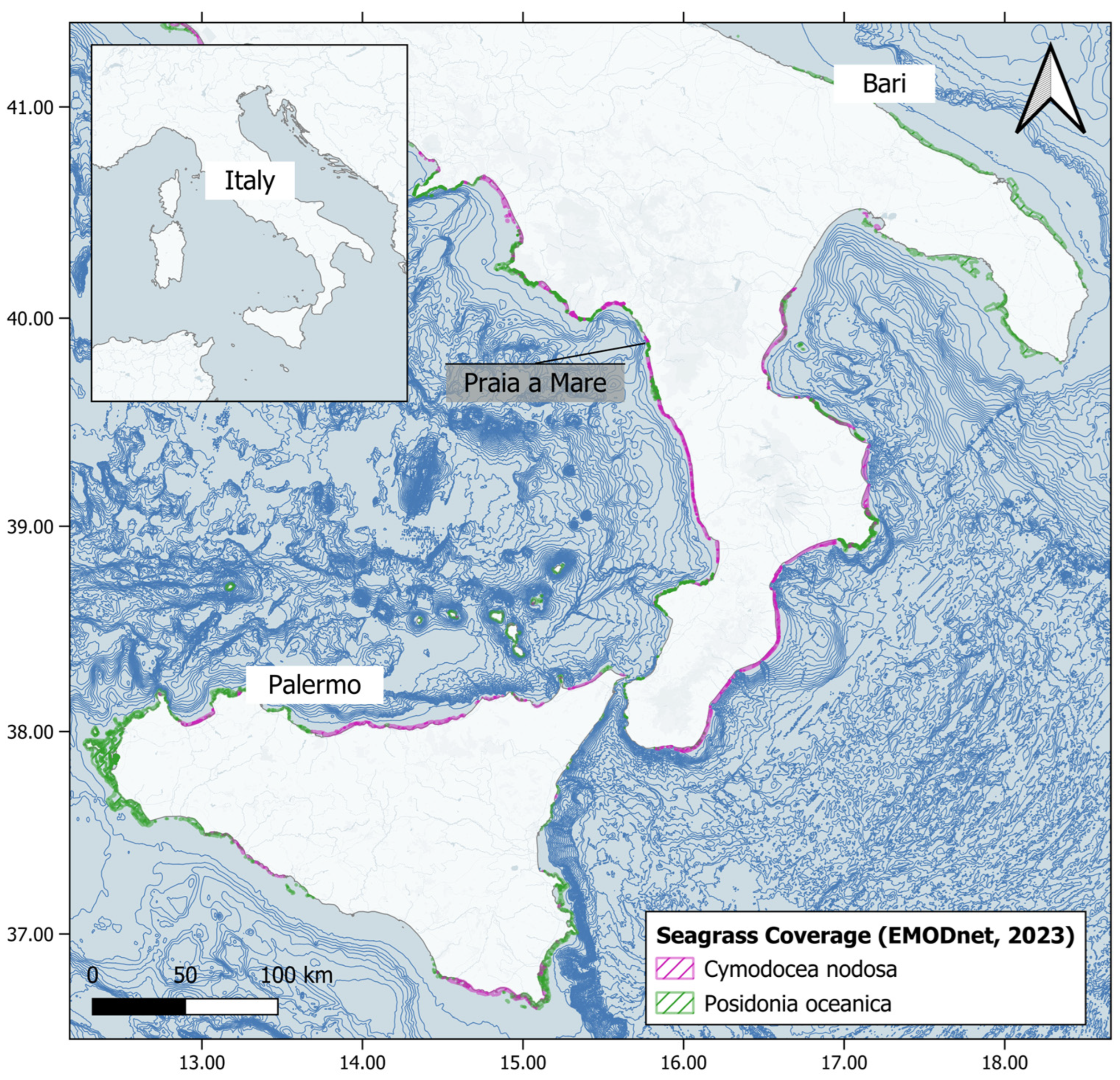
2.1. Study Area
2.2. UAV Platform and Sensor
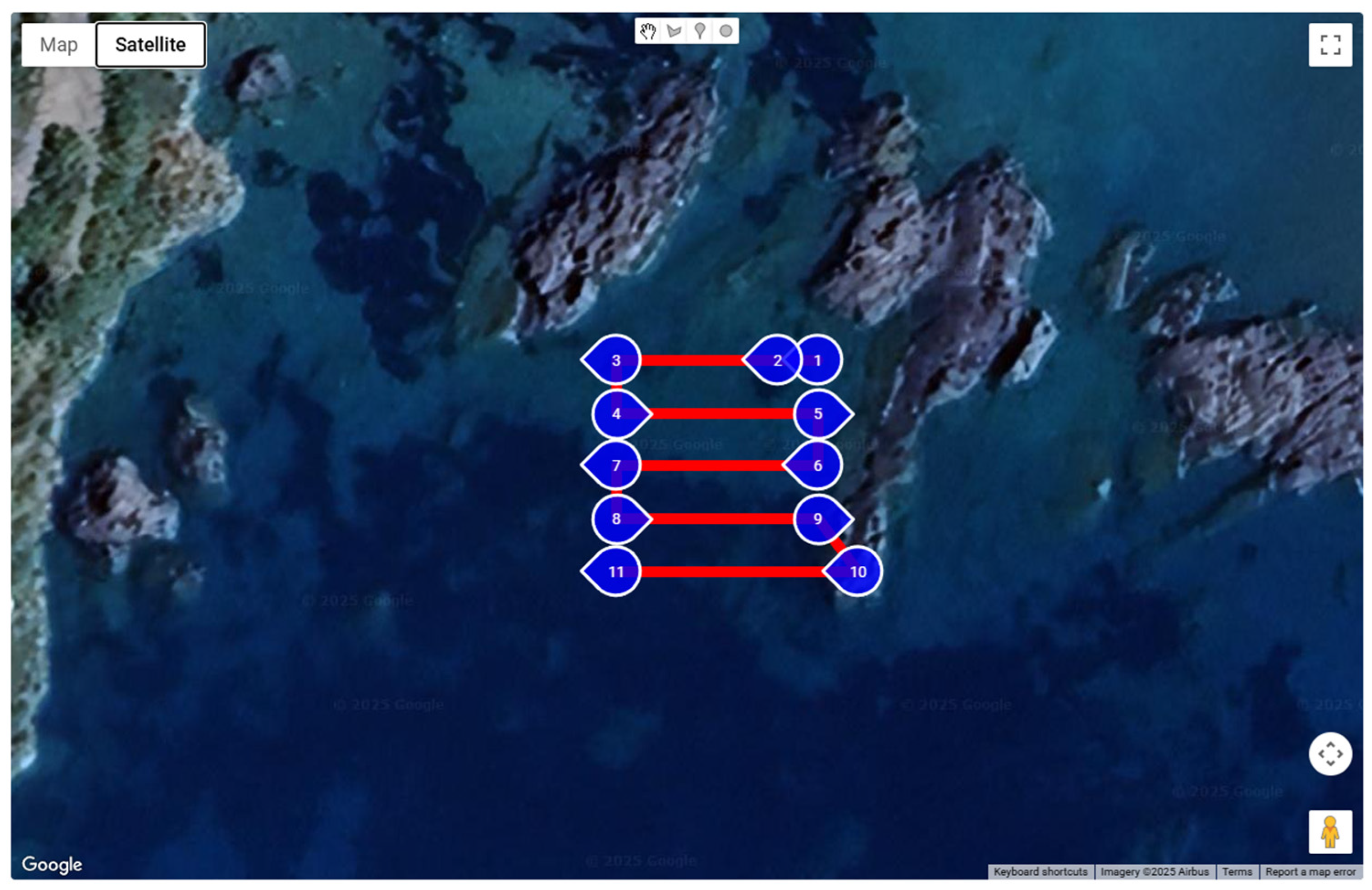
2.3. Flight Planning
2.4. Ground Control Points and Ground-Truth Survey
2.5. Photogrammetric Processing and Orthophoto Reconstruction
3. Results
3.1. Flight Planning and Executing
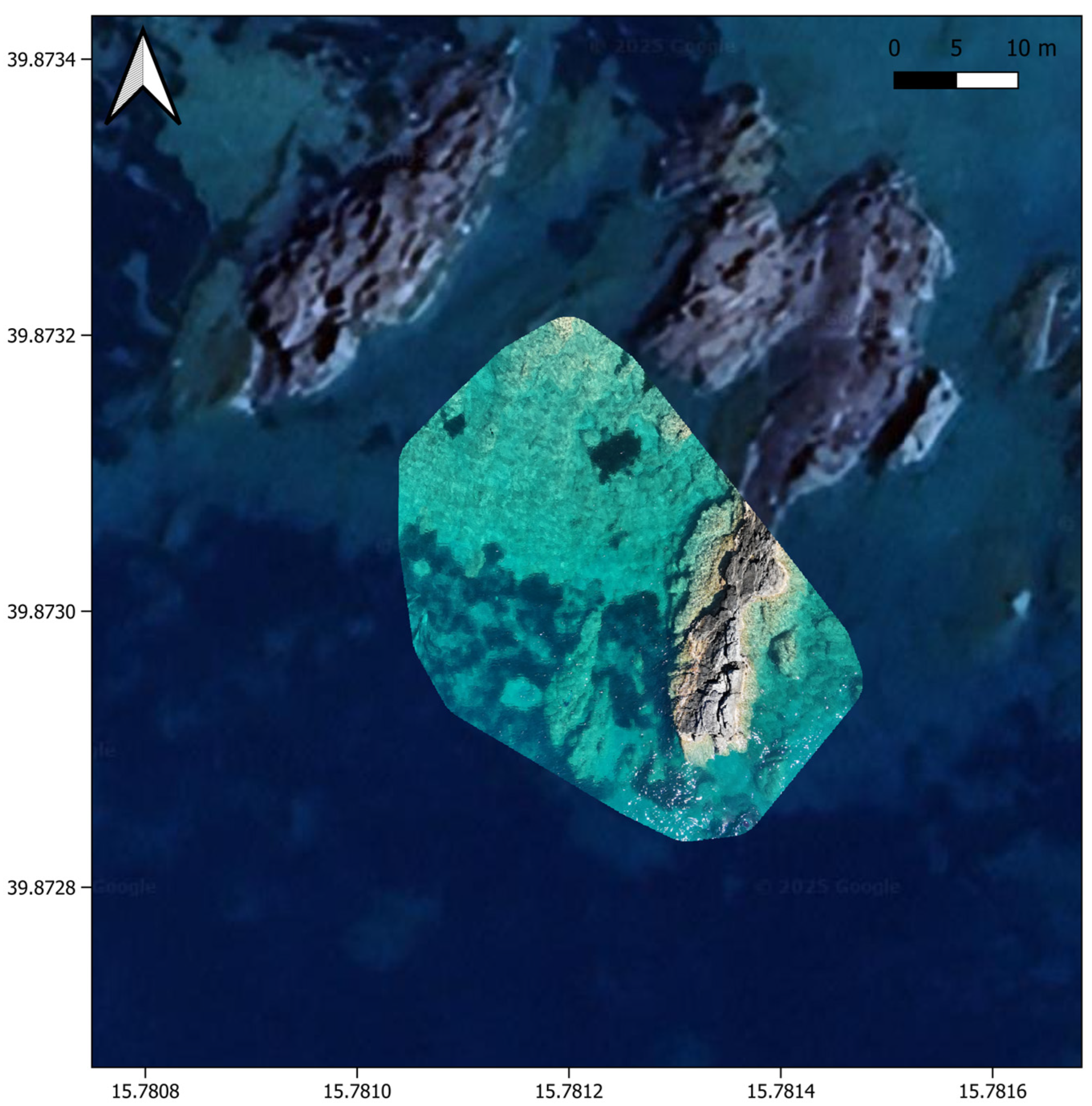
3.2. Photogrammetric Processing
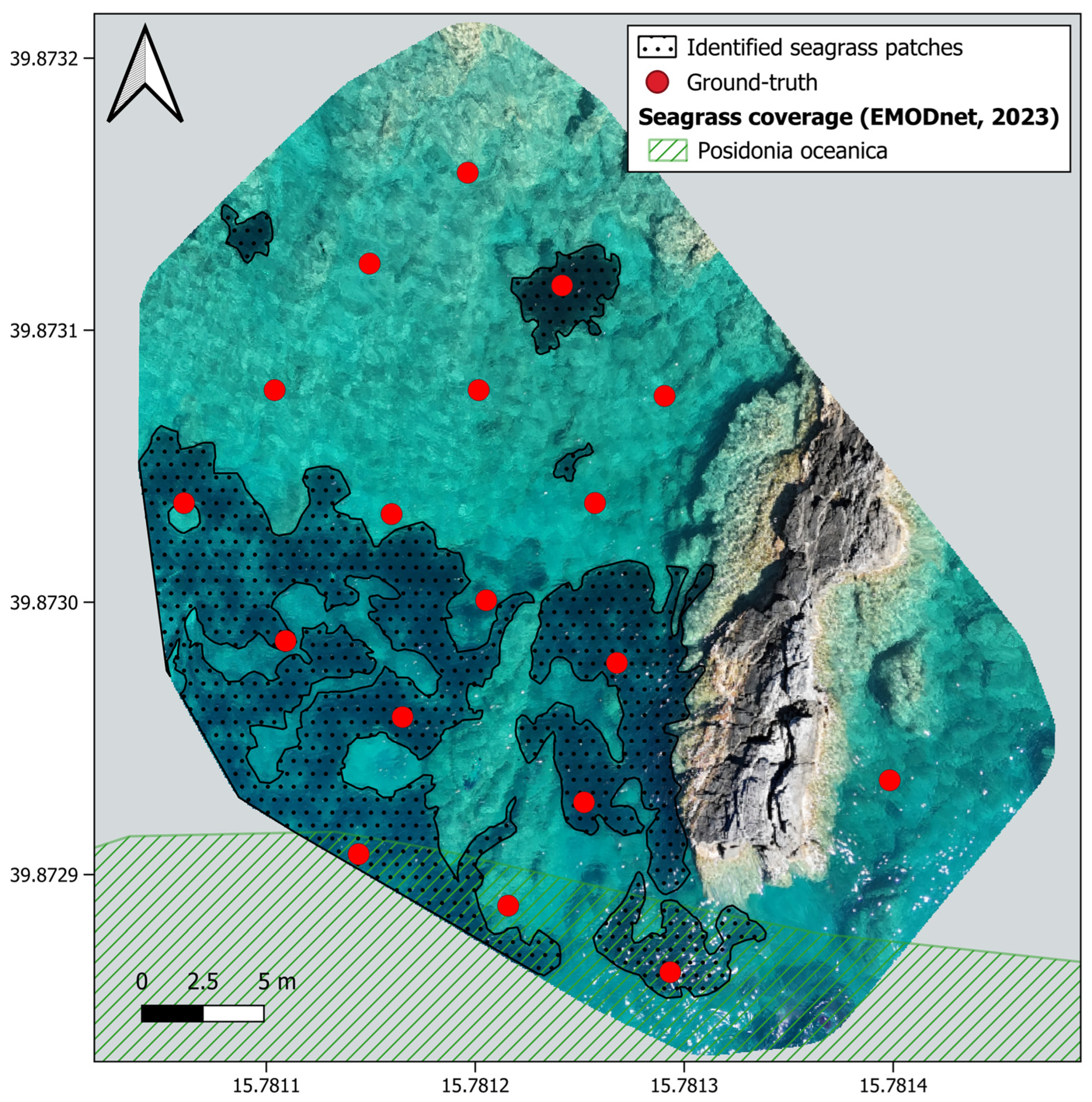
3.3. Seagrass Patches Identification and Analysis
4. Discussion
4.1. Integrated Workflow for Reproducible Seagrass Mapping
- Defining a polygon representing the extent of the target seagrass meadow, including the planned position of the GCPs.
- Setting flight altitude to 45 m above ground level to balance resolution with flight time, speed to 2.5 m/s, and gimbal angle to −90°.
- Generate mission flight.
- Exporting the waypoint file and uploading it to the UAV controller.
- Uploading the image dataset (JPEG format) into a new WebODM project.
- Applying the default “High Resolution” processing preset.
- Activating the “Fast Orthophoto” option to optimize mosaic blending.
- Running the reconstruction using CPU-only computation on a mid-range laptop.
- Exporting the final orthomosaic as a GeoTIFF file for use in GIS.
4.2. Limitations and Considerations
- -
- Dynamic software landscape: The tools assessed in this study were evaluated based on availability and functionality as of July 2025. Software availability, feature sets, pricing models, and drone compatibility may change at any time. Therefore, replicability of this exact workflow in the future may require adjustments and updated tool reviews.
- -
- Open-source installation: Software like WebODM, while cost-free and highly customizable, often needs manual installation and configuration, requiring a certain level of technical proficiency to operate. This can be a barrier for users without technical expertise.
- -
- Hardware limitations: The study employed a sub-250g UAV (DJI Mini 4 Pro), which, while beneficial from a cost perspective, is more sensitive to environmental conditions such as wind gusts, precipitation, and low-light scenarios. Small drones are less stable in strong winds and may be unable to complete planned missions in adverse weather, potentially affecting data consistency and operational feasibility.
- -
- Sensor limitations: The study was conducted using a standard RGB camera, providing information limited to the visible spectrum, which, although adequate under optimal water clarity, does not explicitly discriminate based on narrow spectral bands that could be used for detailed seagrass health assessments. Compared to commonly used satellite sensors for seagrass monitoring (e.g., Sentinel-2 or Landsat 8 OLI), which include multiple visible and near-infrared bands, UAV RGB sensors offer reduced spectral sensitivity but substantially finer spatial resolution.
- -
- Environmental variability: Water clarity, sunlight angle, and sea surface reflection all can affect image quality. While low-cost UAV platforms may exhibit greater sensitivity to environmental conditions compared to professional systems, careful flight planning, high image redundancy, and GCP deployment can substantially mitigate associated uncertainties, although such control is not always feasible in long-term monitoring efforts.
- -
- Manual image interpretation: Visual digitization of seagrass patches can introduce subjectivity and inconsistencies. Automation using AI or supervised classification was beyond the scope of this study but should be pursued in future work to improve efficiency and repeatability.
- -
- Regulatory constraints: UAV operations are subject to national and regional regulations, which vary across countries and protected areas. Even sub-250g platforms may face restrictions, which can limit the broader implementation and adoption of the workflow despite its technical feasibility and cost-effectiveness.
5. Conclusions
Author Contributions
Funding
Data Availability Statement
Conflicts of Interest
References
- Unsworth, R.K.F.; Cullen-Unsworth, L.C. Seagrass Meadows. Curr. Biol. 2017, 27, R443–R445. [Google Scholar] [CrossRef]
- Hemminga, M.A.; Duarte, C.M. Seagrass Ecology; Cambridge University Press: Cambridge, UK, 2000. [Google Scholar]
- Waycott, M.; Duarte, C.M.; Carruthers, T.J.B.; Orth, R.J.; Dennison, W.C.; Olyarnik, S.; Calladine, A.; Fourqurean, J.W.; Heck, K.L.; Hughes, A.R.; et al. Accelerating Loss of Seagrasses across the Globe Threatens Coastal Ecosystems. Proc. Natl. Acad. Sci. USA 2009, 106, 12377–12381. [Google Scholar] [CrossRef] [PubMed]
- Duffy, J. Biodiversity and the Functioning of Seagrass Ecosystems. Mar. Ecol. Prog. Ser. 2006, 311, 233–250. [Google Scholar] [CrossRef]
- Unsworth, R.K.F.; Nordlund, L.M.; Cullen-Unsworth, L.C. Seagrass Meadows Support Global Fisheries Production. Conserv. Lett. 2018, 12, e12566. [Google Scholar] [CrossRef]
- Potouroglou, M.; Bull, J.C.; Krauss, K.W.; Kennedy, H.A.; Fusi, M.; Daffonchio, D.; Mangora, M.M.; Githaiga, M.N.; Diele, K.; Huxham, M. Measuring the Role of Seagrasses in Regulating Sediment Surface Elevation. Sci. Rep. 2017, 7, 11917. [Google Scholar] [CrossRef]
- United Nations Enironment Programme World Conservation Monitoring Centre (UNEP-WCMC); Short, F.T. Global Distribution of Seagrasses; Version 6.0; Sixth Update to the Data Layer Used in Green Short; UNEP-WCMC: Cambridge, UK, 2003. [Google Scholar]
- Orth, R.J.; Carruthers, T.J.B.; Dennison, W.C.; Duarte, C.M.; Fourqurean, J.W.; Heck, K.L.; Hughes, A.R.; Kendrick, G.A.; Kenworthy, W.J.; Olyarnik, S.; et al. A Global Crisis for Seagrass Ecosystems. BioScience 2006, 56, 987–996. [Google Scholar] [CrossRef]
- IPBES. The Global Assessment Report on Biodiversity and Ecosystem Services; IPBES: Bonn, Germany, 2019. [Google Scholar]
- Short, F.T.; Polidoro, B.; Livingstone, S.R.; Carpenter, K.E.; Bandeira, S.; Bujang, J.S.; Calumpong, H.P.; Carruthers, T.J.B.; Coles, R.G.; Dennison, W.C.; et al. Extinction Risk Assessment of the World’s Seagrass Species. Biol. Conserv. 2011, 144, 1961–1971. [Google Scholar] [CrossRef]
- Barry, S.C.; Raskin, K.N.; Hazell, J.E.; Morera, M.C.; Monaghan, P.F. Evaluation of Interventions Focused on Reducing Propeller Scarring by Recreational Boaters in Florida, USA. Ocean Coast. Manag. 2020, 186, 105089. [Google Scholar] [CrossRef]
- Simpson, J.; Davies, K.P.; Barber, P.; Bruce, E. Mapping Fine-Scale Seagrass Disturbance Using Bi-Temporal UAV-Acquired Images and Multivariate Alteration Detection. Sci. Rep. 2024, 14, 19083. [Google Scholar] [CrossRef]
- Aoki, L.R.; Yang, B.; Graham, O.J.; Gomes, C.; Rappazzo, B.; Hawthorne, T.L.; Duffy, J.E.; Harvell, D. UAV High-Resolution Imaging and Disease Surveys Combine to Quantify Climate-Related Decline in Seagrass Meadows. Oceanography 2023, 36, 38–39. [Google Scholar] [CrossRef]
- Short, F.T.; Coles, R.G.; Short, C.A. Global Seagrass Research Methods; Elsevier Science B.V.: Amsterdam, The Netherlands, 2001. [Google Scholar]
- Topouzelis, K.; Makri, D.; Stoupas, N.; Papakonstantinou, A.; Katsanevakis, S. Seagrass Mapping in Greek Territorial Waters Using Landsat-8 Satellite Images. Int. J. Appl. Earth Obs. Geoinf. 2018, 67, 98–113. [Google Scholar] [CrossRef]
- Roelfsema, C.; Kovacs, E.M.; Saunders, M.I.; Phinn, S.; Lyons, M.; Maxwell, P. Challenges of Remote Sensing for Quantifying Changes in Large Complex Seagrass Environments. Estuar. Coast. Shelf Sci. 2013, 133, 161–171. [Google Scholar] [CrossRef]
- Traganos, D.; Aggarwal, B.; Poursanidis, D.; Topouzelis, K.; Chrysoulakis, N.; Reinartz, P. Towards Global-Scale Seagrass Mapping and Monitoring Using Sentinel-2 on Google Earth Engine: The Case Study of the Aegean and Ionian Seas. Remote Sens. 2018, 10, 1227. [Google Scholar] [CrossRef]
- Anderson, K.; Gaston, K.J. Lightweight Unmanned Aerial Vehicles Will Revolutionize Spatial Ecology. Front. Ecol. Environ. 2013, 11, 138–146. [Google Scholar] [CrossRef]
- Nogueira, P.; Silva, M.; Quelhas, M.; Adão, H. Precision Mapping of Seagrass Habitats Using Multispectral Drones and Machine Learning. Preprints 2024, 2024110297. [Google Scholar] [CrossRef]
- Tucker, C.J. Red and Photographic Infrared Linear Combinations for Monitoring Vegetation. Remote Sens. Environ. 1979, 8, 127–150. [Google Scholar] [CrossRef]
- Kerr, J.T.; Ostrovsky, M. From Space to Species: Ecological Applications for Remote Sensing. Trends Ecol. Evol. 2003, 18, 299–305. [Google Scholar] [CrossRef]
- Colomina, I.; Molina, P. Unmanned Aerial Systems for Photogrammetry and Remote Sensing: A Review. ISPRS J. Photogramm. Remote Sens. 2014, 92, 79–97. [Google Scholar] [CrossRef]
- Elma, E.; Gaulton, R.; Chudley, T.R.; Scott, C.L.; East, H.K.; Westoby, H.; Fitzsimmons, C. Evaluating UAV-Based Multispectral Imagery for Mapping an Intertidal Seagrass Environment. Aquat. Conserv. Mar. Freshw. Ecosyst. 2024, 34, e4230. [Google Scholar] [CrossRef]
- Oiry, S.; Davies, B.F.R.; Sousa, A.I.; Rosa, P.; Zoffoli, M.L.; Brunier, G.; Gernez, P.; Barillé, L. Discriminating Seagrasses from Green Macroalgae in European Intertidal Areas Using High-Resolution Multispectral Drone Imagery. Remote Sens. 2024, 16, 4383. [Google Scholar] [CrossRef]
- Román, A.; Tovar-Sánchez, A.; Olivé, I.; Navarro, G. Using a UAV-Mounted Multispectral Camera for the Monitoring of Marine Macrophytes. Front. Mar. Sci. 2021, 8, 722698. [Google Scholar] [CrossRef]
- Riniatsih, I.; Ambariyanto, A.; Yudiati, E.; Redjeki, S.; Hartati, R. Monitoring the Seagrass Ecosystem Using the Unmanned Aerial Vehicle (UAV) in Coastal Water of Jepara. IOP Conf. Ser. Earth Environ. Sci. 2021, 674, 012075. [Google Scholar] [CrossRef]
- Li, Y.; Gundersen, H.; Poulsen, R.N.; Xie, L.; Ge, Z.; Hancke, K. Quantifying Seaweed and Seagrass Beach Deposits Using High-Resolution UAV Imagery. J. Environ. Manag. 2023, 331, 117171. [Google Scholar] [CrossRef] [PubMed]
- Duffy, J.P.; Pratt, L.; Anderson, K.; Land, P.E.; Shutler, J.D. Spatial Assessment of Intertidal Seagrass Meadows Using Optical Imaging Systems and a Lightweight Drone. Estuar. Coast. Shelf Sci. 2018, 200, 169–180. [Google Scholar] [CrossRef]
- Tahara, S.; Sudo, K.; Yamakita, T.; Nakaoka, M. Species Level Mapping of a Seagrass Bed Using an Unmanned Aerial Vehicle and Deep Learning Technique. PeerJ 2022, 10, e14017. [Google Scholar] [CrossRef]
- James, D.; Collin, A.; Houet, T.; Mury, A.; Gloria, H.; Poulain, N.L. Towards Better Mapping of Seagrass Meadows Using UAV Multispectral and Topographic Data. J. Coast. Res. 2020, 95, 1117–1121. [Google Scholar] [CrossRef]
- Karang, I.W.G.A.; Pravitha, N.L.P.R.; Nuarsa, I.W.; Basheer Ahammed, K.K.; Wicaksono, P. High-Resolution Seagrass Species Mapping and Propeller Scars Detection in Tanjung Benoa, Bali through UAV Imagery. J. Ecol. Eng. 2024, 25, 161–174. [Google Scholar] [CrossRef]
- Yang, B.; Hawthorne, T.L.; Hessing-Lewis, M.; Duffy, E.J.; Reshitnyk, L.Y.; Feinman, M.; Searson, H. Developing an Introductory UAV/Drone Mapping Training Program for Seagrass Monitoring and Research. Drones 2020, 4, 70. [Google Scholar] [CrossRef]
- Wilkinson, M.D.; Dumontier, M.; Aalbersberg, I.J.; Appleton, G.; Axton, M.; Baak, A.; Blomberg, N.; Boiten, J.-W.; da Silva Santos, L.B.; Bourne, P.E.; et al. The FAIR Guiding Principles for Scientific Data Management and Stewardship. Sci. Data 2016, 3, 160018. [Google Scholar] [CrossRef]
- EMODnet Seabed Habitats Product. Contains Data from the Global Distribution of Seagrasses (v7.1 March 2021). UNEP-WCMC, Short FT (2021). Global Distribution of Seagrasses (Version 7.1). Seventh Update to the Data Layer Used in Green and Short (2003); UN Environment World Conservation Monitoring Centre: Cambridge, UK, 2023. [Google Scholar] [CrossRef]
- Sullivan, E.; Papagiannopoulos, N.; Clewley, D.; Groom, S.; Raitsos, D.E.; Hoteit, I. Mapping Coastal Marine Habitats Using UAV and Multispectral Satellite Imagery in the NEOM Region, Northern Red Sea. Remote Sens. 2025, 17, 485. [Google Scholar] [CrossRef]
- Bergner, J.; Wallin, D.; Yang, S.; Rybczyk, J. Using Drone-Captured Imagery and a Digital Elevation Model to Differentiate Eelgrass Species: Padilla Bay, Washington. J. Coast. Res. 2024, 41, 105–121. [Google Scholar] [CrossRef]



| Tool | Supported Sub-250g Drones | PC Mission Planning | Automatic Mission Creation | Altitude Setting | Overlap Setting | Automatic Flight Height Adjustment | Automatic Mission Installer | Notes | Cost (€) |
|---|---|---|---|---|---|---|---|---|---|
| DJI Fly (Waypoint) | DJI Mini 4 Pro, DJI Mini 3 Pro, DJI Mini 3, DJI Mini 2 SE, DJI Mini 2, DJI Mini SE, DJI Mini 1 | Controller only | - | ✓ | - | - | - | Native waypoint support via DJI RC 2 or compatible controller. No desktop import. | Free |
| Pixpro Waypoints | DJI Mini 4 Pro | Yes | ✓ | ✓ | ✓ | ✓ | - | Not available as a standalone. Included in all Pixpro subscriptions; 14-day free trial available. | €10/month or €60/year (Solo plan) |
| WaypointMap | DJI Mini 4 Pro, DJI Mini 3 Pro, DJI Mini 3, DJI Mini 2, DJI Mini SE, DJI Mini 1 | Yes | ✓ | ✓ | ✓ | ✓ * | ✓ * | Advanced features in the Premium version. | Free (Basic), ~€12/month (Premium) |
| Litchi | DJI Mini 2, DJI Mini SE, DJI Mini 1 | Yes | ✓ | ✓ | ✓ | - | - | Mini 4 Pro is not officially supported. Workarounds via beta apps or mission converters might work but are not guaranteed. | ~€21 one-time |
| Dronelink | DJI Mini 4 Pro, DJI Mini 3 Pro, DJI Mini 2 | Yes | ✓ | ✓ | ✓ | ✓ | - | Mission planning only via web and mobile. | ~€19/month (Starter), ~€38/month (Growth) |
| DJI FlightPlanner | DJI Mini 2, DJI Mini SE, DJI Mini 1 | Yes | ✓ | ✓ | ✓ | - | - | Requires Android device and Litchi Pilot Beta. Mini 4 Pro support is unofficial. | ~€85 one-time |
| Software | Type | Supported OS | Cost (€) | Supported Sub-250g Drones | Key Features | Required Proficiency Level |
|---|---|---|---|---|---|---|
| WebODM | Open Source /Free (basic) + Paid for advanced | Windows, macOS, Linux | Free (self-hosted); paid plans start ~€8/month | Compatible with any drone producing geotagged images | Orthophoto, DSM/DTM, 3D models, point cloud export, multispectral data processing | 4, Open-source, self-hosted, requires basic command-line familiarity and understanding of processing options |
| Pix4Dmapper | Commercial | Windows, macOS | From ~€3500 (perpetual license) or subscription options | DJI Mini 4 Pro, Mini 3 Pro, and other DJI drones with geotagged images | Advanced photogrammetry, orthomosaic, 3D models, point cloud export, multispectral data processing | 3, Professional desktop software, requires understanding of photogrammetric parameters, but no programming |
| Agisoft Metashape | Commercial | Windows, macOS, Linux | Standard edition ~€1790, Professional ~€3490. Free trial available | Compatible with any drone capturing geotagged images | Orthomosaics, point cloud export, 3D models, multispectral processing | 3, Flexible desktop workflow, moderate learning curve, optional scripting |
| Drone Deploy | SaaS (cloud-based) | Web-based | Plans start at ~€90/month | DJI Mini series and many others | Orthomosaic, DSM, 3D models, real-time processing, collaboration features | 1, Fully cloud-based, highly automated workflow, minimal user intervention, no programming skills required |
| Reality Capture | Commercial | Windows | Free for entities earning < ~900 K/year; €1069–€1582/year per seat for others | Compatible with any drone producing geotagged images | Orthomosaic, high-speed processing, laser scan integration, georeferenced outputs | 4, Advanced parameter control, steeper learning curve, benefits from photogrammetric expertise |
| DJI Terra | Commercial | Windows | Various licenses, Agriculture, Pro, etc., from $265 | Compatible with DJI drones | 2D/3D reconstruction, LiDAR processing, real-time mapping, multispectral support, mission planning | 2, Proprietary ecosystem, guided workflows, limited parameter customization |
Disclaimer/Publisher’s Note: The statements, opinions and data contained in all publications are solely those of the individual author(s) and contributor(s) and not of MDPI and/or the editor(s). MDPI and/or the editor(s) disclaim responsibility for any injury to people or property resulting from any ideas, methods, instructions or products referred to in the content. |
© 2026 by the authors. Licensee MDPI, Basel, Switzerland. This article is an open access article distributed under the terms and conditions of the Creative Commons Attribution (CC BY) license.
Share and Cite
Costa, V.; Romeo, T. Low-Cost Technologies for Marine Habitat Monitoring: A Case Study on Seagrass Meadows. J. Mar. Sci. Eng. 2026, 14, 339. https://doi.org/10.3390/jmse14040339
Costa V, Romeo T. Low-Cost Technologies for Marine Habitat Monitoring: A Case Study on Seagrass Meadows. Journal of Marine Science and Engineering. 2026; 14(4):339. https://doi.org/10.3390/jmse14040339
Chicago/Turabian StyleCosta, Valentina, and Teresa Romeo. 2026. "Low-Cost Technologies for Marine Habitat Monitoring: A Case Study on Seagrass Meadows" Journal of Marine Science and Engineering 14, no. 4: 339. https://doi.org/10.3390/jmse14040339
APA StyleCosta, V., & Romeo, T. (2026). Low-Cost Technologies for Marine Habitat Monitoring: A Case Study on Seagrass Meadows. Journal of Marine Science and Engineering, 14(4), 339. https://doi.org/10.3390/jmse14040339