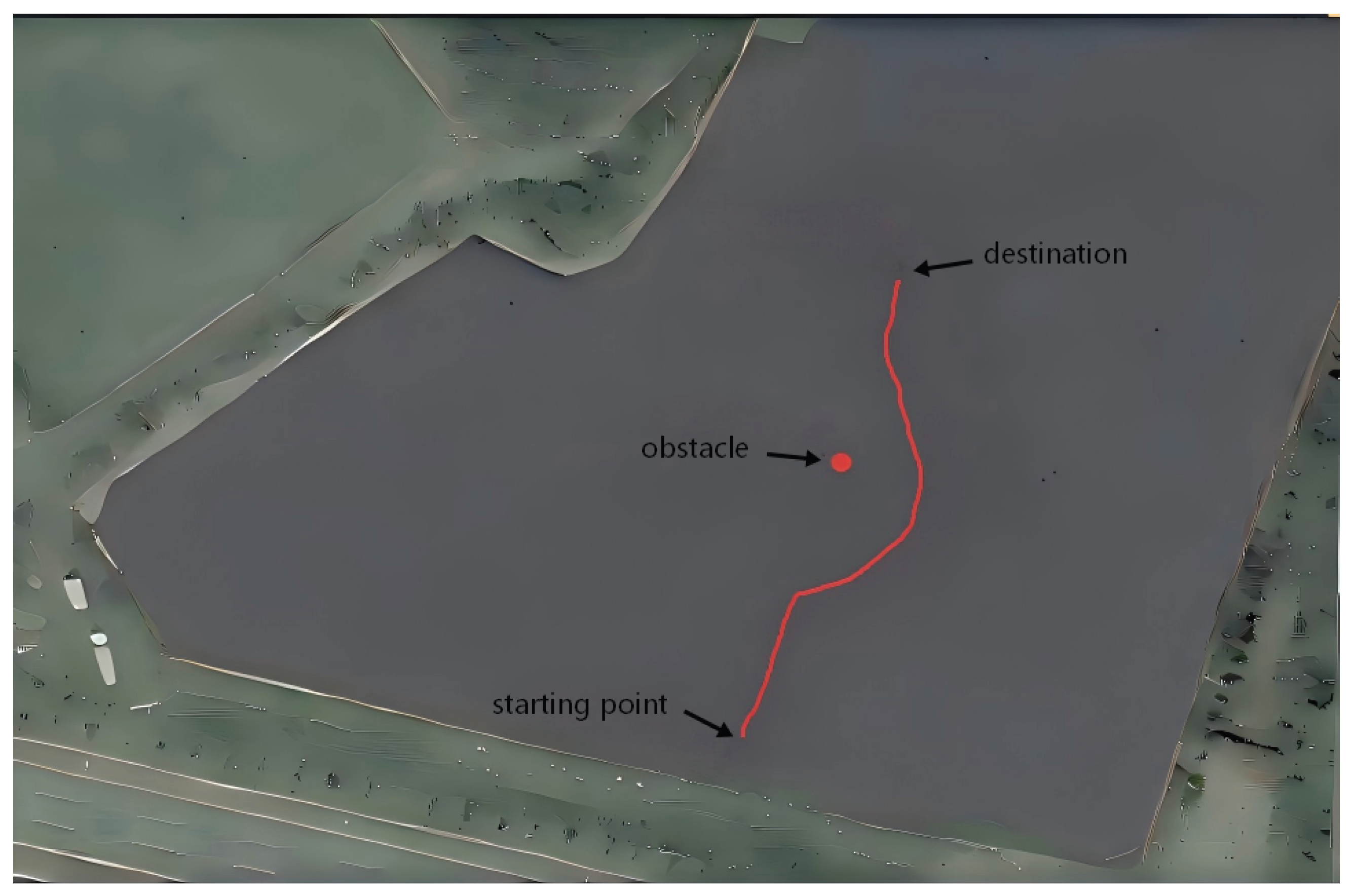
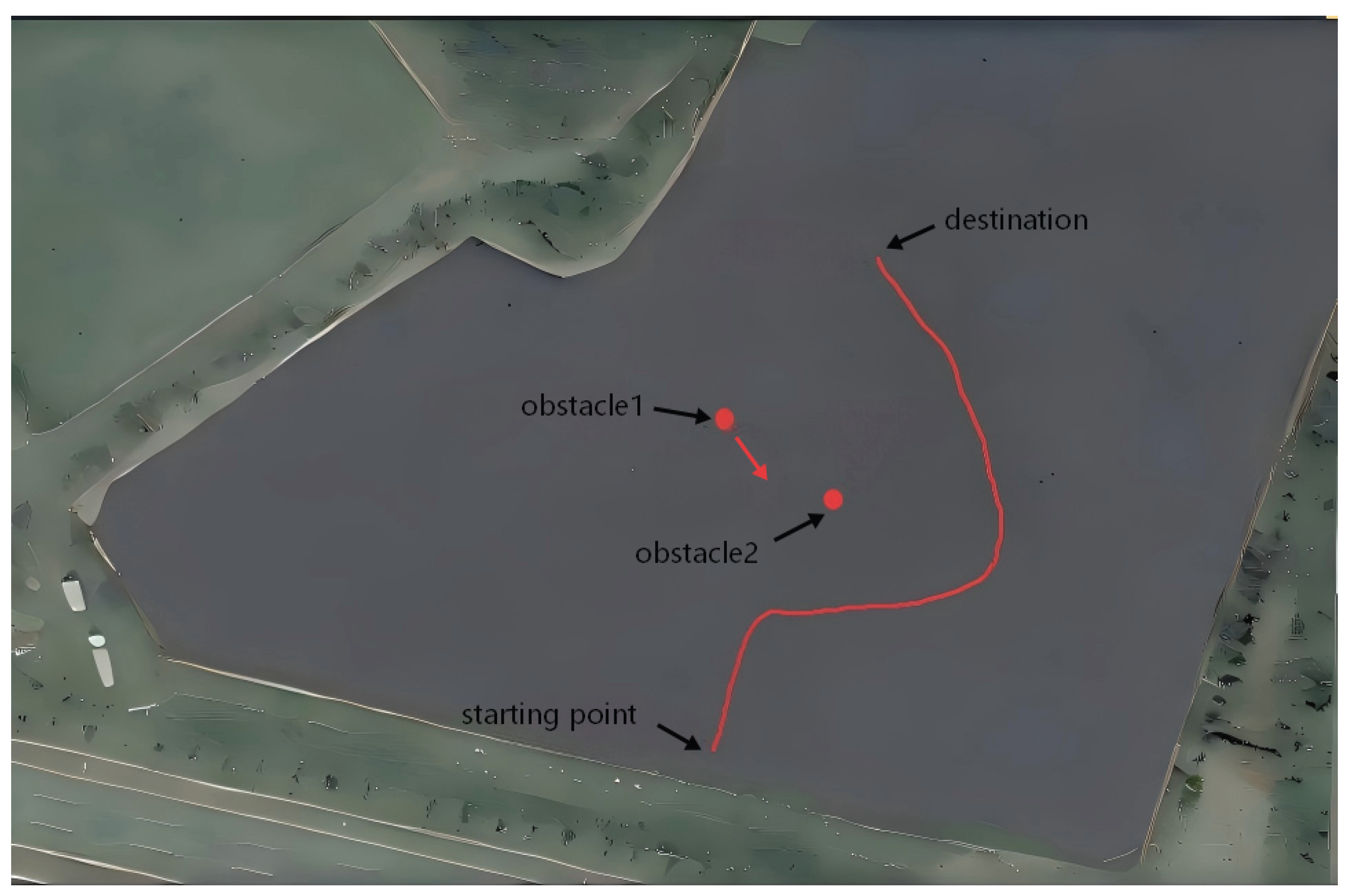
Research on an Obstacle Avoidance System for Unmanned Vessels Based on Millimeter-Wave Radar

Abstract
1. Introduction
2. Overall Design of the Obstacle Avoidance System
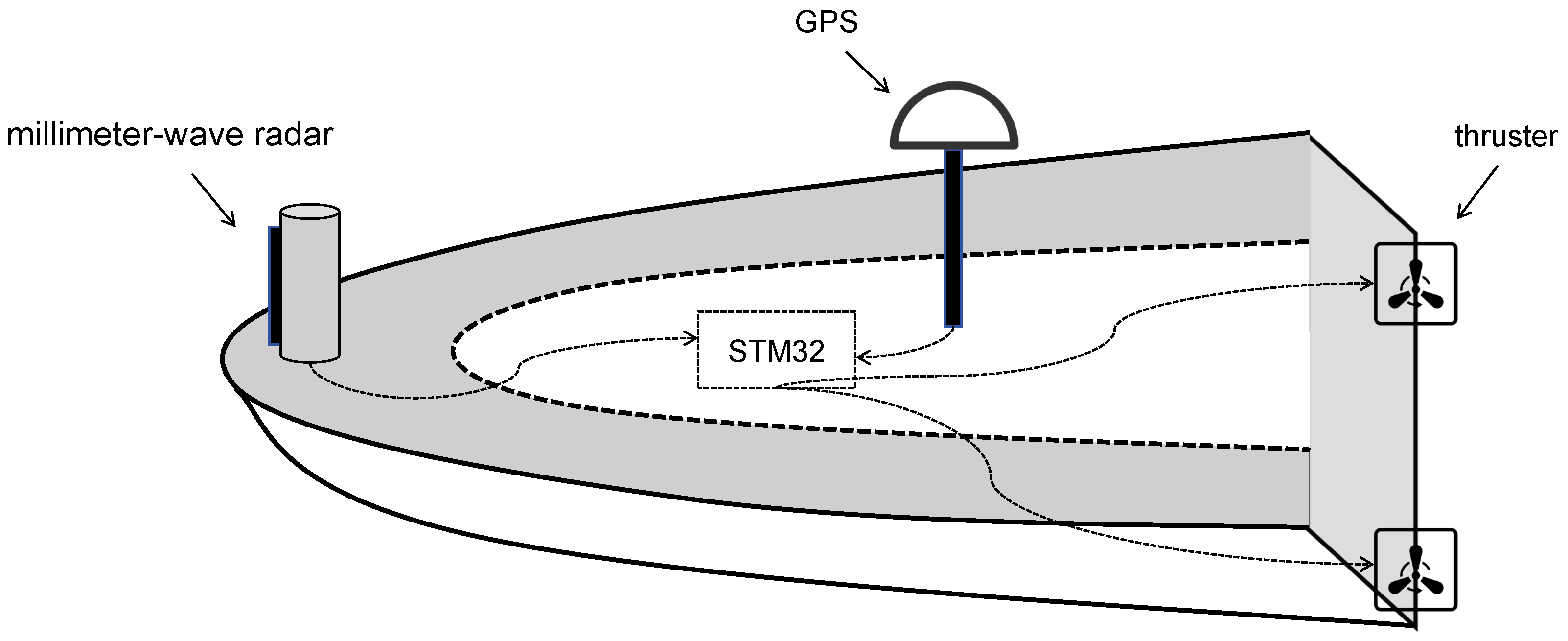
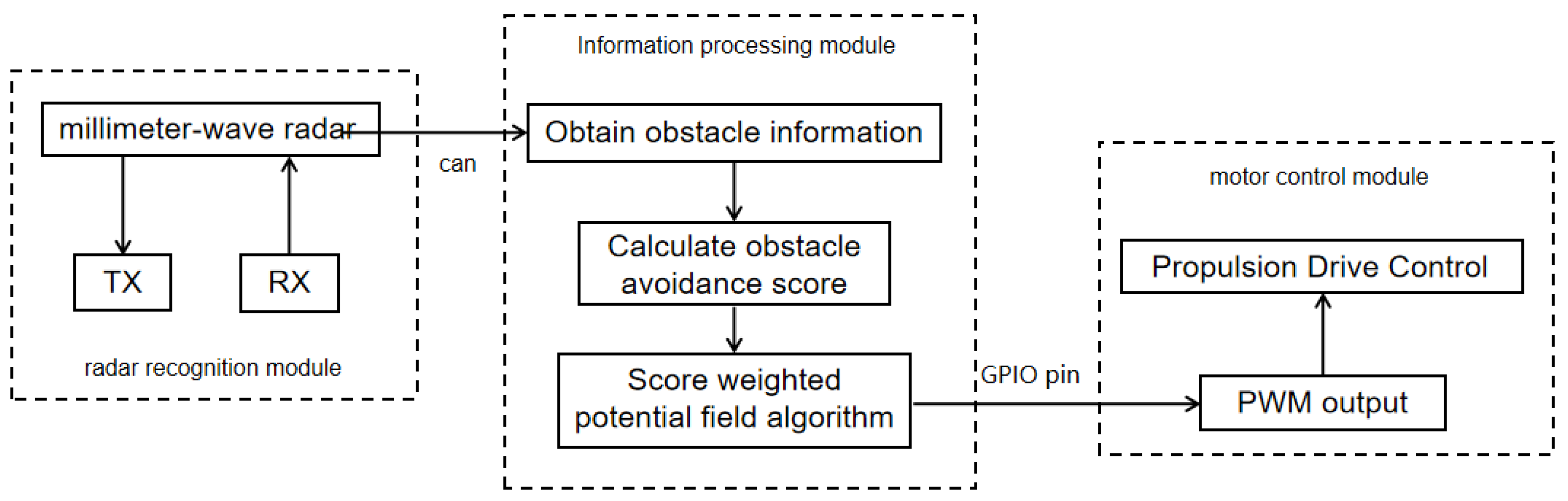
2.1. System Composition
2.2. Improved Artificial Potential Field Method
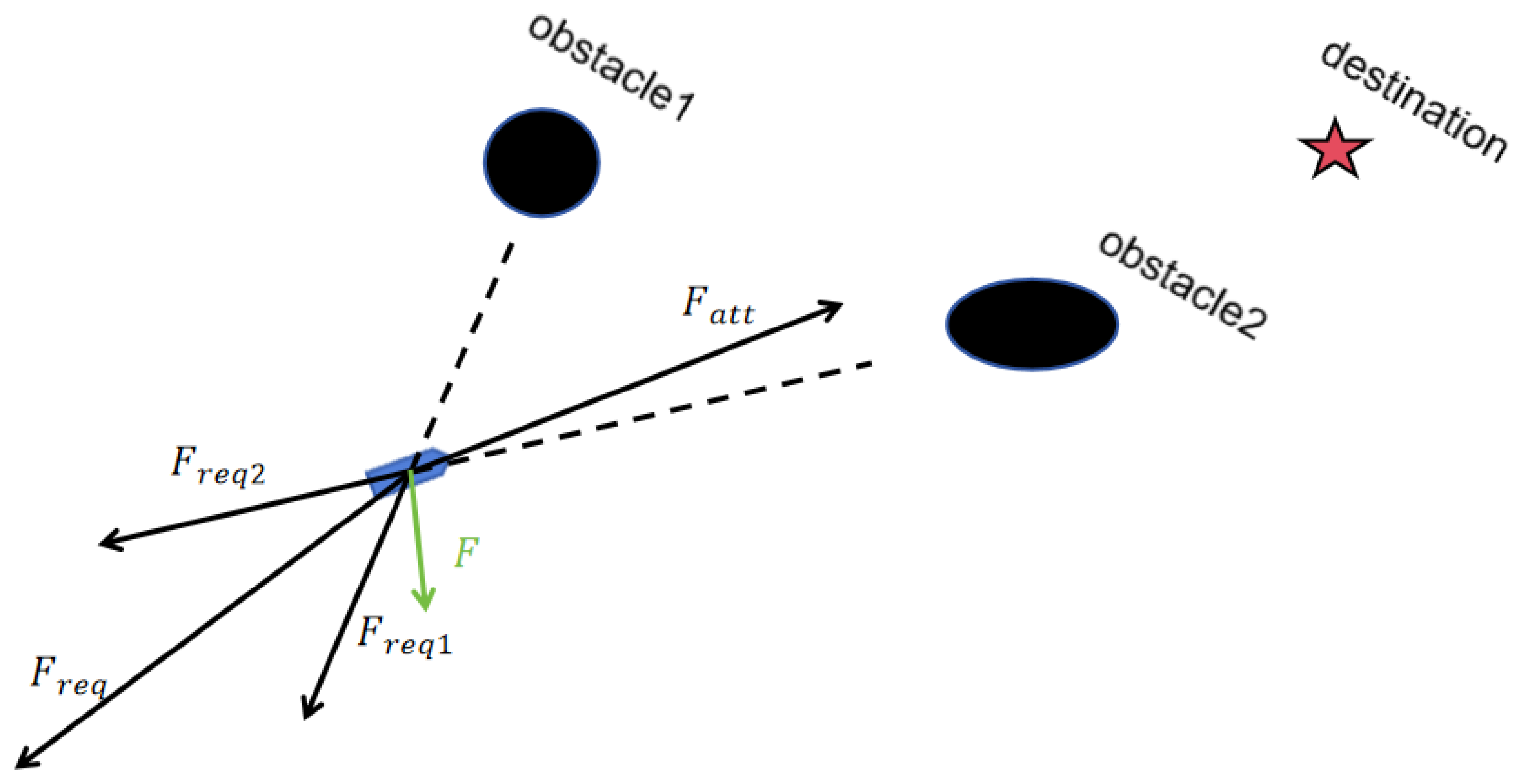
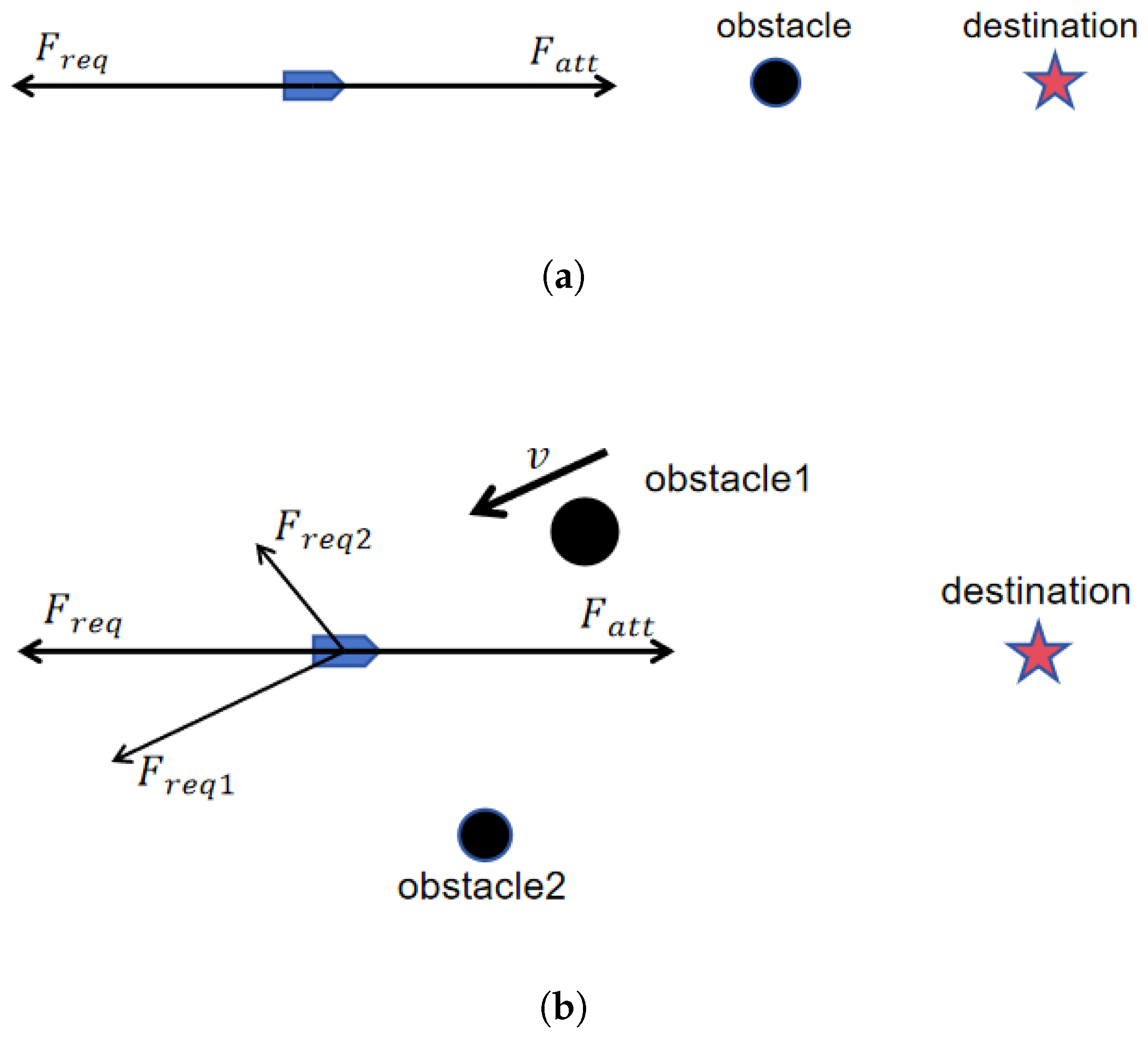
2.2.1. Traditional Artificial Potential Field Method
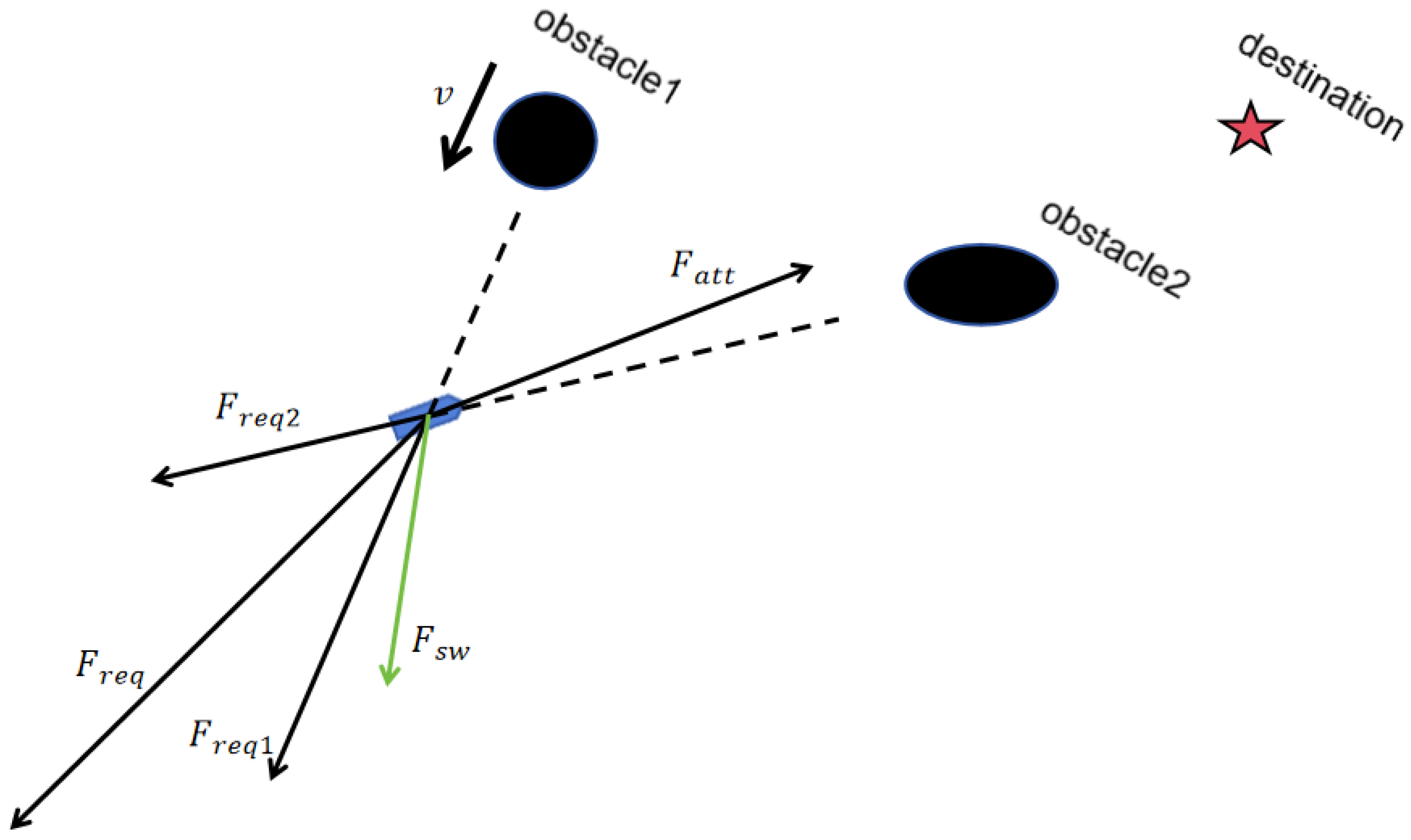
2.2.2. Score-Weighted Potential Field Algorithm
- Calculate the based on distance. Establish an inverse relationship between and d, such that objects closer in distance receive higher scores:
- Calculate the based on motion state. For moving objects whose direction conflicts with the unmanned vessel’s direction, an effective score is calculated. Let its velocity be v; the higher the velocity, the higher the score:where represents the hazardous speed threshold, set at 2 m/s.
- Calculate the based on angle. The closer the angle is to the object directly ahead of the unmanned vessel, the higher the score:
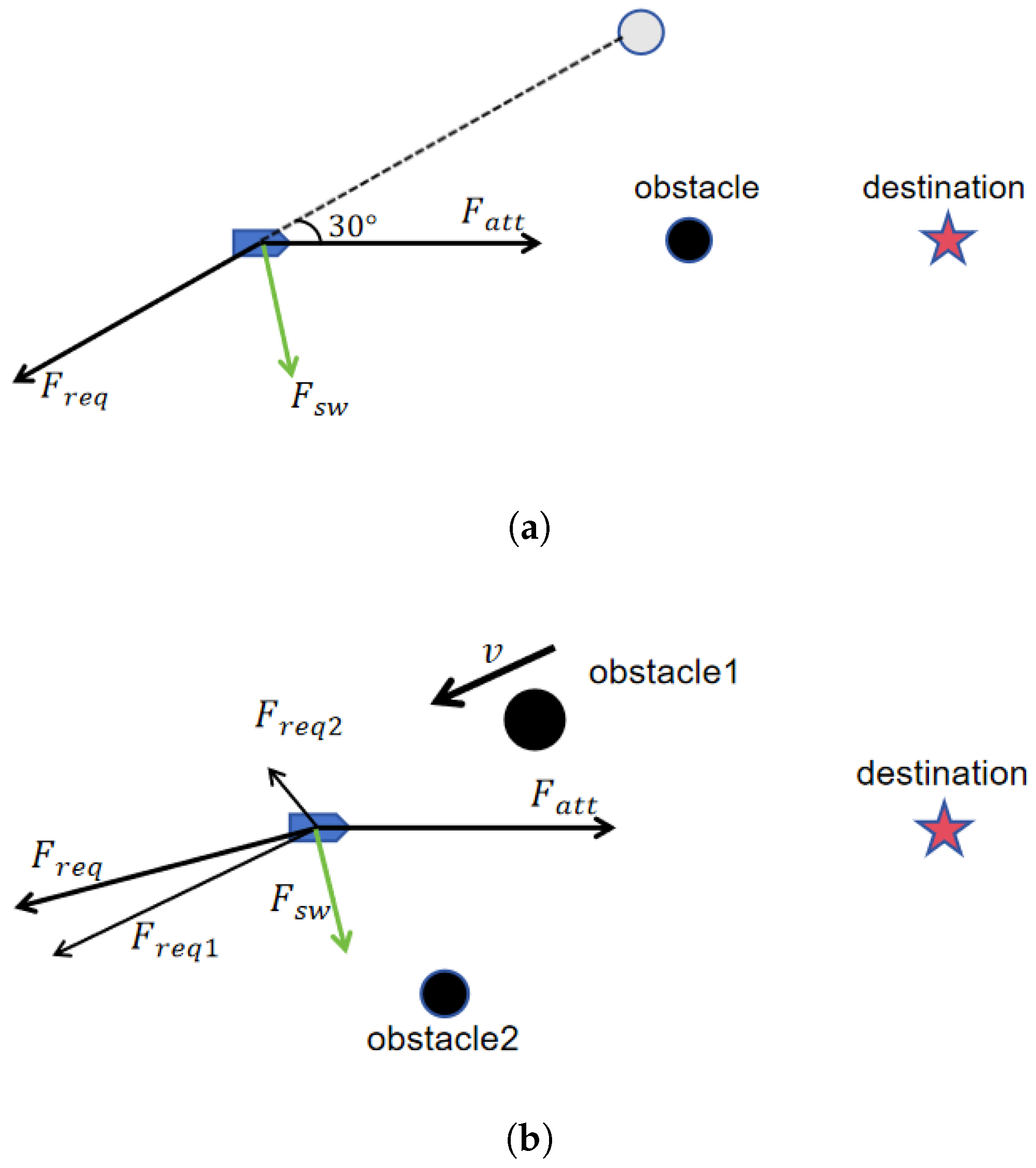
2.2.3. Improvement of Local Equilibrium Point Issues
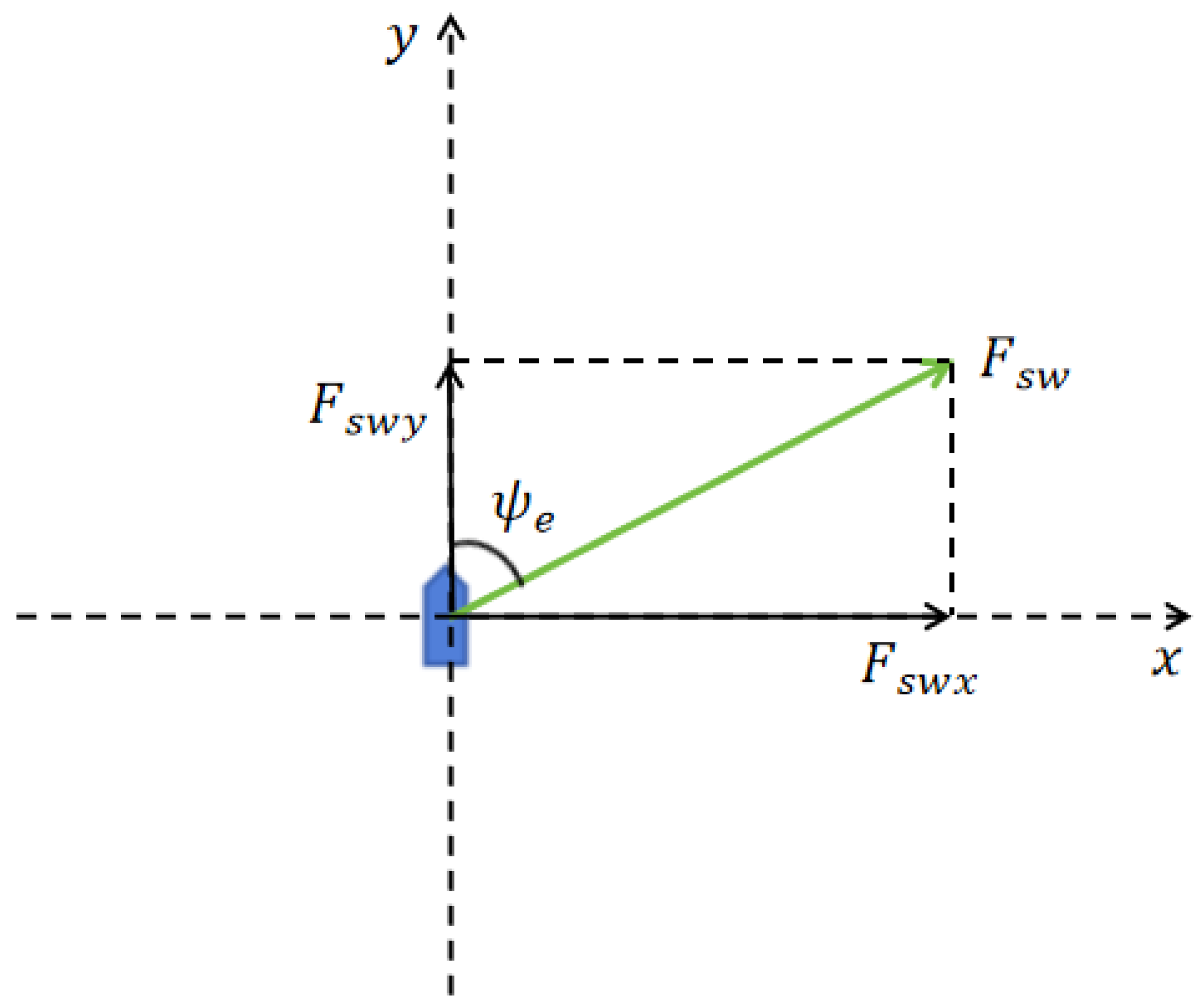
2.2.4. Motion Execution of the Unmanned Vessel
2.3. Selection of Millimeter-Wave Radar
3. Experiments and Results
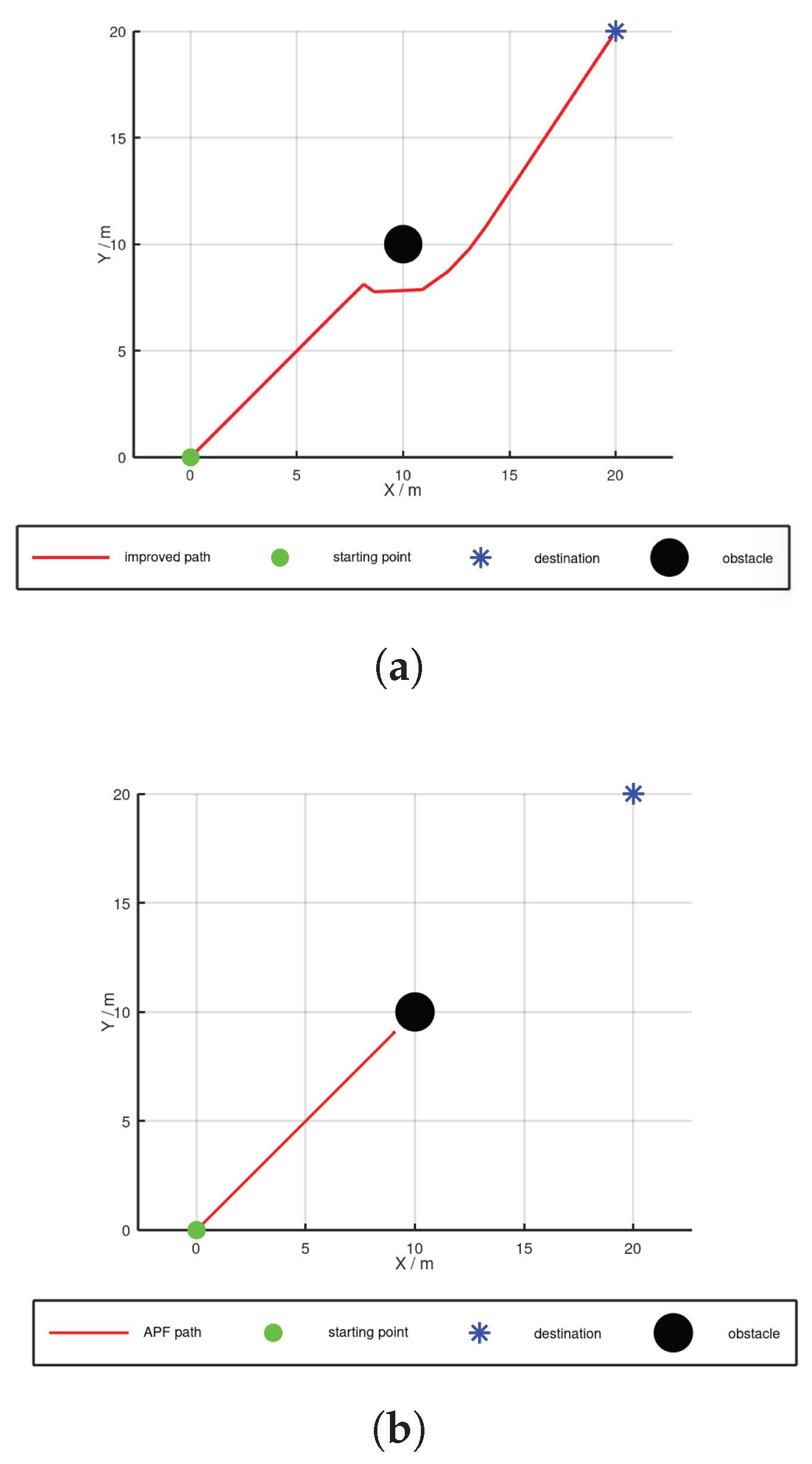
3.1. Simulation and Analysis
3.2. Full-Scale Ship Experiments
3.3. Analysis and Discussion
4. Conclusions
Author Contributions
Funding
Data Availability Statement
Conflicts of Interest
References
- Kale, S. Developments in Unmanned Surface Vehicles (unmanned vessels): A Review. Int. Conf. Appl. Eng. Nat. Sci. 2023, 1, 596–600. [Google Scholar]
- Bowen, X.; Yu, M.; Liu, Z.; Tan, Y.; Sun, Y.; Li, B. A review of path planning for unmanned surface vehicles. J. Mar. Sci. Eng. 2023, 11, 1556. [Google Scholar] [CrossRef]
- Er, M.J.; Ma, C.; Liu, T.; Gong, H. Intelligent Motion Control of Unmanned Surface Vehicles: A Critical Review. Ocean Eng. 2023, 280, 114562. [Google Scholar] [CrossRef]
- Gao, D.; Zhou, P.; Shi, W.; Wang, T.; Wang, Y. A Dynamic Obstacle Avoidance Method for Unmanned Surface Vehicle under COLREGs. J. Mar. Sci. Eng. 2022, 10, 901. [Google Scholar]
- Liu, G.; Zheng, H.; Liu, S.; Shen, B.; Xu, W. Hierarchical Dynamic Trajectory Planning for Autonomous Underwater Vehicles: Algorithms and Experiments. Ocean Eng. 2024, 307, 118221. [Google Scholar] [CrossRef]
- Park, J.-H.; Roh, M.-I.; Lee, H.-W.; Jo, Y.-M.; Ha, J.; Son, N.-S. Multi-Vessel Target Tracking with Camera Fusion for Unmanned Surface Vehicles. Int. J. Nav. Archit. Ocean Eng. 2024, 16, 100608. [Google Scholar]
- Li, Z.; Xi, Q.; Shi, Z.; Wang, Q. Monocular Vision Guidance for Unmanned Surface Vehicle Recovery. Appl. Sci. 2024, 14, 5104. [Google Scholar] [CrossRef]
- Xu, H.; Zhang, X.; He, J.; Yu, Y.; Cheng, Y. Real-Time Volumetric Perception for Unmanned Surface Vehicles Through Fusion of Radar and Camera. IEEE Trans. Instrum. Meas. 2024, 73, 1–12. [Google Scholar] [CrossRef]
- Lyu, Y.; Lin, H.; Wu, J.; Liang, X.; Zhao, C. Robust Radar Inertial Odometry in Dynamic 3D Environments. Drones 2024, 8, 197. [Google Scholar] [CrossRef]
- Dang, X.; Fan, K.; Li, F.; Tang, Y.; Gao, Y.; Wang, Y. Multi-Person Action Recognition Based on Millimeter-Wave Radar Point Cloud. Appl. Sci. 2024, 14, 7253. [Google Scholar]
- Zeng, Z.; Wen, J.; Luo, J.; Ding, G.; Geng, X. Dense 3D Point Cloud Environmental Mapping Using Millimeter-Wave Radar. Sensors 2024, 24, 6569. [Google Scholar] [CrossRef]
- Soumya, A.; Mohan, C.K.; Linga, R.C. Recent Advances in mmWave Radar-Based Sensing, Its Applications, and Machine Learning Techniques: A Review. Sensors 2023, 23, 8901. [Google Scholar] [CrossRef] [PubMed]
- Fan, L.; Wang, J.; Chang, Y.; Li, Y.; Wang, Y.; Cao, D. 4D mmWave Radar for Autonomous Driving Perception: A Comprehensive Survey. IEEE Trans. Intell. Veh. 2024, 9, 4606–4620. [Google Scholar] [CrossRef]
- Kong, H.; Huang, C.; Yu, J.; Shen, X. A Survey of mmWave Radar-Based Sensing in Autonomous Vehicles, Smart Homes and Industry. IEEE Commun. Surv. Tutor. 2025, 27, 463–508. [Google Scholar]
- Xiao, G.; Zheng, G.; Ren, B.; Wang, Y.; Hong, X.; Zhang, Z. A Test Method for Obstacle-Avoidance Performance of Unmanned Surface Vehicles Based on Mobile-Buoy–Shore Multisource-Sensing-Data Fusion. J. Mar. Sci. Eng. 2022, 10, 819. [Google Scholar] [CrossRef]
- Chen, Q.; Yang, J.; Zhao, W.; Tao, L.; Mao, J.; Lu, C. AI-Based Dynamic Avoidance in Deep-Sea Mining. Ocean Eng. 2024, 311, 118945. [Google Scholar]
- Hart, F.; Waltz, M.; Okhrin, O. Two-Step Dynamic Obstacle Avoidance. Knowl.-Based Syst. 2024, 302, 112402. [Google Scholar]
- Farid, G.; Cocuzza, S.; Younas, T.; Razzaqi, A.A.; Wattoo, W.A.; Cannella, F.; Mo, H. Modified A-Star (A*) Approach to Plan the Motion of a Quadrotor UAV in Three-Dimensional Obstacle-Cluttered Environment. Appl. Sci. 2022, 12, 5791. [Google Scholar]
- Meng, T.; Yang, T.; Huang, J.; Jin, W.; Zhang, W.; Jia, Y.; Wan, K.; Xiao, G.; Yang, D.; Zhong, Z. Improved Hybrid A-Star Algorithm for Path Planning in Autonomous Parking System Based on Multi-Stage Dynamic Optimization. Int. J. Automot. Technol. 2023, 24, 459–468. [Google Scholar]
- Wang, Z.; Li, G. Research on Path Planning Algorithm of Driverless Ferry Vehicles Combining Improved A* and DWA. Sensors 2024, 24, 4041. [Google Scholar] [CrossRef]
- Li, J.; Wan, L.; Huang, Z.; Chen, Y.; Tang, H. Hybrid Path Planning Strategy Based on Improved PSO Combined with DWA for Unmanned Surface Vehicles. J. Mar. Sci. Eng. 2024, 12, 1268. [Google Scholar] [CrossRef]
- Gong, X.; Gao, Y.; Wang, F.; Zhu, D.; Zhao, W.; Wang, F.; Liu, Y. A Local Path Planning Algorithm for Robots Based on Improved DWA. Electronics 2024, 13, 2965. [Google Scholar] [CrossRef]
- Kozlov, E.; Muslimov, T. Artificial Potential Field Method for Path and Trajectory Planning of Unmanned Aerial Vehicles: A Review. Unmanned Syst. 2025. prepublish. [Google Scholar] [CrossRef]
- Chang, L.; Shan, L.; Zhang, W.; Jiang, C.; Wang, W.; Dai, Y. A LiDAR and Reasoning-Based Artificial Potential Field for Mobile Robot Navigation in Unknown and Dynamic Environments. Adv. Eng. Inform. 2025, 67, 103519. [Google Scholar] [CrossRef]
- Xing, T.; Wang, X.; Ding, K.; Ni, K.; Zhou, Q. Improved Artificial Potential Field Algorithm Assisted by Multisource Data for AUV Path Planning. Sensors 2023, 23, 6680. [Google Scholar] [CrossRef] [PubMed]
- Li, L.; Wu, W.; Li, Z.; Wang, F. Collision Avoidance Method for Unmanned Ships Using a Modified APF Algorithm. Front. Mar. Sci. 2025, 12, 1550529. [Google Scholar] [CrossRef]
- Li, Y.; Ma, Y.; Cao, J.; Yin, C.; Ma, X. An Obstacle Avoidance Strategy for AUV Based on State-Tracking Collision Detection and Improved Artificial Potential Field. J. Mar. Sci. Eng. 2024, 12, 695. [Google Scholar] [CrossRef]
- Fang, J.; Zhihao, Y.; Mengxue, L.; Han, X.; Weiliang, Z.; Long, W. A New Hybrid Reinforcement Learning with Artificial Potential Field Method for UAV Target Search. Sensors 2025, 25, 2796. [Google Scholar] [CrossRef]
- Zhang, Y.; Liu, K.; Gao, F.; Zhao, F. Research on Path Planning and Path Tracking Control of Autonomous Vehicles Based on Improved APF and SMC. Sensors 2023, 23, 7918. [Google Scholar] [CrossRef]
- Zhai, L.; Liu, C.; Zhang, X.; Wang, C. Local Trajectory Planning for Obstacle Avoidance of Unmanned Tracked Vehicles Based on APF Method. IEEE Access 2024, 12, 19665–19681. [Google Scholar] [CrossRef]
- Liu, L.; Shan, Q.; Xu, Q. USVs Path Planning for Maritime Search and Rescue Based on POS-DQN: Probability of Success-Deep Q-Network. J. Mar. Sci. Eng. 2024, 12, 1158. [Google Scholar] [CrossRef]


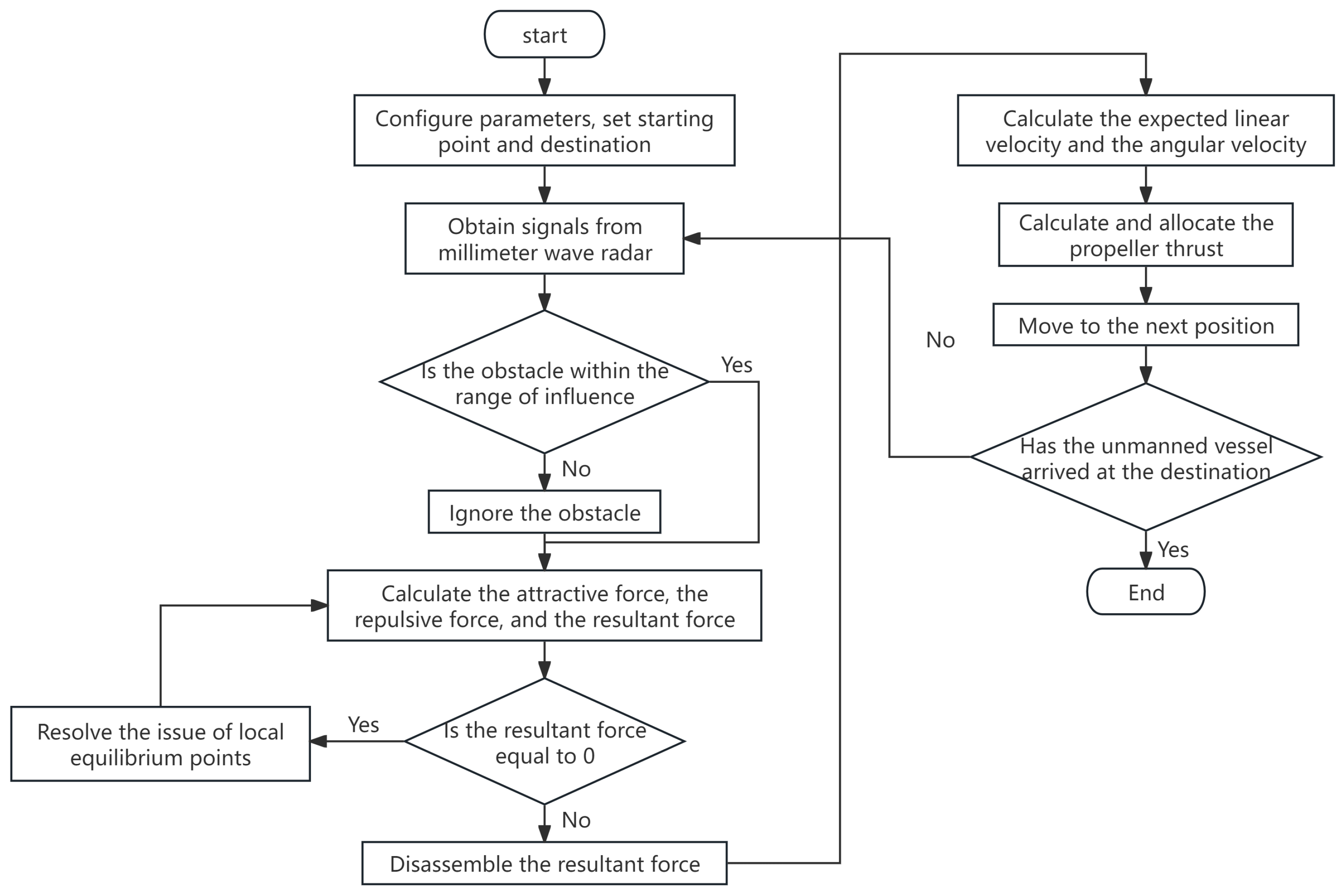


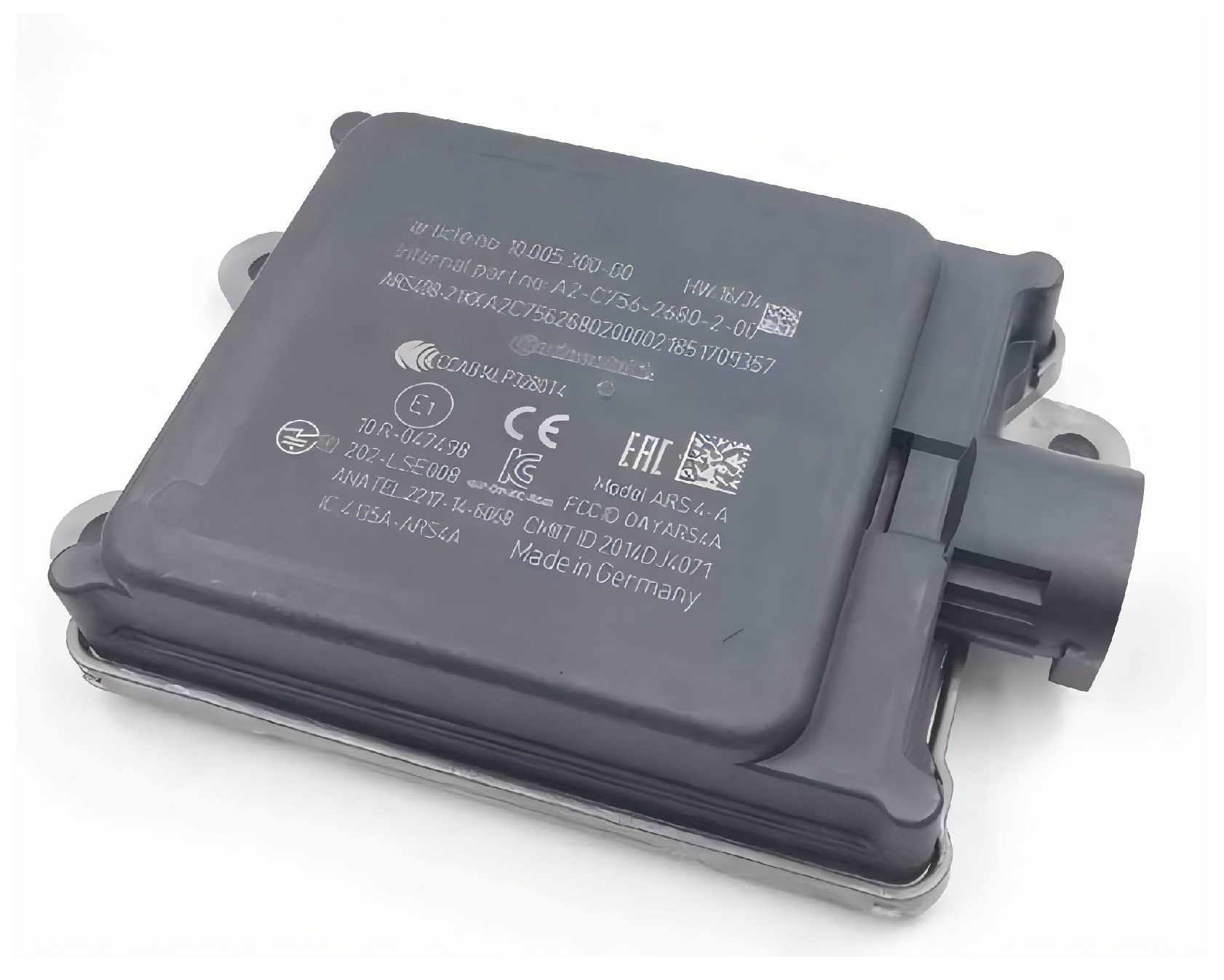






| Parameters | Value |
|---|---|
| 1.0 | |
| 50.0 | |
| 5 m | |
| 0.5 | |
| 0.3 | |
| 0.2 |
| Name | Value | Name | Value |
|---|---|---|---|
| Vessel length | 1.5 m | Vessel width | 0.8 m |
| Displacement | 38 kg | Thruster voltage | 24 V |
| Thruster power | 450 W | Thruster thrust | 7 kg |
| GPS accuracy | 2 m | GPS update frequency | 1 Hz |
| Name | Static Obstacle | Dynamic Obstacle | Local Equilibrium Point (Scenario 1) | Local Equilibrium Point (Scenario 2) |
|---|---|---|---|---|
| Longitude of the starting point (∘) | 119.363755 | 119.363789 | 119.363704 | 119.363698 |
| Latitude of the starting point (∘) | 32.182067 | 32.182107 | 32.182033 | 32.182082 |
| Longitude of the destination (∘) | 119.364129 | 119.364193 | 119.364095 | 119.364125 |
| Latitude of the destination (∘) | 32.182336 | 32.182287 | 32.182319 | 32.182353 |
| Planned (m/s) | 0.7809 | 0.8914 | 0.7523 | 0.9127 |
| Actual (m/s) | 0.7753 | 0.9016 | 0.7595 | 0.9308 |
| Planned (rad/s) | 0.7159 | 1.4464 | 0.6107 | 1.5374 |
| Actual (m/s) | 0.7337 | 1.4711 | 0.6081 | 1.5507 |
Disclaimer/Publisher’s Note: The statements, opinions and data contained in all publications are solely those of the individual author(s) and contributor(s) and not of MDPI and/or the editor(s). MDPI and/or the editor(s) disclaim responsibility for any injury to people or property resulting from any ideas, methods, instructions or products referred to in the content. |
© 2026 by the authors. Licensee MDPI, Basel, Switzerland. This article is an open access article distributed under the terms and conditions of the Creative Commons Attribution (CC BY) license.
Share and Cite
Shi, P.; Yang, X.; Wu, C.; Cheng, H. Research on an Obstacle Avoidance System for Unmanned Vessels Based on Millimeter-Wave Radar. J. Mar. Sci. Eng. 2026, 14, 306. https://doi.org/10.3390/jmse14030306
Shi P, Yang X, Wu C, Cheng H. Research on an Obstacle Avoidance System for Unmanned Vessels Based on Millimeter-Wave Radar. Journal of Marine Science and Engineering. 2026; 14(3):306. https://doi.org/10.3390/jmse14030306
Chicago/Turabian StyleShi, Peixiang, Xinglin Yang, Chentao Wu, and Huan Cheng. 2026. "Research on an Obstacle Avoidance System for Unmanned Vessels Based on Millimeter-Wave Radar" Journal of Marine Science and Engineering 14, no. 3: 306. https://doi.org/10.3390/jmse14030306
APA StyleShi, P., Yang, X., Wu, C., & Cheng, H. (2026). Research on an Obstacle Avoidance System for Unmanned Vessels Based on Millimeter-Wave Radar. Journal of Marine Science and Engineering, 14(3), 306. https://doi.org/10.3390/jmse14030306