Intelligent Fault-Tolerant Control for Wave Compensation Systems Considering Unmodeled Dynamics and Dead-Zone



Abstract
1. Introduction
- Compared with existing methods, the proposed approach fully considers real physical characteristics such as hydraulic system dead zones, faults, and system model uncertainties, effectively enhancing the method’s generalizability in practical applications.
- The proposed method does not require an accurate model of the controlled object. It adaptively learns the unmodeled dynamics of the controlled object through data-driven approaches, ensuring stable tracking within finite time under unknown model conditions and demonstrating strong robustness to parameter uncertainties.
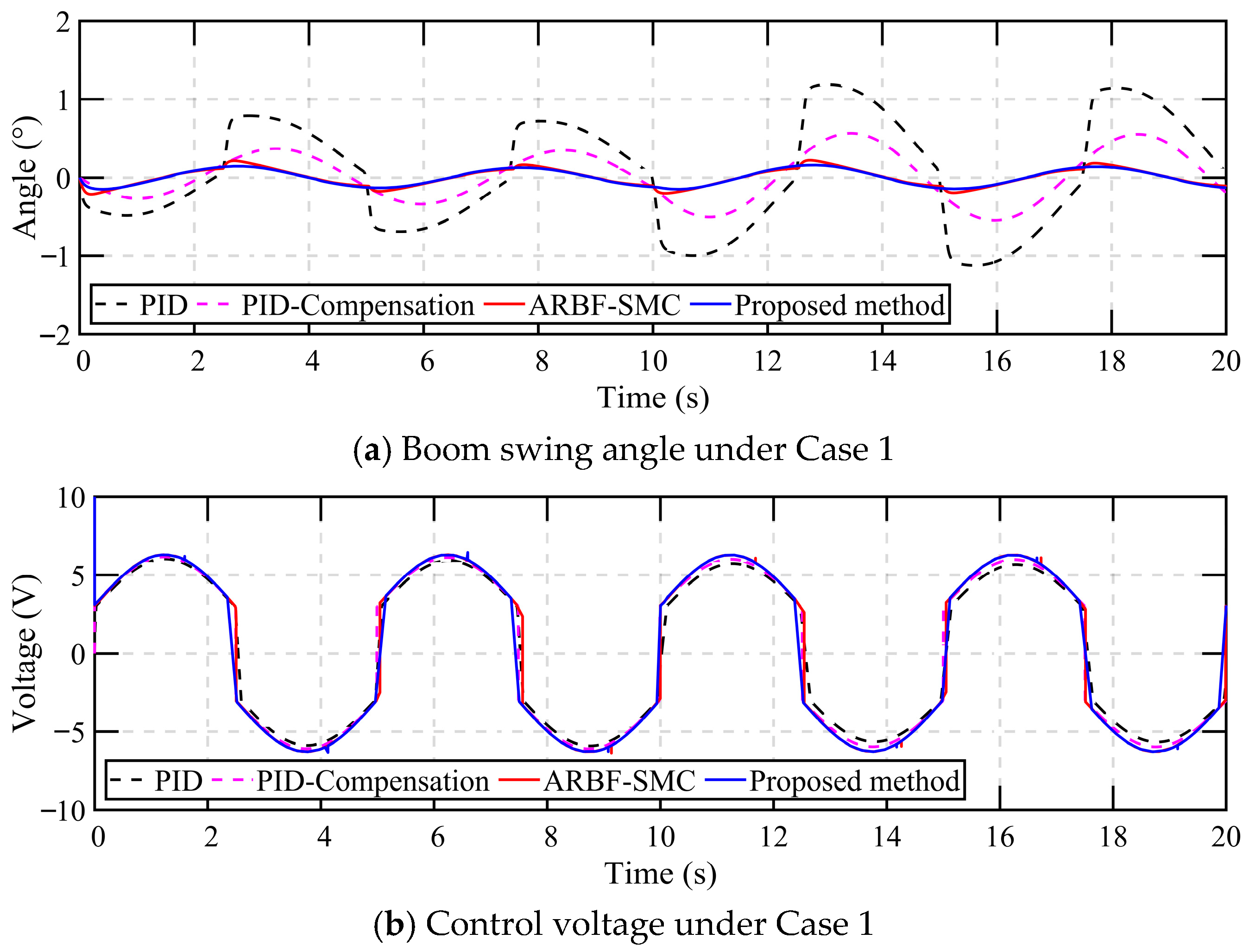
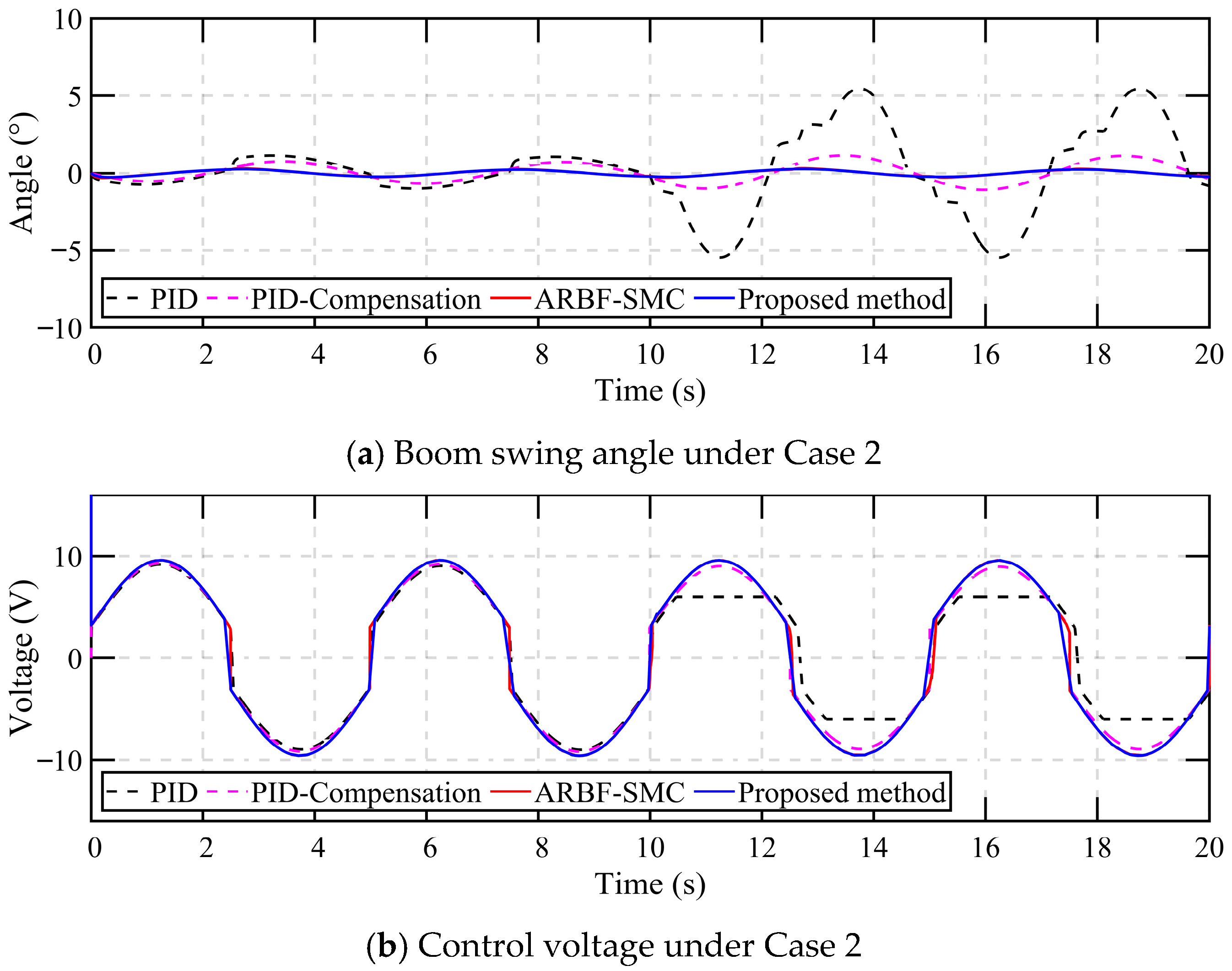
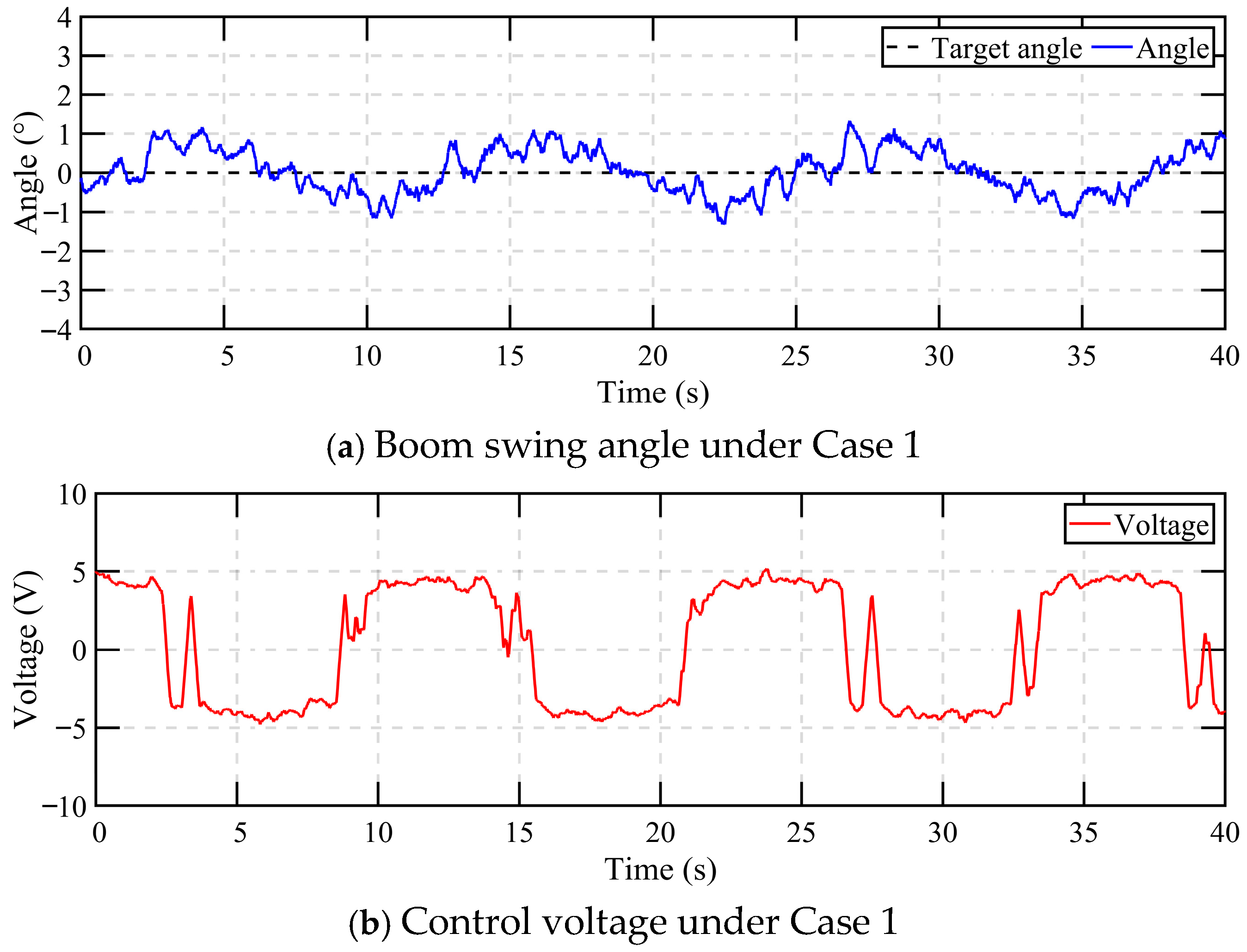
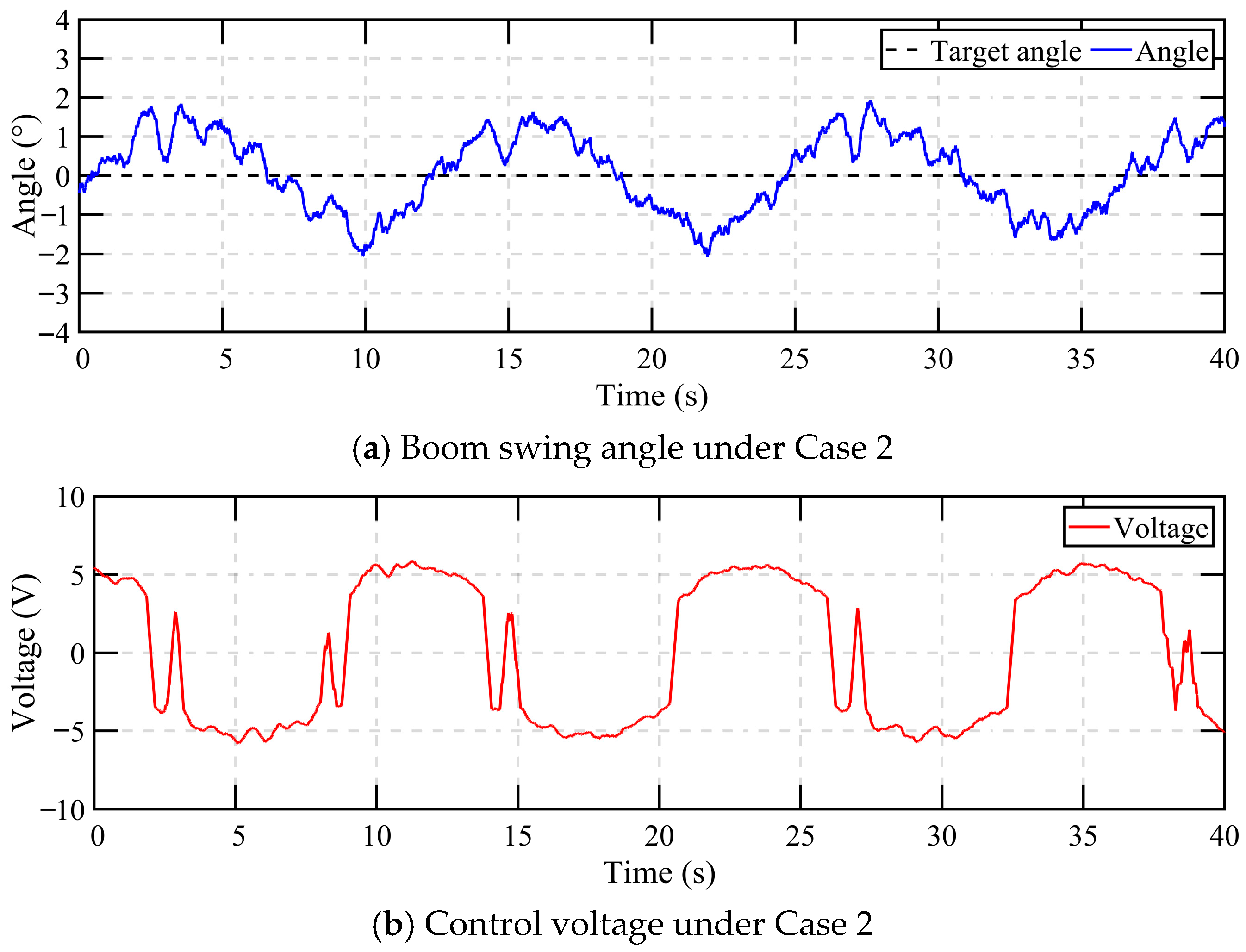
- Simulation and experiment results show that the root-mean-square error (RMSE) and maximum error of the proposed method are significantly reduced compared with traditional control methods, verifying its superior performance.
2. Problem Statement
2.1. System Model
2.2. Control Objective
3. Control System Design
3.1. Dead-Zone Compensation and Fault Analysis
3.2. Unmodeled Dynamics Learning
3.3. Adaptive Fault-Tolerant Control
3.4. Stability Proof
4. Numerical Simulation
5. Experiment
6. Conclusions
Author Contributions
Funding
Data Availability Statement
Conflicts of Interest
References
- Cai, Y.; Zheng, S.; Liu, W.; Qu, Z.; Zhu, J.; Han, J. Sliding-mode control of ship-mounted Stewart platforms for wave compensation using velocity feedforward. Ocean. Eng. 2021, 236, 109477. [Google Scholar] [CrossRef]
- Chen, H.; Sun, N. An Output Feedback Approach for Regulation of 5-DOF Offshore Cranes with Ship Yaw and Roll Perturbations. IEEE Trans. Ind. Electron. 2022, 69, 1705–1716. [Google Scholar] [CrossRef]
- Su, Z.; Fan, J.; Shao, X.; Li, C.; Wang, X. Appointed-Time Prescribed Performance Control for Shipborne SideArm with DRL-Based Kinematic Compensation. IEEE Trans. Autom. Sci. Eng. 2025, 22, 22438–22454. [Google Scholar] [CrossRef]
- Chen, H.; Wang, X.; Benbouzid, M.; Charpentier, J.-F.; Aϊt-Ahmed, N.; Han, J. Improved Fractional-Order PID Controller of a PMSM-Based Wave Compensation System for Offshore Ship Cranes. J. Mar. Sci. Eng. 2022, 10, 1238. [Google Scholar] [CrossRef]
- Gaspar, J.F.; Kamarlouei, M.; Thiebaut, F.; Soares, C.G. Compensation of a hybrid platform dynamics using wave energy converters in different sea state conditions. Renew. Energy 2021, 177, 871–883. [Google Scholar] [CrossRef]
- Yu, H.; Chen, Y.; Shi, W.; Xiong, Y.; Wei, J. State Constrained Variable Structure Control for Active Heave Compensators. IEEE Access 2019, 7, 54770–54779. [Google Scholar] [CrossRef]
- Teng, Y.; Hu, Z.; Sun, Y. Virtual prototype modeling and fuzzy control of the heave compensation system for a 500-ton deep-sea mining vessel. Trans. Inst. Meas. Control 2025, 47, 1974–1986. [Google Scholar] [CrossRef]
- Xu, L.; Yao, L.; Wang, X.; Yang, J.; Niu, D. LADRC of Bridge Crane System Based on Dead Zone Compensation. In Proceedings of the 2022 IEEE 17th International Conference on Control & Automation (ICCA), Naples, Italy, 27–30 June 2022; pp. 400–405. [Google Scholar] [CrossRef]
- Maczyński, A.; Wojciech, S. Stabilization of Load’s Position in Offshore Cranes. J. Offshore Mech. Arct. Eng. 2011, 134, 021101. [Google Scholar] [CrossRef]
- Haselsteiner, A.F.; Ohlendorf, J.-H.; Oelker, S.; Ströer, L.; Thoben, K.-D.; Wiedemann, K.; De Ridder, E.; Lehmann, S. Lifting Wind Turbine Components from a Floating Vessel: A Review on Current Solutions and Open Problems. J. Offshore Mech. Arct. Eng. 2019, 141, 050801. [Google Scholar] [CrossRef]
- Woodacre, J.K.; Bauer, R.J.; Irani, R.A. A Review of Vertical Motion Heave Compensation Systems. Ocean Eng. 2015, 104, 140–154. [Google Scholar] [CrossRef]
- Ngo, Q.H.; Nguyen, N.P.; Nguyen, C.N.; Tran, T.H.; Bui, V.H. Payload pendulation and position control systems for an offshore container crane with adaptive—Gain sliding mode control. Asian J. Control 2020, 22, 2119–2128. [Google Scholar] [CrossRef]
- Chen, H.; Zhang, R.; Liu, W.; Chen, H. A time optimal trajectory planning method for offshore cranes with ship roll motions. J. Frankl. Inst. 2022, 359, 6099–6122. [Google Scholar] [CrossRef]
- Bozkurt, B.; Ertogan, M. Heave and Horizontal Displacement and Anti-Sway Control of Payload during Ship-to-Ship Load Transfer with an Offshore Crane on Very Rough Sea Conditions. Ocean. Eng. 2023, 267, 113309. [Google Scholar] [CrossRef]
- Zhou, J.; Schlanbusch, S.M. Adaptive Quantized Control of Offshore Underactuated Cranes with Uncertainty. In Proceedings of the 2022 IEEE 17th International Conference on Control & Automation (ICCA); Naples, Italy, 27–30 June 2022, IEEE: Piscataway, NY, USA, 2022; pp. 297–302. [Google Scholar] [CrossRef]
- Zhang, R.; Chen, H. An adaptive tracking control method for offshore cranes with unknown gravity parameters. Ocean. Eng. 2022, 260, 111809. [Google Scholar] [CrossRef]
- Qian, Y.; Fang, Y.; Lu, B. Adaptive robust tracking control for an offshore ship-mounted crane subject to unmatched sea wave disturbances. Mech. Syst. Signal Process. 2019, 114, 556–570. [Google Scholar] [CrossRef]
- Zhai, M.; Yang, T.; Sun, N.; Fang, Y. Observer-based adaptive fuzzy control of underactuated offshore cranes for cargo stabilization with respect to ship decks. Mech. Mach. Theory 2022, 175, 104927. [Google Scholar] [CrossRef]
- Van Trieu, P.; Van Binh, C. Fixed-Time Disturbance Observer-Based Fractional-Order Dynamic Surface Control of Autonomous Surface Vessel. Proc. Inst. Mech. Eng. Part I J. Syst. Control Eng. 2025, 09596518251383237. [Google Scholar] [CrossRef]
- Tang, G.; Lei, J.; Li, F.; Zhu, W.; Xu, X.; Yao, B.; Claramunt, C.; Hu, X. A modified 6-DOF hybrid serial-parallel platform for ship wave compensation. Ocean Eng. 2023, 280, 114336. [Google Scholar] [CrossRef]
- Guo, B.; Chen, Y. Fuzzy robust fault-tolerant control for offshore ship-mounted crane system. Inf. Sci. 2020, 526, 119–132. [Google Scholar] [CrossRef]
- Cuong, H.M.; Thai, N.V.; Trieu, P.V.; Dong, H.Q.; Nam, T.T.; Viet, T.X.; Nho, L.C.; Tuan, L.A. Nonsingular fractional-order integral fast-terminal sliding mode control for underactuated shipboard cranes. J. Frankl. Inst. 2022, 359, 6587–6606. [Google Scholar] [CrossRef]
- Falconer, S.; Nordgård-Hansen, E.; Grasmo, G. Remaining useful life estimation of HMPE rope during CBOS testing through machine learning. Ocean. Eng. 2021, 238, 109617. [Google Scholar] [CrossRef]
- Gong, Q.; Liu, Z.; Hu, X.; Teng, Y.; Li, K.; Han, G. Robust anti-disturbance fault-tolerant control of ship-board platforms with multiplicative actuator faults and unknown disturbances. Ocean. Eng. 2023, 286, 115552. [Google Scholar] [CrossRef]
- Qiang, H.; Xiao, C.; Huang, H.; Hai, Y.; Sun, Y. Yaw feedback control of active steering vehicle based on differential flatness theory. J. Theor. Appl. Mech. 2025, 63, 131–149. [Google Scholar] [CrossRef]
- Zhao, X.; Sun, Y.; Li, Y.; Jia, N.; Xu, J. Applications of machine learning in real-time control systems: A review. Meas. Sci. Technol. 2025, 36, 012003. [Google Scholar] [CrossRef]
- Lin, J.; Fang, Y.; Lu, B.; Hao, Y.; Cao, H. Controller design of an offshore boom crane utilizing iterative learning and neural network. Control Theory Appl. 2022, 39, 602–612. [Google Scholar]
- Sun, M.; Ji, C.; Luan, T.; Wang, N. LQR Pendulation Reduction Control of Ship-Mounted Crane Based on Improved Grey Wolf Optimization Algorithm. Int. J. Precis. Eng. Manuf. 2023, 24, 395–407. [Google Scholar] [CrossRef]
- Kim, T.D.; Nguyen, L.N.; Dinh, X.M.; Le, H.X. Adaptive Hierarchical Sliding Mode Control Design for 3D Ship-Mounted Container Crane with Saturating Actuators. J. Control Autom. Electr. Syst. 2022, 33, 1643–1658. [Google Scholar] [CrossRef]
- Tuan, L.A.; Cuong, H.M.; Trieu, P.V.; Nho, L.C.; Thuan, V.D.; Anh, L.V. Adaptive neural network sliding mode control of shipboard container cranes considering actuator backlash. Mech. Syst. Signal Process. 2018, 112, 233–250. [Google Scholar] [CrossRef]
- Qian, Y.; Hu, D.; Chen, Y.; Fang, Y.; Hu, Y. Adaptive Neural Network-Based Tracking Control of Underactuated Offshore Ship-to-Ship Crane Systems Subject to Unknown Wave Motions Disturbances. IEEE Trans. Syst. Man Cybern. Syst. 2022, 52, 3626–3637. [Google Scholar] [CrossRef]





| Parameter | Value |
|---|---|
| Load Mass | 150 |
| Equivalent Damping | 1200 |
| System Stiffness | |
| Equivalent Volume | |
| Discharge Coefficient | 3.42 |
| Flow-Pressure Coefficient | |
| Equivalent Bulk Modulus | |
| Total Leakage Coefficient | |
| Equivalent Piston Area |
| PID | PID-Compensation | ARBF-SMC | Proposed Method | |
|---|---|---|---|---|
| Case 1 | RMSE (°) | 0.6930 | 0.3155 | 0.1073 |
| Max error (°) | 1.1877 | 0.5665 | 0.2210 | |
| Case 2 | RMSE (°) | 2.230 | 0.6310 | 0.1888 |
| Max error (°) | 5.4676 | 1.1330 | 0.3143 |
Disclaimer/Publisher’s Note: The statements, opinions and data contained in all publications are solely those of the individual author(s) and contributor(s) and not of MDPI and/or the editor(s). MDPI and/or the editor(s) disclaim responsibility for any injury to people or property resulting from any ideas, methods, instructions or products referred to in the content. |
© 2026 by the authors. Licensee MDPI, Basel, Switzerland. This article is an open access article distributed under the terms and conditions of the Creative Commons Attribution (CC BY) license.
Share and Cite
Xu, Z.; Zhao, X.; Shen, Z.; Guo, Y.; Sun, Y. Intelligent Fault-Tolerant Control for Wave Compensation Systems Considering Unmodeled Dynamics and Dead-Zone. J. Mar. Sci. Eng. 2026, 14, 265. https://doi.org/10.3390/jmse14030265
Xu Z, Zhao X, Shen Z, Guo Y, Sun Y. Intelligent Fault-Tolerant Control for Wave Compensation Systems Considering Unmodeled Dynamics and Dead-Zone. Journal of Marine Science and Engineering. 2026; 14(3):265. https://doi.org/10.3390/jmse14030265
Chicago/Turabian StyleXu, Zhiqiang, Xiaoning Zhao, Zhixin Shen, Yingjia Guo, and Yougang Sun. 2026. "Intelligent Fault-Tolerant Control for Wave Compensation Systems Considering Unmodeled Dynamics and Dead-Zone" Journal of Marine Science and Engineering 14, no. 3: 265. https://doi.org/10.3390/jmse14030265
APA StyleXu, Z., Zhao, X., Shen, Z., Guo, Y., & Sun, Y. (2026). Intelligent Fault-Tolerant Control for Wave Compensation Systems Considering Unmodeled Dynamics and Dead-Zone. Journal of Marine Science and Engineering, 14(3), 265. https://doi.org/10.3390/jmse14030265