Vibration Features of the Aft Shafting Subjected to Semi-Submerged Propeller Hydrodynamic Excitation

Abstract
1. Introduction
2. Shaft System Vibration Analysis Model
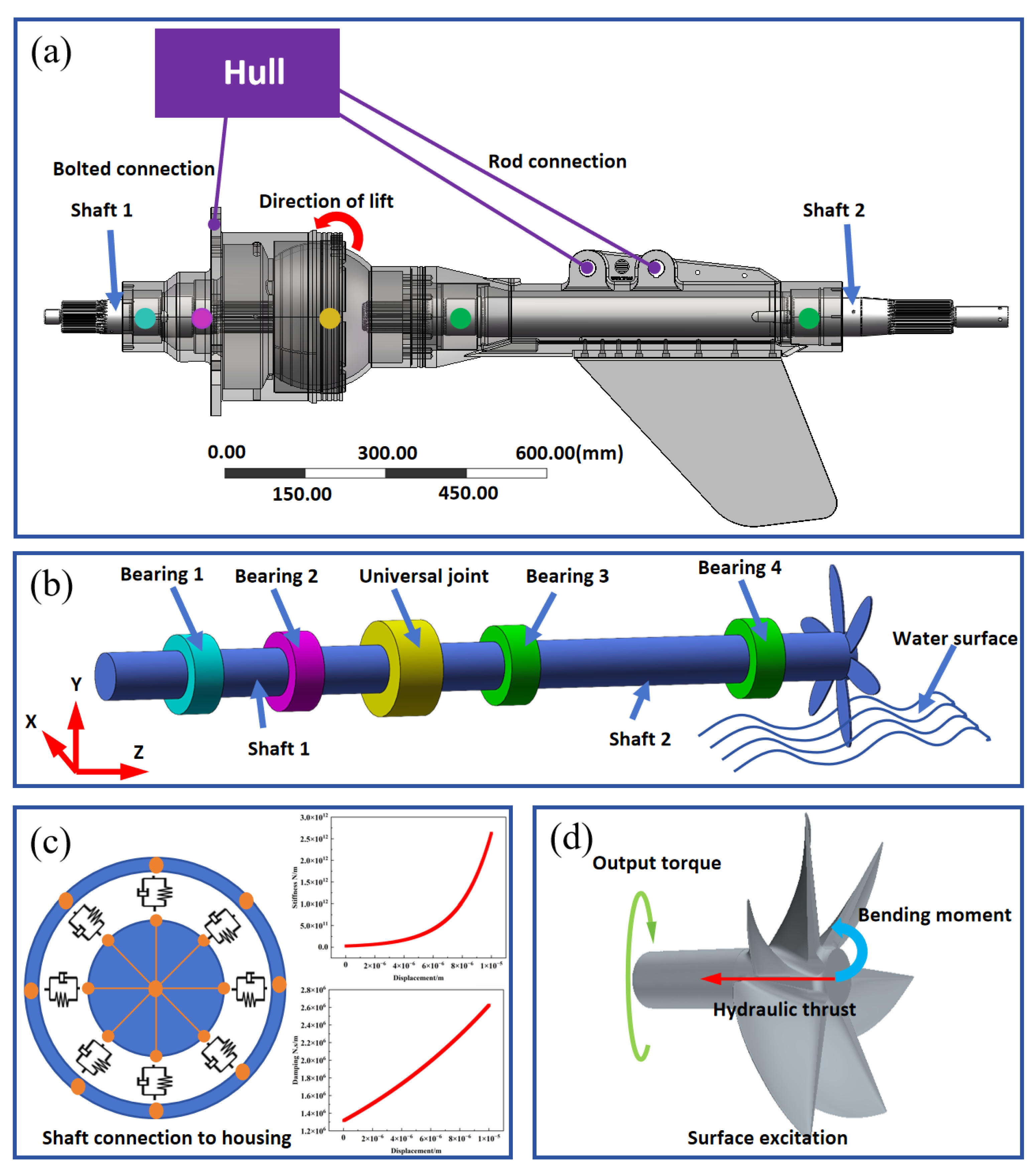
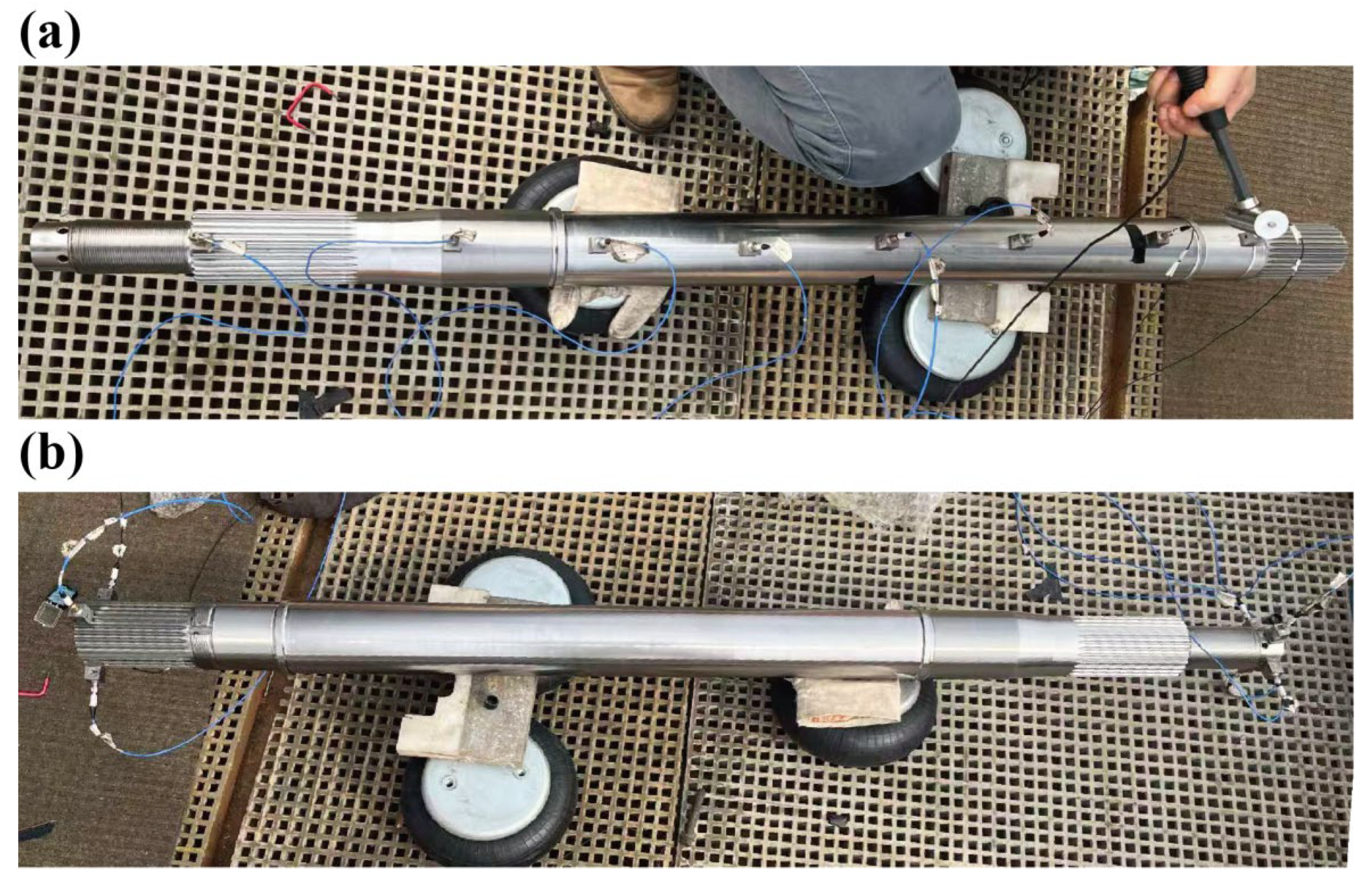
2.1. Multibody Dynamics Modeling and Modal Validation
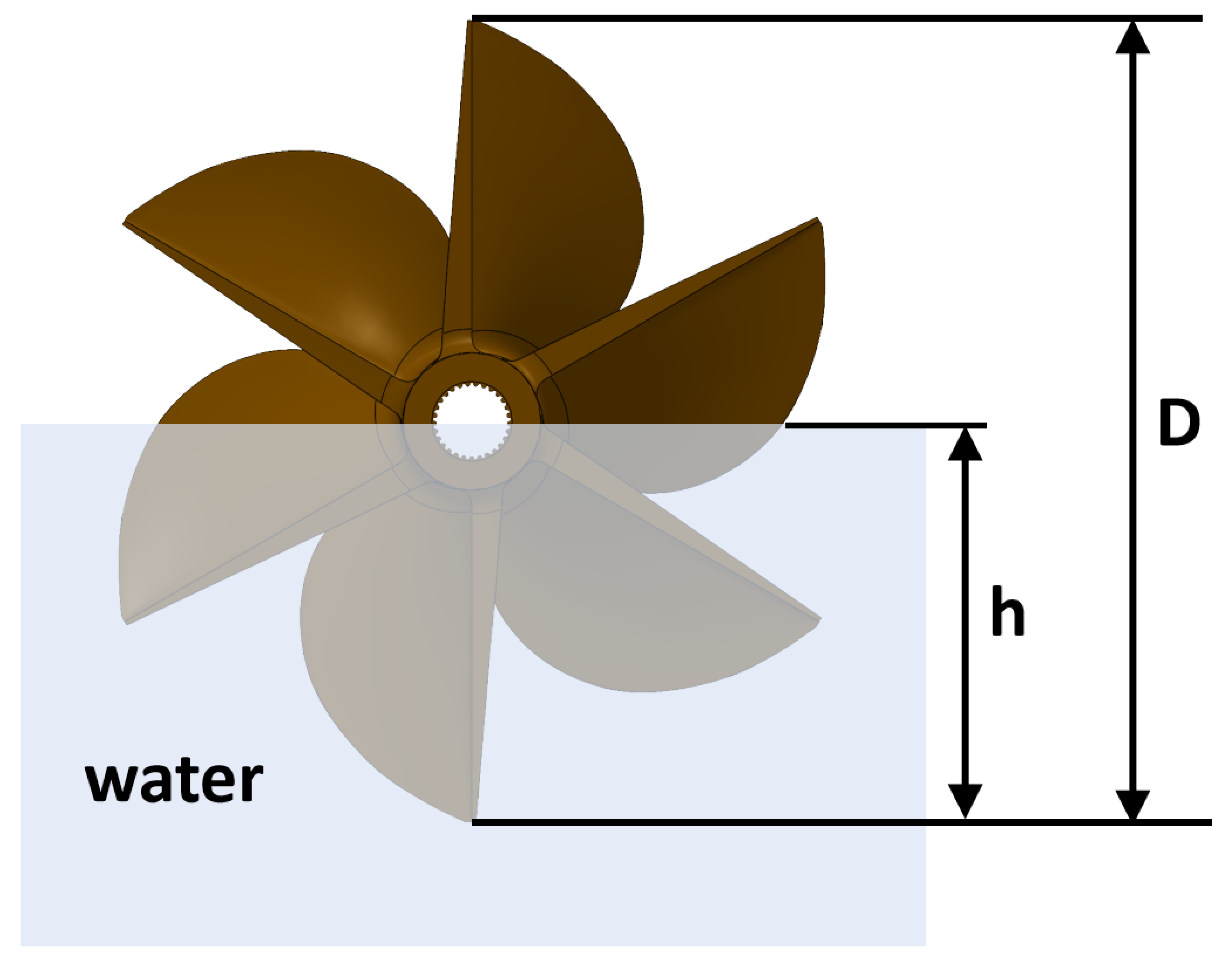
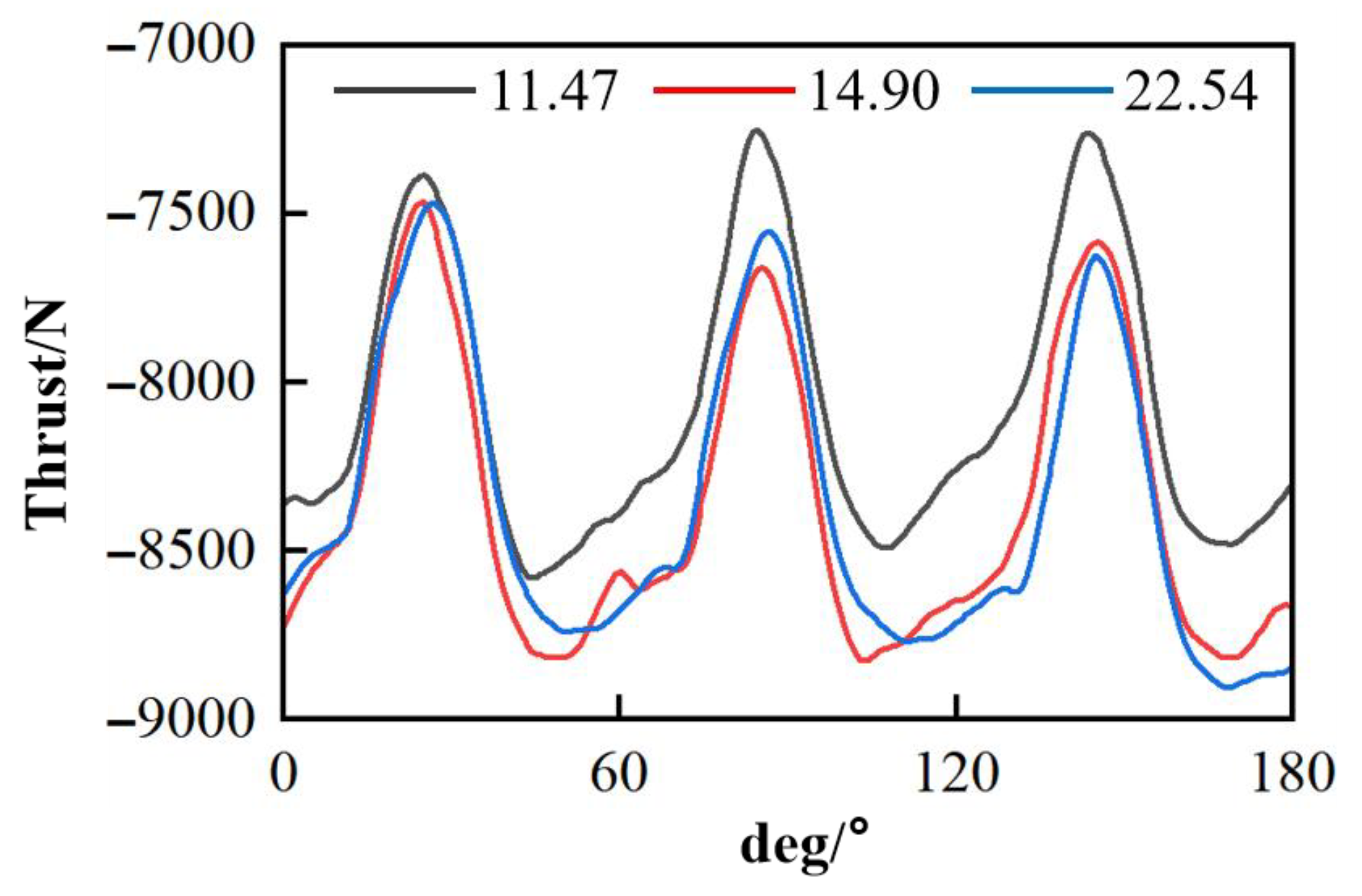
2.2. Semi-Submerged Paddle Excitation
3. Shaft System Vibration Analysis
3.1. Principal Factor Analysis of Shaft System Vibration
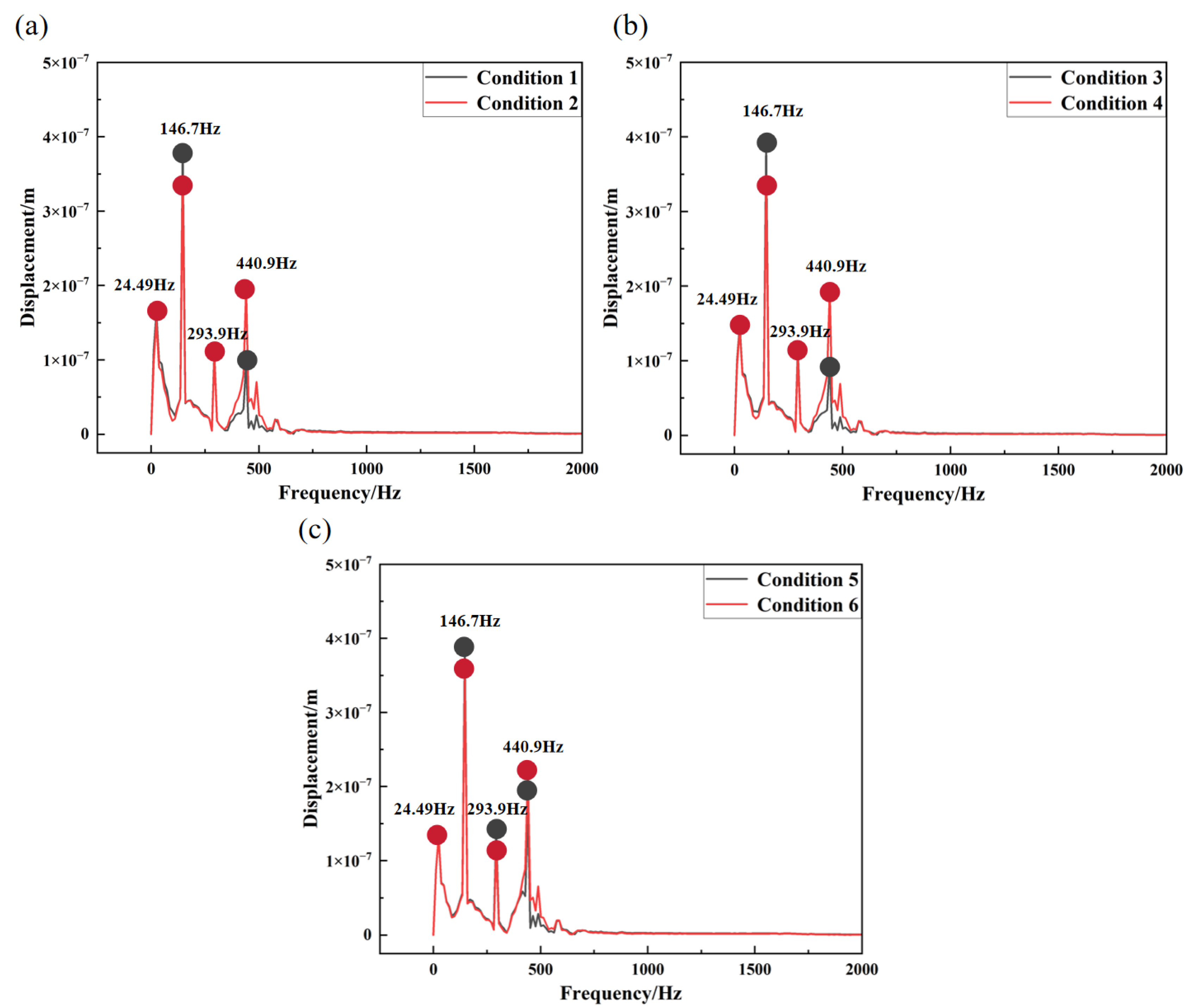
3.2. The Effect of Variations in Bearing Stiffness and Damping
3.3. The Effect of Bearing Position Changes
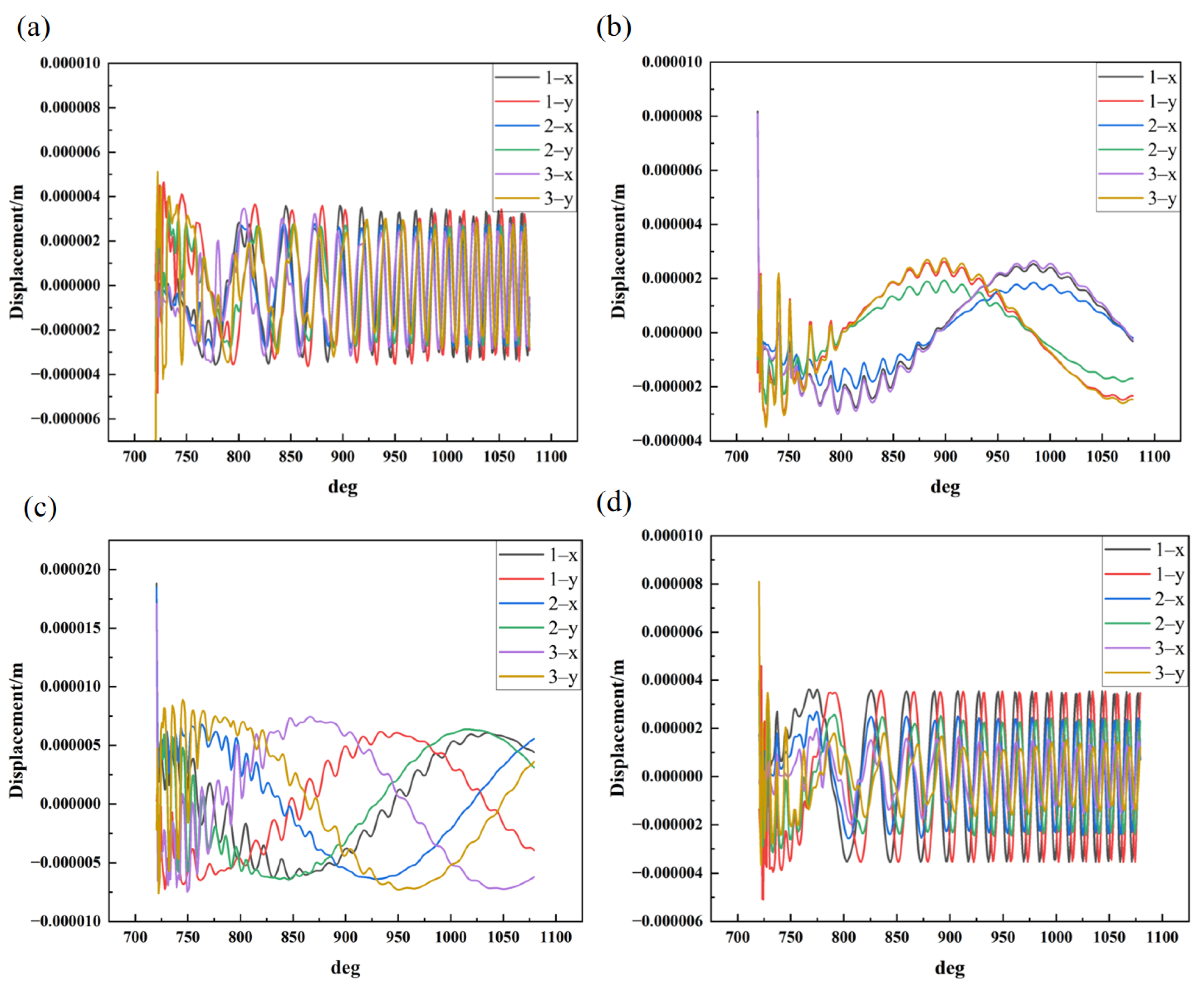
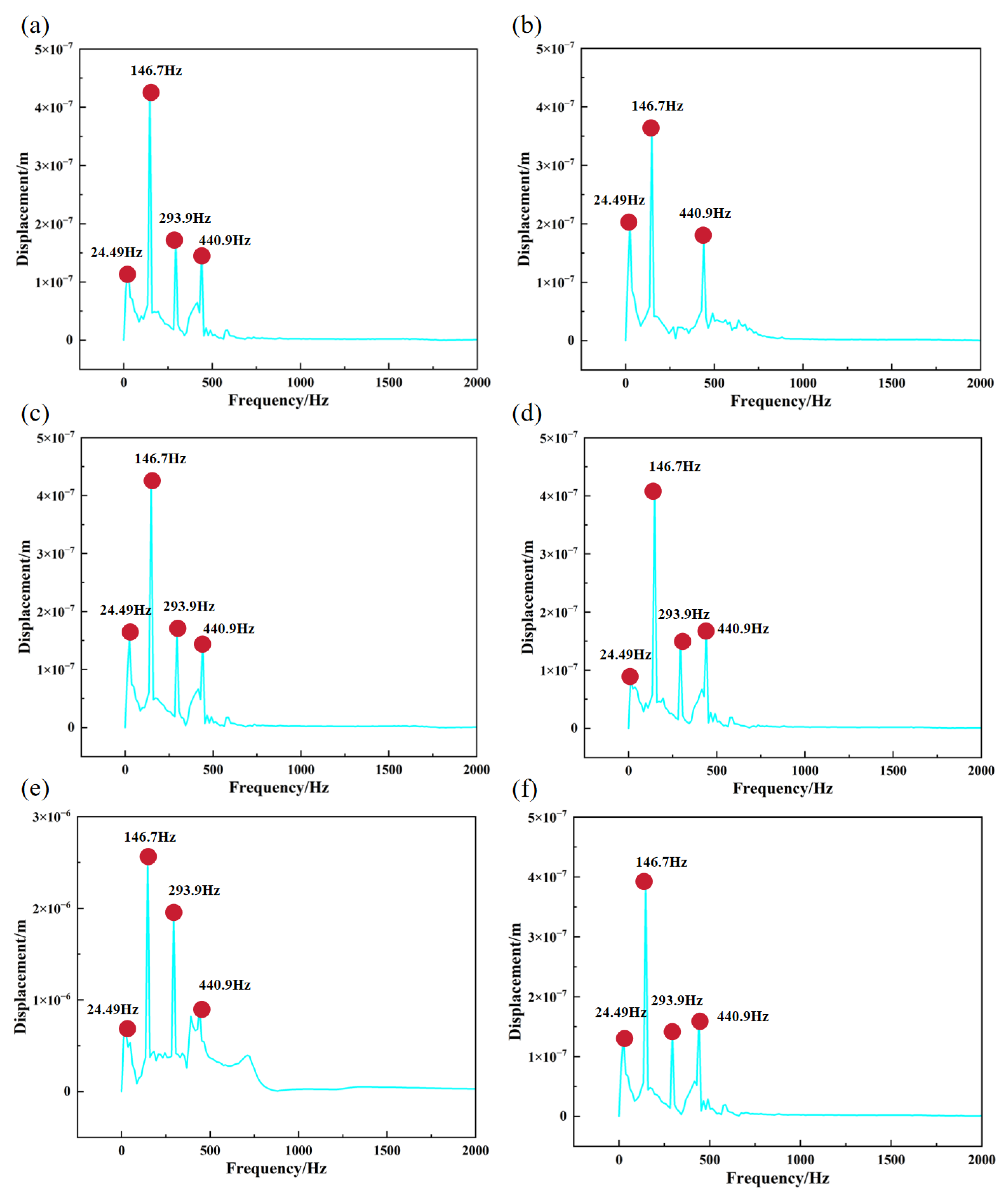
- Keeping the separation between Bearing3 and Bearing4 constant, both bearings are moved 20 mm in the -Z direction. The resulting vibration acceleration is presented in Figure 11a;
- With the spacing between Bearing3 and Bearing4 fixed, both bearings are displaced 20 mm in the +Z direction. The corresponding vibration acceleration is depicted in Figure 11b;
- To increase the bearing spacing, Bearing3’s position is fixed while Bearing4 is moved 20 mm in the -Z direction. The vibration acceleration for this configuration is illustrated in Figure 11c;
- The bearing spacing is increased by maintaining Bearing4’s position relative to the excitation source and shifting Bearing3 by 20 mm in the +Z direction. Figure 11d shows the vibration acceleration outcome;
- The bearing spacing is minimized by concurrently moving Bearing3 20 mm in the +Z direction and Bearing4 20 mm in the -Z direction. The vibration acceleration profile for this minimum-spacing case is given in Figure 11e;
- To achieve the maximum bearing spacing, Bearing3 is moved 20 mm in the -Z direction while Bearing4 is moved 20 mm in the +Z direction. The vibration acceleration for this maximum-spacing configuration is shown in Figure 11f.
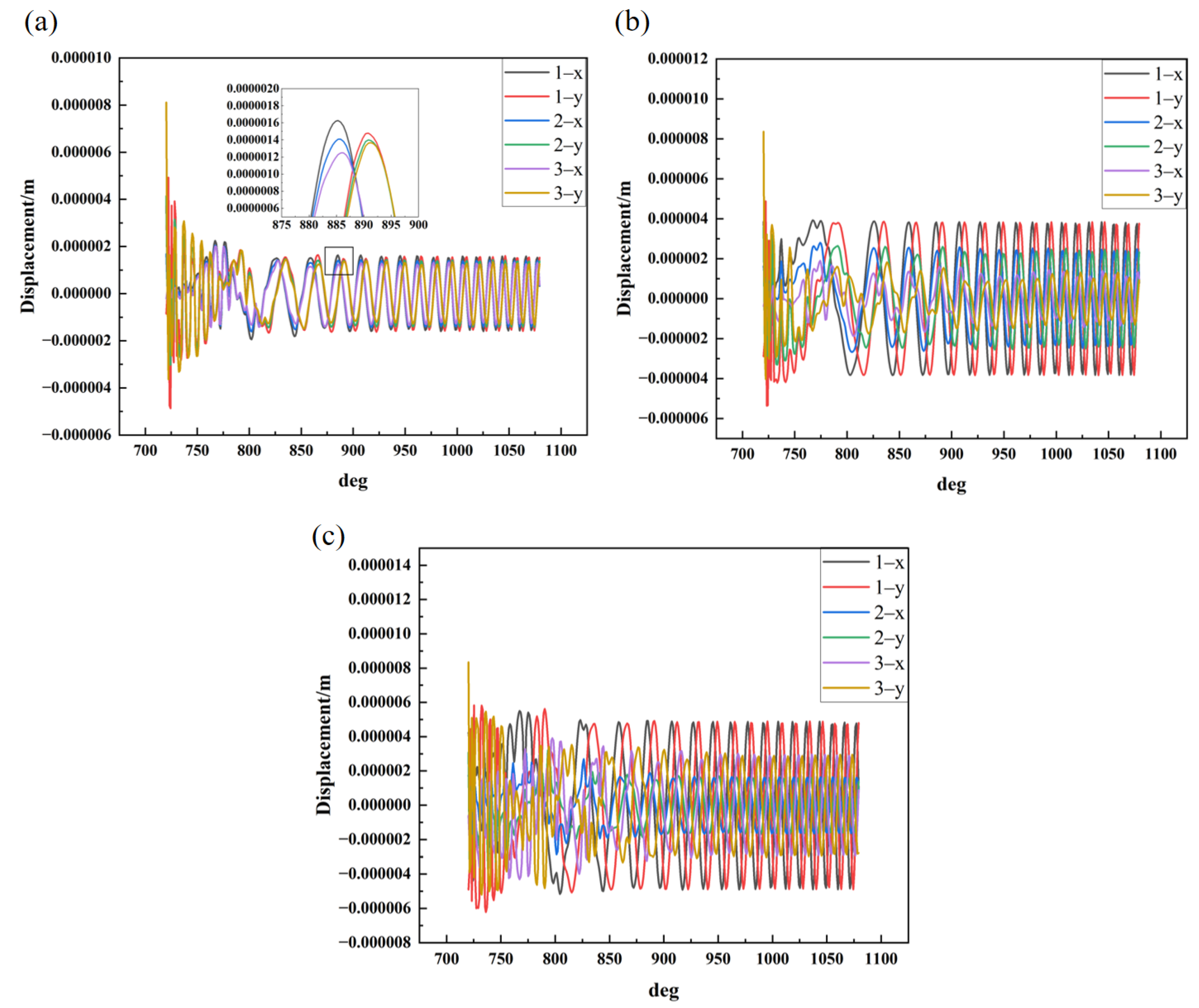
3.4. The Influence of External Support
4. Conclusions
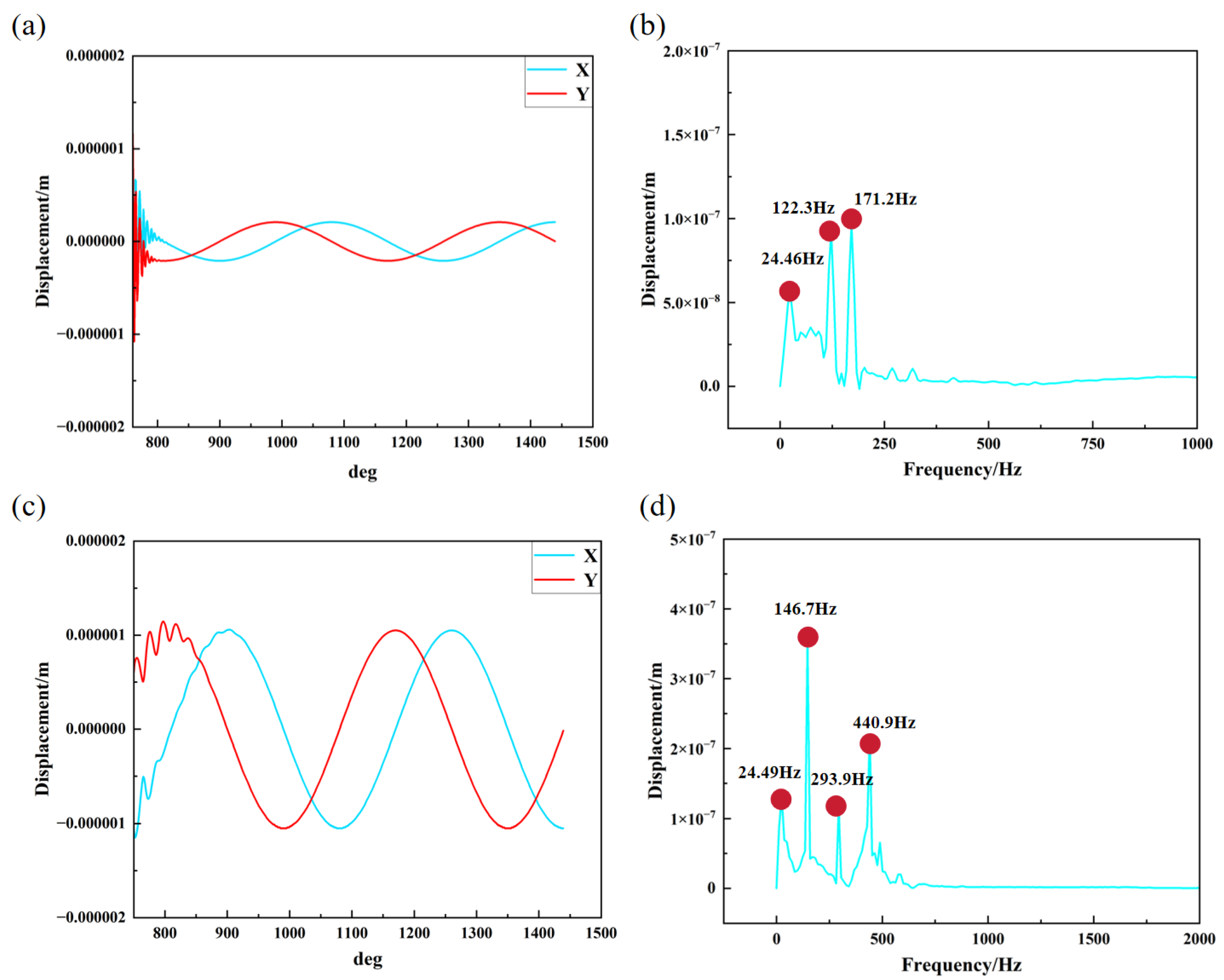
- Shaft 1 exhibits a dominant fundamental frequency of 24.44 Hz, approaching the first-order transition frequency. The frequency peaks on Shaft 2 include 24.45 Hz near the first-order transition frequency, alongside 146.7 Hz and 293.9 Hz approaching propeller excitation frequencies. The superposition of multiple excitation frequencies induces more pronounced displacement oscillations, rendering Shaft 2 at higher resonance risk.
- The combination of increased bearing stiffness and enhanced damping provides an effective approach for mitigating vibrations at nodes in proximity to hydrodynamic excitation sources.
- Maintaining the spacing between Bearing3 and Bearing4 while moving them towards the propeller direction is beneficial for shaft system vibration damping. Thus, vibration response analysis can be employed in the design process of the stern shafting system to optimize both the casing and shaft designs, improving the overall reliability of the system.
- The support stiffness of the tie rod exerts a nonlinear influence on the vibration of the Bearing4. A compliant stiffness (2.5 × 10⁷ N/m) provides significant vibration reduction by buffering and dissipating vibrational energy through elastic deformation.
- The investigation of vibration characteristics of the stern shafting under hydrodynamic excitation provides important vibration-reduction references for the development of high-performance fast craft. All investigations in this study were conducted under the operational condition of 1533 r/min, where the stern shaft system exhibits relatively stable performance. Future work could explore the vibration response characteristics of the stern shafting under different rotational speeds to investigate the coupled effects of speed on hydrodynamics and shafting vibrations.
Author Contributions
Funding
Data Availability Statement
Acknowledgments
Conflicts of Interest
References
- Lai, G.; Lei, J.; Liu, J.; Cao, S.; Qin, H.; Zeng, F.; Zhou, R. Numerical and experimental study on comprehensive optimization for the KPIs of ship propulsion shafting design based on MDO. Ocean Eng. 2021, 222, 108624. [Google Scholar] [CrossRef]
- Kang, W.; Zhang, Z.; Zhou, K.; Chen, Y. The random vibration and force transmission characteristics of the elastic propeller-shafting system induced by inflow turbulence. Ocean Eng. 2019, 188, 106317. [Google Scholar] [CrossRef]
- Zhang, Z.; Ma, X.; Yu, H.; Hua, H. Stochastic dynamics and sensitivity analysis of a multistage marine shafting system with uncertainties. Ocean Eng. 2021, 219, 108388. [Google Scholar] [CrossRef]
- Lei, J.; Zhou, R.; Chen, H.; Gao, Y.; Lai, G. Experimental investigation of effects of ship propulsion shafting alignment on shafting whirling and bearing vibrations. Mar. Sci. Technol. 2022, 27, 151–162. [Google Scholar] [CrossRef]
- Zhang, G.; Zhao, Y.; Chu, W. Longitudinal Vibration Transmission Control of Marine Propulsion Shafting with Friction Damper Integrated into the Thrust Bearing. J. Mar. Sci. Eng. 2022, 10, 1555. [Google Scholar] [CrossRef]
- Wu, H.; Yang, L.; Liu, L. Research on Vibration Excitation Estimation of Warship Propulsion Shafting Based on Waveguide Theory. J. Phys. Conf. Ser. 2021, 1828, 012182. [Google Scholar] [CrossRef]
- Sial, T.; Jin, Y.; Juan, Z. Vibration Characteristics Analysis and Optimization of Trawler Propulsion Shafting System. IOP Conf. Ser. Mater. Sci. Eng. 2019, 576, 012008. [Google Scholar] [CrossRef]
- Chen, M.; Ouyang, H.; Li, W.; Wang, D.; Liu, S. Partial Frequency Assignment for Torsional Vibration Control of Complex Marine Propulsion Shafting Systems. Appl. Sci. 2020, 10, 147. [Google Scholar] [CrossRef]
- Savio, L.; Sileo, L.; Kyrre Ås, S. A Comparison of Physical and Numerical Modeling of Homogenous Isotropic Propeller Blades. J. Mar. Sci. Eng. 2020, 8, 21. [Google Scholar] [CrossRef]
- Knight, B.; Maki, K. Multi-Degree of Freedom Propeller Force Models Based on a Neural Network and Regression. J. Mar. Sci. Eng. 2020, 8, 89. [Google Scholar] [CrossRef]
- Huuva, T.; Cerdier, E.; Törnros, S.; Olof, K. Propeller and Propulsion System Optimization. In Proceedings of the SNAME 15th Propeller and Shafting Symposium, Norfolk, VA, USA, 15–16 September 2018. [Google Scholar] [CrossRef]
- Lin, C.; Zou, M.; Sima, C.; Liu, L.; Jiang, L. Friction-induced vibration and noise of marine stern tube bearings considering perturbations of the stochastic rough surface. Tribol. Int. 2019, 131, 661–671. [Google Scholar] [CrossRef]
- Tong, X.; Chen, H.; Chen, Y.; Li, Z. Influence of skew angle on the random vibration response of propeller-shafting system induced by turbulent inflow. Ocean Eng. 2022, 244, 110350. [Google Scholar] [CrossRef]
- Zhu, Y.; Xie, X.; Zhang, Z. Investigation on vibration transmission control of a shafting system with active orthogonal support. J. Vib. Control 2022, 28, 1453–1469. [Google Scholar] [CrossRef]
- Yang, D.; Qin, H.; Xie, X.; Zhang, Z. Suppression of lateral vibration in a shafting system via an auxiliary active magnetic bearing with position control. Inst. Mech. Eng. 2023, 237, 1581–1594. [Google Scholar] [CrossRef]
- Aboud, A.; Ali, J. Study of Effective Parameters in Stability and Vibration of Marine Propulsion Shafting Systems. J. Phys. Conf. Ser. 2021, 1973, 012032. [Google Scholar] [CrossRef]
- Su, Z.; Zheng, Z.; Huang, X.; Hua, H. Research on dynamic vibration absorber with negative stiffness for controlling longitudinal vibration of propulsion shafting system. Ocean Eng. 2022, 264, 112375. [Google Scholar] [CrossRef]
- Xiao, B.; Li, Y.; Shi, S.; Gao, C.; Lu, S. Analysis of bending-torsional-axial vibration of multi-stage variable-section shaft system. Results Phys. 2022, 36, 105460. [Google Scholar] [CrossRef]
- Xie, X.; He, P.; Wu, D.; Zhang, Z. Vibration attenuation of a propulsion shafting system by electromagnetic forces: Static thrust force balance and harmonic vibration suppression. Mech. Syst. Signal Process. 2022, 179, 109406. [Google Scholar] [CrossRef]
- Wang, F.; Liao, J.; Huang, C.; Li, H.; Cao, J.; Yu, H.; Yan, J. Testing and Analysis of Torsional Vibration of Ship Transmission Shafting Based on Five-Point Smoothing Algorithm. Processes 2022, 10, 1790. [Google Scholar] [CrossRef]
- Li, G.; Lu, L.; Gao, H.; Xing, P.; He, X.; Zhang, H. Numerical investigation on natural vibration characteristics of ship propulsion shafting under uncertainty based on nonparametric approach. Ocean Eng. 2022, 261, 112009. [Google Scholar] [CrossRef]
- He, T.; Xie, Z.; Tao, X.; Yang, K.; Jiao, J.; Huang, M.; Ma, W. Analysis of the Tribological and Dynamic Performance of the Self-Adapting Water-Lubricated Stern Bearing. Lubricants 2022, 10, 245. [Google Scholar] [CrossRef]
- Tan, Y.; Peng, W.; Shen, L.; Xing, J. Simulation Analysis of Vibration Characteristics of the Submerged-propeller Shaft Coupling System. J. Phys. 2022, 2282, 012018. [Google Scholar] [CrossRef]
- Li, J.; Qu, Y.; Chen, Y.; Hua, H.; Wu, J. BEM-FEM coupling for the hydroelastic analysis of propeller-shafting systems in non-uniform flows. Ocean Eng. 2022, 247, 110424. [Google Scholar] [CrossRef]
- Javanmard, E.; Yari, E.; Mehr, J. Numerical investigation on the effect of shaft inclination angle on hydrodynamic characteristics of a surface-piercing propeller. Appl. Ocean Res. 2020, 98, 102108. [Google Scholar] [CrossRef]
- Bushehri, M.P.; Haghighi, M.R.G.; Malekzadeh, P. Fluid-structure interaction analysis of an elastic surface-piercing propellers. J. Fluids Struct. 2025, 132, 104228. [Google Scholar] [CrossRef]
- Gufler, V.; Wehrle, E.; Zwölfer, A. A review of flexible multibody dynamics for gradient-based design optimization. Multibody Syst. Dyn. 2021, 53, 379–409. [Google Scholar] [CrossRef]
- Bi, Y.; Lin, X.; Liu, S.; Tang, M.; Yang, Y.; He, H.; Shen, L.; Zhang, G. Influence of the Pre-Compensation Profile on the Dynamics and Friction Performance of the Piston Skirt–Cylinder Liner System in a Diesel Engine. Energies 2025, 18, 5833. [Google Scholar] [CrossRef]
- Cao, Y.; Yan, G.; Lu, J.; Zhang, W. Suppression of multi-modal torsional vibration of the long-shafting rotor system with nonlinear piecewise NES. Int. J. Non-Linear Mech. 2024, 159, 104617. [Google Scholar] [CrossRef]


| Order | Experiment /Hz | Vibration Pattern | Type | Simulation /Hz | Modal Simulation | Error /% |
|---|---|---|---|---|---|---|
| 1 | 275 | ![]() | bending | 274 | ![]() | 0.3 |
| 2 | 630 | ![]() | bending | 647 | ![]() | 2.6 |
| 3 | 1138 | ![]() | bending | 1163 | ![]() | 2.1 |
| 4 | 1724 | ![]() | bending | 1724 | ![]() | 0 |
| Parameters | Value |
|---|---|
| D/mm | 640 |
| Hub diameter ratio | 0.17 |
| Number of blades | 6 |
| Helical direction | Right |
| Operating Conditions | Stiffness (N/m) | Damping (N·s/m) |
|---|---|---|
| 1 | 3 × 10⁷ | 5 × 10⁶ |
| 2 | 3 × 10⁷ | 1 × 10⁷ |
| 3 | 3 × 10⁸ | 5 × 10⁶ |
| 4 | 3 × 10⁸ | 1 × 10⁷ |
| 5 | 3 × 10⁹ | 5 × 10⁶ |
| 6 | 3 × 10⁹ | 1 × 10⁷ |
Disclaimer/Publisher’s Note: The statements, opinions and data contained in all publications are solely those of the individual author(s) and contributor(s) and not of MDPI and/or the editor(s). MDPI and/or the editor(s) disclaim responsibility for any injury to people or property resulting from any ideas, methods, instructions or products referred to in the content. |
© 2026 by the authors. Licensee MDPI, Basel, Switzerland. This article is an open access article distributed under the terms and conditions of the Creative Commons Attribution (CC BY) license.
Share and Cite
Yin, X.; Zhang, J.; Lin, J.; Dai, H.; Wu, G. Vibration Features of the Aft Shafting Subjected to Semi-Submerged Propeller Hydrodynamic Excitation. J. Mar. Sci. Eng. 2026, 14, 192. https://doi.org/10.3390/jmse14020192
Yin X, Zhang J, Lin J, Dai H, Wu G. Vibration Features of the Aft Shafting Subjected to Semi-Submerged Propeller Hydrodynamic Excitation. Journal of Marine Science and Engineering. 2026; 14(2):192. https://doi.org/10.3390/jmse14020192
Chicago/Turabian StyleYin, Xiaoqing, Junhong Zhang, Jiewei Lin, Huwei Dai, and Guopeng Wu. 2026. "Vibration Features of the Aft Shafting Subjected to Semi-Submerged Propeller Hydrodynamic Excitation" Journal of Marine Science and Engineering 14, no. 2: 192. https://doi.org/10.3390/jmse14020192
APA StyleYin, X., Zhang, J., Lin, J., Dai, H., & Wu, G. (2026). Vibration Features of the Aft Shafting Subjected to Semi-Submerged Propeller Hydrodynamic Excitation. Journal of Marine Science and Engineering, 14(2), 192. https://doi.org/10.3390/jmse14020192