Opportunities for Green H2 in EU High-Speed-Crafts Decarbonization Through Well-to-Wake GHG Emissions Assessment


Abstract
1. Introduction
- From the shipowners’ perspective: Evolution of the alternative technologies’ performance for HSCs’ electricity supply in terms of sustainability and MBM savings with the progressive tightening of the environmental policies (IMO and EU frameworks).
- From the policy-makers’ perspective: Progression of MBMs’ effectiveness as PPP tools for EU-HSCs when emerging technologies are involved.
- From the policy-makers’ perspective: Divergences among IMO and EU approaches for MBMs and their consequences on the promotion of alternative technologies for the EU-HSC fleet’s decarbonization. Particular attention is paid to the effects of the regulation’s exceptions at the convergence of the outermost regions.
2. Literature Review
3. The Method
3.1. Pollutant Impact
- Tank-to-Wake component (TtW).
- ○
- Free sailing stage (s = 1):
- ○
- Remaining navigation stages (∀s∈SS*):
- Well-to-Tank component (WtT).
- ○
- Free sailing stage (s = 1):
- ○
- Remaining navigation stages (∀s∈SS*):
- ○
- On-shore electricity grid (∀s∈SS**):
3.2. IMO Measures
3.2.1. GBM: Annual Operational Carbon Intensity Indicator
- The inclusion of a sub-category in High-Speed Crafts to include Ro-Ro passenger ships for the CII reference line guidelines (G2; MEPC.353(78)).
- Despite the rating boundaries’ extension to Ro-Ro passenger ships in the CII Rating Guidelines (G4, MEPC.354(78)), no specific considerations were included for HSCs.
- The inclusion of more restrictive reduction factors in the 2026 aftermath in comparison to the previous period (2023–2026).
3.2.2. MBM: The IMO Net-Zero Framework
- Attained annual GHG fuel intensity (GFI_attained).
- Target annual GHG intensity
3.3. EU Measures
- Fuel EU: inclusion of a fixed reference value of 91.16 g/CO2eq to define the WtW GHG intensity target, tightening of the Fuel EU non-compliance penalty through a recidivism mechanism and a modification of the reduction schedule of the WtW GHG intensity target.
- EU-ETS: a delay in enforcement from 2023 to 2024 and therefore a modification of the progressive inclusion of TtW CO2 emissions from vessels.
3.3.1. GBM: Fuel EU Maritime Initiative
3.3.2. MBM: Energy Taxation Directive
3.3.3. MBM: EU Emission Trading System
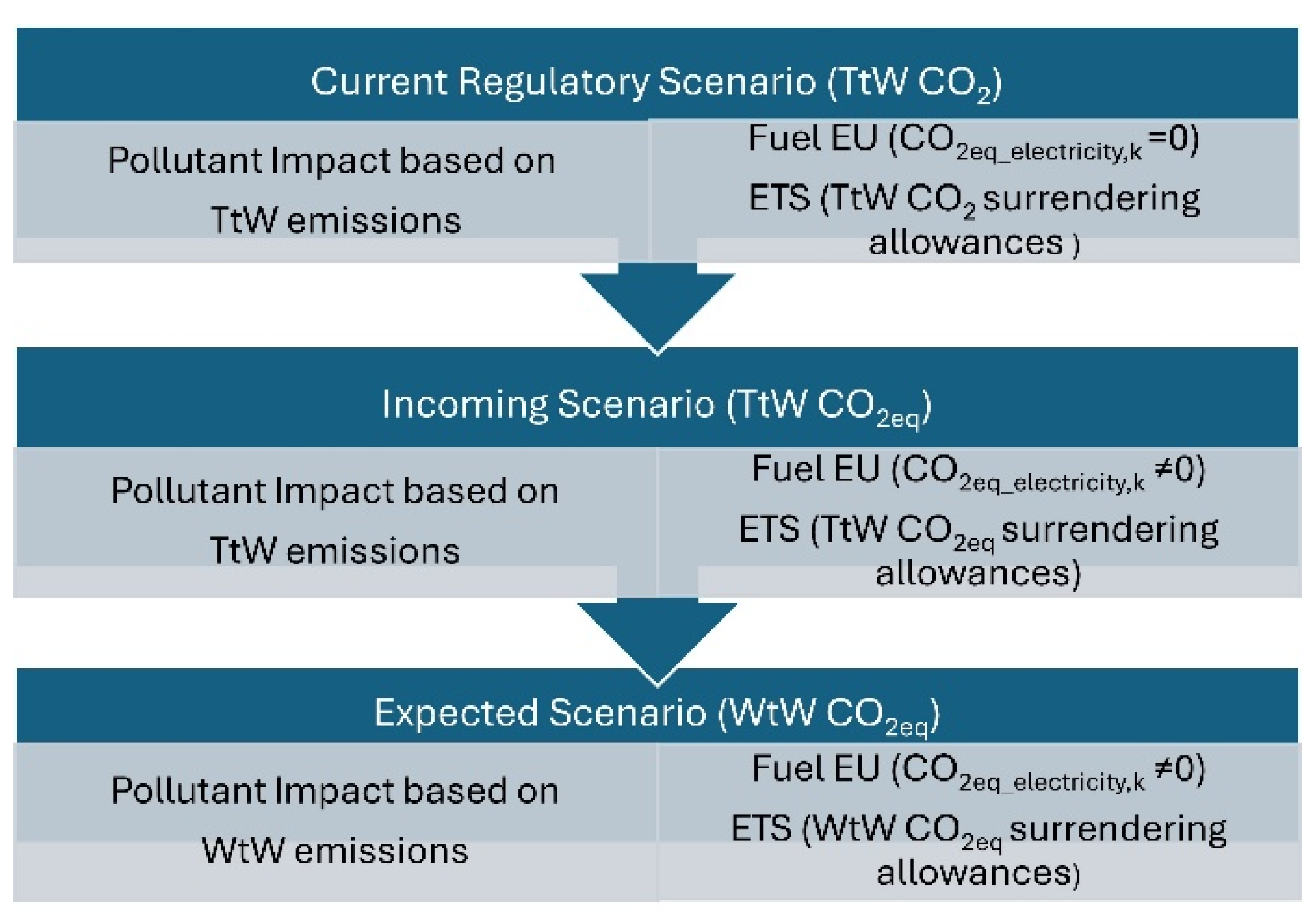
- Current regulatory scenario (TtW CO2 emissions, Regulation (EU) 2015/757):
- Incoming scenario (TtW CO2eq emissions; Regulation (EU) 2023/957):
- Expected scenario (WtW CO2eq emissions; MEPC.391(81)):
4. Case Study
- Slow steaming. Operative solution, which means no vessel retrofitting is necessary.
- Photovoltaic system (PV system) for electricity supply together with slow steaming: Retrofitted vessel. The Global Horizontal Irradiance (GHI) in the Canarian Archipelago is 6.98 kWh/m2/day (NASA Resources from Homer Pro microgrid software).
- Fuel cell system (green H2 fuel cell; this is a proton-exchange membrane fuel cell—PEMFC—[7]) for electricity supply along with slow steaming. Retrofitted vessel.
- Onshore power supply system (OPS) for electricity supply in port (berthing and hoteling, see Table 2) together with slow steaming. Retrofitted vessel.
4.1. Pollutant Impact
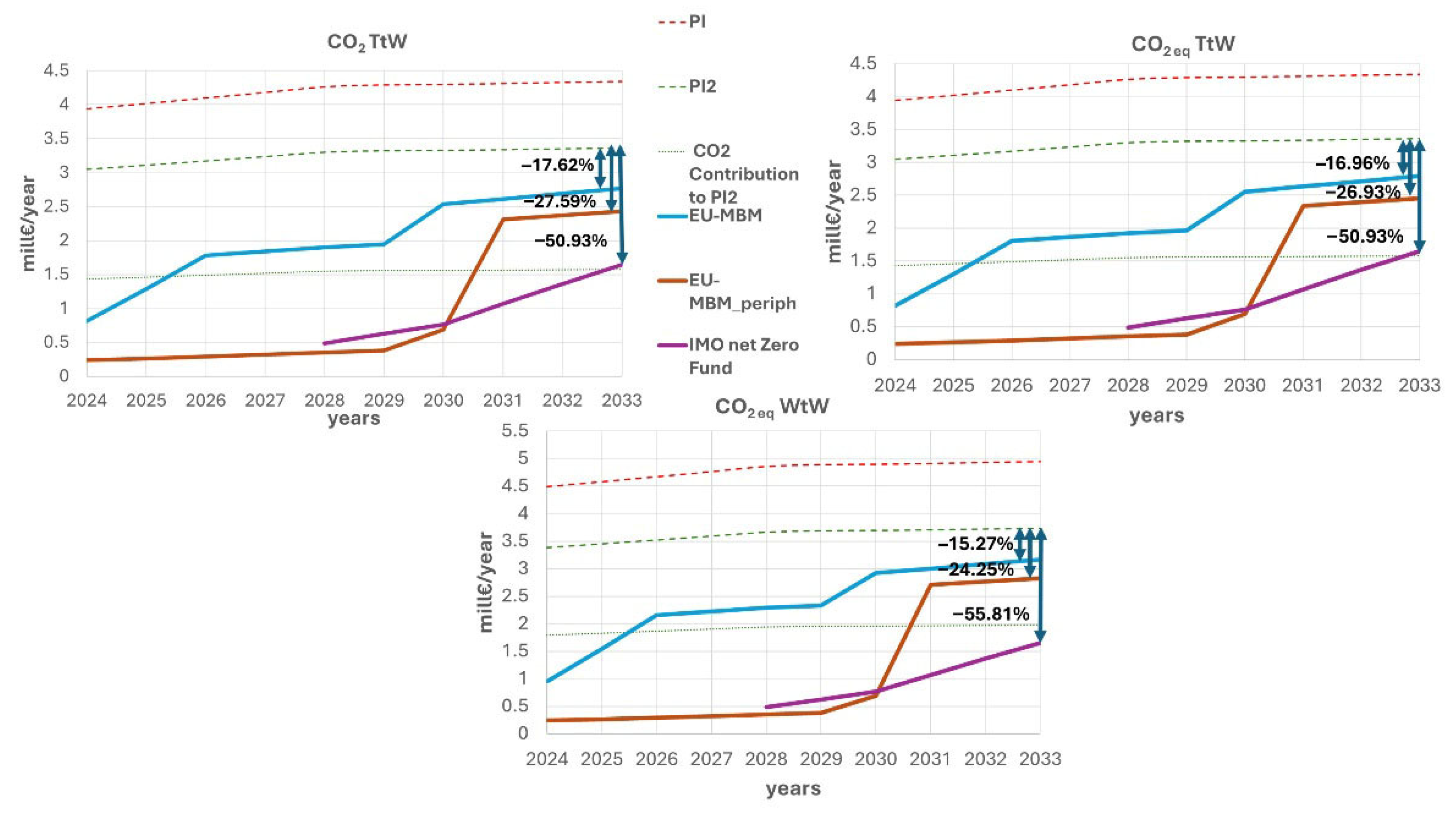
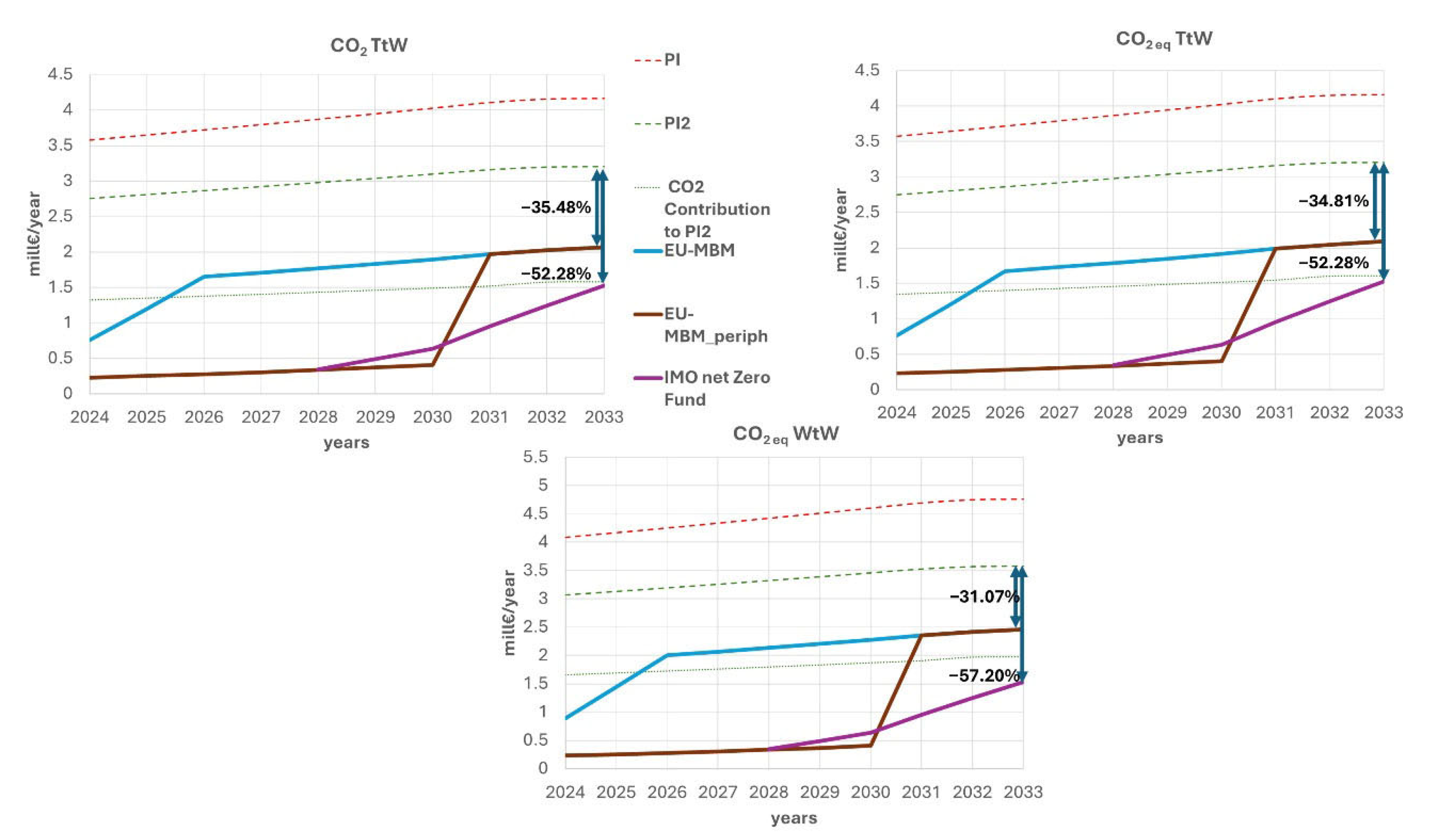
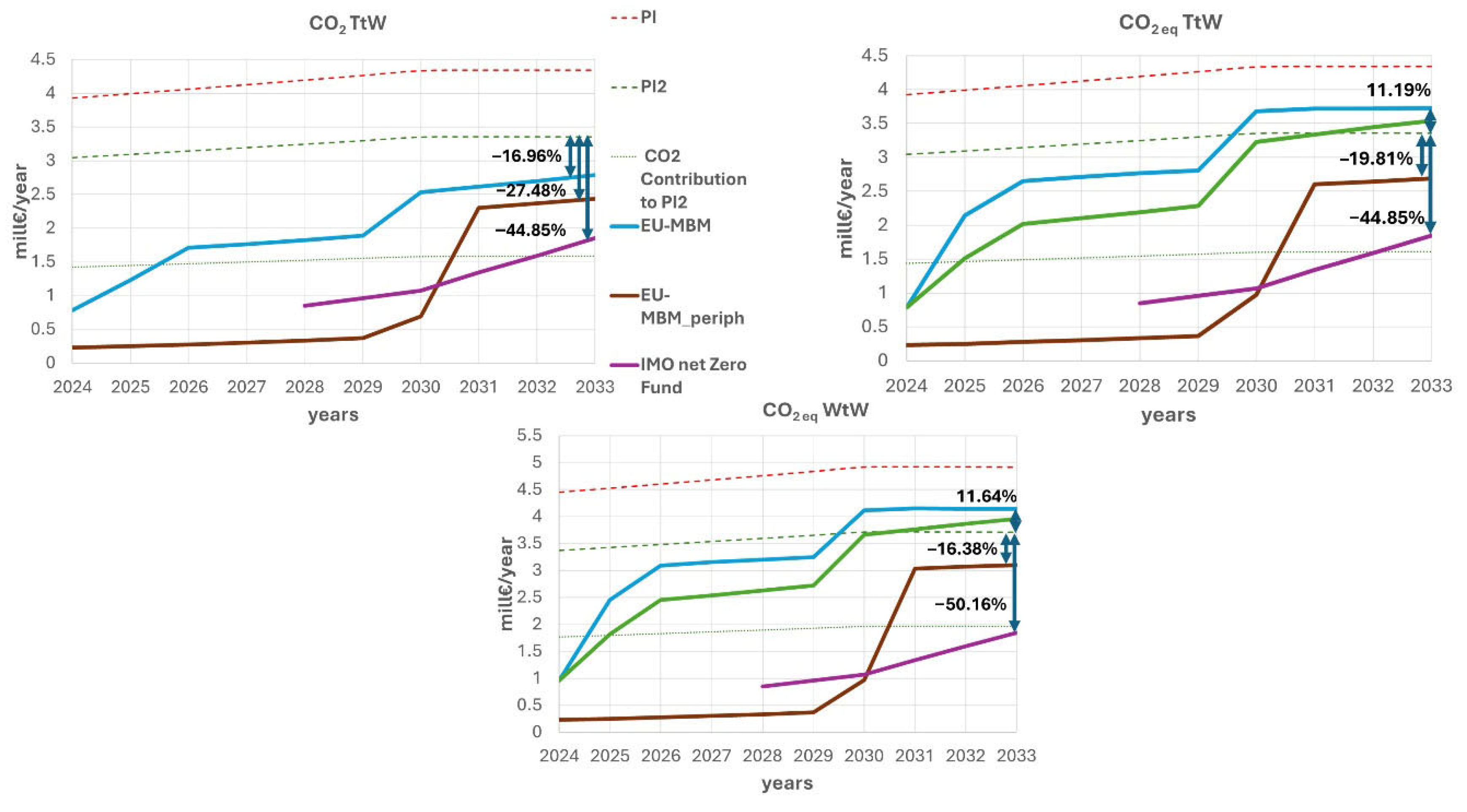
4.2. Goal and Market-Based Measures
5. Results
5.1. Carbon Intensity Indicator (Current Situation and Evolution)
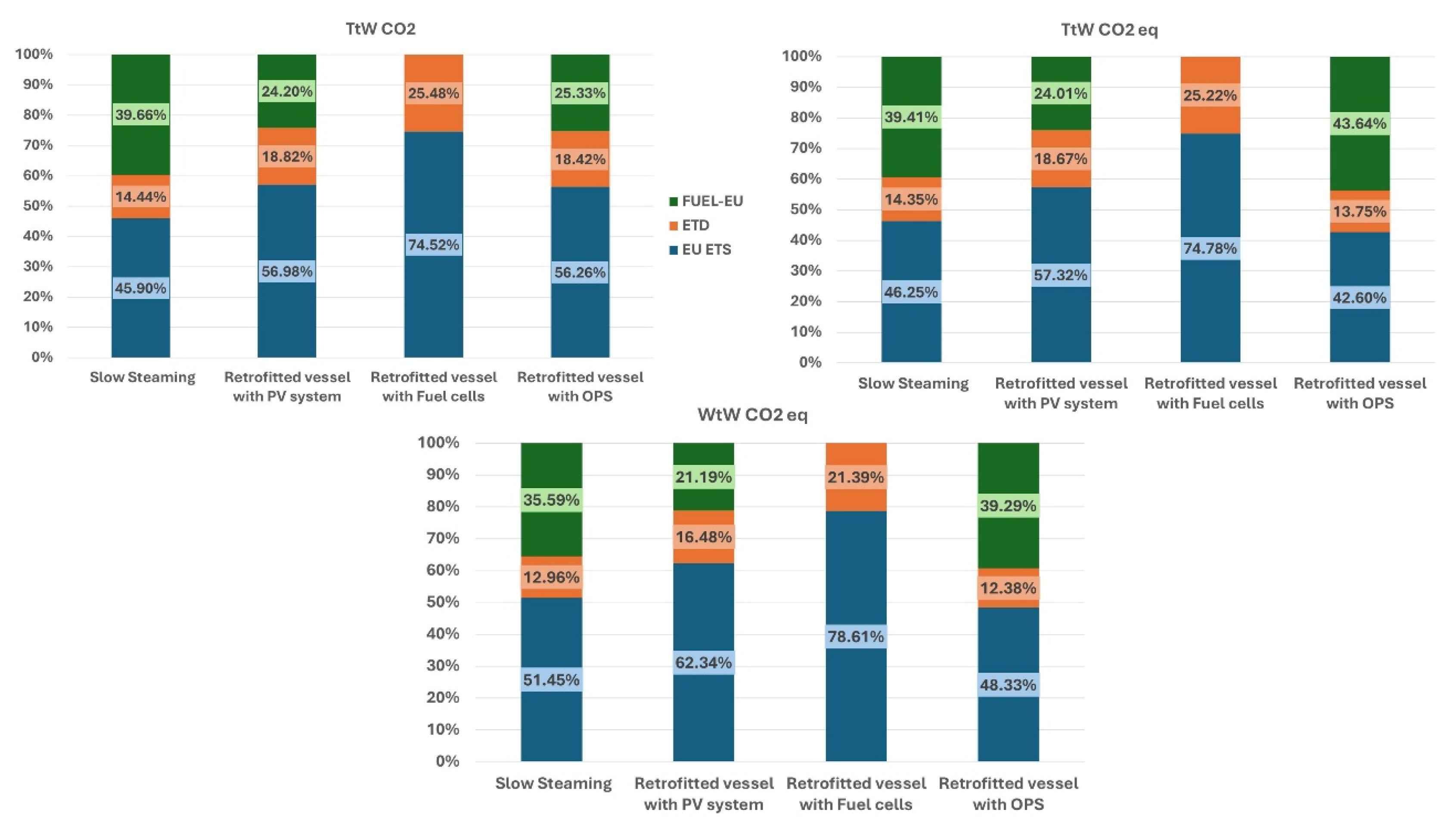
5.2. Pollutant Impact Evolution
5.3. Market-Based Measures
6. Discussion
7. Conclusions
Supplementary Materials
Author Contributions
Funding
Data Availability Statement
Acknowledgments
Conflicts of Interest
Appendix A
References
- European Maritime Safety Agency. Prevention of Pollution by Ships. 2025. Available online: https://www.emsa.europa.eu/we-do/sustainability/environment.html (accessed on 13 January 2026).
- European Maritime Safety Agency. EMSAFE: Key Facts and Data. 2022. Available online: https://www.emsa.europa.eu/we-do/safety/item/4733-emsafe-key-facts-and-data.html (accessed on 13 January 2026).
- European Maritime Safety Agency. The EU Maritime Profile—The Maritime Cluster in the EU. 2025. Available online: https://www.emsa.europa.eu/eumaritimeprofile/section-2-the-eu-maritime-cluster.html (accessed on 13 January 2026).
- European Commission. Motorways of the Sea. European Commission Mobility and Transport. 2024. Available online: https://transport.ec.europa.eu/transport-modes/maritime/motorways-sea_en (accessed on 13 January 2026).
- Nelissen, D.; Kleijn, A.; Hilster, D. CII and EU Maritime Decarbonisation; CE Delft: Delft, The Netherlands, 2023. [Google Scholar]
- Faber, J.; Van Seters, D.; Scholten, P. Shipping GHG Emissions 2030: Analysis of the Maximum Technical Abatement Potential; CE Delft: Delft, The Netherlands, 2023. [Google Scholar]
- Martínez-López, A.; Marrero, A.; Romero-Filgueira, A. Assessment of emerging technologies for high-speed-crafts decarbonization under the European Union regulation. Res. Transp. Econ. 2024, 108, 101497. [Google Scholar] [CrossRef]
- Psaraftis, H.N.; Zis, T.; Lagouvardou, S. A comparative evaluation of market based measures for shipping decarbonization. Mar. Transp. Res. 2021, 2, 100019. [Google Scholar] [CrossRef]
- Lagouvardou, S.; Lagemann, B.; Psaraftis, H.N.; Lindstad, E.; Erikstad, S.O. Marginal abatement cost of alternative marine fuels and the role of market-based measures. Nat. Energy 2023, 8, 1209–1220. [Google Scholar] [CrossRef]
- Marrero, Á.; Martínez-López, A. Decarbonization of Short Sea Shipping in European Union: Impact of market and goal based measures. J. Clean. Prod. 2023, 421, 138481. [Google Scholar] [CrossRef]
- Nelissen, D.; Kleijn, A.; Faber, J. FuelEU Maritime and EU ETS: Sound Incentives for the Fuel Choice; CE Delft: Delft, The Netherlands, 2022. [Google Scholar]
- Vierth, I.; Ek, K.; From, E.; Lind, J. The cost impacts of Fit for 55 on shipping and their implications for Swedish freight transport. Transp. Res. A 2024, 179, 103894. [Google Scholar] [CrossRef]
- Trosvik, L.; Brynolf, S. Decarbonising Swedish maritime transport: Scenario analyses of climate policy instruments. Transp. Res. D 2024, 136, 104457. [Google Scholar] [CrossRef]
- Transport & Environment (T&E). T&E’s Contribution to the Commission Consultation on the Review of the EU ETS: Towards 2040. 2025. Available online: https://www.transportenvironment.org/articles/towards-2040-a-strengthened-ets-to-support-the-transition-of-the-shipping-sector (accessed on 13 January 2026).
- Wang, J.; Li, X.; Yang, D. Uncertainties in life cycle assessment of renewable fuels for green shipping corridors. Transp. Res. D 2025, 147, 104916. [Google Scholar] [CrossRef]
- Wang, H.; Zhou, P.; Jeong, B.; Mesbahi, A.; Mujeeb-Ahmed, M.P.; Jang, H.; Giannakis, A.; Sykaras, K.; Papadakis, A. Life cycle analysis of ammonia fuelled ship: Case ship studies for marine vessels. J. Clean. Prod. 2025, 520, 146105. [Google Scholar] [CrossRef]
- Ventayol, A.; Lee Lam, J.S.; Bai, X.; Chen, Z.S. Comparative life cycle assessment of hydrogen internal combustion engine and fuel cells in shipping. Int. J. Hydrogen Energy 2025, 109, 774–788. [Google Scholar] [CrossRef]
- EEA–EMSA. European Maritime Transport Environmental Report 2025. EEA-EMSA Joint Report 15/2024. 2025. Available online: https://www.eea.europa.eu/en/analysis/publications/maritime-transport-2025 (accessed on 13 January 2026).
- Sánchez, A.; Martín Rengel, M.A.; Martín, M. A zero CO2 emissions large ship fuelled by an ammonia-hydrogen blend: Reaching the decarbonisation goals. Energy Convers. Manag. 2023, 293, 117497. [Google Scholar] [CrossRef]
- Percic, M.; Vladimir, N.; Fan, A. Life-cycle cost assessment of alternative marine fuels to reduce the carbon footprint in short-sea shipping: A case study of Croatia. Appl. Energy 2020, 279, 115848. [Google Scholar] [CrossRef]
- Martínez-López, A.; Ballester, P.; Mazorra-Aguia, L.; Marrero, A. Solar photovoltaic systems for the Short Sea Shipping’s compliance with decarbonization regulations in the European Union. Sustain. Energy Technol. Assess 2023, 60, 103506. [Google Scholar] [CrossRef]
- Martínez-López, A.; Marrero, A.; Martín-Cruz, Y.; Míguez, M. Environmental assessment model for scrubbers versus alternative mitigation systems for feeder vessels in liner shipping. J. Environ. Manag. 2022, 321, 115954. [Google Scholar] [CrossRef] [PubMed]
- International Maritime Organization. 2024 Guidelines on Life Cycle GHG Intensity of Marine Fuels (Resolution MEPC.391(81)). 2024. Available online: https://wwwcdn.imo.org/localresources/en/KnowledgeCentre/IndexofIMOResolutions/MEPCDocuments/MEPC.391%2881%29.pdf (accessed on 13 January 2026).
- Martínez-López, A.; Romero, A.; Chica, M. Specific environmental charges to boost Cold Ironing use in the European Short Sea Shipping. Transp. Res. D 2021, 94, 102775. [Google Scholar] [CrossRef]
- Royal Institution of Naval Architects. Significant Ships; Royal Institution of Naval Architects: London, UK, 2011; p. 60. ISBN 978-1-905040-89-6. [Google Scholar]
- Austal. Leonora Christina (Auto Express 113): Data Sheet. 2011. Available online: https://www.austal.com/sites/default/files/data-sheet/H246%20Leonora%20Christina%20low%20res.pdf (accessed on 15 January 2025).
- Kristensen, H.O.; Psaraftis, H. Prediction of resistance and propulsion power of Ro-Ro ships. In HOK Marineconsult ApS, Report 01; Technical University of Denmark: Kongens Lyngby, Denmark, 2016. [Google Scholar]
- European Maritime Safety Agency. EMSA MRV Public Emission Reports; EMSA: Lisbon, Portugal, 2025; Available online: https://mrv.emsa.europa.eu/#public/emission-report (accessed on 13 January 2026).
- Van Essen, H.; Van Wijngaarden, L.; Sutter, D.; Bieler, C.; Maffii, S.; Fiorello, D.; Fermi, F.; Parolin, R.; Schroten, A.; Brambilla, M.; et al. Handbook on the External Costs of Transport, Version 2019; Publications Office of the European Union: Luxembourg, 2019. [Google Scholar]
- Kristensen, H.O.; Psaraftis, H. Manual for the Computer Program SHIP-DESMO Ro-Ro Cargo, Report 08-2016; HOK Marineconsult ApS: Kokkedal, Denmark, 2016. [Google Scholar]
- Pavlenko, N.; Searle, S.Y.; Christensen, A. The Cost of Supporting Alternative Jet Fuels in the European Union. Working Paper 2019-05 from The International Council on Clean Transportation. 2019. Available online: https://theicct.org/sites/default/files/publications/Alternative_jet_fuels_cost_EU_20190320_1.pdf (accessed on 13 January 2026).
- Gobierno de Canarias. Anuario Energético de Canarias 2021. Dirección General de Energía/Observatorio de la Energía de Canarias. 2021. Available online: https://www.gobiernodecanarias.org/energia/descargas/SDE/Portal/Publicaciones/AnuarioEnergeticodeCanarias-2021-v2.pdf (accessed on 13 January 2026).
- European Commission. EU Energy Statistical Pocketbook and Country Datasheets; European Commission: Brussels, Belgium, 2025; Available online: https://energy.ec.europa.eu/data-and-analysis/eu-energy-statistical-pocketbook-and-country-datasheets_en (accessed on 13 January 2026).
- European Environment Agency. 1.A.1 Combustion in energy industries GB2009 update June 2010 in EMEP/EEA air pollutant emission inventory guidebook—2009. In EEA Technical Report 9/2009; European Environment Agency: Copenhagen, Denmark, 2009. [Google Scholar]
- Government of the Canary Islands. Sustainable Energy Strategy in the Canary Islands. 2022. Available online: https://www.gobiernodecanarias.org/energia/descargas/SDE/Portal/Planificacion/Estrategias/20220214_Estrategia_Sostenible_Canarias_docCompleto_01.pdf (accessed on 13 January 2026).
- Psaraftis, H.N.; Kontovas, C.A.; Kakalis, N.M.P. Speed reduction as an emissions reduction measure for fast ships. In Proceedings of the 10th International Conference on Fast Sea Transportation FAST 2009, Athens, Greece, 5–8 October 2009; pp. 1–12. [Google Scholar]
- Zincir, B. Slow steaming application for short-sea shipping to comply with the CII regulation. Brodogradnja 2023, 74, 21–38. [Google Scholar] [CrossRef]
- Finnish Meteorological Institute. Ship Traffic Emission Assessment Model (STEAM). 2024. Available online: https://www.ilmatieteenlaitos.fi/ (accessed on 13 January 2026).
- Gardner, H.; Brambilla, M.; Matheus, D.; Rando, G.; Grebe, S.; Nelissen, D.; De Vries, M.; Ross, S. Expected Impacts of ‘Fit for 55’ Legislation on Connectivity and Mobility in Europe; European Parliament, Committee on Transport and Tourism: Brussel, Belgium, 2024; Available online: http://www.europarl.europa.eu/thinktank/en/document/IPOL_STU(2024)752457 (accessed on 5 July 2025).





| GFI Compliance Balance | TIER I (g CO2eq) | TIER II (g CO2eq) | IMO Net Zero Fund (EUR/Year) * |
|---|---|---|---|
| GFI_TD ≥ GFI_attainedy | 0 | 0 | 0 |
| GFI_TD < GFI_attainedy ≤ GFI_TB | (GFI_TD − GFI_attainedy) | 0 | (GFI_TD − GFI_attainedy) × 0.85) |
| GFI_TB < GFI_attainedy | (GFI_TD − GFI_TB) | (GFI_TB − GFI_attainedy) | (GFI_TD − GFI_TB) × 0.85) + (GFI_TB − GFI_attainedy) × 3.23) |
| Length Overall (m) | 112.6 |
| Length between perpendiculars (m) | 101.3 |
| Beam (m) | 26.2 |
| Draft (m) | 3.8 |
| Draft max (m) | 4.85 |
| Depth to main deck (m) | 8.5 |
| Depth to upper deck (m) | 15 |
| Gross Tonnage | 10,369 |
| Deadweight Max(t) | 10,000 |
| Cars/Pax (capacity) | 357/1400 |
| Main engine (BHP kW) | 36,000 (4 × 9 MW) |
| Auxiliary engines (kWe) | 4 × 393 |
| Service speed (kn) | 38 |
| Bow thruster (kW) | 2 × 300 |
| Waterjets | 4 × 125KaMeWaSIINP |
| Navigation Stage | Speed (kn) VBs | Propulsion Requirements (kW) | Capacity Planning MMPP * (%BHP) | Electricity Requirements (kW) | Capacity Planning MMAA ** (%kWe) | Times (h/Trip) TVBs |
|---|---|---|---|---|---|---|
| Free Sailing | 38 | 33.757 | 4xMMPP 93.73% | 400 | 2xMMAA 51% | 1.6 |
| Manoeuvring | 4 | 43.2 | 1xMMPP 4.8% | 450 | 2xMMAA 57% | 0.5 |
| Berthing | 0 | 0.00 | 0.00% | 400 | 2xMMAA 51% | 1 |
| Hoteling | 0 | 0.00 | 0.00% | 250 | 1xMMAA 64% | 11.6 *** |
| HSC (38kn) | Slow Steaming HSC | ||||||
|---|---|---|---|---|---|---|---|
| Year | Shipping Time (min) | Regulation (1) | Regulation (2) | Speed (kn) | Increasing Shipping Time (min) | Regulation (1) | Regulation (2) |
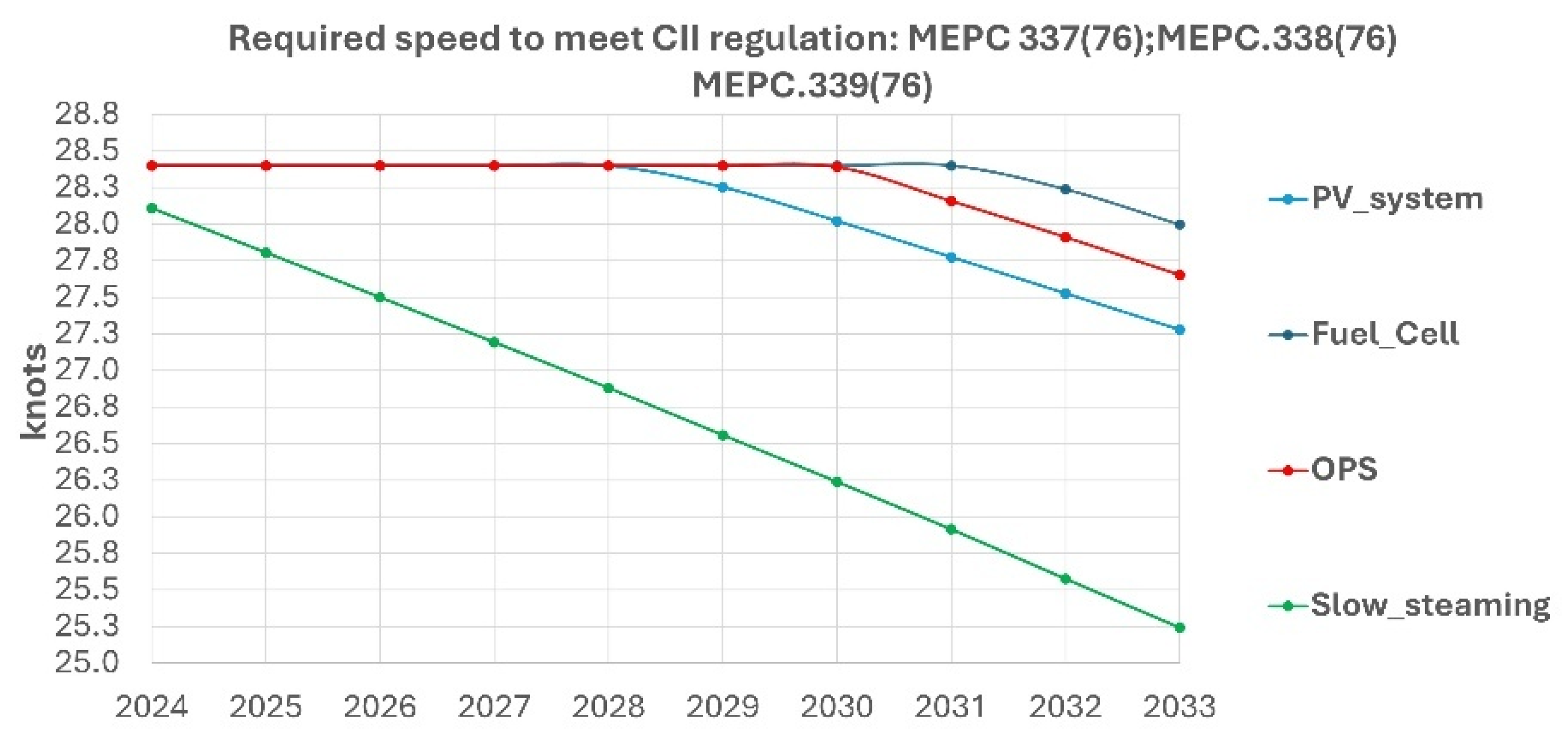
| 2024 | 96 | E | C | 28.11 | 29.16 | C | A |
| 2025 | 96 | E | D | 27.81 | 30.38 | C | A |
| 2026 | 96 | E | D | 27.50 | 31.64 | C | A |
| 2027 | 96 | E | D | 27.19 | 32.93 | C | A |
| 2028 | 96 | E | D | 26.88 | 34.28 | C | A |
| 2029 | 96 | E | D | 26.56 | 35.70 | C | A |
| 2030 | 96 | E | E | 26.24 | 37.14 | C | A |
| 2031 | 96 | E | E | 25.91 | 38.64 | C | A |
| 2032 | 96 | E | E | 25.58 | 40.25 | C | A |
| 2033 | 96 | E | E | 25.24 | 41.87 | C | A |
| PV_System | Fuel_CELL | OPS | Slow_Steaming | |
|---|---|---|---|---|
| Approach | 2024 | |||
| CO2eq TtW | 4.97% | 0.00% | 9.08% | 9.68% |
| CO2eq WtW | 4.77% | 0.17% | 8.35% | 9.28% |
| 2033 | ||||
| CO2eq TtW | 5.38% | 0.00% | 6.49% | 11.54% |
| CO2eq WtW | 5.16% | 0.17% | 6.13% | 11.14% |
| Approach | PV_System | OPS | Slow_Steaming |
|---|---|---|---|
| CO2eq TtW | −4.16% | −4.09% | −5.91% |
| CO2eq WtW | −3.77% | −3.23% | −5.27% |
| CO2 TtW Approach | CO2eq WtW Approach | |||||||
|---|---|---|---|---|---|---|---|---|
| Year | PV_System | Fuel_Cell | OPS | Slow Steaming | PV_System | Fuel_CELL | OPS | Slow Steaming |
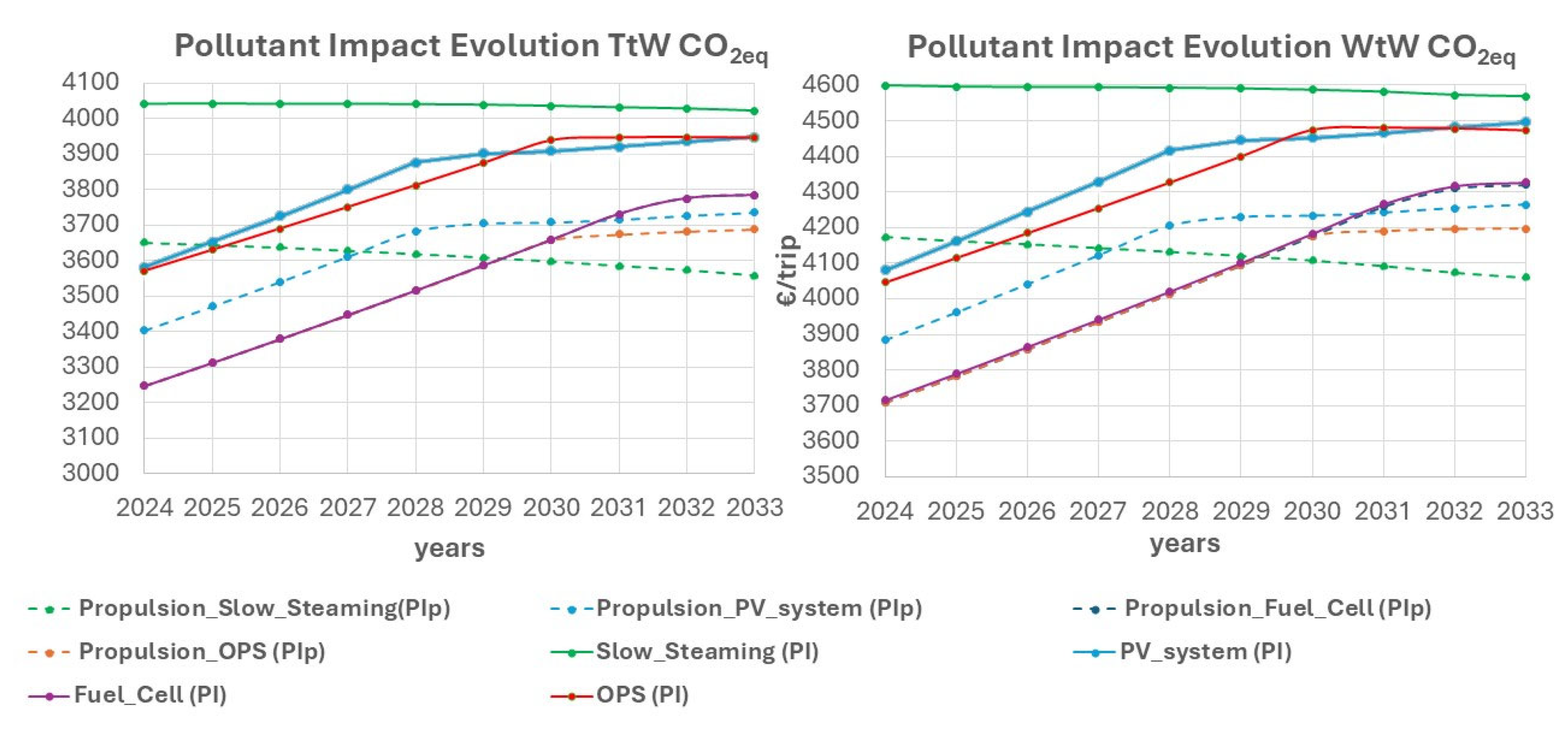
| 2024 | 58.97% | 60.02% | 58.58% | 58.04% | 64.81% | 65.86% | 64.23% | 63.94% |
| 2025 | 58.97% | 60.02% | 58.65% | 58.02% | 64.81% | 65.86% | 64.31% | 63.87% |
| 2026 | 58.97% | 60.02% | 58.72% | 58.01% | 64.81% | 65.86% | 64.39% | 63.82% |
| 2027 | 58.97% | 60.02% | 58.80% | 57.97% | 64.81% | 65.86% | 64.47% | 63.83% |
| 2028 | 58.97% | 60.02% | 58.87% | 57.92% | 64.81% | 65.86% | 64.56% | 63.78% |
| 2029 | 58.97% | 60.02% | 58.95% | 57.88% | 64.81% | 65.86% | 64.64% | 63.75% |
| 2030 | 58.95% | 60.02% | 59.03% | 57.85% | 64.79% | 65.86% | 64.73% | 63.71% |
| 2031 | 58.94% | 60.02% | 59.08% | 57.82% | 64.77% | 65.86% | 64.76% | 63.68% |
| 2032 | 58.92% | 61.49% | 59.14% | 57.79% | 64.76% | 67.17% | 64.79% | 63.60% |
| 2033 | 58.91% | 61.52% | 59.20% | 57.75% | 64.74% | 67.20% | 64.81% | 63.60% |
| TtW CO2 | TtW CO2eq | WtW CO2eq | |||||
|---|---|---|---|---|---|---|---|
| 2028 | 2033 | 2028 | 2033 | 2028 | 2033 | ||
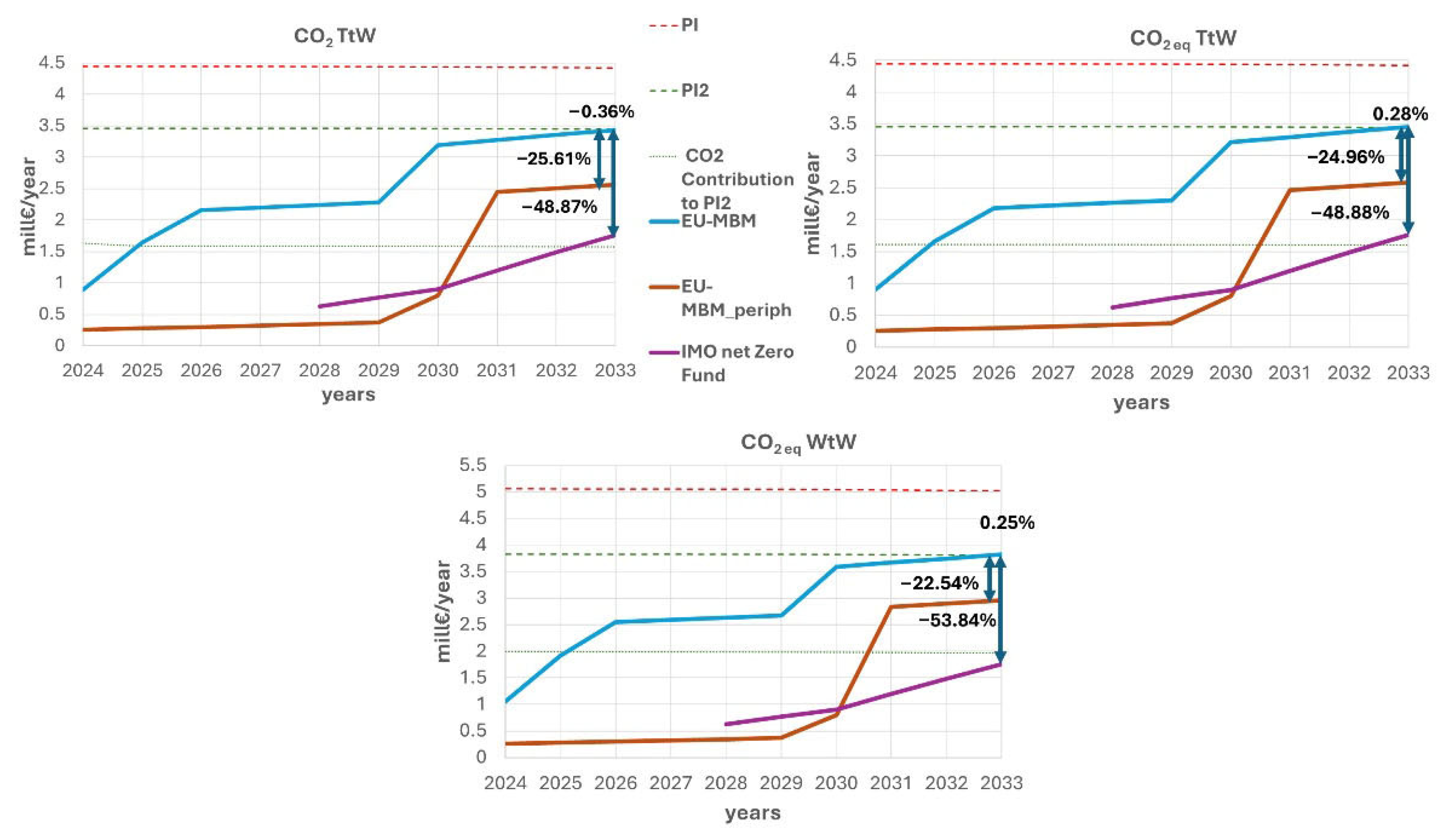
| Retrofitted vessel with PV system | EU-MBM | −15.07% | −19.30% | −14.94% | −19.18% | −13.16% | −17.29% |
| Pollutant Impact (PI2) | −4.56% | −2.39% | −4.56% | −2.39% | −4.35% | −2.13% | |
| IMO net Zero Fund | −21.87% | −6.31% | −21.87% | −6.31% | −21.87% | −6.31% | |
| Retrofitted vessel with fuel cells | EU-MBM | −21.15% | −39.76% | −21.04% | −39.52% | −19.09% | −35.60% |
| Pollutant Impact (PI2) | −13.87% | −6.96% | −13.87% | −6.96% | −13.36% | −6.34% | |
| IMO net Zero Fund | −44.76% | −13.16% | −44.76% | −13.16% | −44.76% | −13.16% | |
| Retrofitted vessel with OPS | EU-MBM | −18.56% | −18.83% | 22.26% | 8.00% | 21.46% | 8.35% |
| Pollutant Impact (PI2) | −6.09% | −2.60% | −6.09% | −2.60% | −6.17% | −2.70% | |
| IMO net Zero Fund | 35.20% | 5.07% | 35.20% | 5.07% | 35.20% | 5.07% | |
Disclaimer/Publisher’s Note: The statements, opinions and data contained in all publications are solely those of the individual author(s) and contributor(s) and not of MDPI and/or the editor(s). MDPI and/or the editor(s) disclaim responsibility for any injury to people or property resulting from any ideas, methods, instructions or products referred to in the content. |
© 2026 by the authors. Licensee MDPI, Basel, Switzerland. This article is an open access article distributed under the terms and conditions of the Creative Commons Attribution (CC BY) license.
Share and Cite
Martínez-López, A.; Marrero, Á.; Romero-Filgueira, A. Opportunities for Green H2 in EU High-Speed-Crafts Decarbonization Through Well-to-Wake GHG Emissions Assessment. J. Mar. Sci. Eng. 2026, 14, 190. https://doi.org/10.3390/jmse14020190
Martínez-López A, Marrero Á, Romero-Filgueira A. Opportunities for Green H2 in EU High-Speed-Crafts Decarbonization Through Well-to-Wake GHG Emissions Assessment. Journal of Marine Science and Engineering. 2026; 14(2):190. https://doi.org/10.3390/jmse14020190
Chicago/Turabian StyleMartínez-López, Alba, África Marrero, and Alejandro Romero-Filgueira. 2026. "Opportunities for Green H2 in EU High-Speed-Crafts Decarbonization Through Well-to-Wake GHG Emissions Assessment" Journal of Marine Science and Engineering 14, no. 2: 190. https://doi.org/10.3390/jmse14020190
APA StyleMartínez-López, A., Marrero, Á., & Romero-Filgueira, A. (2026). Opportunities for Green H2 in EU High-Speed-Crafts Decarbonization Through Well-to-Wake GHG Emissions Assessment. Journal of Marine Science and Engineering, 14(2), 190. https://doi.org/10.3390/jmse14020190