1. Introduction
For some ship operations, such as temporary construction projects at fixed locations, sea state (SS) conditions can change rapidly due to offshore storms or other local weather events. Because of their relatively small size and hull geometry, certain barge-like vessels—such as lightering tugboats—are restricted in the range of SS conditions under which they can safely operate. Consequently, it is essential for operators to understand local ocean conditions, expressed through key SS parameters, in order to assess in real time whether operations can be conducted safely. In many such scenarios, there is also a need for low-cost systems capable of addressing this challenge.
Accordingly, the primary objective of the present work is to develop a method for predicting local SS conditions in near real time for slow-moving, barge-like workboats whose safe operation is confined to a limited range of SS. Because vessel operations must be suspended when severe sea states occur, this work seeks to provide an objective and automated means of estimating local SS parameters—such as significant wave height , peak spectral period , and dominant wave direction —rather than relying on global forecasts, which may be locally inaccurate at the scale of a small vessel, or on empirical visual observations, which are labor-intensive and difficult to perform reliably in practice. In the latter case, operators typically observe the wave field for a short period (e.g., 30 s) to infer significant wave height from the consistently largest waves; similarly, timing several of these dominant waves and averaging their periods yields an estimate of the peak wave period, while visually assessing their prevailing approach provides an estimate of wave direction.
Since the 1960s, wave rider buoys have been developed and used to measure ocean waves and infer SS parameters based on their wave-induced motions, through the application of appropriate transfer functions (TFs), e.g., [
1]. Building on this principle, the idea of using a ship as a wave buoy—referred to as the Wave Buoy Analogy (WBA)—to estimate SS parameters from measured ship motions was introduced in the late 1990s [see review by Nielsen [
2], and references therein]. Within the WBA framework, the ship’s response to the SS provides a low-pass-filtered record of the incident waves, governed by the ship’s Response Amplitude Operators (RAOs), which serve as the TFs. Following this idea, a wide range of methods has been developed to estimate SS parameters, or, in some cases, the complete directional wave energy density spectrum, from measured wave-induced ship motions at zero or non-zero forward speed
U. Reviews of WBA-based methods are provided by Nielsen [
3] and Nielsen [
2]. Most proposed approaches assume linear TFs and operate in the frequency domain; typically, RAOs are expressed as the magnitudes of complex linear TFs as functions of wave frequency and direction, relating the incident wave spectrum to ship motions in up to six degrees of freedom (DOFs) (see
Appendix A for details of linear RAOs). In practice, the response model is often simplified to three DOFs, typically heave, roll, and pitch, since surge, sway, and yaw are generally less directly influenced by wave excitation [
4]. Under these assumptions, the measured ship (or buoy) motion time series represent the linear response of the floating body to a superposition of wave harmonics. For a stationary or slowly varying SS, the wave spectrum can then be estimated via linear inversion using the TFs, given the ship’s heading and speed, e.g., [
4,
5,
6,
7,
8,
9]. A related but more robust frequency-domain approach based on spectral moments was developed by Montazeri et al. [
10]. Some frequency-domain methods employ Kalman filtering to estimate SS parameters, while still relying on the ship RAOs, e.g., [
11,
12,
13,
14]. When estimating the complete SS spectrum, certain approaches assume semi-empirical spectral shapes and directional spreading functions for swell or mixed sea states [
10], involving a small number of parameters obtained through constrained optimization. Other methods, such as Bayesian approaches, perform a full spectral reconstruction by optimizing spectral energy across multiple frequency and directional bins inferred from ship motions [
4,
15,
16].
Although these earlier methods have generally reported reasonable estimates of SS parameters and spectra, they exhibited some limitations when nonlinear ship responses became significant in strong sea states. Under such conditions, the assumption of linear RAOs becomes unreliable—particularly for roll and heave responses and especially in the vicinity of resonance frequencies. Small barge-like workboats—such as the lightering tug considered in this study—are especially susceptible to large motions, most notably in roll, as the wave climate approaches their upper operational SS limit. Moreover, their sharp-cornered hull geometries are prone to strong nonlinear hydrodynamic effects, including nonlinear roll damping and stiffness. In addition to these limitations, WBA-based methods have typically required long time series of ship-motion measurements—on the order of 10–15 min at full scale—particularly when estimating the full directional wave spectrum. In rapidly evolving environments, however, this requirement may violate the underlying assumption of a stationary SS and implies that the inferred parameters represent past, hindcast conditions rather than a true nowcast. Motivated by these limitations, a small number of studies have explored the estimation of simple SS parameters from shorter ship-motion time series without relying on RAOs. For example, Brodtkorb et al. [
17] and Brodtkorb et al. [
18] reported progress in this direction; however, their work was restricted to regular, long-crested wave conditions.
In recent years, neural network (NN) and machine-learning (ML)-based methods have proven highly effective across a wide range of scientific and engineering disciplines for predicting complex physical processes. For example, based on observed time series of ocean waves, several studies have proposed NN-based approaches for predicting longer-term sea state (SS) parameters or generalized wave fields, e.g., [
19,
20,
21]. Within the field of seakeeping, a growing body of research has employed NN- and hybrid NN-based approaches to predict ship motions from long time histories of previously observed vessel responses [
22,
23,
24]. More recently, in the context of the WBA, NN- and ML-based methodologies have been applied in a variety of studies aimed at estimating SS parameters from time series of vessel motions obtained from numerical simulations, laboratory experiments, and/or field measurements, e.g., [
25,
26,
27,
28,
29]; Majidiyan et al. [
30] recently discussed the challenges of applying NN/ML-based method to the seakeeping problem in a noisy ocean environment. Despite the steadily increasing sophistication and predictive capability of the NN architectures employed in these studies, most approaches continue to rely on assumptions of essentially linear ship response or on frequency-domain transfer functions (TFs), and therefore retain limitations similar to those of earlier WBA-based methods.
In the early stages of this work, Grilli et al. [
31] proposed an alternative NN-based methodology to address the problem of SS parameter estimation, overcoming several limitations of earlier WBA approaches for the class of tugboats considered here—particularly those associated with nonlinear ship response. Specifically, they: (i) implemented and experimentally validated an efficient nonlinear, time-domain seakeeping model to predict tugboat motions under prescribed SS conditions, assuming zero forward speed (
); (ii) used this model to generate a training dataset of tugboat motion time series spanning a wide range of SS parameters (
and
) for a limited set of dominant wave directions
; and (iii) trained a simple nonlinear autoregressive NN with exogenous inputs (NARX) to estimate the SS parameters. The methodology was demonstrated for strong sea states that induced pronounced nonlinear ship motions.
Building on this preliminary work and addressing the primary objective of developing a practical method for predicting SS parameters from measured lightering-tugboat motions during operation, the present study further develops, validates, and extends the seakeeping model of Grilli et al. [
31] by (i) accounting for nonzero forward speed (
); (ii) enabling prediction of SS directionality; and (iii) removing the assumption of long-crested waves. During validation of the initial methodology, it was observed that training the NN directly on complete ship-motion time series yielded accurate estimates of
and
, but was less effective for predicting SS directionality. Consequently, we introduce and demonstrate a more effective NN-training strategy based on a set of proxy parameters—referred to as motion discriminant variables (MDVs)—which are readily computed from shorter segments of ship-motion time series. The use of MDVs improves computational efficiency, brings the predictions closer to a true nowcast, and enables accurate estimation of SS directionality. Finally, to validate both the seakeeping model and the NN-based predictive framework, new laboratory experiments are conducted with and without forward speed. These experiments employ a larger-scale tugboat model than that used by Grilli et al. [
31], with the scale increased from 1:29 to 1:19, thereby reducing undesired viscous damping effects and allowing for more reliable scaling to full-scale sea states.
In the context of the WBA, the predictive performance of a NN depends primarily on two factors: (1) the size and diversity of the available dataset of vessel motion records spanning a realistic range of SS conditions used for training; and (2) the degree of regularization or generalization imposed to constrain the NN model. The former ensures that the NN can identify characteristic motion patterns associated with different SS conditions within the training range and accurately estimate SS parameters when applied in practice. The latter mitigates overfitting and enables the NN to generalize effectively, allowing reliable predictions for SS conditions that differ from those encountered during training. We demonstrate that both requirements are satisfied by the proposed methodology and that the second criterion is met more effectively when using MDVs rather than complete ship-motion time series, as in our initial work.
Finally, although this aspect is beyond the scope of the present paper, the ultimate objective of the project sponsors is to deploy the trained NN on their tugboats, together with the required onboard sensors and hardware, as a low-cost and user-friendly decision-support tool for the operators of such small vessels. In this context, the sponsors specified a target maximum prediction error of 5% for the estimated SS parameters, which the present work aims to achieve.
Following this introduction,
Section 2 presents the development of the nonlinear, time-domain seakeeping model employed in this study to generate the vessel motion time-series dataset. The model considers three DOFs—heave, roll, and pitch–, accounts for forward ship speed, and is forced by waves from a directional SS. The formulation is readily generalizable to different hull geometries, provided that the appropriate hydrodynamic coefficients are available. In
Section 3, the seakeeping model is validated and calibrated using results from selected laboratory experiments conducted in a wave/tow tank, both with and without forward speed.
Section 4 then describes the training, validation, and application of an NARX-NN to predict SS parameters based on MDVs computed from short segments of ship-motion time series. For the zero-speed case (
), SS parameters are estimated for beam and oblique seas using three-DOF motion data. For the advancing-speed case (
), owing to the constraints of the two-dimensional wave/tow tank facility, SS parameters are estimated only for head seas and using two DOFs (heave and pitch).
2. Time-Domain Nonlinear Seakeeping Model with Forward Speed
2.1. Modeling Methodology
As discussed in the introduction, in the past few decades, many methods based on the WBA have been proposed for estimating SS parameters from wave-induced ship motions, using linear TFs in the frequency domain (e.g., motion RAOs), or variations of these that still assumed linear processes. More recently, NN- or ML-based methods have been proposed, in which NN/ML algorithms are trained on a large dataset of ship motions in known sea states. The latter were obtained experimentally or, in some cases, through applying a seakeeping model, typically also linearized in the frequency domain.
When the lightering tugboat considered in this study operates near its limiting SS conditions, its relatively small size typically results in large-amplitude motions that induce significant nonlinear effects. These effects are particularly pronounced in the hydrostatic restoring force in heave, as well as in nonlinear viscous damping forces and moments associated with large roll motions and, to a lesser extent, pitch motions. Consequently, standard approaches based on linear TFs are not suitable for inferring SS parameters from the motions of this class of vessel. Instead, the instantaneous heave, roll, and pitch motions of the tugboat operating in a random directional SS are simulated using a newly developed nonlinear, time-domain seakeeping model, under the assumptions of constant forward speed and fixed heading. These three degrees of freedom (DOFs) are selected from the six possible rigid-body motions because, for the tugboat geometry and operating characteristics considered here–and consistent with previous studies (e.g., [
4])—they are the motions most directly and strongly excited by wave forcing. As such, they provide the most informative basis for estimating SS parameters.
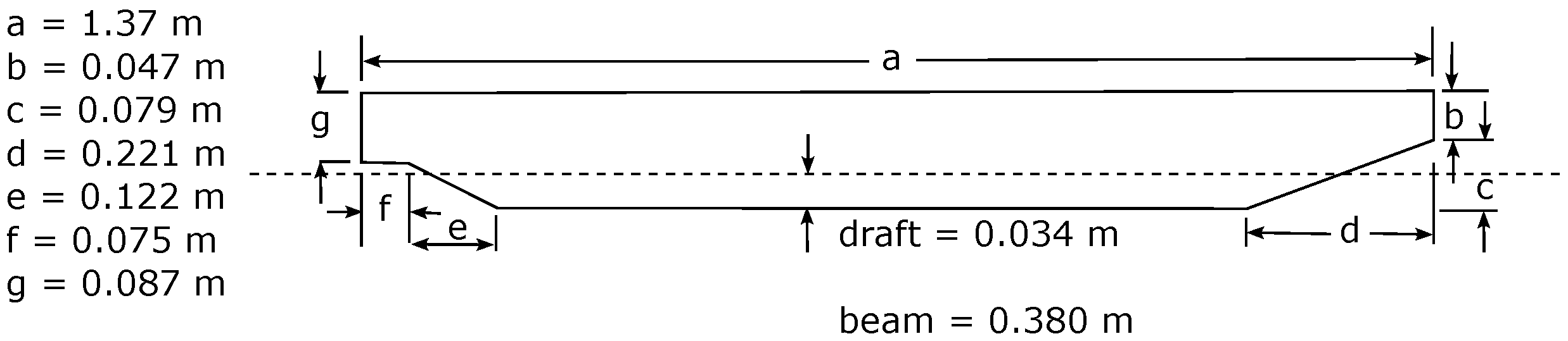
The seakeeping model is applied to both the full-scale lightering tugboat and a geometrically similar 1:19.22-scale physical model. The model-scale dimensions and operating draft are shown in
Figure 1 is representative along the entire beamwise direction. After calibrating the viscous damping coefficients based on laboratory experiments, the seakeeping model is run to generate a dataset of boat-motion time series for a large number of sea states with specified parameters (
,
,
). This dataset is finally used to train an NN to predict SS parameters based on ship motions.
2.2. Model Formulation and Governing Equations
The seakeeping model is formulated by modifying Cummins’ standard linearized radiation-diffraction equations of motion [
32,
33,
34,
35], augmented by a nonlinear hydrostatic restoring force in heave and by nonlinear viscous damping terms in each DOF. The viscous damping forces/moments are modeled using bulk drag coefficients that are calibrated from laboratory experiments (see
Section 2.6 and
Section 3).
Hence, the equations governing the wave-induced motions
of the tugboat, with a forward speed
U, are given by
for
corresponding to heave (m), roll (rad), and pitch (rad), respectively, where index notation with the summation convention over repeated indices is employed, and overdots denote time derivatives. In Equation (
1): (i)
is the ship mass (or inertia) matrix; (ii)
is the added-mass (or inertia) matrix evaluated at infinite frequency; (iii) the convolution integrals represent the linear radiation memory effects, accounting for radiative damping and transient added mass through the impulse response functions (IRFs),
and the full history of the vessel velocity
; (iv)
denotes the total hydrostatic restoring forces and moments, including both linear and nonlinear components that depend on the vessel motions and the instantaneous free-surface elevation
; (v)
represents the nonlinear viscous damping forces or moments, modeled as functions of the motion velocities; and (vi)
is the linear wave-excitation force or moment, arising from the combined Froude–Krylov (FK) and diffraction contributions of each frequency and directional component of the discretized incident wave spectrum.
The tugboat mass
m, inertia matrix
(for
), and linear hydrodynamic coefficients–added mass
, radiative damping
, and excitation force
module
and phase
(including both incident FK and diffracted wave effects)–were computed at zero forward speed (
) using Ansys AQWA 19.0 [
31,
36,
37,
38], for a range of angular frequencies,
, and wave directions,
for the force, and provided to the authors by the project sponsors. These simulations were based on the full-scale tugboat mass distribution and hull geometry (shown in idealized form in
Figure 1) and covered the full scale frequency range
(rad/s) or periods
(s); and there were 21 equally-spaced incident angles
. Using this information, we reconstructed the mass-inertia matrix
and the hydrostatic restoring coefficient matrix
used in the linear component of the total hydrostatic restoring force and moment
(see
Section 2.6). [Note, as the vessel geometry was proprietary, we did not have the option of re-running or modifying these simulations for other parameters, or for a non-zero forward speed.].
With a forward speed
), AQWA’s hydrodynamic coefficients need to be corrected
and
and expressed based on the encounter frequency [
34],
where
g is gravitational acceleration and
denotes the projection of the boat velocity onto the wave component of direction,
(
represents head seas and
following seas). Considering the simple geometry of the tugboat, the correction for forward speed will be done based on strip theory equations [
34,
39,
40]. Details are given
Section 2.3.
Using the hydrodynamic coefficients obtained from the AQWA simulations, the radiation IRFs can be computed directly only for the zero forward-speed case. Using the hydrodynamic coefficients corrected for a non-zero forward speed, however, the IRFs
can be evaluated both with and without forward speed using either of the equivalent formulations [
32,
35],
which are evaluated numerically. Accurate computation of the IRFs requires that the integrals span the full frequency range
[
35,
41]. In the present case, however, the added-mass and radiation-damping coefficients
and
—and their corrected values for a forward speed—were computed only over a finite frequency range. To account for the missing high-frequency contributions, we further develop and apply asymptotic expansions originally proposed by Pérez and Fossen [
41]. Details of this procedure are provided in
Appendix C, and a summary is given in
Section 2.7.
For an SS with known parameters
, described by its directional wave energy density spectrum
, the wave-excitation force and moment
are obtained through linear superposition of the contributions from individual wave components. However, there is no straightforward way to derive the time-domain excitation force
for a vessel advancing at speed
U directly from the corresponding zero-speed coefficients
and
. Consequently, additional simulations were performed using the standard linear, time-domain seakeeping model AEGIR [
42], in which the tugboat advances at a constant forward speed
U into regular waves of frequency
and direction
. For each simulation, the resulting periodic wave-induced forces and moments—accounting for both incident and diffracted wave contributions—were computed and, as in the zero-speed case, expressed in terms of a module
and phase
. Further details of the wave-excitation formulation are provided in
Section 2.5.
Once all model terms are properly parameterized and evaluated, the integro-differential Equation (
1) is solved numerically in the time domain to obtain the tugboat motions. In a time-marching framework, this requires evaluating the radiation memory terms (convolution integrals) over a sufficiently long time history to avoid truncating the IRFs, and thus accounting for many previous system states. As this procedure can be computationally expensive, an alternative approach is adopted in which the convolution integrals are replaced by a finite-dimensional approximation. Specifically, the IRFs—computed using Equation (4)—are fitted with a Prony-series (sum-of-exponentials) representation, resulting in an augmented system of ordinary differential equations (ODEs). This approach has been applied previously in similar contexts, e.g., [
43,
44]), and Armesto et al. [
45] demonstrated that it offers a computationally efficient alternative to direct numerical evaluation of the convolution integrals. In the present work, the Prony-approximation framework is further adapted to explicitly account for the effect of forward speed
U on the IRFs, as obtained from strip theory. The details of the Prony formulation are presented in
Appendix D and summarized in the following section.
2.3. Linear Hydrodynamic Coefficients
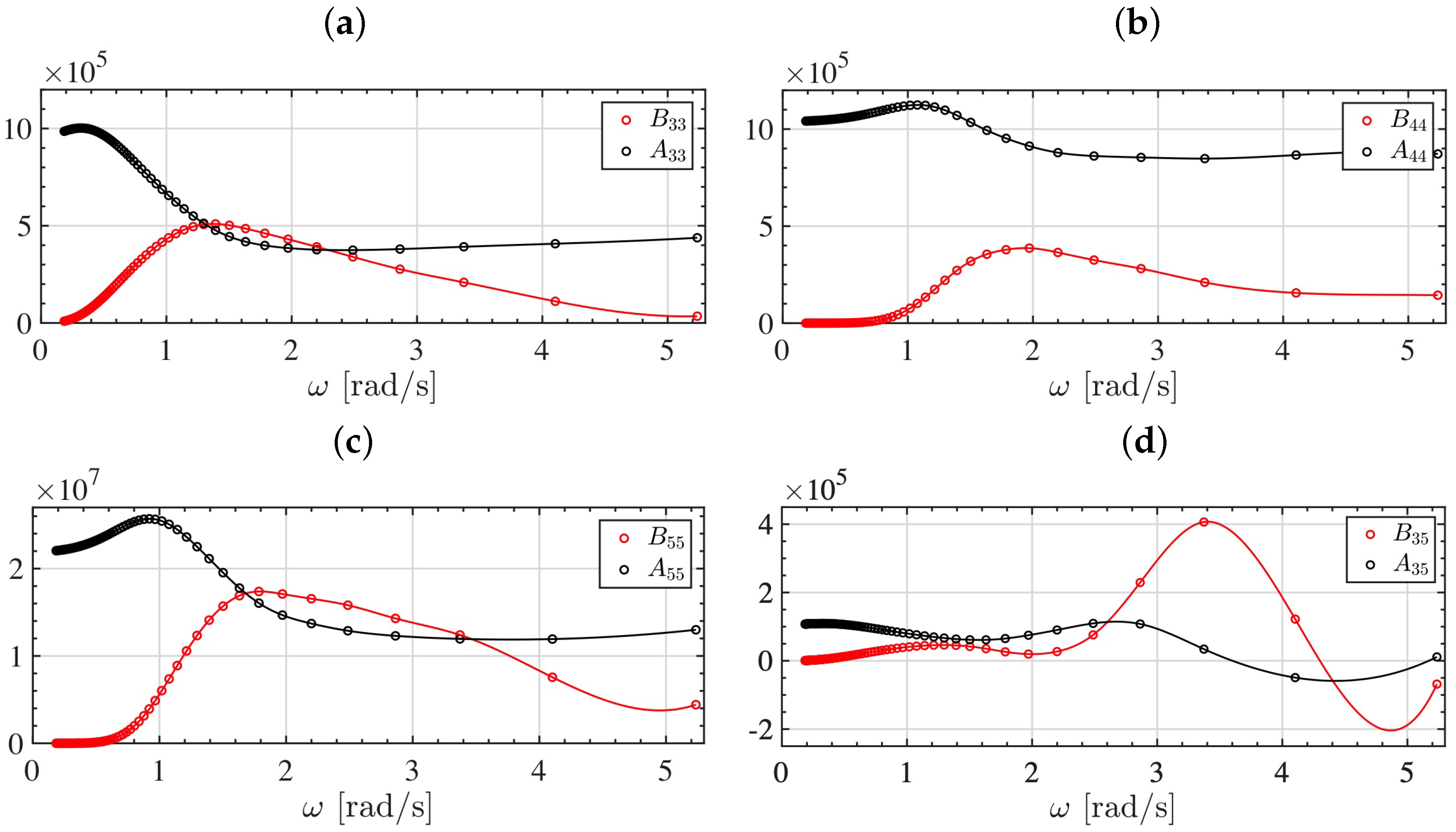
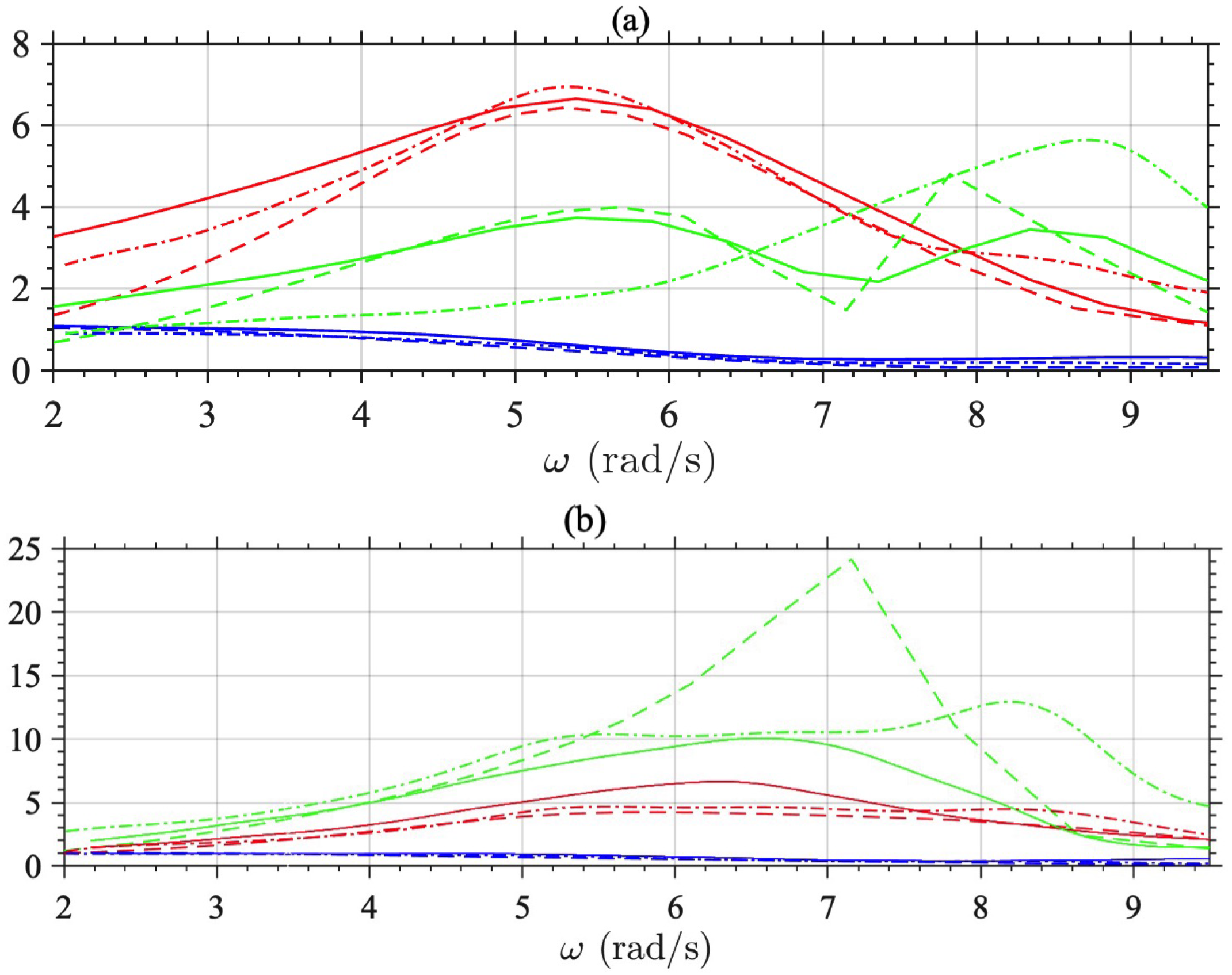
Figure 2 shows the
and
coefficients in heave, roll, and pitch (
), and
and
in heave-pitch coupling—the only significant off-diagonal coefficients–, computed with AQWA for
, for
frequencies in the [0.185, 5.236] (rad/s) range (or equally-spaced period
(s)).
Appendix A provides details of the derivation and formulation of the standard linear RAOs, which, in particular, allow estimation of the tugboat’s resonance frequencies for each DOF based on the hydrodynamic coefficients shown in
Figure 2a–c. Accordingly, applying the second form of Equation (
A7), which neglects coupling between DOFs, and assuming a water density of
, we obtain the resonance frequencies
, 1.83, and 1.64 rad/s (corresponding to periods
, 3.43, and 3.83 s), for
, respectively. For heave and roll, as expected, the natural frequency of each motion occurs near the frequency at which the added mass (or inertia) reaches a minimum, and the linear radiation damping attains a maximum, as shown in
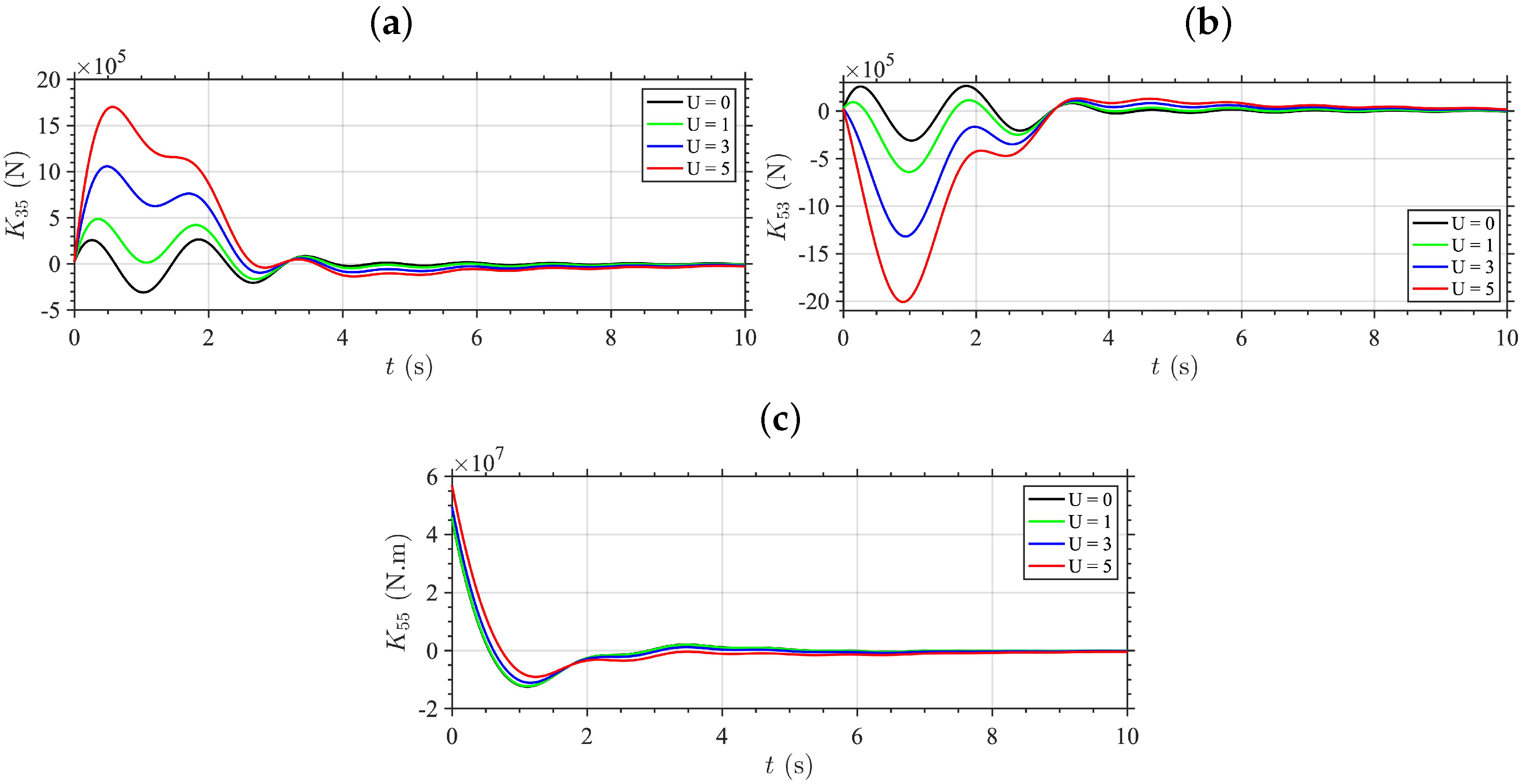
Figure 2a,b. Both numerical simulations and experimental results will later confirm the accuracy of these estimates. For pitch, however, significant coupling with the heave motion (see
Figure 2d) alters the resonance behavior, such that the resonance frequency predicted by the simplified uncoupled formulation is modified. This effect is discussed in detail in the experimental validation
Section 3.
With a forward speed
, the hydrodynamic coefficients that are affected are expressed as a function of those computed at zero forward speed based on strip theory equations [
34,
39,
40]:
The second term in each Equation (
5) represents the forward speed correction. The modified coefficients are used to calculate impulse response functions in
Section 2.7.
2.4. Wave Spectrum and Surface Elevation
Each SS characterized by specified values of
and simulated with the numerical seakeeping model is represented by a wave energy density spectrum. From this spectrum, a random free-surface elevation time series is generated and used both to compute the total wave-excitation forces acting on the vessel and to evaluate the nonlinear component of the hydrostatic restoring force in heave. Directional JONSWAP (JS) spectra
are used, defined as functions of angular frequency
and wave direction
.
Appendix B details the construction of these spectra, which are obtained by combining a two-dimensional JS spectrum parameterized by
, and a peakedness coefficient
, with a standard directional spreading function
centered on the dominant wave direction
. The spreading function is taken as a cosine-power distribution with a frequency-dependent exponent. For the numerical simulations used to generate training data, a representative average value of
is adopted for the JS spectrum. Additional simulations could readily be performed in future work using alternative
values more representative of different ocean wave climates in which the tugboat may operate. When comparing numerical results with laboratory experiments, however, the value of
inferred from the measured laboratory wave spectra is used.
When comparing model results to wave-tank experiments conducted in unidirectional waves, no directional spreading is present in the generated wave field; accordingly, and for all wave components derived from the JS spectrum. In contrast, when developing the NN training dataset using the calibrated numerical model, fully directional sea states are simulated.
For cases involving forward speed, each wave component of the directional SS experienced by the vessel undergoes a frequency shift to the encounter frequency defined in Equation (
2). While the ship velocity modifies the frequencies of the encountered waves, it does not alter the total wave energy. Hence, the encounter energy density spectrum is defined as
where, using Equation (
2), the Jacobian of the frequency transformation is given by the following:
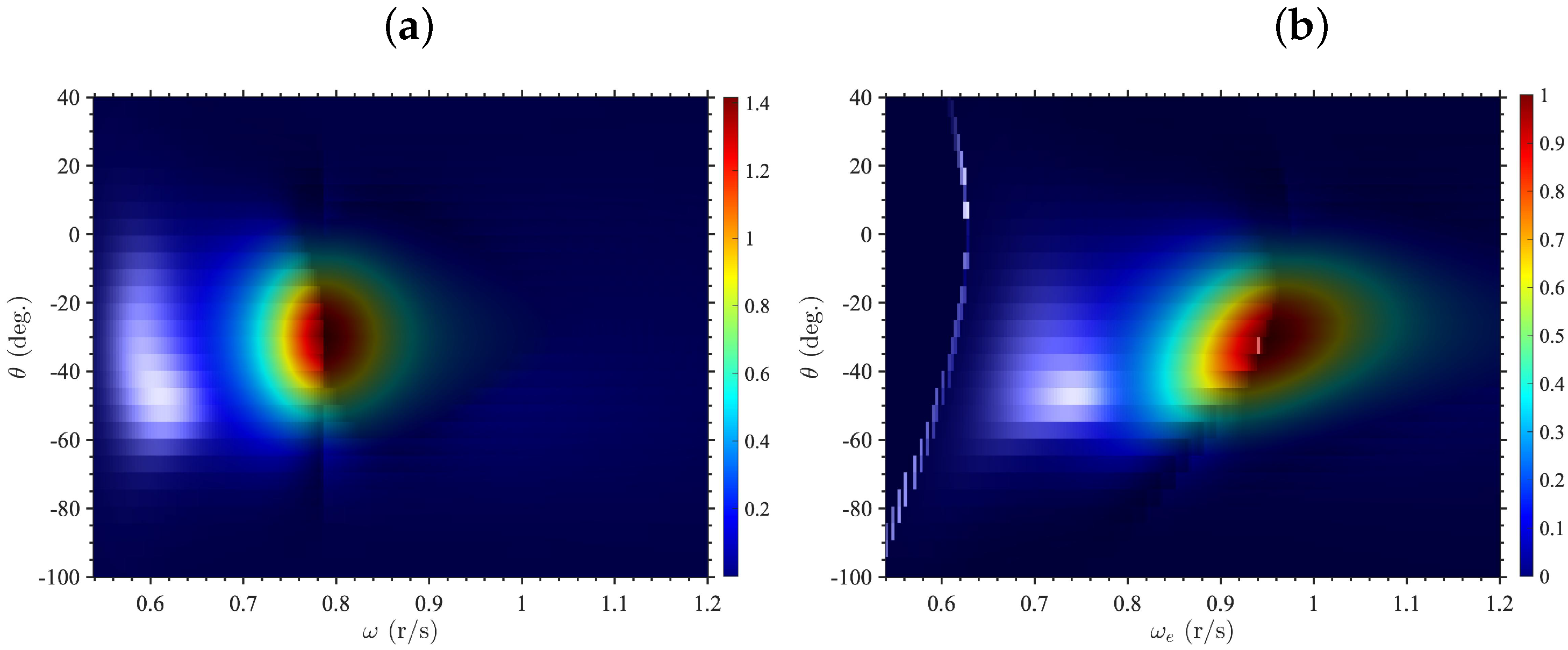
Figure 3 illustrates an example of directional JS spectra computed using Equations (
7) and (
A8), for
m,
s,
(
),
, and
, considering both zero forward speed and a forward speed of
m/s—for which the corresponding encounter spectrum
is shown. Comparison of the two spectra indicates that wave energy is shifted toward higher frequencies, with the effect becoming more pronounced for wave directions closer to
. In addition, the energy density of
increases as a result of the Jacobian transformation.
Given an encounter spectrum
defined for a forward speed
, discretized into
frequency bins of width
and
directional bins of width
, the time series of free-surface elevation
experienced by the vessel is obtained by linear superposition using the random-phase method:
the wave component amplitudes, and the encounter frequencies
are obtained from Equation (
2) as functions of the intrinsic frequencies
. The phases
are independent random variables uniformly distributed over
.
2.5. Wave Excitation Force
The instantaneous wave-excitation force (or moment) associated with a given directional SS spectrum
and the corresponding random free-surface elevation time series
extracted from it (Equation (
8)) is computed by linear superposition of the contributions from individual wave components. For the zero forward-speed case (
), the excitation force coefficients were provided in AQWA’s results, whereas for the advancing-speed case (
), they are derived from AEGIR simulations. In both cases, the excitation force coefficients are interpolated to the
discrete encounter frequencies and
wave directions used in the spectral discretization, and to the specified forward speed
U, when applicable. Accordingly, for
,
where
and
are the interpolated amplitude and phase, respectively, of the excitation force (or moment) induced by a unit-amplitude wave component with encounter frequency
and direction
, at forward speed
U.
For the zero-speed case (
),
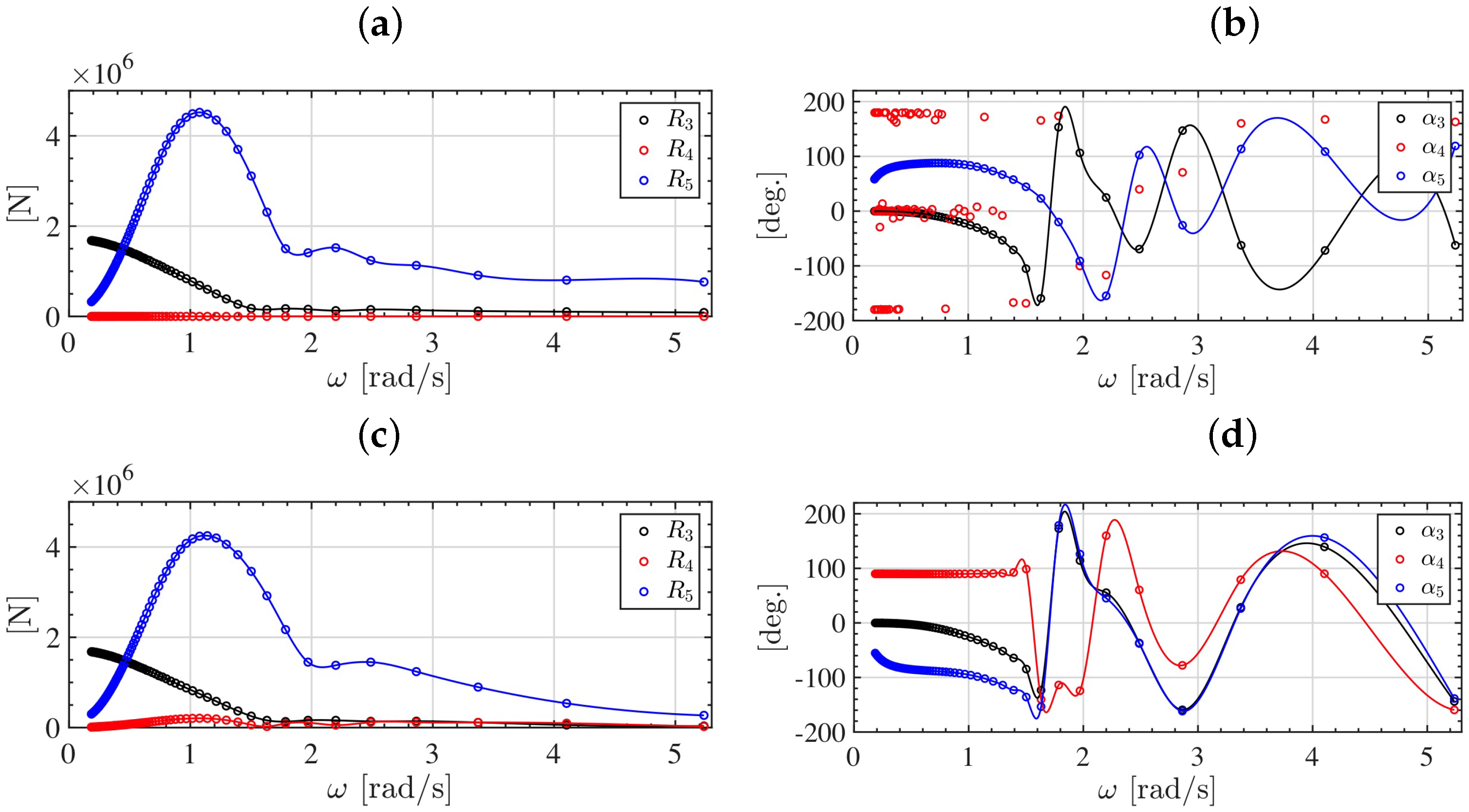
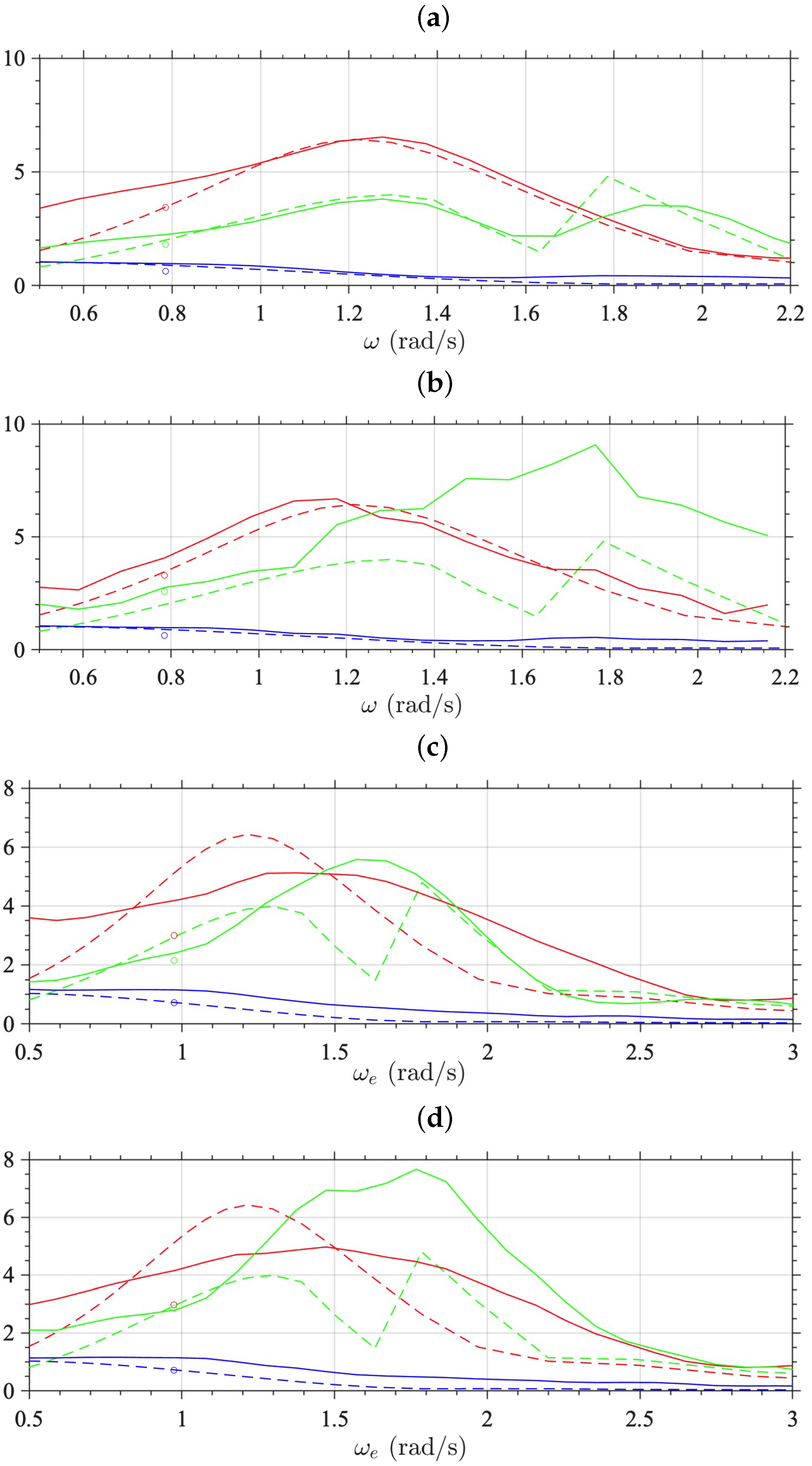
Figure 4 presents examples of the excitation-force module
and phase
, computed with AQWA for wave directions
and, arbitrarily,
, for the three DOFs. Owing to the geometric symmetry of the vessel, results for wave directions in the range
can be obtained by symmetry from those computed over
.
For cases with forward speed (
), the excitation forces (or moments) are computed for each required wave frequency and direction using the time-domain boundary-element model AEGIR [
42], which represents the hull geometry by higher-order NURBS. This approach is necessary because AQWA does not explicitly separate the FK and diffraction components of the excitation force, and strip theory cannot be applied to compute the diffraction force modified by forward speed. To ensure numerical accuracy in AEGIR, at least 12 nodes per wavelength are used in the free-surface discretization, and the computational domain extends to at least 2.5 wavelengths in each direction to allow sufficient wave propagation for the lower frequencies. Deep-water conditions are assumed in all simulations [
46]. Convergence of AEGIR simulations using this discretization was assessed by comparing results with AQWA for
; a good agreement was found between both model results, but details are omitted here for the sake of brevity.
Many additional simulations were then performed with AEGIR for , which provided a time series of wave-induced force (or moments) on the boat, caused by unit amplitude incident periodic wave of frequency/incident direction , based on which the excitation force (or moments) module and phase were computed. These simulations covered the standard operating range of the full-scale tugboat in the considered sea states, i.e., 19 equally spaced encounter frequencies rad/s (period s) and 13 equally spaced incident angles . Time steps were specified as in each simulation, and the duration of each simulation was at least . Once results became periodic in the time series, the module and phase of each force (or moment) were computed for .
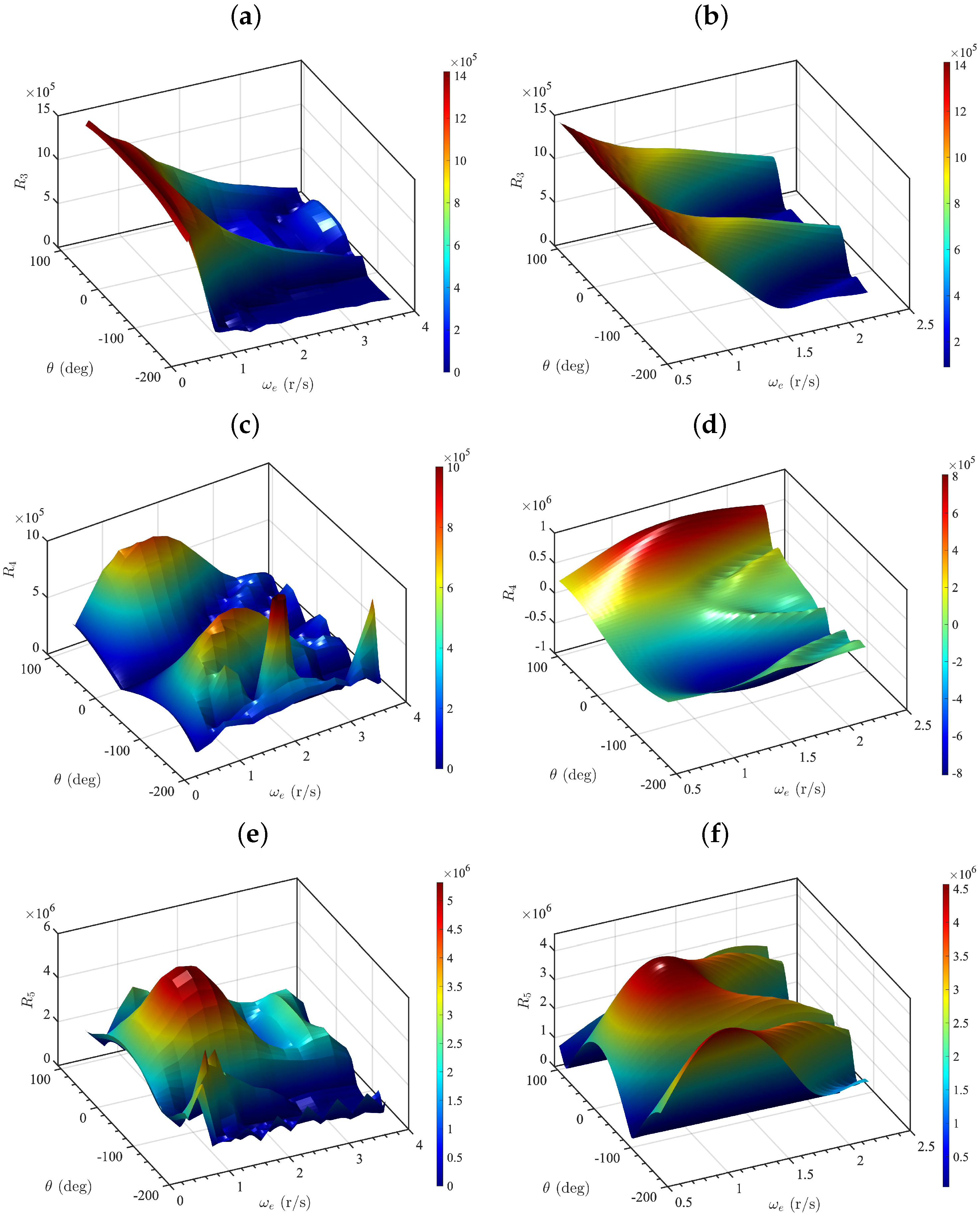
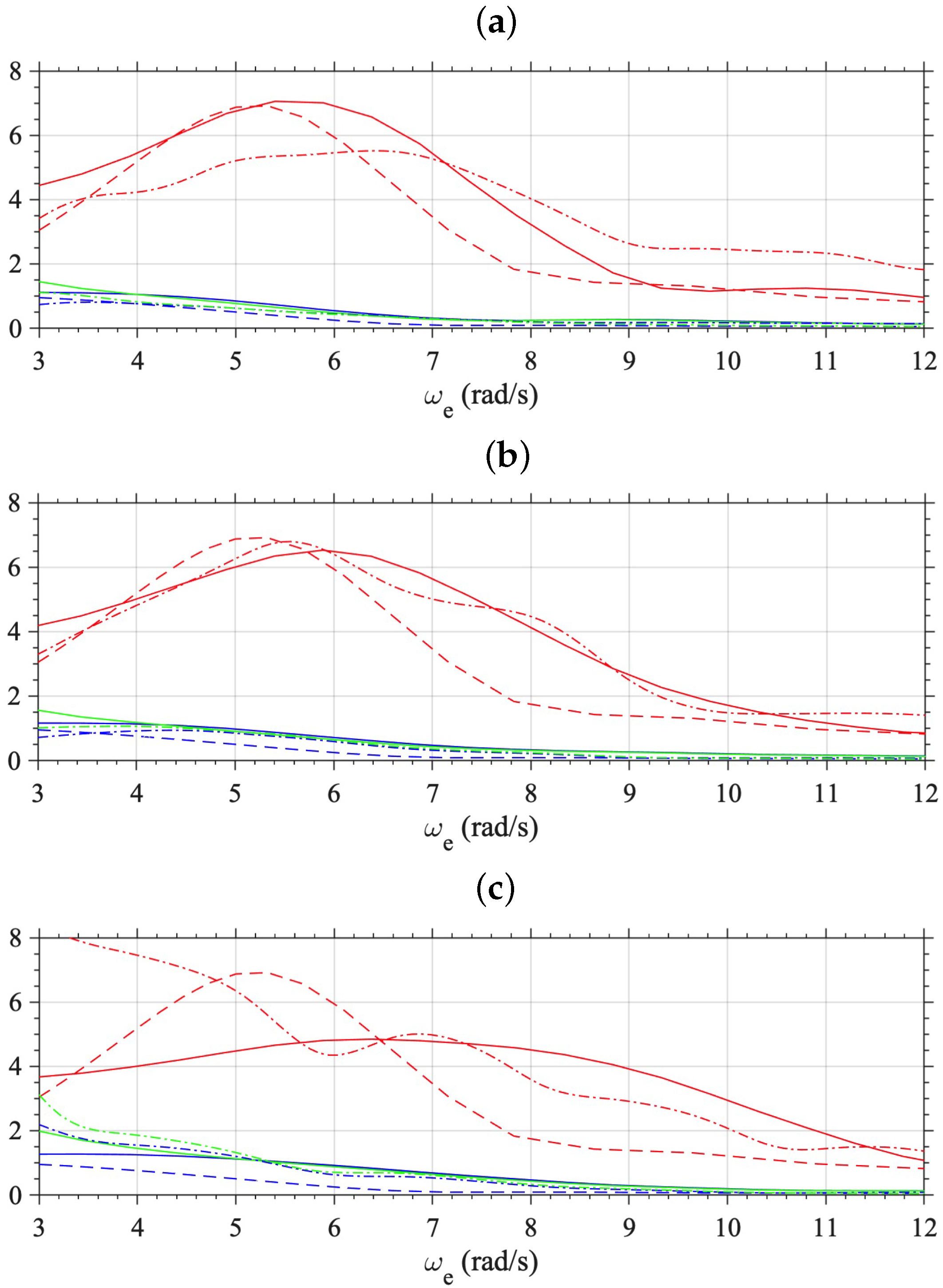
Figure 5a,c,e show the
values computed with AEGIR for
and
m/s, centered on a dominant wave direction
. For comparison,
Figure 5b,d,f show the equivalent force and moments modules computed with AQWA for
m/s (with
). For
, when encounter frequencies are below the range of values computed with AEGIR, since at low frequency,
, results are interpolated from a combination of AQWA results for
(which cover a wider frequency range) and AEGIR results.
2.6. Hydrostatic and Viscous Damping Forces/Moments
The total hydrostatic restoring force and moments term in Equation (
1),
, has linear and nonlinear components that can be computed as a function of the boat geometry for each DOF, with the latter resulting from large boat motions or waves. In the linear components, obtained with AQWA, the heave motion causes small restoring moments in roll and pitch, given by
, for
, respectively, and, in turn, the roll and pitch motions cause small heave forces, given by
, for
. Other coupling terms are negligible due to the boat’s symmetry. In roll and pitch, no nonlinear effects of the instantaneous free surface are included, but the total hydrostatic restoring moments are expressed assuming a large angle, i.e., using
instead of
(
).
Appendix E details how the nonlinear heave restoring force
(with
) is parameterized as a function of the pf
, the instantaneous length of the vessel at the waterline. On this basis and also assuming large angular motions in roll and pitch,
and
, respectively, the total hydrostatic restoring force and moments are defined in the seakeeping model as follows:
Nonlinear viscous damping force and moments, parameterized as,
are specified in Equation (
1) to simulate the effects of vortex shedding and skin friction resulting from large amplitude motions of the tugboat in heave, pitch, and roll. These are standard empirical expressions, proportional to the square of the motion velocity and to coefficients,
—with
the water density,
a relevant wetted surface area or static moment, and
a bulk drag coefficient. For the simple geometry of the tugboat bow, stern, and sidewalks (see
Figure 1), we define:
in heave and,
, in roll and pitch, respectively. Coefficients
are a priori unknown and will be calibrated by comparing model results to experimental results for scale model testing (see
Section 3).
2.7. Motion Memory Terms
The IRFs
used in the motion memory terms of Equation (
1) are defined by Equations (
3) and (4), which can be directly computed by numerical integration for
. The
and
coefficient, however, were only computed using AQWA over a finite frequency range [
], whereas, to accurately compute the IRFs, the integrations must cover the frequency range [0,
∞] [
35,
41].
Appendix C shows how asymptotic expansions can be used to analytically compute the high frequency tails of the integrals [
41] at zero forward speed, and how these can be further developed and applied for a non-zero forward speed.
Because of the nearly double symmetry of the tugboat hull geometry, the off-diagonal values of
and
are mostly negligible, except for (
) and (
), which are identical two by two for
; hence,
for
except for
.
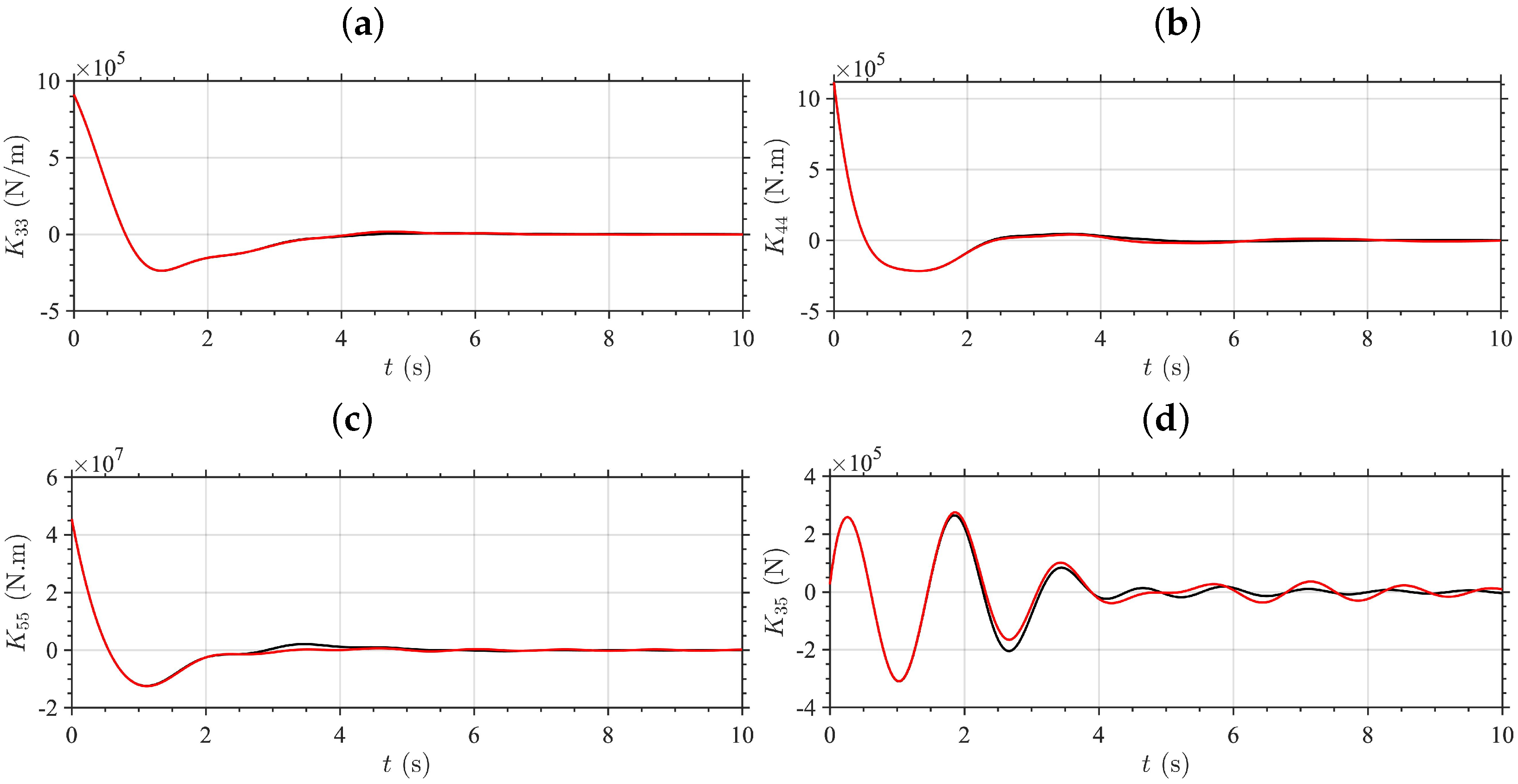
Figure 6 shows the IRFs computed for
by numerical integration, with the high frequency tail corrections, in heave, roll, pitch (
’s), and heave-pitch (
). As recommended in the literature, these were computed using the second form of Equation (4) and related equations, which is more accurate to integrate numerically than the first form. These four IRFs are only significant for
s.
For
, strip theory corrections from Equation (
5) are applied to some of the
’s and
’s which, in particular, yields
. Combining the first IRF form of Equation (
A16) with the expressions for
and
in Equation (
5), we find the following:
and combining Equations (
A17) and (
A19) with the expression of
in Equation (
5), we find the following:
In both cases, the first term is the zero-forward speed IRF,
or
, expressed earlier based on the second form of Equations (
A17) and (
A19), and the second term is the correction IRFs, whose expressions are given in
Appendix C.
Figure 7 shows the total IRFs,
,
and
plotted as a function of time, for forward speed
, 1, 3, and 5 m/s, computed with Equations (
11) and (
12), as well as Equations (
A20) and (
A21) for their respective correction IRFs. While the absolute effect of
U on the pitch IRF
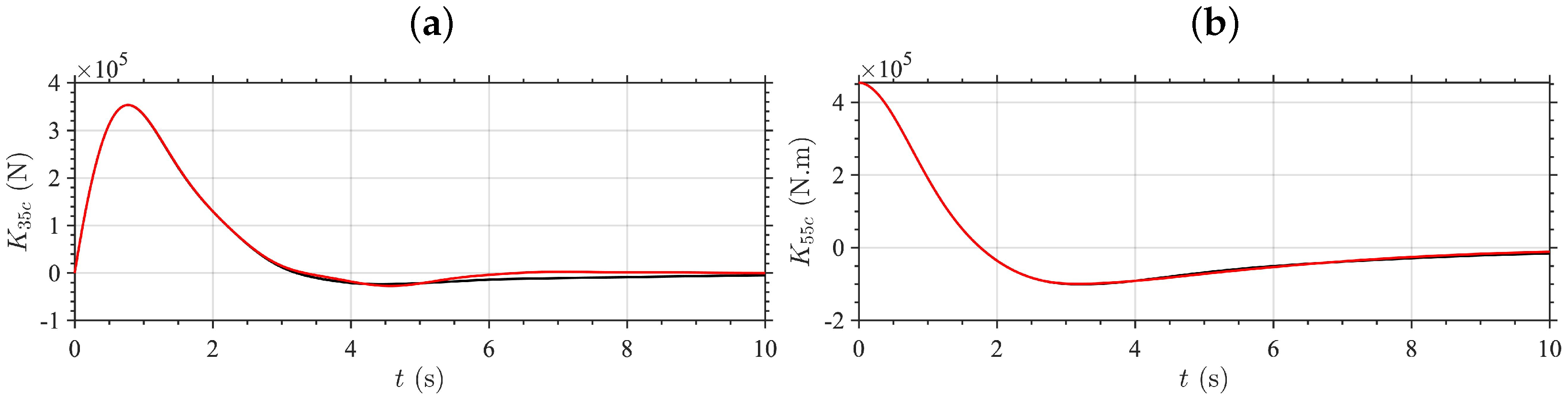
is moderate, it is much larger on the heave–pitch interaction IRFs,
and
, particularly for
s.
As detailed in
Appendix D, a Prony approximation of the IRFs is employed, which transforms the convolution memory terms in the system of nonlinear integro-differential Equation (
1) into additional ODEs for the Prony coefficients. The Prony approximation Equation (
A22) was first fitted to the IRFs computed for the tugboat at zero forward speed (
) and then to the corrected IRFs for a forward speed,
. Different orders of the Prony exponential series expansion (
P value) were used, but, as shown in
Figure 6 and
Figure A1, for this simple tugboat geometry, the IRFs can be closely approximated using
complex Prony coefficients
and
. In all cases, the agreement between the IRFs and their Prony approximation is nearly perfect at short time
s, when the tugboat response is largest, and quite good for
to 10 s.
For the IRFs that are not affected by a forward speed, i.e.,
for
, the Prony approximation transforms the motion memory terms into Equation (
A26), yielding
where
denotes the motion velocities, as
. These represent
additional complex ODEs with as many new unknown complex functions
, to be found from the simultaneous solution of these equations coupled with Equation (
1).
Regarding the IRFs that are affected by a forward speed
, the linearity of the memory term yields
where the superscripts
refer to Prony approximations computed on the IRFs
or
at zero forward speed, or
and
with a forward speed, respectively, and the respective coefficients
and approximations of the memory terms based on correction functions
.
When introducing Equation (
14) into Equation (
1),
additional complex ODEs, similar to Equation (
13), are expressed for the Prony correction functions as
Note, coefficients
and functions
in Equations (
14) were already computed for the zero-forward speed pitch memory term in the third Equation (
13); hence, an additional equation is not needed for these variables.
2.8. Complete System of ODEs Modeling the Wave-Induced Tugboat Motions
The tugboat motions in heave, roll, and pitch,
, are obtained by solving the equations of motion (
1), with the various force and memory terms defined in the preceding sections. The three resulting second-order equations are reformulated as six first-order ordinary differential equations (ODEs) by introducing the generalized velocities
as auxiliary variables. For an SS defined by prescribed parameters
, and the associated directional JS spectrum
and surface elevation time series,
(Equations (
7), (
8) and (
A8)), the hydrostatic restoring forces
are computed using Equation (
10), while the wave-excitation forces
are evaluated using Equation (
9). The radiation memory terms are approximated using the Prony representations, given in Equations (
14) and (
A23). This approximation introduces an additional set of
coupled real first-order ODEs (Equations (
15) and (
A26)), corresponding to the
P complex Prony auxiliary variables
and
. The complete augmented system can therefore be written as
where the total mass or inertia terms are defined as follows:
For , which was found to be adequate for the tugboat geometry considered here, the resulting formulation yields a system of 102 coupled first-order nonlinear ODEs, which are integrated at each time step of the simulation. The time integration is performed over a specified duration , either prescribed directly or defined as a multiple of the dominant wave period (e.g., ). The system is solved efficiently using one of MATLAB’s standard ODE solvers (R2022b), based on optimized explicit Runge–Kutta schemes.
Once the solution is obtained in terms of the vessel motions , velocities , and Prony auxiliary variables and , additional quantities of interest—such as accelerations and the instantaneous forces and moments acting on the vessel—are readily computed as functions of time by evaluating the corresponding terms in the governing equations using the known solution.
4. Motion Discriminant Variables and NN Models for SS Prediction
In our initial study at zero forward speed, reported in [
31], a NARX-NN was trained to predict SS parameters
, for a few headings
from a database of complete vessel-motion time series simulated for many unidirectional seas of known characteristics. Subsequent analysis, however, revealed that using such full-time histories constituted an unnecessarily large dataset to acquire, which could compromise the near-real-time nature of the predictions and increase the risk of overfitting. More importantly, when we attempted to extend this approach to directional sea states and to cases with nonzero forward speed, the NN was unable to estimate the dominant wave direction
with sufficient accuracy, at least within the sponsors’ target error threshold.
These findings motivated the development of a novel, physics-informed ML strategy. We first introduced a compact set of proxy variables—referred to as motion discriminant variables (MDVs)—computed from shorter segments of nonlinear motion records (measured or simulated), and demonstrated that these variables retain the information most relevant to the tugboat response and to the associated SS parameters. A NARX-NN was then trained using this greatly reduced MDV dataset, which mitigated overfitting and non-uniqueness issues inherent in learning directly from raw time series, while significantly improving predictive skill for SS directionality.
Although conventional multivariate nonlinear curve-fitting techniques could also be applied to relate MDVs to SS parameters, the simultaneous estimation of several dependent variables that are partly intercorrelated is handled more efficiently through an NN framework. In the following sections, we detail the formulation of the MDVs and their validation using experimental data, before presenting the training and verification of the final NN-based predictive model.
4.1. Motion Discriminant Variables
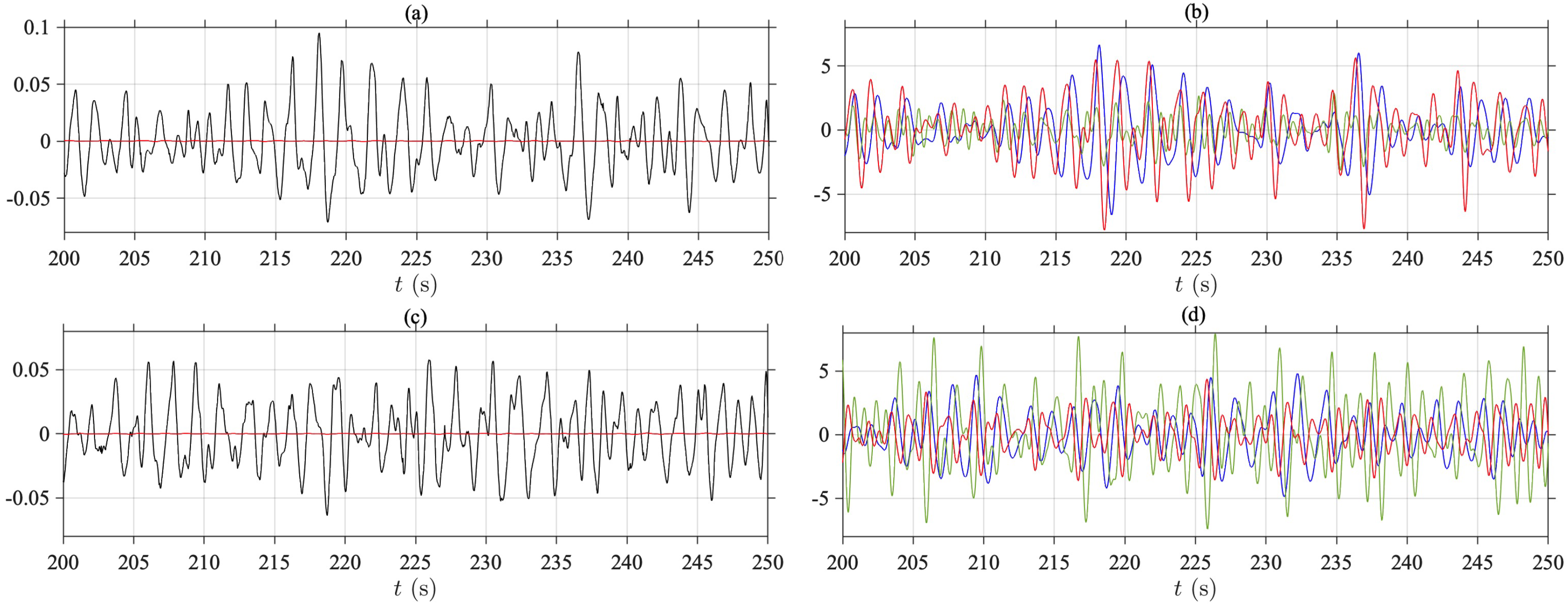
When processing time series of surface elevation, two standard analyses are typically performed. The first is a wave-by-wave statistical evaluation based on the zero-up-crossing (ZUC) method, in which individual wave heights and periods are extracted from the record and descriptive statistics computed, such as the mean, root-mean-square, and the 33% largest heights and periods. The second is a spectral analysis, in which the wave energy-density spectrum is calculated from the time series using a Fourier transform; this yields estimates of the peak spectral period and the corresponding significant wave height. To develop variables representative of boat motions that would be discriminant of SS parameters, we applied both types of analyses to time series of vessel motions obtained from numerical simulations and/or laboratory measurements.
This procedure led to the selection of 37 candidate motion discriminant variables (MDVs) for a given SS, derived from spectral and ZUC analyses of simulated or recorded time series of boat motions and, when available, from heave acceleration. Because motion amplitudes are more meaningful than peak-to-peak heights for quantifying heave, roll, and pitch responses, once trough-to-peak motion heights are identified in the ZUC analysis, these are divided by two to compute equivalent amplitudes , assuming symmetric oscillations. Thus, considering demeaned time series of boat motions for DOFs :
Applying the ZUC method, we extract sets of individual amplitudes and periods for , where is the total number of vessel oscillations in each DOF. Based on these, we compute the following: (i) mean amplitude and period (); (ii) root-mean-square amplitude and period (); and (iii) averages of the 33% largest amplitudes and periods (). This defines 18 variables.
From the motion frequency spectra , we evaluate significant amplitudes and encounter peak periods , yielding 6 additional variables.
Using the complete motion records, we determine the following: (1) the motion standard deviations
and the heave-acceleration standard deviation
(4 variables); and (2) correlations and time-shifted correlations between pairs of motion time series (6 variables). Correlations are defined as follows:
with
. Time-shifted correlations are as follows:
where
and
.
Because boat motions are excited by the SS encounter spectrum, even though the dominant wave direction
is unknown, the vessel speed
U is known, and a partial correction can be introduced. Assuming a small effective heading
, we estimate the encounter peak periods
from the measured spectral peaks
as follows:
which provides three more variables. Without forward speed, this reduces to
.
The above items define a total of 37 MDV candidates for each SS. For Gaussian processes, amplitudes would satisfy the theoretical relationships and ; deviations from these values in practice reflect nonlinear vessel response.
4.2. Numerical/Experimental Validation of Motion Discriminant Parameters at Zero Forward Speed
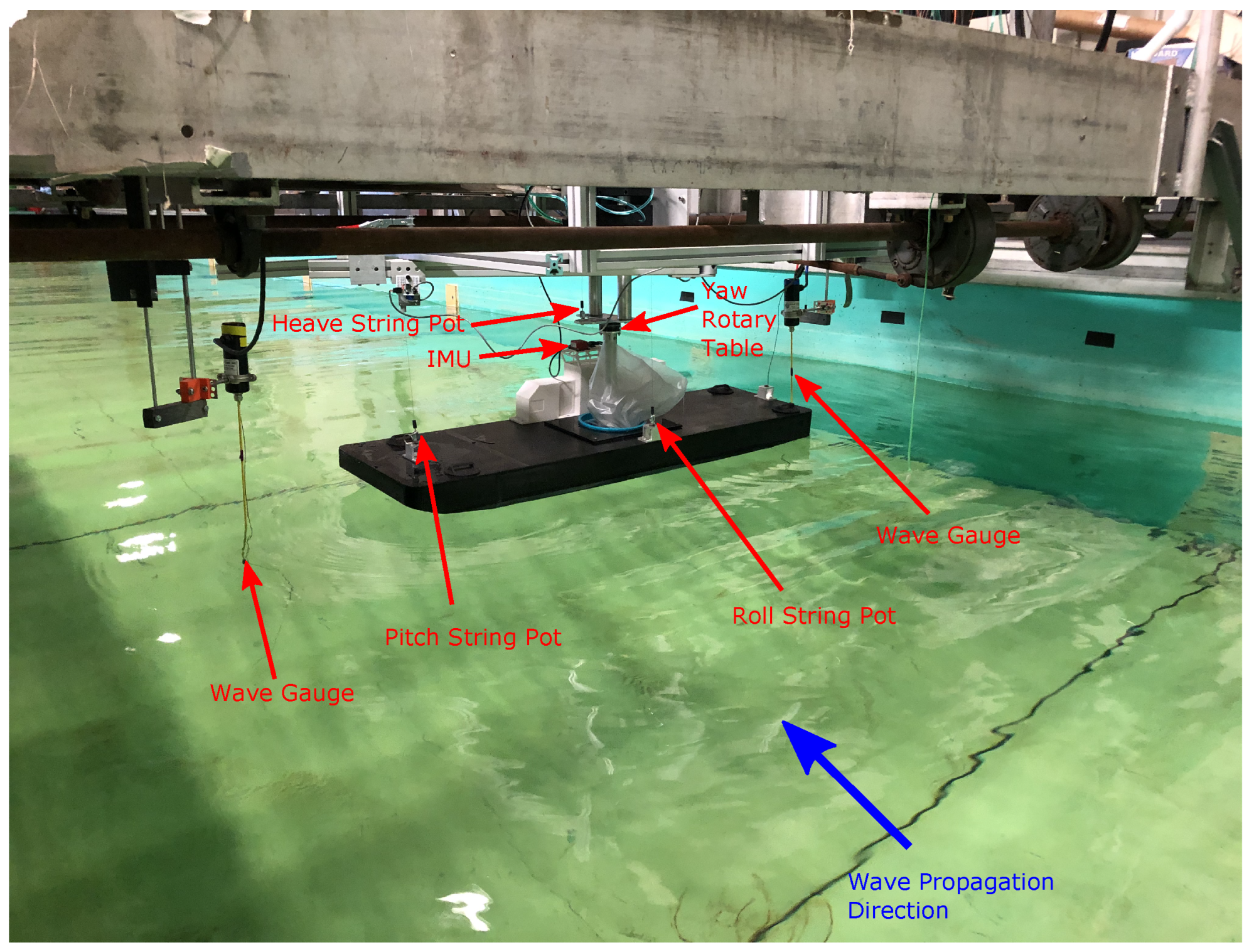
Prior to using the MDVs to train the NN, we evaluate their suitability for estimating SS parameters and their accuracy when computed with the seakeeping model. This is done by comparing MDVs derived from simulations with those obtained from the 56 stationary experiments at zero forward speed (), which constitute the only dataset in which all three DOFs were measured simultaneously. Specifically, the numerical model was run at model scale for 1183 SS 2–4 cases representative of the experimental conditions, combining 13 evenly spaced values of and 7 evenly spaced values of ; each pair of was simulated for 13 headings uniformly distributed within , corresponding to head and head-oblique seas only.
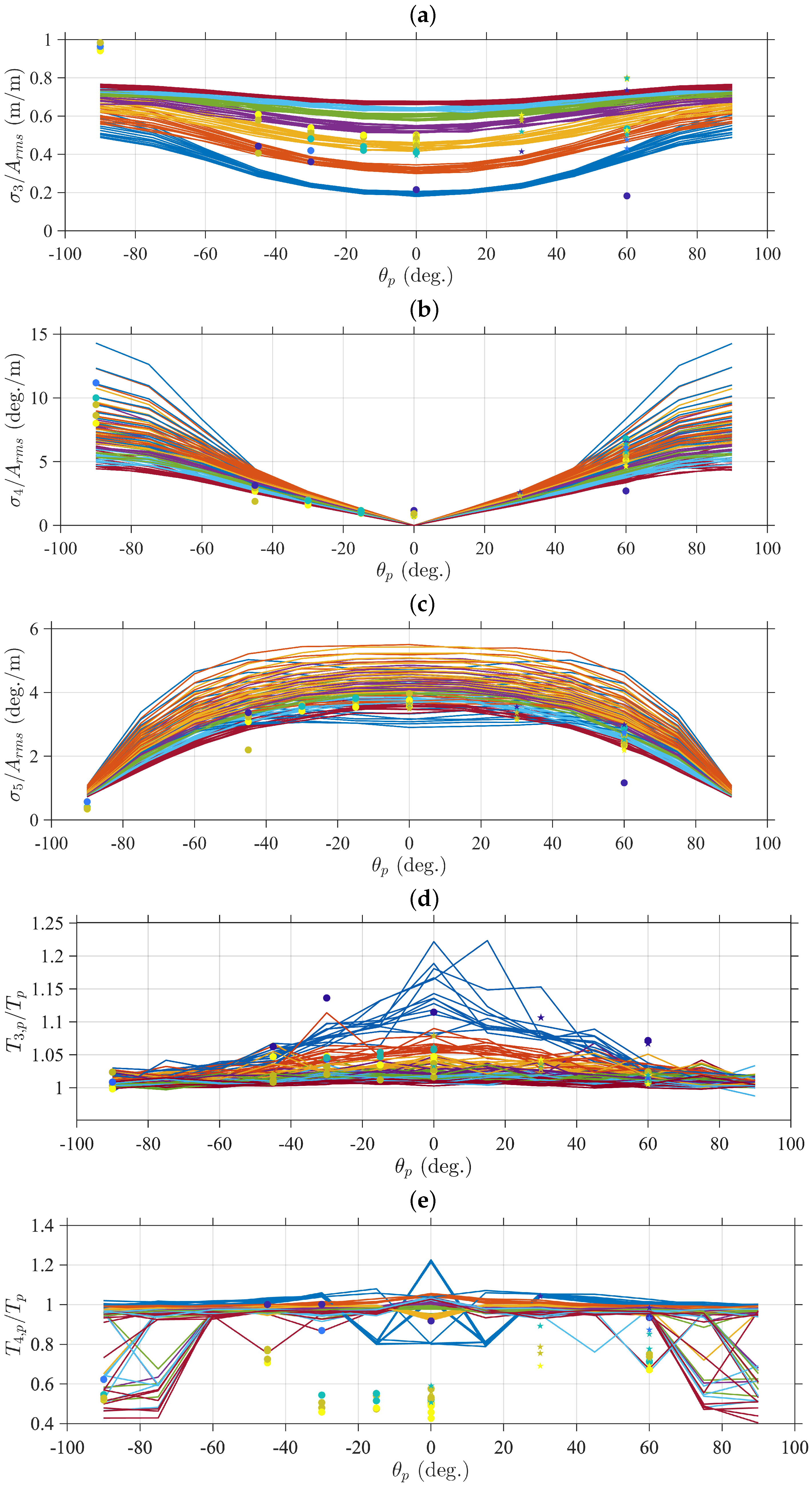
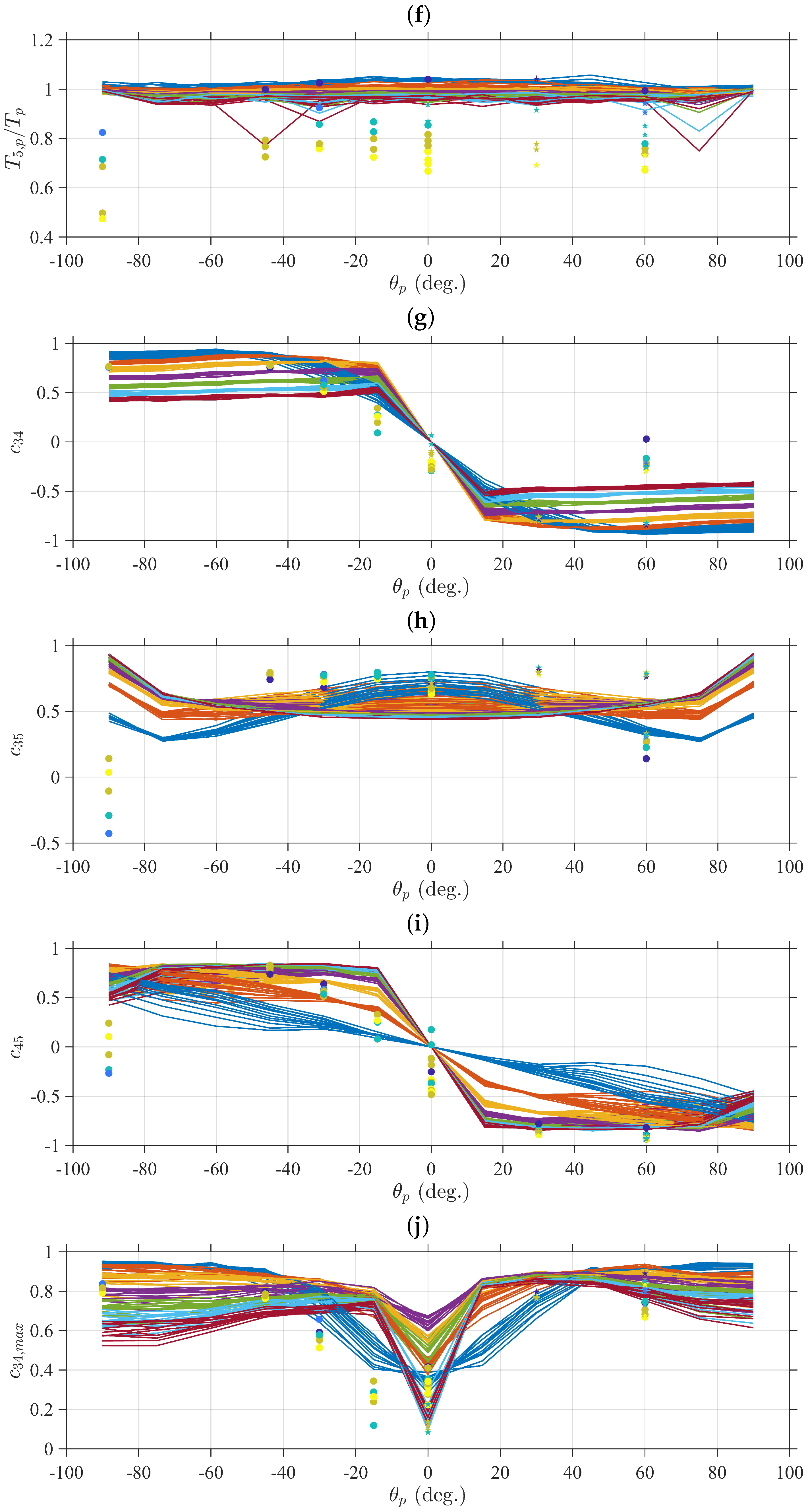
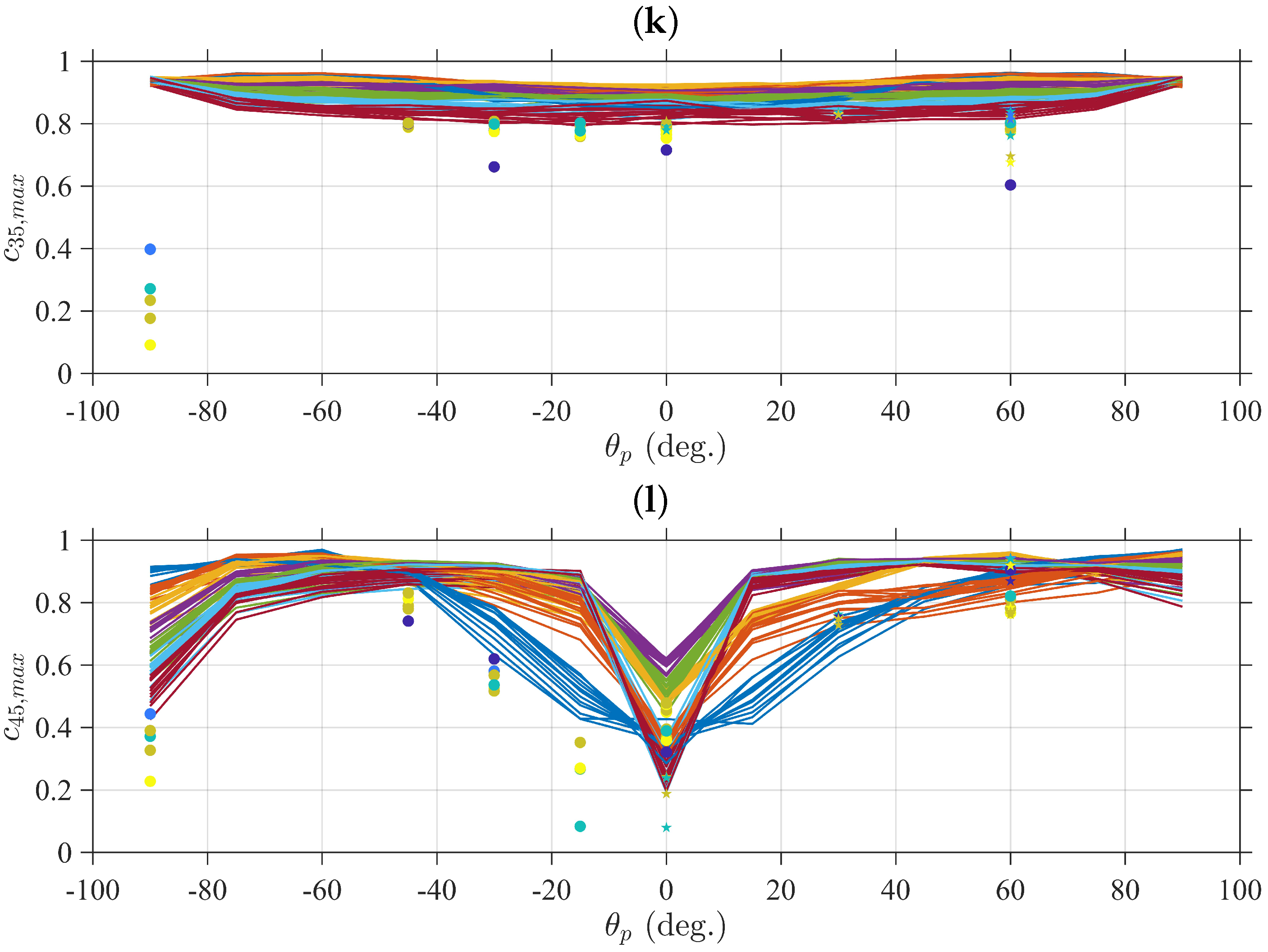
Figure 14 presents a subset of 12 MDVs selected from this analysis, shown as colored lines for model predictions and as symbols for the 56 experiments. Experimental data are categorized according to effective heading: Bullets denote head seas, while pentagrams denote following seas
. For the latter, the measured quantities were transformed to equivalent head-sea angles using symmetry relationships; this required sign changes in some motion correlations. The measured
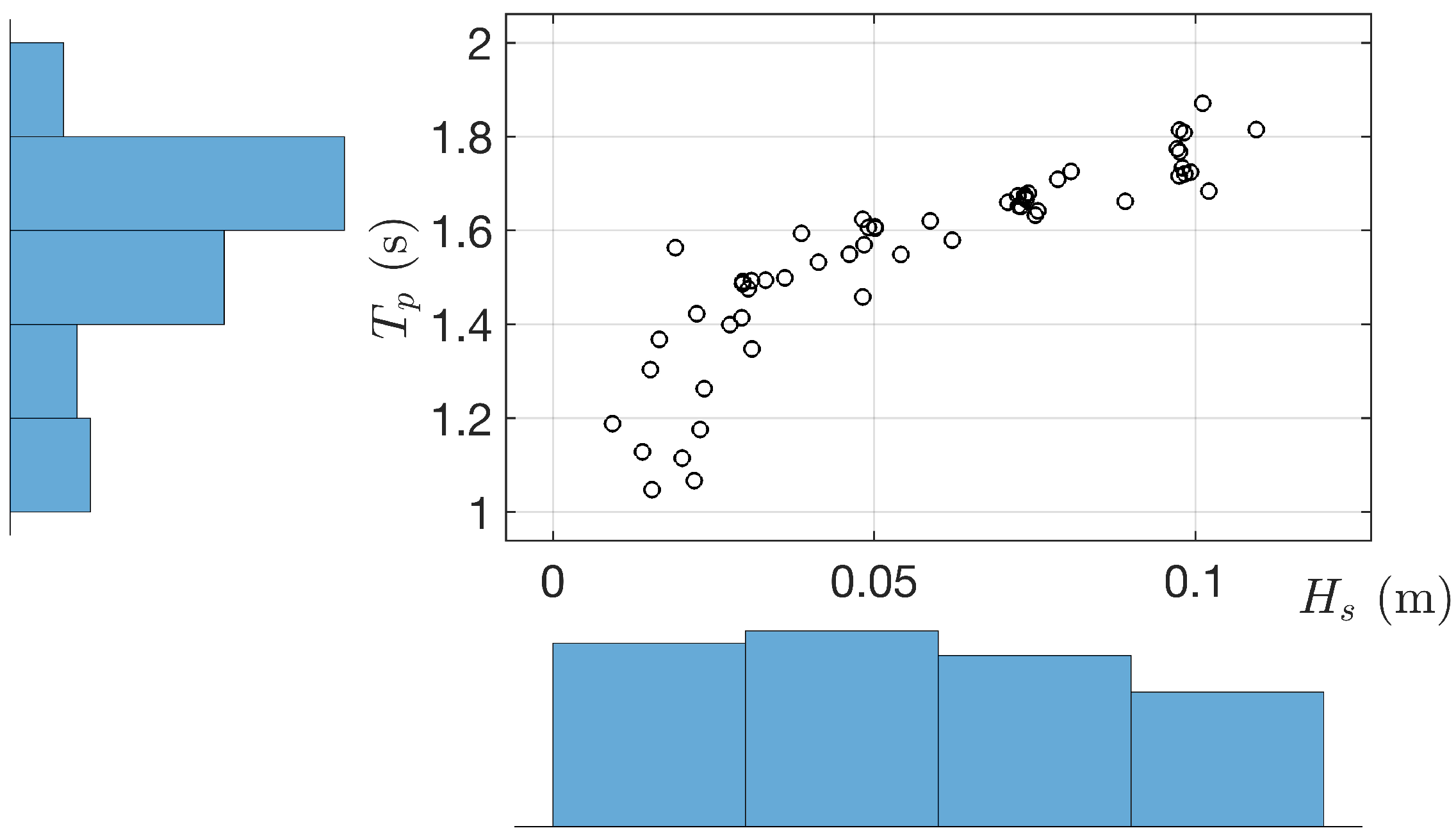
values from the experiments (
Figure 9) were sorted into five evenly spaced groups based on
s, corresponding approximately to scaled SS 2, 2.5, 3, 3.5, and 4 at full scale (
Table 1). These groups are color-coded as purple, blue, green, ocher, and yellow, respectively, and are used consistently when assessing MDV trends and variability.
The results in this figure show the following:
The motion are strongly correlated with the sea-state significant amplitude
(
Figure 14a–c) and, to a lesser extent, with the peak period
(colored lines and symbols). Roll and pitch values vary markedly with heading
, whereas heave is comparatively insensitive to direction. Consequently, the
are reliable estimators of
. Mean ratios obtained from simulations between different MDVs are as follows:
, 1.13, and 1.14,
, 0.97, and 1.11, and
, 0.97, and 0.97, for
, respectively. These values, but more particularly the last triplet, are quite close to those expected for a Rayleigh distribution. Experimental values (symbols) are slightly smaller due to mechanical and scale-enhanced viscous damping, but—except for a few outliers at large
—they agree reasonably with simulations. Spurious sidewall effects explain the nonzero roll at
and the weak pitch at
, where symmetry would predict
, except for a slight heave-pitch coupling.
Encounter-corrected motion in heave and pitch are highly correlated with the SS period
(
Figure 14d–f), indicating that these variables are good estimators; this is confirmed by the averages
, 1.39, and 0.95 values for
(with standard deviations 0.025, 0.31, and 0.11), respectively. For
and 5, correlations
are close to unity, whereas roll-based estimators deteriorate for
because of resonating roll and nonlinear effects. The experimental ratios
agree well with simulations over the energetic range, while discrepancies in roll and pitch are larger at headings where the corresponding motions are least excited.
Motion correlations (
Figure 14g–i)
(heave-roll and heave-pitch) show only weak dependence on
but stronger dependence on
and
(for the smaller or larger wave incidences). These correlations change sign with heading, unlike monovariate statistics that are symmetric; hence, they discriminate between starboard and port seas relative to the vessel. For the following seas, the combined sign pattern of
enables identification of the dominant direction quadrant, even when most other MDVs are similar because of near left-right and bow-stern geometrical symmetry. Experimental correlations (symbols) are in good agreement with simulations except near symmetry angles
, where parasitic motions and transformation of following-sea data introduce scatter.
Maximum time-shifted correlations (
Figure 14j–l)
vary strongly with
and
, and moderately with
; these parameters are therefore useful for estimating SS characteristics. In contrast,
is not discriminant of any SS parameter. Proxy time lags
exhibit little additional predictive value and are not retained in the final MDV set. As in
Figure 14g–i, the experimental values (symbols) are in good agreement with simulations, except near
and
, and for a few outliers.
Overall, the agreement between MDVs derived from simulations and those obtained from experiments is good, with remaining discrepancies largely attributable to known experimental limitations and setup uncertainties: (i) restrictions in the wavemaker frequency range; (ii) spurious roll or pitch motions induced by sidewall reflections; and (iii) imperfect wave absorption in the tank, which resulted in systematically flatter JS spectra and smaller realized
values than targeted, together with relatively greater energy at higher frequencies. These factors influenced the MDVs by increasing high-frequency vessel motions and reducing motion levels near the prescribed spectral peak. In contrast, significant wave height
was estimated more accurately in the experiments, as it is related to the total SS energy
or to the zero-th spectral moment (Equation (
A9)). Wave-incidence angles in the experiments,
, were achieved by yawing the boat model relative to the tank axis. Additional uncertainty arose from limited accuracy in maintaining the specified headings: a small slop in the universal joint produced approximately
random errors in model orientation, which in turn led to a slight systematic bias, particularly for the more oblique cases. Because the following-sea data had to be transformed to equivalent head-sea angles using symmetry relationships, this also contributed to scatter and a few outliers.
Nevertheless, these findings validate the capability of the proposed nonlinear time-domain seakeeping model to reproduce the dominant tugboat responses across the tested sea states and speed ranges, and they support the subsequent NN training based on MDVs.
4.3. Type, Data, and Methodology to Set Up NN Models
NN models were developed and trained to predict SS parameters
from measured or simulated boat motions. In earlier work [
31], motions of the same tugboat were modeled at zero forward speed (
) in long-crested head seas, and a NARX-NN was trained directly on 10-min time series of raw motions, downsampled to 1-s resolution. When this strategy was applied to our more complete set of unidirectional and fully directional seas, with and without forward speed, the resulting NNs predicted SS direction
inaccurately. Here, instead, new NARX-NN models are trained using the 37 proxy variables (MDVs) defined earlier, computed from shorter segments of motion time series. Several MDVs were shown to be highly sensitive to wave direction relative to vessel heading (
Figure 14), enabling improved regularization, computational efficiency, and reduced risk of overfitting. This approach yields more general and accurate operational models for SS estimation at sea.
For the experimental validation, NN model M1 was trained for
using 1183 simulated SS 2–4 at full scale, reflecting laboratory conditions (
Table 2): 13 significant wave heights
m (
m), 7 peak periods
s (
s), and 13 dominant directions
(
). Owing to the left-right hull symmetry, simulations covered only half of the angle range, with the following- and side-sea headings retained solely for comparison with experiments. An operational NN model M2 was then trained on 4199 directional SS for
m/s and headings
(
Table 2): 19
m (
m), 13
s (
s), and 17 directions (
). A separate 2700-case dataset was also simulated for the verification of M2 with parameters within the same range (see details in
Table 2). The 3 m/s (∼6 knot) cruising speed corresponds to that required in field implementation; similar NNs could be trained for other speeds by rerunning the nonlinear model.
For each SS, the wave energy spectra used
equally spaced frequencies with energy
% of the spectral peak; directional seas used
bands, with the spreading range truncated so each component carried
of frequency-wise energy. For every SS,
min, motion time series were generated by solving the augmented ODE system of Equation (
16); results were interpolated to constant
s (6000 points per DOF) on which the 37 MDVs were evaluated. SS conditions in experiments, field applications, and NN training are assumed quasi-stationary over the run duration. To reflect operating environments,
simulations used freshwater density
kg/m
3, while forward-speed cases used seawater density
kg/m
3.
Both models M1 and M2 use a two-layer feedforward NARX architecture (sigmoid hidden layer, 30 neurons; linear output layer) and were configured using Matlab’s NN Toolbox (R2022b). In their
Figure 8, Grilli et al. [
31] provide a schematic of a similar NN. In this phase of work, our aim was not to use the best possible NN but to assess the relevance of the proposed method. Likewise, during training, no formal optimization was pursued beyond ensuring that errors were within sponsor-specified thresholds: 0.15 m for
, 0.5 s for
, and
for
. The seakeeping model was run using the parameters for each SS. As this model was both efficiently formulated and implemented, producing each of the datasets of models M1 and M2 only took on the order of 4 to 8h on a high-end laptop (Mac M1 with 10 CPUs). The simulated data was then randomly parsed into (i) training (60%), (ii) validation (15%), and (iii) testing (25%) subsets. Finally, the setup of each NN model based on their relatively small MDV dataset only took on the order of 5 to 10 min on the same computer.
4.4. Set-Up and Verification of NN Model M1 (Zero Forward Speed)
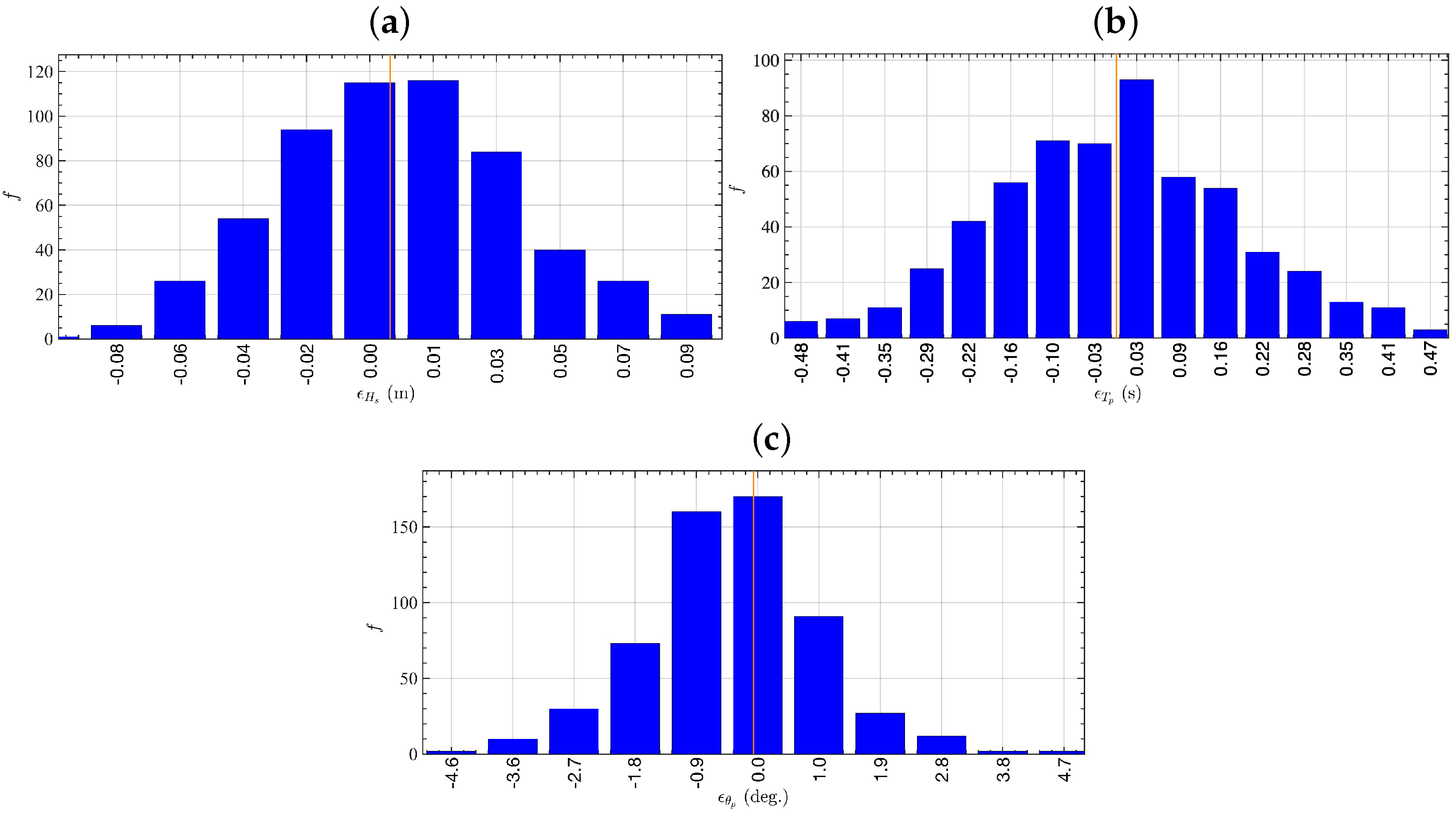
Figure 15 presents histograms of the SS parameter prediction errors
,
, and
, relative to the targeted values in
Table 2, for the trained NN model M1 (
) evaluated over the testing subset (25% of the initial dataset;
Table 2). As anticipated, the errors follow a Gaussian distribution and are therefore random in nature. For the same dataset,
Table 3 summarizes the overall performance in terms of RMS error
and the 95% confidence intervals of each parameter. The errors shown in
Figure 15, together with their 95% confidence limits reported in
Table 3, all comfortably satisfy the sponsor-specified accuracy thresholds for the three SS parameters. In addition,
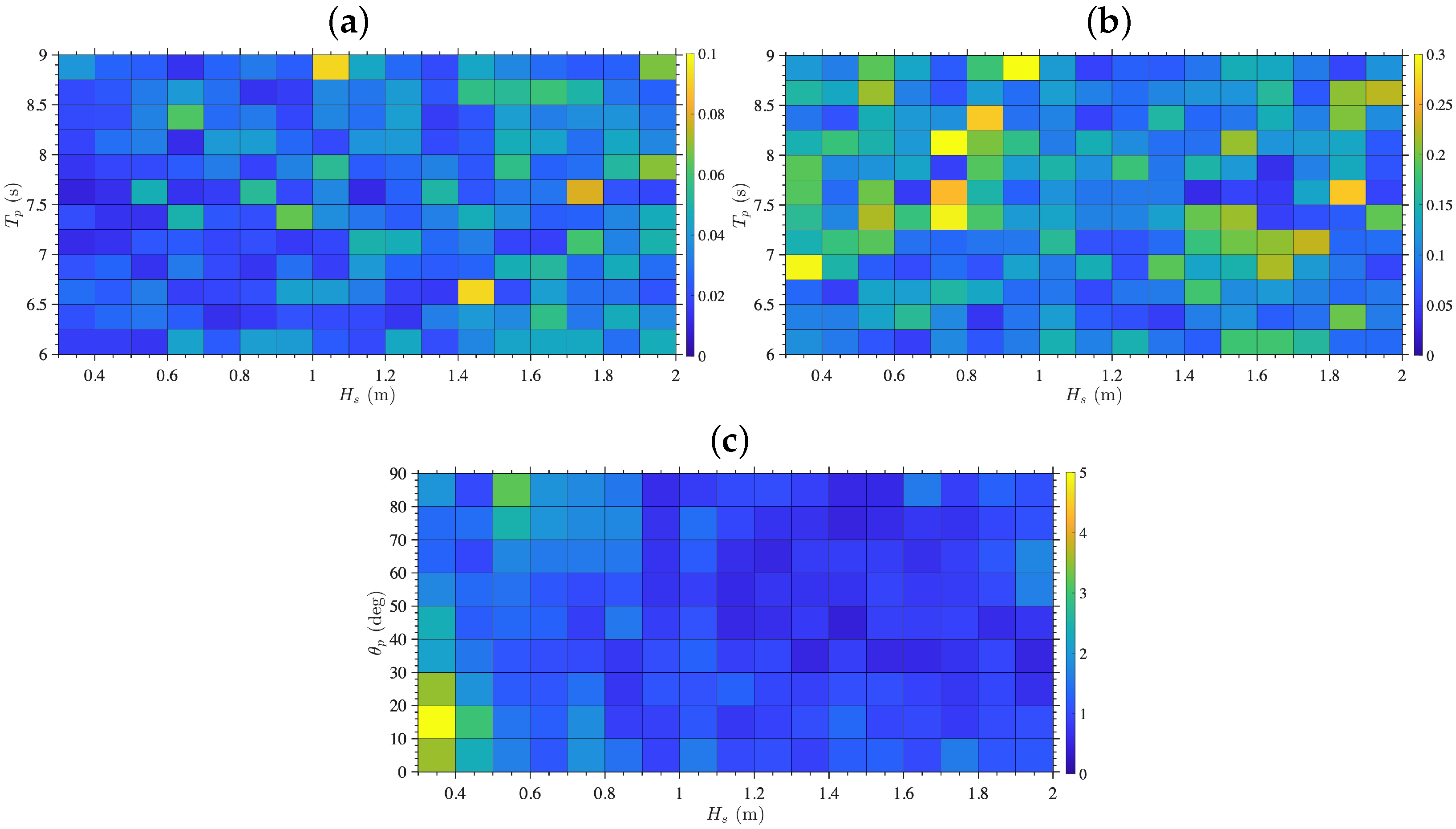
Figure 16 displays the RMS errors over the entire dataset—including training, validation, and testing subsets—projected onto the spaces defined by pairs of SS parameters. Only headings
are included because the error statistics are symmetric for the complementary angles. Across all representations, the RMS errors remain below the required limits, confirming that model M1 achieves reliable predictions throughout the considered range.
4.5. Experimental Validation of NN Model M1 (Zero Forward Speed)
The NN model M1 (
), once trained on the simulation results, was applied to predict the SS parameters
for a subset of 28 laboratory experiments. Test cases associated with spurious or inaccurate measurements—identified as outliers in
Figure 14—were excluded from this evaluation. The excluded set comprised: (i) 10 headings at or near
, which exhibited spurious pitch motions; (ii) 12 head- or following-sea headings
, characterized by unrealistically large parasitic roll; and (iii) 6 additional experiments that appeared as clear outliers in
Figure 14, suggesting larger experimental uncertainties. For the retained
cases, the 37 motion discriminant variables were computed from the measured experimental motion time series and supplied to the NN to issue SS predictions. Ranges of experimental conditions used to test model M1 and derive the corresponding error statistics—transformed to full scale—are summarized in
Table 4.
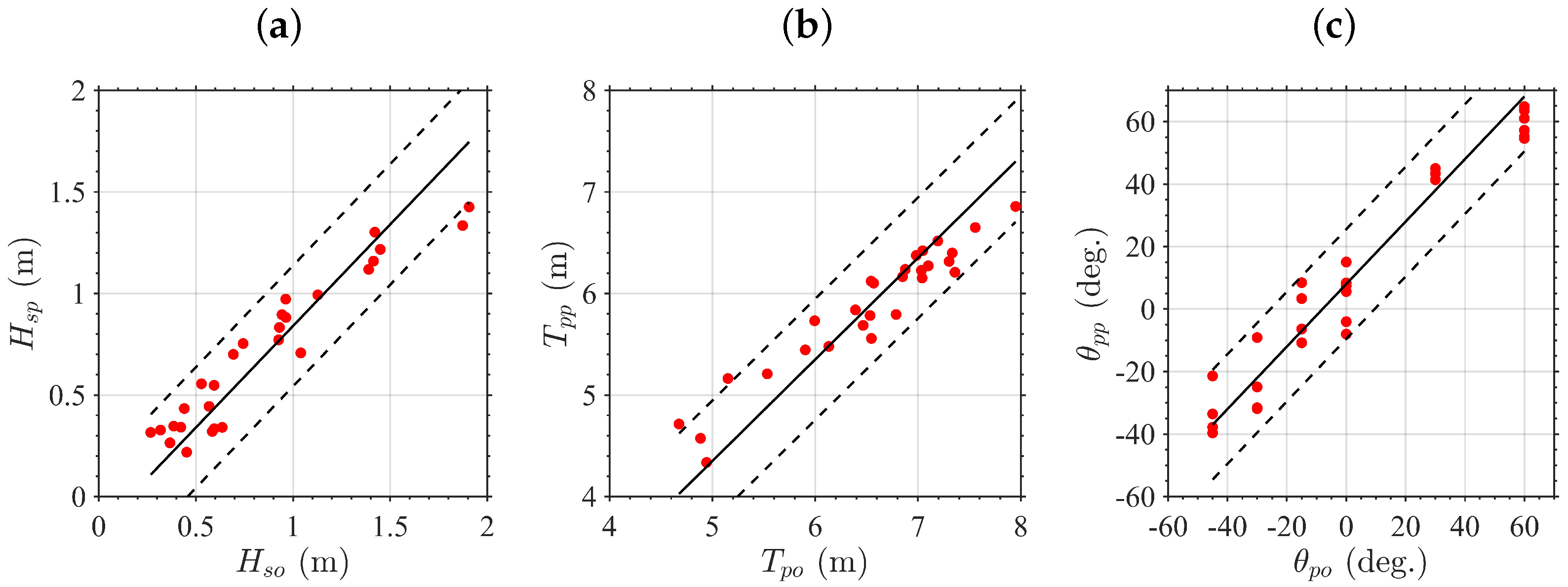
Figure 17 presents full-scale comparisons between predicted and measured SS parameters, together with linear fits constrained to a
slope that minimize
. The presence of small biases—reflected by the
y-intercepts of the fits—is apparent for each parameter and can be attributed to experimental uncertainties. The corresponding intercept biases are approximately: (a) −0.15 m, (b) −0.65 s, and (c)
for
, respectively.
Table 4 summarizes, for each fit, the RMS error
, residual standard deviation
, determination coefficient
, and the correlation between predicted and observed values. After bias removal, the residual errors fall within the 95% confidence intervals—obtained by adding/subtracting
to the fitted lines—in all but one point in subplot (a), supporting the hypothesis of normally distributed residuals and confirming the systematic nature of the biases.
For , the bias corresponds to about −7.8 mm at model scale. This is unlikely to result from wave-gauge miscalibration and is more plausibly explained by undesired damping of vessel motions due to mechanical friction in the heave staff, U-joints, and SPs. Under these effects, the measured motion standard deviations were systematically smaller than those predicted by the seakeeping model, leading the NN—when interrogated with the less energetic experimental MDVs—to slightly underpredict .
The bias of −0.15 s bias at model scale is consistent with the flatter spectra observed in experiments, in which part of the peak energy is shifted to higher encounter frequencies. Across the full experimental set, the measured values were also about 0.15 s smaller than the targeted values derived from peakier JS spectra. Because the NN was trained on these peakier spectra—where vessel motions concentrate near the spectral peak—the MDVs computed from the experimental time series caused a proportional underprediction of .
The bias in likely reflects imperfect maintenance of yaw orientation and mechanical slop in the universal joint, which produced experimental headings slightly larger than targeted, except for near-zero-heading cases.
Correlations between predicted and observed parameters exceed 95% whether computed with or without bias, validating the overall methodology—note the small difference between and is due to the fitting approach that does not ensure a strictly zero mean for the residues. After bias removal, RMS errors meet the desirable thresholds, although the associated confidence intervals remain somewhat larger. The CI for is about twice the target but still small relative to tank-induced disturbances from reflection and seiching. The CI for lies near the threshold, and the CI for () is not unreasonable given the angular step used for training; finer resolution in simulations (e.g., 5–10°) and NN training would likely reduce these directional errors. The values are included for completeness, but represent only the goodness of the line constraint; a standard least-squares fit would yield larger values (0.91, 0.92, and 0.94). Hence is less informative than for quantifying NN accuracy.
Considering the non-ideal SS spectra generated in the tank and experimental measurement uncertainties, the validation of NN model M1 at zero speed can be regarded as successful.
4.6. Set-Up and Verification of NN Model M2 (Forward Speed)
The NN model M2 (
), once trained on the simulation database, was used to predict the SS parameters (
,
,
), first over the testing subset (25% of the initial dataset) and subsequently over the independent verification dataset. Accordingly,
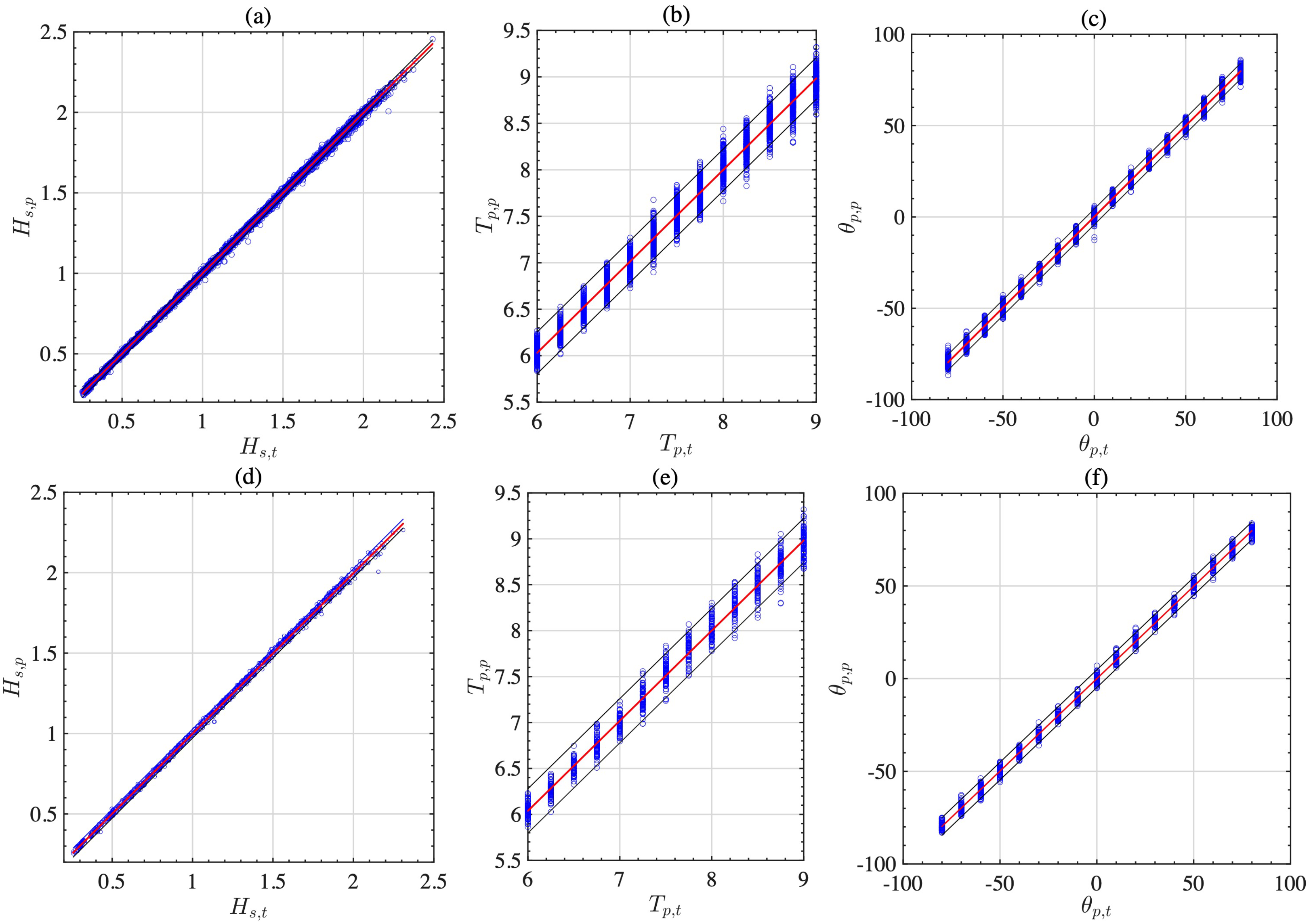
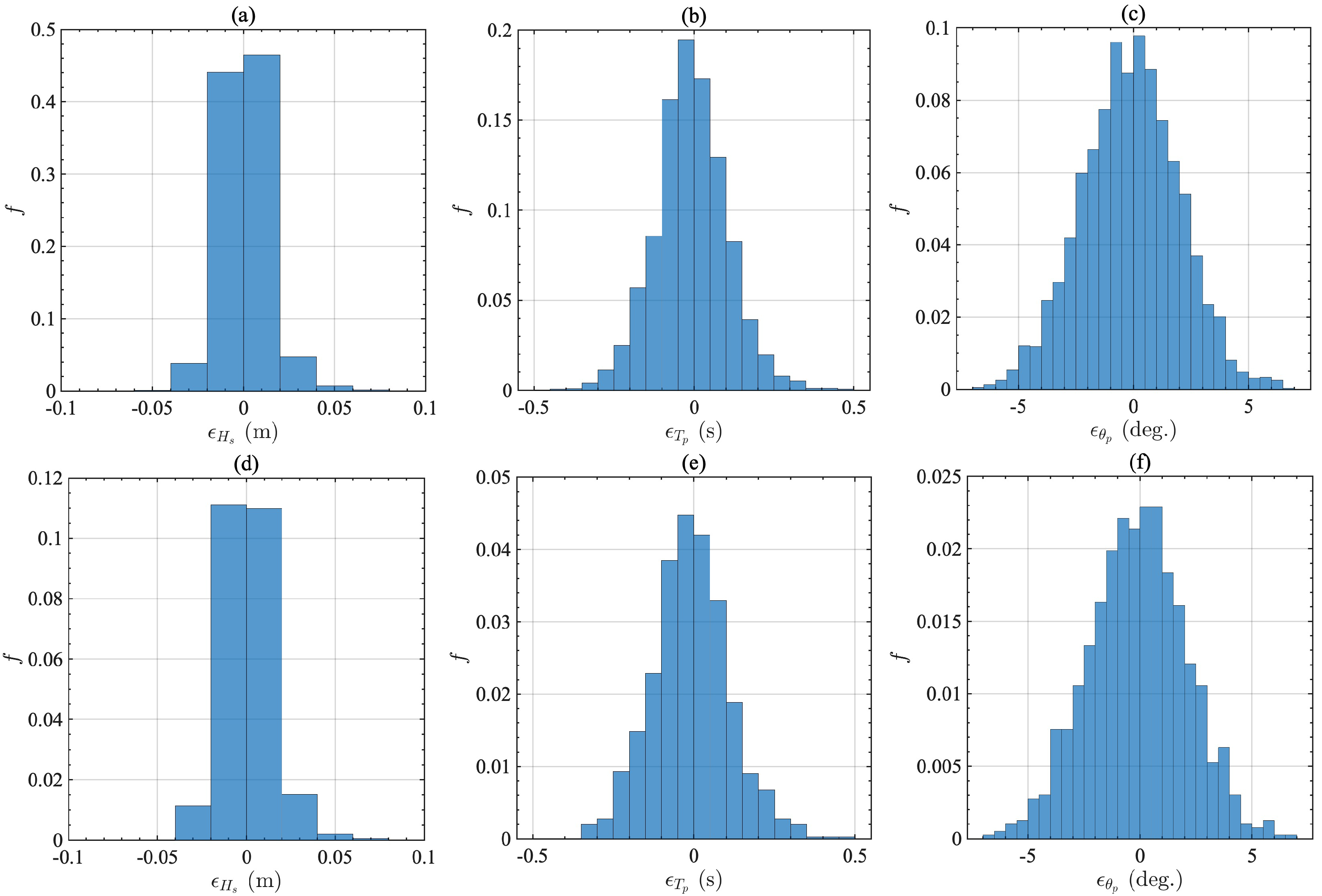
Figure 18 presents predicted versus targeted values of the three SS parameters for the training subsets (panels a–c) and the testing subsets (panels d–f) of the 4199 simulated sea states (
Table 2), together with their best linear fits constrained to zero intercept and the associated 95% confidence intervals. The agreement is very good in all cases, with regression lines lying close to the nominal
slope and exhibiting narrow confidence bands. For the same samples,
Figure 19 displays histograms of the errors between targeted and predicted SS parameters for the training (a–c) and testing (d–f) subsets of the initial dataset. These errors are approximately Gaussian, as expected for predominantly random residuals, and their magnitudes consistently remain within the desirable accuracy thresholds defined for each parameter.
Finally,
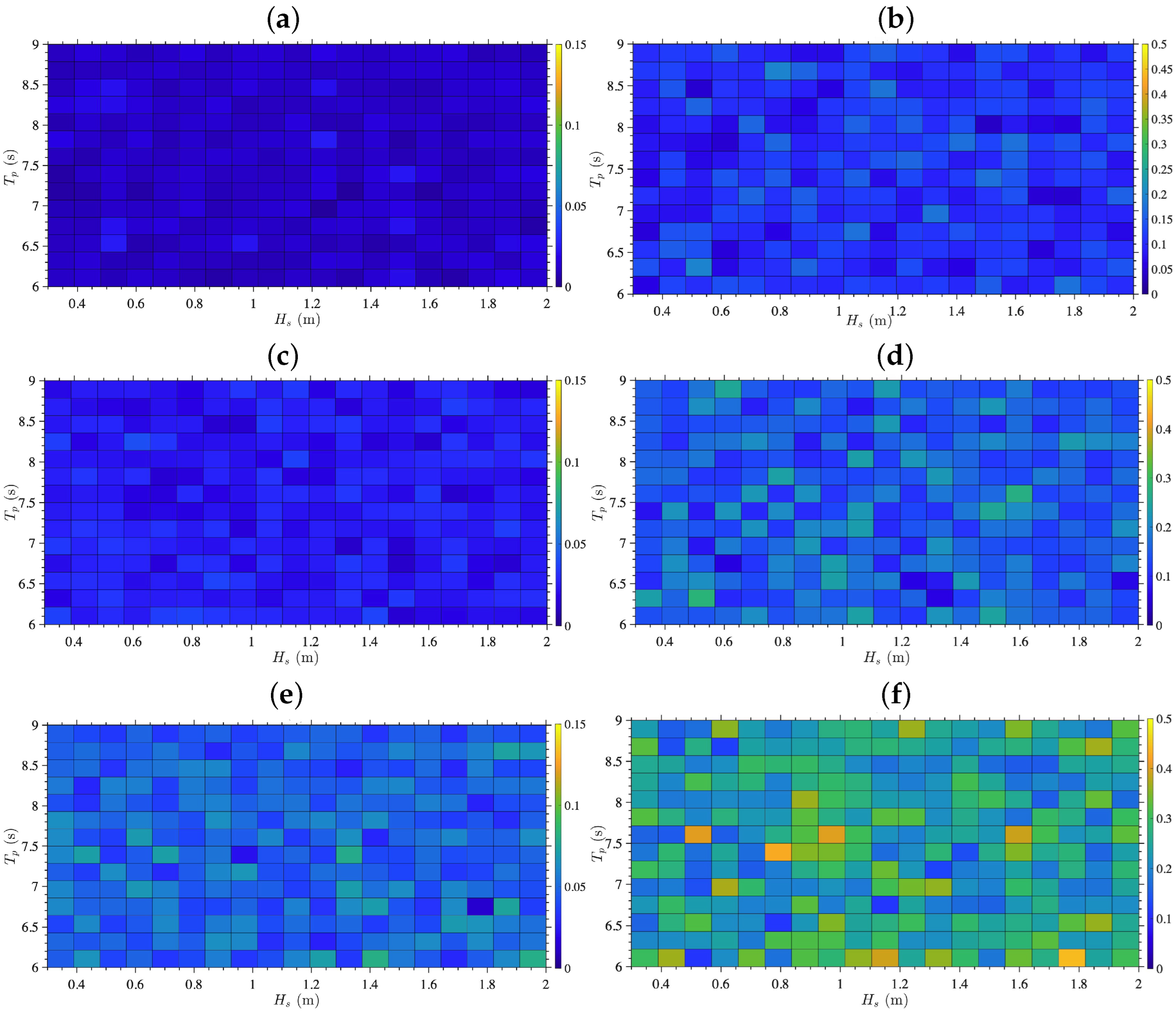
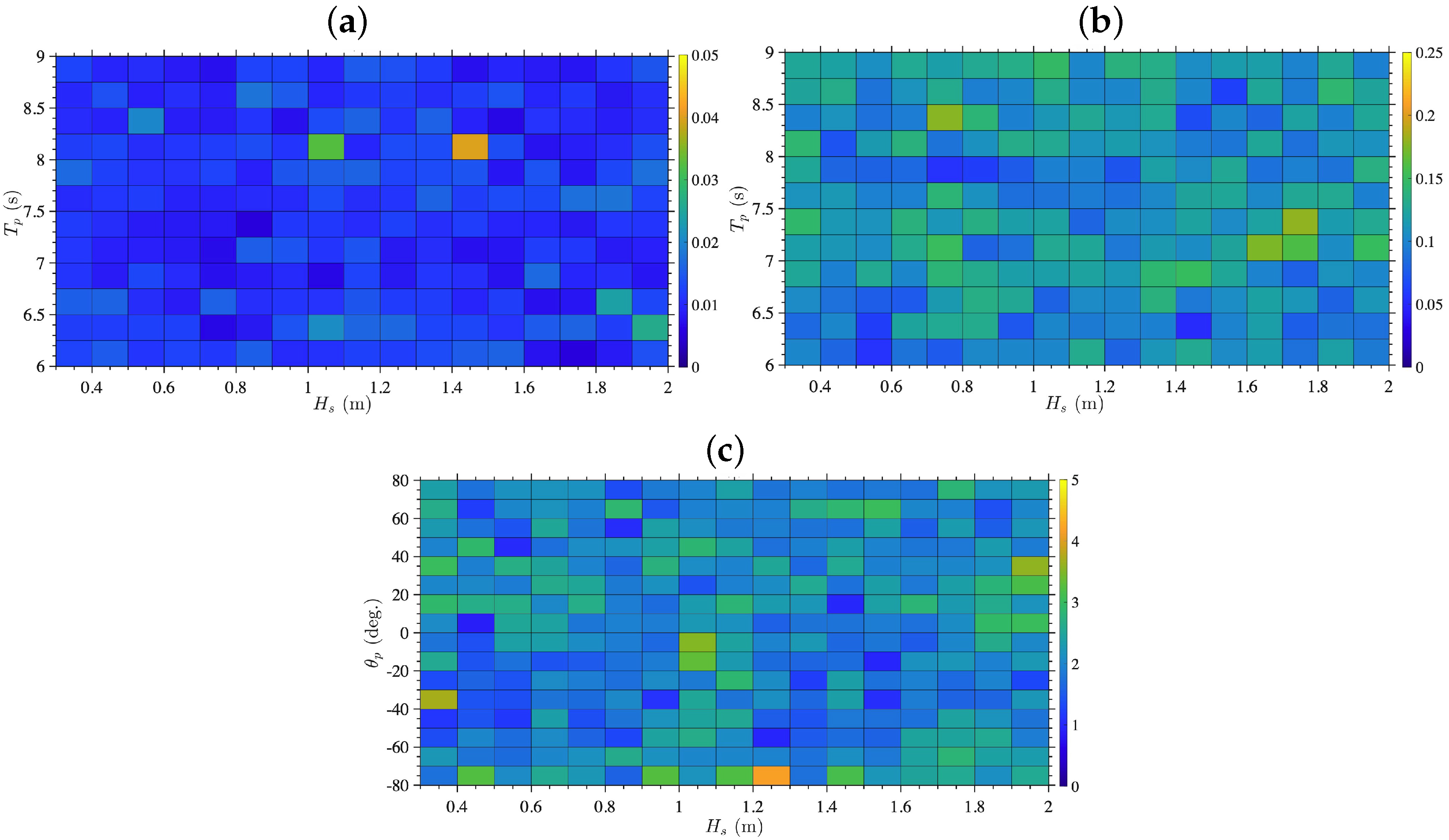
Figure 20 summarizes the overall accuracy of model M2 across the entire initial dataset (i.e., including training, validation, and testing subsets) using the RMS error
. The figure quantifies results over 17 headings
for 19 × 13 binned (
,
) combinations (panels a,b) and over 13 peak periods for 19 × 17 binned (
,
) combinations (panel c). In every representation, the RMS errors in the bins comfortably meet—and generally exceed—the desired thresholds, by a large margin for
and
and by a smaller margin for
, reflecting the sensitivity to directional resolution and the slightly finer
sampling used here.
4.7. Set-Up and Verification of NN Model M2 (Forward Speed with Random Noise)
In practical applications of this methodology—where wave-induced boat motions are measured with an onboard IMU—measurement noise and other inaccuracies are expected to affect the acquired time series, e.g., [
26]. The impact of such noise has commonly been investigated using jittering augmentation, in which random perturbations are injected into the data to enhance robustness and NN generalization, e.g., [
47,
48]. Although NN training is performed using motion data generated by the nonlinear seakeeping simulations, operational predictions of SS parameters in the field must rely on measured motion signals that are likewise affected by noise; consequently, the trained NN will be interrogated under realistic sensor-noise conditions.
To do so, here, we assess the impact that noise would have on the predicted SS parameters through an independent evaluation of NN model M2 (). The model, trained solely on the initial simulation dataset, is interrogated using the verification database both without and with noise injection. The added noise is quantified by a uniformly distributed random error level (%) applied to the MDVs. Because IMU noise would primarily distort the measured motion sequences—and consequently the MDVs derived from them—for simplicity, we emulate this by directly perturbing the 37 MDVs computed from the verification simulations, and then recompute NN predictions and the associated RMS errors using these augmented inputs.
The verification dataset comprises 20 significant wave heights
m (step 0.09 m), 15 peak periods
s (step 0.21 s), and 9 headings
(step
), resulting in 2700 simulated sea states (
Table 2). To provide a more rigorous test, the sampling intervals for the SS parameters were intentionally chosen to differ from those used for training. Consequently, all targeted values fall between the original training points, ensuring that model M2 is evaluated exclusively in extrapolative nowcast conditions rather than in a hindcast sense. This constitutes a demanding and realistic verification of the network’s generalization capability.
The prediction accuracy of NN model M2 was first evaluated with no added random noise in the inputs (
), following the same verification strategy used for the initial dataset. RMS errors
between the predicted and targeted SS parameters (
,
,
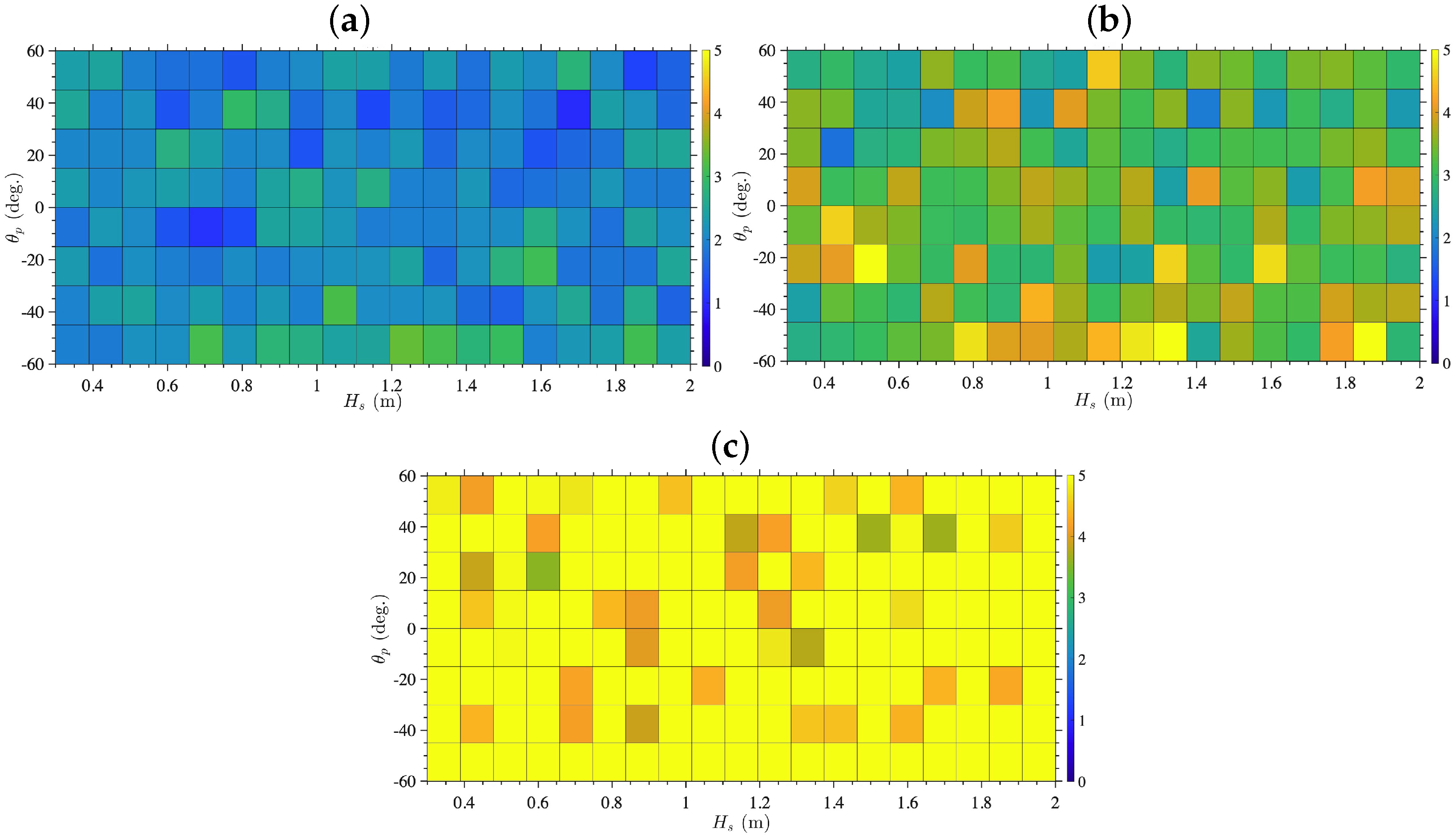
) were computed for the 2700 simulated cases of the independent verification dataset. Analogous to
Figure 20,
Figure 21a,b and
Figure 22a present the RMS errors of significant wave height, peak period, and heading, respectively, quantified over binned (
,
) or (
,
) combinations. These results show that, in all bins, errors comfortably satisfy the required thresholds—by a large margin for
and
and by a smaller margin for
, for the sampling reasons discussed earlier.
Subsequently, the robustness of the trained network was examined by perturbing the same MDVs with uniformly distributed noise levels of
% and 4% (
Figure 21c–f and
Figure 22b,c). The predicted values of
and
remain highly stable under these perturbations and continue to meet the maximum allowable errors. Consistent with the zero-speed interrogation using experimental data, the estimation of headings
is more sensitive to noise injection. With
%, RMS errors remain below
(
Figure 22b), whereas with
% they exceed
in many cases, reaching a maximum of approximately
; this value is still well within the specified
limit. Further improvements are expected if NN training were performed using a larger verification database with a finer directional discretization (e.g.,
rather than
).
Overall, these findings confirm that NN model M2 provides accurate and operationally relevant nowcast predictions of SS parameters under realistic sensor-noise conditions.
5. Conclusions
This work is motivated by the need for near-real-time estimation of Sea State (SS) parameters onboard barge-like vessels, whose lightering operations must remain safely within SS 2–4 for the selected tugboat. Such hulls are highly susceptible to large undesired motions in stronger seas, where nonlinear hydrostatic and viscous effects become significant. To support operational data-driven prediction, we developed a computationally efficient nonlinear time-domain seakeeping model that simulates tugboat motions in heave, roll, and pitch, with and without forward speed, and validated and calibrated it against 1:19.22-scale wave/tow-tank experiments. Although the results are specific to this boat, the methodology is general and can be adapted to any hull by using appropriately computed hydrodynamic coefficients and motion-damping parameters (bulk drag coefficients).
Two NARX-NN models were trained on large simulation datasets. We recommend using motion discriminant variables (MDVs) instead of the entire raw motion time series to avoid overfitting, non-uniqueness, and to improve estimation of SS directionality. Model analyses identified 37 MDVs, validated with experiments, and additional developments verified NN predictions against independent datasets. For training-interrogation, we recommend using ():
as a minimum, 10 key MDVs (, , heave-acceleration , and off-diagonal symmetric correlations );
21 ZUC- or spectrally-derived amplitude-period parameters to refine predictions in nonlinear regimes, especially roll;
6 maximum time-shifted correlations and time shifts for added directional information.
NN model M1 accurately predicted SS parameters from scale-model testing at zero forward speed in unidirectional seas. Biases observed in some experiments are attributed to laboratory wavemaker-spectral limits and spurious wall-induced motions, which are not expected in ocean operations. Interrogation of the realistic NN model M2 (for forward speed in directional seas) met required error thresholds, with only sensor noise (2–4%) degrading directionality in the 4% case.
While the proposed model-based methodology is general, it is subject to limitations inherent to both the simplified physical assumptions of the seakeeping model and the finite coverage of the training datasets. In particular, the model neglects certain physical processes that may influence boat motions under more extreme or complex conditions. In addition, the NN validation results indicate that the angular resolution of the training datasets should likely be refined to further improve directional predictions. Finally, as with any data-driven approach, SS predictions are reliable only within the range of conditions represented in the NN training data and degrade outside this domain.
Finally, operationally, a first prediction requires about 5 min of motion cycles, but thereafter, SS estimates can be issued every few seconds within a moving time window using pre-existing and limited new data. Computing the 37 MDVs would take seconds on a processor equivalent to a modern laptop, and the NN application is also nearly instantaneous, enabling continuous decision making.