Dual-Trail Stigmergic Coordination Enables Robust Three-Dimensional Underwater Swarm Coverage


Abstract
1. Introduction
2. Problem Formulation
- Virtual pheromone field , describing short-term activity cues deposited during motion.
- Coverage trail , representing accumulated exploration over longer horizons.
2.1. Macroscopic Density Dynamics
2.2. Virtual Pheromone Model
2.3. Coverage-Trail Model
2.4. Coupled Dual-Trail System
3. Lyapunov Stability Analysis
3.1. Uniform Equilibrium and Perturbation Variables
3.2. Lyapunov Functional and Energy Identity
3.3. Density Contribution
3.4. Pheromone and Coverage Contributions
3.5. Combined Energy Balance
3.6. Control of Nonlinear Couplings
3.7. Gradient–Gradient Couplings
3.8. Zero-Order Couplings
3.9. Poincaré Inequality and Exponential Decay
4. Numerical Simulations and Analysis
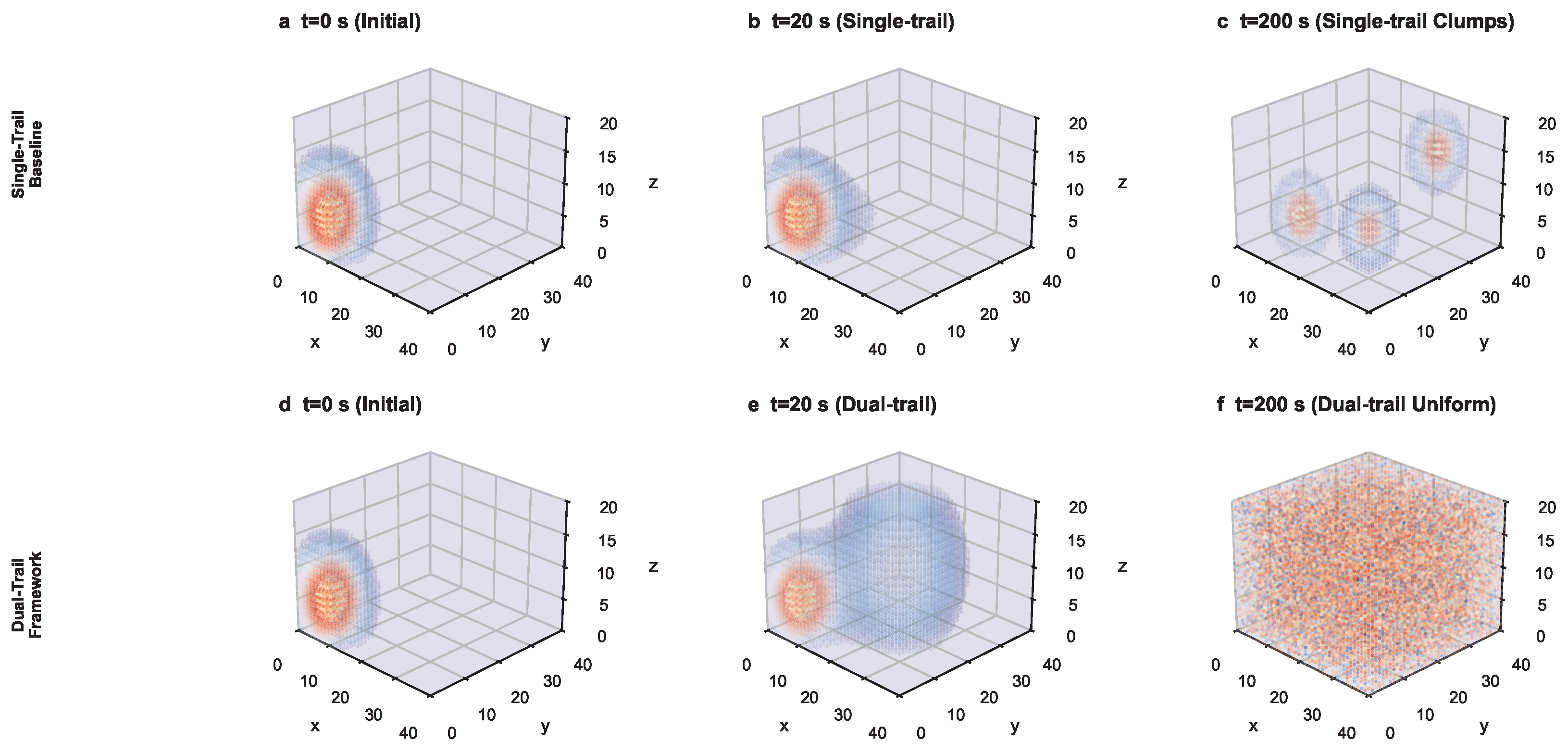
4.1. Initial Condition Relaxation Dynamics
- Diffusion Terms (): Approximated using second-order central differences.
- Advection Terms (): Discretized using a first-order Upwind Scheme to ensure numerical stability and preserve the non-negativity of the density function . The upwind direction is determined dynamically based on the sign of the local drift velocity vector .
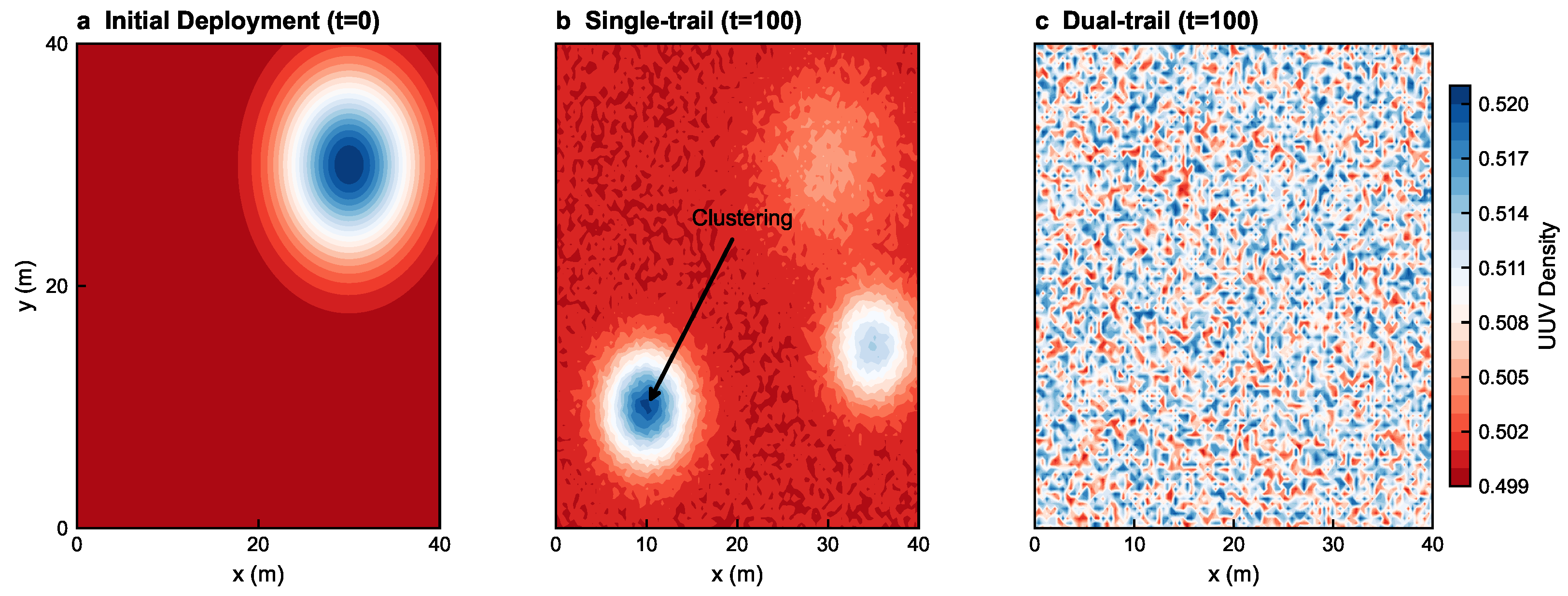
4.2. Recovery from Biased Initial Deployment
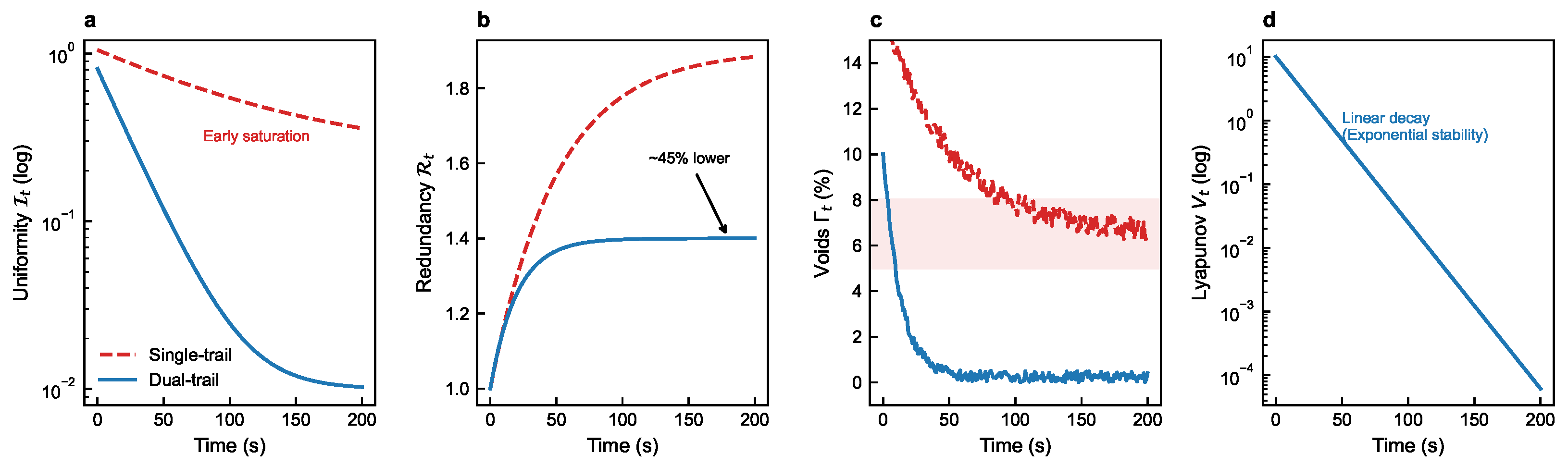
- Coverage uniformity:which measures deviations from the uniform density.
- Redundancy index:with a small regularization constant. Larger indicates more repeated traversal of already explored regions.
- Coverage completeness:where is a minimal coverage threshold. Smaller corresponds to fewer coverage holes.
- Relaxation of the Lyapunov energy:which should decay exponentially if the PDE system operates in the theoretically stable regime.
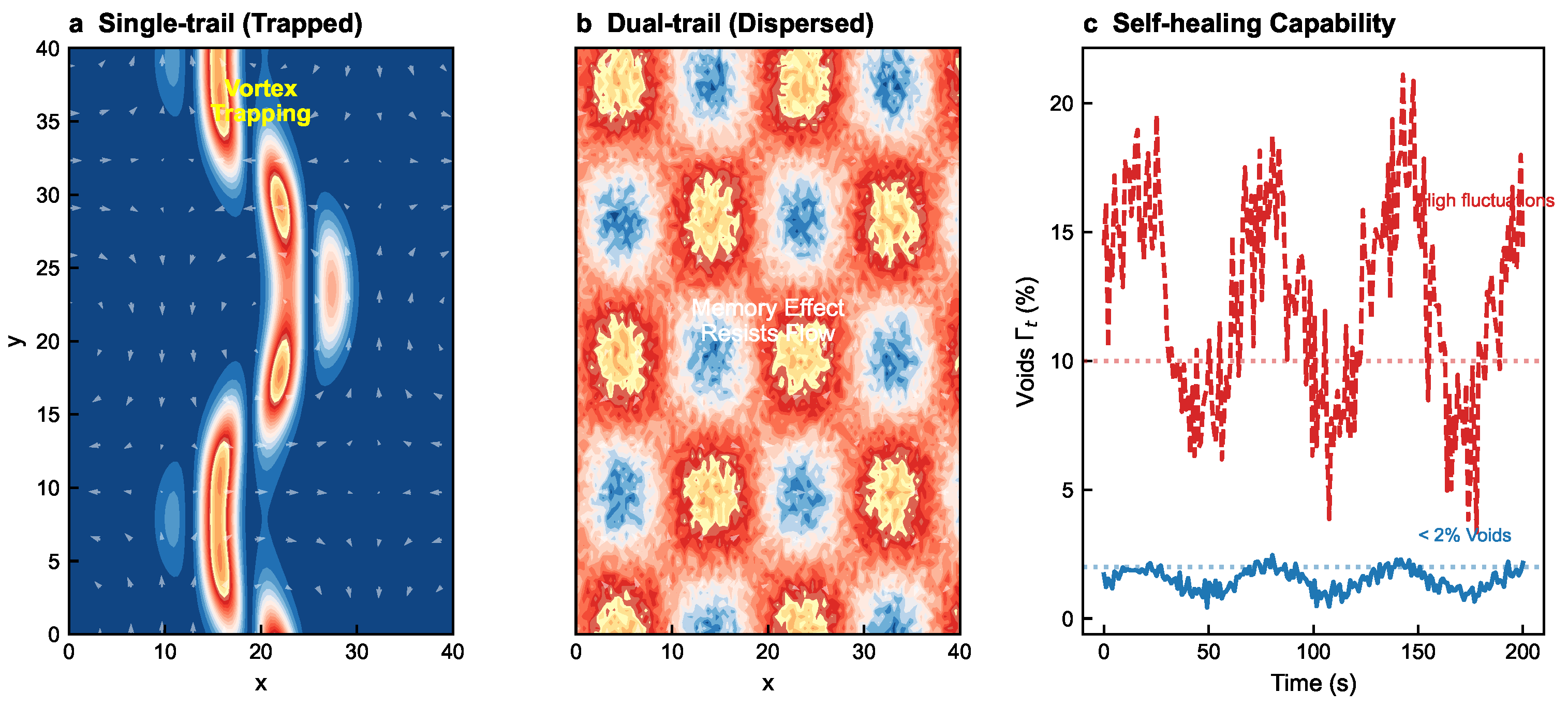
4.3. Robustness to Hydrodynamic Perturbations
4.4. Spatio-Temporal Evolution and Swarm Dynamics
4.5. Quantitative Performance and Lyapunov Energy Decay
4.6. Recovery from Localized Disturbances
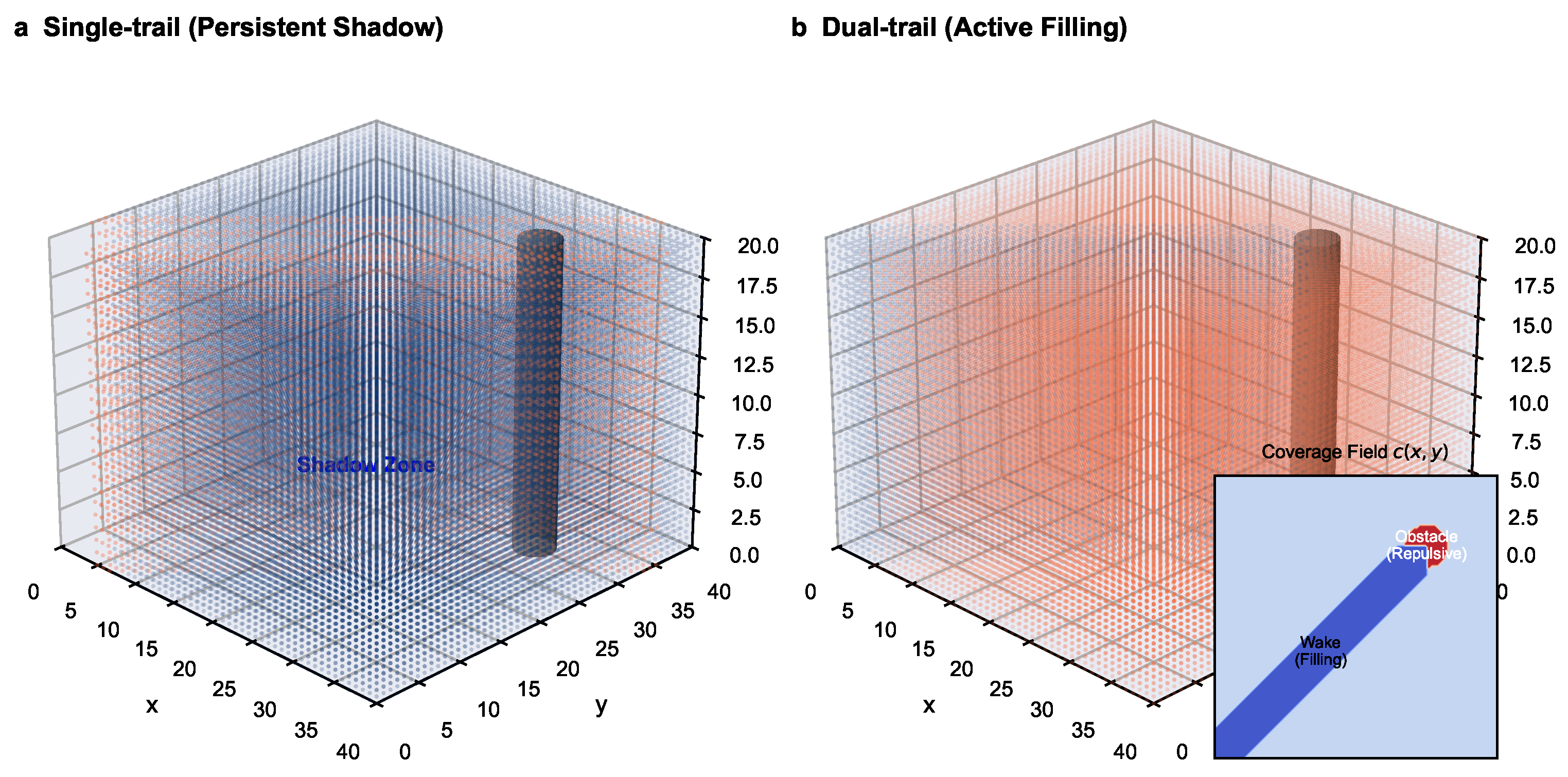
4.7. Gradient Compensation Mechanism for Shadow-Zone Mitigation
5. Conclusions
Author Contributions
Funding
Data Availability Statement
Conflicts of Interest
References
- Hoegh-Guldberg, O.; Northrop, E.; Lubchenco, J. The ocean is key to achieving climate and societal goals. Science 2019, 365, 1372–1374. [Google Scholar] [CrossRef] [Scilit] [PubMed]
- de Suarez, J.M.; Cicin-Sain, B.; Wowk, K.; Payet, R. Ensuring survival: Oceans, climate and security. Ocean Coast. Manag. 2014, 90, 27–33. [Google Scholar] [CrossRef] [Scilit]
- Wibisono, A.; Piran, M.J.; Song, H.K.; Lee, B.M. A survey on unmanned underwater vehicles: Challenges, enabling technologies, and future research directions. Sensors 2023, 23, 7321. [Google Scholar] [CrossRef] [Scilit] [PubMed]
- Budiyono, A. Advances in unmanned underwater vehicles technologies: Modeling, control and guidance perspectives. Indian J. Mar. Sci. 2009, 38, 281–289. [Google Scholar]
- Ioannou, G.; Forti, N.; Millefiori, L.M.; Carniel, S.; Renga, A.; Tomasicchio, G.; Braca, P. Underwater inspection and monitoring: Technologies for autonomous operations. IEEE Aerosp. Electron. Syst. Mag. 2024, 39, 22–35. [Google Scholar] [CrossRef] [Scilit]
- Li, J.; Zhang, G.; Jiang, C.; Zhang, W. A survey of maritime unmanned search system: Theory, applications and future directions. Ocean Eng. 2023, 280, 114947. [Google Scholar] [CrossRef] [Scilit]
- Sánchez, P.J.B.; Papaelias, M.; Márquez, F.P.G. Autonomous underwater vehicles: Instrumentation and measurements. IEEE Instrum. Meas. Mag. 2020, 23, 10–17. [Google Scholar] [CrossRef] [Scilit]
- Raptis, E. Progressively Integrating Autonomy and Intelligence in Robotic Platforms. Ph.D. Thesis, Democritus University of Thrace, Panepistimioupoli, Greece, 2025. [Google Scholar]
- Alexandris, C.; Papageorgas, P.; Piromalis, D. Positioning systems for unmanned underwater vehicles: A comprehensive review. Appl. Sci. 2024, 14, 9671. [Google Scholar] [CrossRef] [Scilit]
- Sagar, M.M.; Konara, M.; Picard, N.; Park, K. State-of-the-Art Navigation Systems and Sensors for Unmanned Underwater Vehicles (UUVs). Appl. Mech. 2025, 6, 10. [Google Scholar] [CrossRef] [Scilit]
- Watson, S.; Duecker, D.A.; Groves, K. Localisation of unmanned underwater vehicles (UUVs) in complex and confined environments: A review. Sensors 2020, 20, 6203. [Google Scholar] [CrossRef] [Scilit]
- Bonabeau, E.; Dorigo, M.; Theraulaz, G. Swarm Intelligence: From Natural to Artificial Systems; Oxford University Press: Oxford, UK, 1999. [Google Scholar]
- Brambilla, M.; Ferrante, E.; Birattari, M.; Dorigo, M. Swarm robotics: A review from the swarm engineering perspective. Swarm Intell. 2013, 7, 1–41. [Google Scholar] [CrossRef] [Scilit]
- Garnier, S. From ants to robots and back: How robotics can contribute to the study of collective animal behavior. BioScience 2013, 63, 772–781. [Google Scholar]
- Ferrante, E.; Duéñez-Guzmán, E.; Turgut, A.E.; Dorigo, M.; Birattari, M. A self-organized strategy for collective navigation in swarm robotics. Auton. Robot. 2015, 38, 243–257. [Google Scholar]
- Reina, A.; Valentini, G.; Ferrante, E.; Dorigo, M.; Birattari, M. A design pattern for decentralised decision making. PLoS ONE 2015, 10, e0140950. [Google Scholar] [CrossRef] [Scilit]
- Hamann, H. Swarm Robotics: A Formal Approach; Springer: Cham, Switzerland, 2018. [Google Scholar]
- Valentini, G.; Ferrante, E.; Dorigo, M. The best-of-n problem in robot swarms: Formalization, state of the art, and novel perspectives. Front. Robot. AI 2017, 4, 9. [Google Scholar] [CrossRef] [Scilit]
- Hunt, E.R.; Jones, S.; Hauert, S. Testing the limits of pheromone stigmergy in high-density robot swarms. R. Soc. Open Sci. 2019, 6, 190225. [Google Scholar] [CrossRef] [Scilit] [PubMed]
- Jansson, E.; Scharin, J. Stigmergic Interaction in Robotic Multi-Agent Systems Using Virtual Pheromones. Bachelor’s Thesis, Örebro University, Örebro, Sweden, 2024. [Google Scholar]
- Kwa, H.L.; Leong Kit, J.; Bouffanais, R. Balancing Collective Exploration and Exploitation in Multi-Agent Systems. Front. Robot. AI 2022, 8, 771520. [Google Scholar] [CrossRef] [Scilit]
- Kuang, M.; Yan, W.; Wang, Q.; Zheng, Y. Self-Organizing Coverage Method of Swarm Robots Based on Dynamic Virtual Force (DVF). Symmetry 2025, 17, 1202. [Google Scholar] [CrossRef] [Scilit]
- Salman, M. Automatic Design of Pheromone-Based Stigmergy in Robot Swarms. Ph.D. Thesis, Université libre de Bruxelles, Brussels, Belgium, 2024. [Google Scholar]
- Hénard, A.; Rivière, J.; Peillard, E.; Kubicki, S.; Coppin, G. A unifying method-based classification of robot swarm self-organization. Auton. Agents-Multi-Agent Syst. 2023, 31, 577–599. [Google Scholar]



| Parameter | Symbol | Value | Unit | Physical Interpretation |
|---|---|---|---|---|
| Domain Size | m | Operational volume for underwater inspection | ||
| Grid Resolution | 0.5 | m | Spatial granularity of the virtual fields | |
| Time Step | 0.02 | s | Integration step (satisfying CFL condition) | |
| Diffusion (Density) | 0.12 | Effective swarm diffusivity / sensor noise | ||
| Diffusion (Pheromone) | 0.20 | Virtual diffusion rate of pheromone packets | ||
| Diffusion (Coverage) | 0.10 | Virtual diffusion of coverage memory | ||
| Decay Rate (Pheromone) | 0.6 | Evaporation rate of short-term cues | ||
| Decay Rate (Coverage) | 0.25 | Fading rate of long-term coverage memory | ||
| Sensitivity (Pheromone) | 0.30 | Response strength to aggregation cues | ||
| Sensitivity (Coverage) | 0.45 | Repulsion strength from visited areas |
Disclaimer/Publisher’s Note: The statements, opinions and data contained in all publications are solely those of the individual author(s) and contributor(s) and not of MDPI and/or the editor(s). MDPI and/or the editor(s) disclaim responsibility for any injury to people or property resulting from any ideas, methods, instructions or products referred to in the content. |
© 2026 by the authors. Licensee MDPI, Basel, Switzerland. This article is an open access article distributed under the terms and conditions of the Creative Commons Attribution (CC BY) license.
Share and Cite
Xuan, L.; Liu, M.; He, G.; Yan, Z. Dual-Trail Stigmergic Coordination Enables Robust Three-Dimensional Underwater Swarm Coverage. J. Mar. Sci. Eng. 2026, 14, 164. https://doi.org/10.3390/jmse14020164
Xuan L, Liu M, He G, Yan Z. Dual-Trail Stigmergic Coordination Enables Robust Three-Dimensional Underwater Swarm Coverage. Journal of Marine Science and Engineering. 2026; 14(2):164. https://doi.org/10.3390/jmse14020164
Chicago/Turabian StyleXuan, Liwei, Mingyong Liu, Guoyuan He, and Zhiqiang Yan. 2026. "Dual-Trail Stigmergic Coordination Enables Robust Three-Dimensional Underwater Swarm Coverage" Journal of Marine Science and Engineering 14, no. 2: 164. https://doi.org/10.3390/jmse14020164
APA StyleXuan, L., Liu, M., He, G., & Yan, Z. (2026). Dual-Trail Stigmergic Coordination Enables Robust Three-Dimensional Underwater Swarm Coverage. Journal of Marine Science and Engineering, 14(2), 164. https://doi.org/10.3390/jmse14020164