Article

A Coastal Zone Imager-Based Model for Assessing the Distribution of Large Green Algae in the Northern Coastal Waters of China

1
Marine Science and Technology College, Zhejiang Ocean University, Zhoushan 316022, China
2
Observation and Research Station of East China Coastal Zone, Ministry of Natural Resources, Nanjing 210007, China
3
National Satellite Ocean Application Service, Beijing 100081, China
*
Author to whom correspondence should be addressed.
J. Mar. Sci. Eng. 2026, 14(2), 140; https://doi.org/10.3390/jmse14020140
Submission received: 3 December 2025 / Revised: 28 December 2025 / Accepted: 5 January 2026 / Published: 9 January 2026
(This article belongs to the Section Marine Ecology)

Abstract

This study analyzed the spatial distribution of large green algae (LGA) in the northern coastal waters of China, including the Yellow Sea and Bohai Sea, using Coastal Zone Imager (CZI) data from the HY-1C/D satellites. An inversion model (coastal zone imager model) of LGA was established, based on which the distribution details of large green algae in the Yellow Sea and Bohai Sea were investigated. The results indicated the following: (1) LGA exhibits a clearly seasonal pattern from May to August. Initially occurrences are detected in May in the southern Yellow Sea (32–34° N), followed by a rapid expansion and intensification from June to mid-July, with peak distribution around 35° N near the Shandong Peninsula. The affected area subsequently decreases in late August. (2) High LGA coverage is mainly concentrated along the Subei Shoal and the Shandong Peninsula in the Yellow Sea, as well as the coastal regions of Yantai, Qinhuangdao, and Yingkou in the Bohai Sea. (3) The LGA-M inversion model demonstrates stable performance in nearshore waters with similar optical characteristics and is applicable to LGA extraction in adjacent coastal seas, highlighting the potential of HY-1C/D satellite data in marine environmental monitoring and protection.

1. Introduction

Macroalgal blooms have become a growing global environmental concern, attracting widespread attention due to their ecological, social, and economic impacts [1]. Macroalgae primarily consist of red, green, and brown algae [2]. These algae predominantly inhabit seawater, making them commonly referred to as seaweeds. Among them, large-scale proliferations of opportunistic green macroalgae, commonly termed green tides, are characterized by rapid biomass accumulation and extensive surface coverage in coastal waters, often forming floating mats that disrupt marine ecosystems and human activities [3].
Since the 1970s, large-scale blooms of macroalgae have occurred in the coastal waters of several countries, including France, the United States, Finland, Italy, and the Netherlands [4]. In recent years, such blooms have shown an increasing trend worldwide, exemplified by green algae outbreaks in Brittany, France, and by massive green tides in the Yellow Sea of China [5]. Species such as Ulva prolifera, Ulva flexuosa, Ulva compressa, Ulva linza, and other large green algae (LGA) are the primary contributors to these outbreaks [6]. Green tides have led to severe ecological degradation, disrupted tourism, and adversely affected aquaculture. The accumulation of massive quantities of green algae has devastated beaches and coastal landscapes, inflicting significant financial losses on the tourism industry [7]. The decomposition of these algae releases unpleasant odors, which significantly diminish the experience for both residents and visitors. Managing and removing the accumulated green algae requires extensive financial and human resources, further exacerbating the socioeconomic burden [8].
The outbreak of green tides is generally the result of multiple interacting environmental factors that jointly regulate the growth, accumulation, and persistence of LGA [9]. Suitable thermal and salinity conditions facilitate algal growth, whereas elevated nutrient availability, driven by riverine inputs, aquaculture activities, and coastal eutrophication, promotes biomass accumulation [10]. Furthermore, hydrodynamic processes, including ocean currents and wind forcing, play a crucial role in the aggregation, transport, and spatial expansion of floating LGA, facilitating their large-scale spread across coastal regions [11]. Together, these physical, chemical, and biological factors create conditions conducive to the initiation and development of green tide events.
In addition to hydrodynamic and thermal conditions, the underwater optical environment plays a critical role in regulating the growth and distribution of large green algae (LGA), particularly in turbid coastal seas such as the Yellow Sea [12]. High concentrations of suspended sediments, driven by strong tidal dynamics, riverine inputs, and coastal resuspension processes, result in elevated water turbidity and increased diffuse attenuation coefficients of light [13]. These conditions significantly reduce underwater light penetration, thereby constraining the depth range and spatial extent suitable for macroalgal growth.
Under such optically complex conditions, LGA tend to preferentially develop near the sea surface or in floating forms to maximize light availability for photosynthesis, while excessive turbidity may suppress algal growth by rapidly attenuating photosynthetically active radiation [14]. Moreover, strong spatial heterogeneity in turbidity can lead to pronounced patchiness in LGA distribution [15]. Importantly, high turbidity and variable optical properties also pose substantial challenges for satellite-based detection of green tides, as water-leaving radiance is strongly influenced by suspended particles and colored dissolved organic matter [16]. These optically complex conditions not only regulate LGA growth and spatial distribution but also pose substantial challenges for satellite-based detection, highlighting the need for robust inversion algorithms in turbid coastal waters.
Remote sensing satellite data have been widely utilized for monitoring large-scale green algae blooms [17]. Moderate-resolution sensors like MODIS (250 m) are widely used for large-scale green tide detection due to their high temporal coverage and computational efficiency. They are typically combined with straightforward methods such as single-band thresholds or spectral indices, including the Floating Algae Index (FAI) and the Normalized Difference Vegetation Index (NDVI) [18]. However, the coarse spatial resolution of MODIS frequently results in mixed pixels in nearshore waters, leading to overestimation of green tide extent and reduced accuracy in coastal regions [19]. High-resolution sensors such as Sentinel-2 MSI (10 m) enable the application of multi-band ratio and index-based methods to resolve fine-scale spatial patterns of green algae, but their practical use is often constrained by complex preprocessing workflows and limited temporal continuity [20]. Chinese satellite sensors, including GF-WFV (16 m) and HJ-CCD (30 m), are typically applied using spectral threshold or band-ratio techniques; nevertheless, their limited spectral configurations restrict the effective separation of green tides from other floating materials or highly turbid waters [21]. Radiative transfer–based approaches have also been explored with multi-spectral satellite data to enhance physical interpretability, yet their reliance on detailed optical parameters and high computational demand limits their applicability for routine, large-scale monitoring [22].
Therefore, most existing studies are constrained by limitations related to satellite sensors or inversion methods, such as insufficient spatial resolution, limited revisit frequency, or degraded performance in optically complex nearshore waters [19]. These limitations hinder the accurate extraction and continuous monitoring of large green algae, particularly in highly turbid coastal regions like the Yellow Sea and Bohai Sea. Moreover, few studies have developed inversion algorithms specifically tailored to new-generation Chinese ocean color sensors, and systematic assessments of large-scale LGA spatiotemporal dynamics using such sensors remain scarce [22].
HY-1C/D Coastal Zone Imager (CZI) offers significant advantages, including wide spatial coverage, high spatial resolution, and high temporal resolution. With a swath width of 950 km, CZI is capable of capturing extensive sea areas in a single pass, greatly enhancing data acquisition efficiency [23]. Its 50 m spatial resolution enables the retrieval of high-detail imagery, facilitating precise observations of marine environments [24]. The dual-satellite operation of HY-1C/D allows for a revisit interval of just three days, providing frequent observational data crucial for tracking short-term variations and dynamic oceanic processes [25]. Additionally, CZI demonstrates strong performance in monitoring turbid coastal waters, where complex optical properties pose challenges for remote sensing. The integration of atmospheric correction algorithms further enhances data accuracy, making CZI highly suitable for observing optically complex water bodies [26]. Given these advantages, this study utilizes HY-1C/D CZI data as the primary data source for analysis.
The objectives of this study are threefold. Initially, an LGA inversion model tailored to HY-1C/D Coastal Zone Imager (CZI) data is developed by identifying LGA-sensitive spectral bands. On this basis, the spatiotemporal distribution patterns of LGA in the Yellow Sea and Bohai Sea are investigated. Furthermore, the relationships between LGA distribution and key environmental variables, particularly sea surface temperature and salinity, are analyzed under turbid coastal water conditions. Based on these objectives, we hypothesize that a CZI-based inversion model can effectively extract LGA in optically complex nearshore waters, and that variations in physical environmental factors, especially temperature and salinity, are significantly associated with the observed spatial variability of LGA in the Yellow Sea and Bohai Sea.

2. Materials and Methods

2.1. Study Area

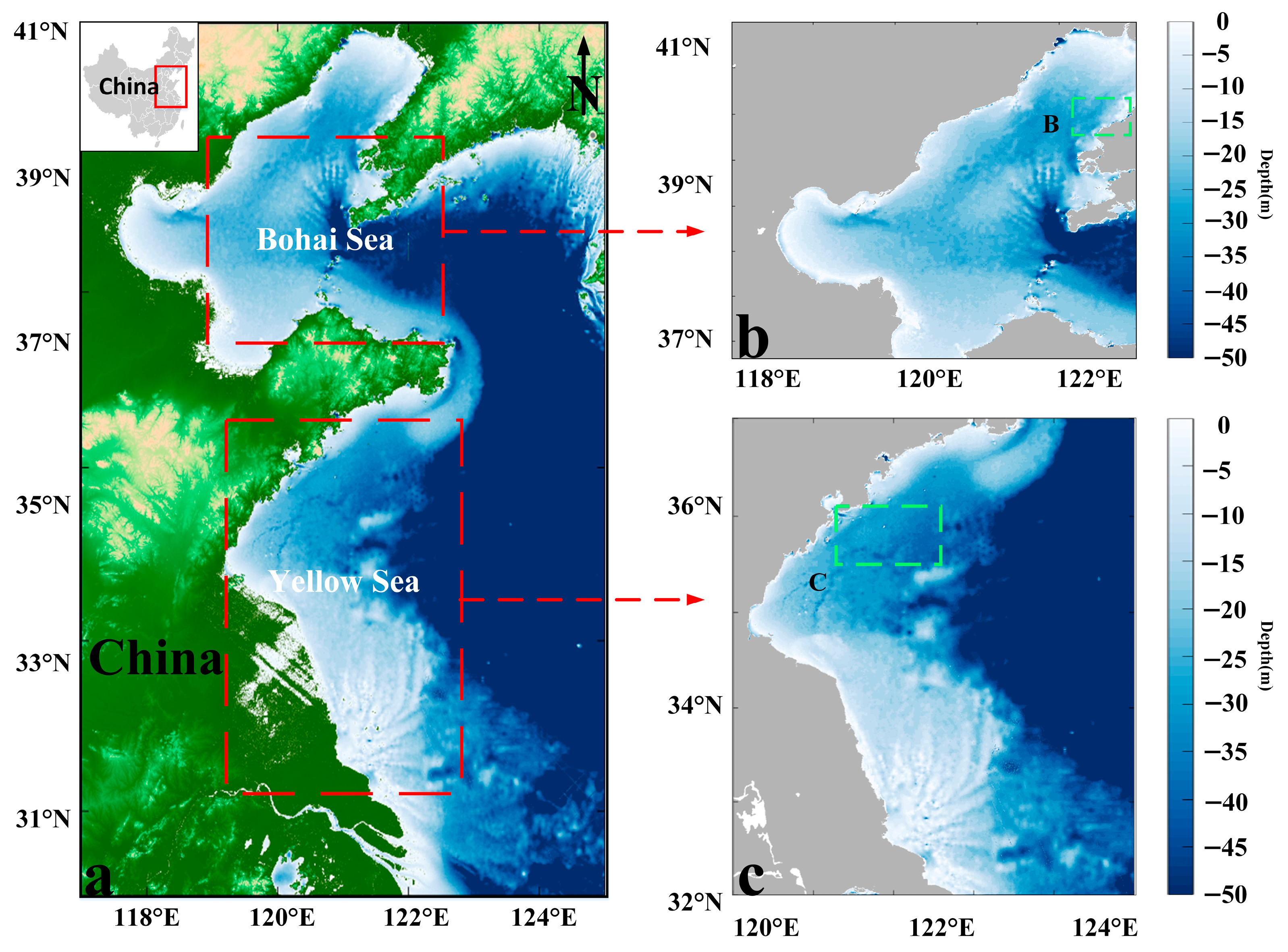
This study focuses on the coastal waters of the Yellow and Bohai Seas (Figure 1), China, within the latitude range of 32–41° N and the longitude range of 119–124° E, aiming to elucidate the spatial distribution patterns of LGA. The region is characterized by a temperate monsoon climate, with an average annual temperature of approximately 16 °C [27]. Summers are warm and humid, with abundant solar radiation, which promotes high primary productivity in the marine ecosystem [28].

2.2. Satellite Data

The HY-1C and HY-1D satellites, equipped with the Coastal Zone Imager (CZI), were launched on 7 September 2018, and 11 June 2020, respectively. Operating in complementary morning and afternoon orbits, they form a dual-satellite observation network, enhancing temporal coverage and observation frequency [29]. The CZI sensor provides 50 m spatial resolution across key visible and near-infrared bands, with a swath width of 950 km and a revisit cycle of approximately 3 days [30]. In this study, HY-1C/D CZI data were used to develop an empirical algorithm for retrieving the spatial distribution of large green algae (LGA) in the Yellow and Bohai Seas, serving as the primary dataset for subsequent analysis. The specific wavelength configurations of the CZI onboard HY-1C/D are detailed in Table 1.
GF-1 satellite data (16 m) were obtained from the China Resources Satellite Application Center [31]. The GF series satellites offer high-resolution optical imagery, with spatial resolutions ranging from sub-meter (GF-2, GF-6) to several meters. Compared with medium-resolution sensors, GF imagery provides finer spatial details, enabling the identification of small-scale environmental features and serving as a validation dataset for LGA distributions retrieved from HY-1C/D CZI data [32].
MODIS 1B data were downloaded from NASA’s DAAC Data Center [33]. MODIS sensors onboard NASA’s Terra and Aqua satellites provide daily observations at spatial resolutions of 250–500 m. MODIS data were used to validate the spatiotemporal patterns of LGA obtained from HY-1C/D, providing an independent, long-term dataset with high temporal frequency for cross-verification [34].

2.3. Measured Spectra of Large Green Algae

Spectral measurements of large green algae were conducted under controlled laboratory conditions using a vertical observation geometry, which is commonly applied in vegetation spectral studies [35]. Transparent cylindrical containers (30 cm in diameter and 50 cm in depth) were filled with natural seawater collected from the field to simulate near-surface marine conditions. The container bottom was optically neutral to minimize background reflection effects. Large green algae samples were placed at shallow depths (0–10 cm below the water surface) to represent typical floating or near-floating states observed in natural environments [36].
Natural sunlight was used as the illumination source. Measurements were per-formed on clear, windless days in open areas free of surrounding obstructions, with acquisition times between 09:00 and 17:00 local time to ensure stable illumination conditions and sufficiently high solar elevation angles [37]. The spectroradiometer was positioned vertically above the water surface, and the field of view fully covered the container opening to minimize adjacency effects. For each measurement, spectral records were obtained sequentially for a calibrated diffuse reflectance reference panel, skylight, pure seawater, and seawater containing large green algae [38].
The large green algae samples were provided by Zhejiang Ocean University. Samples of Ulva prolifera were collected from the Yellow Sea on 9 June 2024, and Enteromorpha samples were collected from Taohua Island on 10 May 2024. Each sample was measured repeatedly under identical conditions to ensure data stability. During spectral preprocessing, raw spectra were inspected, and curves exhibiting abnormal noise or saturation were excluded. Remaining spectra were smoothed using standard filtering procedures, and representative reflectance curves were obtained by averaging multiple valid measurements [39].
The in situ spectral measurements conducted in this study were primarily used to characterize the relative spectral features of LGA and to select sensitive bands for the model development, rather than establishing a direct quantitative relationship with satellite reflectance. Therefore, this paper explores the relationship between in situ spectra and satellite reflectance primarily from qualitative and methodological perspectives. Finally, the effectiveness of the selected spectral bands and the reliability of the inversion model were evaluated through independent satellite validation based on in situ LGA distribution data.

2.4. Reanalysis Data

The temperature data, derived from ERA5 monthly averages, is provided by the European Centre for Medium-Range Weather Forecasts (ECMWF) and spans global meteorological variables from 1940 to the present, with a spatial resolution of 0.25° × 0.25°. This dataset includes multiple atmospheric variables such as temperature, humidity, wind speed, and pressure. The data is generated through reanalysis, integrating observational data with numerical weather prediction models, making it suitable for studies on climate change and meteorological patterns [40]. The data can be accessed via the European Climate Data Service platform [41].
The ocean current and salinity data used in this study are derived from the Global Ocean Physics Analysis and Forecast Dataset [42]. This dataset provides monthly oceanographic variables, including sea surface temperature, ocean currents, and salinity, with a spatial resolution of 0.083° × 0.083°. It offers valuable insights into global oceanic processes and dynamics. The data is generated using advanced ocean forecasting models, ensuring accurate and up-to-date information on ocean circulation and physical phenomena. This dataset is particularly suitable for research on ocean dynamics, climate change, and marine sciences.
The terrain data is derived from the global DEM data published by GEBCO, with a resolution of 15 s [41]. The wind field data are from the ERA-temporary data set, which is one of the multiple data sets generated by a series of ECMWF projects [43]. These data include wind, temperature, rainfall, snow, and sea ice. Studies have shown that these data have better accuracy than other meteorological data.

2.5. In Situ Data

Field sampling was conducted in the Yellow and Bohai Seas on five dates: 13 May and 8 June 2020, 19 May 2021, 17 May 2022, and 22 June 2023 (Figure 1b,c), resulting in a total of 400 geographically referenced LGA samples. All samples were collected from 10:00 to 11:00 AM local time, corresponding to the HY-1C/D satellite overpass, with precise coordinates documented for each location.
The collected dataset was randomly split into two equal subsets (n = 200 each). The first subset was used as the training set to develop a preliminary LGA extraction model, and the second subset was used as an independent test set to assess the model’s extraction accuracy. The training dataset and the validation dataset are independent of each other, with no potential risk of overfitting.

2.6. Data Preprocessing

This study utilized L1B and L2A data from the HY-1C/D Coastal Zone Imager (CZI). During the atmospheric correction preprocessing of the L1B data, atmospheric characteristic parameters retrieved from the L2A data, including the solar irradiance at the top of the atmosphere (F0), Rayleigh scattering optical thickness (tau_r), and ozone absorption coefficients (k_oz), were used to perform atmospheric correction calculations.
To minimize the influence of aerosols, HY-1C/D CZI satellite data acquired on clear and dry days were selected, thereby enhancing the utility of high-resolution satellite imagery for observing large green algae. L1B and L2A data collected from May to August in 2019–2024 were used in this study. These products include blue, green, red, and near-infrared bands, which can be employed to develop an algal inversion model suitable for the Yellow Sea and Bohai Sea.
GF-1 satellite data and MODIS 1B data were used to assist in verifying the inversion results of large green algae. In order to ensure the accuracy of water information, these data are also processed by geometric correction and atmospheric correction.
All calculations were performed using Python 3.8, ENVI 5.3, and ArcGIS 10.2 software.

3. Results

3.1. Establishment of the Inverse Model of LGA

3.1.1. Spectral Characteristics Analysis of Large Green Algae

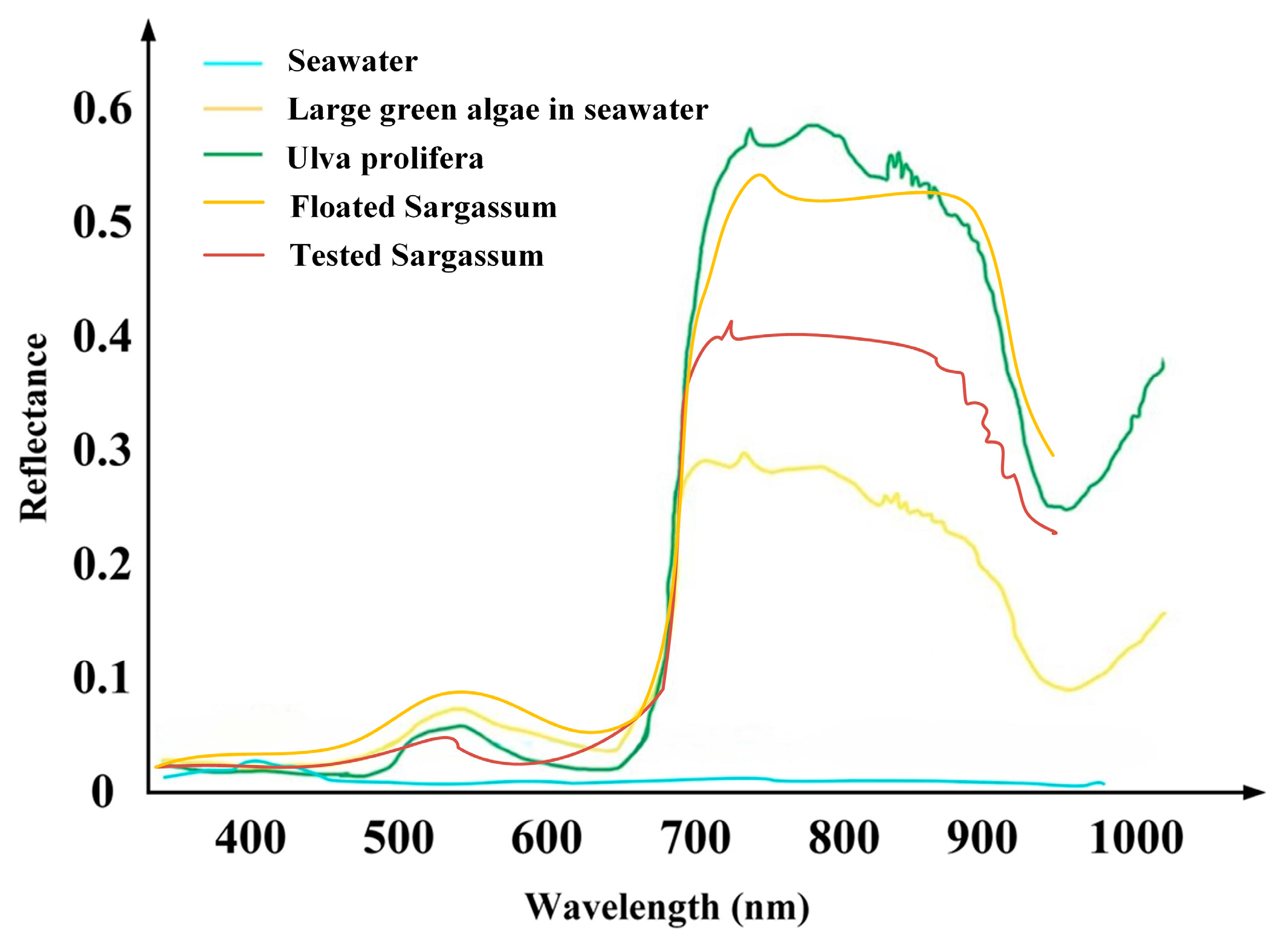
The spectral characteristics of large green algae provide the fundamental basis for their remote sensing identification. We measured the spectral reflectance of large green algae, Ulva prolifera, Sargassum, and seawater to support the extraction of large green algae from remote sensing images (Figure 2). The spectral curves of the samples were mapped for comparison.
Floating LGA significantly alters the spectral characteristics of the water surface, particularly in the visible and near-infrared bands. The blue and red bands exhibit relatively stable reflectance and can be used as a baseline, whereas the green band reflectance increases with LGA coverage. Similarly, near-infrared reflectance increases with the floating algae area due to strong NIR reflectance by LGA and near-complete absorption by water [44]. Based on these spectral differences, an index is calculated using the height difference between the green band reflectance and the baseline [45]. This index is then related to in situ LGA coverage through regression, enabling quantitative estimation of LGA coverage from satellite imagery across the study area.
According to the analysis of the spectral curve, the overall spectral reflectance of large green algae is significantly higher than that of seawater. Large green algae exhibit pronounced high reflectance in the near-infrared band, while demonstrating an absorption valley in the red band. This spectral contrast serves as the physical basis for developing identification algorithms. The blue and green bands are utilized for auxiliary atmospheric correction and for minimizing interference from other water constituent information. Based on the above-mentioned bands, this study established a multiband empirical regression model to enhance the capability of extracting large green algae information.

3.1.2. Model Building

Based on the spectral difference analysis described above, a new large green algae identification index was developed to effectively enhance the green-algae signal while suppressing the water background noise. In addition, seventeen existing spectral indices with relatively high discrimination capability were selected for comparison (Table 2). These indices were calculated using the blue, green, red, and near-infrared bands of the HY-1C/D satellite.
To further improve the evaluation accuracy of green-algae coverage, a statistical analysis was performed on the index values obtained from numerous known algae-distribution samples within the study area. Moreover, a model was established between the index values and the field-measured algae coverage based on synchronous in situ observations.
According to the evaluation results, the model based on the band ratio of band 1 (Blue), band 2 (Green), band 3 (Red), and band 4 (NIR) was the best model, with the R2 of 0.9315 (Table 2).
Therefore, the final LGA inversion model based on CZI data was determined for the Yellow and Bohai Sea regions (Equation (1)), named Large Green Algae inversion model (LGA-M).
Y = 1.6291 X 0.0472
X = R r s B 4 B 3 R r s B 1 + B 2
where Y is the index of LGA, and B1, B2, B3, and B4 are the first, second, third, and fourth bands of the CZI data, respectively.
An inversion model (Equation (1)) for estimating the LGA index has been developed based on X. This model is an algorithm that utilizes spectral characteristics to estimate algae and is specifically designed for nearshore waters. And then, a classification threshold (Y > 0.1) was applied to delineate LGA, which was calibrated through visual interpretation of the imagery.

3.1.3. Verification

To evaluate the performance of the developed model, a commonly used ground-object classification accuracy assessment method—the confusion matrix was employed [46]. Three evaluation metrics, including precision, recall, and the F1-score, were calculated from the confusion matrix. Precision refers to the probability that a pixel identified as a specific category actually belongs to that category. Recall refers to the probability that pixels that actually belong to a certain class are correctly identified. F1-score provides a precision metric for a specific category by combining precision and recall. The above indicators can be expressed as follows:
P r e c i s i o n i = T P T P + F P
R e c a l l i = T P T P + F N
F 1 s c o r e i = 2 × P r e c i s i o n i × R e c a l l i P r e c i s i o n i + R e c a l l i
where TP represents pixels correctly identified as large green algae, FP represents pixels incorrectly identified as large green algae, and FN represents pixels that were actual large green algae but misclassified as non-algae.
The results demonstrated that the proposed LGA-M model outperformed NDVI, FAI, and EVI across all key classification metrics. Specifically, LGA-M achieved a recall of 0.952, a precision of 0.961, and an F1-score of 0.946 (Table 3), indicating its strong balance between accurate macroalgae identification and effective control of false positives. These high-accuracy values confirm the robust performance and reliability of the proposed method. The comparable extraction accuracy obtained for both the training and validation datasets suggests that the proposed model does not suffer from significant overfitting. The absence of a substantial performance gap between the calibration and validation results further confirms the stability and generalization ability of the model.
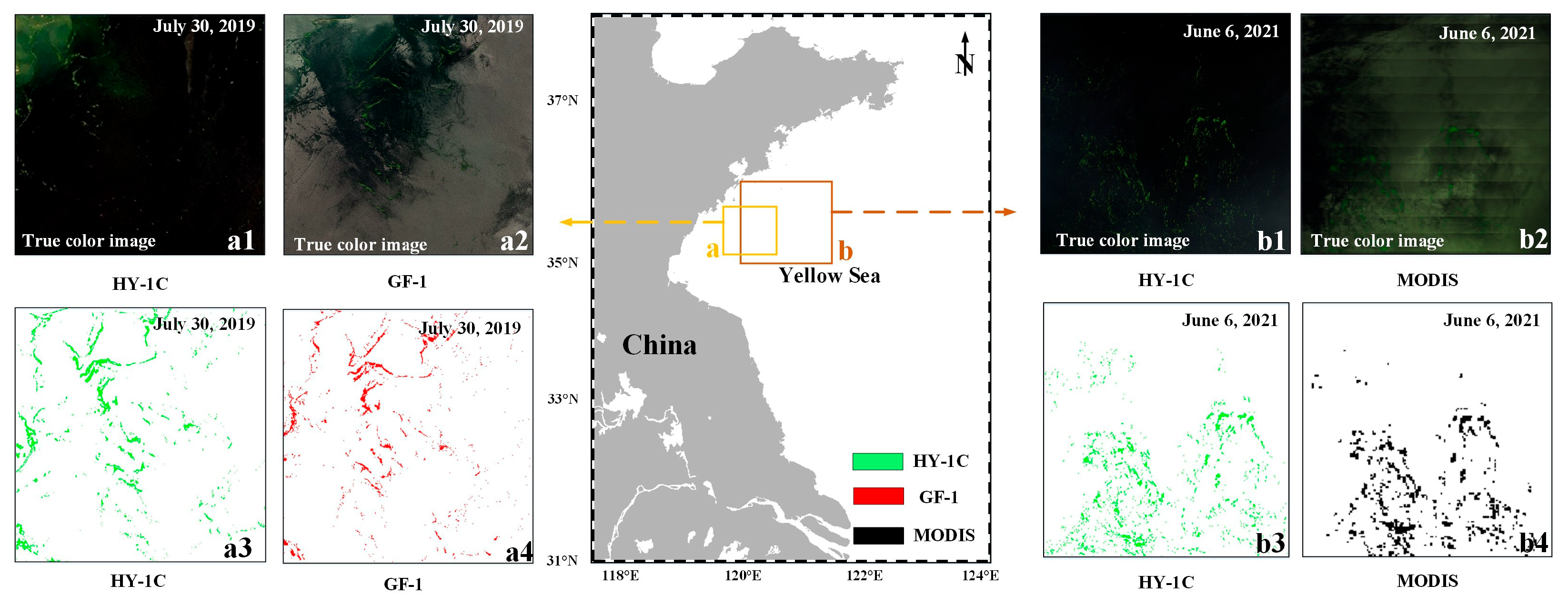
To further determine the rationality of the inversion results, this study also conducted a comparative analysis of large green algae extraction results based on the LGA model with those derived from MODIS and GF data using the method in previous studies (Figure 3 and Figure 4). Firstly, the spatial coverage of large green algae (LGA) obtained through inversion model was compared with satellite true-color imagery, showing that the new model can accurately extract the spatial distribution of LGA (Figure 3(a1,a3,b1,b3)). Additionally, a comparison of the inversion results derived from HY-1C/D and GF satellite data on 30 July 2019, revealed a high consistency in spatial details (Figure 3(a3,a4)). Furthermore, the inversion results from HY-1C/D data on 6 June 2021, were compared with those from MODIS data, showing general agreement in their distribution patterns (Figure 3(b3,b4)). Finally, an area-based quantitative comparison was conducted (Figure 4).
The inversion results of HY1C, GF-1 and MODIS in the Yellow Sea at the same time were quantitatively analyzed. The GF-1 data was used as the reference data set to calculate the absolute coverage area of MODIS and HY-1C/D, and their respective area difference ratio (Table 4).
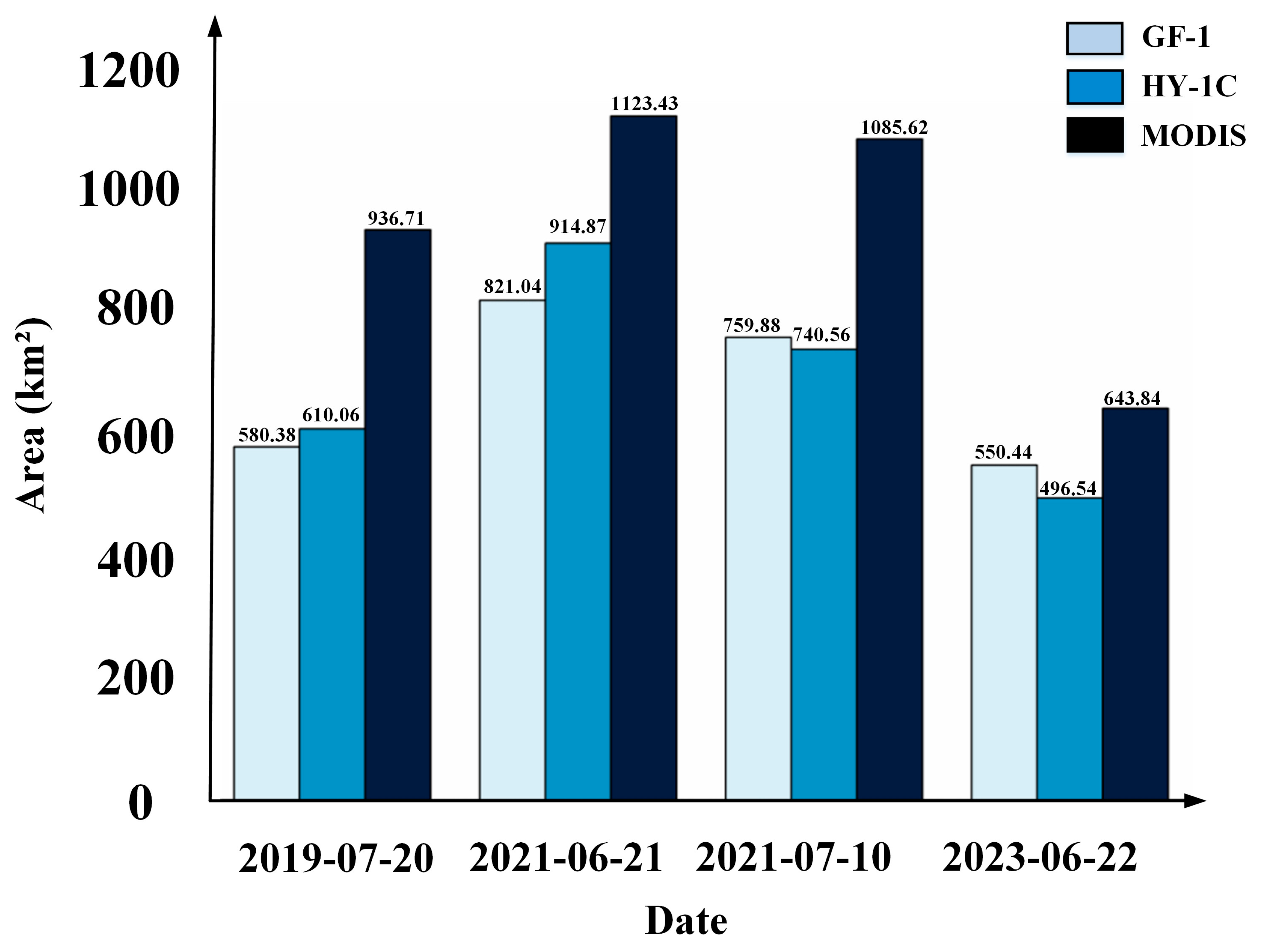
The results show that MODIS consistently overestimated the LGA coverage area on all observation dates, with monitored areas measuring 936.71, 1123.43, 1085.62, and 643.84 km2, respectively. The corresponding ADR values were highest on 20 July 2019, reaching 61.4%, and lowest on 22 June 2023, though still as high as 17.0%. In contrast, HY-1C/D estimates aligned more closely with GF-1 data: the ADR was only 2.5% on 10 July 2021, and peaked at 11.4% on 21 June 2021, still lower than the error levels of MODIS. Overall, HY-1C/D exhibited smaller deviations from GF-1, showing only a slight underestimation (9.8%) on 22 June 2023, whereas MODIS displayed consistent and substantial overestimation with greater error magnitudes.
The differences in LGA spatial coverage across datasets are visually compared using a bar chart (Figure 4). The results show that the LGA coverage areas monitored by HY-1C/D (610.06, 914.87, 740.56, and 496.54 km2) closely match those obtained from GF-1 (580.38, 821.04, 759.88, and 550.44 km2). The comparative analysis indicates that HY-1C/D, employing the proposed model, not only significantly outperforms MODIS in capturing the fine-scale spatial distribution of floating LGA in coastal waters but also achieves accuracy and reliability comparable to GF-1 monitoring results, thereby validating the robustness of the model.
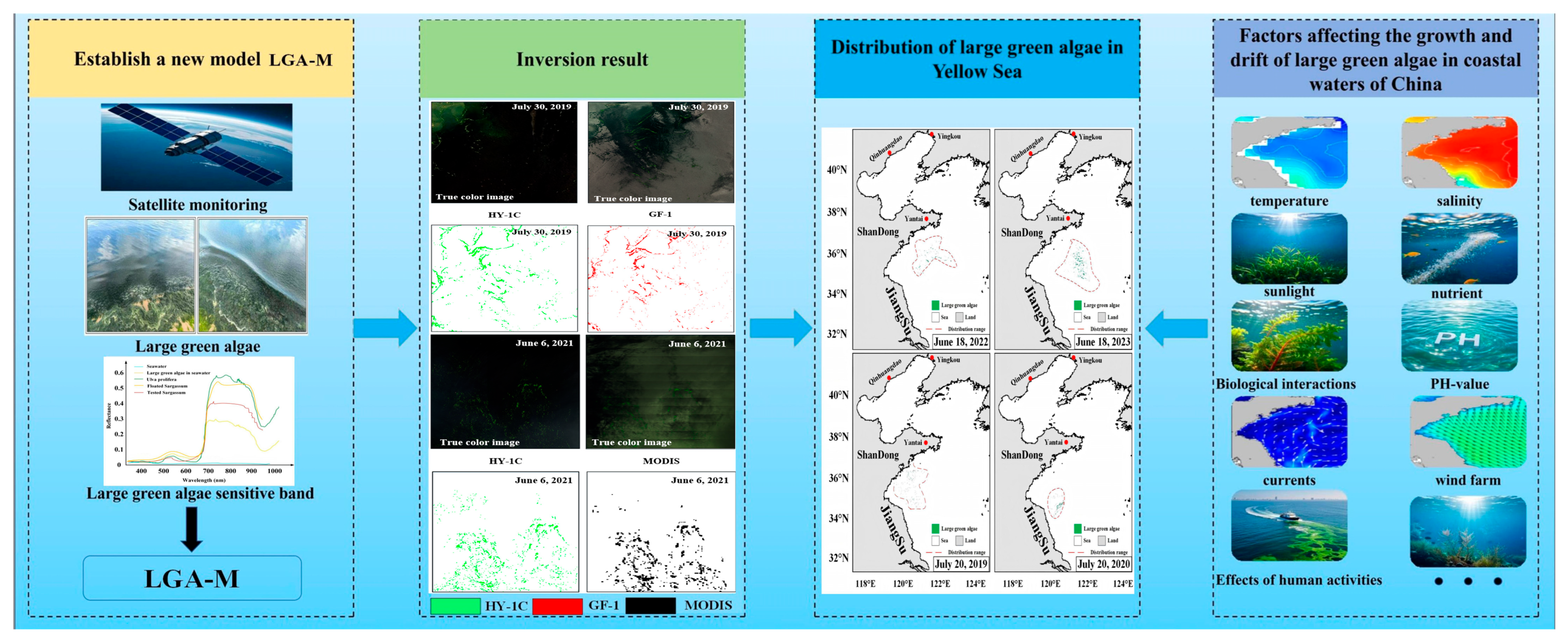
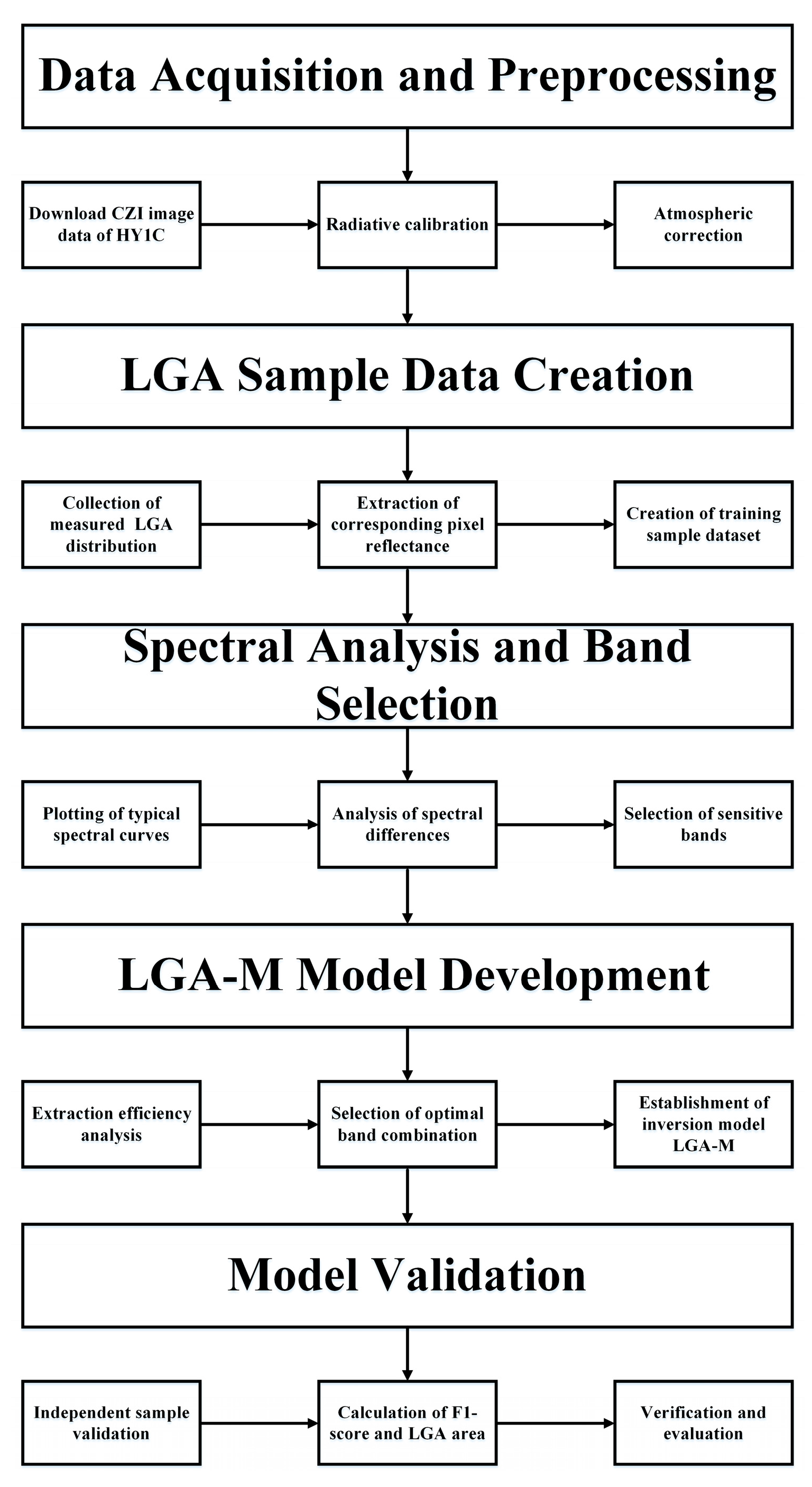
The workflow of this study is illustrated in Figure 5. The process begins with the data acquisition and preprocessing of HY-1C/D CZI satellite imagery, including radiometric calibration and atmospheric correction to ensure reliable surface reflectance data. Next, LGA sample data creation involves collecting measured green-algae distributions, extracting corresponding pixel reflectance values, and generating a representative training dataset. Subsequently, spectral analysis and band selection are developing by plotting typical spectral curves, analyzing spectral differences, and identifying the most sensitive spectral bands for macroalgae detection. Based on these results, the LGA-M model is developed through extraction efficiency analysis and optimization of band combinations to establish an empirical inversion model. Finally, model validation is performed using independent sample data. The validation metrics—precision, recall, and F1-score—are calculated, and the estimated green-algae coverage area is compared with reference data to evaluate the model’s accuracy and stability.

3.2. Distribution Characteristics of LGA in the Yellow and Bohai Seas

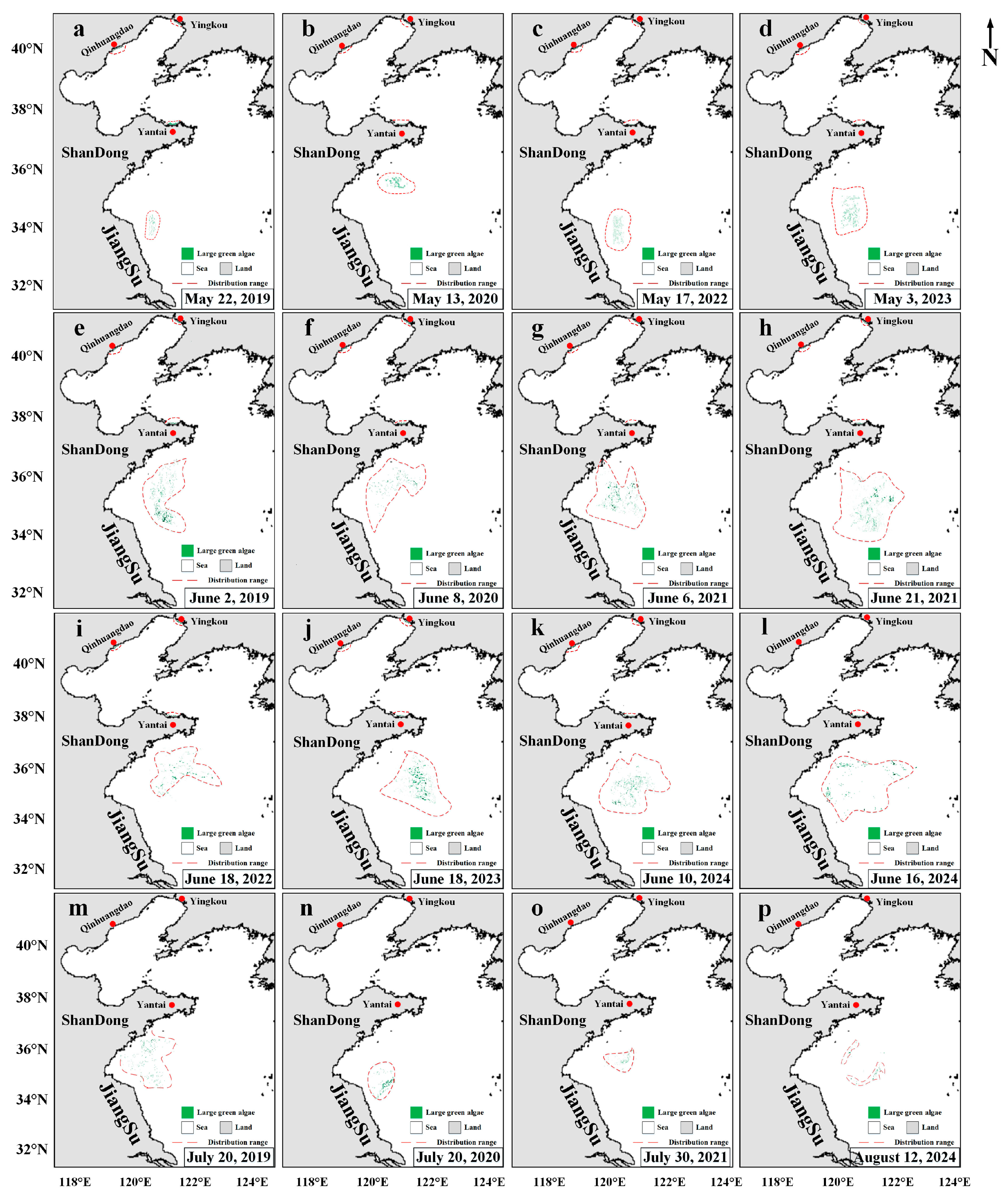
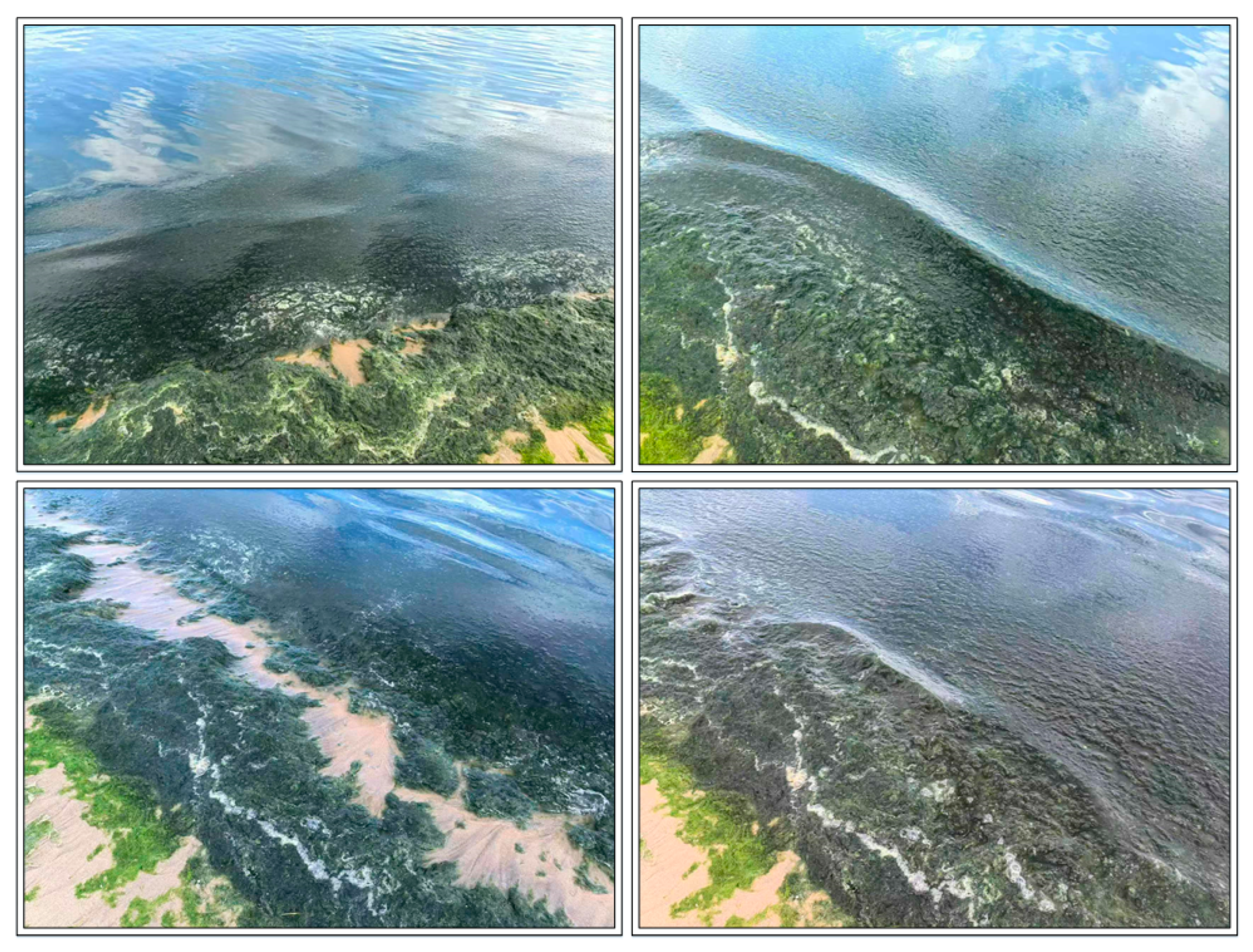
The spatial distribution of LGA in the Yellow and Bohai Seas from 2019 to 2024 was analyzed (Figure 6). In the Yellow Sea, LGA extends across a wide range from nearshore to offshore waters, mainly concentrated around the coastal regions of the Shandong Peninsula and Subei Shoal, forming either band-like structures or extensive patches (Figure 6a,b). In contrast, the LGA distribution in the Bohai Sea is more limited, with a relatively small coverage area, primarily concentrated in the coastal waters of Yantai (Figure 7), Qinhuangdao, and Yingkou City (Figure 6a).
The spatial distribution of LGA exhibits significant temporal variability (Figure 6). In May, LGA coverage in the Yellow Sea is relatively limited, mainly are distributed in coastal areas in the northern Yellow Sea, where the distribution remains sporadic and fragmented (Figure 6a). By June, the affected area expands significantly, particularly in coastal waters, with a noticeable increase in coverage. LGA in the northern Yellow Sea begins to form a more concentrated distribution pattern (Figure 6e). In mid-July, the coverage of certain LGAs further expands, accompanied by an increase in algal density in specific areas, resulting in a more clustered distribution pattern (Figure 6m). From late July to August, both the coverage area and biomass of LGA decline sharply, and the algae gradually dissipate (Figure 6o,p).
The seasonal variation characteristics of LGA are obvious, and the main growth cycles is concentrated in spring (May) and summer (July and August) (Figure 6). In May, LGA is first detected in the coastal waters of Yantai in the Bohai Sea (Figure 6b), while its initial emergence in the Yellow Sea is observed in the coastal waters of Subei Shoal in late May (Figure 6a). During summer (June), LGA experiences vigorous growth, reaching its maximum coverage area (Figure 6l). By late June, the distribution is primarily concentrated in the central and southern Yellow Sea, exhibiting a distinct expansion trend (Figure 6h). In mid-July, although the distribution of LGA remained relatively concentrated, the total coverage is slightly reduced compared to June, while the growth of LGA in the northern Yellow Sea remains strong (Figure 6m). By late July, the coverage area declines further, marking the onset of the decay phase (Figure 6n). In mid-August, LGA experiences mass mortality and gradually disappears (Figure 6p).
The spatial distribution of LGA in the Yellow Sea exhibits significant seasonal variations, showing an increasing trend over the years. In June and July, as water temperatures rise and light conditions improve, the coverage of green algae generally expands. This trend provides crucial data for assessing the ecological health and biodiversity of the Yellow Sea.

4. Discussion

4.1. Applicability of the LGA Inversion Model

The sensitive bands used in the LGA-M model are consistent with those employed in previous studies for extracting algal distribution which is blue, green, red, infrared bands [48]. This multi band combination helps mitigate, to a certain extent, the effects of water properties and associated environmental variations [49].
Comparative validation results demonstrate that LGA-M outperforms NDVI, FAI, and EVI across all key classification metrics, achieving a precision of 96.1%, recall of 95.2%, and an F1-score of 94.6% (Table 3). These high-accuracy outcomes confirm the model’s effectiveness in extracting LGA in the Yellow Sea and Bohai Sea. In addition, this study conducted a comparative analysis of LGA distribution patterns: one derived from MODIS and GF data using previously established models, and the other extracted from HY-1C/D CZI data using the proposed LGA-M model (Figure 3). The results obtained with the LGA-M inversion model show strong agreement with those from the Normalized Difference Vegetation Index (NDVI) inversion model, further validating the feasibility of the proposed approach. It is noteworthy that the LGA-M model provides more detailed spatial information on LGA distribution, whereas the NDVI-based results remain coarser and lack fine-scale spatial resolution (Figure 3(b3,b4)).
The spatiotemporal distribution pattern of LGA predicted by the new model shows strong agreement with previous research findings, further validating the model’s feasibility [50]. LGA initially appears in the coastal waters of the Subei Shoal in May (Figure 6a,c), then emerges in the central Yellow Sea from June to early July (Figure 6e–h) [51], with its center shifting northward, primarily distributed in the off-shore areas of Shandong Province (Figure 6i–l) [50]. By late July, LGA eventually reaches the southern sea area of the Shandong Peninsula (Figure 6m) [52].
The LGA-M offers several distinct advantages. It delivers high extraction accuracy, effectively discriminating LGA from seawater and enabling precise retrieval of LGA coverage (Figure 6). Furthermore, compared with existing models listed in Table 3, the HY-1C/D CZI satellite demonstrates multiple significant strengths in LGA monitoring. To begin with, its moderate 50 m spatial resolution strikes an effective balance between coverage and detail, meeting the requirements for coastal observation [53]. Additionally, the dual-satellite coordinated observation system provides unique morning and evening sampling capabilities, achieving a revisit frequency of ≤1.5 days. This very high temporal resolution significantly enhances the ability to monitor short-term dynamic processes in coastal ecosystems [54].
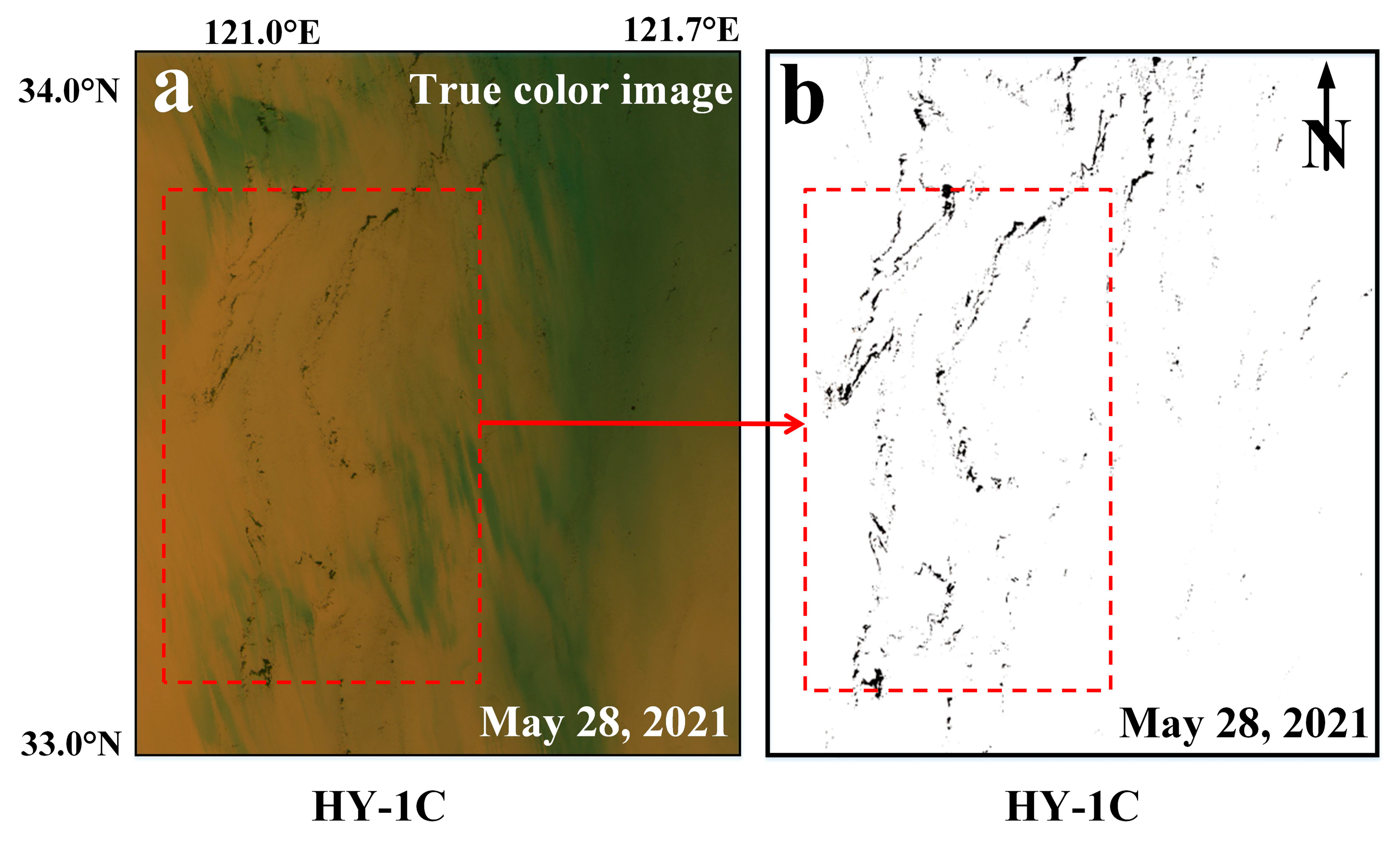
To assess regional applicability, HY-1C/D satellite data acquired over the East China Sea on 28 May 2021 were used as an independent test case (Figure 8). The results indicate that the LGA-M model performs consistently under coastal optical conditions similar to those of the Yellow Sea and Bohai Sea. However, this application represents a preliminary validation rather than a comprehensive demonstration of universal applicability.
The model is primarily suitable for moderately turbid Case-2 coastal waters, where suspended particulate matter concentrations (5–1500 mg L−1) and optical complexity are comparable to those observed in the Yellow Sea, Bohai Sea, and adjacent East China Sea (Figure 6 and Figure 8) [55]. In environments characterized by persistently high turbidity or extremely high suspended matter concentrations, such as estuarine maximum turbidity zones, optical signal saturation may occur, potentially increasing uncertainty in model inversion results [56]. Therefore, caution is advised when applying the model under such conditions, and local calibration may be required.
It should be noted that the applicability of the proposed LGA inversion model is constrained by seasonal and optical conditions. The model is primarily applicable during the main LGA growth period from May to August, when large green algae are predominantly distributed at the sea surface and exhibit stable spectral characteristics [56]. In terms of atmospheric conditions, the model demonstrates reliable performance under clear-sky and thin-cloud conditions, under which surface reflectance signals of LGA remain distinguishable (Figure 6). However, under heavy cloud cover, strong atmospheric disturbances, or extremely high turbidity, retrieval accuracy may be reduced [57].
Moreover, as the model was developed and validated mainly in the Yellow Sea and Bohai Sea during the summer season, potential region or season-specific biases cannot be fully excluded [58]. Future studies incorporating multi-seasonal datasets and coastal regions with different optical environments are necessary to further evaluate model sensitivity and generalizability.

4.2. Factors Influencing the Distribution of LGA in Coastal Waters of China

4.2.1. Factors Affecting the Growth of LGA in Coastal Waters of China

The growth of LGA is primarily influenced by three major environmental factors: physical, chemical, and biological factors [59].
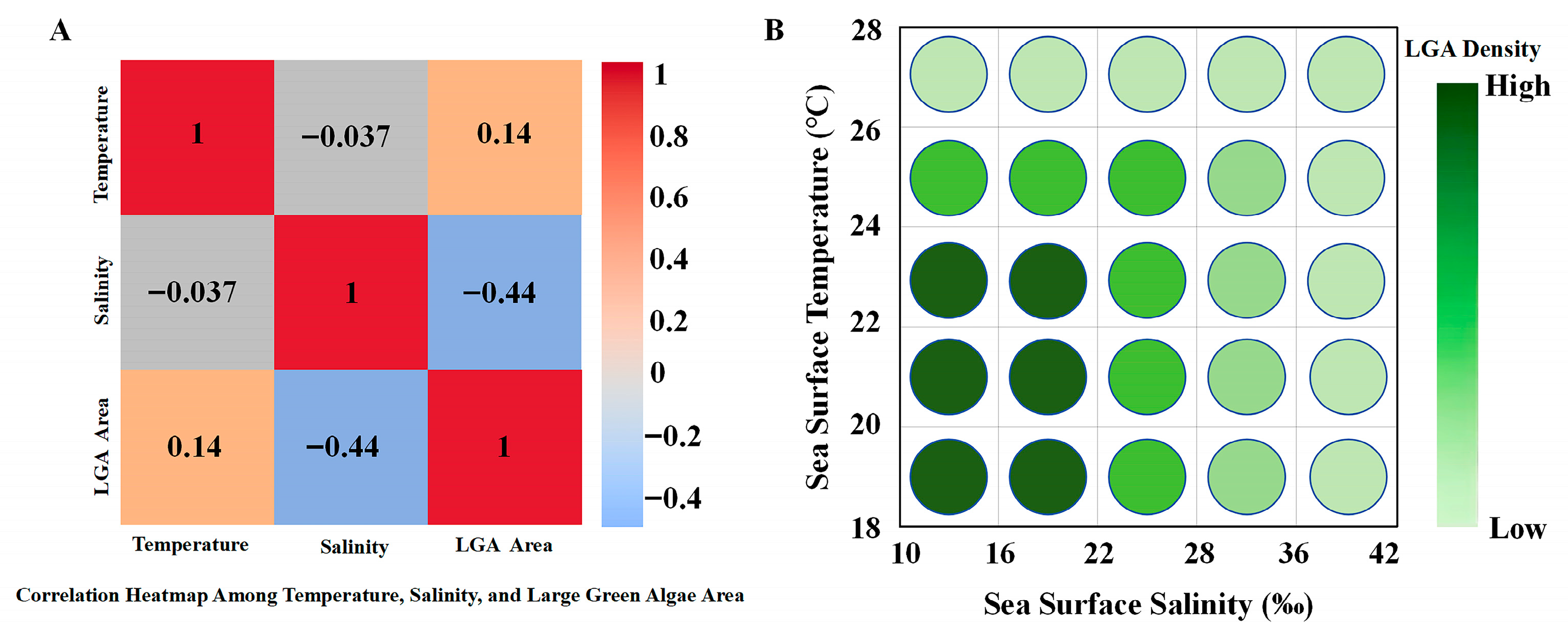
Pearson correlation analysis was used to analysis the relationship between temperature, salinity and LGA area (Figure 9). The results indicated that the LGA area exhibited a moderate negative correlation with salinity (r = −0.44), suggesting that lower salinity conditions are generally more favorable for LGA proliferation. In contrast, only a weak positive correlation was found between the LGA area and temperature (r = 0.14), implying that temperature alone plays a limited role in controlling LGA growth. The correlation between temperature and salinity was negligible (r = −0.0037), indicating that these two environmental variables varied largely independently during the study period.
The relationship between LGA density and temperature–salinity conditions further illustrate the combined effects of these two environmental factors on LGA distribution (Figure 9B). Higher LGA densities are mainly observed under salinity conditions of 10–22‰ and sea surface temperature ranges of 18–24 °C [60]. When temperature exceeds 26 °C or salinity increases to approximately 36‰, LGA density declines markedly. Overall, LGA density shows a pronounced decreasing trend with increasing salinity across all temperature levels, whereas increasing temperature under high-salinity conditions does not result in a corresponding enhancement of LGA density [61]. This pattern indicates that salinity plays a stronger regulatory control on LGA distribution than temperature, and that favorable thermal conditions alone are not enough to support large-scale LGA development in high-salinity environments [62].
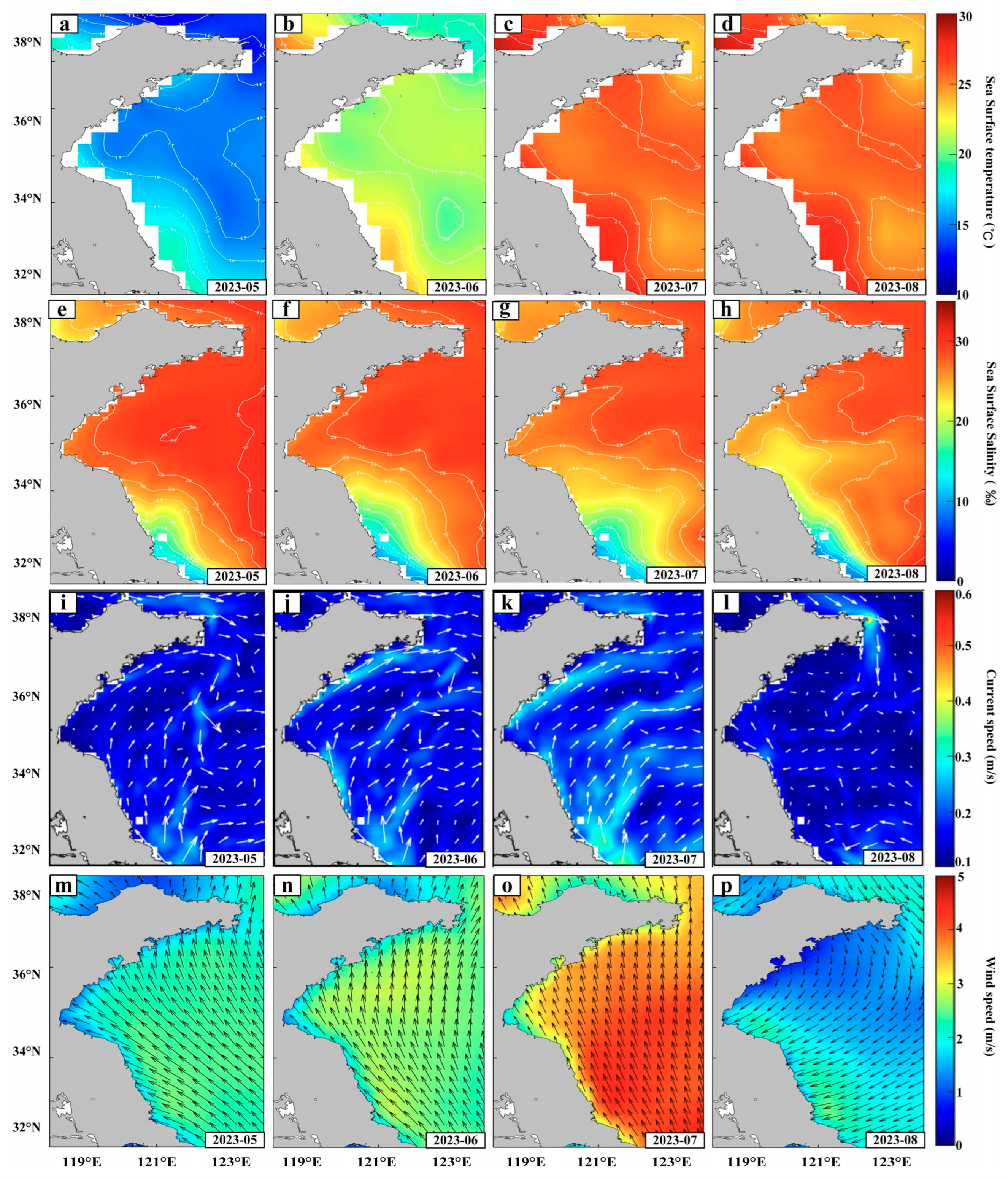
The seasonal evolution of temperature and salinity from May to August corresponds well with the observed initiation, expansion, and subsequent weakening of LGA blooms in the Yellow Sea [63]. Early summer conditions characterized by moderate temperature and low salinity favor LGA development, whereas excessively high temperatures in mid-to-late summer may suppress further growth. In May 2023, the monthly average temperature in the coastal waters of the southern Yellow Sea near the Subei Shoal reached 18 °C for the first time (Figure 10m), and the salinity was approximately 15‰ (Figure 10i), providing favorable conditions for the growth of LGA. As a result, this region has historically been the first area where LGA appears [64]. By June, the monthly average sea surface temperature of the Yellow Sea increased to 21 °C (Figure 10n), and salinity rose to 25‰, promoting large-scale growth of LGA. From July to August, as the sea surface temperature in some areas of the Yellow Sea exceeded 26 °C (Figure 10o,p), and salinity slightly decreased, the growth rate of LGA began to slow down.
Overall, from May to August 2023, the temperature in the Yellow Sea ranged from 18 °C to 30 °C (Figure 10i–l), and the salinity ranged from 10‰ to 30‰ (Figure 10i–l), providing favorable conditions for the growth of LGA. These favorable marine environmental conditions are one of the key drivers of green tide outbreaks in the Yellow Sea [65].
Light is also a crucial factor influencing the growth of LGA, with different species exhibiting varying light requirements [66]. For LGA in the Yellow Sea, the growth rate remains slow under low-light conditions (80 μmol m−2 s−1) [67]. However, under high-light conditions (400 μmol m−2 s−1), the growth rate of LGA significantly accelerates [68]. Nevertheless, excessive light intensity may lead to photoinhibition, thereby impairing its normal growth [69].
In addition to the aforementioned physical environmental factors, chemical factors, particularly nutrient availability, are also key determinants of LGA growth [70]. The Yellow Sea’s Warm Current and the Yangtze River’s diluted water play a crucial role in nutrient distribution in the Yellow Sea [71]. The Yellow Sea Warm Current not only transports warm, high-salinity seawater but also delivers a considerable amount of nutrients, primarily originating from the Taiwan Warm Current and the Kuroshio subsurface water [72]. These nutrients enter the Yellow Sea through different pathways, leading to elevated nutrient concentrations and fostering algal growth [73]. Nitrogen and phosphorus, in particular, are essential nutrients for LGA, and their concentrations and relative ratios have a significant impact on algal proliferation [74]. Human activities such as agricultural runoff, industrial wastewater discharge, and direct release of urban sewage further contribute to the enrichment of nitrogen, phosphorus, and other nutrients, exacerbating LGA overgrowth and leading to the formation of green tides [75]. Nutrient discharge from Porphyra (laver) farming is considered an important contributor to large-scale green tide events in the Yellow Sea, as it releases nutrient-rich wastewater that supports LGA proliferation [76]. To mitigate the overgrowth of LGA, strategies such as reducing nutrient emissions, implementing rational coastal development planning, and enhancing water quality management should be adopted.
Furthermore, pH fluctuations influence LGA growth by altering the availability of dissolved inorganic carbon, which is essential for photosynthesis [77]. Most green algae thrive within a pH range of 6.5 to 8.5, but when pH falls below 7 or exceeds 9, growth is significantly inhibited [78]. In spring and summer, the average pH of the Yellow Sea remains relatively high, at 8.14 ± 0.05 and 8.14 ± 0.04, respectively. This favorable pH environment contributes to the rapid proliferation of LGA from May to August [79].
Biotic interactions also exert a notable influence on the growth of LGA. These interactions include relationships between green algae and microorganisms, as well as competitive dynamics with other plant or algal species [80]. Microorganisms not only supply essential nutrients such as vitamins but may also regulate green algae growth via biochemical signaling molecules [81]. LGA competes with other algal or plant species for critical resources like nitrogen and phosphorus, affecting their growth rates and photosynthetic efficiency. These biological interactions—including microbial support and competition—significantly shape the growth and spatial distribution of LGA [82].

4.2.2. Factors Affecting the Drift of LGA in Coastal Waters of China

The drift of LGA (such as Ulva prolifera) in China’s coastal waters is primarily influenced by environmental factors, particularly ocean currents and wind fields [83].
Ocean currents play a dominant role in shaping the drift trajectory of LGA [84]. Research has shown that the movement of green tide patches is largely controlled by ocean circulation, with variations in current direction and intensity leading to significant spatial differences [85]. During summer, the Yellow Sea Warm Current, driven by the southeast monsoon, forms a distinct circulation pattern [86]. North of 34°40′ N, the predominant current flows eastward or southeastward (Figure 10a–c), generally causing green tide patches to drift in the same direction. South of 34°40′N, the current primarily flows northward, leading to the northward transport of green tide patches. This movement pattern highlights the crucial role of ocean circulation in governing the transport and spatial distribution of green tides. Additionally, other hydrodynamic forces, such as the Yangtze River diluted plume, the Taiwan Warm Current, and the Subei Coastal Current, further facilitate the rapid expansion of green tide patches [87].
Wind fields are another key factor influencing the drift of LGA. Strong winds can propel green algae in specific directions, promoting the large-scale formation of green tides [88]. Fluctuations in wind speed mainly influence the drifting behavior of green tides, while also indirectly affecting their growth conditions by altering water column mixing and nutrient availability [89]. Wind speed variations not only affect the displacement of green tides but also regulate their aggregation and dispersion [88].
The drift direction and speed of LGA are ultimately determined by the combined effects of wind and ocean currents [89]. Green tides in the Yellow Sea predominantly occur in summer, strongly influenced by the southeast monsoon (Figure 10e–g), which drives the Yellow Sea Warm Current. When the wind direction aligns with ocean currents, green tide drift is generally accelerated. However, in some coastal regions, complex hydrodynamic interactions may lead to deviations from this trend, depending on factors such as local topography and current structure.

5. Conclusions

This study developed a novel large green algae (LGA) retrieval model based on the spectrally responsive Blue, Green, Red, and near-infrared bands of HY-1C/D CZI data, providing an effective approach for monitoring LGA distribution in optically complex coastal waters (Figure 11). By integrating multi-band spectral information, the proposed model demonstrates robust inversion performance and improves the capability of HY-1C/D data for macroalgae detection in nearshore environments.
The LGA in the Yellow Sea and Bohai Sea has obvious spatial and temporal distribution characteristics. The results reveal distinct regional aggregation patterns, with LGA primarily concentrated in the coastal waters of the Shandong Peninsula and Subei Shoal in the Yellow Sea, and along the coastal zones of Yantai, Qinhuangdao, and Yingkou in the Bohai Sea. The model effectively captures the seasonal evolution of LGA from May to August, including bloom initiation, peak development, and subsequent dissipation, demonstrating its reliability for long-term monitoring applications.
The spatiotemporal distribution of large green algae (LGA) in the coastal waters of the Yellow Sea and Bohai Sea is primarily influenced by multiple factors, including temperature, salinity, ocean currents, and wind fields. Abundant nutrient availability, combined with favorable temperature and salinity conditions, promotes LGA growth. Meanwhile, ocean currents and wind fields largely result in the drift pathways of floating LGA. From May to August, driven by northward currents and southeasterly winds, LGA tends to migrate from the Subei Shoal toward the Shandong Peninsula.
Overall, the LGA-M exhibits good applicability for nearshore waters with optical properties similar to those of the Yellow Sea and Bohai Sea, highlighting the application potential of HY-1C/D satellite data in marine ecological monitoring and environmental management. The model provides technical support for investigating the spatiotemporal dynamics of large green algae and offers a valuable tool for coastal ecological assessment and early warning of green tide events.

Author Contributions

Conceptualization, T.M. and L.C.; methodology, T.M. and L.C.; software, Y.X.; validation, T.M. and L.C.; formal analysis, T.M.; investigation, T.M., L.C. and B.Z.; resources, L.C.; data curation, Y.X. and B.Z.; writing—original draft preparation, T.M.; writing—review and editing, L.C., Y.X., B.Z. and X.L.; visualization, Y.X.; supervision, L.C.; project administration, L.C.; funding acquisition, L.C. All authors have read and agreed to the published version of the manuscript.

Funding

This work is supported by the following research projects: Open Foundation of the Observation and Rescarch station of East China Coastal Zone, MNR (ORSECCZ2025202); Research Program of National Satellite Ocean Application Service (21108005220); the Basic Public Welfare Research Program of Zhejiang Province under contract (LGF21D010004); the National Key Research and Development Program of China (2023YFD2401905).

Data Availability Statement

Publicly available datasets were analyzed in this study.

Acknowledgments

We are grateful for the HY-1C/D CZI data provided by the China Resource Satellite Data and Application Center.

Conflicts of Interest

The authors declare no conflicts of interest.

Abbreviations

The following abbreviations are used in this manuscript:
CZICoastal Zone Imager
EVIEnhanced Vegetation Index
FAIFloating Algae Index
GF-WFVGaofen Wide Field View Camera
IGAGIndex of floating Green Algae for GOCI
LGALarge Green Algae
LGA-MLarge Green Algae Inversion Model
MODISModerate-resolution Imaging Spectroradiometer
NDVINormalized Difference Vegetation Index

References

  1. Xiao, J.; Wang, Z.; Liu, D.; Fu, M.; Yuan, C.; Yan, T. Harmful macroalgal blooms (HMBs) in China’s coastal water: Green and golden tides. Harmful Algae 2021, 107, 102061. [Google Scholar] [CrossRef] [PubMed]
  2. Pereira, L. Macroalgae. Encyclopedia 2021, 1, 177–188. [Google Scholar] [CrossRef]
  3. Wang, Z.; Fan, B.; Yu, D.; Fan, Y.; An, D.; Pan, S. Monitoring the Spatio-Temporal Distribution of Ulva prolifera in the Yellow Sea (2020–2022) Based on Satellite Remote Sensing. Remote Sens. 2023, 15, 157. [Google Scholar] [CrossRef]
  4. Teichberg, M.; Fox, S.E.; Olsen, Y.S.; Valiela, I.; Martinetto, P.; Iribarne, O.; Muto, E.Y.; Petti, M.A.V.; Corbisier, T.N.; Soto-JimÉNez, M.; et al. Eutrophication and macroalgal blooms in temperate and tropical coastal waters: Nutrient enrichment experiments with Ulva spp. Glob. Change Biol. 2010, 16, 2624–2637. [Google Scholar] [CrossRef]
  5. Song, M.; Kong, F.; Li, Y.; Zhao, J.; Yu, R.; Zhou, M.; Jiang, P.; Yan, T. A Massive Green Tide in the Yellow Sea in 2021: Field Investigation and Analysis. Int. J. Environ. Res. Public Health 2022, 19, 11753. [Google Scholar] [CrossRef]
  6. Pang, S.J.; Liu, F.; Shan, T.F.; Xu, N.; Zhang, Z.H.; Gao, S.Q.; Chopin, T.; Sun, S. Tracking the algal origin of the Ulva bloom in the Yellow Sea by a combination of molecular, morphological and physiological analyses. Mar. Environ. Res. 2010, 69, 207–215. [Google Scholar] [CrossRef]
  7. Diaz, M.; Darnhofer, I.; Darrot, C.; Beuret, J.-E. Green tides in Brittany: What can we learn about niche–regime interactions? Environ. Innov. Soc. Transit. 2013, 8, 62–75. [Google Scholar] [CrossRef]
  8. Charlier, R.H.; Morand, P.; Finkl, C.W.; Thys, A. Green tides on the Brittany coasts. In Proceedings of the 2006 IEEE US/EU Baltic International Symposium, Klaipeda, Lithuania, 23–26 May 2006. [Google Scholar] [CrossRef]
  9. Xu, F.; Gao, Z.; Ning, J.; Zheng, X.; Liu, C.; Gao, W. Error analysis on Green Tide monitoring using MODIS data in the Yellow Sea based on GF-1 WFV data. In Proceedings of the SPIE Optical Engineering + Applications, San Diego, CA, USA, 19 September 2016. [Google Scholar] [CrossRef]
  10. Gao, S.; Chen, X.; Yi, Q.; Wang, G.; Pan, G.; Lin, A.; Peng, G. A Strategy for the Proliferation of Ulva prolifera, Main Causative Species of Green Tides, with Formation of Sporangia by Fragmentation. PLoS ONE 2010, 5, e8571. [Google Scholar] [CrossRef]
  11. Li, D.; Gao, Z.; Song, D. Analysis of environmental factors affecting the large-scale long-term sequence of green tide outbreaks in the Yellow Sea. Estuar. Coast. Shelf Sci. 2021, 260, 107504. [Google Scholar] [CrossRef]
  12. Xie, J.; Feng, X.; Gao, G. Variation of suspended-sediment caused by tidal asymmetry and wave effects. Ocean Model. 2024, 192, 102454. [Google Scholar] [CrossRef]
  13. Lin, L.; Wang, Y.; Liu, D. Vertical average irradiance shapes the spatial pattern of winter chlorophyll-a in the Yellow Sea. Estuar. Coast. Shelf Sci. 2019, 224, 11–19. [Google Scholar] [CrossRef]
  14. An, D.; Yu, D.; Zheng, X.; Zhou, Y.; Meng, L.; Xing, Q. Monitoring the Dissipation of the Floating Green Macroalgae Blooms in the Yellow Sea (2007–2020) on the Basis of Satellite Remote Sensing. Remote Sens. 2021, 13, 3811. [Google Scholar] [CrossRef]
  15. Zhang, H.; Yuan, Y.; Xu, Y.; Shen, X.; Sun, D.; Qiu, Z.; Wang, S.; He, Y. Remote sensing method for detecting green tide using HJ-CCD top-of-atmosphere reflectance. Int. J. Appl. Earth Obs. Geoinf. 2021, 102, 102371. [Google Scholar] [CrossRef]
  16. Sun, X.; Wu, M.; Xing, Q.; Song, X.; Zhao, D.; Han, Q.; Zhang, G. Spatio-temporal patterns of Ulva prolifera blooms and the corresponding influence on chlorophyll-a concentration in the Southern Yellow Sea, China. Sci. Total Environ. 2018, 640–641, 807–820. [Google Scholar] [CrossRef]
  17. Xu, S.; Yu, T.; Xu, J.; Pan, X.; Shao, W.; Zuo, J.; Yu, Y. Monitoring and Forecasting Green Tide in the Yellow Sea Using Satellite Imagery. Remote Sens. 2023, 15, 2196. [Google Scholar] [CrossRef]
  18. Cui, T.W.; Liang, X.J.; Gong, J.L.; Tong, C.; Xiao, Y.F.; Liu, R.J.; Zhang, X.; Zhang, J. Assessing and refining the satellite-derived massive green macro-algal coverage in the Yellow Sea with high resolution images. ISPRS J. Photogramm. Remote Sens. 2018, 144, 315–324. [Google Scholar] [CrossRef]
  19. Cui, T.W.; Zhang, J.; Sun, L.E.; Jia, Y.J.; Zhao, W.; Wang, Z.L.; Meng, J.M. Satellite monitoring of massive green macroalgae bloom (GMB): Imaging ability comparison of multi-source data and drifting velocity estimation. Int. J. Remote Sens. 2012, 33, 5513–5527. [Google Scholar] [CrossRef]
  20. Wang, L.; Yang, R.; Tian, Q.; Yang, Y.; Zhou, Y.; Sun, Y.; Mi, X. Comparative Analysis of GF-1 WFV, ZY-3 MUX, and HJ-1 CCD Sensor Data for Grassland Monitoring Applications. Remote Sens. 2015, 7, 2089–2108. [Google Scholar] [CrossRef]
  21. Gitelson, A.A.; Dall’Olmo, G.; Moses, W.; Rundquist, D.C.; Barrow, T.; Fisher, T.R.; Gurlin, D.; Holz, J. A simple semi-analytical model for remote estimation of chlorophyll-a in turbid waters: Validation. Remote Sens. Environ. 2008, 112, 3582–3593. [Google Scholar] [CrossRef]
  22. Cao, J.; Wang, F.; Zhou, Y.; Ye, Z. In-orbit geometric calibration of HaiYang-1C coastal zone imager with multiple fields. Opt. Express 2021, 29, 18950–18965. [Google Scholar] [CrossRef]
  23. Ji, H.; Tian, L.; Li, J.; Tong, R.; Guo, Y.; Zeng, Q. Spatial–Spectral Fusion of HY-1C COCTS/CZI Data for Coastal Water Remote Sensing Using Deep Belief Network. IEEE J. Sel. Top. Appl. Earth Obs. Remote Sens. 2020, 14, 1693–1704. [Google Scholar] [CrossRef]
  24. Jilin, M.; Jianqiang, L.; Guangping, X.; Tong, Y.; Ruqing, T.; Liqiao, T.; Kohei, A.; Linyu, W. Atmospheric correction for HY-1C CZI images using neural network in western Pacific region. Geo Spat. Inf. Sci. 2022, 25, 476–488. [Google Scholar] [CrossRef]
  25. Luo, W.; Li, R.; Shen, F.; Liu, J. HY-1C/D CZI Image Atmospheric Correction and Quantifying Suspended Particulate Matter. Remote Sens. 2023, 15, 386. [Google Scholar] [CrossRef]
  26. Zhang, S.; Yu, F. The characteristic analysis on sea surface temperature inter-annual variation in the Bohai Sea, Yellow Sea and East China Sea. Mar. Sci. 2009, 33, 8. Available online: https://www.researchgate.net/publication/285329735_The_characteristic_analysis_on_sea_surface_temperature_inter-annual_variation_in_the_Bohai_Sea_Yellow_Sea_and_East_China_Sea (accessed on 25 May 2024).
  27. Qingjun, F.; Xiao, Y.; Qingchao, H.; Lei, L.; Yujie, Z. Variability of the Primary Productivity in the Yellow and Bohai Seas from 2003 to 2020 Based on the Estimate of Satellite Remote Sensing. J. Mar. Sci. Eng. 2023, 11, 684. [Google Scholar] [CrossRef]
  28. Zhuomin, L.; Lei, G.; Rui, C. Sea surface skin temperature retrieval from HY-1D COCTS observations. Front. Mar. Sci. 2023, 10, 1205776. [Google Scholar] [CrossRef]
  29. National Satellite Ocean Application Service. Available online: http://www.nsoas.org.cn/ (accessed on 17 October 2023).
  30. China Resources Satellite Application Center. Available online: https://www.cresda.cn/zgzywxyyzx/index_pc.html (accessed on 10 October 2023).
  31. Zhao, M.; Si, F.; Zhou, H.; Jiang, Y.; Ji, C.; Wang, S.; Zhan, K.; Liu, W. Pre-Launch Radiometric Characterization of EMI-2 on the GaoFen-5 Series of Satellites. Remote Sens. 2021, 13, 2843. [Google Scholar] [CrossRef]
  32. NASA’s DAAC Data Center. Available online: https://ladsweb.modaps.eosdis.nasa.gov/ (accessed on 20 October 2023).
  33. Tesema Kebede, S.; Tekalegn Ayele, W.; Taye, A.; Tenalem, A. Spatio-Temporal Change of Land Use/Land Cover and Vegetation Using Multi-MODIS Satellite Data, Western Ethiopia. Sci. World J. 2023, 2023, 7454137. [Google Scholar] [CrossRef]
  34. Douay, F.; Verpoorter, C.; Duong, G.; Spilmont, N.; Gevaert, F. New Hyperspectral Procedure to Discriminate Intertidal Macroalgae. Remote Sens. 2022, 14, 346. [Google Scholar] [CrossRef]
  35. Kutser, T.; Metsamaa, L.; Strömbeck, N.; Vahtmäe, E. Monitoring cyanobacterial blooms by satellite remote sensing. Estuar. Coast. Shelf Sci. 2006, 67, 303–312. [Google Scholar] [CrossRef]
  36. Dierssen, H.M.; Chlus, A.; Russell, B. Hyperspectral discrimination of floating mats of seagrass wrack and the macroalgae Sargassum in coastal waters of Greater Florida Bay using airborne remote sensing. Remote Sens. Environ. 2015, 167, 247–258. [Google Scholar] [CrossRef]
  37. Wells, M.L.; Trainer, V.L.; Smayda, T.J.; Karlson, B.S.O.; Trick, C.G.; Kudela, R.M.; Ishikawa, A.; Bernard, S.; Wulff, A.; Anderson, D.M.; et al. Harmful algal blooms and climate change: Learning from the past and present to forecast the future. Harmful Algae 2015, 49, 68–93. [Google Scholar] [CrossRef]
  38. Mueller, J.L.; Server, N.T.R. Ocean Optics Protocols for Satellite Ocean Color Sensor Validation. Br. J. Surg. 2003. [Google Scholar] [CrossRef]
  39. Joaquín, M.-S.; Emanuel, D.; Anna, A.-P.; Clément, A.; Gabriele, A.; Gianpaolo, B.; Souhail, B.; Margarita, C.; Shaun, H.; Hans, H.; et al. ERA5-Land: A state-of-the-art global reanalysis dataset for land applications. Earth Syst. Sci. Data 2021, 13, 4349–4383. [Google Scholar] [CrossRef]
  40. Copernicus Climate Data Store. Available online: https://doi.org/10.24381/cds.f17050d7 (accessed on 15 October 2023).
  41. Global Ocean Physics Analysis and Forecast dataset. Available online: https://doi.org/10.48670/moi-00016 (accessed on 28 November 2023).
  42. General Bathymetric Chart of the Oceans. Available online: https://www.gebco.net (accessed on 10 November 2023).
  43. Hu, C.; Feng, L.; Hardy, R.F.; Hochberg, E.J. Spectral and spatial requirements of remote measurements of pelagic Sargassum macroalgae. Remote Sens. Environ. 2015, 167, 229–246. [Google Scholar] [CrossRef]
  44. Hu, C. A novel ocean color index to detect floating algae in the global oceans. Remote Sens. Environ. 2009, 113, 2118–2129. [Google Scholar] [CrossRef]
  45. Yi, L.; Zhang, G. Object-oriented remote sensing imagery classification accuracy assessment based on confusion matrix. In Proceedings of the 2012 20th International Conference on Geoinformatics, Hong Kong, China, 15–17 June 2012; pp. 1–8. [Google Scholar] [CrossRef]
  46. Ding, Y.; Cao, C.H.; Cheng, L.X.; Wang, N.; Wen, L.J. Monitoring of Enteromorpha prolifera in the yellow sea with MODIS image based on linear mixing model and NDVI threshold. Chin. J. Ecol. 2018, 37, 3480–3486. [Google Scholar] [CrossRef]
  47. Liu, S.; Glamore, W.; Tamburic, B.; Morrow, A.; Johnson, F. Remote sensing to detect harmful algal blooms in inland waterbodies. Sci. Total Environ. 2022, 851, 158096. [Google Scholar] [CrossRef] [PubMed]
  48. Cabezudo, M.M.; Tavares, M.H.; They, N.H.; da Motta Marques, D. Assessment of spectral indices and water color combinations for detecting algal blooms in coastal subtropical shallow lakes. Remote Sens. Appl. Soc. Environ. 2025, 39, 101678. [Google Scholar] [CrossRef]
  49. Xia, Z.; Cao, X.; Li, S.; Cao, J.; Tong, Y.; Sun, Y.; Liu, J.; Zhao, S.; Cui, Q.; Zeng, Y.; et al. Distribution of Ulva prolifera, the dominant species in green tides along the Jiangsu Province coast in the Southern Yellow Sea, China. J. Sea Res. 2023, 196, 102436. [Google Scholar] [CrossRef]
  50. Cao, J.; Liu, J.; Zhao, S.; Tong, Y.; Li, S.; Xia, Z.; Hu, M.; Sun, Y.; Zhang, J.; He, P. Advances in the research on micropropagules and their role in green tide outbreaks in the Southern Yellow Sea. Mar. Pollut. Bull. 2023, 188, 114710. [Google Scholar] [CrossRef]
  51. Liu, Y.S.; Wang, D.; Xu, X.-T.; Xu, N.-J.; Li, Y.-H. Combined Effects of Salinity and Temperature on the Growth and Photophysiological Performances Inulva prolifera. Shuisheng Shengwu Xuebao 2016, 40, 7. [Google Scholar]
  52. Cui, T.; Ding, J.; Jia, F.; Mu, B.; Liu, R.; Xu, P.; Liu, J.; Zhang, J. Out-of-Band Response for the Coastal Zone Imager (CZI) Onboard China’s Ocean Color Satellite HY-1C: Effect on the Observation Just above the Sea Surface. Sensors 2018, 18, 3067. [Google Scholar] [CrossRef]
  53. Yu, Z.; Zhang, J.; Chen, Z.; Hu, Y.; Shum, C.K.; Ma, C.; Song, Q.; Yuan, X.; Wang, B.; Zhou, B. Spatiotemporal Evolutions of the Suspended Particulate Matter in the Yellow River Estuary, Bohai Sea and Characterized by Gaofen Imagery. Remote Sens. 2023, 15, 4769. [Google Scholar] [CrossRef]
  54. Knaeps, E.; Ruddick, K.G.; Doxaran, D.; Dogliotti, A.I.; Nechad, B.; Raymaekers, D.; Sterckx, S. A SWIR based algorithm to retrieve total suspended matter in extremely turbid waters. Remote Sens. Environ. 2015, 168, 66–79. [Google Scholar] [CrossRef]
  55. Wang, W.; Wang, G.; Li, J.; Chen, J.; Gao, Z.; Fang, L.; Ren, S.; Wang, Q. Remote sensing identification and model-based prediction of harmful algal blooms in inland waters: Current insights and future perspectives. Water Res. X 2025, 28, 100369. [Google Scholar] [CrossRef]
  56. Kwon-Ho, L.; So-Hyun, L. Monitoring of Floating Green Algae Using Ocean Color Satellite Remote Sensing. J. Korean Assoc. Geogr. Inf. Stud. 2012, 15, 137–147. [Google Scholar] [CrossRef]
  57. Ruihua, D.; Pinfei, W.; Peili, J.; Yi, Z.; Xincheng, C.; Yifei, W. A review on factors affecting microcystins production by algae in aquatic environments. World J. Microbiol. Biotechnol. 2016, 15, 137–147. [Google Scholar] [CrossRef]
  58. Wang, Z.; Fang, Z.; Liang, J.; Song, X. Estimating Ulva prolifera green tides of the Yellow Sea through ConvLSTM data fusion. Environ. Pollut. 2023, 324, 121350. [Google Scholar] [CrossRef] [PubMed]
  59. Li, Y.; Zheng, M.; Lin, J.; Zhou, S.; Sun, T.; Xu, N. Darkness and low nighttime temperature modulate the growth and photosynthetic performance of Ulva prolifera under lower salinity. Mar. Pollut. Bull. 2019, 146, 85–91. [Google Scholar] [CrossRef]
  60. Bao, M.; Xing, Q.; Park, J.-S.; He, P.; Zhang, J.; Yarish, C.; Kim, J.K. Temperature and high nutrients enhance hypo-salinity tolerance of the bloom forming green alga, Ulva prolifera. Harmful Algae 2023, 123, 102402. [Google Scholar] [CrossRef]
  61. Zhan, Y.; Qiu, Z.; Wang, Y.; Su, Y.; Li, Y.; Cui, Y.; Qu, S.; Wang, P.; Rong, X. Long-Term Spatiotemporal Characteristics of Ulva prolifera Green Tide and Effects of Environmental Drivers on Its Monitoring by Satellites: A Case Study in the Yellow Sea, China, from 2008 to 2023. J. Mar. Sci. Eng. 2024, 12, 630. [Google Scholar] [CrossRef]
  62. Wang, Z.; Xiao, J.; Yuan, C.; Miao, X.; Fan, S.; Fu, M.; Xia, T.; Zhang, X. The drifting and spreading mechanism of floating Ulva mass in the waterways of Subei shoal, the Yellow Sea of China—Application for abating the world’s largest green tides. Mar. Pollut. Bull. 2023, 190, 114789. [Google Scholar] [CrossRef] [PubMed]
  63. Yanzhuo, M.; Yingying, L.; Yufei, M.; Ka Po, W.; Jin Yeu, T.; Yuanzhi, Z. Remote Sensing Monitoring of Green Tide Disaster Using MODIS and GF-1 Data: A Case Study in the Yellow Sea. J. Mar. Sci. Eng. 2023, 11, 2212. [Google Scholar] [CrossRef]
  64. Bercel, T.L.; Kranz, S.A. Effects of spectral light quality on the growth, productivity, and elemental ratios in differently pigmented marine phytoplankton species. J. Appl. Phycol. 2021, 34, 185–202. [Google Scholar] [CrossRef]
  65. Jianjun, C.; Jianheng, Z.; Yuanzi, H.; Lingjie, Z.; Qing, W.; Liping, C.; Kefeng, Y.; Peimin, H. Adaptability of free-floating green tide algae in the Yellow Sea to variable temperature and light intensity. Mar. Pollut. Bull. 2015. [Google Scholar] [CrossRef]
  66. Junfei, G.; Zhenxiang, Z.; Zhikang, L.; Ying, C.; Zhiqin, W.; Hao, Z.; Jianchang, Y. Photosynthetic Properties and Potentials for Improvement of Photosynthesis in Pale Green Leaf Rice under High Light Conditions. Front. Plant Sci. 2017, 8, 1082. [Google Scholar] [CrossRef] [PubMed]
  67. Giacometti, G.M.; Morosinotto, T. Photosynthesis|Photoinhibition and Photoprotection in Plants, Algae and Cyanobacteria. In Encyclopedia of Biological Chemistry, 3rd ed.; Elsevier: Amsterdam, The Netherlands, 2013; pp. 384–390. [Google Scholar] [CrossRef]
  68. Ankita, J.; Ruben, C.; Ganti, M. Effects of Environmental Factors and Nutrient Availability on the Biochemical Composition of Algae for Biofuels Production: A Review. Energies 2013, 6, 4607–4638. [Google Scholar] [CrossRef]
  69. Junjie, W.; Zhigang, Y.; Qinsheng, W.; Fuxia, Y.; Mingfan, D.; Dandan, L.; Zhimei, G.; Qingzhen, Y. Intra- and inter-seasonal variations in the hydrological characteristics and nutrient conditions in the southwestern Yellow Sea during spring to summer. Mar. Pollut. Bull. 2020, 156, 111139. [Google Scholar] [CrossRef] [PubMed]
  70. Ergang, L.; Shouye, Y.; Hui, W.; Chengfan, Y.; Chao, L.; James, T.L. Kuroshio subsurface water feeds the wintertime Taiwan Warm Current on the inner East China Sea shelf. J. Geophys. Res. Ocean. 2016, 121, 4790–4803. [Google Scholar] [CrossRef]
  71. Hong-Mei, L.; Chuan-Song, Z.; Xiu-Rong, H.; Xiao-Yong, S. Changes in concentrations of oxygen, dissolved nitrogen, phosphate, and silicate in the southern Yellow Sea, 1980–2012: Sources and seaward gradients. Estuar. Coast. Shelf Sci. 2015, 163, 44–55. [Google Scholar] [CrossRef]
  72. Pankaj Kumar, T.; Sudip, S.; Jocirei, D.F.; Arvind Kumar, M. A Mathematical Model for the Effects of Nitrogen and Phosphorus on Algal Blooms. Int. J. Bifurc. Chaos 2019, 29, 1950129. [Google Scholar] [CrossRef]
  73. Ma, J.; Qin, B.; Paerl, H.W.; Brookes, J.D.; Wu, P.; Zhou, J.; Deng, J.; Guo, J.; Li, Z. Green algal over cyanobacterial dominance promoted with nitrogen and phosphorus additions in a mesocosm study at Lake Taihu, China. Environ. Sci. Pollut. Res. 2015, 22, 5041–5049. [Google Scholar] [CrossRef]
  74. Feng, L.; Shaojun, P.; Thierry, C.; Suqin, G.; Tifeng, S.; Xiaobo, Z.; Jing, L. Understanding the recurrent large-scale green tide in the Yellow Sea: Temporal and spatial correlations between multiple geographical, aquacultural and biological factors. Mar. Environ. Res. 2013, 83, 38–47. [Google Scholar] [CrossRef]
  75. Menéndez, M.; Martínez, M.; Comín, F.A. A comparative study of the effect of pH and inorganic carbon resources on the photosynthesis of three floating macroalgae species of a Mediterranean coastal lagoon. J. Exp. Mar. Biol. Ecol. 2001, 256, 123–136. [Google Scholar] [CrossRef]
  76. Blinks, L.R. The effect of pH upon the photosynthesis of littoral marine algae. Protoplasma 1963, 57, 126–136. [Google Scholar] [CrossRef]
  77. Zhangyi, X.; Jinlin, L.; Shuang, Z.; Qianwen, C.; Fangling, B.; Jianheng, Z.; Peimin, H. Attached Ulva meridionalis on nearshore dikes may pose a new ecological risk in the Yellow Sea. Environ. Pollut. 2023, 332, 121969. [Google Scholar] [CrossRef]
  78. Jin, Z.; Mindy, L.R.; Taylor, R.S.; David, M.K.; Donald, M.A.; Zhonghua, C. Microbial Community Structure and Associations During a Marine Dinoflagellate Bloom. Front. Microbiol. 2018, 9, 1201. [Google Scholar] [CrossRef] [PubMed]
  79. Thomas, W. Exploring bacteria-induced growth and morphogenesis in the green macroalga order Ulvales (Chlorophyta). Front. Plant Sci. 2015, 6, 86. [Google Scholar] [CrossRef]
  80. Gragnani, A. Water Control Policies in Lakes with Vertical Heterogeneity: An Algal Competition Modelling Approach. In Proceedings of the 2024 European Control Conference (ECC), Stockholm, Sweden, 25–28 June 2024; pp. 850–855. [Google Scholar] [CrossRef]
  81. Guang, G.; Zhihai, Z.; Xianghong, Z.; Juntian, X. Changes in morphological plasticity of Ulva prolifera under different environmental conditions: A laboratory experiment. Harmful Algae 2016, 59, 51–58. [Google Scholar] [CrossRef]
  82. Po, H.; Yahao, L.; Yijun, H.; Yuqi, Y. An early forecasting method for the drift path of green tides: A case study in the Yellow Sea, China. Int. J. Appl. Earth Obs. Geoinf. 2018, 71, 121–131. [Google Scholar] [CrossRef]
  83. Menghao, J.; Xin, D.; Chengyi, Z.; Jianting, Z. Exploring the Green Tide Transport Mechanisms and Evaluating Leeway Coefficient Estimation via Moderate-Resolution Geostationary Images. Remote Sens. 2024, 16, 2934. [Google Scholar] [CrossRef]
  84. Jae-Hong, M.; Naoki, H.; Jong-Hwan, Y. Comparison of wind and tidal contributions to seasonal circulation of the Yellow Sea. J. Geophys. Res. 2009, 114. [Google Scholar] [CrossRef]
  85. Bao, M.; Guan, W.; Wang, Z.; Wang, D.; Cao, Z.; Chen, Q. Features of the physical environment associated with green tide in the southwestern Yellow Sea during spring. Acta Oceanol. Sin. 2015, 34, 97–104. [Google Scholar] [CrossRef]
  86. Liang, S.-J.; Kuo, N.-J.; Doong, D.-J.; Hsu, T.-W. Numerical study of wind effect on green island wake. In Proceedings of the OCEANS 2014 TAIPEI, Taipei, Taiwan, 7–10 April 2014. [Google Scholar] [CrossRef]
  87. Dongxue, L.; Zhiqiang, G.; Debin, S.; Weitao, S.; Xiaopeng, J. Characteristics and influence of green tide drift and dissipation in Shandong Rongcheng coastal water based on remote sensing. Estuar. Coast. Shelf Sci. 2019, 227, 106335. [Google Scholar] [CrossRef]
  88. Zhou, F.; Ge, J.; Liu, D.; Ding, P.; Chen, C.; Wei, X. The Lagrangian-based Floating Macroalgal Growth and Drift Model (FMGDM v1. 0): Application to the Yellow Sea green tide. Geosci. Model Dev. 2021, 14, 6049–6070. [Google Scholar] [CrossRef]
  89. Dmitry, A.; Andrew, C.D.; Marie, P.; Keith, D. A high resolution hydrodynamic model system suitable for novel harmful algal bloom modelling in areas of complex coastline and topography. Harmful Algae 2016, 53, 102–117. [Google Scholar] [CrossRef]
Figure 1. (a) Map of the study area; (b) Bathymetric map of the Bohai Sea; (c) Bathymetric map of the Yellow Sea. B: Bohai sampling range; C: Yellow Sea sampling range.
Jmse 14 00140 g001
Figure 2. Measured spectral curves of macroalgae and seawater. “Large green algae in seawater” is the sample of large green algae collected from the Yellow Sea on 9 June 2024; “Ulva prolifera” is the sample of Ulva prolifera collected from the Yellow Sea on 9 June 2024; “Floated Sargassum” is the sample of Sargassum collected from Tahoua Island on 9 May 2024; “Tested Sargassum” is the sample of Sargassum collected from Taohua Island on 9 May 2024.
Jmse 14 00140 g002
Figure 3. Distribution of large green algae (LGA) in the Yellow Sea derived from different sensors and methods. (a1,a2) True-color images acquired on 30 July 2019 by HY-1C/D and GF satellites, respectively. (a3,a4) Corresponding LGA extraction results from HY-1C using the LGA-M model (green) and from GF using NDVI (red) [47]. (b1,b2) True-color images acquired on 6 June 2021 by HY-1C/D and MODIS satellites, respectively. (b3,b4) Corresponding LGA extraction results from HY-1C/D using LGA-M (green) and from MODIS using NDVI (black). The inset map shows the study area in the Yellow Sea, with boxes “a” and “b” indicating the sub-regions shown in panels (a1a4) and (b1b4).
Jmse 14 00140 g003
Figure 4. Comparison of LGA area derived from HY-1C/D CZI using the LGA-M model with LGA derived from GF and MODIS using NDVI.
Jmse 14 00140 g004
Figure 5. Workflow for constructing and validating the LGA-M inversion model using HY-1C/D CZI imagery. The process includes five main stages: (1) data acquisition and preprocessing, (2) LGA sample data creation, (3) spectral analysis and band selection, (4) LGA-M model development, and (5) model validation.
Jmse 14 00140 g005
Figure 6. Distribution of LGA in the coastal waters of the Yellow Sea and Bohai Sea during 2019–2024. (ad): Inversion results for May in 2019–2023; (el): Inversion results for June in 2019–2024; (mp) Inversion results for July–August in 2019–2024.
Jmse 14 00140 g006
Figure 7. Field photographs of LGA in the coastal waters of Yantai, China. The photographs were taken by the research team during a field survey in July 2024.
Jmse 14 00140 g007
Figure 8. Example of large green algae (LGA) detection from HY-1C imagery acquired on 28 May 2021. (a) True-color image showing algal patches in the East China Sea. (b) Extraction results of LGA distribution, with red boxes highlighting regions of good agreement between the true-color image and the inversion results.
Jmse 14 00140 g008
Figure 9. (A) Correlation heatmap showing the relationships among sea surface temperature, sea surface salinity, and large green algae (LGA) area. (B) Schematic distribution of LGA density under different combinations of sea surface temperature and salinity, where darker green circles indicate higher LGA density and lighter colors represent lower density.
Jmse 14 00140 g009
Figure 10. (ad): Monthly average temperature maps of the Yellow Sea and Bohai Sea from May to August 2023. (eh): Monthly average salinity maps of the Yellow Sea and Bohai Sea from May to August 2023. (il): Monthly average current maps of the Yellow Sea and the Bohai Sea from May to August 2023. (mp): Monthly average wind field maps of the Yellow Sea and Bohai Sea from May to August 2023. Arrows indicate the direction of ocean currents (il) and winds (mp), while the color shading and numerical values represent their respective magnitudes.
Jmse 14 00140 g010
Figure 11. Study on large green algae in the coastal waters of the Yellow Sea and Bohai Sea based on the coastal zone imager model.
Jmse 14 00140 g011
Table 1. Sensor characteristics of HY-1C/D CZI.
SensorBand No.Spectral Range/μm
HY-1C/D CZIBand1 (Blue)0.421–0.500
Band2 (Green)0.517–0.598
Band3 (Red)0.608–0.690
Band4 (NIR)0.761–0.891
Table 2. Models of band combination and the corresponding correlation coefficients (R2) and the root mean square error (RMSE).
Band CombinationFunctionFitting ModelR2RMSE (%)
(B2 + B3)/B4Linear y = 5.251 X + 1.9765 0.831210.99
(B2 + B3)/B4Power y = 2.062 X 3.667 0.078412.22
(B2 + B3)/B4Exponential y = 0.1565 e x p ( 2.0793 X ) 0.75488.22
(B1 + B4)/B3Linear y = 0.3887 X + 0.0195 0.70812.71
(B1 + B4)/B3Power y = 0.8158 X 0.7403 0.74582.45
(B4 − B3)/(B1 + B2)Linear y = 0.3792 X 0.1864 0.730411.23
(B4 − B3)/(B1 + B2)Power y = 0.7557 X 0.6501 0.84178.82
(B4 − B3)/(B1 + B2)Exponential y = 1.50 e x p ( ( ( X 0.3602 ) /0.1741)2)0.86448.03
(B4 − B2)/(B1 + B2)Linear y = 0.4177 X 0.0057 0.725710.56
(B4 − B2)/(B1 + B2)Power y = 1.158 X 1.147 0.85288.26
(B4 − B2)/(B1 + B2)Exponential y = 0.1272 e x p ( 2.6081 X ) 0.84777.94
B4/B1Linear y = 4.2 X   + 0.7 0.846210.99
B4/B2Power y = 3.087 X 1.005 0.084112.22
B4-B3Linear y = 3.28 X + 0.06 0.78548.22
(B4 − B3)/B2Linear y = 3.510 X 0.1308 0.70542.71
(B2 + B3)/B4Power y = 2.353 X + 1.803 0.76542.45
(B4B3)/(B1 + B2)Linear  y = 1.6291 X 0.0472 0.9315  1.23 
X: band combination; R2: the correlation coefficient; RMSE: the root mean square error. The bold italics represent the optimal model.
Table 3. Accuracy assessment of LGA inversion methods.
MethodPrecisionRecallF1-Score
LGA-M0.9610.9520.946
NDVI0.8420.8370.845
FAI0.8650.8430.837
EVI0.8840.8690.862
Table 4. Comparison of LGA Coverage and Area Discrepancy Ratios (ADR) among GF-1, MODIS, and HY-1C/D Satellites Using GF-1 as Reference.
DateSatelliteCoverage Area (km2)Area Difference Ratio (%)
20 July 2019GF-1580.38
MODIS936.7161.4
HY-1C/D610.065.1
21 June 2021GF-1821.04
MODIS1123.4336.8
HY-1C/D914.8711.4
10 July 2021GF-1759.88
MODIS1085.6242.9
HY-1C/D740.562.5
22 June 2023GF-1550.44
MODIS643.8417.0
HY-1C/D496.549.8
A D R = A model A GF- 1 / A GF- 1 × 100 % .
Disclaimer/Publisher’s Note: The statements, opinions and data contained in all publications are solely those of the individual author(s) and contributor(s) and not of MDPI and/or the editor(s). MDPI and/or the editor(s) disclaim responsibility for any injury to people or property resulting from any ideas, methods, instructions or products referred to in the content.