


Abstract
This study presents an analytical methodology for evaluating the influence of hull design parameters on the controllability and manoeuvrability of ships equipped with integrated electric propulsion systems. Unlike traditional approaches that examine the hull and propulsion plant independently, the proposed method employs a generalized model of transient modes within the propulsion complex, enabling the coupled interaction among the hull, propulsion units, electric motors, and the electrical power system to be captured during manoeuvring. Active experimental design and regression modelling are applied to construct controllability diagrams, identify the most influential dimensionless parameters, and reduce computational effort. The methodology is used to assess the effect of hull elongation (0.08–0.16 L) with curvature variation limited to 6%. The results show that this degree of elongation has minimal impact on turning performance and course-keeping stability, confirming the feasibility of such design modifications. The proposed approach provides an effective tool for early-stage design and modernization of electric ships and supports decision-making in ship behaviour prediction and traffic management.
1. Introduction
The design of ships employing electric propulsion imposes elevated requirements on their controllability and manoeuvrability—key performance attributes that directly influence operational safety [1,2,3,4,5,6,7], energy efficiency, and functional adaptability. The need for analytical evaluation of these characteristics becomes particularly acute during hull modernization, where modifications to geometric parameters inevitably raise questions about their impact on motion dynamics, stability, and manoeuvring capability in confined environments [8,9,10,11,12,13,14,15,16,17,18,19,20,21,22]. One of the most informative tools for such assessments is the controllability diagram, which represents the relationship between control inputs and resulting trajectory characteristics and can serve as a primary metric for evaluating a vessel’s manoeuvrability [1]. In modern high-density port areas, lengthening of passenger and inland-waterway vessels has become common practice, making manoeuvrability assessment under structural modifications a priority engineering task [23,24,25,26,27]. Although hull design parameters generally include length, beam, draft, and hull form characteristics, the present study focuses on hull lengthening as a representative structural modification. Other geometric and propulsion-related parameters are assumed to remain constant to isolate the effect of hull length on controllability characteristics.
A survey of the published literature provides a comprehensive basis for analytical modelling of how hull-form parameters influence ship behaviour in transient conditions, particularly for vessels equipped with integrated propulsion–electric systems. Classical works [1,2,3,9,10] provide the theoretical foundations of controllability and manoeuvrability, including conditions involving variable loads and hydrodynamic interactions. Contemporary studies further highlight the tight coupling between hull-form variations, hydrodynamic coefficients, and the performance of propulsion and steering devices [28,29,30,31,32,33,34]. These dependencies are increasingly important for the development of navigation systems, simulators, digital twins, and decision-support platforms capable of real-time adaptive control [35,36,37,38,39].
The integration of energy subsystems—hybrid or fully electric—with navigation and control algorithms plays a central role in this context. Studies [40,41,42,43,44,45,46,47,48,49] demonstrate that the vessel’s energy architecture (e.g., EPS type, BESS configuration, and power-redistribution capability) affects manoeuvring efficiency and the level of adaptability to external disturbances. Comparative analyses [4,5,6,27,46,47,48] underscore a growing need for joint optimization of hull geometry, power supply systems, and control algorithms—particularly under conditions of restricted space or heavy traffic—highlighting that manoeuvrability cannot be evaluated independently from the propulsion and power system.
Recent reviews indicate that the transition to electric and hybrid-electric propulsion substantially alters operational constraints and design priorities, including power availability during transient manoeuvres and the role of onboard energy storage. These aspects motivate integrated assessment approaches in which manoeuvring performance is evaluated together with propulsion and electrical system dynamics, particularly at early design and modernization stages. In ref. [50], a framework for assessing the life cycle of sustainable fuels for international shipping is proposed, focusing on electrified vessels and the integration of battery energy storage systems (BESS) and electrical power systems (EPS) as key elements of the decarbonization strategy. In ref. [51], the electrification processes of the maritime fleet are analysed, with particular attention to modern energy storage solutions and long-term onboard energy flow management methods. Work [45] investigates the application of BESS in hybrid and fully electric ships, emphasizing their significant contribution to energy efficiency and operational reliability. Collectively, these studies highlight the central role of electrically propelled vessels in achieving sustainability goals in maritime transport [52].
However, classical approaches to manoeuvrability analysis typically consider the hull in isolation, without accounting for transitions in electric drive operating modes or their influence on thrust dynamics. During manoeuvring—especially in demanding conditions—electric power plants operate in unsteady regimes, and their dynamic response may significantly alter the vessel’s motion. These effects remain insufficiently represented in many existing models, reducing the accuracy of manoeuvrability estimates and potentially leading to suboptimal decisions during modernization.
The gap addressed by this study lies in the absence of a comprehensive approach for evaluating how modifications to the hull geometry of electric-propulsion vessels affect manoeuvrability under transient operating modes of the electric power plant. Existing methods generally treat the hull, propulsion system, and electric drive as isolated subsystems, limiting the ability to capture their interactions during manoeuvring. This constraint hinders informed decision-making in the modernization of vessels with electric propulsion and therefore, the objective of this work is to develop a method for assessing how changes in hull design parameters—particularly hull length—affect a vessel’s manoeuvring characteristics while explicitly accounting for interactions within the integrated propulsion, electric drive, and steering systems. In recent years, Computational Fluid Dynamics (CFD) has been widely applied to investigate hull–propeller interaction and ship manoeuvring performance under various operating conditions. CFD-based studies provide detailed insight into flow structures, pressure distributions, and propeller–hull interaction effects, and have demonstrated high accuracy in predicting hydrodynamic forces and moments. However, such approaches are computationally intensive and are therefore typically limited to a small number of predefined operating conditions.
To achieve this objective, the study formulates several tasks aimed at analytically evaluating the impact of hull-parameter modifications on the manoeuvrability of electric-propulsion vessels. Specifically, it synthesizes modern theoretical and applied approaches to manoeuvrability assessment, examines how changes in hull geometry (with emphasis on lengthening) influence hydrodynamic coefficients, and develops a model that couples the dynamics of electric propulsion, thrust generation, and inertial effects under transient operating conditions. Particular attention is devoted to computing key parameters of the controllability diagram, including critical turning angles, trajectory radii, and manoeuvring-efficiency changes due to hull modifications. The final stage involves deriving practical recommendations on permissible ranges of hull-parameter adjustments that maintain required manoeuvrability performance—an essential component of ship modernization and regulatory approval, where even minor geometric changes require justification of manoeuvrability safety.
In contrast, the present study focuses on an analytical and system-level assessment framework that integrates hull geometry variations with the transient dynamics of integrated electric propulsion systems, that enables efficient parametric analysis and early-stage design evaluation, where rapid assessment of manoeuvrability trends under structural modifications is required. In this study, vessel controllability is defined as the ship’s ability to maintain stable and predictable manoeuvring trajectories under steering inputs, and is analytically represented by the controllability diagram and its characteristic points. While the fundamental hydrodynamic controllability of a vessel is not determined by the propulsion type itself, the transient response of integrated electric propulsion systems influences thrust generation, torque dynamics, and inertia coupling during manoeuvring, which motivates their explicit consideration in the present framework.
The scientific novelty of this work stems from its introduction of the first methodology for assessing how modifications to the hull geometry of electric-propulsion vessels influence controllability while accounting for interactions across all components of the integrated propulsion complex. Unlike classical approaches that assume steady-state operation, the proposed model incorporates transient behaviour, jet pressure dynamics, variations in EPS loading, and the hydrodynamic response to hull-length changes. This enables more accurate predictions of manoeuvrability variations and provides the foundation for identifying critical points on the controllability diagram. To the best of our knowledge, this is the first study to analytically evaluate the effects of hull lengthening on vessels with integrated electric propulsion using a combined transient-mode model, screening experiments, and regression-based controllability analysis.
Despite the extensive body of research on ship manoeuvring, most contemporary studies examine hull geometry, propulsion and steering performance, and electric-propulsion dynamics as independent components. This compartmentalized approach prevents a reliable assessment of the manoeuvrability of vessels equipped with integrated electric drives because, under transient operating conditions, variations in the behaviour of electric motors, frequency converters, and generator sets significantly influence thrust generation, torque response, and inertial characteristics. Consequently, a critical scientific gap persists, making it difficult to accurately evaluate the impact of structural hull modifications—particularly lengthening—on the manoeuvrability of electric ships.
Addressing this gap requires the application of a methodology that simultaneously incorporates:
- (1)
- Dynamic similarity principles and dimensionless parameters of the propulsion complex;
- (2)
- The coupled interaction of the hull, propulsion system, and electrical power system under unsteady operating modes;
- (3)
- Analytical determination of characteristic points on the controllability diagram; and
- (4)
- Sensitivity analysis of manoeuvrability characteristics with respect to variations in hull-design parameters.
Within this study, a conceptual assessment framework is proposed that integrates a transient-mode model of the propulsion complex with a screening-experiment procedure to identify dominant factors and a regression-based analytical approach for determining the characteristic points of the controllability diagram. This methodology enables a quantitative description of the influence of hull lengthening on vessel behaviour and supports early-stage prediction of manoeuvrability characteristics. By explicitly linking hull-form modifications with electric-propulsion dynamics, the framework addresses a key limitation of existing manoeuvrability evaluation methods, which traditionally treat these subsystems in isolation.
The remainder of this paper is structured as follows. Section 2 presents the integrated analytical methodology, including the adopted subsystem models and the experimental design approach. Section 3 describes the baseline scenario and analyses the influence of hull lengthening on key nondimensional parameters and manoeuvrability indicators. Section 4 discusses the obtained results, their engineering significance, and their comparison with existing studies. Finally, Section 5 summarizes the main conclusions and outlines the limitations and directions for future research.
The objective of this study is to quantitatively assess the influence of hull lengthening on ship controllability with integrated electric propulsion systems under fixed geometric and propulsion conditions, using an analytical framework combined with an experimental design approach.
2. Materials and Methods
2.1. General Structure of the Integrated Modelling Framework
The integrated model consists of three main subsystems: (i) a manoeuvring and hull hydrodynamic model describing the ship motion response; (ii) a propeller thrust and efficiency model defining force generation; and (iii) an electric propulsion system model accounting for transient torque and power dynamics. These subsystems are coupled through shared state variables, enabling a consistent simulation of manoeuvring behaviour under unsteady propulsion conditions.
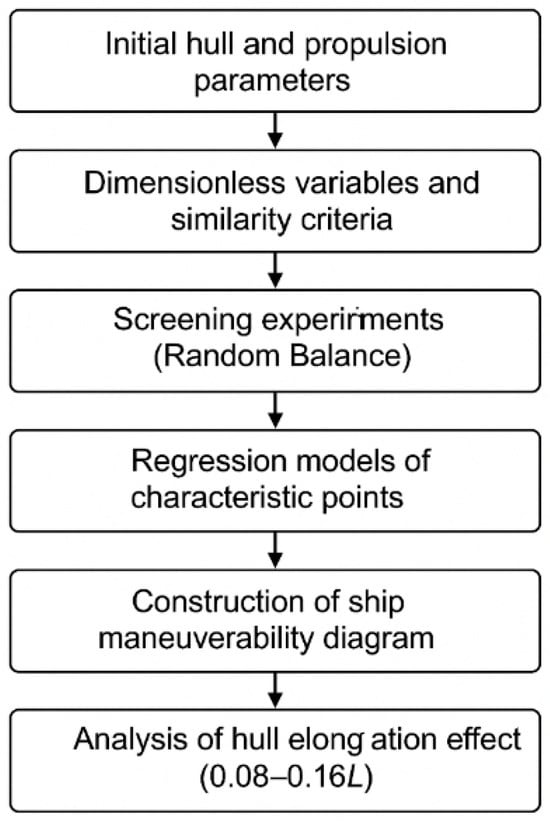
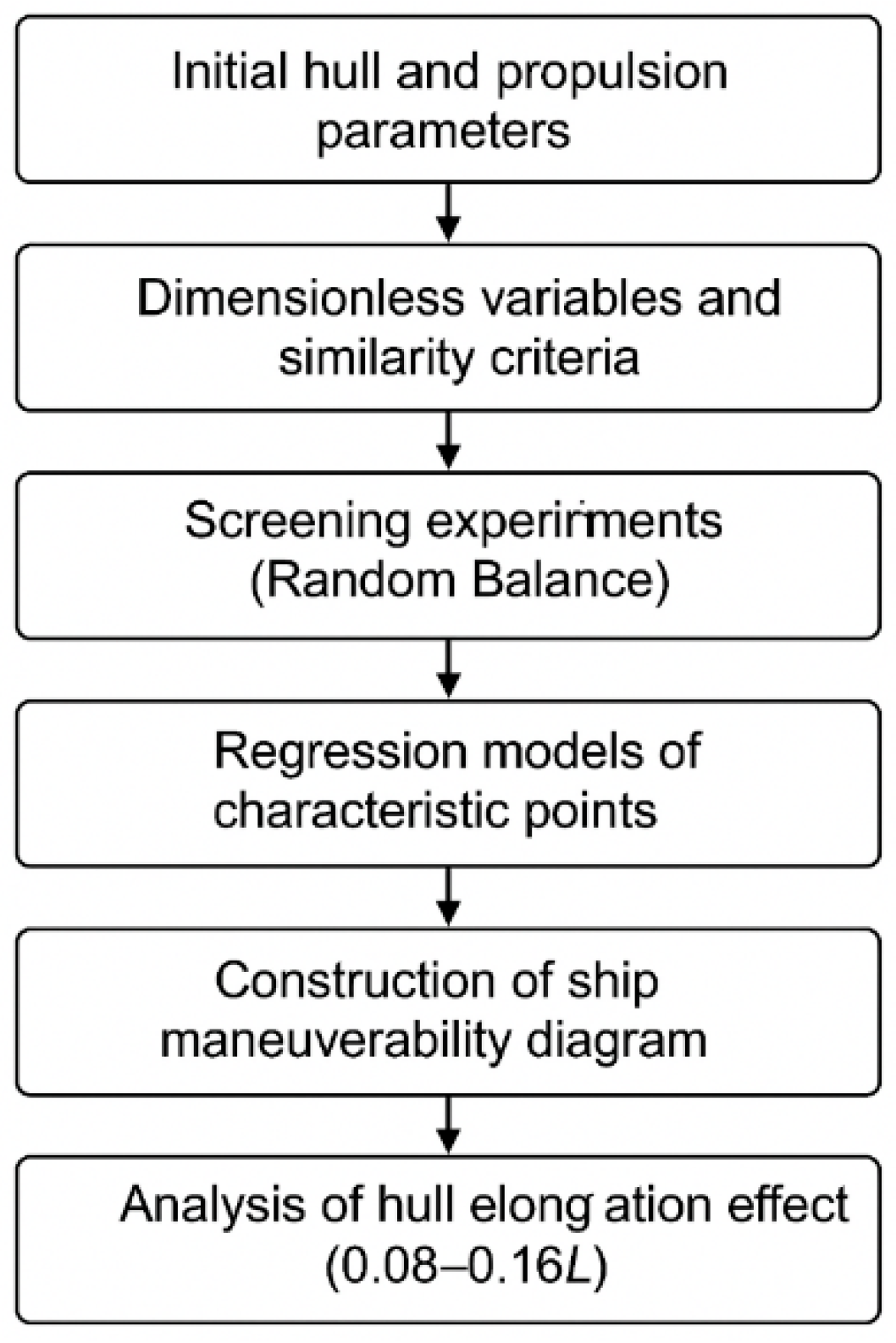
To implement the proposed approach, a step-by-step methodological scheme was developed. It enables an analytical assessment of the ship’s manoeuvring characteristics, considering changes in hull design parameters and integrated electric propulsion system. The methodology comprises three principal stages:
- Development of a generalized transient-mode model of the propulsion complex, describing the coupled interaction among the hull, propulsion units, electric motors, and the power system under conditions of unsteady load variations.
- Identification of the most influential dimensionless parameters via screening experiments (random balance method), enabling a reduction in computational effort and the determination of key factors affecting the characteristic points of the controllability diagram.
- Construction of regression-based analytical models that relate the coordinates of characteristic points to the geometric parameters of the hull and the generalized similarity criteria.
The overall logic of the methodology is illustrated in Figure 1.
Figure 1.
Methodological framework used for controllability analysis.
The use of screening experiments is motivated by the fact that a full factorial analysis involving dozens of parameters would require on the order of 106–108 computational variants. The random balance method enables an 85–95% reduction in the required computational effort while preserving statistically significant identification of the dominant factors.
The resulting methodological framework provides a coherent progression from a physical model to compact analytical relationships and enables the investigation of the influence of hull lengthening on ship manoeuvrability at early design stages.
2.2. Manoeuvring and Hull Hydrodynamic Model
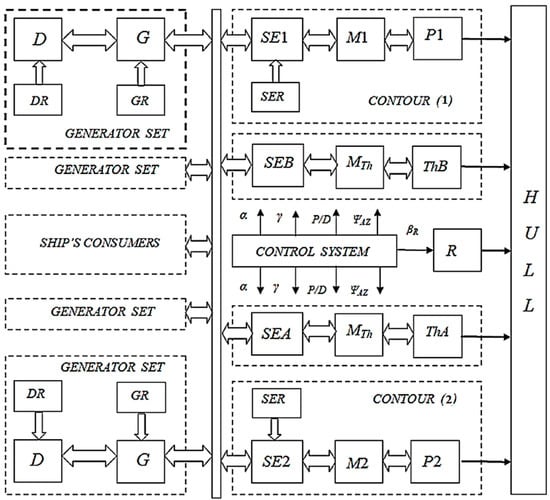
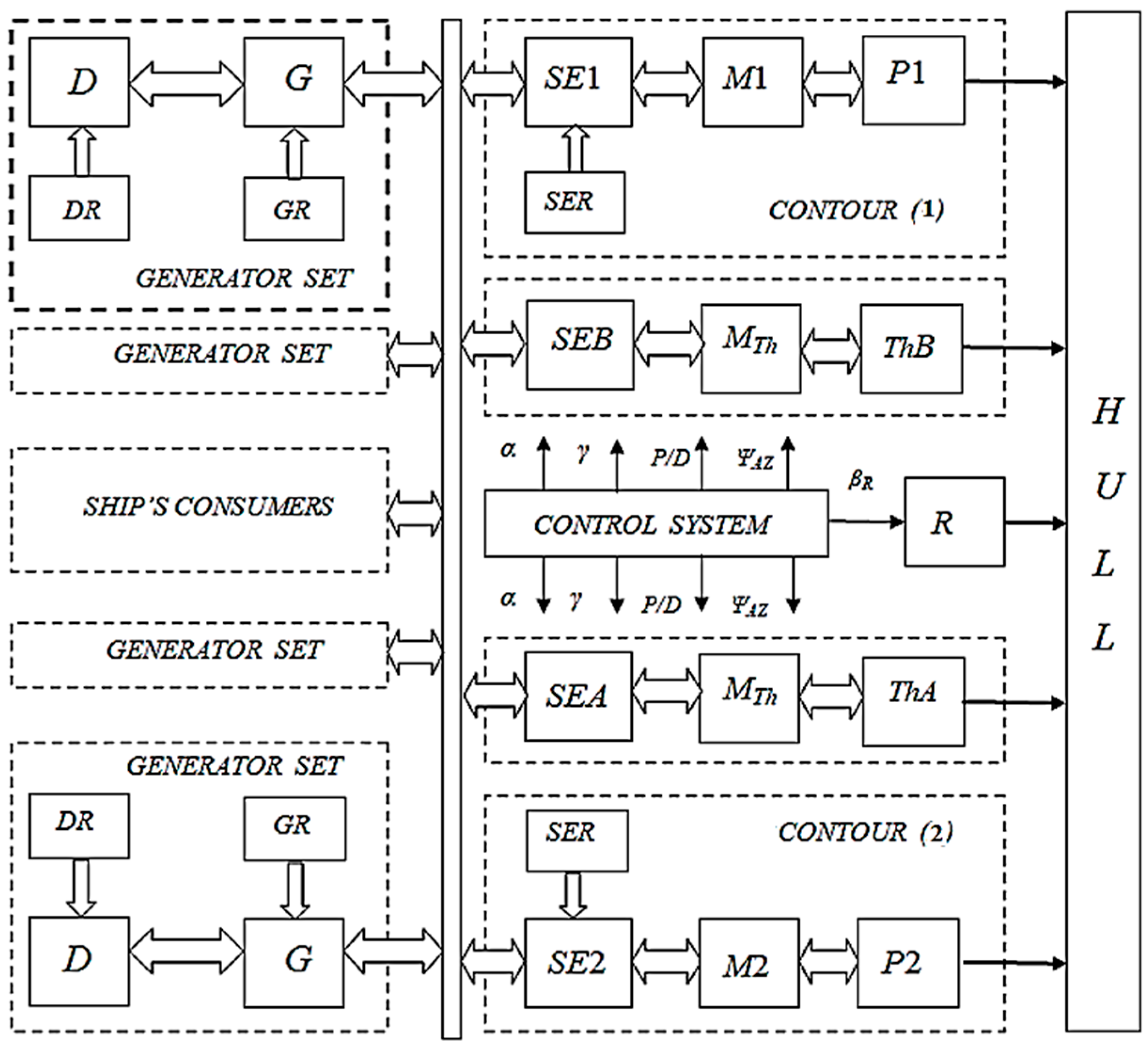
The problem can be addressed using the generalized mathematical model of transient operating modes of propulsion systems for electric-driven vessels presented in [10,11,36]. This model was developed based on the simplified structural diagram of the system shown in Figure 2, which illustrates two right-hand controllability contours corresponding to different operating conditions of the propulsion complex. The diagram shows the main power generation unit (generator set), propulsion power circuits (frequency converter, propulsion motor, and propeller), steering and thruster circuits, and the centralized control system. Solid arrows indicate power flow, whereas dashed arrows represent control and feedback signals. This figure summarizes the subsystem coupling adopted in the integrated transient-mode model.
Figure 2.
Generalized structure of the electric propulsion complex considered in this study. Note that the presented architecture represents a generator-set-based electric propulsion configuration. A battery energy storage system (BESS) is not explicitly modelled in this study and can be incorporated as an extension of the proposed framework in future work.
The ship propulsion and power complex consists of the following main components:
- –
- Generator sets (GENERATOR SET)—several modules, each of which contains a heat engine (D), a speed regulator (DR) with an automatic active load distribution function, a synchronous generator (G), and a voltage regulator (GR) with a reactive load balancing system;
- –
- Propulsion power circuits—right (R) and left (L), each of which includes: a frequency converter (SE), a frequency-controlled electric propulsion motor (M), a control system (SER) that controls the frequency (α) and voltage (γ) of the power supply, and a propeller (P);
- –
- Power circuits of steering devices, which include: voltage converters (SEA, SEB), asynchronous squirrel-cage electric motors (MThA, MThB) and adjustable pitch steering propellers (ThA, ThB);
- –
- General ship power consumers (SHIP’S CONSUMERS);
- –
- Centralized control system (CONTROL SYSTEM), which coordinates the operation of the complex in real time;
- –
- Rudder (R) and hull (HULL), which are involved in shaping the hydrodynamic behaviour of the ship.
The methodology for calculating manoeuvring modes should be applicable to the broadest possible class of vessels. It must enable the assessment of how both hull design parameters and the characteristics of the vessel’s electrical power plant, as well as the specific manoeuvre conditions, influence manoeuvring performance. To achieve this, the mathematical model of transient operating modes was transformed into a system of dimensionless units. This transformation yielded dynamic-similarity criteria and generalized dimensionless parameters of the propulsion complex. These criteria and parameters determine the instantaneous values of the principal operating indicators and the quality metrics of manoeuvring operations. The use of generalized dimensionless parameters significantly reduces the number of independent variables in the model and, to some extent, mitigates the influence of uncertainties in certain physical quantities on the overall research results.
As an example, below are the equations of motion for one of the main elements of the propulsion complex—the ship’s hull—in the coordinate system associated with it, GXYZ, the beginning of which coincides with the centre of gravity of the vessel G. Here, GX is located in the ship’s centreline and directed toward the bow, axis GY—to the starboard side, axis GZ—vertically. In dimensionless form, they appear as:
- Relative components of the vessel’s speed and along the axes X and Y:
- Relative rotational speed around the axis Z
In Equations (1)–(3):
and KPj—useful thrust of the propeller and its part in the total thrust, respectively; and —distance from the centre of the coordinate system to the propellers and distance (Y-axis coordinate) from the propeller to the longitudinal axis X; kRL—coefficient that indicates the position of the propeller: for starboard kRL = +1, and port kRL = −1; —local drift angle on the rudder in a slanting water channel; and —transverse and longitudinal components of water resistance to ship movement [10,36]; and —positional and dynamic components of water resistance to ship rotation [11,12].
The ship motion is described in a standard right-handed coordinate system commonly adopted in ship manoeuvring theory. The selected coordinate definition follows established conventions used in classical and modern manoeuvring models [8,35]. Longitudinal vX1 and transverse vY1 components of the velocity vector of the ship’s centre of gravity and its coordinates X1 and Y1 in a fixed system OX1Y1Z1:
Centre of gravity coordinates X1, Y1, ship speed angle φC and course angle ψC are defined as:
Criteria for dynamic similarity , and dimensionless parameters of the propulsion complex , , , are calculated using the ratios given in [36]. The ratios for calculating the similarity criteria and generalized parameters that characterize the operation of a rowing power plant are also given here.
The model allows the analysis of the behaviour of all elements of the power plant and the ship’s hull, both in straight-line motion and on a curved trajectory. With its help, it is possible to calculate and construct a ship controllability diagram.
2.3. Electric Propulsion and Propeller Subsystem Models
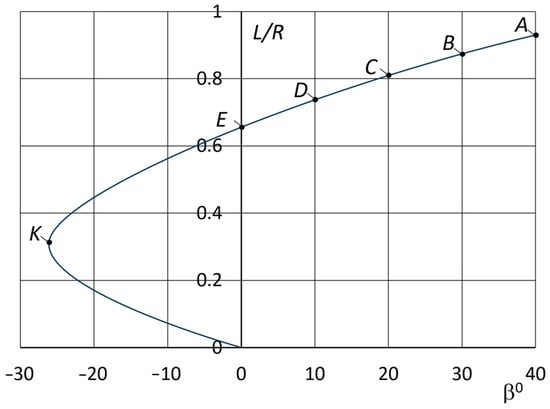
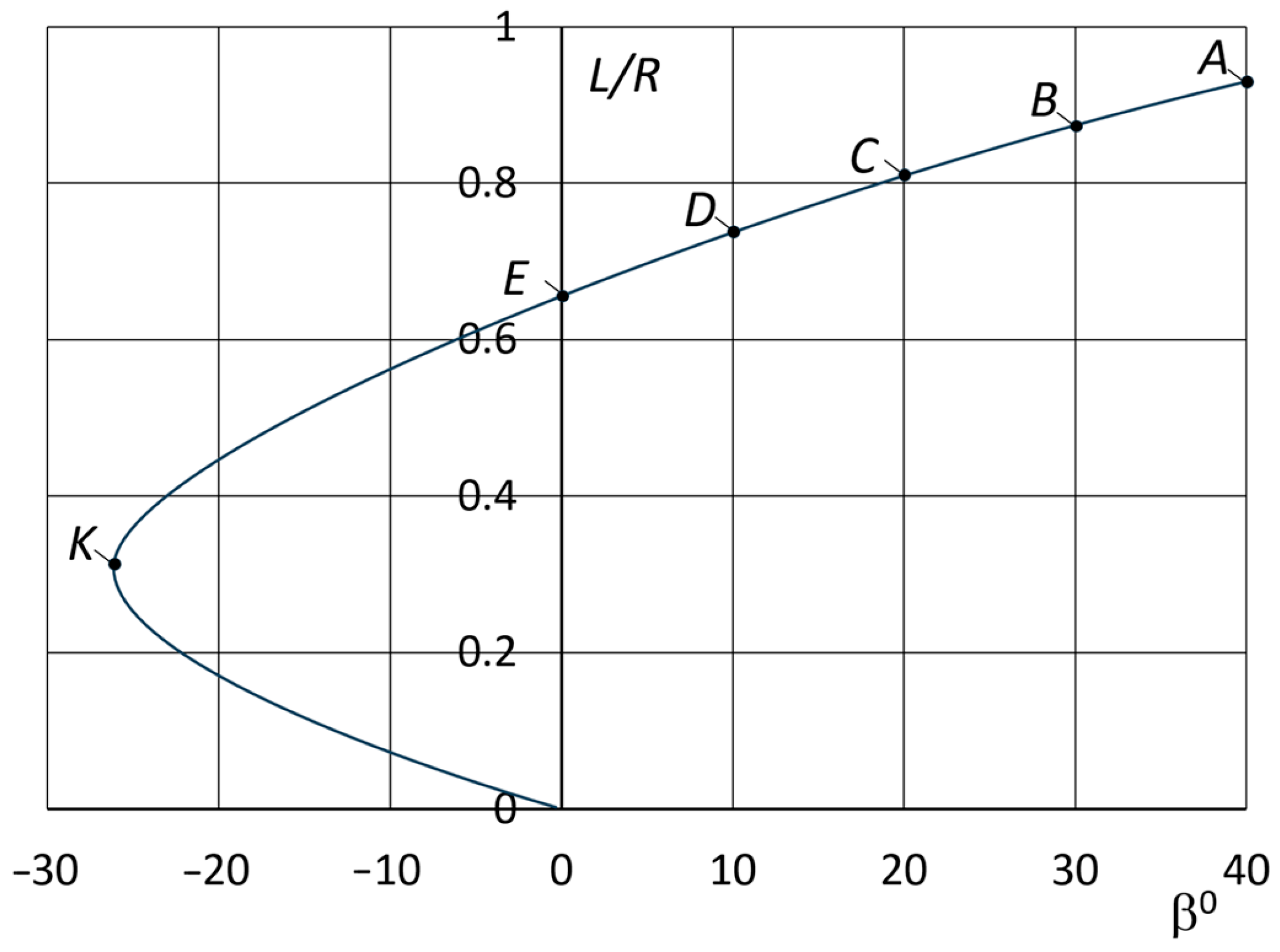
The method being developed for constructing an assessment control chart is focused on the preliminary study of various design options and on solving problems related to assessing the manoeuvrability of electric ships when performing manoeuvring operations. This approach allows the use of approximate methods for constructing a controllability diagram, which also make it possible to analyse the influence of ship hull parameters and power plant parameters on the diagram. To construct the diagram, it is proposed to determine the coordinates of several points on it (for example, points A, B, C, D, E, and K in Figure 3) and construct the desired curve based on them.
Figure 3.
Control diagrams for electric-driven ships.
Each point on the diagram can be obtained by calculating the circular motion of the propulsion complex using a mathematical model [36], constructing the ship’s motion trajectory, and determining its relative curvature. The influence of propulsion system parameters on the controllability diagram can be approximately identified with their influence on the coordinates of characteristic points A, B, C, D, E, and K on the diagram. The first four points can be calculated as values of the relative curvature of the trajectory L/R (L—vessel length, R—radius of steady circulation) at the steering wheel angle settings of 40°, 30°, 20° and 10°. To obtain the coordinates of a point E the vessel is “introduced” into the established circulation, after which the rudder is shifted to 0° (to zero). The trajectory of the new established circulation allows us to determine the relative curvature of the trajectory L/R, corresponding to the angle of the transfer β = 0. The parameters of the critical point K can be obtained by selecting the angle of reverse steering wheel deflection β’, in which the ship leaves the steady circulation on a straight course.
The method under consideration involves calculating the ship’s circulation movement for each characteristic point of the controllability diagram. However, each such solution is a specific solution, the results of which cannot be extended to any other design option for the ship or to any option for changing any parameters of its propulsion electric power plant. It is impossible to analyse the influence of a particular parameter on the ship’s controllability diagram. To solve such problems, analytical calculation methods are needed that allow establishing the patterns of influence of certain parameters on the controllability diagram and predicting the ship’s manoeuvring characteristics. The development of such a calculation method is the goal of this work.
The parameters of the circulation movement of electrodes, and accordingly the controllability diagram, are influenced by dozens of generalized dimensionless parameters of the complex [35]. The numerical values of most of them are unknown at the initial stage of design. It is difficult to assess the influence of the external environment. All this complicates the process of analysing manoeuvring modes of operation, leads to a loss of clarity of the results obtained, thus making the task impossible. At the same time, it is known that a limited (no more than 7…9) number of parameters have a significant impact on the processes occurring in ship propulsion complexes. Based on this, the first step in analysing any process in complex electromechanical systems is to identify those parameters that have a significant impact. In other words, from a multitude of factors qi, i = 1…n it is necessary to identify a subset of factors qj, j = 1…p (p < n), deviation from calculated values Δqj determines the main part of the indicator increment (Δqj) ≈ J(Δqi). The spread of the rest s = n − p factors do not have a significant impact on the indicators under study, and changes in the values of these factors (generalized parameters of the propulsion complex) can be disregarded.
It is advisable to solve such problems [1] using screening experiments based on the assumption that only a small number of factors significantly affect the quality indicator value. The effects of these factors, arranged in descending order, represent an exponential type of dependence. This allows most factors to be classified as noise, against which a relatively small number of significant factors stand out.
With dozens of factors (which corresponds to the system under study), it is convenient to use the random balance method to identify significant parameters. It is based on a random balance matrix (experiment planning matrix—calculations), compiled on the basis of a full factorial experiment (FFE) matrix. Factors can be at two levels: a unit with a plus corresponds to the upper level (maximum value), a unit with a minus corresponds to the lower level (minimum value). The random balance matrix is a plan for conducting numerical experiments.
Based on the results of calculations of the manoeuvres under study at points specified by the random balance matrix, a column vector of the quality indicator was obtained J. Analysis of the impact of qi factors on each quality indicator Jk, in order to identify significant factors (for each indicator), conducted as follows.
In the first stage of the analysis, a scatter plot was constructed. Based on this, the contributions were determined E each factor. Selected m columns of significant factors identified by the scatter plot, constructed matrix FFE like 2l and auxiliary matrix JVS with the results of the FFE matrix calculations. Analytical models of quality indicators are constructed based on an auxiliary matrix J (coordinates of characteristic points of the diagram A, B, C, D, E and K) form
In Formula (10), the values bi, i = 0, 1…l corresponds to the linear model of the quality indicator. At ratios bi reflect the effects of interaction between factors.
Coefficients bi are defined as
where m = 2l;
where ηj—number of parallel calculations.
In the second stage of the analysis, the effects of the significant factors already identified (in the first stage) were excluded and the calculations were repeated. Repeating the steps described above made it possible to rank the entire group of significant factors.
2.4. Design of Experiments and Regression Modelling Procedures
To identify interaction effects, the method of identifying interactions from scatter plots of linear effects was used [36]. Quantitative assessment of significant interactions was performed similarly to the assessment of significant factors by constructing an auxiliary matrix JVS, in which the effects of their interactions played the role of factors.
Statistical analysis of the results obtained at each stage was carried out in the following sequence:
- We determined the selective variances along the rows of the matrix JVS;
- The dispersions of the reproducibility of the single value, the dispersions of the reproducibility of the mean value, and the dispersions of the regression coefficients were calculated;
- The significance of the coefficients was tested using Student’s t-test with degrees of freedom f and level of significance α;
- The conditions for the significance of factors were determined.
The screening experiments conducted in this manner made it possible to identify significant parameters for each quality indicator. As a result, the number of parameters whose influence needed to be analysed decreased from several dozen to 5–9 for each specific indicator. Thus, the screening experiments conducted make it possible to reduce (justifiably) the number of future calculations by a factor of hundreds.
To assess a vessel’s manoeuvrability and construct its controllability diagram, it is important to obtain information about the quantitative relationship between the main parameters Ji (characteristic points A, B, C, D, E, and K of the control diagram) with factors that significantly influence them (generalized dimensionless parameters) and the effects of interactions between these parameters.
To establish such links, the technique of adequate representation of the quality indicator is used J = J (q1, q2…qn) some approximate analytical model J* = J* (q1, q2…qn). Polynomial approximation found the widest application in the construction of analytical models J*(B, q), where B—vector of coefficients of the approximate polynomial. Coefficients B are determined using the least squares method, as
To construct analytical models of ship propulsion system quality indicators, it is sufficient [1] to use polynomials of no higher than second order. The polynomial coefficients are calculated after the corresponding observation matrices have been formed. When planning experiments, a hypothesis is first put forward to represent J(q) first-order model. Then, if the adequacy check reveals the need to move to more complex models, they are gradually made more complex.
For constructing first-order analytical models
The full factorial experiment (FFE) method is widely used. Parameter variation in the FFE method is carried out at two levels. Parameter normalization is performed as follows:
where qi0—mean value i–th parameter; Δqi = qi max − qi0 = qi0 − qi min—interval of change of the i-th parameter.
The maximum and minimum values of the parameters normalized in this way are +1 and −1, respectively, and the average values are zero.
Planning matrix Q1: A full factorial experiment with seven factors (the maximum number of significant parameters for the class of problems under consideration) involves performing N = 27 = 128 calculation options. As a result of implementing the matrix Q1 the vectors of the indicator values are located J = (J1, J2…JN). The coefficients of the approximating polynomials (6) are calculated using the following formulas:
The adequacy of the analytical model of quality indicators is assessed by comparing the values of the coefficients b0 with indicator values J, found at average factor values. Values b0 and J should not differ significantly.
A series of numerical experiments conducted using the random balance method made it possible to identify parameters that significantly affect the controllability diagram. These turned out to be generalized dimensionless parameters.
where L—vessel length; P0—total thrust of propellers; m, λ11, λ22—mass of the vessel and attached masses of water along the longitudinal and transverse axes; v0—ship speed in steady state operation at rated engine power; CYβ—body strength coefficient; FD—the reduced area of the submerged part of the ship’s centreline plane; ρ—specific gravity of water; m1—moment of resistance coefficient; Cωm0—damping moment of resistance coefficient.
Regression analysis enabled the ranking of dimensionless parameters and parameter interaction effects according to their degree of influence on the controllability diagram. The contributions of the listed parameters to the relative curvature of the trajectory are as follows: for NX—43.8%; for Cλ21—17.9%; for C61—8.8%; for C21—8%; for C65—5.8%. The following interactions between parameters had significant effects: NXCλ21 (5.8%), NXC61 (3.2%), and C21C61 (3.2%).
Since the controllability diagram is constructed based on the coordinates of characteristic points A, B, C, D, E, and K, it is logical to determine the influence of the significant parameters on the coordinates of these particular points. Solving this (second) problem makes it possible to construct a controllability diagram for any electric propulsion system (of the class under consideration) and analyse the nature of its change when any parameters of the propulsion complex are changed. In other words, it is necessary to construct analytical dependencies of the coordinates of points A, B, C, D, E, and K on the significant parameters of the complexes NX; Cλ21; C61; C21; C65.
This task was solved using full factorial experiment methods with the involvement of central composite design methods (preliminary studies showed that the dependence of the relative curvature of the trajectory on the parameters of the complex is nonlinear, and quadratic terms must be taken into account). The results of these calculations are presented below for electric boats utilizing one of the promising propulsion options, specifically frequency-controlled asynchronous propulsion motors.
Through a series of numerical experiments conducted on the developed planning matrices Q1, Analytical dependencies of the parameters of the relative curvature of the trajectory (coordinates of points A, B, C, D, E) from the values of dimensionless parameters of complexes. These dependencies are obtained for the values of the rudder blade deflection angle β on: 40°, 30°, 20°, 10° and 0°:
(L/R)β = 40 = 0.501 − 0.231 NX + 0.075 Cλ21 − 0.038 C61 − 0.036 C65 + 0.077 NX2 − 0.035 NX C21,
(L/R)β = 30 = 0.446 − 0.226 NX + 0.068 Cλ21 − 0.040 C61 − 0.034 C65+ 0.075 NX2 − 0.029 NX Cλ21,
(L/R)β = 20 = 0.371 − 0.233 NX + 0.066 Cλ21 − 0.039 C61 − 0.032 C65 + 0.079 NX2 − 0.031 NX Cλ21,
(L/R)β = 10 = 0.287 − 0.246 NX + 0.07 Cλ21 − 0.039 C61 − 0.016 C21 − 0.031 C65 + 0.091 NX2 − 0.043 NX Cλ21 + 0.016 NX C61 + 0.018 NX C65,
(L/R)β = 0 = 0.130 − 0.267 NX + 0.064 Cλ21 − 0.035 C61 − 0.019 C21 − 0.026 C65 + 0.114 NX2 0.008 Cλ212 − 0.054 NX Cλ21 + 0.024 NX C61 + 0.006 NX C21 + 0.025 NX C65 + 0.007 C61 C21.
Parameters of the “critical” point:
βcr = 0.024 − 0.207 NX + 0.034 Cλ21 − 0.014 C61 − 0.026 C21 − 0.021C65+ 0.142 NX2 + 0.003 Cλ212 − 0.001 C612 − 0.001 C212 − 0.006 C652 − 0.04 NX Cλ21 + 0.014 NX C61 + 0.032 NX C21 + 0.028 NX C65 − 0.015 Cλ21 C61 + 0.006 Cλ21 C21+ 0.005 Cλ21C65 − 0.005 C61C21 − 0.006 C61 C65 + 0.016 C21 C65,
(L/R)β = βc = 0.066 − 0.114 NX + 0.026 Cλ21 − 0.017 C61 − 0.008 C21 − 0.012 C65 + 0.036 NX2 + 0.005 Cλ212 + 0.007 C652 − 0.021 NX Cλ21 + 0.010 NX C61 + 0.009 NX C65 + 0.005 Cλ21 C61 − 0.005 C21 C65,
To construct a controllability diagram for any specific electric-driven ship with the type of power plant under consideration, it is sufficient to substitute the numerical values (calculated using the analytical dependencies given above) of the dimensionless parameters. NX; Cλ21; C61; C21; C65 into Equations (24)–(30) and obtain the corresponding diagrams . It should be noted that the analytical dependencies above use normalized representations of the numerical values of the parameters included in them. Normalization is performed according to the ratio
where Aj—value of the j-th parameter of the vessel under consideration; Ajn—normalized value of the j-th parameter; Aj0—the average value of the j-th parameter in the possible (according to the studies conducted) range of values: NX = 0.07…0.20; Cλ21 = 0.65…1.25; C61 = 2…8; C21 = 3…10; C65 = 4…5; ΔAj = Ajmax − Aj0 = Aj0 − Ajmin—interval of change of the j-th parameter.
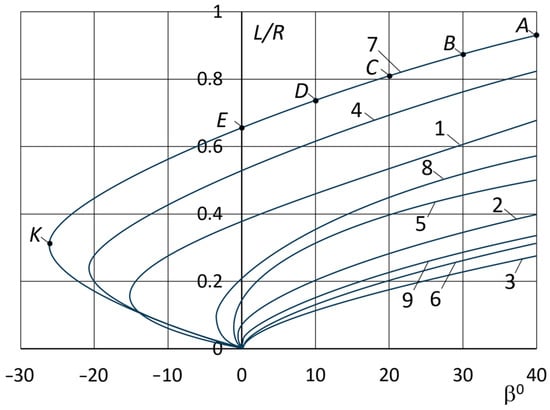
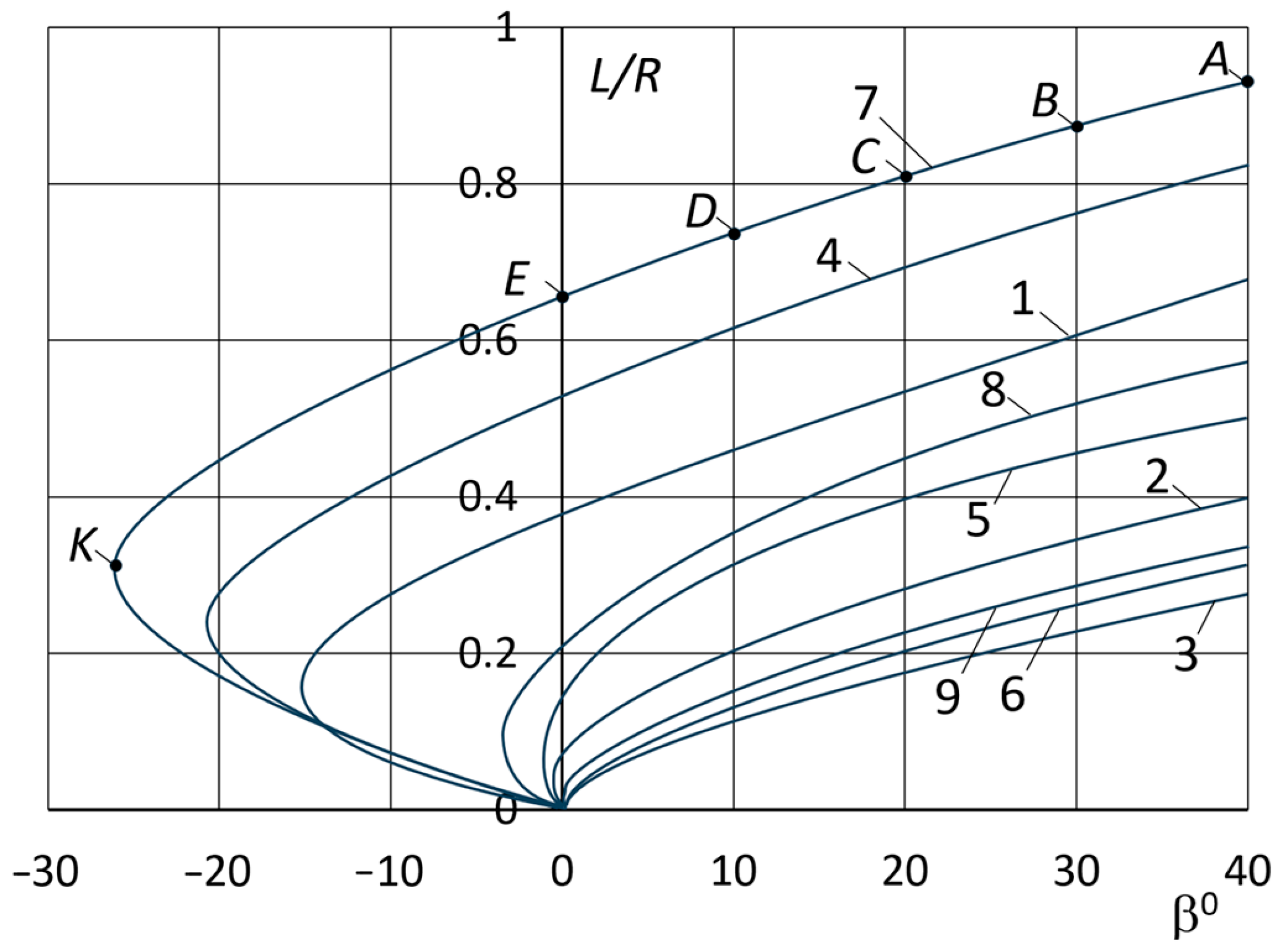
For an approximate assessment of the controllability diagrams of electric boats with asynchronous frequency-controlled propulsion motors, Figure 4 shows, as an example, a small series of diagrams with different parameter ratios NX, Cλ21 with fixed parameter values C61, C21, C65.
Figure 4.
Control diagrams for electric-driven ships at various parameter ratios NX, Cλ21.
The curves in Figure 4 correspond to: 1—NX = 0.06; Cλ21 = 1; 2—NX = 0.12; Cλ21 = 1; 3—NX = 0.2; Cλ21 = 1; 4—NX = 0.06; Cλ21 = 1.3; 5—NX = 0.12; Cλ21 = 1.3; 6—NX = 0.2; Cλ21 = 1.3; 7—NX =0.06; Cλ21 = 1.5; 8—NX = 0.12; Cλ21 = 1.5; 9—NX = 0.2; Cλ21 = 1.5. The numerical values of the other parameters remained equal to the average values Aj0.
To apply the results presented in Figure 3, it is sufficient to compute the dimensionless parameters for the vessel under consideration and select the corresponding curve. For parameter values not explicitly represented in the figure, any suitable interpolation method may be employed.
The results of the studies showed that, of the parameters considered, the power-to-weight ratio of the electric drive has the greatest influence on the controllability diagram. NX. This is additional justification for the need to analyse the manoeuvrability characteristics of electric propulsion systems in conjunction with the power plant.
As can be seen from the figure, its decrease leads to an increase in the manoeuvrability of the electric-driven vessel (L/R)max. At the same time, the vessel becomes less stable, and at high values Cλ21 (and also small values NX) may become uncontrollable. With growth in NX, the electric propulsion system becomes more stable in terms of controllability (although less manoeuvrable), and the controllability diagram turns out to be slightly dependent on other parameters of the complex. The influence of other parameters of power plants is significantly weaker. When they vary (within the specified ranges), there is no need to worry about significant changes in the controllability diagram of the electric propulsion system.
Propeller geometry, installation configuration, and related design parameters are assumed to be constant in the present analysis and are incorporated into the generalized dimensionless similarity criteria of the propulsion complex. This assumption allows the study to focus on the influence of hull lengthening while avoiding an expansion of the parameter space at the early design stage.
2.5. Applicability
The proposed methodology is primarily intended for conventional displacement monohull vessels equipped with integrated electric propulsion systems. Such vessels exhibit manoeuvring behaviour that can be adequately captured by the adopted hydrodynamic and propulsion models. Multihull configurations, such as catamarans, involve fundamentally different hydrodynamic interactions and are therefore outside the direct scope of the present study. The extension of the proposed framework to multihull vessels and small unmanned craft is considered a topic for future research.
2.6. Software
All computations and regression procedures were implemented using Python (version 3.10) with SciPy (version 1.10) and NumPy (version 1.24). Figures and tables were prepared using Microsoft Excel (Microsoft 365) and MATLAB (version R2022b), where applicable. The manuscript was prepared using Microsoft Word (Microsoft 365).
3. Results and Analysis
3.1. Baseline Controllability Analysis
The baseline scenario corresponds to the original hull geometry and nominal configuration of the integrated electric propulsion system. The main geometric parameters of the hull, propulsion layout, and control settings are defined as reference values for subsequent comparative analysis. Key nondimensional parameters derived using the proposed methodology serve as baseline indicators for evaluating the influence of hull lengthening.
This section presents the baseline results of the controllability analysis obtained using the proposed analytical framework. The controllability diagram is constructed based on the analytically determined characteristic points, allowing the influence of the dominant dimensionless parameters of the propulsion complex to be assessed. These results serve as a reference for evaluating the impact of subsequent hull-length modifications.
The derived analytical relationships enable the assessment of how changes in the parameters of electric propulsion systems affect vessel controllability. The considered ranges of dimensionless parameters correspond to typical medium-size passenger and inland vessels equipped with twin electric propulsion systems. The method described can be applied to evaluate the influence of hull design parameters on the controllability diagram—a task that becomes particularly relevant during ship modernization. For passenger vessels, a key modernization strategy is hull lengthening, which allows a substantial increase in passenger capacity and, consequently, improved operational profitability. Prior to implementing such modifications, it is essential to evaluate the resulting changes in the controllability of the modernized vessel.
The length of the vessel affects a large number of parameters in the complex. At the same time, in the preliminary stages of calculation, with limited information available, there is no point in taking into account changes in insignificant parameters. The results of screening experiments made it possible to identify from the set of significant parameters those whose influence on the controllability diagram is most significant. These are the parameters listed above NX, Cλ21, C61 and C21. The remaining parameters can be assumed to be unvarying.
The vessel is lengthened using inserts of a specific length. Let us analyse the effect of the insert length on the diagram. To do this, let us consider inserts with a length of: L1 = 0.08 L; L1 = 0.10 L; L1 = 0.12 L; L1 = 0.16 L.
In analytical dependencies (24)–(30) of the relative curvature (L/R) of the trajectory from the values of dimensionless parameters of complexes, normalized values of parameters are used. Minimum Ajmin, average Aj0 and maximum Ajmax numerical values of dimensionless parameters NX and Cλ and ranges of variation in their values ΔAj are shown in Table 1. The normalized values of these parameters for insertion lengths are also given L1 accordingly 0.08 L (normalized value—Aj1n); 0.10 L (normalized value—Aj2n); 0.12 L (normalized value—Aj3n); 0.16 L (normalized value—Aj4n).
Table 1.
Values of dimensionless parameters.
To calculate the relative curvature of the trajectory when the parameters of the complex change, it is necessary to substitute the numerical values (in normalized form) of the significantly influencing parameters into Equations (24)–(30) NX and Cλ21. The values of the remaining parameters and the effects of parameter interaction are unchanged, so in normalized form these values will be zero. Based on this, the terms on the right-hand side of Equations (24)–(30) containing these parameters will be omitted. The results of the calculations are shown in Table 2.
Table 2.
Parameters of characteristic points of the controllability diagram.
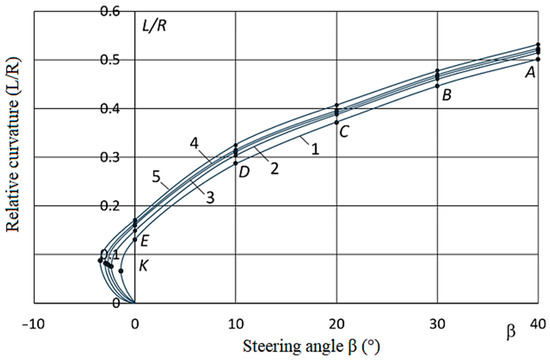
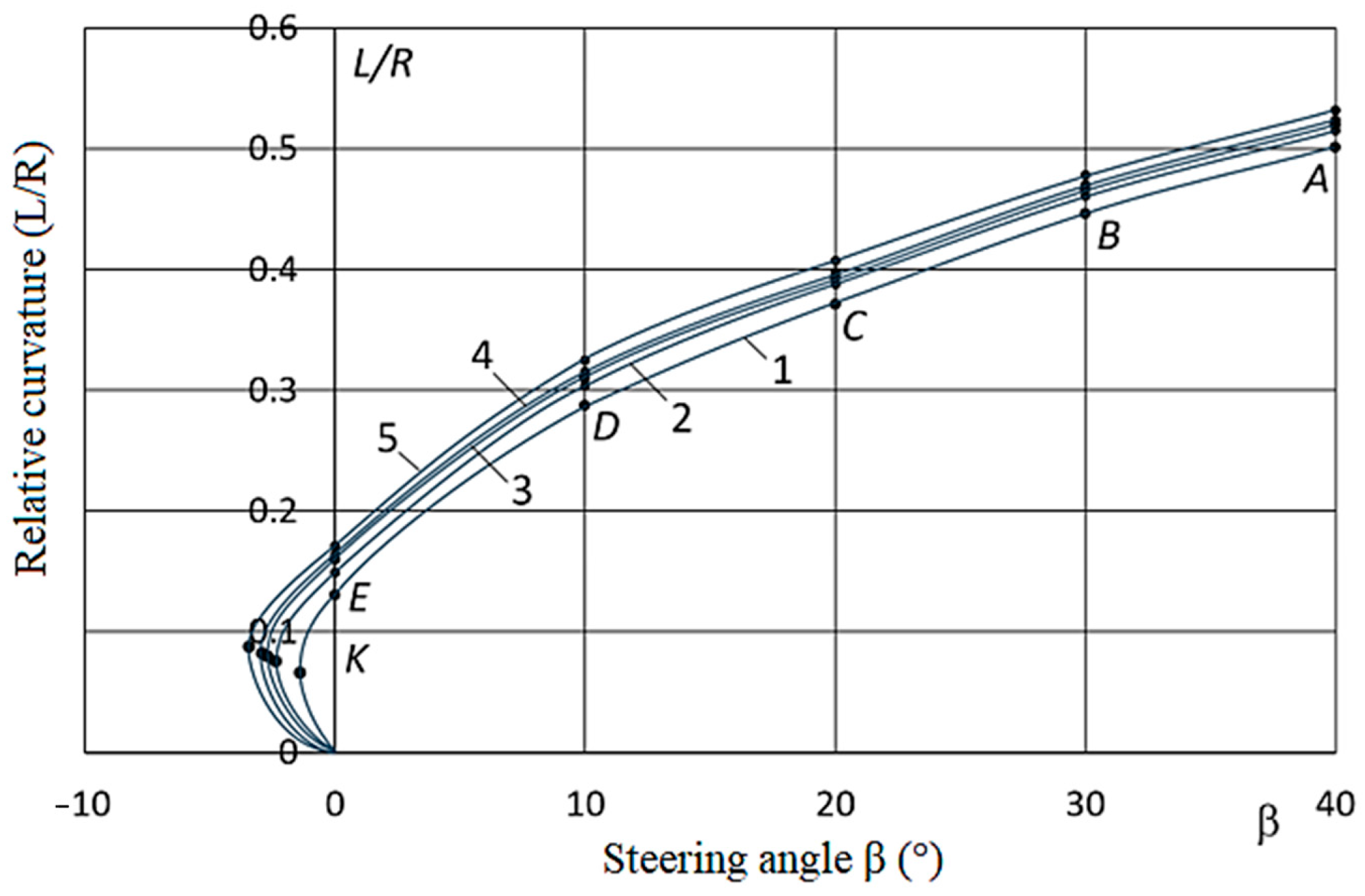
Based on the results of the calculations in Figure 5, controllability diagrams were constructed for different insert lengths. Curve 1 corresponds to the original vessel, curve 2 corresponds to the insert length L1 = 0.08 L, curve 3—insertion length L1 = 0.10 L, curve 4—insertion length L1 = 0.12 L, curve 5—insertion length L1 = 0.16 L.
Figure 5.
Control diagrams for electric-driven ship with different insertion length.
Analysis of the curves obtained shows that lengthening the ship’s hull within the range from L1 = 0.08 L to L1 = 0.12 L has a negligible effect on its manoeuvrability. In particular, the maximum increase in the relative curvature of the trajectory (L/R) at the maximum rudder deflection is no more than 6%—from 0.501 to 0.532. This trend persists at smaller deflection angles. At the same time, an increase in length has a more significant effect on the position of the critical point, shifting it in the direction of larger values of the critical steering angle, accompanied by a corresponding increase in the relative curvature of the trajectory.
However, these changes remain insignificant. This is because the slight decrease in the ship’s power-to-weight ratio (decrease in the NX parameter), which contributes to an increase in its manoeuvrability, is offset by an increase in the relative share of connected water masses in the transverse direction (coefficient λ22) compared to the longitudinal direction (coefficient λ11). The increase in the share of transverse attached masses reduces the value of the dimensionless parameter Cλ21, which, in turn, causes a moderate increase in the critical turning angle βcr. Within the considered parameter ranges and modelling assumptions, the vessel retains a level of controllability close to that of the original prototype. Building on this baseline controllability assessment, the following subsection examines how systematic hull lengthening affects the shape of the controllability diagram and the associated manoeuvring characteristics.
3.2. Comparative Analysis of Hull Lengthening Scenarios
Analysis of three hull lengthening options (0.08 L, 0.12 L, and 0.16 L) showed that changes in manoeuvrability characteristics are moderate and do not lead to a loss of stability or deterioration in the ship’s controllability. When the length was increased by 0.08 L, the critical curvature coefficient βcr changed by only 3–4%, which had practically no effect on the shape of the controllability diagram. For a lengthening of 0.12 L, the deviation was approximately 5%, and the maximum lengthening of 0.16 L resulted in a change of no more than 6% relative to the base variant. At the same time, the relative change in the turning radius and coordinates of key points also remained within 5–7%, indicating that the trajectory remained smooth and there was no tendency toward increased instability.
The obtained values confirm that even with a 16% hull lengthening, the basic indicators of manoeuvrability and course stability remain stable, and the shape of the controllability diagram changes minimally. This indicates that the lengthening of the hull in the studied ranges does not pose a risk to the manoeuvrability of the electric propulsion vessel and can be considered a structurally acceptable modification.
The results indicate a clear trend of moderate variation in manoeuvrability indicators with increasing hull length. Within the analysed range, each of the main nondimensional parameters and the curvature of the controllability curve changed by at most 5–7%, indicating that hull extension does not significantly degrade controllability. From an engineering perspective, this suggests that moderate hull lengthening can be applied during ship modernization without compromising manoeuvring safety.
4. Discussion
Although the present study is based on an analytical and regression-based framework, the obtained trends are consistent with previously reported numerical and experimental findings on the influence of hull length and inertia on ship manoeuvring behaviour. The proposed methodology is therefore intended as an early-stage assessment and screening tool, rather than a substitute for detailed CFD simulations or full-scale trials.
It should be emphasized that the proposed approach is not intended to replace CFD-based analyses, but rather to complement them. While CFD provides detailed flow-field resolution and high-fidelity hydrodynamic forces, it is typically applied to a limited number of operating conditions due to its high computational cost. In contrast, the present framework enables rapid parametric evaluation of manoeuvrability trends by coupling hull geometry variations with the transient dynamics of integrated electric propulsion systems. This makes the method particularly suitable for early-stage design, preliminary assessment of modernization options, and system-level decision support.
The results show that the effect of hull lengthening in the range of 0.08–0.16 L on the manoeuvrability of a vessel with an integrated electric propulsion system is moderate and does not lead to a loss of controllability. Despite the increase in the inertial characteristics of the hull and the change in mass distribution, the critical values of the curvature coefficient β and the coordinates of the main characteristic points of the controllability diagram remain within limits that do not exceed 5–7% of the base values. This indicates that the “hull-electric propulsion complex” system demonstrates a high ability to compensate for the effects of structural modifications to the hull. From an engineering standpoint, this indicates that moderate hull lengthening within the investigated range does not require redesign of the propulsion control system or adjustment of manoeuvring safety margins.
In contrast to [23], which considered only the hydrodynamic effects of the hull, the present study incorporates propulsion–electric dynamics into the analysis of manoeuvrability. Compared with [40], which focused on the efficiency of electric propulsion, the proposed framework explicitly integrates propulsion dynamics with controllability under structural modifications.
A comparison with existing manoeuvring models indicates that traditional approaches generally neglect the influence of dynamic operating modes of the electric motor, frequency converter, and power plant during thrust variations, potentially leading to inaccurate assessments of stability when the hull is lengthened. The proposed method, which combines dimensionless variables, screening experiments, and regression modelling of characteristic points, provides generalized yet physically interpretable patterns that more accurately reflect the behaviour of electric drives in transient modes.
The practical significance of these results lies in the finding that hull lengthening within the studied limits can be implemented during ship modernization without a substantial risk to manoeuvrability. The analytical models developed can be incorporated into decision-support systems for evaluating manoeuvring characteristics and into digital twins of electric vessels to predict behaviour under complex navigational conditions.
However, the method has several limitations. Although some attempts have been made to model resistance using a generalized set of nondimensional parameters, no attempt has been made to include actual external factors such as crosswinds, waves, nonsmooth planing effects, or variations in loading conditions. To validate the present work and compare the results with CFD-based methods, increases in thrust should be tested against experimental or full-scale trials. Environmental disturbances, such as wind or wave motion, should be considered in future studies to reduce uncertainty in ship turning performance. This study primarily addresses still-water conditions, as the effects of wind, waves, or shallow water on vessel manoeuvring were not assessed. Future work will also include validation using prototype or sea-trial data (or scaled-model tests) for representative electric vessels to further confirm the predicted controllability trends under real operating conditions.
5. Conclusions
In this study, an analytical method for assessing the influence of hull design parameter variations on the controllability diagram of electric ships has been developed. The results confirm the importance of accounting for the interaction between all components of an integrated propulsion complex when analysing manoeuvring behaviour, particularly under transient operating conditions. Based on this approach, analytical models were derived to determine the characteristic points of the controllability diagram, enabling a quantitative assessment of how variations in propulsion-system parameters affect ship controllability and manoeuvrability.
The analysis shows that an increase in hull length within the range of 0.08–0.16 of the total hull length has only a minor influence on manoeuvring characteristics and does not lead to a degradation of controllability. This indicates that such structural modifications do not impose limitations on vessel modernization from the standpoint of manoeuvring performance. At the same time, for more detailed investigations of specific operating scenarios, the use of a full mathematical model describing transient propulsion-system dynamics remains advisable.
The proposed analytical relationships provide a practical tool for rapid estimation of manoeuvrability trends and can be applied at early design stages, as well as during preliminary modernization studies, prior to more computationally intensive analyses. The developed models may be integrated into ship design software, route simulators, and decision-support systems for ship traffic management, thereby extending their applicability beyond purely theoretical analysis. Potential future work includes further development of CFD-based simulations for verification and the incorporation of environmental disturbances, such as wind and waves, to increase prediction accuracy.
Author Contributions
Conceptualization, V.Y. and O.S.; methodology, V.Y. and O.M.; software, M.M. and P.N.; validation, V.P., P.K. and O.M.; formal analysis, O.S., O.M. and P.N.; investigation, M.M.; resources, O.M.; data curation, V.Y. and P.N.; writing—original draft preparation, O.S.; writing—review and editing, V.P. and P.K.; visualization, P.K.; supervision, M.M.; project administration, O.M.; funding acquisition, V.P. All authors have read and agreed to the published version of the manuscript.
Funding
This publication was supported by the project “Innovative Technologies for Smart Low Emission Mobilities”, funded as project No. CZ.02.01.01/00/23_020/0008528 by Programme Johannes Amos Comenius, call Intersectoral cooperation.
Data Availability Statement
Data is contained within the article.
Acknowledgments
The authors thank Brno University of Technology for support.
Conflicts of Interest
The authors declare no conflicts of interest.
Abbreviations
The following abbreviations are used in this manuscript:
| B | ship breadth, m |
| DOE | Design of Experiments |
| EPC | Electric Propulsion Complex |
| Fr | Froude number (-) |
| J | moment of inertia of a vessel relative to the vertical axis, kg·m2 |
| k | hydrodynamic drag coefficient (-) |
| k1, k2, k3 | dimensionless complexes describing the interaction between the hull and the propeller (-) |
| L | ship hull length, m |
| m | ship weight, mts |
| M | torque on the electric motor shaft, N·m |
| n | propeller rotation frequency, s−1 |
| P1–Pn | generalized dimensionless groups of transient mode models (-) |
| PCS | Propulsion Control System |
| RBM | Random Balance Method |
| Re | Reynolds number (-) |
| RPM | Revolutions Per Minute |
| S | underwater part of the hull area, m2 |
| T | draft, m |
| Tthr | propeller thrust, N |
| U | ship speed, m/s |
| β | coefficient of curvature of the ship’s trajectory (-) |
| βcr | critical curvature coefficient (-) |
| η | efficiency ratio (-) |
| λᵢ | generalized criteria for similarity of propulsive complexes (-) |
| μ | viscosity coefficient, Pa·s |
| ρ | water density, kg/m3 |
| τ | electromotor time constant, s |
| ω | angular velocity of shaft rotation, rad/s |
References
- Pershits, R.Y. Upravlyaemost’ i upravlenie sudnom [Ship controllability and control]; Sudostroenie: Leningrad, USSR, 1983; 272 p. [Google Scholar]
- Sobolev, G.V. Upravlyaemost’ korablya i avtomatizatsiya sudovozhdeniya [Ship controllability and navigation automation]; Sudovozhdenie: Leningrad, USSR, 1976; 478 p. [Google Scholar]
- Vasiliev, A.V. Upravlyaemost’ sudov [Ship controllability]; Sudostroenie: Leningrad, USSR, 1989; 328 p. [Google Scholar]
- Melnyk, O.; Onyshchenko, S.; Onishchenko, O.; Koskina, Y.; Lohinov, O.; Veretennik, O.; Stukalenko, O. Fundamental concepts of deck cargo handling and transportation safety. Eur. Transp. 2024, 1, 1–18. [Google Scholar] [CrossRef] [Scilit]
- Melnyk, O.; Onishchenko, O.; Drozhzhyn, O.; Pasternak, O.; Vilshanyuk, M.; Zayats, S.; Shcheniavskyi, G. The ship safety evaluation and analysis on the multilayer model case study. E3S Web Conf. 2024, 501, 01018. [Google Scholar] [CrossRef] [Scilit]
- Onyshchenko, S.; Melnyk, O. Modelling of changes in ship’s operational condition during transportation of oversized and heavy cargo. Technol. Audit Prod. Reserves 2020, 6, 66–70. [Google Scholar] [CrossRef] [Scilit]
- Shumylo, O.; Yarovenko, V.; Malaksiano, M.; Melnyk, O.; Iovchev, S. Methods for assessing electric ships’ maneuvering and safety indicators based on the theory of the dynamic similarity. In Studies in Systems, Decision and Control; Springer: Cham, Switzerland, 2025; Volume 580, pp. 235–255. [Google Scholar] [CrossRef] [Scilit]
- Taniguchi, T.; Maki, A. A proposal of the maneuvering motion model for low-speed operations in harbor. Ocean Eng. 2025, 330, 121172. [Google Scholar] [CrossRef] [Scilit]
- Xu, Z.; Haroutunian, M.; Murphy, A.J.; Neasham, J.; Norman, R. A comparison of functional control strategies for underwater vehicles: Theories, simulations and experiments. Ocean Eng. 2020, 215, 107822. [Google Scholar] [CrossRef] [Scilit]
- Odetti, A.; Altosole, M.; Bruzzone, G.; Viviani, M.; Caccia, M. A new concept of highly modular ASV for extremely shallow water applications. IFAC-PapersOnLine 2018, 52, 181–186. [Google Scholar] [CrossRef] [Scilit]
- Scaradozzi, D.; Palmieri, G.; Costa, D.; Pinelli, A. BCF swimming locomotion for autonomous underwater robots: A review and a novel solution to improve control and efficiency. Ocean Eng. 2017, 130, 437–453. [Google Scholar] [CrossRef] [Scilit]
- Wu, N.; Fan, Y.; Wang, R.; Wang, M.; Wu, C.; Wang, Y. Development and field testing of an unmanned surface vehicle system for guidance control and target tracking. Ocean Eng. 2025, 316, 119924. [Google Scholar] [CrossRef] [Scilit]
- Zhang, X.; Wang, C.; Jiang, L.; An, L.; Yang, R. Collision-avoidance navigation systems for Maritime Autonomous Surface Ships: A state of the art survey. Ocean Eng. 2021, 235, 109380. [Google Scholar] [CrossRef] [Scilit]
- Ahmed, F.; Xiang, X.; Jiang, C.; Xiang, G.; Yang, S. Survey on traditional and AI based estimation techniques for hydrodynamic coefficients of autonomous underwater vehicle. Ocean Eng. 2023, 268, 113300. [Google Scholar] [CrossRef] [Scilit]
- Zhao, H.; Gao, X.; Zhang, Y.; Zhang, X. Nonlinear control of decarbonization path following underactuated ships. Ocean Eng. 2023, 272, 113784. [Google Scholar] [CrossRef] [Scilit]
- Bhat, S.S.; Anavatti, S.G.; Garratt, M.; Ravi, S. Review of autonomous outdoor blimps and their applications. Drone Syst. Appl. 2024, 12, 1–21. [Google Scholar] [CrossRef] [Scilit]
- Tang, C.; Wang, W.; Shang, H.; Shen, S.; Bao, Q.; Ji, W.; Long, Y.; Yang, D. Research on path tracking and attitude control of airboat with wave disturbance observer based on model predictive control. Ocean Eng. 2025, 342, 123143. [Google Scholar] [CrossRef] [Scilit]
- Wang, S.; Zhu, M.; Wen, Y.; Tian, K. Parametric dynamic modeling-based robust nonlinear model predictive control design for tracking unmanned surface vehicle trajectory. Ocean Eng. 2025, 328, 121074. [Google Scholar] [CrossRef] [Scilit]
- Tang, C.; Xia, J.; Wang, W.; Shang, H.; Ji, W.; Bao, Q.; Yang, D. A dynamic window model prediction of artificial potential field method for improving the coincidence of actual and predicted trajectory of underactuated planing craft. Ocean Eng. 2024, 313, 119351. [Google Scholar] [CrossRef] [Scilit]
- Wang, S.; Sun, Z.; Yuan, Q.; Sun, Z.; Wu, Z.; Hsieh, T. Autonomous piloting and berthing based on Long Short Time Memory neural networks and nonlinear model predictive control algorithm. Ocean Eng. 2022, 264, 112269. [Google Scholar] [CrossRef] [Scilit]
- An, X.; Xing, H.; Li, H.; Shi, H.; Gu, Y. Construction and verification of the autonomous underwater helicopter’s digital twin system for missions simulation. Ocean Eng. 2025, 341, 122641. [Google Scholar] [CrossRef] [Scilit]
- Li, S.; Xia, G.; Yang, Y.; Gai, H. Incorporating the parameter correction model with online data-driven adjustments for real ship trajectory prediction. Ocean Eng. 2025, 342, 123091. [Google Scholar] [CrossRef] [Scilit]
- Deng, R.; Wang, S.; Hu, Y.; Wang, Y.; Wu, T. The Effect of Hull Form Parameters on the Hydrodynamic Performance of a Bulk Carrier. J. Mar. Sci. Eng. 2021, 9, 373. [Google Scholar] [CrossRef] [Scilit]
- Shumylo, O.; Yarovenko, V.; Malaksiano, M.; Melnyk, O. Comprehensive assessment of hull geometry influence of a modernized ship on maneuvering performance and propulsion system parameters. Pomorstvo 2023, 37, 314–325. [Google Scholar] [CrossRef] [Scilit]
- Cheng, X.; Huang, X.; Xu, D.; Zhao, Z.; Liu, H.; Kong, M.; Ji, R. Ship Optimization Based on Fully-Parametric Models for Hull, Propeller and Rudder. J. Mar. Sci. Eng. 2024, 12, 1635. [Google Scholar] [CrossRef] [Scilit]
- Lee, I.; Son, Y.; Oh, S.-J. Reinforcement learning-based optimal hull form design with variations in fore and aft parts. J. Comput. Des. Eng. 2024, 11, 1–19. [Google Scholar] [CrossRef] [Scilit]
- Lee, I.; Son, Y.; Oh, S.-J. Hull form optimization of fully parameterized small ships using characteristic curves and deep neural networks. Int. J. Nav. Archit. Ocean Eng. 2024, 16, 100596. [Google Scholar] [CrossRef] [Scilit]
- Feng, Y.; Chen, Z.; Dai, Y.; Wang, P. An experimental and numerical investigation on hydrodynamic characteristics of the bow thruster. Ocean Eng. 2020, 209, 107348. [Google Scholar] [CrossRef] [Scilit]
- Abramowicz-Gerigk, T.; Gerigk, M.K. Experimental study on the selected aspects of bow thruster generated flow field at ship zero-speed conditions. Ocean Eng. 2020, 209, 107463. [Google Scholar] [CrossRef] [Scilit]
- Ding, M.; Wang, L.; Wang, Y.; Hu, J.; Yang, P. Hydrodynamics identification of a dynamic positioning vessel with uncertainties: A rapid online physics-informed approach. Ocean Eng. 2025, 342, 122972. [Google Scholar] [CrossRef] [Scilit]
- Xing, J.; Yang, L. Wave devouring propulsion: An overview of flapping foil propulsion technology. Renew. Sustain. Energy Rev. 2023, 184, 113589. [Google Scholar] [CrossRef] [Scilit]
- Fuss, F.K. The Dynamics of a Turning Ship: Mathematical Analysis and Simulation Based on Free Body Diagrams and the Proposal of a Pleometric Index. Dynamics 2023, 3, 379–404. [Google Scholar] [CrossRef] [Scilit]
- Shi, P.; Gao, M.; Chen, S.; Jing, Q.; Xia, Y.; Han, Y.; Zhang, A. MASS intelligent collision avoidance decision-making based on ship pose estimation and COLREGs quantification. Ocean Eng. 2025, 335, 121679. [Google Scholar] [CrossRef] [Scilit]
- Artyszuk, J.; Zalewski, P. Energy savings by optimization of thrusters allocation during complex ship manoeuvres. Energies 2021, 14, 4959. [Google Scholar] [CrossRef] [Scilit]
- Yarovenko, V.A. Raschet i optimizatsiya perekhodnykh rezhimov propulʹsivnykh kompleksov elektrokhodov [Calculation and Optimization of Transient Modes of Propulsion Complexes of Electric Ships]; Mayak: Odesa, Ukraine, 1999. [Google Scholar]
- Yarovenko, V.A.; Chernikov, P.S. Metod rascheta perekhodnykh rezhimov grebnykh elektroenergeticheskikh ustanovok elektrokhodov [Method for calculating transient modes of electric propulsion power plants of electric ships]. Elektrotekhnika Elektromekhanika 2017, 6, 32–41. Available online: https://repository.kpi.kharkov.ua/handle/KhPI-Press/34285 (accessed on 2 January 2026).
- Yang, Y.; Wang, Z.; Hu, F.; Zhang, D.; Ling, H. Multi-objective optimization design for the maneuverability of underwater vehicles based on fully coupled hull–propeller–rudder interaction. Ocean Eng. 2025, 333, 121525. [Google Scholar] [CrossRef] [Scilit]
- Tadros, M.; Ventura, M.; Guedes Soares, C. Review of the Decision Support Methods Used in Optimizing Ship Hulls towards Improving Energy Efficiency. J. Mar. Sci. Eng. 2023, 11, 835. [Google Scholar] [CrossRef] [Scilit]
- Feng, Y.; Chen, Z.; Dai, Y.; Cui, L.; Zhang, Z.; Wang, P. Multi-objective optimization of a bow thruster based on URANS numerical simulations. Ocean Eng. 2022, 247, 110784. [Google Scholar] [CrossRef] [Scilit]
- Park, Y.; Kim, H. Advanced Design of Naval Ship Propulsion Systems Utilizing Battery-Diesel Generator Hybrid Electric Propulsion Systems. J. Mar. Sci. Eng. 2024, 12, 2034. [Google Scholar] [CrossRef] [Scilit]
- Hong, S.H.; Kim, D.M.; Kim, S.J. A Back–Forward Approach-Based Efficiency Performance Analysis Model for Hybrid Electric Propulsion Ships Using the Holtrop–Mennen Method. J. Mar. Sci. Eng. 2023, 12, 9. [Google Scholar] [CrossRef] [Scilit]
- Torreglosa, J.P.; González-Rivera, E.; García-Triviño, P.; Vera, D. Performance Analysis of a Hybrid Electric Ship by Real-Time Verification. Energies 2022, 15, 2116. [Google Scholar] [CrossRef] [Scilit]
- Tuo, Y.; Lin, J.; Peng, Z.; Wang, Y.; Wang, S. An Energy-Efficient Thrust Allocation Based on the Improved Dung Beetle Optimizer for the Dynamic Positioning System of Vessels. J. Mar. Sci. Eng. 2025, 13, 1041. [Google Scholar] [CrossRef] [Scilit]
- Kim, Y.; Kim, J.; Jung, J.; Kim, S.; Choi, J.; Lee, H. Comprehensive Design of DC Shipboard Power Systems for Pure Electric Propulsion Ship Based on Battery Energy Storage System. Energies 2020, 14, 5264. [Google Scholar] [CrossRef] [Scilit]
- Kolodziejski, M.; Michalska-Pozoga, I. Battery Energy Storage Systems in Ships’ Hybrid/Electric Propulsion Systems. Energies 2023, 16, 1122. [Google Scholar] [CrossRef] [Scilit]
- Onishchenko, O.; Bukaros, A.; Melnyk, O.; Yarovenko, V.; Voloshyn, A.; Lohinov, O. Ship refrigeration system operating cycle efficiency assessment and identification of ways to reduce energy consumption of maritime transport. In Studies in Systems, Decision and Control; Springer: Cham, Switzerland, 2023; Volume 481, pp. 641–652. [Google Scholar] [CrossRef] [Scilit]
- Melnyk, O.M.; Onishchenko, O.A.; Shyshkin, O.V.; Volkov, O.M.; Volyanskyy, S.M.; Maulevych, V.O.; Kreitser, K.O. Enhancing shipboard technical facility performance through the utilization of low-sulfur marine fuel grades. J. Chem. Technol. 2024, 32, 233–245. [Google Scholar] [CrossRef] [Scilit]
- Yarovenko, V.A.; Chernikov, P.S.; Zaritskaya, E.I.; Shumylo, A.N. Control of electric ships’ propulsion motors when moving on curvilinear trajectory. Electr. Eng. Electromech. 2020, 5, 58–65. [Google Scholar] [CrossRef] [Scilit]
- Bei, Z.; Wang, J.; Li, Y.; Wang, H.; Li, M.; Qian, F.; Xu, W. Challenges and Solutions of Ship Power System Electrification. Energies 2023, 17, 3311. [Google Scholar] [CrossRef] [Scilit]
- Ha, S.; Jang, H.; Park, C.; Jeong, B. A Prospective Life Cycle Assessment Framework for Sustainable Renewable Fuels in International Shipping: Hydrogen-Based E-Fuels. Renew. Sustain. Energy Rev. 2025, 226, 116219. [Google Scholar] [CrossRef] [Scilit]
- Aksöz, A.; Asal, B.; Golestan, S.; Gençtürk, M.; Oyucu, S.; Biçer, E. Electrification in Maritime Vessels: Reviewing Storage Solutions and Long-Term Energy Management. Appl. Sci. 2025, 15, 5259. [Google Scholar] [CrossRef] [Scilit]
- Park, M.; Yeo, S.; Kim, J.; Choi, J.; Lee, W. Comprehensive review on recent progress in renewable and sustainable energy applications in shipping industry, and suggestions for future developments. Renew. Sustain. Energy Rev. 2025, 225, 116152. [Google Scholar] [CrossRef] [Scilit]

Disclaimer/Publisher’s Note: The statements, opinions and data contained in all publications are solely those of the individual author(s) and contributor(s) and not of MDPI and/or the editor(s). MDPI and/or the editor(s) disclaim responsibility for any injury to people or property resulting from any ideas, methods, instructions or products referred to in the content. |
© 2026 by the authors. Licensee MDPI, Basel, Switzerland. This article is an open access article distributed under the terms and conditions of the Creative Commons Attribution (CC BY) license.