Article

The Effect of Shading by Floating PV on Light and Temperature in a Tropical Lagoon

1
EPHE-UPVD-CNRS, PSL Research University, USR 3278 CRIOBE, Mo’orea 98729, French Polynesia
2
TotalEnergies OneTech, 92400 Courbevoie, France
3
Faré Pasifika UAR 2503, CNRS-UPF-UNC, Université de la Polynésie Française, Campus d’Outumaoro, Faa’a 98702, French Polynesia
*
Author to whom correspondence should be addressed.
J. Mar. Sci. Eng. 2026, 14(17), 1605; https://doi.org/10.3390/jmse14171605
Submission received: 7 August 2026 / Revised: 25 August 2026 / Accepted: 28 August 2026 / Published: 31 August 2026
(This article belongs to the Special Issue Marine Renewable Energy Systems: Advances and Applications)

Abstract

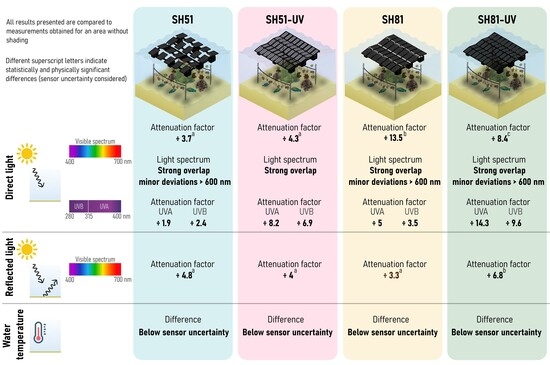
Floating photovoltaic (FPV) systems deployed in saltwater environments represent a promising renewable energy solution for remote regions, like coral reef islands, but their environmental effects remain poorly documented. Here, we conducted a year-long empirical assessment of FPV impacts on underwater light regimes and water temperature in a coral reef lagoon using four platforms with contrasting shading and UV-filtering configurations. FPV installations substantially reduced direct light reaching the seafloor. Platforms engineered to provide similar shading exhibited comparable direct light attenuation at a given position, although spatial heterogeneity beneath most of the structures resulted in additional attenuation. In contrast, reflected light was more homogeneous across platforms and appeared primarily influenced by local substrate topography, with differences between shading levels smaller than those observed for direct light. UV attenuation followed a clear gradient among platforms, whereas spectral modifications within the photosynthetically active radiation range were minor and limited to wavelengths above 600 nm. No effect of FPV installations on water temperature was detected. Overall, FPV systems induce multiple interacting modifications of the underwater light environment. While this complexity constrains the isolation of individual ecological drivers under in situ conditions, our results provide a robust physical framework for assessing the potential ecological impacts of FPV installations in coral reef ecosystems.

Graphical Abstract

1. Introduction

World electricity production still relies heavily on fossil fuels, which are finite resources and major contributors to greenhouse gas emissions and global warming [1,2]. Limiting global warming below 2 °C in 2100 requires a rapid transition of the energy system with large-scale deployment of low-carbon electricity technologies [3]. Renewable energy sources such as wind, hydropower, and solar photovoltaics are, therefore, expanding worldwide. However, in many densely populated regions, the availability of land suitable for renewable energy infrastructure is limited by competing uses, including agriculture, urban development, and conservation [4]. This challenge is particularly acute on small islands, where land resources are scarce and subject to significant land-use conflicts and energy demand often relies heavily on imported fossil fuels.
Floating photovoltaic (FPV) systems have emerged as an innovative solution to overcome land-use constraints by installing solar panels on water bodies rather than terrestrial surfaces [4]. Since the first floating PV installation was inaugurated in 2007 as part of the Aichi project in Japan, with a production capacity of 20 kW [5,6], the technology has experienced rapid global growth, particularly in the United States, Spain, Italy, and Singapore [7], increasing from 132 MW of installed capacity in 2016 to approximately 7.7 GW in 2023 [8]. In 2023, most installed FPV capacity was in Asia, with China being the largest FPV producer, accounting for approximately 50% of regional production. The Netherlands and France were the most significant producers among those located outside of Asia [9]. Although most installations are currently located on freshwater reservoirs and hydroelectric dams, FPV systems are increasingly being deployed in coastal and offshore environments [9]. Recently, experimental FPV systems have been deployed in nearshore and offshore locations, including the North Sea off the Netherlands, Abu Dhabi, and the Maldives, where FPV structures have been installed directly within a coral reef ecosystem. As FPV deployment expands into ecologically sensitive marine habitats, understanding its environmental consequences becomes increasingly important [10], particularly in fragile yet highly productive ecosystems, such as coral reefs.
Coral reefs support exceptional biodiversity and provide essential ecosystem services [7], yet they are among the most vulnerable ecosystems to climate change [11]. Rising sea surface temperatures are increasing the frequency and severity of mass bleaching events worldwide [12,13]. Coral is a symbiotic organism composed of a polyp, an animal part of the coral, and endosymbiotic algae that provide energy through photosynthetic pathways; the algae are the primary source of the coral’s diet [14]. When exposed to thermal stress, this symbiosis can break down, leading to the loss of symbionts or their pigments, a phenomenon known as coral bleaching [15,16]. Severe or prolonged bleaching can result in extensive coral mortality. Current projections suggest that 70–90% of coral reefs could disappear if global warming exceeds 1.5 °C, while the loss may exceed 99% under a 2 °C warning scenario [17].
Given the limited capacity of natural adaptation to keep pace with the current rate of climate change [18], numerous interventions have been proposed to enhance coral resilience and support reef conservation [19]. These include coral transplantation, assisted evolution, selective breeding, enhancement of heterotrophic feeding, predator control, and local stress reduction [20]. Among these approaches, shading has attracted increasing attention because excessive irradiance can amplify the physiological impacts of thermal stress and accelerate bleaching [21,22]. Experimental studies have demonstrated that reducing light exposure during marine heatwaves can alleviate bleaching severity and improve coral survival [23,24,25]. However, most restoration initiatives remain highly localized. The median restored area is only 71 m2 (0.007 ha), and fewer than 4% of projects have attempted to rehabilitate more than one hectare [26]. These data illustrate that, with current techniques and resources, restoration efforts are confined to small patches of reef, far from matching the spatial scale of climate-change-induced degradation. To have a meaningful impact, it is necessary to design and implement larger restoration projects while ensuring that timelines remain realistic [26]. Consequently, there is growing interest in identifying scalable interventions capable of operating at ecologically meaningful spatial scales.
The expansion of FPV systems in tropical coastal environments raises an intriguing possibility in this regard. By reducing incident solar radiation, FPV structures may alter local environmental conditions in ways that could influence coral physiology and bleaching susceptibility. Yet, despite the rapid development of this technology, little is known about its effects on coral reef ecosystems. FPV installations may simultaneously generate ecological risks through habitat modification and provide potential benefits through shading-induced mitigation of thermal stress. Understanding these effects is, therefore, essential before large-scale deployment in reef environments.
In this context, a collaborative project involving TotalEnergies and the municipality of Tumaraa (Ra’iātea, French Polynesia) was established to evaluate the environmental implications of floating photovoltaic structures within a tropical lagoon ecosystem. As a first step, this study investigates how FPV installations modify the physical environment surrounding coral reefs. Particular attention is given to underwater irradiance and water temperature, two key drivers of coral performance, bleaching susceptibility, and reef ecosystem functioning [27,28].

2. Material and Methods

2.1. Study Site

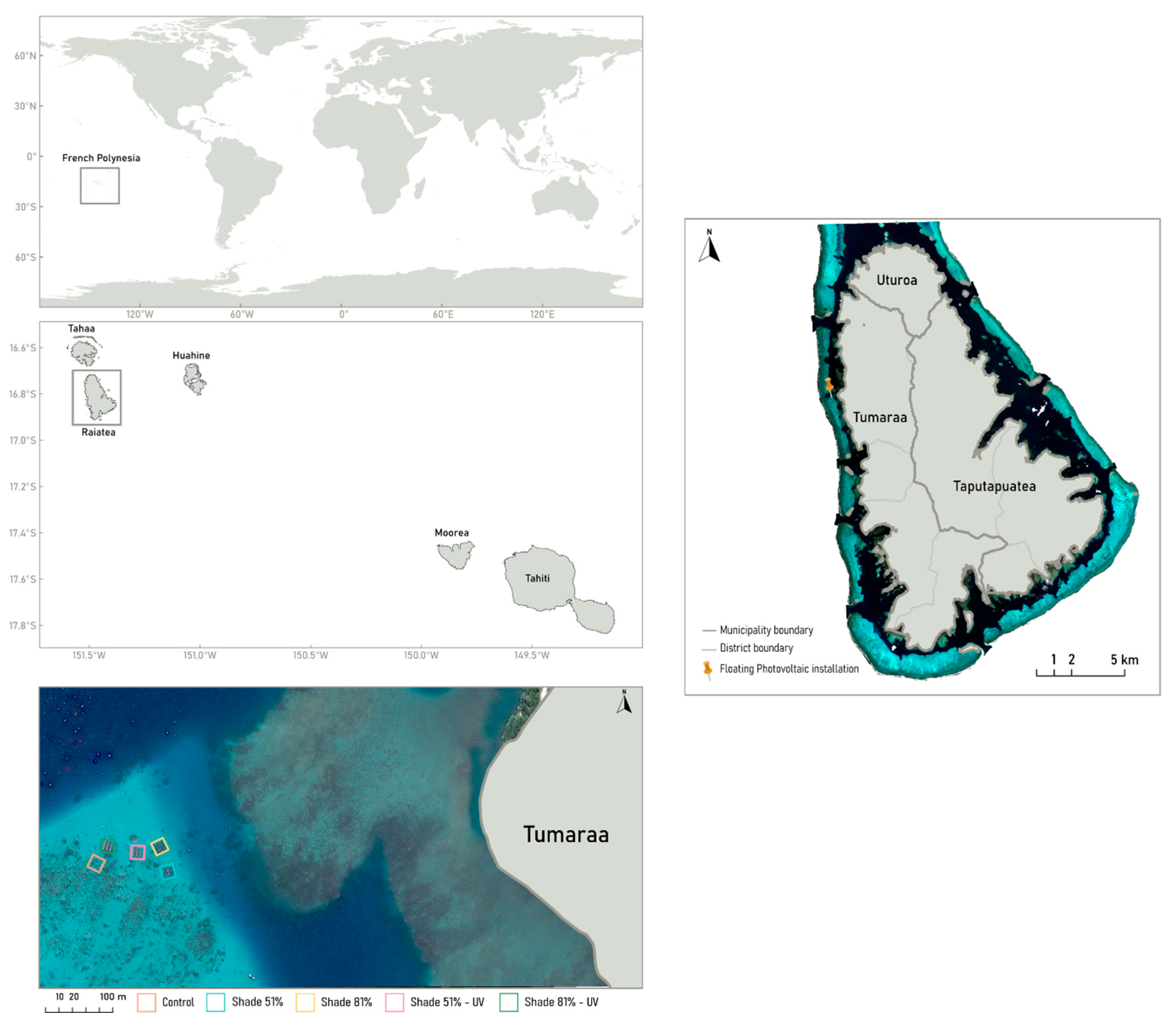
The study was conducted in the lagoon of Tumaraa (16.794191° S, 151.496646° W) on the island of Ra’iātea, French Polynesia (Figure 1). Ra’iātea is located approximately 200 km northwest of Tahiti and is the third most populous island in French Polynesia, with nearly 13,000 inhabitants. Like the other islands of the Society archipelago, Ra’iātea originated from hot-spot volcanism [29].
The experimental site was located approximately 350 m from the shoreline within the lagoon. The seabed consisted predominantly of sand interspersed with scattered coral pinnacles. The water depth beneath the floating photovoltaic (FPV) structures was approximately 2 m. The experimental design comprised four FPV platforms representing different shading treatments and two control areas without structures (Figure 1).

2.2. Floating Photovoltaic Installations

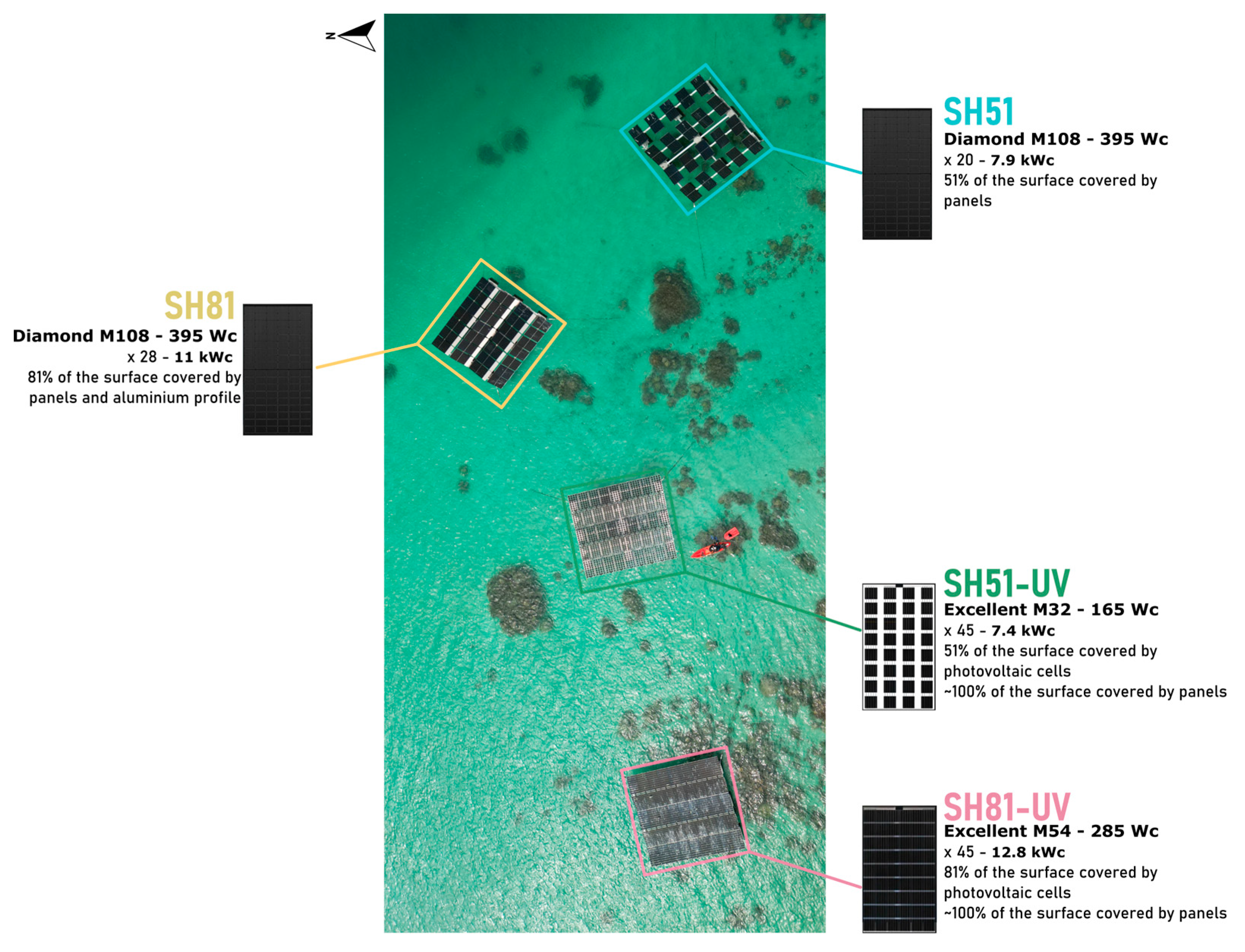
Four floating photovoltaic platforms were deployed between March and April 2024. The structures were designed by SolarinBlue (Sète, France) and differed in their shading intensity and ultraviolet (UV) transmission properties (Figure 2). The different platforms were:
-
SH51: approximately 51% shading, consisting of 20 Diamond M108 photovoltaic modules (SonnenStromfabrik, Wismar, Germany) and covering approximately 73 m2 in total with about 37 m2 of photovoltaic modules (Figure 2).
-
SH81: approximately 81% shading, consisting of 28 panels of Diamond M108 photovoltaic modules (SonnenStromfabrik, Wismar, Germany) and covering 73 m2 in total with about 59 m2 of photovoltaic modules (Figure 2).
-
SH51-UV: approximately 51% shading with enhanced UV transmission, consisting of 45 Excellent M32 photovoltaic modules (SonnenStromfabrik, Wismar, Germany) and covering approximately 76 m2 (Figure 2).
-
SH81-UV: approximately 51% shading with enhanced UV transmission, consisting of 45 Excellent M54 photovoltaic modules (SonnenStromfabrik, Wismar, Germany) and covering approximately 76 m2 (Figure 2).
The Diamond M108 modules were fully covered by photovoltaic cells, whereas the Excellent M32 and Excellent M54 modules contained photovoltaic cells on approximately 81% and 51% of their surface areas, respectively (Figure 2).
Each platform was secured using screw anchors (SK2500 L. 1 M Ø 60 MM by Uship, Saint-Cyprien, France). The mooring system (SeaFlex, Umeå, Sweden) consisted of elastic moorings allowing the platforms to move in response to water motion while maintaining their position. The elastic moorings were attached to the four corners of the platforms using 18/63 kN polyester rope, which was wrapped around a plastic pulley and a chain wrapped around the mooring piece attached to each corner. This system was very conservative for the reef, with no lines or chain at the bottom, and very flexible regarding swell and wave actions.

2.3. Light Monitoring

2.3.1. Photosynthetic Active Radiation (PAR) Monitoring

Photosynthetic Active Radiation (PAR) was monitored from August 2024 to September 2025 in five experimental zones (four platforms and one control). Within each zone, two reference positions were established beneath the platforms at coordinates (3, 3) and (4.5, 4.5) using rebar markers. Three points on the seabed were marked with rebar rods to represent the orthonormal axes (x and y). Three corners of each platform were used to serve as references. Light sensors (Xtreem Photosynthetic Active Radiation Logger, Odyssey Environmental Monitoring, Christchurch, New Zealand) cross-calibrated against HOBO Pendant Temperature/Light 64K Data Logger (HOBO Data Loggers, Bourne, MA, USA) (Supplementary Table S1) were deployed at each position at 1 m depth every 15 min. To limit biofouling, all PAR sensors were equipped with automatic wipers Odyssey PAR Wiper (Odyssey Environmental Monitoring, Christchurch, New Zealand). Sensors were serviced every three months for cleaning and data retrieval. Because the irradiance levels in French Polynesia occasionally exceeded the measurement range of the sensors, saturation events occurred regularly around midday in the control zones. Light-saturated data were deleted from the dataset, and an attenuation factor based on sensor measurements in the control zone was used for the analysis.
To quantify reflected irradiance, additional sensors were installed between March 2025 and July 2025 at position (3, 3) in each experimental zone. The light sensors were placed just beneath the sensor at a depth of 1 m to measure direct light. Direct and reflected PAR were measured simultaneously at 15 min intervals using the same deployment and maintenance procedures.
In addition, a spatial survey of reflected irradiance was conducted between 3 and 7 March 2025. Fourteen sensors were deployed at seven randomly selected locations within the experimental zones, with one pair (direct and reflected light) installed at each location and on each day within each experimental zone. Sensors were mounted on rebar rods at a depth of 1 m. One additional sensor was permanently installed in the control zone to measure both direct and reflected light. At the end of each day, sensors were relocated to a new set of randomly selected positions within the next experimental zone.

2.3.2. Ultraviolet (UV) Monitoring

Ultraviolet (UV) radiation was monitored in five zones (4 FPV platforms and 1 control area) at three time points: 23 June 2024 (cloudy condition), 28 August 2024 (sunny condition), and 19 November 2024 (sunny condition). Measurements were performed using UVA (Skye Instrument, Llandrindod Wells, Wales) and UVB sensors (Skye Instrument, Llandrindod Wells, Wales) displayed on rebar rods at location (3, 3) and deployed at different depths (1, 1.5, and 2 m). UVA’s sensor measured the spectrum between 315 and 400 nm, and UVB’s sensor measured the spectrum between 280 and 315 nm. Three replicate measurements were taken at each depth and averaged. All measurements were performed around solar noon. Additional measurements attempted in January 2025 yielded inconsistent sensor readings, preventing reliable data acquisition. Consequently, UV monitoring was discontinued after November 2024.

2.3.3. Visible Light Spectrum Monitoring

The spectral composition of underwater light was measured on 4–5 September 2025, in five zones (4 FPV platforms and 1 control area) at position (3, 3). The light spectrum was measured using a diving PAM II (D-PAM II, Heinz Walz, Effeltrich, Germany) equipped with a miniature spectrometer (MINI-SPEC, Heinz Walz, Effeltrich, Germany). Five consecutive measurements, using the Average setting in the D-PAM II, were averaged to calculate the final spectrum, while all other instrument settings were maintained at their default values.

2.4. Temperature Monitoring

Temperature was monitored across five zones (four platforms and one control) from August 2024 to September 2025. Temperature was recorded with a HOBO Water Temperature Pro v2 data logger (Hobo Data Loggers, Bourne, MA, USA) deployed at position (3, 3) and (4.5, 4.5), at 1 m depth. Measurements were recorded every 15 min. Sensors were serviced every three months for cleaning and data retrieval.

2.5. Statistical Analyses

2.5.1. Analysis of Direct and Reflected Light Attenuation

For all light analyses, attenuation factors were calculated relative to control measurements. To improve compliance with model assumptions, response variables were log-transformed. Outliers were removed using the interquartile range (IQR) criterion, excluding observations below Q1–1.5 × IQR or above Q3 + 1.5 × IQR. Generalized additive mixed models (GAMMs, [30]) were used to evaluate the effects of platform type (SH51, SH51-UV, SH81 and SH81-UV), month of measurement, sensor position, and hourly variation on light attenuation.
For direct light, the model included the fixed effects of treatment, month, position, and hour after sunrise, as well as the interactions Treatment × Month, Treatment × Position, and Treatment × Hour. Hourly variation was modeled using treatment-specific smooth functions of time since sunrise. Smoothness parameters were estimated using restricted maximum likelihood (REML, [30]). Random intercepts were included for Treatment and for Date nested within Treatment. Because measurements were recorded every 15 min and exhibited temporal autocorrelation, a continuous-time autocorrelation structure was incorporated into the model.
A similar GAMM framework was applied to reflected light data. Fixed effects included treatment, month, hour after sunrise, and the same interactions as those in the direct light model. Random intercepts were included for Date nested within Zone. Preliminary analyses indicated negligible temporal autocorrelation, and, therefore, no autocorrelation structure was retained in the final reflected light model. Observations corresponding to the minimum and maximum values of hour after sunrise were excluded because of insufficient sample sizes.

2.5.2. Analysis of Water Temperature

Water temperature data were analyzed using generalized least-squares (GLS) models. Mean daily temperature was modeled as a function of treatment, month of measurement, sensor position, and their interactions (Treatment × Month and Treatment × Position). Random intercepts were included for Treatment and for Date nested within Treatment.

2.5.3. Post Hoc Analyses and Assessment of Practical Significance

When significant fixed effects were detected, estimated marginal means were calculated and compared using Tukey-adjusted pairwise contrasts. Because large datasets can generate statistically significant differences with limited biological relevance [31], the magnitude of pairwise contrasts was compared with the sensor measurement uncertainty.
For light attenuation factors, the magnitudes of these pairwise differences were compared with the sensors’ maximal relative error (13%) (Supplementary Table S1) to assess whether statistically significant contrasts were also physically meaningful. Because attenuation factors were computed using a common reference measurement, instrumental errors associated with the reference cancel out when comparing two log-transformed attenuation factors. Consequently, the detection threshold for pairwise comparisons corresponded to the propagated uncertainty between two sensors (approximately 0.18 on the log scale).
For temperature measurements, sensor accuracy was ±0.2 °C, corresponding to a propagated uncertainty of approximately 0.28 °C for pairwise differences.
All analyses were performed with R software (v.4.5.2, R Core Team, 2025) using the packages nlme [32] for LMM, mgcv for GAMM [33], emmeans for estimated marginal means [34], and ggplot2 for data visualization [35].

3. Results

3.1. Impact of FPV Platforms on Direct Light Availability

The GAMM fitted to direct light attenuation data ( N o b s = 83,044) explained 69% of the total variance, with fixed effects accounting for 56% and random effects for 13%. The estimated autocorrelation parameter (ɸ ≈ 0.35) indicated a moderate temporal dependence between successive observations.
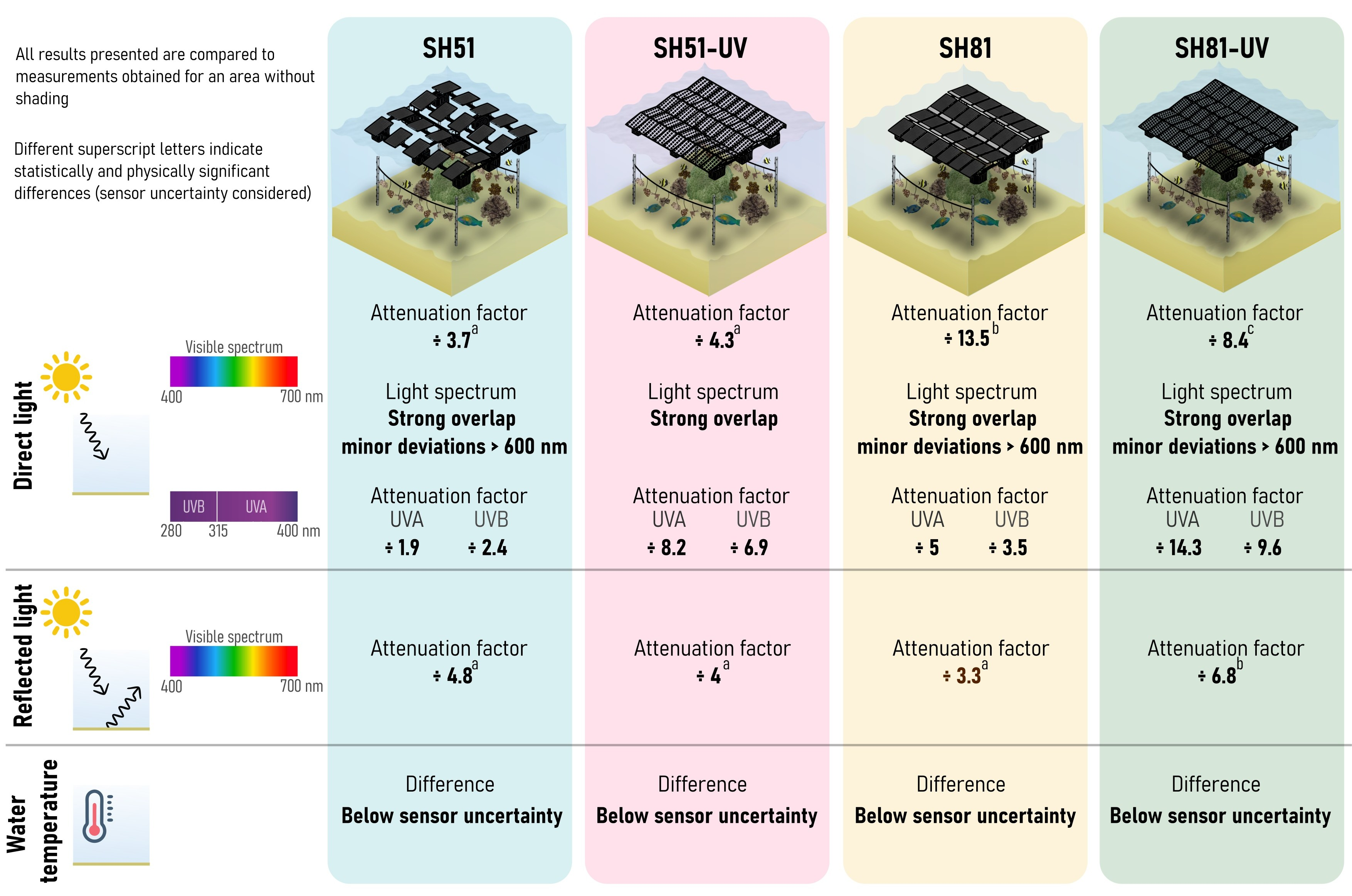
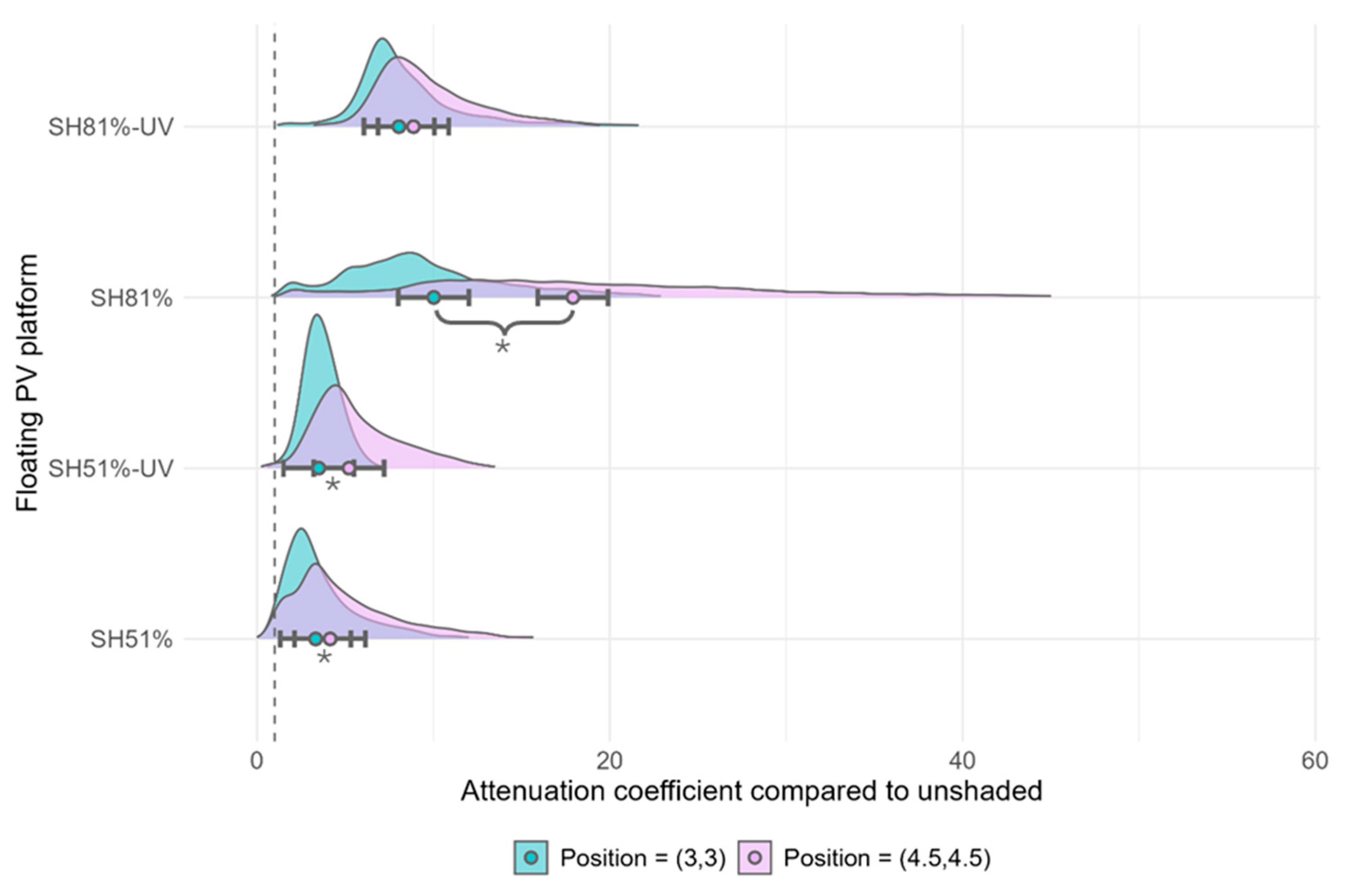
Floating photovoltaic platforms substantially reduced the amount of light reaching the benthos, and shading intensity was the main determinant of attenuation (Figure 3, Table 1). Mean attenuation coefficients were consistently higher under the 81% shading treatments than under the 51% shading treatments (Figure 3, Table 1). At position (3, 3), attenuation coefficients averaged 3.3 under SH51, 3.5 under SH51-UV, 10 under SH81 and 8.1 under SH81-UV. At position (4.5, 4.5), attenuation increased to 4.1, 5.2, 18 and 8.8, respectively. The influence of UV-transmitting modules on direct attenuation was negligible under moderate shading but became detectable under strong shading conditions. Attenuation coefficients under SH51 and SH51-UV were indistinguishable once sensor uncertainty was considered (Table 1). In contrast, attenuation under SH81 and SH81-UV differed beyond the propagated measurement error, particularly at position (4.5, 4.5).
The spatial distribution of light beneath FPV platforms varied markedly among platform configurations. For SH51 and SH51-UV, attenuation coefficients were higher at position (4.5, 4.5) than at position (3, 3), with differences exceeding instrumental uncertainty. The strongest spatial heterogeneity occurred under SH81, where attenuation at position (4.5, 4.5) was approximately 1.8 times greater than that at position (3, 3) (Figure 3). By contrast, SH81-UV exhibited little spatial variability, as differences between positions remained below the propagated sensor error.
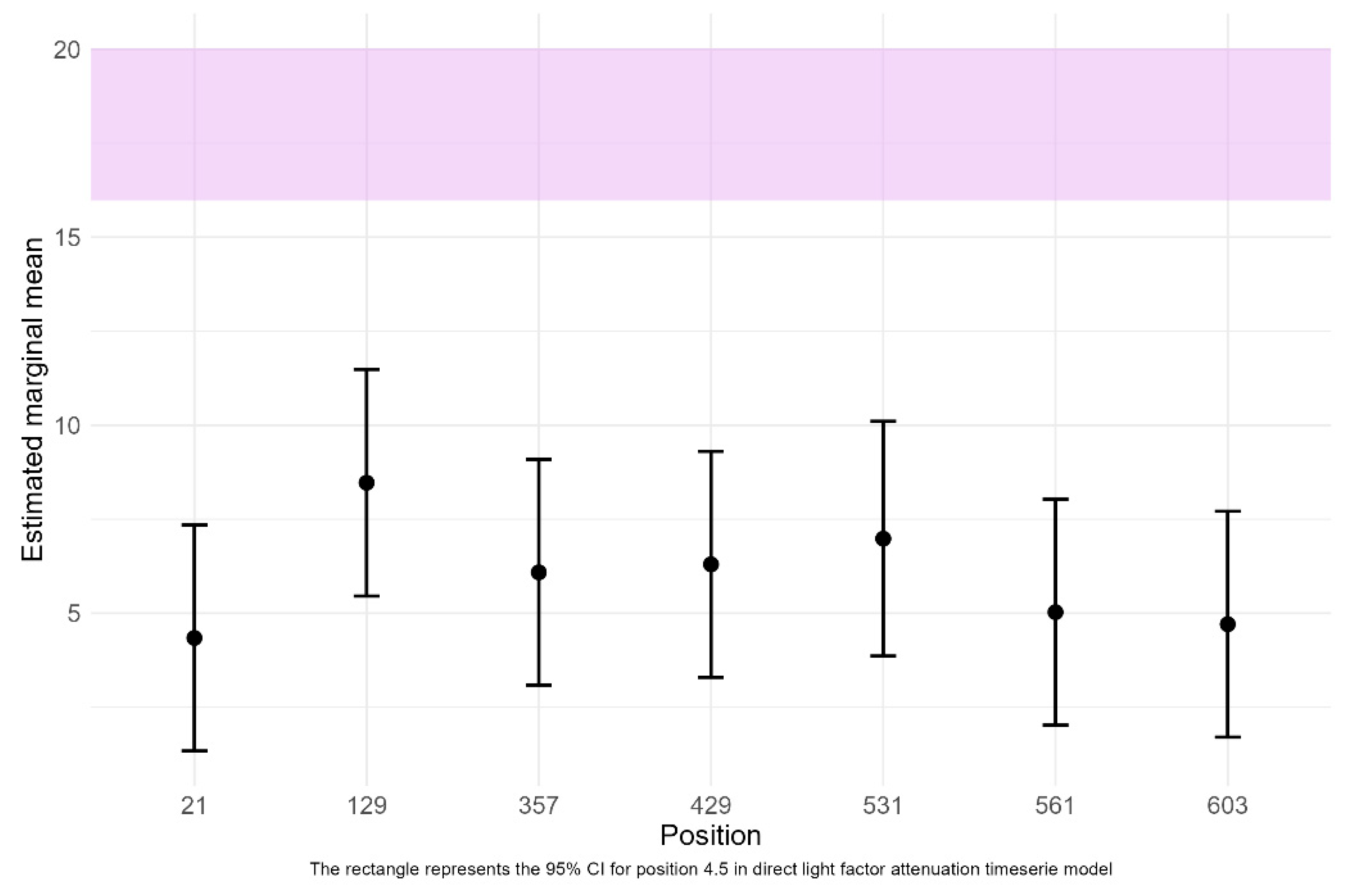
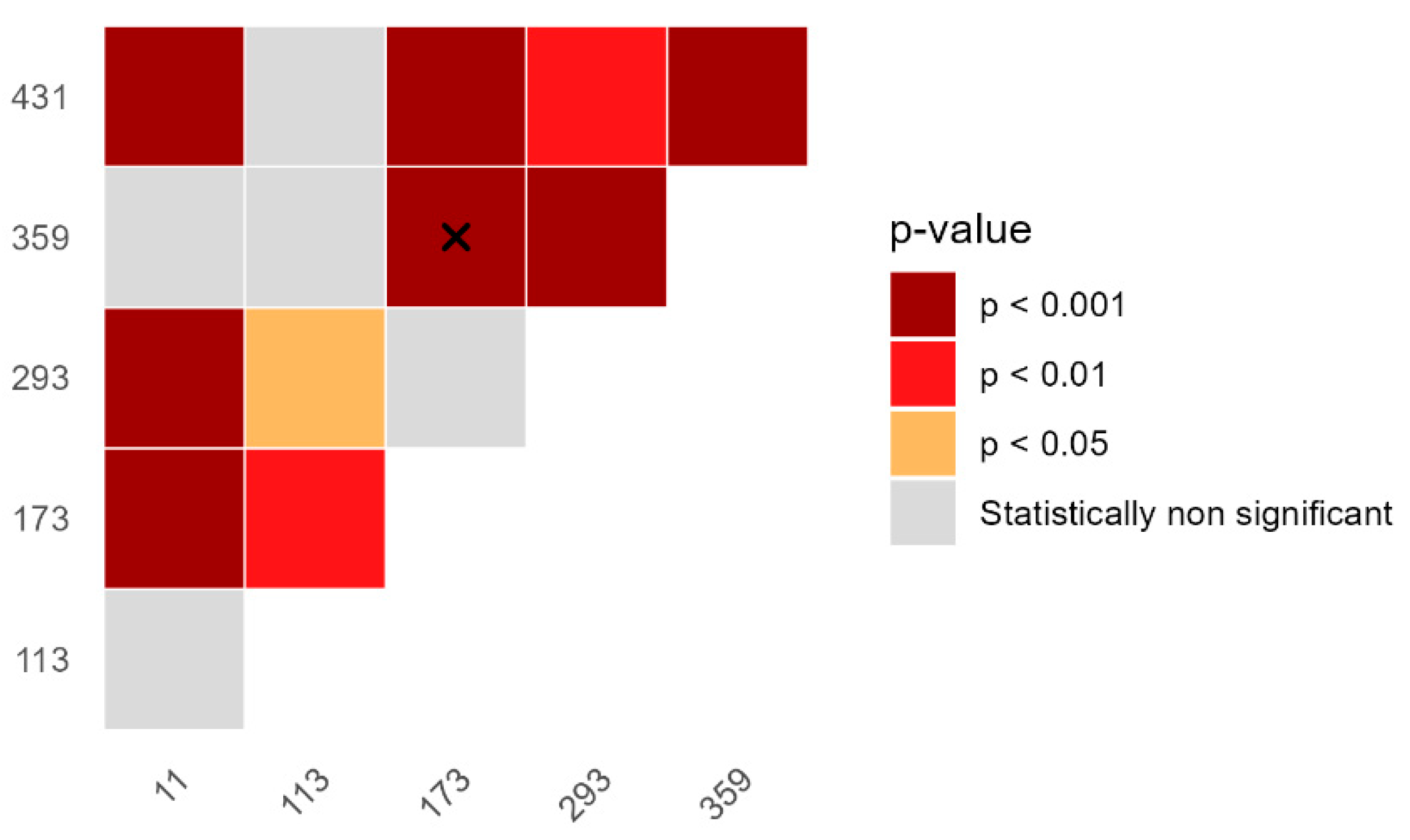
Additional spatial surveys confirmed that the strong attenuation observed under SH81 resulted from localized shading patterns rather than from a uniform reduction in light across the entire platform footprint. The model fitted to seven additional sampling positions showed that attenuation at position (4.5, 4.5) differed from most other locations beneath the platform (Figure 4). In contrast, the spatial survey conducted beneath SH81-UV revealed no significant positional effect (Figure 5).
In addition to reducing incoming light, FPV platforms modified the quantity of light reflected toward the benthic environment. Although hour after sunrise improved model fit, only four of the 220 tested comparisons exceeded propagated sensor uncertainty (Supplementary Figure S3). Consequently, no biologically meaningful diel pattern could be identified. Similarly, no consistent seasonal trend emerged throughout the monitoring period (Supplementary Figure S4). Nevertheless, month-to-month variability tended to be greater for platforms characterized by spacing between photovoltaic panels than for those characterized by spacing between photovoltaic cells.

3.2. Impact of FPV Platforms on Reflected Irradiance

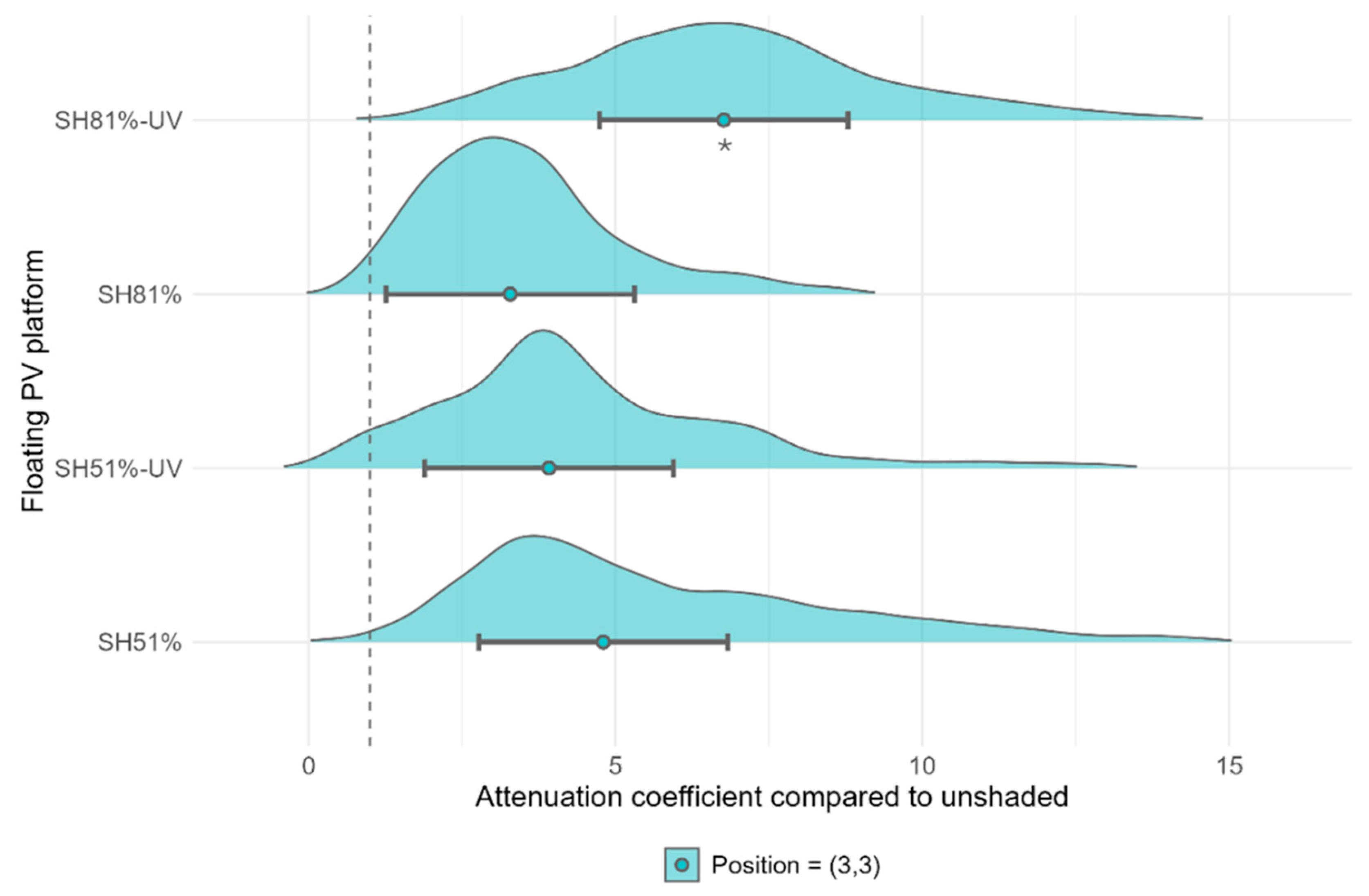
In addition to reducing incoming light, FPV platforms modified the quantity of light reflected toward the benthic environment. The reflected light model ( N o b s = 14,543) explained 61% of the variance, with fixed effects accounting for 34% and random effects accounting for 27%. Reflected attenuation coefficients differed among treatments (Figure 6, Table 2). The strongest effect was observed under SH81-UV, which displayed the highest marginal mean attenuation coefficient (6.8), compared with 4.8 under SH51, 4.0 under SH51-UV and 3.3 under SH81. Overall, reflected attenuation coefficients under SH51 and SH51-UV remained indistinguishable after accounting for sensor uncertainty, whereas clear differences emerged between SH81 and SH81-UV (Figure 6).
The influence of hour after sunrise was more pronounced for reflected light (Supplementary Figure S6), affecting attenuation coefficients mainly near sunrise and sunset, and only for the highly dense platforms (SH81 and SH81-UV). As observed for direct attenuation, no consistent seasonal pattern emerged across months (Supplementary Figure S7). However, variability among months was greater for configurations with spacing between photovoltaic modules than for those with spacing between photovoltaic cells.
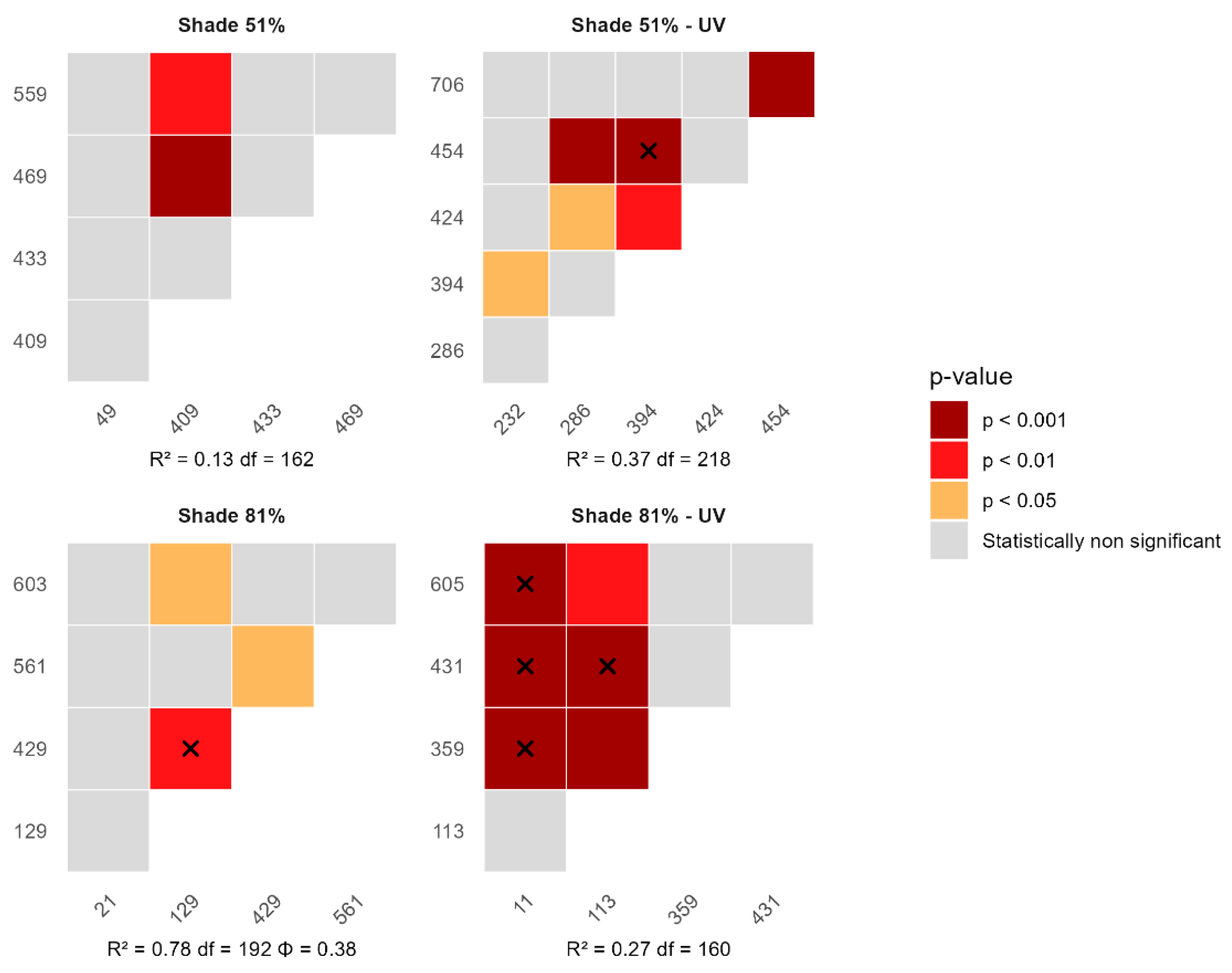
Due to sensor limitations, it was not feasible to study the effect of position on the reflected light attenuation factor. To explore potential spatial variability beneath the platforms, separate models including multiple positions ( n m i n = 5 and n m a x = 6) were fitted for each platform. No significant positional effects were detected on the reflected attenuation factor for SH51, SH51-UV, and SH81 (Figure 7). In contrast, SH81-UV exhibited significant spatial variability. Position 11 differed significantly from three other locations, while position 113 differed significantly from one of these three locations. After accounting for sensor uncertainty, only some of these contrasts remained above the instrumental detection threshold (Figure 7).

3.3. Effect of FPV Platforms on UV Radiations

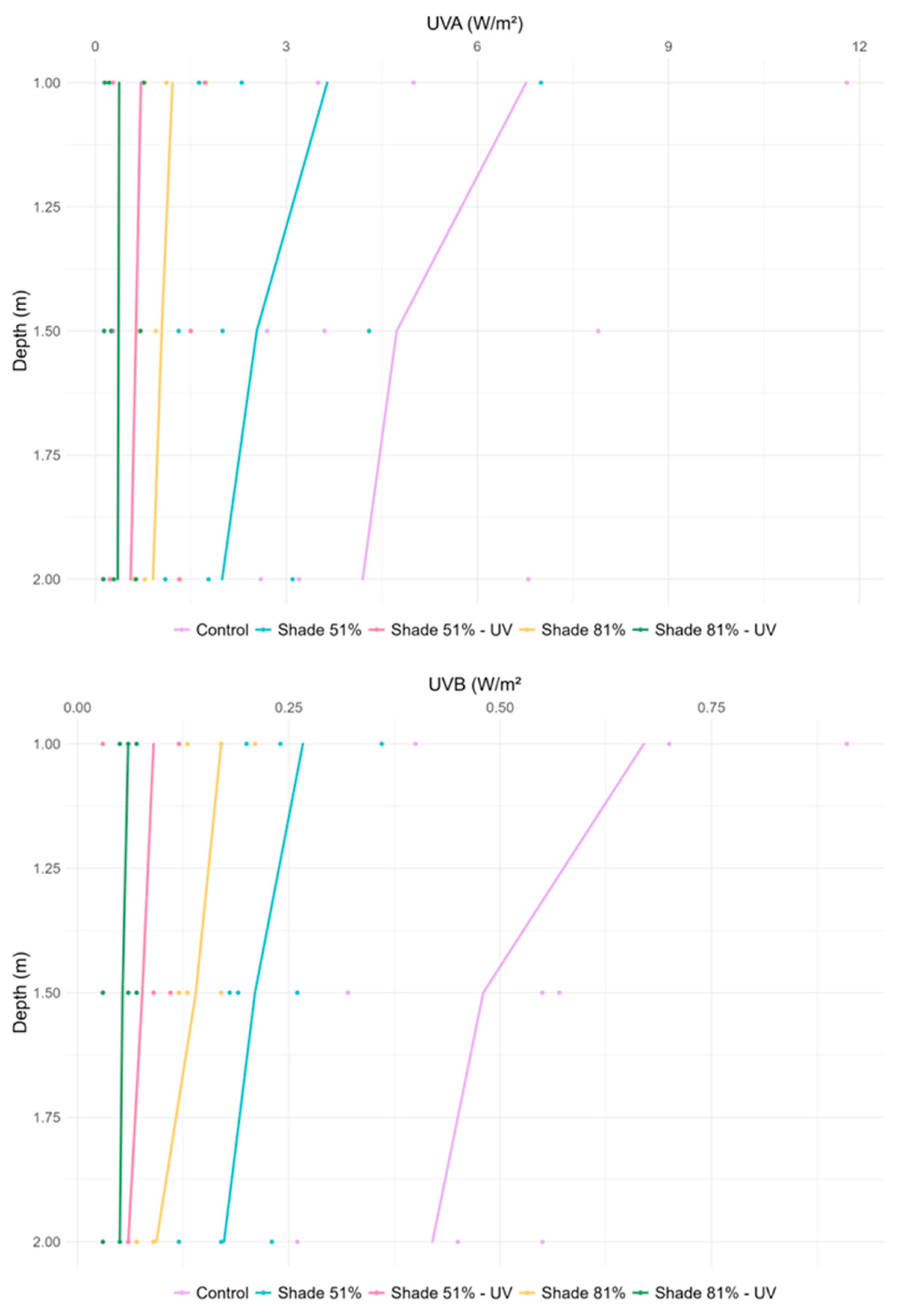
Both UVA and UVB irradiance declined strongly beneath FPV platforms. Between 1 and 2 m depth, UVA intensity decreased by factors of approximately 1.9 (sd = 1.7) under SH51, 5.0 (sd = 3.5) under SH81, 8,2 (sd = 9.8) under SH51-UV, and 14.3 (sd = 13.2) under SH81-UV. Similarly, UVB intensity decreased by factors of approximately 2.41 (sd = 1.2) under SH51, 3.5 (sd = 1.9) under SH81, 6.9 (sd = 4.4) under SH51-UV, and 9.6 (sd = 4.6) under SH81-UV. UVA and UVB exhibited a similar pattern across light conditions (Figure 8). Unexpectedly, UV-transmitting conditions (SH51 and SH81) did not maintain UV levels comparable to ambient conditions. Instead, UV intensities measured beneath SH51-UV and SH81-UV remained substantially lower than those in control areas, although generally higher than those beneath fully covered photovoltaic module platforms (Figure 8).

3.4. Impact of FPV Platform on Visible Light Spectrum

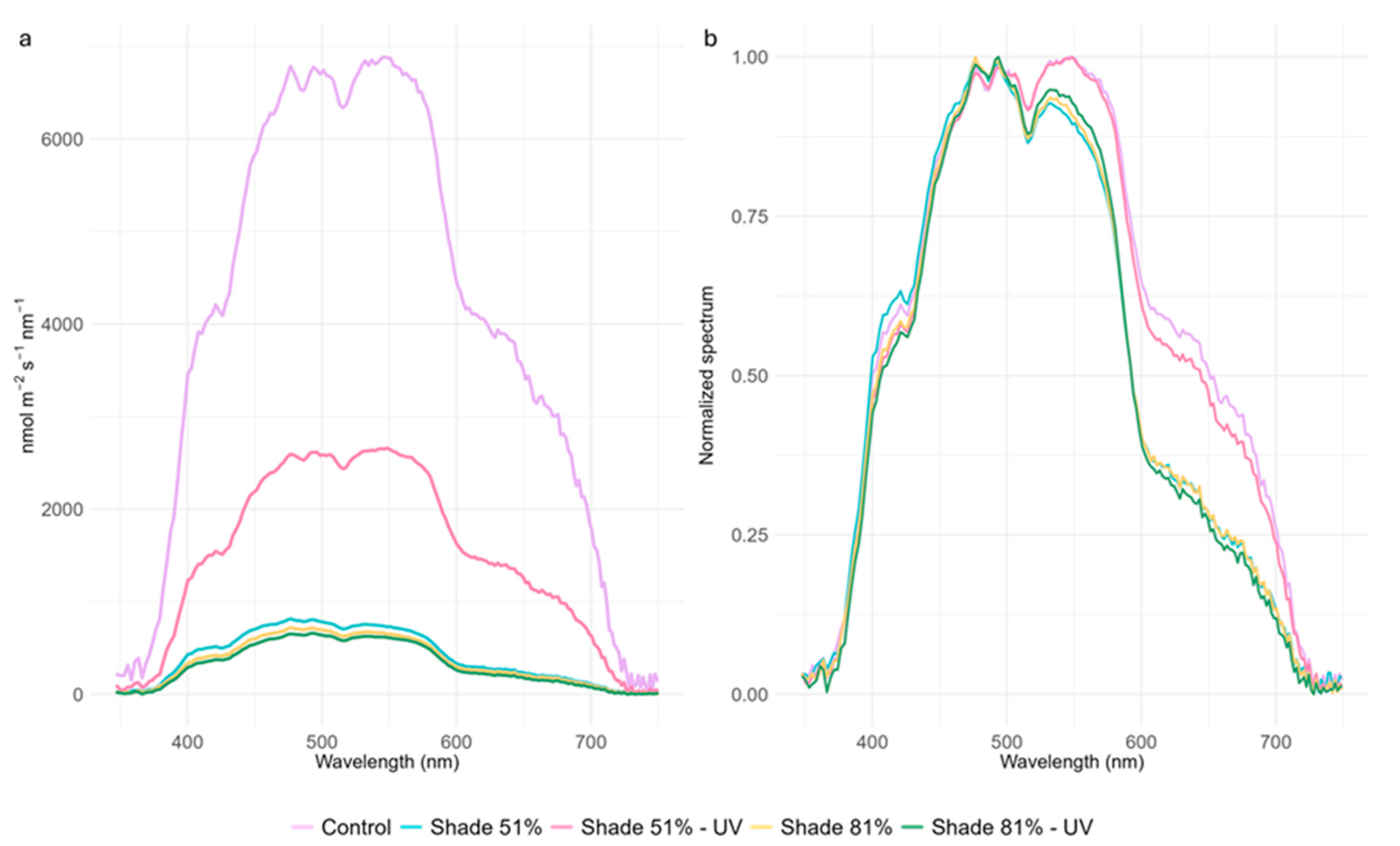
The visible light spectrum differed strongly among treatments because of differences in transmitted irradiance (Figure 9a). However, normalized spectra showed strong overlap across conditions, with only minor deviations at longer wavelengths (>600 nm), suggesting that shading from platforms induced light attenuation with negligible spectral changes (Figure 9b). These results indicate that FPV platforms primarily act as neutral shade structures, reducing the amount of available light while largely preserving its spectral characteristics.

3.5. Impact of FPV Platform on Water Temperature

During the year-long study period, water temperature followed a clear seasonal cycle, ranging from 26.9 °C in July and August to 29.4 °C in February (data from control). Water temperature was statistically significantly lower in FPV conditions compared to control conditions ( N o b s = 2737, R c o n d i t i o n a l 2 = 0.99, R m a r g i n a l 2 = 0.58, p < 0.001, Supplementary Table S2). However, estimated temperature differences relative to control conditions ranged from −0.06 °C to 0°. Although the pairwise Tukey tests (Supplementary Table S2) indicated statistically significant differences, the magnitude of these differences did not exceed the propagated sensor’s accuracy (0.28 °C). Despite substantially reducing irradiance, FPV platforms did not produce biologically meaningful changes in water temperature.

4. Discussion

4.1. Effects of the FPV Platform on Direct Light

Our results demonstrate that the principal environmental effect of FPV platforms in a tropical lagoon is a substantial reduction in irradiance reaching the benthic environment, whereas modifications of spectral composition remain limited. All FPV platform configurations significantly reduced the direct irradiance reaching the water column beneath them compared to the unshaded area (Figure 3), confirming that FPV acts as a physical barrier [10] to incoming solar radiation, as previously reported in freshwater systems [36]. The magnitude of attenuation was primarily controlled by the engineered shading level, with the 81% configurations producing substantially greater attenuation than the 51% configurations. Meanwhile, for a given sensor position, the statistical model indicated that SH51 and SH51-UV exhibited comparable light regimes, whereas both differed from the highly covered platforms SH81 and SH81-UV (Table 1). Although some differences were detected between SH81 and SH81-UV during long-term monitoring (Figure 4), the complementary spatial analyses indicated that these differences were largely driven by localized shading effects rather than by intrinsic differences between platform designs. Structural components such as floats, beams, or anchoring elements likely generated small-scale zones of enhanced shading that were captured by individual sensors. However, our analyses considering the spatial model did not reveal statistically or physically significant differences between positions under SH51 and SH51-UV or between those under SH81 and SH81-UV. Overall, these results should be interpreted with caution, as uncertainties associated with light measurements may be large enough to mask ecologically meaningful responses of corals and other photosynthetic organisms, as previously suggested by [37].
Moreover, across platforms, spectral modifications were mainly changes in irradiance intensity, with only minor effects on the light spectrum above 600 nm (Figure 9). The implications of reduced irradiance in this spectral region for coral growth remain uncertain. Coral symbiotic algae contain chlorophyll a and chlorophyll C 2 ; their absorption maxima are located around 450 nm and 650 nm, respectively [38]. Experimental studies have demonstrated that both blue and red wavelengths can contribute to the photosynthesis performance of coral symbionts [38,39]. However, several studies also report contrasting biological responses, with blue light generally promoting coral growth, whereas red light exerts inhibiting effects depending on species [40,41]. Consequently, the ecological significance of the minor spectral changes observed beneath FPV platforms remains uncertain and is likely to be considerably smaller than the effects associated with the overall reduction in irradiance.
Regarding the ultraviolet monitoring, FPV platforms fully covered with spacing between cells appeared to reduce UV radiation more effectively than platforms with space between panels (Figure 8). Our results suggest that SH51 and SH51-UV differed in their ultraviolet cut-off, and that a similar distinction applies to SH81 and SH81-UV. This finding is particularly relevant for coral reef ecosystems because ultraviolet radiation can influence both physiological stress and photoprotection mechanisms in corals and their symbiotic algae [42,43].

4.2. Effects on Reflected Light

Compared with direct irradiance, reflected light exhibited greater spatial homogeneity and weaker differences among FPV configurations (Table 1 and Table 2). Indeed, while platforms with identical configurations exhibited similar attenuation factors for direct light at position (3, 3), SH81 and SH81-UV showed distinct attenuation factors for reflected light (Figure 6). Moreover, the differences in attenuation factors between 51% and 81% shade were smaller for reflected light than for direct light. This pattern is consistent with earlier studies demonstrating that reflected light under shade conditions tends to become spatially homogenized [44,45]. In aquatic environments, multiple scattering and diffusion within the water column contribute to rapid homogenization [37]. Nevertheless, local reef topography can still generate microhabitats characterized by distinct reflected light regimes. The spatial heterogeneity observed beneath SH81-UV may have resulted from the presence of nearby coral pinnacles that altered local scattering and reflection patterns. Similar effects have been documented in natural reef environments where benthic morphology strongly influences underwater light fields [37].

4.3. Effects on Temperature

Despite substantial reductions in irradiance, our results indicate that FPV affected temperature; however, these differences did not surpass the resolution of our temperature sensor (Supplementary Table S2). These findings contrast with several studies conducted in lakes or reservoirs, where shading by FPV platforms significantly reduced water temperature [10,46]. However, our results are consistent with studies reporting negligible thermal effects of FPV platforms on temperature when these platforms cover less than 2% of the lake surface area [47,48], mainly due to water mixing beneath the FPV platforms with adjacent uncovered areas [46]. Given the relative size of our FPV platform compared to the surrounding water body, our findings align with those reported for small-scale FPV platforms in lakes and reservoirs. Moreover, hydro-morphological characteristics significantly influence the effects of FPV platforms on temperature [49]. This factor is particularly relevant in high-island lagoon systems, where water residence times are on the order of hours [50], whereas in lakes and reservoirs, mean residence times are approximately 0.7 years and 4 years, respectively [51]. Consequently, water parcels remain beneath FPV structures for insufficient periods to undergo substantial thermal modification. The combination of strong water mixing and the relatively small footprint of the experimental platforms, therefore, appears to prevent the development of localized cooling effects.

4.4. Implications for Coral Reef Ecosystems and FPV Deployment

Taken together, our results indicate that FPV installations primarily modify the underwater light environment while exerting little influence on temperature. The dominant environmental effects of FPV deployment were reductions in PAR and UV radiation. These changes are likely to influence photosynthetic organisms, including reef-building corals [28], but the direction and magnitude of biological responses remain uncertain. Importantly, the environmental modifications generated by FPV systems cannot be reduced to a single shading value. Instead, FPV installations create complex optical environments resulting from interactions among platform design, structural elements, local topography, and hydrodynamic conditions.
This complexity highlights both the opportunities and challenges associated with FPV deployment in coral reef ecosystems. Reduced irradiance may mitigate light stress during thermal bleaching events [23,24,25], whereas excessive attenuation can limit photosynthetic performance under non-stressful conditions [52,53]. Understanding where the balance lies between these opposing mechanisms remains a critical research priority. Future studies should, therefore, move beyond physical characterization and evaluate the consequences of FPV deployment for coral physiology, reef biodiversity, ecosystem functioning, and climate resilience. Expanding investigations across a wider range of platform sizes, coverage ratios, hydrodynamic settings, and climatic conditions will be essential for predicting the ecological impacts of FPV technologies in tropical coastal ecosystems. In fact, the small size of our pilot platforms may limit certain potential impacts, such as those on water temperature, phytoplankton density, and changes in zooplankton communities [10].

5. Conclusions

Floating photovoltaic platforms substantially altered the underwater light environment but produced no detectable changes in lagoon water temperature. The magnitude of direct light attenuation was primarily controlled by platform shading intensity, whereas spectral modifications within the PAR range remained limited. Ultraviolet radiation was also substantially reduced beneath FPV structures. A major outcome of this study is the demonstration that FPV platforms generate spatially heterogeneous light environments mainly associated with platform architecture, emphasizing the need for spatially explicit environmental monitoring. Reflected light was generally more homogeneous than direct light and appeared to be influenced more strongly by local reef topography than by platform configuration for small-scale platforms. Overall, these findings indicate that FPV systems modify multiple components of the underwater radiation environment simultaneously, creating complex optical conditions that cannot be described solely by nominal shading percentages. Understanding how these physical changes translate into biological responses now represents the next critical step for evaluating the ecological compatibility of FPV technologies with coral reef ecosystems.

Supplementary Materials

The following supporting information can be downloaded at: https://www.mdpi.com/article/10.3390/jmse14171605/s1, Figure S1: Verifications of model assumptions for the direct light model; Figure S2: Temporal autocorrelation of model residuals on direct light: (a) before temporal autocorrelation correction; (b) after temporal correction; Figure S3: Results of pairwise post-hoc comparisons of hourly direct light attenuation factor (ln-transformed) contrast inside a FPV condition; Figure S4: Results of pairwise post-hoc comparisons of monthly direct light attenuation factor (ln-transformed) contrast inside a FPV condition; Figure S5: Verifications of model assumptions for the reflected light model; Figure S6: Results of pairwise post-hoc comparisons of hourly reflected light attenuation factor (ln-transformed) contrast inside a FPV condition; Figure S7: Results of pairwise post-hoc comparisons of monthly reflected light attenuation factor (ln-transformed) contrast inside a FPV condition; Figure S8: Verifications of model assumptions for daily temperature model; Table S1: Calibration of the Odyssey Submersible PAR sensor compared to the HOBO Pendant Temperature/Light 64K Data Logger; Table S2: Pairwise post-hoc comparisons of daily temperature contrast between non-FPV and FPV conditions.

Author Contributions

M.A.: Writing—Original Draft, Conceptualization, Data Analysis, Investigation, Methodology. L.H.: Writing—Review and Editing, Conceptualization. E.D.: Writing—Review and Editing, Conceptualization, Funding Acquisition, Supervision. S.P.: Writing—Review and Editing, Conceptualization, Investigation, Methodology, Funding Acquisition, Supervision. All authors have read and agreed to the published version of the manuscript.

Funding

The author(s) declared that financial support was received for the research, authorship, and/or publication of this article. This work was funded by Total Energies and French Polynesia through the RIP call for projects.

Institutional Review Board Statement

Not applicable.

Data Availability Statement

Data are available at https://zenodo.org/records/21840278 (accessed on 7 August 2026). Code are available at: https://github.com/m-adge/FPV_effect_light_temp (accessed 31 August 2026).

Acknowledgments

The authors would like to thank the municipality of Tumaraa, its council, its technical department, and the mayor, Cyril Tetuanui, who agreed to host this project and provide equipment and personnel for construction and maintenance.

Conflicts of Interest

Serge Planes, Etienne Drahi and Mathieu Adgé are co-authors of the patent (Device and associated method using solar energy and adapted for the protection of corals, EP4546643A1). This patent covers the concept of combining solar energy production and coral reef nurseries. The patent was published in 2025 and its status is “Pending”. Author Etienne Drahi was employed by the company Total Energies One Tech. The remaining authors declare that the research was conducted in the absence of any commercial or financial relationships that could be construed as a potential conflict of interest.

References

  1. Hussain, A.; Arif, S.M.; Aslam, M. Emerging renewable and sustainable energy technologies: State of the art. Renew. Sustain. Energy Rev. 2017, 71, 12–28. [Google Scholar] [CrossRef] [Scilit]
  2. Musa, S.D.; Zhonghua, T.; Ibrahim, A.O.; Habib, M. China’s energy status: A critical look at fossils and renewable options. Renew. Sustain. Energy Rev. 2018, 81, 2281–2290. [Google Scholar] [CrossRef] [Scilit]
  3. Riahi, K.; Schaeffer, R.; Arango, J.; Calvin, K.; Guivarch, C.; Hasegawa, T.; Jiang, K.; Kriegler, E.; Matthews, R.; Peters, G.P.; et al. 2022: Mitigation Pathways Compatible with Long-Term Goals. In IPCC, 2022: Climate Change 2022: Mitigation of Climate Change. Contribution of Working Group III to the Sixth Assessment Report of the Intergovernmental Panel on Climate Change; Cambridge University Press: Cambridge, UK; New York, NY, USA, 2022. [Google Scholar] [CrossRef] [Scilit]
  4. Oliveira-Pinto, S.; Stokkermans, J. Assessment of the potential of different floating solar technologies—Overview and analysis of different case studies. Energy Convers. Manag. 2020, 211, 112747. [Google Scholar] [CrossRef] [Scilit]
  5. Choi, Y.K.; Choi, W.S.; Lee, J.H. Empirical research on the efficiency of floating PV systems. Sci. Adv. Mater. 2016, 8, 681–685. [Google Scholar] [CrossRef] [Scilit]
  6. Ueda, Y.; Kurokawa, K.; Konagai, M.; Takahashi, S.; Terazawa, A.; Ayaki, H. Five years demonstration results of floating PV systems with water spray cooling. In 27th European Photovoltaic Solar Energy Conference and Exhibition; EUREC: Brussels, Belgium, 2012; pp. 3926–3928. [Google Scholar]
  7. Moberg, F.; Folke, C. Ecological goods and services of coral reef ecosystems. Ecol. Econ. 1999, 29, 215–233. [Google Scholar] [CrossRef] [Scilit]
  8. Selj, J.; Wieland, S.; Tsanakas, I.; van Sark, W.; Roosloot, N.; Otnes, G.; Nysted, V.S.; de Jong, M.; Kroon, J.; Micheli, L. Floating Photovoltaic PowerPlants: A Review of Energy Yield, Reliability, and Maintenance. 2025. Available online: https://iea-pvps.org/key-topics/t13-floating-pv-plants-review-2025/ (accessed on 11 May 2026).
  9. Rodríguez-Gallegos, C.D.; Gandhi, O.; Sun, H.; Paton, C.; Zhang, J.; Ali, J.M.Y.; Alvarez-Alvarado, M.S.; Zhang, W.; Rodríguez-Gallegos, C.A.; Chua, L.H. Global floating PV status and potential. Prog. Energy 2024, 7, 015001. [Google Scholar] [CrossRef] [Scilit]
  10. Exley, G.; Armstrong, A.; Page, T.; Jones, I.D. Floating photovoltaics could mitigate climate change impacts on water body temperature and stratification. Sol. Energy 2021, 219, 24–33. [Google Scholar] [CrossRef] [Scilit]
  11. Mellin, C.; Brown, S.; Cantin, N.; Klein-Salas, E.; Mouillot, D.; Heron, S.F.; Fordham, D.A. Cumulative risk of future bleaching for the world’s coral reefs. Sci. Adv. 2024, 10, eadn9660. [Google Scholar] [CrossRef] [Scilit] [PubMed]
  12. Donner, S.D.; Skirving, W.J.; Little, C.M.; Oppenheimer, M.; Hoegh-Guldberg, O.V.E. Global assessment of coral bleaching and required rates of adaptation under climate change. Glob. Change Biol. 2005, 11, 2251–2265. [Google Scholar] [CrossRef] [Scilit] [PubMed]
  13. Hughes, A.D.; Grottoli, A.G. Heterotrophic compensation: A possible mechanism for resilience of coral reefs to global warming or a sign of prolonged stress? PLoS ONE 2013, 8, e81172. [Google Scholar] [CrossRef] [Scilit] [PubMed]
  14. Grottoli, A.G.; Rodrigues, L.J.; Palardy, J.E. Heterotrophic plasticity and resilience in bleached corals. Nature 2006, 440, 1186–1189. [Google Scholar] [CrossRef] [Scilit] [PubMed]
  15. Levas, S.J.; Grottoli, A.G.; Hughes, A.; Osburn, C.L.; Matsui, Y. Physiological and biogeochemical traits of bleaching and recovery in the mounding species of coral Porites lobata: Implications for resilience in mounding corals. PLoS ONE 2013, 8, e63267. [Google Scholar] [CrossRef] [Scilit] [PubMed]
  16. Rodrigues, L.J.; Grottoli, A.G. Energy reserves and metabolism as indicators of coral recovery from bleaching. Limnol. Oceanogr. 2007, 52, 1874–1882. [Google Scholar] [CrossRef] [Scilit]
  17. Hoegh-Guldberg, O.; Kennedy, E.V.; Beyer, H.L.; McClennen, C.; Possingham, H.P. Securing a long-term future for coral reefs. Trends Ecol. Evol. 2018, 33, 936–944. [Google Scholar] [CrossRef] [Scilit] [PubMed]
  18. Hoegh-Guldberg, O. The adaptation of coral reefs to climate change: Is the Red Queen being outpaced? Sci. Mar. 2012, 76, 403–408. [Google Scholar] [CrossRef] [Scilit]
  19. Voolstra, C.R.; Suggett, D.J.; Peixoto, R.S.; Parkinson, J.E.; Quigley, K.M.; Silveira, C.B.; Sweet, M.; Muller, E.M.; Barshis, D.J.; Bourne, D.G. Extending the natural adaptive capacity of coral holobionts. Nat. Rev. Earth Environ. 2021, 2, 747–762. [Google Scholar] [CrossRef] [Scilit]
  20. Voolstra, C.R.; Peixoto, R.S.; Ferrier-Pagès, C. Mitigating the ecological collapse of coral reef ecosystems: Effective strategies to preserve coral reef ecosystems. EMBO Rep. 2023, 24, e56826. [Google Scholar] [CrossRef] [Scilit] [PubMed]
  21. Hoegh-Guldberg, O. Climate change, coral bleaching and the future of the world’s coral reefs. Mar. Freshw. Res. 1999, 50, 839–866. [Google Scholar] [CrossRef] [Scilit]
  22. Smith, L.W.; Birkeland, C. Effects of intermittent flow and irradiance level on back reef Porites corals at elevated seawater temperatures. J. Exp. Mar. Biol. Ecol. 2007, 341, 282–294. [Google Scholar] [CrossRef] [Scilit]
  23. Butcherine, P.; Tagliafico, A.; Ellis, S.L.; Kelaher, B.P.; Hendrickson, C.; Harrison, D. Intermittent shading can moderate coral bleaching on shallow reefs. Front. Mar. Sci. 2023, 10, 1162896. [Google Scholar] [CrossRef] [Scilit]
  24. Coelho, V.R.; Fenner, D.; Caruso, C.; Bayles, B.R.; Huang, Y.; Birkeland, C. Shading as a mitigation tool for coral bleaching in three common Indo-Pacific species. J. Exp. Mar. Biol. Ecol. 2017, 497, 152–163. [Google Scholar] [CrossRef] [Scilit]
  25. Ellis, S.L.; Butcherine, P.; Tagliafico, A.; Hendrickson, C.; Kelaher, B.P.; Schulz, K.G.; Harrison, D.P. Shading responses are species-specific in thermally stressed corals. Front. Mar. Sci. 2024, 11, 1333806. [Google Scholar] [CrossRef] [Scilit]
  26. Hughes, T.P.; Baird, A.H.; Morrison, T.H.; Torda, G. Principles for coral reef restoration in the anthropocene. One Earth 2023, 6, 656–665. [Google Scholar] [CrossRef] [Scilit]
  27. McClanahan, T.R.; Ateweberhan, M.; Muhando, C.A.; Maina, J.; Mohammed, M.S. Effects of climate and seawater temperature variation on coral bleaching and mortality. Ecol. Monogr. 2007, 77, 503–525. [Google Scholar] [CrossRef] [Scilit]
  28. Tagliafico, A.; Baker, P.; Kelaher, B.; Ellis, S.; Harrison, D. The Effects of Shade and Light on Corals in the Context of Coral Bleaching and Shading Technologies. Front. Mar. Sci. 2022, 9, 919382. [Google Scholar] [CrossRef] [Scilit]
  29. Blais, S.; Guille, G.; Maury, R.C.; Guillou, H.; Miau, D.; Cotten, J. Géologie et pétrologie de l’île de Raiatea (Société, Polynésie Française). Comptes Rendus Académie Sci.—Ser. III—Sci. Vie 1997, 324, 435–442. [Google Scholar]
  30. Wood, S.N. Generalized Additive Models: An Introduction with R; Chapman and Hall/CRC: Boca Raton, FL, USA, 2017. [Google Scholar]
  31. Barnagaud, J.-Y.; Gimenez, O. Analyse de Données en Ecologie, Introduction aux Outils Statistiques Avec R; Le Club Biotope: Mèze, France, 2025. [Google Scholar]
  32. Pinheiro, J.; Bates, D.; DebRoy, S.; Sarkar, D.; Heisterkamp, S.; Van Willigen, B.; Maintainer, R. Package ‘nlme.’ Linear Nonlinear Mix. Eff. Models Version 3, 274. 2017. Available online: https://cran.r-project.org/web/packages/nlme/index.html (accessed on 28 April 2026).
  33. Wood, S. Package ‘mgcv.’ R Package Version 1, 2015; 729. Available online: https://cran.r-project.org/web/packages/mgcv/index.html (accessed on 28 April 2026).
  34. Lenth, R.V.; Piaskowski, J. emmeans: Estimated Marginal Means, aka Least-Squares Means. 2025. Available online: https://cran.r-project.org/web/packages/emmeans/emmeans.pdf (accessed on 29 April 2026).
  35. Wickham, H. ggplot2. WIREs Comput. Stat. 2011, 3, 180–185. [Google Scholar] [CrossRef] [Scilit]
  36. Haberman, J.; Haldna, M. How are spring zooplankton and autumn zooplankton influenced by water temperature in a polymictic lake? Proc. Est. Acad. Sci. 2017, 66, 264–278. [Google Scholar] [CrossRef] [Scilit]
  37. Wangpraseurt, D.; Polerecky, L.; Larkum, A.W.D.; Ralph, P.J.; Nielsen, D.A.; Pernice, M.; Kühl, M. The in situ light microenvironment of corals. Limnol. Oceanogr. 2014, 59, 917–926. [Google Scholar] [CrossRef] [Scilit]
  38. Levy, O.; Dubinsky, Z.; Achituv, Y. Photobehavior of stony corals: Responses to light spectra and intensity. J. Exp. Biol. 2003, 206, 4041–4049. [Google Scholar] [CrossRef] [Scilit] [PubMed]
  39. Izumi, R.; Tan, E.S.; Higa, H.; Shi, Z.; Takeuchi, Y.; Isomura, N.; Takemura, A. Effects of light intensity and spectral composition on the growth and physiological adaptation of Acroporid corals. Coral Reefs 2023, 42, 385–398. [Google Scholar] [CrossRef] [Scilit]
  40. Mass, T.; Kline, D.I.; Roopin, M.; Veal, C.J.; Cohen, S.; Iluz, D.; Levy, O. The spectral quality of light is a key driver of photosynthesis and photoadaptation in Stylophora pistillata colonies from different depths in the Red Sea. J. Exp. Biol. 2010, 213, 4084–4091. [Google Scholar] [CrossRef] [Scilit] [PubMed]
  41. Wijgerde, T.; Melis Avan Silva, C.I.F.; Leal, M.C.; Vogels, L.; Mutter, C.; Osinga, R. Red Light Represses the Photophysiology of the Scleractinian Coral Stylophora pistillata. PLoS ONE 2014, 9, e92781. [Google Scholar] [CrossRef] [Scilit] [PubMed]
  42. Gleason, D.F.; Wellington, G.M. Ultraviolet radiation and coral bleaching. Nature 1993, 365, 836–838. [Google Scholar] [CrossRef] [Scilit]
  43. Shick, J.M.; Lesser, M.P.; Jokiel, P.L. Effects of ultraviolet radiation on corals and other coral reef organisms. Glob. Change Biol. 1996, 2, 527–545. [Google Scholar] [CrossRef] [Scilit]
  44. Norman, J.M. Interfacing leaf and canopy light interception models. Predict. Photosynth. Ecosyst. Models 1980, II, 49–67. [Google Scholar]
  45. Pearcy, R.W. Sunflecks and photosynthesis in plant canopies. Annu. Rev. Plant Physiol. Plant Mol. Biol. 1990, 41, 421–453. [Google Scholar] [CrossRef] [Scilit]
  46. Nobre, R.L.; Vagnon, C.; Boulêtreau, S.; Colas, F.; Azémar, F.; Tudesque, L.; Parthuisot, N.; Millet, P.; Cucherousset, J. Floating photovoltaics strongly reduce water temperature: A whole-lake experiment. J. Environ. Manag. 2025, 375, 124230. [Google Scholar] [CrossRef] [Scilit] [PubMed]
  47. Bax, V.; van de Lageweg, W.I.; Hoosemans, R.; van den Berg, B. Floating photovoltaic pilot project at the Oostvoornse lake: Assessment of the water quality effects of three different system designs. Energy Rep. 2023, 9, 1415–1425. [Google Scholar] [CrossRef] [Scilit]
  48. Ilgen, K.; Schindler, D.; Wieland, S.; Lange, J. The impact of floating photovoltaic power plants on lake water temperature and stratification. Sci. Rep. 2023, 13, 7932. [Google Scholar] [CrossRef] [Scilit] [PubMed]
  49. Nobre, R.; Boulêtreau, S.; Colas, F.; Azémar, F.; Tudesque, L.; Parthuisot, N.; Favriou, P.; Cucherousset, J. Potential ecological impacts of floating photovoltaics on lake biodiversity and ecosystem functioning. Renew. Sustain. Energy Rev. 2023, 188, 113852. [Google Scholar] [CrossRef] [Scilit]
  50. Lenhardt, X. Hydrodynamique des Lagons D’atoll et D’île Haute en Polynésie Française. Ph.D. Thesis, ORSTOM, Paris, France, 1991. [Google Scholar]
  51. Kalff, J. Limnology: Inland Water Ecosystems; Prentice Hall: Englewood Cliffs, NJ, USA, 2002. [Google Scholar]
  52. Ducret, H.; Suchocki, C.R.; Bardin, C.E.; Lewis, C.J.; Permentier, T.; Hardt, M.; Toonen, R.J.; Kochzius, M.; Flot, J.-F. Shading does not lower thermal tolerance in the coral Montipora capitata. Coral Reefs 2026, 45, 429–441. [Google Scholar] [CrossRef] [Scilit]
  53. Schutter, M.; Van Velthoven, B.; Janse, M.; Osinga, R.; Janssen, M.; Wijffels, R.; Verreth, J. The effect of irradiance on long-term skeletal growth and net photosynthesis in Galaxea fascicularis under four light conditions. J. Exp. Mar. Biol. Ecol. 2008, 367, 75–80. [Google Scholar] [CrossRef] [Scilit]
Figure 1. Position of the FPV installation and control zone in Raiatea, French Polynesia.
Jmse 14 01605 g001
Figure 2. Floating photovoltaics installation studied in the present project.
Jmse 14 01605 g002
Figure 3. Attenuation coefficient of direct light under FPV platforms compared to unshaded, for two positions ((3, 3); (4.5, 4.5)). The dashed line represents a factor attenuation equal to one. Asterisks denote statistical and physical differences between the two positions within an FPV platform. Physical significance determines if the 95% confidence interval of the difference estimate from Tukey’s pairwise comparison contains the maximum error of the factor attenuation formula (0.18).
Jmse 14 01605 g003
Figure 4. Marginal mean attenuation coefficient of direct light under SH81 at position (4.5, 4.5) and the associated 95% confidence interval for the long-term monitoring, compared to the marginal mean attenuation coefficient at different positions under SH81 for short-term spatial monitoring.
Jmse 14 01605 g004
Figure 5. Results of pairwise post hoc comparisons of direct light attenuation factor (ln-transformed) contrast at different positions for the SH81-UV platform. Significant p-values are shown in color. Physical significance determines whether the 95% confidence interval includes the sensor’s propagated error (0.18 in the ln-scale). Crosses indicate differences exceeding instrumental uncertainty. The position number refers to the coral fragment number adjacent to the steel pole on which the sensor was attached.
Jmse 14 01605 g005
Figure 6. Attenuation coefficient of reflected light under FPV platforms compared to unshaded. The dashed line represents a factor attenuation equal to one. Asterisks denote statistical and physical differences between a specific FPV platform and the others. Physical significance determines if the 95% confidence interval of the difference estimate from Tukey’s pairwise comparison contains the maximum error of the factor attenuation formula (0.18).
Jmse 14 01605 g006
Figure 7. Results of pairwise post hoc comparisons of reflected light attenuation factor (ln-transformed) contrast at different positions inside an FPV condition. Significant p-values are shown in color. Physical significance determines whether the 95% confidence interval includes the sensor’s propagated error (0.18 in the ln-scale). Crosses indicate differences exceeding instrumental uncertainty. The position number refers to the coral fragment number adjacent to the steel pole on which the sensor was attached.
Jmse 14 01605 g007
Figure 8. Depth profile of UVA (315–400 nm) and UVB (280–315 nm) depending on light conditions (control, SH51%, SH51–UV, SH81%, and SH81–UV). Lines represent the mean value at each depth for each light condition. Points represent raw UV data.
Jmse 14 01605 g008
Figure 9. Visible light spectrum (a) and normalized visible spectrum (b) under the different conditions.
Jmse 14 01605 g009
Table 1. Pairwise post hoc comparisons of the direct light attenuation factor contrast between FPV conditions. Estimates represent the magnitude of differences between conditions, along with their associated standard errors and p-values. Significant p-values are shown in bold. Physical significance determines whether the 95% confidence interval for the difference estimate includes the maximum relative error of the sensor.
Pairwise ComparisonPositionEstimate (Log-Scale)Estimate
(x/y)
SEp. ValueLower.CLUpper.CLSignificance (Statistically + Physically)
SH51—SH813−1.100.330.030<0.001−1.18−1.03Yes
SH51—SH51-UV3−0.050.950.0250.178−0.120.01No
SH51—SH81-UV3−0.880.410.026<0.001−0.95−0.82Yes
SH81—SH51-UV31.052.860.029<0.0010.981.13Yes
SH81—SH81-UV30.221.240.029<0.0010.140.29No
SH51-UV—SH81-UV3−0.830.440.025<0.001−0.9−0.77Yes
SH51—SH814.5−1.470.230.028<0.001−1.54−1.39Yes
SH51—SH51-UV4.5−0.230.790.027<0.001−0.3−0.16No
SH51—SH81-UV4.5−0.760.470.029<0.001−0.83−0.69Yes
SH81—SH51-UV4.51.233.430.025<0.0011.171.30Yes
SH81—SH81-UV4.50.72.020.027<0.0010.630.77Yes
SH51-UV—SH81-UV4.5−0.530.590.026<0.001−0.6−0.46Yes
Table 2. Pairwise post hoc comparisons of reflected light attenuation factor contrast between FPV conditions. Estimates represent the magnitude of differences between conditions, along with their associated standard errors and p-values. Significant p-values are shown in bold. Physical significance determines whether the 95% confidence interval for the difference estimate includes the maximum relative error of the sensor.
Pairwise ComparisonEstimate (Log-Scale)Estimate
(x/y)
SEp. ValueLower.CLUpper.CLSignificance (Statistically + Physically)
SH51—SH810.371.450.049<0.0010.240.50Yes
SH51—SH51-UV0.171.190.0500.0030.050.30No
SH51—SH81-UV−0.360.700.050<0.001−0.49−0.23Yes
SH81—SH51-UV−0.200.820.0500.001−0.32−0.07No
SH81—SH81-UV−0.730.480.050<0.001−0.86−0.60Yes
SH51-UV—SH81-UV−0.540.580.050<0.001−0.67−0.41Yes
Disclaimer/Publisher’s Note: The statements, opinions and data contained in all publications are solely those of the individual author(s) and contributor(s) and not of MDPI and/or the editor(s). MDPI and/or the editor(s) disclaim responsibility for any injury to people or property resulting from any ideas, methods, instructions or products referred to in the content.