
Article

Ship-DiffDet: A Lightweight Diffusion Model for Small-Object Ship Detection

School of Shipping and Naval Architecture, Chongqing Jiaotong University, Chongqing 400074, China
*
Author to whom correspondence should be addressed.
J. Mar. Sci. Eng. 2026, 14(16), 1535; https://doi.org/10.3390/jmse14161535
Submission received: 4 July 2026 / Revised: 3 August 2026 / Accepted: 13 August 2026 / Published: 19 August 2026
(This article belongs to the Special Issue AI-Driven Optimization of Ship Performance and Navigation Safety)

Abstract

Ship detection over long distances is crucial for the visual perception of intelligent ships. AI techniques, particularly machine learning and deep learning, have achieved a series of breakthroughs in this field. However, due to the limited pixels of ships over long distances, such objects often suffer from weak feature representation and are susceptible to interference in complex environments. To address these challenges, this paper proposes an improved architecture named Ship-DiffDet, based on DiffusionDet. First, we redesign the backbone feature extraction network and propose IDC-Net, which utilizes inception depthwise convolution to enhance feature extraction efficiency while reducing computational complexity. Second, to tackle the difficulty of effectively extracting features from small objects, we design a Hybrid Pooling Attention-enhanced Feature Pyramid Network. By incorporating a hybrid pooling attention mechanism, it strengthens multi-scale feature fusion, thereby improving the performance of the detection heads. Furthermore, we introduce a multi-order gated aggregation mechanism into the dynamic detection head to optimize dynamic convolution and further compress the model’s parameter count. Experimental results demonstrate our method achieves an effective balance between detection accuracy and computational efficiency. On our custom-built small-object ship dataset, the proposed method improves AP50 by 1.7% over the baseline while reducing the parameter and FLOPs counts by 48.8% and 22%, respectively.

1. Introduction

As the backbone of international freight transport, maritime shipping handles over 80% of global trade. Intelligent ship detection can help reduce operational costs and improve navigation safety. Using visible-light cameras for ship detection has become a key technique in applications such as smart port management and maritime traffic surveillance. Common methods for ship detection include visible-light imaging [1,2,3], infrared imaging [4,5,6], and radar-based systems [7,8,9]. The main advantage of visible-light imaging lies in its ability to provide rich texture and color information, which facilitates object identification and classification. However, visible-light images are susceptible to variations in illumination, adverse weather conditions, and complex backgrounds. This is particularly problematic for small-object ships, which often appear at a distance, occupy only a small number of pixels, and resemble tiny objects in the overall image. As a result, ensuring the robustness of small-object detection algorithms has become a central challenge.
Current mainstream approaches to object detection generally fall into two categories: those based on convolutional neural networks (CNNs) and those based on Transformers [10]. Among CNN-based methods [11,12,13,14], architectures such as the YOLO series [15], SSD [16], and RetinaNet [17] offer strong real-time performance. The YOLO series, in particular, has mature solutions for edge deployment. Some researchers have adapted these methods for ship detection [18,19,20,21]. However, due to the large downsampling ratios in deep networks, features of small objects often vanish in the feature maps, leading to limited performance in detecting small-object ships. Although the introduction of the Feature Pyramid Network (FPN) [22] and Path Aggregation Network (PANet) [23] has alleviated some difficulties in small-object feature extraction, they still fall short in addressing cases involving extremely small objects. In contrast, Transformer-based methods—such as Detection Transformer [24] and Vision Transformer [25,26]—excel at global modeling, allowing them to leverage contextual information to distinguish objects from distractors. As a result, several researchers have achieved notable success in ship detection by adapting Transformer-based approaches [27,28,29]. However, these methods are often constrained by high computational complexity, making them difficult to deploy on edge devices for real-time monitoring. Moreover, their ability to represent small-object features is limited by the patch-based partitioning scheme, which can dilute or lose critical features of small objects. In recent years, some researchers have innovatively introduced diffusion models [30,31,32,33] to object detection (e.g., DiffusionDet) [34]. By progressively adding noise to an image until it becomes random Gaussian noise and then iteratively denoising to generate bounding boxes, this paradigm has demonstrated strong performance in complex scenarios. Nevertheless, the noise schedule in such models is designed for general purposes and has not been optimized specifically for small-object detection, resulting in only limited improvements in recognition accuracy for small objects. Additionally, diffusion models typically rely on large backbone networks, leading to high parameter counts and multiple inference steps, which makes it difficult to meet the requirements of real-time performance and lightweight deployment.
In summary, for visible-light ship detection, there is a clear need for a detection model that can accurately capture small objects while also being suitable for lightweight deployment. Inspired by the fact that DiffusionDet requires only a single training session while allowing flexible adjustment of the number of proposal boxes and sampling steps during inference, we propose Ship-DiffDet—a lightweight diffusion model tailored for small-object ship detection, built upon the DiffusionDet architecture. Specifically, we redesigned the backbone network to improve its performance in extracting features from small objects, while incorporating inception depthwise convolutions to significantly reduce computational complexity. In the feature pyramid network, we introduced a hybrid pooling attention mechanism to enhance the extraction of small-object features. In the dynamic detection head, we adopted a multi-order gating aggregation mechanism to mitigate the high parameter count typically associated with dynamic convolution, further reducing the overall model size. Through the coordinated optimization of the feature extraction network, feature pyramid network, and dynamic detection head, our approach enables flexible adjustment between detection speed and accuracy without the need for retraining. The main contributions of this paper are as follows:
  • We propose an optimization method for diffusion models tailored to small ship detection, which significantly reduces the number of parameters and computational cost while improving detection accuracy for small-object ships. To the best of our knowledge, no prior work has explored lightweight diffusion models specifically designed for detecting small-object ships in visible-light images.
  • To address the limitation that most publicly available ship datasets focus on close and medium range objects and lack sufficient samples of small-object ships, we constructed a dataset of long-range small-object ships that includes various weather conditions and interferences from flying objects such as seagulls.
  • Extensive experiments on our custom-built small-object ship dataset demonstrate that Ship-DiffDet achieves superior performance in small-object detection accuracy compared to mainstream detectors. In addition, its inference speed can be adjusted according to application requirements, indicating strong potential for edge deployment.

2. Related Works

2.1. Small-Object Detection Methods

Detecting small objects has long been a challenging task in computer vision [35,36,37]. Methods such as FPN [22] and its variants [23,38] use multi-scale feature learning to combine features at different resolutions, effectively improving the representation of small objects. However, due to information loss caused by downsampling, these methods still have limitations when detecting extremely small objects. Transformer-based detectors use global context awareness to suppress background interference and perform well in general detection tasks. However, because they rely on a patch-based partitioning scheme, small-object instances can sometimes be merged into the surrounding background, leading to missed detections. In the field of visible-light ship detection, researchers have developed specialized methods tailored to the characteristics of ships. Gong et al. [39] added a detection layer specifically designed for small objects, incorporating shallow detail information to optimize small-object ship detection. Shen et al. [40] focused on features related to small objects and introduced the CBAM module, which applies channel-wise and spatial attention to weight features, achieving high-precision detection of small ships. Gong et al. [41] proposed a two-stage detection strategy: first detecting the sea–sky line, and then cropping the corresponding patches for training and detection, applying a divide-and-conquer approach to improve small-object ship detection. Liu et al. [42] adopted a combined Normalized Wasserstein Distance (NWD) and Intersection over Union (IoU) loss function, modeling bounding boxes as Gaussian distributions and using the NWD to optimize localization errors for small objects, thereby improving detection accuracy. Although existing research has made some progress, current ship detection methods still face several limitations. Due to insufficient preservation of spatial details, maintaining accuracy for extremely small ships remains difficult. Moreover, detection performance degrades significantly when ships are densely packed or when background interference is high.

2.2. Diffusion Model for Object Detection

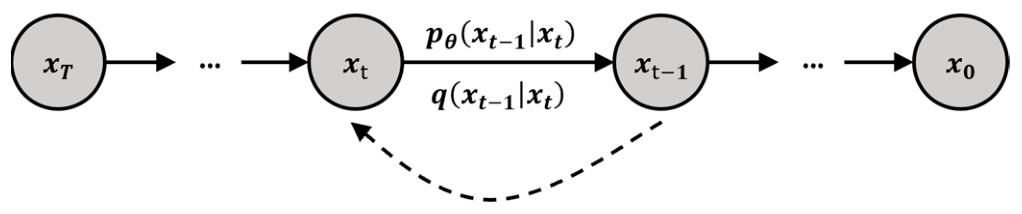
Inspired by diffusion processes in nonequilibrium thermodynamics, researchers have developed a generative framework known as diffusion models, which learn to reverse the process of adding noise. As illustrated in Figure 1, the forward process of a diffusion model gradually adds random Gaussian noise to an input image until it approximates pure noise. The reverse process learns to recover the structural information of the original image from the noise.
Recently, Chen et al. [34] introduced DiffusionDet, which innovatively applies diffusion models to object detection by framing the task as a bounding box generation problem. Through a multi-step reverse diffusion process, the model refines the bounding boxes, leading to more accurate localization. Fan et al. [43] extended DiffusionDet to open-world object detection by incorporating knowledge distillation and a novel incremental learning strategy, thereby improving detection performance for both known and unknown object categories. For applications such as autonomous driving and robot navigation, Orfaig et al. [44] introduced a dynamic fusion mechanism along with targeted regularization, significantly improving detection accuracy and robustness. Their work provides a general, modular, and efficient diffusion model framework for multimodal object detection. Erabati et al. [45] leveraged random proposals and the iterative refinement nature of the diffusion process to decouple training from inference. This offers a novel generative perspective on 3D object detection and establishes a baseline for future research on more efficient diffusion models for 3D perception tasks. Han et al. [46] were the first to introduce diffusion models to the field of optical remote sensing image salient object detection. They reframed the task as conditional mask generation and designed a lightweight denoising network that combines global and local modeling capabilities, effectively enhancing the model’s ability to handle fine details and understand complex remote sensing scenes. To the best of our knowledge, however, no prior work has explored the application of such models to visible-light ship detection, nor has any study investigated the lightweight adaptation of diffusion detectors for edge deployment. The existing DiffusionDet model is designed for general object detection and does not account for the unique scale distribution of small ships. Moreover, due to its backbone network and multi-step sampling process, DiffusionDet places substantial demands on computational resources, which conflicts with the practical requirements of lightweight deployment.

2.3. Lightweight Model Design

In practical application scenarios, deploying deep learning models on resource-constrained devices requires lightweight architectures. Early efforts in model lightweighting focused on replacing conventional convolutions with depthwise separable convolutions, which significantly reduce the number of parameters. However, the lack of cross-channel information exchange in such operations can limit the ability to capture complex cross-channel features. To address this, researchers proposed lightweight network architectures such as MobileNets [47] and ShuffleNet [48], which can replace complex backbones, maintaining representational power while substantially reducing network complexity. In the field of ship detection, many researchers have built upon these network structures, incorporating ship-specific characteristics to design lightweight architectures tailored for ship detection. Liu et al. [49] addressed the challenge of capturing multi-scale features in a lightweight manner in maritime scenes by proposing a dual-cross multi-scale knowledge distillation method. This work systematically integrated a scale-adaptation mechanism into a lightweight detection model for the first time, enhancing the learning capability of the student model. Sang et al. [50] designed the RSL-YOLO framework to tackle issues such as limited computational resources, multi-scale variations caused by low-angle imaging, and environmental noise. By combining lightweight structural design with innovations in attention mechanisms, this framework achieves an effective balance between detection accuracy and inference efficiency. Li et al. [51] proposed the lightweight model MSM-YOLOv8, aiming to address challenges in complex maritime scenes such as varying target scales, overlapping targets, and real-time requirements. However, most of these lightweight architectures are built on CNN-based structures, which inevitably leads to the loss of small ship features. More importantly, the design of lightweight architectures based on DiffusionDet remains largely unexplored. Because DiffusionDet relies on backbones such as ResNet [52] or Swin Transformer [53] and requires multiple sampling steps, its deployment on edge devices is challenging. Motivated by this challenge, we designed a lightweight diffusion architecture model specifically for small-object ship detection, which we call Ship-DiffDet.

3. Proposed Model

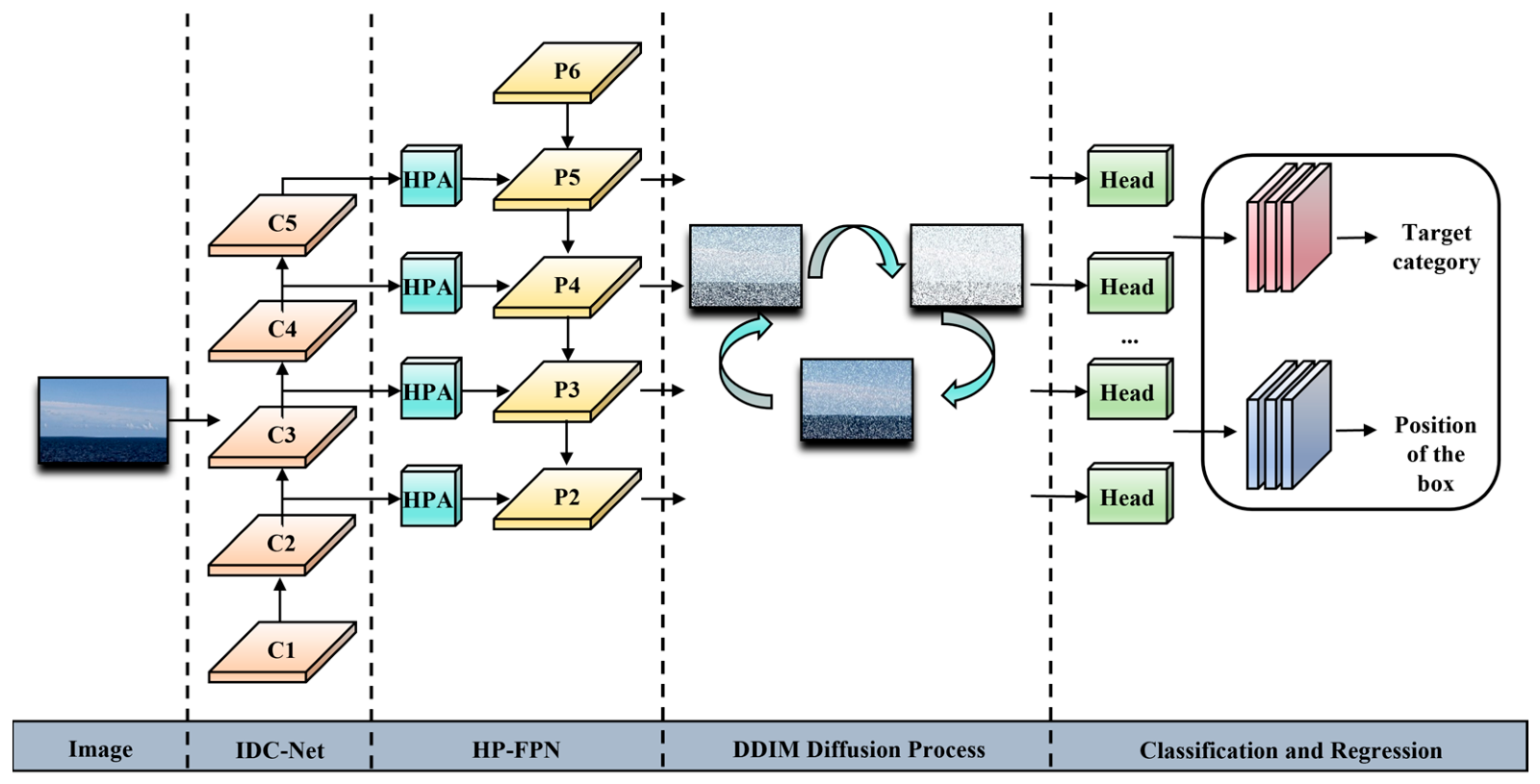
In this study, we present Ship-DiffDet, an improved model specifically designed for small-object ship detection, built upon the DiffusionDet framework. The overall pipeline of our model is similar to that of DiffusionDet, but we have extended and improved key modules and algorithms to enhance its critical recognition capability and optimize parameter efficiency. The architecture of the proposed Ship-DiffDet model is illustrated in Figure 2.
As shown in Figure 2, the model uses ResNet50 as the backbone network and incorporates Inception Depthwise Convolution to form IDC Net. This design not only effectively enlarges the receptive field to suit object detection tasks that require capturing long-range dependencies, but also reduces the parameter overhead associated with conventional convolutions. Second, Ship DiffDet processes the feature maps extracted by IDC Net using an improved HP FPN. This HP FPN leverages dual view pooling information to perform adaptive recalibration of features in both spatial and channel dimensions, thereby improving feature quality, enhancing cross-scale object responses, and suppressing redundant interference—achieving robust performance gains with minimal computational cost. Finally, Ship DiffDet performs a diffusion process. During the DDIM diffusion process, the model feeds the feature maps into the DDIM sampler, which repeatedly predicts the feature maps from the previous timestep to expand the number of feature maps. The diffused feature maps are then passed to the detection head for object classification and bounding box localization. This diffusion operation helps the model better exploit the correlations among feature maps across different timesteps, facilitating feature propagation and diffusion to enhance robustness in object detection and adapt to variations in complex scenes and objects.

3.1. Preliminary

Diffusion models based on Markov chains are a class of generative models that recover samples from random Gaussian noise through iterative denoising. The forward process gradually adds random Gaussian noise to a sample until it approximates pure noise. Because the state at each step depends only on the previous step, this forward process can be parameterized as a Markov chain, as shown in Equation (1), where x 1 , x 2 , , x t denote the data after successive noise additions and β t are predefined parameters.
q ( x t | x t 1 ) = N ( x t ; 1 β t x t 1 , β t I )
Using the reparameterization trick, we obtain x t = 1 β t x t 1 + β t z t , and we arrive at x t = α ^ t x 0 + 1 α ^ t z t . The probability distribution of x t conditioned on x 0 can then be expressed directly as shown in Equation (2). Here, α t = 1 β t , α ^ t = i = 1 t α i , and z t N ( 0 , I ) .
q ( x t | x 0 ) = N ( x t ; α ^ t x 0 , ( 1 α ^ t ) I )
When T is sufficiently large, α ^ t approaches zero, and the distribution of x T approximates a standard normal distribution π ( x T ) N ( 0 , I ) . The reverse denoising process can also be parameterized as a Markov chain, recovering data samples from random Gaussian noise by approximating the posterior distribution, as given in Equation (3).
p θ ( x t 1 | x t , x 0 ) = N ( x t 1 ; μ ~ t ( x t , x 0 ) , β ~ t I )
Using Bayes’ theorem and the method of completing the square for Gaussian distributions, the mean μ ~ t ( x t , x 0 ) is derived as μ ~ t ( x t , x 0 ) = α ^ t 1 β t 1 α ^ t x 0 + α t ( 1 α ^ t 1 ) 1 α ^ t x t = 1 α t ( x t β t 1 α ^ t z t ) , with the variance given by β ~ t = 1 α ^ t 1 1 α ^ t β t .
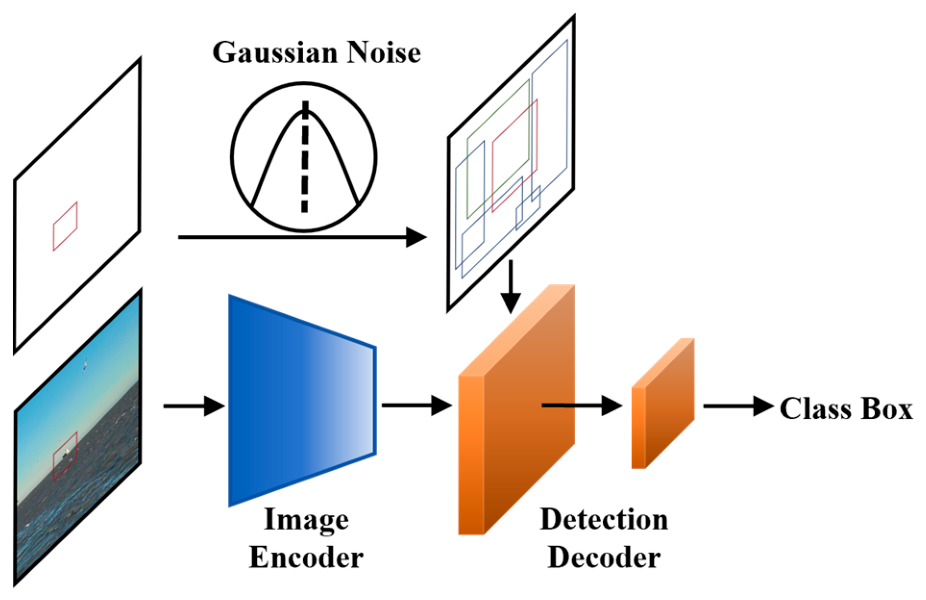
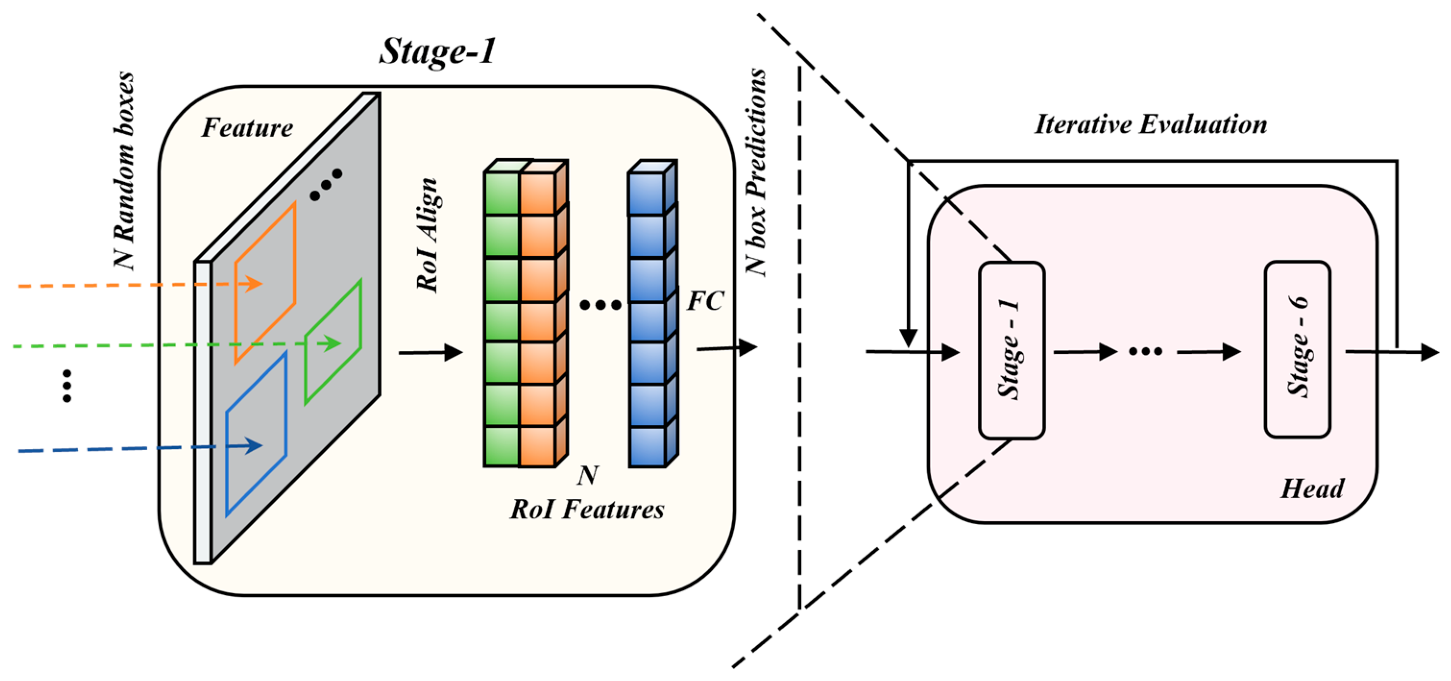
Diffusion models, a recent research focus, have demonstrated exceptional performance in text-to-image generation and video generation tasks. Building on this success, researchers have begun exploring their application to object detection. Chen et al. [34] were the first to propose DiffusionDet, a diffusion model specifically designed for object detection. Its core idea is to formulate object detection as a denoising process that refines noisy boxes into accurate ground-truth boxes. As shown in Figure 3, the model consists of an image encoder and a detection decoder. The image encoder extracts features from the input image, typically using a CNN or Transformer backbone combined with a feature pyramid network. The detection decoder takes a set of initial bounding boxes as input, crops Region-of-Interest features from the feature maps produced by the encoder, and then outputs classification and regression results through a detection head. As illustrated in Figure 4, the decoder adopts a six-stage cascaded design similar to Sparse R-CNN [54]. However, its input consists of randomly initialized bounding boxes rather than learnable proposals, and it does not require explicit proposal feature extraction.
During inference, the model first samples a set of random bounding boxes from a Gaussian distribution as initial noisy boxes, while the encoder extracts feature representations from the input image. The process then proceeds through multiple iterative denoising steps. At each step, the current noisy bounding boxes are fed into the decoder along with the image features, and the decoder outputs corresponding predicted bounding boxes. The DDIM sampler then computes the bounding box distribution for the previous timestep using a deterministic formula based on the predictions and the current noisy boxes. At intermediate steps, the model filters out low-quality proposals based on a predefined confidence threshold, retaining only high-confidence bounding boxes for subsequent iterations. This process is repeated until the final timestep (t = 0), at which point confidence thresholding and non-maximum suppression are applied to the resulting predicted boxes to produce the final detection output. The performance advantage of DiffusionDet stems from its use of dynamic convolutions in the detection head, which generate dedicated convolutional kernel parameters for each instance. However, this also introduces the challenge of an excessively large parameter count.
Due to the limited capability of the backbone network and feature pyramid network in capturing small-object features, combined with the large parameter count introduced by the dynamic detection head, DiffusionDet exhibits certain shortcomings in small-object detection and lightweight deployment. Addressing these limitations is the central focus of our efforts to improve the model.

3.2. Lightweight Backbone with Inception Depthwise Convolution—IDC-Net

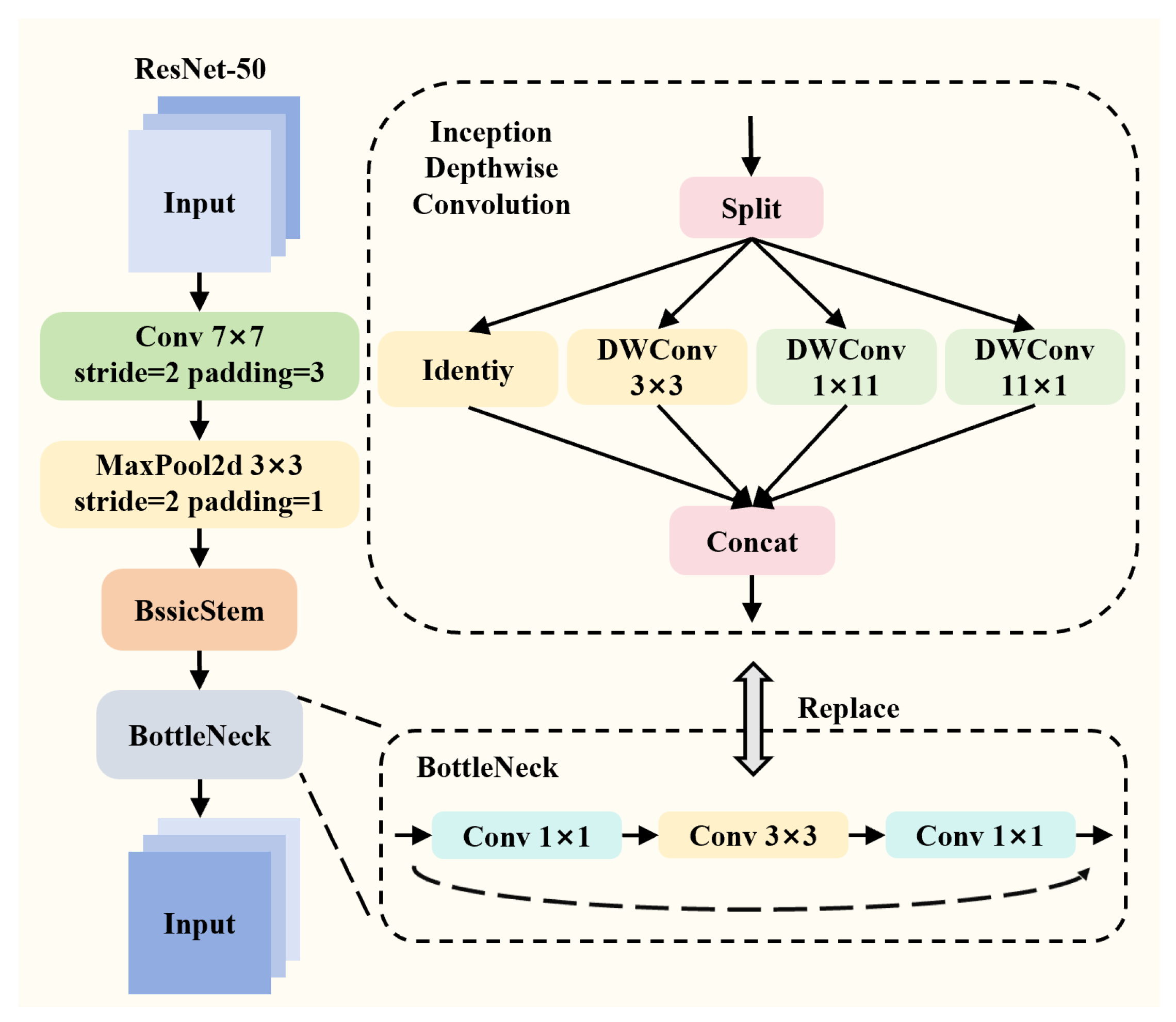
As illustrated in Figure 5, the baseline model utilizes ResNet50 as its backbone network. ResNet [52] effectively mitigates the degradation problem in deep networks by incorporating residual connections. Its fundamental building block employs a “bottleneck” design, a 1 × 1 convolution initially reduces the dimensionality, followed by feature extraction via a 3 × 3 convolution, and finally another 1 × 1 convolution restores the channel count. This design maintains representational capacity while effectively constraining the parameter size. However, the conventional 3 × 3 convolution suffers from a limited receptive field, resulting in inadequate feature extraction capability for small-object ships within complex maritime environments. To address this limitation, we introduce an inception depthwise convolution module [55], depicted in Figure 5, to replace the original 3 × 3 convolutional layer in the bottleneck structure, thereby constructing IDC-Net. Notably, unlike InceptionNeXt which was originally designed for general vision tasks with isotropic convolution branches, our IDC-Net introduces strip-shaped depthwise convolutions tailored to the elongated morphology of ships. Through the integration of multi-scale depthwise convolutions, IDC-Net substantially reduces model parameters while expanding the effective receptive field. This enhances multi-scale feature capture for small objects, all without incurring unnecessary computational overhead. Inspired by the multi-branch architecture of GoogLeNet [56], the proposed module adopts four parallel pathways: the first preserves an identity mapping, the second employs a square-shaped depthwise convolution and the third and fourth utilize horizontal and vertical strip-shaped depthwise convolutions, respectively. This design specifically accommodates the elongated morphology typical of ship objects. Furthermore, the refined residual structure promotes more efficient gradient flow, alleviates the vanishing gradient issue, and enables more effective aggregation of the morphological characteristics of ships, thereby improving the robustness of small-object detection.
We compared Inception Depthwise Convolution with conventional convolution and depthwise convolution in terms of parameter count and FLOPs. The results show that Inception Depthwise Convolution is more efficient than the other two convolutional types. For simplicity, we assume that the input and output channels are the same and omit the bias term. Here, k, C, H, and W denote the kernel size, number of channels, height, and width, respectively. The specific formulas for calculating parameter count and FLOPs are provided in Table 1. As can be seen, both the parameter count and the number of floating-point operations for conventional convolution and depthwise separable convolution scale quadratically with the kernel size k, whereas inception depthwise convolution scales linearly with k. Evidently, inception depthwise convolution effectively reduces both model parameters and computational cost.

3.3. Enhanced Feature Pyramid Network with Hybrid Pooling Attention—HP-FPN

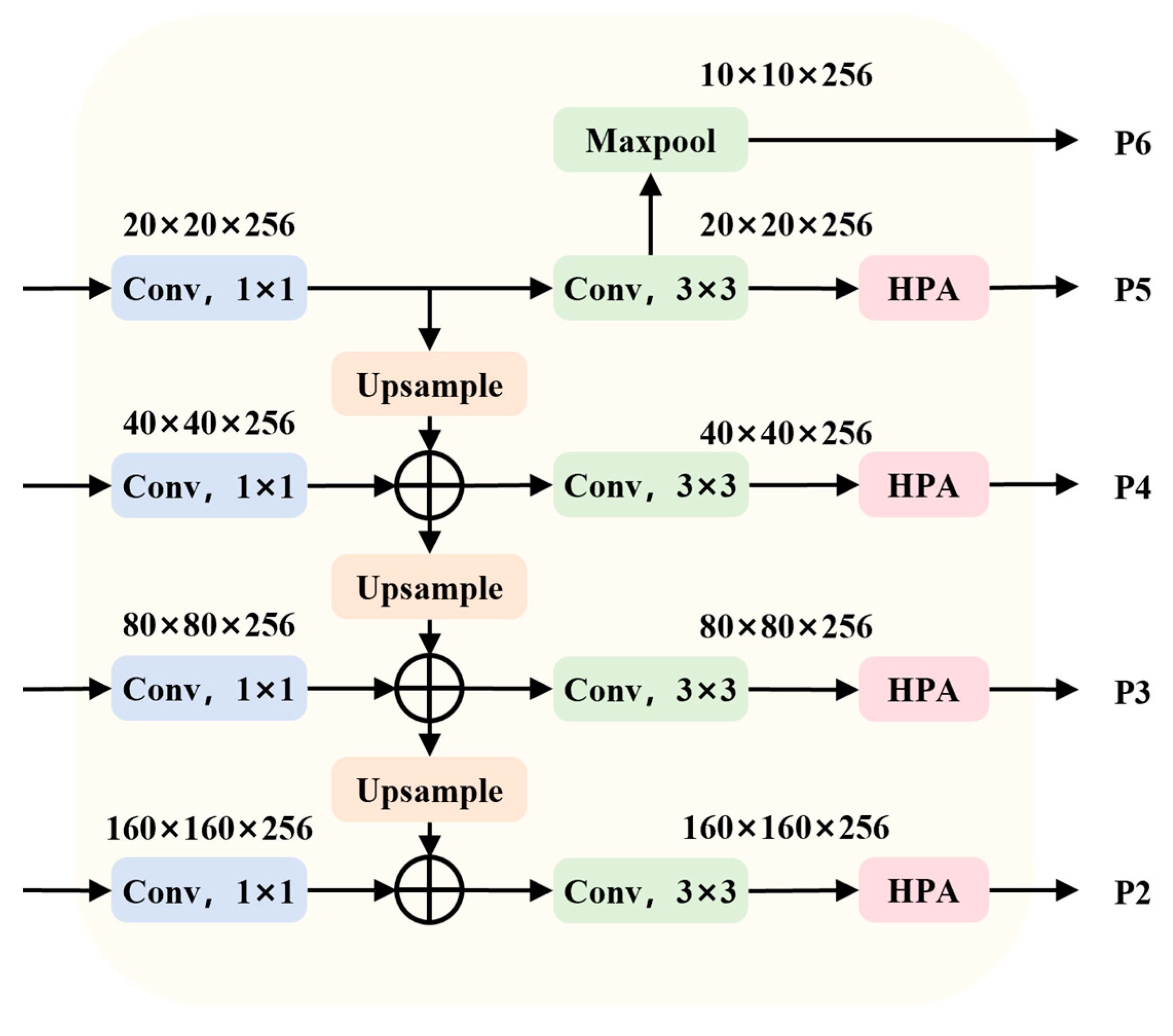
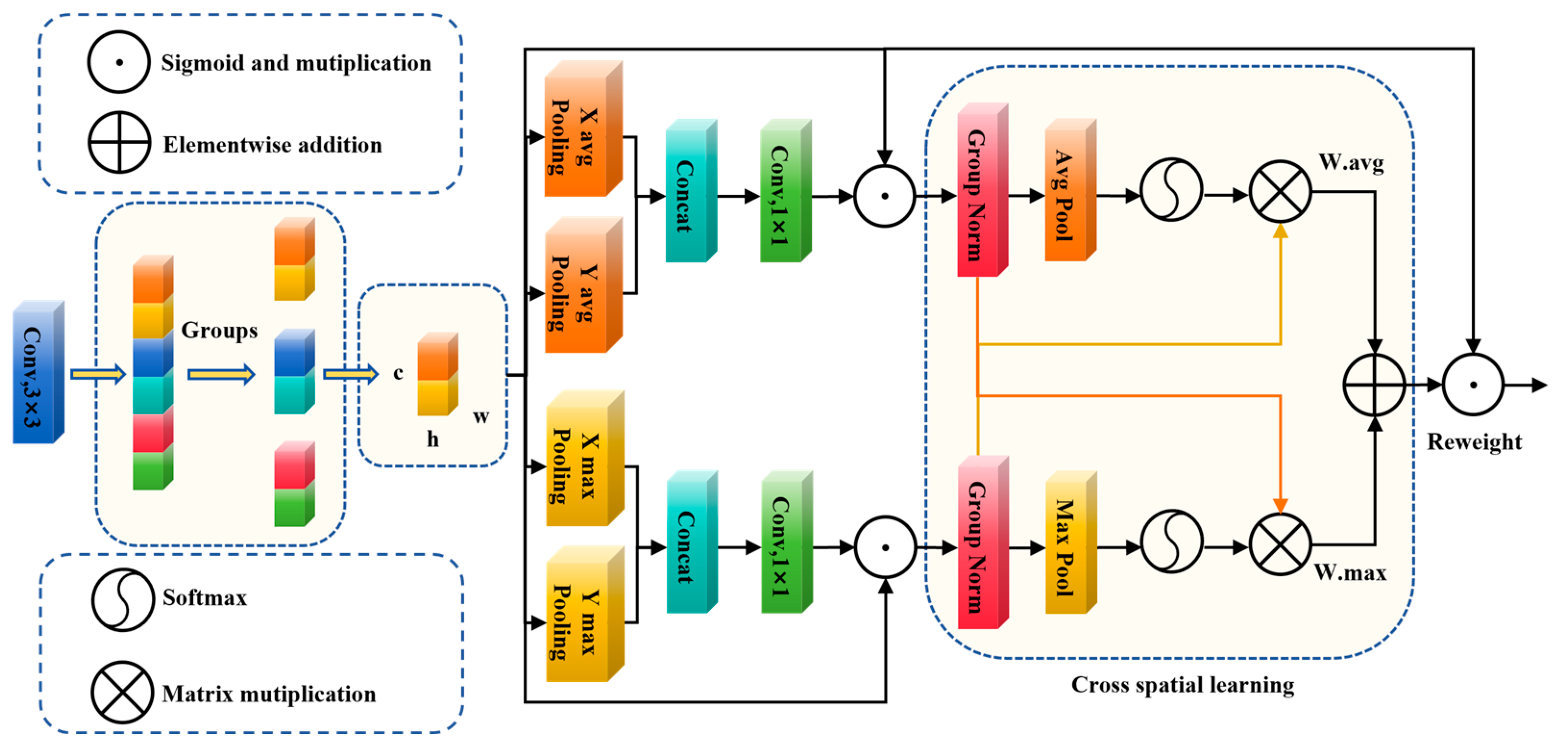
In deep convolutional networks, deeper layers tend to focus more on semantic information of large objects, while the fine-grained details crucial for small objects gradually diminish as the network deepens. FPN [22] addresses this by fusing deep semantic information with shallow, high-resolution details through a top-down pathway and lateral connections, thereby enhancing multi-scale object detection performance. However, during cross-scale feature fusion, information redundancy and noise can be inadvertently introduced across different layers, compromising the purity and discriminative power of features for small objects. To mitigate this issue, we design a Hybrid Pooling Attention-enhanced Feature Pyramid Network (HP-FPN), whose overall architecture is illustrated in Figure 6. The Hybrid Pooling Attention (HPA) [57] module was originally proposed for hyperspectral image classification with a focus on spectral feature calibration. In our specific task of small-object ship recognition, however, detection performance often degrades due to strong maritime interferences. The characteristics of HPA are well suited to our task, as it can effectively suppress ocean-specific disturbances such as glare and waves, thereby improving detection accuracy. Therefore, we embed HPA into each output layer of the feature pyramid network to specifically mitigate marine interference and enhance the features of small ships in the shallow layers. This module enhances feature representation along the channel dimension without altering spatial resolution, effectively suppressing irrelevant background interference. The structure of the HPA module is detailed in Figure 7. The core is a dual-branch attention mechanism. The input features are fed into two parallel branches, an average pooling branch and a max pooling branch. Within each branch, pooling operations are first performed separately along the height and width dimensions. The resulting features are then concatenated and passed through a 1 × 1 convolution to generate a spatial attention weight map, which is subsequently multiplied with the input features. Subsequently, global average pooling and global max pooling are performed on the two normalized branches, respectively, to derive channel-wise weighting factors. Finally, the attention information from both branches is fused via matrix multiplication to produce the final spatial attention weights, which are applied to the input features. By integrating the complementary information from both average and max pooling and leveraging collaborative weighting across spatial and channel dimensions, the proposed mechanism effectively accentuates the discriminative features of ship objects while suppressing background interferences such as waves, clouds, and seabirds, thereby improving the detection performance for small-object ships.

3.4. Efficient Dynamic Head with Gating Mechanism

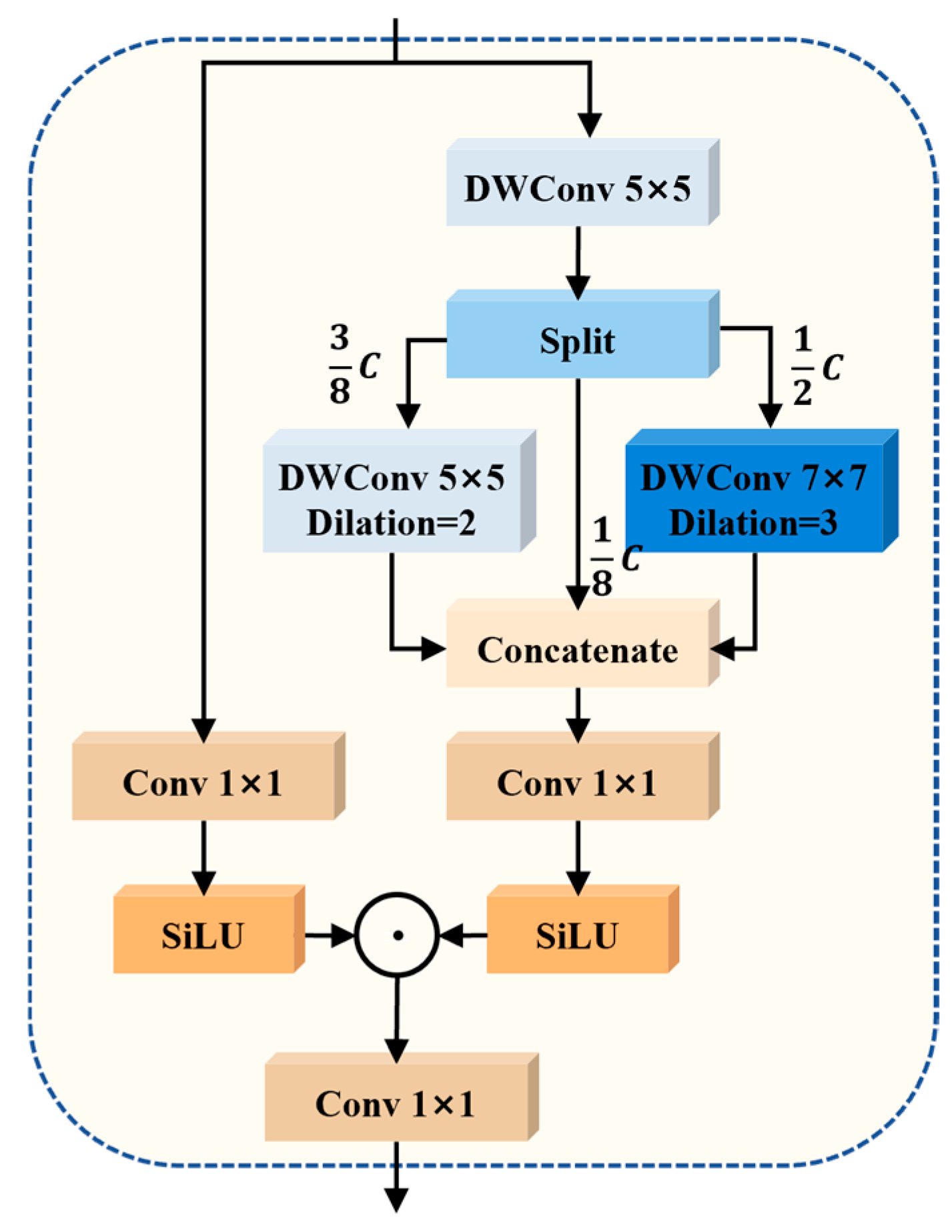
To address the high computational overhead inherent in the instance-specific parameter generation of DynamicConv, we introduce a Multi-Order Gated Aggregation (MOGA) [58] module as an efficient enhancement. The original MogaNet was designed for general-purpose backbone feature extraction. We deploy it in the dynamic detection head of DiffusionDet to address the parameter inefficiency of dynamic convolution. In addition, we deliberately increase the channel allocation of the local detail branches to prioritize the fine-grained features essential for small ship detection—an aspect that has not been explored in previous work. As illustrated in Figure 8, MOGA employs a multi-branch architecture composed of depthwise convolutions with dilation rates of 1, 2, and 3 to capture features at varying receptive fields. The input features are first processed by a 5 × 5 depthwise convolution to obtain a foundational representation, which is then split into three branches according to a channel ratio. The local detail branch focuses on fine-grained information such as edges and textures, which is crucial for the precise identification of small-scale ships. The spatial dependency branch captures structural relationships within a medium range, aiding in the holistic shape perception of medium-scale ships. The global context branch models the long-range relationships between objects and the background, facilitating the contour recognition and scene understanding of large-scale ships.
In the feature aggregation stage, MOGA adaptively fuses multi-scale features via a gating mechanism inspired by Gated Linear Units. Specifically, the features are fed into two parallel paths, a gating branch and a value branch. The gating branch employs a 1 × 1 convolution to generate spatial and channel-wise attention weights. The value branch extracts multi-scale representations via the multi-order depthwise convolutions. Both paths are activated by the SiLU function, followed by element-wise multiplication. The result is then integrated through a 1 × 1 convolution. A residual connection is finally applied to preserve the original information and ensure effective gradient flow. By combining multi-dilation convolutions with gated aggregation, this design achieves efficient multi-scale feature extraction and adaptive selection with a significant parameter reduction, leading to notably improved detection performance for small-object ships.

4. Experiment and Results

To evaluate the effectiveness of Ship-DiffDet, a comprehensive experimental assessment was conducted on our custom-built small-object ship dataset. The evaluation encompassed the following key aspects. First, ablation studies were carried out to validate the contribution and rationale of each proposed module. Second, comparative experiments were performed against current mainstream detection models to verify the performance advantages of our method. Furthermore, we analyzed the impact of key parameters—such as the number of proposal boxes and sampling steps—on detection accuracy and inference speed, thereby exploring the optimal balance between precision and efficiency for the model.

4.1. Experiment Platform

All experiments were conducted on a computer running the Ubuntu 16.04 operating system using the PyTorch deep learning framework. The hardware configuration consisted of an NVIDIA GeForce RTX 3090 Ti GPU and an Intel Core i7-10700 CPU. The software environment included Python 3.9.18, PyTorch 1.8.0, and CUDA 11.1. Detailed specifications are provided in Table 2.

4.2. Metrics

To comprehensively evaluate the model’s performance, this study establishes the following metrics in accordance with the task characteristics and deployment requirements: AP, AP50, Aps, Params and FLOPs. AP represents the mean average precision across all categories, commonly used to evaluate the overall performance of multi-category detection models. Its calculation is given in Equations (4) and (5). Although this study focuses on a single-category detection task, this value is still reported for reference. AP50 denotes the average precision at an IoU threshold of 0.5, which serves as the primary accuracy evaluation metric in this study. APs refers to the average precision specifically for small objects, which is used to evaluate the model’s detection capability for small-object ships. Params refers to the parameter count, which reflects the model’s scale and storage overhead. FLOPs is a metric for measuring computational complexity. In simple terms, it denotes the number of floating point operations, including additions, subtractions, multiplications, and divisions, that a model performs during a single forward inference pass.
A P = 0 1 P ( R ) d R
m A P = 1 n i = 1 n A P i
In Equations (4) and (5), P denotes precision, R denotes recall, and n represents the number of object categories. The detailed computations of P and R are provided in Equations (6) and (7), respectively.
P = T P T P + F P
R = T P T P + F N
In object detection evaluation, a True Positive (TP) denotes a correctly detected genuine object, reflecting the model’s ability to identify actual objects of interest. A False Positive (FP) refers to a background region or non-object erroneously detected as positive, indicating the model’s false alarm rate. A False Negative (FN) represents a genuine object that the model failed to detect, contributing to the miss rate. Together, these three fundamental components form the basis for calculating Precision (P) and Recall (R), as shown in Equations (6) and (7).

4.3. Dataset

Existing research widely employs open-source ship detection datasets such as SeaShips [59], the Singapore Maritime Dataset [60], and ABOships [61]. Among them, SeaShips contains 7000 images across six categories, covering variations in scale, viewpoint, illumination, and occlusion, thus offering considerable scene diversity. The Singapore Maritime Dataset, collected from waters around Singapore, encompasses a variety of complex real-world scenarios and serves as a commonly used benchmark in this field. ABOships focuses specifically on open-sea ships, providing finely annotated data to support vision tasks in marine environments. While these datasets provide a crucial foundation for maritime object detection research, their samples predominantly concentrate on conventionally sized objects. They generally lack systematic construction for distant, small-object ships, and a unified public benchmark for small-object ship detection remains unavailable.
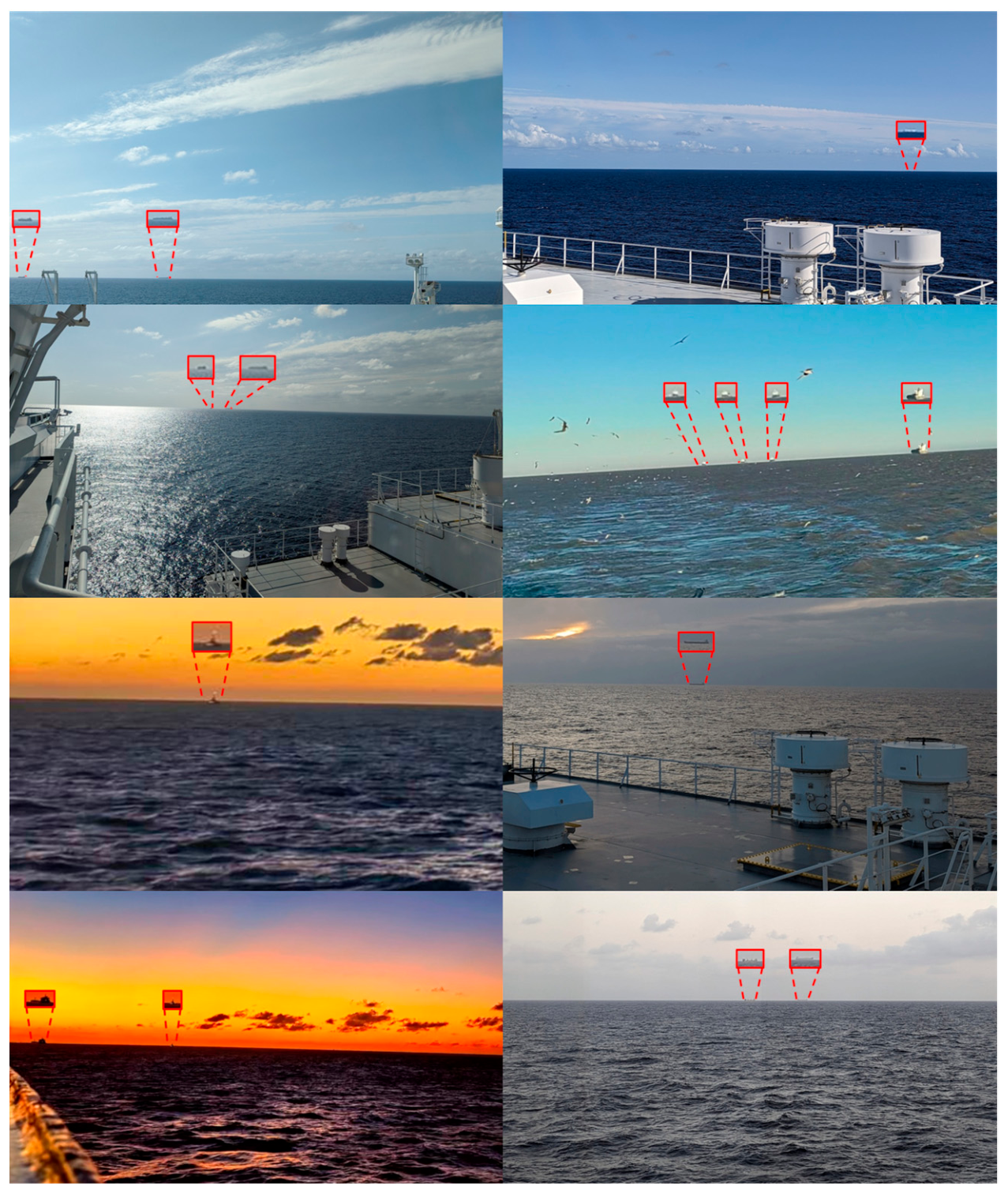
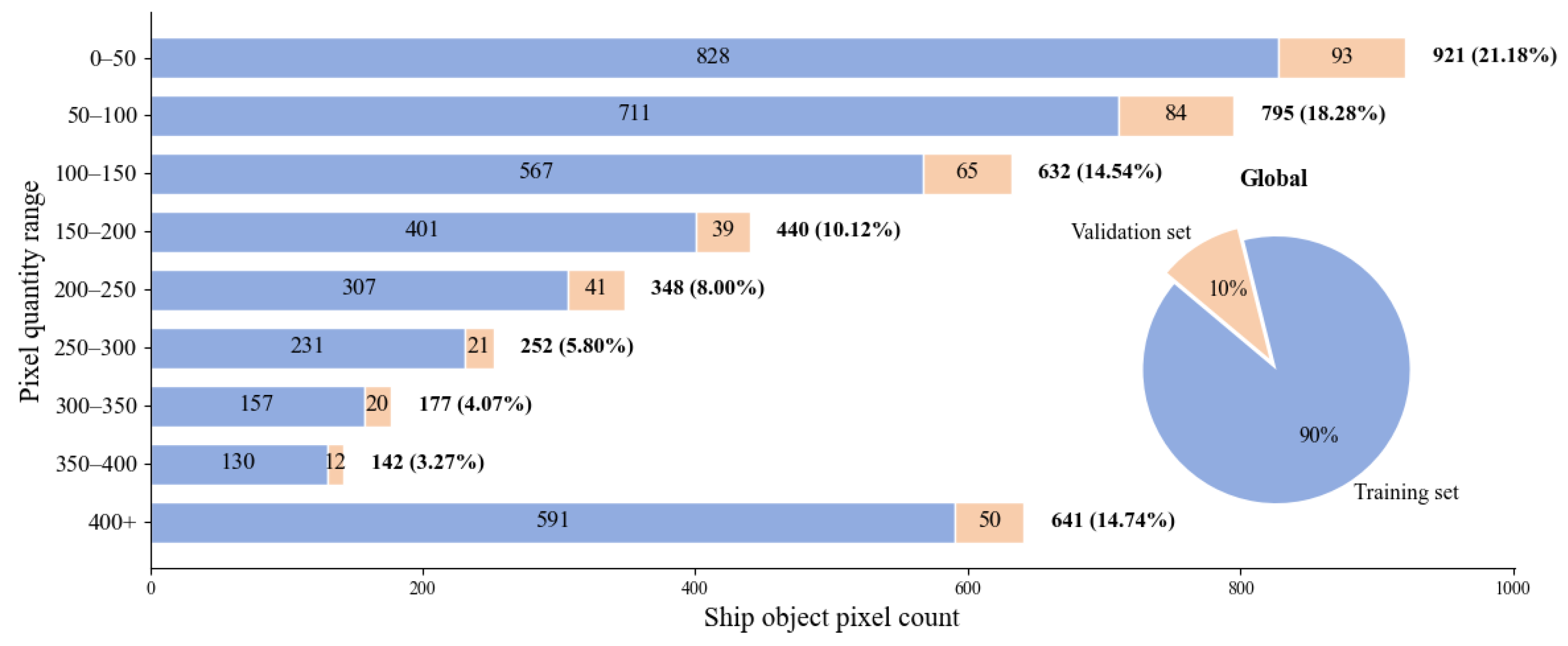
To comprehensively evaluate the robustness of object detection algorithms under complex maritime conditions, we constructed a dataset specifically targeting small ships, as illustrated in Figure 9. Our dataset comprises a total of 1871 high-resolution images, annotated with fine-grained bounding boxes, containing 4348 instance objects. According to the MS COCO definition of small objects (area less than 32 × 32 pixels), the vast majority of instances in our dataset qualify as small ships, with an average pixel area of only 229 pixels, and the smallest object occupying just 4 pixels. Detailed statistical distributions are provided in Figure 10. Importantly, the dataset was deliberately collected and curated to include a variety of representative real-world maritime conditions with adverse weather and challenging lighting, thereby simulating the primary interferences that visual systems face during actual operations. For instance, under strong glare conditions, specular reflection from the sea surface causes local over-saturation and extensive over-exposure, distorting the brightness information of objects and, in severe cases, even obscuring the outlines of small objects, leading to missed detections. In hazy weather, atmospheric scattering significantly reduces scene contrast and greatly shortens the visible range. Target edges become blurred, and clear textural details are submerged into greyish-white or bluish-grey backgrounds, making low-level feature extraction based on edges and gradients extremely difficult. In wavy environments, the dynamically fluctuating sea surface generates a large amount of non-stationary white foam and textural clutter, which exhibit high-dynamic characteristics in both the temporal and spatial domains. Such clutter is easily confused with light-colored small objects, thereby posing serious interference to background modeling and foreground segmentation. Under dusk conditions, the extremely low illumination leads to a sharp drop in the image signal-to-noise ratio, particularly for small objects that occupy very few pixels. In addition, the residual color temperature variations at dusk introduce color casts, rendering feature representations unstable and significantly increasing the likelihood of missed detections. By incorporating these challenging conditions, the dataset not only closely reflects real-world maritime operations but also provides a highly demanding benchmark for subsequent research. This will facilitate the design and validation of robust detection models capable of performing reliably under extreme environmental conditions.

4.4. Ablation Experiments

To evaluate the effectiveness of each component in Ship-DiffDet, we designed a systematic ablation study to analyze the individual and combined contributions of the proposed improvements to model performance. The results are presented in Table 3, where a checkmark (“√”) indicates the application of the corresponding improvement.
The baseline DiffusionDet model suffers from high computational costs, primarily due to the computational complexity of the conventional 3 × 3 convolutions in its ResNet50 backbone and the parameter generation for each instance required by its dynamic detection head. To address this, we designed the IDC-Net based on inception depthwise convolutions and introduced the MOGA module utilizing gated aggregation. These modifications enable the model to maintain its feature extraction capability while significantly reducing both the parameter count and computational complexity. Furthermore, to enhance small-object recognition accuracy, we embedded the Hybrid Pooling Attention module into each output level of the feature pyramid. This module introduces minimal parameter overhead while effectively strengthening feature representation, thereby improving detection performance.
From a deployment perspective, our improved model reduces the parameter count to 24.7 M (a 48.8% decrease from the baseline) and cuts FLOPs to 49.7 G (a 22.0% reduction), while achieving improvements in AP, AP50, and small-object APs to 46.1%, 90.9%, and 45.3%, respectively. These results validate the effectiveness of the lightweight design. The above results indicate that the model is feasible for deployment on relatively high-performance edge devices. The improvements proposed in this paper are not only competitive in terms of academic metrics, but also provide a solid technical foundation and a clear evolutionary path for the industrial deployment of DiffusionDet.
Notably, the performance improvements achieved by the proposed IDC-Net, HP-FPN, and MOGA modules exhibit a high degree of consistency across all experimental configurations. As shown in Table 3, relative to the baseline, the introduction of any single module consistently improves detection accuracy or reduces model complexity. With the progressive integration of these modules, we observe steady performance gains, culminating in the optimal overall performance. This demonstrates that the improvements are deterministic architectural effects rather than statistical anomalies. This consistency validates the reliability of our proposed optimization for small-object ship detection.
Additionally, we analyzed the consistency of our results to confirm that they are not attributable to random errors. Specifically, we conducted tests with five different random seeds and averaged the outcomes to verify statistical significance, ensuring that our findings are not artifacts of random variation. The multiple comparison results from the ablation experiments presented in Table 3 further corroborate the statistical significance, showing that the improvements brought by each module are stable and consistent, rather than random fluctuations. Moreover, the performance gains are cumulative, indicating that the synergistic effect of the combined components exceeds the sum of their individual contributions. Furthermore, the reductions in parameter count and computational complexity are deterministic architectural benefits, free from random variability.

4.5. Comparative Experiments

As shown in Table 4, this study compares Ship-DiffDet with several classical object detection algorithms, listing their performance in terms of both AP50 and FPS. The experimental results indicate that the proposed method outperforms the listed mainstream algorithms in detection accuracy. Compared to YOLOv8 and YOLOv11, it achieves improvements in AP50 of 20.3% and 15.9%, respectively. When compared to the baseline model DiffusionDet, it also exhibits a 1.7% increase in AP50, while the model scale has been significantly optimized.
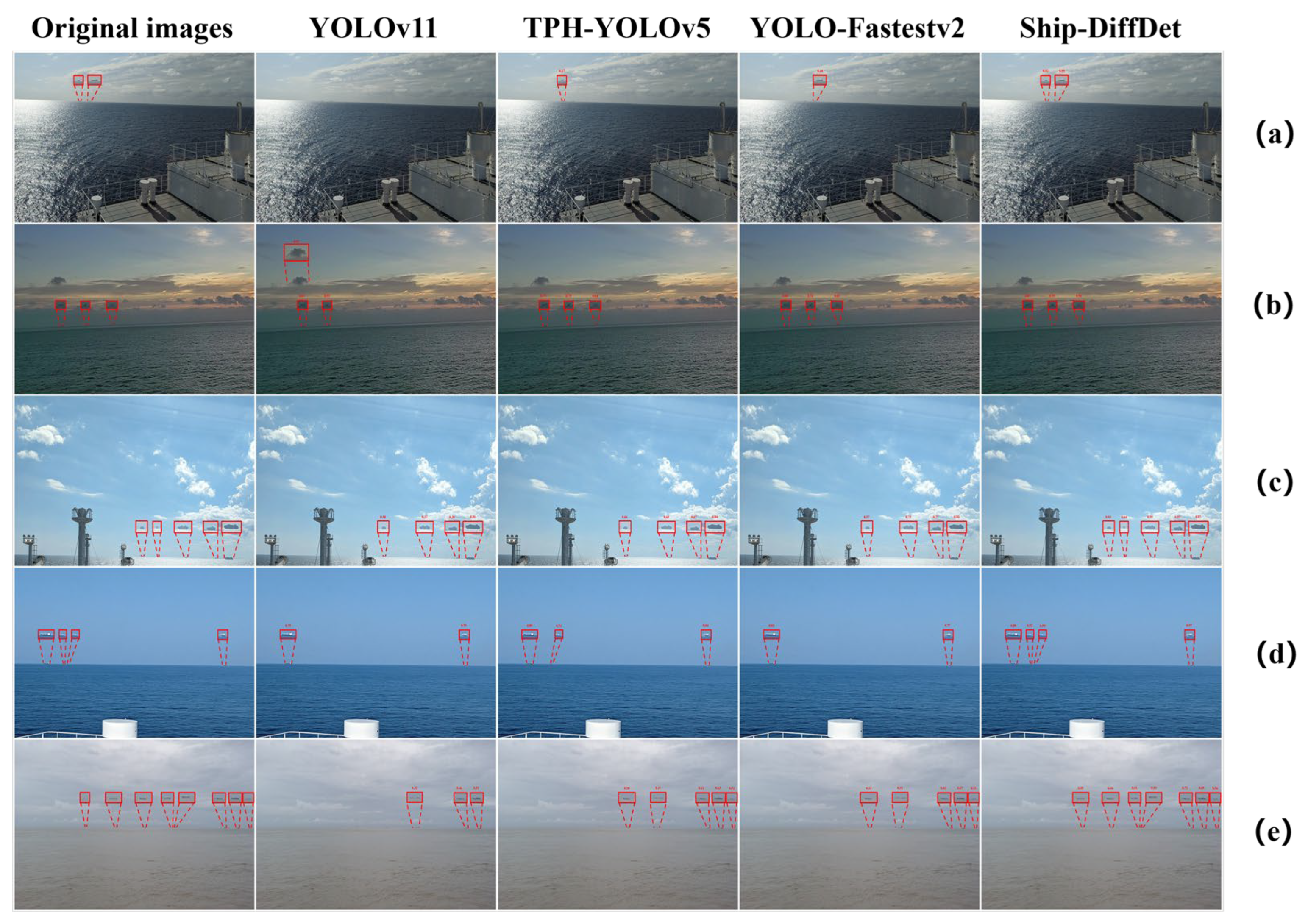
To further demonstrate the performance of our model, we provide a visualization of the detection results in Figure 11. The figure presents a side-by-side comparison of detection results obtained by the mainstream model and our proposed method under various challenging conditions, including strong glare, cloud cover, haze, wave interference, and dense small objects.
From left to right, the figure shows the ground-truth instances in the original image, followed by the detection results of YOLOv11, THP-YOLOv5, YOLO-Fastestv2, and our proposed Ship-DiffDet model. We did not include DiffusionDet in the comparison because, although we reduced its parameter count and achieved a modest improvement in accuracy, the difference in detection performance would not be visually evident. Therefore, we compare only with current mainstream models to demonstrate the superiority of our approach.
In group (a), under strong glare, specular reflection from the sea surface causes local over-saturation and extensive over exposure, severely distorting the brightness information of objects and often completely obscuring the outlines of small objects. YOLOv11 fails to detect any object, indicating that its feature extraction is nearly ineffective in over-exposed regions. TPH-YOLOv5 and YOLO-Fastestv2 detect the left and right objects respectively, but miss the others, revealing limited perceptual capability near saturated areas. In contrast, our model effectively suppresses glare interference and successfully detects all objects, demonstrating stronger compensation and recovery for information loss caused by over-exposure. In group (b), under dusk conditions, extremely low illumination leads to a sharp drop in signal-to-noise ratio, while residual color temperature variations introduce color casts, destabilizing object feature representation and increasing background clutter interference. YOLOv11 not only misses the rightmost object but also misidentifies a discolored cloud as an object, reflecting difficulties in distinguishing foreground features under low illumination. Although TPH-YOLOv5, YOLO-Fastestv2, and our model all detect all objects, our model achieves notably higher confidence scores, proving stronger discriminative robustness against weak signals and color-shift interference in low-light conditions. In groups (c) and (d), under haze, atmospheric scattering significantly reduces contrast and visibility, blurs object edges, and merges texture details into greyish-white or bluish-grey backgrounds, making low-level edge and gradient-based feature extraction extremely difficult, especially for extremely small objects occupying very few pixels. Our model successfully detects all small objects, whereas the other YOLO-series models fail to detect the extremely small ones. This demonstrates that our model can stably extract weak and critical discriminative features even under low contrast and severe edge information degradation. Finally, in group (e), under wavy conditions, the dynamically fluctuating sea surface generates abundant non-stationary white foam and textural clutter with high dynamic characteristics in both spatial and temporal domains. This clutter is easily confused with light-colored small objects and severely interferes with background modeling and foreground segmentation. In this group, the original image contains eight densely packed instances. YOLOv11 detects only three, while TPH-YOLOv5 and YOLO-Fastestv2 detect five; all three merge two adjacent objects into a single detection, which is a typical manifestation of boundary blurring and segmentation failure caused by wave clutter, highlighting the evident deficiency of the YOLO series in detecting continuous dense small objects. In contrast, our model successfully detects seven objects under the same complex wavy background. Although it misses one extremely small object, it significantly reduces false merging and missed detections caused by clutter, demonstrating high robustness and dense object discrimination capability under dynamic interference.
Notably, although Ship-DiffDet outperforms mainstream models in the most challenging small-object scenarios, some edge cases remain. First, all experiments were conducted on daytime visible light images, and performance under nighttime conditions has not yet been verified due to the lack of corresponding samples in our current dataset. Second, while the model effectively handles light haze, extreme dense fog may further degrade the feature quality of small objects, leading to higher miss rates. These limitations will be addressed in our future work.

4.6. Parameter Sensitivity Analysis

Leveraging the inherent advantages of the DiffusionDet model, our approach allows flexible adjustment of the number of proposal boxes and sample steps during both training and inference. In the default configuration, we set the number of proposal boxes to 200 and the number of sample steps to 1. To investigate the impact of these parameter settings on model performance, we conducted a systematic sensitivity analysis using the average precision for small objects (APs) as an example. The results are presented in Table 5. The experimental results show that when the number of sampling steps is fixed at 1, 3, or 5, moderately increasing the number of proposal boxes improves detection accuracy up to a point, beyond which model performance begins to degrade. When the number of sample steps is fixed at 7, however, any increase in the number of proposal boxes directly leads to a drop in performance. The reason for this phenomenon is that a larger number of randomly initialized proposal boxes increases the probability of covering the true objects, making it easier for the denoising process to converge at least some of the boxes near the ground truth. However, due to the single-step sampling used in training and the excessive increase in the number of proposal boxes, a distribution shift occurs among the boxes. Moreover, when denoising is insufficient, non-maximum suppression struggles to balance duplicate removal and retention, ultimately reducing overall detection accuracy. On the other hand, when we fix the number of proposal boxes and gradually increase the number of sample steps, we observe a positive correlation between the number of sample steps and model performance. This is because increasing the number of sampling steps effectively applies the DDIM sampler repeatedly, splitting the generation path into finer segments. With each step requiring only minor adjustments, the overall denoising process becomes smoother and more stable, thereby aiding fine-grained localization.
Further analysis reveals that model performance does not increase monotonically with either the number of proposal boxes or the sample steps, but depends on a balance between the two. The number of proposal boxes determines the coverage breadth of detection, while the sample steps reflect the depth of denoising refinement. Blindly increasing both simultaneously drastically expands the search space and the complexity of the optimization path, exceeding the stable denoising capability that the model has learned during training, and thus leads to performance deterioration. Moreover, as the number of proposal boxes and sample steps increase, inference speed decreases accordingly. Therefore, in practical applications, these two parameters can be flexibly configured according to the specific requirements for accuracy and speed in a given scenario, thereby achieving an optimal balance between efficiency and performance.

5. Conclusions

Accurate and reliable ship detection is fundamental to intelligent maritime environmental perception. To address the significant challenge of detecting distant small-object ships at sea, this study proposes an efficient and lightweight improved model named Ship-DiffDet, based on the DiffusionDet framework. We first constructed a dedicated annotated dataset focused on small-object ships, addressing the scarcity of such samples in existing public datasets. At the model level, the ResNet50 backbone was replaced with IDC-Net, which is built upon inception depthwise convolutions, significantly reducing computational complexity. A hybrid pooling attention mechanism was introduced during the feature fusion stage to enhance the discriminative power of multi-scale features. Furthermore, the detection head was optimized using a multi-order gated aggregation (MOGA) mechanism, further improving the capture and interaction of small-object features. These improvements work synergistically, enabling the model to achieve notable performance gains in small-object ship detection while maintaining low complexity.
Our work has certain limitations. Since our custom dataset and all experiments are focused on daytime visible light scenes, performance under nighttime conditions cannot be validated. However, this limitation stems from the inherent physical constraints of visible light sensors rather than the model architecture itself; visible light cameras cannot capture sufficient texture information of distant ships in dark environments. In future work, we plan to integrate infrared imaging to bridge this gap. Regarding recognition under dense fog, although our dataset includes light haze scenes, samples of extreme dense fog are indeed insufficient. Compared with clear skies, light scattering further weakens the already sparse features of small objects, and detection accuracy under haze often suffers from missed detections. We expect a more pronounced performance degradation in extreme fog conditions. In future work, we will collect more samples of small ships under extreme foggy weather to further expand our dataset and improve model performance in this regard. Regarding recognition under high-density ship traffic, as shown in group (e) of our visualization results in Figure 11, although the model may miss extremely small objects when many instances are present in a single image, it is still able to detect the vast majority of them. These limitations do not undermine our contribution to daytime long-range small-object ship recognition; rather, they point to clear directions for future improvement. We believe that a transparent discussion of these boundary cases can provide a useful reference for subsequent research in this field.

Author Contributions

Conceptualization, Y.G., D.Z. and J.H.; methodology, Y.G. and J.H.; validation and investigation, J.H.; resources, Y.G., D.Z. and J.S.; writing—original draft preparation, J.H.; writing—review and editing, all authors; visualization, J.H.; supervision, Y.G., D.Z. and J.S.; funding acquisition, Y.G., D.Z. and J.S. All authors have read and agreed to the published version of the manuscript.

Funding

This work was supported by the Science and Technology Research Program of the Chongqing Municipal Education Commission (Grant No. KJQN202400743), and Natural Science Foundation of Chongqing, China (Grant No. CSTB2025NSCQ-GPX0836).

Data Availability Statement

The data presented in this study are openly available in GitHub at https://github.com/JHuang808/Ship-diffdet (accessed on 12 August 2026) and https://drive.google.com/drive/folders/1WKjZYdarcy4PYKcjg0idqQDWStrPLvUv (accessed on 12 August 2026).

Acknowledgments

During the preparation of this manuscript, the authors used DeepSeek-V3 for the purposes of translation assistance from Chinese to English and language polishing and proofreading. The authors have reviewed and edited the output and take full responsibility for the content of this publication.

Conflicts of Interest

The authors declare no conflicts of interest.

References

  1. Pagire, V.; Chavali, M.; Kale, A. A comprehensive review of object detection with traditional and deep learning methods. Signal Process. 2025, 237, 110075. [Google Scholar] [CrossRef] [Scilit]
  2. Ramos, L.T.; Sappa, A.D. A decade of you only look once (yolo) for object detection: A review. IEEE Access 2025, 13, 192747–192794. [Google Scholar] [CrossRef] [Scilit]
  3. Muzammul, M.; Li, X. Comprehensive review of deep learning-based tiny object detection: Challenges, strategies, and future directions. Knowl. Inf. Syst. 2025, 67, 3825–3913. [Google Scholar] [CrossRef] [Scilit]
  4. Cheng, Y.; Lai, X.; Xia, Y.; Zhou, J. Infrared dim small target detection networks: A review. Sensors 2024, 24, 3885. [Google Scholar] [CrossRef] [Scilit] [PubMed]
  5. Zhao, X.; Zhao, Y.; Hu, S.; Wang, H.; Zhang, Y.; Ming, W. Progress in active infrared imaging for defect detection in the renewable and electronic industries. Sensors 2023, 23, 8780. [Google Scholar] [CrossRef] [Scilit] [PubMed]
  6. Kumar, N.; Singh, P. Small and dim target detection in infrared imagery: A review, current techniques and future directions. Neurocomputing 2025, 630, 129640. [Google Scholar] [CrossRef] [Scilit]
  7. Moreira, A.; Prats-Iraola, P.; Younis, M.; Krieger, G.; Hajnsek, I.; Papathanassiou, K.P. A tutorial on synthetic aperture radar. IEEE Geosci. Remote Sens. Mag. 2013, 1, 6–43. [Google Scholar] [CrossRef] [Scilit]
  8. Peter, E.; Ang, L.-M.; Seng, K.P.; Srivastava, S. Recent Advances in Deep Learning for SAR Images: Overview of Methods, Challenges, and Future Directions. Sensors 2026, 26, 1143. [Google Scholar] [CrossRef] [Scilit] [PubMed]
  9. Lang, P.; Fu, X.; Dong, J.; Yang, H.; Yin, J.; Yang, J.; Martorella, M. Recent advances in deep learning based SAR image targets detection and recognition. IEEE J. Sel. Top. Appl. Earth Obs. Remote Sens. 2025, 18, 6884–6915. [Google Scholar] [CrossRef] [Scilit]
  10. Vaswani, A.; Shazeer, N.; Parmar, N.; Uszkoreit, J.; Jones, L.; Gomez, A.N.; Kaiser, Ł.; Polosukhin, I. Attention is all you need. Adv. Neural Inf. Process. Syst. 2017, 30. [Google Scholar] [CrossRef] [Scilit]
  11. Girshick, R.; Donahue, J.; Darrell, T.; Malik, J. Rich feature hierarchies for accurate object detection and semantic segmentation. In Proceedings of the IEEE Conference on Computer Vision and Pattern Recognition, Columbus, OH, USA, 23–28 June 2014; pp. 580–587. [Google Scholar]
  12. Girshick, R. Fast r-cnn. In Proceedings of the IEEE International Conference on Computer Vision, Santiago, Chile, 7–13 December 2015; pp. 1440–1448. [Google Scholar]
  13. Ren, S.; He, K.; Girshick, R.; Sun, J. Faster R-CNN: Towards real-time object detection with region proposal networks. IEEE Trans. Pattern Anal. Mach. Intell. 2016, 39, 1137–1149. [Google Scholar] [CrossRef] [Scilit] [PubMed]
  14. He, K.; Gkioxari, G.; Dollár, P.; Girshick, R. Mask r-cnn. In Proceedings of the IEEE International Conference on Computer Vision, Venice, Italy, 24–27 October 2017; pp. 2961–2969. [Google Scholar]
  15. Redmon, J.; Divvala, S.; Girshick, R.; Farhadi, A. You only look once: Unified, real-time object detection. In Proceedings of the IEEE Conference on Computer Vision and Pattern Recognition, Las Vegas, NV, USA, 27–30 June 2016; pp. 779–788. [Google Scholar]
  16. Liu, W.; Anguelov, D.; Erhan, D.; Szegedy, C.; Reed, S.; Fu, C.-Y.; Berg, A.C. Ssd: Single shot multibox detector. In Proceedings of the European Conference on Computer Vision; Springer: Berlin/Heidelberg, Germany, 2016; pp. 21–37. [Google Scholar]
  17. Lin, T.-Y.; Goyal, P.; Girshick, R.; He, K.; Dollár, P. Focal loss for dense object detection. In Proceedings of the IEEE International Conference on Computer Vision, Venice, Italy, 24–27 October 2017; pp. 2980–2988. [Google Scholar]
  18. Shao, Z.; Yin, Y.; Lyu, H.; Soares, C.G.; Cheng, T.; Jing, Q.; Yang, Z. An efficient model for small object detection in the maritime environment. Appl. Ocean Res. 2024, 152, 104194. [Google Scholar] [CrossRef] [Scilit]
  19. Zhou, W.; Xu, B.; Wu, H. Dual-branch wavelet-CNN architecture for enhanced small ship detection. Ocean Eng. 2025, 339, 121967. [Google Scholar] [CrossRef] [Scilit]
  20. Li, Y.; Wang, S. Efficient and lightweight deep learning model for enhanced ship detection in maritime surveillance. Ocean Eng. 2025, 328, 121085. [Google Scholar] [CrossRef] [Scilit]
  21. Kim, H.-C.; Lee, H.-T.; Cho, I.-S. Vessel detection for maritime traffic management using U-Net with backbone networks. Ocean Eng. 2025, 340, 121943. [Google Scholar] [CrossRef] [Scilit]
  22. Lin, T.-Y.; Dollár, P.; Girshick, R.; He, K.; Hariharan, B.; Belongie, S. Feature pyramid networks for object detection. In Proceedings of the IEEE Conference on Computer Vision and Pattern Recognition, Honolulu, HI, USA, 21–26 July 2017; pp. 2117–2125. [Google Scholar]
  23. Liu, S.; Qi, L.; Qin, H.; Shi, J.; Jia, J. Path aggregation network for instance segmentation. In Proceedings of the IEEE Conference on Computer Vision and Pattern Recognition, Salt Lake City, UT, USA, 18–22 June 2018; pp. 8759–8768. [Google Scholar]
  24. Carion, N.; Massa, F.; Synnaeve, G.; Usunier, N.; Kirillov, A.; Zagoruyko, S. End-to-end object detection with transformers. In Proceedings of the European Conference on Computer Vision; Springer: Berlin/Heidelberg, Germany, 2020; pp. 213–229. [Google Scholar]
  25. Dosovitskiy, A.; Beyer, L.; Kolesnikov, A.; Weissenborn, D.; Zhai, X.; Unterthiner, T.; Dehghani, M.; Minderer, M.; Heigold, G.; Gelly, S. An image is worth 16x16 words: Transformers for image recognition at scale. arXiv 2020, arXiv:2010.11929. [Google Scholar]
  26. Han, K.; Wang, Y.; Chen, H.; Chen, X.; Guo, J.; Liu, Z.; Tang, Y.; Xiao, A.; Xu, C.; Xu, Y. A survey on vision transformer. IEEE Trans. Pattern Anal. Mach. Intell. 2022, 45, 87–110. [Google Scholar] [CrossRef] [Scilit] [PubMed]
  27. Wu, W.; Fan, X.; Hu, Z.; Zhao, Y. CGDU-DETR: An End-to-End Detection Model for Ship Detection in Day–Night Transition Environments. J. Mar. Sci. Eng. 2025, 13, 1155. [Google Scholar] [CrossRef] [Scilit]
  28. Liu, C.; Zhang, Y.; Shen, J.; Liu, F. Improved RT-DETR for infrared ship detection based on multi-attention and feature fusion. J. Mar. Sci. Eng. 2024, 12, 2130. [Google Scholar] [CrossRef] [Scilit]
  29. Wang, Y.; Li, X. Ship-DETR: A transformer-based model for efficient ship detection in complex maritime environments. IEEE Access 2025, 13, 66031–66039. [Google Scholar] [CrossRef] [Scilit]
  30. Song, J.; Meng, C.; Ermon, S. Denoising diffusion implicit models. arXiv 2020, arXiv:2010.02502. [Google Scholar]
  31. Ho, J.; Jain, A.; Abbeel, P. Denoising diffusion probabilistic models. Adv. Neural Inf. Process. Syst. 2020, 33, 6840–6851. [Google Scholar]
  32. Yang, L.; Zhang, Z.; Song, Y.; Hong, S.; Xu, R.; Zhao, Y.; Zhang, W.; Cui, B.; Yang, M.-H. Diffusion models: A comprehensive survey of methods and applications. ACM Comput. Surv. 2023, 56, 1–39. [Google Scholar] [CrossRef] [Scilit]
  33. Croitoru, F.-A.; Hondru, V.; Ionescu, R.T.; Shah, M. Diffusion models in vision: A survey. IEEE Trans. Pattern Anal. Mach. Intell. 2023, 45, 10850–10869. [Google Scholar] [CrossRef] [Scilit] [PubMed]
  34. Chen, S.; Sun, P.; Song, Y.; Luo, P. Diffusiondet: Diffusion model for object detection. In Proceedings of the IEEE/CVF International Conference on Computer Vision, Paris, France, 4–6 October 2023; pp. 19830–19843. [Google Scholar]
  35. Zhou, H.; Cao, X.; Sun, K.; Wu, T.; Deng, B. Dense small object detection via multi-scale fusion and context information enhancement. J. Supercomput. 2025, 81, 955. [Google Scholar] [CrossRef] [Scilit]
  36. Peng, J.; Lv, K.; Wang, G.; Xiao, W.; Ran, T.; Yuan, L. MLSA-YOLO: A multi-level feature fusion and scale-adaptive framework for small object detection. J. Supercomput. 2025, 81, 528. [Google Scholar] [CrossRef] [Scilit]
  37. Guo, G.; Chen, P.; Yu, X.; Han, Z.; Ye, Q.; Gao, S. Save the tiny, save the all: Hierarchical activation network for tiny object detection. IEEE Trans. Circuits Syst. Video Technol. 2023, 34, 221–234. [Google Scholar] [CrossRef] [Scilit]
  38. Tan, M.; Pang, R.; Le, Q.V. Efficientdet: Scalable and efficient object detection. In Proceedings of the IEEE/CVF Conference on Computer Vision and Pattern Recognition, Seattle, WA, USA, 13–19 June 2020; pp. 10781–10790. [Google Scholar]
  39. Gong, Y.; Chen, Z.; Deng, W.; Tan, J.; Li, Y. Real-time long-distance ship detection architecture based on YOLOv8. IEEE Access 2024, 12, 116086–116104. [Google Scholar] [CrossRef] [Scilit]
  40. Shen, L.; Gao, T.; Yin, Q. Yolo-lpss: A lightweight and precise detection model for small sea ships. J. Mar. Sci. Eng. 2025, 13, 925. [Google Scholar] [CrossRef] [Scilit]
  41. Gong, Y.; Chen, Z.; Tan, J.; Yin, C.; Deng, W. Two-stage ship detection at long distances based on deep learning and slicing technique. PLoS ONE 2024, 19, e0313145. [Google Scholar] [CrossRef] [Scilit] [PubMed]
  42. Liu, Q.; Chen, H.; Zhao, F. Maritime target detection algorithm based on fusion of visible and infrared images. J. Supercomput. 2025, 81, 22. [Google Scholar] [CrossRef] [Scilit]
  43. Fan, J.; Zhang, E.; Wei, Y.; Wang, Y.; Xia, J.; Liu, J.; Liu, X.; Ma, S. DDOWOD: DiffusionDet for open-world object detection. Pattern Recognit. Lett. 2024, 186, 170–177. [Google Scholar] [CrossRef] [Scilit]
  44. Orfaig, E.; Stainvas, I.; Bilik, I. RGBX-DiffusionDet: A framework for multi-modal RGB-X object detection using DiffusionDet. Pattern Recognit. 2025, 172, 112460. [Google Scholar] [CrossRef] [Scilit]
  45. Erabati, G.K.; Araujo, H. DDet3D: Embracing 3D object detector with diffusion: GK Erabati and H. Araujo. Appl. Intell. 2025, 55, 283. [Google Scholar]
  46. Han, J.; Sun, J.; Wang, F.; Sun, F.; Li, H. ORSIDiff: Diffusion model for salient object detection in optical remote sensing images. IEEE Trans. Geosci. Remote Sens. 2025, 63, 5627315. [Google Scholar] [CrossRef] [Scilit]
  47. Howard, A.G.; Zhu, M.; Chen, B.; Kalenichenko, D.; Wang, W.; Weyand, T.; Andreetto, M.; Adam, H. Mobilenets: Efficient convolutional neural networks for mobile vision applications. arXiv 2017, arXiv:1704.04861. [Google Scholar]
  48. Zhang, X.; Zhou, X.; Lin, M.; Sun, J. Shufflenet: An extremely efficient convolutional neural network for mobile devices. In Proceedings of the IEEE Conference on Computer Vision and Pattern Recognition, Salt Lake City, UT, USA, 18–22 June 2018; pp. 6848–6856. [Google Scholar]
  49. Liu, R.; Zhu, Z.; Ge, H.; Wang, J.; Shu, Y.; Ji, Q. Towards scale-adaptive and lightweight maritime ship object detection via dual-cross multi-scale knowledge distillation. Ocean Eng. 2026, 343, 123206. [Google Scholar] [CrossRef] [Scilit]
  50. Sang, H.; Lu, Q.; Sun, X.; Zhang, S.; Liu, F. A lightweight multi-scale ship detection framework for wave gliders with spatial-channel attention fusion. Measurement 2025, 258, 119280. [Google Scholar] [CrossRef] [Scilit]
  51. Li, Y.; Jia, Z.; Zhang, X.; Yang, F.; Yang, X. A lightweight and efficient ship detection model for complex maritime environments. Appl. Ocean Res. 2025, 164, 104797. [Google Scholar] [CrossRef] [Scilit]
  52. He, K.; Zhang, X.; Ren, S.; Sun, J. Deep residual learning for image recognition. In Proceedings of the IEEE Conference on Computer Vision and Pattern Recognition, Las Vegas, NV, USA, 27–30 June 2016; pp. 770–778. [Google Scholar]
  53. Liu, Z.; Lin, Y.; Cao, Y.; Hu, H.; Wei, Y.; Zhang, Z.; Lin, S.; Guo, B. Swin transformer: Hierarchical vision transformer using shifted windows. In Proceedings of the IEEE/CVF International Conference on Computer Vision, Montreal, BC, Canada, 11–17 October 2021; pp. 10012–10022. [Google Scholar]
  54. Sun, P.; Zhang, R.; Jiang, Y.; Kong, T.; Xu, C.; Zhan, W.; Tomizuka, M.; Yuan, Z.; Luo, P. Sparse R-CNN: An end-to-end framework for object detection. IEEE Trans. Pattern Anal. Mach. Intell. 2023, 45, 15650–15664. [Google Scholar] [CrossRef] [Scilit] [PubMed]
  55. Yu, W.; Zhou, P.; Yan, S.; Wang, X. Inceptionnext: When inception meets convnext. In Proceedings of the IEEE/CVF Conference on Computer Vision and Pattern Recognition, Seattle, WA, USA, 16–22 June 2024; pp. 5672–5683. [Google Scholar]
  56. Szegedy, C.; Liu, W.; Jia, Y.; Sermanet, P.; Reed, S.; Anguelov, D.; Erhan, D.; Vanhoucke, V.; Rabinovich, A. Going deeper with convolutions. In Proceedings of the IEEE Conference on Computer Vision and Pattern Recognition, Boston, MA, USA, 7–12 June 2015; pp. 1–9. [Google Scholar]
  57. Chen, P.; He, W.; Qian, F.; Shi, G.; Yan, J. A synergistic CNN-transformer network with pooling attention fusion for hyperspectral image classification. Digit. Signal Process. 2025, 160, 105070. [Google Scholar] [CrossRef] [Scilit]
  58. Li, S.; Wang, Z.; Liu, Z.; Tan, C.; Lin, H.; Wu, D.; Chen, Z.; Zheng, J.; Li, S.Z. Moganet: Multi-order gated aggregation network. arXiv 2022, arXiv:2211.03295. [Google Scholar]
  59. Shao, Z.; Wu, W.; Wang, Z.; Du, W.; Li, C. Seaships: A large-scale precisely annotated dataset for ship detection. IEEE Trans. Multimed. 2018, 20, 2593–2604. [Google Scholar] [CrossRef] [Scilit]
  60. Prasad, D.K.; Rajan, D.; Rachmawati, L.; Rajabally, E.; Quek, C. Video processing from electro-optical sensors for object detection and tracking in a maritime environment: A survey. IEEE Trans. Intell. Transp. Syst. 2017, 18, 1993–2016. [Google Scholar] [CrossRef] [Scilit]
  61. Iancu, B.; Soloviev, V.; Zelioli, L.; Lilius, J. Aboships—An inshore and offshore maritime vessel detection dataset with precise annotations. Remote Sens. 2021, 13, 988. [Google Scholar] [CrossRef] [Scilit]
Figure 1. A diffusion model where q is the diffusion process and p θ is the reverse process.
Jmse 14 01535 g001
Figure 2. Inference Pipeline and Computational Flow Architecture.
Jmse 14 01535 g002
Figure 3. Architecture of DiffusionDet.
Jmse 14 01535 g003
Figure 4. Details of the detection decoder/head.
Jmse 14 01535 g004
Figure 5. Architecture of IDC-Net.
Jmse 14 01535 g005
Figure 6. Architecture of HP-FPN.
Jmse 14 01535 g006
Figure 7. Model illustration of HPA.
Jmse 14 01535 g007
Figure 8. Model illustration of MOGA.
Jmse 14 01535 g008
Figure 9. Sample picture of sea surface small target in training set.
Jmse 14 01535 g009
Figure 10. Distribution of ship pixel sizes.
Jmse 14 01535 g010
Figure 11. Comparison of detection results. (a) Strong glare; (b) Dusk and cloud; (c) Atmospheric scattering; (d) Haze; (e) Dense object.
Jmse 14 01535 g011
Table 1. Complexity of different types of convolution.
Convolution TypeParameterFLOPs
Conventional convolutionk2C22k2C2HW
Depthwise convolutionk2C2k2CHW
Inception depthwise convolution(2k + 9)C/8(2k + 9)CHW/4
Table 2. Configuration parameters for the experiment.
ConfigurationParameter
CPUInter core i7-10700
GPUNVIDIA RTX3090TI
Operating systemUbuntu16.04
CUDA11.1
DIM_FEEDFORWARD1024
HIDDEN_DIM128
SAMPLE_STEP1
NUM_PROPOSALS200
Table 3. Ablation experiments.
DiffusionDetIDC-NetHP-FPNMOGAAP
(%)
AP50
(%)
APs
(%)
Parameter
(M)
FLOPs
(G)
GPU Memory Usage
(G)
45.189.244.348.263.79.5
45.489.544.636.948.78.2
45.489.644.548.263.911.1
45.289.544.536.064.59.4
45.790.445.036.948.910.0
45.889.844.924.749.58.3
46.090.545.236.064.711.3
46.190.945.324.749.710.0
Table 4. Comprehensive detection performance comparison of mainstream algorithms.
MethodAP50FPSInference Time (ms)
Centernet64.64820.8
Faster R-CNN39.74820.8
SSD63.21437.0
TPH-YOLOv577.22050.0
YOLOv870.64762.1
YOLO-Fastestv281.03333.3
YOLOv1175.04552.2
YOLOv2687.94682.1
DiffusionDet89.24522.2
Ship-DiffDet90.94223.8
Table 5. Comparisons with different sampling steps and proposal boxes.
Proposal Boxes200300500100020004000
Sample Steps
145.345.345.345.645.445.3
345.445.645.645.545.345.4
545.846.046.245.645.345.2
746.646.446.245.845.645.4
Disclaimer/Publisher’s Note: The statements, opinions and data contained in all publications are solely those of the individual author(s) and contributor(s) and not of MDPI and/or the editor(s). MDPI and/or the editor(s) disclaim responsibility for any injury to people or property resulting from any ideas, methods, instructions or products referred to in the content.