A Multi-Temporal Satellite-Derived Bathymetry Fusion Method Based on Adaptive Segmented Rank-Statistic Fusion

 , ,
, ,
Abstract
1. Introduction
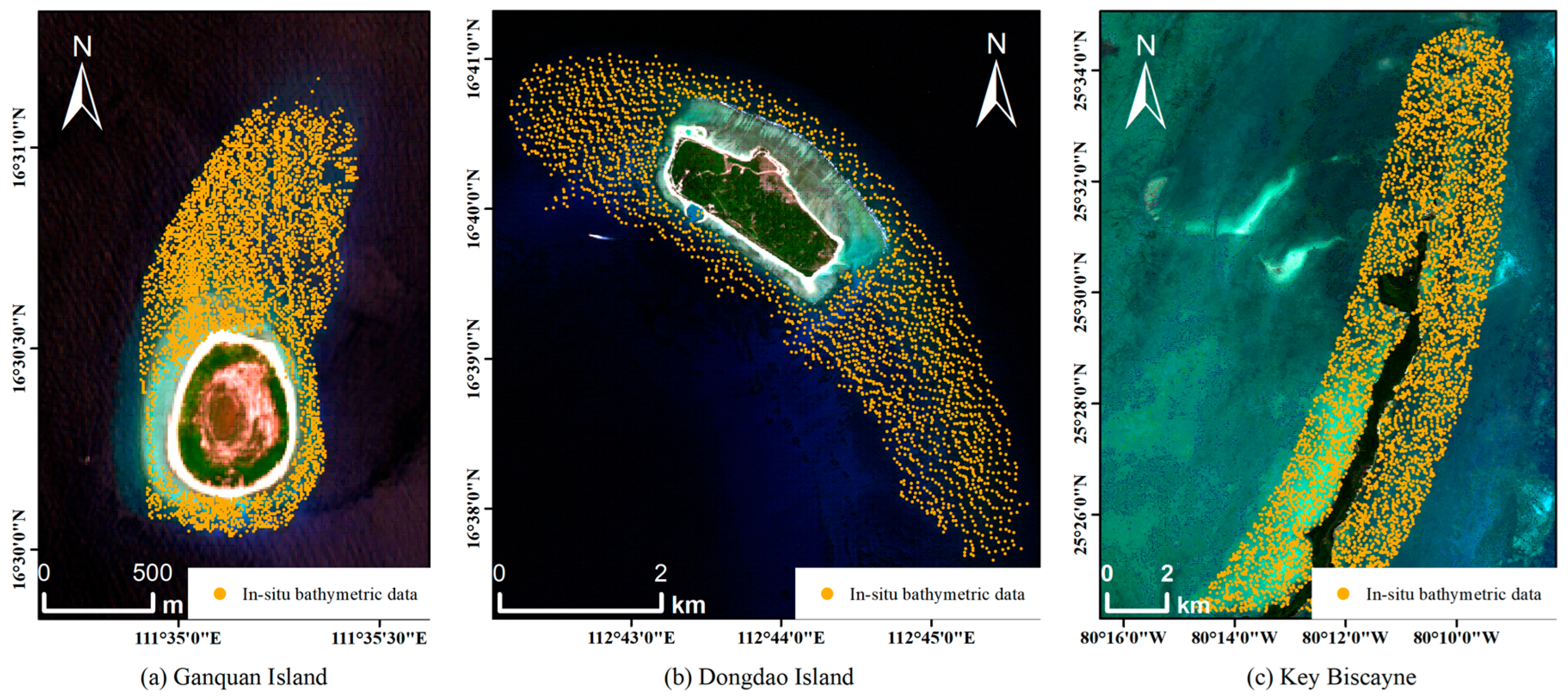
2. Study Areas and Data
2.1. Study Areas
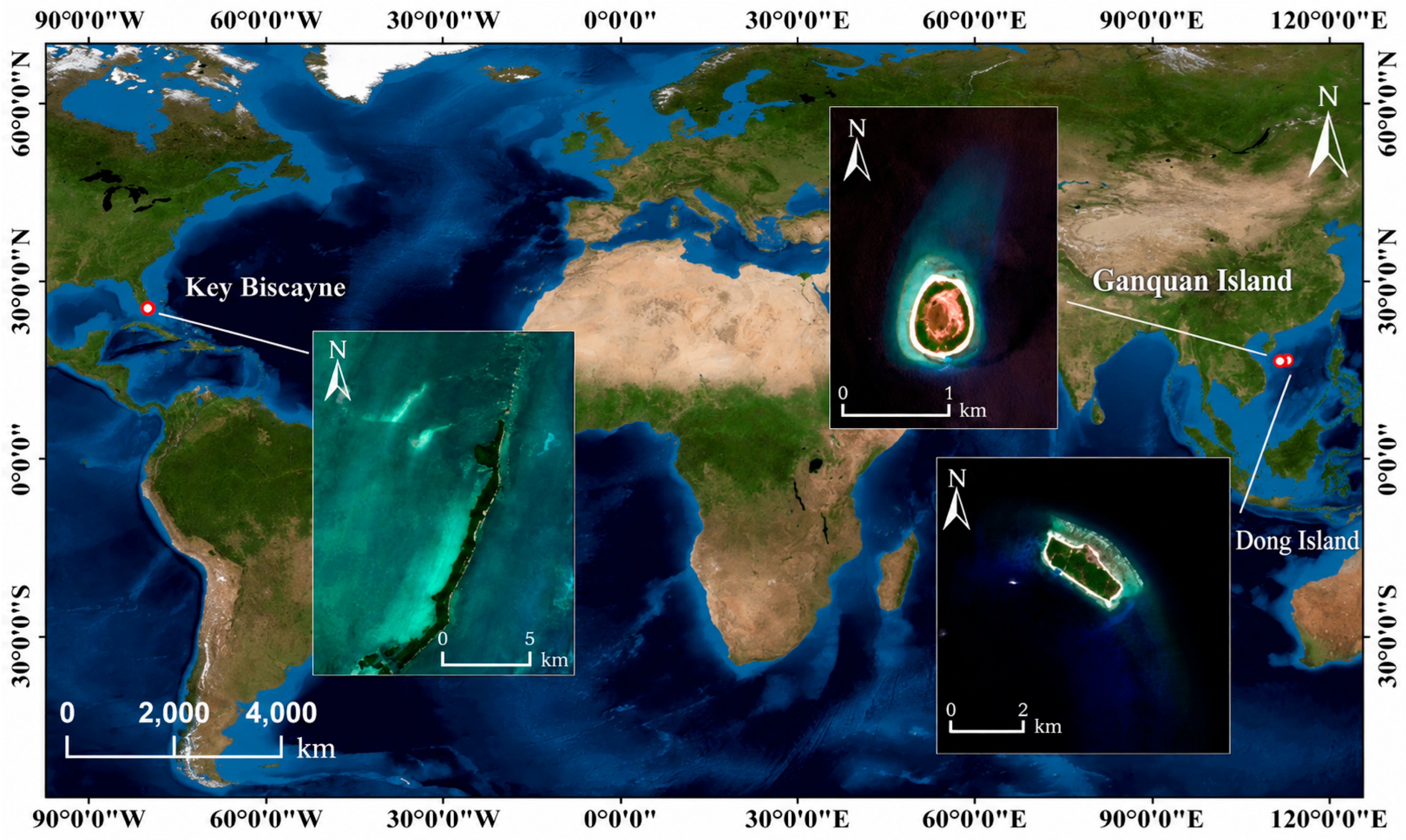
2.2. Datasets
2.2.1. Sentinel-2 Multi-Temporal Imagery

| Study Area | Location | Image Acquisition Dates | ICESat-2 ATL03 Data ID | Number of Valid Photons |
|---|---|---|---|---|
| Ganquan Island | 111°35′24″ E, 16°30′36″ N | 20190224, 20190301, 20190326, 20190704, 20190922 | ATL03_20201119073024_08570907_006_01 | 10,899 |
| ATL03_20210717075633_03621201_006_01 | ||||
| ATL03_20220114231625_03621401_006_01 | ||||
| ATL03_20230815074804_08572007_006_01 | ||||
| Dong Island | 112°43′48″ E, 16°39′36″ N | 20190306, 20190714, 20190719, 20190922, 20191221 | ATL03_20190319123621_12380207_006_02 | 4810 |
| ATL03_20201214061449_12380907_006_01 | ||||
| ATL03_20210613213431_12381107_006_01 | ||||
| Key Biscayne | 80°09′00″ W, 25°29′24″ N | 20190106, 20190205, 20190809, 20191028, 20191207 | ATL03_20220326083753_00501501_006_01 | 52,265 |
| ATL03_20230307042154_11701807_006_02 | ||||
| ATL03_20230606000119_11701907_006_03 | ||||
| ATL03_20240321215455_00502301_006_01 |
2.2.2. ICESat-2 ATL03 Bathymetric Data
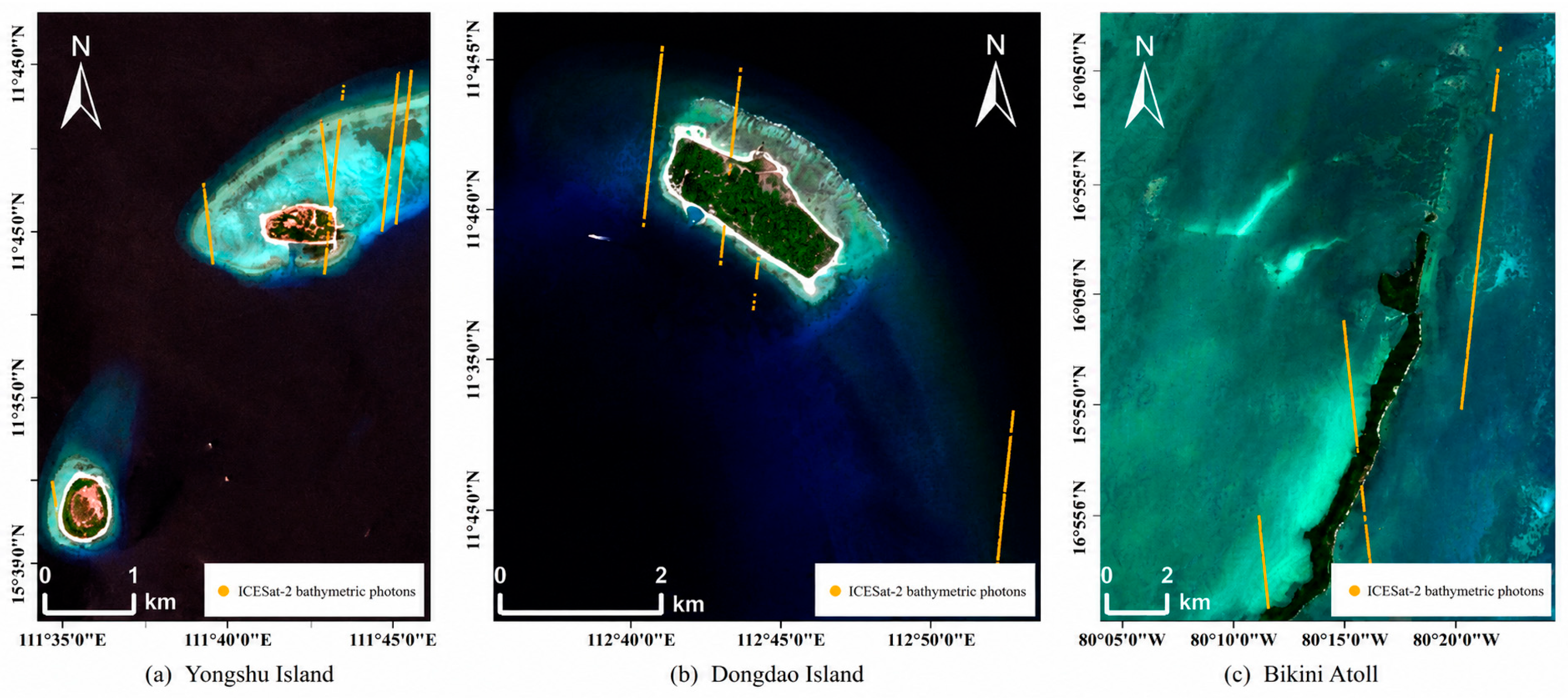
2.2.3. Reference Bathymetric Data

3. Methodology
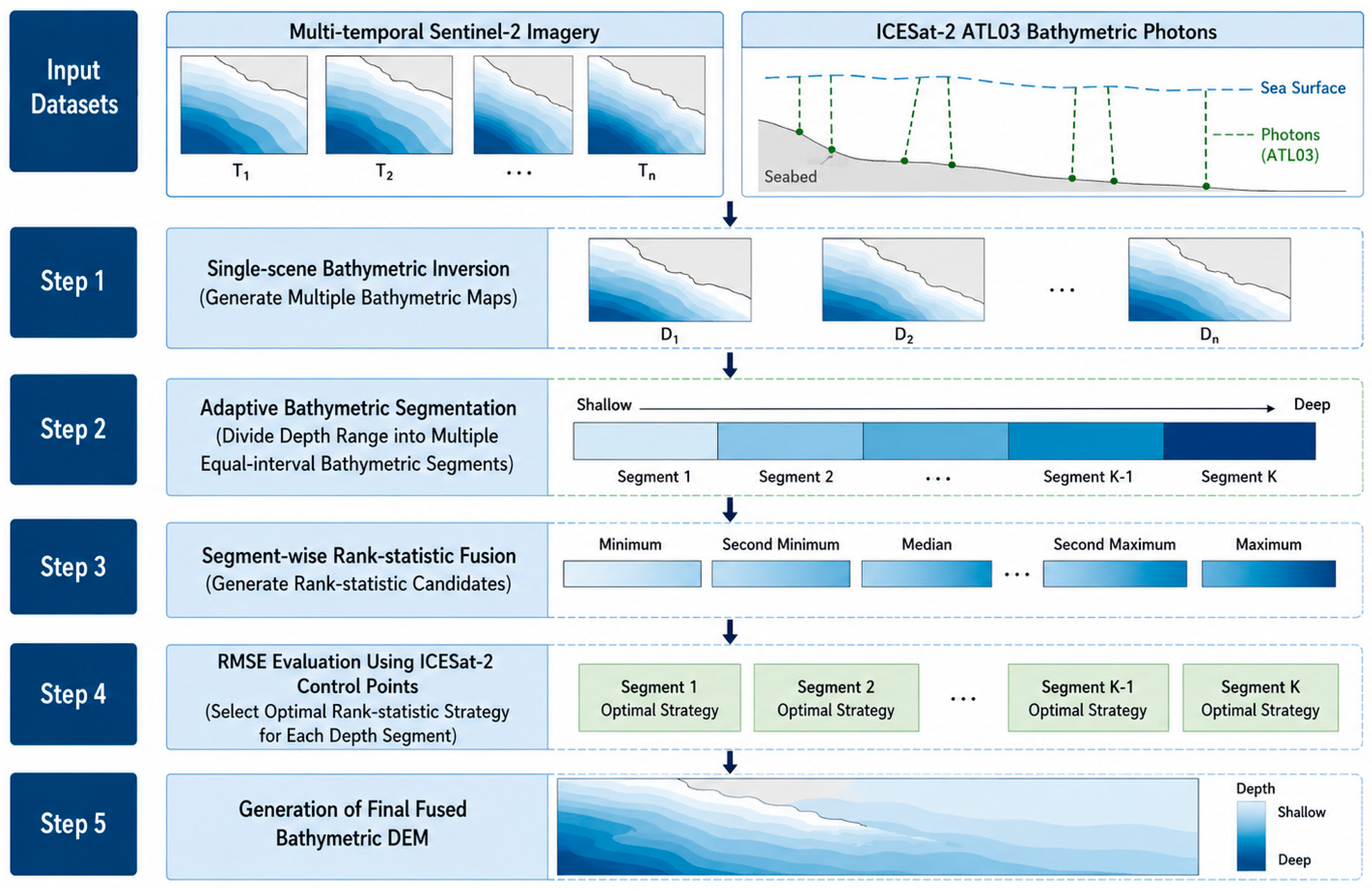
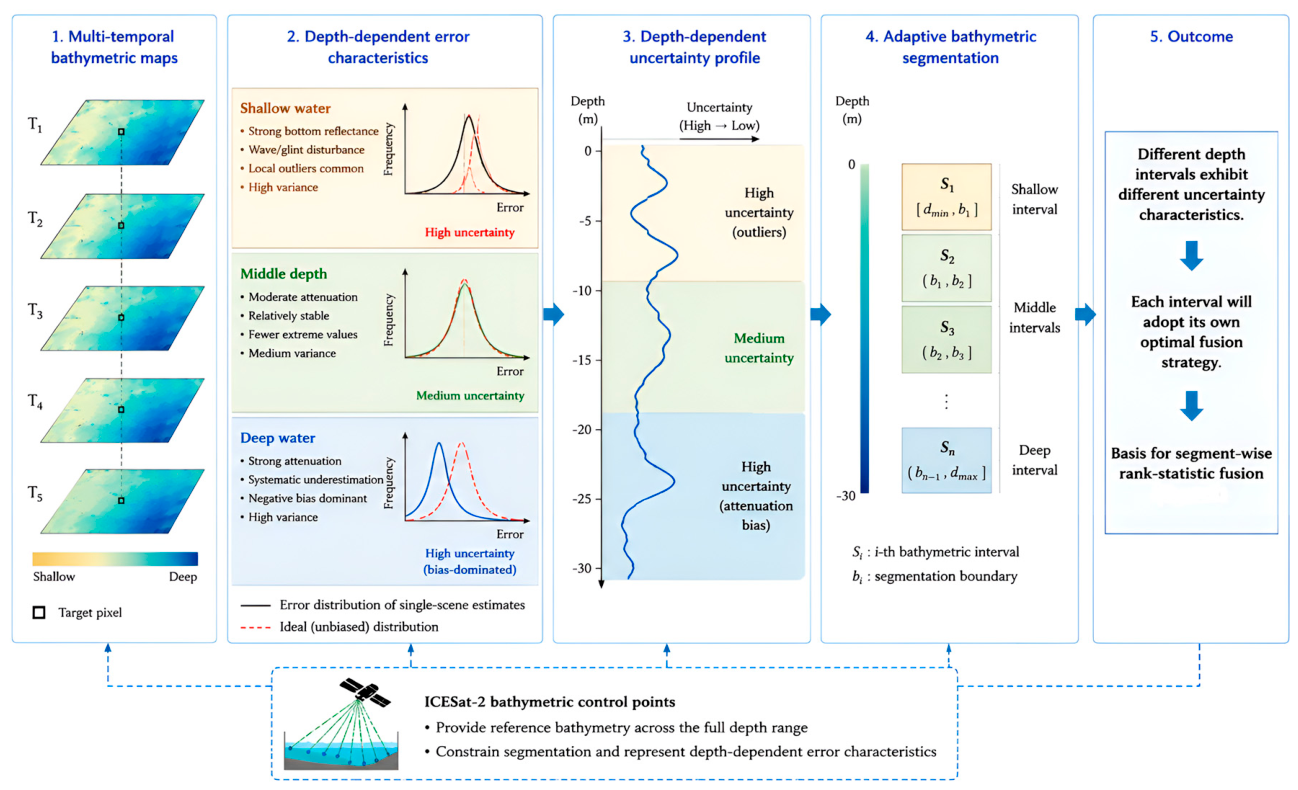
3.1. Framework Overview
3.2. Data Preprocessing
3.2.1. Sentinel-2 Image Preprocessing and Water Extraction
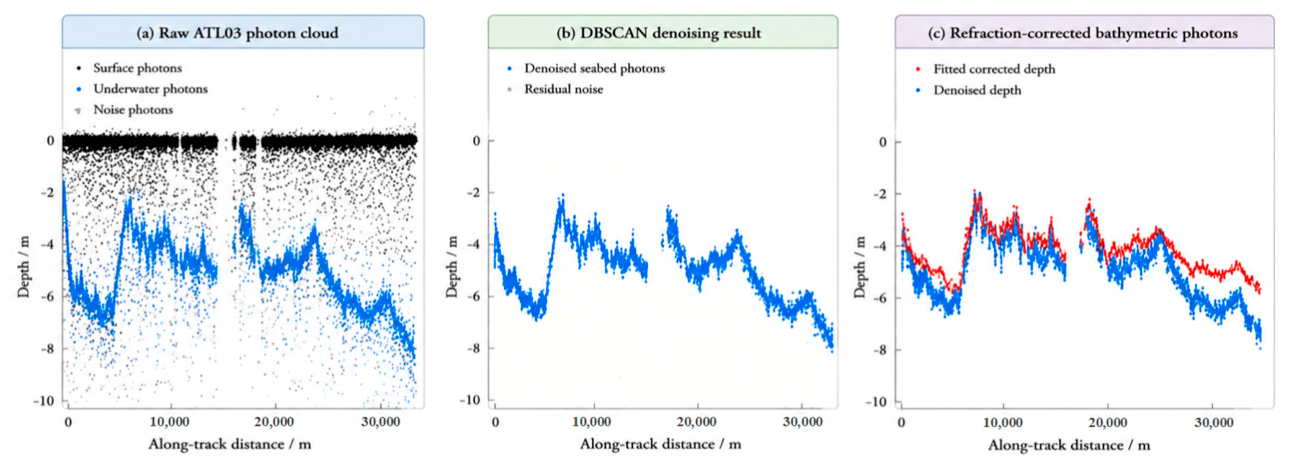
3.2.2. ICESat-2 ATL03 Bathymetric Photon Preprocessing

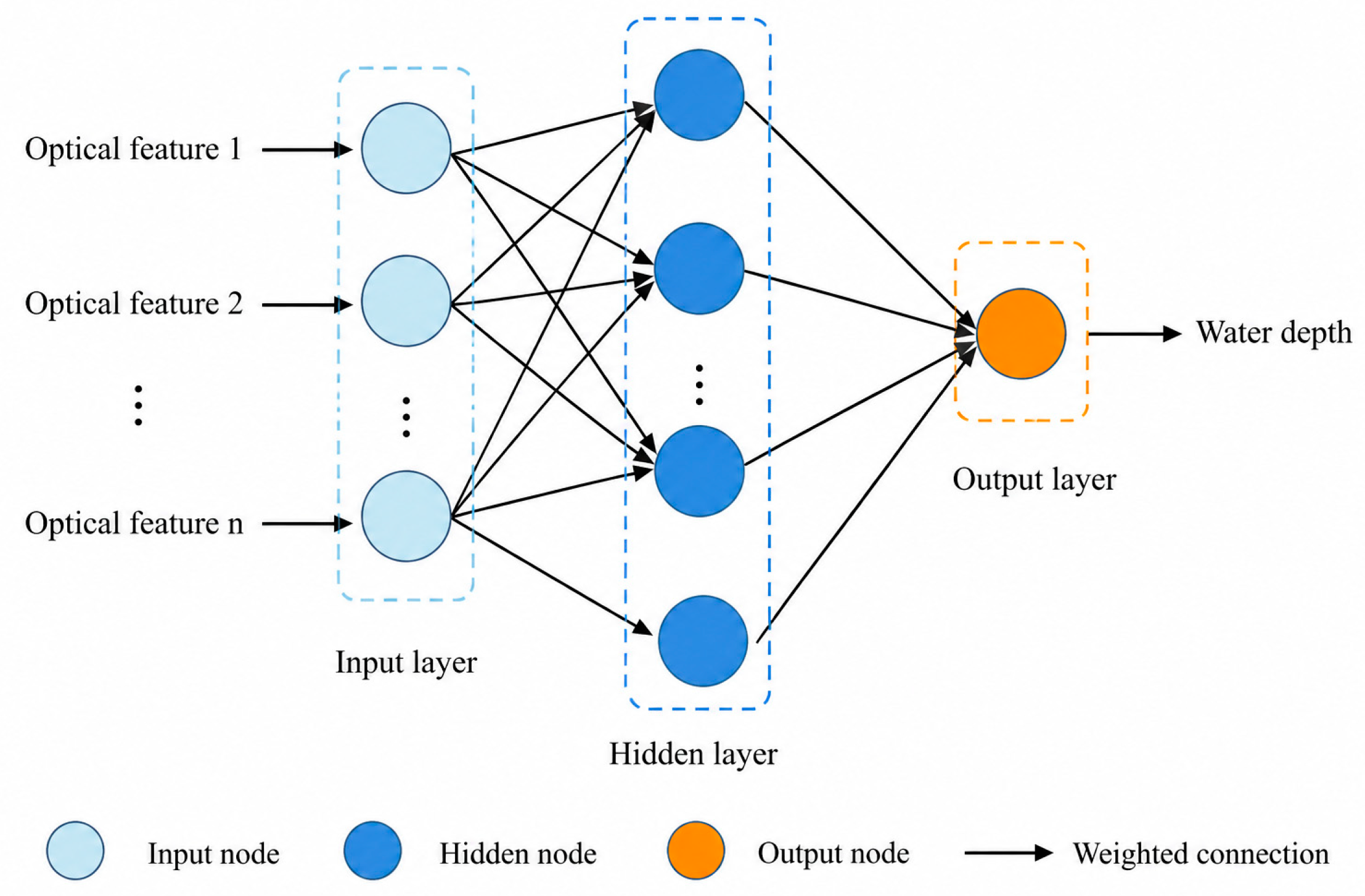
3.3. Multi-Temporal Single-Scene Bathymetric Inversion

3.4. ICESat-2-Constrained Adaptive Bathymetric Segmentation

3.5. Segment-Wise Rank-Statistic Fusion Strategy
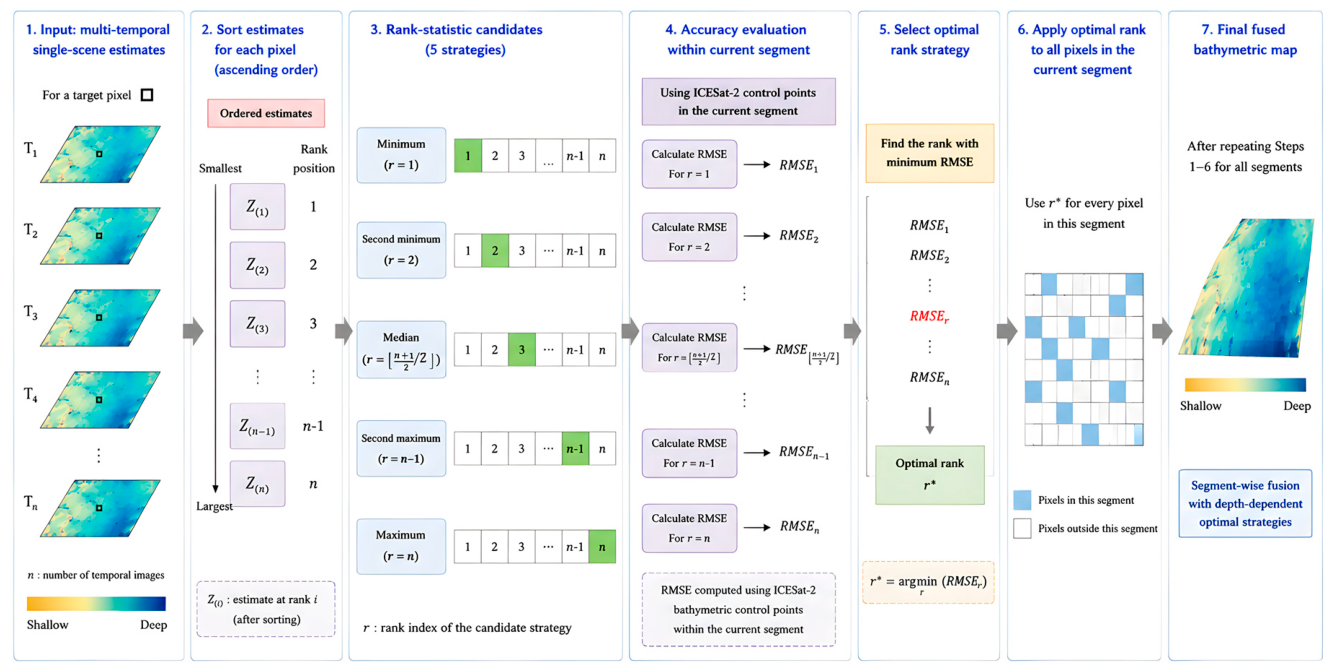
3.6. Final Bathymetric DEM Reconstruction
3.7. Accuracy Assessment
4. Results and Discussion
4.1. Bathymetry Results for Ganquan Island
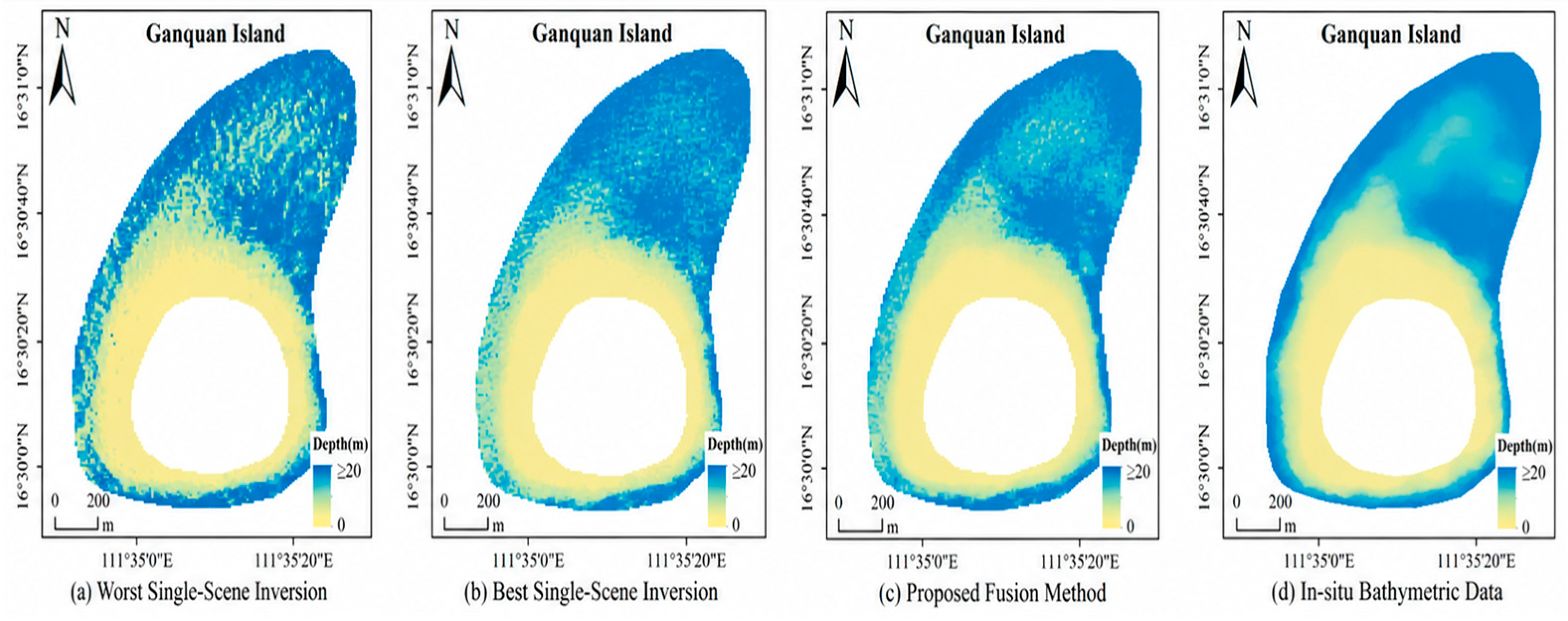
4.1.1. Qualitative Evaluation
4.1.2. Quantitative Evaluation
4.1.3. Accuracy Analysis in Different Bathymetric Intervals
4.2. Bathymetric Results for Dong Island
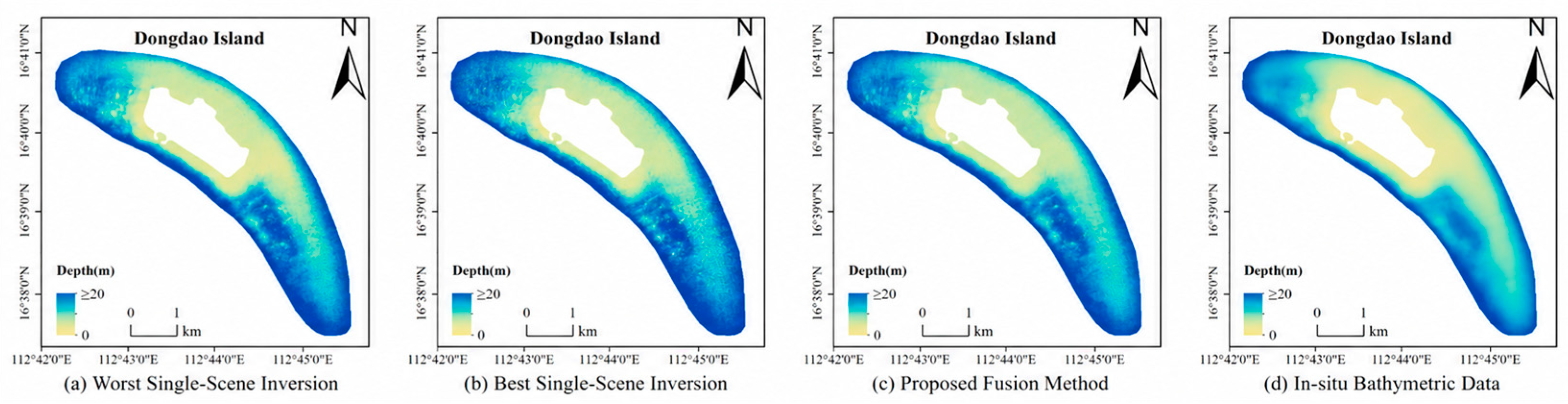
4.2.1. Qualitative Analysis
4.2.2. Quantitative Evaluation
4.2.3. Accuracy Analysis in Different Bathymetric Intervals
4.3. Bathymetry Results for Key Biscayne
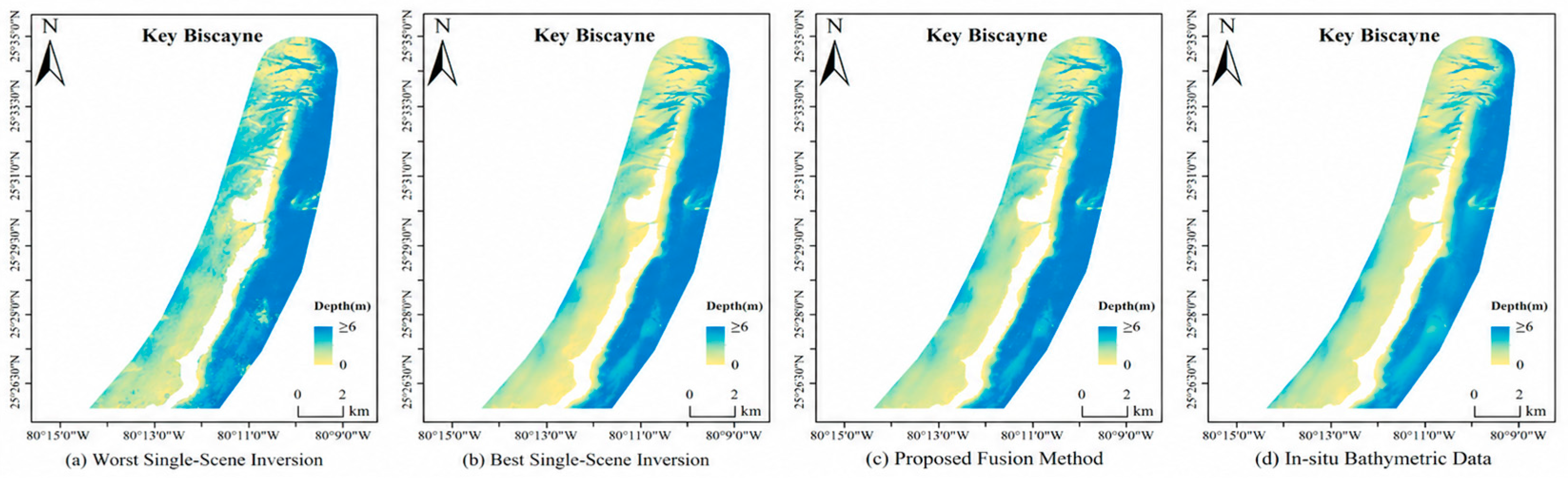
4.3.1. Qualitative Evaluation
4.3.2. Quantitative Evaluation
4.3.3. Accuracy Analysis in Different Bathymetric Intervals
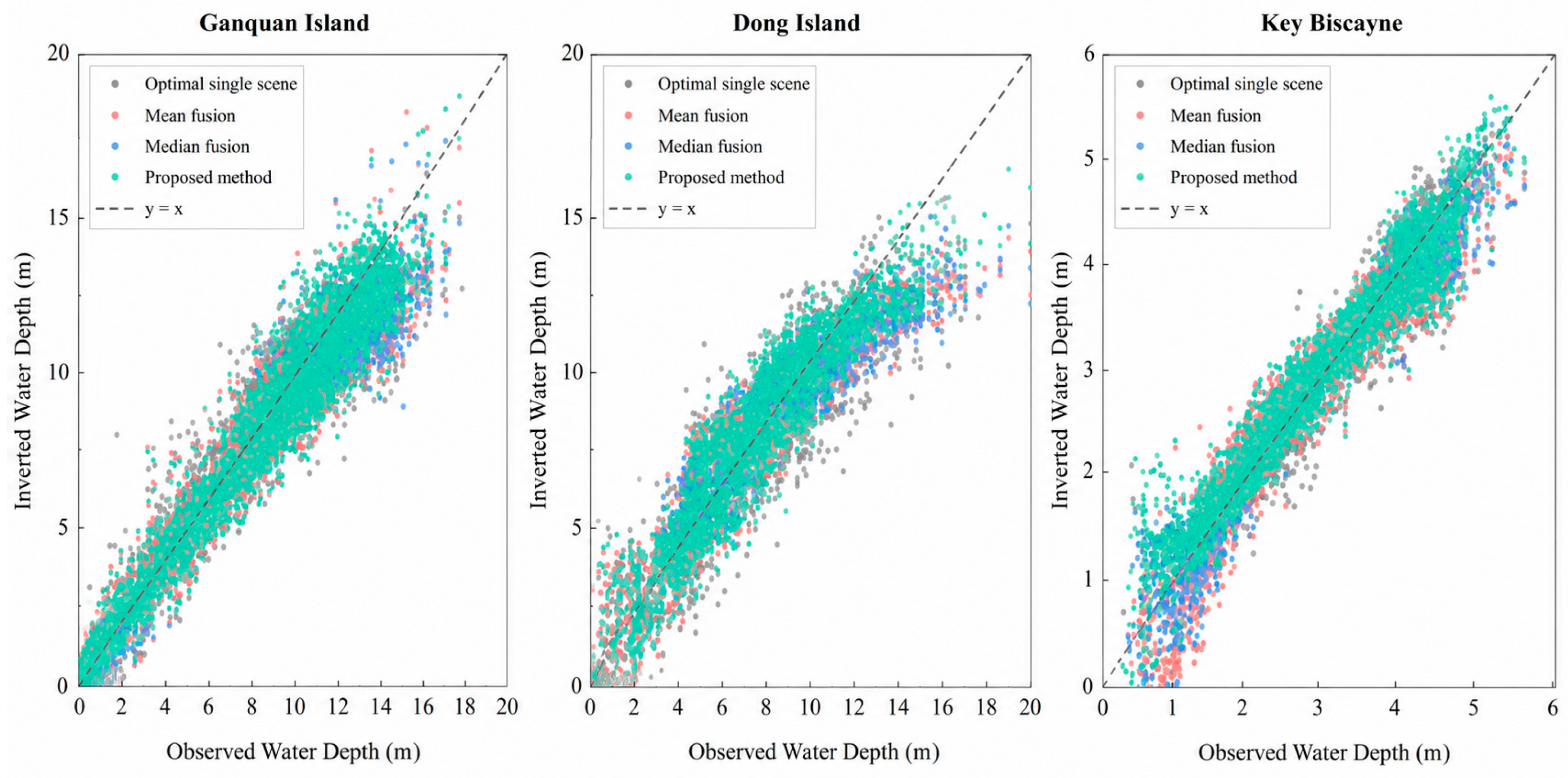
4.4. Comparative Analysis of Different Fusion Methods
4.4.1. Qualitative Evaluation of Bathymetric Inversion Results
4.4.2. Quantitative Evaluation of Bathymetric Inversion Results
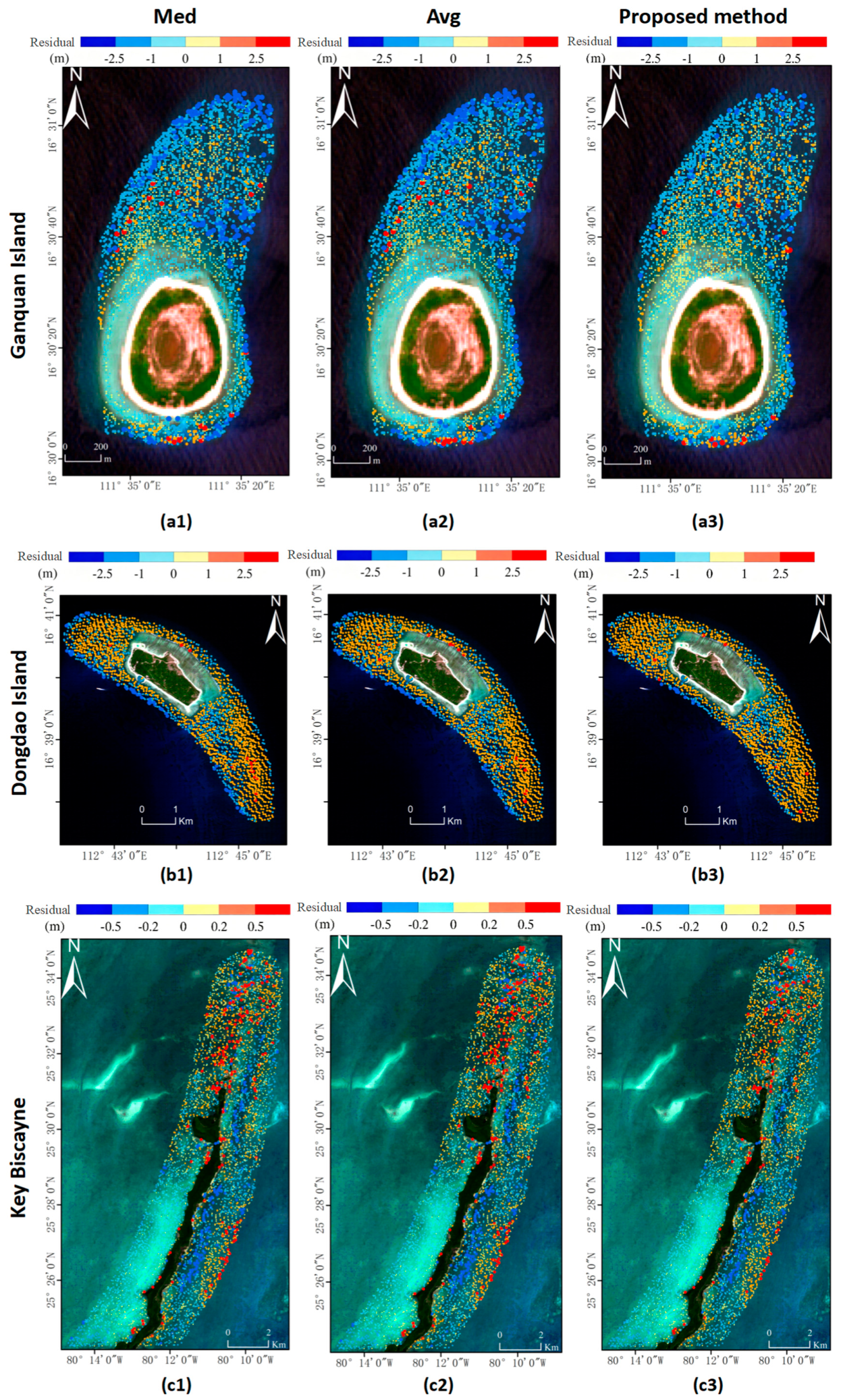
4.4.3. Residual Evaluation Based on Reference Bathymetric Data
4.5. Discussion
4.5.1. Advantages of the Proposed Method
4.5.2. Limitations and Future Work
5. Conclusions
- (1)
- Multi-temporal fusion can effectively improve the stability of satellite-derived bathymetry and reduce random inversion noise compared with single-scene bathymetric inversion.
- (2)
- Conventional mean fusion and median fusion methods can suppress part of the random noise; however, because they adopt global statistical strategies, systematic underestimation remains significant in deep-water regions.
- (3)
- The proposed adaptive segmented rank-statistic fusion method can automatically identify optimal fusion strategies according to local bathymetric error characteristics and consistently achieved the highest accuracy in all three study areas. The overall RMSE was reduced by up to 27.5%, while the R2 value reached 0.95.
- (4)
- In shallow-water regions, median and lower-order rank statistics were more frequently selected, whereas deeper bathymetric intervals generally favored higher-order rank statistics. These findings indicate that different bathymetric intervals exhibit distinct uncertainty characteristics and therefore require different fusion strategies for optimal bathymetric reconstruction.
Author Contributions
Funding
Data Availability Statement
Acknowledgments
Conflicts of Interest
References
- Lyzenga, D.R. Passive Remote Sensing Techniques for Mapping Water Depth and Bottom Features. Appl. Opt. 1978, 17, 379–383. [Google Scholar] [CrossRef]
- Stumpf, R.P.; Holderied, K.; Sinclair, M. Determination of Water Depth with High-Resolution Satellite Imagery over Variable Bottom Types. Limnol. Oceanogr. 2003, 48, 547–556. [Google Scholar]
- Philpot, W.D. Bathymetric Mapping with Passive Multispectral Imagery. Appl. Opt. 1989, 28, 1569–1578. [Google Scholar] [CrossRef]
- Irish, J.L.; Lillycrop, W.J. Scanning Laser Mapping of the Coastal Zone: The SHOALS System. ISPRS J. Photogramm. Remote Sens. 1999, 54, 123–129. [Google Scholar] [CrossRef]
- Guenther, G.C.; Cunningham, A.G.; LaRocque, P.E.; Reid, D.J. Meeting the Accuracy Challenge in Airborne Lidar Bathymetry. In Proceedings of the EARSeL-SIG-Workshop Lidar Remote Sensing of Land and Sea, Dresden, Germany, 16–17 June 2000; pp. 1–27. [Google Scholar]
- Brock, J.C.; Purkis, S.J. The Emerging Role of Lidar Remote Sensing in Coastal Research and Resource Management. J. Coast. Res. 2009, 25, 1–5. [Google Scholar] [CrossRef]
- Eugenio, F.; Marcello, J.; Martin, J. High-Resolution Maps of Bathymetry and Benthic Habitats in Shallow-Water Environments Using Multispectral Remote Sensing Imagery. IEEE Trans. Geosci. Remote Sens. 2015, 53, 3539–3549. [Google Scholar]
- Caballero, I.; Stumpf, R.P. Towards Routine Mapping of Shallow Bathymetry in Environments with Variable Turbidity: Contribution of Sentinel-2A/B Satellites Mission. Remote Sens. 2020, 12, 451. [Google Scholar] [CrossRef]
- Traganos, D.; Poursanidis, D.; Aggarwal, B.; Chrysoulakis, N.; Reinartz, P. Estimating Satellite-Derived Bathymetry (SDB) with the Google Earth Engine and Sentinel-2. Remote Sens. 2018, 10, 859. [Google Scholar] [CrossRef]
- Poursanidis, D.; Traganos, D.; Chrysoulakis, N.; Reinartz, P. Cubesats Allow High Spatiotemporal Estimates of Satellite-Derived Bathymetry. Remote Sens. 2019, 11, 1299. [Google Scholar] [CrossRef]
- Lee, Z.; Carder, K.L.; Mobley, C.D.; Steward, R.G.; Patch, J.S. Hyperspectral Remote Sensing for Shallow Waters: Deriving Bottom Depths and Water Properties by Optimization. Appl. Opt. 1999, 38, 3831–3843. [Google Scholar] [CrossRef] [PubMed]
- Mobley, C.D. Light and Water: Radiative Transfer in Natural Waters; Academic Press: San Diego, CA, USA, 1994. [Google Scholar]
- Pacheco, A.; Horta, J.; Loureiro, C.; Ferreira, O. Retrieval of Nearshore Bathymetry from Landsat 8 Images. Remote Sens. Environ. 2015, 159, 102–116. [Google Scholar] [CrossRef]
- Manessa, M.D.M.; Kanno, A.; Sekine, M.; Haidar, M.; Yamamoto, K.; Imai, T.; Higuchi, T. Satellite-Derived Bathymetry Using Random Forest Algorithm and WorldView-2 Imagery. Geoplan. J. Geomat. Plan. 2016, 3, 117–126. [Google Scholar] [CrossRef]
- Casal, G.; Harris, P.; Monteys, X.; Hedley, J.; Cahalane, C.; McCarthy, T. Understanding Satellite-Derived Bathymetry Using Sentinel 2 Imagery and Spatial Prediction Models. GIScience Remote Sens. 2020, 57, 271–286. [Google Scholar] [CrossRef]
- Sagawa, T.; Yamashita, Y.; Okumura, T.; Yamanokuchi, T. Satellite Derived Bathymetry Using Machine Learning and Multi-Temporal Satellite Images. Remote Sens. 2019, 11, 1155. [Google Scholar] [CrossRef]
- Su, H.; Liu, H.; Heyman, W.D. Automated Derivation of Bathymetric Information from Multi-Spectral Satellite Imagery Using a Non-Linear Inversion Model. Mar. Geod. 2008, 31, 281–298. [Google Scholar]
- Hedley, J.D.; Harborne, A.R.; Mumby, P.J. Simple and Robust Removal of Sun Glint for Mapping Shallow-Water Benthos. Int. J. Remote Sens. 2005, 26, 2107–2112. [Google Scholar]
- Valjarević, A.; Filipović, D.; Milanović, M.; Valjarević, D. New Updated World Maps of Sea-Surface Salinity. Pure Appl. Geophys. 2020, 177, 2977–2992. [Google Scholar] [CrossRef]
- Markus, T.; Neumann, T.; Martino, A.; Abdalati, W.; Brunt, K.; Csatho, B.; Farrell, S.; Fricker, H.; Gardner, A.; Harding, D.; et al. The Ice, Cloud, and Land Elevation Satellite-2 (ICESat-2): Science Requirements, Concept, and Implementation. Remote Sens. Environ. 2017, 190, 260–273. [Google Scholar] [CrossRef]
- Neumann, T.A.; Martino, A.J.; Markus, T.; Bae, S.; Bock, M.R.; Brenner, A.C.; Brunt, K.M.; Cavanaugh, J.; Fernandes, S.T.; Hancock, D.W.; et al. The Ice, Cloud, and Land Elevation Satellite-2 Mission: A Global Geolocated Photon Product Derived from the Advanced Topographic Laser Altimeter System. Remote Sens. Environ. 2019, 233, 111325. [Google Scholar] [CrossRef] [PubMed]
- Parrish, C.E.; Magruder, L.A.; Neuenschwander, A.L.; Forfinski-Sarkozi, N.; Alonzo, M.; Jasinski, M.F. Validation of ICESat-2 ATLAS Bathymetry and Analysis of ATLAS’s Bathymetric Mapping Performance. Remote Sens. 2019, 11, 1634. [Google Scholar] [CrossRef]
- Ma, Y.; Xu, N.; Liu, Z.; Yang, B.; Yang, F.; Wang, X.H.; Li, S. Satellite-Derived Bathymetry Using the ICESat-2 Lidar and Sentinel-2 Imagery Datasets. Remote Sens. Environ. 2020, 250, 112047. [Google Scholar] [CrossRef]
- Leng, Z.; Zhang, J.; Ma, Y.; Zhang, J.; Zhu, H. A novel bathymetry signal photon extraction algorithm for photon-counting LiDAR based on adaptive elliptical neighborhood. Int. J. Appl. Earth Obs. Geoinf. 2022, 115, 103080. [Google Scholar] [CrossRef]
- Zhu, J.; Han, Y.; Wang, R.; Yin, F.; Liu, B.; Cui, Y.; Zhang, Y.; Qin, J. Bathymetry Retrieval without In-Situ Depth Using an ICESat-2-Assisted Dual-Band Model. IEEE J. Sel. Top. Appl. Earth Obs. Remote Sens. 2024, 17, 17739–17752. [Google Scholar] [CrossRef]
- Hamylton, S.M. Mapping Coral Reef Environments: A Review of Historical Methods, Recent Advances and Future Opportunities. Prog. Phys. Geogr. 2017, 41, 803–833. [Google Scholar]
- Purkis, S.J. Remote Sensing Tropical Coral Reefs: The View from Above. Annu. Rev. Mar. Sci. 2018, 10, 149–168. [Google Scholar] [CrossRef]
- Hedley, J.D.; Roelfsema, C.M.; Chollett, I.; Harborne, A.R.; Heron, S.F.; Weeks, S.; Skirving, W.J.; Strong, A.E.; Eakin, C.M.; Christensen, T.R.L.; et al. Remote Sensing of Coral Reefs for Monitoring and Management: A Review. Remote Sens. 2016, 8, 118. [Google Scholar] [CrossRef]
- Lirman, D.; Serafy, J.E.; Hazra, A.; Purkis, S.; Riegl, B.; Graham, N.; Kaufman, L. Coral Communities and Benthic Habitat Mapping in Biscayne National Park, Florida. Mar. Ecol. Prog. Ser. 2008, 357, 119–131. [Google Scholar]
- Drusch, M.; Del Bello, U.; Carlier, S.; Colin, O.; Fernandez, V.; Gascon, F.; Hoersch, B.; Isola, C.; Laberinti, P.; Martimort, P.; et al. Sentinel-2: ESA’s Optical High-Resolution Mission for GMES Operational Services. Remote Sens. Environ. 2012, 120, 25–36. [Google Scholar] [CrossRef]
- ESA. Sentinel-2 User Handbook; European Space Agency: Paris, France, 2022. [Google Scholar]
- McFeeters, S.K. The Use of the Normalized Difference Water Index (NDWI) in the Delineation of Open Water Features. Int. J. Remote Sens. 1996, 17, 1425–1432. [Google Scholar] [CrossRef]
- Ester, M.; Kriegel, H.P.; Sander, J.; Xu, X. A Density-Based Algorithm for Discovering Clusters in Large Spatial Databases with Noise. In Proceedings of the Second International Conference on Knowledge Discovery and Data Mining, Portland, OR, USA, 2–4 August 1996; pp. 226–231. [Google Scholar]
- Rumelhart, D.E.; Hinton, G.E.; Williams, R.J. Learning Representations by Back-Propagating Errors. Nature 1986, 323, 533–536. [Google Scholar] [CrossRef]
- Haykin, S. Neural Networks and Learning Machines; Pearson Education: New York, NY, USA, 2009. [Google Scholar]
- Huber, P.J. Robust Statistics; Wiley: New York, NY, USA, 1981. [Google Scholar]
- Hampel, F.R.; Ronchetti, E.M.; Rousseeuw, P.J.; Stahel, W.A. Robust Statistics: The Approach Based on Influence Functions; Wiley: New York, NY, USA, 1986. [Google Scholar]
- Congalton, R.G.; Green, K. Assessing the Accuracy of Remotely Sensed Data: Principles and Practices; CRC Press: Boca Raton, FL, USA, 2008. [Google Scholar]
- Jensen, J.R. Introductory Digital Image Processing: A Remote Sensing Perspective; Pearson Education: Upper Saddle River, NJ, USA, 2015. [Google Scholar]




| Method | Scene 1 | Scene 2 | Scene 3 | Scene 4 | Scene 5 | Proposed-Method |
|---|---|---|---|---|---|---|
| R2 | 0.92 | 0.84 | 0.88 | 0.85 | 0.89 | 0.95 |
| RMSE | 1.32 | 1.92 | 2.01 | 2.10 | 1.66 | 1.12 |
| MAE | 0.95 | 1.02 | 1.43 | 1.55 | 1.23 | 0.81 |
| Depth Segmentation (m) | Scene 1 | Scene 2 | Scene 3 | Scene 4 | Scene 5 | Proposed Method |
|---|---|---|---|---|---|---|
| (15, 20] | 3.06 | 2.63 | 3.68 | 4.61 | 2.61 | 2.44 |
| (10, 15] | 1.73 | 1.81 | 2.74 | 2.88 | 1.95 | 1.50 |
| (5, 10] | 1.11 | 1.12 | 1.60 | 1.97 | 1.9 | 0.94 |
| [0, 5] | 0.90 | 2.54 | 1.42 | 0.90 | 0.85 | 0.59 |
| Method | Scene 1 | Scene 2 | Scene 3 | Scene 4 | Scene 5 | Proposed Method |
|---|---|---|---|---|---|---|
| R2 | 0.80 | 0.81 | 0.75 | 0.62 | 0.78 | 0.88 |
| RMSE | 1.55 | 1.62 | 1.82 | 2.19 | 1.71 | 1.28 |
| MAE | 1.18 | 1.26 | 1.40 | 1.71 | 1.28 | 1.00 |
| Depth Segmentation (m) | Scene 1 | Scene 2 | Scene 3 | Scene 4 | Scene 5 | Proposed Method |
|---|---|---|---|---|---|---|
| (15, 20] | 4.11 | 4.11 | 4.67 | 5.86 | 4.19 | 3.23 |
| (10, 15] | 1.81 | 2.12 | 2.43 | 2.79 | 1.97 | 1.40 |
| (5, 10] | 1.27 | 1.32 | 1.53 | 1.64 | 1.39 | 1.05 |
| [0, 5] | 1.50 | 1.35 | 1.32 | 2.11 | 1.75 | 1.09 |
| Method | Scene 1 | Scene 2 | Scene 3 | Scene 4 | Scene 5 | Proposed Method |
|---|---|---|---|---|---|---|
| R2 | 0.79 | 0.69 | 0.89 | 0.52 | 0.93 | 0.94 |
| RMSE | 0.72 | 0.69 | 0.40 | 1.16 | 0.32 | 0.29 |
| MAE | 0.47 | 0.35 | 0.29 | 0.67 | 0.22 | 0.21 |
| Depth Segmentation (m) | Scene 1 | Scene 2 | Scene 3 | Scene 4 | Scene 5 | Proposed Method |
|---|---|---|---|---|---|---|
| (4, 6] | 0.51 | 0.45 | 0.49 | 0.77 | 0.40 | 0.37 |
| (2, 4] | 0.44 | 0.3 | 0.31 | 0.6 | 0.26 | 0.23 |
| [0, 2] | 1.15 | 1.18 | 0.47 | 1.93 | 0.35 | 0.30 |
| Study Area | Method | RMSE (m) | MAE (m) | R2 |
|---|---|---|---|---|
| Ganquan Island | Mean Fusion | 1.26 | 0.89 | 0.94 |
| Median Fusion | 1.25 | 0.90 | 0.94 | |
| Proposed Method | 1.12 | 0.81 | 0.95 | |
| Dong Island | Mean Fusion | 1.40 | 1.07 | 0.87 |
| Median Fusion | 1.42 | 1.09 | 0.86 | |
| Proposed Method | 1.28 | 1.00 | 0.88 | |
| Key Biscayne | Mean Fusion | 0.40 | 0.26 | 0.90 |
| Median Fusion | 0.31 | 0.22 | 0.93 | |
| Proposed Method | 0.29 | 0.21 | 0.94 |
Disclaimer/Publisher’s Note: The statements, opinions and data contained in all publications are solely those of the individual author(s) and contributor(s) and not of MDPI and/or the editor(s). MDPI and/or the editor(s) disclaim responsibility for any injury to people or property resulting from any ideas, methods, instructions or products referred to in the content. |
© 2026 by the authors. Licensee MDPI, Basel, Switzerland. This article is an open access article distributed under the terms and conditions of the Creative Commons Attribution (CC BY) license.
Share and Cite
Dong, Z.; Wen, L.; Gong, H.; Liu, Y.; Feng, Y.; Chen, Y.; Tang, Q. A Multi-Temporal Satellite-Derived Bathymetry Fusion Method Based on Adaptive Segmented Rank-Statistic Fusion. J. Mar. Sci. Eng. 2026, 14, 1194. https://doi.org/10.3390/jmse14131194
Dong Z, Wen L, Gong H, Liu Y, Feng Y, Chen Y, Tang Q. A Multi-Temporal Satellite-Derived Bathymetry Fusion Method Based on Adaptive Segmented Rank-Statistic Fusion. Journal of Marine Science and Engineering. 2026; 14(13):1194. https://doi.org/10.3390/jmse14131194
Chicago/Turabian StyleDong, Zhipeng, Leyu Wen, Hui Gong, Yanxiong Liu, Yikai Feng, Yilan Chen, and Qiuhua Tang. 2026. "A Multi-Temporal Satellite-Derived Bathymetry Fusion Method Based on Adaptive Segmented Rank-Statistic Fusion" Journal of Marine Science and Engineering 14, no. 13: 1194. https://doi.org/10.3390/jmse14131194
APA StyleDong, Z., Wen, L., Gong, H., Liu, Y., Feng, Y., Chen, Y., & Tang, Q. (2026). A Multi-Temporal Satellite-Derived Bathymetry Fusion Method Based on Adaptive Segmented Rank-Statistic Fusion. Journal of Marine Science and Engineering, 14(13), 1194. https://doi.org/10.3390/jmse14131194