Article

Significant Wave Height (SWH) Estimation Using the Shadow Method with Azimuthal Dependence Mitigation

1
College of Intelligent Systems Science and Engineering, Harbin Engineering University, No. 145 Nantong Street, Harbin 150001, China
2
College of Electrical Engineering and Automation, Luoyang Normal University, No. 6 Jiqing Road, Luoyang 471934, China
*
Author to whom correspondence should be addressed.
J. Mar. Sci. Eng. 2026, 14(11), 966; https://doi.org/10.3390/jmse14110966 (registering DOI)
Submission received: 27 April 2026 / Revised: 20 May 2026 / Accepted: 21 May 2026 / Published: 23 May 2026
(This article belongs to the Section Ocean Engineering)

Abstract

A significant wave height (SWH) estimation method for X-band ocean radar images based on the shadow modulation principle is studied. The conventional shadow method obtains the wave steepness by analyzing the bright and dark patterns in the radar image and then calculates the SWH. The shadow method relies on accurate estimation of wave steepness, which is the most reliable in the upwave area, so it shows a strong azimuth dependence. Under the actual observation conditions, it is usually difficult to obtain an ideal analysis region to effectively mitigate the direction dependence due to the limitations of physical obstacles and platform attitude changes, which affects the inversion accuracy. To solve the problem, this paper proposes a wave steepness correction method based on harmonic fitting. By establishing a harmonic fitting model between wave steepness and wave angle, the method reconstructs the continuous and stable wave steepness distribution with wave angle from 0 ° to 360 ° according to limited data points. Then, the wave steepness independent of azimuth is obtained when the wave angle is 0 ° . The effectiveness of the proposed wave steepness correction method is validated using a total of 466 sets of radar data collected from 8 November to 18 November 2014 and 10 January to 20 January 2015. After applying the wave steepness correction method, compared to the conventional shadow method without correction, although the correlation coefficient (CC) increased by only 0.07, the bias (BIAS) decreased by 0.12 m, and the average root mean square error (RMSE) decreased by 0.12 m.

1. Introduction

Accurate estimation of significant wave height (SWH) is crucial for coastal engineering, vessel navigation, marine climate monitoring, and disaster early warning. Although wave buoys can provide reliable data, the limitations of high cost and limited coverage are prominent. Wind-wave models, despite the good performance in SWH forecasts, suffer from spectral distortion and underestimation of storm peaks due to the linear spectral assumption, and thus struggle to capture the true nonlinear wave characteristics [1]. Satellite remote sensing can cover vast ocean areas, but the low temporal resolution makes it difficult to achieve continuous and fixed-point observations [2]. X-band radar, with its all-weather capability and relatively low cost, has emerged as an effective means of wave monitoring. It can be mounted on fixed platforms or vessels to enable continuous, almost real-time wave measurements, offering distinct advantages in coastal and nearshore regions [3,4].
The X-band radar image has high temporal and spatial resolution, which can be used to retrieve a variety of ocean parameters, such as the sea surface wind field [5,6], surface flow field [7], and ocean waves [8]. In recent years, the study of ocean wave parameter inversion based on X-band radar images has been paid more and more attention, and has gradually become a hot direction in the field of marine remote sensing [9]. Among them, the SWH, as a key parameter to describe the characteristics of the wave field and measure the wave energy, is of great significance in ocean observation and prediction [10]. Shore-based X-band radar features strong stability and is capable of fully capturing the wave evolution process even under extreme storm conditions [11]. Further extraction of key wave parameters, including wave direction and wave period, can be achieved by processing time-series radar image sequences [12,13].
At present, the main methods for retrieving the SWH from X-band marine radar images include the shadow method and the three-dimensional (3D) Fourier spectrum analysis method using the radar image sequence, which consists of two spatial dimensions and one temporal dimension [14]. In addition, the method based on ensemble empirical mode decomposition is also applied to the estimation of SWH [15]. In recent years, data-driven approaches using artificial intelligence, such as support vector regression [16] and convolutional neural networks (CNNs) [17], have also been explored for wave height inversion. Although accuracy has greatly improved, large amounts of radar data across different sea conditions are required. To reduce reliance on observed data, the CNN is first pre-trained using synthetic radar images, and the pre-trained weights are then transferred to the regression model, thereby enabling more accurate estimates of SWH using real data [18]. Given the data requirements of data-driven methods, physics-based approaches offer a more stable alternative. The 3D Fourier spectrum analysis method establishes an empirical linear relationship between the square root of the signal-to-noise ratio (SNR) and SWH [19], and subsequent studies have improved its accuracy through modulation transfer functions [20], anti-aliasing techniques [21], and adaptive window positioning [22]. Lund et al. [23] further demonstrated that SNR varies with azimuth, being highest in the upwave direction and lowest in the crosswave direction. Based on coastal observation data, the 3D Fourier spectral analysis method has been validated to achieve reliable SWH inversion even under non-ideal engineering conditions, establishing specific boundaries for engineering applicability [24]. A typical implementation of the 3D Fourier spectrum analysis method is SeaVision, a global ocean wave observing system deriving directional wave spectral and SWH in real time [25].
Although the spectrum analysis method can achieve high measurement accuracy for SWH, it relies on external equipment for calibration to establish the nonlinear relationship between SNR and SWH. The shadow method for wave height estimation is based on geometric occlusion effects, where higher waves block the radar line of sight to lower waves, thereby creating shadowed regions in the radar image. As shown in Figure 1, radar antennas mounted on shore-based platforms transmit electromagnetic waves toward the sea surface at a grazing angle. The grazing angle is defined as the angle between the radar line of sight and the sea surface. The azimuth angle is the horizontal direction of the radar line of sight, typically measured clockwise from true north. When waves propagate along the radar line of sight, the wave peaks directly block the radar beam and form shadow regions. The proportion of shaded areas is directly used to estimate wave steepness, which is then combined with peak wave periods to calculate wave height.
At present, compared with the traditional spectral analysis method, the shadow method has the advantage of not needing external reference equipment and has become a research hotspot for retrieving the SWH from marine radar images. Gangeskar [26] proposed the shadow method for retrieving SWH based on shadow areas in radar images. The method operates on the principle that lower waves are occluded by higher waves to produce shadow regions in the radar image for a fluctuating sea surface [27]. Thus, when electromagnetic waves illuminate the sea surface, shadows constitute a dominant feature in the resulting radar image [28]. The stability and accuracy of threshold selection were improved by using a smooth gray intensity histogram in the shadow method [29]. In the traditional shadow segmentation method, the shadow region is often inaccurately delineated, which reduces the accuracy of SWH inversion. To address the limitation, an adaptive segmentation method based on differential edge detection is proposed, which can more accurately extract the shadow region [30]. In order to reduce the influence of errors in the delineation of shadowed regions, a method to calibrate the shadow area of radar images by using filtering and interpolation technology is proposed [31]. The distortion caused by the radar acquisition process and radar signal attenuation with distance is compensated using image enhancement technology.
The shadow method relies on accurate estimation of wave steepness, which is defined as the ratio of wave height to wavelength. For random waves in deep water, the significant wave steepness can be expressed as σ = H s L , where H s is the SWH and L is the wavelength [26]. The relationship forms the physical basis for estimating SWH based on wave steepness derived from radar shadow statistics. Ludeno et al. [32] proposed a method to estimate the wave steepness by maximizing the correlation coefficient (CC) between the non-shadow radar image and the simulated radar image. To improve the accuracy of the shadow segmentation threshold of the radar image, the Prewitt operator was used to calculate the shadow segmentation threshold [33]. In order to solve the problem of unsatisfactory edge detection under low wind speed, Wang et al. [34] used a deep learning model to replace the traditional edge detection theory to calculate the shadow threshold, which reduced the running time and improved the measurement accuracy. Wei et al. [35] used an adaptive shadow threshold to accurately classify radar images into shadow regions and non-shadow regions. By approximating the complementary error function and exponential term in the Smith function, the analytical solution of the root mean square (RMS) of wave steepness is directly obtained from the illumination probability, significantly reducing the calculation time [36].
Radar echo intensity is obviously affected by range and azimuth [23]. The shadow method was originally developed using X-band radar data collected from a fixed offshore platform with an antenna elevation of approximately 43.2 m and the water depth of 174∼185 m [26]. For horizontally polarized X-band marine radars, the sea surface echo intensity exhibits an approximately 180 ° characteristic with respect to the wind and wave directions, reaching a maximum in the upwind direction and a secondary maximum in the downwind direction. Since wave steepness follows a similar azimuthal distribution, a 180 ° azimuth sector is typically selected for analysis to ensure that at least one of the two dominant directions is included, thereby maintaining the reliability of wave steepness inversion.
In addition, the sub-region within ± 5 ° of the upwind direction could be also used to estimate the root mean square (RMS) wave steepness from shipborne X-band radar data acquired from a vessel with an antenna height of 21.9 m above the sea surface and the water depth is 200 m [29]. However, under the actual observation conditions, it is difficult to select the ideal analysis area, due to the influence of factors such as object occlusion and navigation attitude change. Considering the azimuthal variation of wave steepness, subsequent studies constructed a wave steepness feature vector in the azimuth direction to account for directional modulation [35]. However, the detailed variation relation between wave steepness and wave direction in azimuth has not been thoroughly investigated until now.
The method proposed in this paper is not an artificial intelligence-based approach, but rather a physics-based enhancement of the conventional shadow method. The key improvement lies in the introduction of a harmonic fitting procedure that explicitly accounts for the dependence of wave steepness on azimuth. Wave steepness values are calculated for different directional partitions using the conventional shadow method. All obtained wave steepness values with respect to wave angle are then fitted by a harmonic function, clearly showing that wave steepness is highest in the upwave direction and lowest in the crosswave direction, with the data fitting well to the model. Using limited data points, the distribution of wave steepness in the complete period of wave angle is reconstructed, and the steepness value at 0° wave angle is extracted as a reliable estimate for the upwave partition. The advantages and novelty of the proposed approach are summarized as follows: (1) The wave steepness changes in different wave directions is investigated using the shadow method; (2) A correction model based on harmonic fitting is introduced to reconstruct the continuous directional distribution of wave steepness over the range of 0° to 360° from a limited set of observational data points; (3) The proposed method provides a reliable technical approach for SWH accurate inversion in the actual situation of a limited radar field of view or incomplete wave direction coverage.
The remainder of this paper is structured as follows: Section 2 outlines the fundamentals of the conventional shadow method and details the proposed harmonic fitting algorithm of SWH retrieval for X-band radar images. Section 3 presentes the experimental validation and performance analysis of the proposed algorithm. Finally, discussions and conclusions are provided in Section 4 and Section 5, respectively.

2. Methods

2.1. Conventional Method

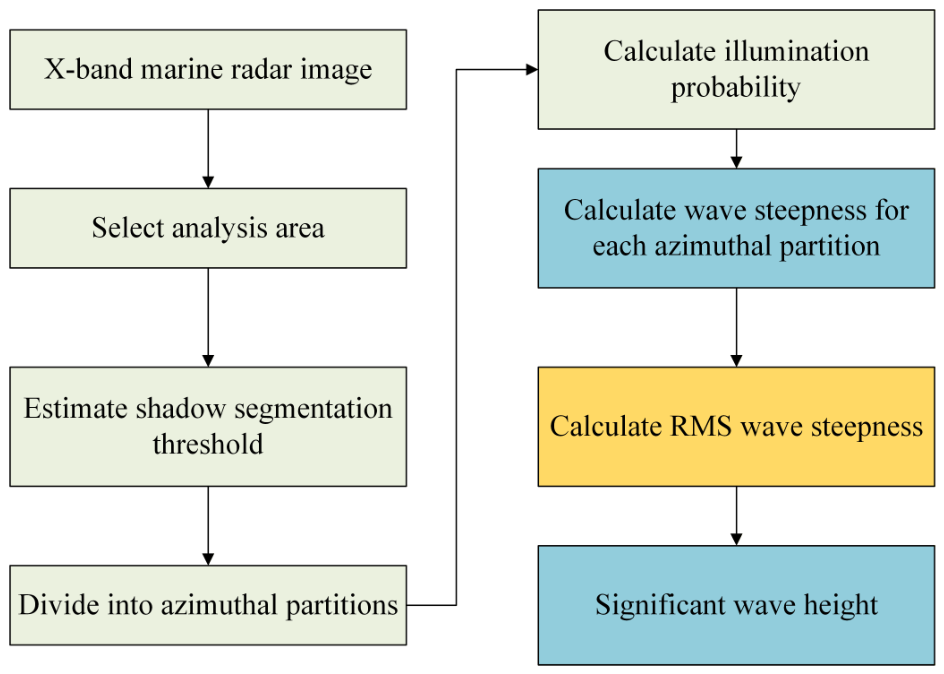
The conventional shadow method for measuring the SWH can be divided into four steps: estimate the threshold for distinguishing between shaded and unshaded areas, calculate the illumination probability for each distance direction block in the azimuth partitions, obtain the averaged RMS wave steepness, and calculate the SWH [26]. A flowchart of the conventional method is shown in Figure 2.
The differential image I E i is obtained by applying the classical difference operator to the original image [26]:
I E i = I ( r , θ ) H i ( r , θ )
where r is the distance, θ is the direction, ⊗ denotes the convolution operation, I ( r , θ ) is the original echo image. H i ( r , θ ) represents the selected directional difference operator corresponding to the pixel points, and i = 1 , 2 , , 8 corresponds to eight directional templates in the range of 0 ° 360 ° with a 45° interval. The eight directional templates are used for edge detection, which is related to the distance direction and azimuth for each pixel. The pixel difference operators for the eight directions are:
H 1 = 0 0 0 0 1 1 0 0 0 , H 2 = 0 0 0 0 1 0 0 0 1 , H 3 = 0 0 0 0 1 0 0 1 0 , H 4 = 0 0 0 0 1 0 1 0 0 , H 5 = 0 0 0 1 1 0 0 0 0 , H 6 = 0 0 1 0 1 0 0 0 0 , H 7 = 0 1 0 0 1 0 0 0 0 , H 8 = 1 0 0 0 1 0 0 0 0 .
The convolution operation is performed to extract the edges of the sea wave texture, which is related to the wave direction. The edge images are filtered using a threshold value equal to the upper K-percentile of the pixel values, where K is empirically set to 10. Specifically, the pixel values are sorted in ascending order, and the value at the 90th percentile position is used as the threshold τ . Pixels with values greater than τ are considered edge pixels. The resulting edge image I T i ( r , θ ) is given as:
I T i ( r , θ ) = 1 , I E i ( r , θ ) > τ 0 , otherwise
Then, the eight edge sub-images are superimposed to obtain the original edge image I T ( r , θ ) :
I T ( r , θ ) = i = 1 8 I T i ( r , θ )
When the original edge image is filtered, the edge image I F ( r , θ ) is as follows:
I F ( r , θ ) = 1 , I T ( r , θ ) 6 0 , otherwise .
Isolated noise typically produces edge detections in all eight directions, whereas true shadow boundaries are empirically detected in fewer than six directions. A threshold of 6 is used to remove isolated noise that differs significantly from the background and does not form a continuous contour. Pixels with edge directions in fewer than six directions ( I T 6 ) are retained as potential shadow boundaries, while those with edge directions in six or more directions are removed as noise. The intensity distribution of the original image pixels with a value of 1 in the edge image is counted to obtain the edge histogram F H ( η ) . The histogram is constructed based on the pixel values of the raw radar image.
The radar video signal is sampled by a 14-bit acquisition card, with a theoretical dynamic range of 0∼16,383 digital numbers. After radar internal gain control, analog filtering, and signal conditioning, the effective linear backscatter intensity of sea clutter from X-band marine radar is limited to 0∼5000. For a near-range radar image, strong sea clutter leads to receiver saturation, whose digital value exceeds 5000. For a far-range radar image, a weak echo of a sea wave is submerged in noise. Only the middle area of the radar image retains stable sea clutter digital number distributed in 0∼5000, which is verified by statistical analysis of experimental radar image data. For subsequent statistical analysis of shadow features, the intensity range of pixel value is divided into 50 histogram bins, and each bin covers a 100 bin width.
The segmentation threshold τ s is then determined as the mode of the edge histogram F H ( η ) , i.e., the grayscale value that occurs most frequently among pixels located at shadow boundaries. The threshold is used to classify each pixel in the original radar image: pixel with intensity below τ s is identified as shadow areas, while pixel intensity above is considered illuminated surface [26]:
τ S = m o d e ( F H ( η ) )
where the mode(·) is defined as the value with the highest frequency of occurrence in a given dateset. Pixel values of the original radar image I ( r , θ ) below τ s are classified as shadow areas and set to 1, while all other pixel values are assigned 0. The shadow image I s ( r , θ ) is given as follows [26]:
I s ( r , θ ) = 1 , I ( r , θ ) < τ s 0 , otherwise .
The range resolution of the radar is determined by the transmitted pulse width. For an X-band marine radar operating in narrow pulse mode, the range resolution Δ R is given by Δ R = c τ / 2 , where c is the speed of light and τ is the pulse width.
The selection of the effective range interval ensures that the radar backscatter intensity varies smoothly. After determining the effective range interval, it is divided into N range blocks of equal width. The division balances the angular resolution of the grazing angle and the statistical stability of the illumination probability estimates.
After obtaining the shadow image, the illumination ratio for each partition block needs to be calculated. The selected original image is equally divided into N blocks in the distance direction and M partitions in the azimuth direction.
The shaded probability of S ( γ ) fis calculated or each block, where γ is the grazing angle. The illumination proportion is defined as L ( γ ) = 1 S ( γ ) . The Smith function for calculating illumination proportion is given as [26,37]
L ( γ ) = 1 1 2 erfc μ 2 σ RMS Λ ( μ ) + 1
where
Λ ( μ ) = 2 π · σ RMS μ · e μ 2 2 σ RMS 2 erfc μ 2 σ RMS 2
μ = tan ( γ )
where erfc ( x ) is the complementary error function and σ RMS is the RMS wave steepness. The grazing angle γ is related to the range r by γ = arctan ( h / r ) , where h is the antenna height. The measured illumination probability L ( γ ) is fitted to Smith’s function using nonlinear least squares to retrieve the RMS wave steepness σ RMS [26]. The fitting procedure is a standard one-parameter fitting problem, implemented using a nonlinear least-squares routine. Then, the average RMS wave steepness σ RMS A can be calculated as
σ RMS A = 1 M i = 1 M σ RMS i 2
where σ RMS i is the RMS wave steepness obtained by using Smith fitting function at different azimuth partitions and M is the number of azimuth partitions. The number of azimuth partitions M is determined by analyzing the size of the analysis area in the azimuth.
Based on the relationship to SWH, the average RMS wave steepness σ RMS A , and the average zero-crossing wave period T m 02 , SWH can be calculated as follows:
H s = σ RMS A g T m 02 2 2 π
where T m 02 = 0.7 T p , the wave peak period T p could be extracted from radar images or a deployed wave buoy in situ [38].

2.2. An Improved Method for SWH Inversion

The shadow method estimates the wave steepness by analyzing the shadow proportion in the radar image and then calculates the SWH, which has the significant advantage of being independent of external reference. However, the shadow method still faces challenges in practical application, especially in complex sea conditions. The azimuth dependence of the echo signal in the radar image results in significant signal attenuation in the observation areas with different wave directions. The attenuation may cause the shadow ratio to be overestimated, which directly affects the accuracy of wave steepness estimation and wave height inversion.
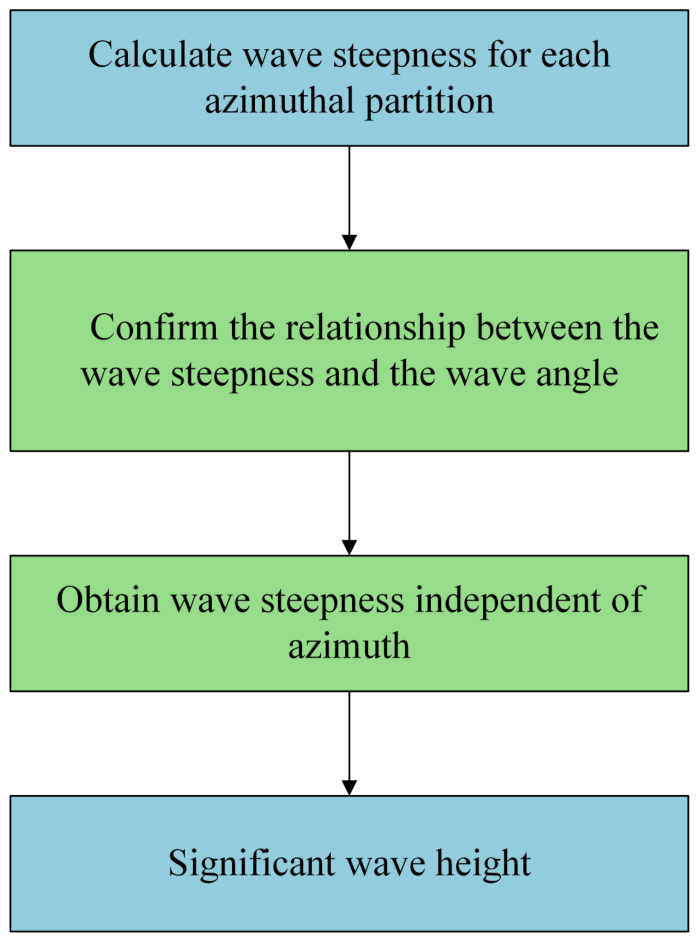
The conventional shadow method typically selectes the upwave region or averages the wave steepness across different azimuthal partitions to mitigate azimuthal dependence. However, in dynamic observation ship-based scenes, the radar field of view is often obscured by ship structure, and the available upwave region for wave height inversion is significantly limited. If the wave steepness calculated in the operational area is averaged directly as the global wave steepness, the azimuth dependence of echo intensity cannot be eliminated, and an obvious estimation error is introduced. To solve the problem, a wave steepness correction method for different wave angle regions is proposed in the paper, which is shown in Figure 3. The method compensates for the calculated wave steepness by establishing the functional relationship between wave steepness and wave direction so as to achieve more accurate wave steepness and SWH estimation.
Although wave direction can be derived from radar images [39], to enhance the reliability of the findings and reduce potential experimental biases, the study used wave direction measured by buoys as a reference. In practical applications where no buoy is available, wave direction can be reliably derived from radar images using the standard spectral analysis method.
The wave angle β is defined as the angle between the radar observation direction and the wave direction. Wave direction is usually defined as the absolute angle relative to true north. In radar image analysis, the heading is often used as the reference. Therefore, it is necessary to convert the absolute wave direction ϕ wave to a relative wave direction ϕ wave with respect to the heading. The radar observation direction ψ ship serves as the heading angle. In the framework, the direction of the wave must be normalized according to the heading, so that the angle between the subsequent waves can be accurately calculated.
The relative wave direction ϕ wave is
ϕ wave = ϕ wave ψ ship + 360 ° mod 360 °
where mod denotes the modular operation, ensuring ϕ wave [ 0 ° , 360 ° ) .
For a given radar azimuth sector with center direction φ radar , the wave angle β is calculated as
β = φ radar ϕ wave mod 180 °
where β [ 0 ° , 180 ° ] represents only the minimal geometric angle, without distinguishing the port and starboard.
In order to describe the directional modulation characteristics of wave steepness in X-band marine radar observation, the study is based on a theoretical model of sea surface scattering [40]. The original model expresses the radar cross section (RCS) σ p p 0 as a function of azimuth χ , which is given as
σ p p 0 = a 0 p p u γ 0 p p + a 1 p p u γ 1 p p cos χ + a 2 p p u γ 2 p p cos 2 χ
where χ is defined as the angle between the radar look direction and the upwind direction, u is the wind speed, and the coefficients a 0 p p , a 1 p p , a 2 p p as well as the wind speed exponents γ 0 p p , γ 1 p p , γ 2 p p all depend on the radar incidence angle.
For convenience, Equation (15) can be written in the following form [41]:
σ p p 0 = A + B cos χ + C cos 2 χ
where A, B, C are the coefficients related to incident angle, wind speed and polarization mode.
The original harmonic model is used to describe the directional modulation of RCS, and its physical basis lies in the effect of wind-driven sea surface roughness on radar backscattering. In contrast, the shadow method is based on the geometric shadowing effect of gravity waves, specifically the screening effect of higher waves on lower waves. Wave steepness, defined as the ratio of wave height to wavelength, directly reflects the geometric structure of the waves and is therefore a more suitable dependent variable for the shadow method than RCS. In this paper, the dependent variable of the harmonic fitting model is replaced by wave steepness σ R M S instead of RCS σ p p 0 .
In addition, the reference direction of the model is adjusted from wind direction χ to wave direction ϕ wave . The original model uses wind direction as the reference axis, which is suitable for conditions dominated by wind wave. However, the shadow method relies on the geometric characteristics of waves, and the distribution of shadows is directly determined by the direction of wave propagation. The analysis area around the wave direction is ideal for estimating SWH for the shadow method. The calculated wave steepness changes with the included angle between the wave direction and the radar line of sight. Therefore, adjusting the reference direction to the wave direction is a reasonable improvement based on the physical mechanism of the shadow method.
In actual marine environments, the relationship between wind direction and wave direction depends on the type of waves. When wind-wave conditions dominate, the wind direction and wave direction are generally consistent. However, under swell-dominated conditions, waves originate from distant wind zones and are independent of local wind fields. In such cases, the wind direction and wave direction often have no direct correlation. If the wind direction is still used as the reference axis, the model will struggle to accurately reflect the geometric structure of the waves, thereby affecting the accuracy of wave steepness extraction. Therefore, adjusting the reference direction to the wave direction is a reasonable improvement based on the physical mechanism of the shadow method. It should be noted that when swell and wind wave are inconsistent, the method may face some limitations in accuracy.
The modified model expresses the wave steepness as a function of the wave angle β :
σ R M S = a 0 + a 1 cos β + a 2 cos 2 β .
where the coefficient a 0 is a constant term reflecting the average wave steepness, a 1 and a 2 are the first-order and second-order harmonic coefficients, respectively, representing the directional modulation features of wave steepness. An important advantage of the formulation is realized when β = 0 , the estimated wave steepness is minimally influenced by azimuthal attenuation.
To improve the stability of the optimization process, a parameter initialization strategy based on the statistical characteristics of data is adopted:
a 0 ( 0 ) = 1 n i = 1 n σ RMS i
a 1 ( 0 ) = α 1 · ( σ RMS max σ RMS min )
a 2 ( 0 ) = α 2 · ( σ RMS max σ RMS min )
where a 0 ( 0 ) , a 1 ( 0 ) , a 2 ( 0 ) are the initial values of a 0 , a 1 , a 2 . σ RMS max and σ RMS min are the maximum and minimum of the observed wave steepness, respectively, and n is the number of effective data points. α 1 and α 2 are scaling factors chosen to ensure that the initial values lie within a physically reasonable range relative to the data variation.
The scaling factors α 1 = 0.4 and α 2 = 0.2 are chosen to ensure physical plausibility and stable convergence. Since the first harmonic should capture the principal data features, it is set α 1 close to half the data range and is reduced to 0.4 to prevent possible overestimation. Because the second harmonic plays a smaller role, the value of variable α 2 is set to 0.2 to keep the model balanced and stable. The selected initialization strategy makes the optimization starting point close to the real solution to ensure that the fitting process is stable and insensitive to the specific value of the coefficient.
The model parameters are estimated using the least squares criterion, which minimizes the mean squared error between the model predictions and the observed values [42]:
MSE ( a ) = 1 n i = 1 n σ R M S ( β i ; a ) σ RMS i 2
subject to
a 0 0 , | a 1 | R , | a 2 | R
and
R = σ RMS max σ RMS min
where a = [ a 0 , a 1 , a 2 ] T is the vector of parameters, σ RMS ( β i ; a ) represents the predicted wave steepness at observation angle β i based on the harmonic model, and σ RMS i is the corresponding measured wave steepness.
After obtaining the optimal parameter estimates a ^ = [ a ^ 0 , a ^ 1 , a ^ 2 ] T , the wave steepness at the upwave direction ( β = 0 ° ) is calculated as:
σ RMS 0 = a ^ 0 + a ^ 1 + a ^ 2
where σ RMS 0 represents the theoretical wave steepness when the wave direction is perfectly aligned with the radar observation direction, thereby eliminating the azimuth modulation effect.
By substituting σ RMS 0 into Equation (12), the SWH H S , which is not affected by azimuth attenuation, is given as
H S = σ RMS 0 g T m 02 2 2 π
By applying the 3D Fourier transform to a sequence of radar images, the wave number-frequency spectrum is obtained. Wave energy is extracted using the linear dispersion relationship, and the frequency spectrum S ( f ) is obtained by integration. From the frequency spectrum, the peak frequency f p can be determined, and the wave peak period T p = 1 f p can be derived. Furthermore, the average zero-crossing period T m 02 can be obtained using the following relationship [38]:
T p = 5 π 4 1 4 T m 02
To validate the proposed wave steepness correction method, the T m 02 values used in this study were obtained from the buoy, ensuring the evaluation focuses on the performance of the shadow method alone without introducing additional uncertainties [26].

2.3. Radar Systems and Data Processing

2.3.1. Sea Trial Radar and Data Processing

The radar used in the experiment is a mono-pulse scanning sea-surface radar, mounted at an altitude of 25 m above sea level. The antenna rotation speed is 26 RPM. Each radar image consists of 2048 lines, with each line composed of 600 pixels, covering a radial distance of up to 4.5 km. Based on the antenna rotational speed and the pulse repetition frequency, theoretically, about 3000 lines in azimuth are obtained for a raw radar image. In practice, the number of obtained lines in each radar image is not fixed due to the ship swaying and wave fluctuation. Therefore, the number of radar image lines is fixed at 2048 for standardized data acquisition, ensuring consistent azimuth resolution across all images. The nearest neighbor interpolation algorithm is used to obtain a fixed number of radar lines. The water depth at the observation area is approximately 48 m. The detailed radar parameters are summarized in Table 1.
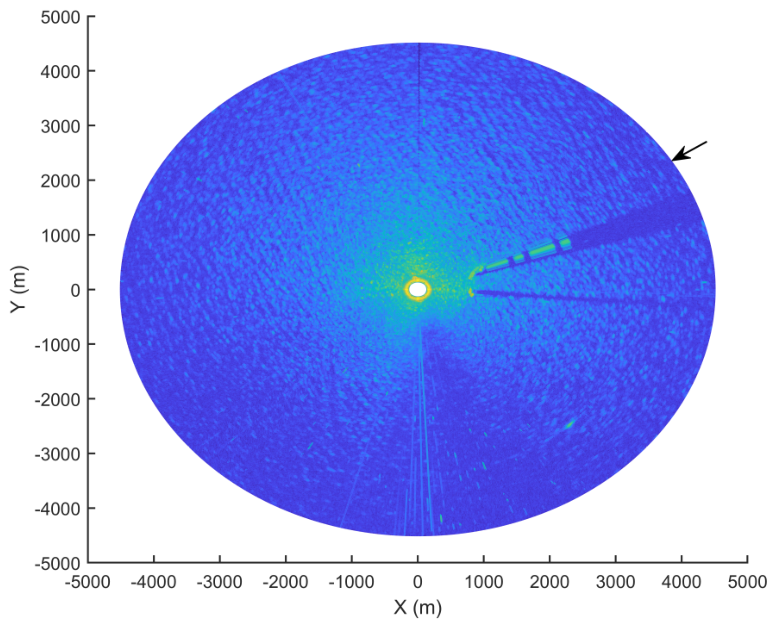
In the sea trial, the azimuth is measured clockwise from the ship’s heading, with 0 ° toward the top of the image. Figure 4 shows the radar image, in which the heading is 16 ° , the wind speed is 9.1   m / s , the absolute wind direction is 72 ° . The relative wind direction is 56 ° , as indicated by the black arrow. The observation results show that the wave direction is basically consistent with the wind direction. In the azimuth sector around 66 ° 73 ° , a lighthouse equipped with a radar transponder causes an extremely bright initial return in the radar image, followed by regular radial streaks. The wave texture in the 66 ° 73 ° azimuth sector is completely masked. In the sector around 90 ° 96 ° , a moving vessel is illuminated by the radar beam and produces strong surface returns. Due to occlusion by the vessel hull, the radar signal is blocked, leaving a shadow zone with no wave echoes. In the sector around 144 ° 192 ° , the ship wake disturbs the local wave field, making the shadow effect more pronounced in the radar image.
Figure 5 shows the distribution of sea trial data in a Cartesian coordinate system, the black vertical dashed lines mark the azimuth positions at 60°, 96°, 144°, 192°, 288°, and 348°. The sea surface texture in the radar image exhibits significant variations across different azimuth sectors. The observation that the direction of wave propagation varies with azimuth is a real phenomenon in a Cartesian coordinate system. Since the radar backscatter intensity directly affects the estimation of wave steepness, the finding confirms the inherent azimuth dependence of the shadow method.
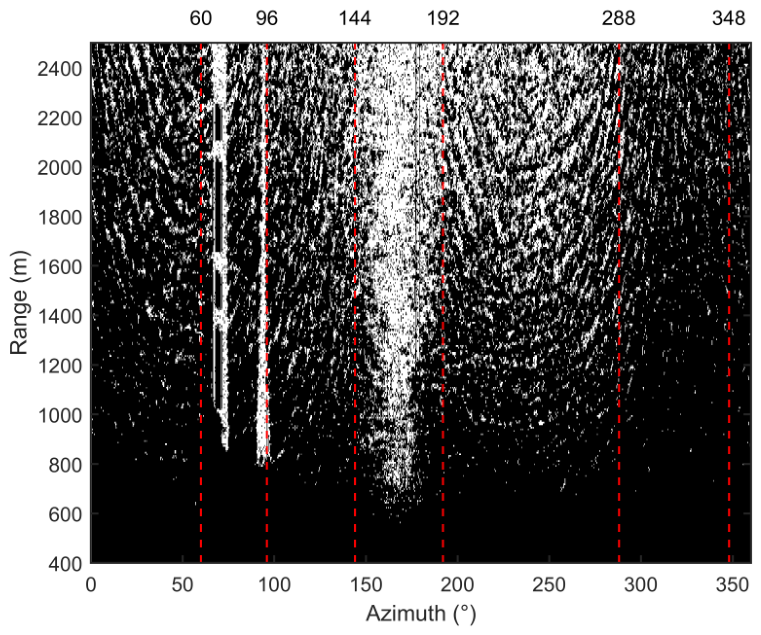
The shadow segmentation threshold is estimated for distinguishing between shaded and unshaded areas to form a shadow map from radar image. Figure 6 shows the shadow map corresponding to the radar image in Figure 5. The horizontal axis represents azimuth, and the vertical axis represents range. The red vertical dashed lines mark the azimuth positions at 60°, 96°, 144°, 192°, 288°, and 348°. The white area indicates the shadowed region, while the black area indicates the illuminated region. It can be observed that the wave patterns within the azimuth ranges 0 ° 60 ° and 288 ° 348 ° are clearly defined. In contrast, within the range 96 ° 144 ° and 192 ° 288 ° , the wave features are weaker. Meanwhile, in the azimuth intervals of 60 ° 96 ° and 144 ° 192 ° , the shadow effect is more pronounced, caused by a lighthouse and a moving vessel in the interval of 60 ° 96 ° and by the ship wake in the interval of 144 ° 192 ° .
Based on the distribution characteristics of sea clutter intensity, the observation area is divided into high-echo area ( 0 ° 60 ° and 288 ° 348 ° ), low-echo area ( 96 ° 144 ° and 192 ° 288 ° ), and radar blind area ( 60 ° 96 ° and 144 ° 192 ° ). In the analysis, an operating range of 400∼2500 m was selected, and the 360 ° azimuth was divided into 30 sectors at 12 ° intervals. When the bin width is wider, more pixels are available for calculating the illumination ratio, resulting in more reliable estimates. Using a 12 ° interval provides sufficient data points for harmonic fitting while clearly showing the overall trend of wave steepness as it varies with wave direction. For the sea trial data, the radar range resolution is 7.5 m , determined by the transmitted pulse width of 50   ns . The antenna height is approximately 25 m . Based on the grazing angle characteristics, vertical beam coverage, and SNR performance, the effective range interval is selected from 400 m to 2500 m . This selection ensures reliable shadow detection while maintaining sufficient grazing angle variation.

2.3.2. Shore-Based Radar and Data Processing

The shore-based experiments employed an X-band marine radar operating in the horizontal polarization mode. The radar working frequency used in the datasets to collect the sea clutter image is 9.3 GHz. The radar antenna height is 45 m above sea level, and its rotational speed is 22 RPM. The radar features a range resolution of 7.5 m and a maximum coverage radius of 4.5 km. Other radar parameters are listed in Table 2.
The pixel values of the raw radar images are acquired using a 60 MHz data acquisition card and mapped to a range of 0 to 8191 (corresponding to 14 bits). To facilitate subsequent processing, signals with noise levels above 5000 are filtered out. Pixel values exceeding 5000 are relatively rare and primarily originate from islands or other obstructing obstacles, typically appearing as edge features rather than sea clutter signals.
At a distance of 800 m away from the radar, a buoy with an operating frequency of 2 Hz was deployed. The radar images from 8 November to 19 November 2014 and from 10 January to 20 January 2015 were recorded to verify the accuracy of the proposed method. During the experiment, the wind direction of the data collection site was mainly northeast. The average water depth in the observation area was about 28 m, and the buoy deployed in the field was used as the reference equipment.
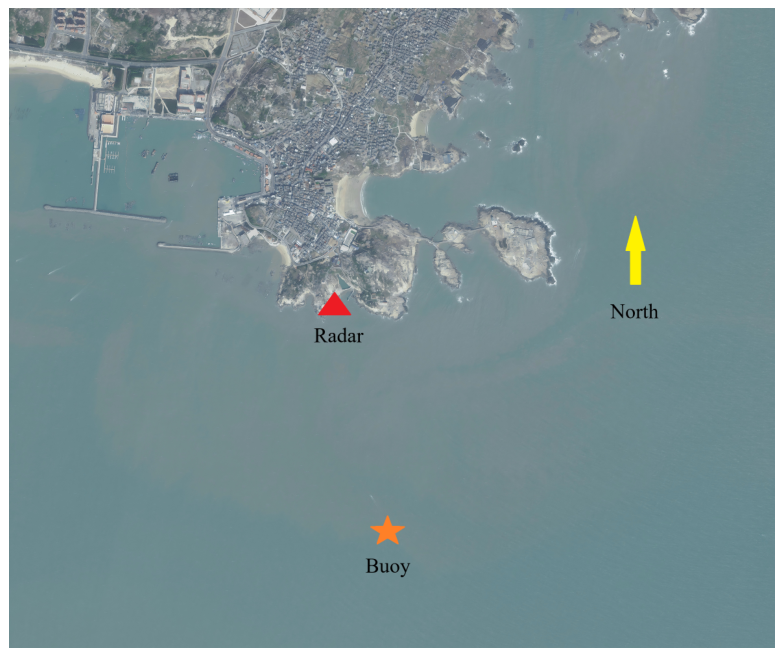
Figure 7 is a schematic diagram of the radar setup and buoy deployment, in which the red triangle is the location of the radar, and the orange star is the deployed position of the wave buoy. The wave buoy operates for 20 min per hour and outputs one record at the end of each hour. Accordingly, the SWH derived from radar data was averaged over the corresponding 20 min to achieve temporal alignment with the buoy record.
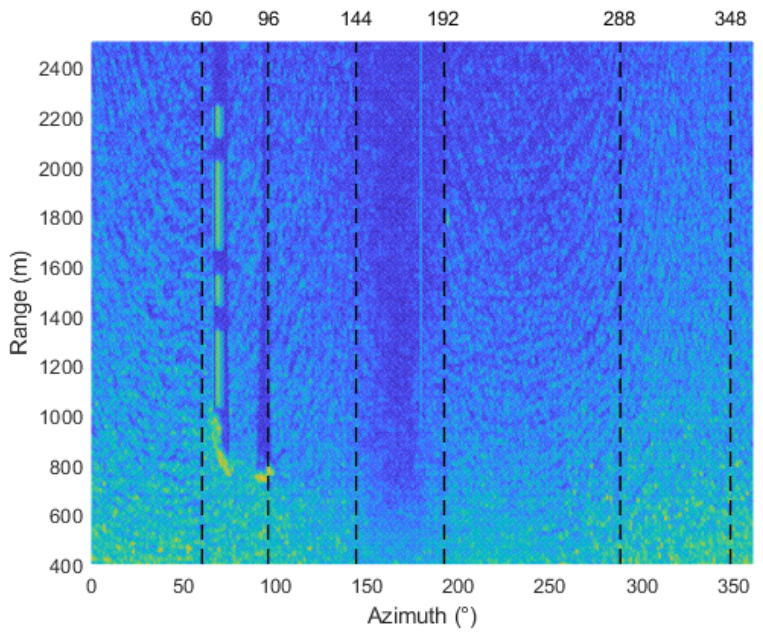
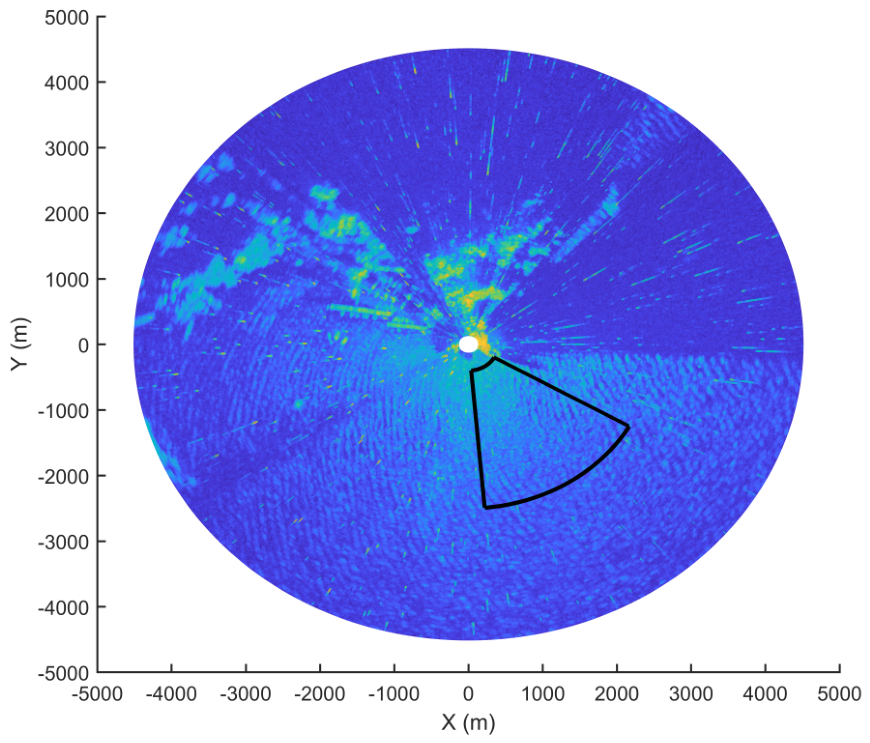
Figure 8 shows the raw radar image displaying the sea clutter backscatter intensity acquired in polar coordinates. Each pixel in the image corresponds to the power value received by the antenna at a specific azimuth and range. Due to the existence of land or other occlusions within the radar field of view, it is necessary to select the areas of the collected sea clutter images that are suitable for wave information inversion. In the experiment, the radial range of the selected study range was 400∼2500 m. Combined with the influence of land occlusion around the experimental environment, the azimuth range of the selected study area is from 120 ° to 175 ° .
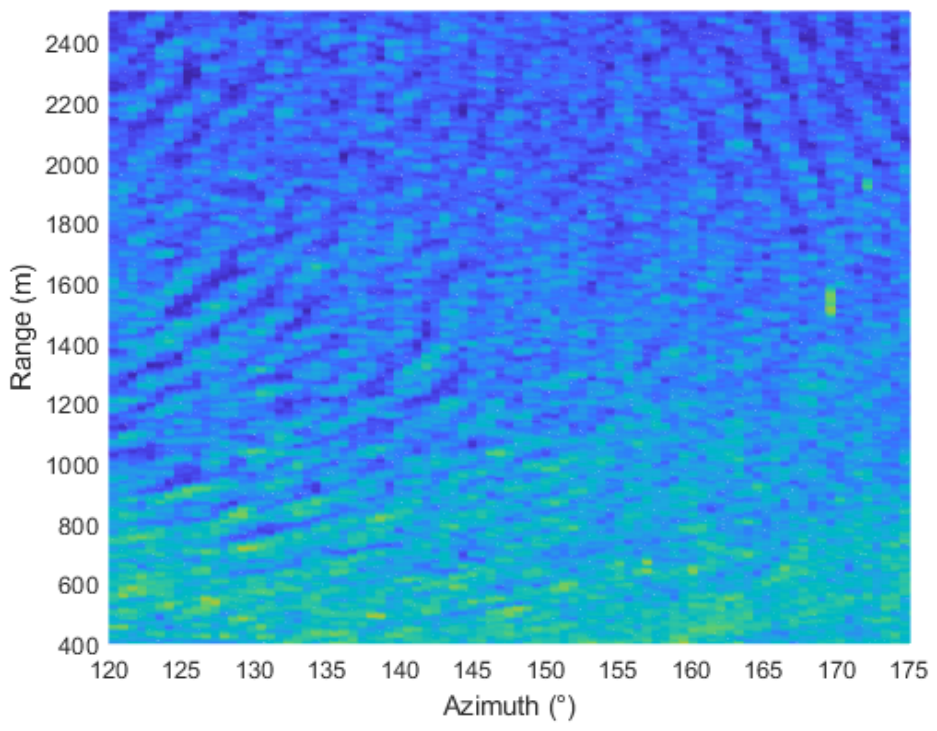
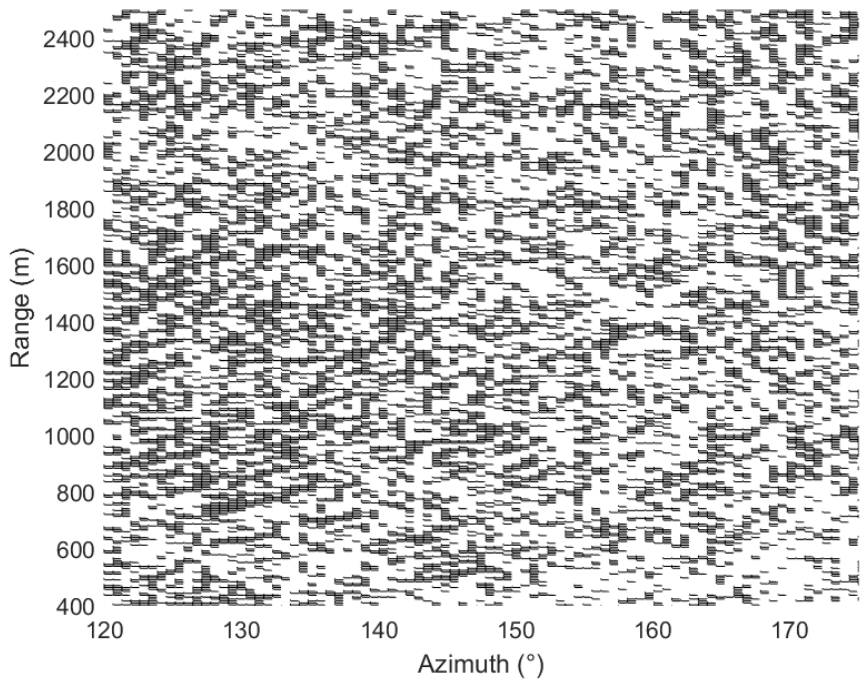
The final selection of the study area is illustrated in Figure 9, where the horizontal axis represents the azimuth and the vertical axis represents the distance from the radar antenna. The variation in brightness distribution across the radar image with azimuth indicates a change in the direction of wave propagation within the measurement area. The directional variation confirms the inherent azimuth dependence of the shadow method and suggests that an averaging strategy of azimuth sections may not fully reflect the true wave propagation characteristics. To ensure sufficient points for harmonic fitting (at least three) and enough pixels for reliable calculation of the illumination ratio, the azimuth range is divided into 6 partitions with an interval of 8 ° . Each partition is divided into 44 blocks.
The upper 10% of pixel values are selected as thresholds for edge detection of the image. Figure 10 displays the edge image obtained after removing isolated noise points from the original image. The horizontal coordinate represents the azimuth angle, while the vertical coordinate denotes the distance from the radar antenna.
After obtaining the edge image, the pixel grayscale values of non-zero pixels in the original sea clutter image at the corresponding positions are calculated, representing the radar echo intensity. A histogram of the pixel values is constructed with a bin width of 100, resulting in 50 bins covering the 0 5000 range. Finally, the mode of the pixel grayscale value histogram is used as the threshold.
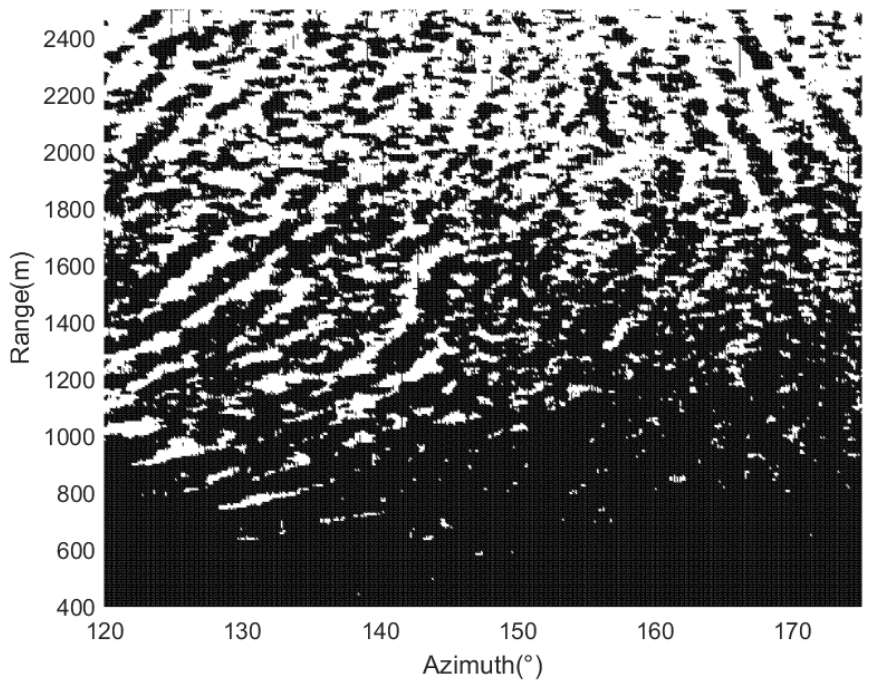
Using the obtained threshold, the image is divided into unshaded (black) and shaded (white) areas, as illustrated in Figure 11. The white portion of the shadow image indicates the shaded areas obscured by waves, whereas the black portion indicates the waves visible to the radar. In addition, the shadow in the image gradually increases with the distance from the radar antenna.
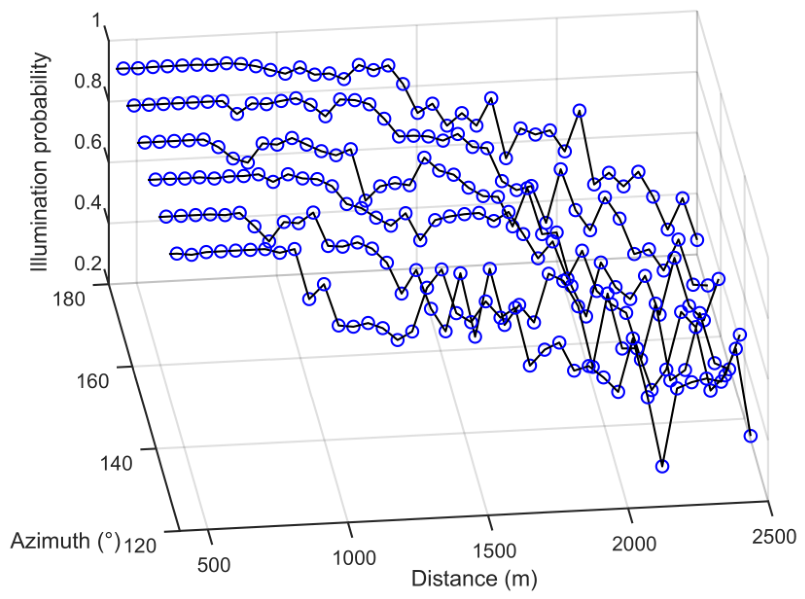
For the shore-based data, the antenna height is 45 m . The effective range interval is selected from 400 m to 2500 m , corresponding to N = 44 range blocks. The occlusion proportion of each sub-area is statistically obtained to calculate the illumination proportion of each block in the area and obtain the illumination curve as shown in Figure 12. It can be seen that the illumination ratio under the same azimuth angle decreases with increasing distance. Therefore, the probability of wave occlusion increases, while the probability of illumination decreases, which is consistent with the actual physical situation.

3. Results

To validate the proposed harmonic fitting model and evaluate its performance under different observation conditions, we conducted two sets of experiments. The sea trial data were collected from a shipborne platform in the East China Sea. The data provide complete 360 ° azimuth coverage without land obstructions and were used to verify the model’s physical basis. In contrast, the shore-based data were collected from a fixed platform on Pingtan Island. Due to land obstruction, the azimuth coverage was limited, and the shore-based data were used to evaluate the effectiveness of the method in practical observation scenarios. The results for the two sets of data are presented in Section 3.1 and Section 3.2, respectively.

3.1. Sea Trial Data and Analysis of Wave Steepness Variation with Wave Angle

The sea trial data, which cover a full 360 ° azimuth without occlusion by ship architecture in azimuth direction, are used to establish and verify that the wave steepness follows the harmonic relation with wave angle. The physical principle of the proposed three-parameter harmonic model has been verified using X-band ship-based data collected in the East China Sea in October 2017.
In a single block, the shadow ratio is defined as the number of shadow pixels divided by the total number of pixels, and is a key intermediate quantity used for wave inversion. Since the ground truth of the shadow ratio is unavailable, traditional error verification methods based on true values are difficult to apply. Therefore, based on the statistical distribution, a confidence interval is used to quantitatively assess the uncertainty in the shadow ratio when no ground truth is available. In this study, the 95% confidence interval is obtained for each block to quantify the credible range and confidence level. The confidence interval width of the shadow ratio is adopted as a quantitative measure of the long-term stability of the shadow measurement. The smaller the width of the confidence interval, the higher the stability of the shadow ratio of the block, and the smaller the calculation error, vice versa.
The confidence interval width of the shadow ratio is adopted as a quantitative measure of the long-term stability of the shadow measurement. A narrower width indicates higher stability. The smaller the width of the confidence interval, the higher the stability of the shadow ratio of the block, and the smaller the calculation error. The wider the confidence interval, the greater the influence of the sea wave state on the shadow ratio, the greater the uncertainty, and the higher the error level. According to the National Center for Health Statistics (NCHS) Data Presentation Standards for Proportions, an estimate is considered reliable for presentation if the absolute width of its 95% confidence interval is ≤5% (i.e., ≤0.05). If the absolute width falls between 5 % and 30 % , the estimate is also considered reliable. Estimates failing to meet these criteria are considered unreliable and should be suppressed [43].
For the sea trial data, to reduce the effect of ship heading changes, a radar image sequence containing 32 images is used to obtain shadow images and calculate the shadow ratio for each block in the distance and azimuth directions. For each block, the value of 32 shadow ratio is achieved and used to calculate the corresponding 95% confidence interval. Thus, 30 × 44 confidence intervals are determined from the 32 radar images.
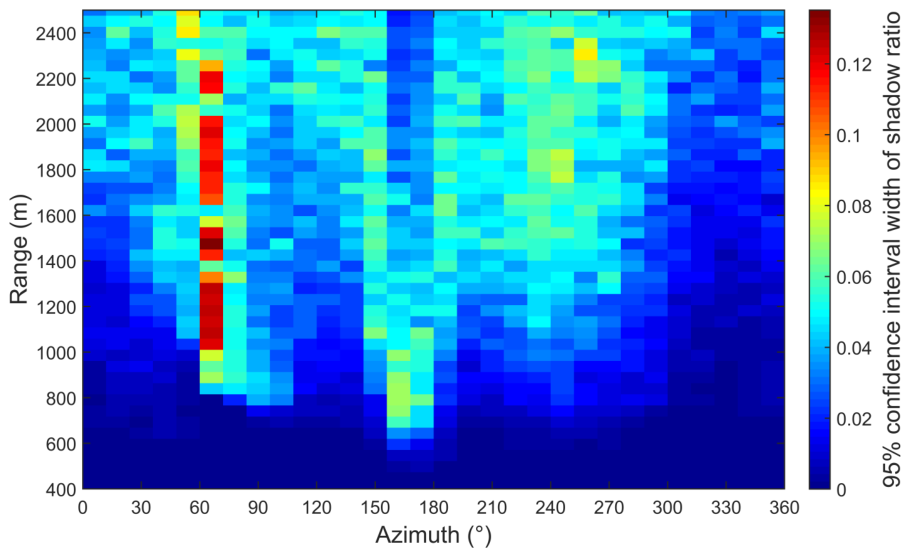
Figure 13 shows a color-coded display of the 95% confidence interval width of the shadow ratio for a sea trial radar image sequence. The horizontal and vertical axes represent the azimuth angle and distance of each block. The color bar indicates the width of the 95% confidence interval. The confidence interval widths gradually increase with distance. However, the width values are abnormally large at around 70 ° in the azimuth direction due to the obstruction of maritime targets and at around 165 ° due to the ship wake effect.
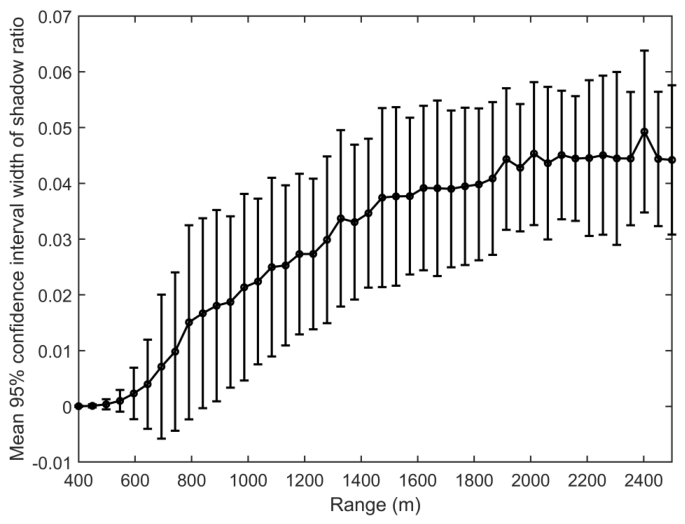
Figure 14 shows the confidence interval width averaged over the azimuth direction, excluding the abnormally large values near 70 ° and 165 ° . The horizontal axis represents the distance of each block, and the vertical axis represents the average confidence interval width. The black dots represent the averaged confidence interval width. The error bars indicate the standard deviation of the confidence interval width at each distance.
Within the range of 400∼2500 m, the average width of the 95% confidence interval for the shadow ratio increases continuously and gradually tends to converge. In the near range of 400∼1800 m, the confidence interval width increases rapidly and monotonically with distance, rising from approximately 0 to approximately 0.04. When the distance exceeds 1800 m, the growth rate slows down significantly, and the width stabilizes within the range of 0.04∼0.05, entering a stage of steady fluctuation. Meanwhile, the error bar width at each distance also increases slowly, but the fluctuation amplitude remains moderate.
Based on the radar backscatter intensity, a binary shadow map is generated. After separating shadow map into several blocks in distance and azimuth directions, the illumination probability is calculated for each block of the azimuthal partition. Based on the grazing angle of each block, the illumination probability computed from the shadow map is subsequently fitted to Smith’s function to retrieve the RMS wave steepness.
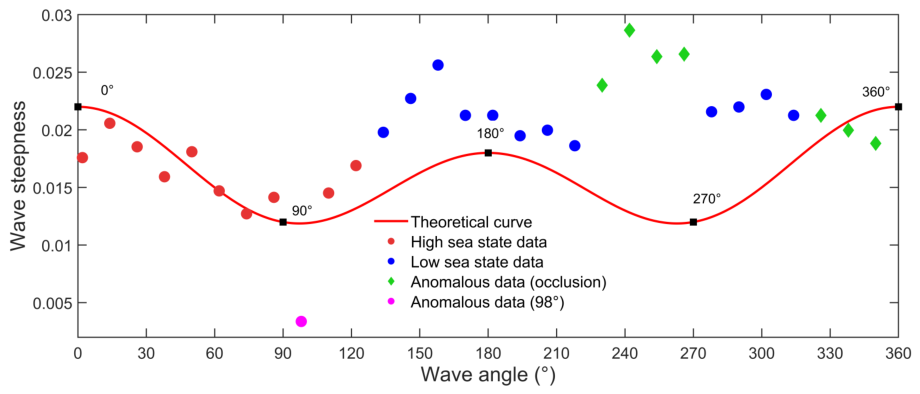
The wave angle is defined as the angle between the radar line of sight and the wave direction. To validate the harmonic fitting function, the azimuth angle for each sector was converted to the corresponding wave angle. Subsequently, the wave steepness and its corresponding wave angle were calculated for each sector. Figure 15 shows the corresponding relationship between wave steepness and wave angle. The high-echo data (red dots) show a significant harmonic variation law: the wave steepness reaches the peak in the upwave direction ( β = 0 ° ), the second peak in the downwave direction ( β = 180 ° ), and the minimum in the crosswave direction ( β = 90 ° or 270 ° ). The directional distribution characteristics of wave steepness closely align with the azimuth-dependent pattern of sea surface scattering. The purple data point represents outliers derived from high-echo conditions, exhibiting significant deviations from the normal trend. The underlying physical mechanism supports the adoption of a three-parameter harmonic model to describe the directional variation of wave steepness.
At the same time, the low-echo data (blue dots) are generally located above the fitting curve, reflecting the limitations of the conventional shadow method system in overestimating wave steepness under low-echo conditions. The abnormal data (green diamond point) in the occluded area have a discrete distribution of wave steepness due to the lack of signal. The sea trial data verify the physical rationality and applicability of the three-parameter harmonic model in describing the variation of wave steepness with azimuth, providing an experimental basis for the practical application of the model in shore-based radar wave inversion.
Based on the harmonic fitting function, a quantitative analysis of the percentage difference between the measured data and the theoretical curve is shown in Figure 15. For high-echo data within the range of 2 ° 122 ° (excluding the outlier at 98°), the deviation between the measured values and the theoretical curve ranged from 0.125 to + 0.078 , with an average absolute deviation of 0.062 . Low-echo data exhibited systematic underestimation across all measurement angles, with deviations ranging from 0.246 to 0.128 and an average underestimation of 0.183 . Low-echo data indicate that the shadow ratio significantly decreases under low wind speed conditions, resulting in overall underestimates of wave steepness. Among the outlier data points, the outlier at 98° had a deviation of 0.782 and is excluded from the analysis. The deviation range for data points affected by occlusion is between 0.312 and + 0.247 , indicating that physical occlusion can severely interfere with wave steepness estimates.

3.2. Shore-Based Experimental Setup and Experimental Results

The harmonic fitting model was validated using sea trial data, demonstrating that it can retrieve the wave steepness in the upwave direction by using the harmonic relationship. However, due to the limited amount of sea trial data, we further utilized data from shore-based experiments conducted on Pingtan Island, Fujian to evaluate the performance of the proposed method.
For the shore-based radar, 192 radar images acquired during the last 20 min of one hour were used for analysis. To assess the uncertainty in the shadow ratio calculation, we analyzed the temporal stability of the shadow ratio within each block based on the 95% confidence interval.
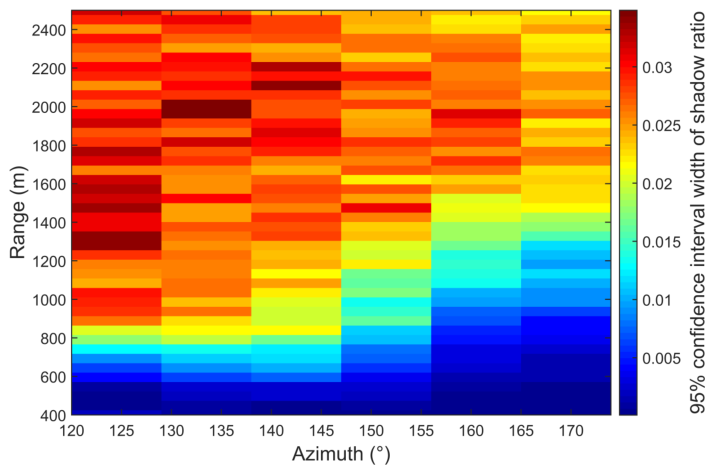
Figure 16 presents a color-coded display of the average width of the 95% confidence interval for the shadow ratio in the two-dimensional range and azimuth domains. In the azimuth dimension, the confidence interval width decreases monotonically with increasing azimuth angle, transitioning from a high-value region (red) in the 120 ° 145 ° interval to a low-value region (blue) in the 160 ° 170 ° interval. In the distance dimension, the confidence interval width increases significantly with distance. The near range of 400∼800 m is a low-value interval with extremely low uncertainty. As the distance extends from 800 m to 2500 m, the width of the confidence interval gradually increases. The slow increase in confidence interval width with distance is attributed to the radar observation geometry and the attenuation of echo SNR. Nevertheless, the spatial distribution of the confidence interval width remains continuous and stable, without divergence, and maintains stable convergence characteristics even under complex long-distance observation conditions.
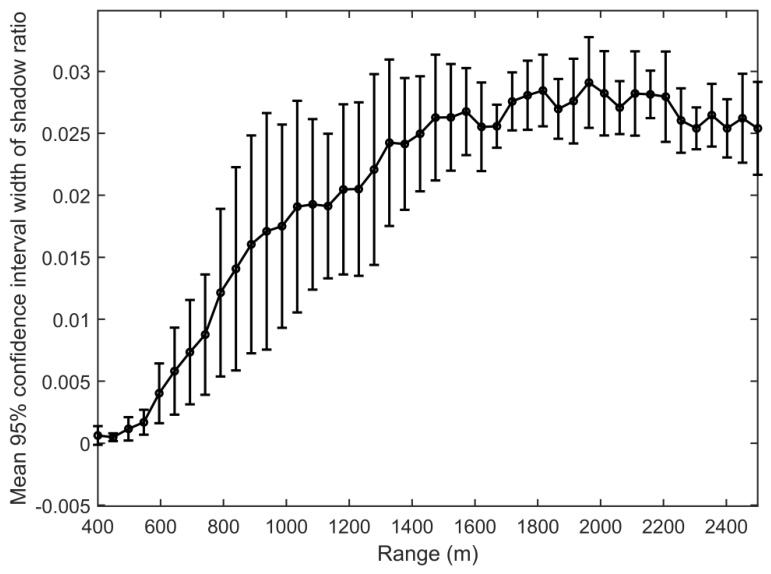
Figure 17 shows the variation curve of the average width of the 95% confidence interval of the shadow ratio with the radar distance and the corresponding distribution of error bars. In the near range, the mean confidence interval width increases steadily with distance, while the error bars increase synchronously, exhibiting a smooth and monotonic trend. When the distance exceeds 1600 m, the average confidence interval width fluctuates within the range of 0.025∼0.030, and the growth trend gradually saturates. Meanwhile, the error bars at each distance maintain a consistent and moderate fluctuation range.
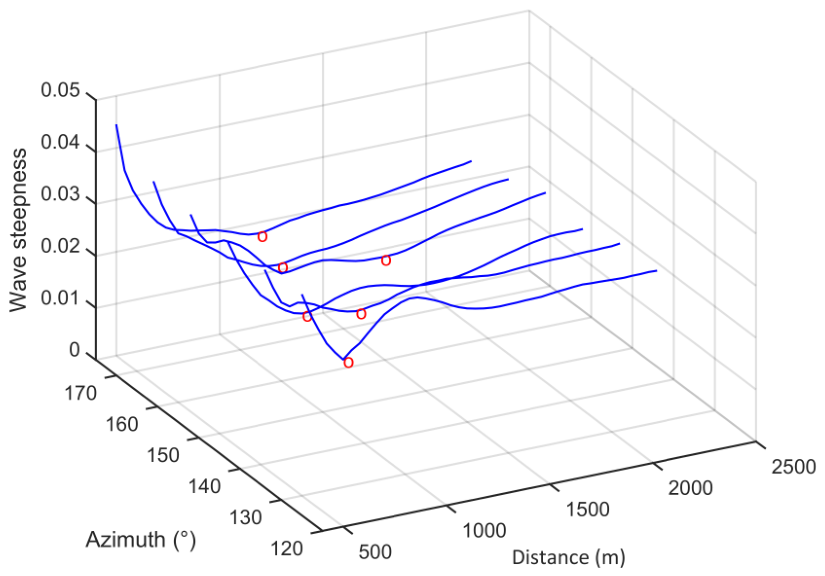
For a given azimuth partition, the known grazing angles and illumination ratios across range blocks are fitted to the Smith function to obtain the RMS wave steepness for that partition. By repeating the process across all azimuth partitions, the RMS wave steepness for each azimuth direction can be obtained. Figure 18 illustrates the calculation process of wave steepness. For each azimuthal partition, a corresponding wave steepness value is obtained by fitting the Smith function. Then, the farthest block is gradually discarded until the illumination ratio sequence used for fitting contains at least one value less than 1. At each step, a wave steepness is generated, and the minimum wave steepness among all values is selected as the obtained RMS wave steepness in a distance direction. The red circles represent the RMS wave steepness values obtained for each azimuth partition.
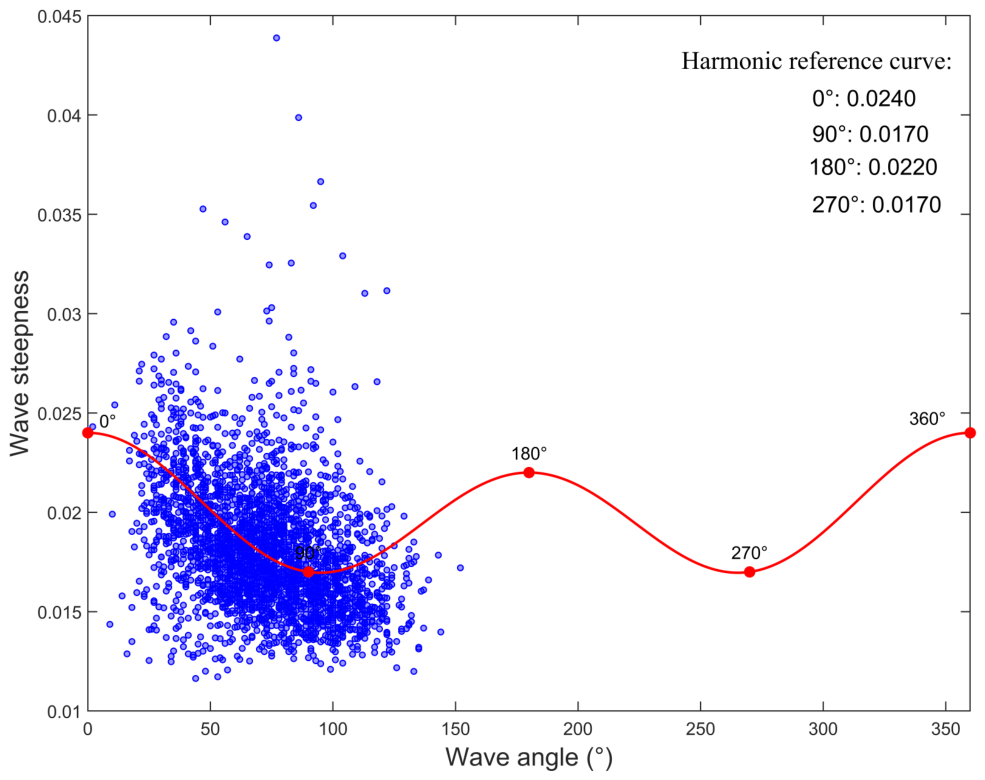
Figure 19 displays all experimental wave steepness from the conventional shadow method, illustrating the statistical relationship between wave steepness and wave angle. The blue points represent the wave steepness inversed in each azimuthal partition for an individual data group, while the solid red line means the overall harmonic curve fitted to the entire dataset.
The data clearly show the significant correlation between wave steepness and wave direction. The wave steepness reaches the maximum in the area of the wave direction near 0 ° , reaches the minimum in the area of the wave angle at 90 ° and 270 ° , and appears the second highest value in the area near 180 ° . The wave steepness at 360 ° is as high as that at 0 ° , indicating that the relationship between wave steepness and wave angle enters the next cycle. The wave steepness exhibits a periodic high–low–high pattern in relation to wave angle, consistent with physical expectations. The wave steepness reaches the highest value in the upwave direction, followed by the downwave direction, and the lowest in the crosswave direction.
The harmonic reference curve effectively captures the periodic change in wave steepness with wave angle, providing a reliable and physically meaningful reference. In particular, the form of the second harmonic quantitatively reflects the difference between the upwave and downwave regions. The fitted model supports the proposed study’s assumption and provides a theoretical basis for correcting biases due to wave direction.
However, the observation points concentrated mainly between 20 ° and 150 ° , while coverage near 0 ° (upwave direction) and 180 ° (downwave direction) is worse. The distribution pattern reflects a common limitation in practical observations; the upwave and downwave regions are often difficult to obtain. Therefore, the key advantage of the harmonic model is that it can be extended to the area of wave angle with less data points under reasonable physical constraints. Figure 19 not only confirms the physical basis of the correction strategy but also highlights the common data limitations that the harmonic fitting method aims to overcome.
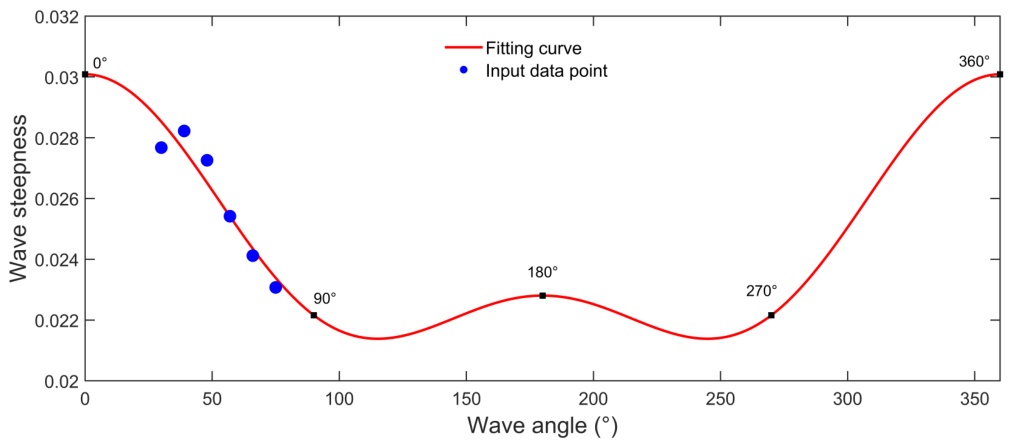
In Figure 20, the wave steepness curve (red solid line) obtained through harmonic function fitting effectively reflects the variation trend of the actual observed data points. The data points exhibit a clear cosine distribution, with wave steepness reaching its maximum at a wave angle of 0 ° and its minimum near 90 ° . The relationship between wave steepness and wave angle follows the physical principle that wave steepness is greatest in the upwave direction and smallest in the crosswave direction. The three-parameter harmonic model successfully captures the periodic variation, producing a smooth fitted curve that aligns with theoretical expectations. Notably, the fitted wave steepness value at β = 0 ° satisfies the range constraint σ RMS 0 ( 0 , 0.142 ) and can be directly used as a global SWH [36].
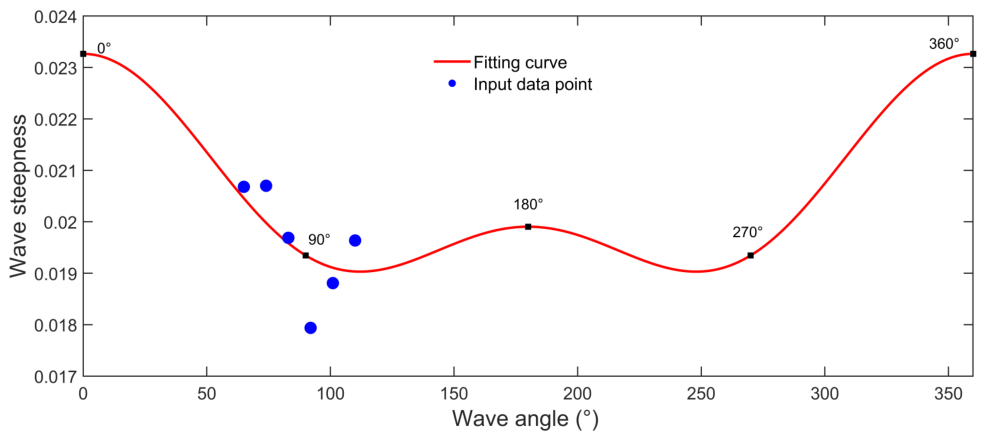
In Figure 21, the fitting is illustrated when wave angles are all concentrated near 90 ° . The observed data points are largely distributed within the crosswave angular range of 60 ° to 120 ° , resulting in a reasonably good fit of the curve (red solid line) within the interval, but with higher uncertainty in other angular regions. Due to the lack of direct observations at key angles such as 0 ° and 180 ° , the predicted values from the fitted curve may exhibit significant deviations. Although the wave steepness at β = 0 ° shown in the figure falls within the acceptable range of valid wave steepness values, its reliability is limited by the narrow angular distribution of the data. When the available data are insufficient or the angle coverage is incomplete, the mathematical fitting prediction may not accurately reflect the real change mode of wave steepness. When data are limited and reliable harmonic fitting cannot be used, the wave steepness derived from azimuthal partitions closest to the wave direction is selected as the global wave steepness to estimate SWH, ensuring robust estimation.
The comparative analysis of Figure 20 and Figure 21 indicates that the accuracy of the harmonic fitting method is highly dependent on the completeness of angular coverage in the observational data. When the data include regions close to the upwave direction, the fitting performs well. Conversely, when the data are concentrated primarily in crosswave angular regions, the fitting results show considerable uncertainty at the extremes.
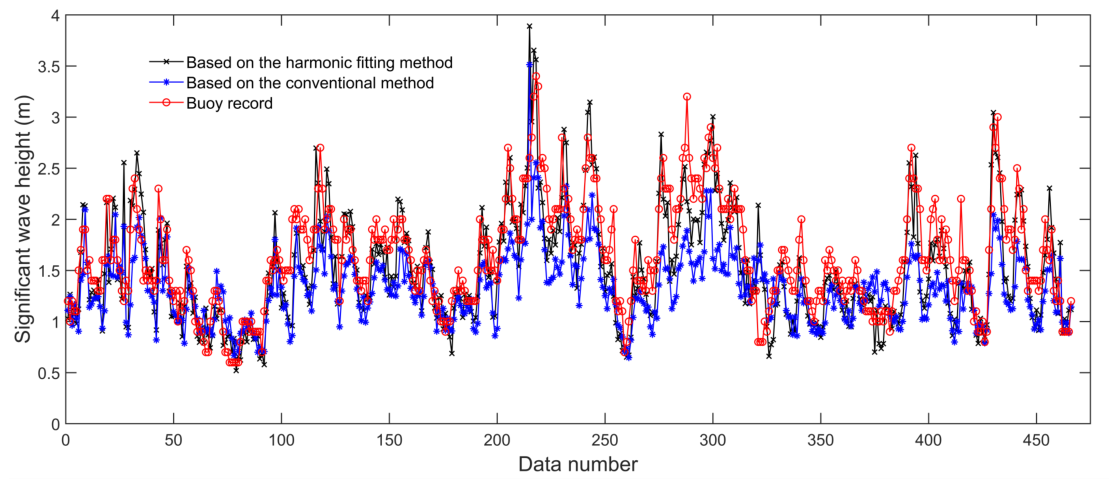
Figure 22 presents a comparative analysis of SWH estimation performance across three algorithms: the conventional shadow method (blue curve), the harmonic fitting correction method proposed in the study (black curve), and the buoy measurements serving as the true values (red curve). The conventional method shows a clear trend of deviation from buoy records, especially the rising and falling stages of wave height during high sea conditions. The systematic bias (BIAS) observed in the conventional method is due to its inability to accurately reconstruct the spatial distribution of wave steepness from limited directional data. To address the limitation, the present study introduces harmonic correction, which introduces azimuthal continuity constraints.
In contrast, the harmonic fitting correction method demonstrates improved agreement with buoy records. The blue line is not only more suitable for the time sequence change in SWH but also significantly reduces the amplitude of system deviation in the conventional method. The performance improvement is due to the fact that the method can reconstruct the directional wave steepness distribution with physical consistency to effectively compensate for the angle loss in the observation data. It is obvious that the correction method demonstrates stable performance across the entire dataset, without significant degradation during rapidly changing sea states.
The harmonic fitting method based on the shadow method performs well, and the generated time series data are more consistent with the buoy records in terms of trend and amplitude. The improvement highlights the importance of considering wave direction, especially when the measurement system has a limited observation direction. The results show that the proposed method not only improves the accuracy of point-to-point inversion but also maintains the dynamic characteristics of SWH evolution, which is of great significance for wave prediction, ship route planning, and marine engineering applications.
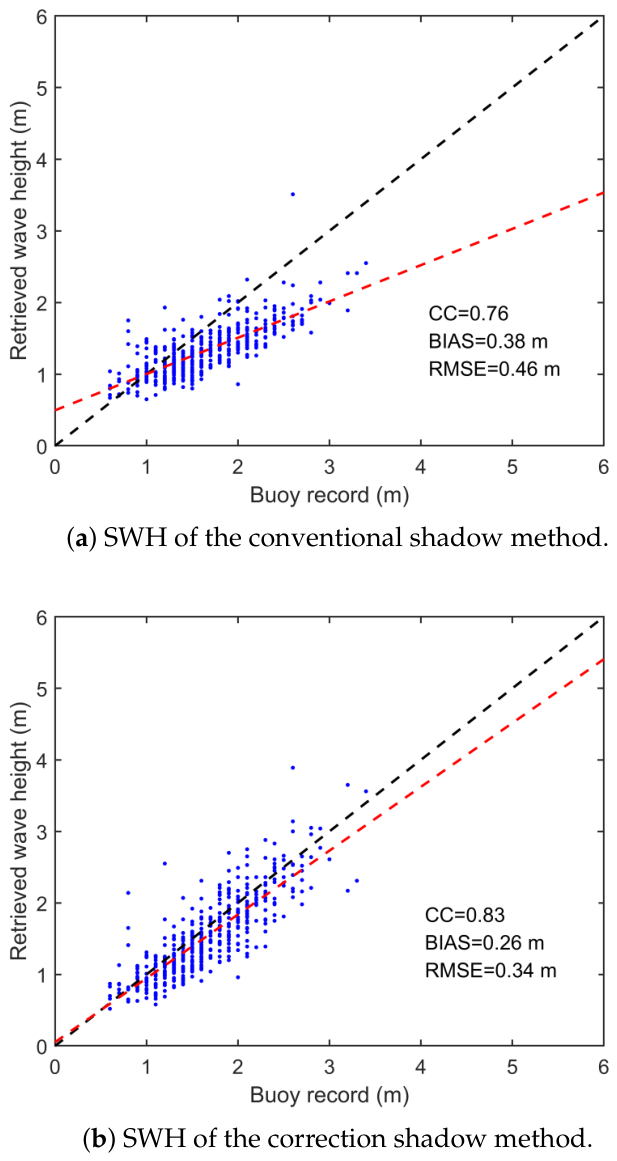
Figure 23 presents scatterplots comparing SWH estimated from the shadow method with buoy values. The horizontal axis represents the buoy value, the resolution of the buoy is 0.1 m, and the blue point represents the calculated SWH. The regression line and the line with a slope of 1 are represented by red and black dashed lines, respectively.
Figure 23a displays results obtained using the conventional shadow method. The regression slope is 0.58 and the intercept is 0.50 m. The positive intercept indicates overestimation at low wave heights, while the slope below 1 confirms underestimation at higher wave heights. The accuracy of the conventional shadow method remains to be improved in both low and high wave energy conditions. The correlation coefficient (CC) between the SWH derived from the conventional shadow method and the buoy value is 0.76, the mean BIAS is 0.38 m, and the root mean square error (RMSE) is 0.46 m, indicating that the method still has obvious estimation deviation.
Figure 23b shows the corresponding results after applying the proposed harmonic fitting correction method. The regression slope is 0.89 and the intercept is 0.05 m. The slope is much closer to 1 and the intercept is near 0, indicating that the consistency of the proposed method with buoy measurement data under all sea conditions has been improved. The harmonic fitting method effectively relieves the overestimation under low sea conditions and the underestimation under medium to high sea conditions and makes the error distribution more uniform. Statistical results show that the performance of the proposed method is significantly improved, the CC increases to 0.83, the BIAS decreases to 0.26 m, and the RMSE decreases to 0.34 m.
The correction method enhances the CC by 0.07, reduces the BIAS by 0.12 m, and lowers the RMSE by 0.12 m. The improvement of all performance indexes shows that the harmonic fitting method effectively alleviates the inherent azimuth dependence of the conventional shadow method, obtains a more accurate SWH estimation, and enhances the practicability of wave inversion under different sea conditions.
The convergence of the harmonic fitting solutions is verified by evaluating the performance of the optimization algorithm. Least-squares fitting is implemented using the lsqcurvefit function of MATLAB software, which employs the trust-region reflection algorithm. The iterations are terminated when the change in parameters falls below the default tolerance ( 1 × 10 6 ) or when the maximum number of iterations (1000) is reached. Statistical analysis of all 233 successfully fitted datasets indicates that the algorithm converges before reaching the maximum iteration limit, demonstrating the effectiveness of the optimization process.
It is worth noting that the wave steepness values used are not derived from a single radar image, but rather from the average of a series of radar images processed together. By effectively reducing the impact of random noise in individual images, the extracted wave steepness values exhibit excellent stability. Consequently, the convergence and reliability of the harmonic fitting have been further improved.

4. Discussion

To evaluate the computational efficiency of the proposed method, a computer configured with a 12th Gen Intel Core i5-12400 processor (2.50 GHz) is utilized. The operating system of the computer is Windows 11 Home, and the harmonic fitting process is executed using MATLAB R2018b. The mean computational time for the fitting operation is 2.2 ms. The primary computational time is still spent on image preprocessing and the calculation of wave steepness in each azimuthal sector. Since the proposed correction method adds only a simple fitting step, it is suitable for real-time or nearly real-time applications and does not require upgrading hardware.
The proposed harmonic fitting method inherently assumes a unimodal wave spectrum. In complex multi-modal sea states, such as when a swell system propagates at an angle to a locally generated wind-sea, the directional distribution of wave steepness may exhibit multiple peaks that a single harmonic function cannot adequately represent. Under such conditions, the accuracy of the proposed correction method may be compromised. Due to the limitations of the experimental environment and radar images, the proposed method is validated using shore-based real data, which only has unidirectional waves. The wave steepness correction method should be validated in the future using data from moving platforms to consider the influence of multidirectional waves.
A promising direction for future research is to compute the directional dependence of RMS wave steepness by integrating over the wave directional distribution derived from the two-dimensional (2D) Fourier transform of radar image sequences. This approach would directly leverage the rich directional information contained in the radar data and could potentially handle complex multi-modal sea states more effectively than the current harmonic fitting method. By obtaining the full directional spectrum, the RMS wave steepness could be computed as an integral over all directions weighted by the directional energy distribution, providing a more physically based representation of the sea state. However, the practical implementation of such an approach requires high-quality radar image sequences and robust 2D FFT processing, and thus warrants separate investigation.
Although the proposed method can effectively overcome the azimuth dependence of the conventional shadow method, some limitations still exist. The harmonic model assumes that the azimuth distribution pattern of wave steepness is consistent under different sea conditions. However, in the actual complex marine environment, such as the coexistence of swell and wind waves, the assumption may not be fully established. The proposed technique is based on the harmonic variation of radar backscatter with wave direction. By examining the relationship between wave steepness and wave direction, the fitting coefficients are derived. The coefficients are then used to correct SWH estimates that are affected by wave angle, thereby reducing directional bias.
The radar antenna is mounted horizontally, but the main beam is tilted downward by a depression angle of 3° to ensure effective sea surface coverage. The gain pattern of both radars is a standard fan-beam for X-band marine radars, which is narrow in azimuth and wide in elevation. The gain pattern of both radars is a standard fan-beam for X-band marine radars, which is narrow in azimuth and wide in elevation. As listed in Table 1 and Table 2, the horizontal beamwidth is 1.3° for the sea trial radar and 0.9° for the shore-based radar, while the vertical beamwidth is 23° and 21°, respectively.
As the waves in the radar images used are all wind-induced, and the gap between wave direction and wind direction is small, the wave angle is considered to be the wind angle. The subsequent mechanism of the simultaneous effect of the wind direction and wave direction on the shadow method needs to be further investigated.
Although the wave period extracted from buoy data is used for verification, the average zero-crossing period can also be reliably obtained through a spectral analysis approach using X-band radar data. The method described in this paper does not really rely on external reference measurements and can operate independently.
Furthermore, the performance of the model is influenced by both the quantity of wave steepness and the wave angle distribution. Fitting stability is reduced when data points are heavily concentrated in the crosswave sector. For the case that the observed values are mainly concentrated in the crosswave direction, future work should aim to develop a more comprehensive correction algorithm. In order to make the model more reliable under challenging practical conditions, the correction algorithm should be able to adjust and improve the fitting results, even if the data angle distribution is uneven.
The dataset was collected mainly in autumn and winter (November 2014 and January 2015). During the autumn--winter season, the wind in the Pingtan Island area comes mainly from the northeast monsoon, blowing from the land toward the sea, with wind speeds ranging from moderate to high (typically 8~17 m/s). Sea states are generally high, although low sea states also occur. The autumn--winter period still experiences occasional typhoon activity, which can bring very high sea states. Thus, compared to other seasons, the dataset covers a relatively wide range of sea states, from low to high. In spring and summer, both northeasterly and southwesterly winds occur. Northeasterly winds blow from land to sea, while southwesterly winds blow from sea to land. Wind speeds are generally lower (typically 3~8 m/s). Sea states are generally lower, and the weaker shadow contrast in radar images may reduce the accuracy of the conventional shadow method. The harmonic fitting method is expected to correct wave steepness under low sea states by reconstructing how wave steepness varies with wave angle. However, how well the method works under very low or long-lasting low sea states still needs to be tested with spring and summer data in future work.

5. Conclusions

The land echo is often included in the radar image under nearshore conditions, which causes the selected analysis area to deviate significantly from the wave direction. In this article, a modified shadow method of estimating SWH from X-band radar images based on the harmonic fitting is proposed to compensate for the reduction in the radar signal at angles far from the dominant wave direction. The performance of the conventional method and the proposed correction method was validated using data from 466 sets of radar data. The records obtained from the deployed buoys during the experiment were regarded as the true values. Compared to conventional methods, the proposed correction method can significantly enhance the inversion accuracy and stability of the shadow method.
In radar image analysis, different wave propagation directions correspond to distinct textural features. Experimental results indicate that selecting the upwave region typically yields higher computational accuracy. However, practical observations are often constrained by environmental conditions, making it difficult to select ideal analysis areas. Therefore, the harmonic fitting correction method enhances the applicability of the shadow method under non-ideal observation conditions. The comparison with the buoy measurement results shows that the introduction of the correction method significantly improves the accuracy of wave height estimation and reduces the overall average deviation by about 0.12 m. Especially under high sea conditions, this method effectively improves the systematic underestimation of the SWH.
The harmonic fitting method proposed in the study effectively addresses the limitations associated with the azimuthal dependence of the conventional shadow method. When the wave direction distribution is not uniform, the shadow method often introduces system BIAS to estimate SWH. By introducing a harmonic model based on the wave angle and wave direction, the complete distribution of wave steepness with respect to wave direction is reconstructed from partial observational data. The algorithm obtains the wave steepness in the upwave direction, thereby significantly mitigating the azimuthal limitations in conventional shadow method. In contrast to simpler empirical adjustments or statistical interpolation approaches, the three-parameter model retains physical meaning and operational simplicity while maintaining reliable performance even under data-limited conditions.
Although the proposed harmonic fitting method has demonstrated its effectiveness, certain limitations should be acknowledged. Firstly, the method’s reliability depends on the quality of wave steepness inputs from the conventional shadow method. Significant errors introduced during preprocessing will propagate through the correction. Secondly, each fitting requires at least three valid data points, which may not always be available in severely cluttered radar images. Finally, while the harmonic fitting model effectively captures directional variations in wave steepness, more complex sea states may necessitate higher-order or multi-modal fitting functions. Future work will focus on addressing these limitations through improved preprocessing techniques, adaptive fitting strategies, and validation across a broader range of sea states.

Author Contributions

K.L. conducted the analysis of the problem, conceived the methodology, and wrote the first draft of the paper. Y.W. conceived the experiment and wrote the software code to verify the novel method. G.L. contributed to data collection, literature review, and preliminary analysis. Through regular research meetings over the duration with Z.L. Z.L. contributed to the analysis of the research, the conception of the experiment, and the revisions of the paper. All authors have read and agreed to the published version of the manuscript.

Funding

This work was supported in part by the Key Scientific Research Project in Colleges and Universities of Henan Province under Grant No. 25B170006.

Data Availability Statement

The data presented in this study are available on request from Zhizhong Lu.

Conflicts of Interest

The authors declare no conflicts of interest.

References

  1. Cavaleri, L.; Abdalla, S.; Benetazzo, A.; Bertotti, L.; Bidlot, J.-R.; Breivik, Ø.; Carniel, S.; Jensen, R.E.; Portilla-Yandun, J.; Rogers, W.E.; et al. Wind–Wave Modeling: Where We Are, Where to Go. J. Mar. Sci. Eng. 2020, 8, 260. [Google Scholar] [CrossRef]
  2. Shen, C.; Huang, W.; Gill, E.W.; Carrasco, R.; Horstmann, J. An Algorithm for Surface Current Retrieval from X-band Marine Radar Images. Remote Sens. 2015, 7, 7753–7767. [Google Scholar] [CrossRef]
  3. Lund, B.; Collins, C.O.; Tamura, H.; Graber, H.C. Multi-directional wave spectra from marine X-band radar. Ocean Dyn. 2016, 66, 973–988. [Google Scholar] [CrossRef]
  4. Yang, Z.; Huang, W. SWHFormer: A vision transformer for significant wave height estimation from nautical radar images. IEEE Trans. Geosci. Remote Sens. 2024, 62, 13. [Google Scholar] [CrossRef]
  5. Wang, H.; Qiu, H.; Wang, L.; Huang, J.; Ruan, X. Sea surface wind speed retrieval from marine radar image sequences based on GLCM-derived texture features. Entropy 2025, 27, 877. [Google Scholar] [CrossRef] [PubMed]
  6. Yang, Z.; Huang, W. WSTCNN: A wavelet scattering transform-CNN model for wind speed estimation from radar images. IEEE Trans. Geosci. Remote Sens. 2025, 63, 5105813. [Google Scholar] [CrossRef]
  7. Gangeskar, R. Verifying high-accuracy ocean surface current measurements by X-band radar for fixed and moving installations. IEEE Trans. Geosci. Remote Sens. 2018, 56, 4845–4855. [Google Scholar] [CrossRef]
  8. Li, J.; Zhao, C.; Ma, X.; Fan, J.; Wang, G.; Huang, L.; Li, Y. Physics-constrained deterministic sea wave reconstruction methodology based on X-band coherent radar. Remote Sens. 2025, 17, 3004. [Google Scholar] [CrossRef]
  9. Huang, W.; Yang, Z.; Chen, X. Wave height estimation from X-band nautical radar images using temporal convolutional network. IEEE J. Sel. Top. Appl. Earth Obs. Remote Sens. 2021, 14, 11395–11405. [Google Scholar] [CrossRef]
  10. Yang, Z.; Huang, W.; Chen, X. Mitigation of rain effect on wave height measurement using X-band radar sensor. IEEE Sens. J. 2022, 22, 5929–5938. [Google Scholar] [CrossRef]
  11. Ezhova, E.A.; Myslenkov, S.A.; Ocherednik, V.V. Monitoring Wind Waves in Golubaya Bay Using Shore-Based X-Band Radar During the November 2023 Black Sea Storm. Phys. Oceanogr. 2025, 32, 887–901. [Google Scholar]
  12. Yang, Z.; Huang, W. Wave height estimation from X-band radar data using variational mode decomposition. IEEE Geosci. Remote Sens. Lett. 2022, 19, 5. [Google Scholar] [CrossRef]
  13. Zuo, S.; Wang, D.; Wang, X.; Suo, L.; Liu, S.; Zhao, Y.; Liu, D. Wave height and period estimation from X-band marine radar images using convolutional neural network. J. Mar. Sci. Eng. 2024, 12, 311. [Google Scholar] [CrossRef]
  14. Huang, W.; Liu, X.; Gill, E.W. Ocean wind and wave measurements using X-band marine radar: A comprehensive review. Remote Sens. 2017, 9, 1261. [Google Scholar] [CrossRef]
  15. Liu, X.; Huang, W.; Gill, E.W. Estimation of significant wave height from X-band marine radar images based on ensemble empirical mode decomposition. IEEE Geosci. Remote Sens. Lett. 2017, 14, 1740–1744. [Google Scholar] [CrossRef]
  16. Cornejo-Bueno, L.; Nieto-Borge, J.C.; Alexandre, E.; Hessner, K.; Salcedo-Sanz, S. Accurate estimation of significant wave height with support vector regression algorithms and marine radar images. Coast. Eng. 2016, 114, 233–243. [Google Scholar] [CrossRef]
  17. Zhao, M.; Zheng, Y.; Lin, Z. Sea surface reconstruction from marine radar images using deep convolutional neural networks. J. Ocean Eng. Sci. 2023, 8, 647–661. [Google Scholar] [CrossRef]
  18. Rezvov, V.; Krinitskiy, M.; Gavrikov, A.; Golikov, V.; Borisov, M.; Suslov, A.; Tilinina, N. Improving data-driven estimation of significant wave height through preliminary training on synthetic X-band radar sea clutter imagery. Front. Mar. Sci. 2024, 11, 1363135. [Google Scholar] [CrossRef]
  19. Nieto-Borge, J.C.; Reichert, K.; Dittmer, J. Use of nautical radar as a wave monitoring instrument. Coast. Eng. 1999, 37, 331–342. [Google Scholar] [CrossRef]
  20. Nieto-Borge, J.C.; Rodríguez, G.R.; Hessner, K.; Gonzalez, P.I. Inversion of marine radar images for surface wave analysis. J. Atmos. Ocean. Technol. 2004, 21, 1291–1300. [Google Scholar] [CrossRef]
  21. Nieto-Borge, J.C.; Hessner, K.; Jarabo-Amores, P.; de la Mata-Moya, D. Signal-to-noise ratio analysis to estimate ocean wave heights from X-band marine radar image time series. IET Radar Sonar Navig. 2008, 2, 35–41. [Google Scholar] [CrossRef]
  22. Al-Habashneh, A.A.; Moloney, C.; Gill, E.W.; Huang, W. An adaptive method of wave spectrum estimation using X-band nautical radar. Remote Sens. 2015, 7, 16537–16554. [Google Scholar] [CrossRef]
  23. Lund, B.; Collins, C.O.; Graber, H.C.; Terrill, E.; Herbers, T.H.C. Marine radar ocean wave retrieval’s dependency on range and azimuth. Ocean Dyn. 2014, 64, 999–1018. [Google Scholar] [CrossRef]
  24. Ivonin, D.; Telegin, V.A.; Chernyshov, P.V.; Myslenkov, S.A.; Kuklev, S.B. Possibilities of X-band nautical radars for monitoring of wind waves near coast. Oceanology 2016, 56, 591–600. [Google Scholar] [CrossRef]
  25. Ezhova, E.; Tilinina, N.; Gulev, S.; Sharmar, V.; Gavrikov, A.; Trofimov, B.; Bargman, S.; Koltermann, P.; Grigorieva, V.; Suslov, A. Real-time open ocean wind waves from navigation radars for a truly global wind wave operational observing system. Appl. Ocean Res. 2025, 165, 104867. [Google Scholar] [CrossRef]
  26. Gangeskar, R. An algorithm for estimation of wave height from shadowing in X-band radar sea surface images. IEEE Trans. Geosci. Electron. 2014, 52, 3373–3381. [Google Scholar] [CrossRef]
  27. Atkinson, J.; Esteves, L.S.; Williams, J.J.; Bell, P.S.; McCann, D.L. Nearshore monitoring with X-band radar: Maximizing utility in dynamic and complex environments. J. Geophys. Res. Ocean. 2021, 126, 19. [Google Scholar] [CrossRef]
  28. Plant, W.J.; Farquharson, G. Wave shadowing and modulation of microwave backscatter from the ocean. J. Geophys. Res. Ocean. 2012, 117, 14. [Google Scholar] [CrossRef]
  29. Liu, X.; Huang, W.; Gill, E.W. Wave height estimation from shipborne X-band nautical radar images. J. Sens. 2016, 2016, 7. [Google Scholar] [CrossRef]
  30. Lu, Z.; Yang, J.; Huang, Y.; Wei, Y.; Yang, Z. Research on the improvement on the algorithm for retrieving wave height from shadow in marine radar images. Chin. J. Sci. Instrum. 2017, 38, 212–218. [Google Scholar]
  31. Navarro, W.; Velez, J.C.; Orfila, A. A shadowing mitigation approach for sea state parameters estimation using X-band remotely sensing radar data in coastal areas. IEEE Trans. Geosci. Remote Sens. 2019, 57, 6292–6310. [Google Scholar] [CrossRef]
  32. Ludeno, G.; Serafino, F. Estimation of the significant wave height from marine radar images without external reference. J. Mar. Sci. Eng. 2019, 7, 432. [Google Scholar] [CrossRef]
  33. Yao, Z.; Chu, X.; Fan, J.; Wang, F. Retrieving significant wave height based on Prewitt operator from X-band radar images. Syst. Eng. Electron. 2022, 44, 1182–1187. [Google Scholar]
  34. Wang, L.; Mei, H.; Yi, K. Improved CycleGAN-based shadow estimation for ocean wave height inversion from marine X-band radar images. Geocarto. Int. 2022, 37, 14050–14064. [Google Scholar] [CrossRef]
  35. Wei, Y.; Wang, Y.; He, C.; Song, H.; Lu, Z.; Wang, H. A method of extracting the SWH based on a constituted wave slope feature vector (wsfv) from X-band marine radar images. Remote Sens. 2023, 15, 5355. [Google Scholar] [CrossRef]
  36. Wei, Y.; Song, H.; Lei, Y.; Liu, K.; Lu, Z. A method of retrieving significant wave height based on shadowing from X-band marine radar images. Int. J. Remote Sens. 2023, 44, 5259–5282. [Google Scholar] [CrossRef]
  37. Smith, B.G. Geometric shadowing of a random rough surface. IEEE Trans. Antennas Propag. 1967, 15, 668–671. [Google Scholar] [CrossRef]
  38. Hua, F.; Fan, B.; Lu, Y.; Wang, J. An empirical relationship between wave spectral peak period and zero-crossing period. Adv. Mar. Sci. 2004, 22, 16–20. (In Chinese) [Google Scholar]
  39. Doong, D.; Wu, L.; Lai, J. Determination of the spatial pattern of wave directions in the inhomogeneous coastal ocean by marine radar image sequences. IEEE Access 2016, 6, 45762–45771. [Google Scholar] [CrossRef]
  40. Moore, R.K.; Fung, A.K. Radar determination of winds at sea. Proc. IEEE 1979, 67, 1504–1521. [Google Scholar] [CrossRef]
  41. Chaudhry, A.; Moore, R. Tower-based backscatter measurements of the sea. IEEE J. Ocean. Eng. 1984, 9, 309–316. [Google Scholar] [CrossRef]
  42. Marquardt, D.W. An Algorithm for Least-Squares Estimation of Nonlinear Parameters. J. Soc. Ind. Appl. Math. 1963, 11, 431–441. [Google Scholar] [CrossRef]
  43. Ward, B.W. kg_nchs: A command for Korn-Graubard confidence intervals and National Center for Health Statistics’ Data Presentation Standards for Proportions. Stata J. 2019, 19, 510–522. [Google Scholar] [CrossRef] [PubMed]
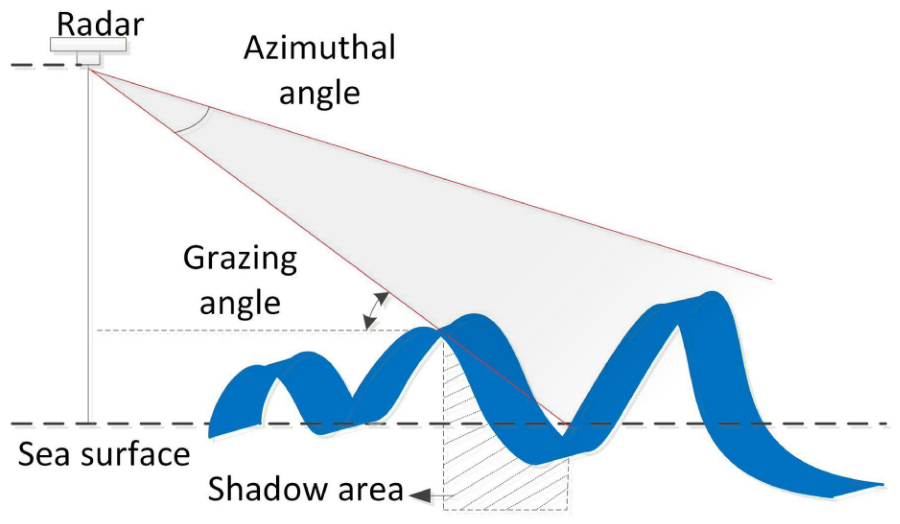
Figure 1. Geometry of the radar observation.
Jmse 14 00966 g001
Figure 2. Flowchart of the conventional shadow method for SWH estimation. The experimental setup, radar parameters, and data acquisition scenarios are detailed in Section 3.1 and Section 3.2.
Jmse 14 00966 g002
Figure 3. The flowchart of the SWH correction method insensitive to azimuth dependence.
Jmse 14 00966 g003
Figure 4. Marine radar image.
Jmse 14 00966 g004
Figure 5. Radar image of sea trial data in Cartesian coordinates.
Jmse 14 00966 g005
Figure 6. Shadow map derived from the marine radar image.
Jmse 14 00966 g006
Figure 7. The experimental sites of radar and buoy.
Jmse 14 00966 g007
Figure 8. Radar image with selected fan-shaped analysis area.
Jmse 14 00966 g008
Figure 9. Selected study area in Cartesian coordinate system.
Jmse 14 00966 g009
Figure 10. Edge image obtained based on differential operator.
Jmse 14 00966 g010
Figure 11. Shadow image obtained by using the shadow segmentation threshold.
Jmse 14 00966 g011
Figure 12. Illumination probability calculated from shadow image.
Jmse 14 00966 g012
Figure 13. The 95% confidence interval width of the shadow ratio for sea trial data.
Jmse 14 00966 g013
Figure 14. Averaged 95% confidence interval width of the shadow ratio for sea trial data.
Jmse 14 00966 g014
Figure 15. Variation of wave steepness with wave angle in sea trial image.
Jmse 14 00966 g015
Figure 16. The 95% confidence interval width of the shadow ratio for shore-based data.
Jmse 14 00966 g016
Figure 17. Averaged 95% confidence interval width of the shadow ratio for shore-based data.
Jmse 14 00966 g017
Figure 18. Estimated wave steepness in each azimuthal partition.
Jmse 14 00966 g018
Figure 19. Harmonic fitting curve of wave steepness of the overall data.
Jmse 14 00966 g019
Figure 20. Wave Steepness distribution with good harmonic fitting.
Jmse 14 00966 g020
Figure 21. Wave steepness distribution with poor harmonic fitting.
Jmse 14 00966 g021
Figure 22. The SWH retrieved from the radar images and recorded by buoys.
Jmse 14 00966 g022
Figure 23. Scatter plots of SWHs compared with the buoy data. (a) Scatter plot of SWH retrieved based on the conventional shadow method; (b) scatter plot of SWH retrieved based on the correction shadow method.
Jmse 14 00966 g023
Table 1. Radar parameters for sea trial.
Radar ParametersValue
Frequency9.4 GHz
Rotational Speed26 RPM
Antenna Polarization MethodHH
Range Resolution7.5 m
Horizontal Beam Width1.3°
Vertical Beam Width23°
Pulse Repetition Frequency1300 Hz
Table 2. Experimental radar parameters.
Radar ParametersValue
Antenna Gain31 dB
Antenna Polarization MethodHH
Horizontal Beam Width0.9°
Vertical Beam Width21°
Pulse Frequency1300 Hz
Pulse Width50 ns
Disclaimer/Publisher’s Note: The statements, opinions and data contained in all publications are solely those of the individual author(s) and contributor(s) and not of MDPI and/or the editor(s). MDPI and/or the editor(s) disclaim responsibility for any injury to people or property resulting from any ideas, methods, instructions or products referred to in the content.