Article

Predictive Robust Tracking Control with Delay Compensation for Dynamic Target Following of Underwater Robots

China Ship Scientific Research Center, Wuxi 214082, China
*
Author to whom correspondence should be addressed.
J. Mar. Sci. Eng. 2026, 14(11), 963; https://doi.org/10.3390/jmse14110963 (registering DOI)
Submission received: 21 April 2026 / Revised: 19 May 2026 / Accepted: 20 May 2026 / Published: 22 May 2026
(This article belongs to the Section Ocean Engineering)

Abstract

Dynamic target following in underwater environments is challenging because delayed target-state feedback, external disturbance, and model uncertainty can significantly reduce tracking performance. This paper proposes a delay-compensated predictive robust tracking method for underwater robots. A relative-following framework is first constructed by defining a reference point with a prescribed offset from the target. To reduce the adverse effect of delayed target information, a prediction mechanism is introduced for reference generation. A robust tracking controller is then designed to improve disturbance rejection and robustness against model mismatch. The proposed method is evaluated through multi-scenario simulations with progressively increased delay, target maneuverability, disturbance intensity, and uncertainty. Comparative results with PID, robust-only, and prediction-only controllers show that the proposed method achieves the smallest mean tracking error in all considered scenarios and provides more reliable tracking performance in difficult underwater conditions. The results demonstrate that the integration of delay compensation and robust control is effective for dynamic target-following tasks with delayed and uncertain target-state feedback.

1. Introduction

Autonomous underwater vehicles (AUVs) and remotely operated vehicles (ROVs) are increasingly deployed in ocean observation, subsea inspection, ecological monitoring, infrastructure maintenance, and cooperative marine operations. In many of these missions, a follower vehicle is required to maintain a prescribed relative pose with respect to a moving target, such as another vehicle, a docking node, or a mobile inspection object. Compared with conventional waypoint navigation or predefined trajectory tracking, dynamic target following imposes a stronger requirement on closed-loop responsiveness. The reference is generated online by the target motion, rather than being known in advance. At the same time, underwater vehicles operate in a highly nonlinear environment characterized by hydrodynamic coupling, ocean-current disturbances, modeling uncertainty, actuator limits, and degradation of target-state information [1]. These factors make precise and reliable target following substantially more difficult than analogous problems in many terrestrial robotic systems.
The existing literature has addressed underwater motion control mainly along four directions: nonlinear and robust trajectory tracking, target-relative following, disturbance-observer and time-delay-estimation-based compensation, and predictive/optimization-based control. Nonlinear tracking methods for AUVs have been developed using exponentially convergent robust designs, hierarchical backstepping–sliding-mode structures, fixed-time sliding-mode control, and adaptive neural or prescribed-performance schemes [2]. In parallel, target-relative control has been investigated through neural adaptive target tracking, guaranteed-performance target tracking, and deep reinforcement learning formulations. Observer-based and estimation-based approaches have been used to compensate for external disturbances and uncertain dynamics, including time-delay estimation, extended-state observation, and disturbance observers. More recently, model predictive control (MPC) and its robust variants have been adopted to explicitly handle multivariable coupling and constraints in underwater tracking systems.
Despite the above progress, two limitations remain evident. First, most studies focus on trajectory tracking with fully specified time-parameterized references, whereas dynamic target following requires real-time regulation of the relative motion with respect to a maneuvering target. Second, many robust underwater controllers are designed to compensate plant-side uncertainty and disturbances, yet they do not explicitly address the mismatch created by delayed target-state feedback. When target motion is fast or the desired stand-off distance is small, even moderate delays can produce reference lag, enlarged relative-position error, and degraded transient behavior. Although time-delay estimation has been used to reconstruct unknown vehicle dynamics, and trajectory prediction has been introduced in dynamic target tracking, the integration of target-state prediction and robust relative-motion tracking remains limited.
Motivated by these issues, this paper addresses dynamic target following for an underwater robot when the target pose and velocity are received with a fixed delay. To reduce reference lag, a first-order motion predictor is introduced to extrapolate the delayed target state to the current instant. The predicted target state is then used to construct the desired relative reference. On this basis, a hierarchical controller is designed: an outer-loop reference generator shapes position and heading errors while incorporating target-motion feedforward terms, and an inner-loop robust controller compensates for plant uncertainty and external disturbances.
The main contributions of this study are summarized as follows:
  • A delayed dynamic-target-following formulation is established in the relative-motion framework, where the reference state is explicitly generated from delayed target-state information.
  • A predictive delay-compensation mechanism is developed to reduce the reference mismatch caused by fixed target-state latency.
  • A hierarchical predictive robust tracking controller is constructed by combining reference shaping and robust dynamic compensation, and closed-loop uniform ultimate boundedness is established through Lyapunov analysis.
The remainder of this paper is organized as follows. Section 2 reviews the most relevant literature. Section 3 presents the vehicle model, predictive delay compensation, controller design, and stability analysis. Section 4 reports the simulation study. Section 5 concludes the paper.

2. Related Work

2.1. Nonlinear and Robust Trajectory Tracking for Underwater Vehicles

Nonlinear and robust control has long been a mainstream route for underwater vehicle tracking. The system dynamics are strongly coupled, underactuated in many practical configurations, and exposed to persistent marine disturbances. Early representative work proposed exponentially convergent robust controllers for AUV trajectory tracking and analyzed the influence of controller parameters on transient performance [3]. Hierarchical nonlinear tracking structures were subsequently developed to combine kinematic and dynamic control design. A notable example is the hierarchical robust nonlinear controller that integrates backstepping and sliding-mode ideas to improve robustness against currents, unmodeled dynamics, and parameter variations [4]. Later work extended this line toward fixed-time sliding-mode tracking with disturbance observation, and adaptive energy-efficient or asymptotic tracking under actuator dynamics and saturation. These studies confirm that Lyapunov-based nonlinear designs remain highly effective for uncertain underwater dynamics.
More recent studies have combined neural approximation, learning-based adaptation, and fixed-time control to improve transient accuracy and robustness. Examples include hybrid model-based/model-free tracking with radial-basis neural approximation [5], adaptive optimal tracking based on reinforcement learning [6], model–data-driven learning adaptive robust control [7], and meta-learning-based current compensation. This evolution indicates a gradual transition from purely model-based robust control to hybrid model–data-driven motion control.

2.2. Target Tracking and Relative-Motion Control

Compared with standard trajectory tracking, dynamic target following emphasizes regulation of the relative pose between the follower and a maneuvering target. This problem has been investigated from several perspectives. Neural-network-based target tracking with prescribed performance was reported in [8], where relative range and bearing variables were transformed into an error system suitable for Lyapunov-based neural adaptive robust control. Feedback-linearization-based target tracking with guaranteed performance was later developed in [9], explicitly combining look-ahead target geometry and neural compensation. Dynamic target tracking has been studied using deep reinforcement learning in [10], Cao et al. proposed a trajectory-prediction-based dynamic target tracking framework that integrates target prediction and MPC [11]. These studies move beyond predefined trajectory regulation and formulate tracking directly in terms of the relative motion with respect to a target.
However, most target-following controllers still assume that the target-state information used for control synthesis is sufficiently fresh or directly available to the follower. This assumption can be restrictive in practical underwater systems, where the target state is frequently affected by sensing, communication, and processing latency. Recent work on relative-space motion control has begun to formulate tracking in moving reference coordinates rather than in the world frame, but a unified control architecture dedicated to dynamic target following under delayed target-state feedback remains scarce.

2.3. Disturbance Observers, Time-Delay Estimation, and Learning-Based Compensation

A second major line of work focuses on compensating plant-side uncertainty and external disturbances. One influential approach is time-delay estimation (TDE), which reconstructs unknown dynamics from delayed input–output information. TDE has been used in robust trajectory control of underwater vehicles [12,13] and in relative-space motion control [14]. Observer-based compensation has also been widely studied. Examples include fixed-time disturbance observers combined with sliding-mode tracking [15], extended-state observers embedded in integral sliding-mode control [16], and super-twisting disturbance observers validated experimentally on real AUV platforms [17,18]. Neural-network-based or meta-learning-based compensators have further been adopted to approximate complex disturbances such as ocean-current-induced mismatch [19,20].
The common feature of these methods is that they primarily compensate plant-side uncertainty, such as hydrodynamic mismatch, lumped disturbances, actuator effects, and unavailable states. In contrast, the present problem involves not only plant-side uncertainty but also reference-side mismatch induced by delayed target-state feedback. Therefore, a controller that simultaneously accounts for target-state delay, prediction residual, and hydrodynamic uncertainty is still required.

2.4. Predictive and Optimization-Based Tracking Control

Predictive and optimization-based control has become increasingly important in underwater tracking because it can explicitly handle state and input constraints, multivariable coupling, and receding-horizon optimization. Early MPC-based three-dimensional trajectory tracking studies demonstrated the feasibility of online optimization for underwater motion control [21,22]. This line was further advanced by Lyapunov-based MPC [23], robust tube MPC with model uncertainty [24,25], adaptive event-triggered nonlinear MPC [26], Gaussian-process-based MPC [27], and velocity-form MPC [28]. In addition, integrated path-planning-and-tracking MPC [26], CFD-informed tracking MPC [29], and robust practical MPC with actuator and workspace constraints [30] have been investigated.
Although these methods have predictive structure, in most cases the predictive element is used to optimize the follower motion with respect to a current reference trajectory. The specific problem of predicting a delayed target state and embedding that prediction into a relative-motion controller is less explored. This distinction is crucial for dynamic target following, where the main challenge lies in the freshness and reliability of the target reference rather than merely in finite-horizon optimization of the follower dynamics.

2.5. Summary of the Literature Gap

The literature reviewed above shows that underwater control has developed mature tools for nonlinear robust tracking, target-relative control, disturbance estimation, and predictive optimization. Nevertheless, the combination of these elements for delayed dynamic target following is still limited. Existing robust controllers primarily address plant-side disturbances and parametric uncertainty; existing target-following controllers primarily address relative-motion regulation; and existing predictive controllers primarily optimize tracking with respect to references that are assumed to be current. A control architecture that explicitly compensates delayed target-state information while preserving robustness to hydrodynamic uncertainty and environmental disturbances is therefore still needed.
The present work addresses this gap by integrating first-order target-state prediction with a robust hierarchical tracking controller in the relative-motion framework. The resulting formulation is tailored to dynamic target following under delayed feedback rather than general trajectory tracking, and it is designed to preserve stability and tracking accuracy in the presence of both reference-side delay and plant-side uncertainty.
It is worth clarifying the specific novelty of the proposed framework. The individual building blocks, namely first-order motion prediction, hierarchical reference shaping, and boundary-layer robust control, are established techniques. The contribution of this work is therefore not a new component. It is the identification and resolution of an under-addressed problem in underwater target following. Most existing target-following controllers implicitly assume that the target-state information used for reference generation is current, whereas in practice it is delayed by acoustic communication, sensing, and processing latency. Three aspects distinguish the proposed framework from existing underwater target-tracking methods. First, the prediction is applied at the reference-generation level, so the delay is compensated on the target side. This differs from conventional model predictive tracking, where the prediction acts at the follower-dynamics level and the reference is assumed to be up to date. Second, the delay compensation and the uncertainty rejection are deliberately decoupled into an outer reference loop and an inner robust loop. Reference-side latency and plant-side uncertainty are thus handled by dedicated mechanisms rather than by a single monolithic controller. Third, the closed-loop stability analysis accounts for reference-side prediction residuals and plant-side disturbances within one Lyapunov framework, whereas most robust underwater controllers certify robustness only against plant-side disturbances. The practical advantage is confirmed by the multi-scenario comparison: the proposed framework retains a small mean tracking error as the delay and target maneuverability increase, a regime in which purely robust or purely predictive controllers each degrade.

3. Methodology

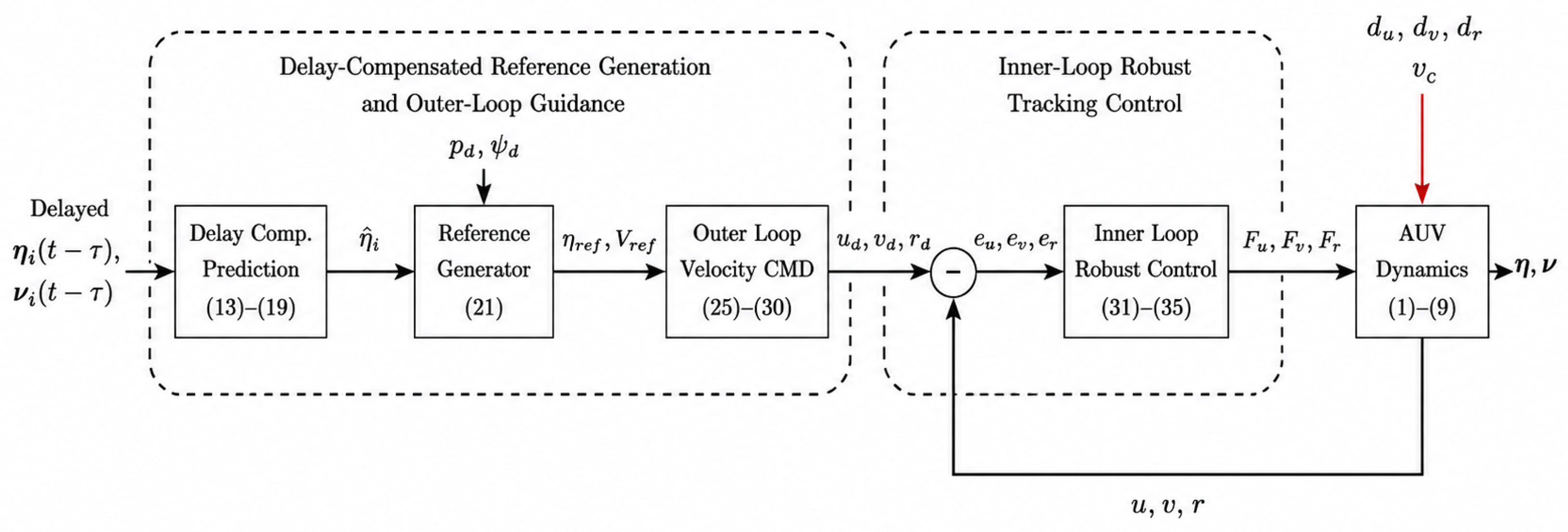
Figure 1 illustrates the overall architecture of the proposed delay-compensated predictive robust tracking method. The delayed target state η t ( t τ ) , ν t ( t τ ) is first processed by the delay-compensation prediction module to estimate the current target state. The reference generator then combines the predicted target state with the prescribed relative offset to obtain the desired reference pose and velocity. In the outer loop, the reference-tracking error is converted into the desired body-frame velocity command ( u d , v d , r d ) . In the inner loop, the velocity errors ( e u , e v , e r ) are used by the robust controller to generate the control inputs ( F u , F v , F r ) for the AUV dynamics under current disturbance and lumped dynamic disturbances.

3.1. Dynamic Model of the Underwater Robot

For the dynamic target-following problem considered in this paper, a planar three-degree-of-freedom (3-DOF) model is adopted to describe the motion of the underwater robot in the horizontal plane. The vehicle pose in the inertial frame is defined as
η = [ x , y , ψ ] T
where x and y denote the position coordinates, and ψ denotes the yaw angle. The body-fixed velocity vector is given by
ν = [ u , v , r ] T
where u, v, and r represent the surge velocity, sway velocity, and yaw rate, respectively.
The kinematic model of the underwater robot is written as
η ˙ = x ˙ y ˙ ψ ˙ = R ( ψ ) u v r
where the surge and sway velocities u and v are body-fixed velocities referenced to the inertial frame (ground-referenced), and
R ( ψ ) = cos ψ sin ψ sin ψ cos ψ
is the planar rotation matrix from the body-fixed frame to the inertial frame.
The ocean current is modeled as an inertial-frame velocity v c I = [ v c x , v c y ] T . For the dynamic equations, the corresponding body-fixed current components are introduced as
ν c = u c v c : = R T ( ψ ) v c I .
To capture the essential nonlinear behavior of the underwater robot, the 3-DOF dynamic model is simplified as
m u ˙ = F u X u u r + m v r + d u
m v ˙ = F v Y v v r m u r + d v
I z r ˙ = F r N r r + d r
where m is the equivalent mass, I z is the yaw moment of inertia, F u , F v , and F r are the control inputs in surge, sway, and yaw channels, respectively, X u , Y v , and N r are the hydrodynamic damping coefficients, and d u , d v , and d r denote lumped uncertainties including external disturbances and modeling errors. The relative velocities with respect to the ocean current are defined as
u r = u u c , v r = v v c .
The above model captures the dominant nonlinear and coupled dynamics of the underwater robot in the horizontal plane and is sufficiently representative for the dynamic target-following problem studied in this work.
Several simplifications are adopted in (6)–(8) to keep the model tractable for control design. The hydrodynamic damping is described by the linear terms X u u r , Y v v r , and N r r , so that higher-order quadratic drag is not modeled explicitly but is absorbed into the lumped uncertainty terms d u , d v , and d r . The ocean current is treated as a slowly varying inertial-frame velocity. It influences the vehicle only through the relative velocities u r and v r in the damping terms, while the body-fixed velocities u and v themselves remain ground-referenced. The kinematics in (3) therefore contain no separate current term, which avoids counting the current twice. Off-diagonal added-mass and cross-coupling hydrodynamic coefficients are neglected, and the inertial properties are represented by the equivalent mass m and the yaw moment of inertia I z . Any residual effects caused by these simplifications are regarded as bounded disturbances included in d u , d v , and d r .
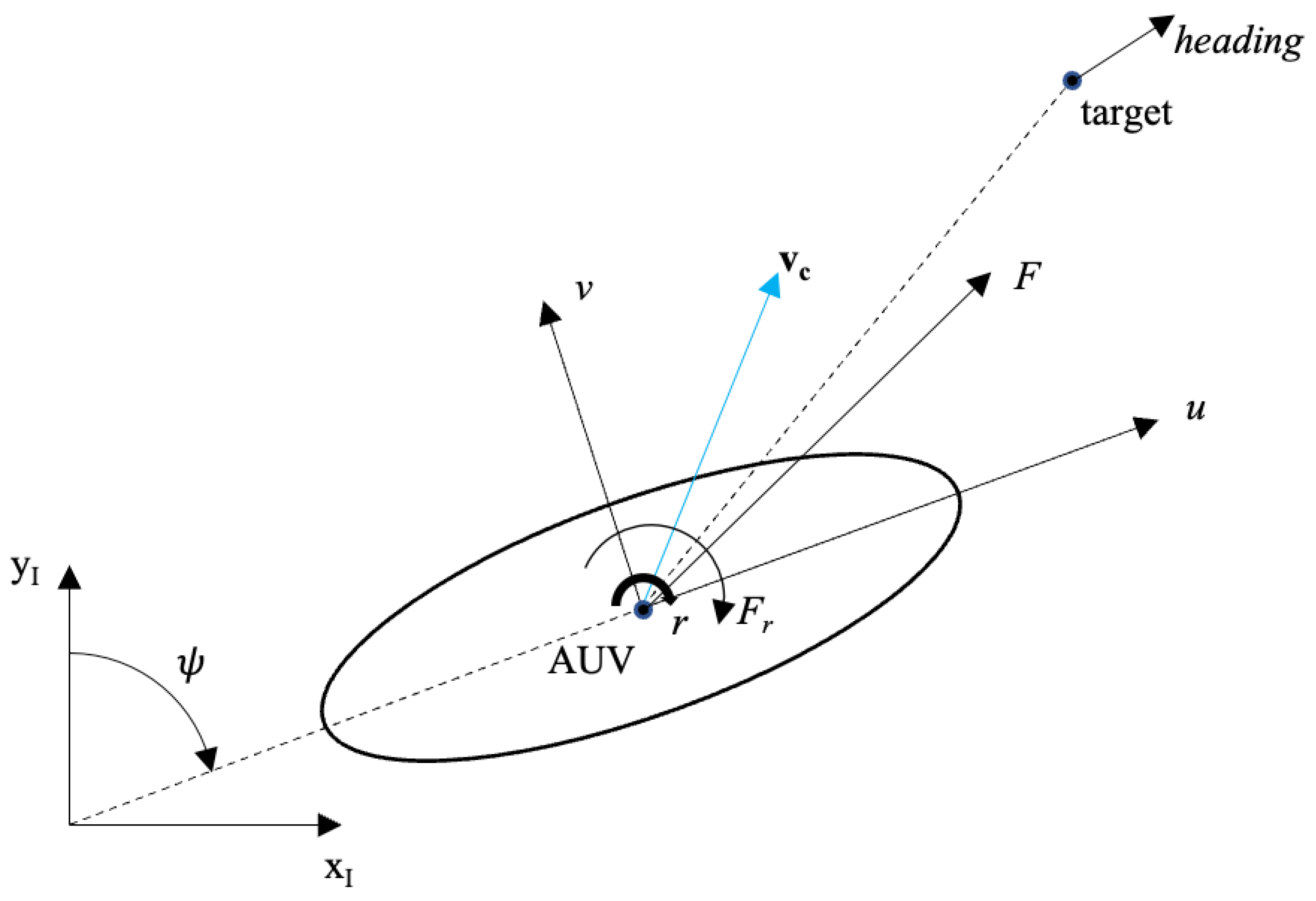
The coordinate definitions and force conventions used in the planar model are summarized in Figure 2. The earth-fixed, or inertial, frame provides the global position coordinates ( x , y ) and yaw angle ψ , while the body-fixed frame is attached to the underwater robot and rotates with the vehicle. The surge and sway velocities ( u , v ) are resolved along the body-fixed axes, and the yaw rate r describes the rotational motion about the vertical axis. The translational control force shown in the figure is denoted by F; in the dynamic equations it is resolved into the body-fixed surge and sway components F u and F v . The yaw input F r is the control moment about the vertical axis. The ocean current is denoted by v c in the figure. It is modeled as an inertial-frame velocity v c I , and it is transformed into body-fixed components ( u c , v c ) when it enters the relative velocities u r and v r . The target point and its heading direction are also shown to indicate the dynamic-following scenario considered later.

3.2. Delayed Dynamic Target Description

Let the target pose and velocity be denoted by
η t = [ x t , y t , ψ t ] T , ν t = [ u t , v t , r t ] T ,
respectively. The target motion in the inertial frame is described by
η ˙ t = R ( ψ t ) u t v t r t .
In practical underwater applications, the target-state information received by the follower is affected by communication latency, sensing delay, and processing delay. Therefore, instead of the current target state η t ( t ) , the follower only has access to the delayed measurements
η t ( t τ ) , ν t ( t τ )
where τ > 0 denotes a known constant time delay.
The time delay degrades the accuracy of the real-time tracking reference and may lead to severe performance deterioration when the target is maneuvering. To address this issue, a predictive delay-compensation mechanism is introduced in the next subsection.

3.3. Predictive Delay Compensation

To compensate for the delayed target-state information, a first-order motion prediction strategy is adopted. Under the standard constant-velocity assumption over the delay interval, the available target-velocity estimate is taken as
ν ^ t ( t ) : = ν t ( t τ ) = u ^ t v ^ t r ^ t .
Based on the delayed target pose and the estimated target velocity, the current target pose is extrapolated over the delay interval τ , yielding
η ^ t ( t ) = η t ( t τ ) + R ( ψ t ( t τ ) ) u ^ t v ^ t τ r ^ t τ .
More explicitly, the predicted target position and yaw angle are given by
x ^ t ( t ) = x t ( t τ ) + x ˙ t ( t τ ) τ
y ^ t ( t ) = y t ( t τ ) + y ˙ t ( t τ ) τ
ψ ^ t ( t ) = ψ t ( t τ ) + r ^ t τ
where
x ˙ t ( t τ ) y ˙ t ( t τ ) = R ( ψ t ( t τ ) ) u ^ t v ^ t .
The prediction error is defined as
η ˜ t ( t ) = η t ( t ) η ^ t ( t ) .
Under the assumption that the target linear acceleration and angular acceleration are bounded, the prediction error remains bounded over the delay interval. Hence, the predicted target state can reduce the adverse effect of delayed measurements and provide a more accurate reference for the subsequent tracking control design.

3.4. Relative Tracking Error Formulation

In dynamic target-following missions, the underwater robot is required to maintain a desired relative offset with respect to the target, rather than coinciding exactly with the target position. Let the desired relative position and heading be defined as
p d = [ x d , y d ] T , ψ d .
Then, the tracking reference generated from the predicted target state is expressed as
p r e f = x ^ t y ^ t + R ( ψ ^ t ) p d , ψ r e f = ψ ^ t + ψ d .
The position tracking error is defined as
e p = e x e y = x y x r e f y r e f
and the heading tracking error used in the analysis is defined as
e ψ = ψ ψ r e f .
For implementation, the heading error is normalized into the interval ( π , π ] , i.e.,
e ψ = wrapToPi ( ψ ψ r e f ) .
The subsequent local stability analysis is carried out in the tracking region | e ψ | < π , where the wrapped and unwrapped heading errors share the same derivative.
The control objective of this paper is to design a controller such that the underwater robot can stably track the reference state generated from the predicted target motion under bounded time delay, external disturbances, and model uncertainties.

3.5. Predictive Robust Tracking Controller Design

To achieve dynamic target following, a hierarchical controller is constructed, consisting of an outer-loop reference generator and an inner-loop robust dynamic controller.

3.5.1. Outer-Loop Reference Velocity Generation

The outer-loop reference generator is constructed from a proportional error-shaping term and the predicted target-motion feedforward term defined below.
v r e f I = K p e p + v t , f f
Let
J = 0 1 1 0
denote the planar skew-symmetric matrix. The predicted feedforward velocity of the reference point is chosen as
v t , f f = R ( ψ ^ t ) u ^ t v ^ t + r ^ t J R ( ψ ^ t ) p d .
Together with the proportional term in (25), this yields the inertial-frame command velocity.
The desired translational velocity in the body-fixed frame is obtained via coordinate transformation:
ν d , x y = R T ( ψ ) v r e f I .
Thus, the desired surge and sway velocities are
[ u d , v d ] T = ν d , x y .
Similarly, the desired yaw rate is designed as
r d = K ψ e ψ + r ^ t
where K ψ > 0 is the heading feedback gain.

3.5.2. Inner-Loop Robust Velocity Tracking Control

Define the velocity tracking errors as
e u = u u d , e v = v v d , e r = r r d .
To improve robustness against hydrodynamic uncertainty and external disturbances, the following control laws are constructed:
F u = m u ˙ d + X ^ u u r m v r K u e u ρ u sat e u ϕ u
F v = m v ˙ d + Y ^ v v r + m u r K v e v ρ v sat e v ϕ v
F r = I z r ˙ d + N ^ r r K r e r ρ r sat e r ϕ r
where K u , K v , and K r are positive feedback gains, X ^ u , Y ^ v , and N ^ r are nominal hydrodynamic parameters used for model compensation, ρ u , ρ v , and ρ r are robust gains, and ϕ u , ϕ v , and ϕ r are boundary-layer parameters. The derivatives u ˙ d , v ˙ d , and r ˙ d are evaluated from the reference generator or obtained through filtered differentiation.
The saturation function is defined as
sat ( z ) = 1 , z > 1 z , | z | 1 1 , z < 1 .
The robust terms in (32)–(34) are introduced to improve robustness against bounded plant-side uncertainty and external disturbances, while the boundary-layer design alleviates the chattering phenomenon that may occur in discontinuous robust controllers.

3.6. Stability Analysis

The following assumptions are used in the analysis:
  • the target-state delay τ is constant and known;
  • the target translational velocity, yaw rate, and their derivatives are bounded;
  • the ocean current, lumped disturbances, and parameter mismatches are bounded, and the closed-loop motion evolves inside a compact operating region;
  • the generated command signals u d , v d , and r d together with their derivatives are bounded;
  • the heading-tracking motion remains in the local region | e ψ | < π so that no branch switching of wrapToPi ( · ) occurs during the analysis interval.
Define the overall tracking error vector as
e = e p T e ψ e u e v e r T .
A Lyapunov candidate function is chosen as
V = 1 2 e p T e p + 1 2 e ψ 2 + 1 2 m e u 2 + 1 2 m e v 2 + 1 2 I z e r 2
which is positive definite with respect to the tracking errors.
Taking the time derivative of (37) gives
V ˙ = e p T e ˙ p + e ψ e ˙ ψ + m e u e ˙ u + m e v e ˙ v + I z e r e ˙ r .
The position error dynamics can be written as
e ˙ p = R ( ψ ) u v p ˙ r e f .
By using (25)–(29) together with the decomposition u = u d + e u and v = v d + e v , (39) can be rearranged as
e ˙ p = K p e p + R ( ψ ) e u e v + δ p
where
δ p : = v t , f f p ˙ r e f .
Under the bounded target-acceleration and bounded prediction-error assumptions, there exists a constant δ ¯ p > 0 such that δ p     δ ¯ p . Therefore,
e p T e ˙ p λ min ( K p ) e p 2 + e p e u 2 + e v 2 + e p δ ¯ p .
Similarly, the heading error dynamics satisfy
e ˙ ψ = r ψ ˙ r e f = K ψ e ψ + e r + δ ψ
where δ ψ : = r ^ t ψ ˙ r e f denotes the bounded heading-reference mismatch caused by target prediction error and target angular acceleration. Therefore,
e ψ e ˙ ψ K ψ e ψ 2 + | e ψ | | e r | + | e ψ | δ ¯ ψ .
for some constant δ ¯ ψ > 0 .
Define the parameter mismatches as
X ˜ u = X u X ^ u , Y ˜ v = Y v Y ^ v , N ˜ r = N r N ^ r .
Next, consider the surge velocity tracking error e u = u u d . Its derivative is
e ˙ u = u ˙ u ˙ d .
Using (6) and substituting the control law (32), one obtains
m e ˙ u = K u e u X ˜ u u r + d u ρ u sat e u ϕ u .
Define the lumped uncertainty term in the surge channel as
Δ u = X ˜ u u r + d u .
Then (47) becomes
m e ˙ u = K u e u + Δ u ρ u sat e u ϕ u .
Multiplying both sides of (49) by e u yields
m e u e ˙ u = K u e u 2 + e u Δ u ρ u e u sat e u ϕ u .
Assuming that Δ u is bounded, i.e.,
| Δ u | Δ ¯ u ,
one has
e u Δ u | e u | Δ ¯ u .
Moreover, the saturation function satisfies
e u sat e u ϕ u 0
which implies that the robust term always contributes non-positively to V ˙ . Therefore,
m e u e ˙ u K u e u 2 + | e u | Δ ¯ u ρ u e u sat e u ϕ u .
By the same reasoning, the sway and yaw-rate channels satisfy analogous dynamics with Δ v : = Y ˜ v v r + d v and Δ r : = N ˜ r r + d r . Consequently,
m e v e ˙ v K v e v 2 + | e v | Δ ¯ v ρ v e v sat e v ϕ v
and
I z e r e ˙ r K r e r 2 + | e r | Δ ¯ r ρ r e r sat e r ϕ r
where Δ ¯ v and Δ ¯ r are positive bounded constants.
Applying Young’s inequality to the mixed terms yields
e p e u 2 + e v 2 ε p 2 e p 2 + 1 2 ε p ( e u 2 + e v 2 ) , | e ψ | | e r | ε ψ 2 e ψ 2 + 1 2 ε ψ e r 2 , e p δ ¯ p ε p δ 2 e p 2 + δ ¯ p 2 2 ε p δ , | e ψ | δ ¯ ψ ε ψ δ 2 e ψ 2 + δ ¯ ψ 2 2 ε ψ δ , | e i | Δ ¯ i ε i 2 e i 2 + Δ ¯ i 2 2 ε i , i { u , v , r } ,
where all ε -parameters are arbitrary positive constants. If the controller gains are selected such that
λ min ( K p ) > ε p + ε p δ 2 , K ψ > ε ψ + ε ψ δ 2 ,
and
K u > 1 2 ε p + ε u 2 , K v > 1 2 ε p + ε v 2 , K r > 1 2 ε ψ + ε r 2 ,
then combining (42), (44), and (54)–(57) in (38) yields
V ˙ α 1 e p 2 α 2 e ψ 2 α 3 e u 2 α 4 e v 2 α 5 e r 2 + β
where α i > 0 ( i = 1 , , 5 ) are positive constants and β > 0 is a bounded residual term caused by target prediction error, external disturbances, and parametric uncertainty.
Let
α = min { α 1 , α 2 , α 3 , α 4 , α 5 } .
Then (60) can be compactly written as
V ˙ α e 2 + β .
Theorem 1.
Consider the delayed dynamic target-following system described by (3)–(8) together with the predictive robust controller (25)–(34). Under the above assumptions and the gain conditions (58) and (59), all closed-loop tracking errors remain uniformly ultimately bounded. Moreover, if the residual terms δ p , δ ψ , Δ u , Δ v , and Δ r vanish, then the tracking errors asymptotically converge to zero.
Proof. 
The weighted Lyapunov function (37) is positive definite with respect to the overall error vector. Equations (42), (44) and (54)–(56) provide upper bounds for all channel-wise contributions to V ˙ . By applying the Young-type estimates in (57) and selecting the gains according to (58) and (59), all mixed terms are absorbed into the dominant negative quadratic terms, which yields (62). Standard Lyapunov comparison arguments therefore imply uniform ultimate boundedness of the closed-loop tracking errors. If the residual terms vanish identically, then β = 0 in (62), and the origin of the tracking-error system becomes asymptotically stable. □
Remark 1.
The stability result above relies on several idealized assumptions. Their practical validity in underwater applications is discussed here. The delay τ is taken as constant and known. In practice, the latency from acoustic communication, sensing, and onboard processing is not strictly constant, but it is typically bounded and slowly varying. A constant nominal value can therefore be used in the predictor (14). Provided that the delay variation is bounded, the resulting additional mismatch is also bounded and is absorbed into the residual terms δ p and δ ψ . The uniform ultimate boundedness conclusion then still holds, with a correspondingly larger residual bound β. The bounded-prediction-error assumption is consistent with the first-order constant-velocity predictor. The dominant prediction error is the second-order term, of order 1 2 a t τ 2 , where a t denotes the target acceleration; it therefore remains bounded whenever the target acceleration is bounded. It should also be emphasized that the predictor is a memoryless one-shot extrapolation: at every instant the target state is re-estimated directly from the current delayed measurement, rather than propagated recursively. Consequently, the prediction error does not accumulate over time. It is effectively reset at each instant and stays bounded by the per-window extrapolation error. During aggressive target maneuvers, this per-window error grows with the target acceleration. This enlarges β and hence the ultimate tracking bound, but it does not cause divergence. This behavior is consistent with Scenario S4, in which strong target maneuvers still yield bounded tracking.

4. Simulation Results and Discussion

To evaluate the effectiveness of the proposed delay-compensated predictive robust tracking method, multi-scenario simulations are conducted in the horizontal plane. The simulations are designed to progressively increase the difficulty of the target-following task by varying the target-state delay, target maneuver intensity, environmental disturbance level, and model mismatch severity. Four controllers are compared in each scenario, namely a conventional PID controller, a robust controller without delay-compensated prediction (ROBUST_ONLY), a prediction-based controller without robust compensation (PRED_ONLY), and the proposed predictive robust tracking controller (PROPOSED).
The latter three controllers are not unrelated designs. ROBUST_ONLY and PRED_ONLY are constructed as ablated variants of the proposed controller, each obtained by disabling exactly one of its two core mechanisms: the predictive delay compensation in Section 3.3 and the robust compensation terms of the inner loop in Section 3.5. This design isolates the individual contribution of each mechanism. The configuration of the four controllers is summarized in Table 1.
  • PROPOSED: The full controller, with predictive delay compensation enabled and the robust terms ρ u , ρ v , ρ r active in (32)–(34).
  • ROBUST_ONLY: The predictive delay compensation of Section 3.3 is removed, so the reference is generated directly from the delayed target state, i.e., the extrapolation term in (14) is dropped and η ^ t ( t ) = η t ( t τ ) . The hierarchical outer and inner loops, including the robust terms, remain identical to PROPOSED.
  • PRED_ONLY: The predictive delay compensation is retained, but the robust compensation terms are switched off by setting ρ u = ρ v = ρ r = 0 in (32)–(34). The inner loop then reduces to a nominal model-compensation plus proportional feedback law.
  • PID: A conventional PID controller acting on the reference-tracking error, used as a non-model-based baseline. It employs neither delay prediction, model compensation, nor robust terms, and is not derived from the proposed framework.
In all scenarios, the controller does not track the target center directly. Instead, it tracks a reference point located behind the target with a prescribed relative offset, which is more suitable for close-range accompaniment and safe following tasks. The desired relative offset is set as
p d = [ 0.65 , 0.12 ] T
whose magnitude is approximately 0.66 m . Therefore, the distance between the follower and the target center is intentionally nonzero, while the true tracking quality is evaluated by the follower’s error with respect to the reference point.
The two components of p d are prescribed design parameters that specify a representative close-range following geometry, rather than values derived from a particular vehicle or sensor configuration. The longitudinal component, i.e., the surge-axis offset of 0.65 m , sets a stand-off distance that keeps the follower a short but safe distance behind the target: it is large enough to avoid contact during target maneuvers and small enough to remain a close-range accompaniment configuration. The lateral component, i.e., the sway-axis offset of 0.12 m , introduces a small lateral bias so that the follower is not placed exactly in the turbulent wake directly behind the target. It should be emphasized that the proposed relative-following framework does not depend on these specific values; it applies to any prescribed bounded offset, and p d is fixed here only to define a consistent and representative following task across all four scenarios.

4.1. Scenario Design

To characterize the physical influence of delayed target-state information, an equivalent lag distance is introduced:
d τ = v ¯ t τ
where v ¯ t denotes the average target speed and τ is the target-state delay. The quantity d τ describes the spatial lag that would be induced by delayed target feedback if no prediction compensation were employed.
Four representative scenarios are considered:
  • Scenario S1 (delay-only baseline): The target exhibits weak maneuvering behavior, while environmental disturbance and model mismatch are negligible. This scenario is used to verify the basic feasibility of the control framework under relatively benign conditions.
  • Scenario S2 (delay + maneuver): The target-state delay is increased and the target performs noticeable maneuvers. Mild current disturbance and moderate model mismatch are introduced. This scenario is designed to reveal the necessity of prediction compensation when the reference is time-varying.
  • Scenario S3 (delay + maneuver + strong disturbance): The delay remains large, while the ocean current and motion-channel disturbances are significantly strengthened. This scenario is used to evaluate disturbance rejection and robustness.
  • Scenario S4 (hard case): A larger delay, stronger target maneuvers, stronger disturbance, and more severe model mismatch are simultaneously considered. This scenario represents a difficult target-following task in a complex underwater environment.
Four simulation scenarios with progressively increased difficulty are considered, as summarized in Table 2. The disturbance levels L0–L2 are defined in Table 3. The quantity d τ denotes the equivalent lag distance caused by delayed target-state feedback. The current level is quantified by the range of the surge and sway current components, while the dynamic disturbance level is quantified by the peak amplitudes of ( d u , d v , d r ) .

4.2. Trajectory Comparison Under Multiple Scenarios

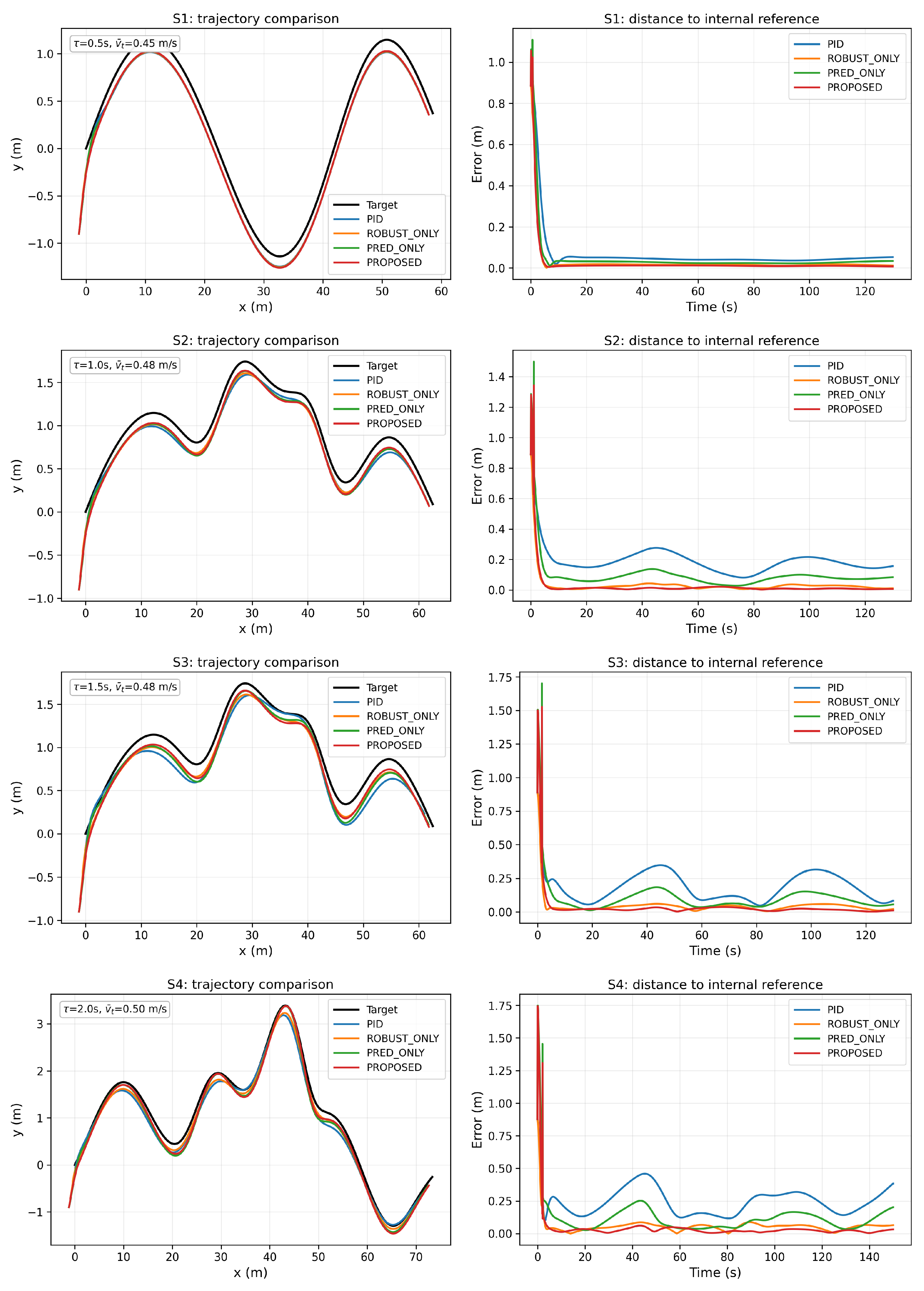
Figure 3 presents the trajectory comparison and reference-tracking error comparison for all four scenarios. In each trajectory subplot, the target trajectory, the generated reference trajectory, and the follower trajectories of the four compared algorithms are shown simultaneously. The reference trajectory is generated from the delayed or predicted target state together with the prescribed relative offset in (63). Therefore, the visual separation between the follower and the target center should not be interpreted as tracking failure. Instead, the essential objective is whether the follower can remain close to the reference trajectory.
In Scenario S1, where the delay is small and the target motion is relatively mild, all methods are able to maintain bounded tracking behavior. However, the PID controller exhibits a visibly larger deviation from the reference trajectory than the other three methods. In Scenario S2, the increase in delay and target maneuver intensity causes the difference between methods to become more pronounced. In this case, the controller without prediction compensation exhibits larger lag during target turning, while the proposed method remains closer to the reference path. In Scenario S3, stronger ocean current and additive disturbance further enlarge the difference between the methods. The PID and prediction-only methods exhibit larger tracking dispersion, whereas the robust-only and proposed methods preserve a tighter reference-following pattern. In Scenario S4, which is the most challenging condition, the superiority of the proposed method becomes more evident in the maneuvering segment, where the combined effect of prediction compensation and robust control reduces the visible reference deviation.
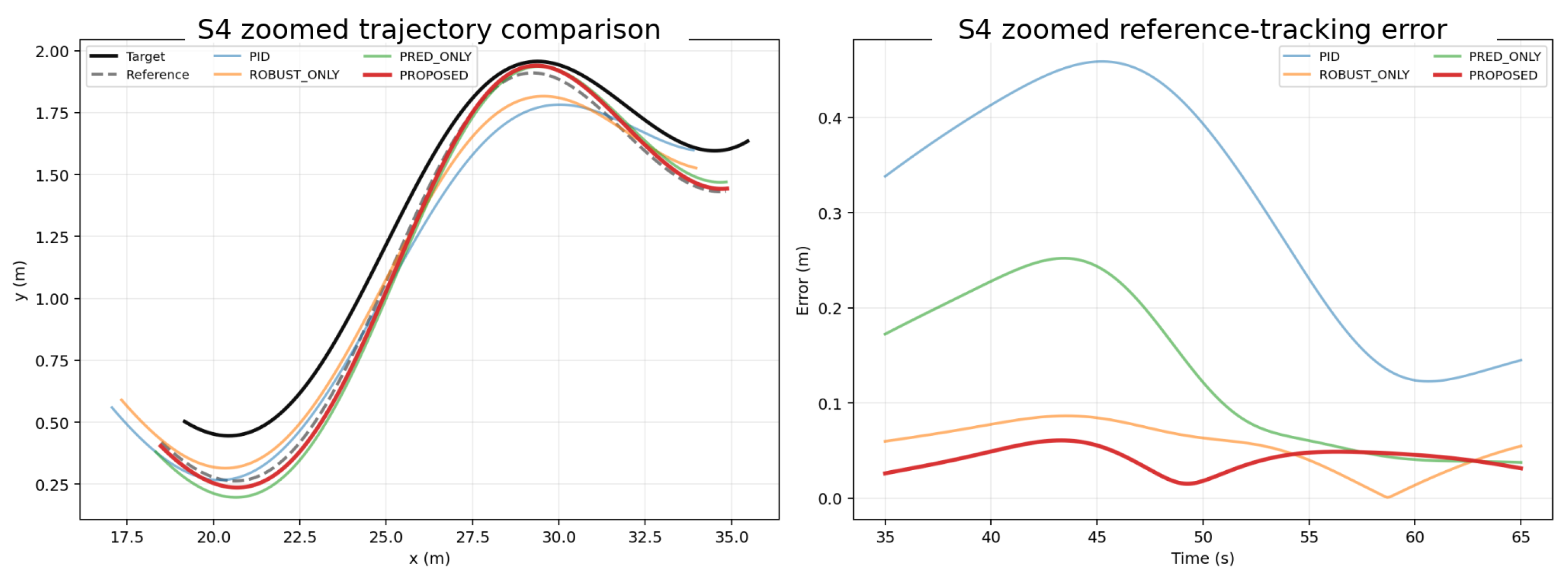
To further highlight the difference among the algorithms in the most difficult case, Figure 4 provides a zoomed comparison for Scenario S4. It can be observed that the PID controller suffers from noticeable lag and larger deviation during target maneuvering. The prediction-only controller reduces the reference lag, but still exhibits larger fluctuation because it lacks robust compensation. The robust-only controller maintains a relatively small mean error under disturbance, but it still tracks a delayed reference and therefore cannot fully suppress maneuver-induced lag. By contrast, the proposed controller better balances reference timeliness and disturbance rejection, resulting in a more concentrated follower trajectory and smaller error during the maneuvering segment.

4.3. Quantitative Comparison of Reference-Tracking Performance

To provide a clearer comparison under different operating conditions, the quantitative results are reorganized on a scenario-by-scenario basis. The 95th-percentile error is removed here, and only the mean reference-tracking error, RMSE, and maximum reference-tracking error are retained. Table 4, Table 5, Table 6 and Table 7 summarize the results for Scenarios S1–S4, respectively.
The reference-tracking error at the k-th sampling instant is defined as the Euclidean distance between the follower and the reference point,
e k = e p ( t k ) = e x 2 ( t k ) + e y 2 ( t k ) , k = 1 , , N ,
where N is the number of samples in the evaluation window. The mean reference-tracking error e ¯ , the root-mean-square error e RMS , and the maximum reference-tracking error e max are then computed as
e ¯ = 1 N k = 1 N e k , e RMS = 1 N k = 1 N e k 2 , e max = max 1 k N e k .
These metrics are reported over two evaluation windows. The full-run window covers the entire simulation, whereas the steady-state window excludes the first 10 s . The first 10 s corresponds to the target-acquisition transient: the follower starts from a nonzero initial offset and gradually converges to the moving reference, so that the tracking error during this interval is large and rapidly decaying and does not reflect the sustained following accuracy. Because the RMSE squares the error, these large transient values dominate the full-run RMSE; consequently, a controller that produces a smoother initial response can exhibit a lower full-run RMSE even when its steady-state following accuracy is not superior. The steady-state window, obtained by discarding the first 10 s , therefore provides a fairer comparison of the sustained tracking performance. Both windows are listed in Table 4, Table 5, Table 6 and Table 7.
Scenario S1 corresponds to the baseline case with small delay and weak target maneuvering. Under this relatively mild condition, all methods maintain bounded tracking behavior. Over the full run, the proposed method achieves the smallest mean error of 0.019 m , reduced by approximately 76.8 % , 29.6 % , and 47.2 % relative to PID, ROBUST_ONLY, and PRED_ONLY, respectively. The smallest full-run RMSE, however, is obtained by ROBUST_ONLY ( 0.112 m against 0.154 m for PROPOSED), because the full-run RMSE is dominated by the initial acquisition transient. Once the first 10 s are excluded, the steady-state results show a consistent advantage of the proposed method, which attains the smallest mean error ( 0.010 m ), RMSE ( 0.010 m ), and maximum error ( 0.012 m ); its steady-state RMSE is about 33 % lower than that of ROBUST_ONLY ( 0.015 m ). Even in this low-difficulty case, therefore, the combination of delay compensation and robust correction provides the most accurate sustained relative following.
Scenario S2 introduces larger delay, stronger maneuvering, mild current disturbance, and moderate model mismatch, so that the benefit of explicit delay compensation becomes more visible. Over the full run, the mean error of PROPOSED is 0.030 m , representing reductions of about 80.0 % , 43.4 % , and 72.7 % relative to PID, ROBUST_ONLY, and PRED_ONLY, respectively. As in S1, ROBUST_ONLY gives the smallest full-run RMSE ( 0.113 m ), since this metric is inflated by the acquisition transient. In the steady-state window, the proposed method is best on all three metrics, with a mean error of 0.010 m , an RMSE of 0.011 m , and a maximum error of 0.020 m , the steady-state RMSE being roughly 54 % lower than that of ROBUST_ONLY ( 0.024 m ). The steady-state mean error of PID ( 0.175 m ) is larger than its full-run mean ( 0.150 m ), which reflects that, without delay compensation, the PID lag accumulates as the target keeps maneuvering instead of being confined to the initial transient.
Scenario S3 further strengthens the environmental disturbance while preserving large delay and noticeable target maneuvering, and the performance gap between methods remains clear. Over the full run, the mean error of PROPOSED is 0.036 m , reduced by about 79.2 % , 34.5 % , and 74.1 % relative to PID, ROBUST_ONLY, and PRED_ONLY, respectively, while ROBUST_ONLY again yields the smallest full-run RMSE ( 0.115 m ). In the steady-state window the ordering is unambiguous: the proposed method achieves the smallest mean error ( 0.018 m ), RMSE ( 0.021 m ), and maximum error ( 0.036 m ), and its steady-state RMSE is about 46 % lower than that of ROBUST_ONLY ( 0.039 m ). This confirms that, under stronger current disturbance, the combined prediction-robust structure still delivers the most accurate sustained tracking.
Scenario S4 represents the hardest case, where larger delay, stronger maneuvering, stronger disturbance, and more severe model mismatch act simultaneously, and it is in this scenario that the sustained-tracking advantage of the proposed method is most pronounced. Over the full run, its mean error is 0.064 m , corresponding to reductions of approximately 73.9 % , 44.3 % , and 68.3 % relative to PID, ROBUST_ONLY, and PRED_ONLY, respectively, while ROBUST_ONLY retains the smallest full-run RMSE ( 0.131 m ). In the steady-state window the proposed method is once more best on every metric, with a mean error of 0.024 m , an RMSE of 0.027 m , and a maximum error of 0.060 m , the steady-state RMSE being about 50 % lower than that of ROBUST_ONLY ( 0.054 m ). Even in the most difficult scenario, therefore, the proposed method provides the best sustained tracking accuracy once the acquisition transient is excluded.
Overall, the quantitative results reveal three consistent trends. First, as the scenario difficulty increases from S1 to S4, the performance of PID deteriorates most obviously, which confirms that conventional feedback control alone is insufficient for delayed underwater target following. Second, the smallest full-run RMSE is obtained by ROBUST_ONLY in every scenario; this does not indicate superior sustained tracking, because the full-run RMSE is dominated by the initial acquisition transient, and a controller with a smoother initial response is favored by this metric. Third, once the first 10 s acquisition transient is excluded, the proposed method achieves the smallest steady-state mean error, RMSE, and maximum error in all four scenarios, with the steady-state RMSE reduced by roughly 33 % to 54 % relative to ROBUST_ONLY. These results show that the apparent RMSE advantage of a purely robust controller is largely attributable to the acquisition transient, whereas the integration of prediction compensation and robust control provides the most accurate and reliable sustained tracking for delayed dynamic target-following tasks in uncertain underwater environments.


5. Conclusions

This study considered the dynamic target-following problem of underwater robots under delayed target-state feedback, external disturbance, and model uncertainty. To reduce the degradation in tracking performance caused by delayed reference information, a delay-compensated prediction mechanism was incorporated into the target-following framework. A robust tracking controller was then designed to improve the ability of the follower to maintain the prescribed relative position with respect to a maneuvering target under uncertain underwater conditions.
The effectiveness of the proposed method was evaluated through simulation under four scenarios with progressively increased difficulty. The results showed that the proposed method achieved the smallest mean tracking error in all scenarios when compared with PID, ROBUST_ONLY, and PRED_ONLY. This indicates that the follower can remain closer to the desired relative-following reference during most of the task. As the delay, target maneuverability, disturbance level, and model mismatch increased, the tracking performance of PID deteriorated more significantly. ROBUST_ONLY and PRED_ONLY improved the response in some aspects, but neither method alone was able to address delay and uncertainty simultaneously. By combining predictive compensation with robust control, the proposed method provided better overall tracking performance in delayed and disturbed underwater environments.
These results show that explicit delay compensation is necessary for underwater dynamic target-following tasks when the target state is updated with latency. At the same time, robustness against disturbance and model uncertainty remains essential for maintaining acceptable tracking performance. The proposed method therefore provides a practical control framework for underwater applications such as close-range target following, cooperative operation, and mobile observation.
This study is limited to simulation-based validation. Practical factors such as three-dimensional current effects, asynchronous sensing updates, actuator saturation, and intermittent target information were not fully considered. Future work will focus on experimental validation using sea-trial data or hardware-in-the-loop testing, and on extending the method to more realistic underwater operating conditions.

Author Contributions

Conceptualization, J.Z. (Jiawei Zhang) and B.H.; methodology, J.Z. (Jiawei Zhang) and D.S. (Dan Shen); software, J.Z. (Jiawei Zhang); validation, J.Z. (Jiawei Zhang) and X.L.; formal analysis, J.Z. (Jiawei Zhang); investigation, J.Z. (Jiawei Zhang), D.S. (Deyong Song) and D.S. (Dan Shen); resources, L.W.; data curation, J.Z. (Jianfeng Zhan); writing—original draft preparation, J.Z. (Jiawei Zhang); writing—review and editing, J.Z. (Jiawei Zhang); visualization, J.Z. (Jianfeng Zhan); supervision, L.W.; project administration, L.W. and D.S. (Dan Shen); funding acquisition, L.W. All authors have read and agreed to the published version of the manuscript.

Funding

This research was funded by National Key Research and Development Program of China grant number 2022YFC2806704.

Institutional Review Board Statement

Not applicable.

Informed Consent Statement

Not applicable.

Data Availability Statement

The simulation settings, processed trajectory records, and the supplementary video described in this study are available from the corresponding author upon reasonable request.

Conflicts of Interest

The authors declare no conflicts of interest.

References

  1. Wang, W.; Wen, T.; He, X.; Xu, G. Robust trajectory tracking and control allocation of X-rudder AUV with actuator uncertainty. Control Eng. Pract. 2023, 136, 105535. [Google Scholar] [CrossRef]
  2. Wu, H.M. Tracking design of an uncertain autonomous underwater vehicle with input saturations by adaptive regression matrix-based fixed-time control. Sensors 2022, 22, 3385. [Google Scholar] [CrossRef] [PubMed]
  3. Qiao, L.; Yi, B.; Wu, D.; Zhang, W. Design of three exponentially convergent robust controllers for the trajectory tracking of autonomous underwater vehicles. Ocean Eng. 2017, 134, 157–172. [Google Scholar] [CrossRef]
  4. Karkoub, M.; Wu, H.M.; Hwang, C.L. Nonlinear trajectory-tracking control of an autonomous underwater vehicle. Ocean Eng. 2017, 145, 188–198. [Google Scholar] [CrossRef]
  5. Kumar, N.; Rani, M. An efficient hybrid approach for trajectory tracking control of autonomous underwater vehicles. Appl. Ocean Res. 2020, 95, 102053. [Google Scholar] [CrossRef]
  6. Li, Z.; Wang, M.; Ma, G. Adaptive optimal trajectory tracking control of AUVs based on reinforcement learning. ISA Trans. 2023, 137, 122–132. [Google Scholar] [CrossRef]
  7. Guo, L.; Zhou, R.; Guo, Q.; Ma, L.; Hu, C.; Luo, J. Spatial trajectory tracking of underactuated autonomous underwater vehicles by model–data-driven learning adaptive robust control. J. Mar. Sci. Eng. 2025, 13, 1151. [Google Scholar] [CrossRef]
  8. Elhaki, O.; Shojaei, K. Neural network-based target tracking control of underactuated autonomous underwater vehicles with a prescribed performance. Ocean Eng. 2018, 167, 239–256. [Google Scholar] [CrossRef]
  9. Shojaei, K. Neural network feedback linearization target tracking control of underactuated autonomous underwater vehicles with a guaranteed performance. Ocean Eng. 2022, 258, 111827. [Google Scholar] [CrossRef]
  10. Shi, J.; Fang, J.; Zhang, Q.; Wu, Q.; Zhang, B.; Gao, F. Dynamic target tracking of autonomous underwater vehicle based on deep reinforcement learning. J. Mar. Sci. Eng. 2022, 10, 1406. [Google Scholar] [CrossRef]
  11. Cao, X.; Ren, L.; Sun, C. Dynamic target tracking control of autonomous underwater vehicle based on trajectory prediction. IEEE Trans. Cybern. 2023, 53, 1968–1981. [Google Scholar] [CrossRef] [PubMed]
  12. Cho, G.R.; Li, J.H.; Park, D.; Jung, J.H. Robust trajectory tracking of autonomous underwater vehicles using back-stepping control and time delay estimation. Ocean Eng. 2020, 201, 107131. [Google Scholar] [CrossRef]
  13. Wang, T.; Wei, Y.; Peng, X.; Huang, L. Trajectory tracking of autonomous underwater vehicle under disturbance based on time-delay adaptive high-order sliding mode control. Ocean Eng. 2023, 288, 116081. [Google Scholar] [CrossRef]
  14. Cho, G.R.; Kang, H.; Kim, M.G.; Park, S.; Bae, C.; Jin, H.S.; Jin, S.; Li, J.H. Robust relative space motion control of underwater vehicles using time delay estimation. J. Mar. Sci. Eng. 2025, 13, 2214. [Google Scholar] [CrossRef]
  15. Zheng, J.; Song, L.; Liu, L.; Yu, W.; Wang, Y.; Chen, C. Fixed-time sliding mode tracking control for autonomous underwater vehicles. Appl. Ocean Res. 2021, 117, 102928. [Google Scholar] [CrossRef]
  16. Tang, J.; Dang, Z.; Deng, Z.; Li, C. Adaptive fuzzy nonlinear integral sliding mode control for unmanned underwater vehicles based on ESO. Ocean Eng. 2022, 266, 113154. [Google Scholar] [CrossRef]
  17. Guerrero, J.; Chemori, A.; Creuze, V.; Torres, J. Robust super-twisting-based disturbance observer for autonomous underwater vehicles: Design, stability analysis, and real-time experiments. Robot. Auton. Syst. 2025, 184, 104859. [Google Scholar] [CrossRef]
  18. Sun, Z.; Wang, B.; Li, Z.; Zhao, Y.; Huang, T.; Li, X.; Zhao, Y.; Qian, P.; Zhang, D. Enhanced trajectory tracking for AUVs: Adaptive super-twisting sliding mode control with disturbance observer. Control Eng. Pract. 2025, 164, 106426. [Google Scholar] [CrossRef]
  19. Ding, Z.; Wang, H.; Sun, Y.; Qin, H. Adaptive prescribed performance second-order sliding mode tracking control of autonomous underwater vehicle using neural network-based disturbance observer. Ocean Eng. 2022, 260, 111939. [Google Scholar] [CrossRef]
  20. Zhang, Y.; Che, J.; Hu, Y.; Cui, J.; Cui, J. Real-time ocean current compensation for AUV trajectory tracking control using a meta-learning and self-adaptation hybrid approach. Sensors 2023, 23, 6417. [Google Scholar] [CrossRef]
  21. Zhang, Y.; Liu, X.; Luo, M.; Yang, C. MPC-based 3-D trajectory tracking for an autonomous underwater vehicle with constraints in complex ocean environments. Ocean Eng. 2019, 189, 106309. [Google Scholar] [CrossRef]
  22. Yan, Z.; Gong, P.; Zhang, W.; Wu, W. Model predictive control of autonomous underwater vehicles for trajectory tracking with external disturbances. Ocean Eng. 2020, 217, 107884. [Google Scholar] [CrossRef]
  23. Gong, P.; Yan, Z.; Zhang, W.; Tang, J. Lyapunov-based model predictive control trajectory tracking for an autonomous underwater vehicle with external disturbances. Ocean Eng. 2021, 232, 109010. [Google Scholar] [CrossRef]
  24. Yan, Z.; Yan, J.; Cai, S.; Yu, Y.; Wu, Y. Robust MPC-based trajectory tracking of autonomous underwater vehicles with model uncertainty. Ocean Eng. 2023, 286, 115617. [Google Scholar] [CrossRef]
  25. Jimoh, I.A.; Yue, H.; Grimble, M.J. Tube-based model predictive control of an autonomous underwater vehicle using line-of-sight re-planning. Ocean Eng. 2024, 319, 119688. [Google Scholar] [CrossRef]
  26. Deng, S.Y.; Hao, L.Y.; Shen, C. Autonomous underwater vehicle (AUV) motion design: Integrated path planning and trajectory tracking based on model predictive control (MPC). J. Mar. Sci. Eng. 2024, 12, 1655. [Google Scholar] [CrossRef]
  27. Liu, T.; Zhao, J.; Huang, J. A Gaussian-process-based model predictive control approach for trajectory tracking and obstacle avoidance in autonomous underwater vehicles. J. Mar. Sci. Eng. 2024, 12, 676. [Google Scholar] [CrossRef]
  28. Jimoh, I.A.; Yue, H. A velocity-form model predictive control of an autonomous underwater vehicle. IEEE J. Ocean Eng. 2025, 50, 1127–1139. [Google Scholar] [CrossRef]
  29. Bao, H.; Zhu, H. Modeling and trajectory-tracking model predictive control novel method of AUV based on CFD data. Sensors 2022, 22, 4234. [Google Scholar] [CrossRef]
  30. Dai, L.; Zhang, D.; Wang, S.; Nie, G.; Zhu, X.; Wang, X. Trajectory tracking control of an autonomous underwater vehicle under disturbance and model uncertainty. J. Mar. Sci. Eng. 2025, 13, 2210. [Google Scholar] [CrossRef]
Figure 1. Block diagram of the proposed delay-compensated predictive robust tracking architecture. The diagram shows the information flow from delayed target-state feedback to reference generation, outer-loop velocity command, inner-loop robust control, and AUV dynamics, together with the main inputs and outputs of each module.
Jmse 14 00963 g001
Figure 2. Coordinate frames, degrees of freedom, and force conventions of the planar 3-DOF underwater robot model. The earth-fixed, or inertial, frame defines the global pose variables ( x , y , ψ ) , whereas the body-fixed frame defines the surge, sway, and yaw variables ( u , v , r ) . The translational force F is resolved into the body-fixed components F u and F v in the dynamic equations, and F r denotes the yaw control moment. The current velocity is defined in the inertial frame and converted to body-fixed components for the dynamic equations; the target point and heading illustrate the dynamic-following context.
Jmse 14 00963 g002
Figure 3. Multi-scenario comparison of target trajectory, reference trajectory, follower trajectories, and reference-tracking errors for PID, ROBUST_ONLY, PRED_ONLY, and PROPOSED.
Jmse 14 00963 g003
Figure 4. Zoomed comparison of trajectory and reference-tracking error in the hardest scenario S4.
Jmse 14 00963 g004
Table 1. Ablation configuration of the compared controllers.
ControllerDelay PredictionRobust TermModel Compensation
PIDnonono
ROBUST_ONLYnoyesyes
PRED_ONLYyesnoyes
PROPOSEDyesyesyes
Table 2. Simulation scenarios.
Scenario v t (m/s) τ (s) d τ (m)Disturbance LevelCase Description
S10.450.50.23L0baseline
S20.491.00.49L1delayed tracking
S30.491.50.74L2robust tracking
S40.522.01.05L2integrated hard case
Table 3. Definition of disturbance levels.
LevelCurrent in Surge/Sway (m/s)Disturbance Peak ( d u , d v , d r ) Description
L0nonenoneno disturbance
L1 [ 0.01 ,   0.03 ] / [ 0.018 ,   0.002 ] ( 0.02 ,   0.015 ,   0.008 ) mild
L2 [ 0.02 ,   0.10 ] / [ 0.065 ,   0.01 ] ( 0.08 ,   0.065 ,   0.028 ) strong
Table 4. Reference-tracking performance comparison in Scenario S1.
MetricPIDROBUST_ONLYPRED_ONLYPROPOSED
Full run
Mean error (m)0.0820.0270.0360.019
RMSE (m)0.1470.1120.1730.154
Maximum error (m)0.8850.8341.111.07
Steady state (first 10 s excluded)
Mean error (m)0.0440.0150.0270.010
RMSE (m)0.0440.0150.0270.010
Maximum error (m)0.0550.0180.0350.012
Table 5. Reference-tracking performance comparison in Scenario S2.
MetricPIDROBUST_ONLYPRED_ONLYPROPOSED
Full run
Mean error (m)0.1500.0530.1100.030
RMSE (m)0.2240.1130.2240.191
Maximum error (m)0.8880.8731.501.34
Steady state (first 10 s excluded)
Mean error (m)0.1750.0220.0770.010
RMSE (m)0.1810.0240.0810.011
Maximum error (m)0.2760.0430.1370.020
Table 6. Reference-tracking performance comparison in Scenario S3.
MetricPIDROBUST_ONLYPRED_ONLYPROPOSED
Full run
Mean error (m)0.1730.0550.1390.036
RMSE (m)0.2340.1150.2260.189
Maximum error (m)0.8880.8731.701.52
Steady state (first 10 s excluded)
Mean error (m)0.1760.0350.0830.018
RMSE (m)0.2000.0390.0950.021
Maximum error (m)0.3460.0600.1840.036
Table 7. Reference-tracking performance comparison in Scenario S4.
MetricPIDROBUST_ONLYPRED_ONLYPROPOSED
Full run
Mean error (m)0.2450.1150.2020.064
RMSE (m)0.2960.1310.2450.198
Maximum error (m)0.8760.8571.7531.754
Steady state (first 10 s excluded)
Mean error (m)0.2390.0490.0990.024
RMSE (m)0.2570.0540.1160.027
Maximum error (m)0.4590.0870.2520.060
Disclaimer/Publisher’s Note: The statements, opinions and data contained in all publications are solely those of the individual author(s) and contributor(s) and not of MDPI and/or the editor(s). MDPI and/or the editor(s) disclaim responsibility for any injury to people or property resulting from any ideas, methods, instructions or products referred to in the content.