Article

Spatio-Temporal Patterns and Limited Co-Occurrence Among Dolphin Species in the Bay of Algeciras–Gibraltar

by
Liliana Olaya-Ponzone
1,2,*,
Rocío Espada Ruíz
1,3,
Estefanía Martín Moreno
3 and
José Carlos García-Gómez
1,2
1
Laboratory of Marine Biology, Department of Zoology, Faculty of Biology, University of Seville, 41012 Seville, Spain
2
Seville Aquarium Biological Research Area I+D+i, 41012 Seville, Spain
3
Ecolocaliza, C/Gibraltar 183, 11300 La Línea de La Concepción, Spain
*
Author to whom correspondence should be addressed.
J. Mar. Sci. Eng. 2026, 14(11), 1044; https://doi.org/10.3390/jmse14111044
Submission received: 3 May 2026 / Revised: 29 May 2026 / Accepted: 30 May 2026 / Published: 2 June 2026
(This article belongs to the Section Marine Ecology)

Abstract

This study examines spatio-temporal patterns of dolphin species in a coastal ecosystem located in the Bay of Algeciras–Gibraltar (southern Spain), a highly anthropogenic coastal system influenced by a submarine canyon and exposed to intense anthropogenic pressure. Between 2017 and 2020, spatial and temporal relationships between short-beaked common dolphins (Delphinus delphis), striped dolphins (Stenella coeruleoalba), and bottlenose dolphins (Tursiops truncatus) were analysed. A solitary female bottlenose dolphin (Billie) was considered separately as an individual case due to its distinct behavioural patterns. Georeferenced data showed that distances between sightings of T. truncatus and subsequent observations of the other species ranged from 261 to 12,000 m, with temporal intervals spanning from 33 s to 5 h 38 min. Short temporal overlaps (≤300 s) were infrequent. These results indicate limited spatio-temporal overlap between D. delphis, S. coeruleoalba, and T. truncatus within the study area. While no statistically significant relationships were detected in the applied models, the observed patterns provide a descriptive quantitative characterisation of species distribution and co-occurrence in a highly anthropogenic coastal system. Given that D. delphis is classified as Endangered in the western Mediterranean and that both D. delphis and S. coeruleoalba are frequently observed with calves, these patterns may be relevant for understanding habitat use and potential implications for conservation. Overall, this study provides a detailed empirical characterisation of spatio-temporal patterns among sympatric dolphin species in this coastal system, highlighting the need for further research using targeted analytical approaches to assess interspecific dynamics.

1. Introduction

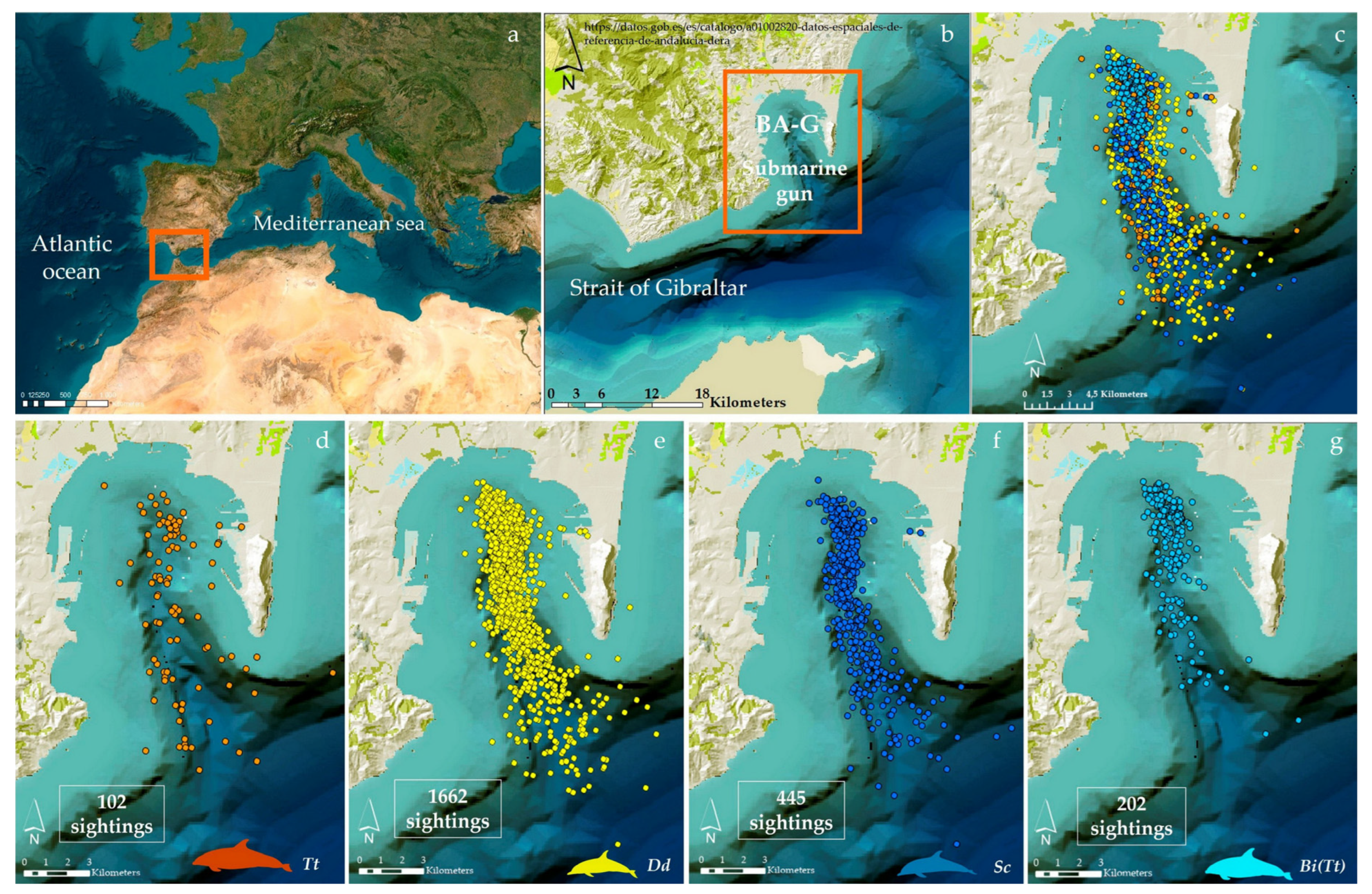
The Bay of Algeciras–Gibraltar (hereafter BA-G), in southern Spain, is a highly trafficked coastal embayment located at the Atlantic–Mediterranean interface, where several delphinid species coexist (Ref. [1], Figure 1). This system is characterised by intense anthropogenic pressure due to the convergence of multiple maritime activities, including one of the busiest commercial shipping routes in Europe, heavy port operations, fishing activity, and a growing whale-watching sector, all occurring in close proximity to dolphin habitat [2,3]. These pressures contribute to frequent vessel–cetacean interactions and persistent human disturbance within the bay [3,4]. The system is also characterised by the presence of a single submarine canyon that likely influences local productivity and habitat structure [5].
The short-beaked common dolphin (Delphinus delphis) is the most frequently observed species throughout the year and regularly uses the bay for foraging, often in groups that include females with calves [6,7]. The striped dolphin (Stenella coeruleoalba) and the bottlenose dolphin (Tursiops truncatus) are also present, although T. truncatus is encountered less frequently [2]. A solitary female T. truncatus (Billie) has also been observed in the area since 2006 and is considered here as an individual case due to its long-term solitary behaviour and occasional associations with groups of D. delphis [1].
The sustained presence of these species in the BA-G is likely linked to its high productivity, driven by Atlantic inflow and local upwelling processes that promote prey aggregation [8]. These species exhibit partially overlapping diets, primarily composed of fish, cephalopods, and crustaceans, which may contribute to spatial and temporal patterns of habitat use within the bay [9].
Delphinid species exhibit a wide range of social structures and group sizes, which may influence their spatial distribution and habitat use. T. truncatus populations are typically characterised by fluid social organisation and complex associations [10,11], whereas D. delphis and S. coeruleoalba often form larger groups with varying degrees of cohesion [12,13,14]. Differences in social organisation and habitat preferences may contribute to patterns of space use in areas where multiple species co-occur.
In coastal systems, bathymetric features such as submarine canyons can play an important role in structuring habitat use by marine predators [15,16,17]. In the BA-G (Figure 2), the north–south canyon is likely associated with local upwelling processes and increased prey availability. Previous studies suggest that T. truncatus tends to use shallower waters, whereas D. delphis and S. coeruleoalba are more frequently associated with continental shelf and pelagic environments, respectively [8,18,19]. These ecological differences may contribute to variation in spatial distribution within the study area.
Previous research in the BA-G has examined the effects of vessel traffic on dolphin behaviour and the occurrence of mixed-species groups [3,20], based on the same long-term monitoring programme. These studies relied on overlapping survey effort and shared field protocols. While they focused on behavioural responses to anthropogenic pressure and interspecific associations, the present study specifically addresses sequential spatial and temporal proximity patterns within the system, using distances and time intervals between sightings as a descriptive approach to explore relative patterns of occurrence among species under the same survey conditions.
Despite these anthropogenic pressures, all three species continue to use the BA-G for foraging, socialising, and reproduction [3,4]. This persistence suggests that the bay provides ecological advantages that may offset the costs associated with anthropogenic pressure.
Given that D. delphis is classified as Endangered in the western Mediterranean [14,21] and that both D. delphis and S. coeruleoalba are frequently observed with calves in the BA-G, understanding patterns of habitat use and spatial and temporal proximity is particularly relevant from a conservation perspective.
Based on previous ecological knowledge, we expected that T. truncatus would be more frequently associated with shallower near-shore waters, whereas D. delphis and S. coeruleoalba would occur more frequently in shelf and relatively more offshore areas. We also expected differences in habitat preferences and ecological traits among species to be reflected in variable patterns of spatial and temporal proximity within the study area.
This study aims to describe the spatial and temporal patterns of occurrence of D. delphis, S. coeruleoalba and T. truncates, within the BA-G coastal system. In addition, we examine the occurrence of the solitary T. truncatus known as Billie as a particular case within the same framework. Specifically, we quantify the distances and time intervals between sightings of T. truncatus and subsequent observations of the other focal dolphin species in order to characterise patterns of spatial and temporal proximity within the study area, using a sequential event-based approach to explore relative occurrence patterns among species under the same survey conditions.

2. Materials and Methods

2.1. Study Area and Data Collection

The study was conducted in southern Spain, in the BA-G; 36°9′0″ N, 5°27′0″ W to 36°3′0″ N, 5°21′0″ W), located on the northern shore of the Strait of Gibraltar (Figure 2). This semi-enclosed embayment constitutes a dynamic transitional ecosystem at the Atlantic–Mediterranean interface, influenced by tidal exchange, intense maritime traffic, and recurrent hydrodynamic mixing processes associated with the Strait of Gibraltar, which contribute to elevated local productivity [5]. Seasonal variability in currents, tidal dynamics, and water mass exchange between the Atlantic Ocean and the Mediterranean Sea contribute to marked environmental heterogeneity within the bay. A single submarine canyon runs north–south across the bay, forming a specular S-shape and reaching a maximum depth of 450 m [5]. This canyon is associated with local mixing processes and prey aggregation and likely contributes to the spatial distribution of dolphin species within the BA-G.
Data were obtained in collaboration with a licensed dolphin-watching operator conducting regular boat surveys between March 2017 and March 2020. These surveys were part of a long-term dataset that has also been used in previous studies examining vessel effects [3,4] and mixed-species groups in the BA-G [20] and therefore represent overlapping survey effort and shared field protocols.
The vessel was a 14 m catamaran that navigated almost daily, covering both coastal and offshore sectors of the bay. Survey routes were non-systematic and designed to maximise encounter rates across the study area; therefore, sampling effort was not evenly distributed, and this limitation was considered when interpreting spatial and temporal patterns.
All surveys followed the official ethical approach protocol established under the Mobile Cetacean Protection Zone (Royal Decree 1727/2007, 21 December), ensuring minimal disturbance to the animals. In total, 25,610 km were surveyed over 1690 h of navigation. Observers used Nikon 7 × 50 binoculars to detect and identify cetaceans.
For each sighting, the following data were recorded: species, number of individuals by age class (adults, juveniles, calves, neonates), geographical position (GPS), vessel course, and the Initial and Final times of each encounter. Complete sighting records corresponding to the sequential occurrence dataset analysed in this study are provided in Supplementary Tables S1–S3.
The orientation of each focal group was initially recorded relative to the bow of the vessel (0–359°, clockwise) and subsequently corrected according to the vessel’s heading (obtained via GPS or digital compass) to derive a true-north bearing. This correction was computed using modular conversion (mod 360°) to ensure angular consistency.

2.2. Distance, Time, and Overlap Measurements

For each T. truncatus (hereafter Tt) sighting, the Final position and time were used as reference points to calculate the distance and elapsed time until the next sighting of D. delphis (hereafter Dd), S. coeruleoalba (hereafter Sc), or, secondarily, the individual case Bi(Tt) on the same day. Distances (m) were measured in ArcGIS Pro 3.7 (Esri, Redlands, CA, USA). using the “measure tool” between the final GPS position of Tt and the initial GPS position of the subsequent species. Time intervals (seconds, s) were calculated as the difference between the Final time of the Tt sighting and the Initial time of the next encounter.
This approach allowed the quantification of spatial and temporal separation between consecutive sightings, providing a standardised framework to describe patterns of occurrence among species. In this context, co-occurrence refers to sequential spatio-temporal proximity under the same survey conditions and should not be interpreted as evidence of social association sensu [22], which requires dedicated analyses of coordinated behaviour or stable affiliative relationships.
Five cases of temporal overlap (Δt ≤ 300 s) between the Final of a Tt sighting and the beginning of another species’ sighting were identified. These events were considered separately as short-term overlaps and were excluded from summary statistics (mean, median, and dispersion) to avoid biasing the description of separation patterns.
Annual and seasonal maps were produced to illustrate the spatial relationship between Tt and subsequent sightings of the other focal species. When more than one focal species (Dd, Sc and/or Bi(Tt)) was recorded after a Tt sighting within the same survey day, all detections corresponding to the same sequential observation context were retained for analysis. These records could reflect either spatially proximate sightings or simultaneous detections recorded within the same observational sequence. Events showing direct temporal overlap between Tt and subsequent focal species detections were excluded from both descriptive analyses and GLM fitting procedures.

2.3. Statistical Analysis

To explore whether the occurrence of Dd, Sc, and Bi(Tt) varied in relation to the spatial and temporal separation from previous Tt sightings, we fitted separate generalized linear models (GLMs) with binomial error distribution for each category (presence = 1, absence = 0), where presence (1) indicated that the focal species was recorded as the first subsequent sighting following a Tt event on the same survey day, and absence (0) indicated that it was not, as an exploratory approach to describe patterns of occurrence.
Predictor variables included the following: (1) elapsed time since the previous Tt sighting, (2) distance (m) from the previous Tt sighting, and (3) season (categorical: spring, summer, autumn, winter). Summer was selected as the reference category because it included the most representative number of observations and corresponded to the period of highest survey intensity.
Elapsed time was log-transformed (log[x + 1]) and distance square root transformed to reduce skewness and improve model fit [23,24]. Model evaluation included coefficient significance (z-test) and Nagelkerke’s pseudo-R2 [25]. Residuals were visually inspected to identify non-random patterns or influential cases. All analyses were conducted in a Python 3.11 environment using the packages statsmodels, pandas, and numpy. Because multiple sequential events could originate from the same survey effort, model outputs were interpreted cautiously as exploratory descriptors of relative occurrence patterns rather than as fully independent ecological observations. Summary information on the number of observations, presences, and absences used in each GLM is provided in Supplementary Table S4.

3. Results

3.1. Sightings

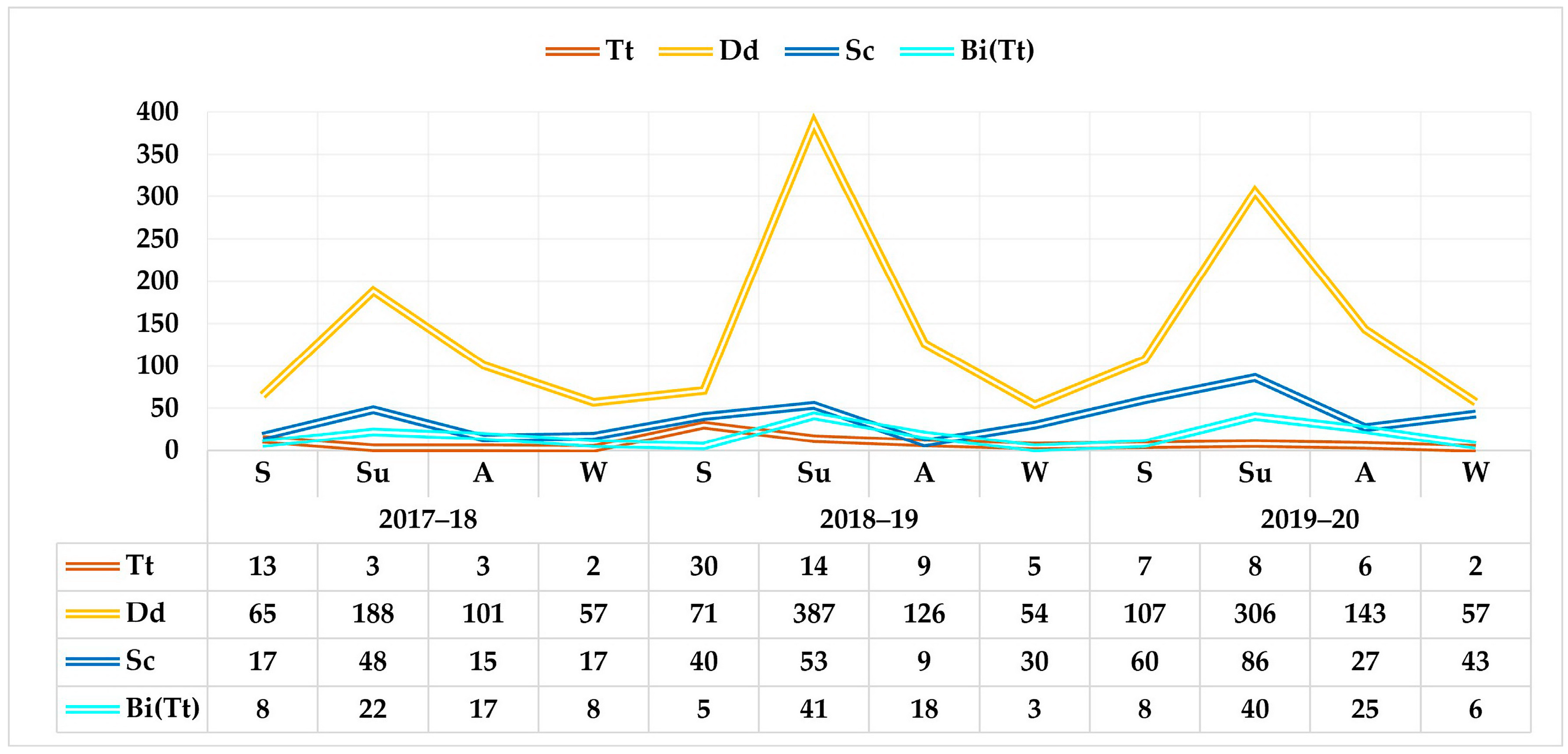
A total of 2410 sightings were recorded across 593 survey days during the study period. The seasonal distribution of Dd, Sc, Tt, and Bi(Tt) (Figure 3) showed that although the three species were sometimes detected on the same day, they were rarely recorded in close temporal or spatial proximity within individual observation sequences.
Dd was the most frequently sighted species, with increasing numbers from summer to autumn, whereas Tt was the least observed, with 102 records. A chi-square test detected no significant seasonal variation in Tt occurrence across years and seasons (χ2 = 5.53, df = 6, p = 0.477), indicating a relatively stable presence throughout the study period.
Group sizes varied among species. Tt groups generally comprised 10–40 individuals, although smaller aggregations were occasionally observed. Dd typically formed groups of 30–90 individuals, and on several occasions, aggregations exceeding 1000 individuals were recorded, including adults, juveniles, calves, and neonates. Sc groups, composed mainly of mothers with calves, ranged from 30 to 40 individuals and occasionally formed mixed aggregations with Dd. During summer, Sc was frequently observed in larger juvenile-dominated groups (up to ~200 individuals), whereas in winter and spring, small juvenile groups (5–20 individuals) were common and often associated with Dd.
No direct mixed-species groups involving Tt with either Dd or Sc, or with Bi(Tt), were recorded within the observation sequences analysed. In contrast, direct mixed-species groups of Dd and Sc, as well as repeated joint sightings between Dd and Bi(Tt), were repeatedly documented during the study period.
In a few instances (e.g., 25 March, 16 and 24 April, and 29 May 2018), no dolphins were sighted despite favourable conditions; these survey days are labelled as ‘No dolphins’ in the Supplementary Tables S1–S3, which detail all sighting sequences and corresponding metadata.

3.2. Times and Distances

Temporal and spatial separation patterns between Tt and subsequent sightings differed among categories. Sc showed the shortest recorded separations from Tt, whereas Bi(Tt) generally exhibited longer temporal intervals between sightings. Detailed seasonal and annual values are summarised in Supplementary Table S5. Because only one Tt event occurred in summer 2017, the corresponding values represent both the seasonal minimum and maximum. On one occasion, a Dd group was detected outside the BA-G 52 min 24 s after a Tt sighting. Since this sighting occurred beyond the study area limits, no spatial distance was calculated, and the event was retained only as part of the descriptive sequence of same-day sightings.
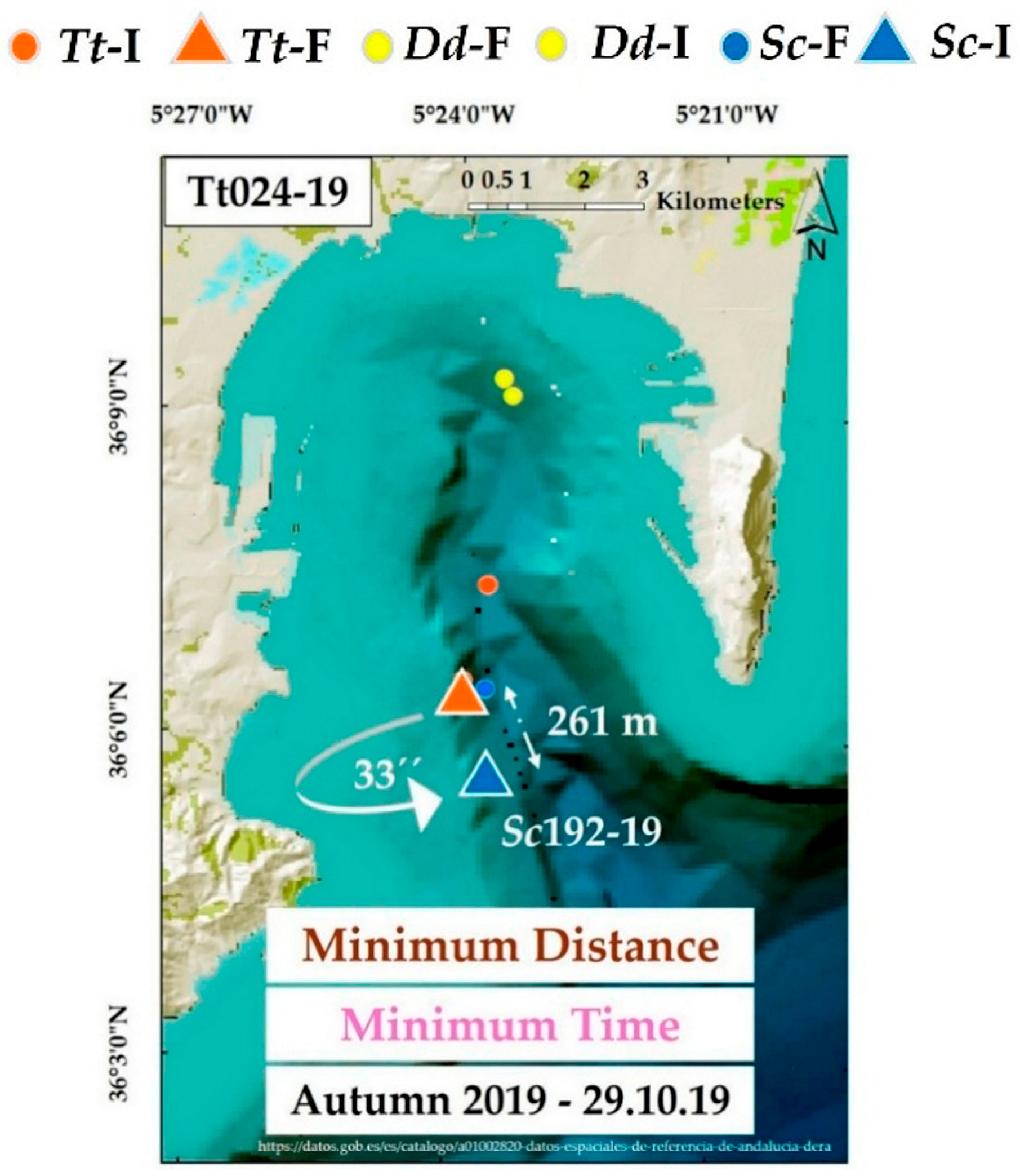
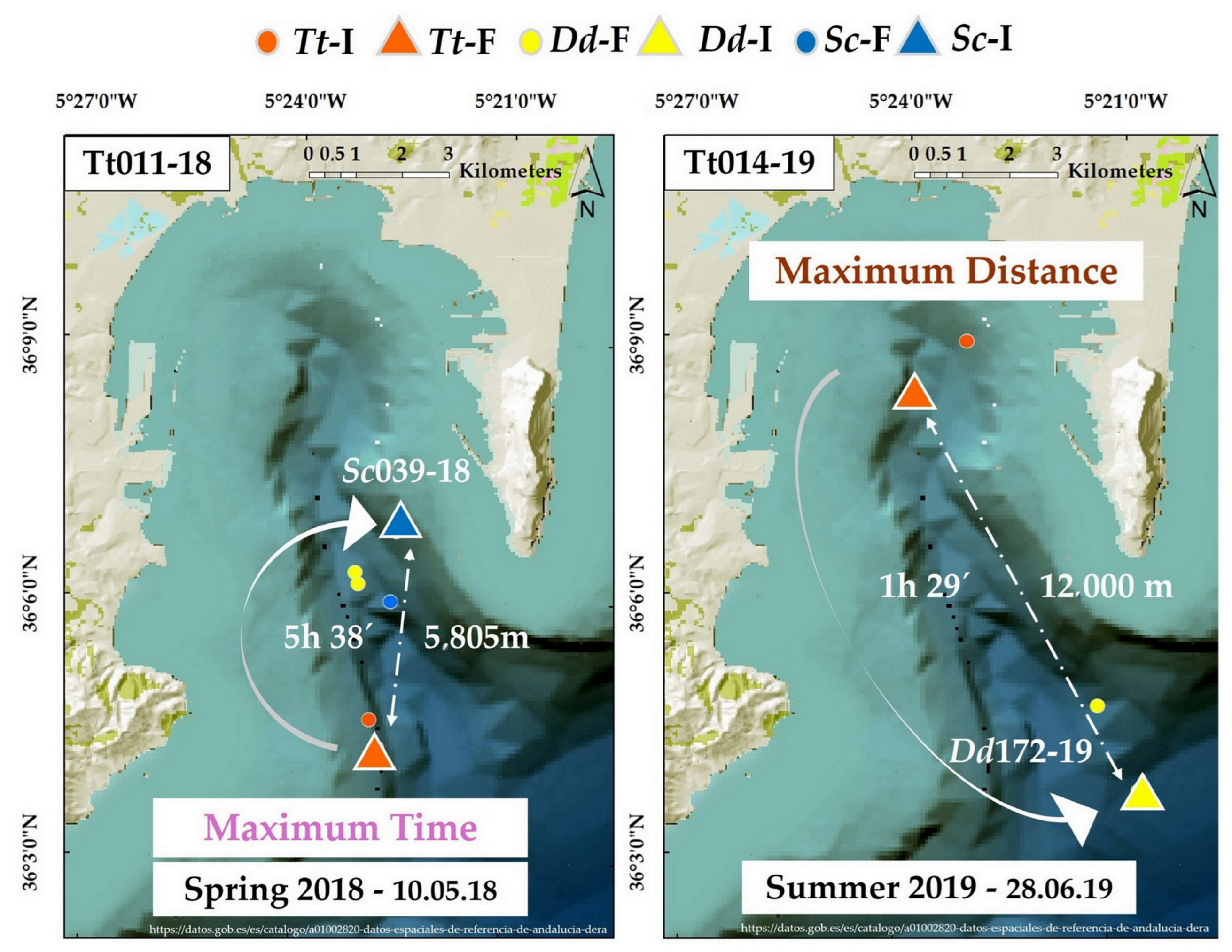
The shortest recorded separation corresponded to the event Tt024-19 → Sc192-19 (261 m and 33 s), whereas the largest distance was recorded for Tt014-19 → Dd172-19 (12,000 m; 1 h 29 min). The longest time interval recorded overall corresponded to Tt011-18 → Sc039-18 (5 h 38 min 47 s). These spatial and temporal extremes are summarised in Table 1; the minimum distance and minimum elapsed time are illustrated in Figure 4, and the maximum elapsed time and maximum distance are illustrated in Figure 5.
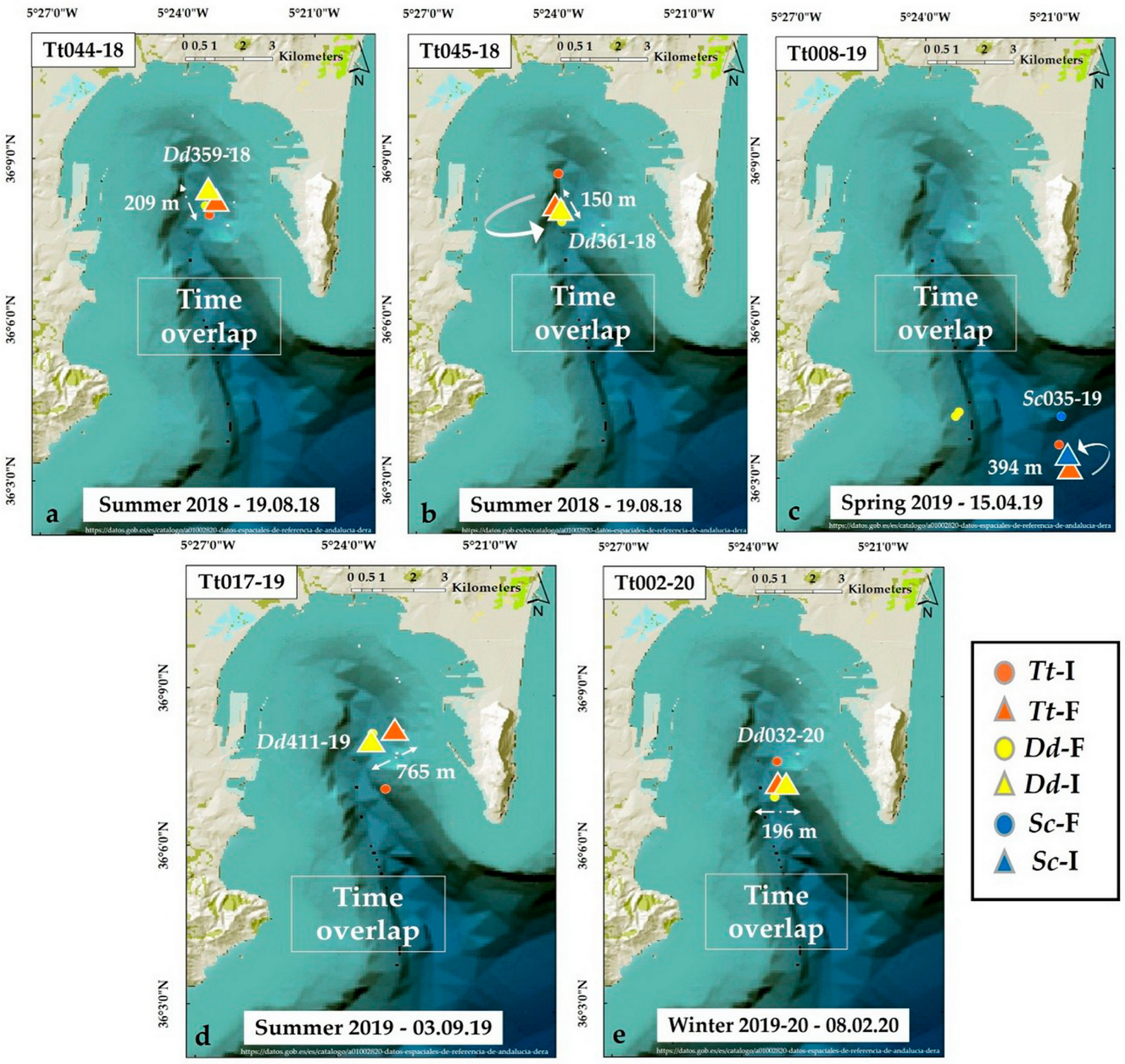
A total of five short-lived temporal overlaps were identified (Figure 6), defined as Δt ≤ 300 s between the Final of a Tt sighting and the Initial of a subsequent sighting of another species within the same day. These overlaps were brief (≤300 s) and occurred at relatively short distances (generally <800 m). The shortest overlap event corresponded to Tt045-18 → Dd361-18 and was recorded at 150 m, as shown in Figure 6b).
Descriptive statistics of time intervals and distances across species and seasons are summarised in Supplementary Table S6, while details of the five overlap events are provided in Supplementary Table S7.
Minimum and maximum distances (m) and times (s) by species, excluding overlap events, are shown in Table 1. Dd exhibited the largest recorded distance (12,000 m), whereas Sc showed the shortest recorded separation from Tt (261 m; 33 s). Bi(Tt) generally exhibited longer temporal intervals between sightings, frequently exceeding 4000 s (~1 h), although these values should be interpreted cautiously because they correspond to an individual case and a smaller number of observations. Median (IQR) and mean ± SD values for both variables by species and season are reported in Supplementary Table S6.
Geographic distributions of minimum and maximum values and the events generating them are presented in Figures S1–S4.

3.3. Statistical Results

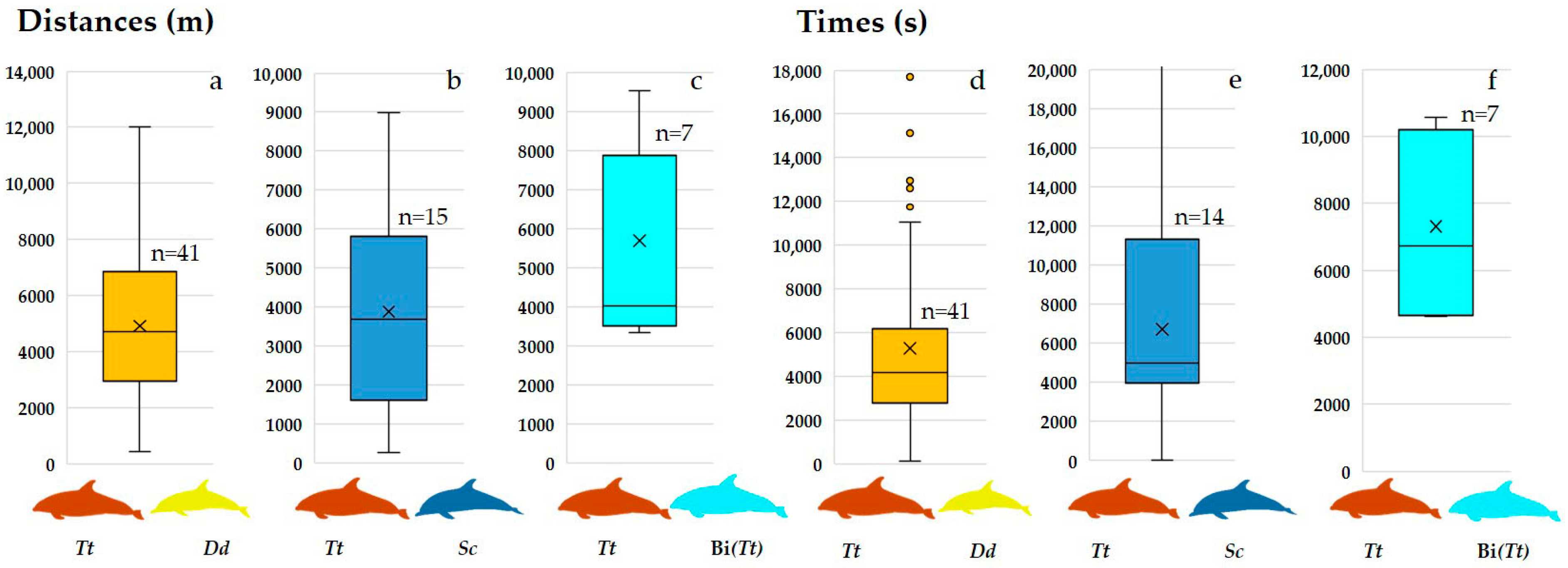
Dd and Sc showed broadly similar distance distributions relative to preceding Tt sightings, whereas Bi(Tt) tended to occur at greater distances and after longer temporal intervals, although based on fewer observations. However, these descriptive tendencies were not supported by statistically significant effects in the GLMs (Table 2). Mean distances for Dd and Sc were also comparable (~4.9 km and 4.7 km, respectively), with similar dispersion (standard deviation, SD ~2.6 km). Time intervals also varied among categories, with broader ranges for Dd and Sc than for Bi(Tt). These descriptive patterns are summarised in Figure 7.
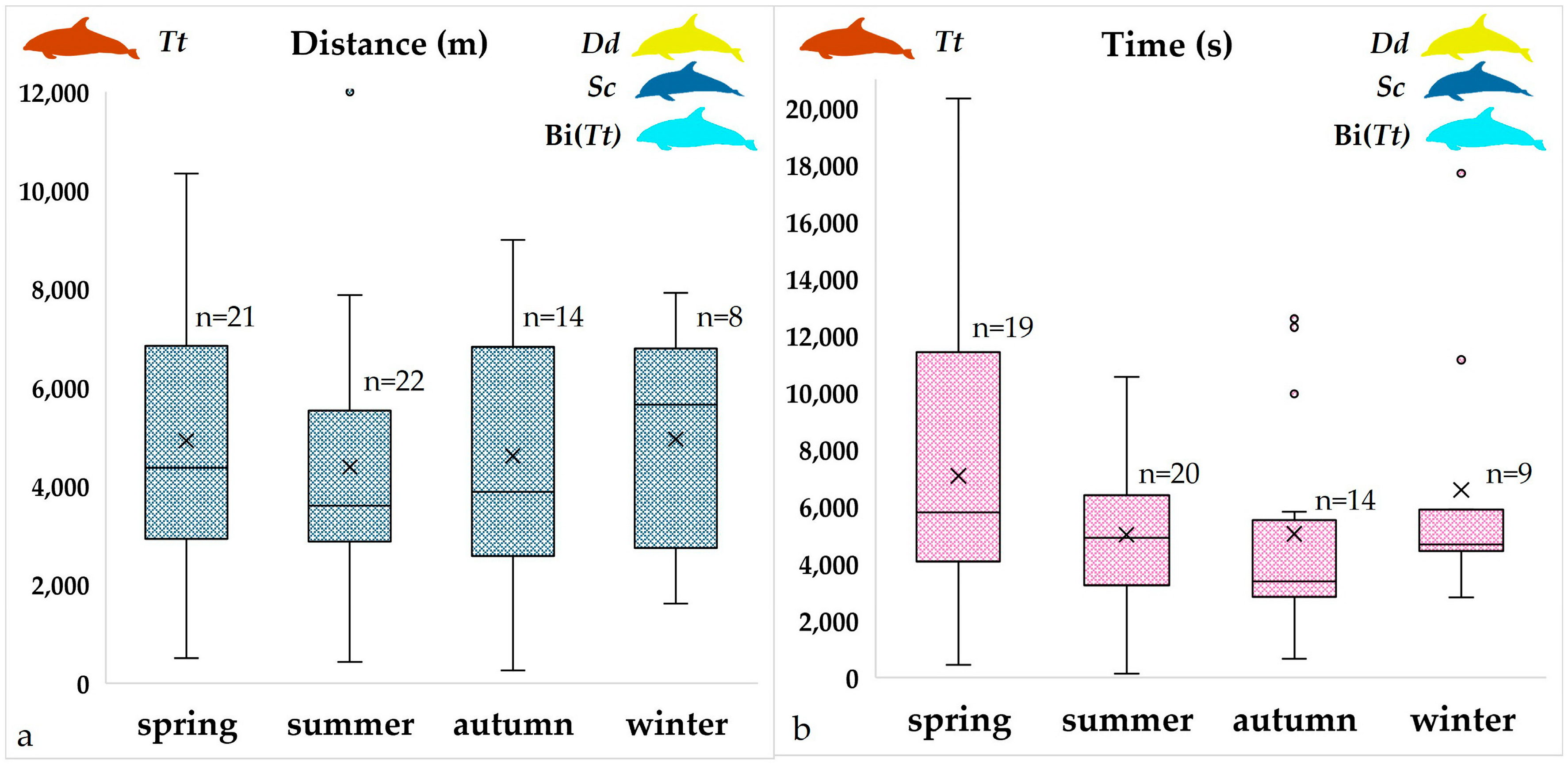
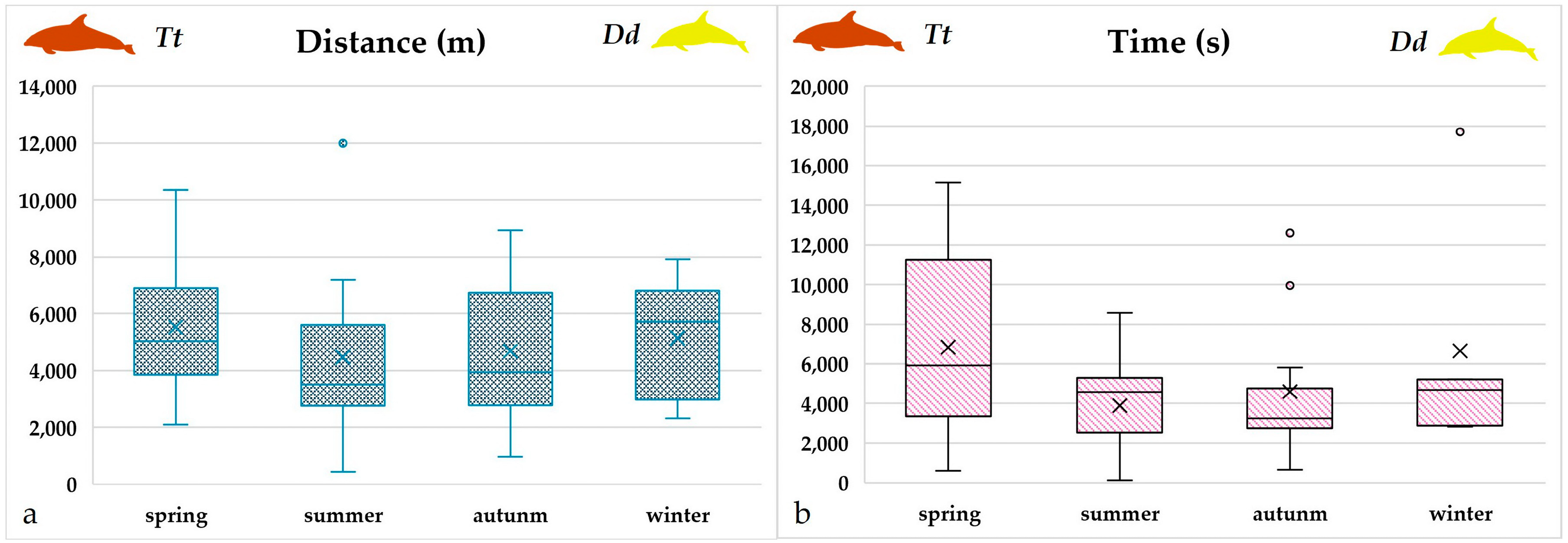
Distances and time intervals were generally lower in winter, whereas spring and summer showed greater variability and dispersion. Distributions were slightly right-skewed in most seasons, reflecting the presence of longer intervals between successive sightings and should be interpreted in light of the uneven sampling effort among seasons. Although seasonal variability was descriptively apparent, this pattern was not supported by statistically significant effects in the exploratory GLM analyses. Seasonal distributions of both variables are displayed in Figure 8.
Dd, which represented the largest sample size (n = 102), showed greater variability in distances during spring and autumn, whereas shorter intervals were more frequent in summer and winter. Time distributions were right-skewed in spring, reflecting the occurrence of longer delays between Tt and subsequent Dd sightings. Overlap events (Δt ≤ 300 s) were excluded from summary statistics, yielding an effective sample size of n = 97. Despite these descriptive seasonal differences, the GLM did not detect significant relationships between occurrence patterns and the analysed predictors. These seasonal patterns for Dd are illustrated in Figure 9.
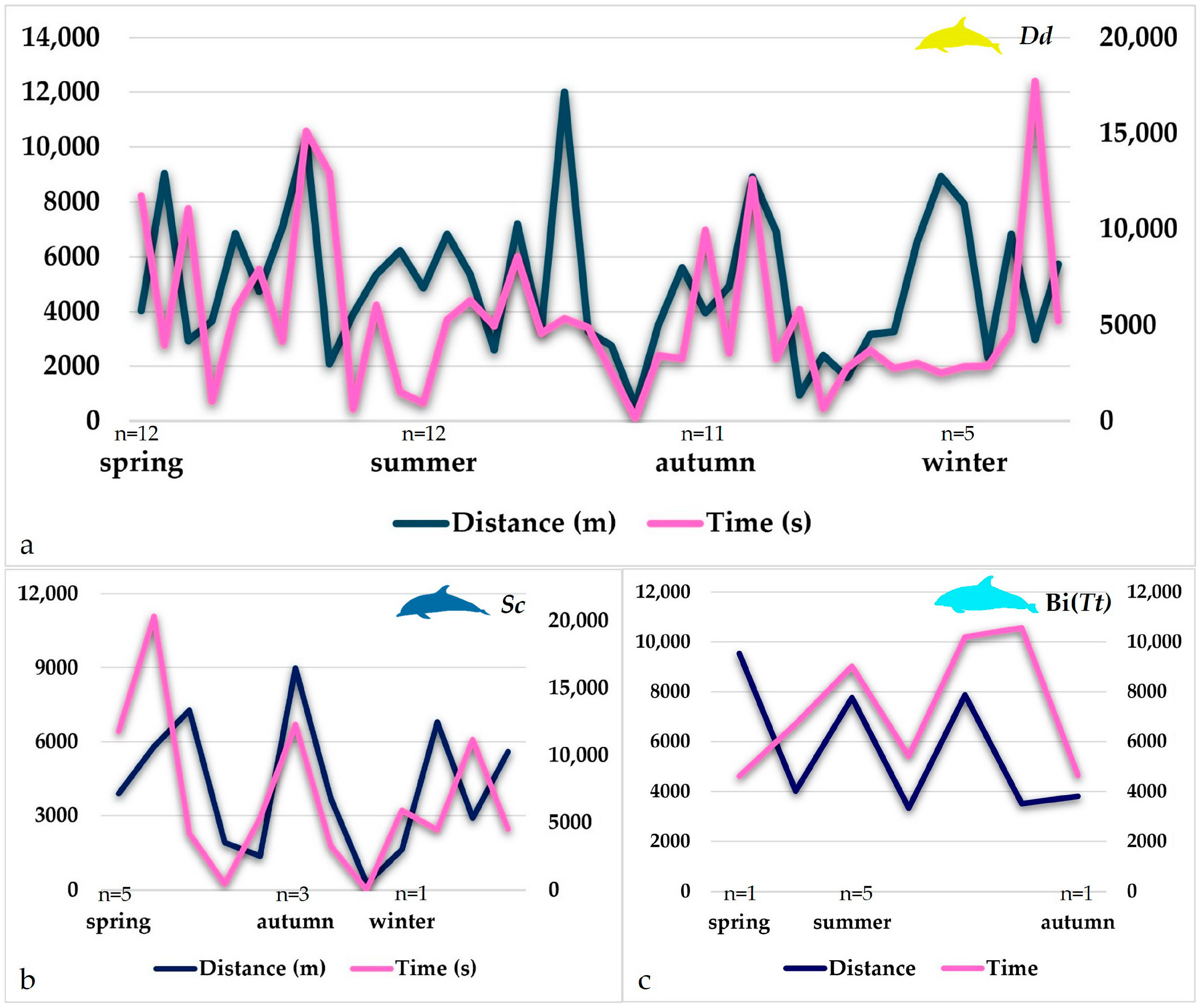
The joint distribution of distance and time by season and species is presented in Figure 10. Patterns varied across species and seasons, with no consistent directional relationship between both variables.
Generalized linear models (GLMs) were fitted to explore whether time since the last Tt sighting, distance from that sighting, and season were related to the occurrence of Dd, Sc, or Bi(Tt) on the same day as an exploratory analysis of spatio-temporal occurrence patterns. Although several descriptive spatio-temporal tendencies were observed across species and seasons, none of the predictors included in the GLMs were statistically significant (all p > 0.15), and model fit was low (Nagelkerke pseudo-R2 < 0.10 for all species; see additional model summary information in Table 2).

4. Discussion

4.1. Sighting Patterns

Interactions among sympatric cetaceans are important for understanding how marine predators use space and time within shared habitats [8,26]. In the BA-G, the patterns observed in this study provide a descriptive framework to examine the spatial and temporal distribution of multiple dolphin species in a highly anthropogenic coastal system [2,3].
The seasonal distribution patterns observed in the BA-G likely reflect a combination of variation in survey effort and other uncontrolled ecological factors. As described in Section 3.1, Dd was the most frequently sighted species, particularly during the summers of 2018 and 2019, coinciding with periods of increased sampling effort. Sc showed a more variable pattern, with a marked increase in 2019, while Bi(Tt) was mainly recorded during summer months. In contrast, Tt showed a more consistent presence throughout the study period, with a peak in spring 2018. Although sampling effort likely influenced sighting frequency [27], seasonal variation in occurrence has also been described in relation to changing ecological conditions in other cetacean systems [28].
A solitary Dd individual associating with Tt has previously been described in a context where Dd had become rare [29]. In the BA-G, Bi(Tt) also represents an atypical association, although it occurs in a system where conspecifics are present. This case should be interpreted cautiously, as it reflects individual-level behavioural variation rather than a species-level pattern, and the mechanisms underlying this association cannot be determined from the present data.
For Tt, the apparent seasonal variability observed in the records may reflect interannual variability or uneven sampling effort [30,31]. The limited number of sightings in some periods reduces the statistical power of the analyses [32], which may explain the absence of clear seasonal trends. Further studies with larger datasets and more standardised sampling effort will be necessary to better characterise the seasonal and spatial use of the BA-G by this species.
Beyond spatio-temporal patterns, trophic differences among species may provide relevant ecological context for interpreting distribution and coexistence patterns [8,9]. Although all three species primarily feed on fish, previous studies indicate differences in prey composition and trophic overlap among Tt, Dd and Sc [9]. For example, reviewed prey taxa include small pelagic and mesopelagic fish such as Sardina pilchardus, Engraulis encrasicolus, Micromesistius poutassou and Myctophidae, as well as benthic or demersal-associated fish families such as Sparidae, Sciaenidae and Haemulidae [9]. Such trophic differences have been proposed as potential mechanisms contributing to coexistence in sympatric delphinids [8,9], although these processes were not directly evaluated in the present study and should therefore be considered hypothetical in the context of the BA-G system. However, the extent to which trophic interactions influence the spatial and temporal patterns described here cannot be directly assessed with the present dataset.

4.2. Spatio-Temporal Patterns

The patterns observed in the distance variable suggest seasonal variability in the spatial distribution of Dd, Sc, and Bi(Tt) relative to Tt. The positive skew recorded in spring, summer, and autumn indicates that, although encounters often occur at moderate or short distances, larger separations are also occasionally observed. In contrast, winter observations were characterised by comparatively higher median distances and fewer close-range records than in other seasons (Table S6).
Regarding time intervals, the overall positive skew indicates that sightings of Dd, Sc, or Bi(Tt) frequently occurred after relatively short intervals following Tt sightings, although with considerable variability. The presence of longer intervals, particularly in spring, reflects that an extended gap between successive sightings also occurred under certain conditions.
Seasonal variability in these patterns has been discussed in relation to multiple ecological and social factors, including environmental conditions, prey availability, population structure, group composition, presence of calves, and behavioural state, all of which may contribute to spatial and temporal patterns among cetacean species [33,34,35].
When considering Dd, which provided the most extensive dataset, a combination of relatively shorter distances and variable time intervals was observed during summer. This pattern may reflect multiple processes, including variation in survey conditions or differences in habitat use across the day. Additionally, longer time intervals (e.g., exceeding two hours) may correspond to separate survey periods conducted on the same day, in which case consecutive sightings may not reflect continuous spatial use of the area.
Although none of the predictors (time, distance, or season) showed statistically significant effects in the GLMs (see Section 3.3), the descriptive patterns reported here provide descriptive context for understanding species occurrence within the BA-G and should not be interpreted as evidence of interspecific interactions or avoidance. The variability observed across species and seasons indicates that spatial and temporal patterns were not uniform during the study period and may have been affected by multiple observational and uncontrolled ecological factors, including uneven sampling effort [32,36].
Comparable patterns of spatial and temporal separation among cetaceans have been described in other regions. For example, spatial partitioning has been reported between killer whales and pilot whales in the eastern Atlantic [37], and between harbour porpoises (Phocoena phocoena) and Tt in Monterey Bay [38]. However, the extent to which similar processes operate in the BA-G cannot be directly inferred from the present results and requires targeted analytical approaches.

4.3. Statistical Patterns

The independent logistic models allowed exploration of whether time and distance since the last Tt sighting were related to the occurrence of the other species as an exploratory assessment of occurrence patterns rather than direct interspecific interactions. No statistically significant effects were detected, which may reflect the relatively limited and uneven number of observations, despite the overall sampling effort. In addition, the high variability observed among sightings may have further reduced the ability of the models to detect consistent patterns.
The absence of statistically significant relationships may also reflect the omission of potentially relevant ecological variables, such as depth, prey distribution, or the behavioural state of Tt at the time of observation [39], which were not systematically incorporated into the present analyses. These variables were not included because the surveys were conducted from a whale-watching platform following non-systematic routes and were primarily designed to record sighting sequences rather than simultaneous habitat or behavioural covariates. Similar ecological factors have been examined in previous studies of habitat partitioning and coexistence patterns among cetaceans [40,41]. Future analyses incorporating these variables, as well as more flexible modelling approaches (e.g., generalized additive models or Bayesian frameworks), may provide a more detailed understanding of these dynamics.
Summer was selected as the reference category due to the higher number of observations, which ensured a more stable baseline for comparison. Seasonal variation in cetacean distribution and behaviour has been widely documented in the northeastern Atlantic and western Mediterranean [21,42], and may contribute to the variability observed in this study.
Although the models did not identify statistically significant relationships, the descriptive patterns presented in this study provide a useful framework for examining spatial and temporal distributions of sympatric dolphin species in the BA-G and should be interpreted cautiously given the limitations of the modelling approach and sampling design. Future analyses incorporating effort-standardised approaches may help disentangle ecological patterns from potential observation biases. Taken together, these results may reflect the ecological complexity of the BA-G system, where multiple environmental, behavioural and anthropogenic factors may interact simultaneously to shape species distributions and spatio-temporal occurrence patterns [3,5,42]. In this context, the statistical results should be interpreted as exploratory indicators rather than evidence of ecological independence among species. Overall, these findings highlight the complexity of species coexistence in a highly dynamic and anthropogenic coastal system and underline the need for further research using targeted analytical approaches.
An additional limitation of the present approach is that the “next sighting” metric reflects the sequential order of detections during surveys rather than direct evidence of association, coordinated movement, or behavioural interaction among species. Consequently, these patterns may also be influenced by detectability and survey routing effects and should therefore be interpreted cautiously.

4.4. Interspecific Interactions Among Odontocetes

Previous studies have documented agonistic interactions involving Tt and other cetacean species, including harbour porpoises and several odontocetes [43,44,45,46,47]. However, such processes are highly context-dependent and were not directly assessed in the present study.
In the BA-G, no direct aggressive interactions between Tt and other species were recorded during the study period, and no mixed groups involving Tt were observed within the analysed sequences. Therefore, the present results only support interpretation of spatio-temporal occurrence patterns and do not allow inference regarding aggression, avoidance, dominance, or other forms of interspecific behavioural interaction.
Bi(Tt) represents an unusual case within this context. Despite the presence of conspecific Tt groups in the BA-G, this individual was consistently observed associating with Dd rather than with other Tt. While this pattern may reflect individual-level behavioural variation [48], it should not be interpreted as representative of species-level interactions, and the underlying causes cannot be determined from the present data.
Further behavioural research is needed to better understand the ecological and social factors underlying interspecific occurrence patterns in the BA-G.

4.5. Biological and Ecological Factors Influencing Interspecific Interactions

Biological and ecological differences among odontocete species, including body size, group composition, and ecological niche, have been proposed as factors potentially influencing interspecific interactions and spatial segregation in sympatric delphinids [49,50,51,52]. However, no direct aggressive interactions involving Tt were recorded in the BA-G during the study period, and no mixed groups including Tt were observed within the analysed sequences, consistent with previous observations from the same study system [20]. Consequently, the extent to which these biological factors may influence the spatio-temporal patterns described here cannot be directly assessed with the present dataset. These observations reinforce the need for cautious interpretation of potential interspecific interaction mechanisms in the BA-G system.

4.6. Potential Impacts

The underlying causes, ecological function, and long-term consequences of agonistic interactions among cetaceans remain insufficiently understood. Nevertheless, if such interactions occur, their potential impact could be considerable, particularly in contexts of spatial and temporal overlap between species [51]. In contexts where such interactions involve aggression, injuries or mortality have occasionally been reported [45,52,53].
The descriptive patterns identified in this study suggest limited spatial and temporal overlap between Dd, Sc, Bi(Tt), and Tt. Similar patterns of spatial separation have been documented in other regions. For example, in southern Brazil, Sotalia guianensis has been displaced by Tt [54], while in the Azores, Dd has been displaced from feeding aggregations involving Tt, even in the absence of direct aggression [55]. These studies indicate that interspecific interactions may influence spatial distribution under certain ecological contexts. However, the extent to which similar processes operate in the BA-G cannot be determined from the present results and no direct evidence of such processes was detected based on the available data.
Since Dd is classified as Endangered in the region and both Dd and Sc are frequently observed with calves, any factors influencing their spatial or temporal use of the habitat could have ecological consequences. Changes in habitat use during key periods such as calving or lactation may affect energetic balance, feeding efficiency, or exposure to stressors, with potential implications for calf survival and population dynamics [34,35].
Despite intense anthropogenic disturbance, the three delphinid species (Tt, Dd and Sc) continue to use the bay throughout the year, although with differing frequencies of occurrence and spatio-temporal patterns. Previous work based on the same long-term monitoring period documented the presence of calves and neonates in Dd and Sc groups and analysed seasonal variation in age-class composition [20], supporting the relevance of the BA-G for groups including young individuals. However, because the present study does not provide a dedicated spatial or demographic analysis of age-class distribution, we do not formally characterise the bay as a breeding or nursery habitat here. The continued use of this highly impacted environment highlights its ecological importance for these species.

4.7. Future Perspectives and Conservation Applications

From a conservation perspective, the spatio-temporal patterns described in this study highlight the importance of considering interspecific interactions when managing shared marine habitats [26], although such interactions were not directly assessed here. Variability in species co-occurrence may be relevant for interpreting habitat use and informing ecosystem-based management, particularly in systems exposed to intense anthropogenic pressure such as the BA-G. Therefore, conservation strategies and marine spatial planning should integrate not only species presence but also patterns of coexistence, in order to support more effective ecosystem-based management approaches [56].
In addition, the sequential occurrence patterns identified in this study, including the temporal and spatial separation frequently observed between Tt and subsequent Dd or Sc sightings, may help refine future monitoring protocols. Considering these spatio-temporal dynamics when designing survey effort and observation windows could improve the interpretation of sympatric species occurrence patterns in the BA-G.
Among the species studied, Dd has been identified as a high-priority taxon for conservation in the BA-G due to its frequent occurrence and its vulnerability to increasing human activities, particularly maritime traffic, which has been shown to significantly alter its activity patterns [3,57]. The recent proposal of a micro-sanctuary for this species aims to preserve critical habitats and mitigate the impacts of human disturbance [2]. In this context, improving our understanding of species coexistence within the BA-G is essential for the development of targeted and effective conservation measures [56].
The findings of this study open new perspectives for research on interspecific dynamics among cetaceans in shared ecosystems. Future work should prioritize increasing sample size and incorporating additional ecological variables to better characterize spatial and temporal patterns. The integration of acoustic, behavioural, and habitat-use data would provide further insight into the processes underlying species distribution [36,58]. Comparative studies across different geographic regions would also help determine whether the patterns observed in the BA-G are site-specific or reflect broader ecological dynamics.
By linking descriptive spatial ecology with conservation, this study contributes to a broader understanding of how multiple factors, including species interactions, environmental conditions, and human disturbance, may shape coexistence patterns in coastal marine mammals within the limitations of a descriptive framework.

Supplementary Materials

The following supporting information can be downloaded at https://www.mdpi.com/article/10.3390/jmse14111044/s1, Figure S1: Georeferenced representation of minimum recorded distances (m) between sightings of Tursiops truncatus (Tt) and subsequent sightings of Delphinus delphis (Dd) and/or Stenella coeruleoalba (Sc) in the BA-G. Elapsed time between sightings is also shown. Single quotation marks denote minutes (′) and double quotation marks denote seconds (″). Tt-I and Tt-F: Initial and final T. truncatus sightings; Dd-I and Dd-F: Initial and final D. delphis sightings; Sc-I and Sc-F: Initial and final S. coeruleoalba sightings; Figure S2: Georeferenced representation of maximum recorded distances (m) between sightings of Tursiops truncatus (Tt) and subsequent sightings of Delphinus delphis (Dd), Stenella coeruleoalba (Sc), and/or Billie (Bi(Tt)) in the BA-G. Elapsed time between sightings is also shown. Single quotation marks denote minutes (′) and double quotation marks denote seconds (″). Tt-I and Tt-F: Initial and final sighting of T. truncatus (Tt); Dd-I and Dd-F: Initial and final sighting of D. delphis; Sc-I and Sc-F: Initial and final sighting of S. coeruleoalba; Bi-I and Bi-F: Initial and final sighting of Billie (Bi(Tt)); Figure S3: Georeferenced representation of minimum recorded times (in hours, minutes and seconds) between sightings of T. truncatus (Tt) and subsequent sightings of D. delphis (Dd) and/or S. coeruleoalba (Sc) at BA-G. Single quotation marks indicate minutes and double quotation marks indicate seconds. Distances recorded between the two points (in meters, m) are also represented. Tt-I and Tt-F: Initial and final T. truncatus (Tt) sighting; Dd-I and Dd-F: Initial and final D. delphis (Dd) sighting; Sc-I and Sc-F: Initial and final S. coeruleoalba (Sc) sighting; Figure S4: Georeferenced representation of maximum recorded times (in hours, minutes and seconds) between sightings of T. truncatus (Tt) and subsequent sightings of D. delphis (Dd) and/or S. coeruleoalba (Sc) at BA-G. Single quotation marks indicate minutes and double quotation marks indicate seconds. Distances recorded between the two points (in meters, m) are also represented. Tt-I and Tt-F: Initial and final T. truncatus (Tt) sighting; Dd-I and Dd-F: Initial and final D. delphis (Dd) sighting; Sc-I and Sc-F: Initial and final S. coeruleoalba (Sc) sighting; Bi-I and Bi-F: Initial and final sighting of Billie (Bi(Tt)); Table S1: Sightings of Delphinus delphis (Dd), Stenella coeruleoalba (Sc) and Billie (Bi(Tt) just before and after sightings of Tursiops truncatus (Tt); 2017-18; Table S2: Sightings of Delphinus delphis (Dd), Stenella coeruleoalba (Sc) and Billie (Bi(Tt)) just before and after sightings of Tursiops truncatus (Tt); 2018–19; Table S3: Sightings of Delphinus delphis (Dd), Stenella coeruleoalba (Sc) and Billie (Bi(Tt)) just before and after sightings of Tursiops truncatus (Tt); 2019-20; Table S4: Summary of the number of observations, presences, and absences used in each generalised linear model (GLM) for each focal species following Tursiops truncatus (Tt) sightings. Table S5: Distances (in metres (m); maximum (DMx, navy blue and bold) and minimum (DMn, navy blue) distances) and Times (in hours (h), minutes (min) and seconds (s); maximum (TMx, fuchsia pink and bold) and minimum (TMn, fuchsia pink) times) between final sightings of Tursiops truncatus (Tt) and initial sightings of Delphinus delphis (Dd), Stenella coeruleoalba (Sc) and Billie (Bi(Tt)) by station on the same day. Tt (orange), Dd (yellow), Sc (blue) and Bi(Tt) (blue-turquoise). Single inverted commas indicate minutes, and double inverted commas indicate seconds; Table S6: Descriptive statistics of the distances (m) and times (s) recorded between sightings of Tursiops truncatus (Tt) and subsequent sightings of Delphinus delphis (Dd). Stenella coeruleoalba (Sc) and Billie (Bi(Tt)) by season. Values are expressed as mean ± standard deviation (SD) and median (interquartile range. IQR); Table S7: Frequency and 95% confidence intervals (CI) of temporal overlap cases (Δt ≤ 5 min) between Tursiops truncatus (Tt) and subsequent sightings of Delphinus delphis (Dd), Stenella coeruleoalba (Sc) and Billie (Bi(Tt)) within the same day.

Author Contributions

Conceptualization, L.O.-P. and R.E.R.; methodology, L.O.-P. and R.E.R.; validation, L.O.-P., R.E.R. and J.C.G.-G.; formal analysis, L.O.-P. and J.C.G.-G.; investigation, L.O.-P. and J.C.G.-G.; resources, L.O.-P. and R.E.R.; data curation, L.O.-P., R.E.R. and E.M.M.; writing—original draft preparation, L.O.-P.; writing—review and editing, L.O.-P.; visualization, L.O.-P., R.E.R. and J.C.G.-G.; supervision, L.O.-P., R.E.R. and J.C.G.-G.; project administration: J.C.G.-G. All authors have read and agreed to the published version of the manuscript.

Funding

This research received no external funding.

Institutional Review Board Statement

This study was conducted in accordance with the cetacean protocol established under the 2014 Marine Protection Regulations and was approved by the Animal Experiments Ethics Committee of the Ministry of Education, Heritage, Environment, Energy and Climate Change of Gibraltar.

Informed Consent Statement

Not applicable.

Data Availability Statement

The data supporting the findings of this study are openly available in Zenodo at https://doi.org/10.5281/zenodo.17849078 (accessed on 1 May 2026).

Acknowledgments

We gratefully acknowledge Dolphin Adventure, a whale-watching company based in Gibraltar, for providing access to their vessels and survey platforms, which were essential for the development of this study. We also thank L. Haasova and A. Scuderi for their valuable assistance and collaboration during field data collection. This research was supported by scientific projects funded through the FIUS (Foundation for Research at the University of Seville), with additional support from the Port Authority of the Bay of Algeciras (APBA), the CEPSA Foundation (now Moeve), Red Eléctrica de España (REE), ACERINOX, the Provincial Council of Cádiz, and the Marina of La Alcaidesa.

Conflicts of Interest

The authors declare no conflicts of interest.

Abbreviations

The following abbreviations are used in this manuscript:
BA-GBahía de Algeciras–Gibraltar
DdDelphinus delphis
ScStenella coeruleoalba
TtTursiops truncatus

References

  1. Espada, R.; Olaya-Ponzone, L.; Haasová, L.; Martín, E.; García-Gómez, J.C. Hybridization in the wild between Tursiops truncatus and Delphinus delphis. PLoS ONE 2019, 14, e0215020. [Google Scholar] [CrossRef] [PubMed]
  2. Olaya-Ponzone, L.; Espada, R.; Patón, D.; Martín, E.; Cárdenas, I.; Serradilla, J.; García-Gómez, J.C. Sport fishing and vessel pressure on the Endangered cetacean Delphinus delphis. J. Environ. Manag. 2023, 325, 116546. [Google Scholar] [CrossRef]
  3. Olaya-Ponzone, L.; Espada Ruíz, R.; Martín Moreno, E.; Patón Domínguez, D.; García-Gómez, J.C. Vessel-Induced Behavioural Changes in Striped and Bottlenose Dolphins in Southern Spain. Aquat. Conserv. Mar. Freshw. Ecosyst. 2025, 35, e70183. [Google Scholar] [CrossRef]
  4. Olaya-Ponzone, L.; Espada Ruíz, R.; Martín Moreno, E.; Patón Domínguez, D.; García-Gómez, J.C. Effects of vessels on common dolphin activity patterns in a critical area for the species. Conservation implications. Mar. Environ. Res. 2025, 207, 107081. [Google Scholar] [CrossRef]
  5. Sammartino, S.; Lafuente, J.G.; Garrido, J.S.; De los Santos, F.J.; Fanjul, E.Á.; Naranjo, C.; Bruno, M.; Calero, C. A numerical model analysis of the tidal flows in the Bay of Algeciras, Strait of Gibraltar. Cont. Shelf Res. 2014, 72, 34–46. [Google Scholar] [CrossRef]
  6. Giménez, J.; Gauffier, P.; Verborgh, P.; Esteban, R.; Jiménez Torres, C.; de Stephanis, R. The Bay of Algeciras: A feeding and a breeding ground for common dolphins? In Proceedings of the 25th Annual Conference of the European Cetacean Society, Cadiz, Spain, 21–23 March 2011. [Google Scholar]
  7. Vella, A.; Murphy, S.; Giménez, J.; de Stephanis, R.; Mussi, B.; Vella, J.G.; Doukara, K.L.; Pace, D.S. The conservation of the Endangered Mediterranean common dolphin (Delphinus delphis): Current knowledge and research priorities. Aquat. Conserv. 2021, 31, 110–136. [Google Scholar] [CrossRef]
  8. Bearzi, M. Dolphin sympatric ecology. Mar. Biol. Res. 2005, 1, 165–175. [Google Scholar] [CrossRef]
  9. Olaya-Ponzone, L.; Espada Ruíz, R.; Domínguez, D.P.; García-Gómez, J.C. Amphiatlantic Dolphins’ Prey: Indicators of Speciation, Trophic Competition and Global Warming? A Review. J. Mar. Sci. Eng. 2024, 12, 978. [Google Scholar] [CrossRef]
  10. Forcada, J.; Aguilar, A.; Evans, P.G.H.; Perrin, W.F. Distribution of common and striped dolphins in the temperate waters of the eastern North Atlantic. Eur. Res. Cetac. 1990, 4, 64–66. [Google Scholar]
  11. Bigiani, S.; Pilenga, C. Cooperation increases bottlenose dolphins social affiliation. Anim. Cogn. 2023, 26, 1319–1333. [Google Scholar] [CrossRef] [PubMed]
  12. Evans, W.E. Common dolphin (Delphinus delphis). In Handbook of Marine Mammals; Academic Press: Cambridge, MA, USA, 1994. [Google Scholar]
  13. Gowans, S.; Whitehead, H.; Arch, J.K. Social organization in dolphins. Behav. Ecol. Sociobiol. 2000, 48, 303–312. [Google Scholar] [CrossRef]
  14. Bearzi, G.; Reeves, R.R.; Notarbartolo di Sciara, G.; Politi, E.; Cañadas, A.; Frantzis, A.; Mussi, B. Ecology, status and conservation of short-beaked common dolphins (Delphinus delphis) in the Mediterranean Sea. Mammal Rev. 2003, 33, 224–252. [Google Scholar] [CrossRef]
  15. Polacheck, T. Relative abundance, distribution and interspecific relationships of cetaceans. Mar. Mammal Sci. 1987, 3, 54–77. [Google Scholar] [CrossRef]
  16. Gowans, S.; Whitehead, H. Distribution and habitat partitioning by small odontocetes in the Gully, a submarine canyon on the Scotian Shelf. Can. J. Zool. 1995, 73, 1599–1608. [Google Scholar] [CrossRef]
  17. Crespo-Picazo, J.L.; Rubio-Guerri, C.; Jiménez, M.A.; Aznar, F.J.; Marco-Cabedo, V.; Melero, M.; Sánchez-Vizcaíno, J.M.; Gozalbes, P.; García-Párraga, D. Bottlenose dolphins (Tursiops truncatus) aggressive behaviour towards other cetacean species in the western Mediterranean. Sci. Rep. 2021, 11, 21582. [Google Scholar] [CrossRef] [PubMed]
  18. Coscarella, M.A.; Crespo, E.A. Feeding aggregation and aggressive interaction between bottlenose (Tursiops truncatus) and common dolphins (Delphinus delphis) in Patagonia, Argentina. J. Ethol. 2010, 28, 183–187. [Google Scholar] [CrossRef]
  19. Archer, F.I. Stranding patterns of marine mammals in the United States. J. Cetacean Res. Manag. 2002, 4, 83–95. [Google Scholar]
  20. Olaya-Ponzone, L.; Espada, R.; Martín, E.; García-Gómez, J.C. Mixed-species dolphin groups in a submarine canyon-associated coastal ecosystem under anthropogenic pressure. Reg. Stud. Mar. Sci. 2025, 91, 104585. [Google Scholar] [CrossRef]
  21. Cañadas, A.; Hammond, P.S. Abundance and habitat preferences of the short-beaked common dolphin Delphinus delphis in the southwestern Mediterranean: Implications for conservation. Endanger. Species Res. 2008, 4, 309–331. [Google Scholar] [CrossRef]
  22. Whitehead, H. Analyzing Animal Societies: Quantitative Methods for Vertebrate Social Analysis; University of Chicago Press: Chicago, IL, USA, 2008. [Google Scholar]
  23. Menard, S. Applied Logistic Regression Analysis, 2nd ed.; Sage Publications: Thousand Oaks, CA, USA, 2002. [Google Scholar]
  24. Crawley, M.J. The R Book, 2nd ed.; Wiley: Chichester, UK, 2012. [Google Scholar]
  25. Hosmer, D.W., Jr.; Lemeshow, S.; Sturdivant, R.X. Applied Logistic Regression; John Wiley & Sons: Hoboken, NJ, USA, 2013. [Google Scholar]
  26. Syme, J.; Krützen, M.; Bejder, L.; Vachon, F.; Allen, S.J. Mixed-species associations in cetaceans: A review and critical evaluation of methods. Front. Mar. Sci. 2021, 8, 678173. [Google Scholar] [CrossRef]
  27. Becker, E.A.; Forney, K.A.; Ferguson, M.C.; Foley, D.G.; Smith, R.C.; Barlow, J.; Redfern, J.V. Comparing California Current cetacean–habitat models developed using in-situ and remotely sensed SST data. Mar. Ecol. Prog. Ser. 2010, 413, 163–183. [Google Scholar] [CrossRef]
  28. Bearzi, G. A “remnant” common dolphin observed in association with bottlenose dolphins in the Kvarnerić (northern Adriatic Sea). Eur. Res. Cetac. 1996, 10, 204. [Google Scholar]
  29. Lusseau, D. Evidence for social role in a dolphin social network. Evol. Ecol. 2006, 21, 357–366. [Google Scholar] [CrossRef]
  30. Buckley, H.L.; Day, N.J.; Case, B.S.; Lear, G. Measuring change in biological communities: Multivariate analysis approaches for temporal datasets with low sample size. PeerJ 2021, 9, e11096. [Google Scholar] [CrossRef]
  31. Rodriguez, L.K.; Fandel, A.D.; Colbert, B.R.; Testa, J.C.; Bailey, H. Spatial and temporal variation in the occurrence of bottlenose dolphins in the Chesapeake Bay, USA, using citizen science sighting data. PLoS ONE 2021, 16, e0251637. [Google Scholar] [CrossRef]
  32. Lemoine, N.P.; Hoffman, A.; Felton, A.J.; Baur, L.; Chaves, F.; Gray, J.; Yu, Q.; Smith, M.D. Underappreciated problems of low replication in ecological field studies. Ecology 2016, 97, 2554–2561. [Google Scholar] [CrossRef]
  33. Mann, J.; Connor, R.C.; Tyack, P.L.; Whitehead, H. Cetacean Societies: Field Studies of Dolphins and Whales; University of Chicago Press: Chicago, IL, USA, 2000. [Google Scholar]
  34. Bearzi, G. Ecology and conservation of short-beaked common dolphins. Mammal Rev. 2009, 39, 50–63. [Google Scholar] [CrossRef]
  35. Mann, J.; Watson-Capps, J.J. Surviving at sea: Ecological and behavioural predictors of calf mortality in bottlenose dolphins (Tursiops sp.). Anim. Behav. 2005, 69, 899–909. [Google Scholar] [CrossRef]
  36. Redfern, J.V.; Ferguson, M.C.; Becker, E.A.; Hyrenbach, K.D.; Good, C.; Barlow, J.; Kaschner, K.; Baumgartner, M.F.; Ballance, L.T.; Fauchald, P.; et al. Techniques for cetacean–habitat modeling. Mar. Ecol. Prog. Ser. 2006, 310, 271–295. [Google Scholar] [CrossRef]
  37. De Stephanis, R.; Giménez, J.; Esteban, R.; Gauffier, P.; García-Tiscar, S.; Sinding, M.S.; Verborgh, P. Mobbing-like behaviour by pilot whales towards killer whales: A response to resource competition or perceived predation risk? Acta Ethol. 2015, 18, 69–78. [Google Scholar] [CrossRef]
  38. Jacobson, E.K.; Forney, K.A.; Harvey, J.T. Acoustic evidence that harbour porpoises (Phocoena phocoena) avoid bottlenose dolphins (Tursiops truncatus). Mar. Mammal Sci. 2015, 31, 115–128. [Google Scholar] [CrossRef]
  39. Hernández, P.A.; Graham, C.H.; Master, L.L.; Albert, D.L. The effect of sample size and species characteristics on performance of different species distribution modelling methods. Ecography 2006, 29, 773–785. [Google Scholar] [CrossRef]
  40. Heithaus, M.R.; Dill, L.M. Food availability and tiger shark predation risk influence bottlenose dolphin habitat use. Ecology 2002, 83, 480–491. [Google Scholar] [CrossRef]
  41. Torres, L.G.; Read, A.J.; Halpin, P. Fine-scale habitat modelling of a top marine predator: Do prey data improve predictive capacity? Ecol. Appl. 2008, 18, 1702–1717. [Google Scholar] [CrossRef]
  42. Bailey, H.; Brookes, K.L.; Thompson, P.M. Seasonal variation in cetacean habitat use in the Northeast Atlantic and Mediterranean: Implications for conservation and monitoring. Front Mar. Sci. 2024, 11, 1319791. [Google Scholar] [CrossRef]
  43. Connor, R.C.; Richards, A.F.; Smolker, R.A.; Mann, J. Patterns of female attractiveness in Indian Ocean bottlenose dolphins. Behaviour 1996, 133, 37–69. [Google Scholar] [CrossRef]
  44. Ross, H.M.; Wilson, B. Violent interactions between bottlenose dolphins and harbour porpoises. Proc. R. Soc. B 1996, 263, 283–286. [Google Scholar] [CrossRef]
  45. Patterson, I.A.P.; Reid, R.J.; Wilson, B.; Grellier, K.; Ross, H.M. Evidence for infanticide in bottlenose dolphins: An explanation for violent interactions with harbour porpoises? Proc. R. Soc. B 1998, 265, 1167–1170. [Google Scholar] [CrossRef]
  46. Cotter, M.P.; Maldini, D.; Jefferson, T.A.; Brownell, R.L. Harbour porpoise interactions with dolphins. Mar. Mammal Sci. 2012, 28, E1–E20. [Google Scholar]
  47. Barnett, J.; Davison, N.; Deaville, R.; Monies, R.; Loveridge, J.; Tregenza, N.; Jepson, P.D. Postmortem evidence of interactions of bottlenose dolphins (Tursiops truncatus) with other dolphin species in south-west England. Vet. Rec. 2009, 165, 441–444. [Google Scholar] [CrossRef]
  48. Díaz López, B. When personality matters: Personality and social structure in wild bottlenose dolphins, Tursiops truncatus. Anim. Behav. 2020, 163, 73–84. [Google Scholar] [CrossRef]
  49. Cusick, J.A.; Herzing, D.L. The dynamic of aggression: How individual and group factors affect the long-term interspecific aggression between two sympatric species of dolphin. Ethology 2014, 120, 287–303. [Google Scholar] [CrossRef]
  50. Langkilde, T.; Shine, R. Interspecific conflict in lizards: Social dominance depends upon an individual’s species not its body size. Austral Ecol. 2007, 32, 869–877. [Google Scholar] [CrossRef]
  51. Selbmann, A.; Basran, C.J.; Bertulli, C.G.; Hudson, T.; Mrusczok, M.T.; Rasmussen, M.H.; Rempel, J.N.; Scott, J.; Svavarsson, J.; Wensveen, P.J.; et al. Occurrence of long-finned pilot whales (Globicephala melas) and killer whales (Orcinus orca) in Icelandic coastal waters and their interspecific interactions. Acta Ethol. 2022, 25, 141–154. [Google Scholar] [CrossRef]
  52. Arbelo, M.; de Los Monteros, A.E.; Herráez, P.; Andrada, M.; Sierra, E.; Rodríguez, F.; Jepson, P.; Fernández, A. Pathology and causes of death of stranded cetaceans in the Canary Islands (1999–2005). Dis. Aquat. 2013, 103, 87–99. [Google Scholar] [CrossRef]
  53. Díaz-Delgado, J.; Fernández, A.; Sierra, E.; Sacchini, S.; Andrada, M.; Vela, A.I.; Quesada-Canales, O.; Paz, Y.; Zucca, D.; Groch, K.; et al. Pathologic findings and causes of death of stranded cetaceans in the Canary Islands (2006–2012). PLoS ONE 2018, 13, e0204444. [Google Scholar] [CrossRef] [PubMed]
  54. Wedekin, L.L.; Daura-Jorge, F.G.; Simões-Lopes, P.C. An aggressive interaction between bottlenose dolphins (Tursiops truncatus) and estuarine dolphins (Sotalia guianensis) in southern Brazil. Aquat. Mamm. 2004, 30, 391–397. [Google Scholar] [CrossRef]
  55. Clua, É.; Grosvalet, F. Mixed-species feeding aggregation of dolphins, large tunas and seabirds in the Azores. Aquat. Living Resour. 2001, 14, 11–18. [Google Scholar] [CrossRef]
  56. Carlucci, R.; Manea, E.; Ricci, P.; Cipriano, G.; Fanizza, C.; Maglietta, R.; Gissi, E. Managing multiple pressures for cetaceans’ conservation with an ecosystem-based marine spatial planning approach. J. Environ. Manag. 2021, 279, 111565. [Google Scholar] [CrossRef] [PubMed]
  57. Campana, I.; Crosti, R.; Angeletti, D.; Carosso, L.; David, L.; Di-Méglio, N.; Moulins, A.; Rosso, M.; Tepsich, P.; Arcangeli, A. Cetacean response to summer maritime traffic in the Western Mediterranean Sea. Mar. Environ. Res. 2015, 109, 1–8. [Google Scholar] [CrossRef]
  58. Cañadas, A.; Sagarminaga, R.; De Stephanis, R.; Urquiola, E.; Hammond, P.S. Habitat preference modelling as a conservation tool: Proposals for marine protected areas for cetaceans in southern Spanish waters. Aquat. Conserv. Mar. Freshw. Ecosyst. 2005, 15, 495–521. [Google Scholar] [CrossRef]
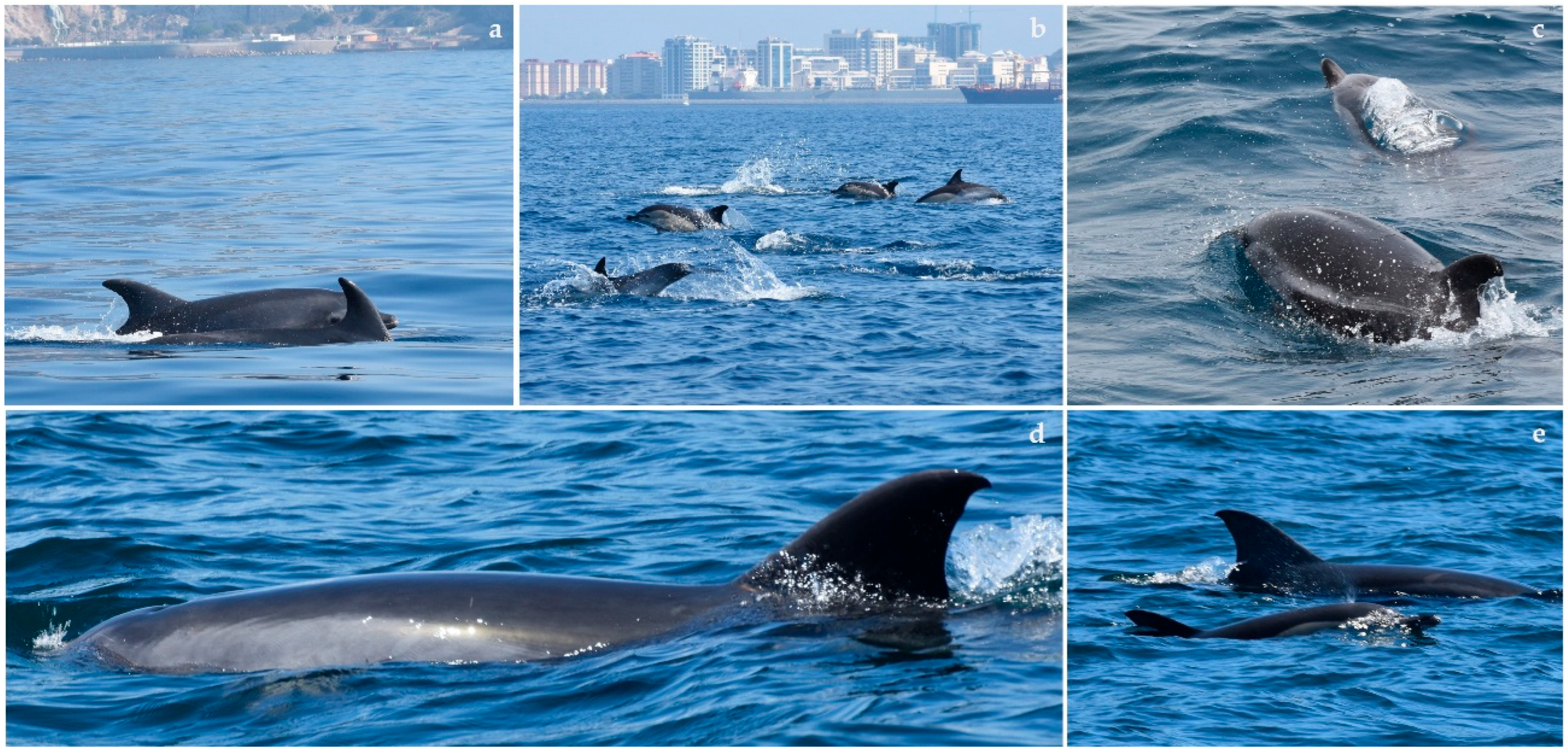
Figure 1. Dolphins observed in the Bay of Algeciras–Gibraltar (BA-G). (a) Tursiops truncatus, (b) Delphinus delphis, (c) Stenella coeruleoalba, (d) the solitary female T. truncatus known as Billie, and (e) Billie associating with D. delphis in the same group. Photos were taken during boat-based surveys conducted in the BA-G between 2015 and 2023.
Jmse 14 01044 g001
Figure 2. Geographical context of the study area. (a) Regional setting of the Bay of Algeciras–Gibraltar (BA-G) at the Atlantic–Mediterranean interface; (b) submarine canyon running north to south; (c) overall spatial distribution of dolphin sightings recorded in the BA-G during the study period, showing Tursiops truncatus (orange dots; n = 102), Delphinus delphis (yellow dots; n = 1662), Stenella coeruleoalba (blue dots; n = 445), and Billie (turquoise dots; n = 202); (d) spatial distribution of Tursiops truncatus sightings; (e) spatial distribution of D. delphis sightings; (f) spatial distribution of S. coeruleoalba sightings; and (g) locations of the solitary female T. truncatus Billie. Basemap source: Esri, Maxar, Earthstar Geographics, and the GIS User Community. Shapefile data: https://datos.gob.es/es/catalogo/a01002820-datos-espaciales-de-referencia-de-andalucia-dera (accessed on 1 May 2026).
Jmse 14 01044 g002
Figure 3. Number of sightings recorded. Total number of sightings of Tursiops truncatus (Tt), Delphinus delphis (Dd), Stenella coeruleoalba (Sc), and the solitary female T. truncatus Billie (Bi(Tt)) recorded seasonally in the BA-G during the study period. Abbreviations for seasons: Spring (S), Summer (Su), Autumn (A), and Winter (W).
Jmse 14 01044 g003
Figure 4. Minimum distance and minimum elapsed time. Georeferenced map showing the minimum distance (m) and minimum elapsed time between a Tursiops truncatus sighting and the subsequent sighting of Stenella coeruleoalba in the Bay of Algeciras–Gibraltar (BA-G). In this panel, the initial and final positions of the T. truncatus sighting are represented by an orange circle (Tt-I) and an orange triangle (Tt-F), respectively, and the initial and final positions of the S. coeruleoalba sighting are represented by a blue triangle (Sc-I) and a blue circle (Sc-F), respectively. The yellow circles correspond to georeferenced positions of Delphinus delphis recorded within the same sequential context. Because D. delphis does not form part of the specific minimum-distance/minimum-time event illustrated in this figure, its positions are shown as circles only. The distance and elapsed time were calculated from the final position of the T. truncatus sighting, represented by the orange triangle, to the initial position of the subsequent S. coeruleoalba sighting, represented by the blue triangle. The curved arrow represents the elapsed time between sightings, whereas the dashed arrow represents the distance measured between the analytical reference and comparison points used in the calculation. Double quotation marks denote seconds.
Jmse 14 01044 g004
Figure 5. Maximum elapsed time and maximum distance. Georeferenced maps showing the maximum elapsed time (h, min) and maximum distance (m) recorded between sightings of Tursiops truncatus and subsequent sightings of Delphinus delphis and/or Stenella coeruleoalba in the Bay of Algeciras–Gibraltar (BA-G). The T. truncatus initial position is represented by an orange circle (Tt-I), and the T. truncatus final position by an orange triangle (Tt-F). For the subsequent species involved in each calculation, the initial position is represented by a triangle in the corresponding species colour, and the complementary/final position by a circle. Thus, S. coeruleoalba is represented by a blue triangle (Sc-I) and a blue circle (Sc-F), and D. delphis by a yellow triangle (Dd-I) and a yellow circle (Dd-F) when it is the species involved in the calculation. The maximum elapsed time or maximum distance was calculated from the final position of the T. truncatus sighting, represented by the orange triangle, to the initial position of the subsequent species sighting, represented by the triangle in the corresponding species colour. In panel Tt011-18, the maximum-time event illustrated involves T. truncatus and S. coeruleoalba; the yellow circles correspond to georeferenced positions of D. delphis recorded within the same sequential context, as D. delphis was observed together with S. coeruleoalba in that sighting, but was not part of the specific maximum-time calculation represented in that panel. In panel Tt014-19, the maximum-distance event illustrated involves T. truncatus and D. delphis. Elapsed time is expressed in hours and minutes.
Jmse 14 01044 g005
Figure 6. Georeferenced maps showing temporal-overlap events between sightings of Tursiops truncatus and subsequent sightings of Delphinus delphis and/or Stenella coeruleoalba in the Bay of Algeciras–Gibraltar (BA-G). The T. truncatus initial position is represented by an orange circle (Tt-I), and the T. truncatus final position by an orange triangle (Tt-F). For the subsequent species involved in each temporal-overlap event, the initial position is represented by a triangle in the corresponding species colour, and the complementary/final position by a circle. Thus, D. delphis is represented by a yellow triangle (Dd-I) and a yellow circle (Dd-F) when it is the species involved in the event, and S. coeruleoalba by a blue triangle (Sc-I) and a blue circle (Sc-F) when it is the species involved in the event. (a) Tt044-18; (b) Tt045-18; (c) Tt008-19; (d) Tt017-19; and (e) Tt002-20, the temporal-overlap events illustrated involve T. truncatus and D. delphis. In panel (c), the temporal-overlap event illustrated involves T. truncatus and S. coeruleoalba; the yellow circles correspond to georeferenced positions of D. delphis recorded within the same sequential context, as D. delphis was observed together with S. coeruleoalba in that sighting, but was not part of the specific temporal-overlap event represented in that panel.
Jmse 14 01044 g006
Figure 7. Boxplots showing distances (ac, metres, m) and times (df, seconds, s) recorded between sightings of Tursiops truncatus and subsequent Delphinus delphis, Stenella coeruleoalba, and Billie events on the same day. Boxes indicate the interquartile range, horizontal lines indicate the median, whiskers indicate the range, and crosses (×) mark the mean. Sample sizes are shown next to each box.
Jmse 14 01044 g007
Figure 8. Seasonal distribution of distance (a) and time (b). Boxplots of distance (m) and time (s) between sightings of Tursiops truncatus (Tt) and all subsequent Delphinus delphis (Dd), Stenella coeruleoalba (Sc), and Billie (Bi(Tt)) sightings (March 2017–March 2020). Sample sizes (n) are shown next to each box. Crosses (×) indicate mean values.
Jmse 14 01044 g008
Figure 9. Boxplots showing (a) distances (m) and (b) times (s) between sightings of Tursiops truncatus (Tt) and subsequent sightings of Delphinus delphis (Dd) during the study period (March 2017–March 2020). The total number of records was n = 102, including five brief overlap events (Δt ≤ 300 s). For statistical calculations of means, medians, and dispersion, these overlap cases were excluded (effective n = 97). Crosses (×) indicate mean values.
Jmse 14 01044 g009
Figure 10. Representation of distance and time by season. Lines show recorded distances (left axis, m) and times (right axis, s) for each sighting of Delphinus delphis (Dd) (a), Stenella coeruleoalba (Sc) (b), and Billie (Bi(Tt)) (c) following sightings of Tursiops truncatus (Tt) during the study period.
Jmse 14 01044 g010
Table 1. Overall minimum and maximum distances (m) and times (s) recorded for each species category between sightings of Delphinus delphis (Dd), Stenella coeruleoalba (Sc), and Billie (Bi(Tt)) and the preceding sighting of Tursiops truncatus (Tt). The T. truncatus sighting corresponding to each value is indicated in parentheses. All sightings are represented and georeferenced in Figures S1–S4 of the Supplementary Material.
SpeciesMinimum Distance (m)—(Tt)Maximum Distance (m)—(Tt)Minimum Time (s)—(Tt)Maximum Time (s)—(Tt)
Dd540 (Tt018-19)12,000 (Tt014-19)145 (Tt018-19)17,700 (Tt003-19)
Sc261 (Tt024-19)8997 (Tt047-18)33 (Tt024-19)17,700 (Tt011-18)
Bi(Tt)3337 (Tt043-18)9530 (Tt009-17)4620 (Tt009-17)10,560 (Tt016-19)
Table 2. Logistic regression coefficients and p-values. Binomial logistic regression models were fitted independently for Delphinus delphis (Dd), Stenella coeruleoalba (Sc), and Billie (Bi(Tt)). The model for Bi(Tt) should be interpreted as an exploratory individual-case analysis. Predictor variables were the time since and the distance from the last sighting of Tursiops truncatus (Tt).
SpeciesPredictorLogit Coefficientp-Value
Ddtime_since_Tt−0.0000910.1547
Dddistance_from_Tt+0.0000880.4139
Sctime_since_Tt+0.0000630.3435
Scdistance_from_Tt−0.0001570.2028
Bi(Tt)time_since_Tt+0.0001180.3403
Bi(Tt)distance_from_Tt+0.0000850.6473
Disclaimer/Publisher’s Note: The statements, opinions and data contained in all publications are solely those of the individual author(s) and contributor(s) and not of MDPI and/or the editor(s). MDPI and/or the editor(s) disclaim responsibility for any injury to people or property resulting from any ideas, methods, instructions or products referred to in the content.