Numerical Study on the Evolution Characteristics of the Bubble Dynamics and Free Surface Structures in Extremely Shallow Water Explosion


Abstract
1. Introduction
2. Numerical Model and Method
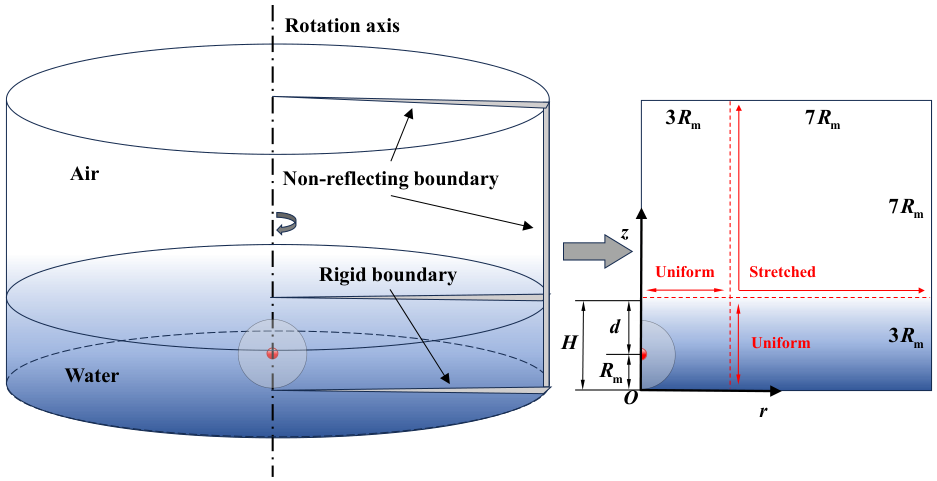
2.1. Numerical Model
2.2. Eulerian Finite Element Method
2.3. Nondimensionalization
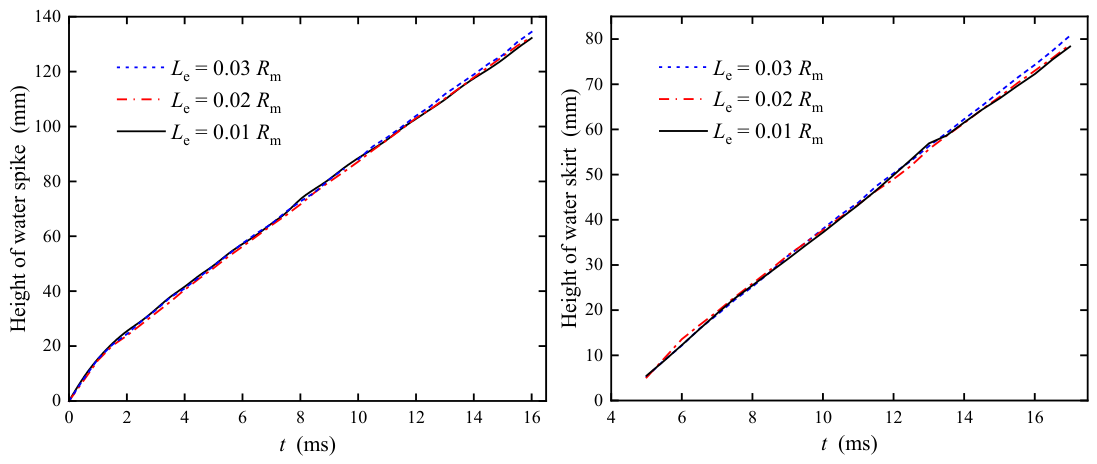
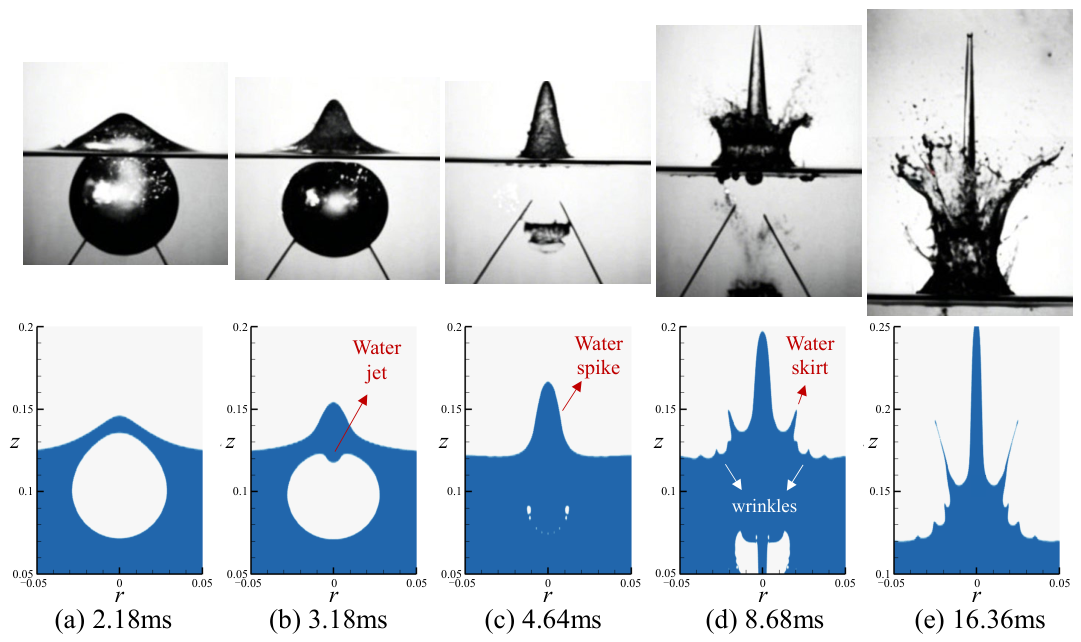
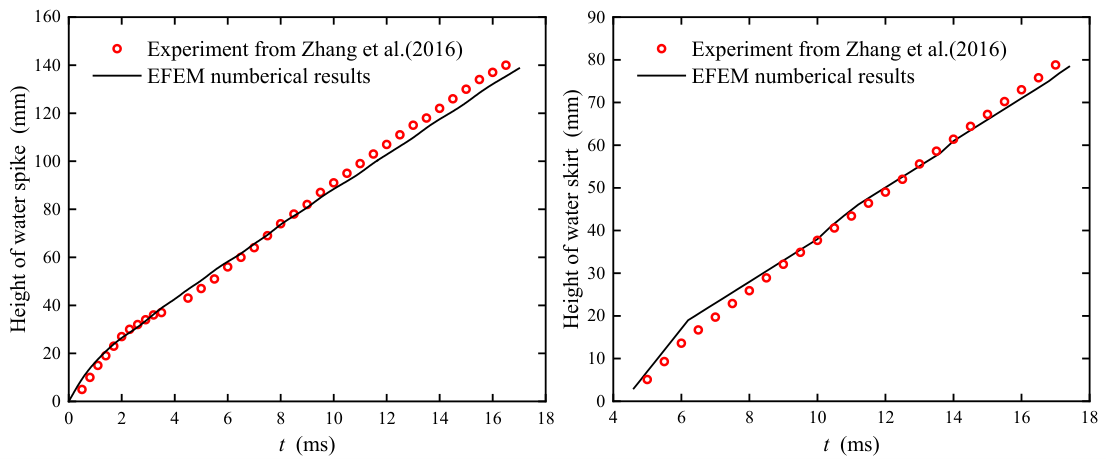
2.4. Convergence Test and Model Validation
3. Results and Discussion
3.1. Underwater Explosion Bubble Dynamics in Shallow Water
3.2. Bubble Dynamics with Different Water Depth Parameters
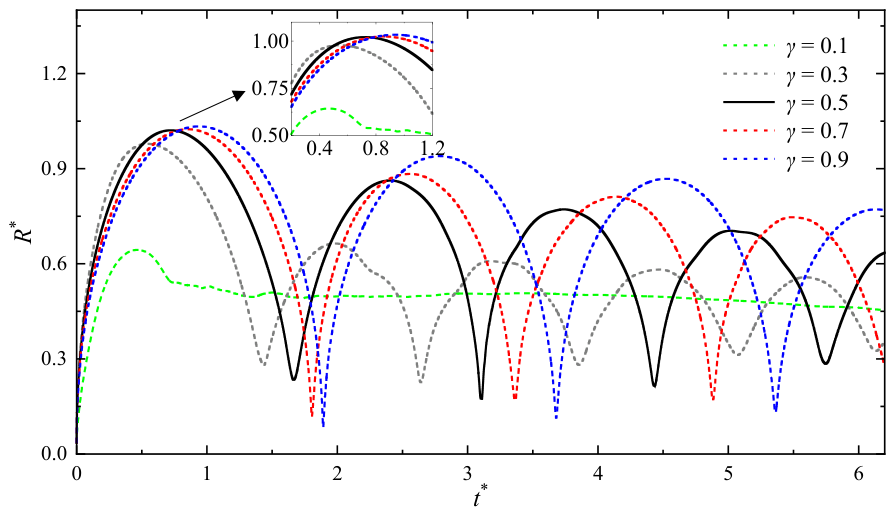
3.3. Bubble Dynamics with Different Position Parameters
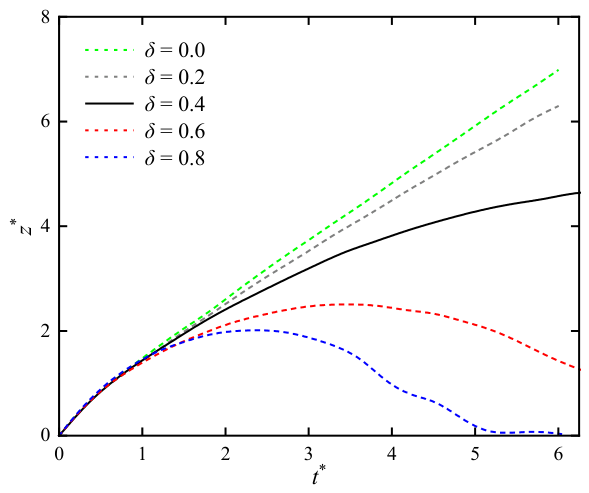
3.4. Bubble Dynamics with Different Buoyancy Parameters
4. Conclusions
- (1)
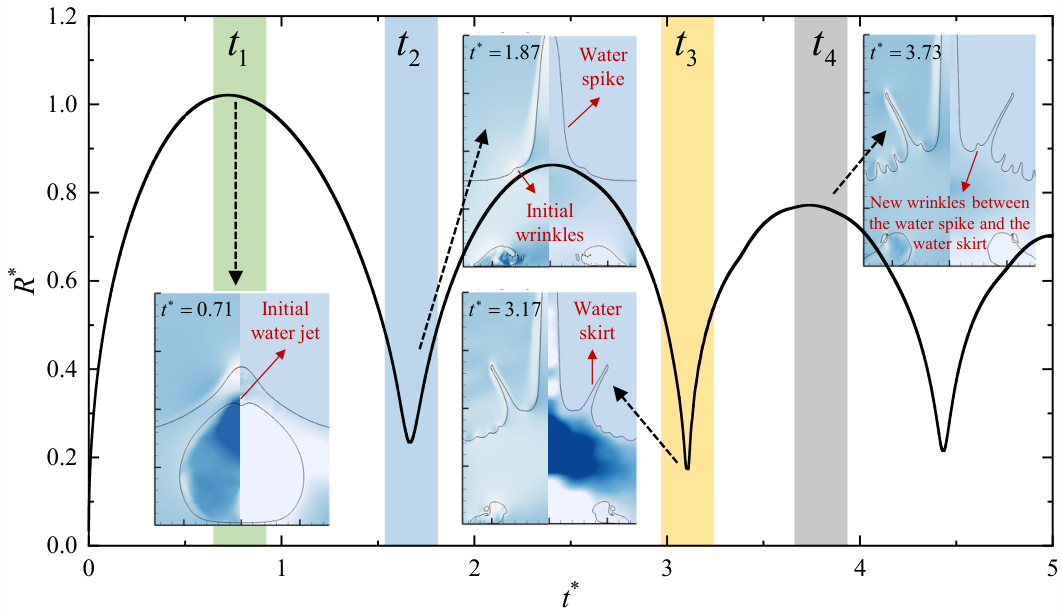
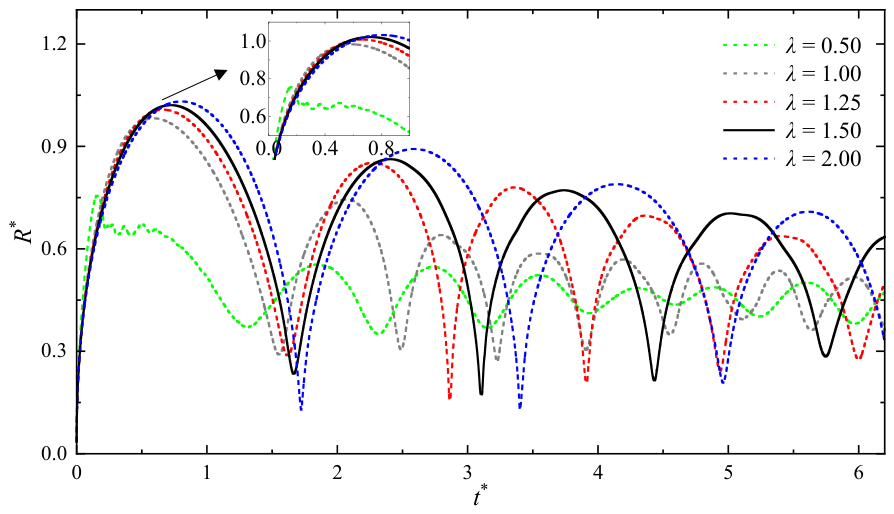
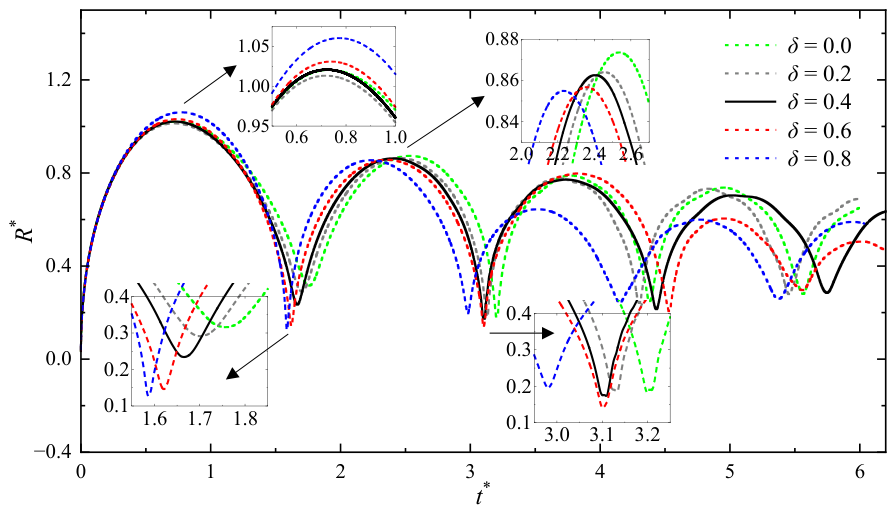
- Due to the nonlinear coupling between the bubble, the free surface, and the bottom boundary in the subsequent stages, the significant influence of different parameters on bubble dynamics is primarily manifested in the first few pulsation periods. Overall, with the increase of the water depth parameter and the position parameter , the maximum bubble equivalent radius increases, and the corresponding pulsation period is prolonged. An increase in the buoyancy parameter also enlarges the maximum bubble equivalent radius but accelerates the bubble collapse process, thereby shortening the pulsation period. It should be noted that when , its constraining effect on the bubble is reduced, resulting in a maximum bubble equivalent radius slightly higher than that in the scenario with .
- (2)
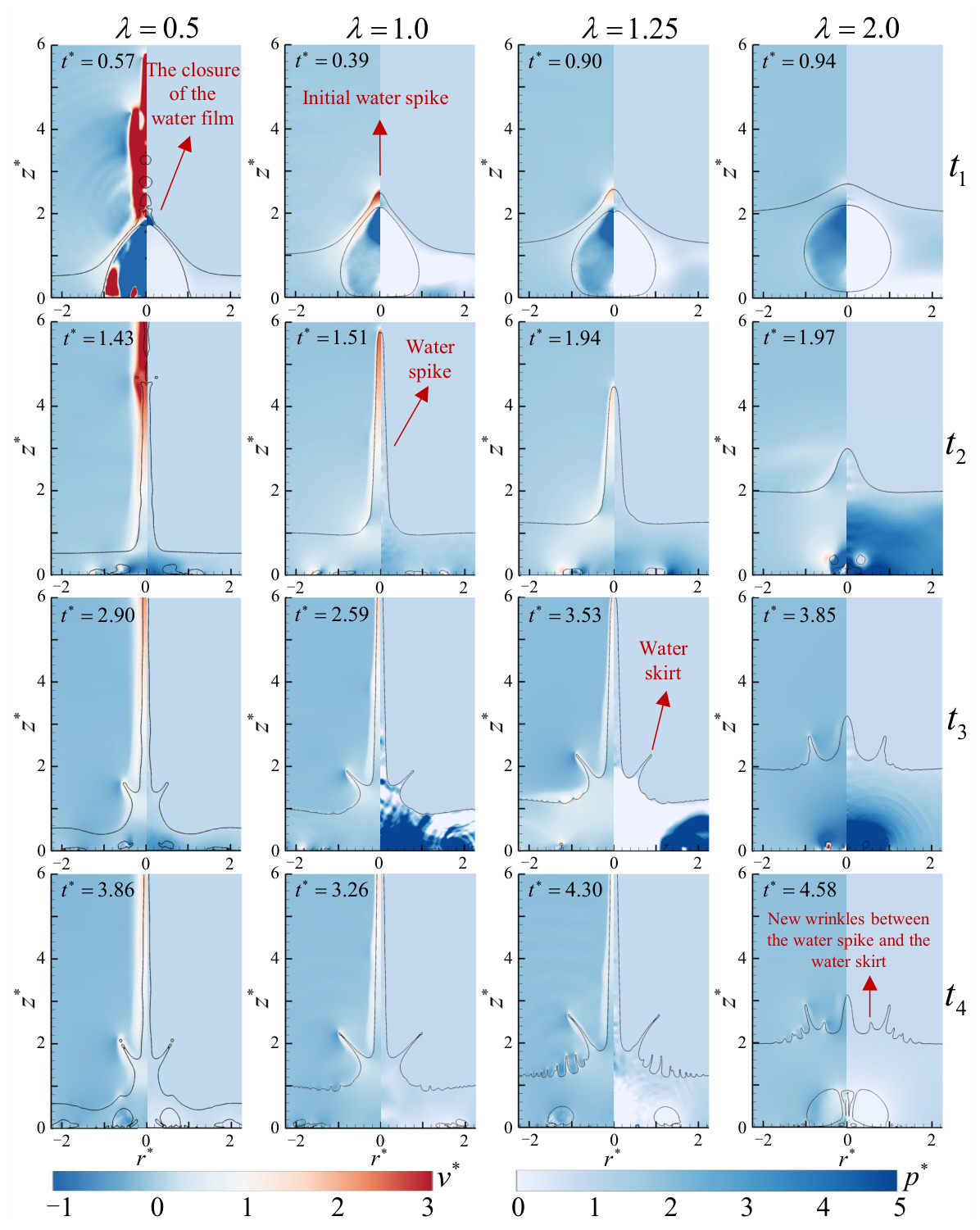
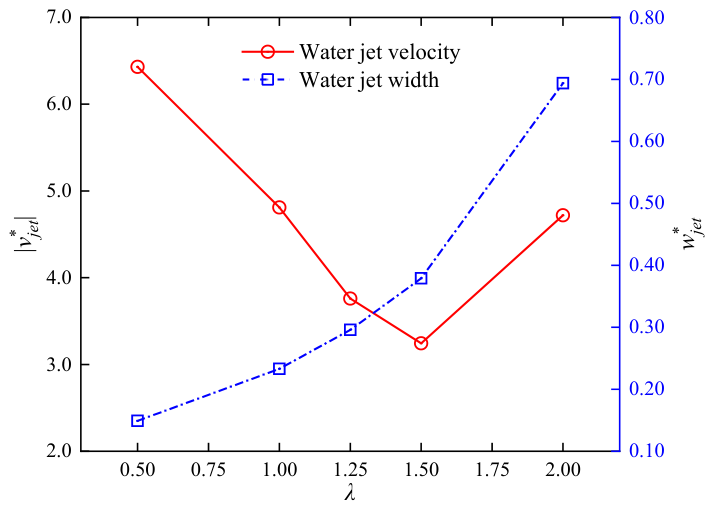
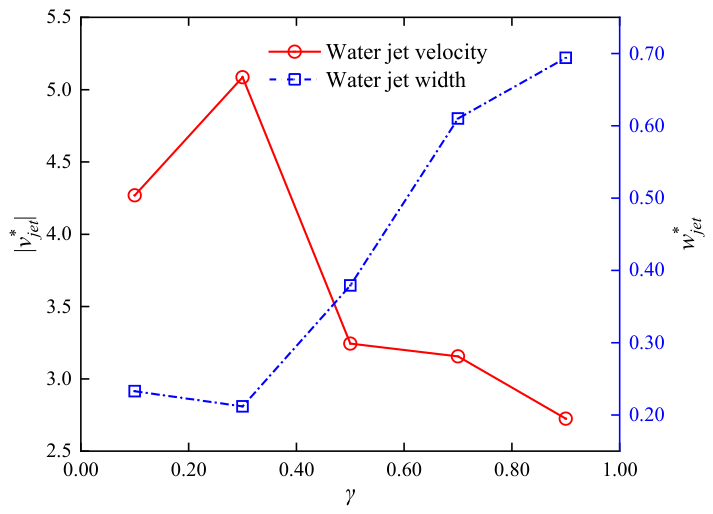
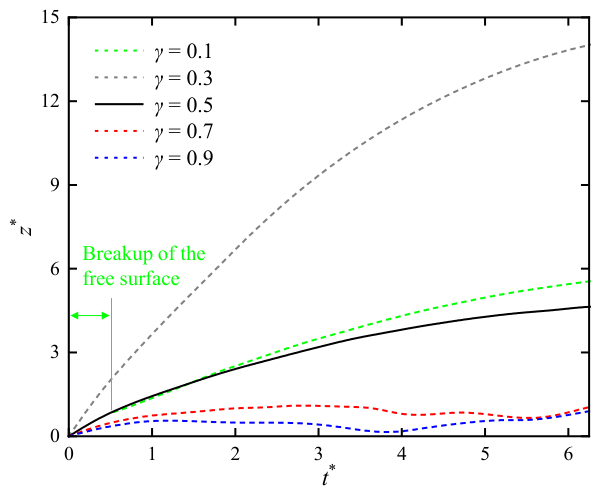
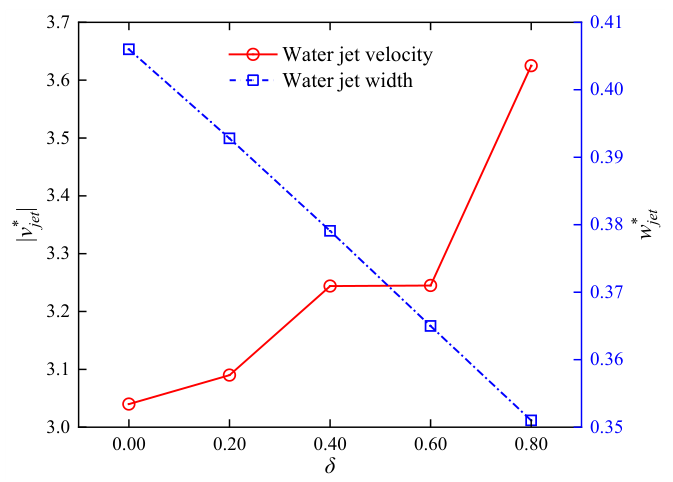
- Under smaller water depth and position parameters, the underwater explosion bubble is closer to the free surface, which can easily lead to the rupture of both the bubble and the free surface, resulting in energy dissipation. As the water depth parameter increases, the jet width also increases, while the jet velocity first decreases and then increases. This is due to the progressively enhanced repulsive effect of the free surface and its superposition with the attractive effect of the bottom boundary. For the position parameter , excluding cases of bubble breaking, an increase in reduces the jet velocity and increases the jet width. A larger buoyancy parameter results in a higher jet velocity and a narrower jet width.
- (3)
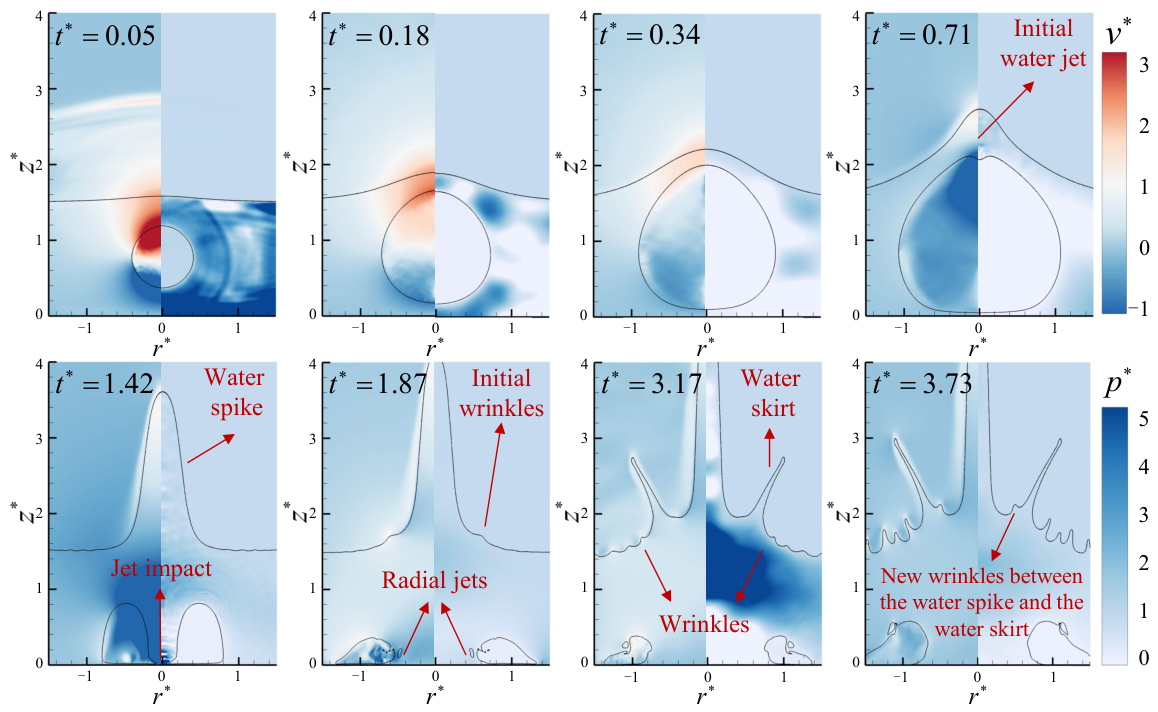
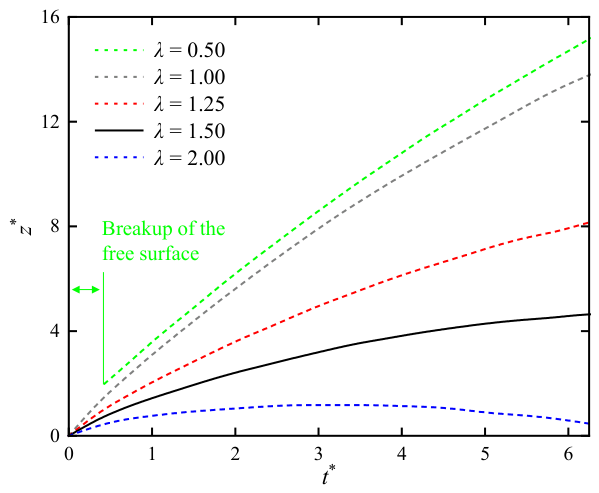
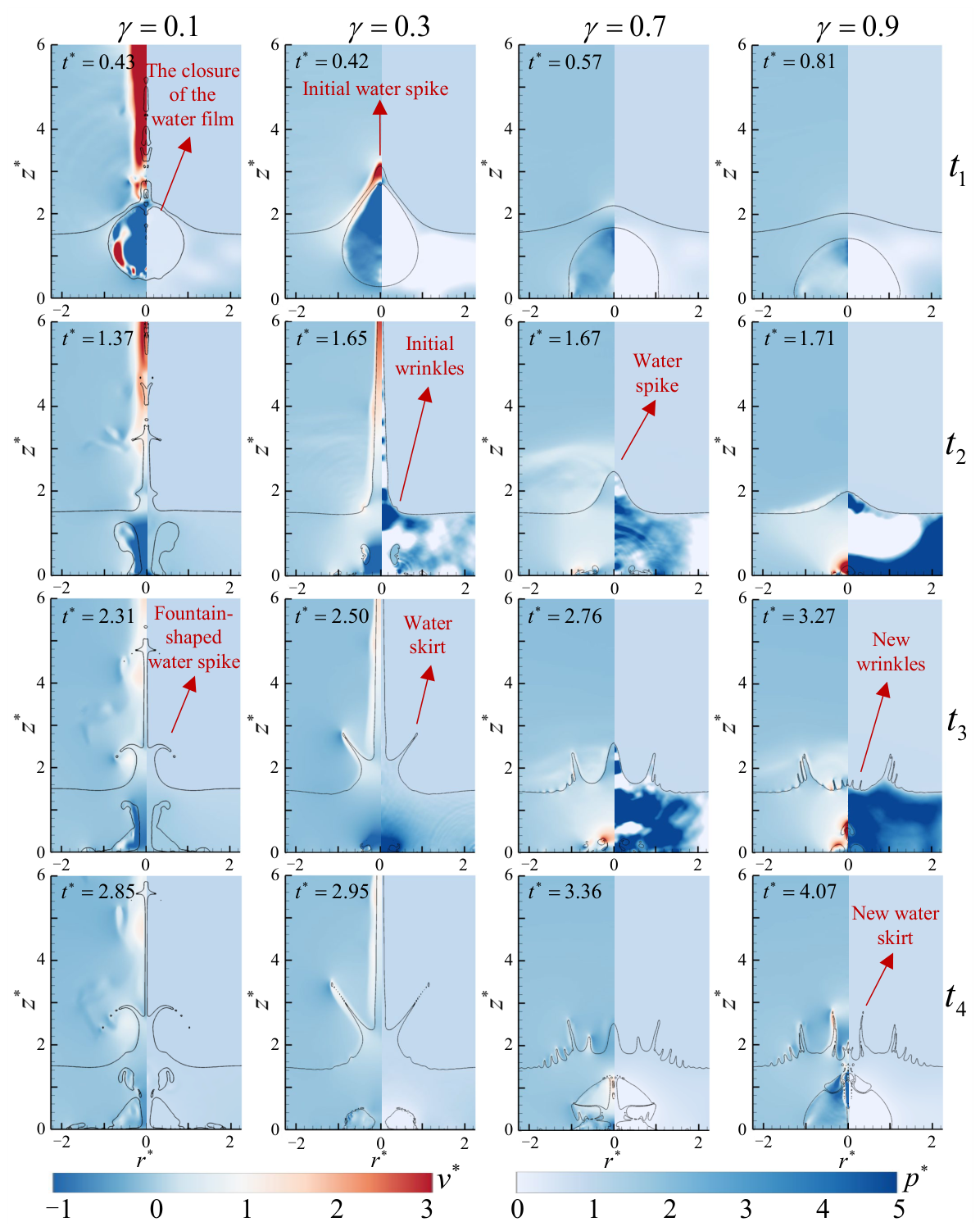
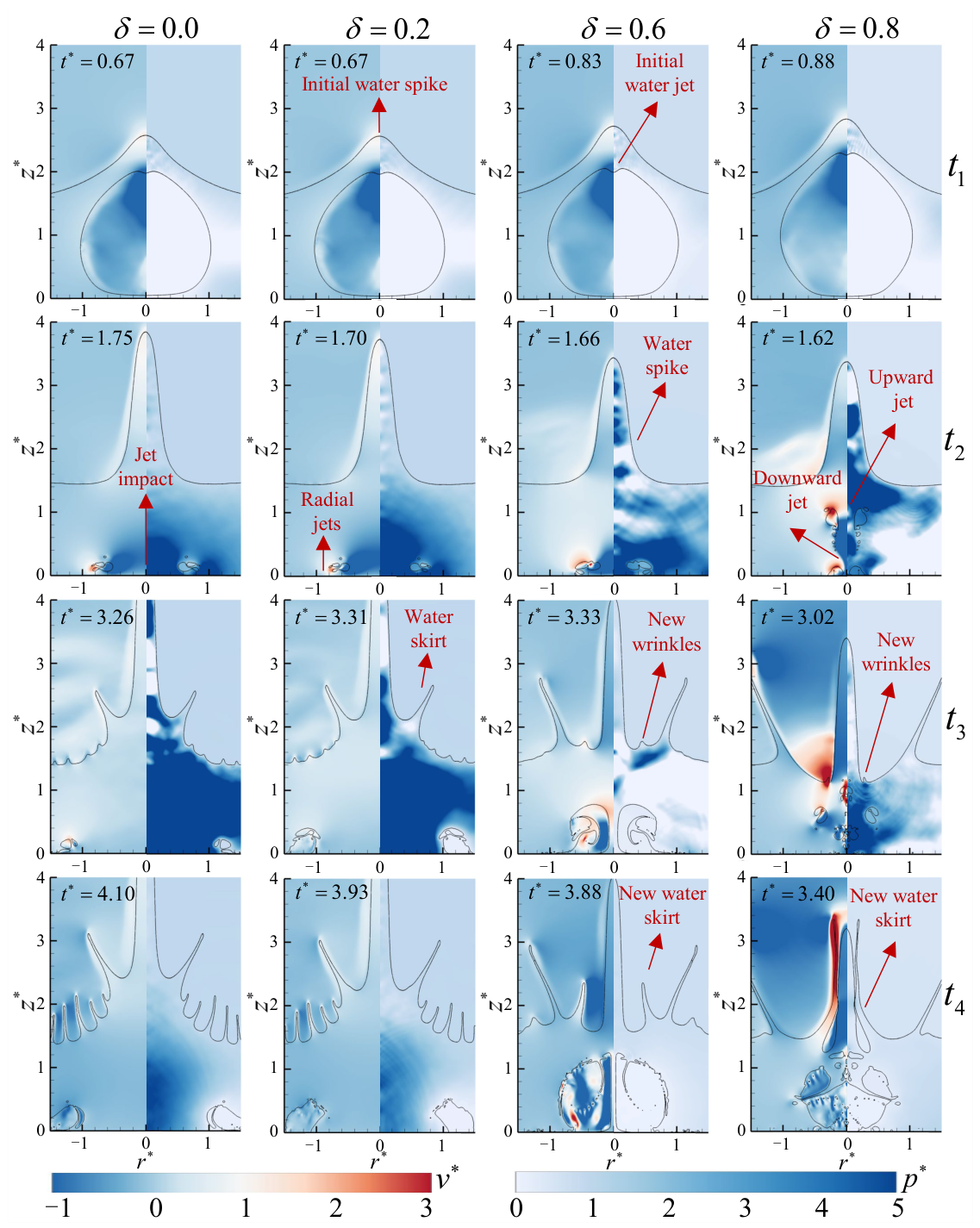
- The expansion of a bubble in shallow water explosion generates a water spike at the free surface. Simultaneously, the pulsation process of the bubble induces the formation of wrinkles on the free surface, with early wrinkles splashing to form the water skirt. Excluding cases of bubble breaking, as the three parameters increase, the morphology of the water spike transitions from tall to short and from narrow to wide, while the rate of its fallback accelerates. Furthermore, when the three parameters are relatively large, the distance between the water skirt and the axis of the water spike also increases. As the bubble pulsation continues, more wrinkles form around the water skirt. Among them, new wrinkles emerging between the water spike and the early water skirt also splash, forming a new water skirt. When , the height of the newly formed water skirt exceeds that of the original water spike and the early water skirt. When , the newly formed water skirt impacts the main water spike at high speed.
Author Contributions
Funding
Data Availability Statement
Acknowledgments
Conflicts of Interest
Abbreviations
| EFEM | Eulerian finite element method |
| VOF | Volume of fluid |
| FVM | Finite volume method |
| SPH | Smoothed particle hydrodynamics |
| BEM | Boundary element method |
| EOS | Equation of state |
| JWL | Jones-Wilkens-Lee |
| CFL | Courant-Friedrichs-Lewy |
| Symbol | Meaning |
| A | Constant related to the type of explosive in the JWL EOS |
| Basic reference scale for accelerated velocity | |
| B | Constant related to the type of explosive in the JWL EOS |
| Courant number | |
| c | Sound speed in the fluid medium |
| Average sound speed of of the mixed cell | |
| d | Detonation distance |
| Conserved variable vector | |
| e | Fluid specific internal energy |
| Specific internal energy of the i-th fluid phase |
| Constant related to the type of explosive in the JWL EOS | |
| Gravitational acceleration vector | |
| g | Vertical component of the gravitational acceleration vector |
| H | Water depth |
| Mesh size | |
| Basic reference scale for length | |
| Standard atmospheric pressure | |
| Basic reference scale for pressure | |
| Reference pressure in the Tammann EOS | |
| Ambient pressure | |
| p | Fluid pressure |
| Dynamic pressure | |
| Maximum bubble radius | |
| R | Bubble equivalent radius |
| Reynolds number | |
| Constant related to the type of explosive in the JWL EOS | |
| Constant related to the type of explosive in the JWL EOS | |
| r | Radial direction |
| Source term | |
| Basic reference scale for time | |
| t | Time |
| Moment after R reaches local maximum in the first bubble pulsation period | |
| Transitional stage between the first and second periods | |
| Transitional stage between the second and third periods | |
| Moment after R reaches local maximum in the third bubble pulsation period | |
| Basic reference scale for velocity | |
| Velocity vector | |
| Radial component of the velocity vector | |
| Axial component of the velocity vector | |
| W | Charge weight |
| Weber number | |
| Fluid position vector | |
| Bubble center position vector | |
| z | Vertical direction |
| Volume fraction of the i-th fluid phase | |
| Ratio of the explosion product density to the explosive’s initial density | |
| Position parameter or specific heat ratio in the Tammann EOS | |
| Distance parameter | |
| Buoyancy parameter | |
| Water depth parameter | |
| Fluid density | |
| Density of the i-th fluid phase | |
| Basic reference scale for density | |
| Water density | |
| Average density of the mixed cell | |
| Local curvature of the pressure wavefront | |
| Constant related to the type of explosive in the JWL EOS | |
| Dimensionless variable |
Appendix A
References
- Cheng, S.J.; Liang, Z.F.; Ruan, X.J.; Miao, R.Y.; Meng, J.Y.; Wu, H.J. Research Progress on Shallow Water Explosion Shock Wave Characteristics and Its Damage Effect. Chin. J. Explos. Propellants 2024, 47, 17–28. (In Chinese) [Google Scholar] [CrossRef]
- Dong, Q.; Wei, Z.; Tang, T.; Zhang, N. Influence of Explosion Depth on Bubble Pulsation in Shallow Water Explosion. Chin. J. High Press. Phys. 2018, 32, 85–93. (In Chinese) [Google Scholar] [CrossRef]
- Meng, Y.; Zhang, D. Analysis of Bubble Motion and Water Jet Behavior in Shallow Water. China Meas. Test. 2018, 44, 73–77. (In Chinese) [Google Scholar] [CrossRef]
- Chahine, G.L. Interaction between an Oscillating Bubble and a Free Surface. J. Fluids Eng. 1977, 99, 709–716. [Google Scholar] [CrossRef]
- Chahine, G.L.; Bovis, A. Oscillation and Collapse of a Cavitation Bubble in the Vicinity of a Two-Liquid Interface. In Proceedings of the Cavitation and Inhomogeneities in Underwater Acoustics; Lauterborn, W., Ed.; Springer: Berlin/Heidelberg, Germany, 1980; pp. 23–29. [Google Scholar] [CrossRef]
- Blake, J.R.; Gibson, D.C. Growth and Collapse of a Vapour Cavity near a Free Surface. J. Fluid Mech. 1981, 111, 123–140. [Google Scholar] [CrossRef]
- Blake, J.R.; Taib, B.B.; Doherty, G. Transient Cavities near Boundaries Part 2. Free Surface. J. Fluid Mech. 1987, 181, 197–212. [Google Scholar] [CrossRef]
- Robinson, P.B.; Blake, J.R.; Kodama, T.; Shima, A.; Tomita, Y. Interaction of Cavitation Bubbles with a Free Surface. J. Appl. Phys. 2001, 89, 8225–8237. [Google Scholar] [CrossRef]
- Zhang, S.; Wang, S.P.; Zhang, A.M. Experimental Study on the Interaction between Bubble and Free Surface Using a High-Voltage Spark Generator. Phys. Fluids 2016, 28, 032109. [Google Scholar] [CrossRef]
- Yan, F.H.; Qiu, Y.Y.; Yue, S.L.; Liu, L.; Wang, J.P.; Gao, X.K. Interaction between Underwater Explosion Bubbles and Soil–Water Interface: A Numerical and Experimental Study. Phys. Fluids 2024, 36, 103334. [Google Scholar] [CrossRef]
- Xu, J.; Chen, T.; Wang, L.; Guo, J. Experimental Study of Shallow Water Explosive Loads in Different Underwater Media. Shipbuild. China 2024, 65, 180–188. (In Chinese) [Google Scholar]
- Wang, L. Study of Bottom Explosion Load Characteristics and Dynamic Response of Ship Structure. Master’s Thesis, Harbin Engineering University, Harbin, China, 2023. (In Chinese) [Google Scholar]
- Zhang, J.; Guan, L.H.; Li, W.J.; Li, J.C.; Wang, Y.B. Centrifuge Modeling of Underwater Explosion near the Water–Soil Interface. Phys. Fluids 2025, 37, 047124. [Google Scholar] [CrossRef]
- Tian, Z.L.; Liu, Y.L.; Zhang, A.M.; Wang, S.P. Analysis of Breaking and Re-Closure of a Bubble near a Free Surface Based on the Eulerian Finite Element Method. Comput. Fluids 2018, 170, 41–52. [Google Scholar] [CrossRef]
- Koukouvinis, P.; Gavaises, M.; Supponen, O.; Farhat, M. Simulation of Bubble Expansion and Collapse in the Vicinity of a Free Surface. Phys. Fluids 2016, 28, 052103. [Google Scholar] [CrossRef]
- Singh, D.; Das, A.K. Numerical Investigation of the Collapse of a Static Bubble at the Free Surface in the Presence of Neighbors. Phys. Rev. Fluids 2019, 4, 023602. [Google Scholar] [CrossRef]
- Liu, L.; Wang, J.; Zhang, Y.; Tang, K.; Ma, T. Coupling Characteristics between Bubble and Free Surface in a Shallow Water Environment. Ocean Eng. 2021, 237, 109577. [Google Scholar] [CrossRef]
- Tian, L.; Xu, X. An Improved SPH Method for Simulating Near-Surface Underwater Explosions in Shallow Water. Eur. J. Mech.-B/Fluids 2026, 116, 204420. [Google Scholar] [CrossRef]
- Zhang, A.M.; Li, S.M.; Xu, R.Z.; Pei, S.C.; Li, S.; Liu, Y.L. A Theoretical Model for Compressible Bubble Dynamics Considering Phase Transition and Migration. J. Fluid Mech. 2024, 999, A58. [Google Scholar] [CrossRef]
- Tian, Z.L.; Liu, Y.L.; Zhang, A.M.; Tao, L.; Chen, L. Jet Development and Impact Load of Underwater Explosion Bubble on Solid Wall. Appl. Ocean Res. 2020, 95, 102013. [Google Scholar] [CrossRef]
- Zhang, Z.; Zhang, H. Surface Tension Effects on the Behavior of a Cavity Growing, Collapsing, and Rebounding near a Rigid Wall. Phys. Rev. E Stat. Nonlinear Soft Matter Phys. 2004, 70, 056310. [Google Scholar] [CrossRef]
- Hirt, C.W.; Nichols, B.D. Volume of Fluid (VOF) Method for the Dynamics of Free Boundaries. J. Comput. Phys. 1981, 39, 201–225. [Google Scholar] [CrossRef]
- Liu, Y.L.; Zhang, A.M.; Tian, Z.L.; Wang, S.P. Investigation of Free-Field Underwater Explosion with Eulerian Finite Element Method. Ocean Eng. 2018, 166, 182–190. [Google Scholar] [CrossRef]
- Cole, R.H. Underwater Explosions; Princeton University Press: Princeton, NJ, USA, 1948. [Google Scholar]
- Barras, G.; Souli, M.; Aquelet, N.; Couty, N. Numerical Simulation of Underwater Explosions Using an ALE Method. The Pulsating Bubble Phenomena. Ocean Eng. 2012, 41, 53–66. [Google Scholar] [CrossRef]
- Blake, J.R.; Gibson, D.C. Cavitation Bubbles near Boundaries. Annu. Rev. Fluid Mech. 1987, 19, 99–123. [Google Scholar] [CrossRef]
- Wang, C.; Khoo, B.C. An Indirect Boundary Element Method for Three-Dimensional Explosion Bubbles. J. Comput. Phys. 2003, 194, 451–480. [Google Scholar] [CrossRef]
- Ivings, M.J.; Causon, D.M.; Toro, E.F. On Riemann Solvers for Compressible Liquids. Int. J. Numer. Methods Fluids 1998, 28, 395–418. [Google Scholar] [CrossRef]
- Lorenz, K.T.; Lee, E.L.; Chambers, R. A Simple and Rapid Evaluation of Explosive Performance—The Disc Acceleration Experiment. Propellants Explos. Pyrotech. 2015, 40, 95–108. [Google Scholar] [CrossRef]
- Benson, D.J. Computational Methods in Lagrangian and Eulerian Hydrocodes. Comput. Methods Appl. Mech. Eng. 1992, 99, 235–394. [Google Scholar] [CrossRef]
- Wang, Q.; Liu, S.; Lou, H. Calibration of Numerical Simulation Methods for Underwater Explosion with Centrifugal Tests. Shock Vib. 2019, 2019, 2670836. [Google Scholar] [CrossRef]





| Fluid | |||
|---|---|---|---|
| water | 7.15 | 330.9 | 998.232 |
| air | 1.4 | 0 | 1.29 |
| 1630 | 371.2 | 3.231 | 4.15 | 0.95 | 0.3 | 4.3 |
| Cases’ ID | |||
|---|---|---|---|
| Case 0 | 1.5 | 0.5 | 0.4 |
| Case 1 | 0.5 | 0.5 | 0.4 |
| Case 2 | 1.0 | 0.5 | 0.4 |
| Case 3 | 1.25 | 0.5 | 0.4 |
| Case 4 | 2.0 | 0.5 | 0.4 |
| Case 5 | 1.5 | 0.1 | 0.4 |
| Case 6 | 1.5 | 0.3 | 0.4 |
| Case 7 | 1.5 | 0.7 | 0.4 |
| Case 8 | 1.5 | 0.9 | 0.4 |
| Case 9 | 1.5 | 0.5 | 0.0 |
| Case 10 | 1.5 | 0.5 | 0.2 |
| Case 11 | 1.5 | 0.5 | 0.6 |
| Case 12 | 1.5 | 0.5 | 0.8 |
Disclaimer/Publisher’s Note: The statements, opinions and data contained in all publications are solely those of the individual author(s) and contributor(s) and not of MDPI and/or the editor(s). MDPI and/or the editor(s) disclaim responsibility for any injury to people or property resulting from any ideas, methods, instructions or products referred to in the content. |
© 2026 by the authors. Licensee MDPI, Basel, Switzerland. This article is an open access article distributed under the terms and conditions of the Creative Commons Attribution (CC BY) license.
Share and Cite
Zhao, W.; Liu, G.; Kong, Q.; Liu, Y.; Wang, Y.; Gao, J. Numerical Study on the Evolution Characteristics of the Bubble Dynamics and Free Surface Structures in Extremely Shallow Water Explosion. J. Mar. Sci. Eng. 2026, 14, 1012. https://doi.org/10.3390/jmse14111012
Zhao W, Liu G, Kong Q, Liu Y, Wang Y, Gao J. Numerical Study on the Evolution Characteristics of the Bubble Dynamics and Free Surface Structures in Extremely Shallow Water Explosion. Journal of Marine Science and Engineering. 2026; 14(11):1012. https://doi.org/10.3390/jmse14111012
Chicago/Turabian StyleZhao, Wenbo, Guocang Liu, Qi Kong, Yunlong Liu, Yu Wang, and Jincheng Gao. 2026. "Numerical Study on the Evolution Characteristics of the Bubble Dynamics and Free Surface Structures in Extremely Shallow Water Explosion" Journal of Marine Science and Engineering 14, no. 11: 1012. https://doi.org/10.3390/jmse14111012
APA StyleZhao, W., Liu, G., Kong, Q., Liu, Y., Wang, Y., & Gao, J. (2026). Numerical Study on the Evolution Characteristics of the Bubble Dynamics and Free Surface Structures in Extremely Shallow Water Explosion. Journal of Marine Science and Engineering, 14(11), 1012. https://doi.org/10.3390/jmse14111012