Article

Influence of Rotor–Nacelle Assembly Modeling Fidelity on Dynamic Behavior of 15 MW Monopile-Supported Offshore Wind Turbine

1
School of Mechanical Engineering and Rail Transit, Changzhou University, Changzhou 213164, China
2
School of Civil Engineering, Tsinghua University, Beijing 100084, China
*
Author to whom correspondence should be addressed.
J. Mar. Sci. Eng. 2026, 14(10), 956; https://doi.org/10.3390/jmse14100956 (registering DOI)
Submission received: 14 April 2026 / Revised: 5 May 2026 / Accepted: 16 May 2026 / Published: 21 May 2026
(This article belongs to the Special Issue Wave Loads on Offshore Structure—2nd Edition)

Abstract

This paper investigates the impact of rotor–nacelle assembly (RNA) structural models on the dynamic response of a 15 MW monopile-supported offshore wind turbine (MOWT). Three RNA models, distributed parameter (DPM), multi-particle (MPM), and concentrated point mass (CPM), were established in ADINA. Model reliability was confirmed through verification against BModes and OpenFAST, covering natural frequencies, mode shapes, and responses under normal environmental loads. The analyses reveal the following: (1) RNA modeling significantly impacts higher-order modal frequencies, with the MPM/CPM exhibiting substantial errors (up to −20.3% and 9.5% for second-order tower mode) and failing to capture blade deformation modes; (2) under low-frequency dominated wave loads, the MPM/CPM predict peak responses within ±10% tolerance; (3) for seismic loads, the discrepancy in three models is governed by input motion spectral characteristics, showing smaller errors under far-field motions (fundamental mode dominated) but significant errors under near-field motions (higher-mode excited). These findings collectively provide theoretical guidance for RNA model selection in MOWTs.

1. Introduction

Offshore wind resources offer significant advantages characterized by higher average wind speeds and lower turbulence intensity, which provide potential for wind energy exploitation [1]. Furthermore, offshore wind farms exert minimal impact on surrounding ecosystems and are often situated near major energy consumption centers. These benefits have fueled rapid growth in the offshore wind industry over the past decade [2]. However, offshore wind turbines (OWTs) are subjected to combined long-term environmental loads from wind, waves, and currents. Currently, most operational offshore wind farms are located in shallow waters (depths ≤ 30 m), where monopile foundations are predominant. This prevalence is attributed to their distinct technical and economic suitability for shallow-water environments: technically, a single large-diameter cylindrical structure provides a direct and efficient load-transfer path to the seabed, and its robust cantilever nature effectively resists moderate lateral wave and current loads in shallow depths [3]. Economically, its standardized cylindrical design allows for mass production with minimal fabrication complexity. Meanwhile, the absence of complex substructural joints facilitates rapid installation using mature piling techniques, thereby significantly reducing both capital expenditure and vessel operation costs. Although the support structure design without redundant members reduces construction costs, it also reduces the structural redundancy and overall robustness of monopile-supported offshore wind turbines (MOWTs). Furthermore, in regions of high seismic risk, they are susceptible to significant damage under strong ground motions [4].
Given these structural and loading characteristics, accurate representation of MOWTs, particularly the rotor–nacelle assembly (RNA), is essential. Structurally, MOWTs comprise a monopile, tower, nacelle, and rotor. To reduce the levelized cost of energy (LCOE), the industry is increasingly deploying high-capacity wind turbines [5]. Consequently, the considerable height of the system combined with the substantial mass of the rotor–nacelle assembly (RNA) gives rise to pronounced dynamic effects in the structural response of MOWTs under environmental loading [6]. However, detailed structural and aerodynamic specifications of wind turbine blades are often proprietary, limiting public access. Consequently, researchers frequently resort to varying degrees of simplification for the RNA in numerical models, particularly for nonlinear analyses involving wind, wave, and seismic excitation [7,8,9].
Existing RNA modeling strategies can generally be categorized into lumped-mass, beam-based, and shell-based approaches. The concentrated point-mass model represents the most fundamental simplification of the RNA, which reduces it to a single lumped mass [10]. While this approach effectively reduces computational costs and remains widely used for analyzing OWT dynamic responses [11,12,13,14,15,16], its critical limitation lies in the complete neglect of the RNA’s internal inertial distribution and structural flexibility. To account for the significant eccentricity in large-scale OWTs, researchers have placed the concentrated mass eccentrically [17] or applied equivalent overturning moments [18]. Additionally, concentrated dynamic loads have been applied at the point mass to simulate rotor loadings during OWT dynamic analyses. For instance, Zou et al. [19] employed this model with harmonic loads representing wind effects, while Huang et al. [20] incorporated non-harmonic horizontal wind loads. To better capture inertial effects, the multi-particle model treats the rotor and nacelle as separate lumped masses and simulates the nacelle as a rigid body [21,22]. Zhao et al. [19] adopted this RNA representation in a detailed finite element model to investigate wind turbine tower failure under seismic loading. Similarly, Sigurðsson et al. [23] applied it to study the effects of pulse-like near-fault ground motion on a 5 MW onshore wind turbine. However, by treating the blades as rigid bodies, this model fundamentally neglects blade flexibility, local blade modes, and the contribution of modal damping. For small-to-medium-capacity OWTs (e.g., ≤5 MW), where the tower dominates the global response, such simplifications may yield acceptable approximations. Nevertheless, as rotor diameters increase, the assumption of rigid blades becomes increasingly unconservative and physically questionable.
Beyond lumped-mass simplifications, other approaches aim to better represent blade characteristics. For example, Murtagh et al. [24] simplified blades as rectangular beams with hollow section cantilevers to incorporate mass distribution. Using this approach, Huo et al. [25] developed a full-scale numerical model validated against measured data, and Ren et al. [26] conducted shaking table tests on an OWT. However, this method neglects spanwise variations in blade stiffness, which are crucial for large-capacity OWTs experiencing significant aeroelastic deformations [27,28]. Consequently, Failla et al. [29] and Xie et al. [30] utilized Timoshenko beam elements for blades, applying them to evaluate decoupled analysis models and establish an aero–hydro–servo–elastic coupled simulation framework. Simpson et al. [31] proposed a substructure method for OWT dynamic response analysis, in which blades are simulated as Euler–Bernoulli beams. By contrast, Duan et al. [32] conducted shaking table tests where they maintained similarity in blade stiffness and mass distribution while neglecting geometric similarity. Alternatively, shell elements have been adopted for higher-fidelity blade modeling. Zuo et al. [33] pioneered the use of shell-element blades for simulating OWT dynamics under combined wind, wave, and seismic loading. Subsequently, Huang [34] employed this model to analyze the seismic response of wind turbines, and Guo et al. [35] used it to investigate wind–wave misalignment effects. While beam-based and shell-based models provide high fidelity in capturing structural flexibility and local modes, they require detailed proprietary geometric data and impose prohibitive computational costs, rendering them impractical for extensive parametric studies or multi-hazard probabilistic analyses.
The choice of RNA structural model can significantly influence dynamic response predictions. Previous studies have demonstrated that RNA modeling affects the fragility of the NREL 5 MW MOWT under near-fault motions [36], as well as the natural frequencies and seismic responses of wind turbine structures [37]. In addition, it has been shown to influence the dynamic response of 5 MW and 10 MW MOWTs under combined wave and seismic excitation [38]. With the rapid deployment of 15 MW-class offshore wind turbines, recent studies have begun to investigate the dynamic responses of these next-generation systems under extreme environmental and seismic loads [39,40,41]. For example, Shahzad et al. [42] comprehensively examined the feasibility of retrofitting the jacket foundation system of a 5.5 MW offshore wind turbine to support 15 MW turbines. In addition, studies have also been performed on foundation ancillary structures. Specifically, Shahzad et al. [43] systematically evaluated the structural response of the modified jacket support frame to accommodate the larger 15 MW turbine. However, a critical limitation persists in these works: the RNA is still predominantly simplified as a lumped mass, which fails to capture the structural flexibility and inertial coupling inherent in such massive rotor systems. Furthermore, following the release of the 22 MW reference wind turbine by the IEA [44], the dynamic responses of 20 MW offshore wind turbines have also garnered increasing research attention [45].
Despite these valuable insights, existing literature predominantly focuses on the 5 MW and 10 MW platforms. With the industry’s rapid shift towards 15 MW-class and larger OWTs, a critical knowledge gap emerges. As power ratings increase, the coupled increments in hub height and RNA mass (see Table 1) significantly reduce the system’s fundamental natural frequency (from 0.25 Hz for 5 MW to 0.18 Hz for 15 MW) [46,47,48]. This reduction in fundamental frequency towards the dominant frequency bands of environmental excitations introduces unprecedented challenges for both monopile foundations and the overall structural design. Structurally, the increased flexibility and lower frequency make the system highly sensitive to dynamic amplification effects, complicating frequency-detuning design (avoiding 1P/3P ranges). For the monopile, the heavier loads and pronounced dynamic responses exacerbate nonlinear damping uncertainty and reveal the inadequacy of traditional p-y soil–structure interaction models, which fail to capture the degradation effects of scour and cyclic loading on structural stiffness. Furthermore, for the overall turbine, the unprecedented scale leads to complex aero–servo–elastic coupling, while the marine environment intensifies corrosion–fatigue coupling under massive cyclic loads. Finally, the sheer scale of these next-generation components presents severe practical challenges in transportation, installation, and code adaptation [49] Therefore, a systematic assessment of the influence of RNA modeling strategies on the dynamic behavior of 15 MW-class MOWTs remains necessary.
To address this research gap, this study investigates the influence of RNA modeling fidelity on the dynamic response of a 15 MW MOWT under seismic loads. The core innovations of this study are threefold: (1) proposing a distributed-parameter model (DPM) for the oversized RNA of 15 MW OWTs to overcome the inherent deficiencies of conventional rigid-body and lumped-mass assumptions; (2) uncovering the critical role of RNA structural flexibility in determining the modal characteristics (frequencies and mode shapes) of large-scale monopile foundations; (3) quantifying the modeling-induced discrepancies in multi-hazard responses, thereby establishing that simplified RNA models yield non-negligible, unconservative errors under seismic loading, which provides critical modeling guidelines for the design of next-generation megawatt OWTs. The paper structure is as follows: Section 2 details the analysis methodology and numerical model; Section 3 covers load cases and model verification; Section 4 presents and discusses the dynamic response results; and Section 5 summarizes the principal conclusions. The primary objective of this investigation is to provide guidelines for selecting RNA structural models of large-capacity MOWTs, thereby bridging theoretical advancements with engineering practice.

2. Analysis Methodology and Numerical Model

2.1. Parameters of 15 MW MOWT

To investigate the influence of RNA structural models, this study adopts the International Energy Agency (IEA) 15 MW reference wind turbine (RWT) [48] as the research object. Developed jointly by the U.S. National Renewable Energy Laboratory and Technical University of Denmark, this three-bladed horizontal-axis turbine features variable-speed and variable-pitch control technologies. As a direct-drive turbine, the center of mass of the RNA is positioned downwind of the tower axis.
The monopile foundation was originally designed based on the IEA 15 MW reference wind turbine (RWT). However, preliminary analysis indicated that the system’s natural frequency was close to the 1P frequency range, increasing the risk of structural resonance [50]. To mitigate this risk, the wall thicknesses of both the tower and monopile were increased, thereby shifting the fundamental natural frequency away from critical excitation bands. The dimensions were determined following the simplified design methodology proposed by Arany et al. [51]. Key technical parameters of the updated support structure are summarized in Table 2; comprehensive details can be found in Ref. [48]. Unless otherwise specified, the 15 MW MOWT referred to throughout this paper incorporates these updated structural dimensions.

2.2. Blade Characteristics

Blades are the primary components used to capture energy in wind turbines, consisting of a spar and skin. The spar functions as the main load-bearing structure, while the skin defines the aerodynamic profile and directly sustains aerodynamic pressures [52]. The blades of the IEA 15 MW RWT utilize the DTU FFA-W3 airfoil series. The airfoil profiles vary along the span from root to tip, specifically incorporating the SNL-FFA-W3-500, FFA-W3-360, FFA-W3-330, FFA-H3-301, FFA-W3-270, FFA-W3-241, and FFA-W41 profiles, as detailed in Ref. [48]. To optimize aerodynamic performance, each blade section features a distinct chord length and twist angle.
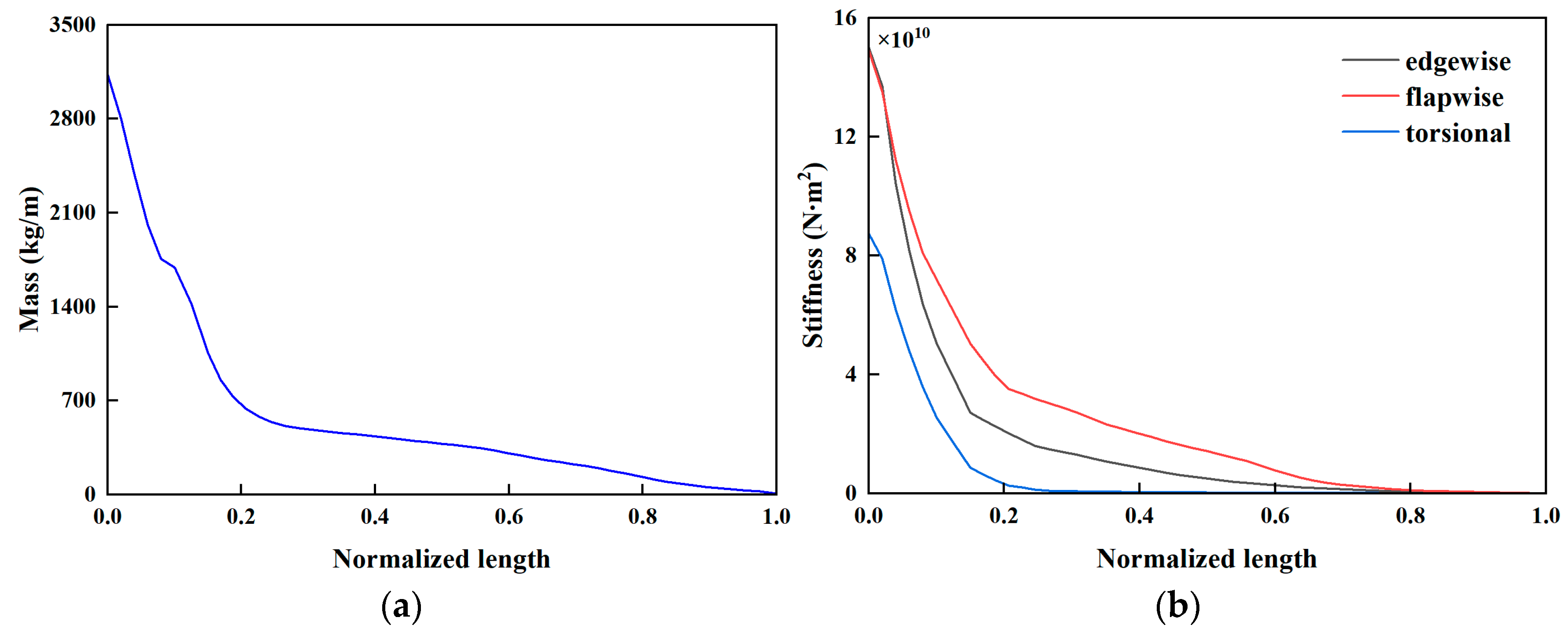
Given that the blades of OWTs are significantly longer than their cross-sectional dimensions and primarily experience loads transverse to their axis, they can be effectively modeled as cantilever beams. Figure 1 illustrates the variation in blade mass and sectional stiffness along the normalized radial distance (span). Consistent with established academic and industrial practices, this study models blades as variable-cross-section beams to analyze the influence of RNA modeling on the dynamic response of the supporting structure.

2.3. Coordinate System

Four coordinate systems are defined in this study to facilitate structural modeling and the application of aero-hydrodynamic loads:
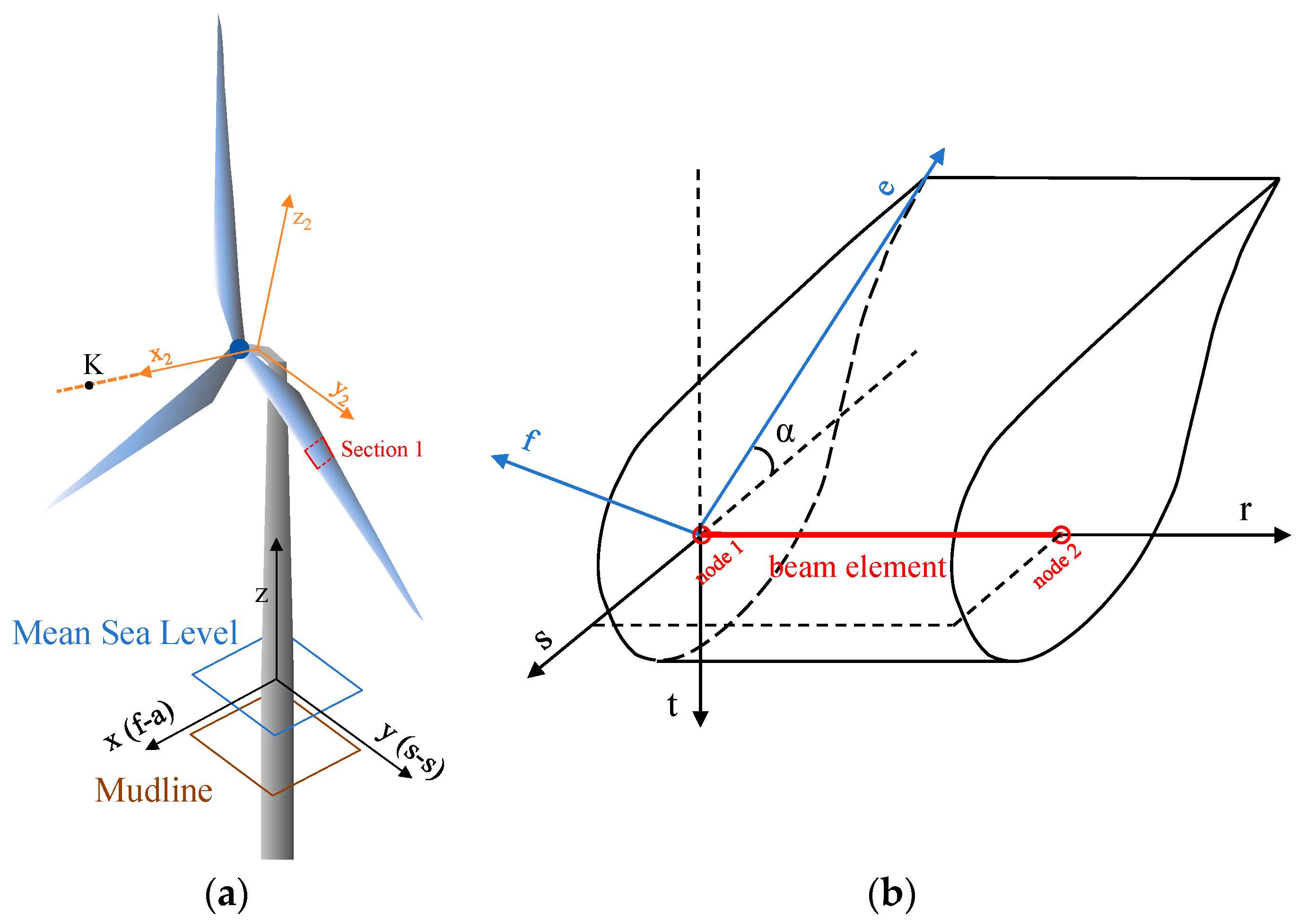
Coordinate System 1 (global coordinate system, black arrow in Figure 2a): The origin lies at the intersection of the undeformed tower axis and mean sea level. The z-axis is vertical and aligned with the undeformed tower axis; the x-axis points upwind, perpendicular to the z-axis; and the y-axis completes a right-handed Cartesian coordinate system. This system is an inertial reference frame, fixed in space and unaffected by structural deformation. It is primarily used for structural modeling, generating wave and wind speed fields, and outputting response data.
Coordinate System 2 (tower-top coordinate system, orange arrow in Figure 2a): The origin is located at the center of mass of the RNA. The x2-axis aligns with the main turbine drive shaft, the y2-axis is parallel to the y-axis of Coordinate System 1, and the z2-axis is normal to the x2-y2 plane and points upward, forming a right-handed system. This system is employed for structural modeling, applying aerodynamic loads, and defining rotation.
Coordinate System 3 (blade cross-section coordinate system, blue arrow in Figure 2b): Fixed to the undeformed blade cross-section, this is a two-dimensional system comprising the e-axis (edgewise) and f-axis (flapwise). The e-axis is parallel to the blade chord, and the f-axis is normal to the chord and points toward the suction side. This convention reflects industry standards for defining blade cross-sectional properties.
Coordinate System 4 (blade-element coordinate system, black arrow in Figure 2b): This local system is defined for each beam element. The r-axis lies along the element axis between nodes, the s-axis is normal to the r-axis and points toward a designated reference point, and the t-axis completes the orthogonal set (r-s-t). For modeling simplicity, the reference point (denoted as point K in Figure 2a) is chosen upwind on the x2-axis for all blade elements. The rst coordinate system is utilized by the ADINA v9.7 software to define the beam element cross-section orientation [53].

2.4. Structural Model

To ensure platform consistency, all simulations in this study are performed using ADINA. Based on the RNA structural representation, three distinct models for the 15 MW MOWT are established.
Distributed-parameter model (DPM): This model idealizes the blades as Timoshenko beams with spatially varying sectional properties (area and stiffness). The hub and nacelle are modeled as concentrated masses located at their respective centers of mass.
Multi-particle model (MPM): This model omits explicit blade modeling. Instead, the rotor and nacelle are represented by concentrated mass bodies positioned at their centers of mass. Crucially, each mass body incorporates both mass and rotational inertia for its corresponding component (nacelle or rotor).
Concentrated point-mass model (CPM): This model reduces the entire RNA to a single concentrated mass point at its center of mass, thus neglecting rotational inertia.

2.4.1. Integrated System Model

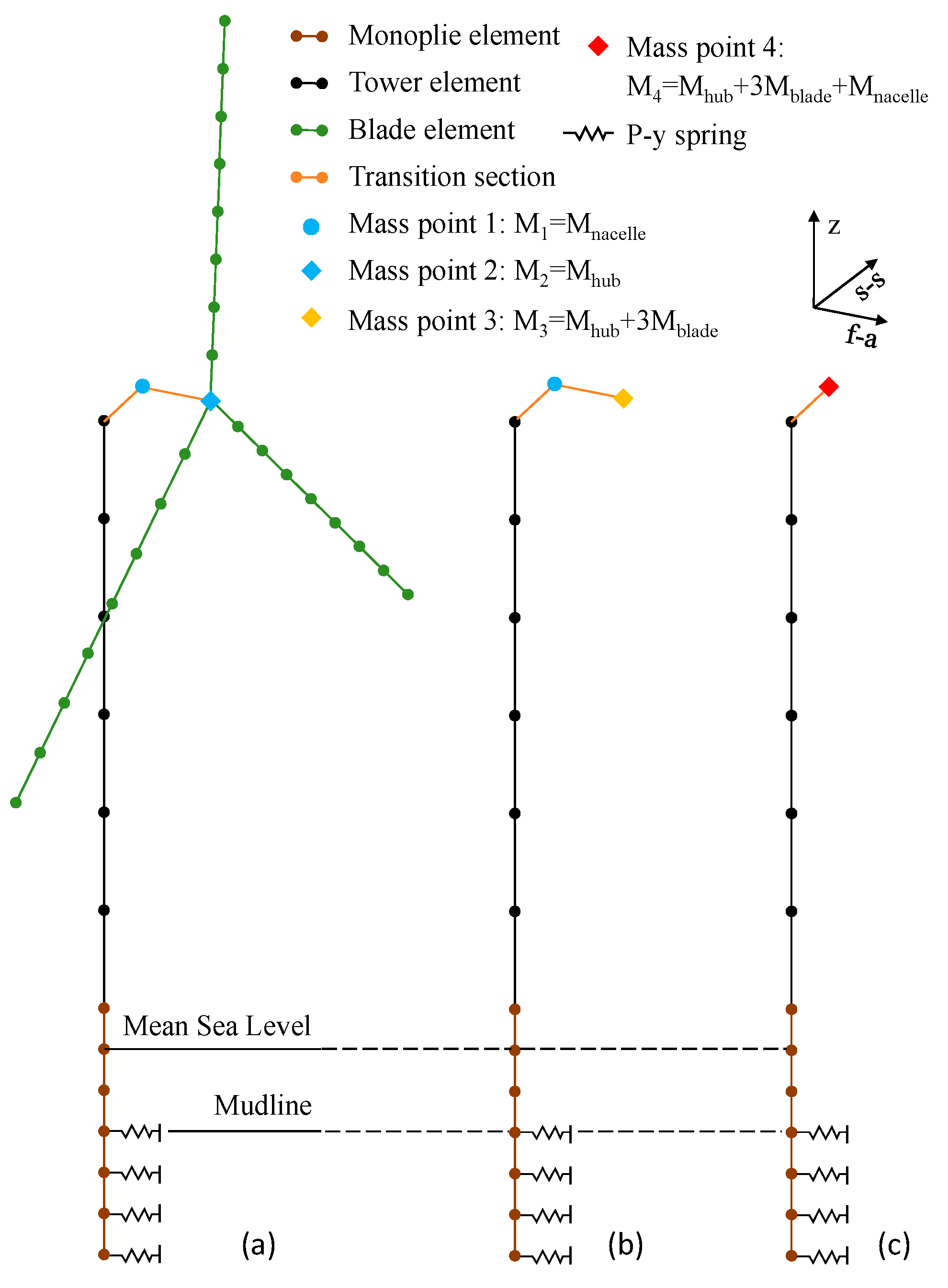
Table 3 summarizes the mass properties of the RNA components while Figure 3 schematically depicts the three numerical models. Across all models, mass points above the tower top were defined using ADINA’s “concentrated mass” element, rigidly connected as required. The DPM accounts for both the inertia effects and stiffness distribution of the RNA. The MPM captures all inertia effects of the RNA. The CPM considers only partial inertia effects, specifically omitting the rotational inertia of the RNA. From a dynamic response analysis perspective, the DPM incorporates the most comprehensive representation of the RNA. Therefore, the analysis results from the DPM serve as the benchmark for comparing the three models.
The tower and monopile are discretized using 3D beam elements with a uniform element size of 1 m. Their cross-sections are modeled using ADINA’s “Pipe” section definition; corresponding outer diameters and wall thicknesses are provided in Table 2. Table 4 lists the elastic parameters for the support structure and blade materials. A steel density of 8500 kg/m3 is adopted to account for non-structural components. The steel material follows a bilinear elastic–plastic constitutive model with kinematic hardening, featuring an initial yield stress of 345 MPa and a tangent modulus of 21 GPa during hardening. The blades are treated as linear elastic, with equivalent sectional properties derived from reference data [48].

2.4.2. Blade Model

To accurately represent the actual blade cross-sectional characteristics, the sectional parameters (area A, moments of inertia I, and polar moment of inertia Ip) are determined based on the blade mass, stiffness data, and other parameters from the IEA research report [48] using the following equations:
A = m ¯ ρ
I = E I ¯ E
I P = G I P ¯ G
where m ¯ , E I ¯ , and G I p ¯ are the blade mass per unit length, sectional bending stiffness, and sectional torsional stiffness, respectively; ρ, E and G are the material mass density, Young’s modulus, and shear modulus, respectively (see Table 4).
Each blade in the DPM is discretized into 50 segments using 3D beam elements of 0.7 m. Although shell-element models offer higher fidelity, the Timoshenko beam theory is employed herein to model blade dynamics, as the detailed internal structures and material properties of 15 MW blades are proprietary. While this simplification cannot capture local cross-sectional deformations (e.g., warping) or associated high-order modes, it accurately represents the global bending and torsional behaviors. Given that this study focuses on the influence of RNA modeling on the global system dynamics and support structure responses, this approach offers a reasonable balance between computational efficiency and analytical adequacy. The blade cross-section is modeled using ADINA’s “General” section type, which does not prescribe a specific geometric shape. For the 15 MW MOWT, the reported blade sectional moments of inertia correspond to the principal axes (edgewise e and flapwise f). Due to the blade’s initial twist angle, the orientations of these principal axes vary spatially along the blade span. Defining the chord direction (and thus the element s-axis) via the key point of the beam element would necessitate an impractical number of key points. To simplify modeling, the s-axis direction of each element is defined to lie within the plane formed by the blade axis and a single reference point K (Figure 2). Subsequently, the moments of inertia and products of inertia about the actual edgewise (e) and flapwise (f) axes are transformed to the element coordinate system (s, t) using the following equations based on the actual chord line direction (defined by angle θ):
I s = I f + I e 2 + I f I e 2 cos 2 θ I f e sin 2 θ
I t = I f + I e 2 I f I e 2 cos 2 θ + I f e sin 2 θ
I s t = I f I e 2 sin 2 θ + I f e cos 2 θ
where If and Ie are the moments of inertia of the blade cross-section about the f-axis and e-axis, respectively; Is and It are the moments of inertia of the blade cross-section about the s-axis and t-axis, respectively; θ is the inclination angle of the e-axis in the cross-sectional coordinate system, which is equal to the sum of the initial twist angle and pitch angle; and Ife and Ist are the inertial products of the cross-section with respect to the fe-axis pair and st-axis pair, respectively.
The foundation damping adopts the model developed by Makris and Gazetas [54], which accounts for the radiation damping due to the outward propagation of diffracted waves and material damping from soil hysteresis.
C = 6 ρ s V s D ( ω d V s ) 1 / 4 + 2 β s K s ω
where C is the damping coefficient; ρ s and Vs are the mass density and shear-wave velocity of the soil, respectively; D is the pile diameter; ω is the fundamental natural angular frequency of the support structure; βs is the hysteresis damping ratio, taken as 5% following Makris and Gazetas [54]; and Ks is the unit length stiffness of the pile, derived from the p-y curve. It is crucial to note that this Makris and Gazetas model is specifically adopted to simulate the radiation damping within the foundation soil domain (i.e., energy dissipation through outward propagating seismic waves in the soil).

2.5. Soil–Structure Interaction (SSI) Model

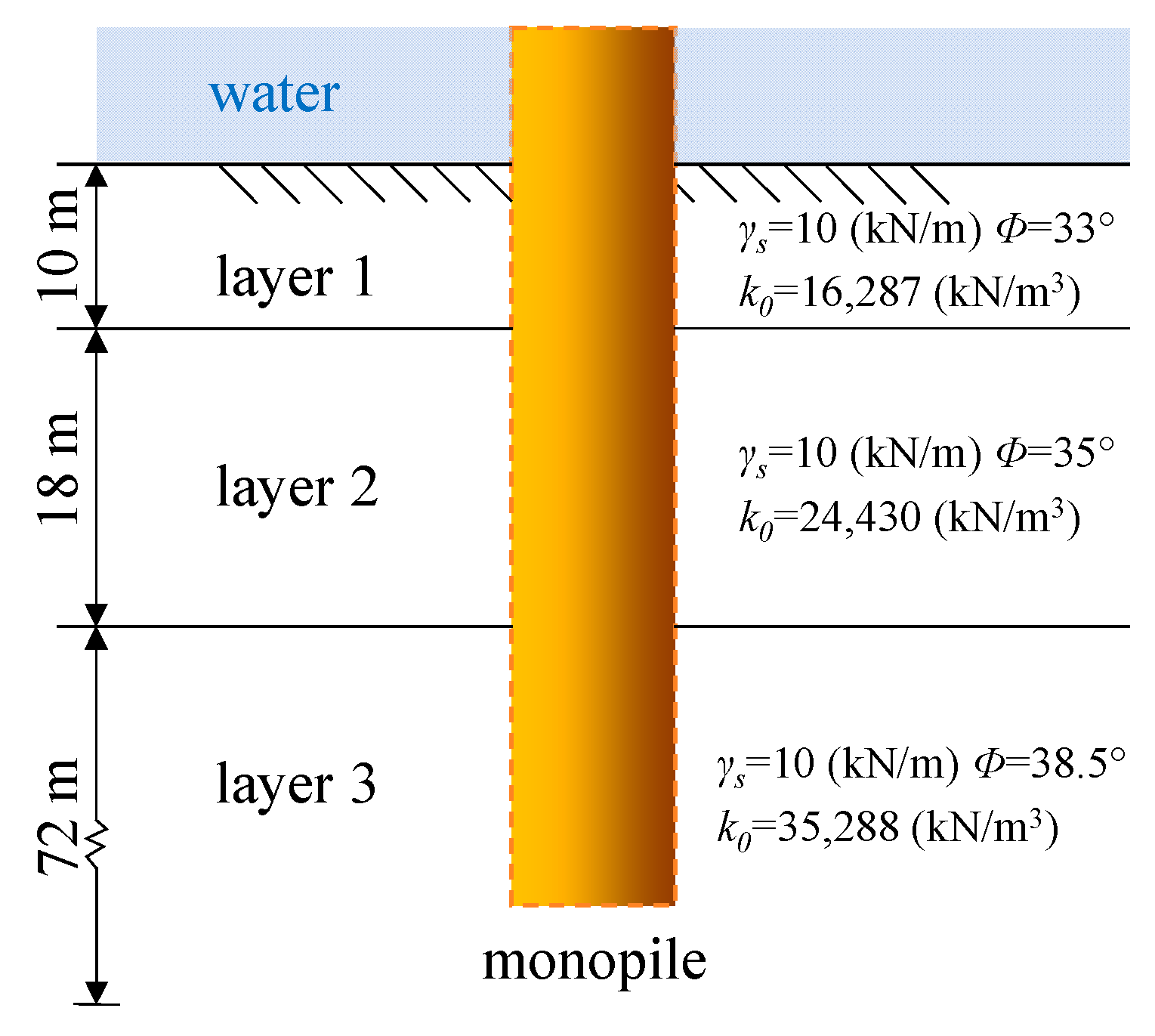
The layered sandy soil site shown in Figure 4 is considered in the analysis, which is characterized by its effective unit weight (γs), internal friction angle (ϕ), and initial foundation stiffness (k0). To maintain computational efficiency, SSI effects are simulated using well-established industry-standard soil resistance curves. For the horizontal foundation resistance of the pile shaft, the improved p-y curves proposed by Sun et al. [55] are adopted (Equation (8)). This model accounts for large-diameter pile size effects and demonstrates good agreement with experimental data:
P = A P u tanh [ k 0 z 0 ( D D 0 ) m ( z z 0 ) n A P u y ]
where A is a coefficient that considers cyclic or static loads (A = 0.9 for cyclic loads); Pu is the ultimate lateral resistance at depth z; k0 is the initial stiffness; z0 = 2.5 m is the reference depth; z is the depth below the original seabed; y is the lateral deflection at depth z; D is the monopile outer diameter; D0 = 1.0 m is the reference monopile diameter; and m = 0.5 and n = 0.6 are dimensionless coefficients. The vertical foundation resistance was modeled using the API-recommended q-z curves [56]. The pile–soil interaction model was implemented in ADINA using the “6-DOF spring” elements, which support required nonlinear spring and damping models. For this synthesized site, the shear-wave velocity profile is determined according to empirical relationships [56]. It should be noted that this simplified approach presents limitations for large-diameter monopiles under strong seismic excitations. Specifically, it cannot fully capture severe soil nonlinearity, pile–soil separation (gapping), or cyclic soil degradation.

3. Load Cases and Model Verification

3.1. Wave Field and Hydro-Elastic Decoupled Model

3.1.1. Irregular Wave Model

An irregular wave model is employed to simulate realistic sea states. Following IEC 61400-3-1 recommendations, the JONSWAP spectrum, which is widely used for the analysis of the dynamic response of bottom-fixed OWTs [57,58,59], is adopted to represent the wave energy distribution, as given by Equation (9):
S ( f ) = α g 2 ( 2 π ) 4 f 5 exp ( 5 4 ( f f p ) 4 ) γ exp ( 0.5 ( f f p σ f p ) 2 )
where fp is the peak spectral frequency; g is the gravitational acceleration; α is the generalized Phillips constant; and σ is the spectral width parameter. Some parameters are fixed, while others are determined based on the significant wave height Hs and peak period Tp, as detailed in Ref. [48].
The spectral significant wave height and peak spectral period of the wave spectrum are correlated with the average wind speed. This study uses the “K13” dataset (53°13′04″ N, 3°13′13″ E; water depth: 25 m) published by Rijkswaterstaat [60], comprising 22 years of measurements (1979–2000). The mean wind speed at 150 m was extrapolated from 85.2 m measurements using the site-specific wind profile. Table 5 correlates these wind speeds with Hs and Tp.
To account for the stochastic nature of waves, six different random seeds were also used to generate the wave loads in each selected wind speed. Table 6 shows the seeds used at a wind speed of 6 m/s.

3.1.2. Hydro-Elastic Decoupling

The hydrodynamic load on the substructure of the 15 MW MOWT, f, can be divided into inertial force and drag force, calculated using the Morison equation:
f = ρ w V u ¨ + ( C M 1 ) ρ V ( u ¨ u ¨ t ) + 1 2 C D ρ D ( u ˙ u ˙ t ) | u ˙ u ˙ t |
where C M is the mass coefficient and C D is the drag coefficient, which are taken as 2.0 and 1.2, respectively; ρ w is the seawater density, taken as 1027 kg/m3; V is the substructure volume per unit height; D is the monopile outer diameter, taken as 10 m; u ˙ and u ¨ are the water particle velocity and acceleration, respectively; and u ˙ t and u ¨ t are the monopile absolute velocity and acceleration, respectively. The wave loads are computed using the HydroDyn module of OpenFAST software v3.5.4 [61] and applied as time histories to the corresponding nodes in the ADINA model. The added mass and damping term are applied to the numerical model of the monopile, as described in Ref. [61].
In ADINA, the processed wave load time histories are evenly distributed at 12 points on the submerged section of the 15 MW OMWT and applied along the -x direction of Coordinate System 1.

3.2. Seismic Input Ground Motion

Three representative seismic records are selected from the PEER strong-motion database, covering far-field, near-field, and pulse-type motions (Table 7). Each record includes three orthogonal components. shows their 5%-damped acceleration response spectra, which span a broad period range, especially [0.1 s, 3 s]. This range encompasses the first 30 modes of the 15 MW MOWT, ensuring representative excitation for evaluating RNA model differences. To simulate varying intensity levels, peak ground accelerations (PGAs) are scaled in increments of 0.1 g from 0.1 g to 0.5 g. Scaling followed GB 50011-2010 [61] specifications, assigning PGA ratios of 1.0 (horizontal 1):0.85 (horizontal 2):0.65 (vertical).
The Erzincan (Erz) earthquake, as a typical representative of strong earthquakes in subduction zones, is characterized by high magnitude, long duration, and concentrated energy release. It has become a classic case for studying the seismic performance of highly flexible structures in earthquake engineering. Its recorded ground motion characteristics are highly consistent with real strong earthquake scenarios and are widely used in the seismic response analysis of various large-scale structures. The Chihuahua earthquake features unique moderate-to-strong ground motion, stable peak acceleration, and remarkable site effects. Its ground motion record (peak acceleration 0.270 g) is both typical and representative. The CHY101E (Chy) earthquake is a typical station record from the 1999 Chi-Chi earthquake in Taiwan. With a short epicentral distance of only 9.94 km and a significant peak acceleration of 0.340 g, its ground motion contains abundant high-frequency components and complex time-domain features, which can well simulate the impact of near-field strong earthquakes on highly flexible structures.
The total analysis duration is set to 800 s with a time step of 0.005 s. The seismic excitation begins at 400 s to avoid initial transient effects. All components are applied simultaneously, with the larger-PGA horizontal component aligned normal to the rotor plane.
During seismic excitation, the wind turbine shall be parked with the blades feathered. In the distributed-parameter model (DPM), the corresponding Equations (4)–(6) should be adopted by setting θ to 90 degrees plus the sum of the initial twist angles at each node position to account for the parked case. In ADINA, the selected seismic load time histories are input into the model as ground acceleration, with the main horizontal component applied along the −x direction of Coordinate System 1.

3.3. Model Verification

To verify the model, modal analysis of the 15 MW MOWT is conducted. Natural frequencies computed in ADINA (using the CPM, structurally consistent with the BModes reference model (NREL, 2020)) are compared with those from BModes. As shown in Table 8, the maximum relative deviation is only 0.123%, indicating excellent model fidelity.
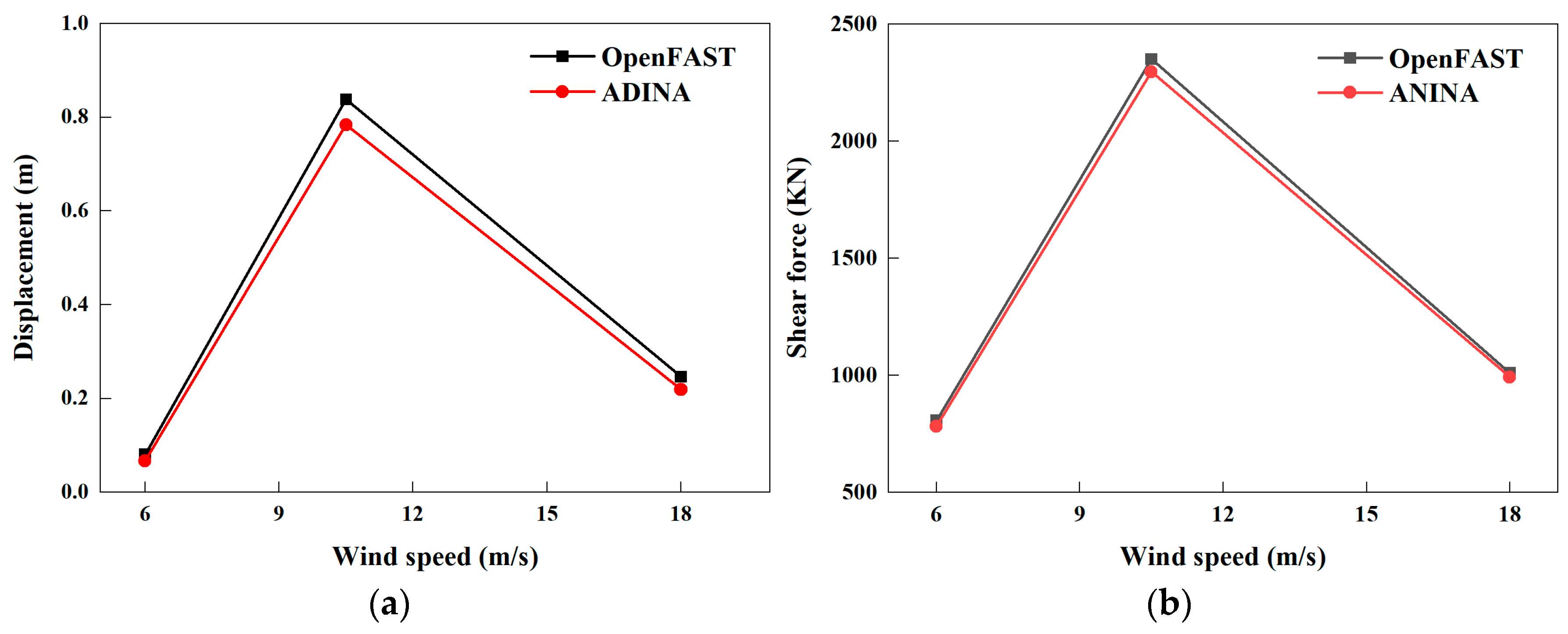
The dynamic response under combined wind–wave excitation is analyzed using both ADINA and OpenFAST, adopting the CPM as it is the modeling approach most consistent with OpenFAST. Hub-height mean wind speeds of 6, 10.59, and 18 m/s are considered, with wave parameters from Table 5. Figure 5 demonstrates strong agreement in peak nacelle displacement and mudline shear force along the x-axis between the two tools. A mesh sensitivity study confirmed that the chosen discretization meets engineering accuracy requirements. The numerical models are verified for subsequent analysis. It should be noted that direct validation of the seismic response is not presented in this study, primarily because the widely-used benchmark tool, OpenFAST, currently lacks an officially integrated seismic analysis module. Nevertheless, the rigorous verification of natural frequencies and wind–wave responses confirms that the fundamental structural properties are accurately captured, providing a reliable basis for the subsequent seismic analyses.

4. Results and Discussions

4.1. Dynamic Characteristics of the 15 MW MOWT

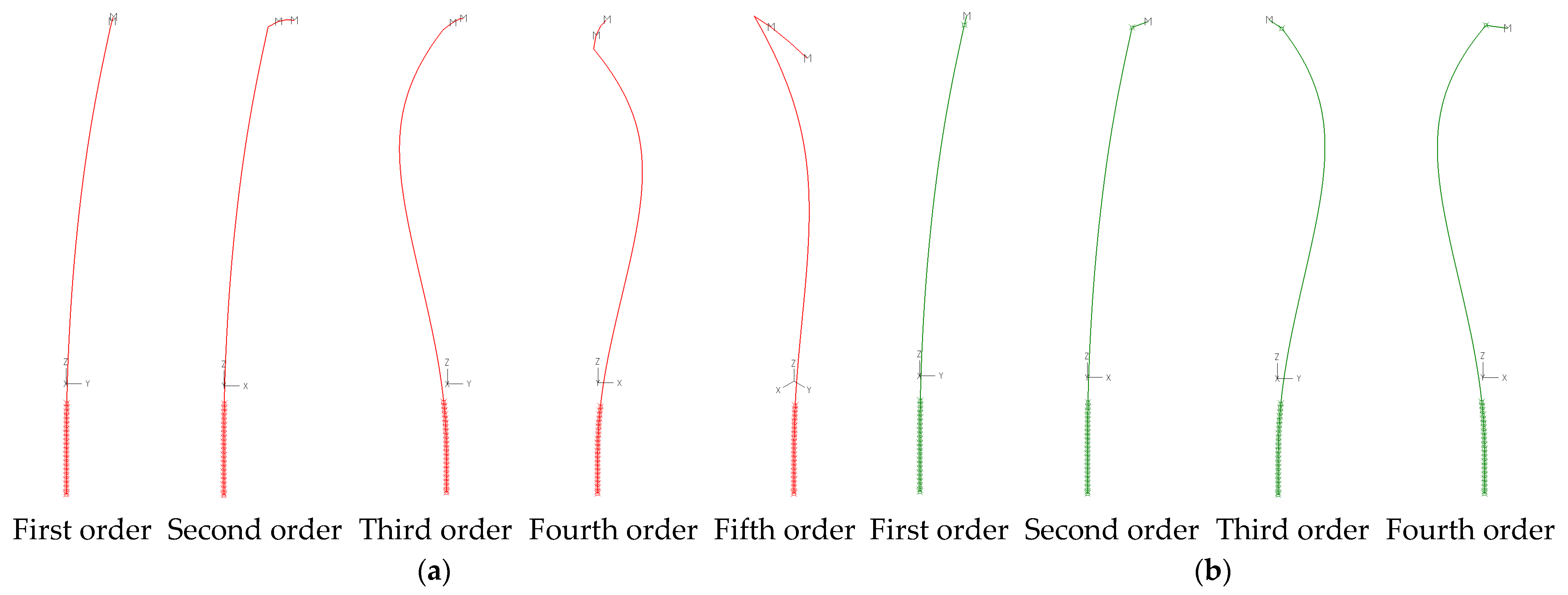
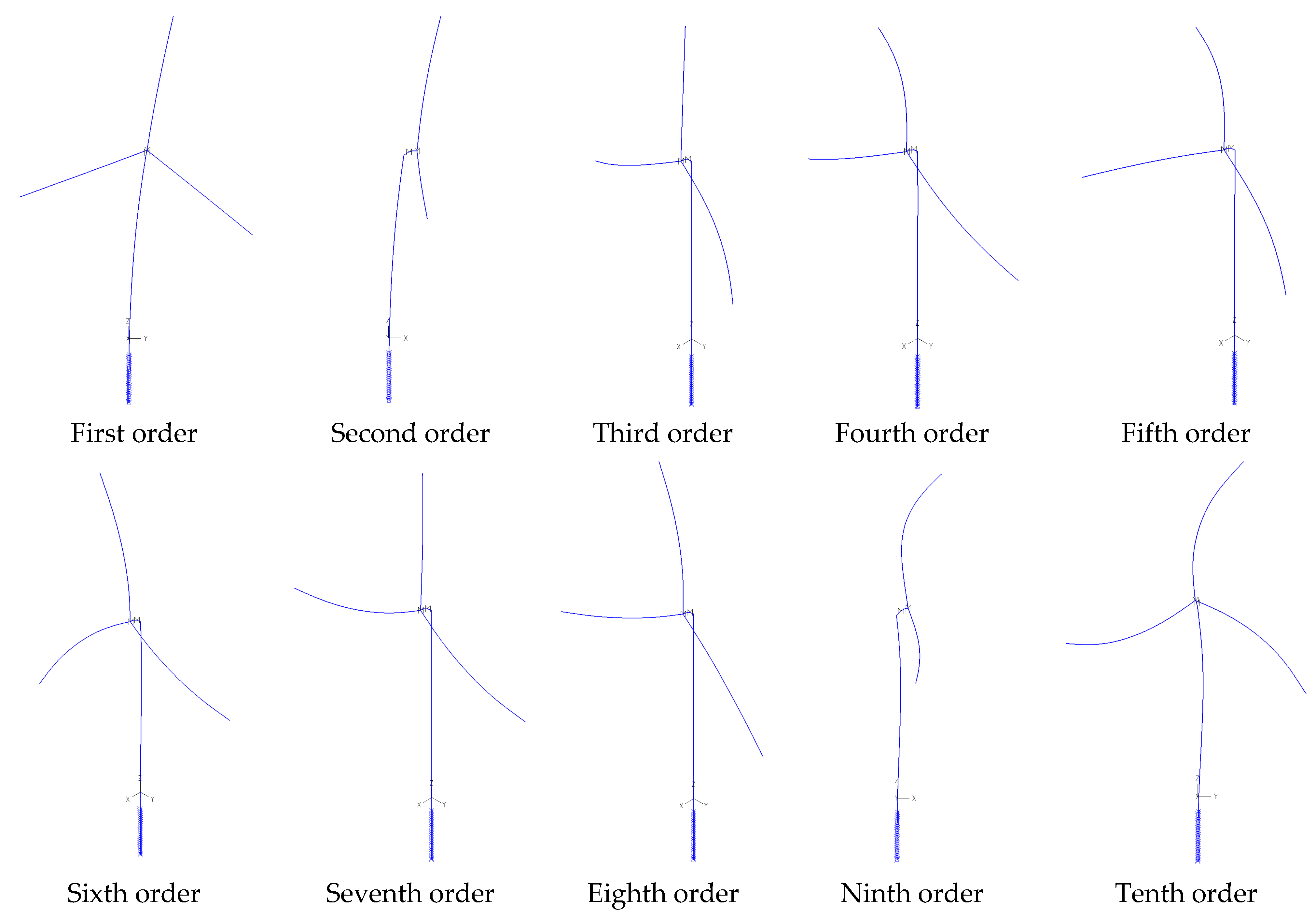
The mode shapes and natural frequencies of the 15 MW MOWT are obtained using the three aforementioned models. The distributed spring stiffness along the pile shaft is determined from the initial tangent slope of the soil resistance curve. For the DPM, the low-speed shaft is fixed to prevent rigid-body motion during modal analysis. As shown in Figure 6, in all modes of the DPM, blade deformation is prominent. In contrast, tower deformation in modes 3 to 8 is negligible, with blade motion dominating. Figure 7 illustrates the modes from the MPM and CPM. Since these models omit detailed blade representations, no blade-related modes are present.
Table 9 compares the natural frequencies of 15 MW MOWT derived from the three models. The absence of blades in the MPM and CPM eliminates blade deformation modes. Moreover, variations in RNA modeling lead to differences in natural frequencies for corresponding modes across the models. Using the DPM as a benchmark, the relative error of natural frequencies for the MPM and CPM, REf, is defined as
RE f = f k f A f A
where fA is the natural frequency of the system obtained from the DPM and fk represents that from models k (k = MPM or CPM). For the first-order tower mode, the MPM shows errors of 0.44% (side-to-side (SS)) and 0.71% (fore–aft (FA)), while the CPM exhibits errors of 2.26% (SS) and 2.57% (FA). However, the discrepancies become markedly larger for the second tower modes. Specifically, the MPM yields errors of −20.29% (SS) and −9.51% (FA), whereas the CPM shows errors of −25.21% (SS) and −15.27% (FA). Overall, the errors in second-mode frequencies for both the MPM and CPM are substantially larger, indicating that these models may introduce significant inaccuracies under conditions involving higher-mode excitations.
The absence of explicit blade modeling in the MPM and CPM fundamentally alters the dynamic coupling characteristics between the tower and the RNA. This alteration manifests primarily through two mechanisms: the degradation of elastic coupling and the deterioration of inertial coupling. First, by neglecting blade flexibility, the MPM and CPM lose the elastic substructure that the blades provide. In the DPM, the flexible blades can undergo local deformation (e.g., modes 3–8 in Table 9), absorbing and feeding back vibrational energy. Omitting this flexibility degrades the elastic connection between the tower and RNA into a rigid connection, altering the elastic boundary conditions and eliminating local blade modes. This is the fundamental reason for the substantial discrepancies in the second-order tower frequencies (up to −20.29% for the MPM and −25.21% for the CPM in the SS direction). Second, by neglecting or improperly simplifying the rotational inertia (particularly in the CPM), the complex multi-dimensional inertial coupling is reduced to a unidirectional rigid-body translational interaction. The massive and eccentric RNA of the 15 MW turbine generates significant rotational reaction forces during tower vibration. Simplifying this complex inertial coupling distorts the inertia transfer path, especially affecting higher-mode responses where rotational effects are pronounced.

4.2. Dynamic Response of 15 MW MOWT Under Wave Load Excitation

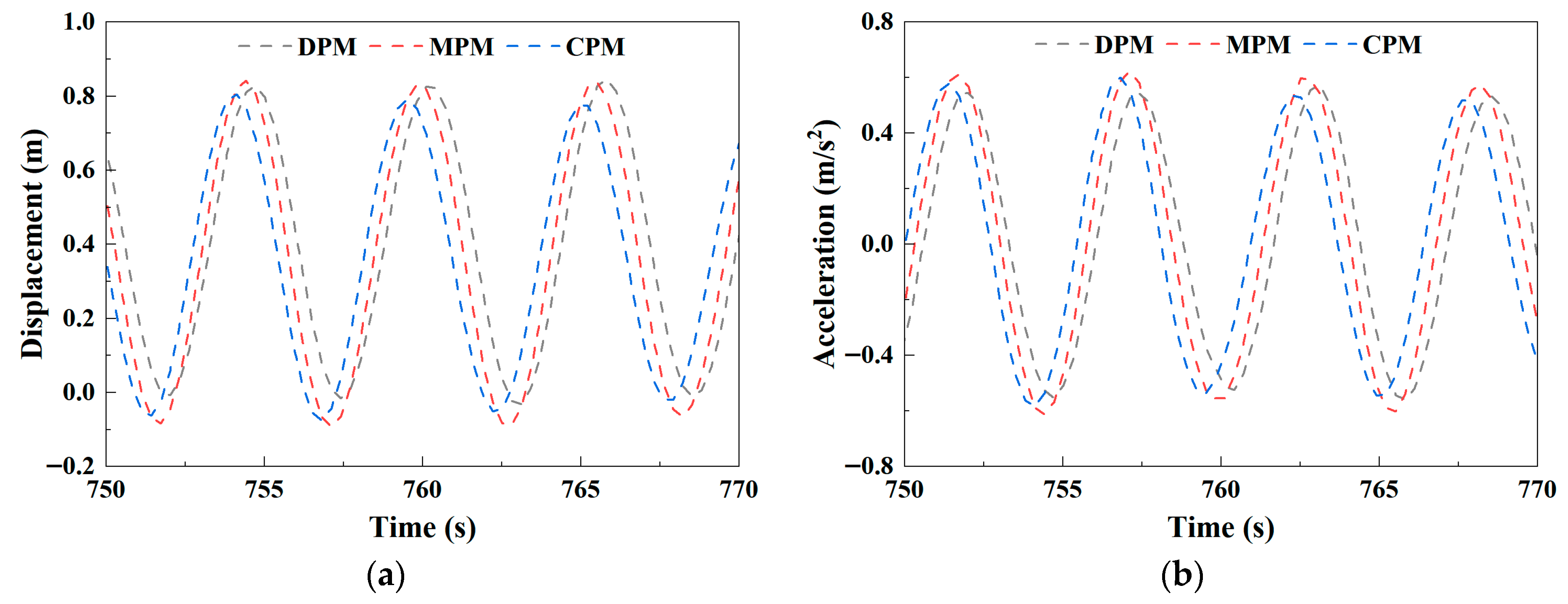
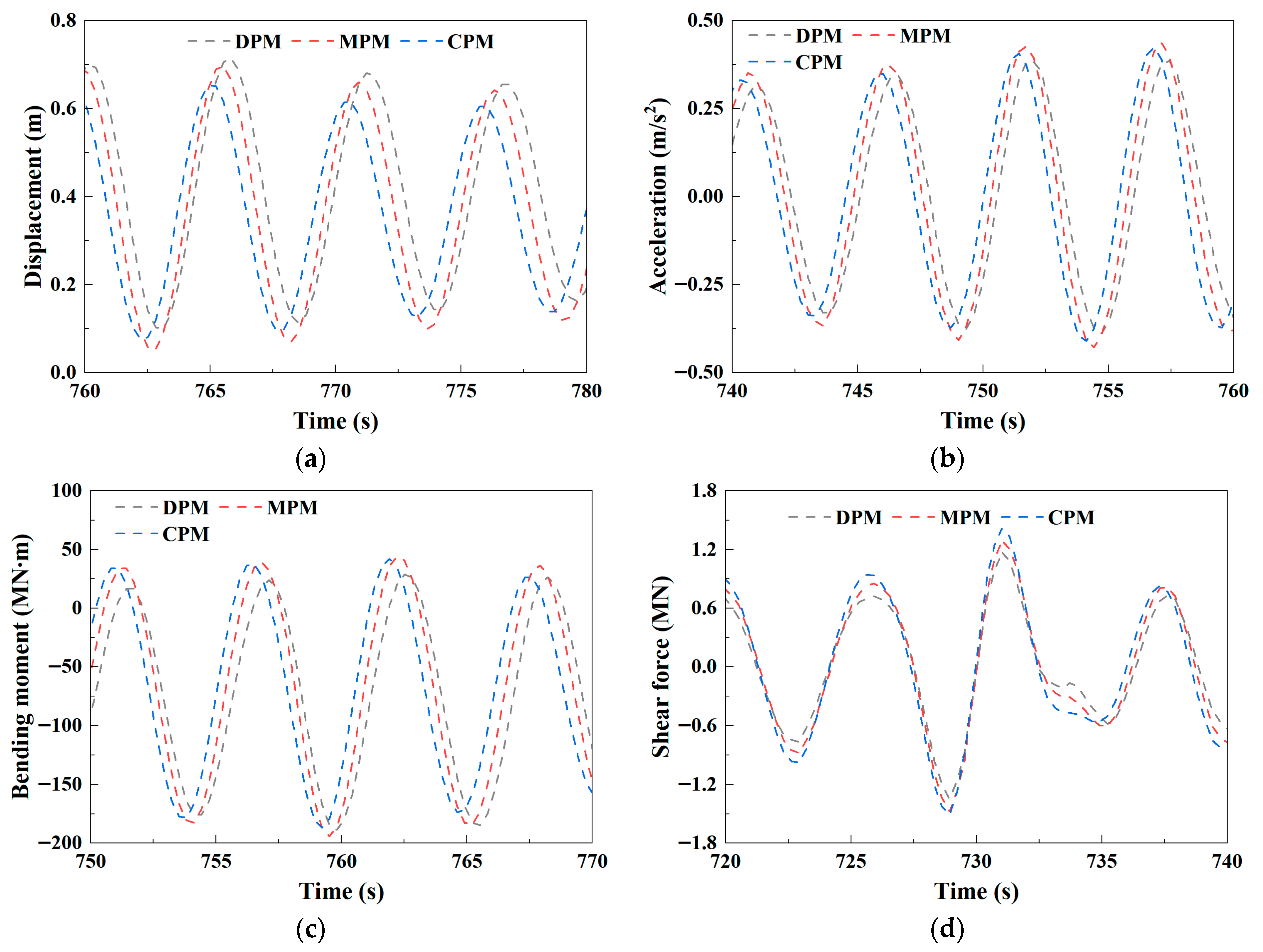
This section investigates the dynamic responses of a 15 MW monopile offshore wind turbine (MOWT) under normal and extreme wave excitations. To eliminate the initial transient effects, the first 200 s of the response time history are truncated. All subsequent figures present results in Coordinate System 1. Under standalone wave loading, aerodynamic and aeroelastic effects are neglected throughout. Due to space limitations, only the time-domain response curves of the 15 MW monopile offshore wind turbine under different wave conditions with a single random seed are presented herein.
Figure 8 presents the response time histories of the 15 MW MOWT under Hs = 1.180 m, Tp = 5.760 s. The figure shows the 100 s segment with the peak response values (the same applies to the following figures in this section). Table 10 summarizes the averaged peak values and root mean square (RMS) values of each model for different random seeds under this load case. Compared with the DPM, the MPM and CPM exhibit errors of −5.60% and −7.46% in the peak tower-top displacement; −4.05% and −6.20% in the peak mudline bending moment; and 1.47% and 0.47% in the peak tower-top acceleration, respectively. The errors of the peak mudline shear force for both models are within ±1%. The MPM and CPM slightly underestimate the RMS values of the tower-top displacement and mudline bending moment, while they can predict the RMS values of tower-top acceleration and mudline shear force with satisfactory accuracy.
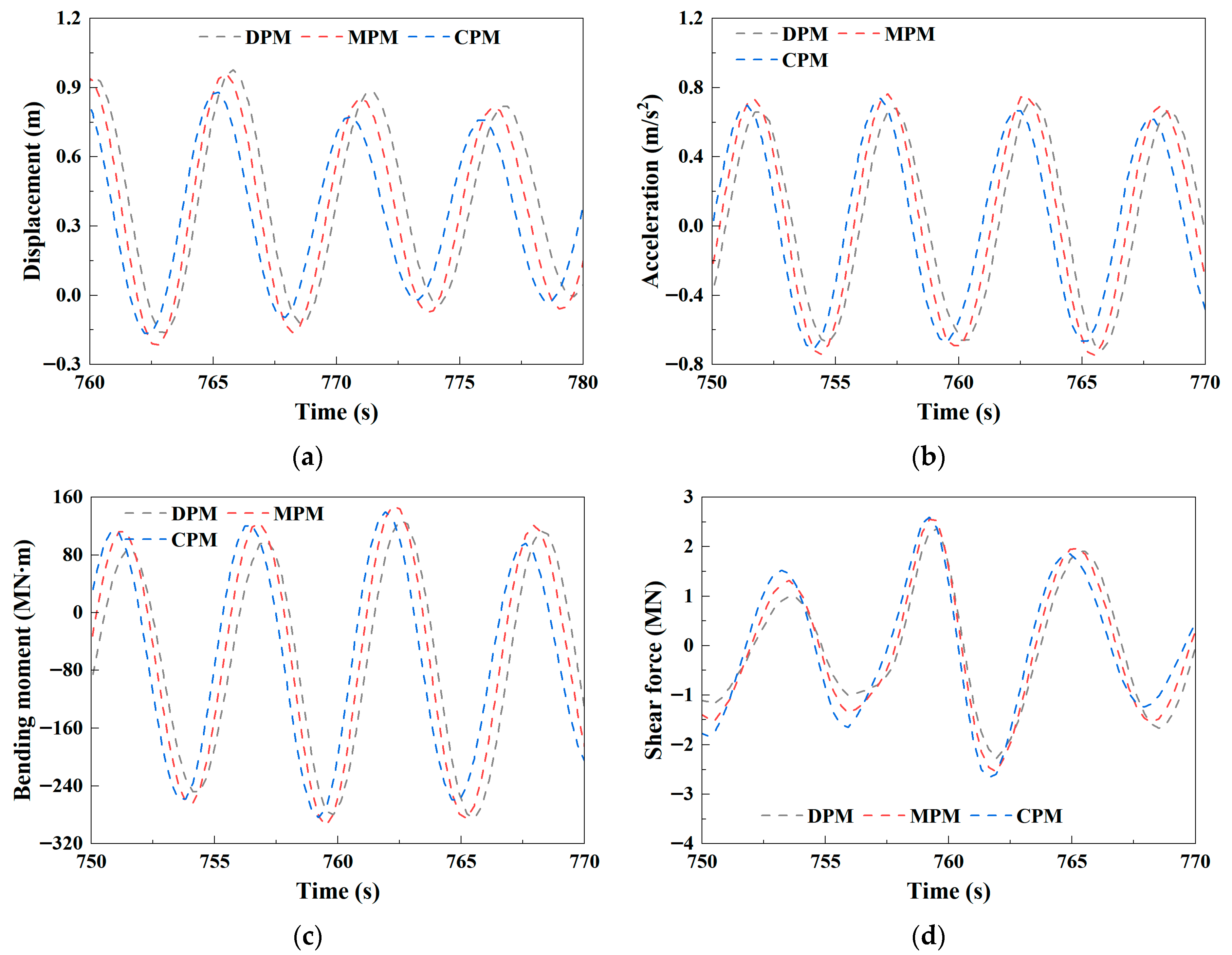
Figure 9 shows the response time histories of the 15 MW MOWT under Hs = 1.535 m, Tp = 5.775 s. Table 11 presents the averaged peak values and root mean square (RMS) values of each model obtained with different random seeds for this load case.
Compared with the DPM, the MPM and CPM yield errors of −5.51% and −7.49% in the peak tower-top displacement and −3.58% and −6.05% in the peak mudline bending moment, respectively. The errors in tower-top acceleration and peak mudline shear force are both within ±1%. Consistent with wave load 1, the MPM and CPM slightly underestimate the RMS values of tower-top displacement and mudline bending moment, while providing reasonably accurate estimations for the RMS values of tower-top acceleration and mudline shear force.
Figure 10 illustrates the response time histories of the 15 MW MOWT under Hs = 2.470 m, Tp = 6.710 s. Table 12 presents the averaged peak values and root mean square (RMS) values of each model with different random seeds for this load case.
Compared with the DPM, the errors of the MPM and CPM in terms of peak tower-top displacement are −5.55% and −8.73%, respectively; the corresponding errors for the peak mudline bending moment are −4.77% and −7.51%. Regarding peak tower-top acceleration, the errors are −1.13% and −3.31%, while the peak mudline shear force errors of both models remain within ±1%. The RMS prediction trends of the MPM and CPM are consistent with those obtained in the previous two load cases.
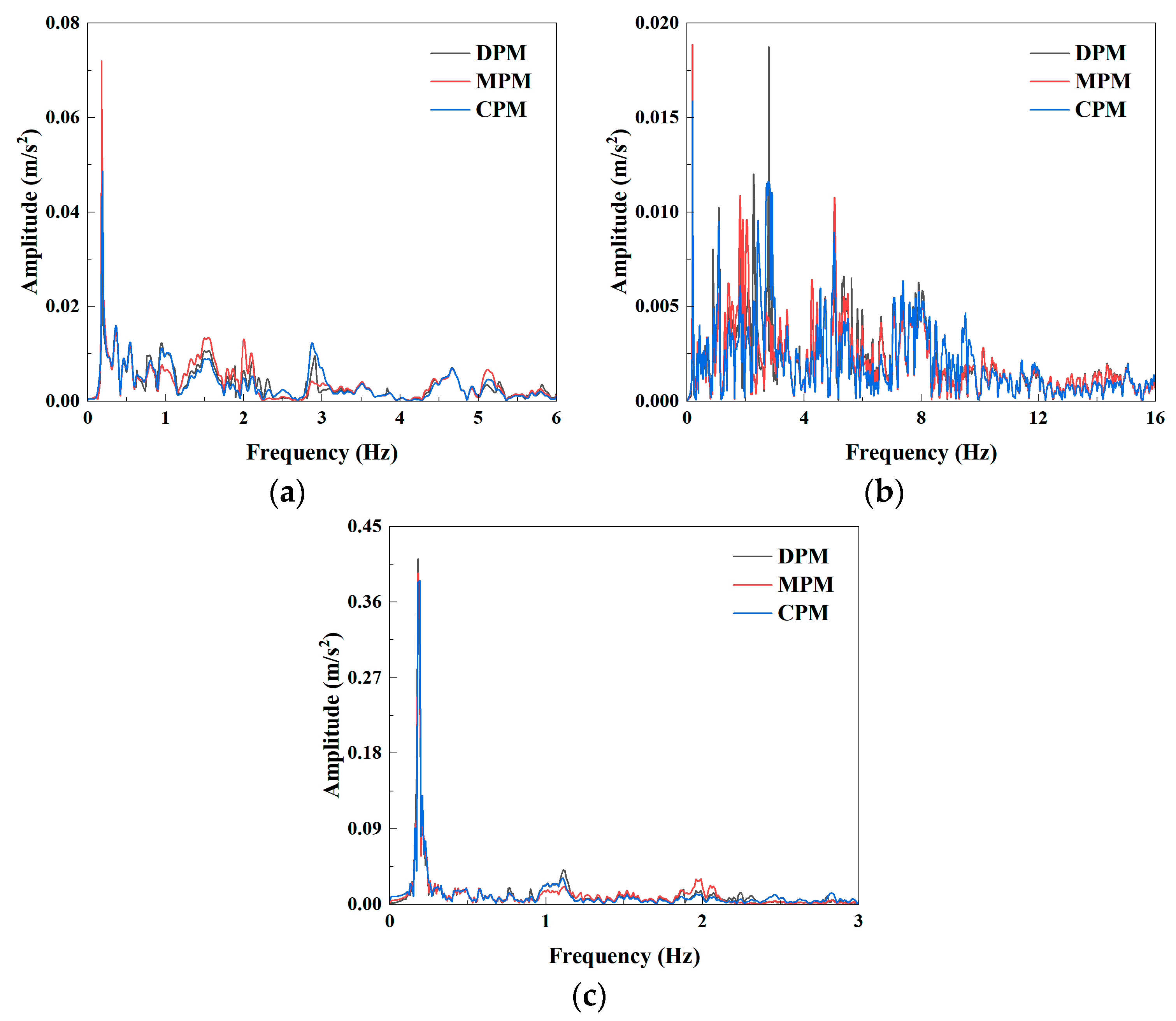
This consistency in prediction accuracy is directly explained by the Fourier amplitude spectra of the tower-top acceleration (Figure 11). As shown, the wave-induced response is predominantly governed by the fundamental mode of the supporting structure. Because the MPM and CPM can reasonably capture the fundamental natural frequencies (errors < 3%, as shown in Table 9), their predictions for fundamental-mode-dominated responses remain satisfactory. The contribution of higher-order modes is negligible under wave excitation, thereby masking the deficiencies of the MPM and CPM in capturing higher-mode dynamics. Therefore, for preliminary wave load predictions where the fundamental-mode response dominates, the MPM and CPM provide acceptable accuracy.
Although discrepancies exist in the predicted fundamental natural frequencies and mode shapes among the three RNA models, the absolute relative errors of all key parameters analyzed for the MPM and CPM under conventional wave loads are below 10%. In the context of offshore engineering, environmental loads such as wind and waves possess substantial inherent stochastic uncertainties (typically 10–20% variability in spectral parameters). Consequently, for the preliminary design and feasibility study phase where the fundamental mode dominates the response, a ±10% deterministic deviation in peak structural responses is generally deemed acceptable. This verifies that the MPM and CPM possess sufficient reliability for the preliminary prediction of peak dynamic responses under conventional wave loads.

4.3. Dynamic Response of 15 MW MOWT Under Seismic Excitation

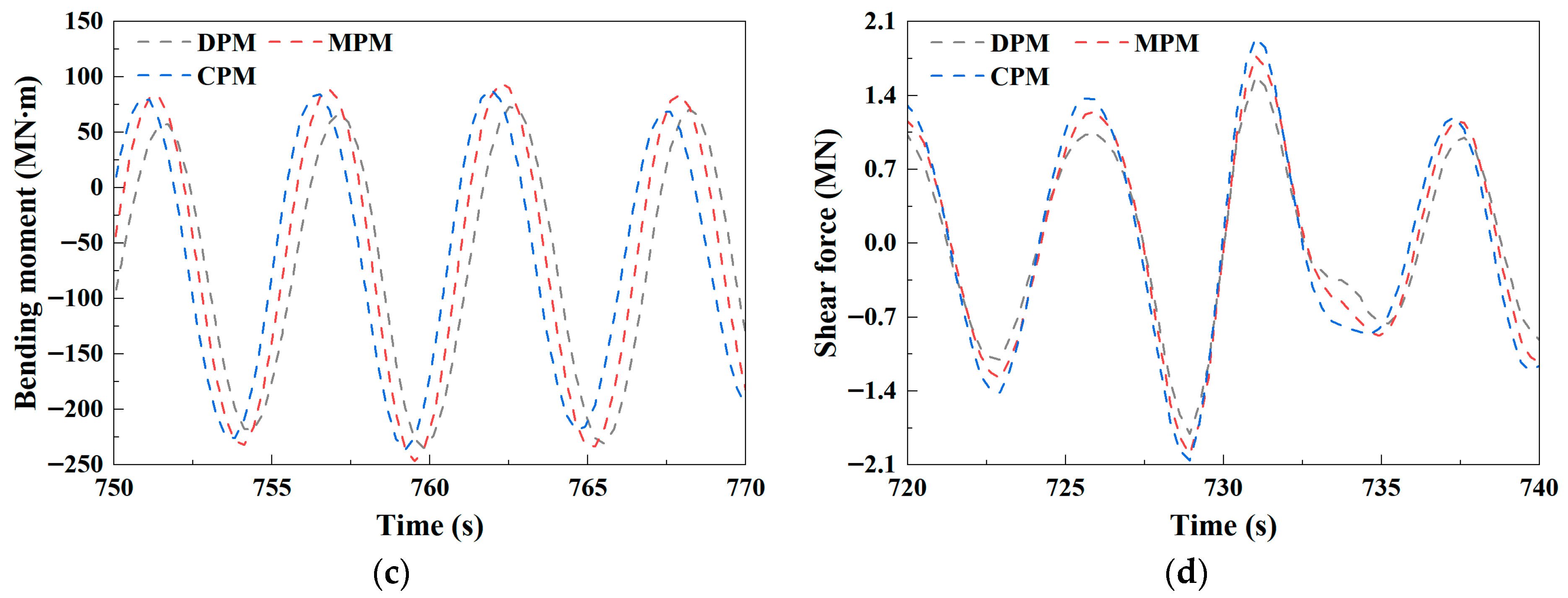
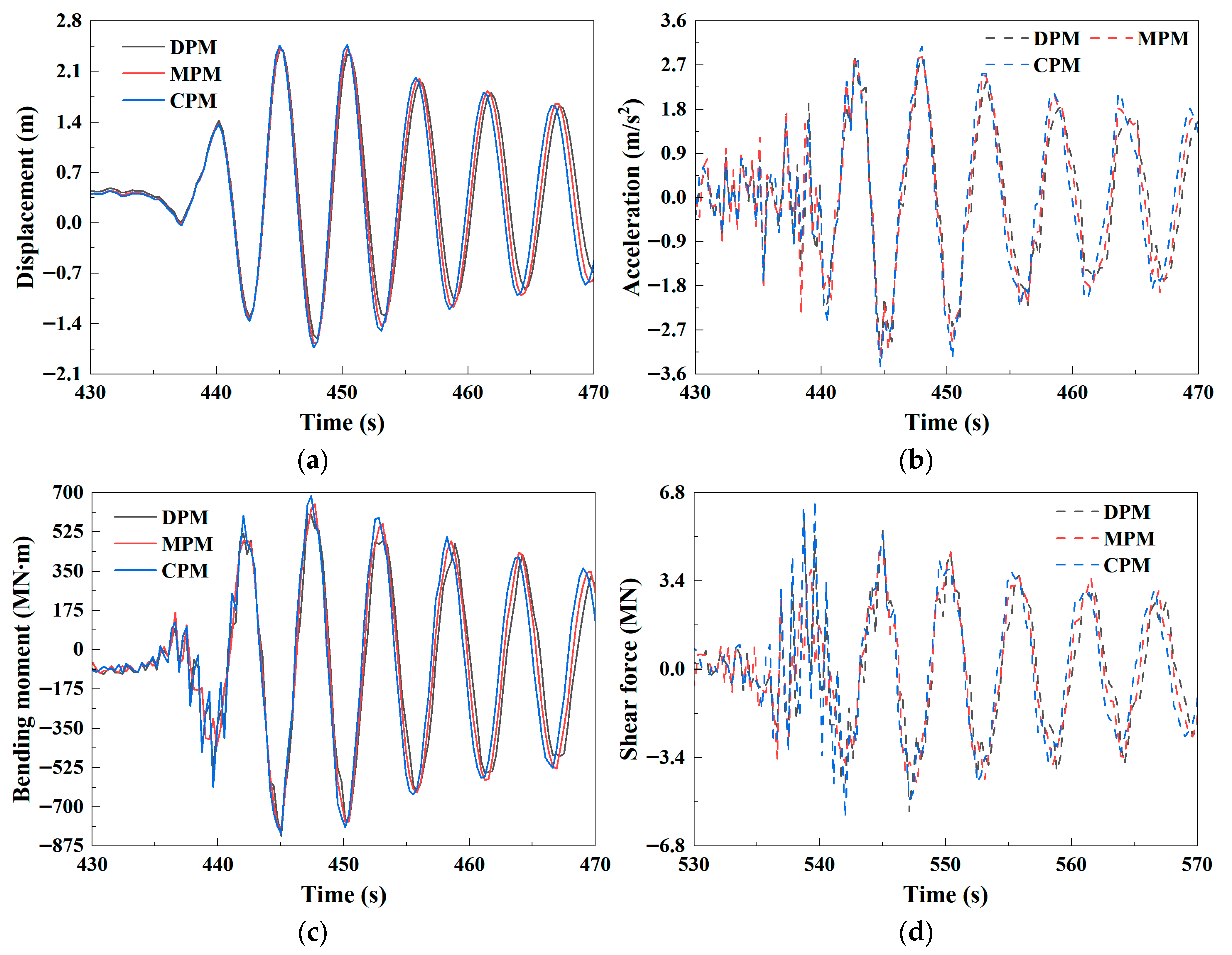
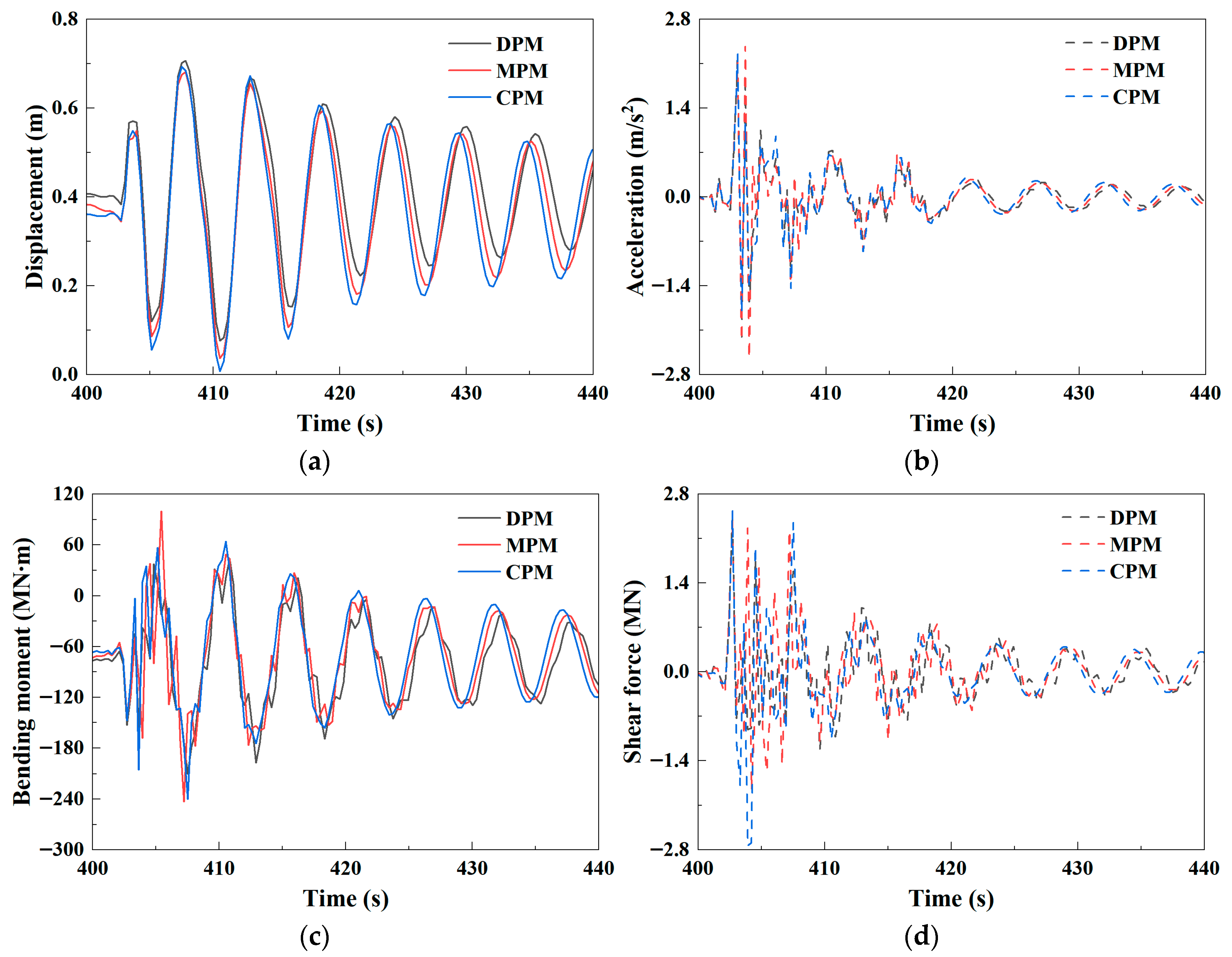
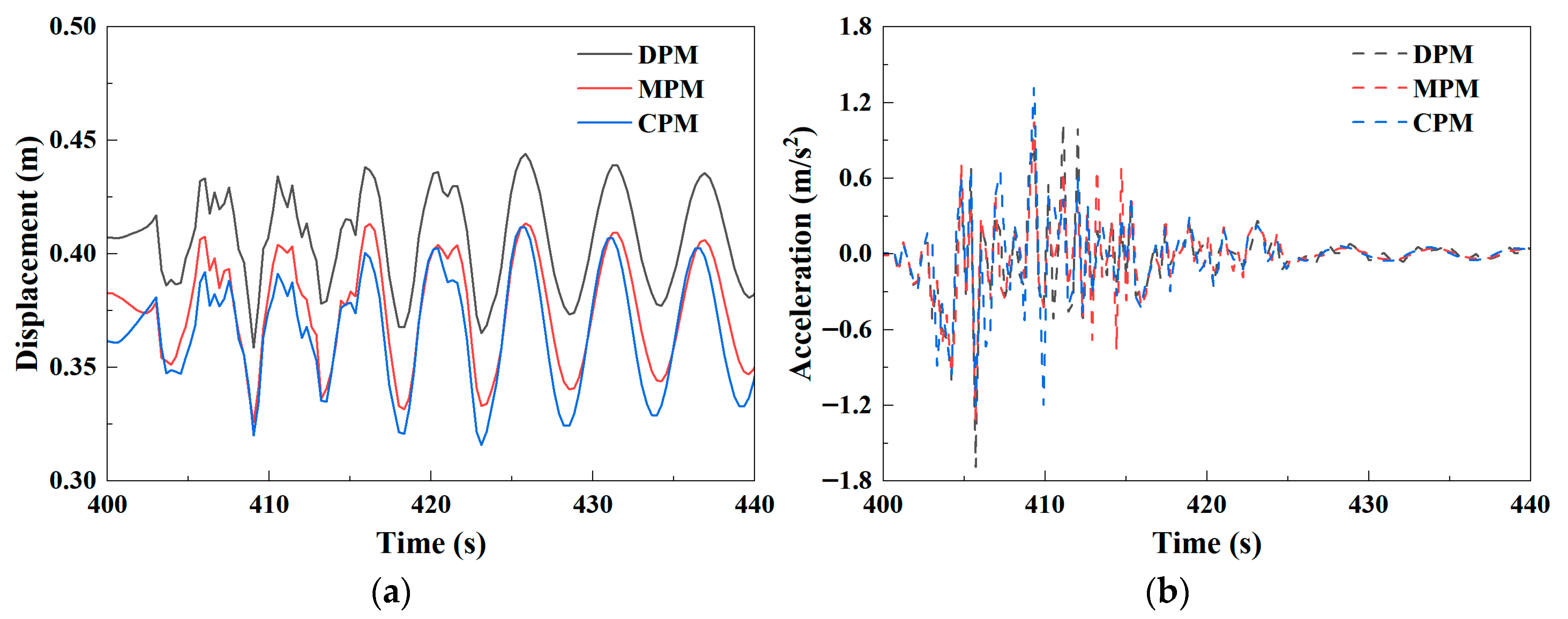
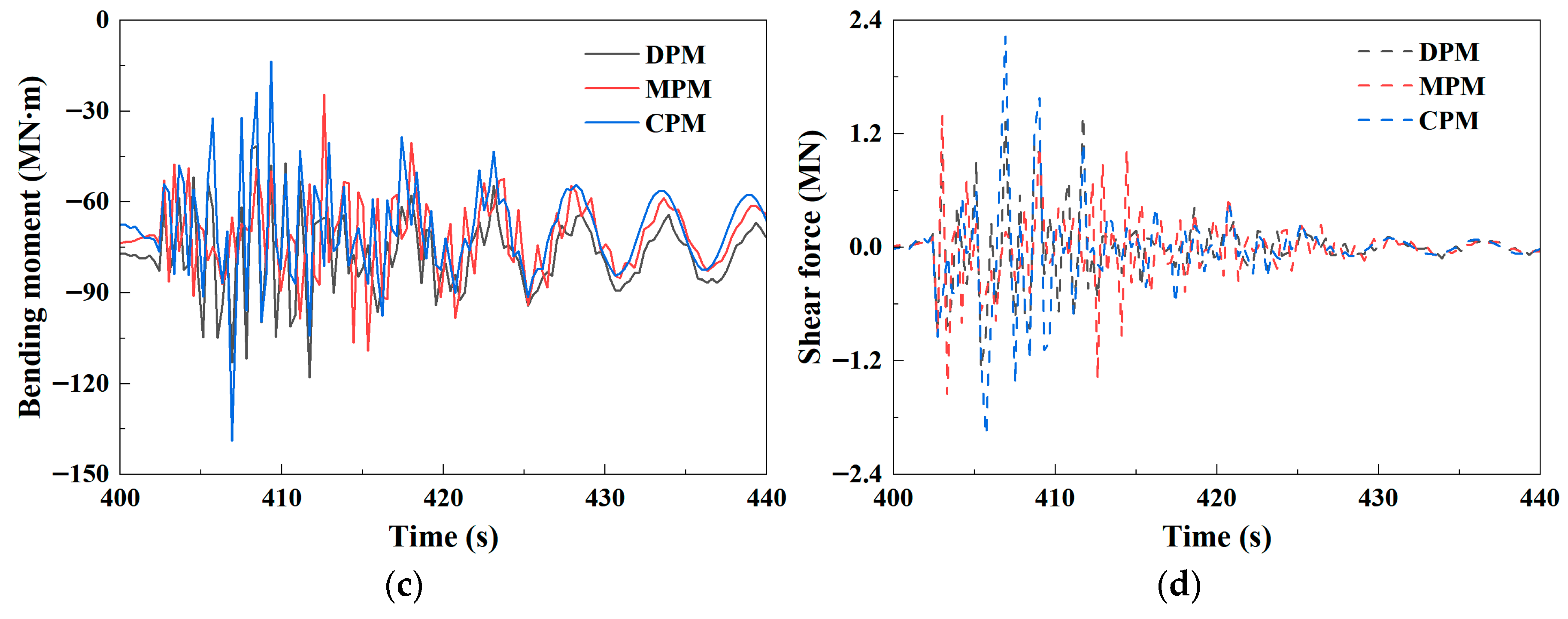
Figure 12 shows dynamic response time histories of the 15 MW MOWT under Erz seismic record excitation. Compared with the DPM, the MPM and CPM exhibit relative errors of −3.64% and −1.90% in peak nacelle displacement; 11.63% and −0.67% in peak nacelle acceleration; 15.56% and 14.17% in peak mudline bending moment; and −3.56% and 9.33% in peak mudline shear force.
Figure 13 shows dynamic response time histories of the 15 MW MOWT under Chihuahua seismic record excitation. Compared with the DPM, the MPM and CPM show errors of −6.90% and −7.25% in peak nacelle displacement; −20.78% and −22.01% in peak nacelle acceleration; −7.55% and 17.63% in peak mudline bending moment; and 11.84% and 61.09% in peak mudline shear force.
Figure 14 shows dynamic response time histories of the 15 MW MOWT under Chy seismic record excitation. For the MPM and CPM, the relative errors in predicting the peak nacelle displacement, acceleration, and mudline bending moment fall within ±8%. For peak mudline shear force, the MPM exhibits an error of −24.51%, while the CPM shows a smaller error of 6.23%.
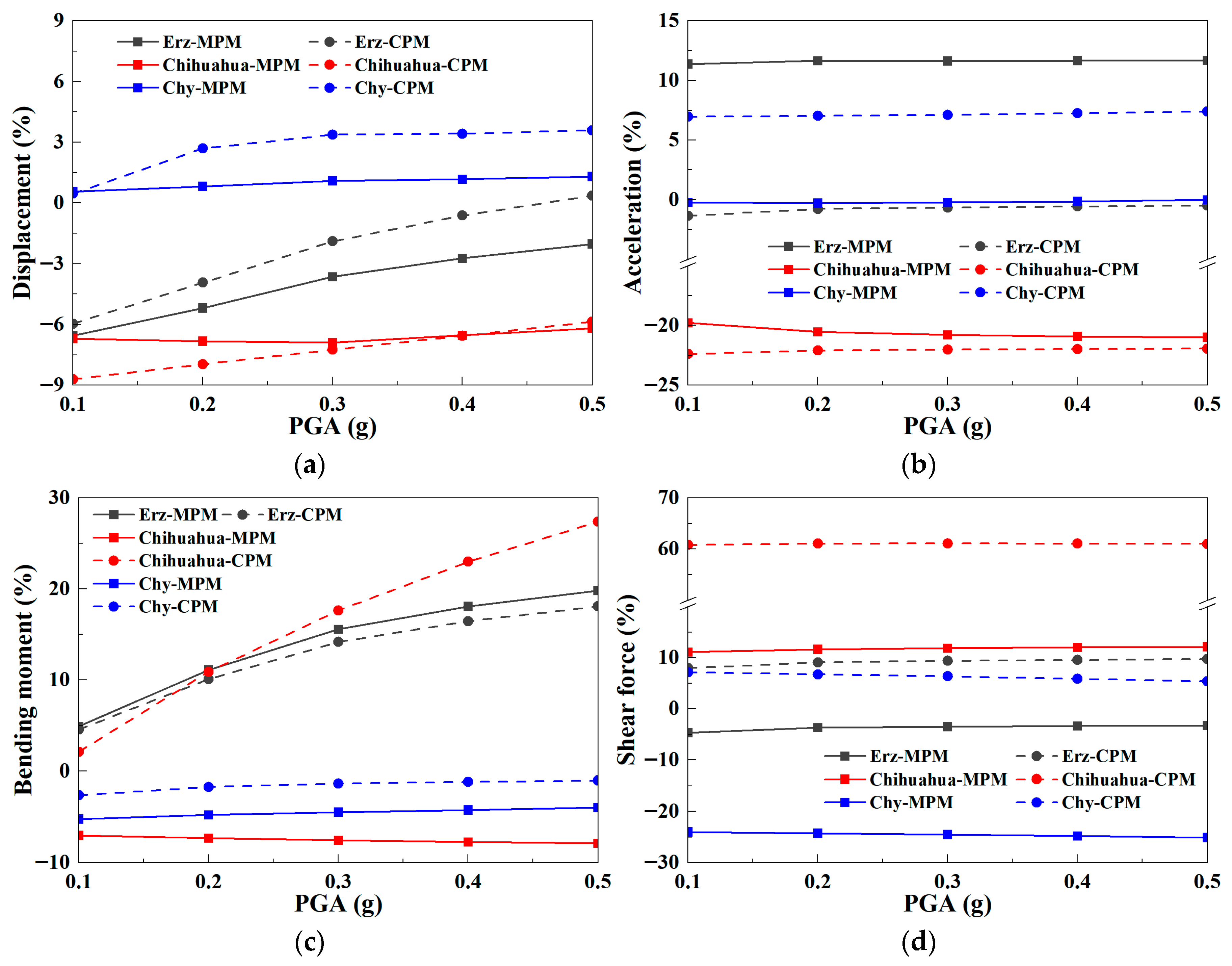
The errors of the MPM and CPM under different PGAs are listed in Figure 15. For peak tower-top displacement, the prediction accuracy of the MPM and CPM improves with increasing seismic intensity under the Erz and Chihuahua earthquakes, with errors controlled within ±6%. For peak tower-top acceleration, large errors are observed in the Chihuahua earthquake. For the mudline bending moment, an obvious PGA-dependent trend appears in the Erz earthquake with small errors only at a low PGA, while errors remain within ±10% across all PGAs in the Chihuahua earthquake. For mudline shear force, all models exhibit high sensitivity.
Under the far-field Chy record (Figure 14), the errors for displacement, acceleration, and bending moment are relatively controlled (mostly within ±8%). However, under the near-field Erz and Chihuahua records (Figure 12 and Figure 13), significant deviations emerge. Specifically, the MPM and CPM severely underestimate high-frequency sensitive parameters, such as the peak nacelle acceleration (up to −22.01% error under Chihuahua) and mudline shear force (reaching a critical error of −61.09% for the CPM under Chihuahua).
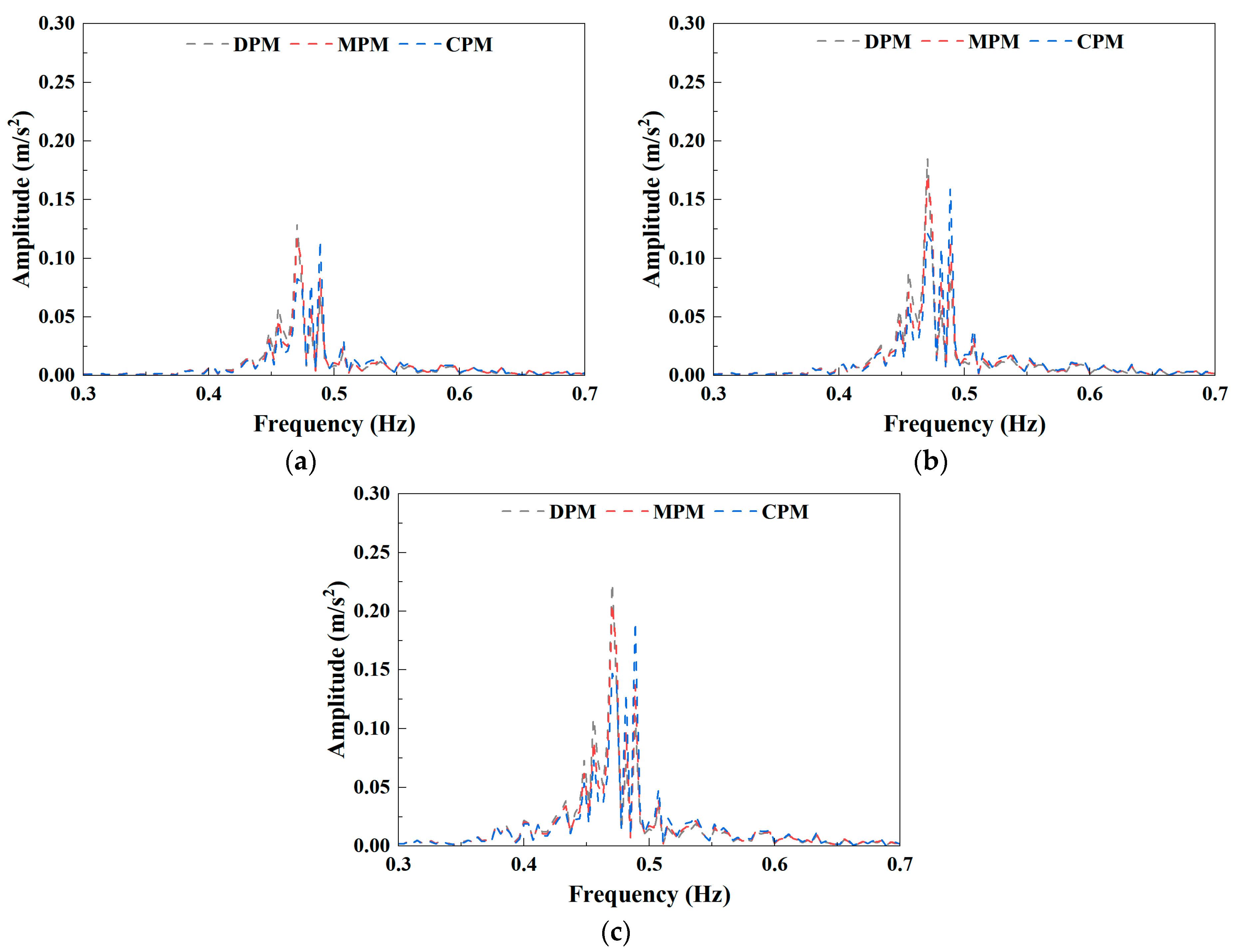
The fundamental physical mechanism behind these critical discrepancies is elucidated by the Fourier amplitude spectra in Figure 16. Under the far-field Chy excitation (Figure 16c), the spectral energy is concentrated in the long-period range, resulting in a fundamental-mode-dominated response where the degraded coupling in the MPM/CPM yields tolerable errors. Conversely, under the near-field Erz and Chihuahua excitations (Figure 16a,b), the spectra exhibit substantial high-frequency content that effectively excites higher-order modes. Because the MPM and CPM fundamentally degrade the elastic–inertial coupling between the tower and RNA into rigid-body interaction (as discussed in Section 4.1), they are inherently incapable of capturing these higher-mode contributions. This distortion of the dynamic coupling under high-frequency excitation leads to the severe underestimation of shear demand and acceleration observed in the time histories.
In essence, the neglect of blade flexibility and rotational inertia in the MPM and CPM degrades the complex elastic–inertial coupled system into a rigid-translational mass system. Under far-field motions (e.g., Chy), where the fundamental global translation mode dominates, this degradation yields tolerable errors. However, under near-field motions (e.g., Erz and Chihuahua), the rich high-frequency components strongly excite higher-order modes that are highly sensitive to the elastic and inertial coupling between the tower and RNA. Consequently, the degraded coupling in the MPM and CPM severely distorts the physical essence of the dynamic response under near-field excitation, leading to unconservative and unignorable errors, such as the −61.09% error in mudline shear force observed under the Chihuahua record.
It is crucial to note that the ±10% acceptable deviation valid for wave loads cannot be extrapolated to seismic analyses. Under near-field motions (e.g., Chihuahua), the degradation of elastic–inertial coupling in the MPM and CPM leads to severe underestimations of high-frequency sensitive parameters (e.g., −61.09% error in mudline shear force). In seismic design for the ultimate limit state (ULS), such unconservative errors exceeding 15–20% are physically unacceptable, as they fail to capture the true shear demand and may lead to unsafe foundation designs. Therefore, a stricter accuracy requirement must be enforced for seismic analyses, and the applicability of simplified models must be re-evaluated based on the spectral characteristics of the input motion.


5. Conclusions

Modern multi-megawatt wind turbines possess complex RNA dynamics, yet industry practice often relies on simplified models whose applicability remains inadequately studied. To address this gap, this study established three structural models for the 15 MW RWT using ADINA: (a) a distributed-parameter model (DPM); (b) a multi-particle model (MPM); and (c) a point-mass model (CPM). Rigorously verified against BModes and OpenFAST, these models enabled a comprehensive assessment of effects of the RNA modeling technique through: (1) quantifying natural frequency and mode shape prediction accuracy; (2) analyzing dynamic responses under seismic loads; and (3) elucidating seismic spectral characteristics (e.g., near-field vs. far-field motions) as key factors governing model discrepancies. The principal findings are summarized as follows:
  • The RNA structural model significantly impacts higher-order modes and natural frequencies. The MPM and CPM, which lack explicit blade modeling, fail to capture blade deformation modes. Changes in blade flexibility and rotary inertia result in the loss of local blade modes, impair the elastic coupling between the tower and RNA, and degrade the dynamic coupling into rigid-body interaction. This simplification significantly modifies the higher-mode responses and inertia transfer characteristics. For natural frequencies, predictions from all three models agree within 5.4%, validating the MPM and CPM for preliminary fundamental frequency analysis. However, substantial discrepancies emerge for second-order tower modes: the MPM and CPM exhibited errors of −9.51% and −15.27%, respectively, for the second FA frequency, and −20.29% and −25.21%, respectively, for the second SS frequency.
  • Under wave excitation, differences in peak responses among the three models are relatively minor. For the 15 MW MOWT, the peak periods of the wave spectrum exceed the system’s fundamental period across normal and extreme sea states, resulting in fundamental-mode-dominated responses. For selected parameters, predictions from the MPM and CPM fall within ±10% of the DPM, collectively demonstrating their validity for wave-induced peak response prediction under standard engineering accuracy thresholds.
  • Discrepancies among the model predictions are more pronounced under seismic excitation than under wave loading. The prediction errors of the MPM and CPM are strongly influenced by the spectral characteristics of the ground motion. Under far-field ground motions (rich in long-period components, e.g., the Chy record), where the fundamental mode dominates the response, the errors of the MPM and CPM are smaller. Conversely, larger errors occur under near-field ground motions (e.g., Erz and Chihuahua records), which more effectively excite higher modes. Especially under the near-field Chihuahua record, the error is more significant, with the mudline bending moment response errors of the CPM even reaching −61.09%.
When it is necessary to use models other than the DPM, priority should be given to the MPM, with the CPM considered last. The use of the CPM should be avoided in seismic response analysis, particularly for near-field earthquakes. As this study focused specifically on the 15 MW MOWT, sufficient verification is strongly recommended when selecting an RNA structural model for the dynamic analysis of turbines with different scales and configurations. Furthermore, exploring the coupling effects of combined environmental loads (e.g., wind–wave–earthquake) and incorporating SSI more rigorously would enhance practical relevance. Finally, experimental verification of simulated dynamic responses, particularly for higher-modes loads, remains crucial for bolstering model confidence. While the selected ground motions successfully demonstrate the existence of RNA model sensitivity, this limited sample size cannot fully capture the stochastic variability of seismic excitations. Future work will employ a broader suite of ground motion records to quantitatively evaluate the influence of seismic characteristics on this structural sensitivity.

Author Contributions

Conceptualization, R.X.; methodology, C.W. and H.Q.; software, C.W.; validation, H.Q.; formal analysis, C.W.; investigation, C.W. and R.X.; data curation, C.W. and H.Q.; writing—original draft preparation, C.W.; writing—review and editing, H.Q. and R.X.; supervision, H.Q. and R.X.; funding acquisition, R.X. All authors have read and agreed to the published version of the manuscript.

Funding

This research is jointly funded by the National Natural Science Foundation of China (Grant No.: 52278480 and 52301343), the Natural Science Foundation of Zhejiang Province (Grant No.: LQ23E090003), and the “Leading Goose” R&D Program of Zhejiang (Grant No.: 2023C03122).

Data Availability Statement

The data are available in the article.

Conflicts of Interest

The authors declare no conflict of interest.

References

  1. Alves Ribeiro, J.; Alves Ribeiro, B.; Pimenta, F.; Tavares, S.M.O.; Zhang, J.; Ahmed, F. Offshore wind turbine tower design and optimization: A review and AI-driven future directions. Appl. Energy 2025, 397, 126294. [Google Scholar] [CrossRef]
  2. Zhou, M.; Yang, N.X.; Tian, Y.H.; Zhang, X.H. Inclined Pullout Capacity of Suction Anchors in Clay over Silty Sand. J. Geotech. Geoenviron. Eng. 2023, 149, 04023030. [Google Scholar] [CrossRef]
  3. Sánchez, S.; López-gutiérrez, J.S.; Negro, V. Foundations in Offshore Wind Farms: Evolution, Characteristics and Range of Use. Analysis of Main Dimensional Parameters in Monopile Foundations. J. Mar. Sci. Eng. 2019, 7, 441. [Google Scholar] [CrossRef]
  4. Jahani, K.; Langlois, R.G.; Afagh, F.F. Structural dynamics of offshore Wind Turbines: A review. Ocean Eng. 2022, 251. [Google Scholar] [CrossRef]
  5. Ali, A.; De Risi, R.; Sextos, A.; Goda, K.; Chang, Z.W. Seismic vulnerability of offshore wind turbines to pulse and non-pulse records. Earthq. Eng. Struct. Dyn. 2020, 49, 24–50. [Google Scholar] [CrossRef]
  6. Yang, C.; Xiao, L.; Chen, P.; Cheng, Z.; Liu, M.; Liu, L. An analytical frequency-domain model of aerodynamic mass and damping of floating wind turbines. Wind Energy 2023, 26, 1140–1164. [Google Scholar] [CrossRef]
  7. Ozturkoglu, O.; Ozcelik, O.; Günel, S. Effects of Operational and Environmental Conditions on Estimated Dynamic Characteristics of a Large In-service Wind Turbine. J. Vib. Eng. Technol. 2024, 12, 803–824. [Google Scholar] [CrossRef]
  8. Bai, J.L.; Li, C.H.; Gong, Y.A.; Wang, Y.H. Dynamic Response Analysis of Offshore Wind Turbine Considering Rotor-nacelle Assembly (RNA) Operation. Eng. Mech. 2022, 39, 97–108. [Google Scholar] [CrossRef]
  9. Wang, J.; Sun, G.; Chen, G.; Yang, X. Finite element analyses of improved lateral performance of monopile when combined with bucket foundation for offshore wind turbines. Appl. Ocean Res. 2021, 111, 102647. [Google Scholar] [CrossRef]
  10. Bazeos, N.; Hatzigeorgiou, G.D.; Hondros, I.D.; Karamaneas, H.; Karabalis, D.L.; Beskos, D.E. Static, seismic and stability analyses of a prototype wind turbine steel tower. Eng. Struct. 2002, 24, 1015–1025. [Google Scholar] [CrossRef]
  11. Khalil, Z.; Stafford, P.J.; Elghazouli, A.Y. Risk-Based Structural Seismic Response Assessment of Large-Scale Jacket-Supported Offshore Wind Turbines. Earthq. Eng. Struct. Dyn. 2025, 54, 2044–2061. [Google Scholar] [CrossRef]
  12. Schafhirt, S.; Muskulus, M. Decoupled simulations of offshore wind turbines with reduced rotor loads and aerodynamic damping. Wind Energy Sci. 2018, 3, 25–41. [Google Scholar] [CrossRef]
  13. Yang, X.; Zeng, X.; Wang, X.; Yu, H. Performance of monopile-friction wheel foundations under lateral loading for offshore wind turbines. Appl. Ocean Res. 2018, 78, 14–24. [Google Scholar] [CrossRef]
  14. Liu, J.; Chen, L.; Xu, S.; Ning, D. Coupled dynamic analysis approach for the ringing response of monopile-supported offshore wind turbines. Ocean Eng. 2025, 339, 122104. [Google Scholar] [CrossRef]
  15. Kim, D.J.; You, Y.S.; Sun, M.Y. Variable Natural Frequency Damper for Minimizing Response of Offshore Wind Turbine: Effect on Dynamic Response According to Inner Water Level. J. Mar. Sci. Eng. 2024, 12, 491. [Google Scholar] [CrossRef]
  16. Ngo, D.V.; Kim, D.H. Seismic responses of different types of offshore wind turbine support structures. Ocean Eng. 2024, 297, 117108. [Google Scholar] [CrossRef]
  17. Dong, X.F.; Jia, Y.M.; Li, W.J.; Jiang, J.N.; Zhou, H. Vibration Simulation Study of Offshore Wind Turbine with Bucket Foundation Considering The Influence of Aerodynamic Damping in Operational State. China Ocean Eng. 2024, 42, 11–23. [Google Scholar] [CrossRef]
  18. Li, B.; Jia, C.; Chen, Y.; Wang, S.; Yang, S.; Wu, Y. Dynamic response of monopile-supported wind turbines considering wake effect. Ocean Eng. 2025, 339, 122124. [Google Scholar] [CrossRef]
  19. Zou, X.J.; Yang, Z.J.; Zhou, M.H.; Huang, L.Y. Horizontal dynamic response of single offshore pile enhanced by wheel in saturated soil layer considering effect of upper wind turbine tower. Soil Dyn. Earthq. Eng. 2025, 198, 109561. [Google Scholar] [CrossRef]
  20. Huang, Y.M.; Wang, Q.Z.; Jiang, J.T.; Wang, P.G.; Zhao, M.; Du, X.L. Theoretical modeling of simplified offshore wind turbines with monopile support under multiple environmental load coupling. Mar. Struct. 2025, 103, 103842. [Google Scholar] [CrossRef]
  21. Tombari, A.; Rostami, R.; Mackay, E.; El Naggar, M.H. Stiffness-proportional foundation damping to linearise soil-monopile interaction models for wind turbines. Soil Dyn. Earthq. Eng. 2025, 195, 109387. [Google Scholar] [CrossRef]
  22. Shi, H.D.; Yan, Y.T.; Yue, M.N.; Li, C.; Niu, K.L. Study on Dynamic Response of Wind Turbine Scour Effect Under Extreme Sea Conditions. J. Chin. Soc. Power Eng. 2024, 44, 1060–1067. [Google Scholar] [CrossRef]
  23. Sigurdsson, G.; Rupakhety, R.; Rahimi, S.E.; Olafsson, S. Effect of pulse-like near-fault ground motions on utility-scale land-based wind turbines. Bull. Earthq. Eng. 2020, 18, 953–968. [Google Scholar] [CrossRef]
  24. Murtagh, P.J.; Basu, B.; Broderick, B.M. Along-wind response of a wind turbine tower with blade coupling subjected to rotationally sampled wind loading. Eng. Struct. 2005, 27, 1209–1219. [Google Scholar] [CrossRef]
  25. Huo, T.; Tong, L.W. Wind-induced response analysis of wind turbine tubular towers with consideration of rotating effect of blades. Adv. Struct. Eng. 2020, 23, 289–306. [Google Scholar] [CrossRef]
  26. Ren, Q.Q.; Xu, Y.Z.; Zhang, H.; Lin, X.H.; Huang, W.; Yu, J.Q. Shaking table test on seismic responses of a wind turbine tower subjected to pulse-type near-field ground motions. Soil Dyn. Earthq. Eng. 2021, 142, 106557. [Google Scholar] [CrossRef]
  27. Duan, L.X.; Wang, W.D.; Zheng, L.; Shi, Y.L. Dynamic response analysis of monopile CFDST wind turbine tower system under wind-wave-seismic coupling action. Thin-Walled Struct. 2024, 202, 112089. [Google Scholar] [CrossRef]
  28. Xi, R.Q.; Xu, C.S.; Du, X.L.; Xu, K. Uncoupled Analysis Method for Seismic Response of Wind Turbines in the Operational Condition. Eng. Mech. 2022, 39, 20–30. [Google Scholar] [CrossRef]
  29. Failla, G.; Santangelo, F.; Foti, G.; Scali, F.; Arena, F. Response-Spectrum Uncoupled Analyses for Seismic Assessment of Offshore Wind Turbines. J. Mar. Sci. Eng. 2018, 6, 85. [Google Scholar] [CrossRef]
  30. Xie, S.Y.; Gao, J.; Li, Y.R.; Jiang, S.X.; Zhang, C.L.; He, J. Aero-Hydro-Elastic-Servo Modeling and Dynamic Response Analysis of A Monopile Offshore Wind Turbine Under Different Operating Scenarios. China Ocean Eng. 2024, 38, 379–393. [Google Scholar] [CrossRef]
  31. Simpson, H.A.; Chatzi, E.N.; Chatzis, M.N. A sub-structuring approach to overcome model limitations for input-state estimation of offshore wind turbines. J. Sound. Vib. 2025, 612, 119153. [Google Scholar] [CrossRef]
  32. Duan, L.X.; Wang, W.D.; Shi, Y.L.; Zheng, L. Shaking table test and finite element analysis of composite wind turbine tower system with tapered large void ratio CFDST member. Thin-Walled Struct. 2025, 215, 113474. [Google Scholar] [CrossRef]
  33. Zuo, H.R.; Bi, K.M.; Hao, H.; Li, C. Influence of earthquake ground motion modelling on the dynamic responses of offshore wind turbines. Soil Dyn. Earthq. Eng. 2019, 121, 151–167. [Google Scholar] [CrossRef]
  34. Huang, H.S. Simulations of 10MW wind turbine under seismic loadings. Compos. Struct. 2022, 279, 114686. [Google Scholar] [CrossRef]
  35. Guo, Z.J.; Hou, W.; Yao, H.J.; Liu, Y.; Zhang, Y.X. Dynamic responses of monopile offshore wind turbines under different wind-wave misalignment angles. Structures 2024, 69, 107454. [Google Scholar] [CrossRef]
  36. Ali, A.; De Risi, R.; Sextos, A. Seismic assessment of wind turbines: How crucial is rotor-nacelle-assembly numerical modeling? Soil Dyn. Earthq. Eng. 2021, 141, 106483. [Google Scholar] [CrossRef]
  37. Shi, S.G.; Zhai, E.D.; Xu, C.S.; Du, X.L.; Sun, Y.L. Effects of Rotor-Nacelle Assembly Models on the Structural Natural Frequencies and Seismic Response of Offshore Wind Turbines. Eng. Mech. 2023, 40, 19–27+36. [Google Scholar] [CrossRef]
  38. Lai, Y.Q.; Li, W.; He, B.; Xiong, G.; Xi, R.Q.; Wang, P.G. Influence of Blade Flexibility on the Dynamic Behaviors of Monopile-Supported Offshore Wind Turbines. J. Mar. Sci. Eng. 2023, 11, 2041. [Google Scholar] [CrossRef]
  39. Rodríguez-Galván, E.; Alamo, G.M.; Aznárez, J.J.; Maeso, O. Non-Linear Behaviour of Soil-Pile Interaction Phenomena and Its Effect on the Seismic Response of OWT Pile Foundations. Validity Range of a Linear Approach through Non-Degraded Soil Properties. Comput. Geotech. 2024, 168, 106188. [Google Scholar] [CrossRef]
  40. Ju, S.H.; Mao, Y.C. Research on Offshore Wind Turbine Support Structures under Seismic Soil Liquefaction. Ocean Eng. 2024, 304, 117750. [Google Scholar] [CrossRef]
  41. Medina, C.; Alamo, G.M.; Padrón, L.A. Contribution of the Rotational Kinematic Interaction to the Seismic Response of Monopile-Supported Offshore Wind Turbines. Ocean Eng. 2023, 280, 114778. [Google Scholar] [CrossRef]
  42. Shahzad, M.M.; Farooq Khan, M.H.; Lee, D. Parametric sensitivity analysis of soil properties for retrofitted offshore wind turbine jacket substructures under combined environmental loading. Ocean Eng. 2025, 341, 122690. [Google Scholar] [CrossRef]
  43. Shahzad, M.M.; Farooq Khan, M.H.; Lee, D. Analyzing the structural integrity of retrofitted jacket substructures for an offshore wind turbine under nonlinear dynamic loading. Appl. Ocean Res. 2025, 165, 104862. [Google Scholar] [CrossRef]
  44. Koragappa, P.; Verdin, P.G. Design and Optimisation of a 20 MW Offshore Wind Turbine Blade. Ocean Eng. 2024, 305, 117975. [Google Scholar] [CrossRef]
  45. Zahle, F.; Barlas, A.; Lønbæk, K. Definition of the IEA Wind 22-Megawatt Offshore Reference Wind Turbine; Technical University of Denmark: Lyngby, Denmark, 2024. [Google Scholar]
  46. Jonkman, J.; Butterfield, S.; Musial, W.; Scott, G. Definition of a 5-MW Reference Wind Turbine for Offshore System Development; National Renewable Energy Laboratory: Golden, CO, USA, 2009. Available online: https://www.osti.gov/biblio/947422 (accessed on 8 April 2026).
  47. Bak, C.; Zahle, F.; Bitsche, R.; Kim, T.; Yde, A.; Henriksen, L.C.; Hansen, M.H.; Blasques, J.P.A.A.; Gaunaa, M.; Natarajan, A. Description of the DTU 10-MW Reference Wind Turbine; DTU Wind Energy: Roskilde, Denmark, 2013. Available online: https://orbit.dtu.dk/files/55645274/The_DTU_10MW_Reference_Turbine_Christian_Bak.pdf (accessed on 14 April 2026).
  48. Gaertner, E.; Rinker, J.; Sethuraman, L.; Zahle, F.; Anderson, B.; Barter, G.E.; Abbas, N.J.; Meng, F.; Bortolotti, P.; Skrzypinski, W.; et al. IEA Wind TCP Task 37: Definition of the IEA 15-Megawatt Offshore Reference Wind Turbine; National Renewable Energy Laboratory: Golden, CO, USA, 2020. [Google Scholar]
  49. Sunday, K.; Brennan, F. A Review of Offshore Wind Monopiles Structural Design Achievements and Challenges. Ocean Eng. 2021, 235, 109409. [Google Scholar] [CrossRef]
  50. IEC61400-6; Wind Energy Generation Systems—Part 6: Tower and Foundation Design Requirements. International Electrotechnical Commission: Geneva, Switzerland, 2019.
  51. Arany, L.; Bhattacharya, S.; Macdonald, J.; Hogan, S.J. Design of Monopiles for Offshore Wind Turbines in 10 Steps. Soil Dyn. Earthq. Eng. 2017, 92, 126–152. [Google Scholar] [CrossRef]
  52. ADINA. ADINA Theory and Modeling Guide; ADINA R&D Inc.: Watertown, MA, USA, 2014. [Google Scholar]
  53. Makris, N.; Gazetas, G. Dynamic pile-soil-pile interaction. Part II: Lateral and seismic response. Earthq. Eng. Struct. Dyn. 1992, 21, 145–162. [Google Scholar] [CrossRef]
  54. Sun, Y.L.; Xu, C.S.; Du, X.L.; Du, X.P.; Xi, R.Q. A Modified p-y Curve Model of Large-Monopiles of Offshore Wind Power Plants. Eng. Mech. 2021, 38, 44–53. [Google Scholar] [CrossRef]
  55. API. Recommended Practice for Planning, Design and Constructing Fixed Offshore Platforms Working Stress Design; American Petroleum Institute: Washington, DC, USA, 2014. [Google Scholar]
  56. Yang, S.H.; Deng, X.W.; Zhang, M.M.; Xu, Y.X. Effect of wave spectral variability on the dynamic response of offshore wind turbine considering soil-pile-structure interaction. Ocean Eng. 2023, 267, 113222. [Google Scholar] [CrossRef]
  57. Abhinav, K.A.; Saha, N. Stochastic response of jacket supported offshore wind turbines for varying soil parameters. Renew. Energy 2017, 101, 550–564. [Google Scholar] [CrossRef]
  58. Branlard, E. Generation of Time Series from a Spectrum: Generation of Wind Times Series from the Kaimal Spectrum Generation of Wave Times Series from the JONSWAP Spectrum; Risø National Laboratory: Roskilde, Denmark, 2010. [Google Scholar]
  59. Fischer, T.; De Vries, W.; Schmidt, B. Upwind Design Basis (WP4: Offshore Foundations and Support Structures); Commission of the European Communities: Stuttgart, Germany, 2011. [Google Scholar]
  60. Jonkman, J.M.; Buhl, M.L., Jr. OpenFAST User Manual (NREL/TP-5000-70400); National Renewable Energy Laboratory: Golden, CO, USA, 2017. [Google Scholar]
  61. Code for Seismic Design of Buildings. 2014. Available online: http://www.lancarver.com/UpFiles/pdf/2014-03-11/031114512416.pdf (accessed on 14 April 2026).
Figure 1. Property of blade for IEA 15 MW reference wind turbine: (a) mass distribution of blade and (b) stiffness distribution of blade.
Jmse 14 00956 g001
Figure 2. Coordinate system of 15 MW MOWT: (a) global and tower-top coordinate system and (b) blade and cross-section coordinate system.
Jmse 14 00956 g002
Figure 3. Different structural models of 15 MW MOWT: (a) DPM; (b) MPM; (c) CPM.
Jmse 14 00956 g003
Figure 4. Soil profile of typical marine site.
Jmse 14 00956 g004
Figure 5. Response of 15 MW MOWT using ADINA and OpenFAST: (a) tower-top displacement along the x-axis and (b) mudline shear force along the x-axis.
Jmse 14 00956 g005
Figure 6. First ten mode shapes of 15 MW MOWT using DPM.
Jmse 14 00956 g006
Figure 7. First several mode shapes of 15 MW MOWT using MPM and CPM: (a) MPM; (b) CPM.
Jmse 14 00956 g007
Figure 8. Response history of 15 MW MOWT excited by wave load (wave load 1 of Table 5): (a) nacelle displacement along x-axis; (b) nacelle acceleration along x-axis; (c) mudline bending moment about the y-axis and (d) mudline shear force along the x-axis.
Jmse 14 00956 g008
Figure 9. Response history of 15 MW MOWT excited by wave load (wave load 2 of Table 5): (a) nacelle displacement along x-axis; (b) nacelle acceleration along x-axis; (c) mudline bending moment about the y-axis and (d) mudline shear force along the x-axis.
Jmse 14 00956 g009aJmse 14 00956 g009b
Figure 10. Response history of 15 MW MOWT excited by wave load (wave load 3 of Table 5): (a) nacelle displacement along x-axis; (b) nacelle acceleration along x-axis; (c) mudline bending moment about the y-axis and (d) mudline shear force along the x-axis.
Jmse 14 00956 g010
Figure 11. Fourier amplitude spectra of tower-top acceleration excited by wave load: (a) wave load 1; (b) wave load 2; (c) wave load 3.
Jmse 14 00956 g011
Figure 12. Seismic response of 15 MW MOWT excited by Erz record in 0.3 g: (a) nacelle displacement along x-axis; (b) nacelle acceleration along x-axis; (c) mudline bending moment about the y-axis and (d) mudline shear force along the x-axis.
Jmse 14 00956 g012
Figure 13. Seismic response of 15 MW MOWT excited by Chihuahua record in 0.3 g: (a) nacelle displacement along x-axis; (b) nacelle acceleration along x-axis; (c) mudline bending moment about the y-axis and (d) mudline shear force along the x-axis.
Jmse 14 00956 g013aJmse 14 00956 g013b
Figure 14. Seismic response of 15 MW MOWT excited by Chy record in 0.3 g: (a) nacelle displacement along x-axis; (b) nacelle acceleration along x-axis; (c) mudline bending moment about the y-axis and (d) mudline shear force along the x-axis.
Jmse 14 00956 g014
Figure 15. Seismic response peak relative error of 15 MW MOWT excited by different earthquake records with different PGAs: (a) nacelle displacement along x-axis; (b) nacelle acceleration along x-axis; (c) mudline bending moment about the y-axis and (d) mudline shear force along the x-axis.
Jmse 14 00956 g015
Figure 16. Fourier amplitude spectra of tower-top acceleration excited by different seismic records: (a) Erz; (b) Chihuahua and (c) Chy.
Jmse 14 00956 g016
Table 1. Natural frequency and RNA weight of wind turbines with different levels of power.
TypeHub Height (m)RNA Mass (kg)Natural Frequency (Hz)
NREL 5 MW90350,0000.25
DTU 10 MW119675,0000.22
IEA 15 MW1501,016,6380.18
Table 2. Properties of 15 MW MOWT.
PartProperty (Unit)Value
BladeRotor diameter (m)242
Hub height (m)150
Cut-in, rated, and cut-out wind speed (m/s)3, 10.59, 25
Cut-in and rated rotor speed (rpm)5.0 and 7.56
Length (m)117
Overall mass (kg)65,250
Hub and nacelleHub diameter (m)7.94
Hub mass (kg)190,000
Nacelle mass (kg)630,888
TowerBottom and top outer diameter (m)10 and 6.5
Bottom and top wall thickness (mm)55.582 and 28.739
Overall mass (kg) 860,000
Structural damping ratio (%)2
MonopileTotal weight (kg)1,318,000
Outer diameter (m)10
Wall thickness (mm)55.341
Total monopile length (m)90
Embedment depth (m)45
Table 3. Mass properties of RNA for IEA 15 MW MOWTs.
ComponentMass/tCenter of Mass
(xcm, zcm)/m
Mass Moment of Inertia
(Jxx, Jyy, Jzz)/(×107 kg·m2)
Blades195.700(10.064, 5.462)(34.9332, 17.4665, 17.4666)
Hub190.000(10.064, 5.462)(0.1382, 0.2169, 0.2161)
Nacelle total820.888(5.486, 3.978)(1.2607, 2.1434, 1.8682)
Nacelle total minus hub630.888(3.945, 3.352)(1.0681, 12.2448, 1.0046)
(Note: xcm and zcm are center of mass position about tower top; Jxx, Jyy, and Jzz are about RNA center of mass).
Table 4. Material properties.
ComponentMaterialYoung’s Modulus E (GPa)Poisson’s Ratio μInitial Yield Stress fy (MPa)Density ρ (kg/m3)
Tower and monopileSteel2100.33458500
BladeComposite200.25-1400
Table 5. Parameters of JONSWAP spectrum.
Wave LoadSignificant Wave Height Hs (m)Peak Period Tp (m)Description
11.1805.760Hub mean wind speed 6 m/s
21.5355.775Hub mean wind speed 10.59 m/s
32.4706.710Hub mean wind speed 18 m/s
Table 6. Seeds of waves generation at an average wind speed of 6 m/s at the hub.
Seed123456
Value12,147,67831,552,357517,001,321461,064,23298,017,64420,070,402
Table 7. Summary of earthquake records.
Seismic RecordsEvent, YearStationComponentTypeDuration (s)
1Erzincan—Turkey, 1992ErzincanErz-x, Erz-y, Erz-zimpulse19.885
2Imperial Valley, 1979Chihuahuachi-x, chi-y, chi-znear field39.99
3Chi-Chi, 1999Chy101Chy-x, Chy-y, Chy-zfar field89.995
Table 8. Natural frequencies of supporting structure of 15 MW MOWT.
ModesBModes (Hz)ADINA (Hz)Relative Difference
SS 1st0.18520.18540.108%
FA 1st0.18680.18690.054%
SS 2nd0.81570.81670.123%
FA 2nd0.86470.86420.058%
Table 9. Full-system natural frequencies of 15 MW MOWT.
DPMMPMCPM
ModeFrequency (Hz)DescriptionModeFrequency (Hz)DescriptionModeFrequency (Hz)Description
10.18131st Tower SS10.18211st Tower SS10.18541st Tower SS
20.18221st Tower FA20.18351st Tower FA20.18691st Tower FA
30.47091st Blade Asymmetric Edgewise30.87042nd Tower SS30.81672nd Tower SS
40.49681st Blade Symmetric Edgewise40.93272nd Tower FA40.86422nd Tower FA
50.52381st Blade Symmetric Edgewise51.03101st Tower Torsion   
60.62331st Blade Asymmetric Flapwise      
70.71851st Blade Symmetric Flapwise      
80.72601st Blade Asymmetric Flapwise      
91.02002nd Tower FA and 2nd Blade Symmetric Edgewise      
101.09202nd Tower SS and 2nd Blade Asymmetric Edgewise      
Table 10. The average parameters of each seed under wave excitation (wave load 1).
ModelPeak ValueRMS
Nacelle displacement (m)DPM0.6560.417
MPM0.6190.386
CPM0.6070.377
Nacelle acceleration (m/s2)DPM0.3370.704
MPM0.3420.701
CPM0.3390.706
Mudline bending moment (MN‧m)DPM167.51483.972
MPM160.73278.084
CPM157.12476.333
Mudline shear force (MN)DPM1.3570.426
MPM1.3690.424
CPM1.3680.421
Table 11. The average parameters of each seed under wave excitation (wave load 2).
ModelPeak ValueRMS
Nacelle displacement (m)DPM0.7610.427
MPM0.7190.396
CPM0.7040.386
Nacelle acceleration (m/s2)DPM0.4730.163
MPM0.4760.163
CPM0.4710.162
Mudline bending moment (MN‧m)DPM205.34589.783
MPM197.99184.199
CPM192.90382.195
Mudline shear force (MN)DPM1.8120.568
MPM1.8250.571
CPM1.8210.567
Table 12. The average parameters of each seed under wave excitation (wave load 3).
ModelPeak ValueRMS
Nacelle displacement (m)DPM0.8780.439
MPM0.8290.408
CPM0.8010.397
Nacelle acceleration (m/s2)DPM0.6030.205
MPM0.5960.202
CPM0.5830.200
Mudline bending moment (MN‧m)DPM257.61698.521
MPM245.31092.812
CPM238.28090.506
Mudline shear force (MN)DPM3.0750.962
MPM3.0680.960
CPM3.0770.954
Disclaimer/Publisher’s Note: The statements, opinions and data contained in all publications are solely those of the individual author(s) and contributor(s) and not of MDPI and/or the editor(s). MDPI and/or the editor(s) disclaim responsibility for any injury to people or property resulting from any ideas, methods, instructions or products referred to in the content.