Article

Research on the Mechanism of Adhesion Force of Ship Icing Based on Ultrasonic Anti-Icing and De-Icing System


1
School of Naval Architecture and Ocean Engineering, Jiangsu University of Science and Technology, Zhenjiang 212000, China
2
Jiangsu Ship & Marine Design and Research Institute, Zhenjiang 212000, China
3
Centre for Marine Technology and Ocean Engineering (CENTEC), Instituto Superior Técnico, Universidade de Lisboa, 1049-001 Lisboa, Portugal
4
Department of Energy, Aalborg University, 9220 Esbjerg, Denmark
*
Author to whom correspondence should be addressed.
These authors contributed equally to this work.
J. Mar. Sci. Eng. 2026, 14(10), 928; https://doi.org/10.3390/jmse14100928 (registering DOI)
Submission received: 20 March 2026 / Revised: 30 April 2026 / Accepted: 10 May 2026 / Published: 18 May 2026
(This article belongs to the Section Ocean Engineering)

Abstract

The ultrasonic anti-icing and de-icing system applies an electrical field to the ship’s surface to weaken the adhesion between the ice layer and the steel plates, while using ultrasonic vibration to generate longitudinal shear forces that break the remaining adhesion, thereby achieving effective de-icing. This study employs the control variable method to examine how different vibration frequencies and configurations of ultrasonic vibrators (“de-icing formations”) impact the adhesion characteristics of the ice layer covering the hull steel plates. Due to the lack of existing experimental instruments for measuring the adhesion force of ship icing, we designed an intelligent device to test the adhesion force between the ship and the ice layer. This device incorporates high-precision sensors and an advanced data acquisition system, enabling real-time measurement and recording of adhesion force data between icing and the hull steel plates. Using the newly developed JUST flat plate adhesion force testing system, this study evaluates how various distribution strategies of ultrasonic vibrators influence the ice adhesion force. Furthermore, the experiment investigates the de-icing efficiency of ultrasonic vibrators with the same number of but different “de-icing formations” and vibration frequencies under identical conditions of ice thickness, time, and excitation current, and provides a detailed analysis of the variation in ice adhesion force. These results clarify the mechanism by which the ultrasonic system manages the adhesion force of ship icing. This research not only introduces new ideas and methods for ship anti-icing and de-icing technology but also offers a scientific basis for enhancing navigation safety and operational efficiency in icy conditions.

1. Introduction

With the rapid development of the global shipping industry, the frequency of ships sailing in cold regions is increasing, and ship icing has become a key factor restricting shipping safety [1]. Ice accumulation not only increases a ship’s resistance and reduces fuel efficiency but also impairs stability and can potentially lead to accidents [2,3]. Figure 1 illustrates common areas on ships prone to icing, including sides of the ship, external pipelines, hatches, and deck staircases. This icing not only affects ship operations but also increases crew workload and the risk of accidents. Therefore, developing efficient and environmentally friendly anti-icing and de-icing technologies is crucial for ensuring safe polar shipping and promoting sustainable development in the shipping industry [4,5].
(1) Traditional ship anti-icing and de-icing methods are as follows. ① Anti-icing coating materials: Coatings are applied on ship surfaces to prevent ice formation and reduce ice adhesion, so that ice can fall off naturally under external conditions such as vibration or wind [6]. This passive method is cost-effective and widely applicable. However, it may cause secondary icing on the surface, material failure under extreme weather [7], and environmental pollution [8]. ② Chemical de-icing: Spraying solutions that react with ice to reduce adhesion [9]. This method is simple and enables rapid de-icing but can pollute the environment and corrode the hull over time, requiring environmental assessments and anti-corrosion measures [10]; ③ Mechanical de-icing methods: The use of mechanical equipment, such as ice scrapers, de-icing shovels, etc., to physically remove the ice on the surface of the hull. This method is suitable for cases involving thicker ice and stronger adhesion, but the operation is more cumbersome and may cause damage to the hull surface [11,12]. Additionally, the efficiency of mechanical de-icing is relatively low, and the de-icing time is prolonged for ships with large icing areas, which may impact the ship’s normal navigation. Therefore, when selecting mechanical de-icing methods, factors such as de-icing efficiency, the degree of hull damage, and operational simplicity need to be considered comprehensively [13,14]. The ultrasonic anti-icing and de-icing system proposed in this paper [15] offers a novel solution for ship anti-icing by combining the electric field effect and ultrasonic vibration effect. The system utilizes the electric field adsorption effect to firmly fix the ultrasonic vibrator to the inner surface of the ship’s steel plate or metal material. It destroys the adhesion between the ice layer and the steel plate through the shear force generated by ultrasonic vibration, achieving a rapid and efficient de-icing effect.
(2) Ice adhesion strength is often measured by the shear method, centrifugal method, etc. The adhesion capacity between icing and material is an important index to assess the effectiveness of de-icing measures [16,17]. The shear method measures the adhesion strength of ice by applying an external force to induce shear damage between the ice and the test surface. For ships sailing in low-temperature environments, research on the ice adhesion strength on the surface of marine metal materials and the factors affecting the size of ice adhesion strength is crucial, and the current research by domestic and foreign scholars is not comprehensive [18,19]. Zhang [20] selected aluminum alloy and brass, which are common metallic materials for ships, to investigate surface hydrophobicity and ice solidification behavior. The effects of ambient temperature and surface oxidation degree were discussed. However, this work did not measure the ice adhesion strength of metal surfaces, and experimental research on ice adhesion for ship steel plate coatings was insufficient. Ding et al. [21] correlated the contact angle with ice adhesion strength, but their study lacked an in-depth analysis of ice adhesion on ship steel plates. In addition, Chen et al. [22] focused on the coating effect on ice accumulation. Their findings help reveal the ice accretion mechanism and support the development of anti-icing strategies. Nevertheless, their research lacked experimental measurements of ice adhesion force. Meanwhile, studies on the influence of different de-icing methods on the adhesion strength of surface ice remain limited worldwide. Therefore, this paper designs a test device for measuring ice adhesion on flat plates. The device is intended to fill the above research gap. By accurately measuring the ice adhesion strength on ship hull steel plates under various conditions, it can provide key data support for the evaluation and optimization of anti-icing and de-icing technologies. The device can not only simulate the icing conditions of actual ship steel plates but also flexibly adjust the vibration frequency and layout of ultrasonic vibrators, thereby comprehensively investigating the influence of the ultrasonic anti-icing system on ice adhesion characteristics. Through this study, we aim to provide new theoretical support and technical pathways for the development of ship de-icing technology, thereby further enhancing the safety and operational efficiency of ship navigation in cold regions, such as the polar regions [23].

2. Design and Methodology

2.1. Design of Test Device for the Adhesion of Flat Sheet Icing

Current ship de-icing methods aim to remove ice by breaking its adhesion to the metal surface. The main factors influencing ice removal are the peeling and shear forces between the ice and the material surface. Therefore, studying the mechanical properties of ice, particularly ice adhesion, is crucial [24,25]. Testing ice adhesion on ship hulls is essential for measuring de-icing effectiveness in Arctic waterways. Currently, there is a lack of systematic research on ship hull ice adhesion testing systems both domestically and internationally. Thus, designing a testing system for ship ice adhesion is a key scientific issue for accurately assessing ice conditions on polar ships.
This apparatus, designed for measuring ice adhesion strength on ship hull steel plates, incorporates several innovative features. First, a multi-size specimen slot design enables rapid adaptation to hull plate samples of varying materials and dimensions, while an ice-breaking pusher mechanism facilitates immediate initiation of the de-icing test. Second, the measurement principle leverages electrical-to-mechanical conversion, whereby the motor voltage (V) during testing is converted into force (kN). The average force over the test duration is then divided by the ice-covered area to yield the ice–substrate adhesion strength in pascals (kPa). Finally, a telescopic link cabin employing a chain transmission mechanism, driven steadily and uniformly by an electric motor, automates the ice-removal testing process. Crucially, the linkage retracts entirely into the cabin post-test, significantly optimizing spatial efficiency and enabling a compact, automated device architecture.
(1) In this paper, we designed and invented an intelligent device for testing the adhesion force between ships and the overlying ice. The device features a replaceable hull steel plate, and the back of the plate includes a mechanism for attaching ultrasonic vibrators, allowing for various arrangements of ultrasonic vibrators, different types of hull steel plates, and other experimental parameters. Thus, the device enables a comprehensive study of the impact of electrically attached ultrasonic vibrators on ice adhesion to hull steel plates under various conditions.
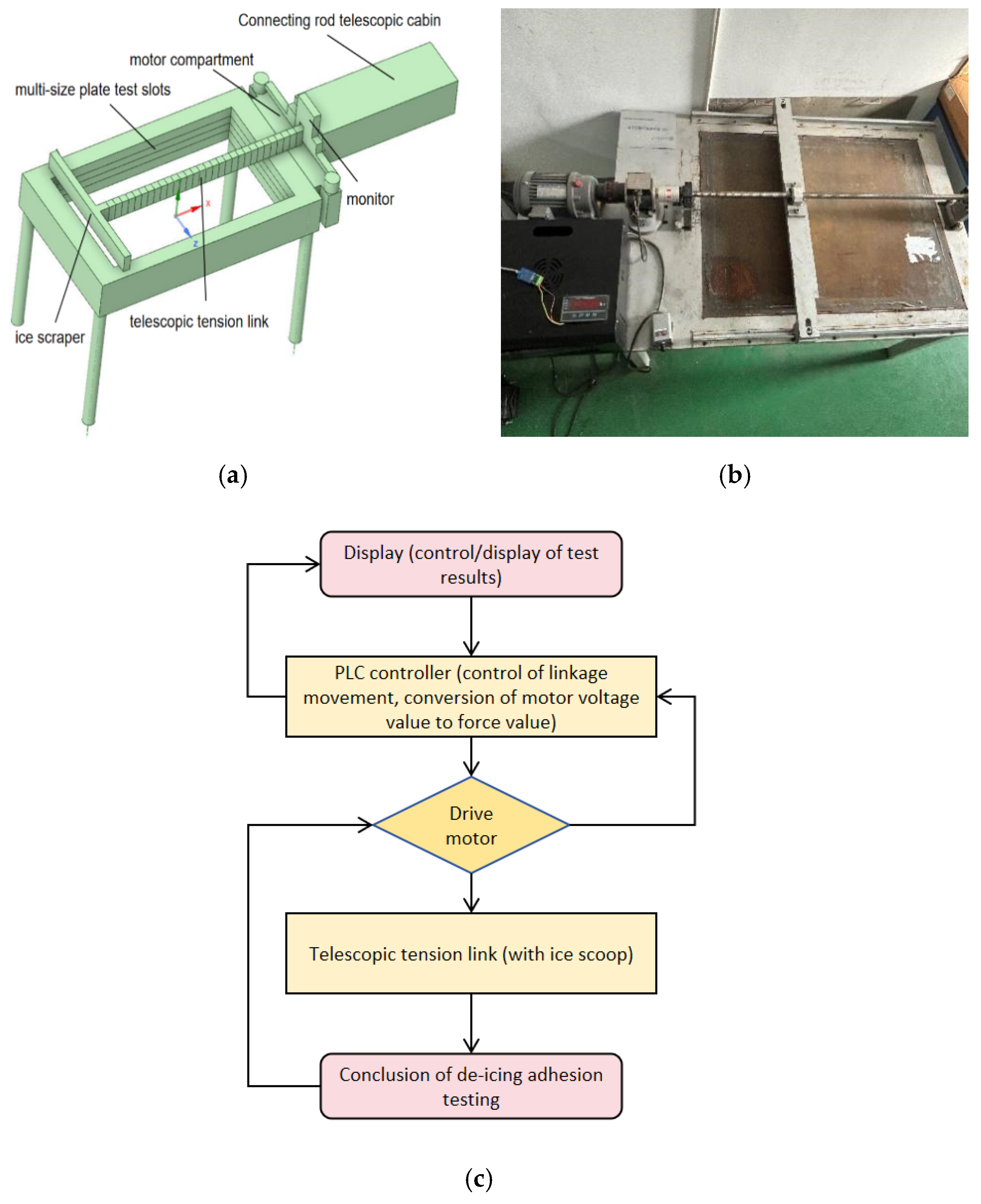
(2) The device operates on the principle of converting electrical signals into mechanical force measurements, and is innovatively applied to the testing of the adhesion force between the ice and the ship’s plate: the voltage value (V) of the motor during the testing process is converted into the force value (kN). The ice adhesion strength (Pa) is obtained by dividing the critical force at which the ice layer detaches by the contact area between ice and plate. The device consists of a telescopic tension linkage, a linkage telescoping chamber, an electric motor, an LED touch-screen display, and a telescopic gimbal holder. The servo motor applies horizontal force F at a rate of 5 N/s. This rate ensures both smooth force application and controllable operation, preventing instantaneous impacts on ice layers that could cause non-uniform fractures and compromise adhesion force measurement accuracy. It also allows for efficient testing within reasonable timeframes, balancing experimental efficiency with data reliability. Furthermore, this rate aligns with the quasi-static loading range commonly used in material mechanics testing, facilitating comparative analysis with peer research results and ensuring data comparability and scientific validity. Preliminary experiments have confirmed that ice detachment processes under this rate accurately reflect adhesion characteristics between ice and ship steel plate surfaces, avoiding creep or localized melting caused by excessively slow loading rates, thereby guaranteeing test result authenticity and validity. To meet operational requirements and minimize manual intervention, thereby ensuring accurate experimental data, the device is equipped with a telescopic tension linkage, an electric motor, and an LED touch-screen display. Additionally, to save space and enhance experimental efficiency, the device features a rod telescoping chamber. The specific testing process is as follows: an ice shoveling pusher begins to remove the ice layer from the ship’s plate until the ice layer separates from the steel plate, at which point the test is concluded. A PLC microcontroller converts the real-time motor voltage (V) into force (kN), which is displayed on the LED screen in real time. Simultaneously, the tester presses “Calculation Key” on the screen to display the results. Simultaneously, when the tester presses “Calculation Key” on the screen, it displays the maximum force value from the entire process, as well as the quotient of the force and ice area (in Pa). This quotient (Pa) represents the adhesion force between the ice and the ship’s plate. At the end of the test, the connecting rod retracts into the “connecting rod telescopic cabin.” The tester then removes the test plate and presses the “Reset” button on the screen. This action returns the connecting rod to its initial position from the telescopic cabin. The entire testing process can be conducted under various ambient temperatures. Figure 2a–c respectively show the design structure distribution diagram, the physical diagram, and the measurement system technology route flow chart.
The experimental device offers wide applicability and quick operation. It features adjustable test slots that accommodate plates of various sizes and materials, enhancing equipment utilization. These slots can be quickly adjusted to fit different plate specifications and securely clamp the hull plates being tested. This flexibility increases the range of experimental conditions and improves overall efficiency.
(3) The calculation principle is as follows: once the ice layer has frozen, a horizontal load F is gradually applied to its surface. As F increases, it eventually causes the ice layer to separate from the substrate. At the moment of separation, F drops abruptly from its maximum value to zero. This maximum value represents the shear adhesion force between the substrate and the ice layer.
τ = F A
In Equation (1) τ is the adhesion strength between the substrate and the ice layer, and A is the contact area between the substrate and the ice layer. According to the above equation, the shear adhesion strength between the substrate and the ice layer can be obtained.
The ice separation load F in this experiment is provided by the servo motor. Because the servo motor can realize closed-loop control of speed, position and torque with high precision and good low-speed performance, it is selected as the source of driving force. The experiment was driven by a ball screw (model SFSR2505, diameter 25 mm, lead distance 5 mm), and its thrust calculation was based on the following equation:
( 2 × 3.14 × η ) × T a = F × I n
In Equation (2), η is the positive efficiency of the ball screw, which is taken as 90%, Ta is the driving torque in Nm, F is the axial load in N, and In is the lead distance of the screw in m.
The core derivation of this formula is based on the principle of energy conservation and the definition of transmission efficiency of the ball screw.
As a transmission mechanism that converts rotary motion into linear motion, the ball screw follows the law of energy conservation between the input rotational mechanical energy and the output linear mechanical energy. Meanwhile, mechanical loss during transmission must be considered, and the forward efficiency η is introduced (i.e., the energy transfer efficiency from rotational input to linear output). High-precision ball screws are adopted in this device, and their typical forward efficiency η ranges from 0.85 to 0.95; in this study, η = 0.9 is used.
For the output torque Ta of the drive motor, the input mechanical work per full revolution (2π radians) is
W 1 = T a × 2 π
For an axial load F, the distance moved axially along the screw during one full revolution is the lead In (unit: m). Therefore, the effective output mechanical work is
W 2 = F × I n
According to the definition of forward efficiency for a ball screw, the forward efficiency is equal to the ratio of effective output work to total input work, which can be expressed as follows:
η = W 2 W 1 = F · I n T a · 2 π
Rearranging the above equation gives Formula (2), in which the constant π is replaced by the engineering approximation 3.14.
(4) For the permanent magnet synchronous servo drive system used in this experiment, we established a comprehensive voltage-to-torque conversion chain. By integrating the armature voltage balance equation, the torque–current linear relationship of servo motors, and the torque–force transmission model of ball screws, we derived the complete calibration transfer function, F = 2 π · η · k t l · ( V k e · ω ) . Here, F represents the experimentally measured adhesion force, η denotes the mechanical transmission efficiency of the ball screw pair, k t is the torque constant of the servo motor, l is the lead length of the ball screw, V is the armature input voltage of the servo motor, k e is the back electromotive force constant of the servo motor, and ω is the rotational angular velocity of the servo motor. The nonlinear errors in the system were corrected through static calibration using standard force sensors, achieving a linear fitting accuracy of 0.998 for the transfer function. This approach enables traceable verification between electrical measurement data and force readings, effectively resolving the traceability challenges in adhesion force measurement. For the experiment conducted in this work, the accuracy of the adopted sensor is 0.1 kPa.

2.2. Model Construction and Program Design

(1) A simulation study was conducted on the de-icing characteristics of the JUST ultrasonic vibrator on the hull using ANSYS finite element (FE) 2022 software. A numerical analysis model was built to perform modal analysis of ultrasonic vibrators at frequencies of 20 kHz (100 W) and 33 kHz (100 W), determining the optimal “de-icing formation” for each part of the hull. The effectiveness of different arrangements of ultrasonic vibrators on the hull steel plate was also analyzed [26]. The research program involves two steps: ① Simulation calculations based on FE modal analysis using ANSYS to determine the vibration displacement of the ice layer and the ice breaking time within the same vibration duration. These calculations consider parameters such as vibration frequency, power, and the “de-icing formation” of the vibrators. This analysis reveals the effect of ultrasonic vibration on the ice-covered structure of the ship’s hull steel plate. ② Modal analysis to determine the relationship between ice adhesion shear stress (adhesion force) and different frequencies and arrangements of ultrasonic vibrators.
In the ANSYS finite element modeling of this study, both AH32 hull structural steel and polycrystalline ice material parameters were referenced from “GB/T 712-2022 Structural steel for ship and ocean engineering” [27] and “Standardization of testing methods for ice properties” [28]. Specific parameters are as follows: AH32 ship plate steel: elastic modulus 206 GPa, Poisson’s ratio 0.3, density 7850 kg/m3, loss factor 0.002; polycrystalline ice: elastic modulus 9.0 GPa, Poisson’s ratio 0.33, density 917 kg/m3, loss factor 0.02. The finite element model in this study strictly adheres to experimental conditions for both boundary conditions and interface coupling methods. Specifically, steel plate support conditions employ four-sided simply supported constraints, consistent with the clamping configuration used in the experimental flat plate adhesion force testing device. For ultrasonic oscillator modeling, high-frequency simple harmonic vibration displacements are applied as surface loads, mirroring the actual excitation method of electro-acoustic transducers on the steel plate’s backside. The ice–steel interface is simulated using a cohesive behavior model to characterize adhesion forces, with critical shear strength and delamination strength parameters established to represent interface failure mechanisms.
(2) In this study, the experimental design was developed based on research objectives and theoretical foundations. Numerical simulation and experimental investigation support each other, with simulation results used to verify the rationality of the experiments. Considering the limitations of actual experiments, this study employs the control variable method for verification, focusing on ultrasonic vibrators at frequencies of 20 kHz (100 W) and 33 kHz (100 W). These frequencies were chosen because they are commonly encountered in practical applications and span a wide range, facilitating a comprehensive analysis of vibration effects on ship hull de-icing. During the experiment, the frequency and power of the ultrasonic vibrator are adjusted while monitoring and recording key indicators, including ice shedding, de-icing time, and energy consumption. This approach verifies the reliability of the simulation results and further explores the optimal use of ultrasonic vibration for ship hull de-icing. The research program involves ultrasonic vibrators with the same number but different “de-icing formations,” varying frequencies, and identical power levels. Under consistent conditions of ice thickness, time, and excitation current, a de-icing effect is observed, and parameters such as the y-axis vibration displacement of the ice and adhesion before and after vibration are measured.
Four cases with different vibrator arrangements were designed, all using two types of vibrators (20 kHz, 100 W and 33 kHz, 100 W). In each case, a 20 mm thick ice layer was subjected to vibration de-icing for 200 s. The vibration displacement, velocity, acceleration, and angle along the y-axis were recorded, and the ice adhesion strength before and after vibration was compared.
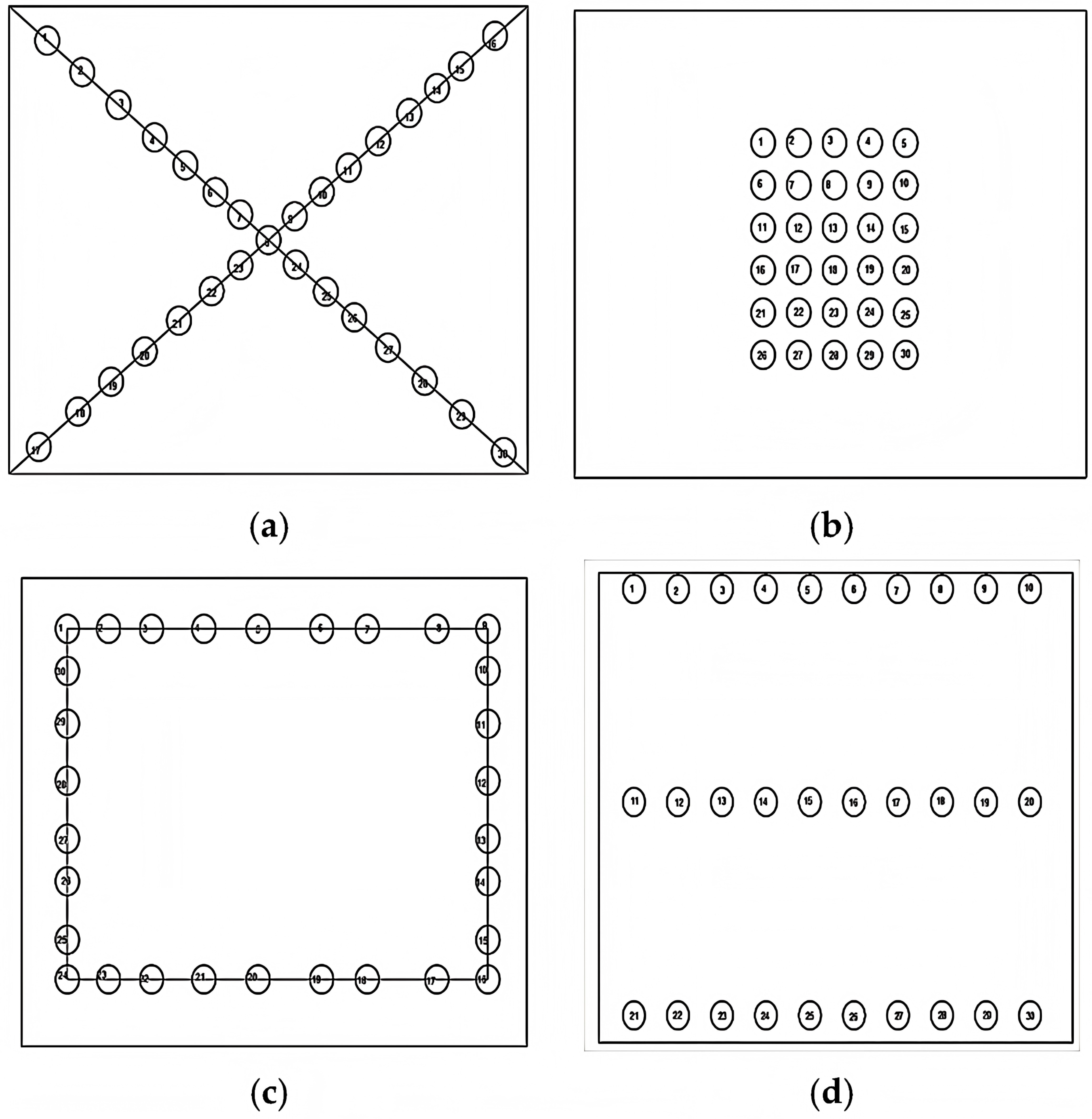
Case 1: Vibrators arranged in an “X” pattern (Figure 3a).
Case 2: Vibrators arranged in a central focus pattern on the steel plate (Figure 3b).
Case 3: Vibrators arranged in a surrounding pattern (Figure 3c).
Case 4: Vibrators arranged in a scattered pattern (Figure 3d).
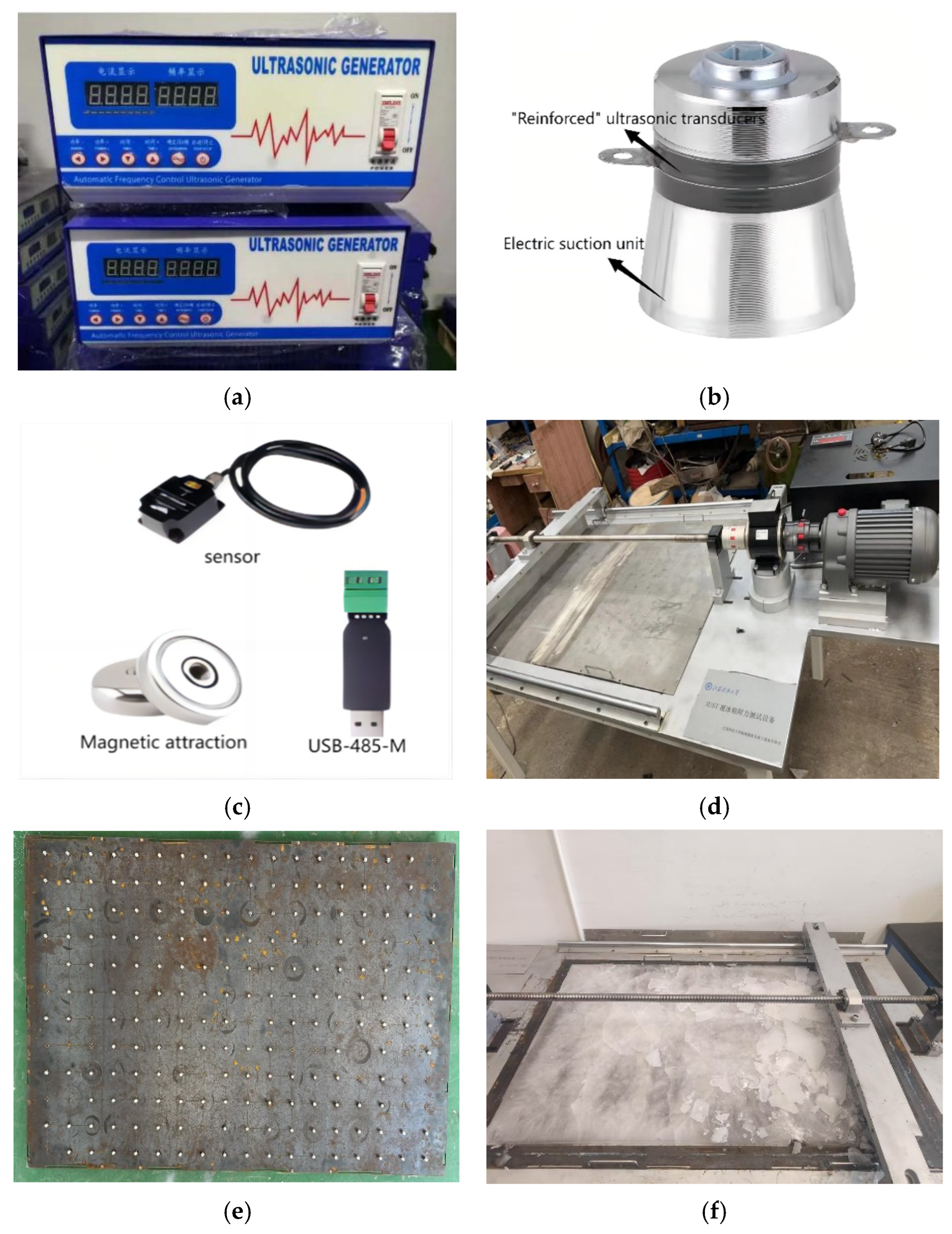
(3) Experimental equipment: The ultrasonic micro-vibration anti-icing and de-icing experimental system consists of an ultrasonic generator (AFG3252C) (Jiangsu University of Science and Technology, Zhenjiang, China), ultrasonic power amplifier (DGR-3001) (Jiangsu University of Science and Technology, Zhenjiang, China), self-developed JUST intelligent test device for the adhesion force between the ship and the overlying ice, magnetic-suction displacement speed amplitude vibration test system, JUST ultrasonic oscillator, etc., as shown in Figure 4a–d. Among them, the signal generator model is Puyuan (AFG3252C), which is used to generate sinusoidal signals with different frequencies; the ultrasonic power amplifier model is Longyi (DGR-3001), whose function is to power amplify the sinusoidal signals generated by the signal generator and drive the piezoelectric drive unit to generate high-frequency vibration. The self-developed JUST intelligent test device for measuring the adhesion force between the ship and overlying ice is characterized by high precision and sensitivity. It is capable of accurately measuring the adhesion force between the ship hull and overlying ice. The magnetic-suction displacement velocity amplitude vibration test system is used for real-time monitoring of displacement, ice coating phenomenon and other key parameters during the vibration process, ensuring the accuracy and reliability of the experimental data. The JUST ultrasonic oscillator, as the core component, transmits energy to the overlying ice through high-frequency vibration to achieve the effect of vibration de-icing. The components of the whole experimental system work together to provide a solid technical foundation for the subsequent experimental research and numerical analysis.
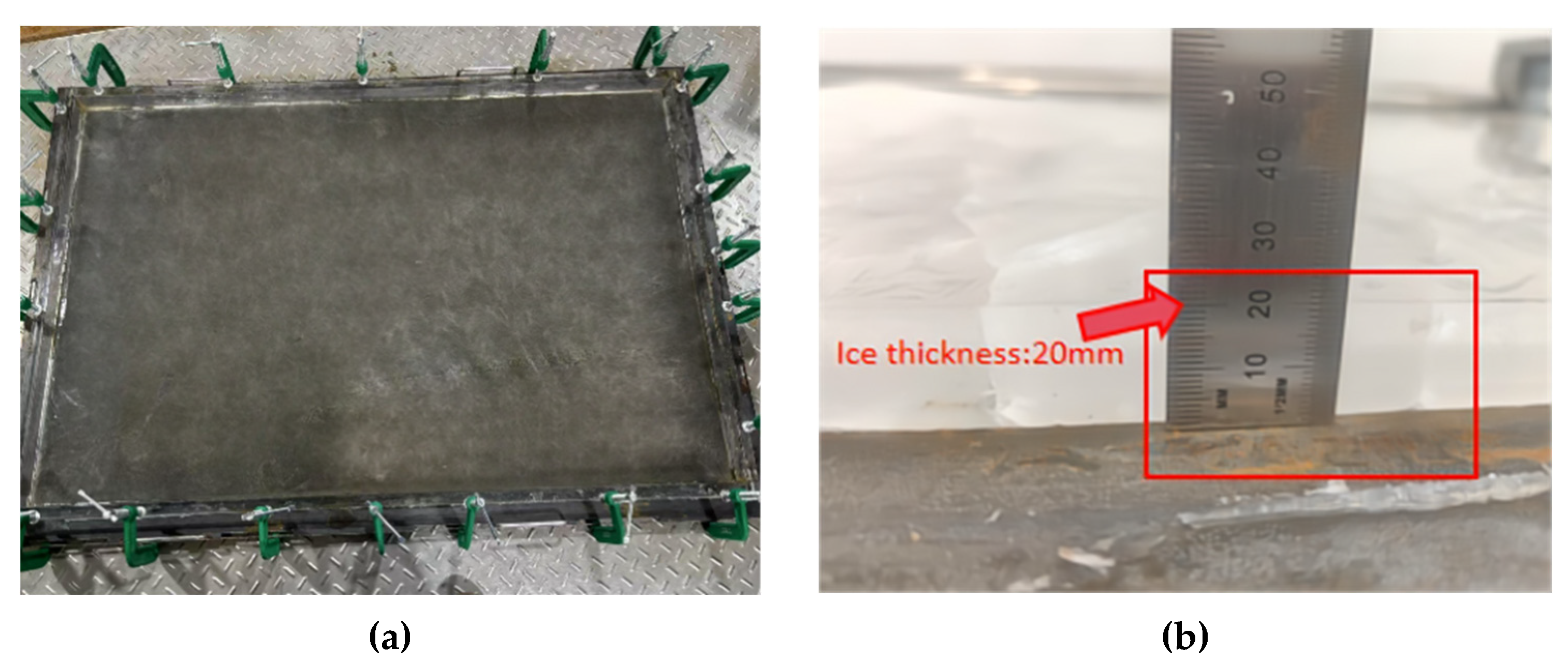
Experimental consumables: Polar ship hull steel plate (AH32 type, 1300 × 850 × 10 mm) and overlying ice (made by the induced-crystal wet seeding method, 1000 × 600 × 20 mm), as shown in Figure 4e,f.
(1) To ensure the accuracy and reproducibility of the experiments, we adopted strict experimental steps and data recording methods. Before the start of the experiment, the hull steel plate of the polar ship was pre-treated, including cleaning, drying, and standardization, to ensure the cleanliness and consistency of the plate’s surface. Subsequently, the overlying ice was prepared using the induced-crystallization wet seeding method to ensure that its thickness, density, and uniformity met the experimental requirements.
(2) During the experiment, ultrasonic vibrators were installed on the hull steel plate in various predetermined arrangements, and the parameters of the ultrasonic generator and power amplifier were adjusted to achieve vibrations at different frequencies and power levels. Throughout the vibration de-icing process, vibration parameters were monitored in real time using a magnetic-suction displacement, velocity, and amplitude vibration test system. The adhesion force between the hull and the overlying ice was measured using the self-developed JUST intelligent test device for adhesion force between ship and overlying ice.
(3) After the experiment, the collected data were organized and analyzed, focusing on key parameters such as vibration displacement, vibration speed/acceleration, vibration angle, and ice adhesion force. By comparing results across different conditions, the influence of ultrasonic vibration on the ship hull’s de-icing performance was thoroughly investigated, providing a theoretical basis and data support for optimizing ultrasonic de-icing technology.

3. Experimental Research

3.1. Experimental Design

To comprehensively evaluate the de-icing effect of ultrasonic vibrators, we conducted similar experiments with vibrators arranged in “center focus,” “X,” “perimeter,” and “dispersion” patterns. The results indicate that different arrangements produce varying de-icing effects under identical conditions. By analyzing these data, we can establish a correlation between the arrangement of ultrasonic vibrators and their de-icing effectiveness, providing theoretical support for further optimizing the ultrasonic de-icing system.
Considering the limitations of the actual experiment, this study uses the “control variables” method for verification. Simulating a section of a polar ship steel plate (1300 × 850 × 20 mm), and constrained by the plate’s size, 30 ultrasonic vibrators (67 mm in diameter, 92 mm in height) were mounted on the bottom, as shown in Figure 4b. Each vibrator operates at frequencies of 20 kHz or 33 kHz with a power of 100 W. The vibrators were numbered (1–30), and their distribution is depicted in Figure 3. The experiment was conducted with the same ice thickness (20 mm), duration (200 s), and excitation current (1.8 mA) for all 30 vibrators. The de-icing effect was observed, and the ice adhesion force was measured after vibration. The experimental design is detailed in Table 1.
To accurately evaluate the effects of different ultrasonic vibrator arrangements on the adhesion of ice-covered hull steel plates, the experimental design encompassed a range of working conditions. Under each condition, ultrasonic vibrators were installed on the hull steel plate in a specific arrangement, and vibration de-icing tests were conducted under the preset experimental conditions (stage of vibration). By comparing the vibration displacement and the change in adhesion force before and after vibration under different working conditions, the influence mechanism of ultrasonic vibration on the adhesion characteristics of ice cover can be thoroughly analyzed.
In the experimental process, the self-developed JUST ship and ice adhesion force intelligent testing device was used to test the adhesion force of ice after vibration. The device can accurately measure the adhesion force between ice and ship plates, which provides key data for evaluating the de-icing effect (stage of adhesion force measurement). At the same time, equipment such as the ice vibration displacement tester is utilized to monitor the displacement change of the ice in real time during the vibration process, further revealing the influence of ultrasonic vibration on the ice’s characteristics.
After the experiment, we will statistically analyze the collected data. By comparing the experimental results under different working conditions, the influence law of the ultrasonic oscillator arrangement on the adhesion force of a hull steel plate covered with ice can be derived, which will provide theoretical support for further optimizing the design of ultrasonic anti-icing and de-icing systems and improving de-icing efficiency. Additionally, the experimental results will also serve as an important reference for the research and development of anti-icing technology for polar navigation ships.

3.2. Realistic Simulation of Hull Icing

We conducted a realistic simulation of hull icing on an AH32-type steel plate (1300 × 850 × 10 mm). The overlying ice on the polar ship hull was prepared using the induced-crystal wet seeding method, with dimensions of 1000 × 600 × 20 mm, as shown in Figure 5. To ensure the accuracy and reliability of the experiments, we adopted the gravitational crystal wet seeding method to make the overlying ice, which can simulate the ice conditions that may be encountered during ship navigation in polar environments. In polar environments, the air temperature may drop to −30 °C or lower, while the seawater temperature typically hovers around −1.8 °C. The hull surface temperature dynamically varies between these two extremes and, due to radiative and convective cooling, often falls below the ambient air temperature. The size of the ice cover was precisely controlled at 1000 × 600 × 20 mm to ensure standardization and comparability of the experiments. During the experiment, we placed the ship’s hull steel plate horizontally and applied a uniform thin film of water to its surface. Then, ice crystals were uniformly spread on the water film using the induced-crystal wet seeding method, and the ice crystals were gradually grown into a continuous ice layer by controlling the temperature and humidity conditions. The entire icing process simulated the natural formation of ice in a polar environment, thereby ensuring the authenticity and validity of the experiment.
Once the ice had formed on the hull steel plate, ultrasonic vibrators were installed in various arrangements and connected to the necessary equipment as per the experimental design. A signal generator produced sinusoidal signals at various frequencies, which were amplified by an ultrasonic power amplifier to drive the piezoelectric unit, generating high-frequency vibrations. During vibration, we monitored the ice’s vibration displacement and adhesion force changes to evaluate the effect of ultrasonic vibration on the ice’s adhesion to the hull steel plate (stage of vibration).
Table 2 gives a summary of experimental results for all eight cases. The parameters include vibrator layout, vibration frequency, maximum vertical displacement of the ice cover, time to reach maximum displacement, and ice adhesion strength after de-icing (stage of adhesion force measurement).
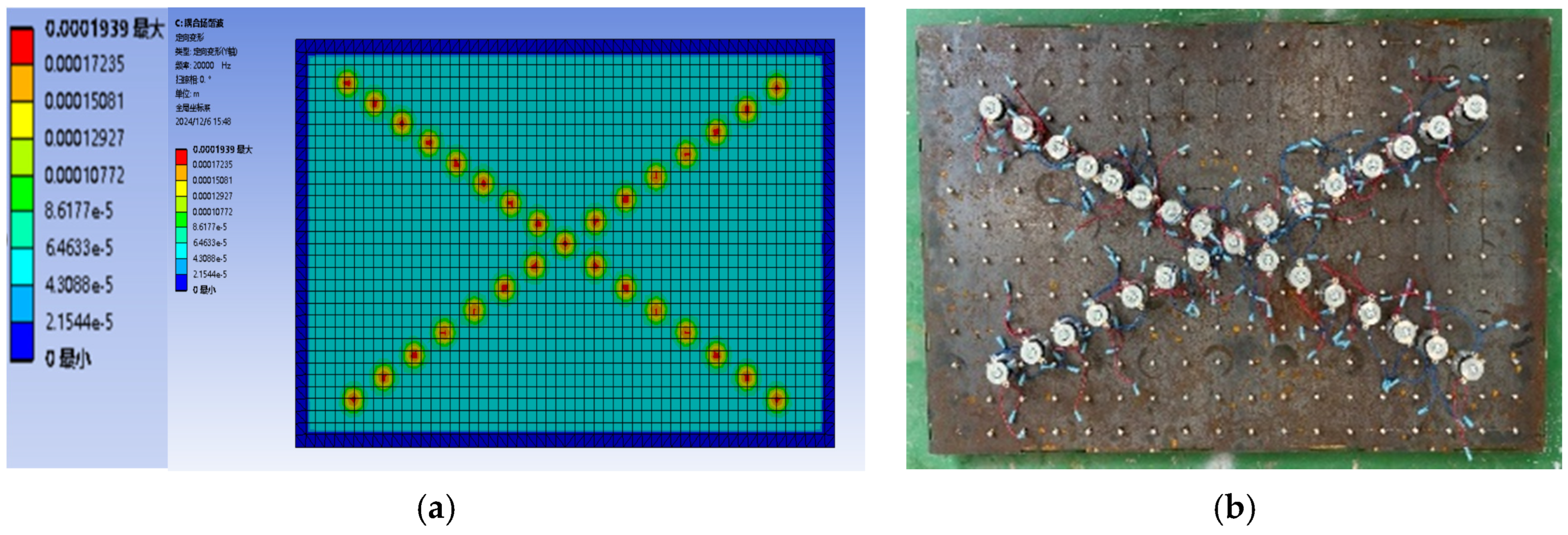
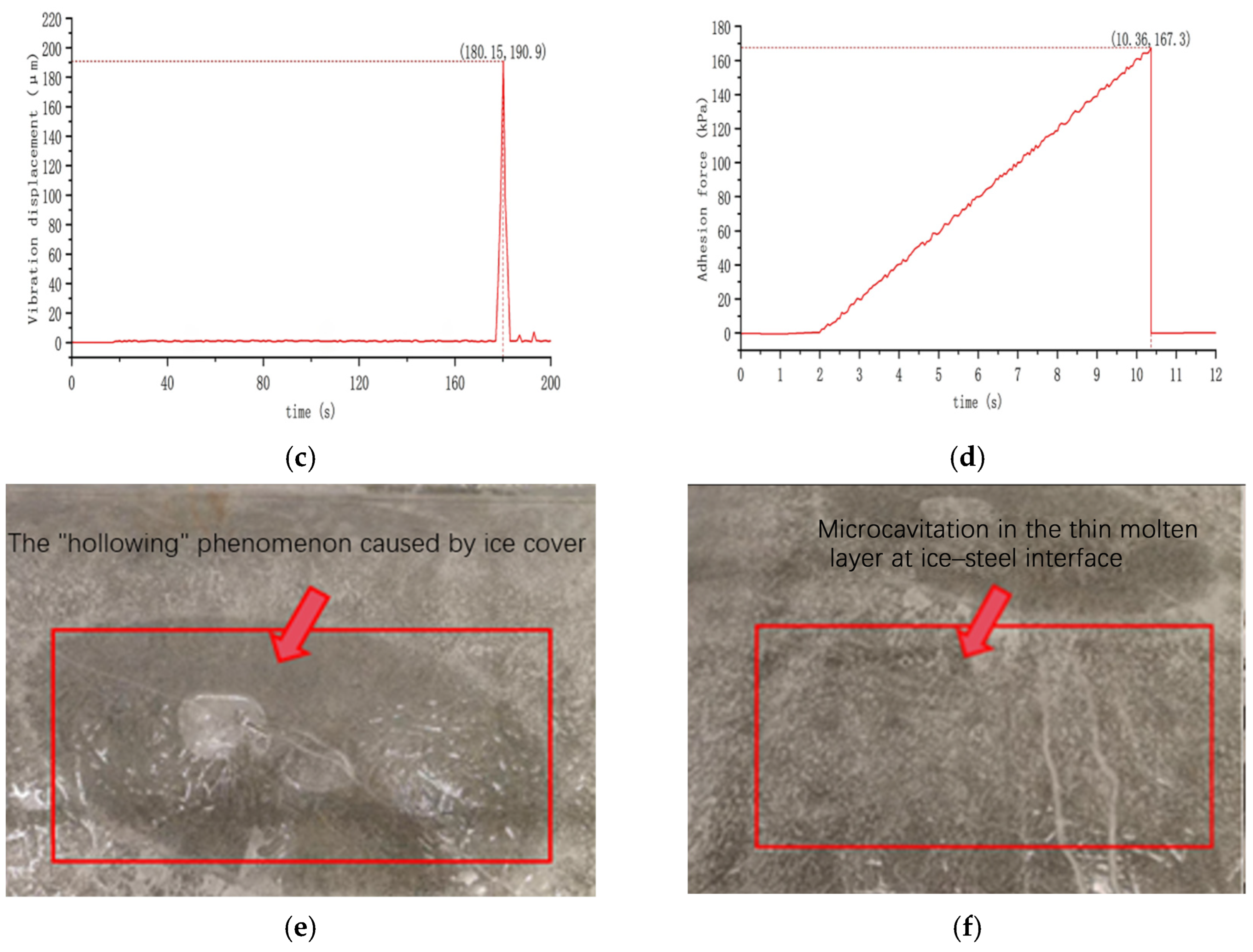
(1) The simulation results for the “X” type, thirty 20 kHz vibrators of total power 3000 W, are shown in Figure 6a, and according to the modal analysis diagram, the maximum displacement in the y-axis direction of the overlaying ice can be seen as Sy′ = 193.90 μm. Its experimental vibrator array is shown in Figure 6b, and according to the displacement test curve in Figure 6c, it can be seen that at T = 180.15 s, the maximum displacement of the overlaying ice in the y-axis direction occurs, Sy = 190.90 μm = 0.1909 mm. When T = 10.36 s, the adhesion strength reaches its maximum value of σ = 167.3 kPa, after which the ice adhesion force rapidly drops to zero, as shown in Figure 6d. At this point, the ice is completely separated from the hull steel plate. This indicates that the de-icing vibration test between the ice and the hull steel plate has been completed, marking the boundary at which the ice begins to shed. As shown in Figure 6e, the “hollow drum” phenomenon and microcavitation in the thin molten layer at the ice–steel interface depicted in Figure 6f are caused by the propagation of ultrasonic vibration energy within the ice. This energy disrupts the crystal structure, thereby facilitating the detachment of ice.
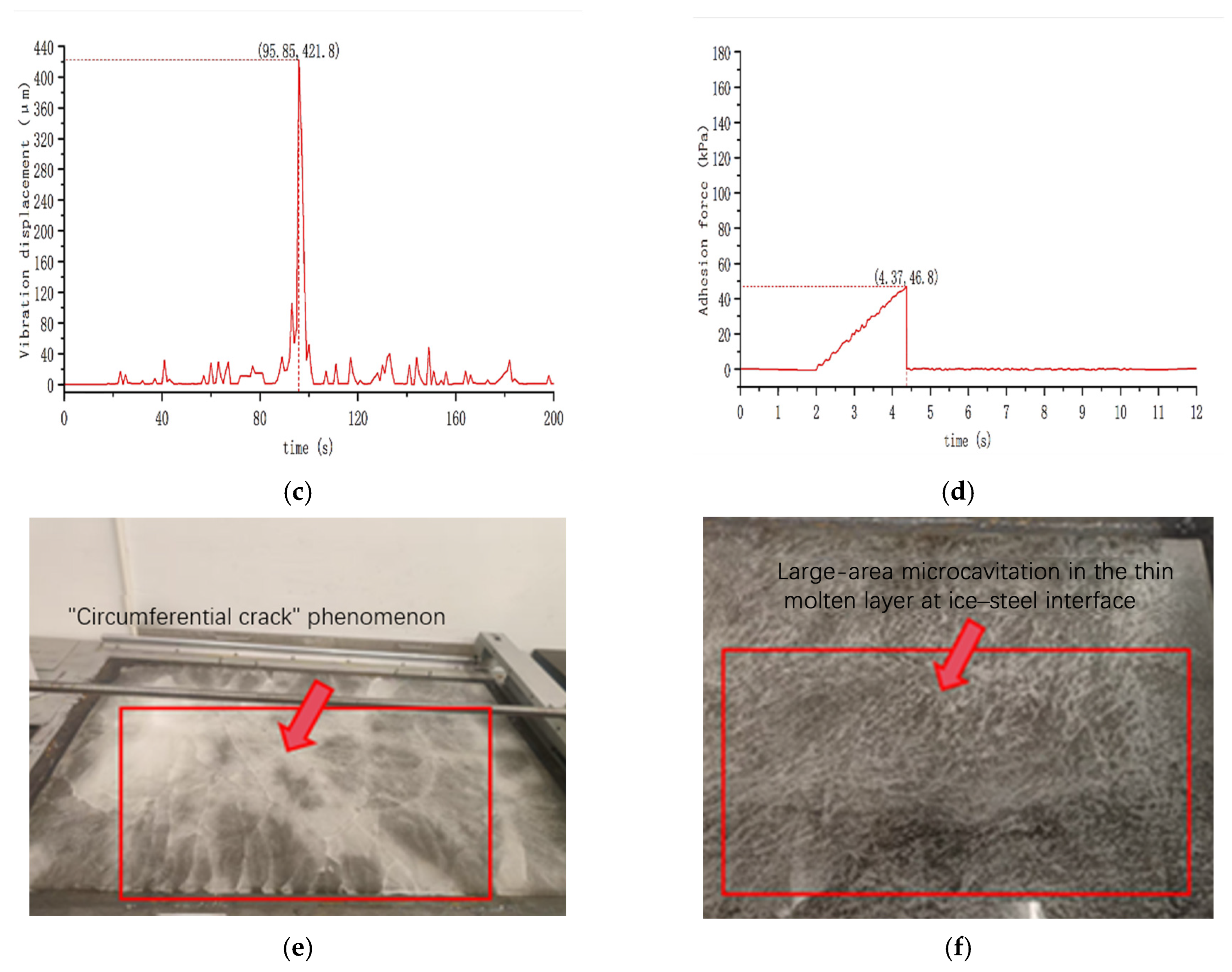
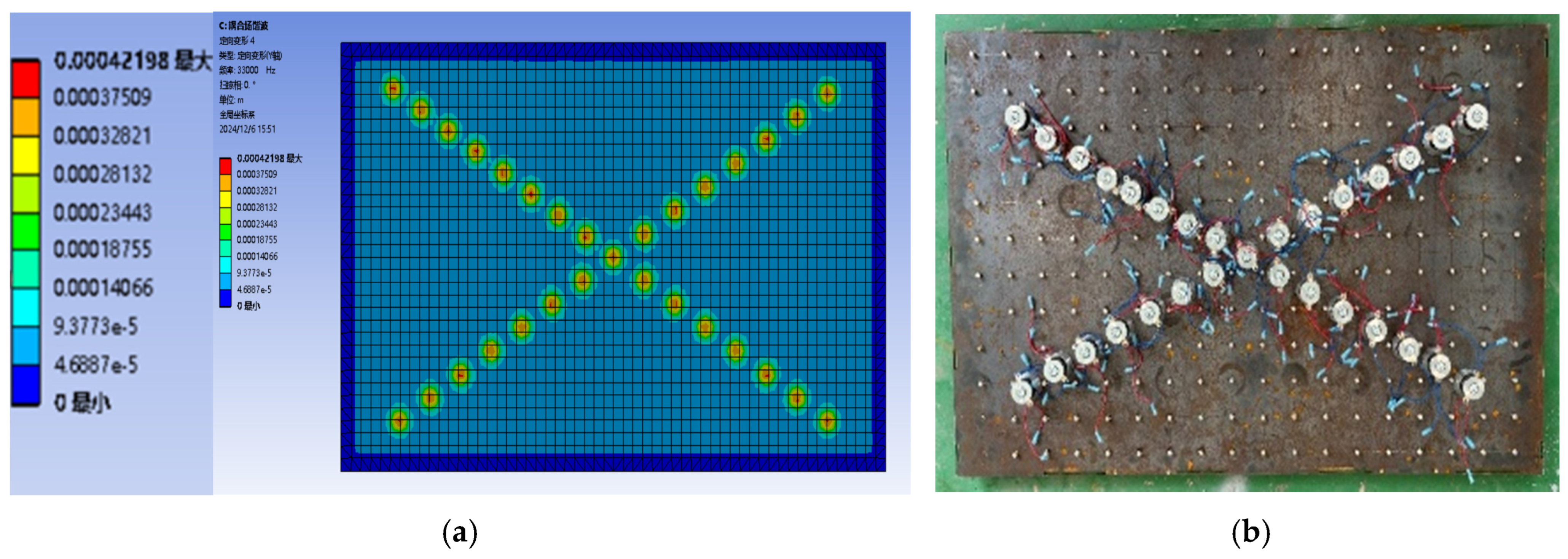
(2) For the vibration case of “X” type, 30 vibrators of 33 kHz with a total power of 3000 W, the modal analysis diagrams show that the maximum displacement of the overlying ice in the y-axis direction reaches a new height of Sy′ = 0.42198 mm = 421.98 μm, which is shown according to the displacement test curves of Figure 7c at T = 95.85 s, Sy = 421.8 μm = 0.4218 mm. In terms of the adhesion test, shown in Figure 7d, the maximum value of adhesion strength σ = 46.8 kPa occurs when T = 4.37 s, and the same phenomenon of rapid return to zero after reaching the maximum value of adhesion strength is also observed, which marks the successful removal of the overlying ice. The maximum displacement predicted by the modal analysis was verified in the experiment, and the adhesion force test also confirmed the effective weakening and final removal of the ice adhesion force by ultrasonic vibration.
Figure 7e,f show the phenomena of “circumferential cracks” and large ultrasonic “bubble” cavitation in the ice cover. These indicate that the mechanical stresses generated by high-frequency vibration have accumulated sufficient energy within the ice cover, ultimately leading to its fracture in a specific direction. The formation of these cracks further facilitates ice shedding, thus improving de-icing efficiency. Additionally, it was observed that as the vibration frequency increased, the “bulging” phenomenon on the ice surface and the cavitation of microcavitation in the thin molten layer at the ice–steel interface became more pronounced, providing direct evidence of the damage caused by ultrasonic vibration to the internal structure of the ice sheet.
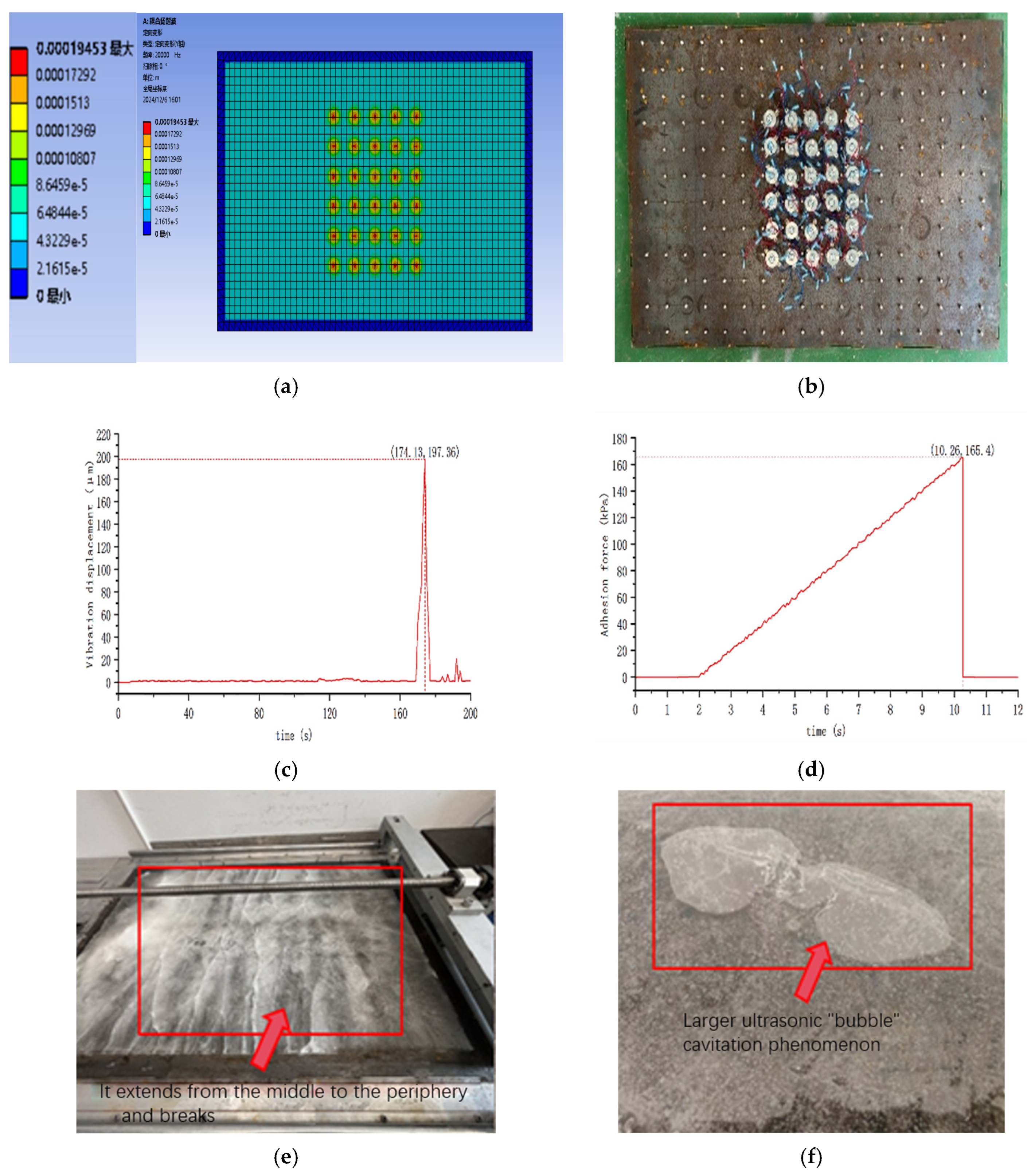
(3) The simulation results of the “centre focus” type, 30 vibrators of 20 kHz with a total power of 3000 W, are shown in Figure 8a. According to the modal analysis diagram, the maximum displacement in the y-axis direction of the overlying ice is Sy′ = 194.53 μm, and the experimental vibrator array is shown in Figure 8b. According to the displacement curve in Figure 8c, it can be seen that when T = 174.13 s, the maximum displacement Sy = 197.36 μm = 0.19736 mm occurs in the y-axis direction. As shown in Figure 8d, when T = 10.26 s, the maximum value of adhesion strength σ = 165.4 kPa appears, and then the adhesion force of the overlying ice quickly returns to a “0” value. At this point, the overlying ice and the hull steel plate are entirely separated. The adhesion test between the ice coating and the hull steel plate has been completed after the de-icing vibration. For example, Figure 8e shows that after the end of the de-icing, the ice cover has a middle extension to the surrounding broken phenomenon. Figure 8f illustrates the ultrasonic “bubble” cavitation phenomenon, showing that high-frequency vibration can produce mechanical stress in the ice cover, which in turn triggers the rupture of the ice layer and its detachment. At the same time, the results of the adhesion test also clearly show the weakening effect of ultrasonic vibration on the adhesion of the overlying ice, which is the key to realizing efficient de-icing.
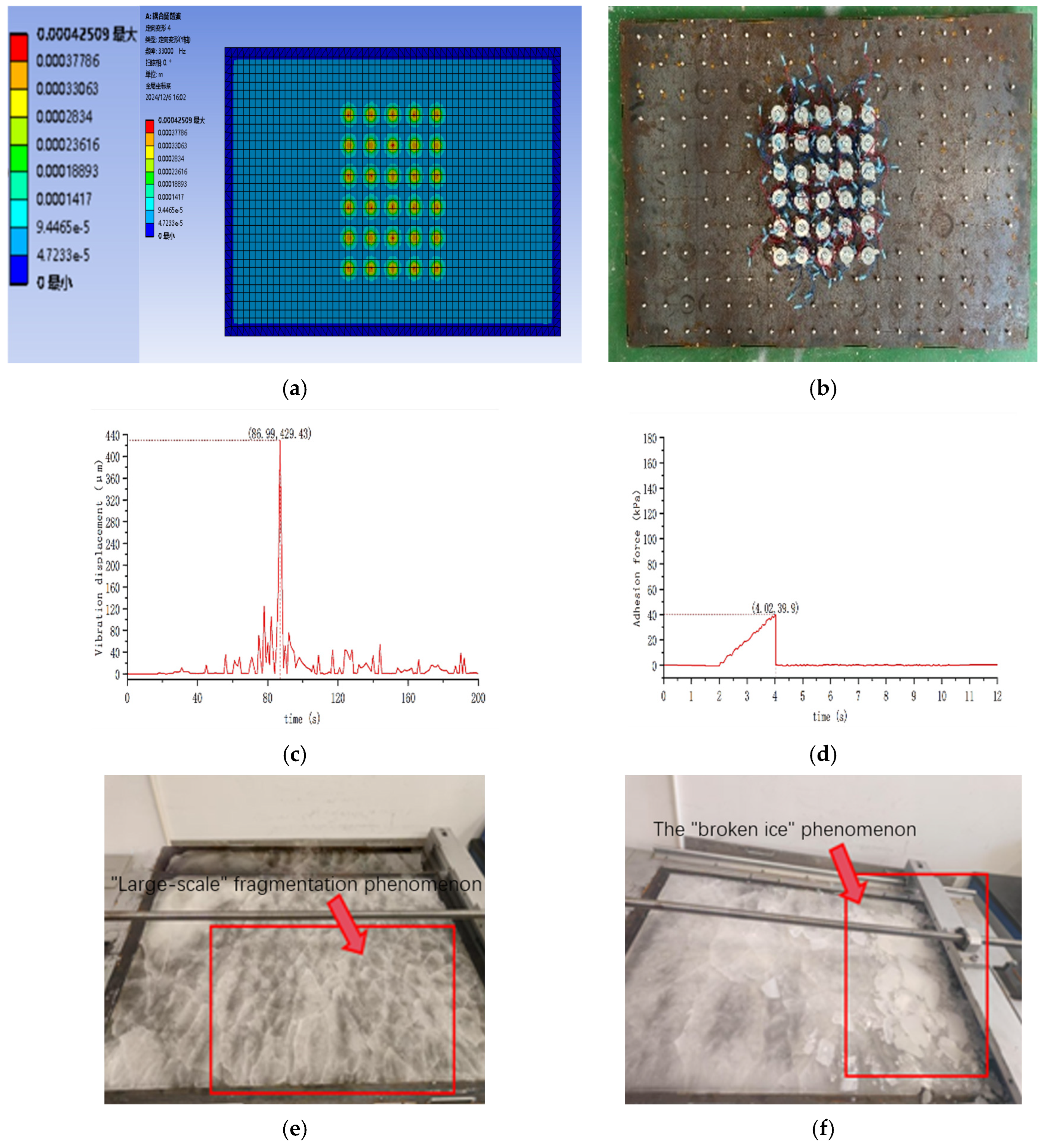
(4) The simulation results of the “centre focus” type, 30 vibrators of 33 kHz with a total power of 3000 W, are shown in Figure 9a. According to the modal analysis diagram, the maximum displacement in the y-axis direction of the overlying ice is Sy′ = 425.09 μm, and the experimental vibrator array is shown in Figure 9b. According to the displacement curve in Figure 9c, when T = 86.99 s, the maximum displacement Sy = 429.43 μm = 0.42943 mm occurs in the y-axis direction. As shown in Figure 9d, when T = 4.02 s, the maximum value of adhesion strength σ = 39.9 kPa appears, and then the adhesion force of the overlying ice quickly returns to “0” value. At this time, the overlying ice and the hull steel plate are entirely separated. The adhesion test between the ice coating and the hull steel plate has been completed after the de-icing vibration. In the process of de-icing, the ice cover “large area” broken phenomenon extends from the center to the surrounding, as shown in Figure 9e. After de-icing, the ice cover exhibits a “broken ice” phenomenon, as shown in Figure 9f. The above phenomena show that when the ultrasonic vibrator distribution position is “center focus” type, under the action of high-frequency vibration, the mechanical stress generated within the ice cover is more concentrated, resulting in large-scale rupture and detachment of the ice layer in a relatively short period of time. By comparing the de-icing effect of the “center focus” arrangement at different frequencies, we found that high-frequency vibration (e.g., 33 kHz) shows more obvious advantages in shortening the de-icing time and improving the de-icing efficiency.
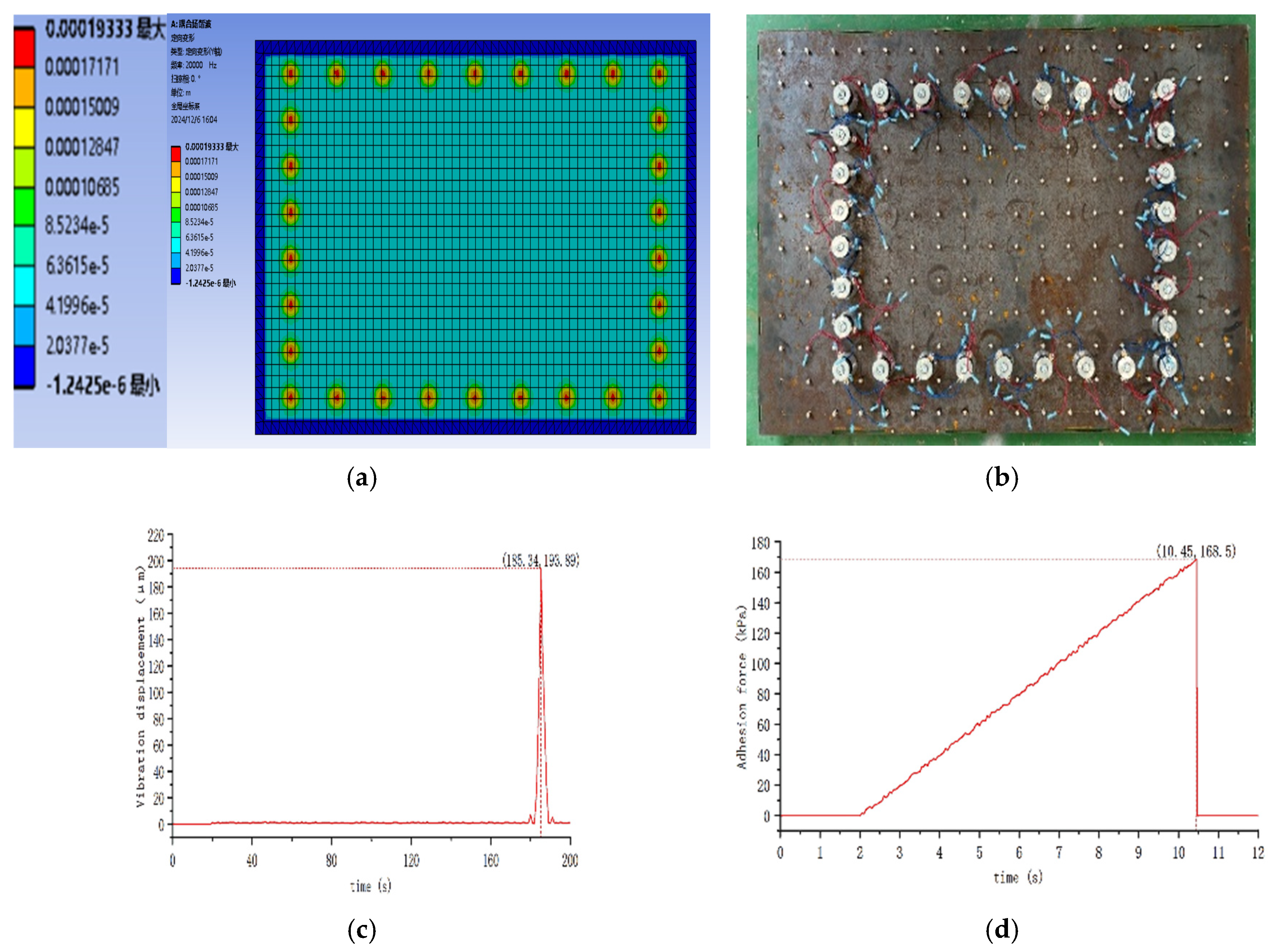
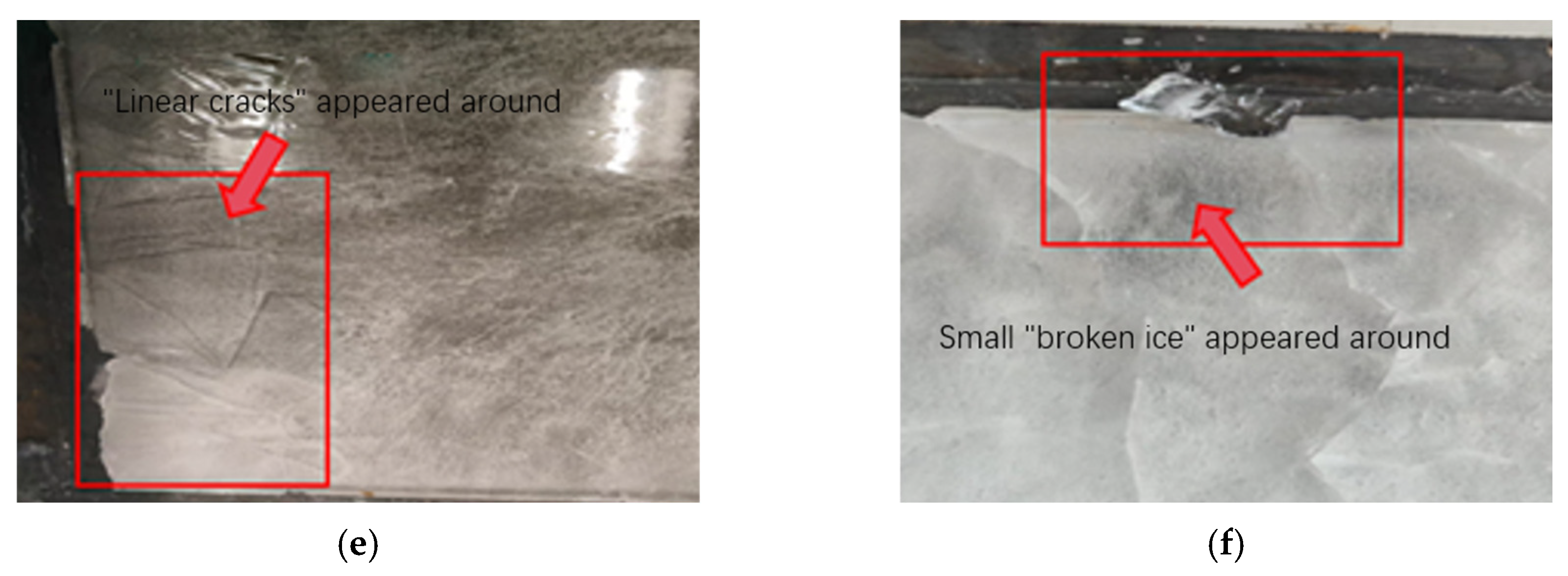
(5) The simulation results of the “surrounding” type, 30 vibrators of 20 kHz with a total power of 3000 W, are shown in Figure 10a. According to the modal analysis diagram, the maximum displacement in the y-axis direction of the overlying ice is Sy′ = 193.33 μm, and the experimental vibrator array is shown in Figure 10b. According to the displacement curve in Figure 10c, it can be seen that when T = 185.34 s, the maximum displacement Sy = 193.89 μm = 0.19389 mm occurs in the y-axis direction. As shown in Figure 10d, when T = 10.45 s, the maximum value of adhesion strength σ = 168.5 kPa appears, and then the adhesion force of the overlying ice quickly returns to “0” value. At this time, the overlying ice and the hull steel plate are entirely separated. The de-icing vibration of the overlying ice and the hull steel plate was observed after the completion of the test of the adhesion force. There are “line cracks” and small “broken ice” around the ice, as shown in Figure 10e,f, which reveal the influence of the ultrasonic vibrators arranged in a “surrounding” type on the adhesion of the ice on the steel plate of the hull of the ship. Under the action of high-frequency vibration, line cracks first appeared around the ice. These cracks then gradually expanded, resulting in the appearance of smaller ice fragments in the surrounding area. This finding further confirms the effectiveness of ultrasonic vibration in the de-icing process, especially in inducing the creation and expansion of ice cracks.
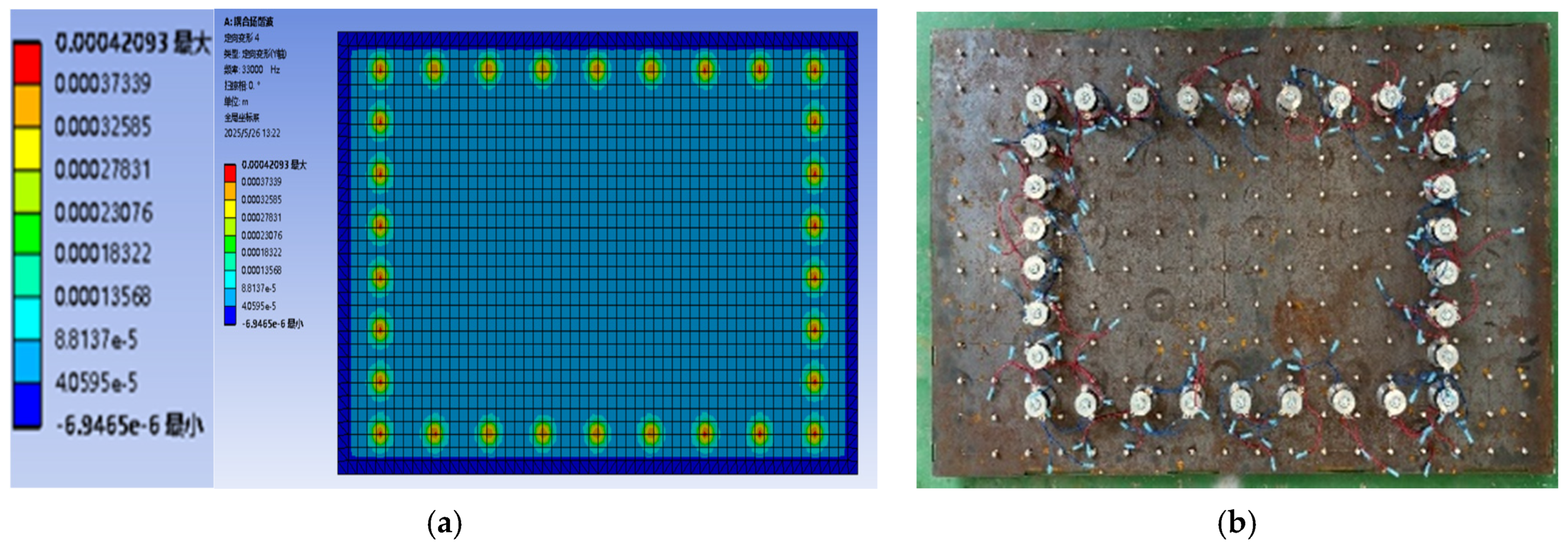
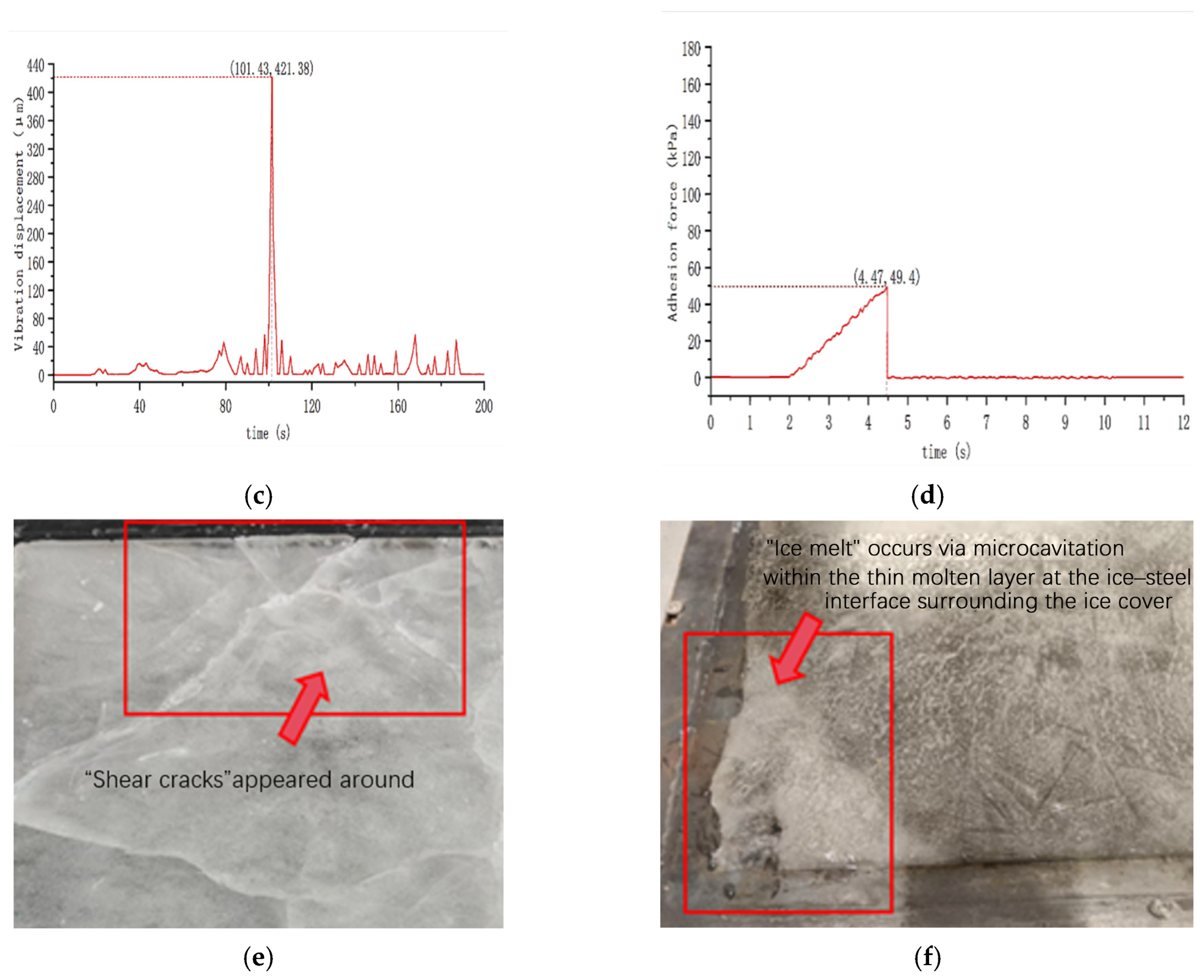
(6) The simulation results of the “surrounding” type, 30 vibrators of 33 kHz with a total power of 3000 W, are shown in Figure 11a. According to the modal analysis diagram, the maximum displacement in the y-axis direction of the overlying ice is Sy′ = 420.93 μm, and the experimental vibrator array is shown in Figure 11b. According to the displacement curve in Figure 11c, when T = 101.43 s, the maximum displacement Sy = 421.38 μm = 0.42138 mm occurs in the y-axis direction. As shown in Figure 11d, when T = 4.47 s, the maximum value of adhesion strength σ = 49.4 kPa appears, and then the adhesion force of the overlying ice quickly returns to “0” value. At this time, the overlying ice and the hull steel plate are entirely separated. The de-icing vibration of the overlying ice and the hull steel plate was observed after the completion of the test of the adhesion force. Shear cracks form around the ice, while microcavitation occurs in the thin molten layer at the ice–steel interface, termed “ice melting,” as shown in Figure 11e,f. This phenomenon reveals that the strong shear effect induces microcavitation in the thin molten layer at the ice–steel interface. This causes the surrounding ice to rapidly develop shear cracks. Furthermore, the “explosion” of bubbles generated during this microcavitation process releases heat, thereby producing the “ice melting” phenomenon observed around the ice cover.
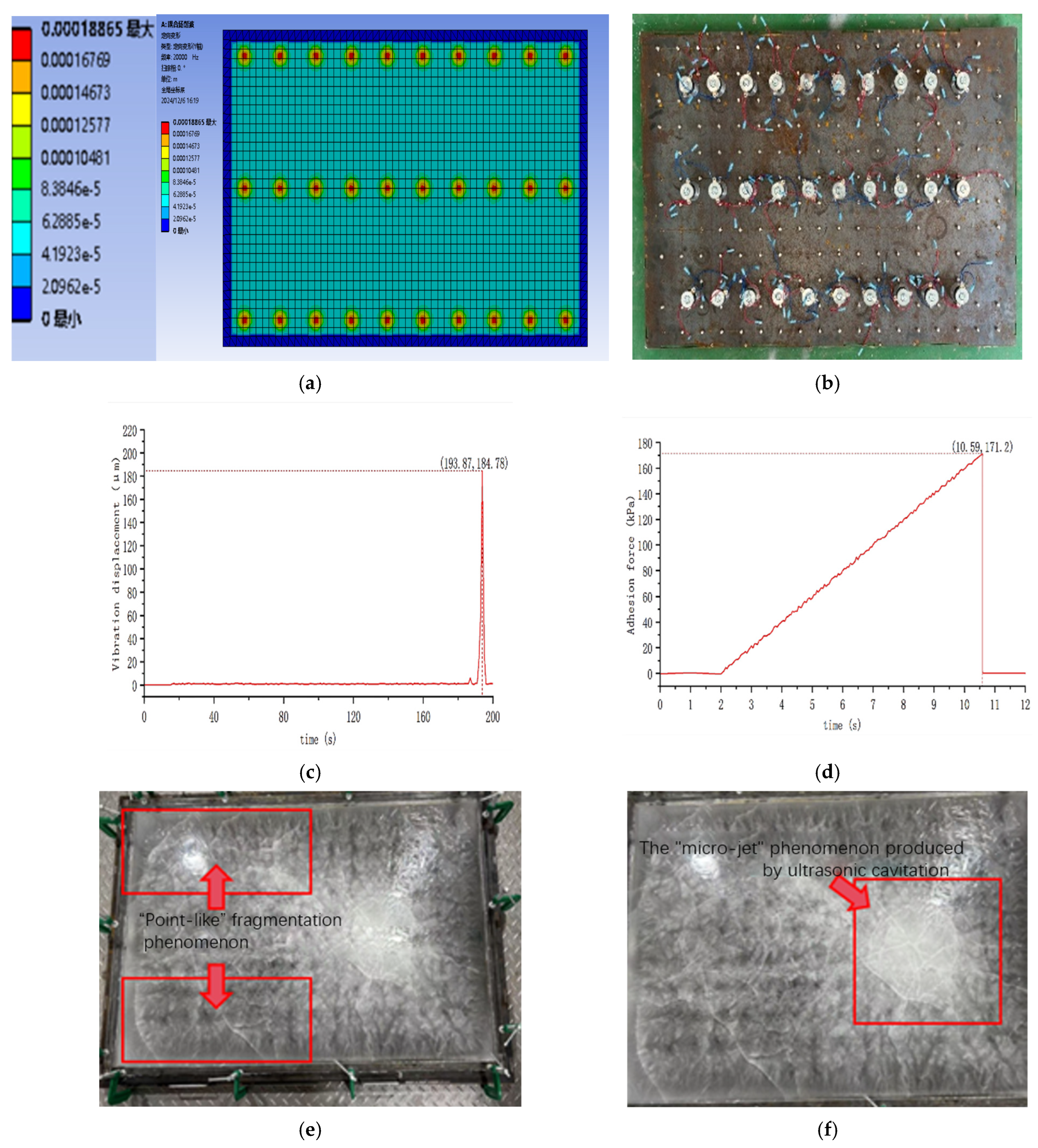
(7) The simulation results of the “scattered” type, 30 vibrators of 20 kHz with a total power of 3000 W, are shown in Figure 12a. According to the modal analysis diagram, the maximum displacement in the y-axis direction of the overlying ice is Sy′ = 188.65 μm, and the experimental vibrator array is shown in Figure 12b. According to the displacement curve in Figure 12c, when T = 193.87 s, the maximum displacement Sy = 184.78 μm = 0.18478 mm occurs in the y-axis direction. As shown in Figure 12d, when T = 10.59 s, the maximum value of adhesion strength σ = 171.2 kPa appears, and then the adhesion force of the overlying ice quickly returns to “0” value. At this time, the overlying ice and the hull steel plate are entirely separated. The de-icing vibration of the overlying ice and the hull steel plate is observed after the completion of the test of the adhesion force. In the “scattered” arrangement, a more uniform “point-like” break-up phenomenon occurs around the ice cover, as shown in Figure 12e. This phenomenon indicates that the mechanical stresses generated by the high-frequency vibration within the ice cover are more evenly distributed, resulting in the ice sheet breaking up at multiple points simultaneously. At the same time, the “micro-jet” phenomenon generated by ultrasonic cavitation shown in Figure 12f further confirms the critical role of ultrasonic vibration in the de-icing process. These “micro-jets” are capable of impacting and stripping the ice cover, thus accelerating the de-icing process.
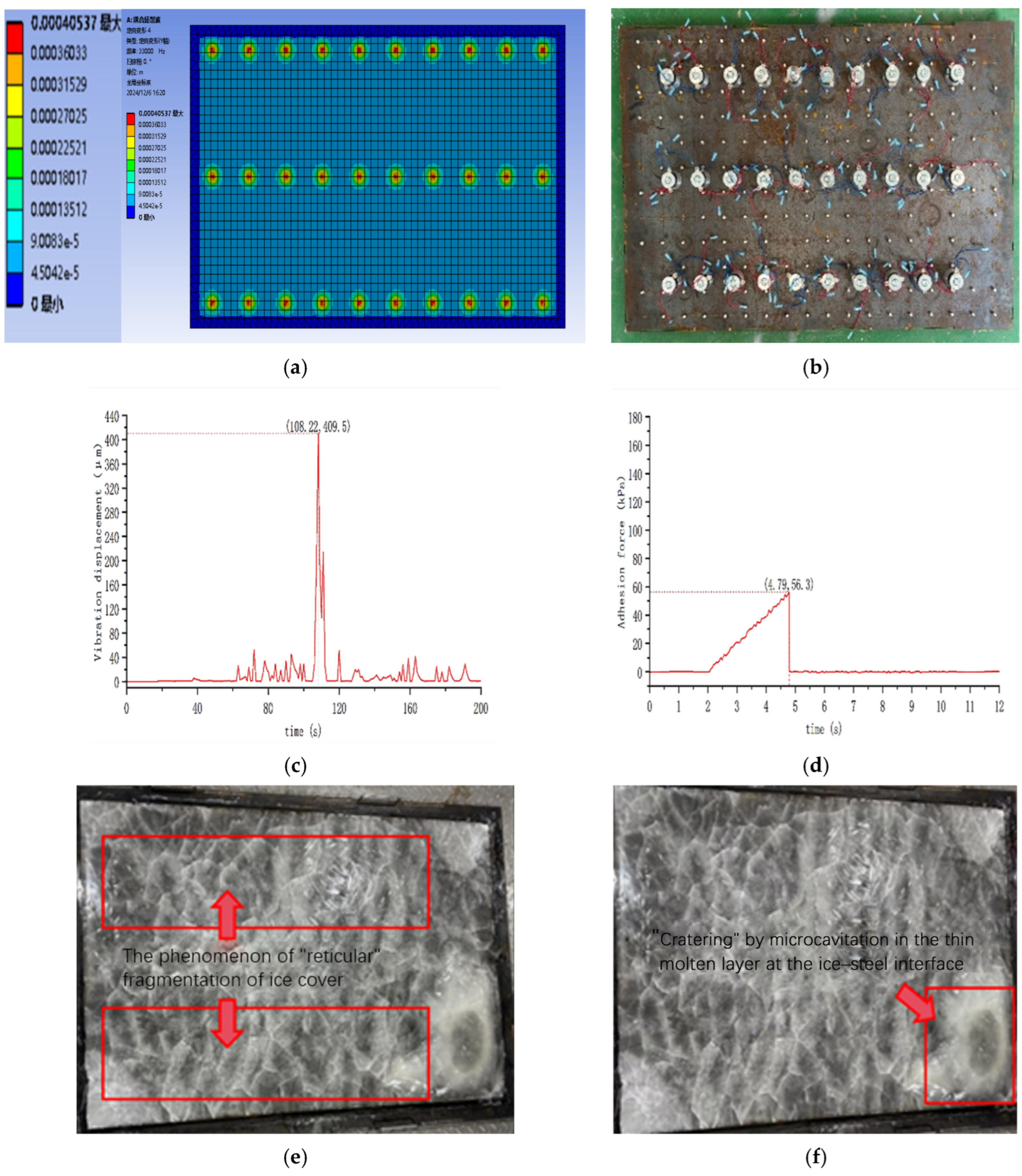
(8) The simulation results of the “scattered” type, 30 vibrators of 33 kHz with a total power of 3000 W, are shown in Figure 13a. According to the modal analysis diagram, the maximum displacement in the y-axis direction of the overlying ice is Sy′ = 405.37 μm, and the experimental vibrator array is shown in Figure 13b. According to the displacement curve in Figure 13c, when T = 108.22 s, the maximum displacement Sy = 409.50 μm = 0.4095 mm occurs in the y-axis direction. As shown in Figure 13d, when T = 4.79 s, the maximum value of adhesion strength σ = 56.3 kPa appears, and then the adhesion force of the overlying ice quickly returns to the “0” value. At this time, the overlying ice and the hull steel plate are entirely separated. The de-icing vibration of the overlying ice and the hull steel plate is observed after the completion of the test of the adhesion force. In the surrounding area, more obvious “net-like” cracks appeared under the action of high-frequency vibration, and these cracks rapidly expanded and intertwined, resulting in the large-scale detachment of the ice overlay in a relatively short period of time, as shown in Figure 13e. In addition, the “micro-jet” and “bubble explosion” phenomena generated by ultrasonic cavitation formed several tiny impact points on the ice surface, further accelerating the ice peeling process. Figure 13f clearly shows the “craters” formed by these tiny impact points. These “craters” not only verify the significant effect of ultrasonic vibration in the de-icing process but also demonstrate its strong influence on the microstructure of the ice layer.

4. Numerical Analysis

Based on data from a single experiment, we employed the Class B uncertainty evaluation method, incorporating calibration errors of the testing apparatus (±1.2 kPa), sensor resolution (±0.5 kPa), and environmental temperature fluctuations (±0.8 kPa). The expanded uncertainty (k = 2) for each adhesion strength value was calculated to be within ±2.5 kPa, with all experimental data falling within this range. Building on these single-experiment results, subsequent studies will conduct repeated experiments to further validate the statistical significance of inter-group differences.
At the same time, the impact of ice on the system is primarily characterized by the competition between the added mass effect and stiffness contribution, with the former typically dominating, thereby causing a significant downward shift in the natural frequency as ice accumulates. This frequency migration is inherently dynamic, exhibiting a “frequency recovery” or “rebound” phenomenon during the de-icing phase as ice–substrate debonding occurs. Accompanied by variations in the phase difference between voltage and current, this dynamic shift serves as the fundamental physical basis for real-time monitoring and automatic tracking of the system’s resonant frequency.
Ultrasonic vibrators were arranged in four configurations: “center focus,” “X,” “surrounding,” and “scattered.” Simulations and experiments were conducted under eight different conditions to evaluate their de-icing performance. The results demonstrate that the “center focus” arrangement offers the best de-icing effect, followed by the “X” arrangement, and then the “surrounding” arrangement, with the “scattered” arrangement being the least effective. The specific data analysis results are as follows:
(1) Under operating conditions with 30 vibrators at 20 kHz and a total power of 3000 W in the “X” arrangement, the ice cover exhibited a “hollow drum” phenomenon at the boundary, as shown in Figure 6e, and ultrasonic “bubble” cavitation, as depicted in Figure 6f. This occurs because the “X” arrangement generates a complex vibration mode, producing a specific stress distribution within the ice cover that triggers a “bulging” effect at the boundary. Simultaneously, ultrasonic cavitation creates numerous tiny bubbles within the ice, which expand and burst rapidly under vibration, generating shockwaves that accelerate ice cracking and detachment. When the frequency increased from 20 kHz to 33 kHz, the ice displayed a “ring crack” phenomenon and large-scale ultrasonic “bubble” cavitation, as illustrated in Figure 7e,f. This indicates that higher frequencies more effectively stimulate cavitation, producing stronger mechanical stress and shock waves within the ice, resulting in faster and larger-scale ice rupture. Additionally, de-icing efficiency improves significantly with higher frequencies, highlighting the critical role of frequency in ultrasonic de-icing technology.
(2) For the “center focus” type, 30 20 kHz vibrators with a total power of 3000 W, a broken phenomenon extended from the middle of the ice to the surrounding, while a larger ultrasonic “bubble” cavitation phenomenon was identified in the middle, as shown in Figure 8e,f. The cavitation effect was significantly better than other arrangements of 20 kHz vibrators, proving that the ship steel plate “center focus” position for the electro-suction ultrasonic vibrators on the ice produced better shear, because ultrasonic waves in the “center focus” position can form a higher energy. The reason is that when the ultrasonic waves are focused at the “center focus” position, a higher energy density can be formed, which produces a more intense shear effect inside the ice cover. This shear effect can not only cause the ice layer to crack and shed in a relatively short period of time over a large area, but also, through the cavitation of ultrasound, further accelerate the process of ice peeling. Specifically, when ultrasonic waves propagate through the ice cover, cavitation bubbles form at specific locations. These bubbles rapidly expand and explode in response to ultrasonic waves, generating strong shock waves and micro-jets. These shockwaves and micro-jets are capable of impacting and stripping the ice cover, thus accelerating the de-icing process. Therefore, the ultrasonic vibration de-icing technology in the “center focus” arrangement has higher de-icing efficiency and better de-icing effect. This finding provides an essential reference and basis for us to further optimize and innovate the anti-icing technology for ships. When the frequency is increased to 33 kHz, the “large area” broken phenomenon and broken ice phenomenon in the middle of the ice extends to the surrounding, such as in Figure 9e,f, and the adhesion force is also reduced to 39.9 kPa. By comparing the de-icing effect under different arrangements, we find that the “center focus”-type arrangement has the most outstanding performance in reducing the adhesion force of the overlying ice and improving the de-icing efficiency, which is mainly due to its unique focusing effect and energy distribution characteristics.
(3) Out of ultrasonic vibrators in the “surrounding”-type and “scattered”-type distribution, the “scattered” de-icing effect is the worst. In the “scattered” type, 20 kHz, there was a “point-like” broken phenomenon around the ice, ultrasonic cavitation was generated by the “micro-jet” phenomenon, the value of the adhesion force reached the maximum σ = 171.2 kPa, and at the same time T = 193.87 s only when the maximum displacement Sy = 184.78 μm. Then the de-icing effect of the best “center focus” type of 33 kHz de-icing efficiency slowed down close to 45%. This is because, in the “surrounding” type of distribution, the ultrasonic energy cannot be effectively concentrated in a specific area of the ice, resulting in relatively low de-icing efficiency. The “scattered” arrangement further disperses the ultrasonic energy, making the mechanical stress and cavitation effect produced by each oscillator relatively weak and unable to form effective cracks and broken areas inside the ice cover. Therefore, under the same total power and number of vibrators, the “scattered” arrangement has the worst de-icing effect. In addition, under a vibration frequency of 33 kHz, the “four-week” type exhibits a phenomenon of “point-like” breakage around the ice. The phenomenon of “micro-jet” generated by ultrasonic cavitation, as shown in Figure 12e,f, is due to the 33 kHz vibration frequency. However, there are “network” cracks and tiny impact points (i.e., “point-like” broken phenomenon), but the distribution of these cracks and impact points is relatively sparse, making it difficult to cover a large area of ice in a short time. The “micro-jet” phenomenon occurs because ultrasonic waves form complex fluctuation fields during propagation and reflection within the ice cover. When these fluctuating fields meet and interfere with each other at specific locations, intense shear stresses and cavitation effects occur. These effects, together, make the ice cover in the “four-week” arrangement appear more obviously broken. However, the degree and efficiency of this breakage can be compared with the “center focus” type and “X” arrangements. Specifically, the “micro-jet” phenomenon is due to the cavitation bubbles formed by ultrasonic waves inside the ice cover expand exploding rapidly under the effect of vibration, resulting in shock waves and high-speed micro-jets that can directly impact and peel off the ice cover, thus accelerating the de-icing process to a certain extent. However, due to the dispersion of ultrasonic energy and the complexity of fluctuation field interference in the “four-week” arrangement, the efficiency and effectiveness of this de-icing method are relatively limited.
In summary, by comparing the simulation and experimental results under different working conditions, we find that the arrangement of ultrasonic vibrators has a significant effect on the ice adhesion force on the hull steel plate. Specifically, when the ultrasonic vibrators are installed on the hull steel plate in a specific arrangement (e.g., “X” type or “center focus” type), it can reduce the adhesion force of the overlying ice more effectively, and thus improve the de-icing efficiency. The “center focus” type has the most apparent effect of the four arrangements, as shown in Figure 9e,f, where the middle of the ice extends to the surrounding “large area” broken phenomenon, because when the ultrasonic waves are focused on the center of the ice cover, the amplitude of vibration at this position increases significantly due to the principle of superposition of mechanical waves, which in turn accumulates more energy inside the ice cover, making it easier for the ice to break up and fall off. In addition, although the “decentralized” arrangement can also achieve the de-icing effect, its de-icing efficiency and the uniformity of ice break-up are slightly lower than those of the “central focus” arrangement. These findings not only provide an essential basis for our in-depth understanding of the mechanism of ultrasonic vibration de-icing but also provide a valuable reference for the optimization and innovation of future marine anti-icing technology.

5. Conclusions

In all experiments, we recorded displacement and adhesion data while observing phenomena such as “bulging” at the ice boundary and “bubble” cavitation caused by ultrasonic waves. These observations provide clear evidence for understanding the ultrasonic de-icing mechanism and validate our experimental and simulation methods. The key conclusions of this study are as follows:
(1) Through simulations and experiments, we carefully examined how different ultrasonic vibrator arrangements influence ice adhesion and de-icing efficiency on ship hull steel plates. The results show that the arrangement of ultrasonic vibrators is essential for ultrasonic de-icing technology. Specifically, the “center focus” arrangement excels at reducing ice adhesion and improving de-icing efficiency due to its unique energy-focusing properties. In contrast, while the “X,” “surrounding,” and “scattered” arrangements achieve some de-icing, they are less effective and less uniform than the “center focus” arrangement.
(2) By comparing the experimental results of vibrators at different frequencies, we observe that as the ultrasonic vibration frequency increases, the maximum displacement and adhesion force of the overlying ice undergo significant changes. This further confirms the effective weakening of the ice adhesion force on the ship’s hull steel plate. The strong mechanical stress and cavitation effects generated by high-frequency vibration create a more complex stress distribution and energy accumulation within the ice, directly accelerating its rupture and detachment while improving de-icing uniformity and efficiency. The observed phenomena of “hollow drum,” “net-like” cracks, and “micro-jets” provide clear evidence for understanding the ultrasonic de-icing mechanism. Particularly in the “centre focus” arrangement, the focused ultrasonic waves cause intense damage to the ice crystal structure in the central region, leading to significant microstructural changes that increase the ice’s fragility and detachment speed. Notably, different vibration frequencies result in distinct fragmentation patterns and detachment speeds of the ice. These findings not only deeply reveal the core mechanisms of ultrasonic de-icing (including stress damage, cavitation, and microstructural alteration) but also provide a crucial basis and direction for optimizing the design and performance of marine ultrasonic anti-icing systems.
(3) Ultrasonic vibrators operating at various frequencies and arrangements display distinct de-icing effects. High-frequency vibration, such as 33 kHz, notably reduces the time required for de-icing and improves efficiency. Resonance enhances ultrasonic wave propagation within the ice, making it more prone to cracking under high-frequency vibration. This finding highlights the crucial role of high-frequency vibration in ultrasonic de-icing and guides future frequency optimization. Therefore, when designing ultrasonic anti-icing systems, it is vital to consider the hull steel plate’s natural frequency and select an optimal vibration frequency for maximum effectiveness de-icing.
In summary, through this simulation and experimental verification, we have established the correlation between the ultrasonic vibrator arrangement and the de-icing effect and further refined the design of the ultrasonic de-icing system. These research results will serve as an essential reference for developing anti-icing and de-icing technology for polar navigation ships, thereby enhancing the safety and cost-effectiveness of ship operations in polar regions. During the experiment, we also observed intriguing phenomena. For example, under specific vibration frequencies and arrangements, distinctive textures and patterns emerge on the ice-covered surface. The formation of these patterns is closely linked to the propagation path and vibration mode of ultrasonic waves. These findings not only broaden our understanding of ultrasonic vibration de-icing technology but also offer new directions and ideas for future research. Additionally, we recognize that the long-term operational stability of ultrasonic vibrators and their potential impact on the ship’s hull steel plates are issues worthy of further investigation. Therefore, in our future work, we will continue to explore the mechanisms and optimization methods of ultrasonic vibration de-icing technology in greater detail. At the same time, we will focus on its feasibility and reliability in practical applications to develop a more comprehensive and effective solution for anti-icing and de-icing technology in polar navigation ships.

Author Contributions

Conceptualization, J.Z. and Y.G.; Methodology, S.H. and Y.G.; Software, M.G.; Validation, D.H.; Investigation, B.Y.; Data curation, B.-Q.C.; Writing—original draft, S.H.; Writing—review & editing, S.H. and Y.G.; Supervision, Y.G.; Funding acquisition, S.H. All authors have read and agreed to the published version of the manuscript.

Funding

1. The study was partially supported by China National Foreign Experts Program (No. H20250198). Project Leader: Shi Hua. 2. The study was partially supported by 2025 Zhenjiang Science and Technology Plan (International Science and Technology Cooperation Project: International Industry-Academia-Research Cooperation and Foreign Talent Introduction Project for Zhenjiang’s Offshore Engineering Equipment Floating Wind Turbine Renewable Energy Industry). (No. GJ2025016). Project Leader: Shi Hua. 3. The study was partially supported by 2025 Jiangsu Province Major Project for Basic Scientific Research (Natural Sciences) in Higher Education Institutions (No. 25KJA580003). Project Leader: Shi Hua. 4. This study was supported by the 2026 Jiangsu Provincial Collaborative Innovation Center Project for Higher Education Institutions (High-Tech Vessels) titled ‘Mechanism and Experimental Research on Ultrasonic Anti-Ice Equipment for Polar Vessels’ (No. XTCX202607). Project Leader: Shi Hua.

Data Availability Statement

The data presented in this study are available on request from the corresponding author.

Conflicts of Interest

The authors declare no conflict of interest.

References

  1. Wang, F.G.; Hu, W.P.; Jiao, X.X.; Fu, S.; Xi, Y.; Han, B. Risk analysis of ship navigation in the Northwest Arctic Passage. Polar Res. 2023, 35, 326–335. [Google Scholar]
  2. Li, H.X.; Chen, Y.; Chen, L.Q.; Huang, Y. Study on the process of water ingress in broken compartments of ships navigating in ice-breaking area. Ship Mech. 2025, 29, 681–692. [Google Scholar]
  3. Di, S.C.; Lei, J.Q.; Shen, D. Numerical simulation of ice resistance hull partitioning characteristics of an icebreaker. Ship Mech. 2025, 29, 181–188. [Google Scholar]
  4. Wang, S.J. Research on Ice Accumulation Forecasting Model for Ships in Polar Navigation Area. Master’s Thesis, Dalian University of Technology, Dalian, China, 2018. [Google Scholar]
  5. Shao, K.; Zhen, Z.; Gao, R.; Song, M.; Zhang, L.; Zhang, X. Comparative experimental study of the effect of loading rate on the typical mechanical properties of bubble and clear ice cubes. Exp. Therm. Fluid Sci. 2024, 159, 111264. [Google Scholar] [CrossRef]
  6. Li, S.J. Preparation and Research of Polyurethane-Based Anti-icing Coating. Master’s Thesis, Beijing University of Chemical Technology, Beijing, China, 2020. [Google Scholar]
  7. Huang, L.; Song, M.; Shen, J.; Kim, D.R.; Zhang, L.; Pekař, L. Experimental study on the effect of inverted aperture plate temperature on frosting characteristics under rising flow considering edge effect. Int. J. Heat Mass Transf. 2024, 224, 12543. [Google Scholar] [CrossRef]
  8. Hua, S.; Wang, Y.X.; Ge, M.W.; Zhang, J. Research on mechanism of anti-icing of polar ships based on ultrasonic vibration. Ocean Eng. 2025, 338, 121994. [Google Scholar] [CrossRef]
  9. Mishra, S.K. A Mixture of Snow and Ice. Roads Bridges 2001, 12, 4. [Google Scholar]
  10. Hou, Y.; Choy, K.L. Durable and robust PVDF-HFP/SiO2/CNTS nanocomposites for anti-icing application: Water repellency, icing delay, and ice adhesion. Prog. Org. Coat. 2022, 163, 106637. [Google Scholar] [CrossRef]
  11. Li, B.; He, L.; Liu, Y.; Luo, J.; Zhang, G. Influences of key factors in hot-air deicing for live substation equipment. Cold Reg. Sci. Technol. 2019, 160, 89–96. [Google Scholar] [CrossRef]
  12. Zhang, Y.; Zhang, L.; Luo, G. Study on de-icing criterion of anti-icing coating and simulation analysis method of mechanical de-icing process for polar ship superstructure. Ocean Eng. 2023, 288, 115811. [Google Scholar] [CrossRef]
  13. Miao, B. Theoretical and Experimental Research on Wing Piezoelectric Vibration De-icing. Master’s Thesis, Nanjing University of Aeronautics and Astronautics, Nanjing, China, 2016; pp. 35–40. [Google Scholar]
  14. Ackley, S.F.; Itagaki, K.; Frank, M.D. De-icing of Radomes and Lock walls using Pneumatic Devices. J. Glaciol. 2018, 64, 197–204. [Google Scholar] [CrossRef]
  15. Hua, S.; Zhang, J. Research on Mechanism of Anti-Icing of Polar Ships Based on Ultrasonic Vibration. In Proceedings of the China Symposium on Polar Science, Taiyuan, China, 10–11 August 2024. [Google Scholar]
  16. Wang, J.Q.; Huang, Y.X.; Gao, B.; Meng, L.T.; Ge, K.; Jin, H.C. Experimental study of dynamic icing adhesion strength on ship surface in polar environment. J. Eng. Thermophys. 2023, 44, 2793–2797. [Google Scholar]
  17. Wang, N.E. Experimental Study on Ice Adhesion Strength Characteristics of Marine Metal Surfaces. Master’s Thesis, Dalian Maritime University, Dalian, China, 2022. [Google Scholar] [CrossRef]
  18. Yu, Z.L.; Lu, W.J.; van den Berg, M.; Amdahl, J.; Løset, S. Glacial ice impacts: Part II: Damage assessment and ice-structure interactions in accidental limit states (ALS). Mar. Struct. 2021, 75, 102889. [Google Scholar] [CrossRef]
  19. Taylor, R.S.; Richard, M.; Hossain, R. A Probabilistic High-Pressure Zone Model for Local and Global Loads During Ice-Structure Interactions. J. Offshore Mech. Arct. Eng. 2019, 141, 051604. [Google Scholar] [CrossRef]
  20. Zhang, X.Z. Experimental Study on the Icing Characteristics of Water Droplets on Marine Metal Surfaces. Master’s Thesis, Dalian Maritime University, Dalian, China, 2020. [Google Scholar]
  21. Tang, S.; Ding, Y.F. Advances in the study of ice adhesion strength on material surfaces. S. China Earthq. 2014, 34, 31–36. [Google Scholar]
  22. Chen, J.; Björling, M.; Marklund, P.; Shi, Y. Effect of anti-icing coating functional groups on ice adhesion. Appl. Mater. Today 2024, 39, 102264. [Google Scholar] [CrossRef]
  23. Hua, S.; Zhang, J. A Walking Ship De-icing Monitoring Device and System. China Invention Patent No. ZL 2023 11534320.0, 10 May 2024. [Google Scholar]
  24. Janjua, Z.A. The influence of freezing and ambient temperature on the adhesion strength of ice. Cold Reg. Sci. Technol. 2017, 140, 14–19. [Google Scholar] [CrossRef]
  25. Ji, Y.Z. Design of Icing Mechanical Strength and Adhesion Strength Testing Device and Numerical Simulation of Ice Shedding Process. Master’s Thesis, Hebei Normal University of Science and Technology, Qinghuangdao, China, 2024. [Google Scholar] [CrossRef]
  26. Xue, Y.; Liu, R.; Li, Z.; Han, D. A review for numerical simulation methods of ship–ice interaction. Ocean Eng. 2020, 215, 107853. [Google Scholar] [CrossRef]
  27. GB/T 712-2022; Standardization Administration of the People’s Republic of China. Structural Steel for Ship and Ocean Engineering. Standards Press of China: Beijing, China, 2022.
  28. IAHR Working Group on Standardizing Testing Methods in Ice, IAHR Section on Ice Problems. Standardization of testing methods for ice properties. J. Hydraul. Res. 1980, 18, 153–165. [Google Scholar]
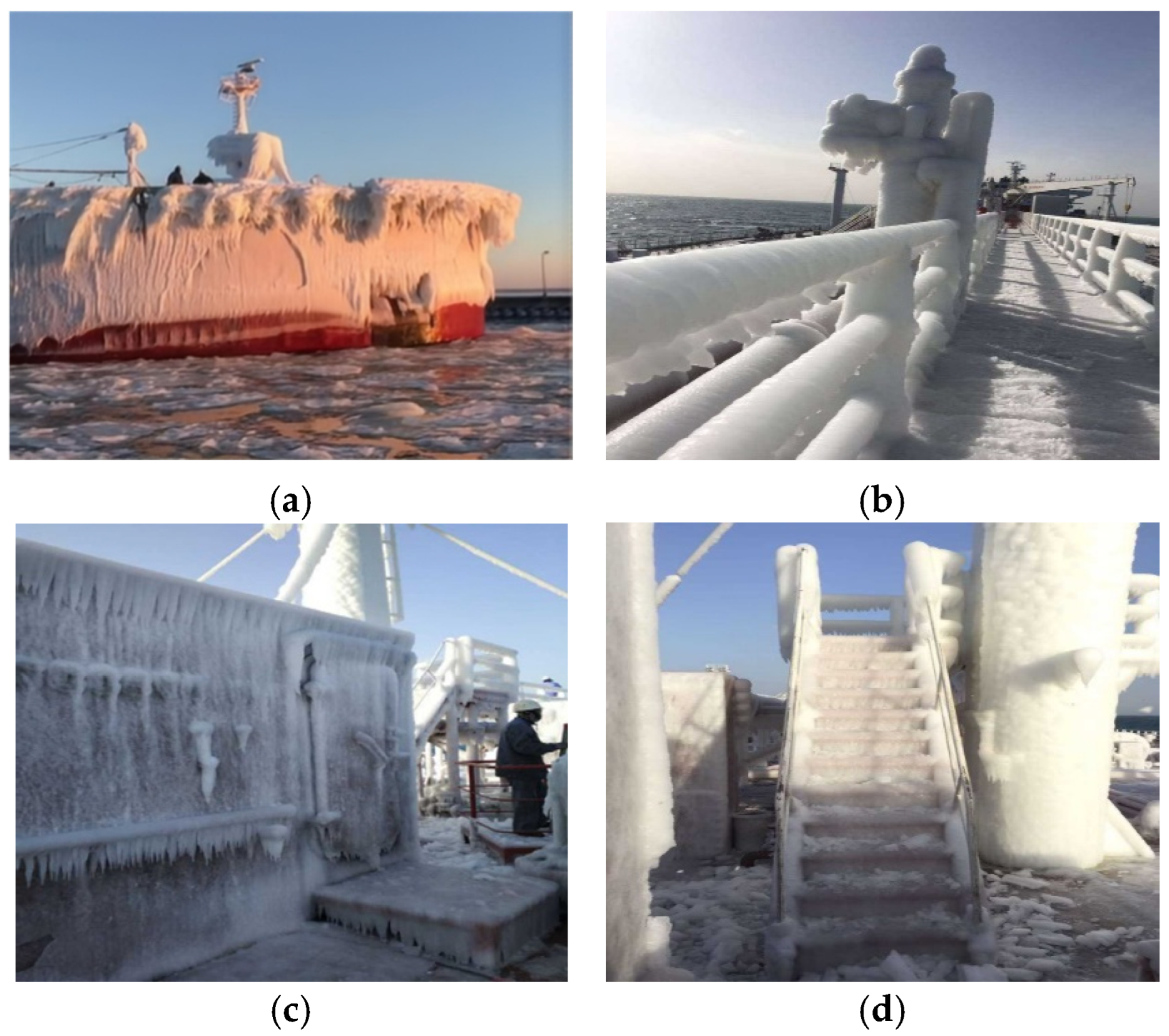
Figure 1. (a) The sides of the ship are covered with ice; (b) the external pipelines of a specific ship are covered with ice; (c) the ice covering the door of a specific cabin; (d) the stairs on the deck of a particular ship are covered with ice.
Jmse 14 00928 g001
Figure 2. Design structure distribution diagram (a), physical diagram (b), and measurement system technology route flow chart (c) for an intelligent test device for testing the adhesion force of a ship to an ice-covering body.
Jmse 14 00928 g002
Figure 3. Design of the “de-icing formation” distribution scheme of the ultrasonic vibrator. (a) “X”-type vibrator arrangement pattern on the ice-covered steel plate. (b) “Focus” concentrated vibrator arrangement pattern at the center of the ice-covered steel plate. (c) “Surrounding” vibrator arrangement pattern on the ice-covered steel plate. (d) “Scattered” vibrator arrangement pattern on the ice-covered steel plate.
Jmse 14 00928 g003
Figure 4. Experimental equipment and laboratory supplies. (a) Ultrasonic generator and ultrasonic power amplifier, (b) JUST ultrasonic vibrator, (c) magnetic-suction displacement speed amplitude vibration test system, (d) JUST intelligent test device for adhesion force between ship and overlying ice, (e) polar ship hull plate, and (f) overlying ice.
Jmse 14 00928 g004
Figure 5. Hull steel plate, overlying ice of a polar ship. (a) Hull steel plate of a polar ship, (b) overlying ice (made by gravitational crystal wet seeding method, 1000 × 600 × 20 mm).
Jmse 14 00928 g005
Figure 6. “X” shape, 30 20 kHz vibrators, simulation diagram and experimental result diagram. (a) Model simulation diagram The non-English term “最大”, “最小”, “C: 耦合场谐波”, “定向变形”, “类型: 定向变形 (Y轴)”, “频率: 20,000 Hz”, “扫掠相 0°”, “单位: m”, “全局坐标系”, refers to Max, Min, C: Coupled-Field Harmonic, Directional Deformation, Type: Directional Deformation (Y Axis), Frequency: 20,000 Hz, Sweeping Phase: 0°, Unit: m, Global Coordinate System, (b) experimental vibrator “X” arrangement, (c) test curve of ice cover displacement during vibration, (d) test curve of ice cover adhesion after vibration, (e) “drumming” at the boundary of the ice cover, and (f) microcavitation in the thin molten layer at the ice–steel interface.
Jmse 14 00928 g006aJmse 14 00928 g006b
Figure 7. “X” shape, 30 33 kHz vibrators, simulation diagram and experimental result diagram. (a) Model simulation diagram. The non-English term “最大”, “最小”, “C: 耦合场谐波”, “定向变形 4”, “类型: 定向变形 (Y轴)”, “频率: 33,000 Hz”, “扫掠相 0°”, “单位: m”, “全局坐标系”, refers to Max, Min, C: Coupled-Field Harmonic, Directional Deformation 4, Type: Directional Deformation (Y Axis), Frequency: 33,000 Hz, Sweeping Phase: 0°, Unit: m, Global Coordinate System, (b) experimental vibrator “X” arrangement, (c) test curve of ice cover displacement during vibration, (d) test curve of ice cover adhesion after vibration, (e) “circumferential cracking” of the ice cover, and (f) large-area microcavitation in the thin molten layer at the ice–steel interface.
Jmse 14 00928 g007aJmse 14 00928 g007b
Figure 8. “Center focus” shape, 30 20 kHz vibrators, simulation diagram and experimental result diagram. (a) Model simulation diagram. The non-English term “最大”, “最小”, “C: 耦合场谐波”, “定向变形 4”, “类型: 定向变形 (Y轴)”, “频率: 20,000 Hz”, “扫掠相 0°”, “单位: m”, “全局坐标系”, refers to Max, Min, C: Coupled-Field Harmonic, Directional Deformation 4, Type: Directional Deformation (Y Axis), Frequency: 20,000 Hz, Sweeping Phase: 0°, Unit: m, Global Coordinate System, (b) experimental vibrator “center focus” arrangement, (c) test curve of ice cover displacement during vibration, (d) test curve of ice cover adhesion after vibration, (e) extension of the ice cover from the middle to the breaking up of the ice cover on all sides, and (f) cavitation of the larger ultrasonic “bubbles” in the middle.
Jmse 14 00928 g008
Figure 9. “Center focus” shape, 30 33 kHz vibrators, simulation diagram and experimental result diagram. (a) Model simulation diagram. The non-English term “最大”, “最小”, “C: 耦合场谐波”, “定向变形 4”, “类型: 定向变形 (Y轴)”, “频率: 33,000 Hz”, “扫掠相 0°”, “单位: m”, “全局坐标系”, refers to Max, Min, C: Coupled-Field Harmonic, Directional Deformation 4, Type: Directional Deformation (Y Axis), Frequency: 33,000 Hz, Sweeping Phase: 0°, Unit: m, Global Coordinate System, (b) experimental vibrator “center focus” arrangement, (c) test curve of ice cover displacement during vibration, (d) test curve of ice cover adhesion after vibration, (e) the ice cover “large area” broken phenomenon extending from the center to the surrounding, and (f) “broken ice” of the ice cover.
Jmse 14 00928 g009
Figure 10. “Surrounding” shape, 30 20 kHz vibrators, simulation diagram and experimental result diagram. (a) Model simulation diagram. The non-English term “最大”, “最小”, “C: 耦合场谐波”, “定向变形 4”, “类型: 定向变形 (Y轴)”, “频率: 20,000 Hz”, “扫掠相 0°”, “单位: m”, “全局坐标系”, refers to Max, Min, C: Coupled-Field Harmonic, Directional Deformation 4, Type: Directional Deformation (Y Axis), Frequency: 20,000 Hz, Sweeping Phase: 0°, Unit: m, Global Coordinate System, (b) experimental vibrator “surrounding” arrangement, (c) test curve of ice cover displacement during vibration, (d) test curve of ice cover adhesion after vibration, (e) “linear cracks” around the ice cover, and (f) smaller “ice fragments” around the ice cover.
Jmse 14 00928 g010aJmse 14 00928 g010b
Figure 11. “Surrounding” shape, 30 33 kHz vibrators, simulation diagram and experimental result diagram. (a) Model simulation diagram. The non-English term “最大”, “最小”, “C: 耦合场谐波”, “定向变形 4”, “类型: 定向变形 (Y轴)”, “频率: 33,000 Hz”, “扫掠相 0°”, “单位: m”, “全局坐标系”, refers to Max, Min, C: Coupled-Field Harmonic, Directional Deformation 4, Type: Directional Deformation (Y Axis), Frequency: 33,000 Hz, Sweeping Phase: 0°, Unit: m, Global Coordinate System, (b) experimental vibrator “surrounding” arrangement, (c) test curve of ice cover displacement during vibration, (d) test curve of ice cover adhesion after vibration, (e) “shear cracks” around the ice, and (f) “ice melt” occurs via microcavitation within the thin molten layer at the ice–steel interface surrounding the ice cover.
Jmse 14 00928 g011aJmse 14 00928 g011b
Figure 12. “Scattered” shape, 30 20 kHz vibrators, simulation diagram and experimental result diagram. (a) Model simulation diagram. The non-English term “最大”, “最小”, “A: 耦合场谐波”, “定向变形”, “类型: 定向变形 (Y轴)”, “频率: 20,000 Hz”, “扫掠相 0°”, “单位: m”, “全局坐标系”, refers to Max, Min, A: Coupled-Field Harmonic, Directional Deformation, Type: Directional Deformation (Y Axis), Frequency: 20,000 Hz, Sweeping Phase: 0°, Unit: m, Global Coordinate System, (b) experimental vibrator “scattered” arrangement, (c) test curve of ice cover displacement during vibration, (d) test curve of ice cover adhesion after vibration, (e) “point-like” break-up phenomenon around the ice cover, and (f) the “micro-jet” phenomenon generated by ultrasonic cavitation.
Jmse 14 00928 g012
Figure 13. “Scattered” shape, 30 33 kHz vibrators, simulation diagram and experimental result diagram. (a) Model simulation diagram. The non-English term “最大”, “最小”, “A: 耦合场谐波”, “定向变形 4”, “类型: 定向变形 (Y轴)”, “频率: 33,000 Hz”, “扫掠相 0°”, “单位: m”, “全局坐标系”, refers to Max, Min, A: Coupled-Field Harmonic, Directional Deformation 4, Type: Directional Deformation (Y Axis), Frequency: 33,000 Hz, Sweeping Phase: 0°, Unit: m, Global Coordinate System, (b) experimental vibrator “scattered” arrangement, (c) test curve of ice cover displacement during vibration, (d) test curve of ice cover adhesion after vibration, (e) “net-like” cracks of the ice cover, and (f) “cratering” by microcavitation in the thin molten layer at the ice–steel interface.
Jmse 14 00928 g013
Table 1. Design of experiments.
Arrangement and Number (pcs) of VibratorsVibration Frequency of a Vibrator (kHz)Vibrator Power
(W)
Vibration Time
(s)
Excitation Current
(mA)
Piezoelectric Transducers Measured Voltage (V)Power FactorIce Thickness
(mm)
“X”, 302030002001.80.88290420
“X”, 303330002001.80.82269720
“center focus”, 302030002001.80.88290420
“center focus”, 303330002001.80.82269720
“surrounding”, 302030002001.80.88290420
“surrounding”, 303330002001.80.82269720
“scattered”, 302030002001.80.88290420
“scattered”, 303330002001.80.82269720
Table 2. Summary of experimental results for all eight cases.
Arrangement and Number (pcs) of VibratorsVibration Frequency of a Vibrator (kHz)Maximum Vertical Displacement of the Ice Cover (μm)Time to Reach Maximum Displacement (s)Ice Adhesion Strength After De-Icing (kPa)
“X”, 3020190.90180.15167.3
“X”, 3033421.8095.8546.8
“center focus”, 3020197.36174.13165.4
“center focus”, 3033429.4386.9939.9
“surrounding”, 3020193.89185.34168.5
“surrounding”, 3033421.38101.4349.4
“scattered”, 3020184.78193.87171.2
“scattered”, 3033409.50108.2256.3
Disclaimer/Publisher’s Note: The statements, opinions and data contained in all publications are solely those of the individual author(s) and contributor(s) and not of MDPI and/or the editor(s). MDPI and/or the editor(s) disclaim responsibility for any injury to people or property resulting from any ideas, methods, instructions or products referred to in the content.