Article

Environmental Modulation of Marine Productivity and Annual Fish Catch Along the Coast of Peru
1
Physics Department, University of Puerto Rico Mayaguez, Mayagüez, PR 00681, USA
2
Geography Department, University of Zululand, KwaDlangezwa 3886, South Africa
J. Mar. Sci. Eng. 2026, 14(10), 926; https://doi.org/10.3390/jmse14100926 (registering DOI)
Submission received: 21 April 2026 / Revised: 13 May 2026 / Accepted: 14 May 2026 / Published: 18 May 2026
(This article belongs to the Special Issue Marine and Coastal Processes in a Changing Climate)

Abstract

This study considers ocean–atmosphere influences on marine productivity over the shelf of Peru. Annual fish catch since 1961 and monthly satellite phytoplankton fluorescence (FLH) since 1997 in the area 7–14 S, 80–76 W provide a basis for statistical evaluation of environmental indicators from reanalysis fields. Monthly FLH is correlated with the year-on-year change in (anchovy) fish catch, wherein the autumn season (Mar–Aug) shows optimal association. The temporal record of FLH is regressed onto various fields, and the upper and lower 10 years are identified for composite analysis. Statistical results link the Southern Oscillation to wind patterns and oceanic response, wherein greater anchovy catch tends to follow La Niña. A case study is made of the change from El Niño in 2023 to La Niña in 2024. Composites indicate that cyclonic wind vorticity spreads phytoplankton across the Peruvian shelf under La Niña, resulting in a 33% increase in fluorescence from 0.26 to 0.39.

1. Introduction

The coast of Peru is swept by the cool Humboldt Current [1]. Coastal upwelling from the prevailing southeasterly wind lifts nutrient-rich water over the shelf. The marine climate instills a trophic cascade from phytoplankton to fish [2], distributed from the coast to 200 km offshore at depths less than 200 m. The dominant species is pelagic anchovy, which spawn in September and October. They recruit into shoals after one year and feed on diatoms, zooplankton and micro-crustaceans, moving shoreward in Jan–Feb and offshore in Jul–Aug [3]. Anchovy is harvested for fishmeal, within quotas that sustain an average of ~6 M T/year. Catch rates tend to vary (standard deviation ~2.6 M T) due to zonal tilting of the upper Pacific Ocean thermocline [4] associated with tropical anticyclonic trade winds. When the circulation weakens, equatorial winds join a fast-moving oceanic Kelvin wave, tilting the thermocline eastward and advecting warm seawater toward Ecuador. About one year later, the anticyclonic trade winds re-establish and the thermocline tilts westward again, modulated by a slow-moving ocean Rossby wave [5,6,7]. This Southern Oscillation has a rhythm of 3–6 years, with stronger events reaching the coast of Peru. Phytoplankton composition switches from beneficial diatoms in La Niña to less nutritious and potentially toxic dinoflagellates in El Niño [8]. Sea surface height variations off Peru are dominated by inter-annual time-scales (65%); annual (5%) and intra-seasonal (30%) fluctuations are secondary [9] due to the low latitude and channeling of southeast winds by coastal mountains [10,11].
Following warm-phase El Niño, a deeper thermocline circulates nutrient-poor water, and the pelagic fish (anchovy) retreat toward Chile, whereas in cool-phase La Niña, a shallower thermocline circulates nutrient-rich water, stimulating the trophic cascade. Thus, ocean–atmosphere interactions cause large year-to-year changes in fish catch, despite management [12]. Numerical modeling by [13] has revealed how variations in wind-driven upwelling affect anchovy recruitment, mainly via changes in currents and seawater composition [14]. Below the ~30 m euphotic mixed layer is a hypoxic zone (O2 ~30 µmol/kg) of decayed organic matter [15], which excludes zooplankton prey and increases ecosystem efficiency. When southeast winds diminish in late summer and during El Niño events, low oxygen water diffuses toward the surface—disrupting the trophic cascade.
Although seasonality is minimal, wind-driven upwelling is most intense during spring (Sep–Nov) when deeper mixing, offshore export and cooler temperatures inhibit bio-accumulation [16]. It is during autumn (Mar–May) that conditions are optimal for biomass over the shelf (CHLa ~4 mg/m3). The marine ecosystem off Peru is unequaled in fishery yield, partly due to how the southeast winds turn offshore and join trade winds over the east Pacific [17]. Despite global warming elsewhere, sea surface temperatures along the coast show a cooling trend [18] due to the strengthening of the pressure gradient between the marine high and continental low, and a gradual weakening of El Niño.
To conceptualize these processes and distinguish important features, we could devise multiple realizations to draw scientific inferences from numerical or field experiments. But that approach may not encompass interactions for migratory fish in coupled ecosystems. Alternatively, a comparative methodology can be employed to draw on repetitive features in historical space–time variability. Here, we combine both forms of enquiry to statistically analyze environmental conditions over the Peruvian shelf in the context of annual fish catch and monthly satellite phytoplankton fluorescence [19]. The scientific objective here is to quantify marine climate influences on year-to-year fluctuations of fish catch over the shelf (7–14 S) using sophisticated reanalysis datasets. Section 2 covers the data and methods, while Section 3 presents the results, progressing from mean features to temporal analysis, regression statistics, and contrasts between high and low productivity. Section 4 provides a summarizing discussion that relates fishery yield to ocean–atmosphere conditions.

2. Data and Methods

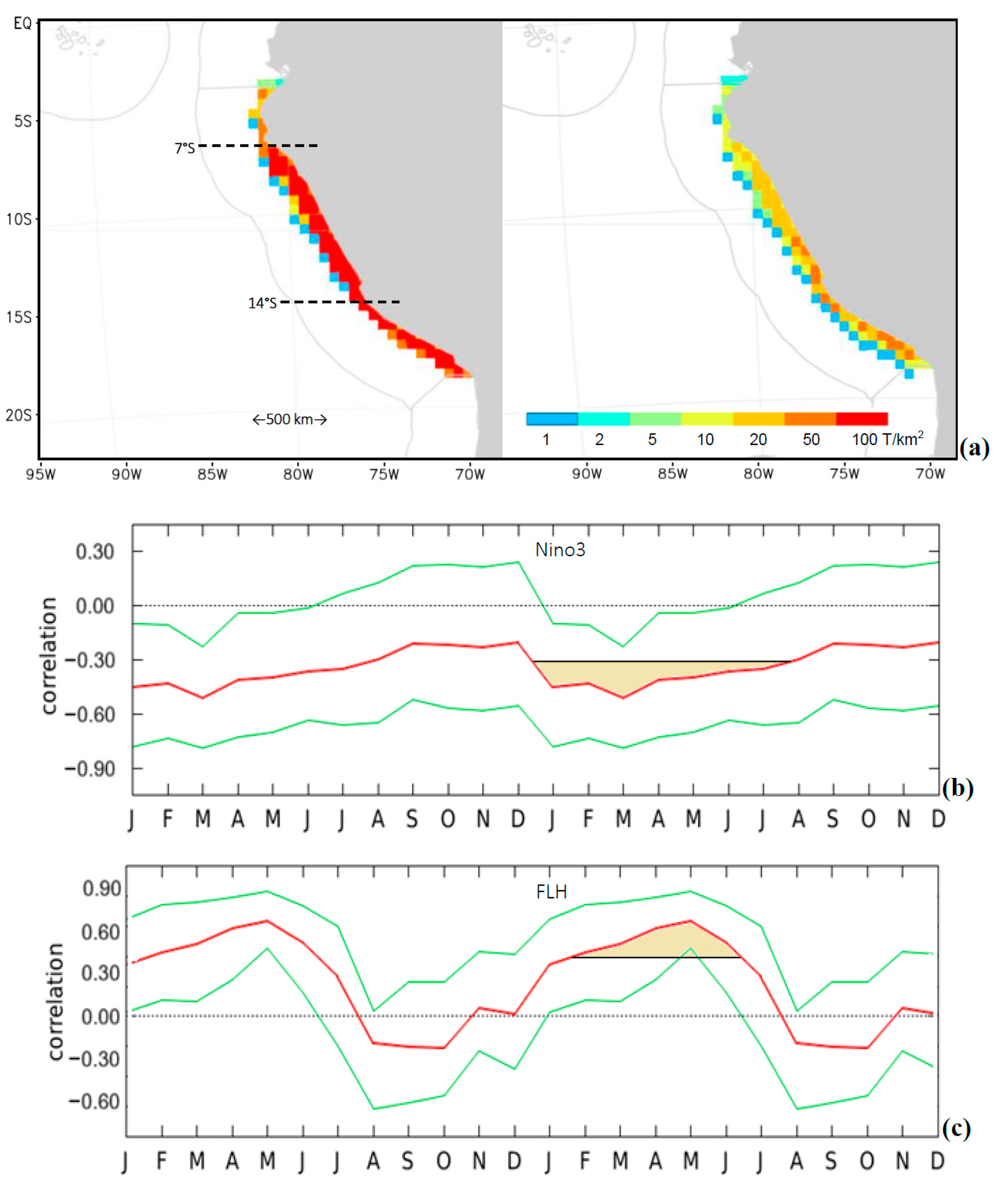
Our study of Peru fishery yield uses annual catch data from FAO [20] since 1961, comprising 85% anchovy. Reported catch density maps (Appendix A Figure A1a) exhibit high values within 200 km of the coast, over the continental shelf from Piura to Paracas 7–14 S. Given the biological complexity and uncertainties in fishing effort and management, an objective proxy for productivity was derived from monthly satellite normalized fluorescence line height (FLH) since 1997 (wavelength ~0.68 µm, resolution ~5 km). Red-band radiance (FLH) improves on green-band (CHLa) as a proxy for fish catch, likely due to dissolved organic matter [15]. Exploratory work was performed to shift the FLH extraction area north–south, east–west, and across seasons until an optimum regression with fish catch was achieved. The designated FLH extraction area is: 7–14 S, 80–76 W (cf. Figure 1b,c,e), and season: Mar–Aug, autumn. This index (~3000 km2) encompasses the Paracas upwelling plume (4° lon × 7° lat) and shelf zone with the greatest fish catch (Appendix A Figure A1a). Sea surface temperature fields since 1961 from the Hadley Centre [21] and ocean dynamic topography (height minus geoid) since 1997 from interpolated satellite altimeters [22] were employed in correlation analyses. Composite subsurface ocean conditions were described via GODAS reanalysis sea temperature, salinity, currents, and vertical motion [23] since 1980. Composite atmospheric conditions were described via MERRA2 reanalysis surface and air temperature, humidity, latent heat flux, net solar radiation, potential vorticity, sea-level air pressure, winds and vertical motion [24] since 1980. The ocean and atmosphere reanalyses have 50 km horizontal resolution and assimilate observations from ship, buoy, drifter, aircraft, and satellite to produce hindcasts with fine vertical resolution.
The statistics were formulated as: (i) year-on-year change in fish catch (year-after value minus year-before or ‘rate’, a temporal subtraction) 1961–2024 from FAO, and (ii) monthly FLH records 1997–2024 from NASA satellites https://giovanni.gsfc.nasa.gov/ (accessed on 1 September 2025). Correlations between the annual fish catch and monthly Nino3 SST, Southern Oscillation Index, and FLH were calculated (cf. Appendix A Figure A1b,c) and identified autumn as the most sensitive. The scatterplot comparison between annual catch rate and seasonal FLH resolved 38% of variance (cf. Figure 1b), supporting its use as a proxy to link marine productivity to fishery yield. The continuous monthly FLH time series over the shelf from Paracas to Piura was subjected to wavelet spectral analysis for amplitude and period, and its frequency probability was analyzed for Gaussian distribution. Next, the FLH time series was regressed onto Mar–Aug fields of latent heat flux, surface temperature, net solar radiation, sea-level air pressure, and ocean dynamic topography, and lead-lag correlations were explored. By ranking the Mar–Aug FLH time series, the upper 10 and lower 10 groups were identified and ‘high minus low’ composites were calculated as maps (5 N–22 S, 95 W–68 W) and height or depth sections (averaged 7–14 S). Insignificant composite differences < 0.5 σ were suppressed by neutral representation. The FLH time series exhibited a large swing in estimated productivity from 2023 to 2024, so those were contrasted in a case study focusing on FLH, air pressure, and wind vorticity or curl. Temporal and spatial regressions with the continuous monthly FLH record 1997–2024 and with annual fish catch rate 1961–2024 require a Pearson-product moment R > |0.21| for 95% confidence with ~60 degrees of freedom. For seasonal FLH, Nino3, and SOI, significance is reached with R > |0.43|.
This study cannot explain the complex biochemical feedback between wind-driven coastal upwelling nutrification and fishery abundance. Instead, recursive statistical methods are employed to indicate macro-scale air–sea interactions that enhance or suppress phytoplankton concentrations over the shelf.

3. Results

3.1. Fish Catch and Ocean Color

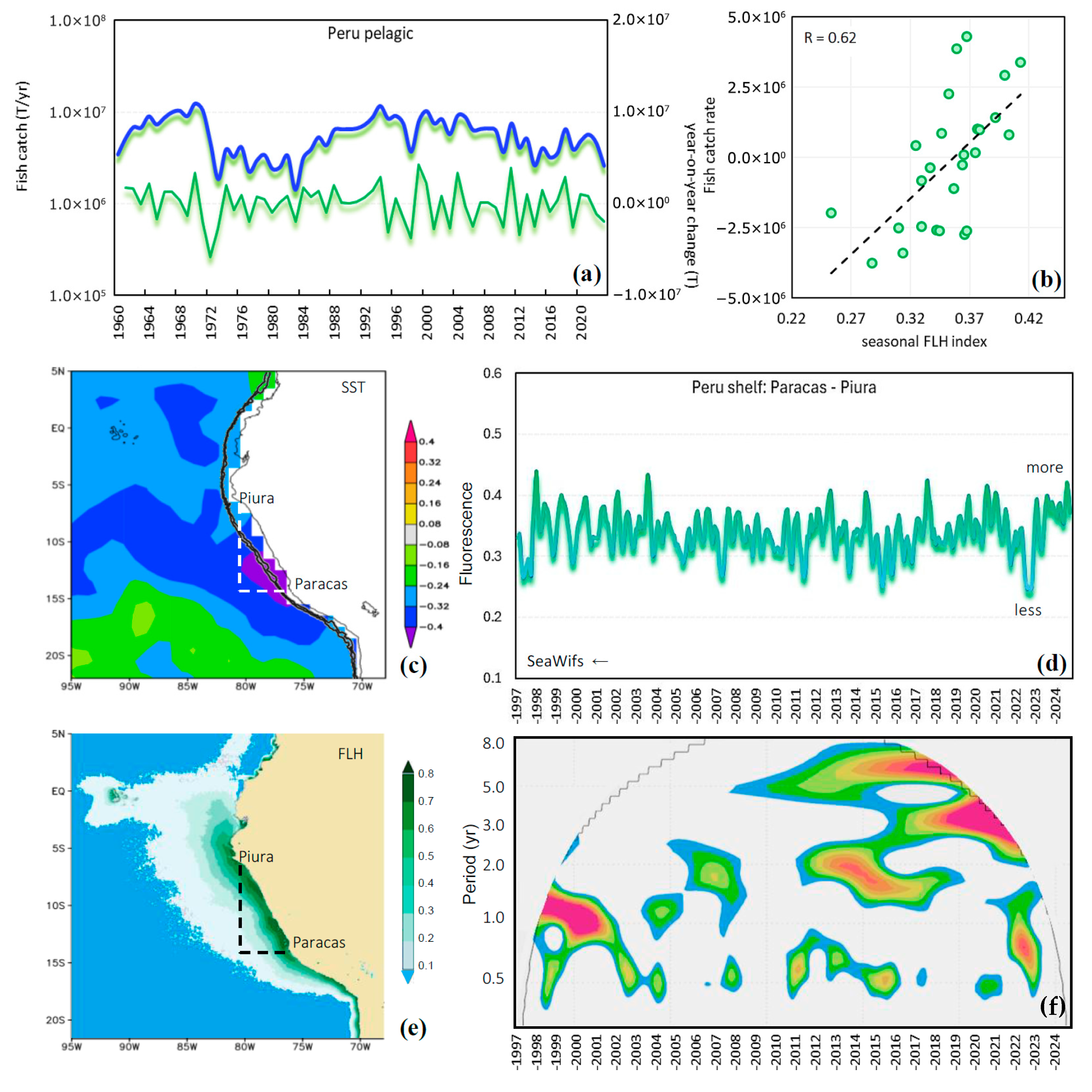
Figure 1a presents the annual record of Peru fish catch and the year-on-year change ‘rate’. The total catch fluctuates at inter-decadal time-scale, with a lengthy downturn between the 1973 and 1983 El Niño events. The catch rate exhibits rebounds at 2–5 year intervals due to zonal tilting of the tropical Pacific thermocline and Southern Oscillation, an inference supported by auto-correlation of −0.27 at +1 year. Appendix A Figure A1a) illustrates the distribution of Peru’s anchovy catch in high and low years. Highest density >20 T/km2 is reported within 200 km of shore and exhibits a weak long-shore gradient. Catch declines rapidly seaward of the shelf edge. The scatterplot (Figure 1b) illustrates a linear regression fit between Peru fish catch rate and seasonal FLH with R value = 0.62 (38% of variance), supported by data in Table 1a, and Appendix A Figure A1b,c). Correlating the catch rate with Mar–Aug SST fields 1961–2024 (Figure 1c), we note a tongue of significant negative values extending northwestward from the Paracas upwelling plume. The inference is that cool/warm SST enhances/suppresses annual catch. The monthly FLH record 1997–2024 is presented in Figure 1d. Seasonal pulsing is interrupted by downturns during El Niño events in 1998, 2016, and 2023. In the map of average satellite FLH (Figure 1e), high red-band radiance > 0.7 Sr−1 extends ~200 km seaward to ~30 m depth (consistent with [2,8]). Moderate normalized FLH values > 0.1 Sr−1 spread further from the coast of Peru (~400 km). The continuous monthly FLH wavelet spectra (Figure 1f) reveal persistent 0.5 and 2 year oscillations, and 3–6 year intervals since 2010 due to ocean Rossby waves that spread westward from Peru [5]. Annual pulsing in 1997–2002 is likely an artifact of SeaWifs’ narrower bandwidth.
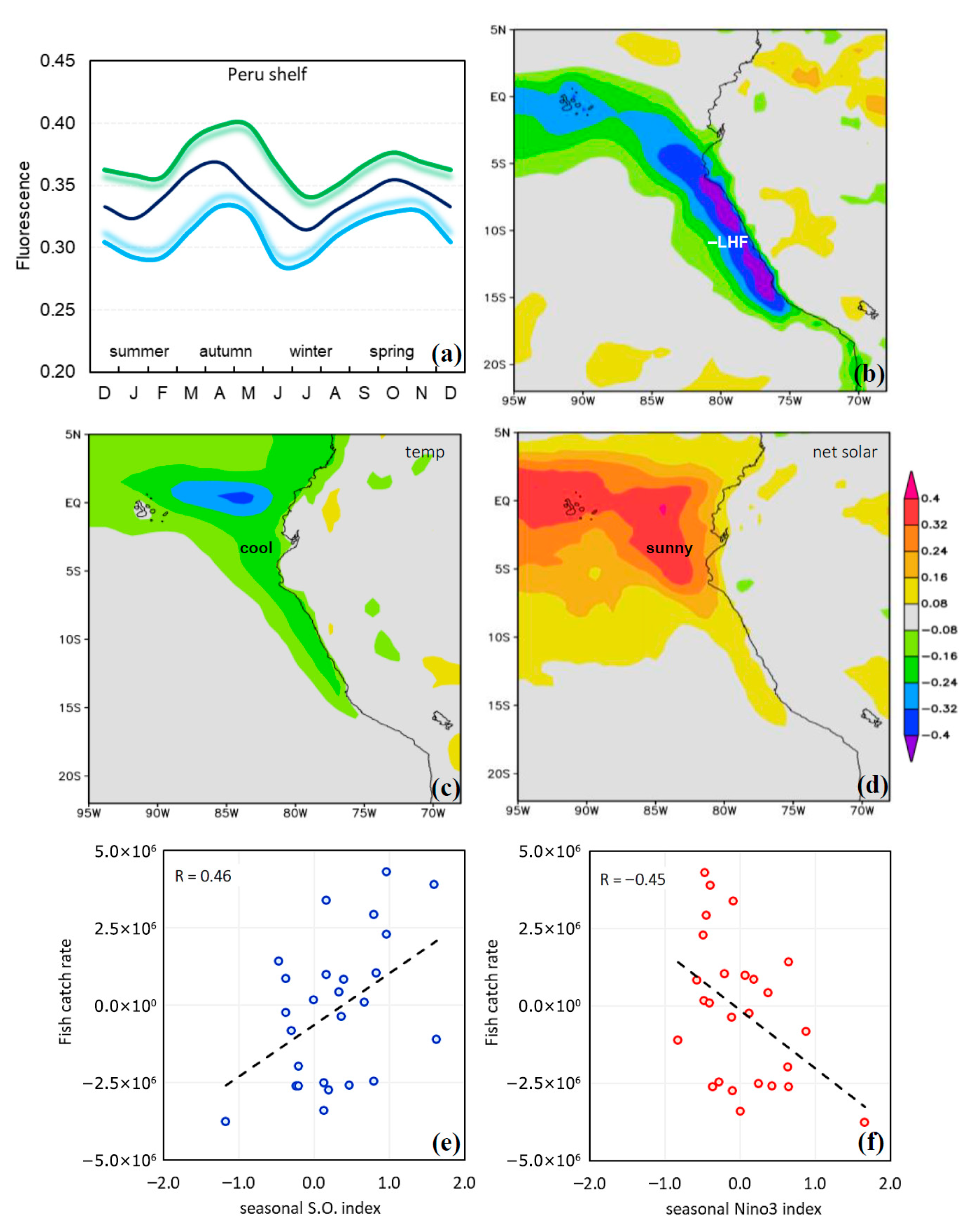
TThe normalized FLH mean annual cycle is presented in Figure 2a. Bi-annual crests are apparent, with major/minor peaks in Mar–May/Sep–Nov. Low FLH in Dec–Feb relates to thermal stratification and infrequent El Niño events, while low FLH in Jun–Aug is attributable to oblique sun angle and cloud cover inhibiting photosynthesis. Yet the 20 and 80 percentiles stay in a narrow range 0.28–0.41 Sr−1, indicative of limited seasonality along the coast of Peru 7–14 S, as also seen in CHLa [25]. Simultaneous correlation maps with respect to the Mar–Aug FLH record 1997–2024 are presented in Figure 2b–d. The latent heat flux exhibits significant negative correlations over the shelf, which extend northwest to the Galapagos Islands. Thus, coastal winds tend to be less turbulent during spells of higher FLH productivity. Similarly, inshore surface temperatures are cool and net radiation is greater, more so toward Ecuador and the Galapagos Islands than off Peru. These features suggest Rossby wave ‘pulling’ in La Niña and Kelvin wave ‘pushing’ in El Niño, teleconnected with the tropical east Pacific. This inference is reinforced by scatterplot correlations of fish catch rate with Mar–May SOI and Nino3 SST (Figure 2e,f), which reveal significant R values of 0.46 and −0.45, respectively.

3.2. Composite Analysis

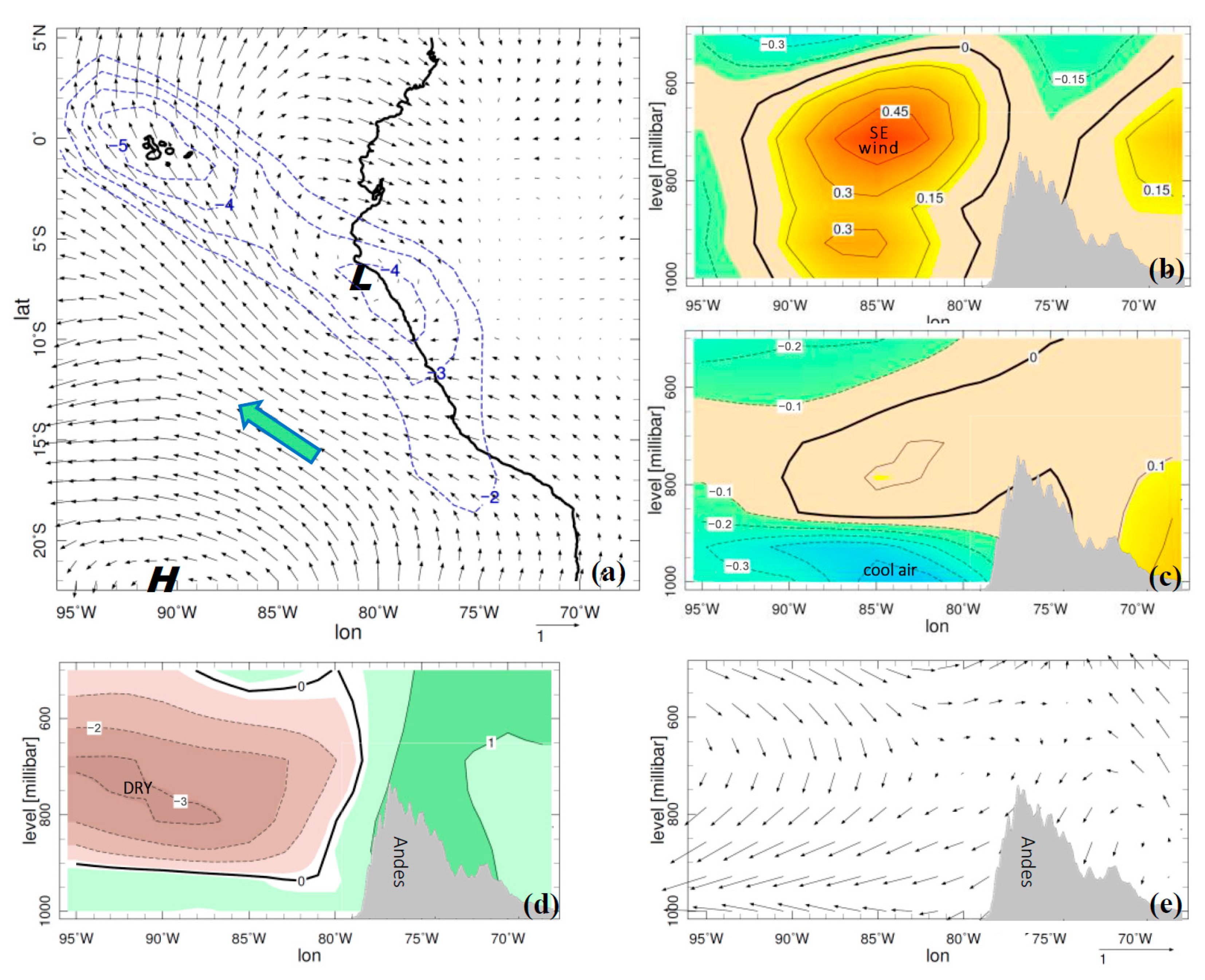
The upper 10 and lower 10 Mar–Aug FLH values are identified (Table 1b) and used to form atmospheric difference maps and height sections in Figure 3a–e. A key feature of higher productivity is the near-surface wind field guided by a marine high and coastal low. Together, these re-direct the alongshore winds to an offshore orientation (Figure 3a) and reduce turbulent mixing over the inner shelf north of Paracas. Stronger and deeper southeasterly winds in an offshore position (Figure 3b) generate cyclonic vorticity inshore. Composite air temperatures are cooled by upwelling (Figure 3c), and the zonal atmospheric circulation subsides over the outer shelf causing a dry layer (Figure 3d,e). In contrast, the Andes altiplano experiences higher humidity favoring crop yields.
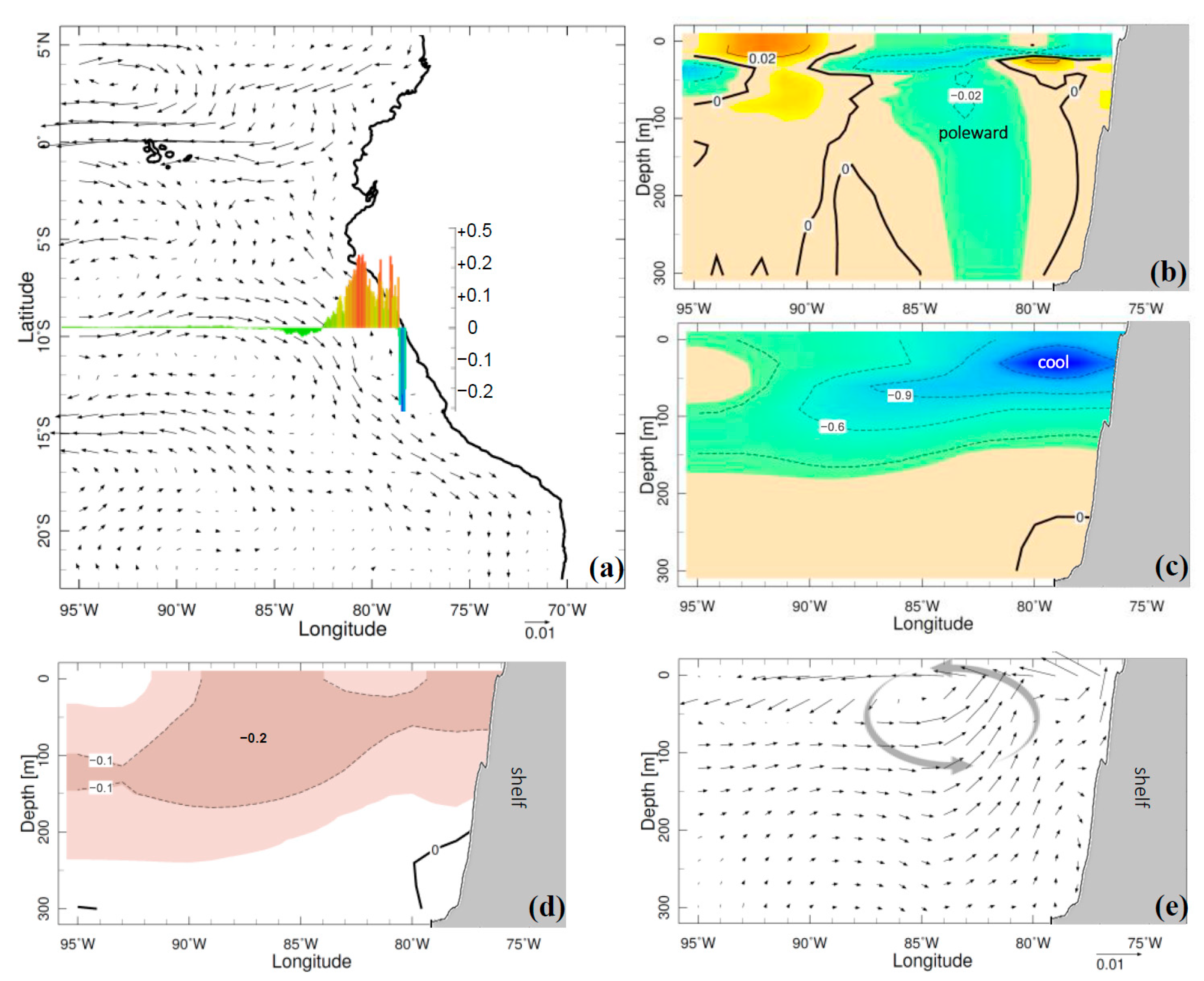
Oceanic difference maps and depth sections are presented in Figure 4a–e, using the same seasons identified in Table 1b, comprising 120 months. Upper ocean currents exhibit anomalous poleward flow along Peru’s shelf edge, indicating a weakening of the Humboldt Current and greater retention of phytoplankton. Currents from Ecuador to the Galapagos Islands are westward, consistent with a La Niña signal. The FLH section shows that surface productivity differences lie inside the poleward currents. At the coast, FLH differences are negative, suggesting an offshore shift of phytoplankton consistent with the wind orientation and Ekman transport. Depth sections show a cool tongue < 0.9 C extending seaward almost 1000 km to 100 m depth, where composite salinity is −0.2 ppt below normal. The zonal oceanic circulation (Figure 4e) clearly shows maximum uplift over the shelf edge some 300 km offshore, associated with cyclonic wind vorticity induced by a standing atmospheric trough over Piura (cf. Figure 3a).

3.3. Leading Processes

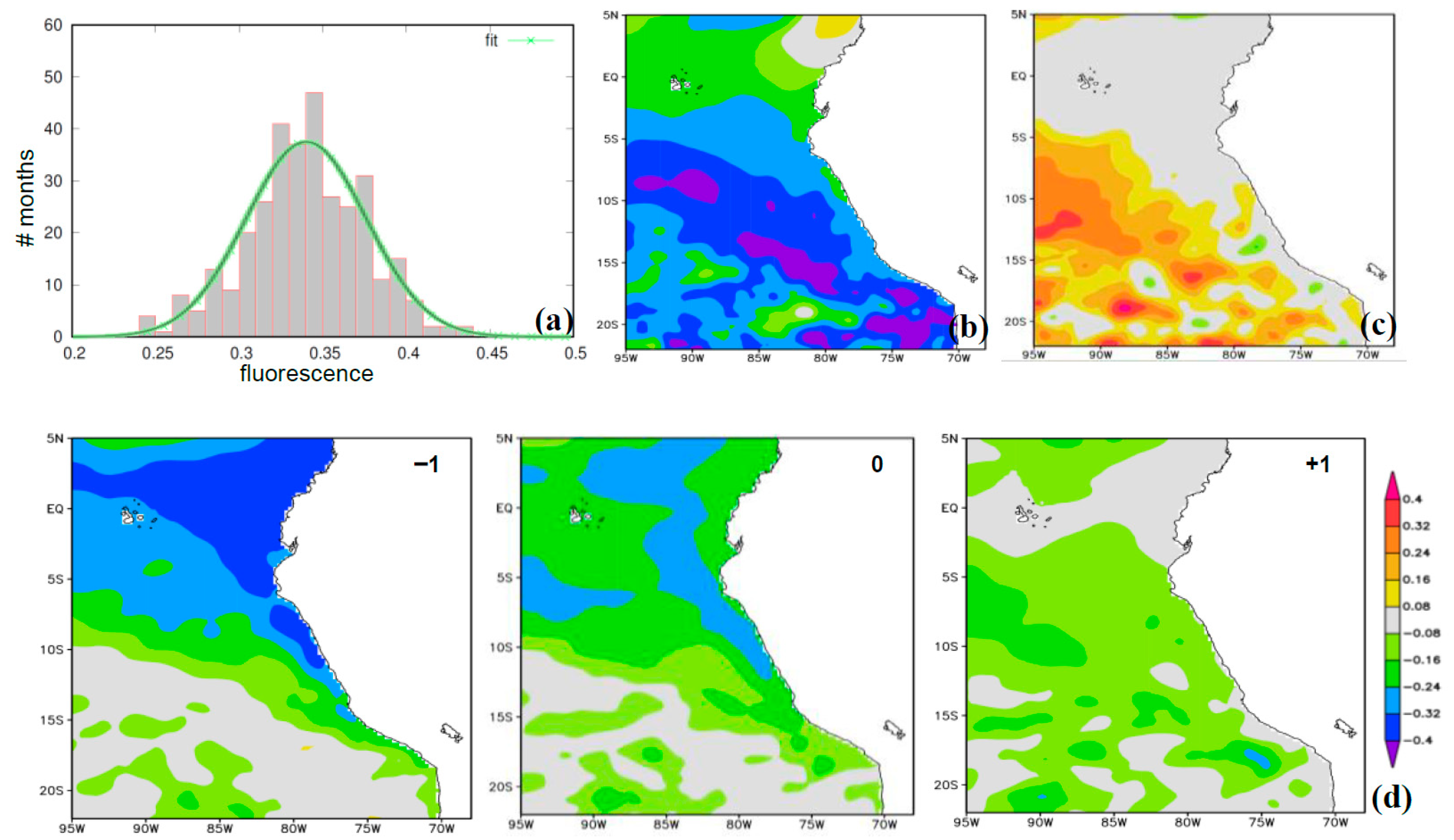
A histogram of monthly FLH is analyzed for a Gaussian fit in Figure 5a. Contrary to expectations, we find a propensity of months near the median, falling off symmetrically toward infrequent outliers, despite the potential for bi-modality from the Southern Oscillation. Thus, extremes of primary productivity are limited; near-normal conditions are sustained by the southeast Pacific anticyclone, wind-driven coastal upwelling, and the steady Humboldt Current. The Gaussian distribution makes the FLH record amenable to linear correlation and composite analysis that suggests the opposite is true.
Segregating the FLH record into normalized values < 0.31 and > 0.37 Sr−1, simultaneous correlation maps with Mar–Aug oceanic dynamic topography 1997–2024 are presented in Figure 5b,c. Less/more productivity is characterized by low/high offshore sea surface height, distinct from the composite currents presented earlier. The continuous monthly FLH record correlated with dynamic topography at lags of −1, 0, +1 months is presented in Figure 5d. The influence is stronger leading than lagging, especially from Ecuador to Galapagos, the source of oceanic Kelvin waves in El Niño. Similar analyses with other fields (cf. Figure 2b–d) did not reveal a delayed response (e.g., optimal R values were simultaneous). Although the physical environment narrowly leads phytoplankton (FLH), the biological response (catch rate) follows by 3–6 months, as might be attributed to zooplankton uptake in La Niña and migratory retreat in El Niño [2].

3.4. Case Study

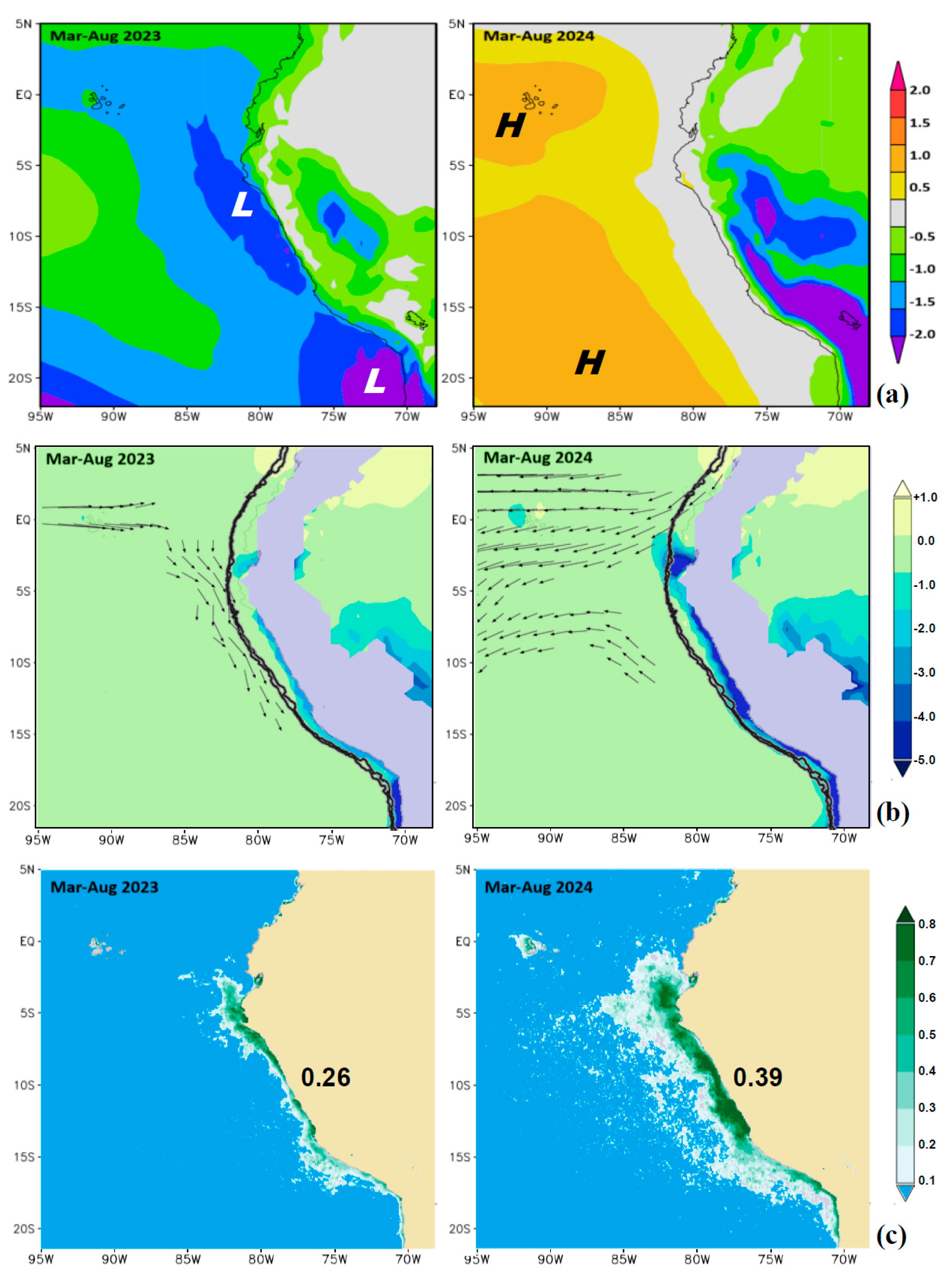
A marked change in FLH was noted in the temporal record from 2023 to 2024 (cf. Figure 1d) and forms a case study for comparative analysis in Figure 6a–c. In Mar–Aug 2023 there was a narrow coastal strip of FLH > 0.5 Sr−1 due to a weak air pressure gradient and slack equatorward winds. Surveys by IMARPE indicate anchovy distributions were inshore and shallow, due to anomalous warm seawater with low oxygen concentration [26] advected by southeastward currents. In contrast, Mar–Aug 2024 had a strong air pressure gradient and vigorous equatorward winds and westward currents, spreading FLH > 0.5 Sr−1 beyond the shelf edge. The primary productivity is altered by the width and intensity of cyclonic wind vorticity or curl (ζv). Vertical motion is generated over the Peru shelf according to W = ζv/ρ f [27], using ζv = 5 10−7 N m−2 (Figure 6b), water density (ρ) ~103 kg m−3, and Coriolis (f) –3.8 10−5 s−1. The wind curl generates vertical motion > 1 m/day in latitudes 7–14 S, in addition to that from offshore Ekman transport (cf. Figure 4e). Critically, that occurs within 200 km of the coast, spreading phytoplankton seaward in the upper mixed layer. Cyclonic wind vorticity is enhanced by cooling of the atmospheric boundary layer inshore (cf. Figure 3c), which supports a steep gradient in air–sea momentum transfer.

4. Discussion

The marine climate is changing, yet recent decades have seen a trend toward cool phase ENSO, which sustains Peru’s upwelling and coastal fisheries [28,29,30,31]. Earlier studies have linked multi-year fluctuations in anchovy abundance to alternating warm poleward and cool equatorward currents, modulated by ENSO [32,33]. Compared with mid-ocean ENSO, the coastal type naturally imposes greater influence on planktonic aggregations and pelagic biomass. These migrate south during the warm phase, preserving ecosystem productivity and shifting marine resources to Chile. The research presented here has added to our understanding of climatic elements within those processes, using in situ data since 1960 and satellite data since 1997.

5. Conclusions

Marine climate influences on productivity over the shelf of Peru from Paracas to Piura have been evaluated in the context of fishery yield and phytoplankton fluorescence. The scientific methodology applied reanalysis data in recursive statistical comparisons. Point-to-field regressions utilized monthly FLH time series 1997–2024 as a proxy for year-on-year changes in pelagic fish catch to understand ocean–atmosphere coupling. This study is novel in using catch rate (instead of total) to minimize external influences and employing FLH (instead of CHLa) to estimate biomass availability.
The significant association of the catch rate with FLH, SOI, and Nino3 (cf. Figure 1b and Figure 2e,f) lent confidence to statistical inferences on marine productivity and extended our understanding from past research [7]. Sea temperatures and phytoplankton concentration over the shelf were linked via the Southern Oscillation to environmental conditions in the tropical east Pacific. Year-on-year changes in the anchovy harvest were statistically correlated with autumn SOI, Nino3, and FLH (Table 1a), which explains ~38% of variance, equivalent to swings exceeding one million tons. During years of high catch, strong southeasterly winds on the shelf edge (cf. Figure 3a,b) induce cyclonic wind vorticity that spreads phytoplankton above the poleward undercurrent (cf. Figure 4a,b), as noted by [34]. Inter-annual fluctuations of Peru fish catch rate, marked by crests following La Niña and troughs following El Niño (cf. Figure 2e,f), occur amidst the steady influence of the southeast Pacific anticyclone and Humboldt Current.
Despite Southern Oscillation influence, the FLH distribution was rather Gaussian (cf. Figure 5a), implying that the marine ecosystem off the coast of Peru operates within an optimal range, somewhat buffered against extremes by a steady overturning circulation (cf. Figure 4e). Lag correlations with dynamic topography found the greatest influence at short lead time from the Ecuador–Galapagos region, indicating that tropical oceanic Kelvin and Rossby waves are fundamental to delayed biological responses and fishery yield.
A comparison of El Niño 2023 and La Niña 2024 seasons quantified how cyclonic wind vorticity spread phytoplankton over the shelf, resulting in a 33% increase in fluorescence from 0.26 to 0.39. This provides new insights into the mechanisms governing the productivity of the Peruvian upwelling system, extending recent work [26]. In summary, this work elucidates how macro-scale air–sea interactions link subsurface characteristics to biological responses in the southeastern Pacific, contributing to a better understanding of environmental influences on Peruvian fish catch.

Funding

This research received no external funding.

Data Availability Statement

The data analyses are available in an Excel spreadsheet by email request. The author declares no competing interests. The author engaged in field work to study the Paracas upwelling plume during CUEA 1976.

Acknowledgments

Environmental data were sourced from the websites of the International Research Institute for Climate, Climate Explorer KNMI (for Nino3, SOI), NASA Giovanni (for FLH), and the University of Hawaii APDRC; fish catch data were derived from the FAO. Point-to-field correlation maps were calculated using the Climate Explorer KNMI website, while composites were averaged in the IRI Climate Library. This work was conceived during a workshop in July 2025 at the National University of Trujillo, Peru.

Conflicts of Interest

The author declares no conflict of interest.

Appendix A

Figure A1. (a) Distribution of Peru anchovy catch in 2000 (left) and 2019, from www.seaaroundus.org/data/ (accessed on 1 September 2025). The map data are pixelated at 1° resolution; thus, the highest catch density is within 200 km of the coast. The FLH proxy for catch rate is extracted from 7 to 14 S (dashed). (b) Cross-correlogram of annual fish catch rate vs. Nino3 per month 1961–2023, shaded > 90% confidence. (c) Cross-correlogram of annual fish catch rate vs. FLH per month 1997–2024 (red), shaded > 90% confidence, identifying an autumn maximum; green lines are the 90% confidence interval.
Jmse 14 00926 g0a1

References

  1. Kämpf, J.; Chapman, P. Upwelling Systems of the World; Springer: Cham, Switzerland, 2016; 433p. [Google Scholar]
  2. Chavez, F.P.; Bertrand, A.; Guevara-Carrasco, R.; Soler, P.; Csirke, J. The northern Humboldt Current System: Brief history, present status and a view towards the future. Prog. Oceanogr. 2008, 79, 95–105. [Google Scholar] [CrossRef]
  3. Espinoza, P.; Bertrand, A. Revisiting Peruvian anchovy (Engraulis ringens) trophodynamics provides a new vision of the Humboldt current system. Prog. Oceanogr. 2008, 79, 215–227. [Google Scholar] [CrossRef]
  4. Clark, W.G. The lessons of the Peruvian anchoveta fishery. CALCOFI Rep. 1977, 19, 57–63. [Google Scholar]
  5. White, W.B. Tropical coupled Rossby waves in the Pacific ocean–atmosphere system. J. Phys. Oceanogr. 2000, 30, 1245–1264. [Google Scholar] [CrossRef]
  6. Fréon, P.; Bouchon, M.; Mullon, C.; García, C.; Ñiquen, M. Interdecadal variability of anchoveta abundance and overcapacity of the fishery in Peru. Prog. Oceanogr. 2008, 79, 401–412. [Google Scholar] [CrossRef]
  7. Chavez, F.P.; Messié, M.; Pennington, J.T. Marine primary production in relation to climate variability and change. Annu. Rev. Mar. Sci. 2011, 3, 227–260. [Google Scholar] [CrossRef]
  8. Ochoa, N.; Taylor, M.H.; Purca, S.; Ramos, E. Intra- and inter-annual variability of nearshore phytoplankton biovolume and community changes in the northern Humboldt Current system. J. Plankton Res. 2010, 32, 843–855. [Google Scholar] [CrossRef]
  9. Jigena-Antelo, B.; Estrada-Ludeña, C.; Howden, S.; Rey, W.; Paz-Acosta, J.; Lopez-García, P.; Salazar-Rodriguez, E.; Endrina, N.; Muñoz-Pérez, J.J. Evidence of sea level rise at the Peruvian coast (1942–2019). Sci. Total Environ. 2023, 859, 160082. [Google Scholar] [CrossRef]
  10. Chavez, F.P.; Messié, M. A comparison of eastern boundary upwelling ecosystems. Prog. Oceanogr. 2009, 83, 80–96. [Google Scholar] [CrossRef]
  11. Jury, M.R.; Alfaro-Garcia, L.E. Peruvian north coast climate variability and regional ocean–atmosphere forcing. Coasts 2024, 4, 508–534. [Google Scholar] [CrossRef]
  12. Chavez, F.P.; Ryan, J.; Lluch-Cota, S.E.; Ñiquen C, M. From anchovies to sardines and back: Multidecadal change in the Pacific Ocean. Science 2003, 299, 217–221. [Google Scholar] [CrossRef]
  13. Xu, Y.; Chai, F.; Rose, K.A.; Ñiquen C, M.; Chavez, F.P. Environmental influences on the interannual variation and spatial distribution of Peruvian anchovy population dynamics from 1991 to 2007: A 3-D modeling study. Ecol. Model. 2013, 264, 64–82. [Google Scholar] [CrossRef]
  14. Salvatteci, R.; Schneider, R.R.; Galbraith, E.; Field, D.; Blanz, T.; Bauersachs, T.; Crosta, X.; Martinez, P.; Echevin, V.; Scholz, F.; et al. Smaller fish species in a warm and oxygen-poor Humboldt Current system. Science 2022, 375, 101–104. [Google Scholar] [CrossRef] [PubMed]
  15. Maßmig, M.; Engel, A. Dissolved organic matter in the upwelling system off Peru: Imprints of bacterial activity and water mass characteristics. JGR Biogeosci. 2021, 126, e2020JG006048. [Google Scholar] [CrossRef]
  16. Xue, T.; Frenger, I.; Prowe, A.E.F.; José, Y.S.; Oschlies, A. Mixed layer depth dominates over upwelling in regulating the seasonality of ecosystem functioning in the Peruvian upwelling system. Biogeosciences 2022, 19, 455–475. [Google Scholar] [CrossRef]
  17. Bakun, A.; Weeks, S.J. The marine ecosystem off Peru: What are the secrets of its fishery productivity and what might its future hold? Prog. Oceanogr. 2008, 79, 290–299. [Google Scholar] [CrossRef]
  18. Jury, M.R. Implications of east Pacific La Niña events for Southern African climate. Atmosphere 2025, 16, 1204. [Google Scholar] [CrossRef]
  19. Gower, J. On the use of satellite-measured chlorophyll fluorescence for monitoring coastal waters. Int. J. Remote Sens. 2016, 37, 2077–2086. [Google Scholar] [CrossRef]
  20. Food & Agricultural Organization (FAO). 2025. Available online: https://www.fao.org/faostat/en/#data/MK (accessed on 1 September 2025).
  21. Kennedy, J.J.; Rayner, N.A.; Atkinson, C.P.; Killick, R.E. An ensemble data set of sea surface temperature change from 1850: The Met Office Hadley Centre HadSST.4.0.0.0 data set. JGR Atmos. 2019, 124, 7719–7763. [Google Scholar] [CrossRef]
  22. Legeais, J.-F.; Ablain, M.; Zawadzki, L.; Zuo, H.; Johannessen, J.A.; Scharffenberg, M.G.; Fenoglio-Marc, L.; Fernandes, M.J.; Andersen, O.B.; Rudenko, S.; et al. An improved and homogeneous altimeter sea level record from the ESA climate change initiative. Earth Syst. Sci. Data 2018, 10, 281–301. [Google Scholar] [CrossRef]
  23. Penny, S.G.; Behringer, D.W.; Carton, J.A.; Kalnay, E. The hybrid global ocean data assimilation system at NCEP. Mon. Weather Rev. 2015, 143, 4660–4677. [Google Scholar] [CrossRef]
  24. Gelaro, R.; McCarty, W.; Suárez, M.J.; Todling, R.; Molod, A.; Takacs, L.; Randles, C.A.; Darmenov, A.; Bosilovich, M.G.; Reichle, R.; et al. The Modern-era retrospective analysis for research and applications v2 (MERRA-2). J. Clim. 2017, 30, 5419–5454. [Google Scholar] [CrossRef]
  25. Echevin, V.; Aumont, O.; Ledesma, J.; Flores, G. The seasonal cycle of surface chlorophyll in the Peruvian upwelling system: A modelling study. Prog. Oceanogr. 2008, 79, 167–176. [Google Scholar] [CrossRef]
  26. Castillo, P.R.; Bouchón, M.; Vásquez, L.; Cuadros, G.; Grados, D.; Valdez, C.; Pozada-Herrera, M. Behaviour and size distribution of anchoveta under El Niño 2023 in the northern Humboldt Current system. Sci. Mar. 2025, 89, e097. [Google Scholar] [CrossRef]
  27. Brink, K.H. Wind-driven currents over the continental shelf. In The Sea: Global Coastal Ocean Processes and Methods; Wiley & Sons: New York, NY, USA, 1998; Volume 10, pp. 3–20. [Google Scholar]
  28. Gutiérrez, D.; Akester, M.; Naranjo, L. Productivity and sustainable management of the Humboldt current large marine ecosystem under climate change. Environ. Dev. 2016, 17, 126–144. [Google Scholar] [CrossRef]
  29. Edwards, M.R.; Cardenas-Alayza, S.; Adkesson, M.J.; Daniels-Abdulahad, M.; Hirons, A.C. Peruvian fur seals as archivists of El Niño-Southern Oscillation effects. Front. Mar. Sci. 2021, 8, 651212. [Google Scholar] [CrossRef]
  30. Galloso, P.; Correa, G.M.; Legendre, P. The impacts of El Niño Southern Oscillation on the pelagic fish community structure of the northern Humboldt Current system. Deep Sea Res. Part II Top. Stud. Oceanogr. 2025, 224, 105553. [Google Scholar] [CrossRef]
  31. Quispe-Ccalluari, C.; Tam, J.; Demarcq, H.; Chamorro, A.; Espinoza-Morriberón, D.; Romero, C.; Dominguez, N.; Ramos, J.; Oliveros-Ramos, R. An index of coastal thermal effects of El Niño Southern Oscillation on the Peruvian upwelling ecosystem. Int. J. Climatol. 2018, 38, 3191–3201. [Google Scholar] [CrossRef]
  32. Moron, G.; Galloso, P.; Gutierrez, D.; Torrejon-Magallanes, J. Temporal changes in mesoscale aggregations and spatial distribution scenarios of the Peruvian anchovy. Deep Sea Res. II Top. Stud. Oceanogr. 2019, 159, 75–83. [Google Scholar] [CrossRef]
  33. Bertrand, A.; Lengaigne, M.; Takahashi, K.; Avadí, A.; Poulain, F.; Harrod, C. El Nino Southern Oscillation (ENSO) Effects on Fisheries and Aquaculture; FAO Fisheries and Aquaculture Technical Paper No. 660; FAO: Rome, Italy, 2020. [Google Scholar]
  34. Rosales-Quintana, G.M.; Marsh, R.; Icochea-Salas, L.A. Interannual variability in contributions of the equatorial undercurrent to Peruvian upwelling source water. Ocean Sci. 2021, 17, 1385–1402. [Google Scholar] [CrossRef]
Figure 1. (a) Temporal record of Peru annual anchovy fish catch (blue) and year-on-year change ‘rate’ (green); (b) scatterplot of fish catch rate vs. Mar–Aug FLH; (c) correlation of fish catch with Mar–Aug SST 1961–2023, shelf edge outlined; (d) temporal record of normalized FLH over the Peru shelf (7–14 S, 80–76 W): the statistical basis; (e) map of average normalized FLH reflectivity (Sr−1); (f) FLH wavelet spectral energy (shaded 90-94-98% confidence, blue-yellow-red) inside the cone of validity. FLH index from Piura to Paracas is dashed in (c,e); labels in (d) refer to the period of SeaWifs and the case study 2023–2024.
Jmse 14 00926 g001
Figure 2. (a) Mean annual cycle of normalized FLH over the Peru shelf (Sr−1): 20, 50, 80 percentiles. Point-to-field simultaneous correlation of the monthly continuous FLH time series (Figure 1d) and Mar–Aug 1997–2024 environmental fields: (b) latent heat flux, (c) surface temperature (0 m), (d) net solar radiation; all use same color bar. Patterns refer to conditions favoring higher FLH productivity and fishery yield; R values > |0.21| are significant for continuous monthly records. (e,f) Scatterplots of fish catch rate 1997–2024 vs. Mar–May SOI and Nino3 SST (right); R values > |0.43| are significant for seasonal records.
Jmse 14 00926 g002
Figure 3. Atmospheric composites of upper minus lower FLH seasons (Mar–Aug): (a) near-surface wind (vectors m/s) and cyclonic vorticity (dashed < −2 10−5 s−1), weather icons, arrow indicates maximum speed. Height sections averaged over 7–14 S of: (b) meridional wind m/s, (c) air temperature C, (d) humidity g/kg, (e) zonal circulation (vector m/s) with Andes profile. Seasons are listed in Table 1b; patterns refer to more minus less productive in terms of FLH. Small differences (<0.5 σ) are unshaded or have small vectors.
Jmse 14 00926 g003
Figure 4. Oceanic composites of upper minus lower FLH seasons (Mar–Aug): (a) 1–200 m currents (vectors) with FLH section (inset). Height sections 7–14 S of: (b) meridional current, (c) sea temperature, (d) salinity, (e) zonal circulation (vector) with shelf profile. Seasons are listed in Table 1b; patterns refer to more minus less productive in terms of FLH. Small differences (<0.5 σ) are unshaded or have small vectors.
Jmse 14 00926 g004
Figure 5. (a) Histogram of monthly normalized FLH (Sr−1) and Gaussian fit. Point-to-field correlation of continuous monthly FLH and ocean dynamic topography: (b) normalized FLH < 0.31 (less productive); (c) normalized FLH > 0.37 Sr−1 (more productive); (d) (left-to-right) environment leading FLH −1 month, simultaneous 0, lagging +1 month, all 1997–2024; all use same color bar. Note that R values > |0.21| are significant.
Jmse 14 00926 g005
Figure 6. Comparison of less (left) and more productive seasons, 2023 (left) and 2024: (a) sea-level air pressure anomalies (hPa) with cell icons; (b) near-surface wind vorticity or curl (10−7 N m−2, cyclonic negative blue) with 1–200 m currents > 0.3 m/s (vector), shelf edge (outlined), elevation > 1000 m (gray); and (c) Mar–Aug average normalized FLH (Sr−1) with index values bold.
Jmse 14 00926 g006
Table 1. (a) Correlation of seasonal FLH with Peru annual fish catch and year-on-year change ‘fish rate’, 1998–2024; R values > 0.43 are bold and significant at 95% confidence. (b) Listing of ranked upper 10 (green) and lower 10 FLH seasons (Mar–Aug) employed in composites.
1998–2024D J FM A MJ J AS O NMar–Aug
Mar–May0.348
Jun–Aug−0.0390.462
Sep–Nov−0.224−0.334−0.023
Mar–Aug0.2300.9180.776−0.248
fish catch0.5390.5310.128−0.0450.435
fish rate0.4420.614−0.004−0.0850.435
(a)
FLHYearFLHYear
0.38520240.3312010
0.38320210.3302022
0.37520180.3292009
0.37020130.3242000
0.36720040.3232006
0.36020200.3132014
0.35620070.3132017
0.35120050.3131998
0.35020150.3062016
0.34820080.2622023
(b)
Disclaimer/Publisher’s Note: The statements, opinions and data contained in all publications are solely those of the individual author(s) and contributor(s) and not of MDPI and/or the editor(s). MDPI and/or the editor(s) disclaim responsibility for any injury to people or property resulting from any ideas, methods, instructions or products referred to in the content.