1. Introduction
In applications such as underwater acoustic communications [
1], target detection, and sonar signal processing [
2], propagation channels [
3] in complex ocean environments usually exhibit significant multipath effects [
4] and sparse structural characteristics [
5]. Since the number of effective propagation paths is limited and the channel energy is mainly concentrated on a few dominant taps, underwater acoustic channels [
6] can often be modeled as typical sparse channels [
7]. Therefore, achieving fast, accurate, and robust sparse underwater acoustic channel estimation under complex noise environments [
8] has become an important research topic in underwater acoustic signal processing [
9].
However, practical underwater acoustic environments [
10] are far more complicated than idealized assumptions. In addition to ambient background noise [
11], reverberation interference, ocean impulsive disturbances, and platform-motion-induced fluctuations [
12,
13], the received signals may also be affected by correlated inputs and channel variations [
14], which significantly increase the difficulty of channel estimation [
15]. Under such conditions, the noise often deviates from the Gaussian model and exhibits heavy-tailed, impulsive, and nonstationary characteristics [
16]. As a result, conventional adaptive algorithms based on the mean square error criterion, such as LMS-type methods [
17,
18], are usually sensitive to outliers and may suffer from severe performance degradation, making them inadequate for accurate sparse channel [
19] estimation in complex underwater acoustic environments [
20].
For sparse system identification and channel estimation, a substantial amount of research has first been devoted to sparse constraint modeling [
21]. Zero-attracting (ZA) [
22], reweighted zero-attracting (RZA), and approximate
-norm constraints have been incorporated into classical adaptive filtering frameworks such as LMS and RLS to enhance the identification capability for sparse unknown systems [
23]. These methods can exploit sparse prior information to some extent and improve the estimation accuracy of dominant taps [
24]. Nevertheless, their robustness is usually established under Gaussian noise or weak perturbation assumptions. When significant impulsive interference, outliers, or non-Gaussian noise [
25] exists in the environment, their performance may degrade substantially.
To improve robustness against non-Gaussian noise, a series of adaptive estimation methods based on robust cost functions have been developed. Among them, the maximum correntropy criterion (MCC) [
26] has attracted considerable attention because it can suppress the influence of large-error samples through local kernel similarity [
27] and thus exhibits strong robustness in impulsive noise environments. Based on MCC, the proportionate MCC (PMCC) algorithm [
28] further introduces a proportionate update mechanism [
29,
30] into the MCC framework, thereby enhancing the selective update capability for dominant sparse taps and achieving better convergence and steady-state performance than conventional MCC in sparse system identification [
31]. Meanwhile, the kernel risk-sensitive loss (KRSL) has been proposed as a new similarity measure in kernel space [
32]. Related studies have shown that KRSL can maintain robustness to outliers and impulsive noise while providing a more favorable performance surface than correntropy-based methods [
33], which is beneficial for achieving faster convergence and higher estimation accuracy.
On the basis of KRSL [
34], recursive kernel risk-sensitive loss (RKRSL) [
35] and several improved variants have been further developed by combining recursive [
36,
37] estimation with robust kernel losses, aiming to enhance the fast convergence capability of adaptive algorithms in complex noise environments. To exploit sparse prior information more effectively, some studies have also incorporated convex regularization into the RKRSL framework [
38] and proposed convex-regularized recursive kernel risk-sensitive loss algorithms, where sparse constraints [
39,
40] are explicitly embedded to improve the identification performance for highly sparse systems [
41]. These studies indicate that the organic combination of robust loss functions, recursive fast-update mechanisms, and sparse priors [
42] is an effective way to improve channel estimation performance in complex noise environments [
43].
In addition to the above general studies on sparse system identification [
44], some works have specifically investigated the structural characteristics of underwater acoustic channels [
45]. For example, block-sparsity-constrained methods have been introduced to exploit clustered channel tap distributions, thereby improving the accuracy and stability of underwater acoustic channel estimation. This suggests that fully exploring the internal structural priors of underwater acoustic channels is of great importance for performance enhancement. Moreover, analyses of proportionate recursive least-squares-type methods for time-varying sparse systems have shown that the proportionate update mechanism has clear advantages in rapidly tracking dominant taps, while recursive frameworks [
46] generally provide better data utilization efficiency and tracking capability in dynamic environments. These studies have laid an important foundation for sparse channel estimation in complex environments from the perspectives of sparse structure exploitation, robust criterion design [
47], proportionate updating, and recursive fast convergence.
Despite the above progress, there is still room for further improvement. First, some robust algorithms can maintain good stability under non-Gaussian noise and impulsive interference [
48]. However, they do not sufficiently exploit the sparse structural information of underwater acoustic channels. As a result, they fail to fully utilize the prior advantage that the channel energy is concentrated on a few dominant taps. Second, some sparse-constrained or proportionate-update algorithms [
49] can enhance the estimation of dominant taps. However, under complex conditions such as correlated inputs, nonstationary noise, and dynamically varying channels, the weighting of historical data is usually still controlled by fixed parameters. This results in limited adaptive adjustment capability. Consequently, it remains difficult to achieve a better tradeoff among convergence speed, steady-state error, tracking performance, and robustness. In other words, how to unify robust kernel loss, proportionate sparse updating, and time-varying memory mechanisms into an effective recursive framework remains an important problem in sparse underwater acoustic channel estimation.
To address the above issues, this paper proposes a variable forgetting factor [
50] proportionate recursive kernel risk-sensitive loss (VFF-PRKRSL) algorithm for sparse underwater acoustic channel estimation in non-Gaussian noise environments. The proposed method incorporates a proportionate update mechanism into the recursive KRSL framework to enhance the selective estimation and dynamic tracking capability of dominant sparse taps. Meanwhile, a variable forgetting factor strategy is introduced to adaptively adjust the contribution of historical data according to the estimation error, thereby improving the overall balance among convergence speed, steady-state estimation accuracy, and robustness. By combining the proportionate update mechanism with the variable forgetting factor strategy, the proposed algorithm can make more effective use of sparse prior information while maintaining stronger adaptability in complex underwater environments.
To verify the effectiveness of the proposed algorithm, simulation scenarios for sparse underwater acoustic channel estimation are constructed, and the algorithm performance is systematically evaluated under several representative non-Gaussian noise conditions. Comparative experiments are conducted among LMS, MCC, PMCC, RKRSL, PRKRSL, and the proposed VFF-PRKRSL algorithm to compare their convergence speed, steady-state misalignment, and estimation accuracy under complex noise environments. In addition, ablation experiments are performed to examine the individual contributions of the proportionate update mechanism and the variable forgetting factor strategy. Furthermore, an SNR sensitivity analysis and a parameter sensitivity analysis on key parameters are carried out to further evaluate the robustness and stability of the proposed method.
The main contributions of this paper are summarized as follows:
A robust adaptive algorithm, termed VFF-PRKRSL, is proposed for sparse underwater acoustic channel estimation under non-Gaussian impulsive noise.
By effectively integrating the proportionate update mechanism and the variable forgetting factor strategy into the recursive KRSL framework, the proposed method can better emphasize dominant sparse taps. It also improves adaptive adjustment capability in dynamic environments, thereby achieving an improved tradeoff among convergence speed, steady-state misalignment, and estimation accuracy.
A comprehensive simulation framework is established to validate the proposed algorithm from multiple aspects, including non-Gaussian noise comparison, ablation analysis, SNR variation analysis, and parameter sensitivity analysis, thereby demonstrating its effectiveness, robustness, and stability.
2. KRSL Criterion and RKRSL-Based Recursive Framework
In non-Gaussian noise environments, conventional adaptive filtering algorithms based on second-order error statistics are highly susceptible to impulsive disturbances and outliers, which often lead to slow convergence, large steady-state misalignment, and degraded robustness. This problem is particularly severe in sparse underwater acoustic channel estimation. Due to the long delay spread, pronounced multipath propagation, and the fact that most channel energy is concentrated on only a few dominant paths, underwater acoustic channels can usually be modeled as typical sparse channels. Meanwhile, ambient background noise, reverberation interference, platform motion, and ocean impulsive disturbances often cause the received noise to exhibit heavy-tailed, impulsive, and nonstationary non-Gaussian characteristics. Therefore, achieving fast, accurate, and robust estimation of sparse underwater acoustic channels in complex noise environments has become a key issue in underwater acoustic signal processing.
To mitigate the performance degradation of conventional methods under impulsive noise, the kernel risk-sensitive loss (KRSL) criterion has been introduced as a robust similarity measure in kernel space. By combining Gaussian kernel mapping with an exponential risk-sensitive structure, KRSL is capable of capturing higher-order statistical characteristics of the error signal and effectively suppressing the adverse influence of abnormal samples on parameter adaptation. For two arbitrary random variables
X and
Y, the KRSL is defined as
where
denotes the Gaussian kernel with kernel width
, and
is the risk-sensitive parameter. Unlike the conventional mean square error criterion, KRSL does not directly amplify large errors, but instead suppresses the influence of outliers through nonlinear kernel weighting. Therefore, it is more suitable for adaptive estimation problems in heavy-tailed and impulsive noise environments.
Consider the sparse underwater acoustic channel estimation model
where
is the coefficient vector of the unknown sparse underwater acoustic channel,
is the input signal vector, and
denotes the additive noise. The output of the adaptive filter is given by
where
is the adaptive estimate vector at iteration
n. Accordingly, the instantaneous estimation error can be expressed as
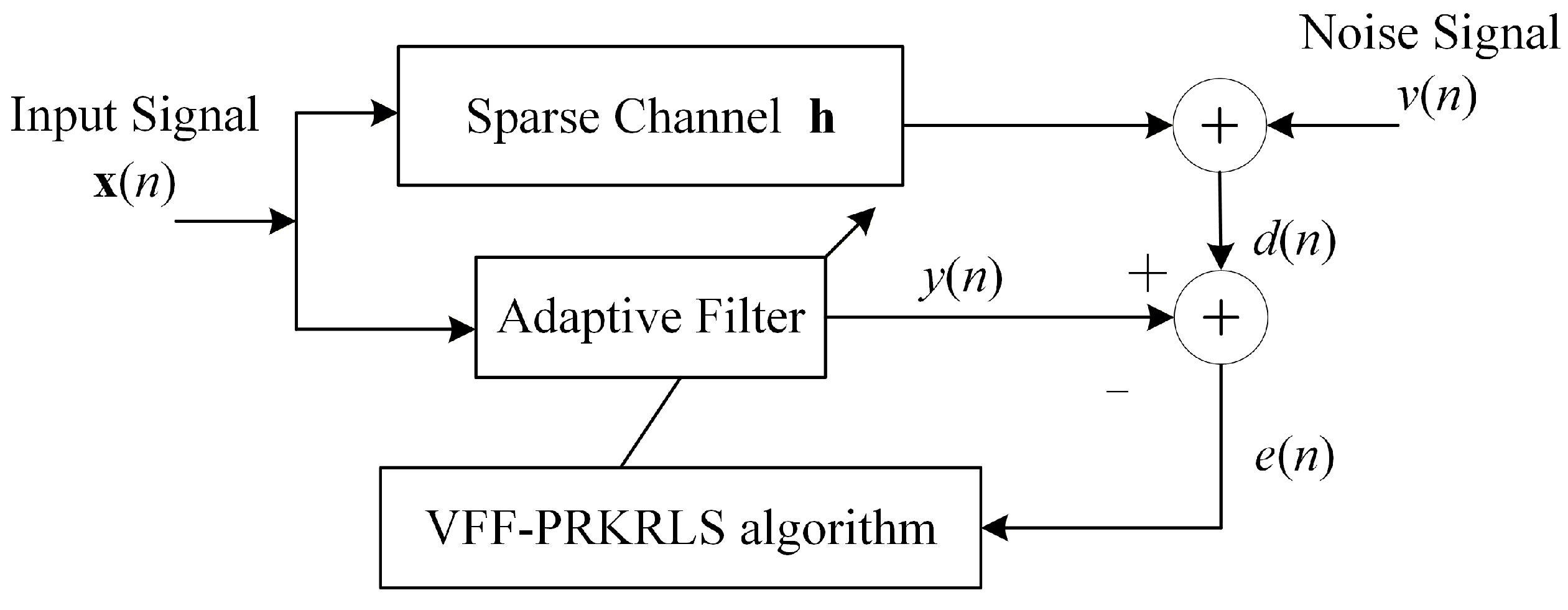
Based on the above model, the sparse underwater acoustic channel estimation structure considered in this paper is shown in
Figure 1. Specifically, the input signal
is simultaneously applied to the unknown sparse underwater acoustic channel and the adaptive filter. The noisy output of the unknown channel forms the desired signal
, while the adaptive filter generates the estimated response
. Their difference produces the error signal
, which is then fed back to update the filter coefficients. Through this iterative procedure, the adaptive filter gradually approaches the unknown sparse underwater acoustic channel.
To embed the KRSL criterion into a recursive adaptive filtering framework, an error-dependent kernel risk-sensitive weighting function is introduced as
It can be seen that the effect of the error on parameter adaptation is no longer linear, but is jointly determined by the Gaussian kernel and the risk-sensitive factor. As a consequence, when abrupt impulsive disturbances occur, the update process becomes less affected by abnormal samples, which improves the stability of the estimation process.
By further incorporating the recursive least-squares idea, the recursive kernel risk-sensitive loss (RKRSL) algorithm can be constructed. In this framework, the weighted correlation matrix and its inverse are recursively updated so that past observations can be efficiently utilized during the adaptation process. Let
denote the inverse of the recursively weighted correlation matrix. Then, the gain vector of the RKRSL algorithm can be written as
where
is the forgetting factor used to balance the contributions of historical data and current observations. Without introducing additional sparse constraints, the basic recursive update of RKRSL can be expressed as
This formulation shows that RKRSL inherits the robustness of KRSL against non-Gaussian disturbances while also preserving the fast convergence behavior of recursive algorithms under correlated inputs, making it suitable for channel estimation in complex underwater acoustic environments.
Although the conventional RKRSL algorithm has attractive robustness and convergence properties, it still has certain limitations when directly applied to sparse underwater acoustic channel estimation. On the one hand, the standard recursive update treats different filter coefficients in a relatively uniform manner, which makes it difficult to fully exploit the sparse structural information of the unknown channel and therefore limits the emphasis on dominant taps.
On the other hand, the weighting of historical information is usually controlled by a fixed forgetting factor, so the algorithm cannot flexibly adjust the balance between past and present data when the channel state or noise statistics vary over time. As a result, it is difficult for the conventional RKRSL algorithm to simultaneously achieve rapid convergence, low steady-state error, and strong tracking capability in complex environments.
Motivated by these observations, this paper further incorporates a proportionate update mechanism and a variable forgetting factor strategy into the recursive KRSL framework, and develops the VFF-PRKRSL algorithm. The proposed method assigns differentiated update strengths to different coefficients according to their current distribution. It also dynamically adjusts the weighting of historical information based on the estimation error. In this way, the method can better exploit sparse prior information and improve adaptability to time-varying non-Gaussian underwater acoustic environments. The detailed derivation of the proposed VFF-PRKRSL algorithm is presented in the next section.
3. Proposed VFF-PRKRSL Algorithm
Building on the recursive KRSL framework in
Section 2, this paper proposes a variable forgetting factor proportionate recursive kernel risk-sensitive loss (VFF-PRKRSL) algorithm for sparse underwater acoustic channel estimation in non-Gaussian environments. By introducing a variable forgetting factor and a proportionate update strategy into the RKRSL recursion, the proposed method improves both adaptive error regulation and the exploitation of sparse channel structure.
For clarity, the derivation is carried out in two steps. First, an error-dependent forgetting factor is incorporated into the conventional RKRSL algorithm to obtain VFF-RKRSL. Then, a nonlinear proportionate matrix is further introduced to develop the final VFF-PRKRSL algorithm.
3.1. VFF-RKRSL Recursion
In the conventional RKRSL algorithm, the forgetting factor remains fixed throughout the adaptation process. Although this treatment has low computational cost, it is difficult to balance fast tracking capability and low steady-state error in time-varying environments. When the unknown system changes abruptly, the influence of historical data should be reduced to enhance the response to new observations. In contrast, when the system varies slowly or remains approximately stationary, the forgetting factor should be chosen close to 1 so that historical information can be more fully utilized and the steady-state misalignment can be reduced.
To avoid an ad hoc selection of the variable forgetting factor, the functional form of is designed according to the following requirements. First, the forgetting factor should be bounded within a prescribed interval, i.e., , to guarantee numerical stability of the recursive update. Second, should be a non-increasing function of the instantaneous squared error , since a large estimation error usually indicates model mismatch, channel variation, or impulsive disturbance, for which a shorter memory depth is desired. Third, the mapping should be smooth and even with respect to , so that positive and negative errors with the same magnitude have identical influence and abrupt changes of the recursive gain are avoided.
Let
denote the instantaneous mismatch energy, and define a normalized reliability factor
to measure the confidence that the current estimate is still consistent with the past data. A natural first-order decay model assumes that the decrease rate of this reliability with respect to the mismatch energy is proportional to its current value, namely
where
controls the sensitivity to the error energy. Solving this differential equation gives
The forgetting factor is then obtained by linearly interpolating between the long-memory state
and the short-memory state
according to this reliability factor:
Therefore, the proposed variable forgetting factor is given by
where
and
denote the lower and upper bounds of the forgetting factor, respectively, and
is an error-sensitivity parameter.
The above construction provides a theoretical basis for the adopted exponential form. Specifically, it is the solution of a first-order reliability decay model with respect to the instantaneous mismatch energy. Moreover, it satisfies the desired boundedness and monotonicity properties:
and
Thus, the forgetting factor automatically approaches
when the estimation error is small, corresponding to a long-memory mode that reduces the steady-state misalignment. Conversely, when the error becomes large,
decreases toward
, corresponding to a short-memory mode that improves the tracking capability under channel variations or abrupt disturbances. In addition, the exponential mapping is smooth, bounded, and saturating, which prevents excessive fluctuation of the forgetting factor and avoids the instability that may be caused by an unbounded error-dependent adjustment.
Let the a priori estimation error in the complex-valued system be defined as
where
is the desired signal,
is the input signal,
is the estimated coefficient vector at the previous time instant, and
denotes the Hermitian transpose. By incorporating the above variable forgetting factor into the gain-vector recursion of the conventional RKRSL, the gain vector of the VFF-RKRSL algorithm can be obtained as
where
is the weighting term associated with the KRSL criterion. It can be observed that, in this gain expression, the variable forgetting factor
and the weighting term
corresponding to the KRSL criterion jointly appear in the denominator, and therefore together determine the magnitude of the recursive gain
. Specifically,
reflects the attenuation degree of historical information, whereas
characterizes the error-dependent nonlinear weighting property. Their combined effect enables the algorithm to achieve improved adaptive regulation capability while maintaining robustness against impulsive interference and non-Gaussian noise.
Accordingly, the inverse correlation matrix is updated as
Compared with the conventional RKRSL with a fixed forgetting factor, the weight assigned to historical information is no longer constant, but is dynamically adjusted according to the current estimation state. Therefore, this recursive form exhibits greater flexibility in nonstationary scenarios.
Finally, without introducing proportionate weighting, the coefficient update equation of VFF-RKRSL is given by
The above error computation, gain recursion, inverse correlation matrix update, and coefficient update together constitute the basic VFF-RKRSL algorithm. Compared with the conventional RKRSL, the proposed algorithm is able to better balance rapid tracking and low steady-state error in time-varying non-Gaussian environments merely by introducing a simple error-driven forgetting-factor adjustment mechanism.
To further illustrate the role of the VFF mechanism, the weight-vector increment in VFF-RKRSL can be examined as
Substituting the gain expression into the above equation yields
It can be seen from this expression that the magnitude of the update is mainly controlled by the modulation effect of the denominator term. In particular, and jointly form a mechanism for adaptively regulating the recursive step size, enabling the algorithm to automatically adjust the update strength in response to error variations.
3.2. Proportionate Extension of the VFF-RKRSL Algorithm
Although the VFF-RKRSL algorithm improves the adaptive capability along the temporal dimension, it still applies a uniform update scheme to all taps and therefore does not fully exploit the uneven coefficient distribution in sparse systems. In sparse systems, only a few dominant taps usually have relatively large magnitudes, while most coefficients remain close to zero. If identical update weights are assigned to all taps, the dominant taps cannot be sufficiently emphasized, which degrades the convergence efficiency in sparse environments.
To further exploit the sparse structure, a proportionate update mechanism is incorporated into the VFF-RKRSL framework. The main idea is to assign larger update weights to coefficients with larger magnitudes and smaller update weights to those with smaller magnitudes, so that more updating capability can be concentrated on the dominant taps.
The proportionate coefficients are designed according to three principles. First, the tap-wise gains should be nonnegative so that the update direction of each tap is not reversed by the proportionate matrix. Second, the gains should increase with the relative magnitude of the corresponding coefficient, thereby emphasizing dominant taps in sparse systems. Third, the overall amount of update should be bounded and approximately independent of the absolute scale of the coefficient vector, so that the proportionate mechanism redistributes the recursive gain among taps rather than introducing an uncontrolled increase in the global update strength.
Based on these requirements, the proportionate matrix is defined as
where the proportionate coefficient associated with the
ith tap is given by
Here,
controls the balance between uniform updating and proportionate updating,
is an overall gain-control parameter,
is a small positive constant used to avoid division by zero and excessive gain fluctuations at the initial stage, and
denotes the
-norm.
The normalization by is used to make the tap-wise gain depend on the relative coefficient magnitude rather than the absolute coefficient scale. Therefore, if all coefficients are multiplied by the same constant, the normalized proportionate allocation remains almost unchanged. This scale-invariant property is desirable in sparse channel estimation, because the purpose of is to redistribute the update energy among different taps according to their relative importance.
The specific form in (
21) can be interpreted as a convex-type mixture of two update patterns. The first term
provides a uniform update floor for all taps, which prevents small or initially zero coefficients from being completely frozen. The second term
allocates additional gain according to the relative magnitude of the
ith coefficient, so that dominant taps receive stronger updates. When
approaches
, the update becomes close to a uniform update. When
approaches 1, the update becomes strongly proportionate and mainly concentrates on large-magnitude taps. Therefore,
provides a continuous transition between conventional uniform updating and highly proportionate sparse updating.
Furthermore, the total proportionate gain satisfies
When
is sufficiently small compared with
, the above summation approximately becomes
This shows that
controls the total update budget assigned by the proportionate matrix. Equivalently, the average tap-wise gain is approximately
. Thus, choosing
makes the average gain close to one, so that the proportionate matrix mainly redistributes the update strength among taps without significantly changing the average update scale of the original recursive algorithm. A larger
increases the overall update intensity and may accelerate convergence but can also cause larger steady-state fluctuations, whereas a smaller
produces a more conservative update and may slow down the identification of dominant taps.
It should be noted that the proportionate coefficient in (
21) is not claimed to be a globally optimal solution. Instead, it is adopted as a bounded and normalized tap-wise gain allocation rule that satisfies the desired nonnegativity, scale invariance, sparse-tap emphasis, and controlled-total-gain properties. The effectiveness and suitable parameter range of this design are further verified through the parameter sensitivity analysis in the simulation section.
On this basis, the coefficient update equation of the proposed VFF-PRKRSL algorithm is written as
It can be seen that the proportionate matrix
, acting as a tap-wise weighting factor, is directly incorporated into the recursive update process of VFF-RKRSL, so that different coefficients can receive different update intensities according to their current magnitudes.
To further examine the update of the
ith tap, its increment is given by
This expression shows that the proportionate factor directly participates in regulating the update magnitude of the ith tap. Specifically, when is relatively large, the proportionate term increases accordingly, so that attains a larger value. Therefore, under otherwise identical conditions, dominant taps with larger magnitudes receive stronger update driving, whereas the updates of taps with smaller magnitudes are relatively suppressed. As a result, the introduced proportionate update mechanism can more effectively exploit the structural characteristic of sparse systems. That is, only a small number of coefficients are dominant, while most coefficients remain close to zero. This improves the identification efficiency of the important taps.
3.3. Convergence and Stability Analysis
In this subsection, only the key convergence and stability results of the proposed VFF-PRKRSL algorithm are presented, while the detailed derivations are provided in
Appendix A. Since the proposed algorithm involves an error-dependent forgetting factor, a nonlinear KRSL weighting term, and a proportionate gain matrix, an exact closed-form convergence analysis is difficult to obtain. Therefore, the following results are derived under a modified independence assumption and provide sufficient, rather than necessary, stability conditions.
Let the desired signal be generated by
where
denotes the unknown channel vector and
is the disturbance. Define the weight-error vector as
Then, the a priori error is given by
For notational simplicity, define the effective gain vector of the VFF-PRKRSL algorithm as
Using the coefficient update equation, the weight-error recursion can be written as
Under the modified independence assumption, the mean weight-error recursion is obtained as
Therefore, the proposed VFF-PRKRSL algorithm is convergent in the mean if
where
denotes the spectral radius. When
is positive semidefinite, a sufficient mean-convergence condition is
Furthermore, assuming that
,
,
, and
are bounded, a conservative sufficient condition for mean stability can be obtained as
For mean-square stability, define
The covariance recursion of the weight-error vector can be expressed as
where
and
. By applying the vectorization operator, the mean-square stability condition is given by
where ⊗ denotes the Kronecker product.
Under the bounded-input condition
, a conservative sufficient condition for mean-square stability is
According to the above analysis, the main parameters of the proposed VFF-PRKRSL algorithm should satisfy
together with the stability bounds in (
34) and (
38). In practical implementation,
should not be selected too small, since a very small forgetting factor may excessively weaken historical information and increase the fluctuation of
. The parameter
controls the sensitivity of the forgetting factor to the instantaneous error. The parameter
determines the degree of proportionate updating, while
controls the overall tap-wise update budget. Finally,
should be chosen as a small positive constant to avoid division by zero and suppress excessive gain variation during the initial adaptation stage.
The above results indicate that, under the boundedness conditions of , , , and , the proposed VFF-PRKRSL algorithm is stable in the mean and mean-square senses when the effective gain is properly limited. Therefore, the variable forgetting factor and the proportionate update mechanism do not destroy the convergence property of the RKRSL recursion, provided that the parameters are selected within the derived stability ranges.
3.4. Algorithm Summary
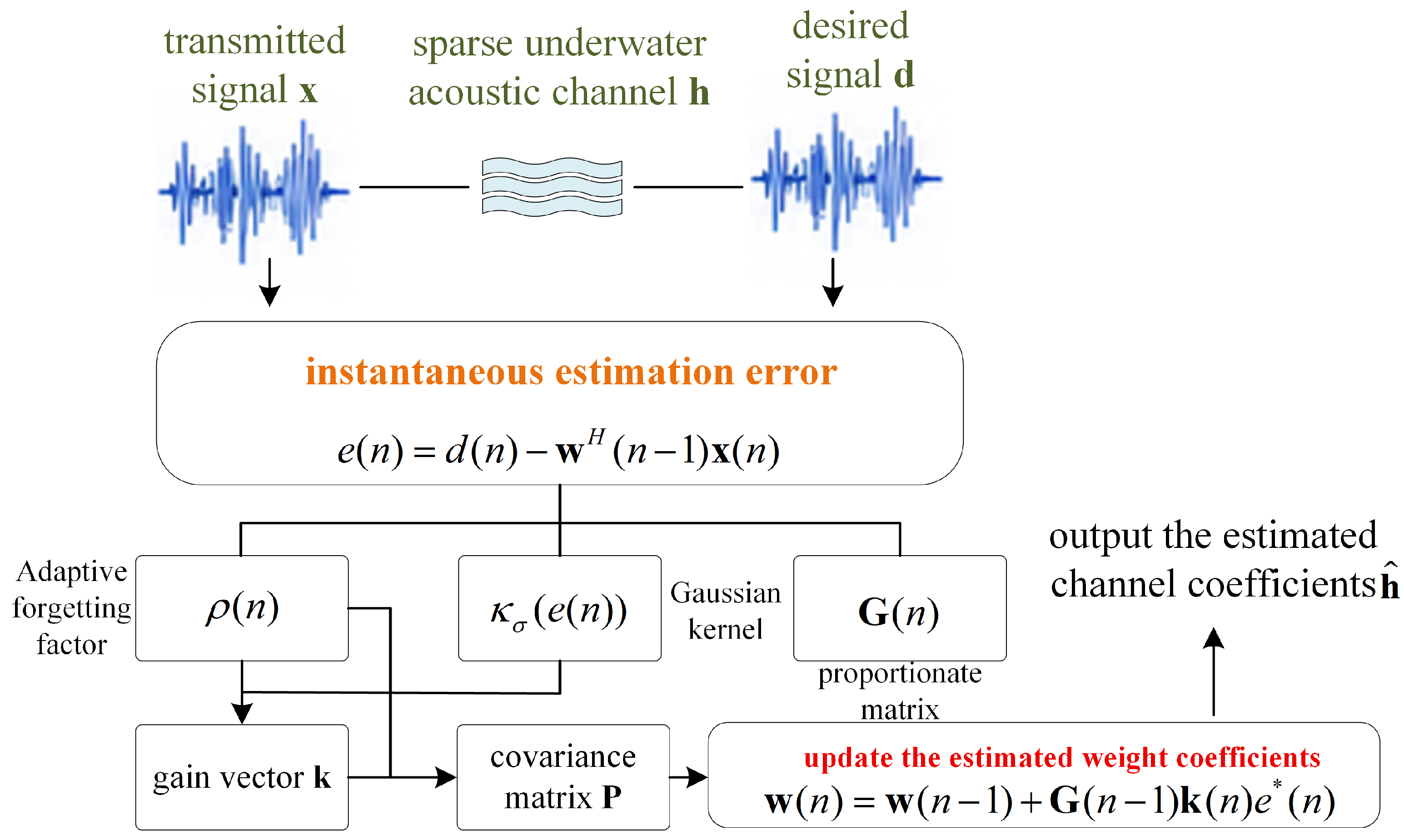
For ease of understanding, before presenting the specific implementation details, the overall structure of the proposed VFF-PRKRSL algorithm is illustrated in
Figure 2. As shown in the figure, the received input signal
and the desired signal
are first used to generate the instantaneous a priori estimation error. This error serves as the key driving quantity for both the variable forgetting-factor adjustment and the KRSL-based robust recursive update.
Specifically, at each time instant, the algorithm first computes the a priori estimation error. According to the magnitude of the current error, the forgetting factor is adaptively adjusted to balance the contribution of historical information and newly arriving data. Then, the Gaussian kernel term and the KRSL weighting factor are calculated, which are further used to update the recursive gain vector and the inverse correlation matrix.
Meanwhile, a nonlinear proportionate matrix is constructed according to the magnitudes of the current coefficient estimates. In this way, different filter taps are assigned different adaptive update weights, and the dominant taps in sparse systems can receive larger updating gains. Finally, the proportionate matrix, the KRSL-based recursive gain, and the current error are jointly used to update the filter weight vector, yielding the estimated channel coefficients.
Overall, as shown in
Figure 2 and Algorithm 1, the proposed VFF-PRKRSL algorithm mainly consists of four stages in each recursion: error computation, variable forgetting-factor adjustment, KRSL-based recursive information updating, and proportionate weighting. The a priori error characterizes the mismatch between the current filter output and the desired response, while the variable forgetting factor dynamically regulates the relative weights of past and current observations.
In addition, the KRSL-based recursion enhances the robustness of the algorithm under impulsive noise and non-Gaussian disturbances. The nonlinear proportionate matrix further emphasizes the dominant taps, thereby improving the adaptation efficiency in sparse systems. Owing to the joint action of these mechanisms, the proposed algorithm can simultaneously achieve improved tracking capability, higher sparse adaptation efficiency, and lower steady-state error in time-varying non-Gaussian environments.
| Algorithm 1 VFF-PRKRSL |
- 1:
Input: , , , , , , , , - 2:
Output:
- 3:
Initialization: , , , - 4:
for
do - 5:
Compute the a priori error
- 6:
Compute the variable forgetting factor according to ( 11) - 7:
Compute the Gaussian kernel term
- 8:
Compute the KRSL weighting term - 9:
- 10:
Compute the proportionate coefficients according to ( 21) - 11:
Form the proportionate matrix - 12:
Update the coefficient vector - 13:
Update the inverse correlation matrix - 14:
end for
|
3.5. Computational Complexity Analysis
To further evaluate the practical feasibility of the proposed algorithm, its computational complexity is analyzed in this subsection. Since the proposed VFF-PRKRSL algorithm is developed based on the recursive PRKRSL framework, its main computational burden is inherited from the gain-vector computation and the inverse correlation matrix update. Therefore, the dominant per-iteration complexity is mainly determined by the recursive matrix operations.
The computational complexity of the proposed VFF-PRKRSL algorithm is summarized in
Table 1. As can be seen, the dominant per-iteration cost of the proposed method arises from the recursive PRKRSL structure, where the gain-vector evaluation and the inverse correlation matrix update constitute the major computational burden. These operations involve matrix–vector and matrix-related recursive updates, leading to an overall arithmetic complexity on the order of
.
More specifically, the conventional PRKRSL algorithm requires
additions,
multiplications/divisions, and 2 exponential evaluations per iteration. After introducing the variable forgetting-factor (VFF) mechanism, the proposed VFF-PRKRSL algorithm requires
additions,
multiplications/divisions, and 3 exponential evaluations. Therefore, compared with PRKRSL, the VFF strategy only introduces a small additional scalar overhead, namely three extra additions, three extra multiplications/divisions, and one extra exponential operation per iteration. Since these additional operations do not alter the dominant quadratic term, the overall computational complexity of the proposed method remains
As shown in
Table 1, LMS-, MCC-, and PMCC-type algorithms have linear computational complexity with respect to the filter length, whereas RLS-type algorithms, including RKRSL, PRKRSL, and the proposed VFF-PRKRSL, exhibit quadratic complexity due to the recursive matrix operations involved. Although the proposed method introduces an additional VFF mechanism and a nonlinear proportionate weighting strategy, these only add lower-order scalar operations and do not change the dominant complexity order.
In terms of memory consumption, LMS, MCC, and PMCC require storage, while RKRSL, PRKRSL, and VFF-PRKRSL require storage, mainly due to the need to store the inverse correlation matrix and related state variables. Therefore, similar to other recursive second-order methods, the proposed algorithm is more suitable for moderate filter lengths, while its storage cost may become significant for large-scale systems.
Overall, the proposed VFF-PRKRSL algorithm improves adaptability in time-varying environments with only a slight increase in scalar operations, while preserving the same dominant computational and memory complexity orders as the conventional PRKRSL algorithm.
4. Simulations and Discussion
To evaluate the performance of the proposed adaptive filtering algorithm, a shallow-water acoustic channel model is constructed using the Bellhop ray-tracing method. The main simulation parameters are summarized in
Table 2. Two scenarios with different transmission ranges and grazing-angle spans are considered, representing a short-range sparse channel and a long-range channel with complex multipath interference, respectively. It should be emphasized that these two Bellhop-generated scenarios are selected as representative and contrasting benchmark cases rather than exhaustive descriptions of all possible underwater acoustic environments. Specifically, Scenario I corresponds to a short-range shallow-water propagation condition with a narrow grazing-angle span, where only a limited number of dominant multipath components exist and the channel exhibits a highly sparse structure. Scenario II corresponds to a longer-range propagation condition with a wider grazing-angle span, where the multipath delay spread becomes larger and the channel contains stronger multipath interference. Therefore, these two scenarios are used to evaluate the proposed algorithm under two different sparse-channel conditions with distinct propagation characteristics.
The practical relevance of the two scenarios can be further interpreted from the perspective of underwater acoustic applications. The short-range sparse scenario is related to shallow-water communication or sensing links in which the received energy is mainly concentrated on a few dominant propagation paths. In contrast, the long-range scenario with a wider grazing-angle span is associated with more complex underwater acoustic links, where stronger multipath propagation and larger delay spread may occur. Thus, although the present study does not cover all possible sea conditions, the selected scenarios provide physically meaningful benchmarks for examining the convergence behavior, steady-state accuracy, and robustness of the proposed algorithm.
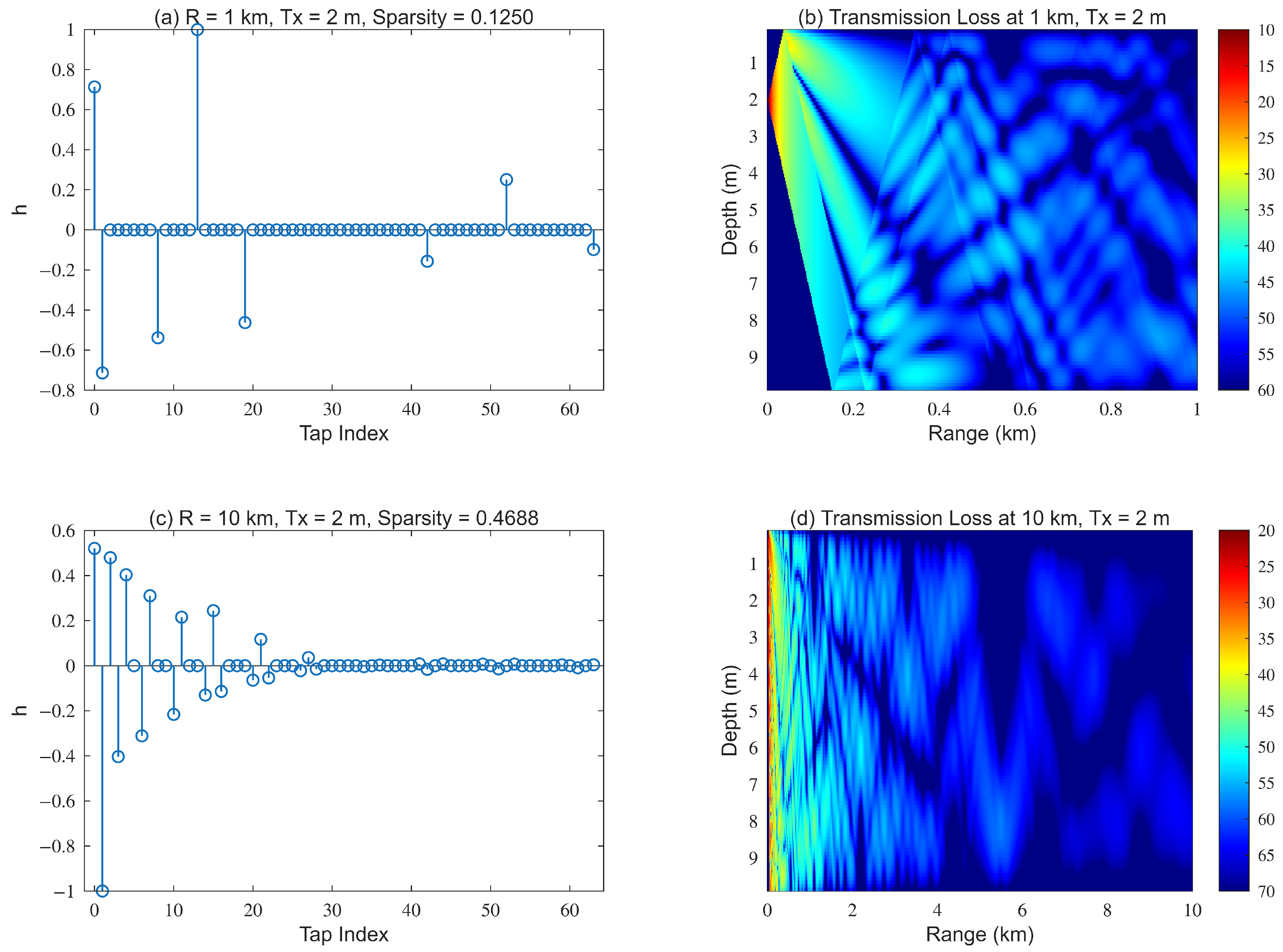
During the discretization process, the complex amplitudes and relative delays of all propagation paths are extracted and mapped onto a fixed-length tap-delay line. Multipath components falling within the same sampling interval are coherently combined through vector summation. Finally, the channel vector is normalized such that its maximum magnitude is unity. The discrete channel impulse response (CIR) tap distributions and the corresponding two-dimensional transmission loss (TL) profiles for the two scenarios are shown in
Figure 3.
It should also be noted that the current validation is based on simulated Bellhop channels. Although such channels can reflect the main physical characteristics of shallow-water multipath propagation, they cannot fully represent all practical ocean environments. More diverse sea conditions and measured sea-trial data will be considered in future work to further examine the practical applicability of the proposed method.
As observed in
Figure 3a,c, the multipath structure undergoes significant transformation as the propagation range and beam angle increase. Under the short-range, narrow-beam conditions of Scenario I, the channel exhibits extreme sparsity, with a sparsity level (i.e., the ratio of active taps) of approximately
, where the channel energy is highly concentrated. In contrast, under the long-range conditions of Scenario II, the number of multipath components increases and the delay spread becomes larger, resulting in a higher sparsity level of
.
The TL maps in
Figure 3b,d further illustrate the spatial energy distribution and reveal the physical mechanism underlying multipath formation. This dual-scenario channel model provides a physically meaningful benchmark for evaluating the convergence and steady-state performance of the proposed VFF-PRKRSL algorithm under underwater acoustic channels with different sparsity levels and propagation conditions.
To ensure a fair and reproducible comparison, all benchmark algorithms and the proposed method are evaluated under the same simulation settings with unified channel configurations, system tap lengths, training sequence lengths, and Monte Carlo trial numbers. In the simulations, the length of the unknown sparse underwater acoustic channel is set to 64, the length of the training sequence is fixed at 5000, and all algorithms are implemented with 200 Monte Carlo runs. Meanwhile, -stable noise is introduced to simulate impulsive interference commonly encountered in communication signals, underwater acoustic environments, and heavy radar clutter, with corresponding parameters set to , , and .
To guarantee the fairness of parameter tuning, hyperparameters including step size, forgetting factor, initialization coefficient and regularization-related parameters of all compared methods are optimized separately via repeated simulations under the same underwater acoustic channel conditions and noise environments. The final parameter values are selected to ensure stable convergence and representative performance for each algorithm in sparse underwater acoustic channel estimation tasks.
In addition, the subsequent simulation section analyzes the impacts of key parameter selection on algorithm performance through targeted experiments. The final parameter settings of the six benchmark algorithms and the proposed method are summarized in
Table 3 to support the reproducibility of experimental results.
4.1. Convergence Performance Comparison Under Varying Sparsity Levels
In the current simulation, the experimental environment is configured with a signal-to-noise ratio of
. To quantitatively evaluate the estimation accuracy of each algorithm for sparse underwater acoustic channels, the Normalized Mean Square Deviation (NMSD) is employed as the performance metric, defined as:
where
denotes the ground-truth channel vector obtained from Bellhop simulations, and
represents the estimated channel vector provided by the algorithm at time
n. The NMSD provides a standardized measure of the deviation between the estimate and the true channel. The specific parameter settings for all evaluated algorithms in this simulation are summarized in
Table 3.
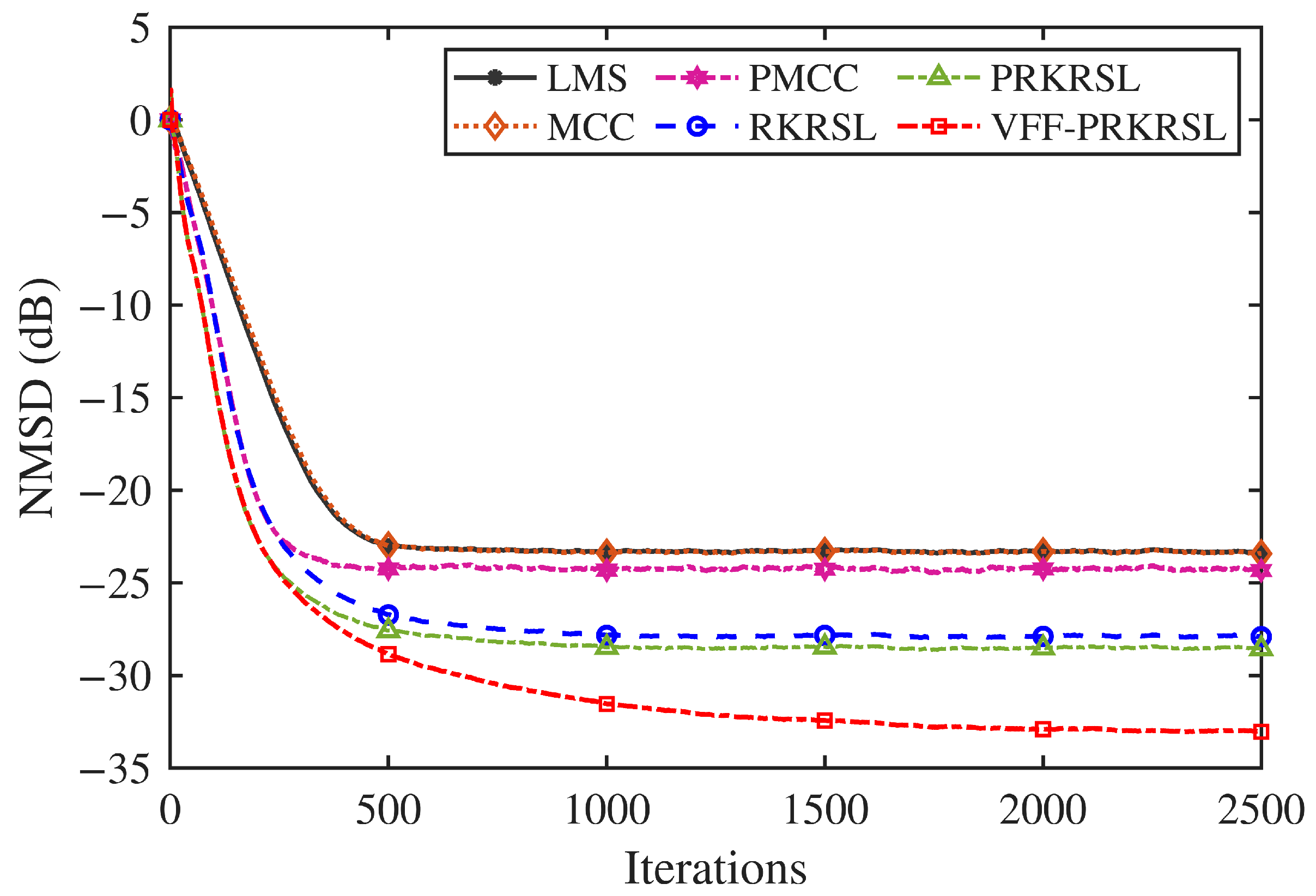
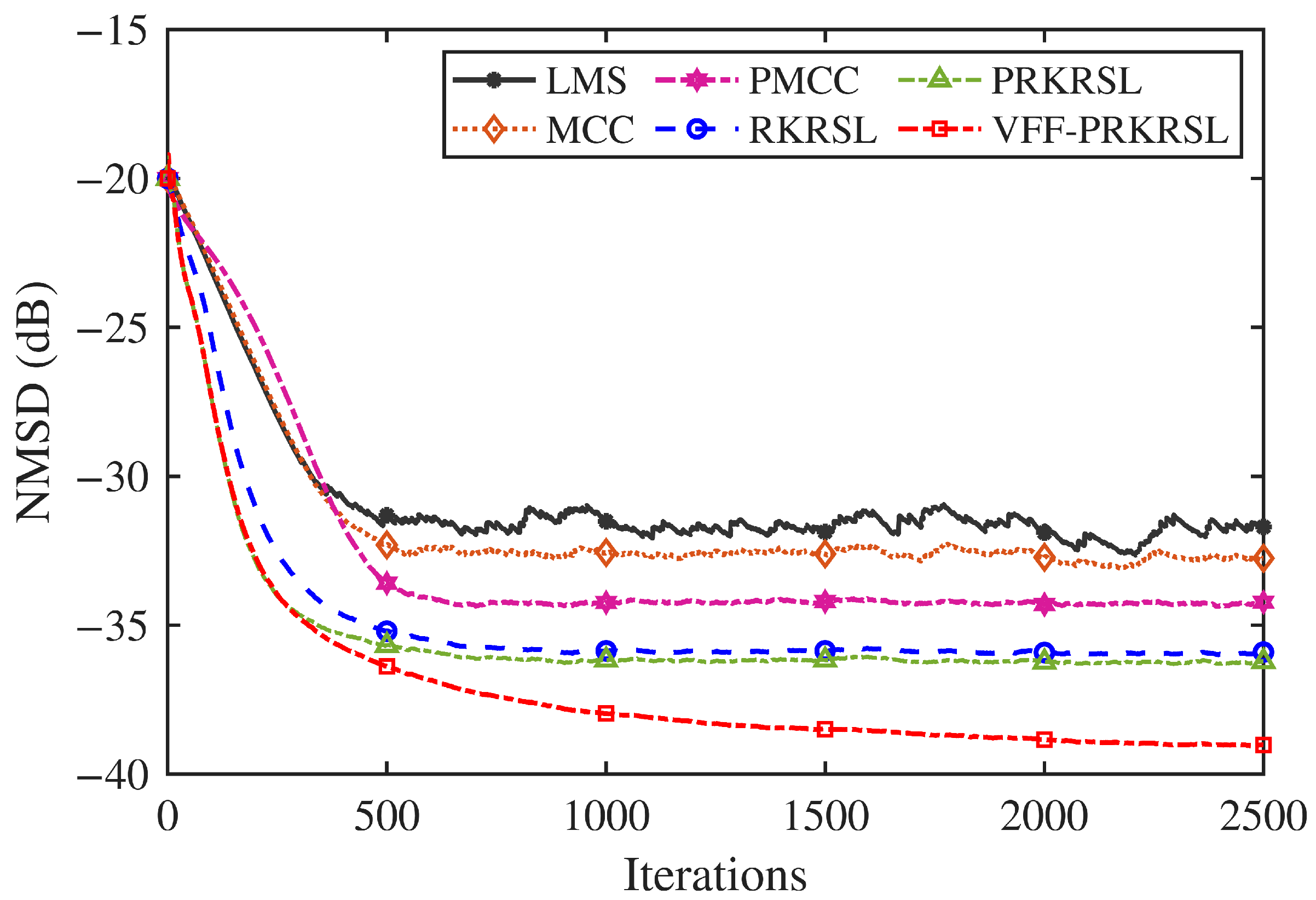
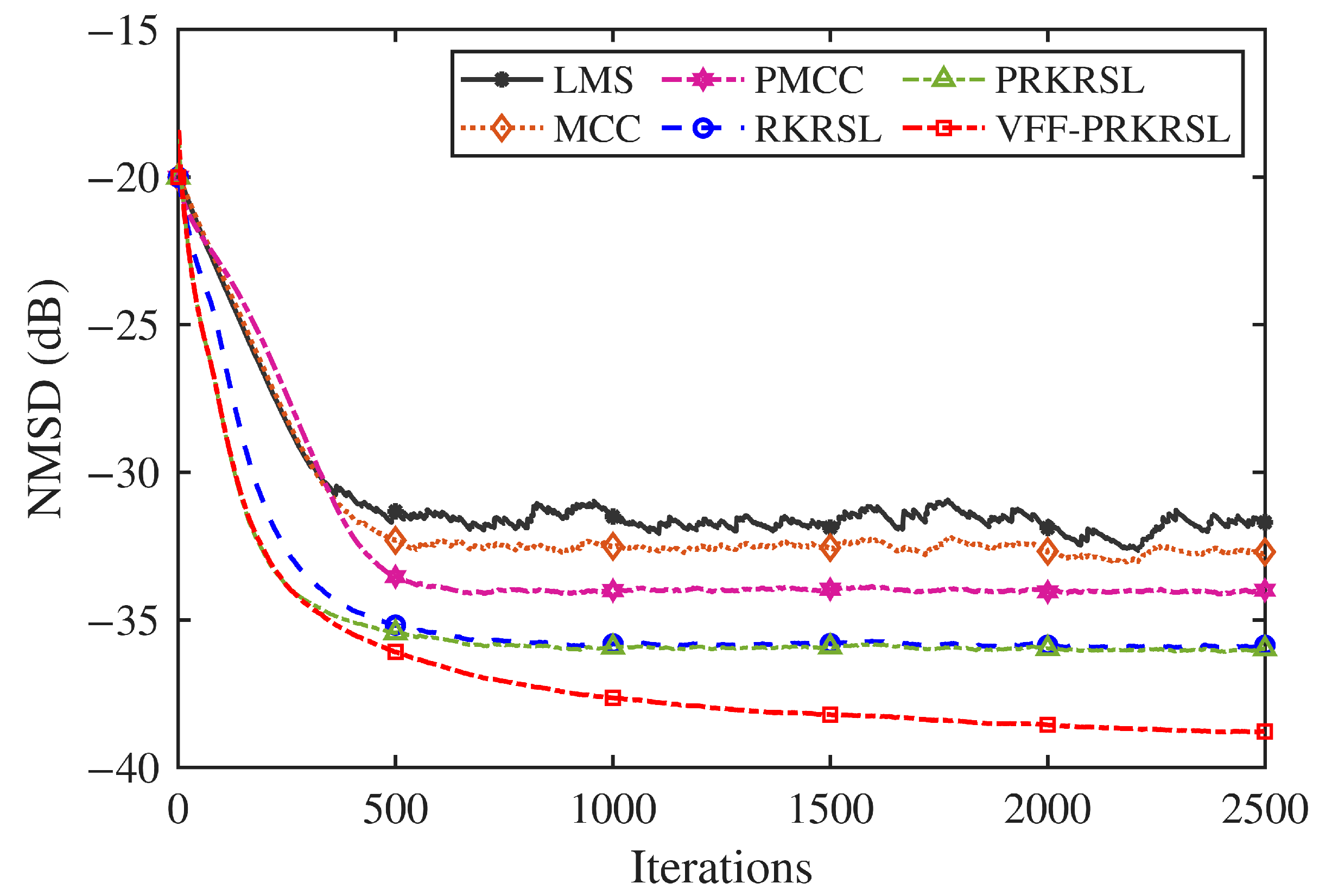
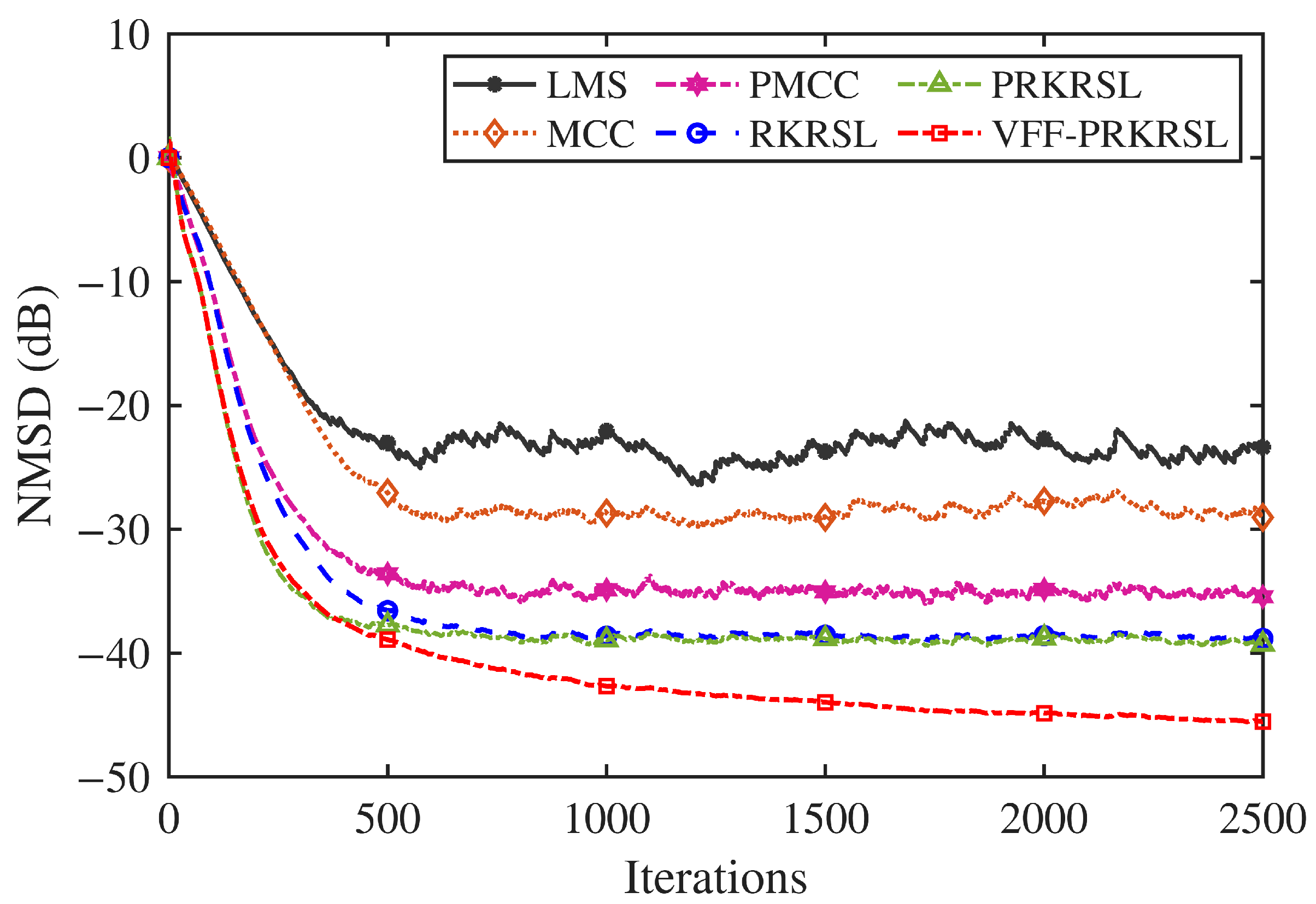
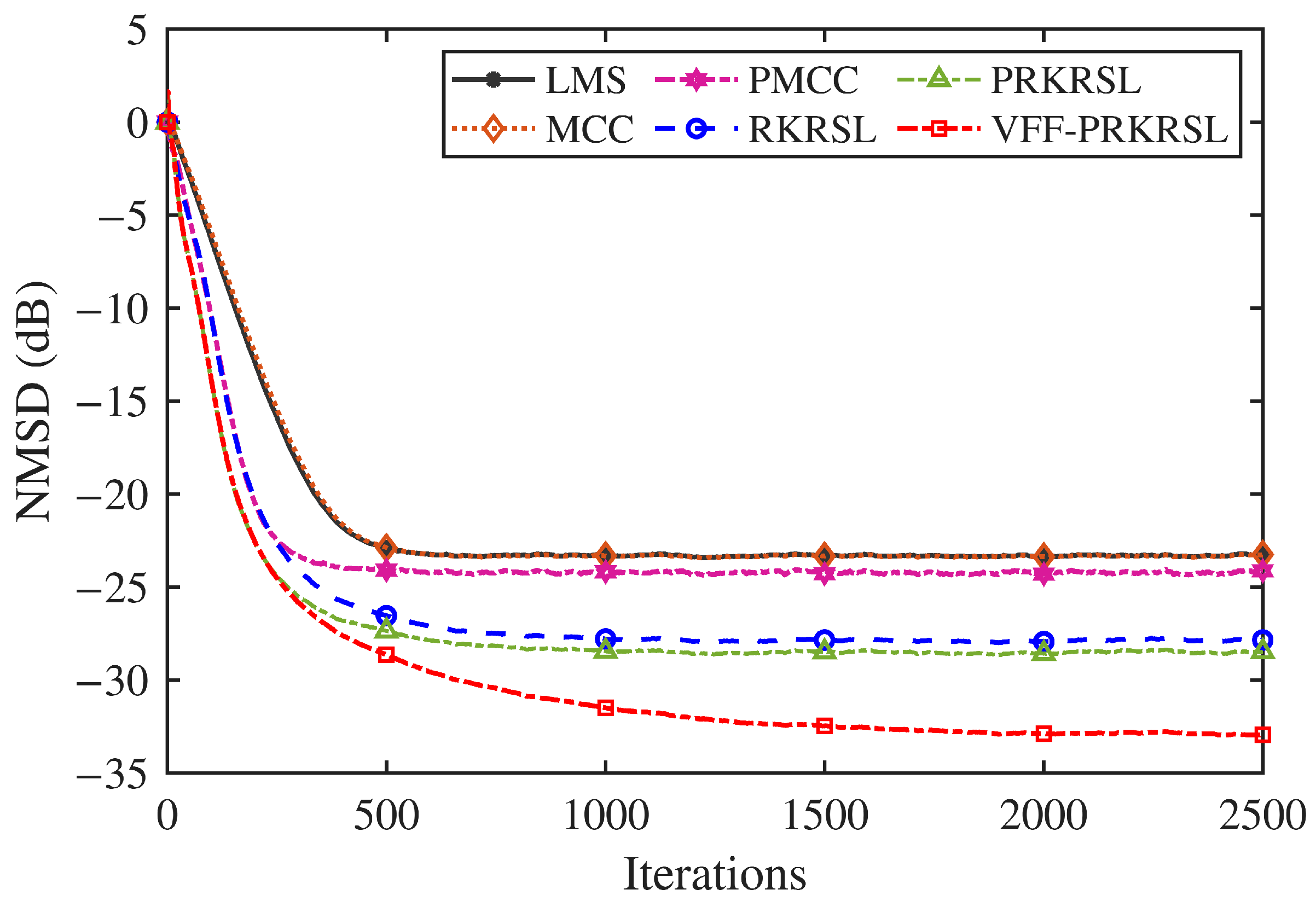
Figure 4 and
Figure 5 illustrate the NMSD (dB) learning curves of the compared algorithms under two distinct sparse scenarios. Specifically,
Figure 4 shows the performance under a sparsity level of 0.125 (Scenario I), while
Figure 5 corresponds to a sparsity level of 0.4688 (Scenario II). In both scenarios, all algorithms experience a fast decrease in NMSD at the initial iteration stage and then tend to converge to a stable steady-state level.
Under both sparsity conditions, the proposed VFF-PRKRSL algorithm achieves superior convergence accuracy compared with the other benchmark algorithms, including LMS, MCC, PMCC, RKRSL, and PRKRSL. The performance gap between the proposed method and the conventional algorithms becomes more noticeable as the iteration approaches the steady state.
At the 2000th iteration, which represents the steady-state performance, the NMSD values of LMS, MCC, PMCC, RKRSL, PRKRSL, and VFF-PRKRSL are −23.6219 dB, −25.8578 dB, −29.1712 dB, −32.5597 dB, −33.1641 dB, and −38.4763 dB for sparsity 0.125, respectively. For sparsity 0.4688, the corresponding NMSD values are −23.6003 dB, −25.7464 dB, −28.6641 dB, −32.4637 dB, −32.6511 dB, and −37.9417 dB, respectively. In both cases, VFF-PRKRSL exhibits the lowest steady-state NMSD, demonstrating significant performance advantages over the existing algorithms in sparse underwater acoustic channel estimation.
4.2. Performance Evaluation Under Non-Gaussian Underwater Acoustic Noise
In underwater acoustic environments, the combined effects of ambient noise, reverberation, and impulsive disturbances often cause the received noise to deviate from the Gaussian assumption and exhibit pronounced heavy-tailed characteristics. To evaluate the performance of different algorithms under such conditions, sparse underwater acoustic channel estimation experiments are conducted under three representative non-Gaussian noise models. These models include K-distributed noise, Laplace noise, and Cauchy noise. The channel sparsity level is set to 0.125, and the signal-to-noise ratio is set to 20 dB.
It should be emphasized that the Cauchy, Laplace, and K-distributed noise models used in this section are adopted as representative benchmark models for evaluating algorithm robustness under different non-Gaussian noise conditions, rather than as exact statistical reconstructions of measured underwater acoustic noise. Specifically, Cauchy noise is used to represent severe impulsive heavy-tailed disturbances, Laplace noise is used to represent moderate heavy-tailed disturbances, and K-distributed noise is used to represent compound-Gaussian-type fluctuations commonly considered in non-Gaussian acoustic and reverberation environments. Therefore, the following experiments should be interpreted as controlled and repeatable robustness evaluations under representative synthetic non-Gaussian noise conditions.
It should be noted that the purpose of using Cauchy, Laplace, and K-distributed noise in this subsection is not to claim an exact one-to-one correspondence with a specific measured underwater noise record. Instead, these distributions are adopted as representative benchmark models to cover different types and degrees of non-Gaussian disturbances that may appear in underwater acoustic channel estimation.
The three synthetic noise models are used to represent different levels of non-Gaussian disturbance. The Cauchy noise with is adopted to describe severe impulsive heavy-tailed interference, the Laplace noise with is used to represent moderate heavy-tailed disturbance with finite variance, and the K-distributed noise with and is used to characterize compound-Gaussian-type noise with random texture fluctuation. These parameters are not intended to exactly fit a specific measured underwater noise record, but to generate controlled and repeatable benchmark conditions with different tail behaviors.
In all simulations, after the raw noise sequence is generated, it is normalized according to the prescribed SNR. Therefore, the distribution parameters mainly control the tail behavior and impulsiveness of the generated noise before SNR normalization, rather than representing the absolute noise power of a particular field measurement. Thus, the following experiments should be interpreted as robustness evaluations under representative synthetic non-Gaussian noise conditions, rather than direct validation using a specific measured underwater noise dataset.
In particular, for the Cauchy-noise scenario, complex-valued Cauchy noise is adopted, which is expressed as
where the real part
and the imaginary part
are independently generated from the Cauchy distribution with zero location parameter and scale parameter
, whose probability density function is given by
Meanwhile, six algorithms, including the proposed VFF-PRKRSL algorithm, are compared in terms of convergence behavior, steady-state performance, and estimation accuracy. This comparison evaluates the effectiveness and robustness of the proposed method under representative synthetic non-Gaussian underwater acoustic noise conditions.
As shown in
Figure 6, under Cauchy noise, all algorithms suffer from severe impulsive interference, while the proposed VFF-PRKRSL still achieves the best estimation accuracy and robustness. At the 2000th iteration, the NMSD values of LMS, MCC, PMCC, RKRSL, PRKRSL, and VFF-PRKRSL are
dB,
dB,
dB,
dB,
dB, and
dB, respectively.
In particular, VFF-PRKRSL outperforms PRKRSL and RKRSL by about dB and dB, respectively, and achieves gains of dB, dB, and dB over PMCC, MCC, and LMS, respectively. These results demonstrate that the proposed algorithm maintains superior convergence and steady-state performance in the presence of strong heavy-tailed Cauchy noise.
In this experiment, the additive noise is modeled as complex Laplace noise. Specifically, the noise sample is expressed as
where the real part
and the imaginary part
are independently generated according to the Laplace distribution with scale parameter
. The corresponding probability density function is given by
Under this setting,
Figure 7 shows the NMSD learning curves of the six algorithms for sparse underwater acoustic channel estimation under Laplace noise with an SNR of 20 dB.
As illustrated in
Figure 7, under Laplace noise, the proposed VFF-PRKRSL also exhibits the lowest steady-state NMSD among the six algorithms. At the 2000th iteration, the corresponding NMSD values are
dB for LMS,
dB for MCC,
dB for PMCC,
dB for RKRSL,
dB for PRKRSL, and
dB for VFF-PRKRSL.
Compared with PRKRSL and RKRSL, the proposed method achieves additional improvements of approximately dB and dB, respectively. Moreover, it provides gains of dB over PMCC and about dB and dB over MCC and LMS, respectively. These results indicate that VFF-PRKRSL preserves both fast convergence and favorable steady-state performance under the adopted Laplace-distributed non-Gaussian noise condition.
In this experiment, the additive noise is modeled as complex K-distributed noise. Specifically, the noise sample is expressed as
where
and
are independent zero-mean Gaussian random variables, and
is a Gamma-distributed texture variable. The corresponding texture distribution is given by
where
b and
denote the scale and shape parameters, respectively. In this experiment, the parameters are set to
and
, and the real and imaginary parts are independently generated under this setting.
Figure 8 shows the NMSD learning curves of the six algorithms for sparse underwater acoustic channel estimation under K-distributed noise with an SNR of 20 dB.
As shown in
Figure 8, a similar trend can be observed under K-distributed noise, where VFF-PRKRSL consistently delivers the best overall performance. Specifically, at the 2000th iteration, LMS, MCC, PMCC, RKRSL, PRKRSL, and VFF-PRKRSL reach NMSD values of
dB,
dB,
dB,
dB,
dB, and
dB, respectively.
Therefore, the proposed algorithm improves the steady-state performance by about dB relative to PRKRSL and dB relative to RKRSL, while outperforming PMCC, MCC, and LMS by dB, dB, and dB, respectively.
These results further confirm the robustness of VFF-PRKRSL under the adopted representative K-distributed non-Gaussian noise condition.
Although the adopted synthetic noise models cannot fully reproduce all characteristics of real measured underwater acoustic noise, they provide controlled and repeatable non-Gaussian test conditions with different tail behaviors. Therefore, the experimental results in this subsection mainly demonstrate the robustness of the proposed algorithm under representative heavy-tailed and impulsive noise conditions. Validation using measured underwater acoustic noise data will be further considered in future work.
4.3. Ablation Study on the Individual Components of the VFF-PRKRSL Algorithm
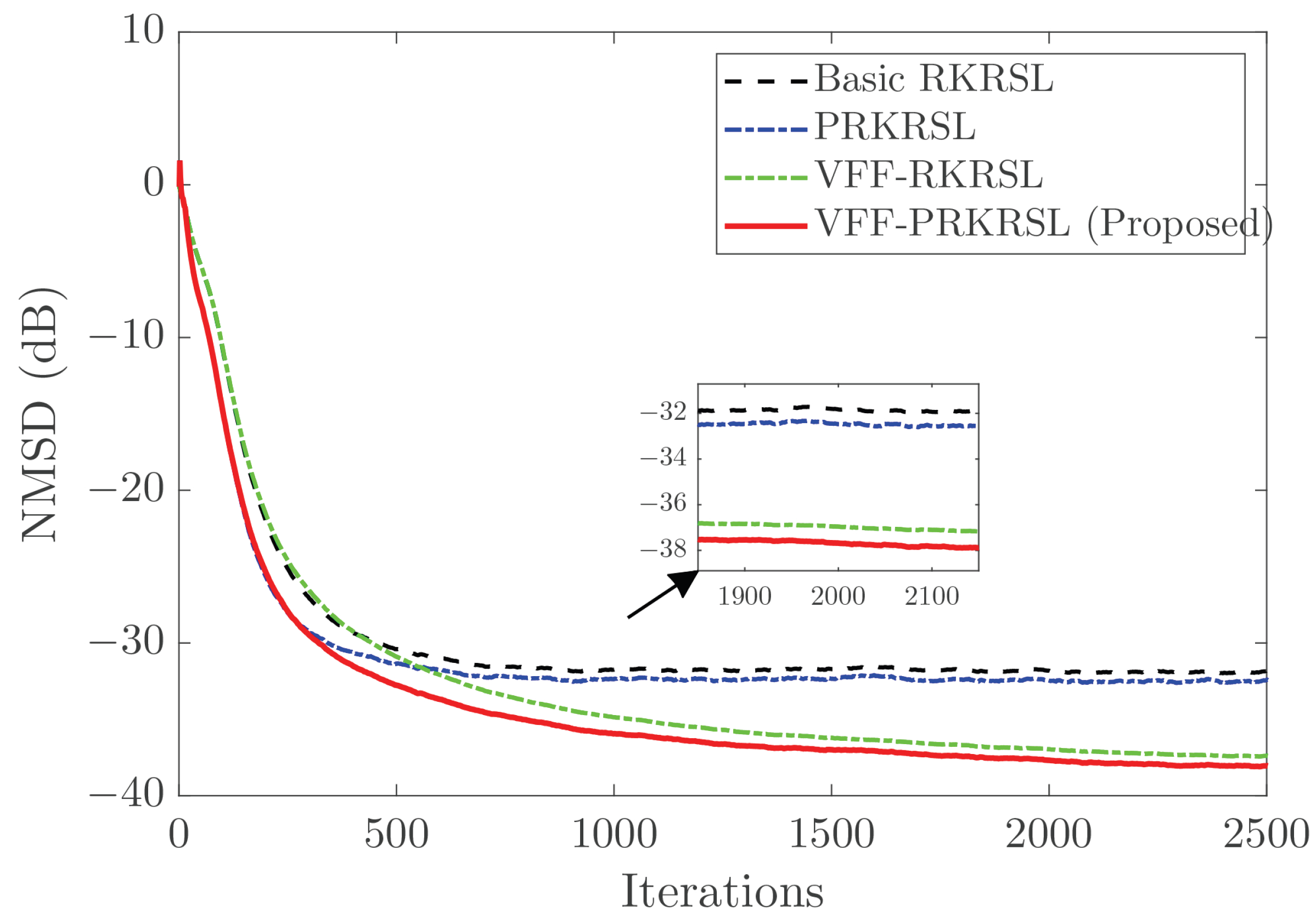
To further evaluate the individual contributions of the proportionate update mechanism and the variable forgetting factor strategy, an ablation study is conducted under the same experimental conditions. The NMSD convergence curves of different algorithms are shown in
Figure 9. Basic RKRSL, PRKRSL, VFF-RKRSL, and the proposed VFF-PRKRSL are compared. This comparison is used to analyze the role of each component in sparse underwater acoustic channel estimation and its impact on the overall algorithm performance.
To further improve the reliability of the ablation analysis, all algorithms are independently repeated over 200 Monte Carlo trials. For each trial, the steady-state NMSD is calculated by averaging the NMSD values over the last 200 iterations. Based on the trial-wise steady-state NMSD values, the mean value, variance, standard deviation, and 95% confidence interval are calculated. In addition, paired t-tests are performed between the proposed VFF-PRKRSL algorithm and each ablated variant, where the null hypothesis is that there is no statistically significant difference between the two algorithms. The significance level is set to .
The corresponding variances of Basic RKRSL, PRKRSL, VFF-RKRSL, and VFF-PRKRSL are 11.4080, 11.1820, 11.7530, and 11.3090 dB2, respectively.
As shown in
Figure 9, Basic RKRSL exhibits the worst steady-state performance. After introducing the proportionate update mechanism, PRKRSL achieves certain improvements in both the initial convergence stage and the steady-state stage, although the overall performance gain remains limited. At the 2000th iteration, its NMSD improves from
dB for Basic RKRSL to
dB, corresponding to an improvement of about
dB.
In contrast, VFF-RKRSL, which incorporates the variable forgetting factor strategy, exhibits a faster convergence rate and a lower steady-state NMSD. At the 2000th iteration, it reaches dB, achieving an improvement of about dB over Basic RKRSL. This indicates that the variable forgetting factor mechanism plays a more significant role in improving the algorithm performance.
When both the variable forgetting factor strategy and the proportionate update mechanism are jointly incorporated, the resulting VFF-PRKRSL achieves the best overall performance. At the 2000th iteration, VFF-PRKRSL obtains an NMSD of dB, which is about dB lower than that of VFF-RKRSL and about dB lower than that of Basic RKRSL. This demonstrates that the two mechanisms provide complementary performance gains.
The statistical results are summarized in
Table 4. It can be observed that VFF-PRKRSL achieves the lowest mean steady-state NMSD of
dB. Compared with Basic RKRSL, PRKRSL, and VFF-RKRSL, the corresponding steady-state improvements are approximately
dB,
dB, and
dB, respectively. Moreover, the paired
t-test results show that the improvements of VFF-PRKRSL over the three ablated variants are statistically significant, with all
p-values smaller than 0.001. Therefore, the performance gain of the proposed algorithm is not caused by random simulation fluctuations, but results from the complementary effects of the variable forgetting factor strategy and the proportionate update mechanism.
4.4. Sensitivity Analysis of Key Parameters
To further investigate the influence of key parameters on the channel estimation performance of the proposed VFF-PRKRSL algorithm, a sensitivity analysis is conducted on the parameters , , and , while the possible interaction with the variable-forgetting-factor parameter is further discussed qualitatively. Specifically, is used to control the kernel width, reflects the adjustment strength of the proportionate update term, and determines the allocation characteristic of the proportionate update mechanism for different tap coefficients. The values of these parameters directly affect the convergence rate, steady-state performance, and tracking capability of the algorithm for sparse structures.
Therefore, with all other experimental conditions kept unchanged, the above parameters are varied individually, and the NMSD convergence curves and steady-state error performance under different parameter settings are compared. In this way, the influence of each parameter on the performance of the proposed algorithm can be further revealed, providing a useful reference for parameter selection.
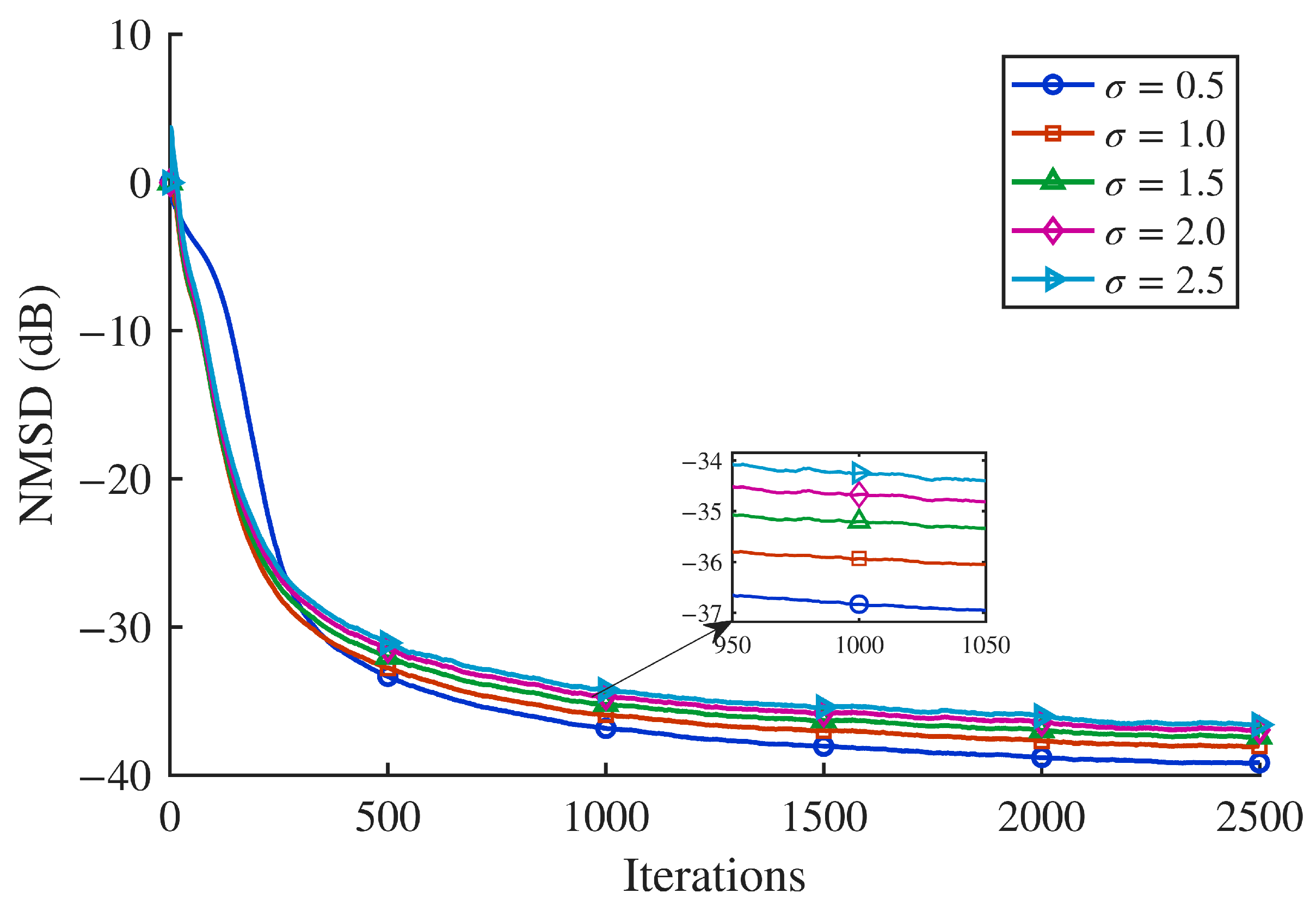
To investigate the influence of the kernel width parameter on the performance of the proposed algorithm, the sensitivity of VFF-PRKRSL to different
settings is evaluated under the same experimental conditions.
Figure 10 presents the corresponding NMSD learning curves under different values of
.
As shown in
Figure 10, the kernel width
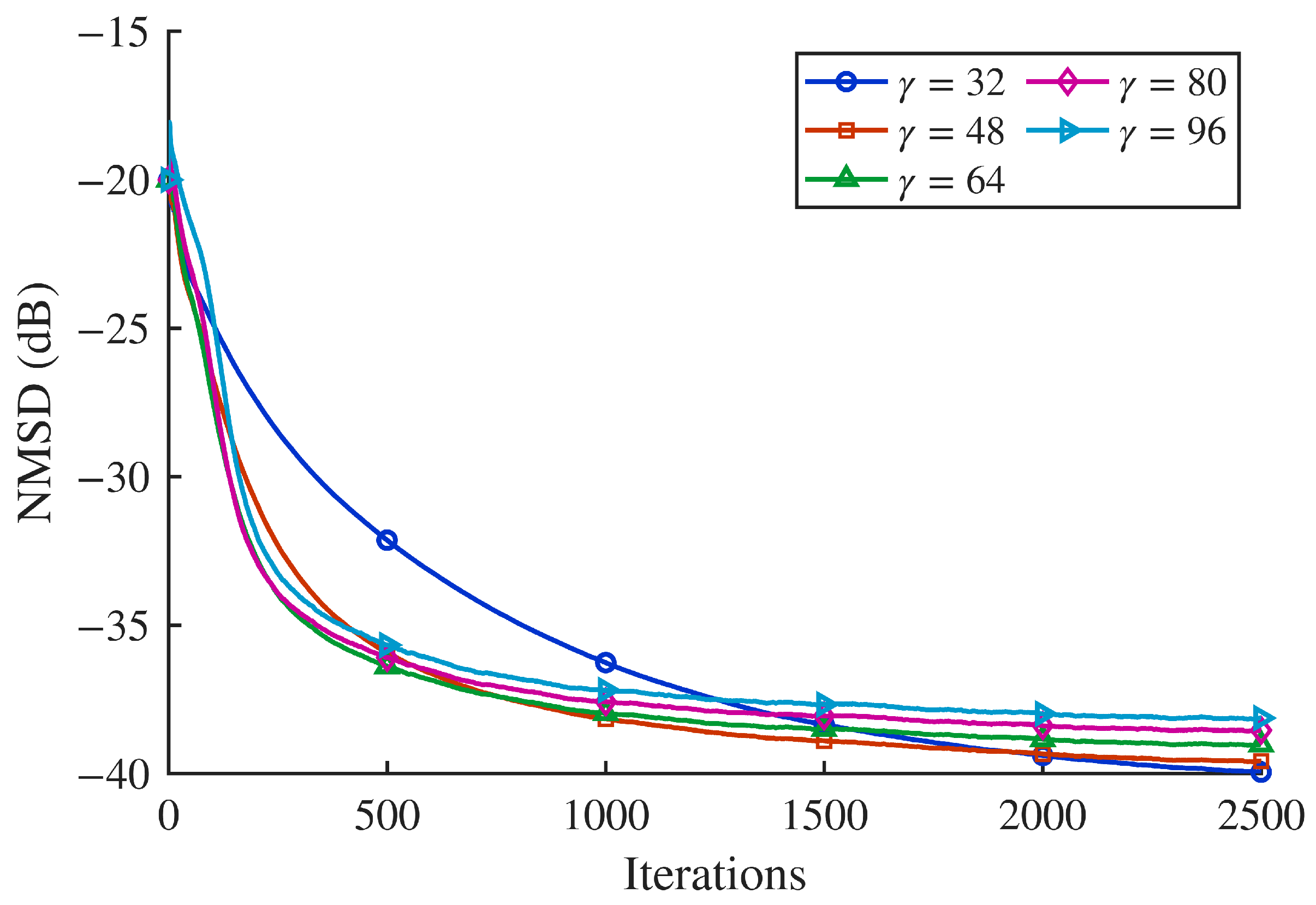
has a noticeable influence on the convergence behavior and steady-state performance of the proposed VFF-PRKRSL algorithm. A smaller
generally yields a lower steady-state NMSD, indicating stronger robustness against impulsive disturbances and outlier errors. In particular,
achieves the best steady-state performance, although its initial convergence is slightly slower.
When and , the algorithm converges faster in the transient stage while still maintaining satisfactory steady-state accuracy. Among them, provides a better balance between convergence speed and steady-state performance. As further increases to and , the steady-state NMSD gradually deteriorates, implying that an excessively large kernel width weakens the robustness of the algorithm under non-Gaussian noise. Therefore, is selected as a suitable choice in the following experiments.
To investigate the influence of the proportionate parameter on the performance of the proposed algorithm, the sensitivity of VFF-PRKRSL to different
settings is evaluated under the same experimental conditions.
Figure 11 shows the corresponding NMSD learning curves under different values of
.
As shown in
Figure 11, different values of
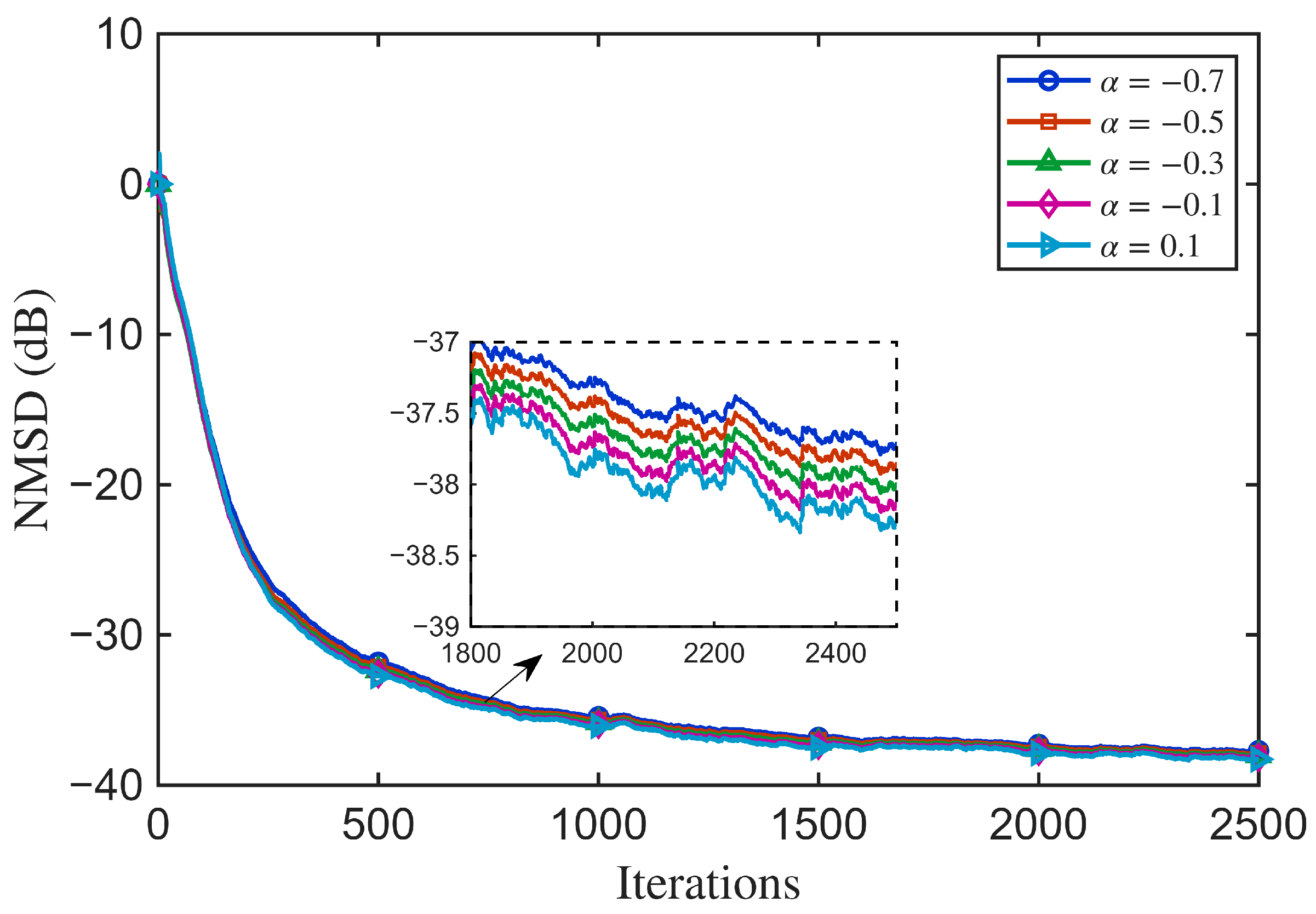
have a certain influence on the convergence and steady-state performance of the proposed VFF-PRKRSL algorithm. Although all curves converge rapidly in the initial stage, noticeable differences can still be observed in the steady-state stage, as shown more clearly in the enlarged inset.
Specifically, as gradually increases from negative values, the steady-state NMSD generally decreases. Among all tested settings, achieves the lowest steady-state NMSD, indicating the best identification performance. In contrast, although smaller negative values of also ensure stable convergence, their steady-state performance is slightly inferior. Therefore, considering both convergence speed and steady-state performance, provides a more favorable trade-off under the current experimental conditions.
To investigate the influence of the proportionate update strength on the performance of the proposed algorithm, the sensitivity of VFF-PRKRSL to different
settings is evaluated under the same experimental conditions.
Figure 12 shows the corresponding NMSD learning curves under different values of
.
As shown in
Figure 12, the parameter
has a significant impact on both the convergence speed and steady-state performance of the proposed VFF-PRKRSL algorithm. When
is small, the algorithm still converges stably, but the convergence rate is relatively slow and the steady-state improvement is limited. As
increases, both the convergence behavior and identification performance are improved, and
achieves the best overall trade-off among the tested settings.
However, when is further increased to 128, the steady-state performance becomes slightly worse than that with , and when , the performance degrades significantly and even fails to approach the desired steady-state region. This suggests that an excessively large leads to overly aggressive updates and harms the stability and accuracy of the algorithm, whereas too small a cannot fully exploit the sparse structure. Therefore, under the current experimental conditions, selecting is more reasonable.
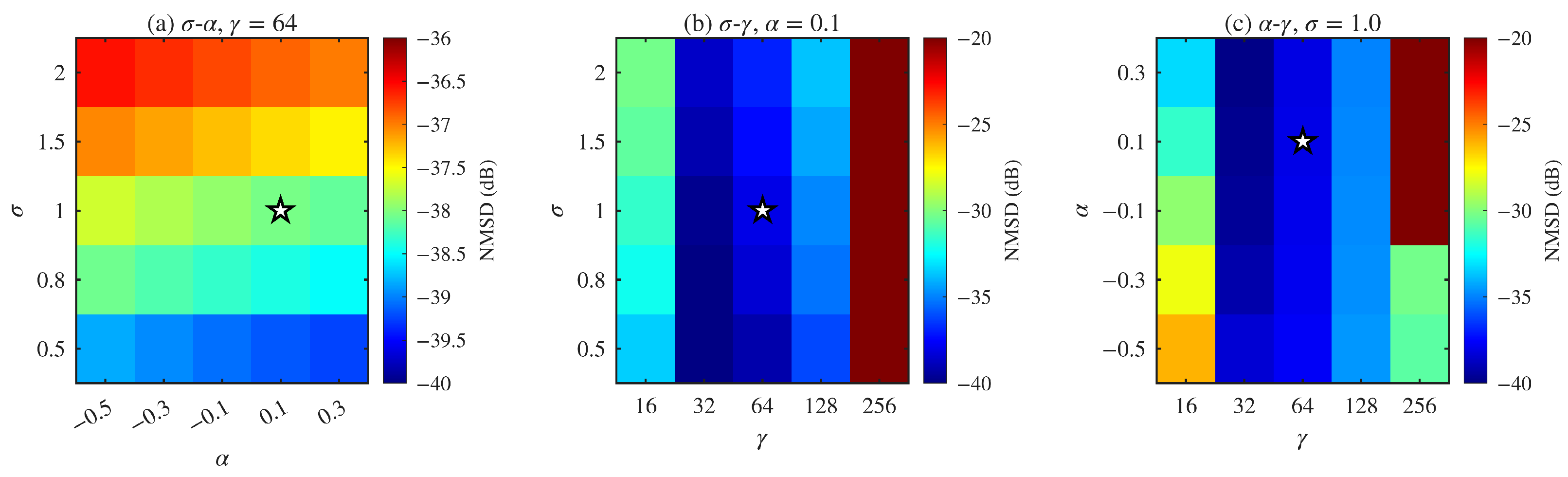
To further investigate the joint dependence among , , and , a two-dimensional parameter robustness mapping experiment is further conducted. Different from the previous one-dimensional sensitivity analysis, where only one parameter is varied at a time, this experiment evaluates the steady-state NMSD under paired parameter variations. Specifically, three two-dimensional robustness maps are constructed: the - map with , the - map with , and the - map with . For each parameter combination, the steady-state NMSD is calculated by averaging the NMSD values over the last 200 iterations.
As shown in
Figure 13, the performance of VFF-PRKRSL is jointly affected by
,
, and
. From
Figure 13a, it can be observed that the kernel width
has a relatively obvious influence on the steady-state NMSD. A smaller
generally leads to a lower steady-state NMSD, indicating stronger suppression of impulsive errors and outliers. However, this does not necessarily mean that the smallest
is the most suitable choice. As shown in the previous convergence-curve analysis in
Figure 10, although
can achieve a slightly lower steady-state NMSD, its initial convergence speed is slower than that of
. This is because a smaller kernel width gives stronger nonlinear error suppression, but it also reduces the effective contribution of relatively large errors during the early adaptation stage, thereby weakening the update strength and slowing down convergence. In contrast,
maintains satisfactory robustness while providing faster initial convergence. Therefore,
is selected as a balanced choice between convergence speed and steady-state accuracy.
Figure 13b shows the joint effect of
and
when
. It can be seen that
has a significant influence on the algorithm stability. When
is too small, the proportionate update strength is insufficient, and the sparse structure cannot be fully exploited. When
is excessively large, especially
, the steady-state NMSD deteriorates significantly, which indicates that overly aggressive proportionate updating may harm the stability of the algorithm. In contrast,
lies in a low-NMSD region and provides a favorable update strength.
Figure 13c further presents the joint dependence between
and
when
. The results show that the influence of
is relatively milder than that of
, while moderate values of
can provide a better balance between sparse-tap emphasis and update stability. In particular, the selected value
is located in a stable low-NMSD region when
, indicating that it is a reasonable setting for the proportionate allocation mechanism.
Overall, the selected parameter configuration, i.e., , , and , is not an isolated sensitive point, but lies in a relatively stable and low-NMSD region. Although some neighboring parameter combinations may achieve slightly lower NMSD in certain cases, the adopted setting provides a more reliable trade-off among convergence speed, steady-state accuracy, sparse-tap exploitation, and robustness. Therefore, the multidimensional robustness mapping further supports the rationality of the parameter selection used in the proposed VFF-PRKRSL algorithm.
It should also be noted that the key parameters of VFF-PRKRSL are not completely independent, and possible interactions may exist among , , , and . The kernel width determines the nonlinear error-suppression behavior of the KRSL criterion, while controls the sensitivity of the variable forgetting factor to instantaneous error variations. A smaller generally enhances robustness against impulsive disturbances, but it may also reduce the effective contribution of large errors during the early adaptation stage. In this case, a larger may improve tracking capability by making the forgetting factor more responsive, but it may also increase steady-state fluctuation.
In addition, and jointly affect the proportionate updating mechanism. The parameter determines how the update energy is distributed among different tap coefficients, whereas controls the overall update strength. A larger combined with stronger proportionate allocation may accelerate the convergence of dominant sparse taps, but overly aggressive updates may degrade stability. Conversely, a smaller improves stability but may not fully exploit the sparse structure. Therefore, the selected parameters should be regarded as a balanced configuration rather than independently optimal values.
A complete multidimensional optimization over , , , and would require extensive simulations under different channel sparsity levels, SNRs, and noise distributions, which is beyond the scope of this paper. Nevertheless, the one-dimensional sensitivity curves and the two-dimensional robustness maps indicate that the adopted parameter setting lies in a relatively stable low-NMSD region and provides a favorable trade-off among robustness, convergence speed, steady-state accuracy, and sparse-channel exploitation.
4.5. Comparison of Steady-State NMSD Performance Under Different SNR Conditions
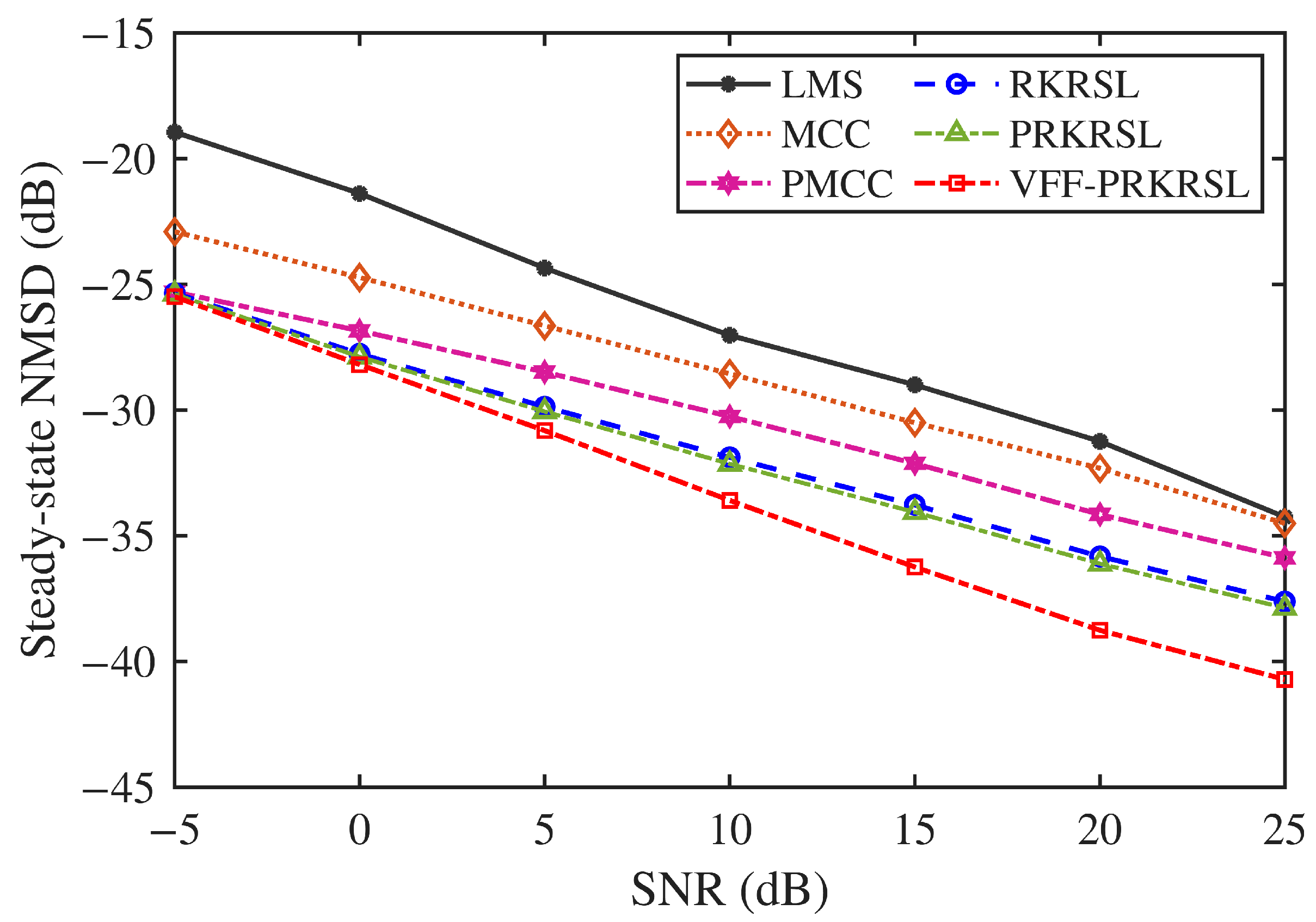
To further evaluate the robustness and steady-state identification capability of different algorithms under varying noise levels, an SNR sensitivity experiment is conducted to investigate the variation of steady-state NMSD with SNR. Specifically, with all other experimental conditions kept unchanged and the channel sparsity level set to 0.125, different SNR levels are considered, and the steady-state NMSD performance of LMS, MCC, PMCC, RKRSL, PRKRSL, and the proposed VFF-PRKRSL algorithm is recorded.
By comparing the steady-state error levels of these algorithms under different SNR conditions, the anti-noise capability of the proposed algorithm and its adaptability to noise variations can be further verified.
As shown in
Figure 14, the steady-state NMSD of all algorithms decreases as the SNR increases, indicating that higher SNR is beneficial to channel estimation accuracy. At 5 dB, the steady-state NMSD values of LMS, MCC, PMCC, RKRSL, PRKRSL, and VFF-PRKRSL are
dB,
dB,
dB,
dB,
dB, and
dB, respectively. At 15 dB, they become
dB,
dB,
dB,
dB,
dB, and
dB, respectively, while at 25 dB, they further improve to
dB,
dB,
dB,
dB,
dB, and
dB, respectively.
Among all the compared algorithms, VFF-PRKRSL consistently achieves the lowest steady-state NMSD under all SNR conditions. Compared with PRKRSL, it further improves the steady-state performance by about dB, dB, and dB at 5 dB, 15 dB, and 25 dB, respectively. These results show that the proposed algorithm maintains strong robustness at low SNR and achieves superior steady-state channel estimation accuracy as the SNR increases.
4.6. Tracking Performance Under Abrupt Channel Variation
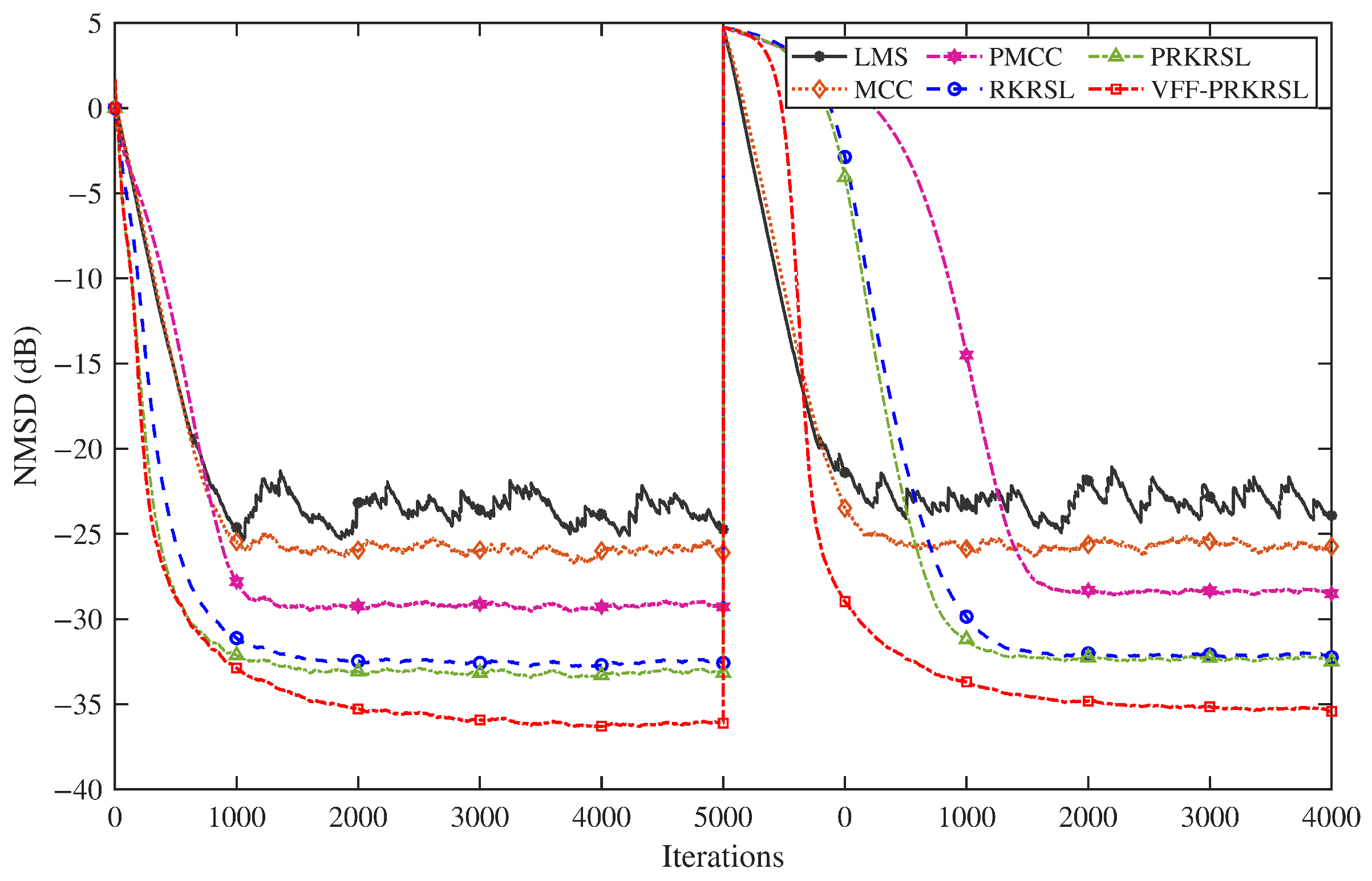
To further evaluate the tracking capability of different algorithms in a nonstationary underwater acoustic channel, an abrupt channel variation experiment is carried out. In this experiment, the unknown channel is suddenly changed at the 2500th iteration, while the other simulation conditions are kept unchanged. Specifically, the channel before the abrupt change corresponds to a sparsity level of 0.4688, and the channel after the abrupt change corresponds to a sparsity level of 0.125. This setting is used to simulate a sudden variation of the underwater acoustic propagation environment.
As shown in
Figure 15, all algorithms first converge under the initial channel condition. Before the abrupt channel change, the proposed VFF-PRKRSL algorithm achieves the lowest NMSD. At the 2500th iteration, the NMSD values of LMS, MCC, PMCC, RKRSL, PRKRSL, and VFF-PRKRSL are
dB,
dB,
dB,
dB,
dB, and
dB, respectively. Compared with PRKRSL and RKRSL, the proposed VFF-PRKRSL obtains additional improvements of about
dB and
dB, respectively.
At the 2500th iteration, the unknown channel changes abruptly, causing the NMSD values of all algorithms to increase sharply. This indicates that the previously estimated coefficient vectors no longer match the new channel. After the abrupt change, all algorithms gradually re-converge to the new channel state. However, their tracking behaviors are significantly different. LMS and MCC can respond to the channel variation, but their final NMSD values remain relatively high. PMCC achieves better performance than LMS and MCC, but it still converges to a higher misalignment level than the recursive KRSL-based algorithms.
After the channel variation, RKRSL and PRKRSL show better robustness and obtain lower NMSD values. Nevertheless, due to the use of a fixed forgetting factor, their tracking capability is still limited. At the 5000th iteration, the NMSD values of LMS, MCC, PMCC, RKRSL, PRKRSL, and VFF-PRKRSL are dB, dB, dB, dB, dB, and dB, respectively. The proposed VFF-PRKRSL still achieves the lowest NMSD after the abrupt channel change. Compared with PRKRSL and RKRSL, it provides further improvements of about dB and dB, respectively.
The superior tracking performance of VFF-PRKRSL can be attributed to the joint effect of the variable forgetting factor and the proportionate update mechanism. When the channel changes suddenly, the estimation error increases, which reduces the forgetting factor and weakens the influence of outdated historical information. As a result, the algorithm can respond more rapidly to the new channel state. Meanwhile, the proportionate update mechanism assigns larger update gains to dominant channel taps, thereby improving the identification efficiency in sparse channel environments. Therefore, the results in
Figure 15 verify that the proposed VFF-PRKRSL algorithm not only achieves lower steady-state NMSD, but also provides stronger tracking capability under abrupt channel variation.
4.7. Discussion on the Practical Significance and Sufficiency of the Performance Gains
Although the proposed VFF-PRKRSL algorithm achieves lower NMSD than the compared algorithms in the above simulations, it is necessary to clarify whether these improvements are practically meaningful and when they can be regarded as sufficient. In this paper, the sufficiency of the performance gain is discussed from three perspectives: the magnitude of NMSD reduction, the consistency of the improvement across different test conditions, and the extra computational cost introduced by the proposed mechanism in practical implementation.
First, the improvement of VFF-PRKRSL over PRKRSL is not marginal in most tested cases. Under the two Bellhop-generated sparse-channel scenarios, the proposed algorithm reduces the steady-state NMSD by about 5.31 dB and 5.29 dB compared with PRKRSL at the 2000th iteration. Since NMSD is expressed on a logarithmic scale, a 3 dB reduction approximately corresponds to halving the normalized squared estimation error. Therefore, an improvement of about 5 dB represents a clearly observable accuracy gain.
Second, the advantage of the proposed method is consistently observed under different sparse-channel structures, non-Gaussian noise models, and SNR levels. For example, under Cauchy noise, VFF-PRKRSL improves the steady-state NMSD by about 5.95 dB over PRKRSL, while under Laplace and K-distributed noise the corresponding improvements are about 4.37 dB and 4.29 dB, respectively. In the SNR sensitivity experiment, the proposed method also maintains lower steady-state NMSD at 5 dB, 15 dB, and 25 dB consistently.
Third, the performance improvement is achieved with only a small increase in scalar operations compared with PRKRSL. The proposed VFF mechanism introduces only three additional additions, three additional multiplications or divisions, and one additional exponential operation per iteration, while the dominant computational complexity remains . Therefore, for moderate-length sparse underwater acoustic channels where recursive algorithms are computationally acceptable, the additional cost is justified by the obtained reduction in steady-state estimation error and improved robustness in non-Gaussian environments.
Based on the above observations, the advantage of VFF-PRKRSL can be considered sufficient when the target application requires high-accuracy sparse channel estimation under impulsive or non-Gaussian noise, and when the system can afford the same dominant complexity order as other RLS-type recursive algorithms. In contrast, if the improvement over competing algorithms is less than about 1 dB, appears only under a single parameter setting, or requires substantially higher complexity, then the advantage would be less convincing.
4.8. Potential Practical Applications of the Proposed Algorithm
The proposed VFF-PRKRSL algorithm has potential applications in several underwater acoustic signal processing tasks where sparse and time-varying channel estimation is required. One important application is underwater acoustic communication, in which accurate channel estimation can improve equalization, signal recovery, and link reliability under severe multipath propagation. The proposed method is also applicable to active sonar, target detection, and underwater localization systems, where robust estimation of sparse propagation paths is beneficial for identifying dominant arrivals and suppressing impulsive interference.
In addition, the proposed algorithm may be useful for autonomous underwater vehicles, underwater sensor networks, and shallow-water monitoring systems. In these scenarios, the acoustic channel may vary due to platform motion, environmental changes, and non-Gaussian disturbances. The variable forgetting factor can enhance tracking capability, while the proportionate mechanism can exploit the sparse multipath structure. Therefore, VFF-PRKRSL is particularly suitable for moderate-length sparse channel estimation problems where robustness, convergence accuracy, and adaptability are more important than extremely low computational complexity.
4.9. Limitations and Challenges of the Proposed Algorithm
Although the proposed VFF-PRKRSL algorithm achieves improved estimation accuracy and robustness, several limitations and challenges should be noted. First, similar to other recursive second-order algorithms, VFF-PRKRSL requires the update and storage of the inverse correlation matrix, resulting in computational and memory complexity. Therefore, when the channel length is very large or the hardware resources are strictly limited, the implementation cost may become a practical concern compared with LMS- or MCC-type algorithms.
Second, the performance of VFF-PRKRSL still depends on the selection of several parameters, including the kernel width, risk-sensitive parameter, proportionate parameters, and the bounds of the variable forgetting factor. Although the sensitivity analysis shows that the algorithm can maintain stable performance within reasonable parameter ranges, inappropriate parameter settings may still affect convergence behavior and steady-state accuracy. In addition, the current validation is mainly based on Bellhop-generated simulation channels. Future work should further evaluate the proposed method using measured sea-trial data and more diverse underwater environments.
5. Conclusions
This paper proposed a variable forgetting factor proportionate recursive kernel risk-sensitive loss algorithm, termed VFF-PRKRSL, for sparse underwater acoustic channel estimation under non-Gaussian noise. By combining the KRSL criterion, recursive updating, a proportionate gain matrix, and an error-driven variable forgetting factor, the proposed method improves the exploitation of sparse channel structures and adaptively adjusts the contribution of historical information. As a result, it achieves a better balance among convergence speed, steady-state estimation accuracy, tracking capability, and robustness against impulsive interference.
Simulation results based on Bellhop-generated underwater acoustic channels verified the effectiveness of the proposed method. Under sparsity levels of 0.125 and 0.4688, VFF-PRKRSL achieved steady-state NMSD values of dB and dB at the 2000th iteration, respectively. Compared with PRKRSL, the corresponding improvements were approximately 5.31 dB and 5.29 dB. These multi-dB gains indicate that the proposed method provides a clear reduction in normalized channel estimation error rather than only a marginal numerical improvement.
The proposed algorithm also showed strong robustness under different non-Gaussian noise models. Under Cauchy noise, VFF-PRKRSL reached an NMSD of dB, improving upon PRKRSL by about 5.95 dB. Under Laplace and K-distributed noise, the corresponding improvements over PRKRSL were about 4.37 dB and 4.29 dB, respectively. These results demonstrate that the proposed method can maintain favorable steady-state accuracy in heavy-tailed and impulsive noise environments, which are commonly encountered in underwater acoustic applications.
The ablation study further showed that the variable forgetting factor is the main contributor to the performance improvement. Based on 200 Monte Carlo trials and steady-state NMSD averaging over the last 200 iterations, the mean steady-state NMSD values of Basic RKRSL, PRKRSL, VFF-RKRSL, and VFF-PRKRSL were dB, dB, dB, and dB, respectively. Specifically, PRKRSL improved the steady-state NMSD by about dB over Basic RKRSL, whereas VFF-RKRSL provided a much larger improvement of about dB.
When the variable forgetting factor and the proportionate update mechanism were jointly incorporated, VFF-PRKRSL achieved the best overall performance, further improving upon VFF-RKRSL by about dB and upon Basic RKRSL by about dB. Moreover, the paired t-test results showed that the improvements of VFF-PRKRSL over the ablated variants were statistically significant, with all p-values smaller than 0.001. This confirms that the two mechanisms are complementary, with the variable forgetting factor enhancing adaptive memory control and the proportionate update improving sparse tap estimation.
From the perspective of practical applications, the proposed algorithm is suitable for underwater acoustic communication, sonar signal processing, target detection, underwater localization, autonomous underwater vehicles, and underwater sensor networks. These applications often involve sparse multipath channels, nonstationary propagation conditions, and impulsive noise. In such scenarios, the robustness and tracking capability of VFF-PRKRSL can provide useful benefits for reliable channel estimation and signal recovery, especially when moderate filter lengths make recursive adaptive filtering computationally feasible.
Nevertheless, the proposed algorithm still has several limitations. Since VFF-PRKRSL inherits the recursive matrix update structure, its dominant computational and memory complexity remains , which may limit its use in very long-channel or strictly resource-constrained systems. In addition, its performance depends on several parameters, such as the kernel width, risk-sensitive parameter, proportionate parameters, and forgetting-factor bounds. Future work will focus on complexity reduction, adaptive parameter selection, and validation using measured sea-trial data under more diverse underwater acoustic environments.