1. Introduction
Sloshing in partially filled tanks is a highly nonlinear free-surface flow phenomenon that can generate significant impact loads that threaten the structural integrity of LNG cargo containment systems [
1,
2]. These impacts may reach locally extreme magnitudes and contribute to structural fatigue and damage. Therefore, accurate prediction of sloshing impacts is critical for structural design and safety assessment.
Previous studies on sloshing impacts have primarily focused on free-surface motion and the associated impact mechanisms. The impact of a liquid surface on a rigid wall has been classically described by Wagner’s impact theory [
3], while Ralph Alger Bagnold introduced the concept of air-pocket-induced pressure amplification [
4]. These studies established that sloshing impacts can be categorized into different regimes depending on the free-surface configuration and impact conditions.
To account for scale effects in sloshing flows, most experimental and numerical studies have adopted gravity-based scaling using Froude similarity. The scaling ratio itself may influence sloshing impact loads, even when similarity conditions are applied [
5]. This approach assumes that free-surface motion is governed by the balance between inertia and gravity, allowing dynamic similarity to be maintained across different scales. However, real sloshing impacts involve complex physical processes, including air entrapment, jet formation, and localized flow variations. Previous studies have pointed out that while Froude scaling is appropriate for describing global flow behavior, local impact pressures are significantly affected by additional factors such as gas–liquid interaction and density ratio effects, making the scaling problem more complex [
6]. As a result, deviations from Froude scaling have been frequently reported, and its applicability remains a subject of ongoing debate. In particular, Froude scaling has been reported to provide conservative estimates at smaller scales [
7]. These limitations indicate that the applicability of Froude scaling depends on the underlying impact conditions and mechanisms.
Extensive efforts have been made to address the scaling of sloshing impact pressures. Abramson et al. [
8] and Cox et al. [
9] derived governing dimensionless parameters based on Π-theorem and conducted early experimental investigations, suggesting that viscous and surface tension effects are relatively negligible and that Froude scaling can serve as the dominant similarity criterion. However, they also noted that gas entrapment and compressibility effects may introduce additional scaling complexities. Subsequent studies proposed multi-parameter scaling frameworks incorporating compressibility effects [
10], while numerical investigations have further explored the influence of two-phase flow dynamics on scaling behavior [
11,
12,
13]. In addition, experimental studies have shown that gas–liquid interactions and air entrapment significantly affect impact pressure magnitude and scaling characteristics [
5,
14]. Furthermore, it has been reported that local sloshing impact pressures cannot be fully described by Froude scaling alone, as they are strongly influenced by density ratio effects and gas–liquid interaction during impact events [
6].
Despite these efforts, a clear scaling criterion for sloshing impacts involving mixed impact regimes—such as air-pocket-dominated impacts and pure impacts—has not yet been established. In particular, the role of impact mechanisms in determining scaling behavior has not been systematically clarified. This issue is closely related to the filling level, which serves as a key control parameter governing internal flow patterns and impact characteristics. Under high filling conditions, multiple impact mechanisms tend to coexist, leading to increased variability and difficulty in achieving consistent scaling behavior.
Previous studies have also highlighted significant uncertainties associated with sloshing experiments, including those arising from experimental setup, motion systems, and data acquisition processes [
15], as well as the influence of geometric parameters such as tank width on impact pressure statistics [
16].
Furthermore, most previous studies have evaluated scaling behavior based on mean or single representative values, with limited consideration of the statistical distribution of impact events or the behavior of extreme impacts. However, from a structural design perspective, the maximum loads induced by extreme events are of primary importance rather than average responses. Experimental studies have also shown that measured impact pressures can vary significantly even under nominally identical conditions due to microscopic flow differences and sensor-related effects, such as thermal shock and droplet formation, leading to substantial measurement uncertainty [
17]. Therefore, conventional approaches may not adequately capture the actual characteristics of sloshing impact pressures.
In particular, the scale dependency of sloshing impact pressures is strongly influenced by the distribution of impact events, especially the behavior of the upper tail corresponding to extreme impacts. Changes in dominant impact mechanisms directly affect the distribution characteristics of impact pressures, which in turn influence the observed scaling behavior. Consequently, a proper interpretation of scaling behavior requires a combined consideration of both distribution characteristics and underlying impact mechanisms.
The importance of understanding the relationship between loading conditions and impact response characteristics has also been recognized in other engineering domains. For example, Yang et al. [
18] demonstrated that in percussive rock drilling, the ratio of shear stress to hydrostatic pressure governs the rock-breaking efficiency in a nonlinear manner, highlighting that the dominant failure mechanism—rather than the absolute load magnitude—determines the system response. This observation is conceptually analogous to the present finding that the dominant impact mechanism governs the scaling behavior of sloshing pressures.
In this study, sloshing impact pressures are defined based on individual impact events, and distribution-based representative metrics, including mean and upper-percentile values, are introduced to analyze scaling behavior. A power-law framework is employed to quantitatively evaluate scale dependency, and the relationship between impact mechanisms and scaling behavior is systematically examined.
The results demonstrate that the scaling behavior of sloshing impact pressures cannot be adequately described by a single similarity law, but is governed by the combined effects of distribution characteristics and impact mechanisms. In particular, the expansion of the distribution tail and the increasing contribution of extreme events play a dominant role in determining scale dependency.
Based on these findings, this study proposes a distribution-based and mechanism-aware scaling framework for sloshing impact pressures, providing a more physically consistent basis for interpreting scaling behavior and enabling improved prediction of impact loads from model-scale experiments within typical scale ranges.
3. Analysis
This section presents a systematic methodology for analyzing the scaling behavior of sloshing impact pressures. The proposed approach incorporates spatial classification, definition of representative impact pressures, and scaling evaluation criteria.
Since sloshing impacts exhibit different characteristics depending on the impact location and underlying flow mechanisms, simple comparisons based on mean values alone are not sufficient to describe scaling behavior. Accordingly, spatial classification, representative pressure metrics, and scaling evaluation criteria are defined in a stepwise manner, enabling consistent comparison of impact pressure data obtained under different scale and filling conditions.
3.1. Spatial Analysis
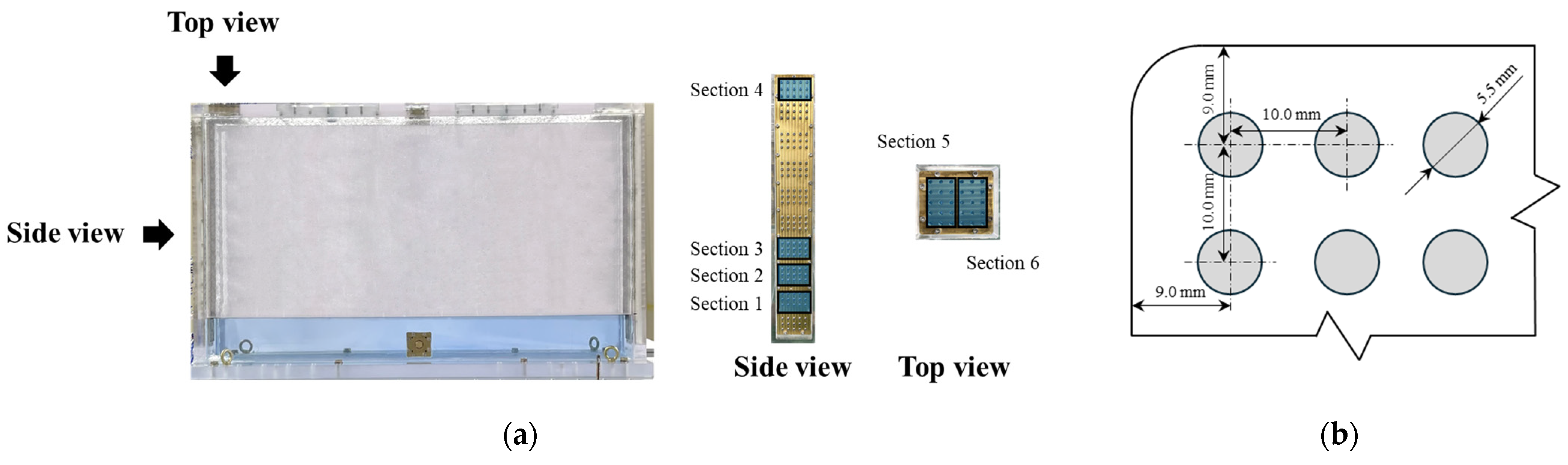
Sloshing impact pressures vary significantly depending on their location within the tank, both in terms of magnitude and underlying impact mechanisms. Therefore, it is essential to account for spatial distribution in the analysis. In this study, based on the sensor arrangement described in
Section 2.2, a total of 90 pressure sensors were grouped into six sections, and the impact pressures were analyzed on a section-wise basis.
For each pressure sensor
, the set of detected impact events is defined as
Here, denotes the -th detected impact peak at sensor , and is the total number of impact events detected at that sensor.
Each sensor is assigned to a specific section
based on its spatial location. The impact event sets from sensors belonging to the same section are combined to construct a section-level impact pressure set as
where
represents the aggregated set of impact events within section
.
This aggregation reduces local variability associated with individual sensors and enables the extraction of representative impact characteristics for each spatial region. Based on , representative impact pressures were evaluated for each section, allowing comparison of spatial distributions and scaling behavior across different locations.
In particular, in sections corresponding to the side-wall region, impacts are predominantly associated with free-surface rise and wall collision. In contrast, in the upper region, impacts are governed by a combination of air pocket formation and collapse, as well as direct free-surface impacts. Therefore, section-based analysis serves not only as a spatial classification but also as an indirect means of distinguishing dominant impact mechanisms.
Furthermore, since a single scaling approach may not be uniformly applicable across all spatial locations, comparison of section-wise results provides insight into the spatial dependency of scaling behavior.
3.2. Definition of Comparative Metric
Sloshing impact pressures exhibit large variability between individual events and show a wide distribution even under identical experimental conditions. Therefore, evaluating scaling behavior based solely on a single maximum or mean value is insufficient. To account for the statistical characteristics of the impact pressures, representative metrics were defined in this study.
Based on the section-level impact event set
defined in
Section 3.1, the impact pressures were sorted in descending order to construct an ordered set as
where
is the total number of impact events in section
.
Based on this ordered set, the representative impact pressures were defined as follows. The mean impact pressure is given by
which represents the overall impact level.
To account for higher-intensity events, the mean values of the upper subsets were additionally defined. The mean of the top one-third of events is expressed as
which captures medium-to-high intensity impact characteristics.
Similarly, the mean of the top one-tenth of events is defined as
which represents near-extreme impact behavior and provides a relevant indicator for characterizing high-intensity impact events, though it is not intended as a direct structural design metric (see
Section 5 for further discussion).
By defining multiple representative metrics, both average and extreme impact behaviors can be analyzed separately. This approach enables a more detailed evaluation of how the distribution of impact pressures changes with scale. In particular, the upper-percentile-based metrics play a key role in capturing extreme-event characteristics and are therefore essential for assessing scaling behavior.
3.3. Scaling Evaluation Method
To evaluate the scaling behavior of sloshing impact pressures, the normalization methods defined in
Section 2.3 were applied to the representative impact pressures obtained at different scales. The representative pressures were converted into dimensionless form, enabling direct comparison across different scale conditions.
In the case of ideal scaling, the dimensionless pressure should remain invariant with respect to scale, indicating that scale dependency has been eliminated. To quantitatively assess this dependency, the relationship between representative impact pressure and scale ratio was modeled using a power law expression as
where
is the scale ratio,
is a coefficient, and
is the exponent representing scale dependency.
For ideal scaling, the dimensionless pressure remains constant across scales, and therefore the exponent approaches zero. Accordingly, was used as the primary indicator of scaling validity in this study. A value of close to zero indicates that the corresponding normalization method provides scale-independent results, whereas larger values of imply that the scaling method does not fully capture similarity across scales.
The power law analysis was performed for each representative metric defined in
Section 3.2 (mean, top 1/3, and top 1/10). This allows the scale dependency to be evaluated across different impact intensity levels.
In particular, an increase in the exponent for upper-percentile-based metrics indicates that extreme impact events are more sensitive to scale variation. This behavior reflects the influence of distribution tails on scaling characteristics.
Furthermore, gravity-based scaling and shear-stress-based scaling were evaluated under the same framework to compare their effectiveness. If a given scaling method yields a value of closer to zero under specific conditions, it suggests that the corresponding physical mechanism is more dominant in governing the impact behavior.
3.4. Impact Regime Classification
Sloshing impact pressures can arise from different flow mechanisms even under identical conditions, and these mechanisms directly influence not only the magnitude and temporal characteristics of the impact pressures but also their scaling behavior. Therefore, it is necessary to classify impact events according to the dominant impact mechanism rather than treating all events as a single dataset.
In this study, impact events were classified into two categories based on the underlying flow mechanism: air-pocket-dominated impacts and pure impacts. This classification was performed by considering both the characteristics of the pressure signals and the corresponding flow visualization results.
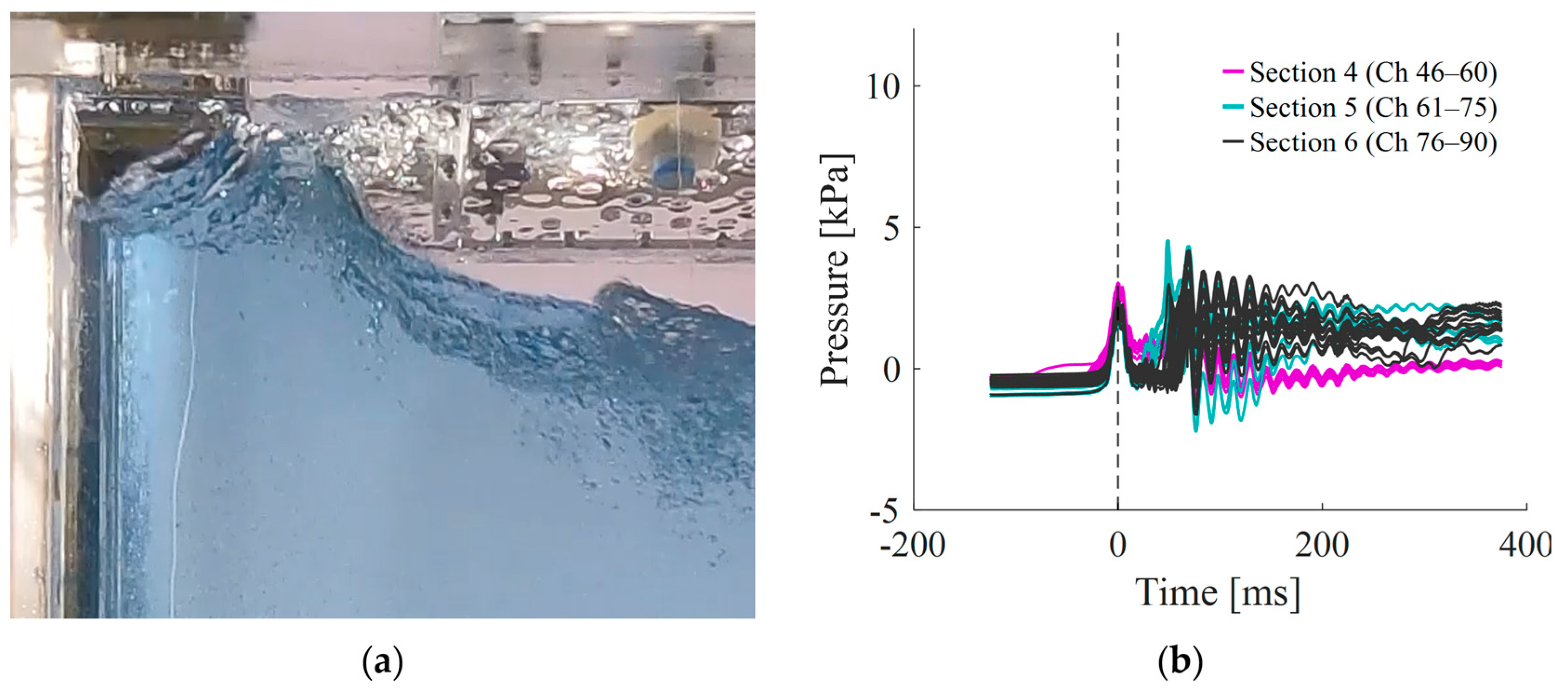
Air-pocket-dominated impacts occur when an air layer is entrapped between the free surface and the upper structure, and the impact is generated through the compression and collapse of the air pocket. These impacts typically exhibit a relatively gradual pressure rise, multiple peaks with oscillatory components, longer impact duration, and comparatively lower peak pressure. Such behavior is attributed to the cushioning effect of the entrapped air layer and is consistent with the characteristics of Bagnold-type impacts. In particular, Pressure oscillations observed near the peak are associated with the compression dynamics of the air pocket.
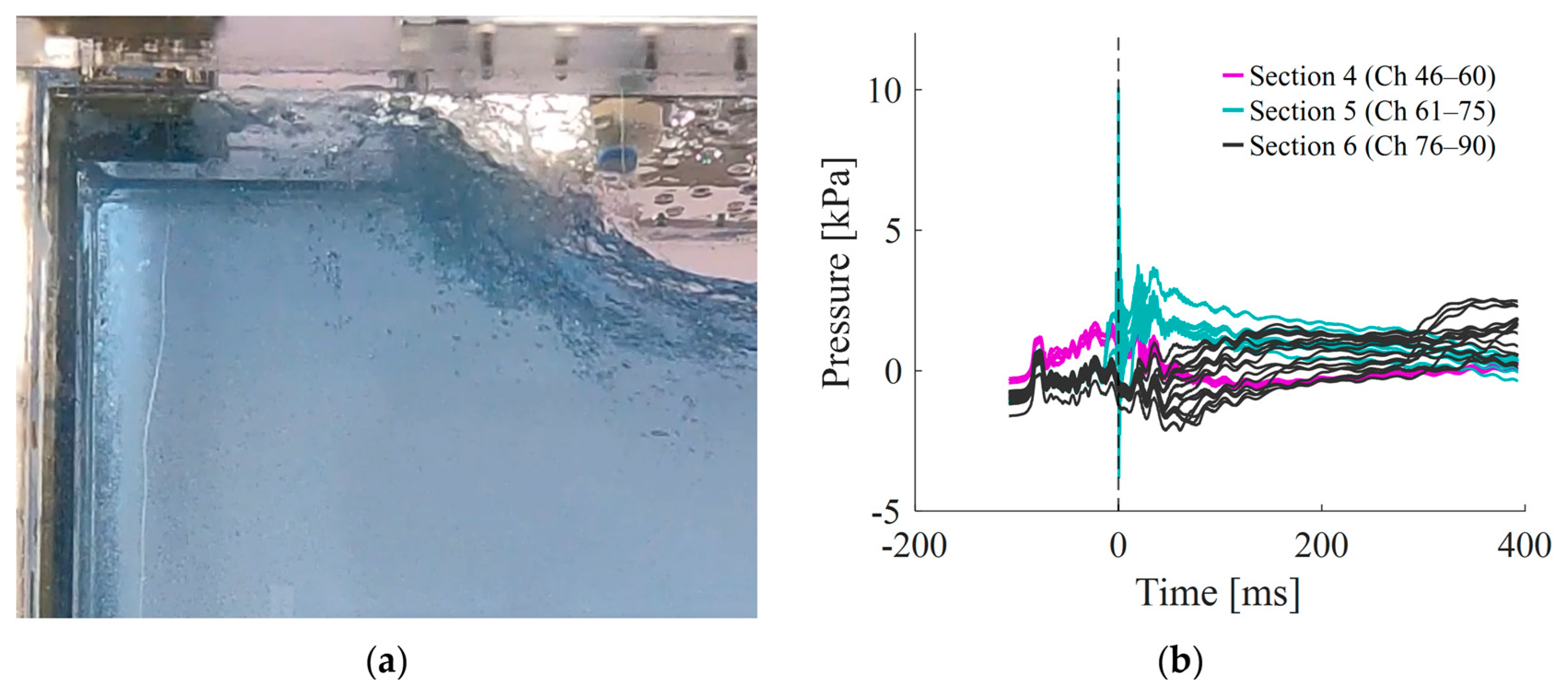
In contrast, pure impacts occur when the free surface directly collides with the structure with little or no air entrainment. These impacts are characterized by a rapid pressure rise over a very short duration, typically exhibiting a single sharp peak with high pressure magnitude. This behavior is associated with direct fluid–structure interaction without air cushioning and is consistent with Wagner-type impact characteristics.
The classification of impact events was carried out through a combined analysis of pressure signals and flow visualization. First, the time history signals were analyzed to evaluate the rise time, duration, and peak shape of each event. Subsequently, camera recordings were examined to identify the presence of air entrainment and the corresponding free-surface behavior. Based on these combined observations, each event was assigned to one of the two impact regimes.
For air-pocket-dominated impacts, the characteristic signal features include a relatively long rise time, multiple oscillatory peaks, and a gradual pressure decay. For pure impacts, the signal is characterized by a short rise time, a single sharp peak, and rapid pressure decay. These qualitative criteria were used as the basis for regime classification, and a quantitative characterization of representative signal parameters is presented in
Section 4.1.
For quantitative characterization of impact signal shape, the rise time and decay time were evaluated for each representative event. Following the peak modeling approach widely adopted in sloshing analysis [
22,
23,
24], these parameters are defined as
where
is the time at which the peak pressure
occurs,
and
are the times at which the pressure crosses the level
on the rising and falling sides of the signal, respectively, and
is a fractional coefficient. In the present study,
= 0.5 was adopted for both rise and decay, consistent with the definition widely used by classification societies including DNV, BV, ABS, and GTT, as individually documented in [
22,
23] and comparatively summarized in [
24]. The total impact duration is defined as
.
Furthermore, impact events were grouped using the cluster definition described in
Section 2.4, and a representative impact mechanism was assigned to each cluster. This enables classification at the level of spatially extended impact events rather than at individual sensor measurements.
The classified impact events were then used as a key basis for subsequent scaling analysis. In particular, the proportion of different impact mechanisms may vary with scale even under the same filling condition, which directly affects the distribution of normalized pressures. Therefore, the interpretation of scaling behavior in this study considers not only experimental conditions but also the variation in dominant impact mechanisms.
Accordingly, the scaling behavior of sloshing impact pressures is analyzed under the premise that it is governed not only by scale and filling conditions but also by the dominant impact mechanism. This perspective provides a fundamental basis for interpreting the results presented in
Section 4.
4. Results
4.1. Impact Regime Identification
Sloshing impact pressures arise from different flow mechanisms even under identical experimental conditions, and these mechanisms directly influence not only the magnitude but also the temporal characteristics of the pressure signals. Therefore, accurate interpretation of scaling behavior requires classification of impact events according to the dominant flow mechanism.
As defined in
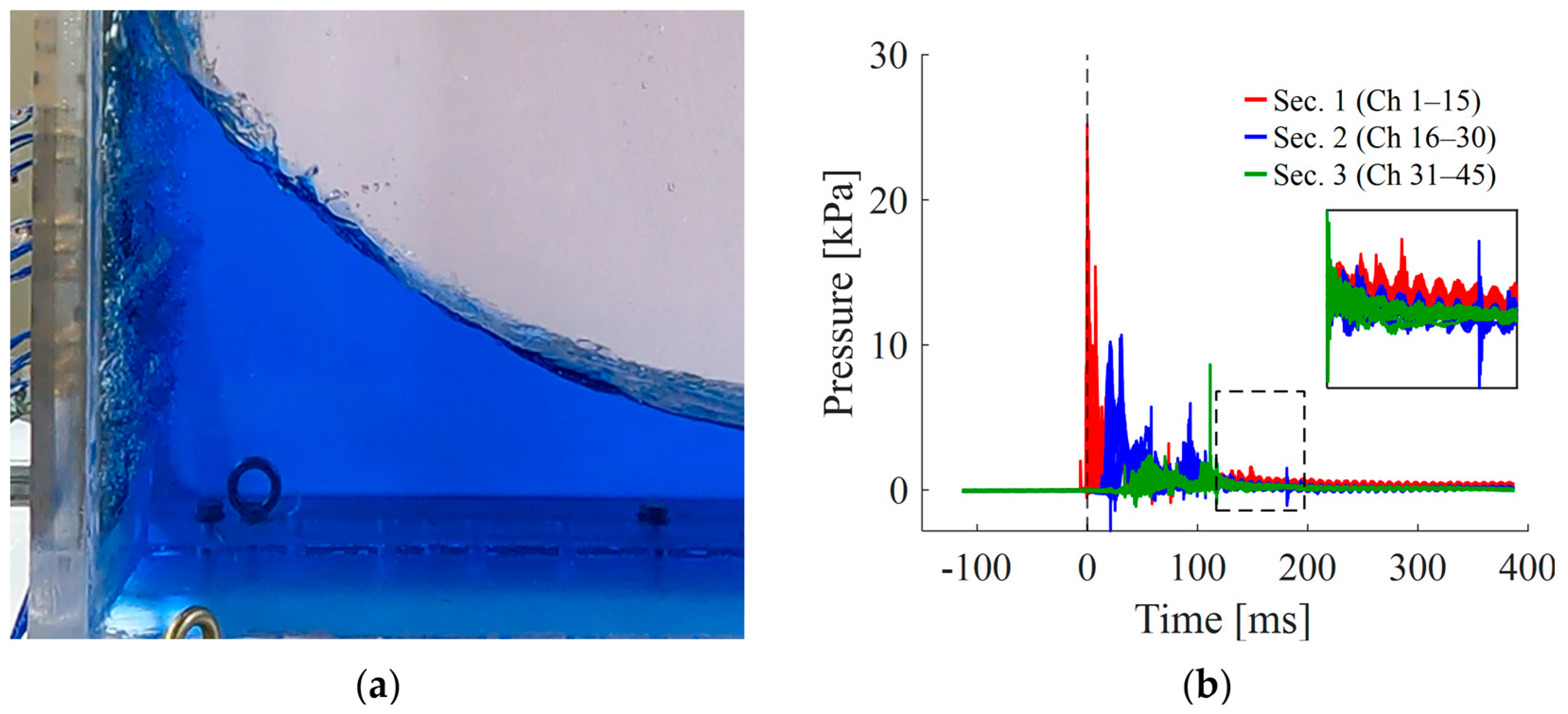
Section 3.4, the impact events were classified into two categories: air-pocket-dominated impacts and pure impacts. The representative flow patterns and corresponding pressure signals for these two impact mechanisms are presented in
Figure 5,
Figure 6 and
Figure 7.
Under low filling conditions, an air layer is frequently entrapped between the free surface and the side wall, and most of the observed impacts were identified as air-pocket-dominated events. The corresponding pressure signals exhibit a gradual rise with multiple peaks containing oscillatory components. These characteristics are attributed to the compression and cushioning effects of the entrapped air layer and are consistent with Bagnold-type impact behavior, as discussed in
Section 3.4.
In contrast, under high filling conditions, both air-pocket-dominated impacts and pure impacts were observed, indicating a coexistence of different impact mechanisms. Pure impacts are characterized by a sharp pressure rise and a single distinct peak, corresponding to direct fluid–structure interaction without significant air cushioning. This behavior is consistent with Wagner-type impact characteristics.
In addition, under high filling conditions, the geometric effect of the upper tank structure was found to influence the impact behavior. In the corner region where the side wall and top structure meet, the rising free surface tends to trap air locally, leading to frequent formation of compressed air pockets. This configuration sustains the occurrence of air-pocket-dominated impacts while enhancing oscillatory features in the pressure signals due to repeated compression and expansion of the entrapped air.
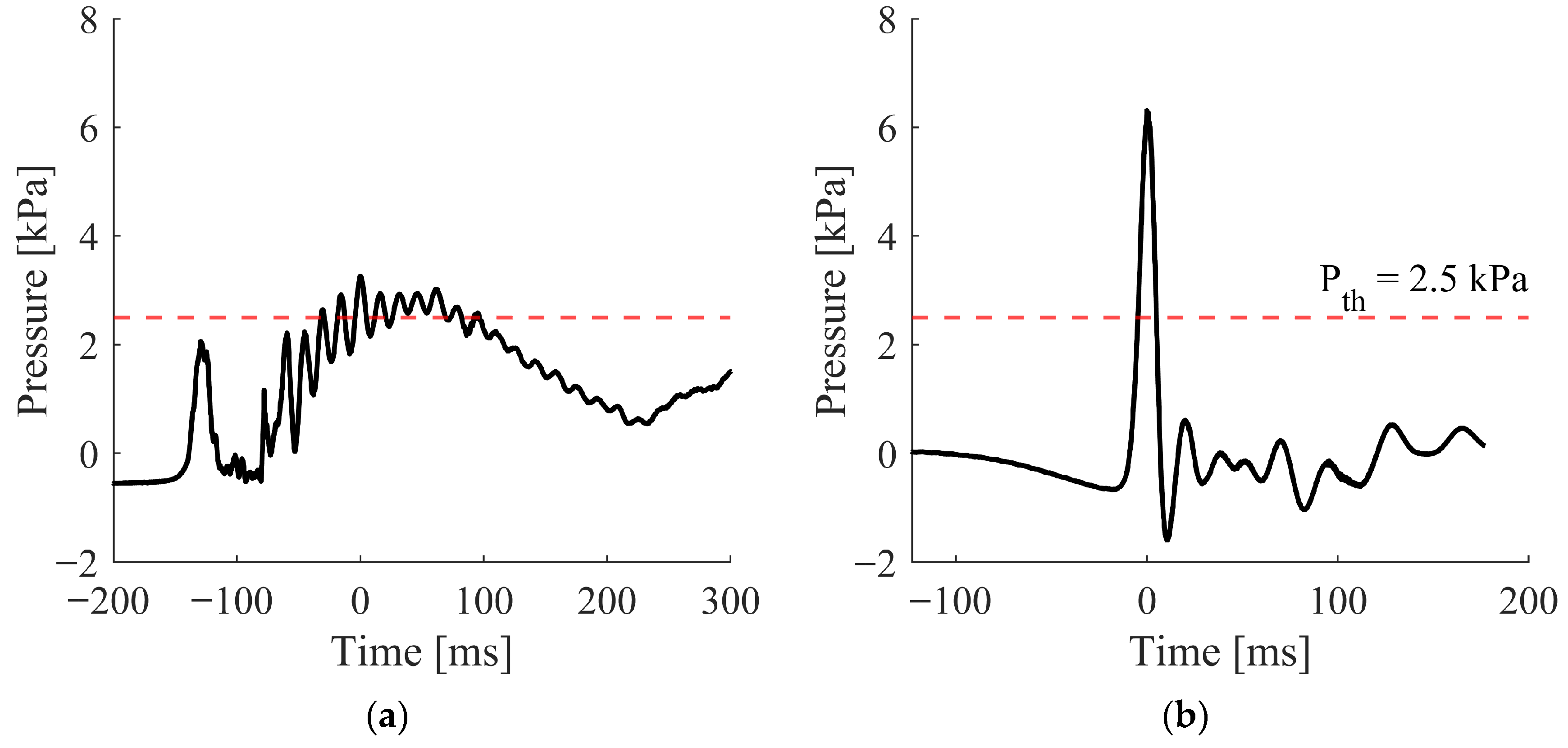
To further quantify the temporal differences between these two impact regimes, the representative pressure signals for Bagnold-type and Wagner-type impacts are compared in
Figure 8, and their characteristic temporal parameters are summarized in
Table 5.
To provide a quantitative basis for regime classification, the temporal parameters of representative pressure signals were evaluated for each impact regime, as summarized in
Table 5. For the Bagnold-type impact (Ch.85), the rise time and decay time were
and
, respectively, yielding a total impact duration of
. In contrast, the Wagner-type impact (Ch.62) exhibited significantly shorter characteristic times, with
and
, corresponding to a total duration of
. The ratio of impact durations between the two regimes is approximately 19:1, and the decay time ratio is approximately 28:1, reflecting the sustained pressure oscillation associated with air pocket compression and expansion in Bagnold-type impacts. These quantitative differences confirm that the temporal characteristics of the pressure signal provide a clear and objective basis for regime classification.
4.2. Spatial Distribution of Impact Events
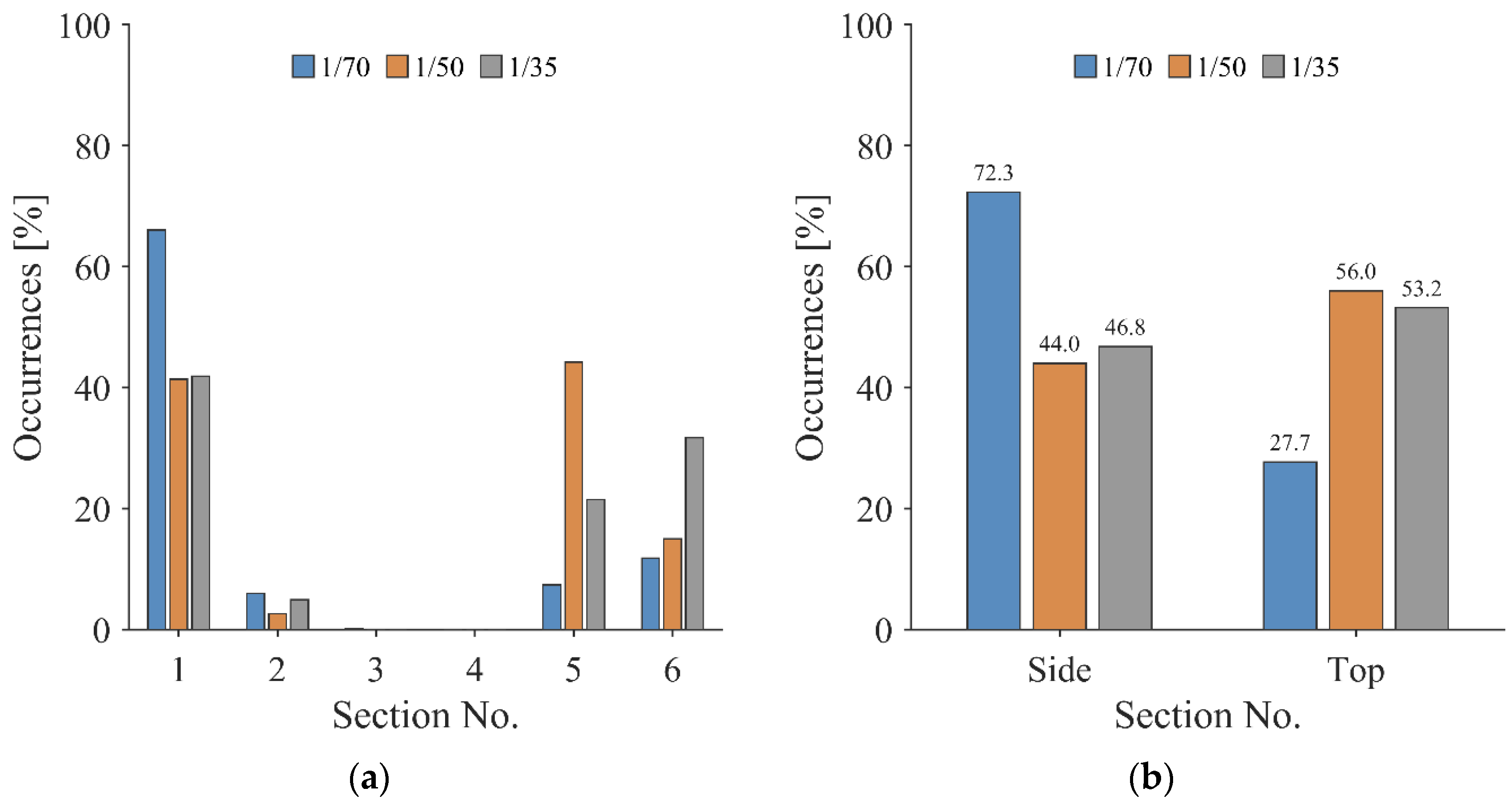
To analyze the spatial distribution of impact mechanisms, the occurrence of impact events in each section was classified under low and high filling conditions, as shown in
Figure 9 and
Figure 10. The analysis was conducted based on the spatial classification defined in
Section 3.1.
Figure 9a presents the occurrence frequency of impact events in each section for different scales under low filling conditions. The detailed occurrence ratios are summarized in
Table 6. As shown in the figure, impact events are not uniformly distributed but tend to concentrate in specific sections. For the 1/70 and 1/35 scales, the highest occurrence is observed in Section 1, followed by Sections 6 and 5. For the 1/50 scale, Sections 1 and 5 exhibit comparable occurrence frequencies. In all scales, the occurrence in Section 2 is relatively low, while almost no impact events are observed in Sections 3 and 4.
To provide a clearer interpretation, the sections were further grouped into side-wall and upper regions, as shown in
Figure 9b. At the 1/70 scale, impact events are predominantly concentrated in the side-wall region. In contrast, at the 1/50 and 1/35 scales, the occurrence frequencies in the side-wall and upper regions become comparable, indicating a transition in the dominant impact locations with increasing scale.
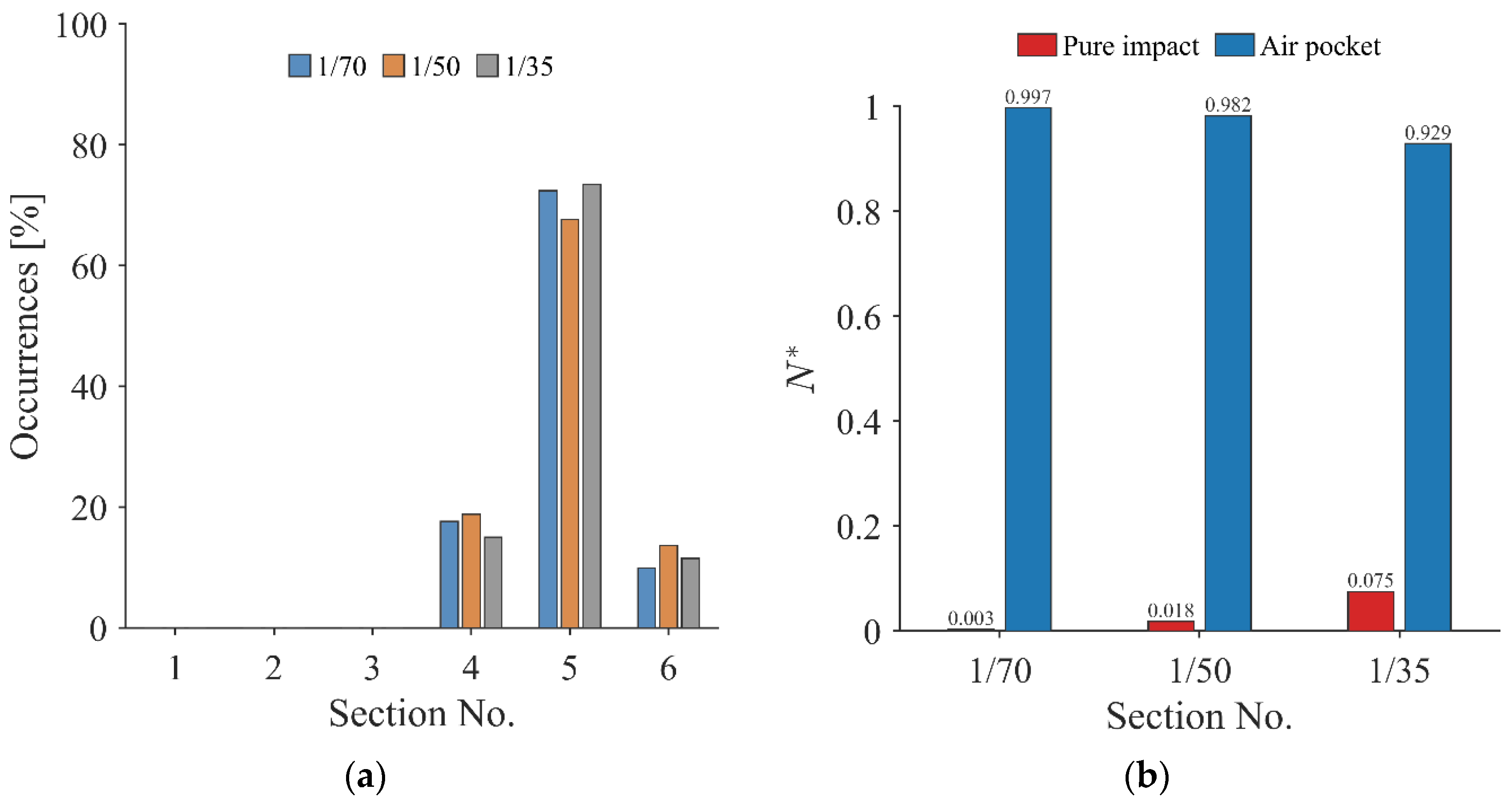
Figure 10a shows the spatial distribution of impact events under high filling conditions. The detailed occurrence ratios are summarized in
Table 7. Due to the elevated free-surface level, impact events are observed only in Sections 4–6, with a pronounced concentration in Section 5. This distribution indicates that, once the free surface reaches the upper corner region, impact events occur more frequently beneath the top structure rather than along the side wall.
Table 6.
Distribution of peak occurrences across sections under low filling conditions [%].
Table 6.
Distribution of peak occurrences across sections under low filling conditions [%].
| Section No. | 1/70 | 1/50 | 1/35 |
|---|
| 1 | 66.1 | 41.4 | 41.9 |
| 2 | 6.0 | 2.6 | 4.9 |
| 3 | 0.2 | 0.0 | 0.0 |
| 4 | 0.0 | 0.0 | 0.0 |
| 5 | 7.4 | 44.2 | 21.5 |
| 6 | 11.8 | 15.8 | 31.1 |
Table 7.
Distribution of peak occurrences across sections under high filling conditions [%].
Table 7.
Distribution of peak occurrences across sections under high filling conditions [%].
| Section No. | 1/70 | 1/50 | 1/35 |
|---|
| 1 | 0.0 | 0.0 | 0.0 |
| 2 | 0.0 | 0.0 | 0.0 |
| 3 | 0.0 | 0.0 | 0.0 |
| 4 | 17.6 | 18.8 | 15.0 |
| 5 | 72.4 | 67.6 | 73.5 |
| 6 | 9.9 | 13.6 | 11.5 |
This behavior can be explained by the geometric constraint under high filling conditions. The reduced clearance between the free surface and the upper structure facilitates local air entrapment near the corner region, leading to a higher frequency of impact events in the upper region.
Figure 10b presents the overall occurrence ratio of impact mechanisms for different scales under high filling conditions. The occurrence frequency is normalized as
where
N* is the normalized occurrence frequency,
is the number of events corresponding to a given impact mechanism,
is the duration of the scenario, and
is the excitation frequency.
As shown in the figure, air-pocket-dominated impacts remain the dominant mechanism across all scales. However, the proportion of pure impacts increases with increasing scale. In particular, the occurrence of pure impacts increases from approximately 0.3% at the 1/70 scale to about 7.5% at the 1/35 scale. In contrast, the proportion of air-pocket-dominated impacts shows a slight decrease with scale, although it still accounts for the majority of events.
4.3. Distribution of Peak Impact Pressure
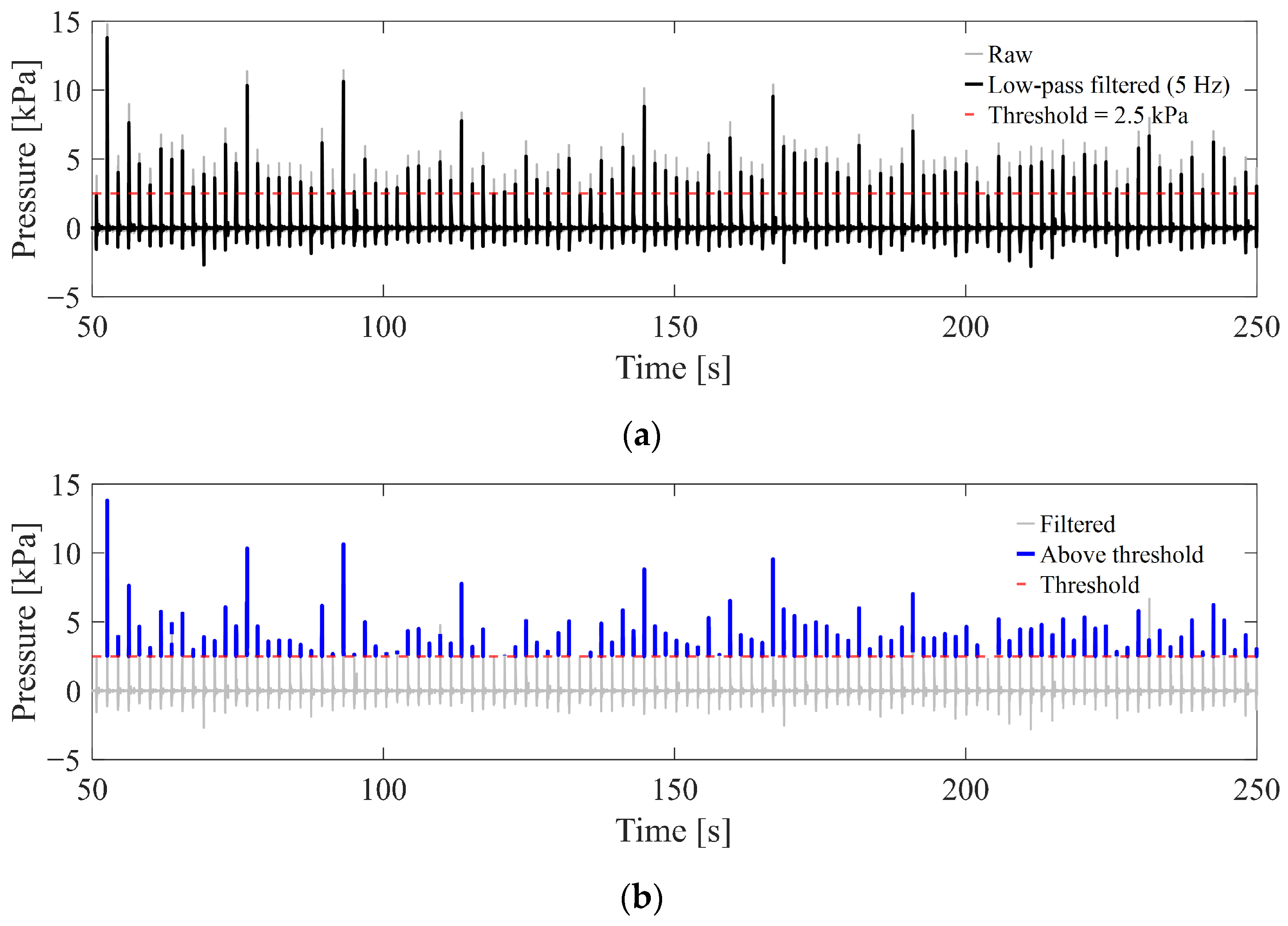
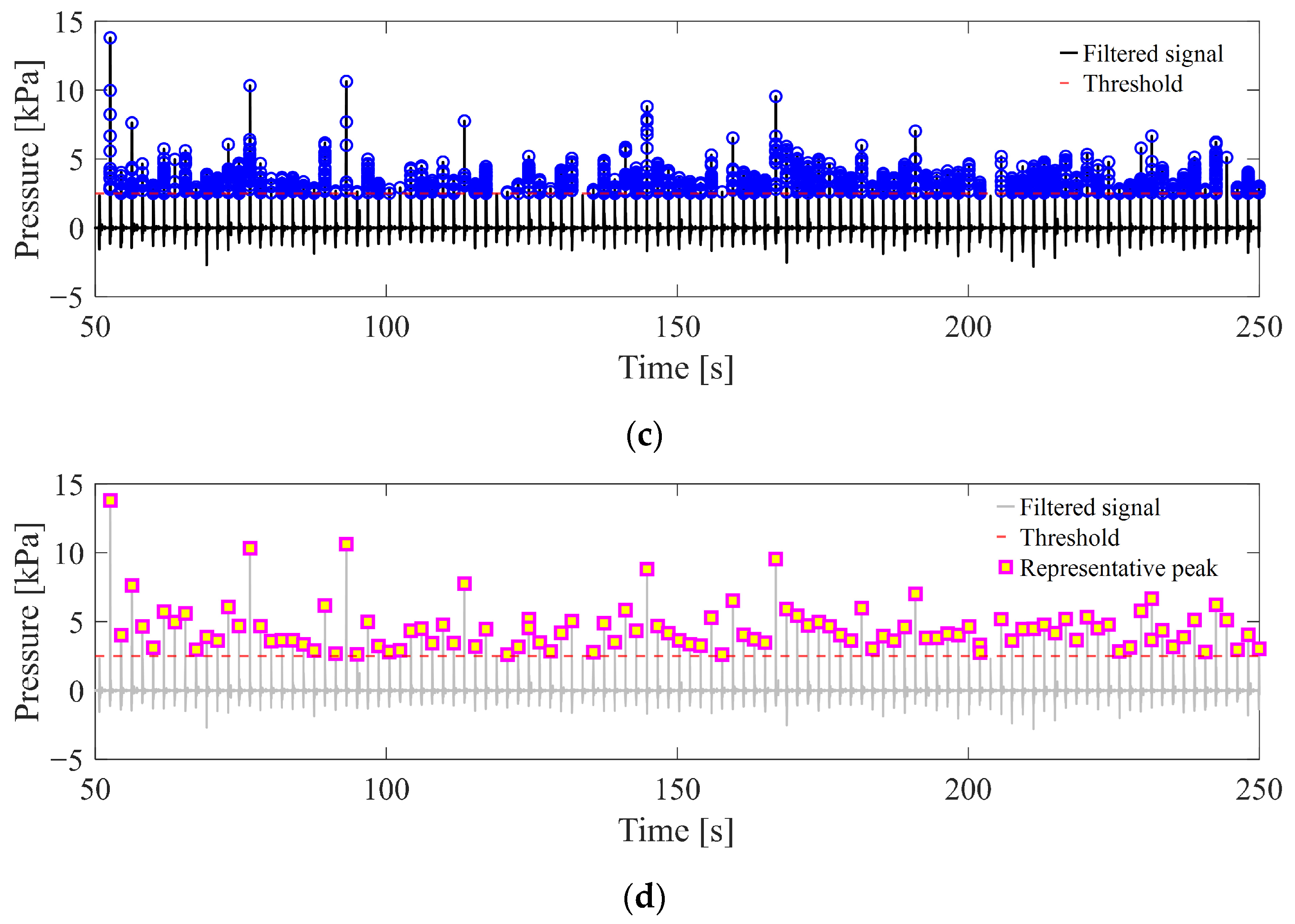
Sloshing impact pressures exhibit significant variability between individual events even under identical excitation conditions, making it difficult to adequately characterize the overall response using a single representative value. Therefore, in this section, individual impact events were defined using time-based clustering, and the maximum peak pressure within each event was selected as the representative value to analyze the event-level pressure distribution.
This distribution-based approach is essential for interpreting scale dependency, particularly for high intensity events, as it enables direct assessment of how the distribution structure varies with scale.
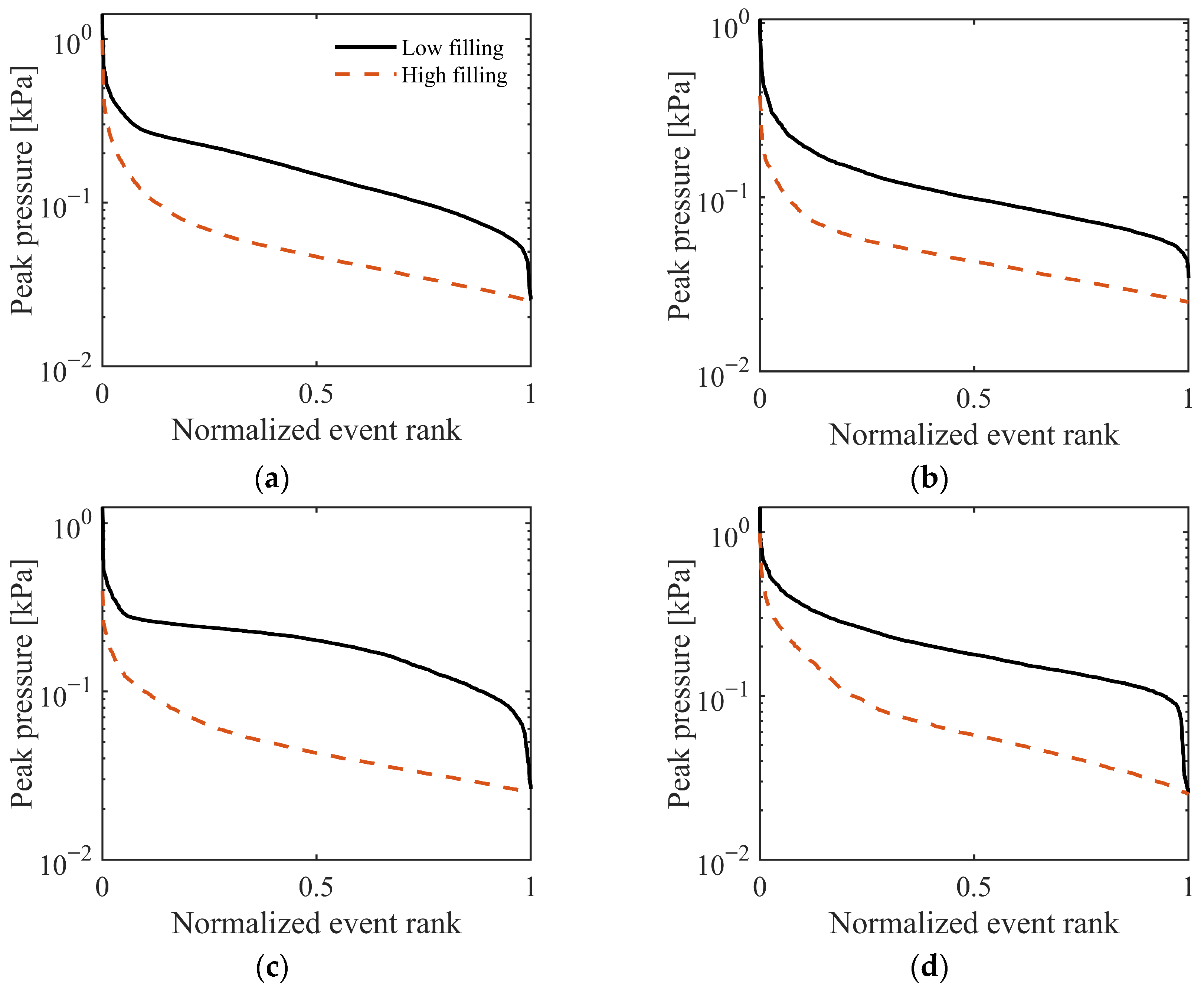
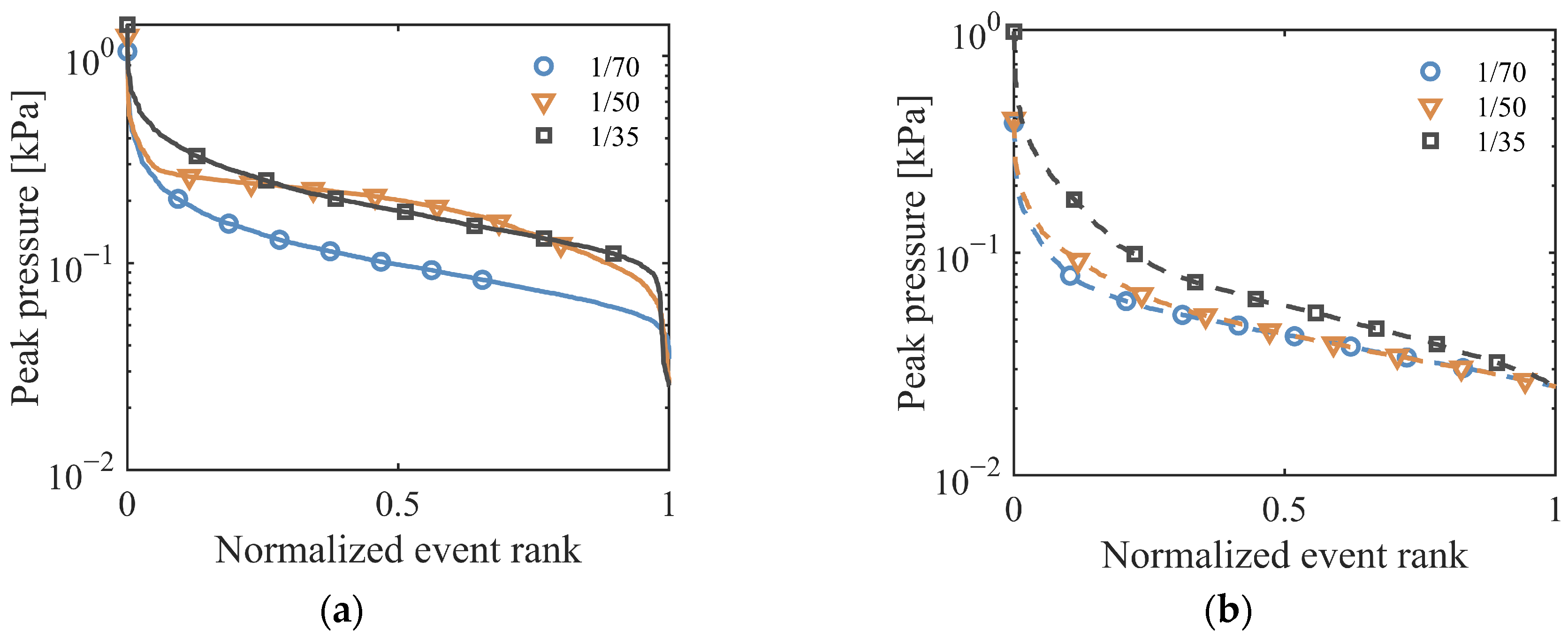
Figure 11 show the sorted event-level peak pressures in descending order.
Figure 11a presents the pooled distribution across all scales, while
Figure 11b–d corresponds to the results for the 1/70, 1/50, and 1/35 scales, respectively. Across all scales and in the pooled results, the low filling condition consistently exhibits higher peak pressure levels than the high filling condition over the entire range. This difference is observed not only in the extreme-value region but also across the entire distribution, indicating that the effect of filling condition is robust and not limited to a specific scale.
Under high filling conditions, although the overall pressure level is lower, the decay of the distribution becomes more gradual and the tail extends toward higher pressure values, indicating a broader spread of impact intensities. This suggests that the variability of impact pressure increases under high filling conditions, despite the reduction in absolute magnitude.
Comparing the distributions across different scales, the 1/50 and 1/35 cases exhibit similar decay trends in the sorted curves. However, the 1/70 scale shows a relatively flatter slope in the intermediate rank region, indicating a more uniform distribution of impact pressures.
This behavior may be partially attributed to the geometric characteristics of the model configuration. Since the tank width was kept constant across all scales, the relative width-to-length ratio increases at smaller scales. As a result, lateral confinement effects are reduced, and the flow becomes more spatially distributed, preventing strong localization of impact energy. Consequently, the distribution of event-level peak pressures becomes more flattened at smaller scales.
To further investigate the scaling behavior, the event-based sorted peak pressures were compared across different scales by separating the low and high filling conditions, as shown in
Figure 12.
Under low filling conditions, the distributions exhibit partial overlap across scales depending on the rank range. In particular, the 1/50 and 1/35 scales show similar distributions in the intermediate rank region, whereas the 1/70 scale consistently maintains a lower pressure level and remains relatively separated from the other two scales. This behavior indicates that the scale effect under low filling conditions is not uniformly manifested over the entire distribution, but rather varies depending on the rank region.
This non-uniform behavior across the distribution directly explains why different representative metrics (e.g., mean, top 1/3, and top 1/10) exhibit different scaling trends, as discussed in
Section 4.4.
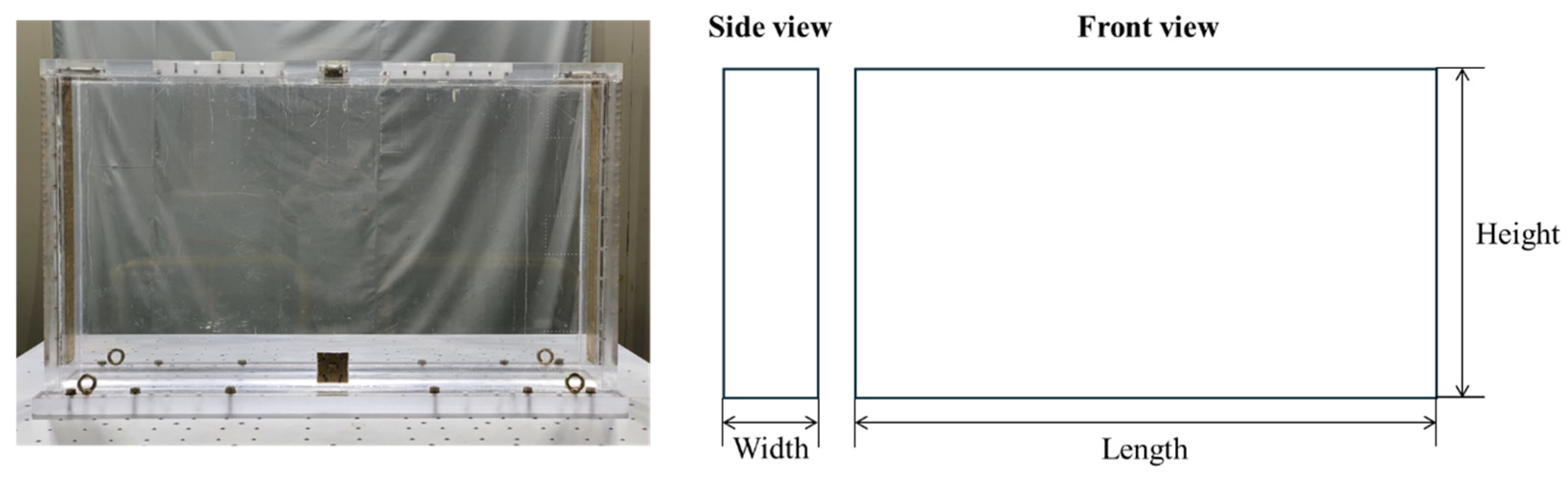
It should be noted that, in the present experiments, the tank width was fixed at 200 mm for all scales, resulting in geometric non-similarity in terms of aspect ratio. In particular, the 1/70-scale model becomes relatively wider compared to the larger-scale models, which may influence the flow structure, especially under low filling conditions where the fluid motion is primarily confined near the side-wall region. This geometric difference can affect the degree of flow localization and impact formation, potentially contributing to the overall lower pressure levels observed for the 1/70 scale.
Specifically, as the scale ratio decreases from 1/35 to 1/70, the width-to-length ratio increases from 0.142 to 0.285, and the width-to-height ratio increases from 0.248 to 0.497, as summarized in
Table 2. These changes in aspect ratio indicate that the degree of lateral confinement and free-surface confinement varies substantially across the tested scales, which may affect three-dimensional flow features such as corner effects, wave breaking, and impact localization.
Therefore, the scale-dependent behavior observed under low filling conditions should be interpreted as a combined effect of both dynamic scaling and geometric distortion, rather than as a purely scale-driven phenomenon.
In contrast, under high filling conditions, a more pronounced scale dependency is observed compared to the low filling case. While the distributions under low filling conditions exhibit rank-dependent similarity and partial overlap, the high filling condition shows a reduction in such overlap, with the 1/35 scale consistently maintaining higher peak pressure levels over almost the entire rank range. This indicates that the differences are not limited to extreme events but rather reflect a systematic shift in the entire distribution with scale.
Furthermore, while the 1/50 and 1/70 scales exhibit relatively similar distributions, the 1/35 scale remains distinctly separated, indicating that the scale effect under high filling conditions is characterized primarily by the upward shift in the 1/35-scale distribution rather than a uniform separation across all scales. These results demonstrate that the pressure response under high filling conditions exhibits increased sensitivity to scale, and that this sensitivity extends beyond the extreme-value region to the overall distribution of impact events.
4.4. Scaling Behavior of Impact Pressure
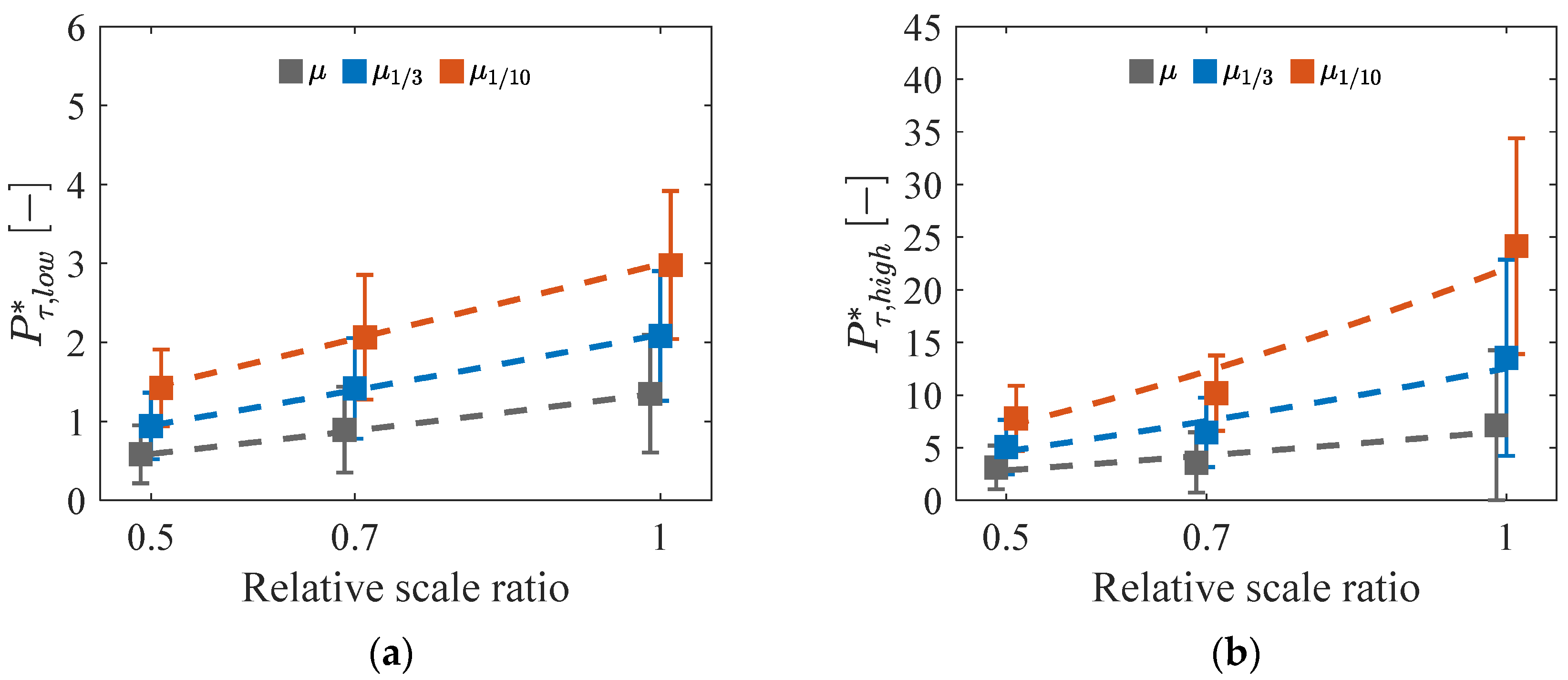
To quantitatively evaluate the scaling behavior of sloshing impact pressures, the power law relationship
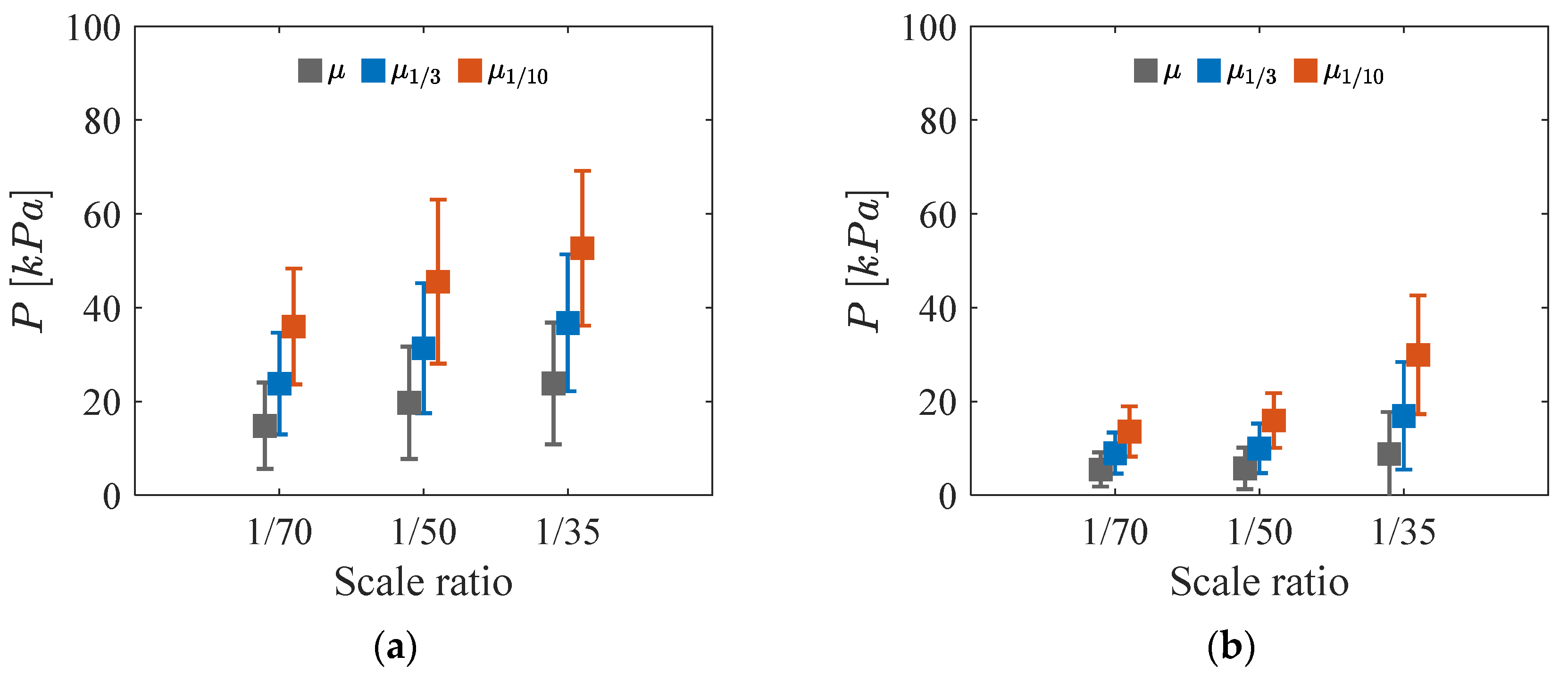
was applied to the representative impact pressures obtained at different scales. Prior to normalization, the representative impact pressures under low and high filling conditions are compared in
Figure 13, illustrating the scale-dependent variation in pressure levels in absolute terms. Here, the exponent
serves as a key indicator of scale dependency; under ideal scaling conditions,
.
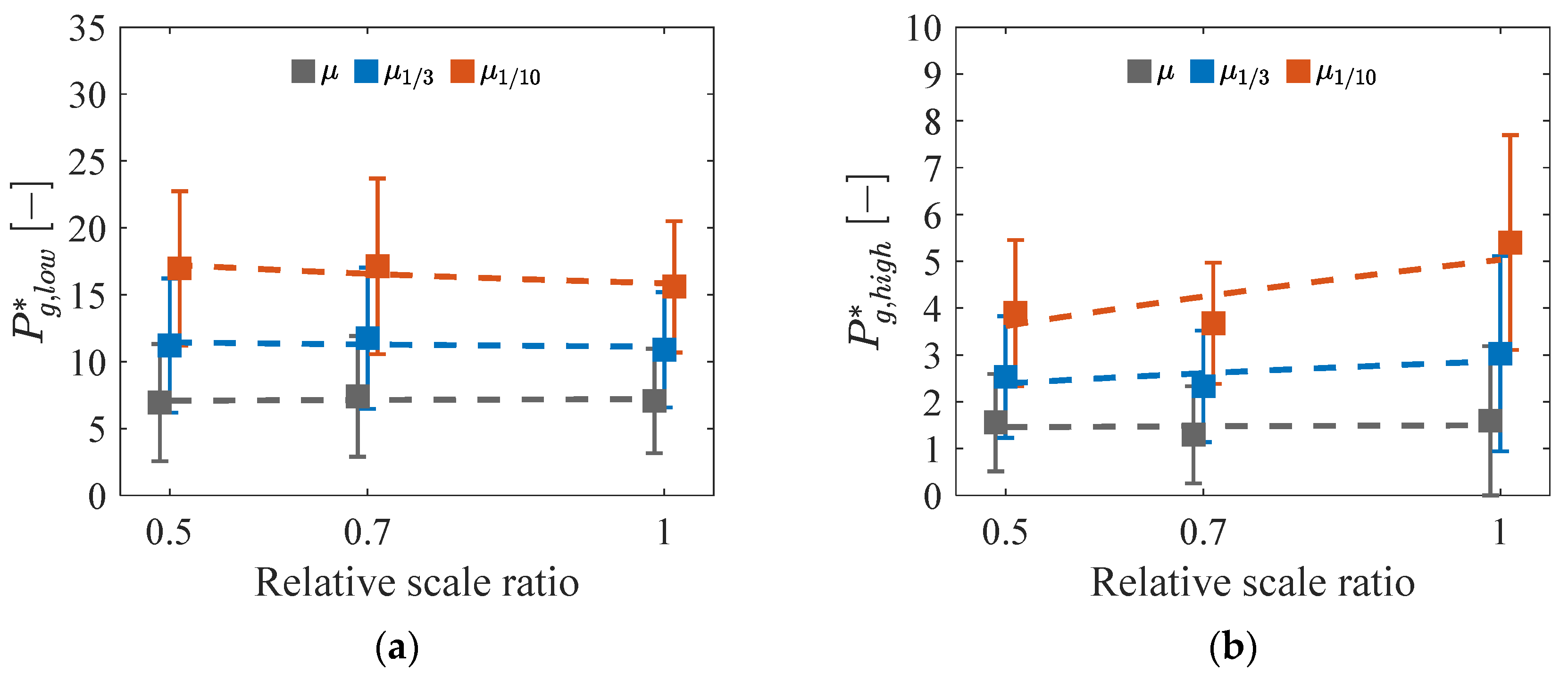
As shown in
Figure 14 and
Table 8, under low filling conditions, gravity-based scaling yields values of
close to zero for all representative metrics (mean, top 1/3, and top 10%), with
and
, respectively (based on three scale points; see limitation discussion below). This indicates that the dimensionless impact pressures remain nearly invariant with scale, suggesting that gravity-based scaling is reasonably valid under these conditions. This behavior is closely related to the relatively uniform impact mechanisms and stable distribution characteristics observed under low filling conditions, as further discussed in
Section 4.5.
In contrast, under high filling conditions, the exponent increases with increasing impact intensity level. In particular, the top 10% mean exhibits the largest value ), indicating that the contribution of extreme events becomes more significant as the scale increases. This behavior suggests that scale similarity is not preserved under high filling conditions and that the distribution structure of impact pressures changes with scale. In particular, the increased spread of the distribution and the enhanced contribution of upper-tail events play a dominant role in determining the observed scale dependency.
For shear-stress-based scaling, the exponent
exceeds unity even under low filling conditions (
), and becomes even larger under high filling conditions (
), as shown in
Figure 15 and
Table 8. This indicates that shear-stress-based normalization does not promote convergence across scales and does not adequately represent the dominant physics governing sloshing impact pressures under the present experimental conditions.
As hypothesized in
Section 2.3, the dominant physical mechanisms may vary depending on the impact conditions. However, the present results show that shear-stress-based scaling fails to capture the scaling behavior even under low filling conditions. This suggests that sloshing impact pressures are governed primarily by inertia and gravity rather than localized shear effects.
Overall, gravity-based scaling is found to be reasonably valid under low filling conditions, whereas its applicability deteriorates under high filling conditions due to the coexistence of multiple impact mechanisms and the increased spread of the pressure distribution.
These results indicate that the scaling behavior of sloshing impact pressure cannot be fully described by a single physical parameter or similarity law, but is strongly influenced by both the statistical characteristics of impact events—particularly the distribution tail—and the underlying flow mechanisms.
The relatively good agreement observed under low filling conditions can be attributed to the more uniform flow structure and consistent impact mechanisms, which result in stable pressure distributions across scales. In addition, the excitation conditions, determined based on the linear dispersion relation, inherently follow gravity-dominated scaling, further contributing to the effectiveness of gravity-based normalization.
In contrast, under high filling conditions, the interaction between air-pocket-dominated and pure impact mechanisms leads to increased variability and a broader distribution, particularly in the upper tail, where extreme events play a dominant role.
These results indicate that the scaling behavior of sloshing impact pressures cannot be fully described by a single physical parameter and is strongly influenced by both the statistical characteristics of impact events and the underlying flow mechanisms.
It should be noted that the power law fitting in the present study is based on three scale points (1/70, 1/50, and 1/35), which limits the statistical robustness of the fitted exponents. With only three data points, confidence intervals for the exponent p cannot be rigorously estimated, and the observed differences in p across filling conditions and intensity levels should be interpreted with caution. Increasing the number of tested scales would be necessary to provide statistically well-supported power law exponents, and this is identified as a priority for future experimental work.
Furthermore, detailed per-case statistical summaries—including event counts, standard deviations, and confidence intervals for each scale, filling level, and representative metric—are not reported in the present study. Providing such information would allow a more complete assessment of the repeatability and statistical reliability of the observed scaling trends, and is identified as a further area for improvement in future work.
4.5. Regime-Dependent Scaling Anaylsis
To interpret the differences in scaling behavior identified in
Section 4.4, the relationship between scaling characteristics and impact mechanisms was examined. As shown in
Figure 14 and
Table 8, the power law exponent
remains close to zero under low filling conditions, whereas under high filling conditions,
increases with increasing impact intensity level. This contrast is closely associated with differences in the dominant impact mechanisms as well as the resulting distribution characteristics of impact pressures.
It should be noted that the excitation conditions were determined based on the linear dispersion relation, which inherently follows gravity-dominated scaling. This provides a consistent baseline for gravity-based normalization and contributes to the relatively good agreement observed under low filling conditions.
As defined in
Section 3.4, sloshing impacts can be classified into air-pocket-dominated impacts, governed by air compression and collapse, and pure impacts, resulting from direct fluid–structure interaction. Considering the distribution characteristics presented in
Section 4.3, most impact events under low filling conditions are dominated by air-pocket mechanisms, which exhibit relatively gradual pressure rise and limited variability.
In addition, under sway excitation, the flow is primarily governed by side-wall interactions, which exhibit relatively consistent kinematics across scales. This leads to a stable distribution of impact pressures with limited spread, and as a result, the representative impact pressures remain nearly invariant across scales, consistent with the near-zero values of
observed in
Table 8.
In contrast, under high filling conditions, impact events occur predominantly in the upper region, where multiple impact mechanisms—including air-pocket-dominated and pure impacts—coexist. Although the overall pressure magnitude is lower than that in low filling conditions, the distribution exhibits a significantly wider spread, particularly in the upper tail. This indicates that a small number of high intensity events contribute disproportionately to the overall distribution.
The pronounced increase of for the top 10% metric suggests that scaling behavior is governed not by the absolute magnitude of impact pressure, but by the expansion of the distribution and the increasing contribution of extreme events. In other words, the relative importance of extreme events increases with scale, leading to a scale-dependent increase in dimensionless impact pressure.
This behavior is closely related to the coexistence of different impact mechanisms. In the upper region, the combined effects of air entrapment due to structural geometry and direct free-surface impacts result in increased variability between events. Consequently, the scaling behavior is influenced more by the variability in impact events than by a uniform increase in impact intensity.
Therefore, the scaling behavior is governed not by a uniform shift in pressure magnitude, but by a redistribution of impact intensity across events. In particular, the expansion of the upper tail of the sorted peak distribution plays a dominant role in determining the scale dependency of extreme impact events.
Furthermore, as observed in
Section 4.2, impact events under high filling conditions are concentrated near the upper corner region (
Section 5), where geometric effects promote air entrapment. This condition facilitates the coexistence of multiple impact mechanisms, leading to a broader distribution rather than localized pressure amplification. As a result, the observed scaling behavior reflects changes in the distribution structure—such as the increased spread and variability of impact events—rather than a simple increase in peak pressure.
For shear-stress-based scaling, the exponent exceeds unity under both low and high filling conditions, indicating a persistent increase in normalized impact pressure with scale. This suggests that shear-based normalization does not adequately capture the dominant physics of the observed impact mechanisms under the present experimental conditions.
This further supports that sloshing impact pressures are governed primarily by inertia–gravity interactions rather than localized shear effects.
It should also be noted that the present experiments were conducted using a two-dimensional tank configuration, in which the internal width was fixed at 200 mm across all scales. While this simplification reduces the complexity associated with three-dimensional flow features and is widely adopted in sloshing scaling studies [
16], it introduces inherent limitations. In particular, out-of-plane flow effects—including sidewall friction, lateral confinement, and three-dimensional air leakage during impact—are not fully captured by the present setup. These effects may influence local impact pressure magnitudes and regime classification, particularly under high filling conditions where air entrapment and roof impact dynamics are dominant. The present results should therefore be interpreted with the understanding that the two-dimensional assumption represents an idealization, and that three-dimensional effects may contribute to residual scaling deviations not fully explained by the present analysis.
From a physical perspective, deviations of p from zero can be interpreted as evidence of unresolved scaling imbalances associated with physical quantities not captured by the applied normalization. When p deviates positively from zero under gravity-based scaling, it suggests that additional physical effects beyond inertia–gravity interaction contribute to the impact pressure at larger scales. In particular, under high filling conditions where air-pocket-dominated impacts are prevalent, gas compressibility effects—characterized by the Cauchy number—become increasingly significant, as the dynamics of air pocket compression and collapse are not fully represented by Froude-based scaling alone. Furthermore, under conditions where the free surface interacts with structural boundaries, surface tension effects—characterized by the Weber number—may also contribute to scaling deviations, particularly at smaller scales where the Bond number is relatively large. Therefore, a positive deviation of p from zero under high filling conditions is consistent with the interpretation that gas compressibility and, to a lesser extent, surface tension effects introduce additional scale dependencies that are not accounted for by gravity-based normalization alone.
5. Conclusions
In this study, the distribution characteristics and scaling behavior of sloshing impact pressures were experimentally investigated across different scale conditions, and their relationship with underlying impact mechanisms was systematically analyzed. By adopting an event-based distribution approach and applying power law analysis, the scale dependency of sloshing impact pressures was quantitatively evaluated.
Under low filling conditions, impact events exhibit relatively consistent behavior, and gravity-based scaling yields nearly scale-independent results, with dimensionless impact pressures remaining almost invariant across scales. This indicates that gravity-dominated scaling is reasonably valid under these conditions.
In contrast, under high filling conditions, mixed impact mechanisms involving both air-pocket-dominated impacts and pure impacts were observed. Although the overall pressure magnitude is lower, the distribution becomes more dispersed, with a pronounced expansion in the upper tail. The increase in the power law exponent for upper-percentile-based metrics demonstrates that extreme events become more influential in determining scaling behavior. This indicates that the scaling behavior is governed not by a uniform increase in pressure magnitude, but by a redistribution of impact intensity across events, particularly through the expansion of the distribution tail.
Shear-stress-based scaling does not produce convergence across scales under any condition, indicating that sloshing impact pressures are governed primarily by inertia and gravity rather than localized shear effects.
Overall, the results demonstrate that the scaling behavior of sloshing impact pressures cannot be adequately described by a single similarity law. Instead, it is strongly influenced by both the statistical distribution of impact events and the dominant impact mechanisms. In particular, the variability of the distribution and the contribution of extreme events play a critical role in determining scale dependency.
From a practical perspective, the present results suggest that, within the commonly adopted model-scale range (1/70–1/35), the scaling behavior derived from model tests can be used to provide approximate predictions of impact pressure levels within the localized regions where the tests were conducted.
However, such predictions should be interpreted with caution, particularly under conditions where multiple impact mechanisms coexist and distribution variability becomes significant.
Based on the power law exponents obtained in this study, a preliminary assessment of scaling reliability can be made. Under low filling conditions, the exponent p for gravity-based scaling ranges from −0.123 to 0.024 across all representative metrics (mean, top 1/3, and top 10%), indicating that the associated scaling error remains well within acceptable engineering limits across the tested scale range (1/70–1/35). Under high filling conditions, p increases progressively with impact intensity level, from 0.039 (mean) to 0.263 (top 1/3) and 0.476 (top 10%), indicating a more pronounced scale dependency for extreme events. For mean-level predictions under high filling conditions (p = 0.039), the scaling error remains within acceptable limits across the full tested range. However, for the top 10% metric (p = 0.476), the deviation relative to the 1/35 reference scale reaches approximately 15% at the 1/50 scale and 28% at the 1/70 scale, both of which exceed the commonly adopted engineering tolerance of 10%. Based on power law extrapolation, the 10% deviation threshold is estimated to occur at a relative scale of approximately 0.79, corresponding to a model scale of approximately 1/44. Therefore, Froude-based scaling for extreme impact events under high filling conditions should be applied with caution at scales smaller than this threshold.
These findings highlight that reliable prediction of sloshing impact loads requires an integrated scaling approach that explicitly accounts for distribution characteristics, especially the upper tail, as well as regime-dependent flow mechanisms.
From an engineering design perspective, the present findings suggest that modifications to tank geometry—such as adjusting the chamfer angle or introducing curved wall profiles in the upper region—may help reduce the coexistence of mixed impact mechanisms under high filling conditions, thereby improving scaling consistency. In addition, the installation of internal damping baffles could suppress the expansion of the impact pressure distribution tail by attenuating extreme events, contributing to more reliable scaling behavior across model scales.
It is also noted that the representative metrics adopted in this study—mean, top one-third, and top one-tenth—are intended for comparative characterization of distribution-level scaling behavior across scales, rather than for direct structural design application. For design purposes, a more rigorous extreme-value analysis, such as fitting the impact pressure distribution to a parametric extreme-value distribution (e.g., Weibull) and estimating return-period-based load levels with confidence intervals, would be required. Such an analysis is identified as an important direction for future work.




 ,
,