1. Introduction
Maritime security and anti-smuggling tasks are crucial to safeguarding national maritime sovereignty economic interests and regional stability. As the marine environment becomes increasingly complex and the mobility of suspicious targets continues to enhance traditional manned patrol and interception models can no longer meet the demand for efficient threat neutralization. Multi-unmanned surface vessel (USV) cooperative navigation and interception technology has emerged as a core technical solution by virtue of its advantages of flexible deployment wide coverage and strong decision-making coordination significantly improving the response speed and success rate of maritime security tasks. This technology is also widely applied in related fields such as offshore facility protection [
1] marine search and rescue and border control and has become an indispensable part of modern intelligent maritime operations.
In scenarios where multiple unmanned surface vessels (USVs) perform cooperative interception tasks, the movement trajectory of the intruding target itself is highly uncertain. Especially in adversarial environments, the target often actively adopts evasion strategies to avoid interception [
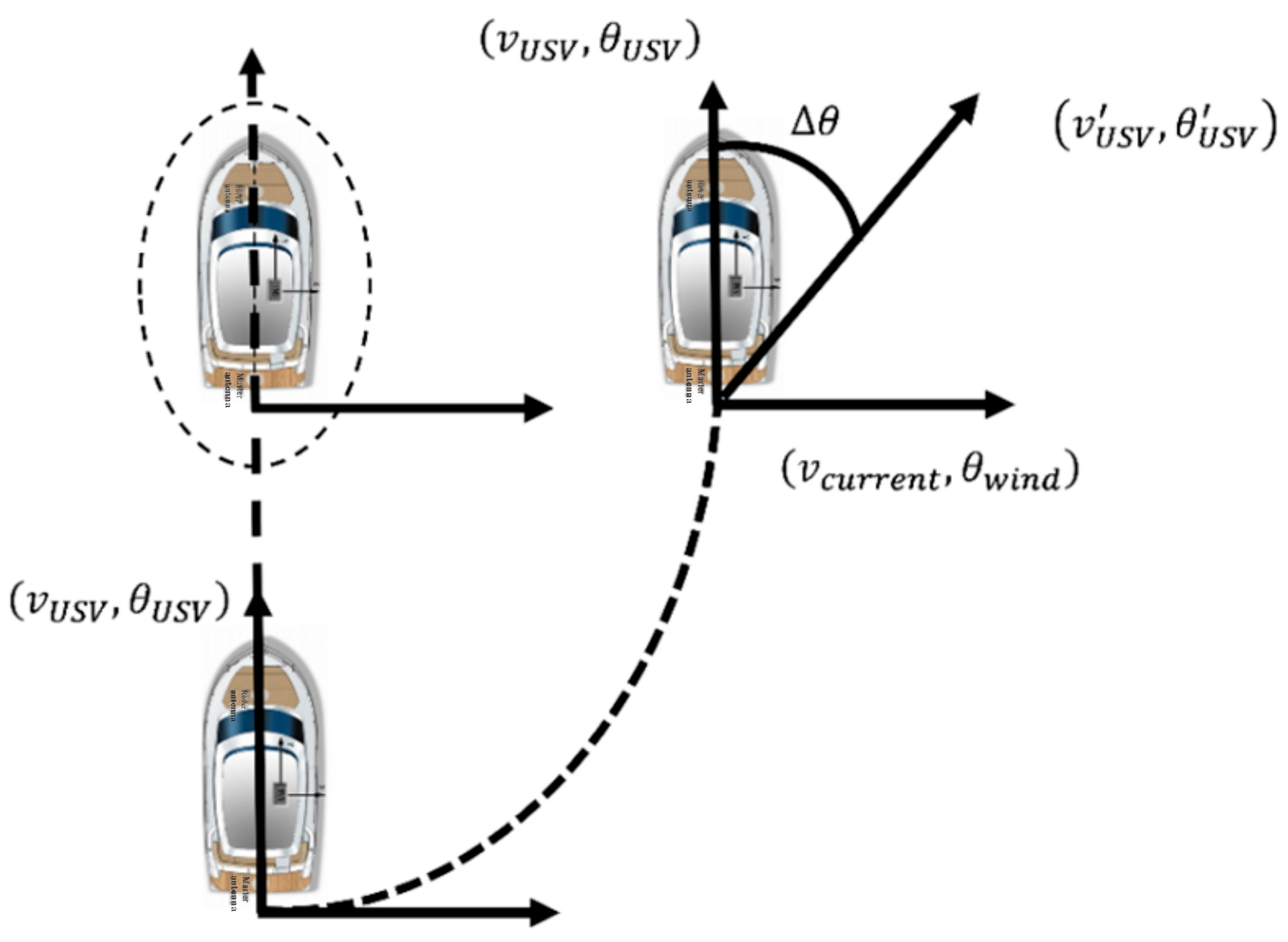
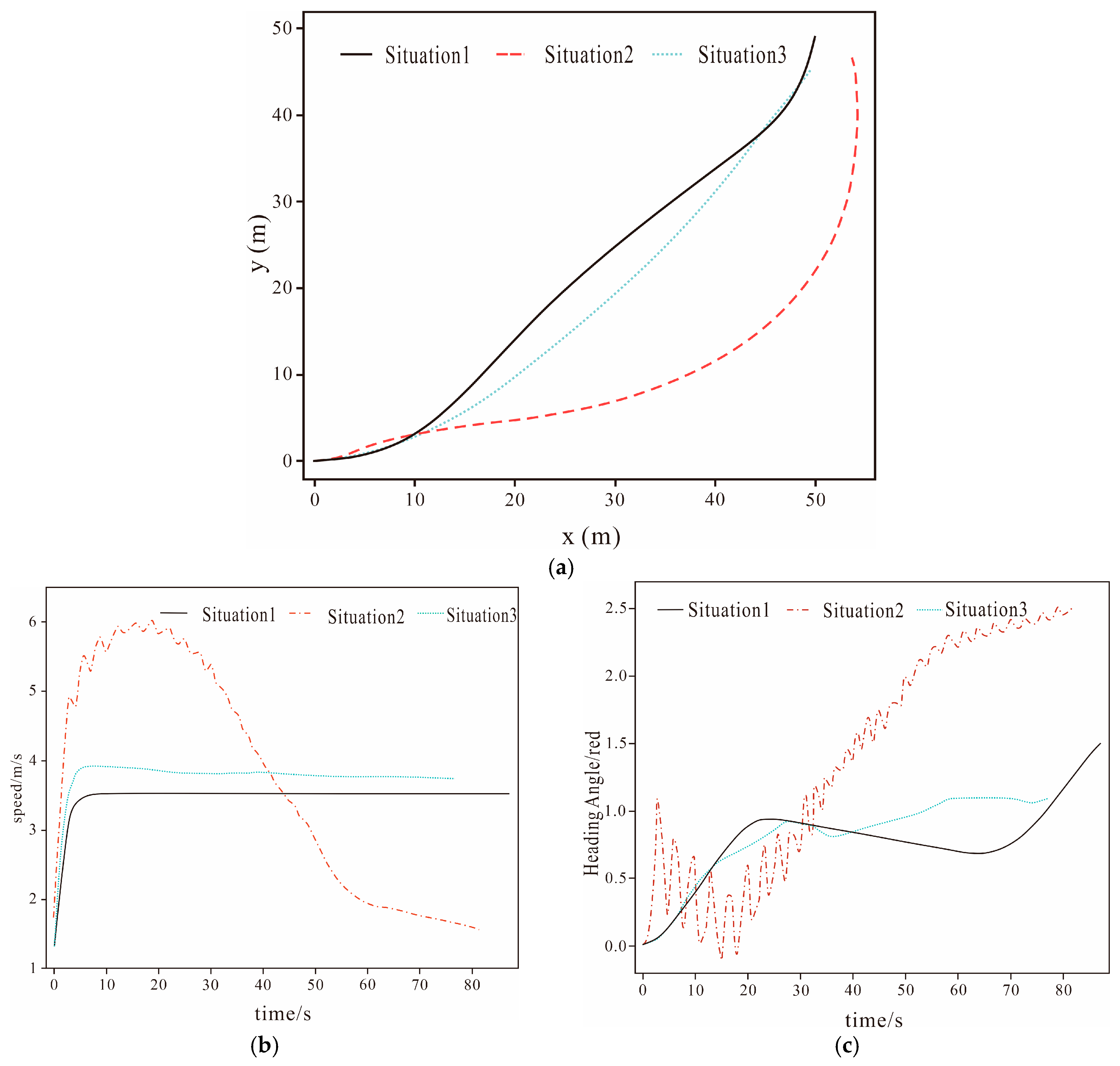
2], and this dynamic behavior significantly increases the difficulty for USVs to track and lock onto the target. At the same time, persistent interference factors in the marine environment such as wind, waves, and currents directly affect the navigation accuracy of USVs [
3], making it difficult for them to stably maintain the preset navigation path and further exacerbating the difficulty of executing interception tasks. These practical challenges not only directly restrict the operational effectiveness of multi-USV cooperative interception but also impose much stricter requirements on the system’s capabilities of perception fusion, dynamic decision-making, and cooperative control than conventional tasks.
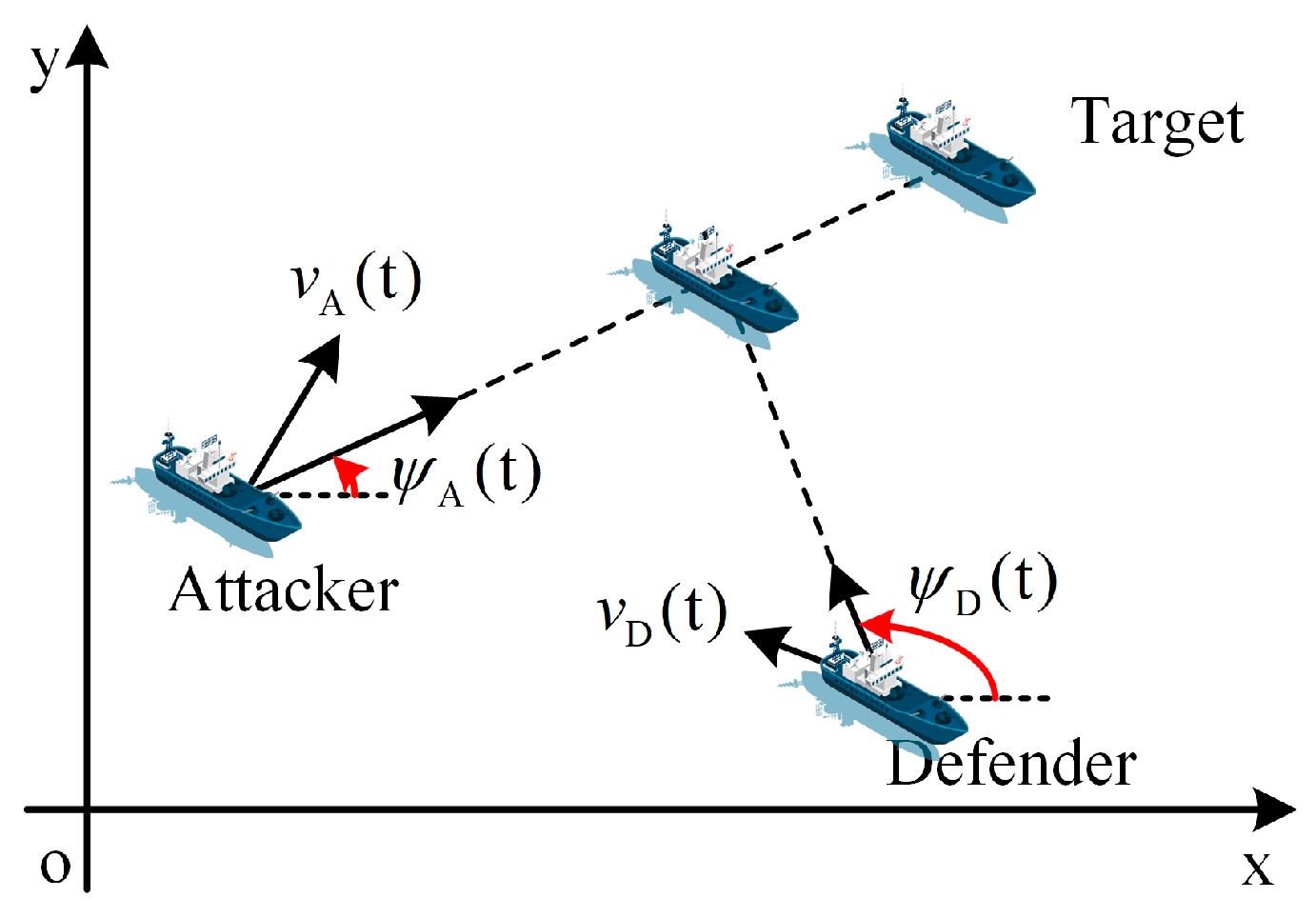
As the final execution phase of cooperative guarding tasks, the core objective of cooperative interception tasks is to implement precise interception of targets entering the interception area. This aims to eliminate potential threats and ensure the safety of guarded targets. In essence, it is a problem centered on the Target-Attacker-Defender (TAD) tripartite interaction system, as shown in
Figure 1.
In the TAD framework, the attacker aims to evade interception and approach the guarded target, while the defender needs to quickly neutralize threats on the premise of ensuring the safety of the guarded target. The environmental perception information and intruder situation information, obtained during the cooperative patrolling and searching phases [
4,
5], serve as the fundamental support for the effective implementation of cooperative interception tasks.
The complexity of the TAD problem mainly stems from two aspects: first, the limited observation capability of each agent leads to errors and uncertainties in situational information acquisition, making situational awareness and communication capabilities the key to the success or failure of the task. Second, the state space has high-dimensional characteristics, which makes it difficult to solve the optimal solution through analytical methods or reverse construction [
6]. To address the issue of limited observation capabilities, Zadka et al. [
7] proposed a cyclic pursuit guidance law based on motion models with different linear velocities, and through the cyclic information interaction mechanism between interception nodes, this law reduces the adverse impact of limited observation on information acquisition. Karras et al. [
8] further proposed a decentralized motion control protocol based on prescribed performance control, which relies on local and relative state feedback as well as a general onboard sensor suite for information acquisition, does not require explicit network communication, not only has low computational complexity but also enables robust and accurate formation control, and its effectiveness has been verified through experiments where four agent nodes intercept a single target. Regarding the problem of high-dimensional state space, early studies mostly relied on accurate prior information of the adversary: Fischer et al. [
9] used the sparsity of road networks to construct a mixed-integer linear programming model to determine the location of collection points and vehicle path planning. Mirza et al. [
10] optimized defense strategies through integer linear programming. Nonlinear model predictive control methods [
11] and approximate dynamic programming methods [
12] also showed good interception effects in specific scenarios, but these methods are highly dependent on accurate prior information and thus difficult to adapt to multi-agent cooperative interception tasks. Currently, the mainstream methods for solving the TAD problem have evolved into task collaboration execution methods based on Stackelberg games, optimal control theory methods, and HJI (Hamilton–Jacobi–Isaacs) partial differential equation solving methods [
13], and all three play an important role in improving task robustness and decision-making optimization capabilities.
In the research on methods based on Stackelberg games, this hierarchical decision-making method has been widely applied due to its advantages in task collaborative execution, but it still has problems of insufficient scenario adaptability and model simplification. Dong et al. [
14], building on the research in reference [
15], used Stackelberg equilibrium to solve the dynamic guarding and interception problem and conducted an in-depth analysis of intruding target strategies. However, their intruding target prediction model is highly discretized and overly simplified, making it difficult to cope with complex dynamic environments. Liang et al. [
16], addressing the security threats posed by unmanned aerial vehicles (UAVs) to critical infrastructure and public spaces, used Stackelberg games to model and analyze the dynamic guarding and interception problem, identified the decisive role of the number of guards around high-value targets in interception success rates, and solved the Stackelberg strong equilibrium through linear programming to maximize the success rate. Nevertheless, in this method, guards can only passively adjust their strategies to adapt to the intruder’s actions, and the interception modes are mostly simple blockades, lacking initiative. To address this, Liang et al. [
17] further optimized the approach: based on analyzing the attack and evasion strategies of intruding targets, they focused on the collaborative cooperation between guarded targets and defenders to construct more efficient interception strategies. Zha et al. [
18], on the other hand, targeted scenarios with different ratios of guards to intruders, established a zero-sum differential game model, and proposed an active defense mechanism based on entropy-based unpredictability measurement by solving the Nash equilibrium. Xu et al. [
19] studied a tripartite leader–follower game model, in this three-level structure, defenders, as leaders, usually dominate decision-making with Stackelberg equilibrium strategies, while Nash equilibrium strategies are only used as alternative solutions. Although Stackelberg games have theoretical advantages, their core mode of “leaders make decisions first, followers respond later” easily leads to decision-making time delays, reducing the system’s response speed to real-time tasks and the flexibility of strategy adjustment. Thus, their adaptability and computational efficiency in dynamic environments still need to be improved.
As a traditional method for solving TAD problems, optimal control theory has achieved considerable progress in the field of multi-agent cooperative interception, while the HJI partial differential equation solving method and other auxiliary methods have also gradually developed. Singh et al. [
20] studied a variant of the multi-target-attacker-defender differential game, the model includes multiple targets, one attacker, and one defender, allowing the defender to switch modes between “rendezvousing with the target (rescue)” and “intercepting the attacker,” while the attacker always tracks the nearest target, the study implements mode switching through a receding horizon method and decomposes the Riccati differential equation matrix to geometrically characterize the players’ trajectories. Valiant et al. [
21] constructed a multi-agent anti-unmanned aerial vehicle (UAV) system, proposed a cooperative multi-agent interception strategy, and achieved optimal tracking and jamming of targets by optimizing the joint mobility and power control of agents. Hou et al. [
22] designed a distributed cooperative search algorithm, aiming to minimize the search time of multiple UAVs under a known target probability distribution. Through the design of an importance function and a task planning system, central Voronoi tessellation for region division, receding horizon predictive control for online path planning, and combining minimum spanning trees to optimize the communication topology, the algorithm balances the requirements of target search and connectivity maintenance. With its efficiency and robustness, the HJI partial differential equation solving method can obtain the optimal strategies of two teams by solving the equation. Huang et al. [
23] thus used neural networks to predict control actions and construct an enhanced dynamic model, and combined the HJI method to predict forward reachable sets for risk assessment. In addition, conservative path defense methods [
24], genetic algorithms [
25], and probabilistic navigation functions [
26] have also been applied in TAD problems. However, it should be noted that optimal control theory relies on accurate models and deterministic conditions, making it difficult to cope with the complex dynamic environments and uncertainties in cooperative guarding tasks, and the HJI equation also faces challenges in handling high-dimensional state spaces.
Beyond theoretical research, the CARACaS control architecture (Control Architecture for Robotic Agent Command and Sensing, CARACaS) developed by NASA’s Jet Propulsion Laboratory (JPL) [
27,
28] has conducted the first systematic verification of multi-agent cooperative interception tasks in a real operational environment. It significantly enhances the capability to handle multi-task targets, avoids the problem of multiple nodes concentrating attacks on a single target, and effectively improves task success rates.
Although current multi-agent cooperative interception control algorithms have made progress in dynamic strategy generation, they still have obvious shortcomings: methods such as Stackelberg games rely on simplified and discretized prediction models, and when facing high target maneuverability or antagonism in complex dynamic environments, the model has poor adaptability to real scenarios, leading to a sharp drop in interception success rate. Optimal control theory and HJI equations need to handle high-dimensional state spaces, with algorithm complexity reaching O(n
3), which is prone to decision delays as the number of system nodes increases, limiting real-time computing performance. Moreover, the efficiency of multi-target collaboration is low—for example, the CARACaS practical test shows that multiple nodes tend to concentrate attacks on a single target, resulting in resource imbalance, and existing distributed mechanisms lack load-balancing optimization. In related studies on multi-USV cooperative motion [
29], the focus is limited to path planning optimization for static coverage tasks. By contrast, this paper fully considers dynamic adversarial targets, interference adaptation in complex environments, and real-time cooperative interception mechanisms. Compared with the core indicators of coverage efficiency and path optimality adopted in related research [
29], this study introduces new performance metrics including interception time, the final distance between the target and the guarded object, and collision rate in dynamic evasion scenarios—all of which have been effectively optimized.
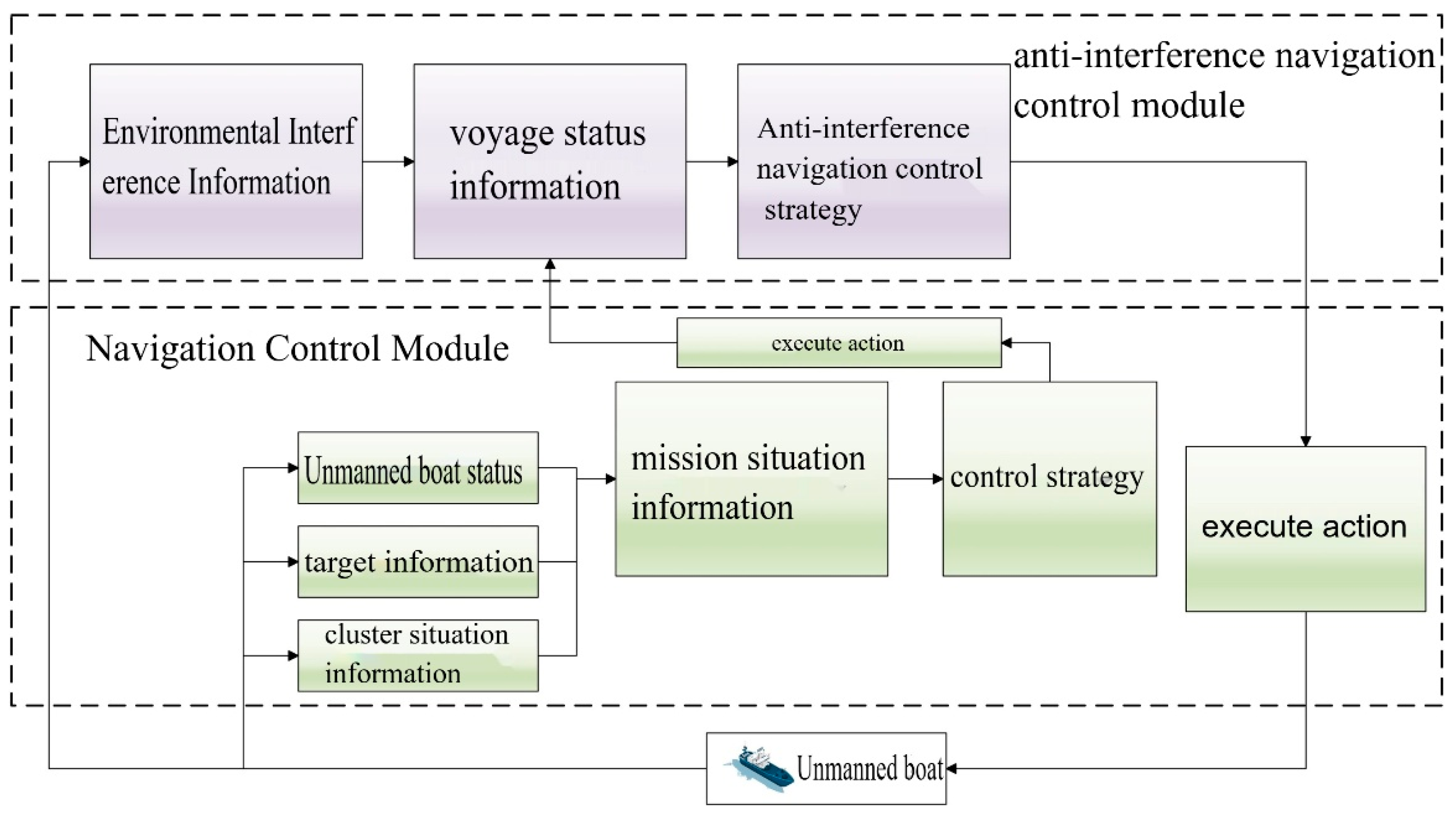
It is important to note that existing research on communication capabilities is mostly based on the idealized assumption of no delay and no packet loss, while in actual marine environments, communication channels face core limitations including signal attenuation caused by electromagnetic interference, limited communication distance that easily introduces transmission delays in multi-node collaboration, and dynamic topological changes due to node movement. These practical issues lead to unsynchronized situational information among nodes, which in turn increases collision risks or causes the collapse of encircling formations. Therefore, it is necessary to supplement a communication fault-tolerant mechanism in the algorithm design. To address the requirements of multi-unmanned surface vessel (USV) cooperative interception tasks, this paper integrates three types of core methods to construct a technical system and obtain corresponding data: the extended Kalman filter method is used to process the motion information of intruding targets, and a multi-step averaged prediction model is built—first, the real-time motion state of the target is converted into computable state numbers to reduce uncertainty errors, and then through single-step iterative update and averaged correction, the accurate future position of the target is output. An adaptive anti-interference navigation control algorithm is designed based on the improved Two-stage architecture: the cooperative interception module outputs interception control numbers by integrating the state of USVs, target information, and cluster information, while the anti-interference module fuses environmental interference information to generate a course compensation angle, which is combined with the training optimization of a reward function oriented to course deviation to reduce the impact of wind and water currents on navigation, a cooperative model is constructed using a two-stage algorithm of “target navigation control—cooperative interception control”: in the target navigation stage, various information maps are used as state values, and USVs are guided to approach the target safely through distance and obstacle avoidance rewards, in the cooperative interception stage, the artificial potential field method is introduced to design distributed rewards, guiding USVs to form a blocking circle evenly, and the strategy is optimized by weighted fusion of reward functions. The results show that these methods are superior to traditional models in target prediction accuracy, USV anti-interference capability, and multi-vessel cooperative efficiency, providing key technical support for cooperative interception.
2. System Task Planning
To accurately describe the task status of the multi-unmanned surface vessel (USV) system in guarding tasks, this section constructs a systematic task plan based on multi-USV collaboration and intruding targets, in guarding tasks, the cooperative interception task, as the final phase, serves as the core objective for multi-USVs to perform cooperative patrolling and cooperative searching tasks. However, multi-USVs cannot implement effective interception actions against intruding targets immediately at the start of the cooperative interception task—especially in practical operational environments, the interception targets faced by multi-USVs often present complex situations such as multi-directional, multi-batch, and antagonistic characteristics. Existing methods such as the Path planning method for maritime dynamic target search based on improved GBNN [
30] may not be suitable for this interception and escape scenario. The Optimization of Multiagent Collaboration for Efficient Maritime Target Search [
31] may lack sufficient search and detection capabilities in this scenario. In such cases, the system needs to establish a clear task process when executing the cooperative interception task, decomposing the complex task into a series of sequentially executed subtasks. The system plan constructed in this section consists of the system operation process, the assignment of intruding targets, and the dynamic prediction of intruding targets. Through this modular task assignment plan, the computational complexity during the cooperative interception task can be reduced, ensuring that the system can intercept intruding targets efficiently and accurately.
2.1. System Operation Process
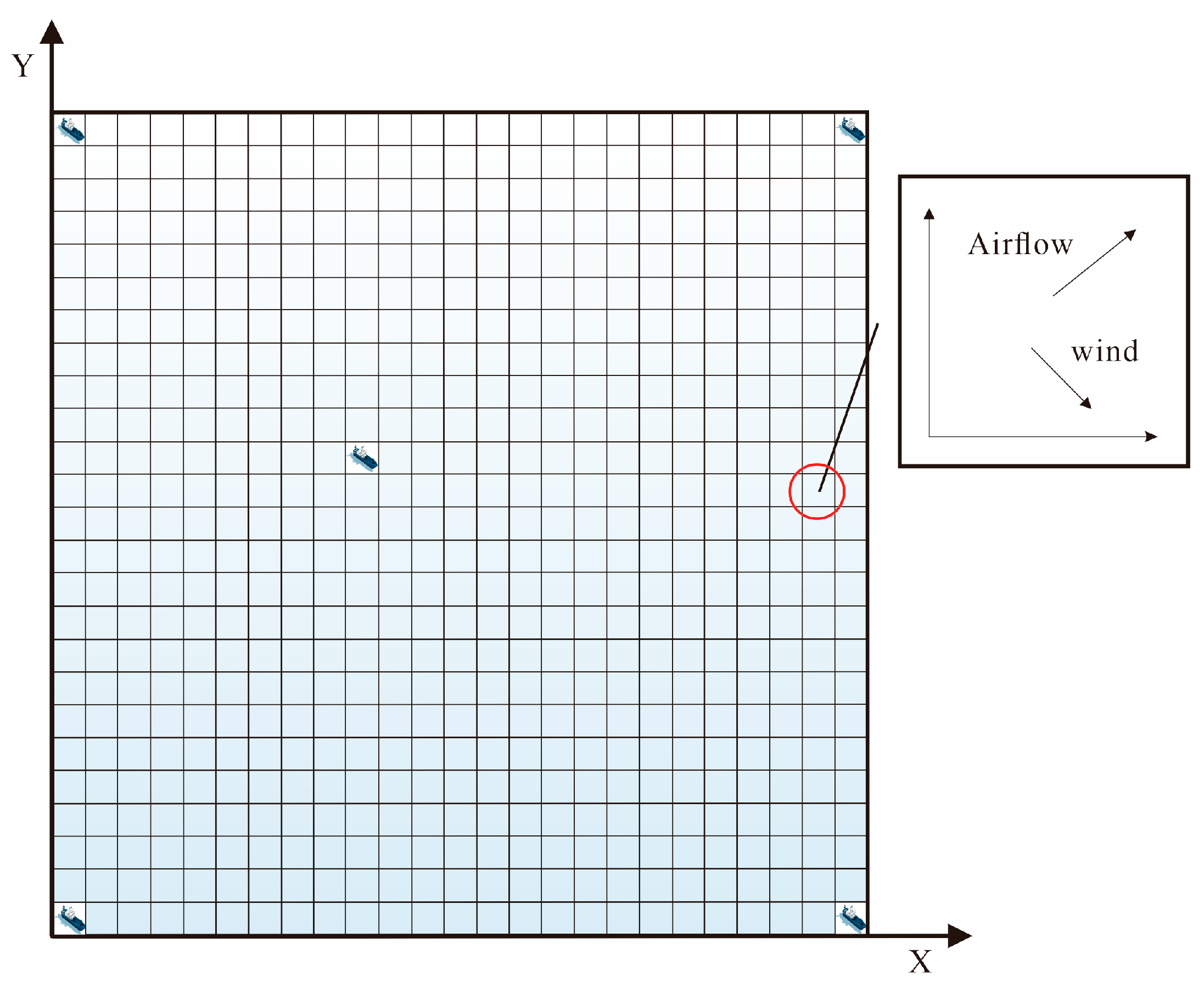
Assume a multi-unmanned surface vessel (USV) system with nodes performs a cooperative interception task in a rectangular mission area (Default: 1000 m × 1000 m, after expansion, it supports 5000 m × 5000 m and above). During the execution of this task, the system adopts a limited centralized-distributed autonomous control architecture, and the system’s operation process is as follows:
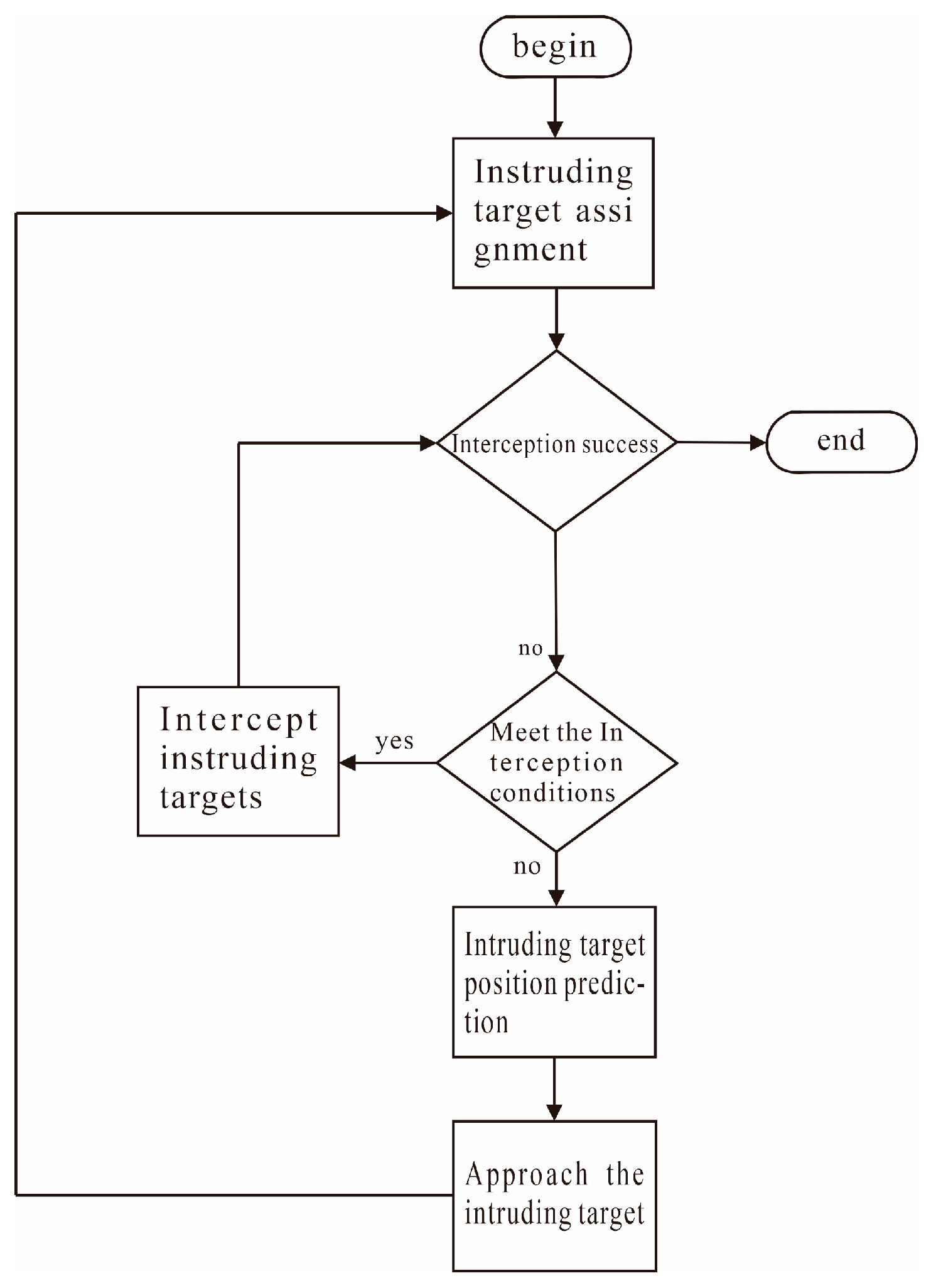
The operation process of the cooperative interception task for the multi-USV system designed in this paper is shown in
Figure 2. When the system confirms all intruding targets, that is, when the central hub node
obtains a set of intruding targets
composed of multiple targets (
and
represents the number of intruding targets), the system starts to execute the cooperative interception task. To address real-world communication constraints, the system integrates a three-layer communication guarantee mechanism into the centralized-distributed control architecture: a master-slave + relay hybrid topology with backup relay nodes for rapid switchover, priority-based transmission using UDP/TCP protocols to balance real-time performance and reliability, and local caching combined with predictive compensation to mitigate the impact of communication interruptions. First,
assigns
to the corresponding
as its interception target based on the position information of the intruding targets and the position information of each node in the system. After
calculates the predicted position of
, it takes this position as its target navigation point, approaches it quickly, and then initiates interception of
when the interception conditions are met. The condition for the system to intercept
is that when all
are sufficiently close to
, that is,
where
is the interception radius.
The interception success criterion shown in the flowchart is: when the distance between the unmanned surface vehicle (USV) and the intruding target is close enough and all USVs can be evenly distributed around the intruding target, the coordinated interception mission is deemed successful. The definition of interception success is expressed as Equation (1).
In Equation (1),
represents the set of system nodes for intercepting
, and this set contains
nodes.
denotes the distance between
and the corresponding
.
is the distance judgment constant.
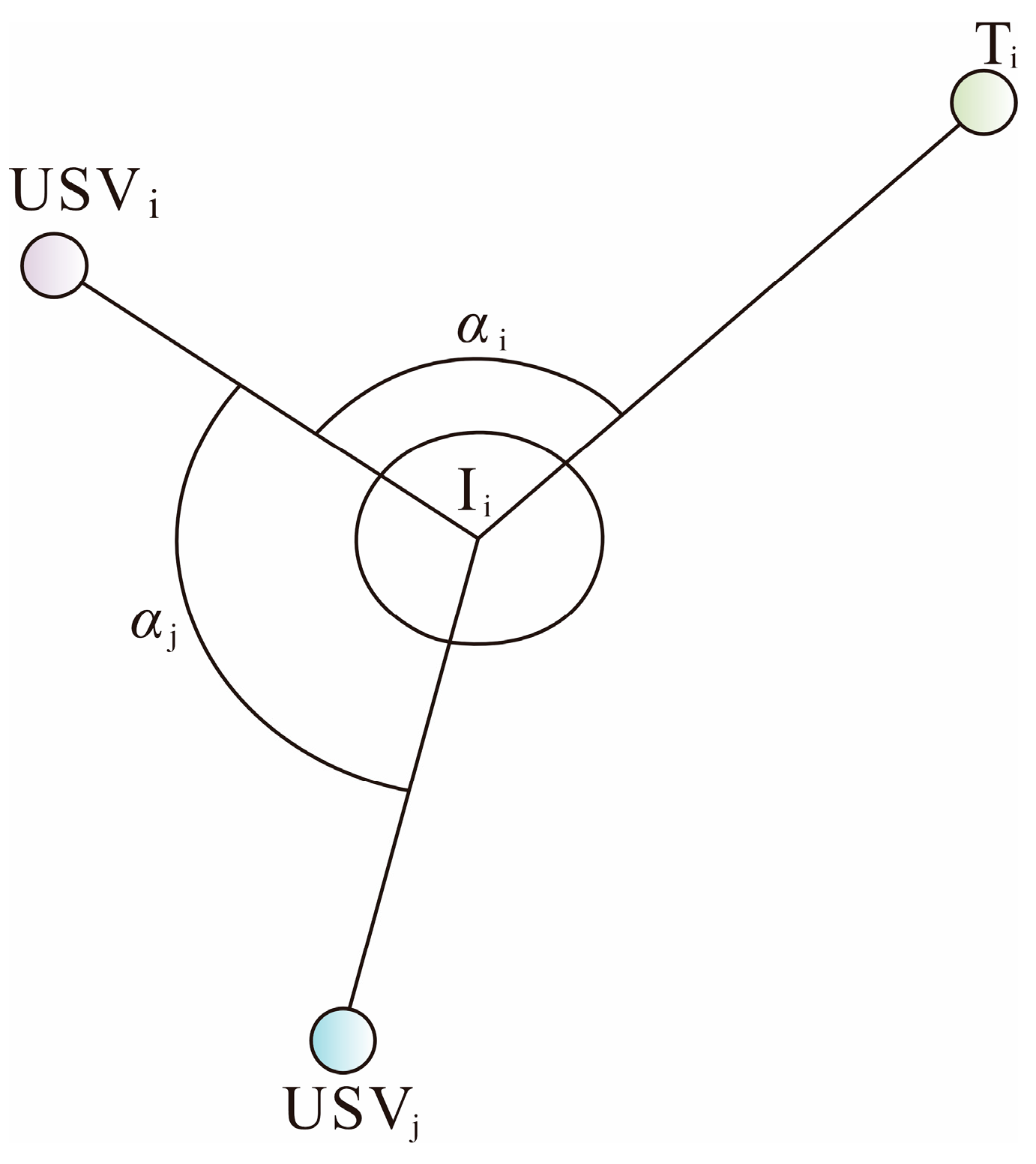
stands for the angle between
and its adjacent node
, and
is also the angle between
and the interception target
, as shown in
Figure 3.
2.2. Assignment of Intruding Targets
After the system obtains the set
, it needs to assign each element in
to the corresponding
as its interception target. To reasonably allocate the elements in
, based on mission requirements,
first calibrates the threat level
for each
in
where
. Here
represents the highest threat level and the calculation method of
is determined by Equation (2).
Here, and respectively represent the and coordinates of the positions of and at time . is the velocity of the intruding target at time . is the maximum possible velocity of the intruding target in the mission scenario. is the velocity weight coefficient ( > 0, determined by the mission scenario, for example, λ = 0.4 for maritime security scenarios and = 0.6 for anti-smuggling scenarios).
As can be seen from Equation (2), the threat function exhibits an obvious nonlinear characteristic: when the target approaches (with the distance decreasing), the denominator decreases nonlinearly, leading to a rapid rise in the threat value; when the target velocity increases ( approaches ), the numerator approaches , further amplifying the threat value. This is consistent with the practical scenario cognition that “targets approaching at high speed pose a higher threat.”
To address the mapping problem from continuous threat values to discrete threat levels , a discretization method based on interval division is proposed. This method can balance the distinguishability of threat degrees and the rationality of unmanned boat resource allocation.
First, calculate the initial threat values of all intruding targets using Equation (2) (where , and denotes the total number of intruding targets), and determine the maximum value and minimum value of the threat values.
Then, combined with the total number of unmanned boats and the maximum number of interception nodes per target , set in accordance with the “resource matching principle” (where ⌈⋅⌉ denotes the ceiling function). This setting ensures that high-threat targets can be allocated a sufficient number of unmanned boats, while avoiding resource waste on low-threat targets.
Finally, divide the threat intervals and map the levels. Uniformly divide the interval [
,
] into
non-overlapping subintervals
. The boundary of the
-th interval is
(where
) If the threat value
of a target falls into
, its discrete threat level is determined as
, with the mathematical expressions as follows:
After obtaining the threat levels of all intruding targets, assigns each intruding target to the corresponding as its interception target. Based on the actual situation of the coordinated interception mission of the multi-USV system, the specific assignment rules are as follows. (a) Each requires at least one node and at most nodes for interception. To improve the interception success rate, priority is given to allocating the full number of USVs to intercept . The specific value of is determined by the numbers of and . (b) When assigning intruding targets, prioritizes the assignment of intruding targets with higher threat levels. This ensures that the intruding targets posing the greatest threat to can obtain the most interception resources and guarantees the safety of .
During the assignment process,
first calculates the distance
between each node in the system and each
in
. Here,
. The calculation method of
is shown in Equation (4).
Here, represents the and coordinates of ’s position at time . When assigns the intruding target , it will select the node with the shortest distance to from the set for interception. If multiple have the same distance to , a required number of nodes will be randomly selected from these for assignment. The assigned to an intruding target will be automatically excluded from the assignment process for the next .
2.3. Prediction of Intruding Target Positions
Since intruding targets are always in motion, their positions will change while the nodes are moving toward them. At this point, if the nodes still take the positions of the intruding targets when they were detected as their navigation targets, it is highly likely to cause the failure of the coordinated interception mission. In addition, when an intruding target changes its original navigation path to escape during the interception process, the USVs also need to predict the position of the intruding target after escape. This guides the USVs to move to that position for re-intercepting the intruding target, thereby reducing the time required for the system to re-intercept the intruding target and improving the system’s interception efficiency.
To solve the problem of predicting the positions of intruding targets at future moments, an extended Kalman filter is used to establish a corresponding position prediction model. This enables to calculate the predicted position information of at future moments based on its current motion state information. The specific modeling process is as follows.
In the Extended Kalman Filter, the state prediction equation of an intruding target can be defined using the motion state information
of the intruding target at time
as shown in the following equation.
Among them,
is the state transition relation, and
is the process noise. To obtain the measured value
of
, the following can be derived using the measurement matrix
and the measurement noise
:
Here,
represents the prediction interval time,
,
and
respectively denote the position, heading angle and angular velocity of the intruding target at the previous moment, and
is a 5th-order identity matrix. Then, to find the Jacobian matrix
of
the following can be obtained:
is the state transition matrix. From this, the state prediction equation of the standard extended Kalman filter is obtained as:
Here,
represents the predicted state at the previous moment. The covariance matrix
corresponding to this predicted state is shown as follows:
Here,
represents the covariance matrix corresponding to the predicted state at the previous moment, and
is the covariance matrix of the process noise
. The final predicted state
is:
The covariance matrix corresponding to
is
:
Here, is the Kalman gain and is the covariance matrix of the measurement noise .
Since the motion state of the intruding target is constantly changing it is necessary to extend the single-step to multi-step prediction average the results of the multi-step prediction and use them as the prediction parameters of the Kalman filter so that the prediction results can be more accurate.
2.3.1. The Compatibility Between Multi-Step Average Prediction and Markov Property
The classic Extended Kalman Filter (EKF) follows the Markov property, meaning that the state at time depends only on the state at time and is independent of historical states. This section clarifies that the multi-step average prediction proposed in this paper does not violate this fundamental property, instead, it optimizes prediction accuracy by fusing independent single-step prediction results.
The multi-step average prediction in this paper is implemented based on independent recursive single-step predictions, rather than directly deriving future states from historical states. First, based on the current state at time , the predicted states at times are recursively calculated, respectively, using the EKF single-step prediction formula . Each single-step prediction (where = 1, 2,..., n) depends only on the state at the previous moment , which is fully consistent with the Markov property.
On this basis, the average of independent single-step prediction results is calculated to reduce the impact of random errors in a single prediction, thereby improving the stability of the final predicted state.
2.3.2. Calculation of Multi-Step Prediction Covariance
To accurately reflect the uncertainty of the multi-step average prediction results, this section designs a modified covariance calculation method based on the principle of variance addition for independent random variables, which is derived as follows.
Assume that the deviation of the k-th single-step prediction is , where is the true state of the intrusion target at time . Since each single-step prediction is independent of each other, the deviations are independent and identically distributed random variables with a variance of .
The average prediction deviation of the multi-step prediction is: .
According to the principle of variance addition for independent random variables, the variance of the average deviation is: . In the formula, since the single-step prediction deviations are independent of each other, the covariance terms between different are 0, which simplifies the calculation process.
2.3.3. Selection Criterion for the n-Step Prediction Horizon
To ensure the rationality of setting the prediction step and avoid parameter arbitrariness, this section proposes a determination criterion for n by combining “target motion complexity” and “USV system response delay”.
Target motion is categorized into two types: uniform linear motion (low complexity) and maneuvering motion (high complexity, such as sudden turns, acceleration, etc.). Maneuvering motion increases the uncertainty of the target trajectory, requiring more prediction steps to cover the possible motion range. The time required for the USV to adjust its navigation strategy based on the predicted target position is denoted as . The prediction horizon must cover the target’s motion range within this delay time to ensure that the USV can intercept the target in a timely manner.
The specific calculation formula for
is:
In this formula, is the velocity of the intrusion target. is the USV system response delay. is the safe interception distance threshold. denotes the ceiling function, which rounds up the calculation result to ensure the prediction horizon is sufficient.
In summary the calculation process of
information is shown in Algorithm 1:
| Algorithm 1: Calculation Process of |
1: Initialize the state transition relation and the motion state information of the intruding target, and set the number of prediction steps .
2: Execute when .
3: .
4: End.
5: The result of the n-step prediction for the motion state quantity of the intruding target is obtained as: . where is the state transition matrix at time .
6: Calculate the average value of the intruding target’s motion state quantity and use it as the prediction parameter of the Kalman filter; meanwhile, use covariance
7: The predicted parameters based on the Kalman filter obtain according to the motion state quantity of the intruding target and the motion state quantity of the unmanned boat. |
5. Simulation Test
5.1. Test Evaluation Parameters
To verify whether the algorithm proposed in this paper can enable the multi-USV system to complete the cooperative interception task efficiently and accurately, the algorithm proposed in this paper is tested in a simulation environment. Before conducting the test, the test evaluation parameters are first specified. The test evaluation parameters consist of the following parts, which are the average distance between the final interception position of the intrusion target and the guarded target
(
), and three evaluation parameters:
, CRBAO, and CRBAA.
represents the total navigation distance (In large-scale tests,
increases with the growth of the initial distance between nodes and targets.), CRBAO represents the collision rate with obstacles, and CRBAA represents the collision rate between nodes.
can be calculated by Equation (45).
Among them, represents the sum of distances between all intrusion targets in the test scenario and after the end of an episode, where . is the distance between the final position of the intrusion target and . An episode ends when the system meets the condition for successful encirclement and interception or the intrusion target successfully invades. The condition for successful interception is that for any intruder , there exists a such that the distance to the intruder satisfies . The condition for a successful intrusion by an intrusion target is that .
The calculation method of CRBAO is given by Equation (46), and that of CRBAA is given by Equation (47):
Among them, denotes the total number of episodes. represents the number of collisions between nodes in a specific episode, denotes the total number of actions performed by the system nodes in that episode, and represents the number of collisions between nodes and obstacles in a specific episode.
Considering the variability of actual combat battlefields, the subsequent tests will be divided into two major scenarios based on the differences in actual operating conditions of USV cooperative encirclement. The first is the test when the target has no countermeasure capability, which focuses on verifying the encirclement efficiency and formation stability of the algorithm when the target sails at a constant speed in a straight line without maneuvering to escape. The second is the test when the target has countermeasure capability, by simulating typical countermeasure behaviors of the target such as sudden acceleration, steering evasion, and feint interference, the dynamic response speed, cooperative strategy self-adjustment ability, and anti-interference performance of the algorithm are comprehensively evaluated.
5.2. Test When the Target Has No Countermeasure Capability
To more objectively reflect the performance of the algorithm proposed in this paper, the multi-USV limit cycle encirclement and interception algorithm based on neural oscillators (referred to as the Limit Cycle Encirclement and Interception Algorithm for short) is selected as the comparative test algorithm in the test. This algorithm has a wide application foundation in the field of multi-agent cooperative control, and its limit cycle control logic forms a typical difference from the dynamic coordination idea of the algorithm in this paper, making it suitable for horizontal performance comparison. Three test scenarios are set according to different system scales and environmental conditions. They are Test Scenario 6: , , , Test Scenario 7: , , , and Test Scenario 8: , , . The intrusion targets are always in a uniform speed navigation state. The initial distance between all intrusion targets and all nodes in the multi-USV system is much larger than . All nodes in the multi-USV system and are always in a communicable state. It is assumed that has obtained the movement situation information of all intrusion targets in the task area before the test starts and can continuously track the intrusion targets. Each test scenario is tested 150 times, with every 30 tests as a group.
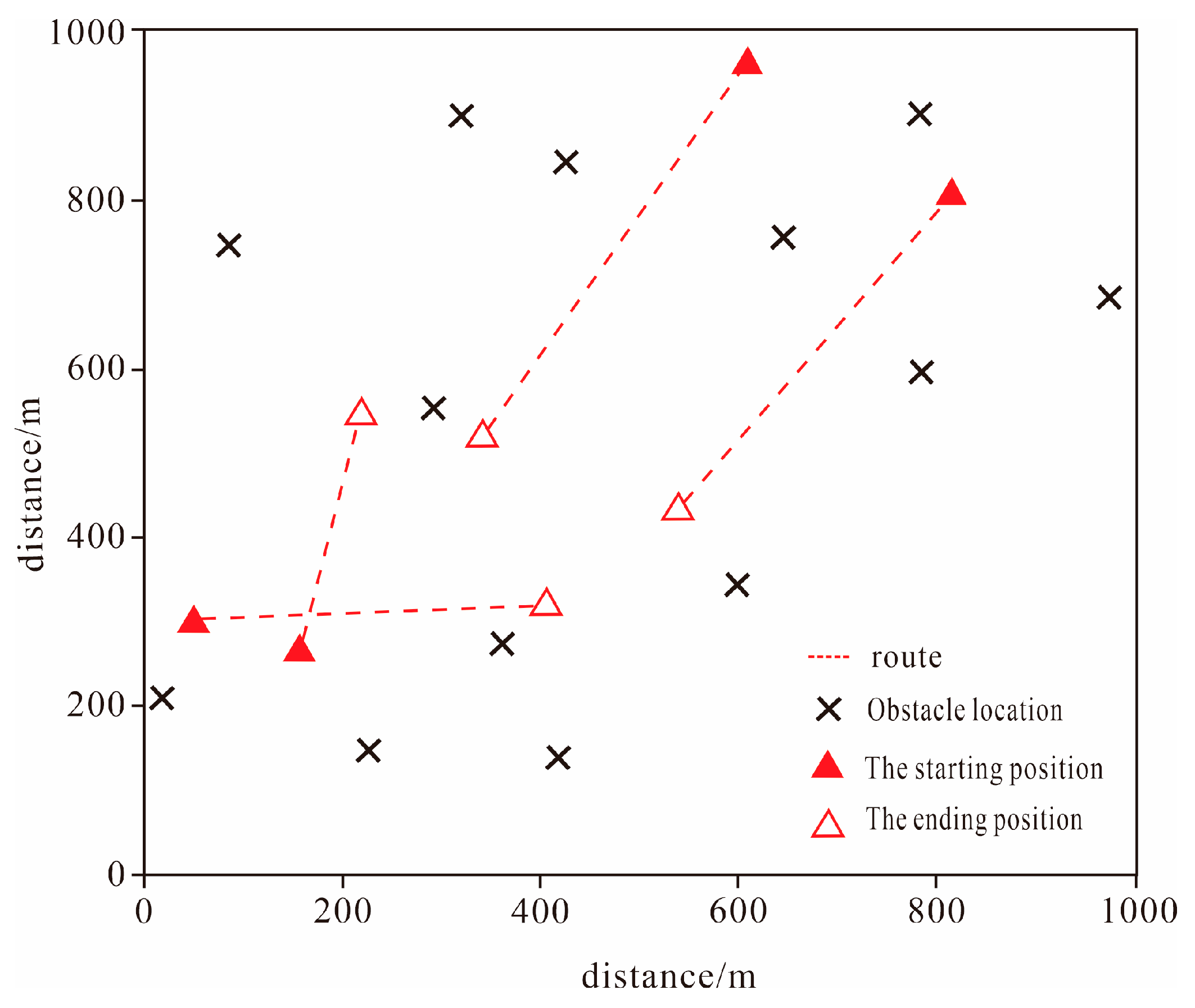
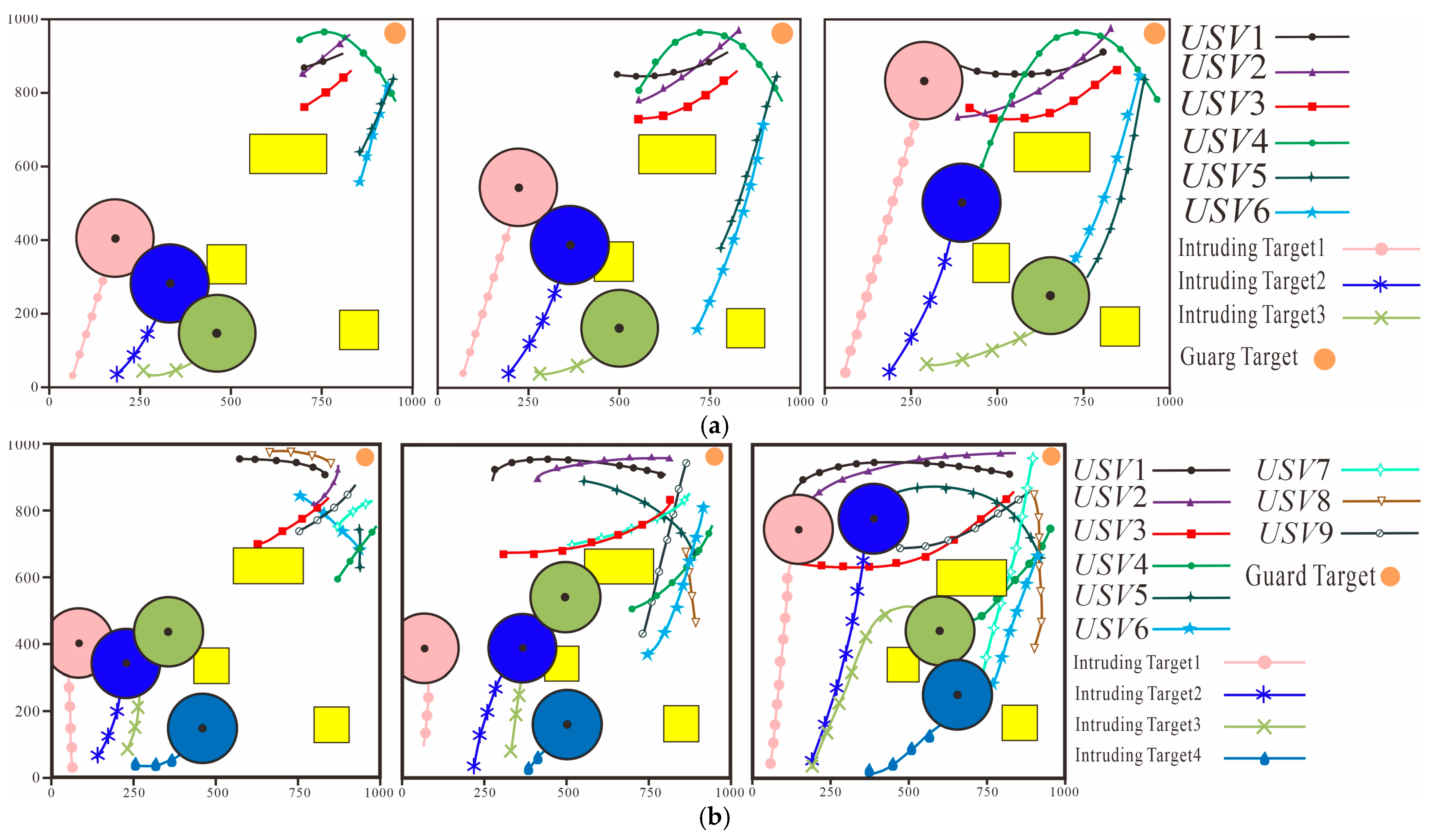
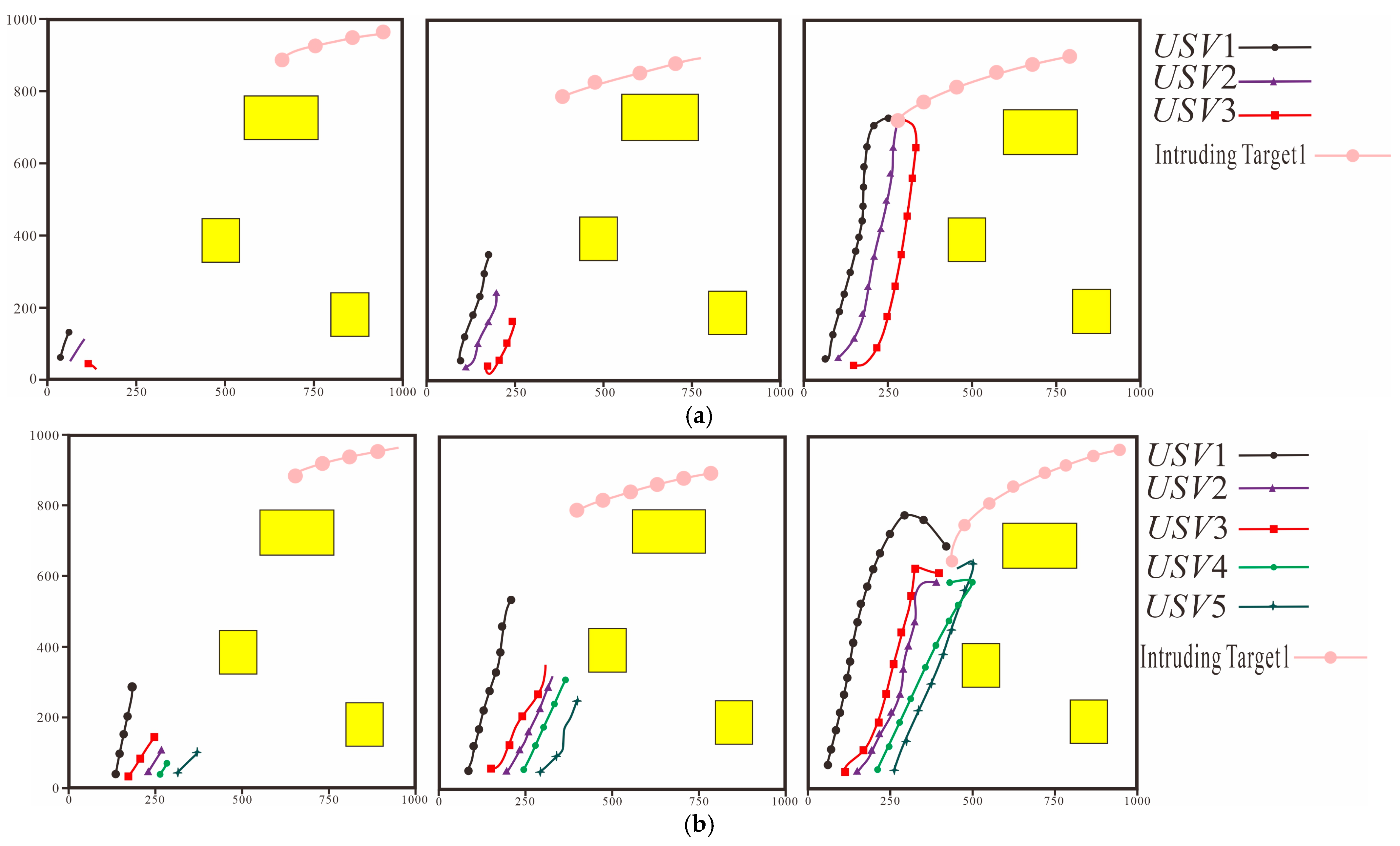
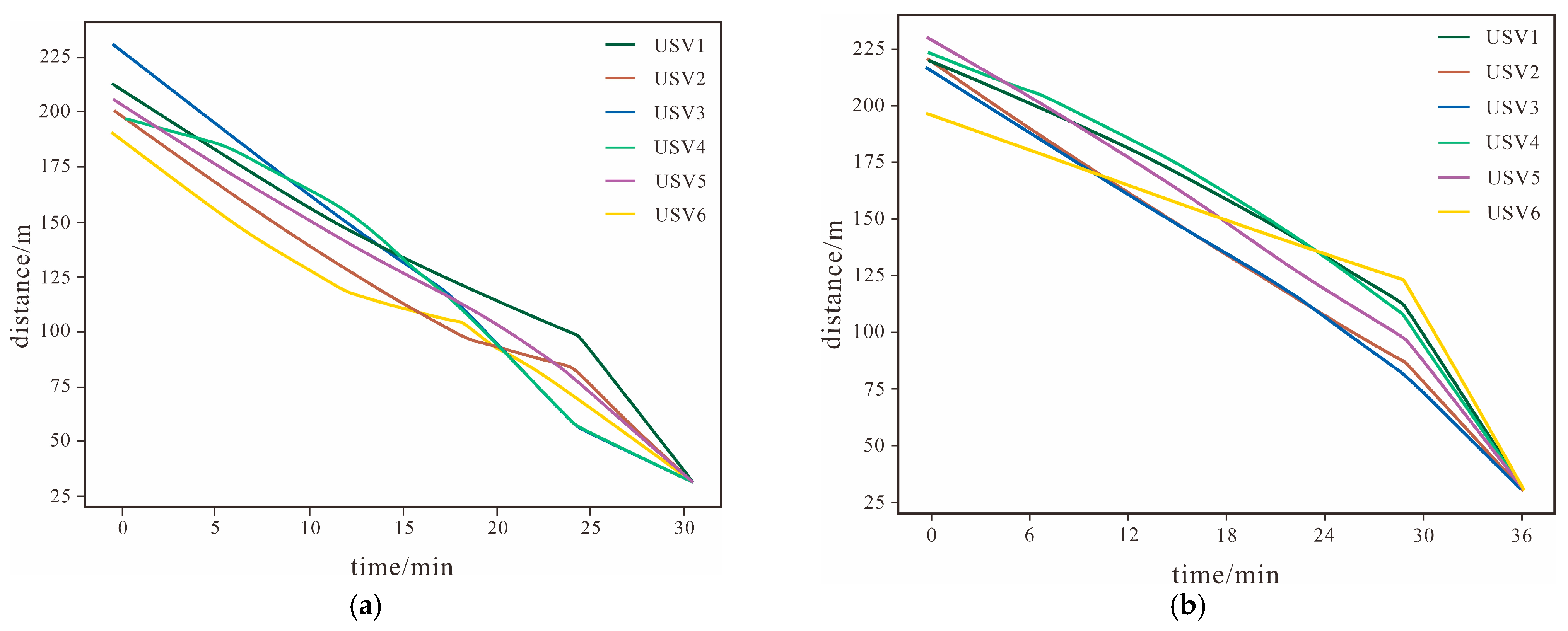
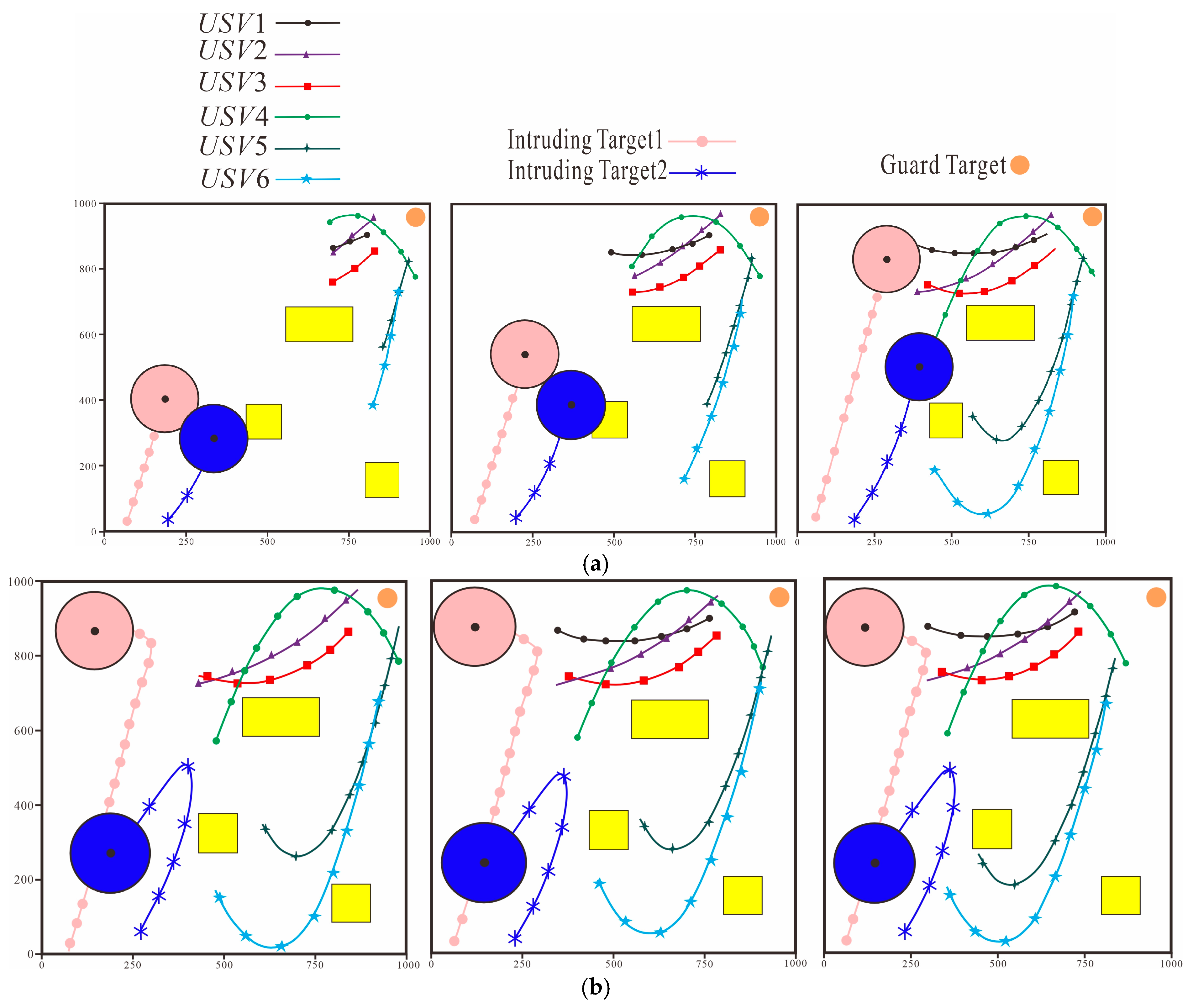
This subsection will select Test Scenario 7 as the key analysis object. The purpose of setting the parameter configuration in the scenario of 1000 m × 1000 m is to focus on the core contradictions of multi-USV cooperative interception (dynamic target prediction, adaptive environmental interference). Through high-density scenarios, the performance of the algorithm under ‘limited resources and concentrated interference’ is verified, providing basic parameters for subsequent large-scale tests. It can specifically verify the core logic of the algorithm proposed earlier in the links of dynamic target tracking and cooperative formation adjustment, and its test results have strong representativeness and persuasiveness. From the navigation trajectories of each node in the system shown in
Figure 12 and the distance changes between each node in the system and the corresponding intrusion target shown in
Figure 13 it can be seen that in the target approaching phase although the position of the intrusion target is constantly changing the nodes under the control of the algorithm can still adjust their navigation direction in a timely manner according to the change in the intrusion target’s position and continuously approach the intrusion target. However there is a certain difference in the speed at which the nodes approach the intrusion target under the control of the two algorithms. It can be seen from
Figure 13 that when the system is controlled by the algorithm proposed in this chapter at
in the average distance between the nodes and the corresponding intrusion targets decreases to about 160 m. Within the same time when the system is controlled by the Limit Cycle Encirclement and Interception Algorithm the average distance between the nodes and the corresponding intrusion targets is about 180 m. Under the control of both algorithms there is no collision between nodes or between nodes and obstacles. In the encirclement and interception phase the final positions of the nodes under the control of both algorithms are distributed at the positions required for encircling the intrusion target and the distance between the nodes and their intrusion targets remains unchanged thus successfully encircling the intrusion target in the end.
The test results of the two algorithms in other test scenarios are presented in
Table 5. It can be seen from
Table 5 that the average interception time of the system controlled by the proposed algorithm is 30.2 min, while that of the system using the Limit Cycle Encirclement and Interception Algorithm is 35.6 min.
To match actual wide and deep sea scenarios, an additional comparative experiment with a 5000 m × 5000 m test range is added.
In the results of the expanded test range, as shown in
Table 6. due to the expansion of the test range, the test time increased by 40–50% compared with the scenario of 1000 m × 1000 m. However, the average interception time of the algorithm in this paper is still 15.5% shorter than that of the limit cycle encirclement interception algorithm, which is basically consistent with the data in the 1000 m × 1000 m range.
When the system is controlled by the algorithm proposed in this paper the
values under all test scenarios are much larger than
. When the system is controlled by the Limit Cycle Encirclement and Interception Algorithm the
values under all test scenarios are also larger than
. A comparison shows that the
value of the system controlled by the proposed algorithm is significantly larger than that controlled by the Limit Cycle Encirclement and Interception Algorithm, which indicates that the system can achieve a better interception effect under the proposed algorithm. The
values of the system under the two algorithms presented in
Table 7 also confirm the above conclusion. By synthesizing all data in
Table 5 and
Table 7 it can be seen that under all test conditions the algorithm proposed in this paper enables the system to achieve a better interception effect.
In a 5000 m × 5000 m test scenario, the improvement ratio reaches 19.2%, and the collision rate ranges from 0.28% to 0.32%, which is basically consistent with the data in the 1000 m × 1000 m range. The slight performance degradation mainly stems from “accumulated prediction errors of long-distance targets” and “delays in multi-target cooperative scheduling”. The algorithm’s modeling logic remains valid.
5.3. Test When the Target Has Countermeasure Capability
When intrusion targets are intercepted, they often adopt corresponding evasion strategies to counteract interception, which makes it difficult for USVs to effectively encircle and intercept them. In this case USVs need to quickly adjust their positions track the escaping intrusion targets in a timely manner and intercept them again. To verify whether the algorithm proposed in this paper can effectively respond to the countermeasures of intrusion targets corresponding scenarios are set up for testing in this subsection.
The test area is exactly the same as that in the previous subsection. Meanwhile, the test range has been expanded to 5000 m × 5000 m. The initial distance between the intrusion target and all nodes in the multi-USV system is much larger than . Two evasion strategies are set for the intrusion target. Evasion Strategy 1: The intrusion target escapes in the same direction as the node that first enters its escape radius . Evasion Strategy 2: When a node enters the of the intrusion target randomly selects a direction to escape. Regardless of the evasion strategy chosen the evasion speed of the intrusion target during the evasion process is greater than the movement speed of the nodes. Its evasion time is set to 5 min and it resumes its original navigation speed after the evasion ends.
To focus on the core game scenario and deeply analyze the dynamic response mechanism of the algorithm this subsection selects Evasion Strategy 1 as the key analysis object. Under this strategy the target’s behavior directly counteracts the initial encirclement logic of the USV formation which facilitates the accurate extraction of system performance characteristics. Through the observation and analysis of the experimental process the key stages in the entire interception process and the system response characteristics can be clearly identified.
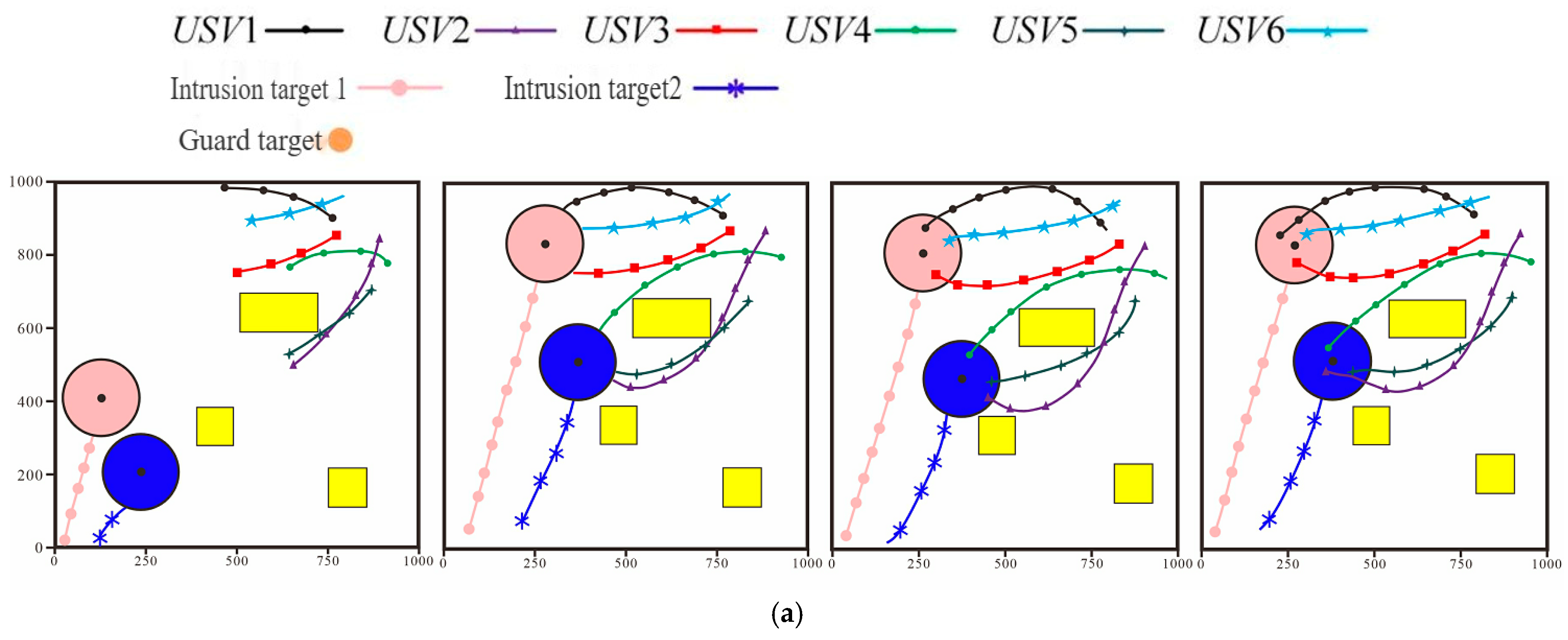
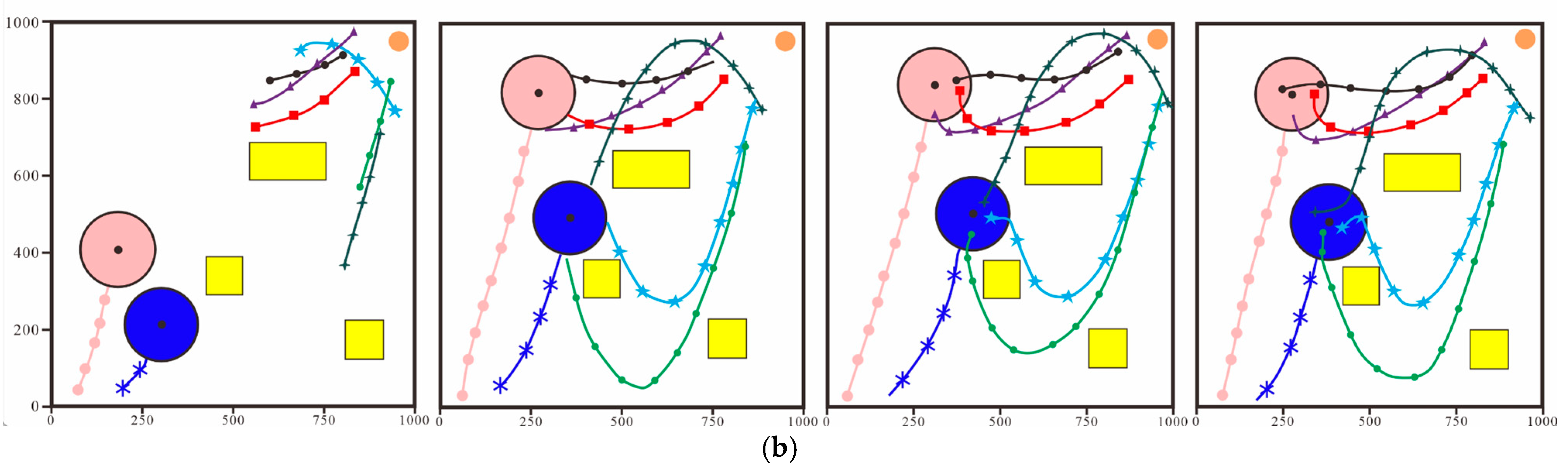
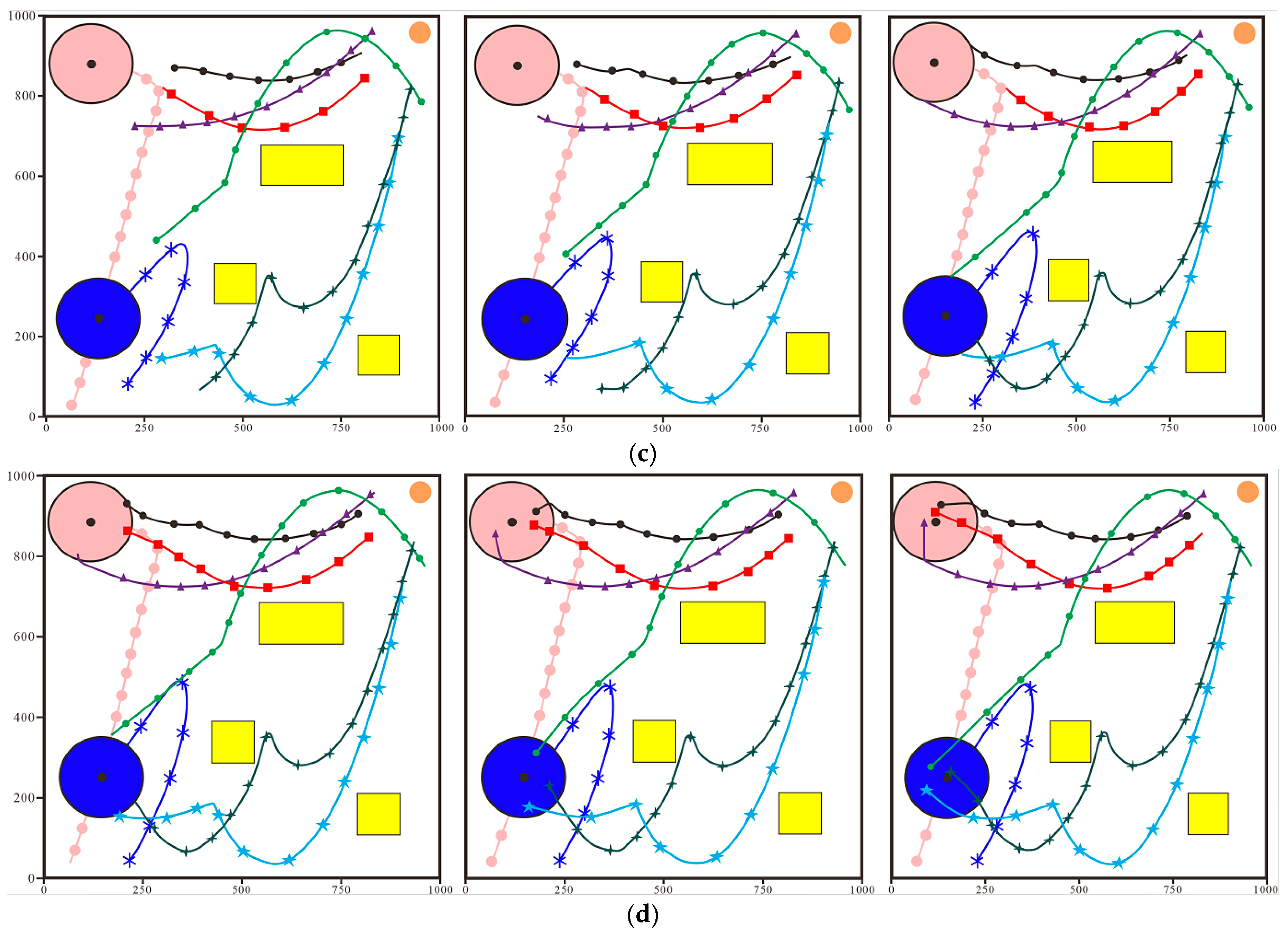
In the initial tracking phase as shown in
Figure 14a the system nodes move based on the target navigation control algorithm proposed in this paper. This algorithm can process the acquired task situation information in real time and convert it into efficient target approach control commands. Through the analysis of the node navigation trajectories it can be observed that all nodes are continuously approaching the intrusion target and exhibit precise target tracking capabilities and dynamic response characteristics under the real-time position changes in the intrusion target.
When the distance between the system and the intrusion target reaches the critical value
as shown in
Figure 14b the intrusion target starts to escape. The escape of the intrusion target results in the failure of the first encirclement and interception. This indicates that the intrusion target’s countermeasure capability increases the system’s interception difficulty and also verifies the necessity for the system to have dynamic adjustment capability. After the intrusion target escapes the system quickly constructs a target position prediction model based on the latest target movement situation information uploaded by
and issues corresponding new control commands accordingly. As shown in
Figure 14c all nodes of the system cooperate to pursue the escaping target in accordance with the updated control commands. When the intrusion target enters the system’s interception radius as shown in
Figure 14d the encirclement and interception phase begins immediately. Finally the system successfully restricts the intrusion target outside the safe distance of the guarded target
.
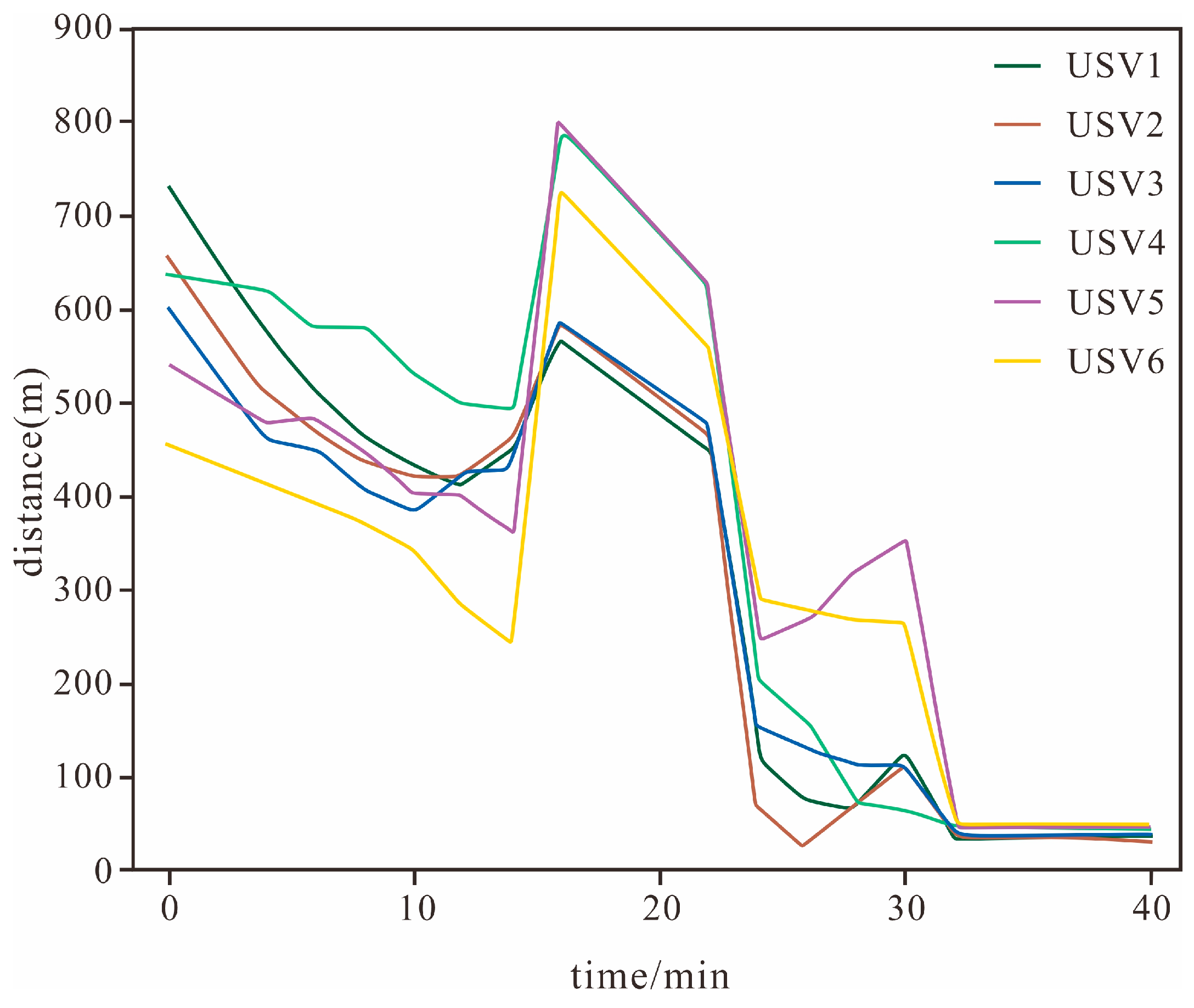
The distance change curve between nodes and the intrusion target presented in
Figure 15 provides a more intuitive basis for process analysis. From the curve characteristics the key phases in the entire operation process can be clearly identified including two approaching processes the target escape process and the final encirclement process.
Through the data analysis of
Table 8 and
Table 9 it can be known that when the intrusion target adopts Evasion Strategy 1 and Strategy 2 the average interception time of the system is 33.8 min and 32.6 min, respectively. In the test within the
range, the average interception time reduction ratio reaches 14.8%, the
improvement ratio is 18.5%, and the collision rate ranges from 0.30% to 0.34%, which is basically consistent with the data in the 1000 m × 1000 m range. This result shows that although different evasion strategies affect the system’s interception efficiency none of them lead to interception failure which confirms that under the control of the algorithm proposed in this paper the system exhibits good task completion capability when facing different evasion strategies.
7. Conclusions and Future Work
This paper conducts in-depth research on the core challenges in the cooperative interception task of multiple Unmanned Surface Vessels (USVs), including the strong dynamics of intrusion targets, complex marine environment interference, and insufficient multi-vessel cooperative accuracy. The adaptive dynamic prediction cooperative interception control algorithm constructs a complete technical framework for “task planning—anti-interference control—phased cooperation”. It lays a foundation for accurate interception through a threat level-oriented target assignment mechanism and an extended Kalman filter multi-step prediction model. Relying on a Two-stage architecture, it separates the cooperative encirclement module from the anti-interference module, effectively offsetting wind and current interference and reducing trajectory deviation and course fluctuation. Through a two-phase strategy of “target navigation—cooperative encirclement”, it optimizes the movement and distribution of nodes to form a stable blockade. Simulation verification shows that compared with the strategy without anti-interference measures, the node trajectory deviation of the adaptive algorithm is reduced by 40% and the course angle fluctuation is reduced by 50%. Compared with the limit cycle encirclement algorithm, the average interception time of this algorithm is shortened by 15%, the average final distance between the intrusion target and the guarded target is increased by 20%, and the collision rate (CRBAO and CRBAA values) is less than 0.3% when facing target escape, which significantly improves the interception efficiency and robustness in complex scenarios.
Although the algorithm in this paper shows excellent performance in simulation scenarios, there is still room for further deepening and expansion in the optimization of anti-interference mechanisms in extremely complex environments and the expansion of high-dynamic multi-target confrontation scenarios. Future research will focus on the deepening and engineering of the algorithm. For extreme marine environments (e.g., typhoons and strong turbulence), an interference prediction model integrating “data-driven—physical modeling” will be constructed, which will train a deep learning sub-model using historical measured data and combine the constraints of fluid mechanics equations to realize advanced prediction of coupled interference, and explores distributed communication optimization based on federated learning. Each USV functions as a local learning node, training a personalized transmission strategy leveraging its proprietary communication quality data (including packet loss rate and latency). Subsequently, the global strategy is updated via federated aggregation, which mitigates the degradation of collaborative efficiency induced by individual communication discrepancies and further enhances communication reliability as well as collaborative stability in complex marine environments. The multi-target cooperative confrontation scenario will be expanded, and a fusion framework of multi-agent reinforcement learning and differential game will be introduced. At the same time, hardware-in-the-loop testing will be carried out to verify the performance of the algorithm under sensor noise and communication delay, and a human–machine hierarchical decision-making mode will be built to further strengthen the framework of the multi-USV dynamic prediction cooperative interception control algorithm. In the future, the test will be further extended to a 10 km × 10 km open-sea scenario, aiming to focus on verifying “multi-node cross-regional collaboration” and “prediction correction under satellite communication delays”.
This study lays a theoretical and practical foundation for the engineering application of the multi-USV cooperative interception system and provides a highly adaptable technical solution for tasks such as maritime security and anti-smuggling. The proposed algorithm successfully connects the integration path of dynamic prediction theory, anti-interference control and multi-agent cooperative technology, opening up a new direction for intelligent interception operations in complex marine environments.




 ,
,