Article

A Multi-Source Data Synchronized Finite Element Model Updating Framework for Jacket Structure Based on GARS–NSGA-III

1
School of Mechanical Science and Engineering, Northeast Petroleum University, Daqing 163318, China
2
School of Architecture and Civil Engineering, Qiqihar University, Qiqihar 161006, China
3
School of Food Science and Engineering, Qiqihar University, Qiqihar 161006, China
*
Author to whom correspondence should be addressed.
J. Mar. Sci. Eng. 2026, 14(1), 72; https://doi.org/10.3390/jmse14010072
Submission received: 3 December 2025 / Revised: 24 December 2025 / Accepted: 28 December 2025 / Published: 30 December 2025
(This article belongs to the Section Ocean Engineering)

Abstract

Accurate representation of structural geometry, physical properties, and boundary conditions remains a major challenge in the finite element (FE) modeling of jacket structures. To address these difficulties, this study proposes a multi-source data synchronous updating framework for FE models based on the Genetic Aggregated Response Surface (GARS) and the Non-dominated Sorting Genetic Algorithm III (NSGA-III). First, vibration and strain tests were simultaneously conducted on an indoor jacket platform structure to obtain its natural frequencies and local dynamic strain responses. The measured data were processed to extract the first three natural frequencies and dynamic strain time histories at two critical locations, which served as reference data for model updating. An initial FE model of the jacket platform structure was then established, and sensitivity analysis was performed to identify the parameters requiring updating. Based on the simulation results, GARS was employed to construct response surface models describing the relationship between structural responses (natural frequencies and local strains) and the parameters to be updated, replacing FE analyses during optimization. Finally, NSGA-III was utilized to achieve synchronous updating of the FE model using multi-source data, and the updated geometric parameters were experimentally validated. The results demonstrate that errors in the first three natural frequencies of the FE model were reduced from 3.44%, −7.31%, and 5.88% to −0.02%, −0.43%, and 0.08%, respectively. Strain errors in the local region decreased from 12.96% and 10.33% to 1.4% and 2.1%. The corrected geometric parameters showed errors less than 1.85% when compared with actual measurements. These findings verify the accuracy and applicability of the proposed method for updating jacket platform FE models, providing an effective reference for model updating of in-service offshore structures.

1. Introduction

Jacket offshore platforms are the core infrastructure for marine oil and gas exploitation. Operating continuously under complex and harsh ocean environmental loads, their structural safety and reliability are essential for protecting human life, ecological systems, and the long-term stability of energy supply [1]. To ensure safe operation throughout the full service life, comprehensive structural integrity assessments based on finite element Analysis (FEA)—covering strength, fatigue, stability, and ultimate capacity—have become indispensable during both the design and operational stages. However, traditional finite element (FE) models often exhibit significant discrepancies from the actual structural responses due to simplified assumptions, uncertainties in material parameters, and idealized boundary conditions [2]. Such discrepancies hinder accurate assessment of structural health and prediction of remaining service life, particularly in aging platforms where long-term operation leads to substantial changes in geometry, material properties, and structural condition [3].
The sources of FE model parameter errors are multifaceted, including the time-varying nature of environmental loads, inherent variations from manufacturing processes, oversimplified boundary and connection conditions, geometric uncertainties, and inaccuracies in material constitutive models. These factors result in considerable inconsistencies between FE model parameters and reality [4,5,6]. FE model updating aims to reduce such inconsistencies by using experimental or monitoring data from the physical structure to adjust model parameters so that the numerical response matches the measured response. Current mainstream techniques fall into two categories: matrix-based and parameter-based methods. Although matrix-based approaches were developed earlier and ensure matrix symmetry, their results often lack physical interpretability, which limits their application in complex structures. In contrast, parameter-based updating directly modifies physically meaningful parameters, making the updated model more interpretable and better aligned with real structural behavior. This approach has therefore seen broader use in engineering applications [7].
Identifying the parameters to be updated is critical to ensuring the physical relevance of parameter-based model updating. Sensitivity analysis is commonly used for this purpose, as it quantifies the influence of geometric, physical, and boundary parameters on the structural response. Selecting only highly sensitive parameters for updating improves both computational efficiency and the relevance of the results [8]. However, for complex structures, accurate updating typically requires adjusting multiple parameters simultaneously, leading to substantial computational effort because each candidate parameter set requires running the FE model repeatedly [9]. To address this issue, surrogate models can be employed to approximate FE response predictions, thereby significantly reducing computational cost and improving the efficiency of multi-parameter updating [10].
Commonly used surrogate modeling methods for replacing finite element analysis in marine engineering include Response Surface Methodology (RSM) [11], Radial Basis Function (RBF) [12], Artificial Neural Network (ANN) [13], Deep Neural Network (DNN) [14], and Proper Orthogonal Decomposition (POD) [15]. Among these methods, RSM is characterized by its intuitive principles, ease of modeling, and interpretability, making it suitable for surrogate modeling of linear and low-dimensional nonlinear responses in marine platform structures. However, it has certain limitations in fitting accuracy when dealing with high-dimensional nonlinear problems [11]. RBF demonstrates strong adaptability when addressing irregular data points and high-dimensional issues, and it can be applied to predict the structural response of marine platforms under environmental loads. However, it is sensitive to the choice of basis functions and shape parameters, which may affect its performance [12]. Artificial neural networks, deep neural networks, and POD methods exhibit powerful predictive capabilities for nonlinear problems, but they require high-quality, large datasets for training and come with relatively high computational costs, making them more suitable for engineering scenarios with complete data [16]. Despite the advantages of each surrogate model, when handling multi-source dynamic response data, the significant differences in data characteristics require the surrogate model to possess strong adaptability, achieving an optimal balance between fitting accuracy and computational efficiency.
The monitoring system of the jacket platform structure can obtain various test data for model updating, including acceleration, displacement, strain, wave height, wave velocity, and others. Among these, acceleration and displacement data are used to extract the modal parameters of the structure, which are commonly employed to update the overall boundary conditions and physical parameters [17]. Strain data reflect the time-varying response of the structure under loading, and are primarily used to update local geometric and material parameters [18]. Meanwhile, ocean environmental data, such as wave height and wave velocity, are mainly used to update the environmental load model and related load parameters [19]. Thus, modal-based updating has become a widely adopted method in jacket FE model refinement [17,20]. However, due to the high redundancy of degrees of freedom in jacket structures, local variations in physical or geometric parameters may not be clearly reflected in modal responses alone. Incorporating strain data for updating local parameters can effectively overcome this limitation and enhance both the completeness and accuracy of model updating [21]. Studies have shown that fusing multiple data types leads to a more reliable FE model than using single-source data. Multi-source model updating strategies include sequential and synchronous updating. Although sequential approaches are easier to implement, they are prone to error accumulation and may cause interference among update steps. Synchronous updating, by contrast, is more robust and capable of finding a global optimum but leads to increased computational complexity due to conflicts among multiple optimization objectives [22]. Thus, selecting an appropriate multi-objective optimization algorithm is essential for achieving a model that accurately reflects the true structural state.
Multi-objective genetic algorithms (MOGA), grounded in evolutionary computation principles, utilize selection, crossover, and mutation operators to drive population evolution toward the Pareto front representing trade-offs among conflicting objectives [23]. However, traditional MOGAs often suffer from slow convergence and insufficient diversity when handling high-dimensional optimization problems. The Non-dominated Sorting Genetic Algorithm III (NSGA-III), an advanced variant of MOGA, introduces a reference-point mechanism to address convergence degradation and uneven distribution in many-objective optimization tasks. Compared with traditional MOGAs, NSGA-III provides superior diversity preservation and uniformity along the Pareto front in high-dimensional settings [24]. Wang H.W. et al. combined it with DNN to optimize the mooring system of a floating platform, reducing mooring line tension, decreasing platform motion, and improving overall design efficiency [25]. NSGA-III was applied to improve the fuel efficiency of ships, achieving up to 4.54% fuel savings compared to the original operational mode [26]. Additionally, NSGA-III was used to optimize multiple sub-objectives, including path length, number of bends, path energy, number of airbags, and rupture bending distance, ultimately achieving the design of the ship’s pipeline route [27]. These studies demonstrate that NSGA-III can effectively handle complex optimization problems with multiple conflicting objectives in marine engineering.
In the FE model updating of jacket structures, stepwise updating often leads to interference between sequential steps, while synchronous updating faces the challenge of multi-objective conflicts. To address this, a multi-source data synchronous updating method based on GARS-NSGA-III is proposed in this study. This method constructs a unified multi-objective optimization framework to simultaneously identify and update the overall boundary conditions and local physical parameters of the structure. This effectively avoids the error propagation inherent in stepwise updating while efficiently coordinating the trade-offs between multiple optimization objectives. This approach provides a valuable framework for the finite element model updating of jacket platform structures in engineering, offering a more reliable simulation foundation for subsequent fatigue life prediction, ultimate strength assessment, and safe operational maintenance.

2. FE Model Updating Method for Jacket Structures Based on GARS–NSGA-III

To address the challenges in FE model updating of jacket platform structures—such as the large number of parameters to be corrected, the insufficient accuracy achievable using single-source test data, and the difficulty of simultaneously optimizing global and local structural performance—this study integrates the Genetic Aggregation Response Surface (GARS) with the NSGA-III multi-objective optimization algorithm. The resulting framework enables an efficient and high-precision synchronous updating strategy capable of simultaneously correcting both global boundary conditions and local physical parameters.

2.1. Genetic Aggregation Response Surface (GARS)

The GARS combines the response surface method with genetic algorithms. By using a genetic algorithm to optimize the selection of basis functions and their associated parameters, GARS constructs surrogate models with improved fitting accuracy and stronger generalization capability.
Assume that the training dataset for constructing the response surface is
D = { ( x i , y i ) } i = 1 n ,   x R d
where the samples may originate from experiments or simulations. The candidate set of basis response surfaces includes second-order polynomials, nonparametric regression models, kriging models, and moving least-squares formulations, etc. Forming the response surface library expressed in Equation (2):
M R = { f ^ 1 , , f ^ M }
The aggregated response surface constructed through the genetic aggregation process is given by Equation (3):
f ^ G A ( x ) = m = 1 M   w m f ^ m ( x ; θ ^ m ) , w m 0 , m   w m = 1
where θ ^ m denotes the hyperparameters of the m-th basis response surface, and w m is its aggregation weight.
The basis type and hyperparameters are encoded into an individual gene according to Equation (4):
gene = [m, θm, w]
where m is the number of basis functions, θ m is the hyperparameter vector, and w represents the weight coefficients.
Using cross-validation error as the fitness metric, a Genetic Algorithm (GA) performs selection, crossover, and mutation until convergence or computational limits are reached.

2.2. Non-Dominated Sorting Genetic Algorithm III (NSGA-III)

As an advanced member of the MOGA family, NSGA-III introduces a reference-point mechanism as its core innovation. By distributing predefined reference points uniformly in the objective space, NSGA-III effectively overcomes performance degradation issues commonly encountered in high-dimensional multi-objective optimization problems. The algorithm performs non-dominated sorting to classify solutions into Pareto layers, and within each layer, individual selection is guided by the distances between solutions and reference points, thereby maintaining a balance between convergence and population diversity.
A typical multi-objective optimization problem involves multiple objective functions and associated constraints. Given the objective function vector
g ( x ) = ( g 1 ( x ) , g 2 ( x ) , , g M ( x ) )
In this expression, x denotes the decision vector; g 1 , g 2 , , g M are the objective functions, and M represents the number of objectives.
(1)
Introduction of Reference Points
Reference points are predefined in the objective space to guide the evolution of the population. Let the set of reference points be expressed as Equation (6)
z r = z 1 r , z 2 r , , z M r r { 1,2 , , R }
where R is the number of reference points.
By combining non-dominated sorting with reference-point association, NSGA-III ensures uniform distribution of solutions across the Pareto front, even in high-dimensional spaces.
(2)
Non-dominated Sorting
Non-dominated sorting is performed by comparing the dominance relationships among solutions. A solution x 1 is said to dominate a solution x 2 if and only if
g i x 1 g i x 2 i { 1 , , N }
and there exists at least one i such that the inequality holds
g i ( x 1 ) < g i ( x 2 )
This enables NSGA-III to assign individuals into hierarchical non-dominated layers satisfying Pareto optimality.
(3)
Reference Point Distance Calculation
For each objective, normalization is performed:
g i = g i z i m i n z i m a x z i m i n
followed by the perpendicular distance between each normalized solution and each reference point:
d ( g , z r ) = g g z r z r 2 z r
Solutions are associated with reference points, ensuring that each reference point is represented within the population. This mechanism helps NSGA-III maintain diversity and achieve uniform distribution of solutions in high-dimensional objective spaces.

2.3. Model Updating Method Based on GARS–NSGA-III

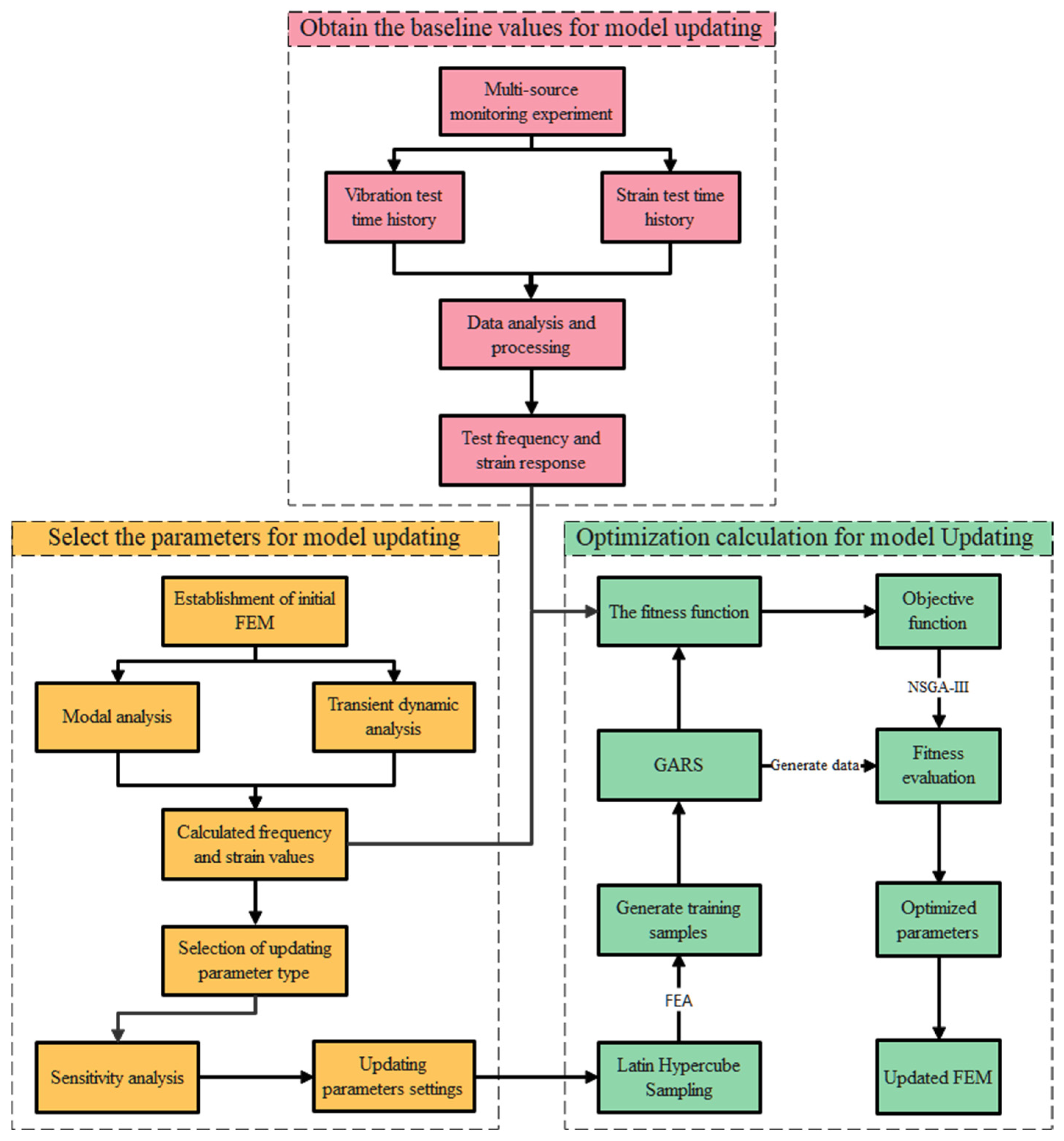
The FE model updating process for jacket structures consists of three key steps: obtaining reference data, selecting the parameters to be updated, and implementing the optimization algorithm. Based on these steps, a complete GARS–NSGA-III model updating framework is constructed, as illustrated in Figure 1.
As shown in Figure 1, the proposed model updating framework consists of three main components. The first component involves establishing the baseline for model updating. This is achieved by conducting multi-source monitoring tests on the jacket structure, during which vibration responses and strain data are synchronously acquired. The raw signals are then processed and analyzed to extract the baseline quantities used for model updating, including natural frequencies and local strain amplitudes.
The second component focuses on selecting the parameters to be updated. Based on the simulation results of the initial FE model, and considering the geometric and physical characteristics of the structure, sensitivity analysis is performed to identify the parameters that have a significant influence on the validation indicators, thereby determining the candidate set of parameters for updating.
The third component performs optimization using the GARS–NSGA-III framework. Latin hypercube sampling is first used to generate sample points, and FE simulations are conducted to construct the training dataset. The GARS method is then employed to build surrogate models for the validation indicators. On this basis, the updating parameters are treated as decision variables, multi-source validation indicators are formulated into objective functions, and the NSGA-III algorithm is applied to perform multi-objective optimization. Throughout the optimization process, GARS provides efficient fitness evaluations, enabling coordinated optimization of multiple objectives. The method ultimately yields a set of Pareto-optimal updating solutions.

3. Vibration and Strain Synchronous Monitoring Tests on the Indoor Jacket Structure

3.1. Experimental Model

A simplified scaled model of a jacket platform from a specific offshore region was constructed in the laboratory. The model was designed with a geometric scaling ratio of 1:30 and structurally simplified by omitting secondary components that have a minimal impact on the overall load-bearing capacity. Only the core load-bearing components were retained, preserving the overall dynamic characteristics of the structure while reducing the complexity of the model (Table 1).
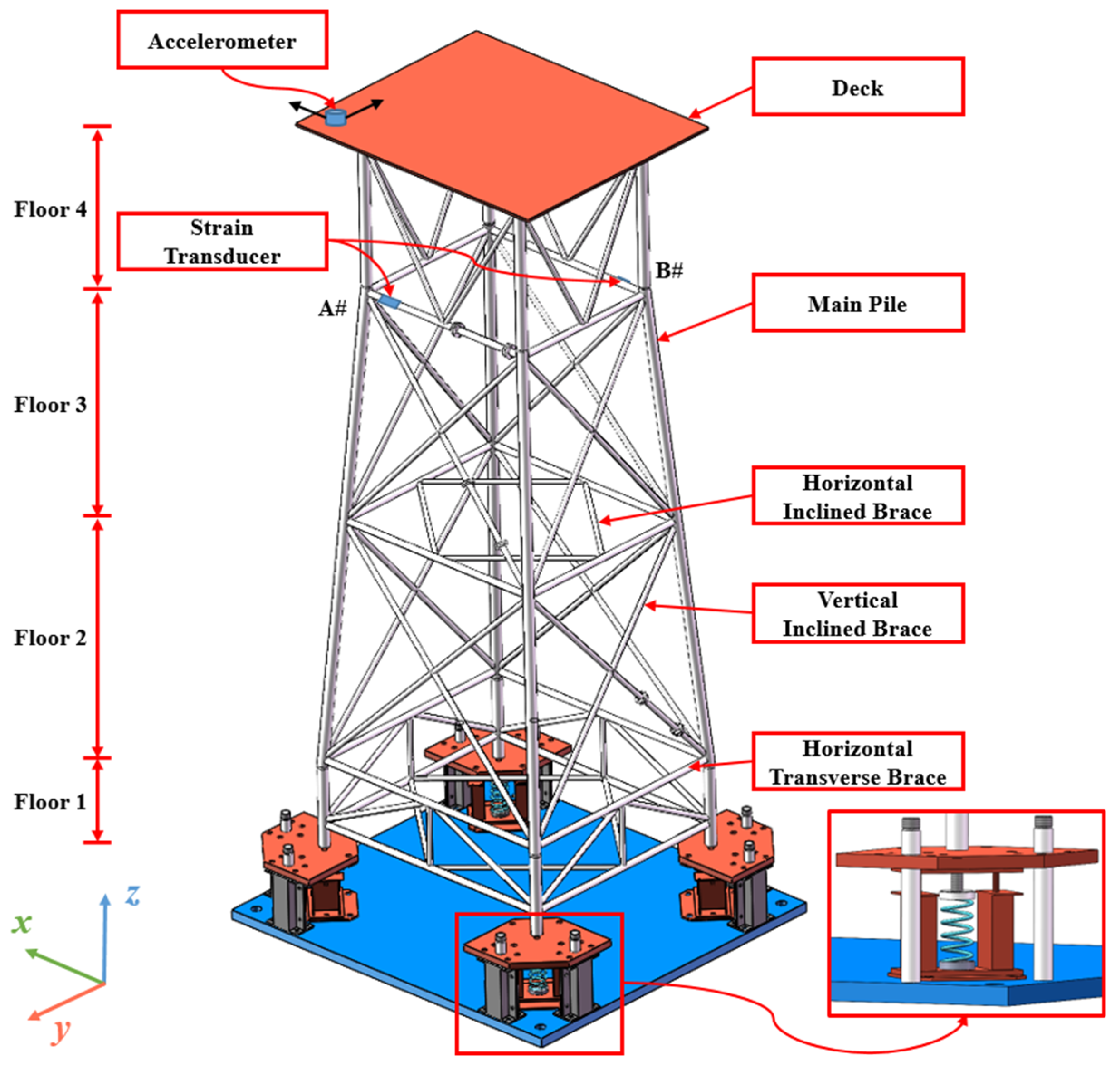
The indoor jacket structure has a total height of 2.3 m and a total mass of 117.5 kg. Due to the effects of uneven scour and settlement, the constraint stiffness of the individual pile foundations in the actual jacket structure varies. In the experimental setup of the indoor jacket structure, the connection between the jacket legs and the base plate is achieved using guide columns and adjustable spring-damper units. This simplified design effectively simulates the impact of varying constraint stiffnesses of the pile foundations on the dynamic response of the structure. The specific geometric details of the setup are shown in Figure 2.
As shown in Figure 2, the base plate is anchored to the floor using foundation bolts, and the guide columns are welded to the base plate. The entire weight of the jacket structure is supported by spring–dampers. The connection stiffness between each of the four legs of the jacket and the base plate can be adjusted by tuning the stiffness of the spring–damper units beneath them, thereby allowing different boundary stiffness conditions to be imposed at the leg bases.

3.2. Laboratory Testing of the Indoor Jacket Structure

(1)
Synchronous Vibration and Strain Measurements
A total of two uniaxial accelerometers and two strain sensors were installed on the indoor jacket model. The accelerometers were mounted on the deck to capture the global dynamic response of the structure. At the same time, the strain sensors were fixed on the horizontal bracing members to monitor local strain behavior. After ensuring that all sensors were securely fixed, zero calibration was performed for each sensor individually. The specific sensor locations are shown in Figure 2, and the detailed sensor specifications are provided in Table 2.
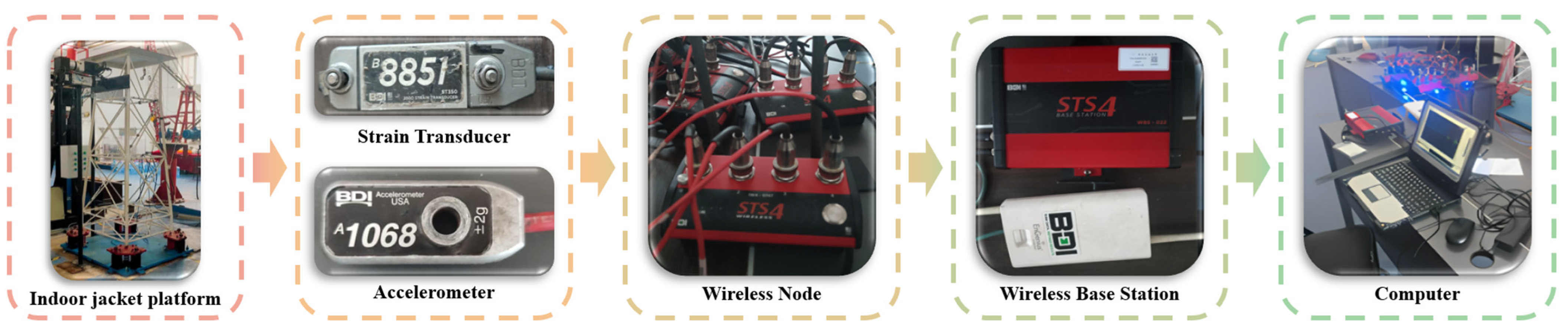
The monitoring and data acquisition system consists primarily of sensors, wireless node modules, a wireless base station, and a terminal computer. The connections among these components are illustrated in Figure 3.
As shown in Figure 3, the accelerometers and strain sensors are mounted on the indoor jacket structure, and all sensors are connected to the wireless node modules through transmission cables. The wireless base station establishes a local wireless network that serves as a data relay, transmitting the measured signals from the wireless node modules to the computer.
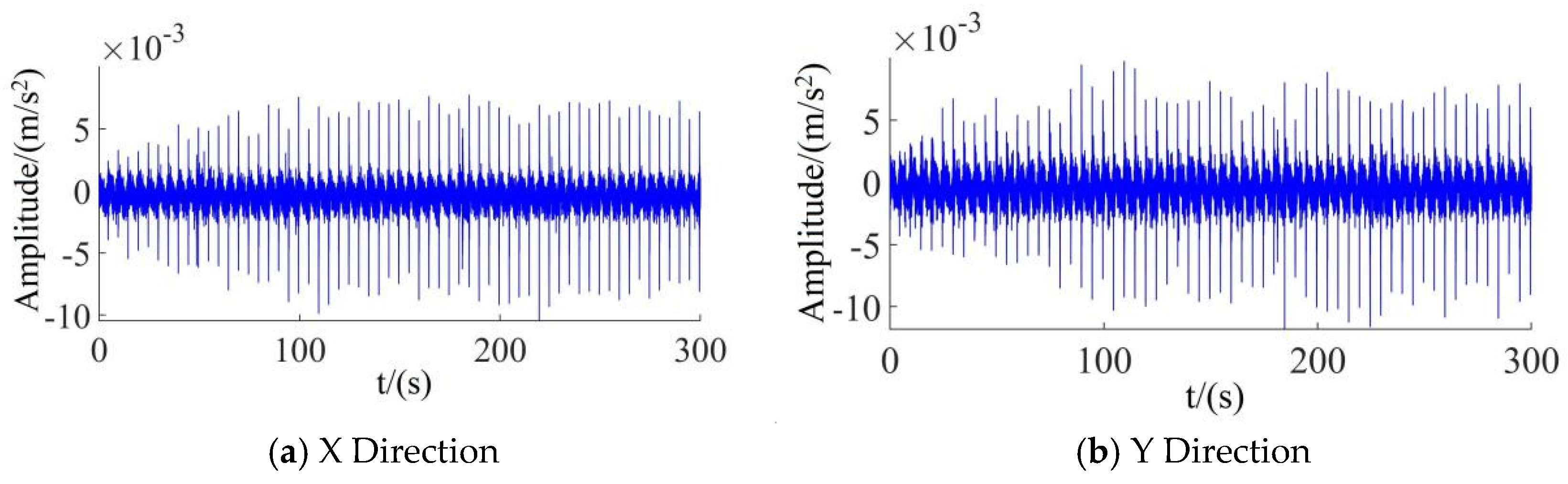
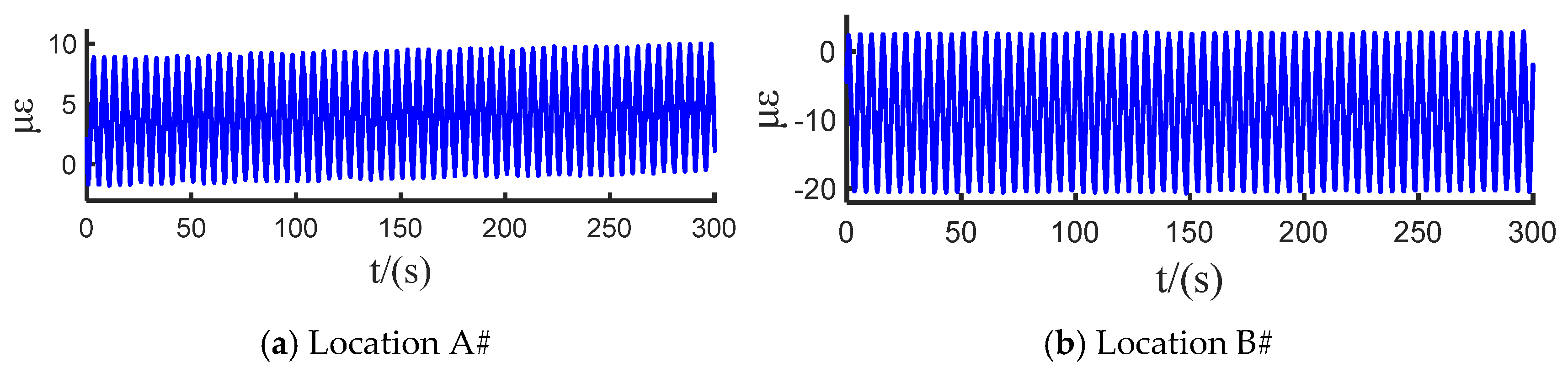
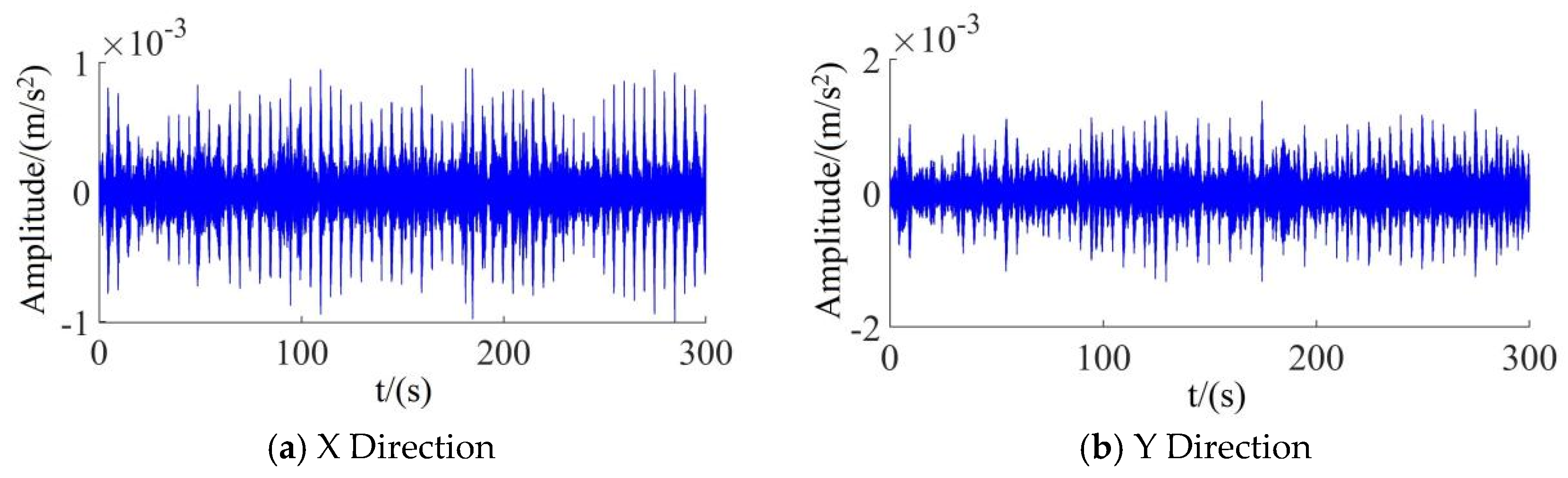
After calibrating the exciter, a sinusoidal load with a period of 5 s and a peak value of 1000 N was applied in the X direction of the indoor jacket structure. The acceleration and strain responses were recorded simultaneously, with both sampling frequencies set to 250 Hz and a total acquisition duration of 300 s. The measured acceleration and strain time-history signals are presented in Figure 4 and Figure 5, respectively.
(2)
Analysis and Processing of Test Signals
The raw acceleration data were preprocessed to improve signal quality. First, a detrending operation was applied to remove low-frequency drift. Subsequently, a combined filtering approach based on the Exponential Moving Average (EMA) and Kalman filtering was used for noise reduction. The preprocessed acceleration signals are shown in Figure 6.
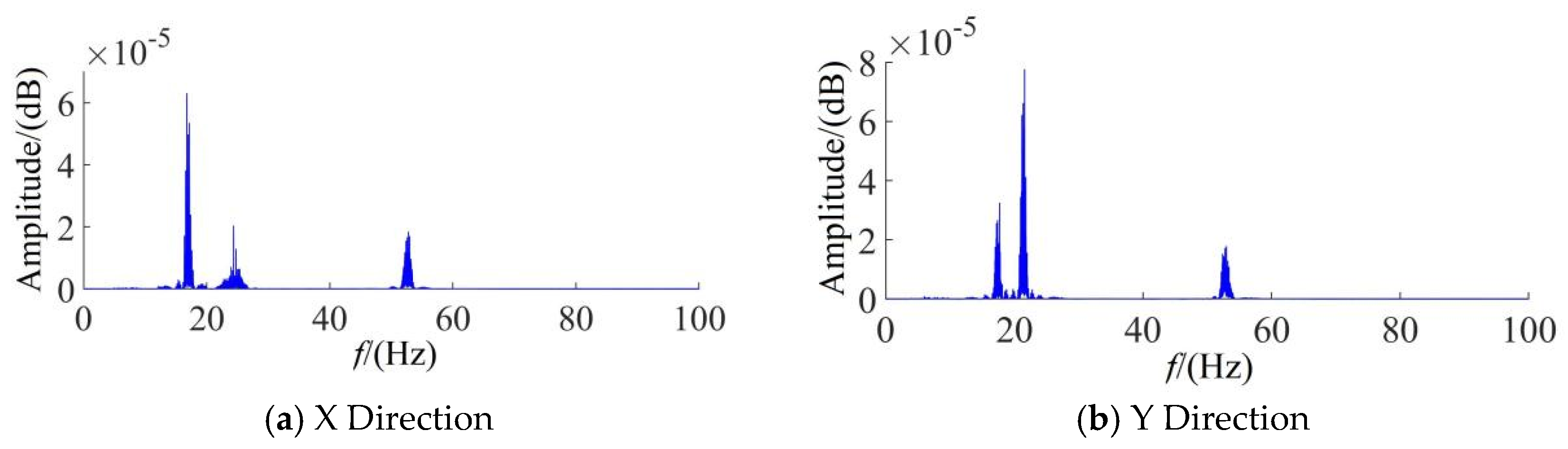
A comparison between the time-history curves in Figure 4 and Figure 6 shows that the number of outliers is significantly reduced after preprocessing, the noise level is markedly suppressed, and the acceleration amplitudes become more concentrated. For both the X and Y directions, the excitation waveform becomes more distinct in the preprocessed data. A Fourier transform was then applied to the preprocessed acceleration signals, and the resulting amplitude spectra are presented in Figure 7.
Peak picking was applied to the amplitude spectra in Figure 7, and the first three modal frequencies identified from the test data were 17.17 Hz, 21.94 Hz, and 52.56 Hz.
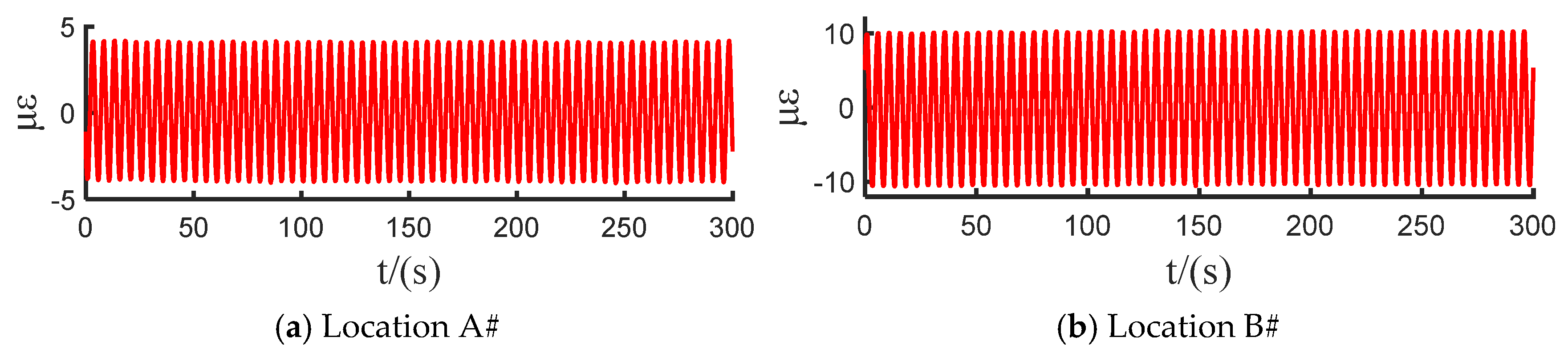
The raw strain data were also preprocessed. A fourth-order polynomial regression was first used to remove the trend component, followed by low-pass filtering with a cutoff frequency of 20 Hz. A baseline correction was then applied. The comparison of the strain time-history curves before and after preprocessing is shown in Figure 8.
A comparison of the time-history curves in Figure 5 and Figure 8 shows that the preprocessed strain data exhibit a more balanced distribution about the zero line, with baseline drift significantly reduced. This indicates that the adopted preprocessing procedure effectively mitigates systematic errors caused by incomplete sensor zeroing. The mean absolute values of the measured strain at the peak and trough points are calculated to be 4.32 με and 10.26 με, respectively.

4. FE Model Updating of the Jacket Structure Based on Multi-Source Test Data

4.1. Establishment and Analysis of the Initial FE Model

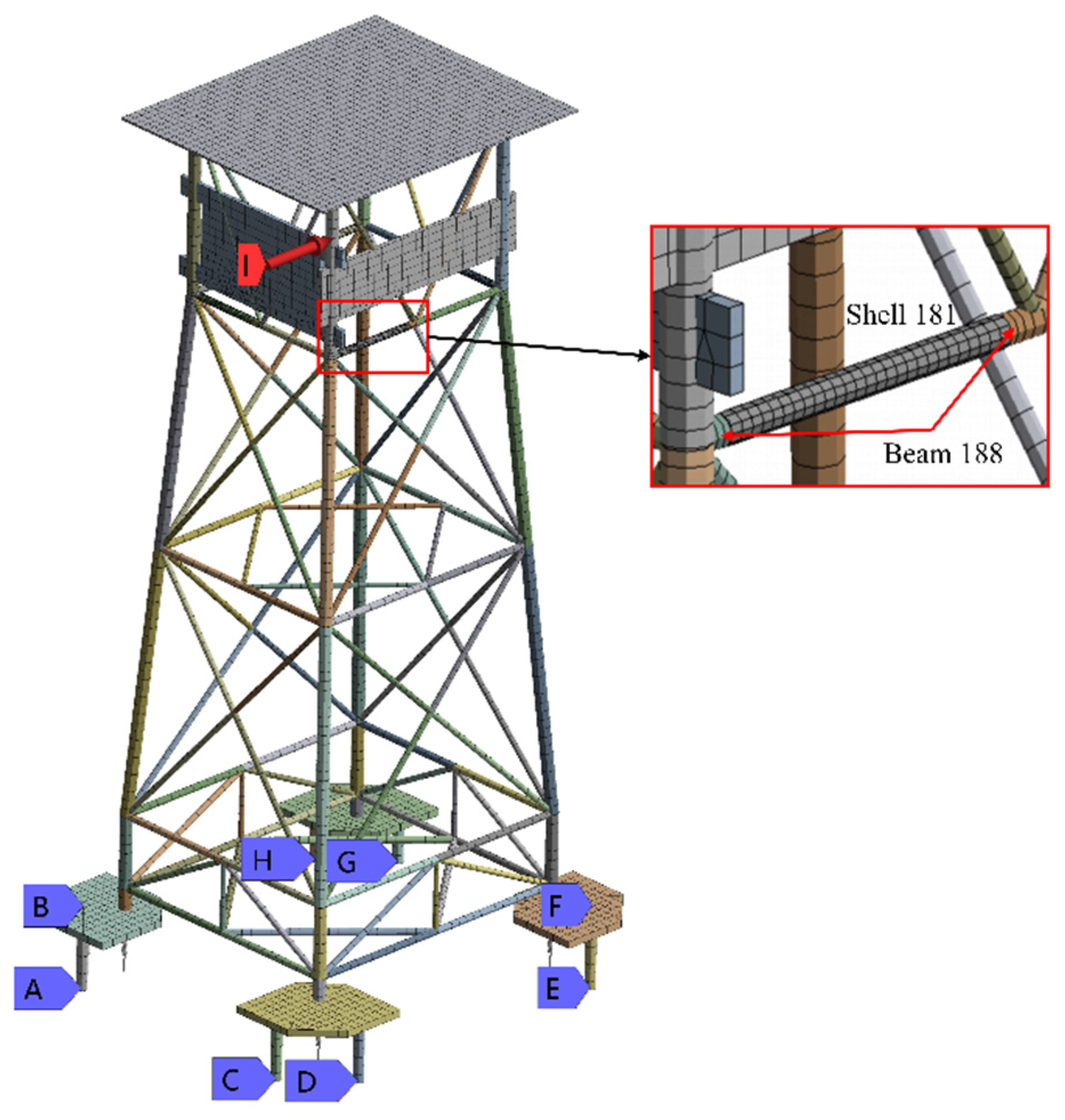
Based on the geometric and material parameters listed in Table 1, a global FE model of the indoor jacket platform structure was developed using the ANSYS Workbench 2021R1. The applied loads and boundary conditions are illustrated in Figure 9. The top deck, excitation plate, and flange plates were meshed using Shell181 elements, whereas the remaining structural members were modeled with Beam188 elements.
Since the strain sensors measure surface strains on the structural members, the sensor-bearing members were also meshed using Shell181 elements to ensure consistency between measured and simulated strain responses. During strain analysis, the strain values were extracted from the top surface of these shell elements. As shown in the local view of Figure 9, for members modeled using a combination of Shell181 and Beam188 elements, Multi-Point Constraint (MPC) coupling was employed to ensure proper connectivity between the two element types. The lower ends of the guide posts were fixed, while sliding contact was defined between their upper ends and the flange plates. To simulate the boundary flexibility at the base of each main pile, individual springs were introduced between each leg and the ground, modeled using Combine14 elements.
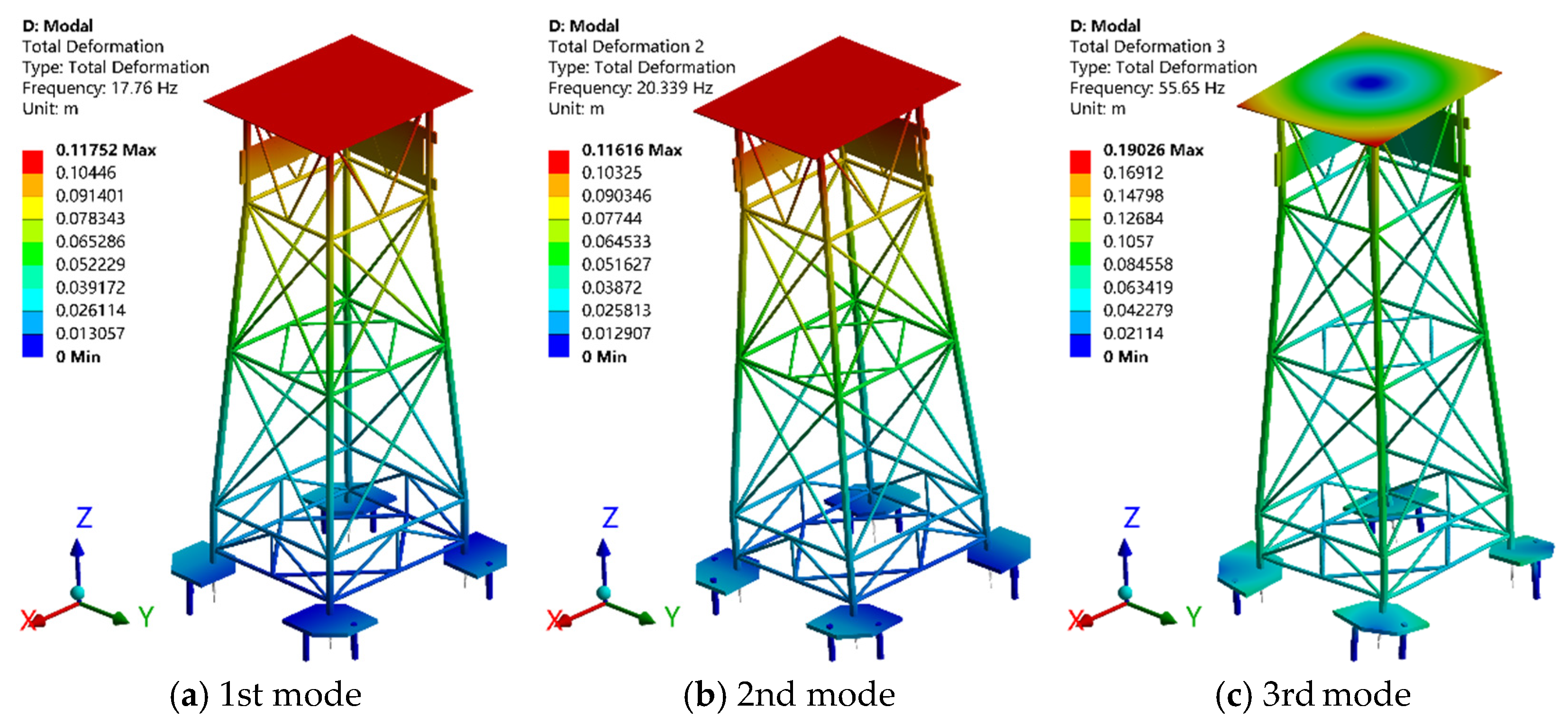
A modal analysis of the FE model shown in Figure 9 was performed using the Block Lanczos method. The first three computed natural frequencies are listed in Table 3, and the corresponding mode shapes are presented in Figure 10.
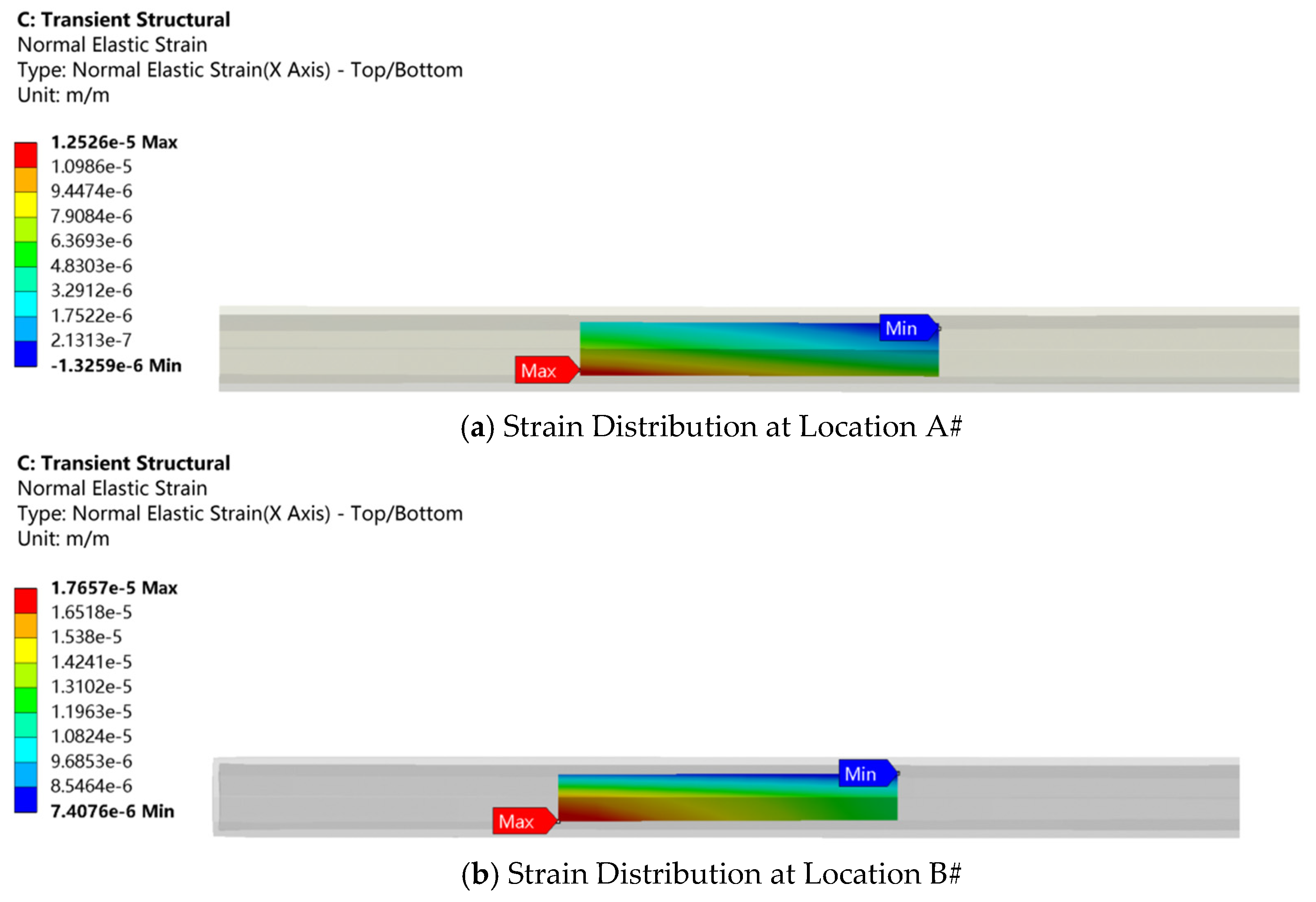
Based on the mode shapes shown in Figure 10, the first three modes of the structure primarily correspond to translations in the X and Y directions, as well as rotation about the Z-axis, clearly reflecting the dynamic characteristics of the global structure under low-order vibration states. Further transient dynamic analysis was conducted on the indoor jacket FE model shown in Figure 9, with a sinusoidal excitation of 5 s period and 1000 N peak applied at the center of the shaker plate in the X direction. The simulation duration was set to 300 s. To ensure that the simulation results strictly correspond to the experimental data in terms of the time sequence, the simulation time step was set to 0.004 s. The strain distribution results at the peak load time for locations A# and B# are shown in Figure 11.
As shown in Figure 11, the maximum and minimum axial strains in the region where the A# sensor is located are 12.52 με and −1.33 με, respectively, with the calculated average strain value being 4.88 με. In the region where the B# sensor is located, the maximum and minimum axial strains are 17.66 με and 7.41 με, respectively, with the calculated average strain value being 11.32 με.
To evaluate the accuracy of the FE model, the first three natural frequencies (f1, f2, and f3) and the strain responses at locations A# and B# (denoted as ε1 and ε2) were selected as validation metrics for the updated model. The relative errors between the simulation results and the experimental measurements were calculated using Equation (11), and the results are summarized in Table 4.
δ = R f R m R m × 100 %
where δ denotes the relative error, R m is the experimentally measured value, and R f is the FE prediction.
As shown in Table 4, substantial discrepancies exist between the initial FE predictions and the experimental measurements, with the maximum relative error reaching 12.96%. This indicates that multiple parameters of the indoor jacket structure FE model require updating.

4.2. Selection of Parameters for Model Updating

Due to the geometric complexity and boundary condition variability of jacket structures, their FE models typically involve a large number of parameters that could potentially require updating. If all parameters are adjusted indiscriminately during the updating process, the computational cost would increase significantly, and the coupling effects among parameters may lead the optimization to converge to a local optimum. Therefore, it is essential to identify key parameters that have a significant influence on the structural dynamic response, based on geometric and physical characteristics as well as sensitivity analysis results. According to Ref. [28] and considering the characteristics of jacket structures, commonly selected updating parameters include elastic modulus, density, effective wall thickness, sectional moment of inertia, cross-sectional area, constraint stiffness, mass distribution, and joint stiffness.
The Spearman rank correlation coefficient is a statistical measure used to evaluate the strength of the monotonic relationship between two variables. As this metric does not rely on any specific assumptions about data distribution, it is widely adopted in FE model updating and sensitivity analysis to quantify the influence of different parameters on structural responses. The Spearman rank correlation coefficient ρ is defined as
ρ = 1 6 d i 2 n ( n 2 1 )
where ρ denotes the correlation coefficient, d i is the difference between the ranks of the two variables after sorting, and n is the number of samples.
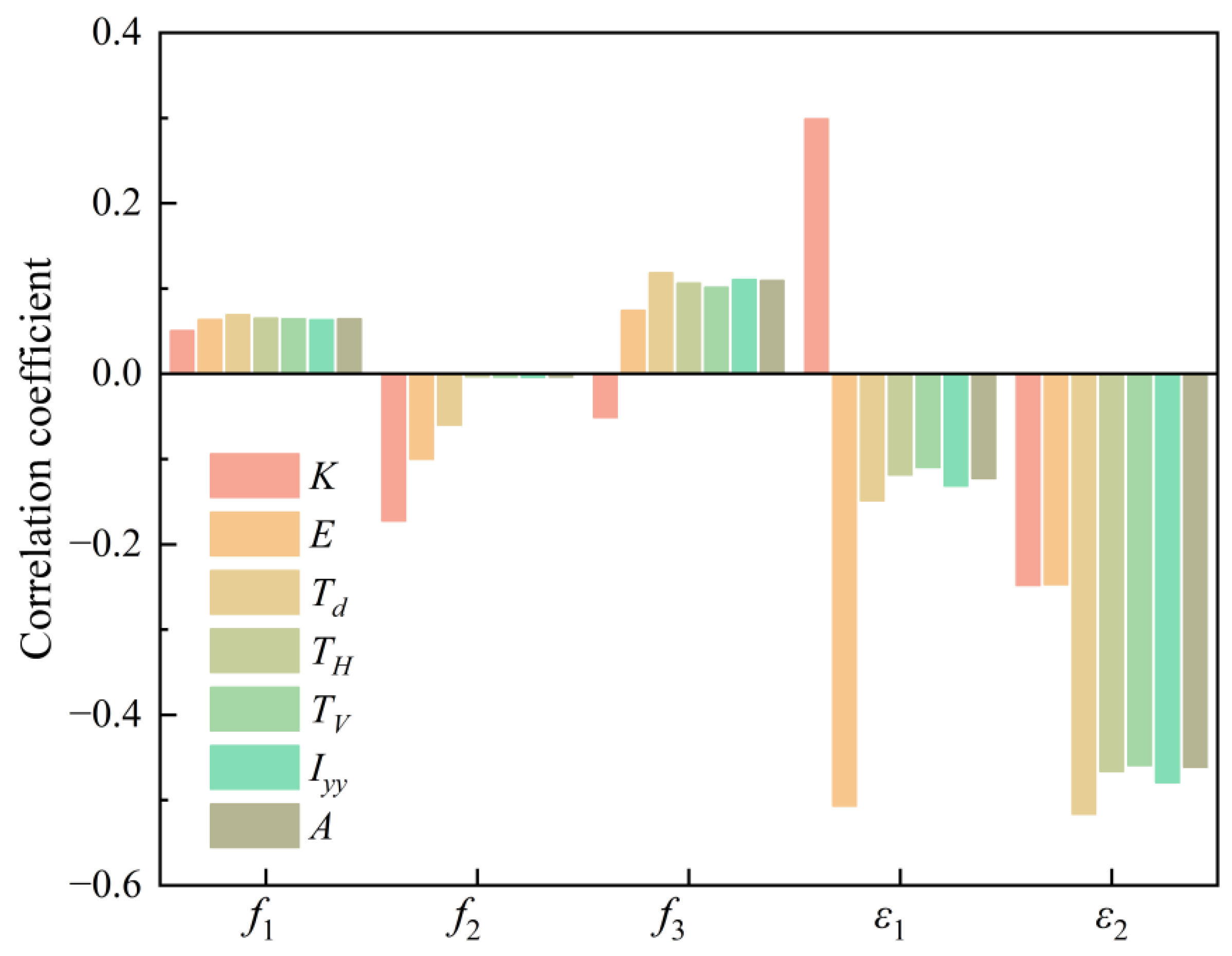
Sensitivity analysis was conducted on the selected parameters using the Spearman rank correlation coefficient. The parameters considered include boundary spring stiffness K, local elastic modulus E, main pile wall thickness Td, horizontal transverse brace wall thickness TH, vertical inclined brace wall thickness TV, as well as the sectional moment of inertia Izz and cross-sectional area A. The computed sensitivity results are presented in Figure 12.
As indicated by the sensitivity results in Figure 12, the boundary spring stiffness exhibits a pronounced influence on the first three natural frequencies of the structure, whereas the elastic modulus, wall thickness, cross-sectional area, and moment of inertia primarily affect the local strain responses. Considering that wall thickness, cross-sectional area, and moment of inertia are geometrically dependent, and that wall thickness is more readily measured in practical engineering applications, wall thickness is selected as the representative geometric parameter for updating. Based on the above analyses, the boundary spring stiffness, structural elastic modulus, and wall thickness of key members are chosen as the updating parameters for the global FE model of the jacket structure. The parameter ranges are determined according to the specifications of the spring–damper devices and the manufacturing standards of cold-drawn steel tubes, as summarized in Table 5.

4.3. FE Model Updating Based on GARS–NSGA-III

After identifying the parameters to be updated, the FE model updating procedure for the jacket platform structure using the GARS–NSGA-III framework consists of two core steps. First, a GARS surrogate model is constructed to efficiently generate the large number of sample evaluations required by NSGA-III for fitness assessment. Subsequently, the NSGA-III multi-objective optimization algorithm is employed to achieve simultaneous optimization of multiple updating parameters.
(1)
Construction of the GARS
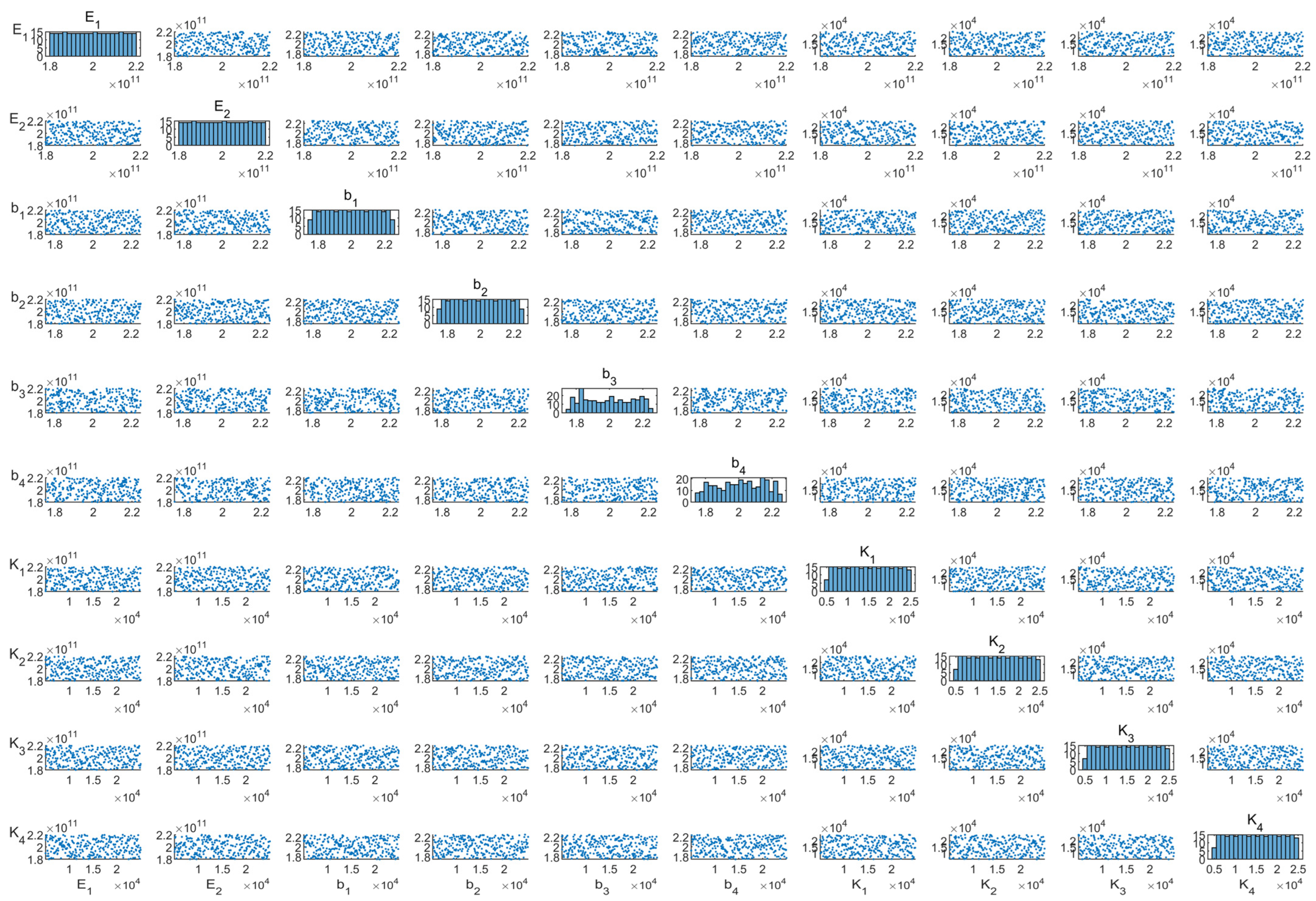
Using the parameter bounds listed in Table 5, training sample points for the updating parameters were generated by means of Latin hypercube sampling. The scatter matrix of the sampling space is illustrated in Figure 13.
Each subplot in Figure 13 illustrates the relationship between a pair of variables. The diagonal subplots show the marginal distribution of each variable, while the off-diagonal subplots display the scatter plots between two variables. The histograms on the diagonal indicate that all variables are uniformly distributed within their respective intervals, effectively preventing clustering of sample points and thereby reducing computational cost, demonstrating the advantages of Latin hypercube sampling. The off-diagonal scatter plots show no evident correlation among variables, indicating that both the selection of updating parameters and the sampling strategy used for surrogate model generation are appropriate.
Based on the sampled points, surrogate models for each updating objective were constructed using four different response surface techniques: GARS, kriging, second-order polynomials, and non-parametric regression. A comparison of their prediction accuracy is summarized in Table 6.
As shown by the RMSE, MSE, and MAE in Table 6, there are significant differences in the fitting accuracy of the four response surfaces for different output responses. For all validation metrics, GARS consistently maintains the lowest error levels, with RMSE in the range of 10−8 to 10−10, MSE in the range of 10−15 to 10−20, and MAE in the range of 10−8 to 10−10, demonstrating exceptionally high fitting accuracy and stability. In contrast, Kriging achieves good accuracy for some responses but exhibits a significant increase in error for f2, indicating its fluctuating adaptability to different responses. The quadratic polynomial response surface and non-parametric regression methods show more pronounced errors for f1 and f2, with RMSE reaching the order of 10−1 and 10−2 to 10−1, respectively, indicating that these methods struggle to maintain adequate accuracy when the system response exhibits stronger nonlinearity or more complex coupling relationships.
Based on a comprehensive comparison of the error magnitudes and the stability of performance across multiple responses, GARS is selected as the surrogate model for subsequent optimization analysis. This choice is based on GARS consistently achieving low error levels across all output responses, indicating that the Genetic Aggregated Response Surface is more capable of accurately capturing the complex mapping relationships between input parameters and output responses in the FE model, making it a more suitable surrogate modeling approach for this study.
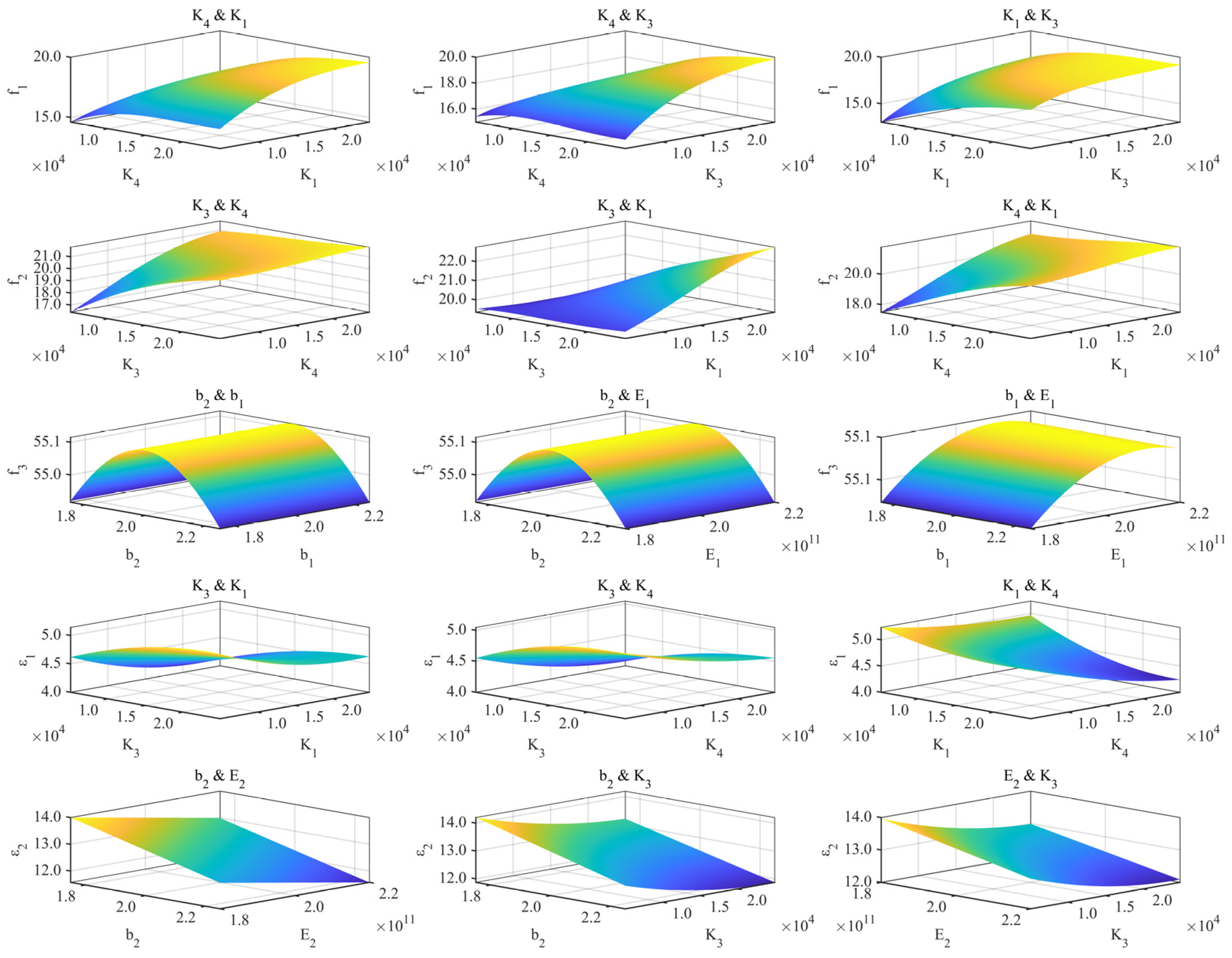
Based on the most influential parameters, the response surfaces corresponding to the output variables listed in Table 6 are plotted in Figure 14.
As shown in Figure 14, all output responses exhibit a convex surface within the parameter ranges, with a relatively flat region near the top, indicating that variations in the parameters produce only minor changes in the corresponding responses in that zone. In the mid-range of the surfaces, the gradients become steeper, revealing a higher sensitivity of the responses to parameter variations. Toward the boundaries of the parameter ranges, the sensitivity decreases again. These characteristics collectively demonstrate the rationality and reliability of the constructed response surface models.
(2)
Multi-objective Optimization Using NSGA-III
The errors between the FE model predictions and the measured data were selected as the fitness functions, and the optimization problem was formulated according to Equation (13).
m i n g ( x ) = i = 1 5   w i g i ( x )
In this formulation, the weighting coefficients w i are assigned according to the relative importance of each updating objective. Since all five objectives are considered equally important, the weights are uniformly distributed among them.
The fitness function, defined as the error between the numerical predictions and the experimental measurements, can be expressed as Equation (14).
g 1 x = f 1 F E x f 1 E x p 2 g 2 x = f 2 F E x f 2 E x p 2 g 3 x = f 3 F E x f 3 E x p 2 g 4 x = ε 1 F E x ε 1 E x p 2 g 5 x = ε 2 F E x ε 2 E x p 2
In which, f i F E ( x ) denotes the i-th natural frequency computed from the FE model, and f i E x p is the corresponding i-th natural frequency obtained from experiments. Similarly, ε j F E ( x ) represents the strain value at the j-th measurement point calculated by the FE model, and ε j E x p is the experimentally measured strain at the same point.
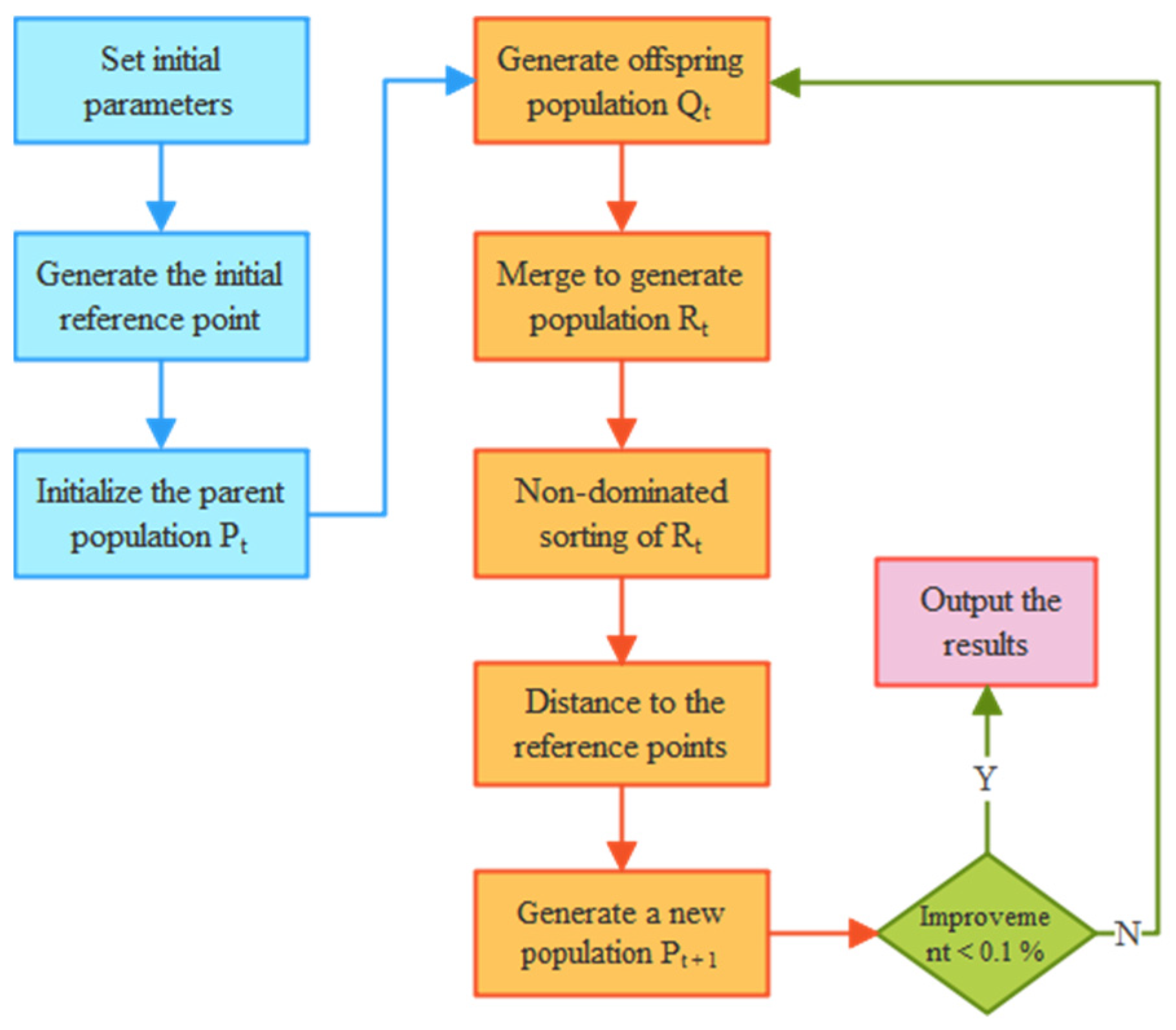
The objective functions are optimized using the NSGA-III algorithm, and the detailed optimization procedure is illustrated in Figure 15.
As shown in Figure 15, the algorithm begins by defining the initial parameters, including 10,000 initial samples, 2600 offspring samples generated per iteration, a maximum of 50 iterations, a maximum allowable Pareto percentage of 70%, a mutation probability of 0.1, and a crossover probability of 0.98. According to Equation (15), the number of reference points is calculated to be 70.
N r = H + M 1 M 1
where M is the number of optimization objectives, and H denotes the number of divisions in the objective space.
Based on the initial parent population Pt, a child population Qt is generated through genetic operations. The combined population Rt is then formed by performing R t = P t Q t . Non-dominated sorting is applied to Rt, dividing it into several non-dominated fronts. For each front, the distance between the solutions and the predefined reference points is computed for ranking, and the next-generation parent population Pt+1 is selected accordingly. Finally, convergence is assessed: if the improvement in the objective functions for the new generation is less than 0.1%, the optimization terminates, and the results are output; otherwise, child population generation proceeds based on Pt+1, and iterations continue until the maximum number of generations is reached.
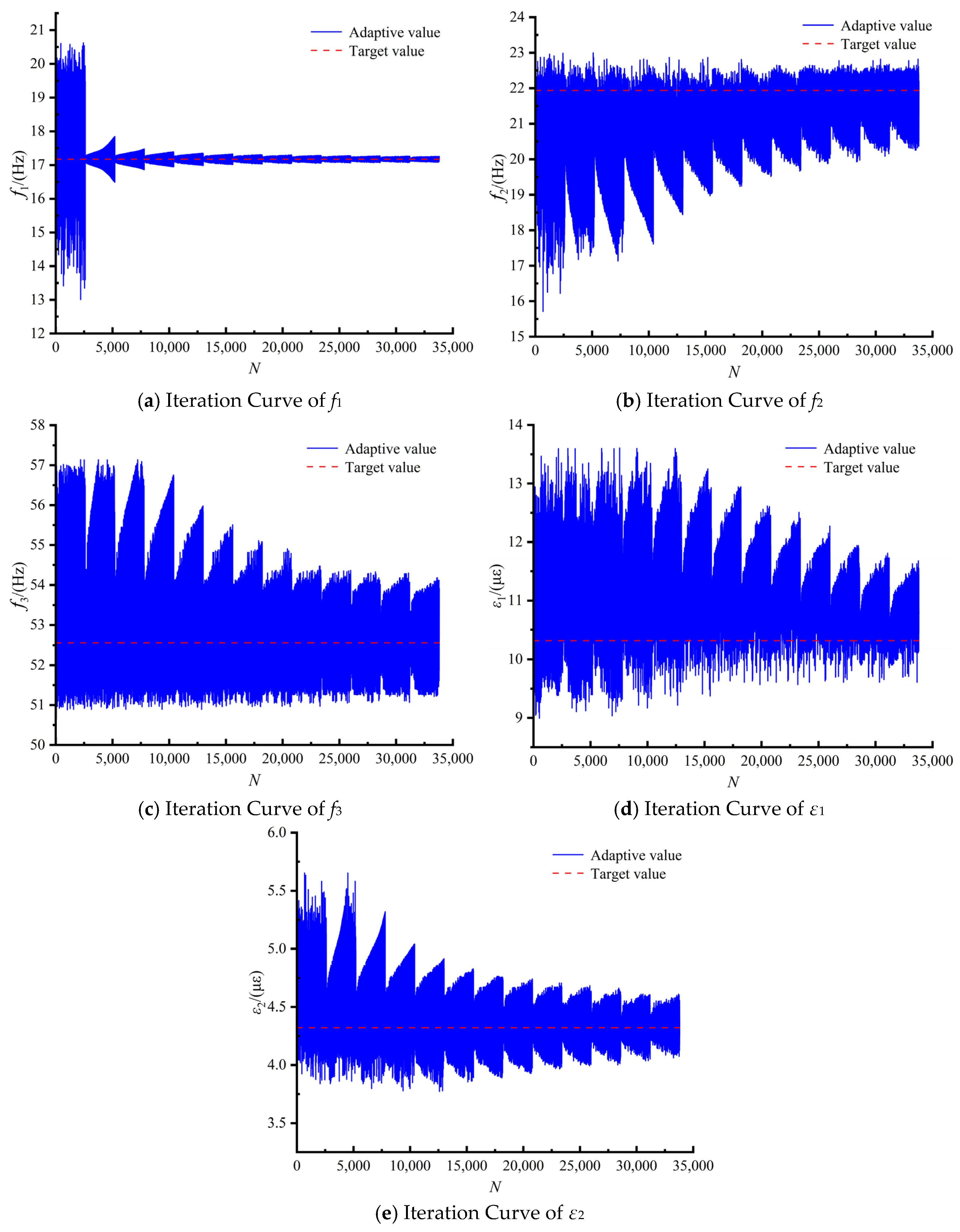
The optimization process of the NSGA-III algorithm is illustrated through the iterative evolution of each objective function, as shown in Figure 16.
Based on the iteration curves shown in Figure 16, it can be observed that the optimization process involved 13 iterations and 32,800 evaluations. In the early stages, the fitness values fluctuated significantly, likely due to the model’s sensitivity to initial conditions. During the initial phase of the optimization process, the system continuously adjusted the initial parameters to find the optimal solution, leading to fluctuations in the fitness values. However, as the number of iterations increased, the fitness values gradually stabilized, with fluctuations converging near the target value, indicating good convergence of the system and confirming the effectiveness of the optimization process in steadily adjusting the structural parameters.
Specifically, the optimization target f1 converged after 5 iterations, suggesting that this target is relatively straightforward to optimize with minimal conflict with other objectives, allowing it to quickly reach the desired target value. The optimization target f3 converged after 8 iterations, which, although requiring more iterations than f1, also showed good convergence. This is likely due to the lower level of conflict between f3 and other optimization objectives, allowing it to reach an optimal value more independently.
In contrast, the optimization of the local strain targets ε1 and ε2 showed slower convergence. This may be due to the complex mechanical characteristics of the strain response, such as changes in local geometric shapes, which require more iterations to optimize. This indicates that these two optimization targets are more likely to conflict with others. From the trends in the iteration curves, it is evident that the relative errors of f1 and f3 are smaller, and they converge more quickly, indicating that these two optimization targets face less conflict with other objectives, making the optimization process easier to achieve. In synchronous optimization, the stronger coordination between the f1 and f3 optimization targets and other objectives enables them to converge more rapidly.
Furthermore, the convergence of the fitness values reflects the gradual adjustment and optimization of the model’s initial conditions. As the coordination between objectives increases during the optimization process, the fitness values gradually converge and eventually stabilize. This not only demonstrates the efficiency of the NSGA-III algorithm in solving complex multi-parameter optimization problems for structural systems but also further validates the robustness of the method.
The updated parameter values obtained after optimization are summarized in Table 7.
As shown in Table 7, the updated parameters exhibit noticeable deviations from their initial values. To verify the geometric parameters involved in the updating process, an ultrasonic thickness gauge was used to measure the wall thickness of the horizontal braces and Main piles. For each structural member, 12 measurement points were selected, and the locations of these points are illustrated in Figure 17.
As shown in Figure 17, three cross sections were selected along the length of each member, and one measurement point was taken at every 90° interval along each section. The average wall thickness of the four members was then calculated, and the updated wall thickness values were compared with the measured averages, as summarized in Table 8.
According to Table 8, the maximum relative error between the updated wall thickness values and the measured values is 1.85%, indicating that the updated structural parameters are consistent with those of the actual physical structure.
To compare the effectiveness of the updating strategies, a stepwise updating approach was also employed in this study. First, the first three natural frequencies of the structure were updated based on vibration testing data, followed by the updating of local parameters using strain testing data. This process continued using the GARS-NSGA-III method for stepwise optimization of the indoor jacket structure’s finite element model. Table 9 summarizes the specific values of the validation metrics after both synchronous and stepwise updating.
According to the FE model updating results of the indoor jacket structure presented in Table 9, the synchronous updating strategy demonstrates significant advantages over the stepwise updating strategy in most cases, with all validation metrics showing relatively low post-update errors. Specifically, the errors for f1, f2, and f3 were reduced from 3.44%, −7.31%, and 5.88% to −0.02%, 0.43%, and 0.08%, respectively. Similarly, the errors for ε1 and ε2 decreased from 10.33% and 12.96% to 2.1% and 1.4%, respectively. In contrast, after applying the stepwise updating strategy, the errors for f1, f2, f3, ε1, and ε2 were 12.36%, −2.14%, 2.13%, 1.7%, and 0.23%, respectively. While the correction of local strains yielded better results with the stepwise approach, the correction errors for the first three natural frequencies were larger, with the error for the first mode reaching as high as 12.36%, which is even worse than the pre-correction error. This suggests that the subsequent correction steps interfered with the results from previous steps. The synchronous updating strategy not only significantly improved the overall accuracy of the FE model but also effectively coordinated the conflicts between different updating objectives. Notably, during the synchronous optimization process, the relative errors for f1 and f3 were smaller. The iteration curves show that these two optimization objectives converged more easily, indicating that they are more easily aligned with the expected target values.


5. Conclusions

Jacket structures typically consist of a large number of tubular members, complex geometric configurations, and special boundary conditions. As a result, FE models developed directly from geometric information often exhibit significant discrepancies from experimentally measured responses, making it difficult to meet engineering accuracy requirements. In this study, a scaled laboratory model of a jacket structure from a specific offshore region was constructed, and its FE model was updated through simultaneous updating of multiple parameters using multi-source experimental data. The main conclusions are as follows:
A multi-source data–driven FE model updating method for jacket structures based on GARS–NSGA-III is proposed. Using the genetic aggregated response surface (GARS) model, the prediction accuracy of all validation metrics is significantly superior to any single type of response surface when the same number of samples is used, effectively improving the fitting accuracy and reliability of the surrogate model. Coupled with the NSGA-III optimization algorithm, the method enables coordinated optimization of multiple updating objectives, including global boundary stiffness and local structural parameters, substantially improving the efficiency and global convergence of multi-parameter updating for jacket structures.
The synchronous updating of 10 parameters, including the global constrained stiffness of the jacket platform model, wall thicknesses of the jacket legs, thickness of horizontal bracing walls, and elastic modulus, was performed. Results show that the errors of the first three natural frequencies were reduced from 3.44%, −7.31%, and 5.88% to −0.02%, −0.43%, and 0.08%, respectively, while the strain errors in the two local regions decreased from 10.33% and 12.96% to 2.1% and 1.4%. No significant conflicts were observed among the multiple objectives. Further validation using ultrasonic wall-thickness measurements confirmed that the discrepancies between updated geometric parameters and actual measurements were within 1.85%. These findings demonstrate that the proposed method achieves coordinated multi-objective updating with high engineering applicability and accuracy, making it suitable for FE model updating of in-service jacket structures.
Overall, the results of this study demonstrate that the proposed multi-source synchronous updating strategy achieves high accuracy and robustness in finite element model updating, making it highly suitable for the evaluation and updating of jacket structures. However, there are certain limitations in this study. First, the experimental model is a simplified scaled version, whose dynamic response primarily reflects the trend characteristics of the actual structure and cannot be directly extrapolated to full-scale structures with high precision. Second, the bottom boundary is modeled using linear springs, which can capture stiffness variations but fail to account for the nonlinear behavior of the actual pile-soil interaction. Furthermore, the analysis does not explicitly consider structural damping effects and complex stochastic ocean wave loads, while the dynamic response in real marine environments is more random and nonlinear. Although the GARS-NSGA-III method improves the accuracy of the updates, its high computational cost may limit its direct application in large-scale engineering projects. Future research will focus on addressing these limitations: incorporating nonlinear pile-soil interaction models, considering random time-varying ocean wave loads and damping effects to improve the realism of environmental and boundary conditions; systematically comparing the performance of different surrogate models in terms of accuracy and efficiency to further optimize the computational process; and integrating validation with actual structures or long-term field monitoring data to facilitate the transition of this method to practical marine engineering applications.

Author Contributions

J.S.: Writing—review and editing, Writing—original draft, Methodology, J.L.: Supervision, Methodology, Conceptualization, H.F.: Data curation, J.P.: Visualization, Writing—review and editing, K.K.: Visualization, Y.S.: Investigation. All authors have read and agreed to the published version of the manuscript.

Funding

This work was supported by the Heilongjiang Provincial Natural Science Foundation of China (Grant No. LH2024C125), Basic Scientific Research Project of Heilongjiang Provincial Universities (Grant No. 145209210), and the Basic Scientific Research Project of Heilongjiang Provincial Universities (Grant No. 145409210).

Data Availability Statement

The data that support the findings of this study are available upon reasonable request from the authors.

Conflicts of Interest

The authors declare no conflict of interest.

Nomenclature

ACross-sectional area D The training set intended for response surface generation
d ( g , z r ) The vertical distance between individuals in the population and each reference point d i The difference between the ranks of the two variables after sorting
EElastic modulus f ^ i The i-th base response surface
f ^ GA Response surface constructed through the genetic aggregation process HThe number of divisions in the objective space
f i Exp The corresponding i-th natural frequency obtained from experiments f i FE ( x ) The i-th natural frequency computed from the FE model
IzzThe sectional moment of inertiaKBoundary spring stiffness
MThe number of optimization objectives M R Base Response Surface Candidate Library
mThe number of basis functions N r The number of reference points.
nthe number of samplesPtThe initial parent population
Pt+1The next-generation parent populationQtThe child population
R f The FE prediction R m The experimentally measured value
RtThe combined populationTdThe wall thickness of the main pile
THThe wall thickness of the horizontal inclined braceTVThe wall thickness of the vertical inclined brace
w m , w i The weight coefficientsxThe decision vector
z r The set of reference points within the target space θ ^ m The hyperparameters of the m-th basis response surface
θ m The hyperparameter vector δ The relative error
ε j FE ( x ) The strain value at the j-th measurement point calculated by the FE model ε j Exp The experimentally measured strain at the same point
ρ The correlation coefficient

References

  1. Su, X.; Zhang, Q.; Li, Y.; Huang, Y.; Jia, Z. Damage identification of a jacket platform based on a hybrid deep learning framework. Struct. Health Monit. 2025, 24, 1700–1724. [Google Scholar]
  2. Li, Y.; Su, X.; Zhang, Q.; Huang, Y.; Jia, Z. Model Updating Method for Jacket Platform Considering Different Component Degradation Based on Deep Learning. Int. J. Struct. Stab. Dyn. 2024, 24, 2450070. [Google Scholar] [CrossRef]
  3. Sha, J.; Leng, J.; Mao, H.; Pei, J.; Diao, K. Research Progress in Predictive Maintenance of Offshore Platform Structures Based on Digital Twin Technology. J. Mar. Sci. Appl. 2025, 24, 877–899. [Google Scholar] [CrossRef]
  4. Hosseinlou, F. Structural model updating of jacket platform by control theory using vibration measurement approach. China Ocean Eng. 2021, 35, 96–106. [Google Scholar] [CrossRef]
  5. Brando, G.; Distefano, F.; Di Carolo, F.; Crupi, V.; Epasto, G.; Galietti, U. Dissimilar Welded Joints and Sustainable Materials for Ship Structures. J. Mar. Sci. Eng. 2025, 13, 2296. [Google Scholar] [CrossRef]
  6. Fu, S.; Chen, H.; Lv, G.E.; Jia, X.; Li, X. Experimental and Numerical Research on p-y Curve of Offshore Photovoltaic Pile Foundations on Sandy Soil Foundation. J. Mar. Sci. Eng. 2025, 13, 1959. [Google Scholar] [CrossRef]
  7. Sehgal, S.; Kumar, H. Structural dynamic model updating techniques: A state of the art review. Arch. Comput. Methods Eng. 2016, 23, 515–533. [Google Scholar] [CrossRef]
  8. Baybordi, S.; Esfandiari, A. Damage detection and model updating of offshore jacket platforms using a direct sensitivity relation based on structural response. Appl. Ocean Res. 2024, 149, 104068. [Google Scholar] [CrossRef]
  9. Ereiz, S.; Duvnjak, I.; Fernando Jiménez-Alonso, J. Review of finite element model updating methods for structural applications. Structures 2022, 41, 684–723. [Google Scholar] [CrossRef]
  10. Song, X.; Lv, L.; Sun, W.; Zhang, J. A radial basis function-based multi-fidelity surrogate model: Exploring correlation between high-fidelity and low-fidelity models. Struct. Multidiscip. Optim. 2019, 60, 965–981. [Google Scholar] [CrossRef]
  11. Ren, Y.; Huang, M.; Hao, J.; Wang, J.; Li, S.; Zhu, L.; Zhao, H.; Shi, W. Local Structure Optimization Design of Floating Offshore Wind Turbine Platform Based on Response Surface Analysis. Energies 2024, 17, 6316. [Google Scholar] [CrossRef]
  12. Wang, J.; Chen, X.; Sun, K.; Ji, S. Far-field identification of ice loads on ship structures by radial basis function neural network. Ocean Eng. 2023, 282, 115072. [Google Scholar] [CrossRef]
  13. Quevedo-Reina, R.; Álamo, G.M.; Aznárez, J.J. ANN-based surrogate model for the structural evaluation of jacket support structures for offshore wind turbines. Ocean Eng. 2025, 317, 119984. [Google Scholar] [CrossRef]
  14. Jia, Z.; Dai, S.; Fan, Z.; Jia, S.; Su, X.; Wang, Y. Model updating method for offshore jacket platforms using improved DNN and OOA considering non-uniform corrosion and structural responses. Struct. Health Monit. 2025, 215269511. [Google Scholar] [CrossRef]
  15. Leng, J.; Mao, H.; Diao, K.; Feng, H. Real-Time Prediction of Stress Response of Tubular Joints on the Jacket Platform Using a Reduced-Order Model. China Ocean Eng. 2025, 39, 13–26. [Google Scholar] [CrossRef]
  16. Kudela, J.; Matousek, R. Recent advances and applications of surrogate models for finite element method computations: A review. Soft Comput. 2022, 26, 13709–13733. [Google Scholar] [CrossRef]
  17. Mojtahedi, A.; Hokmabady, H.; Yaghubzadeh, A.; Mohammadyzadeh, S. An improved model reduction-modal based method for model updating and health monitoring of an offshore jacket-type platform. Ocean Eng. 2020, 209, 107495. [Google Scholar] [CrossRef]
  18. Tygesen, U.T.; Jepsen, M.S.; Vestermark, J.; Dollerup, N.; Pedersen, A. The True Digital Twin Concept for Fatigue Re-Assessment of Marine Structures. In Proceedings of the ASME 2018 37th International Conference on Ocean, Offshore and Arctic Engineering, Madrid, Spain, 17–22 June 2018. [Google Scholar]
  19. Pitchforth, D.J.; Rogers, T.J.; Tygesen, U.T.; Cross, E.J. Grey-box models for wave loading prediction. Mech. Syst. Signal Process. 2021, 159, 107741. [Google Scholar] [CrossRef]
  20. Hokmabady, H.; Mojtahedi, A.; Mohammadyzadeh, S. Uncertainty analysis of an offshore jacket-type platform using a developed numerical model updating technique. Ocean Eng. 2020, 211, 107608. [Google Scholar] [CrossRef]
  21. Yan, T.; Wang, W.; Zhao, H.; Zhou, G. Development of structure monitoring systems and digital twin technology of active jacket platforms. China Mech. Eng. 2021, 32, 2508. [Google Scholar]
  22. Sharma, S.; Kumar, V. A Comprehensive Review on Multi-objective Optimization Techniques: Past, Present and Future. Arch. Comput. Methods Eng. 2022, 29, 5605–5633. [Google Scholar] [CrossRef]
  23. Konak, A.; Coit, D.W.; Smith, A.E. Multi-objective optimization using genetic algorithms: A tutorial. Reliab. Eng. Syst. Saf. 2006, 91, 992–1007. [Google Scholar] [CrossRef]
  24. Cui, Z.; Chang, Y.; Zhang, J.; Cai, X.; Zhang, W. Improved NSGA-III with selection-and-elimination operator. Swarm Evol. Comput. 2019, 49, 23–33. [Google Scholar] [CrossRef]
  25. Wang, H.; Ran, Q.; Ma, G.; Wen, J.; Zhang, J.; Zhou, S. Optimization design of floating offshore wind turbine mooring system based on DNN and NSGA-III. Ocean Eng. 2025, 316, 119915. [Google Scholar] [CrossRef]
  26. Li, Z.; Wang, K.; Hua, Y.; Liu, X.; Ma, R.; Wang, Z.; Huang, L. GA-LSTM and NSGA-III based collaborative optimization of ship energy efficiency for low-carbon shipping. Ocean Eng. 2024, 312, 119190. [Google Scholar] [CrossRef]
  27. Dong, Z.; Luo, W. Ship pipe route design based on NSGA-III and multi-population parallel evolution. Ocean Eng. 2024, 293, 116666. [Google Scholar] [CrossRef]
  28. Augustyn, D.; Smolka, U.; Tygesen, U.T.; Ulriksen, M.D.; Sørensen, J.D. Data-driven model updating of an offshore wind jacket substructure. Appl. Ocean Res. 2020, 104, 102366. [Google Scholar] [CrossRef]
Figure 1. FE Model Updating Procedure for Jacket Structures Based on the GARS–NSGA-III Framework.
Jmse 14 00072 g001
Figure 2. Indoor jacket structure.
Jmse 14 00072 g002
Figure 3. Connection Diagram of the Experimental Setup for the Indoor Jacket Structure.
Jmse 14 00072 g003
Figure 4. Raw Acceleration Time-History Signals.
Jmse 14 00072 g004
Figure 5. Raw Strain Time-History Signals.
Jmse 14 00072 g005
Figure 6. Preprocessed Acceleration Time-History Signals.
Jmse 14 00072 g006
Figure 7. Frequency Spectrum of the Measured Acceleration Response.
Jmse 14 00072 g007
Figure 8. Preprocessed Strain Time-History Signals.
Jmse 14 00072 g008
Figure 9. FE Model of the Indoor Jacket Structure.
Jmse 14 00072 g009
Figure 10. First Three Mode Shapes of the Indoor Jacket Structure.
Jmse 14 00072 g010
Figure 11. Strain Distribution of the Structure in the Test Area.
Jmse 14 00072 g011
Figure 12. Sensitivity Analysis Results.
Jmse 14 00072 g012
Figure 13. Scatter Matrix of Latin Hypercube Sampling for Updating Parameters.
Jmse 14 00072 g013
Figure 14. Response Surfaces of the Surrogate Models.
Jmse 14 00072 g014
Figure 15. Flowchart of the NSGA-III Algorithm.
Jmse 14 00072 g015
Figure 16. Convergence Iteration Curves for Each Updating Objective.
Jmse 14 00072 g016
Figure 17. Wall Thickness Measurement Points of Structural Members.
Jmse 14 00072 g017
Table 1. Geometric size table of the indoor jacket structure.
LocationHeight/mmPart NameSize/mmMaterial
The first floor205Horizontal transverse braceΦ20 × 2Steel 20 (Tianye Special Steel Co., Ltd., Liaocheng, China)
Horizontal inclined braceΦ20 × 2
Vertical inclined braceΦ16 × 2
Main pileΦ34 × 2
The second floor760Horizontal transverse braceΦ20 × 2
Vertical inclined braceΦ16 × 2
Main pileΦ34 × 2
The third floor725Horizontal transverse braceΦ20 × 2
Horizontal inclined braceΦ14 × 2
Vertical inclined braceΦ16 × 2
Main pileΦ34 × 2
The fourth floor500Horizontal transverse braceΦ20 × 2
Vertical inclined braceΦ14 × 2
Main pileΦ34 × 2
Table 2. Sensor parameter information table.
TypeRangeSensitivityExcitation Voltage
Accelerometer±5 g400 mV/g±2 V
Strain Transducer±4000 µε500 µε/mV1~10 V
Table 3. Natural frequency of the indoor jacket platform structure.
Modal OrderFirst-OrderSecond-OrderThird-Order
Frequency/Hz17.7620.3455.65
Table 4. Computational Errors of the FE Model.
Verification MetricExperimental Value FE Simulation ValueRelative Error
f117.17 Hz17.76 Hz3.44%
f221.94 Hz20.34 Hz−7.29%
f352.56 Hz55.65 Hz5.87%
ε110.26 με11.32 με10.33%
ε14.32 με4.88 με12.96%
Table 5. Parameter Ranges for Model Updating.
Updating ParameterLower BoundUpper BoundInitial Value
Elastic modulus of horizontal brace E11.8 × 1011 Pa2.2 × 1011 Pa2.06 × 1011 Pa
Elastic modulus of horizontal brace E21.8 × 1011 Pa2.2 × 1011 Pa2.06 × 1011 Pa
Wall thickness of horizontal brace b11.75 mm2.25 mm2 mm
Wall thickness of horizontal brace b21.75 mm2.25 mm2 mm
Wall thickness of jacket leg (Floor 3) b31.75 mm2.25 mm2 mm
Wall thickness of jacket leg (Floor 4) b41.75 mm2.25 mm2 mm
Boundary stiffness K11 × 106 N/m1 × 108 N/m2 × 107 N/m
Boundary stiffness K21 × 106 N/m1 × 108 N/m1 × 107 N/m
Boundary stiffness K31 × 106 N/m1 × 108 N/m2 × 107 N/m
Boundary stiffness K41 × 106 N/m1 × 108 N/m1 × 107 N/m
Table 6. Comparison of Prediction Accuracy Among Different Response Surface Models.
Evaluation MetricOutput ResponseResponse Surface Type
GARSKriging2nd Order PolynomialsNon-Parametric Regression
RMSEf15.81 × 10−82.69 × 10−40.0980.071
f23.53 × 10−80.0190.1460.067
f32.70 × 10−103.35 × 10−43.27 × 10−30.059
ε16.21 × 10−103.57 × 10−84.92 × 10−83.80 × 10⁻⁷
ε27.93 × 10−105.21 × 10−85.67 × 10−87.01 × 10⁻⁷
MSEf13.38 × 10−157.24 × 10−89.61 × 10−35.04 × 10⁻³
f21.25 × 10−153.61 × 10−42.13 × 10−24.49 × 10⁻³
f37.29 × 10−201.12 × 10−71.07 × 10−53.48 × 10⁻³
ε13.86 × 10−191.28 × 10−152.42 × 10−151.44 × 10⁻¹³
ε26.29 × 10−192.71 × 10−153.21 × 10−154.91 × 10⁻¹³
MAEf14.11 × 10−81.91 × 10−46.93 × 10−25.02 × 10⁻²
f22.51 × 10−81.34 × 10−20.1034.74 × 10−2
f31.91 × 10−102.37 × 10−42.31 × 10−34.17 × 10⁻²
ε14.39 × 10−102.52 × 10−83.48 × 10−82.69 × 10⁻⁷
ε25.61 × 10−103.68 × 10−84.01 × 10−84.96 × 10⁻⁷
Table 7. Comparison of Parameters Before and After Updating.
Updating ParametersInitial ValueUpdated Value
E12.06 × 1011 Pa2.15 × 1011 Pa
E22.06 × 1011 Pa2.16 × 1011 Pa
b12 mm2.11 mm
b22 mm2.20 mm
b32 mm2.07 mm
b42 mm2.11 mm
K12 × 107 N/m2.07 × 107 N/m
K21 × 107 N/m1.13 × 107 N/m
K32 × 107 N/m2.40 × 107 N/m
K41 × 107 N/m1.09 × 107 N/m
Table 8. Comparison of Updated and Measured Wall Thicknesses of Structural Members.
Member LocationMeasured Mean ValueUpdated ValueRelative Error
Horizontal brace on the floor 32.13 mm2.11 mm−0.94%
Horizontal brace on the floor 42.16 mm2.20 mm1.85%
Main pile on the floor 32.10 mm2.07 mm−1.42%
Main pile on the floor 42.12 mm2.11 mm0.47%
Table 9. Updated Results of the Indoor Jacket Structure.
Verification MetricMeasured ValueComputed Value δ
Before UpdatedSynchronous UpdatedStepwise UpdatedBefore UpdatedSynchronous UpdatedStepwise Updated
f117.17 Hz17.761 Hz17.167 Hz19.292 Hz3.44%−0.02%12.36%
f221.94 Hz20.336 Hz22.035 Hz21.47 Hz−7.31%0.43%−2.14%
f352.56 Hz55.652 Hz52.601 Hz53.682 Hz5.88%0.08%2.13%
ε110.26 με11.32 με10.48 με10.44 με10.33%2.1%1.7%
ε24.32 με4.88 με4.38 με4.33 με12.96%1.4%0.23%
Disclaimer/Publisher’s Note: The statements, opinions and data contained in all publications are solely those of the individual author(s) and contributor(s) and not of MDPI and/or the editor(s). MDPI and/or the editor(s) disclaim responsibility for any injury to people or property resulting from any ideas, methods, instructions or products referred to in the content.