Past and Future Changes in Sea Ice in the Sea of Okhotsk: Analysis Using the Future Ocean Regional Projection Dataset

Abstract
1. Introduction
2. Materials and Methods
3. Results
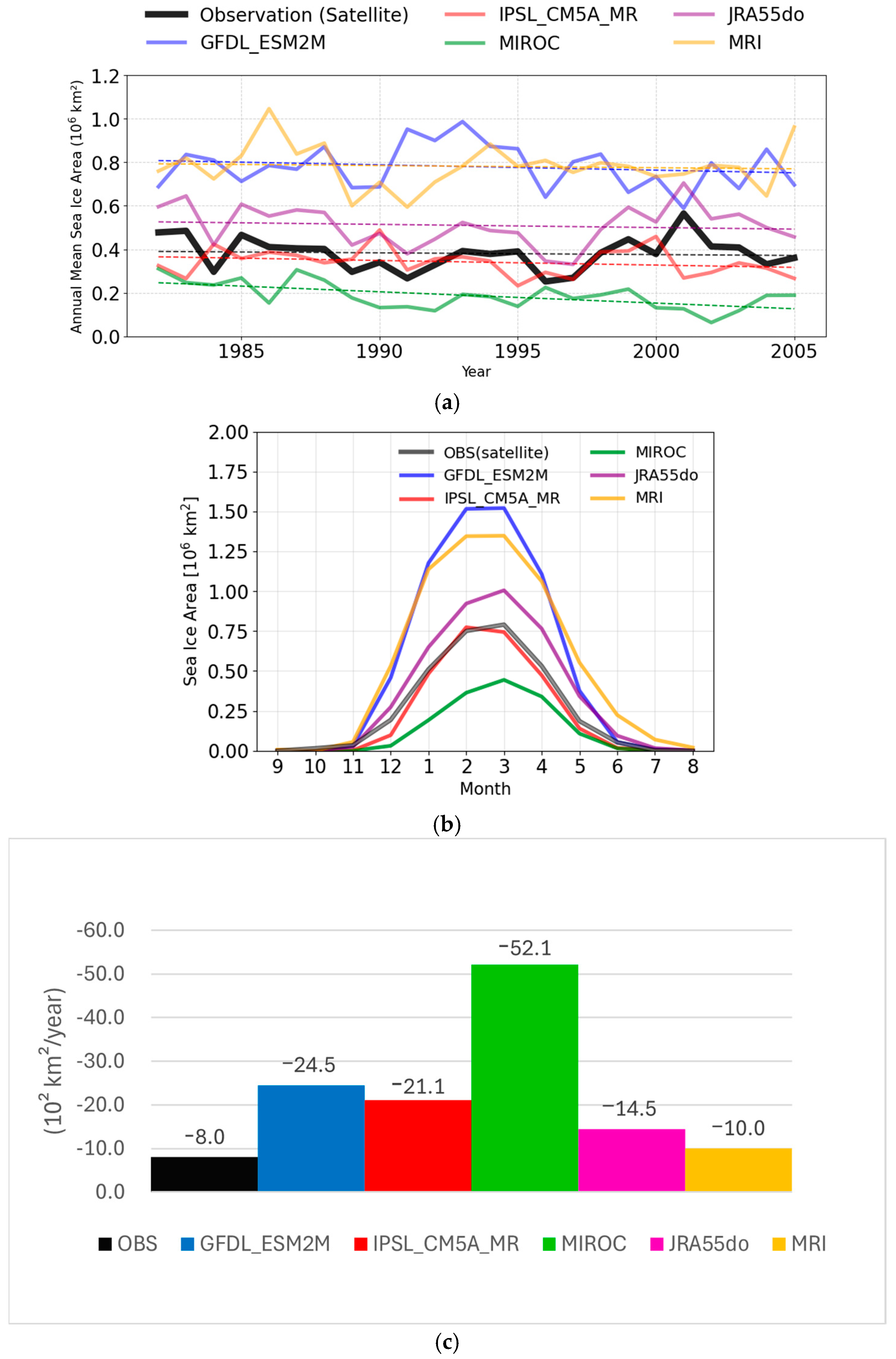
3.1. Historical Model
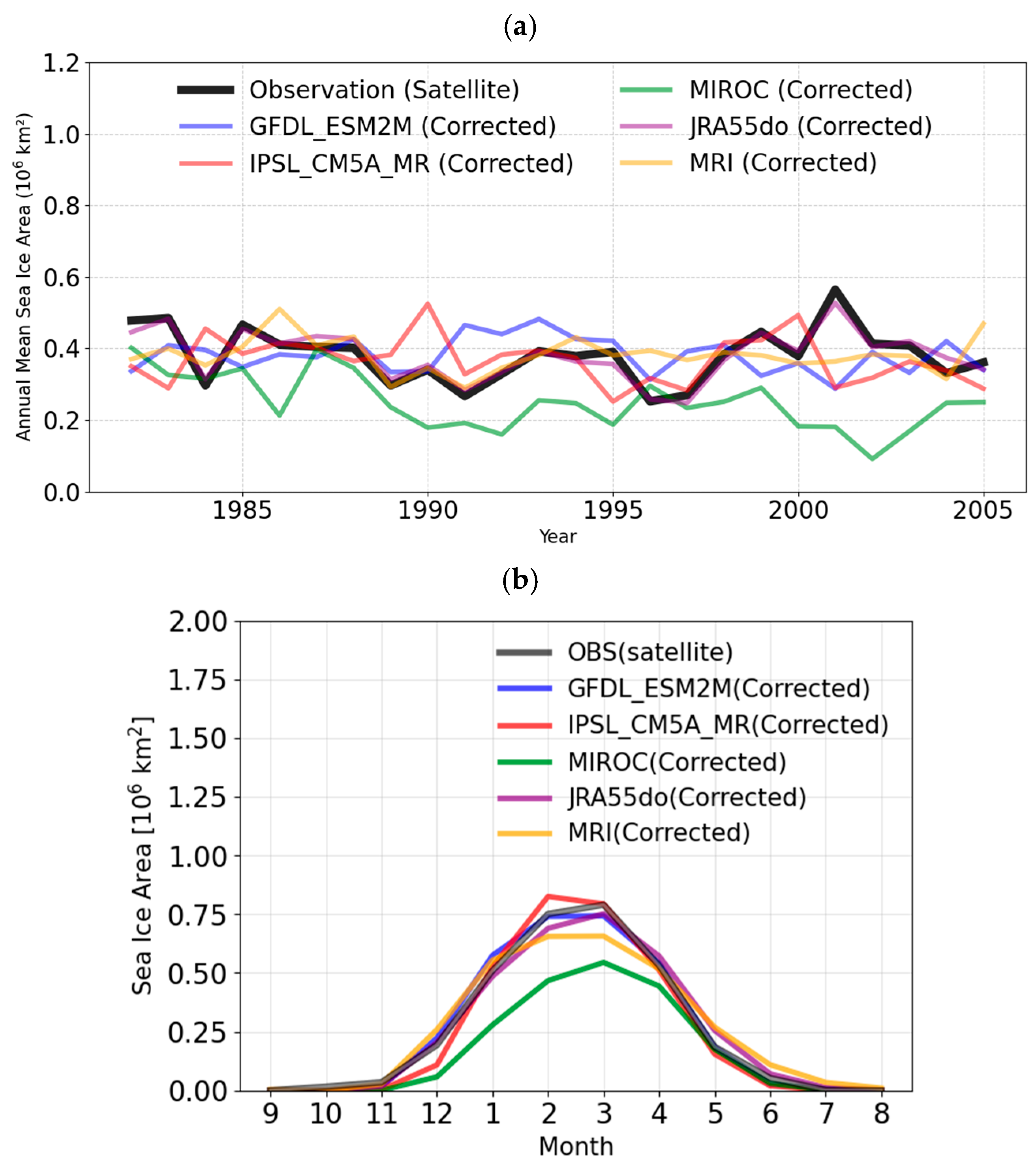
3.2. Bias Correction
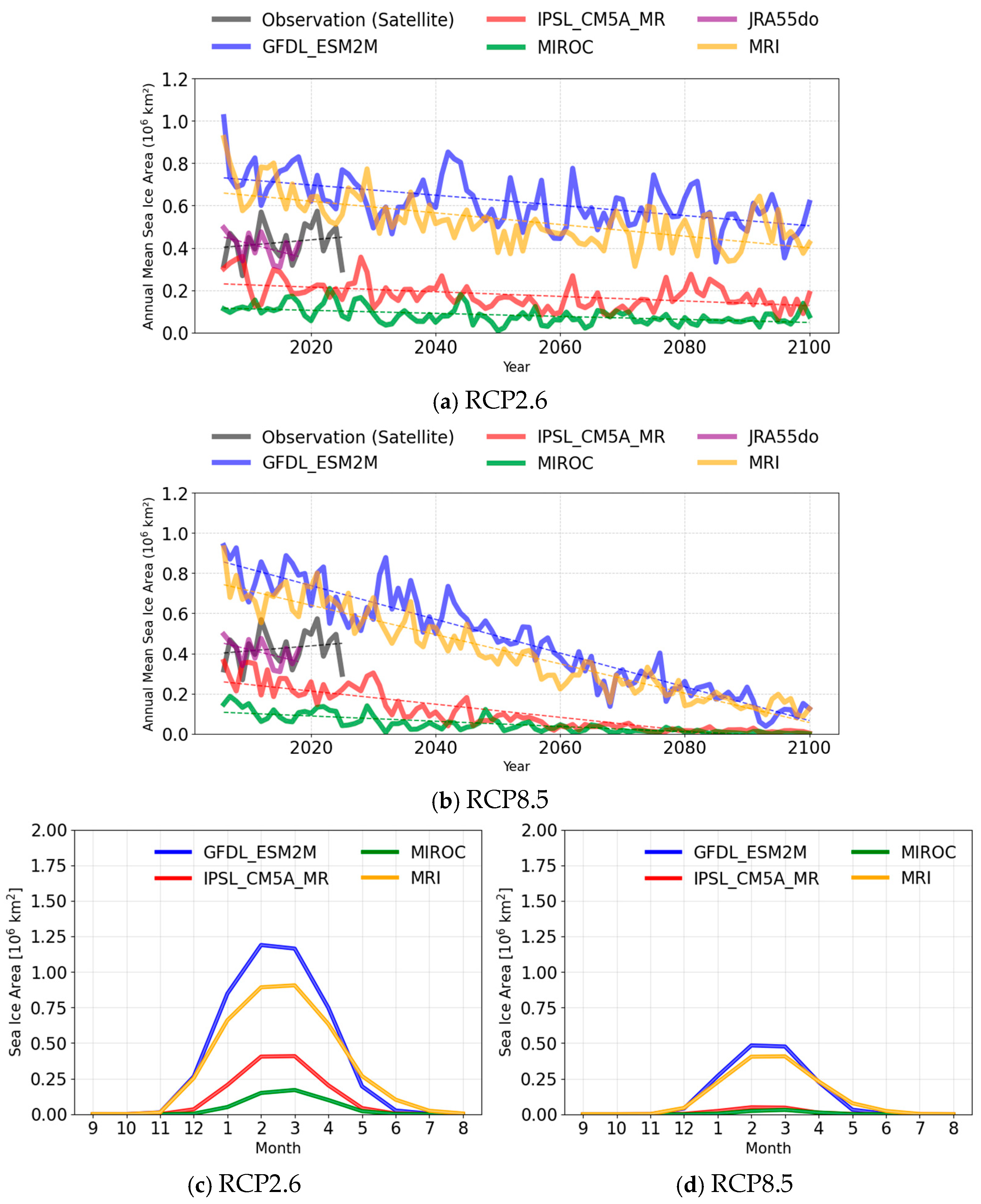
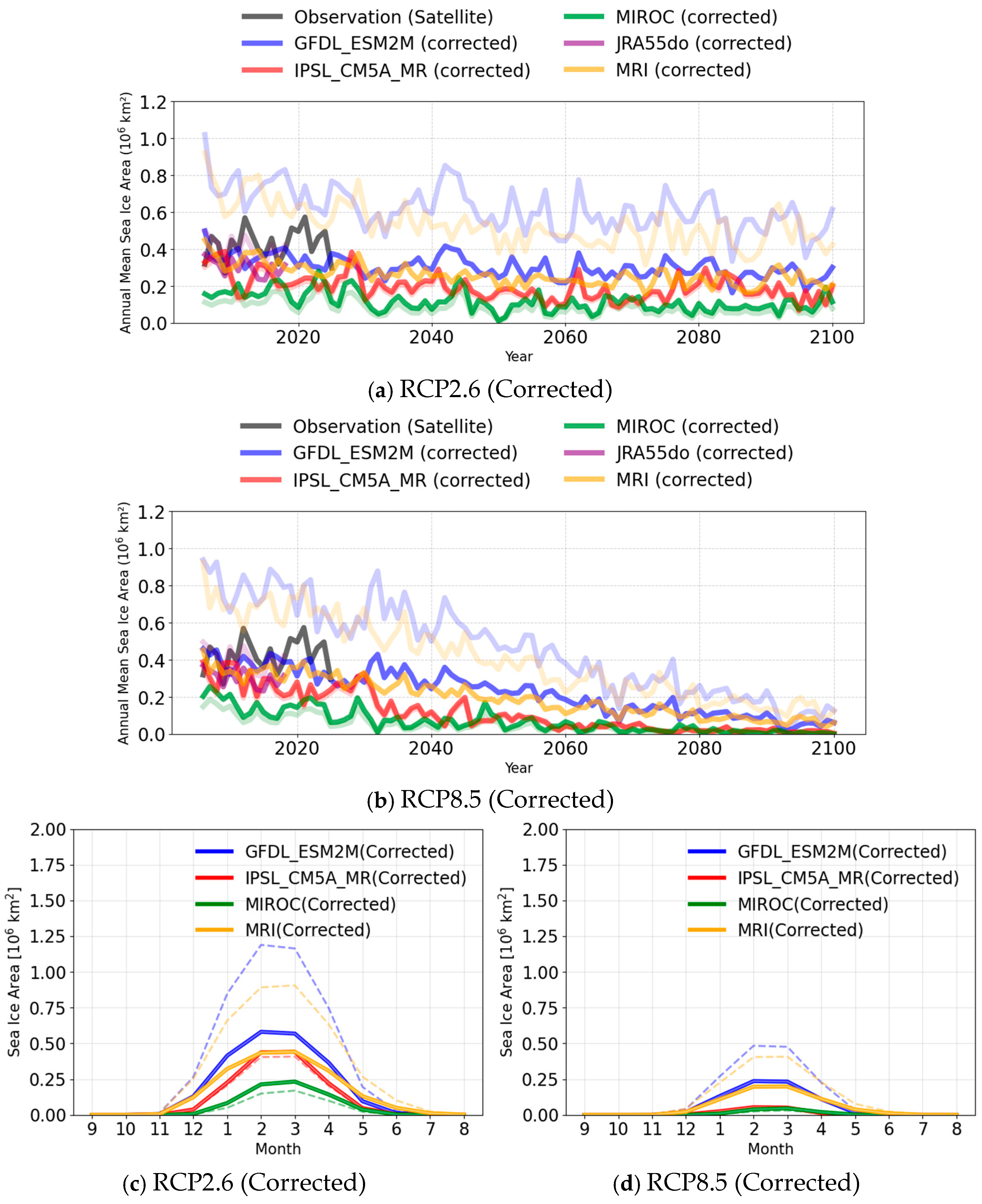
3.3. Future Forecast (Original and Corrected)
4. Discussion
5. Conclusions
Supplementary Materials
Author Contributions
Funding
Data Availability Statement
Conflicts of Interest
Correction Statement
References
- Moon, W.; Wettlaufer, J.S. On the nature of the sea ice albedo feedback in simple models. J. Geophys. Res. Oceans 2014, 119, 5555–5562. [Google Scholar] [CrossRef] [PubMed]
- Rysgaard, S.; Bendtsen, J.; Delille, B.; Dieckmann, G.S.; Glud, R.N.; Kennedy, H.; Mortensen, J.; Papdimitriou, S.; Thomas, D.N.; Tison, J.L. Sea-ice contribution to the air–sea CO2 exchange in the Arctic and Southern Oceans. Tellus B 2011, 63B, 823–830. [Google Scholar] [CrossRef]
- Iwasaki, S. Role of sea ice on winter wave power and its interannual variability in the Sea of Okhotsk: Natural breakwater modified by surface wind changes. Prog. Oceanogr. 2022, 210, 102944. [Google Scholar] [CrossRef]
- Cavalieri, D.J.; Parkinson, C.L. On the relationship between atmospheric circulation and the fluctuations in the sea ice extents of the Bering and Okhotsk seas. J. Geophys. Res. Oceans 1987, 92, 141–7162. [Google Scholar] [CrossRef]
- Pishchalnik, V.M.; Truskov, P.A.; Romanyuk, V.A.; Minervin, I.G. Interannual variability of ice volume in the sea of Okhotsk during the maximum development of ice extent for 2000–2020. Cold Reg. Sci. Technol. 2021, 189, 103326. [Google Scholar] [CrossRef]
- Ministry of Education, Culture, Sports, Science and Technology (MEXT); Japan Meteorological Agency (JMA). Climate Change in Japan 2020: Latest Scientific Findings and Future Outlook; MEXT: Tokyo, Japan; JMA: Tokyo, Japan, 2020; Available online: https://www.data.jma.go.jp/cpdinfo/ccj/2020/pdf/cc2020_gaiyo_en.pdf (accessed on 4 December 2025).
- Iwasaki, S. Increase in the wave power caused by decreasing sea ice over the Sea of Okhotsk in winter. Sci. Rep. 2023, 13, 2539. [Google Scholar] [CrossRef] [PubMed]
- Myslenkov, S.A.; Kruglova, E.E.; Medvedeva, A.Y.; Silvestrova, K.P.; Arkhipkin, V.S.; Akpinar, A.; Dobrolyubov, S.A. Number of Storms in Several Russian Seas: Trends and Connection to Large-Scale Atmospheric Indices. Russ. J. Earth Sci. 2023, 23, 1–31. [Google Scholar] [CrossRef]
- Nishikawa, S.; Wakamatsu, T.; Ishizaki, H.; Sakamoto, K.; Tanaka, Y.; Tsujino, H.; Yamanaka, G.; Kamachi, M.; Ishikawa, Y. Development of high-resolution future ocean regional projection datasets for coastal applications in Japan. Prog. Earth Planet. Sci. 2021, 8, 7. [Google Scholar] [CrossRef]
- Japan Meteorological Agency (JMA); Meteorological Research Institute (MRI). Future Ocean Regional Projection (FORP) Dataset, North Pacific 10 km Version 4 (FORP_NP10_v4); Data Integration and Analysis System (DIAS): Tokyo, Japan, 2024; Available online: https://search.diasjp.net/ja/dataset/FORP_NP10_version4 (accessed on 4 December 2025).
- Japan Meteorological Agency (JMA); Meteorological Research Institute (MRI). Future Ocean Regional Projection (FORP) Dataset, North Pacific 10 km Version 4.5 (FORP_NP10_v4_5); Data Integration and Analysis System (DIAS): Tokyo, Japan, 2024; Available online: https://search.diasjp.net/ja/dataset/FORP_NP10_version4_5 (accessed on 4 December 2025).
- Taylor, K.E.; Stouffer, R.J.; Meehl, G.A. An overview of cmip5 and the experiment design. Bull. Am. Meteorol. Soc. 2012, 93, 485–498. [Google Scholar] [CrossRef]
- Tsujino, H.; Urakawa, S.; Nakano, H.; Toyoda, T.; Fujii, Y.; Aita, M.N.; Nakaoka, S.; Nishikawa, S.; Sakamoto, K.; Yamanaka, G. Reference Manual for the Meteorological Research Institute Community Ocean Model Version 4 (MRI.COMv4); Technical Reports of the Meteorological Research Institute; Meteorological Research Institute: Tsukuba, Japan, 2017; Volume 80, pp. 1–69. [Google Scholar] [CrossRef]
- Watanabe, M.; Suzuki, T.; O’Ishi, R.; Komuro, Y.; Watanabe, S.; Emori, S.; Takemura, T.; Chikira, M.; Ogura, T.; Sekiguchi, M.; et al. Improved climate simulation by MIROC5: Mean states, variability, and climate sensitivity. J. Clim. 2010, 23, 6312–6335. [Google Scholar] [CrossRef]
- Yukimoto, S.; Adachi, Y.; Hosaka, M.; Sakami, T.; Yoshimura, H.; Hirabara, M.; Tanaka, T.Y.; Shindo, E.; Tsujino, H.; Deushi, M.; et al. A new global climate model of the Meteorological Research Institute: MRI-CGCM3—Model description and basic performance. J. Meteor. Soc. Jpn. Ser. 2012, 90, 23–64. [Google Scholar] [CrossRef]
- Tsujino, H.; Urakawa, S.; Nakano, H.; Small, R.J.; Kim, W.M.; Yeager, S.G.; Danabasoglu, G.; Suzuki, T.; Bamber, J.L.; Bentsen, M.; et al. JRA-55 based surface dataset for driving ocean–sea-ice models (JRA55-do). Ocean Model. 2018, 130, 79–139. [Google Scholar] [CrossRef]
- Dunne, J.P.; John, J.G.; Adcroft, A.; Griffies, S.M.; Hallberg, R.W.; Shevliakova, E.; Stouffer, R.J.; Cooke, W.; Dunne, K.A.; Harrison, M.J.; et al. GFDL’s ESM2 global coupled carbon–climate Earth System Models. Part I: Physical formulation and baseline simulation characteristics. J. Clim. 2012, 25, 6646–6665. [Google Scholar] [CrossRef]
- Dufresne, J.L.; Foujols, M.A.; Denvil, S.; Caubel, A.; Marti, O.; Aumont, O.; Balkanski, Y.; Bekki, S.; Bellenger, H.; Benshila, R.; et al. Climate change projections using the IPSL-CM5 Earth System Model: From CMIP3 to CMIP5. Clim. Dyn. 2013, 40, 2123–2165. [Google Scholar] [CrossRef]
- Huang, B.; Liu, C.; Banzon, V.; Freeman, E.; Graham, G.; Hankins, B.; Smith, T.; Zhang, H.M. Improvements of the Daily Optimum Interpolation Sea Surface Temperature (DOISST) Version 2.1. J. Clim. 2021, 34, 2923–2939. [Google Scholar] [CrossRef]
- Reynolds, R.W.; Thomas, M.S.; Chunying, L.; Dudley, B.C.; Kenneth, S.C.; Michael, G.S. Daily high-resolution-blended analyses for sea surface temperature. J. Clim. 2007, 20, 5473–5496. [Google Scholar] [CrossRef]
- Kendall, M.G. Rank Correlation Methods; Griffin: London, UK, 1948. [Google Scholar]
- Martin, S.; Drucker, R.; Yamashita, K. The production of ice and dense shelf water in the Okhotsk Sea polynyas. J. Geophys. Res. 1998, 103, 27771–27782. [Google Scholar] [CrossRef]
- Kimura, N.; Wakatsuchi, M. Relationship between sea-ice motion and geostrophic wind in the Northern Hemisphere. Geophys. Res. Lett. 2000, 27, 3735–3738. [Google Scholar] [CrossRef]
- Minervin, I.G.; Romanyuk, V.A.; Pishchal’nik, V.M.; Truskov, P.A.; Pokrashenko, S.A. Zoning the ice cover of the Sea of Okhotsk and the Sea of Japan. Her. Russ. Acad. Sci. 2015, 85, 132–139. [Google Scholar] [CrossRef]



| Model Name | Sea Ice Area [105 (km2)] | RMSE (Original) | Correlation Coefficients | Correction Coefficients | RMSE (Corrected) |
|---|---|---|---|---|---|
| OBS | 3.8 | ||||
| GFDL-ESM2M | 7.8 | 0.42 | −0.29 | 0.49 | 0.10 |
| IPSL-CM5A-MR | 3.4 | 0.11 | −0.10 | 1.12 | 0.11 |
| MIROC5 | 1.9 | 0.21 | 0.17 | 2.04 | 0.16 |
| JRA55-do | 5.1 | 0.13 | 0.96 | 0.75 | 0.02 |
| MRI-CGCM3 | 7.8 | 0.41 | 0.35 | 0.49 | 0.07 |
Disclaimer/Publisher’s Note: The statements, opinions and data contained in all publications are solely those of the individual author(s) and contributor(s) and not of MDPI and/or the editor(s). MDPI and/or the editor(s) disclaim responsibility for any injury to people or property resulting from any ideas, methods, instructions or products referred to in the content. |
© 2025 by the authors. Licensee MDPI, Basel, Switzerland. This article is an open access article distributed under the terms and conditions of the Creative Commons Attribution (CC BY) license.
Share and Cite
Narita, D.; Iwasaki, S. Past and Future Changes in Sea Ice in the Sea of Okhotsk: Analysis Using the Future Ocean Regional Projection Dataset. J. Mar. Sci. Eng. 2026, 14, 52. https://doi.org/10.3390/jmse14010052
Narita D, Iwasaki S. Past and Future Changes in Sea Ice in the Sea of Okhotsk: Analysis Using the Future Ocean Regional Projection Dataset. Journal of Marine Science and Engineering. 2026; 14(1):52. https://doi.org/10.3390/jmse14010052
Chicago/Turabian StyleNarita, Daichi, and Shinsuke Iwasaki. 2026. "Past and Future Changes in Sea Ice in the Sea of Okhotsk: Analysis Using the Future Ocean Regional Projection Dataset" Journal of Marine Science and Engineering 14, no. 1: 52. https://doi.org/10.3390/jmse14010052
APA StyleNarita, D., & Iwasaki, S. (2026). Past and Future Changes in Sea Ice in the Sea of Okhotsk: Analysis Using the Future Ocean Regional Projection Dataset. Journal of Marine Science and Engineering, 14(1), 52. https://doi.org/10.3390/jmse14010052