Article

Research on Risk Assessment and Prevention–Control Measures for Immersed Tunnel Construction in 100 m-Deep Water Environments

1
School of Transportation, Southeast University, Nanjing 211189, China
2
CCCC Second Harbor Engineering Bureau, Wuhan 430014, China
*
Author to whom correspondence should be addressed.
J. Mar. Sci. Eng. 2026, 14(1), 53; https://doi.org/10.3390/jmse14010053 (registering DOI)
Submission received: 23 November 2025 / Revised: 17 December 2025 / Accepted: 26 December 2025 / Published: 27 December 2025
(This article belongs to the Section Ocean Engineering)

Abstract

With the rapid development of cross-sea infrastructure, the immersed tube method has been increasingly applied to deep-water immersed-tube tunnel construction. However, when the construction depth reaches the scale of one hundred meters, issues such as high hydrostatic pressure, complex hydrological conditions, and limited construction windows significantly elevate project risks. Against this backdrop, this study systematically reviews relevant domestic and international research findings in the context of 100-m-deep water environments and constructs a comprehensive risk index system covering the construction processes of the WBS breakdown system based on the WBS-RBS decomposition method within the HSE framework. A risk index weighting analysis combines quantitative and qualitative analysis, categorizing the indicators into qualitative and quantitative categories. Quantitative analysis employs threshold determination and the LEC method; qualitative analysis utilizes expert surveys and the G1 method. Ultimately, a model that combines multiple methods for a 100-m-deep water environment, integrating subjective expertise and objective data, is developed. On this basis, multi-level prevention and control measures are proposed for hundred-meter-deep water-immersed tube construction. The results demonstrate that the proposed system can effectively identify key risk sources under deep-water conditions and provide practical countermeasures, offering significant guidance for ensuring construction safety and engineering quality in hundred-meter immersed-tube tunnel projects.

1. Introduction

With the growing public concern for ecological sustainability and the rapid increase in the tonnage of marine vessels, underwater tunnel construction has experienced remarkable development. As a large-scale and technically complex system engineering project, underwater tunneling presents numerous design and implementation challenges. In recent years, China has made significant progress in immersed tube tunnel technology through landmark projects such as the Hong Kong–Zhuhai–Macao Bridge immersed tunnel and the Dalian Bay Subsea Tunnel. These projects have enabled the country to master key technologies in immersed tube tunnel design and construction [1,2].
However, most existing offshore immersed tube tunnels have a maximum installation depth of only around 60 m. As marine engineering continues to advance toward deeper waters, both domestic and international projects now demand construction at depths approaching one hundred meters. Under such conditions, conventional immersed tube installation techniques are no longer adequate.
Deep-water construction at a depth of about one hundred meters introduces a series of distinct challenges: this depth increases the difficulty of measurement and positioning and complicates the control of floating and sinking operations; complex seabed geology raises the difficulty of geotechnical investigation; hydrological and meteorological variability limits the construction window and elevates safety risks; underwater operations become more difficult as diving work is restricted and joint-connection precision requirements rise; and finally, both equipment and materials must meet high standards of performance and durability to withstand deep-water environments. Therefore, multiple factors must be comprehensively considered, and safety and quality must be ensured through technological innovation and refined management [3,4].
To systematically identify and analyze these risk factors, anticipate potential hazards, and promote technological advancement, a risk-assessment framework can be established to clarify deficiencies and latent hazards in current deep-water construction technologies. Quantifying the severity and likelihood of each risk factor facilitates the implementation of effective safety measures during construction, reducing the probability of accidents and ensuring the safety of both personnel and equipment. Furthermore, such a framework can guide the development of new technologies and construction methods by highlighting key areas for innovation. Establishing a comprehensive risk-assessment system also helps standardize the risk-management process for immersed tube construction, defining the responsibilities and duties of all participants and promoting a more systematic and scientific approach to risk control.

2. Literature Review

To enhance the safety of immersed tube tunnel construction, researchers worldwide have conducted extensive studies on key technologies such as segment joints and pressure grouting. Aikawa et al. [5] systematically reviewed the planning and construction techniques of the Shatin–Central Link immersed-tube railway tunnel in Hong Kong and proposed new approaches to improve construction safety. van Putten and van Os [6] and Olsen et al. [7] concentrated on immersed tube tunnels in soft-soil areas, proposing risk-mitigation strategies for design, construction, and foundation treatment while emphasizing the significance of geotechnical engineering under soft-ground conditions. Ozakgul [8], using the Marmaray Project as a case study, investigated the adverse effects of excavation-induced differential settlement on steel structures and proposed corresponding rehabilitation techniques. Research by Ding et al. [9] demonstrated that under combined N-M and N-M-Q loading, the mechanical behavior of segment joints evolves through three distinct phases: closing, opening, and crack initiation. Zhang et al. [10] formulated a computational model for assessing the compression-bending capacity of segment joints, adopting concrete yield at the joint as the criterion for ultimate strength. Qiu et al. [11] introduced a multi-stage failure model to analyze the mechanical behavior of longitudinal joints, detailing their progression from elastic deformation through inelastic damage to structural collapse.
Given the limitations of single-point technical control, the development of a systematic construction safety risk-assessment framework has become an essential path to reducing accident probabilities in subsea immersed tube tunnels. Through quantitative evaluation, risk factors can be precisely ranked according to their severity, providing a scientific basis for decision-making and subsequent control measures.
In the field of risk assessment, Bauduin et al. [12] conducted a quantitative evaluation of wall installation and dredging risks during the close-proximity construction of a new immersed tunnel adjacent to an existing one in Amsterdam, introducing novel monitoring technologies to enhance safety assurance. Bjelland [13] established an uncertainty-based risk-management framework for Norway’s Rogfast subsea highway tunnel. Wu M.J. [14], using an ANSYS elastoplastic model based on the general FEM software ANSYS, analyzed the structural stability of the Shenzhen–Zhongshan Link immersed tube tunnel and identified water level fluctuation and wave action as key triggers of global instability. Konstantinos Kazaras et al. [15,16] incorporated the QRA quantitative model and the STAMP systems-theory framework into highway-tunnel risk assessment, thereby extending methodological boundaries. QRA is a technique that quantifies and evaluates the probability and consequences of potential hazards through mathematical models, with its core calculation formula being that the risk value is the product of the likelihood of an accident and its consequences. STAMP, short for the System Theoretic Accident Model and Processes, is an accident causation model based on systems theory. Zhang Z.G. et al. [17] adapted the HSE (Health, Safety, and Environment) management system of the Hong Kong–Zhuhai–Macao Bridge to the immersed tube tunnel of the island-tunnel project. By establishing a closed-loop process of risk identification, evaluation, and control around HSE risk sources and events, they filled a critical gap in China’s systematized safety management for immersed tube tunnel construction. Matasova et al. [18] developed a three-dimensional geo-ecological model for predicting sea-level changes based on their research on the Caucasus Black Sea coastal zone. This research method indicates that sea-level rise is not an isolated hydrological phenomenon. When applying it to the planning of immersed tube tunnels, it is necessary to not only consider the current design water level but also assess the risks posed by the superimposed effects of sea-level rise and geological subsidence in the coming decades. This provides forward-looking guidance for ensuring that immersed tube tunnels, as major infrastructure, can withstand the chronic threats posed by climate change throughout their operational lifespan.
In terms of the risk-index system, the 4M1E (Man, Machine, Material, Method, Environment) and HSE (Health, Safety, Environment) frameworks have been widely adopted [19]. The integration of the WBS (Work Breakdown Structure) and RBS (Risk Breakdown Structure) enables comprehensive coverage of indicators throughout the entire construction process [20,21]. Several studies further suggest that the determination of indicator weights should combine subjective and objective approaches—such as AHP/G1 methods with the entropy-weight method—to improve both the scientific validity and robustness of the evaluation results.
In summary, research on immersed tube tunnel construction risks has gradually evolved from qualitative identification to quantitative assessment, and from isolated indicators to systematic frameworks. These studies provide both theoretical foundations and practical methodologies for safety management and risk control in immersed tube tunnel projects, offering valuable references for future subsea infrastructure development. With the rapid expansion of cross-sea and subsea tunnel construction in China, the immersed tube method has become one of the most important construction techniques. Despite continuous technological advancement—as demonstrated in projects such as the Hong Kong–Zhuhai–Macao Bridge and the Dalian Bay Subsea Tunnel—significant risks remain under deep-water, long-distance, and large-cross-section conditions. Thus, the scientific identification, quantification, and management of construction hazards have become central focuses of current and future research on immersed tube tunnel engineering.

3. Method

As shown in Figure 1, the diagram illustrates the research process for identifying hazards in the construction of a hundred-meter-deep water-immersed tunnel. This process is based on a literature review and the study of the hundred-meter-deep water environment to initially select risk indicators. Subsequently, the indicators are revised and supplemented through expert interviews and the WBS-RBS structure. Then, methods such as the G1 method, questionnaires, threshold determination, and LEC are used to conduct both quantitative and qualitative analyses of the indicators. Finally, a construction risk assessment indicator system is formed.

3.1. Work Breakdown Structure

The primary construction process of an immersed tube subsea tunnel consists of several key stages. First, a temporary dry dock is constructed near the tunnel site, where the immersed tube segments are prefabricated. Once completed, each segment is towed to a designated location on the sea surface, where the seabed foundation trench has already been dredged. The segments are then positioned and lowered—using ballast control—into the prepared trench, after which they are connected underwater with adjacent segments. Finally, the foundation is treated, and the immersed tunnel segments are backfilled. The backfilling is carried out from a construction vessel by pouring coarse sand through a conduit along the side of the segment down to the bottom, forming a longitudinal bedding layer, thereby completing the tunnel structure.
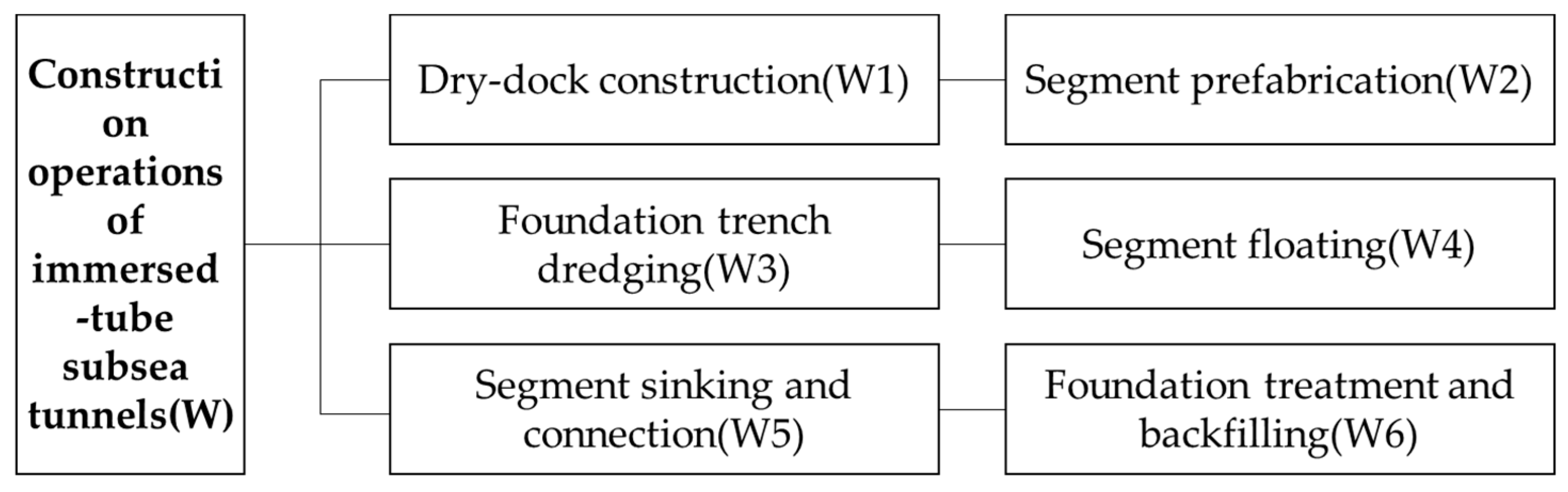
Given the high technical requirements and complex operations involved, the six major stages—dry-dock construction, segment prefabrication, foundation trench dredging, segment floating, segment sinking and connection, and foundation treatment and backfilling—represent the full construction cycle analyzed in this study. Each stage poses distinct technical challenges and risk characteristics, as described below.
  • Dry-dock construction: Construction is carried out within an enclosed dry dock, where cofferdams and drainage systems are used to create a water-free environment for segment prefabrication and auxiliary facility installation. This stage requires high construction precision and is significantly affected by tidal variations and water-level fluctuations.
  • Segment prefabrication: Immersed tube segments are prefabricated in the dry dock or a specialized pre-casting yard according to design specifications. The process involves reinforcement assembly, concrete casting, and prestressing operations. Strict quality control is required to ensure the structural strength and watertightness of the segments.
  • Foundation trench dredging: The seabed trench for the immersed tunnel is excavated at the designated alignment. This process demands precise control of depth, width, and slope, while coping with complex underwater geological conditions to prevent collapses and silt backfilling.
  • Segment floating: The prefabricated segments are transported from the production site to the immersion location by floating them along a controlled route. Accurate control of the floating path, speed, and attitude is essential to avoid segment collision or tilting, while simultaneously responding to complex natural conditions such as currents, waves, and wind.
  • Segment sinking and connection: Each segment is carefully lowered into the predetermined position within the foundation trench and connected to the previously installed segment. This stage requires precise control of the sinking posture, connection alignment, and watertight sealing. The process is highly sensitive to underwater environmental conditions and the precision of construction equipment. The specific process is shown in Figure 2.
  • Foundation treatment and backfilling: The underwater foundation is stabilized through operations such as stone dumping, gravel bedding, and grouting reinforcement. Afterward, the sides and top of the immersed tube are backfilled. The objective is to ensure uniform bearing capacity and structural stability, preventing uneven settlement or localized stress concentration.
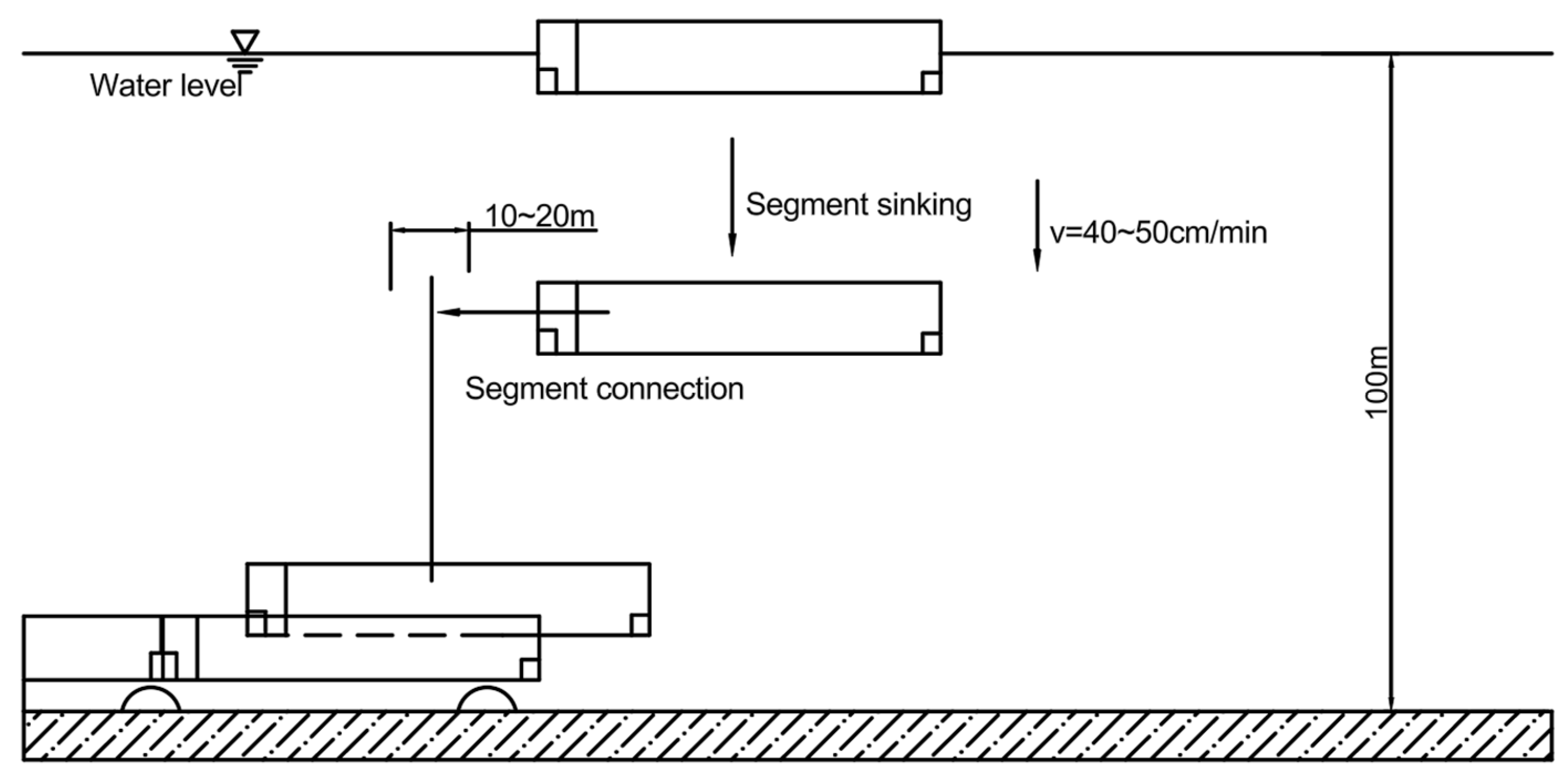
Figure 2. Schematic diagram of segment sinking and connection.
Jmse 14 00053 g002
The work breakdown structure can be simply represented as shown in Figure 3.

3.2. Risk Breakdown Structure

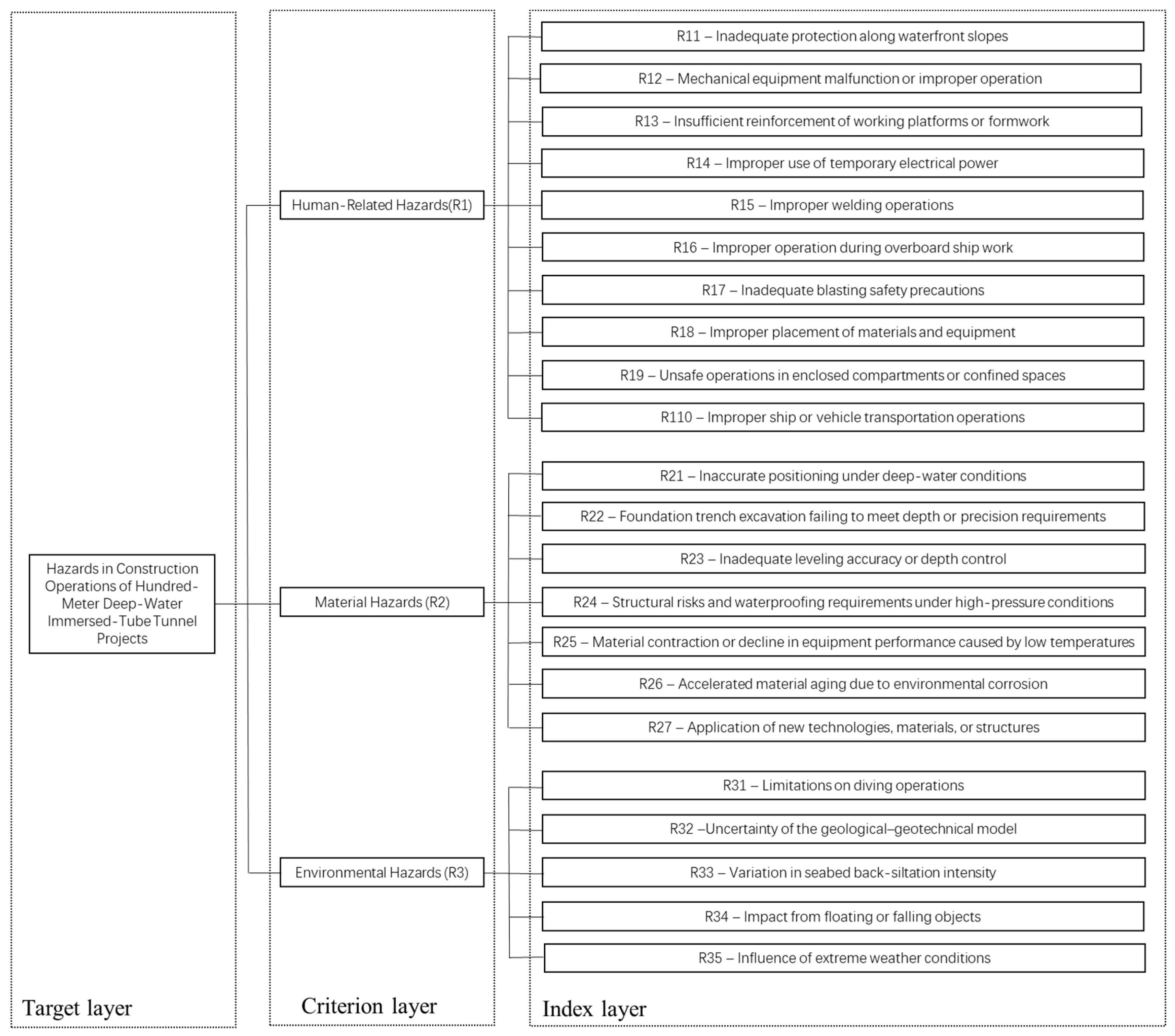
The first level of the Risk Breakdown Structure (RBS) for this project includes human-related hazards, material- or equipment-related hazards, and environmental hazards, which are divided into three indicator categories. Specifically, the human-risk layer consists of ten risk indicators, the material-risk layer includes seven indicators, and the environmental-risk layer comprises five indicators. Together, these twenty-two indicators constitute the complete RBS framework for the immersed tube subsea tunnel project.
In the selection of indicators, the principles of “comprehensive process coverage, deep-water adaptability, and integration of qualitative and quantitative analysis” are followed. When identifying risk indicators for hundred-meter-deep water-immersed tube construction, a scientific and rigorous approach must be adopted, involving a careful review of relevant engineering and technical data. Furthermore, since deep-water-immersed tube construction differs significantly from conventional shallow-water methods, the selection of indicators must fully account for the distinctive characteristics of construction at such depths.
During the evaluation process, qualitative analysis alone is insufficient; it should be complemented by quantitative methods to determine the magnitude of each risk factor’s influence. This combined approach enables a more comprehensive understanding and assessment of project risks, thereby providing a solid foundation for developing more precise and scientifically sound management and decision-making strategies [22].
First, through an extensive literature review, the research was structured top-down with the construction workflow as the main thread. Candidate indicators were listed according to the WBS stages—dry-dock construction, segment prefabrication, foundation trench excavation, floating, immersion and connection, and foundation backfilling. These indicators were then coupled with the RBS risk inventory, and the WBS–RBS coupling matrix was applied to identify the strongly correlated factors at each stage. This ensured that the selected indicators covered the entire construction cycle while simultaneously targeting the weak links in key operations such as segment connection and immersion.
Second, the indicators were hierarchically classified into three categories: human factors (e.g., restrictions on diving or confined-space operations, fatigue, and operational errors); material/equipment factors (e.g., the reliability of deep-water positioning and measurement systems, equipment pressure and corrosion resistance, and the pressure-bearing capacity of joint and sealing systems); and environmental factors (e.g., extreme weather, seabed back-siltation, and slope stability). This classification aligns with the general understanding of engineering quality and safety management and facilitates a subsequent application of methods such as the order relation analysis for weighting and comprehensive evaluation [23,24].
Finally, based on expert interviews and the specific working conditions of hundred-meter-deep construction [25], the candidate indicators were calibrated for “deep-water adaptability.” Priority was given to those sensitive to high hydrostatic pressure, low temperature, underwater measurement and alignment, diving and underwater operation constraints, strong back-siltation, and seabed stability, ensuring that the indicator system accurately reflects the distinctive hazards of deep-water immersed-tube tunnel construction, as shown in Figure 4.

3.3. WBS-RBS Coupling Matrix

The RBS decomposition system is composed of 22 risk factors, while the WBS decomposition system consists of six construction units, which together form the WBS–RBS coupling matrix. In this matrix, the number “1” indicates that a given construction unit is associated with a corresponding risk source, whereas the number “0” indicates no such association.
From a horizontal perspective, if a particular risk factor contains a greater number of “1” values across different construction units, it implies that this risk exerts a broader influence on the overall construction process. Conversely, from a vertical perspective, if a construction unit contains more “1” values, it suggests that multiple hazards are likely to occur within that specific unit. The WBS-RBS coupling matrix generated for this study is shown in Table 1.
However, while the matrix helps identify which hazards or units are more frequently associated, the magnitude and relative weight of each risk still require further calculation through quantitative evaluation models to achieve numerical characterization.
By employing the WBS–RBS coupling matrix, it is possible to gain both a macro-level understanding of the overall project risk profile and a micro-level insight into how each decomposed construction unit contributes to specific hazards. This approach provides a clearer and more logically structured risk analysis for immersed tube subsea tunnel construction operations, demonstrating that the proposed HSE risk management framework possesses strong analytical value and practical applicability.

4. Quantification of Risk Indicators and Determination of Weights

4.1. Risk Quantification

The indicators are divided into two categories: qualitative indicators and quantitative indicators. Qualitative indicators include all human-related risk factors, as well as the material-related factor of the “application of new technologies, materials, and structures”, “Material contraction or decline in equipment performance caused by low temperatures”, and the environmental risk factor “Impact from floating or falling objects”. All remaining factors are treated as quantitative indicators.

4.1.1. Qualitative Indicators

The quantitative calculation method follows the LEC risk assessment model proposed by K. J. Graham and K. F. Kinney, which evaluates construction hazards based on three parameters [26].
D = L × E × C
In the equation, D represents the comprehensive risk value; L denotes the likelihood of an accident occurring; E is the frequency of personnel exposure; and C indicates the severity of accident consequences. By calculating these parameters for each risk source, the resulting risk value ( D ) reflects the relative impact of different risk sources on project safety. The values of L , E , C , and D and their corresponding meanings are shown in Table 2, Table 3 and Table 4, and Table 5, respectively.
This calculation method is both simple and effective, providing a quantitative basis for safety management during the construction process. The evaluation results are typically classified into different risk levels according to the magnitude of the calculated risk values, with high-risk sources requiring priority control and the implementation of corresponding safety measures.

4.1.2. Quantitative Indicators

For quantitative indicators, the threshold determination method is adopted. This method is a commonly used quantitative evaluation approach characterized by its clarity, simplicity, and objectivity, making it particularly suitable for engineering and technical indicators that have clearly defined standard limits.
Inaccurate positioning under deep-water conditions: Based on the publicly available design tolerance (≤5 cm) from projects such as the Shenzhen–Zhongshan Link and quantitative data from millimeter-level alignment practices on site, the geometric alignment error during segment connection is classified into four levels:
  • Δ ≤ 1 cm (Optimal);
  • Δ: 1–2 cm (Acceptable);
  • Δ: 2–5 cm (Warning);
  • Δ > 5 cm (Out of tolerance).
Foundation trench excavation failing to meet depth and precision requirements: According to the Standards for Quality Inspection and Evaluation of Water Transport Engineering Works and the Design and Construction Manual of Immersed Tube Tunnels: Foundation Section, the precision and depth requirements for foundation trench excavation under hundred-meter-deep water-immersed tube construction are shown in Table 6.
Inadequate leveling accuracy or depth control: According to the Standards for Quality Inspection and Evaluation of Water Transport Engineering Works, the Design and Construction Manual of Immersed Tube Tunnels: Foundation Section, and the Construction and Quality Acceptance Standards of the Hong Kong–Zhuhai–Macao Bridge, the accuracy and depth requirements for leveling operations in hundred-meter-deep water-immersed tube construction are shown in Table 7.
Structural risks and waterproofing requirements under high-pressure environments:
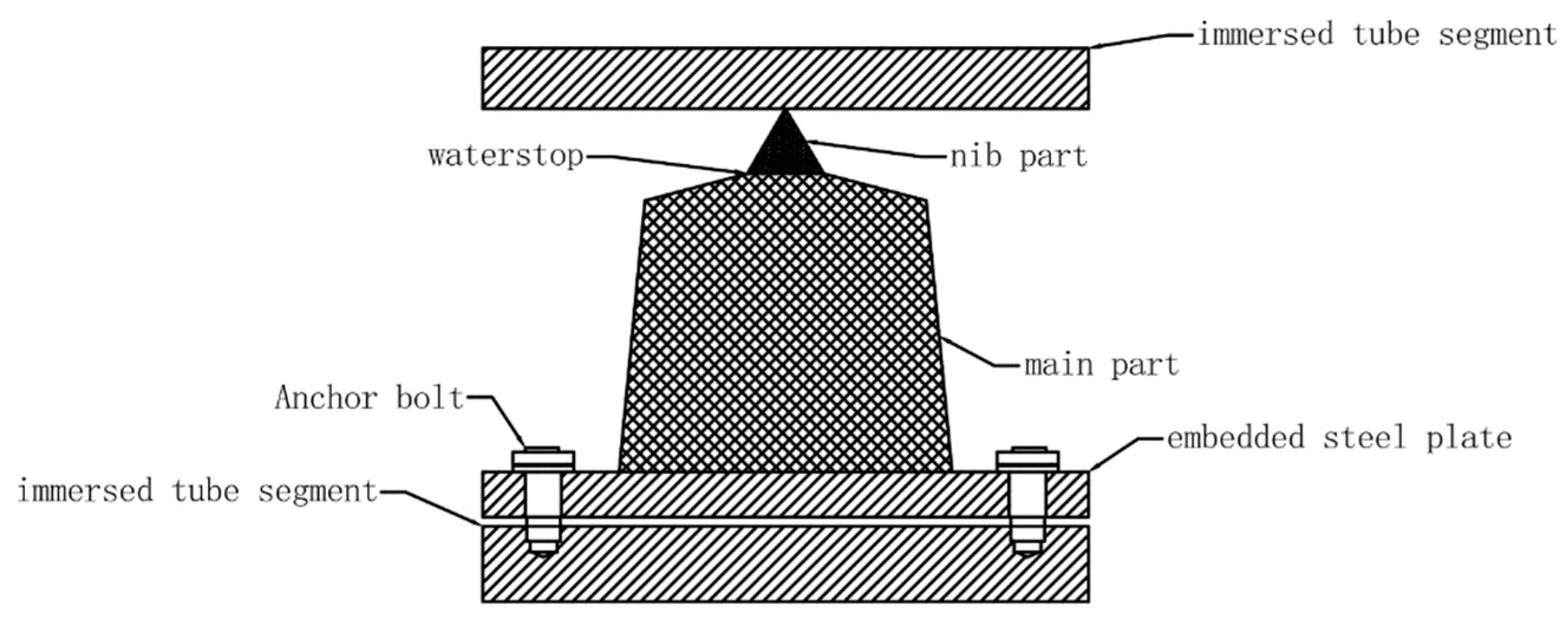
A schematic cross-sectional view of the waterstop sealing structure is shown in Figure 5. In deep-water environments, water pressure is composed of hydrostatic pressure and hydrodynamic pressure.
  • Hydrostatic pressure formula:
    P static = ρ g h
In the formula, ρ represents the density of seawater (≈1025 kg/m3); g denotes the acceleration of gravity (9.81 m/s2); and h signifies the water depth (m).
2.
Dynamic water pressure formula:
In underwater environments, hydrodynamic pressure primarily originates from waves and currents.
Wave pressure (wave force on rectangular submerged body):
The horizontal wave force can be expressed as follows:
F wavex = C H ρ V sinh ( kl 3 / 2 ) ( kl 3 / 2 ) sinh ( kl 1 / 2 ) ( kl 1 / 2 ) u x t
The vertical wave force can be expressed as follows:
The submerged body is located on the permeable layer, and its bottom surface is subjected to wave action. At this time, the vertical wave force acting on the submerged body is the following:
F wavez = C V ρ V sinh ( kl 3 / 2 ) ( kl 3 / 2 ) sinh ( kl 1 / 2 ) ( kl 1 / 2 ) u z t
The submerged body is located on an impermeable layer, and its bottom surface is not affected by waves. At this time, the vertical wave force acting on the submerged body is the following:
F wavez = C V ρ V coth ( kl 3 / 2 ) ( kl 3 / 2 ) sinh ( kl 1 / 2 ) ( kl 1 / 2 ) u z t
In the formula, ρ represents the density of seawater (≈1025 kg/m3); V represents the volume per unit length of the rectangular prism; l 1 represents the length of the submerged body along the slope; l 2 represents the width of the submerged body; l 3 represents the height of the submerged body; d represents the water depth; s represents the distance from the center of the submerged body to the seabed; H represents the wave height; k represents the wavenumber; the wave propagates along the x-direction, with the x-axis being positive along the wave propagation direction and the z-axis being positive upwards; C H represents the horizontal diffraction coefficient, and C V represents the vertical diffraction coefficient; and ux and uz represent the horizontal velocity and vertical velocity, respectively.
The thrust of water flow is as follows:
F f l o w = 0.5 × ρ A v 2
In the formula, F f l o w represents the water flow impact force, ρ denotes the density of seawater, A signifies the cross-sectional area of the object subjected to impact, and v stands for the water flow velocity.
Relevant research indicates that the upper pressure limit of a conventional OMEGA waterstop is approximately 0.9 MPa, while the compressive force of a GINA waterstop at a hardness of 65 can reach 4.1 MN/m, which is close to the theoretical upper limit. Therefore, it is stipulated that Water pressure < 0.8 MPa indicates sufficient margin:
(a)
Water pressure: 0.8–0.9 MPa is near the limit and requires verification;
(b)
Water pressure: 0.9–1.0 MPa is a high-risk zone;
(c)
Water pressure ≥ 1.0 MPa is over the limit, requiring the use of new waterstop structures and materials.
Accelerated material aging due to seawater corrosion: During the prefabrication, transportation, and storage stages of immersed tube construction, as well as after installation, the end shells and joints of the immersed tube are exposed to the atmosphere for long periods. The classification of atmospheric corrosive environments is shown in Table 8.
Corrosion grade C3 corresponds to no significant impact, corrosion grade C4 corresponds to a noticeable impact, corrosion grade C5 corresponds to a distinct impact, and corrosion grade CX corresponds to a severe impact.
Limitations on diving operations: According to the Safety Requirements for Air Diving the Safety Requirements for Mixed-Gas Diving, and the recommendations of the International Marine Contractors Association (IMCA), the safe working depth for air diving should generally be limited to within 40 m. Operations conducted between 40 m and 60 m must be strictly time-controlled due to the risks of nitrogen narcosis and decompression sickness. When the water depth exceeds 60 m, air diving becomes essentially infeasible, and mixed-gas or saturation diving must be used; in engineering practice, such operations are typically replaced by remotely operated vehicle (ROV) or mechanized operations. Therefore, in this study, the diving limitation indicator is classified as follows:
(a)
A water depth ≤ 40 m is no significant limitation;
(b)
A water depth: 40–60 m is a noticeable limitation;
(c)
A water depth > 60 m is a severe limitation.
The uncertainty of the geological–geotechnical model: The foundation bearing capacity formula can adopt the Terzaghi ultimate bearing capacity formula (applicable to strip foundations), and its basic form is as follows:
q u = c N c + γ D f N q + 1 2 γ B N γ
In the formula, q u represents the ultimate bearing capacity of the foundation; c denotes the effective cohesion of the soil; γ signifies the effective unit weight of the soil; D f stands for the burial depth of the foundation (usually calculated from the foundation trench for immersed tubes); B indicates the foundation width; and N c , N q , N γ are Terzaghi bearing coefficients, which are functions of the internal friction angle ϕ of the soil, and their calculation formulas are as follows:
N q = e 2 ( 3 Π / 4 ϕ / 2 ) tan ϕ 2 cos 2 ( 45 ° + ϕ / 2 )
N c = ( N q 1 ) cot ϕ
N γ = 2 ( N q + 1 ) tan ϕ 1 + 0.4 sin ( 4 ϕ )
The calculated ultimate bearing capacity cannot be used directly. It must be divided by a safety factor to obtain the allowable bearing capacity q a :
q a = q u F S
In the formula, FS represents the safety factor, which is typically taken as 2.5 to 3.5. For important and high-risk deep-water immersed-tube projects, a higher value may be adopted.
Based on the analysis of the strength of the soft surface soil, it can be classified into three levels according to the undrained shear strength (Su): high risk, medium risk, and low risk, as shown in Table 9.
When Su is less than 25 kpa, pre-treatment, replacement filling, or excavation unloading combined with support measures is usually required.
Variation in seabed back-siltation intensity: According to construction experience from the Hong Kong–Zhuhai–Macao Bridge, the drying period after the immersed tube is placed on the foundation bed is approximately 10–15 days, and the siltation threshold is only 4 cm (equivalent to 0.97–1.46 m/y). Since the drying duration and siltation thresholds vary among different projects, the quantitative analysis classifies this factor into two categories: meeting the back-siltation requirement and not meeting the back-siltation requirement.
Influence of extreme weather conditions: Taking the impact of wind on immersed tube construction as an example, based on the correlation of the ship motion coordinate system, mathematical methods are used to calculate the force exerted on the hull by wind. Let ζ represent air density, LOA represent hull length, and UR represent relative wind speed. Then, the force exerted on the hull in the horizontal direction Xwind, vertical direction Ywind, and overall force Nwind are expressed as follows:
X wind = 0.5 × ζ B f U R 2 Q w x ( α R ) Y wind = 0.5 × ζ B s U R 2 Q w y ( α R ) Z wind = 0.5 × ζ B s L O A U R 2 Q w n ( α R )
In the formula, α R represents the wind-to-ship angle; Bf and Bs represent the frontal and side projected areas of the ship, respectively; and Q w x ( α R ) , Q w y ( α R ) , Q w n ( α R ) represent the wind pressure moment coefficients in the transverse, longitudinal, and vertical directions, respectively.
Overall, the impact of extreme weather can be assessed from five aspects, as shown in Table 10.

4.2. Weight Assignment

When dealing with multiple evaluation indicators, the G1 order relation method serves as an improvement over the traditional Analytic Hierarchy Process (AHP), providing an intuitive and easily computable subjective weighting approach. It eliminates the need to construct a complex judgment matrix, thereby simplifying the computational process and removing the requirement for consistency testing. This method not only streamlines the determination of indicator weights but also enhances efficiency, making it a practical and effective choice for handling multi-indicator evaluation problems.
The specific steps are as follows:
(1)
Determine the three indicator levels and establish the order of importance among the indicators. The order of importance is determined by an expert group, expressed as follows:
X = x 1 , x 2 , , x n
(2)
Determine the relative importance between adjacent indicators, as expressed by the following equation:
r k = w k 1 w k , ( k = 2 , 3 , , n )
In the equation, w k 1 and w k represent the weights of indicators w k 1 and w k , respectively.
The values of relative importance and their corresponding meanings are shown in Table 11.
(3)
Calculate the weights of the three indicator levels and their corresponding indicators. After the expert group provides all the values of rₖ (k = 2, 3, …, n), the weight of indicator k and the remaining indicators are calculated using the following equation.
ω k = 1 + k = 2 n i = k n r i 1 , ( k = 2 , 3 , , n )
ω k 1 = r k ω k , ( k = 2 , 3 , , n )
(4)
Calculate the comprehensive weight within each indicator level. The comprehensive weight can be determined using the following equation.
W = W a T × W b
In the equation, Wa and Wb represent the weight vector of the indicator level and the corresponding indicator weight vector, respectively.
Since this questionnaire survey involves a large number of indicators, using a matrix format in the actual calculation process can make data handling more intuitive and efficient. In the specific calculation, for m-sorted indicators, the weight vector w = {w1, w2, …, wm} is solved, with the following constraint:
w k - 1 = r k w k i = 1 m w i = 1
Define an m × m system matrix A and vector b :
A = 1 1 1 1 1 r 2 0 0 0 0 r 3 0 0 0 1 r m , b = 1 0 0 0
Finally, solve for the weight vector:
w = A 1 b

5. Results and Discussion

5.1. Results Reduction

A total of 51 valid questionnaires were collected in this survey. The participants mainly included outstanding practitioners who have been involved in immersed tube construction and professors in related fields. These practitioners have accumulated extensive hands-on experience in immersed tube construction projects and have a deep understanding of the technical details, management strategies, and challenges faced during the construction process. Professors in related fields possess profound expertise in theoretical research and can provide in-depth analysis of issues related to immersed tube construction from a professional perspective. Therefore, their participation ensures the quality and professionalism of the questionnaire data, making the results of this survey highly valuable for reference. The specific survey results are shown in Table 12.
By combining qualitative and quantitative analyses, a risk evaluation system for hundred-meter-deep water-immersed tube construction is developed, as shown in the following tables. In the table, the basic score refers to the score obtained from the quantitative analysis in Section 4.1 (the specific scoring rules are shown in the score range column of the table), denoted as r; the weight score refers to the result of the qualitative analysis in Section 4.2 (the results are shown in Table 13), denoted as w; and the evaluation score is the product of the basic score and the weight score, denoted as Q. Taking the indicator R11 as an example, the corresponding scores are denoted as r11, w11, and Q11.
Human risk factors are central to the safety management of immersed tunnel construction. As shown in Table 13, these risks primarily originate from the operational behaviors of construction personnel, safety awareness, and the effectiveness of on-site management measures. In the complex and high-pressure working environment of hundred-meter-deep water, the consequences of human error can be drastically amplified. Therefore, the accurate identification and quantification of human factors are the primary steps in risk control. This assessment employs the LEC method to transform seemingly subjective operational norms into comparable risk values, providing a scientific basis for developing targeted training, supervision, and procedures.
Material and equipment hazards are directly related to the project’s physical quality and technical feasibility. In a hundred-meter-deep water environment, the reliability of equipment performance, material durability, and the mastery of new technologies face extreme challenges (as listed in Table 14). Environmental effects such as hydrostatic pressure, low temperature, and seawater corrosion strongly couple with these hazards, rendering traditional design and selection criteria potentially inadequate. This study utilizes the threshold determination method and binary mechanisms to objectively quantify key technical performance indicators, aiming to identify the material and equipment factors most likely to become weak links under deep-water conditions.
Environmental risk factors form the inherent context and external boundary for immersed tunnel construction in hundred-meter-deep water, whose impacts are often systemic and cannot be entirely eliminated. As shown in Table 15, these hazards include natural conditions such as hydrology, geology, and meteorology, which directly determine the length of the construction window, the feasibility of construction schemes, and the long-term operational stability. The deep-water environment not only amplifies the intensity of these natural forces but also alters their interaction mechanisms with structures and equipment. The focus of this system’s evaluation is to clarify the limiting thresholds of these external conditions and their constraining degree on construction activities, providing critical input for construction planning and contingency plans.
The process for determining the risk level of an index is as follows: The first step is to calculate the r value. Depending on the type of index, consult the table to determine its LEC score or threshold judgment score. An index with an r value greater than or equal to 60 should already be considered a high-risk index (for example, a Major risk corresponds to a score of 60–80). The second step is to determine the w value; according to Table 12, obtain the weight of the index. The final step is to calculate the Q value. If the Q value is greater than or equal to 3.5, the risk is considered unacceptable. The threshold of Q ≥ 3.5 is chosen because unacceptable risks should be both “high-risk in themselves” and “globally significant.” We calculate using r = 60 (the high-risk baseline) and a representative high weight value w = 5.99% (the weight for the “improper use of temporary electrical power”).
Q = r × w = 60 × 5.99 % 3.594
For ease of application and to maintain a certain safety margin, the threshold is rounded to 3.5.

5.2. Discussion

This study aims to establish an evaluation index system for the construction of 100-m-deep water-immersed tubes based on objective data, as a replacement for traditional expert-opinion methods. The goal is to provide a benchmarkable, reusable, and traceable risk assessment framework and improvement pathway for immersed tube projects under varying maritime conditions, construction methodologies, and equipment configurations. By employing a combined strategy of WBS-RBS coupling, LEC quantification, threshold determination, and the G1 method, the evaluation results can be utilized not only for single-project self-assessment but also support cross-project horizontal comparison and longitudinal tracking evaluation (ensuring comparability between projects under the same standard).
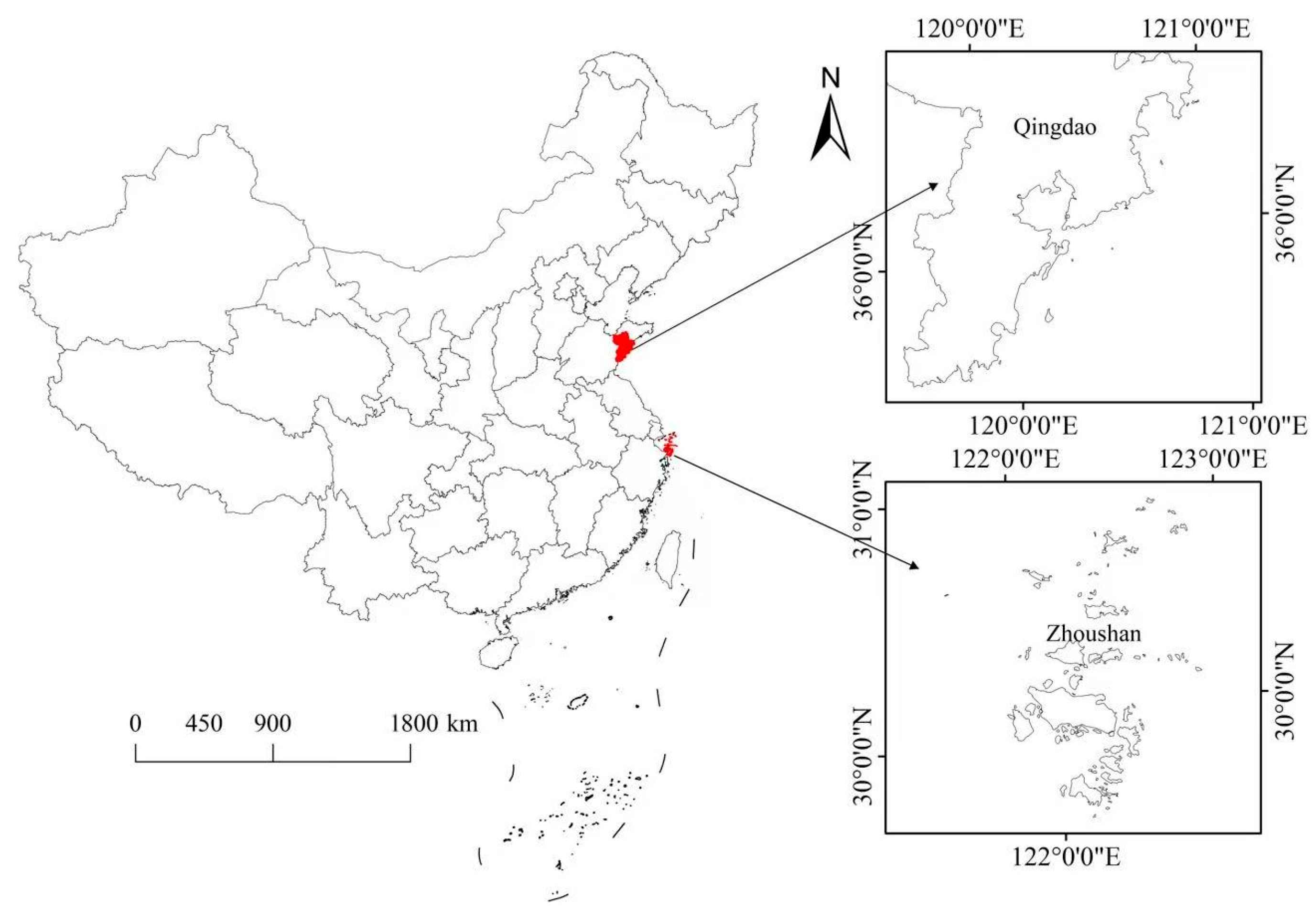
Taking the risk factors of accelerated material aging caused by seawater corrosion as an example, there are significant differences in atmospheric corrosion intensity in different sea areas. Using Qingdao with a corrosion category of C5 and Zhoushan with C3 as a reference (as shown in Figure 6), the risk score for the same structure and material system is significantly higher in Qingdao than in Zhoushan. Consequently, the requirements for protection level, durability verification, and maintenance intervals are also more stringent in Qingdao. Conversely, in Zhoushan, a more economical protection configuration can be adopted while still complying with the specifications. This score discrepancy within the same evaluation framework directly translates into systematic differences in material selection, coating systems, and Life Cycle Cost Analysis (LCCA). It aids in quantifying the “regional environmental premium” factor during the tendering, procurement, and scheme comparison stages, thereby avoiding a generalized “one-size-fits-all” configuration. In the comprehensive weighting results of this study, environmental corrosion is not the highest weighted factor. However, its long-term cumulative effects are amplified through indirect costs such as maintenance downtime, leakage repairs, and secondary protection, prompting managers to re-evaluate its impact on engineering economics from a whole-life-cycle perspective [27].
Likewise, the three indicators—“Influence of extreme weather”, “Limitations on diving operations”, and “Inaccurate positioning under deep-water conditions”—exhibit spatiotemporal heterogeneity across different sea areas and seasons. Factors such as wind speed, wave period, and visibility thresholds collectively narrow the construction window, while the necessity of replacing human divers with ROVs increases abruptly beyond certain water depths. These factors jointly define the optimal solution domain for construction organization parameters (batch, rhythm, and window) and equipment configuration. The evaluation system aims to prevent cost increases or efficiency losses resulting from empirically selected “conservative strategies,” while also avoiding risk spillover caused by “aggressive strategies.”
Weighting rankings reveal that human- and methodology-related indicators—such as “Inadequate blasting safety precautions”, “Mechanical equipment malfunction or improper operation”, “Improper protection along waterfront slopes”, and “Unsafe operations in enclosed compartments or confined spaces”—top the list. This indicates that in 100-m-deep water scenarios, despite recognized challenges like deep-water surveying, watertight pressure resistance, and high-pressure environments, frontline operational behaviors and temporary engineering measures remain high-frequency critical triggers for incidents. Immersed tube projects must prioritize reducing high-weight “Human–Machine–Methodology” risks through institutionalized HSE management, personnel qualification and crew coordination, and the standardization of temporary works. This also explains why some projects, despite having advanced equipment and comprehensive designs, still exhibit incident precursors in areas such as “temporary electrical usage” and “overboard operations.”
For quantitative indicators with clear objectives and standards—such as “Inaccuracy positioning in deep water”, “Inadequate leveling accuracy or depth control”, and “Structural risks and waterproofing requirements under high-pressure conditions”—the threshold determination method offers advantages in efficiency, transparency, and auditability. This facilitates consensus during design clarification and construction acceptance. For event-driven hazards like the “Improper Use of Temporary Electricity” and “Struck-by Objects,” the LEC matrix can quickly prioritize and guide resource allocation. However, under 100-m water depths, some indicators exhibit performance drift across time and environments. For “approaching threshold” states, dynamic correction and a safety override mechanism should be introduced—allowing monitoring signals to trigger temporary work stoppages or alternative solutions, thereby replacing “empirical margins” with “data-driven safety thresholds.”

6. Prevention and Control Measures

In response to challenges such as high water pressure, complex hydrological conditions, short construction windows, and insufficient equipment adaptability faced during the construction of 100-m-deep water-immersed tube tunnels, this paper proposes prevention and control measures across multiple domains. These measures, developed based on risk analysis and indicator system construction, cover structure and materials, foundation construction, element installation, floating transport and sinking, as well as intelligent monitoring and risk management.
  • Structural and Material Prevention Measures: Structures in deep water endure long-term high hydrostatic pressure, making them prone to cracking and leakage. The adoption of steel shell–concrete composite structures should be promoted, leveraging the steel shell’s restraining effect to enhance the concrete’s crack and seepage resistance. Concurrently, high-performance concrete, seawater corrosion-resistant steel, and new waterstop materials should be utilized to improve durability. A multiple waterstop system comprising GINA, OMEGA, and end concrete is recommended for joints, ensuring safety redundancy even under 1 MPa high water pressure.
  • Foundation Construction and Leveling Prevention Measures: Trench accuracy directly impacts sinking quality. To address the insufficient precision of grab dredgers and trailing suction hopper dredgers, spiral cutter-type underwater leveling machines can be developed to achieve refined leveling with an unevenness ≤ 4 cm. For bearing capacity, the composite foundation system of “pile foundation + pile cap + rubber bearing” should be promoted to enhance stability and reduce differential settlement. Simultaneously, flexible backfilling and multi-layer anti-scour protection measures should be employed to prevent back-siltation and ocean current scour.
  • Element Installation and Joining Prevention Measures: Element alignment accuracy and waterstop performance are key focuses of construction control. Automatic docking guidance devices should be developed, integrating ball support and electromagnetic adsorption technology to achieve automatic joint positioning and reduce underwater manual operations. For joint design, a rigid–flexible combined system should be adopted: setting rigid or semi-rigid joints in key sections to enhance integrity, and arranging flexible joints in ordinary sections to release stress. Furthermore, developing highly elastic, low-creep, seawater-resistant rubber materials is essential for improving the long-term sealing performance of waterstop belts.
  • Floating Transport and Sinking Prevention Measures: In deep-water environments, changes in wind, waves, and current fields significantly increase the risks during floating transport. Establishing a multi-mode floating transport support system, combining semi-submersible ships and transport-installation integrated vessels, and selecting flexibly based on working conditions is recommended. During the sinking process, multi-source technology integration—using BeiDou/GNSS, acoustic positioning, and laser alignment—should be applied to improve deep-water sinking accuracy. Furthermore, fluid–structure interaction numerical simulation should be utilized to predict forces and displacements during sinking, enabling the pre-formulation of contingency plans.
  • Intelligent Monitoring and Risk Management: Traditional measurement towers are difficult to use under 100-m water depth conditions; thus, measurement-tower-free positioning systems based on hydroacoustic arrays and laser ranging should be developed. Simultaneously, a multi-parameter real-time monitoring platform should be established to collect and visualize data on attitude, forces, and environmental parameters during floating, sinking, and docking, supporting dynamic risk early warning. At the management level, a comprehensive HSE risk management system should be built, forming a closed-loop control mechanism covering the entire process from risk identification and dynamic assessment to early warning linkage.

7. Conclusions

Compared with conventional immersed tunnel construction in shallow waters, the hundred-meter-deep water environment introduces a series of significant and intensified risk factors. These include substantially increased hydrostatic pressure, which imposes higher demands on structural watertightness and material performance; complex and variable hydrological conditions that pose challenges to positioning accuracy and segment attitude control; as well as heightened risks related to seabed back-siltation, geological instability, and extreme weather. In response to these unique challenges, this study has established a new risk assessment system specifically tailored for hundred-meter-deep water-immersed tunnel construction. Based on the WBS-RBS coupling methodology within an HSE framework, the system comprehensively covers the entire construction process and incorporates 22 risk indicators across the three major categories of human, equipment/mechanical, and environmental factors, ensuring both comprehensiveness and adaptability to deep-water conditions.
The proposed evaluation system classifies risk indicators into qualitative and quantitative categories. For quantitative analysis, qualitative indicators are assessed using the LEC method, which quantifies risk based on the likelihood of accident occurrence, frequency of personnel exposure, and potential severity of consequences. For quantitative indicators, such as water pressure thresholds, a threshold-based evaluation method is employed. Indicators with strict regulatory or design standards, for instance, compliance with foundation trench excavation specifications, are evaluated using a binary “fully compliant or non-compliant” mechanism. To determine the relative importance of each indicator, the G1 method was adopted for qualitative analysis. This combination of quantitative and qualitative approaches ensures a balanced integration of objective data and expert judgment.
Based on expert questionnaires and the weighting results from the G1 method, key risk factors in deep-water scenarios were preliminarily identified. In response to these critical hazards, this study proposes preliminary multi-level and targeted prevention and control measures. These measures include the adoption of steel shell–concrete composite structures and high-performance waterstop systems to enhance pressure resistance, and the development of automated docking and leveling equipment to improve installation accuracy. The risk assessment framework and response strategies proposed in this study for the hundred-meter-deep water environment are of significant importance for promoting the development of immersed tunnel technology towards deeper waters and addressing the associated key technical challenges.
Although this study established a systematic risk assessment framework, there are still some limitations, which point out directions for future research. First, the determination of some parameters in the risk assessment model, such as the values used in the LEC method, largely depends on expert experience and judgment. While this incorporates domain knowledge, it may introduce subjective bias. Future research could explore combining historical project data, incident reports, and machine learning techniques to establish a more objective, data-driven parameter calibration model, reducing overreliance on expert experience. Second, this study focused on technical and management activities during the construction period that directly determine whether a project can be completed safely, on time, and with quality. However, negative impacts on the external environment after or during construction, as well as potential legal, reputational, and long-term management risks (e.g., handling contaminated dredged sediments), could be further investigated in future research.

Author Contributions

Conceptualization, H.X. and L.M.; methodology, H.X.; software, H.X.; validation, Z.C., L.M. and Z.Q.; formal analysis, Z.Q.; investigation, Z.C.; resources, H.X.; data curation, L.M.; writing—original draft preparation, H.X.; writing—review and editing, S.X.; visualization, H.X.; supervision, Z.Q.; project administration, S.X.; funding acquisition, S.X. All authors have read and agreed to the published version of the manuscript.

Funding

This research was funded by the National Natural Science Foundation of China, number 52271266.

Data Availability Statement

The original contributions presented in this study are included in the article. Further inquiries can be directed to the corresponding author.

Acknowledgments

I would like to thank Sudong Xu for his help with this paper.

Conflicts of Interest

Author Zhengzhong Qiu was employed by the company CCCC Second Harbor Engineering Bureau. The remaining authors declare that the research was conducted in the absence of any commercial or financial relationships that could be construed as a potential conflict of interest.

References

  1. Dong, S.; Li, S.; Yu, F.; Wang, K. Risk Assessment of Immersed Tube Tunnel Construction. Processes 2023, 11, 980. [Google Scholar] [CrossRef]
  2. Hu, Z.; Xie, Y.; Wang, J. Challenges and strategies involved in designing and constructing a 6 km immersed tunnel: A case study of the Hong Kong–Zhuhai–Macao Bridge. Tunn. Undergr. Space Technol. 2015, 50, 171–177. [Google Scholar] [CrossRef]
  3. Zhang, J.; Fu, S.; Zhu, J.; Wang, J. Risk factors analyses and preventive measures of immersed tunnel engineering. E3S Web Conf. 2021, 236, 02025. [Google Scholar] [CrossRef]
  4. Marco, D.; Fabio, B.; Simone, F.; Alessio, F. Tram: A New Quantitative Methodology for Tunnel Risk Analysis. Chem. Eng. Trans. (CET J.) 2018, 67, 811–816. [Google Scholar] [CrossRef]
  5. Aikawa, F.; Ngai, C.; McLeod, J.; Hansen, J.; Morris, M.; Ozgur, O. Shatin to Central Link cross-harbour railway tunnel in Hong Kong. Tunn. Undergr. Space Technol. 2022, 126, 104281. [Google Scholar] [CrossRef]
  6. van Putten, E.; van Os, P. The A24 Blankenburg connection: An innovative design concept for an immersed tunnel project in a busy port. Tunn. Undergr. Space Technol. 2022, 124, 104312. [Google Scholar] [CrossRef]
  7. Olsen, T.; Kasper, T.; de Wit, J. Immersed tunnels in soft soil conditions experience from the last 20 years. Tunn. Undergr. Space Technol. 2022, 121, 104315. [Google Scholar] [CrossRef]
  8. Ozakgul, K.; Caglayan, O.; Tezer, O.; Uzgider, E. Remediation of settlements in a steel structure due to adjacent excavations. Eng. Fail. Anal. 2012, 20, 156–165. [Google Scholar] [CrossRef]
  9. Ding, W.; Gong, Y.; Qiao, Y.; Gong, C. Experimental investigation on mechanical behavior of segmental joint under combined loading of compression-bending-shear. Tunn. Undergr. Space Technol. Inc. Trenchless Technol. Res. 2020, 98, 103346. [Google Scholar] [CrossRef]
  10. Zhang, L.; Feng, K.; Li, M.; Sun, Y.; He, C.; Xiao, M. Analytical method regarding compression-bending capacity of segmental joints: Theoretical model and verification. Tunn. Undergr. Space Technol. Inc. Trenchless Technol. Res. 2019, 93, 103083. [Google Scholar] [CrossRef]
  11. Qiu, Y.; Hu, X.; Walton, G.; He, C.; He, C.; Ju, J.W. Full scale tests and a progressive failure model to simulate full mechanical behavior of concrete tunnel segmental lining joints. Tunn. Undergr. Space Technol. Inc. Trenchless Technol. Res. 2021, 110, 103834. [Google Scholar] [CrossRef]
  12. Bauduin, C.; Kirstein, A.A. Design, construction and monitoring of an underwater retaining wall close to an existing immersed tunnel. Tunn. Undergr. Space Technol. 2022, 120, 104311. [Google Scholar] [CrossRef]
  13. Bjelland, H.; Aven, T. Treatment of uncertainty in risk assessments in the Rogfast road tunnel project. Saf. Sci. 2013, 55, 34–44. [Google Scholar] [CrossRef]
  14. Wu, M.; Zhang, Q.; Wu, S. Risk Assessment of Operation Period Structural Stability for Long and Large Immersed Tube Tunnel. Procedia Eng. 2016, 166, 266–278. [Google Scholar] [CrossRef]
  15. Kazaras, K.; Kirytopoulos, K. Challenges for current quantitative risk assessment (QRA) models to describe explicitly the road tunnel safety level. J. Risk Res. 2014, 17, 953–968. [Google Scholar] [CrossRef]
  16. Kazaras, K.; Kirytopoulos, K.; Rentizelas, A. Introducing the STAMP method in road tunnel safety assessment. Saf. Sci. 2012, 50, 1806–1817. [Google Scholar] [CrossRef]
  17. Zhang, Z.; Li, J. Application and Demonstration of Health-Safety-Environment Risk Management to Underwater Tunnel of Hong Kong-Zhuihai-Macao. Tunn. Constr. 2019, 39, 189–196. [Google Scholar] [CrossRef]
  18. Matasova, I.Y.; Yaitskaya, N.A.; Modina, M.A.; Brigida, V.S. Three-dimensional geoecological models in forecasting sea level on Black Sea coast of Caucasus. Geol. Geophys. Russ. S. 2024, 14, 217–229. [Google Scholar] [CrossRef]
  19. Polydoropoulou, A.; Velegrakis, A.; Papaioannou, G.; Karakikes, I.; Bouhouras, E.; Thanopoulou, H.; Chatzistratis, D.; Monioudi, I.; Moschopoulos, K.; Chatzipavlis, A. A composite port resilience index focused on climate-related hazards: Results from Greek ports’ living-labs. Marit. Transp. Res. 2025, 9, 100136. [Google Scholar] [CrossRef]
  20. You, Q.; Zhang, Z.; Wang, H.; Xu, M. Risk identification of subway tunnel shield construction based on WBS-RBS method. Int. J. Crit. Infrastruct. 2023, 19, 261–273. [Google Scholar] [CrossRef]
  21. Zhao, J.; Niu, D.; Shen, J.; Wang, H. A Cost Risk Assessment Framework for UHV AC Projects Based on WBS-RBS-FAHP-COWA-Matter-Element Extension. J. Electr. Eng. Technol. 2025, 20, 2075–2092. [Google Scholar] [CrossRef]
  22. Hwang, I.; Jeong, B.; Jang, H.; Kim, D.; Jee, J. An integrated qualitative–quantitative risk assessment for defining toxic and hazardous zones on hydrogen-fuelled ships with ammonia cracking systems. Ocean. Eng. 2025, 341, 122475. [Google Scholar] [CrossRef]
  23. Jin, G.; Yang, C. A systematic intelligent prediction model for residential construction cost based on fuzzy AHP and GA-BP neural network. Adv. Eng. Inform. 2026, 69, 103858. [Google Scholar] [CrossRef]
  24. Chen, C. A Novel Multi-Criteria Decision-Making Model for Building Material Supplier Selection Based on Entropy-AHP Weighted TOPSIS. Entropy 2020, 22, 259. [Google Scholar] [CrossRef]
  25. Zhou, H.; Zhao, Y.; Shen, Q.; Yang, L.; Cai, H. Risk assessment and management via multi-source information fusion for undersea tunnel construction. Autom. Constr. 2020, 111, 103050. [Google Scholar] [CrossRef]
  26. Li, J.; Wu, W.; Jin, Y.; Zhao, R.; Bian, W. Research on environmental comfort and cognitive performance based on EEG+VR+LEC evaluation method in underground space. Build. Environ. 2021, 198, 107886. [Google Scholar] [CrossRef]
  27. Zhang, N.; Gao, J.; Xu, S.; Tang, S.; Guo, M. Establishing an evaluation index system of Coastal Port shoreline resources utilization by objective indicators. Ocean. Coast. Manag. 2022, 217, 106003. [Google Scholar] [CrossRef]
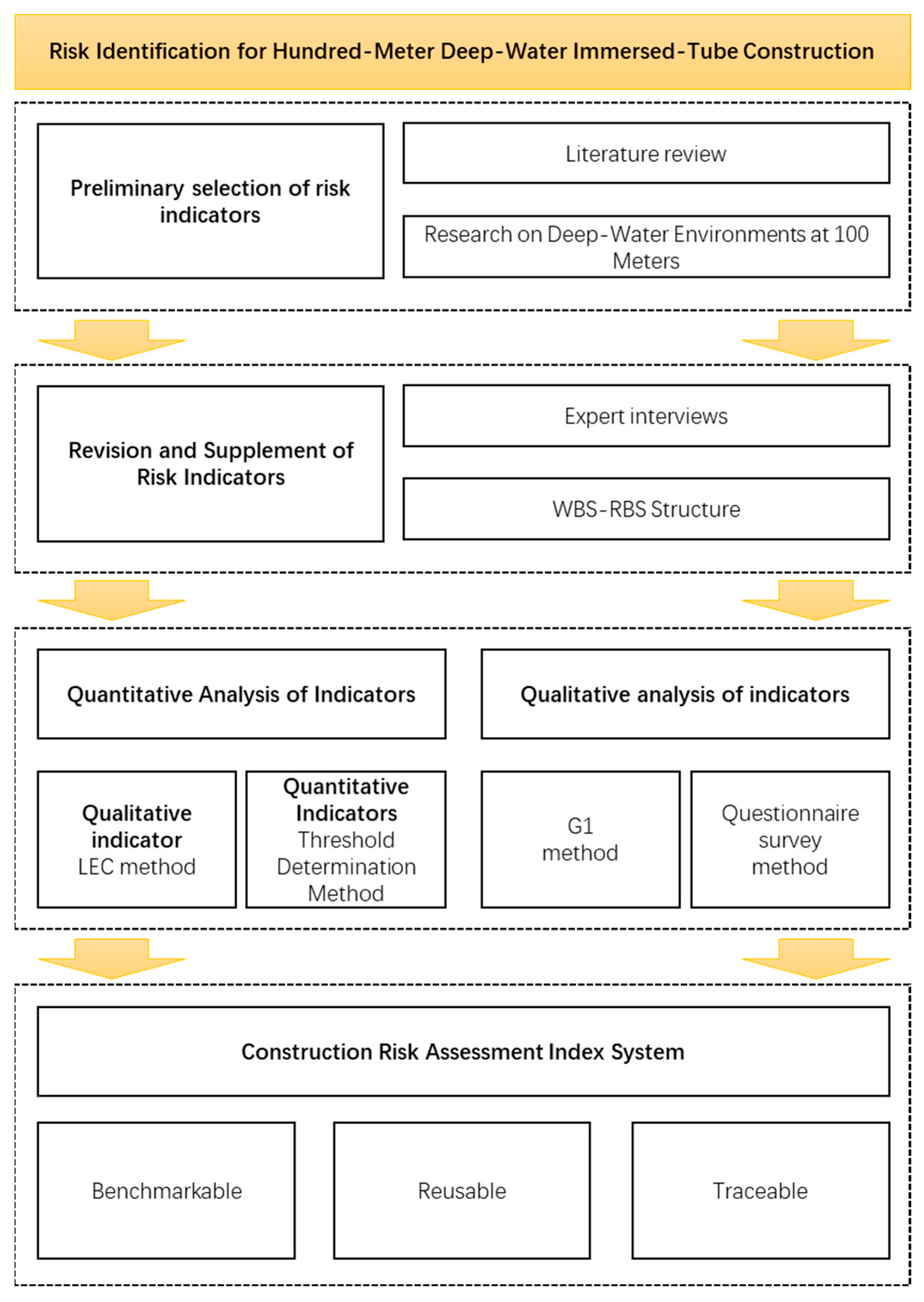
Figure 1. Research process diagram.
Jmse 14 00053 g001
Figure 3. Construction procedures of immersed tube tunnel.
Jmse 14 00053 g003
Figure 4. Hierarchical classification of construction indicators.
Jmse 14 00053 g004
Figure 5. Schematic diagram of the cross-section of the waterstop sealing structure.
Jmse 14 00053 g005
Figure 6. Location of Qingdao and Zhoushan in China.
Jmse 14 00053 g006
Table 1. WBS-RBS coupling table.
RBS Decomposition SystemWBS Decomposition System
W1W2W3W4W5W6
Hazards in Construction Operations of Hundred-Meter-Deep Water-Immersed Tube Tunnel ProjectsR1R11111111
R12111111
R13010010
R14111111
R15010011
R16101111
R17101000
R18111100
R19010010
R110111101
R2R21000110
R22101001
R23101001
R24111111
R25111111
R26111111
R27111111
R3R31101111
R32101111
R33101001
R34111111
R35111111
Table 2. L Value classification table.
L ValueDescription
0.1Practically impossible to occur in reality
0.2Extremely unlikely to occur
0.5Conceivable but highly improbable
1.0Completely accidental, very rarely possible
3.0Possible but infrequent
6.0Fairly likely to occur
10.0Almost certain or fully predictable in advance
Table 3. E Value classification table.
E ValueDescription
0.5Extremely rare occurrence
1.0Occurs several times per year
2.0Exposure about once per month
3.0Exposure once per week or occasional exposure
6.0Daily exposure during working hours t
10.0Continuous exposure to potential hazards
Table 4. C Value classification table.
C ValueDescription
1.0Minor injury
3.0Slight injury
7.0Major injury
15.0Severe injury, one fatality
40.0Moderate disaster, multiple fatalities
100.0Catastrophic disaster, many fatalities
Table 5. D Value classification table.
Result DescriptionD ValueDescription
Slight danger, acceptable<20Negligible risk
General danger, attention required20–69Acceptable risk
Moderate risk, improvement needed70–160Moderate risk
High danger, immediate rectification required160–320Major risk
Extremely high danger, construction must be stopped>320Critical risk
Table 6. Specialized standard for fine excavation inspection and evaluation of immersed tube tunnel foundation trenches.
No.Inspection ItemAllowable Deviation or Requirement
1Single-side width of foundation trench slope−20 to +250 cm (negative values indicate inward deviation)
2Foundation trench axis alignmentAverage allowable deviation: −50 to +50 cm
3Foundation trench bottom elevationNormal allowable deviation for finished excavation bottom elevation: −50 to 0 cm
4Foundation trench slope gradientShall not be steeper than the design slope
Table 7. Quality control standard for rubble compaction and leveling.
No.Inspection ItemSpecified Value or Allowable Error
1Elevation of rubble top surface or maximum allowable error of all measurement points after compaction±30 cm
2Alignment of top edge lines on both sides of rubble layer relative to design position±50 cm
Table 8. Classification table of atmospheric corrosive environments.
Corrosion GradeCorrosion Loss in the First Year
C325–50 μm/y
C450–80 μm/y
C580–200 μm/y
CX>200 μm/y
Table 9. Classification of risks associated with uncertainty of the geological–geotechnical model.
Risk LevelUndrained Shear Strength (Su)
High riskSu < 12 kpa
Medium riskSu: 12–25 kpa
Low riskSu ≥ 25 kpa
Table 10. Meteorological limitation criteria for immersed tube construction.
Construction Stage and ActivityCurrent Velocity (m/s)Wave Height (m)Wind Speed (Beaufort Scale)Visibility (m)
Segment launching from dry dock≤0.3≤0.8≤6≥1000
Rail-guided floating transportation≤0.8≤0.8≤6≥1000
Submerging of semi-submersible barge or floating dock≤0.3≤0.8≤6≥1000
Longitudinal towing of segment within foundation trench≤0.5≤0.8≤6≥1000
Waiting period before segment immersion≤1.1≤0.8≤6≥1000
Segment immersion and connection≤0.5≤0.6≤6≥1000
Table 11. Relative importance assignment table.
ScaleImportance LevelMeaning of the Scale
1.0Equally importantThe two factors are of equal importance
1.2Slightly more importantOne factor is slightly more important than the other
1.4Clearly more importantOne factor is clearly more important than the other
1.6Much more importantOne factor is much more important than the other
1.8Extremely importantOne factor is extremely more important than the other
Table 12. Results of weight assignment.
Risk Factor IndicatorWeight
Inadequate blasting safety precautions11.57%
Mechanical equipment malfunction or improper operation10.00%
Improper protection along waterfront slopes9.08%
Unsafe operations in enclosed compartments or confined spaces9.03%
Insufficient reinforcement of working platforms or formwork7.78%
Improper operation during overboard ship work6.61%
Improper use of temporary electrical power5.99%
Inaccurate positioning under deep-water conditions3.89%
Improper welding operations3.53%
Impact from floating or falling objects3.44%
Influence of extreme weather conditions3.17%
Inadequate leveling accuracy or depth control3.00%
Limitations on diving operations2.88%
Accelerated material aging due to environment corrosion2.65%
Improper ship or vehicle transportation operations2.60%
Foundation trench excavation failing to meet depth or precision requirements2.59%
Structural risks and waterproofing requirements under high-pressure conditions2.23%
Uncertainty of the geological–geotechnical model2.20%
Material contraction or decline in equipment performance caused by low temperature2.20%
Variation in seabed back-siltation intensity2.16%
Application of new technologies, materials, or structures1.81%
Improper placement of materials and equipment1.59%
Table 13. Results of weight assignment (human-related hazards).
Risk Factor IndicatorsClassificationBasic ScoreWeight ScoreEvaluation Score
Score RangeScore
Inadequate protection along waterfront slopesNegligible risk0–20r11w11Q11
Acceptable risk20–40
Moderate risk40–60
Major risk60–80
Severe risk80–100
Mechanical equipment malfunction or improper operationNegligible risk0–20r12w12Q12
Acceptable risk20–40
Moderate risk40–60
Major risk60–80
Severe risk80–100
Insufficient reinforcement of working platforms or formworkNegligible risk0–20r13w13Q13
Acceptable risk20–40
Moderate risk40–60
Major risk60–80
Severe risk80–100
Improper use of temporary electrical powerNegligible risk0–20r14w14Q14
Acceptable risk20–40
Moderate risk40–60
Major risk60–80
Severe risk80–100
Improper welding operationsNegligible risk0–20r15w15Q15
Acceptable risk20–40
Moderate risk40–60
Major risk60–80
Severe risk80–100
Improper operation during overboard ship workNegligible risk0–20r16w16Q16
Acceptable risk20–40
Moderate risk40–60
Major risk60–80
Severe risk80–100
Inadequate blasting safety precautionsNegligible risk0–20r17w17Q17
Acceptable risk20–40
Moderate risk40–60
Major risk60–80
Severe risk80–100
Improper placement of materials and equipmentNegligible risk0–20r18w18Q18
Acceptable risk20–40
Moderate risk40–60
Major risk60–80
Severe risk80–100
Unsafe operations in enclosed compartments or confined spacesNegligible risk0–20r19w19Q19
Acceptable risk20–40
Moderate risk40–60
Major risk60–80
Severe risk80–100
Improper ship or vehicle transportation operationsNegligible risk0–20r110w110Q110
Acceptable risk20–40
Moderate risk40–60
Major risk60–80
Severe risk80–100
Table 14. Results of weight assignment (material hazards).
Risk Factor IndicatorsClassificationBasic ScoreWeight ScoreEvaluation Score
Score RangeScore
Inaccurate positioning under deep-water conditionsError ≤ 1 cm0–25r21w21Q21
Error: 1–2 cm25–50
Error: 2–5 cm50–75
Error > 5 cm75–100
Foundation trench excavation failing to meet depth or precision requirementsCompliance with standard requirements0r22w22Q22
Non-compliance with standard requirements100
Inadequate leveling accuracy or depth controlCompliance with standard requirements0r23w23Q23
Non-compliance with standard requirements100
Structural risks and waterproofing requirements under high-pressure conditionsWater pressure less than 0.8 Mpa0–25r24w24Q24
Water pressure: 0.8–0.9 Mpa25–50
Water pressure: 0.9–1.0 Mpa50–75
Water pressure greater than or equal to 1.0 Mpa75–100
Material contraction or decline in equipment performance caused by low temperaturesNegligible risk0–20r25w25Q25
Acceptable risk20–40
Moderate risk40–60
Major risk60–80
Severe risk80–100
Accelerated material aging due to seawater corrosionCorrosivity category C30–25r26w26Q26
Corrosivity category C425–50
Corrosivity category C550–75
Corrosivity category CX75–100
Application of new technologies, materials, or structuresNegligible risk0–20r27w27Q27
Acceptable risk20–40
Moderate risk40–60
Major risk60–80
Severe risk80–100
Table 15. Results of weight assignment (environmental hazards).
Risk Factor IndicatorsClassificationBasic ScoreWeight ScoreEvaluation Score
Score RangeScore
Limitations on diving operationsWater depth ≤ 40 m0–20r31w31Q31
Water depth: 40–60 m20–60
Water depth > 60 m 60–100
Uncertainty of the geological–geotechnical modelSu ≥ 25 kpa0–20r32w32Q32
Su: 12–25 kpa20–60
Su < 12 kpa60–100
Variation in seabed back-siltation intensityCompliance with back-siltation requirements0r33w33Q33
Non-compliance with back-siltation requirements 100
Impact from floating or falling objectsNegligible risk0–20r34w34Q34
Acceptable risk20–40
Moderate risk40–60
Major risk60–80
Severe risk80–100
Influence of extreme weather conditionsCompliance with standard requirements0r35w35Q35
Non-compliance with standard requirements100
Disclaimer/Publisher’s Note: The statements, opinions and data contained in all publications are solely those of the individual author(s) and contributor(s) and not of MDPI and/or the editor(s). MDPI and/or the editor(s) disclaim responsibility for any injury to people or property resulting from any ideas, methods, instructions or products referred to in the content.