A Policy–Machine Learning Hybrid Approach to Evaluate Trap Mesh Selectivity: A Case Study on Pseudopleuronectes yokohamae


Abstract
1. Introduction
2. Materials and Methods
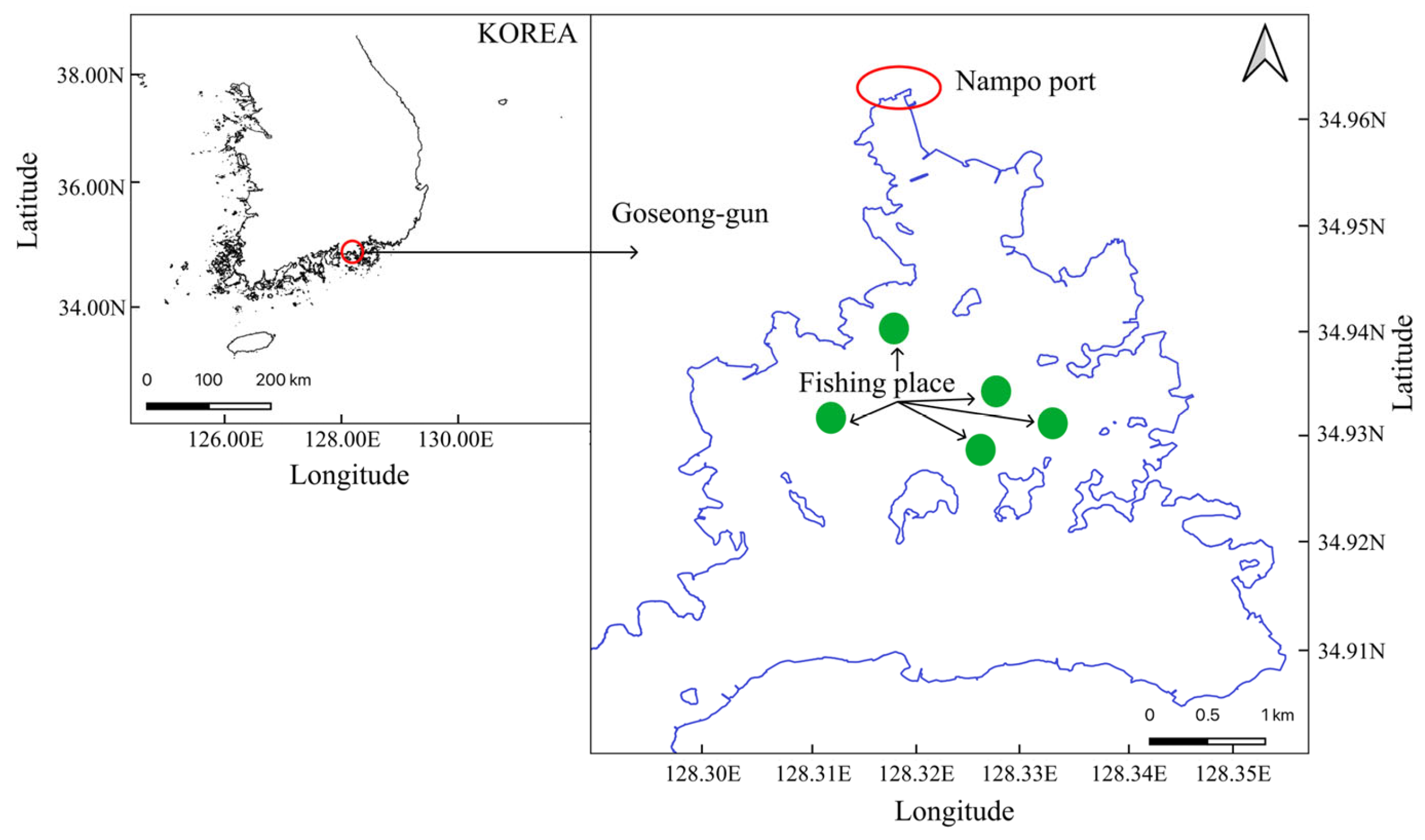
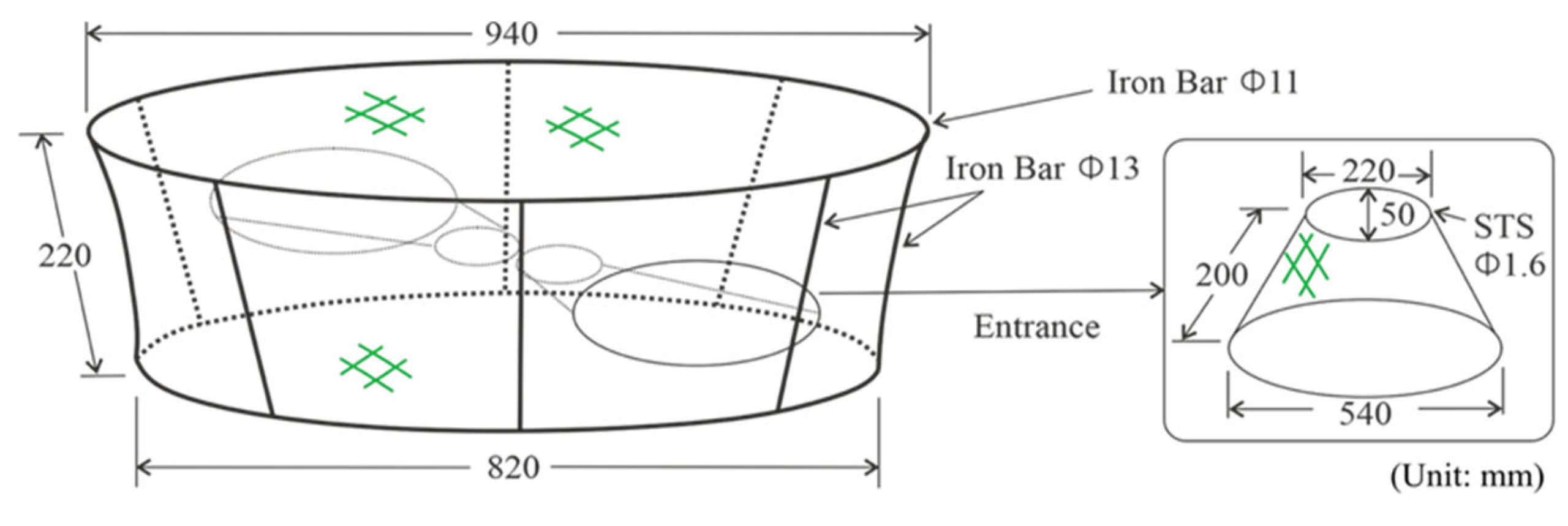
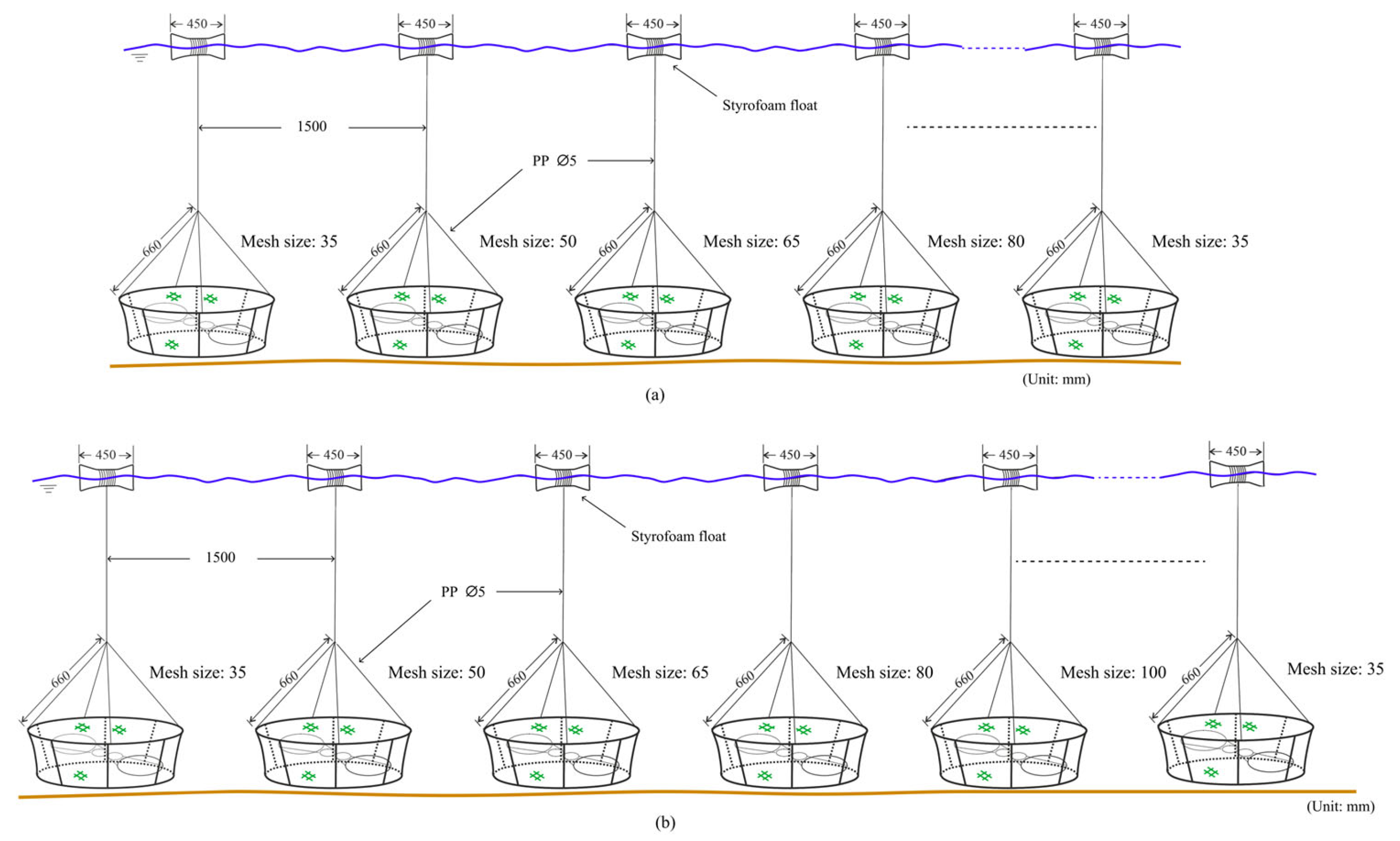
2.1. Field Experiment and Data Collection
2.2. Data Analysis and Modeling Framework
2.2.1. Definition of the Policy–Utility Function
2.2.2. Data Preprocessing
2.2.3. Training and Validation Data Composition
2.2.4. Simulations of Optimal Mesh Sizes Under Different Policy Scenarios
2.2.5. Model Validation and Policy Regret Analysis
3. Results
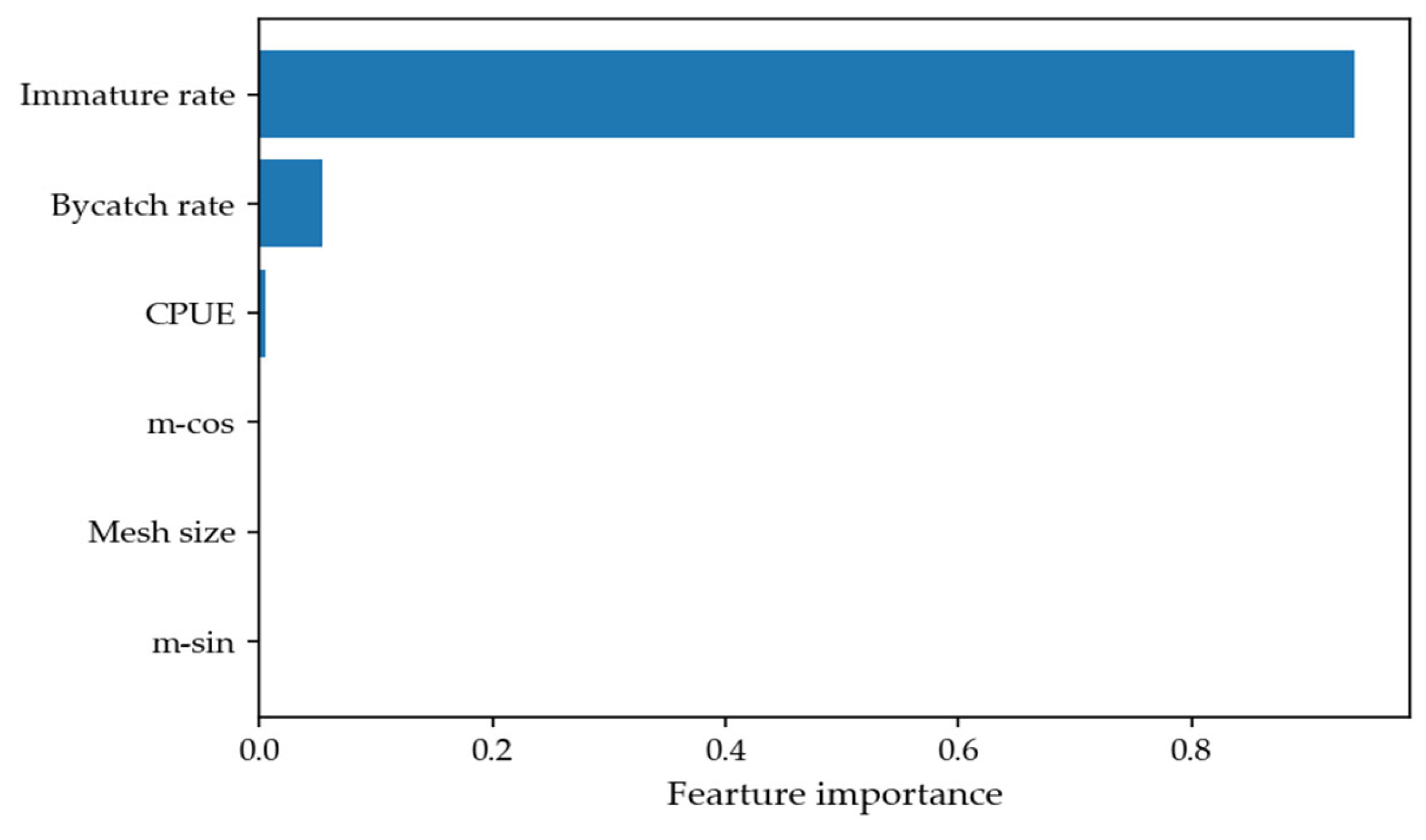
3.1. Model Validation and Interpretation
3.2. Scenario-Specific Utility and Selection Pattern Analysis
3.3. Policy Regret Analysis
4. Discussion
5. Conclusions
Author Contributions
Funding
Data Availability Statement
Conflicts of Interest
References
- Fuller, S.D.; Picco, C.; Ford, J.; Tsao, C.-F.; Morgan, L.E.; Hangaard, D.; Chuenpagdee, R. How We Fish Matters: Addressing the Ecological Impacts of Canadian Fishing Gear; Ecology Action Centre, Living Oceans Society, and Marine Conservation Biology Institute: Halifax, NS, Canada, 2008; ISBN 978-0-9734181-7-0. [Google Scholar]
- Kwon, I.; Lee, G.-H.; Seo, Y.I.; Kang, H.; Lee, J.; Hwang, B.-K. Development of a Gear-Based Fisheries Management Index Incorporating Operational Metrics and Ecosystem Impact Indicators in Korean Fisheries. J. Mar. Sci. Eng. 2025, 13, 1770. [Google Scholar] [CrossRef]
- Kalogirou, S.; Pihl, L.; Maravelias, C.D.; Herrmann, B.; Smith, C.J.; Papadopoulou, N.; Notti, E.; Sala, A. Shrimp Trap Selectivity in a Mediterranean Small-Scale Fishery. Fish. Res. 2019, 211, 131–140. [Google Scholar] [CrossRef]
- Broadhurst, M.K.; Tolhurst, D.J.; Hughes, B.; Raoult, V.; Smith, T.M.; Gaston, T.F. Optimising Mesh Size with Escape Gaps in a Dual-Species Portunid-Trap Fishery. Aquac. Fish. 2020, 5, 308–316. [Google Scholar] [CrossRef]
- Jeong, E.C.; Park, C.D.; Park, S.W.; Lee, J.H.; Tokai, T. Size Selectivity of Trap for Male Red Queen Crab Chionoecetes japonicus with the Extended SELECT Model. Fish. Sci. 2000, 66, 494–501. [Google Scholar] [CrossRef]
- Winger, P.D.; Walsh, P.J. Selectivity, Efficiency, and Underwater Observations of Modified Trap Designs for the Snow Crab (Chionoecetes opilio) Fishery in Newfoundland and Labrador. Fish. Res. 2011, 109, 107–113. [Google Scholar] [CrossRef]
- Grati, F.; Polidori, P.; Scarcella, G.; Fabi, G. Estimation of Basket Trap Selectivity for Changeable Nassa (Nassarius mutabilis) in the Adriatic Sea. Fish. Res. 2010, 101, 100–107. [Google Scholar] [CrossRef]
- Park, C.D.; Bae, J.H.; Cho, S.K.; Kim, I.O. Mesh Selectivity of a Dome-Shaped Pot for Finely-Striated Buccinum striatissimum in the Eastern Coastal Waters of Korea. J. Korean Soc. Fish. Technol. 2014, 50, 284–291. [Google Scholar] [CrossRef]
- Broadhurst, M.K.; Millar, R.B.; Hughes, B. Utility of Multiple Escape Gaps in Australian Scylla serrata Traps. Fish. Res. 2018, 204, 88–94. [Google Scholar] [CrossRef]
- Heo, G.; Cho, S.K.; Koo, M.S. Fishing Characteristics of the Mesh Size and Flapper Connecting Line for a Rockfish Sebastes inermis trap. Korean J. Fish. Aquat. Sci. 2022, 55, 751–757. [Google Scholar] [CrossRef]
- Koo, M.; Kwon, I. Optimal Mesh Size of Traps for Marbled Flounder (Pseudopleuronectes yokohamae) Based on Biological and Economic Factors. Fish. Manag. Ecol. 2024, 31, e12730. [Google Scholar] [CrossRef]
- Millar, R.B.; Fryer, R.J. Estimating the Size-Selectivity Curves of Towed Gears, Traps, Nets and Hooks. Rev. Fish Biol. Fish. 1999, 9, 89–116. [Google Scholar] [CrossRef]
- Koo, M.; Kwon, I. A Machine Learning Technique for Deriving the Optimal Mesh Size of a Gizzard Shad (Konosirus punctatus) Gillnet. J. Mar. Sci. Eng. 2024, 12, 592. [Google Scholar] [CrossRef]
- Zhou, S.; Daley, R.M.; Fuller, M.; Bulman, C.M.; Hobday, A.J. A Data-Limited Method for Assessing Cumulative Fishing Risk on Bycatch. ICES J. Mar. Sci. 2019, 76, 837–847. [Google Scholar] [CrossRef]
- Bastardie, F.; Feary, D.A.; Brunel, T.; Kell, L.T.; Döring, R.; Metz, S.; Eigaard, O.R.; Basurko, O.C.; Bartolino, V.; Bentley, J.; et al. Ten Lessons on the Resilience of the EU Common Fisheries Policy Towards Climate Change and Fuel Efficiency—A Call for Adaptive, Flexible and Well-Informed Fisheries Management. Front. Mar. Sci. 2022, 9, 947150. [Google Scholar] [CrossRef]
- Kim, I.O.; Park, C.D.; Cho, S.K.; Kim, H.Y.; Cha, B.J. Mesh Selectivity of Monofilament and Multifilament Nylon Gill Net for Marbled Sole (Pleuronectes yokohamae) in the Western Sea of Korea. J. Korean Soc. Fish. Technol. 2010, 46, 281–291. [Google Scholar] [CrossRef]
- Namhae-gun Marine and Fisheries Department (NMFD). Namhae-gun Fisheries Resources Spawning and Habitat Creation Project Basic Plan; Namhae-gun Marine and Fisheries Department (NMFD): Namhae-gun, Republic of Korea, 2022. [Google Scholar]
- Arora, R.; Dinitz, M.; Marinov, T.V.; Mohri, M. Policy Regret in Repeated Games. In Advances in Neural Information Processing Systems; The MIT Press: Cambridge, MA, USA, 2018; Volume 31. [Google Scholar]
- Broadhurst, M.K.; Smith, T.M.; Millar, R.B.; Hughes, B.; Raoult, V.; Gaston, T.F. Cumulative Selectivity Benefits of Increasing Mesh Size and Using Escape Gaps in Australian Portunus armatus Traps. Fish. Manag. Ecol. 2019, 26, 319–326. [Google Scholar] [CrossRef]
- Rudershausen, P.J.; Baker, M.S., Jr.; Buckel, J.A. Catch Rates and Selectivity Among Three Trap Types in the U.S. South Atlantic Black Sea Bass Commercial Trap Fishery. N. Am. J. Fish. Manag. 2008, 28, 1099–1107. [Google Scholar] [CrossRef]
- Stohs, S.M.; Harmon, K.M. Bayesian Prediction of Fishery Biological Impacts from Limited Data: A Deep-Set Buoy Gear Case Study. Fish. Res. 2022, 249, 106228. [Google Scholar] [CrossRef]
- Holzer, J. Property Rights and Choice: The Case of the Fishery. Am. J. Agric. Econ. 2015, 97, 1175–1191. [Google Scholar] [CrossRef]
- Koemle, D.; Gassler, B.; Kyle, G.; Meyerhoff, J.; Arlinghaus, R. How Involvement Drives Decision Rules Behind Stated Preferences for Recreational-Fisheries Management. J. Environ. Manag. 2023, 349, 119604. [Google Scholar] [CrossRef] [PubMed]



| Variable | Direction | Description |
|---|---|---|
| CPUE | Positive () | Positively contributes to productivity and fishing efficiency. |
| Immature proportion | Negative () | Negatively associated with resource sustainability due to immature catch. |
| Bycatch rate | Negative () | Represents ecological and economic penalties of non-target catch. |
| Scenario Type | Weight Combination (α, β, γ) | Characteristic |
|---|---|---|
| Productivity-oriented | 1.5, 0.5, 0.5 | Emphasis on productivity |
| Balanced | 1.0, 1.0, 1.0 | Policy-neutral |
| Conservation-oriented | 0.4, 1.3, 1.3 | Emphasis on conservation & bycatch reduction |
| Optimal | (α*, β*, γ*) | Empirical equilibrium point |
| Scenario | ∆U_mean | CI_low_95 | CI_high_95 | Relative_regret_pct |
|---|---|---|---|---|
| Productivity | 0.119475 | 0.119475 | 0.119475 | 100 |
| Balanced | 0.132458 | 0.132458 | 0.132458 | 100 |
| Conservation | 0.142195 | 0.142195 | 0.142195 | 77.14551 |
| Empirically optimal | 0.148676 | 0.148676 | 0.148676 | 72.24447 |
| Study | Approach | Strength | Limitation | Relevance to Present Study |
|---|---|---|---|---|
| Koo and Kwon [11] | SELECT + Decision Tree | Combines biology + economics | Scenario-limited maturity thresholds | Baseline for ΔU modeling |
| Broadhurst et al. [19] | GLMM + GAM | Shows cumulative effects of mesh + gaps | Species/site-specific | Gear modification reference for scenarios |
| Jeong et al. [5] | Extended SELECT | Detailed size-selectivity curves | Control-gear bias | Provides biological selectivity scaling |
| Rudershausen et al. [20] | Proportional selectivity + mortality | Links selectivity to survival | Short-term focus, habitat-specific | Motivates multi-factor inputs |
| Present study | GBM(Gradient Boosting Machine)-based ΔU + policy regret | Multi-objective optimization | Complex model | Integrates biology, economy, and policy |
Disclaimer/Publisher’s Note: The statements, opinions and data contained in all publications are solely those of the individual author(s) and contributor(s) and not of MDPI and/or the editor(s). MDPI and/or the editor(s) disclaim responsibility for any injury to people or property resulting from any ideas, methods, instructions or products referred to in the content. |
© 2025 by the authors. Licensee MDPI, Basel, Switzerland. This article is an open access article distributed under the terms and conditions of the Creative Commons Attribution (CC BY) license.
Share and Cite
Koo, M.; Kwon, I. A Policy–Machine Learning Hybrid Approach to Evaluate Trap Mesh Selectivity: A Case Study on Pseudopleuronectes yokohamae. J. Mar. Sci. Eng. 2026, 14, 38. https://doi.org/10.3390/jmse14010038
Koo M, Kwon I. A Policy–Machine Learning Hybrid Approach to Evaluate Trap Mesh Selectivity: A Case Study on Pseudopleuronectes yokohamae. Journal of Marine Science and Engineering. 2026; 14(1):38. https://doi.org/10.3390/jmse14010038
Chicago/Turabian StyleKoo, Myungsung, and Inyeong Kwon. 2026. "A Policy–Machine Learning Hybrid Approach to Evaluate Trap Mesh Selectivity: A Case Study on Pseudopleuronectes yokohamae" Journal of Marine Science and Engineering 14, no. 1: 38. https://doi.org/10.3390/jmse14010038
APA StyleKoo, M., & Kwon, I. (2026). A Policy–Machine Learning Hybrid Approach to Evaluate Trap Mesh Selectivity: A Case Study on Pseudopleuronectes yokohamae. Journal of Marine Science and Engineering, 14(1), 38. https://doi.org/10.3390/jmse14010038