1. Introduction
Antarctic ice shelves act as buffers that regulate the flow of inland ice to the ocean [
1]. Their stability is a key control on future global sea-level change, and many, such as Pine Island, Thwaites, Smith, and Kohler glaciers, are undergoing rapid retreat [
2]. This rapid change makes floating ice shelves critical environments for observations. One of the important parameters for understanding ice-shelf stability and change is thickness, which influences flexural rigidity, fracture behavior, and basal melting. Direct measurements of ice thickness from airborne or ground-based surveys provide accurate estimates but remain costly and spatially and temporally limited [
3,
4]. Satellite altimetry provides broad coverage but requires the hydrostatic equilibrium assumption [
5]. These limitations motivate continuous ice-shelf thickness monitoring using robust, low-cost, and non-invasive geophysical methods [
6,
7].
Passive seismology using earthquake signals and ambient seismic noise has become a powerful tool in cryospheric studies because it can operate year-round and does not require active sources [
8,
9]. Because Antarctica is relatively aseismic compared with tectonically active regions, ambient noise provides important continuous signals for inferring ice properties and structure [
10,
11].
The Antarctic ambient noise field is multi-source and frequency-dependent [
12]. Noise sources include oceanic processes such as infragravity waves and swell [
13,
14], but also atmospheric wind forcing [
15,
16]. Because these sources vary in time, the noise field can change substantially with environmental conditions. Understanding these sources is essential for interpreting ice-shelf properties with seismic noise.
Ambient noise also carries subsurface information, allowing structural properties to be inferred using techniques such as the horizontal-to-vertical spectral ratio (HVSR) method and ambient noise cross-correlation. The HVSR method uses three-component ambient noise recorded at a single station to identify resonance peaks associated with subsurface structures [
17,
18]. HVSR has been used to estimate the thickness of grounded glaciers and ice sheets [
19,
20,
21]. Additionally, ambient noise cross-correlation between station pairs can retrieve wave propagation that enables inference of velocity structure [
22]. In cryoseismology, cross-correlation studies have focused on shallower structures, such as firn properties [
23,
24,
25] or subglacial water cavities [
26]. However, the use of stable HVSR peaks to determine the full thickness of a floating ice shelf has not yet been demonstrated.
In this study, we analyze ambient seismic data collected on the Pine Island Glacier (PIG) ice shelf. First, we characterize the high-frequency noise field and quantify its relationship with atmospheric wind forcing, comparing it with an inland bedrock site. Environmental forcing signals may obscure ice-shelf structural signals; therefore, we quantify wind-noise behavior before interpreting structural resonances. Second, we identify stable, low-frequency HVSR peaks and show that they are independent of environmental forcing and represent the structural resonance associated with the full ice shelf thickness above the underlying ocean.
2. Study Site and Data
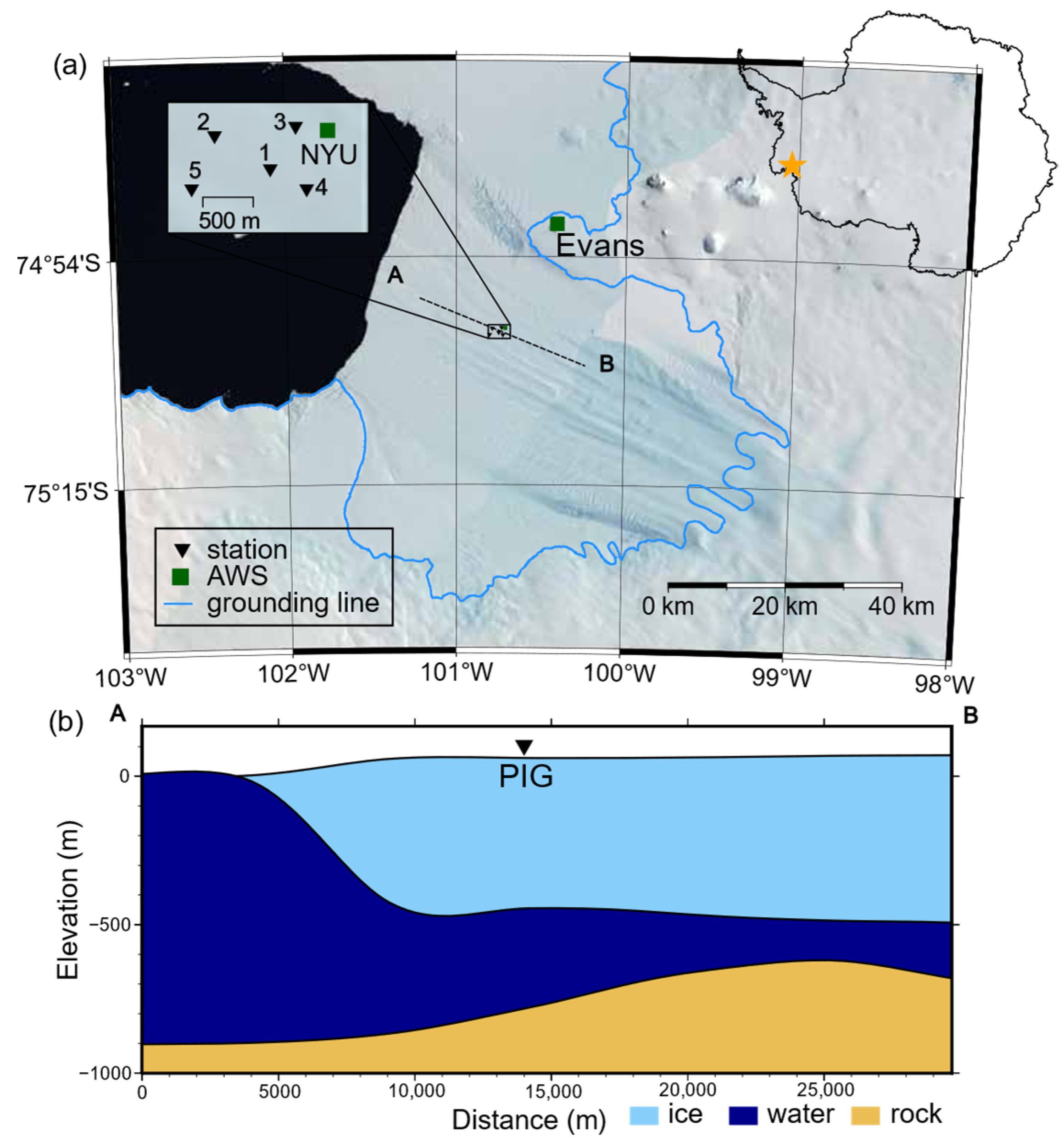
Our study site is located on the PIG ice shelf, a major outlet of the West Antarctic Ice Sheet (WAIS) flowing into the Amundsen Sea (
Figure 1a). A seismic array of five broadband seismometers (Nanometrics Trillium 120 Sec Response, 100 Hz sampling rate; Nanometrics Inc., Kanata, ON, Canada) was deployed near the ice shelf centerline from 2012 to 2013 [
27]. The array (inset,
Figure 1a) consists of stations spaced 0.82–2.10 km apart. All stations are positioned on the floating ice shelf, which features a surface marked by longitudinal ridges and troughs [
28]. A Bedmap2 cross-section (
Figure 1b) shows that at the array location, the ice thickness is ~466 m (surface elevation ~65 m, bed elevation −810 m) [
29]. Bedmap2 thickness values are derived primarily from airborne and ground-based radio-echo sounding surveys, complemented by satellite remote sensing (surface elevation, surface velocity) and mass-conservation modeling in data-sparse areas [
29]. At Pine Island Glacier, the Bedmap2 ice-shelf thickness uncertainty is ±150 m [
29].
In this study, we analyzed continuous seismic records from 1 February 2012 to 30 November 2013. Data from stations PIG1, PIG2, PIG3, and PIG4 were used. PIG5 was excluded due to poor data quality (
Figure S1). Meteorological data, including wind speed and air temperature, were obtained from two nearby automatic weather stations (AWS) shown in
Figure 1a: Evans AWS [
32], located ~22 km from the array, and the NYU AWS [
33], collocated with the seismic array. Because the Evans dataset is more complete and the air temperatures recorded by both stations show no difference during overlapping periods (
Figure S2), we adopted the Evans record for all analyses.
3. Methods
To quantify the relationship between wind velocity and the seismic noise field, we adapted the methodology of Frankinet et al. [
16]. We first computed hourly Power Spectral Densities (PSDs), which describe how the power of a seismic signal is distributed across different frequencies, for the PIG2 station using the ObsPy package (Python v3.10.18; Obspy v1.4.2) [
34,
35]. The data were segmented into non-overlapping 1 h windows. PSDs were computed over a frequency range from 0.02 to 50 Hz, and the resulting spectral power values were accumulated into a probabilistic distribution using 0.25 dB bins spanning −200 to −80 dB. In this context, probabilistic PSD was calculated to account for the statistical distribution of PSDs across many 1 h time windows, from which percentile values are extracted (e.g., 5th percentile or median value) [
36]. For visualization, PSDs were smoothed in logarithmic frequency bins with a width of 1/40 octaves, using an octave step of 1/80, which means each bin edge is spaced by a constant multiplicative ratio: 2
1/80.
Following Frankinet et al. [
16], we linked each hourly PSD to the corresponding average hourly wind speed and grouped the PSD values into wind-speed bins spanning from 0 to 25 m s
−1 with 0.25 m s
−1 wide bins. For each wind speed bin, we defined the base noise level as the 5th percentile of noise power from the probabilistic PSD result. This statistic is preferred over the mean because it is less sensitive to transient outlier events (e.g., icequakes) and better reflects the background noise floor. Glaciers generate frequent transient signals detectable on ocean-bottom and surface seismometers, which have been linked to glacier slip and crevasse propagation [
35,
37].
We then measured the change in noise power as a function of wind speed for each discrete frequency using the vertical-component seismic record. For each frequency, we fit the noise power to wind speed. This was performed using a weighted linear regression. For each wind-speed bin and each frequency, we computed the within-bin standard deviation from the distribution of hourly PSD values. Regression weights were defined as the inverse of the standard deviation of this distribution. Only wind speed bins with 10 or more observations were considered. We found that a single linear relationship provided a robust fit to the PSD values across the 0 to 25 m s−1 wind speeds. This relationship is described by the function , where is the 5th percentile noise power (dB) at a given frequency, is the wind speed (m s−1), and (slope) and (intercept) are the regression parameters for this specific frequency. We therefore repeat the wind-speed binning independently for each frequency, producing a two-dimensional relationship between wind speed and PSD value as a function of frequency.
To investigate structural signals, daily HVSR curves (0.1–40 Hz) were computed from three-component seismic data recorded at the PIG stations using hvsrpy [
38], with 60 s non-overlapping windows, Konno–Ohmachi smoothing method (b = 40) [
39], and geometric averaging of the horizontal components [
40].
HVSR spectrograms were then generated by stacking the daily HVSR curves in chronological order to track changes in resonant properties over time. To test the hypothesis that the observed low-frequency HVSR peaks correspond to structural resonances, we computed synthetic HVSR curves using OASES, a seismo-acoustic modeling package [
41] that solves wave propagation in layered fluid-solid media.
A simplified 1D structural model of the PIG ice shelf, underlying water cavity, and bedrock was constructed with parameters listed in
Table 1 and based on Diez et al. [
42]. To examine the sensitivity of the HVSR response to ice-water interface depth, we performed a suite of forward models in which ice thickness was varied while total depth to bedrock was held constant.
Synthetic seismograms were generated by computing frequency-domain solutions across the bandwidth of interest and applying an inverse Fourier transform to obtain time-domain signals. HVSR curves were then calculated from the synthetic horizontal and vertical component seismograms.
4. Results
4.1. Wind-Induced Seismic Noise
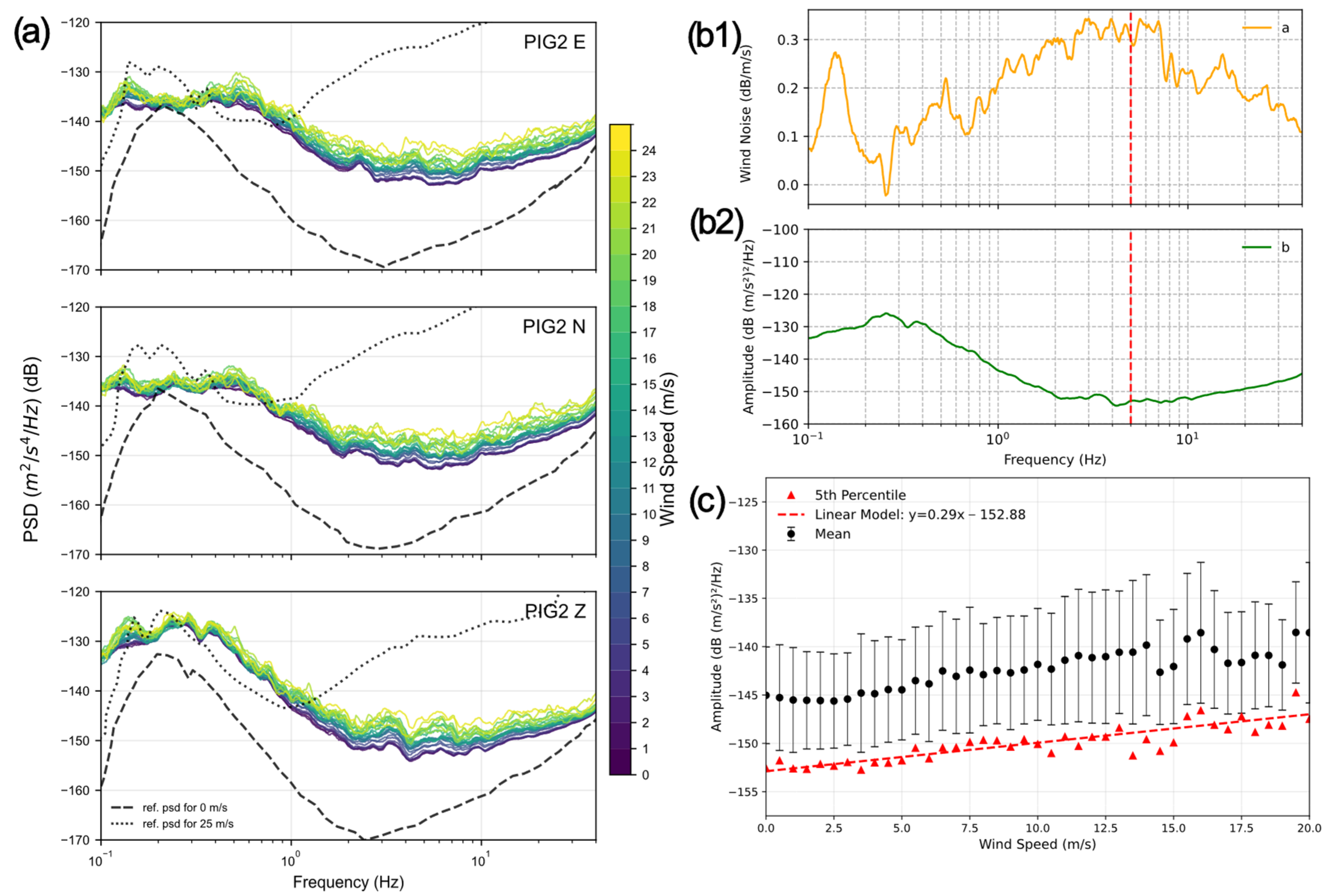
Figure 2a shows the PSDs for all three components at station PIG2, binned by wind speed from 0 to 25 m s
−1 and averaged within each bin. The results clearly demonstrate a frequency-dependent relationship in which noise power increases with wind speed across the full frequency range, with a stronger effect at higher frequencies (mostly above 1 Hz). This correlation is consistent with observations by Frankinet et al. [
16] at the Belgian Princess Elisabeth Antarctica Station (PEAS). However, a direct comparison with the PEAS reference noise models (dashed and dotted lines in
Figure 2a, representing 0 and 25 m s
−1 wind, respectively) reveals differences in both overall noise levels and wind speed sensitivity.
First, the dynamic range of wind-induced noise at PIG is much smaller. Frankinet et al. [
16] reported a 42 dB noise increase at 10 Hz between 0 and 25
wind at PEAS, whereas our PIG data (
Figure 2a) shows only a 5–7 dB increase over the same range. Second, the noise power limits differ substantially between the two sites. PEAS located on bedrock is significantly quieter during calm conditions: its lower noise limit (0 m s
−1, dashed line) is more than 20 dB lower (e.g., at 10 Hz) than the quietest noise observed at PIG. Under high winds, however, PEAS becomes much louder, with its upper noise limit (25 m s
−1, dotted line) is ~15 dB higher than the loudest conditions at PIG.
To quantify wind-driven noise variations at PIG, we developed a synthetic noise model based on linear regression of noise power on wind speed at each frequency.
Figure 2b shows the regression parameters a and b.
Figure 2c illustrates the fit at 5 Hz (dashed red line in
Figure 2b), where wind-induced noise increases by ~6 dB from 0 to 20 m s
−1.
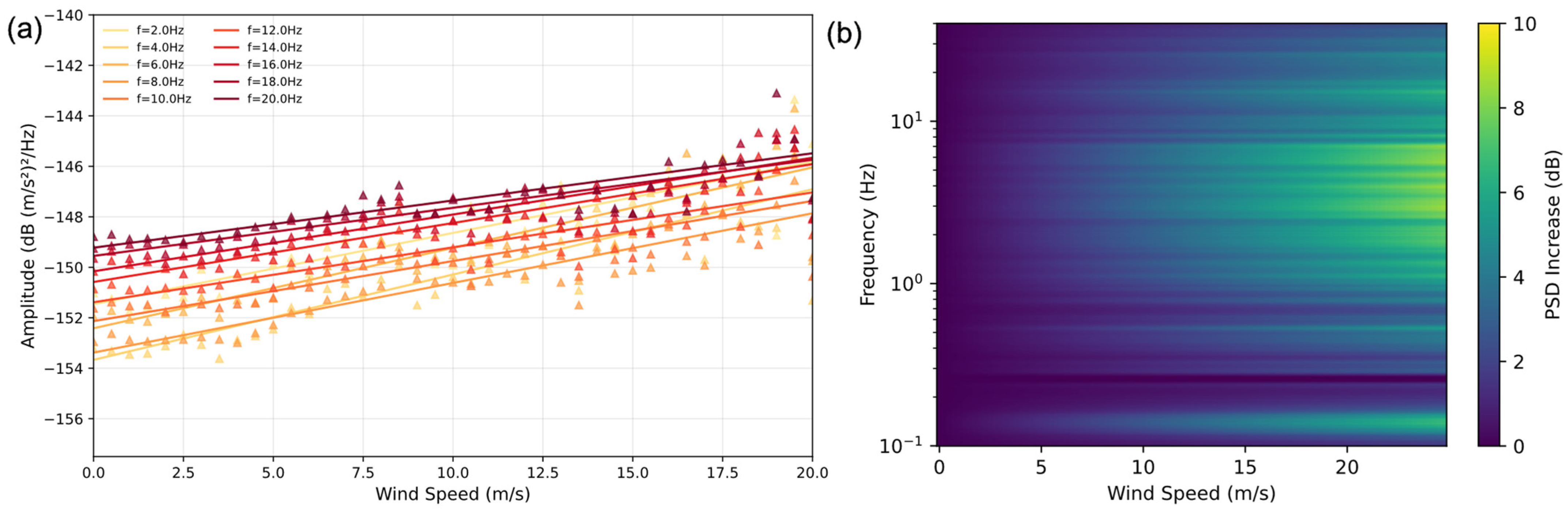
Figure 3a further shows that noise power across multiple discrete frequencies (2–20 Hz) can be well described by individual linear regressions.
With all linear parameters, we produced a synthetic PSD spectrum.
Figure 3b shows the modeled PSD increase (in dB) across frequency and wind speed. We also computed the RMS (root mean square) ground velocity in the 1–40 Hz band, where cryoseismicity is expected, from these synthetic PSDs. Even at a high wind speed of 25 m s
−1, the resulting ground velocity is only 0.07 μm s
−1. This level is far below typical icequake signals (0.3 μm s
−1) [
43], suggesting that wind-induced noise is not a primary limiting factor for icequake detection on the PIG ice shelf.
4.2. HVSR Temporal Variations and Stable Peaks
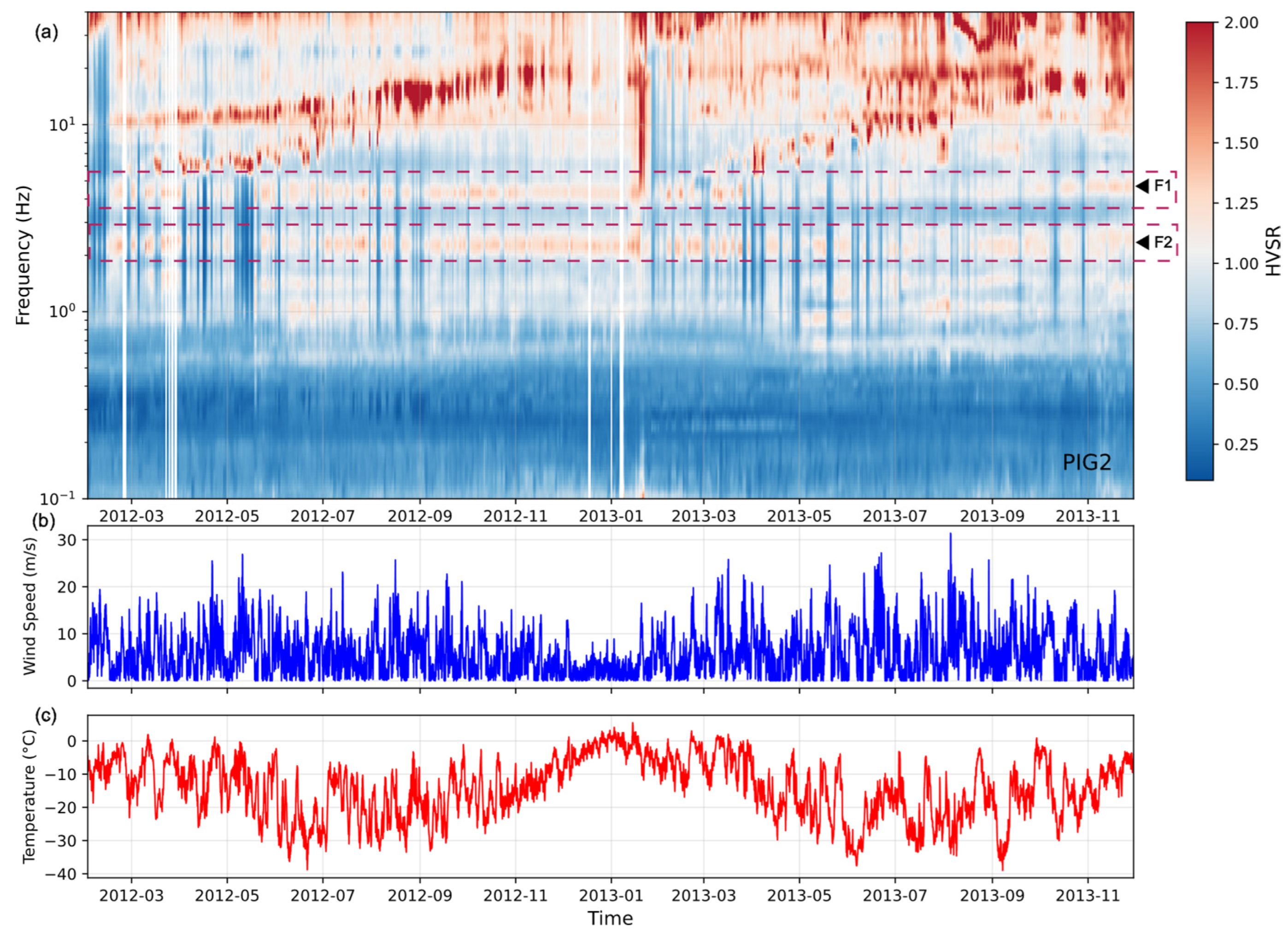
Having characterized the high-frequency, wind-driven noise, we now analyze the temporal characteristics of the HVSR. The HVSR spectrograms, which stack HVSR curves over time (shown for station PIG2 in
Figure 4), exhibit three distinct phenomena.
First, the high-frequency HVSR band (e.g., >7 Hz) is highly variable (
Figure 4a), with shifting peaks. Although the relationship between HVSR variability and meteorological conditions (
Figure 4b,c) is complicated, the variability in this band suggests dominance by environmental forcing and sensitivity to near-surface (firn) conditions. Second, the low-frequency band (<7 Hz) is dominated by blue shading (
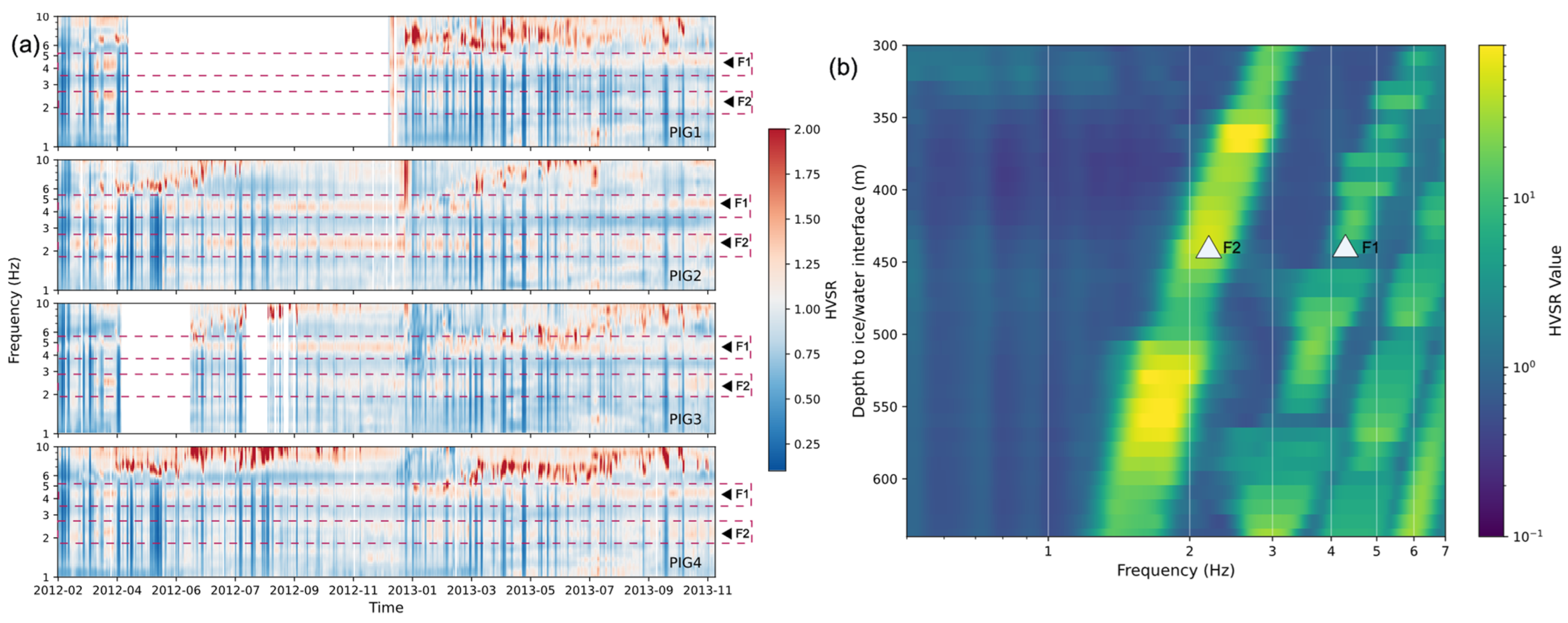
Figure 4a), indicating HVSR values consistently below 1 (HVSR troughs). This baseline pattern indicates that vertical (V) motion exceeds the horizontal (H) motion across the entire band. Third, and most importantly, two distinct features, F1 (~4.3 Hz) and F2 (~2.2 Hz), appear as clear HVSR peaks at all four seismic stations (
Figure 5a). Although their peak amplitudes vary over time, their frequencies remain remarkably stable. These peaks show no correlation with fluctuations in wind speed or air temperature.
This contrast between the highly variable high-frequency HVSR band and the stable low-frequency peaks strongly suggests that F1 and F2 are not atmospheric or firn-related signals. We hypothesize that their stability reflects a deeper structural origin, resonances of the ice-water-bedrock system.
4.3. Forward Modeling
To test whether the stable F1 and F2 peaks represent structural resonances, we modeled the HVSR response of the ice-water-bedrock system using OASES. The results (
Figure 5b) strongly support this hypothesis.
The modeled HVSR curves reproduce resonance peaks at frequencies closely matching F1 and F2. The modeling shows that these peaks are sensitive to the ice-water interface depth: as the ice layer thins, the resonance frequencies shift higher.
The observed frequencies for F1 (~4.3 Hz) and F2 (~2.2 Hz) (indicated by the white triangles in
Figure 5b) align with a modeled ice-water interface depth of ~440 m (
Figure 5b).
5. Discussion
Our investigation of the 0.1–40 Hz ambient noise field on the PIG ice shelf shows two types of signals: wind-driven noise amplification and stable HVSR peaks that persist independently of environmental forcing, reflecting the underlying ice-shelf structure.
5.1. Damped Signature of Wind on a Floating Ice Shelf
Wind-noise analysis reveals a complicated, two-part contrast between PIG and bedrock stations, such as PEAS [
16]. First, during calm wind conditions, baseline noise at PIG is much higher (e.g., >20 dB higher at 10 Hz) than at PEAS. Second, PIG is far less sensitive to wind: whereas PEAS exhibits a ~42 dB noise increase between low and high wind speeds, PIG shows only a ~5–7 dB increase, meaning that even under strong winds, absolute noise levels at PIG remain lower than those at PEAS. Frankinet et al. [
16] used two linear models at PEAS because they observed a change in noise-wind behavior at 6 m s
−1. In contrast, we find no such breakpoint at PIG; a single linear regression fits the data very well, consistent with Lott et al. [
44] and Johnson et al. [
45]. Explaining the behavior difference at PEAS is beyond the scope of this study.
The higher ambient noise baseline at PIG is consistent with expectations for floating ice shelves. As Baker et al. [
14] showed for the Ross Ice Shelf, floating ice is strongly coupled to oceanic processes, such as swell and infragravity waves, producing a noisy seismic wavefield. Inland bedrock sites, such as PEAS, which lack this direct oceanic coupling, naturally exhibit a much lower noise floor.
The stark contrast in wind sensitivity likely arises from differences in near-surface coupling. At PEAS, sensors are directly coupled to bedrock [
16], enabling efficient transfer of wind energy into seismic motion. At PIG, sensors are installed within the firn layer, which acts as a mechanical insulator and reduces wind. Our synthetic noise modeling further shows that, even under strong winds, RMS ground velocities in the cryoseismic band (1–40 Hz) remain well below typical icequake signal amplitudes. The opposite is true for PEAS, where wind noise can obscure events. Thus, site-specific coupling conditions (bedrock vs. firn) can influence the completeness of ice-quake catalogs and should be considered when comparing cryoseismicity across locations.
5.2. The Structural Resonance
The HVSR spectrograms (
Figure 4a and
Figure 5a) show that in the low-frequency band (<7 Hz), baseline HVSR values are consistently below 1, indicating that vertical (V) motion exceeds horizontal (H) motion. This behavior is consistent with observations from the Amery Ice Shelf by Zhan et al. [
46], who showed that the sub-ice-shelf water layer acts as a strong low-velocity waveguide. The water column traps P-wave energy, causing near-vertical resonance and amplifying the vertical component of ambient noise.
Superimposed on this vertically dominated baseline are two stable HVSR peaks, F1 (~4.3 Hz) and F2 (~2.2 Hz). Unlike the highly variable high-frequency HVSR features, these peaks show no correlation with environmental forcings (
Figure 4) and appear consistently across all stations (
Figure 5a). We interpret them as S-wave resonances within the solid ice layer.
OASES forward modeling strongly supports this interpretation (
Figure 5b). The modeled resonance peaks match F1 and F2 closely and demonstrate that their frequencies are sensitive to the ice-water interface depth. The observed peaks correspond to a modeled ice thickness of ~440 m, in close agreement with the Bedmap2 estimate of 466 m at the station location.
The physical origin of these peaks follows from the boundary conditions of the ice shelf and its S-wave transfer function [
47]. The system forms an extreme “stiff-over-soft” structure, with an elastic ice layer overlying seawater. Carcione et al. [
47] showed that, in such a configuration, the classic quarter-wavelength (
), typical of soft-over-rigid media, is suppressed. Instead, the fundamental S-wave resonance corresponds to half-wavelength (
), with frequencies given by:
where
is the S-wave velocity of the ice,
is the ice thickness, and n is the nth frequency peak or higher modes.
Using parameters from our 1D model (
Table 1;
m s
−1) and the modeled ice thickness (
m), this formula predicts the following:
These frequencies are double those predicted by the standard
formula used for grounded ice [
19,
20], align well with the observed peaks: F2 (~2.2 Hz) and F1 (~4.3 Hz). This confirms that F2 represents the fundamental S-wave resonance peak of the ice shelf, and F1 is its first overtone.
The uncertainty in the estimated thickness arises from the uncertainty in the resonance frequency (typically 2–4% for HVSR peaks), and the S-wave velocity of ice which varies with fabric, temperatures, and porosity ( 1800–1950 m s−1; 3–5%). Propagating these errors through Equation (1) yields 4–6%, thus 18–26 m with h = 440 m. The ~26 m difference (<6%) between modeled ice-thickness and Bedmap 2 estimates lies within the uncertainties of both the 1D model and Bedmap2 uncertainty (±150 m).
It is worth noting that the HVSR method has several limitations when applied to ice shelves. The method assumes a laterally homogeneous and horizontally layered ice-water-bedrock system, such that the estimated thickness represents an average value over a certain radius surrounding the station, with an effective radius empirically approximated as one quarter of the dominant frequency [
19]. Consequently, HVSR cannot resolve small-scale structural features such as basal channels and crevasses. In addition, strong localized noise sources that generate energy at or near the resonance frequencies may obscure HVSR peaks, reducing the reliability of peak identification.
6. Conclusions
This study characterizes the ambient seismic noise field on the PIG ice shelf, revealing a wind-induced noise response that differs markedly from that at an inland bedrock site and identifying persistent structural signals using the HVSR method. Unlike the bedrock station, the ice shelf site exhibits higher noise levels during calm conditions and much lower sensitivity to strong winds. This behavior most likely reflects the sensor coupling to firn rather than rigid bedrock, underscoring the importance of understanding site-specific noise environments when interpreting cryoseismicity across different glacier settings.
Across all stations, we identify two stable HVSR peaks at ~2.2 Hz (F2) and ~4.3 Hz (F1), independent of meteorological variability. Our analysis confirms that these two peaks correspond to S-wave resonances within the ice shelf. Forward modeling gives an ice-water interface depth of ~440 m, in close agreement with the Bedmap2 thickness estimate (466 m), supporting the robustness of this resonance-based interpretation.
This work demonstrates a new application of the HVSR technique for estimating the thickness of a floating ice shelf. With further validation, continuous tracking of these stable HVSR peaks may enable real-time monitoring of ice-shelf thickness changes. This passive, low-cost approach offers a valuable complement to remote sensing and radar surveys and provides important insights into ice-shelf stability in a changing climate.
Supplementary Materials
The following supporting information can be downloaded at:
https://www.mdpi.com/article/10.3390/jmse14010036/s1, Figure S1. Example of anomalous seismic data from PIG5. It may result from instrument failure; therefore; We exclude data from the PIG5 station. Figure S2. Comparison of air temperature (a)) and wind speed (b) from New York University (NYU) AWS (blue) and Evans Knoll AWS (black). Gaps in the NYU AWS record indicate periods of missing data.
Author Contributions
Conceptualization, Y.C. and P.Y.; methodology, Y.C.; validation, Y.C., P.Y. and Y.Y.; formal analysis, Y.C.; investigation, D.M.H.; resources, D.M.H.; writing—original draft preparation, Y.C.; writing—review and editing, Y.C., P.Y., and F.L.; supervision, F.L.; project administration, Y.Y. All authors have read and agreed to the published version of the manuscript.
Funding
This study is supported by the National Key Research and Development Program of China under grant number 2023YFC2809103, the National Natural Science Foundation of China (No. 42474055) and the National Key Research and Development Program of China (No. 2023YFC2808503).
Data Availability Statement
Acknowledgments
We thank our partners who provided all the help during the research process and the team for their great support. During the preparation of this work, the authors only used Gemini (generative AI tool) to find grammar errors and improve language.
Conflicts of Interest
The authors declare no conflicts of interest.
Abbreviations
The following abbreviations are used in this manuscript:
| AWS | automatic weather station |
| HVSR | horizontal-to-vertical spectral ratio |
| PEAS | Princess Elisabeth Antarctica Station |
| PIG | Pine Island Glacier |
| PSD | Power Spectral Density |
| WAIS | West Antarctic Ice Sheet |
References
- Greene, C.A.; Gardner, A.S.; Schlegel, N.-J.; Fraser, A.D. Antarctic Calving Loss Rivals Ice-Shelf Thinning. Nature 2022, 609, 948–953. [Google Scholar] [CrossRef]
- Rignot, E.; Mouginot, J.; Morlighem, M.; Seroussi, H.; Scheuchl, B. Widespread, Rapid Grounding Line Retreat of Pine Island, Thwaites, Smith, and Kohler Glaciers, West Antarctica, from 1992 to 2011. Geophys. Res. Lett. 2014, 41, 3502–3509. [Google Scholar] [CrossRef]
- Vaughan, D.G.; Corr, H.F.J.; Ferraccioli, F.; Frearson, N.; O’Hare, A.; Mach, D.; Holt, J.W.; Blankenship, D.D.; Morse, D.L.; Young, D.A. New Boundary Conditions for the West Antarctic Ice Sheet: Subglacial Topography beneath Pine Island Glacier. Geophys. Res. Lett. 2006, 33, 2005GL025588. [Google Scholar] [CrossRef]
- Nicholls, K.W.; Corr, H.F.J.; Stewart, C.L.; Lok, L.B.; Brennan, P.V.; Vaughan, D.G. A Ground-Based Radar for Measuring Vertical Strain Rates and Time-Varying Basal Melt Rates in Ice Sheets and Shelves. J. Glaciol. 2015, 61, 1079–1087. [Google Scholar] [CrossRef]
- Brett, G.M.; Price, D.; Rack, W.; Langhorne, P.J. Satellite Altimetry Detection of Ice-Shelf-Influenced Fast Ice. Cryosphere 2021, 15, 4099–4115. [Google Scholar] [CrossRef]
- Pritchard, H.D.; Ligtenberg, S.R.M.; Fricker, H.A.; Vaughan, D.G.; Van Den Broeke, M.R.; Padman, L. Antarctic Ice-Sheet Loss Driven by Basal Melting of Ice Shelves. Nature 2012, 484, 502–505. [Google Scholar] [CrossRef]
- Paolo, F.S.; Fricker, H.A.; Padman, L. Volume Loss from Antarctic Ice Shelves Is Accelerating. Science 2015, 348, 327–331. [Google Scholar] [CrossRef]
- Podolskiy, E.A.; Walter, F. Cryoseismology. Rev. Geophys. 2016, 54, 708–758. [Google Scholar] [CrossRef]
- Latto, R.B.; Turner, R.J.; Reading, A.M.; Winberry, J.P. Towards the Systematic Reconnaissance of Seismic Signals from Glaciers and Ice Sheets—Part 1: Event Detection for Cryoseismology. Cryosphere 2024, 18, 2061–2079. [Google Scholar] [CrossRef]
- Johnston, A.C. Suppression of Earthquakes by Large Continental Ice Sheets. Nature 1987, 330, 467–469. [Google Scholar] [CrossRef]
- Aster, R.C.; Winberry, J.P. Glacial Seismology. Rep. Prog. Phys. 2017, 80, 126801. [Google Scholar] [CrossRef]
- Anthony, R.E.; Aster, R.C.; Wiens, D.; Nyblade, A.; Anandakrishnan, S.; Huerta, A.; Winberry, J.P.; Wilson, T.; Rowe, C. The Seismic Noise Environment of Antarctica. Seismol. Res. Lett. 2015, 86, 89–100. [Google Scholar] [CrossRef]
- Chen, Z.; Bromirski, P.D.; Gerstoft, P.; Stephen, R.A.; Wiens, D.A.; Aster, R.C.; Nyblade, A.A. Ocean-Excited Plate Waves in the Ross and Pine Island Glacier Ice Shelves. J. Glaciol. 2018, 64, 730–744. [Google Scholar] [CrossRef]
- Baker, M.G.; Aster, R.C.; Anthony, R.E.; Chaput, J.; Wiens, D.A.; Nyblade, A.; Bromirski, P.D.; Gerstoft, P.; Stephen, R.A. Seasonal and Spatial Variations in the Ocean-Coupled Ambient Wavefield of the Ross Ice Shelf. J. Glaciol. 2019, 65, 912–925. [Google Scholar] [CrossRef]
- Chaput, J.; Aster, R.C.; McGrath, D.; Baker, M.; Anthony, R.E.; Gerstoft, P.; Bromirski, P.; Nyblade, A.; Stephen, R.A.; Wiens, D.A.; et al. Near-Surface Environmentally Forced Changes in the Ross Ice Shelf Observed with Ambient Seismic Noise. Geophys. Res. Lett. 2018, 45, 11187–11196. [Google Scholar] [CrossRef]
- Frankinet, B.; Lecocq, T.; Camelbeeck, T. Wind-Induced Seismic Noise at the Princess Elisabeth Antarctica Station. Cryosphere 2021, 15, 5007–5016. [Google Scholar] [CrossRef]
- Nakamura, Y. A Method for Dynamic Characteristics Estimation of Subsurface Using Microtremor on the Ground Surface. Railw. Tech. Res. Inst. Q. Rep. 1989, 30, 25–33. [Google Scholar]
- Bonnefoy-Claudet, S.; Cornou, C.; Bard, P.-Y.; Cotton, F.; Moczo, P.; Kristek, J.; Fäh, D. H/V Ratio: A Tool for Site Effects Evaluation. Results from 1-D Noise Simulations. Geophys. J. Int. 2006, 167, 827–837. [Google Scholar] [CrossRef]
- Picotti, S.; Francese, R.; Giorgi, M.; Pettenati, F.; Carcione, J.M. Estimation of Glacier Thicknesses and Basal Properties Using the Horizontal-to-Vertical Component Spectral Ratio (HVSR) Technique from Passive Seismic Data. J. Glaciol. 2017, 63, 229–248. [Google Scholar] [CrossRef]
- Yan, P.; Li, Z.; Li, F.; Yang, Y.; Hao, W.; Bao, F. Antarctic Ice Sheet Thickness Estimation Using the Horizontal-to-Vertical Spectral Ratio Method with Single-Station Seismic Ambient Noise. Cryosphere 2018, 12, 795–810. [Google Scholar] [CrossRef]
- Berbellini, A.; Schimmel, M.; Ferreira, A.M.; Morelli, A. Constraining S-Wave Velocity Using Rayleigh Wave Ellipticity from Polarization Analysis of Seismic Noise. Geophys. J. Int. 2019, 216, 1817–1830. [Google Scholar] [CrossRef]
- Xia, J.; Miller, R.D.; Park, C.B.; Tian, G. Inversion of High Frequency Surface Waves with Fundamental and Higher Modes. J. Appl. Geophys. 2003, 52, 45–57. [Google Scholar] [CrossRef]
- Chaput, J.; Aster, R.; Karplus, M.; Nakata, N. Ambient High-Frequency Seismic Surface Waves in the Firn Column of Central West Antarctica. J. Glaciol. 2022, 68, 785–798. [Google Scholar] [CrossRef]
- Chaput, J.; Aster, R.; Karplus, M.; Nakata, N.; Gerstoft, P.; Bromirski, P.D.; Nyblade, A.; Stephen, R.A.; Wiens, D.A. Near-Surface Seismic Anisotropy in Antarctic Glacial Snow and Ice Revealed by High-Frequency Ambient Noise. J. Glaciol. 2023, 69, 773–789. [Google Scholar] [CrossRef]
- Chen, Y.; Yan, P.; Yang, Y.; Huang, X.; Li, F. An Application of a Seismic Nodal System with Seismic Ambient Noise near Kunlun Station, Antarctica: Estimating Ice Thickness and Firn Structure. Earth Planet. Phys. 2025, 9, 323–336. [Google Scholar] [CrossRef]
- Guillemot, A.; Bontemps, N.; Larose, E.; Teodor, D.; Faller, S.; Baillet, L.; Garambois, S.; Thibert, E.; Gagliardini, O.; Vincent, C. Investigating Subglacial Water-Filled Cavities by Spectral Analysis of Ambient Seismic Noise: Results on the Polythermal Tête-Rousse Glacier (Mont Blanc, France). Geophys. Res. Lett. 2024, 51, e2023GL105038. [Google Scholar] [CrossRef]
- Holland, D.; Bindschadler, R. Observing Pine Island Glacier (PIG) Ice Shelf Deformation and Fracture Using a GPS and Seismic Network. 2012. Available online: https://www.fdsn.org/networks/detail/XC_2012/ (accessed on 19 October 2025).
- Vaughan, D.G.; Corr, H.F.J.; Bindschadler, R.A.; Dutrieux, P.; Gudmundsson, G.H.; Jenkins, A.; Newman, T.; Vornberger, P.; Wingham, D.J. Subglacial Melt Channels and Fracture in the Floating Part of Pine Island Glacier, Antarctica. J. Geophys. Res. Earth Surf. 2012, 117, F03012. [Google Scholar] [CrossRef]
- Fretwell, P.; Pritchard, H.D.; Vaughan, D.G.; Bamber, J.L.; Barrand, N.E.; Bell, R.; Bianchi, C.; Bingham, R.G.; Blankenship, D.D.; Casassa, G.; et al. Bedmap2: Improved Ice Bed, Surface and Thickness Datasets for Antarctica. Cryosphere 2013, 7, 375–393. [Google Scholar] [CrossRef]
- Bindschadler, R.; Vornberger, P.; Fleming, A.; Fox, A.; Mullins, J.; Binnie, D.; Paulsen, S.; Granneman, B.; Gorodetzky, D. The Landsat Image Mosaic of Antarctica. Remote Sens. Environ. 2008, 112, 4214–4226. [Google Scholar] [CrossRef]
- Earth Resources Observation and Science (EROS) Center. Landsat Image Mosaic of Antarctica (LIMA). 2018. Available online: https://www.usgs.gov/centers/eros/science/usgs-eros-archive-landsat-legacy-landsat-image-mosaic-antarctica-lima (accessed on 19 October 2025).
- Antarctic Meteorological Research and Data Center Evans Knoll Automatic Weather Station. 2013 Quality-Controlled Observational Data. 2013. Available online: https://amrdcdata.ssec.wisc.edu/dataset/evans-knoll-automatic-weather-station-2013-quality-controlled-observational-data (accessed on 19 October 2025).
- Mojica Moncada, J.F.; Holland, D. Automatic Weather Station Pine Island Glacier. 2019. Available online: https://www.usap-dc.org/view/dataset/601216 (accessed on 19 October 2025).
- Beyreuther, M.; Barsch, R.; Krischer, L.; Megies, T.; Behr, Y.; Wassermann, J. ObsPy: A Python Toolbox for Seismology. Seismol. Res. Lett. 2010, 81, 530–533. [Google Scholar] [CrossRef]
- Yan, P.; Holland, D.M.; Tsai, V.C.; Vaňková, I.; Xie, S. Tidally Modulated Glacial Slip and Tremor at Helheim Glacier, Greenland. Geophys. Res. Lett. 2024, 51, e2023GL105342. [Google Scholar] [CrossRef]
- McNamara, D.E. Ambient Noise Levels in the Continental United States. Bull. Seismol. Soc. Am. 2004, 94, 1517–1527. [Google Scholar] [CrossRef]
- Olinger, S.D.; Lipovsky, B.P.; Denolle, M.A.; Crowell, B.W. Tracking the Cracking: A Holistic Analysis of Rapid Ice Shelf Fracture Using Seismology, Geodesy, and Satellite Imagery on the Pine Island Glacier Ice Shelf, West Antarctica. Geophys. Res. Lett. 2022, 49, e2021GL097604. [Google Scholar] [CrossRef]
- Vantassel, J. Jpvantassel/Hvsrpy: V1.0.0 2021. Available online: https://zenodo.org/records/5563211 (accessed on 19 October 2025).
- Konno, K.; Ohmachi, T. Ground-Motion Characteristics Estimated from Spectral Ratio between Horizontal and Vertical Components of Microtremor. Bull. Seismol. Soc. Am. 1998, 88, 228–241. [Google Scholar] [CrossRef]
- Albarello, D.; Lunedei, E. Combining Horizontal Ambient Vibration Components for H/V Spectral Ratio Estimates. Geophys. J. Int. 2013, 194, 936–951. [Google Scholar] [CrossRef]
- Schmidt, H.; Jensen, F.B. A Full Wave Solution for Propagation in Multilayered Viscoelastic Media with Application to Gaussian Beam Reflection at Fluid–Solid Interfaces. J. Acoust. Soc. Am. 1985, 77, 813–825. [Google Scholar] [CrossRef]
- Diez, A.; Bromirski, P.D.; Gerstoft, P.; Stephen, R.A.; Anthony, R.E.; Aster, R.C.; Cai, C.; Nyblade, A.; Wiens, D.A. Ice Shelf Structure Derived from Dispersion Curve Analysis of Ambient Seismic Noise, Ross Ice Shelf, Antarctica. Geophys. J. Int. 2016, 205, 785–795. [Google Scholar] [CrossRef]
- Lombardi, D.; Gorodetskaya, I.; Barruol, G.; Camelbeeck, T. Thermally Induced Icequakes Detected on Blue Ice Areas of the East Antarctic Ice Sheet. Ann. Glaciol. 2019, 60, 45–56. [Google Scholar] [CrossRef]
- Lott, F.F.; Ritter, J.R.R.; Al-Qaryouti, M.; Corsmeier, U. On the Analysis of Wind-Induced Noise in Seismological Recordings: Approaches to Present Wind-Induced Noise as a Function of Wind Speed and Wind Direction. Pure Appl. Geophys. 2017, 174, 1453–1470. [Google Scholar] [CrossRef]
- Johnson, C.W.; Meng, H.; Vernon, F.; Ben-Zion, Y. Characteristics of Ground Motion Generated by Wind Interaction with Trees, Structures, and Other Surface Obstacles. JGR Solid Earth 2019, 124, 8519–8539. [Google Scholar] [CrossRef]
- Zhan, Z.; Tsai, V.C.; Jackson, J.M.; Helmberger, D. Ambient Noise Correlation on the Amery Ice Shelf, East Antarctica. Geophys. J. Int. 2014, 196, 1796–1802. [Google Scholar] [CrossRef]
- Carcione, J.M.; Picotti, S.; Francese, R.; Giorgi, M.; Pettenati, F. Effect of Soil and Bedrock Anelasticity on the S-Wave Amplification Function. Geophys. J. Int. 2017, 208, 424–431. [Google Scholar] [CrossRef]
| Disclaimer/Publisher’s Note: The statements, opinions and data contained in all publications are solely those of the individual author(s) and contributor(s) and not of MDPI and/or the editor(s). MDPI and/or the editor(s) disclaim responsibility for any injury to people or property resulting from any ideas, methods, instructions or products referred to in the content. |