
Next Article in Journal
Spherical Gravity Inversion Reveals Crustal Structure and Microplate Tectonics in the Caribbean Sea
Previous Article in Journal
An Anchorage Decision Method for the Autonomous Cargo Ship Based on Multi-Level Guidance
error_outline You can access the new MDPI.com website here. Explore and share your feedback with us.
 
 
Article

Modeling of High-Precision Sea Surface Geomagnetic Field in the Northern South China Sea Based on PSO-BP Neural Network


1
Department of Surveying and Remote Sensing, School of Civil and Transportation Engineering, Guangdong University of Technology, Guangzhou 510006, China
2
State Key Laboratory of Precision Geodesy, Innovation Academy for Precision Measurement Science and Technology, Chinese Academy of Sciences, Wuhan 430077, China
3
Guangzhou Marine Geological Survey, China Geological Survey, Guangzhou 511458, China
*
Authors to whom correspondence should be addressed.
J. Mar. Sci. Eng. 2026, 14(1), 108; https://doi.org/10.3390/jmse14010108
Submission received: 18 December 2025 / Revised: 31 December 2025 / Accepted: 2 January 2026 / Published: 5 January 2026
(This article belongs to the Section Physical Oceanography)

Abstract

In existing regional geomagnetic field modeling, the smoothness of basic functions and the insufficient data constraints in marginal regions lead to the omission of detail features and extrapolation oscillations. To address these limitations and develop a high-precision marine regional geomagnetic field model, we develop a back propagation neural network (BPNN) method enhanced by particle swarm optimization (PSO). The PSO-BPNN method has the ability of adaptive learning and could extract local features. By combining the magnetic field data measured by ships with the previous model data, a high-precision geomagnetic field model of the northern South China Sea (SCS) is developed. The fitting error of the PSO-BPNN model is 18.05 nT, which is 16% and 20.1% lower than those of the traditional Legendre Polynomial (LP) and Taylor Polynomial (TP) models, respectively. The proposed PSO-BPNN model demonstrates superior robustness and higher accuracy, while retaining more magnetic signals of small geological bodies.

1. Introduction

The ocean geomagnetic field is an important part of the Earth’s magnetic field. It contains rich geophysical information that is valuable for precise navigation, marine target detection, crustal structure investigation and resource exploration, etc. [1,2]. In recent years, geomagnetically matched positioning and navigation technology has attracted attention in marine guidance and navigation. Its advantages of environmental adaptability and covertness have made it an important complement to satellite and inertial navigation. However, its accuracy relies on the resolution and accuracy of geomagnetic field models [3,4,5]. Similarly, high-precision ocean geomagnetic field models can reveal the geological structure of the seabed and the distribution of minerals (e.g., the correspondence between magnetic anomalies and mineral deposits), and provide key data for resource development [6,7]. It can also provide constraints for the study of geodynamic processes such as plate motion and mantle convection [8,9]. Therefore, there is an urgent need to construct high-precision ocean geomagnetic field models to meet the increasing demand for marine navigation and resource exploration.
Scholars have developed various global geomagnetic field models. Typical global models include the main magnetic field model, which is based on spherical harmonic functions. These models focus on describing long-term changes in the Earth’s core field [10], and the comprehensive magnetic field models (CM series and CHAOS series) derived from the combination of satellite and ground magnetic measurement data [11,12]. In addition, the EMAG2v3 magnetic anomaly grid model interpolates sparse oceanic trajectory lines using the Kriging algorithm with a resolution of two arc minutes [13]. The EMM2017 model integrates the EMAG2v3 crustal field data and Swarm satellite core field data to improve the accuracy in the oceanic area [14]. Although there are many global geomagnetic field models, the accuracy of geomagnetic field in the oceanic area is unable to meet the requirements of navigation, positioning, and resource exploration [15,16].
Consequently, researchers developed numerous regional geomagnetic field models, such as the polynomial model [17,18], R-SCHA model [19,20], surface spline model [21,22], and physics-constrained generative adversarial network model [23]. Among these models, the polynomial model is widely used due to its simple calculation formula and high computational efficiency. Feng developed two-dimensional and three-dimensional Taylor polynomial geomagnetic field models in mainland China [24,25]. Wang and Feng constructed regional geomagnetic field models using Legendre polynomials [26,27]. Subsequently, Zhu introduced the singular value decomposition (SVD) method to improve the accuracy and truncation of the model [28]. Traditional modeling methods increase higher-order terms in the basic functions to approximate nonlinear characteristics through smoothing processing. However, high-frequency signals are filtered out; this problem can be effectively addressed by the neural network method.
In recent years, artificial neural networks (ANNs) have been widely used to solve artificial intelligence problems in many fields, such as ionospheric magnetic field modeling [29,30,31], and constructing seafloor terrain models [32,33]. Compared to other neural network models, such as long short-term memory models [34] and convolutional long short-term memory models [35], the ANN model exhibits enhanced flexibility due to its independence from consecutive sample data (each sample set must have the same time interval). Furthermore, advancements in high-performance computing and data infrastructure have enabled the comprehensive utilization of ANN techniques. Among the various types of ANNs, backpropagation neural network (BPNN) is the most widely used. For instance, Chong employed BPNN to facilitate geomagnetically matched navigation for underwater vehicles [36], while Shi utilized BPNN to develop an ionospheric magnetic field model in China [31]. BPNN is a machine learning algorithm that automatically learns nonlinear relationships in data without the need for the manual design of basic functions. The nonlinear activation function of the hidden layer enables the model to fit arbitrarily complex functions. Its successful applications in other fields indicate that BPNN is suitable for signals with local steepness and discontinuity, such as crustal magnetic anomalies, especially in marine areas.
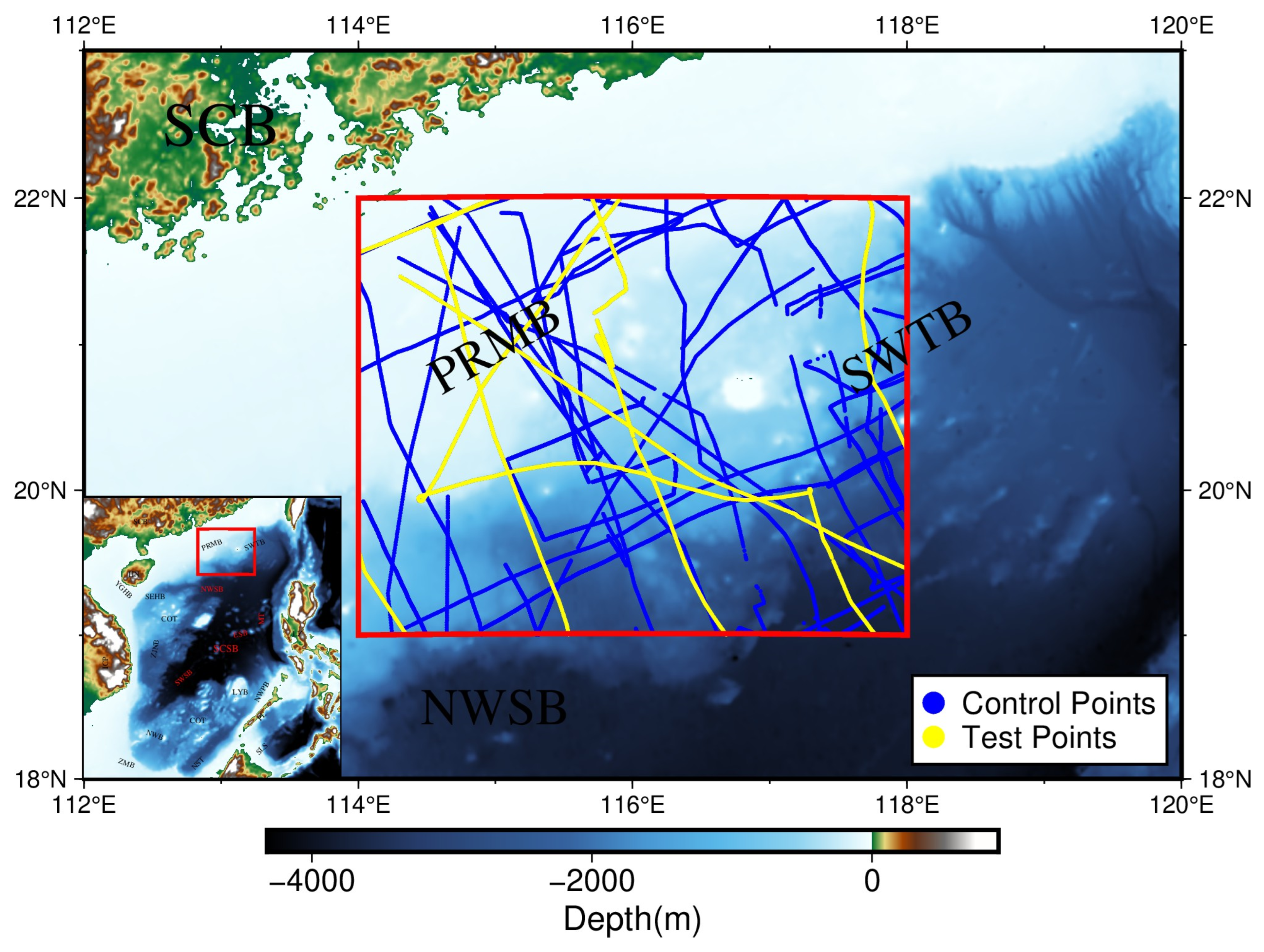
As one of the largest marginal seas in the Western Pacific Ocean, the SCS exhibits complex geological structures and distinctive magnetic characteristics. Owing to its remarkable magnetic anomalies, abundant resources, and unique geostrategic importance, the SCS has consistently been a critical area for research in geosciences and marine resource exploration. In the northern SCS, there are two large basins, the Pearl River Mouth Basin (PRMB) and the Southwest Taiwan Basin (SWTB) (Figure 1). This area has undergone multiple evolutionary stages influenced by the Mesozoic subduction of the ancient Pacific Plate, the Cenozoic extensional rifting, and the seafloor spreading. The crustal thickness ranges from 23 to 12 km, thinning gradually from the continental shelf to the continental slope [37]. Consequently, studying the magnetic anomaly stripes in this region contributes to understanding the evolutionary history of continental breakup and seafloor spreading [38]. Zhao et al. [39] utilized multi-channel seismic, ocean bottom seismometer (OBS), gravity, and magnetic surveys to identify Early Miocene submarine volcanic cones and igneous beds. The lower crust extensively exhibits high velocity layers (HVL) with an average thickness of 4–6 km. Doo and Huang [40] resolved the depth distribution and magnetic susceptibility of anomaly sources using wavelet spectral analysis, 2D magnetic modeling, and density inversion. Zhu et al. [37] showed that the HVL is continuous and up to 8 km thick beneath the Donghae Rise, representing long-term mantle material intrusion. In adddition, the SCS harbors diverse critical mineral resources whose spatial distribution exhibits significant correlation with magnetic anomaly characteristics, particularly in the South China Sea [41]. Therefore, the magnetic structure of the northern SCS could provide valuable information for resource exploration and geophysical and geological studies.
In this study, we develop a PSO-BPNN method to invert for the magnetic field model of the northern South China Sea. The high-precision shipborne magnetic data and data of an existing model are used. To evaluate the advantage of the PSO-BPNN model, we compare it with models built by traditional methods, and with some previous models. Finally, we find that the PSO-BPNN model is better than other models.

2. Materials and Methods

2.1. Data

The training of the PSO-BPNN model incorporated both shipborne geomagnetic measurements and existing model data. The shipborne geomagnetic data were obtained from the National Centers for Environmental Information (NCEI) of the United States, comprising a total of 20,376 measurement points within the study area. The shipborne geomagnetic data provided by the NCEI span a relatively long time (ranging from 1969 to 2014), and the quality of these data varies to some extent. Therefore, the original shipborne magnetic field data were pre-processed. The global geomagnetic activity index (Kp) was studied to detect the abnormal data affected by geomagnetic storms (Kp > 6.0), and the noise data was removed. Then, the comprehensive CM4 model was applied for diurnal correction, external field signals were estimated and removed, and the sea surface magnetic field data was restored [42]. To ensure the validity of the previous shipborne magnetic field data in the present era and to ensure that all data was on the same reference, the shipborne magnetic field data was corrected by the main magnetic field using the International Geomagnetic Reference Field 13 (IGRF13). Finally, the outliers were detected using the least squares trend surface method, and data points that deviated by more than twice the variance were eliminated [42]. The measurement points on the “V3608” measurement line were used as the test points to evaluate the generalization ability, while other data were used as the control points (Figure 1).
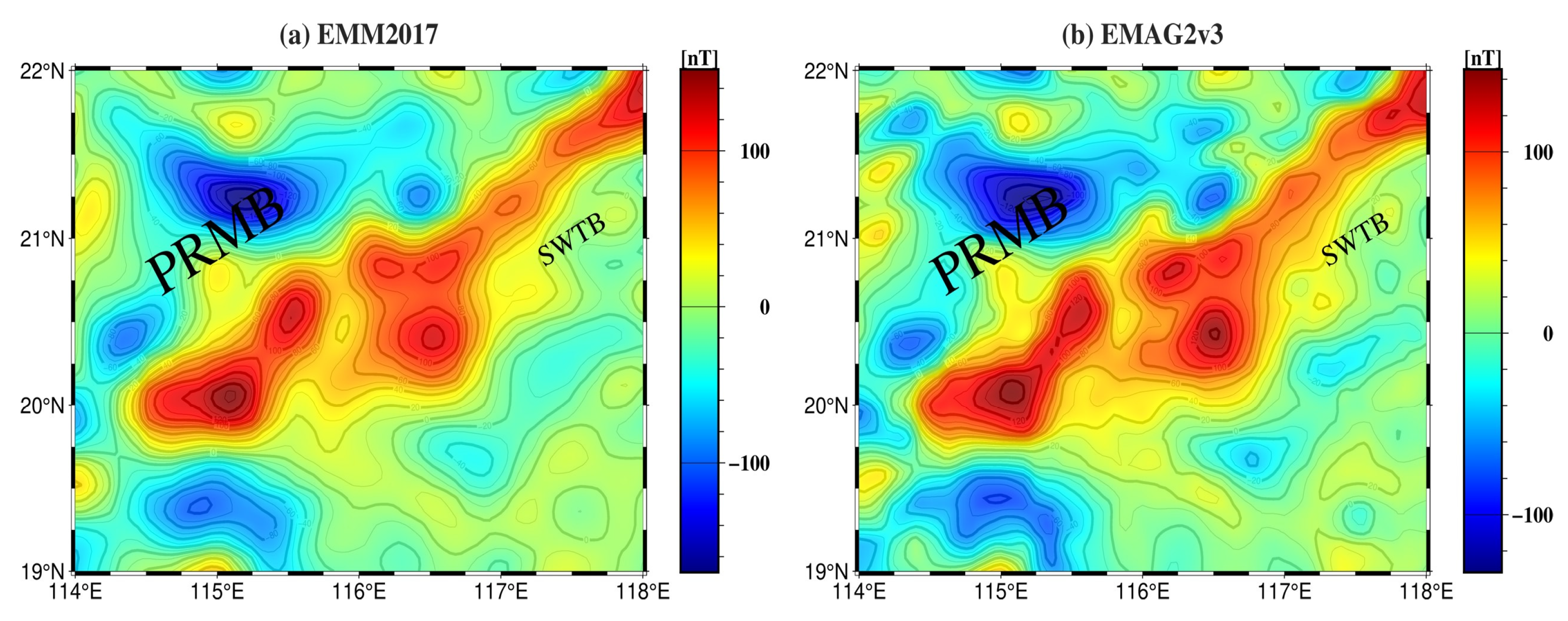
The existing geomagnetic field models employed in this study include the EMM2017 crustal magnetic field model and the EMAG2v3 sea-surface magnetic anomaly grid model (Figure 2). The crustal field model of EMM2017 was derived from the EMAG2v3. In the EMM2017 model, the order of the spherical harmonic functions is up to 790, and the resolvable spatial wavelength is about 51 km [43]. The EMM2017 model provides total magnetic field data, which was corrected by the main field contribution using the IGRF13 model. This process removes the magnetic field generated by the Earth’s core and its slow temporal variations, thereby obtaining a stable sea surface magnetic anomaly. These anomalies are then integrated with the shipborne measurement data to form an 80% training dataset and a 20% validation set. Furthermore, the EMAG2v3 model integrates satellite, shipborne, and airborne magnetic survey data and uses Kriging interpolation [13]. In this study, the EMAG2v3 model is used to evaluate the modeling results.

2.2. Methods

2.2.1. Taylor Polynomial

As a potential field, the geomagnetic field has spatial correlation, thus can be parameterized using the Taylor polynomial method. Select a central reference point for the study area, use the least squares method to fit the measurement data, and calculate the coefficient matrix A i j . By iterative optimization of the root means square error (RMSE) to determine the optimal truncation order [17,25], the optimal magnetic field model is finally obtained:
W x y = i = 0 n   j = 0 i   A i j ( x x 0 ) i j ( y y 0 ) j ,
where W represents the geomagnetic field value (magnetic anomaly value), while x and y denote the geographic latitude and longitude of the measurement point, respectively; x 0 and y 0 are the latitude and longitude of the reference point; A i j denotes the Taylor polynomial coefficients, and n indicates the order of the model training.

2.2.2. Legendre Polynomial

In contrast to the Taylor polynomial model, which relies on Taylor series expansion for local planar approximation, the Legendre polynomial model is grounded in the theoretical framework of spherical harmonic analysis and employs an orthogonal polynomial expansion of the potential function [28,44]. For measurement data of any geomagnetic element, the corresponding coefficient matrix a n k of the Legendre polynomials is computed using the least squares method under different truncation degrees M. The Legendre polynomial model is then obtained by substituting the derived coefficients into the following expression:
F = n = 0 M k = 0 n a n k P k X i P n k Y i ,
where F denotes an element in the geomagnetic field, a n k is the Legendre polynomial coefficient, and P is the Legendre polynomial. X i and Y i are the latitude difference and longitude difference.
The latitude and longitude coordinates of the measurement points need to be transformed:
x i = φ i 1 2 φ m a x + φ m i n 1 2 φ m a x φ m i n y i = λ i 1 2 λ m a x + λ m i n 1 2 λ m a x λ m i n ,
where φ i and λ i are the latitude and longitude of the measurement point, φ m a x and φ m i n are the maximum and minimum latitudes in the study area, and λ m a x and λ m i n are the maximum and minimum longitudes in the study area.
The kth degree Legendre polynomial can be described as
P k Δ x i = m = 0 k 2 1 m × 2 k 2 m ! 2 k m ! k m ! k 2 m ! Δ x i k 2 m ,
where [k/2] is an integer not greater than k/2.

2.2.3. Traditional BPNN

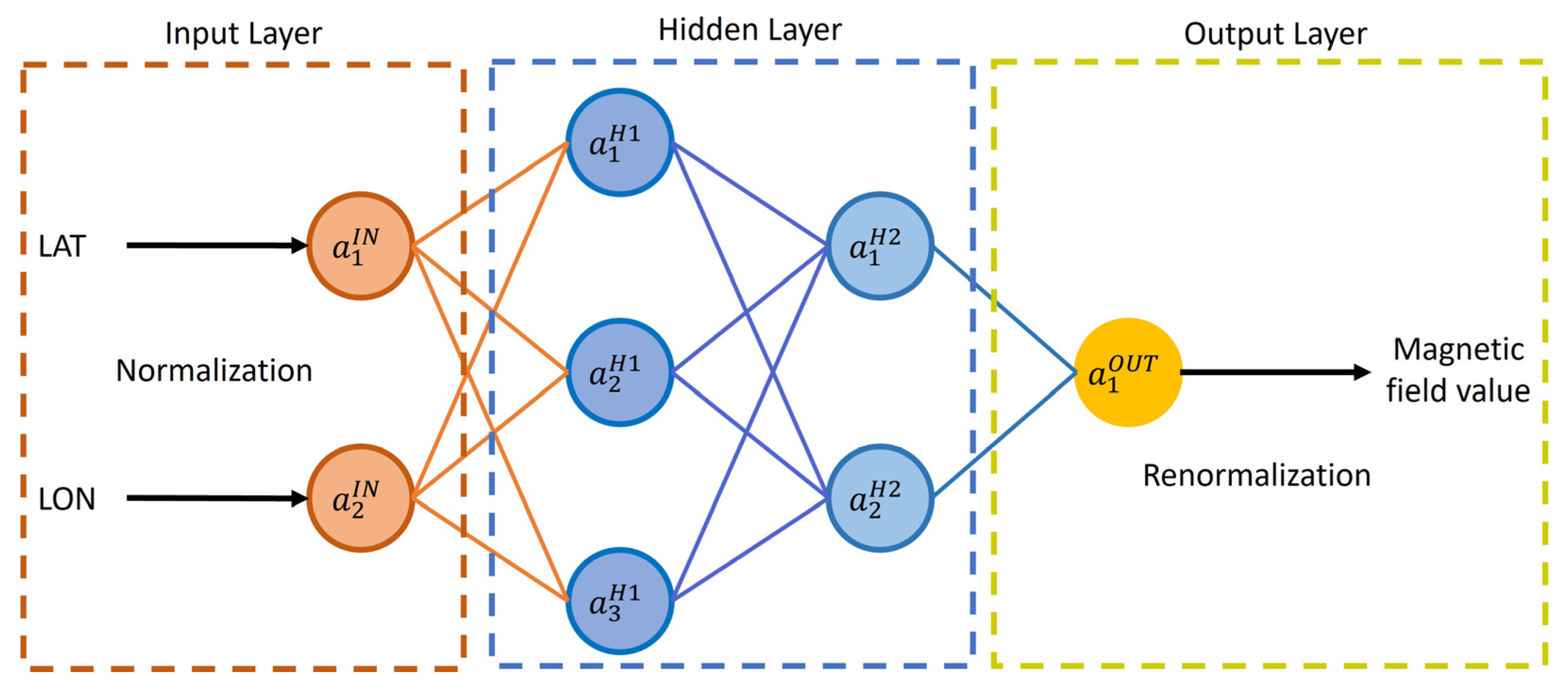
Unlike the above two methods that rely on basis function modeling, which have limited fitting capabilities and may smooth out detailed signals during regional modeling, neural networks are data-driven with strong nonlinear fitting capabilities and can capture details. A Backpropagation Neural Network is a multilayer network trained using the error back propagation algorithm [45]. Its working principle is to propagate the error (between predicted signals and truth signals) backward along the network and adjust the weights layer by layer to minimize the error. Additionally, it uses the chain rule to calculate the impact of the error on the weight and continuously adjusts the weight according to the learning rate. Ultimately, it attains the necessary precision in predicted outcomes through iterative procedures. Figure 3 illustrates the simplified architecture of the BPNN.
The corresponding latitude and longitude values are normalized and transferred to the input layer. Then, they are transferred to the next layer by connecting the weights and thresholds. Throughout this progression, ‘tansig’ serve as the activation function, “purelin” serve as the output layer of activation function, accomplishing the non-linear propagation. The expression of the magnetic field value throughout the process:
n T ψ , λ = g ( i = 1 n 2 w i 3 f ( j = 1 n 1 w i j 2 h + b i 2 ) + b 3 ) ,
where   ψ , λ   is the latitude and longitude of the magnetic field value at the prediction point, w i j ( 2 ) , b i 2 are the weights and bias between the hidden layers, w i 3 , b ( 3 ) are the weights and bias between the hidden layer and the output layer, n1, n2 are the number of nodes of the first and the second layers of the hidden layer, f and g are the “tansig”, purelin” activation functions, h represents the output of the first layer of the hidden layer, and the expression is:
h = f w i j 1 l o n + b i 1 + f w i j 1 l a t + b i 1 ,
where w i j 1 , b i 1 are the weights and biases from the input layer to the hidden layer, where i is the index of the node in the first layer of the hidden layer, j is the index of the node in the input layer, and f is the activation function “tansig”. LON is the longitude and LAT is the latitude. The above equation illustrates the forward computation process in BPNN. In the error back propagation process, the whole network is iteratively updated based on the designed loss function to meet the training requirements.
w = w η l o s s w ,
where w′ represents the adjusted weights, η denotes the learning rate, and loss is the loss function. In this case, the root-mean-square error (RMSE) between the actual and predicted magnetic field values is chosen as the loss function.
However, BPNN is highly dependent on their initial weights. Random initialization can cause the network to converge to a local optimum or result in unstable training. Excessively large initial weights may lead to gradient explosion, destabilizing the network through drastic weight updates. Conversely, overly small initial values may result in the vanishing gradient problem, halt weight updates, and adversely affect the training process. To address these issues, scholars have introduced various optimization algorithms to improve BPNN, such as genetic algorithms and particle swarm optimization [46,47].

2.2.4. Particle Swarm Optimization

PSO is an optimization algorithm based on swarm intelligence. In PSO, the potential solutions to each optimization problem are called “particles”. Each particle has a velocity and a position, and the positions of all particles represent the potential solutions to the problem. By continuously updating the velocity and position of the particle, local optimal solutions are sought. Before the formal training, the initial weights and thresholds of the BPNN will be uniformly encoded. The specific implementation procedure is described as follows:
  • Initialize the particle swarm
The weight matrix and bias vector of the BPNN are flattened into a long vector as individuals. These individuals act as “particle positions” in the population of the particle swarm algorithm. These “particle positions” can determine the direction and step size of the next move based on the initialized velocity.
2.
Calculate the particle fitness value
The quality of the initial solution is assessed by quantifying the performance of the BPNN corresponding to the current particle using a fitness function. By establishing an appropriate fitness function, we get the initial fitness value:
E K = i = 1 O y n d n ,
In Equation (8), K denotes a particle, E(K) denotes the fitness of the particle, y n   denotes the actual magnetic value, d n denotes the predicted magnetic value, and O is the number of elements in the output layer.
3.
Update the individual and group optimal positions of the particles
For each particle, the best individual position is updated according to the calculated fitness value. By an iterative process, the optimal position (the extreme value of each particle) is expressed as T . In the overall operation of the particle swarm, particles share information. The global optimal position, which is the extreme value of all particles through consecutive generations of search, is denoted as Z z .
T i = t i 1 , t i 2 , , t i C , i 1 , 2 , , N ,
Z z = Z z 1 , Z z 2 , , Z z C , z 1 , 2 , , N ,
4.
Updating Particle Position and Velocity
Each particle in the particle swarm is affected by the individual polarity and global polarity during its movement. Through comprehensive analysis of these two types of information and continuous iteration, the particles update their speed and position, as shown in Equations (11) and (12).
j i + 1 = ω j i + s 1 r 1 T i l i + s 2 r 2 Z z l i ,
l i + 1 = l i + j i + 1 ,
where w denote the inertia weight, which is employed to counterbalance the impact of the velocity of two proximate motions. The variables s 1   and   s 2   represent the learning factor of a solitary particle and the learning factor of a particle swarm, respectively. r 1 and r 2   are random numbers within the range of [0, 1], and they are used to enhance the stochasticity of the particle motion.
5.
Determine the optimal position and training of the BPNN
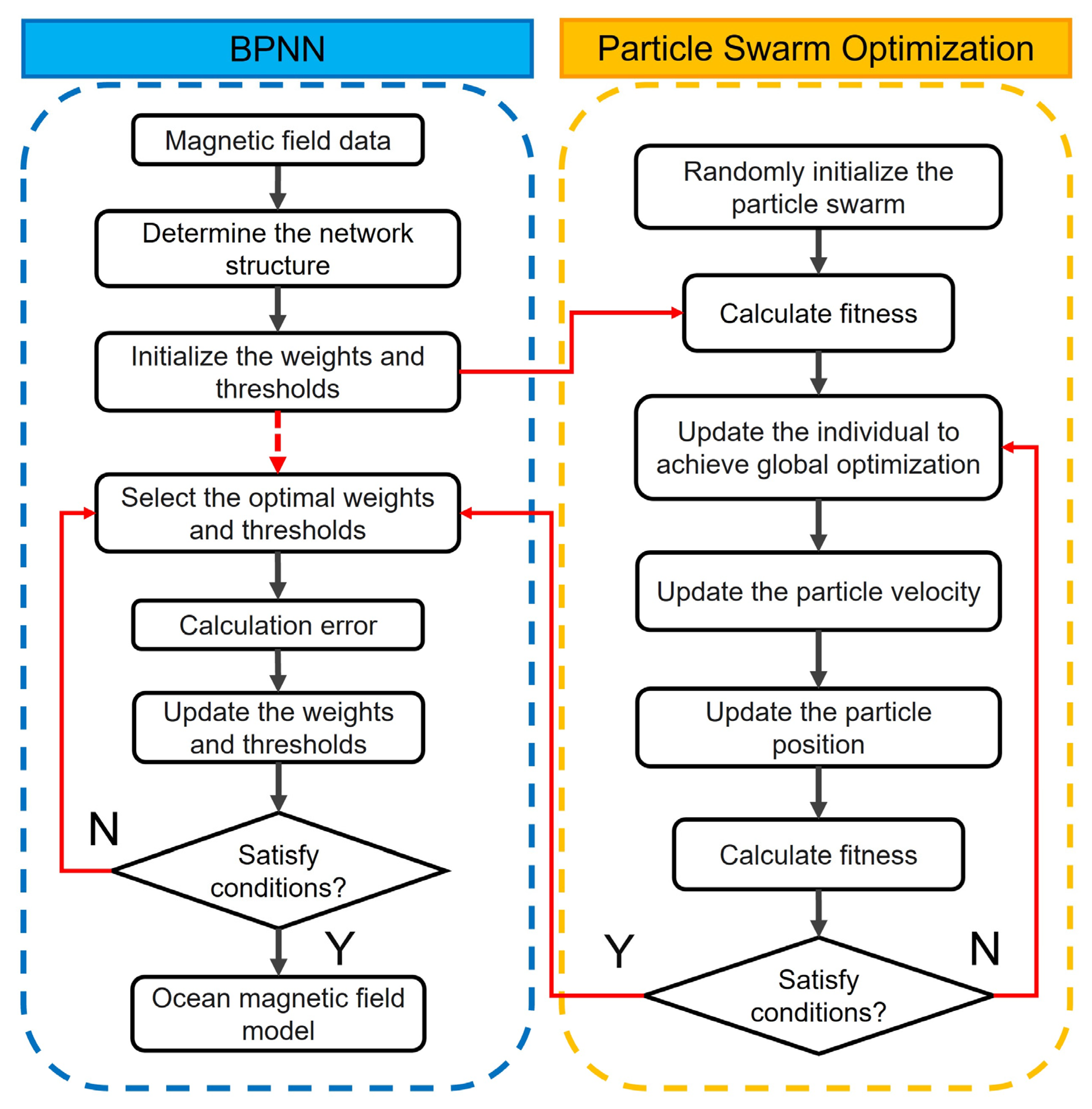
The fitness value of the new position is calculated to determine the basis for the next update. After iteration, the individual with the best fitness is selected. After optimization by the particle swarm algorithm, optimal weights and thresholds are assigned to the BPNN for training. During training, the weights and thresholds adjust according to accuracy metrics to minimize RMSE. Upon satisfaction of the conditions, the algorithm outputs the trained marine magnetic field model (The training flowchart is shown in Figure 4).

3. Results

3.1. Model Assessment

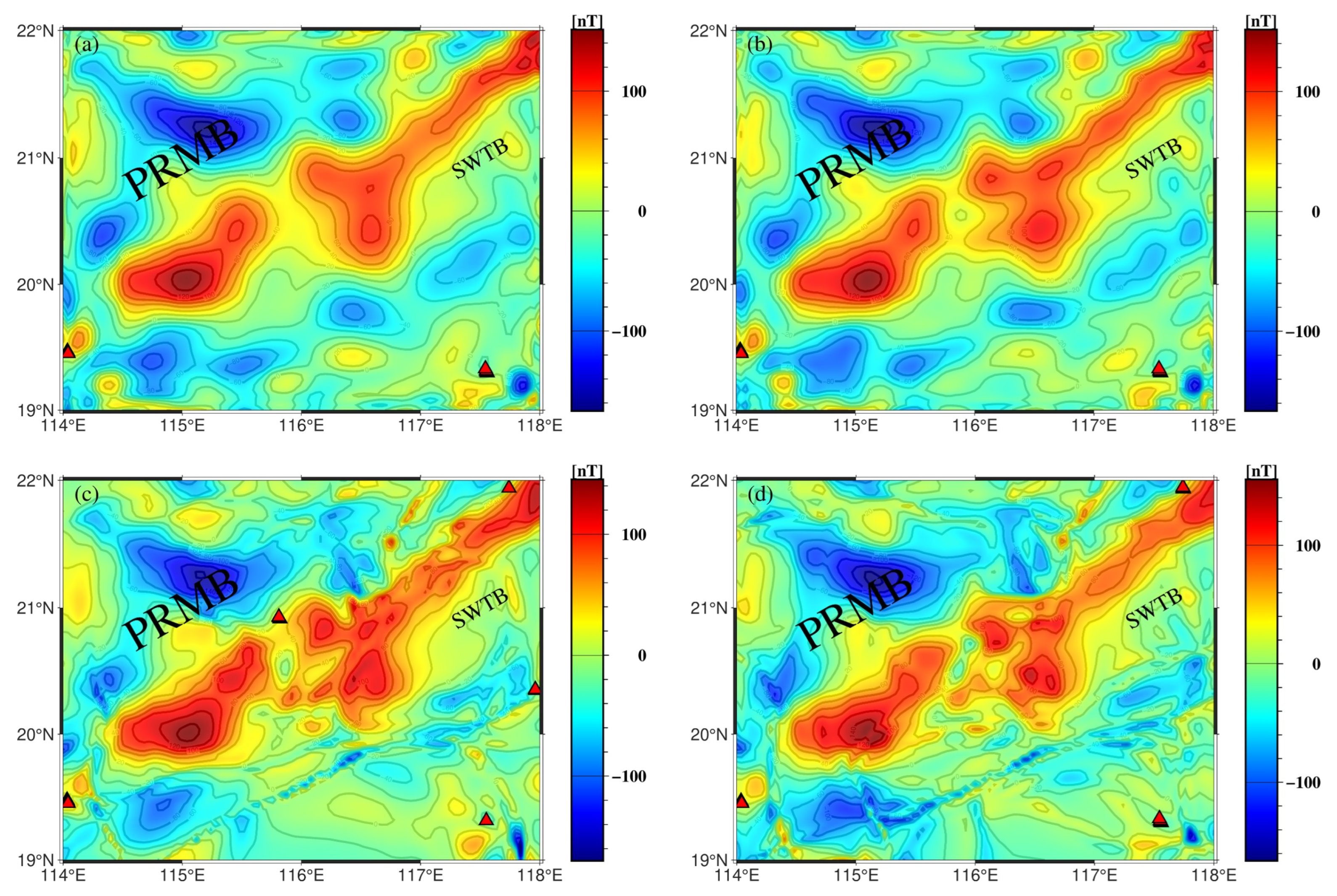
The pre-processed magnetic field data were used as training data, and different modeling methods were employed to build the magnetic field model of the northern South China Sea (Figure 5a–d represent the models constructed by the Taylor polynomial method, Legendre polynomial method, BPNN method, and PSO-BPNN method respectively). We use 2087 ship-measurement points along the “V3608” survey line to verify the accuracy of the model (Figure 1). We interpolated the model to the validation points to assess its accuracy, and the data with residuals exceeding three standard deviations were marked with red triangles, as shown in Figure 5a–d. These outlier points were mainly distributed in the boundary areas. Furthermore, based on previous studies, the magnetic field anomaly in the northern South China Sea extends from northwest to southeast and can be divided into a strong negative magnetic anomaly zone in the northwest, an obvious positive magnetic anomaly zone, and a weak negative magnetic anomaly zone in the southeast [40]. As shown in Figure 5d, the PSO-BPNN method effectively reconstructed the overall spatial characteristics of the magnetic field within the study area. These results indicate that despite high fitting accuracy in the core region, all the modeling methods still have a small number of outliers.
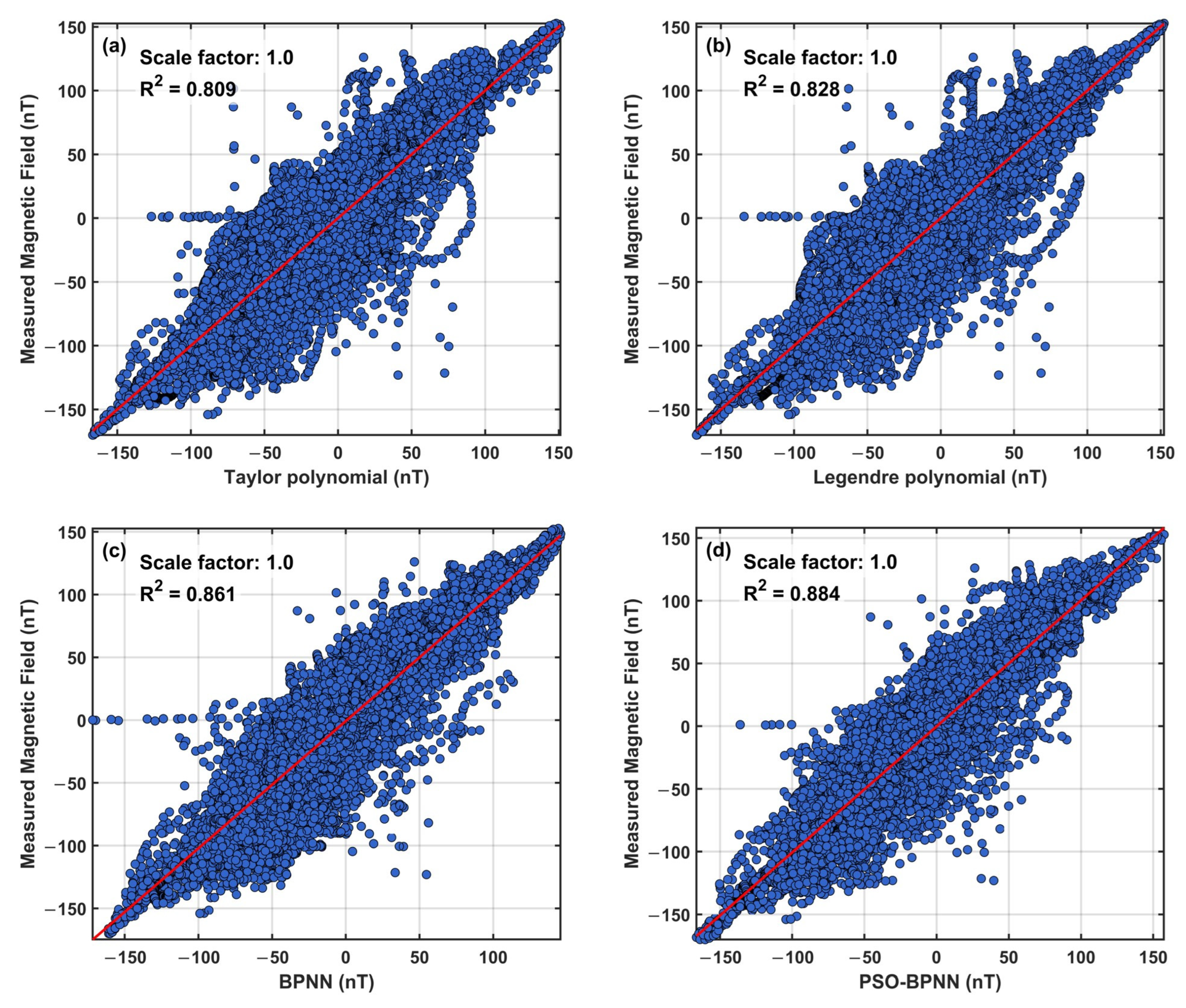
To systematically evaluate the differences among the four geomagnetic field models, the regression analysis results between the predicted values of each model and the training dataset were calculated, as shown in Figure 6a–d. The results show that the PSO-BPNN model exhibits optimal modeling performance, achieving a regression slope of 1.0 and a coefficient of determination (R2) of 0.884. This performance is significantly superior to those of the traditional Taylor polynomial model (R2 = 0.809), the Legendre polynomial model (R2 = 0.828), and the traditional BPNN model (R2 = 0.861). These findings indicate that the PSO-BPNN has a better fitting effect and can more accurately reproduce the macroscopic distribution characteristics of the geomagnetic field in the study area.

3.2. Comparison with Conventional Methods

To evaluate the capability of the PSO-BPNN in approximating complex nonlinear systems, the errors between models derived from different modeling methods and the training set were compared. As shown in Table 1, the PSO-BPNN achieves reductions in RMSE of 16% and 20.1%, and in Mean Absolute Error (MAE) of 20.2% and 25.3%, compared to the Legendre polynomial and Taylor polynomial models, respectively. These substantial error reductions can be attributed to the fundamental limitations of traditional polynomial methods, whose inherent smoothness leads to considerable deviations in regions with abrupt spatial variations. In contrast, the PSO-BPNN’s enhanced nonlinear mapping capability effectively preserves the magnetic field’s high-frequency components. Furthermore, the PSO-BPNN exhibits improved robustness, as evidenced by its 9.2% lower standard deviation (18.05 nT) compared to the conventional BP network (19.88 nT). This improvement confirms that PSO effectively enhances the stability of parameter estimation during the optimization process. The improved accuracy of each indicator suggests that the PSO-BPNN method is more effective than traditional methods at restoring the overall trend of the study area and is more effective in practical applications.
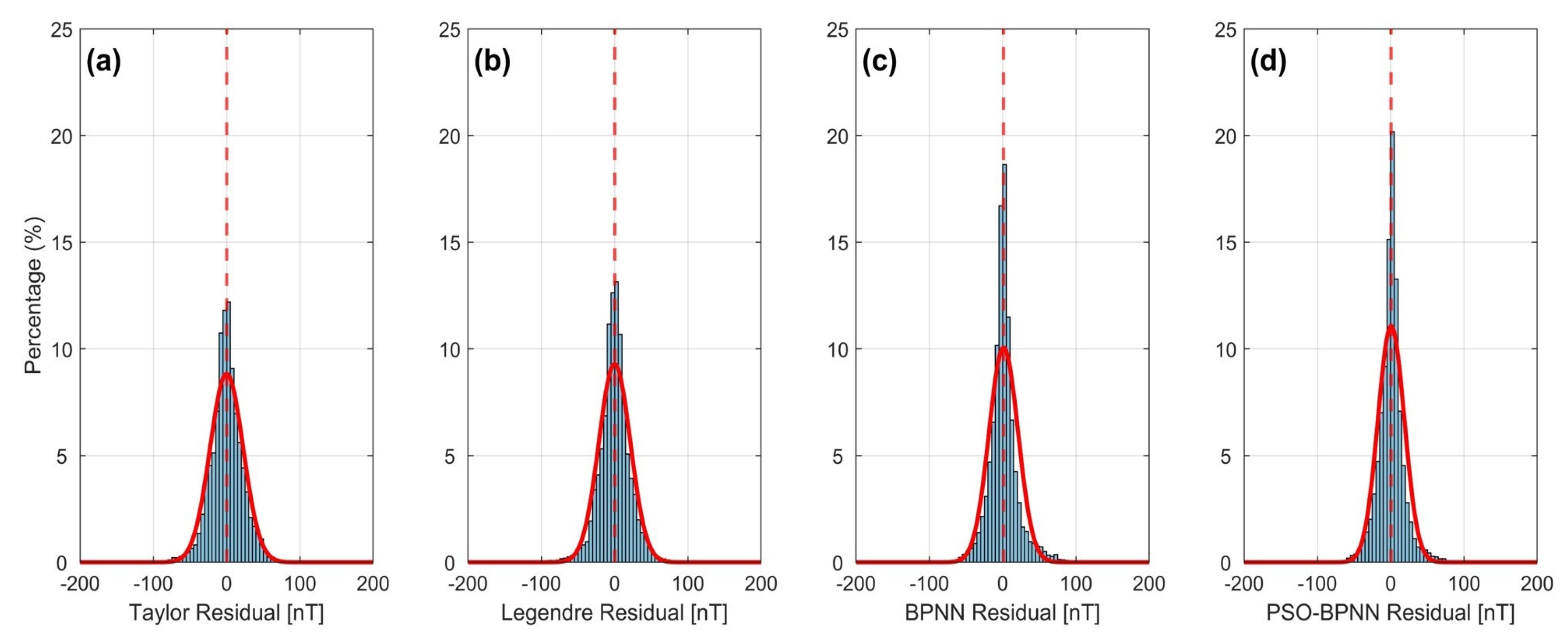
Previous analyses show that PSO-BPNN outperforms traditional methods (e.g., TP, LP, and BPNN) in terms of RMSE, MAE, and other metrics. However, these numerical indexes can only reflect the overall error and cannot reveal its distribution characteristics. To further evaluate the distribution of errors in the PSO-BPNN model and judge whether there are extreme outliers, we analyzed the residual histogram and the fitted normal distribution curve between the models obtained by different modeling methods and the training set, as shown in Figure 7. This figure shows that the residuals of the PSO-BPNN model follow a normal distribution with a narrower, higher peak. As shown in Figure 7 and Table 1, the PSO-BPNN model has smaller standard deviations, relative errors, and mean absolute errors than traditional methods, demonstrating its concentration of residuals. These results suggest that the PSO-BPNN method can effectively suppress large errors and yield a more robust model.
To further evaluate the generalization ability of the PSO-BPNN method, we interpolated the magnetic field model at the test points, and a comprehensive comparison of the error indicators was conducted. As shown in Table 2, the PSO-BPNN method demonstrates the best overall performance, surpassing traditional methods in most error indicators; particularly, its RMSE of 39.14 nT is 4.68% lower than that of the Taylor polynomial model. Notably, the PSO-BPNN method slightly exceeds the Legendre polynomial method across all metrics. This suggests that while the orthogonality of Legendre polynomials contributes to model stability, its extrapolation capability remains limited compared to neural network-based methods. Combined with the PSO-BPNN enhancement on all indicators in Table 1, these results indicate that the PSO-BPNN method possesses strong nonlinear fitting capabilities and achieves a synergistic enhancement in both modeling accuracy and extrapolation performance.
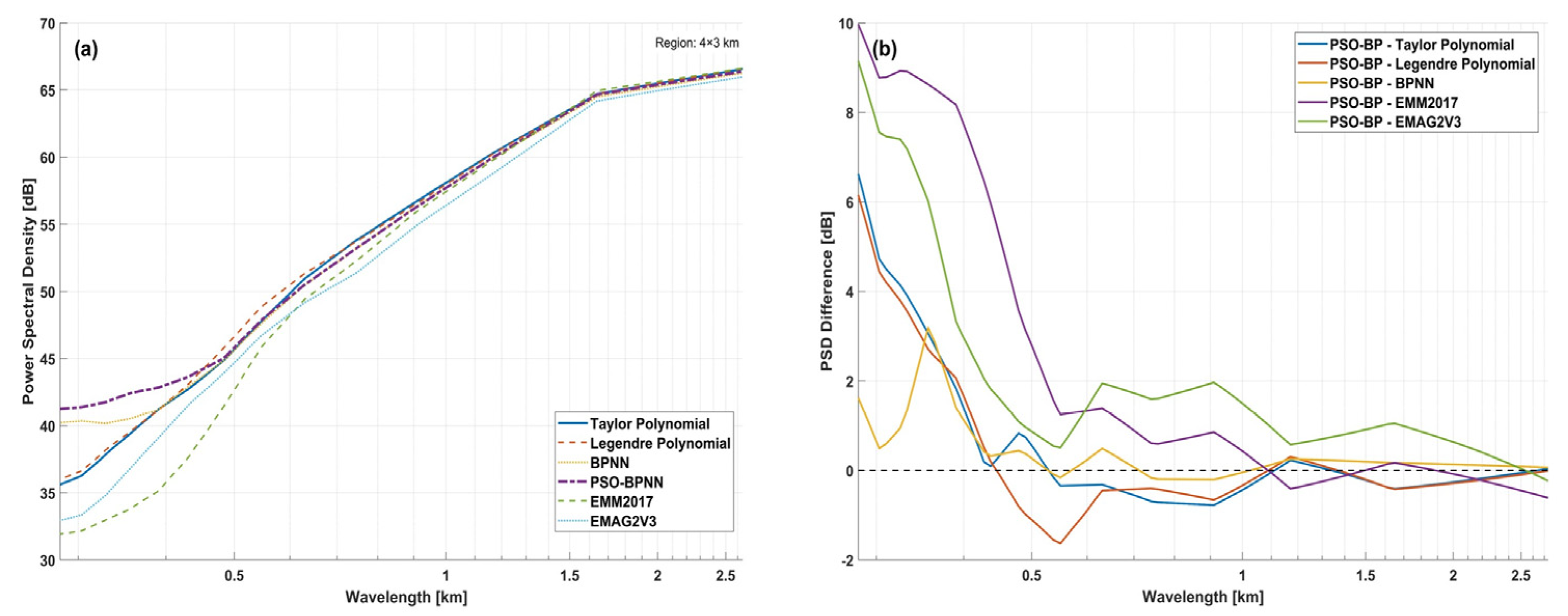
In geophysical applications, the precise reconstruction of high-frequency magnetic field signals is also very critical. We conducted a more detailed test on its ability to reconstruct high-frequency signals by analyzing the power spectral density (PSD) (Figure 8). The high-frequency signals are mainly concentrated at short wavelengths, while higher energies at the same wavelengths indicate the provision of more detailed geomagnetic field information. It shows that the PSO-BPNN model achieves higher PSD than the BPNN model (Figure 8a,b), attributable to the ability of PSO to escape local optima during parameter search. More notably, the PSO-BPNN demonstrates substantially better high-frequency preservation compared to both Taylor and Legendre polynomial models, whose inherent smoothness act as spectral filter attenuating high-frequency energy components. Furthermore, the regional PSO-BPNN model exhibits significantly enhanced energy levels relative to global reference models (EMM2017 crustal field and EMAG2v3 magnetic anomaly grid), particularly within the high-frequency band. Together with previous analyses, these results demonstrate that the PSO-BPNN method not only accurately reconstructs the regional background field but also effectively retains local anomaly details.
The boundary effect is an important criterion for evaluating the performance of regional geomagnetic field models. Therefore, by analyzing the fitting error of each model extending 0.5° inward from the boundary, we can assess which model is most suitable for regional geomagnetic field modeling. As shown in Table 3, the Taylor polynomial and Legendre polynomial models perform the worst, with RMSE values of 21.29 nT and 20.04 nT, respectively. This is because polynomial modeling relies on global analytical basis functions, and the data cannot change the upper limit of the basic functions, resulting in the smoothness of the model. Notably, the PSO-BPNN model achieves an RMSE of 16.61 nT in the boundary region, which is 22.0% lower than that of the Taylor polynomial and 17.1% lower than that of the Legendre polynomial. This demonstrates that the PSO-BPNN method can accurately capture the boundary physical mutations through nonlinear activation functions and adaptive weights.

3.3. Differences from Previous Models

To verify whether the PSO-BPNN model is more accurate than previous models in the study region, we compared the PSO-BPNN model (Figure 5d) with global magnetic field models (Figure 2a,b). It shows that the overall performance of the PSO-BPNN model is consistent with that of the EMAG2v3 and EMM2017 models. Meanwhile, we interpolated different models on the ship measurement control points and calculated the errors. The results are shown in Table 4. It reveals that all accuracy metrics of the PSO-BPNN model outperform those of the previous models. Specifically, the RMSE value of the PSO-BPNN model (19.82 nT) is 61.6% lower than that of EMAG2v3 and 56.4% lower than that of EMM2017. These results indicate that the local marine geomagnetic field model constructed based on PSO-BPNN has a more concentrated error distribution, higher reliability, and the results are closer to the real field source distribution. These differences arise mainly due to the varying quality of the data used in the model, as well as the differences in data processing and modeling techniques.

4. Discussion

4.1. The Influence of Training Samples

The quality of the training samples varies greatly, and the selection of training samples can affect the modeling results of the neural network. To examine the impact of different training samples we designed eight control experiments, and the results are shown in Table 5. In this table, S_SDATA represents the preprocessed ship magnetic field data, and EMM2017 and EMAG2v3 represent the previous models corrected by the main magnetic field of the IGRF13 model. The models’ differences are evaluated by two metrics: fitting error and prediction error. Additionally, considering that the selection of training data is also applicable to BPNN, we used a control experiment to evaluate the enhancement of the particle swarm algorithm.
From Table 5, we can see that the magnetic field model constructed by the BPNN optimized through the particle swarm algorithm performs better than the traditional method model that has not been optimized, which shows the advantages of the particle swarm algorithm. When using the ship measurement data and the EMM2017 model (S_SDATA + EMM) as training data, the magnetic field model obtained by the PSO-BPNN has the best accuracy, with a fitting error of 18.05 nT and a prediction error of 39.14 nT. The EMM2017 crustal field model is mainly based on the third-generation EMAG2V3 model and contains detailed magnetic field information. Therefore, a more accurate model can be obtained by jointly using the EMM2017 model and ship measurement magnetic field data as training data. This indicates that combining previous models can constrain the training of the neural network, avoid its excessive reliance on local ship measurement data, and improve the extrapolation ability and the completeness of the modeling

4.2. Magnetic Field Characteristics in the Northern SCS

Magnetic data can provide insights into the subsurface structural features. The EMAG and EMM models (Figure 2) can reveal the large-scale tectonic distribution of magnetic anomalies in the northern SCS region, especially the obvious NE-SW trending high magnetic anomaly, which was caused by upper mantle materials associated with the subduction of the paleo-Pacific plate [48]. However, due to the lack of small-scale signals, these international models are unable to reveal the magnetic anomaly distribution of small-scale structures such as the local enrichment patches and shallow magma intrusions (magma rocks rich in iron-magnesium minerals with high magnetic susceptibility). On the one hand, the PSO-BPNN model exhibits greater irregularity and preserves more magnetic signals of small-scale geological bodies. These small-scale signals are likely to represent magnetic responses from shallow magnetic intrusions. Thereby, the PSO-BPNN model provides a refined magnetic basis for further identification of magnetic structures and analysis of regional magnetic activity patterns.

4.3. The Reliability Assessment of Model Details

To validate the reliability of the detailed features of the PSO-BPNN model, we selected a detail-rich region between 115.5–116.5° E, and 20–21° N. Ship measurement data points were extracted from this region. We interpolated different models onto the survey points, and calculated the error metrics. As shown in Table 6, the PSO-BPNN model demonstrates outstanding fitting accuracy in this region, with an RMSE of 35.07 nT. Compared to the Taylor polynomial (TP), Legendre polynomial (LP), and traditional BPNN models, the RMSE is reduced by 5.95 nT, 1.49 nT, and 3.79 nT, respectively. These results indicate that the PSO-BPNN model maintains higher accuracy in regions with pronounced detailed features, and its results are highly consistent with actual ship measurement data. This demonstrates the reliability of the magnetic anomaly details preserved during the modeling process.

5. Conclusions

In this study, we propose a marine magnetic field modeling method based on the improved BPNN using the particle swarm optimization algorithm (PSO-BPNN). A high-precision magnetic field model in the northern South China Sea has been successfully constructed by combining the magnetic field data measured by ships with the previous global model. We compared the errors of the PSO-BPNN model with that of other models, and found that the PSO-BPNN model has the highest accuracy. The performance of the PSO-BPNN model was 61.6% and 56.4% higher than that of the EMAG2v3 and EMM2017 models, respectively. In the frequency domain analysis, the PSO-BPNN method has superior ability in retaining high-frequency signals, and capturing small-scale anomalies. Even though the regional magnetic field models constructed by different methods could capture the overall trend of the magnetic field in the northern SCS, the PSO-BPNN model has a better recovery ability and is more robust in handling magnetic field changes, especially in marginal areas with sparse data. The fitting error of the PSO-BPNN model is 18.05 nT, which is 16% and 20.1% lower than those of the traditional Legendre Polynomial and Taylor Polynomial models, respectively. Overall, these results suggest that the PSO-BPNN method is an efficient means to construct a high-precision regional magnetic field model.

Author Contributions

Methodology, C.X.; software, H.C. (Hongjie Chen) and G.W.; validation, C.W.; formal analysis, G.W.; investigation, C.W.; data curation, H.C. (Hongjie Chen); writing—original draft preparation, H.C. (Hongjie Chen) and C.X.; writing—review and editing, H.C. (Haopeng Chen); supervision, H.C. (Haopeng Chen); funding acquisition, H.C. (Haopeng Chen) and C.X. All authors have read and agreed to the published version of the manuscript.

Funding

This research was supported by the National Key Research and Development Program of China (No. 2024YFC2813304), the National Natural Science Foundation of China (No. 42474072), and the Open Research Fund Program of State Key Laboratory of Precision Geodesy, Innovation Academy for Precision Measurement Science and Technology (No. SKLGED2024-4-1).

Data Availability Statement

The data presented in this study are available upon request from the corresponding author.

Acknowledgments

We sincerely thank the editor and the anonymous reviewers for their valuable comments and suggestions that helped improve the manuscript. Most of the figures were created using the Generic Mapping Tool 5.

Conflicts of Interest

The authors declare no conflicts of interest. The funders had no role in the design of the study; in the collection, analyses, or interpretation of data; in the writing of the manuscript; or in the decision to publish the results.

Abbreviations

The following abbreviations are used in this manuscript:
BPNNBack Propagation Neural Network
PSOParticle Swarm Optimization
LPLegendre Polynomial
TPTaylor Polynomial
SVDSingular Value Decomposition
ANNsArtificial Neural Networks
NCEINational Centers for Environmental Information
SCSSouth China Sea
IGRF13International Geomagnetic Reference Field 13
RMSERoot Means Square Error
MAEMean Absolute Error
PSDPower Spectral Density

References

  1. Su, W. Magnetic Anomaly Data Detection of Local Marine Geomagnetic Field Model Considering Robust Trend Surface Scientific Calculation Algorithm. Sci. Program. 2022, 2022, 4055976. [Google Scholar] [CrossRef]
  2. Han, F.; Wang, H.; Lv, Y.; Paterson, G.A.; Biggin, A.J.; Williams, W.; Yang, T.; Miao, J.; Cao, T.; Zhu, D.; et al. Marine Magnetic Anomalies Enhanced by Internal Stress in Rapidly Cooled Submarine Basalts. Geophys. Res. Lett. 2025, 52, e2025GL115045. [Google Scholar] [CrossRef]
  3. Cai, Q.; Yang, G.; Song, N.; Yin, H.; Liu, Y. Analysis and Calibration of the Gyro Bias Caused by Geomagnetic Field in a Dual-Axis Rotational Inertial Navigation System. Meas. Sci. Technol. 2016, 27, 105001. [Google Scholar] [CrossRef]
  4. Ma, X.; Zhang, J.; Li, T. Geomagnetic Reference Map Super-Resolution Using Convolutional Neural Network. Meas. Sci. Technol. 2023, 35, 015014. [Google Scholar] [CrossRef]
  5. Xiong, Y.; Yang, G.; Wen, Z. A Method to Improve Underwater Positioning Reference Based on Topological Distribution Constraints of Multi-INSs. Appl. Sci. 2024, 14, 10206. [Google Scholar] [CrossRef]
  6. He, K.; Pan, Y. Magnetofossil Abundance and Diversity as Paleoenvironmental Proxies: A Case Study From Southwest Iberian Margin Sediments. Geophys. Res. Lett. 2020, 47, e2020GL087165. [Google Scholar] [CrossRef]
  7. He, K.; Zhao, X.; Jiang, Z.; Li, S. Paleoenvironmental Controls on the Abundances of Magnetofossils in the Southwestern Iberian Margin. J. Geophys. Res. Solid Earth 2024, 129, e2023JB027983. [Google Scholar] [CrossRef]
  8. Wu, S.; Thoram, S.; Sun, J.; Sager, W.W.; Chen, J. Characterizing Marine Magnetic Anomalies: A Machine Learning Approach to Advancing the Understanding of Oceanic Crust Formation. J. Geophys. Res. Solid Earth 2025, 130, e2024JB030682. [Google Scholar] [CrossRef]
  9. Erbek-Kiran, E.; Ates, A.; Dolmaz, M.N. Exploring the Crustal Structure of the Aegean Sea from Satellite Bouguer Gravity, Magnetic Data, and Seismological Data. Geo-Mar. Lett. 2025, 45, 12. [Google Scholar] [CrossRef]
  10. Alken, P.; Thébault, E.; Beggan, C.D.; Amit, H.; Aubert, J.; Baerenzung, J.; Bondar, T.N.; Brown, W.J.; Califf, S.; Chambodut, A.; et al. International Geomagnetic Reference Field: The Thirteenth Generation. Earth Planets Space 2021, 73, 49. [Google Scholar] [CrossRef]
  11. Finlay, C.C.; Kloss, C.; Olsen, N.; Hammer, M.D.; Tøffner-Clausen, L.; Grayver, A.; Kuvshinov, A. The CHAOS-7 Geomagnetic Field Model and Observed Changes in the South Atlantic Anomaly. Earth Planets Space 2020, 72, 156. [Google Scholar] [CrossRef] [PubMed]
  12. Sabaka, T.J.; Tøffner-Clausen, L.; Olsen, N.; Finlay, C.C. CM6: A Comprehensive Geomagnetic Field Model Derived from Both CHAMP and Swarm Satellite Observations. Earth Planets Space 2020, 72, 80. [Google Scholar] [CrossRef]
  13. Meyer, B.; Chulliat, A.; Saltus, R. Derivation and Error Analysis of the Earth Magnetic Anomaly Grid at 2 Arc Min Resolution Version 3 (EMAG2v3). Geochem. Geophys. Geosyst. 2017, 18, 4522–4537. [Google Scholar] [CrossRef]
  14. Oehler, J.-F.; Rouxel, D.; Lequentrec-Lalancette, M.-F. Comparison of Global Geomagnetic Field Models and Evaluation Using Marine Datasets in the North-Eastern Atlantic Ocean and Western Mediterranean Sea. Earth Planets Space 2018, 70, 99. [Google Scholar] [CrossRef]
  15. Sun, S.; Li, H.; Du, J.; Zhang, P.; Chen, C.; Liu, P. Revised Global Vertically Integrated Remanent Magnetization Model of the Oceanic Lithosphere with Comparison to LCS-1 Model and MSS-1 Magnetic Measurements. Earth Planet. Phys. 2025, 9, 653–666. [Google Scholar] [CrossRef]
  16. Zhang, J.; Feng, Y.; Zhang, P.; Lin, Y.; Li, X.; Huang, Y. A 100-Degree Lithospheric Magnetic Field Model Constructed Using MSS-1, Swarm-A, and CHAMP Satellite Data. Earth Planet. Phys. 2025, 9, 667–676. [Google Scholar] [CrossRef]
  17. Vujić, E.; Brkić, M.; Kovács, P. Regional Geomagnetic Field Model for Croatia at 2009.5. Acta Geophys. 2016, 64, 26–42. [Google Scholar] [CrossRef]
  18. Wang, Z.; Chen, B.; Yuan, J. Taylor Polynomial Model of the Geomagnetic Field in an Underground Gas Storage Area. Geomagn. Aeron. 2020, 60, 373–380. [Google Scholar] [CrossRef]
  19. Feng, Y.; Nasir, A.; Li, Y.; Zhang, J.; Zhang, J.; Huang, Y. The Study of the Lithospheric Magnetic Field over Xinjiang and Tibet Areas Based on Ground, Airborne, and Satellite Data. Remote Sens. 2023, 15, 2002. [Google Scholar] [CrossRef]
  20. Puente-Borque, M.; Pavón-Carrasco, F.J.; Núñez, A.; Tordesillas, J.M.; Campuzano, S.A. Regional Geomagnetic Core Field and Secular Variation Model over the Iberian Peninsula from 2014 to 2020 Based on the R-SCHA Technique. Earth Planets Space 2023, 75, 128. [Google Scholar] [CrossRef]
  21. Feng, Y.; Li, Y.; Zhang, J.; Liu, S.; Nasir, A.; Huang, Y. Study of the Geomagnetic Field’s Regional Gradients in Chinese Continent Using Three-Dimensional Surface Spline Model. Earth Planet. Phys. 2022, 7, 74–83. [Google Scholar] [CrossRef]
  22. Feng, Y.; Li, X.; Lin, Y.; Zhang, J.; Zhang, J.; Jiang, Y.; Yan, Q.; Liu, P. Utilising Macau Science Satellite-1 Data and Comprehensive Datasets to Develop a Lithospheric Magnetic Field Model of the Chinese Mainland. Remote Sens. 2025, 17, 1114. [Google Scholar] [CrossRef]
  23. Xia, L.; Qin, F.; Xu, W.; Li, K.; Zhu, T.; Han, Y. A Method for Super-Resolution Reconstruction of Marine Geomagnetic Anomaly Reference Maps Based on an Improved Generative Adversarial Network. J. Mar. Sci. Eng. 2025, 13, 2200. [Google Scholar] [CrossRef]
  24. Feng, Y.; Huang, Y.; Li, Y.; Zhang, J.; Liu, S. 3D Modeling of Different Areas of China Based on the 3D Surface Spline Model. Appl. Geophys. 2024, 21, 31–40. [Google Scholar] [CrossRef]
  25. Feng, Y.; Jiang, Y.; Jiang, Y.; Li, Z.; Jiang, J.; Liu, Z.-W.; Ye, M.-C.; Wang, H.-S.; Li, X.-M. Regional Magnetic Anomaly Fields: 3D Taylor Polynomial and Surface Spline Models. Appl. Geophys. 2016, 13, 59–68. [Google Scholar] [CrossRef]
  26. Feng, Y.; Sun, H.; Jiang, Y. Data Fitting and Modeling of Regional Geomagnetic Field. Appl. Geophys. 2015, 12, 303–316. [Google Scholar] [CrossRef]
  27. Wang, S.; Zhao, J.; Wu, Y. Study on Key Technologies of Construction of Marine Geomagnetic Filed Model Based on Polynomial Method. In Proceedings of the Oceans 2008, Quebec City, QC, Canada, 15–18 September 2008; Volume 1–4, pp. 807–811. [Google Scholar]
  28. Zhu, B.; Li, H.; Zhu, L.; Chen, C.; Wu, S. Improved High-Precision Regional Marine Geomagnetic Anomaly Field Model Using Legendre Polynomial Expansion. AIP Adv. 2024, 14, 125322. [Google Scholar] [CrossRef]
  29. Cesaroni, C.; Spogli, L.; Aragon-Angel, A.; Fiocca, M.; Dear, V.; Franceschi, G.D.; Romano, V. Neural Network Based Model for Global Total Electron Content Forecasting. J. Space Weather Space Clim. 2020, 10, 11. [Google Scholar] [CrossRef]
  30. Adolfs, M.; Hoque, M.M. A Neural Network-Based TEC Model Capable of Reproducing Nighttime Winter Anomaly. Remote Sens. 2021, 13, 4559. [Google Scholar] [CrossRef]
  31. Shi, S.; Zhang, K.; Shi, J.; Hu, A.; Zhao, D.; Shi, Z.; Sun, P.; Wu, H.; Wu, S. Modeling TEC Maps Over China Using Particle Swarm Optimization Neural Networks and Long-Term Ground-Based GPS, COSMIC, and Fengyun Data. Space Weather 2023, 21, e2022SW003357. [Google Scholar] [CrossRef]
  32. Wu, C.; Su, X.; Xu, C.; Jian, G.; Li, J. Seafloor Topography Refinement from Multisource Data Using Genetic Algorithm—Backpropagation Neural Network. Geophys. J. Int. 2024, 238, 1417–1428. [Google Scholar] [CrossRef]
  33. Sun, H.; Feng, Y.; Fu, Y.; Sun, W.; Peng, C.; Zhou, X.; Zhou, D. Bathymetric Prediction Using Multisource Gravity Data Derived From a Parallel Linked BP Neural Network. J. Geophys. Res. Solid Earth 2022, 127, e2022JB024428. [Google Scholar] [CrossRef]
  34. Shi, S.; Zhang, K.; Wu, S.; Shi, J.; Hu, A.; Wu, H.; Li, Y. An Investigation of Ionospheric TEC Prediction Maps Over China Using Bidirectional Long Short-Term Memory Method. Space Weather 2022, 20, e2022SW003103. [Google Scholar] [CrossRef]
  35. Ruwali, A.; Kumar, A.J.S.; Prakash, K.B.; Sivavaraprasad, G.; Ratnam, D.V. Implementation of Hybrid Deep Learning Model (LSTM-CNN) for Ionospheric TEC Forecasting Using GPS Data. IEEE Geosci. Remote Sens. Lett. 2021, 18, 1004–1008. [Google Scholar] [CrossRef]
  36. Chong, Y.; Chai, H.; Li, Y.; Yao, J.; Xiao, G.; Guo, Y. Automatic Recognition of Geomagnetic Suitability Areas for Path Planning of Autonomous Underwater Vehicle. Mar. Geod. 2021, 44, 287–305. [Google Scholar] [CrossRef]
  37. Zhu, Q.; Zhu, J.; Chen, X.; Jiao, Y.; Ding, X.; Liu, Z.; Li, S.; Liu, Y.; Qiu, X. Continuous Distribution Pattern and the Origin of the High-Velocity Layer in the Pearl River Mouth Basin in the Northern South China Sea: Constraints by Gravity Modelling. Geol. J. 2025, 60, 253–271. [Google Scholar] [CrossRef]
  38. Wu, Z.; Zhang, J.; Xu, M.; Li, H. Magnetic Anomaly Lineations in the Northeastern South China Sea and Their Implications for Initial Seafloor Spreading. Front. Earth Sci. 2023, 10, 1015856. [Google Scholar] [CrossRef]
  39. Zhao, F.; Wu, S.; Sun, Q.; Huuse, M.; Li, W.; Wang, Z. Submarine Volcanic Mounds in the Pearl River Mouth Basin, Northern South China Sea. Mar. Geol. 2014, 355, 162–172. [Google Scholar] [CrossRef]
  40. Doo, W.-B.; Huang, Y.-S. Causal Sources of the Significant High-Amplitude Magnetic Anomaly Zone in the Northern South China Sea Continental Margin. Mar. Pet. Geol. 2024, 170, 107128. [Google Scholar] [CrossRef]
  41. Ren, Y.; Guan, Y.; Sun, X.; Xu, L.; Xiao, Z.; Deng, Y.; He, W. Nano-Mineralogy and Growth Environment of Fe-Mn Polymetallic Crusts and Nodules from the South China Sea. Front. Mar. Sci. 2023, 10, 1141926. [Google Scholar] [CrossRef]
  42. Sager, W.W.; Huang, Y.; Tominaga, M.; Greene, J.A.; Nakanishi, M.; Zhang, J. Oceanic Plateau Formation by Seafloor Spreading Implied by Tamu Massif Magnetic Anomalies. Nat. Geosci. 2019, 12, 661–666. [Google Scholar] [CrossRef]
  43. Gao, G.; Li, Y.; Kang, G.; Bai, C.; Wen, L. Regional Seismicity of the Northeastern Tibetan Plateau Revealed by Crustal Magnetic Anomalies. Appl. Sci. 2025, 15, 4331. [Google Scholar] [CrossRef]
  44. Zhu, L.; Li, H.; Ouyang, J.; Zhu, B.; Chang, M. Regional Geomagnetic Field Modeling Based on Associated Legendre Polynomials. Appl. Sci. 2025, 15, 3555. [Google Scholar] [CrossRef]
  45. Zipser, D.; Andersen, R.A. A Back-Propagation Programmed Network That Simulates Response Properties of a Subset of Posterior Parietal Neurons. Nature 1988, 331, 679–684. [Google Scholar] [CrossRef]
  46. Nasimi, R.; Irani, R. Combining a Neural Network with a Genetic Algorithm and Particle Swarm Optimization for Permeability Estimation of the Reservoir. Energy Sources Part A Recovery Util. Environ. Eff. 2015, 37, 384–391. [Google Scholar] [CrossRef]
  47. Yang, L.; Chen, H. Fault Diagnosis of Gearbox Based on RBF-PF and Particle Swarm Optimization Wavelet Neural Network. Neural Comput. Applic 2019, 31, 4463–4478. [Google Scholar] [CrossRef]
  48. Wan, K.; Xia, S.; Cao, J.; Sun, J.; Xu, H. Deep Seismic Structure of the Northeastern South China Sea: Origin of a High-Velocity Layer in the Lower Crust. J. Geophys. Res. Solid Earth 2017, 122, 2831–2858. [Google Scholar] [CrossRef]
Figure 1. Distribution of measurement points for the ship-measured geomagnetic field in the PRMB of the SCS. Yellow points (lines) indicate the test points (V3608) and blue points (lines) indicate the control points.
Jmse 14 00108 g001
Figure 2. Two existing international models, (a) Enhanced Magnetic Model (EMM2017) and (b) Earth Magnetic Anomaly Grid at 2 Arc Min Resolution Version 3 (EMAG2v3).
Jmse 14 00108 g002
Figure 3. Neural network structure diagram.
Jmse 14 00108 g003
Figure 4. Flowchart of constructing the marine magnetic field model using PSO-BPNN.
Jmse 14 00108 g004
Figure 5. (ad) represent the Taylor polynomial model, Legendre polynomial model, BPNN model and PSO-BPNN model respectively. The red triangles indicate the validation points in the model with error larger than three standard deviations. The numbers of outliers are 8, 9, 11, and 10.
Jmse 14 00108 g005
Figure 6. (ad) Regression plots of ship-measured magnetic field values against the Taylor polynomial, Legendre polynomial, BPNN, and PSO-BPNN models, respectively.
Jmse 14 00108 g006
Figure 7. Histogram of model and training set differences for different modeling methods. (a) Taylor model fitting error residual; (b) Legendre model fitting error residual; (c) BPNN model fitting error residual; (d) PSO-BPNN model fitting error residual.
Jmse 14 00108 g007
Figure 8. Frequency domain results of each model. (a) represents the PSD plot, while (b) illustrates the difference in PSD.
Jmse 14 00108 g008
Table 1. Statistical results of fitting accuracy of different modeling methods.
Model (nT)MeanSTDMAEMARERMSE
TP−0.0522.6016.432.1922.60
LP−0.0921.4915.372.0021.49
BPNN1.2719.8413.171.6419.88
PSO-BPNN0.6518.0512.271.4818.05
Table 2. Statistical results of prediction accuracy of different modeling methods.
Model (nT)MeanSTDMAEMARERMSE
TP−4.9340.7832.315.9541.06
LP−4.7739.2630.625.5939.60
BPNN6.5539.7130.954.5440.24
PSO-BPNN6.1638.6730.264.8239.14
Table 3. Boundary fitting error statistics for different models.
Model (nT)MEANSTDMAERMSE
TP0.0821.2915.7921.29
LP0.1220.0414.6520.04
BPNN−1.4319.7813.3419.83
PSO-BPNN−0.3116.6111.7016.61
Table 4. Statistical results of differences between different models and check points.
Model (nT)MEANMAESTDRMSEMARE
EMAG2v3−31.6543.1143.1853.533.19
EMM2017−17.4236.9444.3347.632.82
BPNN−4.7217.9528.4528.841.57
PSO-BPNN−3.8516.5426.5326.811.51
Table 5. Accuracy assessment of different input variables.
Method (nT)Training SampleFitting ErrorPrediction Error
BPNNS_SDATA14.8084.49
S_SDATA + EMM19.8840.24
S_SDATA + EMAG19.5442.87
S_SDATA + EMM + EMAG19.1641.81
PSO-BPNNS_SDATA14.9783.97
S_SDATA + EMM18.0539.14
S_SDATA + EMAG19.2244.26
S_SDATA + EMM + EMAG18.2842.03
Table 6. Statistical results of differences between different models and check points in a selected small region.
Model (nT)MARESTDMAERMSE
TP1.4141.0133.5141.02
LP1.2536.5829.4936.56
BPNN1.4237.9130.3638.86
PSO-BPNN1.3634.6027.1235.07
Disclaimer/Publisher’s Note: The statements, opinions and data contained in all publications are solely those of the individual author(s) and contributor(s) and not of MDPI and/or the editor(s). MDPI and/or the editor(s) disclaim responsibility for any injury to people or property resulting from any ideas, methods, instructions or products referred to in the content.