Article

Fixed-Time Robust Path-Following Control for Underwater Snake Robots with Extended State Observer and Event-Triggering Mechanism

1
Department of Traffic Engineering, Yantai Vocational College, Binhai Zhonglu Road, Laishan District, Yantai 264000, China
2
College of Shipbuilding Engineering, Harbin Engineering University, No. 145 Nantong Street, Nangang District, Harbin 150001, China
*
Authors to whom correspondence should be addressed.
J. Mar. Sci. Eng. 2026, 14(1), 102; https://doi.org/10.3390/jmse14010102
Submission received: 18 November 2025 / Revised: 16 December 2025 / Accepted: 24 December 2025 / Published: 4 January 2026
(This article belongs to the Section Ocean Engineering)

Abstract

Aiming at the robust path-following control problem of underwater snake robot (USR) systems subject to modeling uncertainties and time-varying external disturbances, this paper proposes a robust path-following control algorithm based on a fast fixed-time extended state observer (FTESO). First, a fixed-time stability framework with a shorter settling time than existing systems is introduced, and a novel extended state observation system based on the fixed-time stability framework is constructed. Subsequently, by combining the disturbance estimates from the proposed observer with a nonsingular fast fixed-time path-following controller, a robust fixed-time path-following controller is developed. This control strategy incorporates a dynamic event-triggering mechanism, which accomplishes the path-following task while conserving computational resources. The fixed-time convergence of the closed-loop control system is rigorously proved using Lyapunov stability theory. Furthermore, a novel head joint suppression function is designed to reduce the probability of losing the tracking target. Simulation results demonstrate that, compared with conventional control methods, the proposed approach exhibits superior tracking performance and enhanced disturbance rejection capability in complex underwater environments.

1. Introduction

In the context of increasingly sophisticated ocean exploration, underwater robots have emerged as a pivotal solution for critical offshore engineering challenges—namely, the installation and maintenance of marine structures and the exploration and development of seabed resources [1]. The unique streamlined morphology and exceptional maneuverability of underwater snake robots (USRs) have positioned them at the forefront of advanced underwater robotics research since their introduction [2]. The construction of an accurate dynamic model is a cornerstone of underwater robotics research. Driven by their promising applications across military and civilian domains, USRs have attracted growing research interest, spurring the development of various theoretical modeling approaches [3,4,5]. In the realm of mathematical modeling, the research team led by K.Y. Pettersen enhanced the existing friction model for land-based snake robots by incorporating hydrodynamic viscous drag effects. This model dissected the friction force into driven and non-driven components, thereby establishing a 2D planar motion model for USRs [6]. By converting the rotational motion of the links into translational motion, they proposed a control-oriented simplified model [7]. Finally, a new type of mathematical model with additional effectors was developed [8]. To enhance computational efficiency in simulations, this study adopts a simplified mathematical model of the USR as its theoretical framework.
Confined underwater workspaces impose stringent demands on the real-time performance and accuracy of USR motion control algorithms. This challenge has prompted the development of advanced control techniques, including adaptive control [9], backstepping control [10], preset performance control [11], and sliding mode control [12], which can ensure that the controlled system converges to the control target within an infinite period of time. Nevertheless, the control performance of these methods remains insufficient for the stringent requirements of modern USRs. Consequently, finite-time control theory has been introduced into the realm of complex system control. For instance, to address issues of insufficient control authority and disturbances, Wei et al. proposed a finite-time three-axis stabilization controller for underactuated rigid spacecraft [13]. Wang et al. developed a finite-time tracking controller to control strict-feedback nonlinear systems with unmodeled dynamics and dynamic disturbances [14]. Barghandan et al. proposed a chatter-free fast terminal sliding mode control (FTSMC) strategy for robotic arms to enhance tracking accuracy and robustness while ensuring finite-time convergence [15]. To address the singularity issue of terminal sliding mode control, Liu et al. proposed a trajectory tracking control strategy that combines a radial basis function neural network (RBFNN) with nonsingular fast terminal sliding mode (NFTSM) control, which solved the problem of low trajectory tracking accuracy in robotic arms [16]. However, the finite-time convergence of such systems depends on their initial conditions. To overcome this limitation, Zhang et al. proposed a fixed-time terminal sliding mode control scheme for the tracking control of robotic manipulators subject to parametric uncertainties and external disturbances, for which the convergence time is independent of the initial conditions [17]. To further address the issue of insufficient convergence speed in traditional fixed-time control, Cao et al. introduced a time-varying gain into the traditional fixed-time stability method and initially proposed a nonlinear system with fast timing convergence characteristics [18]. Wan et al. improved the nonlinear system with fixed-time convergence and achieved the trajectory tracking for unmanned surface vehicles in the presence of model uncertainty, external disturbances and actuator failures [19]. The objective of this study is to enhance the stability and convergence speed of USR systems when navigating through confined and complex waterways. To this end, this work builds upon prior research by introducing improvements to fixed-time convergent nonlinear systems.
To address the challenges posed by unmodeled dynamics and external disturbances to the accuracy of USR path tracking [20,21], researchers have focused on developing robust control strategies capable of actively compensating for lumped disturbances. Li et al. proposed a model predictive control (MPC) framework to handle uncertainties [22]. Zhang et al. designed an optimal robust controller integrating improved state and kinematic models to resist unknown friction and external disturbances [23]. Guo et al. proposed a fuzzy disturbance observer-based adaptive nonsingular terminal sliding mode control strategy that effectively achieves simultaneous disturbance rejection and trajectory tracking accuracy enhancement [24]. Li et al. proposed an integrated strategy combining adaptive fuzzy sliding mode control and a fixed-time disturbance observer, capable of achieving ship path following in the presence of modeling errors, disturbances, and input saturation [25]. These approaches significantly enhance system trajectory tracking accuracy and robustness through effective disturbance estimation and compensation. Collectively, these studies demonstrate that active compensation for unmodeled internal dynamics and external disturbances is central to achieving high-precision path tracking in USRs.
During path following, excessive joint swing amplitudes can lead to the loss of visual tracking targets, consequently resulting in mission failure for the USR. Hence, ensuring the stability of the USR head under sinusoidal motion patterns is critical for achieving reliable path-following objectives. Au et al. proposed an optimized correction method for the head–body relative angle, which achieves a stabilized field of view for the snake robot through real-time compensation for body undulations [26]. Kim et al. achieved effective suppression of head oscillation in snake robots by combining an RBF neural network with adaptive nonsingular terminal sliding mode control [27]. Zhou et al. proposed a piecewise kinematics-based head control strategy. This platform-independent approach facilitates precise head manipulation across snake robots of varying architectures [28]. Kim et al. designed a controller for the two-degree-of-freedom head of a snake robot, which can effectively read image data while the robot is in motion [29]. To address the limitations of segmented and composite control in coordination and oscillation suppression, this paper introduces a head suppression function combined with a sinusoidal gait, achieving precise path following without target loss.
Conventional time-triggered control, with its fixed “sample-and-actuate” approach, has inherent limitations that often result in low resource utilization efficiency. Event-triggered control (ETC) has thus emerged as a promising alternative to overcome these issues. Wang et al. achieved predefined-time trajectory tracking for uncertain nonlinear systems by integrating adaptive control with an event-triggering mechanism featuring a time-varying threshold [30]. Wang et al. designed a novel event-triggered adaptive controller, achieving the tracking targets required for uncertain nonlinear systems [31]. Zhou et al. proposed an event-triggered optimal control method based on model predictive control, achieving trajectory tracking of modular reconfigurable manipulators with minimal resource consumption [32]. According to the authors’ current understanding, no study on dynamic event-triggering mechanisms has yet been applied in the field of USR path tracking.
Based on the above discussion, the following summary can be made:
  • The control methodology for USRs plays a decisive role in their operational performance within constrained underwater environments. Traditional asymptotic and finite-time convergent control schemes are inadequate to meet the stringent requirements for rapid system convergence, while existing fixed-time control frameworks still exhibit notable limitations in convergence speed. Consequently, there is an urgent need to substantially enhance the current fixed-time convergence control paradigm.
  • A primary challenge in the practical application of USRs is composite time-varying internal and external disturbances, which degrade control performance and tracking accuracy, potentially leading to mission failure. This necessitates the development of an observer for rapid disturbance estimation and its subsequent compensation within the control law to eliminate these detrimental effects.
  • The head oscillation amplitude of a USR is critical to its observation stability. Traditional segmented control strategies compromise head–body motion consistency; therefore, a unified joint trajectory tracking objective function is required to effectively curb excessive head sway and ensure the consistency of the overall movement.
  • Traditional periodic sampling control imposes a significant burden on communication resources. Therefore, adopting an event-triggered mechanism to alleviate this communication load, thereby enhancing resource utilization efficiency, is of critical importance.
Through this summary, to achieve the research objectives of minimizing head oscillation amplitude and accurately tracking the desired path, the main contributions of this work are summarized as follows:
  • A novel fixed-time stabilization framework with a faster convergence rate than existing systems is proposed. This framework serves as the theoretical foundation of this study and represents one of its primary innovations.
  • A fixed-time extended state observer (FTESO) is proposed, which enables precise estimation and active compensation of complex time-varying disturbances while achieving accurate estimation of joint angles and angular velocities without relying on dedicated physical sensors. This method demonstrates significant improvements in both convergence speed and estimation accuracy for system states and composite disturbances.
  • A novel head oscillation suppression function is proposed, which effectively constrains the head oscillation amplitude while maintaining seamless motion coordination with the robot body. Furthermore, by integrating this suppression function with a sinusoidal gait function, a unified joint objective function is constructed.
  • A dynamic event-triggered mechanism is adopted to replace conventional periodic sampling control, which significantly reduces computational resource consumption while maintaining path-following performance.
By accomplishing the aforementioned core tasks, this study achieves rapid observation, accurate estimation, and real-time compensation of composite time-varying disturbances. While effectively suppressing head oscillation and maintaining overall motion continuity, it provides a stable field of view for the observation module and simultaneously ensures high-precision tracking control along the desired path.
The paper is structured as follows: Section 2 establishes the mathematical model of the USR in a 2D plane; Section 3 designs a fixed-time stability framework with a shorter settling time and, combined with the proposed suppression function, introduces a fixed-time sliding mode control strategy based on a FTESO to enable accurate path following of the USR; Section 4 provides the parameter settings for the designed controller and benchmark controllers, along with numerical simulation results and analysis; Section 5 summarizes the research conclusions and outlines potential directions for future work.

2. Preliminaries

This section begins by defining the primary notations used in the mathematical model of the USR, following the conventions established in [7]. Subsequently, three fundamental lemmas pertaining to fixed-time stability theory are briefly introduced. Finally, the control objectives for the USR path-following task are formally formulated.

2.1. Definition of Symbols

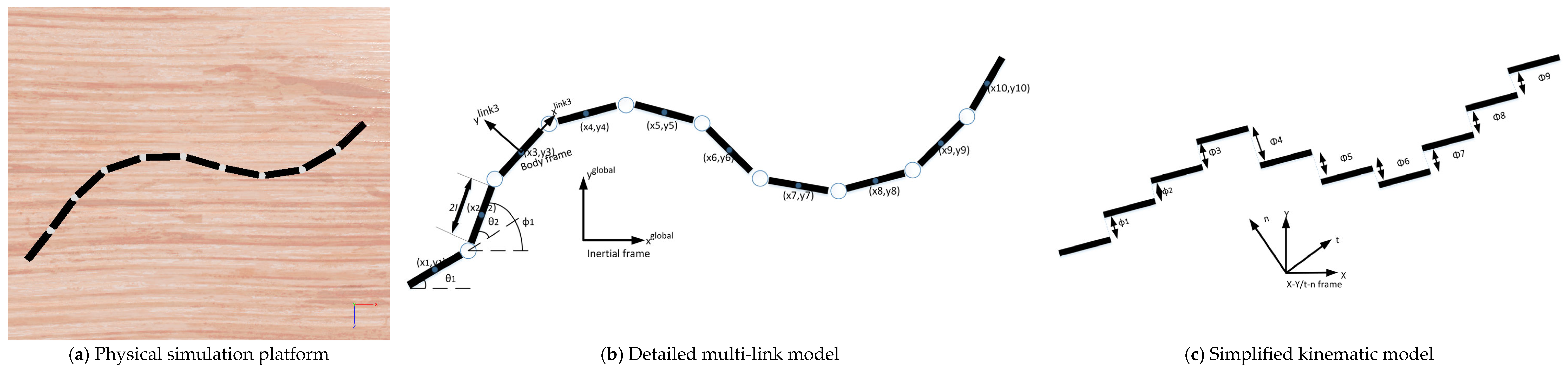
To reduce simulation complexity, this work adopts the control-oriented simplified model proposed by Kelasidi et al. for controlling and analyzing the USR system in a two-dimensional plane. The USR is assumed to consist of N links and N − 1 joints, with each link having a length of 2l and a uniformly distributed mass of m. The global coordinate frame XOY and the body-fixed coordinate frame tOn are defined, where t and n represent the tangential and normal directions of the USR in the local frame, respectively. The notations used in the USR mathematical model and their meanings are summarized in Table 1, the model simplification process is illustrated in Figure 1, and the complete mathematical model of the USR is given by Equation (1).
ϕ ˙ = v ϕ  
θ ˙ = v θ
p ˙ x = v t sin θ v n cos θ + U x
p ˙ y = v t sin θ + v n cos θ + U y
v ˙ ϕ = c n m v ϕ + c p m v t , t e l A D T ϕ + 1 m D D T u + d
v ˙ θ = μ 1 v θ + μ 2 n 1 v t , t e l e T ϕ  
v ˙ t = c t m v t , t e l + 2 c p n m v n , t e l e T ϕ c p n m ϕ T A D ¯ ϕ ˙  
v ˙ n = c n m v n , t e l + 2 c p n m v t , t e l e T ϕ
where e = 1 , 1 , , 1 ϵ R n x 1 ,   D ¯ = D T ( D D T ) 1 ,   c p = c n c t 2 l ,
D = 1 1 0 0 0 1 0 0 0 0 1 1 R n 1 × n A = 1 1 0 0 0 1 0 0 0 0 1 1 R n 1 × n
Owing to the anisotropic nature of the hydrodynamic environment, the normal hydrodynamic coefficient of the USR during sinusoidal locomotion is significantly larger than its tangential counterpart, which constitutes the physical mechanism for forward propulsion [33]. When the sinusoidal gait parameters are specified, the forward velocity of the USR satisfies the following relation: t > 0 , v max > v min > 0 [34].
The sinusoidal gait function followed by the USR joints is shown in Equation (2).
ϕ i = α sin ( ϖ t + ( i 1 ) β + ϕ 0

2.2. Introduction of Lemmas

For the nonlinear system described in Equation (3) below, the following definition is made
x ˙ ( t ) = f ( t , x ) ,   x ( t 0 ) = x 0
where x is the state variable of the nonlinear system, and   f ( . ) : R n R n is a continuous nonlinear function. If system (3) is globally finite-time convergent, then the settling time is bounded as 0 < T < Tmax. In this case, since the convergence time is upper-bounded by a positive constant Tmax, system (3) achieves fixed-time stability.
Lemma 1 
[35]. If a nonlinear system can be shown as in Equation (4)
y ˙ = p 1 s i g n q 1 y p 2 s i g n q 2 y , y ( 0 ) = y 0
where p1 > 0, p2 > 0, q1 > 1, 0 < q2 < 1, signq1y = |y|q1sign(y). Then, the nonlinear system (4) is fixed-time convergent, and its convergence time T is bounded by the expression given in Equation (5).
T f < T max = 1 p 1 ( q 1 1 ) + 1 p 2 ( 1 q 2 )
Lemma 2 
[36]. If a nonlinear system can be shown as in Equation (6)
y ˙ = ( p 1 y ε p 2 y λ ) k , y ( 0 ) = y 0
where λ = 1 2 ( q 1 + q 2 ) 1 2 ( q 1 q 2 ) s i g n ( y 1 ) ε = 1 2 ( q 2 + k ) + 1 2 ( q 2 k ) s i g n ( y 1 ) ,
p 1 > 0 ,   p 2 > 0 ,   q 1 > 0 ,   q 2 > 0 ,   k > 0 ,   q 1 k < 1 ,   q 2 k > 1 .
Then, the nonlinear system (6) is fixed-time convergent, and its convergence time T is bounded by the expression given in Equation (7).
T f T max = 1 ( p 1 + p 2 ) k ( q 2 k 1 ) + 1 p 2 k ( 1 q 1 k ) ln ( 1 + ( p 2 p 1 ) k )
Lemma 3 
[37]. If a nonlinear system can be shown as in Equation (8)
y ˙ = p 1 s i g n k 1 y p 2 s i g n k 2 y , y ( 0 ) = y 0
where  k 1 = 1 + q 1 2 + q 1 1 2 s i g n ( y 1 ) k 2 = 1 + q 2 2 + 1 q 2 2 s i g n ( y 1 )
p 1 > 0 ,   p 2 > 0 ,   s i g n k 1 y = y k 1 s i g n ( y ) ,   q 1 > 1 ,   0.5 < q 2 < 1 ,
Then, the nonlinear system (8) is fixed-time convergent, and its convergence time T is bounded by the expression given in Equation (9).
T f T max = 1 p 2 ( q 1 1 ) ln ( p 1 + p 2 p 1 ) + 1 p 1 ( 1 q 2 ) ln ( p 1 + p 2 p 2 )
As demonstrated in [35,36,37], the upper bound of the convergence time for nonlinear systems (4), (6) and (8) is independent of the initial conditions of the system and is solely determined by the parameter selection in Equations (5), (7) and (9).

2.3. Control Objectives

To achieve the research objectives of this paper, the overall task of the USR is decomposed into the following four sub-control objectives: (1) achieving accurate path following of the system center of mass; (2) ensuring stable tracking of the overall orientation angle; (3) minimizing the occupation of communication resources as much as possible while completing the path-following task; and (4)controlling the link angles to vary smoothly along the body direction, with their oscillation amplitudes gradually decreasing from the mid-body toward the head.
Sub-control Task 1: Define the desired path and desired heading angle in this sub-task as θd and (xd,yd), respectively. The criterion for accomplishing the centroid path-following task is that both the heading angle error and the centroid position error asymptotically converge to a neighborhood of zero. The fulfillment of this sub-control objective ensures the ultimate boundedness of both errors, as shown in Equation (10).
lim t θ θ d = δ 1 ,   lim t e 2 = δ 2
where δ1 and δ2 are positive constants close to zero, and e is the distance error between the center of mass and the desired path.
Sub-control Task 2: The desired orientation angle for this task is determined by the joint angles, and the desired joint angles are obtained through the fulfillment of sub-control objective 1. Assuming the desired joint angle is ϕd. the criterion for accomplishing the orientation angle tracking task is that the joint angle error asymptotically converges to a neighborhood of zero, that is
lim t ϕ ϕ d = δ 3
where δ3 is a positive constant close to zero.
Sub-control Task 3: To enhance resource utilization efficiency, a dynamic event-triggered control strategy is proposed. The design criterion for this strategy is to significantly reduce the control update frequency compared with conventional periodic control, while ensuring both the stability of the USR closed-loop system and satisfactory path-following performance. This control scheme effectively conserves communication and computational resources while guaranteeing the ultimate uniform boundedness of all signals in the system
V ˙ ( x ( t ) ) α V ( x ( t ) ) + γ 1
t min = inf k N t k + 1 t k > 0
where α > 0. γ1 is a normal number close 0, V(x(t)) is the candidate Lyapunov function, x(t) is the state variable, and tmin represents the minimum triggering time interval. Equation (12) ensures system stability, and Equation (13) ensures that the system does not exhibit Zeno behavior.
Sub-control Task 4: Suppose the joint angle of the USR is ϕ = ϕ 1 , ϕ 2 , , ϕ N , and ϕ 1 represents the first joint of the USR head. To reduce the probability of losing the tracking target, the execution of sub-control objective 4 should meet the following evaluation criteria: the joint oscillation amplitude should increase gradually from the head to the tail, and the joint angle variation should maintain progressive continuity, thereby ensuring smooth and coherent overall motion of the USR. Based on these requirements, the joint angle relationship shown in Equation (14) can be derived.
ϕ 1 ϕ 2 ϕ N
It should be noted that during the execution of the aforementioned four sub-control tasks, the system is generally subject to significant time-varying disturbances. To effectively achieve the specified control objectives, it is necessary to perform real-time observation and accurate estimation of these time-varying disturbances and incorporate corresponding compensation mechanisms into the controller design.
During USR locomotion, the joint angles directly determine the orientations of the links and indirectly influence the system heading and centroid position. Therefore, the fulfillment of the orientation angle tracking task serves as the foundation for the USR to accomplish the path-following objective, while the successful execution of the path-following task can be regarded as a direct outcome of completed orientation angle tracking.
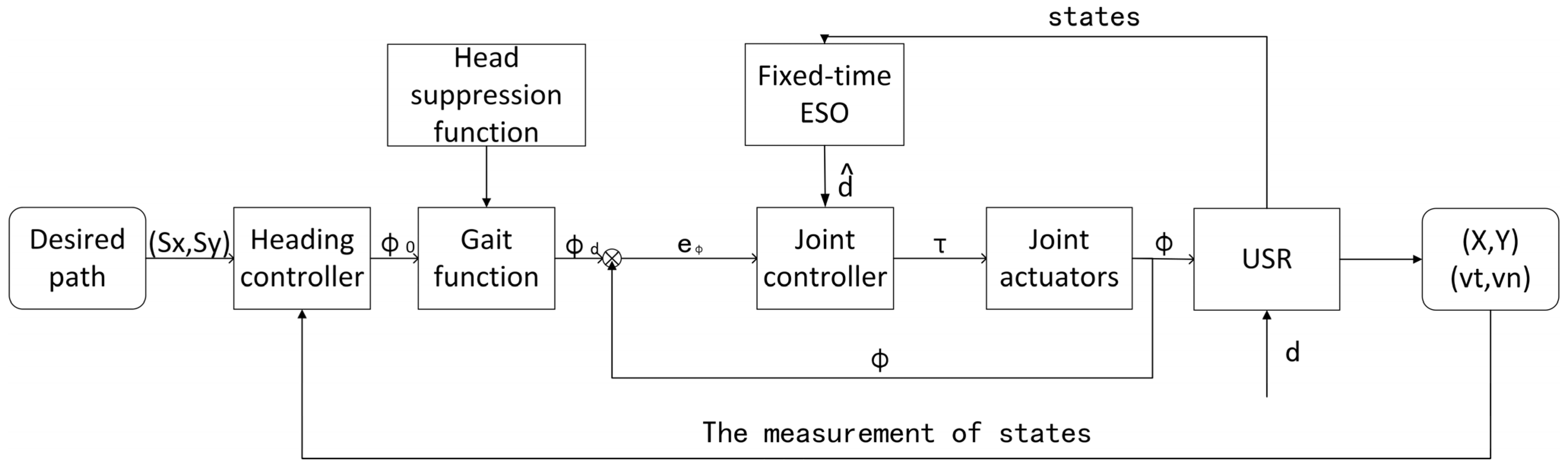
Based on the process of sub-control tasks, the structure diagram of the closed-loop path-following system proposed in this paper can be obtained as shown in Figure 2.

3. Controller Design and Stability Analysis

3.1. Improvement of Fixed-Time Convergence Systems

For USR systems that need to navigate through confined waters while being subject to time-varying disturbances, the design of an auxiliary system with rapid convergence characteristics is particularly important to enhance the overall path-following accuracy. Building upon traditional fixed-time convergence systems and with reference to Lemmas 1–3, this paper designs a system with faster convergence speed.
Lemma 4. 
Cf. Lemmas 1–3, the nonlinear system desired in this paper can be shown as in Equation (15)
z ˙ ξ ( z ) ( l 1 z ε l 2 z λ ) k , z ( 0 ) = z 0
where H(z) is the Heaviside function.
λ = 5 2 q 2 k + 1 2 p + ( 1 2 p 5 2 q + 2 k ) s i g n ( z 1 ) ε = p + q 2 + p q 2 ( 2 H ( z 1 ) 1 ) ,   ξ ( z ) = a + ( 1 a ) exp ( b z c ) ,
a > 0 ,   b > 0 ,   c > 0 ,   l 1 > 0 ,   l 2 > 0 ,   q > 0 ,   p > 0 ,   k > 0 ,   q k < 1 ,   p k > 1 .
Then, the nonlinear system (15) is fixed-time convergent, and its convergence time T is bounded by the expression given in Equation (16).
The proof is provided in Appendix A.1.
T f T max = 1 ( l 1 + l 2 ) k ( p k 1 ) + 1 l 1 k ( 1 q k ) ( 1 ( l 2 l 1 ) k ln ( 1 + ( l 1 l 2 ) k )
Although the expressions of the convergence times of systems (6), (8) and (15) are different, they all depend on the same parameters. Therefore, the convergence times in Equations (7), (9), and (16) are explicitly compared. Since l 1 + l 2 l 2 ln ( 1 + l 2 l 1 ) 1 + l 1 l 2 < 1 , 1 l 2 l 1 ln ( 1 + l 1 l 2 ) ln ( 1 + l 1 l 2 ) and 1 ( l 2 l 1 ) k ln ( 1 + ( l 1 l 2 ) k ) ( l 1 l 2 ) k ln ( 1 + ( l 2 l 1 ) k ) , the convergence times of systems (6) and (8) are strictly greater than that of system (15). By integrating system (15) with a conventional extended state observer and the USR model (1), a novel extended state observer and joint angle tracking controller are developed, thereby ensuring rapid fixed-time convergence of the system.

3.2. Establishment of Fixed-Time Extended State Observer

To facilitate the design of a rapid fixed-time extended state observer and joint controller, the symbols in the USR system are redefined: z 1 = ϕ ,   z 2 = ϕ ˙ . Then the dynamic model of USR can be reconstructed as:
z ˙ 1 = z 2 z ˙ 2 = c n m z 2 + c p m v t , t e l A D T z 1 + 1 m D D T u + d t
The propulsive force for USR biomimetic motion is generated by the sinusoidal movement of joint actuators. However, time-varying disturbances during this motion significantly degrade path-following accuracy. Previous studies have demonstrated that without proper handling of time-varying disturbances, tracking errors induced by joint actuators will accumulate and ultimately lead to failure of the tracking task. Therefore, it is necessary to establish a rapid-response system to observe and estimate time-varying disturbances in real time and incorporate corresponding compensation into the controller to counteract their adverse effects. According to traditional ESO theory, the total disturbance dt of the system is defined as the extended state variable z3, yielding the traditional third-order extended state observer system:
z ˙ 1 = z 2 z ˙ 2 = c n m z 2 + c p m v t , t e l A D T z 1 + 1 m D D T u + z 3 z ˙ 3 = l ( t ) y = z 1
where d t D t ,   d ˙ t = l ˙ t L .
Aiming at the limitation of insufficient convergence speed in conventional extended state observers under time-varying disturbances, this paper designs an improved fixed-time extended state observer with rapid convergence characteristics by incorporating the proposed fixed-time system:
z ^ ˙ 1 = z ^ 2 ψ 1 ( e 1 ) z ^ ˙ 2 = z ^ 3 c n m z ^ 2 + c p m v t , t e l A D T z ^ 1 + 1 m D D T u ψ 2 ( e 1 ) z ^ ˙ 3 = η s i g n ( e 1 ) ψ 3 ( e 1 )
where η is the gain coefficient of observer, and ψi is a nonlinear function, as shown in Equation (20):
ψ i ( e 1 ) = ξ ( e 1 ) ( l 1 , i s i g n ( e 1 ) ε 1 , i + l 2 , i s i g n ( e 1 ) λ 1 , i ) k 1
where e is the estimation error.
ξ ( e 1 ) = a 1 + ( 1 a 1 ) exp ( b 1 e 1 c 1 ) e 1 1 a 1 + ( 1 a 1 ) exp ( b 1 e 1 ) e 1 < 1 ,
a 1 > 0 ,   b 1 > 0 ,   c 1 > 0 ,   l 1 , i > 0 ,   l 2 , i > 0 ,   q 1 , i > 0 ,   p 1 , i > 0 ,   k 1 > 0 ,   q 1 , i k 1 < 1 ,   p 1 , i k 1 > 1 ,
λ 1 , i = 5 2 q 1 , i 1 k + 1 2 p 1 , i + ( 1 2 p 1 , i 5 2 q 1 , i + 1 k ) s i g n ( e 1 ) ε 1 , i = p 1 , i + q 1 , i 2 + p 1 , i q 1 , i 2 ( 2 H ( e 1 ) 1 )
If the extended state observer designed for the USR system (17) is described by Equation (19), then the convergence times of the state variables z1 and z2 are independent of the initial conditions, with both variables estimated within a fixed time Te. Moreover, the estimation error of the extended state variable converges to a neighborhood of the origin within a prescribed time. This upper limit of convergence time is shown in Equation (21). The detailed derivation is provided in Appendix A.2.
T s λ max 1 ε ( M 1 ) λ min ( M 1 ) λ min ( Q 1 ) ( 1 ε ) + λ min ( M 2 ) λ min ( Q 2 ) ( λ 1 ) Δ λ 1 + χ η l ( t )
This paper integrates the improved fixed-time system with a conventional extended state observer to achieve real-time observation and accurate estimation of lumped disturbances. The estimated disturbances are incorporated as a feedforward compensation term in the controller design, enabling rapid disturbance rejection and significantly enhancing the path-following accuracy of the USR system.

3.3. Controller Establishment of Joint Actuator

Based on the sub-control objectives formulated in Section 2, this paper designs a heading-position controller and a joint angle controller, respectively, and introduces a dynamic event-triggered mechanism along with a novel head suppression function.
(a)
Heading and centroid position control
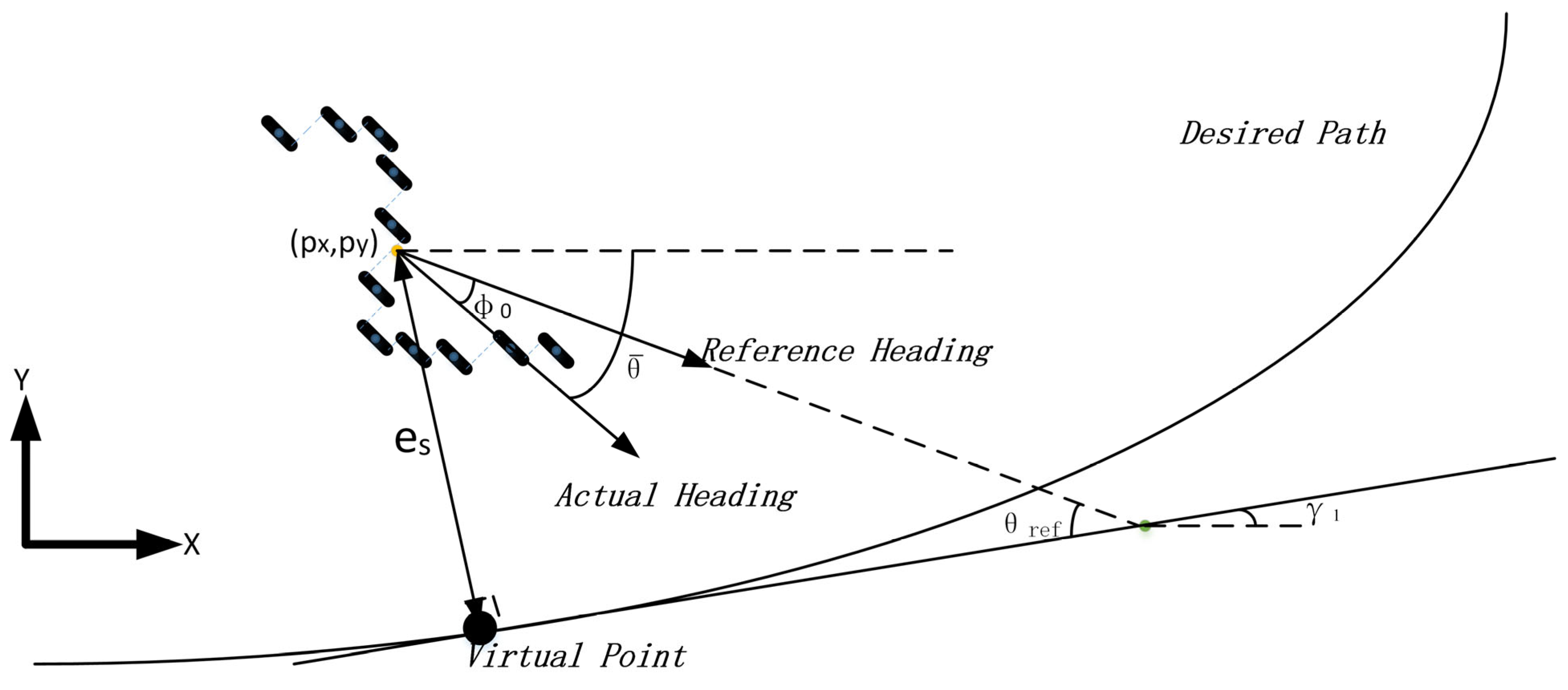
Building upon the work in [5], this paper constructs the desired trajectory for path following and introduces a virtual particle (Sx, Sy) as the reference target for USR path following, thereby defining the centroid position tracking error as:
e S = ( p x S x ) sin γ 1 + ( p y S y ) cos γ 1
where γ1 represents the tangential angle between the current path point of the virtual particle and the horizontal axis of the geodetic coordinate system. Based on the adaptive line-of-sight (LOS) guidance algorithm and Figure 3, the heading angle tracking error of the USR can be obtained as shown in Equation (23):
e θ = θ γ 1 + arctan ( e s + σ 1 y int Δ )
y ˙ int = Δ e s ( e s + σ 1 y int ) 2 + Δ 2
where θ = 1 N θ i is the heading angle for the actual movement of the USR. The forward-looking distance, represented by Δ, is a crucial factor in heading control. To avoid the drawbacks of a fixed forward-looking distance, this paper adopts a variable forward-looking distance, as shown in Equation (25).
Δ = Δ max ( Δ max Δ min ) tanh ( K e s 2 ) 2
where K is a gain constant. Δmax = 6 Nl, and Δmin = 0.8 Nl.
During the sinusoidal locomotion of the USR, the joint offset angle φ0 for heading control is typically obtained through a proportional control law, an approach that has been widely validated in numerous literature and experimental studies. Building upon this foundation, this paper further incorporates the centroid position error to formulate the heading controller presented in Equation (26):
ϕ 0 = e θ + k s e s k θ + e θ + k s e s
where ks and kθ represent the proportional coefficients of the centroid position error and the heading angle error of the USR, respectively.
(b)
Joint angle control
The rotation angle of the servo actuator determines the joint angle of the USR, thereby defining the overall locomotion posture of the robot. The angular relationship of the USR servo actuators under sinusoidal motion is described by Equation (2). Under this relationship, the motion amplitudes of the actuators remain strictly consistent. However, an insufficient motion amplitude leads to inadequate propulsion speed of the USR, while an excessive amplitude causes the head vision module to lose the tracking target. To address this, this paper proposes a novel head motion suppression function, as shown in Equation (27):
Ω ( i ) = 1 exp ( exp ( ς ( i κ ) ) )
where parameter ς is a positive coefficient, and the magnitude of ς determines the degree of joint angle inhibition. κ is a normal number, and the value of κ determines the number of joints affected by the inhibition function.
By combining Equations (2) and (27), the desired joint angle of the USR can be obtained, as shown in Equation (28).
ϕ d ( i ) = Ω ( i ) ( α sin ( ϖ t + ( i 1 ) β + ϕ 0 )
Enhancing joint angle control is crucial for improving the path-following accuracy of the USR. To this end, by integrating the USR dynamic system (1), the fixed-time convergence system (15), and the improved observer (19) based on this system, a fast fixed-time nonsingular terminal sliding mode controller is proposed.
Based on Lemma 4 designed in this paper and referring to the research ideas of Pan et al. [36], the fixed-time nonsingular terminal sliding mode surface is designed as shown in Equation (29):
s i = ζ 1 ( z 1 , i , z 2 , i ) i f   s ¯ i = 0   o r   s ¯ i 0 , z 1 ϒ ζ 2 ( z 1 , i , z 2 , i ) i f   s ¯ i 0 , z 1 < ϒ   i = 1 , 2 , , N 1
s ¯ = z 2 + ( ξ ( z 1 ) 1 k 2 l 3 s i g n ( z 1 ) 2 ε 2 1 k 2 + ξ ( z 1 ) 1 k 2 l 4 s i g n ( z 1 ) 2 λ 2 1 k 2 ) k 2
where
a 2 > 0 ,   b 2 > 0 ,   c 2 > 0 ,   l 3 > 0 ,   l 4 > 0 ,   q 2 > 0 ,   p 2 > 0 ,   k 2 > 0 ,   q 2 k 2 < 1 ,   p 2 k 2 > 1 ,
ξ ( x 1 ) = a 2 + ( 1 a 2 ) exp ( b 2 x 1 c 2 ) x 1 1 a 2 + ( 1 a 2 ) exp ( b 2 x 1 ) x 1 < 1 ,
λ 2 = 5 2 q 2 1 k 2 + 1 2 p 2 + ( 1 2 p 2 5 2 q 2 + 1 k 2 ) s i g n ( z 1 1 ) ε 2 = p 2 + q 2 2 + p 2 q 2 2 ( 2 H ( z 1 1 ) 1 ) .
The switching law (29) is introduced to address the singularity issue of the terminal sliding mode surface. When the sliding state satisfies specific conditions, the system can switch between ζ1,i and ζ2,i. The expressions of ζ1,i and ζ2,i are as follows.
s i = ζ 1 = z 2 + ( ξ ( z 1 ) 1 k 2 l 3 s i g n ( z 1 ) 2 ε 2 1 k 2 + W 1 ( z 1 ) ) k 2   i f   s ¯ i = 0   o r   s ¯ i 0 , z 1 ϒ ζ 2 = z 2 + ( ξ ( z 1 ) 1 k 2 l 3 s i g n ( z 1 ) 2 ε 2 1 k 2 + W 2 ( z 1 ) ) k 2   i f   s ¯ i 0 , z 1 < ϒ   i = 1 , 2 , , N 1
where
W 1 ( z 1 ) = ξ ( z 1 ) 1 k 2 l 4 ( z 1 ) 2 ε 2 1 k 2 W 2 ( z 1 ) = ξ ( z 1 ) 1 k 2 l 4 ( Ξ sin ( z 1 ) + Ψ s i g n ( z 1 ) ι ) Ξ = p 2 ϒ 2 p 2 1 k 2 ι ϒ 2 p 2 1 k 2 ϒ cos ( ϒ ) ι sin ( ϒ ) , Ψ = p 2 ϒ 2 p 2 1 k 2 Ξ cos ( ϒ ) ι ϒ ι 1 ,   1 < ι < 2 .
It can be known that the sliding mode surface (31) is continuously differentiable.
Combining the USR dynamic system (17) and differentiating the sliding surface (31), it can be obtained that:
s ˙ = c n m v ϕ + c p m v t , t e l A D T ϕ + 1 m D D T u + d t ϕ ¨ d + H ˙ ( z 1 )
H ( z 1 ) = ( ξ ( z 1 ) 1 k 2 l 3 s i g n ( z 1 ) 2 ε 2 1 k 2 + W ( z 1 ) ) k 2
Combined with the improved fixed-time convergence system (15) in this paper, a new fixed-time arrival law is proposed, as shown in Equation (34).
s ˙ = ( ξ ( s ) 1 k 3 l 5 s i g n ( s ) 2 ε 3 1 k 3 + ξ ( s ) 1 k 3 l 6 s i g n ( s ) 2 λ 3 1 k 3 ) k 3
where
a 3 > 0 ,   b 3 > 0 ,   c 3 > 0 ,   l 5 > 0 ,   l 6 > 0 ,   q 3 > 0 ,   p 3 > 0 ,   k 3 > 0 ,   q 3 k 3 < 1 ,   p 3 k 3 > 1 ,
ξ ( s ) = a 3 + ( 1 a 3 ) exp ( b 3 s c 3 ) s 1 a 3 + ( 1 a 3 ) exp ( b 3 s )   s < 1 ,
λ 3 = 5 2 q 3 1 k 3 + 1 2 p 3 + ( 1 2 p 3 5 2 q 3 + 1 k 3 ) s i g n ( s 1 ) ε 3 = p 3 + q 3 2 + p 3 q 3 2 ( 2 H ( s 1 ) 1 ) .
To better describe the joint controller, an auxiliary variable is introduced as shown in Equation (35).
v = ϕ ¨ d H ˙ ( z 1 )
Combining the observer (19), sliding mode surface (31) and arrival law (34), the joint controller constructed in this paper is shown in Equation (36).
U = m v + c n v ϕ c p v t , t e l A D T ϕ z ^ 3 ( ξ ( s ) 1 k 3 l 5 s i g n ( s ) 2 ε 3 1 k 3 + ξ ( s ) 1 k 3 l 6 s i g n ( s ) 2 λ 3 1 k 3 ) k 3 η ˜ s i g n ( s ) c n s
where U = D D T u ,   η ˜ = d i a g ( η 1 , η 2 , , η N ) ,   η i > d ˜ 0 + η i 0 ,   η i 0 > 0 .
By applying the heading controller (26) and the joint controller (36) to the USR system, both the overall path-following error and the joint angle tracking errors of all links converge to a neighborhood of the origin within the settling time Tc with Tc ≤ max {Te, TA} + Ts, where Ts and TA are expressed as shown in Equations (37) and (38).
T S 1 ( l 3 + l 4 ) k 2 ( p 2 k 2 1 ) + 1 l 3 k 2 ( 1 q 2 k 2 ) ( 1 ( l 4 l 3 ) k 2 ln ( 1 + ( l 3 l 4 ) k 2 )
T A 1 ( l 5 + l 6 ) k 2 ( p 3 k 3 1 ) + 1 l 5 k 3 ( 1 q 3 k 3 ) ( 1 ( l 6 l 5 ) k 3 ln ( 1 + ( l 5 l 6 ) k 3 )
The proof of the stability of the controller (36) is shown in Appendix A.3.
Through integrated analysis of the convergence times in Appendix A.3, the convergence time of the designed composite controller is derived as: Tcmax {Te, TA} +Ts. This convergence time is independent of the initial state of the USR system, indicating that the convergence performance of controller (36) can be directly determined by parameters independent of initial conditions, thereby achieving fixed-time convergence. This ensures that the USR can accomplish rapid tracking of the desired angle within time Tc. The proposed scheme not only guarantees fixed-time convergence of the controller but also optimizes the terminal sliding mode surface by improving upon existing fixed-time system structures, effectively avoiding singularities and further validating the correctness of the theoretical framework. The comprehensive performance of the designed controller and observer will be systematically evaluated via numerical simulations in the following section.

3.4. Establishment of Dynamic Trigger Mechanism

The dynamic event-triggered mechanism employs a dynamic system to generate adaptive thresholds, which automatically relax the triggering condition during highly dynamic responses and tighten it as the system approaches steady state, thereby more effectively balancing the allocation of computational resources. Therefore, this paper adopts a dynamic event-triggered mechanism and, based on this, redefines the system’s measurement error and estimation error as shown in Equations (39) and (40), respectively:
e m ( t ) = y ( t k ) y ( t ) t [ t k , t k + 1 )
e i ( t ) = z ^ ( t ) y i ( t )
Therefore, the trigger conditions for dynamic events can be obtained, as shown in Equation (41).
t k + 1 = inf t > t k : e m ( t ) 2 σ ( t ) ε + k 1 η ( t )
where ε is the trigger gain coefficient, k1 is the dynamic weight coefficient, and σ(t) is the threshold function in the trigger mechanism, which is designed as shown in Equation (42). η(t) is an internal dynamic variable introduced by the system, and its differential can be expressed as shown in Equation (43).
σ ( t ) = σ 0 + σ 1 e λ t
η ˙ ( t ) = γ η ( t ) + μ 1 e ( t ) 2 μ 2 σ ( t )
where λ stands for the error decay coefficient. δ0 represents the static error bound, and δ1 represents the initial value of the dynamic error bound. γ > 0 represents the attenuation rate of the dynamic variable, and μ1 > 0 and μ2 > 0 are the design parameters of the dynamic system.

4. Simulation Comparison and Analysis

4.1. Construction of the Reference Control Method

To evaluate the performance of the proposed control strategy, controllers designed in references [37,38] are selected as benchmarks. All comparative experiments are conducted under identical simulation conditions to ensure the comparability and reliability of the results.
Reference 1 [37]: The sliding mode surface designed by Tian et al. is shown in Equation (44)
s = e ˙ + α 1 s i g n ( e ) k 1 + β 1 s i g n ( e ) k 1
where
k 1 = a 1 + 1 2 + a 1 1 2 s i g n ( e 1 ) k 2 = a 2 + 1 2 + a 2 1 2 s i g n ( e 1 ) a 1 > 1 ,   0.5 < a 2 > 1 ,   α 1 > 0 ,   β 1 > 0 .
Based on the sliding mode surface and fixed-time system constructed by Tian et al., the controller of the USR joint angle is designed as shown in Equation (45).
U = m ϕ ¨ d + c n ( v ϕ ϕ ˙ d ) c p v t , t e l A D T ( ϕ ϕ d ) + d ^ α 2 s i g n ( s ) k 3 + β s i g n ( s ) k 4 ) k 3 η s i g n ( s ) c n s
where
U = D D T u ,   η = d i a g ( η 1 , η 2 , , η N ) ,   η i > d ˜ 0 + η i 0 ,   η i 0 > 0 ,
α 2 > 0 ,   β 2 > 0 ,   k 3 = a 3 + 1 2 + a 3 1 2 s i g n ( e 1 ) ,   a 3 > 1 ,
k 4 = a 4 + 1 2 + a 4 1 2 s i g n ( e 1 ) ,   0.5 < a 4 > 1 .
Reference 2 [38]: The integral sliding surface designed by Chen et al. is shown in Equations (46) and (47).
s 1 = 0 t e 1 d τ
s 2 = e 2 + 0 t α 3 s i g n ( e 2 ) k 5 + β 3 s i g n ( e 2 ) k 6 d τ
where e 1 = ϕ ϕ d ,   e 2 = ϕ ˙ ϕ ˙ d + k 7 e 1 + s 1 ,   k 5 0 ,   0 < k 6 < 1 ,   k 7 > 0 ,   α 3 > 0 ,   β 3 > 0 .
Based on the sliding mode surface constructed by Chen et al., the controller of the USR joint angle is designed as shown in Equation (48).
U = c n m ϕ ˙ c p m v t , t e l A D T ϕ d ^ k 8 s 2 η s i g n ( s 2 ) + m ( ζ ˙ + α 3 s i g n ( e 2 ) k 5 + β 3 s i g n ( e 2 ) k 6 )
where ζ = k 7 s 1 + ϕ ˙ d .

4.2. Simulation Parameter Setting

As shown in Table 2, three typical types of time-varying disturbances are considered in this study: (1) external time-varying disturbance is formulated as a composite signal, comprising sinusoidal and cosine functions combined with Gaussian white noise; (2) state disturbances related to joint friction; and (3) composite disturbances comprising model uncertainties, state disturbances, and sinusoidal disturbances. To comprehensively evaluate the applicability of the controller, Table 3 presents the USR system states under three different initial working conditions. The simulation setup follows the specifications in reference [7], with key parameters—including USR structural parameters, hydrodynamic coefficients, gait parameters, controller gains, and initial system states—summarized in Table 4.

4.3. Analysis of Simulation Results

4.3.1. Controller Convergence Performance Testing

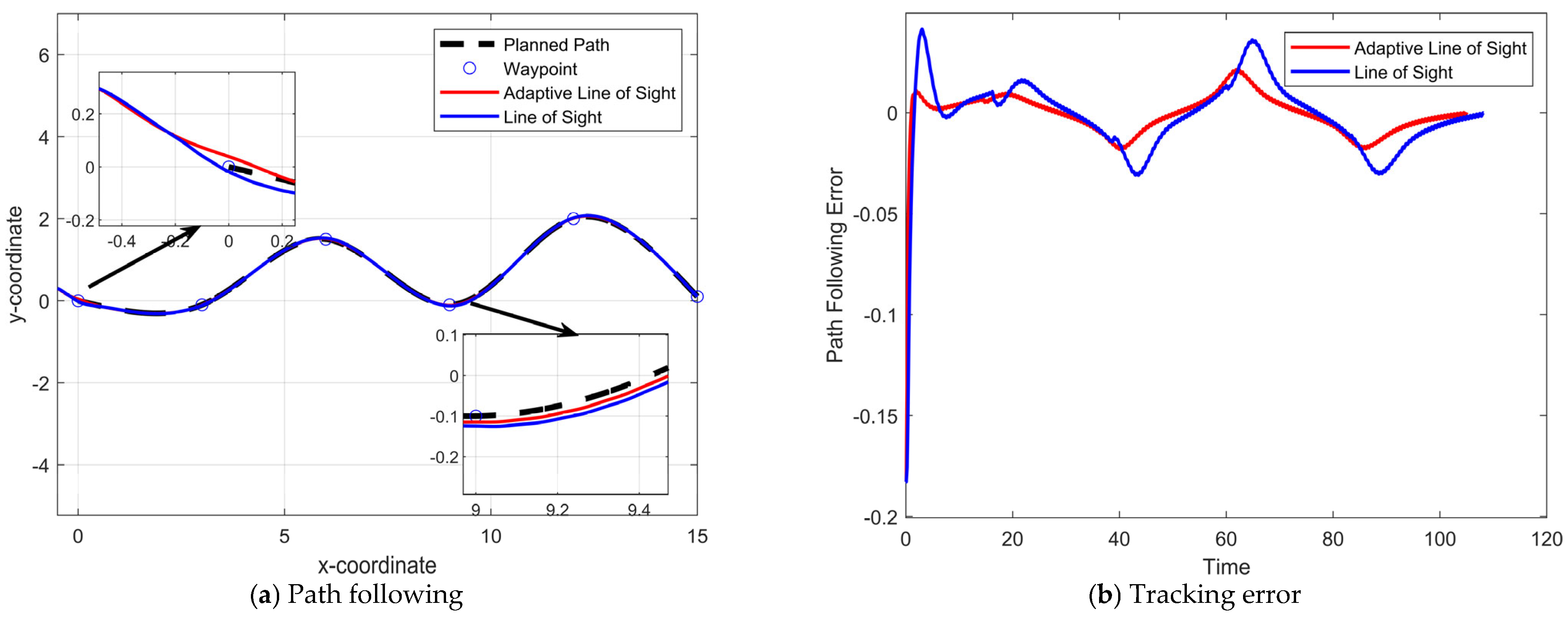
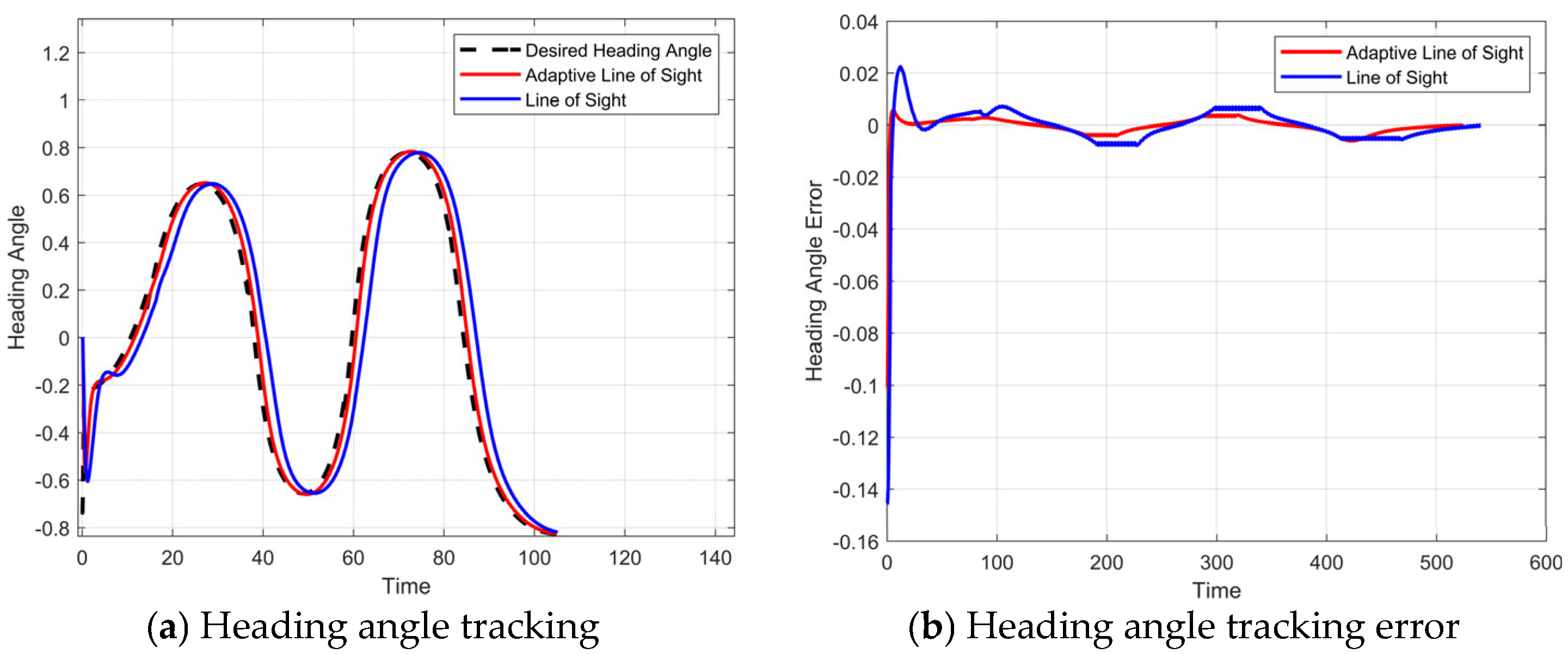
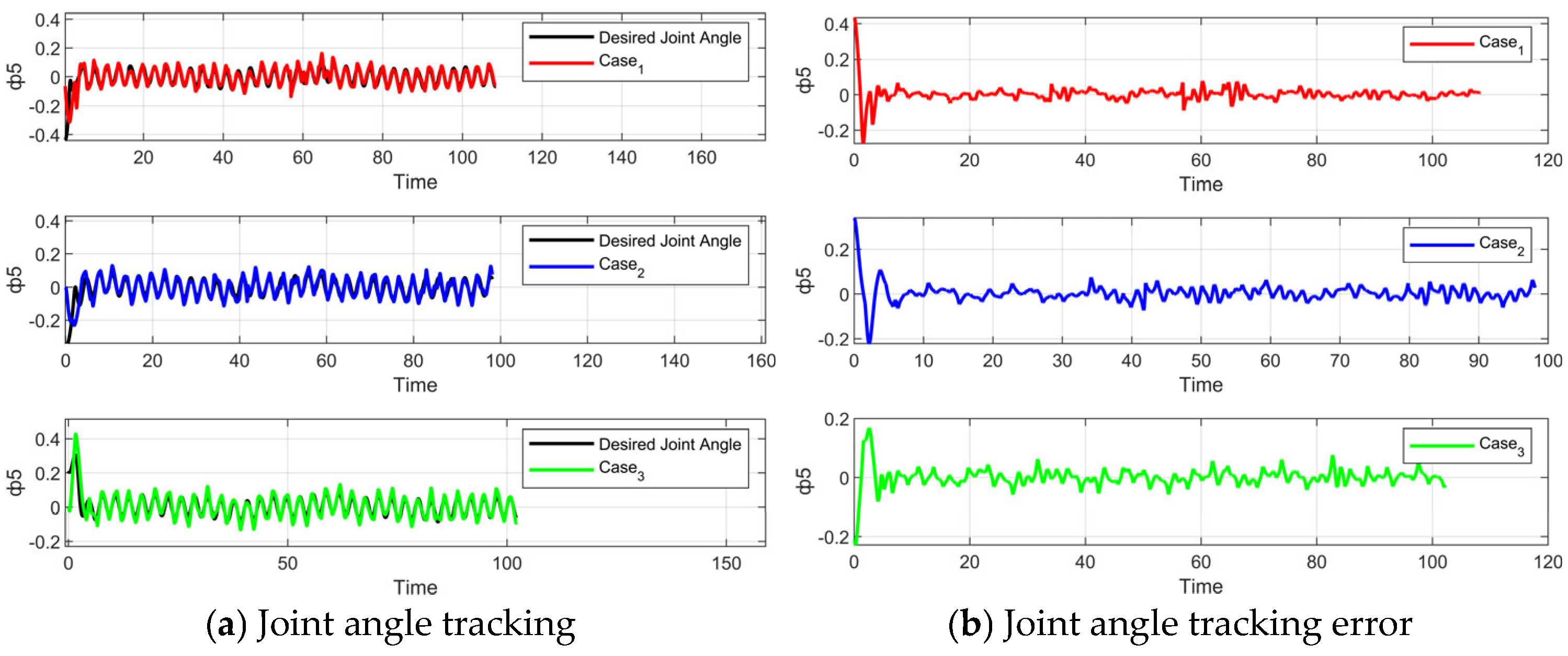
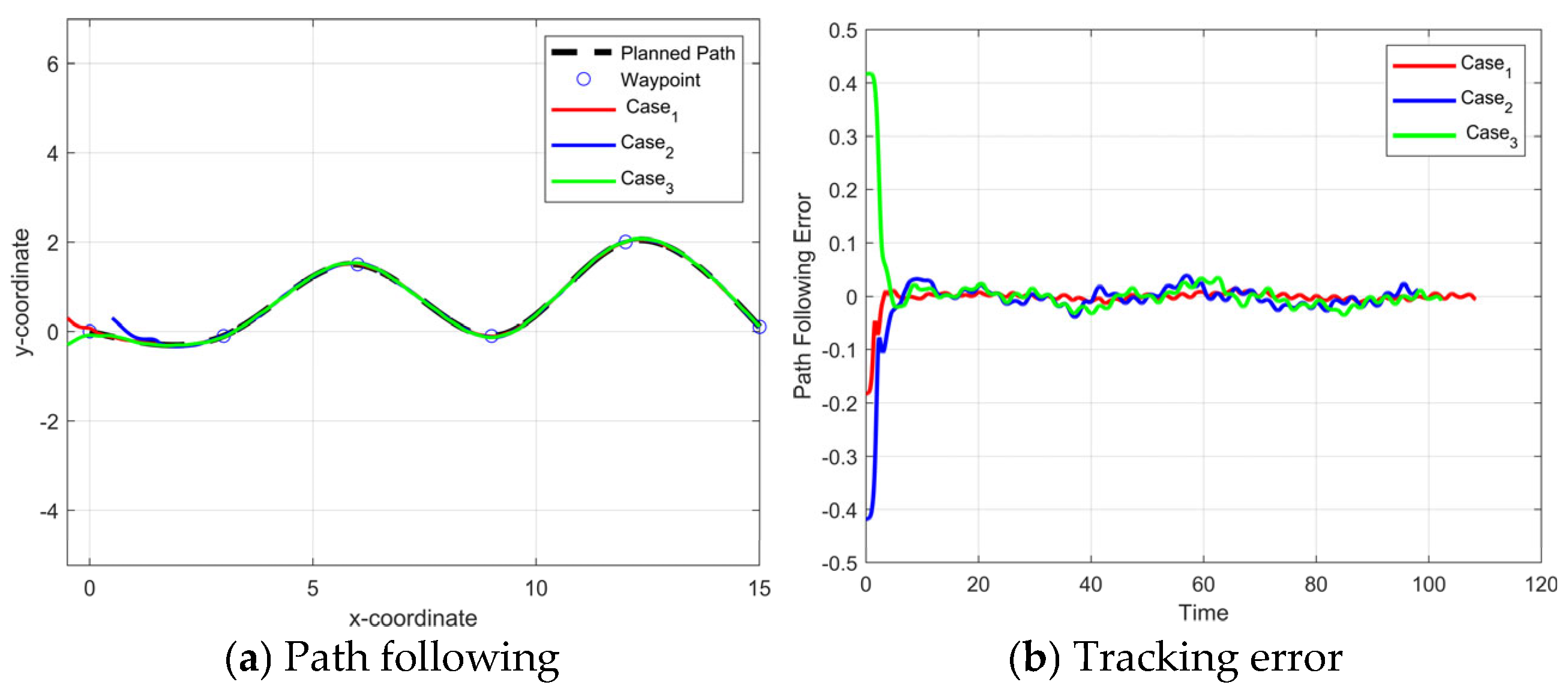
This subsection focuses on evaluating the convergence behavior of the designed heading and joint controllers. Figure 4 and Figure 5 present the path-following and heading angle tracking performance, along with the corresponding errors, under a fixed look-ahead distance (set to twice the USR body length) and a variable distance strategy based on Equation (25), respectively. The results indicate that the proposed controller outperforms the original scheme in both path and heading angle tracking, with the time for tracking errors to converge to zero reduced by 35.8% and 45.7%, respectively. Figure 6 and Figure 7 further illustrate the path-following performance of the USR under the combined action of orientation angle tracking and the heading controller for different initial states. The simulation results verify that the proposed control strategy achieves accurate tracking of the heading angle, joint angles, and desired path in the presence of time-varying disturbances and the heading suppression function, with consistent performance independent of initial position and velocity conditions, demonstrating favorable convergence robustness.

4.3.2. Comparative Analysis of Controller Performance

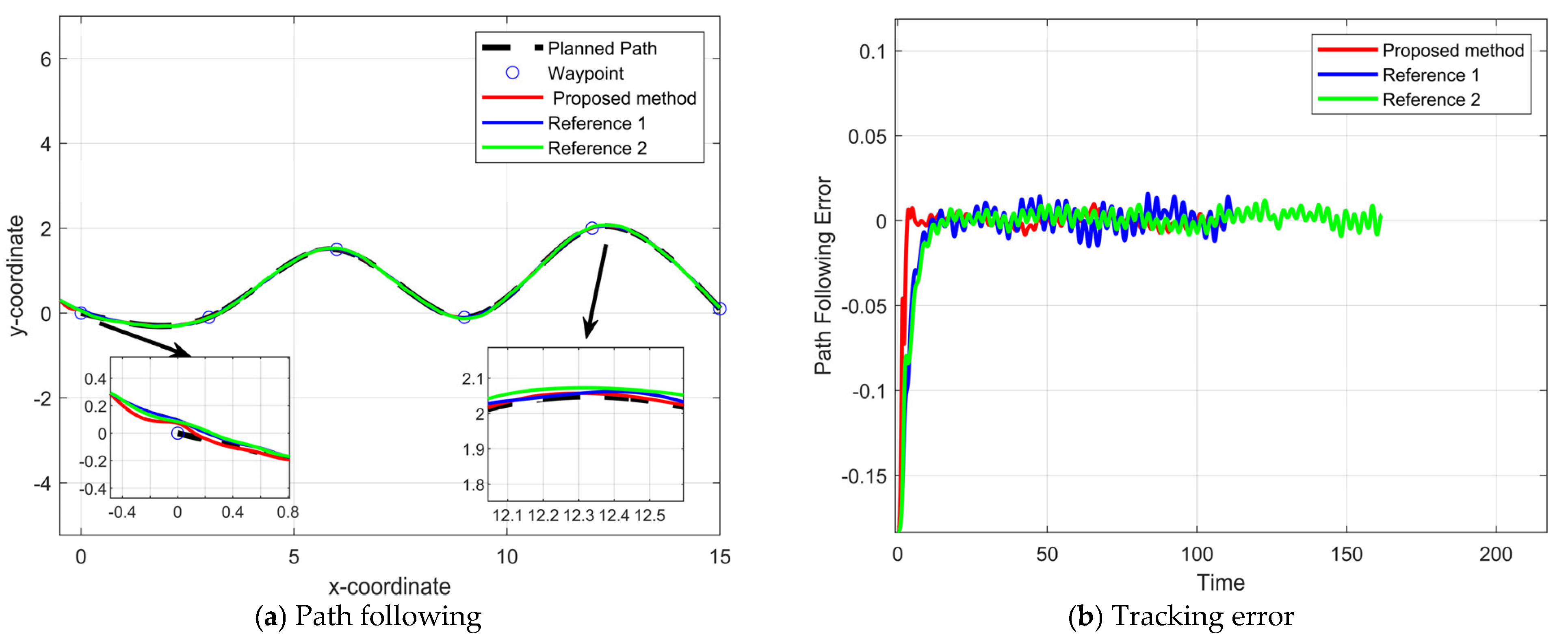
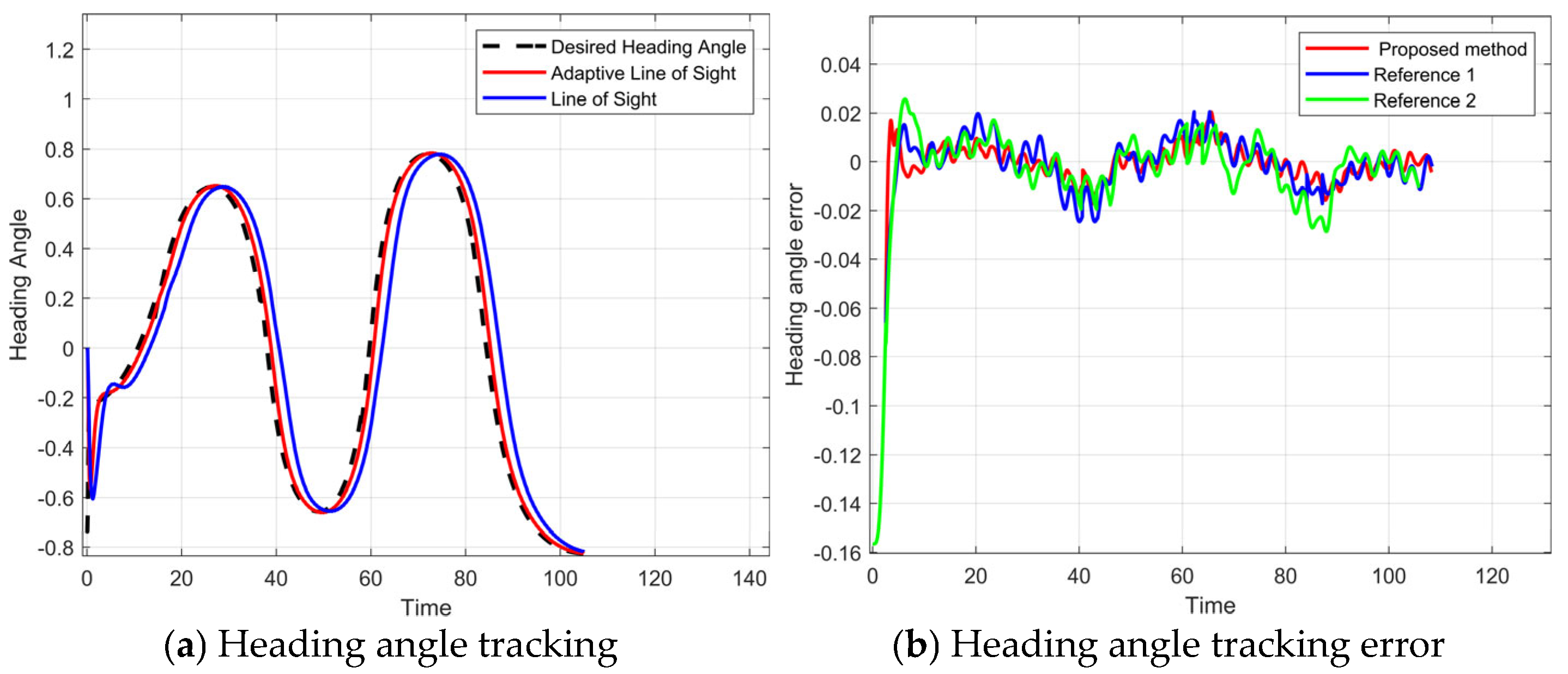
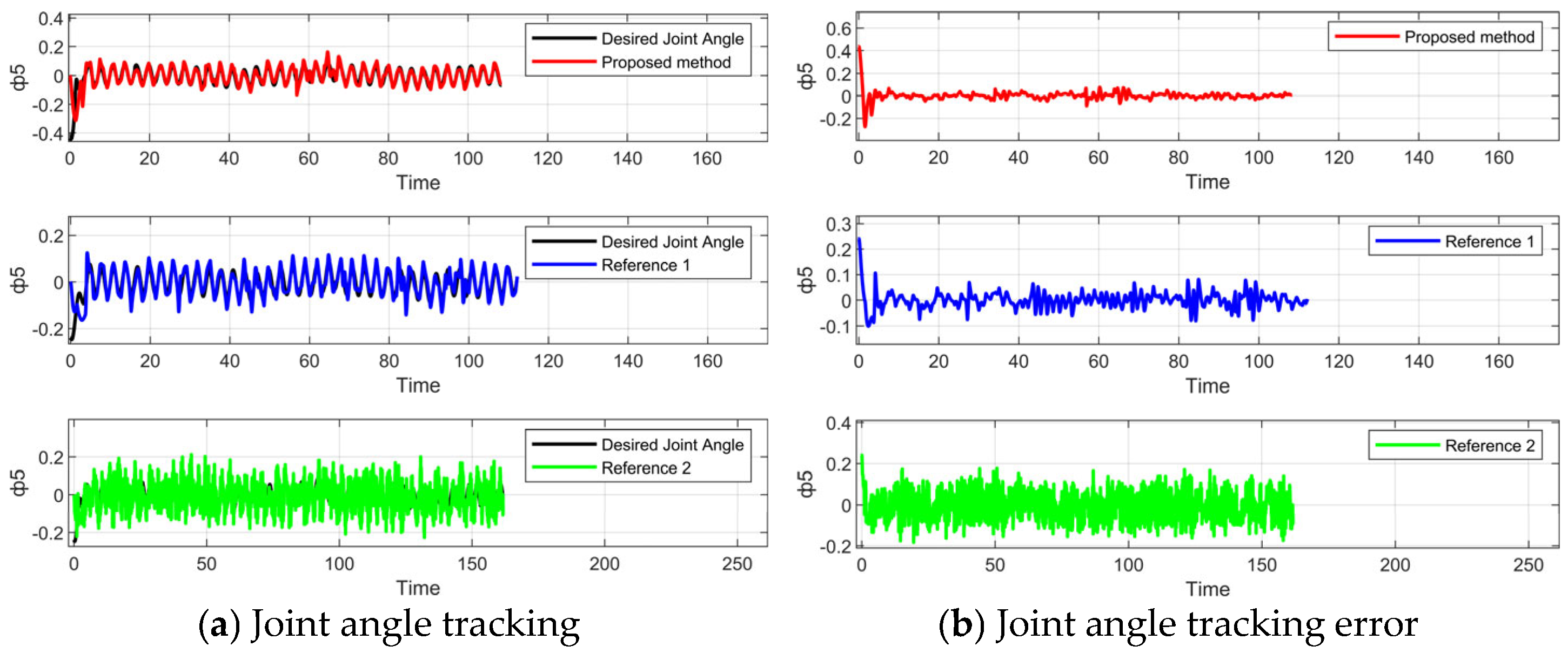
Figure 8 compares the path-following performance of the USR in a 2D plane under the proposed control strategy and two other controllers. Although all three controllers enable the USR to follow the desired path, noticeable tracking deviations are observed during the initial motion phase and turning maneuvers. The comparative results in Figure 8 demonstrate that the proposed controller converges to the desired path more rapidly in the initial stage and maintains lower tracking errors during turns, indicating significantly superior path-following performance over the two reference controllers. Quantitative analysis of path following is provided in Table 5, where the root mean square error (RMSE), maximum steady-state error, and time for tracking error to converge to zero are all better than those of the reference control schemes. A comparison of heading angle tracking performance is shown in Figure 9. Analysis of the heading angle tracking curves and their errors reveals that the heading angle error generated by the proposed heading controller remains closest to the zero baseline, demonstrating superior control performance during USR steering. In multi-joint robotic systems, the middle joint typically exhibits the largest tracking error due to the combined effects of internal force coupling from both sides, as well as hydrodynamic and external disturbances. Therefore, the angle tracking results of the fifth joint are selected for detailed analysis and comparison in Figure 10. Except for the integral controller, the other two controllers achieve tracking of the desired joint angle. The error curves clearly indicate that, under the proposed controller, the joint angle tracking error not only has the smallest amplitude but also the most stable fluctuation, fully verifying the significant advantages of the control strategy in terms of accuracy and robustness.
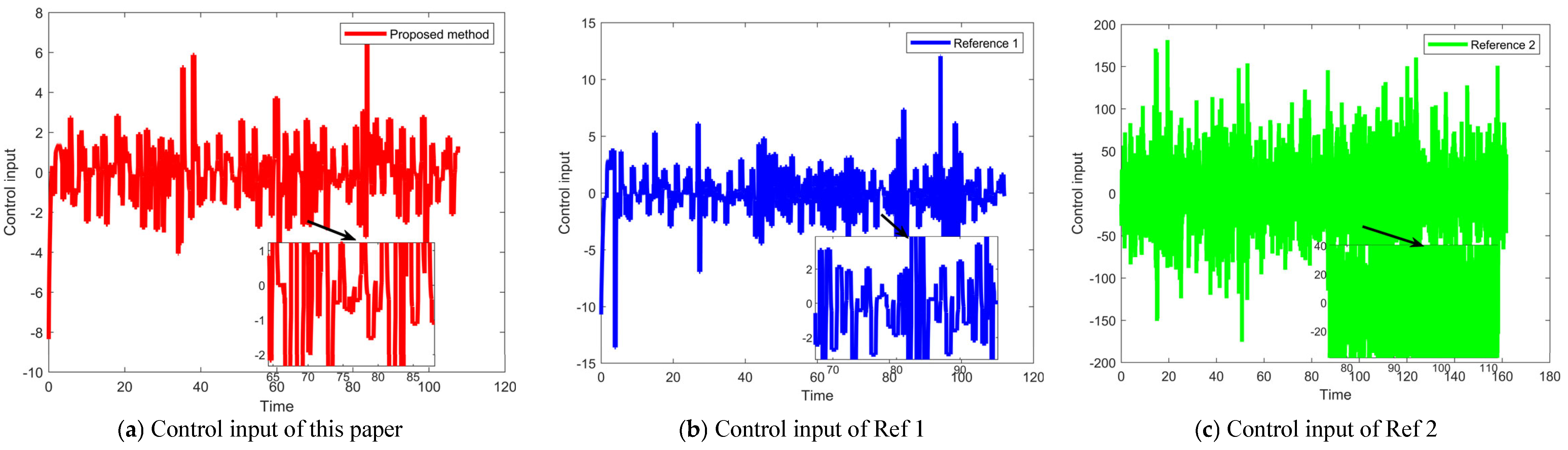
Figure 11 compares the simulated control inputs of the three controllers under the event-triggered mechanism. Compared to the reference controllers, the proposed approach significantly suppresses high-frequency oscillations in the torque signal and reduces the amplitude of control inputs. These improvements help mitigate mechanical wear, extend the service life of servo motors, and lower overall energy consumption. The robot’s velocity is jointly influenced by the number of head joints involved in the suppression function and the joint angle controller. A controlled variable analysis was conducted to quantitatively evaluate the velocity performance of the three controllers under the same suppression function, with results summarized in Table 6. Without suppression, the USR’s average steady-state velocity is 0.1847 m/s. When head joint suppression is enabled, the velocity under the proposed controller is 0.1558 m/s (a decrease of 15.65%), while under the two reference controllers, the velocities are 0.1502 m/s (a decrease of 18.68%) and 0.1473 m/s (a decrease of 20.25%), respectively. These results demonstrate that the proposed control strategy effectively maintains the overall propulsion performance of the USR while ensuring motion stability of the head joints.

4.3.3. Event Triggering Mechanism and Observer Analysis

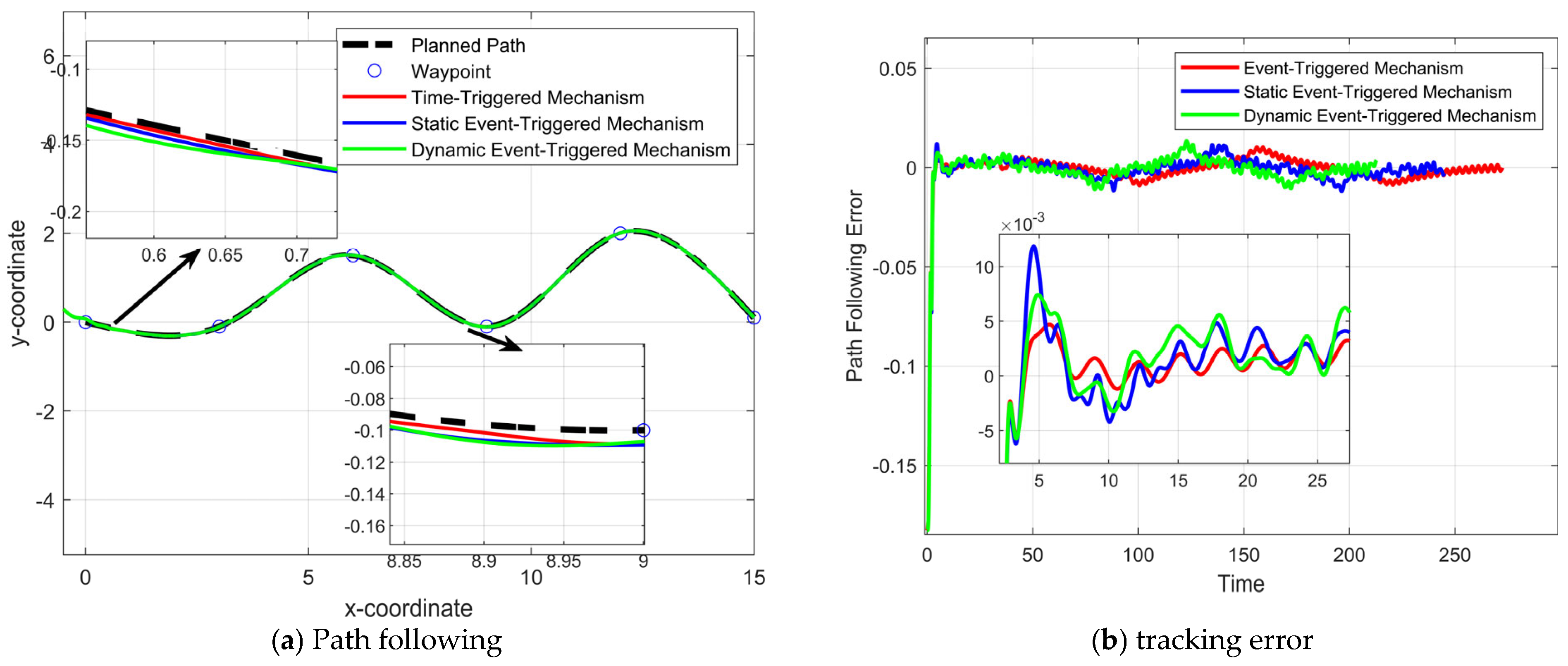
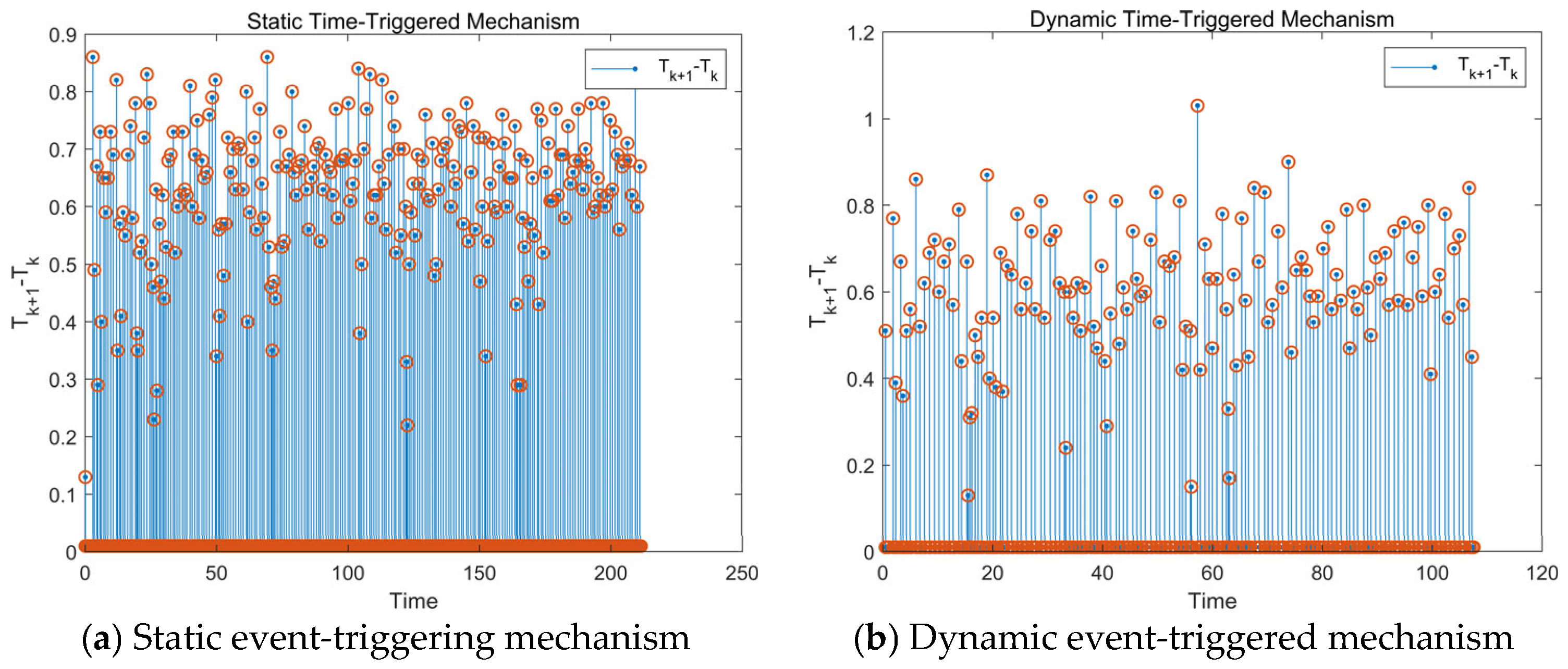
Figure 12 illustrates the path-following results and corresponding tracking errors of the USR under different event-triggered mechanisms. The results indicate that all three triggering mechanisms enable the USR to follow the desired path, but the proposed dynamic triggering mechanism significantly reduces the simulation computation time while maintaining tracking accuracy. Figure 13 further compares the state update intervals under static and dynamic triggering mechanisms. Quantitative performance analysis of the three triggering mechanisms is summarized in Table 7. It is evident that the number of triggers under the dynamic mechanism is substantially lower than that of the static mechanisms, reducing communication resource consumption by approximately 76.63% and 70.38%, respectively. These results fully demonstrate the effectiveness and superiority of the proposed dynamic event-triggered mechanism in optimizing communication resource utilization.
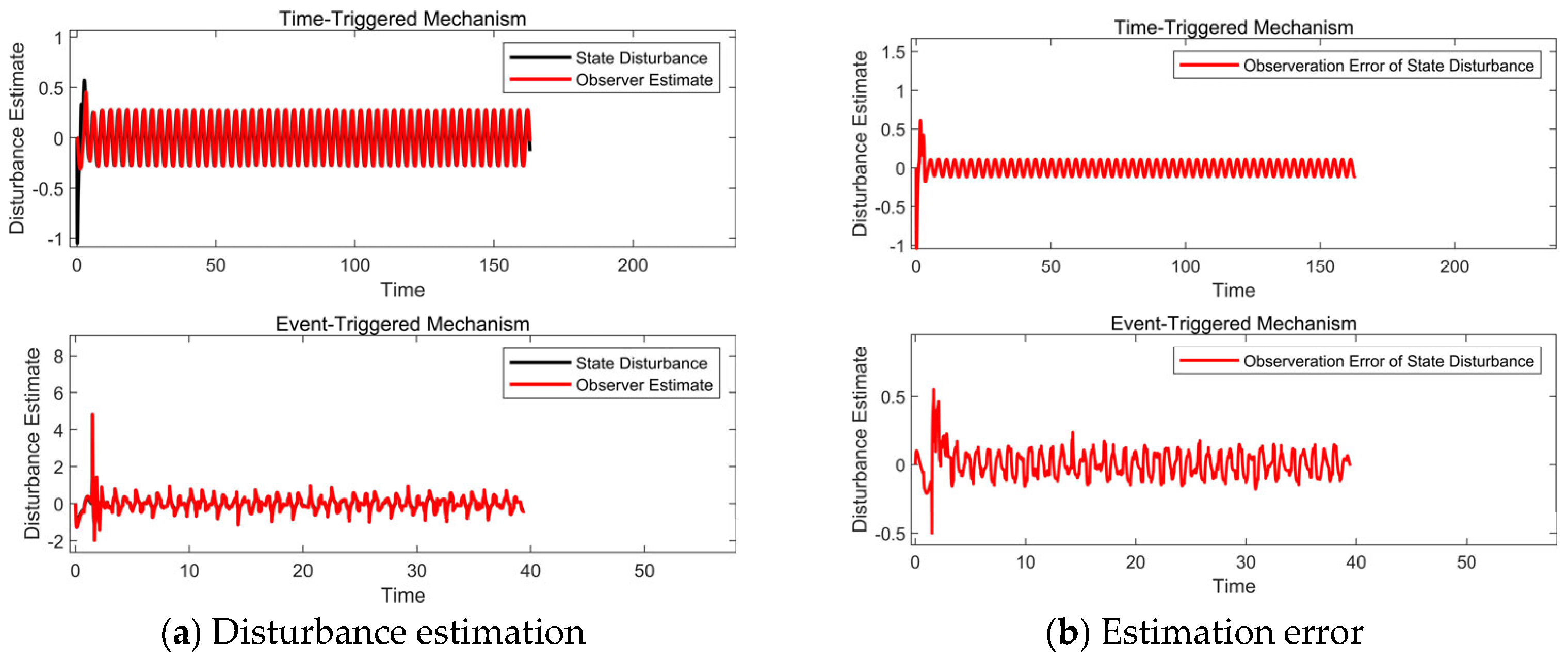
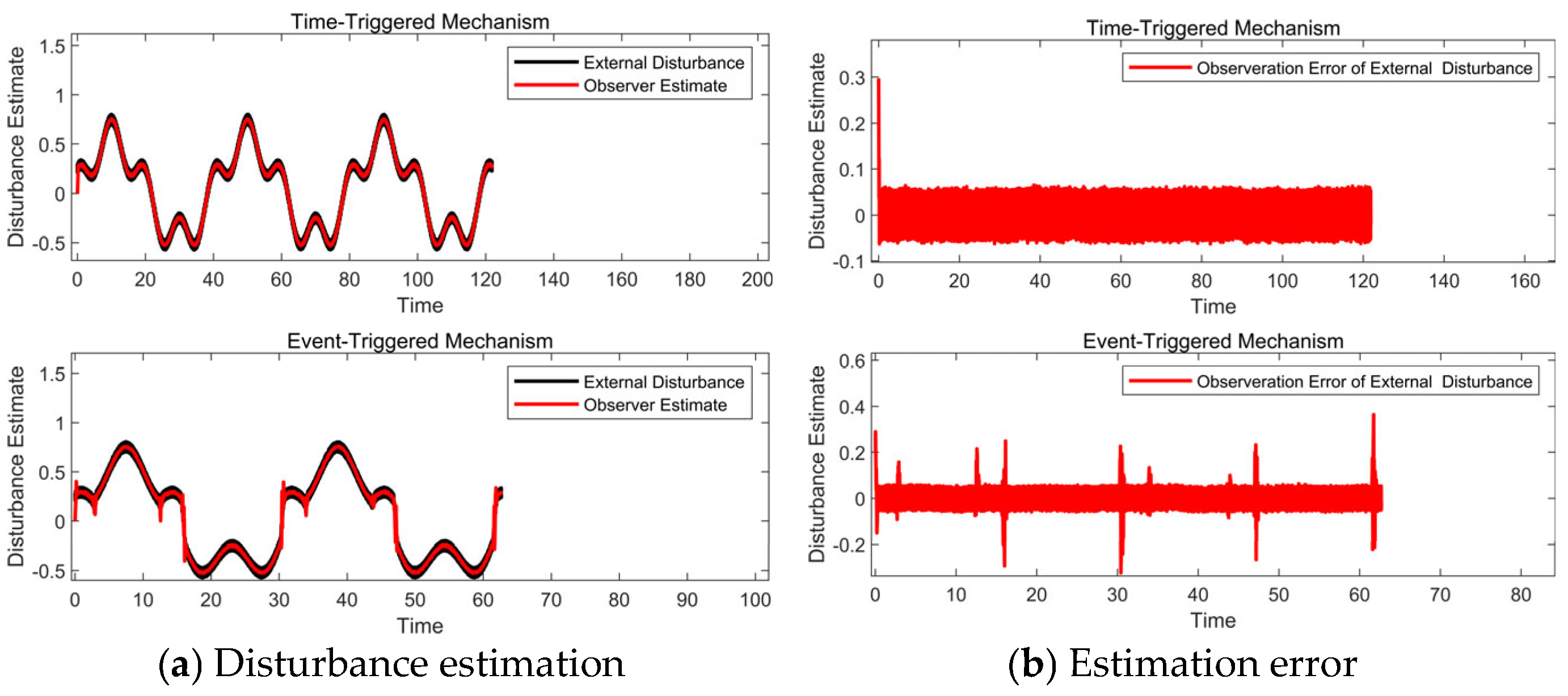
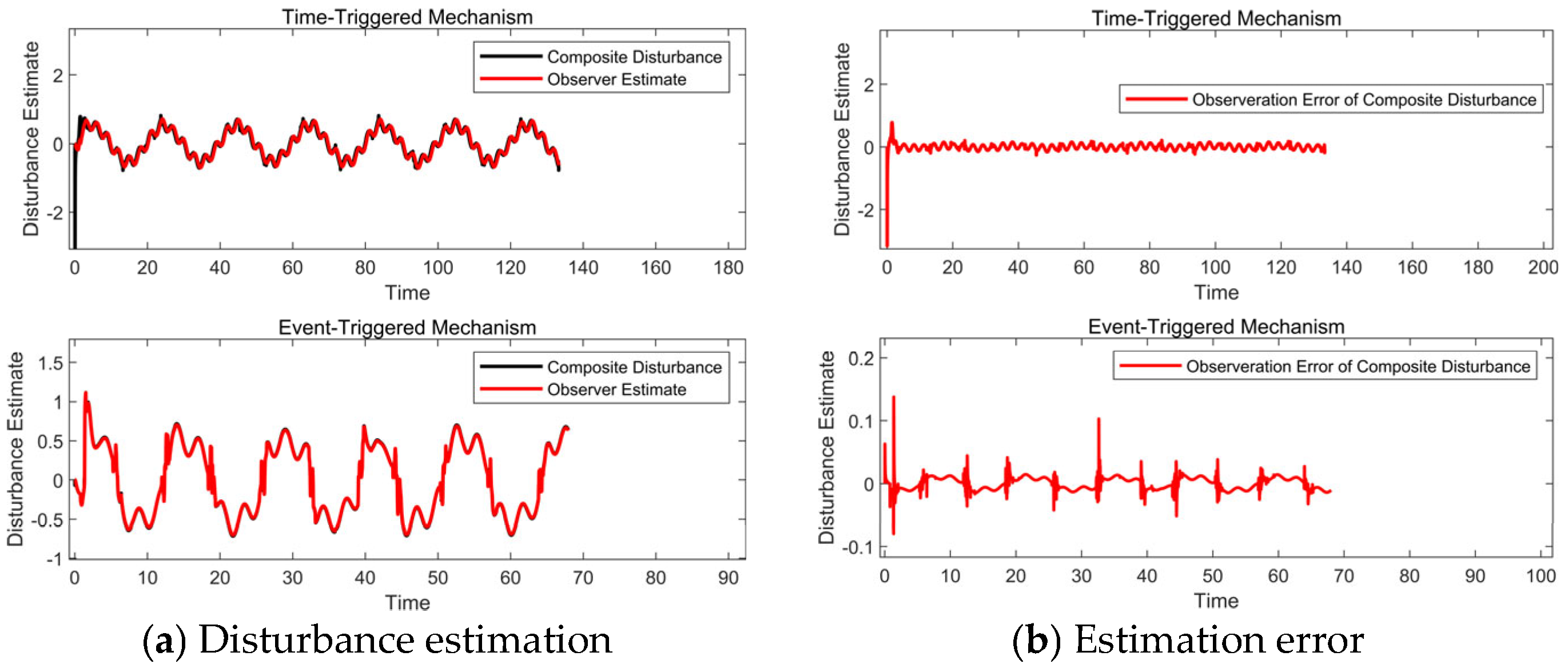
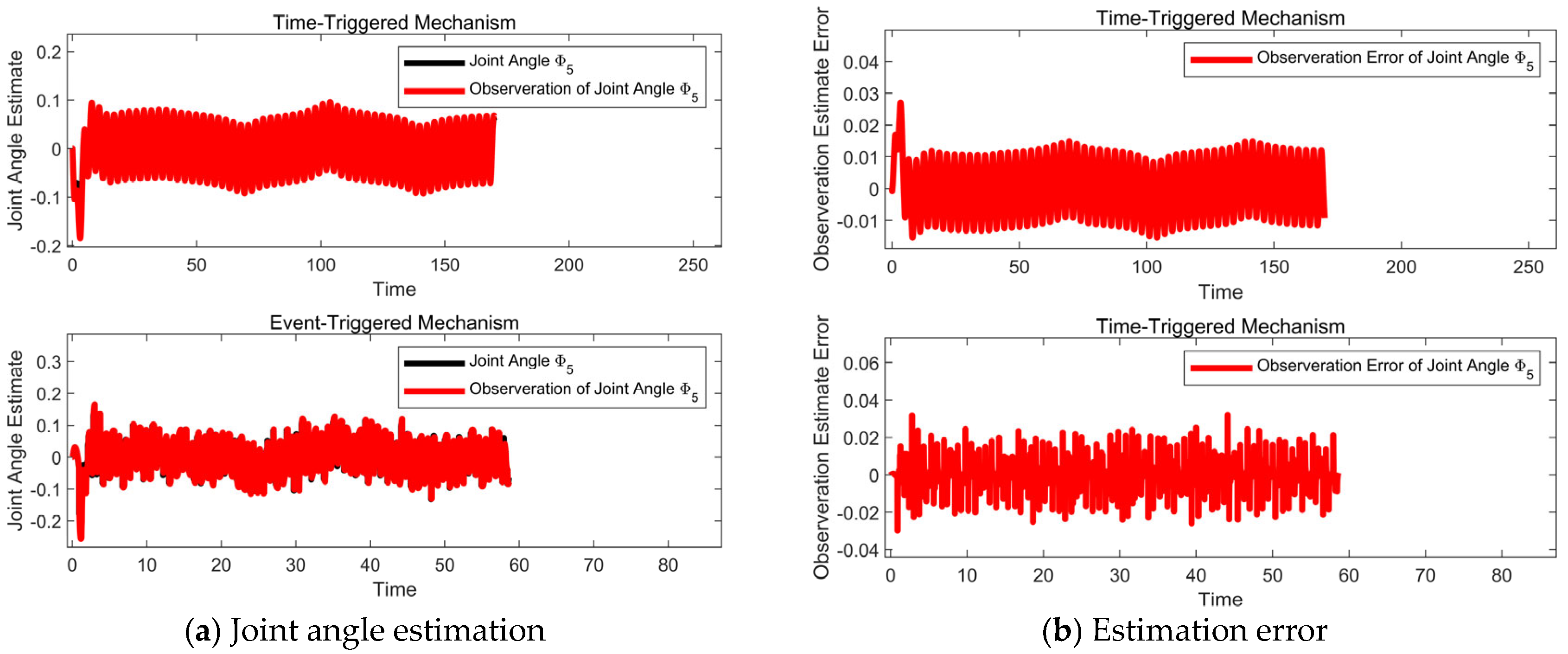
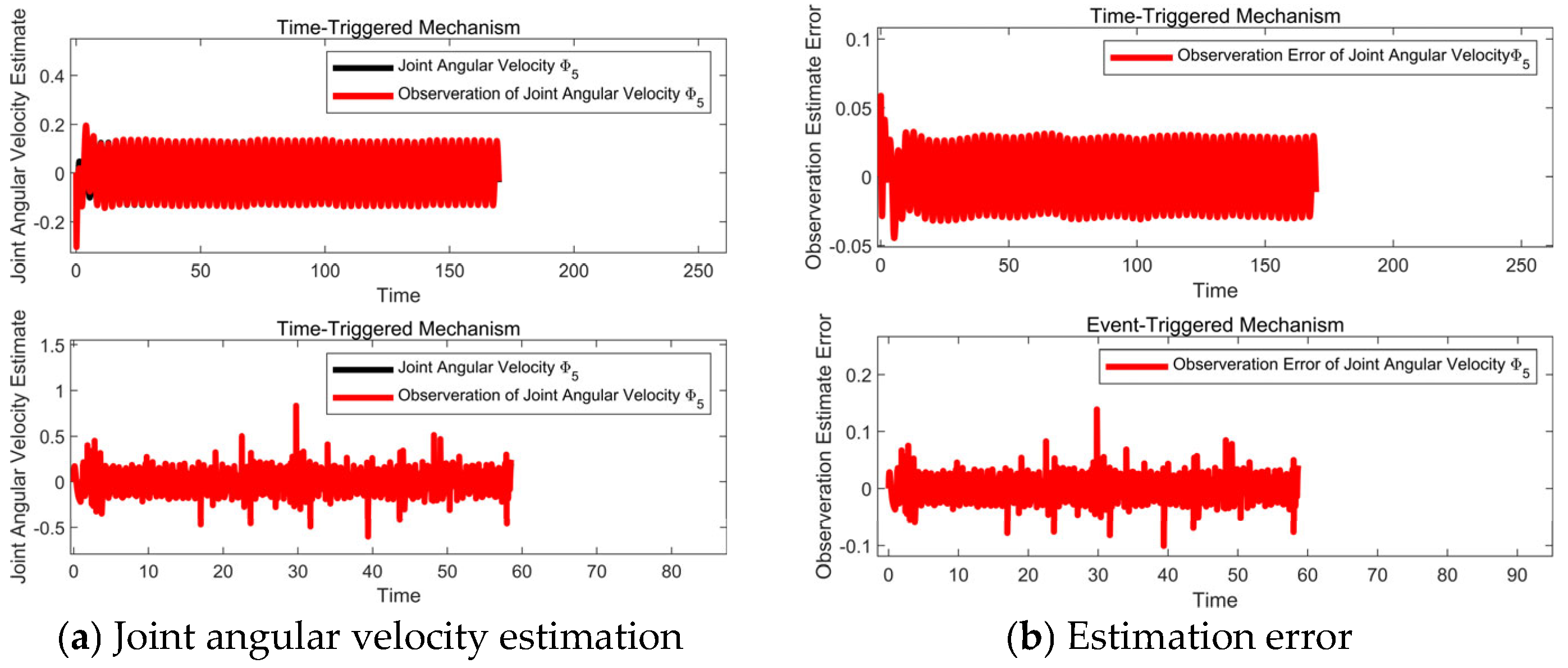
To evaluate the performance of the extended state observer designed in this paper, three different types of time-varying disturbances listed in Table 2 were introduced during the motion of the USR. Figure 14, Figure 15 and Figure 16 present the estimation results and corresponding errors of the extended state observer for these disturbances under different triggering mechanisms. The results show that the proposed observer accurately estimates various types of time-varying disturbances and enables effective compensation in the controller, thereby significantly improving the path-following accuracy of the USR. Figure 17 and Figure 18 further illustrate the estimation performance of the extended state observer for joint actuator rotation angles and angular velocities, along with the associated errors. The simulation results verify that the proposed observer can reliably estimate the robot’s posture even in the absence of sensors or under sensor failure, demonstrating its practical value in system fault tolerance and state reconstruction.

4.3.4. Influence of the Suppression Function on USR

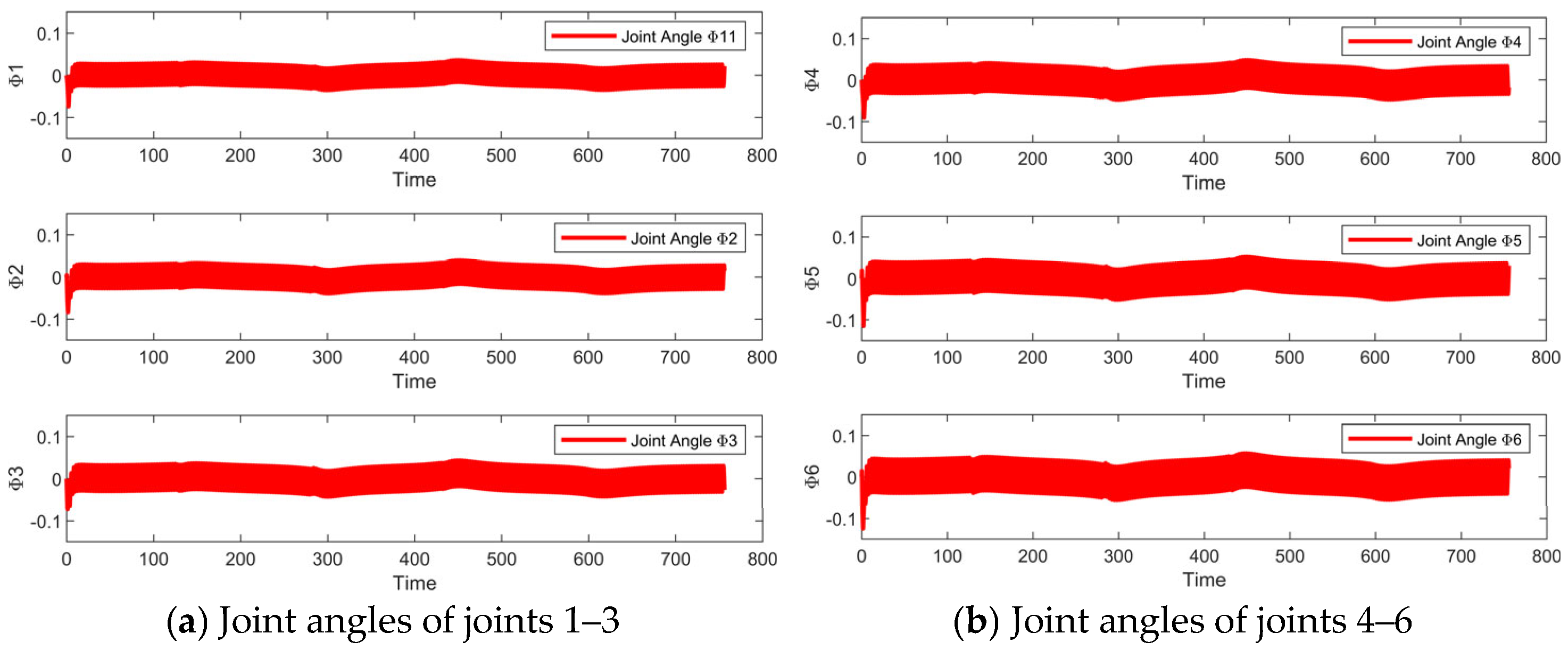
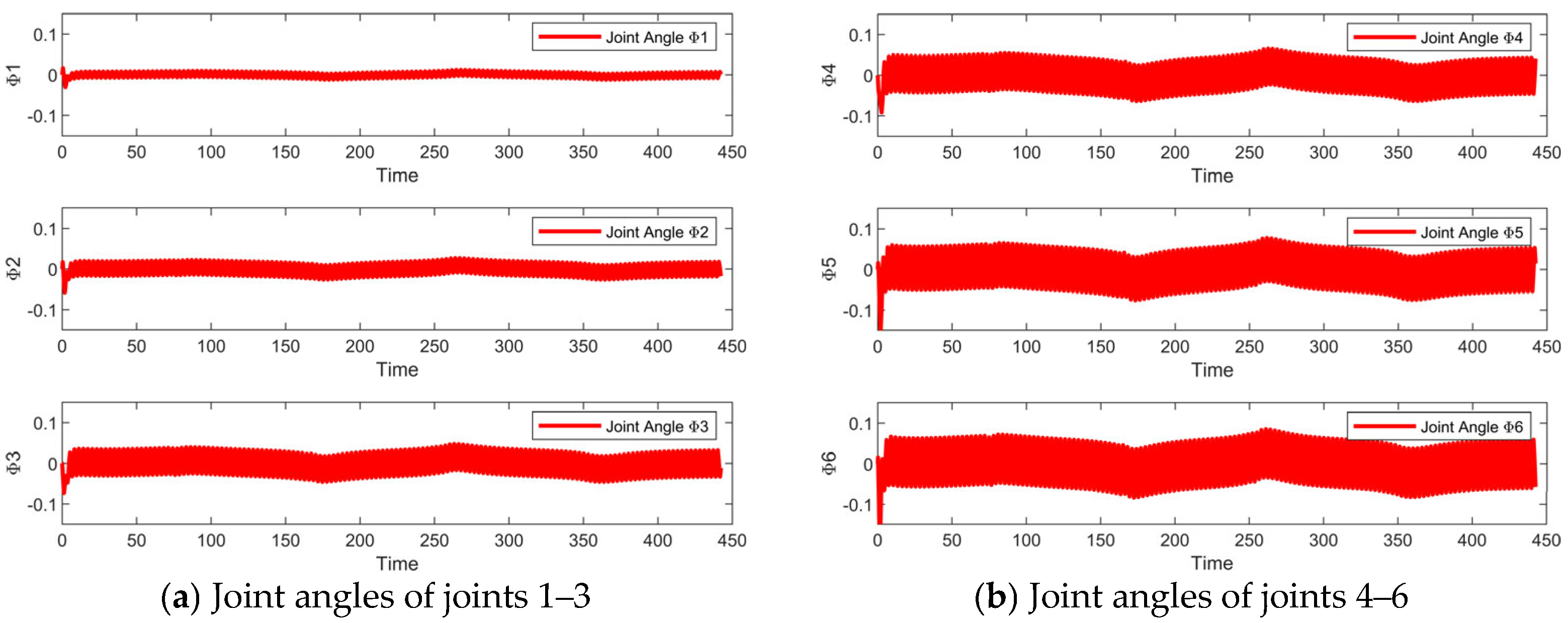
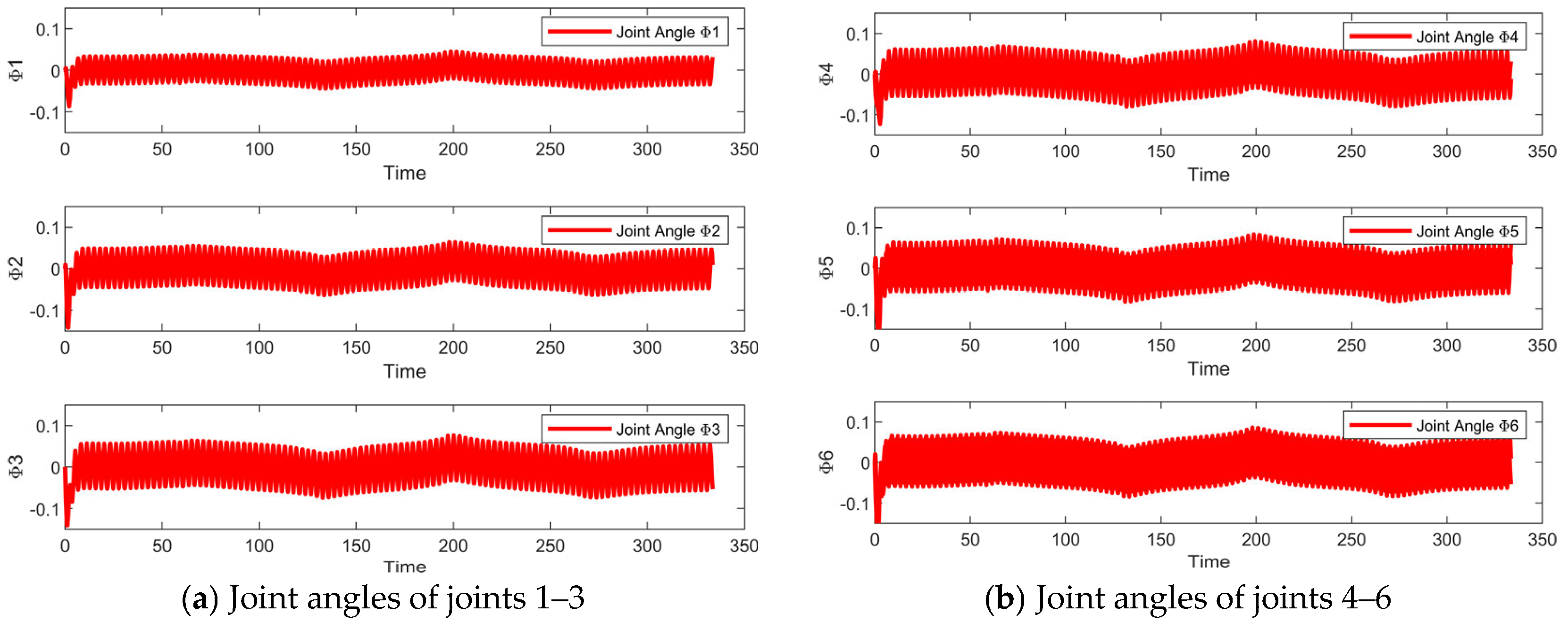
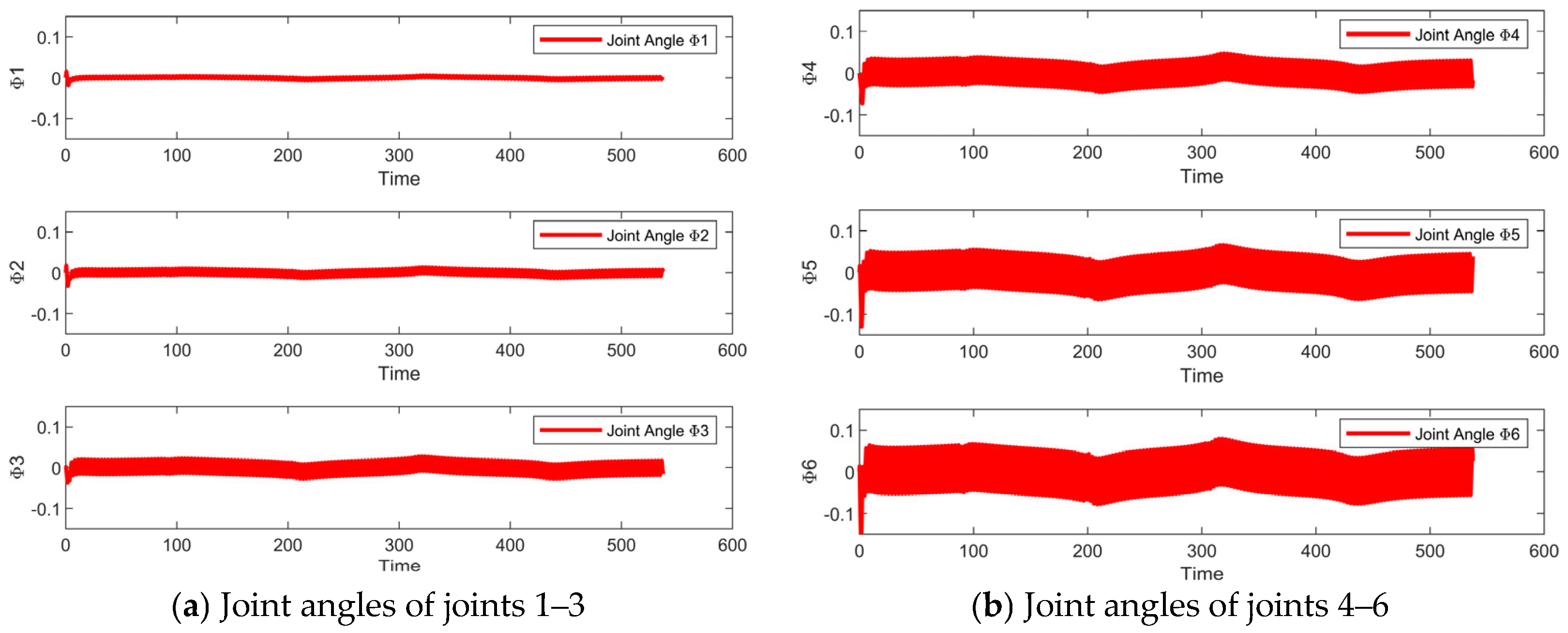
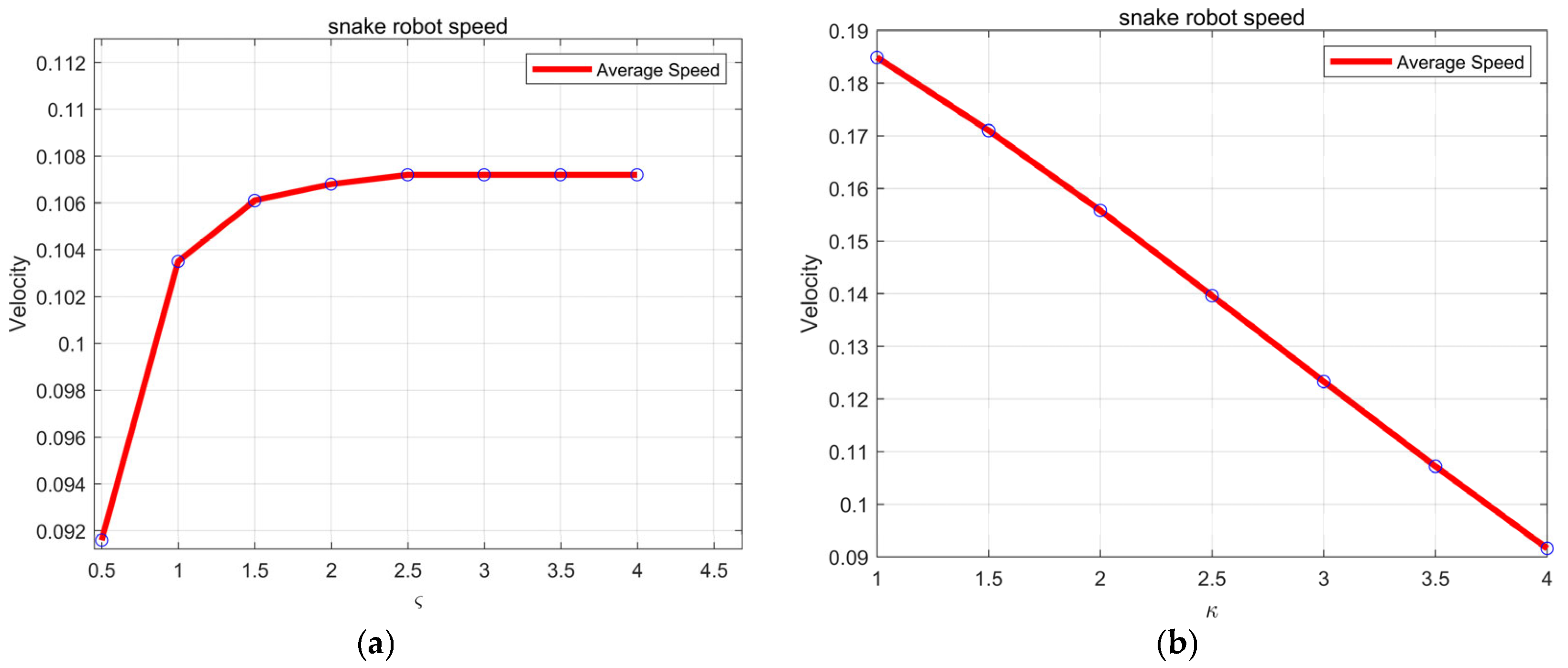
Figure 19, Figure 20, Figure 21 and Figure 22 illustrate the influence of head suppression function parameters on joint angles. Figure 19 and Figure 20 show that when κ is fixed, the oscillation amplitude of suppressed joints decreases as ς increases. Figure 21 and Figure 22 indicate that when ς is fixed, the number of suppressed joints increases with κ. These results demonstrate that κ primarily regulates the number of suppressed joints, whereas ς controls the suppression intensity of joint oscillations. The relationship between USR velocity and suppression function parameters is shown in Figure 23. Figure 23a reveals that the velocity follows an inverse hyperbolic tangent function with respect to ς; beyond a threshold, velocity saturates due to the physical limit of joint suppression under a fixed number of suppressed joints. The velocity improvement stems from reduced fluid resistance resulting from smaller oscillation amplitudes. Figure 23b shows that velocity decreases approximately inversely with κ, as more suppressed joints weaken the undulatory propulsion efficiency of the USR.

4.3.5. Simulation Platform Motion Experiment of USR

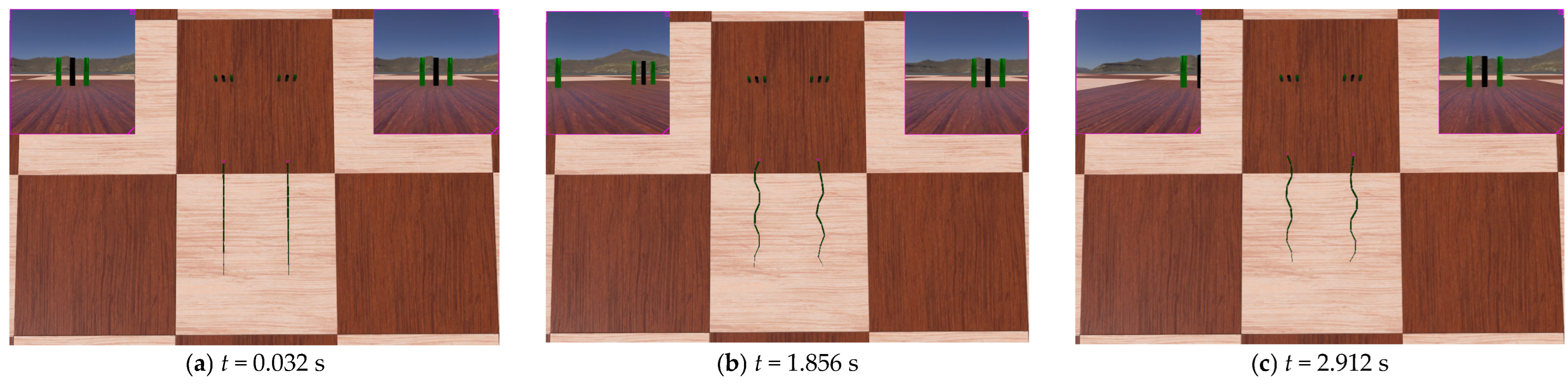
The simulation experiments based on the Webots platform are set up as follows: two identical USR models were deployed in the same simulation environment. The experimental group employed the proposed head suppression function with parameters ς = 2 and κ = 2, while the control group operated without suppression. To demonstrate the robot’s field of view, three cylindrical obstacles (diameter 0.2 m, height 1 m, spaced 0.5 m apart) were placed in front of the robot. Both USRs were tested using the same gait parameters (α = 0.5, ω = 0.5, β = π/4, ϕ0 = 0). The simulation results are shown in Figure 24, Figure 25 and Figure 26.
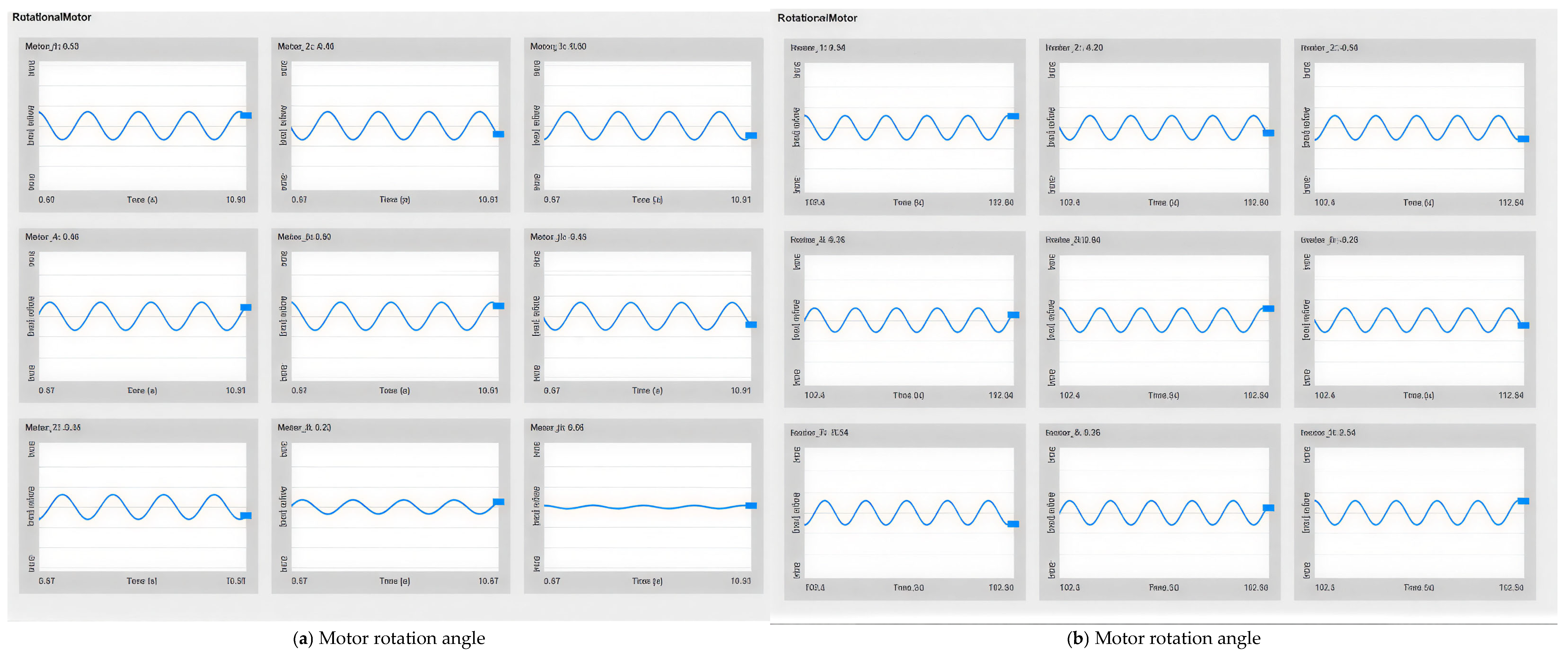
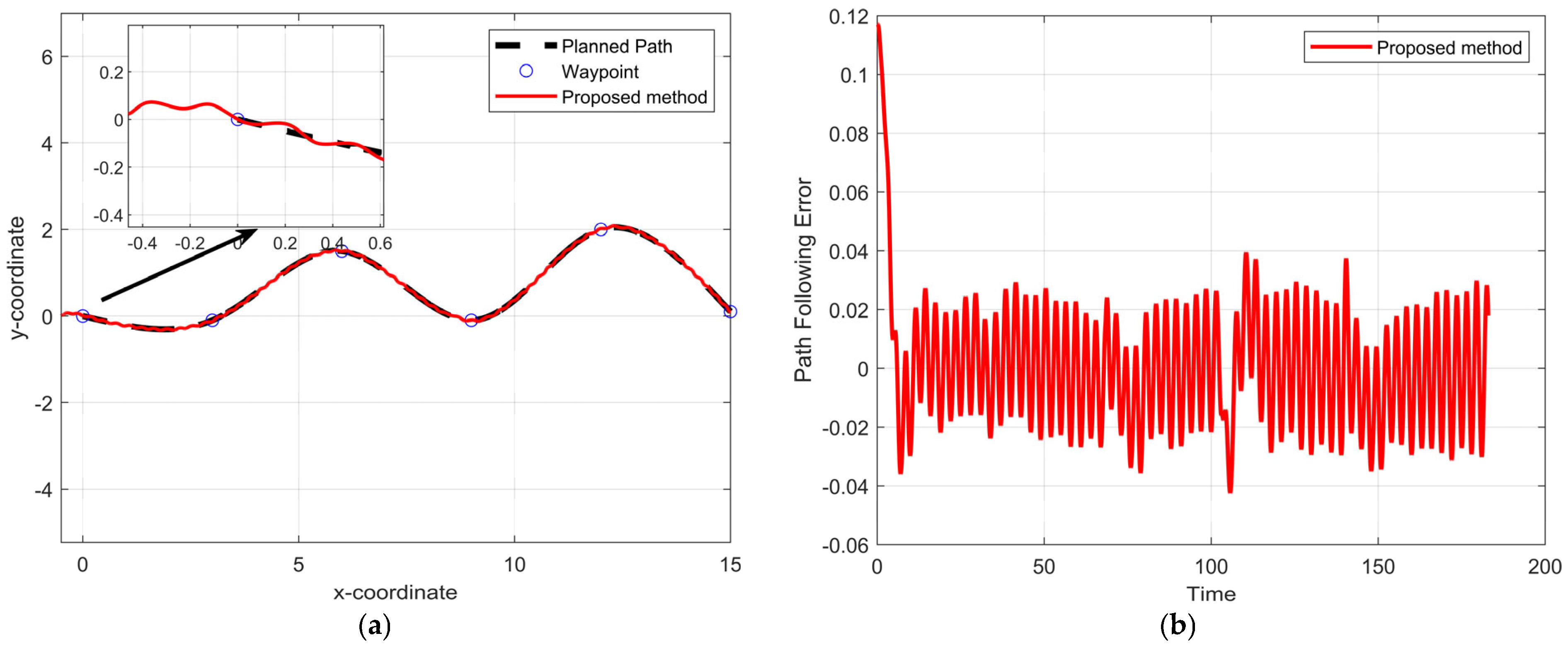
Figure 24 illustrates snapshots of the USR during locomotion. A comparison of camera feedback images shows that the USR equipped with the head suppression function exhibits significantly reduced view angle fluctuations during movement. The retention rate of cylinders in the camera feedback images is markedly higher than that of the control group, effectively reducing the probability of target loss. Figure 25 compares the motor rotation angles of the experimental and control groups in this simulation. It is clearly observed that the amplitude of the first two joint motors is effectively suppressed. Figure 26 presents the path-following performance and tracking error of the USR with the suppression function. Under the experimental conditions configured on the Webots simulation platform, the proposed controller enables the USR to stably follow the desired path, although its centroid oscillates slightly around the target path. Compared with the results in Figure 12, this simulation more closely reflects the motion performance in practical engineering scenarios.

5. Conclusions and Prospect

A novel fixed-time robust control scheme is proposed for the centroid path following of underwater snake robots subject to multiple constraints, including limited head joint motion angles and bounded composite disturbances. By developing a fixed-time extended state observer, the scheme achieves real-time accurate estimation of joint angles, angular velocities, and multiple types of time-varying disturbances, effectively addressing the state reconstruction problem in scenarios without sensors or under sensor failure. This lays a technical foundation for high-precision motion control of USRs in complex underwater environments. In response to the specific requirements of head-mounted electronic devices for a stable operating environment, an innovative head joint suppression function is designed, which cooperates with the serpentine gait function to generate desired joint angle commands. Based on the proposed control framework, four key performance indicators of the USR during path-following tasks are successfully achieved. Comparative simulation results demonstrate that the designed controller not only significantly reduces computational resource consumption but also achieves superior path-following performance. Virtual simulation experiments conducted on the Webots platform further verify the engineering applicability of the control strategy, establishing a theoretical and technical foundation for practical USR applications.
It should be noted that the proposed control strategy has certain limitations. First, the parameters of the head suppression function are preset and cannot be adaptively adjusted, requiring manual optimization based on specific task requirements and system load. Second, the controller design does not fully account for the practical physical constraints of the actuators, including input saturation and potential failure scenarios, which may degrade tracking performance in engineering applications. In future work, we will focus on integrating saturation control and fault-tolerant control strategies to enhance the adaptability and robustness of the system under complex working conditions.


Author Contributions

Conceptualization, J.L.; Methodology, Q.S. and J.L.; Software, Q.S.; Validation, Q.S.; Formal analysis, J.L.; Investigation, Q.S.; Resources, J.L.; Data curation, Q.S. and X.H.; Writing—original draft, Q.S.; Writing—review & editing, Q.S. and J.L.; Visualization, J.L. and X.H.; Supervision, J.L.; Project administration, J.L. and X.H.; Funding acquisition, X.H. All authors have read and agreed to the published version of the manuscript.

Funding

This research received no external funding.

Data Availability Statement

The original contributions presented in this study are included in the article. Further inquiries can be directed to the corresponding author.

Conflicts of Interest

The authors declare no conflict of interest.

Appendix A

Appendix A.1

Proof. 
To prove the upper bound of the convergence time for the nonlinear system (15) designed in this paper, an auxiliary function needs to be introduced W = z 1 q k and a first-order differential performed on it. Therefore, Equation (A1) can be obtained.
W ˙ = ( 1 q k ) ( ξ ( z ) 1 k l 1 z ε + ξ ( z ) 1 k l 2 z λ ) k z q k = ( 1 q k ) ( ξ ( z ) 1 k l 1 W δ + ξ ( z ) 1 k l 1 W μ ) k
where δ = ε q 1 q k and μ = λ q 1 q k . From the definitions of qk and ξ(z), the following is obtained
W ˙ ( 1 q k ) ( l 1 W δ + l 1 W μ ) k
According to (15), it is clear that
λ = p ,   ε = p z 1 λ = 5 q 4 k ,   ε = q z < 1
Applying (A3) to the system (A2), it can be obtained that
T 1 = 1 1 q k 0 W 0 1 ( ξ ( z ) 1 k l 1 W δ + ξ ( z ) 1 k l 2 W μ ) d W = 1 1 q k ( 1 W 0 1 ξ ( z ) ( l 1 W δ ¯ + l 2 W δ ¯ ) k d W + 0 1 1 ξ ( z ) ( l 1 + l 2 W μ ¯ ) k d W
where δ ¯ = p q 1 q k , μ ¯ = 4 q 4 k 1 q k and W 0 = z 0 1 q k
From (A2), since 1 ξ ( z ) a ,   and   1 a 1 ξ ( z ) 1 , it can be obtained that
T 1 1 1 q k ( 1 W 0 1 ( l 1 + l 2 ) W δ ¯ k d W + 0 1 1 ( l 1 + l 2 W μ ¯ ) k d W 1 1 q k ( 1 W 0 1 δ ¯ k ( l 1 + l 2 ) k ( δ ¯ k 1 ) + 1 l 1 k 0 1 1 1 + ( l 2 l 1 ) k W 4 d W 1 ( l 1 + l 2 ) k ( p k 1 ) + 1 l 1 k ( 1 q k ) ( 1 ( l 2 l 1 ) k ln ( 1 + ( l 1 l 2 ) k ) )

Appendix A.2

Proof. 
Substituting the estimation error differential form into the observer dynamics equation, we can obtain:
e ˙ 1 = e 2 + ψ 1 ( e 1 ) e ˙ 2 = e 3 + ψ 2 ( e 1 ) e ˙ 1 = l ( t ) + ψ 1 ( e 1 ) η s i g n ( e 1 )
The convergence characteristics of the error dynamic system (A6) for the improved extended state observer can be verified and analyzed by decomposing it into three parts:
Part 1: The first part is:
e ˙ 1 = e 2 ξ ( e 1 ) l 1 , 1 e 1 ε 1 , 1 s i g n ( e 1 ) e ˙ 2 = e 3 ξ ( e 1 ) l 1 , 2 e 1 ε 1 , 2 s i g n ( e 1 ) e ˙ 3 = l ( t ) ξ ( e 1 ) l 1 , 3 e 1 ε 1 , 3 s i g n ( e 1 )
Define E ε = e 1 e 2 e 3 , H 1 = ξ ( e 1 ) l 1 , 1 1 0 ξ ( e 1 ) l 1 , 2 0 1 ξ ( e 1 ) l 1 , 3 0 0 . The appropriate gain coefficient of the extended state observer can be selected to ensure that the coefficient matrix H1 is Hurwitz.
Define the Lyapunov function as shown in Equation (A8).
V 1 ( E ε ) = E ε T M 1 E ε
where M1 is a positive definite nonsingular symmetric matrix, whose value can be calculated by Equation (A9).
M 1 H 1 + H 1 T M 1 = Q 1
By differentiating the Lyapunov function (A8), we can obtain:
V ˙ 1 ( E ε ) = E ˙ ε T M 1 E ε + E ε T M 1 E ˙ ε = ( H 1 E ε ) T M 1 E ε + E ε T M 1 ( H 1 E ε ) = E ε ( M 1 H 1 + H 1 T M 1 ) E ε T = E ε Q 1 E ε T < 0
Part 2: The second part of the error dynamic Equation (A6) is described as follows:
e ˙ 1 = e 2 ξ ( e 1 ) l 2 , 1 e 1 λ 1 , 1 s i g n ( e 1 ) e ˙ 2 = e 3 ξ ( e 1 ) l 2 , 2 e 1 λ 1 , 2 s i g n ( e 1 ) e ˙ 3 = l ( t ) ξ ( e 1 ) l 2 , 3 e 1 λ 1 , 3 s i g n ( e 1 )
Define H 2 = ξ ( e 1 ) l 2 , 1 1 0 ξ ( e 1 ) l 2 , 2 0 1 ξ ( e 1 ) l 2 , 3 0 0 . The appropriate gain coefficient of the extended state observer can be selected to ensure that the coefficient matrix H2 is Hurwitz.
Define the Lyapunov function as shown in Equation (A12).
V 2 ( E ε ) = E ε T M 2 E ε
where M2 is a positive definite nonsingular symmetric matrix, whose value can be calculated by Equation (A13).
M 2 H 2 + H 2 T M 2 = Q 2
By differentiating the Lyapunov function (A12), we can obtain:
V ˙ 2 ( E ε ) = E ˙ ε T M 2 E ε + E ε T M 2 E ˙ ε = ( H 2 E ε ) T M 2 E ε + E ε T M 2 ( H 2 E ε ) = E ε ( M 2 H 2 + H 2 T M 2 ) E ε T = E ε Q 2 E ε T < 0
From the theorem in reference [39], the convergence times of the error dynamic system can be obtained as:
T 1 λ max 1 ε ( M 1 ) λ min ( M 1 ) λ min ( Q 1 ) ( 1 ε ) + λ min ( M 2 ) λ min ( Q 2 ) ( λ 1 ) Γ λ 1
where Γ < λ min ( Q 2 ) .
Part 3: After time T1, the system state error of the improved extended state observer system will approach the area near zero. We can obtain e1 = e2 = e3 = 0, which means that t T 1 ,   e 1 = e 2 = e 3 = 0 . which means that, Equation (36) holds [40].
e ˙ 3 = l ( t ) η s i g n ( e 1 ) = 0 t T 1
Due to the existence of factors such as noise, it is very difficult to achieve e 3 0 . Reference [41] provides a small convergence region χ, allowing e3 to reach region χ in a relatively short time less than
T 2 = χ η l ( t )
Combining Equations (A16) and (A17), it can be known that the upper limit of the convergence time of the fixed-time converging extended state observer designed in this paper is shown in Equation (A18).
T s λ max 1 ε ( M 1 ) λ min ( M 1 ) λ min ( Q 1 ) ( 1 ε ) + λ min ( M 2 ) λ min ( Q 2 ) ( λ 1 ) Γ λ 1 + χ η l ( t )

Appendix A.3

Phase I: When the system state variable is not on the sliding mode surface and approaches it, substituting the controller (41) into Equation (37), we can obtain
s ˙ = ξ ( s ) 1 k 3 l 5 s i g n ( s ) 2 ε 3 1 k 3 + ξ ( s ) 1 k 3 l 6 s i g n ( s ) 2 λ 3 1 k 3 k 3 + d t z ^ 3 c n s
Design a candidate Lyapunov function V2 = 1/2 sT s and taking the derivative of it yields
V ˙ 2 = s T s ˙ = s T ( ( ξ ( s ) 1 k 3 l 5 s i g n ( s ) 2 ε 3 1 k 3 + ξ ( s ) 1 k 3 l 6 s i g n ( s ) 2 λ 3 1 k 3 ) k 3 + d t z ^ 3 c n s ) = ξ ( s ) ( l 5 s 2 ε 3 + l 6 s 2 λ 3 ) k 3 + s T d e c n s T s
Analysis of Equation (A20) reveals that the lumped time-varying disturbance considered in this work is bounded; hence, the error between the observed and actual disturbances remains bounded. Meanwhile, as the state variables of the USR system are generally bounded, sTde is also bounded. According to Lemma 2 in reference [42], sTde does not affect the convergence of the control system. Therefore, by neglecting the sTde term, Equation (A21) is obtained.
V ˙ 2 = ξ ( s ) ( l 5 s 2 ε 3 + l 6 s 2 λ 3 ) k 3 c n s T s = 2 ξ ( s ) ( l 5 V 2 ε 3 + l 6 V 2 λ 3 ) c n V 2
The derivation and analysis in the first phase demonstrate that the convergence time of the control system in this phase is constrained by the convergence time of the extended state observer and that of the sliding mode surface. Therefore, when the operation time of the USR system exceeds the larger of these two convergence times, the state variable errors of the system will converge to the sliding mode surface.
Phase II: After the error of the state variable in the USR system converges to the sliding mode surface s, if ||z|| > δ, the expression of the sliding mode surface s can be obtained as shown in Equation (A22).
s = z 2 + ( ξ ( z 1 ) 1 k 2 l 3 s i g n ( s ) 2 ε 2 1 k 2 + ξ ( z 1 ) 1 k 2 l 4 s i g n ( s ) 2 λ 2 1 k 2 ) k 2 = 0
Choosing a Lyapunov function V3 = 1/2 z1Tz1, and taking the time derivative of V3 yields Equation (A23)
V ˙ 3 = z 1 T z ˙ 1 = z 1 T z 2 = z z T ( ξ ( z 1 ) 1 k 2 l 3 s i g n ( s ) 2 ε 2 1 k 2 + ξ ( z 1 ) 1 k 2 l 4 s i g n ( s ) 2 λ 2 1 k 2 ) k 2 = ξ ( z 1 ) ( l 3 z 1 2 ε 2 + l 4 z 1 2 λ 2 ) k 2 = ξ ( z 1 ) ( l 3 V 3 ε 2 + l 4 V 3 λ 2 ) k 2
From Lemma 4, it can be known that V3(z1) ≡ 0, and the convergence time satisfies Equation (A6). If ||z|| < δ, similarly, it follows that V ˙ 3 < 0.

References

  1. Sahoo, S.K.; Choudhury, B.B.; Dhal, P.R. Exploring the role of robotics in maritime technology: Innovations, challenges, and future prospects. Spectr. Mech. Eng. Oper. Res. 2024, 1, 159–176. [Google Scholar] [CrossRef]
  2. Yu, S.; Tian, H.; Ye, C.; Peng, J. Novel design and motion analysis of an omni-tread snake-like robot for narrow space inspection. Trans. Can. Soc. Mech. Eng. 2024, 48, 500–513. [Google Scholar] [CrossRef]
  3. Liu, X.; Zang, Y.; Gao, Z. Bio-Inspired Multimodal Motion Gait Control of Snake Robots with Environmental Adaptability Based on ROS. Electronics 2024, 13, 3437. [Google Scholar] [CrossRef]
  4. Liu, J.; Tong, Y.; Liu, J. Review of snake robots in constrained environments. Robot. Auton. Syst. 2021, 141, 103785. [Google Scholar] [CrossRef]
  5. Liu, J.; Zhu, H.; Chen, Y.; Bao, H. Path following of an underwater snake-like robot exposed to ocean currents and locomotion Efficiency optimization based on Multi-Strategy improved Sparrow search algorithm. J. Mar. Sci. Eng. 2023, 11, 1236. [Google Scholar] [CrossRef]
  6. Kelasidi, E.; Pettersen, K.Y.; Gravdahl, J.T.; Liljebäck, P. Modeling of underwater snake robots. In Proceedings of the IEEE International Conference on Robotics and Automation, Hong Kong, China, 31 May–7 June 2014. [Google Scholar] [CrossRef]
  7. Kelasidi, E.; Pettersen, K.Y.; Gravdahl, J.T. A control-oriented model of underwater snake robots. In Proceedings of the 2021 IEEE International Conference on Robotics and Biomimetics (ROBIO), Sanya, China, 6–10 December 2014; pp. 753–760. [Google Scholar] [CrossRef][Green Version]
  8. Kelasidi, E.; Kohl, A.M.; Pettersen, K.Y.; Hoffmann, B.H.; Gravdahl, J.T. Experimental investigation of locomotion efficiency and path-following for underwater snake robots with and without a caudal fin. Annu. Rev. Control 2018, 46, 281–294. [Google Scholar] [CrossRef]
  9. Liu, Z.; Wei, W.; Liu, X.; Han, S. Target Tracking of Snake Robot with Double-Sine Serpentine Gait Based on Adaptive Sliding Mode Control. Actuators 2023, 12, 38. [Google Scholar] [CrossRef]
  10. Zhou, W.; Wang, Y.; Ahn, C.K.; Cheng, J.; Chen, C. Adaptive fuzzy Backstepping-Based formation control of unmanned surface vehicles with unknown model nonlinearity and actuator saturation. IEEE Trans. Veh. Technol. 2020, 69, 14749–14764. [Google Scholar] [CrossRef]
  11. Lu, J.; Yuan, Z.; Wang, N. Dynamic Self-Triggered Fuzzy Formation Control for UAV Swarm with Prescribed-Time Convergence. Drones 2025, 9, 715. [Google Scholar] [CrossRef]
  12. Hsiao, T.; Wang, P. Trajectory tracking of robot manipulators by a new Chattering-Reduced Sliding Mode controller. J. Dyn. Syst. Meas. Control 2025, 148, 021004. [Google Scholar] [CrossRef]
  13. Wei, J.; Lyu, W.; Zhang, B.; Huang, H. Finite-Time Attitude Control of Underactuated Spacecraft with a Hierarchical Sliding Mode Control Approach. Aerospace 2025, 12, 938. [Google Scholar] [CrossRef]
  14. Wang, H.; Xu, K.; Zhang, H. Adaptive Finite-Time Tracking control of nonlinear systems with dynamics uncertainties. IEEE Trans. Autom. Control 2022, 68, 5737–5744. [Google Scholar] [CrossRef]
  15. Barghandan, M.; Mofid, O.; Mobayen, S.; Pirmohamadi, A.A. Finite-time trajectory tracking of parallel manipulators: An adaptive barrier terminal sliding mode approach with input constraints. J. Vib. Control, 2025; in press. [Google Scholar] [CrossRef]
  16. Liu, D.; Xiong, Z.; Liu, Z.; Li, M.; Zhou, S.; Li, J.; Liu, X.; Zhou, X. Trajectory tracking Closed-Loop cooperative control of manipulator neural network and terminal sliding model. Symmetry 2025, 17, 1319. [Google Scholar] [CrossRef]
  17. Zhang, L.; Su, Y.; Wang, Z.; Wang, H. Fixed-time terminal sliding mode control for uncertain robot manipulators. ISA Trans. 2023, 144, 364–373. [Google Scholar] [CrossRef]
  18. Cao, L.; Xiao, B.; Golestani, M. Robust fixed-time attitude stabilization control of flexible spacecraft with actuator uncertainty. Nonlinear Dyn. 2020, 100, 2505–2519. [Google Scholar] [CrossRef]
  19. Wan, L.; Cao, Y.; Sun, Y.; Qin, H. Fault-tolerant trajectory tracking control for unmanned surface vehicle with actuator faults based on a fast fixed-time system. ISA Trans. 2022, 130, 79–91. [Google Scholar] [CrossRef]
  20. Xiu, Y.; Li, D.; Deng, H.; Jiang, S.; Wu, E.Q. Path-Following based on fuzzy Line-of-Sight guidance for a bionic snake robot with unknowns. IEEE/ASME Trans. Mechatron. 2023, 28, 3167–3179. [Google Scholar] [CrossRef]
  21. Liu, J.; Zhu, H.; Chen, Y.; Bao, H.; Wu, Q.; Zhu, H. Full-link trajectory tracking control for underwater snake robot with vector thrusters in the presence of strong time-varying disturbances. Ocean Eng. 2024, 305, 117580. [Google Scholar] [CrossRef]
  22. Li, X.; Ren, C.; Ma, S. Optimal path following control with efficient computation for snake robots subject to multiple constraints and unknown frictions. IEEE Robot. Autom. Lett. 2022, 7, 9151–9158. [Google Scholar] [CrossRef]
  23. Zhang, J.; Ren, C.; Ma, S. Optimal path following control for motion recovery from joint failure of snake robots using improved lateral undulatory GAIT. IEEE/ASME Trans. Mechatron. 2025, 30, 3161–3169. [Google Scholar] [CrossRef]
  24. Guo, K.; Wei, C.; Shi, P. Fuzzy Disturbance Observer-Based adaptive nonsingular terminal sliding mode control for Multi-Joint robotic manipulators. Processes 2025, 13, 1667. [Google Scholar] [CrossRef]
  25. Li, Y.; Bao, C.; Guo, R. Adaptive Fuzzy Sliding-Mode control for ship path tracking based on a Fixed-Time Disturbance Observer. J. Mar. Sci. Eng. 2025, 13, 1788. [Google Scholar] [CrossRef]
  26. Au, C.; Jin, P. Investigation of serpentine gait of a snake robot with a wireless camera. In Proceedings of the 12th IEEE/ASME International Conference on Mechatronic and Embedded Systems and Applications, Auckland, New Zealand, 29–31 August 2016; pp. 1–6. [Google Scholar] [CrossRef]
  27. Kim, S.; Suh, J. Adaptive robust RBF-NN nonsingular terminal sliding mode control scheme for application to snake robot’s head for image stabilization. Appl. Sci. 2023, 13, 4899. [Google Scholar] [CrossRef]
  28. Zhou, Y.; Zhang, Y.; Ni, F.; Liu, H. A head control strategy of the snake robot based on segmented kinematics. Appl. Sci. 2019, 9, 5104. [Google Scholar] [CrossRef]
  29. Kim, S.; Jin, M.; Suh, J. A study on the design of Error-Based Adaptive Robust RBF Neural Network Back-Stepping Controller for 2-DOF Snake Robot’s head. IEEE Access 2023, 11, 23146–23156. [Google Scholar] [CrossRef]
  30. Wang, Q.; Xu, W.; Leng, Z. Adaptive event-triggered anti-windup trajectory tracking control for robotic manipulator. ISA Trans. 2025, 167, 1137–1146. [Google Scholar] [CrossRef]
  31. Wang, L.; Gu, D.; Su, Q.; Long, Y.; Zhao, X.; Zhong, G. Event-Triggered adaptive tracking control with prescribed performance of uncertain nonlinear systems. Int. J. Robust Nonlinear Control, 2025; in press. [Google Scholar] [CrossRef]
  32. Zhou, F.; Zhang, Y.; Ma, T. Event-triggered optimal control for modular reconfigurable manipulators with input constraints based on model predictive control. ISA Trans. 2025, 167, 839–848. [Google Scholar] [CrossRef]
  33. Liljebäck, P.; Pettersen, K.Y.; Stavdahl, Ø.; Gravdahl, J.T. Snake Robots: Modelling, Mechatronics, and Control; Springer: Berlin/Heidelberg, Germany, 2012; Available online: http://cds.cern.ch/record/1500121 (accessed on 18 November 2025).
  34. Liljebäck, P. Modelling, Development, and Control of Snake Robots; Norwegian University of Science and Technology: Trondheim, Norway, 2011. [Google Scholar]
  35. Zuo, Z. Non-singular fixed-time terminal sliding mode control of non-linear systems. IET Control Theory Appl. 2014, 9, 545–552. [Google Scholar] [CrossRef]
  36. Pan, H.; Zhang, G.; Ouyang, H.; Mei, L. Novel Fixed-Time Nonsingular fast terminal sliding mode control for Second-Order uncertain systems based on adaptive disturbance Observer. IEEE Access 2020, 8, 126615–126627. [Google Scholar] [CrossRef]
  37. Tian, Y.; Cai, Y.; Deng, Y. A fast nonsingular terminal sliding mode control method for nonlinear systems with Fixed-Time stability guarantees. IEEE Access 2020, 8, 60444–60454. [Google Scholar] [CrossRef]
  38. Chen, W.; Wei, Y.; Zeng, J.M.; Han, H.; Jia, X. Adaptive terminal sliding mode NDO-Based control of underactuated AUV in vertical plane. Discret. Dyn. Nat. Soc. 2016, 2016, 6590517. [Google Scholar] [CrossRef]
  39. Basin, M.; Yu, P.; Shtessel, Y. Finite- and fixed-time differentiators utilising HOSM techniques. IET Control Theory Appl. 2016, 11, 1144–1152. [Google Scholar] [CrossRef]
  40. Zhang, L.; Wei, C.; Wu, R.; Cui, N. Fixed-time extended state observer based non-singular fast terminal sliding mode control for a VTVL reusable launch vehicle. Aerosp. Sci. Technol. 2018, 82–83, 70–79. [Google Scholar] [CrossRef]
  41. Zhai, J.; Xu, G. A novel Non-Singular Terminal Sliding Mode Trajectory Tracking control for robotic manipulators. IEEE Trans. Circuits Syst. II Express Briefs 2020, 68, 391–395. [Google Scholar] [CrossRef]
  42. Polyakov, A. Nonlinear feedback design for Fixed-Time stabilization of linear control systems. IEEE Trans. Autom. Control 2012, 57, 2106–2110. [Google Scholar] [CrossRef]
Figure 1. Schematic diagram of the model simplification process of a ten-link USR.
Jmse 14 00102 g001
Figure 2. Closed-loop control framework for path following in the USR system.
Jmse 14 00102 g002
Figure 3. Schematic diagram of USR heading centroid tracking.
Jmse 14 00102 g003
Figure 4. Path following and tracking errors under different heading controllers.
Jmse 14 00102 g004
Figure 5. Heading angle tracking and tracking error under different heading controllers.
Jmse 14 00102 g005
Figure 6. Joint angle tracking and tracking errors under different initial states.
Jmse 14 00102 g006
Figure 7. Path following and tracking errors under different initial states.
Jmse 14 00102 g007
Figure 8. Path following and tracking error for three controllers with the same initial conditions.
Jmse 14 00102 g008
Figure 9. Heading angle tracking and tracking error for three controllers with the same initial conditions.

Jmse 14 00102 g009
Figure 10. Joint angle tracking and tracking error for three controllers with the same initial conditions.

Jmse 14 00102 g010
Figure 11. Control inputs to the actuator under the three controllers.
Jmse 14 00102 g011
Figure 12. Path following and tracking error for three mechanism with the same initial conditions.
Jmse 14 00102 g012
Figure 13. Update interval under static triggering mechanisms and the dynamic event-triggered mechanism.
Jmse 14 00102 g013
Figure 14. Estimation of state disturbance and its estimation error.
Jmse 14 00102 g014
Figure 15. Estimation of sinusoidal disturbance and its estimation error.
Jmse 14 00102 g015
Figure 16. Estimation of composite disturbance and its estimation error.
Jmse 14 00102 g016
Figure 17. Estimation of joint angle and its estimation error.
Jmse 14 00102 g017
Figure 18. Estimation of joint angular velocity and its estimation error.
Jmse 14 00102 g018
Figure 19. The first six joint angles under the inhibitory function (ς = 0.1, κ = 3).
Jmse 14 00102 g019
Figure 20. The first six joint angles under the inhibitory function (ς = 0.5, κ = 3).
Jmse 14 00102 g020
Figure 21. The first six joint angles under the inhibitory function (ς = 1, κ = 1).
Jmse 14 00102 g021
Figure 22. The first six joint angles under the inhibitory function (ς = 1, κ = 4).
Jmse 14 00102 g022
Figure 23. Velocity of the USR with different parameters: (a) Velocity versus parameter ς; (b) Velocity versus parameter κ.
Jmse 14 00102 g023
Figure 24. Screenshot of the simulation experiment.
Jmse 14 00102 g024
Figure 25. Motor rotation angle of the USR with and without the suppression function.
Jmse 14 00102 g025
Figure 26. Path following and tracking error of the USR with the suppression function. (a) Path following. (b) Tracking error.
Jmse 14 00102 g026
Table 1. Characters definition.
SymbolDefinition
ϕiThe i-th joint angle
vϕNormal velocity between adjacent links
θiThe i-th link angle
vθUSR deflection angular velocity
NNumber of connecting links
2lLength of the connecting links
mQuality of the connecting links
cpPropulsion coefficient
vt, vnUSR tangential and normal velocity
ct, cnTangential and normal friction coefficient
Ux, UyTangential and normal velocities of ocean currents
p = (px,py)Centroid coordinates of USR
λ1, λ2Fluid torque coefficient of rotation
uiTorque of the i-th actuator
dCompound disturbance (||d|| ≤ dmax)
A, D, eAddition matrix, subtraction matrix and summation matrix
α, β, ω, ϕ0Amplitude, phase shift, frequency and offset of the sinusoidal gait
Table 2. Three categories of time-varying disturbances.
Disturbance Typed(t)
External disturbances 0.5 × sin ( 0.00314 t ) + 0.2 × cos ( 0.00628 × t ) + w k
State disturbances 2 × ϕ ˙ ( t )
Composite disturbances ϕ ˙ ( t ) + Δ M ϕ ¨ ( t ) + Δ C ϕ ˙ ( t ) + Δ G ϕ ( t ) + 0.5 sin ( 0.00314 × t )
Table 3. Three different initial state situations.
Initial State Itempxpy p ˙ x p ˙ y θ
Case 1−0.50.30.1−0.10
Case 20.50.3−0.1−0.1π
Case 3−0.5−0.30.10.1π/4
Table 4. The initial parameter Settings for the simulation.
ItemValueItemValue
N10m1
l0.14 d ^ [0 0 0 0 0 0 0 0 0]
ct0.5 ϕ [0 0 0 0 0 0 0 0 0]
cn3 ϕ ˙ [0 0 0 0 0 0 0 0 0]
λ10.5 ϕ ¨ [0 0 0 0 0 0 0 0 0]
λ220θ0
α0.06 θ ˙ 0
βπ/3(px,py)(−0.5,0.3)
ωπ/2 ( p x ˙ , p y ˙ ) (0,0)
Table 5. Root mean square error of path-following error.
ContentProposed MethodReference 1Reference 2
RMSE0.05860.15890.1757
MAX0.01160.08730.1066
Settling time3.211.1814.45
Table 6. Velocity under different controllers.
ContentNormal VelocityProposed MethodReference 1Reference 2
Value0.18470.15580.15020.1473
Percentage100%84.35%81.32%79.75%
Table 7. Performance of the trigger mechanism.
ContentTime-TriggeredStatic Event-TriggeredDynamic Event-Triggered
Iterations53,74521,22710,833
Trigger count062872532
Proportion of computing resources100%29.62%23.37%
Disclaimer/Publisher’s Note: The statements, opinions and data contained in all publications are solely those of the individual author(s) and contributor(s) and not of MDPI and/or the editor(s). MDPI and/or the editor(s) disclaim responsibility for any injury to people or property resulting from any ideas, methods, instructions or products referred to in the content.