Inter-Basin Teleconnection of the Atlantic Multidecadal Oscillation and Interdecadal Pacific Oscillation in Modulating the Decadal Variation in Winter SST in the South China Sea

 ,
,
Abstract
1. Introduction
2. Data and Methods
2.1. Data
2.2. Methods
2.2.1. Extraction of the Decadal Modes
2.2.2. The Choice of Indices
3. Results
3.1. The Primary Mode of South China Sea SST Interdecadal Variability
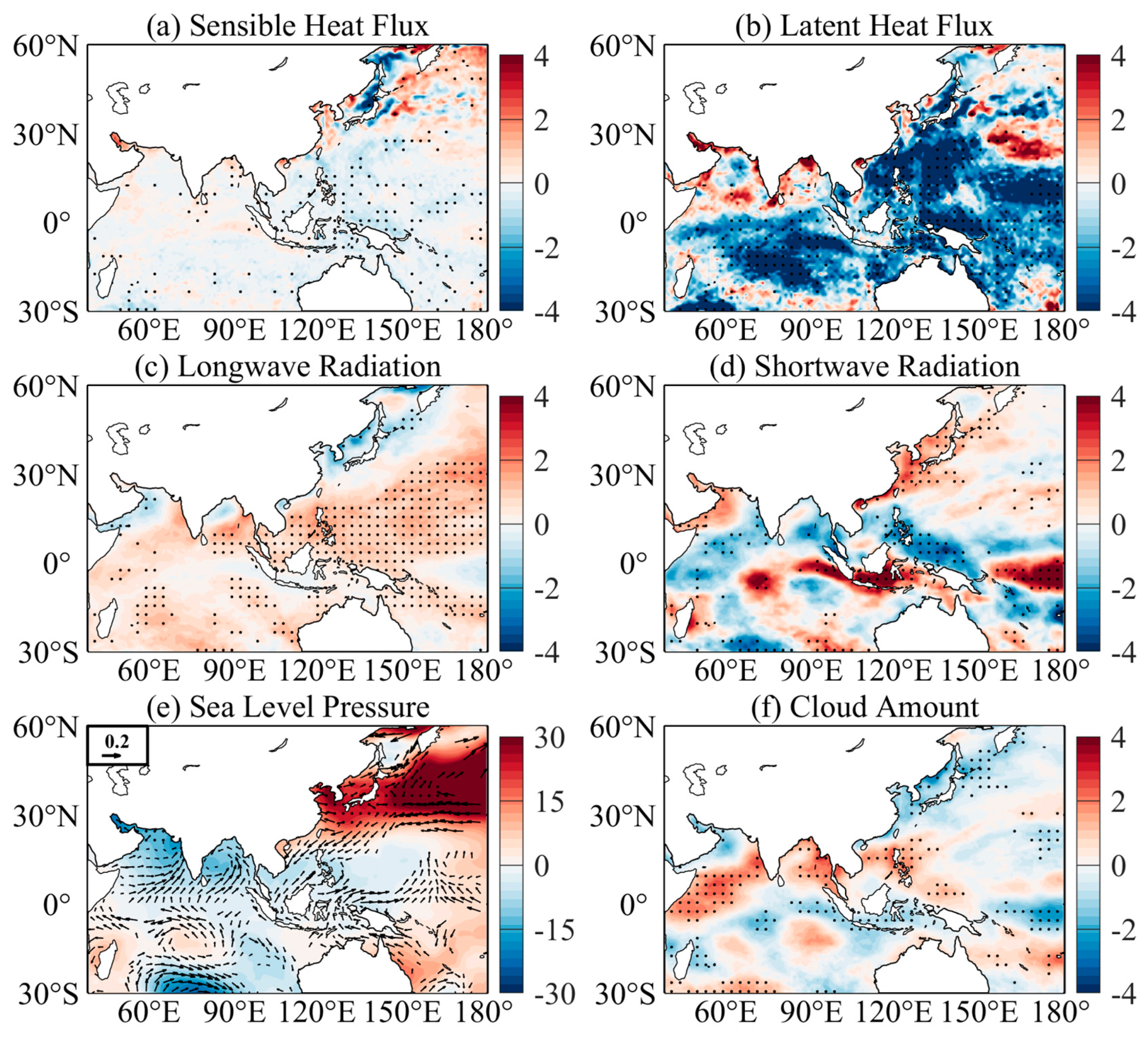
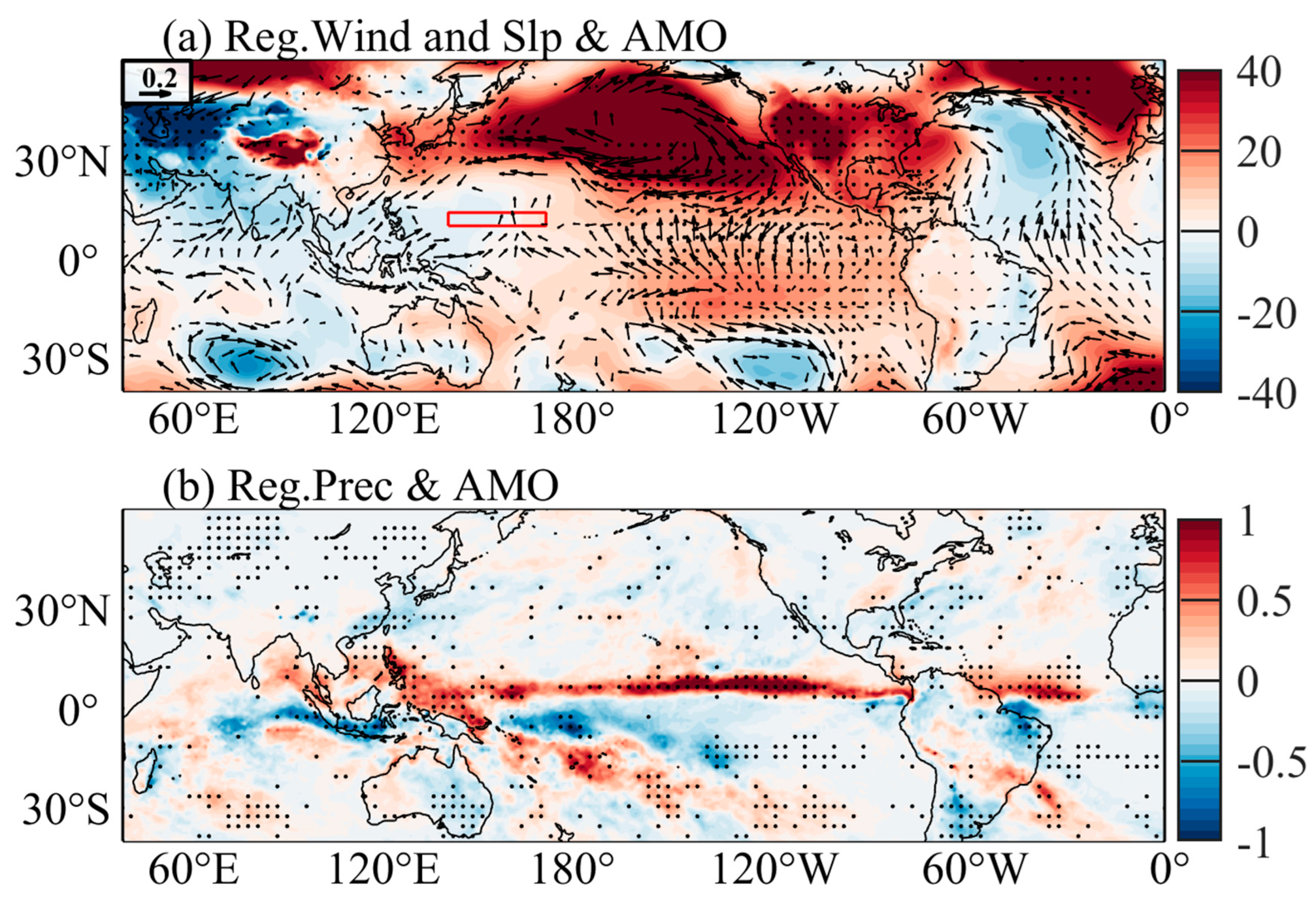
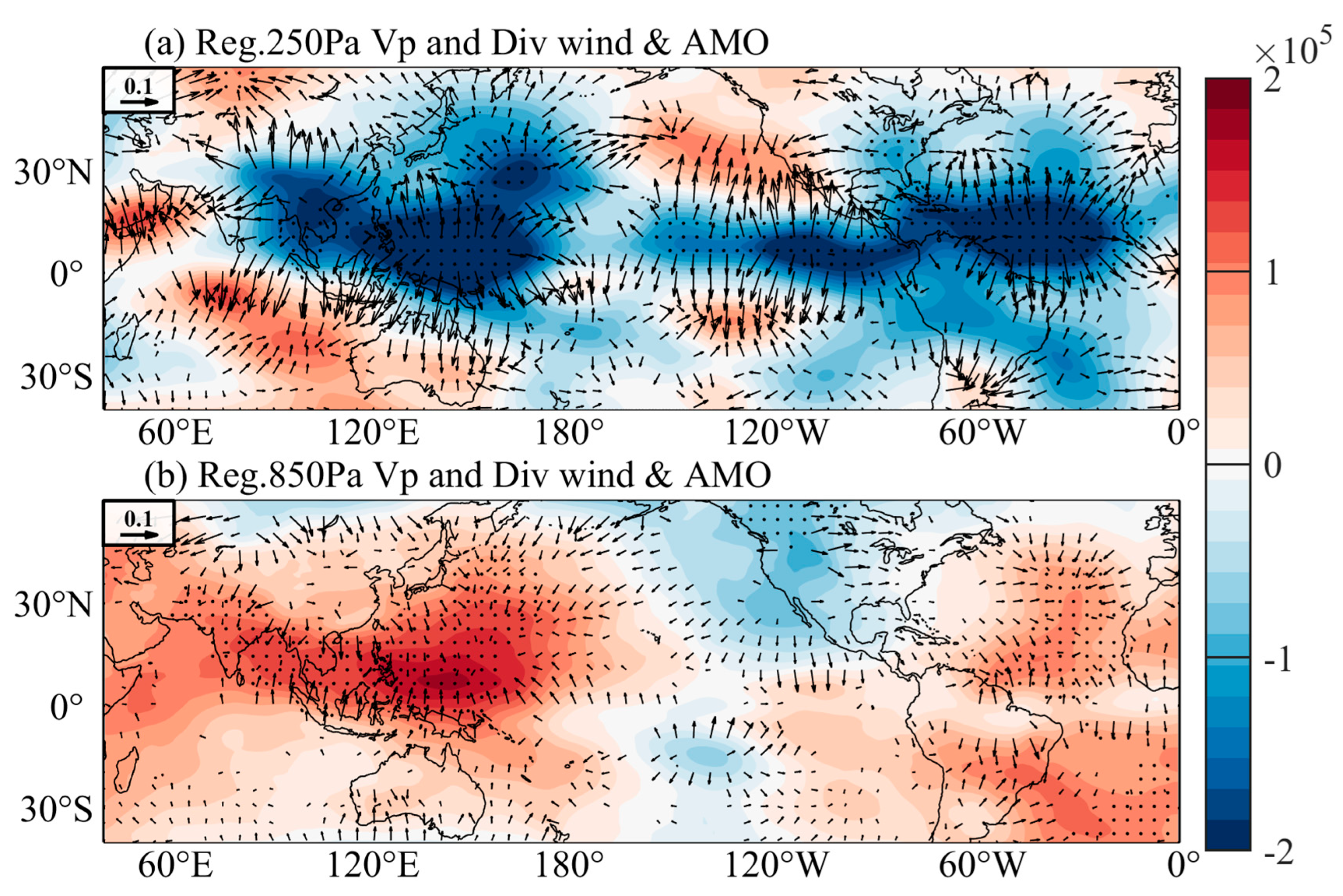
3.2. Connection Between AMO and the SCS Basin Mode
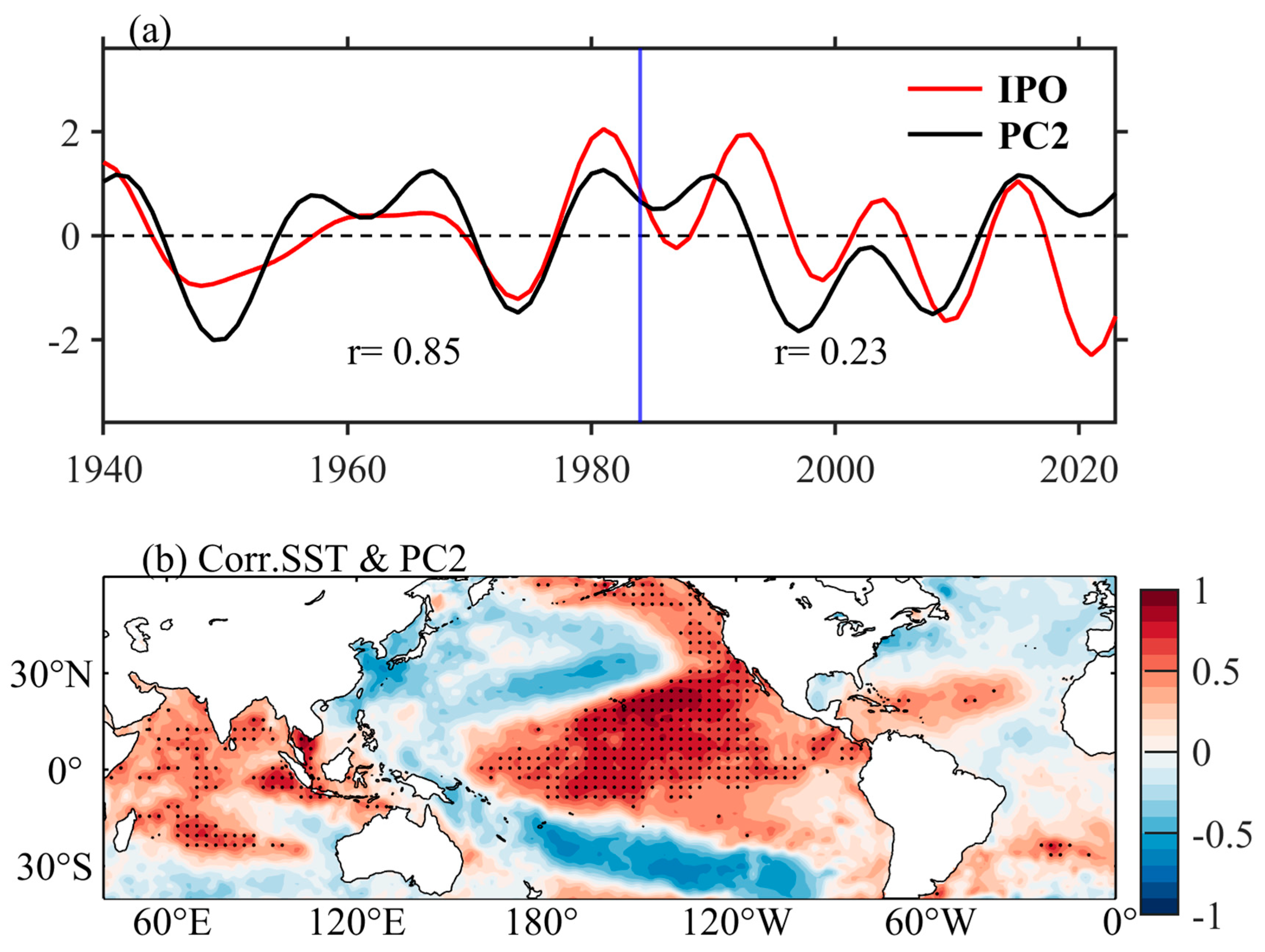
3.3. Connection Between IPO and the SCS Dipole Mode
4. Discussion and Conclusions
Supplementary Materials
Author Contributions
Funding
Data Availability Statement
Conflicts of Interest
Abbreviations
References
- Frölicher, T.L.; Laufkötter, C. Emerging risks from marine heatwaves. Nat. Commun. 2018, 9, 650. [Google Scholar] [CrossRef]
- Frölicher, T.L.; Fischer, E.M.; Gruber, N. Marine heatwaves under global warming. Nature 2018, 560, 360–364. [Google Scholar] [CrossRef]
- Oliver, E.C.J.; Donat, M.G.; Burrows, M.T.; Moore, P.J.; Smale, D.A.; Alexander, L.V.; Benthuysen, J.A.; Feng, M.; Gupta, A.S.; Hobday, A.J.; et al. Longer and more frequent marine heatwaves over the past century. Nat. Commun. 2018, 9, 1324. [Google Scholar] [CrossRef]
- He, Y.; Shu, Q.; Wang, Q.; Song, Z.; Zhang, M.; Wang, S.; Zhang, L.; Bi, H.; Pan, R.; Qiao, F. Arctic Amplification of Marine Heatwaves under Global Warming. Nat. Commun. 2024, 15, 52760. [Google Scholar] [CrossRef] [PubMed]
- Zhang, M.; Han, G.; Wu, X.; Li, C.; Shao, Q.; Li, W.; Cao, L.; Wang, X.; Dong, W.; Ji, Z. SST Forecast Skills Based on Hybrid Deep Learning Models: With Applications to the South China Sea. Remote Sens. 2024, 16, 1034. [Google Scholar] [CrossRef]
- Yu, Y.; Zhang, H.-R.; Jin, J.; Wang, Y. Trends of sea surface temperature and sea surface temperature fronts in the South China Sea during 2003–2017. Acta Oceanol. Sin. 2019, 38, 106–115. [Google Scholar] [CrossRef]
- Lin, Y.; Gan, J.; Cai, Z.; Quan, Q.; Zu, T.; Liu, Z. Coherent Interannual–Decadal Potential Temperature Variability in the Tropical–North Pacific Ocean and Deep South China Sea. Geophys. Res. Lett. 2024, 51, e2024GL012345. [Google Scholar] [CrossRef]
- Chen, S.; Chen, J.P.; Wang, X.; Xiao, Z.N. Varying Relationship between La Niña and SST Anomalies in the Kuroshio and Adjacent Regions during Boreal Winter: Role of East Asian Winter Monsoon. J. Clim. 2023, 36, 5907–5922. [Google Scholar] [CrossRef]
- Zhang, L.Y.; Xu, H.M.; Ma, J.; Zhao, J.W.; Xu, X. Downstream impact of the North Pacific subtropical sea surface temperature front on the North Atlantic westerly jet stream in winter. Atmos. Res. 2021, 253, 105492. [Google Scholar] [CrossRef]
- Kuo, Y.C.; Tseng, Y.H. Impact of ENSO on the South China Sea during ENSO decaying winter–spring modeled by a regional coupled model (a new mesoscale perspective). Ocean Model. 2020, 152, 101655. [Google Scholar] [CrossRef]
- Sun, B.; Li, B.; Yan, J.; Zhou, Y.; Zhou, S. Seasonal variation of atmospheric coupling with oceanic mesoscale eddies in the North Pacific Subtropical Countercurrent. Acta Oceanol. Sin. 2022, 41, 109–118. [Google Scholar] [CrossRef]
- Liu, Q.; Jiang, X.; Xie, S.P.; Liu, W.T. A Gap in the Indo-Pacific Warm Pool over the SCS in Boreal Winter: Seasonal Development and Interannual Variability. J. Geophys. Res. Ocean. 2004, 109, C07012. [Google Scholar] [CrossRef]
- Chen, J.M.; Chang, C.P.; Li, T. Annual Cycle of the SCS Surface Temperature Using the NCEP/NCAR Reanalysis. J. Meteorol. Soc. Jpn. Ser. II 2003, 81, 879–884. [Google Scholar] [CrossRef]
- Koseki, S.; Koh, T.-Y.; Teo, C.-K. Effects of the Cold Tongue in the South China Sea on the Monsoon, Diurnal Cycle and Rainfall in the Maritime Continent. Q. J. R. Meteorol. Soc. 2013, 139, 1566–1582. [Google Scholar] [CrossRef]
- Ce Seow, M.X.; Tomoki, T. Ocean Thermodynamics Behind the Asymmetry of Interannual Variation of SCS Winter Cold Tongue Strength. Clim. Dyn. 2018, 52, 3241–3253. [Google Scholar] [CrossRef]
- Zhang, Y.M.; Zhao, Z.; Liao, E.; Jiang, Y. ENSO and PDO-Related Interannual and Interdecadal Variations in the Wintertime Sea Surface Temperature in a Typical Subtropical Strait. Clim. Dyn. 2022, 59, 3359–3372. [Google Scholar] [CrossRef]
- Zhang, L.; Wu, L.; Lin, X.; Wu, D. Modes and Mechanisms of Sea Surface Temperature Low-Frequency Variations Over the Coastal China Seas. J. Geophys. Res. 2010, 115, C08031. [Google Scholar] [CrossRef]
- Xiao, F.; Wang, D.; Zeng, L.; Liu, Q.-Y.; Zhou, W. Contrasting Changes in the Sea Surface Temperature and Upper Ocean Heat Content in the South China Sea During Recent Decades. Clim. Dyn. 2019, 53, 1597–1612. [Google Scholar] [CrossRef]
- Liu, Q.; Zheng, X. Recent Progress in China in the Study of Ocean’s Role in Climate Variation. Acta Oceanol. Sin. 2012, 31, 1–8. [Google Scholar] [CrossRef]
- Wu, R.; Chen, W.; Wang, G.; Hu, K. Relative Contribution of ENSO and East Asian Winter Monsoon to the South China Sea SST Anomalies During ENSO Decaying Years. J. Geophys. Res. Atmos. 2014, 119, 5046–5064. [Google Scholar] [CrossRef]
- Klein, S.A.; Soden, B.J.; Lau, N.C. Remote Sea Surface Temperature Variations During ENSO: Evidence for a Tropical Atmospheric Bridge. Clim. Dyn. 1999, 12, 917–932. [Google Scholar] [CrossRef]
- Shiozaki, M.; Enomoto, T.; Takaya, K. Disparate Midlatitude Responses to the Eastern Pacific El Niño. J. Clim. 2021, 34, 773–786. [Google Scholar] [CrossRef]
- Wang, Z.; Wang, Y.; Qiu, M.; Zhang, Y.; Zhang, G.; Dong, W. PDO-Modulated ENSO Impact on Southern South China Sea Winter SST: Multi-Anticyclone Synergy. J. Mar. Sci. Eng. 2025, 13, 1741. [Google Scholar] [CrossRef]
- Wu, S.; Lin, W.; Dong, L.; Song, F.; Yang, S.; Lu, Z.; Hu, X. Role of SST in Seasonal Western North Pacific Anomalous Anticyclone: Insights From AMIP Simulations in CMIP6. Geophys. Res. Lett. 2024, 51, e2023GL107080. [Google Scholar] [CrossRef]
- Zhang, W.; Tao, W.; Huang, G.; Hu, K.; Qu, X.; Wang, Y.; Tang, H.; Zhang, S. Ongoing intensification of anomalous Western North Pacific anticyclone during post-El Niño summer with achieved carbon neutrality. npj Clim. Atmos. Sci. 2024, 7, 317. [Google Scholar] [CrossRef]
- Jiang, N.; Yan, Q.; Wang, H.; Ma, J. Strengthened Western North Pacific Anomalous Anticyclone in an El Niño–Decaying Summer across the Last Interglacial. J. Clim. 2025, 38, 2031–2046. [Google Scholar] [CrossRef]
- Enfield, D.B.; Mestas-Nunez, A.M.; Trimble, P.J. The Atlantic multidecadal oscillation and its relation to rainfall and river flows in the continental US. Geophys. Res. Lett. 2001, 28, 2077–2080. [Google Scholar] [CrossRef]
- Bjerknes, J. Atmospheric teleconnections from the equatorial Pacific. Mon. Weather Rev. 1969, 97, 163–172. [Google Scholar] [CrossRef]
- Meehl, G.A.; Hu, A.; Castruccio, F.; England, M.H.; Bates, S.C.; Danabasoglu, G.; McGregor, S.; Arblaster, J.M.; Xie, S.-P.; Rosenbloom, N. Atlantic and Pacific tropics connected by mutually interactive decadal-timescale processes. Nat. Geosci. 2021, 14, 36–42. [Google Scholar] [CrossRef]
- Hong, S.; Kang, I.S.; Choi, I.; Ham, Y.G. Climate responses in the tropical pacific associated with atlantic warming in recent decades. Asia-Pac. J. Atmos. Sci. 2013, 49, 209–217. [Google Scholar] [CrossRef]
- Xue, J.; Zhang, W.; Zhang, Y.; Luo, J.J.; Zhu, H.; Sun, C.; Yamagata, T. Interdecadal modulation of Ningaloo Niño/Niña strength in the Southeast Indian Ocean by the Atlantic Multidecadal Oscillation. Nat. Commun. 2025, 16, 1966. [Google Scholar] [CrossRef] [PubMed]
- Kucharski, F.; Parvin, A.; Rodriguez-Fonseca, B.; Farneti, R.; Martin-Rey, M.; Polo, I.; Mohino, E.; Losada, T.; Mechoso, C.R. The teleconnection of the Tropical Atlantic to Indo-Pacific sea surface temperatures on inter-annual to centennial time scales: A review of recent findings. Atmosphere 2016, 7, 29. [Google Scholar] [CrossRef]
- Sun, C.; Kucharski, F.; Li, J.; Jin, F.-F.; Kang, I.-S.; Ding, R. Western tropical Pacific multidecadal variability forced by the Atlantic multidecadal oscillation. Nat. Commun. 2017, 8, 15998. [Google Scholar] [CrossRef]
- Dong, B.; Dai, A.; Vuille, M.; Timm, O.E. Asymmetric modulation of ENSO teleconnections by the interdecadal Pacific Oscillation. J. Clim. 2018, 31, 7337–7361. [Google Scholar] [CrossRef]
- Dong, B.; Dai, A. The influence of the interdecadal Pacific Oscillation on temperature and precipitation over the globe. Clim. Dyn. 2015, 45, 2667–2681. [Google Scholar] [CrossRef]
- Xie, M.; Wang, C. Decadal variability of the anticyclone in the western North Pacific. J. Clim. 2020, 33, 1–45. [Google Scholar] [CrossRef]
- Fedorov, A.V.; Hu, S.; Wittenberg, A.T.; Levine, A.F.Z.; Deser, C. ENSO low-frequency modulation and mean state interactions. In El Niño Southern Oscillation in a Changing Climate; Wiley: Hoboken, NJ, USA, 2020; Volume 253, pp. 173–198. [Google Scholar]
- Han, W.; Vialard, J.; McPhaden, M.J.; Lee, T.; Masumoto, Y.; Feng, M.; Ruijter, W.P.M. Indian Ocean decadal variability: A review. Bull. Am. Meteor. Soc. 2014, 95, 1679–1703. [Google Scholar] [CrossRef]
- Lim, E.-P.; Hendon, H.H.; Zhao, M.; Yin, Y. Inter-decadal variations in the linkages between ENSO, the IOD and south-eastern Australian springtime rainfall in the past 30 years. Clim. Dyn. 2017, 49, 97–112. [Google Scholar] [CrossRef]
- Dong, L.; McPhaden, M.J. Why has the relationship between Indian and Pacific Ocean decadal variability changed in recent decades? J. Clim. 2017, 30, 1971–1983. [Google Scholar] [CrossRef]
- Xiao, F.; Wang, D.; Yang, L. Can Tropical Pacific Winds Enhance the Footprint of the Interdecadal Pacific Oscillation on the Upper-Ocean Heat Content in the South China Sea? J. Clim. 2020, 33, 4419–4437. [Google Scholar] [CrossRef]
- Xu, C.; Tao, L.; Rong, Y.; Xu, C. Relative importance of global warming, the IPO, and the AMO in surface air temperature and terrestrial precipitation. Int. J. Climatol. 2024, 44, 923–952. [Google Scholar] [CrossRef]
- Lu, Z.; Wang, C. Influence of three tropical oceans on western North Pacific anticyclone strengthening under global warming. npj Clim. Atmos. Sci. 2025, 8, 349. [Google Scholar] [CrossRef]
- Kennedy, J.J.; Rayner, N.A.; Smith, R.O.; Parker, D.E.; Saunby, M. Reassessing biases and other uncertainties in sea surface temperature observations measured in situ since 1850: 1. Measurement and sampling uncertainties. J. Geophys. Res. 2011, 116, D14103. [Google Scholar] [CrossRef]
- Smith, T.M.; Reynolds, R.W.; Peterson, T.C.; Lawrimore, J. Improvements to NOAA’s historical merged land-ocean surface temperature analysis (1880–2006). J. Clim. 2008, 21, 2283–2296. [Google Scholar] [CrossRef]
- Kaplan, A.; Cane, M.A.; Kushnir, Y.; Clement, A.C.; Blumenthal, M.B.; Rajagopalan, B. Analyses of global sea surface temperature 1856–1991. J. Geophys. Res. 1998, 103, 18567–18589. [Google Scholar] [CrossRef]
- Hersbach, H.; Bell, B.; Berrisford, P.; Hirahara, S.; Horányi, A.; Muñoz-Sabater, J.; Nicolas, J.; Peubey, C.; Radu, R.; Schepers, D.; et al. The ERA5 Global Reanalysis. Q. J. R. Meteorol. Soc. 2020, 146, 1999–2049. [Google Scholar] [CrossRef]
- Carton, J.A.; Giese, B.S. A Reanalysis of Ocean Climate Using Simple Ocean Data Assimilation (SODA). Mon. Weather Rev. 2008, 138, 2999. [Google Scholar] [CrossRef]
- Dai, A.; Fyfe, J.C.; Xie, S.-P.; Dai, X. Decadal modulation of global surface temperature by internal climate variability. Nat. Clim. Change 2015, 5, 555–559. [Google Scholar] [CrossRef]
- Henley, B.J.; Gergis, J.; Karoly, D.J.; Power, S.; Kennedy, J.; Folland, C.K. A tripole index for the interdecadal Pacific oscillation. Clim. Dyn. 2015, 45, 3077–3090. [Google Scholar] [CrossRef]
- Bretherton, C.S.; Widmann, M.; Dymnikov, V.P.; Wallace, J.M.; Bladé, I. The effective number of spatial degrees of freedom of a time-varying field. J. Clim. 1999, 12, 1990–2009. [Google Scholar] [CrossRef]
- Xiao, F.; Zeng, L.; Liu, Q.-Y.; Zhou, W.; Wang, D. Extreme subsurface warm events in the South China Sea during 1998/99 and 2006/07: Observations and mechanisms. Clim. Dyn. 2018, 50, 115–128. [Google Scholar] [CrossRef]
- Xiao, F.; Wang, D.; Leung, M.Y.T. Early and Extreme Warming in the South China Sea During 2015/2016: Role of an Unusual Indian Ocean Dipole Event. Geophys. Res. Lett. 2020, 47, e2020GL089936. [Google Scholar] [CrossRef]
- Yang, Y.-M.; An, S.-I.; Wang, B.; Park, J.H. A global-scale multidecadal variability driven by Atlantic multidecadal oscillation. Natl. Sci. Rev. 2020, 7, 1190–1197. [Google Scholar] [CrossRef]
- Tao, L.; Liang, X.S.; Cai, L.; Zhao, J.; Zhang, M. Relative contributions of global warming, AMO and IPO to the land precipitation variabilities since 1930s. Clim. Dyn. 2021, 56, 2225–2243. [Google Scholar] [CrossRef]
- Bony, S.; Lau, K.-M.; Sud, Y.C. Sea surface temperature and large-scale circulation influences on tropical greenhouse effect and cloud radiative forcing. J. Clim. 1997, 10, 2055–2077. [Google Scholar] [CrossRef]
- Eitzen, Z.A.; Xu, K.-M.; Wong, T. An estimate of low-cloud feedbacks from variations of cloud radiative and physical properties with sea surface temperature on interannual time scales. J. Clim. 2010, 24, 1106–1125. [Google Scholar] [CrossRef]
- Klein, S.A.; Hall, A.; Norris, J.R.; Pincus, R. Low-cloud feedbacks from cloud-controlling factors: A review. Surv. Geophys. 2017, 38, 1307–1329. [Google Scholar] [CrossRef]
- Qiu, B.; Lukas, R. Seasonal and interannual variability of the North Equatorial Current, the Mindanao Current, and the Kuroshio along the Pacific western boundary. J. Geophys. Res. 1996, 101, 22465–22482. [Google Scholar] [CrossRef]
- Qiu, B.; Chen, S. Interannual-to-decadal variability in the bifurcation of the North Equatorial Current off the Philippines. J. Phys. Oceanogr. 2010, 40, 2525–2538. [Google Scholar] [CrossRef]
- Wang, X.; Tong, B.; Wang, D.; Yang, L. Variations of the North Equatorial Current bifurcation and the SSH in the western Pacific associated with El Niño flavors. J. Geophys. Res. Ocean. 2019, 125, e2019JC015733. [Google Scholar] [CrossRef]
- Hu, D.; Wu, L.; Cai, W.; Gupta, A.S.; Ganachaud, A.; Qiu, B.; Gordon, A.L.; Lin, X.; Chen, Z.; Hu, S.; et al. Pacific western boundary currents and their roles in climate. Nature 2015, 522, 299–308. [Google Scholar] [CrossRef]
- Sheremet, V. Hysteresis of a western boundary current leaping across a gap. J. Phys. Oceanogr. 2001, 31, 1247–1259. [Google Scholar] [CrossRef]
- Geng, X.; Zhang, W.; Stuecker, M.F.; Liu, P.; Jin, F.-F.; Tan, G. Decadal modulation of the ENSO–East Asian winter monsoon relationship by the Atlantic Multidecadal Oscillation. Clim. Dyn. 2017, 49, 2531–2544. [Google Scholar] [CrossRef]
- Chen, P.; Lu, R. A teleconnection pattern of upper-tropospheric circulation anomalies over the Eurasian continent associated with the interannual variability of atmospheric convection over the tropical western North Pacific in July. Atmos. Ocean. Sci. Lett. 2024, 17, 100451. [Google Scholar] [CrossRef]
- Song, L.; Wu, R. Two types of Rossby wave breaking events and their influences on East Asian winter temperature. J. Geophys. Res. Atmos. 2021, 126, e2020JD033917. [Google Scholar] [CrossRef]
- Li, X.; Holland, D.M.; Gerber, E.P.; Yoo, C. Rossby Waves Mediate Impacts of Tropical Oceans on West Antarctic Atmospheric Circulation in Austral Winter. J. Clim. 2015, 28, 150904104833007. [Google Scholar] [CrossRef]
- Chen, L.; Chen, W.; Hu, P.; Chen, S.; An, X.; Ma, T.; Wang, Z. Processes and mechanisms of the initial formation of the Siberian High during the autumn-to-winter transition. Clim. Dyn. 2024, 62, 315–329. [Google Scholar] [CrossRef]
- Sun, C.; Yan, X. Interannual variations of surface winds over China marginal seas. Chin. J. Oceanol. Limnol. 2012, 30, 922–932. [Google Scholar] [CrossRef]
- Dong, Z.; Wang, L.; Gui, S.; Gong, H.; Hu, K. Diminished impact of the East Asian winter monsoon on the Maritime Continent rainfall after the late-1990s tied to weakened Siberian high–Aleutian low covariation. J. Geophys. Res. Atmos. 2023, 128, e2022JD037336. [Google Scholar] [CrossRef]
- Li, Z.; Liu, J.; Li, T.; Sun, Y. Relative roles of dynamic and thermodynamic processes in causing positive and negative global mean SST trends during the past 100 years. Dyn. Atmos. Oceans 2019, 86, 18–32. [Google Scholar] [CrossRef]


Disclaimer/Publisher’s Note: The statements, opinions and data contained in all publications are solely those of the individual author(s) and contributor(s) and not of MDPI and/or the editor(s). MDPI and/or the editor(s) disclaim responsibility for any injury to people or property resulting from any ideas, methods, instructions or products referred to in the content. |
© 2025 by the authors. Licensee MDPI, Basel, Switzerland. This article is an open access article distributed under the terms and conditions of the Creative Commons Attribution (CC BY) license (https://creativecommons.org/licenses/by/4.0/).
Share and Cite
Yao, S.; Qiu, M.; Wang, Y.; Wang, Z.; Zhang, G.; Dong, W.; Zhang, Y.; Sun, R. Inter-Basin Teleconnection of the Atlantic Multidecadal Oscillation and Interdecadal Pacific Oscillation in Modulating the Decadal Variation in Winter SST in the South China Sea. J. Mar. Sci. Eng. 2025, 13, 2355. https://doi.org/10.3390/jmse13122355
Yao S, Qiu M, Wang Y, Wang Z, Zhang G, Dong W, Zhang Y, Sun R. Inter-Basin Teleconnection of the Atlantic Multidecadal Oscillation and Interdecadal Pacific Oscillation in Modulating the Decadal Variation in Winter SST in the South China Sea. Journal of Marine Science and Engineering. 2025; 13(12):2355. https://doi.org/10.3390/jmse13122355
Chicago/Turabian StyleYao, Shiqiang, Mingpan Qiu, Yanyan Wang, Zhaoyun Wang, Guosheng Zhang, Wenjing Dong, Yimin Zhang, and Ruili Sun. 2025. "Inter-Basin Teleconnection of the Atlantic Multidecadal Oscillation and Interdecadal Pacific Oscillation in Modulating the Decadal Variation in Winter SST in the South China Sea" Journal of Marine Science and Engineering 13, no. 12: 2355. https://doi.org/10.3390/jmse13122355
APA StyleYao, S., Qiu, M., Wang, Y., Wang, Z., Zhang, G., Dong, W., Zhang, Y., & Sun, R. (2025). Inter-Basin Teleconnection of the Atlantic Multidecadal Oscillation and Interdecadal Pacific Oscillation in Modulating the Decadal Variation in Winter SST in the South China Sea. Journal of Marine Science and Engineering, 13(12), 2355. https://doi.org/10.3390/jmse13122355