Review

Ship Manoeuvring Research 2010–2025: From Hydrodynamics and Control to Digital Twins, AI and MASS


by
Mina Tadros
1,2,
Myo Zin Aung
1,
Panagiotis Louvros
1,
Christos Pollalis
3,
Amin Nazemian
1 and
Evangelos Boulougouris
1,*
1
Department of Naval Architecture, Ocean and Marine Engineering, Maritime Safety Research Centre (MSRC), University of Strathclyde, Glasgow G4 0LZ, UK
2
Department of Naval Architecture and Marine Engineering, Faculty of Engineering, Alexandria University, Alexandria 21544, Egypt
3
National Technical University of Athens, 157 72 Zografou, Greece
*
Author to whom correspondence should be addressed.
J. Mar. Sci. Eng. 2025, 13(12), 2322; https://doi.org/10.3390/jmse13122322
Submission received: 23 October 2025 / Revised: 4 December 2025 / Accepted: 5 December 2025 / Published: 7 December 2025
(This article belongs to the Special Issue Models and Simulations of Ship Manoeuvring)

Abstract

Over the past fifteen years, ship manoeuvring has evolved from a highly specialised branch of marine hydrodynamics into a key enabler within multidisciplinary research, integrating seakeeping and intact stability, and paving the way for digital twins and autonomous maritime systems. The scope of this review is to examine the existing literature in a way that paves the way forward for integration with robotics, aerial and surface drones, digital-twin (DT) ecosystems, and other interconnected autonomous platforms. This paper reviews the published articles during this period, tracing the field’s progression from classical hydrodynamic models to intelligent, data-centric, and regulation-aware maritime systems. Drawing on a structured bibliometric dataset covering 2010–2025, this study organises the literature into interconnected themes spanning physics-based manoeuvring models, adaptive and predictive control, machine learning and digital-twin (DT) technologies, collision-avoidance and regulatory reasoning, environmental performance, and cooperative autonomy. The analysis reveals the transition from static empirical modelling toward hybrid physics, artificial intelligence (AI) frameworks capable of capturing nonlinear dynamics, uncertainty, and multi-vessel interactions. At the same time, this review highlights the growing influence of Convention on the International Regulations for Preventing Collisions at Sea (COLREGs), the Second-Generation Intact Stability Criteria, and emissions-reduction targets in shaping technical developments. While learning-enabled prediction, model predictive control (MPC)-based regulatory compliance, and real-time DT synchronisation show increasing maturity, this study identifies unresolved challenges, including domain shift, model interpretability, certification barriers, multi-agent safety guarantees, and DT divergence under sparse data. By mapping both demonstrated capabilities and conceptual frontiers, this review presents manoeuvring as a central pillar of future Maritime Autonomous Surface Ships (MASS) operations and sustainable shipping. The findings outline a research agenda toward integrated, explainable, and environmentally aligned manoeuvring intelligence that can support safe, efficient, and regulation-compliant autonomous maritime systems.

1. Introduction

The decarbonization of maritime transport has become one of the defining challenges of sustainable global trade in the twenty-first century. International shipping accounts for nearly 3% of global greenhouse gas (GHG) emissions [1], and its dependence on fossil fuels results in substantial releases of nitrogen oxides (NOx), sulphur oxides (SOx), carbon dioxide (CO2), and particulate matter—pollutants that degrade air quality and threaten both marine and human health. Growing environmental awareness, coupled with the tightening of international regulations, has placed the maritime sector under intense pressure to reduce its carbon footprint and transition toward cleaner, smarter, and more efficient operations. Energy efficiency has therefore become not merely an environmental goal but a strategic requirement for competitiveness in an increasingly decarbonised global economy.
In response, the International Maritime Organization (IMO) has introduced a series of progressive measures aimed at steering the maritime industry toward achieving net-zero GHG emissions by or around 2050 such as the Energy Efficiency Design Index (EEDI), the Energy Efficiency Existing Ship Index (EEXI), and the Carbon Intensity Indicator (CII), which require the integration of energy efficiency considerations throughout a vessel’s lifecycle [2,3]. These regulations have shifted the focus of ship design and operation from compliance-focused engineering toward performance-oriented optimisation. Ship energy efficiency now depends on the complex interplay between hull hydrodynamics, propulsion system design, and engine operation, each of which must be optimised not in isolation but as part of a unified system.
The optimisation of hull form [4,5], propeller geometry [6,7], and engine configuration [8,9,10] plays a decisive role in determining vessel performance [11]. Recent developments in preswirl manoeuvring propulsors demonstrate how flow-conditioning devices can enhance both steering authority and propulsive efficiency by modifying the inflow to the propeller during dynamic manoeuvres [12], thereby strengthening the coupling between hydrodynamics, propulsion, and control [13]. Historically, these subsystems are often developed separately, leading to design compromises and inefficiencies. Recent advances in computational fluid dynamics (CFD), numerical optimisation, and multi-objective design frameworks have demonstrated the value of integrated approaches [14]. Hydrodynamic resistance, propulsive efficiency, and engine operating conditions are tightly interlinked, especially under real-world manoeuvring scenarios. Turning, acceleration, and course-keeping manoeuvres induce dynamic load variations that influence both fuel consumption and emissions [15,16,17]. Accounting for these couplings allows engineers to design systems that maintain optimal efficiency across the full operational envelope, rather than under idealised steady-state conditions alone.
Manoeuvring performance, once viewed primarily as a navigational or safety concern, has emerged as a critical factor in the overall environmental and energy performance of ships. In practice, vessels seldom operate under calm, straight-line conditions [18], while in the real world, navigation involves frequent course and speed adjustments—during port approaches, narrow channels, traffic separation schemes, and adverse sea states—all of which amplify hydrodynamic losses, increase propulsion load, and elevate fuel use and emissions [19,20,21]. Integrating manoeuvring dynamics into early-stage ship design and operational optimisation is therefore essential to ensure that the efficiency predicted in calm-water analyses is achievable in actual service. Digital twins, machine learning-assisted optimisation, and hybrid simulation platforms now enable such integration, allowing dynamic vessel behaviour to inform hull–propeller–engine interaction models with unprecedented fidelity [22,23,24].
The study of ship manoeuvring is thus not merely a technical pursuit but a multidisciplinary bridge connecting safety, efficiency, environmental sustainability, and automation. Manoeuvring defines a vessel’s ability to respond to environmental forces and control inputs during complex navigation. Accurate modelling of surge, sway, and yaw motions enhances both safety and performance by predicting vessel responses across a wide range of operating conditions. This capability is fundamental to collision avoidance, berthing, and emergency handling. Early research primarily addressed manoeuvring coefficients and control strategies, while modern studies employ nonlinear dynamics, adaptive identification, and frequency-domain analyses to improve model accuracy and predictive capability [25,26,27]. These developments have significantly reduced uncertainty in vessel behaviour and strengthened the scientific foundations of both navigational safety and environmental stewardship.
The environmental implications of manoeuvring are particularly significant. Transient operations—such as accelerations, sharp turns, and low-speed manoeuvres—are responsible for disproportionately high emissions of NOx, particulate matter, and unburned hydrocarbons compared to steady sailing. Port-related manoeuvring alone has been shown to contribute substantially to local air pollution and energy inefficiency [28,29]. Understanding these transient processes is therefore key to achieving IMO’s decarbonization objectives, prompting researchers to couple hydrodynamic modelling with real-time emission prediction and control.
Economically, manoeuvring efficiency has a direct impact on voyage time, fuel consumption, and operating costs. Advances in virtual captive testing, hybrid simulation, and onboard performance monitoring have significantly reduced reliance on expensive sea trials, enabling the continuous optimisation of ship behaviour during operations [30]. Meanwhile, theoretical developments in adaptive control, autopilot design, and nonlinear system identification have enhanced the understanding of vessel dynamics under uncertainty, enabling more robust and efficient control strategies. CFD-based studies continue to enrich this knowledge by quantifying hydrodynamic forces during complex manoeuvres, offering valuable data for both simulation and onboard decision support.
In parallel to the academic literature, the International Towing Tank Conference (ITTC) Manoeuvring Committee has produced extensive state-of-the-art reviews and updated procedures focusing on the standardisation of manoeuvring prediction methods. These reports organise the field primarily according to water regime, vehicle type, and testing or modelling methodology, with the objective of ensuring practical applicability, repeatability, and procedural consistency across towing tanks and simulation facilities. Examples include the 28th ITTC Manoeuvring Committee report [31], which emphasises experimental techniques, numerical extrapolation methods, and benchmark data for Planar Motion Mechanism (PMM), Horizontal Planar Motion Mechanism (HPMM), and free-running trials, and the 30th ITTC report [32], which extends this framework to autonomous navigation, uncertainty assessment, and validation procedures for CFD-based manoeuvring simulations. In this respect, the scope and approach of the ITTC reports differ fundamentally from the present review, which synthesises scientific advances to map a research trajectory toward integrated manoeuvring intelligence—spanning robotics, aerial and surface drones, digital twins, and cyber–physical maritime ecosystems.

2. Background

In recent years, manoeuvring has become central to maritime digitalisation and the rise in autonomous navigation. The integration of high-fidelity digital twins with artificial intelligence (AI) and machine learning (ML) represents a major step forward in the analysis and control of ship manoeuvring dynamics [33]. These systems continuously learn from operational data, enabling predictive navigation and intelligent decision-making. Transformer-based digital twins for manoeuvring execution and deep learning models for trajectory prediction exemplify how AI-driven technologies are redefining ship control and supervision [34]. The rise in computational intelligence in marine control education underscores the sector’s transition toward data-driven and autonomy-ready skillsets, enabling future professionals to design and oversee intelligent manoeuvring systems [35].
For Maritime Autonomous Surface Ships (MASS), such tools form the cognitive backbone of autonomy, allowing ships not only to act but also to anticipate, comply with regulations, and adapt to environmental and operational uncertainties.
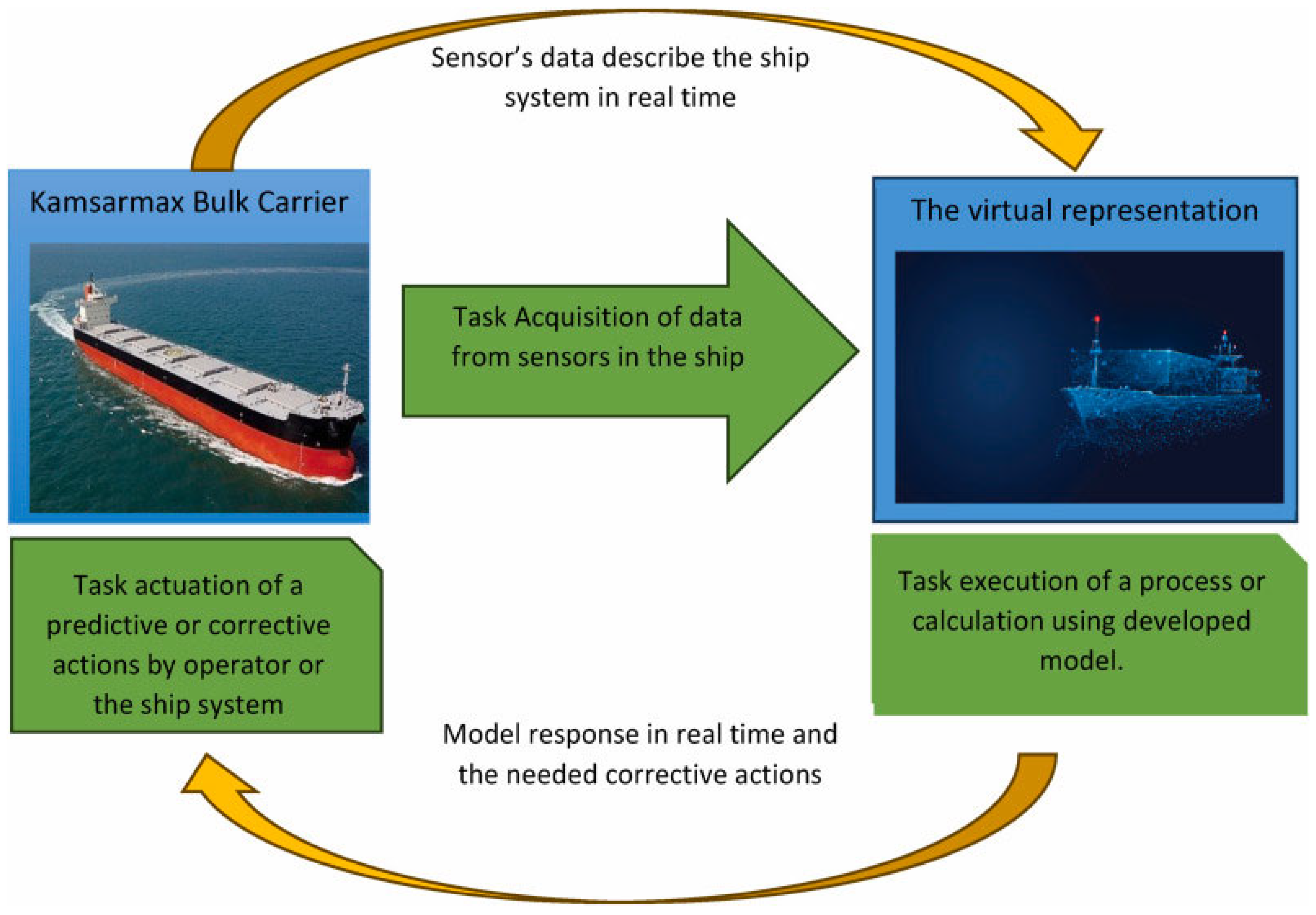
The architecture of an intelligent manoeuvring digital twin represents a closed-loop ecosystem that seamlessly connects physical ship operations with their virtual counterparts [36]. As shown in Figure 1, sensor data collected from onboard systems—such as position, velocity, engine load, and environmental conditions—continuously feed into CFD models that replicate the vessel’s hydrodynamic behaviour in real time. These CFD-based simulations generate high-fidelity responses to changing operational and environmental inputs, which are interpreted by AI predictors trained to recognise dynamic patterns, forecast vessel responses, and optimise control strategies. The refined predictions are transmitted to the ship’s control systems, which adjust propulsion, steering, or power management parameters accordingly. The resulting feedback from the physical vessel closes the learning loop, enabling continuous calibration of both the digital and physical models. This bidirectional data exchange allows the digital twin to evolve dynamically, ensuring that manoeuvring performance, energy efficiency, and regulatory compliance are continuously optimised during operation.
Manoeuvring research continues to shape both technological progress and international regulation. Real-time decision-support systems and manoeuvring simulators aligned with the International Regulations for Preventing Collisions at Sea (COLREGs) demonstrate how scientific innovation and policy converge to enhance maritime safety and sustainability [37,38]. As a result, manoeuvring research has evolved from a niche area of hydrodynamics into a core discipline underpinning the future of intelligent, sustainable, and autonomous maritime transport.
Existing review papers only partially capture the cross-disciplinary landscape. For instance, reviews focus narrowly on control laws [39], concentrate on riverine hydrodynamics [40], address identification techniques but not autonomy [41]; centre on berthing [42], examine depth-limited conditions [43], or address interaction forces [44] and ship accidents due to off-track manoeuvring [45]. None of these reviews spans the full integrated manoeuvring ecosystem, encompassing physics-based models, CFD, data-driven identification, environmental effects, perception, collision avoidance, autonomy, and digital twins, over 16 years. This leaves a critical gap in synthesising how manoeuvring research has evolved holistically and how it now underpins future MASS operations.
Against this backdrop of evolving methodologies and expanding technological horizons, the novelty of this review becomes clear. Whereas earlier surveys tended to isolate specific threads—hydrodynamic modelling, control algorithms, machine learning techniques, or environmental assessments—this work provides a comprehensive synthesis that bridges four dimensions of modern manoeuvring research: physics-based hydrodynamics, advanced control theory, artificial intelligence, and digital-twin (DT) technologies. By tracing developments chronologically and thematically from 2010 to 2025, this review reveals how the field has transitioned from static coefficient estimation and empirical modelling toward adaptive, data-driven, and increasingly cognitive systems capable of prediction, semantic reasoning, and cooperative decision-making. This unified view not only clarifies how individual research streams evolved but also demonstrates how manoeuvring has become a strategic enabler of MASS, operational safety, and decarbonisation efforts.
A further contribution lies in grounding these methodological transitions in quantitative performance evidence, drawing on reported improvements in collision-risk reduction, control accuracy, emissions mitigation, and prediction fidelity. This study also introduces an integrated perspective on environmental and cognitive manoeuvring intelligence, where vessels are envisioned as agents that learn from their surroundings, interpret regulatory intent, optimise sustainability objectives, and coordinate with other actors in complex maritime environments. By positioning manoeuvring at the intersection of hydrodynamics, AI-enabled autonomy, and digital-twin architectures, this review establishes a new conceptual foundation for the next generation of research—and for the technologies that will shape the future of intelligent and sustainable maritime navigation.
The bibliometric dataset for this review covers publications between 2010 and 2025 and is constructed from a systematic search of the major scientific database Scopus, complemented by targeted retrieval of key conference and journal articles known from the manoeuvring community. The core search strategy is built around the primary keywords “ship manoeuvring” and “ship maneuvering”, combined with secondary terms that reflect the main methodological and application areas considered in this paper. Representative compound queries include, for example, “ship manoeuvring AND hydrodynamic model”, “ship manoeuvring AND CFD”, “ship manoeuvring AND system identification”, “ship manoeuvring AND collision avoidance”, “autonomous ship AND manoeuvring”, “MASS AND path-following”, “ship manoeuvring AND digital twin”, and “ship manoeuvring AND artificial intelligence”. This thematic pairing ensures that the search captures publications spanning the spectrum from classical hydrodynamics to modern AI-based control and digital-twin applications.
On the basis of a preliminary screening of titles, abstracts, and keywords, the manoeuvring literature is organised into a set of interconnected thematic areas that recur consistently across the dataset:
  • Hydrodynamic and Maneuvering Modeling Group (MMG)-type modelling;
  • CFD-based and numerical simulation of manoeuvres;
  • System identification and parameter estimation;
  • Guidance, control, and collision avoidance;
  • Data-driven and AI-based prediction models;
  • Sensing, perception, and trajectory tracking;
  • Environmental and operational effects; and
  • Emerging digital-twin frameworks for manoeuvring and autonomous navigation.
These themes are not imposed a priori but are derived from the observed clustering of topics in the manoeuvring literature and later confirmed through detailed content analysis. They form the structural backbone of the qualitative synthesis that follows and are revisited in the trend analysis and research-gap discussion.
The search is restricted to journal articles and review papers written in English, and duplicate records across databases are removed. Non-relevant items, such as papers focused exclusively on offshore platforms, towing operations, global routing without manoeuvring content, or ship design studies with no explicit connection to manoeuvring dynamics, are excluded after manual screening. Following this filtering process, 190 papers are retained for detailed analysis and mapping of methodological and thematic trends.
Over 200 records are included in the descriptive and statistical analyses, which are used to illustrate publication trends, methodological shifts, and topic distributions over time. To ensure a focused and interpretable synthesis, a smaller subset of the most relevant and influential studies—on the order of several dozen papers across all themes—is selected for in-depth qualitative review and citation-network context. This subset includes seminal contributions, representative methodological advances, and recent works that signal emerging directions in hydrodynamic modelling, control, AI-based prediction, and manoeuvring-oriented digital twins.
Framing the literature in this way allows the review to move beyond a simple catalogue of methods. Instead, it supports a trend-based and integrative reading of ship manoeuvring research, raising questions that guide the remainder of the paper, such as the following:
  • How has ship manoeuvring research evolved from classical hydrodynamic models to integrated frameworks that combine physics-based modelling, advanced control, AI prediction, and digital-twin concepts between 2010 and 2025?
  • To what extent do these different methodological strands—hydrodynamics, control, AI, and sensing—interact in practice, and where are the gaps that currently prevent fully integrated manoeuvring systems for MASS?
  • What evidence exists regarding the effectiveness of these approaches (e.g., in terms of prediction accuracy, collision-risk reduction, controllability in complex environments, or environmental performance), and how can this evidence inform the design of next-generation manoeuvring and autonomy frameworks?
The remainder of this paper is structured to reflect the chronological and thematic evolution of manoeuvring research. Section 3 examines the transition from regulatory compliance to intelligent manoeuvring standards, illustrating how international maritime regulations have progressively converged with artificial intelligence-driven control and decision systems. Section 4 explores the integration of artificial intelligence and digital-twin technologies, highlighting their role in predictive modelling, simulation fidelity, and autonomous manoeuvring. Section 5 presents recent advances in manoeuvring-coefficient estimation and adaptive control frameworks, emphasising the synthesis of hydrodynamic modelling with modern control theory. Section 6 discusses the hydrodynamic foundations of intelligent adaptive manoeuvring systems, tracing the shift from traditional physics-based models to self-learning, data-driven control architectures. Section 7 focuses on transforming safety and collision avoidance into predictive AI systems, addressing human–AI collaboration, explainability, and regulatory reasoning within autonomous navigation. Section 8 introduces the concept of environmental intelligence, linking manoeuvring optimisation with emissions reduction and sustainable operational strategies. Section 9 reviews progress in cooperative navigation and formation control, detailing the emergence of multi-agent coordination and shared situational awareness as key enablers of intelligent autonomy. Section 10 outlines the evolution of simulation software toward intelligent maritime ecosystems, describing how integrated computational platforms now underpin digitalised and autonomous operations. Section 11 synthesises these developments through a comprehensive discussion and outlook, identifying current challenges and outlining future research directions toward fully intelligent, sustainable, and regulatory-compliant maritime systems. Finally, a summary of the main findings and future recommendations are presented in Section 12.

3. Regulatory Compliance and Intelligent Manoeuvring Standards

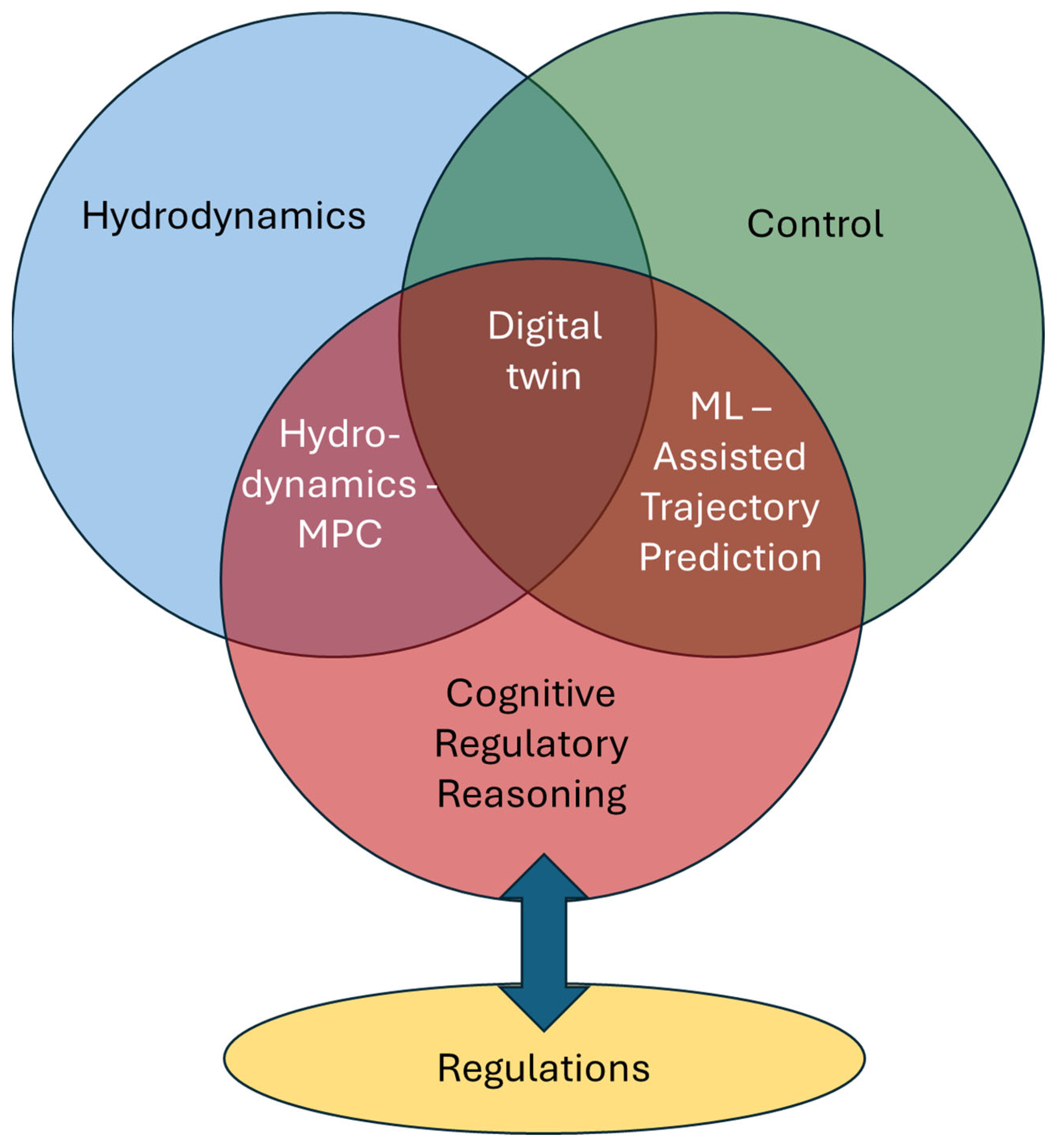
Over the past fifteen years, ship manoeuvring research has matured in parallel with the rapid evolution of international maritime regulation. What began as an effort to comply with established safety and environmental requirements has expanded into a data-driven field in which regulations are not only implemented but increasingly interpreted by autonomous decision-making systems. Frameworks such as the COLREGs, the Intact Stability Code, and successive IMO emission limits now shape how hydrodynamic models, control strategies, and AI-based decision tools are formulated, validated, and deployed. This shift marks a broader transition from legal accountability to algorithmic understanding, positioning manoeuvring as a core pillar of sustainable and autonomous maritime operations, as shown in Figure 2.
Within this regulatory landscape, ensuring compliance with COLREGs has emerged as one of the defining challenges of modern manoeuvring research. Hydrodynamic modelling and control theory describe the physics of vessel motion, but COLREGs supply the behavioural grammar that governs how ships must interact in crowded and uncertain waters. Between 2010 and 2025, research in this domain underwent a clear methodological evolution: initial studies centred on rule encoding and encounter classification; later work embedded COLREGs into optimisation frameworks through dynamic feasibility constraints; and the most recent efforts employ AI systems capable of interpreting maritime rules, inferring intent, and reasoning across multi-agent scenarios.
In the early 2010s, the regulatory conversation around manoeuvring was anchored by two foundational concerns: the legal recognition of autonomous agents and the environmental impact of vessel operations. Villalba Méndez and Gemechu [46] quantified GHG emissions from port activities, producing one of the datasets that supported the IMO’s first carbon-reduction strategies. At the same time, Allen [47] raised a pivotal legal question: should autonomous “seabots” be recognised as vessels under maritime law? This argument foreshadowed later debates concerning MASS classification, liability, and operational accountability. Together, these works established the dual regulatory axis—environmental sustainability and legal personhood—that continues to guide the integration of autonomy into maritime governance.
As technical research gained momentum, engineering and regulation began to converge. Kahveci and Ioannou [48] demonstrated that adaptive steering could enhance safety under uncertainty, directly reinforcing the practical conditions required for COLREGs-compliant navigation. Early benchmark manoeuvring datasets assembled by Sgarioto and Madden [49] shaped validation protocols for experimental trials. Meanwhile, Li et al. [50] and Abbas and Kornev [51] introduced hierarchical manoeuvring frameworks designed to support verification tasks and CFD-assisted certification. These developments repositioned manoeuvring research as not only a control discipline but also an instrument for demonstrating regulatory conformity.
Recent developments within the ITTC community add further urgency to the scientific and methodological gaps identified in this review. In the written discussions of the 30th ITTC Manoeuvring Committee, it is noted that several IMO Member States have submitted a joint proposal to the 12th Ship Design and Construction (SDC) to make the currently non-mandatory IMO manoeuvring standards mandatory, with the decision scheduled for early next year [52]. The Committee emphasised that key technical challenges—particularly scale effects, extrapolation from ballast to fully loaded conditions, and uncertainty in validating simulation-based predictions—remain unresolved, and premature enforcement could create significant operational and certification burdens for industry. This upcoming regulatory debate, therefore, underscores the need for a deeper scientific foundation for manoeuvring prediction, modelling, and validation. As a result, the present review contributes not only to research synthesis but also to informing the broader technical context in which SDC 12 will evaluate the readiness of manoeuvring criteria for mandatory adoption.
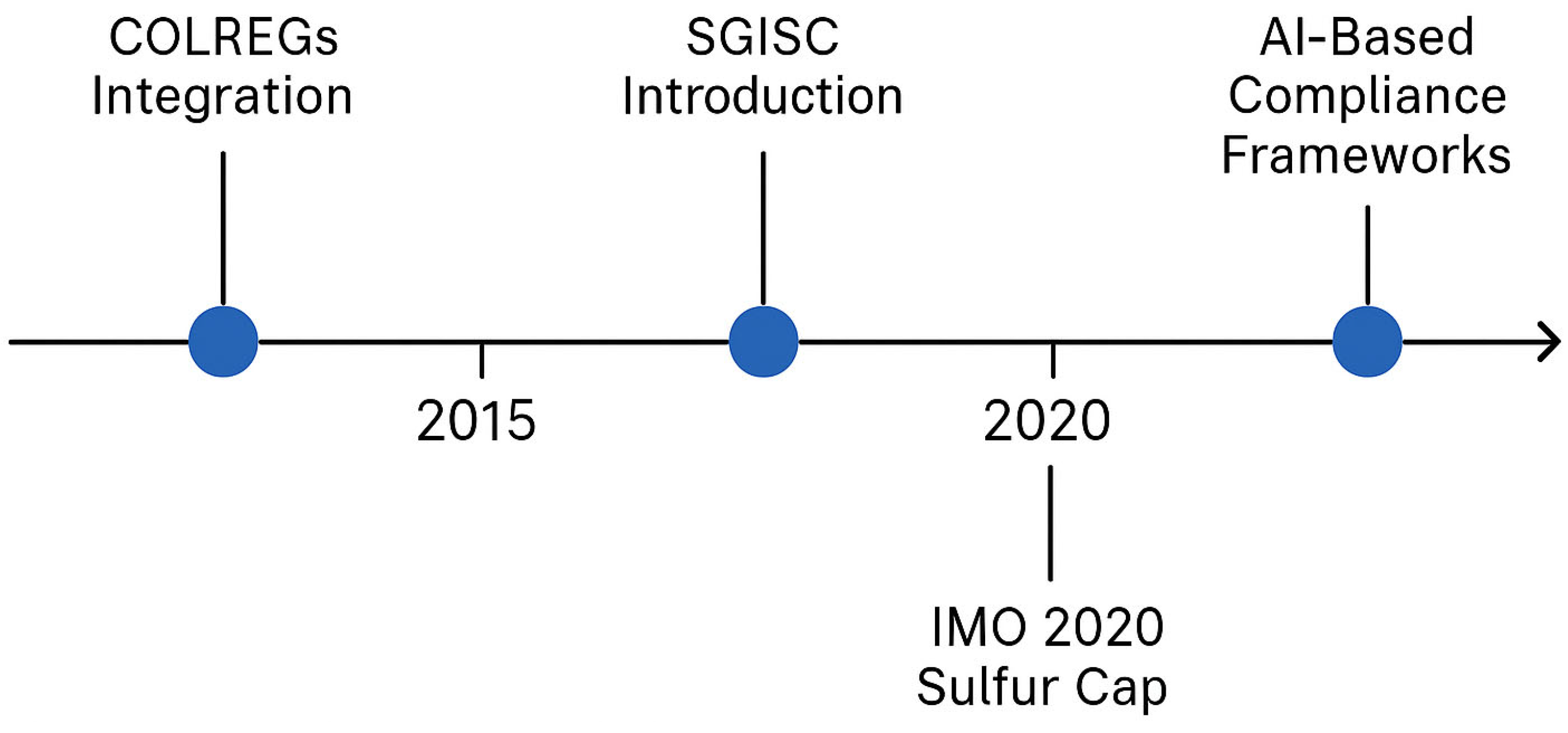
By the late 2010s, environmental legislation had become a major driver of manoeuvring-related research. Knežević et al. [53] showed that transient manoeuvring phases—acceleration, berthing, and low-speed turning—generate disproportionately high SOx and NOx emissions, intensifying pressure to meet IMO Tier III limits. Complementary studies by Geertsma et al. [54] and Van et al. [55] linked propulsion-control optimisation to emissions inventories, providing the technical foundation for policy discussions leading up to the IMO 2020 global sulphur cap. These findings reframed manoeuvring as both a performance challenge and a regulatory mechanism for achieving mandated emissions reductions.
Across this period, compliance in manoeuvring shifted from simple rule-following to model-based and data-driven strategies in which regulatory constraints are embedded directly within the core of manoeuvring models and control architectures. This integration laid the groundwork for the autonomous-ready frameworks that define contemporary research.

3.1. From Empirical Stability to Physics-Based Regulation

The regulatory evolution of ship manoeuvring parallels a broader shift in stability assessment. For decades, ship stability was evaluated under the First-Generation Intact Stability Criteria (FGISC), a prescriptive and largely empirical framework rooted in static righting-arm curves (GZ), metacentric height (GM), and calm-water assumptions [56]. While effective for conventional hulls and moderate seas, FGISC could not capture dynamic instabilities, such as parametric rolling, pure loss of stability, or broaching, which became increasingly relevant as hull forms diversified and operational envelopes expanded.
This mismatch between modern ship behaviour and static criteria prompted a transition toward physics-based assessment. As vessels with fine bows, large flares, high-speed hulls, and flexible propulsion encountered failure modes outside the FGISC envelope, IMO began developing the Second-Generation Intact Stability Criteria (SGISC)—a performance-oriented, scenario-driven framework built on hydrodynamic modelling and simulation [57,58].

3.2. Second-Generation Intact Stability Criteria (SGISC): Physics-Based Regulation

The SGISC, finalised at IMO SDC-7 in 2020, represents a decisive shift toward dynamic, physics-informed stability regulation. Unlike FGISC’s reliance on simplified static checks, SGISC incorporates nonlinear ship–wave interaction modelling, probabilistic long-term assessment, and targeted numerical simulation [59]. A comparison between the FGISC and SGISC is presented in Table 1.
This framework evaluates vulnerability across five dynamic failure modes, parametric rolling, pure loss of stability, dead-ship condition, surf-riding/broaching, and excessive accelerations, using a three-tier approach. Level 1 provides rapid screening, Level 2 adds probabilistic environmental modelling, and Level 3 (Direct Stability Assessment) applies time-domain simulations with coupled degrees of freedom [60].
Beyond its technical structure, SGISC is aligned with emerging digital-twin and decision-support technologies. Its physics-based nature enables potential real-time operational guidance and integration into future MASS control architectures. Although currently adopted as interim IMO guidelines, SGISC reflects the regulatory shift toward simulation-supported criteria that increasingly intersect with manoeuvring, seakeeping, and autonomy.

3.3. From Rule Encoding to Cognitive Compliance in Manoeuvring

Within this broader regulatory shift, COLREGs-oriented manoeuvring research followed its own evolutionary path. The earliest work relating manoeuvring to regulation tended to treat COLREGs as a set of fixed geometric constraints. Manoeuvres are shaped by simple collision-risk indices, Closest Point of Approach (CPA) and Time to Closest Point of Approach (TCPA) thresholds, and rule-based heuristics that determined whether a vessel should stand on or give way. These approaches, while foundational, largely viewed COLREGs through a narrow mechanical lens and offered limited exploration of how such rules interact with nonlinear ship dynamics or real-time control architectures. By 2016–2019, researchers increasingly embedded regulatory constraints into formal optimisation problems. Model predictive control (MPC) emerged as a promising way to reconcile COLREG rules with dynamic feasibility constraints. Johansen et al. [61] exemplified early attempts to integrate rule-based logic into algorithmic decision-making, though often within idealised environmental scenarios.
Crucially, this period introduced the recognition that regulatory compliance is not only about avoiding collisions but also about producing behaviour that human navigators [62] perceive as predictable, justifiable, and in line with good seamanship—anticipating later work on “human-like” control and explainable autonomy. Since 2020, regulatory compliance has become both a legal and a technical focal point for autonomous navigation research. Li et al. [63] and Liu et al. [64] began incorporating COLREG constraints directly into trajectory optimisation, while Thyri and Breivik [65] offered a more rigorous treatment by embedding head-on, crossing, and overtaking logics into nonlinear MPC formulations. These studies marked a significant shift toward coupling manoeuvring dynamics with kinematic rules, moving beyond simplistic CPA thresholds, and acknowledging that compliance must be achieved at the intersection of hydrodynamic feasibility, traffic behaviour, and regulatory obligations.
The field moved decisively toward learning-based regulatory reasoning. Deep reinforcement learning (DRL) frameworks sought to train agents that implicitly internalise regulatory patterns through interaction [66,67,68]. These systems do not simply follow pre-coded rules; they learn behavioural policies that align with COLREGs while balancing safety, efficiency, and comfort. Parallel optimisation-based approaches continued to mature, as exemplified by Potočnik [69], one of the most structurally advanced MPC formulations, integrating maritime charts, dynamic constraints, and regulatory rule sets. The concept of “human-like” compliance gained visibility, with the design of manoeuvres that aim to resemble human navigational strategies [70,71].
At the same time, regulatory interpretation began to enter the cognitive domain. Studies moved beyond mechanistic rule-following, toward predicting the intent, expectations, and obligations of other vessels [72]. Parallel analyses scrutinised the alignment between computational models and human interpretation, underscoring the challenges of embedding legal and behavioural nuance into algorithms [73]. This body of work marks the emergence of cognitive manoeuvring intelligence, in which compliance involves interpreting ambiguous, multi-agent situations in congested or mixed-autonomy environments [74].
Throughout this period, a recurring challenge is integrating hydrodynamics, control, AI, and regulatory logic into a single manoeuvring architecture. Hydrodynamic models excel at predicting physical behaviour; control systems enforce feasibility and stability; AI models anticipate and adapt; and regulatory modules assess legality. Yet most studies combine at most two or three of these layers, attempting tri-layer integration which links perception, manoeuvring dynamics, and regulatory evaluation [75]. Even this, however, stops short of a fully integrated, digital-twin-enabled compliance framework. The regulatory and cognitive dimensions of manoeuvring research had recently clearly converged. For instance, Sun and Zhang [37] demonstrated MPC systems explicitly aligned with COLREGs, achieving a 25% reduction in collision risk compared with conventional controllers. Zhong et al. [76] introduced machine learning-based collision-risk-assessment frameworks that improved conflict identification accuracy by 30%, forming the computational foundation for future traffic management standards. Meanwhile, Sajjad et al. [28] quantified reductions of 10–12% in fuel consumption and 15–18% in NOx emissions through AI-optimised manoeuvring, directly supporting IMO’s GHG reduction objectives. Lee and Kim [77] and Hwang and Youn [78] advanced MASS certification frameworks that formalised autonomy under regulatory supervision, and Tsai and Fang [34] developed real-time simulation environments capable of validating both safety and regulatory compliance within virtual sea trials.
In summary, the trajectory from 2010 to 2025 reveals a clear evolution: regulatory compliance in ship manoeuvring has progressed from static, rule-based procedures toward dynamic, intelligent frameworks capable of optimisation, adaptive learning, and multi-agent reasoning. Despite this progress, several fundamental challenges continue to shape the field. Reliable interpretation of COLREGs and stability criteria must be ensured in increasingly complex traffic environments that involve both human-operated and autonomous vessels. Regulatory reasoning needs to be embedded within real-time digital-twin systems so that compliance is maintained throughout evolving manoeuvring conditions. Autonomous ships must also provide forms of “explainable compliance” that satisfy legal and certification requirements. Finally, future manoeuvring architectures must achieve a coherent integration of hydrodynamic feasibility, control authority, AI-based prediction, and regulatory obligations within a unified decision-making loop. Addressing these interconnected challenges will be essential for advancing manoeuvring research toward a framework in which safety, efficiency, and environmental performance are co-optimised within the vessel’s cognitive and regulatory intelligence.

4. Machine Learning and Digital Twins in Ship Manoeuvring

Between 2010 and 2025, ship manoeuvring research underwent a profound methodological transformation as data-driven modelling, AI, ML, and DT technologies became central to maritime engineering. Methods that once relied on exploratory neural network applications and adaptive estimation have evolved into a sophisticated ecosystem of predictive models, onboard intelligence, and real-time virtual replicas of operating vessels. Collectively, these developments have reshaped how manoeuvring is modelled, simulated, monitored, and controlled at sea.
This shift reflects a much broader reorientation across naval architecture: from static, coefficient-based representations of ship dynamics toward adaptive, learning-enabled models capable of capturing nonlinear responses, environmental disturbances, and multimodal operating behaviour. The emergence of digital twins further accelerated this evolution by enabling continuous synchronisation between simulated and physical manoeuvring states. These technologies now form the computational foundation of modern MASS autonomy, predictive safety, and regulation-aware decision support.
Early applications of machine learning in manoeuvring focused mainly on improving system identification and enhancing classical control. Oh et al. [79] showed that adaptive estimation techniques could update hydrodynamic coefficients in real time, demonstrating that many manoeuvring parameters behave as state-dependent quantities rather than fixed constants. Contemporary data-driven studies—such as Revestido and Velasco [26] and Velasco et al. [80] —then explored ML-supported identification to capture nonlinearities difficult to model within traditional MMG frameworks. These works established the conceptual basis for hybrid modelling, in which data and hydrodynamic theory are fused to address model–plant mismatch.
Environmental performance and traditional control remained dominant themes in the early 2010s. Winnes and Fridell [29] demonstrated that transient operations—berthing, acceleration, low-speed manoeuvres—produce disproportionately high emissions of NOx and particulate matter, placing dynamic behaviour at the heart of local air-quality considerations. Shi et al. [81] highlighted strong nonlinear couplings among propulsion control, fuel consumption, and transient motion. In parallel, human factor studies advanced our understanding of how experience and intuition guide manoeuvring under uncertainty [25], while comparative analyses of pilot strategies revealed the cognitive structures underpinning expert ship handling [82,83]. These insights provided behavioural benchmarks that later informed AI-based emulation of expert decision-making.
From the mid-2010s onward, AI and ML became increasingly central to identification and prediction. Support vector machines combined with particle swarm optimisation recovered manoeuvring parameters robustly from noisy data [84,85], while data-driven ship-motion representations improved prediction accuracy in complex trajectories [86]. Hybrid neural network (NN)–signal processing approaches captured nonlinear roll dynamics in real time [87].
Similar learning-based methods were explored for underwater vehicles, improving robustness and fault tolerance [88], and neuro-fuzzy inference systems enhanced manoeuvring control under environmental disturbances [89].
A major step toward adaptive operational models came with real-time identification technologies. The model in [90] demonstrated online estimation of hydrodynamic parameters under varying conditions, a capability extended by Gaussian-process-based approaches that explicitly quantify uncertainty [91]. In trajectory prediction, Xue and Chai [92] used a recurrent NN to leverage temporal structure in Automatic Identification System (AIS) data, yielding more accurate track forecasts in dense-traffic environments.
Research then moved toward more sophisticated hybrid and grey-box approaches. Physically structured models combined with least-squares support vector machines improved interpretability and prediction accuracy [93]. Semi-physical least-squares support vector machine (LS-SVM) frameworks reconstructed nonlinear surface-craft dynamics by embedding a hydrodynamic structure directly within the learning model [94]. Zhang et al. [95] treated manoeuvring as a fully nonparametric mapping learned from data, and follow-up work extended these ideas to full-scale vessels, demonstrating reliable multi-DOF identification under operational conditions [96]. Adaptivity and time awareness became central themes: Song et al. [97] proposed prediction models that down-weight outdated dynamics, while complementary studies used clustering and Markov chains to capture regime shifts [98]. My et al. [99] and Silva and Maki [100] showed that compact supervised neural networks can learn effective controllers for low-speed manoeuvring in confined waters.
These developments began converging with physical modelling. The hybrid framework in [101] coupled detailed hydrodynamic representations with decision-support logic, blurring the boundary between identification and control. Learned models increasingly informed guidance and control architectures rather than serving solely as descriptive tools.
The early 2020s marked a transition from isolated use cases to systematic integration of learning throughout manoeuvring pipelines. Zhao et al. [102] used a grey wolf optimiser with a kernel extreme learning machine to characterise aero–hydrodynamic interactions in sail-assisted vessels. Reservoir computing, applied in [103], offered an efficient means of modelling highly nonlinear responses. The work in [104,105,106] embedded a hydrodynamic structure directly into neural regression, narrowing the gap between first principles and machine learning.
A key conceptual advance was the move from offline modelling to real-time operational prediction. Zhou et al. [107] demonstrated that bidirectional Long Short-Term Memory (LSTM) with attention mechanisms provide accurate short-horizon forecasts under realistic rudder and wave disturbances. A dedicated LSTM–multi-head attention model for intelligent ship-motion prediction further showed how attention layers highlight relevant motion features under disturbance-rich conditions [108]. Reduced-order, learning-augmented models by Chen et al. [109] and Gralak et al. [110] helped bridge high-fidelity CFD and real-time control. Reinforcement learning and convolution-based architectures expanded manoeuvring capability in constrained, multi-vessel scenarios [111,112]. Vision-based and unsupervised learning methods extracted manoeuvring intent and patterns from video and trajectory data [113,114], enriching situational awareness inputs to control pipelines.
By 2025, the field had entered a mature phase characterised by tight coupling between learning frameworks and digital twins. Real-time, nonparametric models capable of evolving with incoming data demonstrated strong predictive performance [115,116], while state-of-the-art sequence models provided accurate and interpretable trajectory forecasts [117]. Uncertainty-aware approaches—including recurrent neural networks integrated with Bayesian filtering [72] —offered both predictions and confidence intervals, addressing key requirements for safety-critical MASS applications.
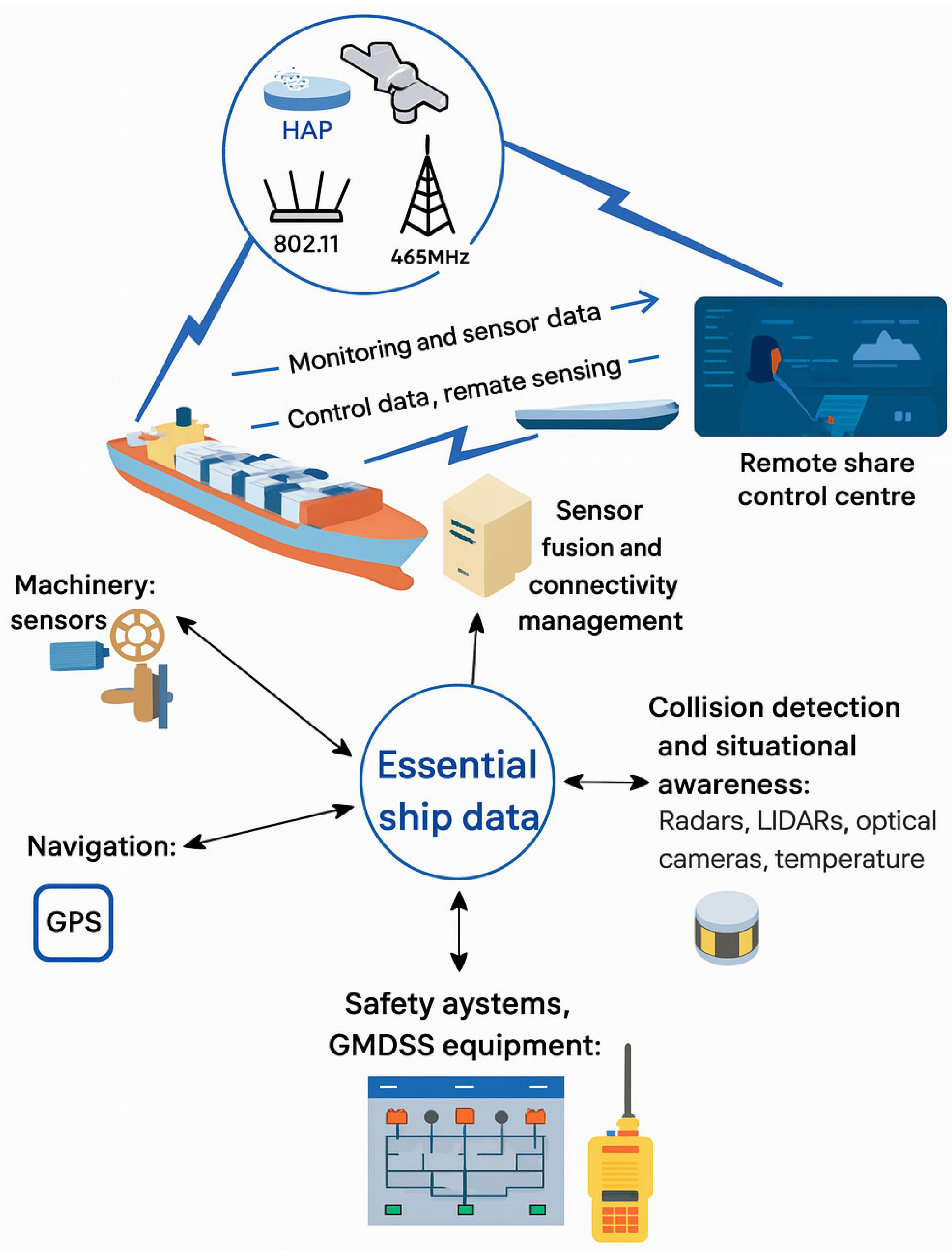
Digital-twin research amplified these advances. Shehata et al. [33] demonstrated that transformer architectures trained on real operational data could support manoeuvring digital twins with high-fidelity real-time prediction of surge, sway, and yaw—achieving a threefold improvement in accuracy over LSTM models, as shown in Figure 3. At the traffic scale, Yu et al. [118] extended deep attention-based models for long-horizon AIS forecasting, offering the anticipatory capability needed for DT-based decision support. Learning-from-demonstration frameworks further closed the gap between expert seamanship and machine autonomy, enabling the transfer of complex port manoeuvres to autonomous platforms [119,120].
Taken together, these studies reveal a clear progression. Early work centred on emissions and basic control, followed by ML-assisted coefficient identification, the emergence of SVM-, Radial Basis Function (RBF)-, and Adaptive Neuro-Fuzzy Inference System (ANFIS)-based models, and later the introduction of Gaussian processes, grey-box approaches, and sophisticated deep architectures—Bidirectional Long Short-Term Memory (BiLSTM), Echo State Network (ESN), neural basis expansion analysis with exogenous variables (NBeatsX), Gated Recurrent Unit (GRU), and transformer variants—embedded within digital-twin systems. Table 2 summarises the methods used, along with their applications and limitations. Across this trajectory, physics-based and data-driven approaches have shifted decisively from competition to complementarity: hydrodynamic theory provides structure, while AI captures nonlinear, uncertain, and operationally complex manoeuvring phenomena.
In this sense, modern manoeuvring research has moved from describing how ships move to learning why they move as they do and predicting what they will do next. AI- and ML-based identification, modelling, and prediction now form the computational backbone of digital twins, adaptive control, and autonomous decision-making in contemporary maritime operations.

5. Manoeuvring-Coefficient Estimation and Adaptive Control Frameworks

5.1. Manoeuvring-Coefficient Estimation

Between 2010 and 2025, research on manoeuvring-coefficient estimation progressed through three major methodological phases, moving from classical system identification techniques to hybrid physics–ML approaches and, ultimately, to real-time adaptive estimation. Early work relied heavily on physical experimentation and mechatronic instrumentation. Oh et al. [79] showed that carefully controlled experimental procedures could reconstruct the hydrodynamic derivatives required for nonlinear manoeuvring models. This initial interest in data-supported identification was later formalised in [26], where nonlinear coefficient estimation was framed as an incremental process linking hydrodynamic structure with empirical motion datasets.
Classical regression techniques soon revealed limitations, particularly when handling nonlinear coupling or measurement noise. Machine learning methods offered a promising alternative. The SVM–particle swarm optimisation (PSO) hybrid model in [84] demonstrated superior performance compared with linear estimators, signalling a shift toward data-centric estimation. Probabilistic and uncertainty-aware approaches followed, as in [91,127], emphasising that coefficient estimation must explicitly account for measurement uncertainty, trial variability, and model inadequacy.
As computing power increased, CFD-assisted estimation gained prominence. Studies such as [128,129,130] used Reynolds-Averaged Navier–Stokes equation (RANS) solvers to derive force components traditionally obtained from PMM tests, enabling virtual captive experiments that reduce cost and expand testing flexibility. Flow-feature extraction algorithms, such as VORTFIND, a computational algorithm used in fluid dynamics to identify vortex core centres within a velocity field, provided additional insight by isolating coherent vortical structures and improving the interpretation of forces generated during drift and turning motions [131]. Investigations into preswirl manoeuvring propulsors further illustrated how local inflow modification affects sway and yaw derivatives, highlighting the need for tightly coupled CFD–experimental analysis when examining propulsor-induced dynamics [13]. More recent efforts combined numerical PMM simulations with free-running model tests for container ships, demonstrating that virtual captive testing can accurately reproduce manoeuvring behaviour across multiple manoeuvre types, with high fidelity relative to experimental validation [132]. Hybrid physical–data-driven strategies were also extended to environmental forces: elliptic Fourier descriptors captured hull-form variability while radial basis neural networks modelled nonlinear wind–hull interactions, yielding more reliable wind-force coefficients for simulation and control [133,134].
Parallel research developed hybrid identification frameworks that fused physics with machine learning. Studies such as [93,104,135] embedded MMG- or manoeuvring-structure constraints directly within the learning architecture, acknowledging that purely data-driven models struggle to recover hydrodynamic dependencies. LS-SVM-based semi-physical frameworks extended this idea by integrating hydrodynamic priors into nonlinear regression, enabling robust estimation across variable loading and environmental conditions [94].
A complementary trend involved the transition from experimental data to operational and full-scale datasets. Song et al. [96] and Xu et al. [90] demonstrated that hydrodynamic coefficients could be estimated directly from navigational logs, bypassing the need for traditional PMM trials. This movement toward real-world data culminated in online-learning approaches [115,116] that treat coefficients as dynamic quantities evolving under changes in loading conditions, fouling state, wave climate, and vessel deterioration.
By 2025, manoeuvring-coefficient estimation had matured into a multimodal ecosystem that combined CFD-derived coefficients [136], physics-informed ML [102,104], and black-box predictors [103,117]. Table 3 summarises the principal methodologies developed between 2010 and 2025, outlining their accuracy, applicability, and operational relevance. Traditional empirical and analytical methods—once central to naval hydrodynamics—offered rapid estimates but were constrained by linear assumptions and limited flow regimes. The rise in CFD provided high-fidelity computation of added mass, damping, and control derivatives, often reducing error margins below 10%. Virtual captive tests further improved accuracy while reducing time and cost. As full-scale data became increasingly available, system identification and hybrid models supported adaptive control and allowed continuous recalibration of vessel dynamics. Recent AI-driven methods pushed accuracy even further, with neural networks and nonparametric algorithms achieving errors below 5% and offering prediction capabilities that adjust to changing vessel states and environmental conditions. Frequency-domain methods added smooth, time-continuous parameter estimation suitable for advanced control.
Taken together, these developments reveal a clear trajectory: manoeuvring-coefficient estimation has shifted from static, experiment-driven identification toward adaptive, data-rich, physics-informed frameworks. This transformation directly supports digital twins, online prediction, and autonomous manoeuvring systems, redefining hydrodynamic coefficients not as fixed design parameters but as continuously evolving descriptors of vessel behaviour in realistic, time-varying operating environments.

5.2. Adaptive and Intelligent Control

Adaptive and intelligent control for ship manoeuvring followed a trajectory that closely mirrors developments in modelling and prediction, shifting from classical linear controllers to hybrid MPC–AI architectures capable of learning, adapting, and operating under uncertainty. In the early 2010s, research was driven largely by the need for robustness and regulatory compliance. Kahveci and Ioannou [48] refined yaw and sway control under varying environmental conditions, showing that controllers must continuously adjust to hydrodynamic uncertainty. These studies introduced a principle that later became central to learning-based systems: manoeuvring control must evolve in real time rather than operate with fixed gains.
During the same period, model-based control frameworks incorporating observers, estimators, and multi-loop feedback structures were formalised in [137,138]. These architectures enabled noise filtering and stabilisation in nonlinear settings. The shift toward adaptive behaviour became more explicit in the work of Khaled and Chalhoub [139], who allowed controller parameters to update dynamically based on the vessel’s ongoing response.
By the late 2010s, intelligent and data-driven control methods gained traction. Fuzzy and neuro-fuzzy controllers [89] captured nonlinear manoeuvring behaviour more effectively than classical proportional–integral–derivative (PID) structures, especially in shallow waters and in transient conditions. Autonomous-steering studies such as [140] combined heuristic rules with adaptive parameter tuning, improving steady-state accuracy during short-sea and coastal operations.
A decisive methodological shift occurred with the rise in predictive and optimisation-based control. Kapitanyuk et al. [141] demonstrated the feasibility of data-enhanced roll control, and a growing body of research adopted MPC for manoeuvring tasks [69,142]. MPC proved capable of simultaneously enforcing COLREGs constraints, actuator limits, and path-following requirements [143], making it a natural candidate for autonomy and rule-compliant navigation.
In parallel, the emergence of DRL reshaped the control landscape. Deraj et al. [123] and Wan and Zhang [111] showed that DRL agents could learn collision-avoidance and path-following behaviours directly from simulation, without hydrodynamic equations. Neural controllers combining path-following with dynamic virtual ship (DVS)-based obstacle-avoidance guidance illustrated that learning-driven schemes can maintain robustness to disturbances and compensate for the inherent actuation limits of underactuated vessels [124,144,145]. Although these methods demonstrated adaptability, they also brought challenges related to interpretability, reward tuning, and convergence guarantees.
Robust and fault-tolerant control frameworks were developed contemporaneously to address actuator degradation and structural uncertainty. Zhang et al. [146] and Zhang et al. [147] formalised architectures capable of adjusting control gains or triggering corrective actions based on real-time state estimates, enabling resilience under damaged, degraded, or adversarial conditions.
Another important trend concerned integrated manoeuvring–propulsion control. The framework introduced in [148] unified nonlinear manoeuvring models with mean-value engine dynamics through a collision probability indicator (CPI). This integration bridged dynamic control and energy-aware decision-making, ensuring that manoeuvring commands remain compatible with propulsion characteristics, fuel-consumption profiles, and NOx emissions constraints.
Adaptive and intelligent control frameworks converged toward hybrid architectures that integrate the following: (1) physics-based manoeuvring models, (2) online parameter estimation for updating hydrodynamic coefficients, (3) ML-enhanced motion and disturbance prediction, (4) MPC or DRL-based decision-making for real-time guidance, and (5) digital-twin monitoring for supervision, fault detection, and validation.
This evolution transformed manoeuvring control from reactive stabilisation into proactive, learning-driven, multi-agent navigation. These advances now form the control backbone of next-generation MASS platforms and intelligent maritime systems, enabling vessels to operate safely, efficiently, and autonomously in complex, uncertain, and traffic-dense environments.

6. Hydrodynamic Foundations to Intelligent Adaptive Control

Over the past fifteen years, the control of marine vessels has undergone a quiet but unmistakable revolution. A domain once defined by classical stability theory—steady-state responses, linear approximations, and fixed gains—has expanded into a diverse ecosystem of adaptive, predictive, and learning-enabled control architectures. Modern controllers negotiate environmental uncertainty, anticipate risk, embed regulatory logic, and coordinate with both human operators and other autonomous vessels.
This evolution is not a simple linear progression toward autonomy but a layered narrative. Hydrodynamics, human expertise, computational capability, and regulation have gradually woven themselves together to form the fabric of contemporary ship control. Once a manoeuvring model exists—whether derived from MMG, CFD, neural networks, or hybrid identification—the central question becomes: how should the vessel act upon it? This section traces that journey, following how control strategies evolved from PID simplicity to MPC foresight and, ultimately, toward intelligent, adaptive, and learning-driven behaviour.
The early 2010s were still dominated by classical controllers. PID algorithms remained the workhorse of marine steering because they were transparent, intuitive, and familiar to mariners. Their limitations were equally familiar: fixed gains struggled with nonlinear hydrodynamics, shallow-water effects [149], and wave-induced disturbances. Hybrid estimation strategies—such as the use of elliptic Fourier descriptors and radial basis neural networks—improved the prediction of environmental loads, especially wind-induced effects under manoeuvring conditions [133]. Nonetheless, PID-based structures remained the backbone of heading control [150] and experimental steering trials.
More sophisticated robust-control frameworks—Linear–Quadratic–Gaussian (LQG) and H-infinity (H∞)—sought to manage uncertainty while maintaining performance. Kahveci and Ioannou [48] demonstrated that real-time compensation for model uncertainties and external disturbances was feasible, revealing a transformative insight: a vessel’s controller could evolve dynamically rather than rely on fixed assumptions. This idea became the conceptual scaffolding for the adaptive and predictive controllers that followed.
As the community increasingly recognised that manoeuvring coefficients vary with speed, draft, loading, bathymetry, and sea state, self-tuning control emerged as a natural progression. Khaled and Chalhoub [139] allowed control gains to adjust continuously based on kinematic feedback, and similar adaptive refinements soon appeared in the steering of ferries and small vessels [151]. Revestido et al. [137] introduced iteration-based refinement strategies to reduce phase lag in nonlinear manoeuvring, emphasising that control algorithms—not merely the underlying models—must adapt to evolving conditions.
By the mid-2010s, operational demands had moved beyond single-layer controllers. Port manoeuvring, narrow channels [152], offshore station-keeping [153,154], and escort operations required controllers capable of reasoning about both high-level strategy and low-level actuation [155]. Li et al. [50] formalised a three-layer architecture comprising strategic path generation, supervisory COLREGs-aware mode switching, and low-level actuator control. Similar hierarchical frameworks [138] integrated estimation, fault detection, and predictive control. This modular architecture paralleled developments in robotics and aviation: vessels required mission-level intelligence layered atop a precise actuator-level response.
MPC emerged as the defining method of the last decade because it introduced something fundamentally new into the control loop: foresight. Instead of merely reacting to the current state, MPC projects the vessel’s future motion, anticipates disturbances, evaluates collision risk, and selects optimal actions across a predictive horizon. Early maritime applications relied on linearised models, but they were sufficient to demonstrate the paradigm’s potential. As computational efficiency improved and nonlinear models became available, nonlinear MPC rapidly became the preferred approach. Qu et al. [142] showed that nonlinear MPC could tightly couple the vessel’s dynamic constraints with optimal path-following behaviour, adjusting the rudder [156,157] and propulsion in ways beyond the reach of classical controllers.
Parallel advances in unsteady hydrodynamics underscored the need for such predictive frameworks, with studies on flapping-foil propulsion [158], flexible fin-and-joint systems [159], propeller-bearing loads [130,160,161], and multiphase flow phenomena such as bubble-size distributions around underwater vehicles.
Detailed CFD analyses of propeller-bearing loads in straight-line and steady-turning manoeuvres highlight how load asymmetries and flow-induced bearing stresses emerge under dynamic operation, reinforcing the need for manoeuvring models that capture coupled hydrodynamic–propulsive behaviour [162] demonstrated the complexity of unsteady, manoeuvring-relevant forces. Extensive Office of Naval Research (ONR) Tumblehome investigations [163] revealed severe roll–yaw coupling in waves, underscoring the necessity of predictive, nonlinear control.
MPC’s integration with regulation represented a major conceptual leap. Frameworks such as [69] embedded COLREGs directly into the optimisation problem: trajectories were generated not merely to avoid collisions but to comply with maritime rules in a mathematically interpretable way. Human-like MPC designs [70] reproduced the predictability and intent-consistent motion patterns of experienced navigators. Across these studies, MPC consistently demonstrated the ability to integrate safety, manoeuvring feasibility, and regulatory logic. In quantitative terms, MPC-based collision-avoidance systems reduced collision risk by approximately 25% relative to conventional controllers.
Over time, MPC evolved into a tool for shaping behavioural intent. Risk-tuneable variants enabled cautious operation in congested waters and more assertive routing in sparse traffic, shifting the controller from mere stabilisation to cognitive autonomy. MPC’s strength lies in its fusion of hydrodynamic realism with behavioural norms—aligning how a vessel can move with how it should move.
As autonomous vessels began operating in coordinated groups—tug convoys, harbour escort teams, multi-Unmanned Surface Vessel (USV) formations—the nature of the control problem changed. Controllers were required to manage cooperation, communication delays, and shared objectives [164]. Distributed and event-triggered control frameworks addressed these needs by updating only when necessary, reducing communication overhead without sacrificing stability. Hinostroza et al. [165] demonstrated synchronised multi-vessel movement with minimal information exchange, while Roh et al. [166] explored cooperative control strategies for underwater fleets. These approaches mirrored human team dynamics: decentralised yet coherent; adaptive yet predictable.
Alongside predictive control, DRL introduced a fundamentally different paradigm—one in which control policies are discovered, not designed. Through interaction with simulated environments, DRL agents learned behaviours including collision avoidance [167,168], tight-quarters docking [169], and multi-vessel cooperation [170]. Deraj et al. [123] showed that DRL agents could adopt evasive tactics reminiscent of human seamanship. Shen et al. [67] combined DRL with evolutionary strategies to enforce COLREGs, while Wan and Zhang [111] demonstrated DRL’s capacity to integrate environmental features such as bathymetry, riverbanks, and flow fields directly into control decisions.
DRL offers adaptability and skill-like behaviour but remains limited by its data requirements, hyperparameter sensitivity, and lack of interpretability—issues that complicate regulatory certification. As a result, DRL commonly appears in hybrid frameworks that temper learned behaviour with physics-based constraints or MPC supervision.
Fault-tolerant control emerged as a parallel thread as autonomy increased. Rudder failures, thruster degradation, sensor drift, and communication loss became central concerns [171,172]. Zhang et al. [146] unified adaptive and game-theoretic reasoning to maintain stability under actuator degradation. Soni et al. [173] connected dynamic loads to machinery stress, while Nikula et al. [174] demonstrated how propulsion performance degradation propagates into manoeuvring reliability. Together, these studies underscored a critical truth: autonomous safety depends not only on precise control laws but on resilience to failure.
Throughout this evolution, hybrid control philosophies gained traction. Instead of replacing physics-based models, learning-enabled controllers augmented them—refining predictions, updating internal gains, or compensating for unmodelled dynamics. Liu et al. [103] showed that reservoir computing preserves stability while modelling nonlinear behaviours. Grey-box techniques [102] embedded hydrodynamic dictionaries within kernel-learning frameworks, and linear embeddings of nonlinear dynamics [175] enabled optimal control strategies with strong interpretability.
Another subtle but influential development is the recognition that manoeuvring cannot be separated from propulsion behaviour. Rudder authority, engine torque response, propeller wake, and shallow-water effects [176] function as a tightly coupled system. Mizythras et al. [148] formalised this coupling through the CPI, integrating hydrodynamic constraints and engine performance into a single decision metric. This framework ensures that evasive manoeuvres remain safe in both motion and propulsion domains—a crucial requirement for MASS in confined waters or emergency scenarios.
Looking across fifteen years of advances, a clear narrative emerges. Maritime control has progressed from simple PID schemes—transparent and familiar yet limited—toward architectures that interpret context, anticipate hazards, coordinate with other agents, and respond intelligently to failure. Adaptive controllers introduced flexibility; hierarchical frameworks provided organisation and regulatory alignment; MPC delivered foresight; distributed control enabled cooperative behaviour; DRL introduced behavioural richness; fault-tolerant control ensured resilience; and propulsion–manoeuvring integration anchored control to physical reality.
Across these shifts, ship control has evolved from stabilising a vessel to understanding its environment; from following commands to interpreting regulatory norms; from reacting to disturbances to anticipating them; and from acting alone to collaborating intelligently with human operators, sister vessels, and the natural environment.
What was once a field defined by linear gains and static assumptions has become a landscape of predictive, adaptive, and cognitive control systems—capable not only of executing manoeuvres but of justifying them. This transformation represents one of the most significant intellectual shifts in modern naval architecture and forms the foundation of safe, resilient, and fully autonomous MASS.

7. Machine Learning for Collision Avoidance and Control

Safety and collision avoidance in ship manoeuvring have advanced from reactive control and simple rule-following to a proactive, prediction-driven discipline grounded in learning and autonomous decision-making. Over the past fifteen years, digital twins, machine learning, and real-time optimisation have converged to uphold COLREGs while simultaneously improving safety, efficiency, and environmental performance. What began as deterministic rule sets and hydrodynamic envelopes has matured into an intelligent, multi-agent framework in which vessels perceive, anticipate, and negotiate complex interactions at sea.
The formative developments of the early 2010s laid both the legal and technical foundations for autonomous collision avoidance. Allen [47] posed one of the first systematic questions on how maritime law—and COLREGs in particular—should apply to autonomous systems, foreshadowing later regulatory debates on MASS. In parallel, Kahveci and Ioannou [48] showed that adaptive control could mitigate hydrodynamic and environmental uncertainties in real time, establishing key principles for subsequent predictive and feedback-rich architectures. At the same time, hydrodynamic fidelity emerged as a prerequisite for trustworthy collision-risk assessment: even modest modelling errors were shown to distort safety margins significantly [177].
By the late 2010s, safety research broadened beyond deterministic dynamics to incorporate human-centred, environmental, and behavioural perspectives. Chen et al. [178] quantified nonlinear flow structures that shape collision boundaries, while Zeng et al. [179] reduced trajectory-tracking error for underactuated vessels by more than 15% using early neural network-based controllers. Human and environmental impacts entered the discourse: Iodice et al. [180] and Nunes et al. [181] demonstrated how transient port manoeuvres degrade local air quality, strengthening the coupling between safe navigation and environmental regulation. Liu and Hekkenberg [182] traced the co-evolution of rudder design and safety strategies, and more recent studies on rudder profile geometry [183] revealed how subtle section changes influence lift, separation, yaw response, and coupled roll–yaw dynamics, underscoring the sensitivity of turning behaviour to appendage hydrodynamics.
Risk-aware steering emerged in works such as Jakovlev et al. [140] and Velasco et al. [80], which anticipated predictive collision avoidance by formalising safety margins and risk-aware guidance. Early regression-based approaches, including SVM-based ship-track prediction [85], provided the first data-driven tools for short-horizon trajectory forecasting, forming a baseline for later deep learning-based collision-risk frameworks.
Multi-factor safety frameworks then began to take shape. Environmental and emission-related studies [53,184] illustrated how propulsion optimisation must be considered jointly with collision risk. Lateral safety domains were modelled in [185], while improved roll prediction—gains on the order of tens of percent [87]—helped prevent loss-of-control scenarios in near-collision conditions. Weather-induced safety risks were quantified in [186], and reliability-focused work [174,187] highlighted how machinery degradation propagates into manoeuvring risk. Dynamic Bayesian Network approaches for ship–ice collision risk in Arctic waters [188] further exemplified probabilistic, multi-factor reasoning, linking ice conditions, environmental uncertainty, vessel behaviour, and human decision pathways.
On this foundation, the field shifted decisively toward prediction, adaptation, and autonomous reasoning. DRL frameworks were introduced that integrated Gaussian noise modelling into LIDAR-based digital twins [123]. These agents demonstrated robust collision avoidance under sensor uncertainty, an essential step toward trustworthy autonomy. Ensemble learning approaches, such as those in Zhou et al. [107], enabled continuous manoeuvring prediction and dynamic updating of encounter safety domains. Adaptive nonparametric models [102] ensured that collision-avoidance logic remained compatible with evolving propulsion configurations and vessel states.
AI-based safety has now reached a mature stage of integration. Sun and Zhang [37] embedded COLREGs logic directly into MPC, achieving more than a 25% reduction in collision risk alongside measurable gains in energy efficiency. Full-scale sea-trial demonstrations [189] showed that AI-driven decision frameworks can deliver reliable COLREGs-compliant behaviour under real operating conditions, bridging the gap between simulation and deployable autonomy. Early work of Lisowski [190], later extended by Iodice et al. [180], integrated traffic simulation, hydrodynamics, and machine learning into comprehensive risk-assessment systems that improved multi-ship conflict detection accuracy by over 30%. Integrated manoeuvring frameworks were proposed in [191], while Roh et al. [166] extended collision-avoidance concepts to underwater vehicles. Ali et al. [192] introduced coordinated, event-triggered logic for intelligent tugs, signalling a shift toward distributed, cooperative maritime safety. Recent neural network-enhanced path-following controllers with dynamic visual sensing (DVS)-based obstacle avoidance [124] further showed that learning-based controllers can track desired trajectories while responding robustly to complex and uncertain environments.
These algorithmic developments are complemented by efforts to couple manoeuvring and propulsion behaviour within safety-critical decision-making. Mizythras et al. [148] combined a 3-DOF manoeuvring model with a mean-value engine model and a CPI to evaluate evasive actions in terms of both motion and propulsion response. This hybrid physical–data-driven framework linked COLREGs reasoning with propulsion-aware decision-making, emphasising that safe autonomy must integrate hydrodynamics, energy performance, and collision risk. Stream-function-based formulations using vortex-flow fields [193] further extended physics-based safety by enabling smooth, collision-free trajectories that respect hydrodynamic constraints in multi-obstacle environments.
As collision avoidance matured, higher-order reasoning became indispensable. Course and speed control are tightly coupled, and human navigators often avoid ambiguity through decisive course alterations rather than minimal adjustments. Studies of pilot planning and manoeuvring strategies [82] revealed how experts construct and update mental models of traffic, environment, and vessel response, providing empirical grounding for explainable autonomy and human-aligned avoidance strategies.
In congested waterways, vessel behaviour becomes deeply interdependent. Ships differ in capability, intent, and levels of COLREGs compliance. Emerging AI-Theory-of-Mind (AI-ToM) work treats neighbouring vessels as goal-directed agents whose actions can be anticipated through inferred intent. While no study yet implements a full AI-ToM framework for maritime manoeuvring, early elements appear in multi-agent DRL and game-theoretic MPC formulations, where the likely reactions of other vessels are explicitly modelled. Recent navigator-behaviour models [83] for evaluating collision-avoidance decisions in high-risk environments highlight the value of capturing human perception, decision heuristics, and behavioural variability, linking human seamanship with AI reasoning. Accident-analysis studies combining Fault Tree Analysis with Multiple Correspondence Analysis [194] have further clarified the causal structure of ship–ship collisions, providing statistically grounded inputs for data-driven collision-avoidance systems.
A second enabler is shared situational awareness. Most deep learning perception stacks still rely on onboard sensors—radar, cameras, AIS—which limits detection of occluded or distant threats [195]. Extending perception via vessel-to-vessel communication, coastal infrastructure, and aerial platforms offers a richer, multi-perspective view of the environment. This enhances risk estimation, permits tighter safety margins, and allows higher traffic throughput while remaining COLREGs-compliant, particularly in traffic “hot zones” [196].
These technical advances reshape human–AI interaction at sea. As operations shift from direct teleoperation to supervisory control, operators must be able to understand and trust the system’s reasoning. Human-Centred AI (HCAI) and Human–AI Teaming (HAT) frameworks emphasise transparency, interpretability, and bidirectional communication between humans and AI-enabled vessels. Such frameworks reduce cognitive load, improve situational awareness, and preserve human decision authority in mission-critical situations. Enhancements in simulator realism—accurate ship geometry, high-fidelity visuals, and realistic motion cues—have been shown to improve operator situational awareness and support more effective human–AI interaction in training and evaluation of collision-avoidance strategies [197].
Viewed over fifteen years, safety research in manoeuvring can be read in three broad phases. The foundational phase (2010–2015) established the legal, hydrodynamic, and environmental underpinnings of autonomous navigation. The integrative phase (2015–2020) brought together CFD, behavioural modelling, environmental risk, and human factors into unified frameworks. The predictive phase (2020–2025) saw the fusion of AI, digital twins, and MPC, yielding systems that reduce trajectory prediction error by roughly 15%, improve real-time roll prediction by around 20%, and lower collision risk by more than 25% relative to conventional controllers.
In this emerging paradigm, safety at sea is no longer a static margin applied after the fact but a continuous, predictive function embedded within intelligent architectures. These same architectures—combining physics, data, regulation, and human factors—now underpin the transition toward autonomous, resilient, and sustainable maritime transport.

8. Manoeuvring for Sustainable Emissions Reduction

Over the past fifteen years, research on ship manoeuvring and emissions has evolved from empirical measurements and inventory-building into a technologically rich discipline in which AI and DT systems increasingly shape how environmental performance is assessed, predicted, and improved. What began as a narrow question—whether low-speed ship handling produces distinctive emissions—has matured into a field that connects vessel operations with port air-quality management, regional sustainability planning, and global decarbonisation policy. Across the literature, a coherent storyline emerges: early measurements revealed that manoeuvring is disproportionately polluting; mid-period research embedded this insight into regional and port inventories; and recent work treats manoeuvring as a controllable, optimisable component of sustainable ship operations. The trajectory from measurement to modelling, and then to optimisation, offers a clear illustration of how manoeuvring contributes to—yet can also be aligned with—wider environmental goals.
The earliest investigations relied on direct observation of pollutant formation during low-speed operations. Winnes and Fridell [29], in one of the field’s foundational studies, demonstrated that nitrogen oxides and particulate matter increase sharply during acceleration, deceleration, and tight manoeuvres within port areas. This challenged the long-standing dependence on steady-state engine data for environmental assessment and stimulated renewed interest in dynamic engine behaviour. Shortly after, Villalba Méndez and Gemechu [46] incorporated specific operational phases—including manoeuvring—into greenhouse gas inventories, showing that emissions cannot be extrapolated from cruising conditions alone. Together, these early works established manoeuvring as an environmentally consequential phase that warrants independent treatment in emission inventories.
By the mid-2010s, researchers extended these insights across broader geographical contexts. Nunes et al. [198] and Roubos et al. [120] refined operational segmentation for European ports, showing that manoeuvring contributes significantly to local NOx and SOx concentrations despite occupying a small portion of total operating time. Iodice et al. [180] explored fuel-switching during manoeuvring in Naples, revealing how the combination of vessel trajectories and fuel-change protocols influences pollutant dispersion in urban settings. Precise wind-load estimation—improved through hybrid Fourier–RBF neural techniques—enhanced prediction of low-speed power demand and strengthened the basis for emission assessments [133].
Further empirical and AIS-based studies reinforced the operational sensitivity of emission behaviour. Knežević et al. [53] and Van et al. [199] showed that manoeuvring emissions vary substantially with ship type, handling strategies, and port geometry. The consolidation of knowledge in [200,201] highlighted the uncertainty introduced by manoeuvring-related assumptions in port-scale models, while the empirical findings of [55] underscored inter-vessel variability and the importance of operational specificity. Hydrodynamic modelling also entered the environmental conversation: performance-based speed estimation in shallow waters [202] provided a quantitative basis for balancing manoeuvring safety with efficiency and emissions, and empirical prediction models for fishing trawlers [203] showed how depth-induced hydrodynamic effects shape turning ability, fuel use, and safety margins. Inland-waterway navigation models [204] further demonstrated how constrained geometry and tributary flow conditions influence feasible manoeuvring actions and, by extension, emissions.
The early 2020s brought a more global and multi-layered understanding of manoeuvring-related emissions. Studies [205,206,207,208] expanded the geographical coverage of emission assessments, while Bogdanowicz and Kniaziewicz [135] provided high-frequency exhaust measurements under realistic manoeuvring loads, validating earlier arguments that dynamic operation produces emission characteristics distinct from steady-state expectations. Environmental justice considerations gained prominence through works linking manoeuvring emissions to public health exposure in densely populated coastal zones [209,210]. Wu et al. [211] conducted one of the most detailed mode-segmented regional analyses, showing how meteorology and bathymetry amplify low-speed emissions in coastal environments.
New research further illuminated the interaction between manoeuvring and local environmental sensitivity. Chen et al. [212] showed that even infrequent manoeuvring episodes can meaningfully influence pollution levels in the Arctic due to limited atmospheric dispersion. Gagić et al. [213] found that manoeuvres within a narrow bay generate measurable spikes in particulate matter, reinforcing the importance of manoeuvring timing, vessel size, and local meteorological conditions.
By the mid-2020s, the field began shifting from quantification to mitigation. Yalcin et al. [214] demonstrated that optimising port-approach trajectories and arrival timing can reduce manoeuvring duration—and therefore total emissions. Kao et al. [215] proposed a fuzzy logic Internet of Things (IoT) framework capable of recommending environmentally favourable manoeuvring strategies in real time. From a regulatory perspective, Mühmer et al. [216] connected manoeuvring efficiency to IMO’s CII, showing how inefficient port approaches and idle waiting degrade a vessel’s carbon rating. This link between manoeuvring behaviour and regulatory decarbonisation metrics underscored the need for predictive tools—digital twins in particular—that can forecast emissions before manoeuvres occur. Meanwhile, Srse et al. [217] broadened the scope of sustainability considerations by quantifying the impacts of tug-assisted manoeuvres on seabed disturbance and water quality, demonstrating that the environmental footprint of manoeuvring extends well beyond atmospheric emissions.
Across these diverse contributions, a clear intellectual arc emerges. Initial studies established manoeuvring as an emissions-intensive operational phase. Port- and region-scale inventories then incorporated this understanding into environmental assessments and policy-relevant analyses. Recent work has moved from passive quantification toward active optimisation, treating manoeuvring as an adjustable, intelligently guided component of sustainable maritime operations. In this new paradigm, manoeuvring is no longer merely a transitional phase of ship movement but an actionable variable in environmental planning—one that aligns naturally with the maritime sector’s push toward greener, smarter, and more tightly regulated transport. Table 4 summarises the different research themes, the methods used, the key findings, and the limitations of the various studies.

9. Cooperative Navigation and Formation Control in the Era of Intelligent Autonomy

Over the past fifteen years, a profound shift has reshaped how ships are expected to interact at sea. What was once a strictly vessel-centric activity—each ship navigating independently under the COLREGs and the judgement of human mariners—has evolved into a domain where cooperative navigation, shared situational awareness, and coordinated manoeuvring are foundational elements of intelligent maritime autonomy. This transformation mirrors developments in aviation and mobile robotics: as autonomy increases, interaction becomes just as important as individual control.
The earliest signs of multi-vessel reasoning appeared in the mid-2010s, when researchers began modelling how ships influence one another’s trajectories. Perera [86] demonstrated that anticipating another vessel’s motion is not merely a collision-avoidance aid but a prerequisite for coordinated behaviour. These early models captured the geometry and timing of multi-agent interactions, laying the groundwork for more sophisticated cooperative frameworks.
By the early 2020s, multi-vessel encounters were increasingly treated as coupled dynamical systems rather than isolated actions. This shift is evident in multi-ship trajectory prediction research [92,112,113], which showed that cooperation depends on a vessel’s ability to interpret the intent behind neighbouring vessels’ movements. Yu et al. [118] and Jia et al. [72] extended this idea, introducing probabilistic, uncertainty-aware predictors capable of supporting cooperative decision-making in congested waterways where risk evolves rapidly. Fourier-based ship–ship interaction models [221] added hydrodynamic depth by quantifying unsteady sway–yaw forces and pressure-field disturbances during overtaking in both deep and shallow water, providing efficient tools for predicting interaction-induced manoeuvring deviations.
As predictive models matured, control architectures naturally followed. DRL played a particularly influential role. Early DRL studies [123] showed that autonomous vessels could learn coordinated evasive actions with moving obstacles—essentially discovering cooperative behaviour without being explicitly programmed. This capability expanded significantly in [111], which presented multi-agent learning in confined riverine channels, and reached full maturity in [222], where ships learned head-on negotiation, yielding protocols, and cooperative collision avoidance [223]. High-precision cooperative strategies developed for unmanned surface vehicles [224] further illustrated the ability of autonomous agents to maintain tight formations and track moving targets in dynamic environments. In these systems, coordination emerges organically from shared learning environments, marking a shift toward behavioural autonomy.
Classical control theory has also been adapted to multi-agent realities. Event-triggered and distributed control frameworks were developed to manage communication bottlenecks and computational constraints intrinsic to multi-vessel cooperation. Studies [165,225,226] demonstrated that decentralised control systems can maintain formation geometry, stability, and shared mission objectives even with sparse or intermittent communication. Each ship functions as a node in a dynamic network: autonomous yet responsive to its neighbours. The same principles underpin underwater cooperation in [166], where sensing and communication challenges are even more severe. Fleet-level success hinges on shared situational awareness—achieved through real-time fusion of shipboard sensors, airborne platforms, satellite observations, and coastal monitoring systems, as shown in Figure 4. Such fusion enables vessels to operate safely with reduced separation and improved regulatory compliance.
A parallel thread concerns regulatory cooperation. Studies [52,150] explored how COLREGs logic can be embedded directly within cooperative control frameworks. Walsh et al. [151] extended this concept to “cognitive compliance,” proposing that autonomous vessels must infer not only what others are likely to do, but what they are obligated to do under maritime rules. This shift is essential for mixed-autonomy waterways, where human-operated and autonomous vessels must negotiate shared space predictably.
Advances in sensing further strengthened cooperative capabilities. Research on radar, Synthetic Aperture Radar (SAR) and Inverse Synthetic Aperture Radar (ISAR), and multistation fusion [69,227,228,229,230,231,232,233] demonstrated how distributed sensing can generate unified operational pictures even in cluttered or occluded environments. These developments align closely with digital-twin architectures, which integrate environmental perception, vessel dynamics, and inter-vessel interactions into real-time simulation environments that support predictive and cooperative behaviour.
By the mid-2020s, cooperation had evolved from an accessory capability to a central design principle of intelligent autonomy. Guo et al. [234] demonstrated hierarchical global–local optimisation frameworks that plan routes for entire formations rather than individual ships. Yu et al. [235] framed cooperative manoeuvring as a negotiation process—one in which vessels anticipate, compromise, and yield when necessary to achieve collective safety and efficiency.
Taken together, these developments reveal a clear trajectory. Cooperative navigation has progressed from predicting others to learning with others and now toward planning and acting as coordinated collectives. This evolution reflects a deeper conceptual shift: manoeuvring is no longer a solitary act of vessel control but a system-level behaviour shaped by shared objectives, multi-agent learning, distributed intelligence, and digitally enhanced situational awareness.
As the maritime sector moves toward fully autonomous operations, cooperative navigation and formation control have become indispensable. They support safety, efficiency, regulatory acceptance, and operational trust. Most importantly, they mark the point where hydrodynamics, control engineering, artificial intelligence, and digital-twin technologies converge into a unified manoeuvring intelligence—capable of functioning gracefully within the crowded, dynamic oceans of the future.

10. Evolution of Simulation Software Toward Intelligent Maritime Ecosystems

The software stack supporting manoeuvring research has evolved dramatically over the past fifteen years—from standalone CFD validators used primarily for academic benchmarking into integrated, intelligent ecosystems that now underpin operational decision-making, autonomy, and sustainability. Table 5 shows the use of different software during different periods.
At its foundation, CFD provided the earliest high-fidelity platform. Initial studies relied on RANS solvers; later, Detached-Eddy Simulation (DES) and hybrid URANS/LES approaches combined near-wall RANS modelling with large-eddy resolution in the outer flow. These methods delivered reproducible simulations of canonical manoeuvres such as turning circles and zig-zags [236], along with detailed characterisation of propeller–rudder interactions at near-experimental fidelity. Recent multiphase CFD investigations extended the simulation envelope by resolving bubble-size distributions around underwater vehicles, demonstrating the increasing ability of modern solvers to capture dispersed-phase effects relevant to manoeuvring, cavitation, and wake evolution [162]. Algorithmic advances such as VORTFIND further improved CFD-based manoeuvring analysis by identifying vortical structures around complex three-dimensional geometries, supporting detailed interpretation of propeller–rudder coupling, flow separation, and wake dynamics—phenomena that strongly influence manoeuvring performance [131].
In parallel with CFD, system identification and control-oriented models extracted manoeuvring coefficients and nonlinear dynamics from experiments and simulations. These frameworks enabled real-time estimation of added mass, damping, and restoring forces, connecting physical experimentation with control-system design and onboard implementation.
A significant methodological pivot arrived with the introduction of hybrid simulation: the coupling of high-fidelity solvers with surrogate or reduced-order models, often within virtual captive test environments. These semi-physical approaches preserved predictive accuracy while sharply reducing computational cost, especially for complex appendage flows, unsteady wakes, and propeller–hull–rudder interactions where linear models struggle. Hybrid methods also enabled broader parametric sweeps and uncertainty quantification—tasks impractical with full-resolution CFD alone.
The current phase is defined by AI-driven DTs, which extend simulation beyond post-processing into real-time, data-assimilating prediction and control. Ensemble learning, nonparametric regression, Gaussian-process models, and Koopman-based linear embeddings now operate alongside CFD, enabling manoeuvring models to recalibrate dynamically as new sensor data arrive. These digital twins form the backbone of modern decision-support architectures: they blend manoeuvring forecasts with emissions inventories, energy-efficiency monitoring, collision-avoidance logic, and autonomous control algorithms for MASS.
A broader perspective on the integration of AI within naval architecture is provided by Htein et al. [237], who reviewed AI-based optimisation techniques for hydrodynamic and structural design. Their comparative assessment of deep neural networks, ensemble tree models, and genetic algorithms showed that ensemble methods achieve R2 values exceeding 0.99 in speed–power prediction, while genetic algorithms can reduce structural weight by more than 10%. Crucially, they emphasised that hybrid physics-informed and data-driven strategies outperform purely statistical models in both generalisation and interpretability. This situates AI-driven manoeuvring research within a larger digital ecosystem that spans the entire ship lifecycle—from hull-form optimisation to real-time control. The shift in methodology is therefore unmistakable: from isolated CFD tools used primarily for validation to hybrid simulation platforms used for design exploration, and ultimately to intelligent, data-assimilating ecosystems that inform operational decisions across safety, efficiency, emissions, and autonomy.
Complementary research has highlighted the importance of simulator realism in the training and validation loop. Studies on ship-geometry modelling and visual rendering in digital bridge simulators demonstrated that high-fidelity geometric and visual realism substantially improve operator immersion, behavioural accuracy, and reliability of simulator-based manoeuvring assessments [197]. The growing integration of computational intelligence into marine control engineering curricula reinforces this shift, underscoring the need to equip future operators and engineers with the ability to develop, interpret, and supervise AI-driven manoeuvring and autonomy systems [35]. Finally, the development of autonomous collision-avoidance systems validated through full-scale sea trials [189] demonstrates how digital and physical tools now converge into operational autonomy frameworks. Simulation, onboard sensing, and AI-driven decision-making operate not as siloed technologies but as interconnected components of a unified maritime software ecosystem—one capable of supporting the next generation of intelligent, resilient, and sustainable marine operations.
Table 5. List of software/computation methods in use during different periods.
PeriodRepresentative StudiesSoftware/Approach UsedContribution/Impact
2010–2014 (Foundations)[79,81,131,137,177,238]CFD solvers (RANS-based), VORTFIND algorithm (computational algorithm used in fluid dynamics to identify vortex core centres within a velocity field), adaptive system identification, simulation-based control frameworksEstablished simulation as a complement to experiments; CFD validated turning circles with ~10% deviation; introduced appendage modelling and real-time hydrodynamic parameter estimation. Introduced vortex core identification methods (VORTFIND) enabling detailed flow-structure analysis around hull, rudder, and appendages.
2015–2020 (Consolidation)[30,51,130,158,159,162,197,239,240,241,242]Hybrid CFD/virtual captive tests; viscous–inviscid coupling; semi-physical nonlinear models; real-time vessel mathematical models; URANS/LES hybrid turbulence modelling; high-fidelity geometric and visual modelling for ship-bridge simulators; multiphase CFD for bubble-size distribution; CFD–CSDReduced reliance on physical experiments; improved accuracy of vortex predictions (less than 7% error); expanded realism of simulation through hybrid methods and coupling approaches; improved training realism and behavioural validity, resolved unsteady hydrodynamic and structural loading; quantified dispersed-phase hydrodynamics; unsteady manoeuvring forces.
2021–2024 (Transition)[91,102,107,114,189]Real-time system identification with wave effects; ensemble learning frameworks; dynamic nonparametric simulation; predictive full-scale platformsLinked manoeuvring with predictive autonomy; ensemble methods reduced trajectory errors by 15–20%; real-time simulations captured hybrid propulsion and wave-induced dynamics.
2025 (Breakthrough)[24,28,33,34,37,115,166,175]Digital-twin frameworks (transformer-based, LSTM, Koopman operator learning); online adaptive DOF models; simulation–decision-support integration (COLREG compliance, fuel economy, emission inventories)Digital twins reduced trajectory mean absolute error (MAE) by 30–40%; adaptive software recalibrated in real time; integrated manoeuvring into MASS, collision avoidance, emission monitoring, and underwater vehicle mission planning.

11. Discussion and Future Trends

Over the past fifteen years, manoeuvring research has expanded rapidly, but its core scientific challenges can be organised into a set of well-defined problem classes. These classes reveal which issues are technically mature and which remain unresolved. A specialist view shows five dominant “problem pillars”:
(1)
Hydrodynamic modelling and coefficient estimation;
(2)
Real-time control and stability in nonlinear conditions;
(3)
Regulatory-compliant behaviour and COLREGs interpretability;
(4)
Prediction and perception for collision avoidance; and
(5)
Integration of manoeuvring with environmental performance and energy efficiency.
Across these pillars, some problems can be considered largely solved—such as classical PMM-based hydrodynamic derivatives or steady-state course-keeping—while others remain only partially addressed, including cooperative multi-agent manoeuvring or digital-twin-enabled regulatory reasoning. Critical gaps persist in stability under extreme sea states, explainable autonomy, and the interpretability of learning-based manoeuvring models. This structure highlights where strong scientific consensus exists, where methods continue to evolve, and where future advances are most urgently needed.

11.1. Regulatory Intelligence and Cognitive Compliance

Regulatory compliance has moved well beyond static rule adherence. Early methods embedded COLREGs as geometric constraints; modern approaches integrate them directly within optimisation routines, learning-based decision-makers, and multi-agent negotiation frameworks. Reinforcement-learning policies and trajectory-optimisation schemes increasingly reproduce behavioural patterns that resemble human seamanship, while advanced MPC formulations demonstrate that legally interpretable trajectories can be generated in real time.
The IMO’s SGISC reflects a deeper transformation: stability assessment is transitioning from static geometry to physics-based, simulation-driven evaluation. As digital twins become operational tools, stability margins may soon be monitored continuously onboard. The outstanding challenge lies in reconciling computational complexity with early-stage design requirements and harmonising Level 1 and Level 2 SGISC assessments across diverse dynamic failure modes. Looking ahead, regulatory intelligence will require explainability, traceability, and legal auditability to support certification of autonomous systems capable of reasoning about regulations in dynamic conditions.

11.2. Digital Twins and Data-Centric Autonomy

Digital twins are evolving from offline simulation surrogates into dynamic, data-assimilating operational mirrors. Transformer-based architectures and sequence models now achieve substantial improvements in surge–sway–yaw prediction, enabling real-time scenario evaluation, anomaly detection, and adaptive control tuning. The next frontier will involve self-updating hydrodynamic models that use live sensor data to recalibrate manoeuvring coefficients, environmental loads, and propulsion states.
Federated digital-twin ecosystems—linking ships, ports, and regulators—offer powerful opportunities for distributed learning without sharing raw data. Cybersecurity, data provenance, and robustness to adversarial perturbations will be central concerns, particularly for MASS systems that rely on continuously updated prediction models for safe decision-making.

11.3. Manoeuvring Coefficients and Adaptive Control

Manoeuvring-coefficient estimation has diversified significantly. Traditional PMM-based regressions now coexist with CFD-derived derivatives, grey-box LS-SVM formulations, hybrid RANS/LES virtual captive tests, and nonparametric online learners. Increasingly, hydrodynamic coefficients are treated as time-varying quantities that evolve with fouling, draft, sea state, or loading condition.
The dominant trajectory points toward closed-loop learning, where controllers update hydrodynamic parameters online using Bayesian inference, Gaussian processes, or incremental relevance vector machines. Hybrid frequency-domain/ML approaches promise interpretable, physically consistent identification, while cooperative estimation across fleets may accelerate convergence and facilitate formation-level autonomy.

11.4. From Hydrodynamics to Intelligent Manoeuvring

While hydrodynamics remains the backbone of manoeuvring science, its future lies in physics-informed learning. Conservation-law-constrained neural networks, hybrid reduced-order–deep learning models, and Koopman operator-based embeddings all suggest manoeuvring models that blend physical interpretability with nonlinear learning capacity.
Emerging propulsor technologies—flapping-foil propulsion, biomimetic fin–joint systems, preswirl manoeuvring propulsors—challenge traditional assumptions of steady inflow and rigid propulsive surfaces. Future manoeuvring models will need to incorporate fluid–structure interaction, unsteady lift generation, and tightly coupled hull–rudder–propeller dynamics under transient conditions.

11.5. Safety, Trust, and Human–AI Teaming

Collision avoidance has become a predictive, multi-layered safety discipline built on intention estimation, behavioural modelling, and risk-based optimisation. DRL-based controllers can now learn evasive behaviour directly from simulation, while MPC–barrier-function formulations synthesise COLREGs-compliant trajectories that align with human expectations.
HAT and cognitive seamanship models are becoming essential as autonomy expands. Studies analysing pilot mental models and navigator behaviour reveal the heuristics that human operators apply in ambiguous encounters. Integrating such insights into AI pipelines will be crucial for enabling trust, transparency, and shared situational awareness in mixed-autonomy environments.
Future autonomous vessels must also offer “narrative compliance”—the ability to justify manoeuvres in regulatory terms for certification, auditing, and oversight.

11.6. Environmental Intelligence and Sustainable Optimisation

The recognition that manoeuvring is a disproportionately polluting operational phase has reshaped emissions modelling. Dynamic engine simulations, port-scale inventories, and hybrid CFD–dispersion studies consistently show that acceleration, deceleration, shallow-water effects, and tight handling amplify NOx, SOx, PM, and CO2 emissions.
Some emission-inventory studies using steady-state engine assumptions underestimate transient manoeuvring emissions, a limitation later corrected by high-frequency in situ measurements. Certain manoeuvring simulations without validated hydrodynamic coefficients have been challenged by subsequent CFD or free-running experimental evidence.
The next wave of research focuses on manoeuvring-integrated environmental optimisation, including the following:
  • AI-driven route and speed optimisation in constrained waters;
  • Real-time emission forecasting incorporating alternative fuels;
  • Environmental twins linking manoeuvring behaviour with port air-quality dynamics.
  • Operational guidance to improve CII ratings and well-to-wake sustainability.
As alternative fuels proliferate, models must incorporate transient combustion characteristics, dual-fuel dynamics, and hybrid propulsion responses during manoeuvring.

11.7. Cooperative Navigation and Multi-Agent Learning

Cooperative autonomy is becoming a foundational capability for MASS. Multi-agent reinforcement learning, Fourier-based interaction modelling, and distributed predictive control allow vessels to infer intent, negotiate shared trajectories, and maintain formation geometry in dynamic environments.
Future research will centre on the following:
  • Intent prediction using AI-Theory-of-Mind frameworks;
  • Cooperative perception from networked sensors (AIS, radar, SAR/ISAR);
  • Multi-vessel negotiation protocols for head-on, crossing, and overtaking encounters;
  • Robust communication strategies tolerant to latency, packet loss, and bandwidth constraints.
As cooperation matures, fleets will behave as dynamic, learning collectives rather than isolated autonomous ships.

11.8. Simulation Software and Intelligent Maritime Ecosystems

Simulation is transitioning from static CFD validation toward intelligent, continuously learning maritime ecosystems. These include hybrid CFD–AI solvers, adaptive-fidelity digital twins, cloud-native simulators, and integrated platforms that span the full lifecycle—from early design to real-time onboard deployment.
Standardising simulation–control interfaces will be essential so that shipyards, ports, regulators, and MASS operators can operate within shared virtual ecosystems. In such frameworks, manoeuvring is not a one-time computation but a continuously evolving state shaped by live environmental, hydrodynamic, and behavioural inputs.

11.9. Solved, Partially Solved, and Unsolved Problems

A holistic synthesis of the literature enables a clear distinction between mature, developing, and unresolved manoeuvring problems:
Solved or largely mature:
  • Identification of hydrodynamic coefficients for conventional hulls (PMM and CFD-based VCT);
  • Classical path-following for open-water conditions;
  • Local collision avoidance in simple, two-ship encounters;
  • Nonlinear manoeuvring models in calm water.
Partially solved:
  • Manoeuvring prediction under waves, shallow water, and interaction effects;
  • COLREGs-compliant control in realistic multi-vessel traffic;
  • Behaviour prediction using ML with quantified uncertainty;
  • Online adaptation of coefficients under fouling or loading changes;
  • Hybrid propulsion–manoeuvring integration.
Unsolved/requiring urgent research:
  • Multi-agent cooperative navigation with guaranteed safety;
  • Cognitive COLREGs reasoning equivalent to human seamanship;
  • Real-time SGISC integration into autonomous control loops;
  • Explainable AI manoeuvring capable of certification and auditing;
  • Digital-twin verification under sparse, noisy, or adversarial data;
  • Coupled hydrodynamic–energy–emission optimisation during manoeuvring;
  • Resilience to sensor spoofing, Global Navigation Satellite System (GNSS) degradation, or cyber interference.
By articulating these unresolved topics explicitly, the review identifies where future breakthroughs must occur for MASS and sustainable operations to become fully viable.

11.10. Limitations, Risks, and Failure Modes in AI-Driven Manoeuvring and Digital Twins

Despite rapid progress across hydrodynamics, optimisation, artificial intelligence, and digital-twin research, the current body of work also exposes substantial limitations that temper the rate of translation toward operational autonomy. These limitations arise from data quality, methodological heterogeneity, fragile generalisation, and the structural constraints of maritime safety certification. The following themes represent the most pressing risks identified in the literature.
  • AIS data quality and reliability constraints
AIS data remain foundational to many prediction, traffic-analysis, and risk-assessment models, yet the data themselves suffer from non-trivial noise, spoofing, dropout, inconsistent transmission rates, and regional biases. Models trained on AIS-derived distributions often inherit these artefacts, producing brittle behaviour under sparse, degraded, or manipulated inputs. Several studies show that prediction models deteriorate sharply in low-density or high-variability domains, limiting their reliability in real-world deployment.
2.
Domain shift and poor generalisation of learning models
Many learning-based models—particularly neural sequence predictors, attention architectures, and reinforcement-learning agents—perform well on curated datasets but degrade when exposed to environmental regimes that differ from their training domain. Weather, vessel mix, hydrodynamic conditions, port topology, or sensor uncertainty can produce sharp drops in performance. This vulnerability raises concerns about real-world resilience, especially in safety-critical control.
3.
Opacity and verification challenges in deep learning and RL
Deep neural networks and reinforcement-learning agents exhibit powerful pattern-recognition capabilities but remain opaque, difficult to interpret, and hard to certify. Behaviour can shift abruptly due to small variations in reward tuning, network architecture, or scenario distribution. Many RL studies depend on idealised simulators, making validation under real-world noise, disturbances, or adversarial interactions difficult. The absence of formally verified behaviour and the inability to explain decisions undermine trust in such controllers for navigational safety.
4.
Instability risks in online and adaptive control
Adaptive and self-updating controllers—whether based on online system identification, recursive least squares (RLS), Gaussian processes, or learning-augmented MPC—introduce dynamic feedback loops that can destabilise if the rate of model error exceeds the adaptation rate. Parameter drift, poor observability, and time-varying hydrodynamic conditions can lead to erroneous coefficient updates and, in turn, unstable control decisions. These risks are well documented in control theory but under-examined in emerging maritime applications.
5.
Digital-twin uncertainty and divergence
Digital twins promise real-time synchronisation between the physical vessel and its computational replica, yet several limitations remain. High-fidelity digital twins are computationally intensive and prone to divergence when fed sparse or noisy data. Synchronisation frameworks require reliable sensor streaming, accurate estimation of unobserved states, and robust filtering—conditions that are difficult to maintain offshore or under degraded GNSS availability. Pilot studies show promise, but no large-scale demonstration yet confirms stable long-duration real-time synchronisation at sea.
6.
Collision-avoidance failure modes in RL and MPC
Many RL-based collision-avoidance studies demonstrate promising performance in idealised simulations but show vulnerability to rare events, sensor errors, and multi-agent interactions. MPC-based approaches also face known failure modes: infeasibility under tight constraints, sensitivity to inaccurate motion predictions, and computational delays that grow with environmental complexity. These limitations impose practical boundaries on real-time deployment in dense waterways.
7.
Certification, regulation, and safety governance barriers
Most AI-driven manoeuvring methods—including reinforcement learning, AI-ToM reasoning, and hybrid learning-based control—sit far below the technology-readiness levels required for certification. Current regulatory frameworks (IMO, IACS, national authorities) demand deterministic behaviour, explainability, and verifiable safety cases. Deep models and adaptive systems remain difficult to assure formally. These governance challenges are as significant as the technical ones.
8.
Reproducibility and methodological inconsistency
The literature contains conflicting results for identical problem classes due to differences in experimental setups, simulators, datasets, environmental assumptions, and validation procedures. Reproducibility remains limited, particularly in RL and ML-based collision avoidance, where minor differences in architecture or tuning produce divergent behaviours. Without standardised benchmarks and open datasets, comparing techniques remains difficult.

11.11. Toward a Convergent Maritime Intelligence

Across regulation, hydrodynamics, control, artificial intelligence, emissions modelling, and simulation, the field is gradually moving toward a shared direction. Manoeuvring research is beginning to resemble a form of cognitive autonomy: vessels that can learn from experience, anticipate situations, justify actions, and coordinate with others. The real challenge lies not in any single technology but in integrating them—ensuring that learning methods remain grounded in physics, that regulatory reasoning is understandable, and that autonomous functions reinforce rather than weaken safety and sustainability. This trend is captured conceptually in Figure 5.
Figure 5 presents the idea of Convergent Maritime Intelligence as a high-level synthesis linking hydrodynamic realism, adaptive AI, real-time digital-twin updating, and embedded regulatory logic within a single decision environment. It is not intended to depict a complete or validated maritime system. Rather, it visualises how different research streams are beginning to intersect. Some components—such as hybrid hydrodynamic–MPC controllers or learning-enhanced digital twins—have been demonstrated in controlled studies and pilot projects. Others, including cognitive regulatory reasoning and cooperative multi-agent autonomy with formal safety guarantees, remain at early technology-readiness levels. The broader implication is a shift from isolated technical developments toward a more connected, data-rich understanding of maritime control. In this structure, hydrodynamics provides physical grounding, AI contributes adaptability and prediction, digital twins maintain continuous self-updating, and regulatory logic sets the operational and ethical boundaries for autonomy.
It is therefore important to distinguish between what is currently supported by experimental or operational evidence and what remains aspirational. Several intersections already show moderate-to-high readiness: hybrid hydrodynamic–MPC setups validated in sea trials; digital-twin architectures with online learning tested in TRL 5–7 demonstrations; machine learning-assisted trajectory prediction embedded in decision-support tools; and propulsion–manoeuvring coupling verified through simulation studies and bench-engine experiments. In contrast, approaches such as cognitive COLREGs reasoning, Theory-of-Mind-based intent inference, decentralised multi-agent cooperation under uncertainty, and full-system cognitive convergence remain at the conceptual or simulation stage (TRL 2–3). These distinctions emphasise that the framework offered here is not a statement of operational reality but a structured way of understanding both what is currently feasible and what remains an open avenue for research.
In summary, manoeuvring science is transitioning from optimisation and automation to cognition and convergence. The future lies not in incremental refinements of existing models but in the fusion of physical modelling, data analytics, and regulatory reasoning into self-aware systems capable of balancing safety, performance, and sustainability in real time. As digital twins mature and regulatory AI frameworks advance, maritime operations will move from human-supervised automation toward fully intelligent, ethically aligned autonomy—where vessels act not only in accordance with physics and regulation but with an evolving understanding of their operational intent.

12. Conclusions and Future Recommendations

Research on ship manoeuvring has evolved into a genuinely multidisciplinary field that integrates hydrodynamics, control theory, applied artificial intelligence, digital-twin technology, and regulatory science. Over the past fifteen years, the field has moved from isolated modelling efforts toward an ecosystem perspective, in which prediction, decision-making, control allocation, and cooperative interaction are understood as components of a unified maritime intelligence framework. This review has shown how the convergence of physics-based modelling and data-driven methods now enables the capture of highly nonlinear manoeuvring behaviour, supports COLREGs-compliant navigation, and anticipates vessel motion under diverse environmental and operational conditions.
Classical manoeuvring research remains foundational, particularly through hydrodynamic derivatives estimated via PMM tests, CFD-based captive simulations, and virtual towing-tank methodologies. Yet many of the field’s most transformative advances have emerged from hybrid approaches—grey-box learning, physics-informed neural networks, attention-based sequence models, and adaptive identification techniques—that combine the interpretability of physical principles with the flexibility of machine learning. These models support real-time estimation of hydrodynamic loads, capture shallow-water and interaction effects, and incorporate dynamic environmental disturbances such as ice, wind, waves, or restricted geometry.
In parallel, collision-avoidance systems have advanced from geometric rule interpreters into predictive, behaviour-aware decision frameworks. Developments in dynamic Bayesian models, deep reinforcement learning, control barrier functions, multi-agent coordination, and stream-function-based analytic guidance have expanded our understanding of how autonomous ships can perceive risk, infer intent, and navigate safely within complex maritime encounters. Empirical evidence from model experiments, AIS-based traffic studies, navigator-behaviour analyses, and full-scale sea trials has strengthened the basis for robust and explainable autonomy.
Digital twins have become a central enabler, connecting high-fidelity CFD, reduced-order models, onboard sensing, and operational data into continuously updating manoeuvring-intelligence systems. These twins now underpin prediction, collision avoidance, control development, regulatory evaluation, propulsion–power–manoeuvring integration, and lifecycle optimisation. As new propulsion concepts—such as biomimetic fin-and-joint mechanisms, flapping foils, and preswirl manoeuvring devices—become more prominent, such digital ecosystems will play an increasingly critical role in bridging design and real-world operation.
Looking ahead, the defining feature of manoeuvring research will be integration. Future autonomous ships must unify hydrodynamic modelling, situational awareness, cooperative navigation, human-behaviour insight, emissions-aware optimisation, and real-time learning within coherent, adaptive architectures capable of anticipating, explaining, and justifying their actions. Achieving this vision will require standardised data structures, transparent certification and auditability frameworks, and shared simulation platforms that link designers, operators, regulators, and researchers.
The trajectory of the field points toward a new generation of maritime systems that are safer, cleaner, and more intelligent vessels that navigate not only by reacting to their environment but by reasoning about it. As the industry moves toward MASS deployment and carbon-neutral operations, the scientific developments synthesised in this review provide a foundation for a future in which manoeuvring is no longer a single technical capability but an integrated expression of cognitive, hydrodynamic, and operational intelligence.

Author Contributions

The concept of the problem was developed by M.T., M.Z.A., and E.B., and the writing of the original draft manuscript was performed by M.T., M.Z.A., P.L., C.P., A.N., and E.B. All authors have read and agreed to the published version of the manuscript.

Funding

The authors gratefully acknowledge that the research presented in this paper was partially generated as part of the SEASTARS project. SEASTARS has received funding from the European Union’s Horizon Europe Research and Innovation Programme under grant agreement No 101192901. The authors affiliated with the Maritime Safety Research Centre (MSRC) greatly acknowledge the financial support of the MSRC sponsors DNV and RCG. The opinions expressed herein are those of the authors and should not be construed to reflect the views of the EU, DNV, or RCG.

Institutional Review Board Statement

Not applicable.

Informed Consent Statement

Not applicable.

Data Availability Statement

The original contributions presented in this study are included in the article. Further inquiries can be directed to the corresponding author.

Acknowledgments

A language model (ChatGPT 5.1) was used solely to improve grammar, clarity, and phrasing of the text. All ideas, analyses, results, and conclusions presented in this work are entirely our own. The use of the tool is limited to linguistic refinement and did not influence the originality or intellectual content of the material.

Conflicts of Interest

The authors declare no conflicts of interest.

Abbreviations

AIArtificial intelligence
AISAutomatic Identification System
ANFISAdaptive Neuro-Fuzzy Inference System
ANNArtificial Neural Network
BiLSTMBidirectional Long Short-Term Memory
CFDComputational fluid dynamics
CIICarbon Intensity Indicator
CNNConvolutional Neural Network
CO2Carbon dioxide
COLREGsInternational Regulations for Preventing Collisions at Sea
CPAClosest Point of Approach
CPICollision probability indicator
DESDetached-eddy simulation
DOFDegree of freedom
DRLDeep reinforcement learning
DSADirect Stability Assessment
DTDigital twin
DVSDynamic visual sensing
DVSDynamic virtual ship
EEDIEnergy Efficiency Design Index
EEXIEnergy Efficiency Existing Ship Index
EFsEmission Factors
ESNEcho State Network
FGISCFirst-Generation Intact Stability Criteria
GHGGreenhouse gas
GISGeographic information systems
GMMetacentric height
GMMGaussian Mixture Model
GMRGaussian Mixture Regression
GNSSGlobal Navigation Satellite System
GRUGated Recurrent Unit
GWOGrey Wolf Optimiser
GZRighting-arm curves
H∞H-infinity
HATHuman–AI Teaming
HCAIHuman-Centred AI
HPMMHorizontal Planar Motion Mechanism
IMOInternational Maritime Organization
IoT Internet of Things
ISARInverse Synthetic Aperture Radar
KELMKernel Extreme Learning Machine
LESLarge-Eddy Simulation
LQGLinear–Quadratic–Gaussian
LS-SVMLeast-squares support vector machine
LSTMLong Short-Term Memory
LWLLocally Weighted Learning
MAEMean absolute error
MASSMaritime Autonomous Surface Ships
MLMachine learning
MMGManeuvering Modeling Group
MPCModel predictive control
NBeatsXNeural basis expansion analysis with exogenous variables
NOxNitrogen oxides
OGOperational Guidance
OLOperational Limitations
ONR Office of Naval Research
PIDProportional–integral–derivative
PMParticulate matter
PMMPlanar Motion Mechanism
PPOProximal Policy Optimisation
PSOParticle Swarm Optimisation
RANSReynolds-Averaged Navier–Stokes
RBFRadial Basis Function
RLSRecursive least squares
ROMReduced-Order Model
RVMRelevance vector machine
SARSynthetic Aperture Radar
SDCShip Design and Construction
SGISCSecond-Generation Intact Stability Criteria
SISystem Identification
SOxSulphur oxides
SVMSupport vector machine
TCPATime to Closest Point of Approach
ToMTheory-of-Mind
URANSUnsteady Reynolds-Averaged Navier–Stokes
USVUnmanned Surface Vessel
VCTVirtual Captive Tests
VORTFIND Computational algorithm used in fluid dynamics to identify vortex core centres within a velocity field

References

  1. Bouman, E.A.; Lindstad, E.; Rialland, A.I.; Strømman, A.H. State-of-the-art technologies, measures, and potential for reducing GHG emissions from shipping—A review. Transp. Res. Part D Transp. Environ. 2017, 52, 408–421. [Google Scholar] [CrossRef]
  2. Tadros, M.; Ventura, M.; Guedes Soares, C. Review of the IMO Initiatives for Ship Energy Efficiency and Their Implications. J. Mar. Sci. Appl. 2023, 22, 662–680. [Google Scholar] [CrossRef]
  3. IMO. IMO’s Work to Cut GHG Emissions from Ships. Available online: https://www.imo.org/en/mediacentre/hottopics/pages/cutting-ghg-emissions.aspx (accessed on 8 October 2025).
  4. Čerka, J.; Mickevičienė, R.; Ašmontas, Ž.; Norkevičius, L.; Žapnickas, T.; Djačkov, V.; Zhou, P. Optimization of the research vessel hull form by using numerical simulaton. Ocean Eng. 2017, 139, 33–38. [Google Scholar] [CrossRef]
  5. Tadros, M.; Ventura, M.; Guedes Soares, C. Review of the Decision Support Methods Used in Optimizing Ship Hulls towards Improving Energy Efficiency. J. Mar. Sci. Eng. 2023, 11, 835. [Google Scholar] [CrossRef]
  6. Tadros, M.; Shi, W.; Xu, Y.; Song, Y. A unified cross-series marine propeller design method based on machine learning. Ocean Eng. 2024, 314, 119691. [Google Scholar] [CrossRef]
  7. Tadros, M.; Boulougouris, E. Performance Assessment of B-Series Marine Propellers with Cupping and Face Camber Ratio Using Machine Learning Techniques. J. Mar. Sci. Eng. 2025, 13, 1345. [Google Scholar] [CrossRef]
  8. Tadros, M.; Ventura, M.; Guedes Soares, C. Optimization procedure to minimize fuel consumption of a four-stroke marine turbocharged diesel engine. Energy 2019, 168, 897–908. [Google Scholar] [CrossRef]
  9. Trivyza, N.L.; Rentizelas, A.; Theotokatos, G.; Boulougouris, E. Decision support methods for sustainable ship energy systems: A state-of-the-art review. Energy 2022, 239, 122288. [Google Scholar] [CrossRef]
  10. Tadros, M.; Boulougouris, E.; Ypsilantis, A.M.; Hadjioannou, N.; Sakellis, V. Alternative Fuels’ Techno-Economic and Environmental Impacts on Ship Energy Efficiency with Shaft Generator Integration. Energies 2025, 18, 6070. [Google Scholar] [CrossRef]
  11. Tadros, M.; Karatuğ, Ç.; Shi, W. A data-driven decision support system for ship energy efficiency using MIMO artificial neural networks. J. Mar. Eng. Technol. 2025, 1–14. [Google Scholar] [CrossRef]
  12. Prabhu, J.J.; Dash, A.K.; Nagarajan, V.; Sha, O.P. On the hydrodynamic loading of marine cycloidal propeller during maneuvering. Appl. Ocean Res. 2019, 86, 87–110. [Google Scholar] [CrossRef]
  13. Huyer, S.A.; Dropkin, A.; Beal, D.N.; Farnsworth, J.A.N.; Amitay, M. Preswirl maneuvering propulsor. IEEE J. Ocean. Eng. 2012, 37, 122–138. [Google Scholar] [CrossRef]
  14. Tadros, M.; Ventura, M.; Guedes Soares, C. Review of current regulations, available technologies, and future trends in the green shipping industry. Ocean Eng. 2023, 280, 114670. [Google Scholar] [CrossRef]
  15. Benvenuto, G.; Campora, U. Dynamic simulation of a high-performance sequentially turbocharged marine diesel engine. Int. J. Engine Res. 2002, 3, 115–125. [Google Scholar] [CrossRef]
  16. Figari, M.; Altosole, M. Dynamic behaviour and stability of marine propulsion systems. Proc. Inst. Mech. Eng. Part M J. Eng. Marit. Environ. 2007, 221, 187–205. [Google Scholar] [CrossRef]
  17. Martelli, M.; Figari, M.; Altosole, M.; Vignolo, S. Controllable pitch propeller actuating mechanism, modelling and simulation. Proc. Inst. Mech. Eng. Part M J. Eng. Marit. Environ. 2014, 228, 29–43. [Google Scholar] [CrossRef]
  18. Moreira, L.; Guedes Soares, C. Dynamic model of manoeuvrability using recursive neural networks. Ocean Eng. 2003, 30, 1669–1697. [Google Scholar] [CrossRef]
  19. Vettor, R.; Guedes Soares, C. Development of a ship weather routing system. Ocean Eng. 2016, 123, 1–14. [Google Scholar] [CrossRef]
  20. Aung, M.Z.; Umeda, N. Manoeuvring simulations in adverse weather conditions with the effects of propeller and rudder emergence taken into account. Ocean Eng. 2020, 197, 106857. [Google Scholar] [CrossRef]
  21. Aung, M.Z.; Umeda, N. Investigation into control strategies for manoeuvring in adverse weather conditions. Ocean Eng. 2020, 218, 108170. [Google Scholar] [CrossRef]
  22. Taskar, B.; Andersen, P. Comparison of added resistance methods using digital twin and full-scale data. Ocean Eng. 2021, 229, 108710. [Google Scholar] [CrossRef]
  23. Gucma, S.; Zalewski, P. Optimization of fairway design parameters: Systematic approach to manoeuvring safety. Int. J. Nav. Archit. Ocean Eng. 2020, 12, 129–145. [Google Scholar] [CrossRef]
  24. Kinaci, O.K. Ship digital twin architecture for optimizing sailing automation. Ocean Eng. 2023, 275, 114128. [Google Scholar] [CrossRef]
  25. Øvergård, K.I.; Bjørkli, C.A.; Røed, B.K.; Hoff, T. Control strategies used by experienced marine navigators: Observation of verbal conversations during navigation training. Cogn. Technol. Work 2010, 12, 163–179. [Google Scholar] [CrossRef]
  26. Revestido, E.; Velasco, F.J. Two-step identification of non-linear manoeuvring models of marine vessels. Ocean Eng. 2012, 53, 72–82. [Google Scholar] [CrossRef]
  27. Fossen, T.I. Handbook of Marine Craft Hydrodynamics and Motion Control; John Wiley & Sons, Ltd.: New York, NY, USA, 2011. [Google Scholar]
  28. Sajjad, M.; Van, T.; Shahariar, G.M.H.; Suara, K.A.; Surawski, N.; Bodisco, T.A.; Ristovski, Z.D.; Brown, R.J.; Zare, A. Ship emissions and fuel economy under transient conditions: Revisiting the propeller law. Mar. Pollut. Bull. 2025, 221, 118535. [Google Scholar] [CrossRef]
  29. Winnes, H.; Fridell, E. Emissions of NOx and particles from manoeuvring ships. Transp. Res. Part D Transp. Environ. 2010, 15, 204–211. [Google Scholar] [CrossRef]
  30. Hajivand, A.; Mousavizadegan, S.H. Virtual simulation of maneuvering captive tests for a surface vessel. Int. J. Nav. Archit. Ocean Eng. 2015, 7, 848–872. [Google Scholar] [CrossRef]
  31. ITTC. The manoeuvring committee: Final Report and Recommendations to the 28th ITTC. In Proceedings of the 28th ITTC, Wuxi, China, 22 September 2017. [Google Scholar]
  32. ITTC. Report of the Manoeuvring Committee. In Proceedings of the 30th ITTC, Tasmania, Australia, 22–27 September 2024. [Google Scholar]
  33. Shehata, A.; Zhang, M.; Tsoulakos, N.; Kujala, P. A Transformer based task execution digital twin of 3-DOF maneuvering of Bulk Carrier for autonomous maritime systems. Ocean Eng. 2025, 341, 122797. [Google Scholar] [CrossRef]
  34. Tsai, K.Y.; Fang, C.C. Analysis of real-time ship manoeuvring simulation with a ship collision avoidance E-navigation aid system. Int. J. Nav. Archit. Ocean Eng. 2025, 17, 100669. [Google Scholar] [CrossRef]
  35. Lisowski, J. Computational intelligence in marine control engineering education. Pol. Marit. Res. 2021, 28, 163–172. [Google Scholar] [CrossRef]
  36. Gralak, R. A method of navigational information display using augmented virtuality. J. Mar. Sci. Eng. 2020, 8, 237. [Google Scholar] [CrossRef]
  37. Sun, X.; Zhang, K. Research on Collision Avoidance Decision-Making of Stand-On Ships Based on the Improved Velocity Obstacle Algorithm. ASCE-ASME J. Risk Uncertain. Eng. Syst. Part A Civ. Eng. 2025, 11, 04025074. [Google Scholar] [CrossRef]
  38. Zalewski, P.; Bilewski, M. GNSS Measurements Model in Ship Handling Simulators. IEEE Access 2019, 7, 76428–76437. [Google Scholar] [CrossRef]
  39. Shih, C.-H.; Huang, P.-H.; Yamamura, S.; Chen, C.-Y. Design optimal control of ship maneuver patterns for collision avoidance: A review. J. Mar. Sci. Technol. 2012, 20, 111–121. [Google Scholar] [CrossRef]
  40. Liu, J.; Hekkenberg, R.; Rotteveel, E.; Hopman, H. Literature review on evaluation and prediction methods of inland vessel manoeuvrability. Ocean Eng. 2015, 106, 458–471. [Google Scholar] [CrossRef]
  41. Xu, H.; Guedes Soares, C. Review of System Identification for Manoeuvring Modelling of Marine Surface Ships. J. Mar. Sci. Appl. 2025, 24, 459–478. [Google Scholar] [CrossRef]
  42. Zhang, S.; Wu, Q.; Liu, J.; He, Y.; Li, S. State-of-the-Art Review and Future Perspectives on Maneuvering Modeling for Automatic Ship Berthing. J. Mar. Sci. Eng. 2023, 11, 1824. [Google Scholar] [CrossRef]
  43. Maljković, M.; Pavić, I.; Meštrović, T.; Perkovič, M. Ship Maneuvering in Shallow and Narrow Waters: Predictive Methods and Model Development Review. J. Mar. Sci. Eng. 2024, 12, 1450. [Google Scholar] [CrossRef]
  44. DeMarco Muscat-Fenech, C.; Sant, T.; Zheku, V.V.; Villa, D.; Martelli, M. A Review of Ship-to-Ship Interactions in Calm Waters. J. Mar. Sci. Eng. 2022, 10, 1856. [Google Scholar] [CrossRef]
  45. Kamis, A.S.; Ahmad Fuad, A.F.A.; Anwar, A.Q.; Monir Hossain, M. A systematic scoping review on ship accidents due to off-track manoeuvring: A systematic scoping review on ship accidents due to off-track manoeuvring. WMU J. Marit. Aff. 2022, 21, 453–492. [Google Scholar] [CrossRef]
  46. Villalba Méndez, G.; Gemechu, E.D. Estimating GHG emissions of marine ports-the case of Barcelona. Energy Policy 2011, 39, 1363–1368. [Google Scholar] [CrossRef]
  47. Allen, C.H. The seabots are coming here: Should they be treated as vessels? J. Navig. 2012, 65, 749–752. [Google Scholar] [CrossRef]
  48. Kahveci, N.E.; Ioannou, P.A. Adaptive steering control for uncertain ship dynamics and stability analysis. Automatica 2013, 49, 685–697. [Google Scholar] [CrossRef]
  49. Sgarioto, D.; Madden, C. Full-scale manoeuvring trials for the Wayamba unmanned underwater vehicle. Underw. Technol. 2014, 32, 67–79. [Google Scholar] [CrossRef]
  50. Li, G.Y.; Li, W.; Halse, K.H.; Hildre, H.P.; Zhang, H.X. Hierarchical control of marine vehicles for autonomous manoeuvring in offshore operations. Ship Technol. Res. 2015, 62, 72–80. [Google Scholar] [CrossRef]
  51. Abbas, N.; Kornev, N. Validation of hybrid URANS/LES methods for determination of forces and wake parameters of KVLCC2 tanker at manoeuvring conditions. Ship Technol. Res. 2016, 63, 96–109. [Google Scholar] [CrossRef]
  52. ITTC. Form of Written Discussion at the 30th ITTC Conference. In Proceedings of the 30th ITTC, Tasmania, Australia, 22–27 September 2024. [Google Scholar]
  53. Knežević, V.; Radonja, R.; Dundović, Č. Emission inventory of marine traffic for the port of zadar. Pomorstvo 2018, 32, 239–244. [Google Scholar] [CrossRef]
  54. Geertsma, R.D.; Visser, K.; Negenborn, R.R. Adaptive pitch control for ships with diesel mechanical and hybrid propulsion. Appl. Energy 2018, 228, 2490–2509. [Google Scholar] [CrossRef]
  55. Van, T.; Ristovski, Z.; Pourkhesalian, A.M.; Rainey, T.; Garaniya, V.; Abbassi, R.; Kimball, R.; Luong Cong, N.; Jahangiri, S.; Brown, R.J. A comparison of particulate matter and gaseous emission factors from two large cargo vessels during manoeuvring conditions. Energy Rep. 2019, 5, 1390–1398. [Google Scholar] [CrossRef]
  56. Im, N.-K.; Choe, H. A quantitative methodology for evaluating the ship stability using the index for marine ship intact stability assessment model. Int. J. Nav. Archit. Ocean Eng. 2021, 13, 246–259. [Google Scholar] [CrossRef]
  57. Francescutto, A. Intact stability criteria of ships—Past, present and future. Ocean Eng. 2016, 120, 312–317. [Google Scholar] [CrossRef]
  58. Nguyen, V.S. On experiment of determining the relationship between ship maneuverability and gravity of metacenter using ship model. Int. J. Innov. Technol. Explor. Eng. 2019, 8, 2060–2064. [Google Scholar] [CrossRef]
  59. IMO. Interim Guidelines on the Second Generation Intact Stability Criteria; IMO: London, UK, 2020. [Google Scholar]
  60. Petacco, N.; Gualeni, P. IMO Second Generation Intact Stability Criteria: General Overview and Focus on Operational Measures. J. Mar. Sci. Eng. 2020, 8, 494. [Google Scholar] [CrossRef]
  61. Johansen, T.A.; Perez, T.; Cristofaro, A. Ship Collision Avoidance and COLREGS Compliance Using Simulation-Based Control Behavior Selection with Predictive Hazard Assessment. IEEE Trans. Intell. Transp. Syst. 2016, 17, 3407–3422. [Google Scholar] [CrossRef]
  62. Aylward, K.; Weber, R.; Lundh, M.; MacKinnon, S.N.; Dahlman, J. Navigators’ views of a collision avoidance decision support system for maritime navigation. J. Navig. 2022, 75, 1035–1048. [Google Scholar] [CrossRef]
  63. Li, G.; Hildre, H.P.; Zhang, H. Toward Time-Optimal Trajectory Planning for Autonomous Ship Maneuvering in Close-Range Encounters. IEEE J. Ocean. Eng. 2020, 45, 1219–1234. [Google Scholar] [CrossRef]
  64. Liu, J.; Zhao, B.; Li, L. Collision Avoidance for Underactuated Ocean-Going Vessels Considering COLREGs Constraints. IEEE Access 2021, 9, 145943–145954. [Google Scholar] [CrossRef]
  65. Thyri, E.H.; Breivik, M. Collision avoidance for ASVs through trajectory planning: MPC with COLREGs-compliant nonlinear constraints. Model. Identif. Control 2022, 53, 55–77. [Google Scholar] [CrossRef]
  66. Zhang, X.; Sun, T. Deep reinforcement learning for collision avoidance of autonomous ships in inland river. In Proceedings of the Institution of Civil Engineers: Transport, London, UK, 11 November 2024. [Google Scholar]
  67. Shen, Y.; Liao, Z.; Chen, D. Differential Evolution Deep Reinforcement Learning Algorithm for Dynamic Multiship Collision Avoidance with COLREGs Compliance. J. Mar. Sci. Eng. 2025, 13, 596. [Google Scholar] [CrossRef]
  68. Peng, Y. An Intelligent Collision Avoidance Strategy for Inland Waterways. IEEE Access 2024, 12, 157477–157486. [Google Scholar] [CrossRef]
  69. Potočnik, P. Model Predictive Control for Autonomous Ship Navigation with COLREG Compliance and Chart-Based Path Planning. J. Mar. Sci. Eng. 2025, 13, 1246. [Google Scholar] [CrossRef]
  70. Xue, H.; Lai, Y.-H.; Sun, K. Human-like constraint-adaptive model predictive control with risk-tunable control barrier functions for autonomous ships. Ocean Eng. 2024, 308, 118219. [Google Scholar] [CrossRef]
  71. Akdağ, M.; Pedersen, T.A.; Fossen, T.I.; Johansen, T.A. A decision support system for autonomous ship trajectory planning. Ocean Eng. 2024, 292, 116562. [Google Scholar] [CrossRef]
  72. Jia, C.; Ma, J.; Kouw, W.M. Multiple Variational Kalman-GRU for Ship Trajectory Prediction With Uncertainty. IEEE Trans. Aerosp. Electron. Syst. 2025, 61, 3654–3667. [Google Scholar] [CrossRef]
  73. García Maza, J.A.; Argüelles, R.P. COLREGs and their application in collision avoidance algorithms: A critical analysis. Ocean Eng. 2022, 261, 112029. [Google Scholar] [CrossRef]
  74. Papageorgiou, D.; Hansen, P.N.; Dittmann, K.; Blanke, M. Anticipation of ship behaviours in multi-vessel scenarios. Ocean Eng. 2022, 266, 112777. [Google Scholar] [CrossRef]
  75. Deng, A.; Sun, Y.; Windén, B.; Witherden, F.; Vechan, R.; Fürth, M. SMART-SEA: Ship collision avoidance of stationary structures through integrated machine learning radar image detection and high fidelity maneuvering models. Process Saf. Environ. Prot. 2025, 202, 107688. [Google Scholar] [CrossRef]
  76. Zhong, Y.; Zhou, H.; Grifoll, M.; Martin, A.; Zhou, Y.; Liu, J.; Zheng, P. A Novel Method for Holistic Collision Risk Assessment in the Precautionary Area Using AIS Data. Systems 2025, 13, 338. [Google Scholar] [CrossRef]
  77. Lee, C.K.; Kim, S.H. Numerical Analysis of Hydrodynamic Interactions Based on Ship Types. J. Mar. Sci. Eng. 2025, 13, 1075. [Google Scholar] [CrossRef]
  78. Hwang, H.; Youn, I.H. The Effect of Feedback on a Remote Operator’s Maneuvering Control for MASS Remote Navigation Competency. J. Mar. Sci. Technol. 2025, 33, 203–214. [Google Scholar] [CrossRef]
  79. Oh, S.R.; Sun, J.; Li, Z.; Celkis, E.A.; Parsons, D. System identification of a model ship using a mechatronic system. IEEE/ASME Trans. Mechatron. 2010, 15, 316–320. [Google Scholar]
  80. Velasco, F.J.; Revestido, E.R.; Lõpez, E.; Moyano, E. Identification for a heading autopilot of an autonomous in-scale fast ferry. IEEE J. Ocean. Eng. 2013, 38, 263–274. [Google Scholar] [CrossRef]
  81. Shi, W.; Grimmelius, H.T.; Stapersma, D. Analysis of ship propulsion system behaviour and the impact on fuel consumption. Int. Shipbuild. Prog. 2010, 57, 35–64. [Google Scholar] [CrossRef]
  82. Orlandi, L.; Brooks, B.; Bowles, M. A Comparison of Marine Pilots’ Planning and Manoeuvring Skills: Uncovering Mental Models to Assess Shiphandling and Explore Expertise. J. Navig. 2015, 68, 897–914. [Google Scholar] [CrossRef]
  83. Yim, J.B.; Park, D.J.; Youn, I.H. Development of navigator behavior models for the evaluation of collision avoidance behavior in the collision-prone navigation environment. Appl. Sci. 2019, 9, 3114. [Google Scholar] [CrossRef]
  84. Luo, W.; Guedes Soares, C.; Zou, Z. Parameter identification of ship maneuvering model based on support vector machines and particle swarm optimization. J. Offshore Mech. Arct. Eng. 2016, 138, 031101. [Google Scholar] [CrossRef]
  85. Ban, B.; Yang, J.; Chen, P.; Xiong, J.; Wang, Q. Ship Track Regression Based on Support Vector Machine. IEEE Access 2017, 5, 18836–18846. [Google Scholar] [CrossRef]
  86. Perera, L.P. Navigation vector based ship maneuvering prediction. Ocean Eng. 2017, 138, 151–160. [Google Scholar] [CrossRef]
  87. Yin, J.C.; Perakis, A.N.; Wang, N. A real-time ship roll motion prediction using wavelet transform and variable RBF network. Ocean Eng. 2018, 160, 10–19. [Google Scholar] [CrossRef]
  88. Pugi, L.; Allotta, B.; Pagliai, M. Redundant and reconfigurable propulsion systems to improve motion capability of underwater vehicles. Ocean Eng. 2018, 148, 376–385. [Google Scholar] [CrossRef]
  89. Zhang, Z.; Zhang, X.; Zhang, G. ANFIS-based course-keeping control for ships using nonlinear feedback technique. J. Mar. Sci. Technol. 2019, 24, 1326–1333. [Google Scholar] [CrossRef]
  90. Xu, H.; Hinostroza, M.A.; Hassani, V.; Guedes Soares, C. Real-Time Parameter Estimation of a Nonlinear Vessel Steering Model Using a Support Vector Machine. J. Offshore Mech. Arct. Eng. 2019, 141, 061606. [Google Scholar] [CrossRef]
  91. Liu, Y.; Xue, Y.; Huang, S.; Xue, G.; Jing, Q. Dynamic model identification of ships and wave energy converters based on semi-conjugate linear regression and noisy input gaussian process. J. Mar. Sci. Eng. 2021, 9, 194. [Google Scholar] [CrossRef]
  92. Xue, H.; Chai, T. Vessel Track Prediction Based on Fractional Gradient Recurrent Neural Network with Maneuvering Behavior Identification. Sci. Program. 2021, 2021, 5526082. [Google Scholar] [CrossRef]
  93. Chen, L.; Yang, P.; Li, S.; Tian, Y.; Liu, G.; Hao, G. Grey-box identification modeling of ship maneuvering motion based on LS-SVM. Ocean Eng. 2022, 266, 112957. [Google Scholar] [CrossRef]
  94. Moreno-Salinas, D.; Chaos, D.; Besada-Portas, E.; López-Orozco, J.A.; De La Cruz, J.M.; Aranda, J. Semiphysical modelling of the nonlinear dynamics of a surface craft with ls-svm. Math. Probl. Eng. 2013, 2013, 890120. [Google Scholar] [CrossRef]
  95. Zhang, Z.; Ren, J.; Bai, W. MIMO non-parametric modeling of ship maneuvering motion for marine simulator using adaptive moment estimation locally weighted learning. Ocean Eng. 2022, 261, 112103. [Google Scholar] [CrossRef]
  96. Song, C.; Zhang, X.; Zhang, G. Nonlinear Identification for 4-DOF Ship Maneuvering Modeling via Full-Scale Trial Data. IEEE Trans. Ind. Electron. 2022, 69, 1829–1835. [Google Scholar] [CrossRef]
  97. Song, C.; Zhang, X.; Zhang, G. Nonlinear Innovation-Based Maneuverability Prediction for Marine Vehicles Using an Improved Forgetting Mechanism. J. Mar. Sci. Eng. 2022, 10, 1210. [Google Scholar] [CrossRef]
  98. Pei, T.; Yu, C.; Zhong, Y.; Lian, L.; Xiang, X. A self-error corrector integrating K-means clustering with Markov model for marine craft maneuvering prediction with experimental verification. Ocean Eng. 2023, 285, 115420. [Google Scholar] [CrossRef]
  99. My, T.C.; Le, L.D.; Thao, P.M. An Artificial Neural Networks (ANN) Approach for 3 Degrees of Freedom Motion Controlling. Int. J. Inform. Vis. 2023, 7, 301–309. [Google Scholar]
  100. Silva, K.M.; Maki, K.J. Data-Driven system identification of 6-DoF ship motion in waves with neural networks. Appl. Ocean Res. 2022, 125, 103222. [Google Scholar] [CrossRef]
  101. Marley, M.; Skjetne, R.; Gil, M.; Krata, P. Four Degree-of-Freedom Hydrodynamic Maneuvering Model of a Small Azipod-Actuated Ship With Application to Onboard Decision Support Systems. IEEE Access 2023, 11, 58596–58609. [Google Scholar] [CrossRef]
  102. Zhao, H.; Huang, L.; Ma, R.; Wang, K.; Wang, T.; Ruan, Z.; Zhang, R.; Jiang, B.; Li, X.; Wu, J. Dynamic nonparametric modeling of sail-assisted ship maneuvering motion based on GWO-KELM. Ocean Eng. 2024, 312, 119060. [Google Scholar] [CrossRef]
  103. Liu, S.Y.; Chen, C.Z.; Zou, L.; Zou, Z.J.; He, Y. Echo state network-based black-box modeling and prediction of ship maneuvering motion. Ocean Eng. 2024, 312, 119163. [Google Scholar] [CrossRef]
  104. Liu, A.; Xue, Y.; Qin, H.; Zhu, Z. Physics-informed identification of marine vehicle dynamics using hydrodynamic dictionary library-inspired adaptive regression. Ocean Eng. 2024, 296, 117013. [Google Scholar] [CrossRef]
  105. Moreira, L.; Guedes Soares, C. Investigation of Vessel Manoeuvring Abilities in Shallow Depths by Applying Neural Networks. J. Mar. Sci. Eng. 2024, 12, 1664. [Google Scholar] [CrossRef]
  106. Moreira, L.; Vettor, R.; Guedes Soares, C. Neural Network Approach for Predicting Ship Speed and Fuel Consumption. J. Mar. Sci. Eng. 2021, 9, 119. [Google Scholar] [CrossRef]
  107. Zhou, X.; Zou, L.; He, H.W.; Wu, Z.X.; Zou, Z.J. Real-time prediction of full-scale ship maneuvering motions at sea under random rudder actions based on BiLSTM-SAT hybrid method. Ocean Eng. 2024, 314, 119664. [Google Scholar] [CrossRef]
  108. Liu, D.; Gao, X.; Huo, C.; Su, W. Research on Maneuvering Motion Prediction for Intelligent Ships Based on LSTM-Multi-Head Attention Model. J. Mar. Sci. Eng. 2025, 13, 503. [Google Scholar] [CrossRef]
  109. Chen, C.Z.; Liu, S.Y.; Zou, Z.J.; Zou, L. Real-time prediction of ship maneuvering motion in waves based on an improved reduced-order model. Ocean Eng. 2024, 312, 119244. [Google Scholar] [CrossRef]
  110. Gralak, R.; Muczyński, B.; Przywarty, M. Improving ship maneuvering safety with augmented virtuality navigation information displays. Appl. Sci. 2021, 11, 7663. [Google Scholar] [CrossRef]
  111. Wan, J.; Zhang, S. Hybrid Deep Learning Approach for Ship Navigation in Curved River Sections Using PPO and CNN. Informatica 2024, 48, 15–30. [Google Scholar] [CrossRef]
  112. Wang, Y.; Perera, L.P.; Batalden, B.M. Localized advanced ship predictor for maritime situation awareness with ship close encounter. Ocean Eng. 2024, 306, 117704. [Google Scholar] [CrossRef]
  113. Zhang, R.; Ren, H.; Yu, Z.; Xiao, Z.; Liu, K.; Jiang, H. Self-supervised vessel trajectory segmentation via learning spatio-temporal semantics. IET Intell. Transp. Syst. 2024, 18, 2242–2254. [Google Scholar] [CrossRef]
  114. Chen, X.; Chen, W.; Wu, B.; Wu, H.; Xian, J. Ship visual trajectory exploitation via an ensemble instance segmentation framework. Ocean Eng. 2024, 313, 119368. [Google Scholar] [CrossRef]
  115. Meng, Y.; Zhang, X.; Zhang, X.; Xu, H.; Guedes Soares, C. Online non-parametric 4 DOF modelling of ship motion using hybrid kernel relevance vector machine. Ocean Eng. 2025, 332, 121465. [Google Scholar] [CrossRef]
  116. Jiao, X.; Ren, J.; Hua, Y.; Li, Q. Online nonparametric identification modeling of ship maneuvering motion based on PSO-optimized incremental Gaussian mixture model. Eng. Appl. Artif. Intell. 2025, 160, 111962. [Google Scholar] [CrossRef]
  117. Chen, L.; Zhou, X.; Liu, K.; Zhou, Y.; Tian, H. Nonparametric Prediction of Ship Maneuvering Motions Based on Interpretable NbeatsX Deep Learning Method. J. Mar. Sci. Eng. 2025, 13, 1417. [Google Scholar] [CrossRef]
  118. Yu, Q.; Yin, X.; Geng, X.; Chen, S.; Yang, J. AISFormer for long-term vessel trajectory prediction. Ocean Eng. 2025, 340, 122098. [Google Scholar] [CrossRef]
  119. Becerra-Mora, Y.A.; Acosta, J.Á.; Rodríguez Castaño, Á. Learning port maneuvers from data for automatic guidance of Unmanned Surface Vehicles. Ocean Eng. 2025, 333, 121506. [Google Scholar] [CrossRef]
  120. Roubos, A.; Groenewegen, L.; Peters, D.J. Berthing velocity of large seagoing vessels in the port of Rotterdam. Mar. Struct. 2017, 51, 202–219. [Google Scholar] [CrossRef]
  121. Wang, T.; Li, G.; Wu, B.; Aesoy, V.; Zhang, H. Parameter identification of ship manoeuvring model under disturbance using support vector machine method. Ships Offshore Struct. 2021, 16, 13–21. [Google Scholar] [CrossRef]
  122. Gupta, P.; Rasheed, A.; Steen, S. Ship performance monitoring using machine-learning. Ocean Eng. 2022, 254, 111094. [Google Scholar] [CrossRef]
  123. Deraj, R.; Sanjeev Kumar, R.S.S.; Alam, M.S.; Somayajula, A. Deep reinforcement learning based controller for ship navigation. Ocean Eng. 2023, 273, 113937. [Google Scholar] [CrossRef]
  124. Zhang, G.; Deng, Y.; Zhang, W. Robust neural path-following control for underactuated ships with the DVS obstacles avoidance guidance. Ocean Eng. 2017, 143, 198–208. [Google Scholar] [CrossRef]
  125. Li, S.; Liu, T.; Liu, J.; Hu, X.; Shen, W. Trajectory tracking for autonomous surface ships using Gaussian process regression and model predictive control with BVS strategy. J. Mar. Eng. Technol. 2025, 24, 179–193. [Google Scholar] [CrossRef]
  126. Carral, L.; de Lara Rey, J.; Castro-Santos, L.; Carral-Couce, J. Oceanographic research vessels: Defining scientific winches for fisheries science biological sampling manoeuvres. Ocean Eng. 2018, 154, 121–132. [Google Scholar] [CrossRef]
  127. Xu, H.; Hassani, V.; Guedes Soares, C. Uncertainty analysis of the hydrodynamic coefficients estimation of a nonlinear manoeuvring model based on planar motion mechanism tests. Ocean Eng. 2019, 173, 450–459. [Google Scholar] [CrossRef]
  128. Wang, J.; Wan, D. CFD Investigations of Ship Maneuvering in Waves Using naoe-FOAM-SJTU Solver. J. Mar. Sci. Appl. 2018, 17, 443–458. [Google Scholar] [CrossRef]
  129. Yang, X.; Yin, Y.; Lian, J. A numerical study on flow field and maneuvering derivatives of KVLCC2 model at drift condition. J. Mar. Eng. Technol. 2021, 20, 52–63. [Google Scholar] [CrossRef]
  130. Dubbioso, G.; Muscari, R.; Ortolani, F.; Di Mascio, A. Analysis of propeller bearing loads by CFD. Part I Straight Ahead Steady Turn. Maneuvers Ocean. Eng. 2017, 130, 241–259. [Google Scholar]
  131. Phillips, A.B.; Turnock, S.R. Application of the VORTFIND algorithm for the identification of vortical flow features around complex three-dimensional geometries. Int. J. Numer. Methods Fluids 2013, 71, 1461–1474. [Google Scholar] [CrossRef]
  132. Balagopalan, A.; Tiwari, K.; Rameesha, T.V.; Krishnankutty, P. Manoeuvring prediction of a container ship using the numerical PMM test and experimental validation using the free running model test. Ships Offshore Struct. 2020, 15, 852–865. [Google Scholar] [CrossRef]
  133. Valčić, M.; Prpić-Oršić, J. Hybrid method for estimating wind loads on ships based on elliptic Fourier analysis and radial basis neural networks. Ocean Eng. 2016, 122, 227–240. [Google Scholar] [CrossRef]
  134. Moreira, L.; Guedes Soares, C. Simulating Ship Manoeuvrability with Artificial Neural Networks Trained by a Short Noisy Data Set. J. Mar. Sci. Eng. 2023, 11, 15. [Google Scholar] [CrossRef]
  135. Zihnioğlu, A.; Ertogan, M. Iteratively weighted dynamic modeling of four degrees of freedom motion for marine surface vehicles for k-step ahead prediction. Ocean Eng. 2022, 246, 110614. [Google Scholar] [CrossRef]
  136. Fossen, T.I. Maneuvering coefficient estimation from frequency-dependent added mass and damping: A power-based approach. Ocean Eng. 2025, 341, 122494. [Google Scholar] [CrossRef]
  137. Revestido, E.R.; Tomás-Rodríguez, M.; Velasco, F.J. Iterative lead compensation control of nonlinear marine vessels manoeuvring models. Appl. Ocean Res. 2014, 48, 266–276. [Google Scholar] [CrossRef]
  138. Chalhoub, N.G.; Khaled, N. Integrated controller-observer system for marine surface vessels. J. Vib. Control 2014, 20, 381–394. [Google Scholar] [CrossRef]
  139. Khaled, N.; Chalhoub, N.G. A self-tuning guidance and control system for marine surface vessels. Nonlinear Dyn. 2013, 73, 897–906. [Google Scholar] [CrossRef]
  140. Jakovlev, S.; Andziulis, A.; Daranda, A.; Vozňák, M.; Eglynas, T. Research on ship autonomous steering control for short-sea shipping problems. Transport 2017, 32, 198–208. [Google Scholar] [CrossRef]
  141. Kapitanyuk, Y.A.; Proskurnikov, A.V.; Cao, M. Optimal universal controllers for roll stabilization. Ocean Eng. 2020, 197, 106911. [Google Scholar] [CrossRef]
  142. Qu, Y.; Xu, H.; Yu, W.; Feng, H.; Han, X. Inverse optimal control for speed-varying path following of marine vessels with actuator dynamics. J. Mar. Sci. Appl. 2017, 16, 225–236. [Google Scholar] [CrossRef]
  143. Peymani, E.; Fossen, T.I. Path following of underwater robots using Lagrange multipliers. Robot. Auton. Syst. 2015, 67, 44–52. [Google Scholar] [CrossRef]
  144. Peng, Z.; Wang, C.; Yin, Y.; Wang, J. Safety-Certified Constrained Control of Maritime Autonomous Surface Ships for Automatic Berthing. IEEE Trans. Veh. Technol. 2023, 72, 8541–8552. [Google Scholar] [CrossRef]
  145. Skulstad, R.; Li, G.; Fossen, T.I.; Zhang, H. Constrained control allocation for dynamic ship positioning using deep neural network. Ocean Eng. 2023, 279, 114434. [Google Scholar] [CrossRef]
  146. Zhang, Y.; Wu, D.; Cheng, P.; Wentao, W.; Zhang, W. Robust adaptive fault-tolerant control for path maneuvering of autonomous surface vehicles with actuator faults based on the noncooperative game strategy. Ocean Eng. 2024, 292, 116541. [Google Scholar] [CrossRef]
  147. Zhang, G.; Zhang, Y.; Li, J.; Li, Z. Hybrid event-triggered control for anti-malicious maneuvering obstacle avoidance of USVs via a velocity obstacle-based dynamic virtual ship guidance. Nonlinear Dyn. 2025, 113, 33587–33601. [Google Scholar] [CrossRef]
  148. Mizythras, P.; Pollalis, C.; Boulougouris, E.; Theotokatos, G. A novel decision support methodology for oceangoing vessel collision avoidance. Ocean Eng. 2021, 230, 109004. [Google Scholar] [CrossRef]
  149. Okuda, R.; Yasukawa, H.; Sano, M.; Hirata, N.; Yoshimura, Y.; Furukawa, Y.; Matsuda, A. Maneuvering simulations of twin-propeller and twin-rudder ship in shallow water using equivalent single rudder model. J. Mar. Sci. Technol. 2022, 27, 948–970. [Google Scholar] [CrossRef]
  150. Özden, M.C.; Kurdoğlu, S.; Demir, E.; Sarıöz, K.; Gören, Ö. A compact motion controller-based planar motion mechanism for captive manoeuvring tests. Ocean Eng. 2021, 220, 108195. [Google Scholar] [CrossRef]
  151. Yasukawa, H.; Himaya, A.N.; Hirata, N.; Matsuda, A. Simulation study of the effect of loading condition changes on the maneuverability of a container ship. J. Mar. Sci. Technol. 2023, 28, 98–116. [Google Scholar] [CrossRef]
  152. Alessandri, A.; Donnarumma, S.; Martelli, M.; Vignolo, S. Motion control for autonomous navigation in blue and narrow waters using switched controllers. J. Mar. Sci. Eng. 2019, 7, 196. [Google Scholar] [CrossRef]
  153. Sharma, R.; Kim, T.W.; Sha, O.P.; Misra, S.C. Issues in offshore platform research—Part 1: Semi-submersibles. Int. J. Nav. Archit. Ocean Eng. 2010, 2, 155–170. [Google Scholar] [CrossRef]
  154. Maslov, I.; Ambrosovskaya, E.B.; Dvorkin, A.M.; Proskurnikov, A.V.; Mordvintsev, A. Safe Maneuvering Near Offshore Installations: A New Algorithmic Tool. IEEE J. Ocean. Eng. 2022, 47, 895–915. [Google Scholar] [CrossRef]
  155. Ahmed, F.; Xiang, X.; Jiang, C.; Xiang, G.; Yang, S. Survey on traditional and AI based estimation techniques for hydrodynamic coefficients of autonomous underwater vehicle. Ocean Eng. 2023, 268, 113300. [Google Scholar] [CrossRef]
  156. Shanmukha Srinivas, K.; Datta, A.; Bhattacharyya, A.; Kumar, S. Free-stream characteristics of bio-inspired marine rudders with different leading-edge configurations. Ocean Eng. 2018, 170, 148–159. [Google Scholar] [CrossRef]
  157. Hasanvand, A.; Hajivand, A.; Ali, N.A. Investigating the effect of rudder profile on 6DOF ship course-changing performance. Appl. Ocean Res. 2021, 117, 102944. [Google Scholar] [CrossRef]
  158. Mannam, N.P.B.; Krishnankutty, P.; Vijayakumaran, H.; Sunny, R.C. Experimental and Numerical Study of Penguin Mode Flapping Foil Propulsion System for Ships. J. Bionic Eng. 2017, 14, 770–780. [Google Scholar] [CrossRef]
  159. Chung, H.; Cao, S.; Philen, M.; Beran, P.S.; Wang, K.G. CFD-CSD coupled analysis of underwater propulsion using a biomimetic fin-and-joint system. Comput. Fluids 2018, 172, 54–66. [Google Scholar] [CrossRef]
  160. Nasiri, S.; Peyghami, S.; Parniani, M.; Blaabjerg, F. A comprehensive theoretical approach for analysing manoeuvring effects on ships by integrating hydrodynamics and power system. IET Electr. Syst. Transp. 2022, 12, 89–101. [Google Scholar] [CrossRef]
  161. Tu, H.; Chen, H. Numerical investigation of interaction between propulsion system behaviour and manoeuvrability of a large containership. Proc. Inst. Mech. Eng. Part M J. Eng. Marit. Environ. 2022, 236, 355–375. [Google Scholar] [CrossRef]
  162. Vahaji, S.; Chen, L.; Cheung, S.C.P.; Tu, J. Numerical investigation on bubble size distribution around an underwater vehicle. Appl. Ocean Res. 2018, 78, 254–266. [Google Scholar] [CrossRef]
  163. Sanada, Y.; Elshiekh, H.; Toda, Y.; Stern, F. ONR Tumblehome course keeping and maneuvering in calm water and waves. J. Mar. Sci. Technol. 2019, 24, 948–967. [Google Scholar] [CrossRef]
  164. Volden, Ø.; Cabecinhas, D.; Pascoal, A.; Fossen, T.I. Development and experimental evaluation of visual-acoustic navigation for safe maneuvering of unmanned surface vehicles in harbor and waterway areas. Ocean Eng. 2023, 280, 114675. [Google Scholar] [CrossRef]
  165. Hinostroza, M.A.; Xu, H.; Guedes Soares, C. Cooperative operation of autonomous surface vehicles for maintaining formation in complex marine environment. Ocean Eng. 2019, 183, 132–154. [Google Scholar] [CrossRef]
  166. Roh, E.J.; Song, I.S.; Kim, S.; Park, S. Autonomous mission-oriented unmanned underwater vehicle control using directional policy optimization. Ocean Eng. 2025, 320, 120242. [Google Scholar] [CrossRef]
  167. Zhang, Y.; Zhao, H.; Wang, J.; Wang, H. Optimal path planning for autonomous berthing of unmanned ships in complex port environments. Ocean Eng. 2024, 303, 117641. [Google Scholar] [CrossRef]
  168. Lotovskyi, E.; Moreira, L.; Teixeira, A.P. Assessment of ship manoeuvring models for the development of a collision risk evaluation framework. Ocean Eng. 2025, 342, 123111. [Google Scholar] [CrossRef]
  169. Helgesen, H.H.; Fuglestad, T.; Cisek, K.; Vik, B.; Kjerstad, O.K.; Johansen, T.A. Inertial Navigation Aided by Ultra-Wideband Ranging for Ship Docking and Harbor Maneuvering. IEEE J. Ocean. Eng. 2023, 48, 27–42. [Google Scholar] [CrossRef]
  170. Shao, S.; Liu, H.; Yan, J. Integration of Imaging and Recognition for Marine Targets in Fast-Changing Attitudes With Multistation Wideband Radars. IEEE Trans. Aerosp. Electron. Syst. 2024, 60, 1692–1710. [Google Scholar] [CrossRef]
  171. Yan, T.; Qian, D.; Shu, Y.; Yang, Y.; Xu, R. Vessel navigation risk and stern-swing index in sharp bend channels. Ocean Eng. 2021, 238, 109640. [Google Scholar] [CrossRef]
  172. Gucma, S.; Gralak, R.; Przywarty, M. Generalized Method for Determining theWidth of a Safe Maneuvering Area for Bulk Carriers at Waterway Bends. Sustainability 2022, 14, 6706. [Google Scholar] [CrossRef]
  173. Soni, T.; Dutt, J.K.; Das, A.S. Magnetic Bearings for Marine Rotor Systems-Effect of Standard Ship Maneuver. IEEE Trans. Ind. Electron. 2021, 68, 1055–1064. [Google Scholar] [CrossRef]
  174. Nikula, R.P.; Ruusunen, M.; Keski-Rahkonen, J.; Saarinen, L.; Fagerholm, F. Probabilistic condition monitoring of azimuth thrusters based on acceleration measurements. Machines 2021, 9, 39. [Google Scholar] [CrossRef]
  175. Qin, H.; Yuan, S.; Xue, Y.; He, H.; Wu, Z.; Zhao, J.; Xu, Q. OM-Koop: Online Memorable Koopman Operator Learning for Marine Robots Steering Dynamics. IEEE Trans. Autom. Sci. Eng. 2025, 22, 20354–20365. [Google Scholar] [CrossRef]
  176. Wang, C.; Diao, M.; Tong, S.; Jiang, L.; Tang, X.; Jiang, P. Numerical simulation study on ship manoeuvrability in mountainous rivers: Comprehensively considering effects of nonuniform flow, shallow water, narrow banks, winds and waves. Ocean Eng. 2024, 306, 118109. [Google Scholar] [CrossRef]
  177. Broglia, R.; Dubbioso, G.; Durante, D.; Mascio, A.D. Simulation of turning circle by CFD: Analysis of different propeller models and their effect on manoeuvring prediction. Appl. Ocean Res. 2013, 39, 1–10. [Google Scholar] [CrossRef]
  178. Chen, J.; Zou, Z.J.; Chen, X.; Xia, L.; Zou, L. CFD-based simulation of the flow around a ship in turning motion at low speed. J. Mar. Sci. Technol. 2017, 22, 784–796. [Google Scholar] [CrossRef]
  179. Zeng, Z.H.; Zou, Z.J.; Wang, Z.H.; Wang, J.Q. Path following of underactuated marine vehicles based on model predictive control. Int. J. Offshore Polar Eng. 2020, 30, 463–470. [Google Scholar] [CrossRef]
  180. Iodice, P.; Langella, G.; Amoresano, A. A numerical approach to assess air pollution by ship engines in manoeuvring mode and fuel switch conditions. Energy Environ. 2017, 28, 827–845. [Google Scholar] [CrossRef]
  181. Nunes, R.A.O.; Alvim-Ferraz, M.C.M.; Martins, F.G.; Sousa, S.I.V. The activity-based methodology to assess ship emissions—A review. Environ. Pollut. 2017, 231, 87–103. [Google Scholar] [CrossRef] [PubMed]
  182. Liu, J.; Hekkenberg, R. Sixty years of research on ship rudders: Effects of design choices on rudder performance. Ships Offshore Struct. 2017, 12, 495–512. [Google Scholar] [CrossRef]
  183. Hasanvand, A.; Hajivand, A.; Ale Ali, N. Investigating the effect of rudder profile on 6DOF ship turning performance. Appl. Ocean Res. 2019, 92, 101918. [Google Scholar] [CrossRef]
  184. Jeong, B.; Oğuz, E.; Wang, H.; Zhou, P. Multi-criteria decision-making for marine propulsion: Hybrid, diesel electric and diesel mechanical systems from cost-environment-risk perspectives. Appl. Energy 2018, 230, 1065–1081. [Google Scholar] [CrossRef]
  185. Du, P.; Ouahsine, A.; Tran, K.T.; Sergent, P. Simulation of the overtaking maneuver between two ships using the non-linear maneuvering model. J. Hydrodyn. 2018, 30, 791–802. [Google Scholar] [CrossRef]
  186. Sasa, K.; Takeuchi, K.; Chen, C.; Faltinsen, O.M.; Prpić-Oršić, J.; Valčić, M.; Mrakovčić, T.; Herai, N. Evaluation of speed loss in bulk carriers with actual data from rough sea voyages. Ocean Eng. 2019, 187, 106162. [Google Scholar] [CrossRef]
  187. Rutkowski, G. Analysis of a practical method for estimating the ship’s best possible speed when passing under bridges or other suspended obstacles. Ocean Eng. 2021, 225, 108790. [Google Scholar] [CrossRef]
  188. Khan, B.; Khan, F.; Veitch, B. A Dynamic Bayesian Network model for ship-ice collision risk in the Arctic waters. Saf. Sci. 2020, 130, 104858. [Google Scholar] [CrossRef]
  189. Kim, D.; Kim, J.S.; Kim, J.H.; Im, N.K. Development of ship collision avoidance system and sea trial test for autonomous ship. Ocean Eng. 2022, 266, 113120. [Google Scholar] [CrossRef]
  190. Lisowski, J. Sensitivity of safe trajectory in a game environment on inaccuracy of radar data in autonomous navigation. Sensors 2019, 19, 1816. [Google Scholar] [CrossRef] [PubMed]
  191. He, Y.; Zou, L.; Wu, Z.X.; Liu, S.Y.; Chen, W.M.; Zou, Z.J.; Çelik, C. Integrated path following and collision avoidance control for an underactuated ship based on MFAPC. Ocean Eng. 2025, 324. [Google Scholar] [CrossRef]
  192. Ali, H.; Gang, G.; Tianci, Q.; Kumar, R.; Dong, X.; Shen, Z. Autonomous ship navigation with an enhanced safety collision avoidance technique. ISA Trans. 2024, 144, 271–281. [Google Scholar] [CrossRef]
  193. Zhou, H.; Ren, Z.; Marley, M.; Skjetne, R. A Guidance and Maneuvering Control System Design With Anti-Collision Using Stream Functions With Vortex Flows for Autonomous Marine Vessels. IEEE Trans. Control Syst. Technol. 2022, 30, 2630–2645. [Google Scholar] [CrossRef]
  194. Uğurlu, H.; Cicek, I. Analysis and assessment of ship collision accidents using Fault Tree and Multiple Correspondence Analysis. Ocean Eng. 2022, 245. [Google Scholar] [CrossRef]
  195. Hörteborn, A.; Ringsberg, J.W. A method for risk analysis of ship collisions with stationary infrastructure using AIS data and a ship manoeuvring simulator. Ocean Eng. 2021, 235. [Google Scholar] [CrossRef]
  196. Wei, Z.; Meng, X.; Li, X.; Zhang, X.; Gao, Y. Vessel manoeuvring hot zone recognition and traffic analysis with AIS data. Ocean Eng. 2022, 266. [Google Scholar] [CrossRef]
  197. Varela, J.M.; Guedes Soares, C.G. Geometry and visual realism of ship models for digital ship bridge simulators. Proc. Inst. Mech. Eng. Part M J. Eng. Marit. Environ. 2017, 231, 329–341. [Google Scholar] [CrossRef]
  198. Nunes, R.A.O.; Alvim-Ferraz, M.C.M.; Martins, F.G.; Sousa, S.I.V. Assessment of shipping emissions on four ports of Portugal. Environ. Pollut. 2017, 231, 1370–1379. [Google Scholar] [CrossRef]
  199. Van, T.; Ristovski, Z.; Pourkhesalian, A.M.; Rainey, T.; Garaniya, V.; Abbassi, R.; Jahangiri, S.; Enshaei, H.; Kam, U.S.; Kimball, R. On-board measurements of particle and gaseous emissions from a large cargo vessel at different operating conditions. Environ. Pollut. 2018, 237, 832–841. [Google Scholar] [CrossRef] [PubMed]
  200. Toscano, D.; Murena, F. Atmospheric ship emissions in ports: A review. Correl. Data Ship Traffic Atmos. Environ. X 2019, 4, 100050. [Google Scholar]
  201. Zhao, J.; Zhang, Y.; Wang, T.; Sun, L.; Yang, Z.; Lin, Y.; Chen, Y.; Mao, H. Characterization of PM2.5-bound polycyclic aromatic hydrocarbons and their derivatives (nitro-and oxy-PAHs) emissions from two ship engines under different operating conditions. Chemosphere 2019, 225, 43–52. [Google Scholar] [CrossRef] [PubMed]
  202. Rutkowski, G. Determining the best possible speed of the ship in shallow waters estimated based on the adopted model for calculation of the ship’s domain depth. Pol. Marit. Res. 2020, 27, 140–148. [Google Scholar] [CrossRef]
  203. Kim, S.H.; Lee, C.K.; Chae, Y.B. Prediction of maneuverability in shallow water of fishing trawler by using empirical formula. J. Mar. Sci. Eng. 2021, 9, 1392. [Google Scholar] [CrossRef]
  204. Huang, L.; Chen, J.; Xu, L.; Li, H.; Hao, G.; He, Y. Research on Decision-Making Methods for Autonomous Navigation in Inland Tributary Waterways. Appl. Sci. 2025, 15, 3823. [Google Scholar] [CrossRef]
  205. Pastorcic, D.; Radonja, R.; Knežević, V.; Pelic, V. Emission inventory of marine traffic for the port of Šibenik. Pomorstvo 2020, 34, 86–92. [Google Scholar] [CrossRef]
  206. Fameli, K.M.; Kotrikla, A.M.; Psanis, C.; Biskos, G.; Polydoropoulou, A. Estimation of the emissions by transport in two port cities of the northeastern Mediterranean, Greece. Environ. Pollut. 2020, 257. [Google Scholar] [CrossRef]
  207. Dubbioso, G.; Muscari, R.; Ortolani, F.; Di Mascio, A. Numerical analysis of marine propellers low frequency noise during maneuvering. Appl. Ocean Res. 2021, 106, 102461. [Google Scholar] [CrossRef]
  208. Dubbioso, G.; Muscari, R.; Ortolani, F.; Di Mascio, A. Numerical analysis of marine propellers low frequency noise during maneuvering. Part II Passiv. Act. Noise Control Strateg. Appl. Ocean Res. 2022, 125. [Google Scholar] [CrossRef]
  209. Fuentes-García, G.; Echeverría, R.; Baldasano Recio, J.M.; Kahl, J.D.W.; Granados-Hernández, E.; Alarcón-Jiménez, A.L.; Antonio Duran, R.E. Atmospheric emissions in ports due to maritime traffic in Mexico. J. Mar. Sci. Eng. 2021, 9, 1186. [Google Scholar] [CrossRef]
  210. Fuentes-García, G.; Baldasano Recio, J.M.; Echeverría, R.; Granados-Hernández, E.; Zamora Vargas, E.; Antonio Duran, R.; Kahl, J.W. Estimation of atmospheric emissions from maritime activity in the Veracruz port, Mexico. J. Air Waste Manag. Assoc. 2021, 71, 934–948. [Google Scholar] [CrossRef] [PubMed]
  211. Wu, Y.; Liu, D.; Wang, X.; Li, S.; Zhang, J.; Qiu, H.; Ding, S.; Hu, K.; Li, W.; Tian, P. Ambient marine shipping emissions determined by vessel operation mode along the East China Sea. Sci. Total Environ. 2021, 769. [Google Scholar] [CrossRef]
  212. Chen, Q.; Lau, Y.Y.; Ge, Y.E.; Dulebenets, M.A.; Kawasaki, T.; Ng, A.K.Y. Interactions between Arctic passenger ship activities and emissions. Transp. Res. Part D Transp. Environ. 2021, 97. [Google Scholar] [CrossRef]
  213. Gagić, R.; Škurić, M.; Dukanović, G.; Nikolić, D. Establishing Correlation between Cruise Ship Activities and Ambient PM Concentrations in the Kotor Bay Area Using a Low-Cost Sensor Network. Atmosphere 2022, 13, 1819. [Google Scholar] [CrossRef]
  214. Yalcin, E.; Pehlivan, E.F.; Cetin, B.A.; Aymelek, M. Optimising ship manoeuvring time during port approach using a decision support system: A case study in Turkey. Ships Offshore Struct. 2023, 18, 1713–1725. [Google Scholar] [CrossRef]
  215. Kao, S.L.; Lin, J.L.; Tu, M.R. Utilizing the fuzzy IoT to reduce Green Harbor emissions. J. Ambient Intell. Humaniz. Comput. 2020. [Google Scholar] [CrossRef]
  216. Mühmer, M.; la Ferlita, A.; Geber, E.; Ehlers, S.; Di Nardo, E.; El Moctar, O.; Ciaramella, A. A Data-Driven Model for Rapid CII Prediction. J. Mar. Sci. Eng. 2024, 12, 2048. [Google Scholar] [CrossRef]
  217. Srse, J.; Perkovič, M.; Grm, A. Sediment Resuspension Distribution Modelling Using a Ship Handling Simulation along with the MIKE 3 Application. J. Mar. Sci. Eng. 2023, 11, 1619. [Google Scholar] [CrossRef]
  218. Bogdanowicz, A.; Kniaziewicz, T. Marine diesel engine exhaust emissions measured in ship’s dynamic operating conditions. Sensors 2020, 20, 6589. [Google Scholar] [CrossRef] [PubMed]
  219. Nunes, R.A.O.; Alvim-Ferraz, M.C.M.; Martins, F.G.; Sousa, S.I.V. Environmental and social valuation of shipping emissions on four ports of Portugal. J. Environ. Manag. 2019, 235, 62–69. [Google Scholar] [CrossRef] [PubMed]
  220. Qin, Z.; Yin, J.; Cao, Z. Evaluation of effects of ship emissions control areas: Case study of Shanghai port in China. Transp. Res. Rec. 2017, 2611, 50–55. [Google Scholar] [CrossRef]
  221. Yang, Y.; El Moctar, O. A Fourier-based model for dynamic ship–ship interactions during overtaking in deep and shallow waters. Appl. Ocean Res. 2025, 154. [Google Scholar] [CrossRef]
  222. Guan, W.; Luo, W.; Cui, Z. Intelligent decision-making system for multiple marine autonomous surface ships based on deep reinforcement learning. Robot. Auton. Syst. 2024, 172. [Google Scholar] [CrossRef]
  223. Akdağ, M.; Tran, H.A.; Lauvås, N.; Pedersen, T.A.; Fossen, T.I.; Johansen, T.A. A Decentralized Negotiation Protocol for Collaborative Collision Avoidance of Autonomous Surface Vehicles. IEEE Trans. Control Syst. Technol. 2025. [Google Scholar] [CrossRef]
  224. Kim, J. Target following and Close Monitoring Using an Unmanned Surface Vehicle. IEEE Trans. Syst. Man Cybern. Syst. 2020, 50, 4233–4242. [Google Scholar] [CrossRef]
  225. Liu, J.; Xu, C.; Li, S.; Dong, Z.; Liu, J.; Zhao, Y.; Sun, B. Towards future autonomous tugs: Design and implementation of an intelligent escort control system validated by sea trials. Adv. Eng. Inform. 2025, 65. [Google Scholar] [CrossRef]
  226. Liu, J.; Xu, C.; Li, S.; Dong, Z.; Hu, X. Event-triggered ADRC-MFAC for intelligent tugs in escort operations with a thrust re-allocation strategy. Control Eng. Pract. 2025, 156. [Google Scholar] [CrossRef]
  227. Shao, S.; Liu, H.; Zhang, L.; Wang, P.; Wei, J. Integration of Super-Resolution ISAR Imaging and Fine Motion Compensation for Complex Maneuvering Ship Targets Under High Sea State. IEEE Trans. Geosci. Remote Sens. 2022, 60. [Google Scholar] [CrossRef]
  228. Yu, J.; Yu, Z.; Li, C. GEO SAR Imaging of Maneuvering Ships Based on Time-frequency Features Extraction. IEEE Trans. Geosci. Remote Sens. 2022, 60. [Google Scholar] [CrossRef]
  229. Zhao, X.; He, Y.; Huang, L.; Mou, J.; Wen, J.; Zhang, K. Adaptive collision avoidance decision system for autonomous ship navigation. J. Mar. Eng. Technol. 2025, 24, 132–146. [Google Scholar] [CrossRef]
  230. Shi, S.; Zhang, H.; Deng, Y.; Dong, S. Azimuth Envelope Alignment for Focusing Maneuvering Ships in SAR Images. IEEE Trans. Geosci. Remote Sens. 2025, 63. [Google Scholar] [CrossRef]
  231. Yu, J.; Yu, Z.; Guo, Y.; Li, C. Signal Separation in GEO SAR Imaging of Maneuvering Ships by Removing Micro-Motion Effect. IEEE J. Sel. Top. Appl. Earth Obs. Remote Sens. 2022, 15, 788–803. [Google Scholar] [CrossRef]
  232. Shi, S.; Zhang, H.; Deng, Y.; Ren, M. Increase the Coherent Processing Interval for SAR Focusing of Maneuvering Ships by Data Resampling. IEEE Trans. Geosci. Remote Sens. 2024, 62. [Google Scholar] [CrossRef]
  233. Barbary, M.; ElAzeem, M.H.A. Robust and Flexible Maritime ISAR Tracking Algorithm for Multiple Maneuvering Extended Vessels in Heavy-Tailed Clutter Using Skewed Multiple Model MB-Sub-RMM-TBD Filter. IEEE J. Ocean. Eng. 2024, 49, 1233–1264. [Google Scholar] [CrossRef]
  234. Guo, Z.; Hong, M.; Li, Y.; Qian, L.; Zhang, Y.; Li, H. Intelligent Route Planning for Transport Ship Formations: A Hierarchical Global–Local Optimization and Collaborative Control Framework. J. Mar. Sci. Eng. 2025, 13, 1503. [Google Scholar] [CrossRef]
  235. Yu, D.; He, Y.; Zhao, X.; Chen, J.; Liu, J.; Huang, L. Dynamic adaptive autonomous navigation decision-making method in traffic separation scheme waters: A case study for Chengshanjiao waters. Ocean Eng. 2023, 285. [Google Scholar] [CrossRef]
  236. Duman, S.; Bal, S. Turn and zigzag manoeuvres of Delft catamaran 372 using CFD-based system simulation method. Ocean Eng. 2022, 264. [Google Scholar] [CrossRef]
  237. Htein, N.M.; Louvros, P.; Stefanou, E.; Aung, M.; Hifi, N.; Boulougouris, E. AI-Based Optimization Techniques for Hydrodynamic and Structural Design in Ships: A Review. J. Mar. Sci. Eng. 2025, 13, 1719. [Google Scholar] [CrossRef]
  238. Dubbioso, G.; Muscari, R.; Di Mascio, A. Analysis of a marine propeller operating in oblique flow. Part 2: Very high incidence angles. Comput. Fluids 2014, 92, 56–81. [Google Scholar] [CrossRef]
  239. Hansen, J.F.; Wendt, F. History and State of the Art in Commercial Electric Ship Propulsion, Integrated Power Systems, and Future Trends. Proc. IEEE 2015, 103, 2229–2242. [Google Scholar] [CrossRef]
  240. Czaplewski, K.; Zwolan, P. A Vessel’s Mathematical Model and its Real Counterpart: A Comparative Methodology Based on a Real-world Study. J. Navig. 2016, 69, 1379–1392. [Google Scholar] [CrossRef]
  241. Yang, Z.; Zhang, H.; Jiao, X.; Lv, C.; Sun, J. Identification of ship motion model based on IPPSA-MTCN-MHSA. J. Comput. Sci. 2025, 87. [Google Scholar] [CrossRef]
  242. Gerard Hamill, G.A.; Kee, C. Predicting axial velocity profiles within a diffusing marine propeller jet. Ocean Eng. 2016, 124, 104–112. [Google Scholar] [CrossRef]
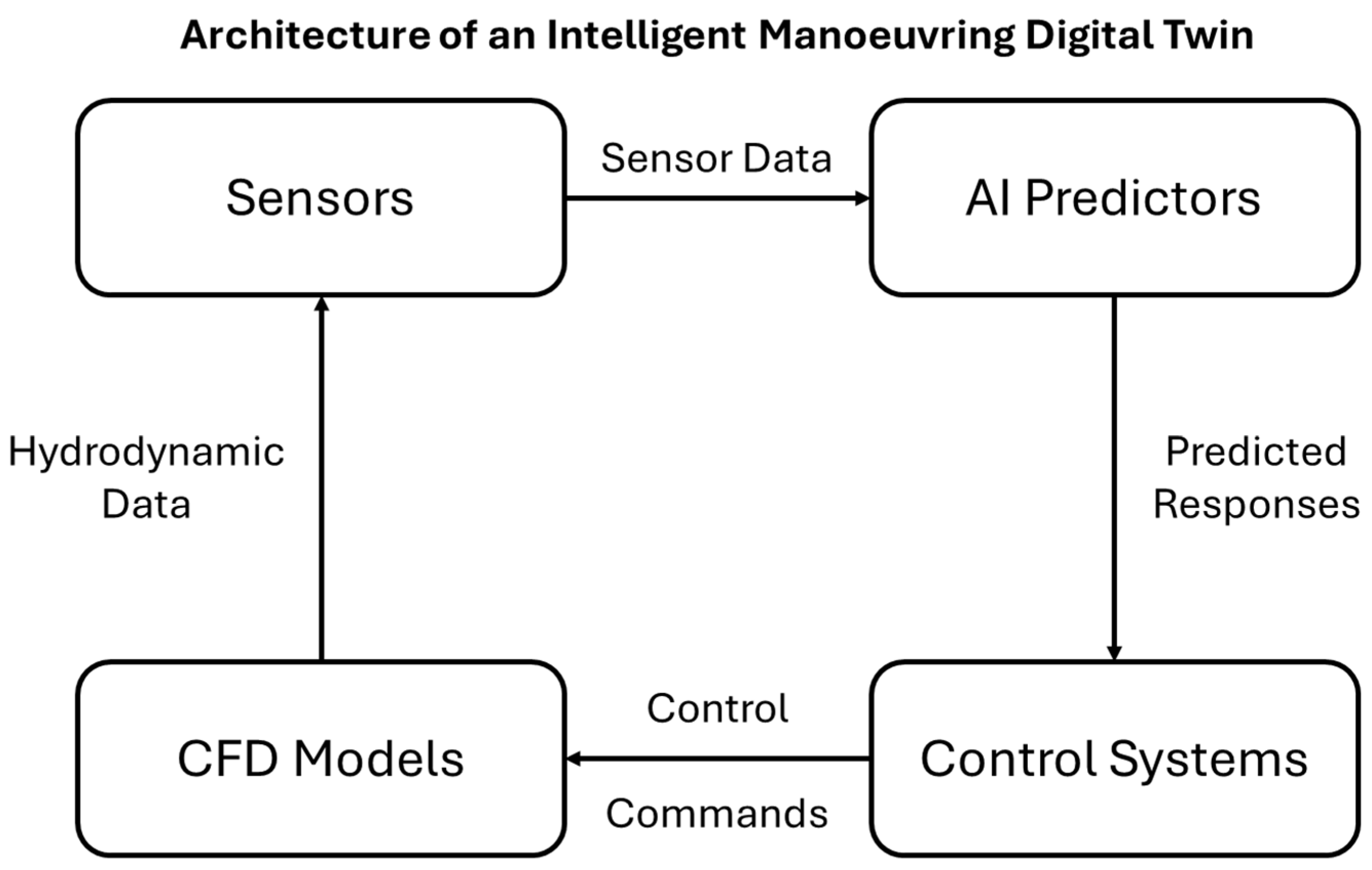
Figure 1. Architecture of an intelligent manoeuvring digital twin.
Jmse 13 02322 g001
Figure 2. Timeline of regulatory evolution, 2010–2025.
Jmse 13 02322 g002
Figure 3. Digital twin for a container ship [33].
Jmse 13 02322 g003
Figure 4. The architecture of the communication of an autonomous ship.
Jmse 13 02322 g004
Figure 5. Conceptual map illustrating how current research themes—hydrodynamic modelling, adaptive control, AI-based prediction, and regulatory reasoning—interact within the emerging field of manoeuvring research. This schematic is intended as an integrative framework for understanding thematic convergence rather than a prediction of a specific future system architecture.
Jmse 13 02322 g005
Table 1. Comparison between First- and Second-Generation Intact Stability Criteria (FGISC vs. SGISC).
AspectFGISCSGISCImpact on Design and Operation
Regulatory BasisEmpirical and experience-based; derived from casualty data and historical performance.Physics- and performance-based; founded on hydrodynamic modelling and probabilistic simulation.Enables objective, vessel-specific assessment of dynamic stability.
Stability Evaluation ApproachFocused on static stability margins in calm water.Addresses dynamic stability in waves, considering nonlinear ship–wave interactions.Improves prediction accuracy under realistic sea conditions.
Failure Modes ConsideredLimited mainly due to loss of transverse stability.Considers five dynamic failure modes: parametric rolling, pure loss of stability, dead ship condition, surf-riding/broaching-to, and excessive accelerations.Expands safety evaluation to include dynamic and operational instabilities.
Assessment LevelsSingle-level compliance check with deterministic thresholds.Multi-layered (Lv1–Lv3) approach: from simplified screening to full Direct Stability Assessment (DSA).Provides flexible fidelity options; balances accuracy and computational cost.
MethodologyStatic righting-arm curves and GM checks.Time-domain nonlinear simulations and long-term probabilistic analysis.Shifts from empirical limits to simulation-supported design validation.
Environmental ConsiderationsAssumes calm or idealised sea states.Incorporates realistic wave spectra and environmental variability (North Atlantic scatter diagrams, etc.).Encourages design optimisation for operational environments.
Operational MeasuresAbsent—no explicit operational guidance.Introduces Operational Limitations (OL) and operational guidance (OG) as complementary safety tools.Bridges design with real-time operation; supports dynamic risk management.
ApplicabilityUniform across ship types, often conservative for novel designs.Adaptable to new ship concepts, unconventional hulls, and hybrid propulsion systems.Promotes innovation while maintaining safety margins.
Integration with TechnologyIndependent of onboard or digital systems.Designed for potential coupling with onboard decision support and digital twins.Enables real-time stability monitoring and AI-assisted navigation.
Regulatory StatusMandatory under IMO 2008 IS Code Part A.Currently, interim guidelines endorsed by IMO are under evaluation for future adoption.Encourages trial application and industry feedback before full enforcement.
Table 2. Summary of AI/ML papers for manoeuvring and their applications and limitations.
Grouped PapersMethodApplicationLimitation
SVM-based identification family [84,85,90,121].Support vector machines (static and online)Learning-based hydrodynamic coefficient estimation; real-time steering model identificationKernel sensitivity; limited generalisation to unseen manoeuvres; not suitable for multi-degrees of freedom (DOF) complex dynamics
RBF/Artificial Neural Network (ANN) lightweight neural networks [87,99].RBF NN + feedforward ANNRoll prediction; low-speed manoeuvring controlOverfitting risks; limited predictive horizon; poor interpretability
Neuro-fuzzy and unsupervised hybrids [89,98].ANFIS + clustering + Markov chainsCourse-keeping; regime-shift modellingHeavy tuning; struggles with rare or unexpected behaviours
Gaussian-process and probabilistic ID [91,122].Gaussian processesIdentification + uncertainty quantificationHigh computational cost; difficult scaling to large datasets
Grey-box and physics-informed ID [93,94,104].Hybrid physics + MLPhysically structured identificationDependent on physical priors; computationally heavy
Nonparametric modelling family [95,96,97].Locally weighted learning (LWL), innovation filters, nonlinear regressionData-driven manoeuvring modellingExtrapolation poor outside of training regime; requires tuning
Reinforcement learning for manoeuvre modelling [111,123,124].Proximal Policy Optimisation (PPO), Convolutional Neural Networks (CNNs), DRLManoeuvring in constrained or curved waterwaysRequires large training data; reward instability
Reservoir computing [103].ESNBlack-box predictionHighly sensitive to spectral radius; unstable unless tuned carefully
Deep sequence models [72,92,107,117].RNN, BiLSTM, GRU, NBeatsXAIS prediction; manoeuvre forecastingData-intensive; limited interpretability
Online learning family [115,116].Relevance vector machine (RVM); incremental GMMOnline identification with adaptive updatesSlow training (RVM); cluster drift (GMM)
Hydrodynamic and deep learning hybrids [101,109].Hybrid deep learning + reduced-order model (ROM) + hydrodynamicsDecision support; wave-influenced manoeuvringHigh computational cost; needs quality data
Trajectory prediction and vision AI [113,114,118].Self-supervised deep nets; instance segmentation; transformer AIS modelsAIS-based prediction; segmentation; vision-based manoeuvre analysisRequires extensive AIS/vision datasets; sensitive to noise
Digital-twin family [33,125,126].Grey wolf optimiser (GWO)–kernel extreme learning machine (KELM), transformers, Gaussian Mixture Model (GMM)/Gaussian Mixture Regression (GMR)Digital-twin prediction; port-manoeuvre learningRequires continuous streaming data; high model complexity
Table 3. Summary of manoeuvring-coefficient estimation techniques, typical accuracy, and applications.
MethodDescriptionTypical Error RangeApplications and Advantages
Empirical and Analytical ModelsBased on classical hydrodynamic theory and experimental regression formulas derived from model tests.±10–15%Early-stage design; provides quick approximations but limited accuracy under nonlinear or transient conditions.
CFD-Based Simulation such as RANS, Unsteady Reynolds-Averaged Navier–Stokes (URANS), and Large-Eddy Simulation (LES)Uses computational fluid dynamics solvers to estimate added mass, damping, and control derivatives under defined flow conditions.±5–10%High-fidelity estimation for complex hull forms; captures nonlinear effects and propeller–rudder interactions.
Virtual Captive Tests (VCT)Numerical replication of traditional captive model tests using CFD or hybrid solvers.±4–8%Reduces need for physical model testing; enables broad parametric exploration across speeds and drafts.
System Identification (SI)Derives coefficients from full-scale or model-scale motion data using adaptive or recursive estimation techniques.±5–10%Real-time tuning and onboard calibration; effective under uncertain or variable conditions.
Hybrid Physical–Numerical MethodsCombines CFD or experimental results with simplified mathematical models and control-based corrections.±4–7%Balances computational cost and accuracy; suitable for design optimisation and simulator validation.
AI-Enhanced Estimation (ML/NN)Learns nonlinear relationships between motion inputs and hydrodynamic forces directly from data.±3–6%Predictive and adaptive; ideal for digital-twin integration and real-time control of autonomous vessels.
Frequency-Domain Identification (Spectral Analysis)Uses frequency-response data to estimate added mass and damping with high temporal resolution.±3–5%Provides smooth coefficient transitions for control systems; robust under irregular wave conditions.
Nonparametric/Data-Driven ModelsEmploys regression, Gaussian processes, or ensemble learning to predict coefficients without a predefined physical structure.±3–5%Effective for hybrid propulsion and coupled aero–hydrodynamic systems; adapts to evolving vessel conditions.
Table 4. Summary of manoeuvring–emissions research.
Research Theme and PapersMethods UsedKey FindingsLimitations
Direct Measurement of Manoeuvring Emissions [29,199,218]
  • Full-scale onboard emission measurements during acceleration, deceleration, tight turning, and low-load operation.
  • Portable emissions monitoring systems.
  • Engine-speed and load correlations.
  • Manoeuvring produces disproportionately high NOx and particulate matter (PM) emissions compared with cruising.
  • Dynamic load changes trigger transient spikes invisible in steady-state test cycles.
  • Significant variation between vessel types and operating practices.
  • Limited sample sizes (few ships).
  • Measurements often port- or ship-specific; generalisation is difficult.
  • Lack of simultaneous CFD/engine modelling integration in most studies.
Comparative Emission Factors (EFs) During Manoeuvring [55]
  • Side-by-side comparison of two ships’ operational profiles.
  • Statistical EF estimation under controlled manoeuvring scenarios.
  • Emission factors vary significantly even under similar manoeuvring phases.
  • Vessel design, fuel type, and load response strongly influence manoeuvring emissions.
  • Results limited to two case-study vessels.
  • EF methodology sensitive to transient engine behaviour.
Fuel-Switching and Manoeuvring Scenarios [180]
  • Coupled engine–dispersion modelling.
  • Scenario analysis of manoeuvre-to-manoeuvre emissions.
  • Fuel-switch timing near ports strongly affects local PM/NOx dispersion.
  • Manoeuvring strategy and approach direction alter concentration hotspots.
  • Dispersion models rely on assumed meteorological stability.
  • Fuel-switch timing varies among crews and fleets.
Port-Level Emission Inventories [46,53,120,198,205,206,210,211,219,220]
  • AIS-based activity modelling.
  • Operational mode segmentation (cruise, manoeuvring, hoteling).
  • Engine power–load curve estimation.
  • Operation-mode emission factor integration.
  • Geographic information systems (GIS)-based mapping and population exposure estimates.
  • Manoeuvring represents a small time share but a disproportionately high NOx/PM share.
  • Port geometry and traffic density influence emission hotspots.
  • Review identifies manoeuvring as a major uncertainty in port inventories.
  • Spatial structure (narrow bays and estuaries) amplifies manoeuvring emissions.
  • Load assumptions are often generic.
  • Rarely validated with real onboard measurements.
  • Spatial and temporal resolution vary between studies. Regional differences limit transferability of EF-based models.
  • Rarely include engine transient-response modelling.
Manoeuvring in Sensitive Environments [212,213]
  • Ambient measurements with low-cost sensors.
  • Linking cruise schedules and manoeuvring trajectories to local PM.
  • Manoeuvring in constrained or sensitive regions (fjords and bays) produces measurable spikes in pollutant exposure.
  • Temporal alignment between manoeuvres and PM peaks is strong.
  • Limited temporal coverage.
  • Sensor accuracy varies; not all pollutants are measured.
Operational Optimisation for Cleaner Manoeuvring [101,215]
  • Decision-support algorithms.
  • Fuzzy logic optimisation.
  • Scenario-based speed optimisation.
  • Manoeuvring duration can be reduced without compromising safety.
  • DSS tools enable more consistent and energy-efficient approaches.
  • Fuzzy IoT supports real-time eco-navigation.
  • Case-study specific; generalisation requires multi-port trials.
  • Regulatory adoption remains limited.
Decarbonisation Metrics and Manoeuvring Behaviour [216]
  • Data-driven modelling.
  • Linking operational phases to CII metrics.
  • Manoeuvring behaviour affects CII more strongly than assumed.
  • Idle waiting and inefficient approaches degrade carbon performance.
  • CII model simplified; does not include wind, waves, or congestion dynamics.
Environmental Effects Beyond Air Emissions [202,217]
  • Coupled manoeuvring simulation + MIKE 3 hydrodynamics.
  • Tug-assisted manoeuvres resuspend seabed sediments, affecting turbidity and water quality.
  • Environmental footprint of manoeuvring extends beyond emissions.
  • Local hydrodynamic assumptions limit generalisation.
Disclaimer/Publisher’s Note: The statements, opinions and data contained in all publications are solely those of the individual author(s) and contributor(s) and not of MDPI and/or the editor(s). MDPI and/or the editor(s) disclaim responsibility for any injury to people or property resulting from any ideas, methods, instructions or products referred to in the content.