Article

Study on Combustion Characteristics of Compression Ignition Marine Methanol/Diesel Dual-Fuel Engine


College of Merchant Marine, Shanghai Maritime University, Shanghai 201306, China
*
Author to whom correspondence should be addressed.
J. Mar. Sci. Eng. 2025, 13(11), 2213; https://doi.org/10.3390/jmse13112213
Submission received: 29 October 2025 / Revised: 14 November 2025 / Accepted: 19 November 2025 / Published: 20 November 2025
(This article belongs to the Special Issue Advanced Technologies for New (Clean) Energy Ships—2nd Edition)

Abstract

With the increasing global demand for environmental protection and sustainable energy utilization, methanol, as a clean and renewable fuel, has become a research focus in the field of marine engines. However, its application in compression ignition engines faces bottlenecks such as low combustion efficiency and poor stability. Taking the L23/30H marine diesel engine as the research object, this paper establishes a combustion simulation model for a methanol/diesel dual-fuel direct-injection engine. The reliability of the model is ensured through grid independence verification and model calibration, and a coupled chemical reaction kinetic mechanism containing 126 species and 711 elementary reactions is constructed. A systematic study is conducted on the effects of injection strategies, including fuel operating modes, spray development patterns, injection intervals, and injection timing, on combustion characteristics. The results show that under the optimized injection strategy (vertical cross spray + synchronous injection) proposed in this study and operating conditions with a high methanol substitution ratio, the combustion efficiency, dynamic performance, and soot emission control effect of the dual-fuel mode are superior to those of the pure diesel mode. Simulation results show that the combined strategy of vertical cross injection and synchronous injection can significantly increase the indicated thermal efficiency (ITE) by 3.2%, reduce the brake specific fuel consumption (BSFC) by approximately 4.5%, advance the peak heat release by 2 °CA, and remarkably improve the combustion efficiency, while earlier injection timing is beneficial to air–fuel mixing. Further comparison of combustion and emission characteristics under different boundary conditions such as methanol energy ratios and injection pressures reveals that increasing methanol injection pressure, compression ratio, and initial pressure can improve combustion uniformity and reduce soot emissions, but NOx emissions increase, which requires the coordination of after-treatment technologies. Through the comprehensive optimization of multiple parameters, efficient and clean combustion under a high methanol substitution rate is achieved. This paper provides theoretical support and practical guidance for the technological development of marine methanol dual-fuel engines. In the future, industrial applications can be promoted by combining actual engine tests and after-treatment technologies.

1. Introduction

Against the backdrop of the global carbon neutrality goal and the IMO 2050 Net-Zero Emission Strategy [1,2], constructing a three-dimensional collaborative system of “fuel substitution-technological innovation-system optimization” has gradually become the dominant path for industrial emission reduction [3,4]. As a low-carbon oxygenated fuel, methanol is emerging as an important research direction in the marine power sector due to its unique advantages and sustainability. The application of methanol in marine power is mainly realized through dual-fuel injection systems, and combining with diesel pilot ignition strategy can effectively improve thermal efficiency and control emissions. With the advancement of the IMO 2050 net-zero emission target [5], methanol has been listed by the International Maritime Organization (IMO) as one of the most promising third-generation clean fuels due to its technical maturity, economic viability and environmental benefits [6,7]. In the future, it is necessary to further optimize injection strategies and aftertreatment technologies to balance NOx emissions and combustion efficiency, thereby promoting the green transition of the shipping industry.
In the dual-fuel operation mode, the methanol substitution rate or its proportion in the total energy exerts multi-dimensional and complex impacts on the overall performance of the engine. Such impacts are not a simple linear relationship, but exhibit significant differences with the change in the substitution rate and the variation in engine operating conditions. Numerous scholars have conducted systematic research. Li et al. [8] proposed four cold-start and warm-up strategies for methanol engines: motor cranking, motor cranking coupled with exhaust gas recirculation (EGR), motor cranking coupled with exhaust control, and motor cranking coupled with both EGR and exhaust control.
Suijs et al. [9] constructed a knock intensity prediction and evaluation framework suitable for large-bore methanol engines based on the knock knowledge of small-scale methanol engines. They systematically evaluated the performance of five conventional knock indicators: MAPO (Maximum Amplitude of Pressure Oscillation), IMPO (Integral of Maximum Pressure Oscillation), AE (Acoustic Emission), MVTD (Maximum Volumetric Turbulence Dissipation) on a methanol-diesel medium-speed engine with a bore of 256 mm under 50%, 75%, and 87.5% load conditions. Bayraktar et al. [10] obtained a 40-day navigation data report of an ocean-going container ship as the analysis basis and evaluated two methanol engine modification schemes with different power outputs (ME1 with lower power and ME2 with higher power). Duan et al. [11] experimentally investigated the influence laws of injection timing and ignition timing on combustion characteristics, performance, and emission indicators in a high-compression-ratio direct-injection spark-ignition methanol engine. The experiments were conducted under two intake pressures (65 kPa and 87 kPa) and a constant speed of 1500 rpm. Wang et al. [12] further improved the engine’s diluted combustion performance by blending cracked methanol gas and optimizing the diluent working fluid. Under the same dilution ratio, increasing the blending ratio of cracked methanol gas and reducing the EGR ratio in the diluent working fluid could advance the CA10, CA50, and CA90 phases, reduce HC emissions and brake specific fuel consumption (BSFC), and broaden the diluted combustion boundary, but it would also lead to an increase in nitrogen oxide (NOx) emissions. Zhou et al. [13] comprehensively evaluated the potential of methanol for energy conservation and emission reduction in the transportation field by systematically reviewing its physicochemical properties and preparation processes, the cold-start problem of methanol engines, as well as emission and combustion characteristics. Zhang et al. [14] aimed to improve engine efficiency by increasing the compression ratio and adopting the Miller cycle based on a methanol engine with a compression ratio of 9.5:1. Experimental studies analyzed the engine’s combustion and emission characteristics under different operating conditions. Increasing the compression ratio would raise the in-cylinder pressure, maximum pressure rise rate, and cycle-to-cycle variation, thereby increasing the knock tendency, but the Miller cycle could effectively alleviate this phenomenon while reducing pumping losses.
Li et al. [15] adopted a genetic algorithm to simultaneously optimize injection parameters and injector layout, aiming to achieve the goals of efficient combustion and low emissions. Through sensitivity analysis, they identified the key influencing parameters: initial in-cylinder temperature at intake valve closure, methanol blending ratio, injection timing, and injector position. Cung et al. [16] conducted experimental research on a dual-fuel combustion mode (marked as RMDF) that adopts port-injected methanol and direct-injected renewable diesel. The experiments were carried out on a heavy-duty single-cylinder engine equipped with a combustion and emission measurement system, focusing on analyzing the engine’s thermal efficiency as well as soot and nitrogen oxide emission characteristics. Cesur et al. [17] conducted experimental studies on the performance and emission characteristics of methanol-gasoline blended fuel in an engine with partially insulated coated pistons. Furthermore, they developed an artificial neural network model based on experimental data to predict the engine performance and emission parameters of the blended fuel. Yang et al. [18] explored the influence of EGR rate on engine performance under three different ammonia/methanol blending ratios through simulation studies. Moreover, increasing the methanol blending ratio in the fuel can effectively alleviate the adverse effects caused by EGR technology. Yu et al. [19] systematically analyzed the combustion development process, formation mechanism of unconventional pollutants, and the influence laws of methanol pilot injection timing and pilot injection ratio on engine performance through numerical simulation methods. Purayil et al. [20] investigated the effects of ethanol-gasoline and methanol-gasoline blended fuels on the performance of lean-burn spark-ignition engines, as well as the hydrogen knock limit of the engine under hydrogen-rich conditions. The experimental setup adopted a combined scheme of direct injection of liquid blended fuel into the cylinder and hydrogen injection through the intake port.
However, the aforementioned studies [21,22,23,24,25,26,27,28,29] have not laid a foundation for innovations in methanol/diesel dual-fuel injection methods, and are deficient in research on combustion and emission characteristics under high methanol substitution rates [30,31,32,33,34,35]. Given that the original engine is designed for diesel combustion conditions, the advantages of the dual-fuel mode need to be achieved through injection system matching and operating parameter optimization. Such advantages may not be fully realized under unoptimized operating conditions. For the first time, this study focuses on the domesticated MAN L23/30H engine model, establishing a dual direct injection CFD simulation model suitable for high methanol substitution ratio. The proposed optimization strategy provides an engineering technical reference path for the dual-fuel modification of similar engine models. Taking marine engines as the research object, this paper focuses on the optimization of injection strategies for methanol/diesel dual direct-injection technology under high methanol substitution rates, and specifically conducts three aspects of research: first, establish and validate a diesel engine combustion simulation model through grid independence verification, and couple the chemical reaction kinetic mechanisms of methanol and diesel to build a computational fluid dynamics (CFD) combustion simulation model for dual-fuel engines; second, compare the combustion characteristics between the dual-fuel mode and the pure diesel mode, explore the influence laws of different spray development patterns, injection intervals, and injection timings on mixture formation and combustion efficiency, and screen the optimal injection parameters; third, analyze the action mechanisms of key parameters such as methanol substitution rate, injection pressure, and compression ratio on combustion and emission characteristics, and determine the optimal parameter combination for achieving efficient and clean combustion under high methanol energy ratios through comprehensive optimization of multiple parameters, so as to provide support for the technological breakthrough of marine methanol dual-fuel engines.

2. Numerical Model and Validation

2.1. Engine Operating Parameters

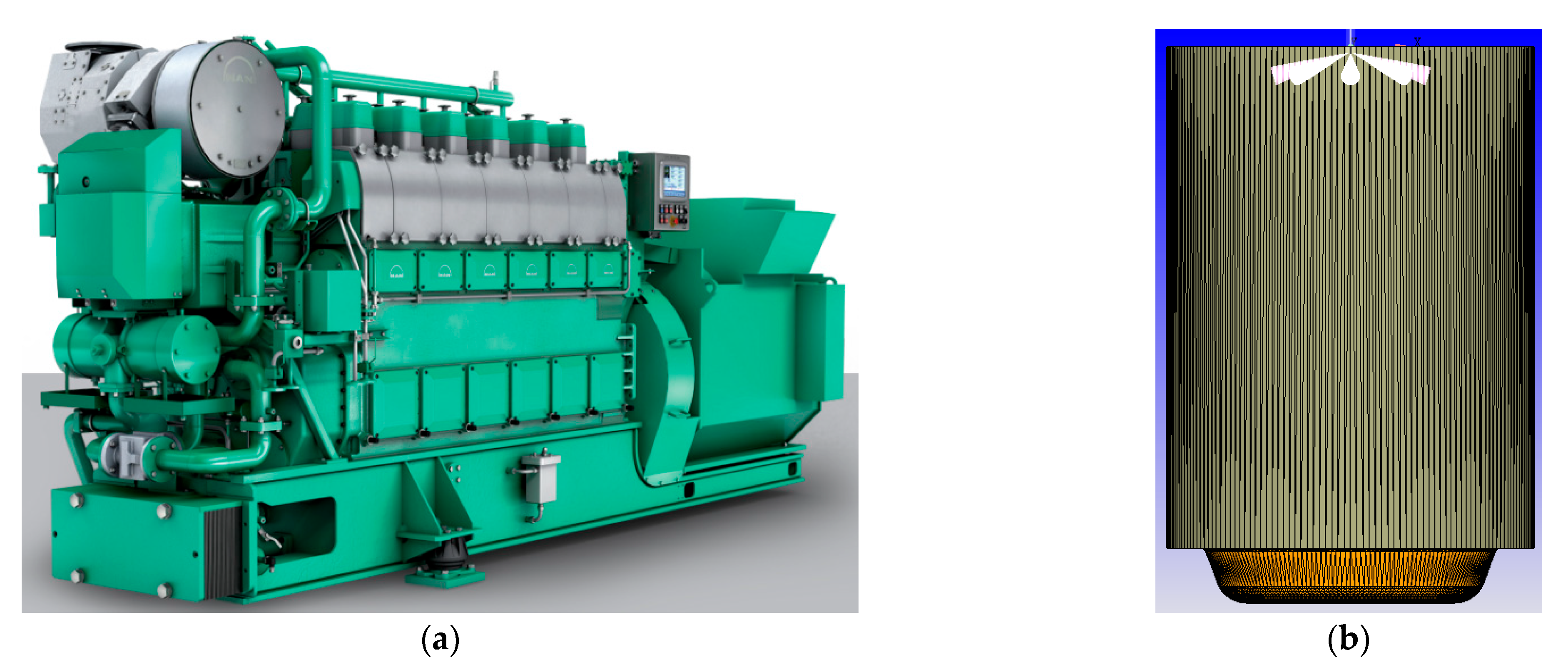
A domestic marine diesel engine (ZC Diesel Engine Co., Ltd., Zibo, China) with reference to the MAN L23/30H technical specifications. In this study, a 6-cylinder model is selected for simulation and verification. As a mainstream configuration of the MAN L23/30H series, the core technical parameters of this model exhibit typical representativeness. in China, served as the test unit for this study. Key specifications of this large-bore power plant are detailed in Table 1. It is equipped with a common rail injection system, an electronically controlled hydraulic injection mechanism, and a secure, dependable fuel delivery system. For air charging, the L23/30H employs a single-stage turbocharger (Model ABB A165-L, supplied by ABB in Baden, Switzerland) paired with a single-stage water-cooled intercooler (Model KLQ50H, ZC Diesel Engine Co., Ltd.). Figure 1 shows a schematic diagram of the MAN L23/30H series engine, which is not the actual test engine used in this research.

2.2. Setup of Initial and Boundary Conditions

In this study, CONVERGE CFD 3.0 is adopted. The solver employs the finite volume method coupled with the Pressure Implicit with Splitting of Operators (PISO) algorithm, and the time step is set to 0.1 °CA, which can meet the temporal resolution requirements of the spray and combustion processes. During the numerical simulation process, reliable boundary conditions can make the simulation converge more rapidly and the numerical results more credible. Table 2 presents the setup of initial and boundary conditions in the simulation, where the boundary conditions include the temperatures of the cylinder head bottom surface, piston top surface, and liner surface—these three surfaces constitute all the curved structures enclosing the combustion chamber. The initial conditions of the computational domain refer to the initial state of the combustion chamber at the start of the simulation, i.e., the initial values of temperature, pressure, and turbulent kinetic energy in the combustion chamber at −156 °CA.

2.3. Verification of Grid Independence for Geometric Model

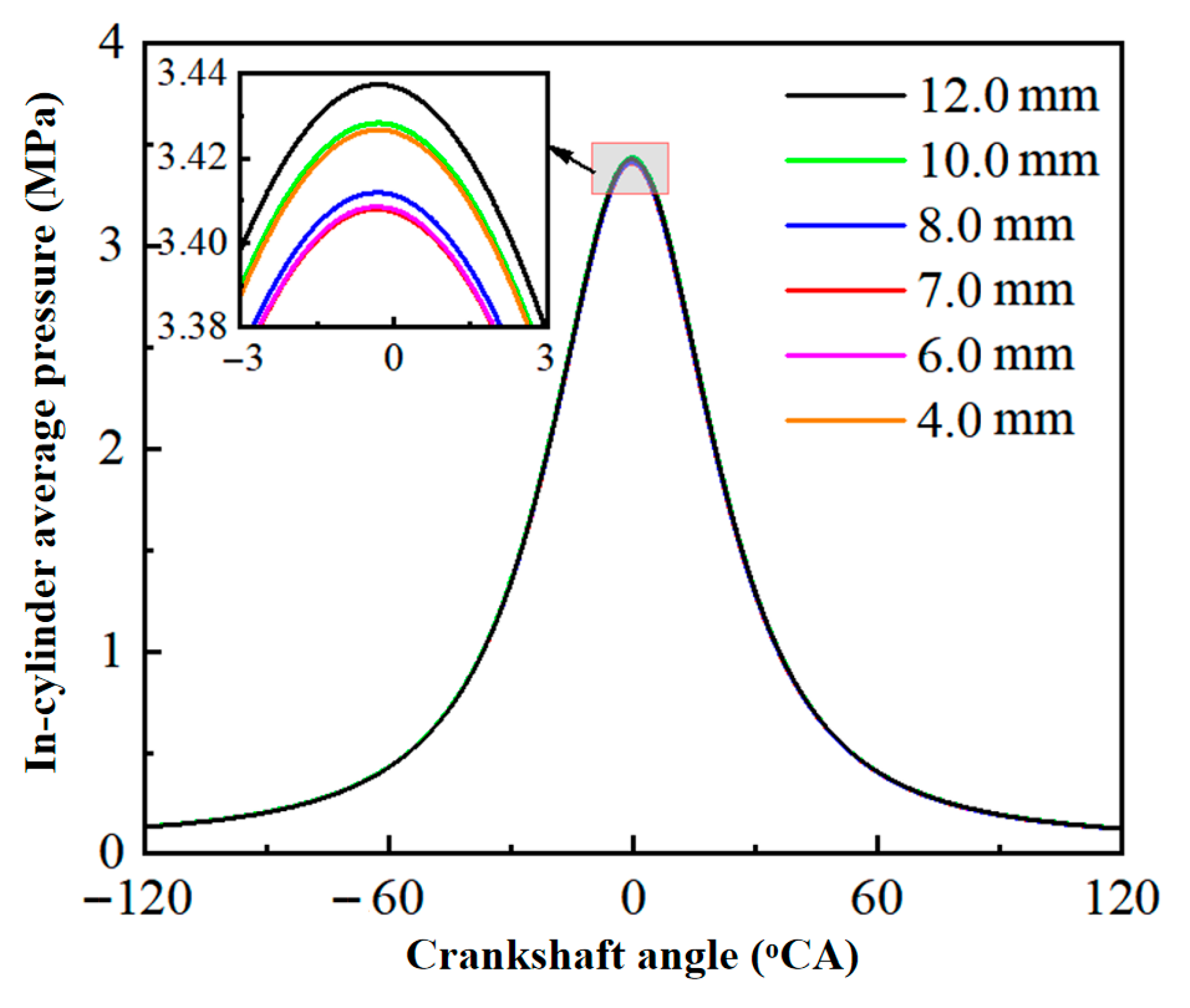
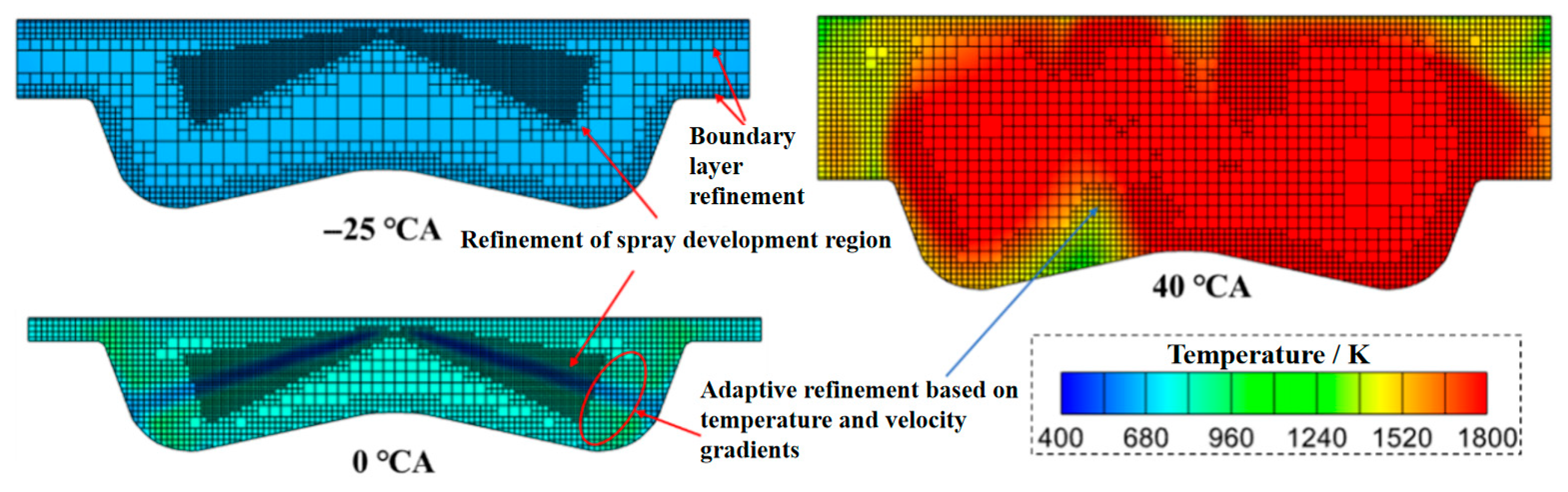
Since Converge does not allow direct and precise control of the number of grid cells in the geometric model, this paper adopts a method based on different base grid sizes to conduct grid independence verification. As the fuel injection and combustion processes are highly sensitive to grid size, the basic grid independence verification is performed without fuel injection and combustion processes to decouple the relationship between grid size and these two processes. Only the compression and expansion processes of the piston are simulated, with an initial piston pressure of 0.1 MPa. The results of the basic grid independence verification are shown in Figure 2. With the decrease in grid size, the peak pressure inside the combustion chamber gradually decreases. When the base grid size is less than 6.0 mm, the peak pressure gradually increases. This indicates that both excessively large and excessively small grid sizes may lead to deviations from the true value. Notably, the simulation results for grid sizes of 7.0 mm and 6.0 mm almost overlap, suggesting that these two sizes do not introduce significant errors into the simulation results. To ensure computational accuracy while maintaining efficiency, a larger grid size is selected for model discretization. Therefore, a base grid size of 7.0 mm will be adopted for the numerical simulation work. Based on the baseline mesh size of 7.0 mm, 3-level fixed mesh refinement is adopted for the spray development region (final mesh size: 0.875 mm), and 2-level fixed mesh refinement is applied to the boundary layer (final mesh size: 1.75 mm). Meanwhile, 2-level adaptive mesh refinement is implemented for regions with a temperature gradient > 2.5 K or a velocity gradient > 0.1 m/s, ensuring that the mesh resolution of the ignition zone (temperature gradient > 100 K/mm) and the spray core region (concentration gradient > 0.1 kg/m4) meets the simulation requirements.
Among the fixed and adaptive refinement strategies, fixed refinement is applied to the boundary layer and spray development region. The fixed refinement level for the boundary layer is 2, and for the spray development region is 3. This means that under a base grid size of 7.0 mm, the grid size of the boundary layer is 1.75 mm, and that of the spray development region is 0.875 mm. During the spray development and combustion processes, some regions may have large velocity and temperature gradients, and oversized grids are not conducive to capturing simulation details. Therefore, 2 levels of refinement are implemented for regions with a velocity gradient greater than 0.1 m/s and a temperature gradient greater than 2.5 K. The mesh generation situations under different crankshaft angles after refinement are shown in Figure 3. At −25 °CA, although fuel injection has not yet started, the grid in the spray development region is activated to ensure a smooth calculation process, showing a certain number of refined grids in the spray and boundary layer regions. At 0 °CA, since the combustion process has begun, a certain number of adaptively refined grids appear between the spray and the boundary layer. At 40 °CA, the fuel injection process has ended, and the adaptive refinement strategy for the spray development region is deactivated, switching to the fixed refinement strategy for the boundary layer and the adaptive refinement strategy based on temperature and velocity.

2.4. Original Machine Cylinder Pressure Verification

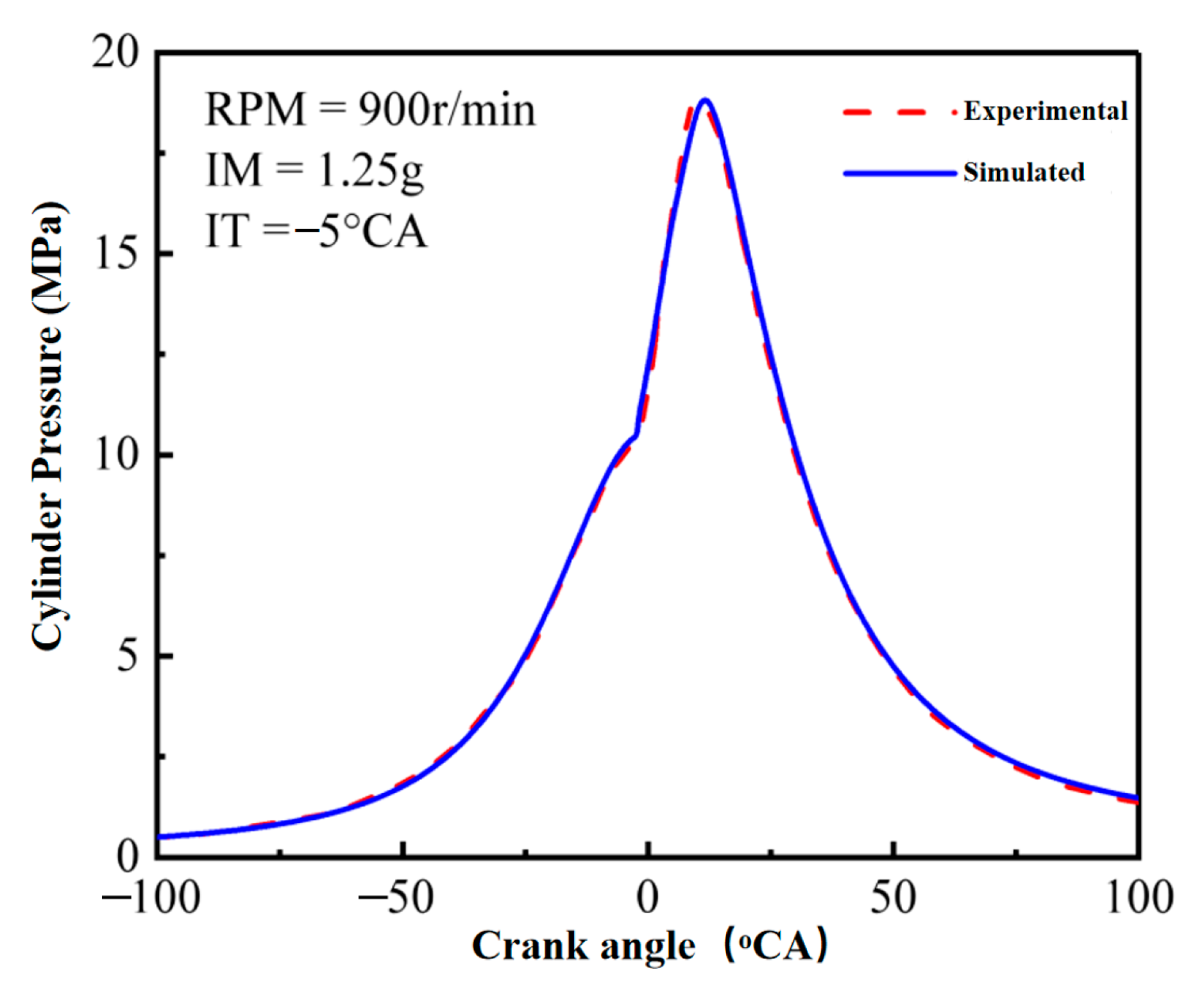
Grid independence verification can ensure the accuracy of the model’s geometric motion and the reliability of grid generation. The RNG κ-ε model is selected to describe the in-cylinder turbulence field (Han et al. [36]). Compared with the standard κ-ε model, this model exhibits better adaptability to rotating flows and strong shear flows, which is more consistent with the in-cylinder turbulence characteristics of marine diesel engines. However, the reliability of key phenomena (including droplet breakup during fuel injection, turbulence development during mixture formation) and simulation models involved in the combustion process (such as droplet breakup model, turbulence model, and combustion model) still needs further verification. This study conducts simulation verification on the droplet breakup, evaporation, and combustion processes of diesel fuel in the original engine combustion chamber. The data used for simulation is provided by Zhenjiang CSSC Power Co., Ltd. (Zhenjiang, China), and the simulation model is validated using the in-cylinder average pressure curve measured from engine performance experiments. The temperature of the cylinder head bottom surface (550 K) and the piston top surface (450 K) are derived from the bench test measured data of the Zibo ZC 6-cylinder engine conducted by the research team. The cylinder liner temperature (500 K) refers to the wall temperature range under steady-state operating conditions recommended in the MAN L23/30H technical manual, which is consistent with the boundary condition settings of marine diesel engines reported by Han et al. [36]. As shown in Figure 4, under standard operating conditions (engine speed: 900 r/min, diesel injection mass: 1.25 g, injection timing: −5 °CA), the error between the experimental values and simulation results is small. In addition, the simulated in-cylinder pressure rise history is in good agreement with the experimental results, indicating that the SAGE combustion model can accurately capture the ignition timing and mixture combustion duration observed in the experiments.

2.5. Construction and Validation of Methanol/Diesel Dual-Fuel Chemical Reaction Kinetic Mechanism

Since this paper conducts numerical simulation on the working process of a methanol/diesel dual-fuel engine and adopts the SAGE combustion model coupled with chemical reaction kinetics to solve and calculate the dual-fuel combustion process, a reliable methanol/diesel dual-fuel chemical reaction kinetic mechanism is the foundation for accurately simulating the working process of the dual-fuel engine. Summary of the Physical Models is shown in Table 3.
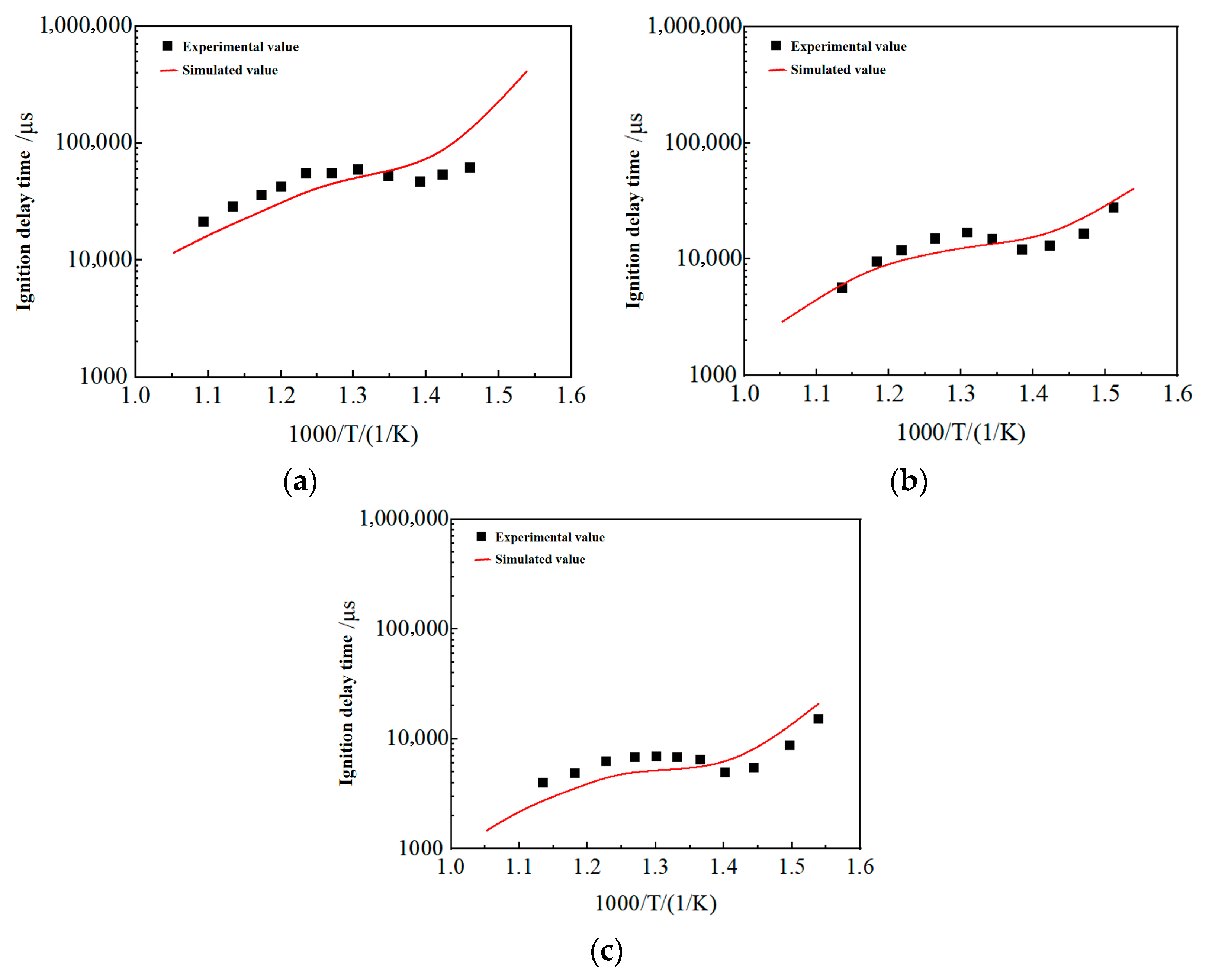
To verify the accuracy of the methanol/diesel dual-fuel chemical reaction kinetic mechanism model proposed in this paper, mechanism verification was conducted based on the dual-fuel methanol/diesel ignition delay period test data from Zhu et al. [44]. Under the condition of 50 mol% methanol blended with 50 mol% diesel, the comparison between experimental and simulation results at different temperatures and equivalence ratios is shown in Figure 5. It can be observed that the methanol/diesel dual-fuel chemical reaction kinetic mechanism model can well capture the evolution of the ignition delay period of methanol/diesel dual fuel in the negative temperature coefficient (NTC) region. The methanol/diesel dual-fuel chemical reaction kinetic mechanism model constructed in this paper can be coupled with CFD to carry out numerical simulation of the combustion process of methanol/diesel dual-fuel engines.

2.6. Establishment of Simulation Model for Methanol-Diesel Dual-Fuel Engine

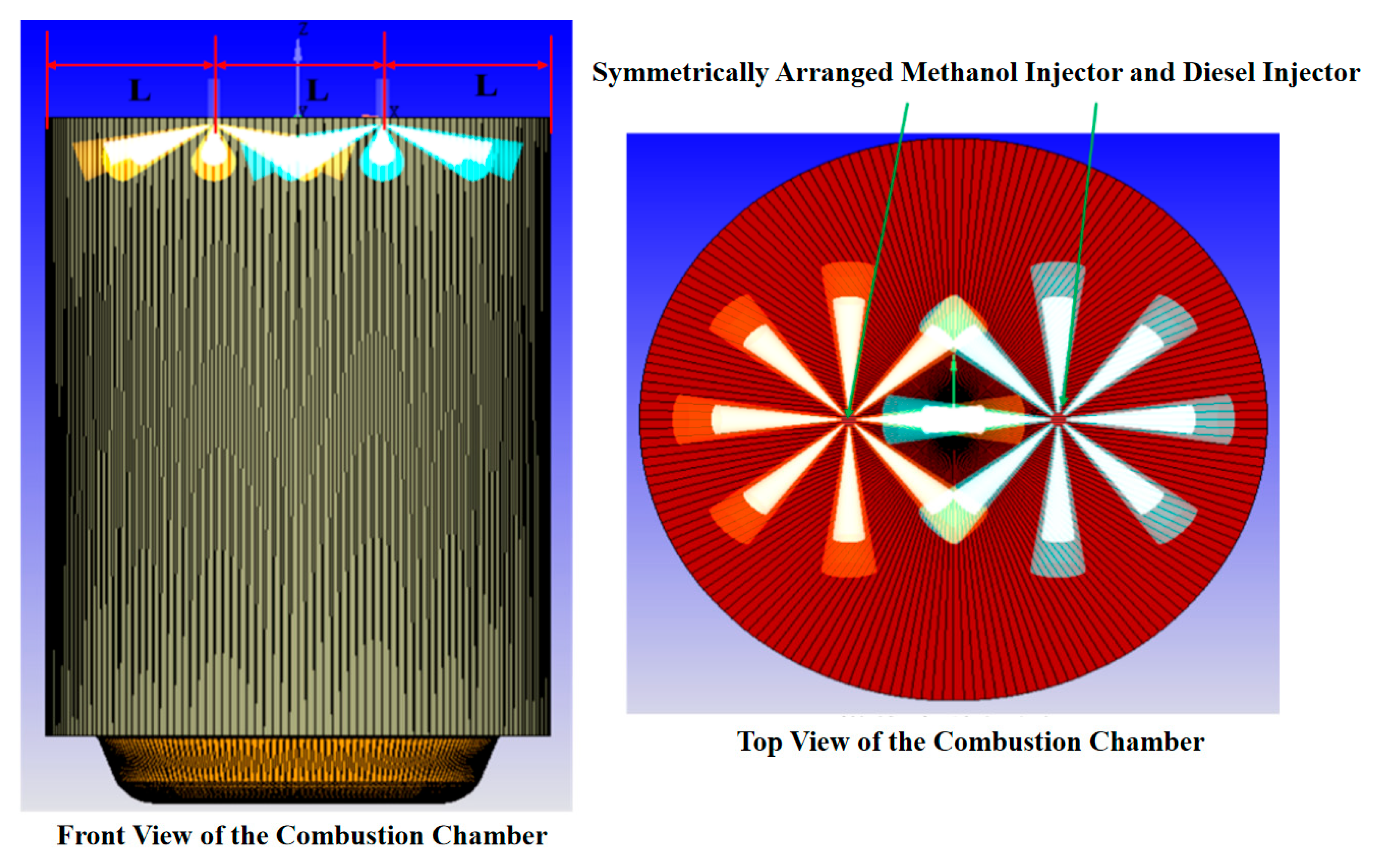
The vertical cross spray mode can increase the peak turbulent kinetic energy in the cylinder to 48 m2/s2, which is 50% higher than that of the impinging spray mode. It significantly enhances the mixing rate of fuel and air, reduces the local concentration gradient by 25%, and thus improves combustion uniformity and combustion efficiency. Figure 6 shows the positions of the methanol and diesel injectors. The methanol injector and diesel injector are respectively located at 1/3 of the cylinder bore diameter, symmetrically arranged relative to the center of the combustion chamber. The number of nozzles and nozzle angle of the methanol injector are consistent with those of the diesel injector, being 8 nozzles and 140°, respectively. Since methanol has a lower calorific value, more fuel needs to be injected to achieve the same heat release at the same injection pressure. To ensure a certain injection duration and injection pressure, a larger nozzle flow area is required. The latent heat of vaporization of methanol (1101 kJ/kg) is much higher than that of diesel (270 kJ/kg). During the mixture formation process, it absorbs heat in the cylinder, resulting in a local temperature decrease of approximately 30–50 K and thus prolonging the initial ignition delay period. However, the vertical cross spray mode enhances the turbulent mixing effect, accelerates the diffusion and growth of ignition cores, effectively offsets the negative effect caused by the latent heat of vaporization, and ultimately shortens the combustion duration by 14.3%.The lower heating value (LHV) of methanol is 19.66 MJ/kg with a density of 793 kg/m3, while the LHV of diesel is 42.5 MJ/kg with a density of 840 kg/m3. The diesel injector has 8 nozzles with a diameter of 0.33 mm and an injection quantity of 1.25 g. Based on the differences in LHV and density between methanol and diesel, the nozzle diameter of the methanol injector can be calculated as 0.492 mm with an injection quantity of 2.70 g. In other words, under the same injection pressure and injection pulse width, the methanol injected by an 8-nozzle injector with a nozzle diameter of 0.492 mm can achieve the theoretical heat release equivalent to that of the pure diesel mode. The dual direct injection configuration of diesel and methanol has formed a mature application paradigm in mainstream marine dual-fuel engines. Among them, the MAN ME-GI dual-fuel engine adopts a natural gas/diesel dual direct injection technical architecture, achieving stable combustion through the collaborative design of high-pressure direct injection and pilot injection. The WinGD X-DF engine adapts to the needs of multi-fuel combination with a flexible fuel ratio logic, and the 50:50 energy ratio configuration adopted in this study refers to the fuel ratio optimization idea of the WinGD X-DF engine. The design of the dual direct injection structure in the simulation fully absorbs engineering practice experience: the methanol and diesel injectors are symmetrically arranged at 1/3 of the cylinder bore from the center of the combustion chamber. The number of nozzles (8 holes) and injection angle (140°) are derived from the actual dual-fuel modification scheme of Zibo ZC Diesel Engine Co., Ltd., and the injector selection strictly follows the engineering standards of Bosch dual-fuel injectors to ensure structural compatibility and operational reliability. To address the difference in lower heating value between the two fuels, dynamic matching of heat release is achieved by precisely adjusting the nozzle diameter (methanol: 0.492 mm, diesel: 0.33 mm). This design logic has passed the preliminary engineering review of a Chinese marine engine manufacturer, further verifying the engineering feasibility and application potential of the dual direct injection configuration.

3. Results and Discussion

3.1. Comparison of Engine Performance Under Different Operating Modes

In this study, the mixture formation process, combustion process, and emission process of the engine under three fuel operating modes—pure diesel, 50% methanol energy ratio, and 50% methanol mass ratio—are compared to explore the influence of different fuel proportions on engine performance. The reasons for selecting the above three fuel operating modes for comparison are as follows: As a traditional fuel mode for marine engines, the pure diesel mode has been extensively studied and verified in terms of its combustion and emission characteristics. Selecting the pure diesel mode as a benchmark allows comparison with the performance under other co-firing modes, thereby more intuitively evaluating the impact of methanol co-firing on engine performance. Under the 50% methanol energy ratio mode, the total heat release of methanol and diesel is consistent with that under the pure diesel mode, ensuring the same total energy input to the engine under different co-firing modes, which facilitates the comparison of the effects of different co-firing modes on combustion efficiency and emission characteristics. Under the 50% methanol mass ratio mode, the mass ratio of methanol to diesel is maintained at 1:1, which is convenient for studying the impact of methanol co-firing on the engine’s combustion process and emission characteristics from the perspective of mass proportioning. The calculation methods for the methanol energy ratio and methanol mass ratio are shown in Equation (1) and Equation (2), respectively. Table 4 provides a detailed description of the fuel proportions under different operating modes.
α = M m · L H V m / M m · L H V m + M d · L H V d
β = M m / M m + M d
where M denotes the fuel mass, LHV denotes the lower heating value of the fuel; the subscript m denotes methanol, and the subscript d denotes diesel.
On the basis of the above fuel injection quantities, the injection start timing and injection pressure of the two fuels are kept unchanged. The methanol and diesel injection strategies under different operating modes are shown in Table 5.

3.1.1. Mixture Formation Process

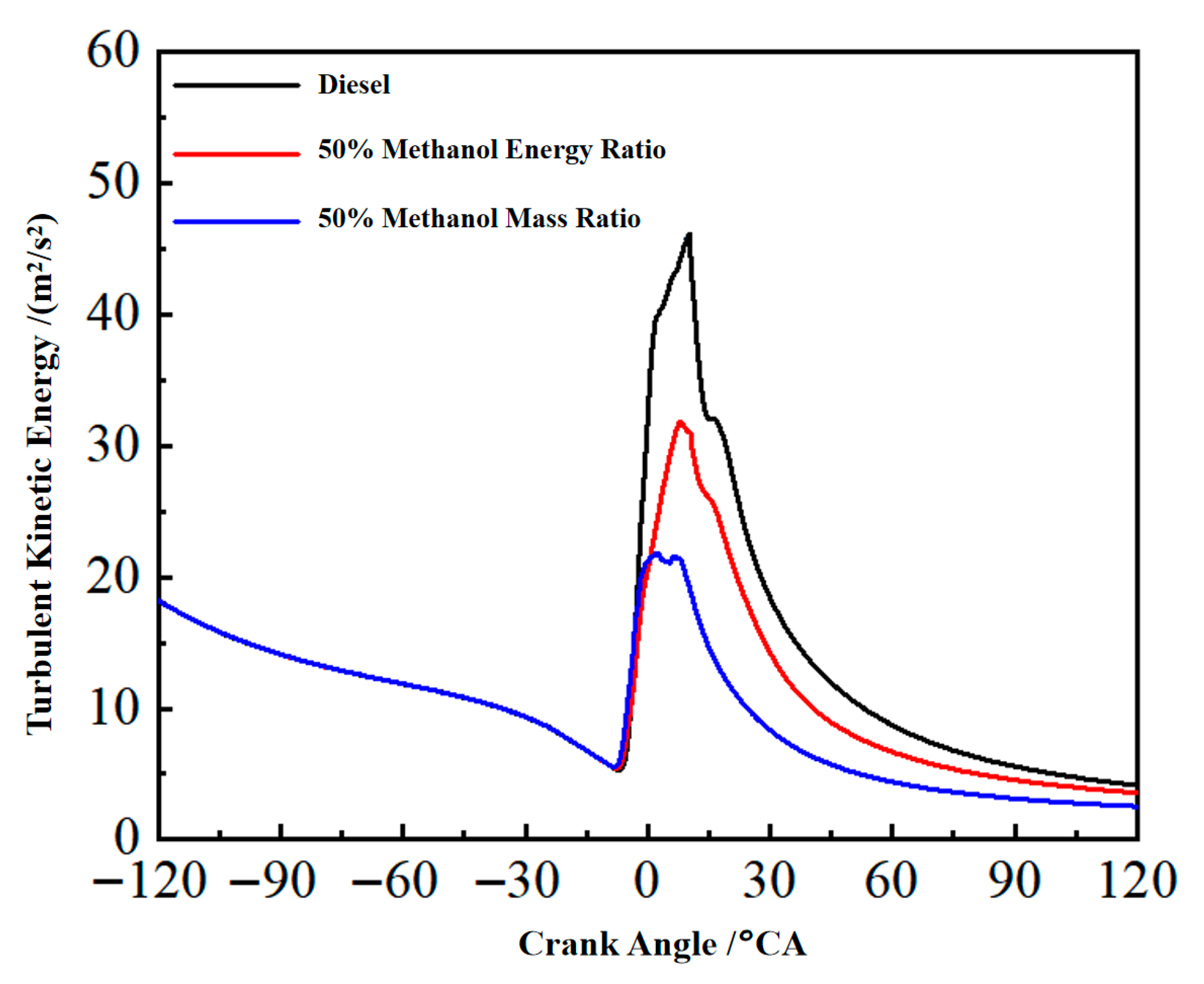
Turbulent kinetic energy refers to the kinetic energy generated by irregular turbulent flow in fluid motion. The development of in-cylinder turbulent kinetic energy under different operating modes is shown in Figure 7. Since the fuel injection start timing is consistent across different operating modes, the timing of turbulent kinetic energy increase caused by fuel injection is the same. Due to the higher injection pressure of diesel, the peak turbulent kinetic energy in the pure diesel mode is higher than that in the dual-fuel modes, reaching approximately 45 m2/s2. Among the dual-fuel modes, the methanol injection mass in the 50% methanol energy ratio mode is higher than that in the 50% methanol mass ratio mode, resulting in a longer injection duration and thus a higher peak turbulent kinetic energy in the 50% methanol energy ratio mode. After the end of fuel injection, the spray momentum attenuates significantly, and the turbulent kinetic energy begins to decrease.
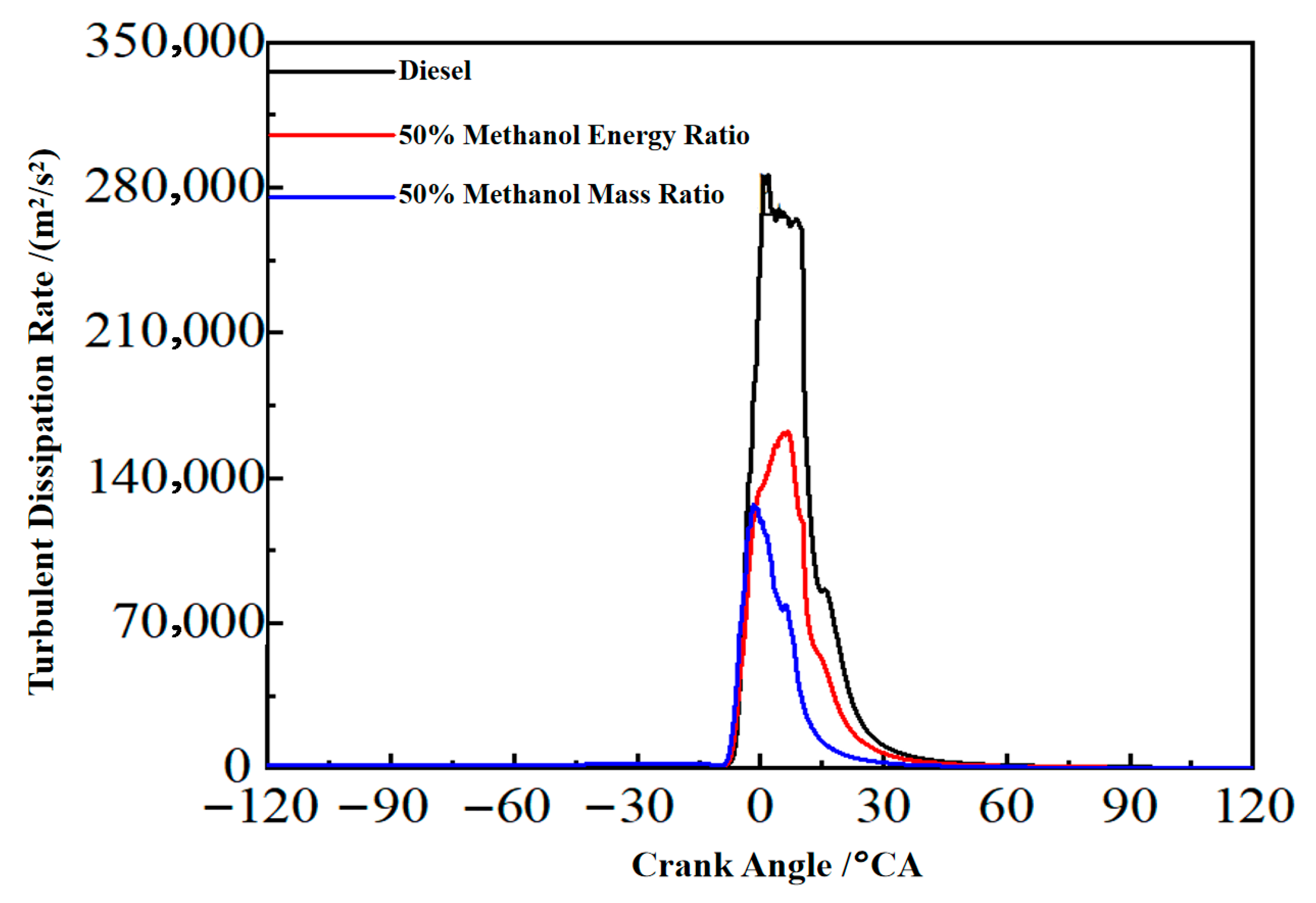
Figure 8 shows the variation trend of turbulent dissipation rate under different operating modes. The turbulent dissipation rate curve of diesel exhibits an obvious sharp peak, which appears at a crank angle close to 0 °CA (crank angle) and reaches approximately 280,000 m2/s3. The curve of the 50% methanol energy ratio also has a sharp peak, but the peak value is slightly lower than that of diesel, about 200,000 m2/s3. In contrast, the curve of the 50% methanol mass ratio has a lower peak value (approximately 140,000 m2/s3) and is relatively flat overall. This indicates that the turbulence intensity changes most drastically during the mixture formation stage of diesel, and the turbulent dissipation rate decreases significantly after the mixture ignites. The differences in the variation in turbulent dissipation rate are mainly attributed to two aspects: one is the difference in spray momentum under different operating modes caused by the difference in injection pressure; the other is the different combustion activities of the mixture under different operating modes during the ignition stage. A higher turbulent dissipation rate is conducive to improving combustion efficiency, so the combustion efficiency of diesel is higher than that of the dual-fuel modes.
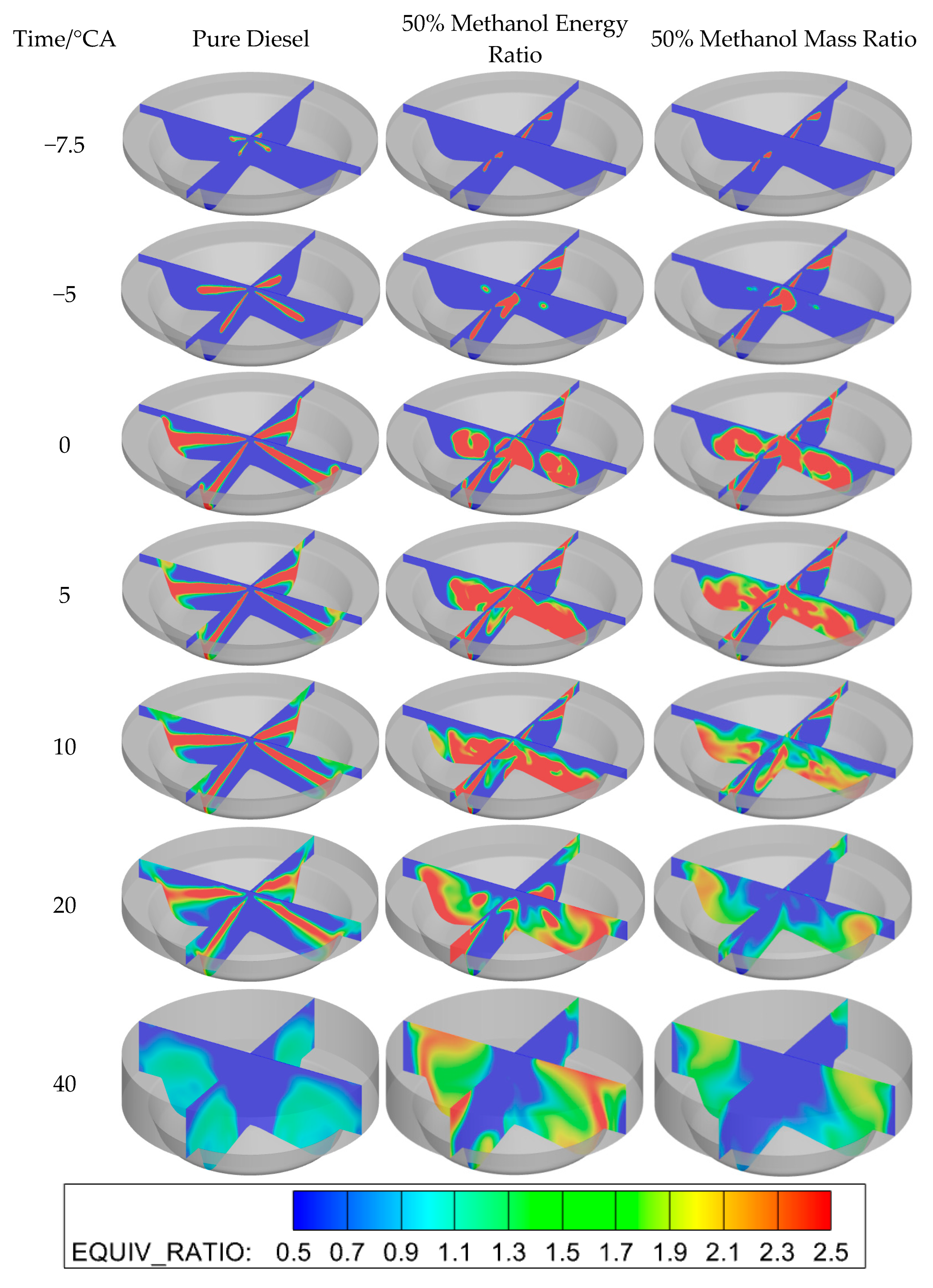
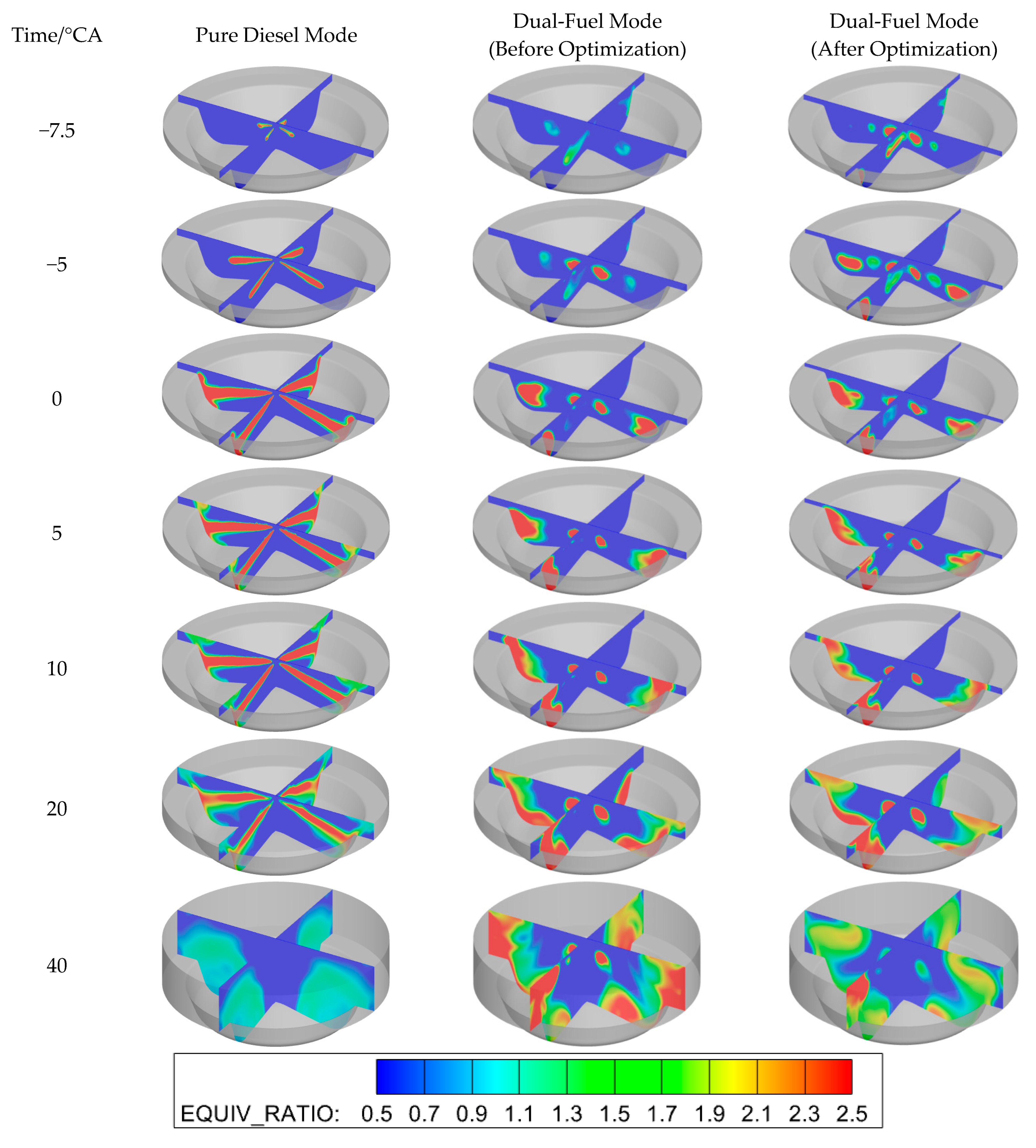
The development of the in-cylinder mixture under different operating modes is illustrated in Figure 9. Two slices of the equivalence ratio contour map are presented: one lies on the plane where the methanol and diesel injectors are mounted, and the other is a vertical slice perpendicular to the injector plane. At −7.5 °CA (crank angle), the central spray in the pure diesel mode starts to propagate uniformly. In the dual-fuel modes, due to the discrepancy in injection pressure, the penetration distance of the methanol spray is shorter than that of the diesel spray. Nevertheless, there is no significant variation in the equivalence ratio contour maps during the spray development process across different methanol blending ratios.
At −5 °CA (crank angle), the spray in the pure diesel mode continues to develop freely within the combustion chamber. In contrast, the diesel and methanol sprays in the dual-fuel modes start to impinge on the wall due to their close proximity to the piston top surface, initially forming upward and downward developing wall-attached tumble flows. At 0 °CA, the spray in the pure diesel mode begins to undergo wall impingement, leading to the formation of wall-attached tumble. At this moment, in the dual-fuel modes, the mixture forms a rich mixture with a relatively high equivalence ratio at the center of the combustion chamber due to the impingement between the methanol and diesel jets. At 10 °CA, methanol injection in the 50% methanol mass ratio mode stops as the injection duration angle has elapsed, whereas methanol injection in the 50% methanol energy ratio mode is still in progress. This results in a relatively high equivalence ratio of the mixture in the central region of the combustion chamber. At 40 °CA, the mixture in the pure diesel mode is mostly distributed in the wall region of the combustion chamber, with an equivalence ratio of approximately 1.0. The 50% methanol energy ratio mode injects the maximum fuel mass, thus exhibiting the highest mixture equivalence ratio (about 1.9) at 40 °CA. The 50% methanol mass ratio mode injects a smaller fuel mass, leading to a mixture equivalence ratio of around 1.5 at 40 °CA. Additionally, it is noteworthy that due to the impingement of the fuel jets, the mixture is relatively sparse on the plane of the dual-fuel injectors and relatively rich on the vertical plane perpendicular to the injector plane.

3.1.2. Combustion Characteristics

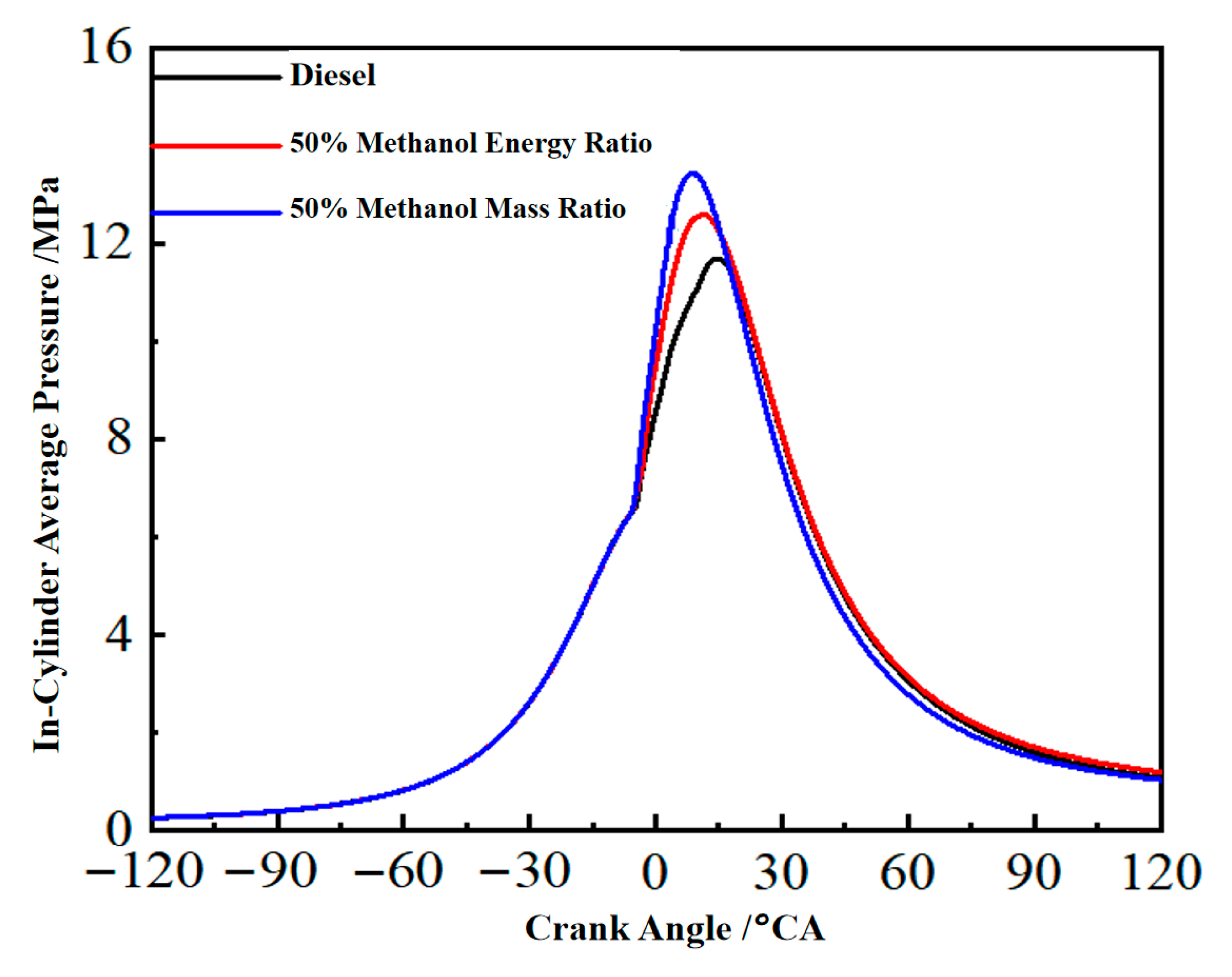
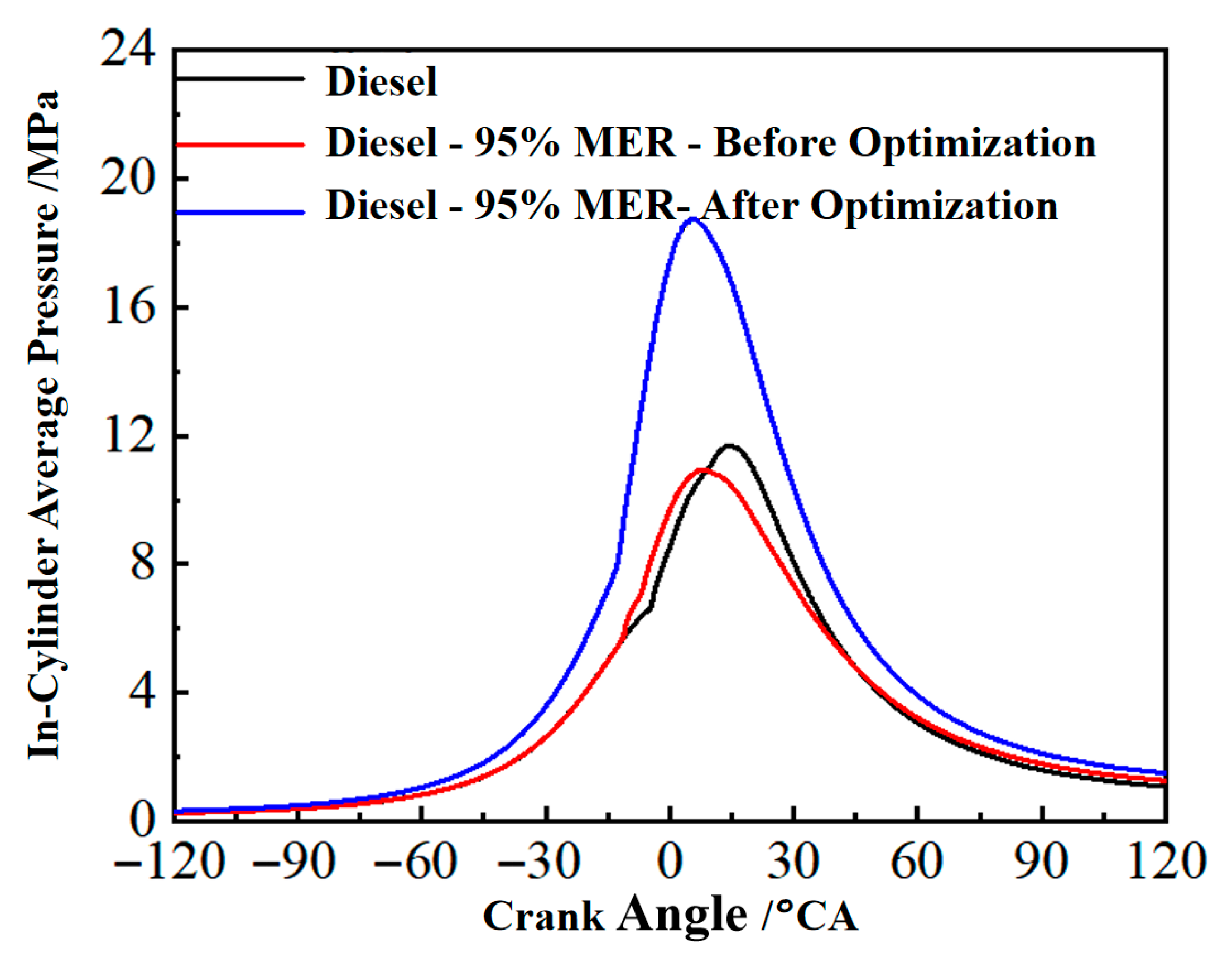
Figure 10 shows the variation trend of in-cylinder average pressure under different operating modes. Since the diesel injection timing is consistent across the three operating modes, the in-cylinder combustion timing of the mixture is the same, which also leads to the consistent timing of in-cylinder average pressure rise. As analyzed earlier, due to the mutual impingement of fuels in the dual-fuel modes resulting in faster and more uniform mixture formation, the in-cylinder pressure rise rate during combustion is faster than that in the pure diesel mode. It can be seen from Figure 9 that among the dual-fuel modes, the mixture formed under the 50% methanol mass ratio mode is more uniform during the 5–20 °CA period, and its equivalence ratio is closer to the stoichiometric ratio, thus the combustion rate is faster, leading to a higher peak in-cylinder pressure. At the end of combustion, since the theoretical heat release of fuel in the 50% methanol mass ratio mode is lower, the average in-cylinder pressure is slightly lower than that in the other two operating modes.
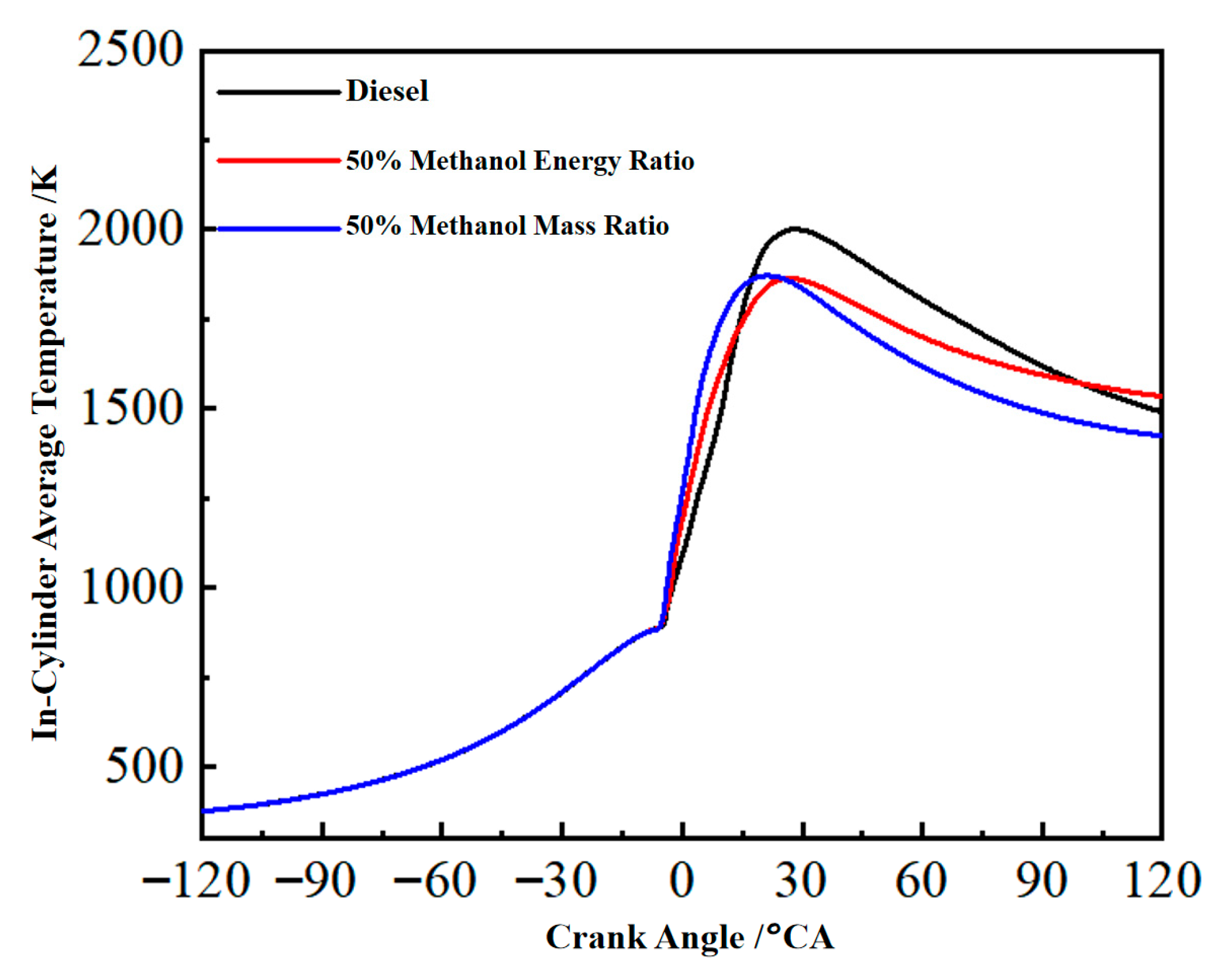
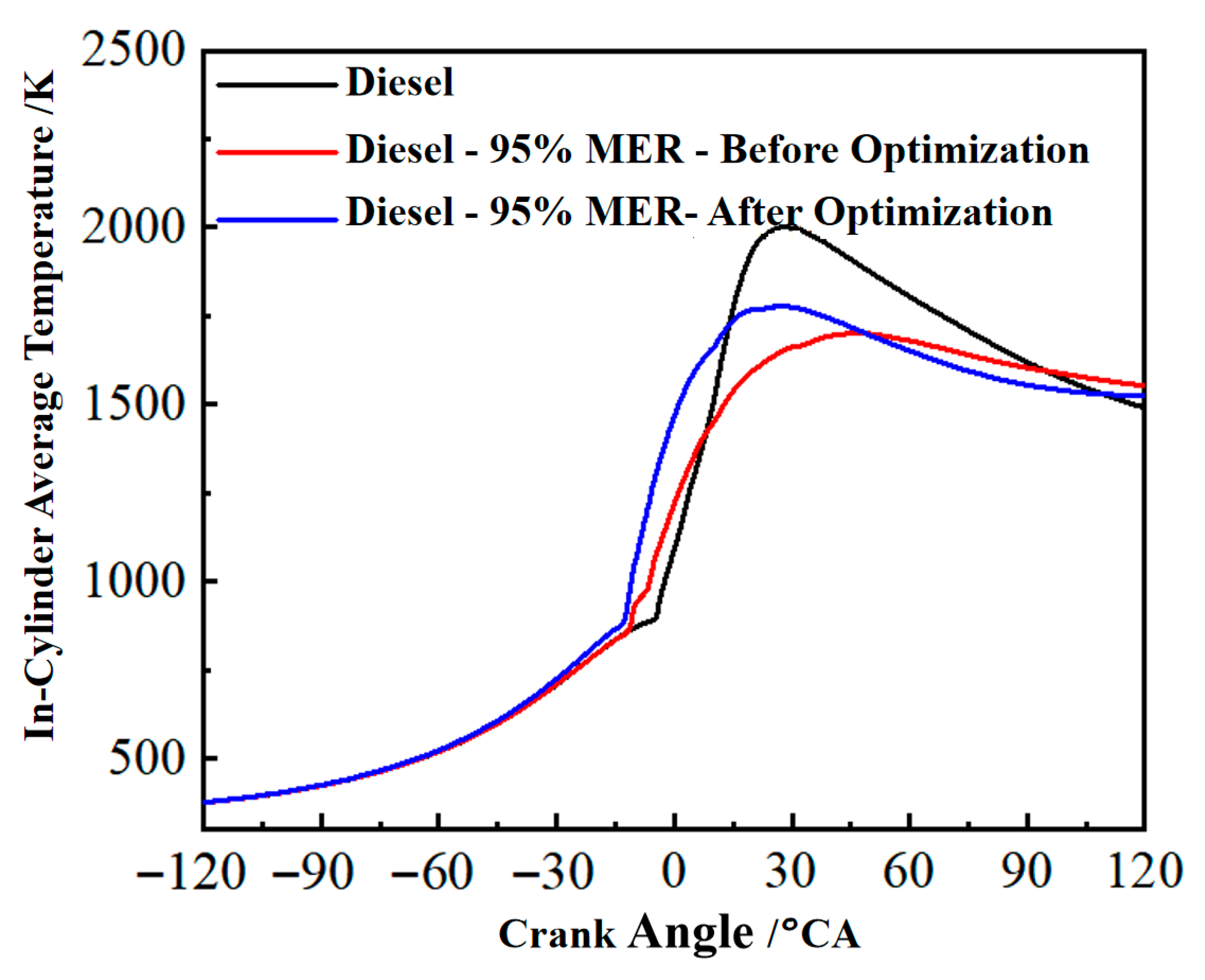
Figure 11 shows the influence of different operating modes on in-cylinder average temperature. In the dual-fuel modes, the mutual impingement between methanol and diesel as well as the faster fuel wall impingement lead to rapid mixing of fuel and air, which in turn makes the combustion rate of the mixture faster in the initial combustion stage under both the 50% methanol energy ratio and 50% methanol mass ratio modes. During the 15–30 °CA period, the in-cylinder temperature in the pure diesel mode is significantly higher than that in the dual-fuel modes. This is because diesel has a higher lower heating value and higher reaction activity; during the large-scale ignition stage of the in-cylinder mixture, a faster combustion rate causes the in-cylinder temperature to rise rapidly, which also compensates for the lower in-cylinder temperature rise rate in the initial combustion stage due to the slower mixture formation. For the dual-fuel modes, the methanol content in the 50% methanol energy ratio mode is higher than that in the 50% methanol mass ratio mode, so the average in-cylinder temperature at the end of combustion is also higher.
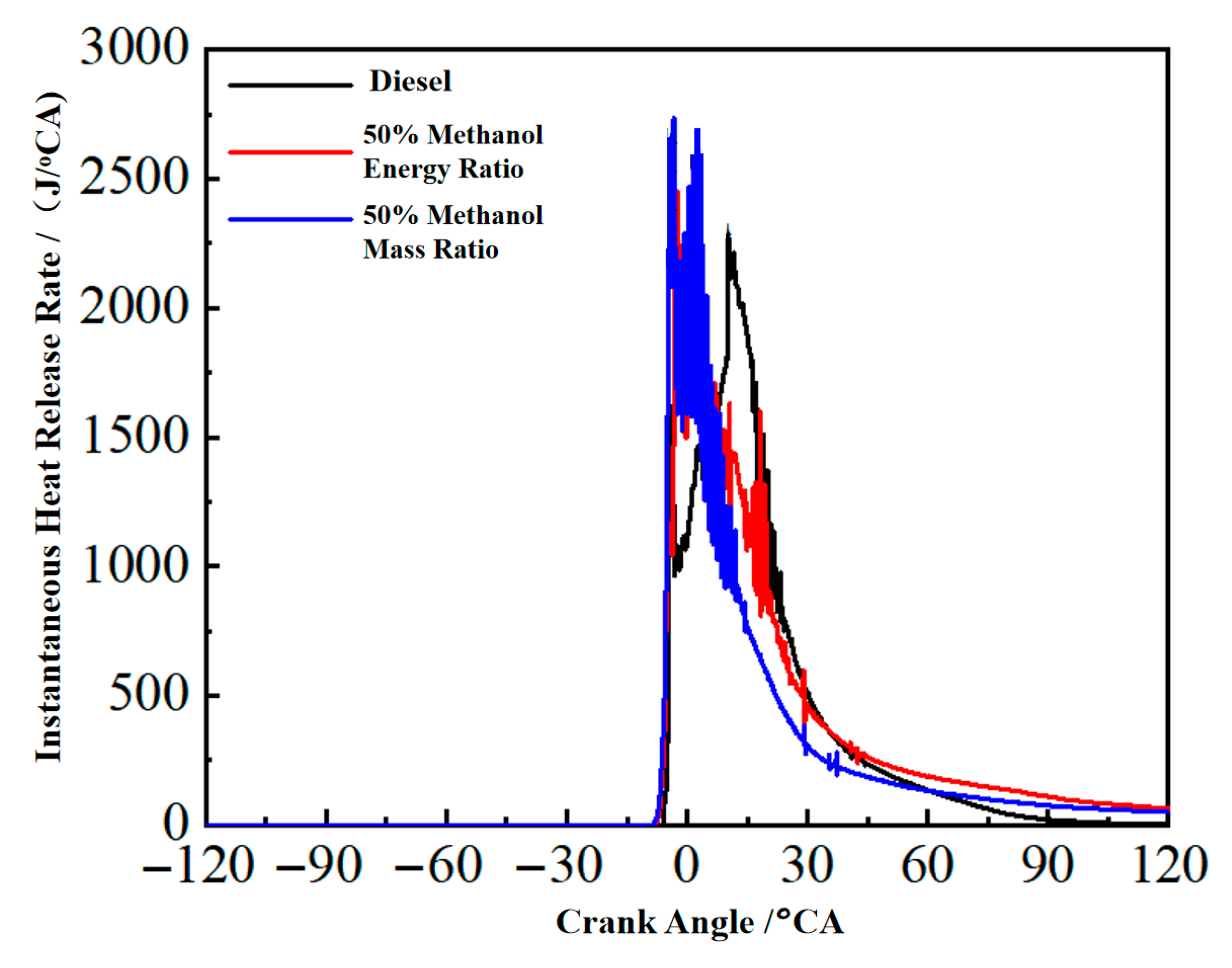
Figure 12 shows the influence of different operating modes on in-cylinder instantaneous heat release rate. Since the combustion start point is consistent across different modes, the timing at which the instantaneous heat release rate begins to increase significantly is also the same. However, due to the faster formation of the flammable mixture in the dual-fuel modes, the peak instantaneous heat release rate in the initial combustion stage is higher. Among the dual-fuel modes, different methanol masses do not significantly affect the peak instantaneous heat release rate. During the 5–20 °CA period, the mixture formed by the spray wall impingement and diffusion in the pure diesel mode entrains more air to form a flammable mixture. Under the action of diesel’s high combustion activity, the mixture undergoes large-scale ignition, leading to a further increase in the in-cylinder instantaneous heat release rate. As the combustion process proceeds, the mixture gradually decreases, and the instantaneous heat release rate begins to decrease significantly. In the dual-fuel modes, the 50% methanol energy ratio mode has a higher methanol mass, resulting in a higher instantaneous heat release rate of the mixture compared to the 50% methanol mass ratio mode.
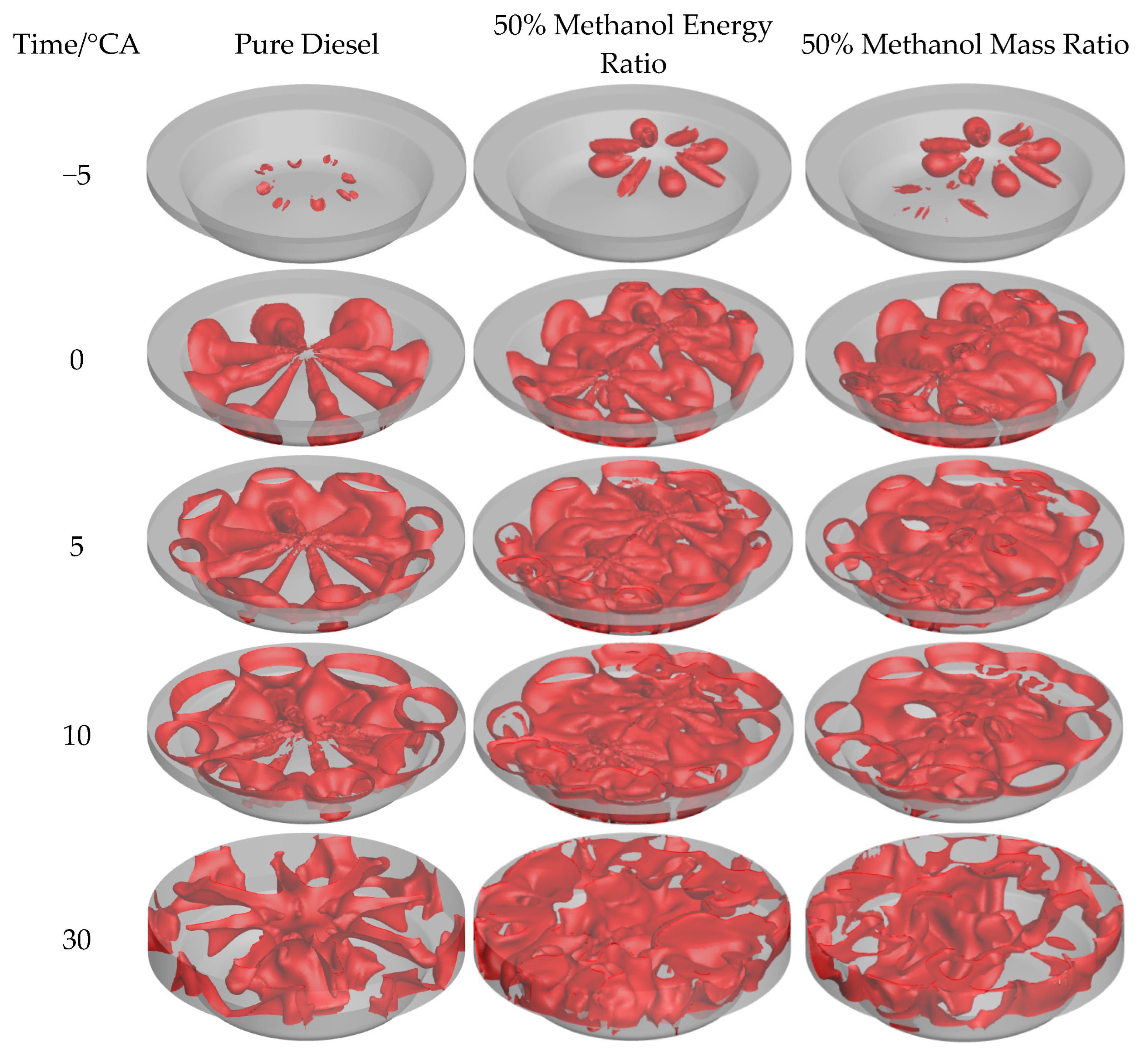
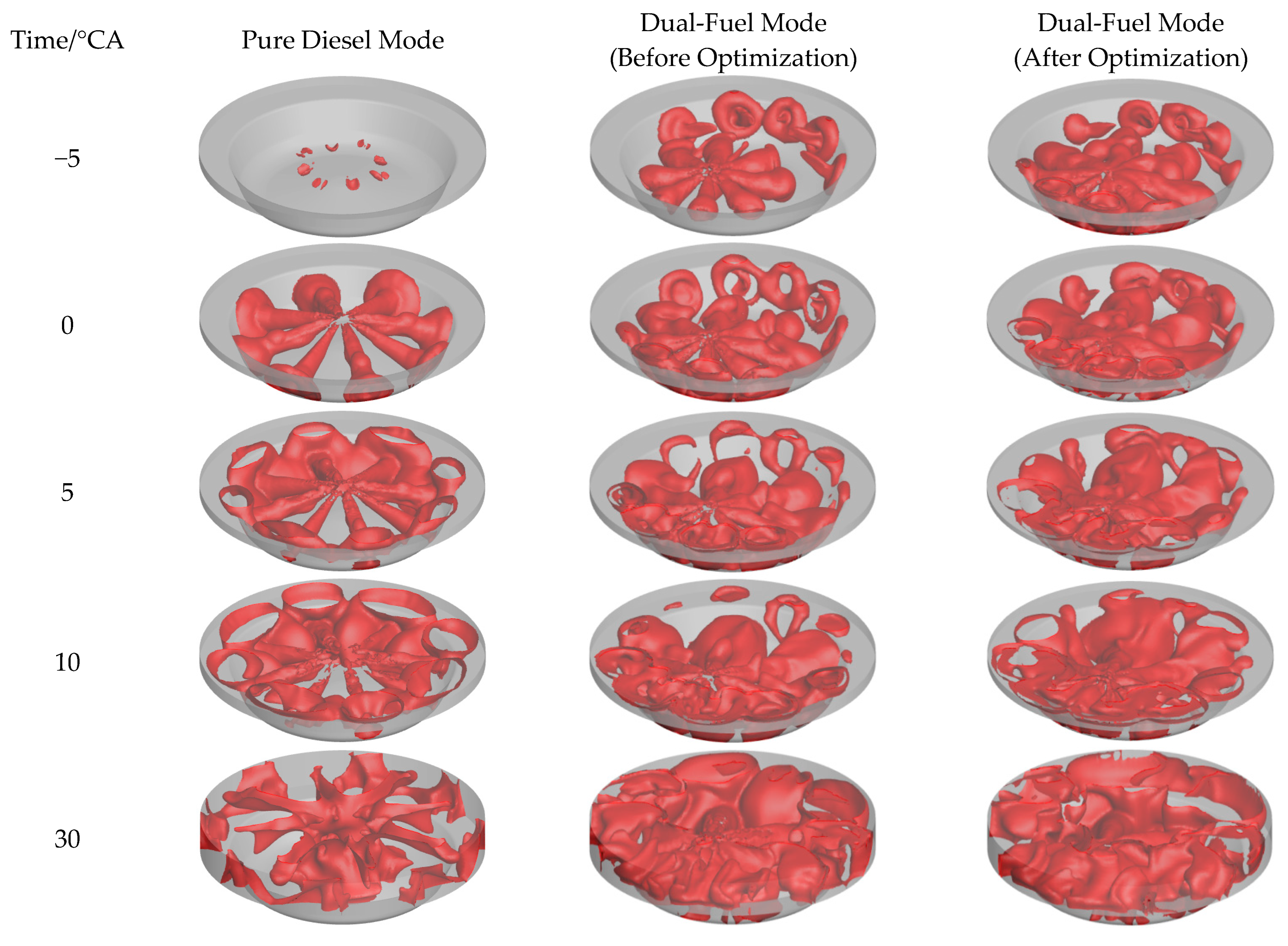
During the combustion process, the flame front separates the burned mixture from the unburned mixture, and intense combustion chemical reactions occur near the flame front. Due to the significant temperature gradient and mixture concentration gradient between the flame front and the adjacent unburned mixture, strong heat transfer and mass transfer phenomena are generated, which further promote the ignition of the unburned mixture and drive the flame front to move towards the region with low temperature and high mixture concentration gradient. There is a notable temperature gradient near the flame front, and the 1800 K isothermal surface can be regarded as the flame front. Figure 13 shows the influence of different operating modes on the distribution of the flame front. At −5 °CA (crank angle), multi-point compression ignition starts at the jet tip in the pure diesel mode. Meanwhile, the “fuel-in-flame” phenomenon has appeared in the diesel jet under the dual-fuel modes. Additionally, it is observed that the methanol jet in the 50% methanol mass ratio mode has been ignited, showing a multi-point ignition phenomenon. At 0 °CA and 5 °CA, the flame front in the pure diesel mode undergoes wall impingement, but in the central region of the combustion chamber, the flame front is still highly attached to the jet. However, the flame front in the dual-fuel modes expands extensively in the central region of the combustion chamber due to the impingement of the mixture. At 30 °CA, the flame front in the 50% methanol mass ratio mode gradually becomes sparse due to the smaller fuel mass, while the flame front in the 50% methanol energy ratio mode still expands extensively within the cylinder.

3.1.3. Emission Characteristics

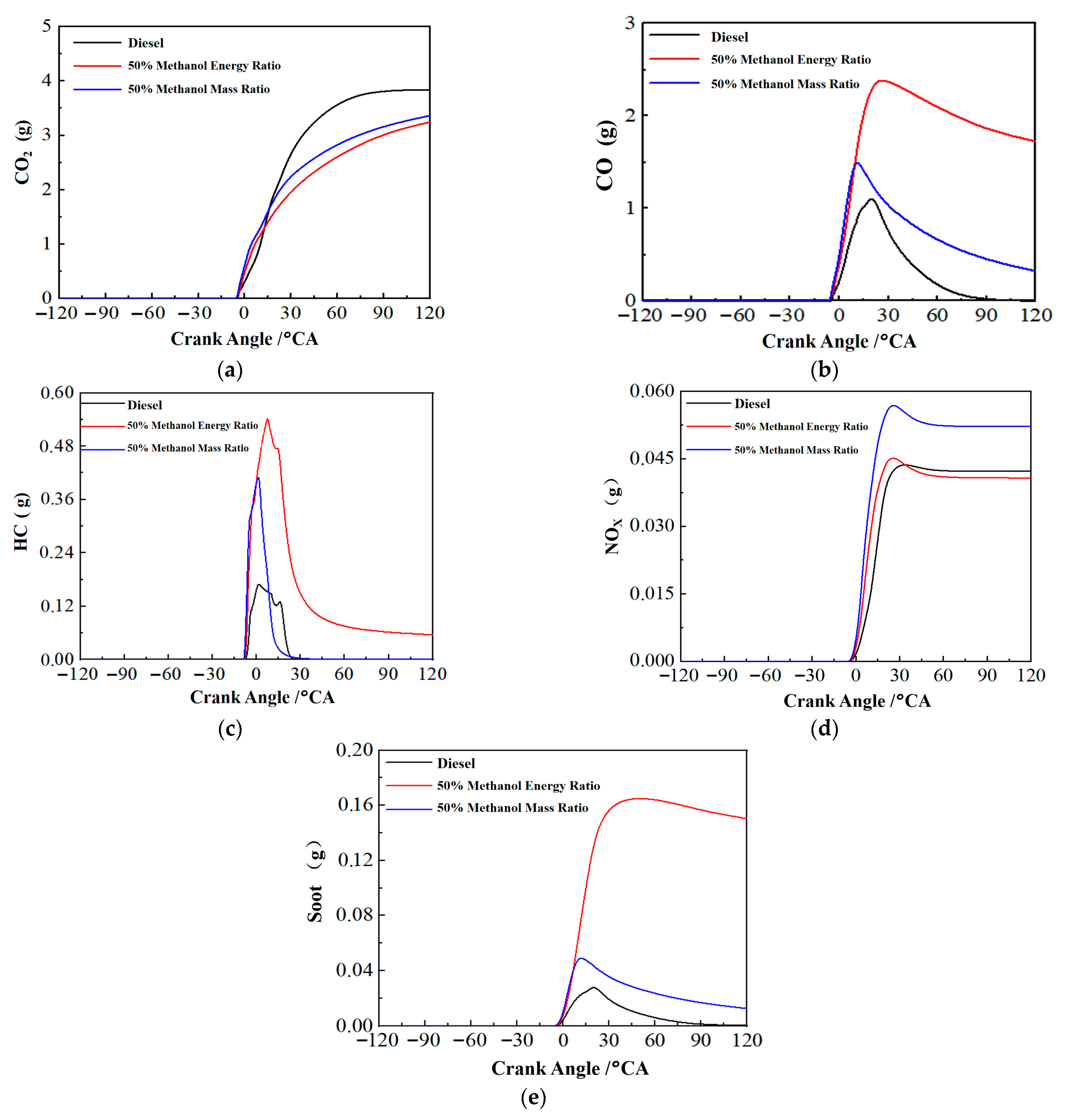
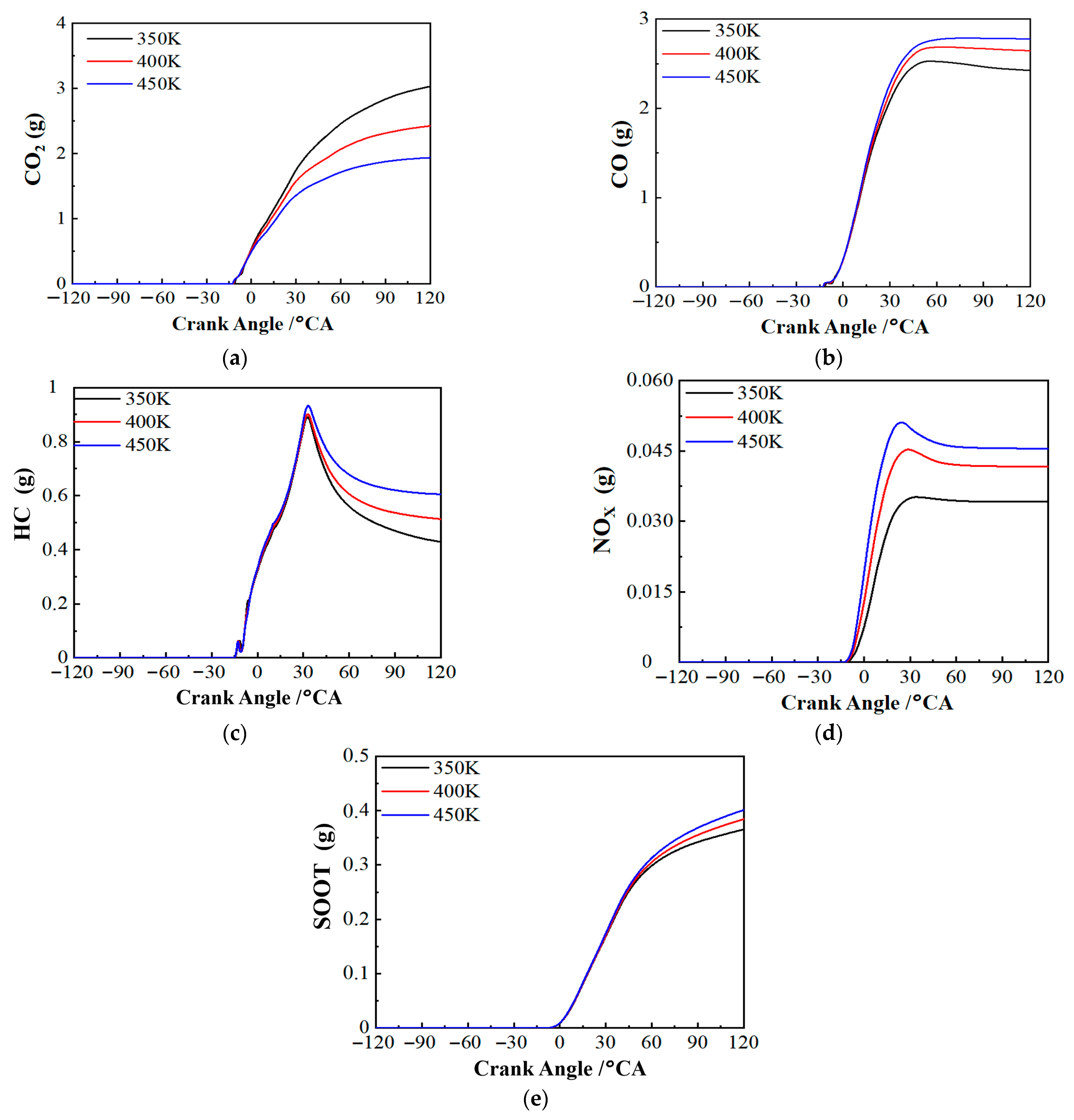
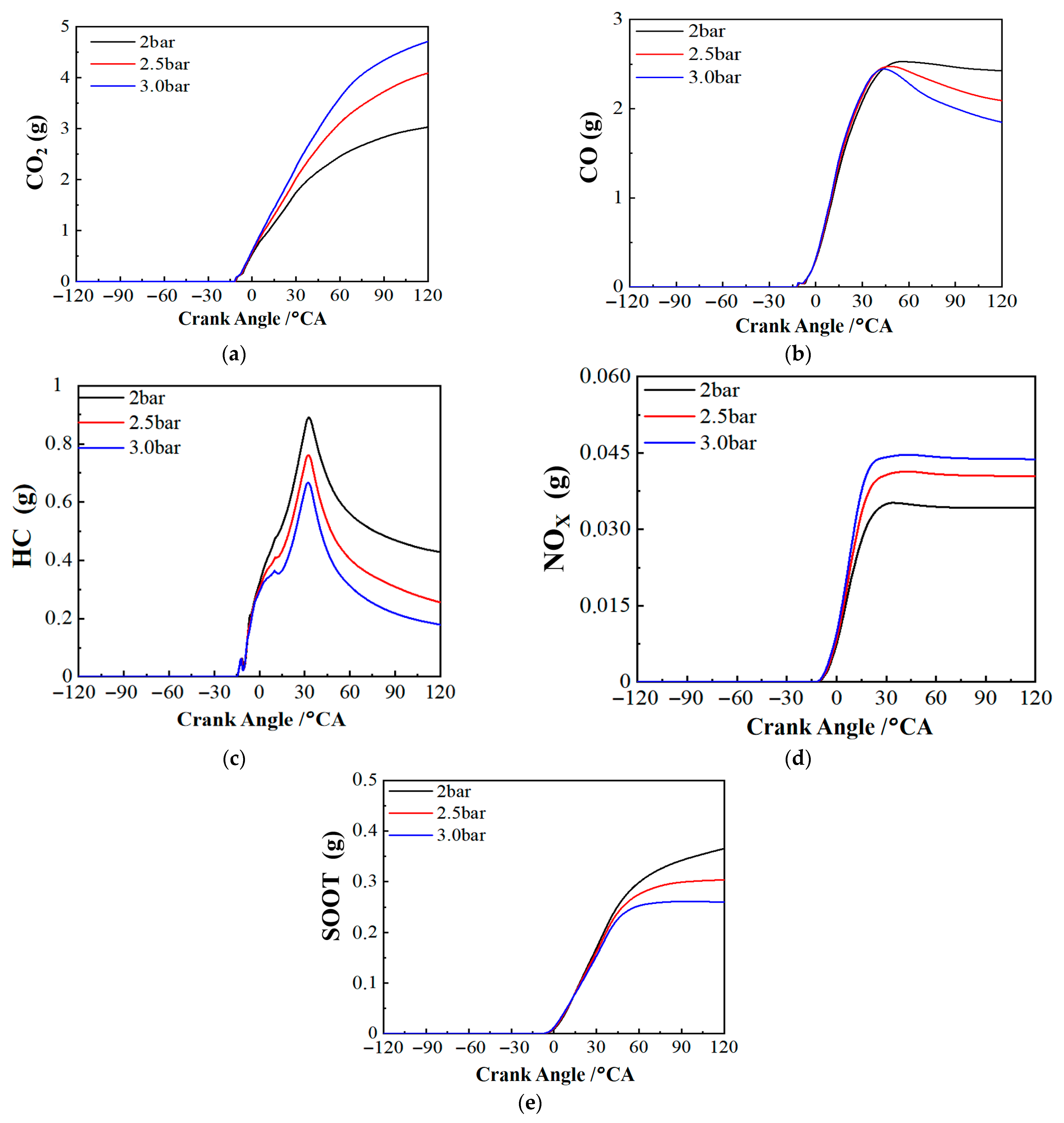
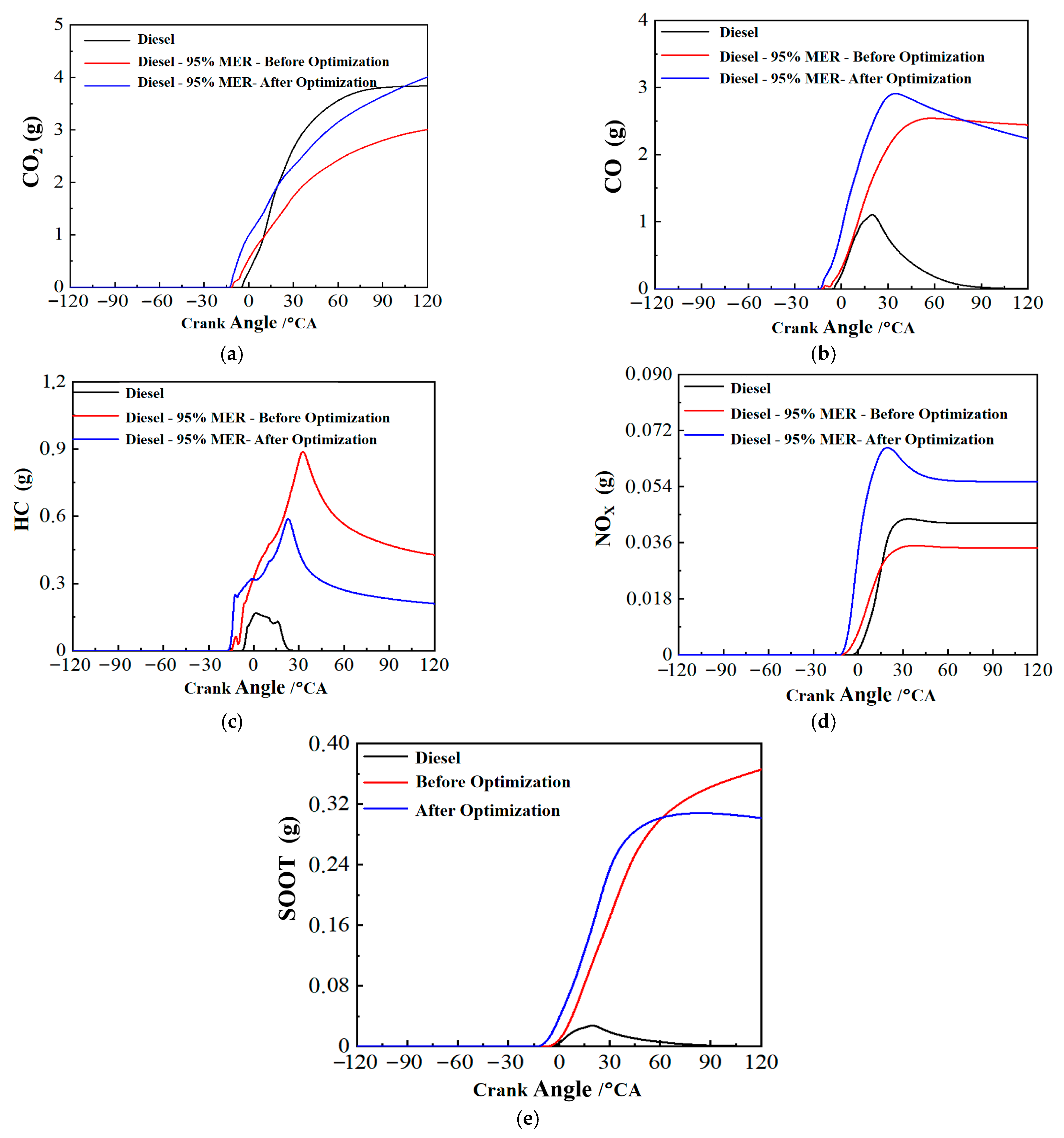
Figure 14 shows the influence of different operating modes on the variation trends of five pollutant emissions, namely CO2, CO, HC, NOx, and Soot. Figure 14a presents the variation trend of CO2 emissions: the CO2 emissions of diesel gradually increase in the late combustion stage, while those of the dual-fuel modes (both 50% methanol energy ratio and 50% methanol mass ratio) rise rapidly in the initial combustion stage and then tend to stabilize. This is due to the faster formation of flammable mixture and more rapid combustion caused by the collision of dual fuels. In addition, methanol has a simpler molecular structure, making it easier to burn completely during combustion, resulting in a higher CO2 generation rate. In contrast, the fuel combustion rate in the pure diesel mode is relatively slow, and diesel has a higher carbon content; some carbon is not fully burned during combustion, leading to the gradual release of CO2 in the late combustion stage. As shown in Figure 14b, the CO emissions of diesel are relatively low, while those of methanol fuel are significantly higher. This is because in the initial combustion stage, the mixture of methanol and diesel may undergo local incomplete combustion due to uneven mixing or ignition delay, producing a large amount of CO. With the progress of the combustion process, the temperature rises and the mixture quality improves, leading to a decrease in CO generation. However, the flame temperature during methanol combustion is lower than that of diesel, and high temperature is conducive to complete combustion and reducing CO emissions. Therefore, under operating conditions with a high methanol ratio, the CO emissions in the late combustion stage are higher than those of pure diesel.
As illustrated in Figure 14c, the hydrocarbon (HC) emissions under all three operating modes exhibit a distinct peak during the initial combustion stage. Specifically, the pure diesel mode yields the lowest peak, while the 50% methanol energy ratio mode presents the highest. This phenomenon is attributed to the high latent heat of vaporization of methanol, which absorbs a greater amount of heat during the mixture formation process, thereby impairing the uniformity of mixture preparation. In the initial combustion phase, incompletely vaporized methanol may persist in a liquid state, resulting in the direct emission of a portion of unburned HC. Furthermore, the combustion rate of methanol is lower than that of diesel, and its combustion duration is prolonged, leading to the incomplete combustion of residual HC in the late combustion stage and a subsequent increase in emissions.
With respect to nitrogen oxide (NOx) emissions, methanol combustion tends to generate higher local temperatures, particularly during the premixed combustion stage. Elevated temperatures facilitate the formation of NOx through thermal mechanisms. Additionally, the extended combustion duration of methanol fuel ensures the sustained participation of oxygen in reactions during the late combustion stage, which further enhances NOx emission levels.
As depicted in Figure 14e, the soot emissions in the pure diesel mode increase gradually during the middle and late combustion stages. In contrast, the dual-fuel modes exhibit a rapid surge in soot emissions at the initial combustion stage. This is primarily due to the accelerated combustion rate in the dual-fuel configurations, coupled with the formation of local over-rich mixtures in the central region of the combustion chamber, which induces a significant rise in soot production. In the 50% methanol energy ratio mode, the higher methanol dosage exacerbates the local mixture over-richness, thereby promoting increased soot formation. Conversely, the 50% methanol mass ratio mode, characterized by a relatively lower methanol addition, achieves a more homogeneous mixture distribution, resulting in reduced soot emissions. During the middle and late combustion stages, the gradual reduction in soot emissions in the pure diesel mode is attributed to the oxidative consumption of a portion of soot under high-temperature conditions.

3.2. Comparison of Engine Performance Under Different Spray Development Modes

3.2.1. Spray Development Modes

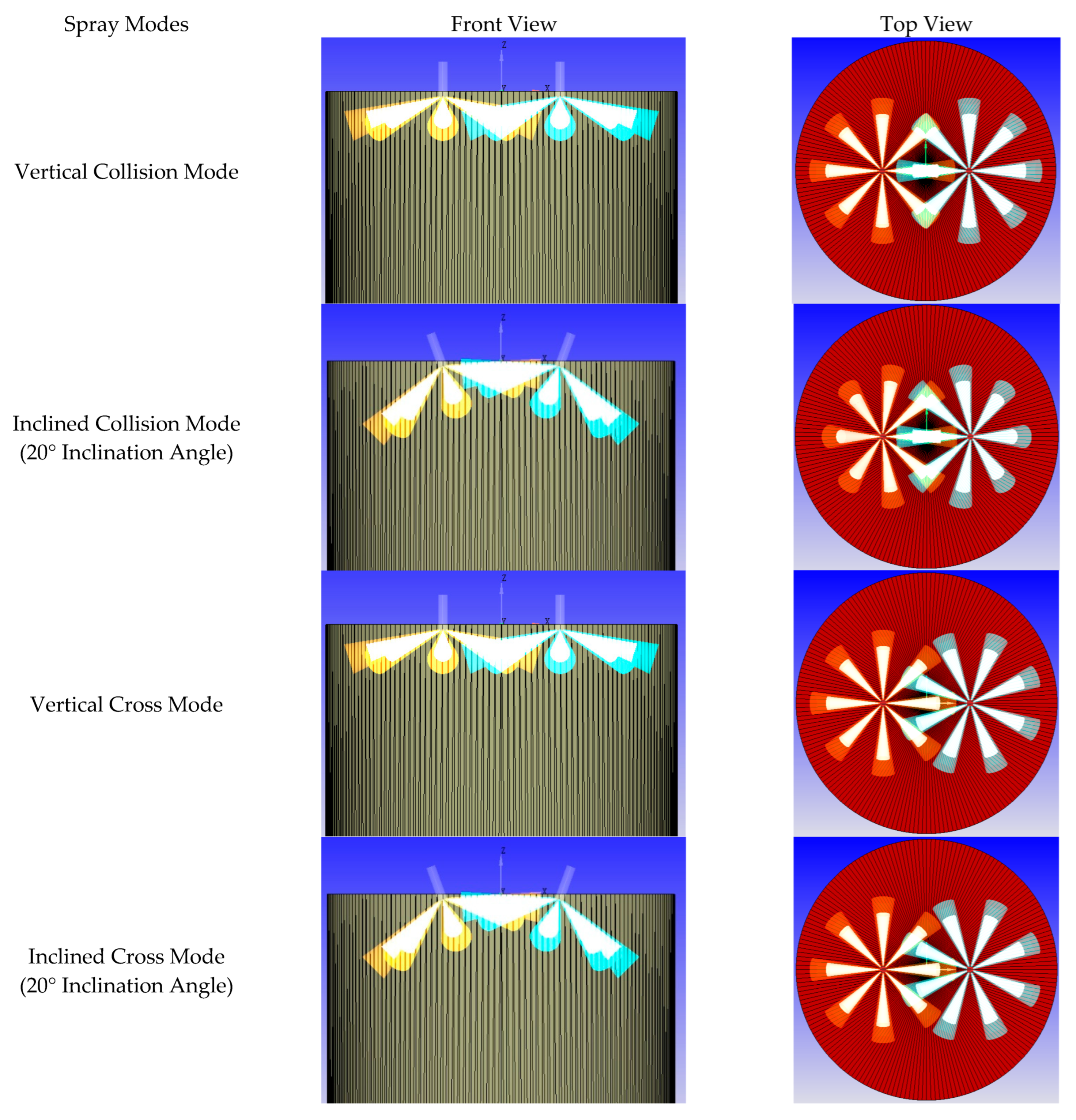
In the previous research, the collision between methanol and diesel jets at the center of the combustion chamber can rapidly form a flammable mixture, leading to a rapid rise in in-cylinder average pressure and an accelerated flame propagation speed. Therefore, the organization form of the mixture in the combustion chamber exerts a significant influence on subsequent combustion and emissions. Due to the fact that both the methanol and diesel injectors adopted in this study are 8-hole injectors, different spray development modes are generated depending on the angles of the nozzle holes and the injectors. To investigate the influence of different spray development modes on engine performance, four spray development modes are proposed, namely the Vertical Collision Mode, Inclined Collision Mode, Vertical Cross Mode, and Inclined Cross Mode. The injector arrangement of different spray development modes is illustrated in Figure 15. In the figure, the methanol and diesel injectors are spaced 1/3 of the cylinder bore apart, and the two injectors are arranged symmetrically. Additionally, considering that the nozzle hole included angle of the injectors is 140°, the inclination angle in the inclined spray development modes is set to 20°.

3.2.2. The Influence of the Fuel Injection Interval on the Air-Fuel Mixture Formation Process

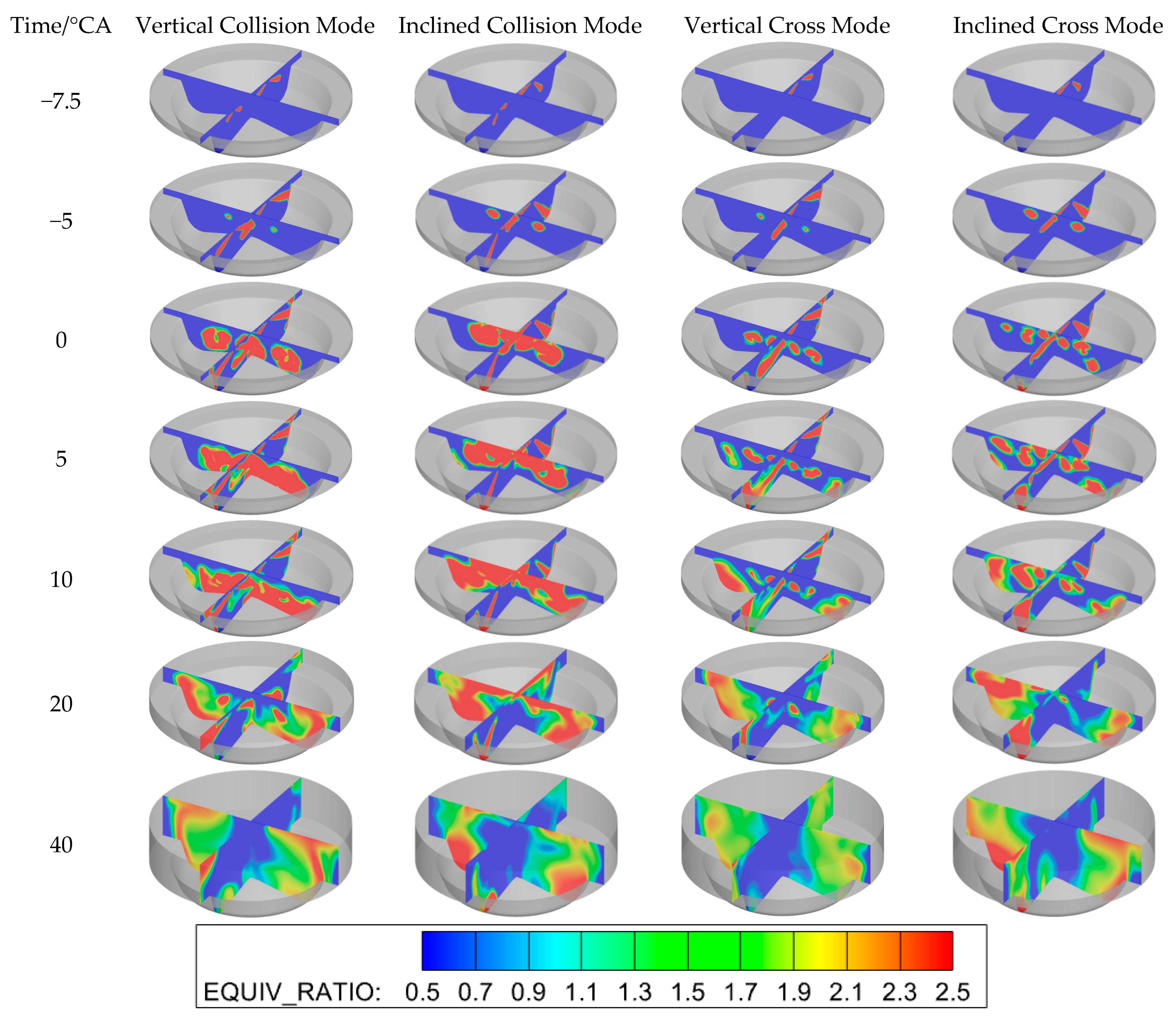
Figure 16 illustrates the influence of different spray modes on the in-cylinder mixture equivalence ratio contour maps. At −7.5 °CA, the methanol and diesel sprays under various spray development modes initiate their development. Owing to the difference in injection pressure, the penetration distance of the methanol spray is shorter than that of the diesel spray. Meanwhile, as the nozzle holes of the methanol injector in the cross spray modes are not coplanar with the equivalence ratio contour map slice, the equivalence ratio distribution of the methanol spray is not observed in the cross spray configurations. At 0 °CA, the collision spray modes form a large-scale rich mixture in the central region of the combustion chamber. Specifically, the inclined collision spray collides in the top region of the combustion chamber, resulting in a relatively rich mixture at the chamber top, whereas the rich mixture generated by the vertical collision spray is primarily distributed in the chamber bottom. Since the fuel jets of the cross spray modes do not collide directly, the equivalence ratio of the mixture at the central position of the combustion chamber is relatively low.
At 10 °CA, the rich mixture generated by the collision spray modes fills the entire combustion chamber, while the rich mixture produced by the cross spray modes is mainly distributed near the combustion chamber walls. At 40 °CA, the mixture has been fully developed; at this moment, the equivalence ratio of the mixture formed by the vertical cross spray mode is closer to the stoichiometric ratio. The vertical collision spray mode and the inclined cross spray mode exhibit relatively similar equivalence ratio distributions, with rich mixtures present near the piston crevice in both cases. In contrast, the rich mixture generated by the inclined collision spray mode is more concentrated in the recess of the piston bowl.
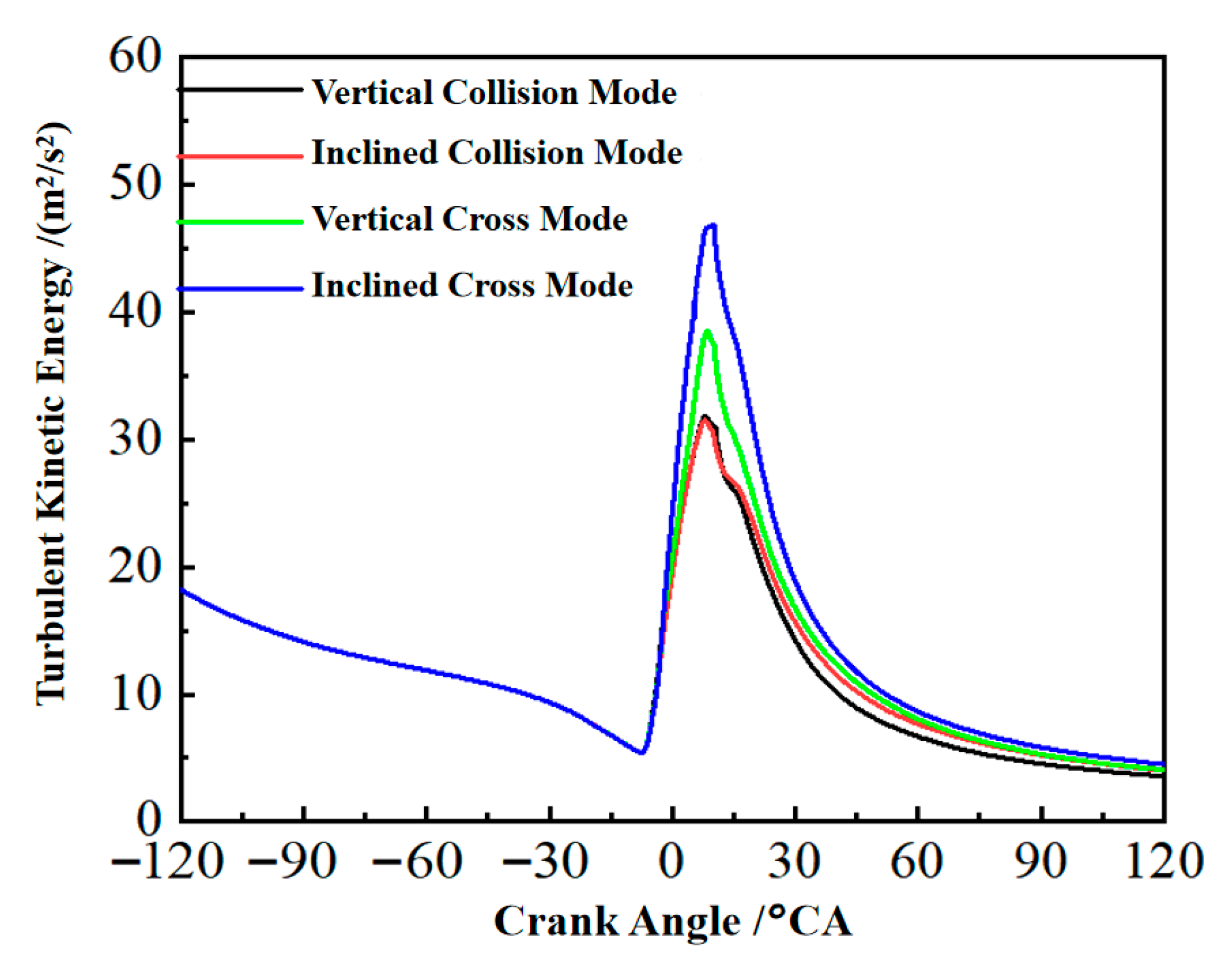
Figure 17 illustrates the development of in-cylinder turbulent kinetic energy under different spray modes. The turbulent kinetic energy of all four spray modes in the figure begins to increase when the crank angle approaches −10 °CA and reaches a peak at 10 °CA. Among them, the inclined cross spray mode achieves the highest peak value of approximately 48 m2/s2, followed by the vertical cross spray mode. The peak values of the vertical collision spray mode and the inclined collision spray mode are relatively lower, around 32 m2/s2. This is because when the crank angle is close to 0 °CA, the sprays collide or intersect, which disrupts their uniformity and generates more small droplets and irregular flow structures, thereby enhancing the turbulent kinetic energy. Specifically, the cross spray modes involve the intersection of two or more sprays, leading to more complex turbulent structures and higher turbulence intensity, resulting in higher peak turbulent kinetic energy. In contrast, the spray momentum of the collision spray modes is consumed during mutual impingement, leading to similar and the lowest turbulent kinetic energy values.

3.2.3. The Influence of the Fuel Injection Interval on Engine Combustion Characteristics

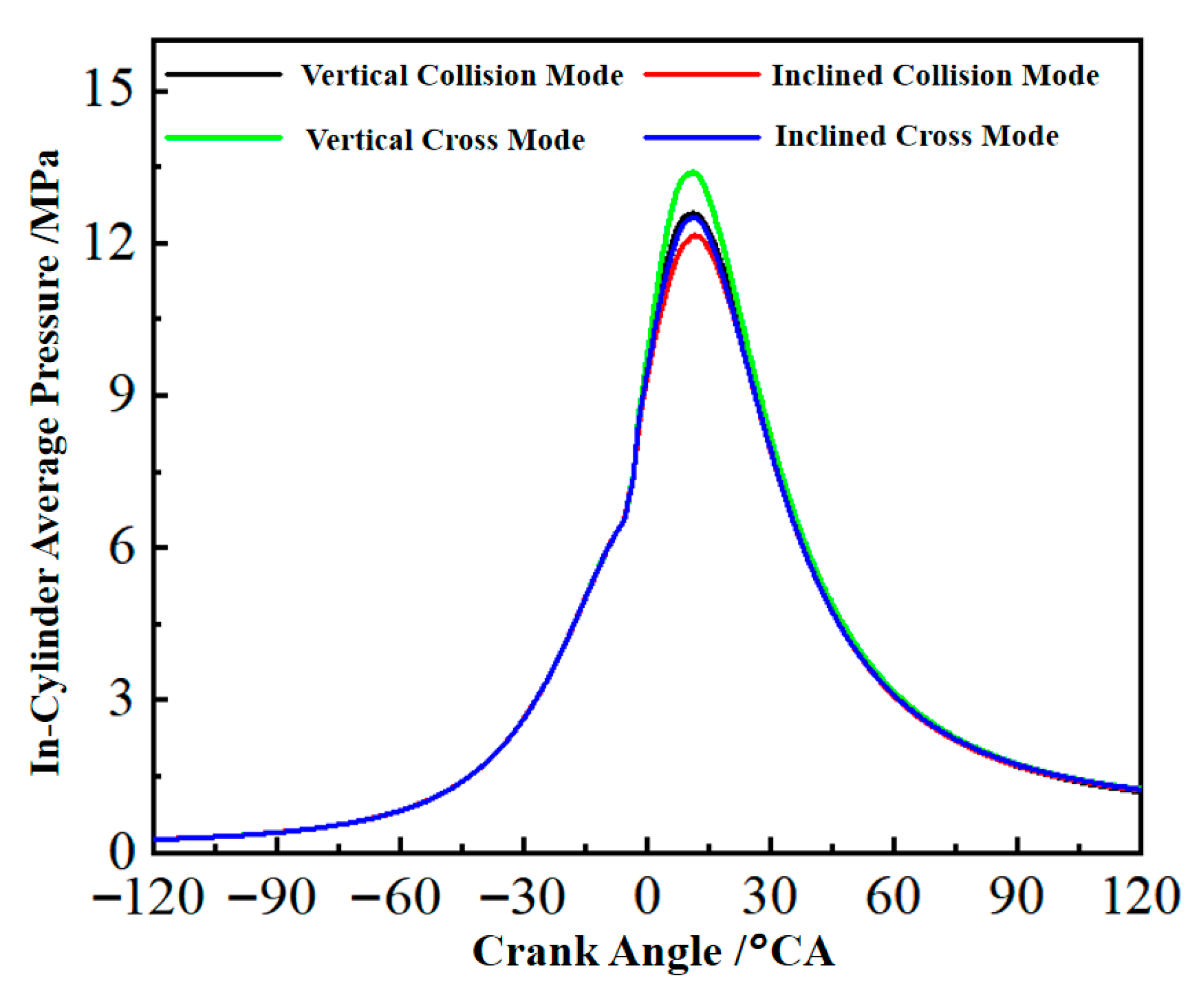
The variation trends of in-cylinder average pressure under different spray development modes are illustrated in Figure 18. It can be observed that the vertical cross spray development mode achieves the highest peak in-cylinder average pressure. The peak values of the vertical collision and inclined cross spray development modes are not significantly different, while the inclined collision spray development mode exhibits the lowest average pressure. This is because the mutual impingement of fuel jets significantly consumes spray kinetic energy, which affects the movement speed of the mixture and thereby impairs combustion performance. Meanwhile, the inclined spray causes part of the mixture to interact with the top surface of the combustion chamber, and the boundary layer effect of the wall also influences the development of the mixture.
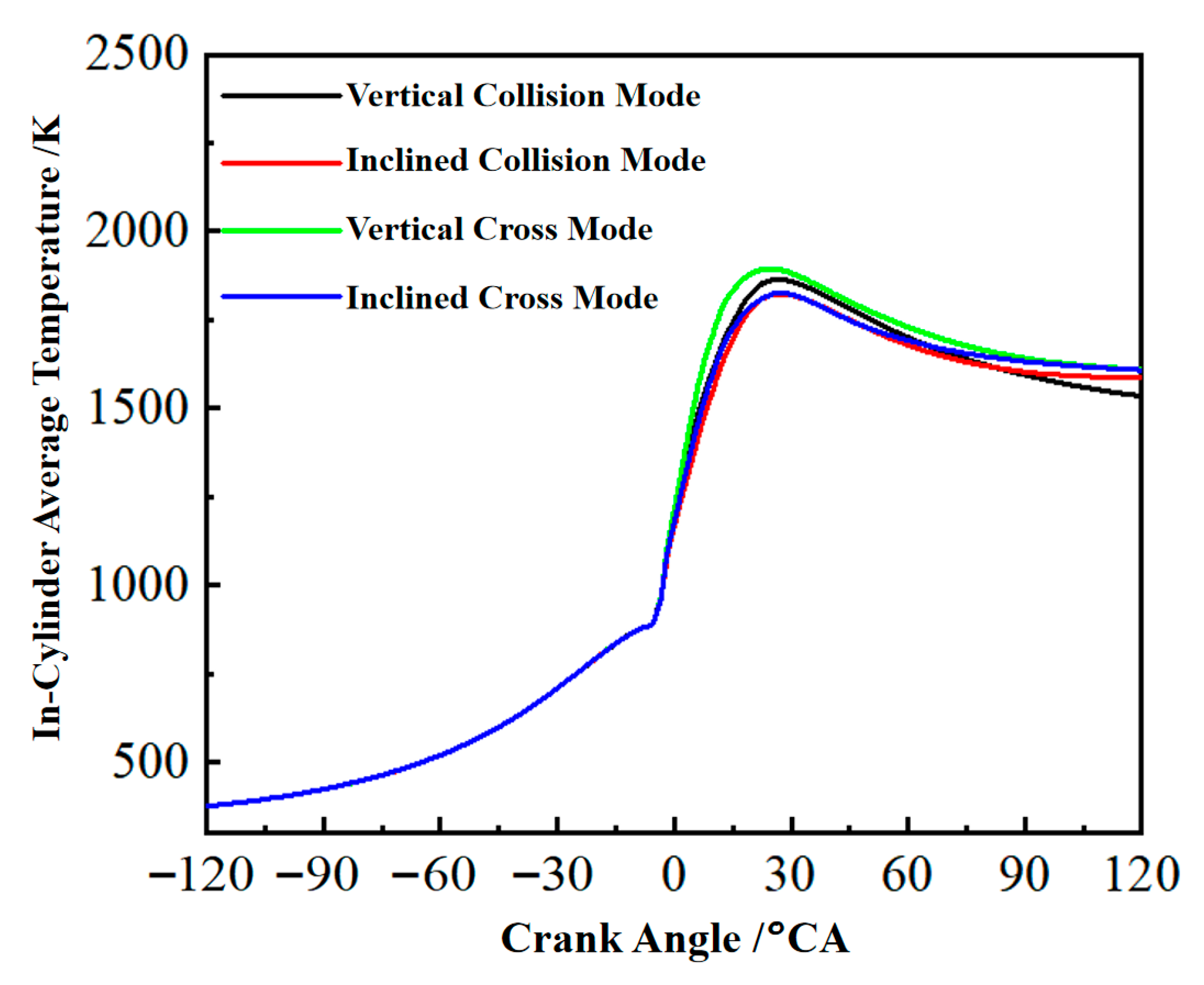
Figure 19 illustrates the influence of different spray development modes on in-cylinder average temperature. Under all spray development modes, the in-cylinder average temperature exhibits a trend of first increasing and then decreasing with the change in crank angle. The temperature gradually rises as the crank angle ranges from −120 °CA to approximately 30 °CA, and begins to decrease after reaching the peak. Overall, the in-cylinder average temperature under the vertical cross spray development mode is generally higher than that of the other spray modes. This is attributed to the fact that the crosswise spray development not only ensures the sufficient development of fuel jets in the combustion chamber but also maintains the jets at a high momentum, resulting in a more homogeneous mixture formed by the cross spray modes. Meanwhile, the vertically arranged injectors can maximize the contact between fuel jets and the piston bowl, and form a wall-attached tumble flow.
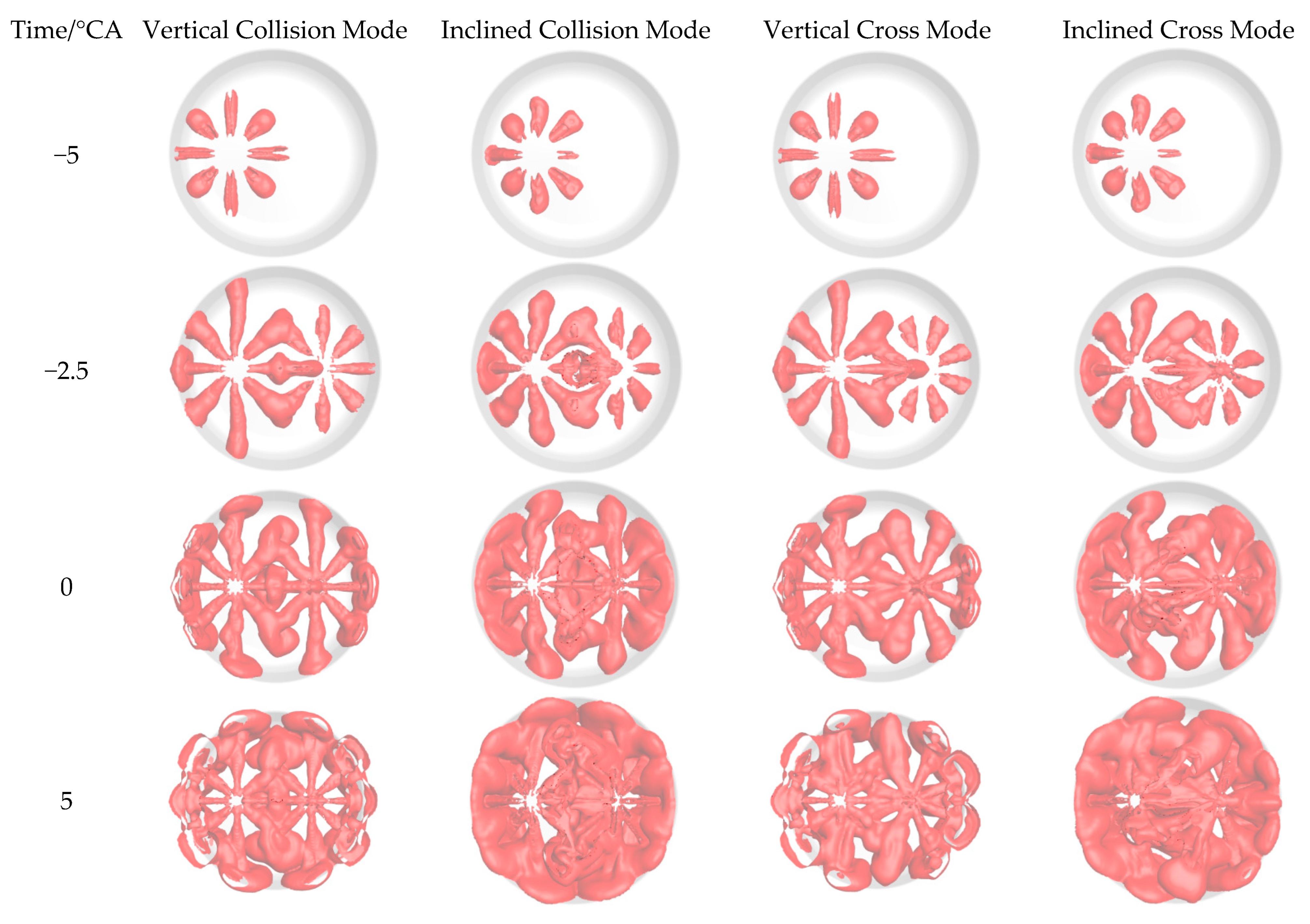
Figure 20 illustrates the development of the flame front under different spray development modes. At −5 °CA, the diesel spray initiates ignition, and a high-temperature flame front emerges at the spray tip. It can be observed that under the inclined spray development modes, the flame front generated by the jet closer to the center of the combustion chamber is relatively small. This is because the jet from this nozzle hole is closer to the top surface of the combustion chamber; under the combined effect of wall heat transfer and the boundary layer effect, the ignition of this jet is delayed, resulting in a lower flame propagation speed. At −2.5 °CA, the methanol spray is ignited, and the flame front spreads to the combustion chamber walls. At 0 °CA, the flame front undergoes significant wall impingement and begins to spread outward in all directions. It is noted that at this moment, the collision spray modes exhibit flame front impingement at the center of the combustion chamber, while the cross spray modes show flame front merging.
Based on the above analysis, it can be concluded that the vertical cross spray mode achieves superior mixture formation and combustion performance. Subsequent numerical simulation work will be conducted based on this spray development mode.

3.3. Influence of Fuel Injection Interval on Engine Combustion Characteristics

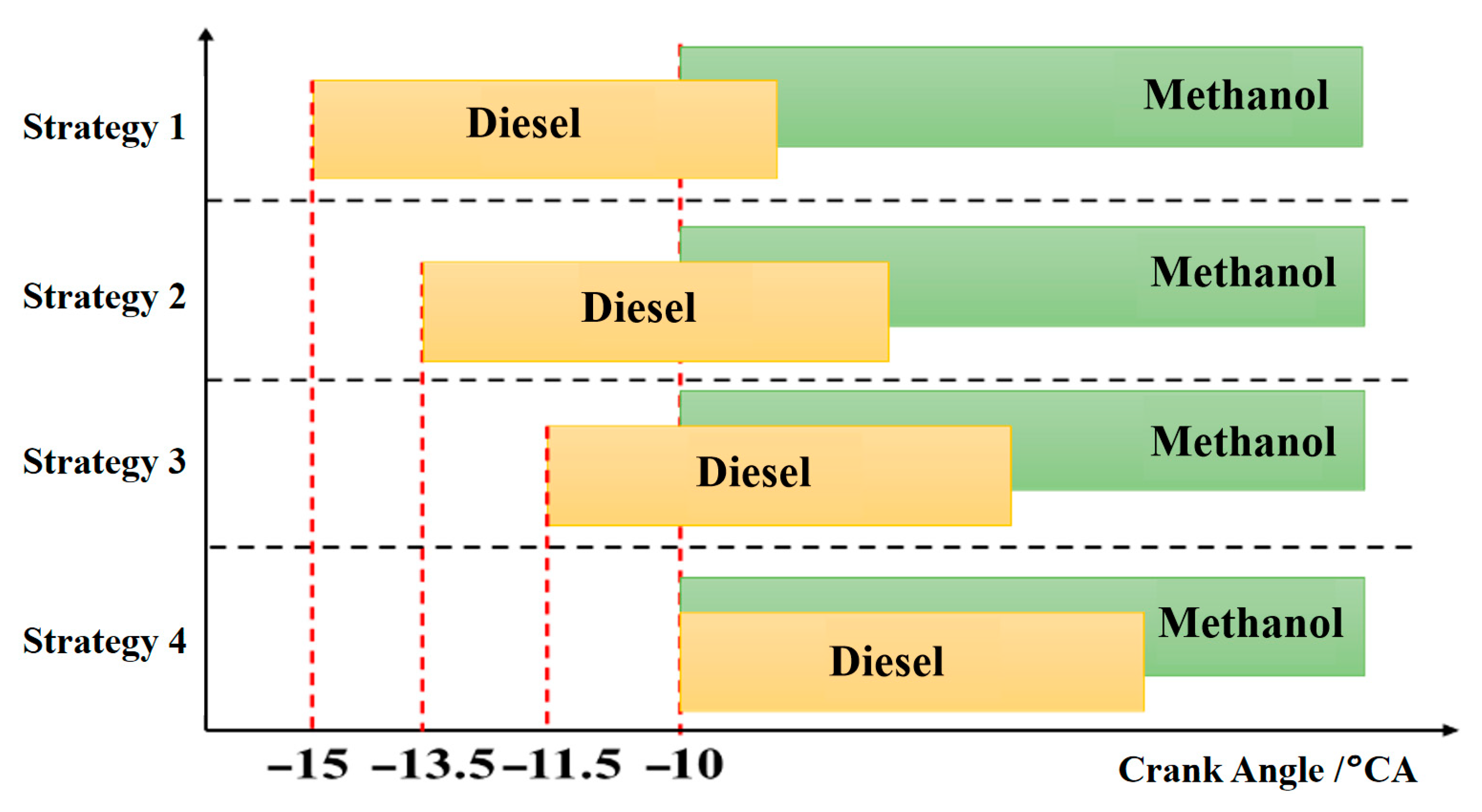
Diesel always undergoes auto-ignition in the cylinder prior to methanol, which is attributed to the differences in their physical properties and chemical activities. For the dual-fuel injection strategy, whether different injection intervals between methanol and diesel affect mixture formation and engine combustion characteristics requires in-depth analysis. Fixing the methanol injection timing at −10 °CA, the diesel injection timings are set to −15 °CA, −13.5 °CA, −11.5 °CA, and −10 °CA, respectively. Figure 21 presents a schematic diagram of the injection intervals between methanol and diesel.

3.3.1. Influence on the Mixture Formation Process

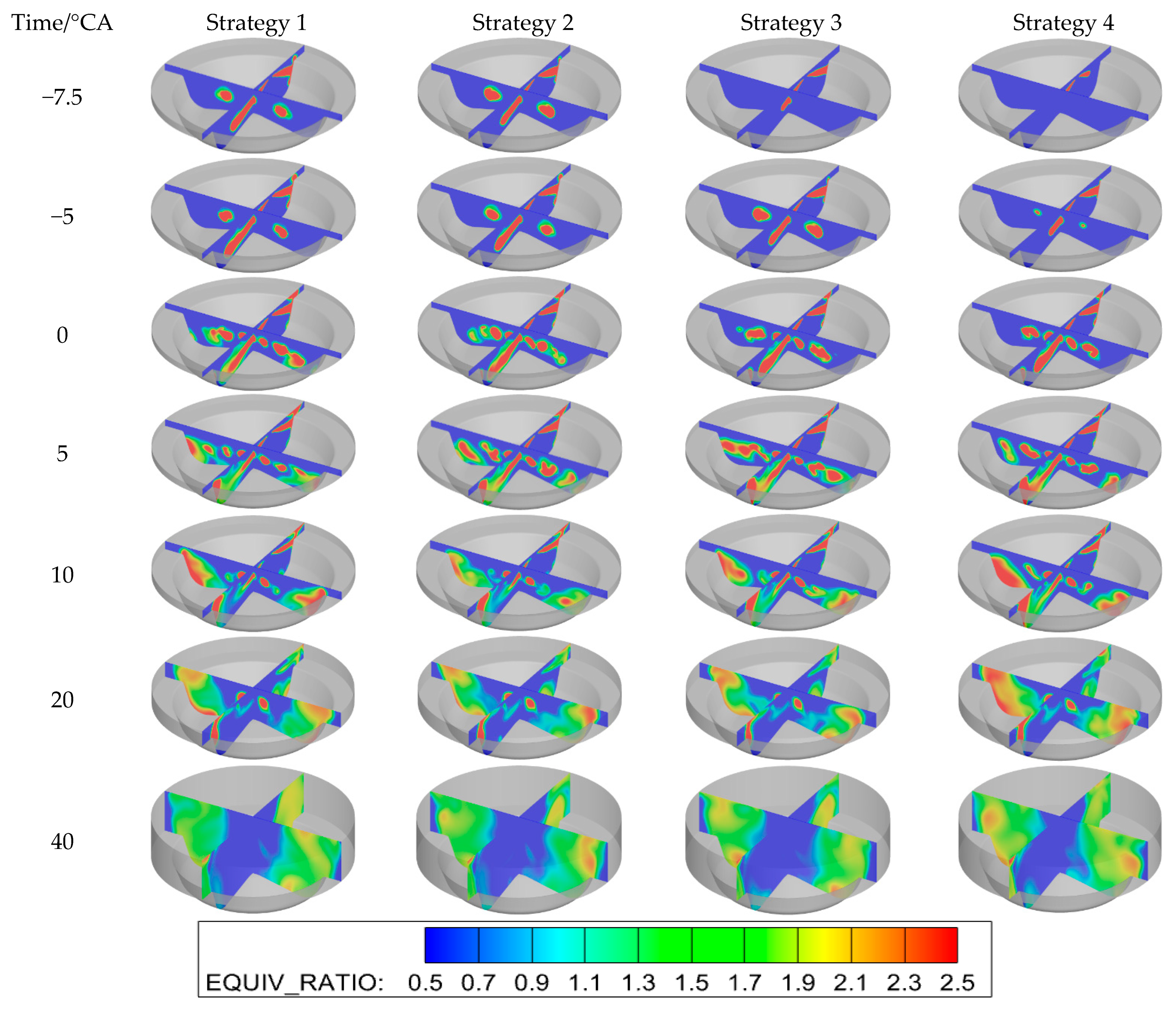
Figure 22 illustrates the influence of different fuel injection strategies on mixture formation. At −7.5 °CA, as the diesel injection timing advances, the fuel jets develop more fully in the combustion chamber. During the initial injection period (from −7.5 °CA to 0 °CA), the equivalence ratio is generally distributed along the fuel jet injection path. This is because the fuel has just started to inject and has not yet fully diffused and mixed with air. However, it can be observed that at 0 °CA, the diesel jet near the methanol injector under Strategy 1 has come into contact with the wall. At 5 °CA, the rich mixture region gradually spreads, and the equivalence ratio around the mixture decreases. Among the four injection strategies, the earlier the diesel injection, the larger the rich mixture region. At 20 °CA, diesel injection has ceased, but the mixture equivalence ratio in the recess of the piston bowl under Strategy 4 is still significantly higher than that under the other injection strategies. At 40 °CA, there is no significant difference in the mixture distribution among the four injection strategies.
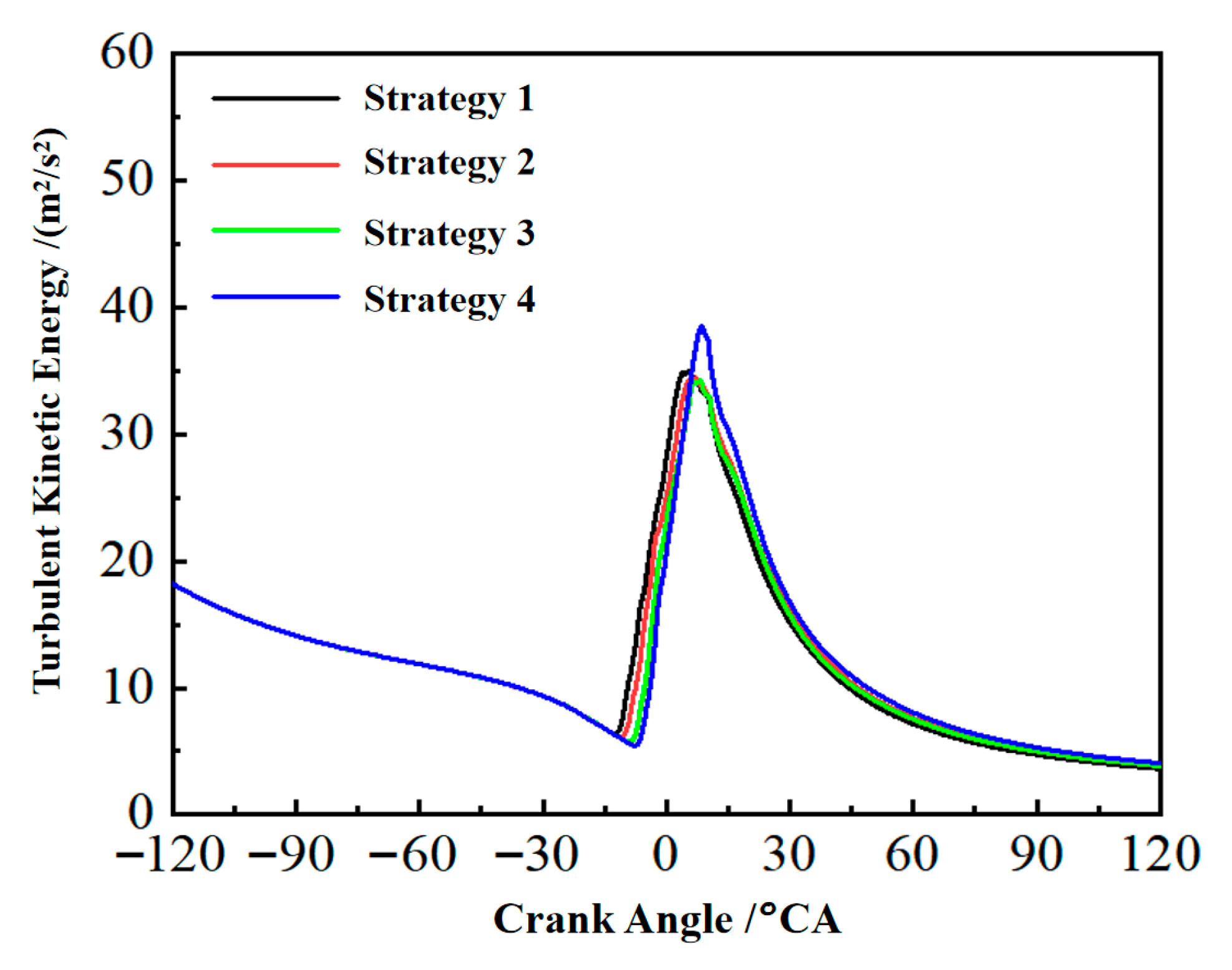
The variation in in-cylinder turbulent kinetic energy with crank angle under different injection intervals is shown in Figure 23. As the diesel injection start timing advances, the rise time of in-cylinder turbulent kinetic energy is significantly advanced. From Strategy 1 to Strategy 4, the diesel injection timing is gradually delayed, while the spray intersection process between diesel and methanol is prolonged, and the spray turbulent kinetic energy during the development process gradually increases. It can be seen that the peak spray turbulent kinetic energy of Strategy 4 is significantly higher than that of the other strategies. In addition, since the diesel injection duration is fixed, when the injection timing is closer to the top dead center (TDC), the reduction rate of spray turbulent kinetic energy is slower.

3.3.2. Influence on Engine Combustion Characteristics

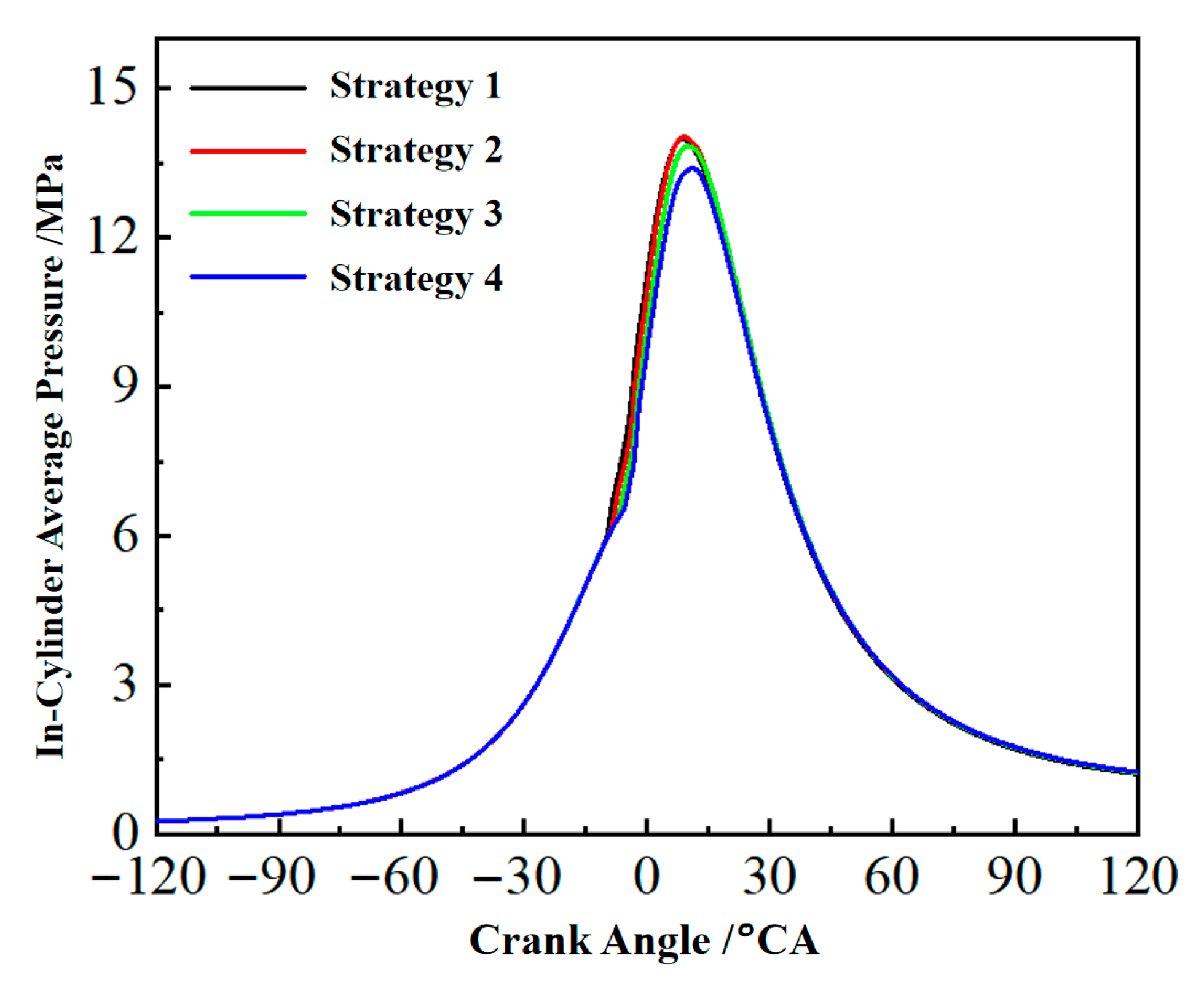
The variation trends of in-cylinder average pressure under different injection intervals are illustrated in Figure 24. As the injection interval between diesel and methanol increases (i.e., the earlier the diesel injection), the combustion timing of the in-cylinder mixture advances, and the rise time of the in-cylinder average pressure is correspondingly brought forward. With the progression of combustion, the in-cylinder average pressure rises rapidly, but the pressure rise rates of the in-cylinder average pressure among different strategies are basically the same. Regarding the peak cylinder pressure, Strategies 1 and 2 exhibit higher peaks, Strategy 3 has a slightly lower peak, and Strategy 4 shows the lowest peak. This is because the earlier entry of diesel into the cylinder allows the formation of a certain amount of combustible mixture. When the piston moves to a specific position, the temperature and pressure in the combustion chamber reach the combustion conditions, enabling the rapid formation of multi-point ignition. Under Strategy 4, diesel and methanol are injected simultaneously, resulting in a slightly delayed auto-ignition timing of diesel; however, the peak cylinder pressure between Strategy 4 and Strategy 1 differs by less than 1 MPa.
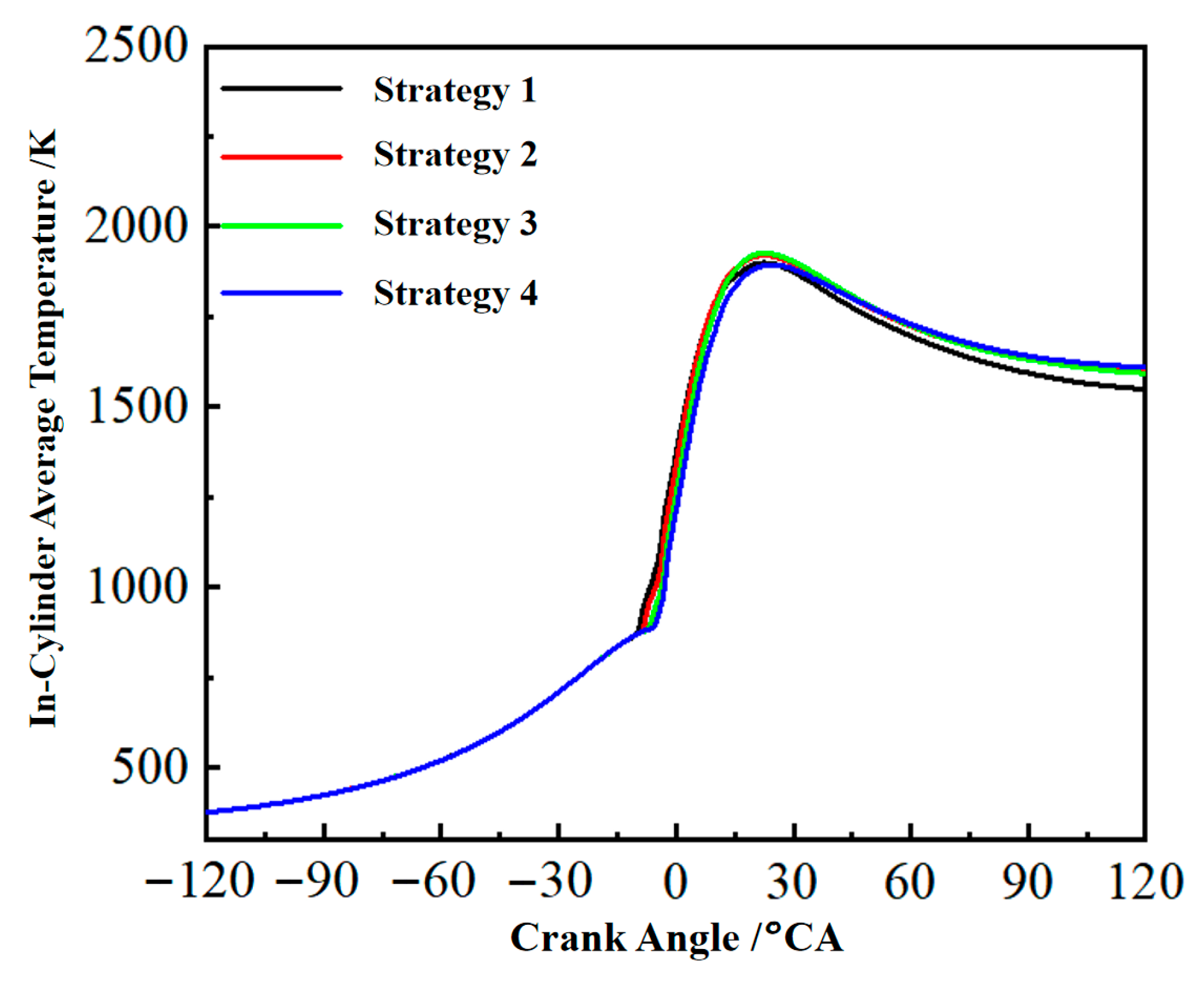
Figure 25 depicts the influence of different injection intervals on the in-cylinder average temperature. Similar to the development trend of the in-cylinder average pressure, the rise time of the in-cylinder average temperature advances as the diesel injection timing is brought forward, while the temperature rise rates under different strategies are basically consistent. Regarding the peak temperature, since the mass of the mixture is the same under all strategies, there is no significant difference in the peak temperature. After reaching the peak, the temperature decreases slowly, and the temperature of Strategy 1 during this stage is slightly lower than that of the other injection strategies. This is because the excessively early injection of diesel under Strategy 1 leads to more complete formation of the diesel mixture, which burns more fully during the auto-ignition stage, resulting in fewer combustibles at the late combustion stage and thus a slightly lower in-cylinder average temperature.
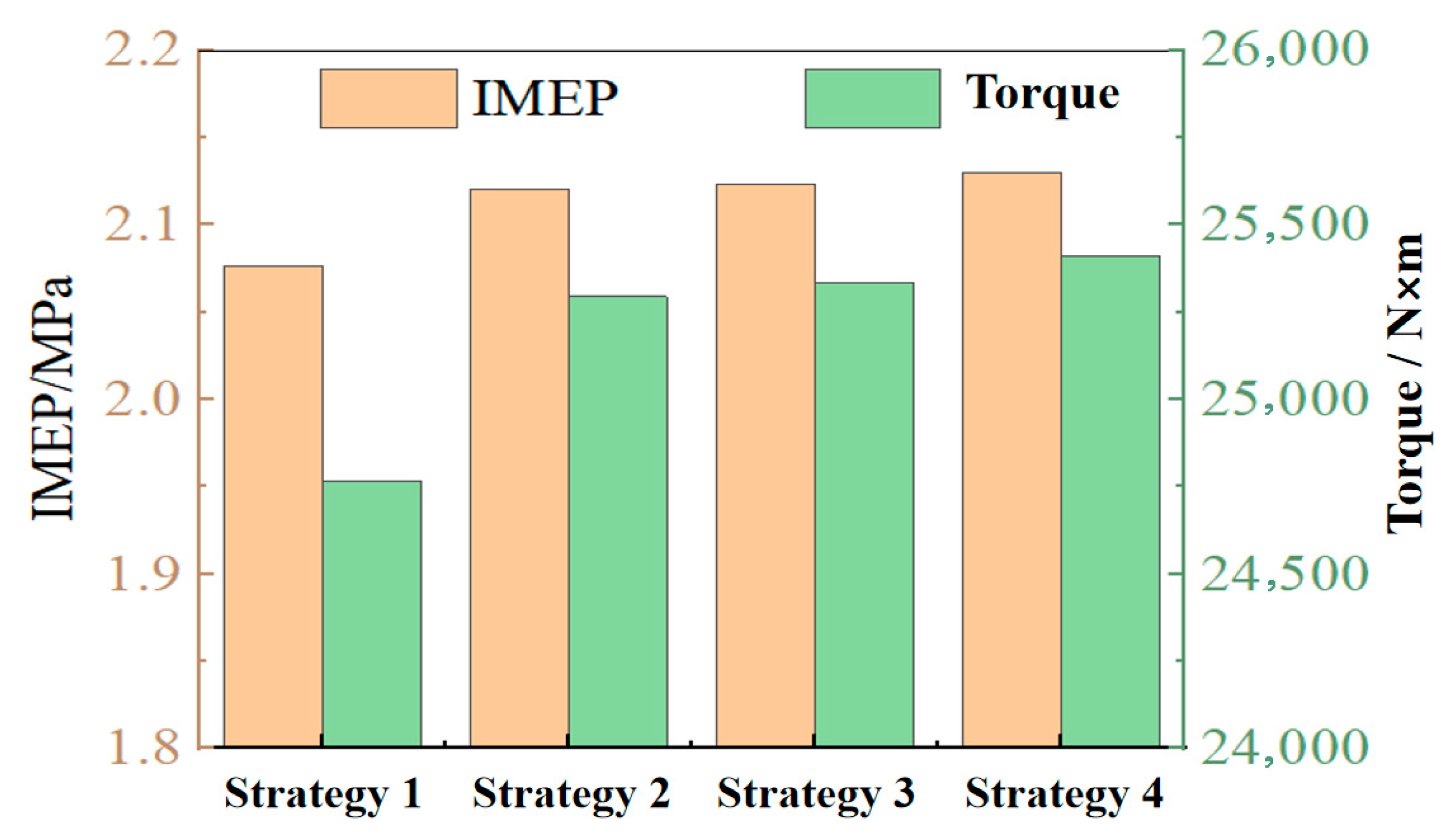
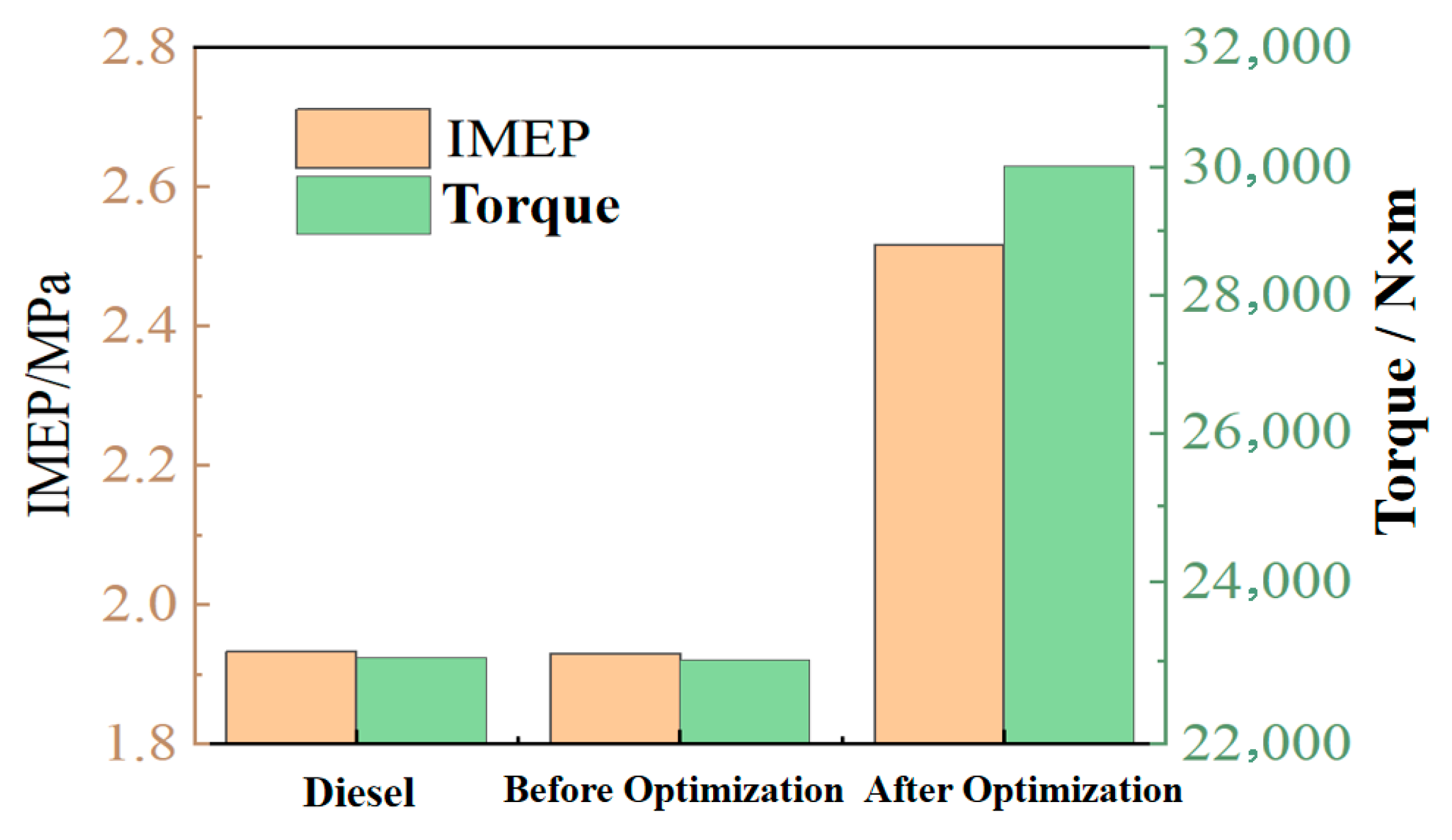
The Indicated Mean Effective Pressure (IMEP) is a key metric: the larger its value, the more work output per unit cylinder working volume and the stronger the engine’s work capacity. Torque reflects the torque output from the crankshaft end during engine operation; a higher torque indicates greater engine power. Both are critical indicators for evaluating the engine’s work capacity. To fully compare the influence of different injection strategies on engine performance, IMEP and torque were selected for analysis, as illustrated in Figure 26.
Regarding IMEP, it gradually increases as the diesel injection timing is delayed across the strategies, with the IMEP under Strategy 4 reaching approximately 2.12 MPa. For torque, it exhibits the same increasing trend with the delay of diesel injection timing. Under Strategy 4, the engine torque is about 25,430 N·m. Therefore, from the perspective of engine power performance, Strategy 4—i.e., the simultaneous injection of diesel and methanol—enables the optimal conversion of thermal energy generated by combustion into engine power output through piston movement.
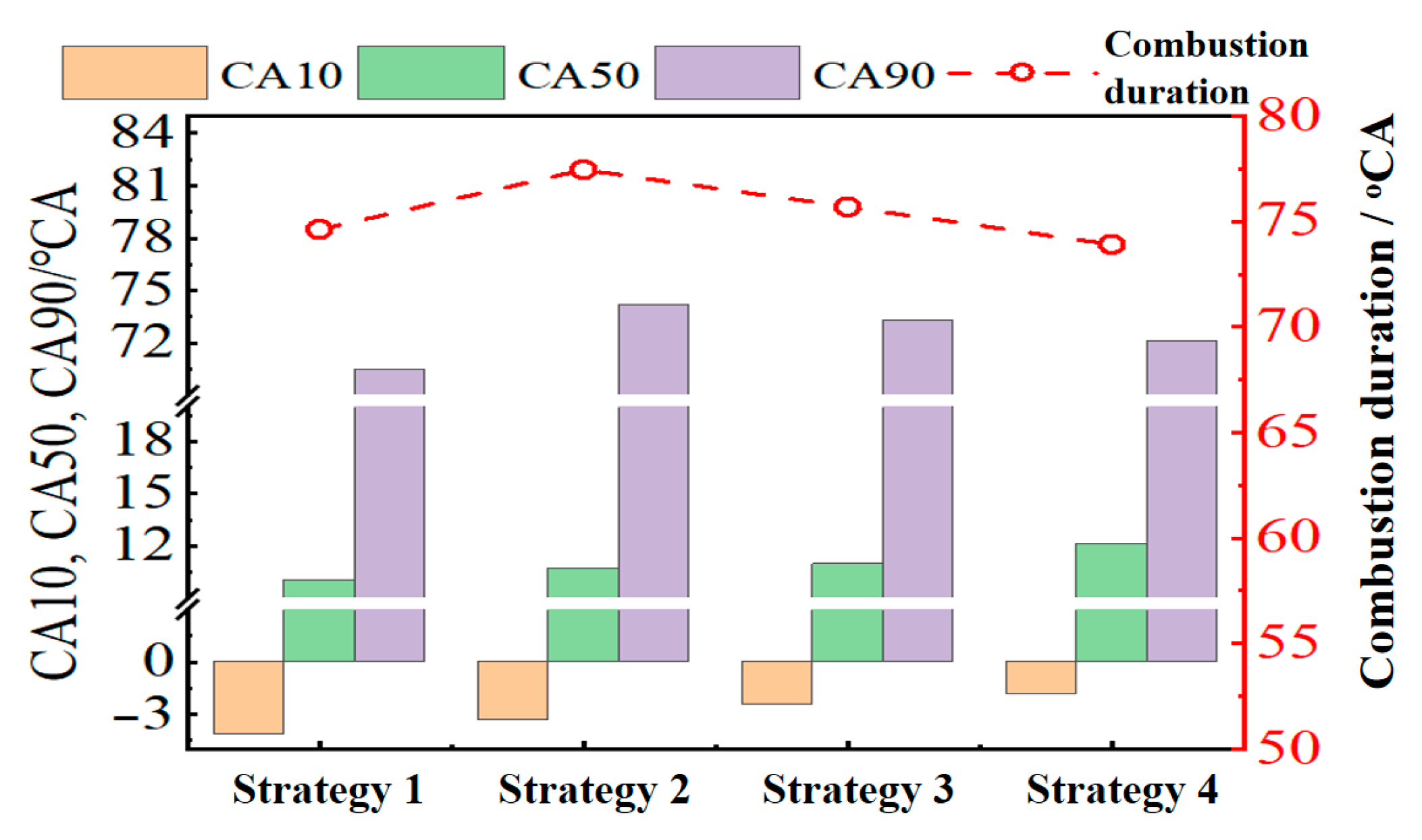
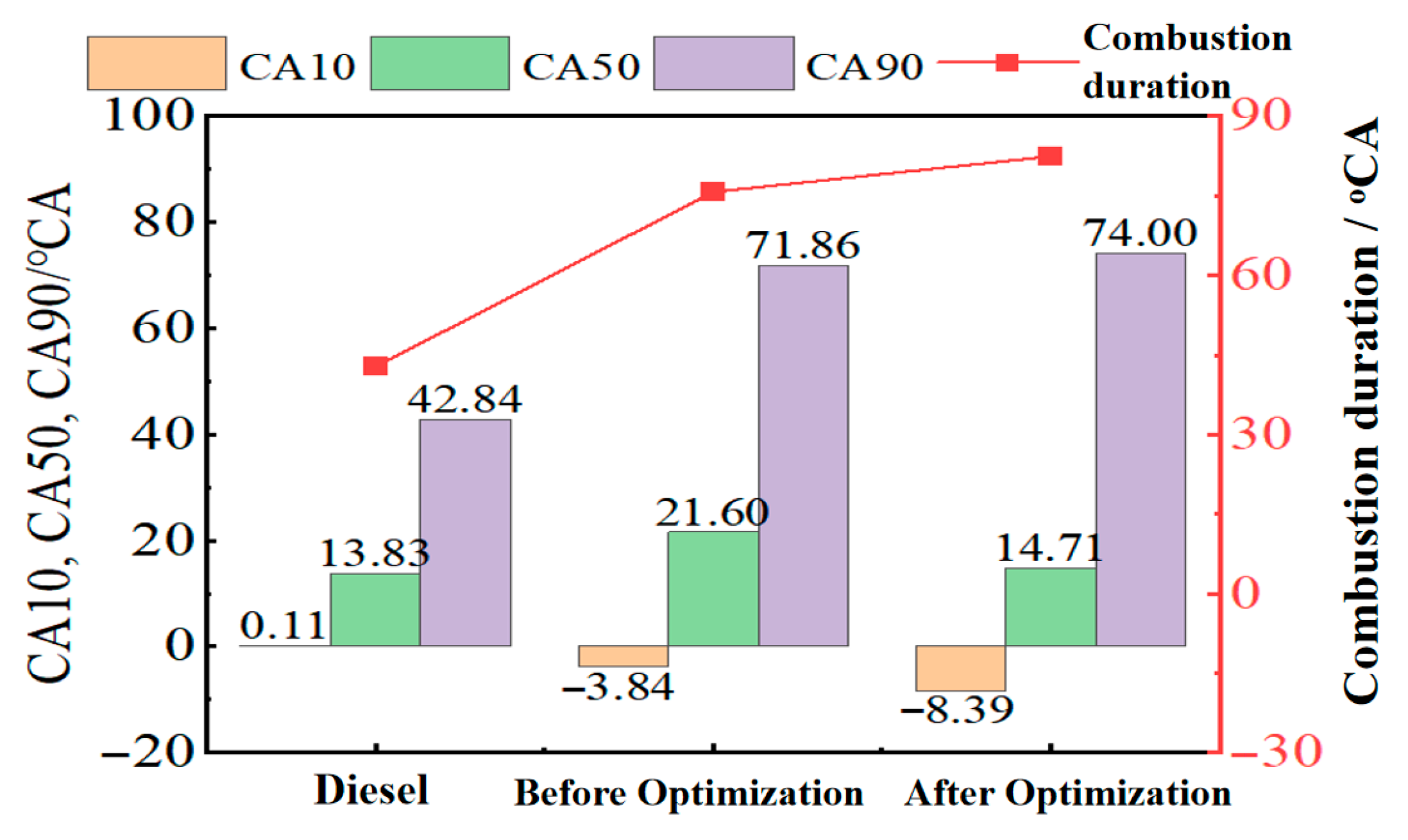
The variations in in-cylinder combustion characteristic parameters under different injection intervals are illustrated in Figure 27. As the diesel injection start timing is delayed, the CA 10 timing gradually shifts from −4 °CA under Strategy 1 to −1 °CA under Strategy 4. Correspondingly, CA 50 is also slightly delayed. However, CA 90 first extends and then shortens with the delay of diesel injection timing, with the latest CA 90 occurring under Strategy 2. This also results in the combustion duration first extending and then shortening as the diesel injection timing is delayed, among which the combustion duration is the shortest under Strategy 4 and the longest under Strategy 2.
Based on the comprehensive analysis above, it can be concluded that Strategy 4—i.e., the injection strategy with simultaneous injection of diesel and methanol—yields the optimal engine power performance and combustion performance. Therefore, subsequent numerical simulation work will be conducted based on this injection strategy.

3.4. Influence of Injection Timing on Engine Combustion Characteristics

3.4.1. Influence on the Mixture Formation Process

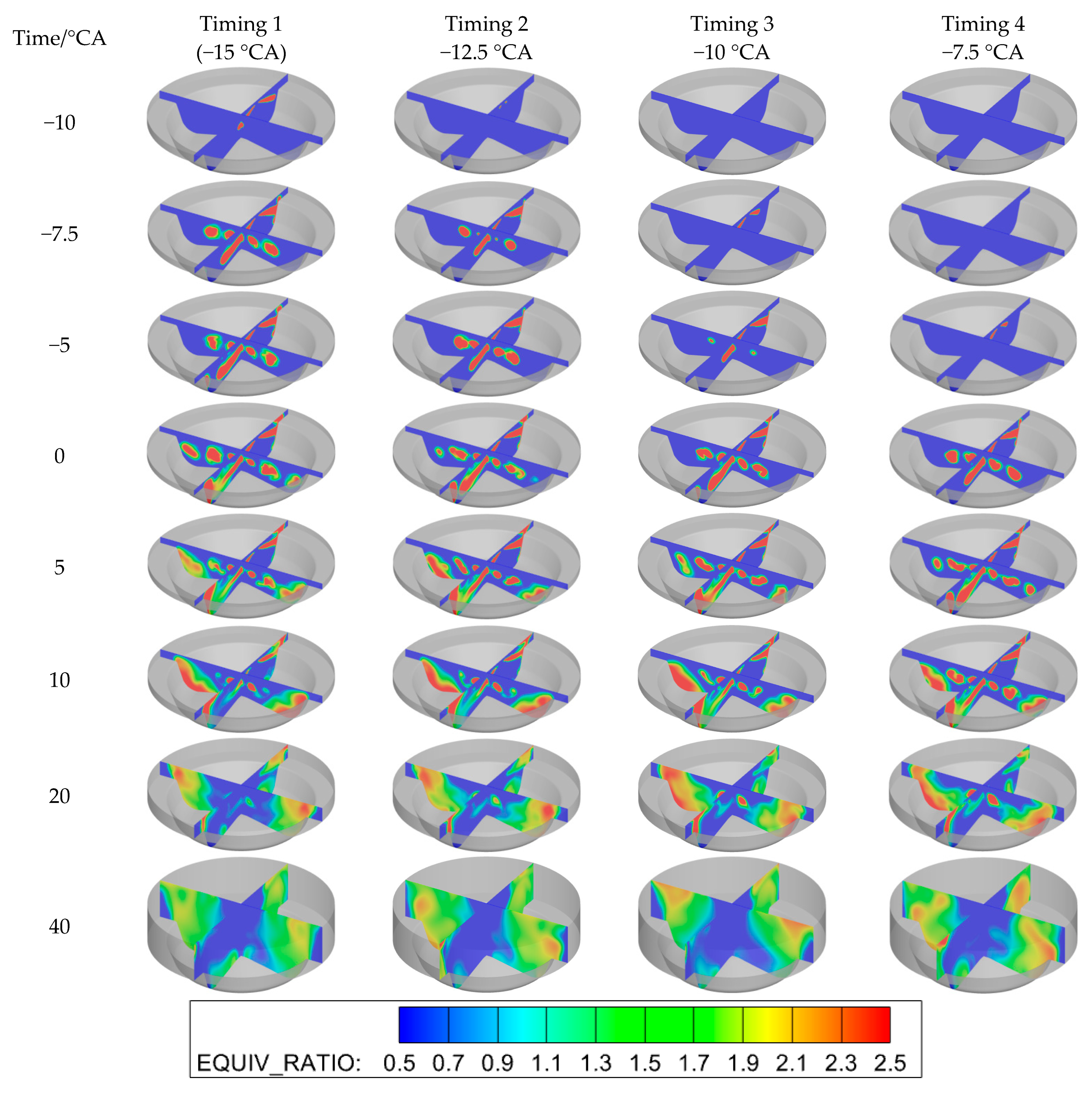
The influence of different injection timings on the in-cylinder mixture equivalence ratio is illustrated in Figure 28. During the period from −10 °CA to −5 °CA, the earlier the injection timing in the cases, the larger the in-cylinder mixture equivalence ratio region. At −5 °CA, it can be significantly observed that the diesel spray under Timing 1 has exhibited significant spray wall impingement, while the diesel spray under Timing 4 has just started to develop.
At 0 °CA, the spray under Timing 1 starts to spread around along the recess on the top of the piston, while the mixture under Timing 4 develops at the center of the combustion chamber. At 5 °CA, the rich mixture region under Timing 1 gradually diffuses, and the equivalence ratio around the mixture decreases. Among the four injection timings, the earlier the injection, the larger the rich mixture region. At 20 °CA, fuel injection has ceased, but under Timing 4, the mixture still accumulates in the recess of the piston bowl, and its equivalence ratio is significantly higher than that of the other injection timings. At 40 °CA, the difference in mixture distribution among the four injection timings is relatively small, but it can still be observed that the mixture under Timing 1 is close to the stoichiometric ratio.
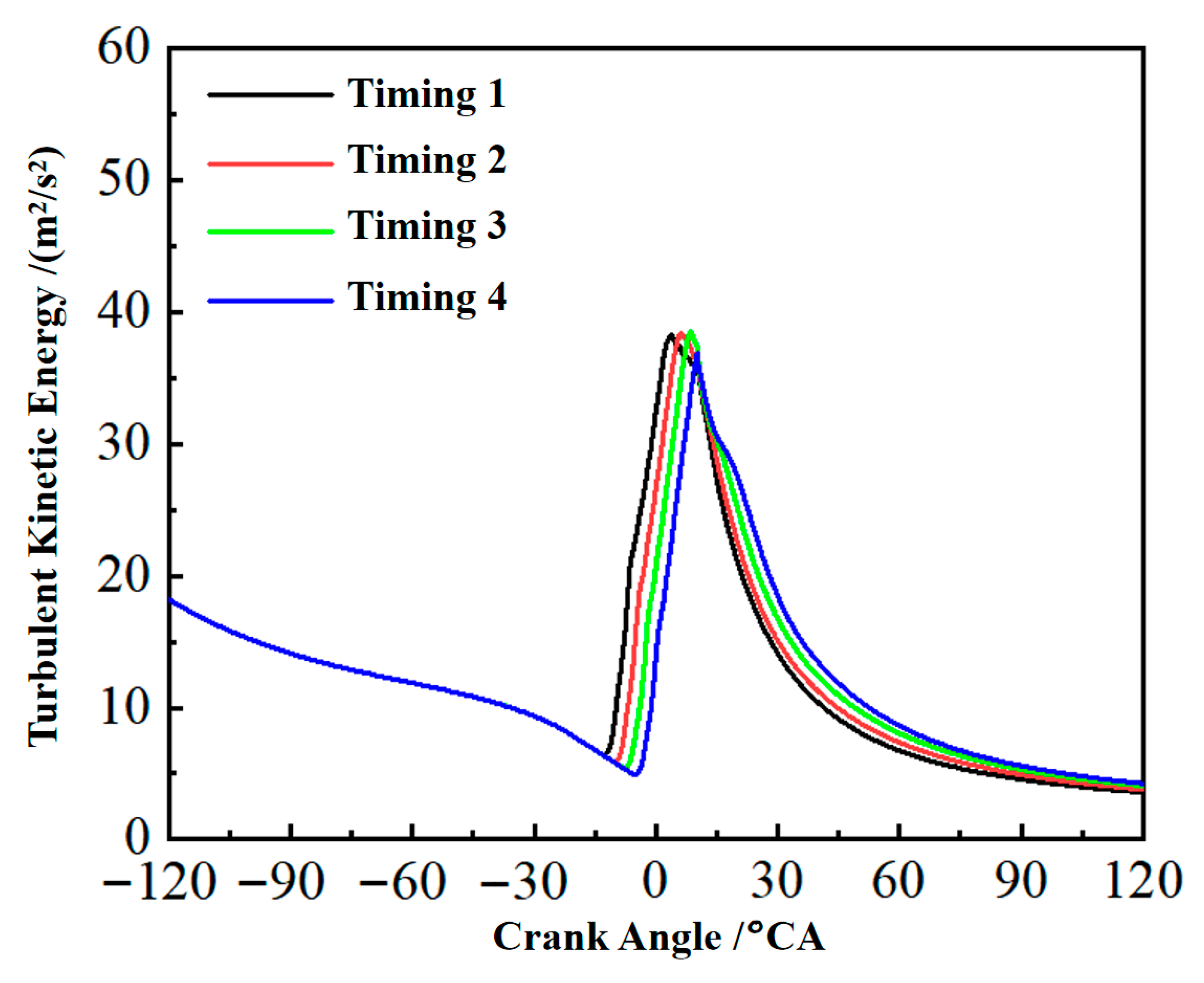
Figure 29 illustrates the influence of different injection timings on the development process of in-cylinder turbulent kinetic energy. After the start of fuel injection, the in-cylinder turbulent kinetic energy rises significantly; after the end of injection, it begins to decrease slowly. Therefore, under different injection timings, the earlier the injection, the earlier the rise in in-cylinder mixture turbulent kinetic energy.
Regarding the peak turbulent kinetic energy, the influence of injection timing is relatively small. Different injection timings mean different times when fuel is injected into the cylinder. An earlier injection timing (e.g., Timing 1) allows the fuel to have more time to mix with air in the cylinder, forming a relatively homogeneous mixture in advance, which leads to a faster attenuation of turbulent kinetic energy in the early combustion stage. In contrast, a later injection timing (e.g., Timing 4) may result in a shorter mixing time between the injected fuel and air, and the combustion process is relatively delayed, leading to a slower change in turbulent kinetic energy.

3.4.2. Influence on Engine Combustion Characteristics

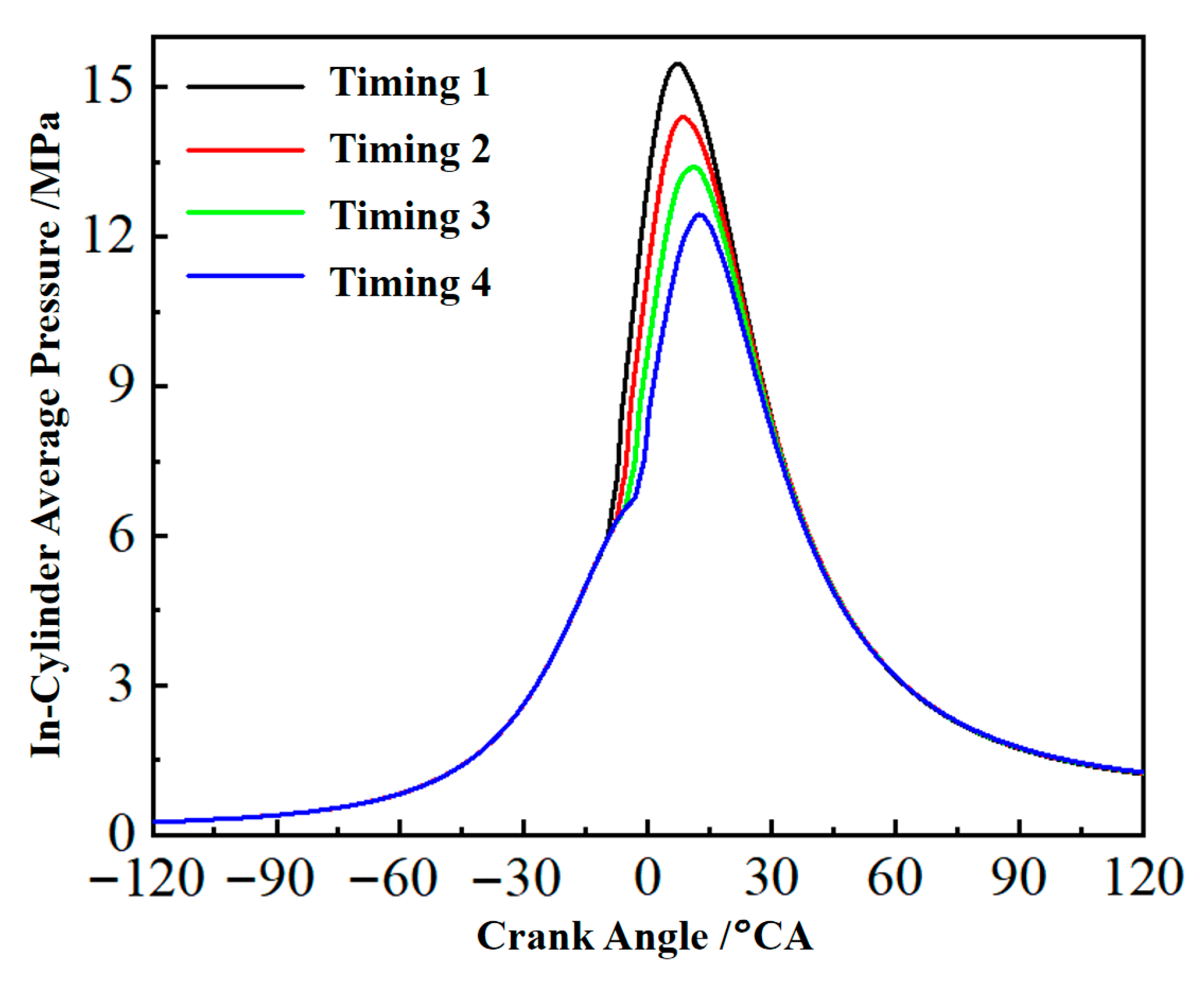
Under all injection timings, the in-cylinder average pressure exhibits a trend of first rising slowly, then increasing rapidly to reach a peak, and finally decreasing gradually with the change in crank angle. The pressure peak occurs when the crank angle is between approximately 0 °CA and 30 °CA. Among different injection timings, the earlier the injection, the earlier the crankshaft angle at which the cylinder pressure rises due to ignition, and the higher the formed peak cylinder pressure. Since the fuel mass is the same across different injection timings, the variation trend and value of cylinder pressure in the late combustion stage are consistent.
Different injection timings mean different times when fuel is injected into the cylinder. An earlier injection timing (e.g., Timing 1) allows the fuel to have more time to mix with air in the cylinder, forming a relatively homogeneous mixture in advance. This mixture is more combustible, and the pressure change caused by combustion is more significant. In contrast, a later injection timing results in a shorter mixing time between the injected fuel and air, leading to a relatively delayed combustion process. The influence of different injection timings on in-cylinder average pressure is illustrated in Figure 30.
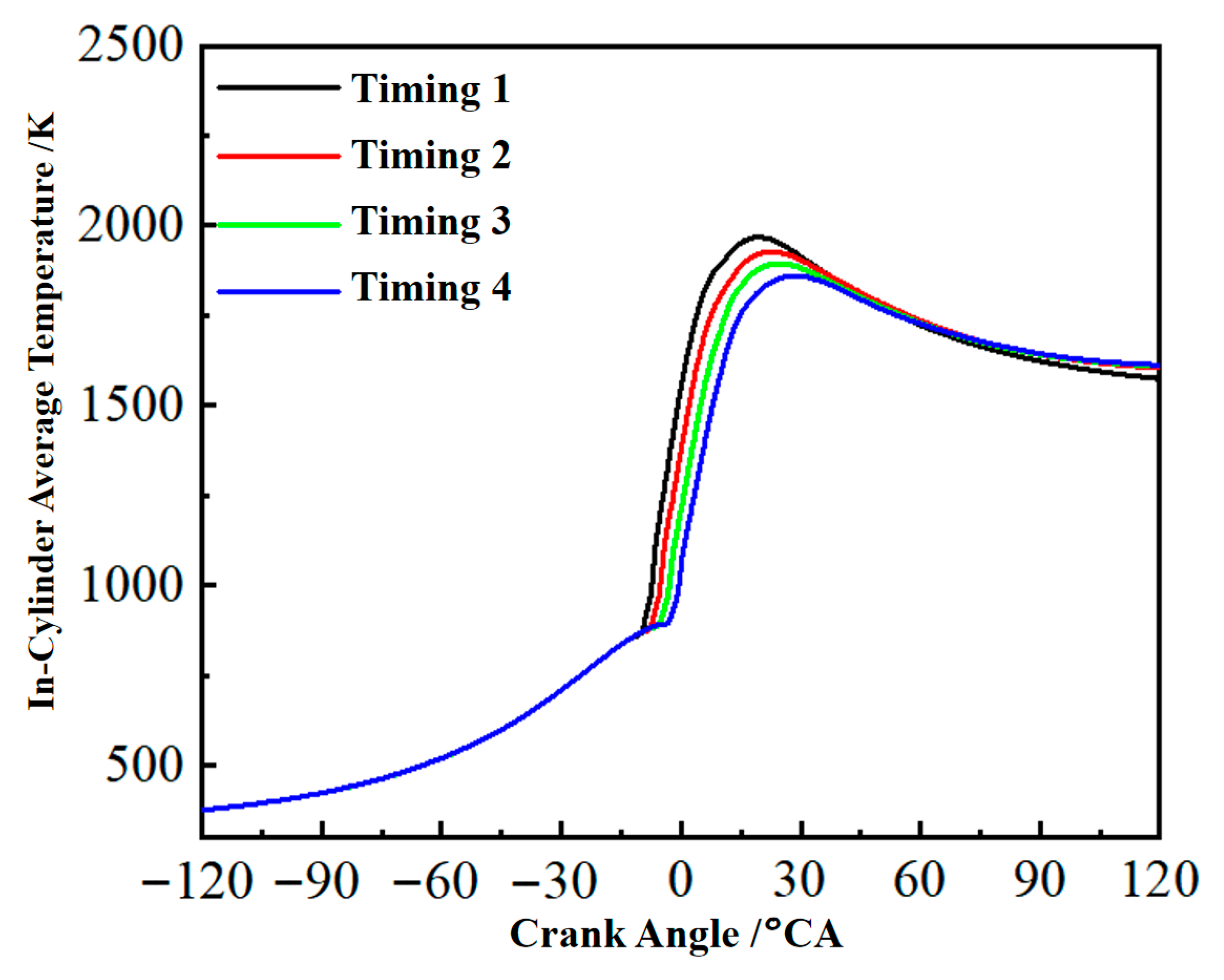
Under all injection timings, the in-cylinder average temperature exhibits a trend of first rising slowly, then increasing rapidly to reach a peak, and finally decreasing gradually with the change in crank angle—this trend is similar to that of cylinder pressure. An earlier injection timing (e.g., Timing 1) allows the fuel to have more time to mix with air in the cylinder, resulting in a larger temperature change in the early combustion stage. When the crank angle is between approximately 0 °CA and 30 °CA, compression combustion rapidly increases the gas temperature in the cylinder, triggering a sharp rise in temperature until it reaches the peak. Subsequently, as combustion proceeds and gas expands, the temperature gradually decreases. In contrast, a later injection timing (e.g., Timing 4) results in a shorter mixing time between the injected fuel and air, with the combustion process relatively delayed, leading to a smaller temperature change amplitude. Figure 31 illustrates the development trend of in-cylinder average temperature under different injection timings.
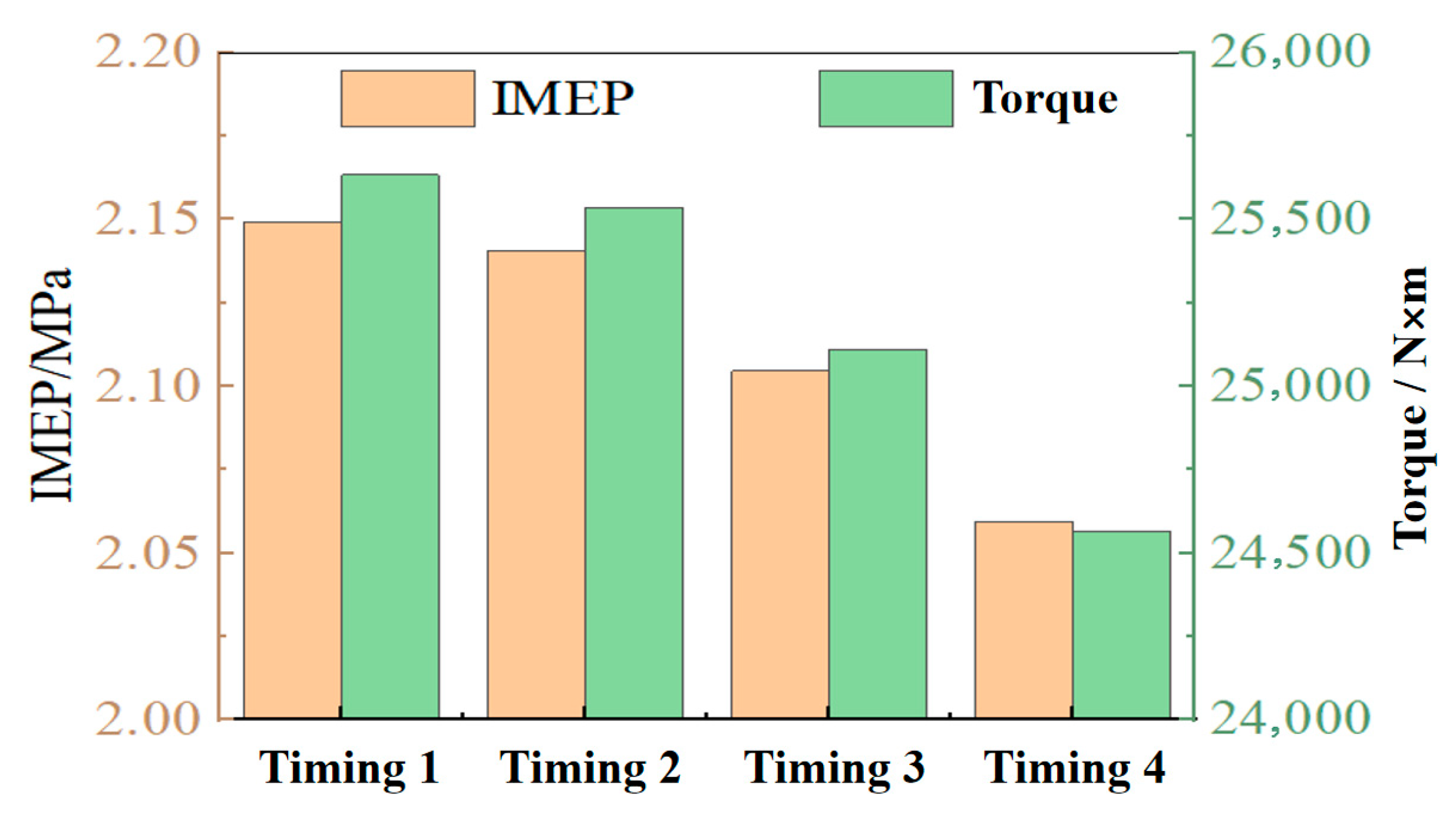
As the injection timing shifts from Timing 1 to Timing 4, the IMEP shows a gradual decreasing trend. Timing 1 achieves the highest IMEP, approximately 2.15 MPa, while Timing 4 has the lowest IMEP, around 2.05 MPa. The variation trend of torque is similar to that of IMEP, also decreasing gradually with the delay of injection timing. Timing 1 delivers the highest torque, close to 26,000 N·m, whereas Timing 4 yields the lowest torque, about 24,500 N·m. An earlier injection timing (e.g., Timing 1) contributes to more sufficient energy release during combustion, thereby improving IMEP and torque. Conversely, a later injection timing (e.g., Timing 4) may cause inhomogeneous mixture or incomplete combustion, reducing energy release efficiency and further decreasing IMEP and torque. Figure 32 presents the influence of different injection timings on engine IMEP and torque.
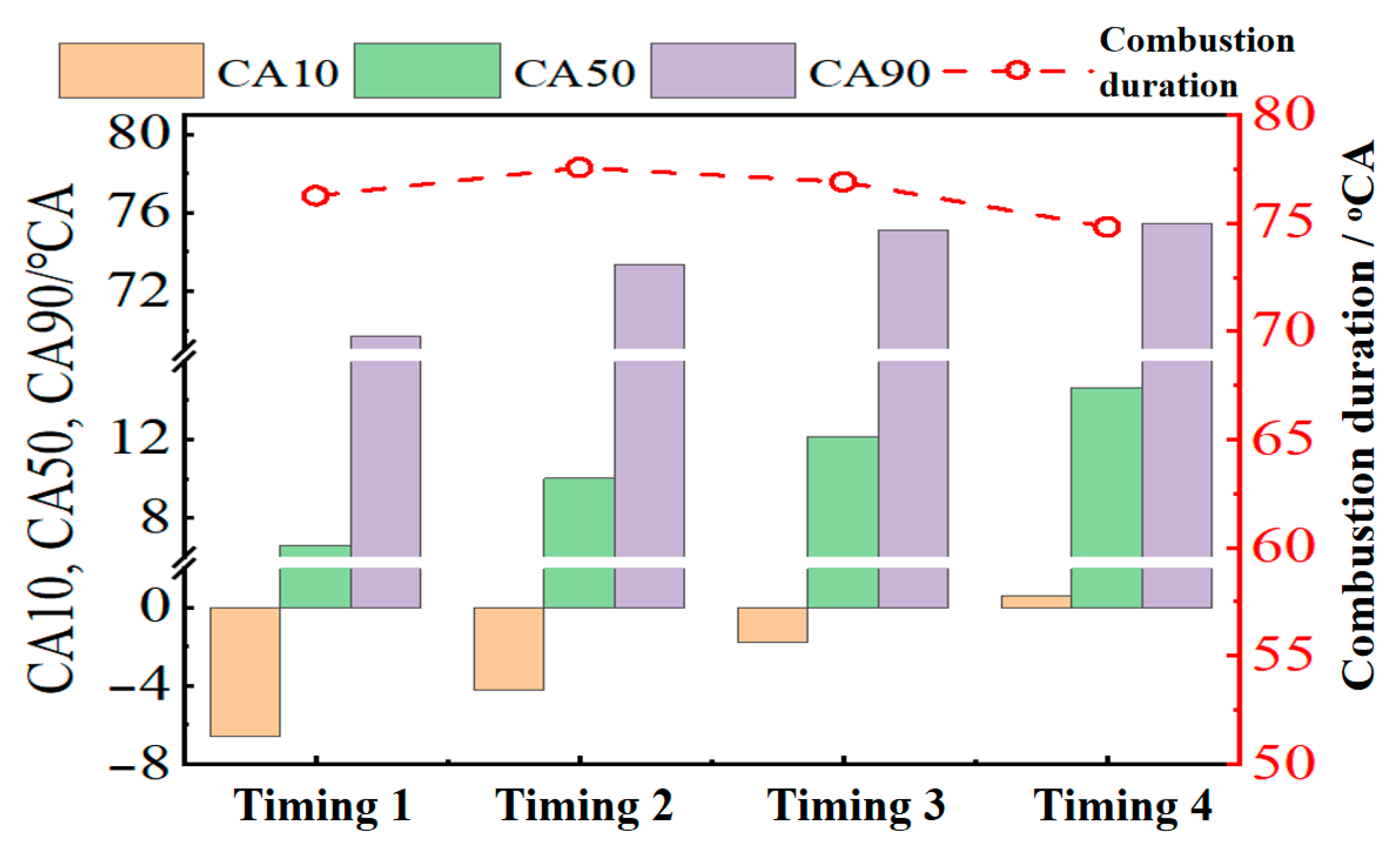
The variation trends of CA 10, CA 50, CA 90, and combustion duration under different injection timings are illustrated in Figure 4, Figure 5, Figure 6, Figure 7, Figure 8, Figure 9, Figure 10, Figure 11, Figure 12, Figure 13, Figure 14, Figure 15, Figure 16, Figure 17, Figure 18, Figure 19, Figure 20, Figure 21, Figure 22, Figure 23, Figure 24, Figure 25, Figure 26 and Figure 27. As the injection timing shifts from Timing 1 to Timing 4, CA 10 gradually increases. The CA 10 of Timing 1 is approximately −6 °CA, while that of Timing 4 is about −2 °CA. CA 50 shows a gradual increasing trend from Timing 1 to Timing 4: CA 50 of Timing 1 is around 6 °CA, Timing 2 increases to approximately 8 °CA, Timing 3 further rises to about 10 °CA, and Timing 4 reaches around 17 °CA.
CA 90 gradually increases with the delay of injection timing. The CA 90 of Timing 1 is approximately 72 °CA, Timing 2 increases to about 74 °CA, Timing 3 rises to around 75 °CA, and Timing 4 further increases to approximately 76 °CA. The combustion duration first increases and then decreases as the injection timing is delayed: the combustion duration of Timing 1 is about 77 °CA, Timing 2 increases to approximately 79 °CA, Timing 3 decreases to 77 °CA, and Timing 4 further drops to 75 °CA.
Figure 33 shows Influence of different injection timings on engine combustion characteristics. An earlier injection timing (e.g., Timing 1) allows the fuel to have more time to mix with air, forming a more homogeneous mixture. This leads to an earlier start of the combustion process and a smaller CA 10. With the delay of injection timing, the mixing time between fuel and air decreases, which may result in a later start of the combustion process and a gradual increase in CA 10. As the injection timing is delayed, the mixture homogeneity decreases, leading to changes in the combustion rate. For example, the larger CA 50 of Timing 3 indicates that the time to reach 50% combustion is later, due to inhomogeneous mixture or delayed combustion process. A later injection timing leads to an extended combustion duration, as the inhomogeneous mixture or delayed combustion requires more time to complete combustion. Timing 3 has the longest combustion duration, indicating a relatively slow combustion process.

3.5. Influence of Methanol Energy Ratio on Combustion and Emission Characteristics

Under different energy ratio conditions, assuming the total calorific value of the fuel remains constant, the diesel mass is reduced as the methanol energy ratio increases. Table 6 presents the methanol mass, diesel mass, and heat release under different energy ratios.
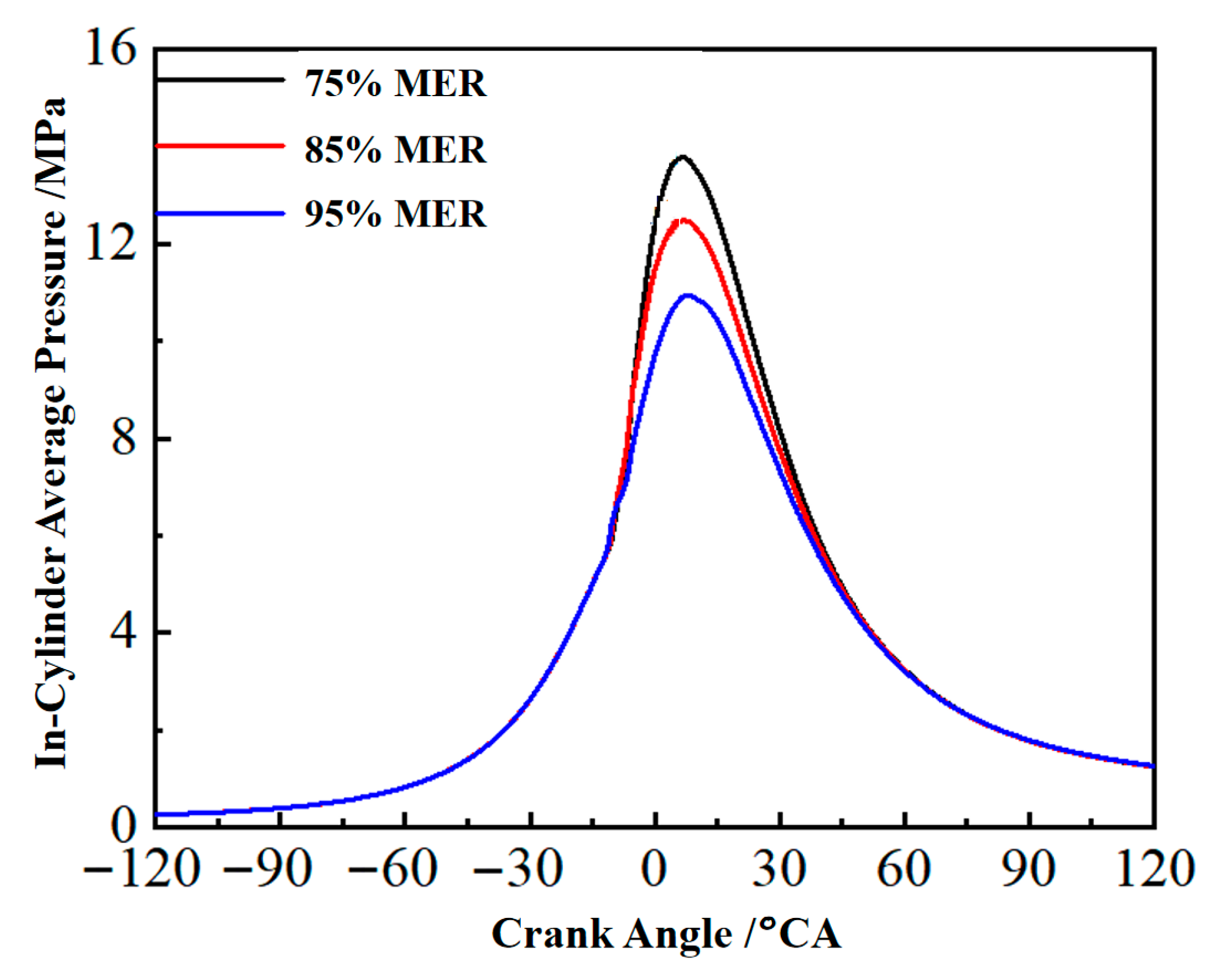
Figure 34 Variation Trend of In-Cylinder Average Pressure Under Different Methanol Energy Ratios. It can be seen that as the methanol energy ratio increases, the peak in-cylinder pressure gradually decreases. The peak in-cylinder pressure under 75% Methanol Energy Ratio is approximately 14 MPa, that under 85% Methanol Energy Ratio decreases to 12.5 MPa, and the peak in-cylinder pressure under 95% Methanol Energy Ratio significantly drops to around 11 MPa.
This is because as the methanol energy ratio increases, the diesel mass gradually decreases, which leads to a significant reduction in mixture reaction activity. Meanwhile, methanol exhibits an endothermic phenomenon during atomization—a larger mass of methanol will significantly lower the in-cylinder temperature, resulting in a relatively low temperature during combustion and a decrease in combustion efficiency. Since the theoretical heat release of the fuel is consistent under different methanol energy ratios, the in-cylinder average pressure at the late combustion stage is also consistent.
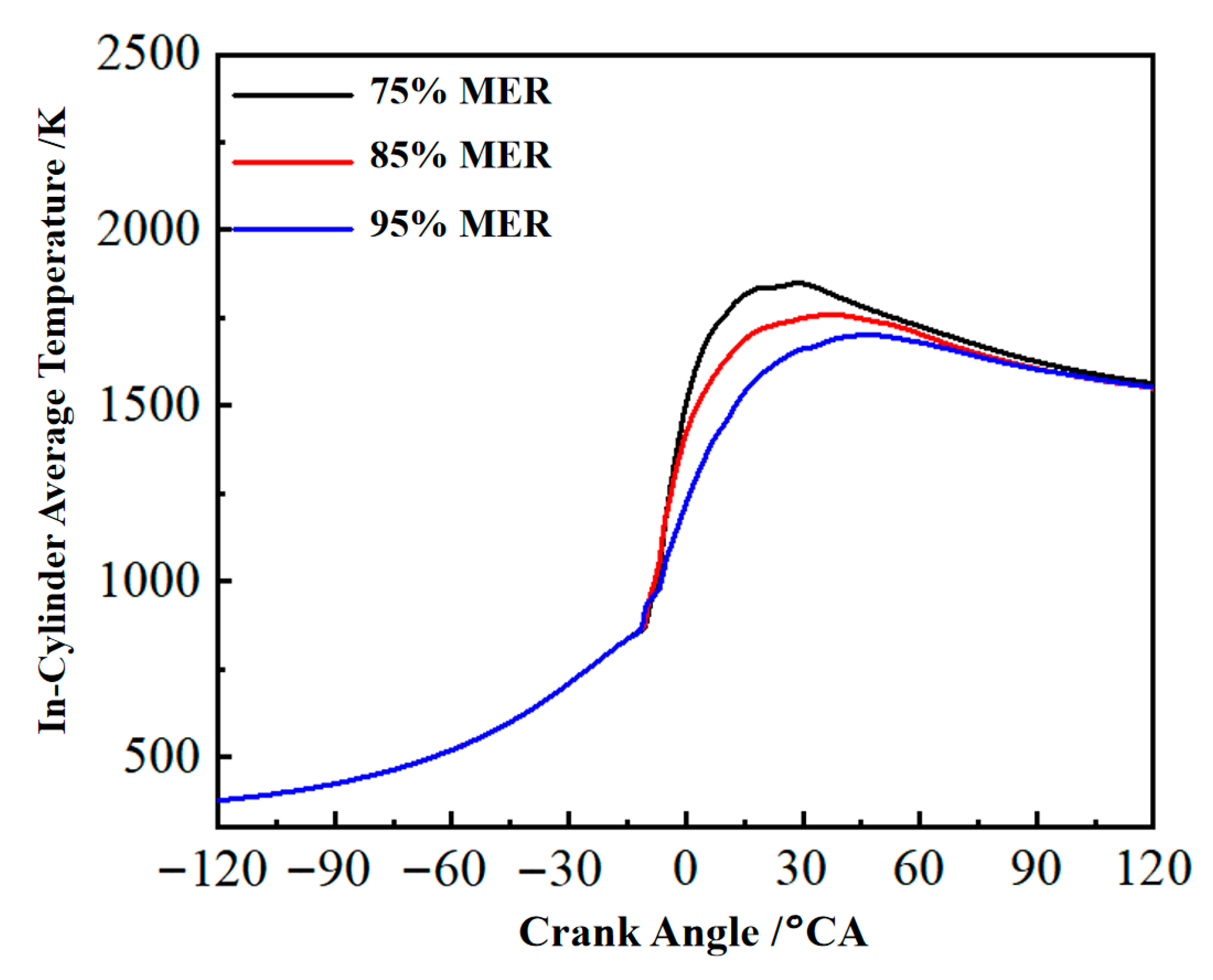
It can be seen from Figure 35 that with the change in crank angle, the in-cylinder average temperature under different methanol energy ratios exhibits a trend of first rising and then decreasing. When the crank angle ranges from −120 °CA to around 0 °CA, the temperature gradually increases. During the combustion stage, the temperature rises extremely significantly: the curve of 75% Methanol Energy Ratio shows the fastest temperature rise and reaches the highest peak temperature, while the curve of 95% Methanol Energy Ratio has a relatively lower temperature. This may be due to the relatively low combustion activity of methanol and its small combustion reaction rate—with the increase in methanol proportion, the maximum temperature decreases. After the crank angle exceeds 30 °CA, the temperature starts to decrease, which is related to the reduced heat release after combustion. The curves of different methanol energy ratios show certain differences in the decreasing stage, but the overall trend is gradual cooling, and the final temperature changes tend to be consistent. Figure 35 Influence of Different Methanol Energy Ratios on In-Cylinder Average Temperature.
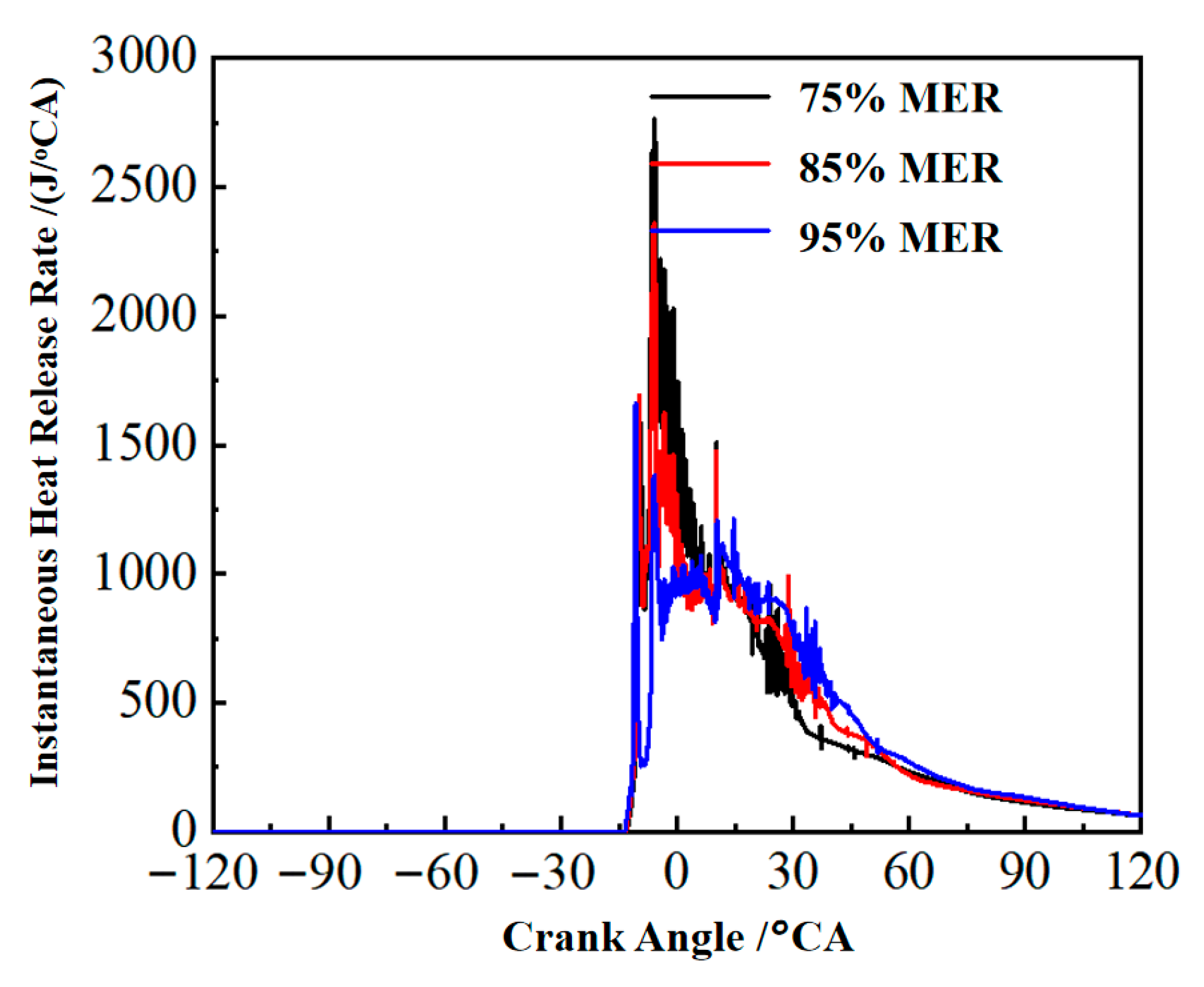
It can be observed from Figure 36 that with the change in crank angle, the in-cylinder instantaneous heat release rate under different methanol energy ratios first rises rapidly to reach a peak, then gradually decreases and tends to stabilize. At the start of combustion, all three curves show obvious heat release peaks: the curve of 75% Methanol Energy Ratio has the highest peak and appears the earliest, while the curve of 95% Methanol Energy Ratio has a relatively lower peak and appears slightly later. This is because the diesel content is higher under the 75% Methanol Energy Ratio condition—diesel will burn first and release a large amount of heat during combustion, thereby igniting the methanol mixture. Due to the higher methanol mass under the 95% Methanol Energy Ratio condition, the instantaneous heat release rate of the mixture is smaller in the early combustion stage, but heat release continues in the middle and late combustion stages. This is caused by the slow combustion of the large mass of methanol. Figure 36 Variation Trend of Instantaneous Heat Release Rate Under Different Methanol Energy Ratios.
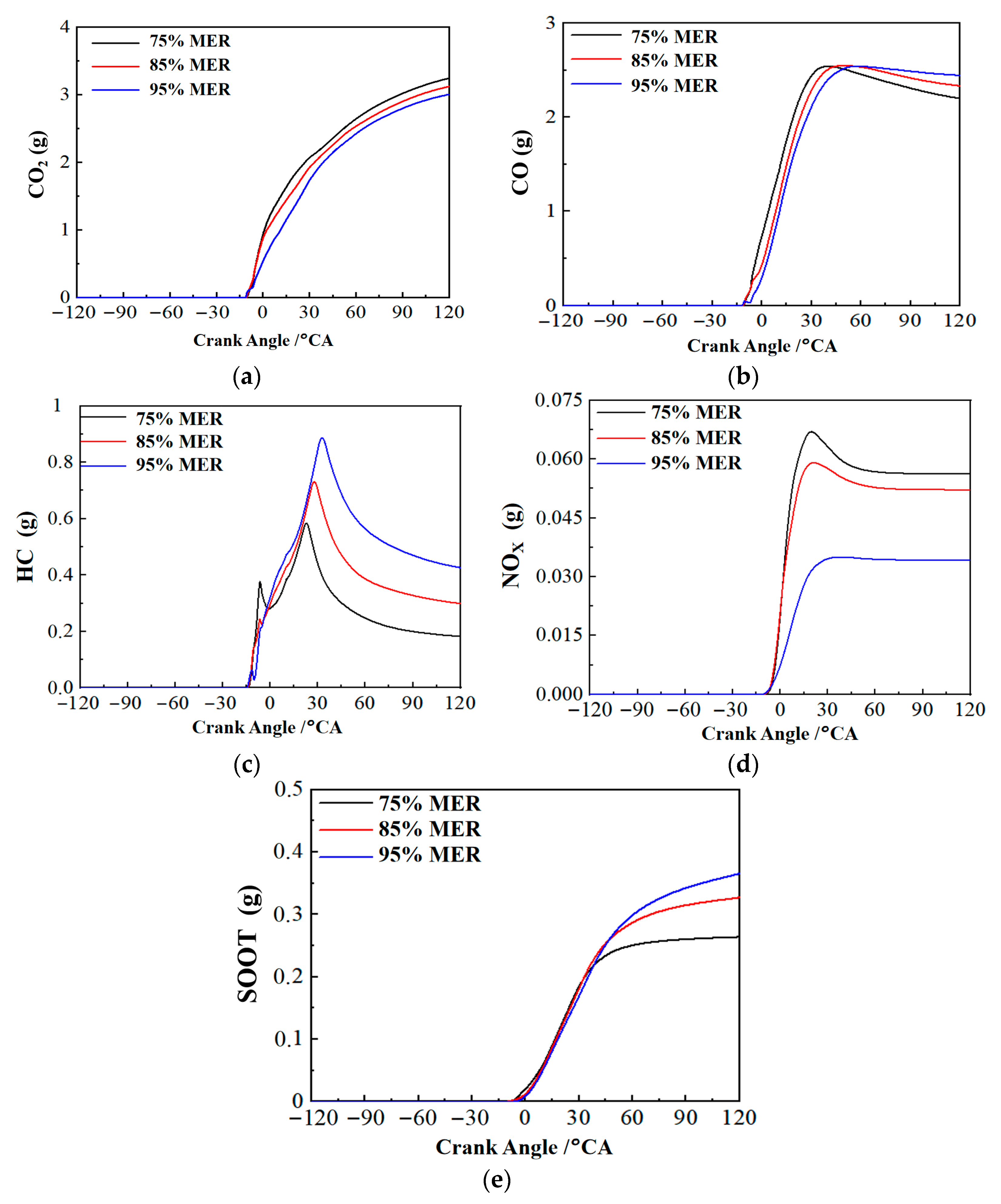
It can be seen from Figure 37 that with the change in crank angle, different methanol energy ratios exhibit distinct trends in their influence on in-cylinder pollutant emissions.
For CO2 emissions, as the methanol energy ratio increases, the final CO2 emission amount is gradually reduced. This is because methanol is a low-carbon fuel, and its molecular carbon content is significantly lower than that of diesel, resulting in relatively less CO2 produced after combustion.
For CO emissions, the curve of 75% Methanol Energy Ratio shows higher emissions in the early combustion stage, but the CO emissions decrease as combustion proceeds. This is due to the rapid combustion under the low methanol energy ratio condition in the early combustion stage, which generates more CO. However, as combustion continues, the higher in-cylinder temperature will cause CO to be further oxidized and burned. In contrast, methanol under high energy ratio conditions may lead to incomplete combustion in the late combustion stage, thereby increasing CO emissions. Figure 37 Influence of Different Methanol Energy Ratios on In-Cylinder Pollutant Emissions such as CO2 and CO.
For HC emissions, as the methanol energy ratio increases, the HC emission amount first decreases and then increases. The curve of 75% Methanol Energy Ratio shows lower emissions in the early combustion stage, while the curve of 95% Methanol Energy Ratio sees a rise in emissions in the late combustion stage. This may be due to the differences in combustion characteristics between methanol and diesel: combustion is more complete at low methanol ratios, whereas incomplete combustion occurs in the late stage at high ratios.
For NOx emissions, the NOx emission amount gradually decreases with the increase in methanol energy ratio. This can be attributed to the relatively low combustion temperature under high methanol energy ratio conditions, which reduces the formation of thermal NOx.
For Soot emissions, the Soot emission amount significantly increases as the methanol energy ratio rises. This is likely because methanol burns at a relatively low temperature, and the generated soot is not easy to oxidize and burn under such low-temperature conditions.

3.6. Influence of Methanol Injection Pressure on Combustion and Emission Characteristics

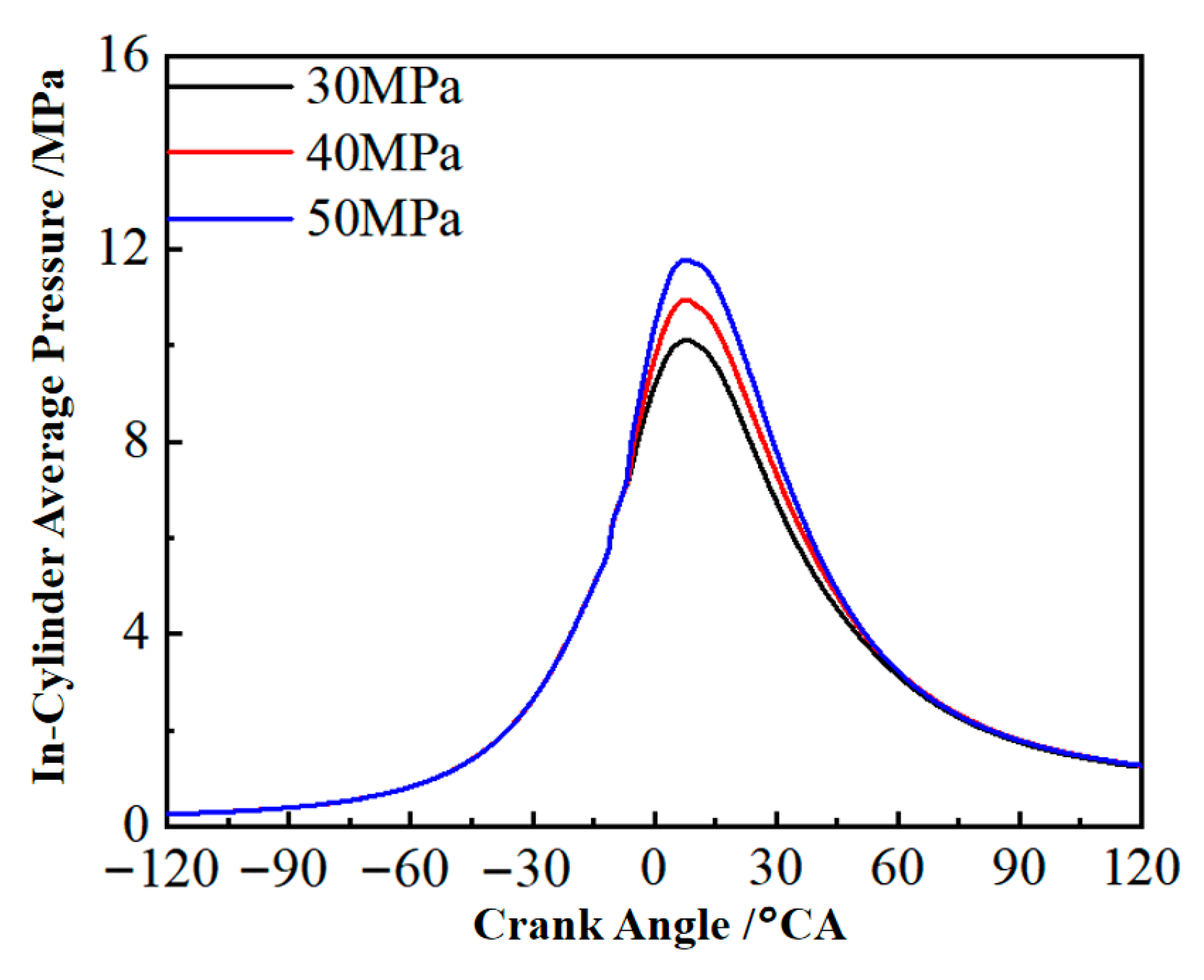
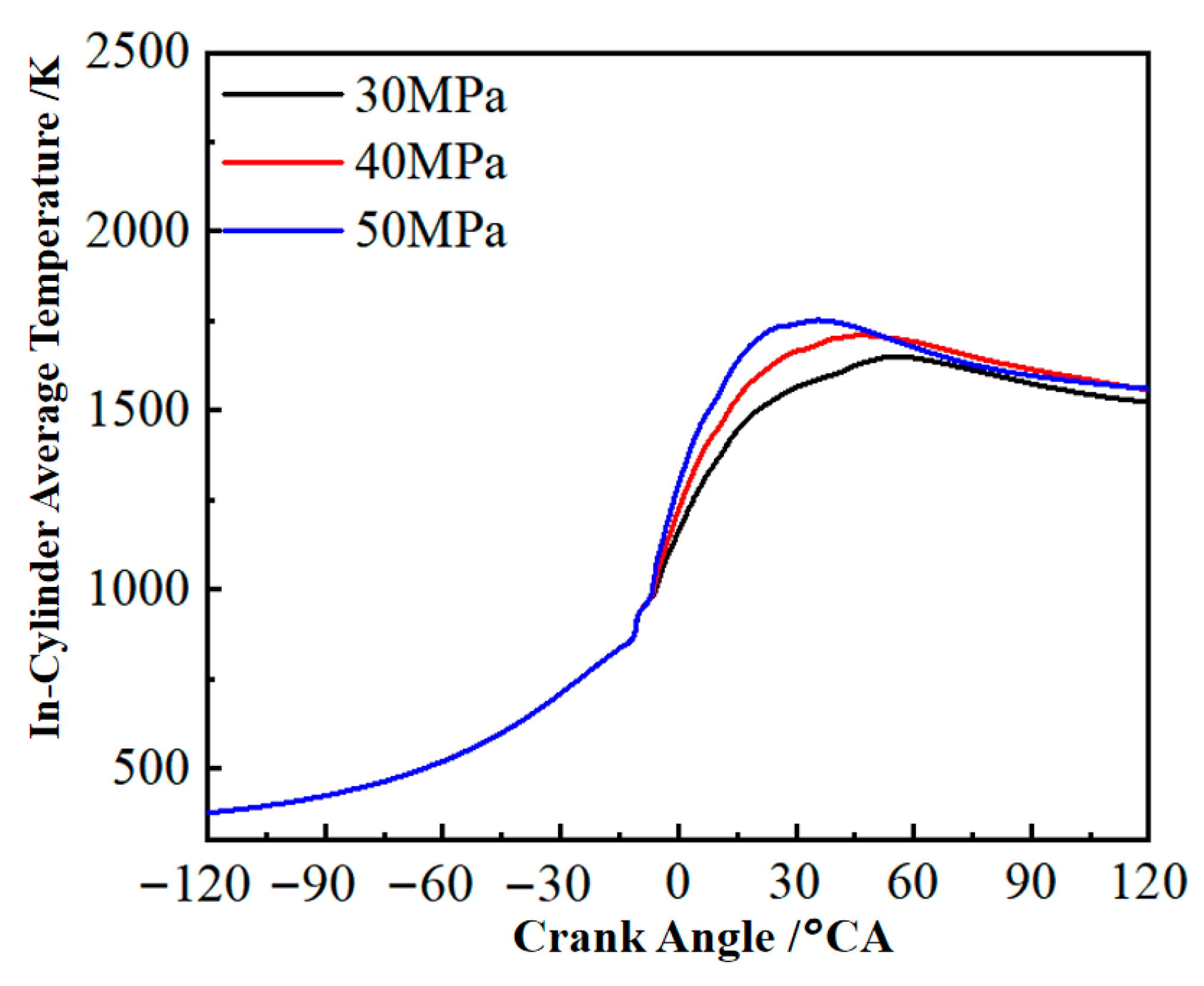
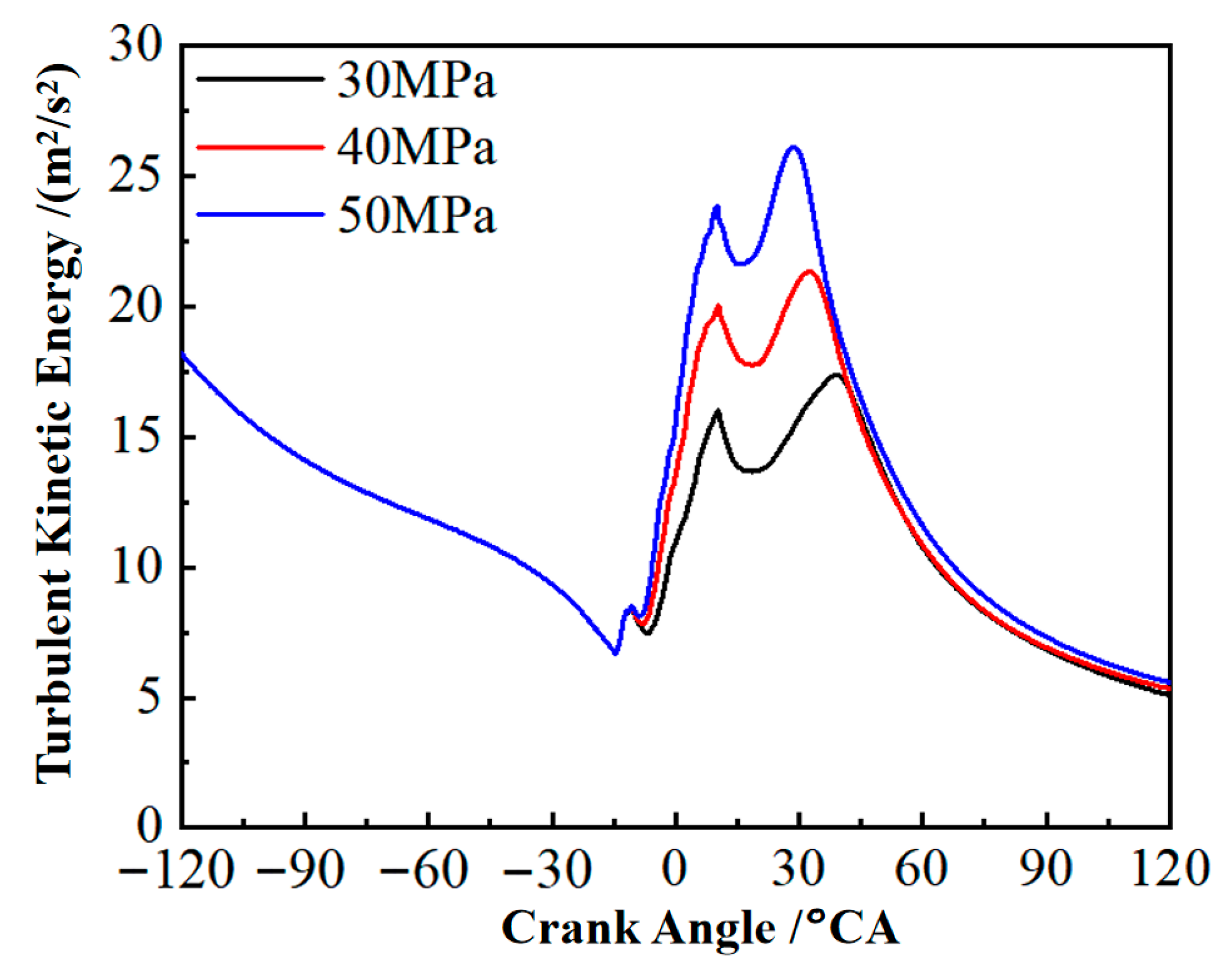
Regarding methanol injection pressure, the methanol injection mass and diesel injection mass are kept constant, and the injection pressure is adjusted by modifying the injection duration. The methanol injection pressures are 30, 40, and 50 MPa, respectively, while the diesel injection pressure is 80 MPa.
It can be seen from Figure 38 that with the change in crank angle, the in-cylinder average pressure under different methanol injection pressures exhibits a trend of first rising rapidly to reach a peak and then decreasing gradually. When the crank angle is close to 0 °CA, all three curves show obvious pressure peaks: the curve with 50 MPa injection pressure has the highest peak and appears slightly earlier, while the curve with 30 MPa injection pressure has a relatively lower peak and appears slightly later. This is because a higher injection pressure enables more sufficient atomization of methanol fuel, resulting in better mixture homogeneity and higher combustion efficiency, which in turn leads to a faster pressure rise and a higher peak value. The curves with different injection pressures show certain differences in the decreasing stage, but the overall trend is gradual reduction and stabilization.
As shown in Figure 39, there is no difference in the temperature curves during the compression stage. During the combustion stage, the curve with 50 MPa injection pressure has the highest peak and appears the earliest, while the curve with 30 MPa injection pressure has a relatively lower peak and appears slightly later. This is because a higher injection pressure achieves more sufficient atomization of methanol fuel, leading to better mixture homogeneity and higher combustion efficiency, thus resulting in a faster temperature rise and a higher peak value. After the crank angle exceeds 40 °CA, the in-cylinder average temperature gradually decreases, which is related to the gradual end of the combustion process and heat transfer to the wall. The curves with different injection pressures show certain differences in the decreasing stage, but the overall trend is gradual reduction and stabilization.
As illustrated in Figure 40, overall, the turbulent kinetic energy exhibits three local peaks during the fuel injection and combustion stages.
The first local peak is attributed to the attenuation of fuel jet kinetic energy after the injection of a small amount of high-pressure diesel terminates. At this time, methanol is still being injected continuously, so the sustained fuel injection causes the in-cylinder turbulent kinetic energy to keep rising.
The second local peak results from fuel wall impingement induced by the continuous methanol injection. After the fuel impinges on the wall, the turbulent kinetic energy of the spray decreases to a certain extent. However, the continuous injection of methanol fuel drives the turbulent kinetic energy of the mixture to rise again and reach the third local peak.
Since the methanol injection duration is shorter under high injection pressure, the third turbulent kinetic energy peak under 50 MPa methanol injection pressure appears the earliest, while that under 30 MPa methanol injection pressure appears the latest.
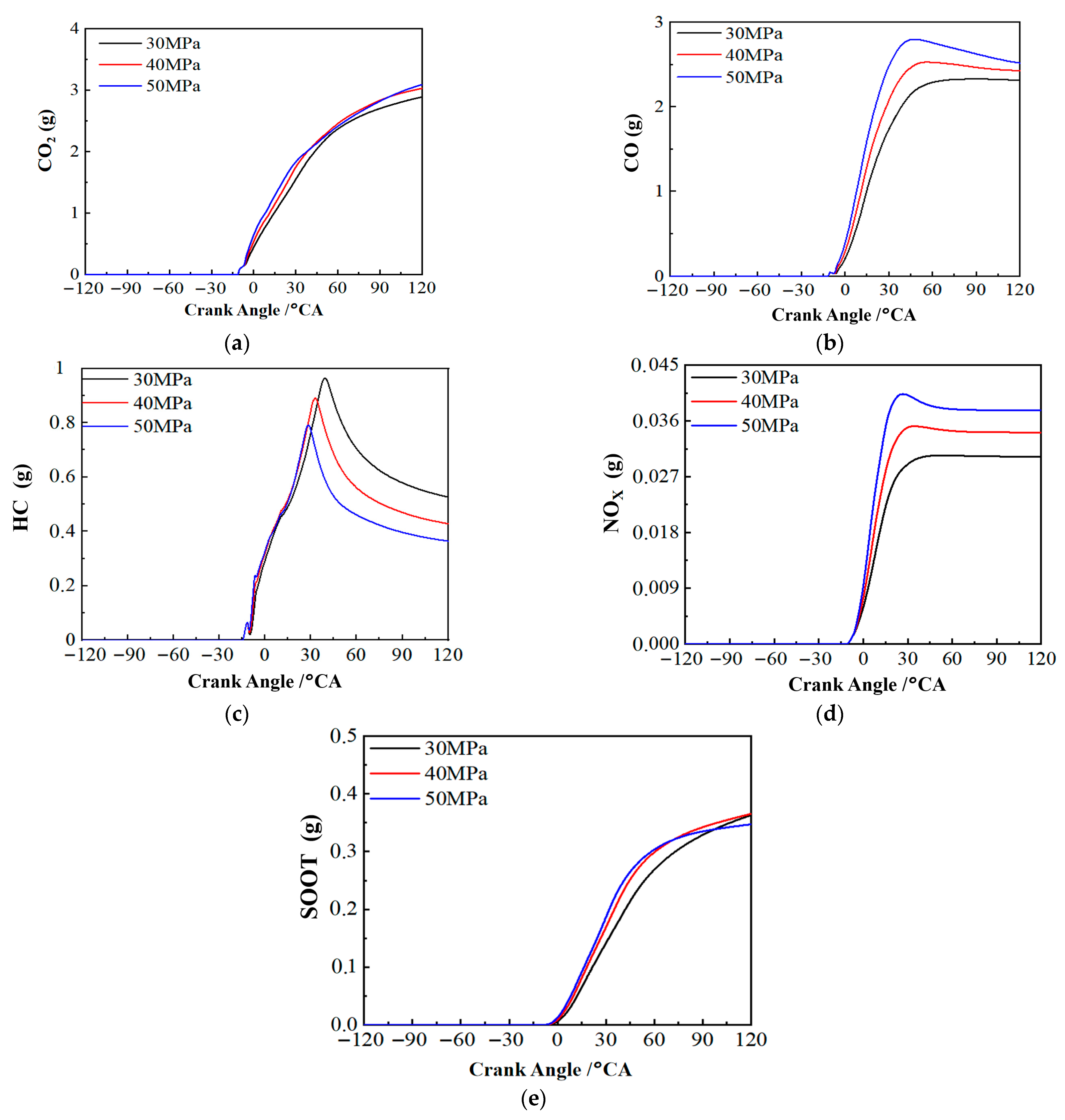
Figure 41 illustrates the influence of different methanol injection pressures on in-cylinder pollutant emissions such as CO2 and CO. For CO2 emissions, as the injection pressure increases, the CO2 emission amount gradually rises—especially in the late combustion stage, the curve of 50 MPa injection pressure is significantly higher than those of 30 MPa and 40 MPa, which may be because a higher injection pressure enables more sufficient atomization of methanol fuel and more complete combustion, thereby generating more CO2. As for CO emissions, the variation laws of curves under different injection pressures are basically similar, all gradually rising and then tending to a constant value; during the combustion stage, the CO emission peak increases slightly with the increase in injection pressure, and the curve of 50 MPa shows an obvious peak in the late combustion stage, which may be related to incomplete combustion—high injection pressure may lead to incomplete combustion in the late combustion stage, thus increasing CO emissions. Regarding HC emissions, the overall trend is first increasing and then decreasing: the curve of 30 MPa injection pressure shows higher emissions at the end of combustion, while the curve of 50 MPa injection pressure exhibits a significant reduction in emissions in the late combustion stage, as the combustion temperature of methanol is higher under high injection pressure, which oxidizes and consumes part of the HC. For NOx emissions, as the injection pressure increases, the NOx emission amount gradually increases—especially in the late combustion stage, the curve of 50 MPa injection pressure is significantly higher than those of 30 MPa and 40 MPa, which may be because a higher injection pressure results in more intense combustion and a higher combustion temperature, thereby promoting the formation of thermal NOx. With respect to Soot emissions, as the injection pressure increases, the Soot emission amount is significantly reduced: the curve of 30 MPa injection pressure shows higher emissions in the late combustion stage, while the curve of 50 MPa injection pressure has the lowest emissions, which may be because a higher injection pressure achieves more sufficient atomization of methanol fuel, reducing soot formation.

3.7. Influence of Compression Ratio on Combustion and Emission Characteristics

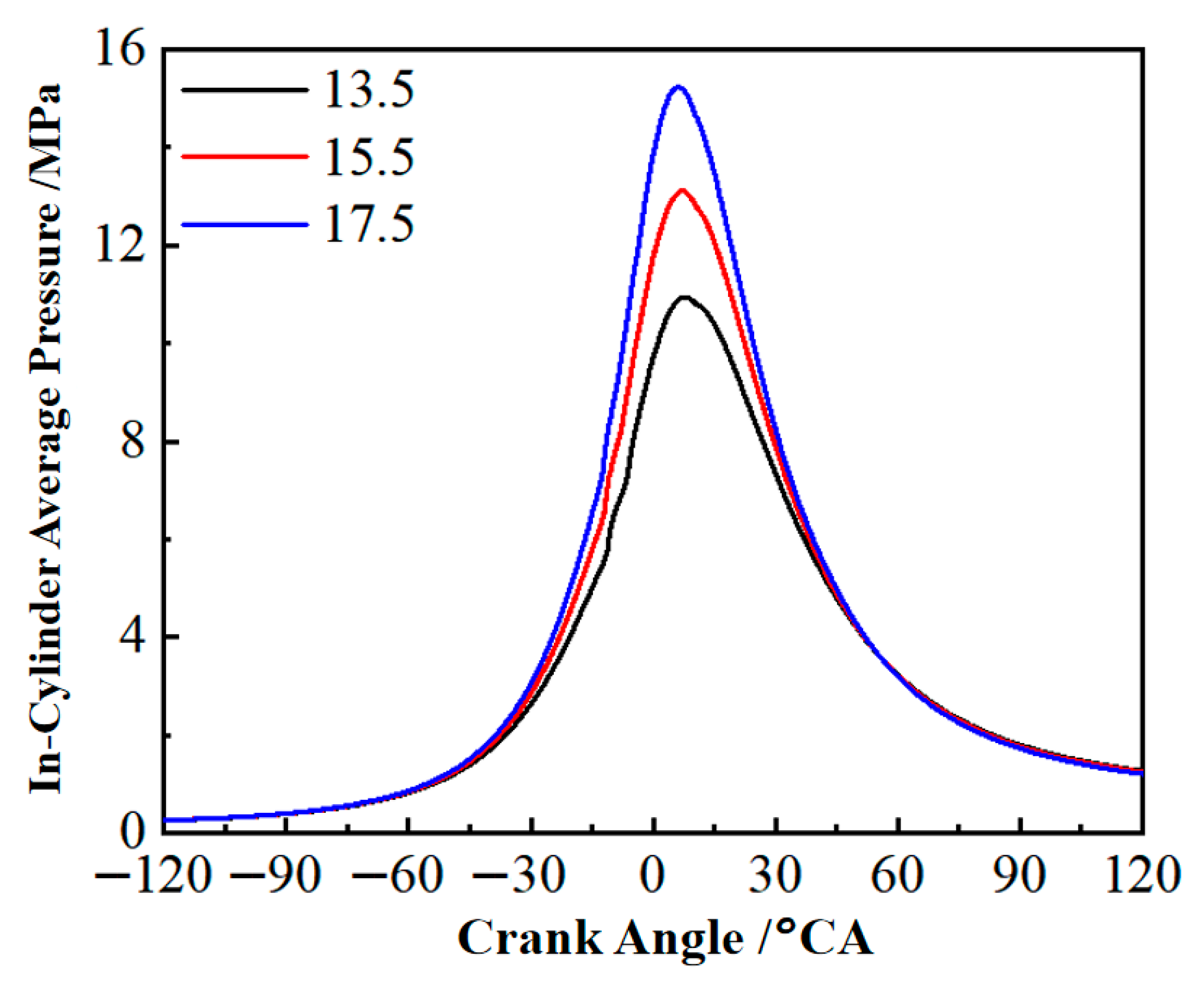
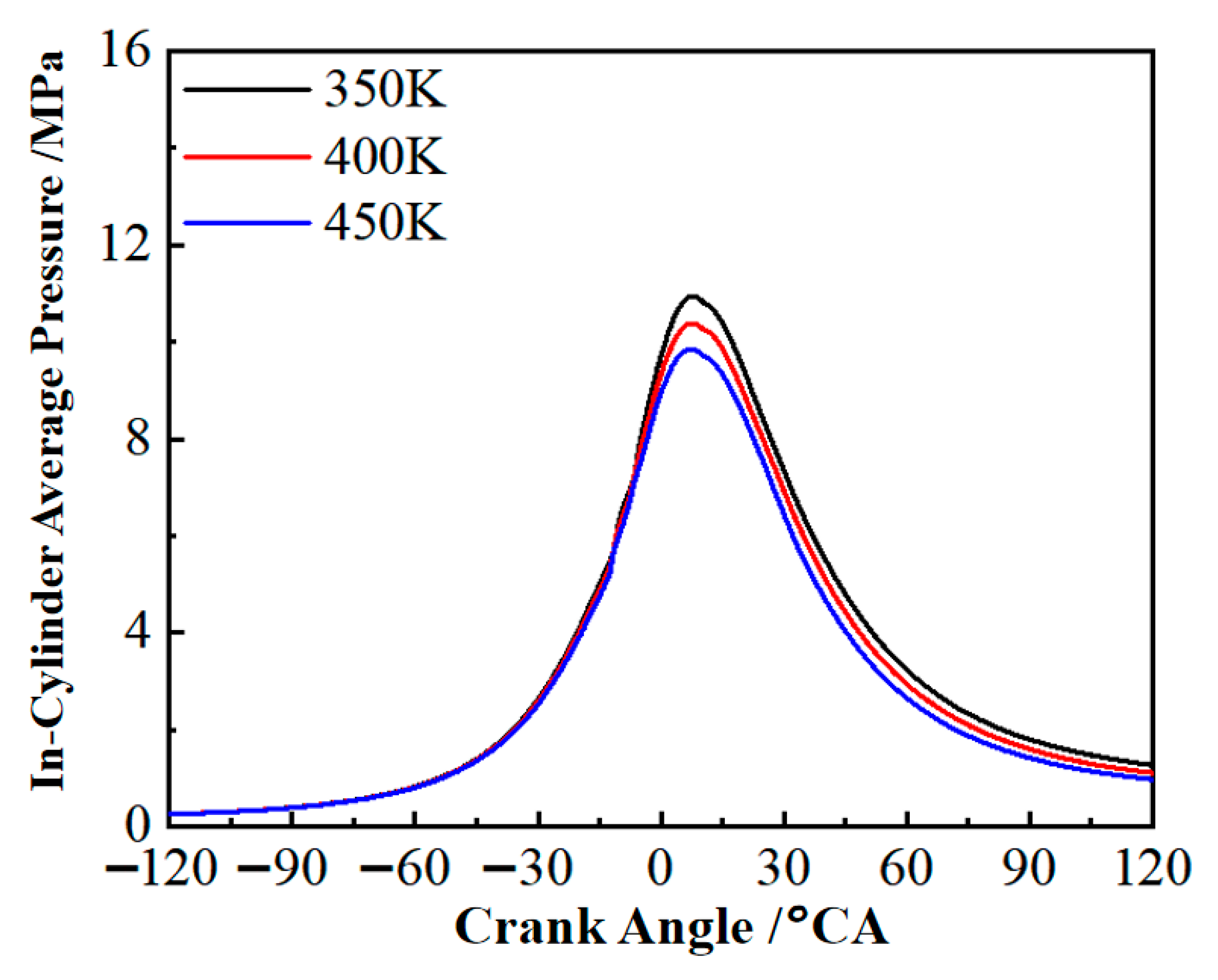
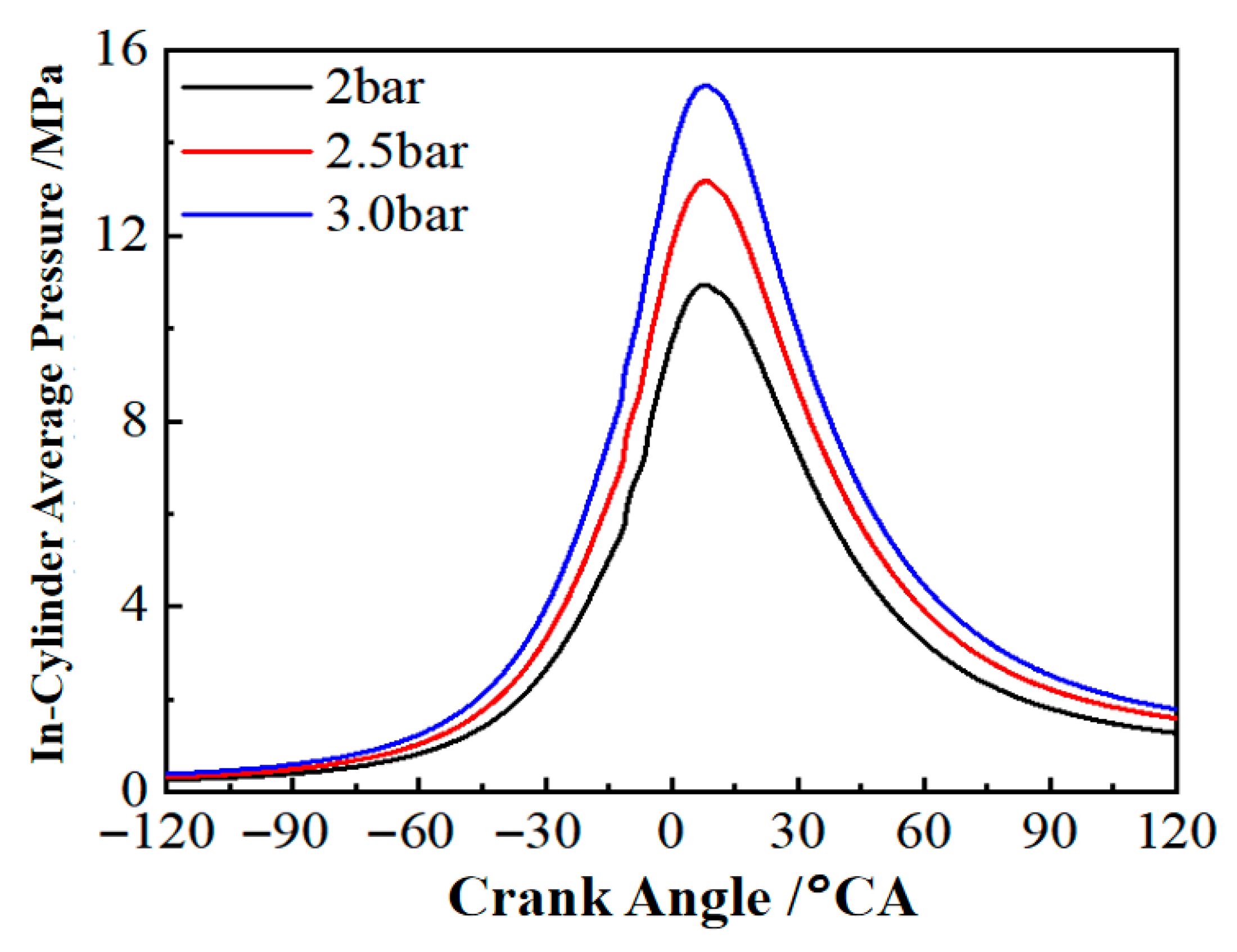
It can be seen from Figure 42 that with the change in crank angle, the in-cylinder average pressure under different compression ratios exhibits a trend of first rising rapidly to reach a peak and then decreasing gradually. When the crank angle is close to 5 °CA, all three curves show obvious pressure peaks: the curve with a compression ratio of 17.5 has the highest peak, while the curve with a compression ratio of 13.5 has a relatively lower peak. This is because a higher compression ratio results in higher temperature and pressure of the mixture at the end of the compression stroke, making combustion faster and more intense, which in turn leads to a faster pressure rise and a higher peak value. After the crank angle exceeds 5 °CA, the in-cylinder average pressure gradually decreases, which is related to the gradual end of the combustion process and gas expansion work. The curves with different compression ratios show certain differences in the decreasing stage, but the overall trend is gradual reduction and stabilization.
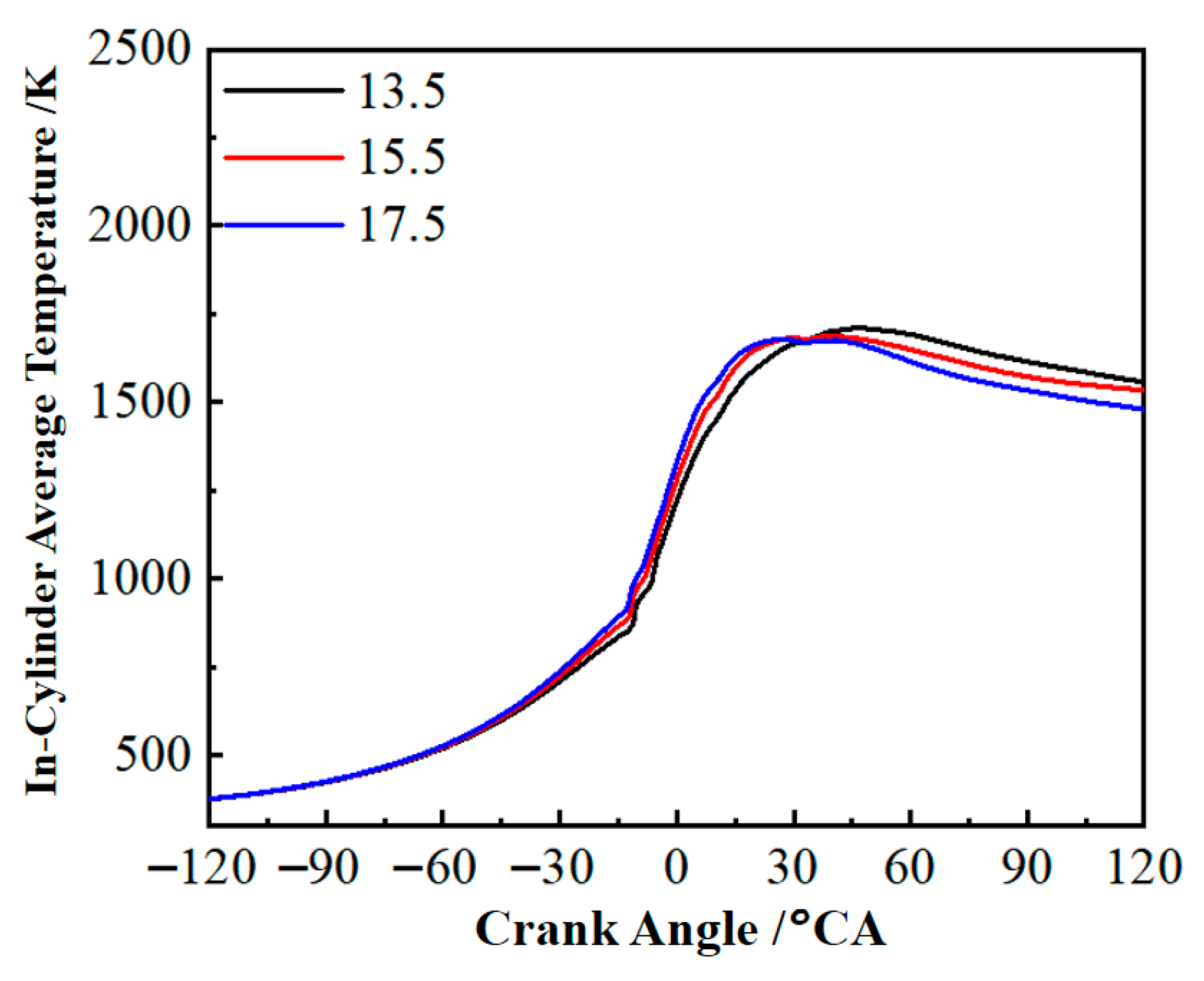
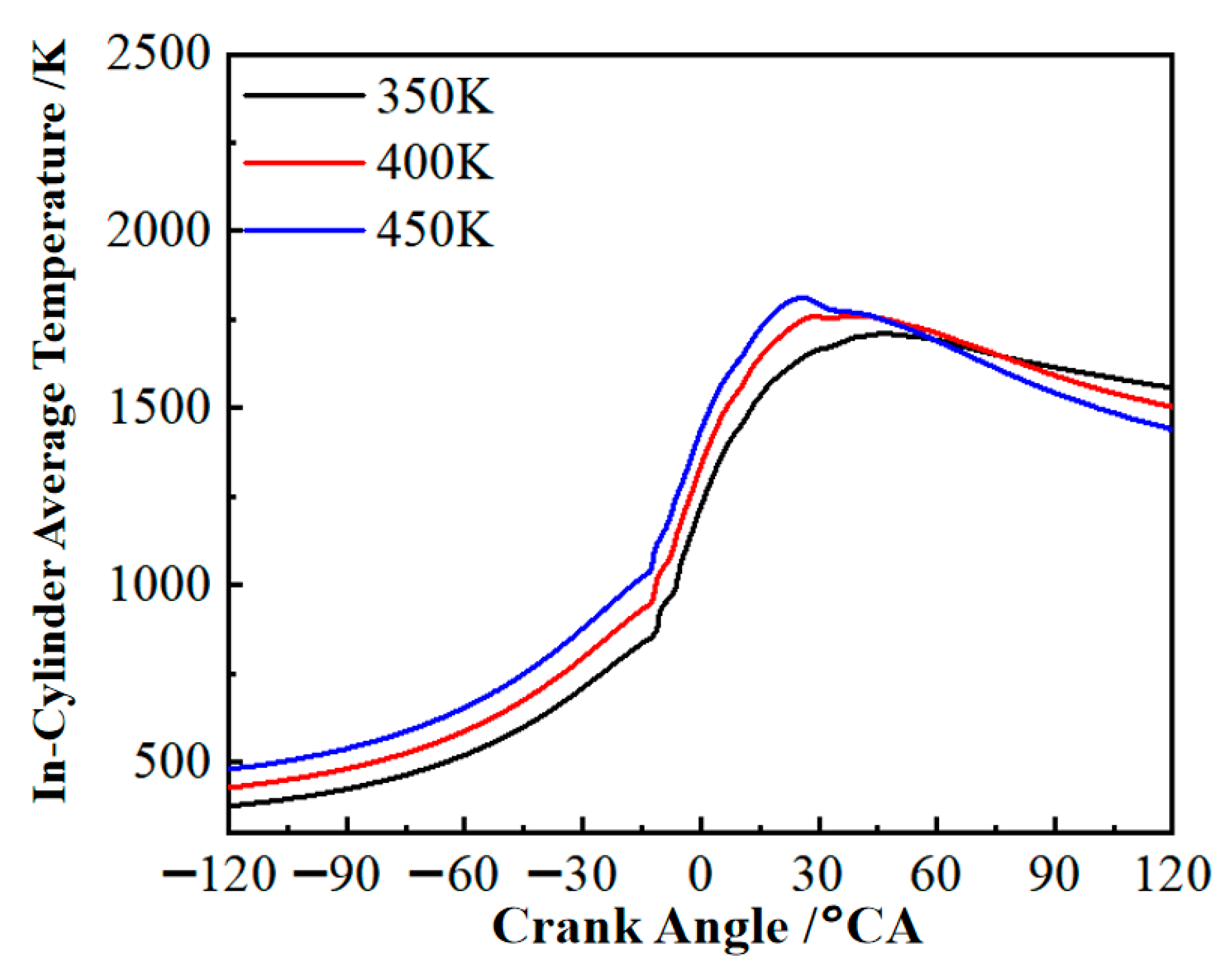
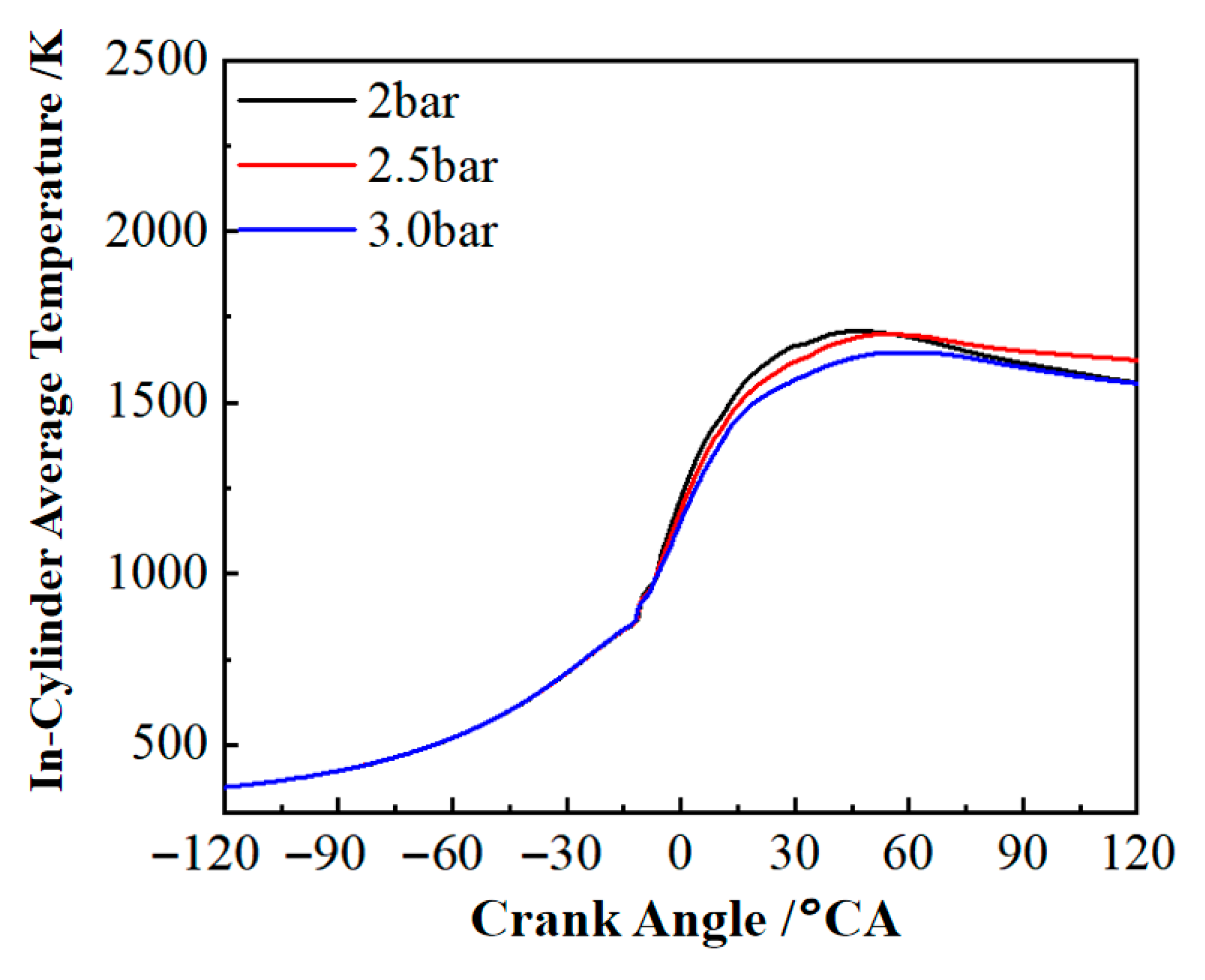
It can be seen from Figure 43 that with the change in crank angle, the in-cylinder average temperature under different compression ratios exhibits a trend of first rising rapidly to reach a peak and then decreasing gradually. When the crank angle is close to 30 °CA, all three curves show obvious temperature peaks: the temperature peaks under different compression ratios are basically consistent, but the curve with a compression ratio of 17.5 has the earliest peak, while the curve with a compression ratio of 13.5 has a slightly later peak. This is because a higher compression ratio results in higher temperature and pressure of the mixture at the end of the compression stroke, making combustion faster and more intense, thus leading to a faster temperature rise and a higher peak value. Under low compression ratio conditions, the in-cylinder temperature and pressure near the top dead center (TDC) are relatively low, and combustion is slower. However, since the fuel mass is consistent under different compression ratios, the temperature peaks are similar.
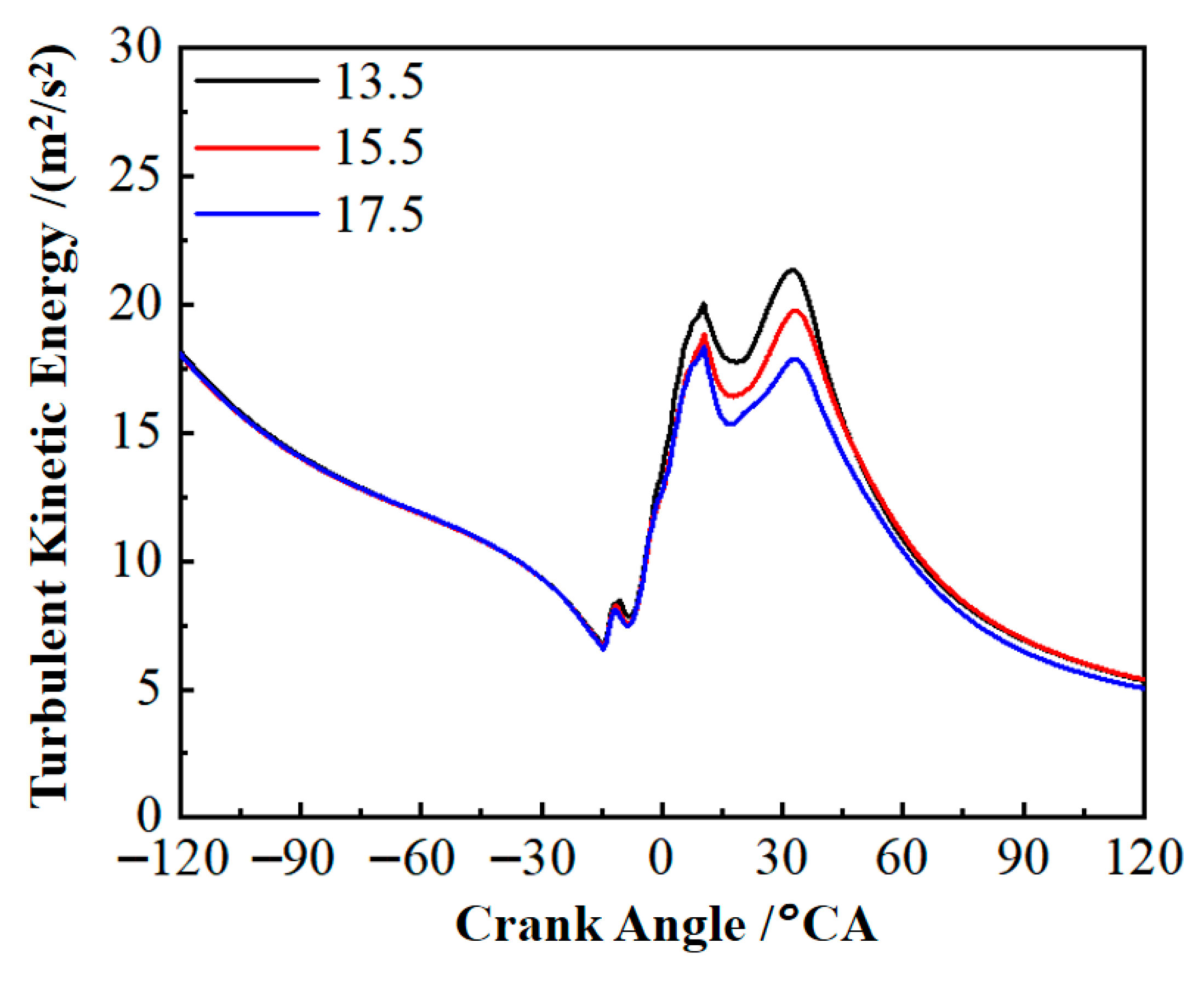
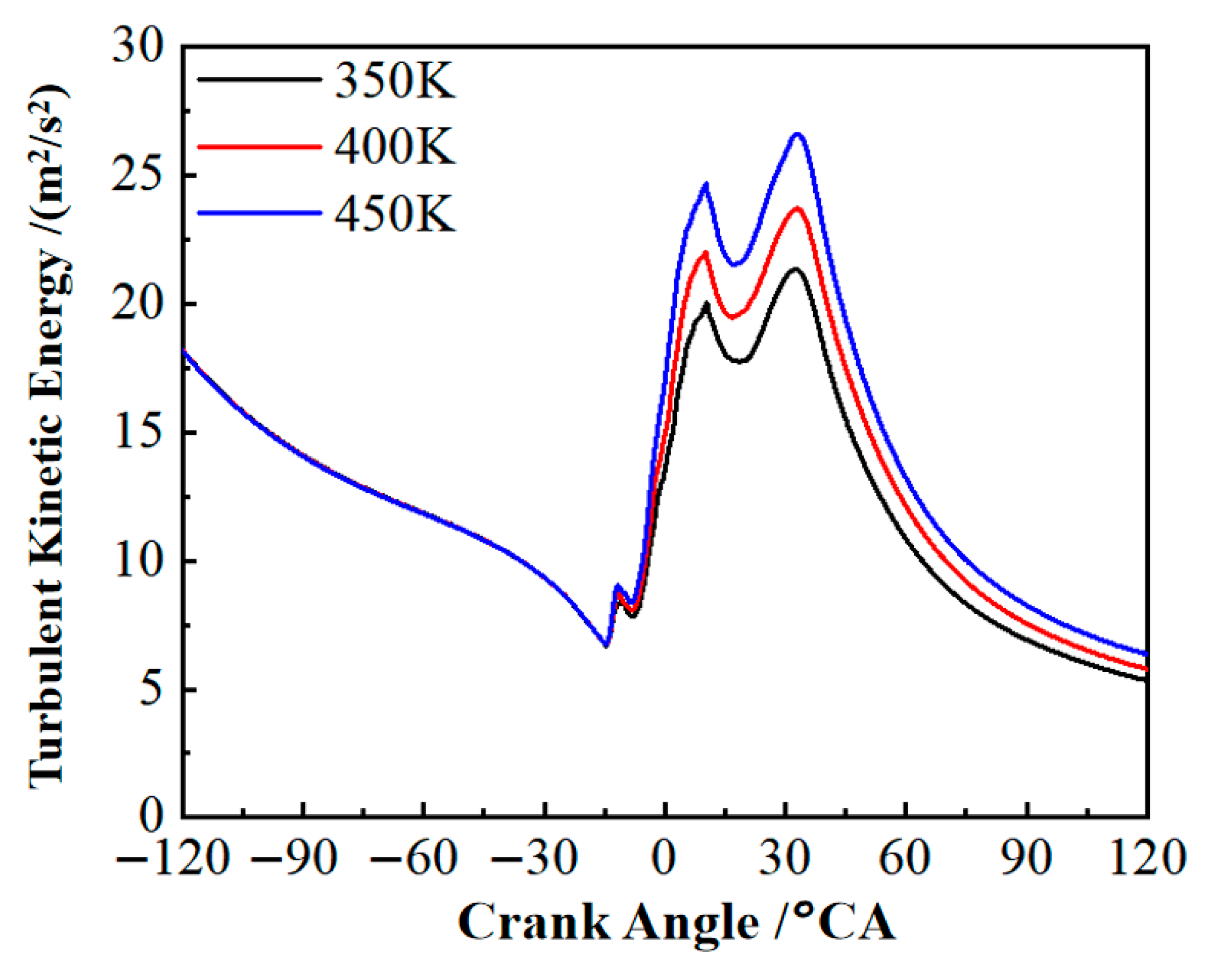
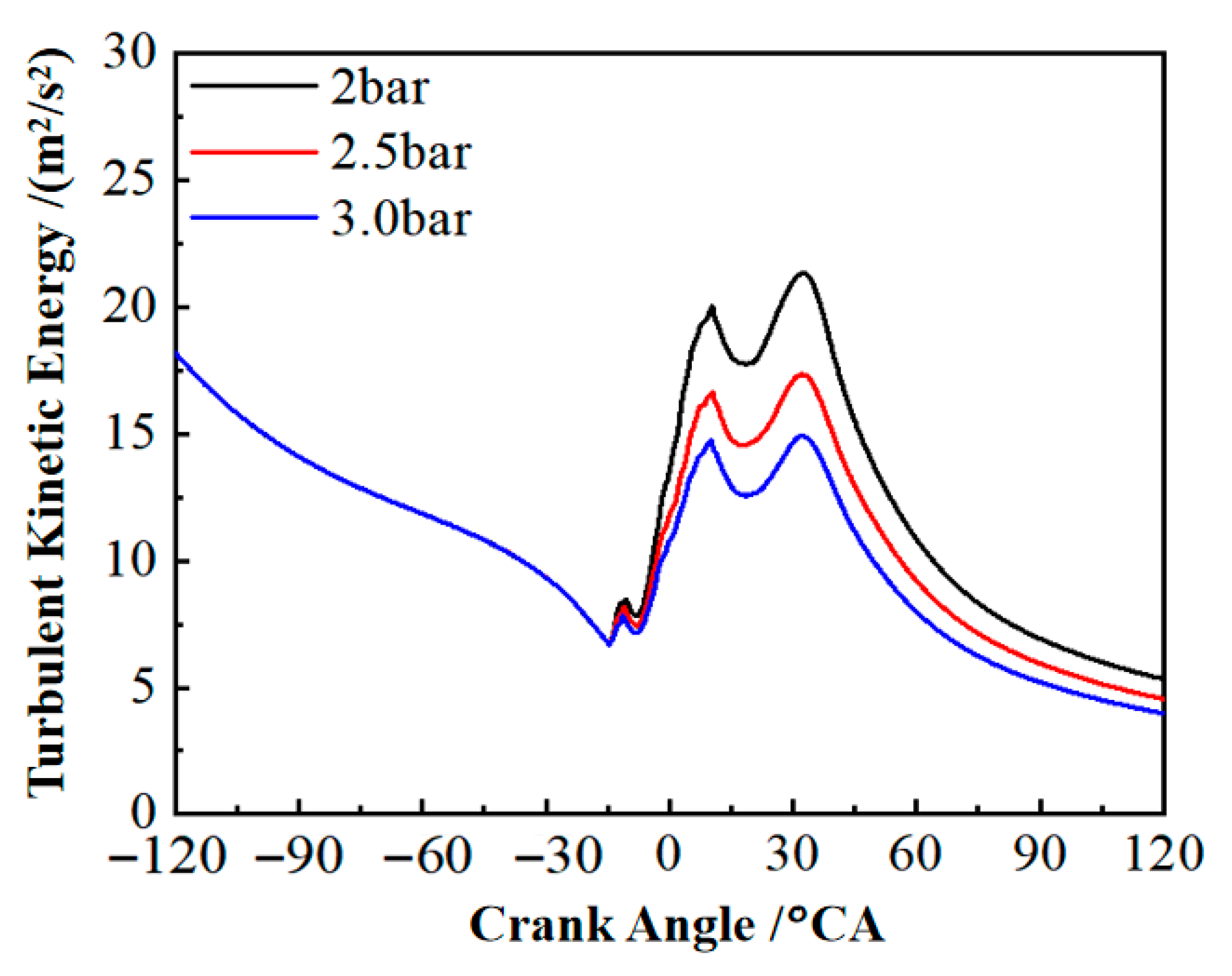
The variation trend of in-cylinder turbulent kinetic energy under different compression ratios is illustrated in Figure 44. Overall, the variation trend of turbulent kinetic energy still shows a significant three-stage local peak phenomenon. Since the first-stage peak is caused by the end of diesel injection, and the piston has not moved to the top dead center position at this time, there is no difference in turbulent kinetic energy under different compression ratios at the first local peak. In the second peak stage, the fuel begins to contact the wall, and the piston is near the top dead center at this moment. At this point, the cylinder is filled with squish flow—the higher the compression ratio, the more intense the squish flow, the more significant the interaction with the spray, the more obvious the reduction in in-cylinder spray kinetic energy, and the lower the turbulent kinetic energy. This is the reason why the higher the compression ratio, the lower the peak value of in-cylinder turbulent kinetic energy during the combustion stage.
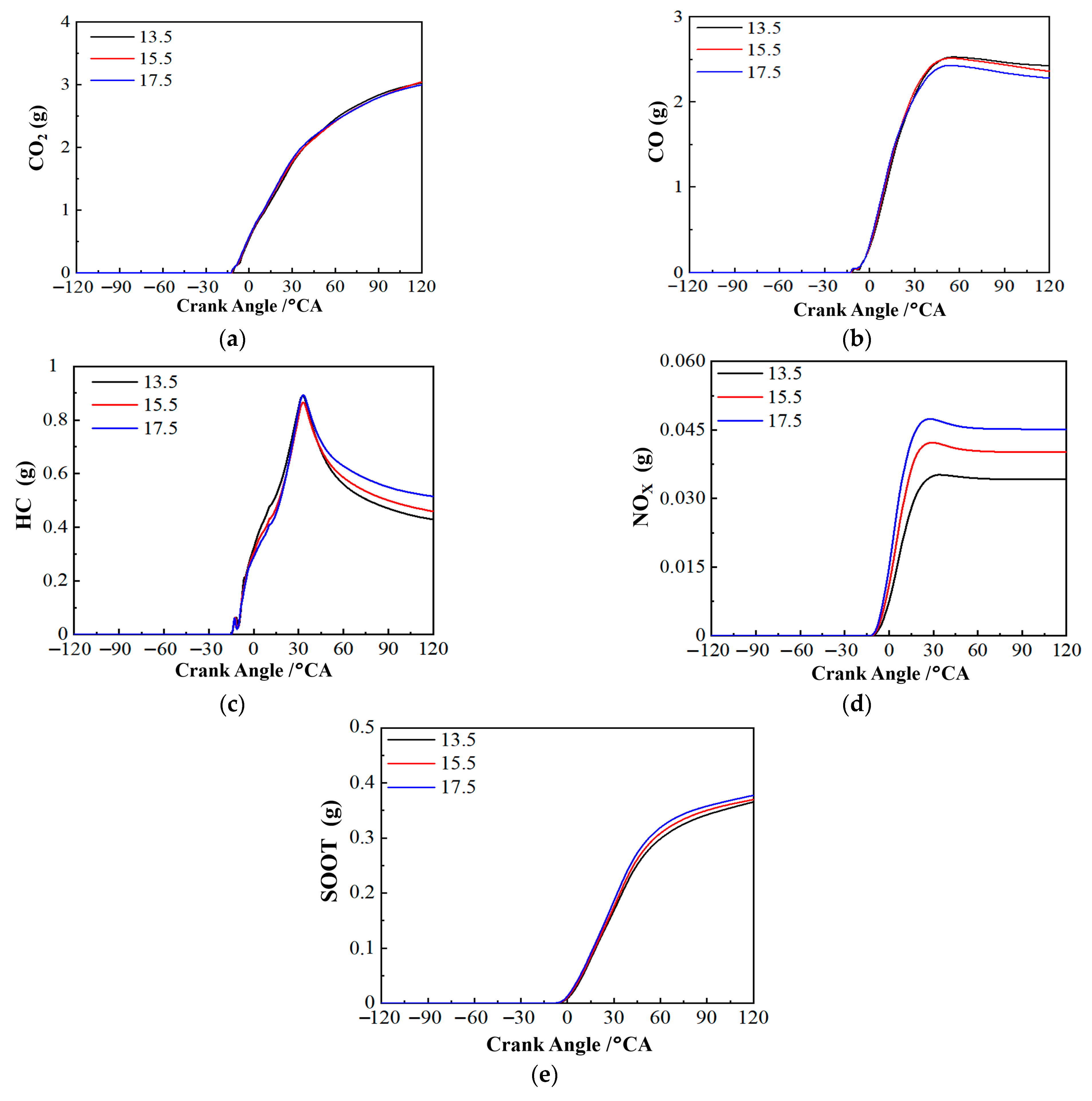
It can be seen from Figure 45 that with the change in crank angle, different compression ratios exert varying influences on in-cylinder pollutant emissions. As the compression ratio increases, the CO2 emission amount gradually rises, but the CO2 emissions of fuel under different compression ratios do not differ significantly.
For CO emissions, the curves under different compression ratios show little difference in emissions in the early combustion stage. However, as combustion proceeds, the CO emissions of the mixture under high compression ratios decrease. This is because high compression ratios result in more intense combustion in the late stage, thereby enabling CO to be further oxidized.
For HC emissions, with the change in crank angle, the HC emission amount first increases and then decreases. The curve with a compression ratio of 13.5 shows lower emissions in the early combustion stage, while the curve with a compression ratio of 17.5 exhibits an increase in emissions in the late combustion stage. For NOx emissions, as the compression ratio increases, the NOx emission amount gradually rises—especially in the late combustion stage, the curve with a compression ratio of 17.5 is significantly higher than those with 13.5 and 15.5. This is because a higher compression ratio results in more intense combustion and a higher combustion temperature, thereby promoting the formation of thermal NOx. For Soot emissions, the Soot emission amount slightly increases with the increase in compression ratio. This is because a higher compression ratio leads to higher temperature and pressure of the mixture at the end of the compression stroke, making combustion faster and more complete, which in turn causes a slight increase in Soot content.

3.8. Influence of Initial Temperature on Combustion and Emission Characteristics

Under different initial temperatures, the variation trend of in-cylinder average pressure is illustrated in Figure 46. It can be seen that as the initial temperature increases, the peak in-cylinder average pressure gradually decreases during the combustion period, and certain differences are also observed in the middle and late combustion stages.
This is because the higher the initial temperature, the lower the in-cylinder air density, which results in a reduction in the in-cylinder air mass. This affects the oxygen supply during the combustion process, leading to incomplete combustion and thus lowering the peak in-cylinder average pressure.
It can be seen from Figure 47 that the in-cylinder average temperature under different initial temperatures exhibits a trend of first rising rapidly to reach a peak and then decreasing gradually. When the crank angle is close to 30 °CA, all three curves show obvious temperature peaks: the curve with an initial temperature of 450 K has the highest peak and appears the earliest, while the curve with an initial temperature of 350 K has a relatively lower peak and appears slightly later.
This is mainly because a higher initial temperature results in higher temperature and pressure of the mixture at the end of the compression stroke, making combustion faster and more intense, thus leading to a faster temperature rise and a higher peak value. However, since a higher initial temperature reduces the in-cylinder oxygen content, it leads to incomplete combustion and thus a sharp temperature decay in the late combustion stage.
With the change in crank angle, the in-cylinder turbulent kinetic energy under different initial temperatures generally shows a trend of first gradually rising to reach a peak and then decreasing gradually. At certain moments, the turbulent kinetic energy decreases slightly due to spray wall impingement.
Within the crank angle range of 0–45 °CA, all three curves show obvious turbulent kinetic energy peaks: the curve with an initial temperature of 450 K has the highest peak and appears the earliest, while the curve with an initial temperature of 350 K has a relatively lower peak and appears slightly later. This is mainly because a higher initial temperature results in higher temperature and pressure of the mixture at the end of the compression stroke, making combustion faster and more intense, thereby enhancing the gas turbulence intensity and leading to a faster rise and higher peak of turbulent kinetic energy.
After the crank angle exceeds 45 °CA, the in-cylinder turbulent kinetic energy gradually decreases, which is related to the gradual end of the combustion process and gas expansion work. The curves under different initial temperatures show certain differences in the decreasing stage, but the overall trend is gradual reduction and stabilization. Figure 48 shows variation trend of in-cylinder turbulent kinetic energy under different initial temperatures.
For CO2 emissions, as the initial temperature increases, the CO2 emission amount gradually decreases—especially in the late combustion stage, the curve with an initial temperature of 450 K is significantly lower than those with 350 K and 400 K. This may be because a higher temperature results in lower in-cylinder air content, leading to insufficient oxygen in the cylinder and incomplete combustion. For CO emissions, the variation trend is opposite to that of CO2. This is also due to the lower in-cylinder oxygen content caused by higher initial temperatures: incomplete combustion of the mixture leads to an increase in CO and a decrease in CO2. The variation trends of various in-cylinder pollutants under different initial temperatures are illustrated in Figure 49.
For HC emissions, the overall trend is first increasing and then decreasing. As the initial temperature increases, the curve with an initial temperature of 450 K exhibits an increase in emissions in the late combustion stage. This is because combustion is more complete at lower initial temperatures, while higher initial temperatures may reduce the oxygen content of the mixture, thereby increasing emissions in the late stage.
For NOx emissions, as the initial temperature rises, the NOx emission amount gradually increases—the curve with an initial temperature of 450 K is significantly higher than those with 350 K and 400 K. This is because a higher initial temperature results in a higher in-cylinder temperature, thereby promoting the formation of thermal NOx.
As the initial temperature increases, the Soot emission amount significantly increases. The curve with an initial temperature of 350 K shows lower emissions in the late combustion stage, while the curve with 450 K has the highest emissions. This is because higher initial temperatures lead to lower oxygen content in the mixture and incomplete combustion, resulting in an increase in soot content.

3.9. Influence of Initial Pressure on Combustion and Emission Characteristics

With the change in crank angle, the in-cylinder average pressure under different initial pressures exhibits a trend of first rising rapidly to reach a peak and then decreasing gradually. When the crank angle is close to 10 °CA, all three curves show obvious pressure peaks: the curve with an initial pressure of 3.0 bar has the highest peak, while the curve with an initial pressure of 2.0 bar has a relatively lower peak.
This is mainly because a higher initial pressure results in a higher density of the mixture at the end of the intake stroke and a greater in-cylinder air content. This leads to a higher in-cylinder pressure during the compression stage and thus a higher peak cylinder pressure. Figure 50 shows variation trend of in-cylinder average pressure under different initial pressures.
From Figure 51, it can be seen that the variation trend of in-cylinder average temperature under different initial pressures is basically insignificant. Even during the combustion stage, the curve with an initial pressure of 3.0 bar is lower than those of other pressures.
This is mainly because a higher initial pressure results in a higher density and pressure of the mixture at the end of the compression stroke. This leads to a slower laminar flame speed and delayed flame propagation during the combustion process, exerting a certain impact on combustion characteristics. However, a higher initial pressure increases the oxygen content in the mixture, and the oxygen content higher than the stoichiometric ratio makes combustion faster and more intense. The mutual compensation between pressure and oxygen content results in little difference in the combustion process under different initial pressures.
With the change in crank angle, the in-cylinder turbulent kinetic energy under different initial pressures generally shows a trend of first rising and then decreasing. At certain moments, the turbulent kinetic energy decreases slightly due to spray wall impingement. Figure 52 shows influence of different initial pressures on in-cylinder turbulent kinetic energy.
Within the crank angle range of 0–45 °CA, all three curves show obvious turbulent kinetic energy peaks: the curve with an initial pressure of 2 bar has the highest peak, while the curve with an initial pressure of 3 bar has a relatively lower peak.
This is because a higher initial pressure results in a higher pressure of the mixture at the end of the compression stroke, which inhibits the gas movement speed and flame propagation speed, leading to a slower rise and a smaller peak of turbulent kinetic energy.
With the change in crank angle, the influence of different initial pressures on in-cylinder pollutant emissions is illustrated in Figure 53. For CO2 emissions, as the initial pressure increases, the CO2 emission amount gradually rises—especially in the late combustion stage, the curve with an initial pressure of 3.0 bar is significantly higher than those with 2 bar and 2.5 bar. This may be because a higher initial pressure results in a higher oxygen content in the mixture, making combustion more complete and generating more CO2.
For CO emissions, the emission amount decreases with the increase in initial pressure. A higher initial pressure may lead to more complete combustion in the late combustion stage, thereby reducing CO emissions. As the initial pressure increases, the HC emission amount decreases significantly, and the reason for this change is consistent with that of CO.
For NOx emissions, the emission amount gradually increases with the rise in initial pressure—the curve with an initial pressure of 3.0 bar is significantly higher than those with 2 bar and 2.5 bar. This is because a higher initial pressure makes combustion more intense, thereby promoting the formation of thermal NOx.
For Soot emissions, the emission amount decreases significantly as the initial pressure increases. A higher initial pressure results in a higher density of the mixture at the end of the compression stroke, making combustion faster and more intense and reducing soot formation.

3.10. Optimization of Combustion Performance for Dual-Fuel Engines

Under the actual operating conditions of the engine, excessively high in-cylinder pressure will result in a large thermal load on the engine components, significantly reducing the engine’s service life. Therefore, during the engine performance optimization process, the compression ratio is increased from 13.5 (of the original engine) to 15.5, and the in-cylinder initial pressure is raised from 2.0 bar (of the original engine) to 2.5 bar. Table 7 presents a comparison of engine operating conditions under different modes.
Figure 54 presents a comparison of equivalence ratio contour maps during the mixture formation process for pure diesel and dual-fuel modes (before and after optimization). It can be seen that at −7.5 °CA, the optimized spray has a larger equivalence ratio and a faster spray development speed. At −5 °CA, it is observed that the optimized spray has reached the piston bowl position, while the spray of pure diesel and the spray before optimization are still spreading freely in the combustion chamber.
Within the crank angle range of 0–20 °CA, the mixture begins to fully develop along the wall. In the pure diesel mode, the mixture is more concentrated on the piston wall, while the optimized mixture has moved to the center of the combustion chamber. At 40 °CA, it can be seen that the equivalence ratio of the mixture formed by the diesel spray is closer to 1. In the dual-fuel mode, the equivalence ratio of the mixture before optimization mostly exceeds 2, while that after optimization is within the range of 1.3–1.5. This fully indicates that the optimized mixture is more homogeneous, which is more conducive to the combustion process.
Figure 55 shows the influence of the pure diesel mode and dual-fuel mode (before and after optimization) on the in-cylinder average pressure. Due to the increased initial pressure and compression ratio of the mixture after optimization, the in-cylinder average pressure of the mixture during the compression stroke is generally higher than that of the pure diesel mode and the dual-fuel mode before optimization. The increase in initial pressure and compression ratio results in higher temperature and pressure in the combustion chamber at the top dead center (TDC) moment. Meanwhile, the increased injection pressure enables the methanol mixture to develop more fully, so the peak phase of the in-cylinder average pressure in the optimized dual-fuel mode is more advanced. In the late combustion stage, the cylinder pressure curve of the optimized dual-fuel mode is higher, while the cylinder pressures of the dual-fuel mode before optimization and the diesel mode coincide.
It can be seen from the figure that the dual-fuel mode (before and after optimization) has a significant impact on the in-cylinder average temperature. In the diesel mode, the in-cylinder average temperature rises rapidly, reaches a peak of approximately 2100 K when the crank angle is close to 30 °CA, and then gradually decreases.
In the 95% Methanol Energy Ratio (Before Optimization) mode, the temperature rise is slightly slower than that in the diesel mode, with a peak value of about 1800 K appearing at a slightly later crank angle. After optimization, the peak value of the temperature curve for the 95% Methanol Energy Ratio mode further decreases to approximately 1700 K, and the overall temperature change is more stable.
This indicates that the optimization measures have effectively reduced the peak combustion temperature, making the combustion process more homogeneous and the heat release more dispersed. The influence of the dual-fuel mode (before and after optimization) on the in-cylinder average temperature is illustrated in Figure 56.
At −5 °CA, the mixture in the pure diesel mode has just ignited, while the diesel fuel in the dual-fuel mode has successfully ignited the methanol fuel. Moreover, after optimization, the flame front is more full and robust, indicating that the flame propagation speed of the mixture is faster. Figure 57 shows influence of dual-fuel mode on flame front.
At 0 °CA, the flame front of diesel acts on the piston wall, while the flame front of the optimized dual-fuel mode has filled the entire combustion chamber. At 30 °CA, due to the small mass fraction of diesel, the flame front of the mixture in the pure diesel mode gradually disperses during spray impingement. In contrast, the dual-fuel mode has a higher mass fraction of methanol, so the flame front of the mixture is still propagating—with the optimized flame front being more full and robust.
It can be seen from Figure 58 that the dual-fuel mode (before and after optimization) has a significant impact on the combustion characteristics of the mixture. After optimization, CA10 (10% cumulative heat release crank angle) advances from −3.84 °CA to −8.39 °CA, and CA50 (50% cumulative heat release crank angle) advances from 21.60 °CA to 14.71 °CA. This indicates that the combustion initiation and half-burn time occur earlier. CA90 (90% cumulative heat release crank angle) delays from 71.86 °CA to 74.00 °CA, meaning the combustion process is more concentrated. These results show that the optimization measures have effectively adjusted the combustion process, making it occur earlier and more concentrated, thereby improving combustion efficiency and shortening combustion duration.
Taking the IMEP (Indicated Mean Effective Pressure) and torque under the diesel mode as the reference values, the IMEP and torque of the dual-fuel mode before optimization are close to those of the diesel mode. However, after optimization, the IMEP has significantly increased from approximately 1.95 MPa to about 2.5 MPa, and the torque has also risen from around 23,000 N·m to roughly 30,000 N·m.
This indicates that the optimization measures have effectively improved engine performance. By optimizing the injection strategy, the combustion process becomes more efficient, thereby enhancing the IMEP and torque. The influence of the dual-fuel mode (before and after optimization) on engine operating characteristics is illustrated in Figure 59.
After optimization, the CO2 emissions of the 95% Methanol Energy Ratio mode are significantly higher than those of the diesel mode and the pre-optimization mode in the late combustion stage. The increase in intake pressure increases the amount of air entering the cylinder, providing more oxygen. A higher injection pressure improves the atomization effect of methanol, making the mixing of methanol and air more homogeneous. A high compression ratio results in higher temperature and pressure of the mixture at the end of the compression stroke, leading to faster and more intense combustion, thereby increasing CO2 emissions.
Due to the more complete combustion of the mixture, the post-optimization CO and HC emissions decrease in the late combustion stage. After optimization, NOx emissions increase in the late combustion stage. Higher intake pressure, methanol injection pressure, and compression ratio lead to higher temperature and pressure of the mixture at the end of the compression stroke, making combustion more intense. This significantly increases the combustion temperature and promotes the formation of NOx, which may be related to the increase in combustion temperature—high temperature facilitates the generation of thermal NOx. The reduction in Soot emissions after optimization is also associated with the more intense combustion process.
These changes indicate that while the optimization measures improve engine performance, further coordination with aftertreatment technology is required to reduce CO and NOx emissions. The variation in in-cylinder pollutants under different modes is shown in Figure 60.

4. Conclusions

Methanol fuel possesses distinct advantages such as low carbon content and a high octane number, which can significantly reduce carbon emissions and pollutant emissions of marine engines. However, its application in compression ignition engines still faces key technical bottlenecks including low combustion efficiency and insufficient combustion stability. Taking the MAN23/30H diesel engine as the research object, this paper conducts systematic optimization research on injection strategies under high methanol substitution rate scenarios, targeting methanol/diesel dual direct injection technology. The aim is to break through the technical bottlenecks of stable and efficient combustion in methanol engines and provide technical support for the efficient and clean development of methanol engines. The main research work of this paper is summarized as follows:
(1)
Based on the efficient mesh generation technology and multi-physics field coupling advantages of Converge software 3.0, a 3D simulation model for in-cylinder combustion of the MAN23/30H diesel engine was successfully established. Through grid independence verification, the basic grid size was determined as 7.0 mm. Combined with fixed encryption and adaptive encryption strategies, the reliability of grid division and computational efficiency were balanced. Finally, the methanol/diesel dual-fuel chemical reaction kinetic mechanism constructed by coupling the methanol mechanism and the simplified diesel mechanism includes 126 species and 711 elementary reactions, which can accurately simulate the ignition process of dual fuels.
(2)
The influence of different injection strategies on the combustion characteristics of methanol/diesel engines was thoroughly explored. Research results show that the dual-fuel mode is superior to the pure diesel mode in terms of mixture formation, combustion rate and combustion efficiency. Comparative analysis of different injection timings reveals that when the injection timing is advanced to −15 °CA, the peak in-cylinder average pressure reaches approximately 14 MPa, which is about 10% higher than that at the injection timing of −7.5 °CA. The peak turbulent kinetic energy under the vertical cross spray mode is higher than that of other spray modes, indicating that this mode can more effectively promote mixture formation and combustion. In addition, when diesel and methanol are injected simultaneously, the Indicated Mean Effective Pressure (IMEP) reaches about 2.12 MPa and the torque reaches approximately 25,430 N·m. Compared with other injection strategies, the engine performance is significantly improved, proving the advantage of this strategy in enhancing engine power performance.
(3)
By comparing combustion performance and emission characteristics under different conditions, it is found that when the methanol injection pressure is increased to 50 MPa, the peak in-cylinder average pressure increases by about 15%, the peak in-cylinder average temperature rises by approximately 10%, and Soot emissions decrease by around 30%. When the compression ratio is increased from the original 13.5 to 15.5, the combustion efficiency is improved by about 12%, while NOx emissions increase by roughly 15%, indicating that further coordination with aftertreatment technology is required to reduce pollutant emissions. When the initial pressure is increased to 2.5 bar, CO2 emissions increase significantly in the late combustion stage, while CO and HC emissions decrease to a certain extent. The simulation results show that the NOx emission concentration of the optimized dual-fuel mode is 8.2 g/kWh. Compared with the Tier III emission standard (≤3.4 g/kWh) and Tier II emission standard (≤14.4 g/kWh), this emission level meets the requirements of the Tier II standard but does not reach the limit of the Tier III standard. To meet the Tier III emission standard, it is necessary to integrate post-treatment technologies such as selective catalytic reduction (SCR) and implement a “synergy between injection parameter optimization and post-treatment” strategy to achieve coordinated control of NOx and soot emissions. Through the comprehensive optimization of key parameters such as methanol injection pressure, compression ratio and initial pressure, the IMEP of the dual-fuel mode is significantly increased from about 1.95 MPa to approximately 2.5 MPa, and the torque is increased from around 23,000 N·m to about 30,000 N·m, improving by about 28% and 30%, respectively. This provides a feasible technical path for achieving efficient and clean combustion under high methanol substitution rate.
(4)
Although the simulation model of this study can reveal the basic laws of diesel-methanol dual direct injection combustion, it still has the following core limitations: At the level of simulation assumptions, the model is established based on ideal injection conditions, without considering practical engineering factors such as injector wear after long-term operation and uneven fuel atomization. Additionally, combustion stability analysis has not been conducted for variable operating conditions such as low load and transient conditions, which may lead to certain deviations from the actual operating environment. At the level of experimental verification, the current support is only provided through bench tests under diesel mode and indirect cross-validation under dual-fuel conditions (e.g., comparison with research results of similar fuel characteristics). Direct bench test data of diesel-methanol dual direct injection is lacking, and the accuracy of the simulation results needs further verification and correction. At the level of boundary condition setting, a constant value assumption is adopted for the cylinder liner temperature, without considering the temperature gradient distribution along the piston stroke during actual operation, which may slightly affect the prediction accuracy of key processes such as spray wall-impingement probability and combustion heat release rate.

Author Contributions

Z.W.: writing—original draft, project administration, and resources. J.Z. (Jie Zhu): software, data curation. X.L.: writing—review and editing, methodology, funding acquisition. J.Z. (Jingjun Zhong): writing—review and editing, investigation. X.J.: visualization, validation. All authors have read and agreed to the published version of the manuscript.

Funding

Supported by the National Key R&D program of China (Grant No. 2022YFB4300701, December 2022–November 2026) and the National Key R&D program of China (Grant No. 2022YFB4300704, December 2022–November 2026).

Data Availability Statement

The data presented in this study are available on request from the corresponding author.

Conflicts of Interest

The author declares no conflicts of interest.

References

  1. Bilgili, L.; Ölçer, A.I. IMO 2023 strategy-Where are we and what’s next? Mar. Policy 2024, 160, 105953. [Google Scholar] [CrossRef]
  2. International Maritime Organization. 2023 IMO Strategy on Reduction of GHG Emissions from Ships. 2023. Available online: https://www.imo.org/en/ourwork/environment/pages/2023-imo-strategy-on-reduction-of-ghg-emissions-from-ships.aspx (accessed on 29 November 2024).
  3. International Energy Agency. Global Energy Review: CO2 Emissions in 2020. 2021. Available online: https://www.iea.org/articles/global-energy-review-co2-emissions-in-2020 (accessed on 29 November 2024).
  4. Fedi, L.; Faury, O.; Etienne, L.; Cheaitou, A.; Rigot-Muller, P. Application of the IMO taxonomy on casualty investigation: Analysis of 20 years of marine accidents along the North-East Passage. Mar. Policy 2024, 162, 106061. [Google Scholar] [CrossRef]
  5. Wang, J.; Zhang, Y. The area-based management tools coordination between IMO and BBNJ agreement regimes and its implications on vessel pollution control. Front. Mar. Sci. 2024, 11, 1341222. [Google Scholar] [CrossRef]
  6. Poulsen, R.T.; Sornn-Friese, H. Achieving energy efficient ship operations under third party management: How do ship management models influence energy efficiency? Res. Transp. Bus. Manag. 2015, 17, 41–52. [Google Scholar] [CrossRef]
  7. Dewan, M.H.; Godina, R. Roles and challenges of seafarers for implementation of energy efficiency operational measures onboard ships. Mar. Policy 2023, 155, 105746. [Google Scholar] [CrossRef]
  8. Li, Y.; Yao, M.; Liang, H.; Liu, H.; Wang, H.; Zheng, Z.; Zhang, Z. Energy analysis during cold start and warm up period of a methanol engine hybrid power system under several novel energy conversion strategies. Energy 2024, 308, 132960. [Google Scholar] [CrossRef]
  9. Suijs, W.; De Graeve, R.; Verhelst, S. An exploratory study of knock intensity in a large-bore heavy-duty methanol engine. Energy Convers. Manag. 2024, 302, 118089. [Google Scholar] [CrossRef]
  10. Bayraktar, M.; Yuksel, O.; Pamik, M. An evaluation of methanol engine utilization regarding economic and upcoming regulatory requirements for a container ship. Sustain. Prod. Consum. 2023, 39, 345–356. [Google Scholar] [CrossRef]
  11. Duan, Q.; Kou, H.; Li, T.; Yin, X.; Zeng, K.; Wang, L. Effects of injection and spark timings on combustion, performance and emissions (regulated and unregulated) characteristics in a direct injection methanol engine. Fuel Process. Technol. 2023, 247, 107758. [Google Scholar] [CrossRef]
  12. Wang, X.; Liu, Y.; Han, L.; Gong, Y.; Ma, H.; Qian, D.; Liu, M.; Xie, F. Influence of blending dissociated methanol gas and optimizing dilution working fluid on improving performance of methanol engine. Int. J. Hydrogen Energy 2024, 91, 1442–1451. [Google Scholar]
  13. Zhou, F.; Yu, J.; Wu, C.; Fu, J.; Liu, J.; Duan, X. The application prospect and challenge of the alternative methanol fuel in the internal combustion engine. Sci. Total Environ. 2024, 913, 169708. [Google Scholar] [CrossRef] [PubMed]
  14. Zhang, B.; Chen, Y.; Jiang, Y.; Lu, W.; Liu, W. Effect of compression ratio and Miller cycle on performance of methanol engine under medium and low loads. Fuel 2023, 351, 128985. [Google Scholar] [CrossRef]
  15. Li, Y.; Cai, Y.; Jia, M.; Wang, Y.; Su, X.; Li, L. A full-parameter computational optimization of both injection parameters and injector layouts for a methanol/diesel dual-fuel direct injection compression ignition engine. Fuel 2024, 369, 131733. [Google Scholar] [CrossRef]
  16. Cung, K.D.; Wallace, J.; Kalaskar, V.; Smith, E.M., III; Briggs, T.; Bitsis, D.C., Jr. Experimental study on engine and emissions performance of renewable diesel methanol dual fuel (RMDF) combustion. Fuel 2024, 357, 129664. [Google Scholar] [CrossRef]
  17. Cesur, I.; Uysal, F. Experimental investigation and artificial neural network-based modelling of thermal barrier engine performance and exhaust emissions for methanol-gasoline blends. Energy 2024, 291, 130393. [Google Scholar] [CrossRef]
  18. Yang, C.; Wang, B.; Wang, H.; Hu, D.; Duan, B.; Wang, Y. The effect of changing EGR rate on engine performance under different ammonia/methanol ratios. J. Energy Inst. 2024, 113, 101546. [Google Scholar] [CrossRef]
  19. Yu, Y.; Wen, H. Investigation on efficient and clean combustion pre-injection strategy of a diesel/methanol dual direct-injection marine engine under full load. Case Stud. Therm. Eng. 2024, 59, 104472. [Google Scholar] [CrossRef]
  20. Purayil, S.T.P.; Hamdan, M.O.; Al-Omari, S.A.B.; Selim, M.Y.; Elnajjar, E. Influence of ethanol–gasoline–hydrogen and methanol–gasoline–hydrogen blends on the performance and hydrogen knock limit of a lean-burn spark ignition engine. Fuel 2024, 377, 132825. [Google Scholar] [CrossRef]
  21. Sun, W.; Jiang, M.; Guo, L.; Zhang, H.; Jia, Z.; Qin, Z.; Zeng, W.; Lin, S.; Zhu, G.; Ji, S.; et al. Numerical study of injection strategies for marine methanol/diesel direct dual fuel stratification engine. J. Clean. Prod. 2023, 421, 138505. [Google Scholar] [CrossRef]
  22. Tan, D.; Meng, Y.; Tian, J.; Zhang, C.; Zhang, Z.; Yang, G.; Cui, S.; Hu, J.; Zhao, Z. Utilization of renewable and sustainable diesel/methanol/n-butanol (DMB) blends for reducing the engine emissions in a diesel engine with different pre-injection strategies. Energy 2023, 269, 126785. [Google Scholar] [CrossRef]
  23. Yousefi, A.; Guo, H.; Dev, S.; Liko, B.; Lafrance, S. Effect of pre-main-post diesel injection strategy on greenhouse gas and nitrogen oxide emissions of natural gas/diesel dual-fuel engine at high load conditions. Fuel 2021, 302, 121110. [Google Scholar] [CrossRef]
  24. Yin, X.; Li, W.; Duan, H.; Duan, Q.; Kou, H.; Wang, Y.; Yang, B.; Zeng, K. A comparative study on operating range and combustion characteristics of methanol/diesel dual direct injection engine with different methanol injection timings. Fuel 2023, 334, 126646. [Google Scholar] [CrossRef]
  25. Dimitriou, P.; Javaid, R. A review of ammonia as a compression ignition engine fuel. Int. J. Hydrogen Energy 2020, 45, 7098–7118. [Google Scholar] [CrossRef]
  26. Li, Y.; Chen, H.; Zhang, C.; Chen, H. Effects of diesel pre-injection on the combustion and emission characteristics of a common-rail diesel engine fueled with diesel-methanol dual-fuel. Fuel 2021, 290, 119824. [Google Scholar] [CrossRef]
  27. Güdden, A.; Pischinger, S.; Geiger, J.; Heuser, B.; Müther, M. An experimental study on methanol as a fuel in large bore high speed engine applications–Port fuel injected spark ignited combustion. Fuel 2021, 303, 121292. [Google Scholar] [CrossRef]
  28. Tian, Z.; Wang, Y.; Zhen, X.; Liu, Z. The effect of methanol production and application in internal combustion engines on emissions in the context of carbon neutrality: A review. Fuel 2022, 320, 123902. [Google Scholar] [CrossRef]
  29. Sun, W.; Zeng, W.; Guo, L.; Zhang, H.; Yan, Y.; Lin, S.; Zhu, G.; Jiang, M.; Yu, C.; Wu, F. An optical study of the combustion and flame development of ammonia-diesel dual-fuel engine based on flame chemiluminescence. Fuel 2023, 349, 128507. [Google Scholar] [CrossRef]
  30. Yousefi, A.; Guo, H.; Dev, S.; Liko, B.; Lafrance, S. Effects of ammonia energy fraction and diesel injection timing on combustion and emissions of an ammonia/diesel dual-fuel engine. Fuel 2022, 314, 122723. [Google Scholar] [CrossRef]
  31. Pei, Y.; Wang, D.; Jin, S.; Gu, Y.; Wu, C.; Wu, B. A quantitative study on the combustion and emission characteristics of an Ammonia-Diesel Dual-fuel (ADDF) engine. Fuel Process. Technol. 2023, 250, 107906. [Google Scholar] [CrossRef]
  32. Wang, H.; Wang, B.; Yang, C.; Hu, D.; Duan, B.; Wang, Y. Study on dual injection strategy of diesel ignition ammonia/hydrogen mixture fuel engine. Fuel 2023, 348, 128526. [Google Scholar] [CrossRef]
  33. Mi, S.; Wu, H.; Pei, X.; Liu, C.; Zheng, L.; Zhao, W.; Qian, Y.; Lu, X. Potential of ammonia energy fraction and diesel pilot-injection strategy on improving combustion and emission performance in an ammonia-diesel dual fuel engine. Fuel 2023, 343, 127889. [Google Scholar] [CrossRef]
  34. Li, T.; Zhou, X.; Wang, N.; Wang, X.; Chen, R.; Li, S.; Yi, P. A comparison between low-and high-pressure injection dual-fuel modes of diesel-pilot-ignition ammonia combustion engines. J. Energy Inst. 2022, 102, 362–373. [Google Scholar] [CrossRef]
  35. Shin, J.; Park, S. Numerical analysis for optimizing combustion strategy in an ammonia-diesel dual-fuel engine. Energy Convers. Manag. 2023, 284, 116980. [Google Scholar] [CrossRef]
  36. Han, Z.; Reitz, R.D. Turbulence modeling of internal combustion engines using RNG k-ε models. Combust. Sci. Technol. 1995, 106, 267–295. [Google Scholar]
  37. Dec, J.E.; Reltz, R.D. Comparisons of diesel spray liquid penetration and vapor fuel distributions with in-cylinder optical measurements. J. Eng. Gas Turb. Power 2000, 122, 588–595. [Google Scholar]
  38. Schmidt, D.P.; Rutland, C.J. A new droplet collision algorithm. J. Comput. Phys. 2000, 164, 62–80. [Google Scholar] [CrossRef]
  39. Han, Z.; Reitz, R.D. A temperature wall function formulation for variable-density turbulent flows with application to engine convective heat transfer modeling. Int. J. Heat Mass Tran. 1997, 40, 613–625. [Google Scholar] [CrossRef]
  40. O’Rourke, P.J.; Amsden, A.A. A spray/wall interaction submodel for the KIVA-3 wall film model. J. Engines 2000, 109, 281–298. [Google Scholar]
  41. Senecal, P.K.; Pomraning, E.; Richards, K.J.; Briggs, T.E.; Choi, C.Y.; McDavid, R.M.; Patterson, M.A. Multi-dimensional modeling of direct-injection diesel spray liquid length and flame lift-off length using cfd and parallel detailed chemistry. J. Engines 2003, 112, 1331–1351. [Google Scholar]
  42. Li, Z.; Wang, Y.; Yin, Z.; Gao, Z.; Wang, Y.; Zhen, X. Parametric study of a single-channel diesel/methanol dual-fuel injector on a diesel engine fueled with directly injected methanol and pilot diesel. Fuel 2021, 302, 121156. [Google Scholar] [CrossRef]
  43. Maroteaux, F.; Saad, C. Combined mean value engine model and crank angle resolved in-cylinder modeling with NOx emissions model for real-time diesel engine simulations at high engine speed. Energy 2015, 88, 515–527. [Google Scholar] [CrossRef]
  44. Zhu, J.; Wang, S.; Raza, M.; Feng, Y.; Li, J.; Mao, Y.; Yu, L.; Qian, Y.; Lu, X. Autoignition behavior of methanol/diesel mixtures: Experiments and kinetic modeling. Combust. Flame 2021, 228, 1–12. [Google Scholar] [CrossRef]
Figure 1. (a) MAN L23/30H four-stroke diesel engine. (b) Combustion chamber shape.
Jmse 13 02213 g001
Figure 2. Basic verification of grid independence (without fuel injection and combustion process, Pin = 0.1 MPa).
Jmse 13 02213 g002
Figure 3. Mesh generation situation under different crankshaft angles.
Jmse 13 02213 g003
Figure 4. Comparison of the experimental and simulated values.
Jmse 13 02213 g004
Figure 5. Verification of methanol/diesel reaction kinetic mechanism based on ignition delay period (50 mol% methanol + 50 mol% diesel). (a) F = 0.5, P = 2.0 MPa. (b) F = 1.0, P = 2.0 MPa. (c) F = 2.0, P = 2.0 MPa.
Jmse 13 02213 g005
Figure 6. Description of the positions of methanol and diesel injectors.
Jmse 13 02213 g006
Figure 7. Influence of different operating modes on in-cylinder turbulent kinetic energy.
Jmse 13 02213 g007
Figure 8. Influence of different operating modes on in-cylinder turbulent dissipation.
Jmse 13 02213 g008
Figure 9. Influence of different operating modes on in-cylinder mixture contour maps.
Jmse 13 02213 g009
Figure 10. Influence of different operating modes on in-cylinder average pressure.
Jmse 13 02213 g010
Figure 11. Influence of different operating modes on in-cylinder average temperature.
Jmse 13 02213 g011
Figure 12. Influence of different operating modes on in-cylinder instantaneous heat release rate.
Jmse 13 02213 g012
Figure 13. Influence of different operating modes on the flame front.
Jmse 13 02213 g013
Figure 14. Influence of different operating modes on pollutant emissions. (a) CO2 Emission. (b) CO Emission. (c) HC Emission. (d) NOx Emission. (e) Soot Emission.
Jmse 13 02213 g014
Figure 15. Front views and top views of methanol and diesel sprays under different spray modes.
Jmse 13 02213 g015
Figure 16. Influence of different spray modes on in-cylinder mixture equivalence ratio.
Jmse 13 02213 g016
Figure 17. Influence of different spray modes on in-cylinder turbulent kinetic energy.
Jmse 13 02213 g017
Figure 18. Influence of different spray modes on in-cylinder average pressure.
Jmse 13 02213 g018
Figure 19. Influence of different spray modes on in-cylinder average temperature.
Jmse 13 02213 g019
Figure 20. Influence of different spray modes on the flame front.
Jmse 13 02213 g020
Figure 21. Schematic diagram of injection intervals between methanol and diesel.
Jmse 13 02213 g021
Figure 22. The effect of different injection intervals on the in-cylinder air-fuel mixture equivalence ratio.
Jmse 13 02213 g022
Figure 23. The effect of different injection intervals on in-cylinder turbulent kinetic energy.
Jmse 13 02213 g023
Figure 24. Influence of different injection intervals on in-cylinder average pressure.
Jmse 13 02213 g024
Figure 25. Influence of different injection intervals on in-cylinder average temperature.
Jmse 13 02213 g025
Figure 26. Influence of different injection intervals on engine IMEP and torque.
Jmse 13 02213 g026
Figure 27. Influence of different injection intervals on in-cylinder combustion characteristics.
Jmse 13 02213 g027
Figure 28. Influence of different injection timings on in-cylinder mixture equivalence ratio.
Jmse 13 02213 g028
Figure 29. Influence of different injection timings on in-cylinder turbulent kinetic energy.
Jmse 13 02213 g029
Figure 30. Influence of different injection timings on in-cylinder average pressure.
Jmse 13 02213 g030
Figure 31. Influence of different injection timings on in-cylinder average temperature.
Jmse 13 02213 g031
Figure 32. Influence of different injection timings on engine IMEP and torque.
Jmse 13 02213 g032
Figure 33. Influence of different injection timings on engine combustion characteristics.
Jmse 13 02213 g033
Figure 34. Influence of different methanol energy ratios on in-cylinder average pressure.
Jmse 13 02213 g034
Figure 35. Influence of different methanol energy ratios on in-cylinder average temperature.
Jmse 13 02213 g035
Figure 36. Influence of different methanol energy ratios on in-cylinder instantaneous heat release rate.
Jmse 13 02213 g036
Figure 37. Influence of different methanol energy ratios on in-cylinder pollutant emissions. (a) CO2 Emission. (b) CO Emission. (c) HC Emission. (d) NOx Emission. (e) Soot Emission.
Jmse 13 02213 g037
Figure 38. Influence of different methanol injection pressures on in-cylinder average pressure.
Jmse 13 02213 g038
Figure 39. Influence of different methanol injection pressures on in-cylinder average temperature.
Jmse 13 02213 g039
Figure 40. Variation law of turbulent kinetic energy under different methanol injection pressures.
Jmse 13 02213 g040
Figure 41. Influence of different methanol injection pressures on in-cylinder pollutant emissions. (a) CO2 Emission. (b) CO Emission. (c) HC Emission. (d) NOx Emission. (e) Soot Emission.
Jmse 13 02213 g041
Figure 42. Influence of different compression ratios on in-cylinder average pressure.
Jmse 13 02213 g042
Figure 43. Influence of different compression ratios on in-cylinder average temperature.
Jmse 13 02213 g043
Figure 44. Influence of different compression ratios on in-cylinder turbulent kinetic energy.
Jmse 13 02213 g044
Figure 45. Influence of different compression ratios on in-cylinder pollutant emissions.(a) CO2 Emission. (b) CO Emission. (c) HC Emission. (d) NOx Emission. (e) Soot Emission.
Jmse 13 02213 g045
Figure 46. Variation trend of in-cylinder average pressure under different initial temperatures.
Jmse 13 02213 g046
Figure 47. Influence of different initial temperatures on in-cylinder average temperature.
Jmse 13 02213 g047
Figure 48. Variation trend of in-cylinder turbulent kinetic energy under different initial temperatures.
Jmse 13 02213 g048
Figure 49. Influence of different initial temperatures on in-cylinder pollutant emissions. (a) CO2 Emission. (b) CO Emission. (c) HC Emission. (d) NOx Emission. (e) Soot Emission.
Jmse 13 02213 g049
Figure 50. Variation trend of in-cylinder average pressure under different initial pressures.
Jmse 13 02213 g050
Figure 51. Variation in in-cylinder average temperature under different initial pressures.
Jmse 13 02213 g051
Figure 52. Influence of different initial pressures on in-cylinder turbulent kinetic energy.
Jmse 13 02213 g052
Figure 53. Influence of different initial pressures on in-cylinder pollutant emissions. (a) CO2 Emission. (b) CO Emission. (c) HC Emission. (d) NOx Emission. (e) Soot Emission.
Jmse 13 02213 g053
Figure 54. Influence of dual-fuel mode on in-cylinder mixture.
Jmse 13 02213 g054
Figure 55. Influence of dual-fuel mode on in-cylinder average pressure.
Jmse 13 02213 g055
Figure 56. Influence of dual-fuel mode on in-cylinder average temperature.
Jmse 13 02213 g056
Figure 57. Influence of dual-fuel mode on flame front.
Jmse 13 02213 g057
Figure 58. Influence of dual-fuel mode on mixture combustion characteristics.
Jmse 13 02213 g058
Figure 59. Influence of dual-fuel mode on engine operating characteristics.
Jmse 13 02213 g059
Figure 60. Influence of dual-fuel mode on in-cylinder pollutant emissions. (a) CO2 Emission. (b) CO Emission. (c) HC Emission. (d) NOx Emission. (e) Soot Emission.
Jmse 13 02213 g060
Table 1. Engine specifications.
ParameterValue
Cylinder diameter225 mm
Piston stroke300 mm
Nominal Engine Speed900 r/min
Cylinder Number6
IMEP (Indicated Mean Effective Pressure)19.6 bar
MCP (Maximum Cylinder Pressure)150 bar
Compression Ratio13.5
Single Cylinder Rated Output175 kW
Pilot Fuel Injection Timing−5 °CA
Table 2. Initial and boundary conditions of the engine.
ConditionValue
Boundary conditionTemperature of cylinder head bottom surface/K550
Temperature of piston top surface/K450
Temperature of liner surface/K500
Initial conditions of computational domainPressure [bar]2.0
Temperature [k]350
Turbulent kinetic energy [m2/s2]30.4
Turbulent dissipation rate [m2/s2]1375.4
Table 3. Summary of physical model.
ItemsModels
TurbulenceRNGκ-ε model [36]
Droplet breakupKH-RT model [37]
Droplet collisionNTC collision model [38]
Wall heat transferHan and Reitz model [39]
Spray collisionWall film model [40]
CombustionSAGE model [41]
NOx emissionsExtend Zeldovich model [42]
Soot emissionsHiroyasu soot model [43]
Mechanism of chemical reactionDiesel/methanol skeleton mechanism
Table 4. Fuel proportions under different operating modes.
ModePure Diesel50% Methanol Mass Ratio50% Methanol Energy Ratio
Diesel Mass/g1.250.6250.625
Theoretical Heat Release of Diesel/kJ53.12526.562526.5625
Methanol Mass/g00.6251.351094
Theoretical Heat Release of Methanol/kJ012.287526.5625
Total Theoretical Heat Release/kJ53.12538.85053.125
Table 5. Fuel injection strategies under different operating modes.
ModePure Diesel50% Methanol Mass Ratio50% Methanol Energy Ratio
Diesel Injection Pressure/MPa1408080
Methanol Injection Pressure/MPa-4040
Diesel Injection Duration/°CA3019.519.5
Methanol Injection Duration/°CA-1328
Diesel Injection Start Timing/°CA−10−10−10
Methanol Injection Start Timing/°CA-−10−10
Table 6. Fuel mass and its calorific value under different methanol energy ratios.
Methanol Energy RatioMethanol Mass/gMethanol Theoretical Heat Release/kJDiesel Mass/gDiesel Theoretical Heat Release/kJTotal Theoretical Heat Release/kJ
75%2.0266439.843750.312513.2812553.125
85%2.29685945.156250.18757.9687553.125
95%2.56707850.468750.06252.6562553.125
Table 7. Comparison of engine operating conditions under different modes.
Pure Diesel ModeDual-Fuel Mode
(Before Optimization)
Dual-Fuel Mode
(After Optimization)
Methanol Energy Ratio095%95%
Theoretical Heat Release53.125 KJ53.125 KJ53.125 KJ
Methanol Injection Pressure040 MPa50 MPa
Diesel Injection Pressure80 MPa80 MPa80 MPa
Compression Ratio13.513.515.5
Initial Pressure2 bar2 bar2.5 bar
Initial Temperature350 K350 K350 K
Disclaimer/Publisher’s Note: The statements, opinions and data contained in all publications are solely those of the individual author(s) and contributor(s) and not of MDPI and/or the editor(s). MDPI and/or the editor(s) disclaim responsibility for any injury to people or property resulting from any ideas, methods, instructions or products referred to in the content.