Article

Navigational Risk Evaluation of One-Way Channels: Modeling and Application to the Suez Canal


1
Navigation College, Dalian Maritime University, Dalian 116026, China
2
State Key Laboratory of Maritime Technology and Safety, Dalian Maritime University, Dalian 116026, China
*
Author to whom correspondence should be addressed.
J. Mar. Sci. Eng. 2025, 13(10), 1864; https://doi.org/10.3390/jmse13101864
Submission received: 22 August 2025 / Revised: 19 September 2025 / Accepted: 22 September 2025 / Published: 26 September 2025
(This article belongs to the Section Ocean Engineering)

Abstract

Navigating ships through one-way channels introduces significant uncertainties due to their unique navigational constraints, yet a comprehensive and tailored risk evaluation system for such channels remains notably underdeveloped. Recognizing its critical role as a global maritime artery, this study selects the Suez Canal as the case study to address this gap. The study begins by analyzing the navigational characteristics of one-way channels, systematically identifying key risk factors such as channel width, traffic density, and environmental conditions. Building on this, a novel risk evaluation model is developed, integrating the entropy weight method to assign objective weights, fuzzy logic to handle uncertainty, and Evidential Reasoning (ER) to aggregate multi-criteria assessments. The Suez Canal is then utilized as a case study to demonstrate the model’s effectiveness and practical applicability. The results reveal that Channel C exhibits the highest risk utility value, consistent with its history of the most grounding incidents, including the notable “Ever Given” event during 2021–2023. These findings not only provide valuable insights for enhancing Suez Canal management strategies but also contribute to filling the existing void in risk evaluation frameworks for one-way channels, paving the way for future research into dynamic risk assessment methodologies.

1. Introduction

The world trade volume is increasing due to economic globalization, which has stimulated maritime cargo transportation in recent years [1]. Maritime transport is the backbone of international trade and the global economy. Over 80% of the volume of international trade in goods is carried by sea [2]. The Suez Canal, the Panama Canal, the Strait of Malacca, and the English Channel are currently the most important shipping channels in the world. Among them, the Suez Canal is a channel with important strategic significance, and it undertakes 12% of the global shipping volume [3]. Once a shipping channel accident occurs, it will cause serious damage to the global supply chain [4] and may even cause immeasurable casualties, economic losses, and marine pollution, so ensuring the safety of ships sailing in strategic channels is a top priority for the global shipping industry [5].
On the morning of 23 March 2021, the Suez Canal, one of the most heavily used shipping routes, was blocked by the vast container ship “Ever Given”. As a result, more than 400 ships scheduled to pass through the canal in the east–west and west–east directions were affected. Other victims included ships that were scheduled to arrive at/pass through the canal, shippers, consignees, ship operators, ship owners, and container terminals. About 15 to 17 billion dollars had been held up [6]. Following the grounding of the “Ever Given”, the tanker “Affinity V” ran aground near the “Ever Given” grounding site in August 2022, blocking the shipping channel for five hours. In 2023, there were also two ship groundings, the cargo ship “M/V Glory” in January and the container ship “MSC ISTANBUL” in March, which had varying degrees of impact on traffic in the Suez Canal. Hence, there is an urgent need to evaluate the risk of ship navigation in the Suez Canal in order to avoid the recurrence of similar accidents.
In the study of navigational risk, channels are usually divided into four types: one-way channel, two-way channel, compound channel, and restricted channel [7]. The Suez Canal can only allow fleets sailing in the same direction at the same time [8], which is a typical one-way channel. A one-way channel restricts ship traffic to a single direction at any given time to ensure safe navigation and prevent collisions. This restriction is often due to the canal’s narrow width, limited infrastructure, or heightened navigational risks, making simultaneous two-way traffic infeasible. Due to the one-way channel conditions being limited or high-risk level, the ship in the one-way channel navigation will be subject to more strict restrictions and constraints. To ensure the safety of ship navigation, the maritime authorities have set up a time-sharing one-way navigational mode similar to the Suez Canal; that is, to limit the direction of the ship in the channel according to the change in time. In a two-way channel, there are two one-way traffic flows; for example, the traffic separation scheme of the waters uses the typical two-way navigation, but the navigation of each sub-channel is one-way navigation.
Therefore, this study focuses on the construction of a new navigation risk evaluation index system and evaluation methods for one-way channels, as well as taking the blockage of the Suez Canal as an example to provide inspiration for accident prevention. It is verified that the model developed in this study can help the maritime authorities to locate the high-risk sub-channel more accurately and take precautions as soon as possible. In general, the innovations of this study are as follows:
(1)
For the first time, the whole channel is divided into multiple channel segments from the perspective of similar channel characteristics, and a risk evaluation method applicable to one-way channels is proposed.
(2)
Two innovative indexes, “effective width of channel” and “time division interval”, are added to the one-way channel navigation risk index system to make it more applicable to one-way channel risk evaluation.
(3)
The introduction of the compromise coefficient effectively combines subjective evaluation and objective data, and the evidential reasoning (ER) method is used for the channel risk aggregation, which can better deal with the uncertainty of the complex system.
(4)
The ship grounding accidents in the Suez Canal during the period of 2021–2023 are used as a case study to demonstrate the application value of the proposed evaluation model. The results of this study reveal a new perspective of waterway management for one-way channel risk evaluation.
The rest of the study is organized as follows: Section 2 summarizes and critically reviews the literature. Section 3 describes the methodology for index selection, modeling, and validation. In Section 4, four main one-way channels of the Suez Canal are studied using the developed evaluation model, and the results of the evaluation are discussed, with further analysis of the Suez Canal blockage events. Finally, Section 5 concludes this study and provides prospects for future studies.

2. Literature Review

Maritime transportation is the cornerstone of global trade by carrying various kinds of materials to be transported worldwide [9]. The Suez Canal is one of the important passages of the Maritime Silk Road; meanwhile, the Suez Canal has a very important strategic value. Therefore, the navigation safety of ships in the Suez Canal is of great significance to ensure the safe and efficient operation of the maritime transport route. However, there are few studies about the navigational risk of the Suez Canal. The strategic safety of the Suez Canal is usually considered in some studies. For example, a new data-driven Bayesian network (BN)-based risk model was constructed by Fan et al. [4], which developed a risk database involving 25 factors. After testing the case of the Suez Canal blockage, they gave a reasonable explanation for the cause of the blockage accident. Gong et al. [10] used the expert scoring method to evaluate the risk of the important straits and canals included in the Maritime Silk Road, and the evaluation indexes included the width and depth of the canals and straits, piracy and terrorist attacks, and finally, they obtained the highest safety index for the Suez Canal. However, Lu et al. [8] considered the Suez Canal to have a relatively low level of safety. Although these studies evaluated the navigational risk of the Suez Canal from a macroscopic perspective, they did not use parameters other than the width and depth of the canal and did not reach consistent conclusions. Therefore, there is an urgent need to evaluate the risk of ship navigation in the Suez Canal in order to avoid the recurrence of similar situations.
In order to study the navigational risk of the Suez Canal, several navigational risk evaluation methods have been grouped for each type of channel, as shown in Table 1. At present, current studies on the navigational risk of channels focus mainly on two-way channels [11,12,13] and compound channels [14,15], and a relatively perfect research system has been formed. However, for one-way channels, there is a serious lack of risk evaluation systems.

2.1. Research on Navigational Risks of Two-Way Channels

Two-way channels can provide two-way navigation conditions for ships. Common evaluation methods such as analytic hierarchy process (AHP) [12], fuzzy comprehensive evaluation model [16], fuzzy Bayesian network [24], and gray fuzzy theory [13] are mostly applied to the evaluation of navigational risks of two-way channels. In addition, the evaluation methods for two-way channels have been continuously improved and refined for specific research objects. As a special form of two-way navigation, the navigation risk evaluation of ship routing system waters is also necessary. Therefore, Li et al. [11] screened out representative water risk evaluation indexes and used the matter element method to construct a navigational risk evaluation model for the Laotieshan ship routing channel. In order to determine the navigational risk level of the channel, Wang et al. [21] selected the entropy and matter element model to quantitatively evaluate the environmental risk of navigational pilotage in the two-way inland channel of the Jiangsu section of the Yangtze River and determine the navigational risk level of the channel. Questionnaire surveys and ship maneuvering simulation experiments can also be used for risk evaluation of two-way fairways; for example, Park Y.S. et al. [22] used this method to scientifically evaluate the navigational risk of the Busan approach channel. In addition, the Marine Traffic Hazard Index has been used to draw hazard maps of the Busan harbor channel, allowing for real-time evaluation of channel risk [23]. Although two-way channels differ from one-way channels in navigational conditions, the accumulated research on two-way channels offers valuable methodological references. In particular, the evaluation frameworks, weighting techniques, and simulation approaches developed in this context provide useful tools that can be adapted to the research of one-way channel risks.

2.2. Research on Navigational Risks of Compound Channels

The compound channels are implemented by excavating parallel shallow water channels on both sides of the original deep-water main channel, with separate channels for large and small ships, which can more effectively alleviate the navigational pressure caused by the growth of throughput. The channels of Tianjin Port and Dongjiakou Port are typical compound channels. Li [14] used a fuzzy evaluation model to quantitatively evaluate the navigational risk of channel waters of Tianjin Port, which provided a basis for the application of fuzzy theory in the evaluation of channel risk. Taking the Dongjiakou channel as the specific research object, Liu et al. [15] use Sep Pair Analysis—an analytic hierarchy process (SPA-AHP) method—to establish an evaluation index system and evaluate the safety and effectiveness of the compound channel. Meng et al. [19] used the reason model to identify the factors affecting the navigational risk level of the channels and used the entropy weight method with fuzzy mathematics to make a comprehensive evaluation of the navigational risk of the Dongjiakou channel, which is a compound channel. In view of the own characteristics of compound channels, the relevant risk evaluation indexes cannot be fully applied to one-way channels. Due to the particular design of compound channels, their risk evaluation indexes cannot be directly transferred to one-way channels. Nevertheless, research in this field sheds light on how channel geometry, vessel segregation, and traffic distribution shape navigational risks. Such findings highlight the necessity of tailoring risk assessment frameworks to the unique operating conditions of one-way channels.

2.3. Research on Navigational Risks of Narrow Channels

In addition, the channel characteristics of narrow channel waters are relatively special, and both one-way channels and two-way channels that meet certain conditions can be called narrow channels. For the level of navigational risk in narrow channel waters, Shi et al. [25] used the comprehensive evaluation method of AHP and fuzzy theory to obtain the risk level of warship maneuvering in narrow channels. Narrow channels, as a broader category encompassing both one-way and two-way traffic, highlight critical factors such as restricted maneuvering space, hydrodynamic effects, and close-quarters interactions. These factors are particularly relevant to one-way channels that also fall within the definition of narrow channels, thereby offering practical insights for refining the evaluation of navigational risks in the present research.

2.4. Research on Navigational Risks of One-Way Channels

Although the above channel navigation risk evaluation system has some reference value for one-way channels, it is not entirely applicable, and particular attention needs to be paid to the selection of risk indexes for one-way channels. Thus, it is essential and meaningful to initiate a new study on the navigational risk of one-way channels to bridge the research gap.
The risk evaluation of a one-way channel is related to selected indexes. Current research on one-way navigation is mainly focused on ship scheduling [26,27,28,29,30,31], and there are few studies on the navigational risk level of one-way channels, which cannot provide more comprehensive guidance for the maritime authority to make decisions. Given that other types of channels are relatively mature in terms of index systems and risk evaluation methods, they can be used as a reference for the risk evaluation system of one-way channels. However, the navigation period of the ship and passing capacity of the channel are the main problems in ship scheduling in one-way channels. Therefore, when studying the navigational risk of one-way channels, the time factor and passing capacity of the channel should be taken into consideration. The time factors involved in the one-way channel are mainly reflected in the time interval of the channel. The effective width of the channel, as the main factor affecting the maneuverability of the ship [32], will also affect the passing capacity of the channel to a great extent. In the study of navigation risk of one-way channels, time division interval and effective width of the channel should be added as evaluation indexes.
Based on the characteristics of the risk indexes of one-way channels, subjective expert evaluation and objective data need to be effectively combined, and at the same time, this evaluation system also has a certain degree of uncertainty, so the Evidential Reasoning (ER) method is selected as the risk-evaluation-aggregation method in this study. Compared with other decision-making and risk assessment methods, such as STAMP–BN integration [33], ANP-extended STAMP models [34], control theory-based fuzzy Fine–Kinney approaches [35], and simulator-based navigational risk assessment techniques [36], as a multi-criteria decision-making method, the evidential reasoning (ER) method is more accurate in dealing with complex systems associated with various types of uncertainty and has been widely used to deal with evaluative information in multi-expert multi-criteria problems with uncertainty. The ER method can often be combined with fuzzy sets; for example, Qin et al. [37] combined interval type 2 fuzzy sets (IT2FS) with the evidential reasoning (ER) method to deal with risk uncertainty problems. In order to quantify the risk level associated with identified MASS, Chang et al. [38] combined Failure Mode and Effects Analysis (FMEA) with Evidential Reasoning (ER) and Rule-Based Bayesian Networks (RBN). In addition, ER methods also have advantages in systems dealing with multiple data sources, and in a framework for probabilistic ship risk evaluation based on a hybrid approach and multiple data sources proposed by Yu et al. [39], evidential reasoning methods are used to summarize the data for assessing the overall risk of ships in coastal waters. In summary, the ER method is a very reasonable approach for aggregating the results of navigational risk evaluation.

3. Methodology

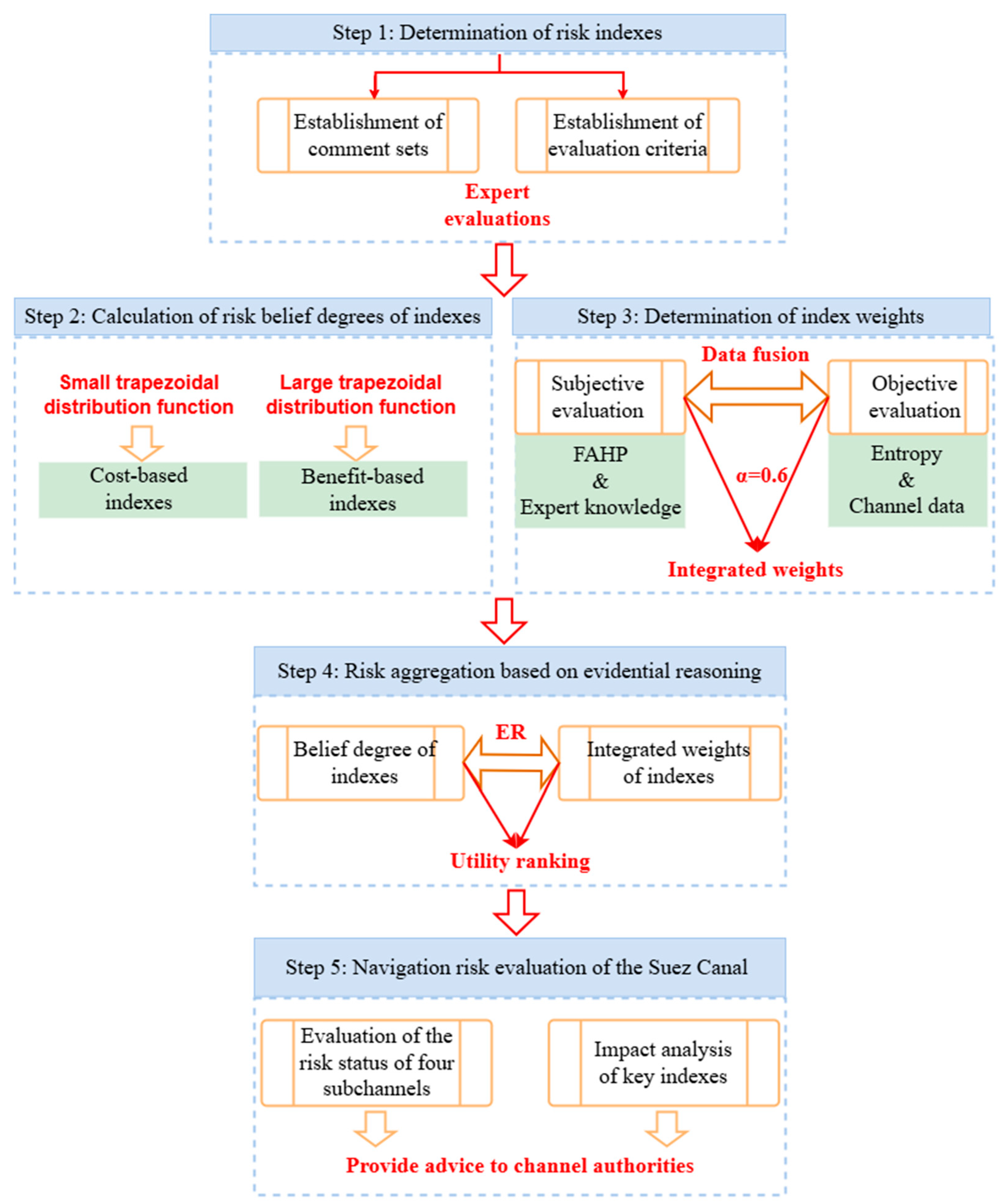
Based on the analysis of the navigational characteristics of one-way channels, the one-way channel navigation risk evaluation model is established, as shown in Figure 1. Firstly, the risk evaluation index system of a one-way channel is established by combining the experts’ opinions, and the evaluation criteria of indexes are determined to assist the experts in evaluating scientifically. Then, based on the expert evaluation and objective data, the risk level belief degree and comprehensive weights of the indexes are determined, in which the compromise coefficient is introduced to carry out the effective integration of subjectivity and objectivity. Next, the evidential reasoning (ER) method is used to achieve the aggregation and analysis of the risk evaluation results, and the utility function is used to rank the risk values of the risk indexes in the comprehensive evaluation results. Finally, the four one-way sub-channels of the Suez Canal are evaluated and analyzed in terms of risk, and reference recommendations are made for channel management based on the evaluation results.

3.1. Determination of Indexes

An extensive literature review shows that there is not a completely fixed standard for the evaluation system about navigational environment and navigational risk; mainly due to different objects to be evaluated, the content of the evaluation index system established varies. For example, the index system of port navigation and the index system of the traffic separation scheme are different. The navigational characteristics of one-way channels are more similar to those of port channels, but there are also differences. The one-way channels are limited by the channel conditions and can only choose to send ships in formation, without considering the impact of ship overtaking.
In order to ensure the scientific validity of the risk evaluation of one-way channels, a certain number of experts in related fields are invited to discuss and validate the establishment of the index system. Considering the stakeholders of the navigational risk of one-way channels, the selected experts include managers of shipping companies, container ship captains, container ship pilots, and researchers in the field of navigational safety (Table 2), all of whom have practical experience in transiting the Suez Canal, thereby ensuring the representativeness and validity of their judgments in this study. According to some similar studies [38,40,41,42,43], it is believed that the number and authority of experts is suitable for this study.
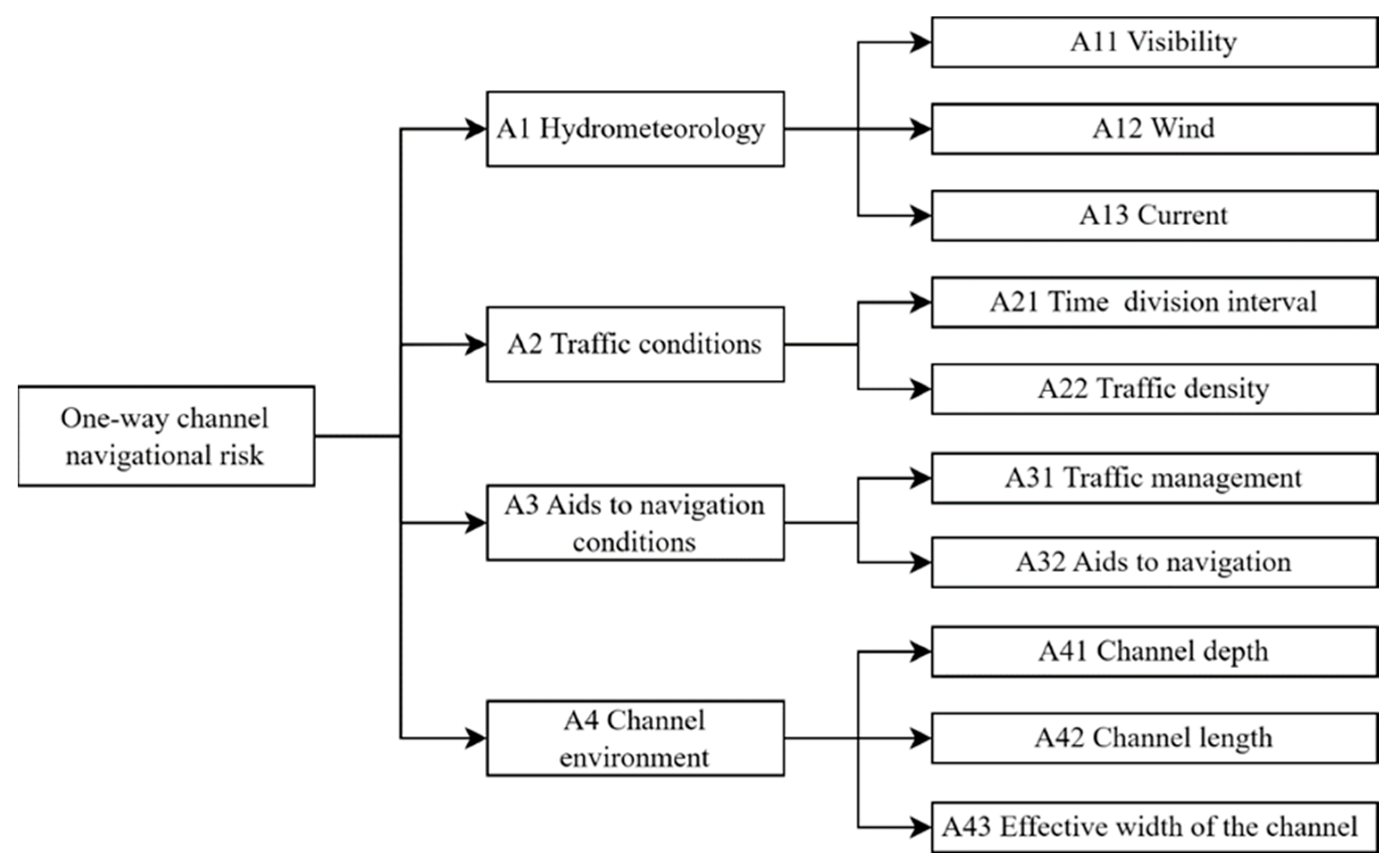
Based on the discussion of the opinions of the experts, the one-way channel navigational risk evaluation index system is established, as shown in Figure 2. At the criterion layer, hydrometeorology (A1), traffic conditions (A2), aids to navigation conditions (A3), and channel environment (A4) are selected as four important aspects to consider. For hydrometeorology, visibility (A11), wind (A12), and current (A13) are set as evaluation indexes; with regard to traffic conditions, time division interval (A21) and traffic density (A22) are identified; under the aids to navigation conditions, traffic management (A31) and aids to navigation (A32) are mainly considered; and finally, the channel environment includes three important indexes: channel depth (A41), channel length (A42), and effective channel width (A43). In particular, time division interval, which refers to the time separation arrangement of vessels navigating in one-way channels, is a unique feature of such channels. Similarly, effective channel width, which represents the portion of a narrow channel that can actually be used for safe navigation after deducting factors such as bank effects and safety margins, is a unique feature of narrow channels. Both of these factors will have a direct impact on the navigational risk of ships in one-way channels; therefore, experts agreed that the inclusion of these two indexes is very necessary and meaningful.
In this study, according to the actual situation of one-way channels, the evaluation indexes are divided into cost-based indexes and benefit-based indexes [44], among which, except for traffic management and aid to navigation, which are benefit-based indexes, the remaining eight indexes are cost-based indexes.
The factor set is the set of each index factor of the evaluation object, i.e., A = { A 1 , A 2 , A 3 , A 4 } , A 1 = { A 11 , A 12 , A 13 } , A 2 = { A 21 , A 22 } , A 3 = { A 31 , A 32 } , A 4 = { A 41 , A 42 , A 43 } . Finally, a one-way channel navigational risk evaluation system can be constructed.

3.2. Quantification and Rating of Indexes

In order to effectively capture the index evaluation risk, the expert group is invited to score the likelihood of indexes posing a risk on a Likert scale from 1 (very low) to 5 (very high), as provided in Appendix A [38,43,45,46]. The navigational risk of one-way channels is categorized into the five evaluation levels described above, and the set of evaluation factors consists of criterion-level and index-level factors in the index system.
In the research related to the navigational risk of compound channels, domain experts have made great contributions to the establishment of evaluation criteria [14]. Therefore, based on the existing studies, the specific description of the evaluation criteria of the indexes in this study is as follows, summarized in Table 3.
(1)
Evaluation criteria for hydrometeorology
In terms of hydrometeorology, the criteria for evaluating visibility, wind, and current indexes are determined separately. Firstly, prolonged poor visibility will directly lead to the fatigue of the navigational officer and produce misjudgment, lookout negligence, and other undesirable phenomena. The evaluation criterion of visibility is shown in Table 4, and the inverse of the annual average minimum visibility of the studied waters is chosen as the calculation criterion. Secondly, different wind levels have different degrees of influence on ships, and the greater the wind, the more difficult it is to ensure the safety of ship navigation. The annual average maximum sustained wind speed under normal operational conditions in the study area is chosen as the calculation criterion, while the Beaufort wind scale and analyses of severe sea states [47] are referenced in the text to support the evaluation of wind-related conditions. When the current speed is large, it is difficult to maneuver the ship in the channel and easy to cause ship collisions or other accidents. As the main current direction in a one-way channel has a small angle with the channel, the maximum current speed is selected as the calculation criterion.
(2)
Evaluation criterion for traffic conditions
With the increase in the number of ships, it will inevitably increase the traffic pressure of one-way channels. The time division interval system has been widely adopted by some one-way navigational channels, such as the Suez Canal, the deep-water channel at the mouth of the Yangtze River in China, etc. The selection of the time division interval will affect the passage capacity of the channel and thus the risk level of ships navigating in the channel. The higher the passage capacity of the channel under the certain situation of the time division interval of the channel, the smaller the danger of ships navigating in the channel. The passage capacity of the channel can be expressed as Equation (1):
M = 24 V n L ρ T D
where ρ is the channel utilization rate, also known as channel saturation, when the value of ρ reaches 0.5 ~ 0.6 , it means that the channel is in saturation. At this time, the corresponding channel ship passage is the actual navigability of the channel; thus, the channel utilization rate is used as a calculation criterion for the split-time interval index factor. In addition, M is the annual passage capacity of the one-way channel; V is the average speed of ships sailing in the channel; n is the sum of the average number of ships crossing per day, such as the daily arrangement of the fleet in different directions through the channel 2 times each, then n = 4 ; L is the average mileage of ships sailing in the channel; T is the annual working days of the channel; D is the average length of the channel occupied by each ship in navigation.
For the traffic density index, it can better describe the busyness of the channel. Considering the differences in ship sizes, the ship conversion factor [49] is introduced to convert ship traffic volume.
(3)
Evaluation criterion for aids to navigation conditions
The navigational behavior of ships in a channel is mainly controlled by the local channel management, and certain services are also required for the ships to ensure that their navigational behavior tends to be consistent and standardized. The aids to navigation provide a safety guarantee for ships navigating in port channels, and the perfection of aids to navigation largely affects the navigational behavior of ships. Traffic management and aids to navigation are both qualitative indexes, so their evaluation criteria are given on the basis of previous studies [48,50] and the opinions of experts in the field.
(4)
Evaluation criterion for channel environment
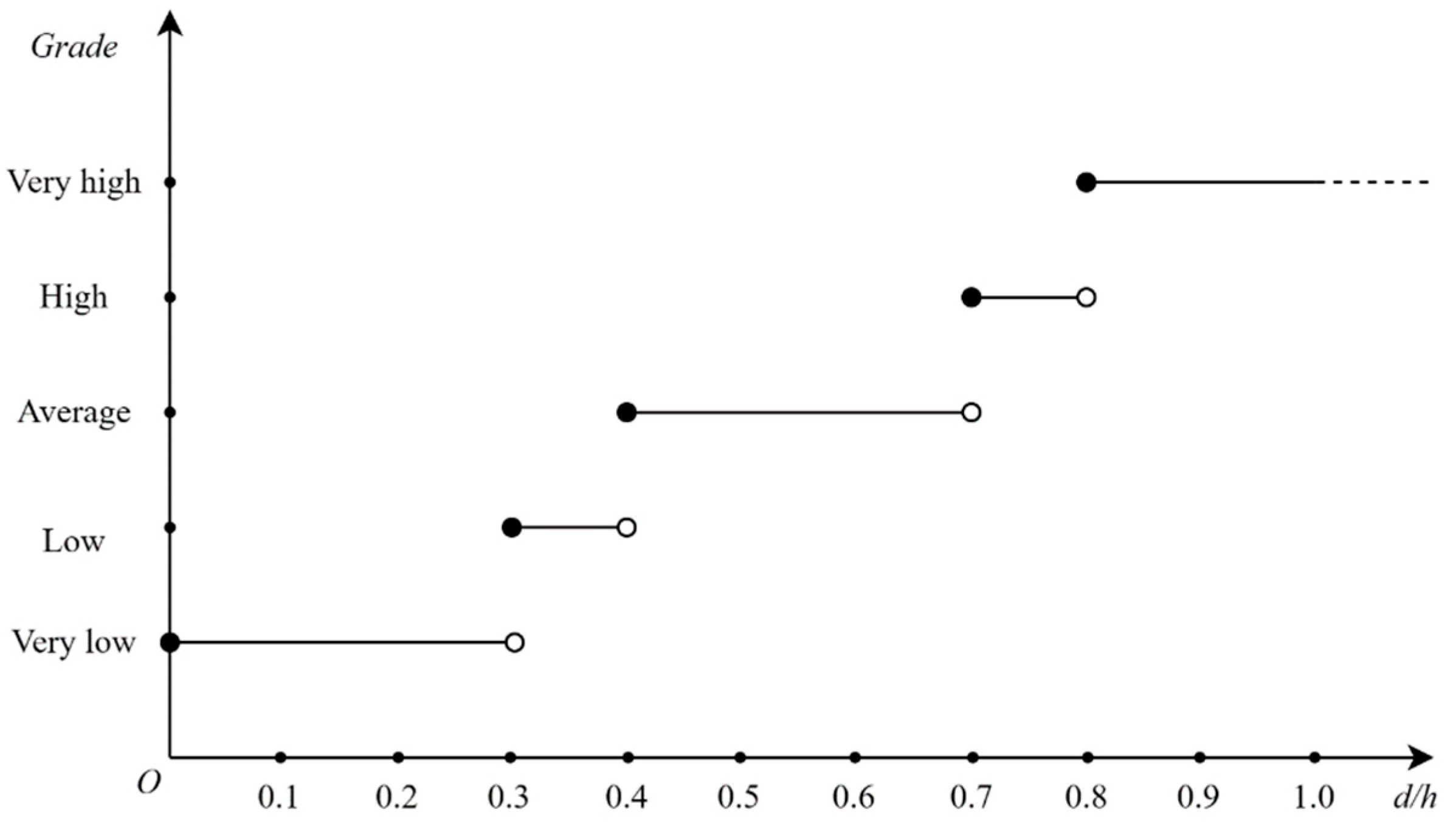
One-way channels are maneuvering restricted waters, and the depth and width of the channel are two important factors affecting ship maneuvering. However, it should be noted that water depth is a relative concept for different ships, so the ratio of water depth to ship draught (d/h) is used to express water depth. According to the relationship table of the degree of influence of water depth on ship maneuverability [32], the water depth is divided into five ranges as shown in Table 5.
For the channel width, another factor affecting ship maneuverability in restricted waters, it should be noted that the channel width related to ship maneuverability refers to the bottom width of a channel (effective channel width, W), and not the average width of a channel cross-section or the water surface width [32]. In this study, the ratio of ship length to the effective channel width is taken as the risk degree calculation criterion for the water width of a channel. In the relationship between effective channel width and ship maneuverability shown in Table 6, three maneuverability influence division intervals are given.
In addition, the length and width of the channel limit the space of ship movement and navigable waters. Drawing on the research of relevant scholars and expert opinions [51], the ratio of channel length to channel width is the calculation criterion of channel length hazard.
By dimensionless evaluation criteria for each index factor, the one-way channel navigational risk rating system can be determined (as shown in Table 7). Since there is a scientific and clear criterion for the classification of the channel depth index [32], it belongs to a certainty index, while the remaining indexes belong to uncertainty indexes due to the lack of more precise grading criteria given, which requires risk level measurement from experts. For the uncertainty indexes, there is a certain degree of blindness in expert evaluation, so it is necessary to quantify the qualitative indexes and some quantitative indexes with unclear evaluation criteria by fuzzification. By constructing the belief degree function, the belief degrees of uncertainty indexes can be obtained, and the evaluation results can truly reflect the probability of each index belonging to the evaluation set.
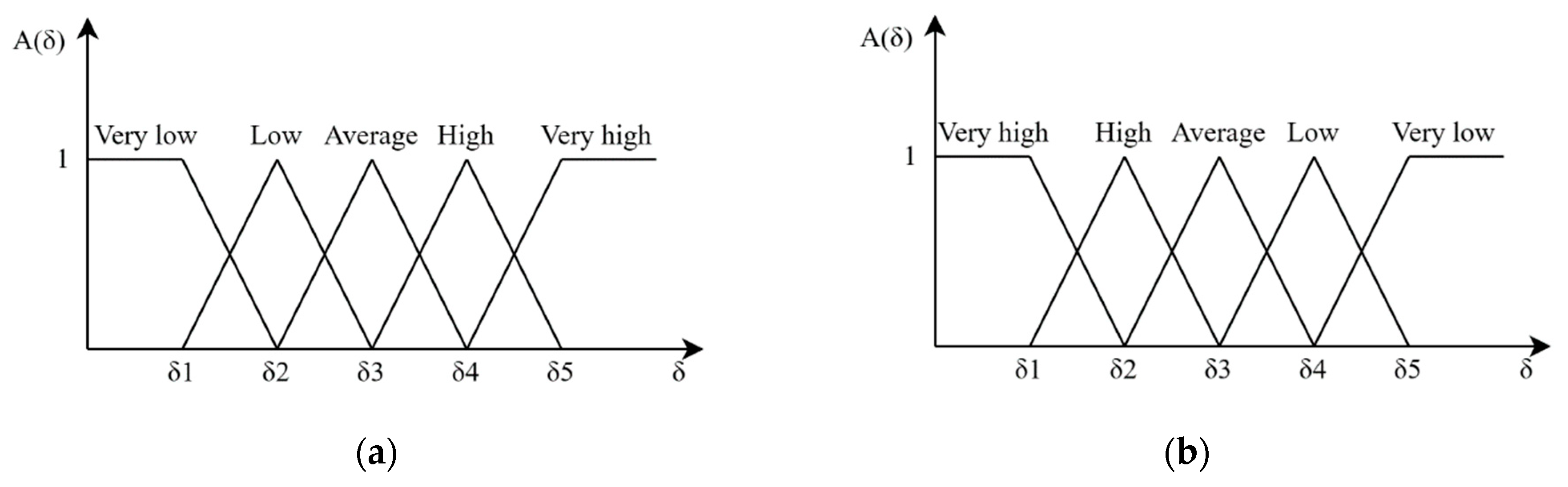
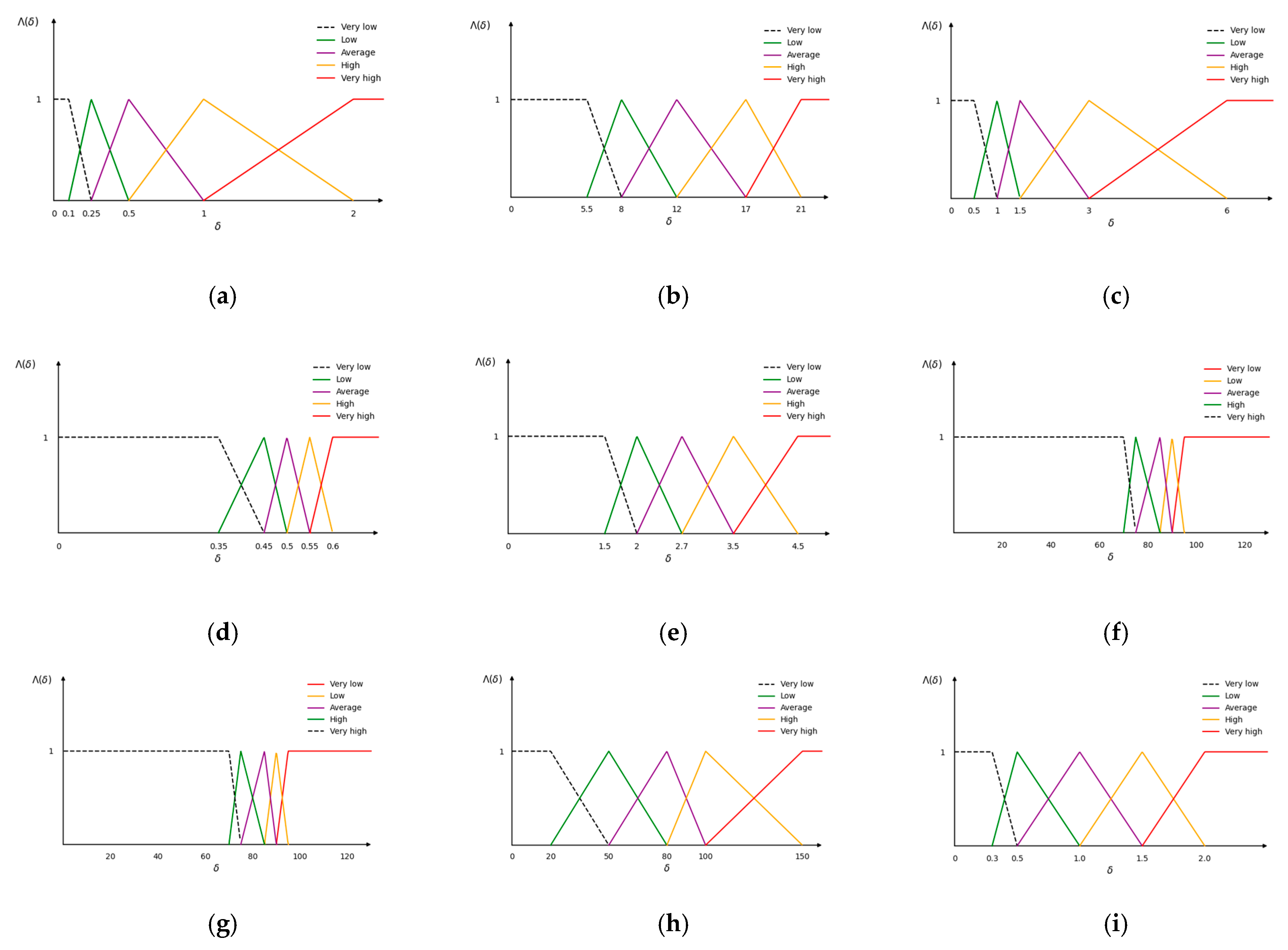
In this study, the risk level is classified by means of constructing the belief degree function. Among the indexes, visibility, wind, current, channel length, effective channel width, time division interval, and traffic density are treated as cost-based indexes, and thus a small trapezoidal distribution belief degree function is used, as shown in Figure 3a. Traffic management and aids to navigation are treated as benefit-based indexes, for which a large trapezoidal belief function is adopted, as shown in Figure 3b.

3.3. Determination of Comprehensive Weights of Indexes

There are relatively few studies in the field of risk evaluation of one-way channels. Most of the risk evaluation methods adopted by researchers are hierarchical analysis methods or fuzzy theory. Fuzzy mathematics is usually applied to problems with fuzzy phenomena, which include the fuzzification process in risk assessment [52]. But the evaluation results are greatly influenced by the subjective judgment of experts, and the objectivity of evaluation is slightly insufficient. Therefore, the fuzzy analytical hierarchy process (FAHP) method is combined with the entropy weight method (EWM) in this study, and the compromise coefficient is introduced to determine the comprehensive weights of the risk indexes.
The weights of the first-layer indexes are determined using the FAHP method, and the index weight vector is determined as W i = r i i = 1 ,   2 , , s ; the weight vector of the second-layer indexes is W i j = w i j i = 1 ,   2 , , s ;   j = 1 ,   2 , , m , and their weights are determined using the FAHP-entropy method for linear combination weighting, and the combination weights are as follows:
w i j = α w i j + 1 α w i j
where α is the compromise coefficient, which refers to the weight occupied by subjective evaluation results in this study, and 0 α 1 ; w i j is the subjective assigned value; w i j is the objective assigned value.

3.4. Risk Aggregation Based on Evidential Reasoning (ER)

The Evidential Reasoning (ER) approach is an extension of Dempster–Shafer evidence theory that allows combining evidence with two parameters (weights and belief degree) and shows significant advantages when dealing with complex systems associated with various types of uncertainty. Therefore, the ER method is used to aggregate the results of single-factor evaluations after obtaining the risk state belief degrees as well as the weights of the indexes.
Assuming that a group of evaluated individuals is evaluated by N evaluation levels H n ( n = 1 ,   2 , , N ) under I criteria A i ( i = 1 ,   2 , , I ) . A I ( j ) is defined as a subset of the j t h   index under I t h criterion, denoted as A I ( j ) = a i 1 , a i 2 , , a i J . Therefore, the belief degree that the j t h index under the criterion A i is evaluated at level H n can be written as:
S ( a i j ) = { ( H n , β n , i j ) , n = 1 , 2 , , N ; i = 1 , 2 , , I ; j = 1 , 2 , , J }
β n , i j denotes the belief degree of the j t h index under criterion A i for the evaluation level H n , where β n , i j 0 , and n = 1 N β n , i j = 1 .
Each index a i j corresponds to a weight w i j , and the fundamental probability mass of that index can be expressed in Equation (4), representing the extent to which index a i j in A I ( j ) is assessed as H n .
m n , I ( j ) = ω i j β n , i j
In addition, m H , I ( j ) denotes the fundamental probability mass remaining in A I ( j ) that has not yet been assigned to any evaluation level, as shown in Equation (5):
m H , I j = 1 n N m n , I ( j )
Thus, the evidential reasoning process is shown in Equations (6)–(9).
K I ( j + 1 ) = 1 t = 1 N i = 1 i t N m t , I ( j ) m i , j + 1 1         j = 1 , 2 , , J 1
m n , I ( i + 1 ) = K I ( j + 1 ) m n , I ( j ) m n , j + 1 + m n , I ( j ) m H , j + 1 + m H , I ( j ) m n , j + 1
m H , I ( j + 1 ) = K I ( j + 1 ) × m H , I ( j ) × m H , j + 1
β n = m n , I ( J ) 1 m H , I ( J )         n = 1 , 2 , , N ,   j = 1 , 2 , , J
where K I ( i + 1 ) is the normalization factor to make n = 1 N m H , I ( i + 1 ) + m n ,   I ( i + 1 ) = 1 and β n is the aggregated belief degree of the criterion layer. Similarly, the final evaluation results of the target layer can be obtained by aggregating the aggregated evaluation results of each criterion layer.

3.5. Utility Ranking

All indexes must be ranked according to their aggregated belief degrees [53]. In order to achieve the accurate quantification and ranking of each evaluated individual, a Risk Priority Index (RPI) needs to be introduced, as shown in Equations (10) and (11) [42]. It can be concluded that the higher the RPI value of an evaluated individual, the higher the risk level and the higher the risk of ship navigation:
R P I = n = 1 N β n × u H n
u H n = n 1 N 1
where β n is the confidence level assigned to H n and N is the number of risk level. The priority level of the utility function   u H n ( n = 1 ,   2 , , N ) was linearly assigned to u H 1 = 0 , u H 1 = 0.25 , u H 1 = 0.5 , u H 1 = 0.75 , u H 1 = 1 [54].

4. Case Study

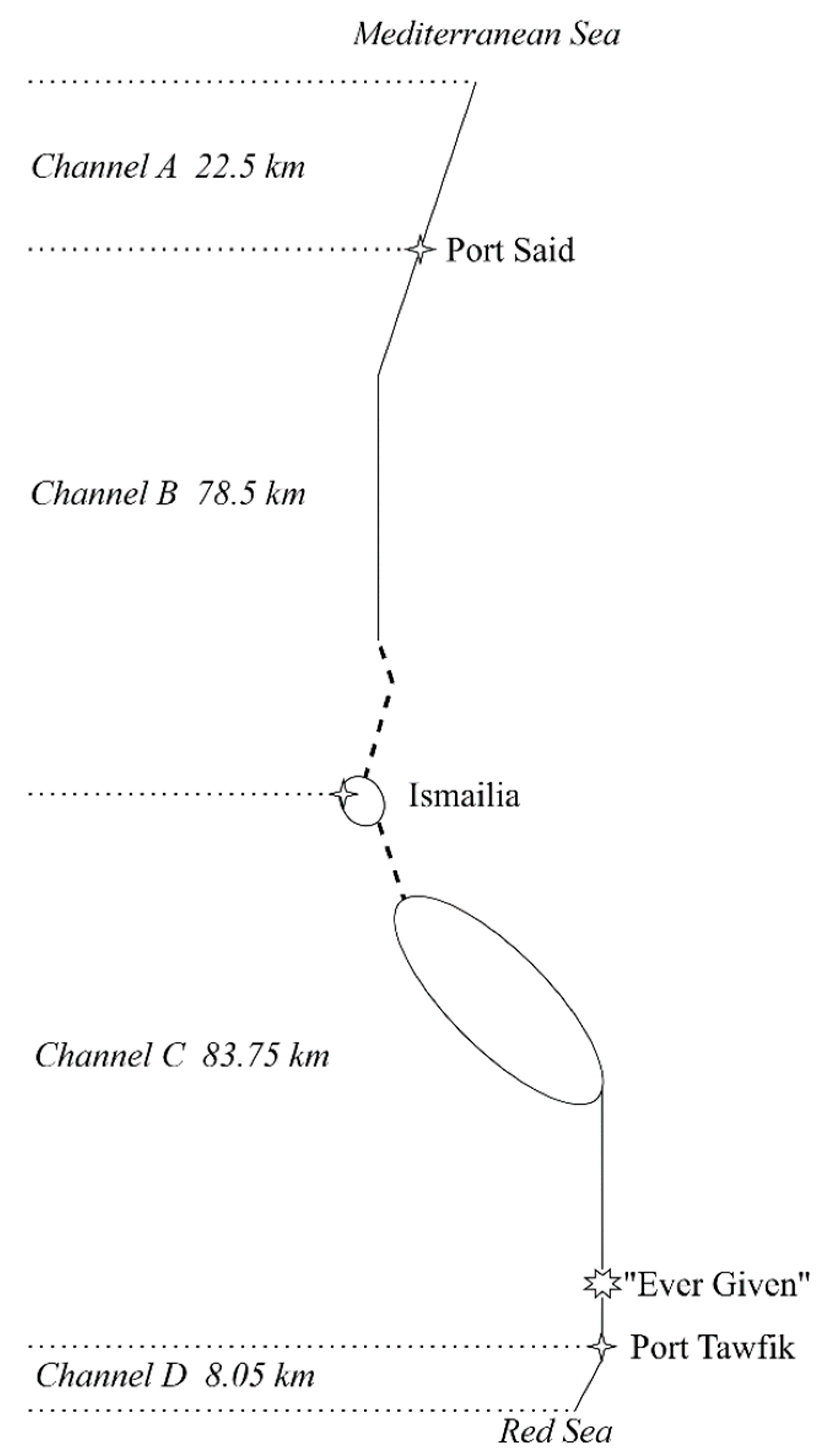
The Suez Canal is located in the northeast of Egypt, from the port of Tawfik in the Gulf of Suez on the Red Sea to the port of Said at the southern end of the Mediterranean Sea, with a total length of 192.8 km. It is one of the busiest channels in the world, while the Suez Canal is a typical channel that adopts a time-sharing one-way navigation method, and the Suez Canal accounts for more than 12% of the global ship traffic. According to the Suez Canal Authority (SCA), the average daily ship traffic of the Suez Canal is about 51.5 vessels, and only one formation each of southbound and northbound ships passes through the Suez Canal daily, and the two formations basically enter the canal at the same time, and the southbound and northbound ships do not affect each other during the navigation. For the study of the Suez Canal navigational risks, this study divides the canal into four navigation segments (as shown in Figure 4). Channel A refers to the eastern import sub-channel; Channel B refers to the lighthouse from Port Said to Ismailia; Channel C refers to the port from Ismailia to Tawfik, where a grounding of the “Ever Given” in that section of the channel caused a blockage in the Suez Canal; Channel D refers to the southern Suez import sub-channel. As shown in Figure 4, the straight line represents the one-way sub-channel portion contained in the Suez Canal, and the dashed line represents the two-way sub-channel portion contained in the Suez Canal.

4.1. Determination and Quantification of Indexes

4.1.1. Determination of Hydrometeorological Conditions

In this study, the annual minimum visibility and single-day maximum average wind speed at three major ports (Port Said, Port Ismailia, and Port Tawfik) in the Suez Canal basin from 2016 to 2021 are collected with reference to the tides and currents [8]. The hydrometeorological conditions of each sub-channel in the Suez Canal are shown in Table 8.

4.1.2. Determination of Traffic Conditions

According to the planning of the Suez Canal, it is known that the density of ships in the canal channel basically maintains a constant value, and in this study, by reviewing the literature [55,56] with the information related to ships in the channel given by the SCA, the traffic density values of the four sections θ can be calculated as shown in Table 9, while the values of each parameter for calculating the utilization rate of each sub-channel can be obtained according to Equation (1), as shown in Table 10.

4.1.3. Determination of Aids to Navigation Conditions

The two indexes about traffic management completeness rate and navigational aid sign completeness rate are perfected through expert surveys. In this study, 70 questionnaires were issued, and 56 valid questionnaire surveys were returned. The results of the questionnaire surveys are shown in Section 5.

4.1.4. Determination of Channel Environment

In this study, four main one-way sub-channels of the Suez Canal are studied, and the main environmental parameters of the selected four sub-channels are shown in Table 11.
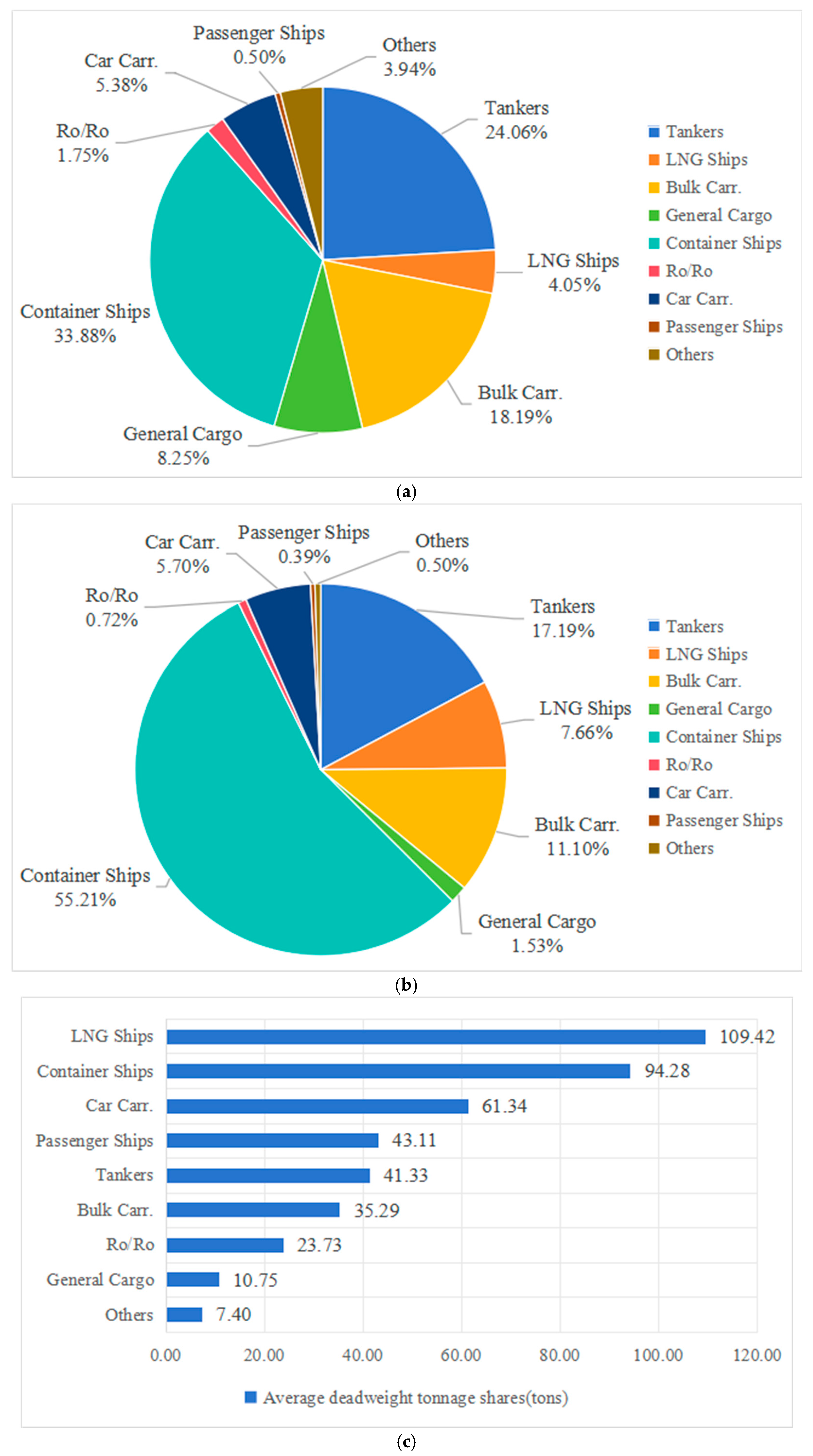
The index criteria of channel length, channel depth, and effective channel width need to be determined by the channel environmental data together with the ship parameters, and the larger the deadweight tonnage and ship type, the greater the danger of ships navigating in the channel. Considering that the largest number of ships navigating is more representative of the study, the information related to the ships passing through the channel in all years from 2011 to 2020 released by the SCA is summarized and analyzed, as shown in Figure 5 [57].
It can be concluded from Figure 5a that container ships sail through the Suez Canal in the largest number, followed by oil tankers and bulk carriers. From Figure 5b, container ships are the type of ships with the largest deadweight that sail through the Suez Canal. The average cargo tonnage of each type of ship can be calculated from the relevant data in Figure 5a,b. In Figure 5c, the average cargo tonnage of LNG ships is 109,420 tons, followed by container ships (94,280 tons), considering that the number of LNG vessels navigating the Suez Canal is small and the total tonnage carried is small. As a result, the corresponding data for LNG ships is not representative. In addition, two of the four major ship groundings that occurred in the Suez Canal in 2021–2023 were container ships, in particular the ultra-large container ship (ULCS) “Ever Given”, which blocked the Suez Canal for six days. Container ships are therefore selected as an example to study the navigational risk level of the Suez Canal one-way channel.
The basic parameters of several design representative vessels of current container ships are shown in Table 12. The deadweight tonnage (DWT) of container ships passing through the Suez Canal from 2011 to 2020 is 5138.014 million tons. The total number of container ships passing through the canal is 54,499. The average deadweight tonnage of container ships is calculated to be 94,277 tons, which belongs to 100,000 DWT. To explore the navigational risk situation of each sub-channel of the Suez Canal, this study selects the 100,000 DWT container ships of design vessel type as the object for research.

4.2. Determination of Evaluation Values for Indexes

Based on the derived evaluation criteria values corresponding to each evaluation index and the results of the expert questionnaire, the evaluation values of each evaluation index can be obtained as shown in Table 13.

4.3. Calculation of Belief Degrees of Indexes

According to the belief degree function of each evaluation index (as shown in Figure 6), the belief degree of the risk level of each index is obtained, as shown in Table 14. In this case, the belief degree of the risk state to which the value of the certainty index belongs is 1. In the table, M, T, L, B, and H denote the five fuzzy evaluation levels, namely B (very ow), L (low), M (medium), H (high), and T (very high).
It is shown that the evaluation results of the belief degrees of visibility index, wind index, channel depth index, traffic management index, and aids to navigation index are the same for each of the four sections of the channel. There are three reasons for this situation:
(1)
Based on the collected meteorological conditions of the Suez Canal from 2016 to 2021, it is concluded that the difference between the values of the annual average minimum visibility and the annual average maximum wind speed of the four sections of the channel are small and equal.
(2)
All four sections of the channel are under the jurisdiction of the SCA, and aids to navigation are uniformly installed by the management according to IMO rules.
(3)
The difference between the two values of the channel depth of the four sections of the channel is small. The value of the selected standard ship draught is certain, and the ratio of the ship draught to the channel depth is calculated to be in the medium risk of the index evaluation within the threshold value of the standard.

4.4. Calculation of Comprehensive Weights of Indexes

The subjective weights of the indexes were determined on the basis of the experts’ opinions. Taking the criterion layer as an example, the kernel matrix of the fuzzy judgment matrix of the indexes is
A = 0.50 0.20 0.80 0.89 0.80 0.50 0.89 0.93 0.20 0.11 0.50 0.50 0.11 0.07 0.50 0.50
The expert consistency index k 1 = 0.0617 < ε is calculated to satisfy the consistency check. The same method is used to derive the consistency check indexes k 2 = 0.1 ,   k 3 = 0.1667 ,   k 4 = 0.0306 ,   k 5 = 0.1043 for each index layer fuzzy matrix, which all satisfy the consistency check.
The objective weights of indexes are jointly determined by the navigational risk evaluation values of four one-way sub-channels. Firstly, the navigational evaluation values of the four sections are normalized; secondly, based on the normalized data, the objective weights of the indexes are calculated.
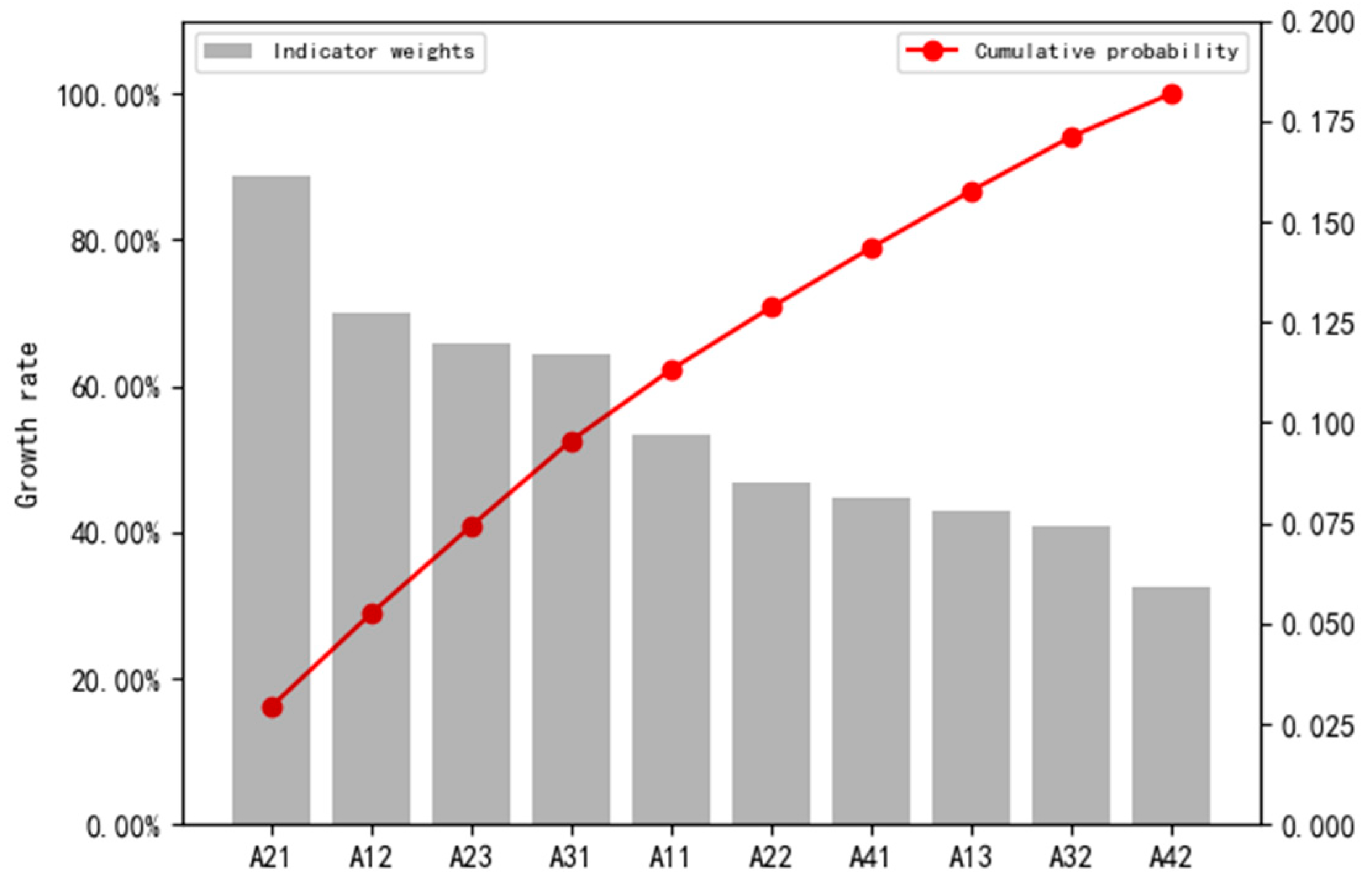
The objective weights and subjective weights are combined with reference to form the comprehensive weights. In order to determine the value of α , which is the compromise coefficient, it is necessary to ensure that the expert opinion is the main factor of reference; however, the opinion of the expert cannot be used as a decisive factor. This study makes α = 0.6 ,   0.7 ,   0.8 respectively, resulting in the change in the ranking of the comprehensive weights calculated for each index as shown in Figure 7.
According to the change in the comprehensive weight ranking of each index in Figure 7, the index’s rank changing with α , namely, channel length index A 42 (red frame) and traffic management index A 31 (yellow frame), are selected. When α = 0.6 , the weight ranking of index A 42 and index A 31 are 6th and 7th, respectively. When α = 0.7 , the ranking of the two indexes starts to change, and index A 42 is 7th and index A 31 is 6th. Combining the four one-way sub-channels, there is a significant difference in the degree of risk between index A 42 and index A 31 . As can be seen from Table 14, the risk level of index A 42 is greater than or equal to the risk level of index A 31 in the four one-way sub-channels. Therefore, it can be considered that the corresponding navigational risk weight of A 42 is before A 31 . In a comprehensive view, the compromise coefficient α = 0.6 is more consistent with the actual situation. Therefore, α = 0.6 is adopted as the compromise coefficient to calculate the comprehensive weight in this study. The comprehensive weights of each index at α=0.6 and their ranking are shown in Table 15.
From the comprehensive weights of indexes, it can be seen that the channel depth index and wind index are the key factors affecting the level of navigational risk of ships in one-way channels, among which the channel depth-to-draught ratio has the greatest influence on the level of navigational risk. In nautical research, the water depth-to-ship draught ratio is usually used to reflect the maneuverability of the ship, and the lower the value, the worse the maneuverability of the ship in the channel. Wind has the second highest influence on the level of navigational risk. When the ship is navigating in a long channel, excessive wind may cause the ship to run aground.
Pareto’s law states that the important factors in any set of things usually account for only 20%, and the rest, despite being the majority, are of minor importance [58]. According to this principle, the comprehensive weights of the indexes are transformed into the form of cumulative percentages, and the Pareto diagram of the navigational risk evaluation system of the one-way channel in each section of the Suez Canal is shown in Figure 8. From Figure 8, it can be seen that the key factors in the top 20% of the navigational risk evaluation system of the one-way channel in the four sections of the Suez Canal are channel depth A 41 and wind A 12 .
Based on the above analyses, ships should pay attention to the ship draught when sailing in one-way channels, especially when navigating in channels with shallow water depth; ships need to wait for the tide to pass. In addition, container ships have distinctive features such as a large cargo stacking height and a large windward area, from which it can be seen that the influence of wind is more significant. Therefore, when container ships navigate in longer channels, they should enter the channels according to the instructions of local channel authorities in a compliant manner to minimize the adverse effects of wind.

4.5. Evaluation of Navigational Risk in the Suez Canal

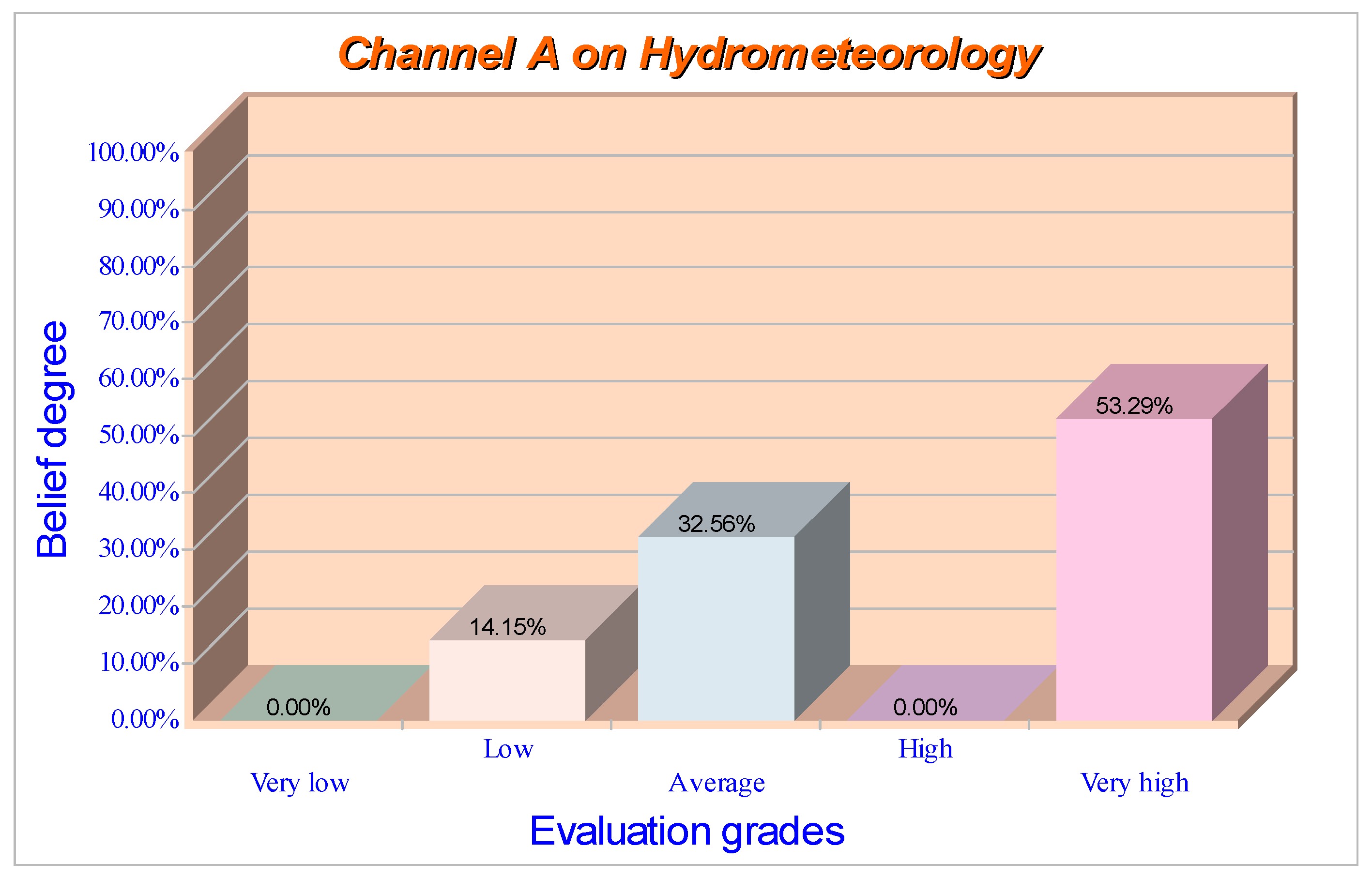
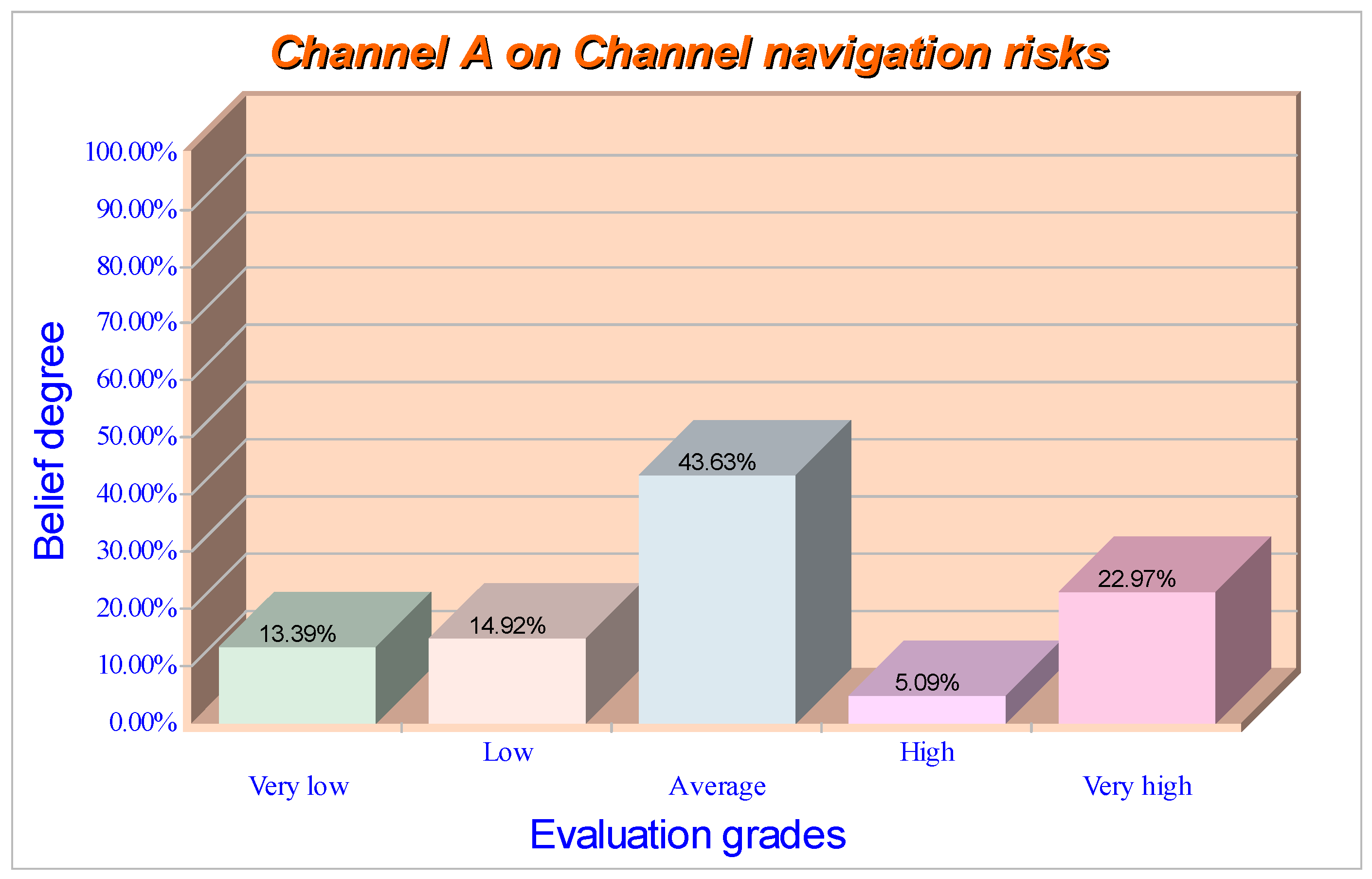
After obtaining the risk level and comprehensive weights of the indexes in the index layer, the ER algorithm is used to perform the navigational risk aggregation from the index layer to the criterion layer and from the criterion layer to the target layer, i.e., Equations (3)–(9). This evidential reasoning process can also be realized by the Intelligent Decision System (IDS) version 1.2. Taking Channel A as an example, Figure 9 demonstrates the aggregated evaluation result for criterion layer A1, and Figure 10 shows the result of the target layer aggregation evaluation for Channel A. Similarly, the aggregated evaluation results for four sub-channels can be obtained, as shown in Table 16.
From the aggregated evaluation results of navigational risk, it can be seen that the navigational risk of the selected standard ships is “medium risk” for all four one-way sub-channels. When the sum of “very low risk” and “low risk” belief degrees is defined as the belief degree of small risk, and the sum of “high risk” and “very high risk” belief degrees is defined as the belief degree of large risk, it is found by comparison that the belief degrees of large risk of Channel B and Channel C are larger than the belief degrees of large risk of Channel A and Channel D. The main reason is that Channel B and Channel C are long and narrow inland channels, where ships navigate for a longer time; the influence of high-risk index factors on the navigation of the sub-channels is more significant as a result. Therefore, the risk level of each sub-channel needs to be quantified.
In order to further compare and evaluate the risk magnitude of different sub-channels, the utility function is used to transform the belief degree distribution of the risk level into clear values for risk ranking. According to Equations (10) and (11), the utility value of risk can be calculated as follows.
R P I A = u H 1 β 1 + u H 2 β 2 + u H 3 β 3 + u H 4 β 4 + u H 5 β 5 = 0 × 0.1339 + 0.25 × 0.1492 + 0.5 × 0.4363 + 0.75 × 0.0509 + 1 × 0.2297 = 0.5233
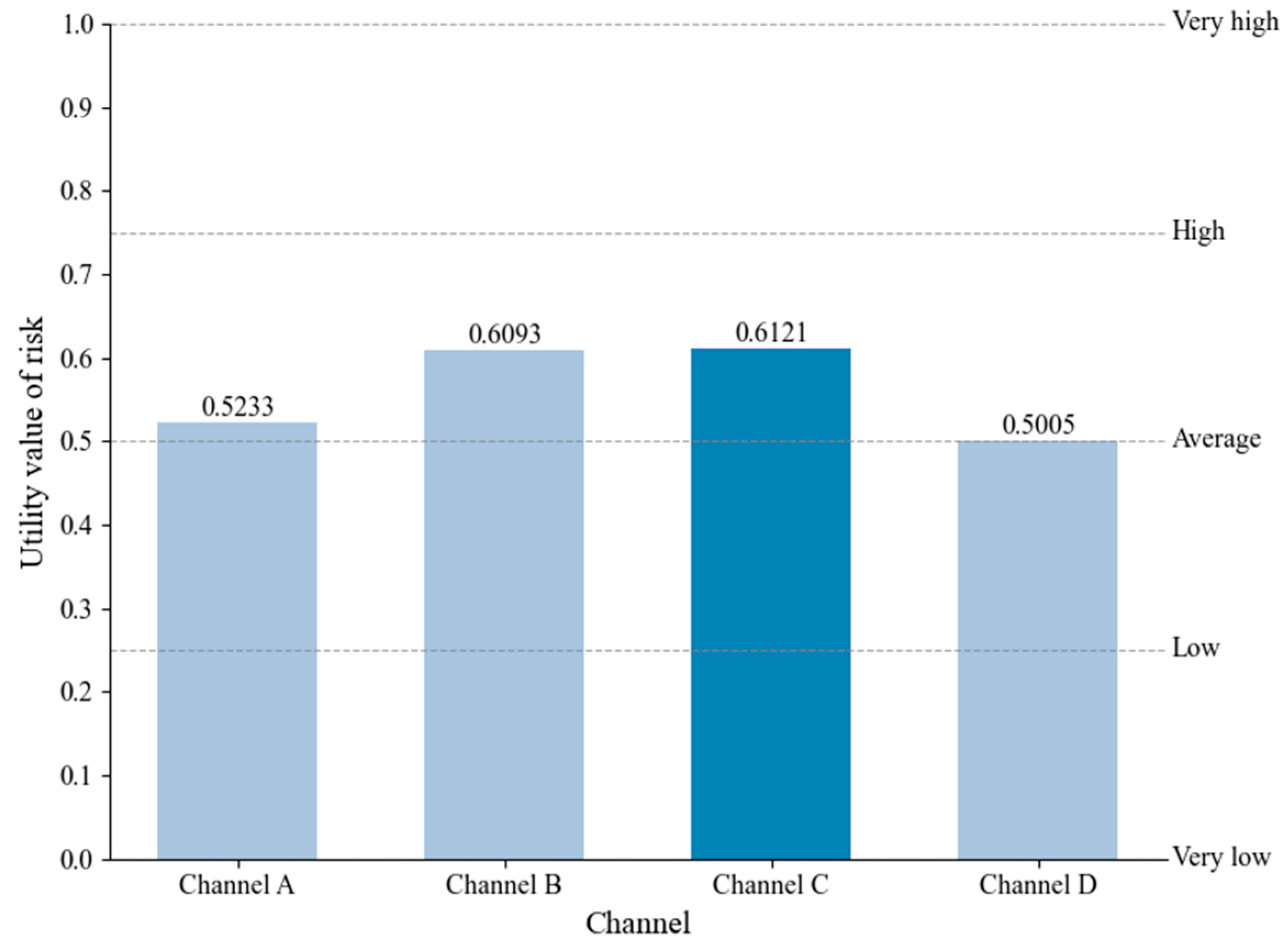
In this way, the corresponding risk utility values for all sub-channels can be calculated and ranked, and the risk results for each of the Suez Canal sub-channels are summarized in Figure 11. It can be seen that the sub-channel with the highest navigational risk among the four sections of the Suez Canal is Channel C, which is the channel where “Ever Given” ran aground. The risk utility values of Channel B, Channel A, and Channel C decrease in turn. It should be noted that of the four ships that ran aground in the Suez Canal during the period 2021–2023, three (“Ever Given”, “Affinity V”, and “MSC ISTANBUL”) ran aground in Channel C. The grounding incident of the “MV Glory” occurred in Channel B, which is the sub-channel with the second-highest risk utility value. Thus, the results of the risk evaluation are consistent with the actual circumstances of ship groundings in the Suez Canal.
A targeted approach to the navigational risk of one-way channels is provided from the perspective of evaluation indexes in this study. Among all the evaluation indexes, the two indexes of channel depth and effective channel width are related to the ship. The evaluation criterion of the channel water depth index is the ratio of ship draught to channel depth. The evaluation criterion of the effective channel width index is the ratio of ship type length to effective channel width. The ship’s length is the inherent quantity of each ship, and its size will not change. However, the ship draught is a variable, and the size of the ship draught changes dynamically with the changes in the ship’s cargo capacity, ballast water, and seawater density. Therefore, under the condition of fixed ship length, in order to investigate the influence of ship parameters on the level of navigational risk of different sub-channels in four sections of the canal, the navigation safety of 100,000 DWT container ships under different ship draught conditions is analyzed.
From Figure 12, it can be seen that if the channel depth index is the independent variable and the risk level of channel depth is the dependent variable, the relationship between them is reflected in the form of a segmentation function. The segmentation function shows an increasing trend of risk level with the increase in the channel depth.
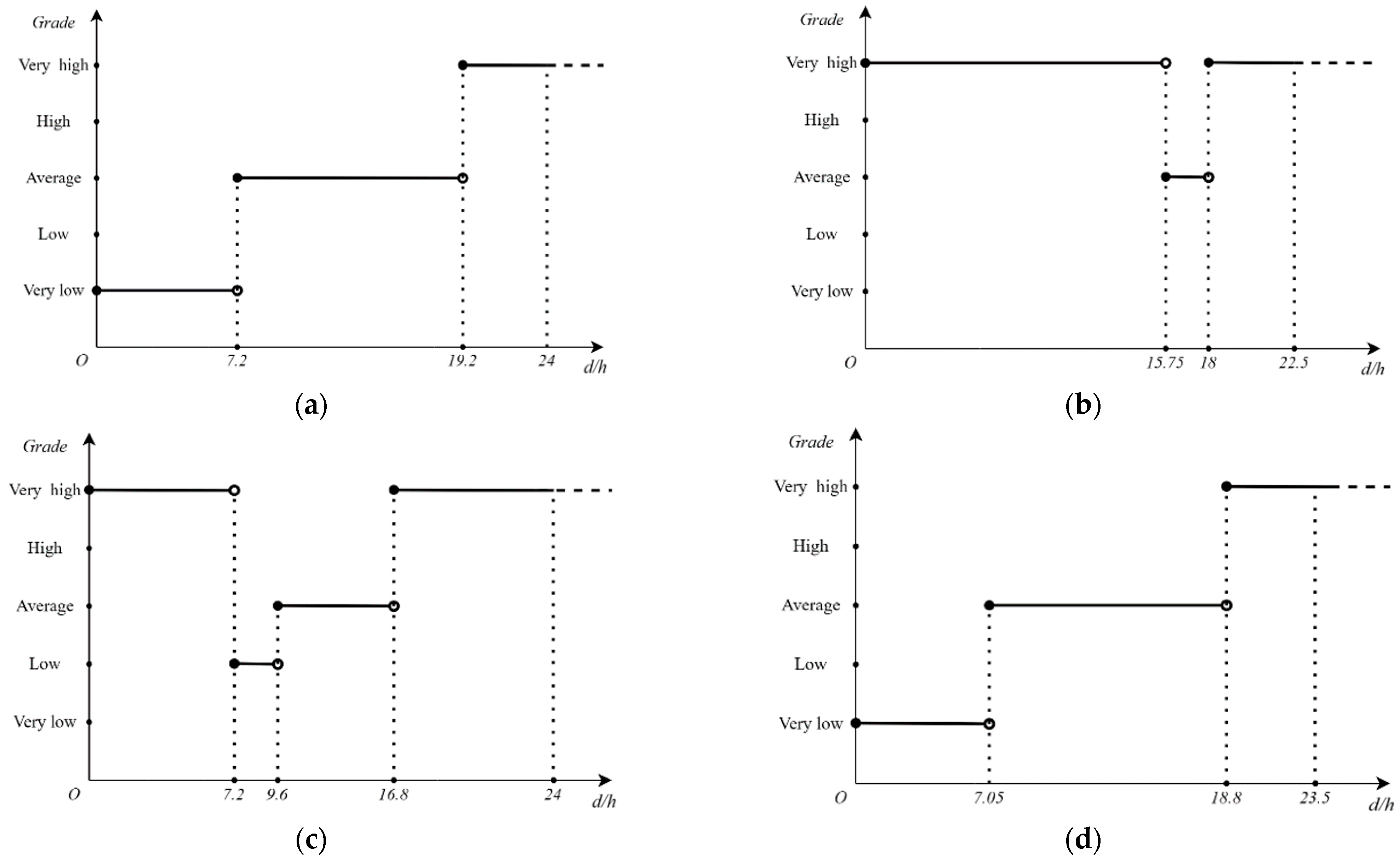
The channel depth index is determined by the ratio of ship draught to channel depth. The entropy method uses the critical value method to normalize the data, in which case the comprehensive weight does not change when the ship draught is changed. However, the change in the ship’s draught will lead to the change in the belief degree, which will lead to the change in the navigational risk evaluation results. Therefore, in the case of different channel depths of the four sections of the channel, the influence of the ship draught on the navigational risk is analyzed based on the division of the channel, and the analysis results are shown in Figure 13.
The results of the study on the effect of different ship draughts on the navigational risk level of sub-channels show that the values of ship draughts corresponding to the critical points of risk levels will change for different values of specific water depths of each sub-channel. The trends of Channel A and Channel D are similar, and the navigational risk levels of both sub-channels contain three risk levels, which are low risk, medium risk, and high risk. The critical value of the alternating low risk and medium risk of Channel A corresponds to a ship draught value of 7.2 m, and the critical value of the alternating medium risk and high risk corresponds to a ship draught value of 19.2 m. The two thresholds for Channel D are 7.05 m and 18.8 m, respectively.
The trends for Channel B and Channel C are similar. The navigational risk level for Channel B contains two risk levels, high risk and medium risk, and the navigational risk level for Channel C contains three risk levels, high risk, medium risk, and low risk. The ship draught corresponding to the threshold for the change from high risk to medium risk for Channel B is 15.75 m, and the ship draught corresponding to the threshold for the change from medium risk to high risk is 18 m. The critical value for the change from high risk to low risk in Channel C corresponds to a ship draught value of 7.2 m, the critical value for the change from low risk to medium risk corresponds to a ship draught value of 9.6 m, and the critical value for the change from medium risk to high risk corresponds to a ship draught value of 16.8 m.
By comparison, it can be found that the navigational risk of all four sub-channels is at high risk when the ship draught value is high, and the navigational risk level is low or medium when the ship draught value is moderate. However, it should be noted that when the ship draught value is at a low level, the navigational risk of Channel A and Channel D is low, while the navigational risk of Channel B and Channel D is high. This is due to the fact that the length of Channel B and Channel C is much longer than that of Channel A and Channel C. Although the channel depth index is the most important factor affecting the navigational risk of a channel, its effect on the overall navigational risk of a channel is not particularly significant for longer channels when all the other indexes are at high risk levels. Therefore, it is reflected in the results that the navigational risk of the channel is low when the ship draught is small in Channel A and Channel D channels, while the navigational risk of the channel is high when the ship draught is small in Channel B and Channel C.

4.6. Implications

This study contributes to navigational risk assessment in one-way channels by addressing the unique operational characteristics of constrained waterways and developing a structured ER-based risk evaluation model. It systematically advances knowledge in model construction, indicator design, and practical application, with significant implications for both theoretical understanding and maritime safety management.
This study enriches the theoretical understanding of navigational risk by situating assessment within the specific context of one-way channels. It highlights the importance of context-specific frameworks for constrained waterways and demonstrates how the interaction of infrastructure limitations and environmental variability shapes maritime risk. This contribution broadens system-oriented perspectives in maritime safety theory and provides a foundation for future studies in similarly constrained operational environments. Furthermore, this study advances methodological insights by showing how structured evaluation models can integrate expert judgment with systematic analysis. By bridging qualitative and quantitative assessment, it provides a replicable framework for risk evaluation in complex maritime environments [59]. It supports the development of models that effectively balance data objectivity and expert knowledge, which is critical for addressing uncertainty in maritime risk management.
From a managerial perspective, the findings offer actionable guidance for enhancing operational safety. By clarifying the key factors influencing navigational risk, the framework enables maritime authorities to implement evidence-based policies, optimize vessel scheduling, prioritize high-risk areas, and allocate resources efficiently. The multi-level aspect, assessing risk across overall channels, sub-channels, and vessel-specific factors, also supports proactive risk management, allowing decision-makers to anticipate potential hazards and design targeted interventions. Additionally, the framework demonstrates practical applicability beyond the specific study context. Its principles can be extended to other high-risk maritime or transportation environments, supporting the design of intelligent, systematic, and evidence-based safety management systems [60]. By promoting structured decision-making and adaptability, the framework contributes to enhancing overall operational safety and aligns with international efforts to strengthen maritime governance.

5. Conclusions

Based on the significant impact of the Suez Canal ship grounding events on the global shipping network, the navigational characteristics of one-way channels are given special attention in this study. Therefore, an ER-based risk evaluation model for one-way channels is creatively established, and the experimental results show the following:
(1)
This study fully takes into account the navigational risk characteristics of ships in one-way channels, and the addition of two innovative indicators, “effective width of channel” and “time division”, enhances the applicability and practicality of the established model to the risk evaluation system of one-way channels.
(2)
The navigational risk evaluation model for one-way channels, developed using the Evidential Reasoning (ER) method in this study, effectively balances the objectivity of data with the subjectivity of expert judgment, thereby addressing the uncertainty inherent in expert knowledge.
(3)
In this study, the Suez Canal, which is an important strategic channel, is taken as the object of study, and the whole one-way channel is divided into four sub-channels for investigation. The results show that Channel C, where the grounding accident of the “Ever Given” ship occurred, is the sub-channel with the highest risk utility value. In addition, the applicability of the model is verified in the context of four ship groundings that occurred in the Suez Canal during the period 2021–2023.
(4)
In order to provide stakeholders with more reasonable and feasible suggestions, this study takes a 100,000 DWT container ship as the standard ship to study the influence of ships with different draughts on the navigational risk level of the channel, and the final results show that the navigational risk level of the channel can be effectively reduced when the ratio of ship draught to water depth of the channel is kept between 0.3 and 0.8. Therefore, large container ships should choose the waiting tide through the channel as much as possible.
Despite the promising results of this study, there are still limitations in terms of research methodology and data resources, which provide directions for future research. The reliance on a limited expert panel introduces subjectivity, suggesting the need for more diverse perspectives. The five-year dataset, while useful for recent trends, may not capture long-term shifts; future research should expand temporal coverage and incorporate real-time AIS and meteorological data. The focus on a single vessel type narrows applicability, while human factors such as fatigue, operational errors, and management practices remain underrepresented despite their central role in maritime accidents. Moreover, the static design constrains the capacity to capture dynamic fluctuations in traffic and weather conditions. In the future, we plan to refine the framework by expanding the expert panel for greater input diversity, broadening the dataset’s scope and diversity to enhance the generalizability and accuracy of the findings, and exploring adaptive simulation models that incorporate real-time data and diverse channel contexts, such as the Panama Canal or the Strait of Malacca, to address evolving navigational risks more effectively. At the same time, comparative studies with alternative decision-making approaches will be conducted to validate and enhance the model’s adaptability. By integrating these approaches, the research not only advances academic discussions of navigational risk theory but also provides actionable insights for canal authorities seeking to strengthen risk monitoring and management in complex one-way channel environments.

Author Contributions

Conceptualization, J.Y. and H.X.; methodology, J.Y.; software, Y.S.; validation, W.X. and H.X.; formal analysis, X.W.; investigation, W.X.; resources, J.Y.; data curation, Y.S.; writing—original draft preparation, Y.S.; writing—review and editing, W.X. and J.Y.; visualization, W.X. and X.W.; supervision, J.Y.; project administration, H.X.; funding acquisition, J.Y. All authors have read and agreed to the published version of the manuscript.
All authors have read and agreed to the published version of the manuscript.

Funding

This work was supported by the National Natural Science Foundation of China under Grant No. 41861144014.

Data Availability Statement

The original data presented in the study are openly available on the official website of the Suez Canal Authority (SCA) at https://www.suezcanal.gov.eg (accessed on 15 March 2021).

Conflicts of Interest

The authors claim that no conflict of interest exists in the submission of this manuscript, and the manuscript is approved by all co-authors for publication. None of the materials in the paper has been published or is under consideration for publication elsewhere.

Appendix A

  • One-Way Channel Navigational Risk Assessment System Expert Survey Questionnaire.
  • Dear Esteemed Expert,
We extend our sincere gratitude for your participation in this survey, which forms a critical component of the One-Way Channel Navigational Risk Assessment System development. This questionnaire is designed to leverage your professional expertise and informed judgment to evaluate navigational risk levels under varying environmental and operational conditions. We employ a Likert scale for scoring (1 = Very Low, 2 = Low, 3 = Average, 4 = High, 5 = Very High), and we kindly request that you assign the most appropriate risk rating based on the specified value ranges for each index. Your responses will be treated with the utmost confidentiality and utilized exclusively for research purposes. Please complete the questionnaire independently, drawing upon your extensive professional knowledge and experience. Should you have any queries or require clarification, please do not hesitate to contact us at your convenience.
Survey Content: Please provide a score for each value range of the following indices to reflect the corresponding navigational risk level.
Table A1. Navigational Risk Evaluation Scoring Table.
CriteriaIndexScore
Hydrometeorology (A1)Visibility (A11)
Wind (A12)
Current (A13)
Precipitation (A14)
Traffic conditions (A2)Time division interval (A21)
Traffic density (A22)
Vessel Speed (A23)
Aids to navigation conditions (A3)Traffic management (A31)
Aids to navigation (A32)
Communication Reliability (A33)
Channel environment (A4)Channel depth (A41)
Channel length (A42)
Effective width of the channel (A43)
Ship overtaking ratio (A44)
Scoring Guidelines: Kindly insert a score ranging from 1 to 5 in the blank cells under the “Score” column (1 = Very Low, 5 = Very High) to indicate the risk level you deem appropriate for each value range. Should any value range appear ambiguous or require adjustment, please provide your suggestions or comments in the adjacent blank space. All units have been standardized (e.g., wind speed in m/s, length in km).
We deeply appreciate the valuable time and expertise you have committed to this survey. Your insights will significantly contribute to enhancing the safety assessment of one-way channels. For any further correspondence or discussion, please feel free to reach out to us. We wish you continued success in your professional endeavors!

References

  1. Chen, X.; Wu, H.; Han, B.; Liu, W.; Montewka, J.; Liu, R.W. Orientation-aware ship detection via a rotation feature decoupling supported deep learning approach. Eng. Appl. Artif. Intell. 2023, 125, 106686. [Google Scholar] [CrossRef]
  2. UNCTAD. Trade and Development Report 2021; United Nations: Geneva, Switzerland, 2021; Available online: https://unctad.org/publication/trade-and-development-report-2021 (accessed on 15 March 2023).
  3. Topham, G. How the Suez Canal Blockage Can Seriously Dent World Trade. 2021. Available online: https://www.inkl.com/news/how-the-suez-canal-blockage-can-seriously-dent-world-trade (accessed on 15 March 2023).
  4. Fan, S.Q.; Yang, Z.L.; Wang, J.; Marsland, J. Shipping accident analysis in restricted waters: Lesson from the Suez Canal blockage in 2021. Ocean Eng. 2022, 266, 113119. [Google Scholar] [CrossRef]
  5. Fan, S.Q.; Yang, Z.L.; Blanco-Davis, E.; Zhang, J.F.; Yan, X.P. Analysis of maritime transport accidents using Bayesian networks. Proc. Inst. Mech. Eng. Part O J. Risk Reliab. 2020, 234, 439–454. [Google Scholar] [CrossRef]
  6. Lee, J.M.; Wong, E.Y. Suez Canal blockage: An analysis of legal impact, risks and liabilities to the global supply chain. MATEC Web Conf. 2021, 339, 01019. [Google Scholar] [CrossRef]
  7. Li, J.J.; Zhang, X.Y.; Yang, B.D.; Wang, N.N. Vessel traffic scheduling optimization for restricted channel in ports. Comput. Ind. Eng. 2021, 152, 107014. [Google Scholar] [CrossRef]
  8. Lu, Z. Ship navigation experience through the Suez Canal. Navig. China 1994, 1, 68–81. (In Chinese) [Google Scholar]
  9. Elidolu, G.; Sezer, S.I.; Akyuz, E.; Aydin, M.; Gardoni, P. A comprehensive risk analysis for cargo leakage pollution at tanker ship manifold using cloud modelling and Bayesian belief network approach. Mar. Pollut. Bull. 2025, 219, 118238. [Google Scholar] [CrossRef]
  10. Gong, X.X.; Lu, J. Strait/canal security assessment of the Maritime Silk Road. Int. J. Ship. Trans. Log. 2018, 10, 281–298. [Google Scholar] [CrossRef]
  11. Li, Z.; Zhu, J.; Zhu, J.; Huang, C. Post-evaluation of navigation safety with the implementation of ship routing based on matter element method. Saf. Environ. Eng. 2019, 26, 181–186. [Google Scholar]
  12. Liang, D.; Wan, H.; Meng, B.; Xiong, F.; He, Y. Risk assessment of two-way navigation of the inbound and outbound channels of Fangcheng Port based on Fuzzy Hierarchical Analysis method. China Water Transp. 2020, 20, 12–13. (In Chinese) [Google Scholar]
  13. Wang, Y.F.; Huang, L.W.; Shen, G.H.; Jia, M.M. A risk evaluation model for channel navigation based on the gray-fuzzy theory. Eurasip. J. Wirel. Commun. Netw. 2018, 2018, 153. [Google Scholar] [CrossRef]
  14. Li, B. Grey Fuzzy Pre-Evaluation of the Navigation Safety of Compound Channels in Tianjin Port. Master’s Thesis, Dalian Maritime University, Dalian, China, 2010. (In Chinese). [Google Scholar]
  15. Liu, K.; Fan, Z.; Zhang, Y. Research of assessment on compound channel establishment based on SPA-AHP method. In Proceedings of the 5th International Conference on Traffic Engineering and Transportation System (ICTETS 2021), Chongqing, China, 24–26 September 2021; p. 12058. [Google Scholar]
  16. Tang, X.; Shen, H.; Gao, C.; Shao, H. Application of extension superiority in harbor channel navigation risk evaluation. Saf. Environ. Eng. 2018, 25, 145–149. [Google Scholar]
  17. Wu, D.; Wen, Y. Risk evaluation of waterway environment based on entropy weight and matter element model. J. Wuhan Univ. Technol. 2014, 38, 1158–1162. (In Chinese) [Google Scholar]
  18. Gan, W.D.; Zhang, Z.Y.; Li, Y.W. Navigation risk evaluation for channels based on the Belief Rule Base. In Proceedings of the Civil Engineering and Urban Planning IV: 4th International Conference on Civil Engineering and Urban Planning (CEUP), Beijing, China, 25–27 July 2015; CRC Press: Boca Raton, FL, USA, 2016. [Google Scholar]
  19. Meng, B.; Ma, Q.; Jiang, F.; Xu, Y. Risk assessment of the harbor approach channels based on the entropy weight and fuzzy evaluation model. J. Saf. Environ. 2017, 17, 2125–2128. [Google Scholar]
  20. Sun, L.; Zhang, H.; Liu, W.; Chen, F. Research on risk assessment and control of inland navigation safety. Int. J. Syst. Assur. Eng. Manag. 2018, 9, 729–738. [Google Scholar] [CrossRef]
  21. Wang, C.; Jiang, F.; Ma, Q.; Ma, Y.; Zhong, Q.; Meng, B. Environment risk evaluation for channel piloting based on entropy weight and matter-element model. Navig. China 2017, 40, 44–49. (In Chinese) [Google Scholar]
  22. Park, Y.; Kim, J.; Aydogdu, V. A study on the development the maritime safety assessment model in Korea waterway. J. Navig. Port Res. 2013, 37, 567–574. [Google Scholar] [CrossRef]
  23. Luong, T.N.; Hwang, S.; Im, N. Harbour Traffic Hazard Map for real-time assessing waterway risk using Marine Traffic Hazard Index. Ocean. Eng. 2021, 239, 109884. [Google Scholar] [CrossRef]
  24. Wamugi, J.W.; Camliyurt, G.; Sakar, C.; Park, S.; Park, Y.; Aydin, M.; Kim, D. Harbour Traffic Hazard Map for real-time assessing domestic ferry accident causes in Kenya’s Likoni ferry route using fuzzy Bayesian network. Ocean. Eng. 2025, 340, 122388. [Google Scholar] [CrossRef]
  25. Shi, J.; Liu, C.; Ding, F. A fuzzy assessment model of steering safety of the vessel in the gat. Chin. J. Ship Res. 2010, 5, 48–51. (In Chinese) [Google Scholar]
  26. Liu, B.L.; Li, Z.C.; Wang, Y.D.; Sheng, D.A. Short-term berth planning and ship scheduling for a busy seaport with channel restrictions. Transp. Res. Part E Logist. Transp. Rev. 2021, 154, 102467. [Google Scholar] [CrossRef]
  27. Liu, D.D.; Shi, G.Y.; Kang, Z. Fuzzy Scheduling Problem of Vessels in One-Way Waterway. J. Mar. Sci. Eng. 2021, 9, 1064. [Google Scholar] [CrossRef]
  28. Wang, Z.; Liu, K.; Yang, X.; Yang, F.; Xugang, Y. Probability of ship speed reducing in one-way channel. Navig. China 2018, 41, 42–46. (In Chinese) [Google Scholar]
  29. Wu, Y.; Zhang, R. Integrated Optimization of Continuous Berth Allocation and Ship Scheduling under One-Way Channel. Comput. Eng. Appl. 2022, 58, 246–255. (In Chinese) [Google Scholar]
  30. Xu, G.; Guo, T.; Wu, Z. Optimum scheduling model for ship in/outbound harbor in one-way traffic fairway. J. Dalian Marit. Univ. 2008, 34, 150–153. (In Chinese) [Google Scholar]
  31. Zheng, H.X.; Liu, B.L.; Deng, C.Y.; Feng, P.P. Ship scheduling optimization in one-way channel bulk harbor. Oper. Res. Manag. Sci. 2018, 27, 28. [Google Scholar]
  32. Liu, Z. Ship Maneuvering; Dalian Maritime University Press: Dalian, China, 2012; pp. 40–70. (In Chinese) [Google Scholar]
  33. Ceylan, B.O.; Sezer, S.İ.; Akyuz, E. An integrated system theoretic accident model and process (STAMP)–Bayesian network (BN) for safety analysis of water mist system on tanker ships. Appl. Ocean Res. 2024, 145, 103837. [Google Scholar] [CrossRef]
  34. Ceylan, B.O.; Celik, M.S.; Akyar, D.A. ANP extended STAMP model for complex system accident analysis: A real case of ship main engine failure. J. Mar. Eng. Technol. 2025, 24, 67–80. [Google Scholar] [CrossRef]
  35. Ceylan, B.O. Control theory-based fuzzy Fine-Kinney risk assessment for boiler automation system from the maritime autonomous surface ships (MASS) perspective. Ocean Eng. 2025, 298, 118563. [Google Scholar] [CrossRef]
  36. Aydogdu, Y.V. Utilization of full-mission ship-handling simulators for navigational risk assessment: A case study of large vessel passage through the Istanbul Strait. J. Mar. Sci. Eng. 2022, 10, 659. [Google Scholar] [CrossRef]
  37. Qin, J.; Xi, Y.; Pedrycz, W. Failure Mode and Effects Analysis (FMEA) for Risk Assessment Based on Interval Type-2 Fuzzy Evidential Reasoning Method. Appl. Soft Comput. 2020, 89, 106134. [Google Scholar] [CrossRef]
  38. Chang, C.H.; Kontovas, C.; Yu, Q.; Yang, Z.L. Risk assessment of the operations of maritime autonomous surface ships. Reliab. Eng. Syst. Saf. 2021, 207, 107324. [Google Scholar] [CrossRef]
  39. Yu, Q.; Teixeira, A.P.; Liu, K.; Rong, H.; Soares, C.G. An Integrated Dynamic Ship Risk Model Based on Bayesian Networks and Evidential Reasoning. Reliab. Eng. Syst. Saf. 2021, 216, 107993. [Google Scholar] [CrossRef]
  40. Liu, Y.; Ma, X.X.; Qiao, W.L.; Han, B. On the determination and rank for the environmental risk aspects for ship navigating in the Arctic based on big Earth data. Risk Anal. 2022, 43, 2186–2210. [Google Scholar] [CrossRef]
  41. Ma, X.; Liu, Y.; Zhang, J.; Qiao, W. Architecture Analysis of Arctic Shipping Routes Safety System Based on Fuzzy AHP. Navig. China 2020, 43, 1–6+13. (In Chinese) [Google Scholar]
  42. Wan, C.P.; Yan, X.P.; Zhang, D.; Qu, Z.H.; Yang, Z.L. An advanced fuzzy Bayesian-based FMEA approach for assessing maritime supply chain risks. Transp. Res. Part E Logist. Transp. Rev. 2019, 125, 222–240. [Google Scholar] [CrossRef]
  43. Wang, X.J.; Xia, G.Q.; Zhao, J.; Wang, J.; Yang, Z.L.; Loughney, S.; Fang, S.; Zhang, S.; Xing, Y.; Liu, Z. A novel method for the risk assessment of human evacuation from cruise ships in maritime transportation. Reliab. Eng. Syst. Saf. 2023, 230, 108887. [Google Scholar] [CrossRef]
  44. Tang, H.M.; Shi, Y.; Dong, P.W. Public blockchain evaluation using entropy and TOPSIS. Expert Syst. Appl. 2019, 117, 204–210. [Google Scholar] [CrossRef]
  45. Jiang, M.Z.; Lu, J.; Qu, Z.H.; Yang, Z.L. Port vulnerability assessment from a supply Chain perspective. Ocean. Coast Manag. 2021, 213, 105851. [Google Scholar] [CrossRef]
  46. Yang, Z.L.; Wang, J. Use of fuzzy risk assessment in FMEA of offshore engineering systems. Ocean Eng. 2015, 95, 195–204. [Google Scholar] [CrossRef]
  47. Ma, L.Q.; Yang, J.X.; Jian, J. Analysis of academic meanings of severe weather and rough sea state. China Navig. 2021, 44, 14–20+26. (In Chinese) [Google Scholar]
  48. Zhang, L.Y.; Wang, H.; Meng, Q.; Xie, H.B. Ship accident consequences and contributing factors analyses using ship accident investigation reports. Proc. Inst. Mech. Eng. Part O J. Risk Reliab. 2019, 233, 35–47. [Google Scholar] [CrossRef]
  49. Fang, X.; Wang, F.; Wu, Z. Vessel traffic safety evaluation method. Safety Index Method. J. Dalian Mar. Coll. 1992, 4, 337–341. (In Chinese) [Google Scholar]
  50. Nie, Z.Y.; Jiang, Z.L.; Chu, X.M.; Yu, Z. Efficacy Evaluation of Maritime AtoN by Fuzzy AHP Approach. In Proceedings of the 2019 5th International Conference on Transportation Information and Safety (ICTIS), Liverpool, UK, 14–17 July 2019; pp. 247–251. [Google Scholar]
  51. Ma, H.; Wu, Z. Comprehensive evaluation of the environmental hazards of ships in the waters of the port channels. J. Dalian Marit. Univ. 1998, 3, 17–20. (In Chinese) [Google Scholar]
  52. Chen, X.; Liu, S.; Liu, R.W.; Wu, H.; Han, B.; Zhao, J. Quantifying Arctic oil spilling event risk by integrating an analytic network process and a fuzzy comprehensive evaluation model. Ocean. Coast. Manag. 2022, 228, 106326. [Google Scholar] [CrossRef]
  53. Loughney, S.; Wang, J.; Matellini, D.B.; Nguyen, T.T. Utilizing the evidential reasoning approach to determine a suitable wireless sensor network orientation for asset integrity monitoring of an offshore gas turbine driven generator. Expert Syst. Appl. 2021, 185, 115583. [Google Scholar] [CrossRef]
  54. Wan, C.P.; Zhang, D.; Yan, X.P.; Yang, Z.L. A novel model for the quantitative evaluation of green port development—A case study of major ports in China. Transp. Res. Part D Transp. Environ. 2018, 61, 431–443. [Google Scholar] [CrossRef]
  55. Shi, G. How to cross the Suez Canal safely and smoothly. Tianjin Navig. 2020, 2, 5–8. (In Chinese) [Google Scholar]
  56. Wen, Y.; Wu, Z. Safety analysis of ship navigation environment system in Xiamen port. J. Dalian Marit. Univ. 2001, 1, 1–4. (In Chinese) [Google Scholar]
  57. Suez Canal Authority (SCA). Available online: https://www.suezcanal.gov.eg (accessed on 15 March 2023).
  58. Grosfeld-Nir, A.; Ronen, B.; Kozlovsky, N. The Pareto managerial principle: When does it apply? Int. J. Prod. Res. 2007, 45, 2317–2325. [Google Scholar] [CrossRef]
  59. Cao, W.; Wang, X.; Feng, Y.; Zhou, J.; Yang, Z. Improving maritime accident severity prediction accuracy: A holistic machine learning framework with data balancing and explainability techniques. Reliab. Eng. Syst. Saf. 2026, 266, 111648. [Google Scholar] [CrossRef]
  60. Wang, X.; Cao, W.; Li, T.; Feng, Y.; Uğurlu, Ö.; Wang, J. An Integrated Multidimensional Model for Heterogeneity Analysis of Maritime Accidents during Different Watchkeeping Periods. Ocean Coast. Manag. 2025, 264, 107625. [Google Scholar] [CrossRef]
Figure 1. The navigational risk evaluation framework of a one-way channel.
Jmse 13 01864 g001
Figure 2. Indexes of one-way channel navigational risk evaluation.
Jmse 13 01864 g002
Figure 3. Belief degree function image. (a) Cost-based index; (b) benefit-based index.
Jmse 13 01864 g003
Figure 4. Schematic diagram of the entire Suez Canal.
Jmse 13 01864 g004
Figure 5. Suez Canal vessel statistics. (a) Number of different types of vessels as a percentage; (b) percentage of total load of different types of ships; (c) average deadweight tonnage shares of different types of vessels.
Jmse 13 01864 g005
Figure 6. Belief degree function of each index. (a) Visibility; (b) wind; (c) current; (d) time division interval; (e) traffic density; (f) traffic management; (g) aids to navigation; (h) channel length; (i) effective width of the channel.
Jmse 13 01864 g006
Figure 7. Variation in comprehensive weights with different compromise coefficients.
Jmse 13 01864 g007
Figure 8. Pareto chart for evaluating the navigational risk of the one-way channel of the Suez Canal.
Jmse 13 01864 g008
Figure 9. The aggregated evaluation results of Channel A for criterion layer A1.
Jmse 13 01864 g009
Figure 10. The aggregated evaluation results of navigational risks of Channel A.
Jmse 13 01864 g010
Figure 11. The risk utility values of the four sub-channels.
Jmse 13 01864 g011
Figure 12. Risk classification—Ship draught/channel depth.
Jmse 13 01864 g012
Figure 13. The effect of different ship draughts on the level of navigational risk in each sub-channel. (a) Channel A; (b) Channel B; (c) Channel C; (d) Channel D.
Jmse 13 01864 g013
Table 1. Objects and models of the navigational risk studies.
Object of ResearchAuthorMeasurement Model
Undefined ChannelTang et al. [16]Extension superiority theory
Wu & Wen [17]Entropy and matter–element
Gan et al. [18]Belief rule base and evidential reasoning
Compound ChannelLiu et al. [15]Sep pair analysis—analytic hierarchy process
Meng et al. [19]Reason model
Li [14]Gray theory and fuzzy comprehensive evaluation
Two-way ChannelLiang et al. [12]Fuzzy hierarchical analysis process
Li et al. [11]Matter—element
Sun et al. [20]Fuzzy comprehensive evaluation
Wang et al. [13]Set-valued statistics and gray theory
Wang et al. [21]Entropy and matter—element
Park Y S et al. [22]Mathematical model
Luong et al. [23]Traffic hazard index
Wamugi et al. [24]Fuzzy Bayesian network
Narrow ChannelShi et al. [25]AHP and fuzzy mathematics
Table 2. General information for the experts.
ItemAgeOccupationEducational LevelCertificate RankJob Tenure
Expert 141Manager of shipping companyMasters of navigation technology2nd OfficerHe has more than 8 years of experience in container operation management.
Expert 250Senior seafarerBachelors of navigationChief OfficerHe has more than 10 years of experience in container ship transportation.
Expert 351Senior seafarerBachelors of navigationSenior CaptainHe has more than 10 years of working experience.
Expert 446ProfessorPhD of navigationSenior CaptainHe has more than 10 years of experience in navigation safety research, especially container safety.
Expert 553Safety managerMasters of navigation technologySenior CaptainHe has more than 10 years of experience in the field of channel navigation safety.
Table 3. Evaluation criteria for indexes [14].
IndexTypeAttributeCalculation Criterion
Hydrometeorology (A1)
Visibility (A11)Cost-basedUncertainty Inverse of the annual average minimum visibility
Wind (A12)Cost-basedUncertaintyThe annual average maximum sustained wind speed
Current (A13)Cost-basedUncertaintyThe maximum current speed
Traffic conditions (A2)
Time division interval (A21)Cost-basedUncertaintyChannel utilization rate
Traffic density (A22)Cost-basedUncertaintyTraffic density converted by ship conversion factor
Aids to navigation conditions (A3)
Traffic management (A31)Benefit-basedUncertainty-
Aids to navigation (A32)Benefit-basedUncertainty-
Channel environment (A4)
Channel depth (A41)Cost-basedCertaintyRatio of water depth to ship draught
Channel length (A42)Cost-basedUncertaintyRatio of channel length to channel width
Effective width of the channel (A43)Cost-basedUncertainty Ratio of ship length to the effective channel width
Table 4. Visibility scale table [48].
Visibility Range (NM)Scale
>10Clear
2–10Moderate
<2Poor
Table 5. Relative water depth–ship maneuverability relationship.
Ratio   of   Water   Depth   to   Ship   Draught   ( d / h )Relative DepthManeuverability
d / h 1 / 3 DeepwaterBasically, no effect
1 / 3 d / h 2 / 5 Deeper waterNon-significant impact
2 / 5 d / h 2 / 3 Medium water depthGeneral impact
2 / 3 d / h 5 / 6 Shallow waterSignificant impact
d / h 5 / 6 Super shallow waterVery significant impact
Table 6. Effective channel width–ship maneuverability relationship.
Ship Length (l)/Effective Channel Width (W)Water TypeEffect in Quay WallManeuverability
l / W < 1 / 2 Navigable watersIgnorableNo effect
1 / 2 < l / W 1 Narrow watersExistenceSome impact
l / W > 1 Super Narrow watersStrongerObvious impact
Table 7. One-way channel navigational risk rating system.
IndexTypeVery HighHighAverageLowVery Low
Visibility (A11)Cost-based [ 1 , ) [ 0.5 , 2 ) [ 0.25 , 1 ) [ 0.1 , 0.5 ) [ 0 , 0.25 )
Wind (A12)Cost-based [ 17 , ) [ 12 , 21 ) [ 8 , 17 ) [ 5.5 , 12 ) [ 0 , 8 )
Current (A13)Cost-based [ 3 , ) [ 1.5 , 6 ) [ 1 , 3 ) [ 0.5 , 1.5 ) [ 0 , 1 )
Time division interval (A21)Cost-based [ 0.55 , ) [ 0.5 , 0.6 ) [ 0.45 , 0.55 ) [ 0.35 , 0.5 ) [ 0 , 0.45 )
Traffic density (A22)Cost-based [ 3.5 , ) [ 2.7 , 4.5 ) [ 2 , 3.5 ) [ 1.5 , 2.7 ) [ 0 , 2 )
Traffic management (A31)Benefit-based ( 0 , 75 ] ( 70 , 85 ] ( 75 , 90 ] ( 85 , 95 ] ( 90 , 100 ]
Aids to navigation (A32)Benefit-based ( 0 , 75 ] ( 70 , 85 ] ( 75 , 90 ] ( 85 , 95 ] ( 90 , 100 ]
Channel depth (A41)Cost-based [ 0.8 , ) [ 0.7 , 0.8 ) [ 0.4 , 0.7 ) [ 0.3 , 0.4 ) [ 0 , 0.3 )
Channel length (A42)Cost-based [ 100 , ) [ 80 , 150 ) [ 50 , 100 ) [ 20 , 80 ) [ 0 , 50 )
Effective channel width (A43)Cost-based [ 1.5 , ) [ 1 , 2 ) [ 0.5 , 1.5 ) [ 0.3 , 1 ) [ 0 , 0.5 )
Table 8. Fuzzy opinion scale.
Channel AChannel BChannel CChannel D
Visibility (km)2.512.512.512.51
Wind (m/s)24.5224.5224.5224.52
Current (kn)221.52.5
Table 9. Values of navigable density in the Suez Canal one-way sub-channels.
Channel AChannel BChannel CChannel D
Traffic   density   θ 2.972.662.972.66
Table 10. Utilizations of the Suez Canal sub-channels.
M
(Num)
V
(kn)
n
(Time)
L
(n Mile)
T
(Day)
D
(n Mile)
Channel   Utilization   ( ρ )
Channel A18,797.513.75212.153652.160.36
Channel B18,797.513.75242.393652.160.45
Channel C18,797.513.75245.223652.160.46
Channel D18,797.513.7524.353652.160.35
Table 11. Parameters of the Suez Canal one-way sub-channels.
Channel Length
(km)
Channel Width
(m)
Channel Depth
(m)
Effective Channel Width
(m)
Channel A22.531724190
Channel B78.534522.5121
Channel C83.7531324121
Channel D8.0536023.5190
Table 12. Main parameters of container ship design representing ship type.
DWTShip Length (m)Ship Width (m)Full Draught (m)
100,000 DWT34645.614.5
70,000 DWT30040.314.0
50,000 DWT29332.313.0
10,000 DWT14122.68.3
Table 13. Evaluation values for indexes.
Evaluation IndexesChannel AChannel BChannel CChannel D
Visibility0.400.400.400.40
Wind24.5224.5224.5224.52
Current221.52.5
Time division interval0.360.450.460.35
Traffic density2.972.662.972.66
Traffic management85858585
Aids to navigation100100100100
Channel depth0.600.640.600.62
Channel length70.98227.54267.5722.36
Effective channel width1.822.862.861.82
Table 14. Belief degrees of indexes.
Evaluation IndexesChannel AChannel BChannel CChannel D
Visibility
A 11
[0, 0.4, 0.6, 0, 0]
M
[0, 0.4, 0.6, 0, 0]
M
[0, 0.4, 0.6, 0, 0]
M
[0, 0.4, 0.6, 0, 0]
M
Wind
A 12
[0, 0, 0, 0, 1]
T
[0, 0, 0, 0, 1]
T
[0, 0, 0, 0, 1]
T
[0, 0, 0, 0, 1]
T
Current
A 13
[0, 0, 0.67, 0.33, 0]
M
[0, 0, 0.67, 0.33, 0]
M
[0, 0, 1, 0, 0]
M
[0, 0, 0.33, 0.67, 0]
H
Time division interval
A 21
[0.9, 0.1, 0, 0, 0]
B
[0, 1, 0, 0, 0]
L
[0, 0.8, 0.2, 0, 0]
L
[1, 0, 0, 0, 0]
B
Traffic density
A 22
[0, 0, 0.66, 0.34, 0]
M
[0, 0.06, 0.94, 0, 0]
M
[0, 0, 0.66, 0.34, 0]
M
[0, 0.06, 0.94, 0, 0]
M
Traffic management
A 31
[0, 0, 1, 0, 0]
M
[0, 0, 1, 0, 0]
M
[0, 0, 1, 0, 0]
M
[0, 0, 1, 0, 0]
M
Aids to navigation
A 32
[1, 0, 0, 0, 0]
B
[1, 0, 0, 0, 0]
B
[1, 0, 0, 0, 0]
B
[1, 0, 0, 0, 0]
B
Channel depth
A 41
[0, 0, 1, 0, 0]
M
[0, 0, 1, 0, 0]
M
[0, 0, 1, 0, 0]
M
[0, 0, 1, 0, 0]
M
Channel length
A 42
[0, 0.3, 0.7, 0, 0]
M
[0, 0, 0, 0, 1]
T
[0, 0, 0, 0, 1]
T
[0.92, 0.08, 0, 0, 0]
B
Effective channel width
A 43
[0, 0, 0, 0.36, 0.64]
T
[0, 0, 0, 0, 1]
T
[0, 0, 0, 0, 1]
T
[0, 0, 0, 0.36, 0.64]
T
Table 15. Calculation results of index weights and single-factor evaluation results.
Criterion LayerIndex LayerSubjective
Weighting
Objective
Weighting
Comprehensive WeightRank
Hydrometeorology
A 1
0.2886
Visibility
A 11
0.3347
0.09660.09800.09725
Wind
A 12
0.4763
0.13750.11270.12762
Current
A 13
0.1890
0.05450.11280.07788
Traffic conditions
A 2
0.1807
Time division interval
A 21
0.6861
0.12400.10600.11684
Traffic density
A 22
0.3139
0.05670.10020.07419
Aids to navigation conditions
A 3
0.1357
Traffic management
A 31
0.6380
0.08660.07360.08147
Aids to navigation
A 32
0.3620
0.04910.07360.058910
Channel environment
A 4
0.3949
Channel depth
A 41
0.4874
0.19250.11410.16111
Channel length
A 42
0.1766
0.06970.10870.08536
Effective channel width
A 43
0.3360
0.13270.10020.11973
Table 16. The aggregated evaluation results of navigational risk of each sub-channel.
Target ChannelsEvaluation Set Belief DegreeComments
Very LowLowAverageHighVery High
Channel A[0.13390.14920.43630.05090.2297]Average
Channel B[0.02380.24220.370500.3635]Average
Channel C[0.02370.23980.36460.00770.3641]Average
Channel D[0.22660.12110.37510.05830.2389]Average
Disclaimer/Publisher’s Note: The statements, opinions and data contained in all publications are solely those of the individual author(s) and contributor(s) and not of MDPI and/or the editor(s). MDPI and/or the editor(s) disclaim responsibility for any injury to people or property resulting from any ideas, methods, instructions or products referred to in the content.