Article

A Simulation Model of the Influence of LNG Ships on Traffic Efficiency at Tianjin Port

1
Intelligent Transportation Systems Research Center, Wuhan University of Technology, Wuhan 430063, China
2
Tianjin Research Institute for Water Transport Engineering, M. O. T., Tianjin 300456, China
3
College of Maritime, Beibu Gulf University, Qinzhou 535000, China
4
State Key Laboratory of Maritime Technology and Safety, Wuhan University of Technology, Wuhan 430063, China
5
National Engineering Research Center for Water Transport Safety (WTSC), Wuhan University of Technology, Wuhan 430063, China
6
Tianjin Maritme Safety Administration, Tianjin 300211, China
*
Authors to whom correspondence should be addressed.
J. Mar. Sci. Eng. 2024, 12(3), 405; https://doi.org/10.3390/jmse12030405
Submission received: 21 December 2023 / Revised: 27 January 2024 / Accepted: 20 February 2024 / Published: 26 February 2024
(This article belongs to the Special Issue Safety and Efficiency of Maritime Transportation and Ship Operations)

Abstract

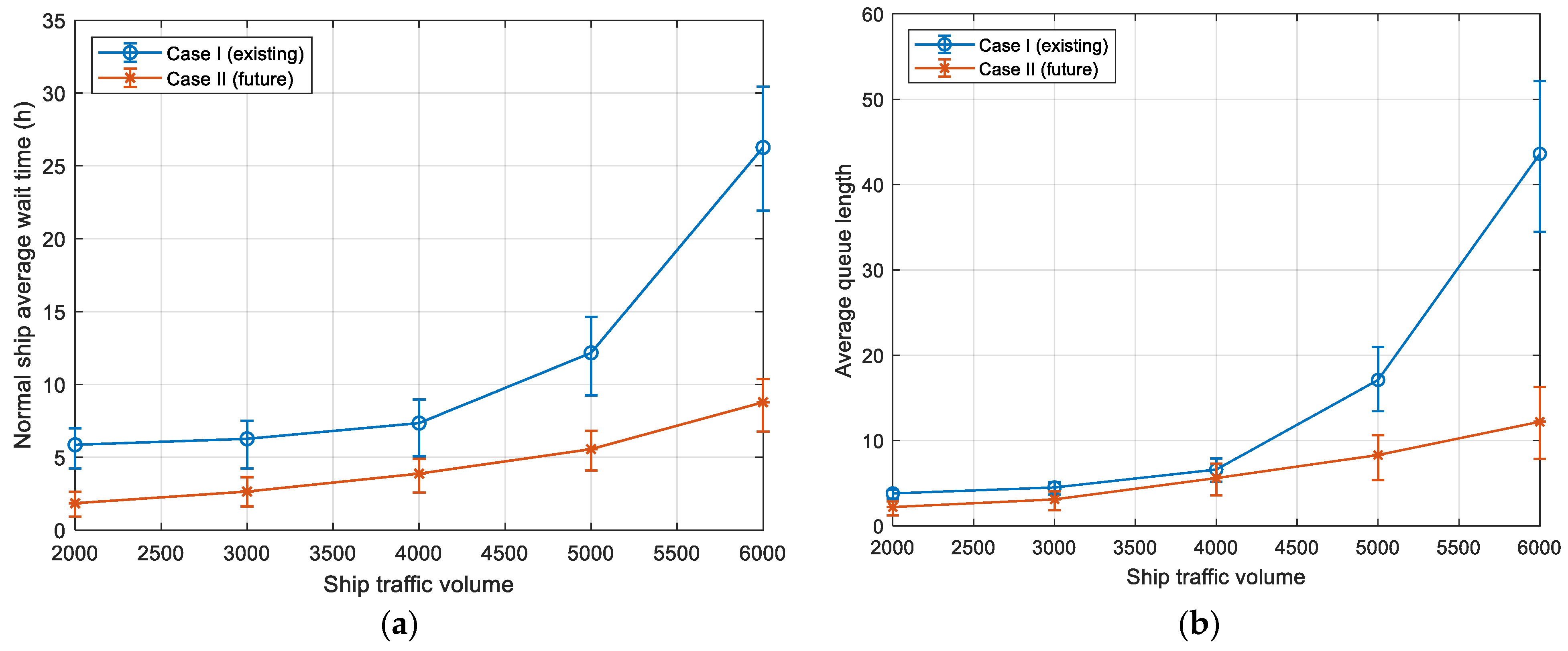
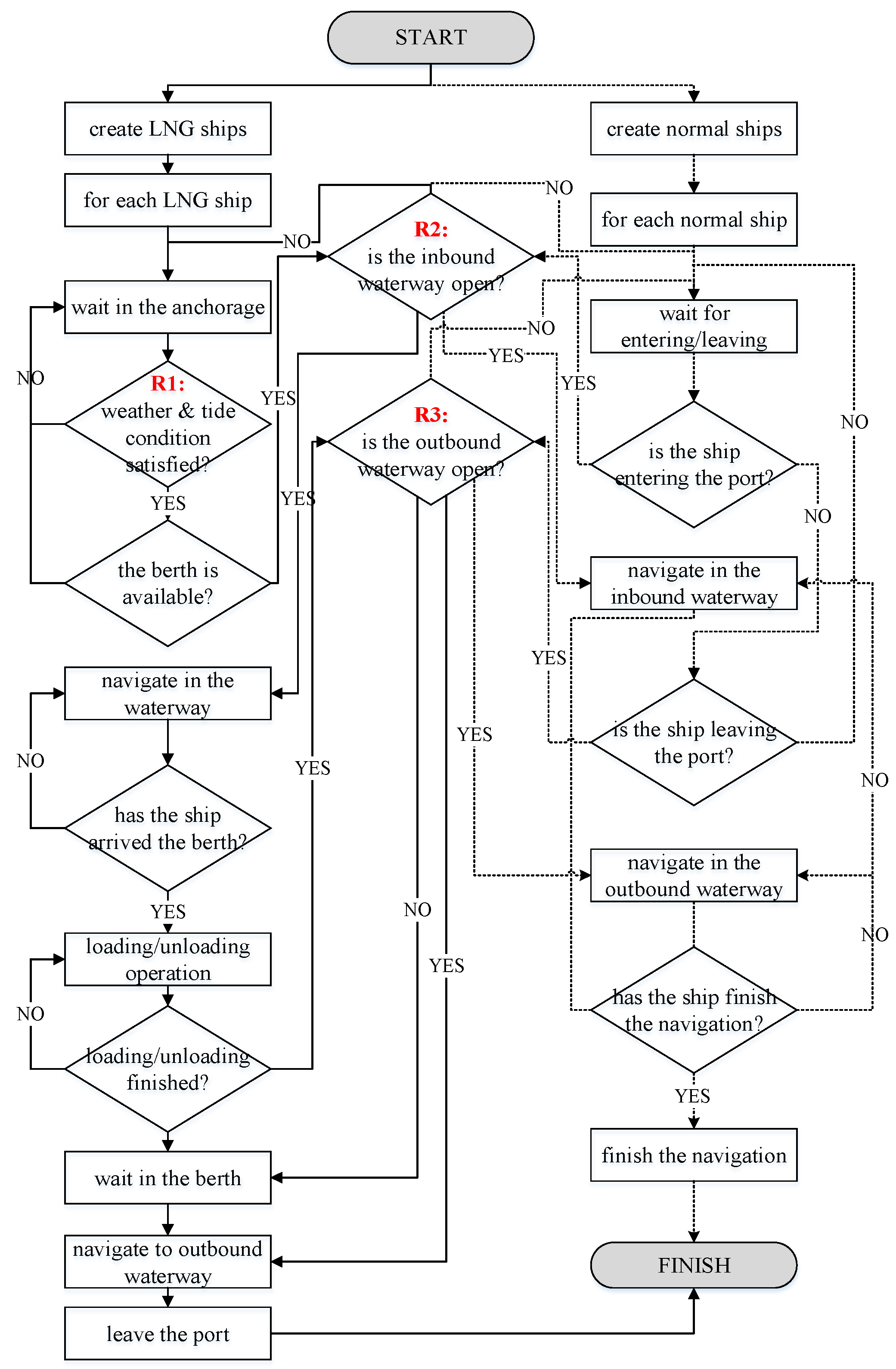
Tianjin Port is one of the largest ports in northern China. Liquefied natural gas (LNG) ships are one of the most special ship types, and their navigation safety and efficiency has become the top concern of the port authority. There are two LNG berths at the port, and the annual arrivals, which reach more than 100, increasingly influence other ships. The objective of this study is to evaluate the influence of LNG ships on other ships in a quantitative way. To realize this, a simulation system is established by analyzing the factors affecting waterway transit efficiency. The software Arena is adopted to simulate the arrival and departure of the ships at Tianjin Port and to simulate how the average waiting time and the average queue length in the port area are affected by the LNG ships. A traffic system for the two ship types is formulated, and the mutual influences between them are expressed by the inbound and outbound waterway states. The simulations are performed under both existing and new ship traffic regulations. Cases in which the number of LNG ships gradually increases are simulated comprehensively. The simulation model as well as the results can serve as a good reference for the local port authority in the formulation of traffic regulations.
Keywords: LNG ships; traffic organization; discrete-time simulation; port waterway capacity LNG ships; traffic organization; discrete-time simulation; port waterway capacity