Diversity of Agricultural Production and Food Consumption in Rural China: A Dual Analysis of Expenditure and Dietary Structure


Abstract
1. Introduction
2. Theoretical Analysis
2.1. Theoretical Framework and Research Hypotheses
2.2. The Household Production and Consumption Model
3. Data and Model Configuration
3.1. Data Sources
3.2. Model Configuration
- Benchmark Regression. This paper utilizes CLES data to examine the impact of agricultural production diversity on rural household food consumption systems. Food expenditure and dietary diversity are selected as dependent variables, representing economic cost and dietary quality dimensions, respectively. With respect to the empirical approach, this paper employs the least-squares dummy variable (LSDV) estimator, incorporating two-way fixed effects for both region and time, as the benchmark specification. This choice is motivated by two main considerations. First, from a methodological standpoint, the core explanatory variable—agricultural production diversity—has a continuous distribution rather than being driven by exogenous binary policy shocks; consequently, quasi-natural experimental designs, such as difference-in-differences, are not suitable. Second, given the heterogeneity in natural endowments and socio-economic conditions across regions, alongside temporal fluctuations in the macroeconomic environment, the use of unbalanced panel data within a two-way fixed-effects framework is more effective than cross-sectional regression for controlling both unobservable regional heterogeneity and time-varying effects. Overall, the two-way fixed-effects specification substantially mitigates omitted variable bias, thereby enhancing the robustness and explanatory power of the core parameter estimates. The specific formula is as follows:where is the dependent variable, specifically represented by two indicators in the text: ① denotes the natural logarithm of household i’s food expenditure in year t, used to measure household food expenditure; ② denotes the dietary diversity index (DDS) for household i in year t, used to measure household dietary quality.is the core explanatory variable, representing the household’s agricultural production diversity. represents a series of control variables. is the regression coefficient of the core independent variable. is the intercept term, is the vector of regression coefficients for the control variables. is the region fixed effect. In the empirical analysis, regional dummy variables are introduced for control, aiming to absorb regional heterogeneities such as geographical environment and dietary culture that do not change over time. is the time fixed effect, controlled by introducing year dummy variables, aiming to remove the impact of macro time trends such as price fluctuations and policy adjustments. represents the random disturbance term.
- 2.
- Addressing Endogeneity Issues. The aforementioned benchmark model may suffer from endogeneity issues stemming from reverse causality. Therefore, the instrumental variables approach is employed to resolve bidirectional causality concerns, utilizing two-stage least squares (2SLS) regression. The first-stage regression model is as follows:In Equation (9), is the instrumental variable for agricultural production diversity, and is the regression coefficient of the instrumental variable.The second stage regression model is as follows:In Equation (10), is the fitted value obtained from the first-stage estimation, and is the estimated coefficient of the fitted value.
- 3.
- Mediation effect model. To gain a deeper understanding of the mechanisms through which agricultural production diversity affects food systems, it should be noted that recent microeconometric research has identified the traditional ‘three-step’ mediation analysis—the classic causal steps approach proposed by Baron and Kenny (1986) [38], which sequentially tests the relationships among the independent variable, mediator, and dependent variable—as being prone to bias arising from the endogeneity of the mediating variable, potentially leading to misleading conclusions [38,39]. To ensure the scientific rigour and robustness of the mechanism analysis, this paper adopts the framework proposed by Jiang Ting (2022) in modern microeconomics [40]. It departs from the conventional testing steps, which are vulnerable to endogeneity concerns, and instead implements a more robust ‘two-step method’ for mechanism testing: namely, after establishing the main effect of the core explanatory variable, the analysis proceeds to examine its causal impact on the mediating variable. Building on this approach, the present paper extends and formulates the following mechanism testing model within the framework of the baseline specification. Building on Equation (8), we extend and specify the following model:In Equation (11), is the mechanism variable, is the intercept term, and is the regression coefficient, reflecting the degree of impact of the core explanatory variable, agricultural production diversity, on the mechanism variable.
3.3. Variable Specifications
- Dependent variables. To comprehensively examine the multidimensional impact of agricultural production diversity on household food consumption, in terms of both economic cost and dietary structure, this study takes food expenditure and dietary diversity as the dependent variables. On the one hand, food expenditure is used to measure the economic burden of household food consumption. These data are based on respondents’ recall of their households’ purchases of various food items, consumption of self-produced food and eating-out expenditure over the past week. The reported figures are then aggregated and annualised. Since expenditure data typically exhibit a right-skewed distribution, and to mitigate heteroskedasticity, per capita food expenditure is log-transformed. On the other hand, dietary diversity is used to capture the nutritional quality and consumption structure of rural households’ diets. This paper employs the Dietary Diversity Score (DDS) methodology recommended by the Food and Agriculture Organization of the United Nations (FAO) for measurement [41]. First, in terms of the observation period, household food consumption displays a certain degree of randomness and seasonality. To smooth out occasional fluctuations in consumption on any given day, this study considers respondents’ food consumption over the previous seven days, so as to better reflect households’ usual dietary patterns [42]. Second, in constructing the indicator, we referred to the 2022 edition of the Chinese Dietary Guidelines and classified foods into eight groups according to their nutritional attributes: grains and root vegetables, vegetables, fruits, meat, dairy products, eggs, aquatic products, and legumes and nuts. A binary counting method was used for the calculation [43]. If the household consumed any food from a given category within the past seven days, the score for that group is set to 1; otherwise, it is 0. Summing the scores across all eight groups yields the household’s overall dietary diversity score. A higher score indicates a greater variety in the household’s food intake and a more balanced nutritional profile.
- Core explanatory variable. The core explanatory variable in this study is agricultural production diversity, which is intended to capture the richness of rural households’ agricultural production structures. Following the approach adopted in the existing literature [44,45], it is measured by counting the number of crop species cultivated and livestock species reared by each household over the preceding year, with the totals combined into a single count variable. Simple data processing is applied to ensure an accurate assessment, and no complex transformations are performed. Higher values of this indicator correspond to greater diversity in households’ grain and vegetable baskets.
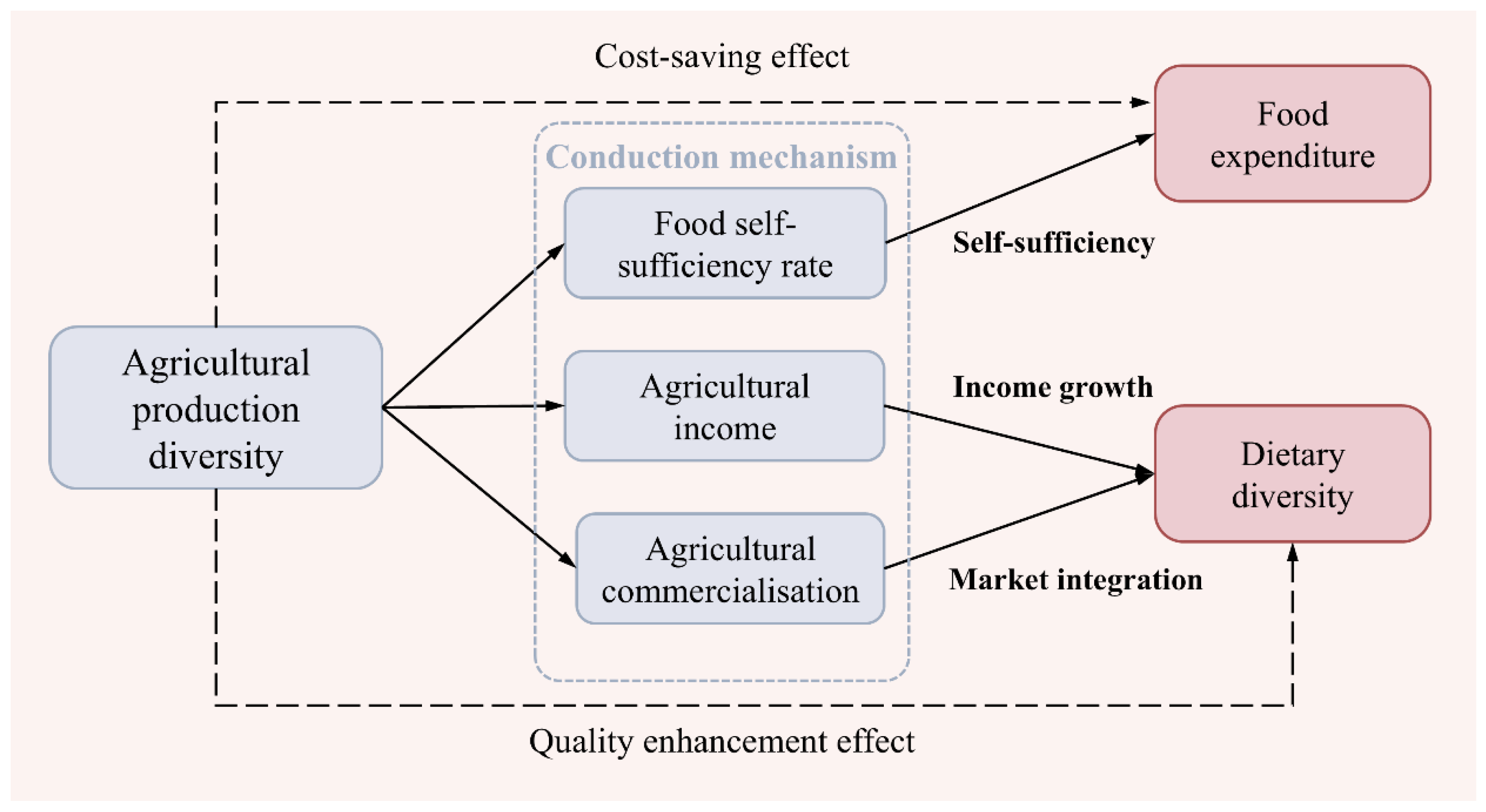
- Mechanism variables. To examine more deeply the mechanisms through which agricultural production diversity affects food consumption systems, and to empirically test the two potential transmission channels—subsistence substitution and income growth—discussed above, two sets of mechanism variables are introduced. First, for the self-sufficiency substitution effect aimed at easing the economic burden, the grain self-sufficiency rate is used as a proxy variable. It is defined as the proportion of self-produced grain in a household’s daily consumption of that food category. This indicator directly reflects a household’s food security capacity: higher values indicate lower dependence on external markets and, consequently, a greater ability to reduce monetary food expenditure through non-market channels. Second, with regard to the income growth effect on dietary quality, agricultural income and the degree of agricultural commercialization are selected as mechanism variables. Log-transformed agricultural income is used to measure net operating income, while the level of agricultural commercialization is captured by the ratio of agricultural product sales to total output value [46]. These variables are intended to reflect rural households’ economic access and market integration, and are used to test whether agricultural production diversification eases liquidity constraints and strengthens households’ purchasing power for diverse foods by increasing agricultural income or raising the level of commercialization.
- Control variables. To minimise endogeneity bias arising from omitted variables, the selection of control variables strictly follows the principle of exogeneity. These variables are drawn from three dimensions: characteristics of household heads and decision-makers, household resource endowments, and the village’s external environment. First, with respect to the characteristics of household heads and decision-makers, we include agricultural training, women’s empowerment and educational attainment. Agricultural training reflects the accumulation of human capital by the household head. Households whose heads have received modern agricultural training are more likely to adopt scientifically informed crop and livestock management practices, which may also foster greater awareness of nutritional health, thereby directly shaping the household’s dietary composition. Women’s empowerment captures the extent to which women participate in household decision-making. Existing research suggests that women are more inclined to prioritise nutritional quality and health when allocating resources, thereby exerting a substantial influence on household food consumption decisions [47]. which has a certain influence on food consumption decisions. Educational attainment is measured by the highest number of years of schooling among household members, in order to control for the effect of knowledge endowment on consumption attitudes. Second, in terms of household resource endowments and facilities, we include labour structure, productive assets, refrigerator ownership and the installation of water purifiers. Labour structure reflects the intensity of household involvement in agricultural production. Higher levels of agricultural labour input generally indicate stronger household management capacity, increasing the likelihood that rural households engage in diversified crop and livestock activities, which in turn influence household food consumption patterns via the self-production mechanism. Productive assets serve as a proxy for household physical capital, capturing the quantity of assets deployed in agricultural production. Existing research suggests that both labour input and physical capital affect the efficiency of factor allocation and labour productivity in agriculture [48], thereby boosting household income and purchasing power, which in turn enhances the household’s economic capacity to improve dietary quality and diversify food consumption. Refrigerators, as important durable consumer goods, can alter households’ food storage and procurement patterns. The use of water purifiers reflects rural households’ concern for living standards and health, which can, to some extent, influence food consumption patterns. Finally, with respect to the external village environment, food accessibility is included as a control variable, proxied by the presence of e-commerce delivery stations in the village. Improved ecommerce infrastructure effectively broadens rural households’ food procurement channels, reduces search costs, and constitutes an important external factor shaping their food consumption behaviour [49]. Descriptions and descriptive statistics for each variable are presented in Table 1.
4. Empirical Findings
4.1. Benchmark Regression
4.2. Robustness Test
- Adjustment of the time sample. Given that agricultural production is vulnerable to external shocks such as climate change and macroeconomic policy adjustments, certain years may display abnormal fluctuations that could distort the estimation results. To eliminate such interference, the data for 2022 are excluded and the sample period is restricted to 2020–2021. This allows us to test whether the findings are driven by specific years and thereby to assess the robustness of the conclusions. If the regression results were significant only in the full sample but became insignificant after excluding 2022, this would suggest that the estimates were driven by that anomalous year. Conversely, if the results remained significant, it would indicate that the conclusions are robust. Columns (1) and (2) of Table 3 report the regression results after adjusting the time sample. The estimates show that the coefficient of agricultural production diversity on food expenditure is −0.041, while that on dietary diversity is 0.066, both significant at the 1% level. These findings are highly consistent with the sign and significance of the baseline regression using the full sample, indicating that the adjustment to the sample period does not fundamentally alter the main conclusions. The impact of agricultural production diversity on food systems thus appears to be robust.
- Replacement of the core explanatory variable. To validate the appropriateness of the core indicator, the explanatory variable is replaced, switching from agricultural production diversity to crop diversity. Agricultural production diversity captures diversification in both crop cultivation and other agricultural activities, and thus provides a more comprehensive reflection of the overall agricultural production structure of rural households. However, given the multiple forms of agricultural diversification, the impact of different agricultural activities is broadly consistent. Moreover, crop cultivation constitutes the fundamental component of rural households’ agricultural production. Therefore, for robustness testing, we focus exclusively on the effect of crop diversity—a core element of agricultural production—on the level of food expenditure. As shown in columns (3) and (4) of Table 3, when crop diversity is used to replace the core explanatory variable, the regression coefficient for food expenditure remains significantly negative, while that for dietary diversity remains significantly positive. This indicates that diversified production reduces food expenditure and enhances dietary diversity, whether assessed from the perspective of overall agricultural production or solely from the angle of crop cultivation. This finding further confirms the robustness of the conclusion.
- The baseline regressions presented above have demonstrated that agricultural production diversity can enhance overall dietary diversity. To further characterise its impact on specific nutrient intake patterns, this study employs protein intake diversity as a more stringent alternative dependent variable. Against the backdrop of ongoing dietary upgrading among rural households in China, the diversity of high-quality protein sources has emerged as a key indicator of nutritional improvement and dietary advancement. Using the CLES data, protein intake diversity scores were recalculated based on household consumption of meat, eggs, dairy products, and plant-based proteins. As shown in Column (5) of Table 3, agricultural production diversity continues to exert a positive and statistically significant effect on protein intake diversity at the 1% level. These results indicate that diversification in agricultural production not only broadens the range of food sources available to rural households but also substantively enhances the quality of nutrient intake.
- Seemingly Unrelated Regression (SUR). In the benchmark regressions, food expenditure and dietary diversity were estimated separately. However, in actual household decision-making, the allocation of expenditure budgets and the choice of food varieties are often made simultaneously, and the two may be correlated. For example, certain unobserved household preferences may simultaneously affect both expenditure and dietary diversity. Ignoring this correlation may reduce the efficiency of the estimates. Therefore, the seemingly unrelated regression approach is employed to estimate the two equations jointly, thereby improving the validity of the results. Columns (6) and (7) of Table 3 report the estimation results of the SUR model. The findings show that the coefficient of agricultural production diversity for food expenditure is −0.031, while that for dietary diversity is 0.060, with both coefficients statistically significant at the 1% level. The estimates from the seemingly unrelated regression model are consistent with those from the two-way fixed-effects specification in the benchmark regression. This indicates that the core conclusions of this study remain valid even after accounting for correlation in the disturbance terms across equations, thereby demonstrating the robustness of the findings.
4.3. Endogeneity Analysis
4.4. Heterogeneity Analysis
4.4.1. Heterogeneity in the External Industrial Environment
4.4.2. Heterogeneity in Aging Levels
5. Analysis of the Impact Mechanism
6. Discussion and Conclusions
Author Contributions
Funding
Institutional Review Board Statement
Data Availability Statement
Acknowledgments
Conflicts of Interest
Abbreviations
| CLES | China Land Economic Survey |
| PPS | Probability Proportional to Size |
| LSDV | least squares dummy variable estimation |
| 2SLS | two-stage least squares |
| DDS | Dietary Diversity Score |
| FAO | Organization of the United Nations |
| HDDS | Household dietary diversity scores |
| SUR | Seemingly Unrelated Regression |
| IV | instrumental variable |
References
- Wu, H.; MacDonald, G.K.; Galloway, J.N.; Geng, Y.; Liu, X.; Zhang, L.; Jiang, S. A new dietary guideline balancing sustainability and nutrition for China’s rural and urban residents. iScience 2022, 25, 105048. [Google Scholar] [CrossRef]
- Han, A.; Chai, L.; Liu, P. How much environmental burden does the shifting to nutritional diet bring? Evidence of dietary transformation in rural China. Environ. Sci. Policy 2023, 145, 129–138. [Google Scholar] [CrossRef]
- Huang, Y.; Tian, X. Food accessibility, diversity of agricultural production and dietary pattern in rural China. Food Policy 2019, 84, 92–102. [Google Scholar] [CrossRef]
- Liu, Z.; Kornher, L.; Qaim, M. Impacts of supermarkets on child nutrition in China. Food Policy 2024, 127, 102681. [Google Scholar] [CrossRef]
- Wang, H.; Liu, C.; Fan, H.; Tian, X. Rising food accessibility contributed to the increasing dietary diversity in rural and urban China. Asia Pac. J. Clin. Nutr. 2017, 26, 738–747. [Google Scholar]
- Xu, W.; Zhao, Q.; Fan, S.; Zhu, C. Effects of direct grain subsidies on food consumption of rural residents in China. Agribusiness 2023, 39, 1382–1398. [Google Scholar] [CrossRef]
- Han, L.; Zhao, T.; Zhang, R.; Hao, Y.; Jiao, M.; Wu, Q.; Liu, J.; Zhou, M. Burden of nutritional deficiencies in China: Findings from the global burden of disease study 2019. Nutrients 2022, 14, 3919. [Google Scholar] [CrossRef] [PubMed]
- Chaudhary, G.; Kumar, M.; Sehrawat, A.R. Food Fortification: Strategy to Combat Hidden Hunger: A Systematic Review. Food Chem. Int. 2025, 1, 384–407. [Google Scholar] [CrossRef]
- Wang, Z.; Chen, Y.; Tang, S.; Chen, S.; Gong, S.; Jiang, X.; Wang, L.; Zhang, Y. Dietary diversity and nutrient intake of Han and Dongxiang smallholder farmers in poverty areas of Northwest China. Nutrients 2021, 13, 3908. [Google Scholar] [CrossRef] [PubMed]
- Zhou, S.; Ye, B.; Fu, P.; Li, S.; Yuan, P.; Yang, L.; Zhan, X.; Chao, F.; Zhang, S.; Wang, M.Q.; et al. Double Burden of Malnutrition: Examining the Growth Profile and Coexistence of Undernutrition, Overweight, and Obesity among School-Aged Children and Adolescents in Urban and Rural Counties in Henan Province, China. J. Obes. 2020, 2020, 2962138. [Google Scholar] [CrossRef]
- Li, J.; Chen, K.; Yan, C.; Tang, Z. The impact of income disparity on food consumption—Microdata from rural China. Agriculture 2024, 14, 689. [Google Scholar] [CrossRef]
- Lee, A.; Patay, D.; Herron, L.M.; Parnell Harrison, E.; Lewis, M. Affordability of current, and healthy, more equitable, sustainable diets by area of socioeconomic disadvantage and remoteness in Queensland: Insights into food choice. Int. J. Equity Health 2021, 20, 153. [Google Scholar] [CrossRef] [PubMed]
- Barosh, L.; Friel, S.; Engelhardt, K.; Chan, L. The cost of a healthy and sustainable diet–who can afford it? Aust. N. Z. J. Public Health 2014, 38, 7–12. [Google Scholar] [CrossRef]
- Yan, Z.; Xiao, X.; Jiao, J.; Lin, W. How does agricultural production diversity nourish household dietary diversity? Evidence from China. Glob. Food Secur. 2024, 40, 100749. [Google Scholar] [CrossRef]
- Pingali, P.; Mittra, B.; Rahman, A. The bumpy road from food to nutrition security–Slow evolution of India’s food policy. Glob. Food Secur. 2017, 15, 77–84. [Google Scholar] [CrossRef]
- Pingali, P. Agriculture renaissance: Making “agriculture for development” work in the 21st century. Handb. Agric. Econ. 2010, 4, 3867–3894. [Google Scholar]
- Sibhatu, K.T.; Qaim, M. Farm production diversity and dietary quality: Linkages and measurement issues. Food Secur. 2018, 10, 47–59. [Google Scholar] [CrossRef]
- Sibhatu, K.T.; Qaim, M. Meta-analysis of the association between production diversity, diets, and nutrition in smallholder farm households. Food Policy 2018, 77, 1–18. [Google Scholar] [CrossRef]
- Shen, Q.; Qiang, T.; Zhong, T. The impact of agricultural production diversity on farmer household dietary diversity: A case study of Nanjing City. Front. Nutr. 2025, 12, 1493371. [Google Scholar] [CrossRef] [PubMed]
- Sibhatu, K.T.; Krishna, V.V.; Qaim, M. Production diversity and dietary diversity in smallholder farm households. Proc. Natl. Acad. Sci. USA 2015, 112, 10657–10662. [Google Scholar] [CrossRef]
- He, X.; Weisser, W.; Zou, Y.; Fan, S.; Crowther, T.W.; Wanger, T.C. Integrating agricultural diversification in China’s major policies. Trends Ecol. Evol. 2022, 37, 819–822. [Google Scholar] [CrossRef]
- Feliciano, D. A review on the contribution of crop diversification to Sustainable Development Goal 1 “No poverty” in different world regions. Sustain. Dev. 2019, 27, 795–808. [Google Scholar] [CrossRef]
- Appiah-Twumasi, M.; Asale, M.A. Crop diversification and farm household food and nutrition security in Northern Ghana. Environ. Dev. Sustain. 2024, 26, 157–185. [Google Scholar] [CrossRef] [PubMed]
- Yang, M.; Amar, N.; Zhao, L.; Pan, C. Family composition, income, and healthy diet in rural China: Evidence from three provinces. Front. Nutr. 2025, 12, 1608024. [Google Scholar] [CrossRef] [PubMed]
- Jones, A.D. Critical review of the emerging research evidence on agricultural biodiversity, diet diversity, and nutritional status in low-and middle-income countries. Nutr. Rev. 2017, 75, 769–782. [Google Scholar] [CrossRef]
- Cao, S.; Sun, F.; Wang, L.; Hong, W. “Less is more?” The association between crop specialization and dietary diversity in China. Front. Sustain. Food Syst. 2024, 8, 1439989. [Google Scholar] [CrossRef]
- Grewal, B.; Grunfeld, H.; Sheehan, P. The Contribution of Agricultural Growth to Poverty Reduction; Australian Centre for International Agricultural Research (ACIAR): Canberra, Australia, 2012. [Google Scholar]
- LaFave, D.; Thomas, D. Farms, families, and markets: New evidence on completeness of markets in agricultural settings. Econometrica 2016, 84, 1917–1960. [Google Scholar] [CrossRef]
- Connors, K.; Jaacks, L.M.; Prabhakaran, P.; Veluguri, D.; Ramanjaneyulu, G.V.; Roy, A. Impact of crop diversity on dietary diversity among farmers in India during the COVID-19 pandemic. Front. Sustain. Food Syst. 2021, 5, 695347. [Google Scholar] [CrossRef]
- Han, H.; Lin, H. Patterns of agricultural diversification in China and its policy implications for agricultural modernization. Int. J. Environ. Res. Public Health 2021, 18, 4978. [Google Scholar] [CrossRef]
- Barrett, C.B.; Reardon, T.; Swinnen, J.; Zilberman, D. Agri-food value chain revolutions in low-and middle-income countries. J. Econ. Lit. 2022, 60, 1316–1377. [Google Scholar] [CrossRef]
- Chegere, M.J.; Stage, J. Agricultural production diversity, dietary diversity and nutritional status: Panel data evidence from Tanzania. World Dev. 2020, 129, 104856. [Google Scholar] [CrossRef]
- Otekunrin, O.A.; Momoh, S.; Ayinde, I.A. Smallholder farmers’ market participation: Concepts and methodological approach from Sub-Saharan Africa. Curr. Agric. Res. J. 2019, 7, 139. [Google Scholar] [CrossRef]
- Chen, F.; Wei, T.; Zhu, N. Determinants of consumption structure of livestock products among rural Chinese residents: Household characteristics and regional heterogeneity. Agriculture 2023, 13, 1839. [Google Scholar] [CrossRef]
- Chegere, M.J.; Kauky, M.S. Agriculture commercialization, household dietary diversity and nutrition in Tanzania. Food Policy 2022, 113, 102341. [Google Scholar] [CrossRef]
- Khandoker, S.; Singh, A.; Srivastava, S.K. Leveraging farm production diversity for dietary diversity: Evidence from national level panel data. Agric. Food Econ. 2022, 10, 15. [Google Scholar] [CrossRef]
- Becker, G.S. A Theory of the Allocation of Time. Econ. J. 1965, 75, 493–517. [Google Scholar] [CrossRef]
- Baron, R.M.; Kenny, D.A. The moderator–mediator variable distinction in social psychological research: Conceptual, strategic, and statistical considerations. J. Personal. Soc. Psychol. 1986, 51, 1173–1182. [Google Scholar] [CrossRef]
- Zhao, X.; Lynch, J.G.; Chen, Q. Reconsidering Baron and Kenny: Myths and truths about mediation analysis. J. Consum. Res. 2010, 37, 197–206. [Google Scholar] [CrossRef]
- Jiang, T. Mediating effects and moderating effects in causal inference. China Ind. Econ. 2022, 5, 100–120. [Google Scholar]
- FAO. Household Dietary Diversity. 2006. Available online: https://www.fao.org/nutrition/assessment/tools/household-dietary-diversity/en/ (accessed on 23 November 2025).
- Hou, M.; Qing, P.; Min, S. Multiple indicators of household dietary diversity in rural China: Effects of income and dietary knowledge. Nutrition 2021, 91, 111406. [Google Scholar] [CrossRef] [PubMed]
- Esaryk, E.E.; Reynolds, S.A.; Fernald, L.C.; Jones, A.D. Crop diversity is associated with higher child diet diversity in Ethiopia, particularly among low-income households, but not in Vietnam. Public Health Nutr. 2021, 24, 5857–5868. [Google Scholar] [CrossRef] [PubMed]
- Jones, A.D.; Shrinivas, A.; Bezner-Kerr, R. Farm production diversity is associated with greater household dietary diversity in Malawi: Findings from nationally representative data. Food Policy 2014, 46, 1–12. [Google Scholar] [CrossRef]
- Kabir, M.R.; Halima, O.; Rahman, N.; Ghosh, S.; Islam, M.S.; Rahman, H. Linking farm production diversity to household dietary diversity controlling market access and agricultural technology usage: Evidence from Noakhali district, Bangladesh. Heliyon 2022, 8, e08755. [Google Scholar] [CrossRef] [PubMed]
- Otekunrin, O.A.; Ayinde, I.A.; Sanusi, R.A.; Onabanjo, O.O. Dietary diversity, nutritional status, and agricultural commercialization: Evidence from adult men of rural farm households. Dialogues Health 2023, 2, 100121. [Google Scholar] [CrossRef]
- Argaw, T.L.; Phimister, E.; Roberts, D. From farm to kitchen: How gender affects production diversity and the dietary intake of farm households in Ethiopia. J. Agric. Econ. 2021, 72, 268–292. [Google Scholar] [CrossRef]
- Dorward, A. Agricultural labour productivity, food prices and sustainable development impacts and indicators. Food Policy 2013, 39, 40–50. [Google Scholar] [CrossRef]
- Shen, J.; Zhu, Z.; Qaim, M.; Fan, S.; Tian, X. E-commerce improves dietary quality of rural households in China. Agribusiness 2023, 39, 1495–1511. [Google Scholar] [CrossRef]
- Klasen, S.; Meyer, K.M.; Dislich, C.; Euler, M.; Faust, H.; Gatto, M.; Hettig, E.; Melati, D.N.; Jaya, I.N.S.; Otten, F.; et al. Economic and ecological trade-offs of agricultural specialization at different spatial scales. Ecol. Econ. 2016, 122, 111–120. [Google Scholar] [CrossRef]
- Djuraeva, M.; Bobojonov, I.; Kuhn, L. To specialize or not to specialize?—A technical efficiency analysis in three transition economies. Eur. Rev. Agric. Econ. 2026, 53, 177–213. [Google Scholar] [CrossRef]
- Wang, S.; Li, D.; Li, T.; Liu, C. Land use transitions and farm performance in China: A perspective of land fragmentation. Land 2021, 10, 792. [Google Scholar] [CrossRef]
- Nguyen, T.T.; Qaim, M. Local and regional food production diversity are positively associated with household dietary diversity in rural Africa. Nat. Food 2025, 6, 205–212. [Google Scholar] [CrossRef] [PubMed]


| Variable Name | Variable Declaration | Mean | SD |
|---|---|---|---|
| Food expenditure | Per capita food expenditure of rural households (Yuan, logarithmic) | 8.105 | 0.831 |
| Dietary diversity | Number of food types consumed by rural households in a week | 6.645 | 1.314 |
| Agricultural production diversity | Total number of different agricultural product types produced by households | 1.711 | 1.415 |
| Food self-sufficiency Rate | Proportion of self-produced grain in the daily diet of rural households | 0.305 | 0.409 |
| Agricultural income | Income obtained from agricultural operations by rural households (Yuan, logarithmic) | 3.158 | 4.292 |
| Agricultural commercialization | Proportion of agricultural products sold through the market by rural households | 0.379 | 0.434 |
| Agricultural training | Whether the household head has received agricultural technical education or training: 1 = Yes; 0 = No | 0.302 | 0.459 |
| Women’s empowerment | Whether there are females among household management decision-makers: 1 = Yes; 0 = No | 0.274 | 0.446 |
| Labor structure | Proportion of household members participating in agricultural labor | 0.499 | 0.413 |
| Education level | Maximum years of education in the rural household | 11.212 | 4.072 |
| Refrigerator | Whether the rural household has a refrigerator: 1 = Yes; 0 = No | 0.978 | 0.148 |
| Water purifier | Whether the rural household has installed a water purifier: 1 = Yes; 0 = No | 0.224 | 0.417 |
| Productive assets | Total number of productive assets owned by the rural household (Count) | 0.530 | 2.254 |
| Food accessibility | Whether the village where the household resides has an e-commerce delivery station: 1 = Yes; 0 = No | 0.597 | 0.491 |
| (1) | (2) | (3) | (4) | (5) | (6) | |
|---|---|---|---|---|---|---|
| Food Expenditure | Dietary Diversity | |||||
| Agricultural production diversity | −0.027 *** | −0.046 *** | −0.031 *** | 0.032 ** | 0.042 *** | 0.060 *** |
| (0.009) | (0.010) | (0.010) | (0.014) | (0.015) | (0.015) | |
| Agricultural training | 0.037 | 0.092 *** | 0.210 *** | 0.181 *** | ||
| (0.027) | (0.027) | (0.041) | (0.041) | |||
| Women’s empowerment | 0.043 | 0.012 | 0.048 | 0.022 | ||
| (0.028) | (0.027) | (0.042) | (0.042) | |||
| Labor structure | 0.080 ** | 0.148 *** | −0.240 *** | −0.232 *** | ||
| (0.033) | (0.032) | (0.051) | (0.051) | |||
| Education level | 0.028 *** | 0.023 *** | 0.057 *** | 0.056 *** | ||
| (0.003) | (0.003) | (0.005) | (0.005) | |||
| Refrigerator | 0.153 * | 0.137 * | 0.950 *** | 0.864 *** | ||
| (0.082) | (0.081) | (0.153) | (0.152) | |||
| Water purifier | 0.120 *** | 0.107 *** | 0.397 *** | 0.376 *** | ||
| (0.030) | (0.029) | (0.042) | (0.042) | |||
| Productive assets | 0.016 ** | 0.014 * | 0.003 | 0.004 | ||
| (0.008) | (0.008) | (0.008) | (0.007) | |||
| Food accessibility | 0.071 *** | 0.042 | 0.110 *** | 0.175 *** | ||
| (0.025) | (0.027) | (0.039) | (0.044) | |||
| Regional fixed effects | YES | YES | ||||
| Time fixed effects | YES | YES | ||||
| Constant | 8.151 *** | 7.576 *** | 7.818 *** | 6.590 *** | 4.891 *** | 5.065 *** |
| (0.019) | (0.084) | (0.094) | (0.032) | (0.160) | (0.172) | |
| Number | 4439 | 4439 | 4439 | 4439 | 4439 | 4439 |
| R2 | 0.002 | 0.036 | 0.119 | 0.001 | 0.093 | 0.112 |
| Adjustment Time Sample | Replace the Core Explanatory Variable | Replacement of the Dependent Variable | SUR Model | ||||
|---|---|---|---|---|---|---|---|
| (1) | (2) | (3) | (4) | (5) | (6) | (7) | |
| Food Expenditure | Dietary Diversity | Food Expenditure | Dietary Diversity | Protein Intake Diversity | Food Expenditure | Dietary Diversity | |
| Agricultural production diversity | −0.041 *** | 0.066 *** | 0.053 *** | −0.031 *** | 0.060 *** | ||
| (0.011) | (0.017) | (0.013) | (0.009) | (0.015) | |||
| Planting diversity | −0.041 *** | 0.054 *** | |||||
| (0.012) | (0.018) | ||||||
| Control variables | YES | YES | YES | YES | YES | YES | YES |
| Regional fixed effects | YES | YES | YES | YES | YES | YES | YES |
| Time fixed effects | YES | YES | YES | YES | YES | YES | YES |
| Constant | 7.823 *** | 5.273 *** | 7.807 *** | 5.089 *** | 3.630 *** | 7.818 *** | 5.065 *** |
| (0.101) | (0.183) | (0.094) | (0.171) | (0.145) | (0.096) | (0.152) | |
| Number | 3642 | 3642 | 4439 | 4439 | 4439 | 4439 | 4439 |
| R2 | 0.135 | 0.110 | 0.120 | 0.111 | 0.102 | 0.119 | 0.112 |
| (1) | (2) | (3) | (4) | |
|---|---|---|---|---|
| Phase One | Phase Two | Phase One | Phase Two | |
| Household size | 0.199 *** | |||
| (0.013) | ||||
| Transfer of agricultural land | 0.846 *** | |||
| (0.042) | ||||
| Agricultural production diversity | −0.403 *** | 0.186 *** | ||
| (0.048) | (0.050) | |||
| Control variables | YES | YES | YES | YES |
| Regional fixed effects | YES | YES | YES | YES |
| Time-fixed effect | YES | YES | YES | YES |
| Underidentification test (Kleibergen–Paap rk LM statistic) | 208.27 *** | 336.98 *** | ||
| Weak instrumental variables test (Kleibergen–Paap rk Wald F statistic) | 230.78 | 397.66 | ||
| Number | 4439 | 4439 | ||
| R2 | 0.275 | −0.190 | 0.304 | 0.098 |
| (1) | (2) | (3) | (4) | |
|---|---|---|---|---|
| Food Expenses | Dietary Diversity | |||
| Industrialized Villages | Non-Industrialized Villages | Industrialized Villages | Non-Industrialized Villages | |
| Agricultural production diversity | −0.016 | −0.034 *** | 0.023 | 0.079 *** |
| (0.023) | (0.012) | (0.033) | (0.017) | |
| Control variables | YES | YES | YES | YES |
| Regional fixed effects | YES | YES | YES | YES |
| Time fixed effects | YES | YES | YES | YES |
| Constant | 7.806 *** | 7.875 *** | 5.227 *** | 5.078 *** |
| (0.244) | (0.105) | (0.444) | (0.188) | |
| Number | 987 | 3375 | 987 | 3375 |
| R2 | 0.164 | 0.111 | 0.139 | 0.107 |
| (1) | (2) | (3) | (4) | |
|---|---|---|---|---|
| Food Expenses | Dietary Diversity | |||
| Ageing Households | Non-Ageing Households | Ageing Households | Non-Ageing Households | |
| Agricultural production diversity | −0.016 | −0.045 *** | 0.022 | 0.094 *** |
| (0.014) | (0.016) | (0.023) | (0.020) | |
| Control variables | YES | YES | YES | YES |
| Regional fixed effects | YES | YES | YES | YES |
| Time-fixed effect | YES | YES | YES | YES |
| Constant | 7.908 *** | 7.496 *** | 5.087 *** | 4.997 *** |
| (0.111) | (0.192) | (0.208) | (0.334) | |
| Number | 2214 | 2225 | 2214 | 2225 |
| R2 | 0.139 | 0.106 | 0.105 | 0.094 |
| (1) | (2) | |
|---|---|---|
| Food Expenses | Food Self-Sufficiency Rate | |
| Agricultural production diversity | −0.031 *** | 0.103 *** |
| (0.010) | (0.004) | |
| Control variables | YES | YES |
| Regional fixed effects | YES | YES |
| Time fixed effects | YES | YES |
| Constant | 7.818 *** | −0.059 |
| (0.094) | (0.042) | |
| Number | 4439 | 4439 |
| R2 | 0.119 | 0.341 |
| (1) | (2) | (3) | |
|---|---|---|---|
| Dietary Diversity | Agricultural Income | Agricultural Commercialization | |
| Agricultural production diversity | 0.060 *** | 1.133 *** | 0.094 *** |
| (0.015) | (0.050) | (0.005) | |
| Control variables | YES | YES | YES |
| Regional fixed effects | YES | YES | YES |
| Time fixed effect | YES | YES | YES |
| Constant | 5.065 *** | 0.899 ** | −0.091 ** |
| (0.172) | (0.403) | (0.041) | |
| Number | 4439 | 4439 | 4439 |
| R2 | 0.112 | 0.260 | 0.468 |
Disclaimer/Publisher’s Note: The statements, opinions and data contained in all publications are solely those of the individual author(s) and contributor(s) and not of MDPI and/or the editor(s). MDPI and/or the editor(s) disclaim responsibility for any injury to people or property resulting from any ideas, methods, instructions or products referred to in the content. |
© 2026 by the authors. Licensee MDPI, Basel, Switzerland. This article is an open access article distributed under the terms and conditions of the Creative Commons Attribution (CC BY) license.
Share and Cite
Xing, T.; Zhang, S.; Xiong, Y.; Li, Y.; Wen, X. Diversity of Agricultural Production and Food Consumption in Rural China: A Dual Analysis of Expenditure and Dietary Structure. Agriculture 2026, 16, 837. https://doi.org/10.3390/agriculture16080837
Xing T, Zhang S, Xiong Y, Li Y, Wen X. Diversity of Agricultural Production and Food Consumption in Rural China: A Dual Analysis of Expenditure and Dietary Structure. Agriculture. 2026; 16(8):837. https://doi.org/10.3390/agriculture16080837
Chicago/Turabian StyleXing, Tianyang, Sihui Zhang, Yanling Xiong, Yuting Li, and Xiaowei Wen. 2026. "Diversity of Agricultural Production and Food Consumption in Rural China: A Dual Analysis of Expenditure and Dietary Structure" Agriculture 16, no. 8: 837. https://doi.org/10.3390/agriculture16080837
APA StyleXing, T., Zhang, S., Xiong, Y., Li, Y., & Wen, X. (2026). Diversity of Agricultural Production and Food Consumption in Rural China: A Dual Analysis of Expenditure and Dietary Structure. Agriculture, 16(8), 837. https://doi.org/10.3390/agriculture16080837