Article

The Impact of Extreme Climate on Agricultural Production Resilience in China: Evidence from a Dynamic Panel Threshold Model

1
School of Economics, Qufu Normal University, Rizhao 276825, China
2
College of Economics and Management, Northwest A&F University, Yangling 712100, China
*
Author to whom correspondence should be addressed.
Agriculture 2026, 16(8), 825; https://doi.org/10.3390/agriculture16080825
Submission received: 8 March 2026 / Revised: 30 March 2026 / Accepted: 6 April 2026 / Published: 8 April 2026
(This article belongs to the Section Agricultural Economics, Policies and Rural Management)

Abstract

Against the backdrop of accelerating climate change, extreme weather events have increasingly caused yield losses in agricultural crops. Meanwhile, they undermine the stability of production systems, posing an increasingly severe threat to agriculture. This study draws on the “diversity–stability” hypothesis to construct a country-level measure of agricultural production resilience in China (ARES). Using output time series for multiple agricultural products, we capture the co-movements of shocks and system resilience through output stability and volatility. By combining ARES with climate exposure measures, we assemble a panel dataset covering 1343 counties over the period 2000–2023 and employ a dynamic panel threshold model to jointly account for persistence in ARES and state-dependent nonlinearities in climate impacts. The results reveal significant path dependence in ARES and pronounced threshold effects across climate dimensions. In the full sample, extreme high-temperature days become significantly detrimental after crossing the threshold, whereas extreme low-temperature days become significantly beneficial in the high-exposure regime. Extreme rainfall days and extreme drought days generally exhibit positive effects that weaken markedly beyond their respective thresholds, indicating diminishing marginal gains in ARES under severe exposure. The comprehensive climate physical risk index significantly suppresses ARES when it is below the threshold value; however, after surpassing the threshold, its marginal effect becomes significantly weaker. Heterogeneity analyses across hilly, plain, and mountainous areas, as well as nationally designated key counties for poverty alleviation and development, further show that threshold locations and regime-specific effects differ substantially by terrain and development conditions. These findings highlight the need for “threshold-based” climate adaptation governance, emphasizing targeted investments and risk-financing instruments to prevent ARES collapse under tail-risk regimes.

1. Introduction

Climate change has become one of the most severe challenges facing global economic and social systems in the 21st century. The Sixth Assessment Report of the Intergovernmental Panel on Climate Change states that, under global warming, the frequency distribution of extreme climate events—such as heatwaves, droughts, extreme rainfall, and low-temperature disasters—is shifting systematically, transforming “once-in-a-century” disasters into “once-in-a-decade” occurrences. These changes in the distribution tails pose unprecedented challenges to agriculture, as agricultural production systems are far more sensitive to climatic conditions than other economic sectors. Extreme events not only disrupt production directly but also threaten global food security and rural livelihoods by amplifying systemic risks [1,2,3]. In China, a major global agricultural producer, the sector’s sensitivity to climate fluctuations is particularly pronounced, with extreme events causing intensified fluctuations in food output and long-term pressures on national food security [4,5]. Against this backdrop, assessing the impact of extreme climate on agriculture has shifted from focusing solely on average yield losses to examining the “resilience” of agricultural systems, namely their ability to maintain functions, absorb disturbances, and recover from shocks.
In the context of escalating climate uncertainty, the evaluation paradigm for agricultural production systems is undergoing a fundamental transformation. Traditional agricultural economics research has often focused on yield maximization or efficiency improvements [6], but this approach overlooks systems’ adaptive and recovery capabilities in the face of shocks. The concept of agricultural production resilience (ARES) shifts the focus from “static output levels” to “dynamic system stability.” Resilience, derived from complex adaptive systems theory in ecology [7], emphasizing a system’s capacity to maintain core functions amid disturbances, absorb shocks, and recover through reorganization [8,9].
Agricultural production resilience has become central to assessing sustainable agricultural development, emphasizing long-term adaptation and stability beyond short-term output indicators [8]. Resilience reflects how crop diversity buffers risks [10] and embodies path dependence and cumulative historical effects, helping agricultural systems withstand high-tail climate risks [11]. In the context of accelerating global warming, enhancing agricultural production resilience has become a key strategy for safeguarding food security and rural development, particularly in developing countries with uneven resource endowments.
Studying the impact of extreme climate on ARES is important not only for identifying the physical transmission pathways of climate risks but also for revealing the critical conditions for system collapse. Biophysical evidence shows that extreme events often breach crop physiological thresholds, triggering nonlinear amplification of damages [12]. Low-intensity climate fluctuations can often be buffered through adaptation measures, such as crop rotation or irrigation optimization, but high-intensity events may trigger systemic collapse, amplifying regionally synchronized losses [2,13,14]. For example, Schlenker and Roberts (2009) [12], using U.S. county-level data, found that corn, soybean, and cotton yields exhibit a clear threshold structure in response to temperature: below the physiological critical point of approximately 29–32 °C, temperature increases have mild impacts; once the threshold is exceeded, marginal losses escalate sharply. Ignoring these nonlinear effects underestimates long-term economic consequences and can misguide policy design. However, most existing studies focus on linear effects or average climate variables, with few examining the structural impacts of extreme climate on resilience from a nonlinear perspective, particularly at the county level in China.
To address these research gaps, this study examines how exposure to extreme climate events (including extreme cold days, extreme hot days, extreme precipitation days, and extreme drought days), as well as a climate physical risk index, affects China’s county-level ARES in a dynamic, threshold-dependent manner. It also evaluates heterogeneity in threshold locations and regime-specific effects across terrain types and between counties nationally designated as key counties for poverty alleviation and development (NKCPADs). To this end, this study focuses on China’s agricultural system. Using a panel dataset covering 1343 counties over 2000–2023, an ARES measure is constructed based on the “diversity–stability” theory. A dynamic panel threshold model is employed to analyze the nonlinear effects of extreme low-temperature days (LTD), extreme high-temperature days (HTD), extreme rainfall days (ERD), extreme drought days (EDD), and the comprehensive climate physical risk index (CPRI) on ARES in China. This framework elucidates how the “fat-tail risk” of extreme climate events shapes agricultural system resilience boundaries. Theoretically, it advances the understanding of agriculture as a complex adaptive system by highlighting interactions between threshold effects and path dependence [15]. Practically, identifying specific thresholds informs differentiated policies, including threshold-triggered insurance and region-specific adaptation investments. The evidence supports a shift from managing average effects to threshold-oriented governance and stratified adaptation policies, offering direct relevance for safeguarding China’s food security and promoting sustainable development.
Compared with existing studies, this research offers three potential contributions. First, it develops a county-level ARES that explicitly incorporates the multi-crop diversity–stability characteristics of agricultural systems. This approach goes beyond frameworks based on a single crop or a single volatility metric, providing a reusable indicator for quantifying ARES at the county scale in China. Second, an empirical strategy using a dynamic panel threshold model (DPTM) is adopted. This framework jointly accounts for the dynamic inertia (path dependence) of ARES and the threshold-type nonlinear effects of extreme climate conditions. This design mitigates the risk of misidentifying threshold effects under conventional linear specifications or quadratic-term approximations and improves identification of “state-switching” processes. Third, from the perspective of multidimensional extreme climate risk, the regime-dependent effects of LTD, HTD, ERD, EDD, and CPRI on resilience are systematically examined. Further heterogeneity analyses are conducted by topographic type and NKCPAD status. The results reveal a general structure characterized by a “buffer zone–threshold–collapse zone” (or a post-threshold segment with marginal convergence), providing empirical evidence to support the design of threshold-triggered adaptation policies.
The remainder of this paper is organized as follows. Section 2 presents the conceptual framework. Section 3 describes the methods and data. Section 4 reports the empirical results. Section 5 discusses the research findings. Section 6 presents the conclusions.

2. Conceptual Framework

2.1. Extreme Climate Risk: Nonlinear Shocks Shifting from Average Effects to Fat-Tail Risk

Climate change is systematically reshaping the distribution of extreme events. As a result, heatwaves, extreme rainfall, droughts, and cold-weather disasters are evolving from sporadic hazards into more frequent tail-risk events, imposing persistent pressure on agricultural production systems. Existing studies indicate that the impacts of extreme climate events extend beyond direct yield losses from crop physiological stress. They also operate indirectly by disrupting soil moisture, altering pest and disease transmission pathways, and disturbing cropping calendars, collectively amplifying system vulnerability [1,2]. In China’s major agricultural regions, extreme heat and precipitation contribute to increased grain yield volatility, suggesting that extreme climate shocks exhibit pronounced regional heterogeneity [4,5].
Despite these advances, early research primarily focused on the linear effects of average climate variables, such as annual mean temperature and precipitation, making it difficult to capture the “fat-tail risk” characteristics of extreme events. Unlike mean climate changes, extreme events often display asymmetry and threshold dependence. Specifically, once temperature or moisture conditions cross crop physiological critical points, marginal yield losses accelerate in a structurally nonlinear manner [12,13]. Accordingly, this study defines extreme climate risk as tail disturbances capable of altering both the stability and recovery capacity of agricultural systems, with emphasis on their empirical features of nonlinearity and segmented switching.

2.2. ARES: A Dynamic State Variable Built on Stability

The concept of resilience originates from ecology and social–ecological systems theory and refers to a system’s capacity to absorb disturbances, adapt to change, and maintain core functions when confronted with shocks [7]. In agricultural economics, production resilience extends beyond the static outcome of maintaining yields. It emphasizes a system’s ability to sustain output stability and diversity under climate uncertainty through risk diversification, adaptive adjustment, and recovery mechanisms [8].
This study adopts a county-level agricultural production resilience index (ARES) for China, grounded in the diversity–stability logic. Different crops exhibit heterogeneous sensitivities to climate conditions and pest and disease dynamics. By reducing the synchrony of yield fluctuations through diversified crop structures, the system can better buffer external shocks and diversify risk, enhancing stability and recovery at the system level [10]. Resilience is not solely determined by contemporaneous disturbances; it may also reflect dynamic path dependence. Historical shocks can shape system states over time through learning, adaptive adjustments, and accumulated investments, endowing resilience with an “inertia-like” property [15]. Accordingly, ARES is treated as a dynamic state variable that evolves over time rather than as a purely static measure.

2.3. Mechanisms Through Which Extreme Climate Impacts ARES: Threshold Effects and Dynamic Inertia

Prior research identifies three key mechanisms linking extreme climate to ARES. First, threshold-type nonlinearity exists. In low-intensity ranges, agricultural systems can buffer shocks through adaptive strategies, resulting in weak marginal effects. Once exposure crosses a threshold, high-intensity events may trigger physiological constraints and increase adaptation costs, sharply reducing resilience or attenuating marginal effects [1,2,12]. Second, resilience exhibits dynamic inertia and path dependence. Historical resilience persists over time, influencing current system states through “adaptive capital accumulation” [15,16]. Third, effects vary across intervals. Threshold locations and effect directions are not consistent across regions. Terrain and development conditions jointly shape outcomes under the same climate shock, generating systematic variation in resilience responses.
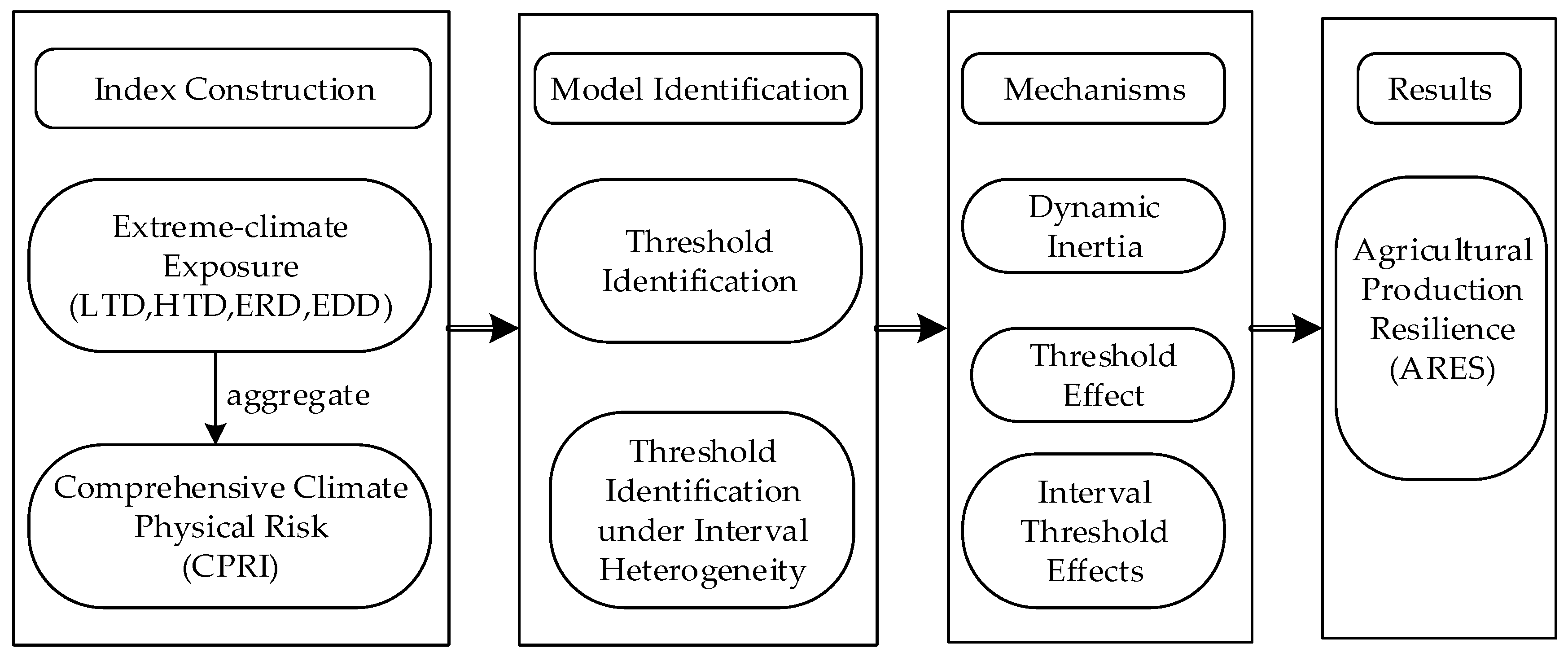
Based on this, the present study proposed the following conceptual framework. Drawing on Machefer et al. (2024) [17] and Zampieri et al. (2020, 2021) [18,19], agricultural production resilience is measured by deviations in multi-crop output sequences and the co-movement structure of crop volatility. A LOESS detrending procedure isolates components attributable to short-term shocks. Following Guo et al. (2024) [20], extreme climate exposure is decomposed into four dimensions: extreme low-temperature days (LTD), extreme high-temperature days (HTD), extreme rainfall days (ERD), and extreme drought days (EDD). A climate physical risk composite index (CPRI) captures the compound pressure from multidimensional extreme events. This study tests the following hypotheses: (i) the effects of extreme climate on agricultural production resilience operate through a threshold-dependent, segmented process; and (ii) this process coexists with the dynamic inertia of ARES. In other words, extreme climate does not merely affect resilience in the current period. But it also shapes the evolutionary trajectory of future resilience through cross-period state transitions. Moreover, different climate dimensions and their integrated risk (CPRI) may induce sign reversals and marginal-effect attenuation across exposure intervals and across regions (Figure 1).

3. Methods and Data

3.1. Measurement of Extreme Climate Indices

Drawing on the approach of Guo et al. (2024), four extreme climate sub-indices—LTD, HTD, ERD, and EDD—are used to construct the CPRI, which represents extreme climate risks [20]. First, meteorological stations with substantial missing data are removed. Next, the historical distributions of each indicator from 1 January 1973, to 31 December 1992, are calculated. T i 10 is defined as the 10th percentile of the historical daily average temperature at station i, representing the threshold for LTD; T i 90 is defined as the 90th percentile of the historical daily average temperature at station i, representing the threshold for HTD R i 95 is defined as the 95th percentile of the historical daily precipitation at station i, representing the threshold for ERD H i 5 is defined as the 5th percentile of the historical daily humidity at station, representing the threshold for EDD. Subsequently, the number of extreme weather days for each event type at each station from 1993 to 2023 is counted.
For example, the number of extreme low-temperature days ( L T D i , n ) at station i in year n is defined as
L T D i , n = t = 1 365 L T i , n , t
where
L T i , n , t = 1   i f   T i , n , t < T i 10 0   i f   T i , n , t T i 10
Here, T i , n , t represents the daily average temperature at station i on day t in year n.
Similarly, the numbers of H T D i , n , E R D i , n , and E D D i , n can be calculated.
HTD:
H T D i , n = t = 1 365 H T i , n , t
where
H T i , n , t = 1   i f   T i , n , t < T i 90 0   i f   T i , n , t T i 90
ERD:
E R D i , n = t = 1 365 E R i , n , t
where
E R i , n , t = 1   i f   R i , n , t < R i 95 0   i f   R i , n , t R i 95
EDD:
E D D i , n = t = 1 365 E R i , n , t
where
E D i , n , t = 1   i f   H i , n , t < H i 5 0   i f   H i , n , t H i 5
Here, R i , n , t and H i , n , t represent the precipitation and relative humidity at station i on day t in year n, respectively.
Using the geographical coordinates of each station, meteorological data are mapped to cities, and the average number of extreme days across all covered stations in each city is calculated. For example, the number of LTD ( L T D m , n ) in city m in year n is
L T D m , n = 1 M j = 1 M L T D j , n
where M is the number of stations in the city and L T D m , n is the arithmetic mean of LTD across all stations in the region. Similarly, H T D m , n , E R D m , n , and E D D m , n can be obtained.
Because the four extreme climate measures differ in nature and cannot be directly compared, a min–max standardization method is applied to each measure, constructing a common index for each category. For example, for LTD,
L T D m , n _ _ _ _ _ = L T D m , n min k = 1 , , K ; l = 1 , , L L T D k , l max k = 1 , , K ; l = 1 , , L L T D k , l min k = 1 , , K ; l = 1 , , L L T D k , l × 100
where K is the total number of cities in the sample, and L is the total number of years. In this way, four sub-indices are obtained: L T D m , n _ _ _ _ _ , H T D m , n _ _ _ _ _ , E R D m , n _ _ _ _ _ and E D D m , n _ _ _ _ _ (all standardized to 0–100).
After standardization, the four sub-indices are combined to construct the CPRI for each city. A simple weighted average is used:
C P R I m , n = ω 1 L T D m , n _ _ _ _ _ + ω 2 H T D m , n _ _ _ _ _ + ω 3 E R D m , n _ _ _ _ _ + ω 4 E D D m , n _ _ _ _ _
In this dataset, ω i is set to 0.25.

3.2. Measurement Method for ARES

In recent years, research on ARES has expanded on the basis of Holling’s (1996) classic resilience theory, incorporating an ecological framework that treats agricultural production systems as complex adaptive systems [21]. This approach emphasizes that resilience depends not only on the ability to resist external disturbances but also on the internal structural capacity for self-adjustment and transformation (e.g., Jiao et al., 2022) [22]. Accordingly, this paper introduces MacArthur’s (1955) “diversity–stability” proposition [23], which argues that different crops exhibit varying sensitivities to external factors such as climate changes, soil condition variations, and pest invasions. By forming diversified and staggered planting structures, the synchronicity of yield fluctuations can be reduced, enhancing the system’s capacity to absorb, buffer, and recover from shocks, thereby improving overall stability in agricultural production.
For index construction, this study references the approaches of Machefer et al. (2024) [17] and Zampieri et al. (2020, 2021) [18,19], assessing system resilience from the perspective of agricultural output. Annual production of three product categories—grains, cotton, and oilseeds—serves as the baseline data. According to China’s county-level statistical yearbooks, grains include major crops such as rice, wheat, maize, soybeans, and tubers (sweet potatoes and potatoes). Cotton is measured by lint cotton output, covering both spring-sown and summer-sown varieties. Oilseeds include crops such as peanuts, rapeseed (oilseed rape), sesame, sunflower seeds, and perilla seeds. Collectively, these crops cover China’s primary agricultural products and broadly reflect the core components and diversified structure of its agricultural production system, providing a feasible and information-rich proxy for crop diversity and shock co-movement at the county level. Under this framework, grains are set as the benchmark crop. The original yield time series for each crop is denoted as Q = q 1 , t , q 2 , t , , q m , t , , q M , T , where q m , t represents the actual yield of crop m in year t. Given that agricultural yield data often exhibit significant trends and non-stationary characteristics, the LOESS smoothing method is applied to each crop’s yield sequence to remove low-frequency trend components. This highlights the intensity and frequency of annual fluctuations, allowing short-term shocks deviating from long-term trends to be clearly identified and characterizing the system’s immediate response to shocks. Based on this, the potential yield level f l o e s s q m , t , λ m of crop m in year t is obtained, and the ARES is constructed as follows:
A R E S t = q B , t f l o e s s q B , t , λ B 1 + m = 2 , m B M q m , t f l o e s s q m , t , λ m 1 C o v y m , t , y B , t 1
In the equation, f l o e s s q m , t , λ m and f l o e s s q B , t , λ B represent the potential yield paths obtained after LOESS smoothing of the yield sequences for crop m and benchmark crop B, respectively, where λ m and λ B are the corresponding smoothing parameters. q m , t f l o e s s q m , t , λ m 1 and q B , t f l o e s s q B , t , λ B 1 characterize the degree to which crop m and benchmark crop B deviate from their potential yields under shocks in year t. Let q m , t f l o e s s q m , t , λ m 1 = y m , t , q B , t f l o e s s q B , t , λ B 1 = y B , t ; then C o v y m , t , y B , t is the covariance between the shock deviation degrees of other crops and grains.
Equation (12) uses the time series of grain shock deviations in each region as a reference to measure the correlation of shock deviations between other crops and grains, then performs a weighted sum to obtain the ARES for each county. The correlation coefficient C o v y m , t , y B , t reflects the impact of crop diversity on system stability: if the yield fluctuations of different crops are highly synchronized with the benchmark crop, crop m and grains may experience simultaneous yield reductions under external shocks, resulting in weak risk diversification at the system level. Conversely, a low or negative correlation indicates staggered or compensatory responses among different crops, promoting risk diversification through functional complementarity and enhancing agricultural system stability under external disturbances. The specific calculation method is
C o v y m , t , y B , t = t = 1 T y m , t y ¯ m y B , t y ¯ B t = 1 T y m , t y ¯ m 2 t = 1 T y B , t y ¯ B 2
where y ¯ m and y ¯ B are the means of the shock deviation sequences for crop m and benchmark crop B, respectively, and T is the sample length. A larger ARES value indicates stronger adaptation and recovery capabilities of the regional agricultural production system under external shocks. Agricultural production resilience is thus defined as the capacity of agricultural output to maintain stability in the face of external climate disturbances. At the level of observability, this capacity is primarily manifested in the stability, or equivalently, the volatility of agricultural output. Accordingly, in constructing the indicator, agricultural production resilience is operationalized as a measure of stability. Although “shock resistance” and “recovery capacity” are typically intertwined with stability in the resilience literature, in this study, resilience performance is captured primarily through output stability and volatility attenuation.

3.3. DPTM Setup

To investigate the nonlinear impacts of extreme climate events on ARES, consider a representative county-level agricultural production function influenced by climate shocks:
Y i t = A i t f K i t , L i t , L a n d i t g C l i m a t e i t + ε i t
where Y i t is the agricultural output of county i in year t; A i t represents technology and productivity; K i t and L i t denote capital (e.g., machinery) and labor inputs, respectively; L a n d i t represents arable land; and ε i t is a random shock. The function g C l i m a t e i t modulates productivity based on exposure to extreme climate (e.g., LTD, HTD, ERD, EDD, or CPRI), capturing how extreme climate disrupts production efficiency.
ARES is conceptualized as the inverse of output vulnerability, incorporating both stability (low variance) and diversity (crop diversity as a buffer against shocks), and is specified as follows:
A R E S i t = D i t σ Y i t C l i m a t e i t
where D i t is the crop diversity index [17] and σ is the conditional variance of output. A higher A R E S i t implies greater system robustness.
The nonlinearity arises from critical physiological thresholds in crops and limits to economic adaptation. Crops exhibit critical thresholds [12], beyond which marginal damages accelerate. From an economic perspective, low-intensity shocks can be absorbed through adaptive behaviors (e.g., irrigation adjustments or crop rotations), whereas high-intensity events overwhelm these mechanisms, leading to cascading failures [2]. This is formalized as a threshold-dependent impact function:
A R E S i t = β 0 + β 1 X i t + γ C l i m a t e i t ; τ + u i t
where X i t is a vector of control variables and γ is defined as the following piecewise function:
γ C l i m a t e i t ; τ = γ L C l i m a t e i t C ¯   i f   C l i m a t e i t τ γ H C l i m a t e i t C ¯   i f   C l i m a t e i t > τ
where τ is the unknown threshold and C ¯ is the average climate exposure. This mechanism implies γ L 0 (low-intensity intervals buffered by diversity and adaptation) and γ H < 0 with γ H > γ L (high-intensity intervals collapsing due to exceeded physiological limits and rising adaptation costs). This reflects “high-tail risks,” whereby extreme events amplify regionally synchronized losses [19].
To test the nonlinear impacts of extreme climate on ARES, the following panel threshold model is constructed based on the above equations:
A R E S i t = β 0 + γ L C l i m a t e i t I C l i m a t e i t τ + γ H C l i m a t e i t I C l i m a t e i t > γ + μ i + ε i t
where I is the indicator function. The threshold value is estimated by minimizing the sum of squared residuals (SSR).
To examine the path dependence of ARES, the above static model is extended to a DPTM by incorporating the first-order lag of ARES ( A R E S i t 1 ), capturing the dynamic adjustment processes and persistence effects in agricultural systems. The dynamic threshold model is specified as follows:
A R E S i t = β 0 + α A R E S i t 1 + γ L C l i m a t e i t I C l i m a t e i t τ + γ H C l i m a t e i t I C l i m a t e i t > γ + μ i + ε i t
Building on Equation (19) and incorporating control variables yields the final dynamic panel data threshold model as shown in Equation (20):
A R E S i t = β 0 + α A R E S i t 1 + γ L C l i m a t e i t I C l i m a t e i t τ + γ H C l i m a t e i t I C l i m a t e i t > γ + ϕ C o n t r o l i t + μ i + ε i t
where the dependent variable A R E S i t denotes ARES; C l i m a t e i t represents the extreme climate variables, including LTD, HTD, ERD, EDD, and CPRI; I represents the indicator function; C o n t r o l i t is the vector of control variables; and ε i t is the random error term.
On the one hand, the model treats ARES as a state variable with dynamic inertia by including its lagged value, thereby capturing persistence in resilience arising from accumulated adaptation over time and mitigating bias from misattributing unobserved historical adaptive capacity or other omitted persistent factors to contemporaneous extreme climate. On the other hand, the model introduces threshold effects determined by extreme climate indicators, allowing the impact of extreme climate to exhibit distinct marginal effects across regimes defined by the threshold. This approach avoids relying on linear terms or simple quadratic specifications that may misrepresent the “critical point–switching” structure of the economic adaptation mechanism. This study performs threshold testing and identifies threshold existence using the likelihood-ratio (LR) statistic. Specifically, as the threshold parameter varies, the LR statistic changes accordingly. When the LR statistic falls below the critical value at a given significance level, the corresponding threshold parameter lies within the confidence interval, indicating the presence of an optimal threshold in the sample.
The dynamic panel threshold model is estimated using the Stata 18.0 command xtendothresdpd, with 1000 bootstrap replications for linear–nonlinear testing. Because the DPTM includes a lagged dependent variable, it may suffer from endogeneity. Although extreme climate is assumed exogenous, some control variables may be endogenous. The xtendothresdpd command addresses endogeneity by employing GMM-type instrumental variables derived from differenced equations. To examine the effects of extreme climate on agricultural production resilience and based on information from China’s County Statistical Yearbooks, the analysis further extracts subsamples of counties by terrain type (hilly, plain, mountainous) and national poverty-focused development counties. Model (20) is then estimated separately for these subsamples.

3.4. Data

The sample covers 1343 county-level regions in China over the period 2000–2023, forming a panel dataset with 29,463 observations. The dependent variable is ARES, constructed from the annual yields of major agricultural products, including grains, cotton, and oilseeds. The control variables include a set of indicators reflecting macroeconomic development and agricultural production conditions: per capita gross domestic product, gross agricultural output value, cultivated land area, total power of agricultural machinery, chemical fertilizer application, effective irrigated area, rural electricity consumption, and employment in the primary industry. These variables are denoted as GDP, ADI, CLA, TAM, CFA, EIA, REC, and EPI (Table 1). All county-level socioeconomic data are sourced from the annual editions of the China County Statistical Yearbook. To mitigate heteroscedasticity, scale differences, and potential skewness, all variables are transformed using natural logarithms. The extreme climate data encompass four typical categories of CPRI: LTD, HTD, ERD, and EDD. These data are sourced from the Global Historical Climatology Network dataset released by the U.S. National Oceanic and Atmospheric Administration. Extreme climate variables are calibrated using the 1973–1992 period to ensure a sufficiently long baseline and to mitigate potential endogeneity arising from using the same years for both threshold construction and estimation. To ensure consistency with county-level agricultural data and provide a sufficiently long time span for identifying dynamic inertia and threshold effects, the analysis period is set to 2000–2023.

4. Results

4.1. Descriptive Statistics of Variables

Table 1 presents the descriptive statistics of the variables. For ARES, the mean is approximately 1.95, with a standard deviation of 0.896, indicating a moderate overall resilience level across the sample regions but notable differences between regions and years. The minimum value is −4.526, and the maximum reaches 7.734, spanning a wide range that reflects significant imbalances in agricultural systems’ shock resistance and recovery capabilities under varying extreme climate conditions. The four categories of extreme climate indicators all exhibit strong dispersion and clear right-skewed distributions, suggesting that some regions frequently experienced severe cold events during the sample period. The number of HTD is significantly higher than that of LTD, indicating that high-temperature exposure plays a more prominent role in the climate risk structure. The standard deviation of ERD is as high as 18.18 days, with a maximum of 306.25 days, reflecting extremely intense fluctuations and implying that spatial and interannual imbalances in ERD far exceed those of temperature-related indicators. EDD similarly exhibits strong volatility and long-tailed features. Overall, the means of the four types of extreme events are relatively high, and the ranges between maximum and minimum values are wide, indicating that CPRI exposures across regions during the sample period exhibit both substantial structural differences and occasional extreme shocks. This constitutes a multidimensional, nonlinear source of pressure on ARES, providing a rich informational foundation for subsequently identifying “high-risk states” and their threshold effects.

4.2. Analysis of Extreme Climate and ARES

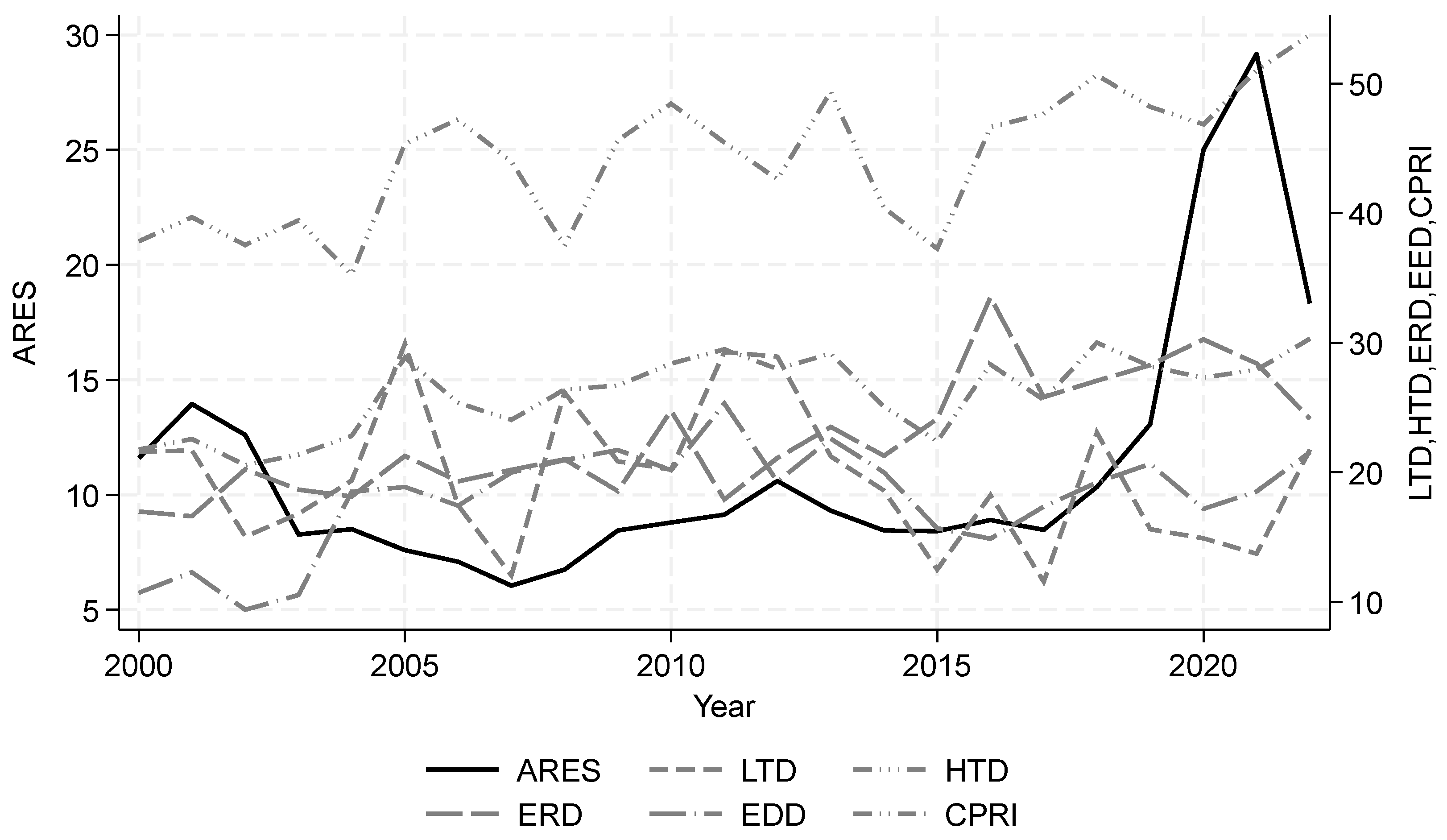
To establish a baseline for the ARES response and provide a reference framework for interpreting its behavior under extreme climate shocks, this section analyzes extreme climate conditions and agricultural production resilience. Figure 2 shows the annual average evolutionary trajectories of ARES (left axis) and various climate risk indicators (right axis) during the sample period. Through dual-axis comparison, it is evident that both single-dimensional extreme climate indicators (HTD, LTD, ERD, EDD) and CPRI exhibit pronounced interannual oscillations. In particular, the comprehensive risk index (CPRI) shows local peaks in multiple years (e.g., around 2005, 2011, and 2019), indicating that climate threats to Chinese agriculture are not linearly increasing but manifest as pulse-like shocks with high abruptness and uncertainty.
Furthermore, different types of extreme climate events (such as high temperatures and droughts) often alternate or occur synchronously, and this compounding effect constitutes the main external pressure on agricultural production. Comparison of trends on the left and right axes reveals a complex interplay rather than a simple inverse relationship. In some years with high climate risks (e.g., CPRI peaks), ARES experiences short-term declines due to pressure (e.g., around 2007). However, in certain periods, resilience rebounds despite persistent risks, suggesting that agricultural systems may possess an “adaptive threshold.” Specifically, after crossing a critical point, pure risk shocks may trigger system collapse or induce system upgrades.
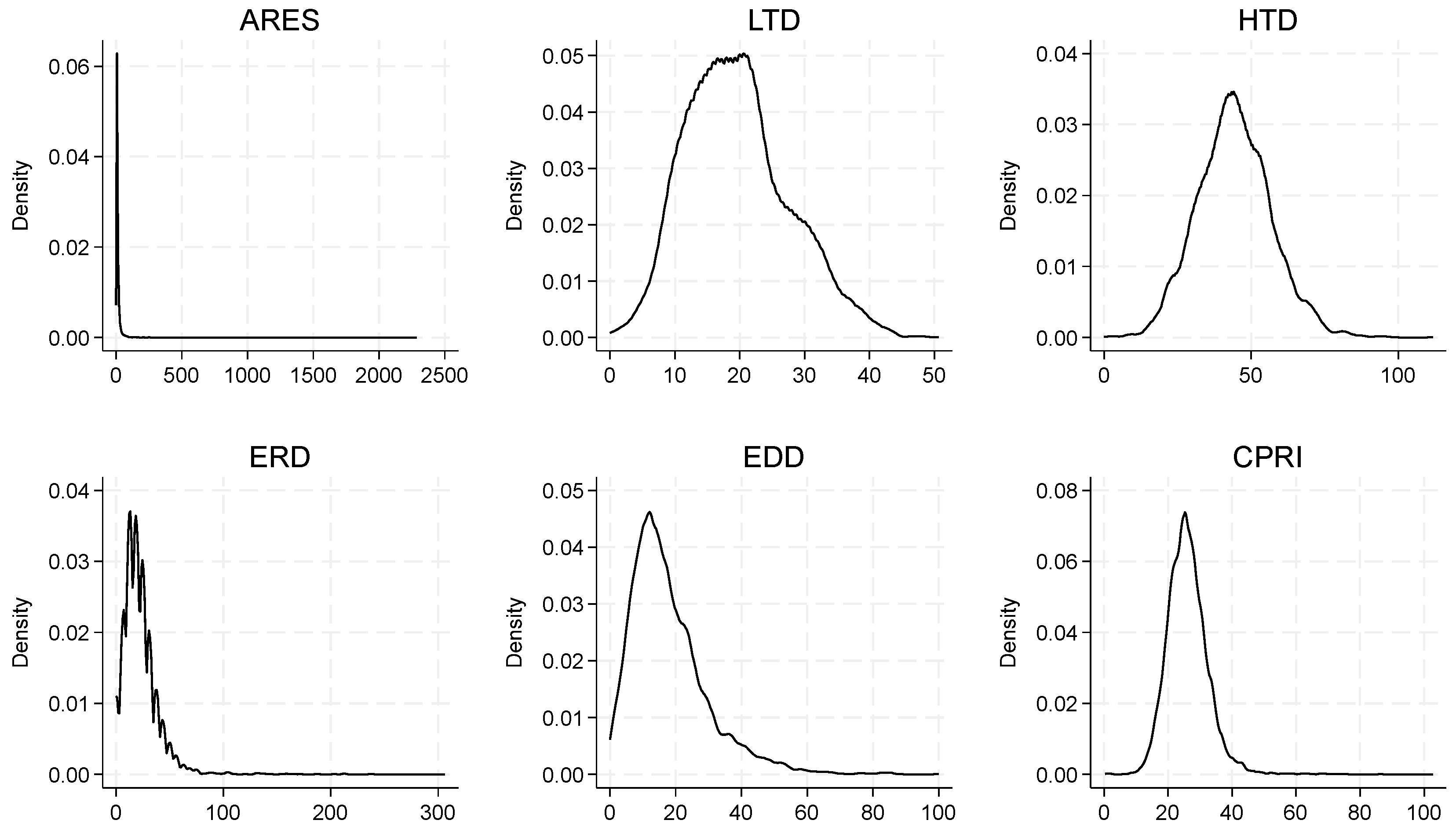
Figure 3 shows the kernel density estimation results for ARES, CPRI, and each sub-extreme climate indicator. The distribution of ARES exhibits a pronounced “peaked and fat-tailed” pattern, with strong right skewness. Most sample observations cluster in the lower range, forming a sharp peak, while the long right tail indicates that only a few regions possess extremely high ARES. This high degree of imbalance suggests substantial spatial heterogeneity in China’s county-level ARES, indicating that simple mean regressions may be distorted by outliers and supporting the use of nonlinear threshold models in this study.
For the extreme climate variables, none of the indicators follow a standard normal distribution; instead, they show varying degrees of skewness and multimodality. This pattern reflects the “black swan” attributes of extreme climate events—namely, the concentration of observations in normal years (peaks) alongside a non-negligible probability of extreme anomalous years (tails). In particular, the broad tails of some indicators suggest that the sample includes high-risk observations affected by extreme shocks, which are critical for examining the “collapse zone” of climate adaptability in this study. The non-normal, asymmetric, and fat-tailed distributions of the core variables further suggest that agricultural production systems respond to climate shocks in a nonlinear manner. Because traditional linear mean regression assumes that residuals follow a normal distribution, it may not adequately capture causal relationships under these distributional features, thereby justifying the use of nonlinear threshold models for empirical analysis.

4.3. Unit Root Tests and Correlation Analysis

Table 2 presents the unit root test results for the main variables. The LLC test allows for heterogeneous intercepts and time trends across cross-sections and adjusts for serial correlation and heteroscedasticity through pre-regression, thereby enhancing robustness. Therefore, the LLC test is employed for the panel unit root examination. The absolute values of the test statistics for each variable are far greater than the critical values, with corresponding p-values almost all equal to 0.000, which is below the 1% significance level. This indicates that the null hypothesis of a unit root is strongly rejected for all variables, implying that they are stationary and do not exhibit first- or higher-order integration. Consequently, panel regression and threshold models can be directly applied for estimation without the risk of spurious regression affecting the reliability of subsequent empirical results.
Table 3 presents the results of the correlation analysis for the main variables. As shown in Table 3, pairwise correlations between the key dependent variable—ARES—and the four types of extreme climate exposure (LTD, HTD, ERD, and EDD), as well as CPRI, are generally low (with most absolute values below 0.10). This indicates that simple linear associations in the sample are weak, which is consistent with the “fat-tail risk–threshold–nonlinearity” mechanism emphasized in this study: the effects of extreme events on resilience are more likely to manifest through marginal-effect switching after crossing critical thresholds, rather than through stable monotonic relationships in full-sample averages. Meanwhile, correlations among the climate variables are relatively high. In particular, the correlation coefficients between CPRI and ERD, EDD, and HTD are approximately 0.615, 0.549, and 0.509, respectively. This suggests that the composite index effectively aggregates multidimensional information on extreme exposures; however, it also implies that including CPRI and its component indicators simultaneously in the same regression may induce multicollinearity. Accordingly, to preserve coefficient interpretability, the model specification should adopt an identification strategy that estimates models separately using either the composite index or the disaggregated indicators. Overall, the correlation results not only support our empirical design of using a dynamic threshold model to capture the segmented, asymmetric, and state-dependent impacts of extreme climate on resilience but also provide a clear econometric rationale for the variable-entry strategy and the associated robustness checks.

4.4. Empirical Results

4.4.1. Baseline DPTM Estimation Results

Table 4 presents the full-sample estimation results for the effects of extreme climate events on ARES in China. The coefficient on the lagged term of ARES is statistically significant at the 1% level across all specifications, indicating pronounced dynamic inertia in resilience. Specifically, past agricultural resilience continues to exert a positive effect on current resilience, although the impact of past shocks attenuates over time.
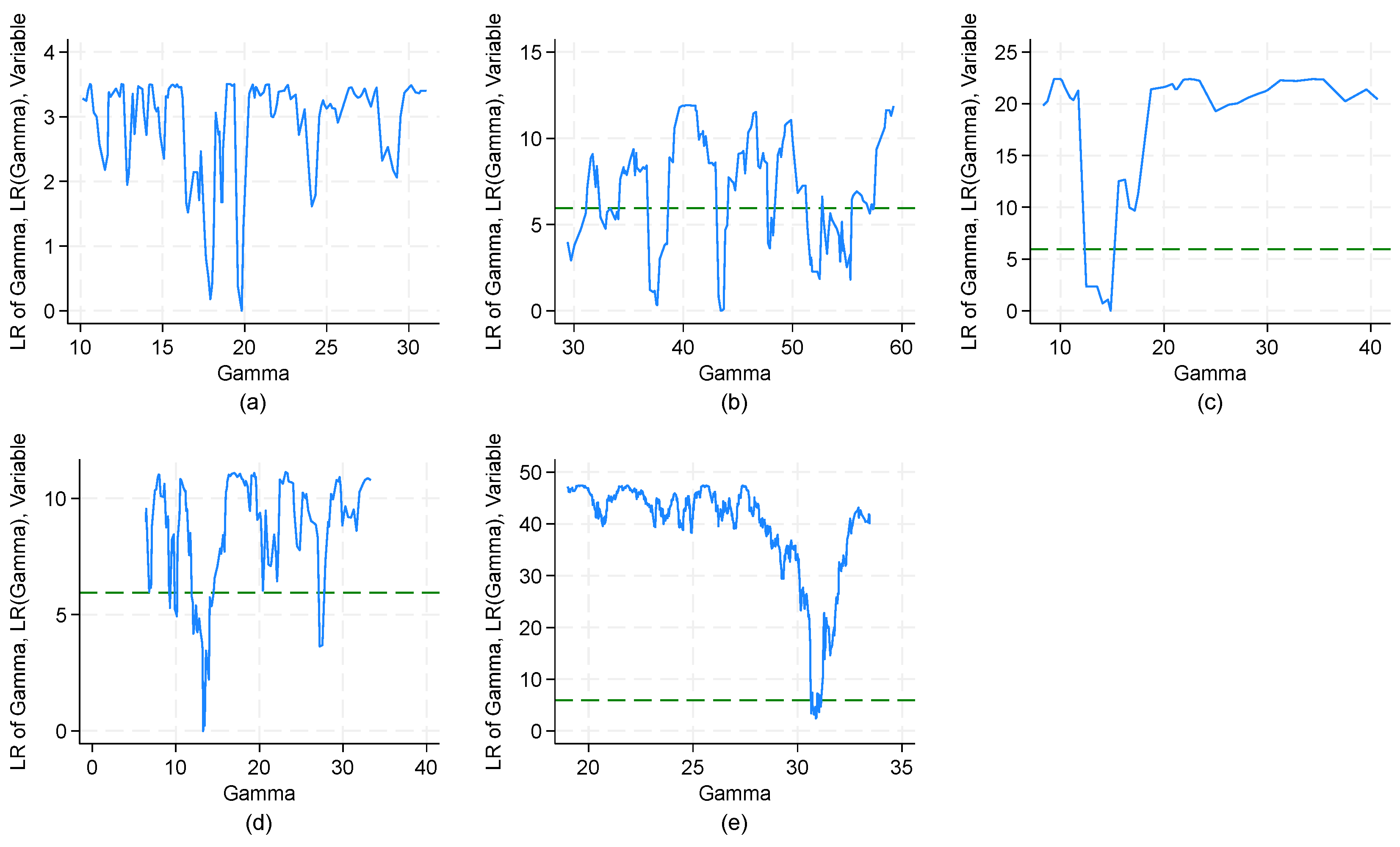
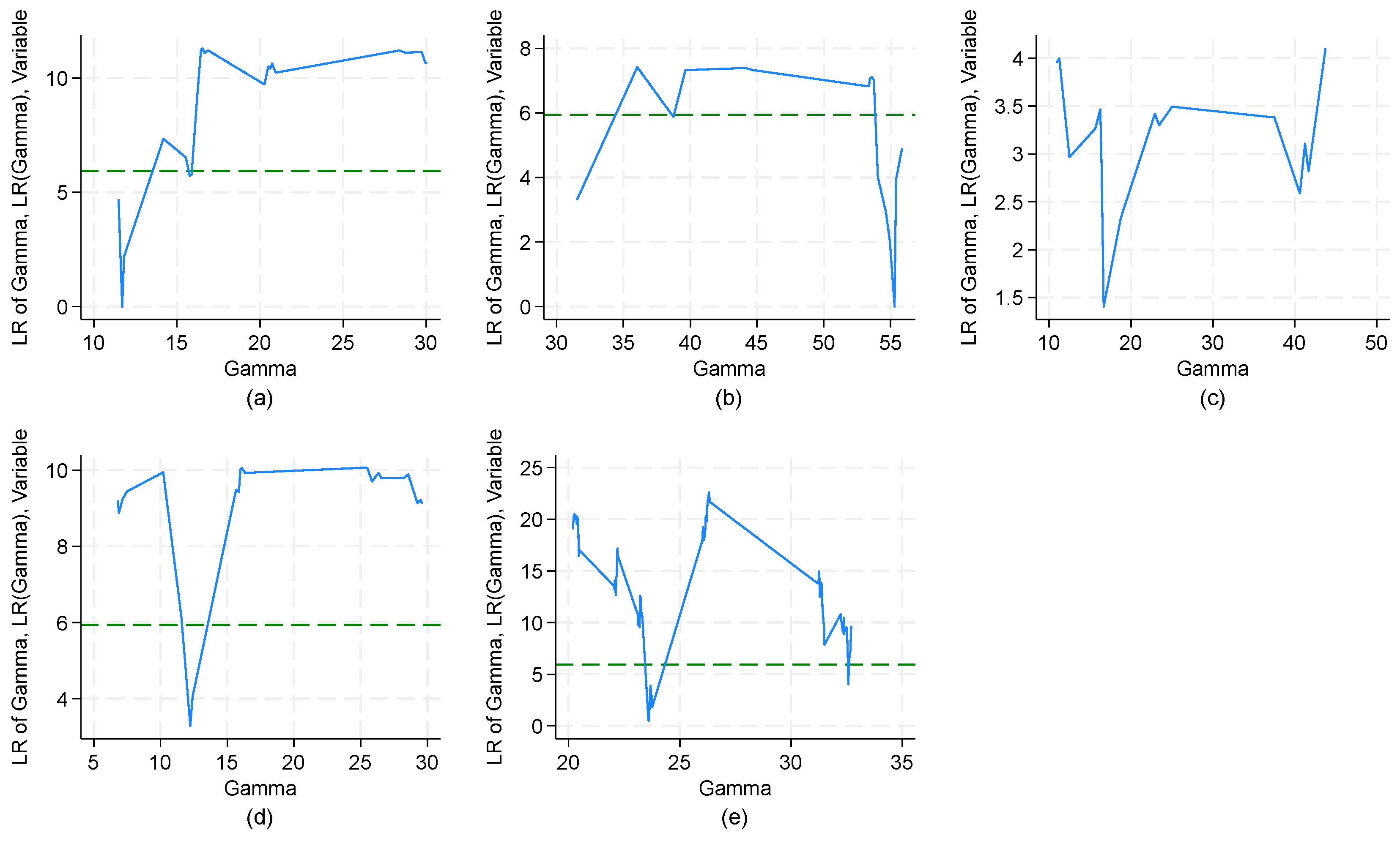
Column (1) of Table 4 shows that the effect of LTD on ARES is not statistically significant in the pre-threshold regime. However, after the threshold is crossed, each additional day of LTD increases ARES by 0.35%, and this estimate is significant at the 1% level. Therefore, LTD has no significant effect on resilience in the pre-threshold regime but exerts a statistically significant positive effect once the threshold is exceeded. Figure 4a further illustrates that this threshold effect is clearly defined. Figure 4b indicates that the impact of HTD on ARES also exhibits a clear threshold. Column (2) shows that the pre-threshold effect is not statistically significant; however, after crossing the threshold, HTD has a significant negative effect on resilience: each additional day of HTD reduces ARES by 0.22%.
Columns (3) and (4) report the effects of ERD and EDD on ARES, respectively. Figure 4c,d show that both ERD and EDD exhibit clear threshold effects in their impacts on resilience. The results indicate that, in the pre-threshold regime, both ERD and EDD have statistically significant positive effects on ARES: a one-day increase in ERD and EDD is associated with increases in resilience of 1.09% and 2.42%, respectively. However, once the threshold is exceeded, the resilience-enhancing effects weaken markedly. Specifically, each additional day of ERD and EDD increases resilience by only 0.20% and 0.38%, respectively—approximately one-fifth and one-sixth of their corresponding pre-threshold effects.
Figure 4e and Column (5) show that the overall effect of CPRI on ARES also exhibits a clear threshold. Before the threshold is exceeded, CPRI has a statistically significant inhibitory effect on resilience: a one-unit increase in CPRI reduces ARES by 0.45%. After the threshold is crossed, however, the estimated effect of CPRI on resilience is no longer statistically significant, indicating that once exposure surpasses the threshold, further increases in CPRI do not exert a discernible impact on ARES.

4.4.2. DPTM Estimation Results for Hilly Counties

Table 5 presents the estimation results for the effects of extreme climate events on ARES in hilly counties. The coefficient on the lagged term of ARES is statistically significant at the 1% level across all specifications, indicating pronounced dynamic persistence in resilience. However, compared with the full-sample estimates, the degree of persistence is relatively weaker. This suggests that past ARES continues to promote current resilience, but the carryover (shock) effect is smaller in magnitude.
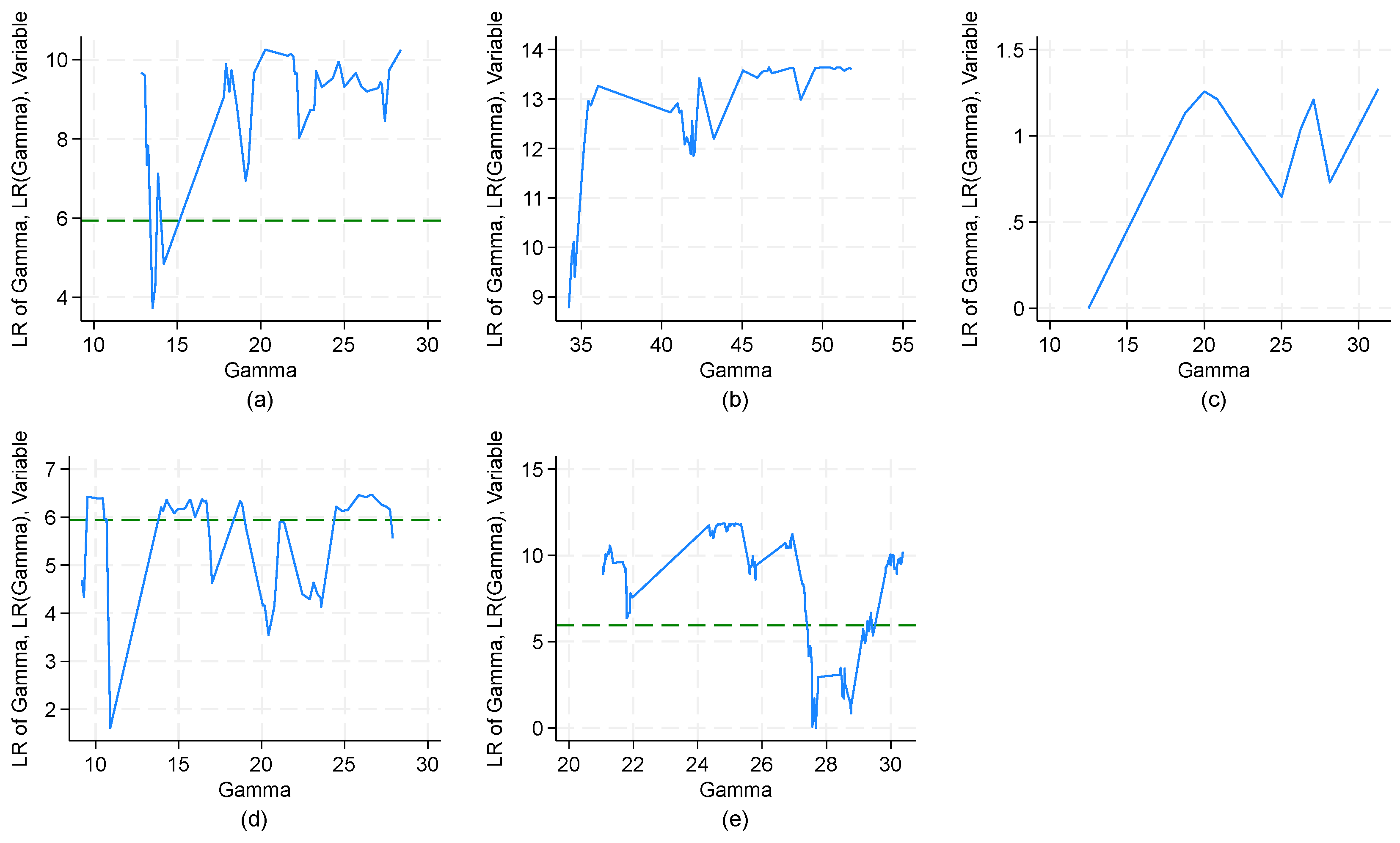
Figure 5a and Column (1) show that LTD exerts a statistically significant positive effect on ARES in hilly counties and exhibits a clear threshold. Before the threshold is exceeded, each additional day of LTD increases resilience by 2.71%; after the threshold is crossed, this resilience-enhancing effect declines to 0.68%, which is approximately 25% of the pre-threshold magnitude. By contrast, Column (2) indicates that before the HTD threshold is crossed, each additional day of HTD reduces resilience in hilly counties by 0.21%; after the threshold is exceeded, the inhibitory effect strengthens slightly to 0.25%. Although the estimated negative effects are similar across the two regimes, Figure 5b confirms the presence of a distinct threshold.
Figure 5c suggests that the impact of ERD on ARES in hilly counties does not exhibit a distinct threshold effect. Accordingly, the estimates in Table 4 indicate that the resilience-enhancing effect of ERD ranges from 0.23% to 0.27%; that is, one additional day of ERD increases ARES in hilly counties by approximately 0.25%. By contrast, Figure 5d shows a clear threshold effect for EDD. Before the threshold is exceeded, each additional day of EDD increases ARES in hilly counties by 3.01%; after the threshold is crossed, the positive effect declines to 0.18%, which is only about 6% of the pre-threshold magnitude.
Figure 5e and Column (5) show that, in hilly counties, CPRI has a statistically significant positive effect on ARES and exhibits a clear threshold effect. Before the threshold is exceeded, a one-unit increase in CPRI increases ARES by 1.04%; after the threshold is crossed, the effect declines to 0.68%, which is only about 50% of the pre-threshold magnitude.

4.4.3. DPTM Estimation Results for Plain Counties

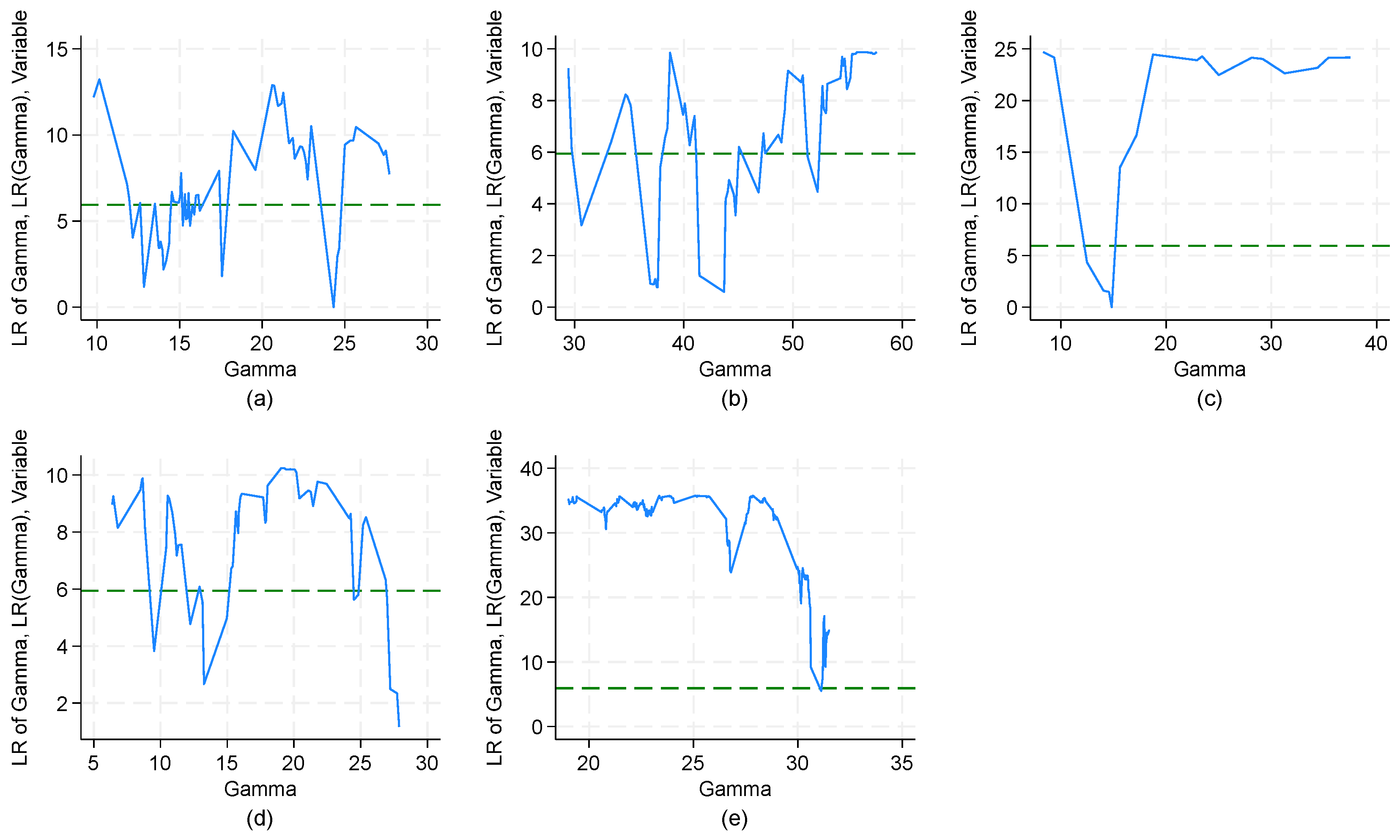
Table 6 presents the estimation results from the DPTM for plain counties. The results indicate a pronounced lag effect in ARES. Moreover, Figure 6a and Column (1) show that LTD has a statistically significant positive effect on ARES in plain counties and exhibits a threshold effect. Before the threshold is exceeded, each additional day of LTD increases resilience by 2.6%; after the threshold is crossed, the positive effect declines by more than half, to 1.13%. Column (2) shows that before the HTD threshold is exceeded, each additional day of HTD reduces resilience by 1.29%; after the threshold is exceeded, each additional day reduces resilience by 0.47%. Therefore, HTD has a statistically significant inhibitory effect on ARES; however, Figure 6b indicates that its impact does not display a distinct threshold effect.
Figure 6c further indicates that the effect of ERD on ARES in plain counties does not exhibit a distinct threshold effect. Nonetheless, the results in Column (3) suggest that ERD has a statistically significant positive effect on resilience in plain counties. In contrast, Column (4) and Figure 6d show that EDD has a statistically significant negative effect on ARES in plain counties and exhibits a clear threshold effect. Before the threshold is exceeded, each additional day of EDD reduces resilience by 2.17%; after the threshold is crossed, the inhibitory effect diminishes to 0.09%, which is approximately 4% of the pre-threshold magnitude.
Column (5) indicates that the effect of CPRI on ARES in plain counties is not statistically significant before the threshold is exceeded. However, once the threshold is crossed, CPRI exhibits a statistically significant positive effect on ARES. As shown in Figure 6e, this effect is clearly present.

4.4.4. DPTM Estimation Results for Mountainous Counties

Table 7 presents the estimation results from the DPTM for mountainous counties. The results indicate a pronounced lag effect in ARES. Column (1) shows that LTD has a statistically significant positive effect on ARES: before the threshold is exceeded, each additional day of LTD increases resilience by 1.22%; after the threshold is crossed, the positive effect declines to 0.73%, representing a reduction of more than 40% relative to the pre-threshold magnitude. Column (2) shows that before the threshold is exceeded, each additional day of HTD increases ARES by 0.92%; after the threshold is crossed, the increase falls to 0.20% per day. Therefore, HTD exerts a statistically significant positive effect on resilience, but its effect diminishes by approximately 78% once the threshold is exceeded.
Column (3) shows that the coefficient of ERD for mountainous counties is negative, but not statistically significant. Column (4) indicates that, before the threshold is exceeded, each additional day of EDD increases ARES in mountainous counties by 1.76%, significant at the 1% level; after the threshold is crossed, each additional day increases resilience by 0.01%, and the effect is not statistically significant. These results suggest that ERD has no significant effect on ARES in mountainous counties, whereas the positive effect of EDD is present only before the threshold is reached and becomes insignificant once the threshold is exceeded.
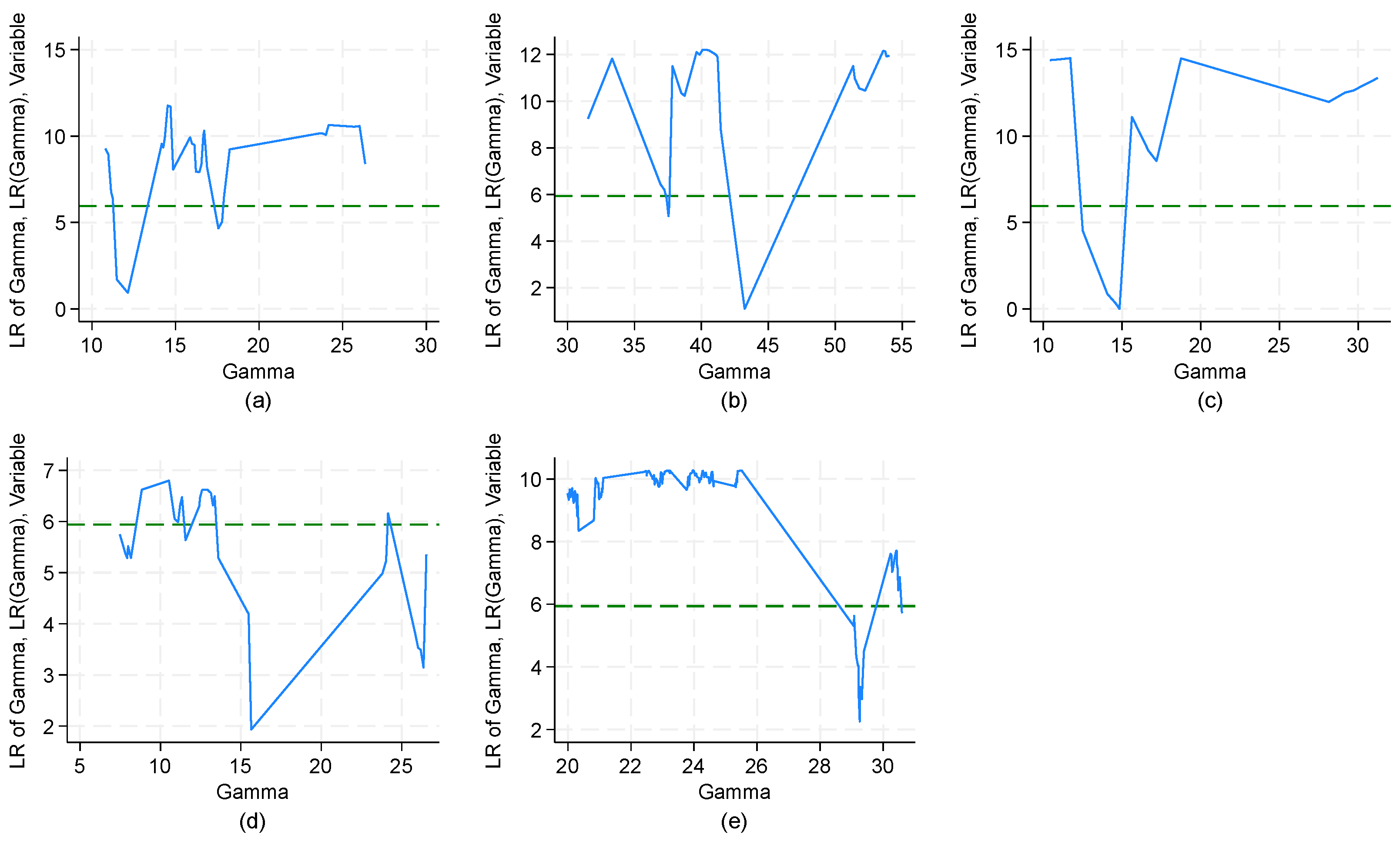
Column (5) shows that CPRI has a statistically significant inhibitory effect on ARES in mountainous counties. Specifically, before the threshold is exceeded, a one-unit increase in CPRI reduces ARES by 1.17%; after the threshold is crossed, the negative effect diminishes to 0.56%. In other words, once CPRI exceeds the threshold, its inhibitory effect on resilience in mountainous counties falls to approximately 50% of its pre-threshold magnitude. Moreover, Figure 7 indicates clear threshold values across all model specifications for different types of extreme climate events, confirming that the threshold effects reported above are well defined.

4.4.5. DPTM Estimation Results for NKCPADs

Table 8 presents the estimation results from the DPTM for NKCPADs. The results indicate a pronounced lag effect in ARES. Figure 8a and Column (1) show a clear threshold effect in the impact of LTD: before the threshold is exceeded, each additional day of LTD reduces ARES by 0.47%; after the threshold is crossed, the effect becomes positive, with each additional day increasing resilience by 0.56%.
Column (2) shows that before the threshold is exceeded, the effect of HTD on ARES is not statistically significant. After the threshold is crossed, each additional day of HTD reduces ARES by 0.23%. Therefore, the impact of HTD exhibits a clear threshold effect (as shown in Figure 8b), and the inhibitory effect becomes more pronounced once the threshold is exceeded.
Column (3) shows that, before the threshold is exceeded, each additional day of ERD reduces ARES by 0.82%; after the threshold is crossed, the reduction is 0.26% per day. This indicates that the inhibitory effect of ERD differs across regimes, declining to approximately 30% of its pre-threshold magnitude once the threshold is exceeded. Column (4) indicates that, before the threshold is exceeded, each additional day of EDD increases ARES by 1.60%; however, after the threshold is crossed, each additional day of EDD decreases resilience by 0.10%. As shown in Figure 8c,d, both ERD and EDD exhibit clear threshold effects in their impacts on ARES.
As shown in Figure 8e and Column (5), CPRI exerts a statistically significant inhibitory effect on ARES in NKCPADs, with a clear threshold effect. Specifically, before the threshold is exceeded, a one-unit increase in CPRI reduces ARES by 1.02%; after the threshold is crossed, the inhibitory effect decreases to 0.53%. That is, once the threshold is exceeded, the negative effect on resilience declines to approximately 50% of its pre-threshold magnitude.

5. Discussion

5.1. Main Findings

Based on county-level panel data from China spanning 2000–2023, this study constructs an ARES that captures the “diversity–stability” dimension and employs a DPTM to identify the dynamic and threshold-type nonlinear effects of LTD, HTD, ERD, EDD, and CPRI on ARES. The full-sample results confirm significant path dependence in ARES, indicating that resilience is not a static outcome of “current shocks–current responses” but a dynamic state variable shaped by historical shocks, adaptive investments, and accumulated institutional and technological capacities. This finding is consistent with evidence that climate shocks exert persistent effects on economies and growth [16] and aligns with the social–ecological resilience framework that emphasizes “intertemporal adjustment and reorganization” [8].
Furthermore, the effects of different types of extreme climate on ARES exhibit pronounced state dependence and regime-specific (piecewise) patterns. Specifically, HTD significantly suppresses ARES after the threshold is crossed, whereas LTD becomes significantly positive in the post-threshold regime. ERD and EDD display threshold patterns characterized by “enhancement with diminishing marginal effects”. CPRI is significantly inhibitory before the threshold, while its effect becomes statistically insignificant after the threshold. This nonlinearity is consistent with the established evidence that crops respond to extreme temperatures in a threshold-dependent manner: once temperatures enter the tail range, the slope of yield losses steepens substantially [12,13]. Meanwhile, global studies show that extreme events such as heatwaves, droughts, and waterlogging disrupt crop production and may increase the risk of synchrony [1,2,11], providing externally consistent evidence for the “threshold–collapse zone” identified in this study.
Further heterogeneity analysis indicates that the estimated threshold locations and the signs of regime-specific coefficients vary across hilly areas, plains, mountainous areas, and NKCPADs, revealing that the same climate shock can yield different resilience outcomes under differences in topographic endowments, production systems, and adaptive capacity. Taken together, these findings suggest a key conclusion: the impacts of extreme climate on ARES are not monotonically linear but instead resemble a process of “buffering–threshold switching–effect reappraisal”. In this process, adaptive responses, factor reallocation, and structural adjustment within agricultural systems may be activated—or may fail—across different exposure-intensity ranges, thereby shaping the piecewise trajectory of resilience dynamics [7].

5.2. Dynamic Inertia: ARES as a “Cumulative State Variable”

Across the full sample and all subsamples, the first-order lag of ARES is significantly positive, indicating strong inertia and persistence. This suggests that, following shocks, county-level agricultural systems accumulate “adaptive capital” through cultivar selection, agronomic adjustments, and infrastructure investments (e.g., irrigation, drainage/waterlogging control, and agricultural machinery), thereby generating intertemporal persistence in ARES. At the same time, this dynamic inertia implies two effects. First, the impact of contemporaneous shocks can be partially absorbed by existing adaptive capacity. Second, if shocks persist or exceed critical thresholds, the system may shift to a new regime in which previously accumulated resilience advantages exhibit diminishing returns or become ineffective under higher-risk conditions. Accordingly, a dynamic threshold framework is empirically well suited in this context, as it allows “resilience inertia” and “threshold switching” to coexist and more accurately reflects the real-world “shock–response–adjustment” process in agricultural systems.

5.3. Mechanisms of Threshold Effects: From Physiological to Economic Adaptation Thresholds

The full-sample estimates show that the effect of LTD on ARES is insignificant below the threshold but becomes significantly positive once the threshold is crossed. This suggests that when low-temperature events intensify to levels perceived as major risks, they are more likely to trigger systematic responses (e.g., adjusting planting dates, adopting cold-tolerant varieties, protective cultivation/thermal insulation, and risk-sharing mechanisms), thereby reducing volatility or enhancing the asynchrony of crop-specific shock responses. In contrast, the effect of HTD on ARES is insignificant prior to the threshold but becomes significantly negative in the post-threshold regime, indicating a systematic decline in ARES once high-temperature exposure reaches a critical level. This pattern is consistent with the nonlinear temperature sensitivity of crops: exceeding critical thresholds substantially amplifies yield-loss risks [12], and this sensitivity varies across growth stages and regions [13]. At the system level, high temperatures may also increase synchrony in yield fluctuations across crops by accelerating evapotranspiration, shortening the grain-filling period, and intensifying heat–drought coupling, thereby weakening the resilience foundation that relies on diversity to spread risk.
The effects of ERD and EDD on ARES are significantly positive before the threshold and remain positive after the threshold, although with smaller coefficients, indicating diminishing marginal effects. A plausible explanation is that, under moderate exposure, moisture anomalies induce improvements in irrigation and drainage, optimization of field management, and adjustments in crop structure, thereby dampening fluctuations. However, once exposure exceeds the threshold, an “adaptation ceiling” emerges due to infrastructure constraints and financial limitations, leading to diminishing marginal returns. Global evidence also shows that heatwaves, drought, and excess moisture significantly affect crop yields [11] and disrupt global crop production [1], providing real-world context for the post-threshold attenuation of benefits: under persistently high exposure, adaptation continues, but its marginal contribution to stability diminishes.
CPRI is significantly negative before the threshold but becomes statistically insignificant after the threshold, indicating that it substantially undermines resilience under low-to-moderate exposure, whereas at higher levels, its marginal effect may be offset by stronger adaptation and structural adjustment or weakened as the “remaining explainable increment” declines. Compound extreme risks amplify losses and nonlinearities [11], and the increasing likelihood of synchronous shocks under future warming [2] suggests that the policy implications of CPRI should be interpreted in conjunction with the composition of its underlying risk components. The same CPRI level may arise from different combinations of risks, implying asymmetric effects on ARES.

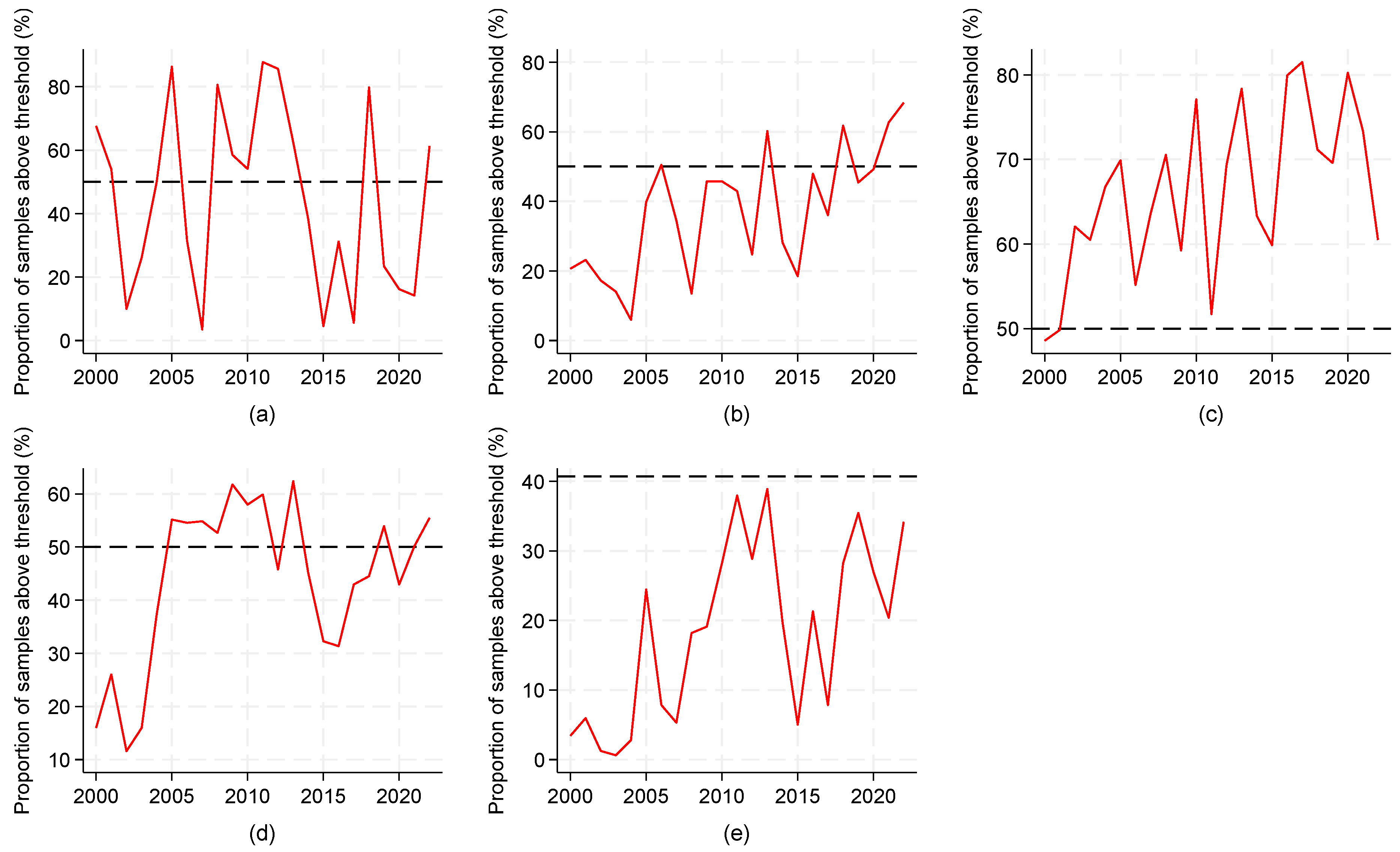
5.4. Share of Counties Exceeding Thresholds and the Breadth of Exposure to Extreme Climate Risk

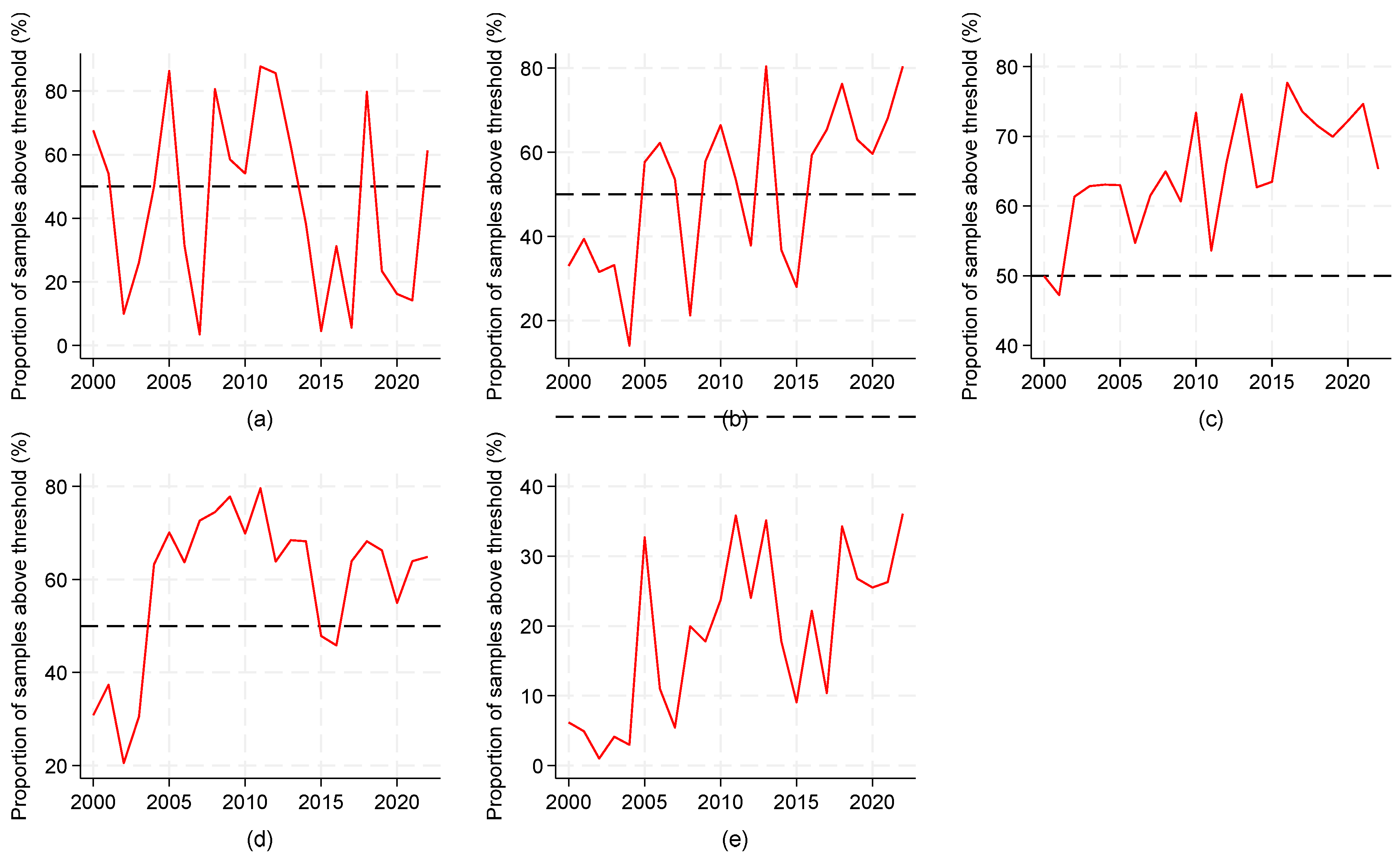
The dynamic panel threshold model identifies two regimes—pre- and post-threshold—each with distinct marginal effects. However, the macro-level significance of these effects depends on the share of counties located in the post-threshold regime. The “proportion of counties exceeding the threshold” reported in Figure A1 characterizes the weight of the post-threshold mechanism in the sample, thereby determining whether the overall results align more closely with the pre- or post-threshold regime. This perspective is consistent with the systemic-risk literature, which argues that the aggregate consequences of extreme events depend not only on local loss gradients but also on the extent of synchronous exposure [2]. Using HTD as an example, the post-threshold coefficient is significantly negative. The rising exceedance share in Figure A1b therefore indicates that more counties are entering an “amplified heat-damage regime”, corresponding to a spatial expansion of resilience suppression. This is consistent with evidence that damage from extreme heat increases sharply in the upper tail of the temperature distribution [12,13]. For ERD and EDD, Figure A1c,d show persistently high exceedance shares. Combined with converging post-threshold coefficients, this suggests that the sample is often dominated by a “post-threshold convergence regime,” in which mechanisms that enhance ARES remain operative but yield progressively smaller marginal improvements.

5.5. Topographic and Regional Heterogeneity: Why the Same Extreme Event Produces Different Outcomes Across Counties

This paper estimates the model separately for counties in hilly, plain, and mountainous regions, as well as for NKCPADs. The results reveal pronounced differences in both threshold locations and regime-specific coefficients, underscoring that the threshold structure is jointly shaped by interactions among natural endowments, production systems, and adaptive capacity.
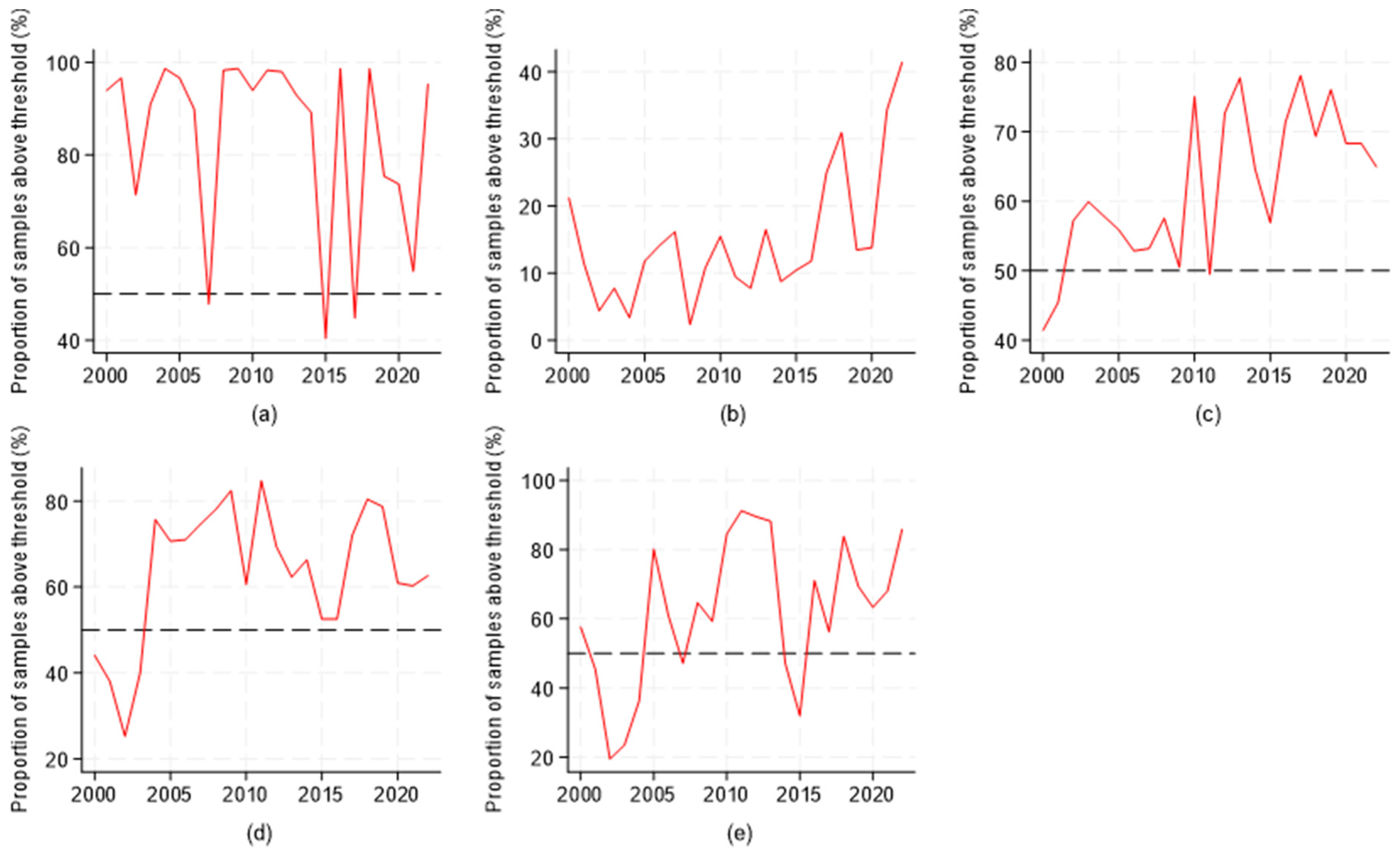
In hilly counties, LTD is more likely to trigger preventive measures directly related to cold protection, such as strengthening irrigation and water-retention capacity, implementing agronomic protective practices, and adjusting sowing dates and crop varieties to improve tolerance to low-temperature stress. At this stage, the functional complementarity generated by crop diversification can effectively reduce risk exposure and dampen the synchrony of yield fluctuations, thereby enhancing ARES. By contrast, post-threshold LTD is often associated with more severe frost damage and a higher probability of secondary losses. Constraints on irrigation safeguards and field-level protection costs intensify, and the marginal returns to adaptation investment decline; consequently, the promoting effect on ARES shifts from significant expansion to convergence. For EDD prior to the threshold, when drought exposure has not yet fully breached binding constraints, local authorities are more likely to implement stabilization-oriented measures centered on water sourcing and allocation, such as enhancing water-storage capacity, adopting water-saving irrigation, optimizing reservoir or canal distribution schedules, and introducing drought-tolerant management and planting-structure adjustments. These measures help maintain moisture stability during critical growth stages and reduce output fluctuations [24,25]. After EDD crosses the threshold into the post-threshold regime, rigid constraints on water resources are more likely to emerge and expand in a nonlinear manner. The operational boundaries of water storage capacity and irrigation scheduling capability gradually become more apparent. Moreover, because the drought propagation time and intensity undergo structural changes across the event development, persistence, and recovery stages—and because initial soil moisture conditions serve as a critical driver—the post-threshold constraints are increasingly difficult to offset through simple increases in inputs. Consequently, the positive effect exhibits a pronounced convergence [26]. Meanwhile, increases in CPRI before the threshold typically strengthen risk awareness and motivate a shift toward systemic adaptation. Improvements in irrigation and water-supply scheduling, information services, and emergency-response mechanisms promote crop diversification and the reallocation of production factors, thereby improving coordination capacity and adaptive efficiency. After CPRI crosses the threshold, the simultaneous occurrence of multiple hazards is more likely to generate shock “resonance,” weakening contingency effectiveness and exhausting adaptation instruments. This results in declining marginal benefits and convergence in effect magnitude. Figure A2a,d,e show persistently high shares of counties exceeding the thresholds for LTD, EDD, and CPRI, implying that the sample is frequently dominated by post-threshold mechanisms. This pattern aligns with the “diversity–stability” logic: crop diversity reduces risk exposure and improves stability [10], but when shocks exceed thresholds and overlap with critical phenological stages, the benefits of cross-crop asynchrony diminish, and marginal gains naturally converge.
Furthermore, in hilly counties, high temperatures simultaneously increase crop heat damage and intensify evapotranspiration and water-demand stress. Meanwhile, hilly areas often face constraints in irrigation infrastructure, field engineering, and mechanization adaptability, which delay mitigation and limit the effectiveness of “irrigation–management” offset mechanisms. After the threshold is crossed, nonlinear amplification of water and management constraints, together with elevated damage risks, reduces the marginal returns to adaptation, making the negative impact more pronounced. Combined with the rising exceedance share in Figure A2b, this suggests increasing spatial coverage and intensity of heat-induced suppression. Figure A3b,d show persistently high shares of counties exceeding the thresholds, indicating that plains are more frequently in the post-threshold exposure regime. This attenuation can be interpreted as follows: when extreme exposure becomes widespread and quasi-normalized, plains are more likely to develop large-scale adaptative and institutionalized responses, thereby reducing marginal damages. The strong negative pre-threshold effects are consistent with evidence that damage from extreme heat increases sharply in the upper tail of the temperature distribution [12,13]. For HTD, limited pre-threshold capacity for heat protection and water diversion/cooling leads to more direct yield losses and higher production volatility. After the threshold is crossed, improvements in irrigation and drainage infrastructure, mechanization, and management practices enable more effective absorption of heat shocks, thereby attenuating adverse effects. For EDD, weak pre-threshold water allocation and limited drought-relief capacity cause drought to translate more rapidly into irrigation shortfalls, amplifying pressure on stable production. After the threshold, strengthened water conservancy networks, interregional water transfers, water-saving technologies, and service systems help alleviate irrigation constraints, leading to a clear reduction in the marginal suppression of resilience induced by drought.
Under pre-threshold LTD, moderate cold exposure is more likely to prompt localities to strengthen cold-protection and insulation measures, coordinated with irrigation and field water regulation, as well as adjustments to seed quality and agronomic calendars. These measures improve the growth environment during critical stages, enhance production stability and shock resistance, and thereby increase “stable production resilience.” In the post-threshold stage, however, frost damage intensifies and cascading losses expand, increasing pressure on the buffering capacity of supplementary water storage and field engineering during countermeasures, while the marginal returns to adaptation investment diminish. As a result, the promotional effect weakens. Similarly, under pre-threshold ERD, abundant rainfall often improves yield stability by replenishing water and increasing soil moisture, while encouraging improvements in drainage systems and field management practices. After the threshold is exceeded, extreme rainfall events that cause waterlogging, flooding, and soil erosion are nonlinearly amplified. At the same time, rising constraints on governance costs and engineering investment weaken the buffering capacity of irrigation and drainage systems, thereby reducing their positive contribution to ARES. Figure A3a,c show persistently high exceedance shares, again suggesting that post-threshold exposure and mechanisms dominate in plain counties. Moreover, the finding that the CPRI coefficient becomes significantly positive in the post-threshold regime implies that when CPRI reaches sufficiently high levels, the net effect of system upgrading and adaptation investment may manifest as improved resilience in terms of stability. Given that future warming is expected to increase the probability of synchronous shocks [2], this result should be interpreted as triggered adaptation rather than as risk itself generating benefits.
In mountainous counties, under pre-threshold LTD, relatively mild cold exposure is more likely to induce mountain localities to implement adaptive management measures—such as cold protection and insulation, adjustments to the agronomic calendar, and the adoption of improved crop varieties—to enhance yield stability and production resilience. Moreover, given a certain level of governance capacity, these safeguard arrangements interact more effectively with local factor-organizing efficiency (e.g., technical services and resource allocation) [27], thereby strengthening resilience. After the threshold is exceeded, frost damage is more severe. Constrained by limited transportation conditions and lower accessibility of infrastructure in mountainous areas, the responsiveness of irrigation support and on-farm management becomes harder to mobilize effectively. After a frost event occurs, both the crop’s temperature sensitivity and the manifestation of damage exhibit lagged and duration-dependent effects, which are further controlled by the threshold temperature. As exposure intensifies, the management buffering capacity becomes increasingly difficult to sustain, leading to a higher likelihood of entering a “risk transition” regime [28] and, consequently, diminishing marginal returns to adaptation. Therefore, the positive effect converges [29]. Regarding pre-threshold HTD, excessive heat primarily triggers targeted measures such as shading and cooling, staggered irrigation schedules, and the use of heat-tolerant varieties, all of which improve shock resistance. At this stage, provided that irrigation scheduling and market entry/access are relatively smooth, management adjustments can be more effectively translated into buffering capacity. In the post-threshold period, by contrast, heat stress is compounded by worsening water scarcity, and constraints on waterworks and field operations become more stringent. As a result, the buffering role of irrigation becomes difficult to sustain, and adaptation efforts cannot offset escalating losses to the same extent, leading the positive effects to converge. Under pre-threshold EDD, drought conditions typically encourage preventive adaptation—such as enhanced water saving, improved water storage, and drought-tolerant configurations—thereby improving resilience. In the post-threshold regime, however, limited water supply due to topographical constraints and insufficient replenishment creates “hard scarcity,” under which losses expand nonlinearly. The characterization of agricultural drought indices and the selection of corresponding management strategies fundamentally depend on irrigation supply conditions and the water-balance constraint; as drought severity intensifies, the water constraint exerts a stronger influence on the feasible set of optimal irrigation decisions. This thereby reflects a decline in the capacity to “buffer” drought impacts under threshold-after conditions, i.e., reduced resilience buffering [30].
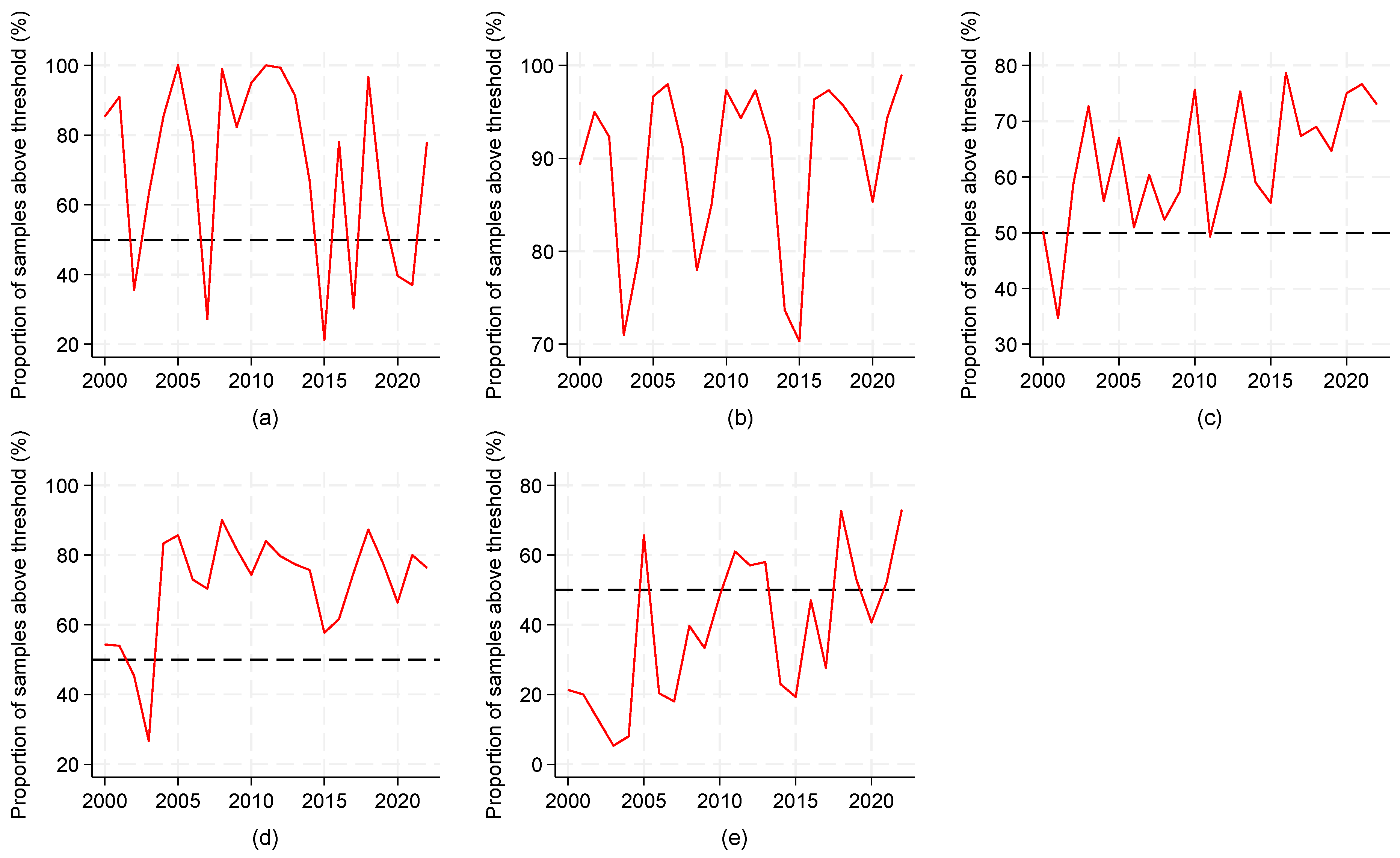
By contrast, ERD has no statistically significant effect on ARES in mountainous counties. This likely reflects the offsetting influence of two opposing mechanisms: topography-induced dispersion and rapid runoff (which can mitigate waterlogging) versus localized landslides, debris flows, and soil erosion (which can amplify damage). Moreover, substantial within-sample heterogeneity in rainfall extremes, agricultural exposure, and adaptive capacity (e.g., drainage and early-warning systems) further dilutes the average effect, yielding an insignificant estimate. Figure A4a,b indicate that a larger share of mountainous counties experience LTD and HTD shocks below the thresholds, suggesting that their impacts on ARES are predominantly driven by pre-threshold mechanisms. In contrast, Figure A4d suggests that the effect of EDD is mainly governed by post-threshold mechanisms. Meanwhile, CPRI is significantly negative both before and after the threshold, with a weaker—though still significant—effect in the post-threshold regime. This implies stronger structural vulnerability constraints when mountainous counties face compound risks: systemic pressures generate greater cumulative depletion of infrastructure and livelihood capital, causing diminishing returns—or even failure—of adaptation measures, such that the net effect becomes negative and persistently depresses ARES. The elevated and sustained mid-to-high share of counties exceeding the CPRI threshold in Figure A4e further indicates an expansion in the spatial coverage of this negative effect.
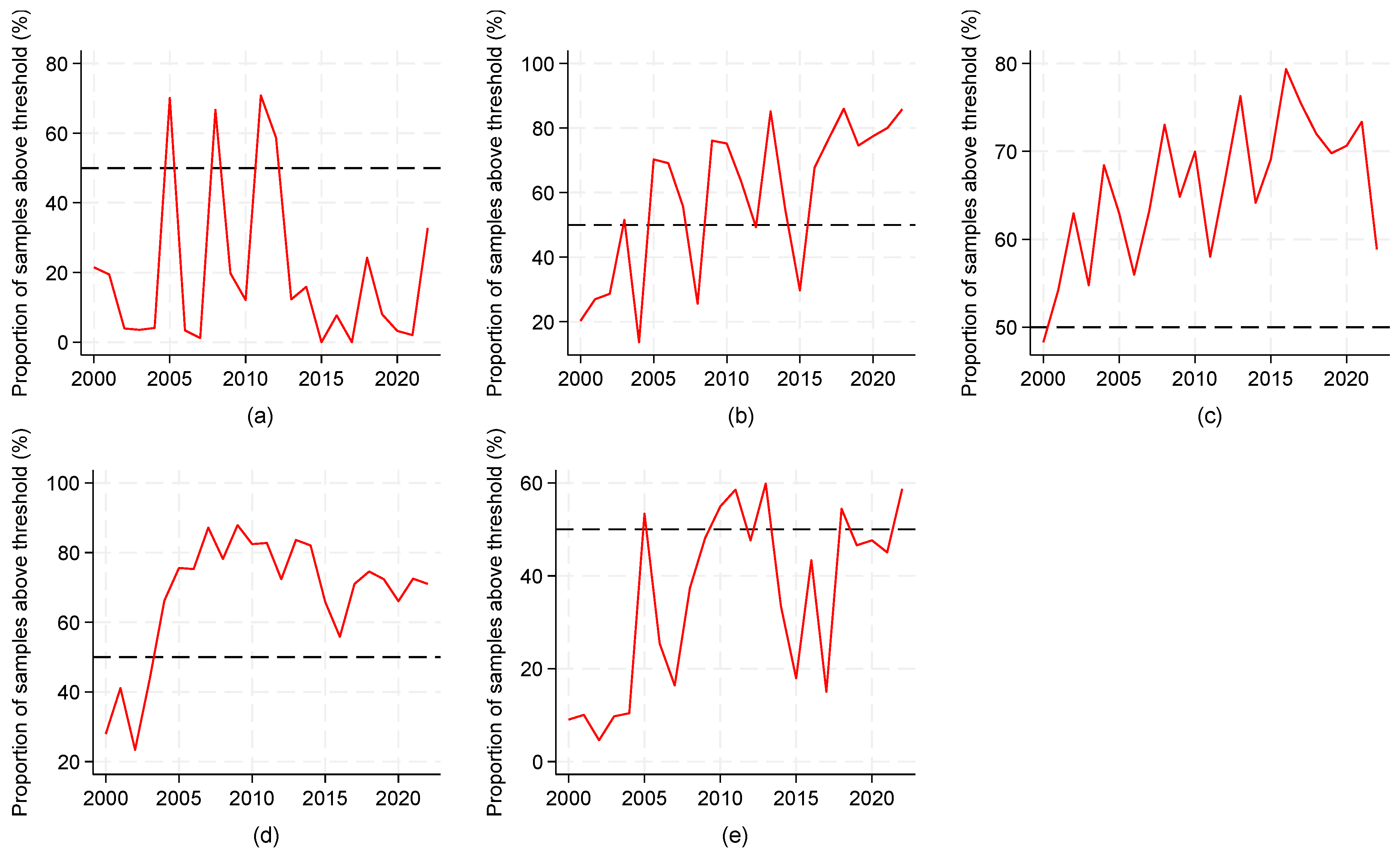
In the NKCPADs, when HTD remains below the threshold, farmers can partially offset impacts through simple measures (e.g., adjusting farming calendars, temporary irrigation, and reducing field operations), so marginal suppression remains limited. Once HTD exceeds crop physiological thresholds and coincides with water scarcity, weak irrigation security, limited drought-relief water supply, insufficient electricity, tube wells, or pipeline networks, and limited buffers from agricultural insurance and household savings make heat shocks more likely to translate into irreversible yield losses and asset damage, producing nonlinear amplification of negative effects. These counties also face persistent shortcomings in drainage and farmland water conservancy. Before ERD exceeds the threshold, moderate-to-strong rainfall more readily generates frequent waterlogging, disease outbreaks, muddy roads, and delays in fieldwork and harvesting, yet may not trigger high-level disaster relief or engineering responses. As a result, the cumulative “everyday wear and tear” on ARES is more pronounced. When ERD crosses the threshold, national and provincial/municipal emergency responses and targeted assistance are more likely to be activated, creating a floor (safety-net) effect that appears statistically as attenuated marginal suppression. For CPRI, when it lies below the threshold, multiple types of extreme climate shocks may occur more frequently without escalating into “major disasters”. In NKCPADs—where recovery capacity is weak and financial and technological constraints are binding—such recurrent shocks can continuously deplete labor, cash flow, and production inputs, thereby significantly depressing resilience. When CPRI rises to a high level, these counties are more likely to receive concentrated policy support and safety-net protection, and farmers may undertake structural adjustments, partially offsetting further increases in compound risk and leading to a convergent suppressing effect. Figure A5b,c,e indicate that NKCPADs face broader coverage of ERD, whereas coverage of HTD and CPRI is comparatively smaller.
Moreover, in NKCPADs, LTD exerts a significant suppressive effect on ARES in the pre-threshold regime but becomes significantly positive after crossing the threshold. This reversal may be attributed to the comparatively limited capacity of poverty-alleviation counties to provide irrigation and soil-moisture regulation, as well as to the generally insufficient provision of heating and insulation facilities, cold-chain and mechanized services, cold-tolerant varieties, technical training, agricultural insurance, and working capital. Under moderate cold conditions that do not necessarily constitute a “major disaster,” local stakeholders are often forced to absorb the shock passively; losses then translate directly into yield volatility, thereby weakening resilience. However, once LTD exceeds the threshold and is officially categorized as a relatively serious disaster, NKCPADs are more likely to trigger policy-based responses and experience resource reallocation toward key counties, resulting in a statistically significant net promotional effect on resilience. In addition, EDD shows a significant positive effect on the ARES of poverty-alleviation counties in the pre-threshold period but yields a significant negative effect after the threshold is crossed. This pattern may be explained by the fact that extreme moderate drought is more likely to prompt poverty-alleviation counties, within the existing poverty-support and public-service framework, to prioritize measures such as water saving, stable irrigation, and yield protection. Through more effective irrigation scheduling, increased water-storage capacity, and optimized on-farm management, the amplitude of fluctuations under constrained input conditions can be reduced, thereby strengthening resilience. After the threshold is exceeded, however, the capacity of these measures to contain escalating losses becomes limited, leading to a significant inhibitory effect. When drought duration exceeds the threshold, weaknesses in water supply and infrastructure become binding bottlenecks. Prolonged drought further depletes soil moisture and household cash flow; assistance is often limited to minimum protection and cannot offset capacity losses, so the net effect becomes significantly negative. As shown in Figure A2a,d, the long-run coverage of LTD and EDD in NKCPADs is broadly similar. This suggests that these counties are well suited to building a shared foundational capacity to cope with both cold and drought hazards, with particular attention to preventing compound cold–drought events.

5.6. From “Climate Shocks” to “Resilience Threshold Governance”

Climate risk management should not rely solely on the magnitude of average losses for resource allocation. A more feasible approach is to distinguish explicitly between two states—before and after the threshold is reached—and to incorporate post-threshold coverage into early-warning systems and decision-making.
First, when extreme climate risk has not yet surpassed the critical level, policy should focus on reducing shock intensity and limiting the extent to which risks become synchronous across regions or production links. A strategy centered on risk management and structural adjustment is likely to be more cost-effective. For example, through agricultural subsidies, technology extension, and market linkages, policymakers can encourage, within feasible limits, greater crop diversification, thereby reducing the synchronicity of yield fluctuations and maintaining stability. In addition, promoting agricultural insurance, index-based insurance, and premium subsidies linked to disaster severity can help farmers establish stable risk-hedging and recovery mechanisms under low-intensity perturbations. Meanwhile, the establishing routine early-warning and advisory system (e.g., irrigation reminders, pest and disease risk alerts, and guidance on adjustments to sowing dates or fertilization schedules) can help control costs during the pre-threshold period.
Second, once risk exceeds the threshold, relying solely on insurance or information services is often insufficient; instead, capacity building is required to modify physical risk and production constraints, together with strong and timely intervention to prevent a sharp decline in resilience. Specifically, investment should prioritize interventions that directly reduce exposure to extreme conditions (e.g., enhancing drought-resistant water sources, upgrading water-saving irrigation, and improving drainage systems). In parallel, a rapid operational pathway should be established from early warning to emergency procurement of agricultural inputs, input supply, and timely fund disbursement, thereby minimizing delays during recovery. Moreover, for small-scale operators, low-asset households, and counties characterized by high vulnerability, relatively higher subsidy rates, low-interest financing, or minimum income support and recovery subsidies should be provided to ensure that they can complete re-sowing and undertake necessary adaptation investments even after severe shocks, when financial constraints would otherwise hinder recovery.
Third, when the proportion of counties in the post-threshold state increases, resource allocation priority and emergency response levels should be raised accordingly. This approach can more directly mitigate the tail-end systemic risks that extreme climate events pose to food security.


6. Conclusions

Against the backdrop of intensifying global climate change and increasingly frequent extreme weather, enhancing the production resilience of agricultural systems has become a central issue for safeguarding agricultural security and achieving sustainable development.
Our results indicate that the evolution of ARES is not a sequence of discrete contemporaneous reactions; rather, it displays pronounced dynamic inertia and path dependence. Accumulated resilience in earlier periods significantly strengthens current coping capacity, corroborating the view of resilience as a state variable shaped by intertemporal influences from past adaptive investments, institutional responses, and structural adjustments. Building on this, this paper further reveals a piecewise nonlinear pattern in how extreme climate affects resilience dynamics: climate shocks do not simply and monotonically erode the system but instead exhibit clear threshold-switching behavior. In the full sample, HTD exerts a significant suppressive effect on resilience once the threshold is exceeded, underscoring the potential for tail heat risk to trigger systemic breakdown. By contrast, ERD and EDD display a “promotion before the threshold with marginal convergence after the threshold” pattern, while CPRI significantly depresses resilience in the pre-threshold regime, with its marginal effect becoming smoother at high exposure levels. Taken together, these findings suggest that under low-to-moderate disturbances, agricultural systems can often absorb shocks through factor reallocation and structural diversification (i.e., a buffering effect). However, when extreme exposure crosses specific thresholds and becomes more persistent, constraints on infrastructure capacity and the upper bound of adaptive capital imply that adaptation dividends may diminish—or even be exhausted.
In addition, this study reveals pronounced heterogeneity in the evolution of agricultural system resilience under different natural endowments and socioeconomic conditions. Plain counties, supported by stronger infrastructure and more organized service networks, exhibit clear adaptation-induced attenuation and resilience-repair capacity when facing threshold-crossing heat and drought shocks. By contrast, hilly and mountainous counties—constrained by topography and bottlenecks in engineered regulation and storage—are more likely to experience converging adaptation gains and amplified synchronous fluctuations once thresholds are exceeded. NKCPADs show the sharpest sign reversals across multiple extreme climate indicators, highlighting the fragile balance in vulnerable regions between limited pre-threshold defensive capacity and strong post-threshold dependence on trigger-based external assistance.
These findings provide important practical insights for reshaping the paradigm of climate-adaptation governance. The traditional, single-track resource allocation approach based on average losses is increasingly inadequate for managing complex extreme risks. Future policy design should shift toward a new paradigm that integrates “threshold governance” with “exposure-based governance.” On the one hand, policy interventions should specify explicit climate-trigger conditions: before thresholds are crossed, they should encourage crop diversification and agronomic adjustments to enhance system redundancy; after thresholds are exceeded, they should recognize the risk of exhausted adaptation dividends and prevent localized shocks from escalating into systemic, cross-regional synchronous yield losses. On the other hand, public resources should be prioritized toward areas with a high share of above-threshold counties and persistently negative resilience effects (e.g., mountainous areas and NKCPADs). Through forward-looking infrastructure upgrades and the deployment of risk-financing instruments (such as index insurance), policy can help break the low-resilience lock-in that characterizes vulnerable regions.
Finally, this study has several limitations. First, the ARES constructed in this paper mainly captures the stability dimension but cannot simultaneously measure potential trade-offs between resilience, absolute output levels, and farmers’ welfare. Second, the positive impacts or convergence effects observed after the threshold may, to some extent, reflect micro-level adaptation behaviors that are not directly observed. Third, the analysis does not account for transmission effects of compound extreme events across regions within a spatial spillover framework. Therefore, future research could further examine, from a holistic perspective, the possible complementarities or trade-offs between resilience, absolute output levels, and farmers’ welfare. In addition, more refined mechanism variables could be introduced—such as farmers’ adaptive inputs and the construction and operation–management of irrigation and water conservancy infrastructure—to achieve stronger causal identification. Moreover, as the probability of compound extreme events (e.g., the simultaneous occurrence of heatwaves and droughts) continues to rise, it will be valuable to investigate further, within a spatial spillover network framework, the interregional transmission effects of compound climate risks on ARES.

Author Contributions

H.L., writing—original draft preparation and review, editing, investigation, empirical analysis, visualization, and data curation. Z.C., review and data curation. L.Z., writing—original draft preparation and review, investigation, supervision, and conceptualization. All authors have read and agreed to the published version of the manuscript.

Funding

This study was partially supported by the Natural Science Foundation of Shandong Province, China (grant number ZR2022MG026) and the National Social Science Fund of China (grant number 22BJY153).

Data Availability Statement

The data presented in this study are available on request from the corresponding author due to the large scale and high dimensionality of the compiled panel dataset. The dataset integrates multi-source meteorological and socioeconomic information covering 1343 counties over a 24-year period. Because the data were harmonized, cleaned, and reconstructed from multiple statistical yearbooks and climate databases, the complete dataset requires accompanying data dictionaries, processing scripts, and documentation to ensure accurate interpretation and replication of the empirical results. Therefore, the data are provided upon reasonable request to the corresponding author.

Conflicts of Interest

The authors declare no conflicts of interest.

Appendix A

Figure A1. Share of counties in the post-threshold regime over time. Panels report the number of counties exceeding each threshold: (a) LTD; (b) HTD; (c) ERD; (d) EDD; and (e) CPRI. The grey dashed line indicates that the proportion of counties exceeding the threshold is 50%.
Agriculture 16 00825 g0a1
Figure A2. Share of hilly counties exceeding the threshold over time. Panels report the number of counties exceeding each threshold: (a) LTD; (b) HTD; (c) ERD; (d) EDD; and (e) CPRI. The grey dashed line indicates that the proportion of counties exceeding the threshold is 50%.
Agriculture 16 00825 g0a2
Figure A3. Share of plain counties exceeding the threshold over time. Panels report the number of counties exceeding each threshold: (a) LTD; (b) HTD; (c) ERD; (d) EDD; and (e) CPRI. The grey dashed line indicates that the proportion of counties exceeding the threshold is 50%.
Agriculture 16 00825 g0a3
Figure A4. Share of mountainous counties exceeding the threshold over time. Panels report the number of counties exceeding each threshold: (a) LTD; (b) HTD; (c) ERD; (d) EDD; and (e) CPRI. The grey dashed line indicates that the proportion of counties exceeding the threshold is 50%.
Agriculture 16 00825 g0a4
Figure A5. Share of NKCPADs exceeding the threshold over time. Panels report the number of counties exceeding each threshold: (a) LTD; (b) HTD; (c) ERD; (d) EDD; and (e) CPRI. The grey dashed line indicates that the proportion of counties exceeding the threshold is 50%.
Agriculture 16 00825 g0a5

References

  1. Lesk, C.; Rowhani, P.; Ramankutty, N. Influence of Extreme Weather Disasters on Global Crop Production. Nature 2016, 529, 84–87. [Google Scholar] [CrossRef]
  2. Tigchelaar, M.; Battisti, D.S.; Naylor, R.L.; Ray, D.K. Future Warming Increases Probability of Globally Synchronized Maize Production Shocks. Proc. Natl. Acad. Sci. USA 2018, 115, 6644–6649. [Google Scholar] [CrossRef]
  3. Lesk, C.; Coffel, E.; Winter, J.; Ray, D.; Zscheischler, J.; Seneviratne, S.; Horton, R. Stronger Temperature-Moisture Couplings Exacerbate the Impact of Climate Warming on Global Crop Yields. Nat. Food 2021, 2, 683–691. [Google Scholar] [CrossRef]
  4. Piao, S.; Ciais, P.; Huang, Y.; Shen, Z.; Peng, S.; Li, J.; Zhou, L.; Liu, H.; Ma, Y.; Ding, Y.; et al. The Impacts of Climate Change on Water Resources and Agriculture in China. Nature 2010, 467, 43–51. [Google Scholar] [CrossRef]
  5. Zhang, Q.; Zhang, W.; Li, T.; Sun, W.; Yu, Y.; Wang, G. Projective Analysis of Staple Food Crop Productivity in Adaptation to Future Climate Change in China. Int. J. Biometeorol. 2017, 61, 1445–1460. [Google Scholar] [CrossRef]
  6. Deschenes, O.; Greenstone, M. The Economic Impacts of Climate Change:: Evidence from Agricultural Output and Random Fluctuations in Weather. Am. Econ. Rev. 2007, 97, 354–385. [Google Scholar] [CrossRef]
  7. Holling, C.S. Resilience and Stability of Ecological Systems. Annu. Rev. Ecol. Syst. 1973, 4, 1. [Google Scholar] [CrossRef]
  8. Anderies, J.M.; Folke, C.; Walker, B.; Ostrom, E. Aligning Key Concepts for Global Change Policy: Robustness, Resilience, and Sustainability. Ecol. Soc. 2013, 18, 26. [Google Scholar] [CrossRef]
  9. Huang, I.Y.; Forero, O.A.; Wagner-Medina, E.V.; Florez Diaz, H.; Tremma, O.; Fargetton, X.; Lowenberg-DeBoer, J. Resilience of Food Supply Systems to Sudden Shocks: A Global Review and Narrative Synthesis. Glob. Food Secur. 2025, 44, 100842. [Google Scholar] [CrossRef]
  10. Di Falco, S.; Chavas, J. On Crop Biodiversity, Risk Exposure, and Food Security in the Highlands of Ethiopia. Am. J. Agri. Econ. 2009, 91, 599–611. [Google Scholar] [CrossRef]
  11. Zampieri, M.; Ceglar, A.; Dentener, F.; Toreti, A. Wheat Yield Loss Attributable to Heat Waves, Drought and Water Excess at the Global, National and Subnational Scales. Environ. Res. Lett. 2017, 12, 064008. [Google Scholar] [CrossRef]
  12. Schlenker, W.; Roberts, M.J. Nonlinear Temperature Effects Indicate Severe Damages to U.S. Crop Yields under Climate Change. Proc. Natl. Acad. Sci. USA 2009, 106, 15594–15598. [Google Scholar] [CrossRef]
  13. Butler, E.E.; Huybers, P. Variations in the Sensitivity of US Maize Yield to Extreme Temperatures by Region and Growth Phase. Environ. Res. Lett. 2015, 10, 034009. [Google Scholar] [CrossRef]
  14. Chen, X.; Wang, H.; Zhu, X.; Zhang, X. Spatial-Temporal Characteristics of Agricultural Economic Resilience and Spatial Spillover Effects of Driving Factors: Evidence from Provincial Panel Data in China. Front. Environ. Sci. 2025, 13, 1437018. [Google Scholar] [CrossRef]
  15. Seekell, D.; Carr, J.; Dell’Angelo, J.; D’Odorico, P.; Fader, M.; Gephart, J.; Kummu, M.; Magliocca, N.; Porkka, M.; Puma, M.; et al. Resilience in the Global Food System. Environ. Res. Lett. 2017, 12, 025010. [Google Scholar] [CrossRef]
  16. Dell, M.; Jones, B.F.; Olken, B.A. Temperature Shocks and Economic Growth: Evidence from the Last Half Century. Am. Econ. J.-Macroecon. 2012, 4, 66–95. [Google Scholar] [CrossRef]
  17. Machefer, M.; Zampieri, M.; van der Velde, M.; Dentener, F.; Claverie, M.; d’Andrimont, R. Earth Observation Based Multi-Scale Analysis of Crop Diversity in the European Union: First Insights for Agro-Environmental Policies. Agric. Ecosyst. Environ. 2024, 374, 109143. [Google Scholar] [CrossRef]
  18. Zampieri, M.; Weissteiner, C.J.; Grizzetti, B.; Toreti, A.; van den Berg, M.; Dentener, F. Estimating Resilience of Crop Production Systems: From Theory to Practice. Sci. Total Environ. 2020, 735, 139378. [Google Scholar] [CrossRef]
  19. Zampieri, M.; Toreti, A.; Ceglar, A.; De Palma, P.; Chatzopoulos, T.; Michetti, M. Analysing the Resilience of Agricultural Production Systems with ResiPy, the Python Production Resilience Estimation Package. SoftwareX 2021, 15, 100738. [Google Scholar] [CrossRef]
  20. Guo, K.; Ji, Q.; Zhang, D. A Dataset to Measure Global Climate Physical Risk. Data Brief 2024, 54, 110502. [Google Scholar] [CrossRef]
  21. Holling, C.S. Surprise for science, resilience for ecosystems, and incentives for people. Ecol. Appl. 1996, 6, 733. [Google Scholar] [CrossRef]
  22. Jiao, S.; Qi, J.; Jin, C.; Liu, Y.; Wang, Y.; Pan, H.; Chen, S.; Liang, C.; Peng, Z.; Chen, B.; et al. Core Phylotypes Enhance the Resistance of Soil Microbiome to Environmental Changes to Maintain Multifunctionality in Agricultural Ecosystems. Glob. Change Biol. 2022, 28, 6653–6664. [Google Scholar] [CrossRef]
  23. MacArthur, R. Fluctuations of Animal Populations and a Measure of Community Stability. Ecology 1955, 36, 533. [Google Scholar] [CrossRef]
  24. Yang, M.; Xiao, W.; Zhao, Y.; Li, X.; Lu, F.; Lu, C.; Chen, Y. Assessing Agricultural Drought in the Anthropocene: A Modified Palmer Drought Severity Index. Water 2017, 9, 725. [Google Scholar] [CrossRef]
  25. Zhang, F.; Cui, N.; Guo, S.; Yue, Q.; Jiang, S.; Zhu, B.; Yu, X. Irrigation Strategy Optimization in Irrigation Districts with Seasonal Agricultural Drought in Southwest China: A Copula-Based Stochastic Multiobjective Approach. Agric. Water Manag. 2023, 282, 108293. [Google Scholar] [CrossRef]
  26. Xu, Z.; Jiang, B.; Guo, X.; Wu, Z.; Fan, S. Initial Soil Moisture Conditions Dominate Variation in Event-Scale Propagation Time from Meteorological to Agricultural Drought. Agric. Water Manag. 2026, 325, 110128. [Google Scholar] [CrossRef]
  27. Frederiks, T.M.; Christopher, J.T.; Sutherland, M.W.; Borrell, A.K. Post-Head-Emergence Frost in Wheat and Barley: Defining the Problem, Assessing the Damage, and Identifying Resistance. J. Exp. Bot. 2015, 66, 3487–3498. [Google Scholar] [CrossRef]
  28. Tschurr, F.; Kirchgessner, N.; Hund, A.; Kronenberg, L.; Anderegg, J.; Walter, A.; Roth, L. Frost Damage Index: The Antipode of Growing Degree Days. Plant Phenomics 2023, 5, 0104. [Google Scholar] [CrossRef]
  29. Gabbrielli, M.; Perego, A.; Acutis, M.; Bechini, L. A Review of Crop Frost Damage Models and Their Potential Application to Cover Crops. Ital. J. Agron. 2022, 17, 2046. [Google Scholar] [CrossRef]
  30. Mahdavimanshadi, M.; Fan, N. Multistage Stochastic Optimization for Semi-Arid Farm Crop Rotation and Water Irrigation Scheduling Under Drought Scenarios. J. Agric. Biol. Environ. Stat. 2025, 30, 310–333. [Google Scholar] [CrossRef]
Figure 1. Concepts and framework.
Agriculture 16 00825 g001
Figure 2. Temporal trends of ARES and climate risk.
Agriculture 16 00825 g002
Figure 3. Kernel density distributions of key variables.
Agriculture 16 00825 g003
Figure 4. LR test results from the estimated dynamic panel threshold model for the impact of extreme climate variables on ARES in the full sample. (a) LTD; (b) HTD; (c) EDD; (d) ERD; and (e) CPRI. Panels (ae) plot the profile likelihood-ratio (LR) statistics for the threshold parameter. The green dashed line denotes the critical value at the specified significance level. Values of the threshold parameter for which the LR statistic lies below the critical value constitute the confidence interval, indicating the estimated threshold range.
Agriculture 16 00825 g004
Figure 5. LR test results from the estimated dynamic threshold model for the impact of extreme climate variables on ARES in counties in hilly regions: (a) LTD; (b) HTD; (c) EDD; (d) ERD; and (e) CPRI.
Agriculture 16 00825 g005
Figure 6. LR test results from the estimated dynamic threshold model for the impact of extreme climate variables on ARES in plain counties: (a) LTD; (b) HTD; (c) EDD; (d) ERD; and (e) CPRI.
Agriculture 16 00825 g006
Figure 7. LR test results from the estimated dynamic threshold model for the impact of extreme climate variables on ARES in counties in mountainous regions: (a) LTD; (b) HTD; (c) EDD; (d) ERD; and (e) CPRI.
Agriculture 16 00825 g007
Figure 8. LR test results from the estimated dynamic threshold model for the impact of extreme climate variables on ARES in NKCPADs: (a) LTD; (b) HTD; (c) EDD; (d) ERD; and (e) CPRI.
Agriculture 16 00825 g008
Table 1. Descriptive statistics of the variables.
VariableDescriptionObsMeanStd. Dev.MinMax
ARESAgricultural production resilience29,4631.9500.896−4.5267.734
LTDExtreme low-temperature days29,46319.5837.9680.00050.680
HTDExtreme high-temperature days29,46344.24612.5340.000111.710
ERDExtreme rainfall days29,46322.64918.1780.000306.250
EDDExtreme drought days29,46317.94311.8680.000100.000
CPRIClimate physical risk index29,46326.1056.5230.340102.690
GDPPer capita gross domestic product28,1829.6420.8248.25110.821
ADI Gross agricultural output value28,18211.8720.57610.94312.993
CLACultivated land area29,4636.0270.0255.9856.082
TAMTotal power of agricultural machinery28,1823.0450.3602.4233.612
CFAChemical fertilizer application29,4639.2960.1498.8979.478
EIA Effective irrigated area29,4632.6290.2692.1483.328
RECRural electricity consumption (10,000 kWh)29,4638.6170.4517.8459.319
EPIEmployees in the primary industry26,9019.9490.5969.21412.129
Table 2. Unit root tests for variables.
Panel A: Dependent Variable and Core Independent Variables
VariableARESLTDHTDERDEDDCPRI
Adjusted t−32.805−46.075−57.355−72.919−29.746−36.199
p-value0.0000.0000.0000.0000.0000.000
Panel B: Control Variables
VariableGDPADICLATAMCFAEIARECEPI
Adjusted t−21.240−21.077−25.268−43.874−690.0−590.00−180.0−26.139
p-value0.0000.0000.0000.0000.0000.0000.0000.000
Table 3. Correlation analysis of variables.
ARESLTDHTDERDEDDCPRIGDPADICLATAMCFAEIAREC
LTD−0.0627
HTD−0.0201−0.1489
ERD−0.0475−0.0036−0.075
EDD0.0430−0.01480.25−0.0537
CPRI−0.04220.24020.50850.61460.5491
GDP0.0728−0.10290.25060.19730.20070.3172
ADI0.0916−0.11010.25670.19280.20330.31610.9839
CLA−0.0387−0.248−0.1388−0.0254−0.2545−0.2842−0.5383−0.5067
TAM0.0809−0.10460.24320.19090.20290.30980.99560.983−0.5588
CFA−0.0437−0.1809−0.03960.06620.0358−0.01620.41040.3033−0.32250.3936
EIA0.11240.19950.0891−0.02340.05970.1201−0.02530.0867−0.03480.0086−0.7106
REC0.0345−0.07070.21540.18740.19520.30110.95470.9089−0.51170.93650.502−0.2083
EPI0.1364−0.18080.22280.17030.12620.22530.81230.878−0.2410.82830.02750.39890.6399
Table 4. Estimation results from the DPTM.
Variable(1)(2)(3)(4)(5)
L.ARES0.5632 ***0.5919 ***0.5849 ***0.5459 ***0.5320 ***
(0.0138)(0.0141)(0.0149)(0.0145)(0.0163)
Climate (Climate ≤ τ)−0.00160.00060.0109 ***0.0242 ***−0.0045 *
(0.0022)(0.0017)(0.0034)(0.0038)(0.0026)
Climate (Climate > τ)0.0035 ***−0.0022 **0.0020 ***0.0038 ***0.0001
(0.0010)(0.0010)(0.0007)(0.0009)(0.0017)
GDP−0.01870.4953 ***0.2219 ***0.1918 **0.1783 **
(0.0816)(0.0916)(0.0784)(0.0762)(0.0881)
ADI0.5519 ***0.5302 ***0.5257 ***0.4746 ***0.4984 ***
(0.0619)(0.0615)(0.0605)(0.0597)(0.0596)
CLA−1.0217 **−1.5572 ***−1.5497 ***−1.7378 ***−1.4095 ***
(0.4224)(0.4101)(0.4032)(0.4034)(0.3879)
TAM0.0011−0.7061 ***−0.3957 ***−0.3162 **−0.2316
(0.1584)(0.1594)(0.1479)(0.1430)(0.1525)
CFA0.3328 ***0.1731 ***0.3252 ***0.2179 ***0.3116 ***
(0.0553)(0.0575)(0.0545)(0.0548)(0.0555)
EIA−0.01830.0993 **0.1429 ***0.1096 ***0.1073 **
(0.0455)(0.0438)(0.0434)(0.0420)(0.0428)
REC0.3443 ***0.3307 ***0.4102 ***0.4100 ***0.3866 ***
(0.0535)(0.0550)(0.0522)(0.0530)(0.0535)
EPI−1.3232 ***−1.6634 ***−1.5241 ***−1.4326 ***−1.4998 ***
(0.0802)(0.0801)(0.0751)(0.0738)(0.0808)
Constant7.9350 ***13.3278 ***11.3078 ***13.2933 ***11.1733 ***
(2.8204)(2.7857)(2.7110)(2.7293)(2.6467)
Obs25,620 25,620 25,620 25,620 25,620
Group1281 1281 1281 1281 1281
Threshold19.82 43.42 14.84 13.27 30.92
Notes: 1. ***, **, and * denote significance at the 1%, 5%, and 10% levels, respectively. 2. Standard errors are reported in parentheses. 3. The climate variables in Models (1)–(5) are LTD, HTD, ERD, EDD, and CPRI, respectively.
Table 5. Estimation results from the DPTM for hilly counties.
Variable(1)(2)(3)(4)(5)
L.ARES0.4087 ***0.4647 ***0.3882 ***0.3561 ***0.3884 ***
(0.0067)(0.0068)(0.0053)(0.0054)(0.0072)
Climate (Climate ≤ τ)0.0271 ***−0.0021 ***0.0027 ***0.0301 ***0.0104 ***
(0.0009)(0.0003)(0.0007)(0.0011)(0.0010)
Climate (Climate > τ)0.0068 ***−0.0025 ***0.0023 ***0.0018 ***0.0068 ***
(0.0002)(0.0003)(0.0002)(0.0003)(0.0006)
GDP0.2169***0.3820 ***0.1172 ***0.2417 ***0.1887 ***
(0.0244)(0.0312)(0.0213)(0.0302)(0.0350)
ADI0.4406 ***0.3439 ***0.3091 ***0.3231 ***0.2705 ***
(0.0295)(0.0347)(0.0242)(0.0168)(0.0225)
CLA0.5219 ***−0.8737 ***−1.0474 ***−0.7731 ***−0.8574 ***
(0.1407)(0.1101)(0.1295)(0.0968)(0.1561)
TAM0.5916 ***0.08640.5235 ***0.4325 ***0.4861 ***
(0.0425)(0.0529)(0.0505)(0.0543)(0.0775)
CFA0.6238 ***0.5147 ***0.5088 ***0.4360 ***0.5038 ***
(0.0252)(0.0255)(0.0284)(0.0258)(0.0181)
EIA0.2658 ***0.2594 ***0.2378 ***0.2560 ***0.2328 ***
(0.0127)(0.0136)(0.0206)(0.0121)(0.0076)
REC−0.01120.1298 ***0.1826 ***0.1162 ***0.1460 ***
(0.0198)(0.0179)(0.0220)(0.0187)(0.0208)
EPI−1.6381 ***−1.5961 ***−1.4607 ***−1.4962 ***−1.4589 ***
(0.0323)(0.0415)(0.0223)(0.0205)(0.0277)
Constant−1.18697.8595 ***8.8598 ***7.6930 ***7.8030 ***
(1.0168)(0.8288)(0.9670)(0.7400)(0.8796)
Obs5940 5940 5940 5940 5940
Group297 297 297 297 297
Threshold11.71 55.29 17.19 12.07 24.29
Notes: 1. *** denotes significance at the 1% level. 2. Standard errors are reported in parentheses. 3. The climate variables in Models (1)–(5) are LTD, HTD, ERD, EDD, and CPRI, respectively.
Table 6. Estimation results from the DPTM for plain counties.
Variable(1)(2)(3)(4)(5)
L.ARES0.3911 ***0.3940 ***0.4036 ***0.4363 ***0.4014 ***
(0.0044)(0.0055)(0.0061)(0.0068)(0.0059)
Climate (Climate ≤ τ)0.0260 ***−0.0129 ***0.0074 ***−0.0217 ***0.0006
(0.0006)(0.0006)(0.0007)(0.0012)(0.0004)
Climate (Climate > τ)0.0113 ***−0.0047 ***0.0026 ***−0.0009 ***0.0048 ***
(0.0003)(0.0002)(0.0001)(0.0003)(0.0003)
GDP0.1799 ***0.3591 ***0.1293 ***0.1896 ***−0.0516
(0.0335)(0.0341)(0.0328)(0.0383)(0.0322)
ADI0.6629 ***0.5556 ***0.5985 ***0.5514 ***0.5912 ***
(0.0210)(0.0264)(0.0265)(0.0309)(0.0271)
CLA−2.2911 ***−3.4657 ***−3.7698 ***−3.0678 ***−3.2570 ***
(0.1387)(0.1737)(0.1843)(0.1419)(0.1451)
TAM−0.4135 ***−0.8303 ***−0.5380 ***−0.4819 ***−0.2954 ***
(0.0600)(0.0651)(0.0612)(0.0525)(0.0685)
CFA0.2740 ***0.1553 ***0.2331 ***0.1908 ***0.2939 ***
(0.0250)(0.0315)(0.0213)(0.0285)(0.0213)
EIA−0.0693 ***−0.01810.0265−0.0226−0.0475 ***
(0.0134)(0.0222)(0.0178)(0.0173)(0.0145)
REC0.0563 ***0.1494 ***0.2267 ***0.1811 ***0.2103 ***
(0.0200)(0.0214)(0.0189)(0.0172)(0.0219)
EPI−1.2118 ***−1.2018 ***−1.1930 ***−1.2090 ***−1.0219 ***
(0.0422)(0.0381)(0.0342)(0.0275)(0.0221)
Constant15.6877 ***24.1503 ***24.8897 ***21.5973 ***20.9515 ***
(0.8377)(1.2943)(1.2144)(1.1186)(0.9928)
Obs6000 6000 6000 6000 6000
Group300 300 300 300 300
Threshold14.86 29.28 12.50 11.02 27.68
Notes: 1. *** denotes significance at the 1% level. 2. Standard errors are reported in parentheses. 3. The climate variables in Models (1)–(5) are LTD, HTD, ERD, EDD, and CPRI, respectively.
Table 7. Estimation results from the DPTM for mountainous counties.
Variable(1)(2)(3)(4)(5)
L.ARES0.5605 ***0.5580 ***0.5800 ***0.5493 ***0.5080 ***
(0.0125)(0.0133)(0.0129)(0.0122)(0.0145)
Climate (Climate ≤ τ)0.0122 ***0.0092 ***−0.00380.0176 ***−0.0117 ***
(0.0013)(0.0016)(0.0030)(0.0045)(0.0023)
Climate (Climate > τ)0.0073 ***0.0020 **−0.00050.0001−0.0056 ***
(0.0008)(0.0009)(0.0007)(0.0008)(0.0017)
GDP0.13150.4622 ***0.2290 ***0.1930 **0.2523 ***
(0.0843)(0.0902)(0.0855)(0.0818)(0.0829)
ADI0.4355 ***0.4467 ***0.5203 ***0.4534 ***0.5116 ***
(0.0639)(0.0681)(0.0665)(0.0685)(0.0623)
CLA−1.9820 ***−0.7850 *−1.1069 ***−1.7793 ***−0.8518 **
(0.4389)(0.4540)(0.4216)(0.4216)(0.3859)
TAM−0.2980 *−0.3214 **−0.2410−0.1538−0.0900
(0.1527)(0.1607)(0.1506)(0.1363)(0.1445)
CFA0.1406 **0.01730.2193 ***0.05590.1968 ***
(0.0608)(0.0636)(0.0606)(0.0630)(0.0577)
EIA−0.1235 ***0.05990.0475−0.03250.0831 *
(0.0474)(0.0482)(0.0479)(0.0457)(0.0444)
REC0.5937 ***0.4140 ***0.4906 ***0.5212 ***0.4333 ***
(0.0577)(0.0585)(0.0546)(0.0548)(0.0550)
EPI−1.5337 ***−1.8750 ***−1.7532 ***−1.6981 ***−1.8172 ***
(0.0812)(0.0888)(0.0791)(0.0764)(0.0808)
Constant16.4831 ***11.6677 ***11.1643 ***17.0349 ***10.7181 ***
(2.9189)(3.0432)(2.9340)(2.9520)(2.6332)
Obs11,720 11,720 11,720 11,720 11,720
Group586 586 586 586 586
Threshold24.32 41.89 14.84 11.02 27.68
Notes: 1. ***, **, and * denote significance at the 1%, 5%, and 10% levels, respectively. 2. Standard errors are reported in parentheses. 3. The climate variables in Models (1)–(5) are LTD, HTD, ERD, EDD, and CPRI, respectively.
Table 8. Estimation results from the DPTM for NKCPADs.
Variable(1)(2)(3)(4)(5)
L.ARES0.5207 ***0.5146 ***0.5356 ***0.4855 ***0.4675 ***
(0.0054)(0.0054)(0.0060)(0.0054)(0.0072)
Climate (Climate ≤ τ)−0.0047 ***−0.0007 *−0.0082 ***0.0160 ***−0.0102 ***
(0.0014)(0.0004)(0.0010)(0.0008)(0.0008)
Climate (Climate > τ)0.0056 ***−0.0023 ***−0.0026 ***−0.0010 ***−0.0053 ***
(0.0004)(0.0002)(0.0002)(0.0003)(0.0006)
GDP−0.2068 ***0.1639 ***0.0005−0.00290.0310
(0.0271)(0.0286)(0.0406)(0.0361)(0.0343)
ADI0.5506 ***0.6523 ***0.6097 ***0.6384 ***0.6170 ***
(0.0250)(0.0242)(0.0289)(0.0210)(0.0208)
CLA0.9661 ***0.7073 ***0.5234 ***0.24330.5047 ***
(0.1922)(0.1410)(0.1912)(0.2094)(0.1292)
TAM0.2336 ***−0.2070 ***−0.1280 *0.0204−0.1240 **
(0.0603)(0.0586)(0.0701)(0.0664)(0.0528)
CFA0.4382 ***0.3390 ***0.4109 ***0.3433 ***0.4058 ***
(0.0253)(0.0197)(0.0321)(0.0351)(0.0295)
EIA0.0607 ***0.1949 ***0.1765 ***0.1762 ***0.1995 ***
(0.0227)(0.0182)(0.0272)(0.0205)(0.0170)
REC0.4334 ***0.3334 ***0.4281 ***0.4054 ***0.3941 ***
(0.0260)(0.0212)(0.0287)(0.0256)(0.0226)
EPI−1.0382 ***−1.4214 ***−1.2376 ***−1.3764 ***−1.2687 ***
(0.0378)(0.0239)(0.0407)(0.0309)(0.0293)
Constant−7.6746 ***−4.1309 ***−4.4861 ***−1.3896−3.8622 ***
(1.2059)(0.9953)(1.3611)(1.4617)(0.9561)
Obs6380 6380 6380 6380 6380
Group319 319 319 319 319
Threshold12.25 48.20 14.84 17.46 31.12
Notes: 1. ***, **, and * denote significance at the 1%, 5%, and 10% levels, respectively. 2. Standard errors are reported in parentheses. 3. The climate variables in Models (1)–(5) are LTD, HTD, ERD, EDD, and CPRI, respectively.
Disclaimer/Publisher’s Note: The statements, opinions and data contained in all publications are solely those of the individual author(s) and contributor(s) and not of MDPI and/or the editor(s). MDPI and/or the editor(s) disclaim responsibility for any injury to people or property resulting from any ideas, methods, instructions or products referred to in the content.