Article

Optimized Decision Model for Soil-Moisture Control Lower Limits and Evapotranspiration-Based Irrigation Replenishment Ratios Based on AquaCrop-OSPy, PyFAO56, and NSGA-II and Its Application


1
College of Resources and Environment, Qingdao Agricultural University, Qingdao 266109, China
2
College of Resources and Environment, China Agricultural University, Beijing 100193, China
3
Department of Plant Nutrition, College of Resources and Environmental Sciences, National Academy of Agriculture Green Development, China Agricultural University, Beijing 100193, China
4
Agriculture and Rural Affairs Bureau of Laoling City, Dezhou 253000, China
5
Precision Agriculture Center, Department of Soil, Water and Climate, University of Minnesota, St. Paul, MN 55108, USA
6
Department of Internet of Things Engineering, School of Artificial Intelligence and Computer Science, Anqing Normal University, Anqing 246133, China
7
Anhui Yigang Information Technology Co., Ltd., Anqing 246100, China
8
Department of Agricultural Technology, Center for Precision Agriculture, Norwegian Institute of Bioeconomy Research (NIBIO), Apelsvoll, Nylinna 226, 2849 Kapp, Norway
*
Authors to whom correspondence should be addressed.
These authors contributed equally to this work.
Agriculture 2026, 16(7), 806; https://doi.org/10.3390/agriculture16070806
Submission received: 16 February 2026 / Revised: 25 March 2026 / Accepted: 2 April 2026 / Published: 4 April 2026
(This article belongs to the Topic Water Management in the Age of Climate Change)

Abstract

As water resources are becoming increasingly scarce in the North China Plain, irrigation strategies that simultaneously improve grain yield and reduce irrigation water input are needed for winter wheat (Triticum aestivum L.) production. Current irrigation decision rules are based either on fixed soil moisture thresholds or on evapotranspiration (ET)-based ratios applied uniformly across the growing season, limiting their flexibility for growth stage-specific irrigation management. In this study, a multi-objective simulation optimization framework was developed to jointly optimize soil moisture lower control limits (irrigation trigger thresholds) and evapotranspiration-based irrigation replenishment ratios across key winter wheat growth stages. The framework integrated the AquaCrop-OSPy crop model with the PyFAO56 soil moisture balance, irrigation scheduling model and the NSGA-II evolutionary optimization algorithm. A field experiment was conducted during the 2024–2025 growing season in Laoling City, Shandong Province, China, employing a four-dense–one-sparse strip cropping pattern with two irrigation treatments: T1 (subsurface sprinkler irrigation) and T2 (shallow subsurface drip irrigation). The AquaCrop-OSPy model was calibrated and validated using measured canopy cover, aboveground biomass, grain yield, and soil moisture content in the 0–60 cm soil layer. Simulated canopy cover and grain yield showed good agreement with observations, with the coefficient of determination (R2) ranging from 0.87 to 0.94. For grain yield, the normalized root mean square error (NRMSE) ranged from 2.24% to 3.75%, and the root mean square error (RMSE) ranged from 0.29 to 0.54 t·ha−1. For aboveground biomass, R2 was 0.99, while RMSE ranged from 1.02 to 1.11 t·ha−1, and NRMSE ranged from 14.25% to 15.49%. The PyFAO56 irrigation strategy model simulated average root-zone soil-moisture dynamics with satisfactory accuracy, with an R2 of 0.86 and an RMSE of 5%. Multi-objective optimization (maximizing yield while minimizing irrigation volume) generated 23 Pareto-optimal irrigation strategies, with irrigation volumes ranging from 51 to 128 mm, corresponding yields ranging from 9.8 to 10.8 t·ha−1, and irrigation water use efficiency (IWUE) ranging from 0.08 to 0.19 t·ha−1·mm−1. Correlation analysis within the Pareto set indicated that soil-moisture control lower limits during the regreening–jointing stage and higher soil-moisture control lower limits during the flowering–maturity stage were key controlling factors for achieving high yields and irrigation water use efficiency. The Entropy-Weighted Ranked Minimum Distance method identified an optimal irrigation scheme involving two irrigations (one at the end of the jointing stage and another at the beginning of the grain filling stage) involving an irrigation depth of 75 mm, achieving a simulated yield of 10.4 t·ha−1 and an IWUE of 0.16 t·ha−1·mm−1. The proposed AquaCrop-PyFAO56-NSGA-II framework provides a flexible, process-based workflow for jointly optimizing irrigation control thresholds and evapotranspiration-based irrigation replenishment ratios across different winter wheat growth stages. Under the monitored conditions of the 2024–2025 wet season, the framework identified a two-irrigation strategy that balanced grain yield and irrigation input. This study should, therefore, be regarded as a proof-of-concept evaluation conducted in a well-instrumented single-site field setting rather than as a universally transferable recommendation. Because model calibration, within-season validation, and optimization were all based on one wet growing season at one site, the derived stage-specific thresholds, Pareto front, and S5 recommendation are most applicable to hydro-climatic conditions similar to the study year and should be further tested across contrasting year-types and locations before broader extrapolation.

1. Introduction

Winter wheat (Triticum aestivum L.) is one of the world’s three major cereal crops, serving as the staple food for over 35% of the global population [1,2]. In arid and semi-arid regions, wheat production has long faced water deficits, leading to yield losses due to water stress as high as 50–60% [3]. Therefore, achieving high wheat yields with efficient water use under limited water resources requires precise monitoring of crop and soil moisture conditions, enabling rapid decision-making for timely irrigation [4,5]. One commonly used precision irrigation method is to make irrigation decisions based on evapotranspiration and water balance (ET-WB), which estimates the crop evapotranspiration and soil moisture deficit using meteorological data to determine the irrigation rate by setting an irrigation threshold. Another approach is to make irrigation decisions based on soil moisture directly monitored using soil moisture sensing. The irrigation gets triggered when the soil moisture content or water potential drops to the preset threshold. Compared with traditional irrigation methods that rely on a farmer’s experience, these two precision methods can typically save irrigation water and increase yield [6,7].
The ET-WB irrigation decision-making method has demonstrated excellent applicability in optimizing winter wheat irrigation regimes. For instance, a three-year field study indicated that under sprinkler irrigation conditions for winter wheat in the North China Plain, applying a water supply rate equal to 0.63 times the cumulative net evaporation yielded higher production and water use efficiency (WUE) [8]. Another study determined winter wheat irrigation rates using the difference between E601 evaporimeter evaporation and concurrent rainfall. The results suggested that a coefficient of approximately 1.25 maximized grain yield, whereas higher WUE could be achieved by appropriately reducing this coefficient [9]. However, current ET–WB-based irrigation scheduling approaches often apply a fixed control strategy across the entire growing season, limiting stage-specific adjustments with room for further improvement. Moreover, these approaches primarily regulate the irrigation amount, while providing relatively limited refinement of irrigation timing.
Relevant studies have conducted comparative trials by implementing soil moisture monitoring and supplemental irrigation treatments at different soil layers during the jointing stage, flowering stage, and entire growth period, contrasting these with conventional irrigation or various supplemental irrigation standards. Relevant studies have shown that soil-moisture-based irrigation in winter wheat should not be interpreted as a single invariant threshold across the whole growing season. Instead, the lower limit of irrigation control should vary according to crop water sensitivity at different growth stages. Previous experiments based on soil moisture monitoring at the wintering, jointing, and flowering or anthesis stages, or within different monitored soil layers, generally maintained relative soil moisture within approximately 65–75% during critical periods and demonstrated that stage-specific threshold regulation could reduce total water consumption while maintaining or improving grain yield, WUE, and irrigation benefits [10,11,12]. It should be noted that existing irrigation strategies based on soil moisture conditions have two limitations: (i) they predominantly employ a fixed lower threshold for soil moisture content throughout the entire crop growth period, without accounting for the stage-specific water sensitivity of winter wheat, whose water requirements differ between vegetative growth, reproductive development, and grain filling, and (ii) they typically specify only the trigger conditions for irrigation timing, neglecting the importance of controlling the volume of water applied per irrigation event.
Despite the demonstrated field-level effectiveness of the ET-WB and soil-moisture-based irrigation scheduling methods, their practical applications are still largely constrained by stage-invariant control rules and by the decoupled regulation of irrigation timing and amount. A promising approach is to use process-based crop models that can mechanistically link water supply to crop growth and yield formation to systematically assess and optimize stage-specific composite strategies that jointly control a soil-moisture trigger threshold and an ET-WB-based replenishment ratio.
Unlike the DSSAT crop model [13,14] and the WOFOST crop model [15,16], the AquaCrop model employs water as its primary driver with simplified parameters, focusing specifically on WUE. Through multi-scenario simulations, AquaCrop has been employed to evaluate winter wheat yield and WUE under varying precipitation patterns and irrigation schemes, aiming to optimize irrigation volume and timing [17]. These applications demonstrated that AquaCrop could simulate fundamental irrigation management strategies, including full irrigation and fixed-pattern deficit irrigation, providing decision support for timing, frequency, and volume of irrigation [18,19]. However, AquaCrop’s built-in irrigation control methods remain relatively limited, with the model capable of directly controlling only a restricted set of irrigation strategies [20]. AquaCrop can only set fixed soil moisture content thresholds for triggering irrigation throughout the entire growth period or perform full irrigation at 100% evapotranspiration. It cannot flexibly adjust these two variables for different crop growth stages, making it difficult to meet the demands of precision irrigation.
Consequently, there is a lack of research on utilizing models to simulate composite irrigation strategies that simultaneously control both irrigation timing and water volume, such as “soil-moisture control lower limit and evapotranspiration-based irrigation replenishment ratios” across crop growth stages. Therefore, it is necessary to incorporate composite irrigation control models into crop models to simulate and evaluate the effects of such strategies on winter wheat yield and WUE.
To achieve more flexible irrigation scheduling simulations, this study incorporates the PyFAO56 irrigation strategy model. PyFAO56 is an open-source Python implementation based on the ASCE standard reference evapotranspiration and FAO56 dual-crop coefficient soil moisture balance method. It provides water stress calculation options consistent with AquaCrop and facilitates customized extensions of irrigation rules. Compared to traditional spreadsheet tools, Python’s modularity and automation enhance the reusability and maintainability of ET-based irrigation scheduling while also facilitating integration with precision irrigation scenarios [21]. In PyFAO56, irrigation timing can be triggered by setting lower control limits for different growth stages. Irrigation activates when root-zone soil moisture depletion (Dr) reaches a specified ratio (P) of the raw water requirement (RAW) relative to field capacity or when the crop water stress coefficient falls below a threshold. Irrigation volume can be replenished as a percentage of the reference crop evapotranspiration (ET), with additional constraints such as maximum application limits or interval restrictions (e.g., maximum single-session volume and weekly maximum irrigation frequency) to form specific irrigation instructions. This “soil-moisture control lower limit–soil moisture control threshold and percentage of evapotranspiration-based irrigation replenishment ratio” split design facilitates scheduling simulations across multiple crops, climates, and irrigation equipment scenarios.
Optimizing agricultural irrigation often requires balancing yield enhancement with water conservation, constituting a classic multi-objective optimization problem. Conventional irrigation optimization schemes typically pursue single objectives (such as maximum yield or highest WUE), yet this approach struggles to simultaneously account for the trade-off between yield and water consumption. Enhanced genetic algorithms offer effective solutions for multi-objective optimization. The Non-Dominated Sorting Genetic Algorithm-II (NSGA-II) can enhance global optimization capabilities while preserving solution diversity through the introduction of crowding distance sorting and elite retention strategies [22]. Existing research demonstrates that applying multi-objective optimization techniques can significantly reduce irrigation water consumption while maintaining yield. For instance, ref. [6] optimized winter wheat irrigation strategies for different hydrological years in the Guanzhong Plain, comprehensively considering objectives such as yield, WUE, and irrigation benefits. The resulting optimized schemes significantly improved WUE by 1.1–9.7% compared to local traditional irrigation practices while reducing irrigation water consumption by approximately 4.2–5.7%.
Research on decision-making for winter wheat irrigation using existing crop growth models coupled with optimization algorithms still exhibits gaps in the functionality of irrigation control strategies. First, many studies set the lower threshold for irrigation control or the percentage of evapotranspiration-based irrigation replenishment ratios as a constant throughout the entire growth period [8,9,10,12]. This results in the regreening–jointing, jointing–flowering, and flowering–maturity stages rules or the same supply intensity being applied across the regreening–jointing, jointing–flowering, and flowering–maturity stages. This approach struggles to reflect the stage-specific regulation required by crop water sensitivity and the changing soil–crop water processes throughout the growth cycle. Second, in selecting decision variables for parameter optimization, existing studies often treat the irrigation control lower threshold and the percentage of evapotranspiration-based irrigation replenishment ratios separately: during optimization, typically only one is included in the decision variable set, while the other is treated as a preset constant or an empirically determined fixed value [6,20]. This approach struggles to form an integrated “trigger rule–supply intensity” strategy tailored for precision irrigation across distinct growth stages.
Therefore, the objective of this study was to propose and validate a reproducible, implementable open-source framework tailored for the specific application scenario of strip cropping in the North China Plain by integrating crop models, irrigation strategy models, and optimization algorithms.

2. Materials and Methods

2.1. Optimize the Construction of the Decision-Making Model

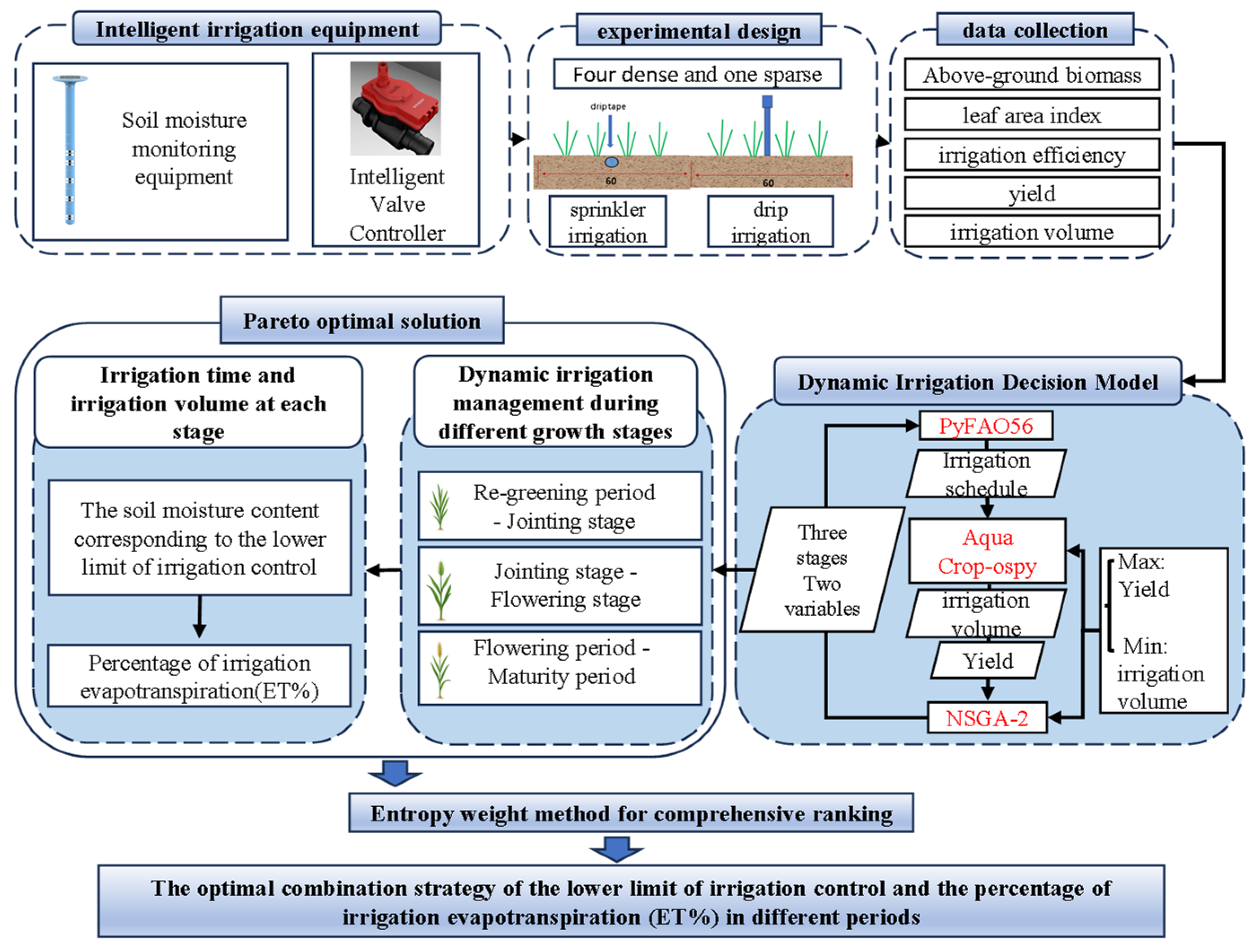
This study developed a multi-objective optimization framework to determine soil-moisture trigger threshold (control lower limit) and irrigation volumes by integrating AquaCrop, PyFAO56, and the NSGA-II algorithm. The framework comprises three modules: (i) irrigation strategy simulation with PyFAO56, (ii) performance evaluation with AquaCrop, and (iii) multi-objective optimization of irrigation soil-moisture control lower limit and irrigation volumes. AquaCrop was first calibrated and validated against measured canopy cover, aboveground biomass, and grain yield to ensure reliable crop growth and yield simulations. In parallel, PyFAO56 was used to construct a feasible irrigation strategy space and to simulate root-zone soil moisture dynamics under candidate irrigation schedules. The two models were then coupled and implemented in a Python 3.8 environment to enable iterative exchange of irrigation decisions and model outputs. Six decision variables were defined across three growth stages (regreening–jointing, jointing–flowering, and flowering–maturity), including the lower soil moisture threshold and the evapotranspiration-based irrigation replenishment ratio for each stage. NSGA-II was subsequently employed to conduct an evolutionary search under the dual objectives of maximizing grain yield and minimizing total seasonal irrigation, thereby generating a Pareto-optimal solution set. Finally, entropy weighting was applied to derive indicator weights for the Pareto solutions, followed by comprehensive ranking to identify the optimal combination of soil-moisture control lower limit and stage-specific I/ET percentage [23,24]. This framework is illustrated in Figure 1.

2.1.1. Description of the AquaCrop-OSPy Crop Growth Model

In this study, AquaCrop-OSPy was used as the crop growth and yield-response component within the coupled PyFAO56–AquaCrop simulation loop. The model was executed at a daily time step for the winter wheat season from 25 October 2024 to 15 June 2025, driven by the site-specific meteorological forcing together with the predefined soil and crop parameter sets described in Section 2.4. Initial conditions were prescribed using a layered soil water content profile, and each simulation was run to crop termination to generate season-integrated growth and yield outputs for irrigation-strategy evaluation.
For each candidate irrigation strategy generated during optimization, PyFAO56 produced a daily irrigation depth time series, which was then imposed on AquaCrop-OSPy as an external irrigation schedule to ensure that AquaCrop evaluated crop growth under exactly the same irrigation events and amounts as those proposed by the decision variables. After each run, AquaCrop-OSPy provided daily crop transpiration Tr and final grain yield Y. Consistent with the AquaCrop biomass formation concept, aboveground biomass accumulation was linked to cumulative crop transpiration via water productivity, and yield was derived from biomass through harvest index. These relationships are summarized as
B = W P · T r
  Y = H I · B
where B is aboveground biomass, WP is normalized water productivity, Tr is daily crop transpiration, T r is cumulative transpiration over the simulation period, HI is the harvest index, and Y is grain yield. In the coupled framework, Y from AquaCrop-OSPy was used as the yield objective in the multi-objective search, while irrigation volume was computed from the imposed irrigation schedule. Water productivity indicators were then calculated using the simulated yield together with seasonal irrigation totals to support the ranking and selection of representative Pareto-optimal irrigation strategies.

2.1.2. Description of the PyFAO56 Irrigation Strategy Model

PyFAO56 incorporates enhancements such as a layered soil representation and a variable depletion fraction (P) to better represent within-field heterogeneity while offering greater reusability, extensibility of rule definitions, and scalability for batch simulations than conventional spreadsheet-based workflows [20]. It includes a built-in automated irrigation module that generates event-based irrigation sequences, facilitating threshold-triggered or evapotranspiration-proportional replenishment strategies within growth stage windows to implement diverse irrigation configurations.
The four-stage windows are defined as follows:
Ω s = t s s t a r t , t s e n d   s = 1 , , 4
The definition of root-zone relative water deficit is
f D r , i = D r , i T A W i = 0 Z r , i θ F C z θ z , i d z 0 Z r , i θ F C z θ W P z d z  
The trigger thresholds for each stage, in the current stage, s, are as follows:
f D r , i m s  
Replenishment period:
S i = j j = L i + 1 , , i
Here, i represents the current day sequence, and Li represents the most recent irrigation day that is less than i. Si is the only retained replenishment window—from the day after the last irrigation until the current irrigation day.
Evapotranspiration deficit requiring replenishment (calculated as “evapotranspiration minus effective precipitation,” taking the positive component):
D i E T = j = L i + 1 i E T j a P j e f f +
DiET represents the transpiration deficit requiring replenishment, equal to the sum of the positive portions of cumulative ETja since the last irrigation. Here, Pjeff denotes effective precipitation on day j (mm), accounting only for the portion that enters the root zone and is utilized by crops.
Effective precipitation is defined as
P j e f f = c × P
In the formula, c is the effective rainfall coefficient, calculated as follows:
c = 0 P 5   mm 1.0 5 < P 50   mm 0.8   ~   0.75 50 < P 150   mm 0.7 P   >   150   mm
Irrigation deficits are compensated for based on a stage-specific evapotranspiration-based irrigation replenishment ratio:
I i p l a n = α s 100 D i E T
αs represents the stage replenishment percentage, used to explicitly map the “evapotranspiration-based irrigation replenishment ratio for each period” to the planned net replenishment volume for the day (Iiplan).
In summary, the PyFAO56 model is primarily invoked to achieve irrigation scheduling control through soil moisture balance simulation. The process involves establishing the PyFAO56 soil moisture model using meteorological and soil data identical to AquaCrop. The model calculates reference ET based on daily meteorological conditions and determines soil moisture changes in conjunction with soil parameters. Irrigation trigger conditions are set within the model: irrigation commences when root-zone moisture falls below the preset irrigation control threshold (decision variable 1). The water supply during irrigation is supplemented as an evapotranspiration-based irrigation replenishment ratio at that stage (decision variable 2). This generates the specific irrigation volume and irrigation time series for each irrigation event, which are then passed to the AquaCrop crop growth model.

2.2. Dual Model Calibration and Validation

To evaluate the reliability and accuracy of model simulation results, a combination of metrics can be employed, including the coefficient of determination (R2), root mean square error (RMSE), normalized root mean square error (NRMSE), Nash–Sutcliffe model efficiency coefficient (EF), and goodness-of-fit index (d). Their specific calculation formulas can be found in [24]. R2 reflects the model’s ability to explain observed variability; values closer to 1 indicate higher goodness-of-fit. NRMSE can be used to classify model performance: when NRMSE ≤ 10%, the model is considered “excellent”; 10% < NRMSE ≤ 20% is “good”; 20% < NRMSE ≤ 30% indicates “fair”; and NRMSE > 30% signifies poor model performance. The goodness-of-fit index d primarily characterizes the consistency between simulated and observed trends. A d value closer to 1 indicates ideal fitting; if d approaches 0 or is negative, the model’s ability to reproduce the observed process is weak. The EF measures the improvement in model simulation results relative to the observed mean. An EF close to 1 indicates high prediction accuracy, while values between 0 and 1 are generally acceptable. An EF < 0 indicates that the model’s prediction performance is inferior to using the observed mean as an estimate, meaning the observed results outperform the simulated results [25].

2.3. Multi-Objective Optimization of Irrigation Systems

The objective function of this study evaluates winter wheat yield maximization and total irrigation water minimization as performance metrics, using the soil moisture content corresponding to the soil-moisture control lower limit and the evapotranspiration-based irrigation replenishment ratio for each of the four irrigation periods. Each candidate scheme comprises six decision variables: Stage 1 (Regreening–Jointing Stage): Decision variable 1 is the irrigation control threshold (critical soil moisture content for initiating irrigation); decision variable 2 is the percentage of actual irrigation volume relative to reference evapotranspiration. Stage 2 (jointing to heading stage): Decision variable 3 is the soil-moisture control lower limit; decision variable 4 is the evapotranspiration-based irrigation replenishment ratio. Stage 3 (heading to maturity stage): Decision variable 5 is the soil-moisture control lower limit; decision variable 6 is the evapotranspiration-based irrigation replenishment ratio. The objective function expression and constraint condition expression are as follows:
  max Y = F ( L , P ) min W = j = 1 n I j ( L , P )
  0.25 L k 0.55 k = 1 , 2 , 3 50 P k 100 k = 1 , 2 , 3
In the formula, Y is the winter wheat yield, simulated by the crop–water model under a given irrigation strategy; W is the total irrigation water volume during the growing season (mm); I j ( L , P ) is the irrigation quota of the j -th irrigation event ( j = 1 , 2 , , n ) ; and n is the number of irrigations triggered by the model. L k is the lower control limit for irrigation, expressed as the soil relative moisture content threshold for each irrigation period, and P k is the percentage of irrigation volume relative to evapotranspiration for each period. Here, L = ( L 1 , L 2 , L 3 ) and P = ( P 1 , P 2 , P 3 ) . Thus, each candidate scheme comprises six decision variables. The obtained Pareto-optimal solution set was comprehensively evaluated using the Two-Objective Partially Satisfied Index method to identify the relatively optimal irrigation scheme [26].

2.4. Study Case

2.4.1. Overview of the Test Area

This experiment was conducted at the Wangmutui Village experimental base in Laoling City, Dezhou, Shandong Province (approximately 37°44′ N, 117°14′ E, elevation 25 m), during the 2024–2025 winter wheat growing season. The study area is located in the northern part of the North China Plain, characterized by flat, open terrain and favorable irrigation and drainage conditions. It experiences a warm temperate continental monsoon climate with distinct seasons and rainfall coinciding with the warm season. Multi-year climate parameters (1991–2020 long-term averages) are as follows: annual mean temperature is 12.6–13.4 °C, accumulated temperature (≥10 °C) is 3900–4200 °C·d, and annual precipitation is 550–600 mm, with over 70% concentrated between June and August. Annual average sunshine duration is approximately 2600–2800 h, and the frost-free period lasts about 195–210 days. The predominant soil type in the area is luvisol, characterized by loamy to sandy loam texture, deep soil layers, moderate water and nutrient retention capacity, and neutral to slightly alkaline pH. Field water-holding capacity was determined using the field measurement method, wilting coefficient via the high-speed centrifugation method, and soil bulk density and saturated moisture content through the ring knife method. The finalized soil moisture baseline data are summarized in Table 1. The fundamental soil parameters from Table 1 were input into the soil modules of AquaCrop and PyFAO56.
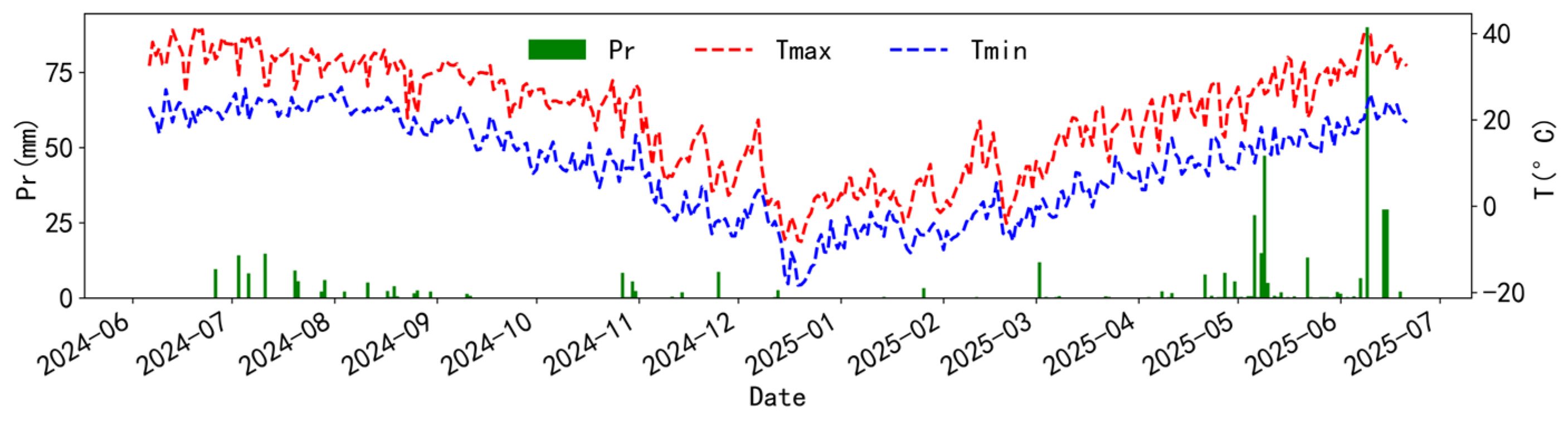
The required daily meteorological data, including maximum and minimum temperatures, dew point temperature, wind speed, solar radiation, and precipitation, were obtained from the Dingwu Town Comprehensive Meteorological Monitoring Station, located approximately 1.2 km from the site. These data were used to calculate ETo via a standardized method [27]. Temperature and precipitation during the winter wheat growing season of 2024–2025 are shown in Figure 2.
This study conducted a one-year field trial on winter wheat from 2024 to 2025, employing two irrigation treatments: four-close—one-spaced drip irrigation (T1) and four-close–one-spaced sprinkler irrigation (T2). The test variety was the high-yielding, early-maturing, high-quality cultivar “Jimai 22.” Land preparation and seeding were completed using a winter wheat strip shallow-buried drip irrigation seeder with navigation. The planting pattern was “four dense rows + one wide row,” with dense row spacing of 12 cm and wide row spacing of 24 cm. Drip tapes were shallowly buried at the center of the four dense wheat rows. Seeding rate was 262.5 kg·ha−1; a basal application of 18–16–6 compound fertilizer was applied at 562.5 kg·ha−1. Topdressing was applied via fertigation at the tillering, jointing, and flowering stages, supplying urea at 51.0, 82.5, and 82.5 kg·ha−1 and potassium chloride (KCl) at 7.5, 10.5, and 10.5 kg·ha−1, respectively. Differences between treatments primarily concerned irrigation methods and schedules: S2 (sprinkler irrigation) received its first irrigation on March 30 at a rate of 65.10 mm, followed by a second irrigation on April 20 at the same rate. T1 (drip irrigation) received its first irrigation on March 31 at 65.10 mm, with the second irrigation on April 25 at 65.10 mm. All other cultivation and nutrient management practices were consistent to ensure comparability and interpretability.
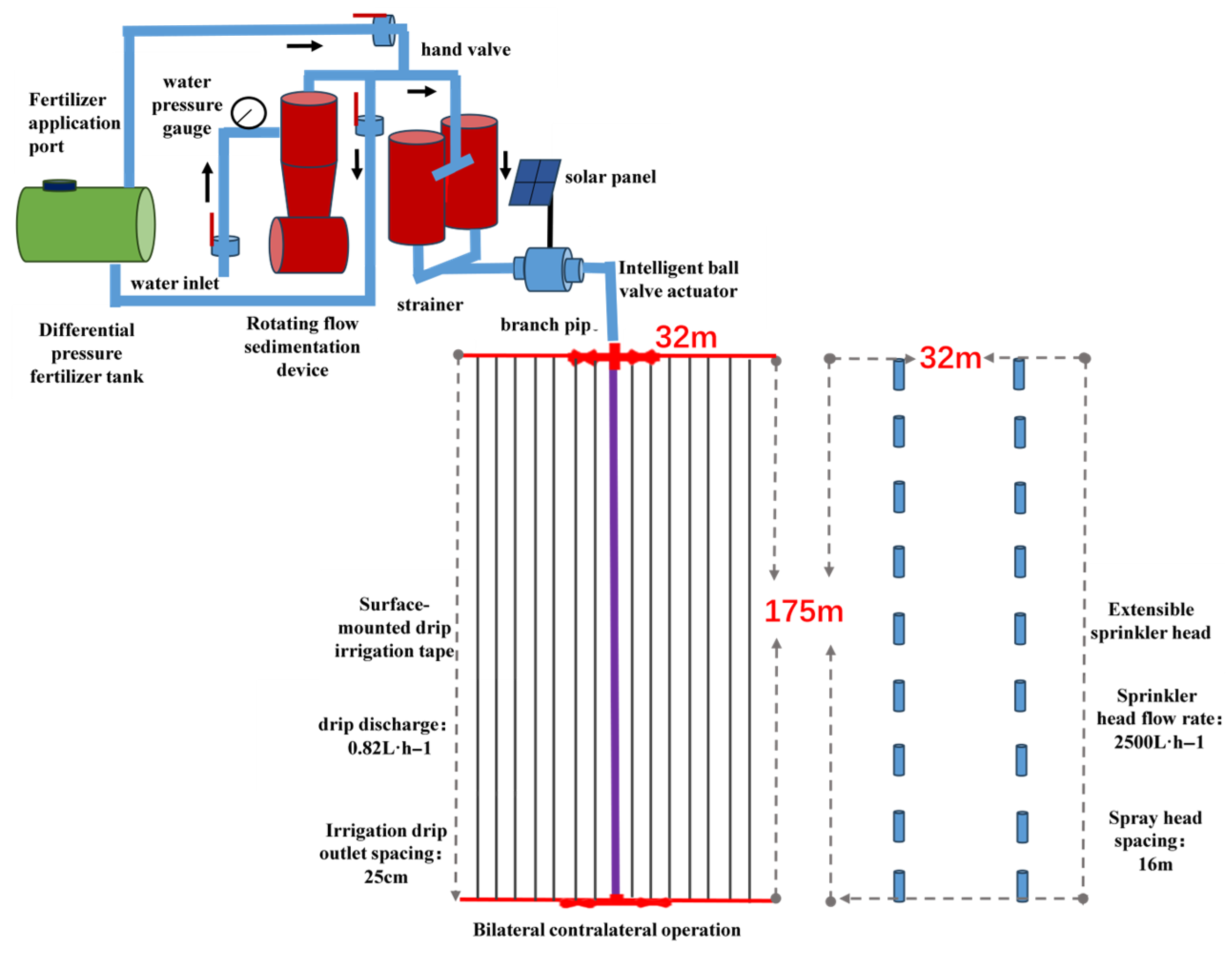
To achieve integrated water and fertilizer management, the field was equipped with an irrigation system comprising a filtration/fertilization unit—smart valve control—distribution manifolds—and terminal drip/sprinkler emitters (Figure 3). The headworks sequentially incorporated a differential pressure fertilizer tank, a cyclonic sand trap, and a mesh filter, enabling simultaneous injection of water-soluble fertilizers and clean water into the pipeline network while ensuring water quality. A manual valve and water meter were installed on the inlet side for pressure regulation and on/off control. Branch pipes connect the headworks to the field operation zones. These pipes are fitted with YGGK-QF-1 smart ball valve/butterfly valve actuators developed by Anhui Yigang Information Technology Co., Ltd. (Anqing, China), supporting both local and remote control. Local operation uses a Bluetooth mini-program to control valves in under 5 s. Remote operation employs a mobile app to send control commands and record response times, which take less than 8 s. The valve control process features real-time uploading of water pressure and flow rate data. The total irrigation volume set by the irrigation optimization model developed in this study can be configured via the mobile mini-program. Once the total irrigation volume is reached, the ball valve automatically closes.
For plots using drip irrigation, shallow-buried drip tapes are laid out in a “double-sided counterflow” pattern. The working strip width is approximately 32 m, with a row length of 175 m. Drip tapes were laid equidistantly along crop rows with 25 cm spacing between emitters, each rated at 0.82 L·h−1. Two drip tapes were installed on opposite sides of each row (or bed), enabling opposing expansion of the wetting zone within the root zone to enhance water and fertilizer use efficiency. Flushing valves were installed at the end of each drip tape for routine maintenance and sediment discharge.
A sprinkler irrigation zone was installed parallel to the drip lines, also 32 m wide. Telescopic sprinkler heads were arranged along the rows at 16 m intervals, with a rated flow rate of 2500 L·h−1 per head. The sprinkler and drip irrigation zones were controlled by smart ball valves, operating on a staggered schedule to prevent pressure fluctuations and match water demand characteristics at different growth stages. The equipment overview is shown in Figure 3.

2.4.2. Parameter Collection and Processing

Soil moisture content was measured using the PG3H-60B soil moisture monitoring device (Anhui Yigang Information Technology Co., Ltd., Anqing, China), which supports 4G wireless transmission of monitoring data. Soil moisture was monitored within the 0–0.60 m soil profile at four depths (0.10, 0.20, 0.40, and 0.60 m). One moisture monitoring device was installed for each of the drip irrigation and sprinkler irrigation treatments. For the drip irrigation treatment, the device was positioned on the drip tape side at the center of the seedling strip. For the sprinkler irrigation treatment, it was placed at the midpoint between two rows of retractable sprinkler heads. Measurements were taken at 40 min intervals. Canopy cover (CC) was defined as the proportion of ground surface area covered by the vertical projection of green canopy. Its value was calculated using the leaf area index (LAI). From 17 April to 27 May 2025, LAI samples were collected every 10 days using an LAI-2000 Plant Canopy Analyzer (LI-COR, Lincoln, NE, USA). Since the AquaCrop model outputs canopy cover (CC), the observed LAI values must be converted to canopy cover for comparison. The conversion formula for canopy cover (CC) is as follows [28]:
  C C = 1.005 1 e 0.6 L A I 1.2
During the 2024–2025 growing season, aboveground biomass was determined by destructive sampling at the regreening, jointing and flowering stages (28 March, 18 April and 5 May, respectively) and again at physiological maturity. In each treatment, four replicate plots were established, and 10 representative plants were collected from each replicate plot at each sampling date. Samples were transported to the laboratory, gently washed to remove soil and debris, and oven-dried at 105 °C for 30 min to terminate metabolic activity. They were then dried at 80 °C for 24 h, cooled to room temperature, and weighed to determine dry matter accumulation.
Grain yield and yield components were measured at maturity. Plants were harvested from two adjacent rows over a 0.5 m length in each plot, placed in mesh bags, and transported to the laboratory. The number of plants in each harvested sample was counted and recorded. Roots were removed, and the aboveground material was oven-tried at 105 °C for 30 min and then at 75 °C to constant weight to obtain dry biomass. For yield components, a uniformly growing section (4 rows × 1 m) was selected to count spikes, and grain number was determined from 10 randomly selected spikes. All harvested samples were mechanically threshed, and grain mass was recorded. A subsample of 500 kernels was weighed, dried at 75 °C to constant weight, and used to determine grain moisture content. Final grain yield was expressed at a standard moisture content of 13.5% using:
  Y 13.5 = W f ( 1 M f ) A × 10 , 000 × 1 1 0.135
In this equation, Y 13.5 is the final grain yield at 13.5% moisture, W f is the measured grain mass of the harvested sample at field (as-threshed) moisture, M f is the grain moisture content at harvest (mass fraction) determined from a 500-kernel subsample dried to constant weight, and A is the harvested area (m2). The term W f ( 1 M f ) converts the field grain mass to dry matter, which is then adjusted to the 13.5% moisture basis by dividing by ( 1 0.135 ) ; the factor 10,000 converts yield from m2 to ha (1 ha = 10,000 m2).
Irrigation water use efficiency (IWUE) (t·ha−1·mm−1), where I represents total irrigation water volume (mm) during the winter wheat growth period:
  I W U E = Y I

2.4.3. Optimization Scenario

The coupled irrigation decision framework was evaluated as a proof of concept using an intensively monitored single-site dataset from the 2024–2025 winter wheat season under the four-dense–one-sparse planting system. In AquaCrop-OSPy, model calibration was conducted using field observations of canopy cover, aboveground biomass, and grain yield from the T1 treatment (subsurface sprinkler irrigation), and validation was performed using the corresponding observations from the T2 treatment (shallow subsurface drip irrigation) within the same growing season. In PyFAO56, calibration was based on T1 root-zone soil moisture observations (0–60 cm), and validation used the corresponding T2 dataset. After model calibration and within-season validation, NSGA-II was applied to optimize stage-specific irrigation decisions, including the soil-moisture control lower limit and the evapotranspiration-based irrigation replenishment ratio across three key growth stages under the representative wet-year conditions of 2024–2025. In the decision simulations, irrigation application efficiency was set to 80% for subsurface sprinkler irrigation and 90% for shallow-buried drip irrigation, with corresponding soil surface wetted fractions of 80% and 100%, respectively. These assumptions were specified with reference to the actual irrigation practices in the experimental area and to reflect the contrasting physical characteristics of the two irrigation systems. Compared with sprinkler irrigation, drip irrigation delivers water more directly to the root zone and generally results in lower non-productive evaporation losses and higher water delivery precision, whereas sprinkler irrigation wets a larger soil surface area and is more susceptible to evaporation-related losses. Therefore, lower application efficiency and wetted fraction were assigned to sprinkler irrigation. These parameters were kept constant across all candidate strategies and were treated as system-specific boundary conditions rather than optimization variables.

3. Results

3.1. Yield, Water-Use Efficiency, and Irrigation Schedule Under Two Irrigation Methods

As summarized in Table 2, the shallow-buried drip irrigation treatment T2 outperformed the subsurface sprinkler irrigation treatment T1 in both grain yield and WUE indicators while requiring less irrigation water. Grain yield increased from 9.52 to 10.86 t·ha−1, and WUE and IWUE also increased from 0.025 to 0.032 t·ha−1·mm−1 and from 0.073 to 0.083 t·ha−1·mm−1, respectively. In addition, the total irrigation volume was reduced from 153.0 mm in T1 to 130.2 mm in T2. Regarding scheduling, T2 applied a lower depth per event and a longer interval between irrigations than T1, which is consistent with the observed improvements in yield and water productivity under the experimental conditions.

3.2. AquaCrop-OSPy Model Parameter Calibration and Validation

3.2.1. AquaCrop-OSPy Model Parameter Calibration

With the calibration objective of minimizing the difference between simulated yield and regional statistical yield, a trial-and-error approach was employed to iteratively calibrate the standard water productivity, root growth coefficient, reference harvest index, upper and lower limits of water stress, temperature, and salinity stress coefficients [29]. Model parameters were calibrated using field measurements from the T1 treatment and validated using data from the T2 treatment. The pre- and post-calibration parameter values are presented in Table 3. All calibrated parameters fall within FAO-recommended ranges and are generally consistent with those reported for winter wheat in other AquaCrop-OSPy studies [30,31]. Following the calibration of the model parameters, the AquaCrop-OSPy model was calibrated and validated using T1 winter wheat trial data for three indicators: canopy cover, aboveground biomass, and yield. Figure 4 compares simulated and measured canopy cover, Figure 5 compares simulated and measured aboveground biomass, and Table 4 reports the correspondence between simulated and measured yield. Evaluation results indicate that the R2 values for these three indicators generally range from approximately 0.94 to 0.99. The RMSE for canopy cover is 2.24%, while for biomass and yield, the RMSE ranges from 0.4 to 3.3 t·ha−1. The NRMSE ranges from approximately 4% to 46%, with an efficiency factor (EF) between 0.58 and 0.91 and a coefficient of variation (CV) for d ranging from 0.78 to 0.98.
Comprehensively evaluating the simulation results across all growth indicators, the AquaCrop-OSPy model demonstrated good agreement between simulated and measured values for key growth stages of winter wheat. This indicates that the calibrated model parameters can be effectively utilized for dynamic simulation of critical growth processes in winter wheat.

3.2.2. Validation Results of AquaCrop-OSPy Model Simulating Winter Wheat Canopy Cover

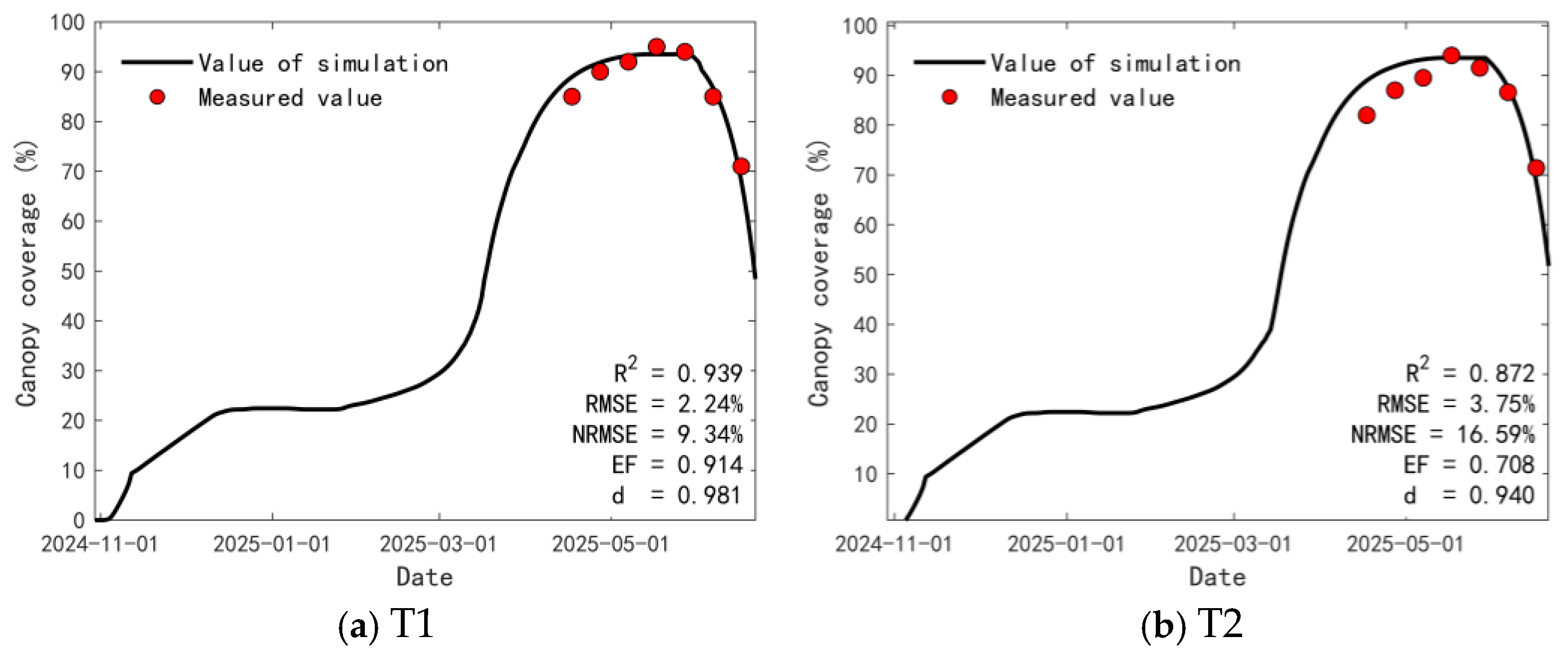
After calibrating the AquaCrop-OSPy model parameters, validation was conducted using actual data from the T2 treatment. As shown in Figure 4, the model effectively reproduced the seasonal variation characteristics of winter wheat canopy cover under both irrigation methods. Specifically, under T2 treatment, simulated values gradually increased alongside measured values after regreening. Canopy cover reached a high plateau phase from heading to grain filling, with measured values ranging from 82% to 94%, followed by a gradual decline. Overall fitting accuracy was R2 = 0.87, RMSE = 3.75%, NRMSE = 16.59%, EF = 0.71, and d = 0.94, indicating the model captures the general process of canopy expansion and senescence. However, deviations remain during the rapid growth phase before flowering and the slow senescence phase after flowering. In contrast, the simulated curve for T1 treatment similarly reproduced the trajectory of slow increase during regreening, rapid expansion from jointing to heading, and sharp decline after grain filling. Simulated values were closer to measured values near observation points, with evaluation metrics of R2 = 0.94, RMSE = 2.24 percentage points, NRMSE = 9.34%, EF = 0.91, and d = 0.98. Compared to drip irrigation, sprinkler irrigation showed an R2 improvement of 0.07, with RMSE and NRMSE reduced by 40.3% and 43.7%, respectively. The efficiency factor (EF) and d increased by 0.21 and 0.04, respectively. This indicates that under the current parameter calibration conditions, the model more accurately captures the rapid canopy expansion before flowering and the gradual senescence process after flowering in sprinkler irrigation scenarios.

3.2.3. The Verification Results of the AquaCrop-Ospy Simulation of Winter Wheat Biomass

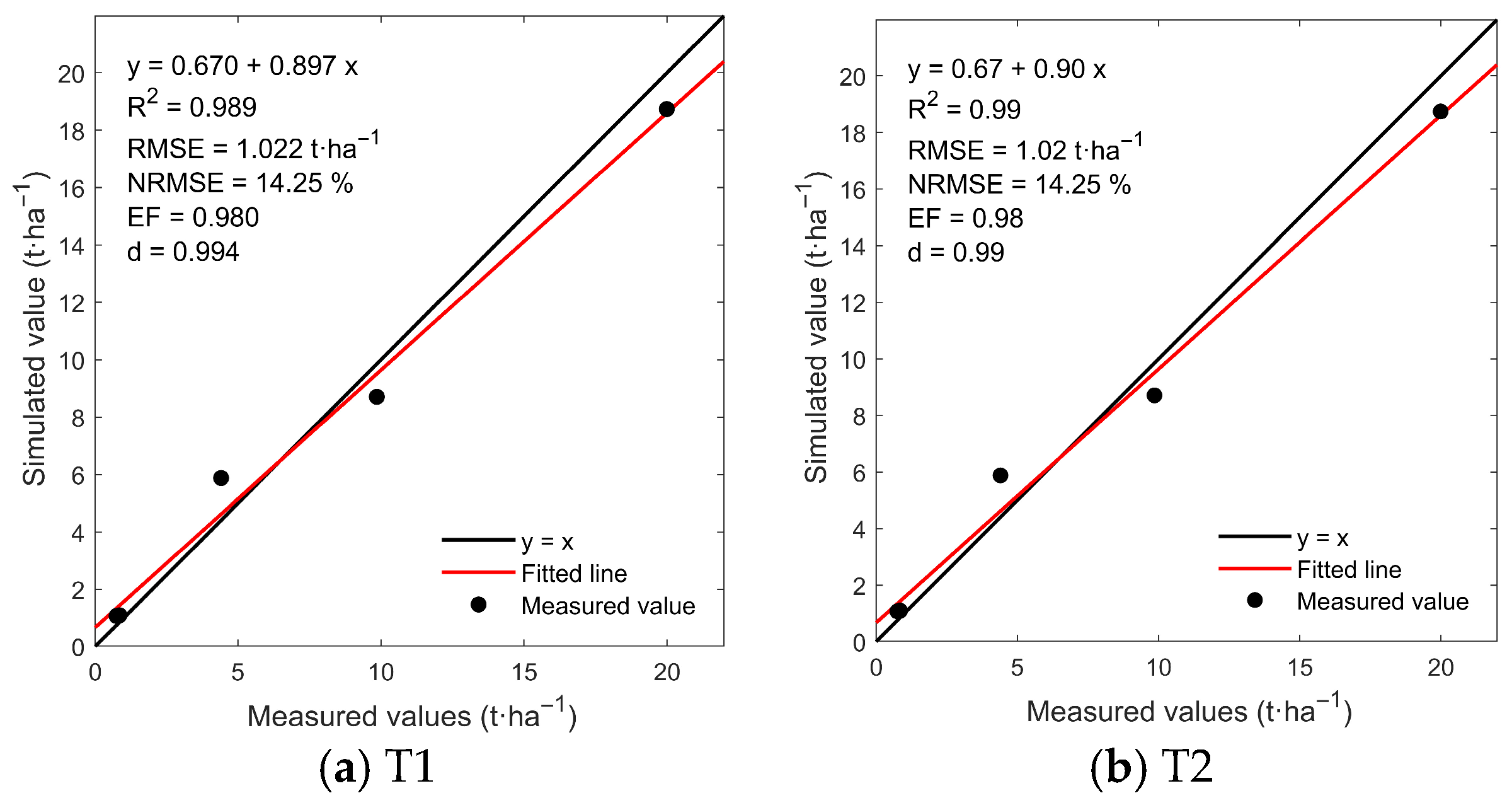
The AquaCrop-OSPy model reproduced aboveground biomass dynamics well for both T1 and T2, as shown in Figure 5. Agreement between simulated and measured biomass was very strong, with the coefficient of determination R2 equal to 0.99 in both datasets. Overall dispersion errors were low, with RMSE around 1.0 to 1.1 t·ha−1, and normalized errors were similar, with NRMSE around 14% to 15%, indicating that the model captured the observed variability of aboveground biomass during the study year.

3.2.4. AquaCrop-Ospy Model Simulation of Winter Wheat Yield Validation Results

The AquaCrop-OSPy model was calibrated using the T1 treatment and validated against independent yield observations from T2 (Table 4). The simulated yields were close to the measured values for both datasets, with NRMSE values of 5.67% for calibration and 2.67% for validation, indicating low prediction error and improved performance in the validation set. Overall, the yield simulation error remained within an acceptable range (approximately 3–6%) across the two irrigation treatments, suggesting that the calibrated model can reliably reproduce treatment-induced variations in winter wheat grain yield.

3.3. PyFAO56 Model Parameter Calibration and Validation

3.3.1. PyFAO56 Model Parameter Calibration

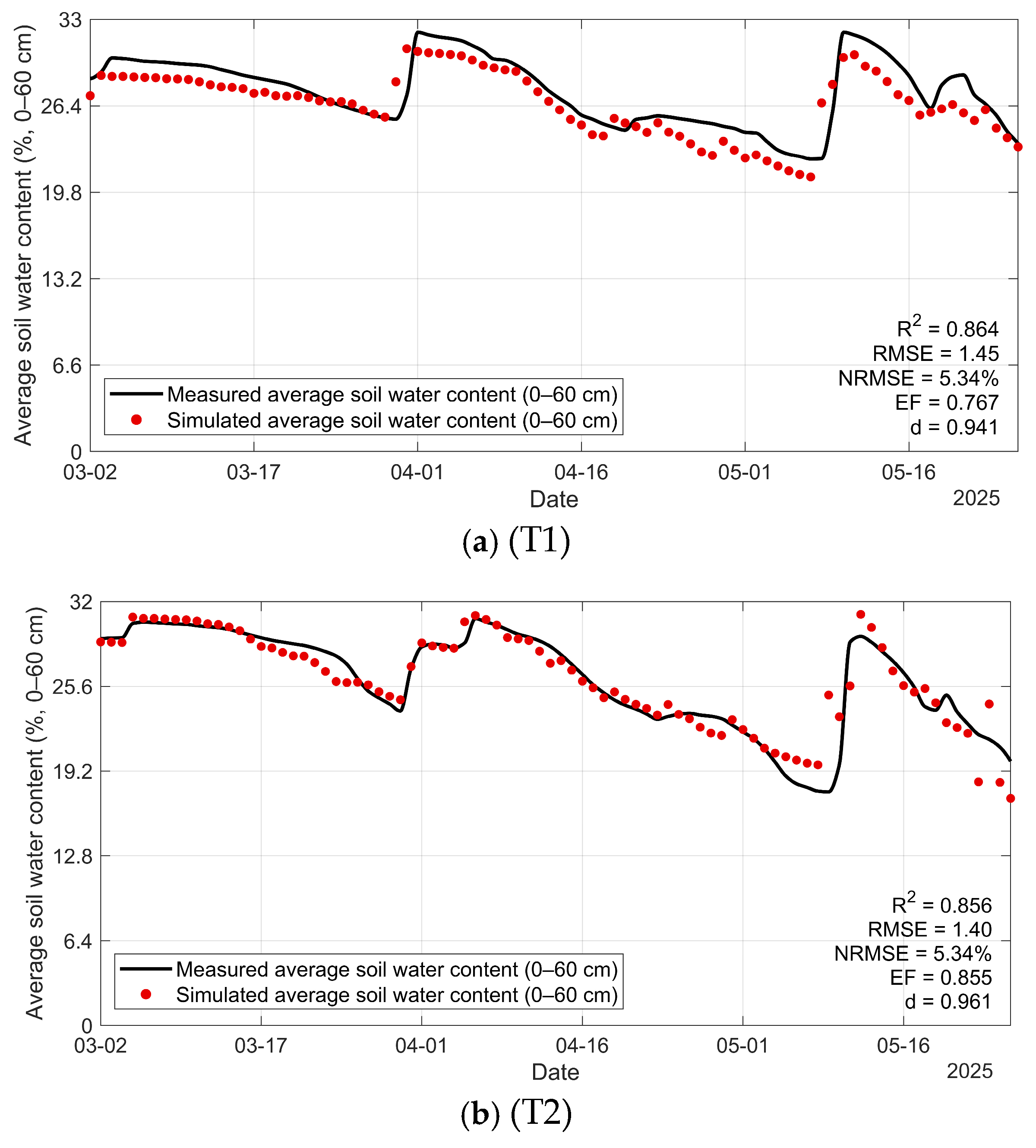
PyFAO56 model parameter calibration employs the same method as AquaCrop-OSPy. Using field-measured soil moisture content data from the T1 treatment, each parameter of the PyFAO 56 model was individually adjusted and calibrated. The model parameters before and after calibration are shown in Table 5. Evaluation results indicate that, as shown in Figure 6, compared to the measured values, the simulated soil moisture content exhibits the following values: R2 = 0.864, RMSE = 1.45%, and NRMSE = 5.34%. This demonstrates the model’s capability to accurately reproduce the rise and fall processes of root-zone moisture levels before and after irrigation and rainfall, as well as the overall consumption trend. Overall, the calibrated PyFAO56 model in this study demonstrated high agreement between simulated and observed average soil moisture content in the 0–60 cm layer of winter wheat. It can serve as a reliable tool for subsequent evapotranspiration-based irrigation scheduling and multi-scenario water process simulations.

3.3.2. Verification Results of Soil Moisture Content Simulated by the PyFAO56 Model

T2 was used as the model validation set. The PyFAO56 model demonstrated good agreement with observed measurements for average soil moisture content at 0–60 cm, as shown in Figure 6: R2 = 0.856, RMSE = 1.40%, NRMSE = 5.34%. When T1 served as the calibration set, R2 = 0.864, RMSE = 1.45, NRMSE = 5.34%. Considering all metrics collectively, although T1 exhibits a slightly higher R2 than T2, T2 demonstrates a smaller RMSE and significantly larger EF and d values. This indicates that the model achieves slightly superior overall simulation performance on the validation set, reliably reproducing soil moisture changes in the 0–60 cm root zone under different irrigation regimes. During the first irrigation, the average soil moisture content measured and simulated for both T1 and T2 treatments increased by 2–3% compared to pre-irrigation levels, remaining slightly below 33% field capacity. This indicates the irrigation primarily addressed root-zone moisture deficits without causing prolonged saturation. After mid-May, precipitation temporarily restored soil moisture content in both treatments to near field capacity. However, it rapidly declined below 22% during the grain filling to maturity stage. During this late, high-water-demand phase, discrepancies between model predictions and actual measurements widened further. This indicates that when soil moisture falls significantly below field capacity and water consumption is intense, the simulation still exhibits some deviation in capturing peak water consumption patterns.
Additional process-level water-balance diagnostics for T1, T2, and the selected S5 scheme are provided in Figures S1–S3.

3.4. Optimization Results of NSGA-II and TOPSIS

3.4.1. Pareto Non-Inferior Solution Set for Irrigation Strategies

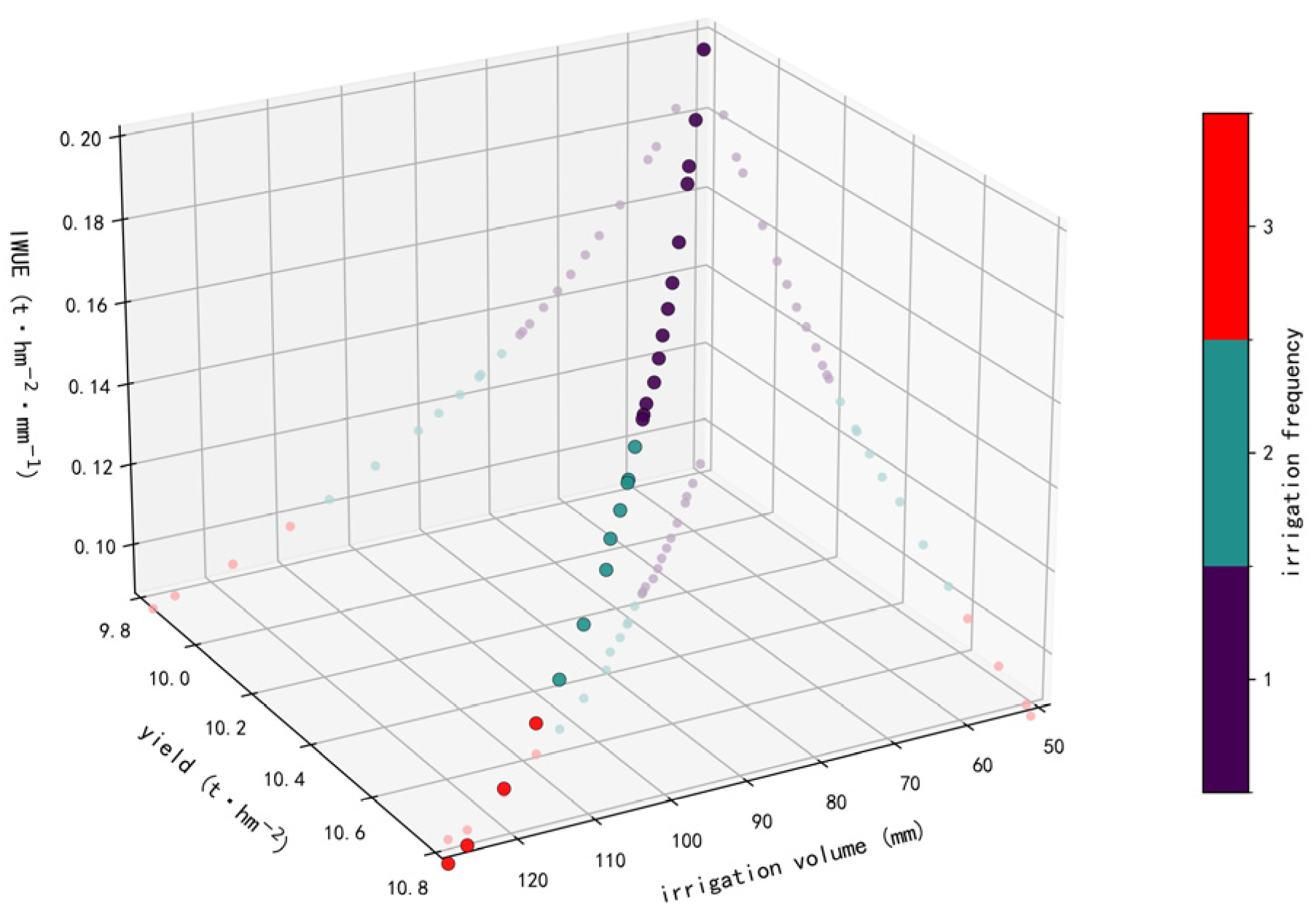
To identify representative optimal irrigation regimes within the feasible decision space, we implemented a multi-objective simulation-optimization workflow in Python that couples PyFAO56 to generate irrigation schedules and soil water balance with AquaCrop-OSPy to evaluate yield responses, and uses NSGA-II to search for trade-offs between two objectives: maximizing grain yield and minimizing seasonal irrigation volume. In the NSGA-II setup, each candidate solution was defined as a set of stage-wise irrigation parameters, and a population of 50 candidate solutions was evolved over 500 generations. New candidate solutions were created by recombining and slightly perturbing existing solutions using simulated binary crossover with a probability of 0.8 and polynomial mutation with a probability of 0.05, while an elitism strategy was adopted to retain non-dominated solutions during evolution. These parameter settings were selected empirically after preliminary trial runs to balance computational cost and solution diversity within the coupled AquaCrop-OSPy-PyFAO56 optimization framework. Therefore, the resulting Pareto front should be interpreted as an empirically derived solution set under the explored search configuration, suitable for applied irrigation decision screening in this case study. The search was constrained to practically relevant irrigation regimes with 1–3 irrigation events and a total seasonal irrigation volume of 55–120 mm. After convergence, a non-dominated Pareto solution set was obtained, redundant solutions were removed, and representative schemes were retained for subsequent analysis. The retained Pareto-optimal irrigation schemes are presented in Figure 7.
Among the 23 Pareto non-inferior solutions obtained (S1–S23; see Table S1 in the Supplementary Materials for the soil-moisture control lower limit and evapotranspiration-based irrigation replenishment ratio), irrigation quotas ranged from 51.42 to 128 mm, with irrigation frequencies of one to three times; corresponding yields ranged from 9.80 to 10.80 t·ha−1, with irrigation water use efficiency (IWUE) values between 0.08 and 0.19 t·ha−1·mm−1. The Pareto set exhibits a clear trade-off relationship: as irrigation quotas and irrigation frequency increase, yield monotonically increases from 10.6 to 10.8 t·ha−1 and gradually stabilizes. Within the range of 95–110 mm irrigation volume and 2–3 irrigation events, yield approaches its upper limit, and the marginal benefit of increased irrigation investment begins to diminish, reflecting a typical optimal upper limit characteristic.
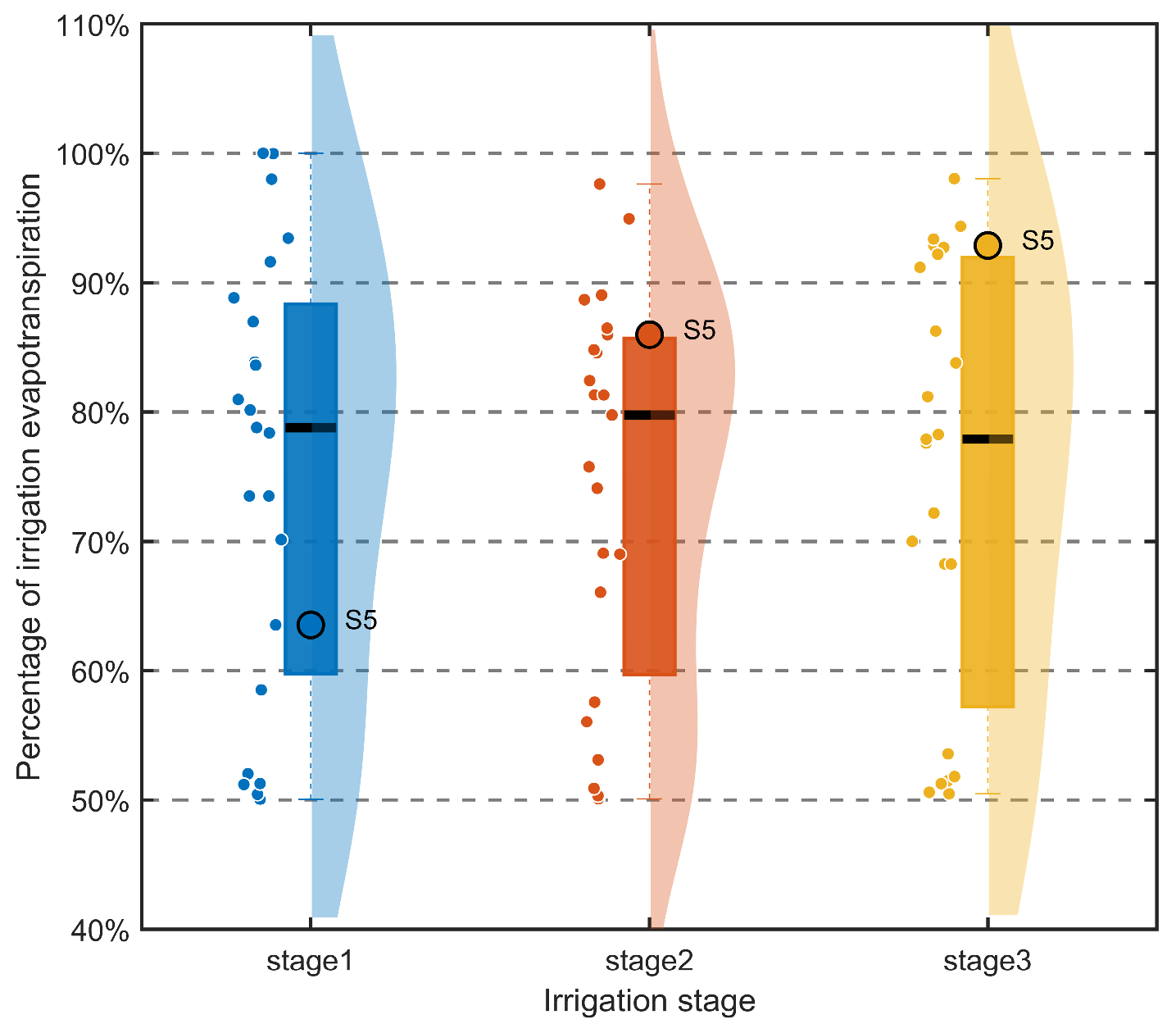
As shown in Figure 8, the irrigation–evapotranspiration ratios for irrigation schemes S1–S23 were generally concentrated across the three growth stages. The median values for the regreening–jointing, jointing–flowering, and flowering–maturity stages were 79%, 80%, and 78%, respectively, all remaining stable at approximately 80%. Most treatments fell within the 70% to 90% range. Only a few schemes approached 50% during the regreening–jointing stage or exceeded 90% during the jointing–flowering and flowering–maturity stages. This indicates that the experiment primarily employed moderate-intensity irrigation while retaining a certain degree of early deficit irrigation combined with later excess irrigation.
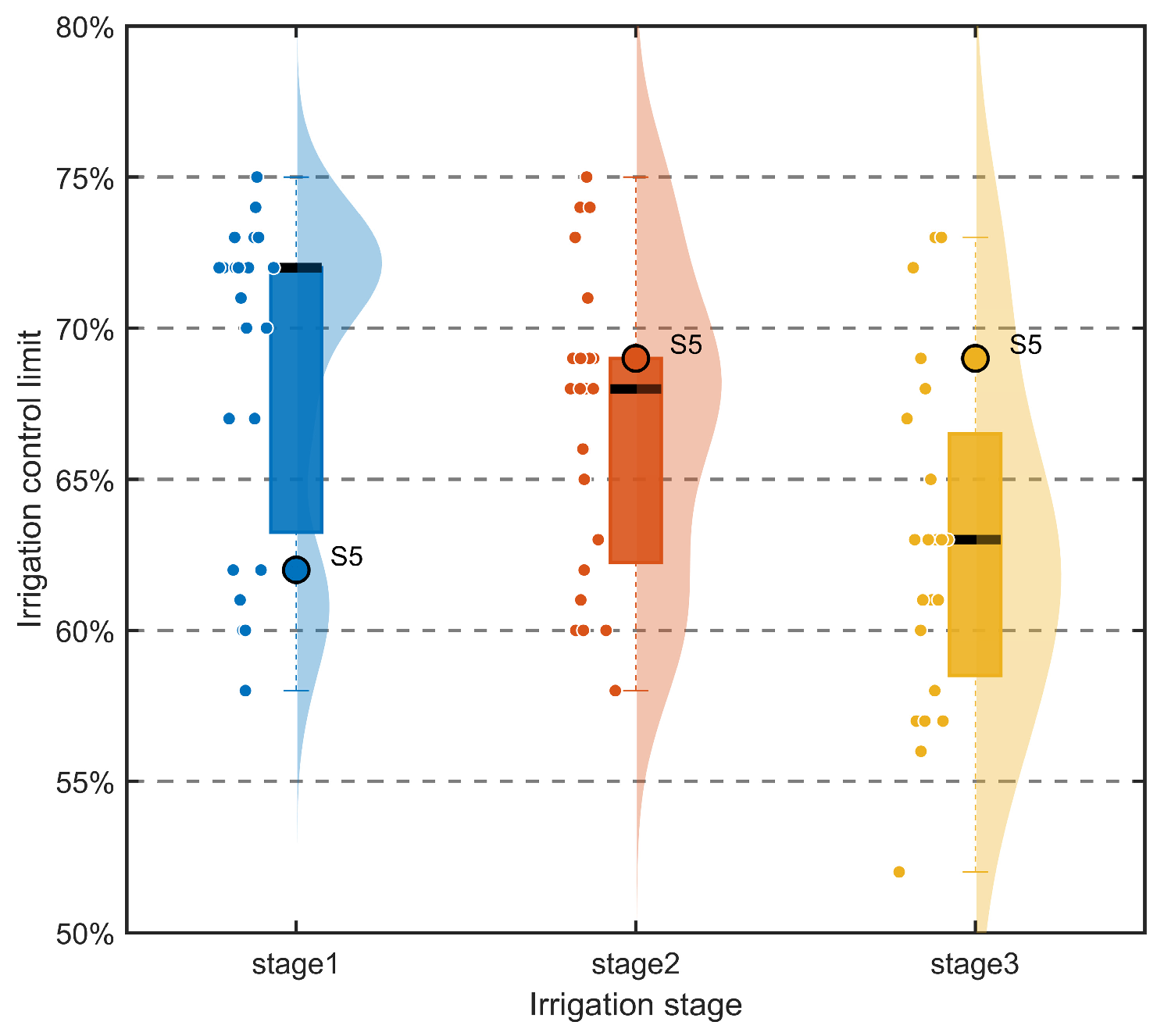
The corresponding lower control limits for irrigation also exhibited phased variations across growth stages, as shown in Figure 9: Values during the regreening–jointing stage were primarily concentrated around 70%, ranging from 58% to 75%, with approximately one-third of treatments exceeding 72%, indicating that most schemes maintained higher soil moisture content during this period. The lower control limits for the jointing–flowering stage were more concentrated, generally falling between 60% and 74%, with a quantile range of approximately 63% to 69%, consistent with the narrow, centrally positioned box in the cloud-rain diagram; the lower control limits for the flowering–maturity stage were overall slightly lower, with most treatments concentrated between 59% and 66%.
Only a few treatments reached nearly 70%, with the median line in the figure shifting significantly downward. The combined distribution of evapotranspiration percentages and irrigation control thresholds indicates that the simulated schemes generally maintained irrigation intensity within the range of 60% to 80% of crop water requirements across all three growth stages. However, higher control thresholds were predominantly applied during the regreening–jointing stage, with slightly reduced thresholds in the subsequent two stages.
The correlation heatmap analysis linking stage-wise decision variables to yield, IWUE, and irrigation frequency is reported in Supplementary Material S3 (Figure S4).

3.4.2. TOPSIS-Based Irrigation Decision Screening

To more objectively select the globally optimal solution from the Pareto-optimal solution set, the TOPSIS method was employed to rank the optimal irrigation quota and irrigation frequency combinations derived from the Pareto solution set [26]. The evaluation criteria were irrigation quota and yield. Data in Figure 7 underwent yield normalization and irrigation quota inverse normalization, followed by normalization processing. Based on local farmers’ prioritization of yield and water consumption, weights of 0.9 and 0.1 were assigned to yield and irrigation volume, respectively. TOPSIS was applied to rank the obtained Pareto-optimal irrigation quota and frequency combinations. The distances to positive and negative ideal solutions and relative proximity are shown in Table 6.
As shown in Table 6, during abundant water years, it is recommended to adopt the top-ranked S5 irrigation management scheme: we set the soil moisture content corresponding to the lower limit of irrigation control at 0–60 cm to 62%, 69%, and 69% FC during the regreening–jointing, jointing–flowering, and flowering–maturity stages, respectively. The corresponding irrigation–evapotranspiration percentages are 63.54%, 85.97%, and 92.87%. As shown in Figure 8 and Figure 9, compared to irrigation schemes S1–S23, the deviation of S5’s soil-moisture control lower limit from the median is −10%, +1%, and +6%, respectively, while the deviation of evapotranspiration-based irrigation replenishment ratios from the median is −15.25%, +6.21%, and +14.97%. The S5 irrigation scheme involves two irrigation events with a total quota of 75 mm, omitting winter irrigation, applied at the end of the jointing stage and the beginning of the grain filling stage. This scheme ranked first in the TOPSIS analysis of this study. Under the abundant water year scenario, it stabilized yield at 10.4 t·ha−1 with 75 mm irrigation. Compared to the high-yield, high-irrigation strategy with three irrigations, it maintained a relatively high IWUE of 0.16 t·ha−1·mm−1, achieving a balance of high yield and water conservation. Should rainfall exhibit uneven spatiotemporal distribution or increased risks of hot dry winds post-flowering, the irrigation–evapotranspiration ratio for the corresponding period may be moderately increased, with the total quota raised to approximately 90–100 mm. This corresponds to the lower-ranked irrigation schemes S7 and S6.
A process-based interpretation of the stage-wise deficit pattern of the S5 scheme is provided in Supplementary Material S2.

4. Discussion

4.1. Difference Analysis of Yield and Water Use Under Different Irrigation Methods

This study shows that drip irrigation could effectively improve wheat WUE and yield compared to traditional sprinkler irrigation. These findings align with the results reported by Liu [32], who found that the drip irrigation (DI) treatment exhibited the highest WUE and IWUE, with a wheat yield of 9929.7 kg·ha−1. In contrast, the novel buried sprinkler irrigation (JSI) treatment gave the second-highest yield of approximately 9264.4 kg·ha−1. This study confirmed that drip irrigation outperformed sprinkler irrigation, offering distinct advantages in enhancing WUE and achieving high yields.
Specifically, relative to sprinkler irrigation, the T1 drip irrigation treatment in this experiment increased WUE and IWUE by approximately 28% and 14%, respectively, and improved grain yield by about 14%. Consistent with these findings, Liu [32] reported that drip irrigation increased WUE by up to 35% and IWUE by 14% compared with traditional furrow irrigation, underscoring the capacity of drip systems to enhance crop water productivity. Although sprinkler-based approaches, including subsurface sprinkler irrigation, can also deliver yield gains and water-saving benefits, their performance generally remained lower than that of drip irrigation in our study. A plausible explanation is that sprinkler irrigation entails greater non-productive water losses and lower delivery precision, resulting in higher soil evaporation. For example, inter-row evaporation under mobile sprinkler irrigation has been reported to be approximately 45% higher than under drip irrigation. By reducing evaporative losses and concentrating water supply within the root zone, drip irrigation increases the fraction of applied water available for crop transpiration and biomass accumulation, thereby improving water use efficiency and ultimately supporting higher yield.
The advantages of drip irrigation in terms of water productivity and yield are largely attributable to its more precise and efficient water delivery, which can minimize non-productive water losses and improve the root-zone microenvironment. Previous studies have shown that drip irrigation can reduce soil evaporation and alter the partitioning of evapotranspiration relative to conventional surface-wetting methods, thereby increasing the fraction of applied water contributing to productive transpiration [33,34]. By sustaining a relatively adequate and stable soil water supply during mid-to-late growth, micro-irrigation systems, including micro-sprinkling, have been reported to maintain stronger post-anthesis physiological activity, such as higher photosynthetic performance and delayed flag-leaf senescence, which supports grain filling and increases grain weight [35,36]. These physiological advantages may further translate into improved yield components and higher final yield under optimized drip fertigation or micro-irrigation regimes [37]. In our experiment, the superior WUE/IWUE and yield observed under the T1 drip irrigation treatment are consistent with these reported mechanisms, although additional measurements would be required to explicitly attribute the response to specific physiological pathways. By contrast, sprinkler irrigation typically wets a larger surface area and is more susceptible to evaporative and wind-drift losses, which may reduce the effectiveness of water delivery to the plant root zone even under automated control.

4.2. AquaCrop-OSPy Model Applicability

In this study, the AquaCrop-OSPy model simulated canopy cover for the T1 treatment compared to T2, showing the following improvements in metrics: R2 increased by 0.067, RMSE decreased by 40.3%, NRMSE decreased by 43.7%, EF increased by 0.206, and d increased by 0.041. Overall, the model inadequately captured the slow post-flowering canopy senescence process under the T2 treatment. Field measurements showed a slower decline in canopy cover before and after flowering under T2 conditions, whereas the model simulated a faster rate of decay. One possible reason may include a difference in the field microclimate and root-zone water uptake space, as sprinkler irrigation significantly reduces the difference between maximum field temperature and saturated vapor pressure shortly after irrigation, increasing air relative humidity. This is accompanied by an elevated crop transpiration, flag-leaf net photosynthetic rate, and stomatal conductance, which creates a more favorable physiological environment for rapid early canopy expansion and, consequently, allows sprinkler irrigation to achieve higher canopy cover and faster pre-flowering growth rates [38]. In contrast, shallow-buried drip irrigation concentrates water near the root zone, keeping surface and inter-row soils relatively dry. Localized wet patches weaken the microclimate effects of near-surface humidification and cooling, as well as the reduction in saturated vapor pressure deficit, resulting in slower early canopy expansion [39]. Moreover, drip irrigation may provide crops with more water later in the season, delaying crop senescence. Consequently, post-flowering canopy cover senescence under drip irrigation progresses more slowly than under sprinkler irrigation [40]. Mechanistically, AquaCrop-OSPy models canopy senescence using a fixed decay coefficient and accumulated temperature, without accounting for the effect of continuous post-flowering water supply [41]. Therefore, AquaCrop-OSPy simulations under sprinkler and drip irrigation require consideration of short-term microclimate corrections post-irrigation. Failure to do so may systematically underestimate the pre-flowering canopy expansion advantage of sprinkler irrigation or overestimate both the pre-flowering canopy expansion rate and post-flowering canopy decay rate under drip irrigation [42].
Studies based on winter wheat trials in the North China Plain have also validated AquaCrop’s applicability in yield and biomass simulation [31]. Wang et al. [43] calibrated and validated the model using multiple irrigation regimes and soil moisture control thresholds. The results showed that for winter wheat grain yield, the coefficient of determination, R2, ranged from 0.80 to 0.93, with RMSE values of 0.19–0.42 t·ha−1 and a normalized root mean square error (NRMSE) of 2.10–5.36%; For aboveground biomass, R2 ranged from 0.92 to 0.96, with RMSE values of 0.26–0.70 t·ha−1 and NRMSE values of 1.38–4.11%. These results demonstrate the model’s ability to reliably reproduce yield and biomass variation processes under different irrigation regimes. These results align with our findings, indicating strong consistency between AquaCrop-OSPy model predictions and observed yield and biomass. This further supports the validity of simulating winter wheat yield and biomass in this study.

4.3. Applicability of the PyFAO56 Model

The performance metrics of the PyFAO56 model for soil water content under both irrigation treatments indicate that PyFAO56 can effectively reproduce the observed temporal dynamics throughout the 2024–2025 winter wheat growing season. Specifically, model–observation agreement was consistent for both treatments (T1 subsurface sprinkler irrigation and T2 shallow subsurface drip irrigation), supporting the applicability of PyFAO56 for seasonal-scale soil water simulations in this study. This level of accuracy is comparable to that reported by Jalil et al. [44] in a winter wheat study in the Kabul River Basin.
When evaluating PyFAO56 under different optimized irrigation strategies, they also achieved high coefficients of determination and consistency indices, along with low root mean square errors, concluding that the model possesses good simulation capability for root-zone soil moisture. Under simulation scenario T2, the model effectively captured the gradual rise and subsequent stabilization of soil moisture content following the first irrigation, reflecting the slow progression of drip irrigation water through the soil profile. The measured and simulated soil moisture decay rates were lower than those observed in T1, indicating that drip irrigation concentrates more water in the crop root zone. This concentration reduces surface evaporation and deep percolation [45], thereby maintaining higher soil moisture levels in the short term. Related studies also indicate that surface drip irrigation on winter wheat in the North China Plain can enhance irrigation water use efficiency and optimize root-zone moisture distribution [46]. After entering the grain filling to maturity stage, the deviation between the simulated soil moisture content of T1 and T2 and the measured values increased, particularly during the rapid wet-dry alternation phase. There was a certain lag in reproducing the measured peak and trough values. This may be related to the increasingly heterogeneous spatial distribution of root water uptake in the later growth stages, the complexity of water redistribution processes, and the incomplete characterization of the time-varying nature of soil hydraulic parameters. These crop water production models tend to accumulate errors in evapotranspiration and yield during the mid-to-late growth stages, leading to increased deviations in water and water use efficiency [47], consistent with the findings in this study on winter wheat. Overall, the results indicate that the PyFAO56 model is suitable for simulating soil moisture dynamics in the root zone of winter wheat under T1 and T2 scenarios. However, further optimization of soil hydraulic parameters and root water uptake processes is necessary to enhance simulation accuracy during the late growth stage.

4.4. Optimized Results for Soil-Moisture Control Lower Limit and Evapotranspiration-Based Irrigation Replenishment Ratio

The stage-specific distributions of the soil-moisture control lower limit and the evapotranspiration-based irrigation replenishment ratio indicate that the optimized winter wheat irrigation strategy in this study is better interpreted as a dynamic rule for irrigation triggering and replenishment than as a fixed calendar schedule. In PyFAO56, the lower threshold determines when irrigation should be initiated, whereas the evapotranspiration-based irrigation replenishment ratio determines how much of the cumulative evapotranspiration deficit should be replenished once irrigation is triggered [21]. This distinction is agronomically important because irrigation demand in winter wheat is not generated at fixed dates, but emerges from the interaction among in-season rainfall, root-zone soil water depletion, and atmospheric evaporative demand. Under such conditions, direct optimization of irrigation dates and application depths would prescribe predetermined irrigation events, whereas the actual day on which the root zone reaches a critical depletion state and the corresponding water deficit to be replenished may vary even within the same wet-year scenario [10,11,12,21]. As a result, a fixed irrigation date may occur before meaningful water stress has developed, leading to unnecessary wetting of the soil profile, or after water limitation has already emerged, thereby reducing irrigation efficiency and weakening the coordination between water supply and crop demand [10,11,12]. The optimization results obtained in this study support this interpretation. Among the 23 Pareto non-inferior solutions, irrigation quotas ranged from 51.42 to 128 mm, irrigation frequency ranged from one to three events, grain yield ranged from 9.80 to 10.80 t·ha−1, and IWUE ranged from 0.08 to 0.19 t·ha−1·mm−1, indicating that no single fixed irrigation timing–depth combination could simultaneously maintain optimal performance across all objectives.
The optimal soil-moisture control lower limits for winter wheat across growth stages reported in a previous study [48] included 50% of field capacity (FC) from sowing to jointing, 65% FC from jointing to early heading, 70% FC from heading to flowering, and 65% FC from grain filling to maturity. In the present study, the quantile range of 63–69% during the jointing–flowering stage closely matches the 65–70% interval reported in the previous study [48], and the quantile range of 59–66% during the flowering–maturity stage is also broadly consistent with the 65% FC threshold reported in that study [48]. By contrast, the median value of 72% during the regreening–jointing stage exceeded the reported lower limit of 50% FC [48]. This difference suggests that, under the wet-year conditions of the present study, a relatively higher early-stage threshold was beneficial for maintaining a more stable root-zone water status before the first irrigation, thereby avoiding unnecessary depletion accumulation prior to the subsequent critical stages. This interpretation is also consistent with the distribution of the optimized evapotranspiration-based irrigation replenishment ratio: the sample medians for the regreening–jointing, jointing–flowering, and flowering–maturity stages were 79%, 80%, and 78%, respectively, remaining stable overall at approximately 80%, while still preserving the pattern of moderate early deficit and stronger later replenishment. Such a stage-wise combination indicates that the optimization did not converge to a uniform irrigation intensity across the season but retained differentiated trigger thresholds and replenishment intensities across growth stages.
This stage-wise differentiation is further illustrated by the selected S5 scheme. In S5, the lower thresholds were set at 62%, 69%, and 69% FC for the regreening–jointing, jointing–flowering, and flowering–maturity stages, respectively, and the corresponding evapotranspiration-based irrigation replenishment ratios were 63.54%, 85.97%, and 92.87%. From a field management perspective, this scheme required only two irrigation events with a total quota of 75 mm, while maintaining grain yield at 10.4 t·ha−1 and IWUE at 0.16 t·ha−1·mm−1. Compared with the higher-irrigation schemes in the Pareto set, S5 did not rely on a larger seasonal irrigation input to maintain productivity, but instead achieved a better balance among irrigation timing, replenishment intensity, and crop water demand across growth stages. Therefore, the agronomic value of jointly optimizing the soil-moisture control lower limit and the evapotranspiration-based irrigation replenishment ratio lies in generating a stage-specific irrigation rule that can coordinate irrigation triggering with replenishment amount under changing soil–crop–atmosphere conditions, rather than prescribing static irrigation dates and application depths. This interpretation is also consistent with previous studies showing that soil-moisture-threshold-based irrigation can reduce total water consumption while maintaining yield and WUE, and that irrigation within the 0.6–0.8 ETc range can sustain high winter wheat yield while improving water use efficiency [10,11,12].

4.5. Limitations and Research Needs

Despite the promising results obtained in this study, several limitations should be acknowledged. First, model calibration, validation, and optimization were all conducted using data from a single site and a single growing season (2024–2025), which corresponded to a wet-year hydro-climatic regime in the North China Plain. Consequently, the present analysis does not provide evidence of inter-annual robustness or cross-year transferability of the coupled framework. Moreover, because both the calibration and validation datasets were derived from the same growing season, the calibrated parameter set may partly embody season-specific characteristics, including rainfall distribution, atmospheric evaporative demand, and crop response under the wet-year conditions of 2024–2025. Although the model reproduced the observed dynamics with acceptable accuracy within this season, parameter uncertainty was not explicitly quantified, nor was its propagation through the optimization process evaluated. Accordingly, the derived Pareto front and the identified S5 strategy should be interpreted as conditional on the current season-specific parameterization, rather than as uncertainty-bounded or universally robust recommendations. Second, because both model parameterization and decision-variable optimization were established under the same seasonal background, the framework may not fully represent irrigation-response dynamics under average or dry-year conditions, particularly when rainfall patterns, atmospheric demand, and late-season stress trajectories differ substantially from those observed between 2024 and 2025. Third, the present framework was developed and tested specifically for winter wheat in the North China Plain, and its direct applicability to other crops or agroecological regions remains limited without further calibration and validation. Since crop-specific growth traits and regional environmental conditions can substantially alter irrigation requirements, the strategies proposed here should not be extrapolated beyond the present study context without additional supporting evidence. To address these gaps, future work should prioritize engineering and deployment-oriented research that enables end-to-end implementation. A key step is to translate the open-source framework into an operational closed-loop smart irrigation system by coupling real-time sensing with automated actuation. Long-term meteorological records can be organized into a precipitation year-type scenario library, linked to stage-specific control parameter sets that specify soil-moisture trigger thresholds and evapotranspiration-based irrigation replenishment ratios. During operation, volumetric soil water content in the 0 to 0.60 m profile is monitored at multiple depths and transmitted to an edge controller. An embedded irrigation decision engine integrates the PyFAO56 soil water balance and scheduling routines with meteorological inputs from an automatic weather station, including radiation, precipitation, dew point temperature, wind speed, air pressure, and air temperature, to compute ET0 using the ASCE reference evapotranspiration method and FAO-56 procedures. When soil moisture reaches the stage-specific lower threshold under an event-triggered control logic, an ET-based replenishment module estimates the required net irrigation depth from cumulative evapotranspiration deficit minus effective precipitation, scaled by the selected evapotranspiration-based irrigation replenishment ratio. The command is executed through a smart valve actuator using metered volumetric dosing with flow and pressure feedback, closing automatically once the target volume is delivered. Telemetry should be logged via standardized interfaces to enable model recalibration, data assimilation, and continuous strategy refinement.
In parallel, adoption and scalability should be evaluated through farm-level economic assessment and implementation studies. Economic analyses should quantify capital and operating costs of sensors, communication, and control hardware relative to yield gains and water savings, and should characterize risk under climate variability. Incorporating additional decision criteria and constraints related to profitability and environmental sustainability, such as net returns, energy use, nutrient leaching, and greenhouse gas emissions, would further improve the practical relevance of the optimization. Collectively, these efforts will enhance the transferability and adoptability of the proposed approach and support water-efficient, climate-resilient irrigation management beyond the study context.

5. Conclusions

This study developed a multi-objective simulation-optimization framework by coupling AquaCrop-OSPy, PyFAO56, and NSGA-II to jointly optimize soil-moisture control lower limit and evapotranspiration-based irrigation replenishment ratios for winter wheat. The framework was evaluated using a single-site field experiment conducted under subsurface sprinkler irrigation (T1) and shallow subsurface drip irrigation (T2) during the 2024–2025 wet season in the North China Plain.
Within this experimental context, the coupled models reproduced canopy cover, grain yield, and 0–60 cm soil-moisture dynamics with acceptable accuracy, indicating that the framework can be used to analyze irrigation-response differences between the two irrigation methods under the tested planting pattern. Compared with T1, T2 achieved higher grain yield and better water-use performance with less irrigation input, suggesting that root-zone-focused water supply was more favorable under the monitored field conditions.
The NSGA-II optimization generated a Pareto frontier that clarified the trade-off between grain yield and seasonal irrigation volume. Within the solution space obtained for the 2024–2025 wet-year conditions, a lower evapotranspiration replenishment percentage during the regreening–jointing stage and a higher soil-moisture control lower limit during the flowering–maturity stage were associated with the high-yield and low-irrigation solutions. Decision analysis further identified S5 as the preferred strategy within this wet-year scenario, with stage-specific lower limits of 62%, 69%, and 69% of field capacity and corresponding evapotranspiration replenishment percentages of 63.5%, 86.0%, and 92.9%, respectively. This scheme required two irrigations totaling 75 mm and maintained grain yield at approximately 10.4 t·ha−1 with an IWUE of 0.16 t·ha−1·mm−1.
However, these findings should be interpreted with caution. Because calibration, within-season validation, and optimization were all based on a single wet growing season at one site, the resulting Pareto front and S5 recommendation should be viewed as condition-specific outcomes rather than broadly generalizable prescriptions. Future work should test the coupled framework across multiple years, contrasting precipitation year-types, and additional sites, so that the stability and transferability of stage-specific irrigation decisions can be more rigorously evaluated before regional recommendations.

Supplementary Materials

The following supporting information can be downloaded at https://www.mdpi.com/article/10.3390/agriculture16070806/s1, Supplementary Material S1: PyFAO56 water balance time series diagnostics. Supplementary Material S2: Supplementary discussion on the stage-wise deficit pattern of the S5 irrigation scheme. Supplementary Material S3: Supplementary results for the Pearson correlation heatmap across stage-wise irrigation decision variables and outcomes. Supplementary Material S4: Irrigation parameters and performance indicators for the 23 Pareto schemes (S1–S23). Figure S1: PyFAO56 soil water balance time series for treatment T1 (daily root-zone depletion diagnostics, precipitation and irrigation events, and deep percolation markers where applicable). Figure S2: PyFAO56 soil water balance time series for treatment T2 (daily root-zone depletion diagnostics, precipitation and irrigation events, and deep percolation markers where applicable). Figure S3: PyFAO56 soil water balance time series for the selected Pareto-optimal irrigation scheme S5 (daily root-zone depletion diagnostics, precipitation and irrigation events, and deep percolation markers where applicable). Figure S4: Pearson correlation heatmap between stage-wise soil-moisture control lower limit, evapotranspiration replenishment percentages, and performance metrics across S1–S23 schemes. Table S1: Stage-specific soil-moisture control lower limit (% of field capacity), evapotranspiration-based irrigation replenishment ratio, and outcome metrics for each scheme.

Author Contributions

Conceptualization, X.L., Z.L., H.Z. and Y.M.; Methodology, X.L. and Z.L.; Software, X.L. and Z.L.; Validation, X.L., Z.L., Y.M. and H.Z.; Formal Analysis, X.L. and Z.L.; Investigation, Z.L., W.T. and X.L.; Resources, H.Z. and J.L.; Data Curation, X.L., Z.L. and W.T.; Writing—Original Draft, X.L. and Z.L.; Writing—Review and Editing, Y.M., H.Z. and K.K.; Visualization, X.L. and Z.L.; Supervision, Y.M., Y.C. and J.L.; Project Administration, H.Z. and Y.C.; Funding Acquisition, Z.A. and H.Z. All authors have read and agreed to the published version of the manuscript.

Funding

This research was funded by the National Key Research and Development Program of China, grant number 2023YFD1901505; Subproject No. 2023YFD1901505-05; the Anhui Provincial Science and Technology Innovation Tackling Program (2025), grant number S202523anull053350; and the Anhui Provincial University Innovation Team Project, Digital Agriculture Innovation Team, grant number 2023AH010039.

Institutional Review Board Statement

Not applicable.

Data Availability Statement

The original contributions presented in this study are included in the article and Supplementary Materials. Further inquiries can be directed to the corresponding authors.

Acknowledgments

Thank you to all of our teachers, Chen Yanling, Zha Haijie, Liang Jun, Miao Yuxin, Krzysztof Kusnierek, and An Zhichao, for their support and assistance in this research.

Conflicts of Interest

Author Hainie Zha was employed by the company Anhui Yigang Information Technology Co., Ltd. The remaining authors declare that the research was conducted in the absence of any commercial or financial relationships that could be construed as potential conflicts of interest. The company had no role in the design of the study; in the collection, analyses, or interpretation of the data; in the writing of the manuscript; or in the decision to submit the manuscript for publication.

Abbreviations

The following abbreviations are used in this manuscript:
AquaCrop-OSPyopen-source Python implementation of the AquaCrop crop model
PyFAO56Python-based FAO-56 dual crop-coefficient soil water balance and irrigation scheduling model
FAO-56FAO Irrigation and Drainage Paper No. 56 procedures
ASCEAmerican Society of Civil Engineers (ASCE standardized reference evapotranspiration method)
NSGA-IINon-Dominated Sorting Genetic Algorithm II
TOPSISTechnique for Order Preference by Similarity to an Ideal Solution
ETccrop evapotranspiration (crop water requirement), i.e., total crop water use for a given crop and growth stage under specific conditions
ET0reference evapotranspiration, i.e., climatic evaporative demand over a standardized reference surface used as the baseline for irrigation scheduling
ET-WBevapotranspiration–water balance method
WUEwater use efficiency
IWUEirrigation water use efficiency
FCsoil water content at field capacity
CCcanopy cover
LAIleaf area index
RMSEroot mean square error
NRMSEnormalized root mean square error
EFNash–Sutcliffe efficiency coefficient
dindex of agreement
RAWreadily available water
Drroot-zone depletion
HIharvest index

References

  1. Shewry, P.R.; Hey, S.J. The contribution of wheat to human diet and health. Food Energy Secur. 2015, 4, 178–202. [Google Scholar] [CrossRef]
  2. Senapati, N.; Semenov, M.A.; Halford, N.G.; Hawkesford, M.J.; Asseng, S.; Cooper, M.; Ewert, F.; van Ittersum, M.K.; Martre, P.; Olesen, J.E.; et al. Global wheat production could largely benefit from exploiting the genetic yield gap. Nat. Food 2022, 3, 532–541. [Google Scholar]
  3. Zhao, J.; Han, T.; Wang, C.; Jia, H.; Worqlul, A.W.; Norelli, N.; Zeng, Z.; Chu, Q. Optimizing irrigation strategies to synchronously improve the yield and water productivity of winter wheat under interannual precipitation variability in the North China Plain. Agric. Water Manag. 2020, 240, 106298. [Google Scholar] [CrossRef]
  4. Velazquez-Chavez, L.J.; Daccache, A.; Mohamed, A.Z.; Centritto, M. Plant-based and remote sensing for water status monitoring of orchard crops: Systematic review and meta-analysis. Agric. Water Manag. 2024, 303, 109051. [Google Scholar] [CrossRef]
  5. Zeng, R.; Yao, F.; Zhang, S.; Yang, S.; Bai, Y.; Zhang, J.; Wang, J.; Wang, X. Assessing the effects of precipitation and irrigation on winter wheat yield and water productivity in North China Plain. Agric. Water Manag. 2021, 256, 107063. [Google Scholar] [CrossRef]
  6. Guo, D.; Olesen, J.E.; Manevski, K.; Ma, X. Optimizing irrigation schedule in a large agricultural region under different hydrologic scenarios. Agric. Water Manag. 2021, 245, 106575. [Google Scholar] [CrossRef]
  7. Li, B.Z.; Zhou, G.S. Advance in the study on drought index. Acta Ecol. Sin. 2014, 34, 1043–1052. [Google Scholar] [CrossRef]
  8. Liu, H.; Yu, L.; Luo, Y.; Wang, E.; Chen, C.; Pan, Y. Responses of winter wheat (Triticum aestivum L.) evapotranspiration and yield to sprinkler irrigation regimes. Agric. Water Manag. 2011, 98, 483–492. [Google Scholar] [CrossRef]
  9. Liu, X.; Shao, L.; Sun, H.; Chen, S.; Zhang, X. Responses of yield and water use efficiency to irrigation amount decided by pan evaporation for winter wheat. Agric. Water Manag. 2013, 129, 173–180. [Google Scholar] [CrossRef]
  10. Su, Y.H.; Liu, B.H.; Wang, X.X.; Zhang, Q.H.; Song, Y.L.; Chen, D.M.; Ma, Y.A. Effects of supplemental irrigation based on soil moisture at jointing and flowering stages on yield and water consumption characteristics of wheat cultivar Hanmai 16. J. Triticeae Crops 2019, 39, 589–594. [Google Scholar]
  11. Guo, Z.J. Effects of Soil Moisture-Based Supplemental Irrigation in Different Soil Layers on Water Consumption Characteristics and Yield of Wheat. Master’s Thesis, Shandong Agricultural University, Taian, China, 2014. [Google Scholar]
  12. Zhang, X.Z.; Zhuang, W.F.; Wang, J.; Hou, J.X. Effects of soil moisture-based supplemental irrigation criteria on wheat yield and water use efficiency. Mod. Agric. Sci. Technol. 2017, 24. [Google Scholar]
  13. Xiao, D.; Tao, F. Contributions of cultivars, management and climate change to winter wheat yield in the North China Plain in the past three decades. Eur. J. Agron. 2014, 52, 112–122. [Google Scholar] [CrossRef]
  14. Zhang, X.; Wang, S.; Sun, H.; Chen, S.; Shao, L.; Liu, X. Contribution of cultivar, fertilizer and weather to yield variation of winter wheat over three decades: A case study in the North China Plain. Eur. J. Agron. 2013, 50, 52–59. [Google Scholar] [CrossRef]
  15. Gao, Y.; Wang, Y.; Yin, S.; Curnel, Y. The application of world food study model (WOFOST) for yield prediction in Heilongjiang Province. Chin. J. Agrometeorol. 2006, 27, 27–30. [Google Scholar]
  16. Sun, L.; Hou, Q.; Ma, Y.; Zhao, H.; Zhao, F.; Zhang, F. Adaptability of WOFOST model to simulate the whole growth period of maize in Hetao irrigation region of Inner Mongolia. Chin. J. Ecol. 2016, 35, 800–807. [Google Scholar]
  17. Xing, H.M.; Xu, X.G.; Feng, H.K.; Li, Z.H.; Yang, F.Q.; Yang, G.J. Water use efficiency of winter wheat in the Beijing region based on the AquaCrop model. Sci. Agric. Sin. 2016, 49, 4507–4519. [Google Scholar]
  18. Farahani, H.J.; Izzi, G.; Oweis, T.Y. Parameterization and evaluation of the AquaCrop model for full and deficit irrigated cotton. Agron. J. 2009, 101, 469–476. [Google Scholar] [CrossRef]
  19. Teng, X.W.; Dong, Y.S.; Shen, J.X.; Meng, L.M.; Feng, H.K. Winter wheat irrigation simulation in arid area based on AquaCrop model. Sci. Agric. Sin. 2015, 48, 4100–4110. [Google Scholar]
  20. Feng, S.Y.; Jiang, J.; Huo, Z.L.; Zhang, C.B. Optimization of irrigation scheduling under deficit irrigation with saline water for spring wheat based on SWAP model. Trans. Chin. Soc. Agric. Eng. 2014, 30, 66–75. [Google Scholar]
  21. DeJonge, K.C.; Thorp, K.R.; Brekel, J.; Pokoski, T.; Trout, T.J. Customizing pyfao56 for evapotranspiration estimation and irrigation scheduling at the Limited Irrigation Research Farm (LIRF), Greeley, Colorado. Agric. Water Manag. 2024, 299, 108891. [Google Scholar] [CrossRef]
  22. Du, J.; Liu, R.; Cheng, D.; Wang, X.; Zhang, T.; Yu, F. Enhancing NSGA-II algorithm through hybrid strategy for optimizing maize water and fertilizer irrigation simulation. Symmetry 2024, 16, 1062. [Google Scholar] [CrossRef]
  23. Zha, H.; Liu, X.; Zhou, J.; Zha, P.; Hao, J. A Dynamic Multi-Objective Irrigation Optimization Method for Winter Wheat Based on Crop Model and Artificial Intelligence. Chinese Patent CN120525367A, 22 August 2025. [Google Scholar]
  24. Yang, J.M.; Yang, J.Y.; Liu, S.; Hoogenboom, G. An evaluation of the statistical methods for testing the performance of crop models with observed data. Agric. Syst. 2014, 127, 81–89. [Google Scholar] [CrossRef]
  25. Bai, Y.; Gao, J. Optimization of the nitrogen fertilizer schedule of maize under drip irrigation in Jilin, China, based on DSSAT and GA. Agric. Water Manag. 2021, 244, 106555. [Google Scholar] [CrossRef]
  26. Jahanshahloo, G.R.; Lotfi, F.H.; Izadikhah, M. Extension of the TOPSIS method for decision-making problems with fuzzy data. Appl. Math. Comput. 2006, 181, 1544–1551. [Google Scholar] [CrossRef]
  27. Walter, I.A.; Allen, R.G.; Elliott, R.; Howell, T.A.; Itenfisu, D.; Jensen, M.E. The ASCE Standardized Reference Evapotranspiration Equation; American Society of Civil Engineers: Reston, VA, USA, 2005. [Google Scholar]
  28. Verger, A.; Martínez, B.; Camacho-de Coca, F.; García-Haro, F.J. Accuracy assessment of fraction of vegetation cover and leaf area index estimates from pragmatic methods in a cropland area. Int. J. Remote Sens. 2009, 30, 2685–2704. [Google Scholar]
  29. Xin, X.; Cai, J.; Yu, Y.; Han, Y. Quantifying groundwater contributions and threshold in the growth stages for winter wheat. Trans. Chin. Soc. Agric. Eng. 2024, 40, 101–111. [Google Scholar]
  30. Hu, Y.; Ma, P.; Zhang, B.; Hill, R.L.; Wu, S.; Dong, Q.; Chen, G. Exploring optimal soil mulching for the wheat-maize cropping system in sub-humid drought-prone regions in China. Agric. Water Manag. 2019, 219, 59–71. [Google Scholar]
  31. Wang, X.; Wang, Q.; Fan, J.; Fu, Q. Evaluation of the AquaCrop model for simulating the impact of water deficits and different irrigation regimes on the biomass and yield of winter wheat grown on China’s Loess Plateau. Agric. Water Manag. 2013, 129, 95–104. [Google Scholar]
  32. Liu, M.; Liang, F.; Li, Q.; Wang, G.; Tian, Y.; Jia, H. Enhancement growth, water use efficiency and economic benefit for maize by drip irrigation in Northwest China. Sci. Rep. 2023, 13, 8392. [Google Scholar] [CrossRef]
  33. Yang, D.; Li, S.; Kang, S.; Du, T.; Guo, P.; Mao, X.; Tong, L.; Hao, X.; Ding, R.; Niu, J. Effect of drip irrigation on wheat evapotranspiration, soil evaporation and transpiration in Northwest China. Agric. Water Manag. 2020, 232, 106001. [Google Scholar] [CrossRef]
  34. Mehmood, F.; Wang, G.; Abubakar, S.A.; Zain, M.; Rahman, S.U.; Gao, Y.; Duan, A. Optimizing irrigation management sustained grain yield, crop water productivity, and mitigated greenhouse gas emissions from the winter wheat field in North China Plain. Agric. Water Manag. 2023, 290, 108599. [Google Scholar] [CrossRef]
  35. Li, J.; Wang, Y.; Zhang, M.; Liu, Y.; Xu, X.; Lin, G.; Wang, Z.; Yang, Y.; Zhang, Y. Optimized micro-sprinkling irrigation scheduling improves grain yield by increasing the uptake and utilization of water and nitrogen during grain filling in winter wheat. Agric. Water Manag. 2019, 211, 59–69. [Google Scholar] [CrossRef]
  36. Bao, X.; Zhang, B.; Dai, M.; Liu, X.; Ren, J.; Gu, L.; Zhen, W. Improvement of grain weight and crop water productivity in winter wheat by light and frequent irrigation based on crop evapotranspiration. Agric. Water Manag. 2024, 301, 108922. [Google Scholar] [CrossRef]
  37. Lu, J.; Hu, T.; Geng, C.; Cui, X.; Fan, J.; Zhang, F. Response of yield, yield components and water-nitrogen use efficiency of winter wheat to different drip fertigation regimes in Northwest China. Agric. Water Manag. 2021, 255, 107034. [Google Scholar] [CrossRef]
  38. Liu, H.J.; Kang, Y. Effect of sprinkler irrigation on microclimate in the winter wheat field in the North China Plain. Agric. Water Manag. 2006, 84, 3–19. [Google Scholar] [CrossRef]
  39. Xu, H.X.; Guo, J.; Zheng, L.J.; Ma, J.J.; Bai, J.Z.; Sun, X.H. Optimization of winter wheat root-zone irrigation scheduling in southern Shanxi using AquaCrop model. Water Sav. Irrig. 2025, 8, 44–51. [Google Scholar]
  40. Yi, L.H.; Wang, L.; Zhang, M.N.; Mao, P.P.; Dang, J.Y.; Wu, H.J.; Li, Y.K.; Zhang, Y.Q.; Zhang, J.; Pei, X.X.; et al. Effect of irrigation methods on growth and water use efficiency of winter wheat. J. Irrig. Drain. 2017, 36, 14–19. [Google Scholar]
  41. Mueller, N.D.; Gerber, J.S.; Johnston, M.; Ray, D.K.; Ramankutty, N.; Foley, J.A. Closing yield gaps through nutrient and water management. Nature 2012, 490, 254–257. [Google Scholar] [CrossRef] [PubMed]
  42. Xuan, Z.Y.; Zhang, X.T.; Dang, H.K.; Niu, J. Optimizing irrigation scheduling for winter wheat production in the Hebei Plain using the AquaCrop model. J. Irrig. Drain. 2025, 44, 10–19. [Google Scholar]
  43. Wang, G.; Mehmood, F.; Zain, M.; Hamani, A.K.M.; Xue, J.; Gao, Y.; Duan, A. AquaCrop model evaluation for winter wheat under different irrigation management strategies: A case study on the North China Plain. Agronomy 2022, 12, 3184. [Google Scholar] [CrossRef]
  44. Jalil, A.; Akhtar, F.; Awan, U.K. Evaluation of the AquaCrop model for winter wheat under different irrigation optimization strategies at the downstream Kabul River Basin of Afghanistan. Agric. Water Manag. 2020, 240, 106321. [Google Scholar] [CrossRef]
  45. Yang, M.D.; Leghari, S.J.; Guan, X.K.; Ma, S.C.; Ding, C.M.; Mei, F.J.; Wei, L.; Wang, T.C. Deficit subsurface drip irrigation improves water use efficiency and stabilizes yield by enhancing subsoil water extraction in winter wheat. Front. Plant Sci. 2020, 11, 508. [Google Scholar] [CrossRef] [PubMed]
  46. Wang, G.; Liang, Y.; Zhang, Q.; Jha, S.K.; Gao, Y.; Shen, X.; Sun, J.; Duan, A. Mitigated CH4 and N2O emissions and improved irrigation water use efficiency in winter wheat field with surface drip irrigation in the North China Plain. Agric. Water Manag. 2016, 163, 403–407. [Google Scholar] [CrossRef]
  47. Sandhu, R.; Irmak, S. Assessment of AquaCrop model in simulating maize canopy cover, soil-water, evapotranspiration, yield, and water productivity for different planting dates and densities under irrigated and rainfed conditions. Agric. Water Manag. 2019, 224, 105753. [Google Scholar] [CrossRef]
  48. Shen, X.J.; Sun, J.S.; Liu, Z.G.; Zhang, J.Y.; Liu, X.F. Effects of lower irrigation control limits on winter wheat yield and grain quality. Trans. Chin. Soc. Agric. Eng. 2010, 26, 58–65. [Google Scholar]
Figure 1. Schematic overview of the study workflow, showing the linkage between smart field sensing and experimental treatments, the coupled PyFAO56–AquaCrop simulation loop, and the NSGA-II-based multi-objective search with entropy-weighted ranking used to select the stage-wise irrigation control parameter combination.
Agriculture 16 00806 g001
Figure 2. Daily meteorological conditions at the experimental site during the winter wheat season from June 2024 to June 2025, showing precipitation (Pr, bars; left axis) and daily maximum and minimum air temperature (Tmax and Tmin, dashed lines; right axis). The series illustrates the seasonal transition from warm, rainfall-concentrated summer conditions to cold winter temperatures with limited precipitation, followed by rising temperatures and increasing rainfall toward late spring and early summer, which together define the hydrothermal background for winter wheat growth and irrigation scheduling.
Agriculture 16 00806 g002
Figure 3. Layout and key components of the field-scale irrigation–fertigation system used in the experiment, showing the headworks (fertilizer injection and filtration), smart-valve-based control of branch pipelines, and the two parallel application zones. The diagram highlights the plot geometry and emitter arrangement for the shallow-buried drip configuration with paired laterals and terminal flushing, as well as the sprinkler configuration with telescopic heads spaced along the plot width, together illustrating how water and nutrients were delivered and regulated across treatments.
Agriculture 16 00806 g003
Figure 4. Comparison of AquaCrop-OSPy simulated (black line) and field-measured (red circles) winter wheat canopy cover (%) during the 2024–2025 growing season under two irrigation treatments: (a) T1 subsurface sprinkler irrigation and (b) T2 shallow subsurface drip irrigation. Goodness-of-fit statistics (R2, RMSE, NRMSE, EF, and Willmott’s d) are reported in each panel.
Agriculture 16 00806 g004
Figure 5. Agreement between AquaCrop-OSPy simulated and field-measured winter wheat aboveground biomass during the 2024–2025 growing season under two irrigation treatments: (a) T1 subsurface sprinkler irrigation and (b) T2 shallow subsurface drip irrigation. The black line denotes the 1:1 line (y = x), the red line denotes the linear fitted line, and black circles denote measured biomass values. Model performance statistics (R2, RMSE, NRMSE, EF, and Willmott’s d) are reported in each panel.
Agriculture 16 00806 g005
Figure 6. Time series comparison of measured and simulated winter wheat average soil water content in the 0–60 cm soil layer during the 2024–2025 growing season under two irrigation treatments: (a) T1—subsurface sprinkler irrigation and (b) T2—shallow subsurface drip irrigation. The black line represents measured average soil water content, and red circles represent simulated values. Model performance statistics (R2, RMSE, NRMSE, EF, and Willmott’s d) are shown in each panel.
Agriculture 16 00806 g006
Figure 7. Three-dimensional visualization of Pareto-optimal irrigation regimes generated by the AquaCrop–PyFAO56–NSGA-II multi-objective optimization framework. Each point represents a non-dominated irrigation scheme within the feasible domain of 1–3 irrigation events and 55–120 mm seasonal irrigation volume. Axes show seasonal irrigation volume (x, mm), grain yield (y, t·hm−2), and irrigation water use efficiency (z, t·hm−2·mm−1). Point color indicates irrigation frequency (number of irrigation events), as shown by the color bar.
Agriculture 16 00806 g007
Figure 8. Distribution of the stage-specific evapotranspiration-based irrigation replenishment ratio for Pareto-optimal irrigation schemes. The y-axis shows the percentage of irrigation relative to evapotranspiration in each growth stage, and the x-axis denotes the three irrigation stages. Colored jittered points represent individual Pareto non-dominated solutions (S1–S23). The violin shape illustrates the density of solutions, and the embedded boxplot summarizes the median and interquartile range. The highlighted marker indicates the selected representative scheme (S5).
Agriculture 16 00806 g008
Figure 9. Distribution of the stage-specific lower soil moisture thresholds for Pareto-optimal irrigation schemes. The y-axis shows the soil-moisture control lower limit, defined as the soil relative moisture threshold used to trigger irrigation in each growth stage, and the x-axis denotes the three irrigation stages. Colored jittered points represent individual Pareto non-dominated solutions (S1–S23). The violin and boxplot depict the distribution (density, median, and interquartile range). The highlighted marker denotes the selected representative scheme (S5).
Agriculture 16 00806 g009
Table 1. Soil moisture properties for the study site.
Soil Layer
(cm)
Permanent Wilting CoefficientField CapacitySaturated Water Content Bulk Density (g·cm−3)
0–200.100.320.411.50
20–400.120.340.421.47
40–600.120.340.421.45
60–1000.130.340.421.43
Note: Soil moisture characteristics and bulk density by soil layer at the Wangmutui Village experimental base, Leling (Dezhou), Shandong Province, measured for model parameterization in AquaCrop-OSPy and PyFAO56 during the 2024–2025 winter wheat season.
Table 2. Yield, water-use efficiencies and irrigation schedule (MM-DD) of winter wheat under two irrigation methods.
Irrigate OnceIrrigate Twice
Irrigation MethodYield
(t·ha−1)
Water Use Efficiency
(t·ha−1·mm−1)
Effective Precipitation Utilization Efficiency
(t·ha−1·mm−1)
Irrigation Water Utilization Efficiency
(t·ha−1·mm−1)
Date
(MM-DD)
Irrigation Volume
(mm)
Date
(MM-DD)
Irrigation Volume
(mm)
Subsurface sprinkler irrigation
(T1)
9.520.0250.0380.07303-2076.5004-2276.50
Shallow-buried drip irrigation
(T2)
10.860.0320.0430.08303-2165.1004-2765.10
Note: T1 and T2 denote subsurface sprinkler irrigation and shallow-buried drip irrigation, respectively. Dates are presented in month–day format, and irrigation volume is expressed in mm.
Table 3. AquaCrop-OSPy crop module parameters used for winter wheat in this study, showing FAO-recommended ranges and the final values adopted.
Model ParameterDescribeRecommended ValueConstant Value
TtemeThe time from sowing to emergence of seedlings (GDD)100~250102
TtmatThe time required from sowing to maturity (GDD)1500~29001901
TtfloThe time from sowing to flowering (GDD)1000~13001159
CGCCanopy development rate (%/GDD)0.05~0.070.10
CDCCanopy attenuation rate (%/GDD)0.0040.0023
CCmaxMaximum canopy coverage80~9988
HI0Reference gain index45%~55%0.43
Tdfloflowering season (GDD)150~280178
WPNormalized water use efficiency (g·cm−3)15~2015
KCtr,xCrop coefficient before canopy reaches maximum and begins to decline1.101.30
CC0Canopy coverage at 90% emergence (%)1.50.15
TtsenTime required from sowing to senescence (GDD)1000~20001230
PsenPremature aging threshold (%)0.850.76
BredepRespiratory depression threshold5%0.10
StbioMinimum daily growth rate for biomass accumulation under non-stress conditions (°C·d−1)13~1520
Note: GDD denotes growing degree days. “Recommended value” refers to FAO AquaCrop guidelines, and “constant value” indicates the final values used in this study.
Table 4. Comparison of measured and simulated winter wheat grain yield for model calibration (T1) and validation (T2).
Irrigation MethodMeasured Value
(t·ha−1)
Simulation
Value
(t·ha−1)
RMSE (t·ha−1)NRMSE
calibrationSubsurface sprinkler irrigation
(T1)
9.5210.060.545.67%
ValidationShallow-buried drip
irrigation
(T2)
10.8610.570.292.67%
Note: T1 was used for calibration and T2 for validation. RMSE and NRMSE denote root mean square error and normalized root mean square error, respectively; yield is expressed in t·ha−1.
Table 5. PyFAO56 model crop module parameters.
Model
Parameter
DescriptionRecommended
Values
Constant
Values
KcbiniKcb initial value0.150.25
KcbmidKcb midpoint Value21.90
KcbendKcb terminal value0.700.40
LiniEarly developmental stage (d)140156
LdevRapid growth phase (d)3031
LmidMaturity stage (d)3540
LendDecline phase (d)510
hiniInitial plant height (m)0.20.10
HmaxMaximum plant height (m)0.90.73
ZriniDeeply rooted from the start (m)0.400.30
ZrmaxMaximum root depth (m)21.40
PbaseConsumption ratio (p)0.530.55
ZeSoil layer thickness in the soil surface evaporation process0.050.1
REWTotal depth evaporation rate in phase I (mm)36
CN2Pre-wet flow potential6072
TEWTotal evaporable water volume of the surface evaporation control layer (mm)3045
Note: “Recommended values” denote reference settings from the FAO-56 dual crop coefficient framework, whereas “constant values” are the calibrated values adopted in this study based on T1 soil-moisture observations. Abbreviations: K c b i n i , K c b m i d , and K c b e n d are basal crop coefficients for initial, mid-, and end stages; L i n i , L d e v , L m i d , and L e n d are stage durations in days; h i n i and H m a x are initial and maximum plant height; Z r i n i and Z r m a x are initial and maximum rooting depth; p is the depletion fraction; Z e is the thickness of the surface evaporation layer; REW is readily evaporable water; CN2 is the curve number; TEW is total evaporable water.
Table 6. TOPSIS-based ranking of the top three irrigation schemes selected from the Pareto-optimal solution set using yield and irrigation volume as evaluation criteria.
Irrigation SchemeOptimal Solution DistanceThe Distance of a Poor SolutionComprehensive ProximityRanking
Results
S50.00740.03010.80251
S70.01190.02800.70122
S60.01290.02730.67883
Note: Yield was normalized, and irrigation volume was inversely normalized prior to TOPSIS analysis. Criterion weights were set to 0.9 for yield and 0.1 for irrigation volume; “comprehensive proximity” denotes the relative closeness to the positive ideal solution.
Disclaimer/Publisher’s Note: The statements, opinions and data contained in all publications are solely those of the individual author(s) and contributor(s) and not of MDPI and/or the editor(s). MDPI and/or the editor(s) disclaim responsibility for any injury to people or property resulting from any ideas, methods, instructions or products referred to in the content.