Article

Nitrogen Use Efficiency in Maize over Sixteen Years of Unbalanced Fertilization with Nitrogen and Potassium

by
Agnieszka Rutkowska
1,* and
Beata Suszek-Łopatka
2
1
Department of Fertilization and Nutrients Management, Institute of Soil Science and Plant Cultivation-State Research Institute, Czartoryskich 8, 24-100 Pulawy, Poland
2
Department of Soil Science and Environmental Analysis, Institute of Soil Science and Plant Cultivation-State Research Institute, Czartoryskich 8, 24-100 Pulawy, Poland
*
Author to whom correspondence should be addressed.
Agriculture 2026, 16(7), 788; https://doi.org/10.3390/agriculture16070788
Submission received: 26 February 2026 / Revised: 27 March 2026 / Accepted: 31 March 2026 / Published: 2 April 2026
(This article belongs to the Special Issue Fertilization Strategies for Improving Fertilizer Use Efficiency)

Abstract

Adequate fertilization with nitrogen (N) and potassium (K) is essential to sustain crop productivity and minimize nitrogen losses to the environment. However, the increasing imbalance in fertilizer use in Poland, with low potassium inputs, may impair long-term soil fertility and nitrogen use efficiency. The aim of this study was to evaluate the effects of long-term potassium omission on maize productivity and nitrogen use efficiency under varying nitrogen fertilization rates. A 16-year field experiment (2003–2018) was conducted in two different regions of Poland (Grabów and Baborówko), on soils with medium to low available potassium content. Maize response to potassium fertilization cessation was evaluated at increasing nitrogen rates (50–250 kg N ha−1). Grain yield, nitrogen uptake (Yn), nitrogen surplus (Ns), and nitrogen use efficiency (NUE) were assessed according to the EU Nitrogen Expert Panel (EUNEP) approach. Potassium omission had little effect on maize yield and NUE indices. At nitrogen rates commonly applied in agricultural practice in Poland (~100 kg N ha−1), NUE strongly exceeded 100%. The other NUE indices—nitrogen surplus and nitrogen uptake remained optimal (<80 kg N ha−1, and >80 kg N ha−1, respectively), regardless of potassium treatment. These results indicate a low risk of nitrogen losses under moderate nitrogen inputs, even without potassium fertilization. However, given the declining NUE trend on soils with low potassium content, a reduction in nitrogen use efficiency can be expected, particularly under high nitrogen application rates and continued unbalanced potassium fertilization.

1. Introduction

In crop production nitrogen (N) and potassium (K) are the key macronutrients. Nitrogen plays a decisive role in numerous physiological processes as a fundamental component of enzymes, amino acids and hormones [1,2,3]. Potassium promotes carbohydrate metabolism and utilization of nitrogen by plants, thereby improving the quality of crops [4,5]. Balanced application of nitrogen and potassium is essential for optimizing crop yields and improving product quality while reducing environmental pollution [6,7].
In Poland, a clear phenomenon in fertilizer management since accession to the European Union (2004) is the increased use of nitrogen relative to other macronutrients, including potassium. The average consumption of mineral fertilizers (NPK) in the last decade was approximately 130 kg per hectare, with nitrogen accounting for 57% of total fertilizer use [8]. This trend is unfavorable in the long term, both from productive and environmental perspectives, as it leads to soil depletion of plant-available potassium. The problem of unbalanced mineral fertilization becomes even more important considering that, according to the Polish soil fertility assessment system, over 40% of soils in the country are deficient in potassium [9].
Although nitrogen is a crucial input to food production, its excessive use contributes to many environmental problems [10,11,12]. To achieve effective N utilization and enhanced crop productivity, sufficient K uptake from the soil is essential due to strong synergistic interactions between these nutrients. K depletion in the soil solution enhances ammonium–nitrogen (NH4+-N) uptake by plants and decreases the absorption, translocation, and assimilation of nitrate–nitrogen (NO3-N), which, in turn, reduces leaf nitrate reductase activity [13]. Unbalanced NK fertilization may lead to increased N losses. These excessive N losses not only result in low nitrogen use efficiency (NUE) and poor crop yields, but also affect the environment and climate. The volatilization of ammonia, nitrate leaching, and the emissions of di-nitrogen, nitrous oxide, and nitrogen oxide are the main loss pathways from agricultural systems [14,15].
Maize (Zea mays) is a popular crop in Poland, grown primarily for grain and silage, with an area exceeding 1.3 million hectares (as of 2024) [16]. Adapting well to temperate climate, maize is a key feed and food grain in the country. Among cereals, maize has the highest yield potential; however, fully realizing this potential requires substantial amounts of both nitrogen and potassium [17,18,19]. Modern high-yielding maize hybrids have been shown to accumulate great amount of biomass and to respond more effectively to nitrogen fertilization. This results in increased photosynthetic capacity and higher grain production [20,21]. Therefore, maize cultivation may lead to significant nitrogen losses to the environment when nitrogen use efficiency is low due to unbalanced NK fertilization.
Research on the positive effects of potassium on maize productivity and nitrogen use efficiency has primarily focused on the physiological aspects of K fertilization and the interactions between nitrogen and potassium [22,23,24,25]. Numerous studies have assessed yield response to potassium fertilization, reporting significant increases in grain yield and biomass, especially under low soil K availability or environmental stress [6,26,27]. Several studies conducted under Polish conditions also indicate that potassium availability in soils plays a crucial role in stabilizing crop yields [28,29,30], particularly under intensive nitrogen fertilization management [31]. However, most studies are based on short-term experiments and are often influenced by weather conditions and random factors during the growing season.
The literature encompasses a wide range of NUE calculations, and acknowledges that different NUE indices have distinctive functions [32,33,34]. In Europe, the currently recommended method of determining the NUE index, proposed by the EU Nitrogen Expert Panel (EUNEP) [35], is based on a holistic approach to the management of this nutrient, both in terms of plant productivity and agricultural emissivity, but also in terms of maintaining soil fertility at an appropriate level. According to this approach, NUE is defined as the ratio between N outputs and N inputs (in kg N output harvested per kg N input or in %), and N surplus as the difference between N inputs and N outputs (in kg N ha−1). It was assumed that for European conditions, the threshold values of the N indicators are N output (Yn) > 80 kg ha−1, NUE 50–90%, and nitrogen surplus (Ns) < 80 kg ha−1 [35,36]. The described approach was adapted in the presented research.
There is a gap in the literature regarding the effect of permanent unbalanced potassium fertilization on maize productivity and nitrogen use efficiency. Thus, the main objectives of this paper were: (i) to assess the long-term effects of potassium fertilization cessation on maize productivity, (ii) to determine the impact of unbalanced NK fertilization on nitrogen use efficiency, and (iii) to estimate the risk of nitrogen losses in relation to nitrogen surplus under low potassium input and unbalanced fertilization management.

2. Materials and Methods

2.1. Experimental Design

The long-term field experiments were carried out from 2003 to 2018 at the Experimental Stations of the Institute of Soil Science and Plant Cultivation in Grabów (21°39′ E, 51°21′) and Baborówko (16°37′ E, 52°37′) in Poland. During the period of the experiments, the average annual rainfall was 587 mm in Grabów and 492 mm in Baborówko. The soil of the experiment site in Grabów was classified as heterogeneous sandy loam (World Reference Base WRB: Stagnic Luvisols), and in Baborówko, it was partly sandy loam (WRB: Albic Luvisol) and partly black earth (WRB: Gleyic Phaeozem). In the Experimental Station in Grabów, the soil under the experiment was characterized as slightly acidic (pHKCl 6.2) (according to the Polish soil reaction classification, based on pH measurement in 1 M KCl 1:5, soil:solution ratio) with a high content of available phosphorus (69.8 mg P kg−1 soil) (Egner–Riehm Double-Lactate DL method) and a medium content of available magnesium (30.4 mg Mg kg−1 soil) (Schachthabel method). In the Experimental Station in Baborówko, soil reaction was neutral (pHKCl 6.8), the content of available phosphorus was very high (113 mg P kg−1 soil), and magnesium was high (54 mg Mg ha−1 soil). In 2003, the content of available potassium in the soil in Grabów was low (83 mg K kg −1 soil), and in Baborówko, it was recognized as medium (116 mg K kg−1 soil), according to the classes of available macronutrient contents in soil used in the Polish recommendation system.
The experiments were conducted in a split-plot layout, as a two-factor design with two replications. Four cereal crops were grown each year in the rotation: winter oilseed rape (Brassica napus L. var. oleifera), winter wheat (Triticum aestivum L.), maize (Zea mays L.), spring barley (Hordeum vulgare L.). The first factor was potassium fertilization in the K-plus variant as the control (annual application of potassium fertilizers for each crop in the rotation) and without the K variant (without fertilizers throughout the entire period of the experiments). Since 2003, in the K-plus treatment, K fertilizer in the form of superphosphate was applied before sowing the crops at the following rates: 108 kg K ha−1 y−1 under winter oilseed rape, 75 kg K ha−1 y−1 under wheat, 116 kg K ha−1 y−1 under maize, and 58 kg K ha−1 y−1 under barley. Phosphorus was applied at rates of 39 kg P ha−1 y−1 under winter oilseed rape, 35 kg P ha−1 y−1 under maize, and 31 kg P ha−1 y−1 under wheat and barley, and magnesium (42 kg Mg ha−1 y−1) was applied at a constant rate in both the K-plus treatment and in the treatment without K.
The second factor had six levels of N fertilizer, including a control with no N supply. Spring barley was fertilized with 0, 30, 60, 90, 120, and 150 kg N ha−1 y−1, winter wheat with 0, 40, 80, 120, 160, and 200 kg N ha−1 y−1, and winter oilseed rape and maize with 0, 50, 100, 150, 200 and 250 kg N ha−1 y−1. The total rates of 50 and 100 kg N ha−1 were applied after the emergence of maize, and in the N150-N250 treatments, the first rate of 100 kg N ha−1 was applied after emergence, and the subsequent doses of 50 kg N ha−1 were applied at 14-day intervals.
In the treatment without K, where no potassium fertilizers were applied since 2003, a progressive depletion of soil potassium occurred over 16 years, especially under the application of large doses of nitrogen fertilizers. Between 2007 and 2018, the content of available potassium in the topsoil (0–30 cm) in Grabów ranged from 67.7 to 50 mg K kg−1 soil at the lowest N doses and from 51.7 to 41.5 mg K kg−1 soil at the highest doses of nitrogen applied to individual crops in the rotation. In Baborówko, these values were as follows: from 123 to 62.5 mg K kg−1 soil and from 114 to 70 mg K kg−1 soil, respectively.

2.2. Plant Sampling, Chemical Analyses, and Calculations of NUE Indices

Each year the grain and straw yields were harvested over 20.3 m2 by hand. The plant samples of grain and straw were collected at full maturity from an area of 1 m2 and analyzed for total N and K as determined by the mineralization of the sample using the Kjeldahl method with Continuous Flow Analysis (CFA) and UV–Vis spectrophotometry (Skalar San+). The uptake of N and K in grain and straw was calculated from the percentage of the elements and the yields of the main and forecrop.
The nitrogen use efficiency (NUE) was calculated using the method proposed by the EU Nitrogen Expert Panel (EUNEP) [35] as an easy-to-use indicator applicable to agricultural land, farms and entire food production–consumption systems. According to the approach, NUE calculations based on N input and N output provide information about resource use efficiency, the economy of food production (N in harvested yield; Yn), and the pressure on the environment (N surplus; Ns). According to the approach, four ranges of NUE indices were established to evaluate the efficiency of nitrogen management in crop production:
-
NUE > 90 (risk of soil mining);
-
NUE 50–90%, Yn < 80 kg N ha−1 y−1 (risk of Yn limitation);
-
NUE 50–90%, Yn > 80 kg N ha−1 y−1, Ns < 80 kg N ha−1 y−1 (desirable range for NUE, Yn and Ns);
-
NUE < 50 (risk of insufficient N use).
NUE was calculated according to the formula:
NUE   =   Y n F   ×   100
where:
  • Yn = total N uptake by maize (kg ha−1) as the sum of N uptake by grain and by straw at harvest;
  • F = N fertilizer rate (kg ha−1).
The term N output is equivalent to the term N yield (Yn = nitrogen uptake), and N input is equivalent to the term N fertilizer rate (F).
Nitrogen utilization efficiency (kg kg−1) was calculated according to the Moll et al. [37]:
NutEY   =   Y d Y n
where:
  • Yd—grain yield (kg ha−1);
  • Yn—total N uptake by maize (kg ha−1).

2.3. Statistical Analysis

The statistical analysis was performed using R software version 4.3.2. [38], packages: readxl [39]; openxlsx [40], writexl [41], dplyr [42], ggplot2 [43], rstatix [44], emmeans [45], nlme [46], MuMIn [47], and gridExtra [48], and some analysis were performed using TIBCO Statistica version 13.3 [49].
The long-term field experiment included 384 objects (2 locations × 6 N doses × 2 K treatments × 16 years = 384) in two replications. In the first step, the significance of differences in maize parameters (grain yields, K uptake, NUE, total N uptake, N surplus and NutEY) between objects with diverse K fertilization (K plus and without K) was evaluated: n = 384 for each localization, 6 N doses × 2 K treatments × 16 years × 2 replicates (for NUE, n = 360—there is no NUE value for N rate = 0 kg ha−1). The effects were assessed separately for two locations: Baborówko and Grabów. The differences between the K-plus and without-K treatments were evaluated separately for each year following the discontinuation of K fertilization. Additionally, for grain yields, the effects of K treatments were assessed at six different levels of N application, ranging from 0 to 250 kg ha−1. Due to the non-normal distribution of some of the compared groups (Liliefors test and Shapiro–Wilk test, α = 0.05), the non-parametric Mann–Whitney U test (α = 0.05; the rstatix package [44]) was applied. The significant differences, along with the medians and interquartile range (IQR) of tested groups, are presented using box plots (the ggplot2 package [43]).
Then, mixed-effects models were built to assess the singular and interactive effects of K and N fertilization. The analysis was performed on data from both replicates (n = 384 for each localization: 6 N doses × 2 K treatments × 16 years × 2 replications; for NUE, n = 360—there is no NUE value for N rate = 0 kg ha−1). Tukey-adjusted pairwise comparisons of estimated marginal means (EMMs) were applied to test the significance of differences between values predicted by mixed-effects models for different levels of K fertilization, N rate and their combinations (the emmeans package [45]). Pairwise comparisons were adjusted for multiple testing using Tukey’s method to control the family-wise error rate. Additionally, marginal and conditional R2 values for each model were computed to assess explanatory power (the MuMIn package [47]). This method was applied to include main effects, as well as additional conditional effects that influenced plants in the field. The conditional effects in the mixed-effects model were: year, representing annual variation driven mainly by weather conditions, and field plot nested within year, reflecting the four-year crop rotation system during the 16-year experiments. This modeling approach allowed us to incorporate both the main experimental factors and also additional conditional effects that influenced crops in the field and varied across years. Moreover, potential temporal autocorrelation was assessed graphically based on the temporal variability of the response variables across years and based on the scatterplots of mixed-effects model residuals against year. The initial mixed-effects model is presented below:
Yijkl = μ + αi + βj + (αβ)ij + uk + vk(l) + εijkl
where:
-
Yijkl—response variable (grain yield, nitrogen uptake, nitrogen surplus, nitrogen use efficiency, or nitrogen utilization efficiency);
-
i—level of potassium fertilization (K-plus, without-K treatments);
-
j—level of nitrogen rate (0, 50, 100, 150, 200, 250 kg ha−1);
-
k—specific year in the study period (2003–2018);
-
l—treatment-specific field plot identifier; each field plot was included in the experiment in a 4-year rotation and was consistently assigned to the same fertilization treatment, with two replicates per year;
-
μ—overall mean (fixed intercept);
-
αi—fixed effect of potassium fertilization (K-plus, without-K treatments);
-
βj—fixed effect of nitrogen rate (N rate);
-
(αβ)ij—fixed effect of interaction between potassium and nitrogen;
-
uk—random effect of year, capturing inter-annual variability;
-
vk(l)—random effect of field plot nested within year, capturing spatial heterogeneity;
-
εijkl—residual error term.

3. Results

The obtained results showed that the studied parameters in the long-term experiment fluctuated across years. These fluctuations are visible both in the parameter values and in the residuals of the fixed-effects models (Figures S11–S20 in the Supplementary Materials). This variability is likely related to differences in weather conditions across years. However, no consistent temporal trend was observed that could correlate with the progressive potassium depletion in the soil. Therefore, the observed year-to-year variation should not bias the evaluation of the main effects of K fertilization at different N rates.

3.1. Crop Response to the Withdrawal of Potassium Fertilization

3.1.1. Effect of Potassium Fertilization on Grain Yield over the Experimental Period

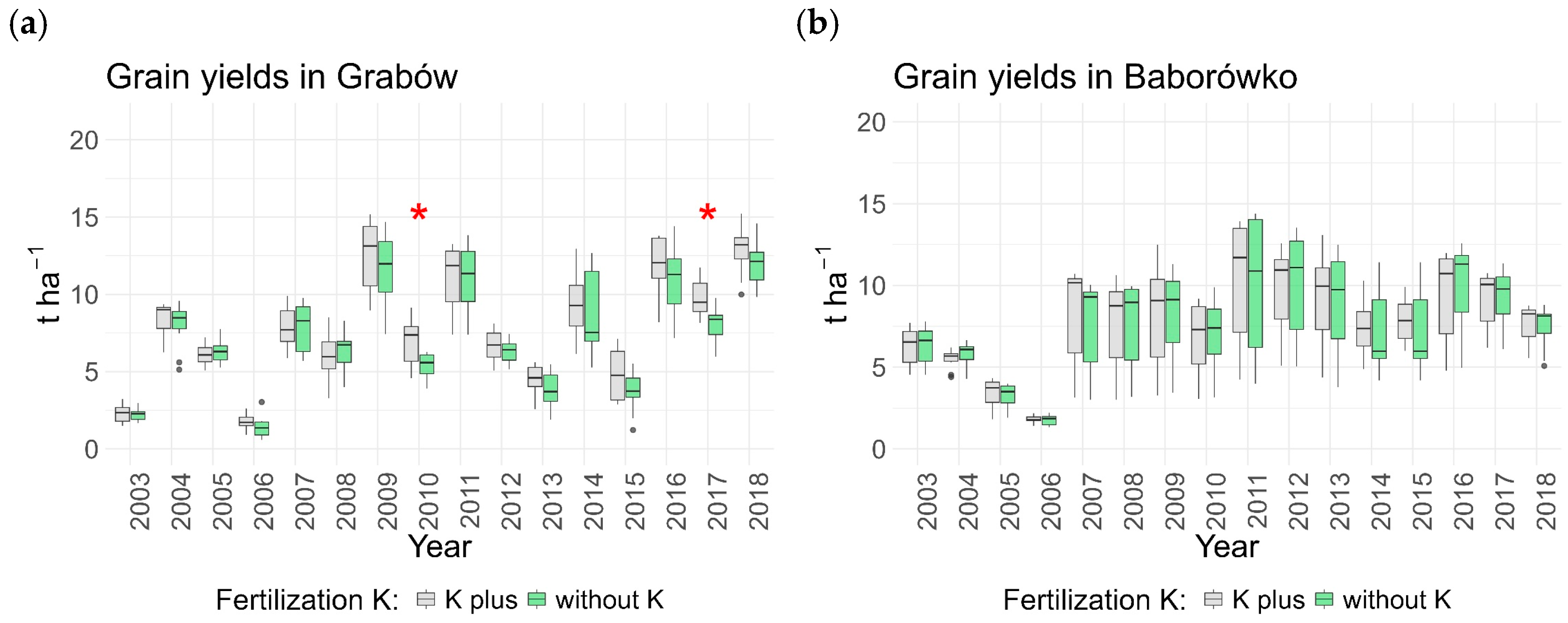
The grain yield of maize, assessed annually over 16 years and compared between the K-plus treatment and treatment without K at two locations (Grabów and Baborówko), indicated that the effect of the K-plus treatment was insignificant (Figure 1). The level of grain yields varied across years with similar trends in both the K-plus and without-K treatments (Figure 1; Tables S1 and S2). A statistically significant difference between the K-plus and without-K treatments was observed only twice—in 2010 and 2017 at the Grabów site.

3.1.2. Effect of Potassium Fertilization at Different Levels of Nitrogen on Maize Productivity

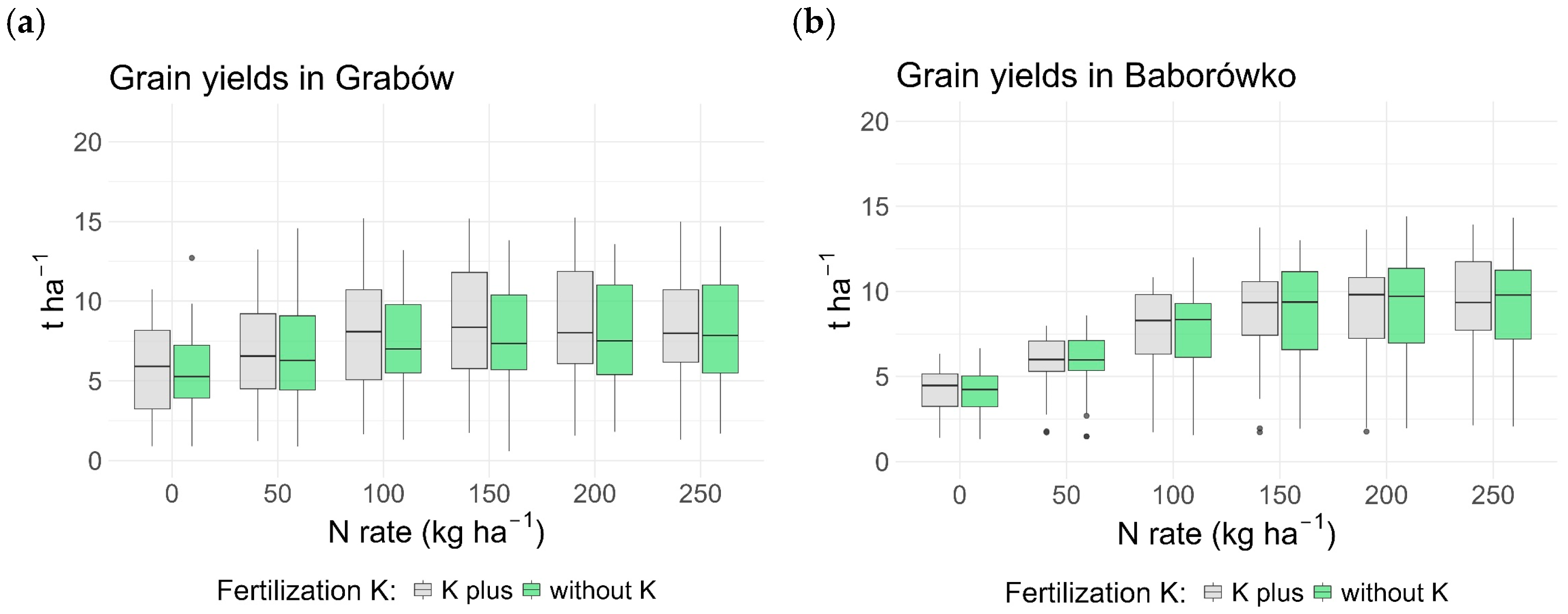
The effect of K fertilization was assessed at different nitrogen application rates. On the whole, the obtained grain yields did not differ significantly between the K-plus and without-K treatments at any N level in either location (Figure 2, Table S5).
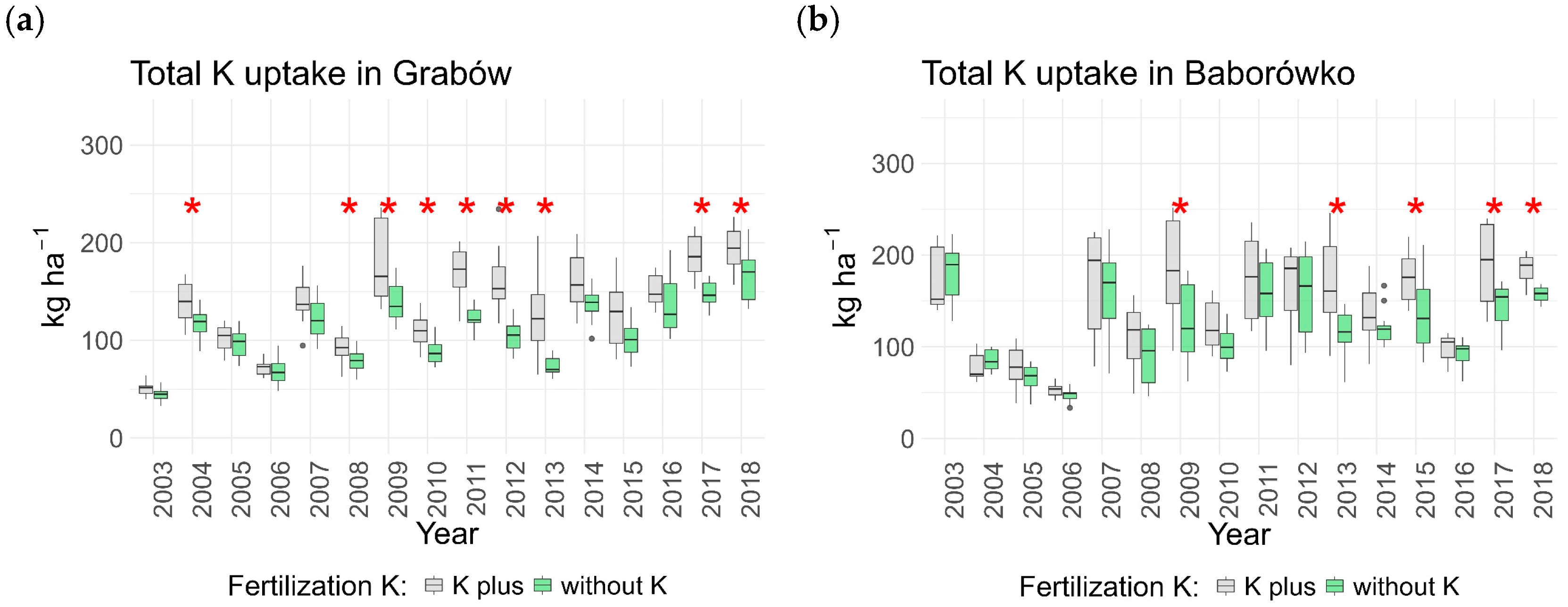
It is worth noting that the total K uptake was significantly higher in crops receiving the K-plus treatment across almost the entire study period in Grabów. This effect was less pronounced in Baborówko, where differences in K uptake between the K-plus and without-K treatments were statistically significant only in five of the study years (Figure 3, Tables S1 and S2).

3.2. Effect of Potassium Soil Potassium Mining on Nitrogen Utilization Indices over the Years

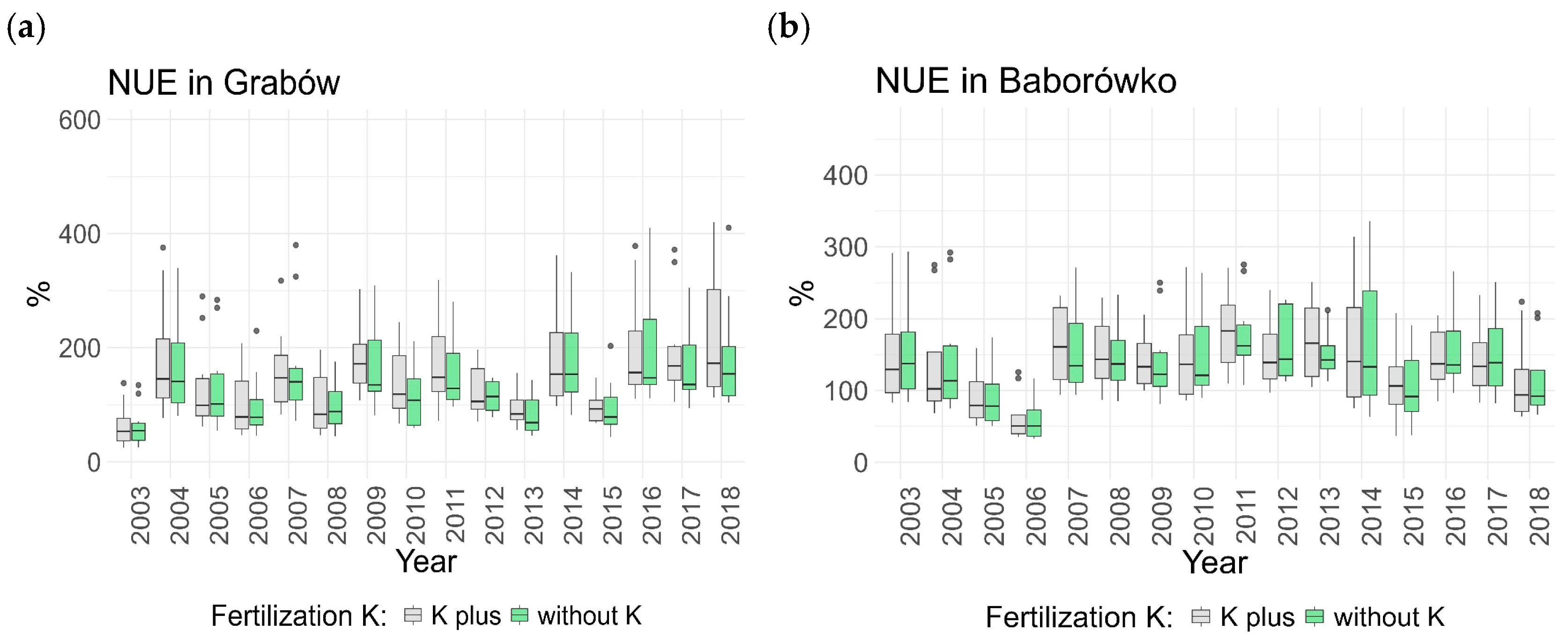
In this study, the effect of the cessation of K fertilization from 2003 to 2018 on nitrogen utilization indices was assessed. The statistical analysis revealed that, over the entire 16-year period, nitrogen use efficiency was independent of the K-plus and without-K treatments in study locations (Figure 4, Tables S3 and S4).
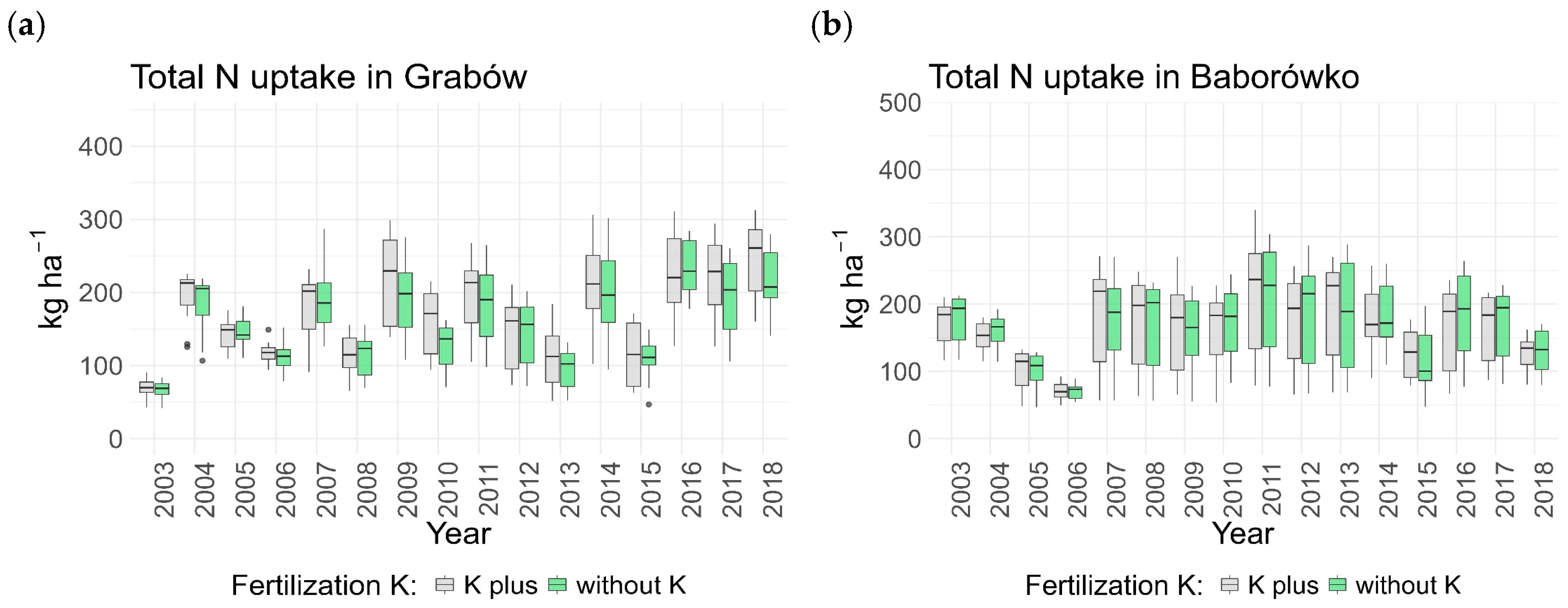
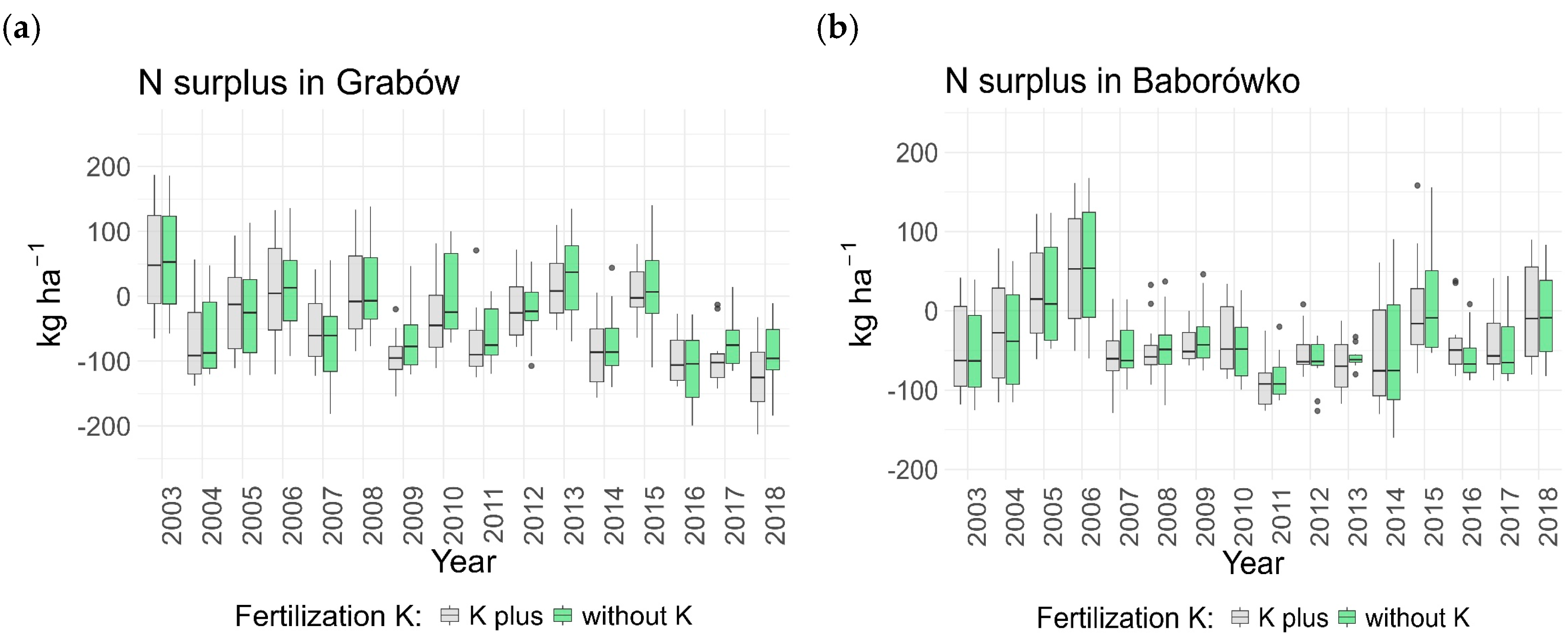
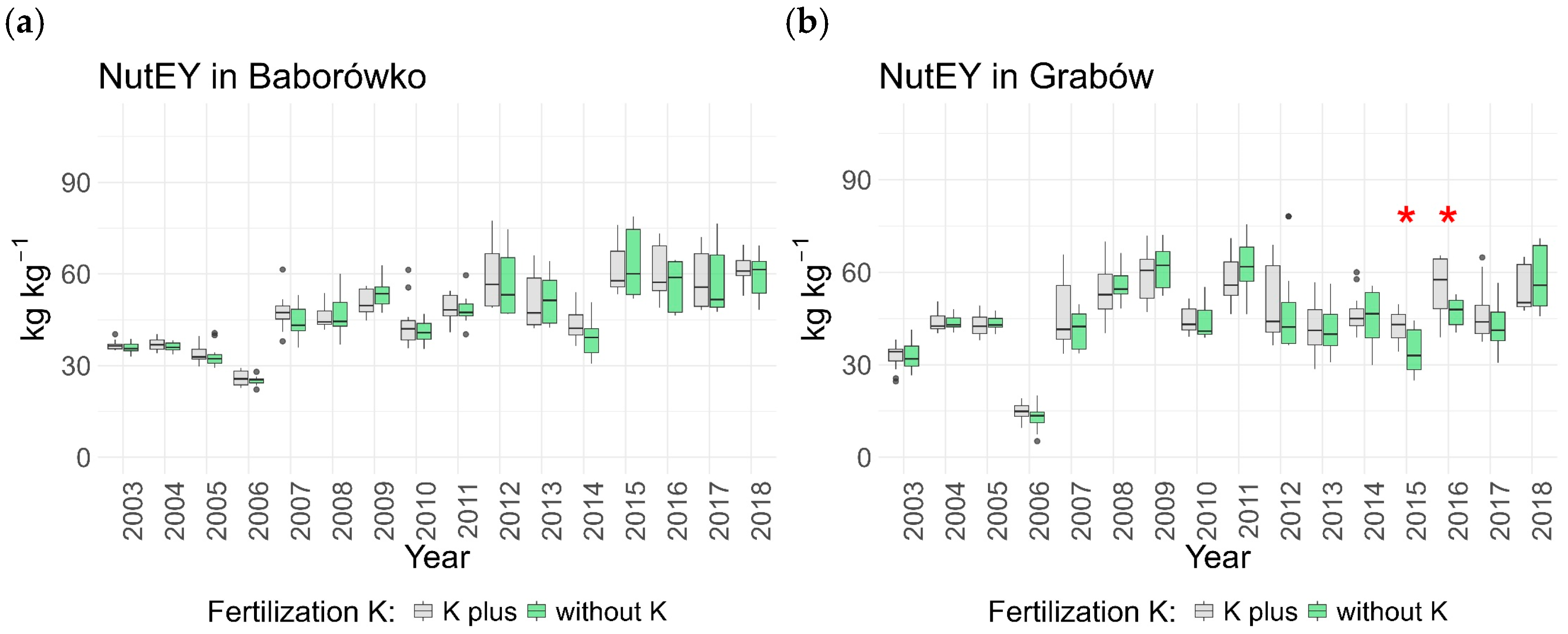
During the long-term study, the effect of K fertilization was also insignificant for nitrogen uptake (Figure 5, Tables S1 and S2) and nitrogen surplus (Figure 6, Tables S3 and S4) in maize in both locations. Nitrogen utilization efficiency (NutEY) was also similar in both K treatments throughout the study period (Figure 7). Only in two years, 2015 and 2016, in Grabów, was the value of NutEY significantly higher in the K-plus treatment.

3.3. The Combined Effects of Potassium Fertilization and Nitrogen Applications on Maize Grain Yield

The combined effects of potassium and nitrogen fertilization on maize grain yield were assessed using mixed-effects models fitted separately for the Grabów and Baborówko locations (Table 1 and Table 2). Model residuals (n = 384) were approximately normally distributed, with no evidence of strong heteroscedasticity or autocorrelation. A small number of symmetric outliers were identified, with minimal impact on the model estimates (see diagnostic plots in Supplementary Materials: Figures S1 and S2).
Overall, the mixed-effects models showed good fit to the data, as confirmed by the residuals vs. fitted scatterplots (Figures S1 and S2). The conditional R2 values (reflecting both fixed and random effects) were very high, 90% for Grabów and 94% for Baborówko, indicating strong overall explanatory power. In contrast, the marginal R2 values (reflecting only fixed effects) were markedly lower: 7% for Grabów and 33% for Baborówko, suggesting that the fixed effects explained a limited portion of variability.
For the comparison of yield levels, model-derived estimated marginal means (EMMeans), rather than observed means calculated from the two field replicates, were used. This approach is justified because the mixed-effects model incorporates both the main effects and additional conditional effects that influenced plant performance under field conditions. Specifically, the model accounted for year-to-year differences caused by weather conditions, as well as differences between field plots resulting from the crop rotation system applied throughout the 16-year experiment. Thus, the model provides estimated means (estimated marginal means; EMMeans) of yield, which are more reliable and directly comparable across treatments than simple arithmetic means computed from the raw data (Table 3 and Table 4).
The effects of potassium fertilization and its interaction with nitrogen dose (K × N dose) were not statistically significant (Table 1 and Table 2). In both locations, maize grain yield significantly increased with increasing nitrogen rates. This trend was more pronounced in Baborówko than in Grabów and remained consistent across both potassium treatments (see prediction plots with 95% CI in Figures S1 and S2).
More detailed comparisons of maize grain yields between groups subjected to different combinations of K and N treatments indicated that grain yield increased significantly with rising N rates in the range of 0–100 kg ha−1 in Grabów and 0–200 kg ha−1 in Baborówko (Table 3 and Table 4). Further increases in N rates did not result in a statistically significant rise in grain yield. In Baborówko, K treatments had no statistically significant effect on grain yield (Table 4). In Grabów, a slightly higher grain yield (5–9%) was observed in fields with K fertilization, but this effect was statistically significant only at three N rates: 100, 150 and 200 kg N ha−1 (Table 3).

3.4. The Combined Effects of Potassium Fertilization and Nitrogen Applications on Nitrogen Use Indices in Maize

The impact of combined potassium and nitrogen fertilization on nitrogen use indices in maize was assessed using mixed-effects models applied separately to datasets from Grabów and Baborówko (Table 5 and Table 6). The models are characterized by residuals that are approximately normally distributed and symmetric with no evidence of strong heteroscedasticity or autocorrelation. Thus, the models appear to be reliable (see diagnostic plots in Supplementary Materials: Figures S3–S10).
Across both sites, nitrogen uptake increased significantly with the increase in the nitrogen dose (Table 5 and Table 6). It ranged from 105 to 202 kg N ha−1 in Grabów and from 77 to 206 kg N ha−1 in Baborówko (Table 7 and Table 8), and its rise was associated with a decrease in the nitrogen surplus. However, this trend was similar in both K-treated (K-plus) and K-untreated (without-K) plots. Statistically significant differences between K treatments were observed only in Grabów at nitrogen rates of 150 and 200 kg N ha−1. At these rates, potassium fertilization enhanced nitrogen uptake and, as a result, reduced nitrogen surplus by 16–17 kg ha−1 at 150 and 200 kg N ha−1, respectively (Table 7 and Table 8).
Conversely, increasing nitrogen rates led to a decline in nitrogen use efficiency and nitrogen utilization efficiency. The lowest values of NUE, amounting to about 50%, were noted in 2003 in Grabów and in 2006 in Baborówko. With such low efficiency, the nitrogen surplus in both locations reached 50 kg N ha−1; the efficiency of nitrogen utilization was only 33 kg N kg−1 in Grabów and 26 kg N kg−1 in Baborówko. The highest values of NUE were obtained in 2018 in Grabów and in 2011 in Baborówko—about 160% and 180%, respectively, with a strongly negative N surplus (about minus 100 kg N ha−1 in Grabów and about minus 85 kg N ha−1 in Baborówko) and a high value of nitrogen efficiency utilization (53 kg kg−1 in Grabów and 48 kg kg−1 in Baborówko). Regardless of such large differences in the values of the NUE indices, no effect of potassium fertilization was found in any case.

4. Discussion

4.1. Effect of Long-Term Potassium Omission on Maize Productivity

The results of the present long-term experiment conducted on light soil characterized by a medium-to-low content of available K indicate that the cessation of potassium fertilization for 16 years did not significantly affect maize grain yield, despite a progressive depletion of the topsoil K content. These findings generally contrast with the widely recognized importance of potassium as a key macronutrient controlling plant growth and crop productivity. Nonetheless, certain reports point to the lack of a clear relationship between potassium fertilization and maize yield, despite the plant’s considerable nutrient requirements. Discrepancies in research findings usually result from variations in soil–climatic conditions and the duration of experiments.
In the described 16-year experiments, unfertilized plants of maize took up less potassium compared with plants regularly supplied with K. Nevertheless, these differences were relatively small, considering the period without K fertilizer applications. The amount of accumulated potassium proved sufficient to obtain yields similar to those in the treatment with balanced K fertilization in Baborówko, or slightly lower in Grabów (Figure 1, Table 3 and Table 4). However, the median values of K uptake by plants supplied with K fertilizers which accounted for 142 kg K ha−1 in Grabów and 156 kg K ha−1 in Baborówko, indicate that K removal with maize biomass over four complete crop rotations in the same field was substantial and reached about 600 kg K ha−1. It is worth noting that no organic fertilizers were applied during the experiment, and straw from all cultivated crops (oilseed rape, winter wheat, maize and spring barley) was removed from the field. Consequently, the only external sources of potassium for plants were inorganic potassium fertilizers and K contained in post-harvest residues.
The lack of a clear yield response to K fertilization therefore suggests that soil potassium reserves were sufficient to meet maize nutritional requirements during the experimental period, and that the soil in the experiments exhibited a high buffering capacity with respect to potassium. The current conceptual understanding of soil K availability assumes the existence of distinct K pools: rapidly available K, including water-soluble K, and exchangeable K, non-exchangeable K, and mineral K [50,51]. There is a quasi–equilibrium in the soil–plant system between the different forms of potassium [52,53]. Although cropping decreases the amounts of exchangeable K, it is generally not possible to reduce this pool below a certain level. This is because, once a minimum level is reached, the release of fixed K is triggered by a low concentration of K in the soil solution, and in the exchangeable fraction [54].
If the reserve of non-exangeable potassium in the soil is sufficient, crops may maintain relatively stable yields for many years even in the absence of potassium fertilization [55,56,57]. Under Polish conditions, in a study conducted by Stępień and Mercik [58] among 1967 and 1999, on soil with low potassium content (71 mg K kg−1 soil), in the crop rotation: rye, spring barley, winter wheat, potato, yields remained at a similar level throughout the experiment. Although the average dose of nitrogen applied in this experiment was relatively low and amounted to 80 kg N ha−1, cereal yields did not exceed 3 t ha−1, and potatoes 12 t ha−1, over the 30-year period, plants took up significant amounts of potassium, averaging more than 11 000 kg K ha−1. In our experiment, high-yielding cultivars with much higher requirements for both potassium and nitrogen were grown, particularly winter oilseed rape and maize, which further increased soil potassium depletion.
It is well documented that potassium availability to plants depends both on the pool of available K in the soil and on the potential of K release [50,51]. This soil capacity was demonstrated in previous research conducted by Rutkowska and Gosek among 2003 and 2007 [59]. Water-soluble, exchangeable, non-exangeable, and total K fractions were determined in selected experimental treatments, which included complete nitrogen and potassium fertilization and unbalanced fertilization with these macronutrients. In all experimental treatments, the content of the analyzed potassium forms was strongly dependent on the K balance (ranging from +200 kg K ha−1 to −576 kg K ha−1). However, the proportion of water-soluble K in exchangeable K was about 27%, the proportion of exchangeable K in reserve potassium about 30%, and the share of reserve K in total K was about 27%, regardless of the fertilizer combination.
Potassium availability to plants also depends on soil mineralogy and microbial activity. Consequently, different soils require different amounts of potassium to ensure adequate yields of crop [60,61]. Another study conducted under Polish conditions indicates that a positive yield response to potassium fertilization can be expected under conditions of low soil K availability and water stress during the growing season [28]. However, in a five-year field experiment with maize conducted by Bąk and Gaj [30] on soil with a medium level of available K, the yield response to varying K fertilization differed across years, with an increasing trend observed in only one year. Similar interannual variability was reported by Grzebisz et al. [62] in an experiment with maize grown under conditions of medium soil potassium content and supplied with different K fertilizer rates. These authors concluded that in years favorable for maize growth, an optimal potassium supply enhances yield potential, whereas under unfavorable conditions it increases plant resistance to stress factors and reduces grain yield losses. In our study, a significant difference in maize yield was observed only twice over 16-year period, and at one location, in Grabów, when maize yields were moderately low (in 2010) and moderately high (2017) and the available soil potassium was insufficient to obtain higher yields.
Another factor that may have contributed to the limited yield response to potassium fertilization in the presented study, is the crop rotation system applied in the experiment. Crop rotation systems can enhance the levels of available and exchangeable K relative to monoculture, thereby improving the soil’s K supply capacity and dynamics of potassium in soil, which in turn affects K uptake by subsequent crops [6,63]. The experiment was conducted using a modified Norfolk crop rotation, incorporating four crop species with distinct nutrient requirements. Deep-rooted species—oilseed rape and maize can access nutrients from deeper soil layers, whereas shallow-rooted cereals utilize nutrients from upper layers, allowing complementary exploitation of soil potassium, as well as ensuring sustained crop production and yield stability [64,65].

4.2. Unbalanced NK Fertilization and NUE Indices

In the present study which investigated the impact of long-term soil potassium depletion on NUE parameters, the method proposed by the EU Expert Panel was applied [35]. This approach integrates three key components: nitrogen input, nitrogen output and nitrogen surplus, and is used for the evaluation of nitrogen fertilization sustainability across different production systems. There are only few studies that report NUE calculated using this methodology [9,35,36,66]. According to the results obtained by Quemada et al. [36] based on the data collected from nearly 200 arable farms in Europe, with the prevalence of cereals grown in 2–3 crop rotations, the mean value of NUE in cereals was 60% and N surplus was 68 kg N ha−1. Similar studies conducted under Polish conditions with different crops, including cereals, indicate that the mean NUE oscillated between 50 and 80%, and nitrogen surplus ranged between 15 and 83 kg N ha−1 [9]. However, these values represent medians derived from different datasets, accounting for nitrogen removal by the main products or by the total biomass of harvested crops.
Despite the well-documented synergistic interaction between nitrogen and potassium nutrition in yield stability [6,67], and the prolonged period without potassium application, the present results show only a weak interaction between these nutrients. Nitrogen uptake increased with increasing nitrogen rates in both experimental sites, irrespective of potassium fertilization. Conversely, a decline in nitrogen use efficiency with increasing nitrogen doses was observed, which is in agreement with commonly reported findings that enhanced nitrogen availability leads to diminishing returns in crop N recovery [68,69]. In general, the average NUE values were high, which was influenced by two factors. First, the calculations accounted for total plant biomass, including both grain and straw, as the straw was removed from the field annually after harvest. Second, in maize cultivation, when nitrogen rates exceeded 100 kg N ha−1, the total fertilizer amount was divided into two applications to enhance nitrogen use efficiency and minimize nitrogen losses. In both locations, NUE values above 100% were observed at nitrogen rates up to 150 kg N ha−1, indicating efficient use of nitrogen at moderate fertilizer rates. Values exceeding 100% are not desirable, as they indicate the depletion of soil nitrogen resources. However, such a relationship was observed both under balanced potassium fertilization and in the absence of potassium applications. The omission of potassium fertilization did not result in negative environmental effects associated with an increase in nitrogen surplus due to reduced nitrogen use efficiency. The desired nitrogen surplus below 80 kg N ha−1 was maintained across the entire range of nitrogen rates, regardless of potassium fertilization. These findings support previous conclusions that, under the conditions of the field experiments conducted, soil potassium availability was sufficient to sustain nitrogen metabolism in maize, thereby maintaining NUE indices within the recommended range [35].
Usually, nitrogen use efficiency is associated with the status of indigenous K in agricultural soils. Below the critical soil potassium level, the efficiency of N fertilizer use may be reduced. However, improvements in NUE resulting from K fertilization also depend on the level of N nutrition, soil moisture regimes, crop responsiveness to K, plant genotype, and crop growth stage [13,70]. In the presented study, NUE indices were affected by the level of nitrogen fertilization, not by potassium applications. Consistently, long-term potassium cessation did not significantly affect N surplus. It should be emphasized, however, that the soil in the described experiment was maintained through good agricultural practice, soil pH was optimal throughout the entire experiment period, and fertilization with other nutrients was applied in accordance with recommendations. Nevertheless, in Grabów, where the initial available potassium content was lower than in Baborówko, NUE values tended to be slightly lower in the treatment without K fertilization, particularly at the highest N rates. This trend suggests that lower soil potassium status may constrain nitrogen use efficiency under certain conditions, even when both nitrogen uptake and yields are slightly reduced. However, the magnitude of this effect depends on the severity of potassium deficiency. In soils with adequate potassium reserves and a high buffering capacity, this effect can be alleviated [22,71,72].

4.3. Agronomic and Environmental Implications of Prolonged Cessation of Potassium Fertilization

In the Polish fertilizer recommendation system, five classes of soil fertility are distinguished: very low, low, medium, high and very high. According to these recommendations, in crop production, it is necessary to keep at least a medium content of macronutrients (P, K, Mg) in order to maintain proper soil fertility and ensure high yields. Fertilizer doses are then calculated, taking into account soil fertility, forecrop, expected yield and the uptake of macronutrients per unit of the main products and by-products. For potassium, in light soils, a medium content of available potassium ranges from 83.1 to 124.5 mg K kg−1 soil. It should be noted that the experimental fields were located on soils typical of Poland, with a medium-to-low content of available potassium. The soil in Baborówko was characterized by a slightly higher potassium content compared with that in Grabów, where the initial potassium level was at the boundary between the medium and low classes.
The most common method used worldwide to assess K status is the measurement of exchangeable K to formulate fertilizer recommendations [53]. Meanwhile, there is evidence of the importance of non-exchangeable K (slowly plant-available K). Comprehensive monitoring studies of soils in Poland indicate significant potassium reserves in the subsoil, which can potentially be taken up by roots. According to these studies, the average content of exchangeable potassium in light soils amounts to 71.1 mg K kg−1 soil in the 25–50 cm layer of soil, and the total content of extracted potassium is 503 mg K kg−1 soil [73].
Under the presented experimental conditions, potassium withdrawal did not significantly affect maize productivity over the 16-year period. These findings suggest that soil reserves were sufficient to sustain crop demand during the experimental period. This was particularly evident in Baborówko, where initial soil K levels were higher and yield differences between the K-plus and without-K treatments were negligible. In Grabów, where the initial K status was lower, slight yield reductions under K withdrawal were observed at relatively high nitrogen rates, indicating that soil K buffering capacity may be site-specific.
This is also confirmed by the nitrogen use efficiency indices. The mean NUE values, as well as nitrogen uptake, nitrogen surplus, and nitrogen utilization efficiency, were similar in treatments with and without potassium applications. In this study, the effect of potassium omission was evaluated under increasing nitrogen rates for maize, ranging from 50 to 250 kg N ha−1. In agricultural practices in Poland, the average nitrogen rates applied in maize production range between 100 and 125 kg N ha−1. At this level, the NUE values obtained in both locations exceeded 100%, demonstrating very efficient use of nitrogen from fertilizers by maize, regardless of potassium fertilization. Moreover, at the rates of 100 and 150 kg N ha−1, the nitrogen surplus remained negative, suggesting a relatively low risk of nitrogen losses. However, it should be noted that at these doses, such high NUE values corresponding to a strongly negative nitrogen surplus indicate depletion of soil nitrogen reserves, which is not desirable in the long term if no other nitrogen sources, such as organic fertilizers or manure, are applied.
Nevertheless, the observed decline in the content of available potassium in both locations indicates a progressive process of soil depletion, which in the long term may lead to more severe consequences for crop production, particularly at high nitrogen doses. In specific conditions, in soils with a low total K content, such as sandy soils, rapid K depletion can occur over a relatively short period if K removal is not balanced by regular potassium fertilization with mineral fertilizers or by adequate recycling of crop residues or manure. In this sandy soil, with an annual negative balance of about 40 kg K ha−1, less than 50 years are required to remove 25% of the soil potassium stock [53].
It should be emphasized that the presented results refer to specific soil conditions and a defined crop rotation system. Moreover, the soils at both locations were characterized by a regulated pH, maintained through regular liming. Thus, under the conditions of the conducted experiment, the effect of potassium omission on maize productivity and the analyzed NUE indicators was limited. However, under acidic soil conditions and in a maize monoculture, a much stronger impact of unbalanced potassium fertilization on crop yield and soil potassium status should be expected.

5. Conclusions

The results obtained from experiments conducted in two locations differing in climatic conditions, on soils with a medium-to-low content of available potassium, which is typical in Poland, indicate that the cessation of potassium fertilization for 16 years did not lead to a significant decrease in nitrogen use efficiency in maize. Consequently, long-term potassium cessation had no effect on maize productivity, and yield variability observed during the experimental period was primarily dependent on weather conditions during the growing season. This was possible provided that at least an adequate level of other nutrients and appropriate soil pH were maintained, and maize was grown in a four-crop rotation system.
However, continued depletion of soil potassium reserves, combined with intensive nitrogen fertilization—especially under conditions where crop residues such as straw are removed—may eventually lead to reduced yields. This effect is expected to be particularly pronounced in crops with high nutrient requirements, such as maize.

Supplementary Materials

The following supporting information can be downloaded at https://www.mdpi.com/article/10.3390/agriculture16070788/s1. Figure S1. Residuals vs. fitted values, Q-Q plot, residual histogram, and predicted grain yield with 95% CI, from the mixed-effects model (Grabów data); Figure S2. Residuals vs. fitted values, Q-Q plot, residual histogram, and predicted grain yield with 95% CI, from the mixed-effects model (Baborówko data); Figure S3. Residuals vs. fitted values, Q-Q plot, residual histogram, and predicted nitrogen uptake (Yn) with 95% CI, from the mixed-effects model (Grabów data); Figure S4. Residuals vs. fitted values, Q-Q plot, residual histogram, and predicted nitrogen uptake (Yn) with 95% CI, from the mixed-effects model (Baborówko data); Figure S5. Residuals vs. fitted values, Q-Q plot, residual histogram, and predicted nitrogen surplus (Ns) with 95% CI, from the mixed-effects model (Grabów data).; Figure S6. Residuals vs. fitted values, Q-Q plot, residual histogram, and predicted nitrogen surplus (Ns) with 95% CI, from the mixed-effects model (Baborówko data).; Figure S7. Residuals vs. fitted values, Q-Q plot, residual histogram, and predicted NUE with 95% CI, from the mixed-effects model (Grabów data).;Figure S8. Residuals vs. fitted values, Q-Q plot, residual histogram, and predicted NUE values with 95% CI, from the mixed-effects model (Baborówko data).; Figure S9. Residuals vs. fitted values, Q-Q plot, residual histogram, and predicted NutEY values with 95% CI, from the mixed-effects model (Grabów data).; Figure S10. Residuals vs. fitted values, Q-Q plot, residual histogram, and predicted NutEY values with 95% CI, from the mixed-effects model (Baborówko data).; Figure S11. Residuals vs. year scatterplot from the mixed-effects model (Grabów data).;Figure S12. Residuals vs. year scatterplot from the mixed-effects model (Baborówko data).; Figure S13. Residuals vs. year scatterplot from the mixed-effects model (Grabów data).; Figure S14. Residuals vs. year scatterplot from the mixed-effects model (Baborówko data).; Figure S15. Residuals vs. year scatterplot from the mixed-effects model (Grabów data).; Figure S16. Residuals vs. year scatterplot from the mixed-effects model (Baborówko data).; Figure S17. Residuals vs. year scatterplot from the mixed-effects model (Grabów data).; Figure S18. Residuals vs. year scatterplot from the mixed-effects model (Baborówko data).; Figure S19. Residuals vs. year scatterplot from the mixed-effects model (Baborówko data).; Figure S20. Residuals vs. year scatterplot from the mixed-effects model (Baborówko data).; Table S1. Median, minimal and maximal values of grain yield (t·ha−1), total N uptake (kg·ha−1) and total K uptake (kg·ha−1) for each year in Baborówko; Table S2. Median, minimal and maximal values of grain yield (t·ha−1), total N uptake (kg·ha−1) and total K uptake (kg·ha−1) for each year in Grabów; Table S3. Median, minimal and maximal values of NUE (%), total NutEY (kg·kg−1) and N surplus (kg·ha−1) for each year in Baborówko; Table S4. Median, minimal and maximal values of NUE (%), total NutEY (kg·kg−1) and N surplus (kg·ha−1) for each year in Grabów; Table S5. Median, minimal and maximal values of grain yield (t·ha−1), total N uptake (kg·ha−1) and total K uptake (kg·ha−1) for each N rate.

Author Contributions

Conceptualization, A.R.; methodology, A.R.; software, B.S.-Ł.; formal analysis, B.S.-Ł.; investigation, A.R.; resources, A.R.; data curation, B.S.-Ł. and A.R.; writing—original draft preparation, A.R. and B.S.-Ł.; writing—review and editing, A.R. and B.S.-Ł.; visualization, B.S.-Ł. All authors have read and agreed to the published version of the manuscript.

Funding

This research received no external funding.

Data Availability Statement

The raw data supporting the conclusions of this article will be made available by the authors on request.

Conflicts of Interest

The authors declare no conflicts of interest.

References

  1. Marschner, P. Mineral Nutrition of Higher Plants; Elsevier Ltd.: Amsterdam, The Netherlands, 2012; p. 651. [Google Scholar]
  2. Tian, M.; Tan, G.; Liu, Y.; Rong, T.; Huang, Y. Origin and evolution of Chinese waxy maize: Evidence from the Globulin-1 gene. Genet. Resour. Crop Evol. 2009, 56, 247–255. [Google Scholar] [CrossRef]
  3. Yue, K.; Li, L.L.; Xie, J.; Liu, Y.; Xie, J.; Anwar, S.; Fudjoe, S.K. Nitrogen supply affects yield and grain filling of maize by regulating starch metabolizing enzyme activities and endogenous hormone contents. Front. Plant Sci. 2022, 12, 798119. [Google Scholar] [CrossRef] [PubMed]
  4. Gaj, R.; Górski, D.; Przybyl, J. Effect of differentiated phosphorus and potassium fertilization on winter wheat yield and quality. J. Elem. 2013, 18, 55–67. [Google Scholar] [CrossRef]
  5. Ullah, A. Response of maize hybrids to varying potassium application in Pakistan. Pak. J. Agric. Sci. 2009, 46, 179–184. [Google Scholar]
  6. Pettigrew, W.T. Potassium influences on yield and quality production for maize, wheat, soybean and cotton. Physiol. Plant. 2008, 133, 670–681. [Google Scholar] [CrossRef]
  7. Dhillon, J.S.; Eickhoff, E.M.; Mullen, R.W.; Raun, W.R. World potassium use efficiency in cereal crops. Agron. J. 2019, 111, 889–896. [Google Scholar] [CrossRef]
  8. Piwowar, A. Consumption of mineral fertilizers in the Polish agriculture—Trends and directions of changes. Agric. Res. 2021, 11, 477–487. [Google Scholar] [CrossRef]
  9. Faber, A.; Jarosz, Z.; Jędrejek, A.; Kopiński, J. Nitrogen relationships in Polish cropping system. J. Water Land Dev. 2023, 56, 27–36. [Google Scholar] [CrossRef]
  10. Galloway, J.N.; Townsend, A.R.; Erisman, J.W.; Bekunda, M.; Cai, Z.; Freney, J.R.; Martinaelli, J.A.; Seitzinger, S.P.; Sutton, M. Transformation of the nitrogen cycle: Recent trends, questions, and potential solutions. Science 2008, 320, 889–892. [Google Scholar] [CrossRef]
  11. Jones, I.; Provins, A.; Holland, M.; Mills, G.; Hayes, F.; Emmetta, B.; Harper-Simonds, L. A review of the evidence for nitrogen impacts on ecosystem services. Ecosyst. Serv. 2014, 7, 76–88. [Google Scholar] [CrossRef]
  12. Kanter, D.R.; Winiwarter, W.; Bodirsky, B.L.; Bouwman, L.; Boyer, E.; Buckle, S.; Compton, J.E.; Dalgaard, T.; Wim de Vries, D.L.; Leip, A.; et al. A framework for nitrogen futures in the shared socioeconomics pathways. Glob. Environ. Change 2020, 61, 102029. [Google Scholar] [CrossRef]
  13. Khalifa, K.; Al-Chammaa, M.; Al-Ain, F. Effect of potassium fertilizers on cotton yield and nitrogen uptake efficiency in an Aridisol. Commun. Soil Sci. Plant Anal. 2012, 43, 2180–2189. [Google Scholar] [CrossRef]
  14. Bouwman, L.; Goldewijk, K.K.; Van Der Hoek, K.W.; Beusen, A.H.W.; Van Vuuren, D.P.; Willems, J.; Rufino, M.C.; Stehfest, E. Exploring global changes in nitrogen and phosphorus cycles in agriculture induced by livestock production over the 1900–2050 period. Proc. Natl. Acad. Sci. USA 2013, 110, 20882–20887. [Google Scholar] [CrossRef]
  15. Cameron, K.C.; Di, H.J.; Moir, J.L. Nitrogen losses from the soil/plant system: A review. Ann. Appl. Biol. 2013, 162, 145–173. [Google Scholar] [CrossRef]
  16. GUS (Statistics Poland). Means of Production in Agriculture in the 2024/25 Farming Year; GUS: Warsaw, Poland, 2025. Available online: https://stat.gov.pl/obszary-tematyczne/rolnictwo-lesnictwo/uprawy-rolne-i-ogrodnicze/ (accessed on 25 February 2026).
  17. Gheysari, M.; Mirlatifi, S.M.; Banana, M.; Homaee, M.; Hoogenboom, G. Interaction of water and nitrogen on maize grown for silage. Agric. Water Manag. 2009, 96, 809–821. [Google Scholar] [CrossRef]
  18. Asibi, E.; Chai, Q.; Coulter, J.A. Mechanisms of nitrogen use in maize. Agronomy 2019, 9, 775. [Google Scholar] [CrossRef]
  19. Ige, S.A.; Bello, B.O.; Mahamood, J.; Afolabi, M.; Aremu, C.; Abolusoro, S.; Oyekale, S.; Chijioke, F. Nitrogen use efficiency of open-pollinated maize cultivars and topcrosses under low nitrogen soil. Heliyon 2024, 10, e39223. [Google Scholar] [CrossRef]
  20. Gheith, E.M.S.; El-Badry, O.Z.; Lamlom, S.F.; Ali, H.F.; Siddiqui, M.H.; Ghareeb, R.Y.; El-Sheikh, M.H.; Jebril, J.; Abdelsalam, N.R.; Kandil, E.E. Maize (Zea mays L.) productivity and nitrogen use efficiency in response to nitrogen application levels and time. Front. Plant Sci. 2022, 13, 941343. [Google Scholar] [CrossRef]
  21. Rawal, N.; Vista, S.P.; Khadka, D.; Paneru, P. Nitrogen accumulation, and its use efficiency of maize (Zea mays L.) as influenced by varying nitrogen rates. Int. J. Agron. 2024, 2024, 4104123. [Google Scholar] [CrossRef]
  22. Ciampitti, I.A.; Vyn, T.J. Understanding global and historical nutrient use efficiencies for closing maize yield gaps. Agron. J. 2014, 106, 2107–2117. [Google Scholar] [CrossRef]
  23. Wang, N.; Zhipin, A.; Qiuying, A.; Peifang, L.; Yunfeng, Q.; Zhao, L.; Chao, T.; Hefa, C.; Fadong, L. Impacts of nitrogen (N), phosphorus (P), and potassium (K) fertilizers on maize yields, nutrient use efficiency, and soil nutrient balance: Insights from a long-term diverse NPK omission experiment in the North China Plain. Field Crop. Res. 2024, 318, 106916. [Google Scholar] [CrossRef]
  24. Du, Q.; Zhao, X.; Jiang, C.; Wang, X.; Han, Y.; Wang, J.; Yu, H. Effect of potassium deficiency on root growth and nutrient uptake in maize (Zea mays L.). Agric. Sci. 2017, 8, 1263–1277. [Google Scholar] [CrossRef]
  25. Zhang, Q.; Li, G.; Lu, W.; Lu, D. Interactive effects on nitrogen and potassium on grain yield and quality of waxy maize. Plants 2022, 11, 2528. [Google Scholar] [CrossRef]
  26. Niu, J.; Zhang, W.; Chen, X.; Li, C.; Zhang, F.; Jiang, L.; Liu, Z.; Xiao, K.; Assaraf, M.; Imas, P. Potassium Fertilization on maize under different production practices in the North China Plain. Agron. J. 2011, 103, 288–829. [Google Scholar] [CrossRef]
  27. He, B.; Xue, C.; Sun, Z.; Ji, Q.; Wei, J.; Ma, W. Effect of different long-term potassium dosages on crop yield and potassium use efficiency in the maize–wheat rotation system. Agronomy 2022, 12, 2565. [Google Scholar] [CrossRef]
  28. Szczepaniak, W. Plant’s response to potassium fertilization. J. Elem. 2004, 9, 57–66. (In Polish) [Google Scholar]
  29. Szczepaniak, W. Evaluating nitrogen use efficiency (NUE) indices on the background of mineral status of the seed crop at maturity: Cases study of maize. Pol. J. Environ. Stud. 2016, 25, 2129–2138. [Google Scholar] [CrossRef]
  30. Bąk, K.; Gaj, R. Effect of differentiated phosphorus and potassium fertilization on maize grain yield and plant nutritional status at a critical growth stage. J. Elem. 2016, 21, 337–348. [Google Scholar]
  31. Grzebisz, W.; Gransee, A.; Szczepaniak, W.; Diatta, J. The effects of potassium fertilization on water-use efficiency in crop plants. Plant Nutr. Soil Sci. 2013, 176, 355–374. [Google Scholar] [CrossRef]
  32. Dobermann, A.R. Nitrogen Use Efficiency—State of Art; Agronomy & Horticulture—Faculty Publications: Lincoln, NE, USA, 2005; p. 316. [Google Scholar]
  33. Martinez-Feria, R.A.; Castellano, M.J.; Dietzel, R.N.; Helmers, M.J.; Liebman, M.; Huber, I.; Archontoulis, S.V. Linking crop and soil-based approaches to evaluate system nitrogen use efficiency and trade-offs. Agric. Ecosyst. Environ. 2018, 256, 131–143. [Google Scholar] [CrossRef]
  34. Congreves, K.A.; Otchere, O.; Ferland, D.; Farzadfar, S.; Williams, S.; Arcand, M.M. Nitrogen use efficiency definitions of today and tomorrow. Front. Plant Sci. 2021, 12, 637108. [Google Scholar] [CrossRef] [PubMed]
  35. EU Nitrogen Expert Panel. Nitrogen Use Efficiency (NUE)—An Indicator for the Utilization of Nitrogen in Agriculture and Food Systems; Wageningen University: Wageningen, The Netherlands, 2015. [Google Scholar]
  36. Quemda, M.; Lassaletta, L.; Jensen, L.S.; Godinot, O.; Brentrup, F.; Buckley, C.; Foray, S.; Hvid, S.K.; Oenema, J.; Richards, K.G.; et al. Exploring nitrogen indicators of farm performance among farm types across several European case studies. Agric. Syst. 2020, 177, 102689. [Google Scholar] [CrossRef]
  37. Moll, R.H.; Kamprath, E.J.; Jackson, W.A. Analysis and interpretation of factors which contribute to efficiency of nitrogen utilization. Agronom. J. 1982, 74, 562–564. [Google Scholar] [CrossRef]
  38. R Core Team. R: A Language and Environment for Statistical Computing, Version 4.3.2; R Foundation for Statistical Computing: Vienna, Austria, 2023. Available online: https://www.r-project.org (accessed on 25 March 2026).
  39. Wickham, H.; Bryan, J. Readxl: Read Excel Files. CRAN Softw Notes 2025, Version 1.4.5. Available online: https://cran.r-project.org/web/packages/readxl/readxl.pdf (accessed on 25 March 2026).
  40. Schauberger, P.; Walker, A.; Garbuszus, J.M. Openxlsx: Read, Write and Edit xlsx Files. CRAN Tools Rep 2025, Version 4.2.8. Available online: https://CRAN.R-project.org/package=openxlsx (accessed on 25 March 2026).
  41. Ooms, J.; McNamara, J. writexl: Export Data Frames to Excel ‘xlsx’ Format. R Package Version 1.5.3. 2025. Available online: https://CRAN.R-project.org/package=writexl (accessed on 25 March 2026).
  42. Wickham, H.; François, R.; Henry, L.; Müller, K.; Vaughan, D. dplyr: A Grammar of Data Manipulation. Tidyverse Methods 2023, Version 1.1.4. Available online: https://CRAN.R-project.org/package=dplyr (accessed on 25 March 2026).
  43. Wickham, H.; Chang, W.; Henry, L.; Pedersen, T.L.; Takahashi, K.; Wilke, C.; Woo, K.; Yutani, H.; Dunnington, D.; van den Brand, T.; et al. Ggplot2: Elegant Graphics for Data Analysis. Tidyverse Graph J 2024, Version 3.5.0. Available online: https://CRAN.R-project.org/package=ggplot2 (accessed on 25 March 2026).
  44. Kassambara, A. rstatix: Pipe-Friendly Framework for Basic Statistical Tests. Datanovia Stat Softw 2023, Version 0.7.2. Available online: https://CRAN.R-project.org/package=rstatix (accessed on 25 March 2026).
  45. Lenth, R. emmeans: Estimated Marginal Means, Aka Least-Squares Means. CRAN Stat Inference J 2025, Version 1.11.1. Available online: https://CRAN.R-project.org/package=emmeans (accessed on 25 March 2026).
  46. Pinheiro, J.; Bates, D.; DebRoy, S.; Sarkar, D.; R Core Team. nlme: Linear and Nonlinear Mixed Effects Models. CRAN Mixed Model Rev 2023, Version 3.1-163. Available online: https://CRAN.R-project.org/package=nlme (accessed on 25 March 2026).
  47. Bartoń, K. MuMIn: Multi-Model Inference. CRAN Model Comp J 2022, Version 1.46.0. Available online: https://CRAN.R-project.org/package=MuMIn (accessed on 25 March 2026).
  48. Auguie, B. Gridextra: Miscellaneous Functions for “Grid” Graphics. R Package Version 2.3. 2017. Available online: https://CRAN.R-project.org/package=gridExtra (accessed on 25 March 2026).
  49. TIBCO Software Inc. TIBCO Statistica™, Version 13.3.0; TIBCO Software Inc.: Palo Alto, CA, USA, 2018.
  50. Moody, P.W.; Bell, M.J. Availability of soil potassium and diagnostic soil tests. Aust. J. Soil Res. 2006, 44, 265–275. [Google Scholar] [CrossRef]
  51. Syers, J.K. Potassium in soils: Current concepts. In Feed the Soil to Feed the People: The Role of Potash in Sustainable Agriculture, Proceedings of the IPI Golden Jubilee Congress, Basel, Switzerland, 8–10 October 2002; International Potash Institute: Basel, Switzerland, 2003; Volume 1, p. 301. [Google Scholar]
  52. Öborn, I.; Andrist-Rangel, Y.; Askegaard, M.; Grant, C.A.; Watson, C.A.; Edwards, A.C. Critical aspects of potassium management in agricultural systems. Soil Use Manag. 2005, 21, 102–112. [Google Scholar] [CrossRef]
  53. Römheld, V.; Kirkby, E.A. Research on potassium in agriculture: Needs and prospects. Plant Soil. 2010, 335, 155–180. [Google Scholar] [CrossRef]
  54. Fuleky, G. Exhaustion of available soil potassium. Nawozy Nawoż.-Fetrilizers Fertil. 2005, 3, 133–140. [Google Scholar]
  55. Singh, M.; Wanjari, R.H.; Jatav, R.C. Phosphorus and potassium management under long-term manuring and fertilization. Indian J. Fertil. 2022, 13, 98–109. [Google Scholar]
  56. Johnson, A.E.; Poulton, P.R. The importance of long-term experiments in agriculture: Their management to ensure continued crop production and soil fertility; the Rothamsted experience. Eur. J. Soil Sci. 2018, 69, 113–125. [Google Scholar] [CrossRef] [PubMed]
  57. Kasuya, M.; Ando, K.; Oga, T.; Ohashi, Y.; Kuno, C. Evaluation of the changes in rice yield and soil chemical properties and estimation of potassium supply mechanism from a paddy-field soil under a 95-year long-term fertilizer experiment in Aichi Prefecture, Japan. Jpn. J. Soil Sci. Plant Nutr. 2022, 93, 1–11. [Google Scholar]
  58. Stępień, W.; Mercik, S. Changes in the phosphorus and potassium content in soil and crop yielding in a 30-year time period, on soil fertilized and not fertilized with these nutrients. Zesz. Probl. Postępów Nauk. Rol. 1999, 467, 269–278. (In Polish) [Google Scholar]
  59. Rutkowska, A.; Gosek, S. Changes in the content of potassium forms in the soil with different nitrogen and potassium fertilization. Nawozy Nawoż.-Fertil. Fertil. 2009, 2, 229–231. (In Polish) [Google Scholar]
  60. Islam, A.; Karim, A.J.M.S.; Solaiman, A.R.M.; Islam, M.S.; Saleque, M.A. Eight-year long potassium fertilization effects on quantity/intensity relationship of soil potassium under double rice cropping. Soil Tillage Res. 2017, 169, 99–117. [Google Scholar] [CrossRef]
  61. Wang, C.; Xie, Y.; Tan, Z. Soil potassium depletion in global cereal croplands and its implications. Sci. Total Environ. 2024, 907, 167875. [Google Scholar] [CrossRef]
  62. Grzebisz, W.; Čermák, P.; Proco, E.; Szczepaniak, W.; Potarzycki, J.; Füleky, G. Potassium impact on nitrogen use efficiency in potato –a case study from the Central –East Europe. Plant Soil Environ. 2017, 63, 422–427. [Google Scholar] [CrossRef]
  63. Al-Musavi, Z.K.; Vona, V.; Kulmány, I.M. Utilizing different crop rotation Systems for agricultural and environmental sustainability: A Review. Agronomy 2025, 15, 1966. [Google Scholar] [CrossRef]
  64. Grzebisz, W.; Szczepaniak, W.; Potarzycki, J.; Łukowiak, R. Sustainable management of soil potassium—A crop rotation oriented concept. In Soil Fertility; Issaka, R.N., Ed.; InTech: Rijeka, Croatia, 2012. [Google Scholar]
  65. Suwara, I.; Pawlak-Zaręba, K.; Gozdowski, D.; Młynek, S. Chemical properties of soil after over 55 years of differentiated fertilization and crop rotation. Soil Sci. Annu. 2025, 76, 213837. [Google Scholar] [CrossRef]
  66. Faber, A.; Jarosz, Z.; Jadczyszyn, T. Nitrogen use efficiency of winter wheat on farms in Poland. Pol. J. Agron. 2016, 26, 21–25. [Google Scholar]
  67. Zörb, C.; Senbayram, M.; Peiter, E. Potassium in agriculture—Status and perspectives. J. Plant Physiol. 2014, 171, 656–669. [Google Scholar] [CrossRef]
  68. Lassaletta, L.; Billen, G.; Grizzetti, B.; Anglade, J.; Garnier, J. 50 year trends in nitrogen use efficiency of world cropping systems: The relationships between yield and nitrogen input to cropland. Environ. Res. Lett. 2014, 9, 105011. [Google Scholar] [CrossRef]
  69. Fixen, P.E.; Bruulsema, T.W.; Pullman, C.V.E. The four rights of fertilizer management. Better Crops with Plant Food. Int. Plant Nutr. Inst. 2015, 99, 14–16. [Google Scholar]
  70. Grzebisz, W.; Barłóg, P.; Szczepaniak, W.; Potarzycki, J. Effect of potassium fertilizing system on dynamics of dry matter accumulation by maize. Nawozy Nawoż.-Fertil. Fertil. 2010, 40, 45–56. [Google Scholar]
  71. Jagadish, T.; Vinod, K.S.; Kaushik, M. Potassium management in rice–maize systems in South Asia. J. Plant Nutr. Soil Sci. 2013, 176, 317–330. [Google Scholar] [CrossRef]
  72. Islam, A.; Jagadish, K.; Salim, M.; Majumdar, K.; Gathala, M.K. Potassium supplying capacity of diverse soils and K-use efficiency of maize in South Asia. Agronomy 2018, 8, 121. [Google Scholar] [CrossRef]
  73. Fotyma, M. Content of potassium in different forms in the soils of Southeast Poland. Pol. J. Soil Sci. 2007, 40, 19–32. [Google Scholar]
Figure 1. Grain yields (Yd) of maize depending on potassium application in Grabów (a) and in Baborówko (b). The box plots show median and interquartile range (IQR), the whiskers represent min and max values in the range of 1.5 times below and above the IQR, points below and above whiskers are presented outliers; the red asterisk indicates the significant difference between the K-plus and without-K treatments (the non-parametric Mann–Whitney U test, α = 0.05; n = 384).
Agriculture 16 00788 g001
Figure 2. Grain yields (Yd) of maize depending on potassium fertilization under increasing nitrogen rates in Grabów (a) and in Baborówko (b). The box plots show median and interquartile range (IQR), the whiskers represent min and max values in the range of 1.5 times below and above the IQR, points below and above whiskers are presented outliers; the absence of a red asterisk means that the difference between the K-plus and without-K treatments was not statistically significant (the non-parametric Mann–Whitney U test, α = 0.05; n = 384).
Agriculture 16 00788 g002
Figure 3. Total K uptake by maize depending on potassium application in Grabów (a) and in Baborówko (b). The box plots show median and interquartile range (IQR), the whiskers represent min and max values in the range of 1.5 times below and above the IQR, below and above the whiskers are the presented outliers; the red asterisk indicates the significant difference between the K-plus and without-K treatments (the non-parametric Mann–Whitney U test, α = 0.05; n = 384).
Agriculture 16 00788 g003
Figure 4. Nitrogen use efficiency (NUE) for maize in Grabów (a) and in Baborówko (b). The box plots show median and interquartile range (IQR), the whiskers represent min and max values in the range of 1.5 times below and above the IQR, below and above the whiskers are the presented outliers; the absence of a red asterisk means that the difference between the K-plus and without-K treatments was not statistically significant (the non-parametric Mann–Whitney U test, α = 0.05; n = 360).
Agriculture 16 00788 g004
Figure 5. Total nitrogen uptake (Yn) by maize in Grabów (a) and in Baborówko (b) over the years. The box plots show median and interquartile range (IQR), the whiskers represent min and max values in the range of 1.5 times below and above the IQR, points below and above whiskers are presented outliers; the absence of a red asterisk means that the difference between the K-plus and without-K treatments was not statistically significant (the non-parametric Mann–Whitney U test, α = 0.05; n = 384).
Agriculture 16 00788 g005
Figure 6. N surplus (Ns) in Grabów (a) and in Baborówko (b) over the years. The box plots show the median and interquartile range (IQR), the whiskers represent min and max values in the range of 1.5 times below and above the IQR, points below and above whiskers are presented outliers; the absence of a red asterisk means that the difference between the K-plus and without-K treatments was not statistically significant (the non-parametric Mann–Whitney U test, α = 0.05; n = 384).
Agriculture 16 00788 g006
Figure 7. Nitrogen utilization efficiency (NutEY) for maize in Grabów (a) and in Baborówko (b). The box plots show the median and interquartile range (IQR), the whiskers represent min and max values in the range of 1.5 times below and above the IQR, points below and above whiskers are presented outliers; the red asterisk indicates the significant difference between the K-plus and without-K treatments (the non-parametric Mann–Whitney U test, α = 0.05; n = 384).
Agriculture 16 00788 g007
Table 1. Fixed effects estimated from the mixed-effects models (n = 384) for maize grain yield (t ha−1) in response to nitrogen doses (kg ha−1) and potassium fertilization treatments, based on the data from a long-term field experiment conducted in Grabów from 2003 to 2018.
EffectEstimateStd.ErrorDFt-ValueSignificance
(Intercept)5.90.851926.96***
without-K−0.420.29165−1.44n.s.
N dose 501.060.291653.67***
N dose 1002.180.291657.53***
N dose 1502.460.291658.51***
N dose 2002.650.291659.16***
N dose 2502.430.291658.41***
without-K × N dose 50−0.120.41165−0.3n.s.
without-K × N dose 100−0.310.41165−0.76n.s.
without-K × N dose 150−0.260.41165−0.64n.s.
without-K × N dose 200−0.360.41165−0.87n.s.
without-K × N dose 2500.010.411650.04n.s.
Significance of effects: *** p < 0.001, n.s. = not significant.
Table 2. Fixed effects estimated from the mixed-effects models (n = 384) for maize grain yield (t ha−1) in response to nitrogen doses (kg ha−1) and potassium fertilization treatments, based on the data from a long-term field experiment conducted in Baborówko from 2003 to 2018.
Fixed EffectEstimateStd.ErrorDFt-ValueSignificance
(Intercept)4.230.631926.72***
without-K−0.170.4165−0.41n.s.
N dose 501.660.41654.15***
N dose 1003.540.41658.86***
N dose 1504.490.416511.23***
N dose 2004.720.416511.8***
N dose 2504.990.416512.49***
without-K × N dose 500.140.571650.25n.s.
without-K × N dose 1000.040.571650.07n.s.
without-K × N dose 1500.050.571650.08n.s.
without-K × N dose 2000.190.571650.34n.s.
without-K × N dose 2500.010.571650.02n.s.
Significance of effects: *** p < 0.001, n.s. = not significant.
Table 3. Estimated marginal means (EMMeans) from a linear mixed-effects model (REML), with Tukey-adjusted pairwise comparisons for grain yields (t ha−1) of maize in Grabów (n = 384; α = 0.05).
N Rate
(kg·ha−1)
K-PlusWithout-K
05.90 a5.49 a
506.97 b6.43 b
1008.08 c7.35 c *
1508.36 c7.68 c *
2008.55 c7.78 c *
2508.33 c7.93 c
Asterisks denote statistically significant differences between K-plus and without-K treatments. Different letters indicate statistically significant differences among N rates.
Table 4. Estimated marginal means (EMMeans) from a linear mixed-effects model (REML), with Tukey-adjusted pairwise comparisons for grain yields (t ha−1) of maize in Baborówko (n = 384; α = 0.05).
N Rate
(kg·ha−1)
K PlusWithout K
04.23 a4.06 a
505.89 b5.86 b
1007.77 c7.65 c
1508.72 cd8.60 cd
2008.95 d8.97 d
2509.22 d9.07 d
The absence of asterisks denotes that differences between the K-plus and without-K treatments are not statistically significant. Different letters indicate statistically significant differences among N rates.
Table 5. Fixed effects estimated from the mixed-effects models (n = 384; for NUE, n = 360) for nitrogen use indices: N uptake (Yn; kg ha−1), N surplus (Ns; kg ha−1), nitrogen use efficiency (NUE; %), and nitrogen utilization efficiency (NutEY; kg kg−1) in maize under varying nitrogen doses (kg ha−1) and potassium fertilization treatments, based on the data from a long-term field experiment conducted in Grabów from 2003 to 2018.
Fixed EffectYn (Uptake)Ns (Surplus)NUENutEY
(Intercept)105.15 ***−105.15 ***262 ***54.67 ***
without-K1.01 n.s.−1.01 n.s.−11 n.s.−4.31 *
N dose 5026.06 **23.94 **-−3.09 n.s.
N dose 10067.84 ***32.16 ***−89 ***−9.68 ***
N dose 15080.61 ***69.39 ***−139 ***−11.41 ***
N dose 20097.12 ***102.88 ***−161 ***−13.87 ***
N dose 25096.46 ***153.54 ***−182 ***−15.05 ***
without-K × N dose 50−6.62 n.s.6.62 n.s.-2.94 n.s.
without-K × N dose 100−14.14 n.s.14.14 n.s.−2 n.s.3.45 n.s.
without-K × N dose 150−16.68 n.s.16.68 n.s.1 n.s.4.35 n.s.
without-K × N dose 200−18.12 n.s.18.12 n.s.3 n.s.4.02 n.s.
without-K × N dose 250−8.53 n.s.8.53 n.s.8 n.s.3.85 n.s.
Significance of effects: *** p < 0.001, ** p < 0.01, * p < 0.05, n.s. = not significant.
Table 6. Fixed effects estimated from the mixed-effects models (n = 384; for NUE, n = 360) for nitrogen use indices: N uptake (Yn; kg ha−1), N surplus (Ns; kg ha−1), nitrogen use efficiency (NUE; %), and nitrogen utilization efficiency (NutEY; kg kg−1) in maize under varying nitrogen doses (kg ha−1) and potassium fertilization treatments, based on the data from a long-term field experiment conducted in Baborówko from 2003 to 2018.
Fixed EffectYn (Uptake)Ns (Surplus)NUENutEY
(Intercept)76.98 ***−76.98 ***224 ***55.29 ***
without-K2.71 n.s.−2.71 n.s.8 n.s.−3.26 *
N dose 5035.15 ***14.85 n.s.-−2.90 n.s.
N dose 10088.54 ***11.46 n.s.−59 ***−8.77 ***
N dose 150113.58 ***36.42 ***−97 ***−10.32 ***
N dose 200120.86 ***79.14 ***−125 ***−11.13 ***
N dose 250128.74 ***121.26 ***−142 ***−11.74 ***
without-K × N dose 501.30 n.s.−1.3 n.s.-1.62 n.s.
without-K × N dose 100−5.82 n.s.5.82 n.s.−11 n.s.3.67 n.s.
without-K × N dose 150−11.58 n.s.11.58 n.s.−14 n.s.4.60 *
without-K × N dose 2004.11 n.s.−4.11 n.s.−5 n.s.1.98 n.s.
without-K × N dose 2500.92 n.s.−0.92 n.s.−7 n.s.1.97 n.s.
Significance of effects: *** p < 0.001, * p < 0.05, n.s. = not significant.
Table 7. N use indices for maize—N uptake (Yn; kg ha−1), N surplus (Ns; kg ha−1), nitrogen use efficiency (NUE; %), and nitrogen utilization efficiency (NutEY; kg kg−1) under K-plus and without-K treatments across different nitrogen application rates in Grabów. Estimated marginal means (EMMeans) from a linear mixed-effects model (REML), with Tukey-adjusted pairwise comparisons (n = 384; for NUE, n = 360; α = 0.05).
N RateK PlusWithout K
YnNsNUENutEYYnNsNUENutEY
0105 a−105 a-55 a *106 a−106 a-50 a *
50131 b−81 b262 a52 a126 b−76 b251 a50 a
100173 c−73 b173 b45 b160 c−60 b160 b44 b
150186 cd *−36 c *124 c43 bc170 cd *−20 c *113 c43 b
200202 d *−2 d *101 cd41 bc185 de *15 d *93 cd41 b
250202 d48 e81 d40 c194 e56 e78 d39 b
Asterisks denote statistically significant differences between K-plus and without-K treatments; Different letters indicate statistically significant differences among N rates.
Table 8. N use indices for maize: N uptake (Yn; kg ha−1), N surplus (Ns; kg ha−1), nitrogen use efficiency (NUE; %), and nitrogen utilization efficiency (NutEY; kg kg−1) under K-plus and without-K treatments across different nitrogen application rates in Baborówko. Estimated marginal means (EMMeans) from a linear mixed-effects model (REML), with Tukey-adjusted pairwise comparisons (n = 384; for NUE, n = 360; α = 0.05).
N RateK PlusWithout K
YnNsNUENutEYYnNsNUENutEY
077 a−77 a-55 a *80 a−80 a-52 a *
50112 b−62 ab224 a52 a116 b−66 a232 a51 ab
100166 c−66 ab166 b47 b162 c−62 a162 b47 bc
150191 cd−41 b127 c45 b182 cd−32 b121 c46 bcd
200198 d2 c99 d44 b205 de−5 c102 d43 cd
250206 d44 d82 d44 b209 e41 d84 e42 d
Asterisks denote statistically significant differences between K-plus and without-K treatments. Different letters indicate statistically significant differences among N rates.
Disclaimer/Publisher’s Note: The statements, opinions and data contained in all publications are solely those of the individual author(s) and contributor(s) and not of MDPI and/or the editor(s). MDPI and/or the editor(s) disclaim responsibility for any injury to people or property resulting from any ideas, methods, instructions or products referred to in the content.