Article

Spatial Assessment of Soil Properties and Soil Quality Dynamics (SFI and SQI) on Hainan Island Using Field Observations and Remote Sensing Data

1
Key Laboratory of Genetics and Germplasm Innovation of Tropical Special Forest Trees and Ornamental Plants (Ministry of Education), School of Tropical Agriculture and Forestry, Hainan University, Danzhou 571700, China
2
Hainan Institute of National Park, Haikou 571100, China
3
Research Centre of Fluid Machinery Engineering and Technology, Jiangsu University, Zhenjiang 212013, China
4
Environment and Plant Protection Institute, Chinese Academy of Tropical Agricultural Sciences, Haikou 571101, China
5
Key Laboratory for Cultivated Land Preservation, Agricultural Environment and Soil Institute, Hainan Academy of Agricultural Sciences, Haikou 571101, China
*
Authors to whom correspondence should be addressed.
Agriculture 2026, 16(7), 762; https://doi.org/10.3390/agriculture16070762
Submission received: 27 February 2026 / Revised: 25 March 2026 / Accepted: 25 March 2026 / Published: 30 March 2026
(This article belongs to the Section Artificial Intelligence and Digital Agriculture)

Abstract

Soil salinity and nutrient availability are major constraints affecting crop productivity, soil quality, and agroecosystem sustainability, particularly in coastal regions vulnerable to seawater intrusion. This study provides a comprehensive spatial and temporal assessment of soil properties and quality dynamics on Hainan Island by integrating field observations and multi-temporal remote sensing (RS) datasets. In 2024, a total of 152 sampling sites were surveyed, with three topsoil soil samples collected at each location. Multi-year RS data (2024–2021), including soil salinity reflectance indices (SRSI and SI), the Normalized Difference Vegetation Index (NDVI), and land use and land cover (LULC), were analyzed to evaluate temporal and spatial variability. The soil fertility index was calculated using alkali-hydrolyzed nitrogen (AN), available phosphorus (AP), available potassium (AK), soil pH, and soil organic matter (SOM). The soil quality index was calculated using the same parameters with the addition of chromium (Cr) to account for potential heavy metal contamination. Furthermore, in this study the Inverse Distance Weighting (IDW) method was used for spatial distribution maps of soil properties and other indices. The results indicated that soils were predominantly acidic (pH < 6.0) with generally low electrical conductivity (0.01–0.53 mS cm−1) across inland areas, whereas higher salinity levels (2.28–5.31 mS cm−1) were observed in southern and eastern coastal zones, suggesting potential seawater intrusion. Nutrient concentrations ranged from 60.1 to 150 mg kg−1 (AN), 4 to 332 mg kg−1 (AP), and 50.1 to 100 mg kg−1 (AK). NDVI values (0.70–0.94) indicated high vegetation density over most agricultural landscapes. Significant positive correlations were observed between soil EC and the SRSI (r = 0.781) and SI (r = 0.663; p < 0.01), demonstrating the reliability of RS-derived indices for salinity assessment. The integrated indicator-based framework developed in this study provides a scientific basis for precision agriculture, soil health monitoring, and sustainable land management in coastal agroecosystems.

1. Introduction

Soil salinization creates various environmental problems worldwide, affecting agricultural yield and sustainable development. According to the Food and Agriculture Organization of the United Nations (FAO), soil salinization is a major cause limiting plant growth, degrading soil and groundwater quality, and decreasing arable land. The spread of salinization is increasing day by day and is often associated with inappropriate farming practices, soil erosion, deforestation, and overgrazing. In 2021, a research study reported that around 424 million hectares of topsoil worldwide are salt-affected, which negatively impacts soil fertility, quality, and performance [1]. An overdose of soil nutrients can also convert irrigated land into bare land, which not only reduces crop productivity but is also harmful to humans and other living organisms. Additionally, soil nutrients perform important roles in soil fertility for crop production, forest land and natural vegetation. The presence of soil nutrients and heavy metals plays a vital role in examining ecosystem health and agricultural productivity [2,3]. Soil macronutrients, such as nitrogen (N), phosphorus (P), and potassium (K), influence crop yields and maintain the natural health of ecosystems [4]. Large amounts of nutrients available in the soil or nutrient deficiencies could limit crop development. Therefore, crops require a suitable amount of soil nutrients to maintain their health under different environmental stresses. However, high concentrations of heavy metals in the soil profile can adversely affect soil health, plant growth and overall soil quality [5]. In soil, chromium (Cr) elements commonly exist in the form of HCrO4 and CrO42− [6]. Generally, Cr is absorbed by plants through their root systems and accumulation in tissues, which contributes to soil contamination and negatively affects plant development. When Cr enters the plant root system, it is transported to the upper parts of the plant along with other nutrients, influencing stems, leaves, and other organs [7,8]. The distribution of these nutrients and Cr varies naturally due to processes of soil formation, weathering, and climate patterns. On the other hand, human involvement also influences soil nutrients, especially during land-use practices [9,10]. Previous studies have highlighted that Cr enters the soil through fertilizer application, industrial activities, and natural environmental sources, making it a key indicator of soil contamination [11,12]. Understanding the variability of soil nutrients and Cr concentration is essential for improving agricultural practices, developing efficient fertilization strategies, and minimizing environmental degradation [13].
Hainan Island is known as a tropical region which covers around 42.5% of the total national tropical area and provides tropical base agriculture production in China [14]. From 1990 to 2020, the area of fruit and vegetables increased by 3.6 times, while their combined production increased by 12.8 times, indicating a substantial rise in yield. During the same period, total N and P fertilizer consumption levels increased by 2.4 times (from 37 million tons to 125 million tons) [15]. A former study reported that the areas of fruits and vegetables increased; therefore, the paddy area decreased by 29.5% from 2010 to 2020, and paddy land was converted into vegetable and seasonal fruit plantations [16]. In recent decades, for the better production of vegetables and fruits on Hainan Island, farmers have applied high amounts of N and P fertilizers to the soil because these cash crops can generate income with relatively low fertilizer prices [17]. The excess N and P fertilizers can disrupt the natural nutrient balance, suppressing the uptake of other essential nutrients like potassium, zinc, and iron, ultimately reducing soil health and crop quality [18].
Therefore, soil fertility assessment tools such as the soil fertility index (SFI) and soil quality index (SQI) developed using key macronutrients (NPK) and soil properties, including soil pH and soil organic matter (SOM), are essential for evaluating nutrient management. These indices play a significant role in assessing plant nutrient availability and are important indicators for determining soil health status. This comprehensive view of SFI is associated with the concepts of soil security and soil health conditions [19]. Analyzing NPK not only offers valuable theoretical guidance for soil nutrient management but also helps to understand how elemental changes in soil ecosystems respond to global environmental changes and influence the nitrogen cycle [20]. Therefore, considering the importance of SFI and SQI, this study focuses on the analysis of macronutrient and heavy metal distributions in three different land use types, such as paddy fields, forest land, and shrublands, throughout Hainan Island [21]. Although natural forests hold significant ecological and economic value in the region, their area, along with that of shrublands, has been declining due to increasing anthropogenic activities.
Techniques such as semivariance analysis and Inverse Distance Weighted (IDW) interpolation have become standard approaches for quantifying the spatial variability of soil physical and chemical properties [22,23]. These methods are used for detailed mapping and evaluation of nutrient distribution and heavy metal concentrations across different land use types. Recently, several studies have used Geographic Information Systems (GIS) applications for spatial mapping of soil nutrients in different regions. A research study demonstrated ordinary Kriging and cluster analysis to investigate the spatial heterogeneity of available soil K in the hilly regions of western Chongqing [24]. Similarly, Fu et al. [25] applied a combination of geostatistical methods, and Moran’s I index to study the spatial distribution of key soil properties, including OM, N, P, K, and soil pH in typical subtropical forest soils of Zhejiang Province. Their work also identified major environmental and land use factors influencing this variability. In another study, integrated GIS with ordinary Kriging interpolation was used to assess the spatial patterns of multiple soil properties, such as mechanical composition, soil pH and essential nutrients, including trace elements such as zinc and boron [26]. Advanced research of SFI and SQI has been greatly supported by technological progress in GIS and geostatistical methods. These tools provide valuable visual and analytical insights into soil management. Therefore, this study aims to evaluate the soil fertility index (SFI) and soil quality index (SQI) based on soil properties with spatial mapping (IDW interpolation), which enhances strength of essential nutrient data. Furthermore, Cr is a potentially toxic heavy metal and is often underexplored in tropical regions like Hainan; there is need to evaluate its presence to protect soil quality, ensure food safety, and promote sustainable land use.
Remote sensing (RS) technology has emerged as a powerful tool for monitoring and mapping vegetation dynamics, land use land cover (LULC) changes, and agricultural productivity indicators [27]. Similarly, another study employing Normalized Difference Vegetation Index (NDVI) time series data combined with support vector machine algorithms has demonstrated the feasibility of accurately mapping winter wheat distribution in semi-arid regions [28]. A research study integrated the CropSyst cropping system model with GIS to develop sophisticated crop yield simulation frameworks [29]. Concurrently, Ding et al. [30] employed geodetector models to investigate the influence of meteorological variables, including precipitation and temperature, on vegetation index dynamics. Despite increasing recognition of these challenges, substantial research gaps remain. Previous studies have largely relied either on remote sensing to monitor natural vegetation or on ground-based measurements alone, with no integrated soil salinity data available for Hainan Island.
Therefore, the main aim of the current study is to comprehensively evaluate soil fertility and soil quality dynamics in Hainan Island by integrating field-based soil properties (N, P, K, pH, soil organic matter and, Cr) with spatial analysis and RS-based indicators. Specifically, this study seeks to (i) analyze the spatial variability of key soil fertility parameters, (ii) develop a soil fertility index and soil quality index to assess soil health status, and (iii) generate spatial distribution maps to support sustainable nutrient management and agricultural productivity in the region.

2. Material and Methods

2.1. Site Description and Soil Type

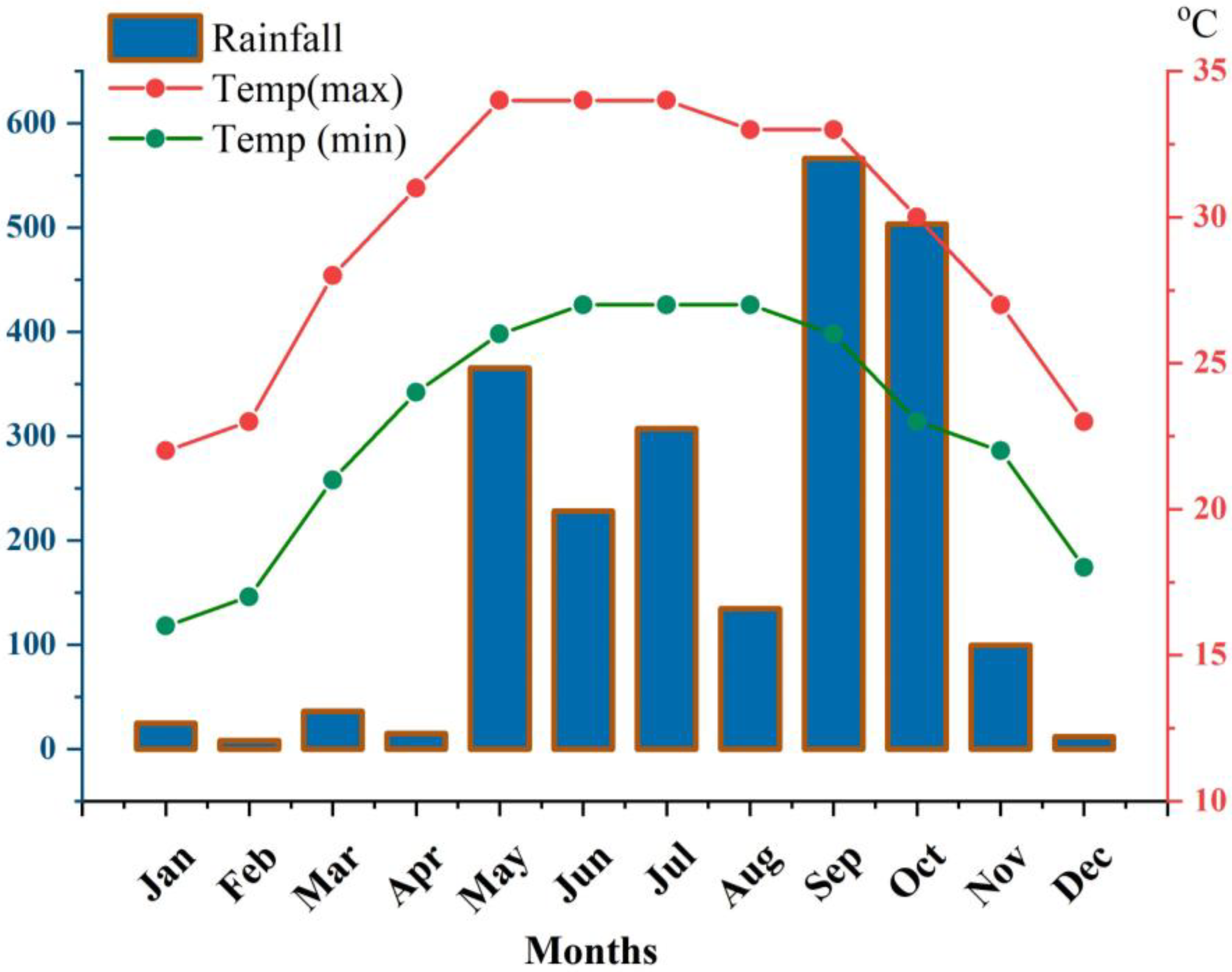
Hainan Island was selected as the study area, located in southern China between the coordinates 18°20′–20°10′ N and 108°21′–111°03′ E. The overall Hainan Island area is covered by around 35,400 km2. The annual mean temperatures range from 22 °C to 26 °C, and July and August are the warmest months, with temperatures that can exceed 30 to 32 °C. While January is the coldest month, temperatures fluctuate between 16 and 18 °C, as shown in Figure 1. Average annual precipitation varies from 1000 to 2600 mm, while annual evapotranspiration is recorded at approximately 1300 mm [31,32]. The maximum rainy season is from May to October, often exceeding 300 mm per month. In contrast, the dry season occurs between November and April, being the driest months, sometimes receiving less than 30 mm of precipitation.
This seasonal variation significantly influences both natural vegetation and agricultural activities. In Hainan Island, rice and sugarcane are cultivated as major crops, while fruits like pineapples, bananas, lychees, and coconuts are widely grown and exported. In this region, natural vegetation includes tropical rainforests, mangrove forests, and coastal shrublands, contributing to the island’s ecological diversity. Mostly, Hainan Island soil is red, yellowish, sandy, and acidic; the top layer (0–30 cm) is generally rich in organic matter, supporting robust vegetation and microbial activity. This upper horizon gradually transitions into deeper layers composed of weathered material and parent rock, each reflecting the tropical climate and the region’s geological history.

2.2. Soil Sampling and Determination

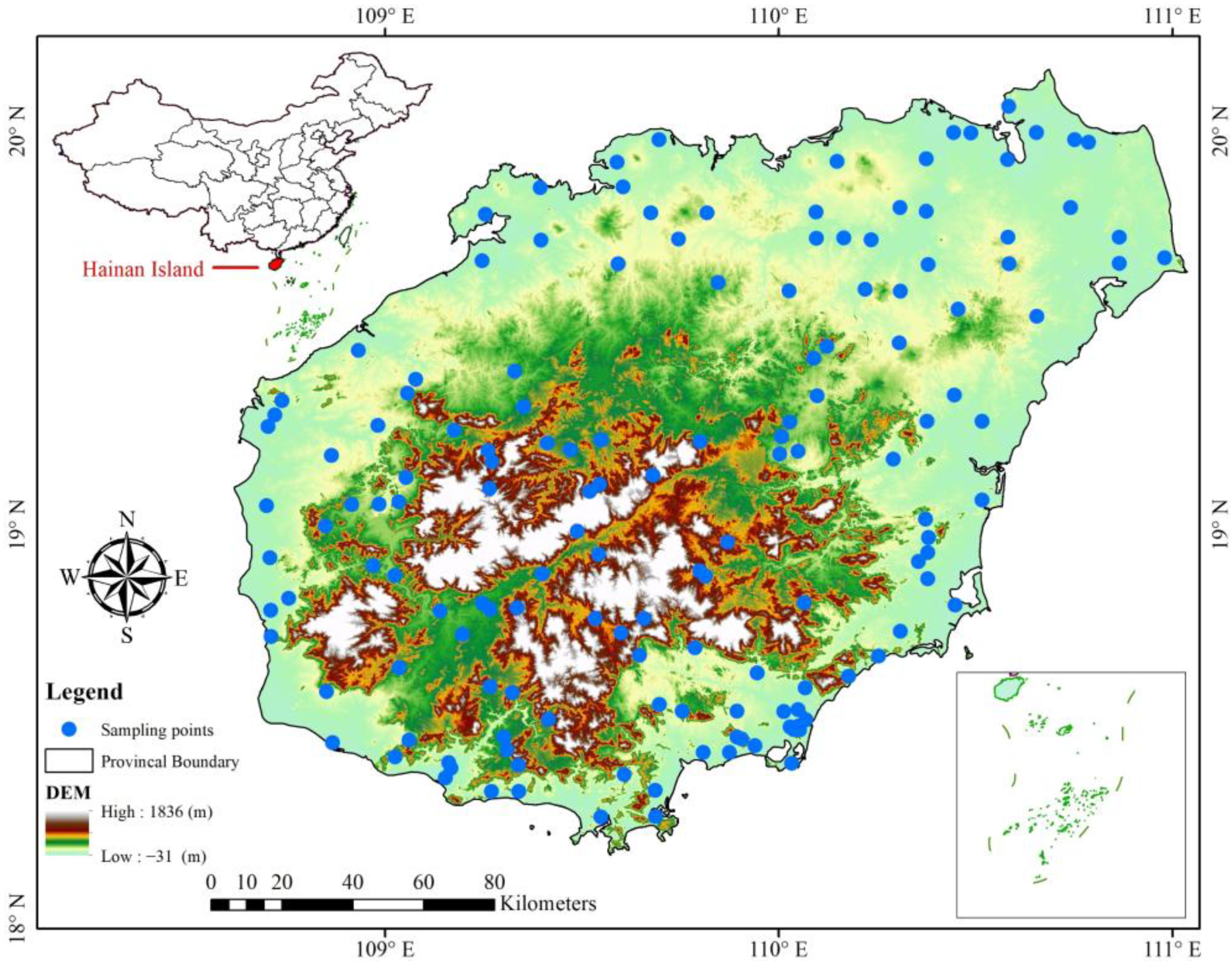
The soil samples were collected during the dry season from February to April 2024, using a smartphone-based GPS application (GPS Toolbox; Shenzhen Leduo Information Technology Co., Ltd., Shenzhen, China) to differentiate sampling locations. Geographic coordinate data were recorded using this application, which provides latitude, longitude, and elevation based on the WGS84 coordinate system. Sampling sites were selected using a land-use–based stratified sampling approach. Prior to fieldwork, Google Earth imagery and land use/land cover (LULC) maps were examined to identify representative landscape types, including paddy fields, forests and shrublands. Soil sampling points were manually selected within agricultural land, forests, and shrublands to confirm spatial representation of the study area and further confirm during the field visit. These samples supported the calibration and validation of remote sensing analyses, while temporal dynamics were assessed using multi-temporal satellite observations. In total, 152 locations were randomly selected for soil sampling. At each location three soil samples were collected from the top layer and composited into a single representative sample, resulting in 152 composite soil samples (Figure 2). The composite sampling method was adopted to minimize local variability and provide a more reliable estimate of soil properties at each site. Each sample was labelled and sealed in a plastic bag with metadata including coordinates, land use type, and administrative location (city/district) recorded on a standardized field form. After collection, all samples were immediately transferred to the laboratory for physicochemical analysis. After that, samples were air-dried and sieved through a 2 mm mesh to ensure homogeneity.
Soil EC was determined by an EC meter (Hanna Model-8733, Instruments Deutschland GmbH, Vöhringen, Germany), and soil pH was measured by using a soil/water ratio of 1:2.5 (w/v), following standard procedures with a digital pH meter (Mettler Toledo 320-S, Shanghai Bante Instrument Co., Ltd., Shanghai, China). The Walkley–Black method was used to analyze the SOM as described in the literature [33]. To determine soil Cr concentration, 0.5 g of dried soil was digested using EPA Method 3051A, a microwave-assisted nitric acid digestion procedure. The resulting digest was analyzed using ICP-OES to quantify total chromium content [34,35]. To measure AN, 5 g of air-dried soil is treated with 1.0 M sodium hydroxide (NaOH), followed by distillation. The released ammonia was collected in a boric acid solution and titrated with a standard acid [36]. Soil AP was determined by extracting 5 g of air-dried soil with 0.5 M sodium bicarbonate (NaHCO3), and shaking for 30 min. The P concentration in the extract was measured using a UV–visible spectrophotometer (Model UV-2100, Shimadzu, Tokyo, Japan) based on the intensity of the blue color developed [37]. For AK analysis, 5 g of air-dried soil was extracted with 1 M ammonium acetate and shaken for 30 min. The K content was then analyzed using a flame photometer following standard procedures [38]. The World Reference Base for Soil Resources [39] classification system indicated that the dominant soil types on Hainan Island include Ferralsols, Acrisols, Cambisols, Fluvisols, and Arenosols, which are typical of tropical and coastal environments in southern China.

2.3. Determination of Soil Fertility Index (SFI) and Soil Quality Index (SQI)

The SFI and SQI were calculated to evaluate soil fertility and overall soil quality across Hainan Island. Five soil parameters, including TN, AP, AK, soil pH, and SOM, were selected to construct the SFI. The selection of these parameters is based on their critical role in influencing crop productivity and soil health. These variables are also recognized as key indicators of soil fertility and nutrient availability, which affect crop productivity. To bring the values to a comparable scale between 0 and 1, each parameter was normalized using min–max scaling, higher values indicating better soil conditions within agronomic thresholds.
The SFI was computed using a simple additive model:
Index   =   1 n i = 1 n S i
where Si is the normalized score of the ith soil parameter; n = 5 is the number of selected indicators (TN, AP, AK, soil pH and SOM).
The SQI index was developed to represent a broader evaluation of soil environmental quality by incorporating the same fertility-related parameters together with Cr, which reflects potential heavy metal contamination and environmental risk.
The SFI is designed to evaluate soil fertility based on nutrient availability and physicochemical properties, whereas the SQI incorporates chromium as an environmental risk indicator. Therefore, SQI reflects both fertility and contamination aspects, providing a broader assessment of soil quality. After calculating the indices at each sampling point, spatial interpolation in ArcGIS 10.8 was conducted to generate continuous distribution maps of the individual parameters, SFI and SQI. These spatial outputs helped identify zones of very low, low, moderate, and high soil fertility and quality across the study area.

2.4. Soil Organic Carbon Estimation

Soil organic carbon (SOC) was estimated from SOM using the Van Bemmelen conversion factor. SOM values (g kg−1) were first converted to percentage (%) by dividing by 10, and SOC (%) was then calculated as:
SOC   ( % )   =   S O M ( % ) 1.724
where 1.724 is a commonly used factor assuming that SOM contains approximately 58% organic carbon. This approach is widely applied in soil science for indirect estimation of SOC from SOM.
The SOC is usually multiplied by 1.724, the “Van Bemmelen factor”, which assumes that SOM contains 58% of C [40,41].

2.5. Spatial and Statistical Analyses

Spatial distribution maps were generated through ArcGIS 10.8 software to explore soil physiochemical properties. The Comma-Separated Values (CSV) file was imported into ArcGIS 10.8, and both Ordinary Kriging and Inverse Distance method (IDW) were initially evaluated to determine the most appropriate method for representing the spatial variability of soil properties. These maps were subsequently clipped using the boundary cover of Hainan Island, and the resulting layers were classified into four distinct classes based on defined ranges to produce the final spatial maps.
For statistical analysis, IBM SPSS Statistics version 20.0 (IBM Corp., Armonk, NY, USA) was employed. One-way analysis of variance (ANOVA) was conducted to evaluate whether significant differences existed among the three land use types, i.e., paddy fields, forests, and shrublands, in terms of soil physicochemical properties. Duncan’s multiple range test was used for post hoc comparisons to identify differences between groups at the p < 0.05 significance level. The correlation coefficients were reported at two significant levels: p < 0.05 (*) and p < 0.01 (**). Origin 2024 (Origin Lab Corporation, Northampton, MA, USA) was used to generate all graphs and visualizations. To evaluate the reliability of spatial interpolation, cross-validation was conducted using the leave-one-out method. The interpolation performance was assessed using Root Mean Square Error (RMSE), Mean Absolute Error (MAE), and the coefficient of determination (R2). These statistical indicators were calculated to compare interpolation accuracy between different interpolation methods and to determine the most appropriate spatial prediction method for generating the final spatial distribution maps.

2.6. Land Use Land Cover Classification and Soil Salinity Indices

For the Land Use Land Cover (LULC), ESRI Land Cover 10 m product was the data used in this study, which is derived from Sentinel-2 and an overall accuracy of 86% was reported by [42]. The LULC data set is available at (https://gee-community-catalog.org/projects/S2TSLULC/, accessed on 26 August 2025). This imagery uses deep learning methods, which divided it into nine different classes: water bodies, trees, flooded vegetation, crop areas, built-up areas, bare ground, snow/ice, clouds, and rangeland. The maps used in this study were used to identify changes in different areas of the entire Hainan Island. Additionally, two other indices were used to assess soil salinity details listed in Table 1. The selection of these indices is based on their effectiveness in detecting soil salinity of the soil surface area, following [43,44]. The salinization remote sensing index (SRSI) was applied to detect salinity-affected areas. The index was calculated using Sentinel-2 spectral bands according to the following equation: SRSI = B3/B11; further details are shown in Table 1. To avoid misclassifying water bodies as saline surfaces, the Normalized Difference Water Index (NDWI) was used to mask water-dominated areas. The extraction tool in ArcGIS 10.8 was used to remove these areas and improve the accuracy of soil salinity detection. For the salinity index (SI-1), the standard equation was applied to generate salinity maps, as shown in Table 1. The SI-1 index was included as a complementary indicator to SRSI, as it is more sensitive to high-salinity conditions due to its reliance on SWIR bands, which enhance the detection of salt-affected surfaces. Additionally, to address the scale discrepancy between point-based soil samples and pixel-based satellite data, a spatial averaging approach was applied to integrate field-collected soil data with Sentinel-2 imagery (10 m spatial resolution). Specifically, average reflectance values were extracted using a 3 × 3-pixel window (30 m × 30 m) centered on each sampling location. This method has been generally used in similar soil RS studies to reduce the impacts of geolocation mismatch, mixed-pixel effects, and local spectral noise, thereby enhancing the robustness of spatial analyses [45]. To evaluate spatial dependence, Moran’s I statistic was calculated for soil EC and salinity indices. The results indicated the presence of spatial autocorrelation; therefore, correlation results were interpreted with caution. Furthermore, to evaluate the relationship between field-measured soil salinity and satellite-derived salinity indices, electrical conductivity (EC) values from all sampling locations (n = 152) were paired with the corresponding SRSI and SI values. Correlation analysis was performed in SPSS to quantify the relationships between EC and the remote sensing indices, with statistical significance assessed at p < 0.05 and p < 0.01.

3. Results

3.1. Ground-Based Soil Property Data Across Three Different Land Use Types

In comparison between three land use types, such as paddy fields, forests, and shrublands, shown in Table 2, the highest AN mean value 133.76 mg/kg was recorded in the forest region of the island. However, a greater AP was observed in the paddy field by 117.22 mg/kg, followed by forest and shrubs, with 104.69 mg/kg and 103.87 mg/kg, respectively. The paddy fields also had the highest AK concentration, 70.62 mg/kg, followed by shrubland, 67.16 mg/kg. Forest soil exhibited the lowest AK value, 61.81 mg/kg, suggesting less mineral turnover or leaching in undisturbed natural soils. All land use types have slightly acidic soil, while paddy fields had the highest soil pH 5.32, compared to forest 5.08 and shrubland 4.98.
The shrubland exhibited the highest SOM content 21.32 g/kg, indicating substantial organic input from plant residues. Paddy fields had the highest SOM at 19.19 g/kg, while forest soil had the lowest at 16.15 g/kg, potentially due to leaching or slower decomposition under canopy cover. The highest Cr concentration was recorded in shrubland, 51.81 mg/kg, which may reflect localized contamination or soil type. Paddy fields had 43.13 mg/kg, while forest soil showed the lowest Cr levels, 42.19 mg/kg.

3.2. Soil pH, EC, Organic Matter and Chromium

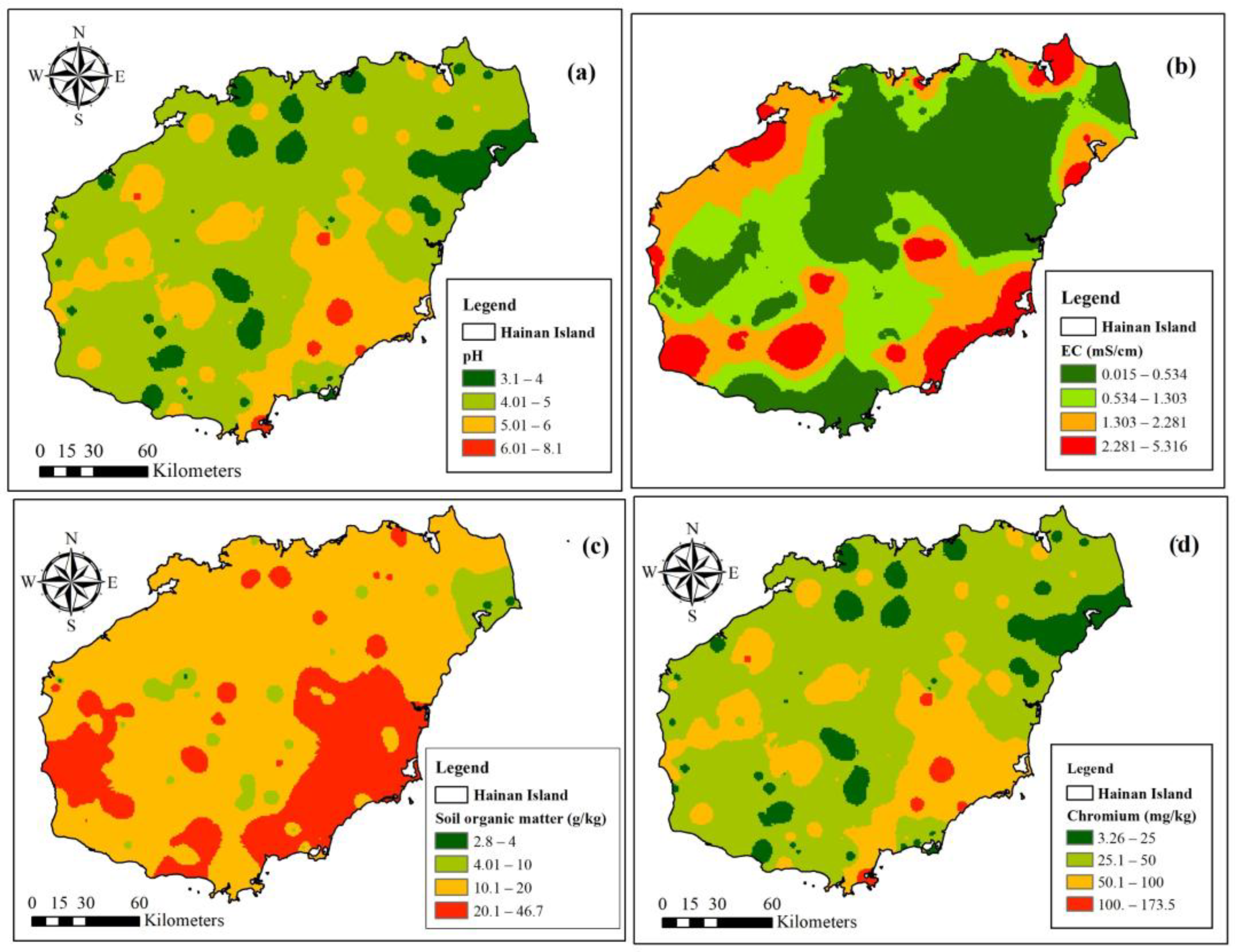
Figure 3 illustrates the spatial distribution maps of soil pH, EC, SOM, and Cr concentrations across Hainan Island. The results of soil pH indicate that most soils are covered below the 6 range, while the center part of Hainan Island shows a pH range between 3.1 and 5, with a maximum range of 5 to 6, which shows that the soil is acidic. Results of soil EC are shown in Figure 3b. The spatial variation in soil salinity clearly shows that central and northern inland areas fall within the low-salinity range (0.01–0.53 mS/cm), and the coastal belt shows a moderately saline range (0.53–2.28 mS/cm), while a high range in soil EC (2.28–5.31 mS/cm) mainly occurs along the southern and eastern coasts, reflecting the influence of seawater intrusion. Furthermore, the SOM range fluctuates between 2.8 and 47.7 (g/kg) throughout the island. If the SOM range exceeds 10%, it is considered an indicator of high soil fertility. In Hainan Island, a significant portion of the area exhibits SOM values in the 10–20% range, clearly indicating that the soils are highly fertile.
The spatial distribution map of Cr concentrations across Hainan Island is presented in Figure 3c. Cr concentration ranged from 3.2 to 173 (mg/kg). Considering that the approximate permissible concentration (APC) for chromium in agricultural soil is 100 mg/kg, most of the island falls within the 25 to 50 (mg/kg) range, indicating relatively low Cr concentrations. These values are generally below the permissible threshold, suggesting minimal Cr pollution across most parts of the island. However, very few soil samples show high Cr concentration exceeding the permissible limit. High-range samples are shown in red in Figure 3d.

3.3. Spatial Distribution of AN, AP and AK

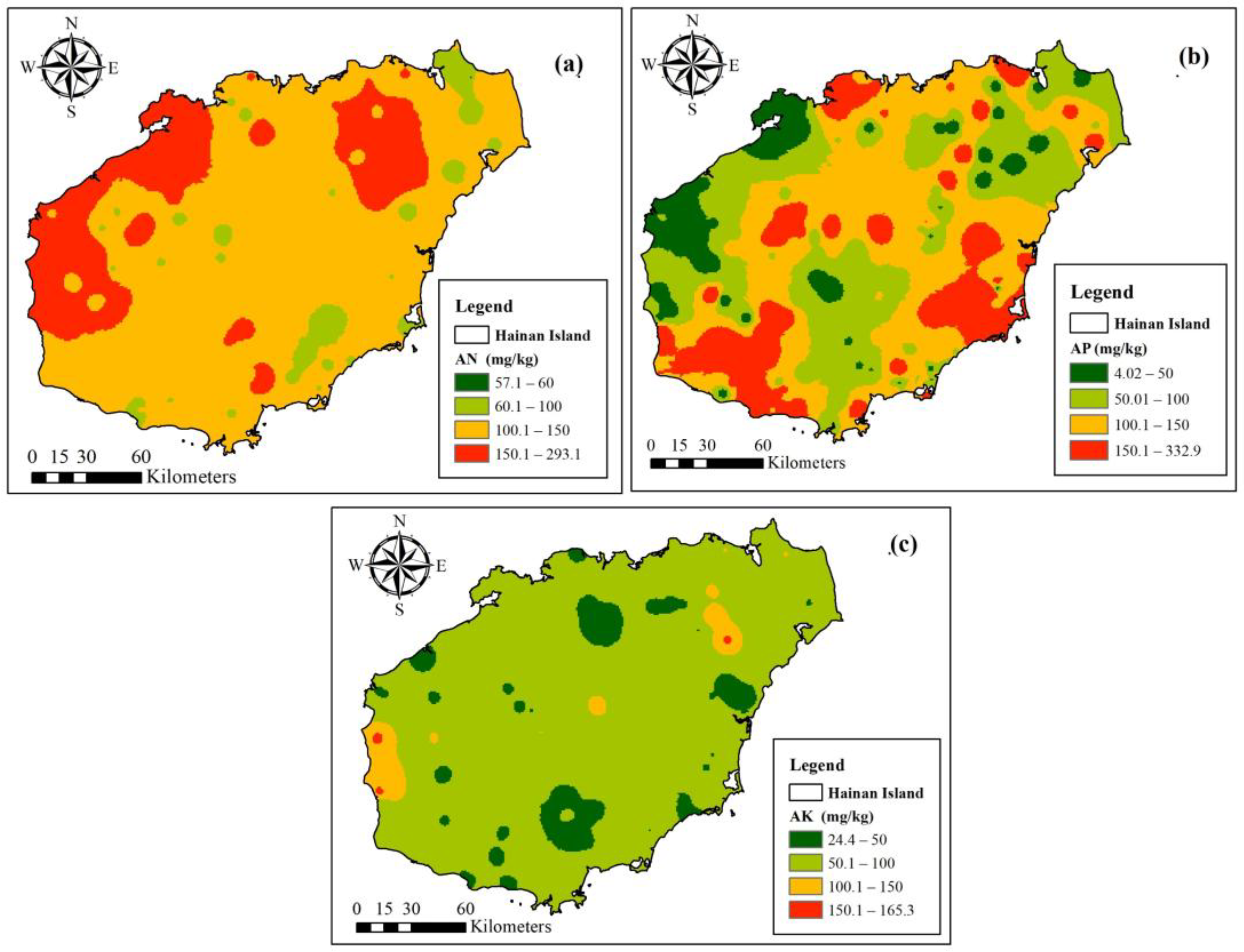
Spatial distribution maps indicating the variation among soil nutrients throughout Hainan Island are presented in Figure 4. The AN result showed that the moderate range of 100–150 mg/kg covers the largest area of the island, as shown in Figure 4a. The higher concentration from the 150–293 mg/kg range extends from the northern to southern zones, indicating a longitudinal spread of elevated AN level. The AP concentrations ranged from 4 to 332 mg/kg across the island, as shown in Figure 4b. The central region of the island mostly exhibits a moderate AP range, while low and very low concentrations of AP were observed in the northern and western parts of Hainan Island. The spatial distribution of AK was also classified into four categories, as shown in Figure 4c. Approximately 90% of the study area is represented by dark and light green colors, corresponding to very low to low AK concentrations. Overall, the spatial analysis of soil nutrients (AN, AP, and AK) suggests that the majority of Hainan Island falls within low to moderate fertility levels, which may have implications for sustainable land management and agricultural productivity.

3.4. Interpolation Accuracy Assessment

Cross-validation was conducted to determine predictive accuracy of the interpolation methods. The results of cross-validation and the accuracy of the interpolation methods are shown in Table 3. It was observed that the results of IDW generally produced slightly better prediction accuracy than Ordinary Kriging for most soil parameters. For example, for soil pH, the RMSE values were 0.36 for IDW and 0.38 for Kriging, while the corresponding MAE values were 0.27 and 0.28, respectively. Similar trends were observed for EC, AN, AP, and AK; IDW showed lower RMSE and MAE values and slightly higher R2 values than Kriging. Nevertheless, for SOM, Kriging demonstrated better predictive performance, with lower RMSE (3.01 g/kg) and MAE (2.31 g/kg) values and a higher R2 0.78 than IDW. Overall, the differences between the two methods were relatively small; however, considering that IDW performed better for the majority of soil parameters, the IDW interpolation method was selected to generate the final spatial distribution maps of soil properties in this study. The relatively low RMSE and MAE values along with moderate to high R2 values further indicate that the interpolation results provide reliable predictions of the spatial distribution of soil properties in this study area.

3.5. Spatial Distribution Pattern of Soil Fertility and Quality Indices

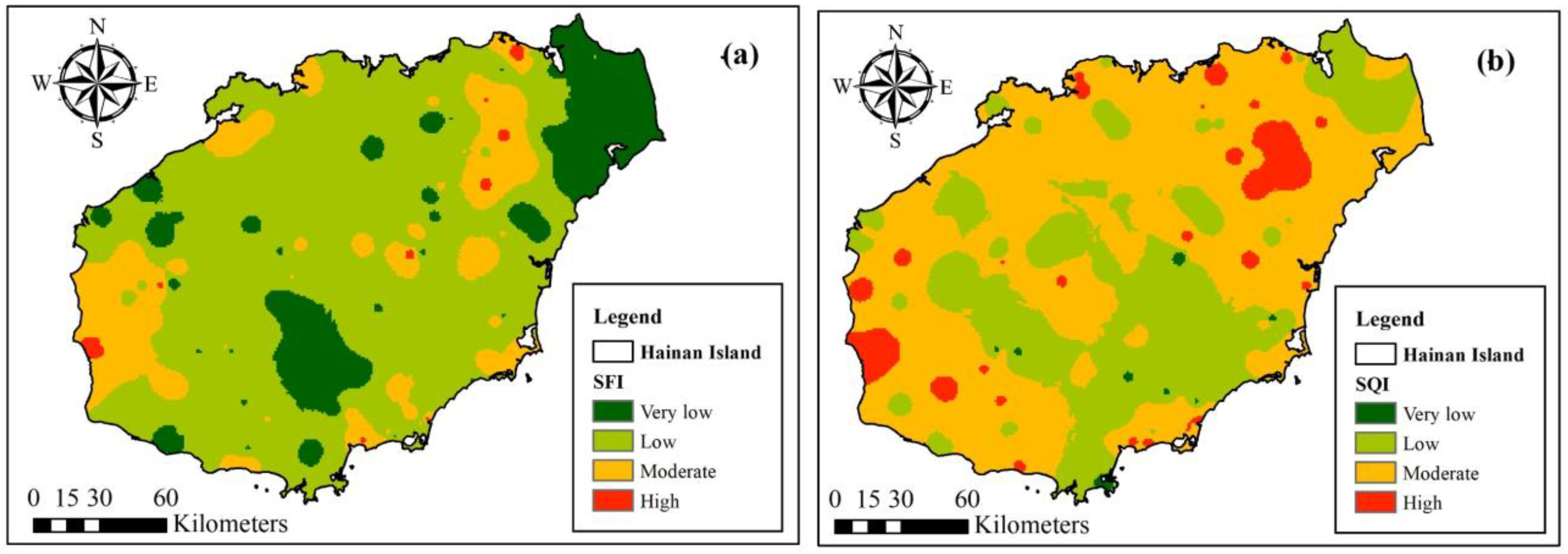
The spatial distribution maps of the soil fertility index and soil quality index are presented in Figure 5. The SFI values were classified into four categories, each category represented by a different color and a different range. The results indicate that Hainan Island soils exhibit low fertility, while moderate fertility is observed in the eastern and western regions of the island. A small area covered by red color highlights the high-fertility range of the soil in the southern part of the island, suggesting localized zones of enriched nutrient content and better soil conditions. Furthermore, the spatial pattern of the SQI shows that a large portion of the island falls within low to moderate quality classes. However, areas with high SQI values generally correspond to the high-SFI zones, though the high-quality SQI areas cover a broader extent than those identified in the SFI map. This suggests that while fertility contributes significantly to overall soil quality, other factors such as soil texture, structure, and organic matter may also enhance soil quality in these regions.

3.6. Assessment of N/P, P/K and C Estimation Percentages

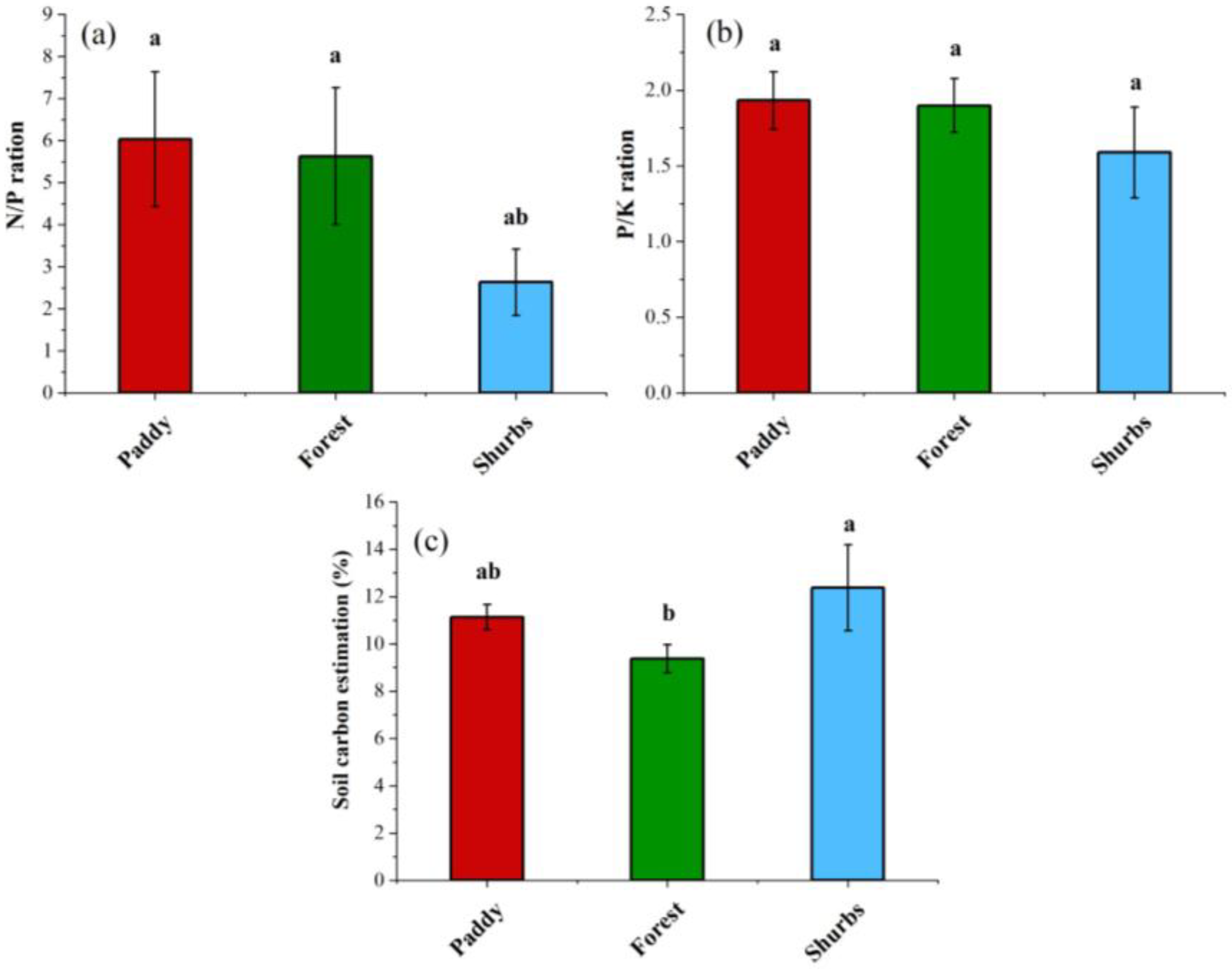
The nitrogen and phosphorus N/P ratio, phosphorus and potassium P/K ratio, and carbon estimation percentages across different land use types, including paddy fields, forests, and shrublands, are presented in Figure 6. The statistical analysis indicates that the N/P ratio is not significantly different across the three land use types (F = 0.37, p = 0.682). While paddy fields showed relatively higher N/P ratios than forest and shrublands, these differences were not statistically significant. Similarly, the P/K ratio showed non-significant variations among the land use types (F = 0.29, p = 0.750), although the average values follow the pattern paddy > forest > shrubs. The carbon estimation showed significant variation for different land-use types (F = 3.31, p = 0.039). The shrubland showed the highest carbon estimation content at 13%, followed by paddy fields and forest soils at 11% and 9%, respectively. This indicates relatively higher carbon storage potential in shrubland ecosystems within the study area.

3.7. Variation of Soil Fertility Index and Soil Quality Index Across Different Land Use Types

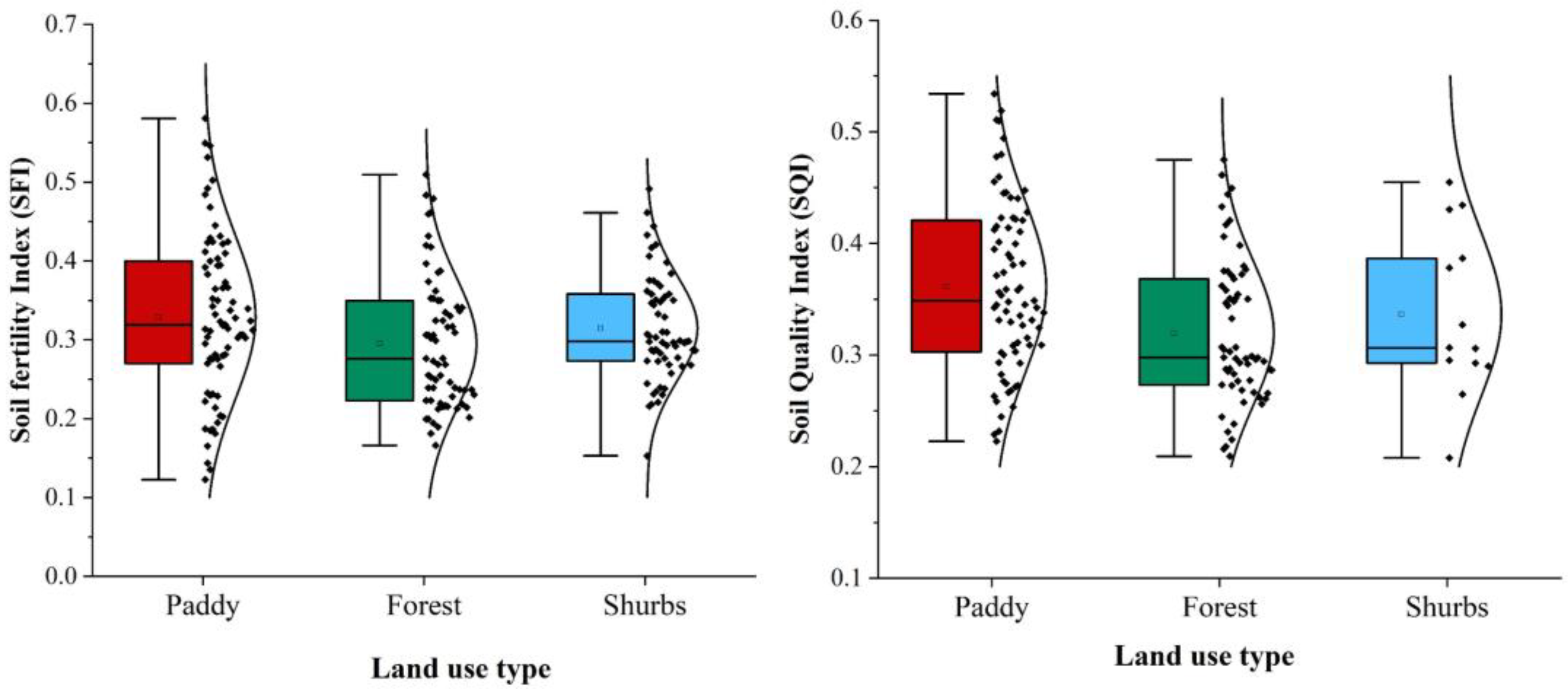
Figure 7 illustrates violin-box plots showing the distribution of SFI and SQI among three land use types. The results of the SFI median show that paddy land has a median value of 0.35, forest 0.30 and shrubland 0.29, which indicates that median values are higher in paddy land, approximately 16–20%. Furthermore, paddy land exhibited a larger interquartile range (IQR: 0.25–0.45) and greater dispersion of individual values. Moreover, the results of SQI showed similarly higher median values in paddy land (0.38), greater than forest and 12% higher than shrub lands (0.34). The results of the violin plots reveal that paddy field data points are denser in the upper quartile, indicating that a substantial proportion of samples maintain moderate to high soil quality. Conversely, forest and shrubland areas displayed narrower distributions and lower upper whiskers, reflecting more uniform but modest soil quality.

3.8. Correlation Coefficient Between SFI/SQI and Soil Characteristics

The correlation between soil indices (SFI and SQI) and soil physiochemical properties revealed significant variation across the Hainan Island dataset, as presented in Table 4. However, the SFI index showed strong positive relationships with soil characteristics such as AN, AP, AK, SOM and Cr concentration by 0.327 **, 0.306 **, 0.607 **, 0.609 **, 0.0323 **, respectively, while soil pH showed a significant correlation only with SQI. Chromium showed a significant negative, i.e., −0.546 **, correlation with SFI. These patterns highlight the dual role of fertility enhancers (OM, N, K) and pollutants (Cr) in shaping soil conditions across Hainan Island.

3.9. NDVI and Salinity Indices of Hainan Island

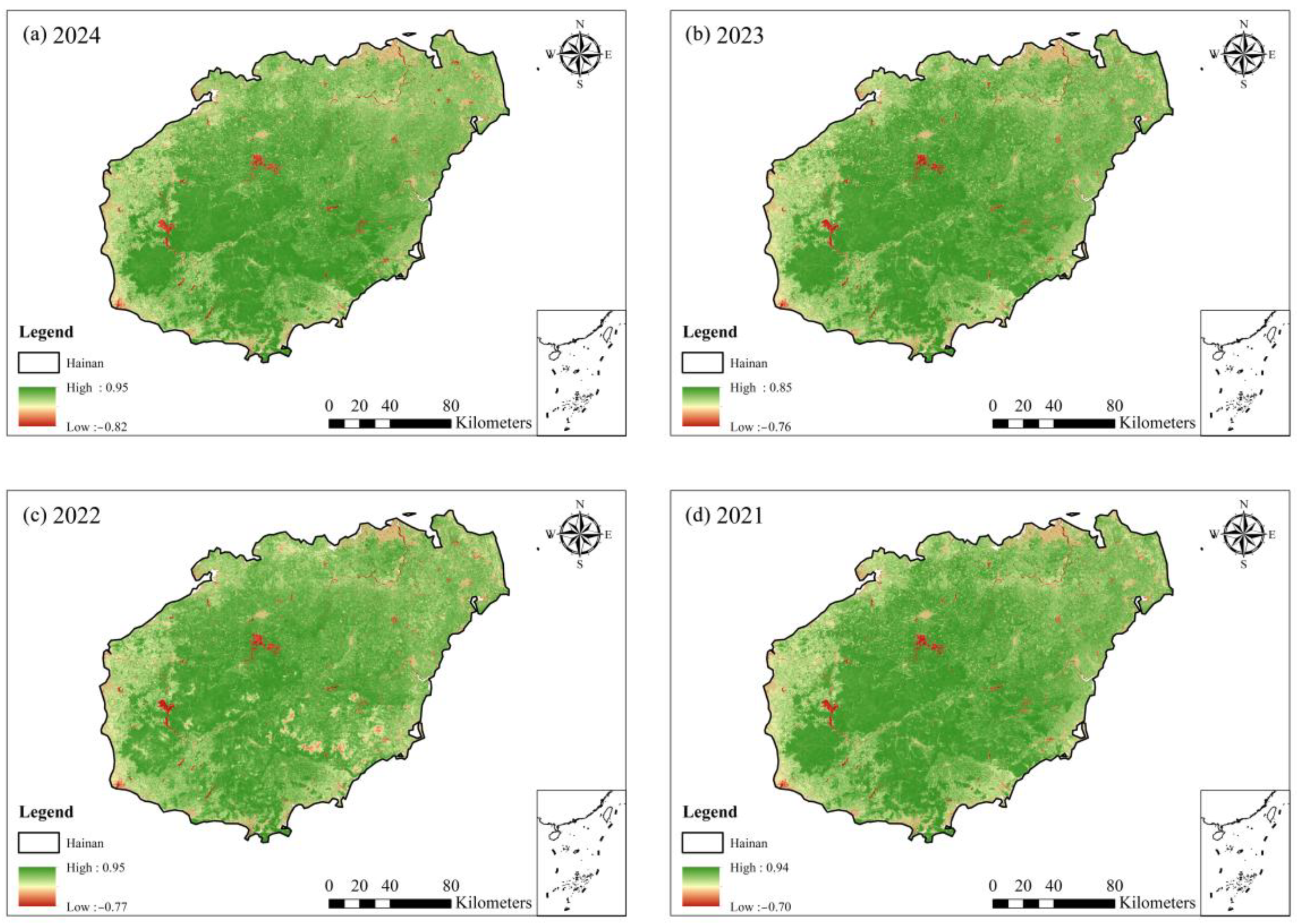
The results of NDVI shown in Figure 8 indicate consistently high vegetation cover from 2021 to 2024. The range of NDVI values in 2021 fluctuates between 0.70 and 0.94 and shows higher vegetation cover in entire areas, and in 2022 a slight increase was observed ranging from 0.77 to 0.95, reflecting improved vegetation health. In addition, in 2023 NDVI values declined but in 2024 the highest vegetation vigor appeared again with values ranging from 0.82 to 0.95 and indicating overall stable vegetation patterns, while lower NDVI values were observed along with urban and coastal regions.
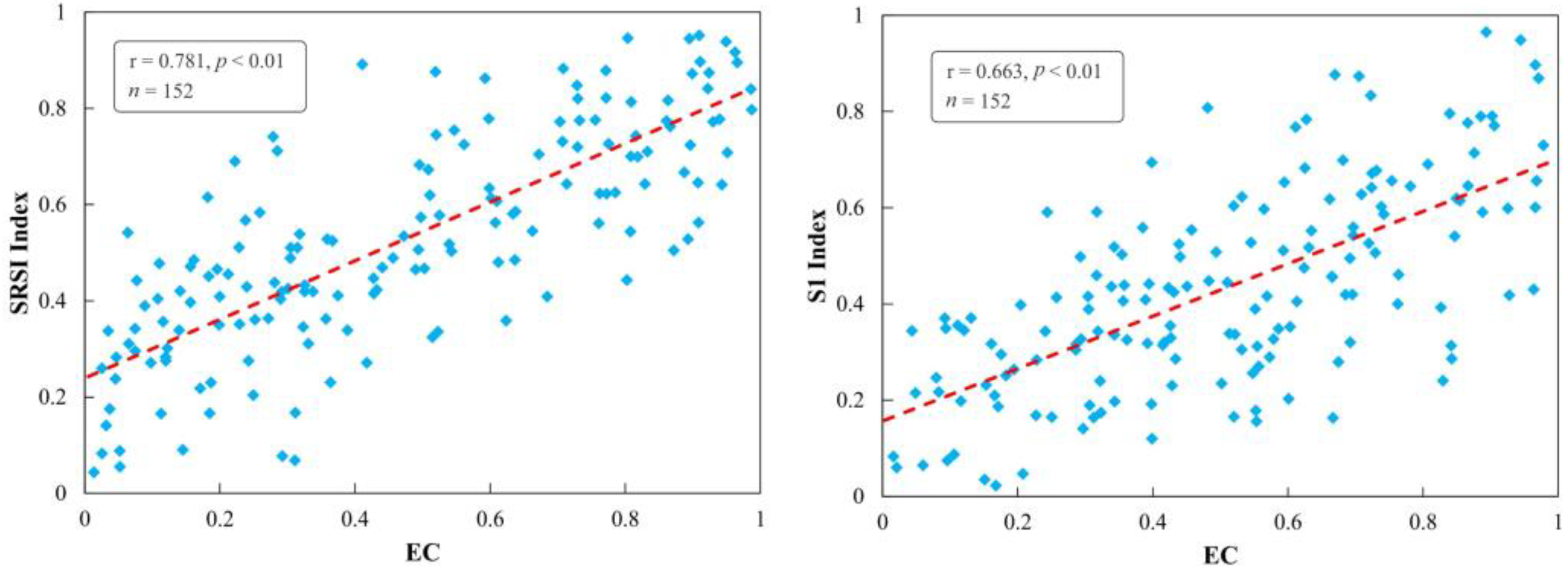
The results of two different indices, SRSI and SI, are shown in Table 5. The SRSI index mean values indicate stability across the year and a range of 0.34–0.38 was observed, which suggests suitability for tracking background salinity conditions. In contrast the SI index values were higher compared to the SRSI index; the mean values of the SI index range between 0.66 and 0.70, with increasing maximum values from 4.35 in 2021 to 7.54 in 2024, indicating stronger spatial heterogeneity and the presence of localized salinity hotspots. EC exhibited a strong positive correlation with SRSI (r = 0.781, p < 0.01) and a significant correlation with S1 index (r = 0.663, p < 0.01), indicating that both indices effectively reflect salinity conditions (Figure 9). Furthermore, SRSI and S1 were moderately correlated (r = 0.432, p < 0.05), suggesting consistency in their performance for assessing soil salinity.
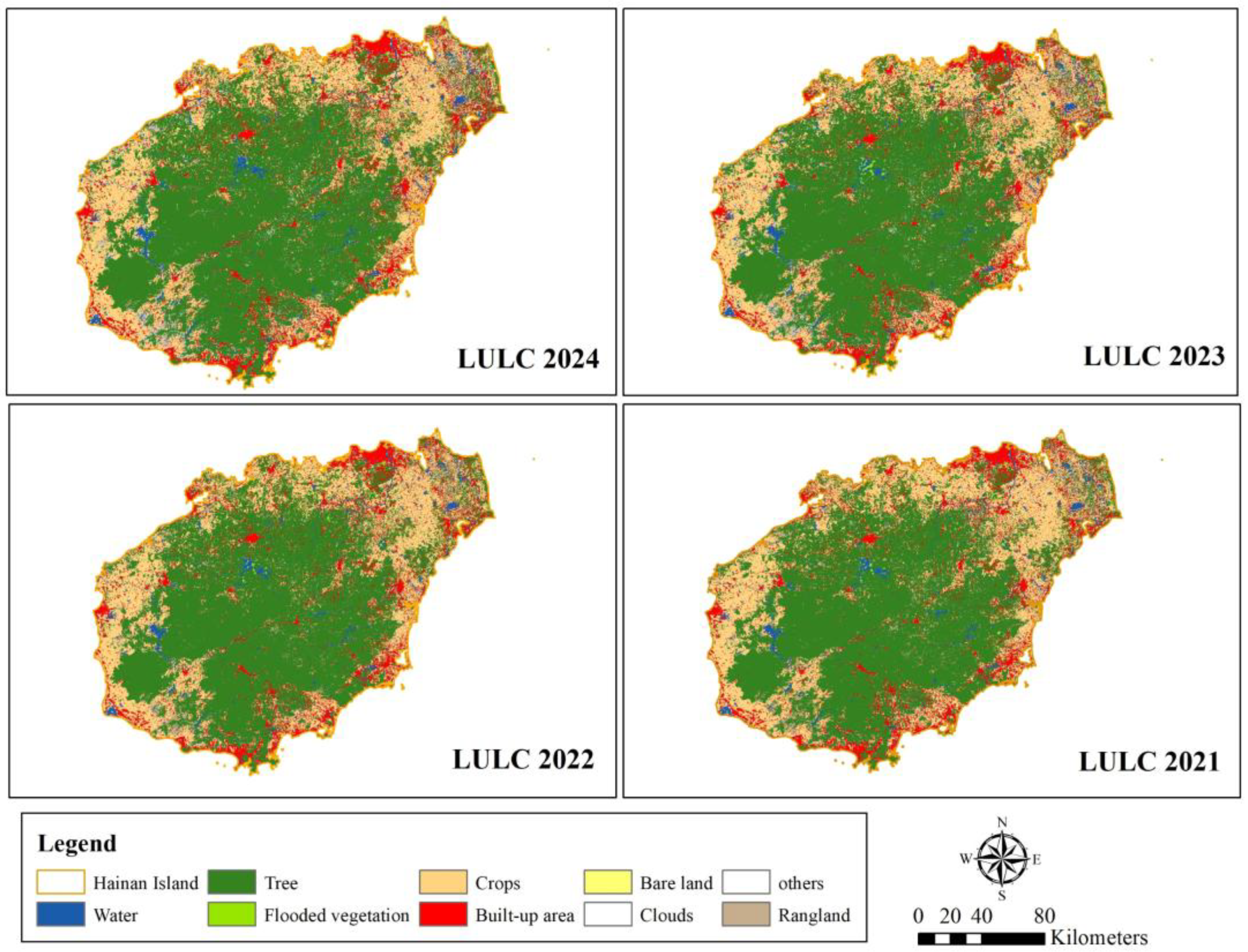
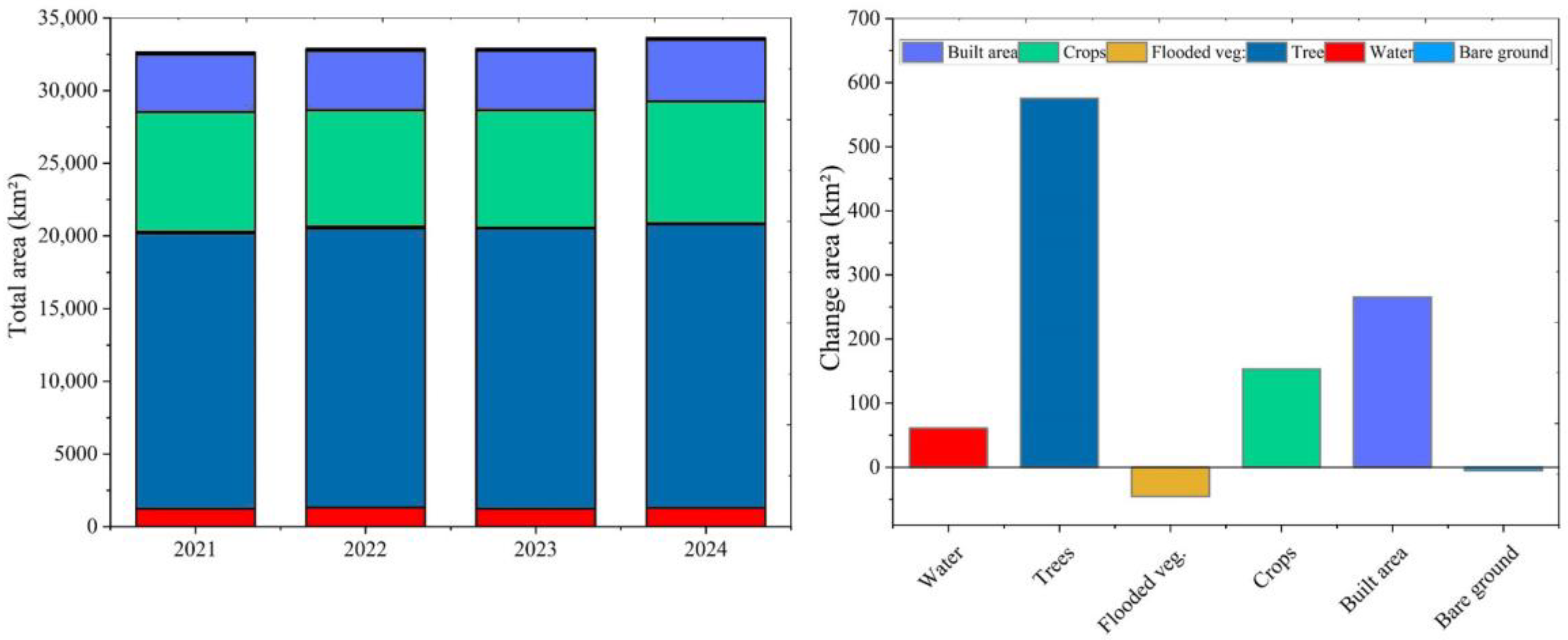
The spatial and temporal maps of LULC dynamics of Hainan from 2021 to 2024 are shown in Figure 10. The maps display that tree cover remains the dominant class through the study period. The built area class was clearly visualized more in coastal areas. Figure 11 shows a bar graph of LULC, which indicates that tree area and built area increased during this period and flooded vegetation decreased. Furthermore, it was also observed that bare land and water remained relatively stable, with minor fluctuations (<50 km2). Overall, the results highlight ongoing urbanization and agricultural expansion at the expense of natural vegetation.

4. Discussion

This study integrates field observations, remote sensing indices, and spatial analysis to assess soil salinity and quality dynamics at a regional scale. To the best of our knowledge, this is a comprehensive study investigating the soil EC of Hainan Island in combination with field data. Moreover, soil pH is a key factor; it seems that in tropical regions approximately 40% of acid soils are deficient in P due to its fixation with aluminum (Al+) and iron (Fe+) complexes [47,48]. In the current study, it was observed that in most areas, the pH range was 5 to 6, which indicates that acidic soil is predominant. These results are consistent with another study, which highlights that 88% of soil is acidic with a range of approximately 5.5 across the island [43]. Another study investigated pineapple fields in Hainan Island, mentioning that pH levels fluctuate between 4.5 and 5.5. A high precipitation rate leads to leaching of basic cations, including Ca2+, Mg2+, K+, and Na+, from the soil profile. As these nutrients are washed away, they are replaced by acidic cations such as hydrogen (H+) and Al3+, which lower the soil pH [49]. Most of the island falls within the 25 to 50 mg/kg range, indicating low Cr concentrations and suggesting minimal anthropogenic pollution from activities such as industrial operations or intensive agriculture [50]. To assess the environmental significance of Cr concentrations, the observed values are evaluated according to Chinese soil environmental quality standard GB 15618-2018 [51]. The measured Cr concentrations (3.2–173 mg kg−1) are generally within the typical background range; however, values exceeding the risk screening threshold of approximately 150 mg kg−1 may indicate potential concern. Notably, soil in the study area is predominantly acidic, as indicated by soil pH results, which can increase the mobility and bioavailability of heavy metals (Cr). Thus, even moderate increases in Cr concentration under acidic conditions may pose a higher environmental risk. However, most sampling locations in this study remain within acceptable limits; a few values approach or exceed the threshold, suggesting localized enrichment. Thus, extensive contamination is not evident, but the potential influence of soil acidity on Cr behavior warrants careful consideration. Furthermore, the results of soil EC clearly show that central and northern inland areas fall within the low-salinity range (0.01–0.53 mS/cm), and the coastal belt shows a moderately saline range (0.53–2.28 mS/cm), while a high range in soil EC (2.28–5.31 mS/cm) mainly occurs along the southern and eastern coasts, reflecting the influence of seawater intrusion. Spatial mapping is a scientific approach for tropical regions, addressing ecological changes in the soil environment, promoting sustainable land uses and enhancing overall ecosystem health [52]. The IDW interpolation provided clearer identification of high-salinity zones along coastal areas and more accurately reflected the spatial variability observed in the field measurements. Therefore, the IDW method was selected for generating the final spatial distribution maps in this study. Measuring soil nutrient status is important when needed to improve the sustainable farming and agricultural productivity for food security. However, on Hainan Island, a huge amount of area exhibits the higher SOM 10 to 20% values, and major nutrients (NPK) are usually present in a moderate range, which clearly demonstrates that soils of this region are highly fertile. A research study reported that TN and TP use in this region has increased 2.4 times, leading to a significant nutrient surplus and making the islands a nutrient “hot spot” [53]. Another previous study states that in the Hainan region there is extensive use of N and P fertilizers for cash crop systems, which could have increased the soil nutrients [54]. In addition, variations in AP and the stability of soil K content in the study area are influenced by soil type, land use, and climate conditions [4]. To further evaluate the agricultural significance of these findings, established threshold values for soil nutrients were considered. An AN value between 100 and 293 mg kg−1 in this study indicates generally sufficient N availability for crop growth. For AP, concentrations below 10 mg kg−1 indicate deficiency, while higher values reflect sufficient to excessive levels, likely associated with fertilizer inputs. In contrast, AK remains low across most study areas, suggesting a potential K limitation despite adequate N and P levels. This imbalance in nutrient availability highlights the importance of balanced fertilization strategies to sustain soil fertility and agricultural productivity in the region. Furthermore, a research study reported that in stable distribution AK soil is highly dependent on soil structure and composition, specifically complex fixing with soil clay particles, resulting in deficiencies that were observed [55]. In this study, we investigate the N/P ratio, P/K ratio, and C estimation in three land use types, including paddy fields, forest and shrubs. Paddy fields exhibited slightly higher N/P ratios than other land use types; they are suggested to be regulated by microbial homeostasis. In tropical acidic soils, microbial populations tend to immobilize excess inorganic N, converting it into organic forms, which helps buffer fluctuations in the N/P ratio, particularly in forest and shrub land systems [56]. Furthermore, paddy soil predominantly received P-based fertilizers to support rice growth, whereas K fertilization is often less frequent, especially in regions where K is not a limiting nutrient [57]. This differential nutrient input leads to an accumulation of P relative to K, thereby increasing the P/K ratio in paddy soils compared to natural systems such as forests and shrubs. In contrast, forest ecosystems rely on internal nutrient cycling through litter decomposition, resulting in a more balanced nutrient distribution, while shrublands, with lower organic inputs, exhibit comparatively reduced nutrient ratios.
Additionally, it was observed that paddy soil and shrublands generally have higher carbon content estimates than forest land [58]. This difference may be attributed to variations in soil structure and management practices. Forest soils typically do not develop compacted plow pans, resulting in greater microporosity compared to arable soils, which enables more efficient water infiltration and percolation. Moreover, the deeper root systems of trees and most agricultural crops contribute substantial organic carbon inputs at greater soil depths [59]. These characteristics may account for the slightly elevated organic carbon (OC) stocks observed in the subsoil layers, usually in vegetation-covered areas of sites [60].
Assessment of SFI and SQI indices based on soil nutrients and land use data analysis provides a deep understanding of the soil ecosystems. The dynamic between SFI and land use could have important implications for the development of sustainable agriculture. Generally, in the current research the violin-box graph indicates a higher but median SFI in paddy soils, indicating relatively better soil fertility compared to forest and shrub areas [61]. The spread values (interquartile range) are large for paddy fields, suggesting greater variability in soil fertility conditions within these lands. Paddy fields also show the highest median SQI, suggesting that cultivation areas maintain relatively better soil quality possibly due to fertilization and management practices [62]. Forest soils have a lower median SFI and a slightly narrower interquartile range, suggesting more uniform but generally lower fertility. Forest ecosystems are typically not fertilized or amended by humans, unlike agricultural systems [63]. This results in naturally lower nutrient availability, particularly for N, P, and K, which are key components of SFI. Shrublands show moderate SFI values, with a median similar to that of forests, but a slightly lower fraction, indicating higher minimum soil fertility than forest areas. In addition, natural ecosystems and other factors, such as natural vegetation, farming practices, and precipitation, are significant in the spatial heterogeneity of several ecosystem facilities in Hainan Island.
The presence of outliers in all categories indicates localized variations, particularly in paddy lands, where a few samples showed very high fertility. Shrubland, dominated by woody perennials and grass, exerts less nutrient demand and deeper root extraction than dense forests, allowing more nutrients to remain in the surface soil layers, contributing to higher minimum SFI. Further, shrubland often has open or semi-open canopies that allow greater sunlight penetration. This encourages faster litter decomposition, increased microbial activity, and nutrient mineralization, improving soil fertility at the surface [64]. Shrub cover often leads to soil heterogeneity, particularly in nutrient accumulation in shrubland. A previous study showed that shrubs can form ‘fertile Islands’ by accumulating C and N [65]. Forest and shrublands have slightly lower but comparable medians and similar interquartile ranges. This indicates a wide distribution of SQI [66]. This suggests that higher variability in soil fertility contributes significantly to overall soil quality; other factors such as soil texture, structure, and organic matter may also enhance soil quality in these regions. The results of NDVI of Hainan Island show high vegetation cover during the study period, with the values ranging between 0.7 and 0.95. These results are consistent with a previous study by Luo et al. [46], which reported that Hainan is a rich biodiversity region, dominated by forest ecosystems with strong NDVI signals. The seasonal NDVI range reported in his study was 0.65 and 0.90, and spatial variations were linked to monsoonal rainfall patterns. Another study found that vegetation in Hainan was relatively stable over two decades, although urban expansion led to local declines in NDVI around Haikou and Sanya [67]. These findings support the interpretation that Hainan’s vegetation dynamics are shaped by a combination of climatic variability and human activities, with forests showing resilience, while agricultural and coastal areas remain more vulnerable to stress. The results of LULC show that the built area increases and the flooded vegetation slightly decreases. These findings align with a former study of urban expansion that observed cropland reduction of around 956 km2 between 2000 and 2020, much of which was converted into construction land and woodland [68]. Similarly, Gong et al. [69] emphasized that rapid urban growth has significantly diminished ecosystem service capacity across the island. The expansion of built-up areas increases impervious surfaces, thereby the intensifying risks of flooding and heat island effects, while reducing ecological connectivity.
The findings of this study underscore the need for integrated land use planning and sustainable development of Hainan Island. First, excessive nutrient use is harmful to major crops and also impacts natural vegetation. Second, sustainable agriculture practices, including efficient irrigation, crop rotation, and agroforestry, could help balance agricultural expansion with ecological protection. Finally, remote sensing data with ground measurements provides robust and authentic results and support adaptive land management. Although this study integrates field observations and remote sensing data, some limitations remain. The spatial interpolation was based on 152 sampling points, which may not fully capture small-scale variability. Future studies should increase sampling density and apply advanced geostatistical modeling.

Limitations of the Study

This study provides important insights into the spatial distribution of soil salinity and fertility across Hainan Island. Several limitations should be acknowledged. Firstly, soil samples were collected during only a single dry season (February–April 2024), and therefore, temporal variations in soil properties were inferred primarily from multi-temporal RS observations rather than repetitive field measurements. Future studies should incorporate multi-year or multi-season soil sampling to better capture temporal variability in soil conditions.
Secondly, field sampling could not fully cover all areas of Hainan Island due to accessibility constraints. In some locations, the predefined sampling coordinates were difficult to reach because of physical barriers such as waterlogged land, dense vegetation, or a lack of accessible routes. In such cases, nearby alternative sampling points were selected to ensure field data collection while maintaining spatial representativeness. Despite these constraints, efforts were made to maintain an appropriate spatial distribution of samples across the study area. In future work, dense sampling points with different depths such as (0–30, 30–60, 60–100 cm) should be considered.
The presence of spatial autocorrelation may affect the strength of the correlations between soil EC and RS indices. Despite the current study applying standard correlation analysis, future work should incorporate spatial regression approaches to further refine statistical inference.

5. Conclusions

This study provides a comprehensive assessment of soil properties and quality indices on Hainan Island using ground truth data and a remote sensing approach. In this study, SFI and SQI indices were developed based on soil nutrients and soil properties. It was observed that along with coastal area, EC range was high (2.28–5.31 mS/cm), which reflects the influence of seawater intrusion, while the center and northern part fall in the low-salinity range (0.01–0.53 mS/cm). EC exhibited a strong positive correlation with SRSI (r = 0.781, p < 0.01) and a significant correlation with S1 index (r = 0.663, p < 0.01), indicating that both indices are useful proxies for reflecting the spatial pattern of soil salinity. While Cr concentration range was adequate for environmental limits, high concentrations were found in certain areas, mainly in the southeast area of the island, which is potentially at risk. Industrial discharges, such as those from metal processing, burning, coating, and chemical manufacturing, are commonly associated with increasing Cr pollution. The findings of temporal variation in vegetation and land cover show that vegetation is healthier during 2021–2024. The built-up area increases and the flooded vegetation decreases. These findings emphasize the need for specific soil management practices, optimized fertilization strategies, and regular monitoring of soil contaminants to ensure long–term agricultural productivity and environmental sustainability in Hainan regions. Future studies should also focus on expanding soil monitoring networks and on integrating socio-economic and crop productivity data to support informed land use and policy decisions.

Author Contributions

Conceptualization, D.Z. (Di Zeng) and D.Z. (Dongming Zhang); methodology, D.Z. (Di Zeng); software, K.A.S.; validation, F.S.; formal analysis, K.A.S.; investigation, D.Z. (Di Zeng) and D.Z. (Dongming Zhang); resources, X.S. and L.L.; data curation, D.Z. (Di Zeng) and D.Z. (Dongming Zhang); writing—original draft preparation, D.Z. (Di Zeng), K.A.S. and F.S.; writing—review and editing, D.Z. (Di Zeng), K.A.S., F.S., X.S., M.A., J.Z., L.L., J.Z. and D.Z. (Dongming Zhang); visualization, M.A.; supervision, X.S., J.Z. and L.L.; project administration, D.Z. (Di Zeng) and D.Z. (Dongming Zhang); funding acquisition, J.Z. and D.Z. (Dongming Zhang). All authors have read and agreed to the published version of the manuscript.

Funding

National Key Research and Development Program of China (Grant Number: 2023YFD1901401). Provincial Key Research and Development Program of China (Grant Number: ZDYF2024KJT PY056). Distribution and transformation of heavy metal chromium under paddy soil acidification in tropical area of China, Natural Science Foundation of Hainan Province (Grant Number: 421QN0868). Distribution of heavy metal chromium under vegetable soil acidification in Hainan, Scientific Research Project of Hainan University (Grant Number: Hnky2023-10).

Data Availability Statement

All data in this research can be obtained from the corresponding authors upon reasonable request. The data is not publicly available due to privacy or ethical restrictions.

Conflicts of Interest

The authors state that they have no interest which might be perceived as posing a conflict.

References

  1. FAO; ITPS. Global Map of Salt-Affected Soils (GSASmap): Technical Report; FAO: Rome, Italy, 2021. [Google Scholar]
  2. Guillot, E.; Bertrand, I.; Rumpel, C.; Gomez, C.; Arnal, D.; Abadie, J.; Hinsinger, P. Spatial Heterogeneity of Soil Quality within a Mediterranean Alley Cropping Agroforestry System: Comparison with a Monocropping System. Eur. J. Soil Biol. 2021, 105, 103330. [Google Scholar] [CrossRef]
  3. Liu, J.; Su, S.; He, Z.; Jiang, L.; Gu, X.; Xu, D.; Ma, R.; Hong, W. Relationship Between Pinus Taiwanensis Seedling Regeneration and the Spatial Heterogeneity of Soil Nitrogen in Daiyun Mountain, Southeast China. Ecol. Indic. 2020, 115, 106398. [Google Scholar] [CrossRef]
  4. Solangi, F.; Zhu, X.; Khan, S.; Rais, N.; Majeed, A.; Sabir, M.A.; Iqbal, R.; Ali, S.; Hafeez, A.; Ali, B.; et al. The Global Dilemma of Soil Legacy Phosphorus and Its Improvement Strategies under Recent Changes in Agro-Ecosystem Sustainability. ACS Omega 2023, 8, 23271–23282. [Google Scholar] [CrossRef] [PubMed]
  5. Xu, S.; Yu, C.; Wang, Q.; Liao, J.; Liu, C.; Huang, L.; Liu, Q.; Wen, Z.; Feng, Y. Chromium Contamination and Health Risk Assessment of Soil and Agricultural Products in a Rural Area in Southern China. Toxics 2022, 11, 27. [Google Scholar] [CrossRef]
  6. Balali-Mood, M.; Naseri, K.; Tahergorabi, Z.; Khazdair, M.R.; Sadeghi, M. Toxic Mechanisms of Five Heavy Metals: Mercury, Lead, Chromium, Cadmium, and Arsenic. Front. Pharmacol. 2021, 12, 643972. [Google Scholar] [CrossRef]
  7. Anjum, S.A.; Ashraf, U.; Tanveer, M.; Shahid, M.; Shakoor, A.; Wang, L. Phyto-Toxicity of Chromium in Maize: Oxidative Damage, Osmolyte Accumulation, Anti-Oxidative Defense and Chromium Uptake. Pedosphere 2017, 27, 262–273. [Google Scholar] [CrossRef]
  8. Ao, M.; Chen, X.; Deng, T.; Sun, S.; Tang, Y.; Morel, J.L.; Qiu, R.; Wang, S. Chromium Biogeochemical Behaviour in Soil-Plant Systems and Remediation Strategies: A Critical Review. J. Hazard. Mater. 2022, 424, 127233. [Google Scholar] [CrossRef]
  9. Li, Q.; Jia, Z.; Zhu, Y.; Wang, Y.; Li, H.; Yang, D.; Zhao, X. Spatial Heterogeneity of Soil Nutrients after the Establishment of Caragana Intermedia Plantation on Sand Dunes in Alpine Sandy Land of the Tibet Plateau. PLoS ONE 2015, 10, e0124456. [Google Scholar] [CrossRef]
  10. Su, S.J.; Liu, J.F.; He, Z.S.; Hong, W.; Zhang, J.B. The Spatial Heterogeneity of Soil Nutrients in a Mid-Subtropical Castanopsis kawakamii Natural Forest. Acta Ecol. Sin. 2012, 32, 5673–5682. [Google Scholar]
  11. Ertani, A.; Mietto, A.; Borin, M.; Nardi, S. Chromium in Agricultural Soils and Crops: A Review. Water Air Soil Pollut. 2017, 228, 190. [Google Scholar] [CrossRef]
  12. Jiang, W.; Hou, Q.; Yang, Z.; Yu, T.; Zhong, C.; Yang, Y.; Fu, Y. Annual Input Fluxes of Heavy Metals in Agricultural Soil of Hainan Island, China. Environ. Sci. Pollut. Res. 2014, 21, 7876–7885. [Google Scholar] [CrossRef] [PubMed]
  13. Wang, L.; Jia, Y.; Cheng, D.; Zhao, Z.; Tao, T. Spatial Variation of Soil Nutrients and Evaluation of Cultivated Land Quality Based on Field Scale. Open Geosci. 2023, 15, 20220508. [Google Scholar] [CrossRef]
  14. Li, T.; Wang, S.; Chen, B.; Wang, Y.; Chen, S.; Chen, J.; Xiao, Y.; Xia, Y.; Zhao, Z.; Chen, X. Widespread Reduction in Gross Primary Productivity Caused by the Compound Heat and Drought in Yangtze River Basin in 2022. Environ. Res. Lett. 2024, 19, 034048. [Google Scholar] [CrossRef]
  15. Zhou, X.; Wang, Q.; Zhang, R.; Ren, B.; Wu, X.; Wu, Y.; Tang, J. A Spatiotemporal Analysis of Hainan Island’s 2010–2020 Gross Ecosystem Product Accounting. Sustainability 2022, 14, 15624. [Google Scholar] [CrossRef]
  16. Wen, S.; Yao, W.; Tian, B.; Xu, L.; Liu, Q.; Xu, Y.; Qi, Z.; Yang, Y.; Zeng, Z.; Zang, H. Spatiotemporal Dynamic of Rice Production and Its Carbon Footprint in Hainan, China: Implications for Food Security and Environmental Sustainability. J. Environ. Qual. 2024, 53, 418–429. [Google Scholar] [CrossRef]
  17. Van Alfen, N.K. Encyclopedia of Agriculture and Food Systems; Elsevier: Amsterdam, The Netherlands, 2014; ISBN 978-0-444-52512-3. [Google Scholar]
  18. Solangi, F.; Zhu, X.; Solangi, K.A.; Iqbal, R.; Elshikh, M.S.; Alarjani, K.M.; Elsalahy, H.H. Responses of Soil Enzymatic Activities and Microbial Biomass Phosphorus to Improve Nutrient Accumulation Abilities in Leguminous Species. Sci. Rep. 2024, 14, 11139. [Google Scholar] [CrossRef]
  19. Lehmann, J.; Bossio, D.A.; Kögel-Knabner, I.; Rillig, M.C. The Concept and Future Prospects of Soil Health. Nat. Rev. Earth Environ. 2020, 1, 544–553. [Google Scholar] [CrossRef]
  20. Solangi, F.; Bai, J.; Gao, S.; Yang, L.; Zhou, G.; Cao, W. Improved Accumulation Capabilities of Phosphorus and Potassium in Green Manures and Its Relationship with Soil Properties and Enzymatic Activities. Agronomy 2019, 9, 708. [Google Scholar] [CrossRef]
  21. Li, D.; Pang, Q.; Cai, X.; Zhou, M. Current Status of Rational Anniversary Utilization of Existing Vegetable Protection Facilities in Hainan. Int. J. Ecol. 2018, 7, 1–5. [Google Scholar] [CrossRef]
  22. Pan, Z.; Dong, Y.; He, G.; Guo, T.; Zhu, N. Spatial Heterogeneity of Soil Properties in Planted Mixed Forests in the Rocky Desertification Areas of the Wuling Mountain. PeerJ 2024, 12, e18724. [Google Scholar] [CrossRef]
  23. Terefe, R.; Yu, K.; Deng, Y.; Yao, X.; Wang, F.; Liu, J. Spatial Variability of Soil Chemical Properties of Moso Bamboo Forests of China. J. For. Res. 2021, 32, 2599–2608. [Google Scholar] [CrossRef]
  24. Chen, W.; Cai, Y.; Zhu, K.; Wei, J.; Lu, Y. Spatial Heterogeneity Analysis and Source Identification of Heavy Metals in Soil: A Case Study of Chongqing, Southwest China. Chem. Biol. Technol. Agric. 2022, 9, 50. [Google Scholar] [CrossRef]
  25. Zhao, K.; Zhang, C.; Tunney, H. Using Moran’s I and Geostatistics to Identify Spatial Patterns of Soil Nutrients in Two Different Long-term Phosphorus-application Plots. Z. Pflanzenernähr. Bodenk. 2011, 174, 785–798. [Google Scholar] [CrossRef]
  26. Malla, R.; Shrestha, S.; Khadka, D.; Bam, C.R. Soil Fertility Mapping and Assessment of the Spatial Distribution of Sarlahi District, Nepal. Am. J. Agric. Sci. 2020, 7, 8–16. [Google Scholar]
  27. Dai, Z.; Mei, X.; Luo, J.; Fagherazzi, S. Profiling of Mangrove Forest Dynamics in the Fly River Delta, Papua New Guinea. Mar. Pollut. Bull. 2025, 217, 118119. [Google Scholar] [CrossRef]
  28. Jin, N.; Tao, B.; Ren, W.; Feng, M.; Sun, R.; He, L.; Zhuang, W.; Yu, Q. Mapping Irrigated and Rainfed Wheat Areas Using Multi-Temporal Satellite Data. Remote Sens. 2016, 8, 207. [Google Scholar] [CrossRef]
  29. Li, R.; Wei, C.; Afroz, M.D.; Lyu, J.; Chen, G. A GIS-Based Framework for Local Agricultural Decision-Making and Regional Crop Yield Simulation. Agric. Syst. 2021, 193, 103213. [Google Scholar]
  30. Ding, Y.; Feng, Y.; Chen, K.; Zhang, X. Analysis of Spatial and Temporal Changes in Vegetation Cover and Its Drivers in the Aksu River Basin, China. Sci. Rep. 2024, 14, 10165. [Google Scholar] [CrossRef]
  31. Shi, X.; Nie, T.; Xiong, Q.; Liu, Z.; Zhang, J.; Liu, W.; Wu, L.; Cui, W.; Sun, Z. Assessment of Carbon Stock and Sequestration of the Mangrove Ecosystems on Hainan Island Based on InVEST and MaxEnt Models. J. Trop. Biol. 2023, 14, 298–306. [Google Scholar]
  32. Li, W.; Zhang, J.; Liu, S.; Che, X.; Chen, X.; Zou, H. Meteorological Characteristics and Monitoring Index of Drought in Hainan Island. J. Trop. Biol. 2022, 13, 324–330. [Google Scholar]
  33. Nelson, D.W.; Sommers, L.E. Total Carbon, Organic Carbon, and Organic Matter. In Methods of Soil Analysis: Part 3 Chemical Methods; American Society of Agronomy: Madison, WI, USA, 1996; Volume 5, pp. 961–1010. [Google Scholar]
  34. Barbosa, É.S.; Cacique, A.P.; Pinho, G.P.d.; Silvério, F.O. Optimization of Methodology for Determination of Inorganic Chromium Species in Sewage Sludge Samples by HPLC-ICP-MS/MS. J. Braz. Chem. Soc. 2020, 31, 2491–2499. [Google Scholar] [CrossRef]
  35. Kingston, H.S. Microwave Assisted Acid Digestion of Sediments, Sludges, Soils and Oils: EPA Method 3051; Duquesne University: Pittsburg, PA, USA, 1994. [Google Scholar]
  36. Amin, M. Studies on the Measurement and Behaviour of Nitrogen in Soil. Ph.D. Thesis, University of Glasgow, Glasgow, UK, 1995. [Google Scholar]
  37. Murphy, J.; Riley, J.P. A Modified Single Solution Method for the Determination of Phosphate in Natural Waters. Anal. Chim. Acta 1962, 27, 31–36. [Google Scholar] [CrossRef]
  38. Zelazny, L.W.; He, L.; Vanwormhoudt, A. Charge Analysis of Soils and Anion Exchange. In SSSA Book Series; Sparks, D.L., Page, A.L., Helmke, P.A., Loeppert, R.H., Soltanpour, P.N., Tabatabai, M.A., Johnston, C.T., Sumner, M.E., Eds.; Soil Science Society of America, American Society of Agronomy: Madison, WI, USA, 2018; pp. 1231–1253. ISBN 978-0-89118-866-7. [Google Scholar]
  39. IUSS Working Group WRB. World Reference Base for Soil Resources: International Soil Classification System for Naming Soils and Creating Legends for Soil Maps, 4th ed.; International Union of Soil Sciences (IUSS): Vienna, Austria, 2022. [Google Scholar]
  40. Benslama, A.; Benbrahim, F.; Rym-Gadoum, L.; Gómez-Lucas, I.; Mordan-Vidal, M.M.; Navarro-Pedreño, J.; Bech-Borrás, J. Soil carbon storage under different types of arid land use in Algeria. Environ. Geochem. Health 2024, 46, 330. [Google Scholar] [CrossRef] [PubMed] [PubMed Central]
  41. Pribyl, D.W. A critical review of the conventional SOC to SOM conversion factor. Geoderma 2010, 156, 75–83. [Google Scholar] [CrossRef]
  42. Karra, K.; Kontgis, C.; Statman-Weil, Z.; Mazzariello, J.C.; Mathis, M.; Brumby, S.P. Global Land Use/Land Cover with Sentinel 2 and Deep Learning. In Proceedings of the 2021 IEEE International Geoscience and Remote Sensing Symposium IGARSS; IEEE: Brussels, Belgium, 2021; pp. 4704–4707. [Google Scholar]
  43. Gerardo, R.; de Lima, I.P. Sentinel-2 Satellite Imagery-Based Assessment of Soil Salinity in Irrigated Rice Fields in Portugal. Agriculture 2022, 12, 1490. [Google Scholar] [CrossRef]
  44. Wang, J.; Ding, J.; Yu, D.; Ma, X.; Zhang, Z.; Ge, X.; Teng, D.; Li, X.; Liang, J.; Lizaga, I.; et al. Capability of Sentinel-2 MSI Data for Monitoring and Mapping of Soil Salinity in Dry and Wet Seasons in the Ebinur Lake Region, Xinjiang, China. Geoderma 2019, 353, 172–187. [Google Scholar] [CrossRef]
  45. Zhang, X.; Zhang, G.; Zhang, S.; Ai, H.; Han, Y.; Luo, C.; Liu, H. A Novel Model for Mapping Soil Organic Matter: Integrating Temporal and Spatial Characteristics. Ecol. Inform. 2024, 84, 102923. [Google Scholar] [CrossRef]
  46. Luo, H.; Dai, S.; Li, M.; Liu, E.; Li, Y.; Xie, Z. NDVI-Based Analysis of the Influence of Climate Changes and Human Activities on Vegetation Variation on Hainan Island. J. Indian Soc. Remote Sens. 2021, 49, 1755–1767. [Google Scholar] [CrossRef]
  47. Fahad, S.; Chavan, S.B.; Chichaghare, A.R.; Uthappa, A.R.; Kumar, M.; Kakade, V.; Pradhan, A.; Jinger, D.; Rawale, G.; Yadav, D.K. Agroforestry Systems for Soil Health Improvement and Maintenance. Sustainability 2022, 14, 14877. [Google Scholar] [CrossRef]
  48. Dollinger, J.; Jose, S. Agroforestry for Soil Health. Agroforest Syst. 2018, 92, 213–219. [Google Scholar] [CrossRef]
  49. Wang, J.; Wang, L.; Wang, Y.; Tsang, D.C.; Yang, X.; Beiyuan, J.; Yin, M.; Xiao, T.; Jiang, Y.; Lin, W. Emerging Risks of Toxic Metal(Loid)s in Soil-Vegetables Influenced by Steel-Making Activities and Isotopic Source Apportionment. Environ. Int. 2021, 146, 106207. [Google Scholar] [CrossRef]
  50. Prasad, S.; Yadav, K.K.; Kumar, S.; Gupta, N.; Cabral-Pinto, M.M.; Rezania, S.; Radwan, N.; Alam, J. Chromium Contamination and Effect on Environmental Health and Its Remediation: A Sustainable Approaches. J. Environ. Manag. 2021, 285, 112174. [Google Scholar] [CrossRef]
  51. GB 15618-2018; Soil Environmental Quality Standard for Soil Pollution Risk Control of Agricultural Land. Ministry of Ecology and Environment of the People’s Republic of China: Beijing, China, 2018.
  52. Solangi, K.A.; Siyal, A.A.; Wu, Y.; Abbasi, B.; Solangi, F.; Lakhiar, I.A.; Zhou, G. An Assessment of the Spatial and Temporal Distribution of Soil Salinity in Combination with Field and Satellite Data: A Case Study in Sujawal District. Agronomy 2019, 9, 869. [Google Scholar] [CrossRef]
  53. Song, C.; Zhang, J.; Liu, L.; Ma, W.; Ma, L.; Ding, S.; Zhao, H. Spatial and Temporal Characteristics of Agricultural Green Development Indica-Tors in Hainan Island. Chin. J. Eco-Agric. 2020, 28, 1156–1167. [Google Scholar]
  54. Li, T.; Li, W.; Yi, J.; Wang, Y.; Yu, C.; Rees, R.M.; Winiwarter, W.; de Vries, W.; Ju, X. A Multi-Level Integration Framework for Sustainable Nitrogen Management in Tropical Agriculture. One Earth 2025, 8, 101308. [Google Scholar] [CrossRef]
  55. Sharma, S.K.; Sharma, A.; Rana, S.; Kumar, N. Evaluation of Multi-Nutrient Extractants for Determination of Available P, K and Micronutrient cations in Soil. J. Plant Nutr. 2018, 41, 782–792. [Google Scholar] [CrossRef]
  56. Pang, Y.; Tian, J.; Zhao, X.; Chao, Z.; Wang, Y.; Zhang, X.; Wang, D. The Linkages of Plant, Litter and Soil C:N:P Stoichiometry and Nutrient Stock in Different Secondary Mixed Forest Types in the Qinling Mountains, China. PeerJ 2020, 8, e9274. [Google Scholar] [CrossRef] [PubMed]
  57. Liu, Z.; Zhou, W.; Shen, J.; He, P.; Lei, Q.; Liang, G. A Simple Assessment on Spatial Variability of Rice Yield and Selected Soil Chemical Properties of Paddy Fields in South China. Geoderma 2014, 235, 39–47. [Google Scholar] [CrossRef]
  58. Han, T.; Liu, K.; Huang, J.; Khan, M.N.; Shen, Z.; Li, J.; Zhang, H. Temporal and Spatial Characteristics of Paddy Soil Potassium in China and Its Response to Organic Amendments: A Systematic Analysis. Soil Tillage Res. 2024, 235, 105894. [Google Scholar] [CrossRef]
  59. Reed, S.C.; Townsend, A.R.; Taylor, P.G.; Cleveland, C.C. Phosphorus Cycling in Tropical Forests Growing on Highly Weathered Soils. In Phosphorus in Action; Bünemann, E., Oberson, A., Frossard, E., Eds.; Soil Biology; Springer: Berlin/Heidelberg, Germany, 2011; Volume 26, pp. 339–369. ISBN 978-3-642-15270-2. [Google Scholar]
  60. Schwarz, E.; Johansson, A.; Lerda, C.; Livsey, J.; Scaini, A.; Said-Pullicino, D.; Manzoni, S. Organic Carbon Stabilization in Temperate Paddy Fields and Adjacent Semi-Natural Forests Along a Soil Age Gradient. Geoderma 2024, 443, 116825. [Google Scholar] [CrossRef]
  61. Ren, B.; Wang, Q.; Zhang, R.; Zhou, X.; Wu, X.; Zhang, Q. Assessment of Ecosystem Services: Spatio-Temporal Analysis and the Spatial Response of Influencing Factors in Hainan Province. Sustainability 2022, 14, 9145. [Google Scholar] [CrossRef]
  62. Ahamadou, B.; Huang, Q. Impacts of Agricultural Management Practices on Soil Quality. In Molecular Environmental Soil Science; Xu, J., Sparks, D.L., Eds.; Springer: Dordrecht, The Netherlands, 2013; pp. 429–480. ISBN 978-94-007-4176-8. [Google Scholar]
  63. Ye, H.; Wang, H.; Nie, C.; Wang, J.; Huang, W.; Teng, L.; Wu, M. Measurement Indicators and an Evaluation Approach for Assessing the Sustainable Development Capacity of Tropical Agriculture: A Case Study for Hainan Province, China. Sustainability 2023, 15, 8778. [Google Scholar] [CrossRef]
  64. Vivanco, L.; Austin, A.T. Tree Species Identity Alters Forest Litter Decomposition through Long-term Plant and Soil Interactions in Patagonia, Argentina. J. Ecol. 2008, 96, 727–736. [Google Scholar] [CrossRef]
  65. Li, H.; Shen, H.; Zhou, L.; Zhu, Y.; Chen, L.; Hu, H.; Zhang, P.; Fang, J. Shrub Encroachment Increases Soil Carbon and Nitrogen Stocks in Temperate Grasslands in China. Land. Degrad. Dev. 2019, 30, 756–767. [Google Scholar] [CrossRef]
  66. Vivanco, L.; Austin, A.T. Nitrogen Addition Stimulates Forest Litter Decomposition and Disrupts Species Interactions in Patagonia, Argentina: N addition and plant diversity interactively affect decomposition. Glob. Change Biol. 2011, 17, 1963–1974. [Google Scholar] [CrossRef]
  67. Song, P.; Yang, Q.; Wu, W.; Su, T.; Jiang, Y.; Lu, J.; Sun, Z.; Zhang, J.; Yu, R.; Wang, P.; et al. Assessing and Predicting the Value of Ecosystem Services in Sanya City, Hainan Island, China. Ecol. Indic. 2025, 170, 112967. [Google Scholar] [CrossRef]
  68. Guo, J.; Qi, S.; Chen, J.; Lai, J. Driving Forces behind the Reduction in Cropland Area on Hainan Island, China: Implications for Sustainable Agricultural Development. Land 2024, 13, 1274. [Google Scholar] [CrossRef]
  69. Gong, W.; Duan, X.; Mao, M.; Hu, J.; Sun, Y.; Wu, G.; Zhang, Y.; Xie, Y.; Qiu, X.; Rao, X.; et al. Assessing the Impact of Land Use and Changes in Land Cover Related to Carbon Storage by Linking Trajectory Analysis and InVEST Models in the Nandu River Basin on Hainan Island in China. Front. Environ. Sci. 2022, 10, 1038752. [Google Scholar] [CrossRef]
Figure 1. Presents the monthly rainfall and maximum and minimum temperature of the year 2024.
Agriculture 16 00762 g001
Figure 2. Study area location map of Hainan Island showing the spatial distribution of soil sampling points. The black boundary indicates the provincial boundary, and blue circles denote sampling locations.
Agriculture 16 00762 g002
Figure 3. The spatial distribution of (a) soil pH and (b) soil organic matter (g/kg) (c) and soil chromium (Cr) (mg/kg) (d) of Hainan Island.
Agriculture 16 00762 g003
Figure 4. Spatial distribution maps of macronutrients of the (a) alkali-hydrolyzed nitrogen (AN) (mg/kg), (b) available phosphorus (AP) (mg/kg) and (c) available potassium (AK) (mg/kg) across Hainan Island.
Agriculture 16 00762 g004
Figure 5. Spatial distribution of the (a) Soil Fertility Index and (b) Soil Quality Index.
Agriculture 16 00762 g005
Figure 6. Comparison of (a) N/P ratio, (b) P/K ratio, and (c) carbon estimation (%) across different land-use types (paddy fields, forests, and shrublands) in Hainan Island. Bars represent mean values, and error bars indicate standard deviation. Different letters above the bars indicate significant differences among land-use types based on one-way ANOVA followed by Tukey’s HSD test (p < 0.05).
Agriculture 16 00762 g006
Figure 7. Violin-box plots display the distribution of Soil Fertility Index and Soil Quality Index across different land-use types (paddy fields, forests, and shrublands). The violin shape represents the kernel density distribution of the data, showing the variability of values within each land-use type. The central box shows the interquartile range (IQR; 25th–75th percentile), while the horizontal line within the box represents the median value. The whiskers extend to the minimum and maximum values within 1.5 × IQR, and individual points represent observed sample values.
Agriculture 16 00762 g007
Figure 8. Spatial and temporal distribution maps of NDVI 2021–2024 of Hainan Island.
Agriculture 16 00762 g008
Figure 9. Correlation of soil salinity indices (SRSI and SI) with soil EC ground-based data. Each point represents a sampling observation (n = 152), and the red dashed line denotes the fitted linear regression. Both relationships exhibit significant positive correlations (SRSI: r = 0.781, p < 0.01; SI: r = 0.663, p < 0.01).
Agriculture 16 00762 g009
Figure 10. Spatial and temporal distribution maps of land use land cover (2024–2021) of Hainan Island.
Agriculture 16 00762 g010
Figure 11. Temporal variation in total area of major land cover classes and corresponding land cover change in Hainan Island from 2021 to 2024. The upper panel shows the total area (km2) of each land cover class for different years, while the lower panel presents the net change area (km2) for each class during the study period.
Agriculture 16 00762 g011
Table 1. Different indices used in this study and their equations.
Vegetation and Soil Salinity IndexBand NumberBand NameWavelength (nm)Band Width (nm)EquationReferences
NDVIB8NIR band832.8106B8 − B4/B8 + B4[46]
B4Red band664.638
SRSIB3Green (G)56035B3/B11[44]
B11Short-wave Infrared (SWIR1)161090
SI-1B12Short-wave Infrared (SWIR2)2190180B12/B8[43]
B8Near Infrared (NIR)842115
Table 2. Descriptive statistics of soil properties under different land use type (paddy, forest, shrub land).
ParametersMeanMinMaxSDCV%
Paddy Field
AN (mg/kg)131.566.78286.3345.1434.33
AP (mg/kg)117.223.5333.4486.5773.86
AK (mg/kg)70.623216628.5240.39
pH5.324.188.130.7213.47
SOM (g/kg)19.193.0341.767.9741.55
Cr (mg/kg)43.133.15140.1329.1467.57
Forest
AN (mg/kg)133.7657.11293.550.8838.04
AP (mg/kg)104.693.9281.6370.1667.02
AK (mg/kg)61.8124.3122.320.1632.61
pH5.083.866.550.5310.4
SOM (g/kg)16.152.3345.98.1650.52
Cr (mg/kg)42.196.25136.1126.663.05
Shrubland
AN (mg/kg)122.39103.3134.5411.179.13
AP (mg/kg)103.8716.3251.6271.3868.72
AK (mg/kg)67.1644.1692.4613.620.24
pH4.983.15.540.6412.89
SOM (g/kg)21.328.6946.9111.2652.81
Cr (mg/kg)51.8113.81174.241.8680.8
Note: Alkali-hydrolyzed nitrogen (AN), available phosphorus (AP) and available potassium (AK) soil (pH), soil organic matter (SOM) and chromium (Cr), CV < 10% indicates weak variability; 10% < CV < 100% indicates moderate variability; and CV > 100% indicates strong variability.
Table 3. The cross-validation and comparison of two different methods for soil parameters.
Soil ParametersUnitMethodRMSEMAER2
Soil pHIDW0.360.270.77
Soil pHKriging0.380.280.74
ECmS/cmIDW0.590.420.78
ECmS/cmKriging0.620.460.74
SOMg/kgIDW3.142.450.75
SOMg/kgKriging3.012.310.78
ANmg/kgIDW15.8811.470.76
ANmg/kgKriging16.1012.010.74
APmg/kgIDW36.1527.710.72
APmg/kgKriging38.2228.940.70
AKmg/kgIDW14.628.840.76
AKmg/kgKriging15.059.360.74
Table 4. Pearson correlation coefficients among soil fertility, soil quality indices and selected soil properties.
ParametersSFISQIpHANAPAKSOMCr
SFI10.486 **−0.0910.327 **0.306 **0.607 **0.609 **0.0323 **
SQI 10.567 **0.209 *0.179 *0.404 **0.108−0.546 **
pH 1−0.021−0.0810.038−0.081−0.312 **
AN 1−0.480 **0.207 *0.0080.024
AP 1−0.154−0.0500.012
AK 10.210 **0.061
SOM 10.511 **
Cr 1
Note: SFI (soil fertility index), SQI (soil quality index), pH (soil pH), AN (alkali-hydrolyzed nitrogen), AP (available phosphorus), AK (available potassium), SOM (soil organic matter) and Cr (chromium). ** significant at p < 0.01 and * significant at p < 0.05. Cr was incorporated only in the SQI calculation; its correlation with SFI reflects a statistical association rather than inclusion in the SFI formulation.
Table 5. Descriptive statistics data of soil salinity indices (SRSI index and S1) of (2021–2024).
SRSI IndexSoil Salinity Index SI
YearMaxMeanMinSDMaxMeanMinSD
20211.880.350.120.124.350.680.140.19
20221.720.380.120.146.280.660.110.17
20231.650.360.100.146.390.680.130.19
20241.750.340.120.127.540.690.140.21
Disclaimer/Publisher’s Note: The statements, opinions and data contained in all publications are solely those of the individual author(s) and contributor(s) and not of MDPI and/or the editor(s). MDPI and/or the editor(s) disclaim responsibility for any injury to people or property resulting from any ideas, methods, instructions or products referred to in the content.