Beeswax-Based Tools for Queen Rearing Without Grafting Larvae for Apis mellifera



Abstract
1. Introduction
2. Materials and Methods
2.1. Experimental Colonies
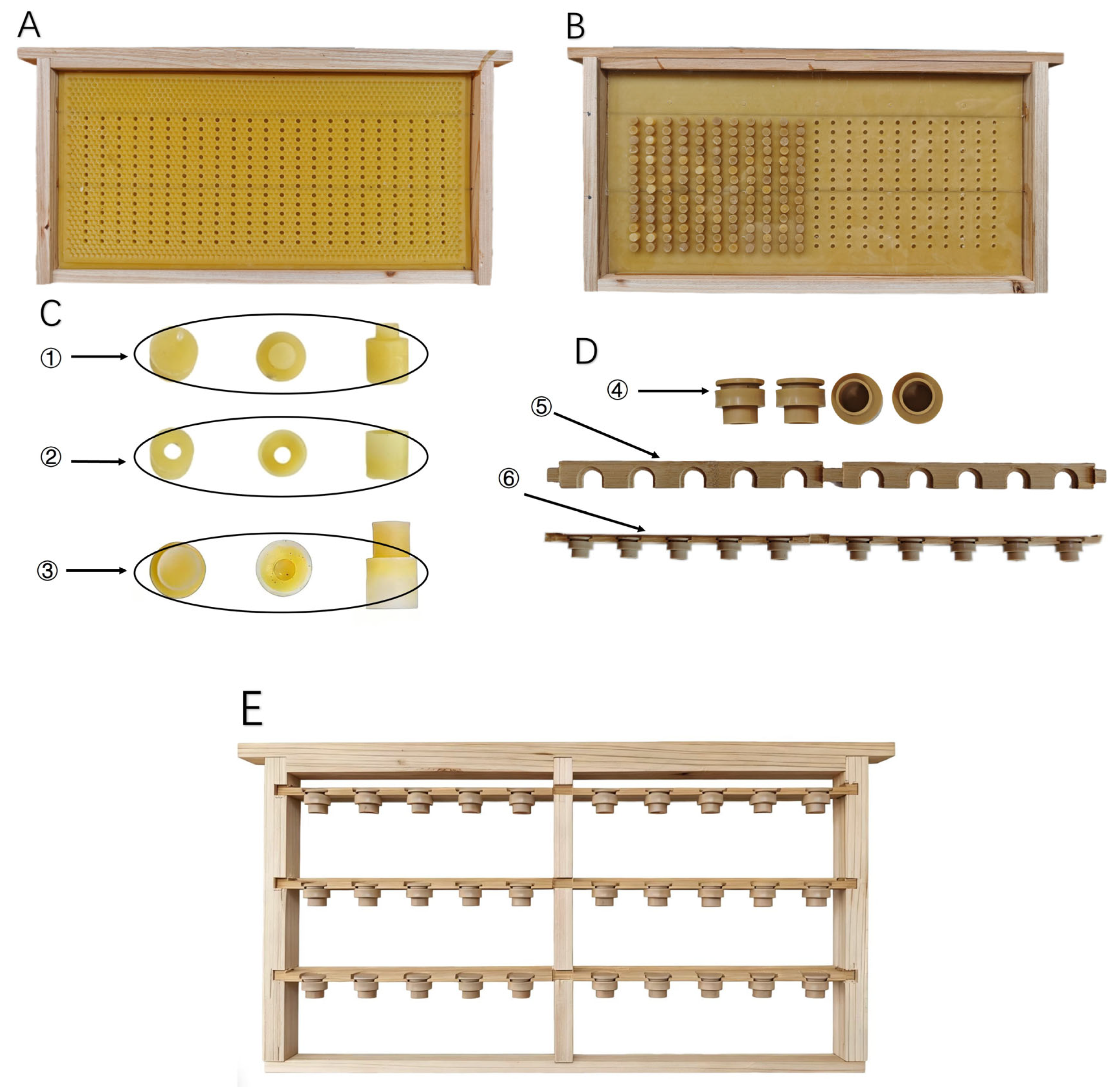
2.2. Structure and Main Accessories of the Beeswax-Based Tools for Queen Rearing Without Grafting Larvae
2.3. Queen Rearing
2.3.1. Comb Construction
2.3.2. Egg Laying
2.3.3. Preparation of Nurse Colonies
2.3.4. Larval Transfer Methods
2.4. Determination of Queen Cell Acceptance Rate, Queen Cell Length, Queen Emergence Rate, and Newly Emerged Queen Weight
2.5. Determination of Queen Morphological Indices
2.6. Determination of the Number of Ovarian Tubules of Reared Queens
2.7. Determination of Relative Expression Levels of Queen Development-Related Genes
2.7.1. RNA Extraction and cDNA Synthesis
2.7.2. Quantitative Real-Time PCR (qPCR) Assay
2.8. Data Processing
3. Results
3.1. Comparison of Two Methods on Larval Acceptance Rate, Queen Cell Length, and Queen Emergence Rate
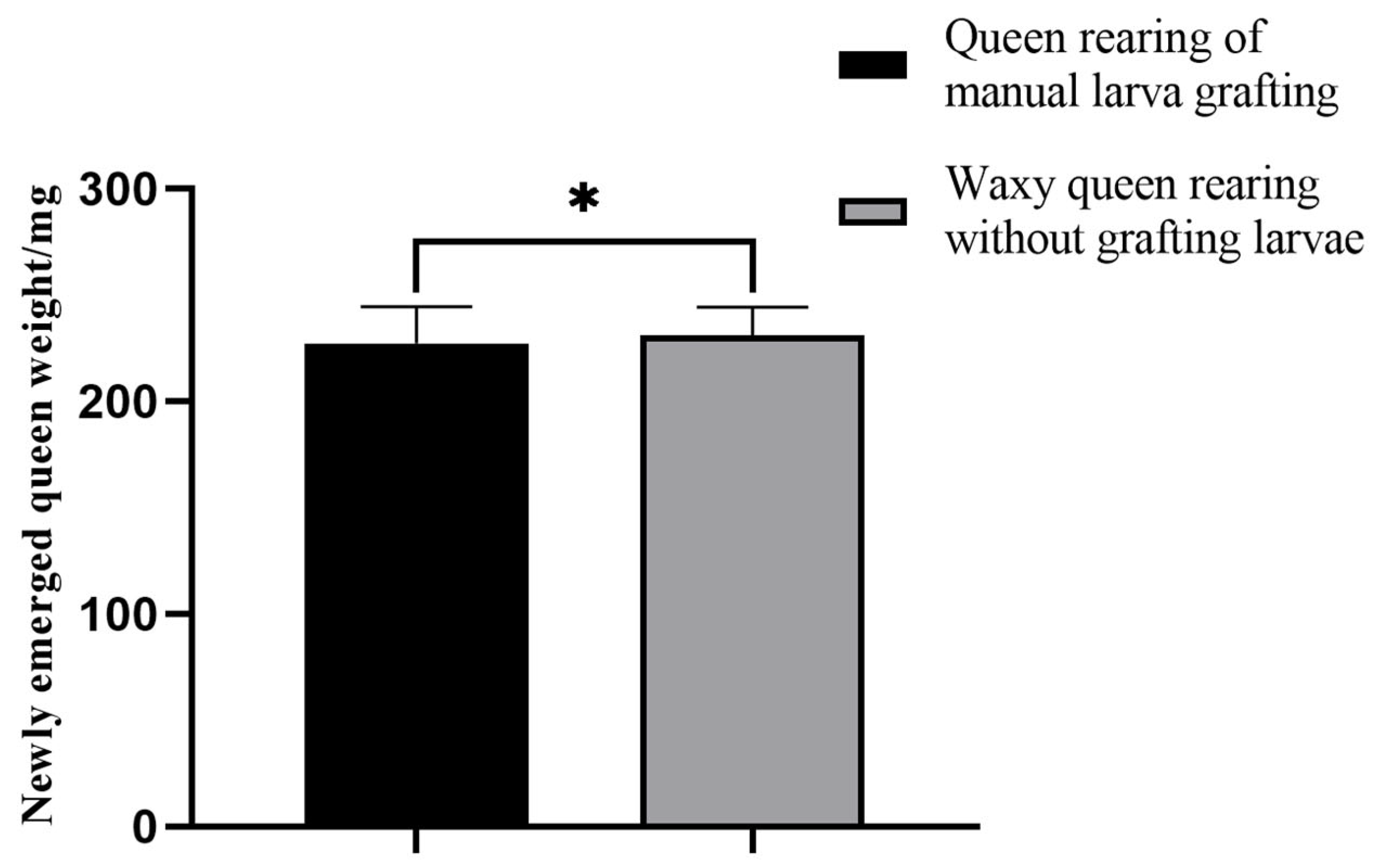
3.2. Comparison of Two Methods on the Weight of Newly Emerged Queens
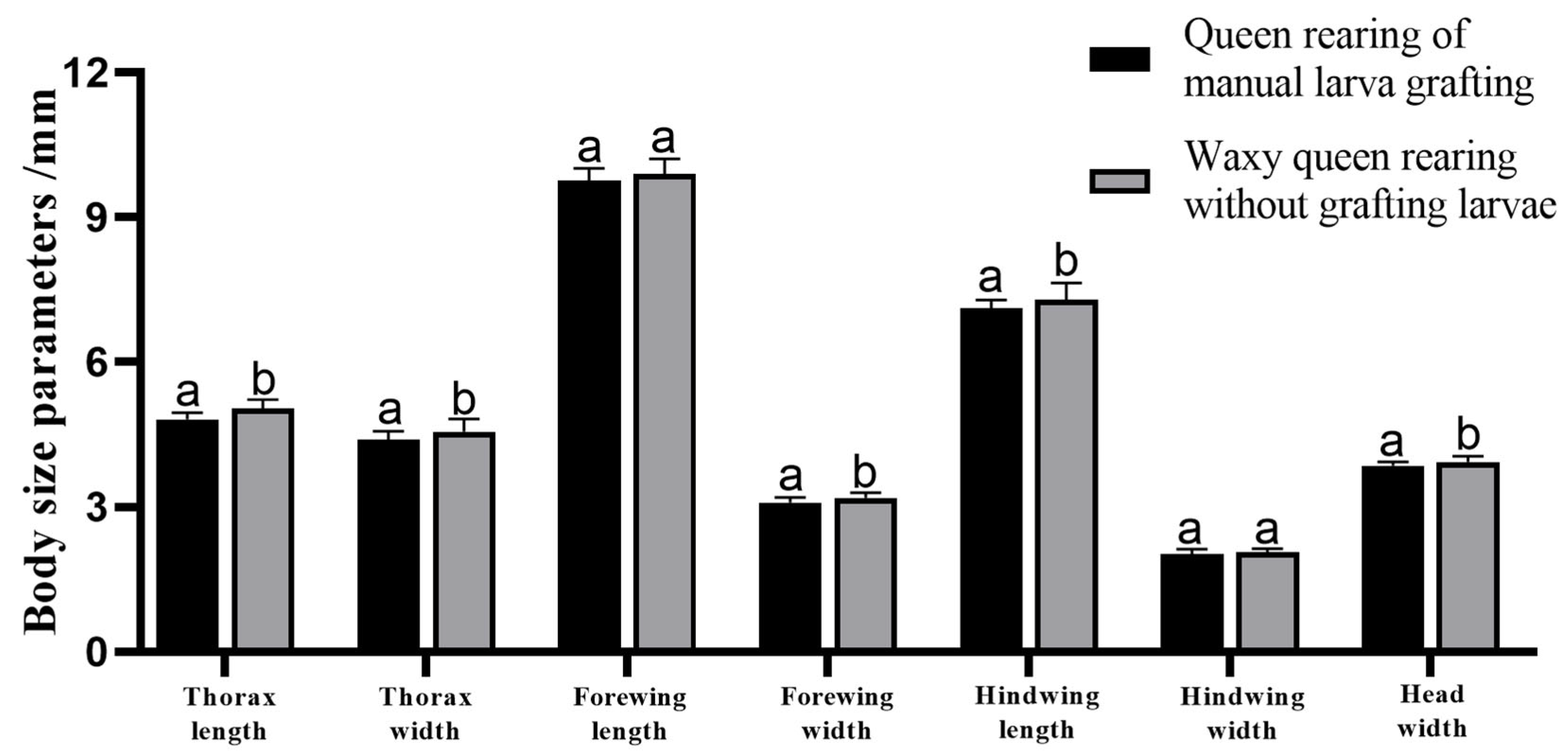
3.3. Comparison of Two Methods on the Queen Morphological Indices
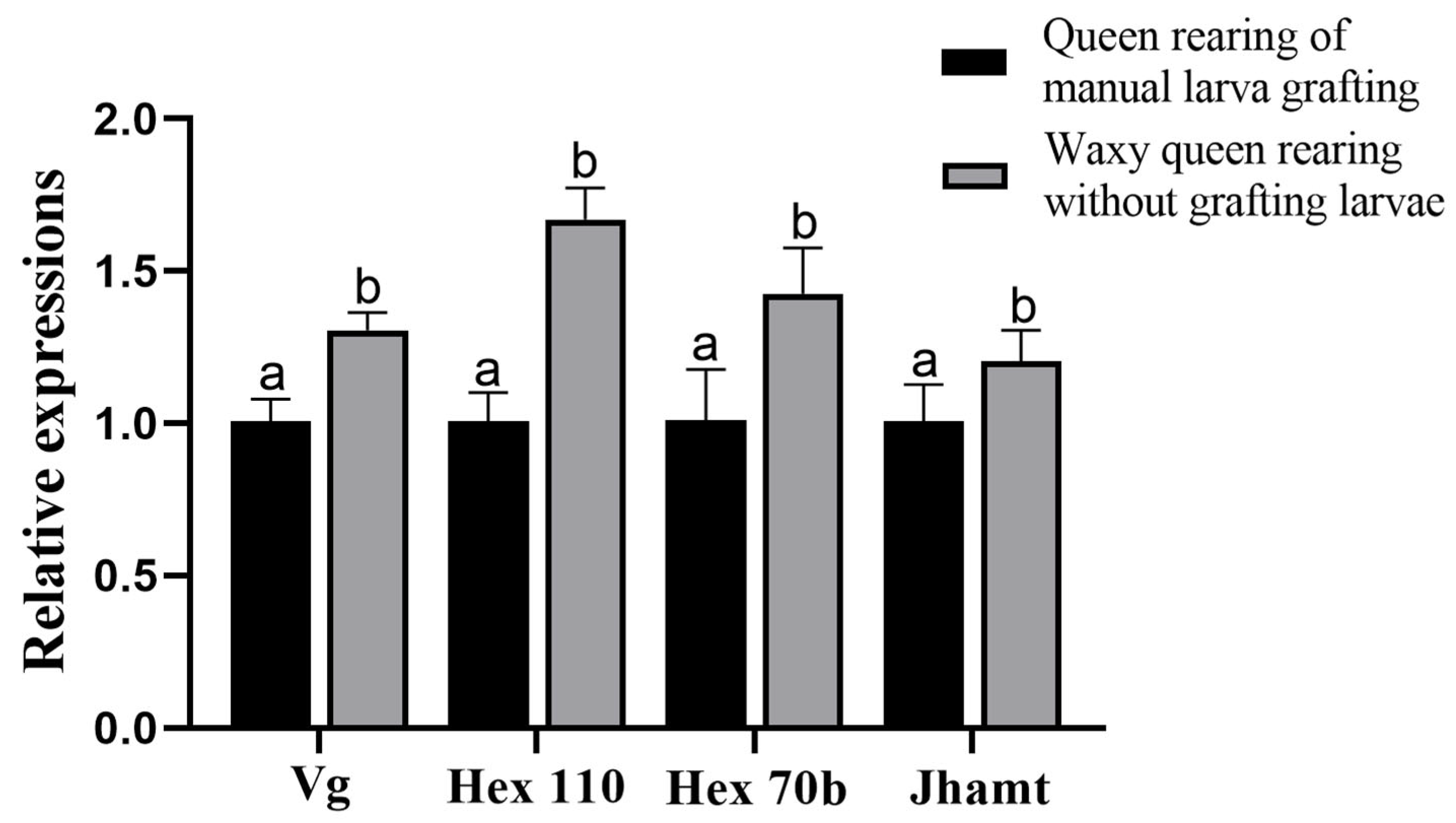
3.4. Comparison of Two Methods on the Relative Expression Levels of Queen Development–Related Genes
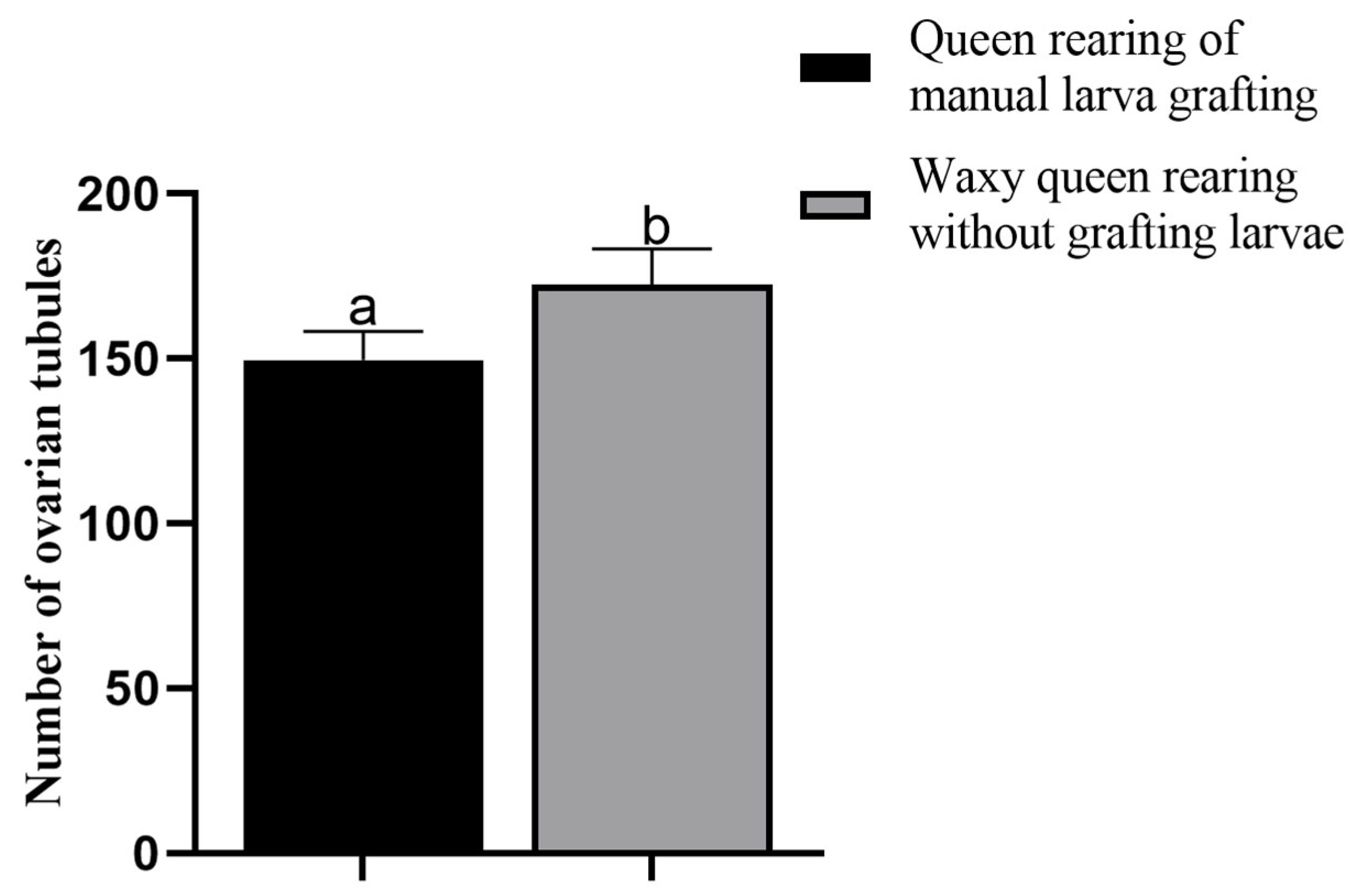
3.5. Comparison of Two Methods on the Number of Ovarian Tubules of Reared Queens
4. Discussion
5. Conclusions
Author Contributions
Funding
Institutional Review Board Statement
Informed Consent Statement
Data Availability Statement
Conflicts of Interest
References
- Yi, Y.; He, X.J.; Barron, A.B.; Liu, Y.B.; Wang, Z.L.; Yan, W.Y.; Zeng, Z.J. Transgenerational accumulation of methylome changes discovered in commercially reared honey bee (Apis mellifera) queens. Insect Biochem. Mol. Biol. 2020, 127, 103476. [Google Scholar] [CrossRef] [PubMed]
- Amiri, E.; Strand, M.K.; Rueppell, O.; Tarpy, D.R. Queen Quality and the Impact of Honey Bee Diseases on Queen Health: Potential for Interactions between Two Major Threats to Colony Health. Insects 2017, 8, 48. [Google Scholar] [CrossRef] [PubMed]
- DeGrandi-Hoffman, G.; Gilley, D.W.; Hooper, J. The influence of season and volatile compounds on the acceptance of introduced European honey bee (Apis mellifera) Queens into European and Africanized colonies. Apidologie 2007, 38, 230–237. [Google Scholar] [CrossRef]
- Danka, R.G.; Loper, G.M.; Villa, J.D.; Williams, J.L.; Sugden, E.A.; Collins, A.M.; Rinderer, T.E. Abating feral Africanized honey bees (Apis mellifera L) to enhance mating control of European queens. Apidologie 1994, 25, 520–529. [Google Scholar] [CrossRef]
- Zeng, M.; Zeng, Z.J. Investigation and analysis of rearing scale, output value and benefit of honey bee operations. Chin. J. Appl. Entomol. 2020, 57, 1139–1142. [Google Scholar] [CrossRef]
- Doolittle, G.M. Scientific Queen-Rearing as Practically Applied: Being a Method by Which the Best of Queen-Bees Are Reared in Perfect Accord with Nature’s Ways: For the Amateur and Veteran in Bee-Keeping; Thomas G. Newman & Son: Chicago, IL, USA, 1889. [Google Scholar]
- Laidlaw, H.H., Jr.; Page, R.E., Jr. Queen Rearing and Bee Breeding; Wicwas Press: Kalamazoo, MI, USA, 1997. [Google Scholar]
- Laidlaw, H.H., Jr. Production of queens and package bees. In The Hive and the Honey Bee; Graham, J.M., Ed.; Dadant & Sons: Hamilton, IL, USA, 1992; pp. 989–1042. [Google Scholar]
- Pan, Q.Z.; Wu, X.B.; Guan, C.; Zeng, Z.J. A new method of queen rearing without grafting larvae. Am. Bee J. 2013, 153, 1279–1280. Available online: https://www.researchgate.net/publication/259870689_A_New_Method_of_Queen_Rearing_without_Grafting_Larvae (accessed on 26 February 2026).
- Wakjira, K.; Negera, T.; Dabela, S.; Alemu, T. Comparing responses of local honeybees (Apis mellifera L.) to karl jenter and doolittle grafting queen rearing methods. Int. J. Anim. Sci. Technol. 2019, 3, 42–47. [Google Scholar] [CrossRef]
- Castellanos-Zacarias, C.; Dominguez-Rebolledo, A.; Zamora-Bustillos, R.; Vivas-Rodriguez, J.; Baeza-Rodriguez, J.; Ramon-Ugalde, J.; Loeza-Concha, H. Queen bee (Apis mellifera L.) production using grafting method and non-grafting system. Open Access Libr. J. 2025, 12, 10. [Google Scholar] [CrossRef]
- Lashari, M.A.; Ghramh, H.A.; Ahmed, A.M.; Mahmood, R.; Rafique, M.K.; Ahmad, S.; Al-Shehri, B.M.; Mohammed, M.E.A.; Khan, K.A. Aptness of diverse queen cup materials for larval graft acceptance and queen bee emergence in managed honey bee (Apis mellifera) colonies. J. King Saud Univ. Sci. 2022, 34, 102043. [Google Scholar] [CrossRef]
- Wu, X.B. Research progress on graft-free queen rearing methods for honey bees. Heilongjiang Anim. Sci. Vet. Med. 2018, 33–38. [Google Scholar] [CrossRef]
- Breed, M.D. Recognition pheromones of the honey bee. BioScience 1998, 48, 463–470. [Google Scholar] [CrossRef]
- Büchler, R.; Andonov, S.; Bernstein, R.; Bienefeld, K.; Costa, C.; Du, M.; Gabel, M.; Given, K.; Hatjina, F.; Harpur, B.A.; et al. Standard methods for rearing and selection of Apis mellifera queens 2.0. J. Apic. Res. 2025, 64, 555–611. [Google Scholar] [CrossRef]
- Ruttner, F. Biogeography and Taxonomy of Honeybees; Springer: Berlin/Heidelberg, Germany, 1988. [Google Scholar]
- Gan, H.Y.; Tian, L.Q.; Yan, W.Y. Preparation and staining technology of queen bee ovary sections. J. Bee 2012, 32, 9. [Google Scholar] [CrossRef]
- Chen, P.S.; Shen, C.H.; Bai, J.; Chen, H.; Ouyang, X.H. Exploration of observation methods for ovary tissues of Apis mellifera queens. Gansu Anim. Husb. Vet. Med. 2018, 48, 55–57. [Google Scholar] [CrossRef]
- Bitondi, M.M.; Nascimento, A.M.; Cunha, A.D.; Guidugli, K.R.; Nunes, F.M.; Simões, Z.L. Characterization and expression of the Hex 110 gene encoding a glutamine-rich hexamerin in the honey bee, Apis mellifera. Arch. Insect Biochem. Physiol. 2006, 63, 57–72. [Google Scholar] [CrossRef]
- Pang, Q.; Wang, Y.; Wang, K.; Zhang, W.W.; Ji, T. Differential Expression Analysis of hexamerin110 and hexamerin70b in Queen Bee Ovaries at Different Larval Grafting Ages. J. Environ. Entomol. 2017, 39, 62–67. [Google Scholar]
- Corona, M.; Velarde, R.A.; Remolina, S.; Moran-Lauter, A.; Wang, Y.; Hughes, K.A.; Robinson, G.E. Vitellogenin, juvenile hormone, insulin signaling, and queen honey bee longevity. Proc. Natl. Acad. Sci. USA 2007, 104, 7128–7133. [Google Scholar] [CrossRef]
- Hu, F.L.; Jin, S.H.; Zheng, H.Q. Establishment of multi-queen colonies of Apis mellifera and observation of queen egg-laying capacity. Acta Entomol. Sin. 2005, 48, 465–468. [Google Scholar] [CrossRef]
- Wang, L.M.; Xiao, J.H.; Zhang, F.; Han, X. Larval grafting for queen rearing affects miRNA expression in Apis mellifera queens. J. Environ. Entomol. 2024, 46, 866–872. [Google Scholar] [CrossRef]
- Abou-Shaara, H.; Mehrparvar, S.; Read, Q.D.; Chen, J.; Amiri, E. Impact of commercial plastic queen cell cups on rearing success and development of honey bee queens. J. Apic. Res. 2025, 64, 1074–1084. [Google Scholar] [CrossRef]
- Woyke, J. Correlations between the age at which honeybee brood is grafted, characteristics of the resultant queens, and results of insemination. J. Apic. Res. 1971, 10, 45–55. [Google Scholar] [CrossRef]
- Delaney, D.A.; Keller, J.J.; Caren, J.R.; Tarpy, D.R. The physical, insemination, and reproductive quality of honey bee queens (Apis mellifera L.). Apidologie 2011, 42, 1–13. [Google Scholar] [CrossRef]
- Tarpy, D.R.; Keller, J.J.; Caren, J.R.; Delaney, D.A. Assessing the mating ‘health’ of commercial honey bee queens. J. Econ. Entomol. 2012, 105, 20–25. [Google Scholar] [CrossRef] [PubMed]
- Facchini, E.; De Iorio, M.G.; Turri, F.; Pizzi, F.; Laurino, D.; Porporato, M.; Rizzi, R.; Pagnacco, G. Investigating genetic and phenotypic variability of queen bees: Morphological and reproductive traits. Animals 2021, 11, 3054. [Google Scholar] [CrossRef]
- Es’kov, E.K.; Es’kova, M.D. Factors influencing wing size and body weight variation in the western honeybee. Russ. J. Ecol. 2013, 44, 433–438. [Google Scholar] [CrossRef]
- Hatjina, F.; Bieńkowska, M.; Charistos, L.; Chlebo, R.; Costa, C.; Dražić, M.M.; Filipi, J.; Gregorc, A.; Ivanova, E.N.; Kezić, N.; et al. A review of methods used in some European countries for assessing the quality of honey bee queens through their physical characters and the performance of their colonies. J. Apic. Res. 2014, 53, 337–363. [Google Scholar] [CrossRef]
- Kucharski, R.; Maleszka, J.; Forêt, S.; Maleszka, R. Nutritional Control of Reproductive Status in Honeybees via DNA Methylation. Science 2008, 319, 1827–1830. [Google Scholar] [CrossRef]
- Rangel, J.; Keller, J.J.; Tarpy, D.R. The effects of honey bee (Apis mellifera L.) queen reproductive potential on colony growth. Insectes Sociaux 2013, 60, 65–73. [Google Scholar] [CrossRef]
- Wang, D.C.; He, Y.H. Experimental study on the superiority of naturally mated honey bee queens over artificially reared queens. J. Bee 2005, 25, 7–8. [Google Scholar] [CrossRef]
- Spivak, M.; Reuter, G.S. Successful Queen Rearing: Short Course; University of Minnesota Extension Service: St. Paul, MN, USA, 1994. [Google Scholar]
- Yu, L.; He, X.; Shi, X.; Yan, W.; Wu, X. Honey bee maternal effects improve worker performance and reproductive ability in offspring. Front. Cell Dev. Biol. 2023, 11, 1156923. [Google Scholar] [CrossRef]



| Gene Name | Forward Primer Sequence (5’-3’) | Reverse Primer Sequence (5’-3’) |
|---|---|---|
| Vg | CGTGTTCCAGAGGACGTTGA | GGACTTCGTGGCTCTCCATC |
| Hex70b | GGTGCTACGGTTCCACTTCA | ATCGATGGCGGTTGAGATCC |
| Hex110 | TGCCCAAGTTAATCTTGCTGGATA | TGCTTGTTGATCCTGTTGTCCT |
| Jhamt | TGAAAGCCAGCACGATACAATACCG | TCCGCAACCTATGTCCAAACACTTC |
| β-actin | GGCTCCCGAAGAACATCC | TGCGAAACACCGTCACCC |
| Queen-Rearing Methods | Larval Acceptance Rate | Queen’s Emerging Rate | Length of the Queen Cell |
|---|---|---|---|
| Waxy queen rearing without grafting larvae | 84.72 ± 6.28 a | 98.15 ± 4.54 a | 30.07 ± 3.15 a |
| Queen rearing of manual larva grafting (control group) | 86.11 ± 6.81 a | 91.67 ± 7.46 a | 27.47 ± 3.46 b |
Disclaimer/Publisher’s Note: The statements, opinions and data contained in all publications are solely those of the individual author(s) and contributor(s) and not of MDPI and/or the editor(s). MDPI and/or the editor(s) disclaim responsibility for any injury to people or property resulting from any ideas, methods, instructions or products referred to in the content. |
© 2026 by the authors. Licensee MDPI, Basel, Switzerland. This article is an open access article distributed under the terms and conditions of the Creative Commons Attribution (CC BY) license.
Share and Cite
Zhang, G.; Yan, W.; Zeng, Z.; Wu, X. Beeswax-Based Tools for Queen Rearing Without Grafting Larvae for Apis mellifera. Agriculture 2026, 16, 758. https://doi.org/10.3390/agriculture16070758
Zhang G, Yan W, Zeng Z, Wu X. Beeswax-Based Tools for Queen Rearing Without Grafting Larvae for Apis mellifera. Agriculture. 2026; 16(7):758. https://doi.org/10.3390/agriculture16070758
Chicago/Turabian StyleZhang, Gao, Weiyu Yan, Zhijiang Zeng, and Xiaobo Wu. 2026. "Beeswax-Based Tools for Queen Rearing Without Grafting Larvae for Apis mellifera" Agriculture 16, no. 7: 758. https://doi.org/10.3390/agriculture16070758
APA StyleZhang, G., Yan, W., Zeng, Z., & Wu, X. (2026). Beeswax-Based Tools for Queen Rearing Without Grafting Larvae for Apis mellifera. Agriculture, 16(7), 758. https://doi.org/10.3390/agriculture16070758