The Leaf Length-Width Method Is Applicable to Compound Leaves of Diverse Forms


Abstract
1. Introduction
2. Materials and Methods
2.1. Study Species and Sampling
2.2. Leaf Size Measurement
2.3. Data Analysis
3. Results
4. Discussion
5. Conclusions
Supplementary Materials
Funding
Institutional Review Board Statement
Data Availability Statement
Acknowledgments
Conflicts of Interest
References
- Van Iersel, M.W. Carbon use efficiency depends on growth respiration, maintenance respiration, and relative growth rate. A case study with lettuce. Plant Cell Environ. 2003, 26, 1441–1449. [Google Scholar] [CrossRef]
- Singh, J.; Singh, K.; Bhardwaj, V.; Mangal, V.; Kumar, R.; Kumar, D.; Sood, S. Genomic Insights into Tuber Yield and Associated Morphological and Biochemical Traits in Potato (Solanum tuberosum L.) Through GWAS. J. Plant Growth Regul. 2025, 45, 1042–1059. [Google Scholar] [CrossRef]
- Fan, Y.; Liu, Y.; Yue, J.; Jin, X.; Chen, R.; Bian, M.; Ma, Y.; Yang, G.; Feng, H. Estimation of potato yield using a semi-mechanistic model developed by proximal remote sensing and environmental variables. Comput. Electron. Agric. 2024, 223, 109117. [Google Scholar] [CrossRef]
- Zhao, G.; Gao, K.; Gao, M.; Xu, X.; Li, Z.; Yang, X.; Tian, P.; Wei, X.; Wu, Z.; Yang, M. Straw Returning Combined with Application of Sulfur-Coated Urea Improved Rice Yield and Nitrogen Use Efficiency Through Enhancing Carbon and Nitrogen Metabolism. Agriculture 2025, 15, 1554. [Google Scholar] [CrossRef]
- Su, M.; Cao, W.; Yun, Y.; Xia, P.; Guo, Y.; Zhou, X.; Jiang, C.; Jiang, J.; Zhu, Y.; Yao, X.; et al. Monitoring crop leaf area index using improved global structure-from-motion and multi-feature data fusion on a phenotyping robot. Eur. J. Agron. 2026, 174, 127974. [Google Scholar] [CrossRef]
- Misle, E.; Rojas, O.; Schiappacasse, F.; Kahlaoui, B. Assessing some ecophysiological traits of Protea ‘Pink Ice’ for the quantification of productive parameters. Plant Biosyst. 2026, 160, 49. [Google Scholar] [CrossRef]
- Li, Y.; Shi, Z.; Yuan, M.; Xu, Z.; Yang, S.; Ma, L.; Sun, Y.; Wu, S.; Zhang, X.; Gao, J. Global tree mycorrhizal and leaf type co-influence inconsistent responses of leaf area to environmental factors. Ecol. Indic. 2025, 178, 114010. [Google Scholar] [CrossRef]
- Wang, Y.; Deng, Y.; Zhao, H.; Li, F.; Fan, Z.; Tian, T.; Feng, T. Patterns of Change in Plant Leaf Functional Traits Along an Altitudinal Gradient in a Karst Climax Community. Agronomy 2025, 15, 1143. [Google Scholar] [CrossRef]
- Kassout, J.; Souali, H.; Zahiri, A.; Abou-Saaid, O.; Mohammed, A.; Oulbi, S. Intraspecific Variability in Leaf Functional Traits Reveals Divergent Resource-Use Strategies and Geographic Adaptation in Mediterranean Olive Cultivars from Worldwide Olive Germplasm Bank of Marrakech. Plants 2026, 15, 471. [Google Scholar] [CrossRef] [PubMed]
- Zuhri, M.; Setiawan, N.; Dewi, S.; Sulistyawati, E. Tropical seedling performance under drought: A functional trait approach for species selection in restoration. iForest—Biogeosciences For. 2026, 19, 9–17. [Google Scholar] [CrossRef]
- Yao, W.; Shi, P.; Wang, J.; Mu, Y.; Cao, J.; Niklas, K.J. The “Leafing Intensity Premium” Hypothesis and the Scaling Relationships of the Functional Traits of Bamboo Species. Plants 2024, 13, 2340. [Google Scholar] [CrossRef] [PubMed]
- Bosch, N.E.; McLean, M.; Tuya, F. Evolutionary legacies structure the geography of seagrass traits across the world’s oceans. New Phytol. 2026. [Google Scholar] [CrossRef]
- Fantinato, E.; Manente, S.; Gastaldi, E.; Menegazzo, A.; Presotto, F.; Scapinello, G.; Toniolo, N.; Lorenzato, L.; Buffa, G. Linking leaf economic spectrum to floral resources along an environmental gradient. J. Ecol. 2025, 113, 1659–1671. [Google Scholar] [CrossRef]
- Gordaliza, G.G.; García-Rovés, J.C.M.; López, R.; Aranda, I.; Gil, L.; Perea, R.; Rodríguez-Calcerrada, J. Herbivory legacy modifies leaf economic spectrum and drought tolerance in two tree species. Oecologia 2025, 207, 39. [Google Scholar] [CrossRef]
- Niinemets, U.; Portsmuth, A.; Tena, D.; Tobias, M.; Matesanz, S.; Valladares, F. Do we underestimate the importance of leaf size in plant economics? Disproportional scaling of support costs within the spectrum of leaf physiognomy. Ann. Bot. 2007, 100, 283–303. [Google Scholar] [CrossRef] [PubMed]
- Guo, X.; Zhang, J.; Gu, J.; Li, Z.; Wang, Y. Variations and Coordination of Leaflet and Petiole Functional Traits Within Compound Leaves in Three Hardwood Species. Forests 2025, 16, 139. [Google Scholar] [CrossRef]
- Li, J.; Wang, Y.; Mao, Q.; Cheng, W.; Cao, M.; Teng, H.; Diao, Y.; Jin, M.; Fei, N. Ontogenetic Stage Strongly and Differentially Influences Leaf Economic and Stomatal Traits Along Phyllotactic and Environmental Gradients. Forests 2025, 16, 1624. [Google Scholar] [CrossRef]
- Suzuki, K.C.; Kajino, H.; Hirokawa, S.; Tomimatsu, H.; Kadowaki, K.; Hikosaka, K. The coordination between root and leaf functional traits across 33 woody plant species shifts between mycorrhizal types. Tree Physiol. 2025, 46, tpaf151. [Google Scholar] [CrossRef]
- Zhou, Y.-J.; Ning, Q.-R.; Cui, H.-X.; Hao, G.-Y. Corner’s Rules and Their Linkages with Twig Functions and Tree Productivity in Simple- and Compound-Leaved Tree Species. Plant Cell Environ. 2025, 48, 3314–3325. [Google Scholar] [CrossRef]
- Chen, J.; Ren, T.; Xie, H.; Yang, W.; Zhang, W.; Zhang, J.; Xu, M.; Wu, L.; Fan, Z.; Yi, C.; et al. Life form and behavior type shape water use efficiency in tropical plants via leaf functional traits. Environ. Exp. Botany 2026, 242, 106315. [Google Scholar] [CrossRef]
- Dar, S.A.; Dar, J.A. Linking carbon storage with land use dynamics in a coastal Ramsar wetland. Sci. Total. Environ. 2024, 932, 173078. [Google Scholar] [CrossRef]
- Na, Q.; Lai, Q.; Bao, G.; Xue, J.; Liu, X.; Gao, R. Estimation of Gross Primary Productivity Using Performance-Optimized Machine Learning Methods for the Forest Ecosystems in China. Forests 2025, 16, 518. [Google Scholar] [CrossRef]
- Wang, X.; Shi, X.; Fan, D.; Hou, J.; Zhang, X.; Yu, M.; He, L.; Liu, Y.; Xue, L.; He, B.; et al. How do mixed forests always increase community productivity? The contribution of leaf area, photosynthesis and temporal niche differentiation. Ecol. Indic. 2026, 182, 114514. [Google Scholar] [CrossRef]
- Yang, H.; Kim, A.R.; Chun, J.-H. Ecosystem Water-Use Efficiency in a Warm-Temperate Evergreen Broad-Leaved Forest in the Republic of Korea. Water 2026, 18, 354. [Google Scholar] [CrossRef]
- Liu, M.; Ding, K.; Dong, X.; Ji, S.; Kong, X.; Sun, D.; Chen, H.; Gao, Y.; Li, C.; Bai, C.; et al. Genome-Wide Association Analysis Dissects the Genetic Architecture of Maize Leaf Inclination Angle and Leaf Area Index. Agronomy 2026, 16, 178. [Google Scholar] [CrossRef]
- Ochiai, S.; Kamada, E.; Sugiura, R. Modeling the Leaf Area Dynamics of Sweet Potatoes under Varying Nitrogen Conditions. Hortic. J. 2026, 95, 21–29. [Google Scholar] [CrossRef]
- Ono, K.; Ikawa, H.; Miyata, A. Multi-year water and carbon flux contrasts between high-yielding and conventional rice cultivars. Agric. For. Meteorol. 2026, 378, 110983. [Google Scholar] [CrossRef]
- Selim, A.I.; Bardisi, A.; Nawar, D.A.; Laban, N.; Ali, A.M. Retrieving, Estimating Biophysical Parameters and Predicting Potato Yield from Sentinel-2 Satellite Data in Sandy Soil Using Machine Learning Models, Al-Salhiya, Egypt. Egypt. J. Agron. 2026, 48, 371–401. [Google Scholar] [CrossRef]
- Yao, W.; Niinemets, Ü.; Niklas, K.J.; Damgaard, C.F.; Shi, P. Low size inequality in stomatal area distributions detected for 12 tree and shrub Magnoliaceae species: Evidence of hydraulic optimization. Bot. Lett. 2025, 173, 72–84. [Google Scholar] [CrossRef]
- Sadeghi, S.M.M.; Aghajani, H.; Jalilvand, H.; Ahmady-Asbchin, S.; Sadati, S.M.; Coenders-Gerrits, M.; Dymond, S.F. Canopy vitality drives rainfall redistribution in an old-growth temperate beech forest. For. Ecol. Manag. 2026, 606, 123552. [Google Scholar] [CrossRef]
- Munna, A.; Amuri, N.; Woiso, D.; Hieronimo, P. The potential of the marula tree, Sclerocarya birrea, (A. Rich.) Horchst subspecies litterfall in enhancing soil fertility and carbon storage in drylands. iForest—Biogeosci. For. 2025, 18, 366–374. [Google Scholar] [CrossRef]
- Uemori, K.; Hishi, T. Conversion From Natural Broad-Leaved Forest to Conifer Plantation Increases Relative Detritus Dependency of Aculeata Communities. Ecol. Res. 2026, 41, e70023. [Google Scholar] [CrossRef]
- Ishaq, R.A.F.; Zhou, G.; Jing, G.; Shah, S.R.A.; Ali, A.; Imran, M.; Jiang, H.; Obaid-ur-Rehman. Geospatial Robust Wheat Yield Prediction Using Machine Learning and Integrated Crop Growth Model and Time-Series Satellite Data. Remote Sens. 2025, 17, 1140. [Google Scholar] [CrossRef]
- Sakoda, K.; Sakurai, A.; Imamura, S. Difference in single-leaf and whole-plant photosynthetic response to light under steady and non-steady states in Arabidopsis thaliana. Front. Plant Sci. 2025, 16, 1532522. [Google Scholar] [CrossRef]
- Chiteri, K.O.; Chiranjeevi, S.; Jubery, T.Z.; Rairdin, A.; Dutta, S.; Ganapathysubramanian, B.; Singh, A. Dissecting the genetic architecture of leaf morphology traits in mungbean (Vigna radiata (L.) Wizcek) using genome-wide association study. Plant Phenome J. 2023, 6, e20062. [Google Scholar] [CrossRef]
- Chen, J.; Chen, C. Study on the Shape Characteristics and the Allometry of Phalaenopsis Leaves for Greenhouse Management. Plants 2023, 12, 2031. [Google Scholar] [CrossRef]
- Hu, T.; Poire, R.; Way, D. Leaf Analyzer: A Fully Automated and Open-Source Tool for High-Throughput Leaf Trait Measurement. Plant Phenomics 2026, 8, 100145. [Google Scholar] [CrossRef]
- Singh, J.; Kumar, D.; Sood, S.; Bhardwaj, V.; Kumar, S. Morpho-physiological characterization and principal component analysis for agronomic traits in tetraploid potato germplasm. Discov. Appl. Sci. 2025, 7, 1149. [Google Scholar] [CrossRef]
- Tunç, Y.; Demirel, F.; Khadivi, A.; Yılmaz, K.U.; Demirsoy, H.; Cemek, B.; Gözel, H.; Mishra, D.S. Artificial intelligence-based modeling for accurate leaf area estimation in olive (Olea europaea L.) cultivars. PLoS ONE 2026, 21, e0339865. [Google Scholar] [CrossRef] [PubMed]
- Mu, Y.; He, K.; Shi, P.; Wang, L.; Deng, L.; Shi, Z.; Liu, M.; Niklas, K.J. Comparison between computer recognition and manual measurement methods for the estimation of leaf area. Ann. Bot. 2024, 134, 501–510. [Google Scholar] [CrossRef] [PubMed]
- Poljak, I.; Vidaković, A.; Benić, L.; Tumpa, K.; Idžojtić, M.; Šatović, Z. Patterns of Leaf and Fruit Morphological Variation in Marginal Populations of Acer tataricum L. subsp. tataricum. Plants 2024, 13, 320. [Google Scholar] [CrossRef]
- Lai, Y.; Mu, X.; Fan, D.; Zou, J.; Xie, D.; Yan, G. Methodology comparison for correcting woody component effects in leaf area index calculations from digital cover images in broadleaf forests. Remote Sens. Environ. 2025, 321, 114659. [Google Scholar] [CrossRef]
- Katata, G.; Watanabe, M.; Oikawa, S.; Takahashi, A.; Kubota, T.; Takase, Y.; Enomoto, T.; Sakagami, N.; Suzuki, Y.; Fukushima, K.; et al. Evidence of NOx and O3 concentration reduction by kudzu (Pueraria lobata) invasion at a Japanese highway. Atmos. Pollut. Res. 2023, 14, 101644. [Google Scholar] [CrossRef]
- Molari, M.; Dominici, L.; Comino, E. Experimenting growing media through local bio-resources valorisation: A design-oriented approach for living walls. J. Clean. Prod. 2024, 436, 140446. [Google Scholar] [CrossRef]
- Patti, M.; Musarella, C.M.; Spampinato, G. A Habitat-Template Approach to Green Wall Design in Mediterranean Cities. Buildings 2025, 15, 2557. [Google Scholar] [CrossRef]
- Moser-Reischl, A.; Franceschi, E.; Rahman, M.A.; Rodrigues-Leite, J.; Pretzsch, H.; Pauleit, S.; Rötzer, T. Spatial and temporal dynamics of the leaf area index (LAI) of selected tree species in urban environments. Urban For. Urban Green. 2025, 107, 128795. [Google Scholar] [CrossRef]
- Montgomery, E. Correlation studies in corn. Neb. Agric. Exp. Stn. Annu. Rep. 1911, 24, 108–159. [Google Scholar]
- Yu, H.; Li, S.; Schrader, J.; Wei, Q.; Hölscher, D.; Shi, P. Leaf area prediction in two Quercus species: Validation of the Montgomery equation under bilateral asymmetry. Trees 2025, 39, 119. [Google Scholar] [CrossRef]
- Schrader, J.; Shi, P.; Royer, D.L.; Peppe, D.J.; Gallagher, R.V.; Li, Y.; Wang, R.; Wright, I.J. Leaf size estimation based on leaf length, width and shape. Ann. Bot. 2021, 128, 395–406. [Google Scholar] [CrossRef]
- Koyama, K.; Smith, D.D. Scaling the leaf length-times-width equation to predict total leaf area of shoots. Ann. Bot. 2022, 130, 215–230. [Google Scholar] [CrossRef] [PubMed]
- Fatima, S.; Ahmad, F.; Parveen, Z.; Basharat, S.; Hameed, M.; Asghar, A.; Ahmad, M.S.A.; Anwar, M.; Shah, S.M.R.; Shah, R.; et al. Climate-driven Modifications in Structural and Functional Traits of Couch Grass [Cynodon dactylon (L.) Pers.] along Elevation Gradient. J. Soil Sci. Plant Nutr. 2026. [Google Scholar] [CrossRef]
- Cain, S.A.; Castro, G.D.O. Manual of Vegetation Analysis; Harper & Brothers: New York, NY, USA, 1959. [Google Scholar]
- Koyama, K.; Smith, D.D. Scaling the leaf length-times-width equation to predict total leaf area of shoots [Dataset]. Dryad 2022. [Google Scholar] [CrossRef]
- Palaniswamy, K.M.; Gomez, K.A. Length-Width Method for Estimating Leaf Area of Rice. Agron. J. 1974, 66, 430–433. [Google Scholar] [CrossRef]
- Stewart, D.W.; Dwyer, L.M. Mathematical characterization of leaf shape and area of maize hybrids. Crop Sci. 1999, 39, 422–427. [Google Scholar] [CrossRef]
- de Souza Oliveira, V.; dos Santos, K.T.H.; de Morais, A.L.; Santos, G.P.; Santos, J.S.H.; Schmildt, O.; Czepak, M.P.; Gontijo, I.; Alexandre, R.S.; Schmildt, E.R. Non-destructive method for estimating the leaf area of pear cv.‘Triunfo’. J. Agric. Sci. 2019, 11, 14–21. [Google Scholar] [CrossRef]
- Teobaldelli, M.; Rouphael, Y.; Gonnella, M.; Buttaro, D.; Rivera, C.M.; Muganu, M.; Colla, G.; Basile, B. Developing a fast and accurate model to estimate allometrically the total shoot leaf area in grapevines. Sci. Hortic. 2020, 259, 108794. [Google Scholar] [CrossRef]
- Sala, F.; Dobrei, A.; Herbei, M.V. Leaf Area Calculation Models for Vines Based on Foliar Descriptors. Plants 2021, 10, 2453. [Google Scholar] [CrossRef] [PubMed]
- Shi, Z.; Wang, J.; Sun, G.; Yao, W.; Shi, P.; Ruan, H. Application of the Montgomery Equation in Morphometric Analysis of Tepals: A Case Study of Liriodendron × sinoamericanum. Plants 2025, 14, 1861. [Google Scholar] [CrossRef]
- Yu, K.; Reddy, G.V.P.; Schrader, J.; Guo, X.; Li, Y.; Jiao, Y.; Shi, P. A nondestructive method of calculating the wing area of insects. Ecol. Evol. 2022, 12, e8792. [Google Scholar] [CrossRef]
- Wang, C.; Heng, Y.; Xu, Q.; Zhou, Y.; Sun, X.; Wang, Y.; Yao, W.; Lian, M.; Li, Q.; Zhang, L.; et al. Scaling relationships between the total number of leaves and the total leaf area per culm of two dwarf bamboo species. Ecol. Evol. 2024, 14, e70002. [Google Scholar] [CrossRef]
- Deng, L.; Wang, J.; Zhang, L.; Hölscher, D.; Shi, P. Testing the validity of the Montgomery–Koyama–Smith equation and the power law equation using 3231 tepals of a Magnolia species. Trees 2025, 39, 74. [Google Scholar] [CrossRef]
- Fu, Q.; Shi, P.; Gielis, J.; Niklas, K.J. Non-destructive prediction of shoot-level leaf area and biomass in Indocalamus bamboo via scaling laws. Front. Plant Sci. 2025, 16, 1650196. [Google Scholar] [CrossRef]
- Meng, Y.; Ratkowsky, D.A.; Yao, W.; Heng, Y.; Shi, P. The Geometric Series Hypothesis of Leaf Area Distribution and Its Link to the Calculation of the Total Leaf Area per Shoot of Sasaella kongosanensis ‘Aureostriatus’. Plants 2025, 14, 73. [Google Scholar] [CrossRef]
- Zhao, C.; Wang, J.; Mu, Y.; Yao, W.; Wang, H.; Shi, P. Testing the Validity of the Montgomery–Koyama–Smith Equation for Calculating the Total Petal Area per Flower Using Two Rosaceae Species. Plants 2024, 13, 3499. [Google Scholar] [CrossRef]
- Yan, C.; Shi, P.; Yu, K.; Guo, X.; Lian, M.; Miao, Q.; Wang, L.; Yao, W.; Zheng, Y.; Zhu, F.; et al. Using the Montgomery-Koyama-Smith equation to calculate the stomatal area per unit lamina area for 12 Magnoliaceae species. Ann. Bot. 2024, 134, mcae165. [Google Scholar] [CrossRef]
- Koyama, K. Leaf Area Estimation by Photographing Leaves Sandwiched between Transparent Clear File Folder Sheets. Horticulturae 2023, 9, 709. [Google Scholar] [CrossRef]
- Tsaniklidis, G.; Makraki, T.; Papadimitriou, D.; Nikoloudakis, N.; Taheri-Garavand, A.; Fanourakis, D. Non-Destructive Estimation of Area and Greenness in Leaf and Seedling Scales: A Case Study in Cucumber. Agronomy 2025, 15, 2294. [Google Scholar] [CrossRef]
- Suarez, E.; Blaser, M.; Sutton, M. Automating Leaf Area Measurement in Citrus: The Development and Validation of a Python-Based Tool. Appl. Sci. 2025, 15, 9750. [Google Scholar] [CrossRef]
- Giang, T.T.; Ryoo, Y.-J. Sweet Pepper Leaf Area Estimation Using Semantic 3D Point Clouds Based on Semantic Segmentation Neural Network. AgriEngineering 2024, 6, 645–656. [Google Scholar] [CrossRef]
- Moriyuki, S.; Kochi, N.; Shinohara, Y.; Matsushima, Y.; Isozaki, M. Selection of Small Camera for Leaf Area Measurement Based on Distance Information and Validation of Strawberry Yield Prediction Model Using Distance Information. Environ. Control Biol. 2025, 63, 79–89. [Google Scholar] [CrossRef]
- Fleck, S.; Niinemets, U.; Cescatti, A.; Tenhunen, J.D. Three-dimensional lamina architecture alters light-harvesting efficiency in Fagus: A leaf-scale analysis. Tree Physiol. 2003, 23, 577–589. [Google Scholar] [CrossRef]
- Yang, L.; Wu, Z.; Wang, L.; Peng, J.; Zhou, Q. Three-dimensional morphological reconstruction of potato leaf from a single image. J. King Saud Univ. Comput. Inf. Sci. 2025, 37, 300. [Google Scholar] [CrossRef]
- Easlon, H.M.; Bloom, A.J. Easy Leaf Area: Automated digital image analysis for rapid and accurate measurement of leaf area. Appl. Plant Sci. 2014, 2, 1400033. [Google Scholar] [CrossRef] [PubMed]
- Song, Y.; Glasbey, C.A.; Polder, G.; van der Heijden, G.W.A.M. Non-destructive automatic leaf area measurements by combining stereo and time-of-flight images. IET Comput. Vis. 2014, 8, 391–403. [Google Scholar] [CrossRef]
- Apelt, F.; Breuer, D.; Nikoloski, Z.; Stitt, M.; Kragler, F. Phytotyping4D: A light-field imaging system for non-invasive and accurate monitoring of spatio-temporal plant growth. Plant J. 2015, 82, 693–706. [Google Scholar] [CrossRef]
- Nguyen, T.T.; Slaughter, D.C.; Max, N.; Maloof, J.N.; Sinha, N. Structured Light-Based 3D Reconstruction System for Plants. Sensors 2015, 15, 18587–18612. [Google Scholar] [CrossRef]
- Syed, T.N.; Jizhan, L.; Xin, Z.; Shengyi, Z.; Yan, Y.; Mohamed, S.H.A.; Lakhiar, I.A. Seedling-lump integrated non-destructive monitoring for automatic transplanting with Intel RealSense depth camera. Artif. Intell. Agric. 2019, 3, 18–32. [Google Scholar] [CrossRef]
- Paulus, S.; Behmann, J.; Mahlein, A.-K.; Plümer, L.; Kuhlmann, H. Low-Cost 3D Systems: Suitable Tools for Plant Phenotyping. Sensors 2014, 14, 3001–3018. [Google Scholar] [CrossRef]
- Vázquez-Arellano, M.; Reiser, D.; Paraforos, D.; Garrido-Izard, M.; Griepentrog, H. Leaf Area Estimation of Reconstructed Maize Plants Using a Time-of-Flight Camera Based on Different Scan Directions. Robotics 2018, 7, 63. [Google Scholar] [CrossRef]
- Müller-Linow, M.; Pinto-Espinosa, F.; Scharr, H.; Rascher, U. The leaf angle distribution of natural plant populations: Assessing the canopy with a novel software tool. Plant Methods 2015, 11, 11. [Google Scholar] [CrossRef]
- Yau, W.K.; Ng, O.-E.; Lee, S.W. Portable device for contactless, non-destructive and in situ outdoor individual leaf area measurement. Comput. Electron. Agric. 2021, 187, 106278. [Google Scholar] [CrossRef]
- Teng, P.; Sugiura, H.; Date, T.; Lee, U.; Yoshida, T.; Ota, T.; Nakagawa, J. Voxel-Based Leaf Area Estimation in Trellis-Grown Grapevines: A Destructive Validation and Comparison with Optical LAI Methods. Remote Sens. 2026, 18, 198. [Google Scholar] [CrossRef]
- Zhang, S.; Zhang, L. Using an IR camera to improve leaf area and temperature measurements: A new method for increasing the accuracy of photosynthesis-related parameters. Agric. For. Meteorol. 2022, 322, 109005. [Google Scholar] [CrossRef]
- Nomura, K.; Wada, E.; Saito, M.; Yamasaki, H.; Yasutake, D.; Iwao, T.; Tada, I.; Yamazaki, T.; Kitano, M. Estimation of the Leaf Area Index, Leaf Fresh Weight, and Leaf Length of Chinese Chive (Allium tuberosum) Using Nadir-looking Photography in Combination with Allometric Relationships. Hortscience 2022, 57, 777–784. [Google Scholar] [CrossRef]
- Sun, B.; Zain, M.; Zhang, L.; Han, D.; Sun, C. Stem-Leaf Segmentation and Morphological Traits Extraction in Rapeseed Seedlings Using a Three-Dimensional Point Cloud. Agronomy 2025, 15, 276. [Google Scholar] [CrossRef]
- Zhang, L.; Shi, S.; Zain, M.; Sun, B.; Han, D.; Sun, C. Evaluation of Rapeseed Leave Segmentation Accuracy Using Binocular Stereo Vision 3D Point Clouds. Agronomy 2025, 15, 245. [Google Scholar] [CrossRef]
- Efroni, I.; Eshed, Y.; Lifschitz, E. Morphogenesis of Simple and Compound Leaves: A Critical Review. Plant Cell 2010, 22, 1019–1032. [Google Scholar] [CrossRef]
- Klingenberg, C.P.; Duttke, S.; Whelan, S.; Kim, M. Developmental plasticity, morphological variation and evolvability: A multilevel analysis of morphometric integration in the shape of compound leaves. J. Evol. Biol. 2012, 25, 115–129. [Google Scholar] [CrossRef]
- Wu, Y.; Wang, G.; Pu, R.; Bai, T.; Fan, H.; Zhang, J.; Yang, S. Comprehensive Analysis of Agronomic Traits, Saponin Accumulation, and SNP-Based Genetic Diversity in Different Cultivars of Panax notoginseng. Genes 2025, 16, 1185. [Google Scholar] [CrossRef]
- He, L.; Yang, L.; Zhao, W.; Chen, J. Multilayered regulatory control of compound leaf development. Curr. Opin. Plant Biol. 2026, 89, 102847. [Google Scholar] [CrossRef] [PubMed]
- Jessica, G.; Byrne, M.E. From genes to climate: A perspective on the importance of leaf shape. J. Exp. Bot. 2026, 77, 243–247. [Google Scholar] [CrossRef] [PubMed]
- Niinemets, Ü.; Portsmuth, A.; Tobias, M. Leaf size modifies support biomass distribution among stems, petioles and mid-ribs in temperate plants. New Phytol. 2006, 171, 91–104. [Google Scholar] [CrossRef]
- Takai, N.; Osada, N. Petiole mechanics of coexisting tree species in a warm-temperate forest understory in relation to leaf size, leaf habit, and leaf form. Oecologia 2025, 208, 4. [Google Scholar] [CrossRef] [PubMed]
- Shabani, A.; Sepaskhah, A. Leaf area estimation by a simple and non-destructive method. Iran. Agric. Res. 2023, 36, 101–105. [Google Scholar]
- Bakhshandeh, E.; Kamkar, B.; Tsialtas, J.T. Application of linear models for estimation of leaf area in soybean [Glycine max (L.) Merr]. Photosynthetica 2011, 49, 405. [Google Scholar] [CrossRef]
- Gao, M.; Van der Heijden, G.W.A.M.; Vos, J.; Eveleens, B.A.; Marcelis, L.F.M. Estimation of leaf area for large scale phenotyping and modeling of rose genotypes. Sci. Hortic. 2012, 138, 227–234. [Google Scholar] [CrossRef]
- Fallovo, C.; Cristofori, V.; Mendoza de-Gyves, E.; Rivera, C.M.; Rea, R.; Fanasca, S.; Bignami, C.; Sassine, Y.; Rouphael, Y. Leaf Area Estimation Model for Small Fruits from Linear Measurements. Hortscience 2008, 43, 2263–2267. [Google Scholar] [CrossRef]
- Leroy, C.; Saint-André, L.; Auclair, D. Practical methods for non-destructive measurement of tree leaf area. Agrofor. Syst. 2007, 71, 99–108. [Google Scholar] [CrossRef]
- Vos, J.; van der Putten, P.E.L. Effect of nitrogen supply on leaf growth, leaf nitrogen economy and photosynthetic capacity in potato. Field Crops Res. 1998, 59, 63–72. [Google Scholar] [CrossRef]
- Park, S.K.; Gang, M.-S.; Cho, W.-J.; Kim, H.-J. Irrigation Control System Based on Hanging-Gutter-Scale Evapotranspiration Measurement for Tomato (Solanum lycopersicum L.) Cultivation in Greenhouse Hydroponics. J. Biosyst. Eng. 2026, 51, 5. [Google Scholar] [CrossRef]
- Peksen, E. Non-destructive leaf area estimation model for faba bean (Vicia faba L.). Sci. Hortic. 2007, 113, 322–328. [Google Scholar] [CrossRef]
- Torri, S.I.; Descalzi, C.; Frusso, E. Estimation of leaf area in pecan cultivars (Carya illinoinensis). Cienc. E Investig. Agrar. 2009, 36, 53–58. [Google Scholar] [CrossRef]
- Muthukannan; rani, J.; Mohan, B.; Prabha, D. Comparative growth analysis of Raphanus sativus L. (Radish): Effects of vermiwash and vermicompost applications on plant development. Discov. Food 2024, 4, 64. [Google Scholar] [CrossRef]
- Costa, A.P.; Pôças, I.; Cunha, M. Estimating the leaf area of cut roses in different growth stages using image processing and allometrics. Horticulturae 2016, 2, 6. [Google Scholar] [CrossRef]
- Schneider, C.A.; Rasband, W.S.; Eliceiri, K.W. NIH Image to ImageJ: 25 years of image analysis. Nat. Methods 2012, 9, 671–675. [Google Scholar] [CrossRef]
- R Core Team. R: A Language and Environment for Statistical Computing; R Foundation for Statistical Computing: Vienna, Austria, 2025. [Google Scholar]
- Wickham, H. ggplot2: Elegant Graphics for Data Analysis; Springer: New York, NY, USA, 2016. [Google Scholar]
- Wilke, C.O. cowplot: Streamlined plot theme and plot annotations for ‘ggplot2’. CRAN Repos 2016, 2, R2. [Google Scholar]
- Auguie, B. gridExtra: Miscellaneous Functions for “Grid” Graphics. R Package Version 2.3. 2017. Available online: https://CRAN.R-project.org/package=gridExtra (accessed on 3 March 2026).
- Warton, D.I.; Wright, I.J.; Falster, D.S.; Westoby, M. Bivariate line-fitting methods for allometry. Biol. Rev. 2006, 81, 259–291. [Google Scholar] [CrossRef]
- APG IV. An update of the Angiosperm Phylogeny Group classification for the orders and families of flowering plants: APG IV. Bot. J. Linn. Soc. 2016, 181, 1–20. [CrossRef]
- Arber, A. The Natural Philosophy of Plant Form; Cambridge University Press: New York, NY, USA, 1970. [Google Scholar]
- Sattler, R. Partial homology of pinnate leaves and shoots: Orientation of leaflet inception. Bot. Jahrb. Syst. 1992, 114, 61–79. [Google Scholar]
- Champagne, C.; Sinha, N. Compound leaves: Equal to the sum of their parts? Development 2004, 131, 4401–4412. [Google Scholar] [CrossRef] [PubMed]
- Koch, G.; Rolland, G.; Dauzat, M.; Bédiée, A.; Baldazzi, V.; Bertin, N.; Guédon, Y.; Granier, C. Are compound leaves more complex than simple ones? A multi-scale analysis. Ann. Bot. 2018, 122, 1173–1185. [Google Scholar] [CrossRef] [PubMed]



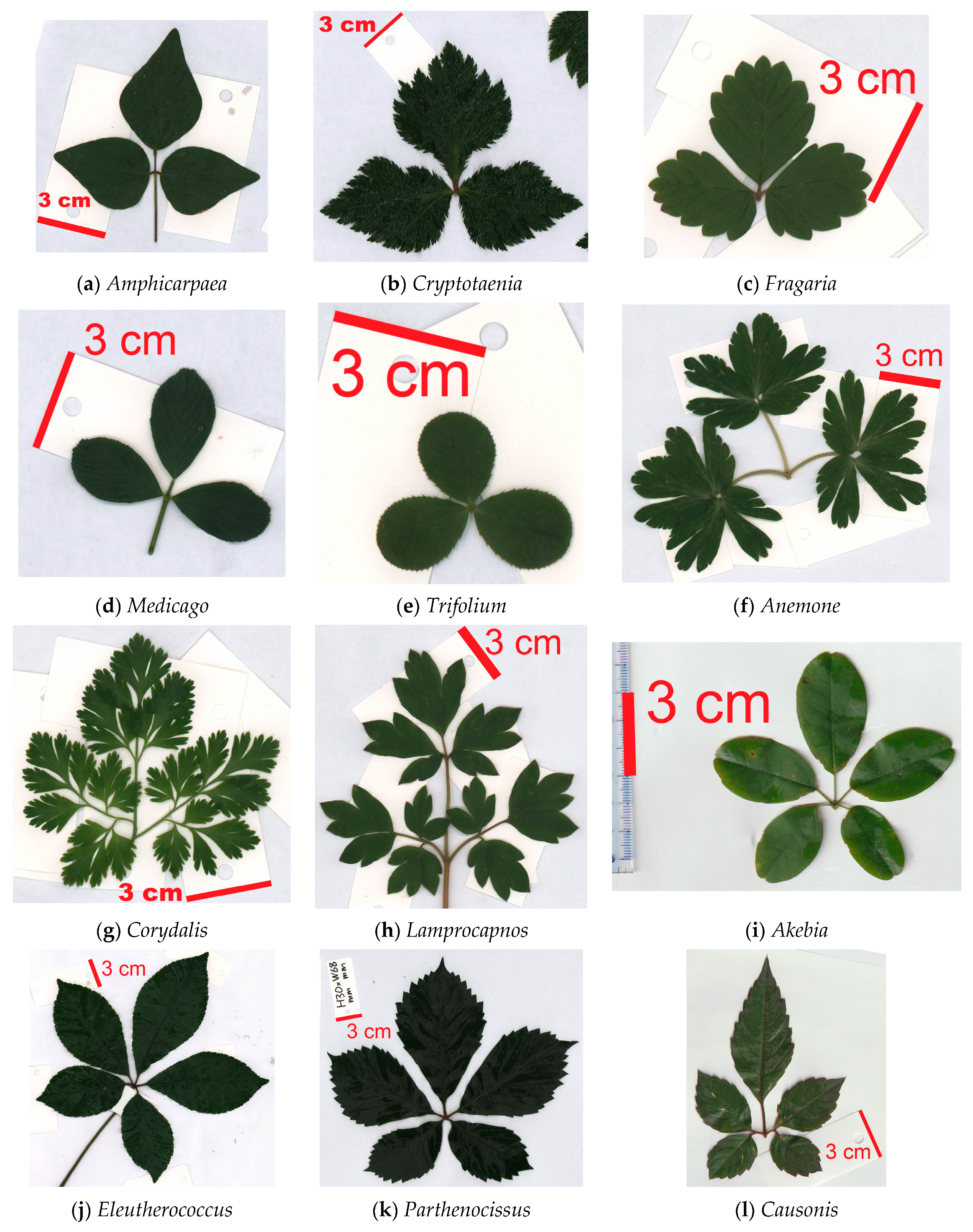
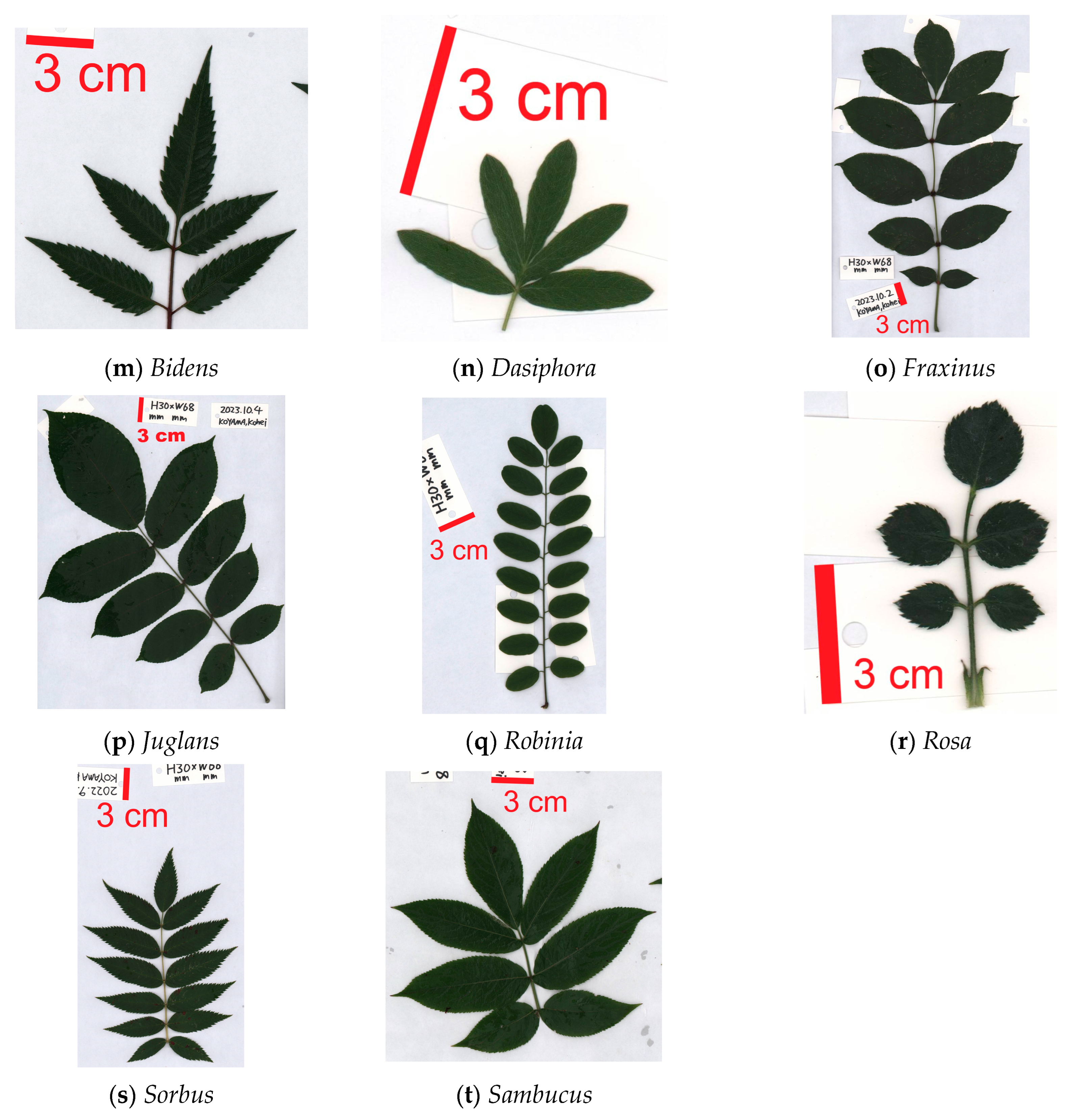
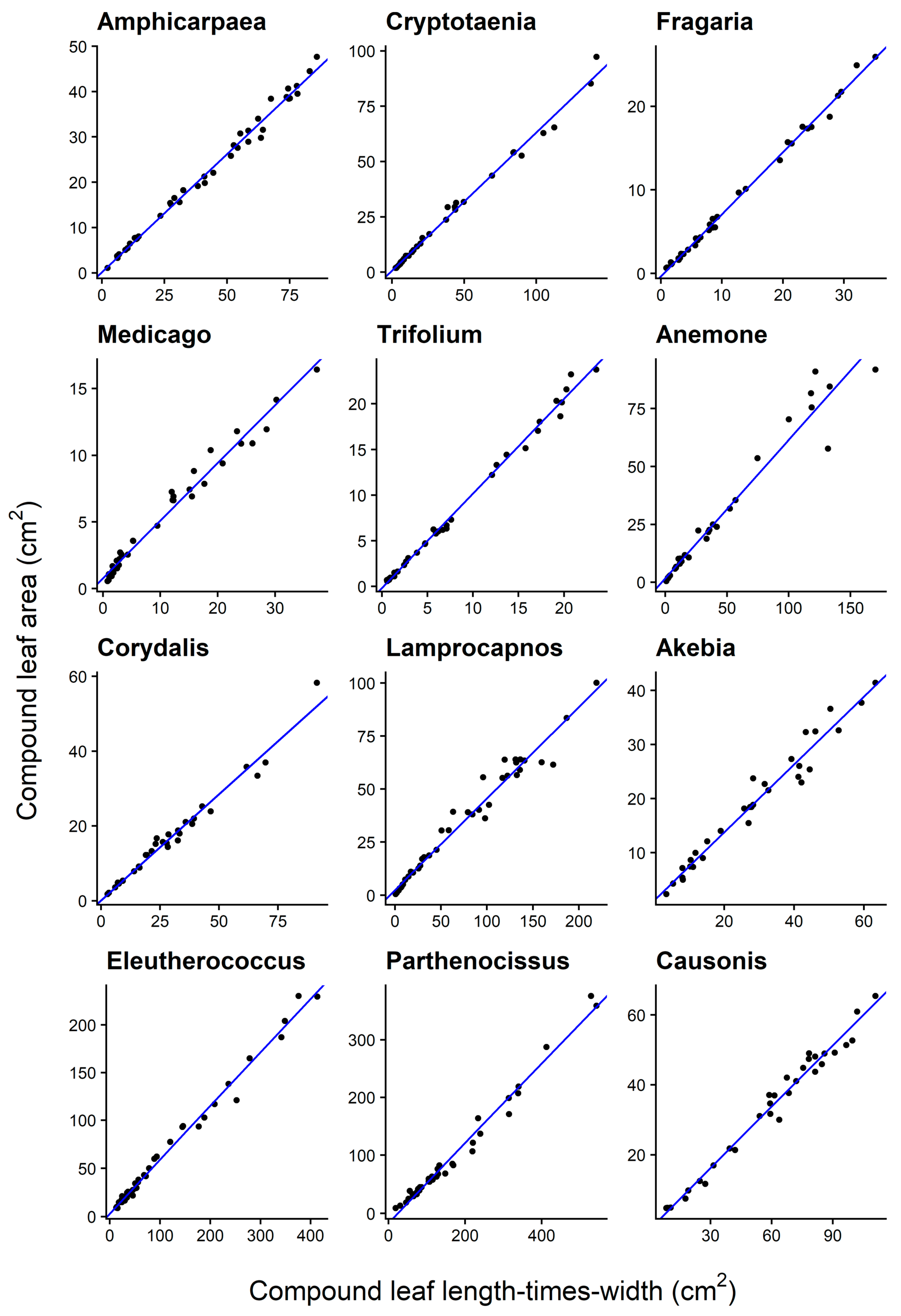
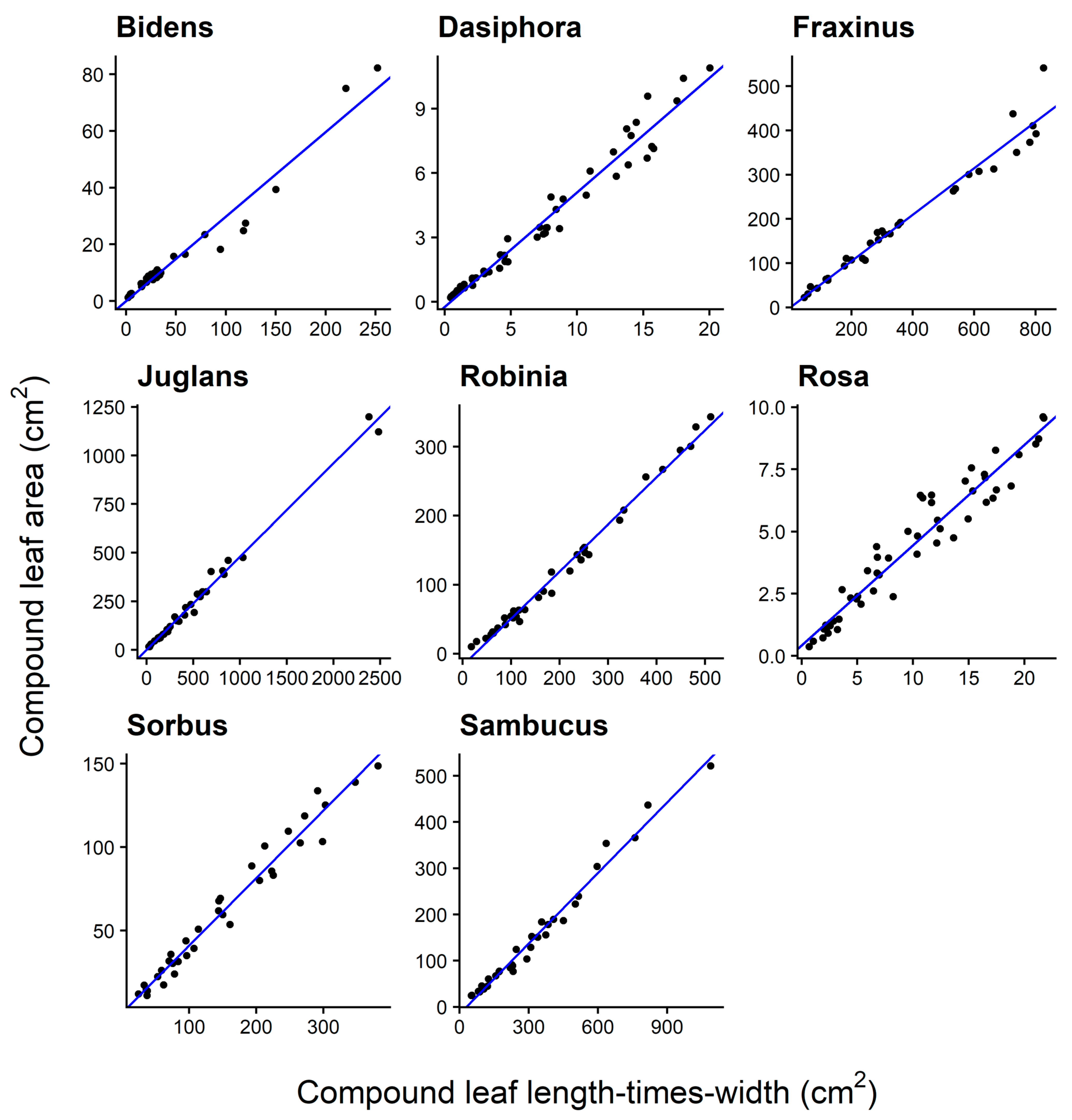
| Panel in Figure 1 | Species Name | Leaf Shape *1 | Order | Life Form: H (Herbaceous), W (Woody) | N *2 |
|---|---|---|---|---|---|
| a | Amphicarpaea edgeworthii Benth. | C3 | Fabales | H (liana) | 40 |
| b | Cryptotaenia japonica Hassk. | C3 | Apiales | H | 34 |
| c | Fragaria vesca L. | C3 | Rosales | H | 34 |
| d | Medicago sativa L. | C3 | Fabales | H | 37 |
| e | Trifolium repens L. | C3 | Fabales | H | 33 |
| f | Anemone raddeana Regel | C3 × 2 | Ranunculales | H | 31 |
| g | Corydalis incisa (Thunb.) Pers. | C3 × 2 or C3 × 3 | Ranunculales | H | 30 |
| h | Lamprocapnos spectabilis Fukuhara | C3 × 2 | Ranunculales | H | 43 |
| i | Akebia quinata Decne. | C5 | Ranunculales | W (liana) | 31 |
| j | Eleutherococcus divaricatus (Siebold & Zucc.) S.Y.Hu | C5 | Apiales | W | 44 |
| k | Parthenocissus quinquefolia Planch. | C5 | Vitales | W (liana) | 40 |
| l | Causonis japonica (Thunb.) Raf. | E5 | Vitales | H (liana) | 31 |
| m | Bidens frondosa L. | P | Asterales | H | 38 |
| n | Dasiphora fruticosa (L.) Rydb. | P | Rosales | W | 47 |
| o | Fraxinus mandshurica Rupr. | P | Lamiales | W | 31 |
| p | Juglans mandshurica var. sachalinensis (Komatsu) Kitam. | P | Fagales | W | 35 |
| q | Robinia pseudoacacia L. | P | Fabales | W | 35 |
| r | Rosa hybrid cultivar | P | Rosales | W | 52 |
| s | Sorbus commixta Hedl. | P | Rosales | W | 35 |
| t | Sambucus racemosa L. subsp. kamtschatica (E.L.Wolf) Hultén | P | Dipsacales | W | 34 |
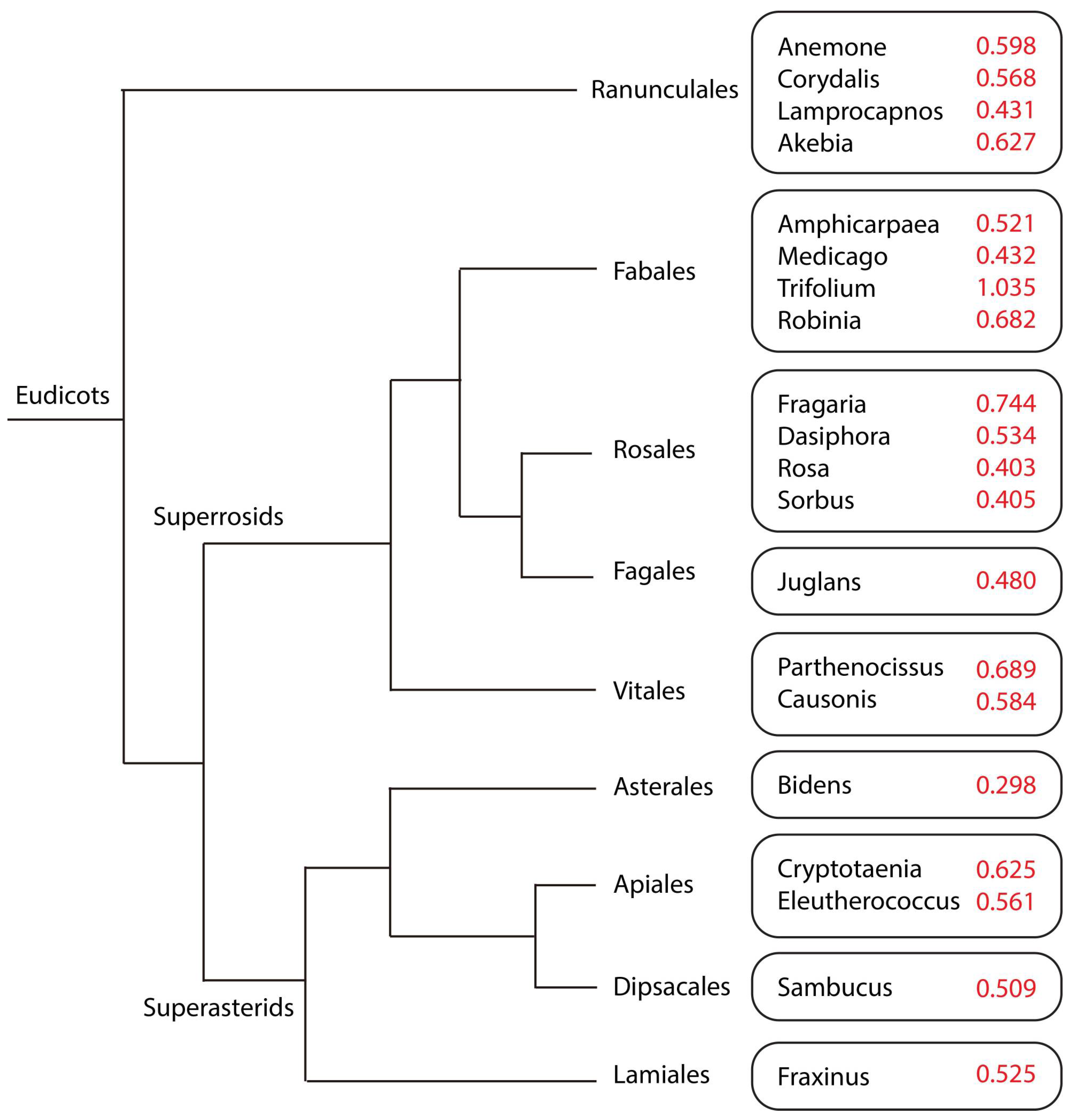
| Species (Genus Name) | Compound Leaf Area (cm2) | Linear Regression Y = a + bX (Y = Leaf Area, X = The Product of Leaf Length and Width) | R2 *1 | ||
|---|---|---|---|---|---|
| Min | Max | Intercept (a) (cm2) | Slope (b) = Montgomery Parameter (M) | ||
| Amphicarpaea | 1.092829356 | 47.67431325 | 0.223421124 | 0.521199455 | 0.991167156 |
| Cryptotaenia | 1.907021276 | 97.35170494 | 0.75202645 | 0.624806406 | 0.992174317 |
| Fragaria | 0.662651004 | 25.9248227 | −0.330868569 | 0.743920092 | 0.995928821 |
| Medicago | 0.56516016 | 16.41021808 | 0.786861032 | 0.432175276 | 0.978632608 |
| Trifolium | 0.589246133 | 23.72812459 | −0.175019462 | 1.034869991 | 0.99402099 |
| Anemone | 0.488457804 | 91.79307806 | 1.686765193 | 0.598202525 | 0.953724822 |
| Corydalis | 1.76193196 | 58.26698024 | 0.159201843 | 0.567537199 | 0.973812028 |
| Lamprocapnos | 0.514049151 | 100.0947819 | 2.465991473 | 0.431231394 | 0.970151587 |
| Akebia | 2.369959418 | 41.41196019 | 1.269087009 | 0.626616675 | 0.962310559 |
| Eleutherococcus | 8.749588236 | 230.3954532 | 3.13963436 | 0.561123412 | 0.99016514 |
| Parthenocissus | 9.124927987 | 376.0823303 | −16.70358662 | 0.688628841 | 0.9825661 |
| Causonis | 4.916549307 | 65.4376469 | −1.277223662 | 0.58429843 | 0.978485828 |
| Bidens | 1.175338151 | 82.17209372 | 0.114813393 | 0.298287525 | 0.956290676 |
| Dasiphora | 0.195125058 | 10.88779184 | −0.228973481 | 0.533633081 | 0.963685501 |
| Fraxinus | 22.07135371 | 540.8598502 | −0.161317201 | 0.525214407 | 0.959637716 |
| Juglans | 15.22943191 | 1198.642755 | 0.090064691 | 0.480215537 | 0.990763168 |
| Robinia | 9.942274022 | 343.1277725 | −16.98046335 | 0.681989467 | 0.989376056 |
| Rosa | 0.362436551 | 9.605715556 | 0.417437925 | 0.403325792 | 0.927692969 |
| Sorbus | 11.03424316 | 148.5358857 | 0.622095911 | 0.404586203 | 0.967762119 |
| Sambucus | 24.20948563 | 521.0701433 | −15.31912778 | 0.50937497 | 0.981410065 |
Disclaimer/Publisher’s Note: The statements, opinions and data contained in all publications are solely those of the individual author(s) and contributor(s) and not of MDPI and/or the editor(s). MDPI and/or the editor(s) disclaim responsibility for any injury to people or property resulting from any ideas, methods, instructions or products referred to in the content. |
© 2026 by the author. Licensee MDPI, Basel, Switzerland. This article is an open access article distributed under the terms and conditions of the Creative Commons Attribution (CC BY) license.
Share and Cite
Koyama, K. The Leaf Length-Width Method Is Applicable to Compound Leaves of Diverse Forms. Agriculture 2026, 16, 671. https://doi.org/10.3390/agriculture16060671
Koyama K. The Leaf Length-Width Method Is Applicable to Compound Leaves of Diverse Forms. Agriculture. 2026; 16(6):671. https://doi.org/10.3390/agriculture16060671
Chicago/Turabian StyleKoyama, Kohei. 2026. "The Leaf Length-Width Method Is Applicable to Compound Leaves of Diverse Forms" Agriculture 16, no. 6: 671. https://doi.org/10.3390/agriculture16060671
APA StyleKoyama, K. (2026). The Leaf Length-Width Method Is Applicable to Compound Leaves of Diverse Forms. Agriculture, 16(6), 671. https://doi.org/10.3390/agriculture16060671