Article

The Impact of Farmers’ Digital Capability on Large-Scale Farmland Management: Evidence from the Perspective of Farmland Inflow Behavior

1
College of Economics and Management, Northwest A&F University, Yangling 712100, China
2
College of Economics and Management, Chang’an University, Xi’an 710061, China
*
Author to whom correspondence should be addressed.
Agriculture 2026, 16(3), 383; https://doi.org/10.3390/agriculture16030383
Submission received: 7 January 2026 / Revised: 24 January 2026 / Accepted: 4 February 2026 / Published: 5 February 2026
(This article belongs to the Section Agricultural Economics, Policies and Rural Management)

Abstract

This study empirically investigates the impact and underlying mechanisms of farmers’ digital capability (DC) on large-scale farmland management, utilizing micro-survey data from 1144 rural households across five provinces in China: Anhui, Henan, Shaanxi, Hebei, and Shandong. The analysis employs a double machine learning model (DML). The results demonstrate that DC is positively related to farmers’ farmland inflow, thereby facilitating the realization of large-scale land management. Mechanism analysis reveals that farmers’ DC affects large-scale farmland management by expanding the transaction radius and improving agricultural production efficiency. Heterogeneity analysis indicates that the positive effect of DC on farmland inflow is more pronounced when farmers possess advantages in human capital, income levels, business entity characteristics, and natural endowments. This finding suggests that the impact of farmers’ DC on large-scale farmland management is not yet inclusive. Accordingly, the government should actively construct a cultivation system for farmers’ DC, build an inclusive digital service platform for farmland transfer, help farmers bridge the digital divide, and further unleash digital dividends. In future research, we will conduct follow-up surveys on fixed farmer households to expand the survey scope, optimize the measurement of key variables, and carry out comparative analyses across different institutional contexts, thereby providing a more systematic scientific basis for the development of agricultural modernization driven by digital empowerment.

1. Introduction

Since the reform and opening up, the household contract responsibility system has significantly increased farmers’ enthusiasm for production. However, it has also resulted in practical issues, such as a high degree of farmland fragmentation and a low level of large-scale operations. With the rapid advancement of industrialization and urbanization, the phenomenon of farmland idleness and abandonment has become increasingly prominent. This trend not only reduces the efficiency of land resource utilization but also obstructs the development of large-scale agricultural operations. Consequently, it has emerged as a key constraint on China’s agricultural modernization and the safeguarding of national food security. For this reason, the General Office of the Communist Party of China Central Committee and the General Office of the State Council (hereinafter referred to as the General Offices) have successively issued policy documents including Opinions on Guiding the Orderly Circulation of Rural Land Management Rights and Developing Moderate-Scale Agricultural Operations and Opinions on Improving the Measures for the Separation of Rural Land Ownership, Contractual Rights and Management Rights, explicitly proposing the reform path of realizing large-scale agricultural operations through farmland transfer [1,2,3,4]. Meanwhile, with the rapid development of digital rural construction, the popularization and application of digital technologies in rural areas have played a key role in farmers’ access to farmland [5] and exerted a profound impact on agricultural production [6]. Against this backdrop, exploring whether the improvement of farmers’ DC can realize large-scale agricultural operations is of great theoretical and practical significance.
Existing studies have conducted multi-dimensional discussions on the influencing factors of farmers’ farmland transfer behavior. At the institutional and policy level, property right stability has been proven to be the fundamental guarantee for farmland transfer, and land titling can effectively enhance large-scale farmland management [7,8]. Meanwhile, agricultural subsidy policies can also incentivize farmers to inflow farmland and expand their operation scale [9,10]. At the market environment level, studies have found that the development and improvement of the farmland transfer market and the agricultural socialized service market are important supports for driving farmers to inflow farmland and realize large-scale operation [11,12]. At the individual endowment level, existing research suggests that factors such as labor aging [13], off-farm employment behavior [14], and financial literacy [15] are all important determinants affecting farmers’ large-scale farmland management.
The in-depth implementation of the digital rural strategy and the rapid popularization of the Internet in rural areas have gradually drawn academic attention to the role of digital information technology in the allocation of farmland resources for farmers. This occurs through information and technological empowerment. Studies based on the single measurement indicator of “internet usage” have found that internet usage enhances the inflow of farmland to farmers. It further expands their operational scale by improving information search efficiency, expanding social capital networks, and reducing transaction costs [16,17]. However, other studies have indicated that the facilitating effect of farmers’ access to agricultural information via the internet on farmland outflow is stronger than that on farmland inflow [18], or pointed out that promoting farmland outflow may inhibit farmland inflow by strengthening the non-agricultural employment effect [19]. Another strand of literature has constructed a comprehensive evaluation system of farmers’ digital literacy based on the digital divide, revealing that digital literacy can facilitate farmers’ farmland inflow [2]. Conversely, some studies have found that digital literacy may exert an inhibitory effect on farmers’ farmland inflow [20], which is not conducive to expanding operational scale. Due to differences in research perspectives, sample selection, variable setting and other aspects, existing studies have not yet reached a consistent conclusion.
More importantly, neither the single indicator based on “Internet usage” nor the comprehensive indicator based on the digital divide can cover the multi-dimensional concept of farmers’ DC in terms of digital access, awareness, skills, transformation and other aspects. The lack of a comprehensive and systematic measurement of farmers’ DC makes it difficult to accurately capture the impact of digital technology application on large-scale agricultural operations. Meanwhile, the penetration of digital technology at the micro level of rural households has enhanced the optimal allocation of agricultural production factors [21], thereby directly affecting the scale of farmers’ farmland management. However, most existing studies have linked farmers’ DC with household financial asset allocation and income [22,23,24], ignoring the unique performance of DC in farmland transfer and failing to fully address the inequality issues caused by the digital divide. In addition, traditional linear regression models, which are prone to nonlinear problems and the “curse of dimensionality”, are mostly adopted in research methods.
In light of this, this study expands and enhances existing research in three key areas. First, it incorporates digital awareness into the measurement of farmers’ DC to improve the evaluation system from a cognitive perspective. Second, the study adopts the DML model to address the issues of nonlinearity and the “curse of dimensionality” present in traditional linear regression models, thereby enhancing the accuracy and stability of estimates. Third, it conducts a comprehensive analysis of the impact and mechanisms of farmers’ DC on large-scale farmland management from both theoretical and empirical perspectives. Additionally, the study explores the issue of digital inequality within the context of large-scale farmland management, aiming to reveal the deeper implications of inclusive development.
This study intends to explore the core research question of whether the improvement of farmers’ DC is positively related to large-scale farmland management and attempts to reveal its internal mechanisms. The structure of the paper is arranged as follows: Section 2 conducts theoretical analysis and proposes research hypotheses. Section 3 introduces the research data and methods. Section 4 analyzes the empirical results to clarify the impact of farmers’ DC on large-scale farmland management. Section 5 discusses the conclusions drawn from this study. Section 6 summarizes the research findings and puts forward corresponding policy implications.

2. Theoretical Analysis and Research Hypotheses

2.1. The Conceptual Connotation of Farmers’ DC

From the perspective of classical political economy, technological progress is an important driving force for sustainable development [25,26]. Farmers’ DC represents the level of penetration and integration of digital technologies at the micro level of rural households, serving as the micro-driving force for advancing large-scale agricultural operations and realizing sustainable agricultural development. According to the digital divide theory, the digital divides faced by farmers mainly include access, usage and transformation divides [27]. In addition, farmers are also confronted with the digital divide at the level of cognitive awareness, namely the digital awareness divide [28]. Meanwhile, the digital awareness divide often determines the differences in the frequency and effectiveness of farmers’ participation behaviors in the digital economy [23]. In view of this, this study attempts to define farmers’ DC from the perspective of the digital divide. First, the digital access divide is the foundation, referring to the disparities among farmers in the acquisition of digital infrastructure such as fixed broadband, smartphones and computers. It directly determines the access threshold for their participation in digital agriculture and is related to the efficiency of resource utilization and the inclusiveness of sustainable development. Second, the digital awareness divide is the guide, reflecting the gaps in farmers’ cognitive awareness in terms of digital socialization, innovation, security and development, which affects farmers’ willingness and effectiveness in applying digital technologies to improve agricultural operations. Third, the digital skills divide is the key, referring to the differences in farmers’ proficiency in technology applications such as equipment operation, information retrieval and content creation. It constitutes the core support for transforming digital technologies into agricultural productivity, which is consistent with the requirement of technological innovation-driven efficient resource utilization in sustainable development. Finally, the digital transformation divide is the ultimate goal, manifested as the gaps in farmers’ capability to apply digital technologies in agricultural production, supply and marketing, governance, finance and other fields. It is directly linked to the effectiveness of large-scale farmland management and the efficiency of optimal resource allocation. To sum up, DC is the comprehensive literacy of farmers in four dimensions, namely digital access, digital awareness, digital skills and digital transformation, which jointly form the capability foundation for farmers to realize sustainable agricultural development by virtue of digital technologies.

2.2. The Direct Effect of Farmers’ DC on Large-Scale Farmland Management

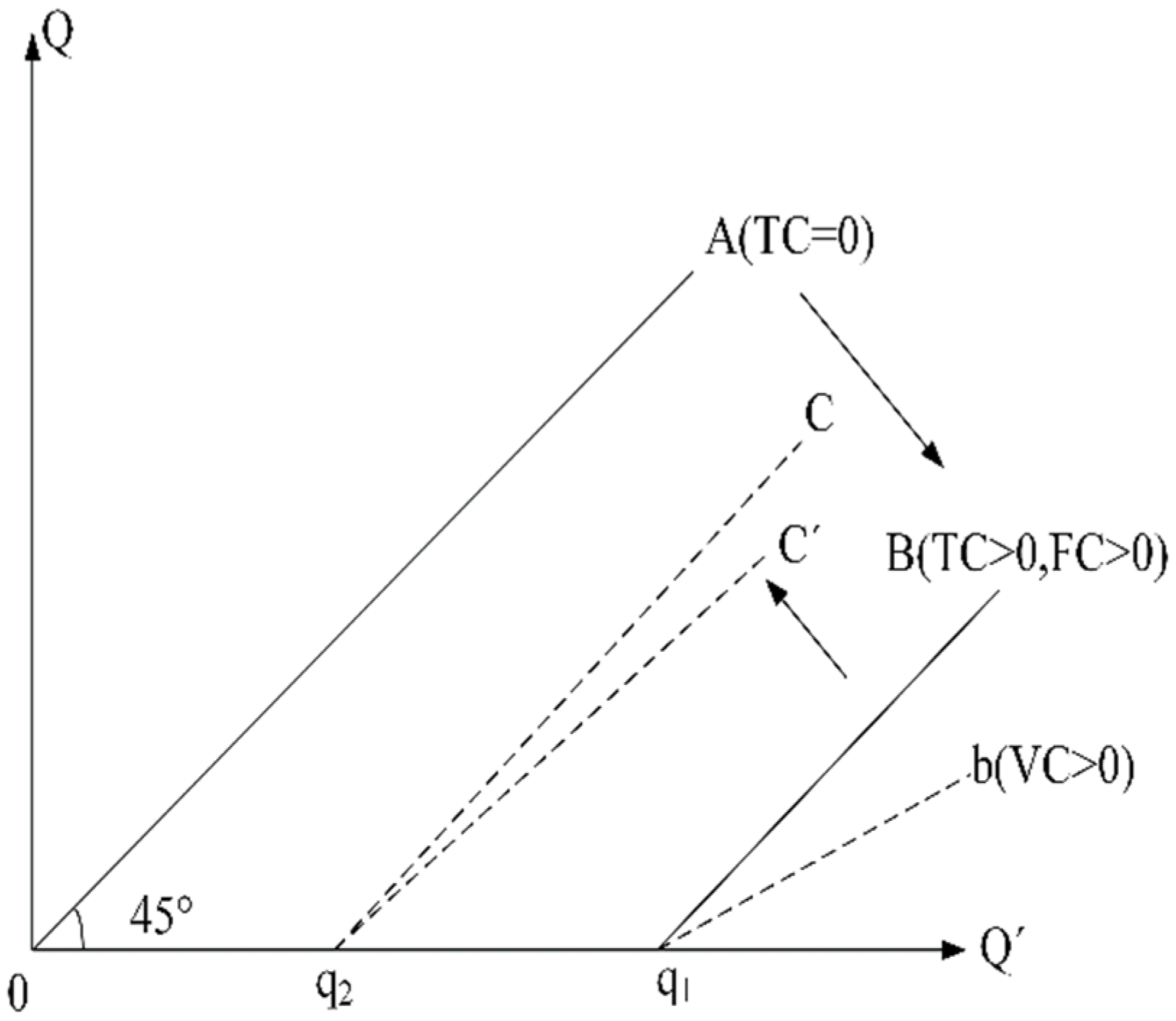
In rural China, a large number of farmers still fail to participate in the farmland inflow market, which aligns with the insensitivity observed in friction models. In view of this, this study conducts a graphical analysis based on transaction cost theory and drawing on the friction models proposed by Rosett [29] and Skoufias [30]. In the farmland inflow market, transaction costs can be divided into fixed transaction costs and variable transaction costs [31]. Among them, fixed transaction costs mainly refer to the search costs and negotiation costs incurred by farmers with farmland inflow demands in the process of seeking transaction counterparts; these costs affect farmers’ decisions to enter the farmland inflow market but have no correlation with the scale of farmland inflow. Variable transaction costs refer to the costs paid by farmers with farmland inflow demands to complete transactions based on the type and content of contracts, and such costs affect the scale of farmland inflow [32].
As shown in Figure 1, this study assumes that Q’ represents farmers’ farmland inflow behavior in the absence of any transaction costs, which is equal to farmers’ quantity demanded, while Q denotes the actual quantity of farmers’ participation in the farmland inflow market, with Q ≤ Q’. Meanwhile, it is assumed that farmland information is complete and there are no transaction costs between the two parties of the transfer; that is, a perfectly competitive farmland transfer market emerges. Under such circumstances, all farmers can achieve the optimal allocation of production factors by participating in the farmland transfer market. This is represented by Line A in Figure 1, with a slope of 1 and Q = Q’. When transaction costs arise due to market friction, Line A will shift downward. Information asymmetry in farmland transfer will lead to an increase in the search and negotiation costs for farmers when participating in the market [33], namely fixed transaction costs, which create a market access threshold. If farmers’ demand for farmland inflow is relatively small, the proportion of fixed transaction costs will be relatively high [18], and such costs can only be observed when farmers’ transaction volume exceeds the threshold value q1. When Q’ falls between 0 and q1, Q equals 0. Within this interval, changes in farmers’ demand for farmland inflow will not lead to changes in their decisions on farmland inflow; that is, insensitivity exists. At this time, Line B, which corresponds to farmers, represents the actual transaction volume when the demand reaches the threshold value q1, and the larger the intercept, the higher the threshold for farmers to enter the farmland transfer market. Meanwhile, with the increase in market transaction volume, variable transaction costs such as enforcement costs will also rise; at this point, the slope will be less than 1, causing farmers to shift from Line B to Line b, that is, Q < Q’, and farmers tend to reduce the transaction volume. As shown in Figure 1, the application of digital technologies enables farmers to obtain farmland transfer information more rapidly and accurately and improves the efficiency of searching for transaction counterparts, thereby reducing fixed transaction costs and lowering the market access threshold for farmland transfer [17]. At this time, farmers shift from Line B to Line C to the left, which increases the probability of farmers’ farmland inflow. Secondly, the improvement of farmers’ DC gradually makes farmland transfer information more transparent and transaction procedures more standardized, which can strengthen the supervision and management of farmland transfer behaviors [34], thus effectively preventing moral hazard and opportunism, reducing variable transaction costs, and thereby increasing the scale of farmland inflow. Therefore, the popularization of the Internet improves farmers’ DC, which in turn reduces the transaction costs of farmers’ farmland inflow and enhances farmers’ farmland inflow; that is, ∠Cq2C’ < ∠Bq1b.
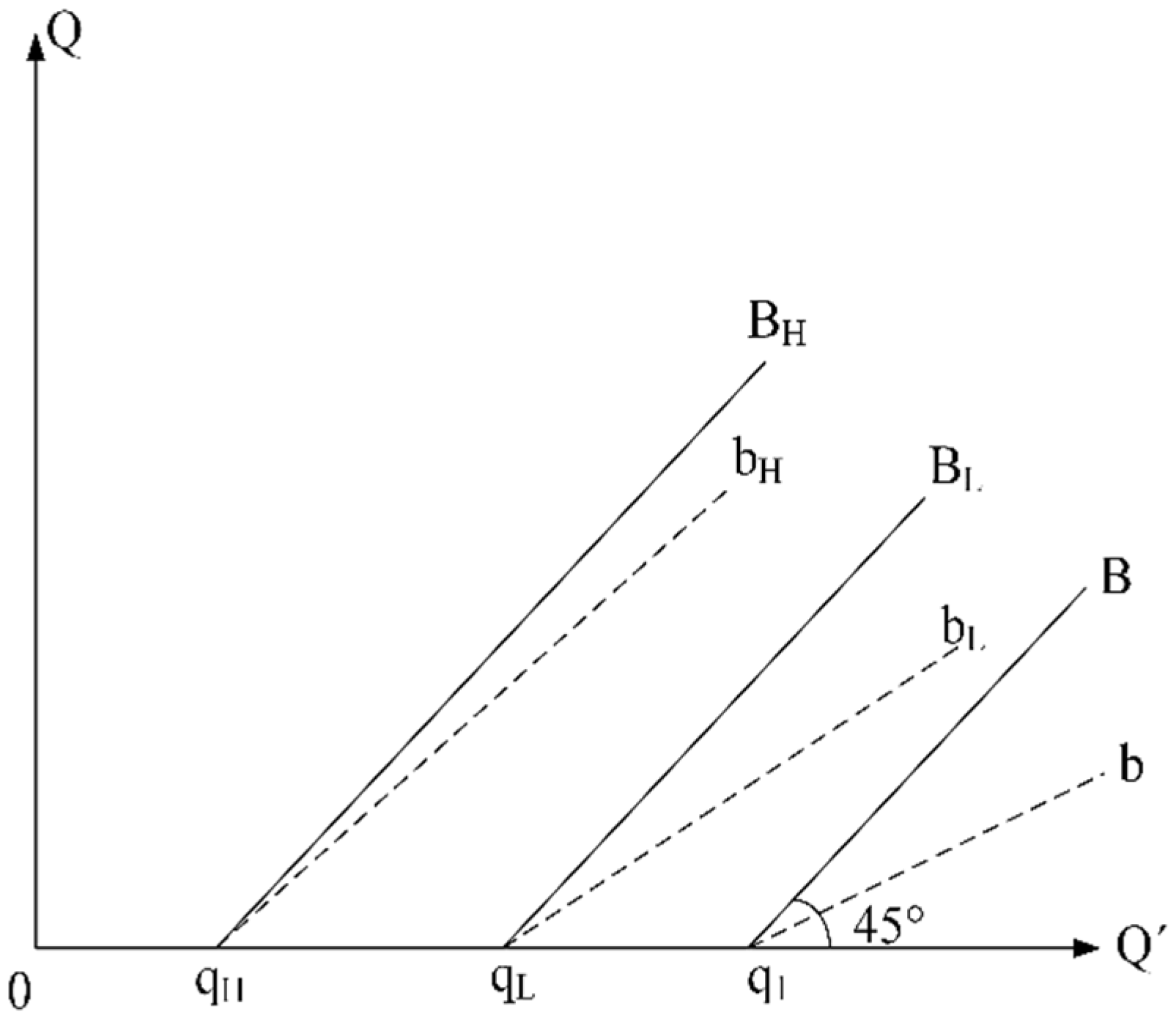
As shown in Figure 2, this study assumes that there are two farmers, namely farmer H and farmer L. Among them, farmer H has a higher level of DC, while farmer L has a relatively weaker level of DC. Compared with farmer L, farmer H is more likely to obtain local farmland transfer information through Internet media and has a greater probability of matching with suitable transaction counterparts, thus being more inclined to enter the farmland inflow market. At this point, the demand curve of farmer H shifts from Line B to Line BH, and the demand curve of farmer L shifts from Line B to Line BL. That is to say, farmers with stronger DC are more willing to transfer in farmland and expand their operational scale. In addition, farmers with stronger DC are more capable of avoiding moral hazard and opportunism through internet information technologies. Therefore, farmer H can also achieve a larger scale of farmland inflow and thus is more likely to realize large-scale operations, i.e., ∠BHqHbH < ∠BLqLbL. On this basis, this study proposes the following hypothesis:
H1: 
Farmers’ DC is positively related to large-scale farmland management.

2.3. The Impact Mechanism of Farmers’ DC on Large-Scale Farmland Management

2.3.1. Transaction Radius

The improvement of farmers’ DC can break the traditional differential pattern of kinship-based and geography-based farmland transfer and contribute to farmland inflow by expanding the transaction radius of farmland transfer, thereby facilitating the realization of large-scale operations. Specifically, first, in terms of kinship-based farmland transfer, due to information asymmetry, traditional farmland transfer was usually confined to kinship relations, resulting in a narrow range of optional transaction counterparts. The improvement of DC, on the one hand, enables farmers with inflow demands to make full use of Internet media to obtain farmland transfer information, which enhances the transparency and timeliness of information in the farmland transfer market. his allows farmers to reduce the screening costs of transaction counterparts through information integration, lower the threshold for accessing farmland transfer information, and break away from kinship dependence. On the other hand, the advancement of DC enables farmers to expand their social networks and broaden the pool of potential transaction partners in farmland transfer, so that farmland transfer transactions are no longer restricted to the acquaintance circle, thereby breaking the kinship-based differential pattern of farmland transfer [33,35]. Second, in terms of the geography-based characteristics of farmland transfer, information in rural areas is often inaccessible due to geographical constraints, which makes the farmland transfer market mostly limited within villages. In addition, cross-village transactions usually involve higher transaction costs, which further leads to the fact that farmers’ farmland transfer behaviors mostly occur among neighbors in the same village. The improvement of DC, however, enables farmers to obtain cross-regional farmland information through information platforms such as WeChat groups and Tuliu Network, thereby breaking the geographical restrictions on farmland transfer [36]. Meanwhile, DC can increase farmers’ out-of-domain social capital and accurately match cross-regional land transfer-out demands through internet platforms, thus weakening the geographical constraints on farmland inflow. Finally, the expansion of the transaction radius of farmland transfer can help farmers grasp abundant farmland transfer information, alleviate the problem of information asymmetry, promote their ability in contract negotiation and pricing, and reduce transaction costs, thereby enhancing large-scale operations [37,38].
H2: 
Farmers’ DC affects large-scale farmland management by expanding the transaction radius.

2.3.2. Agricultural Production Efficiency

Farmers’ DC can increase farmland inflow and enhance large-scale operations by improving agricultural production efficiency. Specifically, first, in terms of land productivity: on the one hand, farmers with a stronger DC can obtain abundant information on emerging agricultural technologies (including the Internet of Things, drone-based crop protection, and smart farming technologies such as remote sensing monitoring and intelligent irrigation systems) via Internet platforms, which in turn facilitate their adoption of such new technologies. The adoption of new technologies can significantly improve the quality and yield of agricultural production [21], achieving gains in production efficiency. On the other hand, farmers can learn green agricultural production technologies through the internet to reduce the application of pesticides and chemical fertilizers, thereby lowering unit-area production costs [39]. Therefore, the improvement of farmers’ DC can enhance land productivity through cost reduction and efficiency improvement. Second, in terms of labor productivity, enhanced DC enables farmers to access advanced agricultural production expertise and technical capabilities via the internet, thereby augmenting their agriculture-specific human capital and transforming themselves into “new-type farmers” proficient in both management and technology, which in turn improves unit labor productivity. Meanwhile, farmers with stronger DC can reduce the communication and negotiation costs with professional large-scale farmers and skilled growers through internet information media, improve the efficiency of information transmission, enhance the dissemination and diffusion of new agricultural technologies, and form an agricultural information network with high accuracy and strong timeliness. This optimizes the external conditions for agricultural labor, thereby reducing unit labor costs [40]. In addition, the improvement of farmers’ DC can encourage them to actively introduce agricultural socialized services to replace family agricultural labor, thus improving unit labor productivity [41]. Finally, enhanced agricultural production efficiency can increase the expected returns of farmland management, which in turn incentivizes rural households to acquire additional farmland through transfer and expand their operation scale [42].
H3: 
Farmers’ DC affects large-scale farmland management by improving agricultural production efficiency.

3. Data and Methodology

3.1. Data Source

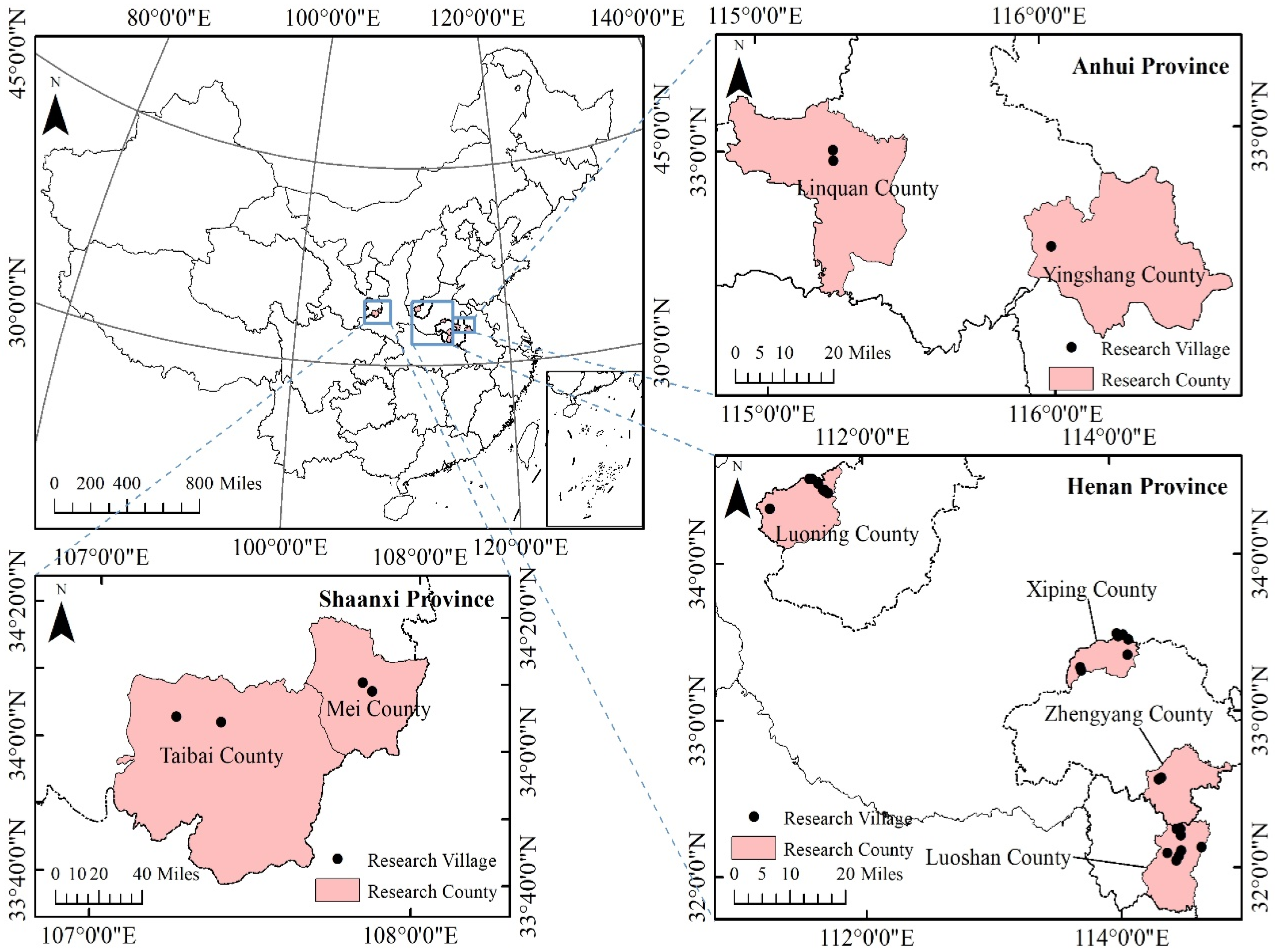
The research data for this study derive from farmer questionnaire surveys conducted by the research team in Anhui, Henan, Shaanxi, Hebei, and Shandong provinces in May 2023, January 2024, and June–July 2024. The research areas are presented in Figure 3 below. First, to address potential selection bias in the sample regions, the selected survey provinces represent eastern, central, and western China. Additionally, considering the heterogeneous impacts of different crop cultivation types on large-scale farmland management, the sample rural households include growers of food crops, such as wheat and corn, as well as cash crops, such as fruits and vegetables. Therefore, the samples selected in this paper encompass geographical differences across China and reflect the primary characteristics of agricultural operations in the country, enhancing the nationwide generalizability of the research conclusions. Second, the research team adopted a stratified sampling method, selecting 2–3 geographically non-adjacent cities in each province and 1–2 non-adjacent counties in each city, ultimately identifying 14 counties as the research sample regions. Finally, in accordance with the principles of randomness and representativeness, 2–5 towns were selected from each county, 1–4 administrative villages were randomly chosen from each town, and approximately 20 rural households were randomly selected from each village for one-on-one semi-structured interviews. The questionnaire design incorporated essential elements in a systematic sequence. This included an informed consent form for respondents, details regarding survey timing and location, the names of investigators, and specific survey items. The questions primarily addressed the farmers’ DC scale, household farmland management and transfer status, characteristics of household heads, and basic household features. This approach ensured that all variables required for the study aligned with corresponding items in the questionnaire. Additionally, the research team conducted a pilot survey prior to the formal investigation to confirm the clarity and validity of the questionnaire and its items. A total of 1190 questionnaires were collected during the survey. After excluding invalid responses and those with abnormal data, 1144 valid samples were obtained, resulting in an effective response rate of 96.13%.

3.2. Model and Variables

3.2.1. Empirical Model

Based on the theoretical analysis above, this study adopts the DML proposed by Chernozhukov et al. [43] to test the impact of farmers’ DC on large-scale farmland management. The DML has unique advantages in handling high-dimensional control variables and multicollinearity, making it more suitable for the research of this paper. The reasons are as follows: on the one hand, farmers’ decisions on whether to inflow farmland are susceptible to the socioeconomic environment. To improve the accuracy of estimating the impact of DC on farmers’ farmland inflow behavior, this study controls as many other influencing factors on large-scale farmland management as possible. This practice, however, gives rise to the problems of the “curse of dimensionality” and multicollinearity caused by high-dimensional control variable sets in traditional linear regression models. Nevertheless, the DML can leverage a variety of machine learning algorithms and their regularization techniques to automatically screen out an effective set of control variables with high prediction accuracy from the pre-selected high-dimensional control variable pool. This not only avoids the “curse of dimensionality” caused by redundant control variables but also mitigates the estimation bias arising from the limitation of key control variables [44], thus yielding more accurate estimation results. On the other hand, in the process of socioeconomic transformation, the economic effects generated by digital development are usually nonlinear. Compared with traditional estimation methods, the DML is capable of capturing more complex data structures, thereby improving the accuracy and stability of estimations in nonlinear data and reducing model specification bias [45]. Based on the above analysis, the following DML is constructed:
Y i = θ 0 D C i + g X i + U i
E U i D C i , X i = 0
In Equations (1) and (2), i denotes individual farmers; Y i represents farmers’ farmland inflow behavior; D C i stands for farmers’ digital capability; and θ 0 is the corresponding treatment effect coefficient. X i refers to high-dimensional control variables, whose specific form g ^ X i is estimated by machine learning algorithms; U i is the residual term. The solution process for the above equations is as follows:
θ ^ 0 = 1 n i I D C i 2 1 1 n i I D C i Y i g ^ X i
In Equation (3), n stands for the sample size. To examine its estimation bias:
n θ ^ 0 θ 0 = 1 n i I D C i 2 1 1 n i I D C i U i   + 1 n i I D C i 2 1 1 n i I D C i g X i g ^ ( X i )
In Equation (4), a = 1 n i I D C i 2 1 1 n i I D C i U i , which follows a standard normal distribution; b = 1 n i I D C i 2 1 1 n i I D C i g X i g ^ ( X i ) . Among them, b satisfies regularization and is presented in a divergent form. To accelerate convergence and ensure the unbiasedness of the treatment coefficient under small samples, an auxiliary model is constructed as follows:
D C i = m X i + V i
E V i X i = 0
In Equation (5), m X i signifies the regression function of D C i with respect to high-dimensional control variables, while V i denotes the error component. A machine learning algorithm is employed to estimate its specific form m ^ X i , based on which the residual estimator V ^ i = D C i m ^ ( X i ) is constructed. Subsequently, using the same method to estimate g ^ X i , we obtain Y i g ^ X i = θ 0 D C i + U i . Finally, V ^ i is used as an instrumental variable for D C i to perform the regression, yielding the following unbiased coefficient estimate:
θ ˇ 0 = 1 n i I V ^ i D C i 1 1 n i I V ^ i Y i g ^ X i
At this point, compared with Equation (4), θ ˇ 0 has a faster convergence rate, thus an unbiased estimate of the treatment coefficient can be obtained. Given that the support vector machine (SVM) algorithm has a unique advantage in handling nonlinear relationships with high-dimensional covariates and exhibits greater robustness in estimation with medium-sized samples, this study adopts this algorithm for estimation to reduce the risk of overfitting. Meanwhile, to eliminate regularization bias and improve estimation efficiency, a 5-fold cross-validation method is applied to process the regression samples so as to enhance the robustness of the model estimation.

3.2.2. Variable Description

(1) Dependent variable. Against the backdrop of China’s current institutional arrangement of the separation of rural land ownership, contractual rights and management rights, the only pathway to achieve large-scale farmland management lies in farmland transfer. Specifically, the behavioral logic of farmers’ farmland inflow determines the realization of large-scale farmland management [46]. Therefore, drawing on the practices of the existing literature, this study selects the perspective of farmland inflow to explore the effect of farmers’ DC on large-scale farmland management [47,48]. This study selects farmers’ farmland inflow decision (FID) and farmland inflow scale (FIS) as the dependent variables. Specifically, FID is a dummy variable that takes the value of 1 if a farmer has transferred in farmland and 0 otherwise. Meanwhile, FIS is measured by the logarithm of the actual area of farmland transferred in by the rural household.
(2) Independent variable. This study takes farmers’ DC as the independent variable. The essence of rural digital economy development lies in empowering micro-level individual farmers. Therefore, based on the realistic conditions of rural China, constructing a multi-dimensional and in-depth index system for farmers’ DC is crucial for deepening micro-level research on the rural digital economy. Existing studies have established a comprehensive evaluation system for farmers’ DC based on the digital access divide, digital skills divide, and digital conversion divide [27]. However, this study argues that the potential digital awareness divide should also be brought into focus. Accordingly, drawing on the digital technology application fields accessible to farmers identified during the field survey, this study first constructs a four-dimensional index system for farmers’ DC, covering digital access, digital awareness, digital skills, and digital conversion. Second, reliability and validity tests were conducted on the farmers’ DC scale. The test results show that Cronbach’s α coefficient is 0.848, which is higher than the threshold value of 0.8, indicating good consistency of the scale; the KMO value is 0.903, above the threshold of 0.8; the chi-square statistic of Bartlett’s test of sphericity is 6922.180, with a corresponding p-value of 0.000. On this basis, it can be concluded that the farmers’ DC measurement scale designed in this study is statistically reasonable. Then, referring to the method of Huang et al. [49], this paper carries out dimensionless processing on the data to mitigate the errors caused by different measurement units and enhance the comparability among farmers. Finally, compared with other measurement methods such as Principal Component Analysis (PCA) and factor analysis, the weights generated by the entropy weight method are derived from the information entropy of the indicators themselves. This method can effectively eliminate the interference of subjective factors, retain the economic implications of the original indicators, and achieve a relatively objective evaluation. Therefore, this paper adopts the entropy weight method to assign objective weights to the indicators of each dimension. The items, units and calculated weights of the farmers’ DC scale are shown in Table 1 below.
(3) This study selects farmland transfer transaction radius and agricultural production efficiency as mediating variables. Among them, the farmland transfer transaction radius is comprehensively characterized by two dummy variables: ① whether the transaction counterparty is non-relatives/non-neighbors (yes = 1, no = 0), reflecting the kinship boundary of transfer; and ② whether the transaction counterparty is villagers from other villages (yes = 1, no = 0), reflecting the geographical boundary of transfer. Agricultural production efficiency is measured by land productivity (agricultural output value per unit of farmland) and labor productivity (annual agricultural output value per unit of labor), so as to fully reflect farmers’ agricultural production efficiency.
(4) Control Variable. To isolate the effects of confounding variables on farmers’ farmland inflow behavior, this study incorporates variables such as household head characteristics, household attributes, and regional characteristics into the model estimation. Specifically, the core characteristics of household heads include gender, age, education level, political affiliation, and health status. Household attributes encompass household size, agricultural labor force size, participation in endowment insurance, degree of farmland fragmentation, business entity characteristics, road hardening status, household income level, and distance to the nearest town. Regional characteristics are defined by the provincial location of the rural household, specifically whether the household is situated in Anhui, Henan, Shaanxi, Hebei, or Shandong province. Descriptive statistics of the variables are presented in Table 2 below.

4. Empirical Results

4.1. Benchmark Regression Analysis

Table 3 presents the benchmark regression results. Since the DML model estimation does not report control variables, they are omitted from this table. As shown in Columns (1) to (4), regardless of whether other factors are controlled or not, farmers’ DC can not only increase the probability of farmers’ farmland inflow but also expand the area of farmland inflowed, thereby positively relating to large-scale farmland management. The underlying mechanism is that the adoption of the Internet and digital technologies broadens farmers’ social networks, mitigates the information asymmetry inherent in the traditional farmland transfer market, reduces transaction costs related to farmland transfer, and enhances the efficiency of demand matching in farmland transfer. Consequently, a scale operation effect is generated, thereby verifying research hypothesis H1.

4.2. Robustness Test

4.2.1. Endogeneity Test

To mitigate endogeneity, this study employs the 2009 county-level fixed-line telephone subscriber count (for the counties where sample farmers reside) as the instrumental variable for farmers’ DC. This variable satisfies the relevance condition because early county-level fixed-line subscriptions reflect local digital infrastructure levels and thus affect farmers’ current DC. It also meets the exogeneity condition, as the 2009 data are unrelated to farmers’ current farmland inflow decisions, which in turn justifies its validity. The test results are shown in Table 4. After addressing endogeneity with the instrumental variable, farmers’ DC still exerts a significant positive impact on household farmland inflow, confirming the robustness of the benchmark regression conclusions.

4.2.2. Other Robustness Tests

First, we replaced the measurement method for the core explanatory variable. This study adopted factor analysis to recalculate farmers’ DC. The reliability and validity test results indicated that the sample data were suitable for factor analysis. Subsequently, the recalculated farmers’ DC index replaced the original core explanatory variable for the robustness test. Second, we excluded elderly samples. We considered that farmers over 80 years old possess inherent disadvantages in human capital for engaging in agricultural production and operation. Therefore, this study re-estimated the benchmark regression results after excluding samples where the household head was over 80 years old. Third, we adjusted the sample splitting ratio. Following the method of Jiang et al. [50], we modified the sample splitting ratio of the DML from the original 1:4 to 1:2 and 1:7, respectively, for re-estimation. This adjustment aimed to test the robustness of the model estimation results after altering the sample splitting ratio. Fourth, we replaced the machine learning algorithm. This study substituted the support vector machine algorithm in the benchmark regression with the Lasso regression algorithm and the elastic net algorithm to examine the impact of different algorithms on the original estimation results. The estimation results (see Appendix A for details) demonstrate that the conclusions derived from the benchmark regression remain robust after these robustness tests.

4.3. Mechanism Analysis

The changes in the economic and social environment caused by the Internet ultimately lead to shifts in farmers’ needs, thereby influencing their behavioral decisions. Based on this, this study employed the mechanism analysis method proposed by Jiang [51] to test the mechanism through which farmers’ DC affects large-scale farmland management from two dimensions: farmland transfer transaction radius and agricultural production efficiency. The results are presented in Table 5 below.
As shown in Columns (1) and (2) of Table 5, farmers’ DC may contribute to non-kinship and non-geographical farmland transfer transactions. This indicates that the improvement of farmers’ DC can break the previous differential order transfer pattern based on kinship and geography, thereby expanding the transaction radius and further increasing farmers’ farmland inflow to realize large-scale operations. This finding can be attributed to the fact that the enhancement of DC helps reduce both the search costs incurred by farmers in acquiring farmland transfer information and the expenses associated with transaction negotiations and expands the range of transaction object choices for farmers in need of farmland inflow. Meanwhile, the improvement of DC can increase farmers’ out-of-domain social capital, making transaction objects not limited to farmers in the same village or neighboring areas, thus realizing the “circle-breaking” of transaction subjects [33], enhancing farmland inflow and large-scale operations, and verifying the research hypothesis H2. As shown in Columns (3) and (4), the effect of farmers’ DC on farmland productivity and labor productivity is positively significant at the 1% statistical level. This implies that farmers’ digital capability drives farmland inflow by improving agricultural production efficiency, thereby laying the foundation for large-scale farmland management. The underlying reason is that the improvement of farmers’ DC can help them use Internet platforms to learn and acquire new agricultural technologies and knowledge, facilitate the dissemination of agricultural technical information and policy-related information, enhance farmers’ adoption of new technologies and accumulation of human capital, improve the productivity per unit area of farmland and labor productivity per capita through information and technology effects, and thereby boost farmland inflow to achieve large-scale management, which verifies the research hypothesis H3.

4.4. Heterogeneity Analysis

Against the backdrop of the digital economy, the issue of digital inequality stemming from the digital divide is pervasive. Existing studies have confirmed that a higher level of farmers’ DC is positively associated with large-scale farmland management, while whether this effect exhibits heterogeneity based on variations in farmers’ personal capital endowments remains an open question. In addition, inclusive growth focuses on both efficiency and equity. However, previous studies on inclusive growth have mainly centered on income levels [52,53]. In contrast, in the context of farmland resource allocation, few studies have explored the inclusiveness issues arising from disparities in farmers’ equal opportunities to participate in the farmland market from the perspective of digital empowerment. In summary, this study intends to explore the formation of digital inequality and the inclusiveness of the effect of farmers’ large-scale farmland management based on differences in farmers’ capital endowments.

4.4.1. Human Capital Heterogeneity

First, from the perspective of age heterogeneity, elderly farmers typically encounter the “digital divide” problem more than their younger counterparts. Consequently, the impact of farmers’ DC on large-scale farmland management may differ among households led by heads of varying ages. This study adopts the age classification method proposed by Tan et al. [15]. Farmers are categorized into the young group (assigned a value of 1) if their household heads are below the sample average age, and into the elderly group (assigned a value of 0) if their household heads exceed this threshold. This classification allows for an analysis of the influence of DC on large-scale farmland management across different age groups. Second, regarding educational attainment heterogeneity, educational attainment serves as a significant factor contributing to digital inequality. Farmers whose household heads possess higher educational attainment are generally more equipped to understand and adopt new agricultural technologies. This capability enhances their ability to optimize agricultural production and management processes, thereby influencing large-scale farmland management. Based on this, this study refers to the approach of Wang [24], taking high school education as the criterion for classifying household heads’ educational attainment. According to the years of education, farmers with household heads having a high school education or above are divided into the high educational attainment group (assigned a value of 1), and those with household heads having education below high school are divided into the low educational attainment group (assigned a value of 0), so as to analyze the impact of DC on large-scale farmland management across different educational attainment levels. Subsequently, the interaction terms of DC with farmers’ age grouping variable and educational attainment grouping variable are adopted as new core explanatory variables, respectively. To ensure the rigor of the model, the DC variable, age grouping dummy variable, and educational attainment grouping dummy variable that constitute the interaction terms are introduced jointly for parameter estimation.
Columns (1) and (2) of Table 6 demonstrate that the interaction terms between DC and age grouping positively influence farmers’ decisions regarding farmland inflow and the scale of inflow, achieving statistical significance at the 5% and 1% levels, respectively. This finding suggests that higher levels of DC among young farmers may facilitate increased farmland inflow, thereby promoting large-scale farmland management. This phenomenon can be attributed to the inherent disadvantages in labor endowment faced by elderly farmers, as well as their relatively greater challenges related to the digital divide. They encounter greater difficulties in obtaining farmland transfer information through digital technologies such as the Internet, resulting in a relatively low probability and scale of farmland inflow, thereby giving rise to the problem of digital inequality. As shown in Columns (3) and (4), the interaction terms between DC and educational attainment grouping both have a significantly positive impact on farmers’ farmland inflow decision and inflow scale at the 1% statistical significance level. The results suggest that the positive impact of DC on farmland inflow is more prominently reflected in the group of farmers with household heads with higher educational attainment, while farmers with lower educational attainment can hardly benefit from it. A possible reason is that farmers with higher educational attainment of household heads can better master digital technologies and apply them to the agricultural production process, increase the demand for farmland inflow by improving agricultural production efficiency, and then generate the large-scale operation effect.

4.4.2. Income and Operation Heterogeneity

On the one hand, farmers’ income level is an important factor leading to digital inequality. Relatively speaking, farmers with higher income levels have more abundant economic resources, are more likely to purchase and access digital devices, and can obtain more benefits from production and operation under the empowerment of digital technologies. Therefore, differences in household income levels may lead to heterogeneous impacts of farmers’ DC on large-scale farmland management. By following the aforementioned grouping logic, farmers with income higher than the sample mean are classified into the high-income group (assigned a value of 1), and those with income lower than the sample mean are classified into the low-income group (assigned a value of 0), so as to analyze the impact of DC on large-scale farmland management across farmers with different income levels. On the other hand, the characteristics of farmers’ operation subjects are also likely to cause digital inequality. Compared with ordinary farmers, new-type agricultural operation subjects usually have more abundant agricultural production funds and material resources, thus making it easier to carry out production development and expand operation scale through agricultural digital technologies. Therefore, this study assigns a value of 1 to new-type operation subjects such as professional large-scale households, family farms, and professional cooperatives and 0 to ordinary farmers, so as to examine the impact of DC on large-scale farmland management across different agricultural operation subjects.
Columns 1 and 2 of Table 7 show that the interaction terms between DC and income grouping have a significantly positive impact at the 1% level on farmers’ farmland inflow decision and scale. The results indicate that DC has a stronger positive effect on the farmland inflow and large-scale farmland management among high-income rural households. This is because high-income households have more economic resources to improve household digitalization level and enhance digital technology application in agricultural production and operation, thereby enhancing production efficiency, increasing farmland inflow demand, and achieving large-scale farmland management through inflow. In contrast, low-income households, due to insufficient capital accumulation, have limited ability to purchase digital and intelligent agricultural facilities, making it difficult to apply digital technologies in production. This leads to insufficient agricultural resource investment; they are more inclined to engage in off-farm work [33], resulting in low farmland inflow willingness. Columns 3 and 4 show that the interaction terms between DC and new-type operation subject grouping have a significantly positive impact at the 1% level on farmers’ farmland inflow decisions and scale. This means that the enhancing effect of DC on farmland inflow is more prominent in new-type agricultural operation subjects, while small-scale ordinary rural households hardly benefit. A possible reason is that new-type subjects usually have high professionalism and strong organizational capacity and can rely on their advantage of abundant agricultural resources to apply digital technologies in production, thus generating the large-scale farmland management effect.

4.4.3. Natural Endowment Heterogeneity

First, farmland fragmentation can cause digital inequality. Compared with highly fragmented farmland, concentrated and contiguous farmland is more conducive to optimizing agricultural production and management processes through digital technologies (e.g., UAV crop protection, numerically controlled agricultural machinery, intelligent IoT greenhouse monitoring systems), thereby facilitating large-scale operations. Thus, differences in farmers’ farmland fragmentation degree may lead to heterogeneous impacts of their DC on large-scale farmland management. Accordingly, this study classifies farmers with fragmentation degree below the sample mean as the low-fragmentation group (value 1) and those above as the high-fragmentation group (value 0) to analyze DC’s impact on large-scale operations across different fragmentation degrees. Second, digital infrastructure construction varies across China’s regions. Compared with the western region, the central and eastern regions, relying on advantageous geographical locations and regional endowments, launched digital construction earlier with higher completeness [54]. Such differences in farmers’ DC further result in obvious regional characteristics in farmland management scale. Therefore, this study classifies Anhui, Henan, Hebei and Shandong Provinces as central and eastern provinces (value 1) and Shaanxi Province as a western province (value 0) to analyze regional differences in DC’s impact on farmers’ large-scale farmland management.
Columns (1) and (2) of Table 8 demonstrate that the interaction terms between DC and the degree of farmland fragmentation positively influence farmers’ decisions regarding farmland inflow and the scale of inflow, achieving statistical significance at the 1% level. This finding suggests that DC contributes to increased farmland inflow among rural households with low farmland fragmentation, thereby facilitating large-scale farmland management. This phenomenon is understandable, as farmland characterized by low fragmentation is more concentrated and contiguous. Such conditions enable the effective application of digital technologies to enhance agricultural production, subsequently increasing farmers’ demand for farmland inflow and promoting large-scale operations. As indicated in Columns (3) and (4), the interaction terms between DC and regional grouping significantly positively influence farmers’ decisions regarding farmland inflow and the scale of inflow, achieving a statistical significance level of 1%. This finding suggests that farmers’ DC is positively related to farmland inflow particularly among those in central and eastern provinces. This phenomenon can be attributed to the central and eastern regions being situated in China’s North China Plain, where the development of the national Digital Countryside initiative commenced relatively early. Taobao Villages and demonstration towns for Digital Countryside construction are notably concentrated in these areas, and the deployment of digital infrastructure, including 5G network base stations and gigabit optical networks, began at an earlier stage. Consequently, farmers in these regions have earlier access to Internet information technologies, resulting in relatively stronger digital capabilities. Furthermore, the farmland in the North China Plain is both concentrated and contiguous, facilitating the large-scale implementation of digital agriculture and smart agriculture facilities. As a result, the enhancement of farmers’ DC has a stronger positive effect on the large-scale farmland management among farmers in the central and eastern regions.
Based on the above empirical analysis results, it can be concluded that research hypotheses H1, H2 and H3 are all verified, indicating that the conclusions drawn in this study are consistent with the theoretical analysis.

5. Discussion

This study makes four important contributions to the relevant research on farmers’ DC and large-scale farmland management. First, based on the digital divide theory, it incorporates digital awareness into the evaluation system of farmers’ DC, breaking through the research framework of previous studies that only focused on digital access and digital usage [27,55]. It fills the research gap of the “digital awareness divide”, improves the measurement dimensions of farmers’ DC from the perspective of cognitive awareness, and provides a new perspective and method for accurately measuring the penetration degree of the digital economy at the micro level. In addition, the test based on a more systematic measurement index of farmers’ DC finds that the improvement of farmers’ DC level is positively related to large-scale farmland management, which provides the latest empirical evidence for the controversies existing in previous studies and further supports the viewpoint that digital empowerment drives large-scale agricultural operation and thus safeguards national food security [5]. Yet vigilance is also needed against rural internal inequality arising from the excessive concentration of farmland [56]. Second, this study confirms that DC can expand the transaction radius of farmland transfer by alleviating information asymmetry and can improve agricultural production efficiency at the same time, so as to realize large-scale agricultural operation, which provides new empirical evidence for the research of Hua et al. [57]. Third, we reveal the digital inequality caused by differences in human capital, income level, business entities and natural endowments, indicating that the development of the digital economy exhibits the phenomenon of “elite capture”. Small-scale farmers are more vulnerable to digital exclusion, leading to polarization in rural society and a lack of inclusiveness in agricultural transformation and development. This is significantly different from the research conclusion of Wang et al. [55], but it also exactly reveals the inclusive defects of digital economy development in the process of large-scale agricultural operation. Fourth, we adopt the DML to overcome the limitations of traditional linear regression in dealing with high-dimensional data and nonlinear relationships, effectively solving the problems of “curse of dimensionality” and multicollinearity [58], improving the accuracy and stability of the research conclusions, and providing a methodological reference for relevant empirical research.
Despite the certain progress made in this study, we believe there is still room for further expansion. First, in terms of research scope, it fails to fully cover the regional characteristics of different agricultural production modes in both northern and southern China. In the future, we will expand the scope of the survey to enhance the generalizability of the conclusions. Second, in terms of variable measurement, the existing variables cannot fully reflect the depth and intensity of farmers’ application of digital technologies. In the future, we will set up corresponding items in the questionnaire and use more refined scales and objective data (such as the frequency of digital equipment usage, the amount of technology investment, etc.) to improve the index system. Furthermore, the binary variable of transaction radius as a mechanism variable fails to fully capture the characteristics of dimensions such as geographic distance, market activity, and contractual complexity. To address this issue, we will add relevant survey items to measure this variable in future questionnaires. Finally, in terms of dynamic effect observation, due to the lack of long-term follow-up survey data on farmers in this study, it is difficult to reveal the long-term dynamic impact of farmers’ DC on large-scale farmland management. In subsequent research, we will carry out follow-up surveys on fixed farmers, further explore the long-term mechanism of DC affecting large-scale farmland management, and provide more comprehensive theoretical support and policy reference for enhancing large-scale and inclusive agricultural development under the backdrop of digital rural construction.

6. Conclusions and Policy Implications

From the perspective of farmland inflow, this study takes 1144 farmers across five provinces (Anhui, Henan, Shaanxi, Hebei, and Shandong) as the research sample and applies the DML model to conduct an empirical analysis of how farmers’ DC affects large-scale farmland management as well as the underlying mechanisms. On this basis, it explores the issue of digital inequality. The research results show that DC is positively related to farmers’ farmland inflow and thereby achieves large-scale operation, but this effect only holds for farmer groups with advantages in human capital, income level, business entity characteristics, and natural endowments. This indicates that the effect of farmers’ DC on large-scale farmland management is not yet inclusive. In addition, mechanism analysis indicates that farmers’ DC affects large-scale farmland management by expanding the transaction radius and improving agricultural production efficiency. The above conclusions can provide theoretical support and empirical evidence for digital empowerment of the large-scale and modern development of China’s agriculture and have important theoretical significance and practical value for bridging the digital divide among farmers, promoting the inclusive development of the rural digital economy and ultimately achieving the goal of sustainable agricultural development. However, there is still room for expansion of the existing conclusions. In the future, we plan to use panel data to analyze the long-term dynamic effects of digital capability, explore the long-term distributional effects of digital-driven large-scale farmland management, and conduct comparative analyses across different institutional contexts.
Based on the above conclusions, this study draws the following policy recommendations:
First, construct a cultivation system for farmers’ DC to narrow the internal gap in DC among farmers. The government should focus on the dimensions of farmers’ DC construction, actively build a digital training platform for agricultural technologies, regularly conduct online agricultural technology training for farmers and push relevant learning cases through establishing official WeChat accounts. It is necessary to enhance farmers’ digital awareness, help them bridge the digital skills and transformation divides, and comprehensively improve their DC.
Second, strengthen standardized education on farmland transfer and promote the development of the rural farmland transfer market. Grassroots governments should actively carry out online and offline education on national land laws and regulations, accelerate the formulation of a scientific and reasonable supervision system for farmland transfer, regulate the order of the farmland transfer market, prevent the risk of excessive concentration of farmland, ensure the orderly participation of farmers, especially small-scale farmers, in the farmland transfer market, and further unleash digital dividends.
Third, promote the aging-friendly and inclusive construction of digital villages and build an inclusive digital service platform for farmland transfer. Actively introduce digital service facilities suitable for the elderly, and at the same time carry out popularization and convenience transformation of digital infrastructure to reduce the difficulty of use and operation for farmers. In addition, identify small-scale farmers and non-new business entity farmers on the digital service platform for farmland transfer and establish transaction protection mechanisms to prevent small-scale farmers from suffering transaction “bullying”. For example, implement a minimum transaction support price for small-scale farmers and establish a third-party approval mechanism for contract terms.
Fourth, strengthen the renovation of fragmented farmland and tilt digital subsidy policies toward the western regions. On the one hand, encourage farmers with a high degree of farmland fragmentation to actively carry out land consolidation so as to improve the mechanization and agricultural suitability of farmland. On the other hand, increase the intensity of digital subsidies for farmers in the western regions, accelerate the improvement of digital infrastructure construction in the western regions, help farmers bridge the digital divide and share information dividends, and then promote the inclusive development of large-scale farmland management supported by the improvement of DC.

Author Contributions

Writing—original draft preparation, Z.X.; data curation, Z.X.; writing—review and editing, Z.X., C.X. and J.Y.; funding acquisition, C.X. and J.Y. All authors have read and agreed to the published version of the manuscript.

Funding

This research was funded by the National Natural Science Foundation of China (Grant No. 72274157), the Modern Agricultural Development Project (Grant No. SCO24A004), the Shaanxi Provincial Social Science Fund Project (Grant No. 2025R034), the Special Program for Rural Re-vitalization Services Empowered by Science and Technology–Industrial Development Plan Project (TG20251127), and the National Key R&D Program of China (Grant No. 2017YFE0181100).

Institutional Review Board Statement

According to Article 32 of the Administrative Measures for Ethical Review of Life Science and Medical Research Involving Humans in China, studies utilizing human data or biospecimens—which do not cause harm to individuals, involve sensitive personal information or commercial interests, or employ anonymized data—may be exempt from ethical review (https://www.gov.cn/zhengce/zhengceku/2023-02/28/content_5743658.htm, accessed on 24 January 2026). This study does not fall within the scope of ethical research, as it does not involve animal or human clinical experiments and is not unethical. All participants were fully informed of the purpose of the survey and the use of the collected data under the premise of anonymity. No sensitive personal information was involved. Participants may withdraw at any time, and their anonymity and confidentiality are guaranteed. Participation was entirely voluntary, with no conflicts of interest or potential risks for those in positions of authority. This study adheres to the principles of the Declaration of Helsinki and qualifies as exempt research.

Informed Consent Statement

Informed consent for participation was obtained from all the subjects involved in the study.

Data Availability Statement

The raw data supporting the conclusions of this article will be made available by the authors on request.

Conflicts of Interest

The authors declare no conflicts of interest.

Abbreviations

The following abbreviations are used in this manuscript:
DCDigital capability
DMLDouble machine learning model
FIDFarmland inflow decision
FISFarmland inflow scale
KLTKin-oriented land transfer
GLTGeographically oriented land transfer
FLPFarmland productivity

Appendix A. Results of Other Robustness Tests

Table A1. Robustness Test 1: Replacing the dependent variable, replacing the measurement method of the independent variable, and eliminating elderly samples.
(1)(2)(3)(4)
Replacing the Independent VariableEliminating Elderly Samples
VariablesFIDFISFIDFIS
DC0.0504 **0.2402 ***0.1453 **0.6332 **
(0.0235)(0.0888)(0.0699)(0.2779)
ControlsYESYESYESYES
Constant0.1248 ***0.6818 ***0.1259 ***0.6830 ***
(0.0119)(0.0476)(0.0120)(0.0474)
N1144114411191119
Note: **, and *** indicate statistical significance at the 5%, and 1% levels, respectively. Farmer-level cluster-robust standard errors are presented in parentheses.
Table A2. Robustness Test 2: Changing the sample split ratio.
(1)(2)(3)(4)
Kfolds = 3Kfolds = 8
VariablesFIDFISFIDFIS
DC0.1589 **0.6972 **0.1303 *0.5642 **
(0.0693)(0.2741)(0.0696)(0.2750)
ControlsYESYESYESYES
Constant0.1231 ***0.6699 ***0.1215 ***0.6691 ***
(0.0119)(0.0466)(0.0118)(0.0466)
N1144114411441144
Note: *, **, and *** indicate statistical significance at the 10%, 5%, and 1% levels, respectively. Farmer-level cluster-robust standard errors are presented in parentheses.
Table A3. Robustness Test 3: Changing the machine learning algorithm.
(1)(2)(3)(4)
Lasso Regression AlgorithmElastic Net Algorithm
VariablesFIDFISFIDFIS
DC0.1159 *0.5161 *0.1153 *0.5113 *
(0.0677)(0.2917)(0.0677)(0.2885)
ControlsYESYESYESYES
Constant−0.00060.0002−0.0006−0.0002
(0.0106)(0.0351)(0.0106)(0.0351)
N1144114411441144
Note: * indicate statistical significance at the 10% level. Farmer-level cluster-robust standard errors are presented in parentheses.

References

  1. Gao, L.; Sun, D.; Huang, J. Impact of land tenure policy on agricultural investments in China: Evidence from a panel data study. China Econ. Rev. 2017, 45, 244–252. [Google Scholar] [CrossRef]
  2. Zeng, H.; Chen, J.; Gao, Q. The Impact of Digital Technology Use on Farmers’ Land Transfer-In: Empirical Evidence from Jiangsu, China. Agriculture 2024, 14, 89. [Google Scholar] [CrossRef]
  3. Rogers, S.; Wilmsen, B.; Han, X.; Wang, Z.J.; Duan, Y.; He, J.; Li, J.; Lin, W.; Wong, C. Scaling up agriculture? The dynamics of land transfer in inland China. World Dev. 2021, 146, 105563. [Google Scholar] [CrossRef]
  4. Cui, H.; Zheng, L.; Wang, Y. The impact of changes in land transfer decisions on rural livelihood transitions: Evidence from dynamic panel data in China. Appl. Geogr. 2025, 176, 103515. [Google Scholar] [CrossRef]
  5. Ayanwale, A.; Kehinde, A.D. Determinants of use of digital innovation and its impact on land acquisition and food security among farming households in Nigeria. World Dev. Perspect. 2025, 39, 100702. [Google Scholar] [CrossRef]
  6. Pei, W.; Pei, W. Digital rural development, green agricultural transformation, and digital inclusive finance. Financ. Res. Lett. 2025, 86, 108879. [Google Scholar] [CrossRef]
  7. Wen, H.; Si, R. Research on the impact of land rights certification on farmers’ operating behavior. Int. Rev. Econ. Financ. 2024, 96, 103679. [Google Scholar] [CrossRef]
  8. Gong, M.; Zhong, Y.; Zhang, Y.; Elahi, E.; Yang, Y. Have the new round of agricultural land system reform improved farmers’ agricultural inputs in China? Land Use Policy 2023, 132, 106825. [Google Scholar] [CrossRef]
  9. Zhang, J.; Mishra, A.K.; Zheng, L. China’s new agricultural subsidy and land rental market development: The dual perspective of efficiency and equity. China Econ. Rev. 2025, 92, 102420. [Google Scholar] [CrossRef]
  10. Wang, W.; Wang, Y.; Shen, Y.; Cheng, L.; Qiao, J. The role of multi-category subsidies in cultivated land transfer decision-making of rural households in China: Synergy or trade-off? Appl. Geogr. 2023, 160, 103096. [Google Scholar] [CrossRef]
  11. Xi, Q.; Mei, L. How did development zones affect China’s land transfers? The scale, marketization, and resource allocation effect. Land Use Policy 2022, 119, 106181. [Google Scholar] [CrossRef]
  12. Qian, L.; Lu, H.; Gao, Q.; Lu, H. Household-owned farm machinery vs. outsourced machinery services: The impact of agricultural mechanization on the land leasing behavior of relatively large-scale farmers in China. Land Use Policy 2022, 115, 106008. [Google Scholar] [CrossRef]
  13. Liu, J.; Fang, Y.; Wang, G.; Liu, B.; Wang, R. The aging of farmers and its challenges for labor-intensive agriculture in China: A perspective on farmland transfer plans for farmers’ retirement. J. Rural Stud. 2023, 100, 103013. [Google Scholar] [CrossRef]
  14. Zhou, Y.; Wang, Z.; Wang, W.; Wang, Y. The Impact of Migrant Workers’ Return Behaviors on Land Transfer-in: Evidence from the China Labor Dynamic Survey. Land 2025, 14, 869. [Google Scholar] [CrossRef]
  15. Tan, J.; Cai, D.; Han, K.; Zhou, K. Understanding peasant household’s land transfer decision-making: A perspective of financial literacy. Land Use Policy 2022, 119, 106189. [Google Scholar] [CrossRef]
  16. Deng, X.; Xu, D.; Zeng, M.; Qi, Y. Does Internet use help reduce rural cropland abandonment? Evidence from China. Land Use Policy 2019, 89, 104243. [Google Scholar] [CrossRef]
  17. Aker, J.C. Dial “A” for agriculture: A review of information and communication technologies for agricultural extension in developing countries. Agric. Econ. 2011, 42, 631–647. [Google Scholar] [CrossRef]
  18. Liu, Z.; Xin, X.; Lv, Z. Does Farmers’ Access to Agricultural Information on the Internet Promote the Land Transfer? J. Agrotech. Econ. 2021, 100–111. [Google Scholar] [CrossRef]
  19. Zhang, F.; Bao, X.; Deng, X.; Xu, D. Rural Land Transfer in the Information Age: Can Internet Use Affect Farmers’ Land Transfer-In? Land 2022, 11, 1761. [Google Scholar] [CrossRef]
  20. Xinyi, L.; Jiahui, L.; Kai, Z. Influence of Farmers’ Digital Literacy on Production Factor Allocation. Res. Econ. Manag. 2024, 45, 56–76. [Google Scholar] [CrossRef]
  21. Liu, M.; Wang, J.; Li, H. Can farmers’ digital economy participation promote their conservation tillage behavior under the perspective of agricultural industry chain? Land Use Policy 2025, 159, 107776. [Google Scholar] [CrossRef]
  22. Wu, K.; Zhai, Y.; She, Y. The impact of digital literacy on the effectiveness of household financial asset portfolios: Evidence from China. Financ. Res. Lett. 2026, 88, 109142. [Google Scholar] [CrossRef]
  23. Wang, S.; Qu, C.; Yin, L. Digital literacy, labor migration and employment, and rural household income disparities. Int. Rev. Econ. Financ. 2025, 99, 104040. [Google Scholar] [CrossRef]
  24. Wang, J. Can digital literacy improve income mobility? Evidence from China. Telecommun. Policy 2025, 49, 102960. [Google Scholar] [CrossRef]
  25. Klarin, T. The Concept of Sustainable Development: From its Beginning to the Contemporary Issues. Zagreb Int. Rev. Econ. Bus. 2018, 21, 67–94. [Google Scholar] [CrossRef]
  26. Manioudis, M.; Meramveliotakis, G. Broad strokes towards a grand theory in the analysis of sustainable development: A return to the classical political economy. New Polit. Econ. 2022, 27, 866–878. [Google Scholar] [CrossRef]
  27. Wang, X.; Liu, Y.; Song, M. Digital Capability and Household Risk Financial Assets Allocation. Chin. Rural Econ. 2023, 102–121. [Google Scholar] [CrossRef]
  28. Wu, X.; Wang, H. Digital Literacy of Farmers: Framework System, Driving Effects, and Cultivation Pathways—An Analytical Perspective from the Competence Theory. E-Gov. 2023, 105–119. [Google Scholar] [CrossRef]
  29. Rosett, R.N. A statistical model of friction in economics. Econom. J. Econom. Soc. 1959, 27, 263–267. [Google Scholar] [CrossRef]
  30. Skoufias, E. Household Resources, Transaction Costs, and Adjustment through Land Tenancy. Land Econ. 1995, 71, 42–56. [Google Scholar] [CrossRef]
  31. Fluboton, E.; Richter, R.; Luo, C.; Jiang, J. New Institutional Economics: A Transaction Cost Analysis Paradigm; Shanghai People’s Press: Shanghai, China, 2006. [Google Scholar]
  32. Cai, W.; Huo, X.; Yang, H. Can Internet Use Facilitate Rural Households’ Farmland Inflows? An Analysis Based on Transaction Costs. Rural Econ. 2022, 28–36. [Google Scholar] [CrossRef]
  33. Zou, B.; Mishra, A.K. How internet use affects the farmland rental market: An empirical study from rural China. Comput. Electron. Agric. 2022, 198, 107075. [Google Scholar] [CrossRef]
  34. Ellison, N.B.; Vitak, J.; Gray, R.; Lampe, C. Cultivating Social Resources on Social Network Sites: Facebook Relationship Maintenance Behaviors and Their Role in Social Capital Processes. J. Comput. Mediat. Commun. 2014, 19, 855–870. [Google Scholar] [CrossRef]
  35. Zhang, J.; Zhang, X. The Impact of Internet Use on the Decision-making of Farmland Transfer and its Mechanism: Evidence from the CFPS Data. Chin. Rural Econ. 2020, 57–77. Available online: https://link.cnki.net/urlid/11.1262.F.20200324.1717.008 (accessed on 3 January 2026).
  36. Zheng, H.; Ma, W.; Wang, F.; Li, G. Does internet use improve technical efficiency of banana production in China? Evidence from a selectivity-corrected analysis. Food Policy 2021, 102, 102044. [Google Scholar] [CrossRef]
  37. Zanello, G.; Srinivasan, C.S. Information sources, ICTs and price information in rural agricultural markets. Eur. J. Dev. Res. 2014, 26, 815–831. [Google Scholar] [CrossRef]
  38. Zhu, X.; Hu, R.; Zhang, C.; Shi, G. Does Internet use improve technical efficiency? Evidence from apple production in China. Technol. Forecast. Soc. Change 2021, 166, 120662. [Google Scholar] [CrossRef]
  39. Liao, Q.; Wang, X.; Yang, R. Complements or substitutes? The impact of social interactions and Internet use on farmers’ green production technology adoption behavior. J. Clean Prod. 2025, 518, 145964. [Google Scholar] [CrossRef]
  40. Yan, D.; Zheng, S. Can the Internet Use Improve Farmers’ Production Efficiency? Evidence From Vegetable Growers in Shaanxi, Hebei and Shandong Provinces. J. Nanjing Agric. Univ. (Soc. Sci. Ed.) 2021, 21, 155–166. [Google Scholar] [CrossRef]
  41. Matsvai, S.; Hosu, Y.S. ICT and Agricultural Development in South Africa: An Auto-Regressive Distributed Lag Approach. Agriculture 2024, 14, 1253. [Google Scholar] [CrossRef]
  42. Chen, J.; Xue, Y.; Qian, L. Has the Construction of Well-facilitated Farmland Increased the Enthusiasm of Farmers to Grow Crops? An Investigation Based on the Planting Behavior of Double Cropping Rice among Farmers. J. Nanjing Agric. Univ. (Soc. Sci. Ed.) 2024, 24, 98–109. [Google Scholar] [CrossRef]
  43. Chernozhukov, V.; Chetverikov, D.; Demirer, M.; Duflo, E.; Hansen, C.; Newey, W.; Robins, J. Double/debiased machine learning for treatment and structural parameters. Econom. J. 2018, 21, C1–C68. [Google Scholar] [CrossRef]
  44. Yu, D.; Zou, X. The effect of smart city construction on the green evolution of enterprises under the formation of new-quality Productivity: Based on double machine learning models. J. Clean Prod. 2025, 521, 146286. [Google Scholar] [CrossRef]
  45. Aruga, R.; Chiba, T.; Goshima, K. CO2 Emissions and Corporate Performance: Japan’s Evidence with Double Machine Learning. 2023. Available online: https://ssrn.com/abstract=4432938 (accessed on 3 January 2026).
  46. Lang, S.; Liang, Y.; Huang, L.X.; Zhu, H.B.; Xiao, S.H. How Land Inflow Affects Rural Household Development Resilience-Empirical Evidence from Eight Western Counties in China. Land 2025, 14, 1251. [Google Scholar] [CrossRef]
  47. Yang, Z.; Rao, F.; Zhu, P. The Impact of Specialized Agricultural Services on Land ScaleManagement: An Empirical Analysis from the Perspective of Farmers’ Land Transfer-in. Chin. Rural Econ. 2019, 82–95. [Google Scholar] [CrossRef]
  48. Zhao, L.; Ma, L.; Shi, J. Impact of agricultural insurance on large-scale land management: From the perspective of cultivated land transfer. J. Chin. Agric. Mech. 2022, 43, 214–221. [Google Scholar] [CrossRef]
  49. Huang, Y.; Zhang, J.; Cai, Y.; Zhang, J. Effect of individual Digitalization on Income Growth and Distribution:Evidence from the China Household Digital Economy. China Ind. Econ. 2023, 23–41. [Google Scholar] [CrossRef]
  50. Jiang, Y.; Sun, J. Does smart city construction promote urban green development? Evidence from a double machine learning model. J. Environ. Manag. 2025, 373, 123701. [Google Scholar] [CrossRef]
  51. Jiang, T. Mediating Effects and Moderating Effects in Causal Inference. China Ind. Econ. 2022, 100–120. [Google Scholar] [CrossRef]
  52. Amponsah, M.; Agbola, F.W.; Mahmood, A. The relationship between poverty, income inequality and inclusive growth in Sub-Saharan Africa. Econ. Model. 2023, 126, 106415. [Google Scholar] [CrossRef]
  53. Zhang, X.; Wan, G.; Zhang, J.; He, Z. Digital Economy, Financial Inclusion, and Inclusive Growth. Econ. Res. J. 2019, 54, 71–86. Available online: https://link.cnki.net/urlid/11.1081.F.20190819.1737.010 (accessed on 3 January 2026).
  54. Wang, Q.; Liu, M. The Impact of Digital Economy on High-Quality Development of Agriculture—Analysis Based on the Mediating Effect of Technological Innovation. Theory Pract. Financ. Econ. 2025, 46, 111–117. [Google Scholar] [CrossRef]
  55. Wang, H.; Leng, H.; Huang, W.; Han, J. Digital capability and rural household development resilience: A double machine learning approach. J. Rural Stud. 2025, 120, 103900. [Google Scholar] [CrossRef]
  56. Villavicencio-Pinto, E. The geography of property rights: Land concentration, irrigation access and rural poverty under climate change in Chile. Land Use Policy 2025, 156, 107578. [Google Scholar] [CrossRef]
  57. Hua, J.; Tian, M.; Zhao, Y.; Zhou, K.; Mei, F. Study on the Mitigation Effect and Promotion Mechanism of Agricultural Digitalization on the Agricultural Land Resource Mismatch. Agriculture 2024, 14, 913. [Google Scholar] [CrossRef]
  58. Wang, L.; Lyu, J.; Zhang, J. Explicating the Role of Agricultural Socialized Services on Chemical Fertilizer Use Reduction: Evidence from China Using a Double Machine Learning Model. Agriculture 2024, 14, 2148. [Google Scholar] [CrossRef]
Figure 1. The impact of DC and transaction costs on farmland inflow.
Agriculture 16 00383 g001
Figure 2. Farmland inflow decisions of farmers with different levels of DC.
Agriculture 16 00383 g002
Figure 3. Study area.
Agriculture 16 00383 g003
Table 1. Index system of farmers’ digital capability.
Primary DimensionSecondary DimensionSpecific IndicatorRangeWeight
Digital AccessInternet AccessDo you have fixed broadband installed at home?0/10.0103
Digital DevicesDo you have a computer at home currently?0/10.1156
Do you use a smartphone currently?0/10.0226
Digital AwarenessDigital Social AwarenessCompared with offline socializing, do family members prefer online socializing?0/10.0250
Digital Innovation AwarenessHave any family members ever posted innovative content such as self-discovered life tips and tricks online?0/10.0939
Digital Development AwarenessDoes any family member want to participate in training on digital technologies (smart agriculture technology, Internet of Things technology, live streaming, etc.)?0/10.0997
Digital Security AwarenessWhen using online social tools such as WeChat and QQ, do you consider information security issues such as account and password protection?0/10.0331
Digital SkillsOperational SkillsCan any family member use basic functions of a smartphone or perform simple operations on a computer?0/20.0172
Information Navigation SkillsCan any family member use mobile phones or the Internet to search for relevant information such as new market trends, technologies and policies in agricultural production and sales?0/10.0656
Social SkillsCan family members proficiently participate in online communication (text input, voice, video) interactions?0/10.0199
Entertainment SkillsCan any family member use video entertainment apps such as Douyin or Kuaishou?0/10.0195
Digital SkillsContent Creation SkillsCan any family member make short videos related to daily life or agricultural production?0/10.0621
Digital ConversionSocial Governance FieldHave any family members participated in Party-masses education (Xuexi Qiangguo), village affairs decision-making and democratic supervision through village WeChat groups or mini-programs?0/30.0597
Production FieldDo you use technical facilities such as drones, IoT monitoring and intelligent breeding for agricultural production, or learn breeding and planting technologies through Internet platforms?0/20.1062
Supply and Marketing FieldHave any family members posted agricultural product sales information on online platforms such as WeChat Moments, JD.com, Taobao and live streaming platforms, or adopted smart logistics technology for refined product transportation and distribution?0/40.1902
Financial FieldHave any family members used digital payment, digital credit products or digital wealth management products?0/30.0593
Table 2. Statistical description of variables *.
Variable SymbolVariable NameVariable DescriptionMeanSD
FIDFarmland inflowFarmland inflow status: 1 = Yes; 0 = No0.22990.4209
FISScale of farmland inflowScale of farmland inflow (log-transformed)0.77991.6155
DCDigital capabilityIt is calculated by the entropy weight method based on the farmers’ digital capability index system presented in Table 10.34280.2175
KLTKin-oriented land transferTransaction partner type: 1 = Non-relatives/non-neighbors; 0 = Relatives/neighbors0.35660.4792
GLTGeographically oriented land transferWhether the transaction partner is a villager from another village: 1 = Yes; 0 = No0.07600.2652
FLPFarmland productivityAgricultural output value per unit of farmland (log-transformed)6.02753.4968
LPLabor productivityAnnual agricultural output value per unit of agricultural labor (log-transformed)7.39894.4121
GenGenderGender of household head: Male = 1, Female = 00.95540.2065
AgeAgeAge of household head (years)60.139010.4581
EduEducation levelYears of education of household head (years)7.56643.0566
PoliticalPolitical affiliationHousehold head’s CPC membership: 1 = holds CPC membership; 0 = non-member0.10580.3077
HealthHealth statusHealth status of household head: 1 = Unable to take care of oneself; 2 = Suffering from severe illness or able to take care of oneself but unable to work; 3 = Suffering from illness and only able to engage in light work; 4 = Suffering from chronic diseases but not affecting labor; 5 = Healthy4.43360.8588
HouseholdHousehold sizeNumber of household members (persons)3.89771.6461
ALFAgricultural labor forceProportion of agricultural labor force in total household population0.42290.3184
InsuranceEndowment insurance enrollmentNumber of household members covered by endowment insurance (persons)1.97471.2805
BurdenHousehold burdenProportion of children, students and elderly persons without labor capacity in the total household population0.31080.2959
FragmentFarmland fragmentationRatio of the number of farmland plots operated by households to the total area of farmland operated by households0.30870.3092
NewNewWhether the household is a new-type agricultural management entity: 1 = Yes; 0 = No0.18710.5454
HardenRoad HardeningWhether the field road is hardened: Yes = 1; No = 00.72120.4486
IncomeHousehold IncomeTotal Household Income (Logarithmized)11.50611.2179
DistanceDistance to the TownDistance from Household Residence to the Nearest Town (km)5.38775.3981
* Observations = 1144.
Table 3. Baseline regression results.
(1)(2)(3)(4)
VariablesFIDFIDFISFIS
DC0.4870 ***0.1333 *2.3208 ***0.5677 **
(0.0575)(0.0692)(0.2574)(0.2740)
ControlsNOYESNOYES
Constant0.1281 ***0.1222 ***0.6711 ***0.6696 ***
(0.0120)(0.0118)(0.0451)(0.0466)
N1144114411441144
Note: *, **, and *** indicate statistical significance at the 10%, 5%, and 1% levels, respectively. Farmer-level cluster-robust standard errors are presented in parentheses.
Table 4. Results of endogeneity test.
(1)(2)
VariablesFIDFIS
DC1.7315 *11.8006 **
(1.0213)(5.4981)
ControlsYESYES
Constant0.1124 ***0.6007 ***
(0.0151)(0.0762)
N11441144
Note: *, **, and *** indicate statistical significance at the 10%, 5%, and 1% levels, respectively. Farmer-level cluster-robust standard errors are presented in parentheses.
Table 5. Mechanism test.
(1)(2)(3)(4)
VariablesKLTGLTFLPLP
DC0.1744 **0.0952 **2.0348 ***2.5637 ***
(0.0786)(0.0441)(0.5404)(0.6580)
ControlsYESYESYESYES
Constant0.2477 ***−0.0244 ***−1.6953 ***−1.8021 ***
(0.0140)(0.0078)(0.1022)(0.1251)
N1144114411441144
Note: **, and *** indicate statistical significance at the 5%, and 1% levels, respectively. Farmer-level cluster-robust standard errors are presented in parentheses.
Table 6. Analysis of human capital heterogeneity.
(1)(2)(3)(4)
VariablesFIDFISFIDFIS
DC × Age0.1806 **1.0202 ***
(0.0854)(0.3716)
DC × Edu 0.3270 ***1.8660 ***
(0.1054)(0.5491)
ControlsYESYESYESYES
Constant0.1206 ***0.6578 ***0.1268 ***0.6933 ***
(0.0118)(0.0459)(0.0119)(0.0479)
N1144114411441144
Note: **, and *** indicate statistical significance at the 5%, and 1% levels, respectively. Farmer-level cluster-robust standard errors are presented in parentheses.
Table 7. Analysis of income and operation heterogeneity.
(1)(2)(3)(4)
VariablesFIDFISFIDFIS
DC × Income0.2189 ***1.1154 ***
(0.0749)(0.2970)
DC × New 1.0613 ***6.7511 ***
(0.0941)(0.5202)
ControlsYESYESYESYES
Constant0.1187 ***0.6523 ***0.1625 ***0.9471 ***
(0.0118)(0.0458)(0.0119)(0.0514)
N1144114411441144
Note: *** indicate statistical significance at the 1% level. Farmer-level cluster-robust standard errors are presented in parentheses.
Table 8. Natural endowment heterogeneity analysis.
(1)(2)(3)(4)
VariablesFIDFISFIDFIS
DC × Fragment0.3040 ***2.0406 ***
(0.0762)(0.3391)
DC × province 0.2044 ***1.1757 ***
(0.0738)(0.2973)
ControlsYESYESYESYES
Constant0.1187 ***0.6426 ***0.1204 ***0.6572 ***
(0.0117)(0.0441)(0.0118)(0.0456)
N1144114411441144
Note: *** indicate statistical significance at the 1% level. Farmer-level cluster-robust standard errors are presented in parentheses.
Disclaimer/Publisher’s Note: The statements, opinions and data contained in all publications are solely those of the individual author(s) and contributor(s) and not of MDPI and/or the editor(s). MDPI and/or the editor(s) disclaim responsibility for any injury to people or property resulting from any ideas, methods, instructions or products referred to in the content.