Article

Efficacy of Arbuscular Mycorrhizal Fungi in Alleviating Manganese Stress in Trifoliate Orange

1
Hubei Key Laboratory of Spices & Horticultural Plant Germplasm Innovation & Utilization, College of Horticulture and Gardening, Yangtze University, Jingzhou 434025, China
2
ICAR-Central Citrus Research Institute, Nagpur 440033, India
*
Author to whom correspondence should be addressed.
These authors contributed equally to this work.
Agriculture 2026, 16(3), 342; https://doi.org/10.3390/agriculture16030342
Submission received: 4 January 2026 / Revised: 26 January 2026 / Accepted: 28 January 2026 / Published: 30 January 2026
(This article belongs to the Special Issue Arbuscular Mycorrhiza in Cropping Systems)

Abstract

Manganese (Mn) toxicity, commonly triggered by soil acidification, poses a significant threat to citrus production. Arbuscular mycorrhizal (AM) fungi can alleviate heavy metal stress, while their specific function and quantitative effectiveness in conferring Mn tolerance to citrus remain unclear. This study investigated the physiological regulation conferred by four AM fungal species, Rhizophagus intraradices (Ri), Funneliformis mosseae (Fm), Paraglomus occultum (Po), and Diversispora epigaea (De), on trifoliate orange (Poncirus trifoliata L. Raf.) under Mn stress. Mn toxicity reduced root colonization in a species-dependent manner, significantly lowering colonization by all AM fungal isolates except Fm. It also severely inhibited plant growth and induced pronounced oxidative damage, accompanied by metabolic imbalance. Under Mn-stressed conditions, AM fungal inoculation, especially Ri, significantly enhanced plant biomass relative to the non-AM control, with respective increases of 148% in leaves, 33% in stems, and 64% in roots, demonstrating a marked species-specific efficacy. Furthermore, AM symbiosis effectively promoted chlorophyll index and limited Mn translocation to the leaves under both non-stress and Mn-stress conditions, with Ri being the most effective in reducing leaf Mn content. Symbiosis with AM fungi, particularly Ri, fine-tuned the antioxidant enzyme defense under Mn stress by selectively suppressing superoxide dismutase and peroxidase activities while further boosting catalase activity. Concurrently, AM fungi alleviated Mn-induced oxidative damage, with the magnitude of mitigation varying by species: Ri delivered the most comprehensive protection, most effectively reducing hydrogen peroxide and malondialdehyde levels in both leaves and roots, whereas Po was particularly effective in suppressing root superoxide anion radical and malondialdehyde levels in roots. Furthermore, AM fungi reversed Mn-induced shifts in organic osmolytes: they significantly reduced the excessive accumulation of soluble sugars and proline while mitigating the loss of soluble proteins, thereby assisting in restoring metabolic homeostasis. The alleviative effects varied significantly among AM fungal species, with Ri identified as the most efficient and Mn-tolerant strain. These findings highlight the potential of utilizing specific AM fungi, particularly Ri, as a sustainable biological strategy to enhance citrus productivity in acidified, Mn-contaminated soils.

1. Introduction

Citrus fruits are among the most economically significant crops globally, contributing substantially to global agricultural markets and nutrition. China is currently the world’s largest producer, with extensive cultivation occurring in subtropical regions such as Guangxi, Guangdong, Sichuan, and Hunan provinces [1]. Trifoliate orange (Poncirus trifoliata L. Raf.), a key rootstock for commercial citrus varieties in China, is prized for its exceptional cold tolerance and disease resistance, though it exhibits pronounced physiological sensitivity to manganese (Mn) toxicity. A major constraint to citrus productivity, particularly in Southern China, is the prevalence of strongly acidic soils (pH < 5.5) [2]. Comprehensive surveys across key citrus-growing regions (Jiangxi, Fujian, Guangdong, Guangxi, Hunan, etc.) show severe soil acidification in orchards, with mean pH values approximating 4.6 in >1000 samples collected from Ganzhou [3]. The acidification arises from synergistic drivers: intensive application of ammonium-based fertilizers, monsoonal rainfall-induced leaching of base cations (Ca2+, Mg2+, K+), and continuous proton and organic acid exudation by citrus roots [3]. Under such acidic conditions, insoluble Mn oxides are reduced to the highly bioavailable Mn2+ ion, leading to its excessive accumulation in soil solution [4]. Mn is an essential micronutrient involved in photosynthesis and enzyme activation, while supra-optimal concentrations become highly phytotoxic [5]. Mn toxicity in citrus manifests as growth stunting, interveinal chlorosis progressing to brown necrotic lesions on mature leaves, and characteristic dark-brown cortical browning in fine feeder roots, directly correlating with tissue Mn concentrations exceeding 500 mg/kg dry weight, thereby severely compromising yield and orchard longevity [6]. Therefore, there is a pressing need for sustainable agricultural practices that can mitigate the adverse effects of Mn toxicity while promoting healthy citrus production.
One promising avenue for addressing Mn toxicity in citrus cultivation is the utilization of arbuscular mycorrhizal (AM) fungi [7]. Citrus plants possess very few or no root hairs, making them exceptionally dependent on AM symbiosis for effective soil explore and resource acquisition [8]. AM fungi play a crucial role in enhancing plant nutrient uptake, particularly in nutrient-poor soils, and have been shown to alleviate heavy metal stress [9]. The symbiosis between AM fungi and plant roots is particularly significant in citrus, as these fungi can effectively replace root hairs, thereby increasing the surface area for nutrient and water absorption [10]. This relationship is vital for the overall health and growth of citrus plants, especially in challenging soil conditions characterized by high metal concentrations [11,12].
Research has robustly demonstrated that AM fungi can enhance metal stress tolerance in plants, including their ability to mitigate Mn toxicity [12,13]. By improving nutrient absorption and enhancing antioxidant defense mechanisms, AM fungi can help plants cope with oxidative stress induced by heavy metals [14]. The influence of mycorrhizal fungi on Mn absorption is multifaceted; they can alter the root architecture, enhance the mobilization of nutrients, and improve the overall physiological status of the plant. Furthermore, AM fungi can modulate the accumulation of soluble sugars, proline, and proteins, which are critical for maintaining metabolic balance under stress conditions [15,16,17,18].
The role of AM fungi in plant heavy metal tolerance is complex and context-dependent, involving mechanisms categorized as immobilization (extraradical binding or precipitation) [19], compartmentalization (intraradical sequestration in fungal structures) [20,21], and physiological alleviation (enhanced antioxidant capacity and osmotic adjustment) [22,23,24]. Regarding Mn tolerance by AM fungi, compelling evidence suggests that AM fungi can enhance host plant tolerance to Mn stress not necessarily by reducing uptake, but by orchestrating superior internal detoxification mechanisms [5]. These include bolstering the antioxidant enzyme system (e.g., superoxide dismutase (SOD), peroxidase (POD), catalase (CAT)) to scavenge Mn-induced reactive oxygen species (ROS) and reducing membrane lipid peroxidation (indicated by malondialdehyde, MDA) [25,26]. Some studies indicate that AM fungi might also inadvertently increase Mn uptake in certain plant species, leading to heightened Mn accumulation rather than alleviation of stress [13]. Furthermore, the role of antioxidant enzymes in mitigating Mn toxicity could vary significantly among different plant–fungal interactions, and the reliance on these enzymes may not be sufficient to counteract the detrimental effects of excessive Mn [27,28]. Additionally, the relationship between AM fungi and plant health is complex, and other factors, such as soil conditions and plant osmotic adjustment, may play a more critical role in determining a plant’s overall tolerance to heavy metal stress than the activity of AM fungi alone [29,30].
Crucially, the functional benefits conferred by AM symbiosis are not universal but exhibit high functional specificity, contingent upon the precise plant–fungus combination and environmental stressor [31]. Different AM fungal species or isolates possess distinct physiological traits, colonization strategies, and metabolic capabilities, leading to a continuum of symbiotic effectiveness from highly beneficial to neutral or even occasionally parasitic [32]. This species-dependent functional diversity is a critical factor often overlooked in stress mitigation studies. Although general benefits of AM fungi for heavy metal tolerance are documented, whether and how different AM fungal species differentially modulate Mn tolerance in citrus remains largely unexplored. Understanding this interaction is key to harnessing the full potential of AM fungi for targeted agricultural applications.
This study was designed to address two interconnected hypotheses: (1) AM symbiosis can enhance the Mn tolerance of trifoliate orange seedlings by mitigating oxidative damage and restoring metabolic homeostasis; and (2) this protective effect is strongly dependent on the identity of the AM fungal partner. To test these hypotheses, we investigated the physiological and biochemical responses of trifoliate orange inoculated with four distinct AM fungal species under conditions of Mn stress. Key parameters including symbiotic establishment (colonization rate), plant biomass, leaf Mn content, chlorophyll index, oxidative stress markers, antioxidant enzymes, and the dynamics of key organic osmolytes (soluble sugars, proline, and soluble proteins) were determined.

2. Materials and Methods

2.1. Preparation of AM Fungal Inoculums

Four species of AM fungi were used in this study: Funneliformis mosseae, Rhizophagus intraradices, Paraglomus occultum, and Diversispora epigaea. All isolates were obtained from the Institute of Root Biology, Yangtze University. Fungal propagation was conducted over a three-month period using white clover (Trifolium repens) as a host plant in sterile pot culture. The resulting inoculum consisted of mycorrhizal root fragments, extraradical hyphae, and growth substrate, thoroughly homogenized to ensure uniformity. Quantitative analysis confirmed spore densities of approximately 25, 24, 23, and 20 per gram for respective inoculum of F. mosseae, R. intraradices, P. occultum, and D. epigaea. The inocula were stored at 4 °C until use.

2.2. Plant Culture

After surface sterilization with 70% ethanol for 30 s, seeds of trifoliate orange were germinated in autoclaved sand (121 °C, 0.11 MPa, 2 h) and maintained at 25 °C under a 16-h photoperiod. Following 2 months, uniform seedlings with five leaves were selected to transfer into a pot (16.0 cm top diameter × 14.5 cm height × 10.3 cm bottom diameter). The pot was filled with 2.2 kg of autoclaved growth substrate composed of sand and loam soil at a 3:1 volume ratio. The substrate had the following physicochemical properties: pH 6.1, ammonium-N 48.74 mg/kg, nitrate-N 16.33 mg/kg, available P 47.95 mg/kg, available K 27.39 mg/kg, and available Mn 517.84 mg/kg (within non-toxic baseline range), and organic carbon 12.32 g/kg.
On the day of transplanting, AM fungal treatments were applied with 80 g of the corresponding inoculum per pot. Control treatments received 80 g of autoclaved AM fungal inoculum, supplemented with 2 mL of 0.22-μm filtered inoculum filtrate to maintain microbial metabolite exposure without viable fungi. After transplanting, plants were acclimatized for 7 days under low-light conditions (photosynthetically active radiation ≈ 100 μmol/m2/s) at 25 °C and then transferred to a controlled greenhouse with photosynthetically active radiation of 960 μmol/m2/s, day/night temperature of 28 °C/21 °C, and relative humidity of 65%. Pots were randomized weekly to minimize microenvironmental variation.
Four weeks post-transplanting, root mycorrhizal colonization rate was confirmed to exceed 60%, after which Mn stress was initiated, with each pot receiving 200 mL of 20 mmol/L MnSO4 solution (pH 5.5) every 4 days. No-Mn-stressed pots received an equal volume of deionized water. After 12 weeks of Mn exposure, typical Mn toxicity symptoms such as leaf margin chlorosis appeared in some plants, and the experiment was terminated. For biochemical analyses, leaf and root samples were collected from multiple plants per pot, pooled to form a composite sample per replicate (n = 4 biological replicates per treatment), and immediately frozen in liquid nitrogen, followed by storage at −80 °C.

2.3. Experimental Design

A two-factorial design was adopted, involving five AM fungal inoculation treatments (F. mosseae, R. intraradices, P. occultum, D. epigaea, and no-AM control) and two Mn treatments (with or without Mn stress), resulting in ten treatment combinations. Each treatment was replicated ten times, with three seedlings per pot, totaling 300 pots arranged in a completely randomized design.

2.4. Determination of Mycorrhizal Variables and Plant Biomass

At harvest, shoots and roots from all three seedlings in each pot were separated, and their fresh weights were combined to obtain the plant biomass per pot, which was then averaged per seedling (n = 10). For colonization assessment, 1–2 cm root segments were sampled from each plant, cleared, and stained with 0.05% (w/v) trypan blue in lactophenol according to the procedure described by Phillips and Hayman [33]. Root AM colonization was examined under a light microscope. The mycorrhizal colonization rate was calculated using the following formula: Colonization rate (%) = (total length of root segments colonized by AM fungus/total length of root segments observed) × 100%.

2.5. Determination of Antioxidant Defense Parameters

For enzyme assays, 0.30 g of fresh leaves and roots was homogenized in 3 mL of ice-cold 50 mmol/L phosphate buffer (pH 7.8), containing 1% PVP and 0.1 mmol/L EDTA. The homogenate was centrifuged at 12,000× g and 4 °C for 15 min, and the resulting supernatant was used for subsequent analyses. Activities of SOD, POD, and CAT were quantified spectrophotometrically using commercial ELISA kits of product codes BC5165, BC0090, and BC0200, respectively, from Beijing Solarbio Science & Technology Co., Ltd. (Beijing, China), following the manufacturer’s instructions.
MDA levels were measured using the thiobarbituric acid method [34]. Briefly, 0.10 g of fresh tissue was homogenized in 5 mL of 5% trichloroacetic acid and centrifuged at 10,000× g for 20 min. Then, 2 mL of the supernatant was reacted with 2 mL of 0.67% thiobarbituric acid solution at 100 °C for 15 min. Absorbance was measured at 450 nm, 532 nm, and 600 nm.
Relative electrolyte conductivity (REC) was determined according to the method described by Niu et al. [35] with slight modifications. Fresh tissue (0.10 g) was rinsed thoroughly with distilled water and subjected to a vacuum of 0.8 MPa for 20 min to facilitate electrolyte leakage. The initial conductivity (R1) of the solution was measured using a conductivity meter. The solution was treated in a boiling water bath for 30 min, cooled to room temperature, and the final conductivity (R2) was measured. REC was calculated as: REC (%) = (R1/R2) × 100.
Superoxide anion (O2•−) levels were measured according to the method of He et al. [36]. Briefly, 0.25 g of fresh tissue samples was homogenized in 5 mL of 0.1 mol/L phosphate buffer (pH 7.8). The homogenate was centrifuged at 4000× g for 10 min at 4 °C. Subsequently, 0.5 mL of the supernatant was incubated with 0.5 mL of 50 mM phosphate buffer and 0.1 mL of 10 mM hydroxylamine hydrochloride for 1 h. Following this, 1 mL of 17 mM sulfanilamide and 1 mL of 7 mM α-naphthylamine were added, and the mixture was allowed to react for 20 min. Absorbance was then measured at 530 nm.
Hydrogen peroxide (H2O2) levels were assayed using the protocol of Velikova et al. [37]. Fresh tissue samples (0.30 g) were homogenized in 5 mL of 0.1% (w/v) trichloroacetic acid and centrifuged at 12,000× g for 15 min. A reaction mixture was prepared by combining 1 mL of the supernatant with 1 mL of 10 mmol/L potassium phosphate buffer (pH 7.0) and 2 mL of 1 mol/L potassium iodide. After thorough mixing, the absorbance of the mixture was recorded at 390 nm.

2.6. Determination of Free Proline, Soluble Sugar, and Soluble Protein Levels

Free proline levels in leaves and roots were determined following the acidic ninhydrin method as described by Bates et al. [38] with minor modifications. Tissue samples (0.30 g) were homogenized with 3% (w/v) sulfosalicylic acid and extracted in a boiling water bath for 10 min. The homogenate was filtered, and 1 mL of the filtrate was mixed with 1 mL of glacial acetic acid and 1 mL of acidic ninhydrin reagent. The mixture was incubated at 100 °C for 30 min, cooled to room temperature, and then extracted with 2 mL of toluene by vortexing for 30 s. After phase separation, the upper toluene layer was collected, and its absorbance was measured at 520 nm using a standard curve prepared with L-proline.
Soluble sugar levels were quantified using the anthrone–sulfuric acid method [39]. Fresh tissue (0.30 g) was extracted with 5 mL of distilled water at 100 °C for 30 min with occasional shaking. The extract was filtered and made up to 10 mL with distilled water. Then, 1 mL of the extract was mixed with 4 mL of anthrone reagent (0.2% anthrone in concentrated sulfuric acid), heated at 100 °C for 1 min, and cooled rapidly. Absorbance was recorded at 620 nm using glucose as the standard for calibration.
Soluble protein levels were measured according to the Coomassie Brilliant Blue G-250 dye-binding method [40]. Fresh tissue (0.30 g) was homogenized in 5 mL of ice-cold 50 mM phosphate buffer (pH 7.8) and centrifuged at 12,000× g for 15 min at 4 °C. Then, 0.1 mL of the supernatant was mixed with 3 mL of Coomassie Brilliant Blue G-250 reagent and allowed to stand for 5 min. Absorbance was measured at 595 nm using bovine serum albumin as the standard.

2.7. Chlorophyll Index and Mn Content in Leaves

Chlorophyll index (Chl) was non-destructively measured using the portable Dualex Scientific+ plant polyphenol chlorophyll meter (Force-A, Orsay, France). For chlorophyll and Mn determination, the youngest fully expanded leaves were collected from all three seedlings in each pot, pooled to form a composite sample per replicate (n = 4). Fresh leaf samples were heat-treated at 100 °C for 15 min and dried at 75 °C until constant weight. After grinding, sieving, and digestion, Mn content was measured using an inductively coupled plasma mass spectrometer (IRIS Advantage, Thermo, Waltham, MA, USA).

2.8. Statistical Analysis

All data was subjected to two-way analysis of variance (ANOVA) using SAS software (v9.1.3) to evaluate the main effects of AM fungal inoculation, Mn stress, and their interaction (p < 0.05). When a significant interaction (p < 0.05) was detected, Duncan’s multiple range test was applied for post hoc comparisons of means among treatments. Pearson correlation coefficients were calculated to assess linear relationships between variables. Prior to ANOVA, all percentage data (e.g., mycorrhizal colonization rate) were subjected to arcsine square root transformation to approximate a normal distribution. Figures were generated using Origin software (v2021).

3. Results

3.1. Regulation of Root AM Fungal Colonization Rate in Response to Mn Stress

Under Mn-free conditions, root AM fungal colonization rates of trifoliate orange ranged from 70.2% to 87.5%, with Ri showing the highest colonization rate and De the lowest (Table 1). However, the AM fungal colonization rate decreased significantly to 55.7–72.0%, with Ri exhibiting the highest colonization rate and De the lowest. Mn stress reduced the AM fungal colonization rate, but this effect varied depending on the AM fungal species. Specifically, the colonization by Fm was not significantly affected, while that by Ri, Po, and De declined significantly by 17.7%, 15.3%, and 20.7%, respectively.

3.2. Regulation of Plant Tissue Biomass by AM Fungi in Response to Mn Stress

Under Mn-free conditions, AM fungal inoculation significantly enhanced plant biomass compared with the non-AM control (Table 1). The promotion effect was most pronounced in plants inoculated with Ri, which increased leaf, stem, and root biomass by 169%, 40%, and 59%, respectively, relative to the control. Inoculation with Fm, Po, and De also substantially improved growth, with biomass increases ranging from 80 to 100% for leaves, 24–32% for stems, and 23–43% for roots. Under Mn stress, plant biomass of the non-AM control was severely inhibited, with leaf, stem, and root biomass being only 69%, 79%, and 72% of their respective values under Mn-free conditions. Inoculation with AM fungi effectively mitigated this Mn-induced growth suppression. Notably, Ri inoculation remained the strongest alleviation effect, increasing biomass by 148% (leaf), 33% (stem), and 64% (root) compared to the stressed control. The other fungi also conferred significant growth advantages under stress: Fm, Po, and De increased leaf biomass by 152%, 145%, and 145%, stem biomass by 43%, 29%, and 27%, and root biomass by 26%, 38%, and 24%, respectively.

3.3. Regulation of Chl by AM Fungi in Response to Mn Stress

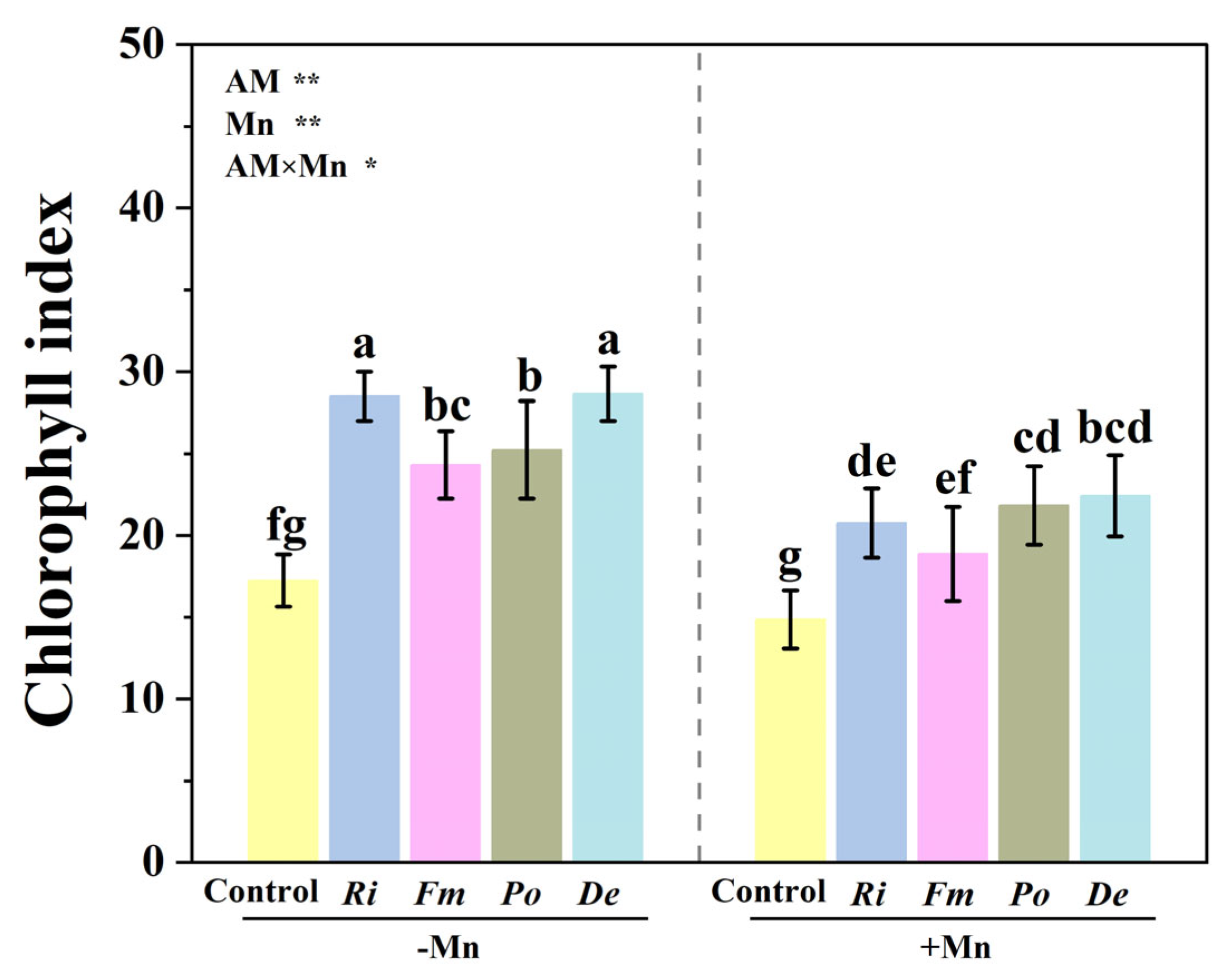
Mn stress, to some extent, inhibited Chl, while AM inoculation dramatically increased Chl (Figure 1). Under Mn-free conditions, AM fungal inoculation significantly increased the leaf Chl compared with the non-AM control. Among the AM fungi tested, Ri and De showed the strongest promoting effects, raising the index by 65% and 66%, respectively, followed by Po by 46% and Fm by 41%. AM inoculation effectively alleviated this Mn stress-triggered reduction in Chl, with De and Po providing the greatest protection, increasing the index by 51% and 47% relative to the stressed control, while Ri and Fm enhanced it by 39% and 27%, respectively.

3.4. Regulation of Leaf Mn Content by AM Fungi in Response to Mn Stress

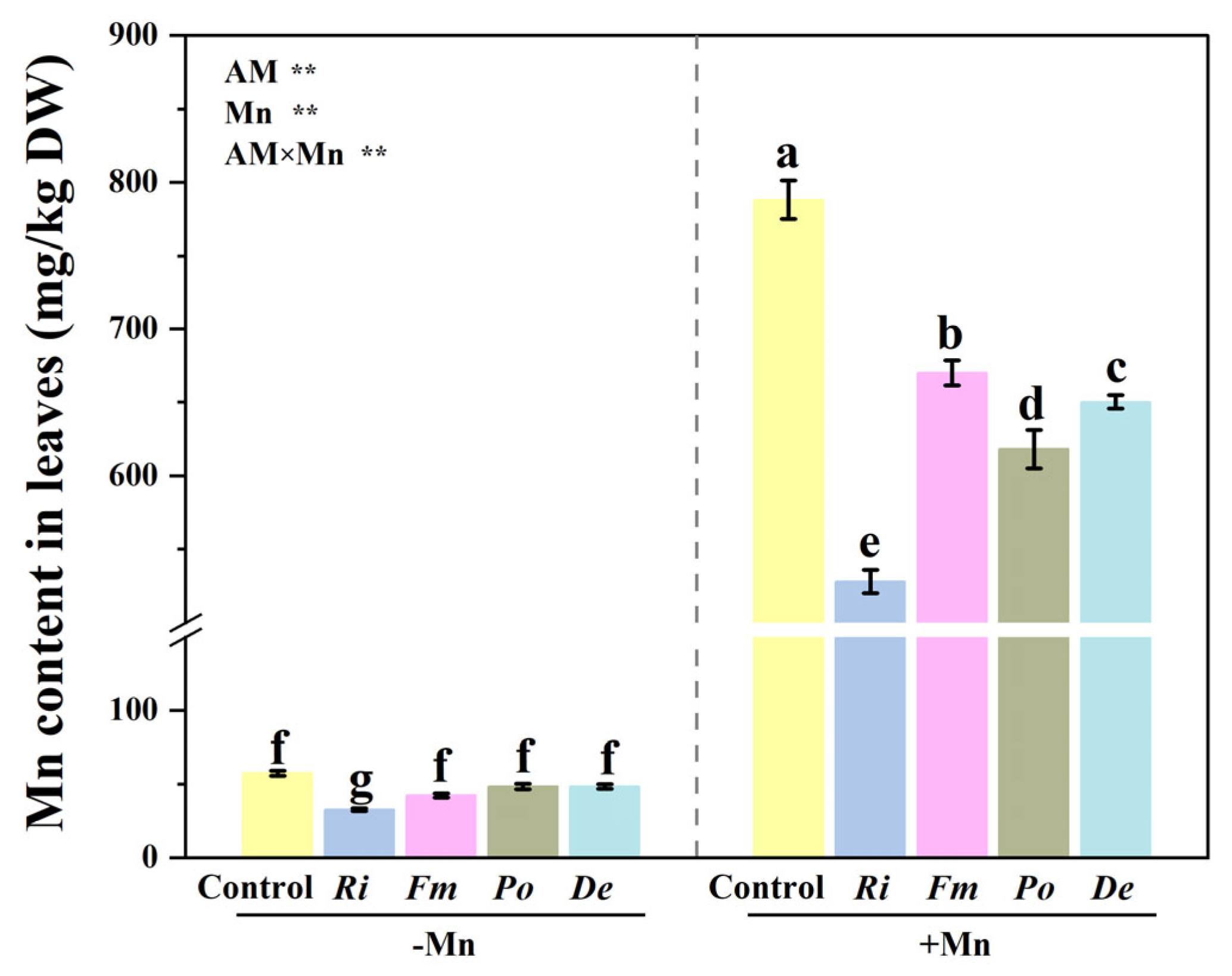
Mn stress distinctly increased leaf Mn content, regardless of AM inoculation (Figure 2). Under Mn-free conditions, AM fungal inoculation generally resulted in lower leaf Mn content compared to the non-AM control, with Ri showing the greatest reduction (43%). Under Mn stress, the non-AM control exhibited a sharp increase in leaf Mn concentration. Notably, AM inoculation significantly mitigated this accumulation under Mn stress: all AM treatments reduced leaf Mn levels relative to the stressed non-AM control. Fm and Ri were the most effective, decreasing Mn content by 23% and 17%, respectively, while Po and De reduced it by 11% and 8%, respectively.

3.5. Regulation of Antioxidant Enzyme Activity by AM Fungi in Response to Mn Stress

Mn stress induced a strong oxidative response in non-mycorrhizal plants, leading to a significant increase in SOD, POD, and CAT activities in both leaves and roots compared to the no-Mn control (Table 2). Under Mn-free conditions, AM fungal inoculation generally increased SOD activity, compared to the non-AM control. The most pronounced enhancement was observed with De inoculation, which increased SOD activity by 127% in leaves and 110% in roots. Inoculation with Po, Ri, and Fm also increased leaf SOD activity by 78%, 42%, and 23%, and root SOD activity by 134%, 78%, and 64%, respectively. For POD activity, all AM fungal inoculation collectively significantly elevated root POD activity by 17–21%, with Fm exhibiting the more pronounced effect. However, the effects were more variable and of smaller magnitude on leaf POD activity, with a significant increase only in leaf POD activity under Ri inoculation by 8%. CAT activity was significantly enhanced by Po, Fm, and Ri inoculations, with increases ranging from 23% to 50% in leaves and 27% to 51% in roots. De inoculation did not induce a significant change in leaf CAT activity, but significantly elevated root CAT activity 23%.
Under Mn stress, inoculation with AM fungi significantly alleviated this Mn-induced over-accumulation of SOD and POD (Table 2). Compared to the Mn-stressed control, Ri and Fm inoculations were most effective in reducing SOD activity, with decreases of 58% and 46% in leaves, and 51% and 58% in roots, respectively. Po and De inoculations also reduced SOD activity, though to a lesser extent (13–16% in leaves and 39–40% in roots). Similarly, all fungal inoculations lowered the excessively high POD activity, with reduction rates ranging from 17% to 29% in leaves and 16% to 19% in roots. In contrast to SOD and POD, the two-way ANOVA indicated that the response of CAT activity to AM inoculation was independent of Mn stress (no significant interaction, Table 2). Overall, AM inoculation significantly increased CAT activity, and Mn stress also markedly elevated it. In brief, symbiosis with AM fungi, particularly Ri, effectively fine-tuned the response pattern by alleviating the over-accumulation of SOD and POD while concurrently promoting higher CAT activity.

3.6. Regulation of Oxidative Damage Markers (ROS, MDA, and REC) by AM Fungi in Response to Mn Stress

Mn stress induced significant oxidative damage, as reflected in the marked increase in H2O2, O2•−, MDA, and REC in both AM and no-AM plants (Table 3). AM symbiosis, particularly Ri, consistently and effectively alleviated this oxidative damage under both Mn-free and Mn-stress conditions by reducing ROS accumulation and membrane damage. For markers where the AM effect was independent of Mn stress (leaf and root H2O2, leaf MDA, and leaf REC), inoculation consistently resulted in lower levels compared to non-mycorrhizal plants across both conditions. For example, under Mn-free conditions, inoculation with AM fungi generally reduced the levels of oxidative stress markers compared to the non-mycorrhizal control. All fungal treatments significantly reduced H2O2 levels in both leaves and roots. The most pronounced reduction was observed with Ri inoculation, decreasing H2O2 by 26% in leaves and 23% in roots. O2•− production was also reduced following AM treatment, particularly in roots, with Po inoculation showing the greatest decrease (44.6%) in roots. MDA levels, an indicator of membrane lipid peroxidation, were significantly lower in inoculated plants versus uninoculated plants. Ri inoculation was again the most effective, reducing leaf and root MDA by 34% and 34%, respectively. Similarly, REC, reflecting membrane integrity, decreased by all inoculations, with De showing the largest reduction (41.3%).
Under Mn stress, a severe oxidative burst was evident. The non-AM control exhibited sharply elevated levels of all measured parameters compared to the Mn-free control (Table 3). Leaf and root MDA levels increased by 51% and 247%, respectively, while REC increased by 29.1%. Inoculation with AM fungi effectively mitigated this Mn-induced oxidative damage. Compared to the stressed control, H2O2 levels were significantly reduced in all inoculated treatments. The decreases ranged from 26 to 28% in leaves and 23–28.0% in roots, with Ri and Fm showing consistently strong effects. O2•−, production was also suppressed. Po inoculation led to the largest decrease in leaves (47%), while Ri was most effective in roots (38%). MDA accumulation was significantly alleviated. The mitigation was most notable in roots, where Po inoculation reduced MDA by 71%, followed by Ri (58% reduction). In leaves, Ri also provided the strongest reduction (27%). REC was significantly lowered by all fungal inoculations, indicating improved membrane stability. The reduction ranged from 29% (De) to 39% (Fm) compared to the stressed control.

3.7. Regulation of Organic Osmolytes (Soluble Sugar, Soluble Protein, and Proline) by AM Fungi in Response to Mn Stress

Mn stress triggered a strong osmotic adjustment response characterized by sugar and proline accumulation alongside protein degradation (Table 4). AM fungal symbiosis effectively counteracted these stress-induced metabolic changes. Under Mn-free conditions, inoculation with AM fungi significantly altered the levels of organic substrates compared to the non-AM control. AM fungal inoculation generally increased leaf soluble sugar levels by 40% (Ri) to 74% (De). In roots, the effect was species-dependent: Fm, Po, and De inoculation significantly increased soluble sugar by 47%, 45%, and 36%, respectively, while Ri inoculation surprisingly decreased root sugar by 31%. All AM fungal inoculations significantly enhanced soluble protein levels in both leaves and roots. The promotion was most substantial with Po in leaves (+99%) and Ri in roots (+46%). Increases in other fungus–organ combinations ranged from 59% to 89%. The effects on proline levels were less consistent and generally smaller. Only Ri and De inoculations led to a significant increase in leaf proline by 21% and 28%, respectively, while Ri and Fm increased root proline by 28% and 33%, respectively.
Under Mn stress, the non-AM control exhibited a distinct metabolic shift: soluble sugar and free proline levels were markedly elevated (by 134% and 166% in leaves and 54% and 100% in roots, respectively), whereas soluble protein levels were reduced by 23% in leaves and 10% in roots compared to the no-Mn control (Table 4). Inoculation with AM fungi modulated this stress-induced metabolic response. A consistent finding was that AM inoculation significantly enhanced soluble protein levels in both leaves and roots regardless of Mn treatment, based on the interaction. Compared to the Mn-stressed control, all fungal treatments significantly reduced the excessively high leaf soluble sugar levels by 24% (De) to 31% (Po). In roots, the sugar levels in inoculated plants were comparable to or slightly lower than the stressed control, with no significant increases. AM fungal inoculation alleviated the Mn-induced decline in protein content. In leaves, Po and De inoculations restored protein levels to values 125% and 110% higher than the stressed control, respectively. In roots, Po and De also increased protein levels by 34% and 31%. A primary effect of inoculation under stress was to significantly decrease the drastically accumulated proline, especially in leaves. Reductions compared to the stressed control were substantial: 40% (Ri), 41% (Fm), 36% (Po), and 41% (De). In roots, proline levels in inoculated plants were also generally lower than in the stressed control. In short, AM fungal inoculation enhanced soluble sugar and protein under non-stress conditions, while under Mn toxicity it mitigated the stress-induced metabolic imbalance by reducing the over-accumulation of sugars and proline while alleviating the loss of soluble proteins.

4. Discussion

This study observed a significant reduction in AM fungal colonization rates of trifoliate orange roots under Mn stress, which aligns with the extensive literature documenting the inhibitory effects of heavy metal stress on mycorrhizal symbiosis [7,41,42]. The significant declines in colonization rates for Ri, Po, and De indicate heightened sensitivity to Mn stress. In contrast, Fm exhibited remarkable resilience, with its colonization rate remaining statistically invariant under Mn stress. Despite a 17.7% decline, Ri maintained the highest colonization level under Mn stress. Conversely, De, with the lowest colonization rate and the largest proportional decrease, likely delivered a more limited suite of symbiotic benefits under stress. This differential symbiotic stability directly underpins the subsequent variation in functional benefits. Excessive Mn can disrupt the symbiotic establishment through direct toxicity to fungal structures, impairing hyphal growth, branching, and metabolic activity [8], and alteration of root physiology and architecture, reducing carbon allocation or modifying root exudate profiles crucial for pre-symbiotic signaling [43,44].
The present study indicated that Mn stress significantly suppressed tissue biomass production of trifoliate orange, a hallmark response attributable to Mn-induced inhibition of root meristematic activity, disruption of chloroplast ultrastructure, interference with Fe2+/Ca2+ homeostasis, and uncoupling of photophosphorylation [45]. However, AM fungal inoculation significantly enhanced biomass production under both Mn-free and Mn-stress conditions, demonstrating the pivotal role of AM symbiosis in sustaining plant growth under Mn stress. Critically, Ri demonstrated remarkable efficacy in mitigating Mn-driven growth suppression, restoring root biomass to 64% above the stressed control, thereby revealing an active, symbiotically mediated enhancement of host vigor rather than passive tolerance. The effect exhibited the species-dependent efficacy of AM fungi, with Ri having the more profound effect and De having the relative lower performance. The magnitude of biomass increase induced by AM fungi broadly corresponded with their root colonization rates. Ri, which maintained the highest colonization rate under both conditions, consistently provided the greatest growth benefit. In contrast, the relatively lower performance of De, especially in root biomass promotion under stress (+24% vs. Ri’s +64%), may be linked to its higher sensitivity to Mn (as seen in colonization decline). This functional disparity underscores that the AM benefit in promoting plant biomass is a finely tuned outcome of specific plant–fungus genotype interactions under given environmental conditions [46]. Our findings on plant growth promotion under Mn stress align with and extend previous work on AMF-mediated alleviation of metal toxicity in citrus. For instance, Xu et al. [7] reported that Fm inoculum significantly improved the growth of trifoliate orange exposed to 100 mg/kg MnSO4•H2O for 16 weeks. However, our comparative design reveals that Ri outperforms Fm in both colonization stability and biomass restoration, highlighting the necessity of strain-level selection, not just genus- or species-level identification, in designing effective bioinoculation strategies.
The differential regulation of key antioxidant enzymes, SOD, POD, and CAT, by AM fungi, as revealed in this study, provides a mechanistically refined explanation for their role in modulating plant redox homeostasis under Mn stress. The contrasting responses of these enzymes to AM symbiosis under stress versus non-stress conditions highlight a context-dependent strategy deployed by the symbiotic system. Under Mn-free conditions, the general upregulation of SOD and CAT activities by AM fungi suggests a priming of the plant’s antioxidant system [47]. The species-specific pattern was noteworthy: De elicited the strongest SOD induction, while Ri had a more moderate effect. This may indicate that different AM fungi possess varying efficiencies in modulating the host’s ROS signaling network. The significant enhancement of CAT, the primary enzyme responsible for detoxifying H2O2, is crucial, as it prevents the accumulation of H2O2 to toxic levels [48].
Under Mn stress, AM symbiosis induced a critical functional reconfiguration of the antioxidant system. This pattern resembles other AM systems where fungi enhance basal antioxidant capacity or selectively stimulate SOD and CAT, even under low or no stress [3,49]. Functionally, this likely prepares AM plants to cope more effectively with later oxidative challenges. Non-AM plants exhibited a strong oxidative burst, reflected in large increases in SOD, POD, and CAT, similar to responses documented in Mn-stressed soybean [50,51]. Inoculation with AM fungi, however, fine-tuned this response: it reduced the over-accumulation of SOD and POD (especially by Ri and Fm), indicating lower ROS pressure, while concurrently further elevating CAT activity. This targeted enhancement, particularly prominent with Ri, reveals a strategic prioritization within the antioxidant apparatus, shifting the system toward more efficient H2O2 detoxification. This pattern of moderated antioxidant enzyme activities alongside reduced oxidative damage has been observed in other AM-heavy metal systems, such as leaf SOD and POD activity in Malus hupehensis under Cd stress with Funneliformis mosseae, root POD activity in Robinia pseudoacacia under Pb stress with Rhizophagus irregularis, and leaf SOD and POD activity in Phragmites australis under combined Zn/Cd stress with Rhizophagus intraradices [2,24,52,53]. The superior performance of Ri in enhancing CAT (39% increase in roots) correlates strongly with its outstanding ability to alleviate membrane lipid peroxidation and maintain growth, underscoring CAT’s pivotal role in conferring Mn tolerance within this specific symbiosis.
The marked elevation of key oxidative stress indicators, H2O2, O2•−, MDA, and REC in Mn-stressed plants clearly delineates the induction of severe oxidative stress leading to membrane disintegration [26]. This study showed that even mycorrhizal plants experienced measurable oxidative pressure under Mn stress, but the magnitude was significantly lower than in non-mycorrhizal controls. AM symbiosis, particularly with Ri, functions as a highly effective, constitutive system for mitigating this damage across both non-stress and stress conditions. Even in the absence of Mn stress, AM inoculation reduced H2O2, O2•−, MDA, and REC relative to the non-AM control, demonstrating that AM symbiosis actively improves basal redox homeostasis and membrane stability, not merely stress-responsive protection. Ri provided the largest declines in H2O2 and MDA, suggesting a functionally superior symbiosis for ROS control, analogous to stronger protection reported for specific AM strains in Robinia pseudoacacia and maize under high metal loads [22,52]. This study also revealed the critical, stress-responsive role of AM symbiosis in oxidative damage containment under Mn stress. All AM fungi significantly reduced accumulation of all measured oxidative markers, confirming the symbiosis’ fundamental capacity to interrupt the self-amplifying cycle of ROS generation, lipid peroxidation, and membrane leakage [54]. As a result, AM fungi, particularly Ri, re-equilibrate redox homeostasis under Mn stress: they limit ROS generation and/or enhance ROS scavenging, so less H2O2 and O2•− accumulate, and membranes remain more intact. The species-specific efficacy in alleviating different oxidative parameters was evident: Ri consistently showed broad-spectrum effectiveness in H2O2, O2•−, and MDA in both organs under Mn stress, while Po was exceptionally effective in suppressing root O2•− under non-stressed conditions and root MDA under Mn stress. These results underscore that the functional outcome of mycorrhizal symbiosis in stress alleviation is a product of the specific plant–fungus combination and its integrated response to the environmental challenge [55].
In this study, Mn toxicity drove a classic osmotic adjustment response, characterized by excessive accumulation of soluble sugars and proline alongside impaired protein biosynthesis or accelerated proteolysis [56,57]. AM fungi actively remodeled this stress metabolism, shifting the host toward protection and sustained growth. Without Mn stress, AM inoculation raised leaf sugars, reflecting higher photosynthetic capacity and carbon allocation to the symbiosis [58]. The decrease in root sugars with Ri (while leaf sugars rise) suggests more efficient export of photoassimilates to the fungus and/or faster metabolic use in roots, consistent with the strong functional activity of R. intraradices in other heavy-metal contexts [24,52]. AM inoculation also strongly increased soluble proteins in both organs, indicating improved nitrogen status and/or protein synthesis, as seen in AM–Cd systems where carbohydrate and amino-acid metabolism genes were upregulated and soluble nitrogenous compounds accumulate [24]. AM treatments modestly increased proline levels in some combinations, suggesting a mild osmotic/antioxidant priming effect rather than a full stress response, similar to AM effects seen under moderate drought where proline may rise or fall depending on how well the symbiosis relieves stress [15].
Under Mn toxicity, AM fungi clearly remodeled the stress metabolism. All AM fungi reduced excessive leaf sugar accumulation compared with the Mn-stressed control, bringing levels closer to those of non-stressed plants. This AM-mediated reduction suggests better maintenance of water and ion homeostasis, thereby eliminating the need for extreme sugar-based osmotic compensation. The large Mn-induced proline surge was sharply reduced by AM inoculation, especially in leaves. In Mn-stressed soybean and peanut, high proline is interpreted as a compensatory response to osmotic and oxidative imbalance [29,58]. When AM fungi relieve stress (better water/nutrient status, lower ROS), plants can downshift from this emergency mode. Similar patterns, lower proline in better-protected mycorrhizal plants, have been reported under drought and Cd stress when the symbiosis effectively mitigates damage [15,24]. AM fungi reversed Mn-induced protein loss, greatly increasing soluble protein relative to the stressed control. This echoes findings under Mn toxicity in rice and soybean, where protein decline is linked to oxidative damage and degradation [56,57], and under Cd stress in apple, where AM symbiosis upregulates genes for carbohydrate and amino-acid metabolism and maintains higher protein levels [24]. AM fungi, especially Ri, shift Mn-stressed plants toward a metabolically balanced state: normalized sugar levels, diminished reliance on proline as an osmoprotectant/antioxidant, and restored protein pools indicative of sustained growth and cellular function. This underscores the potential of selecting specific AM fungal inoculants for their capacity to optimize host metabolism under abiotic stress conditions.
Our measurement of leaf Mn content provides direct evidence for a key mechanism behind the observed protection. Under Mn stress, all four fungal species mitigated the excessive accumulation of Mn in leaves, with Fm and Ri exhibiting the strongest capacity for this restriction. This finding strongly supports the fact that a primary protective role of AM fungi against Mn toxicity is to sequester or immobilize excess Mn within the roots, thereby reducing Mn translocation to leaves [59]. This strategy aligns with established mechanisms of AM-mediated heavy metal tolerance, where metals such as Cd and Zn are compartmentalized in fungal vacuoles, bound to cell wall pectins, or precipitated as phosphates within root apoplasts [19,20,21,26,29].
Mn toxicity disrupts chloroplast integrity, inhibits chlorophyll biosynthesis, and accelerates pigment degradation, leading to interveinal chlorosis [6]. The significantly higher Chl observed in AM plants under Mn stress, particularly those colonized by De and Po, can thus be attributed, at least in part, to their lower leaf Mn content. By limiting the influx of toxic Mn ions into leaves, AM fungi alleviate the primary source of stress on the photosynthetic apparatus. This primary protection is synergistically reinforced by the antioxidant defense system fine-tuned through AM symbiosis for preserving chlorophyll stability and thylakoid membrane integrity [60].
Collectively, our findings on the modulation of antioxidant enzymes, oxidative damage markers, leaf Mn content, and metabolic homeostasis directly support our initial hypotheses. First, AM symbiosis enhances Mn tolerance in trifoliate orange through a coordinated, multi-tiered physiological strategy that mitigates oxidative damage and restores metabolic balance while also limiting Mn translocation to the leaves. Second, the significant variation in the magnitude of these protective effects, from the comprehensive resilience conferred by Ri to the more parameter-specific benefits of Po or the relatively lower efficacy of De, provides strong evidence that the protective effect is intrinsically dependent on AM fungal identity, not merely presence or absence of symbiosis.

5. Conclusions

This study definitively demonstrates that AM fungi could alleviate Mn toxicity in trifoliate orange, which validates our first hypothesis. Further, the efficacy was strongly species-dependent, confirming our second hypothesis. The core finding was the superior, consistent, and multi-dimensional performance of Ri in mitigating the physiological and biochemical symptoms of Mn stress, positioning it as a highly promising AM fungal strain for enhancing host resilience. Under Mn stress, Ri not only maintained the most stable symbiotic establishment but also provided the most comprehensive physiological benefits, including optimal growth promotion, a finely tuned antioxidant response (modulating SOD/POD and enhancing CAT), significant reduction in leaf Mn accumulation, and significant mitigation of oxidative damage and metabolic imbalance. This positions Ri as a high-priority microbial resource for enhancing crop resilience in acidic, Mn-contaminated agroecosystems. For practical application, Ri inoculation holds direct promise for improving the establishment and health of citrus groves in acidic or Mn-rich soils, contributing to more sustainable and resilient horticultural systems. Future research should prioritize field-scale validation of these benefits and explore the underlying molecular mechanisms driven by this effective symbiosis.

Author Contributions

L.-L.M.: Writing—original draft, Visualization, Software, Methodology, Investigation. C.-Z.L.: Writing—data Curation, Formal Analysis, Validation. B.-W.Z.: Writing—investigation, Methodology. Y.-N.Z.: Writing—review and editing, Supervision, Conceptualization. A.K.S.: Writing—review and editing. Q.-S.W.: Writing—review and editing, Supervision, Resources, Conceptualization. All authors have read and agreed to the published version of the manuscript.

Funding

This work was supported by the Open Fund of Hubei Key Laboratory of Spices & Horticultural Plant Germplasm Innovation & Utilization (YYKFG202502). This work was also funded by the Innovation Project for College Students of Yangtze University (Yz2025376).

Institutional Review Board Statement

Not applicable.

Informed Consent Statement

Not applicable.

Data Availability Statement

Data are contained within the article. The data presented in this study can be requested from the authors.

Conflicts of Interest

The authors declare no conflicts of interest.

References

  1. Johnson, J.; Hungerford, N.; Sultanbawa, Y.; Netzel, M. Unlocking the sublime: A review of native Australian citrus species. Foods 2025, 14, 2425. [Google Scholar] [CrossRef] [PubMed]
  2. Li, B.; Wang, S.C.; Zhang, Y.; Qiu, D.W. Acid soil improvement enhances disease tolerance in citrus infected by Candidatus Liberibacter asiaticus. Int. J. Mol. Sci. 2020, 21, 3614. [Google Scholar] [CrossRef] [PubMed]
  3. Li, Z.; Wu, N.; Meng, S.; Wu, F.; Liu, T. Arbuscular mycorrhizal fungi (AMF) enhance the tolerance of Euonymus maackii Rupr. at a moderate level of salinity. PLoS ONE 2020, 15, e0231497. [Google Scholar] [CrossRef] [PubMed]
  4. Yadav, D.S.; Jaiswal, B.; Gautam, M.; Agrawal, M. Soil acidification and its impact on plants. In Plant Responses to Soil Pollution; Singh, P., Singh, S.K., Prasad, S.M., Eds.; Springer: Singapore, 2020; pp. 1–26. [Google Scholar] [CrossRef]
  5. Xu, F.Q.; Meng, L.L.; Kuča, K.; Wu, Q.S. The mechanism of arbuscular mycorrhizal fungi-alleviated manganese toxicity in plants: A review. Plant Physiol. Biochem. 2024, 213, 108808. [Google Scholar] [CrossRef]
  6. You, X.; Yang, L.-T.; Qi, Y.-P.; Guo, P.; Lai, N.-W.; Ye, X.; Li, Q.; Chen, L.-S. Long-term manganese-toxicity-induced alterations of physiology and leaf protein profiles in two Citrus species differing in manganese-tolerance. J. Plant Physiol. 2017, 218, 249–257. [Google Scholar] [CrossRef]
  7. Xu, F.Q.; Meng, L.L.; Lei, A.Q.; Hashem, A.; Abd_Allah, E.F.; Wu, Q.S. Arbuscular mycorrhizal fungi mitigate manganese toxicity on trifoliate orange. Sci. Hortic. 2024, 338, 113722. [Google Scholar] [CrossRef]
  8. Tan, X.P.; Li, C.Z.; Zou, Y.N.; Lei, A.Q.; Alqahtani, M.D.; Wu, Q.S. Cultivar-dependent effects of arbuscular mycorrhizal (AM) fungal inoculation on fruit quality and native AM fungal community in navel orange. Rhizosphere 2026, 37, 101269. [Google Scholar] [CrossRef]
  9. Pal, S.P. Arbuscular mycorrhiza: A useful tool for heavy metal bioremediation. Int. J. Agric. Environ. Biotechnol. 2011, 4, 397–399. [Google Scholar]
  10. Liu, Z.; Cheng, X.F.; Zou, Y.N.; Srivastava, A.K.; Alqahtani, M.D.; Wu, Q.S. Negotiating soil water deficit in mycorrhizal trifoliate orange plants: A gibberellin pathway. Environ. Exp. Bot. 2024, 219, 105658. [Google Scholar] [CrossRef]
  11. Li, B.; Wang, Y.N.; Hu, T.L.; Qiu, D.W.; Francis, F.; Wang, S.C. Root-associated microbiota response to ecological factors: Role of soil acidity in enhancing citrus tolerance to huanglongbing. Front. Plant Sci. 2022, 13, 937414. [Google Scholar] [CrossRef]
  12. Akhtar, O.; Pandey, D.; Zoomi, I.; Singh, U.; Chaudhary, K.L.; Mishra, R.; Pandey, N. Role of arbuscular mycorrhizal fungi in heavy metals homoeostasis in plants. J. Plant Growth Regul. 2024, 43, 3971–3985. [Google Scholar] [CrossRef]
  13. Nogueira, M.A.; Magalhães, G.C.; Cardoso, E.J.B.N. Manganese toxicity in mycorrhizal and phosphorus-fertilized soybean plants. J. Plant Nutr. 2004, 27, 141–156. [Google Scholar] [CrossRef]
  14. Alshegaihi, R.M.; Alatawi, A.; Alenezi, M.A. Ameliorative effects of plant growth promoting rhizobacteria and arbuscular mycorrhizal fungi on Cu stress in maize (Zea mays L.) with a focus on oxidative damage, antioxidant responses, and gene expression. J. Soil Sci. Plant Nutr. 2024, 24, 2437–2455. [Google Scholar] [CrossRef]
  15. Bahadur, A.; Batool, A.; Nasir, F.; Jiang, S.; Qin, M.; Zhang, Q.; Pan, J.; Liu, Y.; Feng, H. Mechanistic insights into arbuscular mycorrhizal fungi-mediated drought stress tolerance in plants. Int. J. Mol. Sci. 2019, 20, 4199. [Google Scholar] [CrossRef]
  16. Jia, T.; Wang, J.; Chang, W.; Fan, X.; Sui, X.; Song, F. Proteomics analysis of E. angustifolia seedlings inoculated with arbuscular mycorrhizal fungi under salt stress. Int. J. Mol. Sci. 2019, 20, 788. [Google Scholar] [CrossRef] [PubMed]
  17. Zheng, F.L.; Liang, S.M.; Chu, X.N.; Yang, Y.L.; Wu, Q.S. Mycorrhizal fungi enhance flooding tolerance of peach through inducing proline accumulation and improving root architecture. Plant Soil Environ. 2020, 66, 624–631. [Google Scholar] [CrossRef]
  18. Liang, S.M.; Hashem, A.; Abd_Allah, E.F.; Wu, Q.S. Transcriptomic analysis reveals potential roles of polyamine and proline metabolism in waterlogged peach roots inoculated with Funneliformis mosseae and Serendipita indica. Tree Physiol. 2025, 45, tpaf013. [Google Scholar] [CrossRef] [PubMed]
  19. Wu, S.; Zhang, X.; Sun, Y.; Wu, Z.; Li, T.; Hu, Y.; Su, D.; Lv, J.; Li, G.; Zhang, Z.; et al. Transformation and immobilization of chromium by arbuscular mycorrhizal fungi as revealed by SEM-EDS, TEM-EDS, and XAFS. Environ. Sci. Technol. 2015, 49, 14036–14047. [Google Scholar] [CrossRef]
  20. Zhang, X.; Hu, Z.; Yan, T.; Lu, R.; Peng, C.; Li, S.; Jing, Y. Arbuscular mycorrhizal fungi alleviate Cd phytotoxicity by altering Cd subcellular distribution and chemical forms in Zea mays. Ecotoxicol. Environ. Saf. 2019, 171, 352–360. [Google Scholar] [CrossRef]
  21. Doyama, K.; Yamaji, K.; Haruma, T.; Ishida, A.; Mori, S.; Kurosawa, Y. Zn tolerance in the evergreen shrub, Aucuba japonica, naturally growing at a mine site: Cell wall immobilization, aucubin production, and Zn adsorption on fungal mycelia. PLoS ONE 2021, 16, e0257690. [Google Scholar] [CrossRef]
  22. Kuang, Q.; Wu, Y.; Gao, Y.; An, T.; Liu, S.; Liang, L.; Xu, B.; Zhang, S.; Yu, M.; Shabala, S.; et al. Arbuscular mycorrhizal fungi mitigate cadmium stress in maize. Ecotoxicol. Environ. Saf. 2025, 289, 117600. [Google Scholar] [CrossRef]
  23. Xie, K.; Chen, Y.; Wang, X.; Zhou, X.; Cheng, Y.; Yu, X.; Wang, J.; Sun, M.; Li, Y.; He, C. Physiological and multi-omics analysis reveals the mechanism of arbuscular mycorrhizal fungi alleviating cadmium toxicity in green onion. Ecotoxicol. Environ. Saf. 2025, 290, 117754. [Google Scholar] [CrossRef] [PubMed]
  24. Zhuang, X.L.; Liu, S.Y.; Xu, S.Z.; Qin, S.J.; Lyu, D.; He, J.L.; Zhou, J.T. Arbuscular mycorrhizal fungi alleviate cadmium phytotoxicity by regulating cadmium mobility, physiological responses, and gene expression patterns in Malus hupehensis Rehd. Int. J. Mol. Sci. 2025, 26, 1418. [Google Scholar] [CrossRef] [PubMed]
  25. Faria, J.M.S.; Pinto, A.P.; Teixeira, D.; Brito, I.; Carvalho, M. Diversity of native arbuscular mycorrhiza extraradical mycelium influences antioxidant enzyme activity in wheat grown under Mn toxicity. Bull. Environ. Contam. Toxicol. 2022, 108, 451–456. [Google Scholar] [CrossRef] [PubMed]
  26. Pan, G.; Wang, W.M.; Li, X.H.; Pan, D.; Liu, W.S. Revealing the effects and mechanisms of arbuscular mycorrhizal fungi on manganese uptake and detoxification in Rhus chinensis. Chemosphere 2023, 339, 139768. [Google Scholar] [CrossRef]
  27. Malcová, R.; Gryndler, M.; Vosátka, M. Magnesium ions alleviate the negative effect of manganese on Glomus claroideum BEG23. Mycorrhiza 2002, 12, 125–129. [Google Scholar] [CrossRef]
  28. Mou, D.; Yao, Y.; Yang, Y.; Zhang, Y.; Tian, C.; Achal, V. Plant high tolerance to excess manganese related to root growth, manganese distribution and antioxidative enzyme activity in three grape cultivars. Ecotoxicol. Environ. Saf. 2011, 74, 776–786. [Google Scholar] [CrossRef]
  29. Nogueira, M.A.; Cardoso, E.J.B.N. Mycorrhizal effectiveness and manganese toxicity in soybean as affected by soil type and endophyte. Sci. Agric. 2003, 60, 329–335. [Google Scholar] [CrossRef]
  30. Bisht, A.; Garg, N. Harnessing the role of arbuscular mycorrhizae in arresting nodular senescence by modulating osmolyte synthesis and ascorbate-glutathione pool in cadmium stressed pigeon pea. Plant Growth Regul. 2024, 102, 409–427. [Google Scholar] [CrossRef]
  31. Jiang, H.R.; Fu, W.L.; Deng, C.; Zou, Y.N.; Alqahtani, M.D.; Wu, Q.S. Hyphosphere metabolic reprogramming in lipids and aromatic amino acids drives differential mycorrhizal growth promotion in trifoliate orange. Rhizosphere 2026, 37, 101280. [Google Scholar] [CrossRef]
  32. Harrower, J.T.; Gilbert, G.S. Parasitism to mutualism continuum for Joshua trees inoculated with different communities of arbuscular mycorrhizal fungi from a desert elevation gradient. PLoS ONE 2021, 16, e0256068. [Google Scholar] [CrossRef] [PubMed]
  33. Phillips, J.M.; Hayman, D.S. Improved procedures for clearing roots and staining parasitic and vesicular-arbuscular mycorrhizal fungi for rapid assessment of infection. Trans. Br. Mycol. Soc. 1970, 55, 158–161. [Google Scholar] [CrossRef]
  34. Yan, K.X.; Huang, R.H.; Gao, X.B.; Hashem, A.; Abd-Allah, E.F.; Wu, Q.S.; Guo, C. Entrophospora etunicata enhances manganese stress tolerance in tea plants by increasing antioxidant enzyme defense and modulating quality-related metabolism. Rhizosphere 2025, 36, 101226. [Google Scholar] [CrossRef]
  35. Niu, M.; Huang, Y.; Sun, S.; Sun, J.; Cao, H.; Shabala, S.; Bie, Z. Root respiratory burst oxidase homologue-dependent H2O2 production confers salt tolerance on a grafted cucumber by controlling Na+ exclusion and stomatal closure. J. Exp. Bot. 2018, 69, 3465–3476. [Google Scholar] [CrossRef]
  36. He, J.D.; Zou, Y.N.; Wu, Q.S.; Kuča, K. Mycorrhizas enhance drought tolerance of trifoliate orange by enhancing activities and gene expression of antioxidant enzymes. Sci. Hortic. 2020, 262, 108745. [Google Scholar] [CrossRef]
  37. Velikova, V.; Yordanov, I.; Edreva, A. Oxidative stress and some antioxidant systems in acid rain-treated bean plants: Protective role of exogenous polyamines. Plant Sci. 2000, 151, 59–66. [Google Scholar] [CrossRef]
  38. Bates, L.S.; Waldren, R.P.; Teare, I.D. Rapid determination of free proline for waterstress studies. Plant Soil 1973, 39, 205–207. [Google Scholar] [CrossRef]
  39. Yemm, E.W.; Willis, A.J. The estimation of carbohydrates in plant extracts by anthrone. Biochem. J. 1954, 57, 508–514. [Google Scholar] [CrossRef]
  40. Bradford, M.M. A rapid and sensitive method for the quantitation of microgram quantities of protein utilizing the principle of proteindye binding. Anal. Biochem. 1976, 72, 248–254. [Google Scholar] [CrossRef]
  41. Garg, N.; Chandel, S. Arbuscular mycorrhizal networks: Process and functions. In Sustainable Agriculture; Lichtfouse, E., Hamelin, M., Navarrete, M., Debaeke, P., Eds.; Springer: Dordrecht, The Netherlands, 2011; Volume 2, pp. 907–930. [Google Scholar] [CrossRef]
  42. Hildebrandt, U.; Regvar, M.; Bothe, H. Arbuscular mycorrhiza and heavy metal tolerance. Phytochemistry 2007, 68, 139–146. [Google Scholar] [CrossRef]
  43. Audet, P.; Charest, C. Dynamics of arbuscular mycorrhizal symbiosis in heavy metal phytoremediation: Meta-analytical and conceptual perspectives. Environ. Pollut. 2007, 147, 609–614. [Google Scholar] [CrossRef]
  44. Rui, W.G.; Mao, Z.P.; Li, Z.F. The roles of phosphorus and nitrogen nutrient transporters in the arbuscular mycorrhizal symbiosis. Int. J. Mol. Sci. 2023, 23, 11027. [Google Scholar] [CrossRef] [PubMed]
  45. Millaleo, R.; Reyes-Díaz, M.; Ivanov, A.G.; Mora, M.L.; Alberdi, M. Manganese as essential and toxic element for plants: Transport, accumulation and resistance mechanisms. J. Soil Sci. Plant Nutr. 2010, 10, 470–481. [Google Scholar] [CrossRef]
  46. Verbruggen, E.; Van Der Heijden, M.G.; Weedon, J.T.; Kowalchuk, G.A.; Röling, W.F. Community assembly, species richness and nestedness of arbuscular mycorrhizal fungi in agricultural soils. Mol. Ecol. 2012, 21, 2341–2353. [Google Scholar] [CrossRef] [PubMed]
  47. Pozo, M.J.; Azcón-Aguilar, C. Unraveling mycorrhiza-induced resistance. Curr. Opin. Plant Biol. 2007, 10, 393–398. [Google Scholar] [CrossRef]
  48. Gill, S.S.; Tuteja, N. Reactive oxygen species and antioxidant machinery in abiotic stress tolerance in crop plants. Plant Physiol. Biochem. 2010, 48, 909–930. [Google Scholar] [CrossRef]
  49. Spagnoletti, F.N.; Balestrasse, K.; Lavado, R.S.; Giacometti, R. Arbuscular mycorrhiza detoxifying response against arsenic and pathogenic fungus in soybean. Ecotoxicol. Environ. Saf. 2016, 133, 47–56. [Google Scholar] [CrossRef]
  50. Pan, Y.; Shi, J.; Li, J.; Zhang, R.; Xue, Y.; Liu, Y. Regulatory mechanism through which old soybean leaves respond to Mn toxicity stress. Int. J. Mol. Sci. 2024, 25, 5341. [Google Scholar] [CrossRef]
  51. Li, J.; Jia, Y.; Dong, R.; Huang, R.; Liu, P.; Li, X.; Wang, Z.; Liu, G.; Chen, Z. Advances in the mechanisms of plant tolerance to manganese toxicity. Int. J. Mol. Sci. 2019, 20, 5096. [Google Scholar] [CrossRef]
  52. Yang, Y.; Han, X.; Liang, Y.; Ghosh, A.; Chen, J.; Tang, M. The combined effects of arbuscular mycorrhizal fungi (AMF) and lead (Pb) stress on Pb accumulation, plant growth parameters, photosynthesis, and antioxidant enzymes in Robinia pseudoacacia L. PLoS ONE 2015, 10, e0145726. [Google Scholar] [CrossRef]
  53. You, Y.; Wang, L.; Ju, C.; Wang, G.; Ma, F.; Wang, Y.; Yang, D. Effects of arbuscular mycorrhizal fungi on the growth and toxic element uptake of Phragmites australis (Cav.) Trin. ex Steud under zinc/cadmium stress. Ecotoxicol. Environ. Saf. 2021, 213, 112023. [Google Scholar] [CrossRef]
  54. Zou, Y.N.; Wu, Q.S.; Kuča, K. Unravelling the role of arbuscular mycorrhizal fungi in mitigating the oxidative burst of plants under drought stress. Plant Biol. 2021, 23, 50–57. [Google Scholar] [CrossRef]
  55. van Der Heijden, M.G.; Martin, F.M.; Selosse, M.A.; Sanders, I.R. Mycorrhizal ecology and evolution: The past, the present, and the future. New Phytol. 2015, 205, 1406–1423. [Google Scholar] [CrossRef] [PubMed]
  56. Li, F.; Yao, Y.; Wu, Z.; Zheng, D.; Xue, Y.; Liu, Y. Combined metabolomic and transcriptomic analysis to reveal the response of rice to Mn toxicity stress. Ecotoxicol. Environ. Saf. 2024, 289, 117454. [Google Scholar] [CrossRef] [PubMed]
  57. Liu, Y.; Pan, Y.; Li, J.; Chen, J.; Yang, S.; Zhao, M.; Xue, Y. Transcriptome sequencing analysis of root in soybean responding to Mn poisoning. Int. J. Mol. Sci. 2023, 24, 12727. [Google Scholar] [CrossRef] [PubMed]
  58. Pu, S.Q.; Zheng, F.L.; Wu, Q.S.; Hashem, A.; Abd-Allah, E.F.; Zou, Y.N. Arbuscular mycorrhizal fungi mediate leaf sugar profile in water-stressed trifoliate orange. BMC Plant Biol. 2025, 25, 1456. [Google Scholar] [CrossRef]
  59. Liu, Y.; Zhao, M.; Chen, J.; Yang, S.; Chen, J.; Xue, Y. Comparative transcriptome analysis reveals complex physiological response and gene regulation in peanut roots and leaves under manganese toxicity stress. Int. J. Mol. Sci. 2023, 24, 1161. [Google Scholar] [CrossRef]
  60. Zheng, F.L.; Tan, Z.P.; Zhang, Y.; Xu, X.H.; Hashem, A.; Debnath, A.; Wu, Q.S. Enhancing walnut growth and drought tolerance through Serendipita indica: Focus on mitochondrial antioxidant defense. Plant Growth Regul. 2024, 104, 1697–1706. [Google Scholar] [CrossRef]
Figure 1. Effects of inoculation with four arbuscular mycorrhizal fungi on chlorophyll index of trifoliate orange plants under Mn-free and Mn-stressed conditions. Data represent mean ± SE (n = 4). Different letters above the bars indicate significant (p < 0.05) differences according to Duncan’s multiple range test. Abbreviations: AM, arbuscular mycorrhizal; Mn, manganese; Ri, Rhizophagus intraradices; Fm, Funneliformis mosseae; Po, Paraglomus occultum; De, Diversispora epigaea; Control, no-arbuscular mycorrhizal fungi; −Mn, Mn-free; +Mn, Mn-stressed; *, p < 0.05; **, p < 0.01.
Agriculture 16 00342 g001
Figure 2. Effects of inoculation with four arbuscular mycorrhizal fungi on leaf Mn content of trifoliate orange plants under Mn-free and Mn-stressed conditions. Data represent mean ± SE (n = 4). Different letters above the bars indicate significant (p < 0.05) differences according to Duncan’s multiple range test. Abbreviations: AM, arbuscular mycorrhizal; Mn, manganese; Ri, Rhizophagus intraradices; Fm, Funneliformis mosseae; Po, Paraglomus occultum; De, Diversispora epigaea; Control, no-arbuscular mycorrhizal fungi; −Mn, Mn-free; +Mn, Mn-stressed; **, p < 0.01.
Agriculture 16 00342 g002
Table 1. Effects of inoculation with four arbuscular mycorrhizal fungi on root mycorrhizal colonization rate and plant biomass production in trifoliate orange plants under Mn-free and Mn-stressed conditions.
Mn TreatmentAM FungusRoot AM Fungal Colonization Rate (%)Plant Biomass (g FW/Plant)
LeafStemRoot
Mn-freeControl0 ± 0 e0.45 ± 0.05 e0.95 ± 0.10 e1.41 ± 0.11 e
Ri87.5 ± 2.9 a1.21 ± 0.18 a1.33 ± 0.13 a2.24 ± 0.21 a
Fm75.4 ± 3.0 b0.90 ± 0.14 b1.25 ± 0.15 ab2.02 ± 0.19 ab
Po71.8 ± 9.3 b0.86 ± 0.14 bc1.18 ± 0.14 cd1.94 ± 0.19 bc
De70.2 ± 2.2 b0.81 ± 0.14 cd1.22 ± 0.12 bc1.73 ± 0.18 cd
Mn stressControl0 ± 0 e0.31 ± 0.05 f0.75 ± 0.18 f1.02 ± 0.11 f
Ri72.0 ± 4.9 b0.77 ± 0.13 d1.00 ± 0.15 e1.67 ± 0.18 de
Fm68.3 ± 9.9 bc0.78 ± 0.12 d1.07 ± 0.16 de1.28 ± 0.14 e
Po60.9 ± 5.9 cd0.76 ± 0.15 d0.97 ± 0.14 e1.41 ± 0.15 e
De55.7 ± 3.2 d0.76 ± 0.10 d0.95 ± 0.16 e1.26 ± 0.13 e
Significance
AM inoculation ********
Mn stress *NS***
Interaction ****
Note: Data represent mean ± SE (n = 10). Different letters among treatments indicate significant (p < 0.05) differences according to Duncan’s multiple range test. Abbreviations: AM, arbuscular mycorrhizal; Mn, manganese; Fm, Funneliformis mosseae; Ri, Rhizophagus intraradices; Po, Paraglomus occultum; De, Diversispora epigaea; Control, no-arbuscular mycorrhizal fungi; NS, not significant at p < 0.05; *, p < 0.05; **, p < 0.01.
Table 2. Effects of inoculation with four arbuscular mycorrhizal fungi on antioxidant enzyme activities in leaves and roots of trifoliate orange plants under Mn-free and Mn-stressed conditions.
Mn TreatmentAM FungusSOD (U/g FW)POD (U/g FW)CAT (μmol/g FW)
LeafRootLeafRootLeafRoot
No-MnControl112.43 ± 12.89 g112.61 ± 10.12 g428.70 ± 8.95 e345.38 ± 9.27 d243.00 ± 13.08 g174.48 ± 1.93 e
Ri159.68 ± 12.08 f200.55 ± 26.70 ef465.07 ± 21.14 cd414.79 ± 11.79 c299.79 ± 15.53 f263.83 ± 11.33 c
Fm137.81 ± 7.18 fg184.43 ± 9.60 f460.79 ± 20.76 cde416.58 ± 16.31 c339.74 ± 5.76 e221.11 ± 12.90 d
Po200.10 ± 11.92 e263.04 ± 23.68 de439.38 ± 25.64 de408.01 ± 15.56 c363.68 ± 8.74 cd267.00 ± 18.52 c
De255.39 ± 7.53 d236.08 ± 18.69 ef440.11 ± 16.05 de403.39 ± 19.39 c264.89 ± 22.11 g214.00 ± 26.00 d
Mn stressControl626.34 ± 25.88 a727.18 ± 108.25 a666.90 ± 19.06 a567.39 ± 14.48 a351.38 ± 9.66 de286.00 ± 10.44 c
Ri260.85 ± 12.41 d355.39 ± 17.53 c530.70 ± 23.06 b466.53 ± 6.44 b422.67 ± 3.51 a397.00 ± 12.12 a
Fm338.85 ± 25.62 c307.38 ± 26.30 cd554.25 ± 29.40 b473.07 ± 20.42 b386.56 ± 16.63 b312.16 ± 16.25 b
Po542.67 ± 39.51 b437.19 ± 25.96 b474.72 ± 25.16 c459.79 ± 14.63 b383.17 ± 14.42 bc314.33 ± 12.58 b
De526.25 ± 24.68 b441.09 ± 12.84 b490.45 ± 14.33 c475.87 ± 14.30 b399.27 ± 13.51 b336.67 ± 13.01 b
Significance
AM inoculation NS**********
Mn stress ************
Interaction ********NSNS
Note: Data represent mean ± SE (n = 4). Different letters among treatments indicate significant (p < 0.05) differences according to Duncan’s multiple range test. Abbreviations: AM, arbuscular mycorrhizal; Mn, manganese; Fm, Funneliformis mosseae; Ri, Rhizophagus intraradices; Po, Paraglomus occultum; De, Diversispora epigaea; Control, no-arbuscular mycorrhizal fungi; SOD, superoxide dismutase; POD, peroxidase; CAT, catalase; NS, not significant at p < 0.05; **, p < 0.01.
Table 3. Effects of inoculation with four arbuscular mycorrhizal fungi on oxidative damage indicators in leaves and roots of trifoliate orange plants under Mn-free and Mn-stressed conditions.
Mn TreatmentAM FungusH2O2 (μmol/g FW)O2•− (μmol/g FW)MDA (nmol/g FW)REC (%)
LeafRootLeafRootLeafRootLeafRoot
Mn-freeControl55.70 ± 5.14 b56.80 ± 3.93 b17.91 ± 1.85 bcd21.61 ± 3.57 b30.70 ± 2.00 de17.57 ± 1.25 e90.33 ± 8.50 b81.33 ± 4.04 b
Ri41.45 ± 3.04 d43.86 ± 7.71 c15.90 ± 1.72 cde12.65 ± 1.42 f20.27 ± 2.34 g11.56 ± 0.72 f65.67 ± 2.31 ef48.00 ± 2.65 d
Fm43.51 ± 3.80 cd47.58 ± 6.20 bc14.54 ± 1.29 e13.54 ± 1.32 ef24.62 ± 0.95 fg13.49 ± 0.72 f63.33 ± 5.51 ef50.33 ± 4.16 d
Po46.17 ± 3.56 cd50.00 ± 4.37 bc14.79 ± 0.90 e11.97 ± 0.40 f25.80 ± 1.97 ef13.49 ± 0.75 f58.00 ± 4.58 fg58.67 ± 3.51 c
De45.82 ± 2.64 cd51.63 ± 5.11 bc15.28 ± 0.88 de14.71 ± 0.52 def29.13 ± 3.23 def19.66 ± 0.47 e53.00 ± 2.65 g50.33 ± 1.53 d
Mn stressControl67.55 ± 5.49 a69.18 ± 6.87 a29.64 ± 1.75 a25.54 ± 0.59 a46.22 ± 3.16 a60.95 ± 6.53 a116.67 ± 7.23 a115.00 ± 9.17 a
Ri48.60 ± 5.59 bcd49.81 ± 48.60 bc19.37 ± 1.01 b15.96 ± 0.77 cde33.60 ± 3.74 cd25.38 ± 1.12 d76.33 ± 3.51 cd79.00 ± 4.58 b
Fm48.96 ± 1.94 bcd51.53 ± 4.44 bc17.11 ± 1.38 bcde17.48 ± 1.38 cd35.74 ± 1.43 c30.78 ± 1.19 c71.00 ± 2.65 de64.33 ± 6.02 c
Po49.46 ± 4.82 bc53.07 ± 2.82 bc15.75 ± 0.87 cde15.83 ± 0.94 cde38.40 ± 4.23 bc17.79 ± 1.20 e78.00 ± 4.00 cd62.33 ± 2.52 c
De50.32 ± 2.94 bc54.82 ± 3.64 b18.58 ± 2.89 bc18.21 ± 2.32 c42.19 ± 5.86 ab54.70 ± 4.44 b83.00 ± 4.36 bc80.67 ± 3.21 b
Significance
AM inoculation ****************
Mn stress ****************
Interaction NSNS***NS**NS*
Note: Data represent mean ± SE (n = 4). Different letters among treatments indicate significant (p < 0.05) differences according to Duncan’s multiple range test. Abbreviations: AM, arbuscular mycorrhizal; Mn, manganese; Fm, Funneliformis mosseae; Ri, Rhizophagus intraradices; Po, Paraglomus occultum; De, Diversispora epigaea; Control, no-arbuscular mycorrhizal fungi; H2O2, hydrogen peroxide; O2•−, superoxide anion; MDA, malondialdehyde; REC, relative electrolyte conductivity; NS, not significant at p < 0.05; *, p < 0.05; **, p < 0.01.
Table 4. Effects of inoculation with four arbuscular mycorrhizal fungi on soluble sugar, soluble protein, and free proline levels in leaves and roots of trifoliate orange plants under Mn-free and Mn-stressed conditions.
Mn TreatmentAM FungusSoluble Sugar (mg/g FW)Soluble Protein (mg/g FW)Free Proline (μg/g FW)
LeafRootLeafRootLeafRoot
Mn-freeControl11.09 ± 1.05 e12.48 ± 1.05 b7.00 ± 0.84 f10.70 ± 0.52 c0.58 ± 0.03 d0.43 ± 0.05 d
Ri15.54 ± 1.83 d8.58 ± 0.66 c12.10 ± 0.36 bc15.58 ± 1.69 a0.70 ± 0.15 cd0.55 ± 0.08 cd
Fm18.03 ± 0.65 cd18.38 ± 2.01 a13.21 ± 1.26 ab13.60 ± 1.35 ab0.53 ± 0.01 d0.57 ± 0.04 cd
Po18.41 ± 1.34 bcd18.10 ± 2.14 a13.94 ± 0.62 a13.41 ± 0.99 ab0.65 ± 0.04 d0.48 ± 0.05 d
De19.27 ± 0.57 bcd16.99 ± 0.39 a12.21 ± 1.20 bc14.58 ± 0.81 ab0.74 ± 0.02 bcd0.48 ± 0.05 d
Mn stressControl25.89 ± 4.60 a19.26 ± 1.34 a5.42 ± 0.64 g9.67 ± 0.76 c1.54 ± 0.38 a0.86 ± 0.02 a
Ri19.67 ± 1.31 bcd17.46 ± 0.99 a8.82 ± 0.79 e10.19 ± 0.49 c0.93 ± 0.03 bc0.82 ± 0.10 a
Fm21.37 ± 3.29 bc18.73 ± 0.82 a9.86 ± 1.19 de10.62 ± 1.76 c0.91 ± 0.05 bc0.72 ± 0.13 ab
Po22.64 ± 3.10 ab19.25 ± 1.04 a12.18 ± 1.10 bc12.93 ± 1.21 b0.99 ± 0.14 b0.67 ± 0.06 bc
De20.22 ± 0.64 bc18.73 ± 0.82 a11.40 ± 0.85 cd12.64 ± 0.55 b0.91 ± 0.02 bc0.66 ± 0.13 bc
Significance
AM inoculation NSNS******NS
Mn stress ************
Interaction **NSNSNS****
Note: Data represent mean ± SE (n = 4). Different letters among treatments indicate significant (p < 0.05) differences according to Duncan’s multiple range test. Abbreviations: AM, arbuscular mycorrhizal; Mn, manganese; Fm, Funneliformis mosseae; Ri, Rhizophagus intraradices; Po, Paraglomus occultum; De, Diversispora epigaea; Control, no-arbuscular mycorrhizal fungi; NS, not significant at p < 0.05; **, p < 0.01.
Disclaimer/Publisher’s Note: The statements, opinions and data contained in all publications are solely those of the individual author(s) and contributor(s) and not of MDPI and/or the editor(s). MDPI and/or the editor(s) disclaim responsibility for any injury to people or property resulting from any ideas, methods, instructions or products referred to in the content.