Article

Fostering the Circular Approach Among Professional and Hobby Farmers: The Effects of Information Sources and Farmers’ Perceptions on the Intention to Adopt Compost from Organic Municipal Waste


1
Department of Education, University of Roma Tre, Via del Castro Pretorio 20, 00185 Rome, Italy
2
Institute of Sciences and Technologies for Sustainable Energy and Mobility (STEMS), National Research Council of Italy (CNR), Strada delle Cacce, 73, 10135 Torino, Italy
*
Author to whom correspondence should be addressed.
Agriculture 2026, 16(3), 329; https://doi.org/10.3390/agriculture16030329
Submission received: 2 December 2025 / Revised: 22 January 2026 / Accepted: 26 January 2026 / Published: 28 January 2026
(This article belongs to the Section Agricultural Economics, Policies and Rural Management)

Abstract

The organic fraction of municipal solid waste (OFMSW) compost has the potential to be an effective soil improver, and agriculture is the industry with the largest potential market for its adoption, followed by landscaping and gardening hobbyist uses. Understanding which factors foster the intention to adopt OFMSW compost among users engaged in agricultural activities is, therefore, crucial for its diffusion. A paper-and-pencil questionnaire was administered to 119 visitors involved in farming activities at an exhibition focused on the green and circular economy. The PROCESS macro for SPSS model 8 was applied to test a moderated mediated model to investigate the relationship between being a professional or hobby farmer, perceived drivers and the intention to adopt compost, with the moderation of the frequency of exposure to different information sources. The results showed that hobbyists perceived more drivers for compost adoption. In turn, the perceived drivers had a positive impact on users’ intention to adopt. Moreover, with a low frequency of use of information sources, professionals perceived fewer advantages of compost adoption. The present study highlighted the need to enhance discussions about compost properties and benefits, especially for professional farmers.

1. Introduction

In recent years, waste mismanagement has been widely acknowledged as one of the biggest threats to human health and the main cause of environmental degradation. In the European Union, 237 million tons of municipal solid waste (MSW) were generated in 2021, of which about 90 million tons comprised the organic fraction. In the same year, 49% of EU municipal waste was recycled, while 51% was landfilled or incinerated, missing opportunities to contribute to sustainable development. According to the ISPRA Report [1], EU27 recycling reached 68 million tons in 2019 (+3.2% vs. 2017), led by France and Italy (900k and 830k ton increases), while Italy generated nearly 29 million tons of urban waste in 2020, with 77% treated (33% recycled, 23% anaerobic digestion/composting, and 21% energy recovery) and 23% landfilled/incinerated.
The circular economy (CE) paradigm promoted by the 2030 Agenda, based on Reuse, Recycling, and Recovery, transforms the organic fraction of municipal solid waste (OFMSW) through composting into nutrient-rich, phytotoxin-free soil conditioners that replace costly chemical fertilizers and enhance soil fertility [2,3,4]. The key practical challenge, however, is the critically low adoption of OFMSW compost in agriculture despite these proven CE benefits (nutrient recycling, fertilizer substitution, and soil health improvement). In Italy, agriculture—which has the largest potential market in the EU—accounts for only 13.5% of compost use versus 68% by gardeners/hobbyists, creating a major bottleneck for scaling sustainable waste management solutions despite growing fertilizer demand (4–4.5 million m3 estimated) and increasing compost availability.
Understanding which factors foster the intention of adopting OFMSW compost among users engaged in agricultural activities is, therefore, crucial for its diffusion. In this regard, when investigating users’ perspectives about compost adoption, some studies have reported that perceiving strict regulations, financial burdens, and lack of certified quality [5,6] and issues related to bad odor or toxicity [6,7] represent significant hindering factors for OFMSW compost adoption. On the other hand, other studies have highlighted that the availability of adequate financial support and reduction in production costs are considered key drivers to encourage the use of compost [8,9].
Importantly, these perceived barriers and drivers are not fixed but are strongly influenced by users’ levels of knowledge and awareness [10,11]. As highlighted by previous studies [12,13,14], the more farmers are informed about the agronomic, environmental, and economic benefits of organic fertilizers and sustainable practices, the more likely they are to adopt them. In this context, access to and use of information sources play a crucial role in shaping farmers’ perceptions of both the advantages and the risks associated with compost use, thereby influencing their adoption intentions.
Consistent with the OECD definition of innovation [15], the adoption of OFMSW compost may be considered an innovation [16,17] since it is an agri-environmental and managerial practice that enhances environmental sustainability [18,19]. Building on this, Rogers’ diffusion of innovations theory [20] offers a valuable lens for understanding how communication channels shape the dissemination of new practices by influencing individuals’ awareness, knowledge development, and attitudes throughout the adoption process. The theory describes the diffusion of innovations as a decision-making process that takes place among members of a social system. It differentiates between impersonal channels (such as mass media) and personal channels, which can be informal (e.g., family members or peers) or formal (e.g., institutional sources). Each of these channels plays a role across the stages of diffusion by transmitting information about innovations, shaping perceptions, and ultimately affecting whether individuals choose to adopt them. Through these communicative pathways, potential users are introduced to innovations and evaluate their potential benefits and drawbacks. Several studies have explored how information sources contribute to the uptake of sustainable innovations [21,22,23], but none have directly applied Rogers’ [20] framework to the case of compost adoption in agriculture.
An individual variable whose role in affecting compost adoption has been overlooked is represented by potential users’ involvement in agricultural activities, i.e., being a professional or a hobby farmer. Professional farmers operate in a farm business where farm activity is the main source of income [24]. This strong dependence on agricultural work may contribute, as suggested by Caffaro et al. [25], to a lower willingness to change well-structured routines and to a greater resistance to change. Hobby farmers, in contrast, make less than 25% or 50% of their income from farming (e.g., [26]), typically hold a full-time job outside the farm, and are mainly interested in embracing the “farm lifestyle”, meaning that they do not generate income from their farming activities, and whatever is produced is ultimately intended for self-consumption. Although hobby farmers often have no prior experience in professional farming [27], they have certain skills and knowledge in applying agricultural practices and techniques [28].
Despite these differences, both groups contribute to agricultural production and shape the environmental sustainability of the agricultural system. Hobby farmers, in particular, play an important role against urban sprawl and help to maintain agricultural and environmental land uses on the fringe [27,29]. For this reason, they may represent an important sector for compost use, making it relevant to understand which factors can support or hinder their intention to adopt compost from the OFMSW. Yang and Ju [30] explained that hobbyists may prefer to implement innovations in their operations to improve production efficiency, thereby gaining more time to invest in other activities. Conversely, other studies [31,32] have highlighted that professional farmers are pushed to innovate by factors such as expected income, efficiency gains, the availability of subsidies, and access to credit because innovation typically requires considerable capital investment, and inadequate support during the adoption process may increase farmers’ financial exposure, thereby reinforcing the need for clear economic incentives and accessible financial instruments.
Walder et al. [33] introduced the concept of information sources, showing that hobbyists are likely to implement innovations in their own activities as their employment outside the agricultural context may expose them to different sources of information and ideas that are crucial for innovation. In contrast, professional farmers tend to adopt innovations not because they access a broad set of external information sources but rather because of the reliability and technical depth of the knowledge accessed, particularly when it originates from scientific research or institutional expertise [34]. In this sense, the quality perception of information matters more than its quantity. However, Braun et al. [35] found that hobbyists are more likely to use impersonal information sources but do not particularly stay informed compared with those engaged in farming for profit. Diekmann et al. [36], focusing on professional farmers, showed that specialized print media remains the most important source, followed by interpersonal channels (such as consultants and other farmers) and broadcast media.
Although these studies offer valuable insights, they still leave an important gap: no previous research, to our knowledge, has directly compared hobby and professional farmers on specific issues related to sustainable agriculture. This gap is also evident in research on the adoption of compost derived from the OFMSW, including whether exposure to information sources may affect the two groups differently. Developing such comparative insights would help clarify how each group could be engaged more effectively in sustainability-oriented agricultural practices.
Taking into account the prior considerations and with the aim of promoting farming sustainability practices [37], the present study used a moderated mediated model to explore factors shaping hobby and professional farmers’ intention to adopt OFMSW compost. Specifically, this study addresses a notable gap in the literature by directly comparing hobby and professional farmers, a distinction that has rarely been examined in a systematic manner. By analyzing the mediating role of perceived drivers and the moderating role of the frequency of exposure to different information sources, this research investigates whether and how these factors differentially influence perceptions and adoption intentions across the two groups. This analysis was conducted on a group of Italian farmers, reflecting the relevance of the national context discussed earlier in this paper, where compost from organic municipal solid waste represents a particularly important component of CE strategies.
Identifying how perceived drivers for OFMSW compost adoption are shaped by information exposure and by farmers’ degree of professional involvement can offer actionable insights for CE policymakers and agricultural extension services to design targeted interventions that accelerate OFMSW compost adoption. In particular, the findings can inform policymakers on how communication strategies, advisory services, and support measures can be better tailored to different target groups to increase compost use in agriculture. Distinguishing between hobby and professional farmers highlights that a “one-size-fits-all” policy approach is unlikely to be effective, suggesting the need for differentiated instruments within CE strategies. At the same time, this study advances agricultural innovation research since these findings support the design of customized agri-innovative practices—such as soil fertility protocols based on organic compost and digital knowledge-sharing platforms—that leverage the most effective informational channels to overcome farmers’ resistance to change while sustaining openness to innovation.

2. Research Hypotheses

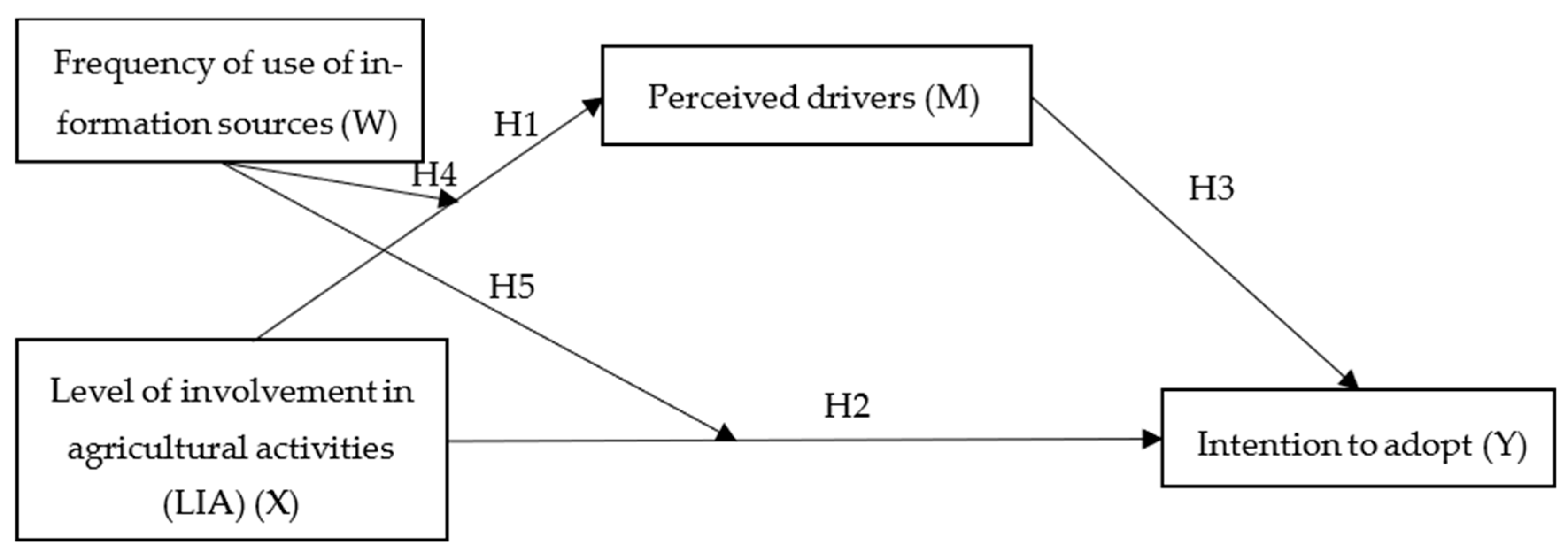
Building on the state of the art, we developed and tested the following six hypotheses. First, concerning the relationship between the level of involvement in agriculture (LIA, i.e., being a professional or hobby farmer) and perception of drivers and intention to use, studies [38,39] on the adoption of sustainable farming practices indicated that farmers’ intentions were stronger when these practices were perceived as tangible and aligned with farm goals. Furthermore, the few available studies on compost adoption [13,31,40] indicate that professional farmers showed a propensity to adopt compost when its use is associated with clear agronomic benefits and tangible economic returns [31,40]. Building on these previous findings, we developed and tested the following hypotheses.
H1: 
Being a professional farmer will show a positive association with perceived drivers (i.e., X has a positive effect on M).
H2: 
Being a professional farmer will show a positive association with intention to adopt (i.e., X has a positive effect on Y).
Regarding perceived drivers, prior research has consistently highlighted the role of positive attitudes; awareness of social norms; high perceived agronomic, environmental, and economic benefits; and low perceived risks in enhancing farmers’ interest in sustainable practice adoption [38,41,42]. In the case of compost adoption, Chen et al. [12] and Case et al. [9] showed that when users perceive clear advantages, such as improved soil quality, reduced environmental impact, or cost savings, their intention to adopt compost increases. Based on this evidence, we stated the following hypothesis:
H3: 
Perceived drivers will show a positive association with the intention to adopt (i.e., M has a positive effect on Y).
Regarding the role of information sources, the abovementioned studies, in the broader field of innovation, have shown that hobby farmers benefit from diversified information exposure beyond agriculture, while professional farmers’ innovation adoption is driven mainly by access to reliable knowledge [33,34]. Concerning compost adoption, to the best of our knowledge, only two studies [7,8] have examined the role played by information sources. Vigoroso et al. [8], comparing professionals and hobbyists in their compost adoption behaviors, showed that professional farmers display a significantly higher propensity to keep themselves informed about compost, alongside a trend, although non-significant, toward perceiving greater benefits from its use; Bagagiolo et al. [7] showed that farmers who directly received information and suggestion from peers and/or people who belong to their social network were influenced in their decision to adopt compost.
Based on this evidence, we expected the frequency of exposure to information sources to moderate the relationship between LIA and perceived drivers and between LIA and intention to adopt:
H4: 
The relationship between being a professional farmer and perceived drivers will be stronger at higher levels of exposure to information sources (i.e., W positively moderates the effect between X and M).
H5: 
The relationship between being a professional farmer and the intention to adopt compost will be stronger at higher levels of exposure to information sources (i.e., W positively moderates the effect between X and Y).
H6: 
The indirect relationship between LIA and intention to adopt via drivers is moderated by the frequency of use of information sources.
The proposed hypotheses are represented in Figure 1.

3. Materials and Methods

3.1. Participants

A sample of 119 participants in the study was chosen from among visitors at the “Ecomondo” Green Technology Expo, one of the largest European exhibitions in the field of green and CE events in Europe, held in Rimini, Emilia Romagna Region (Northeastern Italy). It is focused on the reuse and valorization of raw materials, energy, water resource monitoring and protection, and sustainable development. According to earlier research [44,45], exhibitions are a great setting for surveys and data-gathering activities because they draw a large audience with both recreational and professional interests.
Statistical power analysis through the G*Power (version 3.1) software [46] was used to calculate the a priori sample size based on Abbu and Gopalakrishna [47]. With four predictors—i.e., level of involvement in agriculture (LIA), perceived drivers, information sources, and LIA × information sources—as well as a medium effect size level (0.15), a moderate significance level (α = 0.05), and a power requirement of 0.90, the minimum sample size needed was 108.

3.2. Instruments and Procedure

A questionnaire was given to the participants in pencil and paper form. Trained research assistants distributed the questionnaire to the exhibition visitors after verbally explaining the study’s objectives, the questionnaire’s focus on compost made from municipal waste, and the fact that it was anonymous. As a first screening step, respondents were asked to confirm that they were Italian native speakers and that they were familiar with compost obtained from the organic fraction of municipal solid waste, either because they had heard about it, were interested in using it, or were current users. Participants were also asked to indicate their level of involvement in agricultural activities by self-identifying as either professional or hobby farmers. Clear definitions were provided in the questionnaire to support this classification, in line with Italian legislative decree (D.lgs. 99/04, modified by D.lgs. 101/05). Specifically, respondents were classified as professional farmers if at least 50% of their total working time and income derived from agricultural activity, whereas respondents whose agricultural production was intended exclusively for self-consumption and not for sale were classified as hobby farmers.
The questionnaire was written in Italian and required approximately ten minutes to complete. The use of Italian was intended to ensure full comprehension of the items and to reduce potential misunderstandings, particularly given the technical content related to compost characteristics and agricultural practices. There was no reward provided for taking the survey. All participants gave their verbal consent for inclusion before they participated in the study. The questionnaire was designed based on previous instruments [6,9,33,48,49] and consisted of five different sections. Only the variables that are relevant for the aims of the present study are described hereafter (see Table 1).

3.3. Data Analysis

Descriptive statistics were computed for participants’ sociodemographic information and all the variables of interest. The consistency of the items regarding perceived drivers (three items) and information sources (five items) was measured by computing Cronbach’s alpha coefficient [52]. After the reliability analysis, an aggregated score was computed as the sum of the considered items, leading to the creation of two scales, namely “drivers” and “information sources”. Then, to investigate the relationships between LIA, perceived drivers, frequency of use of information sources, and intention to adopt, we used the SPSS v26 PROCESS macro, model 8, v.4 [43], to test our moderated mediation hypotheses. We used 5000 bootstrap samples in the present study and determined the mediating effect at the 95% confidence interval. Parameters with an associated p-value < 0.05 were considered significant. In detail, model 8 is a first-stage conditional model process, in which “the moderator W operates on the first stage of the mediation process, with W moderating the effect of X on M but M’s effect on Y is fixed to be independent of W and any other variable in the model” [53]. At the same time, W moderates the effect of X on Y. As a result, the indirect effect of X on Y through M is conditional on the level of W. This model was selected because it best aligns with the conceptual framework of the present study, allowing the proposed relationships to be tested in a manner that is consistent with the underlying theoretical assumptions. Alternative model specifications would imply different relational structures that were not theoretically considered for the scope of the present research.
In addition, the choice of the PROCESS macro rather than structural equation modeling (SEM) was methodologically appropriate given the characteristics of the present study. PROCESS is easier to use than any SEM program, and it can estimate all the path coefficients, standard errors, t- and p-values, confidence intervals, and various other statistics useful for testing hypotheses, such as conditional indirect effects and the index of moderated mediation. Furthermore, as discussed by Hayes et al. [54], for models based entirely on observed variables, regression-based conditional process analysis and SEM yield substantively equivalent results, and the choice between the two approaches has no great influence in terms of parameter estimates and conclusions.

4. Results

Table 2 summarizes the main sociodemographic characteristics of the participants, whereas the descriptive statistics of the investigated variables and reliability values are reported in Table 3.
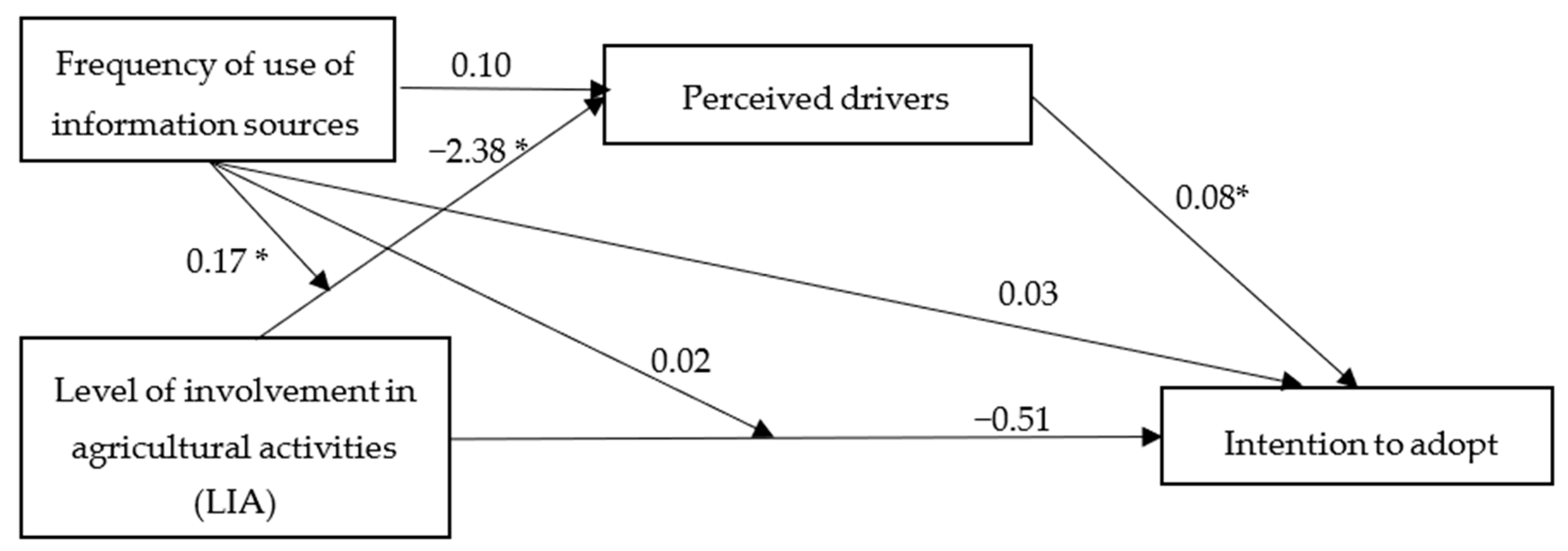
Figure 2 reports both direct and interaction effects among the studied variables. In detail, the figure shows the direct relationships between LIA, drivers, and intention to adopt, as well as the interaction between LIA and frequency of use of information sources on perceived drivers and intention to adopt.
Direct effects. The results of the mediation analysis showed that H1 was rejected since being a professional farmer was negatively related to the perceived drivers, which means that hobbyists perceived the incentives that encourage OFMSW compost adoption as more relevant compared with professional users (b = −2.38, Bse = 0.92, t = −2.58, p = 0.01). Being a professional farmer showed no significant associations with the intention to adopt compost from the OFMSW, making us reject H2 (b = −0.51, Bse = 0.32, t = −1.57, p = 0.11). Consistent with H3, the perceived drivers had a positive impact on intention to adopt (b = 0.08, Bse = 0.32, t = 2.5, p = 0.01).
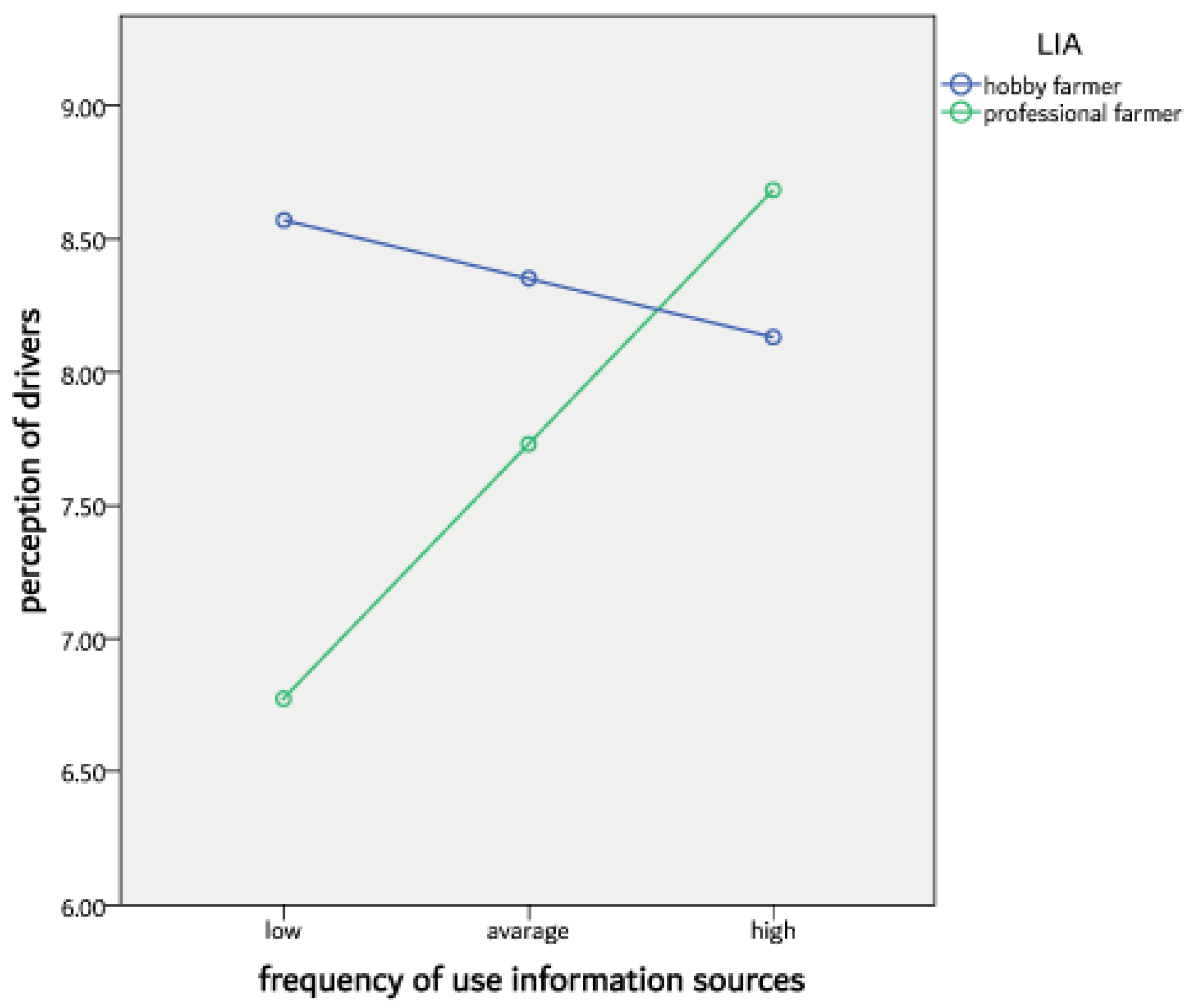
Moderation effects. Moreover, H4 was accepted since the interaction between the level of involvement in agriculture and the information sources (LIA × source) was significant for perceived drivers (b = 0.173, Bse = 0.74, t = 2.33, p = 0.0213). The effect of LIA was examined by simple main effects analyses above and below the means of the use of information sources. At the lower level of information sources, the main effect of LIA on the mediation variable was significant (b = −0.898, Bse = 0.346, t = −2.59, p = 0.0108). Figure 3 shows the moderation graphically, highlighting that at a low frequency of use of information sources, professionals perceived drivers of compost adoption as less relevant compared with hobby farmers. Finally, the frequency of exposure to information sources did not show a significant moderation effect on the association between LIA and the intention to adopt compost (b = 0.026, Bse = 0.02, t = 0.99, p = 0.320) (H5 rejected).
Overall moderated mediation effects. Finally, H6 was accepted since the overall test of moderated mediation (i.e., the relationship, via driver, between LIA and intention to adopt, moderated by information sources) was significant, as indicated by the index of moderated mediation (index =  0.014, 95% CI [0.0002, 0.0337]). As detailed in Table 4, the conditional indirect effect of LIA on intention to adopt was significant at low levels of frequency of use of information sources, while it became non-significant at medium and high levels.

5. Discussion

In this study, we tested a model of the relationships between being a hobby farmer and the intention to adopt compost from the OFMSW, considering the mediation of perceived drivers and the moderation of the frequency of exposure to information sources. The results showed that being a hobbyist was positively associated with perceiving compost adoption drivers (thus rejecting H1), which in turn had a positive impact on the intention to adopt it (therefore confirming H3). The findings also rejected H2 since no significant association was detected between being a professional farmer and the intention to adopt. H4 was instead confirmed since the frequency of use of information sources positively moderated the relationship between being a professional farmer and the perceived drivers, showing that a higher frequency of exposure to information sources can increase the perception of drivers for compost adoption among professional farmers. In contrast, H5 was not supported since the intention to adopt did not vary for professional farmers based on their exposure to information sources. In line with these results, H6 was supported, as the moderated mediation analysis showed that the indirect effect of being a professional farmer on intention to adopt through perceived drivers was conditional on the frequency of use of information sources.
Regarding the investigated drivers, the findings that hobbyists perceive the benefits as more significant compared with professional farmers can be explained by the fact that they pay for their farming activity, “rather than to obtain income from it”, and because the crops are primarily intended for personal consumption [57,58]. These factors may increase their sensitivity to cost-related drivers and strengthen their desire to grow food without pesticides or chemical inputs, as well as increase their interest in using fertilizing products with quality certifications. The greater openness of hobby farmers to compost adoption can be interpreted through different theoretical frameworks, including role identity theory. This perspective showed that individuals’ behaviors and evaluations are shaped by the social roles they identify with and by the meanings attached to those roles [59]; being a professional or a hobby farmer is not simply a structural distinction but reflects different normative expectations and values that guide decision-making. Hobby farmers, whose engagement in agriculture is often linked to lifestyle preferences and environmental values, may be more likely to perceive compost use as consistent with their role identity and thus attribute greater value to its perceived benefits. By contrast, professional farmers, whose role identity is more closely tied to productivity and economic performance, may assess compost primarily in terms of its instrumental and cost-related implications [27]. From this angle, the moderating role of information sources observed in this study becomes relevant. Exposure to targeted information may help reframe compost in ways that resonate with professional farmers’ role identity, highlighting agronomic effectiveness, certified quality, and economic returns [60]. Consistent with previous communication studies [61], which show that message–identity congruence shapes the relationship between perceived risk and perceived effectiveness when identity-consistent information is limited, professional farmers may be less inclined to view compost-related drivers as salient, whereas increased exposure can help align innovation attributes with their role-based expectations.
Nonetheless, because identity was not directly measured in the present study, this interpretation remains theoretical and should be empirically examined in future research by assessing farmers’ role identities and their alignment with sustainable practices. In light of these considerations, the outcome of the study contributes to the literature debate on the willingness to sustainably innovate among hobbyists compared to professionals [13,33], strengthening the assumption of the positive role of the hobby farmer.
The present results also add to the still-limited literature on the differences between professional and hobby farmers in attitudes toward the adoption of a number of behaviors, mainly related to occupational safety [62,63]. Given the high rate of hobbyists among farmers worldwide [27], further studies that compare the attitudes and behaviors of different categories of operators would be useful to support comprehensive actions toward an overall more sustainable farming system.
In line with the previous literature on the role of information sources to promote compost adoption [10,11], a significant moderating effect of information sources on perceived drivers that encourage compost adoption has been shown for professional farmers: professional farmers with little exposure to information sources had reduced perceived drivers. This limited exposure to information sources could be explained by the fact that farmers place a high value on independence [25] and frequently believe they are unaffected by the beliefs and actions of their neighbors [64] or may have difficulties in interfacing with extension workers [65], thus avoiding communication processes that are key for the diffusion of innovation [20]. Consistent with the diffusion of innovations theory [20], our results highlight the importance of communication channels in shaping how individuals evaluate innovation attributes. The moderating effect observed among professional farmers suggests that limited information exposure reduces the perceived relevance of compost-related drivers, whereas greater exposure supports the positive evaluations needed during the persuasion stage. Therefore, professional farmers may benefit from more frequent use of information sources.
This issue raises, as a practical implication, the need to employ a bottom-up approach to innovation diffusion in rural areas. Thus, the scientific community, public authorities, government and enterprises should be more linked with professional farmers to facilitate knowledge exchange, spread of innovation, and dissemination of the advantages of adopting sustainable and innovative practices to achieve sustainable objectives [66]. The usefulness of a CE approach in farming and benefits in the adoption of OFMSW compost should be stressed during communication and educational activities focused on the possibility of raising economic benefits, saving time, reducing physical workload through innovative sustainable practices [67]. Similarly, and despite the unwillingness of some farmers to share their farming experiences, the current literature [7,68] also recognizes the role of networks and social learning in enabling the generation of agricultural knowledge and the development of sustainable solutions. Regarding this, it should be considered that in the present study, the role of information sources was investigated through a single factor. Future research could examine the effectiveness of each information source at each stage of the diffusion process (i.e., awareness, information, application, trial, and adoption), given that different communication channels can intervene at various stages of the innovation–decision process [20]. This would help identify the sources that need to be improved to maximize their impact during the compost adoption process.
Finally, the significant positive relationship between perceived drivers and intention to adopt is consistent with Majbar et al. [69], who found that individual factors, particularly knowledge about the properties and benefits of compost, influence farmers’ perceptions and increase their interest in using compost. This acceptance is more likely to occur if farmers know the advantages of compost, how it is produced, and how to use it. Also, encouraging the sharing of this knowledge may be beneficial in fostering adoption among non-current but future potential users [7].
Overall, by showing how information channels moderate drivers’ perception and adoption intentions, the research offers practical guidance for designing innovation dissemination pathways that enhance sustainability-oriented practices, reduce reliance on chemical fertilizers, and foster the transition toward more resilient and circular agricultural systems. Ultimately, scaling OFMSW compost use in agriculture advances multiple EU priorities: closing nutrient loops (CE Action Plan), reducing synthetic fertilizer dependency (Farm to Fork Strategy), and enhancing soil health (Soil Mission 2030), positioning the study as a concrete contribution to integrated CE–agricultural sustainability frameworks. Even though the current study examined factors influencing views and adoption intentions across two major categories of potential large-volume compost consumers, some limitations should be considered. The current study had a small, non-probabilistic sample to start. It should be highlighted that this limitation is common to all surveys conducted on Italian farmers, as no comprehensive list of the population is available. However, past research has shown that visitors of agricultural exhibitions are a useful and valid source of questionnaire data regarding the social–psychological processes involved in farmers’ attitudes and behaviors and offer a reasonable balance between conducting effective surveys and collecting generalizable data [70]. Moreover, findings from non-representative samples typically affect the absolute level of the variables, not their relationships [71], and the latter were the main focus of this study. However, new studies conducted in countries where a full list of farmers in the population exists could provide information about the robustness of our findings.
Also, despite its fast and frugal characteristics, this sampling method allowed us to reach a niche group of users [69]. Future research should, however, include a broader range of participants and consider different sources of diversity in the farming population (such as gender, age, and experience; see Kernecker et al. [72] and McKillop et al. [73]) to obtain more generalizable results. Furthermore, our participants were recruited from attendees of a green technology fair. Consequently, it could be contended that our sample likely consisted of farmers more receptive to innovative and sustainability-sensitive ideas compared to non-participants and that our sampling method may have introduced a selection bias. However, the sociodemographic characteristics of our participants align with those of the Italian farming population [74,75], and also, as reported in the Results section, we covered a diverse spectrum among the study participants, including both compost users and non-users, and different intentions to adopt in the future. Thus, we have confidence in the overall validity of our findings.
Second, the information we gathered was self-reported and cross-sectional. Even though self-reporting is frequently adopted in this type of research [76], it is possible that participants’ answers were impacted by memory bias. To obtain a more complete and accurate understanding of the variables and processes under investigation, future research would benefit from designing a longitudinal study in which exposure to information channels is monitored and recorded at various time points. This study could also combine self-reported data collection with other methodologies, such as observations of information-seeking behaviors, to further explore the issue. In future developments, a mixed methods approach with a sequential explanatory design [77] could be employed. In this design, statistical results are refined and explained through qualitative data (such as semi-structured interviews), where farmers share their views on this type of compost in their own words.
Third, sociodemographic characteristics (e.g., age and level of education) were not considered in the model tested in the present study, although they may play a role in individuals’ decision to adopt (or not adopt) OFMSW compost (as is the case for other agricultural innovations [31,78]). Future research should address this limitation, also including those sociodemographic variables in the analysis.
Finally, the internal consistency of the driver construct showed a low Cronbach’s alpha value. This result may be explained by several factors. For instance, the limited sample size may have further contributed to the low-reliability coefficient [79] and been affected by the heterogeneous nature of the items [51,80] included in this construct (i.e., informational and economic). However, the construct was retained considering that all three items represent relevant drivers within the theoretical framework of the study. As a consequence, the low value may limit the strength of conclusions reported specifically for this construct, and related results should be interpreted with caution.

6. Conclusions

Based on the present results, exposure to information and the perception of enablers represent key aspects to be considered to support the intention to adopt OFMSW compost. Exposing farmers to different sources of information will increase their awareness of several factors that support compost adoption and, as a result, their intention to adopt compost. These interventions can address all users, but particularly professional farmers, who, on the one hand, struggle to incorporate new practices into their farming activities until they see the benefits, and, on the other hand, represent the wider pool of potential compost users, compared with off-farm users [81]. From a theoretical perspective, this research contributes to the literature on compost adoption and circular economy practices. In particular, it shows that perceived drivers are a key mechanism that might link farmers’ intention to adopt and that such a mechanism works differently depending on the frequency of exposure to information sources. By integrating mediation and moderation within the same framework, the findings provide greater nuance in understanding how adoption intentions can be influenced by informational contexts and groups of users.
From an empirical perspective, this study provides novel evidence that professional and hobby farmers differ meaningfully in the mechanisms underlying their intention to adopt compost derived from organic municipal solid waste. The results show that the two groups respond differently to perceived drivers and to exposure to information sources, confirming that farmers’ level of involvement in agricultural activities is a relevant factor shaping sustainability-oriented adoption decisions. By empirically demonstrating that information channels and perceived benefits operate through distinct pathways for professionals and hobbyists, this study moves beyond treating farmers as a homogeneous group and highlights the importance of differentiated analytical and policy approaches. These findings contribute empirical support to the idea that circular economy practices in agriculture diffuse unevenly across user profiles, reinforcing the need for targeted strategies to foster innovation uptake.
With regard to the policy implications of the present findings, they suggest that policies aimed at promoting the circular use of OFMSW compost in agriculture should prioritize the strengthening of information, training, and peer-based knowledge networks. Given the central role of perceived drivers and information exposure—particularly for professional farmers—public authorities and agricultural policymakers should support bottom-up, network-oriented strategies that facilitate dialogue among farmers, hobbyists, researchers, extension services, and industry actors. Investments in targeted training programs, field demonstrations, and peer-to-peer exchange platforms can help translate technical knowledge about compost quality, certification, and agronomic performance into practice-relevant information.
A peer network could be created, and user-to-user communication and conversations about the benefits, drawbacks, and qualities of compost could be improved to share the knowledge and attitudes of farmers and hobbyists. These network-based communications and other forms of peer social interaction should be leveraged through the development of policies and organizational structures intended to promote public initiatives to enhance users and potential users’ awareness about compost properties and characteristics. For instance:
  • Farmers’ associations could invest in targeted educational and meeting initiatives, developing proper platforms;
  • Governments should collaborate closely with agricultural extension services to provide farmers with composting-related information, resources, and technical assistance;
  • Extension agencies can provide information on composting procedures, field demonstrations, and on-farm trials to demonstrate the benefits of compost use in local contexts.
More broadly, integrating these network-based communication and training actions into circular economy and rural development policies would enhance awareness, reduce uncertainty, and accelerate the diffusion of compost use as a sustainable agricultural practice. Beyond these implications, some avenues for future research can be outlined based on the present findings. First, further studies should include larger and more heterogeneous samples of both professional and hobby farmers, building on the variability already observed in terms of gender, age and education levels in the present sample and explicitly consider additional sources of diversity such as farm size and farming experience in order to obtain more generalizable evidence on the intention to adopt OFMSW compost. Finally, experimental or quasi-experimental evaluations of targeted communication, training and peer-to-peer initiatives are required to identify which combinations of policy tools and extension strategies are most effective in increasing perceived drivers and promoting compost adoption, particularly among professional farmers, who represent a key target group for circular waste management strategies.
In addition, future research should consider qualitative methodologies (e.g., semi-structured interviews or focus groups) to better understand the reasons behind farmers’ perceptions of compost adoption drivers and the role played by information sources. Such qualitative approaches could provide a deeper understanding of how professional and hobby farmers interpret compost-related benefits and constraints and how different communication channels shape these evaluations in practice.

Author Contributions

Conceptualization, G.D.P., L.V., F.C. and N.P.; methodology, L.V., F.C. and N.P.; formal analysis, L.V.; investigation, L.V. and N.P.; data curation, G.D.P. and L.V.; writing—original draft preparation, G.D.P. and L.V.; writing—review and editing, F.C. and N.P.; project administration, N.P. All authors have read and agreed to the published version of the manuscript.

Funding

This research received no external funding.

Institutional Review Board Statement

This study was conducted in full compliance with the ethical requirements of the Italian Psychological Association and with the applicable regulations of the European Union and the Italian Republic, including the General Data Protection Regulation (EU 2016/679, GDPR). Participation was voluntary and anonymous. Participants were fully informed about the purposes and scope of the study and provided informed consent prior to taking part. No financial compensation was provided.

Informed Consent Statement

Informed consent was verbally obtained from all subjects involved in the study.

Data Availability Statement

The raw data supporting the conclusions of this article will be made available by the authors upon request.

Conflicts of Interest

The authors declare no conflicts of interest.

Abbreviations

The following abbreviations are used in this manuscript:
OFMSWOrganic fraction of municipal solid waste
MSWMunicipal solid waste
LIALevel of involvement in agriculture

References

  1. ISPRA (Istituto Superiore per la Protezione e Ricerca Ambientale). Rapporto Rifiuti Urbani. 2021. Available online: https://www.isprambiente.gov.it/files2022/pubblicazioni/rapporti/rapportorifiutiurbani_ed-2021-n-355-conappendice_agg18_01_2022.pdf (accessed on 9 November 2025).
  2. Parsa, A.; Van De Wiel, M.; Schmutz, U.; Taylor, I.; Fried, J. Balancing people, planet, and profit in urban food waste management. Sustain. Prod. Consum. 2024, 45, 203–215. [Google Scholar] [CrossRef]
  3. Lofthouse, V.; Prendeville, S. Human-Centred Design of Products and Services for the Circular Economy—A Review. Des. J. 2018, 21, 451–476. [Google Scholar] [CrossRef]
  4. Assandri, D.; Pampuro, N.; Zara, G.; Bianco, A.; Cavallo, E.; Budroni, M. Co-Composting of Brewers’ Spent Grain with Animal Manures and Wheat Straw: Influence of Two Composting Strategies on Compost Quality. Agronomy 2021, 11, 1349. [Google Scholar] [CrossRef]
  5. Viaene, J.; Van Lancker, J.; Vandecasteele, B.; Willekens, K.; Bijttebier, J.; Ruysschaert, G.; Reubens, B. Opportunities and barriers to on-farm composting and compost application: A case study from northwestern Europe. Waste Manag. 2016, 48, 181–192. [Google Scholar] [CrossRef] [PubMed]
  6. Rahmani, M.; Hodges, A.W.; Kiker, C.F. Compost Users’ Attitudes Toward Compost Application in Florida. Compost Sci. Util. 2004, 12, 55–60. [Google Scholar] [CrossRef]
  7. Bagagiolo, G.; Vigoroso, L.; Pampuro, N.; Cavallo, E. The Role of Social Interaction and Personal Characteristics in Affecting the Adoption of Compost from Organic Fraction of Municipal Solid Waste in Italy. Agronomy 2022, 12, 445. [Google Scholar] [CrossRef]
  8. Vigoroso, L.; Pampuro, N.; Bagagiolo, G.; Cavallo, E. Factors Influencing Adoption of Compost Made from Organic Fraction of Municipal Solid Waste and Purchasing Pattern: A Survey of Italian Professional and Hobbyist Users. Agronomy 2021, 11, 1262. [Google Scholar] [CrossRef]
  9. Case, S.D.C.; Oelofse, M.; Hou, Y.; Oenema, O.; Jensen, L.S. Farmer perceptions and use of organic waste products as fertilisers—A survey study of potential benefits and barriers. Agric. Syst. 2017, 151, 84–95. [Google Scholar] [CrossRef]
  10. Ciavatta, C.; Centemero, M.; Toselli, M.; Zaccone, C.; Senesi, N. Compost production, analysis and applications in agriculture. In Multi-Scale Biogeochemical Processes in Soil Ecosystems: Critical Reactions and Resilience to Climate Changes; Yang, Y., Keiluweit, M., Senesi, N., Xing, B., Eds.; Wiley: New York, NY, USA, 2022; pp. 297–321. [Google Scholar]
  11. Walker, P.; Williams, D.; Waliczek, T.M. An analysis of the horticulture industry as a potential value-added market for compost. Compost Sci. Util. 2006, 14, 23–31. [Google Scholar] [CrossRef]
  12. Chen, T.; Zhang, S.; Yuan, Z. Adoption of solid organic waste composting products: A critical review. J. Clean. Prod. 2020, 272, 122712. [Google Scholar] [CrossRef]
  13. Folefack, A.J.J. The determinants for the adoption of compost from household waste for crop production by farmers living nearby Yaounde, Cameroon: Descriptive and logit model approaches of analysis. Int. J. Biol. Chem. Sci. 2015, 9, 308–328. [Google Scholar] [CrossRef]
  14. Truc, N.T.T.; Sumalde, Z.M.; Espaldon, M.V.O.; Pacardo, E.P.; Rapera, C.L.; Palis, F.G. Farmers’ awareness and factors affecting adoption of rapid composting in Mekong Delta, Vietnam and Central Luzon, Philippines. J. Environ. Sci. Manag. 2012, 15, 59–73. [Google Scholar]
  15. Oslo Manual. Guidelines for Collecting and Interpreting Innovation Data, 3rd ed.; OECD Publishing: Paris, France, 2005; Available online: https://www.oecd.org/content/dam/oecd/en/publications/reports/2005/11/oslo-manual_g1gh5dba/9789264013100-en.pdf (accessed on 25 January 2026).
  16. Genius, M.; Pantzios, C.J. Information Acquisition and Adoption of Organic Farming Practices. J. Agric. Resour. Econ. 2014, 31, 93–113. [Google Scholar]
  17. Unay Gailhard, İ.; Bavorová, M.; Pirscher, F. Adoption of agri-environmental measures by organic farmers: The role of interpersonal communication. Iran J. Bot. 2015, 21, 127–148. [Google Scholar]
  18. Biddoccu, M.; Opsi, F.; Cavallo, E. Relationship between runnoff and soil losses with rainfall characteristics and long term soil management practices in hilly vineyard (Piedmont, NW Italy). J. Soil Sci. Plant Nutr. 2014, 60, 92–99. [Google Scholar] [CrossRef]
  19. Pulina, A.; Lai, R.; Seddaiu, G.; Bertora, C.; Rizzu, M.; Grignani, C.; Roggero, P.P. Global warming potential of a Mediterranean irrigated forage system: Implications for designing the fertilization strategy. Eur. J. Agron. 2018, 98, 25–36. [Google Scholar] [CrossRef]
  20. Rogers, E.M. Diffusion of Innovations, 5th ed.; Free Press: New York, NY, USA, 2003; Available online: https://books.google.es/books?id=9U1K5LjUOwEC (accessed on 25 January 2026).
  21. Caffaro, F.; Micheletti Cremasco, M.; Roccato, M.; Cavallo, E. Drivers of farmers’ intention to adopt technological innovations in Italy: The role of information sources, perceived usefulness, and perceived ease of use. J. Rural Stud. 2020, 76, 264–271. [Google Scholar] [CrossRef]
  22. McBride, W.; Daberkow, S. Information and the adoption of precision farming technologies. J. Agribus. 2003, 2003, 21–38. [Google Scholar]
  23. Defrancesco, E.; Gatto, P.; Runge, F.; Trestini, S. Factors Affecting Farmers’ Participation in Agri-environmental Measures: A Northern Italian Perspective. J. Agric. Econ. 2008, 59, 114–131. [Google Scholar] [CrossRef]
  24. DBO. Taking the Leap from Hobby and Part-Time Farming to a Full-Time Venture. 2023. Available online: https://www.bdo.ca/insights/from-hobby-part-time-to-full-time-farming#:~:text=Operating%20a%20farm%20business%20where,your%20main%20source%20of%20revenue (accessed on 9 November 2025).
  25. Caffaro, F.; Lundqvist, P.; Micheletti Cremasco, M.; Nilsson, K.; Pinzke, S.; Cavallo, E. Machinery-related perceived risks and safety attitudes in senior Swedish farmers. J. Agromed. 2018, 23, 78–91. [Google Scholar] [CrossRef]
  26. Kristensen, S.P. Multivariate analysis of landscape changes and farm characteristics in a study area in central Jutland, Denmark. Ecol. Model. 2003, 168, 303–318. [Google Scholar] [CrossRef]
  27. Song, B.; Robinson, G.M.; Bardsley, D.K. Hobby and part-time farmers in a multifunctional landscape: Environmentalism, lifestyles, and amenity. Geogr. Res. 2022, 60, 480–497. [Google Scholar] [CrossRef]
  28. Firdaus, R.R.; Ebekozien, A.; Samsurijan, M.S.; Rosli, H. What Drives the Young Malaysian Generation to Become Horticulture Farmers? A Qualitative Approach. Millenn. Asia 2024, 15, 465–486. [Google Scholar] [CrossRef]
  29. Guzmán, G.I.; López, D.; Román, L.; Alonso, A.M. Participatory action research in agroecology: Building local organic food networks in Spain. Agroecol. Sustain. Food 2013, 37, 127–146. [Google Scholar] [CrossRef]
  30. Yang, W.Y.; Ju, X.F. Analysis of Farmers’ technology innovation adoption impacted by internal and external factor. In Proceedings of the 2014 International Conference on Management Science & Engineering (ICMSE), 21st Annual Conference Proceedings, Helsinki, Finland, 17–19 August 2014; pp. 1512–1517. [Google Scholar]
  31. Rizzo, G.; Migliore, G.; Schifani, G.; Vecchio, R. Key factors influencing farmers’ adoption of sustainable innovations: A systematic literature review and research agenda. Org. Agric. 2024, 14, 57–84. [Google Scholar] [CrossRef]
  32. Vasavi, S.; Anandaraja, N.; Murugan, P.P.; Latha, M.R.; Selvi, R.P. Challenges and strategies of resource poor farmers in adoption of innovative farming technologies: A comprehensive review. Agric. Syst. 2025, 227, 104355. [Google Scholar] [CrossRef]
  33. Walder, P.; Sinabell, F.; Unterlass, F.; Niedermayr, A.; Fulgeanu, D.; Kapfer, M.; Melcher, M.; Kantelhardt, J. Exploring the relationship between farmers’ innovativeness and their values and aims. Sustainability 2019, 11, 5571. [Google Scholar] [CrossRef]
  34. Vollaro, M.; Raggi, M.; Viaggi, D. Innovation adoption and farm profitability: What role for research and information sources? Bio-Based Appl. Econ. 2020, 8, 179–210. [Google Scholar]
  35. Braun, H.; Apfel, D.; Rilling, B.; Herbes, C. On the irrelevance of (peat-free) substrates-Qualitative insights into the social practices of hobby gardeners in Germany. Clean. Responsible Consum. 2024, 14, 100201. [Google Scholar] [CrossRef]
  36. Diekmann, F.; Loibl, C.; Batte, M.T. The economics of agricultural information: Factors affecting commercial farmers’ information strategies in Ohio. Appl. Econ. Perspect. Policy 2009, 31, 853–872. [Google Scholar] [CrossRef]
  37. Knierima, A.; Borgesb, F.; Kerneckerb, M.L.; Krausb, T.; Wurbsbù, A. What drives adoption of smart farming technologies? Evidence from a cross-country study. In Proceedings of the 13th European International Farm Systems Association Symposium (IFSA), Chania, Greece, 1–5 July 2018; pp. 1–5. [Google Scholar]
  38. Li, J.; Feng, S.; Luo, T.; Guan, Z. What drives the adoption of sustainable production technology? Evidence from the large scale farming sector in East China. J. Clean. Prod. 2020, 257, 120611. [Google Scholar] [CrossRef]
  39. McCollum, C.; Bergtold, J.S.; Williams, J.; Al-Sudani, A.; Canales, E. Perceived benefit and cost perception gaps between adopters and non-adopters of in-field conservation practices of agricultural producers. Sustainability 2022, 14, 11803. [Google Scholar] [CrossRef]
  40. Liu, M.; Liu, H. Farmers’ adoption of agriculture green production technologies: Perceived value or policy-driven? Heliyon 2023, 10, e23925. [Google Scholar] [CrossRef]
  41. Swart, R.; Levers, C.; Davis, J.; Verburg, P. Meta-analyses reveal the importance of socio-psychological factors for farmers’ adoption of sustainable agricultural practices. One Earth 2023, 6, 1771–1783. [Google Scholar] [CrossRef]
  42. Tankosić, J.; Ignjatijević, S.; Lekić, N.; Kljajić, N.; Ivaniš, M.; Andžić, S.; Ristić, D. The role of environmental attitudes and risk for adoption with respect to farmers’ participation in the agri-environmental practices. Agriculture 2023, 13, 2248. [Google Scholar] [CrossRef]
  43. Hayes, A.F. Introduction to Mediation, Moderation, and Conditional Process Analysis; Guilford Press: New York, NY, USA, 2013. [Google Scholar]
  44. Lin, C.T.; Lin, C.W. Exhibitor perspectives of exhibition service quality. J. Conv. Event Tour. 2013, 14, 293–308. [Google Scholar] [CrossRef]
  45. Urano, K.; Hiroi, K.; Kaji, K.; Kawaguchi, N. A location estimation method using ble tags distributed among participants of a large-scale exhibition. In Proceedings of the Adjunct Proceedings of the 13th International Conference on Mobile and Ubiquitous Systems: Computing Networking and Services, Hiroshima, Japan, 28 November–1 December 2016; pp. 124–129. [Google Scholar]
  46. Faul, F.; Erdfelder, E.; Lang, A.G.; Buchner, A. G* Power 3: A flexible statistical power analysis program for the social, behavioral, and biomedical sciences. Behav. Res. Methods 2007, 39, 175–191. [Google Scholar] [CrossRef]
  47. Abbu, H.R.; Gopalakrishna, P. Synergistic effects of market orientation implementation and internalization on firm performance: Direct marketing service provider industry. J. Bus. Res. 2021, 125, 851–863. [Google Scholar] [CrossRef]
  48. Caffaro, F.; Roccato, M.; Micheletti Cremasco, M.; Cavallo, E. An ergonomic approach to sustainable development: The role of information environment and social-psychological variables in the adoption of agri-environmental innovations. J. Sustain. Dev. 2019, 27, 1049–1062. [Google Scholar] [CrossRef]
  49. Adrian, A.M.; Norwood, S.H.; Mask, P.L. Producers’ perceptions and attitudes toward precision agriculture technologies. Comput. Electron. Agric. 2005, 48, 256–271. [Google Scholar] [CrossRef]
  50. Orsini, S.; Costanzo, A.; Solfanelli, F.; Zanoli, R.; Padel, S.; Messmer, M.M.; Schaefer, F. Factors affecting the use of organic seed by organic farmers in Europe. Sustainability 2020, 12, 8540. [Google Scholar] [CrossRef]
  51. Canavari, M.; Gori, F.; Righi, S.; Viganò, E. Factors fostering and hindering farmers’ intention to adopt organic agriculture in the Pesaro-Urbino province (Italy). AIMS Agric. Food 2022, 7, 108–129. [Google Scholar] [CrossRef]
  52. Cronbach, L. Coefficeint alpha and the internal struture of tests. Psychometrika 1951, 16, 297–334. [Google Scholar] [CrossRef]
  53. Hayes, A.F.; Rockwood, N.J. Conditional process analysis: Concepts, computation, and advances in the modeling of the contingencies of mechanisms. Am. Behav. Sci. 2020, 64, 19–54. [Google Scholar] [CrossRef]
  54. Hayes, A.F.; Montoya, A.K.; Rockwood, N.J. The analysis of mechanisms and their contingencies: PROCESS versus structural equation modeling. Australas. Mark. J. 2017, 25, 76–81. [Google Scholar] [CrossRef]
  55. van Griethuijsen, R.A.; van Eijck, M.W.; Haste, H.; den Brok, P.J.; Skinner, N.C.; Mansour, N.; Savran Gence, A.; BouJaoude, S.; BouJaoude, S. Global Patterns in Students’ Views of Science and Interest in Science. Res. Sci. Educ. 2015, 45, 581–603. [Google Scholar] [CrossRef]
  56. Módosné Szalai, S.; Jenei, S.; Németh, E. Knowledge or Confidence? Exploring the Interplay of Financial Literacy, Digital Financial Behavior, and Self-Assessment in the FinTech Era. FinTech 2025, 4, 75. [Google Scholar] [CrossRef]
  57. Gellrich, M.; Baur, P.; Robinson, B.H.; Bebi, P. Combining classification tree analyses with interviews to study why sub-alpine grasslands sometimes revert to forest: A case study from the Swiss Alps. Agric. Syst. 2008, 96, 124–138. [Google Scholar] [CrossRef]
  58. Seufert, V.; Austin, S.E.; Badami, M.G.; Turner, S.; Ramankutty, N. The diversity of organic farmer motivations and livelihoods in the Global South–A case study in Kerala, India. Geoforum 2023, 138, 103670. [Google Scholar] [CrossRef]
  59. Stryker, S.; Burke, P.J. The Past, Present, and Future of an Identity Theory. Soc. Psychol. Q. 2000, 63, 284–297. [Google Scholar] [CrossRef]
  60. Rust, N.; Jarvis, R.; Reed, M.; Cooper, J. Framing of sustainable agricultural practices by the farming press and its effect on adoption. Agric. Hum. Values 2021, 38, 753–765. [Google Scholar] [CrossRef]
  61. Ngo, C.; Poortvliet, P.; Feindt, P. Examining the Effectiveness of Climate Change Communication with Adolescents in Vietnam: The Role of Message Congruency. Water 2020, 12, 3016. [Google Scholar] [CrossRef]
  62. Caffaro, F.; Roccato, M.; Micheletti Cremasco, M.; Cavallo, E. Part-time farmers and accidents with agricultural machinery: A moderated mediated model on the role played by frequency of use and unsafe beliefs. J. Occup. Health 2018, 60, 80–84. [Google Scholar] [CrossRef] [PubMed]
  63. McGwin, G.; Enochs, R.; Roseman, J.M. Increased risk of agricultural injury among African—American farm workers from Alabama and Mississippi. Am. J. Epidemiol. 2000, 152, 640–650. [Google Scholar] [CrossRef] [PubMed][Green Version]
  64. Burton, R.J.F. Reconceptualising the “behavioural approach” in agricultural studies: A socio-psychological perspective. J. Rural Stud. 2004, 20, 359–371. [Google Scholar] [CrossRef]
  65. Banmeke, T.O.A.; Ajayi, M.T. Farmers’ perception of the agricultural information resource centre at Ago-Are, Oyo State, Nigeria. Int. J. Agric. Econ. Rural. Dev. 2008, 1, 22–29. [Google Scholar]
  66. Jiao, X.; Zhang, H.; Ma, W.; Wang, C.; Li, X.; Zhang, F. Science and Technology Backyard: A novel approach to empower smallholder farmers for sustainable intensification of agriculture in China. J. Integr. Agric. 2019, 18, 1657–1666. [Google Scholar] [CrossRef]
  67. Eppler, M.J.; Hoffmann, F. Strategies for Business Model Innovation: Challenges and Visual Solutions for Strategic Business Model Innovation. In Strategy and Communication for Innovation; Pfeffermann, N., Minshall, T., Mortara, L., Eds.; Springer: Berlin, Heidelberg, 2013. [Google Scholar]
  68. Perdana, T.; Kusnandar, K.; Perdana, H.H.; Hermiatin, F.R. Circular supply chain governance for sustainable fresh agricultural products: Minimizing food loss and utilizing agricultural waste. Sustain. Prod. Consum. 2023, 41, 391–403. [Google Scholar] [CrossRef]
  69. Majbar, Z.; El Madani, F.Z.; Khalis, M.; Lahlou, K.; Ben Abbou, M.; Majbar, E.B.; Rais, Z. Farmers’ Perceptions and Willingness of Compost Production and Use to Contribute to Environmental Sustainability. Sustainability 2021, 13, 13335. [Google Scholar] [CrossRef]
  70. Reichardt, M.; Jürgens, C. Adoption and future perspective of precision farming in Germany: Results of several surveys among different agricultural target groups. Precis. Agric. 2009, 10, 73–94. [Google Scholar] [CrossRef]
  71. Roccato, M. L’uso della statistica nella ricerca in psicologia sociale [Using statistics in social psychological research]. In Metodi, Modelli e Tecnologie dell’Informazione a Supporto delle Decisioni [Methods, Models and Information Technologies for Decision Support]; Di Maio, A., Gallo, M., Simonetti, B., Eds.; Franco Angeli: Milano, Italy, 2008; pp. 183–191. [Google Scholar]
  72. Kernecker, M.; Knierim, A.; Wurbs, A.; Kraus, T.; Borges, F. Experience versus expectation: Farmers’ perceptions of smart farming technologies for cropping systems across Europe. Precis. Agric. 2020, 21, 34–50. [Google Scholar] [CrossRef]
  73. McKillop, J.; Heanue, K.; Kinsella, J. Are all young farmers the same? An exploratory analysis of on-farm innovation on dairy and drystock farms in the Republic of Ireland. J. Agric. Educ. Ext. 2018, 24, 137–151. [Google Scholar] [CrossRef]
  74. CREA (Consiglio per la Ricerca in Agricoltura e l’analisi dell’Economia Agraria). L’agricoltura Italiana Conta 2021. 2021. Available online: https://www.crea.gov.it/documents/68457/0/ITACONTA+2021_ITA_WEB+%282%29.pdf/21e95e09-864b-102c-881a-9aa0c02fb44c?t=1641314141536 (accessed on 9 November 2025).
  75. INPS (Istituto Nazionale Previdenza Sociale). Statistiche in Breve. Anno 2022 Mondo Agricolo. 2023. Available online: https://servizi2.inps.it/servizi/osservatoristatistici/api/getAllegato/?idAllegato=1003 (accessed on 9 November 2025).
  76. Lioutas, E.D.; Charatsari, C. Green innovativeness in farm enterprises: What makes farmers think green? J. Sustain. Dev. 2017, 26, 337–349. [Google Scholar] [CrossRef]
  77. Creswell, J.W.; Plano Clark, V.L.; Gutmann, M.; Hanson, W. Advanced mixed methods research designs. In Handbook on Mixed Methods in the Behavioral and Social Sciences; Tashakkori, A., Teddlie, C., Eds.; Sage: Thousand Oaks, CA, USA, 2003; pp. 209–223. [Google Scholar]
  78. Olatade, K.O.; Olugbire, O.O.; Adepoju, A.A.; Aremu, F.J.; Oyedele, P.B. How does farmers’ characteristics affect their willingness to adopt agricultural innovation? The case of biofortified cassava in Oyo State, Nigeria. AFRREV STECH Int. J. Sci. Technol. 2016, 5, 59–75. [Google Scholar] [CrossRef]
  79. Yurdugül, H. Minimum sample size for Cronbach’s coefficient alpha: A Monte-Carlo study. Hacet. Üniversitesi Eğitim Fakültesi Derg. 2008, 35, 397–405. [Google Scholar]
  80. Tavakol, M.; Dennick, R. Making sense of Cronbach’s alpha. Int. J. Med. Educ. 2011, 2, 53–55. [Google Scholar] [CrossRef] [PubMed]
  81. Centemero, M.; Caimi, V.; Adani, F. L’impiego del Compost in Agricoltura “The Use of Compost in Agriculture”. Available online: https://www.researchgate.net/publication/238682407_L%27IMPIEGO_DEL_COMPOST_IN_%0AAGRICOLTURA_THE_USE_OF_COMPOST_IN_AGRICULTURE (accessed on 9 November 2025).
Figure 1. Moderated mediation model with perceived drivers as mediator (M) and information sources as a moderator (W). LIA is the independent variable (X), and intention to adopt is the dependent variable (Y) (SPSS PROCESS, model 8 [43]).
Agriculture 16 00329 g001
Figure 2. Results of the model tested. Regression coefficients are reported for each path and interaction. * p < 0.05.
Agriculture 16 00329 g002
Figure 3. Effect exerted on perceived drivers by the interaction between LIA (being a hobby or professional farmer) and declaring to use information sources rarely vs. frequently. Simple slopes were calculated after centering the independent (i.e., recoding −1 the hobbyist farmers and 1 the professional ones) and the moderator variables (i.e., recoding −1 the participants who had low frequency in using information sources and 1 the participants using them more frequently). The association between information-source use and perceived drivers differs by LIA group, with perceived drivers increasing among professional farmers and slightly decreasing among hobbyists as information-source use increases.
Agriculture 16 00329 g003
Table 1. Sections, items, and answer options of the questionnaire used in the present study.
SectionsSourceItemsResponses
1. Perceived drivers [9]Availability of expert adviceFor each option: 1—“strongly disagree”; 2—“disagree”; 3—“agree”; 4—“strongly agree”
Availability of official quality certification
Reducing production costs
2. Frequency of use of information sources [48]Videos and internetFor each option: 1—“never”; 2—“rarely”; 3—“sometimes”; 4—“often”
Journals and advertisements
Seminars and training courses
Discussions with peers/relatives
Discussions with consultants/
trade organizations
3. Intention to adopt [49,50,51]Intention to adopt compost from organic urban waste1 = surely not, 2 = probably not, 3 = probably yes, and 4 = surely yes
4. Sociodemographic data Level of involvement in agriculture0 = hobby farmer, 1 = professional farmer
Gender0 = female, 1 = male, 2 = other/prefer not to declare
AgeOpen answer
Education1 = primary school, 2 = secondary school, 3 = high school, and 4 = degree and over
Table 2. Main sociodemographic characteristics of the participants.
Variable Levels n %
GenderMen9680.7
Women2319.3
Level of involvement in agricultural activities (LIA)Professional farmer5243.7
Hobbyist farmer6756.3
EducationMiddle school119.2
High school4739.5
University degree5042
Post-graduate119.2
Current adoptionProfessional farmer1714.28
GenderHobby farmer3126.05
Mean (SD)
Intention to adoptProfessional farmer3.17 (1.02)
Hobby farmer3.61 (0.78)
Age 41.64 (14.17)
Table 3. Descriptive statistics and reliability analysis for the variables of interest.
SectionItems Mean (SD) Cronbach’s α
OverallProfessionalsHobbyists
Perceived driversAvailability of expert advice2.35 (1.24)2.31 (1.30)2.39 (1.20)0.40 1
Availability of official quality
certification
2.59 (1.32)2.52 (1.39)2.64 (1.27)
Reducing production costs3.16 (1.23)2.94 (1.29)3.33 (1.73)
Information sourcesVideos and internet2.78 (0.94)2.81 (0.76)2.76 (1.06)0.73
Journals and advertisements2.45 (0.93)2.31 (0.89)2.55 (0.95)
Seminars and training courses2.13 (1.04)2.15 (0.91)1.97 (0.98)
Discussions with peers/relatives2.57 (1.01)2.67 (0.94)2.49 (1.06)
Discussions with consultants/
trade organizations
2.05 (0.95)2.17 (0.98)2.09 (1.09)
Intention to adoptIntention to adopt compost from
organic urban waste
3.42 (0.16)3.17 (1.02)3.61 (0.77)
1 Values under 0.6 were accepted, mainly due to the small number of items that contributed to the factor [55] and the heterogeneous nature of the items [56]. Furthermore, to support the adequacy of this construct, an exploratory factor analysis (EFA, no-rotation) was performed on the three items. The analysis yielded a single-factor solution explaining 45.68% of the variance, with good factor loadings, which are 0.689, 0.704, and 0.633.
Table 4. Moderated mediation effect.
Information SourcesEffectBootstrapped Standard ErrorBootstrapped LLCIBootstrapped ULCI
M − SD−0.0710.046−0.182−0.003
M−0.0240.024−0.0840.009
M + SD0.0220.027−0.0340.080
Disclaimer/Publisher’s Note: The statements, opinions and data contained in all publications are solely those of the individual author(s) and contributor(s) and not of MDPI and/or the editor(s). MDPI and/or the editor(s) disclaim responsibility for any injury to people or property resulting from any ideas, methods, instructions or products referred to in the content.