


Abstract
Sweet potato (Ipomoea batatas (L.) Lam.) is an important root crop in China, playing significant roles in ensuring national food security and increasing farmers’ income. The sprouting capability of sweet potato storage roots determines the quality of sweet potato seedlings and serves as a prerequisite for ensuring yield and quality. With the increasing severity of sweet potato viral diseases, the decline of the sprouting capability of seed roots has led to severe declines in both the yield and quality of sweet potatoes. It is urgent to uncover the genetic basis and molecular mechanisms underlying the sprouting capabilities of storage roots with different virus contents. In this study, storage roots with different virus contents of two sweet potato varieties, Jishu 25 (J25) and Jishu 26 (J26), were evaluated for sprouting capability and virus content, including chlorotic stunt virus (CSV), feathery mottled virus (FMV), sweet potato virus G (SPVG), sweet potato latent virus (SPLV), and sweet potato chlorotic fleck virus (SPCFV). The results show that the storage roots with low virus levels of both varieties exhibited stronger sprouting capability and lower virus content. Comparative transcriptome analysis of the differences in sprouting capabilities between storage roots with different virus content revealed that the starch metabolism, cellulose metabolism, jasmonic acid (JA) signaling pathway, and salicylic acid (SA) signaling pathways are potential biological pathways contributing to the differences in sprouting capabilities between storage roots with different virus contents. This study provides evidence for further research on the sprouting mechanisms of sweet potatoes.
1. Introduction
Sweet potato (Ipomoea batatas (L.) Lam.) is an autohexaploid root and tuber crop which belongs to the Ipomoea section of the Convolvulaceae family. It is abundant in nutrients such as starch and carotenoid and also possesses strong stress tolerance and wide adaptability. Therefore, sweet potato is established as a crucial staple crop and industrial resource in developing countries and is widely used in healthcare, food and feed processing, and bioenergy production. In short, sweet potato is an economically important crop and plays a significant role in ensuring food security [1,2,3,4].
As a vegetatively propagated crop, sweet potato production primarily relies on harvested storage roots (i.e., seed roots) for seedlings propagation, followed by seedling cutting to produce new storage roots. Thus, production of seed roots is the primary step in sweet potato cultivation. The quality of the seed roots determines the quality of the seedlings. Sprouting capability is a key trait for measuring the quality of the seed roots, mainly including the time of sprouting, the seedling growth rate, and the number and weight of seedlings produced per kilogram of storage roots. Seed roots with strong sprouting capability typically produce seedlings earlier with greater numbers and stronger vigor, which is prerequisite for high sweet potato yield and quality [5,6,7].
Viral diseases are significant diseases affecting the yield and quality of sweet potatoes [8,9]. At present, more than 20 species of viruses have been discovered in China that can cause viral diseases in sweet potatoes, mainly including chlorotic stunt virus (CSV), feathery mottled virus (FMV), sweet potato virus G (SPVG), sweet potato latent virus (SPLV), and sweet potato chlorotic fleck virus (SPCFV). The accumulation of viruses leads to severe declines in both the yield and quality of seed roots and impair their sprouting capabilities [8,10]. Sweet potatoes reproduce asexually, allowing for viruses to transmit to subsequent generations and resulting in progressively worsening viral diseases that can ultimately lead to complete crop failure [11]. Therefore, storage roots with low virus levels produced from virus-free tissue-cultured sweet potato plantlets in aphid-proof greenhouses or net houses significantly reduce the risk of viral diseases than storage roots with high virus levels and are commonly used as seed roots for propagation [12,13,14]. However, current research on the differences in sprouting capabilities between storage roots with different virus contents, as well as the molecular mechanisms underlying these differences, remains limited. Further exploration could provide valuable insights for understanding the sprouting characteristics of sweet potatoes.
In a previous study, Li et al. [15] found that the virus carrying rate of the Jishu 25 and Jishu 26 storage roots harvested in Binzhou was 17.41–41.25%, whereas rates of storage roots from Yulin were only 1.43–8.72%. Thus, storage roots from Yulin were considered to be low in virus content, while those from Binzhou were considered to be high in virus content. Storage roots from these two regions were sampled for further investigation. This study aims to compare the sprouting capabilities, including the number and weight of seedlings produced per kilogram of storage roots between low- and high-virus-content storage roots of Jishu 25 and Jishu 26. Comparative transcriptome analysis was used to investigate the biological processes associated with differences in sprouting abilities. These findings can provide evidence for further research on sweet potato sprouting capabilities.
2. Materials and Methods
2.1. Plant Materials
Two cultivated varieties, Jishu 25 (J25) and Jishu 26 (J26), were selected. Low virus content storage roots of J25 and J26 harvested in Yulin, Shaanxi Province, China (38°49′41″ N, 109°48′78″ E), in 2023. High-virus-content storage roots were harvested in Binzhou, Shandong Province, China (37°22′35″ N, 118°39′18″ E). The sprouting capability experiment was conducted in 2024 at the experimental nursery of the Crop Research Institute, Shandong Academy of Agricultural Sciences (Jinan, Shandong Province, China; 36°70′83″ N, 117°07′76″ E). The storage roots with low and high virus levels of J25 and J26 were designated into four groups: J25-L (low virus content), J25-H (high virus content), J26-L (low virus content), and J26-H (high virus content), respectively. All sweet potato materials were provided and maintained by the Crop Research Institute, Shandong Academy of Agricultural Sciences, Jinan, China.
2.2. Sprouting Capability Assessment for Each Variety
Following the method described by Hou [16], sprouting ability was evaluated using the sparse arrangement method with a planting density of 15 kg/m2. The healthy, medium-similar sized storage roots of uniform size from each group (J25-L, J25-H, J26-L, and J26-H) were selected. Three independent biological replicates were taken from each group, and each biological replicate consisting of 15 kg storage roots which planted in an area of one square meter. Sprouting was photographed at 15 and 45 days after planting (DAPs). At 45 DAPs, the number of sprouts and sprout weight per kilogram of storage roots were recorded.
2.3. Transcriptome Analysis
Transcriptome sequencing and analysis were performed by Novogene Co., Ltd. (Tianjin, China). Storage roots were sampled from the groups described in 2.1 at 15 DAPs. Three biological replicates were analyzed per group, with each replicate pooled from five individual storage roots. The total RNA of 12 samples (four groups with three biological replicates) was extracted using an RNA isolator, Total RNA Extraction Reagent (Vzayme, Nanjing, China). RNA quality detection and sequencing library construction were conducted using the Agilent 2100 bioanalyzer (Santa Clara, CA, USA). Qualified libraries were sequenced on the Illumina HiSeq™ platform (San Diego, CA, USA) [17]. Raw data were filtered to remove low-quality reads (reads containing adapters, undetermined bases, or where more than 50% of the bases had a Qphred ≤ 20), resulting in clean data used for subsequent analysis. Q20, Q30, and GC content were calculated for the clean data. Transcriptome assembly was performed using Trinity software v2.4.0 [18]. FPKM values (Fragments Per Kilobase of transcript per Million mapped reads) were calculated for each gene based on gene length and the number of mapped reads. The DESeq2 R package (version 1.20.0) was used for identification and expression analysis of differentially expressed genes (DEGs). An FDR < 0.05, as determined by DESeq2 R package, was considered to indicate differential expression genes. DEGs were identified using thresholds of |log2 (Fold change)| ≥ 1 and p < 0.05. KOBAS software v2.0.12 was used for KEGG pathway enrichment analysis of the DEG sets, with p < 0.05 set as the threshold for significant pathway enrichment [19].
2.4. qRT-PCR Analysis of DEGs
qRT-PCR was used to the detection of chlorotic stunt virus (CSV), feathery mottled virus (FMV), sweet potato virus G (SPVG), sweet potato latent virus (SPLV), and sweet potato chlorotic fleck virus (SPCFV) in sweet potato storage roots and evaluate the relative expression of DEGs according to Hou et al. [6].
Total RNA was extracted from liquid nitrogen-frozen root samples using the Vazyme Total RNA Extraction Kit (Vazyme, Nanjing, China). cDNA was synthesized by reverse transcription using the Takara Reverse Transcription Kit (Takara, Kusatsu, Japan) and used as the template. qRT-PCR was performed using the CFX Connect Real-Time System (Bio-Rad, Hercules, CA, USA) and ChamQ Universal SYBR qPCR Master Mix (Vazyme, Nanjing, China). The reaction program was as follows: initial denaturation at 95 °C for 30 s, followed by 40 cycles of 95 °C for 10 s and 60 °C for 15 s. The IbActin gene in sweet potato was used as an internal reference for calculating relative virus content and the relative expression of DEGs. Table A1 (Appendix A) lists the primer sequences for all genes used in this study. Three technical replicates were set up for each experiment, and the relative expression levels of genes were calculated using the comparative CT method [20].
2.5. Statistical Analysis
All data were analyzed using a two-tailed Student’s t-test with SPSS 26.0 (https://www.ibm.com/support/pages/downloading-ibm-spss-statistics-26-transition-extended-support-30-sep-2025, accessed on 28 September 2025). Data are shown as means ± standard deviation (SD). Transcriptomics data were normalized between 0 and 1 using MinMax normalization [21] in heatmaps, which involves subtracting the minimum value of the dataset, dividing the result by the max–min difference, and scaling the data proportionally for better presentation. Heatmaps were generated using TBtools software v2.333 [22].
3. Results
3.1. Assessment of Sweet Potato Sprouting Capability
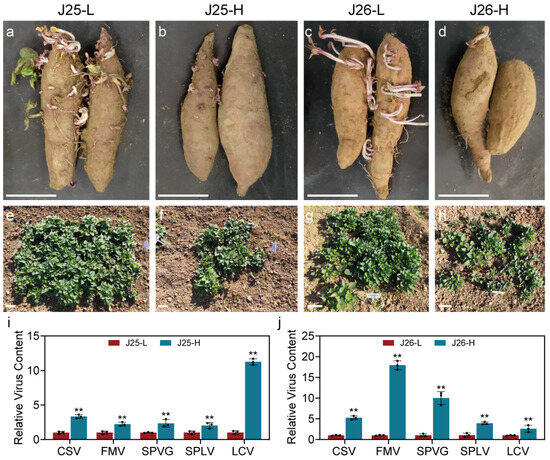
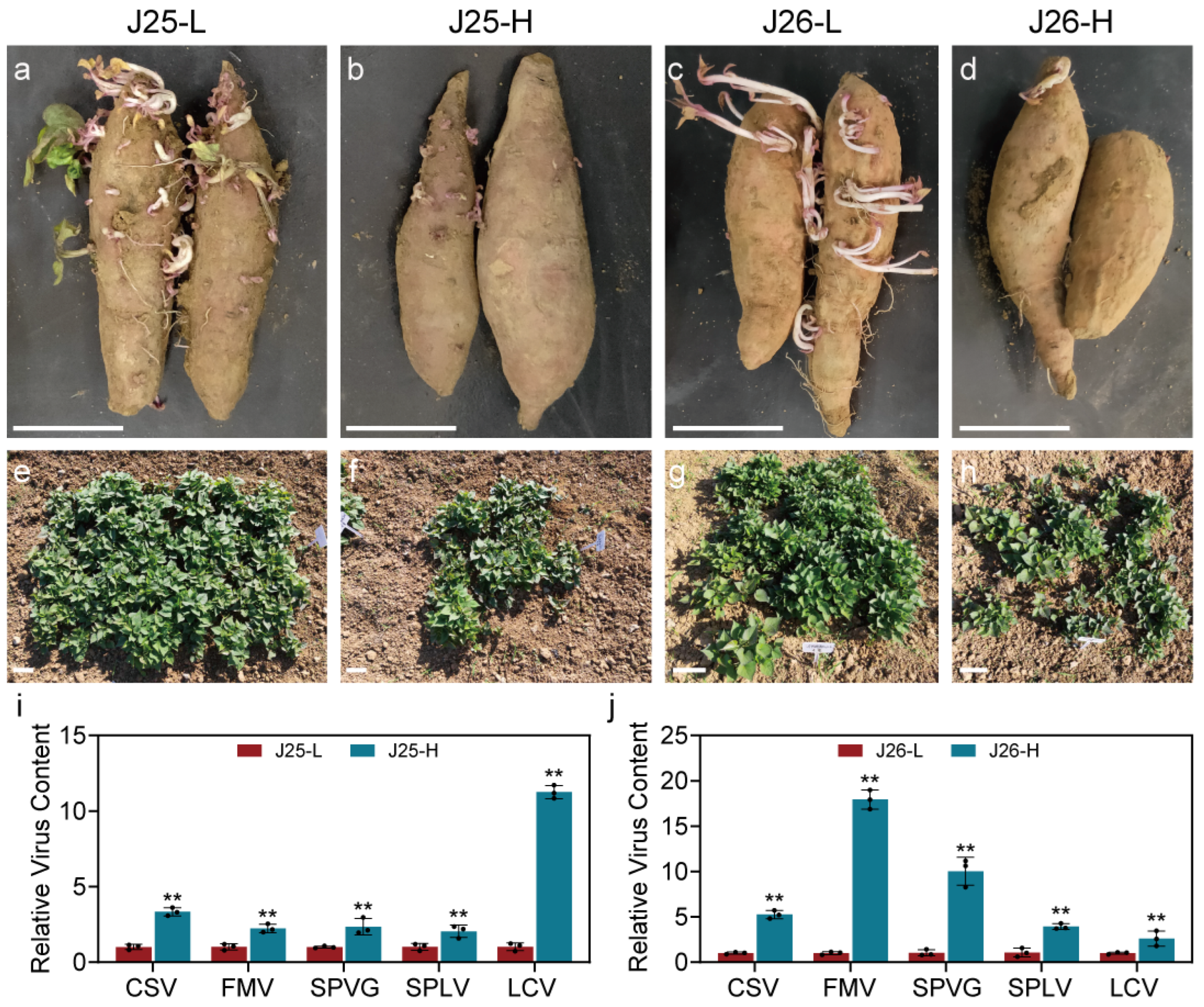
The sprouting capability of storage roots with low and high virus levels were observed at 15 DAPs. As shown in Figure 1a–d, J25-L and J26-L sprouted earlier than J25-H and J26-H. By this time, sprouts from J25-L had emerged and turned green, while those from J26-L had emerged but not yet greened. J25-H and J26-H were just beginning to sprout. These results indicate that storage roots with low virus content had superior initial sprouting vigor. The overall sprouting situation was observed 45 days after planting. Figure 1e–h and Table A2 show that the number and weight of sprouts per kilogram storage roots from J25-L and J26-L was significantly higher than that from J25-H and J26-H, further confirming the superior sprouting capability of storage roots with low virus levels. qRT-PCR results show that the content of five key virus species, including CSV, FMV, SPVG, SPLV, and LCV [23], in storage roots with low virus levels of J25 and J26 was significantly lower than in the storage roots with high virus levels (Figure 1i,j).
Figure 1.
Sprouting capability evaluation of Jishu 25 and Jishu 26. (a–d) Sprouting performance of sweet potato (Ipomoea batatas) storage roots: storage roots with low virus levels of Jishu 25 (J25-L), storage roots with high virus levels of Jishu 25 (J25-H), storage roots with low virus levels of Jishu 26 (J26-L), and storage roots with high virus levels of Jishu 26 (J26-H), respectively. Scale bar = 5 cm. (e–h) Field germination characteristics of Jishu 25 storage roots with low virus levels, Jishu 25 storage roots with high virus levels, Jishu 26 storage roots with low virus levels, and Jishu 26 storage roots with high virus levels, respectively. Scale bar = 10 cm. (i,j) Detection of common sweet potato virus contents in Jishu 25 storage roots with low and high virus levels, and Jishu 26 storage roots with low and high virus levels, respectively. Data are presented as mean ± SD (n = 3). ** indicates a statistically significant difference (p < 0.01) in virus content between storage roots with low and high virus levels, as determined by Student’s t-test.
3.2. Transcriptome Sequencing Quality Assessment
High-throughput transcriptome sequencing was performed on a total of 12 samples (J25-L, J25-H, J26-L, and J26-H, each with three biological replicates). After filtering, a total of 100.92 Gb of data and 336,426,336 clean reads were obtained, with an average of 8.41 Gb per library. The GC content ranged from 45.25% to 45.99%, Q20 was ≥97.91%, and Q30 was ≥93.96% (Table 1). The sequencing error rate was between 0.02% and 0.03%. These results indicate high-quality sequencing data suitable for subsequent bioinformatics analysis.
Table 1.
Transcriptome quality control data of the storage roots with low and high virus levels of different sweet potato varieties.
3.3. Identification of Different Expression Genes (DEGs)
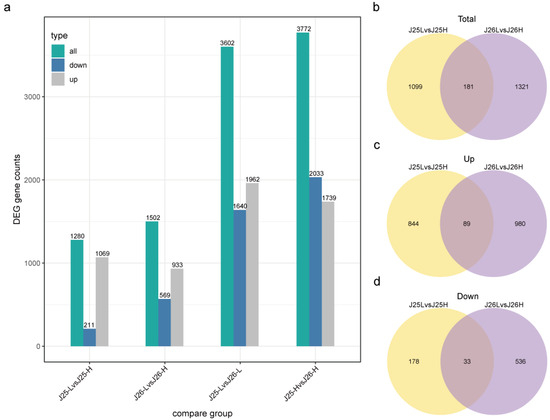
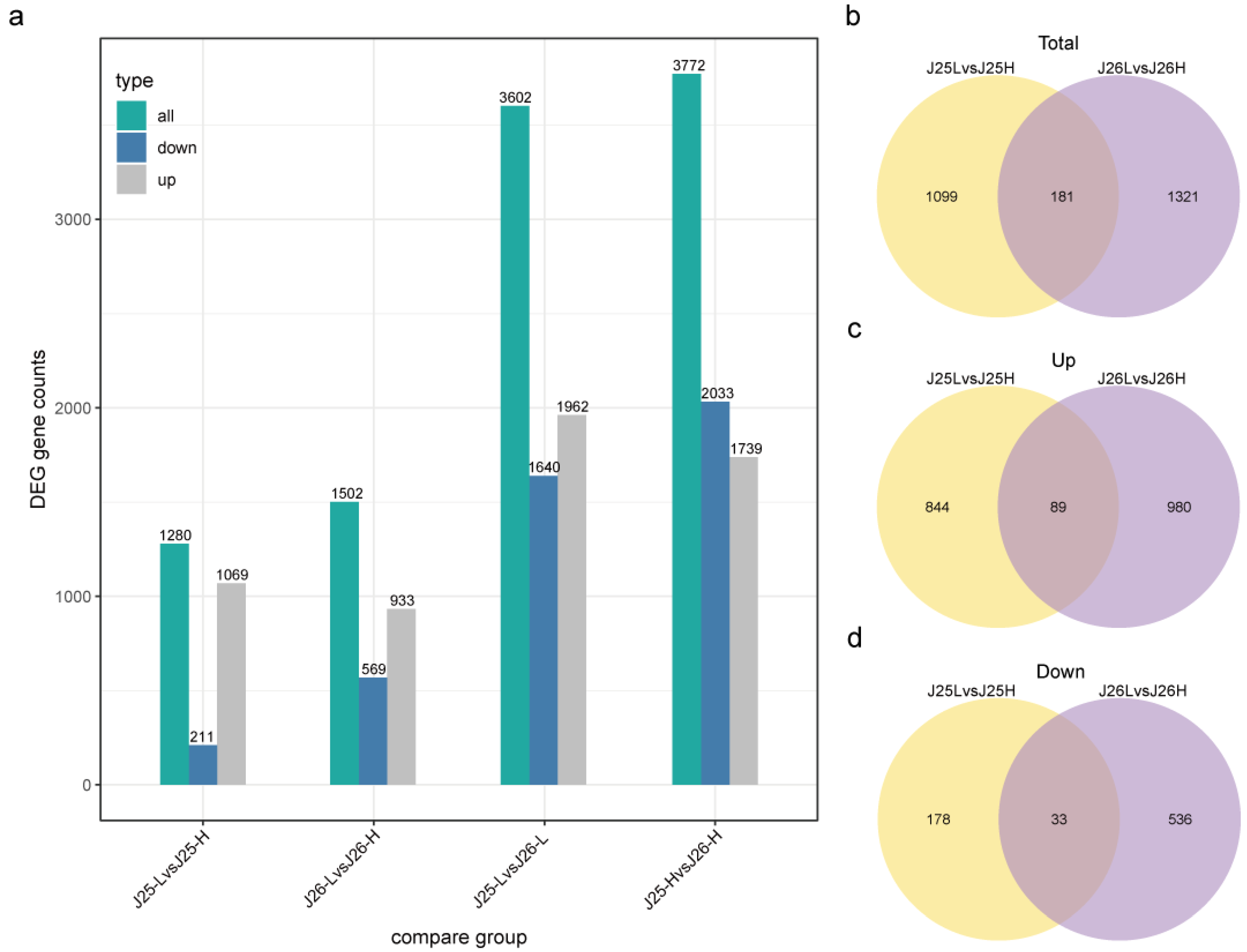
To investigate the molecular mechanisms underlying sweet potato’s sprouting capability, we selected four comparison groups with significant phenotypic differences in sprouting capability for differential expression analysis: J25-L vs. J25-H, J26-L vs. J26-H, J25-L vs. J26-L, and J25-H vs. J26-H. As shown in Figure 2, 1280 DEGs (211 down-regulated, 1069 up-regulated) were identified in the J25-L vs. J25-H comparison, 1502 DEGs (569 down-regulated, 933 up-regulated) in J26-L vs. J26-H, 3602 DEGs (1640 down-regulated, 1962 up-regulated) in J25-L vs. J26-L, and 3772 DEGs (2033 down-regulated, 1739 up-regulated) in J25-H vs. J26-H (Figure 2a).
Figure 2.
Number of DEGs in different comparison groups. (a) Number of DEGs in different comparison groups. (b) Number of common DEGs in J25-L vs. J25-H and J26-L vs. J26-H. (c) Number of common up-regulated DEGs in J25-L vs. J25-H and J26-L vs. J26-H. (d) Number of common down-regulated DEGs in J25-L vs. J25-H and J26-L vs. J26-H.
To better explore the DEGs associated with the differences in sprouting capability between storage roots with low and high virus levels, the DEGs from J25-L vs. J25-H and J26-L vs. J26-H were intersected. A total of 181 common DEGs were identified, including 89 up-regulated and 33 down-regulated genes (Figure 2b–d). These overlapping DEGs were then subjected to subsequent analysis.
3.4. KEGG Enrichment Analysis of Different Biological Pathways Between Storage Roots with Low and High Virus Levels
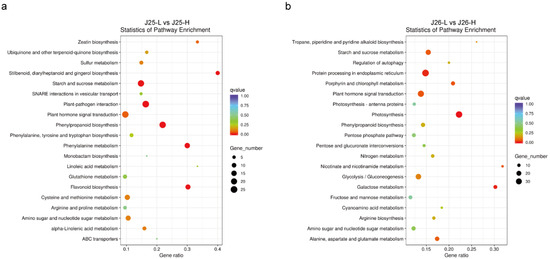
KEGG pathway enrichment analysis was performed on the common DEGs in J25-L vs. J25-H and J26-L vs. J26-H. The results show that in the J25-L vs. J25-H group, DEGs were primarily enriched in carbon metabolism-related pathways (starch and sucrose metabolism), phenylpropanoid biosynthesis-related pathways (phenylpropanoid biosynthesis, phenylalanine, tyrosine, and tryptophan biosynthesis, phenylalanine metabolism, flavonoid biosynthesis), and plant signal transduction-related pathways (plant–pathogen interaction, plant hormone signal transduction) (Figure 3a).
Figure 3.
KEGG analysis of DEGs for J25-L vs. J25-H (a) and J26-L vs. J26-H (b). Fisher’s exact test was employed for the KEGG pathway enrichment analysis. The color of the dots represents the q-value, with a smaller q-value indicated by a color closer to red. The size of the dots represented the number of DEGs in that pathway.
In the J26-L vs. J26-H group, DEGs were mainly enriched in carbon metabolism-related pathways (starch and sucrose metabolism, pentose phosphate pathway, pentose and glucuronate interconversions, Glycolysis/Gluconeogenesis, galactose metabolism, fructose and mannose metabolism), phenylpropanoid biosynthesis-related pathways (phenylpropanoid biosynthesis), plant signal transduction-related pathways (plant hormone signal transduction), and photosynthesis-related pathways (photosynthesis—antenna proteins, photosynthesis, porphyrin, and chlorophyll metabolism) (Figure 3b).
In summary, common DEGs from both J25-L vs. J25-H and J26-L vs. J26-H comparisons were enriched in the starch and sucrose metabolism (carbon metabolism), phenylpropanoid biosynthesis (phenylpropanoid synthesis), and plant hormone signal transduction (plant signal transduction), indicating that these three pathways might participate in regulating sweet potato’s sprouting capability under different virus contents.
3.5. Analysis of DEGs in Key Pathways
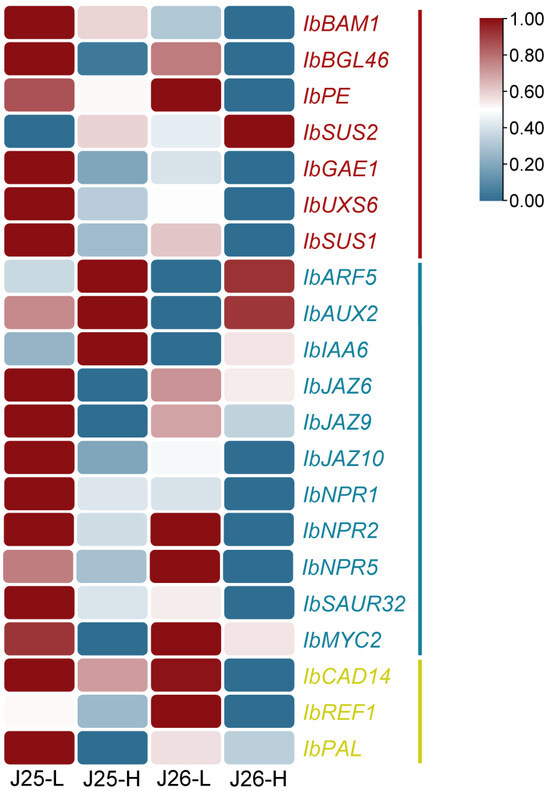
Subsequently, DEGs enriched in the starch and sucrose metabolism, phenylpropanoid biosynthesis, and plant hormone signal transduction pathways were analyzed. DEGs in the starch and sucrose metabolism mainly included key enzyme genes for starch degradation such as β-Amylase (IbBAM1), key enzyme genes for sucrose metabolism such as Sucrose Synthase (IbSUS1 and IbSUS2), key genes for cellulose metabolism such as β-Glucosidase (IbBGL46), UDP-Glucuronate 4-Epimerase (IbGAE1), UDP-Glucuronate Decarboxylase (IbUXS6), and a key enzyme gene for pectin degradation, Pectinesterase (IbPE) (Figure 4). Except for IbSUS2, the expression levels of all these genes were higher in J25-L and J26-L than in J25-H and J26-H, suggesting that efficient sprouting is perhaps accompanied by rapid degradation of starch and cell wall-related components.
Figure 4.
FPKM values of DEGs. Genes differentially expressed in starch and sucrose metabolism are highlighted in red, those in the plant hormone signal transduction pathway are in blue, and those in phenylpropanoid biosynthesis are in yellow. Values were normalized from 0 to 1, with the colors representing their distribution.
DEGs in the plant hormone signal transduction pathway mainly included jasmonic acid (JA)-responsive genes (IbJAZ6, IbJAZ9, IbJAZ10, IbMYC2), auxin (IAA)-responsive genes (IbIAA6, IbSAUR32) and an IAA transport protein gene (Auxin Influx Carrier, IbAUX2), salicylic acid (SA)-responsive genes (IbNPR1, IbNPR2, IbNPR5), and an abscisic acid (ABA)-responsive gene (IbARF5). Among these, JA- and SA-responsive genes were highly expressed in J25-L and J26-L, while the ABA-responsive gene IbARF5 was expressed at higher levels in J25-H and J26-H. The IAA-responsive gene IbIAA6 and the transport protein gene IbAUX2 showed higher expression in J25-H and J26-H, whereas IbSAUR32 was highly expressed in J25-L and J26-L (Figure 4). These results indicate that the sweet potato sprouting capability under different virus content is regulated by multiple hormones and that the JA and SA signaling pathways potentially have a more significant impact.
DEGs in the phenylpropanoid biosynthesis pathway mainly included genes encoding Cinnamyl alcohol dehydrogenase (IbCAD14), Coniferyl-aldehyde dehydrogenase (IbREF1), and Phenylalanine ammonia-lyase (IbPAL). All these genes were expressed at higher levels in J25-L and J26-L (Figure 4).
3.6. qRT-PCR Validation of Different Expression Genes
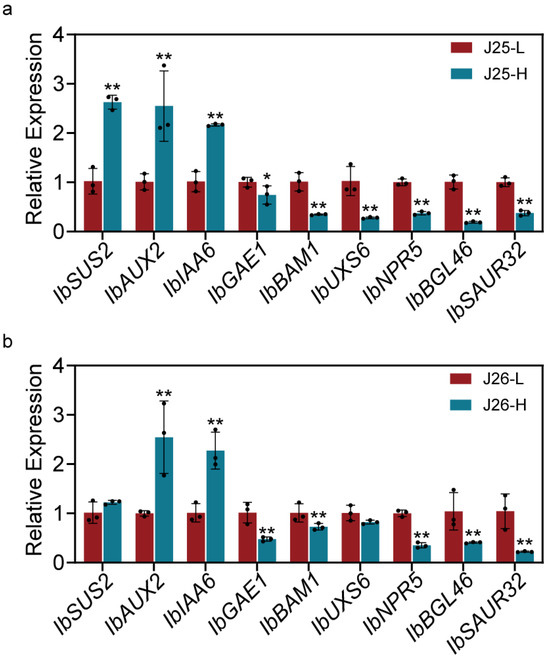
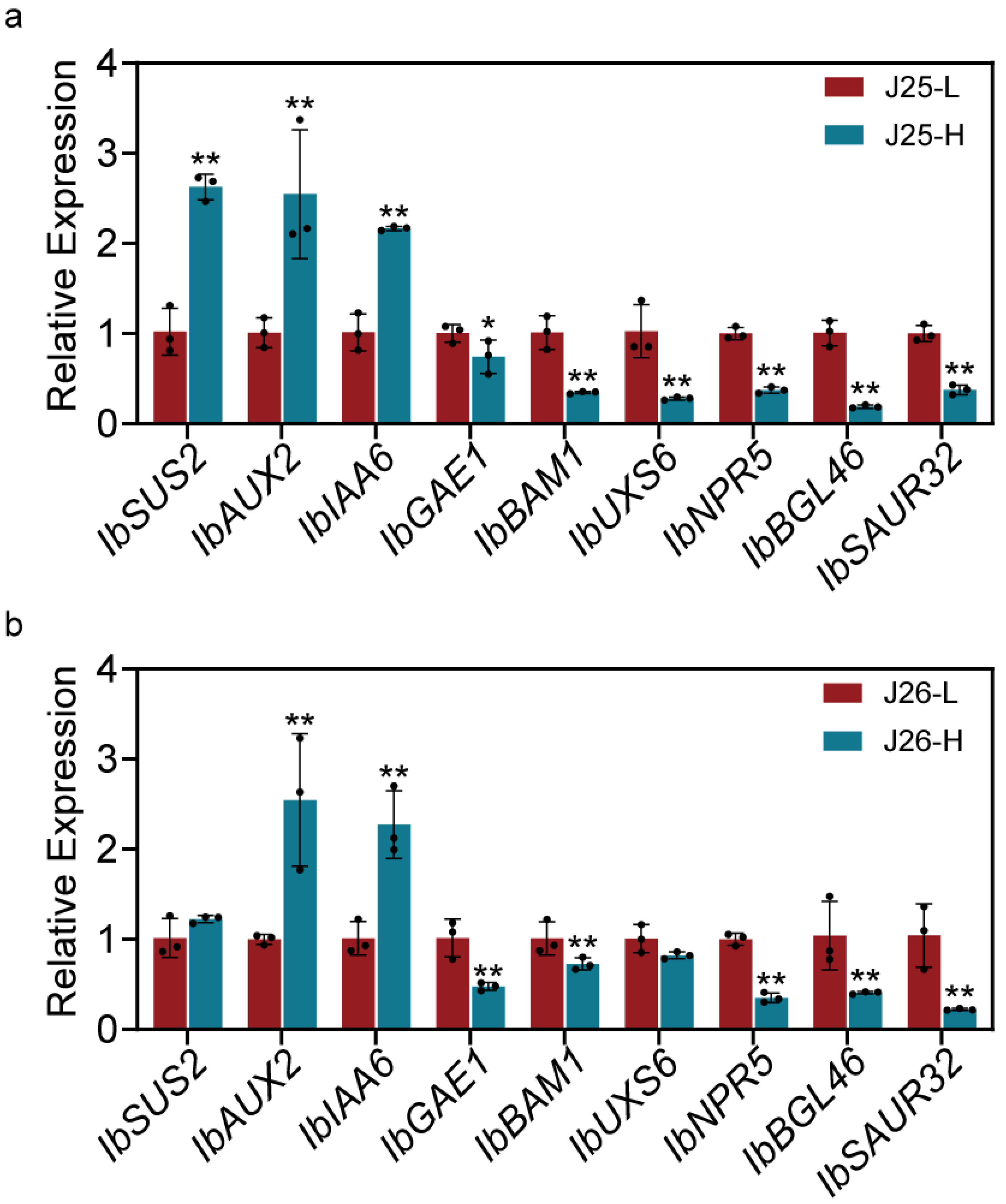
To validate the reliability of the transcriptome data, nine DEGs enriched in the starch and sucrose metabolism, phenylpropanoid biosynthesis, and plant hormone signal transduction pathways were selected for qRT-PCR validation. The results show that among these nine DEGs, the expression levels of IbSUS2, IbAUX2, and IbIAA6 were significantly higher in J25-H compared to J25-L, while the other seven genes showed the opposite trend (Figure 5a). In J26, the expression levels of IbSUS2 and IbUXS6 showed no significant difference between J26-L and J26-H, while the expression trends of the remaining genes were the same as in J25 (Figure 5b). Overall, the nine DEGs exhibited expression trends consistent with the transcriptome sequencing results, validating the reliability of the transcriptome data.
Figure 5.
qRT-PCR validation of relative expression levels of nine DEGs. (a,b) Relative expression levels of nine differentially expressed genes in storage roots with low and high virus levels of Jishu 25, and storage roots with low and high virus levels of Jishu 26, respectively. Data are presented as mean ± SD (n = 3). * and ** indicate statistically significant differences in gene expression between storage roots with low and high virus levels at p < 0.05 and p < 0.01, respectively, as determined by Student’s t-test.
4. Discussion
Sweet potato sprouting is a complex process. It involves active cell division, differentiation, metabolism, and transport of substances. This process is influenced by plant hormones and storage conditions.
4.1. Starch Degradation Provides Nutrients for Sweet Potato Sprouting
Starch is the main nutrient in sweet potato storage roots [24]. Its degradation plays a vital role in providing essential nutrients for sprouting and ensuring the growth of sweet potato seedlings [5,25]. Amylase, including α-amylase and β-amylase, catalyze the hydrolysis of starch into soluble sugars for plant growth and development [26]. Geng et al. [27] found that β-amylase plays an important role in starch degradation in the storage roots of the sweet potato variety ‘Yanshu 25’. The activity of β-amylase is highly positively correlated with the sprouting ability of ‘Yanshu 25’. Studies by Zhang et al. [12] also demonstrated that β-amylase activity is associated with sweet potato sprouting capabilities. In our transcriptome analysis, the expression level of the β-amylase gene (IbBAM1) was significantly higher in J25-L and J26-L compared to J25-H and J26-H (Figure 4). This result further suggests that β-amylase could participate in promoting sweet potato sprouting.
4.2. Cell Wall Metabolism Is an Important Biological Process for Sweet Potato Sprouting
The plant cell wall is a complex and dynamic structure. It mainly consists of cellulose, hemicellulose, pectin, lignin, and proteins. These components act as a cytoskeleton. They provide shape, volume, structure, rigidity, and strength to plant cells and connect plant cells together [28]. Therefore, the structure of the cell wall determines how plants grow. During the growth of above-ground plant parts, plants must loosen and rebuild their cell walls. This process drives cell growth in a precisely controlled spatial and temporal pattern [29,30,31].
The aerial parts of plants are formed through cell division and differentiation in the shoot apical meristem (SAM) [32]. During SAM formation, pectin needs to be degraded. Pectinesterase is a key enzyme that catalyzes the de-methylesterification of cell wall pectin to participate in SAM formation [33]. β-Glucosidase is a type of cellulase enzyme. It catalyzes the hydrolysis of non-reducing β-D-glycosidic bonds in glycosidic compounds [34]. This reaction releases β-D-glucose and corresponding monosaccharides, oligosaccharides, or complex sugars [35]. Cellulose, a major component of plant cell walls, contains many β-D-glycosidic bonds. Previous research has shown that β-glucosidase can guide cell wall loosening and remodeling by degrading these bonds. This supports tissue expansion and growth [36,37]. In poplar, overexpression of β-glucosidase genes (PopCel1 and PopCel2) promotes leaf growth by enhancing cell expansion [38]. In rice, overexpression of Os4BGlu14 results in significantly longer grains. These grains have lower starch content but higher glucose and lignin content [39]. The β-glucosidase gene Os12BGlu38 is crucial for the development of the pollen intine. Mutation of Os12BGlu38 leads to defects in the pollen intine cell wall in rice. This causes pollen collapse and shrinkage, reducing or even eliminating its viability [40].
UDP-glucuronate 4-epimerase converts UDP-glucuronate (UDP-GlcA) into UDP-galacturonate (UDP-GalA, a precursor for pectin synthesis) [41]. UDP-glucuronate decarboxylase converts UDP-GlcA into UDP-xylose (UDP-Xyl, a precursor for hemicellulose synthesis), via a decarboxylation reaction [42]. Pectin and hemicellulose are important components of the plant cell wall. Therefore, both UDP-glucuronate 4-epimerase and UDP-glucuronate decarboxylase are significant in plant cell wall synthesis.
In our transcriptome analysis, the expression levels of genes for pectinesterase, β-glucosidase, UDP-glucuronate 4-epimerase, and UDP-glucuronate decarboxylase were significantly higher in J25-L and J26-L (Figure 4). Based on these results, it is speculated that the cell wall metabolism is more active in storage roots with low virus levels. This likely contributes to promoting sweet potato sprouting.
4.3. The JA Pathway Is Involved in Regulating Sweet Potato Sprouting and Virus Resistance
Jasmonates (JAs) are important lipid-derived hormones in plants. They play crucial roles in regulating plant growth, development, and responses to biotic stress [43,44]. Jasmonates include various derivatives such as methyl jasmonate (MeJA) and jasmonic acid-isoleucine conjugate (JA-Ile) [45]. Jasmonate ZIM-domain (JAZ) proteins are key repressors in the JA signaling pathway. When jasmonate levels are low, JAZ proteins inhibit the activation of JA-responsive genes by repressing transcription factors like MYC2. When jasmonate levels rise, JAZ proteins are ubiquitinated by the SCFCO1 E3 ubiquitin ligase and are subsequently degraded by the 26S proteasome. This activates the transcription factors, leading to the expression of JA-responsive genes [46,47,48]. Therefore, JAZ genes are central components of the JA response pathway.
Previous studies indicate that JAZ genes can influence seed germination. In rice, Lv et al. [49] found that OsMYB30 can suppress the expression of β-amylase genes. OsJAZ9 can interact with OsMYB30, inhibiting its transcriptional activation activity. This regulates starch breakdown in grains, affecting rice grain germination. Additionally, research shows that JAZ genes mediate rice resistance to rice stripe virus (RSV). When OsJAZ6 is ubiquitinated and degraded, it releases JAMYB to bind to the AGO18 promoter, enhancing antiviral capacity [50]. In summary, JAZ genes play roles in regulating the seed germination and antiviral processes in plants.
In our transcriptome analysis, the JAZ family genes IbJAZ6, IbJAZ9, and IbJAZ10 and the transcription factor IbMYC2 were highly expressed in J25-L and J26-L (Figure 4). Based on these results, we speculate that the jasmonic acid signaling response pathway is more active in the storage roots with low virus levels. This likely plays an important role in promoting sweet potato sprouting and virus resistance.
4.4. The SA Pathway Is an Important Candidate Pathway for Regulating Sweet Potato Sprouting
Salicylic acid (SA) is a phenolic plant hormone widely present in plants [51]. It significantly regulates plant growth, development, and resistance [52]. The Non-expresser of Pathogenesis-Related genes (NPR) family acts as genuine transcriptional co-factors in the SA signal transduction pathway [53]. They play a key regulatory role in the SA signaling pathway.
NPR family genes have been well studied in Arabidopsis, with six members identified. Among them, AtNPR1 and AtNPR2 are key positive regulators in the SA signaling pathway, involved in Arabidopsis immune responses. In contrast, AtNPR3 and AtNPR4 play opposing roles [54,55]. AtNPR5 and AtNPR6 are involved in regulating the growth of lateral branches and floral organs in Arabidopsis [56,57]. Research on NPR family genes in other plants has primarily focused on their responses to biotic and abiotic stresses. Studies on their functions in plant growth and development are relatively scarce and require further investigation.
In our transcriptome analysis, the NPR1 family genes IbNPR1, IbNPR2, and IbNPR5 were highly expressed in J25-L and J26-L (Figure 4). This indicated that the salicylic acid signaling response pathway was more active in the storage roots with low virus levels. It was an important candidate pathway for regulating sweet potato sprouting, and NPR family genes were important candidate genes.
5. Conclusions
In this study, we evaluate the sprouting capability and virus content of storage roots with low and high virus levels of Jishu 25 (J25) and Jishu 26 (J26). Our experimental results show that the storage roots with low virus levels of both varieties exhibited stronger sprouting capability and lower virus content. Subsequently, we conducted comparative transcriptomes to analyze the differences in sprouting capability between storage roots with low and high virus levels. The results reveal that starch metabolism, cellulose metabolism, jasmonic acid (JA) signaling pathway, and salicylic acid (SA) signaling pathway are potential biological pathways contributing to the differences in sprouting capability between low and high virus levels seed roots. This study provides a valuable insight into the potential mechanisms, and candidate genes for further research into the sprouting mechanisms of sweet potatoes.
Author Contributions
F.H. conceived and designed the research. Z.J. and T.D. performed the experiments. Z.J. analyzed the data. Z.J. and T.D. wrote the paper. Y.Z., Z.Q., A.L., Q.W. and F.H. revised the paper. All authors have read and agreed to the published version of the manuscript.
Funding
This work was supported by the Key R&D Program of Shandong province (2024LZGC011), the China Agriculture Research System of Sweetpotato (CARS-10-GW08), and the Technical System of Potato Industry in Shandong Province (SDAIT-16-04).
Data Availability Statement
The transcriptome sequences described here are accessible via GenBank accession numbers PRJNA1381310.
Conflicts of Interest
The authors declare no conflict of interest.
Abbreviations
The following abbreviations are used in this manuscript:
| L | Storage roots with low virus levels |
| H | Storage roots with high virus levels |
| DAP | Day after planting |
| DEG | Different expression genes |
| JA | Jasmonates acid |
| SA | Salicylic acid |
Appendix A
Table A1.
Primers used in this study.
Table A2.
Number of sprouts and sprout weight per kilogram of storage roots.
References
- Jiang, Z.C.; Wei, Z.H.; Zhang, J.; Zheng, C.X.; Zhu, H.; Zhai, H.; He, S.Z.; Gao, S.P.; Zhao, N.; Zhang, H.; et al. Source-sink synergy is the key unlocking sweet potato starch yield potential. Nat. Commun. 2024, 15, 7260. [Google Scholar] [CrossRef] [Scilit] [PubMed]
- Zhang, H.; Zhang, Q.; Zhai, H.; Gao, S.P.; Yang, L.; Wang, Z.; Xu, Y.T.; Huo, J.X.; Ren, Z.T.; Zhao, N.; et al. IbBBX24 promotes the jasmonic acid pathway and enhances fusarium wilt resistance in sweetpotato. Plant Cell 2020, 32, 1102–1123. [Google Scholar] [CrossRef] [Scilit]
- Jiang, Z.C.; Zhang, Q.H.; Chen, T.Y.; Zhang, R.Y.; Zhang, H.; Gao, S.P.; Zhai, H.; He, S.Z.; Zhao, N.; Liu, Q.C. Overexpressing a universal stress protein gene IbUSP17 increases starch content without yield penalty in sweetpotato. J. Integr. Agr. 2025; in press. [CrossRef] [Scilit]
- Zhang, H.; Dai, Z.R.; Zhang, X.C.; Shang, M.Q.; Gao, X.R.; Ma, R.Q.; Zhao, L.M.; Zhang, X.L.; Liu, Q.C.; Zhai, H.; et al. Natural allelic variations in IbCHYR1–IbZnFR complex regulate Fusarium root rot resistance in sweet potato. Adv. Sci. 2025, 4, e15202. [Google Scholar] [CrossRef] [Scilit]
- Wang, Q.M.; Zhang, L.M.; Wang, J.J.; Wang, D.Z. Influence of main nutrients in storage root on budding of sweetpotato. J. Shandong Agric. Sci. 1998, 1, 7–9. [Google Scholar]
- Hou, F.Y.; Xie, B.T.; Qin, Z.; Li, A.X.; Dong, S.X.; Wang, Q.M. Sweetpotato leaf curl virus decreased storage root yield and quality of edible sweetpotato (Ipomoea batatas (L.) lam) in China. Agron. J. 2020, 112, 3948–3962. [Google Scholar] [CrossRef] [Scilit]
- Li, Y.J.; Wang, N.; Meng, Y.Y.; Hai, X.; Xing, H.X.; Liu, H.J.; Shi, C.Y.; Si, C.C. Endogenous hormone content and starch metabolism of storage roots during storage and its relationship with germination in sweet potato. Chin. J. Trop. Crops 2024, 45, 362–369. [Google Scholar]
- Ogero, K.O.; Kreuze, J.F.; McEwan, M.A.; Luambano, N.D.; Bachwenkizi, H.; Garrett, K.A.; Andersen, K.F.; Thomas-Sharma, S.; van der Vlugt, R.A.A. Efficiency of insect-proof net tunnels in reducing virus-related seed degeneration in sweet potato. Plant Pathol. 2019, 68, 1472–1480. [Google Scholar] [CrossRef] [Scilit]
- Wainaina, J.M.; Ateka, E.; Makori, T.; Kehoe, M.A.; Boykin, L.M. Phylogenomic relationship and evolutionary insights of sweet potato viruses from the western highlands of Kenya. PeerJ 2018, 6, e5254. [Google Scholar] [CrossRef] [Scilit]
- Villalba, A.; Martínez-Ispizua, E.; Morard, M.; Crespo-Sempere, A.; Albiach-Marti, M.R.; Calatayud, A.; Penella, C. Optimizing sweet potato production: Insights into the interplay of plant sanitation, virus influence, and cooking techniques for enhanced crop quality and food security. Front. Plant Sci. 2024, 18, 1357611. [Google Scholar] [CrossRef] [Scilit]
- Loebenstein, G. Control of sweet potato virus diseases. Adv. Virus Res. 2015, 91, 33–45. [Google Scholar] [PubMed]
- Zhang, L.M.; Wang, Q.M.; Wang, J.J.; Xi, G.H.; Wang, Y.C. Classification standard and production and breeding system of virus-free sweet potato seed. J. Shandong Agricu. Sci. 1999, 1, 24–26. [Google Scholar]
- Duan, F.; Fu, G.Z.; Zhang, Z.W.; Liu, B.Q.; Zhuang, Y.; Yang, M.Y.; Shen, J.Y.; Yang, C.Q. Exploration and optimization of the basic culture medium formula for the tissue culture and propagation of virus-free sweet potato seedlings. J. Anhui Agricul. Sci. 2024, 52, 45–49. [Google Scholar]
- Yuan, R.; Wang, J.; Dai, X.B.; Sun, S.J.; Zhao, D.L.; Zhou, Z.L.; Cao, Q.H. Photosynthesis, yield and quality of different gradation virus-free seedlings of sweetpotato varieties. J. Plant Genet. Resour. 2025, 26, 1132–1141. [Google Scholar]
- Li, A.X.; Zhang, L.M.; Wang, Q.M.; Wang, D.L.; Xie, B.T.; Qin, Z.; Hou, F.Y.; Dong, S.X. Effect of root seeds of east breeding in west China on occurrence of sweet potato virus disease. J. Shandong Agric. Sci. 2019, 51, 87–90. [Google Scholar]
- Hou, F.Y.; Dong, S.X.; Xie, B.T.; Li, A.X.; Wang, Q.M. Effect of root density on germination characteristics of sweetpotato. Plant Physiol. J. 2017, 53, 849–856. [Google Scholar]
- Hansen, K.D.; Brenner, S.E.; Dudoit, S. Biases in Illumina transcriptome sequencing caused by random hexamer priming. Nucleic Acids Res. 2010, 38, e131. [Google Scholar] [CrossRef] [Scilit] [PubMed]
- Grabherr, M.G.; Haas, B.J.; Yassour, M.; Levin, J.Z.; Thompson, D.A.; Amit, I.; Adiconis, X.; Fan, L.; Raychowdhury, R.; Zeng, Q.; et al. Full-length transcriptome assembly from RNA-Seq data without a reference genome. Nat. Biotechnol. 2011, 29, 644–652. [Google Scholar] [CrossRef] [Scilit]
- Mao, X.; Cai, T.; Olyarchuk, J.G.; Wei, L. Automated genome annotation and pathway identification using the KEGG Orthology (KO) as a controlled vocabulary. Bioinformatics 2005, 21, 3787–3793. [Google Scholar] [CrossRef] [Scilit] [PubMed]
- Schmittgen, T.D.; Livak, K.J. Analyzing real-time PCR data by the comparative C-T method. Nat. Protoc. 2008, 3, 1101–1108. [Google Scholar] [CrossRef] [Scilit]
- Liu, Y.; Wei, H.; Ma, M.; Li, Q.; Wang, H. Arabidopsis FHY3 and FAR1 regulate the balance between growth and defense responses under shade conditions. Plant Cell 2019, 32, 2089–2106. [Google Scholar] [CrossRef] [Scilit]
- Chen, C.; Chen, H.; Zhang, Y.; Thomas, H.R.; Frank, M.H.; He, Y.H.; Xia, R. TBtools: An integrative toolkit developed for interactive analyses of big biological data. Mol. Plant 2020, 13, 1194–1202. [Google Scholar] [CrossRef] [Scilit]
- Zou, W.; Chen, S.P.; Yang, Z.; Chen, X. Key sweet potato viruses in Fujian province and their distribution, harmfulness, and implications in China. Curr. Issues Mol. Biol. 2025, 47, 242. [Google Scholar] [CrossRef] [Scilit]
- Dai, Q.W.; Niu, F.X.; Sun, J.; Cao, J. Situation and prospect of sweet potato starch processing industry in China. Agric. Outlook 2015, 10, 40–44. [Google Scholar]
- Collins, W.W.; Sun, G.H. Carbohydrate changes during sweet potato germination. Horticult. Seed 1992, 1, 56. [Google Scholar]
- Hagenimana, V.; Simard, R.E.; Vezina, L.P. Amylolytic activity in germinating sweet potato (Ipomoea batatas L.) roots. J. Am. Soc. Hortic. Sci. 1994, 119, 313–320. [Google Scholar] [CrossRef] [Scilit]
- Geng, S.X.; Liu, Z.H.; Golding, G.B.; Pristijono, P.; Lv, Z.F.; Lu, G.Q.; Yang, H.Q.; Ru, L.; Li, Y.X. Transcriptomic analyses of carvone inhibited sprouting in sweet potato (Ipomoea batatas (L.) Lam cv ‘Yan 25′) storage roots. Postharvest Biol. Tec. 2023, 195, 112142. [Google Scholar] [CrossRef] [Scilit]
- De, C.T.; Desmet, T.; Van, D.E. Carbohydrate-active enzymes involved in rice cell wall metabolism. J. Exp. Bot. 2024, 75, 6206–6227. [Google Scholar] [CrossRef] [Scilit] [PubMed]
- Hatfield, R.D.; Rancour, D.M.; Marita, J.M. Grass cell walls: A story of cross-linking. Front. Plant Sci. 2017, 7, 2056. [Google Scholar] [CrossRef] [Scilit]
- Iwai, H. Virtual issue: Cell wall functions in plant growth and environmental responses. J. Plant Res. 2021, 134, 1155–1158. [Google Scholar] [CrossRef] [Scilit]
- Cosgrove, D.J. Structure and growth of plant cell walls. Nat. Rev. Mol. Cell Biol. 2024, 25, 340–358. [Google Scholar] [CrossRef] [Scilit]
- Palin, R.; Geitmann, A. The role of pectin in plant morphogenesis. Biosystems 2012, 109, 397–402. [Google Scholar] [CrossRef] [Scilit]
- Peaucelle, A.; Braybrook, S.A.; Le Guillou, L.; Bron, E.; Kuhlemeier, C.; Höfte, H. Pectin-induced changes in cell wall mechanics underlie organ initiation in Arabidopsis. Curr. Biol. 2023, 21, 1720–1726. [Google Scholar] [CrossRef] [Scilit]
- Ketudat Cairns, J.R.; Mahong, B.; Baiya, S.; Jeon, J.S. β-Glucosidases: Multitasking, moonlighting or simply misunderstood? Plant Sci. 2015, 241, 246–259. [Google Scholar] [CrossRef] [Scilit]
- Wang, C.L.; Chen, S.; Dong, Y.P.; Ren, R.J.; Chen, D.F.; Chen, X.W. Chloroplastic Os3BGlu6 contributes significantly to cellular ABA pools and impacts drought tolerance and photosynthesis in rice. New Phytol. 2020, 4, 1042–1054. [Google Scholar] [CrossRef] [Scilit]
- Cosgrove, D.J. Growth of the plant cell wall. Nat. Rev. Mol. Cell Biol. 2005, 6, 850–861. [Google Scholar] [CrossRef] [Scilit]
- Yu, L.; Sun, J.Y.; Li, L.G. PtrCel9A6, an endo-1,4-beta-glucanase, is required for cell wall formation during xylem differentiation in populus. Mol. Plant 2013, 6, 1904–1917. [Google Scholar] [CrossRef] [Scilit] [PubMed]
- Ohmiya, Y.; Nakai, T.; Park, Y.W.; Aoyama, T.; Oka, A.; Sakai, F.; Hayashi, T. The role of PopCel1 and PopCel2 in poplar leaf growth and cellulose biosynthesis. Plant J. 2003, 33, 1087–1097. [Google Scholar] [CrossRef] [Scilit] [PubMed]
- Ren, R.J.; Wang, P.; Wang, L.N.; Su, J.P.; Sun, L.J.; Sun, Y.; Chen, D.F.; Chen, X.W. Os4BGlu14, a monolignol β-glucosidase, negatively affects seed longevity by influencing primary metabolism in rice. Plant Mol. Biol. 2020, 104, 513–527. [Google Scholar] [CrossRef] [Scilit] [PubMed]
- Shim, S.H.; Mahong, B.; Lee, S.K.; Kongdin, M.; Lee, C.; Kim, Y.J.; Qu, G.; Zhang, D.; Ketudat Cairns, J.R.; Jeon, J.S. Rice β-glucosidase Os12BGlu38 is required for synthesis of intine cell wall and pollen fertility. J. Exp. Bot. 2022, 73, 784–800. [Google Scholar] [CrossRef] [Scilit]
- Ding, X.; Li, J.H.; Pan, Y.; Zhang, Y.; Ni, L.; Wang, Y.L.; Zhang, X.G. Genome-wide identification and expression analysis of the UGlcAE gene family in tomato. Int. J. Mol. Sci. 2018, 19, 1583. [Google Scholar] [CrossRef] [Scilit]
- Li, Z.; Chen, R.; Wen, Y.; Liu, H.; Chen, Y.; Wu, X.Y.; Yang, Y.X.; Wu, X.R.; Zhou, Y.; Liu, J.P. Comprehensive analysis of the UDP-glucuronate decarboxylase (UXS) gene family in tobacco and functional characterization of NtUXS16 in Golgi apparatus in Arabidopsis. BMC Plant Biol. 2018, 23, 551. [Google Scholar] [CrossRef] [Scilit]
- Schuman, M.C.; Baldwin, I.T. The layers of plant responses to insect herbivores. Annu. Rev. Entomol. 2015, 61, 373–394. [Google Scholar] [CrossRef] [Scilit]
- Züst, T.; Agrawal, A.A. Trade-offs between plant growth and defense against insect herbivory: An emerging mechanistic synthesis. Annu. Rev. Plant Biol. 2017, 68, 513–534. [Google Scholar] [CrossRef] [Scilit]
- Wasternack, C.; Strnad, M. Jasmonate signaling in plant stress responses and development-active and inactive compounds. Nat. Biotechnol. 2016, 33, 604–613. [Google Scholar] [CrossRef] [Scilit] [PubMed]
- Chini, A.; Fonseca, S.; Fernández, G.; Adie, B.; Chico, J.M.; Lorenzo, O.; García-Casado, G.; López-Vidriero, I.; Lozano, F.M.; Ponce, M.R.; et al. The JAZ family of repressors is the missing link in jasmonate signaling. Nature 2007, 448, 666–671. [Google Scholar] [CrossRef] [Scilit] [PubMed]
- Fernández-Calvo, P.; Chini, A.; Fernández-Barbero, G.; Chico, J.; Gimenez-Ibanez, S.; Geerinck, J.; Eeckhout, D.; Schweizer, F.; Godoy, M.; Franco-Zorrilla, J.M.; et al. The Arabidopsis bHLH transcription factors MYC3 and MYC4 are targets of JAZ repressors and act additively with MYC2 in the activation of jasmonate responses. Plant Cell 2011, 23, 701–715. [Google Scholar] [CrossRef] [Scilit] [PubMed]
- Zhang, F.; Yao, J.; Ke, J.; Zhang, L.; Lam, V.Q.; Xin, X.F.; Zhou, X.E.; Chen, J.; Brunzelle, J.; Griffin, P.R.; et al. Structural basis of JAZ repression of MYC transcription factors in jasmonate signaling. Nature 2015, 525, 269–273. [Google Scholar] [CrossRef] [Scilit]
- Lv, Y.; Yang, M.; Hu, D.; Yang, Z.; Ma, S.; Li, X.H.; Xiong, L.Z. The OsMYB30 transcription factor suppresses cold tolerance by interacting with a JAZ protein and suppressing β-amylase expression. Plant Physiol. 2017, 173, 1475–1491. [Google Scholar] [CrossRef] [Scilit]
- Yang, Z.; Huang, Y.; Yang, J.; Yao, S.; Li, Y. Jasmonate signaling enhances RNA silencing and antiviral defense in rice. Cell Host Microbe 2020, 28, 89–103. [Google Scholar] [CrossRef] [Scilit]
- Klessig, D.F.; Malamy, J. The salicylic acid signal in plants. Plant Mol. Biol. 1994, 26, 1439–1458. [Google Scholar] [CrossRef] [Scilit]
- Zhang, Y.; Li, X. Salicylic acid: Biosynthesis, perception, and contributions to plant immunity. Curr. Opin. Plant Biol. 2019, 50, 29–36. [Google Scholar] [CrossRef] [Scilit]
- Liu, X.; Liu, Z.; Niu, X.; Xu, Q.; Yang, L. Genome-Wide Identification and Analysis of the NPR1-Like Gene Family in Bread Wheat and Its Relatives. Int. J. Mol. Sci. 2019, 20, 5974. [Google Scholar] [CrossRef] [Scilit] [PubMed]
- Initiative, T.A.G. Analysis of the genome sequence of the flowering plant Arabidopsis thaliana. Nature 2000, 408, 796–815. [Google Scholar] [CrossRef] [Scilit] [PubMed]
- Liu, G.; Holub, E.B.; Alonso, J.M.; Ecker, J.R.; Fobert, P.R. An Arabidopsis NPR1-like gene, NPR4, is required for disease resistance. Plant J. 2005, 41, 304–318. [Google Scholar] [CrossRef] [Scilit]
- Norberg, M.; Holmlund, M.; Nilsson, O. The BLADE ON PETIOLE genes act redundantly to control the growth and development of lateral organs. Development 2005, 132, 2203–2213. [Google Scholar] [CrossRef] [Scilit] [PubMed]
- Hepworth, S.R.; Zhang, Y.; McKim, S.; Li, X.; Haughn, G.W. BLADE-ON-PETIOLE-dependent signaling controls leaf and floral patterning in Arabidopsis. Plant Cell 2005, 17, 1434–1448. [Google Scholar] [CrossRef] [Scilit]

Disclaimer/Publisher’s Note: The statements, opinions and data contained in all publications are solely those of the individual author(s) and contributor(s) and not of MDPI and/or the editor(s). MDPI and/or the editor(s) disclaim responsibility for any injury to people or property resulting from any ideas, methods, instructions or products referred to in the content. |
© 2026 by the authors. Licensee MDPI, Basel, Switzerland. This article is an open access article distributed under the terms and conditions of the Creative Commons Attribution (CC BY) license.