How Does the Digital Village Construction Affect the Urban–Rural Income Gap: Empirical Evidence from China

Abstract
1. Introduction
2. Theoretical Analysis and Research Hypotheses
2.1. The Direct Impact of DRC on the URIG
2.2. The Mechanism by Which DRC Impacts the URIG
- (1)
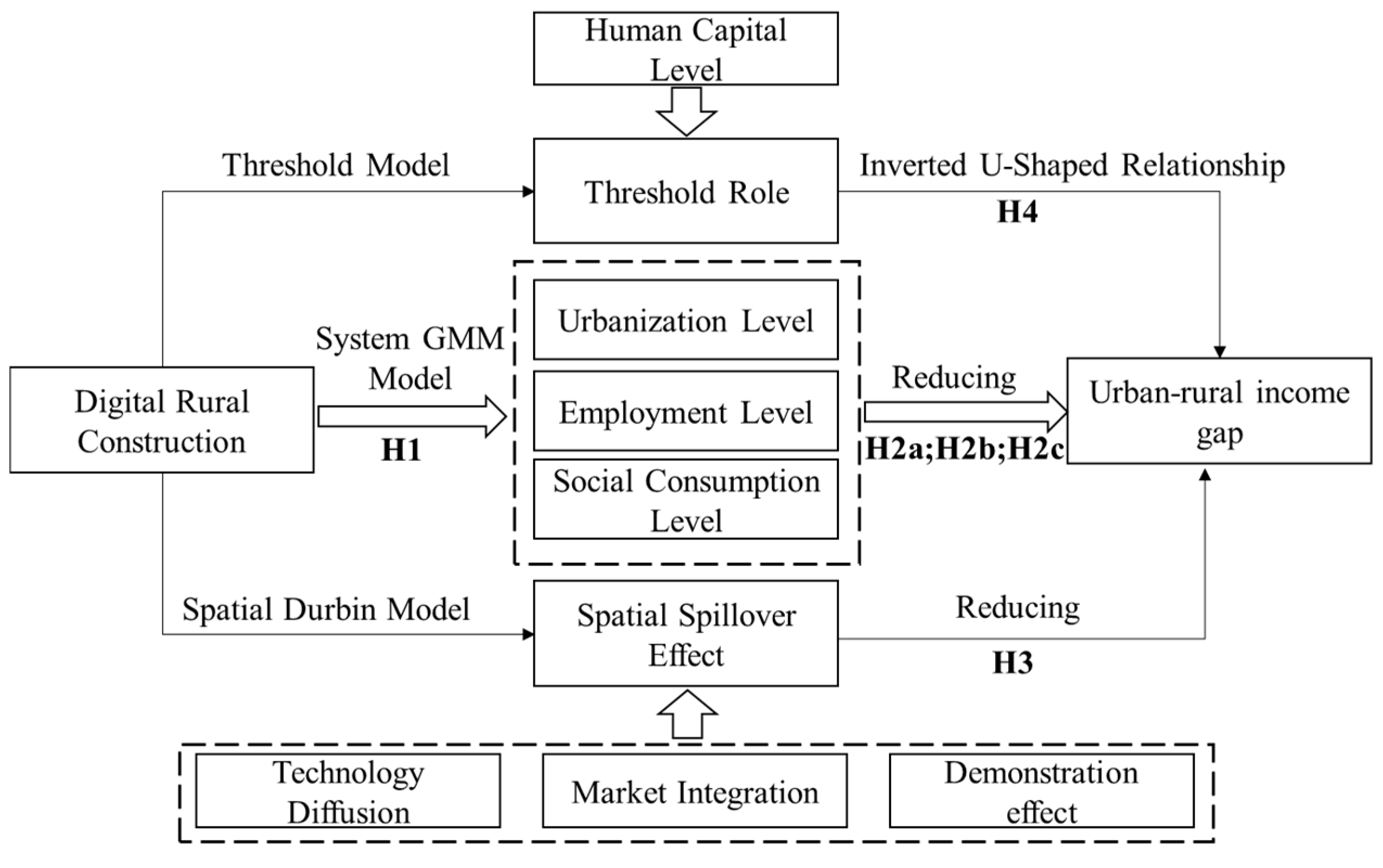
- Urbanization level: Based on the factor endowment theory, DRC takes the extension of digital infrastructure to rural areas as a breakthrough, breaking down the traditional urban–rural spatial divide. On the one hand, the integration of technologies with rural transportation and water conservancy facilities makes rural areas closer to urban areas in terms of public service supply and industrial development conditions, attracting urban capital and technology to extend downward to rural areas, promoting the construction of rural industrial parks and e-commerce clusters, accelerating rural industrial upgrading [23], and promoting urbanization transformation. At the same time, DRC empowers the construction of rural land transfer platforms, realizing the market-oriented allocation of land resources. Farmers obtain property income through land management rights, shares, and transfers while participating in nearby urbanization, thereby reducing income losses during the process. This high-quality urbanization process enhances rural productivity by balancing urban and rural factor income [24], serving as an important transmission channel for DRC to narrow the URIG. However, existing studies have not incorporated it into their analytical framework [25]. Therefore, hypothesis H2a is proposed as follows:
- (2)
- Employment level: Based on the employment multiplier theory, employment is the core link between production and income. DRC builds an employment-driven mechanism from two dimensions: job creation and capacity building. At the job creation level, the integration of DRC with agriculture and service industries fosters new employment forms, creating numerous non-agricultural jobs in areas like platform operation and logistics management. This provides farmers with localized employment opportunities, enabling them to reduce the costs of cross-regional labor mobility. At the capacity-building level, digital resources such as online vocational training and remote technical guidance break down the limitations of rural educational resources, helping rural laborers quickly master digital skills and professional knowledge, improving their overall quality, and enabling them to transform from traditional agricultural workers to digital economy practitioners and social entrepreneurs [26]. This improvement in the employment levels directly increases wages and operating income, thereby narrowing the URIG and becoming an important transmission path for DRC to influence the URIG. However, existing research on the mechanisms by which employment levels play a role is insufficient [14]. Therefore, hypothesis H2b is proposed as follows:
- (3)
- Social consumption level: Consumer economics theory emphasizes that social consumption is a key link in activating rural economic vitality [27]. From the supply side, the establishment of cold chain logistics networks reduces the price of industrial products for rural residents. It broadens the sales channels for rural specialty agricultural products, achieving two-way circulation of industrial products downstream for improved quality and agricultural products upstream for increased efficiency. From the demand side, digital payments and financial tools alleviate liquidity constraints for rural households. At the same time, digital scenarios such as short videos and live streaming stimulate diversified and high-quality consumption demands from rural residents, promoting the upgrading of the social consumption structure [28], thereby driving the development of industries and creating more operating income opportunities for rural residents. The interconnection of consumption markets enables rural residents to increase their actual income through the dual effects of “selling well” and “buying cheaply”, thereby serving as an intermediary in narrowing the URIG in DRC. However, there is a gap in existing research on the mediating effect of social consumption levels on the URIG [1]. Therefore, hypothesis H2c is proposed as follows:
2.3. Spatial Spillover Effect of DRC on the URIG
2.4. The Threshold Effect of DRC on the URIG
3. Research Design
3.1. Model Design
- (1)
- Systemic GMM model: The justifications for the selection of the research model are outlined below. First, the explanatory variable, the URIG, exhibits dynamic dependence. The current year’s URIG level is highly correlated with the URIG in previous years, requiring the introduction of its lagged terms as explanatory variables. The systemic GMM model, by constructing level and difference equations, can effectively solve the dynamic panel bias. Second, some explanatory variables in the model may have endogeneity problems, such as bidirectional causality and omitted variables. The system GMM approach eliminates reliance on extraneous instrumental variables; instead, it leverages lagged values of variables as instruments, thereby inherently resolving endogeneity issues within the model [32]. Third, the sample utilized herein is panel data with a cross-sectional extensive structure and a time-series of short duration. The systemic GMM’s estimation robustness under small sample conditions is better than that of the differenced GMM, FE, and OLS models. Fourth, fixed-effect models struggle to address endogeneity biases, and bias-corrected least squares difference value models have limited ability to handle complex endogeneity; the system GMM model can solve this problem. The model follows the rule of “number of instrumental variables < number of cross-sectional elements, and the model is defined as follows:In Equation (1), the explained variable Gapi,t represents the URIG in region i during period t; Gapi,t represents the lagged period of the dependent variable; Digi,t represents the level of DRC in region i during period t; controli,t is the control variable; μi represents the regional fixed effect; λt represents the time fixed effect; and εi,t is the random disturbance term.
- (2)
- Mediation effect model: To verify the mechanism by which DRC affects the URIG, this study, referencing existing research [33], this study constructs the following mediation effect model. In Equations (2)–(4), Midi,t represents the mediating variable.
- (3)
- Spatial Durbin model (SDM): Traditional fixed-effect models assume individual independence, while spatial models can separate direct and indirect effects, correcting estimation biases caused by neglecting spatial autocorrelation in traditional models [34] and improving the reliability of statistical inference. The SDM expression is as follows:In Equation (5), ρ represents the spatial autoregressive coefficient to be estimated, and ω1 represents the spatial lag coefficient of the explanatory variable DRC, δ1 represents the spatial lag coefficient of the control variable, and W represents the spatial weight matrix. The adjacency matrix captures the spillover effect of geographically adjacent areas by defining the “geographical adjacency” relationship. Based on existing research [35], this paper selects the adjacency matrix for matching analysis.
- (4)
- Threshold model: The threshold model can effectively identify inflection points and reveal the abrupt changes in the relationship between variables [36]. To examine the nonlinear relationship between DRC and the URIG, drawing on Hansen’s (1999) model construction scheme [37], this study follows the threshold model:In the above model, RL is the human capital level, and γ is a single threshold value. To obtain a single threshold conclusion, it is necessary to test the double threshold, and so on. In Equations (6) and (7), γ1 and γ2 are two threshold values of human capital level.
3.2. Variable Selection
- (1)
- Dependent variable: The Theil index incorporates sensitivity to extreme income levels and considers population factors. Given China’s country’s economic development exhibits a clear dual structure and a large population, the Theil index becomes an effective tool for measuring the URIG [38,39]. Specifically, the Theil index can accurately grasp the contribution of high-income and low-income extreme groups to the URIG, and its calculation incorporates the influence of population size, thus more comprehensively reflecting the inequality in income distribution. An elevated index value corresponds to a more pronounced URIG, and its calculation formula is presented below:where Theil represents the URIG; and r represent the total income of urban and rural residents in each province, respectively; It represents the total income of urban and rural residents in that province; and Pt represents the total population of urban and rural residents in that province
- (2)
- Explanatory variables: DRC: This paper expands upon existing research [40,41] by measuring DRC from four dimensions: digitalization of infrastructure (DOI), digitalization of the economy (DOE), digitalization of governance (DOG), and digitalization of life (DOL). Accounting for data gaps, 16 indicators were finally chosen for quantification, with specific details provided in Table 1.
- (3)
- Mechanism variables: Urbanization level, employment level, and social consumption level: DRC, by improving urbanization levels, addresses the problem of “emphasizing agglomeration while neglecting integration” in traditional urbanization, providing a vehicle for narrowing the URIG, theoretically aligning with the “theory of integrated urban-rural development”. Employment growth fueled by DRC boosts farmers’ wage-based earnings while concurrently fostering industrial development through employment expansion, forming a virtuous cycle of income growth and becoming a core driving force for narrowing the URIG, consistent with the “employment multiplier theory”. Social consumption is a key link connecting DRC with the URIG. The interconnection of consumer markets can both improve farmers’ income levels and promote URIG convergence, consistent with the “consumption economics theory”. Hence, the present research selected these three variables to function as mechanistic variables.
- (4)
- Threshold variable: Human capital level (HCL): The core logic of selecting HCL as the threshold variable for the impact of DRC on the URIG lies in its crucial role as a prerequisite for transforming DRC into an income equilibrium effect, directly defining the nonlinear boundary of its impact. The critical attribute of HCL aligns with both the inherent laws of DRC and the realities of rural development, making it a reasonable threshold variable for characterizing the nonlinear impact of DRC on the URIG.
- (5)
- Control variables: Leveraging insights from prior research [42,43], nine control variables were selected: tax burden level, level of openness to the outside world, industrial structure, transportation infrastructure, economic level, labor force level, technological level, informatization level, and innovation level (see Table 2).
3.3. Data Sources and Descriptive Statistics
4. Empirical Analysis
4.1. Benchmark Regression Results and Robustness Tests
4.2. Mechanism Testing
- (1)
- The mediating role of urbanization level: Column (1) in Table 4 demonstrates that the impact of DRC on the urbanization level is positive. Column (2) shows that after adding urbanization level and DRC to the model together, the impact of both urbanization level and DRC on the URIG is negative. This indicates that DRC can reduce the URIG by improving the urbanization level, thus verifying hypothesis H2a. The reason for this is that, on the one hand, DRC breaks geographical spatial limitations through digital infrastructure, driving the effective clustering of rural-based production factors in urbanized towns. On the other hand, the agglomeration of factors in urbanization forms a “radiation effect”, with urban technology and management experience penetrating rural areas through digital platforms. Rural factors achieve added value in the integration with urban factors, thereby narrowing the disparity in the return rate of urban and rural factors and inhibiting the widening of the URIG. On this basis, the rural digital economy spawned by DRC complements the urban digital industry chain, and rural areas become the supply chain terminal of urban digital industries, gradually narrowing the URIG.
- (2)
- The mediating role of employment level: Column (3) shows that the impact of DRC on employment is positive, while in column (4), both employment level and DRC are negative. Evidence derived from the analysis demonstrates that DRC narrows the URIG by improving the employment level, thus verifying hypothesis H2b. The reason for this is that DRC has emerged as a live streaming and smart agriculture platform, providing rural laborers with high-income and flexible employment options. At the same time, online recruitment reduces the information asymmetry of rural labor employment, facilitates the high-efficiency mobility of the rural surplus labor force toward non-agricultural sectors or urban regions, and improves employment matching efficiency. It can be said that DRC transforms the rural employment structure from traditional agriculture to digital service industries and modern agriculture, not only improving the stability of rural labor employment but also improving the quality of employment and farmers’ income level, narrowing the URIG with urban employment. This result shows that DRC can not only “create employment” but also “improve the quality of employment”, providing a new practical path for breaking the employment structure.
- (3)
- The mediating role of social consumption level: Column (5) demonstrates that the impact of DRC on social consumption level is significantly positive, while the coefficients of social consumption and DRC in column (6) are both negative. The regression outcomes validate that social consumption can serve as an intermediate path for DRC to narrow the URIG, thus verifying hypothesis H2c. The reasons for this are that DRC improves the rural e-commerce logistics system, such as cold chain logistics networks, reducing the time and money costs of rural consumption, expanding the scale of the rural consumer market, spurring the advancement of relevant industrial sectors such as farm produce processing and rural tourism, and leisure, thereby elevating rural households’ earnings. Consumption upgrading forces rural industries to transform towards branding and high added value, enhancing the profitability and income-generating capacity of rural industries. This conclusion supplements the research on the mediating role of DRC on the URIG from a consumption perspective, breaks through the traditional analytical framework that focuses on the production end, verifies the mitigating effect of social consumption level on the URIG, and provides a new entry point for the study of balanced development of social consumption and income.
4.3. Spatial Effect Test
- (1)
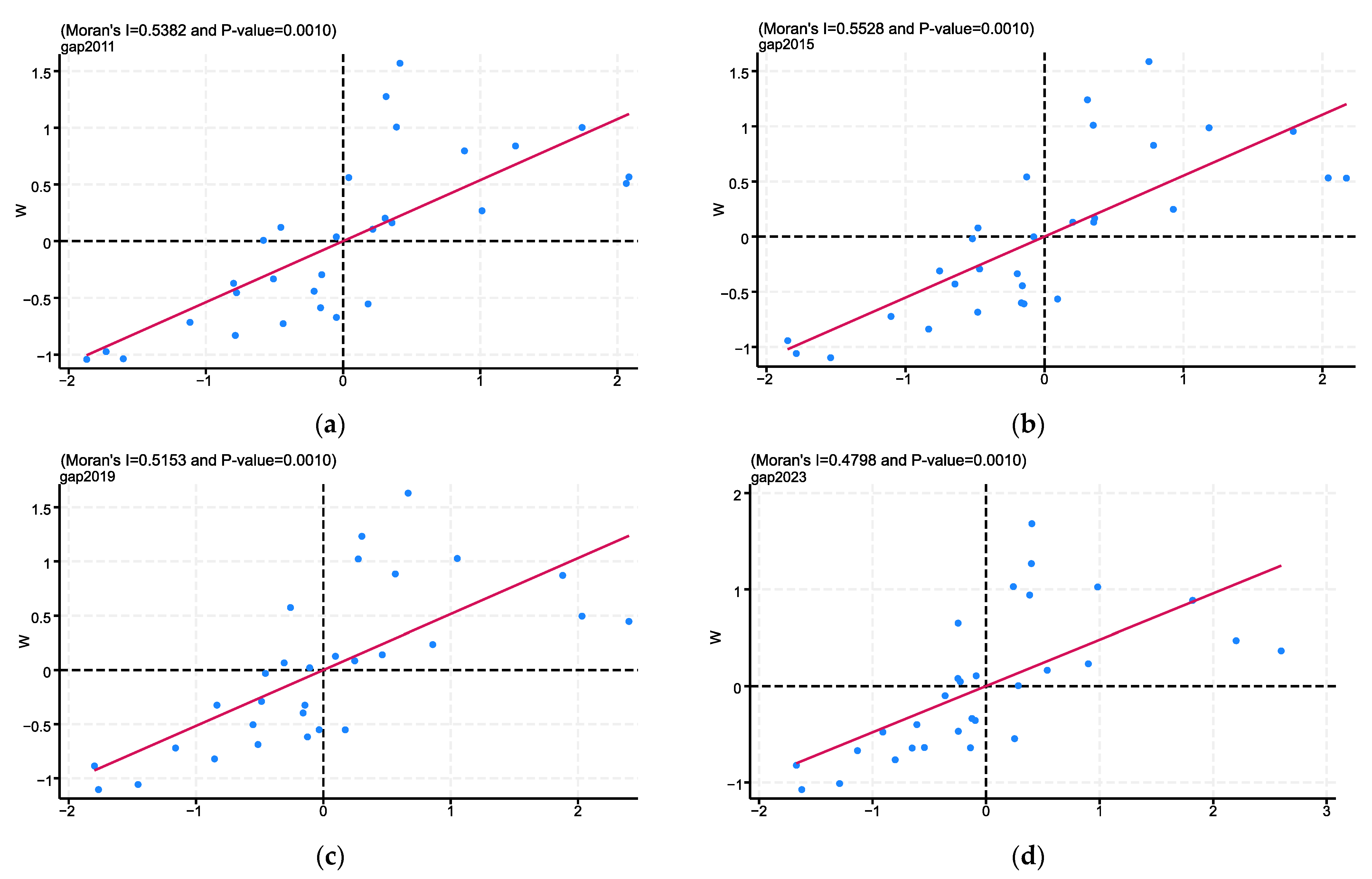
- Spatial autocorrelation test (SAT): This paper uses the global Moran’s I index calculated based on the spatial adjacency weight matrix for this test. Overall, all values in Table 5 are significant, suggesting that the URIG has spatial autocorrelation among provinces, allowing for the construction of this model for analysis.Figure 3 presents Moran scatter plots of the URIG in 2011, 2015, 2019, and 2023. The spatial distribution of predominantly selected research samples demonstrates distinct local characteristics of high–high (HH) and low–low (LL). Specifically, in 2011, the sample size of HH clustering accounted for 43.3%, and the sample size of LL clustering accounted for 46.7%, indicating that the URIG in most provinces of China was at a relatively low level. From 2011 to 2023, the number of low–low clustering areas remained basically unchanged, but the count of high–high agglomeration regions decreased by 3, while the quantity of low–high and high–low clustering areas increased by 2. This reflects that the barriers to the two-way flow of factors of production between urban and rural areas have not been eliminated, and there is still a certain imbalance in the URIG. By 2023, compared with 2011, the URIG in the third quadrant showed a trend of concentration, with a decrease in dispersion and no significant change in quantity. Only the gap within the agglomeration area was decreasing, indicating that the relative size of the URIG in the low-agglomeration area was shrinking.
- (2)
- Spatial spillover effect test and decomposition: To select a suitable spatial model for analyzing the impact of DRC on the URIG, the LM test was performed on each variable. The statistical results in Table 6 reveal that the statistics for LM(error) and LM(lag) are 144.843 and 196.852, respectively, both significant, indicating that the SDM should be selected for analysis. To test the robustness of the model selection, the LR test was further performed. The results for LR (sar) and LR (sem) were both significant, demonstrating strong model stability. Simultaneously, a fixed-effect-type test was performed.Table 6 demonstrates that the DRC regression coefficient stands at −0.0188, exerting a negative impact on URIG. Columns (3)–(5) in Table 7 show that DRC negatively affects the URIG under the direct (DE), indirect (IE), and total effects (TE). This finding verifies that the impact of DRC on the URIG has a spatial effect, thus verifying hypothesis H3. Specifically, the following was observed:The direct effect demonstrates that the improvement in DRC in a region can reduce the URIG. First, by improving the digital skills of farmers, creating local digital jobs, and stimulating the rural consumer market, it directly increases the income level of farmers. Second, by leveraging the digital empowerment of rural public services, it alleviates income inequality. The indirect effect is negative, which verifies that the improvement in DRC in a region will significantly narrow the URIG in its neighboring regions. Rural characteristic industries spurred by local DRC may form industrial chain divisions with neighboring regions, improving the overall rural income level of the region through industrial synergy. At the same time, DRC reduces the flow costs of labor, technology, and information, and the digitally skilled labor force cultivated by local DRC may flow to neighboring regions, driving the improvement in rural employment quality in neighboring regions and narrowing the URIG. The total effect is negative, indicating that the “local effect” and “spillover effect” work together in the overall impact of DRC on the URIG. From a numerical perspective, the significance and coefficient of the total effect mean that, from a spatial correlation perspective, the impact of DRC on the URIG is a joint effect. Not only does the investment in the local area generate direct returns, but the spillover effect on surrounding areas further expands the impact.
4.4. Threshold Inspection
- (1)
- Threshold model validation: To verify the stationarity of the data and prevent spurious regression, this paper uses the LLC test method for validation. Table 8 shows that DRC, the URIG, threshold variables, and control variables all have no unit roots, verifying that the selected data is stable.The impact of DRC on the URIG may exhibit a non-linear relationship. Table 9 shows that the F-values are 58.87 and 51.26, respectively, and are significant. Nevertheless, the threefold threshold test fails to attain statistical significance, which demonstrates that it exerts a dual threshold effect. Accordingly, a dual threshold model is adopted for estimation. Table 10 demonstrates that the two threshold values corresponding to DRC influence on the URIG are 0.0139 and 0.0232, respectively, reflecting a relatively notable effectiveness of threshold identification.
- (2)
- Threshold model regression results (see Table 11): When the HCL is lower than the first threshold value of 0.0139, the coefficient of DRC is positive, which verifies that DRC will widen the URIG when the HCL is low. When HCL is between the two threshold values, i.e., greater than 0.0139 and less than 0.0232, the coefficient of DRC is −0.0392, significantly negatively affecting the URIG at the 5% level, indicating that DRC will begin to narrow the URIG when the HCL is high. When the HCL surpasses the second threshold parameter of 0.0232, DRC’s regression coefficient further diminishes to −0.0805 and attains significance. Relative to the findings in the second threshold interval, the coefficient in this range is smaller, indicating that DRC has a greater effect on reducing the URIG at a high HCL than at a low HCL. In summary, the impact of DRC on the URIG presents an inverted “U”-shaped relationship, thus verifying hypothesis H4.The reasons for this are as follows: In the early stages of DRC, the focus was primarily on infrastructure development [3], exhibiting a clear skill bias. Rural laborers lacked sufficient education and digital skills, making it difficult for them to master technologies such as e-commerce operations and smart agricultural management. In contrast, highly skilled urban workers could quickly connect with digital industries, leading to income disparity. Simultaneously, the urban–rural “digital divide” persisted, with rural residents primarily using digital tools for basic social and entertainment purposes, failing to translate them into productive and managerial capabilities. At this stage, the income-generating effects of DRC were concentrated among urban and rural elites, further widening the URIG. However, once HCL reaches the first threshold, some laborers acquire basic digital skills through skills training and begin participating in non-agricultural employment or online sales of agricultural products. Farmers can optimize their planting structure and reduce operational risks through DRC, gradually loosening the information barriers between areas, and the URIG begins to narrow. Once HCL crosses the second threshold and digital skills become widespread, new professional farmers, returning entrepreneurs, and other groups can deeply utilize technologies to significantly improve agricultural labor productivity and enter the stage of industrial integration in DRC, thereby further bridging the URIG.Furthermore, this paper lags the threshold variable, HCL. It can be seen that after lagging the HCL by one period, the impact of DRC on URIG remains significant and is affected by the double threshold of the HCL, consistent with the above conclusions, verifying the stability of the double threshold regression.
5. Discussion, Conclusions and Recommendations
5.1. Discuss
5.2. Research Conclusions
5.3. Countermeasures and Recommendations
- (1)
- Construct a digital mechanism to empower urban–rural integration in China. Addressing the intermediary role of urbanization, employment, and consumption levels in hypotheses H2a, H2b, and H2c, digital technology is needed to remove bottlenecks in the transmission process. First, in the urbanization field, establish a digital service platform for rural migrants, integrating modules such as job recruitment, children’s education, and medical security to enable online processing of the entire process of household registration, employment, and social security. Simultaneously, use digital maps to mark the distribution of urban and rural public service resources, promoting the downward flow of education and medical services. Second, regarding employment, collaborate with e-commerce platforms and universities to offer digital skills training, providing specialized training for rural laborers in areas such as agricultural product photography and cross-border e-commerce, establishing a closed loop of training-certification-employment. Third, at the social consumption level, support the upgrading of rural convenience stores into “digital purchasing points”, promote the “online ordering + offline delivery” model, and create regional public brands, enhancing the quality the added value of agricultural products.
- (2)
- Promote China’s cross-regional collaboration and benefit sharing in DRC across eastern, central, and western regions. Based on hypothesis H3, the spatial interconnectedness of DRC breaks down administrative barriers. First, the eastern provinces with developed digital villages should take the lead in establishing a digital village collaborative development alliance with central and western provinces. This alliance will create a technology sharing database and experience exchange mechanism, regularly hold cross-provincial digital agriculture field observation meetings, and promote mature technologies such as smart irrigation and digital pest and disease monitoring. Second, a cross-regional digital circulation platform for agricultural products should be built to integrate cold chain logistics resources across provinces, achieve data interoperability, and reduce losses during agricultural product circulation. Third, a regional digital governance coordination mechanism should be established to unify e-commerce standards and traceability systems for agricultural products, solve the qualification certification problems in cross-regional transactions, and allow the digital development dividends of developed provinces to be transmitted to less developed areas through the industrial chain.
- (3)
- Stratification and classification to improve China’s human capital level: Based on the inverted “U”-shaped threshold characteristic of human capital in hypothesis H4, it precisely matches the digital skill training content. First, for remote rural areas with low human capital levels, conduct digital infrastructure popularization actions, providing hands-on training through pairing village cadres with volunteers to teach basic smartphone operation, online payment, medical insurance reimbursement, and other practical skills. Second, for areas with moderate human capital levels, focus on advanced digital skills enhancement, offering courses such as agricultural data analysis, e-commerce platform operation, and live-streaming script design, establishing practical training bases in conjunction with local enterprises, and encouraging trainees to participate in e-commerce project practice. Third, for areas with high human capital levels, focus on cultivating digital innovation talent, collaborating with universities to offer cutting-edge majors such as agricultural artificial intelligence and rural digital governance, setting up a digital entrepreneurship support fund dedicated to young returnees starting businesses in their hometowns, and supporting the development of digital application scenarios suitable for rural areas.
Supplementary Materials
Author Contributions
Funding
Institutional Review Board Statement
Data Availability Statement
Conflicts of Interest
References
- Deng, J.; Li, X.; Zhang, N. The Impact of Digital Rural Construction on Rural Revitalization-Empirical Evidence from Chinese County Panel Data. Agriculture 2024, 14, 1903. [Google Scholar] [CrossRef] [Scilit]
- He, Z.; Chen, M.; Gu, D. How digital village construction affects to the effectiveness of rural governance?—Research on the NCA and QCA methods. Cities 2025, 156, 105514. [Google Scholar] [CrossRef] [Scilit]
- Zhao, S.; Li, M.; Cao, X. Empowering rural development: Evidence from China on the impact of digital village construction on farmland scale operation. Land 2024, 13, 903. [Google Scholar] [CrossRef] [Scilit]
- Guo, H. The agricultural carbon reduction effect of digital rural construction under the dual carbon target. PLoS ONE 2024, 19, e0299233. [Google Scholar] [CrossRef] [Scilit]
- Yang, H.; Li, J.; Sieber, S.; Long, K. Does Digital Village Construction Affect the Sustainable Intensification of Cultivated Land Use? Evidence from Rural China. Agriculture 2025, 15, 978. [Google Scholar] [CrossRef] [Scilit]
- Wang, Z.; Zheng, X.; Wang, Y.; Bi, G. A multidimensional investigation on spatiotemporal characteristics and influencing factors of China’s urban-rural income gap (URIG) since the 21st century. Cities 2024, 148, 104920. [Google Scholar] [CrossRef] [Scilit]
- Ye, S.; Tu, A.; Ye, Y.; Liao, F. Digital Divide, Agricultural Supply Chain Finance, and the Urban-rural Income Gap in China. Sustain. Futures 2025, 10, 100863. [Google Scholar] [CrossRef] [Scilit]
- Lin, X.; Jiang, Y. The impact of industrial digitalization on the urban-rural income gap. PLoS ONE 2025, 20, e0335065. [Google Scholar] [CrossRef] [Scilit]
- Xiao, Y.; Yin, M.; Wang, H.; Xiang, Y. Digital Finance, Digital Usage Divide, and Urban–Rural Income Gap: Evidence from China. Systems 2025, 13, 145. [Google Scholar] [CrossRef] [Scilit]
- Liu, Y.; Zhou, M. Can rural e-commerce narrow the urban–rural income gap? Evidence from coverage of Taobao villages in China. China Agric. Econ. Rev. 2023, 15, 580–603. [Google Scholar] [CrossRef] [Scilit]
- Ren, Y.S.; Kuang, X.; Klein, T. Does the urban–rural income gap matter for rural energy poverty? Energy Policy 2024, 186, 113977. [Google Scholar] [CrossRef] [Scilit]
- Yan, D.; Li, P.; Liang, X. The urban–rural income gap, green innovation and urban carbon emissions: An empirical study in the Yangtze River Delta, China. Habitat Int. 2025, 164, 103525. [Google Scholar] [CrossRef] [Scilit]
- Wang, L.; Zhang, M. Exploring the impact of narrowing urban-rural income gap on carbon emission reduction and pollution control. PLoS ONE 2021, 16, e0259390. [Google Scholar]
- Shan, T.C.; Shi, R.Z. Impact of Digital Village Development on the Urban–Rural Income Gap—A Spillover Effects Perspective. Financ. Res. Lett. 2025, 86, 108557. [Google Scholar] [CrossRef] [Scilit]
- Jiang, Q.; Li, Y.; Si, H. Digital economy development and the urban–rural income gap: Intensifying or reducing. Land 2022, 11, 1980. [Google Scholar] [CrossRef] [Scilit]
- Yao, X.; Qiao, P. Research on the impact of digital rural construction on agricultural total factor productivity. Stat. Res. 2025, 42, 101–113. [Google Scholar]
- Karl, M.; Frederick, E. Marx Engels Collected Works Vol 20: Marx and Engels:1864–1868; Lawrence & Wishart: London, UK, 1985. [Google Scholar]
- Mikhailovna, T.Y. Basic aspects of rural social infrastructure development. Int. Rev. 2020, 3–4, 98–104. [Google Scholar] [CrossRef] [Scilit]
- Ren, J.; Chen, X.; Shi, L.; Liu, P.; Tan, Z. Digital village construction: A multi-level governance approach to enhance agroecological efficiency. Agriculture 2024, 14, 478. [Google Scholar] [CrossRef] [Scilit]
- Li, F.; Zang, D.; Chandio, A.A.; Yang, D.; Jiang, Y. Farmers’ adoption of digital technology and agricultural entrepreneurial willingness: Evidence from China. Technol. Soc. 2023, 73, 102253. [Google Scholar] [CrossRef] [Scilit]
- Liao, F.; Zheng, Y.; Yang, D. Digital transformation in rural governance: Unraveling the micro-mechanisms and the role of government subsidies. Humanit. Soc. Sci. Commun. 2025, 12, 1–14. [Google Scholar] [CrossRef] [Scilit]
- Xiong, C.; Zhang, Y.; Wang, W. SD-LSTM: A Dynamic Time Series Model for Predicting the Coupling Coordination of Smart Agro-Rural Development in China. Agriculture 2025, 15, 1491. [Google Scholar] [CrossRef] [Scilit]
- Hong, M.; Zhang, W. Industrial structure upgrading, urbanization and urban-rural income disparity: Evidence from China. Appl. Econ. Lett. 2021, 28, 1321–1326. [Google Scholar] [CrossRef] [Scilit]
- Yao, Y.; Jiang, L. Urbanization forces driving rural urban income disparity: Evidence from metropolitan areas in China. J. Clean. Prod. 2021, 312, 127748. [Google Scholar] [CrossRef] [Scilit]
- Zhao, H.; Yang, L.; Zheng, R. Driving mechanism of digital rural construction on the convergence of urban and rural income gap. Urban Issues 2025, 1, 70–84. [Google Scholar]
- Mao, D.; Chen, J.; Hu, S. Urban-rural economic inequality: Is social entrepreneurship the solution? China Agric. Econ. Rev. 2025, 17, 663–678. [Google Scholar] [CrossRef] [Scilit]
- Deaton, A.; Muellbauer, J. Economics and Consumer Behavior; Cambridge University Press: Cambridge, UK, 1980. [Google Scholar]
- Liu, Y.; Chen, W.; Zhang, X.; Liao, W. Digital economy, consumption structure and rural economic transformation: A case study of China. Front. Sustain. Food Syst. 2025, 9, 1565067. [Google Scholar] [CrossRef] [Scilit]
- Su, Y.; Zheng, W.; Yu, P. The impact of digital consumption on energy transition in China. Cogent Econ. Financ. 2025, 13, 2568637. [Google Scholar] [CrossRef] [Scilit]
- Schultz, T.W. Investment in human capital. Am. Econ. Rev. 1961, 51, 1–17. [Google Scholar]
- Li, X.; Li, G. Digital rural construction and urban-rural income gap: A U-shaped relationship. J. Huazhong Agric. Univ. (Soc. Sci. Ed.) 2024, 4, 12–24. [Google Scholar]
- Ullah, S.; Akhtar, P.; Zaefarian, G. Dealing with endogeneity bias: The generalized method of moments (GMM) for panel data. Ind. Mark. Manag. 2018, 71, 69–78. [Google Scholar] [CrossRef] [Scilit]
- Fairchild, A.J.; MacKinnon, D.P. A general model for testing mediation and moderation effects. Prev. Sci. 2009, 10, 87–99. [Google Scholar] [CrossRef] [Scilit] [PubMed]
- Mur, J.; Angulo, A. The spatial Durbin model and the common factor tests. Spat. Econ. Anal. 2006, 1, 207–226. [Google Scholar] [CrossRef] [Scilit]
- Yao, X.; Deng, X. Rural human capital, spatial effects and urban-rural income gap. J. South China Agric. Univ. (Soc. Sci. Ed.) 2020, 19, 111–126. [Google Scholar]
- Lee, S.; Seo, M.H.; Shin, Y. Testing for threshold effects in regression models. J. Am. Stat. Assoc. 2011, 106, 220–231. [Google Scholar] [CrossRef] [Scilit]
- Hansen, B.E. Threshold effects in non-dynamic panels: Estimation, testing, and inference. J. Econom. 1999, 93, 345–368. [Google Scholar] [CrossRef] [Scilit]
- Tang, J.; Gong, J.; Ma, W.; Rahut, D.B. Narrowing urban–rural income gap in China: The role of the targeted poverty alleviation program. Econ. Anal. Policy 2022, 75, 74–90. [Google Scholar] [CrossRef] [Scilit]
- Chen, D.; Ma, Y. Effect of industrial structure on urban–rural income inequality in China. China Agric. Econ. Rev. 2022, 14, 547–566. [Google Scholar] [CrossRef] [Scilit]
- Zhang, Z.; Hu, T.; Shen, P. Digital rural construction and agricultural green total factor productivity: The role of land finance, land resource misallocation, and agricultural technology innovation. Front. Environ. Sci. 2025, 13, 1611339. [Google Scholar] [CrossRef] [Scilit]
- Lei, X.K.; Chen, Y.X. Impact of digital villages construction on agricultural green production efficiency: Evidence from China. Front. Sustain. Food Syst. 2025, 9, 1597762. [Google Scholar] [CrossRef] [Scilit]
- Zhang, D.; Kong, Q.; Shen, M. Does polycentric spatial structure narrow the urban-rural income gap?—Evidence from six urban clusters in China. China Econ. Rev. 2023, 80, 101999. [Google Scholar] [CrossRef] [Scilit]
- Xia, H.; Yu, H.; Wang, S.; Yang, H. Digital economy and the urban–rural income gap: Impact, mechanisms, and spatial heterogeneity. J. Innov. Knowl. 2024, 9, 100505. [Google Scholar] [CrossRef] [Scilit]



| Primary Indicator | Secondary Indicator | Variable Meaning | Data Source | Weight |
|---|---|---|---|---|
| DOI | Rural logistics coverage rate | Rural delivery routes (km) | National Bureau of Statistics (NBOS) | 0.040045 |
| Logistics infrastructure investment | Transport, storage, and postal sector fixed-asset investment (CNY 100 million) | China Statistical Yearbook (CSY) | 0.055617 | |
| Internet infrastructure construction | Broadband connectivity subscribers in rural areas (10,000 households) | NBOS | 0.092286 | |
| Agricultural meteorological observation stations | Agricultural meteorological observation stations (number) | CSY | 0.025927 | |
| DOE | Rural e-commerce | Taobao villages (number) | Analysis by Alibaba Research Institute and Nanjing University Spatial Planning Research Center | 0.347847 |
| Talent support for DRC | Agricultural technical professionals in public enterprises and institutions | China Science and Technology Statistical Yearbook | 0.004246 | |
| Digital technology services | Engaged personnel count in information transmission, software, and IT services | CSY | 0.110207 | |
| E-commerce infrastructure investment | Transport-related expenditure of local governments (CNY 100 million) | NBOS | 0.030272 | |
| Digital finance development level | Digital inclusive finance index | Beijing University Digital Inclusive Finance Index (2011–2020) | 0.024192 | |
| DOG | Digital village governance funding supply | Local governmental expenditures for urban–rural community development | NBOS | 0.050582 |
| E-government development level | Provincial government online government service capabilities | China E-Government Development Survey Report | 0.004246 | |
| DOL | Television penetration rate | Full population coverage rate of rural TV broadcasting (%) | CSY | 0.005574 |
| Radio penetration rate | Full population coverage rate of rural radio broadcasting services (%) | CSY | 0.004412 | |
| Information service consumption level | Per capita spending by rural dwellers on transport and communications (CNY) | China Household Survey Yearbook (CHSY) | 0.03727 | |
| Information technology services | Total telecommunications business volume (CNY 100 million) | NBOS | 0.118868 | |
| Smartphone penetration rate | Mean number of mobile devices owned by every 100 rural households (units) | CSY | 0.010854 |
| Variable Type | Variables | Variable Definitions | Obs | Mean | Standard Deviation | Max | Min |
|---|---|---|---|---|---|---|---|
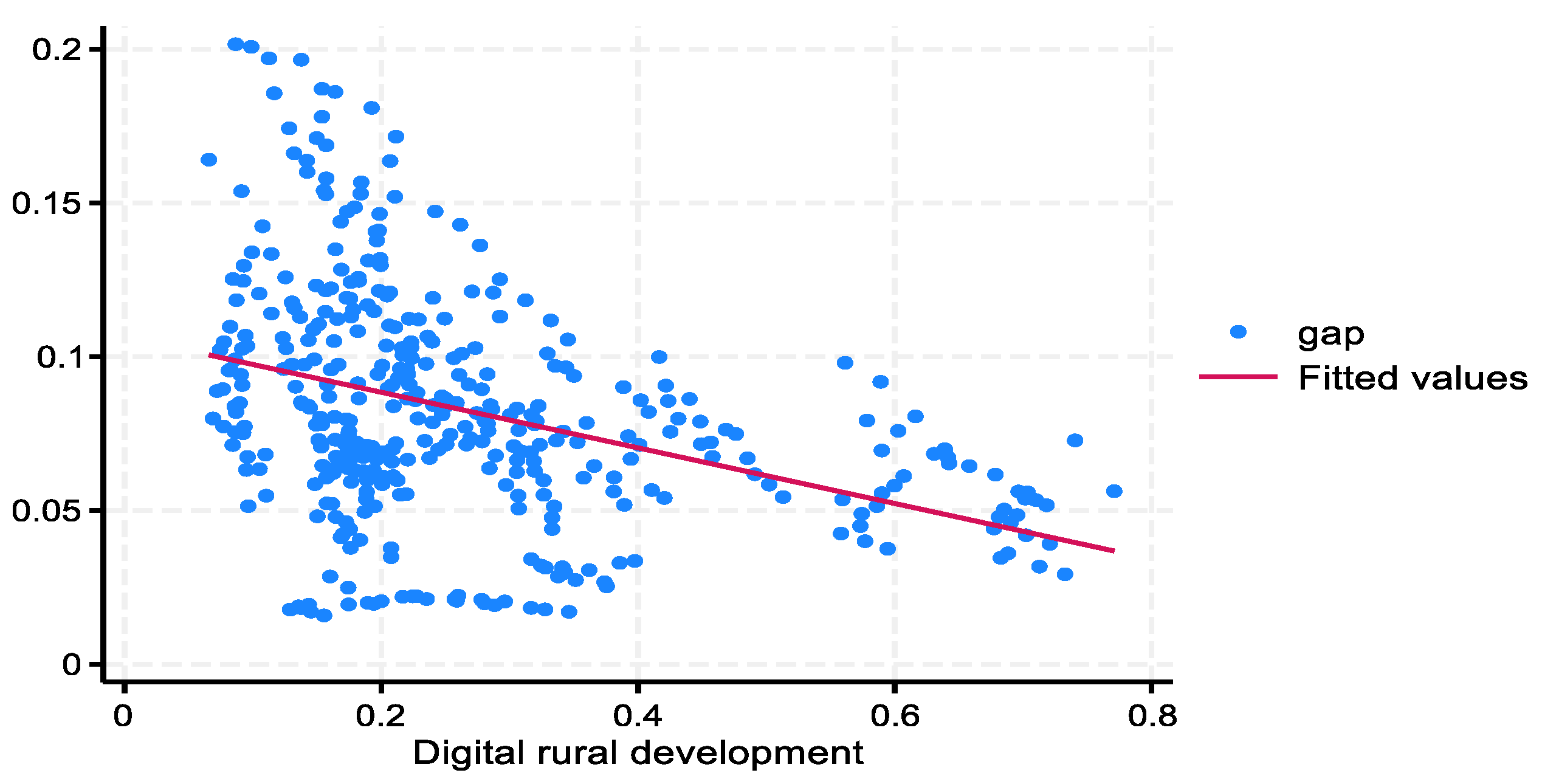
| Explanatory variable | URIG | Calculated using the Theil index | 390 | 0.0825 | 0.0381 | 0.202 | 0.0159 |
| Explanatory variable | DRC | Calculated using the entropy method | 390 | 0.266 | 0.159 | 0.771 | 0.0656 |
| Control variable | Tax burden level | Tax Revenue/Gross Regional Product | 390 | 0.0796 | 0.0292 | 0.200 | 0.0354 |
| Level of openness to the outside world | (Total Import and Export Value of Goods × USD/CNY Exchange Rate)/Gross Regional Product | 390 | 0.270 | 0.277 | 1.464 | 0.0076 | |
| Industrial structure | Tertiary Industry Value/(Primary Industry Value + Secondary Industry Value) | 390 | 2.403 | 0.123 | 2.846 | 2.132 | |
| Transportation infrastructure level | Kilometers (Logarithm)/Total Freight Volume (Logarithm) | 390 | 11.650 | 0.835 | 12.980 | 9.440 | |
| Economic development level | GDP Per Capita | 390 | 13,000 | 8300 | 49,000 | 5100 | |
| Labor force level | Employment (Logarithm) | 390 | 7.590 | 0.781 | 8.864 | 5.545 | |
| Technology market development level | Technology Market Transaction Value/Gross Regional Product | 390 | 0.0198 | 0.0323 | 0.195 | 0.0002 | |
| Informatization level | Postal and Telecommunications Business Volume/Gross Regional Product | 390 | 0.0632 | 0.135 | 2.513 | 0.0147 | |
| Innovation level | Domestic Invention Patent Applications (Logarithm) | 390 | 9.692 | 1.384 | 12.40 | 5.318 | |
| Mediator variable | Urbanization level | Urbanization Rate | 390 | 0.599 | 0.131 | 0.896 | 0.228 |
| Employment level | Tertiary Industry Employment (Logarithm) | 390 | 6.736 | 0.755 | 8.239 | 4.710 | |
| Social consumption level | Total Retail Sales of Consumer Goods/Gross Regional Product | 390 | 0.376 | 0.0699 | 0.538 | 0.183 | |
| Threshold variable | Human capital level | Number of Students Enrolled in Higher Education Institutions/Total Population | 390 | 0.0215 | 0.006 | 0.0437 | 0.008 |
| Variables | OLS | FE | SYS-GMM | ||
|---|---|---|---|---|---|
| (1) No Lagged Terms of the Dependent Variable | (2) Lagged Terms of the Dependent Variable | (3) No Lagged Terms of the Dependent Variable | (4) Lagged Terms of the Dependent Variable | (5) | |
| DRC | −0.0326 *** (0.0112) | −0.0022 ** (0.0009) | −0.0749 ** (0.0362) | −0.0089 ** (0.0034) | −0.0238 ** (0.0096) |
| DRC is lagging by one period | - | 0.9685 *** (0.0063) | - | 0.9868 *** (0.0091) | 0.8711 *** (0.0326) |
| Tax burden level | −0.0840 (0.0738) | −0.0003 (0.0031) | −0.0300 (0.0396) | −0.0034 (0.0039) | 0.0204 (0.0159) |
| Openness level | −0.0332 *** (0.0108) | 0.0013 (0.0008) | −0.0226 ** (0.0105) | −0.0007 (0.0013) | −0.0054 (0.0061) |
| Industrial structure | −0.0511 ** (0.0252) | 0.0009 (0.0022) | −0.0493 (0.0364) | 0.0038 (0.0029) | 0.0133 (0.0129) |
| Transportation infrastructure level | −0.0120 *** (0.0021) | 0.0002 (0.0002) | −0.0017 (0.0028) | 0.0005 ** (0.0002) | 0.0018 * (0.0010) |
| Economic development level | −0.0000 (0.0000) | 0.0000 * (0.0000) | −0.0000 (0.0000) | −0.0000 (0.0000) | 0.0000 *** (0.0000) |
| Labor force level | 0.0030 (0.0025) | 0.0008 *** (0.0003) | 0.0470 ** (0.0190) | 0.0037 ** (0.0015) | 0.0077 ** (0.0030) |
| Technology market development level | −0.1224 * (0.0657) | 0.0000 (0.0044) | −0.1188 (0.0895) | −0.0038 (0.0050) | −0.0075 (0.0270) |
| Information level | −0.0009 (0.0042) | −0.0012 (0.0012) | −0.0053 ** (0.0022) | −0.0015 (0.0013) | −0.0029 ** (0.0013) |
| Innovation level | −0.0255 (0.0023) | −0.0002 (0.0002) | −0.0181 *** (0.0042) | −0.0002 (0.0004) | −0.0030 ** (0.0015) |
| _cons | 0.3583 *** (0.0624) | −0.0106 ** (0.0053) | 0.0752 (0.1633) | −0.0410 ** (0.0150) | −0.0731 * (0.0395) |
| AR(1) | - | - | - | - | 0.030 |
| AR(2) | - | - | - | - | 0.359 |
| Hansen Tese | - | - | - | - | 0.424 |
| N | 390 | 360 | 390 | 360 | 360 |
| Variables | (1) Urbanization Level | (2) URIG | (3) Employment Level | (4) URIG | (5) Social Consumption Level | (6) URIG |
|---|---|---|---|---|---|---|
| DRC | 0.1382 *** (0.0244) | −0.0277 *** (0.0089) | 0.3103 ** (0.1447) | −0.0461 *** (0.0090) | 0.3690 *** (0.0681) | −0.0409 *** (0.0098) |
| Urbanization Level | −0.1902 *** (0.0189) | |||||
| Employment Level | −0.0256 *** (0.0033) | |||||
| Social Consumption Level | −0.0354 *** (0.0075) | |||||
| Sobel | −0.0263 *** (0.0053) | −0.0079 ** (0.0038) | −0.0013 *** (0.0037) | |||
| _bs_1 95% Confidence Interval (P) | [−0.0380, −0.0146] | [−0.0158, −0.0000] | [−0.0212, −0.0049] | |||
| _bs_1 95% Confidence Interval (BC) | [−0.0480, −0.0074] | [−0.0676, −0.0245] | [−0.0635, −0.0184] | |||
| _bs_1 p-value | 0.002 | 0.049 | 0.002 | |||
| Control Variables | Controlled | Controlled | Controlled | |||
| N | 390 | 390 | 390 | |||
| F | 619.10 *** | 556.99 *** | 506.13 *** | |||
| Year | Moran’s I | Z | p | Year | Moran’s I | Z | p |
|---|---|---|---|---|---|---|---|
| 2011 | 0.429 *** | 4.191 | 0.000 | 2018 | 0.414 *** | 4.077 | 0.000 |
| 2012 | 0.427 *** | 4.182 | 0.000 | 2019 | 0.402 *** | 3.975 | 0.000 |
| 2013 | 0.426 *** | 4.178 | 0.000 | 2020 | 0.389 *** | 3.867 | 0.000 |
| 2014 | 0.427 *** | 4.189 | 0.000 | 2021 | 0.390 *** | 3.872 | 0.000 |
| 2015 | 0.432 *** | 4.225 | 0.000 | 2022 | 0.388 *** | 3.863 | 0.000 |
| 2016 | 0.427 *** | 4.179 | 0.000 | 2023 | 0.382 *** | 3.821 | 0.000 |
| 2017 | 0.423 *** | 4.145 | 0.000 |
| Test Method | Statistic | p-Value |
|---|---|---|
| LM-error | 144.843 | 0.004 |
| Robust LM-error | 29.437 | 0.000 |
| LM-lag | 196.852 | 0.000 |
| Robust LM-lag | 81.446 | 0.000 |
| LR (sar) | 96.30 | 0.000 |
| LR (sem) | 89.09 | 0.000 |
| Variables | (1) | (2) | (3) | (4) | (5) |
|---|---|---|---|---|---|
| Main | Wx | DE | IE | TE | |
| DRC | −0.0188 *** (0.0073) | −0.0545 *** (0.0124) | −0.0221 *** (0.0073) | −0.0731 *** (0.0168) | −0.0953 *** (0.0190) |
| Control variables | YES | YES | YES | YES | YES |
| rho | 0.2325 *** (0.0650) | ||||
| sigma2_e | 0.0000 *** (0.0000) | ||||
| N | 390 | ||||
| Variables | LLC | p | Conclusion | Variables | LLC | p | Conclusion |
|---|---|---|---|---|---|---|---|
| URIG | −4.9196 | 0.0000 | Stable | Economic development level | −3.0809 | 0.0010 | Stable |
| DRC | −5.7058 | 0.0000 | Stable | Labor force level | −5.3735 | 0.0000 | Stable |
| Tax burden level | −3.8301 | 0.0001 | Stable | Technology market development level | 3.9870 | 0.0000 | Stable |
| Level of openness to the outside world | −7.8730 | 0.0000 | Stable | Information level | −13.7471 | 0.0000 | Stable |
| Industrial structure | −1.7012 | 0.0444 | Stable | Innovation level | −3.6753 | 0.0001 | Stable |
| Level of transportation infrastructure | −5.2733 | 0.0000 | Stable | Human capital | −1.6502 | 0.0495 | Stable |
| Explained Variable | Threshold Variables | Number of Thresholds | F | p | Bootstrap Times | Critical Value | ||
|---|---|---|---|---|---|---|---|---|
| 10% | 5% | 1% | ||||||
| URIG | Human Capital Level | Single Threshold | 58.87 ** | 0.0483 | 600 | 49.0793 | 58.6409 | 83.0222 |
| Double Threshold | 51.26 ** | 0.0317 | 600 | 38.6486 | 46.0503 | 64.0659 | ||
| Triple Threshold | 32.15 | 0.8000 | 600 | 77.5492 | 87.7515 | 117.0301 | ||
| Explained Variable | Threshold Variables | Threshold Number | Threshold Value | 95% Confidence Interval |
|---|---|---|---|---|
| Double Threshold Test | URIG | First Threshold Variable | 0.0139 | [0.0134, 0.0139] |
| Second Threshold Variable | 0.0232 | [0.0230, 0.0232] |
| Variable | (1) | (2) | ||
|---|---|---|---|---|
| URIG | p-Value | URIG | p-Value | |
| Human capital level ≤ 0.0139 | 0.0771 *** (0.0251) | 0.002 | 0.0815 *** (0.0281) | 0.004 |
| 0.0139 < Human capital level < 0.0232 | −0.0392 ** (0.0168) | 0.021 | −0.0497 ** (0.0199 | 0.013 |
| Human capital level ≥ 0.0232 | −0.0805 *** (0.0167) | 0.000 | −0.0845 *** (0.0199) | 0.000 |
| Constant term | 0.1295 (0.0840) | 0.124 | 0.0482 (0.0887) | 0.587 |
| Control variable | Controlled | Controlled | ||
| Observed value | 390 | 360 | ||
Disclaimer/Publisher’s Note: The statements, opinions and data contained in all publications are solely those of the individual author(s) and contributor(s) and not of MDPI and/or the editor(s). MDPI and/or the editor(s) disclaim responsibility for any injury to people or property resulting from any ideas, methods, instructions or products referred to in the content. |
© 2026 by the authors. Licensee MDPI, Basel, Switzerland. This article is an open access article distributed under the terms and conditions of the Creative Commons Attribution (CC BY) license.
Share and Cite
Xu, J.; Liu, H. How Does the Digital Village Construction Affect the Urban–Rural Income Gap: Empirical Evidence from China. Agriculture 2026, 16, 278. https://doi.org/10.3390/agriculture16020278
Xu J, Liu H. How Does the Digital Village Construction Affect the Urban–Rural Income Gap: Empirical Evidence from China. Agriculture. 2026; 16(2):278. https://doi.org/10.3390/agriculture16020278
Chicago/Turabian StyleXu, Jin, and Hui Liu. 2026. "How Does the Digital Village Construction Affect the Urban–Rural Income Gap: Empirical Evidence from China" Agriculture 16, no. 2: 278. https://doi.org/10.3390/agriculture16020278
APA StyleXu, J., & Liu, H. (2026). How Does the Digital Village Construction Affect the Urban–Rural Income Gap: Empirical Evidence from China. Agriculture, 16(2), 278. https://doi.org/10.3390/agriculture16020278