1. Introduction
With the continuous growth of the global population and increasing demand for food, smart agriculture has garnered significant attention as a pivotal approach to enhancing agricultural productivity and ensuring crop quality [
1]. Modern controlled-environment agriculture relies on precise environmental sensing and fruit detection technologies to enable automated management and efficient harvesting. Vision-based crop recognition and semantic segmentation technologies constitute the core of intelligent agricultural systems, directly impacting the operational efficiency of agricultural machinery and the quality control of produce [
2]. Within this context, accurate fruit counting, tracking, and size estimation are essential for yield prediction, harvest planning, and evaluating fruit maturity and quality, while also informing transportation and storage strategies to improve overall economic efficiency [
3].
Recent developments in deep learning have substantially advanced agricultural image segmentation methods, primarily focusing on single-modality image analysis, with YOLO-based one-stage networks and Transformer architectures emerging as leading approaches. These methods address various challenges in crop recognition and segmentation by combining the real-time efficiency of YOLO models with the robust global feature modeling capabilities of Transformer architectures [
4]. Du et al. [
5] presented a DSW-YOLO architecture built upon YOLOv7 for the detection of ripe strawberries and their occlusion levels, enhancing feature extraction with DCNv3 in ELAN, applying Shuffle Attention, and optimizing WIoU v3 loss, reaching 86.7% mAP@0.5, 82.1% recall, and 82.8% precision. Rong et al. [
6] designed a Swin Transformer V2–based improved segmentation framework integrated with a picking-point recognition method to detect ripe tomatoes in complex environments. The model, enhanced with SeMask in the encoder and UPerNet with feature selection and alignment in the decoder, achieved 82.5% MIoU and 89.79% MPA. Yuan et al. [
7] proposed a CA-TransUNet++ model that combines Coordinate Attention with a Transformer architecture for Camellia oleifera fruit segmentation. Leveraging multi-scale feature extraction, global information modeling, and transfer learning on a small hyperspectral dataset, the model achieves 92.14% MIoU, 96.51% MPA, and 95.81% Dice, with improved convergence and generalization. The above studies indicate that incorporating advanced attention mechanisms and enhanced feature extraction modules into YOLO-based and Transformer-based [
8] architectures can significantly improve segmentation accuracy and efficiency in complex agricultural environments [
9].
Most existing approaches depend on adequate and consistent illumination for accurate feature extraction, but their performance substantially deteriorates under low-light or nighttime conditions, which frequently occur in practical agricultural settings [
10,
11]. To address precise detection and low-cost deployment of pitaya fruits under daytime and nighttime supplementary lighting, Li et al. [
12] developed a lightweight YOLOv5s model incorporating a ShuffleNetV2 backbone, a Concentrated-Comprehensive Convolution Receptive Field Enhancement (C3RFE) module, and a Bidirectional Feature Pyramid Network (BiFPN), achieving an average precision of 97.80%, a GPU inference speed of 139 FPS, and a model size of 2.5 MB. Jiang and Ahamed [
13] developed an autonomous pesticide spraying robot using light and pheromones to improve accuracy and reduce waste. With thermal cameras, LiDAR, and YOLACT segmentation, it navigates orchards in low light, achieving over 83% mAP and under 0.21 m positional error for effective nighttime pest control. These studies demonstrate that integrating lightweight architectures, specialized feature enhancement modules, and multimodal sensing enables effective and accurate agricultural operations under challenging lighting conditions.
Nonetheless, reliance on single RGB images restricts CNN-based models’ segmentation accuracy and robustness under severe illumination variations and complex occlusions [
14]. To address the limitations of single-modality imaging in complex environments, multimodal fusion techniques combine RGB, near-infrared, depth, and other data sources to enhance agricultural image analysis. These approaches notably improve recognition and segmentation performance, especially under uneven lighting and fruit occlusion. To improve detection and segmentation of tomato main stems against similar-colored backgrounds, Liu et al. [
15] proposed YOLACTFusion, a multimodal fusion method using attention to integrate RGB and near-infrared images. Experiments show YOLACTFusion achieves precisions of 93.90% and 95.12%, recalls of 62.60% and 63.41%, and a mAP of 46.29%, with a reduced model size of 165.52 MB compared to YOLACT, significantly enhancing agricultural robotic vision. To address the low detection accuracy of selective harvesting robots in complex environments, Gao et al. [
16] proposed LACTA, a lightweight and efficient detection algorithm. It incorporates adaptive feature extraction and cross-layer feature fusion, enabling LACTA to achieve a mAP of 97.3% with a compact 2.88 MB model size, while significantly reducing computational complexity and parameter count. To improve tomato detection under complex agricultural conditions, Chen et al. [
17] proposed YOLO-DNA, a lightweight framework with a multimodal fusion encoder integrating depth and near-near-infrared data. It achieves 98.13%
and 74.0%
, surpassing lightweight counterparts by 5.01% and 14.55%, while maintaining 37.12 FPS. Song et al. [
18] proposed a multimodal parallel transformer framework for apple disease recognition and grading, fusing image data with multi-dimensional environmental sensor information. Incorporating segmentation preprocessing, cross-scale attention, frame-wise diffusion, and model compression, the framework achieves 0.98 precision, 0.93 recall, 0.95 F1-score, and 0.96 accuracy in complex orchard scenarios.
Compared with existing RGB–IR or RGB–NIR fusion methods, most prior works rely on early-stage input concatenation or mid-level feature aggregation combined with generic attention weighting. These designs often assume direct compatibility between modalities and do not explicitly model inter-modal discrepancies, which becomes critical under mixed illumination and partial occlusion where one modality may be locally unreliable. In contrast, our framework introduces a discrepancy-aware fusion mechanism (C-MDCF) that exploits channel-wise difference cues to selectively complement cross-modal features. Moreover, cross-scale attention (MS-CPAM) and semantic-detail refinement (MSF-SRNet) are integrated to preserve fine boundaries of small or occluded fruits. As a result, the proposed design enables robust segmentation as well as accurate downstream size and count estimation under complex lighting conditions.
However, despite recent advances in multimodal semantic segmentation for agricultural image analysis, several challenges persist. Existing approaches often rely on large datasets and complex network architectures, leading to high computational costs and limited real-time applicability. Moreover, the accurate detection of small or occluded targets under variable lighting conditions remains difficult. To address these limitations, a multimodal segmentation and refinement framework is proposed for tomato fruit segmentation under complex lighting conditions. The framework exploits the complementary information from near-infrared and RGB images to achieve fine-grained segmentation of tomato size, while a trajectory reconnection mechanism is incorporated into the DeepSORT algorithm to handle occlusions in controlled-environment agriculture, thereby enhancing tracking continuity for temporarily occluded fruits. The primary innovations and contributions of this study are summarized as follows:
We propose a dual-branch multimodal backbone integrated with a Cross-Modality Difference Complement Fusion (C-MDCF) to effectively fuse RGB and near-infrared features, and propose C2f-DCB, a lightweight module that combines group and heterogeneous convolutions to reduce complexity and improve feature extraction.
We propose a Cross-Scale Attention Fusion Network that incorporates a Multi-Scale Channel and Position Attention Mechanism (MS-CPAM), enabling more precise extraction of fine-grained details by the model and spatial dependencies, especially for small or occluded tomato instances.
We design the Enhanced Multi-Scale Feature Fusion and Semantic Refinement framework, which integrates the Scale-Concatenate Fusion Module (Scale-Concat) and Semantic Detail Injection (SDI) to improve multi-scale feature alignment and semantic refinement via Hadamard-based cross-layer fusion.
We conduct extensive experiments demonstrating that the proposed framework achieves a mean average precision (mAP) of 97.8% and a real-time detection speed of 105.07 FPS on a mixed-light validation set, enabling accurate real-time counting and size estimation of tomatoes for yield estimation.
2. Materials and Methods
2.1. Datasets
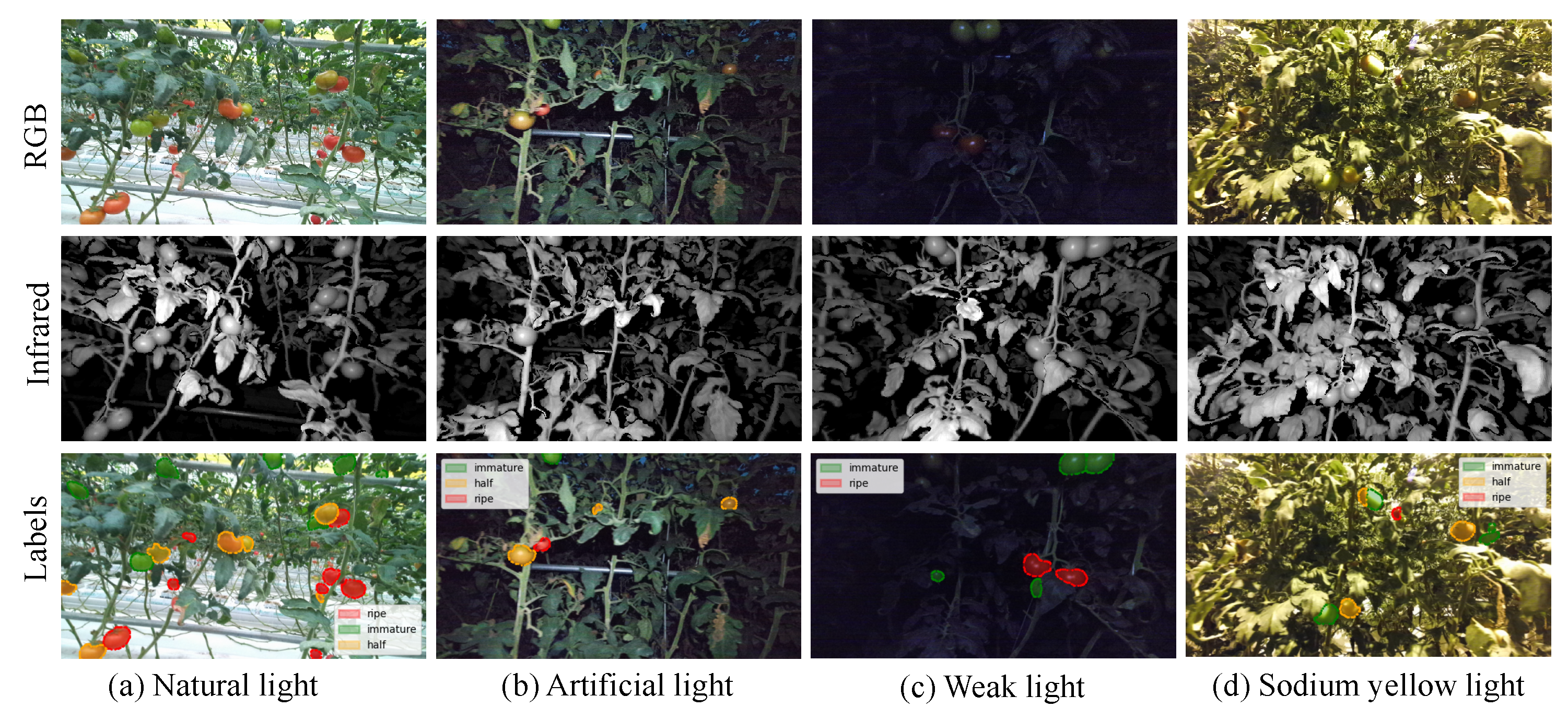
This work utilizes the publicly available Multimodal Image Dataset of Tomato Fruits with Different Maturity [
19], which includes 4000 multimodal image sets captured under four types of lighting—natural, artificial, low, and sodium yellow—as depicted in
Figure 1. The dataset provides annotations for both target detection and semantic segmentation across three fruit maturity stages: unripe, half-ripe, and ripe. To facilitate robust model training and evaluation, a total of 1389 images were selected and partitioned into training, testing, and validation subsets using standard proportions of approximately 70%, 15%, and 15%, respectively. RGB images were used to form the RGB dataset, while near-infrared images were organized with identical splits to create the near-infrared dataset. This arrangement ensures that both modalities maintain consistent representations across lighting conditions and maturity stages, enabling effective multimodal learning for small-object detection and semantic segmentation of tomato fruits in diverse environmental scenarios.
The Multimodal Image Dataset of Tomato Fruits used in this study was collected in a single facility-agriculture (greenhouse) environment and focuses on one tomato variety. The dataset does not include open-field scenes or multiple cultivars with distinct leaf morphologies. Nevertheless, it exhibits considerable visual complexity due to intra-environment variability. In particular, images contain dense and irregular foliage structures, intertwined stems, supporting wires, irrigation pipes, and frequent occlusions between fruits and leaves. These factors introduce substantial background clutter and partial visibility, posing challenges for instance segmentation and size estimation beyond illumination variations. The dataset was designed to emphasize robustness under diverse lighting conditions within a controlled greenhouse setting, including variations in intensity, direction, and spectral composition. While inter-varietal biological diversity and outdoor cultivation conditions are not covered in the current dataset, addressing such broader generalization scenarios through multi-dataset evaluation and cross-crop transfer learning will be explored in future work.
2.2. Multi-Branch Cross-Feature Fusion Backbone Network
In facility agricultural environments, the semantic segmentation of tomato fruits is often hindered by complex lighting conditions, dense occlusion, and background clutter. Under such conditions, RGB images are prone to issues such as overexposure, underexposure, and shadowing, which can lead to incomplete or ambiguous visual features. In contrast, near-infrared imagery, which captures thermal radiation independent of visible light, provides structural and temperature-based information that remains robust under variable lighting, thereby complementing RGB data.
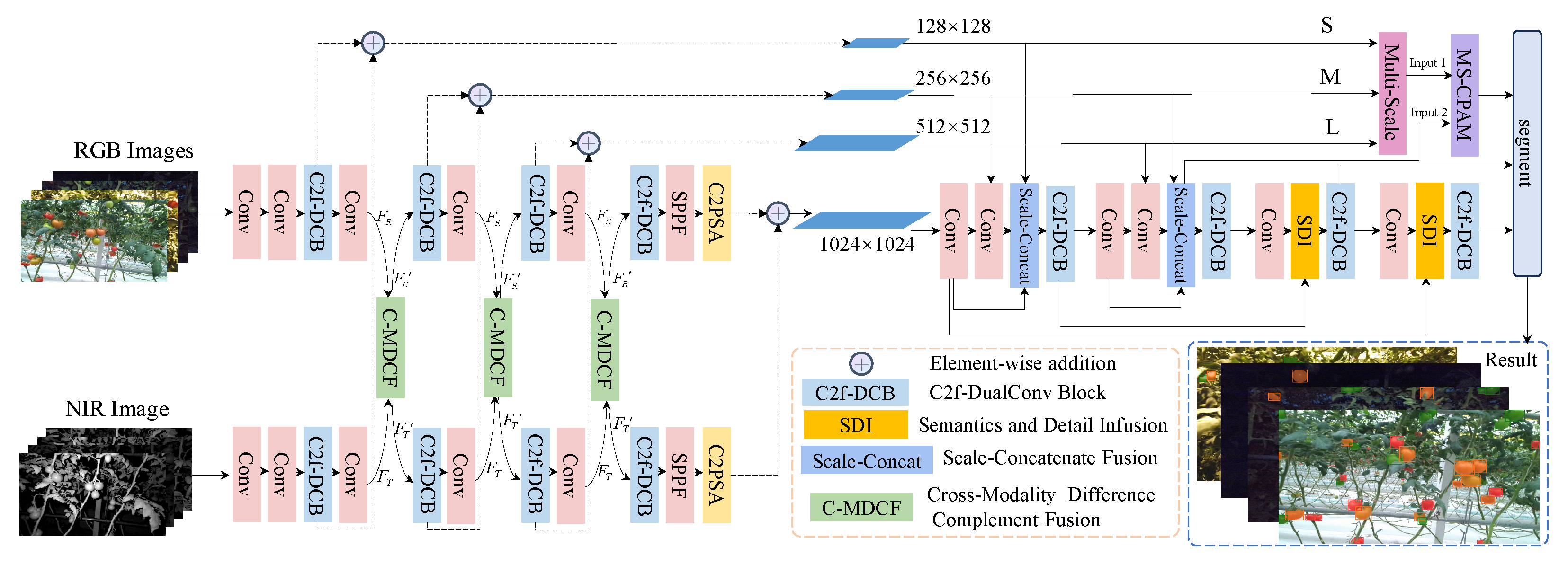
We build our backbone on Ultralytics YOLO11 (also referred to as YOLOv11 in some literature or communities), a recent one-stage detection/segmentation framework released as an engineering implementation with publicly available documentation and code, and we extend it with a dual-branch RGB–NIR backbone and the proposed fusion/refinement modules [
20]. The backbone integrates a Cross-Modality Difference Complementary Fusion (C-MDCF) module and a C2f-DCB block. The dual-branch design enables modality-specific feature extraction and interaction, while the C-MDCF module facilitates effective cross-modal feature fusion. Furthermore, by combining group and heterogeneous convolutions, the lightweight C2f-DCB module is developed to reduce computational complexity and enhance feature representation capability. Branch A processes RGB images, while Branch B handles near-infrared inputs. A feature-level fusion strategy is employed to integrate multimodal features. Both branches follow an identical architecture and consist of four feature extraction modules, each tailored to different stages of hierarchical representation learning. The first module includes three consecutive
convolutional layers followed by a C2f-DCB module, designed to reduce modality discrepancies, align channel dimensions, and enhance contextual feature extraction while preserving fine details.Modules 2 and 3 each contain a
convolutional layer with a stride of 2 and a subsequent C2f-DCB module, which together extract mid-level semantic features while maintaining structural integrity. The final module integrates a C2f-DCB module with a Spatial Pyramid Pooling Fast (SPPF) layer to capture high-level semantic features, reduce spatial dimensions, and decrease computational overhead, thereby improving inference efficiency. All convolutional layers utilize the SiLU activation function. To support the accurate segmentation of small tomato targets, all convolutional kernels are set to
with small strides. This configuration preserves high-resolution feature maps, enhances fine-grained feature capture, and reduces the likelihood of small-object omission. The complete architecture is shown in
Figure 2.
2.2.1. C2f-DCB
In the complex environments of protected agriculture, such as greenhouses, semantic segmentation of tomatoes is often challenged by variable lighting conditions, dense occlusion, and irregular object shapes. To address these challenges while ensuring both model efficiency and robust feature representation, we propose a lightweight feature extraction module, termed C2f-DCB, which is derived by replacing the standard convolution in the conventional C2f module with an enhanced structure, DualConv [
21].
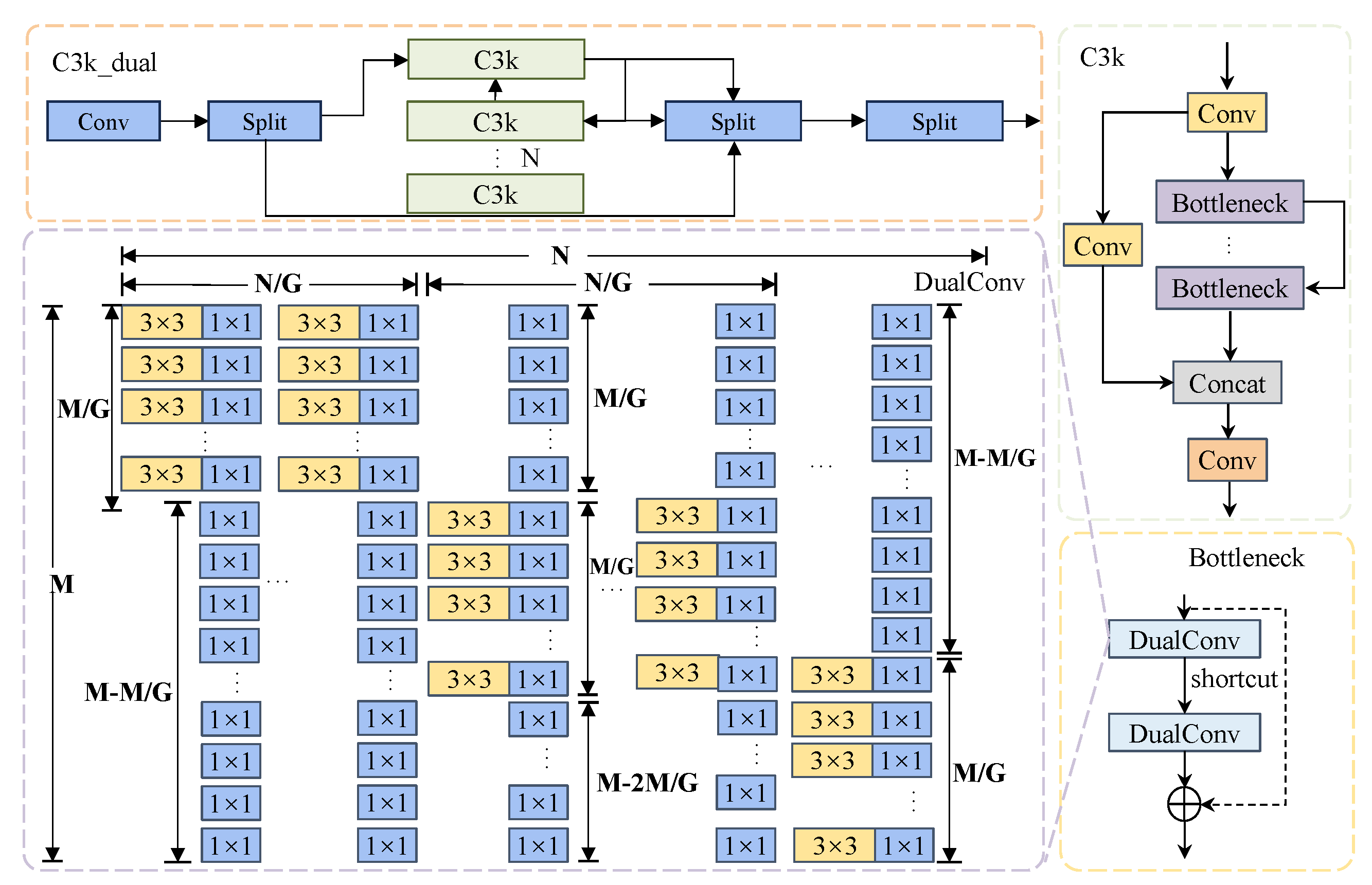
DualConv is a novel convolutional mechanism that combines the complementary advantages of group convolution and heterogeneous convolution to improve both representation capacity and inter-channel information exchange. Specifically, for each filter group, DualConv performs a 3 × 3 group convolution on a subset of the input channels to capture local spatial features, while simultaneously applying a 1 × 1 pointwise convolution across all input channels to retain global contextual information and facilitate effective cross-channel interaction. The outputs of these parallel branches are then summed, enabling the network to preserve rich spatial and semantic information while reducing feature redundancy. Unlike traditional group convolution, where each kernel operates on only a limited portion of the input feature map (typically 1/G of the total channels), DualConv enhances this architecture by equipping each group with a complementary 1 × 1 convolution path. This design allows spatially grouped operations to access the complete input feature map, mitigating the information bottleneck commonly induced by channel partitioning. In contrast to HetConv, which alternates between 3 × 3 and 1 × 1 kernels in a fixed pattern, DualConv maintains uninterrupted and parallel 1 × 1 convolutional paths, thereby preserving more continuous and complete semantic representations. The architectural details of the C2f-DCB module are depicted in
Figure 3.
By integrating DualConv into the C2f module, the resulting C2f-DCB retains the computational efficiency and structural simplicity of the original C2f, while significantly enhancing feature expressiveness and cross-channel communication. This is particularly beneficial for tomato semantic segmentation in greenhouse environments, where accurate delineation of small fruit instances and occluded boundaries is critical. Moreover, due to its inherent parameter efficiency through group convolution and its preservation of full input information via 1 × 1 convolutions, the C2f-DCB module enables deeper network construction without requiring additional operations such as channel shuffling. This makes it particularly suitable for lightweight semantic segmentation models deployed on edge devices under resource-constrained conditions in protected agriculture.
2.2.2. Cross-Modality Difference Complement Fusion
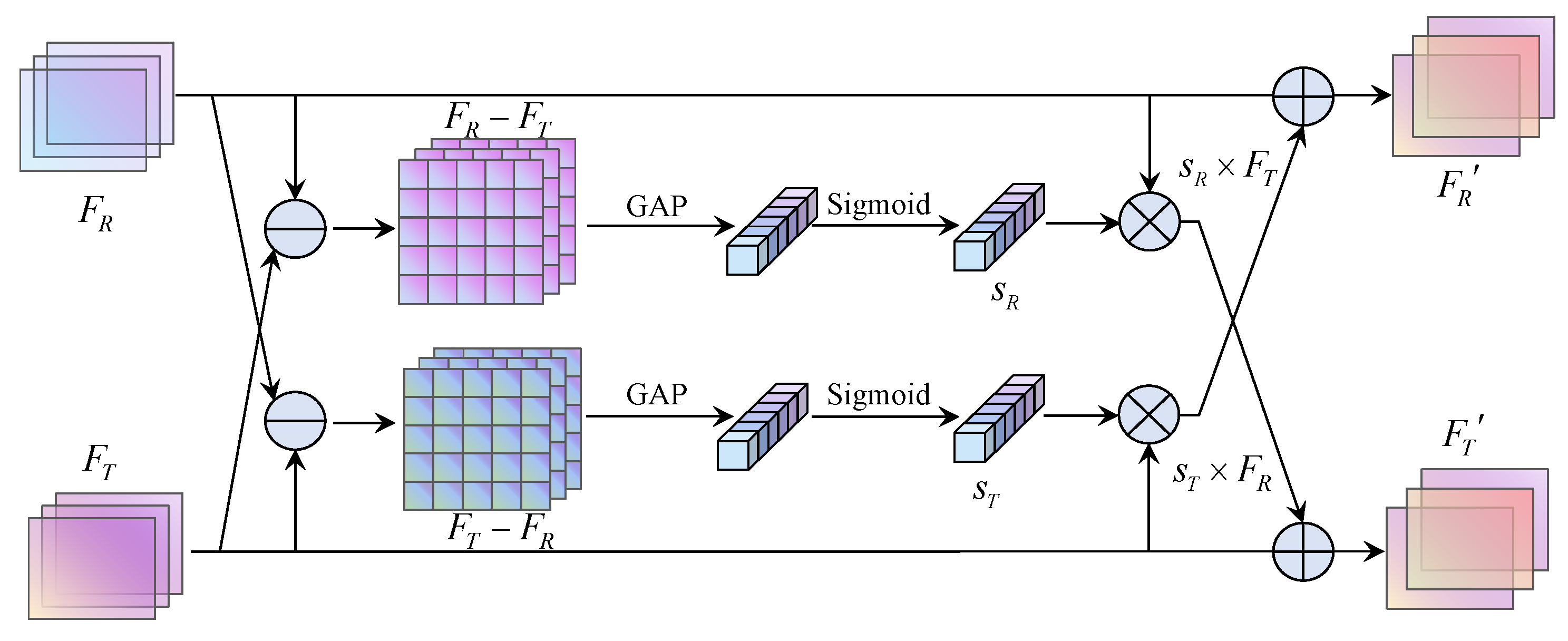
In facility agricultural environments, semantic segmentation of tomato fruits often encounters challenges such as complex lighting, multiple occlusions, and indistinct object boundaries. Relying solely on a single modality, such as RGB images, is insufficient to maintain robust performance across varying illumination conditions. To address this limitation, near-infrared (NIR) images are introduced as complementary inputs, providing structural and thermal cues that compensate for the shortcomings of RGB data under low light or intense illumination. Motivated by this, we propose the Multimodal Differential Complementary Fusion Module (C-MDCF) [
22] to effectively integrate complementary features from RGB and IR modalities, thereby enhancing the accuracy and robustness of tomato fruit segmentation, as shown in
Figure 4.
The RGB convolutional feature map
and the near-infrared (NIR) convolutional feature map
can be decomposed channel-wise into common-mode and differential-mode components as follows:
where the near-infrared feature map
and the RGB feature map
are split along the channel dimension into shared and differential components. Specifically, the common-mode component
represents the shared semantic features between the two modalities, reflecting the mutual information of the target. The differential-mode component
captures the unique characteristics of each modality, highlighting complementary information specific to each. This decomposition enables the fusion module to effectively leverage complementary features across modalities, thereby improving the model’s performance in segmenting tomato fruits under complex environmental conditions.
To enable effective multimodal fusion, the C-MDCF module utilizes channel-wise difference weighting to adaptively extract complementary features from the alternate modality. This module takes as input the feature maps produced by each single-modality branch during the feature extraction phase. By adaptively learning channel-wise difference weights between the two modalities, the C-MDCF module dynamically adjusts the fusion ratio, selectively emphasizing the modality that provides more discriminative information in the given context. This approach enhances the efficiency of cross-modal information utilization and mitigates the redundancy and conflicts that often arise from simple feature addition in conventional fusion strategies. The fusion process is formally defined as:
where
and
represent the feature maps from the RGB and NIR modalities, respectively.
and
denote the updated or fused feature maps for the near-infrared and RGB modalities, respectively. The term
denotes the absolute difference between the two modalities, capturing the inter-modal discrepancies. The operator
refers to global average pooling, which aggregates spatial information into a compact channel descriptor. The symbol
denotes the Sigmoid activation function, and the operator ⊙ indicates element-wise multiplication. This mechanism allows each modality to selectively incorporate complementary information from the other modality while preserving its own original features, thereby enabling effective and lightweight cross-modal integration.
2.3. Multi-Scale Channel and Position Attention Mechanism
In facility agricultural environments, the semantic segmentation of tomato fruits presents substantial challenges due to multi-scale object variations, dense occlusions, indistinct fruit boundaries, and complex lighting conditions. These difficulties are especially pronounced for small-scale tomatoes, which are frequently obscured or blended into the background, thereby hindering the accuracy of conventional segmentation networks. To address this, a novel Multi-Scale Channel and Position Attention Mechanism (MS-CPAM) is proposed, which enhances the model’s ability to represent multi-scale tomato targets and improves spatial perception through the combination of multi-scale feature fusion with channel and positional attention. This integrated design enables the network to better adapt to the inherent scale variations and spatial complexities of protected agricultural environments.
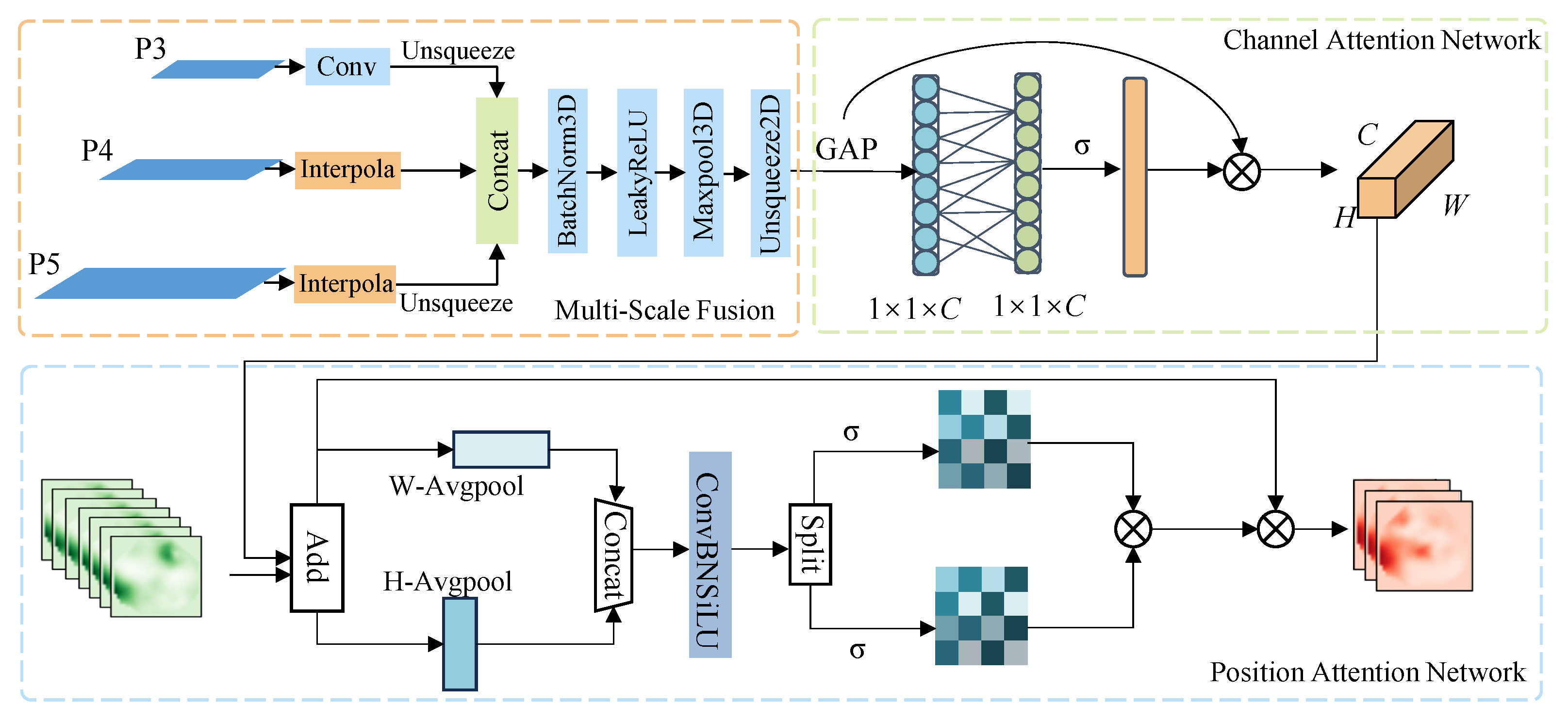
The Multi-Scale Fusion effectively integrates multi-scale feature maps by spatially aligning and fusing them through 3D convolution operations. Initially, separate convolutions are applied to unify the channel dimensions of features from different scales. Subsequently, features from the medium and large scales are upsampled to match the spatial resolution of the smallest scale. These aligned features are concatenated along a newly introduced dimension and processed via a 3D convolution to capture inter-scale correlations. Following batch normalization and LeakyReLU activation, a 3D max pooling operation aggregates spatial information while reducing dimensionality. Finally, the pooled features are squeezed back to their original dimensions. The MSFM is structured to leverage complementary information across different scales effectively, thereby enhancing the representational capacity for challenging small and occluded targets in complex agricultural environments. In MS-CPAM, we employ 3D convolutions to capture spatial and channel correlations across different feature scales. By simultaneously considering spatial and depth dimensions, 3D convolutions enable more accurate fusion of multi-scale features, which is particularly useful for detecting small or occluded objects in complex agricultural environments. While 3D convolutions are computationally more expensive than 2D convolutions, they offer substantial improvements in performance, particularly in handling complex lighting variations and occlusions.
To effectively capture representative features across channels, the Channel and Position Attention Mechanism is further integrated, through which detailed multi-scale information from both the Scale-Concatenate Fusion Modules and the SDI module is incorporated. As depicted in
Figure 5, CPAM consists of two sub-networks: a channel attention branch receiving input directly from the Scale-Concat as Input 1, and a position attention branch taking the combined output of the channel attention and SDI modules as input as Input 2.
The channel attention branch processes feature maps output from the PANet stage, containing rich detail cues. Based on SENet, traditional channel attention extracts channel weights via global average pooling, two dense layers, and a sigmoid activation. However, this approach reduces dimensionality, which can hinder attention accuracy and fails to efficiently model inter-channel dependencies.
To overcome these limitations, the channel attention retains full dimensionality after global average pooling and models local cross-channel interactions by considering each channel along with its nearest neighbors via 1D convolutions. The kernel size
k controls the neighborhood size influencing each channel’s attention and is related to the channel dimension
C through a nonlinear mapping:
where
and
b are scaling parameters (set as
,
). This adaptive setting enables deeper mining of complex channel relationships, enhancing feature discrimination especially for subtle tomato features in dense and occluded scenes.
The position attention branch complements channel attention by emphasizing spatial information crucial for precise localization. It splits the input feature map along width and height dimensions, applying pooling operations:
where
W and
H denote width and height, and
the feature value at position
. The pooled vectors
and
are concatenated and passed through a
convolution to produce spatial attention maps, which are then split into two location-dependent feature maps representing width and height attentions respectively.
Finally, the refined feature map is obtained by element-wise multiplication of the input features with the learned channel and position attention weights, yielding an output that effectively enhances the model’s focus on relevant tomato regions. This design is particularly beneficial in protected agricultural environments, where small, overlapping, and visually ambiguous tomato fruits require both precise channel-wise feature selection and spatial localization for robust semantic segmentation.
2.4. Multi-Scale Fusion and Semantic Refinement Network
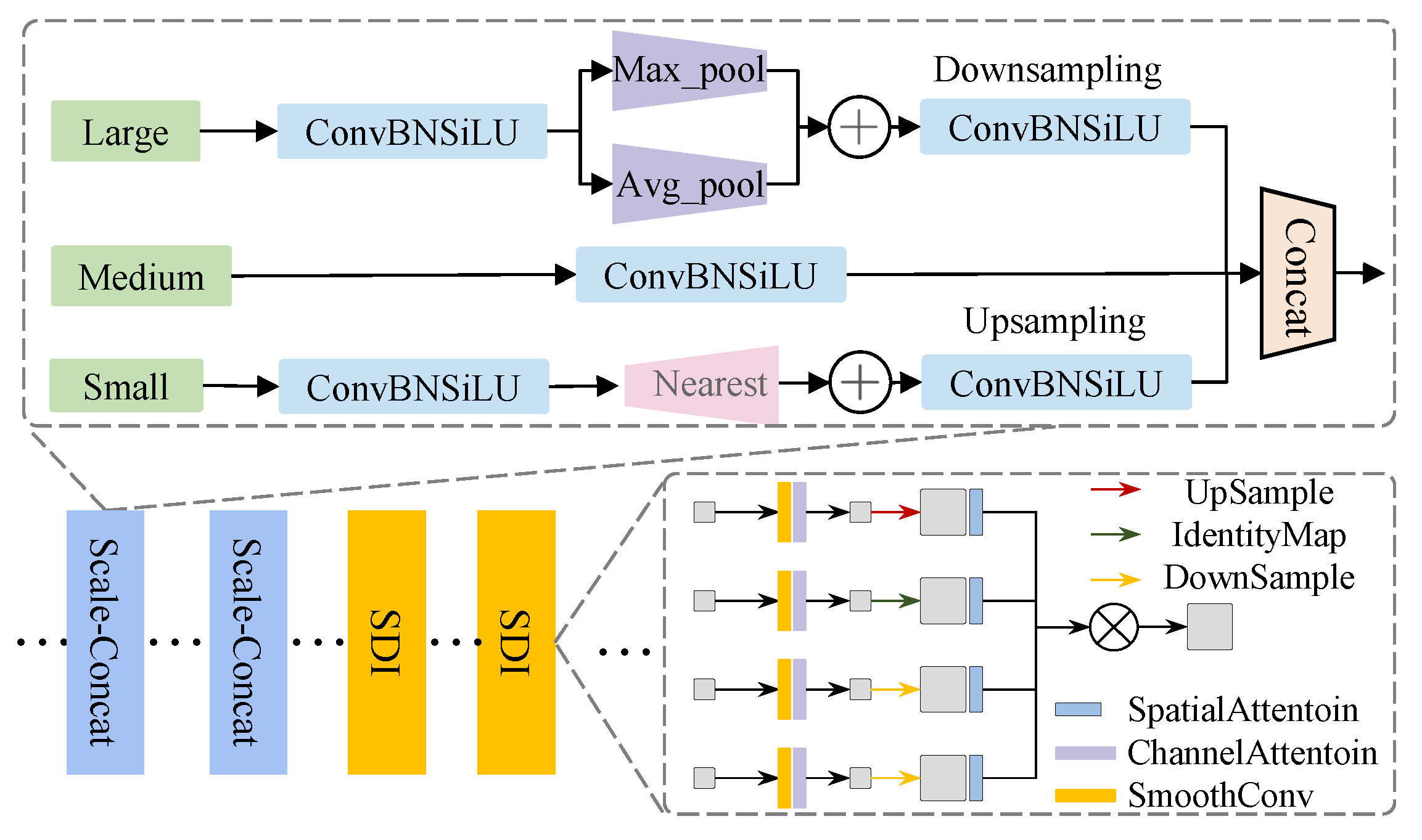
In complex protected agricultural environments, tomato detection and segmentation are hindered by dense occlusion, scale variation, and background interference. To overcome these challenges, MSF-SRNet is proposed in this study, comprising two complementary modules with distinct functions: the Scale-Concatenate Fusion Module, which strengthens multi-scale feature representation, and the Semantic Detail Injection (SDI) module, which preserves fine-grained spatial details lost during deep semantic abstraction [
23], with the architecture illustrated in
Figure 6. Specifically, Scale-Concat enhances contextual learning by parallelly processing large-, medium-, and small-scale feature maps, aligning their spatial resolutions, and concatenating them along the channel dimension, thereby improving the detection of small and occluded objects. In contrast, The SDI module fuses high-level semantic representations and low-level spatial features through a Hadamard-based cross-layer fusion strategy refined by spatial and channel attention mechanisms, ensuring the retention of critical structural details. By jointly leveraging Scale-Concat and SDI, the proposed network achieves more robust feature learning and significantly enhances segmentation accuracy under variable object sizes and complex occlusion.
2.4.1. Scale-Concatenate Fusion Module
This paper designs a Scale-Concatenate Fusion Module (Scale-Concat) to improve the expressiveness of multi-scale features. Unlike traditional Feature Pyramid Networks (FPNs), Scale-Concat processes large-, medium-, and small-scale feature maps in parallel. Each scale is first passed through a 1 × 1 convolution to unify the channel dimensions. For large-scale feature maps, a combination of max pooling and average pooling is employed to downsample spatial resolution while enhancing translational invariance. In contrast, small-scale feature maps are upsampled using nearest-neighbor interpolation to preserve local details such as edges and textures, effectively mitigating the loss of small-object features caused by background interference during upsampling [
24].
After aligning the spatial resolution of the three scales, the processed feature maps are concatenated along the channel dimension to form a fused multi-scale representation. Define , , and as the processed feature maps corresponding to the large-, medium-, and small-scale features, respectively. This fusion mechanism enables the model to achieve stronger recognition and segmentation performance when handling tomato fruits with severe occlusion and varying scales, thereby significantly improving segmentation accuracy under complex conditions in protected agricultural environments.
2.4.2. Semantic Detail Injection
In semantic segmentation tasks, models typically rely on rich detail information to achieve accurate boundary localization. However, as the network depth increases, spatial details in lower layers tend to be overshadowed by the abstract semantics of higher layers, resulting in the loss of critical information. The SDI adopts a Hadamard-based cross-layer fusion strategy to merge high-level semantics with low-level fine-grained features, thereby boosting the representational capability of multi-level feature maps. Furthermore, a specially designed skip connection mechanism enriches all feature hierarchies with both semantic context and structural details. The optimised multi-scale fused features are input to the decoder, resulting in more precise semantic segmentation outputs.
The Semantic Detail Injection (SDI) module refines the hierarchical feature maps generated by the head. For each feature map at level i, both spatial and channel attention mechanisms are applied to obtain the enhanced feature . This process enables the feature to integrate local spatial information and global channel-wise context, as shown below:
The Semantic Detail Injection (SDI) module refines the hierarchical feature maps generated by the head. For each feature map at level
i, the initial feature is denoted as
. Both spatial and channel attention mechanisms are applied to obtain the enhanced feature
:
where
and
represent the spatial and channel attention operations at level i, respectively, and
c is a hyperparameter controlling the reduced channel dimension. Specifically, a 1 × 1 convolution is used to reduce the channels of the original feature map
to c, resulting in the transformed feature
, where
and
denote the height and width.
The refined feature maps are then forwarded to the decoder. At each decoder stage
i, the corresponding enhanced feature
is used as the reference target. To ensure spatial alignment, the feature maps from all other levels
j are resized to match the resolution of
. This process is defined as:
where
D,
I, and
U denote adaptive average pooling, identity mapping, and bilinear interpolation to the resolution
, respectively.
To reduce artifacts introduced by resizing and to enhance feature consistency, a
convolution is applied to each resized feature map
. The operation is defined as:
where,
denotes the learnable parameters of the smoothing convolution, and
represents the smoothed feature map at level
j in decoder stage
i. Once all feature maps for stage
i are resized to the same spatial resolution, an element-wise Hadamard product is applied across them to enhance the feature representation at level
i, enriching both semantic information and fine-grained details. This operation is defined as:
where,
H denotes the Hadamard product. The resulting fused feature
is then assigned to the
i-th decoder stage for subsequent resolution reconstruction and semantic segmentation.
2.5. Evaluation Metrics
A confusion matrix comprising four metrics—TP, TN, FP, and FN—was constructed from the labeled and model-predicted samples. The model’s performance was evaluated using mean Average Precision (mAP). The corresponding formulas are given below:
AP represents the area under the precision–recall curve. The formulas used to compute each evaluation metric are as follows:
The mAP (mean average precision) represents the average of AP across all categories and directly indicates the model’s classification capability. The formula for computing mAP is as follows:
Mean Intersection over Union (MIoU) is a standard metric in semantic segmentation that evaluates the average agreement between predicted and ground truth masks across classes. Specifically, for each class
i, the intersection is the number of pixels correctly predicted as class
i (true positives), and the union includes the overall count of pixels belonging to class
i in either the prediction or the ground truth, encompassing both false positives and false negatives. Let
denote the number of pixels belonging to class
i that are predicted as class
j, and
t be the total number of semantic categories (including background, which is denoted as
). The IoU is computed for each class individually, and the MIoU is obtained by averaging the IoU values over all classes. The formulation of MIoU is presented in Equation (
15).
The counting accuracy (
) is defined as:
where
denotes the number of fruits predicted by the tracking system, and
represents the ground-truth count obtained from manual annotation. This metric quantifies the relative deviation of the predicted count from the actual count, with higher values indicating better consistency between automatic tracking results and human annotations.
FPS measures the model’s real-time inference capability, whereas GFLOPs (Giga Floating Point Operations) indicate its computational complexity. The number of parameters reflects the model’s architectural simplicity, while FLOPs (floating-point operations) quantify its computational complexity during inference.
3. Results of Experiment
3.1. Experimental Details
Input images were resized to 640 × 640. The model was trained for 150 epochs with a batch size of 32 using single-class segmentation. Stochastic gradient descent (SGD) was employed as the optimizer. Mixed precision training (AMP) was enabled to accelerate training. All experiments reported in this paper were conducted on Ubuntu 22.04 with Python 3.9, PyTorch 2.2.2, and CUDA 12.4, using an Intel(R) Xeon(R) Gold 6330 CPU and a single NVIDIA GeForce RTX 3090 GPU (24 GB). The training setup was based on YOLO11 defaults with modifications to the image size, number of epochs, and GPU hardware. The reported FPS is measured on the RTX 3090 GPU and reflects the throughput of the detection and segmentation network, excluding the DeepSORT tracking overhead. Latency on embedded platforms (e.g., Jetson or Edge TPU) was not explicitly benchmarked, and the reported FPS is therefore intended as a GPU-side throughput reference under a consistent hardware setting.
The DeepSORT algorithm was used for tracking with the following configuration: The maximum age of a track was set to 20 frames, allowing the tracker to maintain continuity even through temporary occlusions. A track is initiated only after detecting the object in at least 5 consecutive frames, ensuring that only confident tracks are established. To match objects across frames, a threshold for appearance similarity was set, ensuring that only objects with a sufficient visual match were linked. Additionally, both position and velocity information were used in the tracking process to improve accuracy. Finally, a Non-Maximum Suppression (NMS) technique was applied with a 60% overlap threshold to avoid duplicate detections of the same object.
3.2. Analysis of Model Performance Through Ablation Experiments
Table 1 presents the ablation results of incrementally integrating the proposed components—C-MDCF, MS-CPAM, SDI, and C2f-DCB into the baseline model within the YOLO11 framework. The baseline achieves a strong
of 95.5% and
of 76.7% with only 3.26M parameters and a high inference speed of 104.17 FPS, demonstrating excellent real-time performance. Introducing the C-MDCF (Multimodal Differential Channel Fusion Module) yields notable gains of +1.0% and +1.5% in
and
, respectively, highlighting its effectiveness in cross-modal feature fusion under occlusion and complex lighting conditions. The addition of MS-CPAM further improves detection accuracy to 96.9% and 78.8%, indicating enhanced perception of multi-scale and partially occluded targets. Although it introduces additional complexity, the accuracy gains justify the trade-off. Integrating the SDI module enhances semantic consistency and boundary localization; specifically, SDI yields a clear improvement in mIoU with only marginal changes in
, indicating that it primarily refines boundary delineation rather than increasing object discoverability. This property is particularly beneficial for robotic harvesting, where accurate fruit boundaries support safer grasp planning and reduce the risk of mechanical damage. Finally, the C2f-DCB module enables the model to achieve peak performance: 97.8%
, 79.1%
, and 105.07 FPS, while reducing the parameter count to 4.10M. This confirms the module’s lightweight yet effective design.
In conclusion, each component contributes distinct and complementary benefits. The YOLO-MSRF framework configuration achieves a balanced trade-off between accuracy, robustness, and efficiency, rendering it suitable for practical agricultural applications. Each single-module variant yields consistent improvements over the baseline, verifying its standalone effectiveness. Moreover, the paired combinations (e.g., C-MDCF with MS-CPAM, and MS-CPAM with SDI) achieve larger gains than individual additions, indicating complementary effects between cross-modal fusion, multi-scale attention, and semantic detail injection. Overall, the full model provides the best accuracy while maintaining real-time speed, demonstrating a favorable accuracy–efficiency trade-off.
To verify that the incremental gains in
Table 1 are not caused by training randomness, we repeated each ablation setting five times with different random seeds while keeping the same data split and training protocol. We report the mean and standard deviation of the main metrics (e.g.,
,
, and mIoU). In addition, we performed paired statistical tests between consecutive ablation variants (paired
t-test,
). The results show that the improvements introduced by each module are consistent across runs, and the gains of the later modules (e.g., SDI and C2f-DCB) remain statistically significant, supporting the validity of our architectural choices.
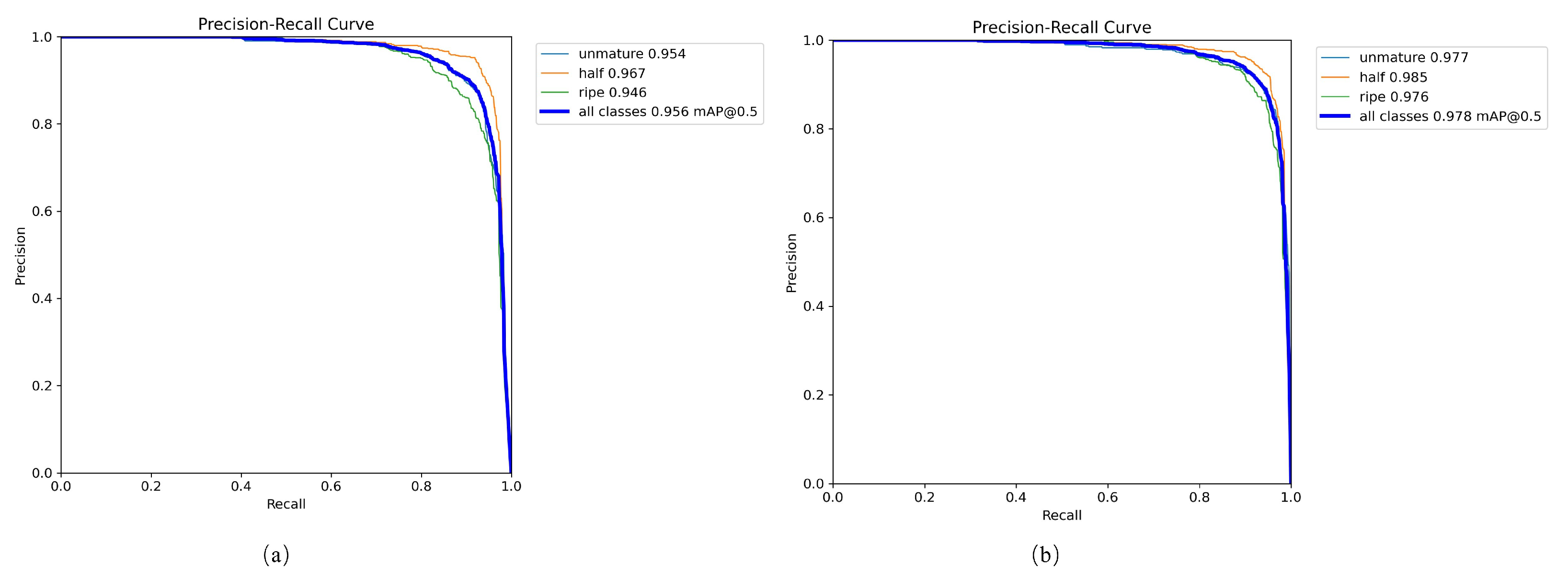
Figure 7 compares the PR curves of tomato detection at different maturity stages (unripe, half-ripe, ripe) for the YOLO-MSRF model and the baseline. The YOLO-MSRF model shows a larger area under the PR curve, indicating superior performance in segmentation and detection accuracy. The proposed YOLO-MSRF achieves a higher PR-AUC than the baseline (97.8 vs. 95.6), indicating a better precision–recall trade-off.
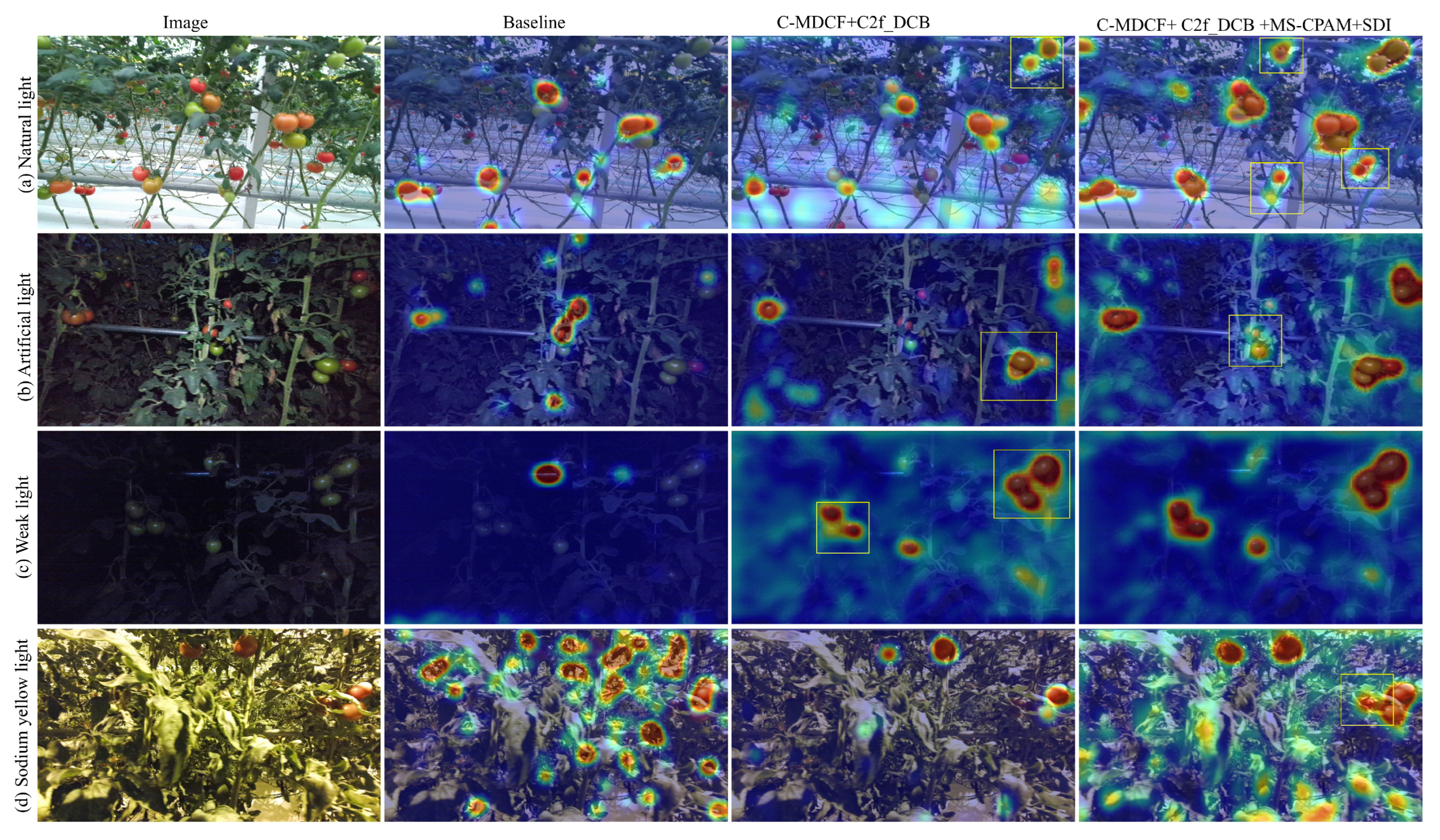
Figure 8 demonstrates that YOLO-MSRF performs better in localizing and segmenting small or occluded objects, such as unripe tomatoes, compared to the baseline. The integration of multimodal RGB and NIR data enhances robustness, leading to more reliable detection in varying agricultural environments. These results highlight the effectiveness of YOLO-MSRF for accurate and real-time tomato detection.
3.3. Sensitivity Analysis of C-MDCF to Misalignment, Noise, and Missing Modality
Table 2 indicates that C-MDCF is resilient to moderate RGB–NIR input imperfections. Under NIR spatial shifts of ±4 and ±12 pixels, performance degrades only slightly relative to the nominal dual-branch setting, suggesting robustness to small registration errors. Specifically,
decreases from 97.8 to 96.7 and 96.1,
from 79.1 to 77.8 and 77.1, and mIoU from 77.53 to 76.13 and 75.94. When Gaussian noise is injected into the NIR modality, the overall degradation remains limited but is more pronounced for stricter metrics, implying that noisy NIR primarily impairs high-IoU mask alignment and boundary quality rather than coarse detection. For
and 25,
declines to 96.9 and 96.4,
to 77.6 and 77.1, and mIoU to 75.31 and 75.08, respectively.
To examine modality absence, we evaluate two practical settings. First, we consider a masked-NIR fallback in which cross-modal injection is disabled while the dual-branch architecture is preserved. In this case, and mIoU decrease to 95.9 and 74.13, respectively, while GFLOPs and FPS remain unchanged (14.6 GFLOPs and 105.07 FPS), thereby isolating robustness effects from architectural changes. Second, RGB-only inference operates in a true single-branch mode, reducing computation from 14.6 to 12.0 GFLOPs and increasing throughput from 105.07 to 124.17 FPS. Correspondingly, drops from 97.8 to 95.5, from 79.1 to 76.7, and mIoU from 77.53 to 73.93, quantifying the accuracy–efficiency trade-off when NIR is unavailable.
3.4. The C2f-DCB Performance Comparison and Analysis of Convolution Operators
To verify the effectiveness of adopting DualConv in the C2f-DCB module, five commonly used convolution operators were evaluated under a unified experimental setting. The results are summarized in
Table 3. Overall, DualConv achieves the most favorable trade-off among detection accuracy, model complexity, and inference efficiency. In terms of accuracy, DualConv attains the highest
and
of 97.8% and 77.53%, respectively. By contrast, although Standard Conv exhibits strong feature representation capability, it incurs the largest parameter count (4.86 M) and computational cost (15.8 GFLOPs). Affected by computational redundancy, its inference speed is limited to 71.79 FPS. Notably, DualConv reduces the parameter count and computational cost by 15.6% and 7.6%, respectively, while simultaneously improving
by 0.8%, indicating that its dual-path feature extraction mechanism can more effectively suppress redundancy and enhance the representation of critical features.
Regarding hardware execution efficiency, Depthwise Separable Conv and Group Conv achieve higher inference speeds (118.42 FPS and 108.30 FPS, respectively) owing to their lower computational overhead. However, their values (96.2% and 96.8%, respectively) exhibit a noticeable decline compared with DualConv, making them less suitable for high-precision detection tasks. In addition, Dilated Conv enhances contextual modeling by enlarging the receptive field and thus outperforms Standard Conv in accuracy; nevertheless, the discontinuous memory access caused by dilated sampling degrades execution efficiency, resulting in the lowest inference speed among all methods (68.25 FPS), which limits its applicability in real-time scenarios.
In summary, DualConv maintains a lightweight design while alleviating the insufficient representational capacity of conventional lightweight operators and preserving favorable hardware-side inference performance, thereby validating its suitability as the core convolution operator in the C2f-DCB module.
3.5. Comparative Analysis Under Different Lighting Conditions
Table 4 reports the quantitative mask segmentation performance of the baseline and the improved models under different illumination conditions. Under artificial lighting, the improved model achieves a substantially higher recall for the overall class (0.859 vs. 0.783), while its precision decreases (0.748 vs. 0.807). Meanwhile, the
and the
show slight improvements (0.891 vs. 0.889 and 0.678 vs. 0.672), indicating that the proposed model tends to retrieve more true instances under challenging illumination at the cost of more false positives.
In weak-light environments, the improved model increases precision for the overall class (0.924 vs. 0.864) with a modest reduction in recall (0.965 vs. 0.997), and it achieves a higher (0.946 vs. 0.927) while keeping at a comparable level (0.651 vs. 0.656). For unripe tomatoes, precision improves markedly (0.812 vs. 0.685) and increases (0.855 vs. 0.793), suggesting stronger discrimination under low contrast; however, the stricter slightly decreases (0.312 vs. 0.346), implying that high-IoU mask alignment for this difficult class remains challenging.
Under natural lighting, the improved model consistently outperforms the baseline across all reported metrics for the overall class, with precision rising from 0.911 to 0.951, recall from 0.940 to 0.961, from 0.979 to 0.987, and from 0.826 to 0.839, demonstrating more reliable feature extraction under standard illumination.
In the sodium yellow light scenario, the baseline model shows slightly higher precision (0.773 vs. 0.751), whereas the improved model achieves better recall (0.831 vs. 0.797) and higher (0.856 vs. 0.849). The remains essentially unchanged (0.618 vs. 0.619), indicating that the proposed model maintains stable mask quality under strong color cast while improving detection completeness.
Overall, the improved model exhibits better robustness across lighting variations, mainly reflected by higher and improved recall/precision depending on the illumination condition, while some precision–recall trade-offs are observed in specific settings.
Ablation experiments under four common lighting conditions—(a) Natural, (b) Artificial, (c) Weak, and (d) Sodium yellow—are displayed in
Figure 8, with each row representing a distinct lighting setup. Within each row, the first column displays the original images, while the second column illustrates the segmentation results from the baseline model; the third and fourth columns display improvements introduced by the C-MDCF + C2f-DCB modules and the further integration of MS-CPAM + SDI modules, respectively.
The baseline model, shown in the second column, detects only a limited number of clearly visible tomato targets under natural lighting, with its performance markedly declining under other lighting conditions.
In the third column, the incorporation of C-MDCF + C2f-DCB significantly enhances segmentation performance. Specifically, C-MDCF effectively fuses RGB and infrared image data, mitigating interference caused by similar colors within the RGB channel during target localization. Concurrently, the C2f-DCB module maintains the receptive field while improving feature extraction capability and resolution, thereby enhancing detection of immature tomatoes in complex backgrounds—particularly where green fruits and leaves share similar hues.
Further enhancements are evident in the fourth column, where MS-CPAM + SDI modules are introduced. Heatmaps clearly indicate that MS-CPAM amplifies the model’s responsiveness to objects at various scales, especially small tomatoes, by capturing local key features through its multi-scale channel attention mechanism. Simultaneously, the SDI module refines spatial attention to emphasize critical regions, boosting segmentation accuracy for occluded or blurred-edge targets. Additionally, this module improves representation of complex textures such as leaf edges, preserving fine details and sharpening segmentation boundaries.
In summary, although the baseline model demonstrates some detection capability under normal lighting, its performance deteriorates in suboptimal conditions such as weak or sodium yellow light. The proposed multi-module enhancement strategy substantially improves tomato semantic segmentation across diverse lighting environments, confirming the robustness and efficacy of the method with multi-modal inputs in complex scenarios.
3.6. Performance Analysis of Different Models
To further confirm our model’s effectiveness, we compared it with several prominent detection and segmentation models, including YOLACT [
25], YOLOv5 [
26], YOLOv8 [
27], YOLOv9 [
28], SegFormer [
29], and SegMAN [
30].
Table 5 presents a comprehensive comparison of our proposed model against several state-of-the-art segmentation and detection models on the same tomato dataset, with uniform input image sizes to ensure fairness. Our model achieves the highest
of 97.8%, outperforming all compared methods. For instance, it surpasses YOLOv8 by 1.5 percentage points and YOLOv5 by 2.5 points, indicating superior detection accuracy at the commonly used 0.5 IoU threshold. In terms of
, which measures average precision over a range of IoU thresholds, our model reaches 79.1%, exceeding YOLOv8 (61.2%) and significantly outperforming YOLOv5 (64.7%) and YOLCAT (72.69%). This reflects enhanced robustness in more stringent evaluation conditions.
Regarding efficiency, our model maintains a competitive inference speed of 80.1 FPS, which is substantially faster than YOLOv5 (26.17 FPS) and YOLCAT (12.74 FPS), while slightly lower than the extremely fast YOLOv9 (163.93 FPS). Despite the high speed, our model is highly lightweight, with only 3.72 million parameters and 8.21 GFLOPs, far fewer than most other models—for example, YOLOv9 has 53.2 million parameters and 24.5 GFLOPs, while SegMAN has 75.3 million parameters and 25.3 GFLOPs. These results highlight our model’s ability to maintain high accuracy while minimizing computational cost, making it appropriate for use in resource-constrained agricultural environments.
Furthermore, our model achieves an mIoU of 77.45%, which is superior to YOLOv8 (75.13%) and significantly higher than YOLCAT (71.46%) and SegMAN (68.41%), indicating better segmentation quality and boundary precision. While SegMAN exhibits the highest FPS among segmentation models, its accuracy metrics lag behind our model, further confirming the effectiveness of our approach.
In summary, the proposed model strikes an excellent balance between high detection accuracy, segmentation quality, computational efficiency, and inference speed. It outperforms existing detection and segmentation baselines in key performance indicators, underscoring its potential for practical applications in real-time tomato fruit segmentation under complex agricultural conditions.
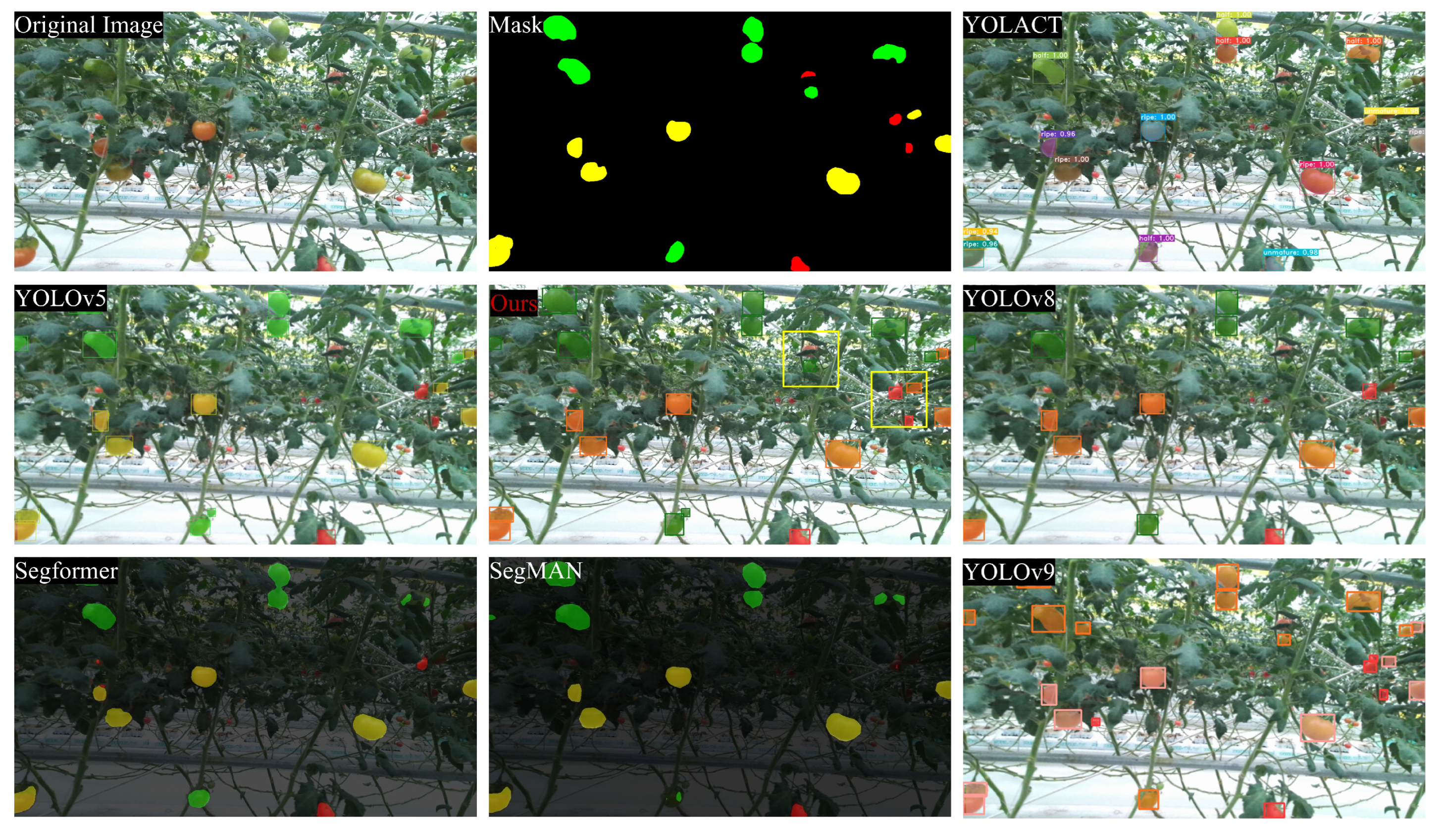
Figure 9 illustrates the segmentation results of tomatoes under natural lighting conditions demonstrate that the proposed method achieves the best performance in localizing small-target tomatoes. In comparison, SegFormer and SegMAN exhibit blurred segmentation boundaries and fail to detect small-target tomatoes. YOLACT, YOLOv5, and YOLOv8 perform moderately in localization but produce inaccurate segmentation edges. While YOLOv9 and our method show significant advantages in detecting small targets, the quantitative results (
Table 5) reveal that YOLOv9 requires 15× more parameters and 10× higher computational cost than our approach. This confirms that our method not only adapts well to complex lighting conditions but also maintains superior accuracy and the most precise segmentation under natural illumination.
As illustrated in
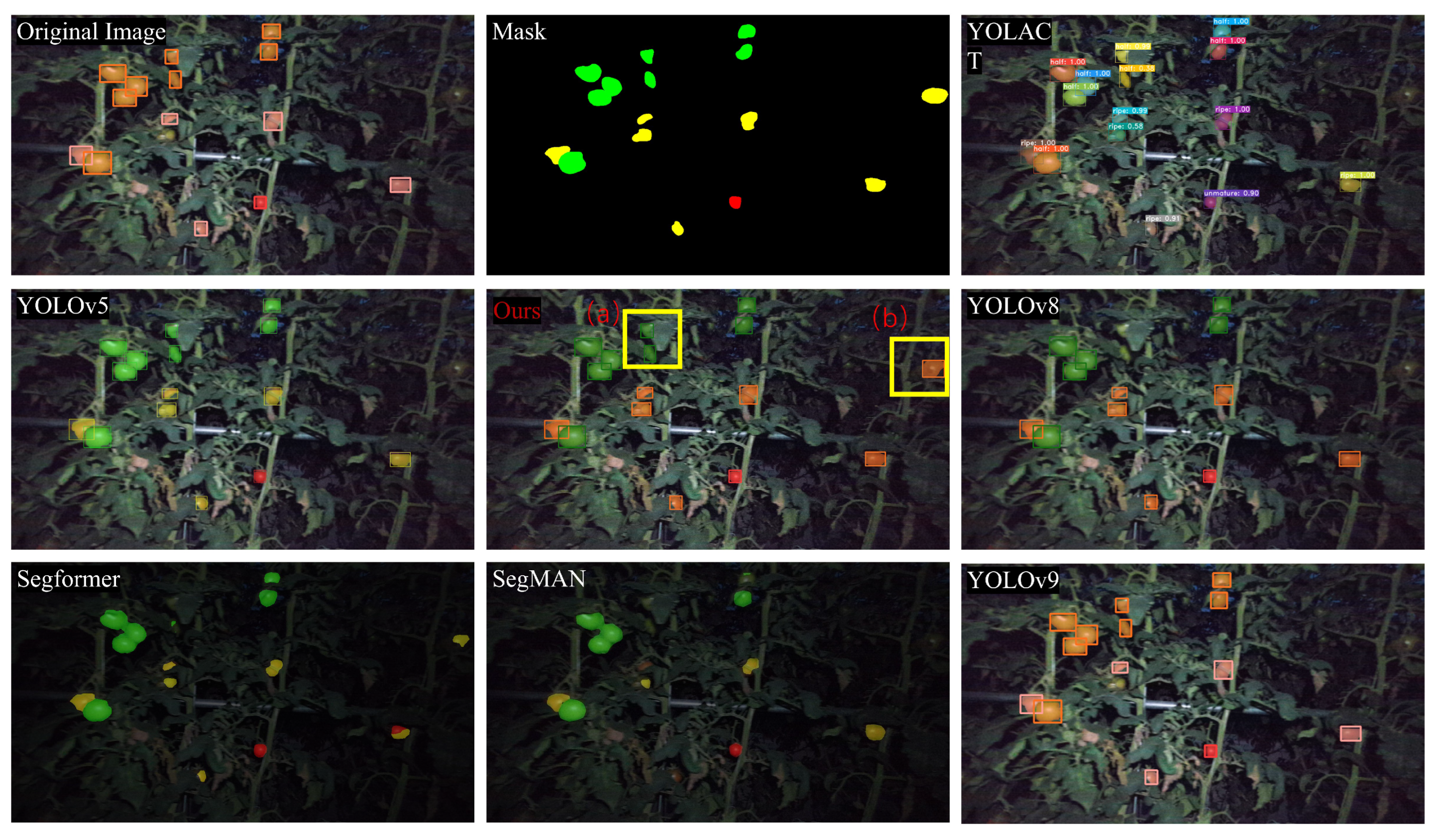
Figure 10, the tomato segmentation results under artificial lighting conditions demonstrate that the proposed method successfully detects both (a) green tomatoes with background-like coloration and (b) tomatoes in low-light regions under uneven illumination. In contrast, SegFormer and SegMAN, as traditional two-stage segmentation methods, exhibit blurred segmentation boundaries in low-light scenarios and fail to detect tomatoes with background-similar colors. While YOLOv8 detects slightly fewer immature tomatoes, YOLACT, YOLOv5, and YOLOv9 manage to identify most immature tomatoes but struggle with extremely low-light instances (b). These comparisons highlight that our method not only detects more tomatoes under artificial lighting but also maintains sharper segmentation boundaries. This underscores its adaptability and robustness under uneven and challenging illumination conditions.
As demonstrated in
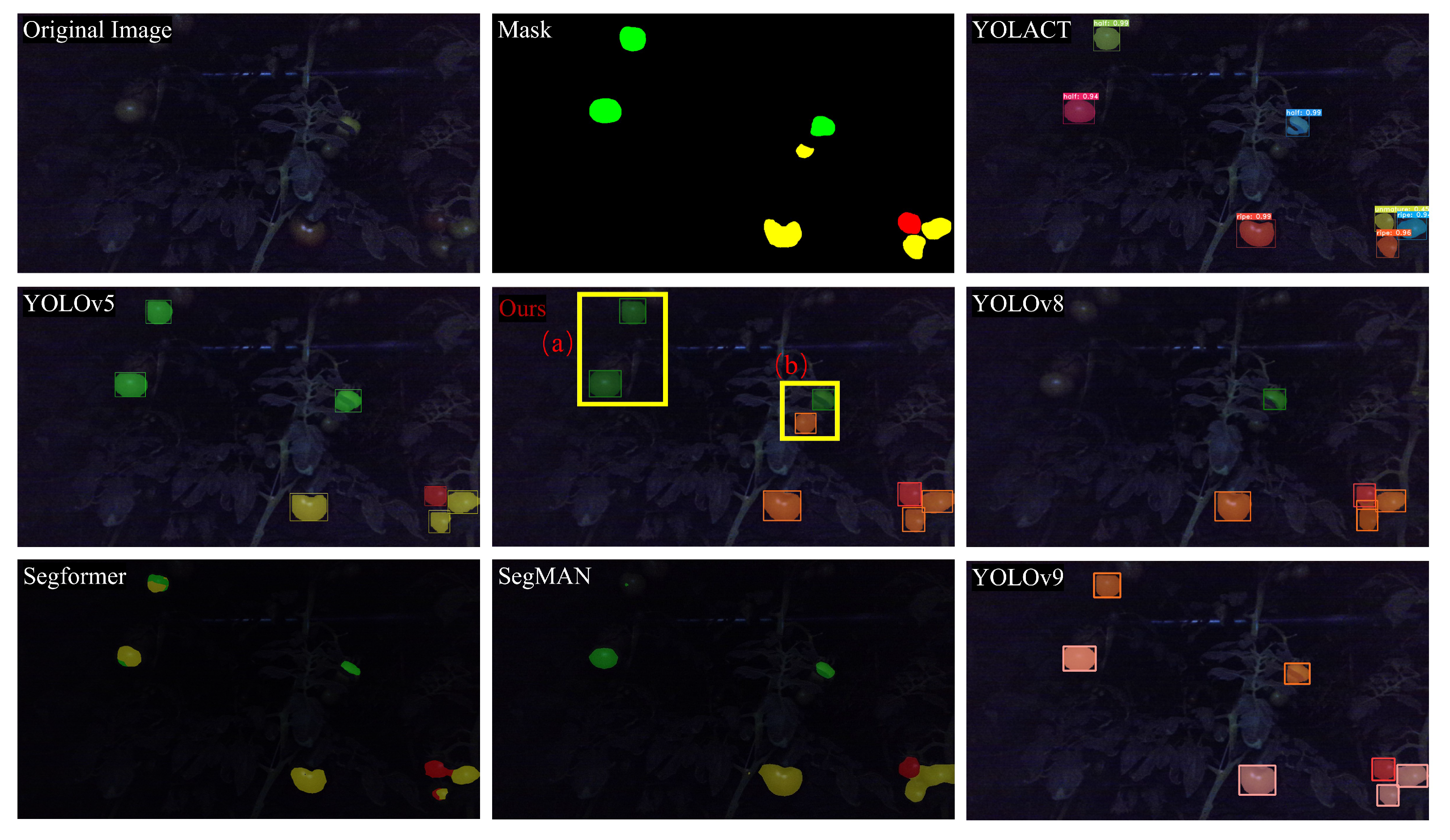
Figure 11, the tomato segmentation results under low-light conditions show that our proposed method effectively handles both (a) green tomatoes with background-like coloration and (b) occluded tomatoes. In comparison, traditional segmentation methods like SegFormer and SegMAN exhibit significantly blurred segmentation boundaries in low-light environments and completely fail to detect tomatoes that blend with the background, resulting in remarkably low segmentation accuracy. While YOLOv8 shows poor sensitivity to complex backgrounds and cannot detect green tomatoes, YOLACT and YOLOv9 manage to identify most background-colored tomatoes but suffer from classification inaccuracies. YOLOv5 performs better in this condition, correctly classifying and segmenting most tomatoes, yet fails to recognize occluded tomatoes (b). These comparative results clearly indicate that our method achieves superior performance in low-light conditions, detecting more tomatoes while maintaining precise segmentation boundaries. This robust performance demonstrates our method’s exceptional capability in handling challenging scenarios involving color camouflage and occlusion under insufficient lighting.
As illustrated in
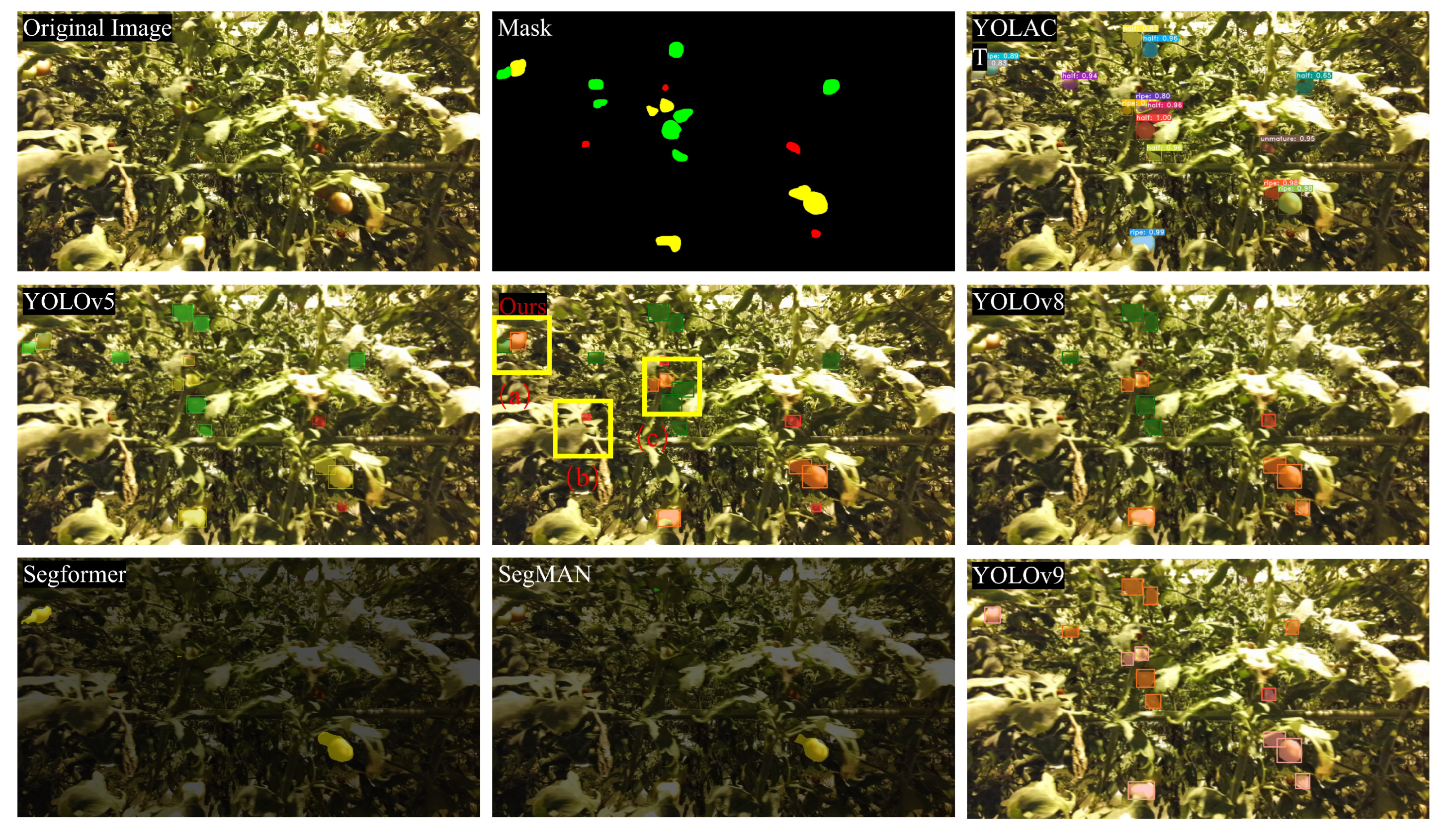
Figure 12, the tomato segmentation performance under sodium-vapor lighting conditions demonstrates that our proposed method successfully detects both (c) green tomatoes with background-like coloration and small-target tomatoes (a) and (b). In stark contrast, conventional segmentation methods including SegFormer and SegMAN show extremely limited capability in tomato detection under this specific lighting condition, indicating their low photosensitivity and resulting in remarkably poor segmentation accuracy. While YOLOv5 fails to detect semi-mature tomatoes, YOLACT, YOLOv8, and YOLOv9 exhibit relatively better performance in recognizing most tomato instances, albeit with limited effectiveness for small-target tomatoes. These comparative results clearly highlight that our method achieves superior performance in sodium-vapor lighting environments, particularly in detecting more small-target tomatoes while maintaining precise segmentation boundaries.
4. Fruit Tracking-Based Count and Size Estimation
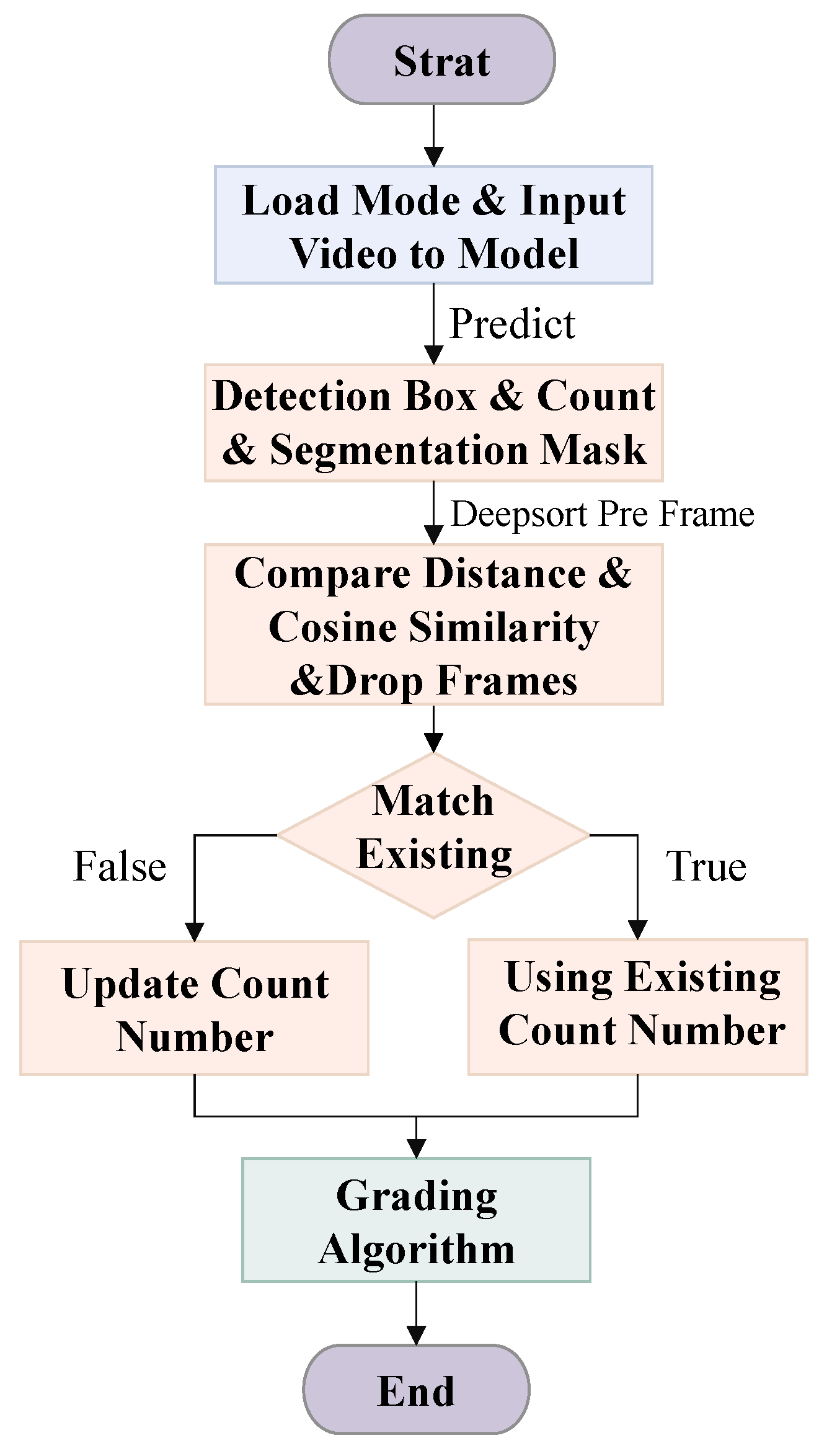
In controlled-environment agriculture, counting, tracking, and estimating tomato size are crucial for tasks such as yield prediction, harvest planning, and assessing fruit maturity and quality. These data support optimised crop management and cultivation practices to enhance yield and quality, while also providing reliable information for transportation and storage, thereby reducing loss and waste and improving overall economic efficiency. Moreover, precise counting and size estimation are essential for planning and scheduling automated harvesting systems and advancing intelligent management in controlled-environment agriculture. A multi-modal approach for tomato tracking, counting, and pixel-level size estimation is proposed in this study, with the algorithmic workflow illustrated in
Figure 13. First, a pre-trained model is applied to video frames for detection and instance segmentation, providing each tomato’s bounding box, class, and pixel-level mask, enabling precise localization and pixel-wise representation. The detection results are then fed into a DeepSORT multi-object tracker, which integrates appearance features and spatial information to track tomatoes across consecutive frames. In controlled agricultural environments, tomatoes are often occluded or overlapped. To ensure tracking continuity, a trajectory reconnection mechanism is designed: temporarily lost trajectories, including their last bounding box, class, and appearance embedding, are stored in a candidate list; in subsequent frames, new detections are matched with lost trajectories based on class consistency, appearance similarity, spatial distance, and temporal interval. If matched, the original trajectory ID is restored, allowing short-term occluded tomatoes to regain tracking, while trajectories exceeding the time threshold are discarded to reduce misidentification risk. As shown in
Table 4, the counting accuracy achieves an average of over 90%, while the mAP0.5 reaches a maximum of 98.9%.
This approach capitalises on the YOLO-MSRF model’s strengths in object detection and multi-scale feature fusion to enable real-time detection, counting, and pixel-level size estimation of harvestable tomatoes. Moreover, when integrated with depth cameras, pixel-level semantic segmentation can be further normalized to infer the true physical dimensions of each tomato, thereby enhancing the precision and reliability of size measurements [
31,
32]. By combining such measurements with size grading algorithms and appearance-based traits, tomato yield estimation and quality grading can be further achieved. According to commonly used agricultural grading standards, tomatoes are classified into three size categories based on fruit diameter: large, with a diameter exceeding 7 cm; medium, with a diameter ranging from 5 to 7 cm; and small, with a diameter less than 5 cm, while cherry tomatoes typically have a diameter between 2 and 3 cm [
33].
Furthermore, considering that the average fruit weight of tomatoes cultivated in Northern solar greenhouses in China typically ranges from 120 g to 150 g, the approximate yield per plant can be estimated by multiplying the detected fruit count by the average fruit weight. This estimation provides both upper and lower yield bounds and offers quantitative guidance for labor allocation, harvest scheduling, crop management, transportation, storage, and resource distribution, thereby enhancing the overall efficiency, effectiveness, and economic performance of agricultural production.
In this study, DeepSORT combines appearance embedding with Kalman filter-based motion prediction, which enables robust tracking of small and occluded tomato instances in dense clusters. Its computational efficiency allows real-time operation, which is critical for practical deployment in greenhouse environments. However, DeepSORT may suffer from ID switches under prolonged occlusions or severe overlaps, and its performance could be improved by incorporating more advanced appearance models or motion predictors, as implemented in recent MOT methods. Overall, DeepSORT provides a reasonable balance between tracking accuracy and efficiency, making it suitable for automated tomato counting and size estimation in our application.
Occlusion-Aware Size Estimation: In occlusion or overlap scenes, the instance mask may be partially missing, which can lead to systematic underestimation if size is derived directly from the visible mask area. To address this issue, we adopt an ellipse fitting strategy based on the Hough transform. Specifically, we extract the contour points of the predicted mask and apply an ellipse Hough transform to estimate ellipse parameters , where a and b are the semi-major and semi-minor axes, respectively. The corresponding diameters are and , and the ellipse area is . We further compute an equivalent diameter for robust size grading. An occlusion indicator (e.g., low mask solidity or abrupt area drop along a track) is used to trigger ellipse fitting. For each track ID, multiple frame-wise estimates are aggregated using a robust statistic (median) to obtain the final size, which improves reliability under short-term occlusions.
5. Discussion
The ablation results (
Table 1) suggest that the proposed components contribute complementary improvements to both segmentation accuracy and robustness. Compared with the baseline, introducing C-MDCF enhances cross-modal interaction and feature complementarity, which leads to consistent gains in
and mIoU. After incorporating MS-CPAM, the performance further improves, indicating that the proposed attention mechanism strengthens discriminative representation for small targets and partially occluded fruits. With SDI integrated, the model achieves additional improvement in segmentation quality (mIoU in
Table 1), implying better preservation of semantic details and boundary cues. Notably, the final inclusion of C2f-DCB reaches the best overall performance (97.8%
, 79.1%
, and 77.53 mIoU) while maintaining real-time inference (105.07 FPS), suggesting that it effectively balances representation enhancement and lightweight computation for practical deployment in facility agriculture. All architectural components were selected under real-time constraints, and the final configuration represents a practical trade-off between accuracy improvement and computational overhead, as supported by the ablation study.
Performance under Varying Lighting Conditions: We have evaluated the model’s performance under various lighting conditions, including low-light and high-light environments. Our experiments demonstrate that the integration of RGB and near-infrared (NIR) images significantly reduces the impact of lighting variations on the model’s performance. By utilizing complementary information from both modalities, the model mitigates the challenges posed by poor lighting conditions, ensuring accurate segmentation and detection even in extremely low or high light scenarios. This fusion approach enables robust performance across a wide range of illumination conditions typically encountered in controlled agricultural environments.
Handling Occlusion and Complex Environments: In agricultural settings, especially those with dense crop arrangements like greenhouses, occlusions and overlapping objects are common challenges. To address these issues, we have incorporated a trajectory reconnection mechanism into the model. This mechanism ensures continuity in tracking and detection even when fruits are temporarily occluded. Lost trajectories, along with their bounding box, class, and appearance embedding, are stored and matched with new detections based on class consistency, spatial distance, and temporal intervals. Additionally, the model benefits from multi-scale feature fusion and fine-grained spatial context, which allows it to capture detailed information about small and occluded objects. These capabilities are crucial for maintaining accurate tracking and segmentation in complex agricultural environments where cluttered backgrounds and overlapping crops are prevalent.
Impact of 3D Convolutions on Performance: 3D convolutions significantly enhance the model’s ability to capture multi-scale spatial relationships, which is crucial for detecting small and occluded objects in agricultural settings. Despite their computational expense, the use of 3D convolutions results in higher accuracy and robustness, particularly in challenging environments with occlusions or lighting variations. While 2D convolutions or depthwise separable convolutions could reduce computational cost, they would not achieve the same level of feature representation, especially in complex agricultural tasks. In future work, we plan to explore adaptive methods that balance the use of 3D and 2D convolutions based on available resources, allowing for optimized performance across different deployment scenarios.
Limitations and Future Work: While the proposed multimodal tomato semantic segmentation framework achieves strong performance under complex lighting conditions, several limitations remain and motivate future work. First, cross-crop transfer learning should be investigated to validate applicability to different fruits and vegetables (e.g., strawberries and cucumbers), which is important for improving the versatility of agricultural robots. Second, self-supervised learning could reduce dependence on large-scale annotated data, improving scalability to new environments and varieties. Third, incorporating temporal modeling may further alleviate occlusion-related failures and enhance tracking stability in dense canopy scenes. Finally, improving energy efficiency via model quantization and hardware co-design will facilitate large-scale deployment in resource-constrained agricultural scenarios and better align the system with practical production requirements. Additionally, cross-sensor motion blur differences caused by rover vibration (especially without global shutters) are not explicitly addressed in this work and will be explored in future studies.
In addition, our framework relies on multimodal RGB–near-infrared (RGB–NIR) inputs, which may limit its applicability in settings where NIR sensors are unavailable. In such cases, the proposed pipeline would need to fall back to an RGB-only configuration, and performance may degrade due to the loss of complementary NIR cues, particularly under challenging illumination. As a practical extension, we will provide an RGB-only variant and further investigate modality-missing learning strategies (e.g., knowledge distillation or modality hallucination) to transfer the benefits of NIR into the RGB branch, thereby reducing hardware dependence while retaining robustness.
Moreover, although we evaluate diverse illumination conditions, our experiments are conducted on a specific dataset and facility agriculture environment. Generalization to other greenhouses, camera systems, crop varieties, and outdoor scenarios may be affected by domain shifts in background clutter, fruit appearance, and lighting. Future work will therefore include cross dataset evaluation and domain generalization or adaptation techniques, such as transfer learning as well as self supervised and semi supervised learning, to improve robustness across different environments.
6. Conclusions
In this study, we present a lightweight and robust multimodal semantic segmentation framework tailored for tomato detection under complex lighting conditions in facility agriculture. By integrating RGB with complementary modalities and incorporating a series of novel modules—C-MDCF, C2f-DCB, MS-CPAM, and MSF-SRNet—the proposed method enhances feature representation, attention modeling, and cross-modal fusion, achieving superior accuracy (
of 97.8%) and real-time performance (105.07 FPS). Furthermore, we incorporate a trajectory reconnection mechanism into DeepSORT to improve tracking continuity for temporarily occluded fruits, enabling reliable tracking-based counting in controlled-environment agriculture (
Table 6). Overall, this work provides a practical solution for accurate and efficient fruit segmentation and counting under challenging visual conditions, supporting the advancement of smart facility agriculture.