Article

Blade Design and Field Tests of the Orchard Lateral Grass Discharge Mowing Device

1
College of Mechanical and Electrical Engineering, Hebei Agricultural University, Baoding 071000, China
2
Hebei Province Smart Agriculture Equipment Technology Innovation Center, Baoding 071001, China
*
Author to whom correspondence should be addressed.
Agriculture 2026, 16(2), 235; https://doi.org/10.3390/agriculture16020235
Submission received: 25 December 2025 / Revised: 14 January 2026 / Accepted: 15 January 2026 / Published: 16 January 2026
(This article belongs to the Section Agricultural Technology)

Abstract

Targeted coverage of crushed grass segments under the fruit tree canopy synergistically achieves the agronomic goals of soil moisture conservation, weed suppression, and soil fertility improvement. To address issues like incomplete grass cutting and high risk of damaging fruit trees in complex orchard environments with traditional mowing devices, a lateral grass discharge blade for orchard mowers was designed. Based on airflow field theory, the dynamic basis of the airflow field, critical conditions for carrying crushed grass segments, and their movement laws on the blade and in the air were analyzed to identify key factors affecting discharge. CFD simulations were conducted using the Flow Simulation module of SolidWorks 2021 to explore the effects of the blade airfoil’s long side, short side lengths, and horizontal included angle on the outlet velocity and outlet volumetric flow rate of crushed grass segments, determining the reasonable parameter range. With these three as test factors and the two indicators above, orthogonal tests and parameter optimization were performed via Design-Expert 13.0 software, yielding optimal parameters: long side 125 mm, short side 35 mm, horizontal included angle 60°, corresponding to 9.105 m/s outlet velocity and 0.045 m3/s volume flow rate. A prototype mowing device with these parameters was fabricated for orchard field tests. Results show an average stubble stability coefficient of 94.2%, average over-stubble loss rate of 0.39%, and crushed grass segment distribution variation coefficient of 23.8%, meeting orchard mower operation requirements and providing technical support for orchard weed mowing, coverage, and utilization.

1. Introduction

China is the world’s largest fruit-producing country, with the global leading planting area for various fruit trees [1]. By 2023, the total area of orchards in China was approximately 12,738 thousand hectares, and the fruit output reached 327.443 million tons [2]. The large industrial scale has placed extremely high demands on the refined management of orchards. In the field management of orchards, grass control is an important link with high labor intensity [3,4]. At present, the common grass control methods include three types: manual weeding, chemical weeding, and mechanical mowing [5]. Manual weeding requires a large amount of labor. Not only is its operation efficiency low, but also the development of urbanization has led to a serious loss of rural labor force [6,7]. Although chemical weeding is simple and easy to operate, long-term application of herbicides can lead to a decline in orchard soil quality, an imbalance in microbial communities, and the residual components can also pose risks to human health [8,9] and cause damage to fruit trees. In contrast, mechanical mowing features efficient, environmentally friendly, and sustainable operational capabilities, enabling it to control weeds quickly and effectively [10,11]. It has gradually occupied a dominant position in modern orchard management. Particularly in the grass-growing and mulching system, it serves as the core technical means to achieve the coordination of weed control and ecological protection [12].
As a sustainable orchard management model, the orchard grass-growing and mulching system offers significant advantages. After the grass is mowed, shredded, and returned to the field, it can effectively improve the soil structure [13] increase the content of soil organic matter [1,14], enhance the soil’s water and moisture retention capacity, and reduce soil erosion [15,16]. Meanwhile, it can also regulate the orchard’s microclimate [17], creating a favorable ecological environment for the growth of fruit trees in the orchard. However, if orchard weeds are left to grow unchecked, their excessive proliferation will compete with fruit trees for water, nutrients, and sunlight [18], affecting the normal growth and development of fruit trees [19]. Therefore, timely and reasonable mowing operations have become an indispensable link in orchard grass-growing management. Against this backdrop, the performance of mechanical mowing technology directly determines the effectiveness of orchard grass-growing management, among which the blade structure and grass discharge method are key factors affecting the operation effect.
A series of studies by scholars have shown that parameters such as blade type, material, edge angle, and rotational speed have a significant impact on mowing efficiency and quality. Fu [20] et al. designed a double-disc rotary cutter based on the characteristics of alfalfa planting in China and alfalfa agronomic requirements, promoting the uniform growth of the next alfalfa crop. Thomas [21] et al. employed the Design of Experiments (DoE) method, combining quantitative and qualitative performance indicators (such as the uniformity of grass clipping distribution, energy consumption, noise, etc.), to optimize the geometric parameters of mower blades (such as upturn angle, rake angle, fin design, etc.) for improving mechanical performance. H Jun [22] et al. tested the relationships between the rotational speed of the blade and the wind speed at the mower outlet, the power required by the mower, the cutting and discharge conditions relative to the lawn height, as well as the working speed. Chon [23] et al. comprehensively integrated LDV, high-speed cameras, and CFD numerical simulations to reveal the effects of the geometric shape of lawn mower blades and the structure of the casing on the internal flow field and operational performance. Bilous [24] et al. focused on the processing of corn, wheat, and barley, and optimized parameters such as the spacing, installation angles of impact plates (the core cutting components) of disc crushers, as well as disc rotational speeds by combining DEM simulations with experiments. They demonstrated that the precise matching between the parameters of cutting components and grain characteristics can significantly improve cutting efficiency and reduce energy consumption, thereby providing a basis for the parameter regulation of cutting tools in grain processing. Mathanker [25] et al. focused on the stalk cutting of energy cane, and investigated the effects of blade inclination angle, cutting speed, and stalk size on cutting energy consumption via impact cutting experiments. They found that the specific cutting energy consumption increases with the rise in cutting speed, providing key insights for the parameter optimization of cutting tools applied to energy crops.
The grass discharge method of a mower is related to the distribution position of the cut and crushed grass segments as well as their decomposition and maturation rate. The common grass discharge methods of orchard mowers include three types: lateral discharge, rear discharge, and grass collection [26]. Among these, rear discharge is currently the mainstream grass discharge method. During operation, grass is directly discharged backward through the rear grass discharge outlet of the mower, forming a continuous grass strip. This not only hinders subsequent operations such as fertilization and irrigation but also increases the workload of manual cleaning. Although the grass collection method can centrally gather the mowed crushed grass segments, it relies on grass bags or grass collection boxes. This not only increases the weight of the equipment but also requires frequent shutdowns for emptying, which affects operational efficiency. In contrast, the lateral discharge method directionally discharges crushed grass segments through the side discharge outlet, forming a concentrated unilateral grass strip that facilitates subsequent orchard management. Meanwhile, it does not rely on grass collection devices, which reduces the machine’s load, lowers energy consumption, and avoids the hassle of frequent shutdowns for emptying in the grass collection method. Thus, it enables long-term continuous operation and meets the requirements of refined management in modern orchards.
Computational Fluid Dynamics (CFD) is a method used to simulate and analyze fluid flow. It is widely applied in fields such as aerospace [27], energy and power [28], agricultural engineering [29] and environmental science [30]. Zhiling Chen [31] et al. used CFD to simulate the actual operating scenario of a cigar tobacco sprayer and analyzed the movement characteristics of droplets under different spraying conditions. Field tests showed that the droplet deposition density on the leaf surface exhibited a consistent change. Wang J [32] et al. used CFD simulation to study the airflow distribution characteristics in the cutterhead, providing an important reference for understanding the relationship between airflow and the distribution of material residues. Liu [33] et al. optimized the structural parameters of the micro rice-wheat combine harvester and conducted airflow field simulation analysis on the cleaning cylinder using CFD technology. Field tests proved the rationality of the airflow field distribution inside the optimized cleaning device. Dalong J [34] et al. conducted a three-dimensional numerical analysis on the conveying performance of the screw conveyor using CFD simulation, and further explored the influences of muck rheological parameters and screw conveyor working parameters on the muck flow behavior. Tang H [35] et al. analyzed the formation mechanism of the flow field in the pre-stripping header of the combine harvester through CFD simulation, revealing the flow field formation and steady-state flow field characteristics generated by the two types of combs. This provides ideas for the optimization of the pre-harvest stripping structure of the combine harvester and the research on reducing stripping losses in the later stage. Xing [36] et al., aiming to improve the performance of the impeller of the impurity discharge fan in the sugarcane harvester, established a CFD model simulation test for the impurity discharge fan and optimized the impeller parameters. Their research enhanced the impurity discharge performance of the fan under complex field conditions. Li [37] et al. simulated the internal flow field of the seed metering device using the CFD simulation method, obtained the distribution of the internal airflow field, and the results were basically consistent with those of the actual prototype test. The above studies indicate that the CFD method has significant efficacy in simulating fluid flow-related processes involved in various agricultural mechanization operations. The simulation results are in good agreement with the actual test data, which proves the reliability and accuracy of CFD as a computational modeling method for fluid dynamics in agricultural machinery development. In terms of the application of CFD in mowing machinery, scholars have studied the flow patterns of the internal airflow field in mowers [38,39], but have not investigated the working mechanism under the condition of side grass discharge. Therefore, conducting research on orchard side-discharge mowing devices through CFD simulation is of great significance for promoting the development of mechanization in modern orchards.
The main work of this paper are as follows:
(1)
Through theoretical analysis of the movement process of crushed grass segments after cutting, the key parameters affecting the grass discharge performance of the mowing device are determined. The determination of these parameters can lay a theoretical foundation for the subsequent simulation research on the working process.
(2)
Based on CFD, simulation tests are conducted on the blades under different parameter conditions, and the influence of various factors on the outlet velocity and outlet volumetric flow rate is analyzed. These simulation tests provide reliable data for the optimization of blade parameters.
(3)
A prototype of the orchard side-discharge mowing device was built, and field performance tests were carried out. The results show that all indicators meet the standard requirements for mowers.

2. Materials and Methods

2.1. Lateral Grass Discharge Principle of the Orchard Mower

2.1.1. Working Principle of Orchard Mowers with Lateral Grass Discharge

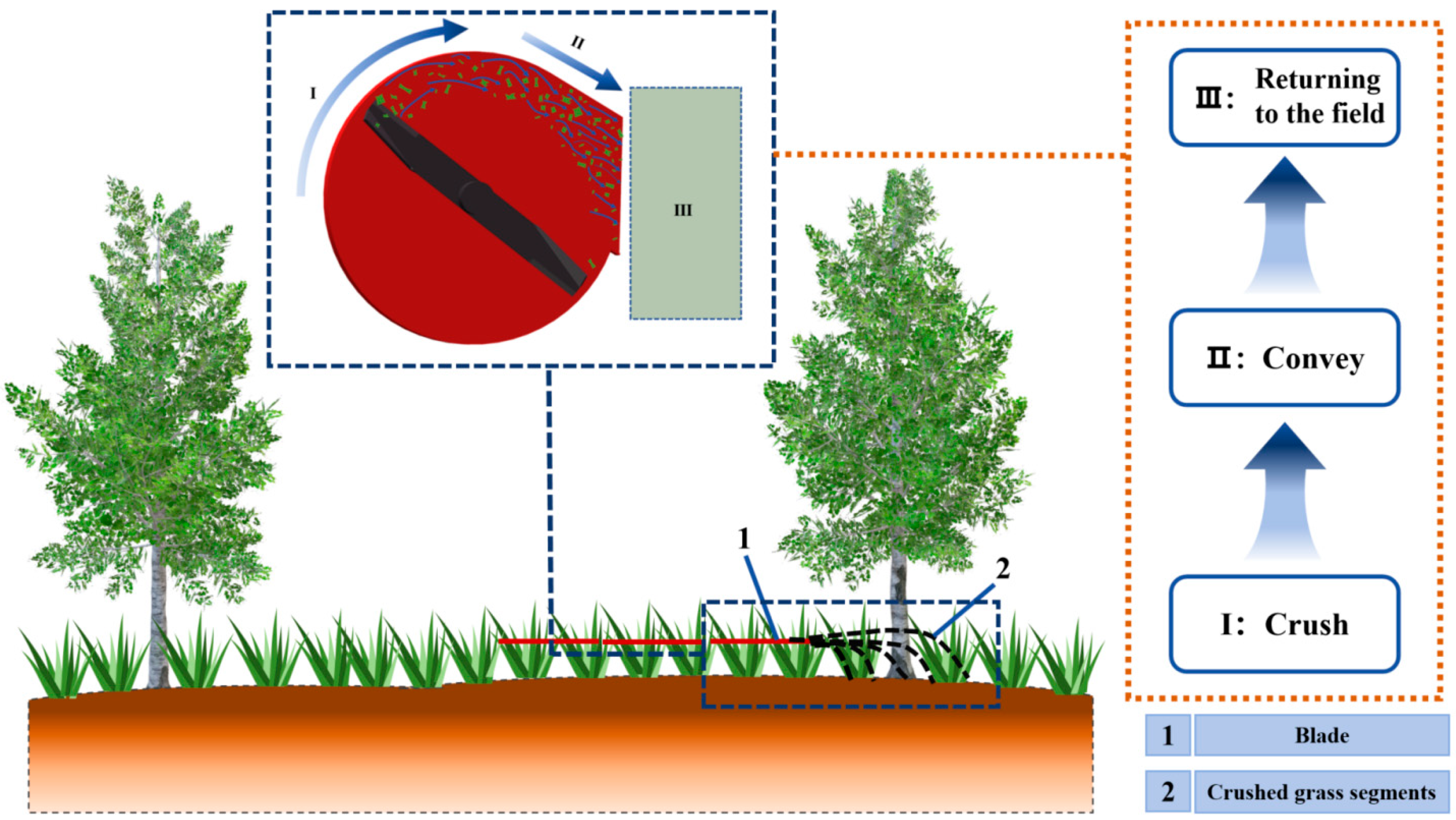
The orchard mower with lateral grass discharge is composed of a lateral grass discharge device, a power transmission system, and a frame. Among these components, the lateral grass discharge device consists of blades, a cutter shaft, and a housing. By locating the grass discharge outlet on the right side of the mower housing, the crushed grass segments inside the housing can be discharged from the right end of the mower under the action of the rotating airflow and scattered beneath the canopy of fruit trees. During the operation of the orchard mower with lateral grass discharge, it is connected to a tractor via a suspension method to form a mowing operation unit. The power of the tractor is transmitted to the orchard mower with lateral grass discharge through the rear power take-off shaft and a coupling, and then transferred to the cutter shaft via the transmission system inside the lateral grass discharge mower. The rotating cutter shaft drives the blades to rotate at a high speed, which cuts and crushes the grass. Meanwhile, under the action of the wind field formed by the high-speed rotation of the blades, the crushed grass segments are discharged from the grass discharge outlet. Therefore, the lateral grass discharge process of grass biomass can be divided into three main zones: Shredding Zone (I), Conveying Zone (II), and Mulching Zone (III). Its working principle is shown in Figure 1.

2.1.2. Blade Structure and Airflow Field of Airfoil

(1)
Blade structure
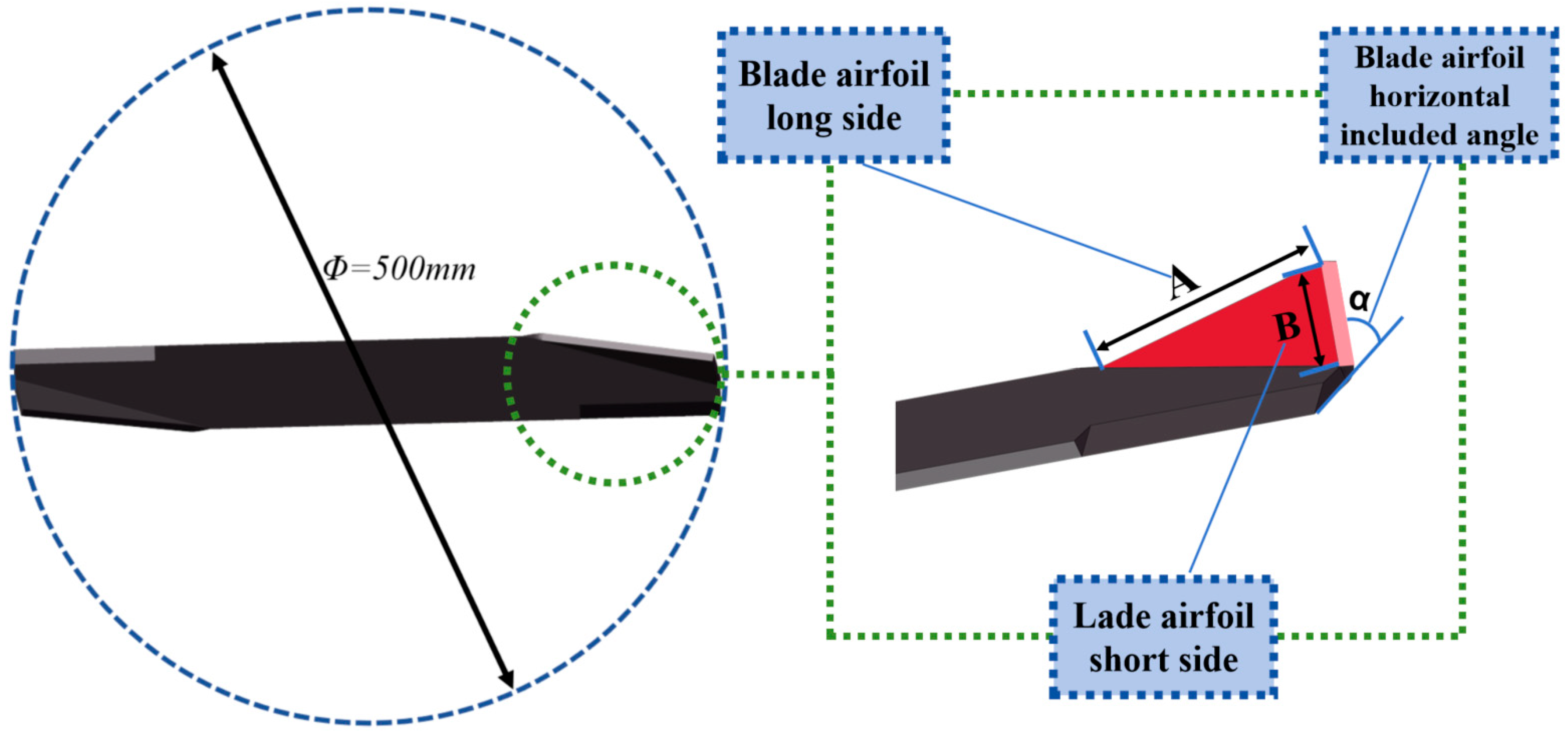
The blade structure is a crucial factor affecting the grass cutting, crushing performance, and grass discharge wind field performance of the orchard mower, and its structure is shown in Figure 2. When the blade rotates, the grass is cut and crushed into segments. Under the action of gravity, centrifugal force, and friction force, these crushed grass segments move along the airfoil of the blade toward its edge. After leaving the blade, they perform a horizontal or oblique projectile motion with a certain initial velocity, and finally fall into the inter-row spaces of fruit trees or the area beneath the tree canopies.
The design of its airfoil is the core prerequisite for determining whether the crushed grass segments can be discharged laterally as expected. If a flat blade without a specific airfoil is adopted, only mechanical cutting force can be used to break the grass during rotation, while the surrounding airflow is in a disordered diffusion state. As a result, the cut grass segments splash randomly or accumulate under the blade, making lateral discharge impossible. A rational airfoil design, via specific configurations of the long side, short side, and horizontal included angle, enables the crushed grass segments to form stable flow trajectories around the airfoil and be discharged laterally with high efficiency.
(2)
Fundamentals of aerodynamics for blade airfoils
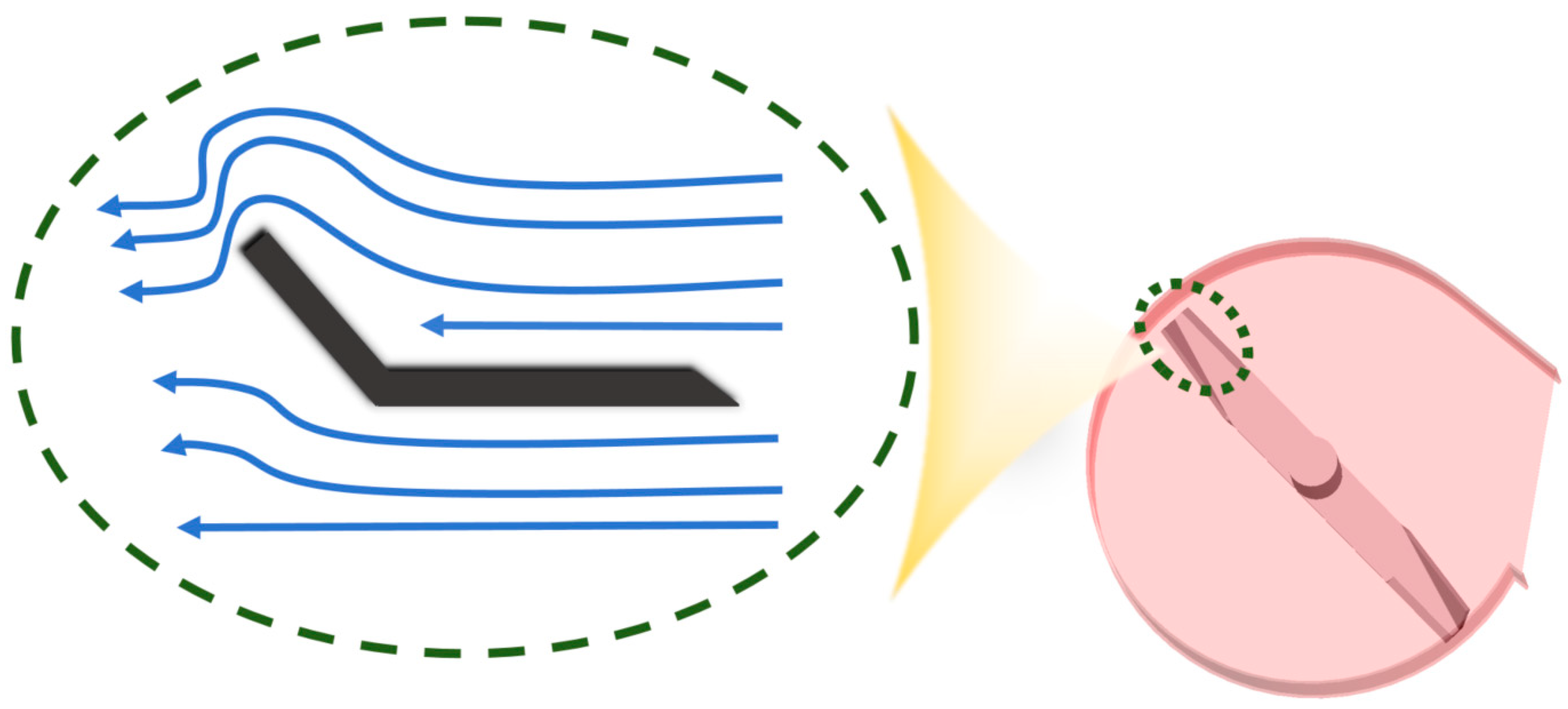
To conduct a preliminary analysis of the flow field characteristics around the high-speed rotating airfoil blade, based on Bernoulli’s principle, the sum of kinetic energy, potential energy, and pressure potential energy of the fluid per unit volume is constant along the streamline under the assumptions of ideal, incompressible, and steady airflow. In the flow field generated by the high-speed rotation of the mower blade, air can be regarded as an incompressible flow. However, in actual working conditions, the airflow may be affected by viscous effects, unsteady effects, and centrifugal force caused by rotation. To describe the flow field more accurately, it is necessary to consider the energy balance in the rotating frame of reference. Assuming the blade is stationary and the air flows toward the blade at an equal and opposite velocity, with the airflow being continuous, as shown in Figure 3.
In the rotating frame of reference, Bernoulli’s equation should include the centrifugal potential energy term. For the horizontal lateral grass discharge scenario, the variation in height difference is negligible, yet it is necessary to consider the effect of centrifugal acceleration. For two points the flow field, the modified Bernoulli’s equation is satisfied by the pressure values p 1 and p 2 , velocity values v 1 and v 2 , and air density ρ as follows:
p 1 + 1 2 ρ v 1 2 + ρ ϕ 1 = p 2 + 1 2 ρ v 2 2 + ρ ϕ 2
where ϕ is the centrifugal potential energy term, which is correlated with the rotational angular velocity and radial position r, with ϕ = 1 2 ω 2 r 2 . After simplification, the form of the energy conservation equation is expressed as follows:
1 2 ρ v 2 + p + ρ ϕ = c
The pressure difference between the upper and lower surfaces of the airfoil is as follows:
Δ p = p 2 p 1 = 1 2 ρ v 1 2 v 2 2 + ρ ϕ 1 ϕ 2
This pressure difference generates a lift force perpendicular to the airfoil, which acts as the primary driving force for grass discharge, counteracting gravity to keep the crushed grass segments afloat. The lift force formula is as follows:
F L = 1 2 ρ v 2 S C L
where
FL—lift force, N;
ρ —Air density, kg/m3;
v—Characteristic airflow velocity, m/s;
S—area of the airfoil, S = 1 2 A B , m2;
C L —lift coefficient, which is a function of the airfoil shape, the angle of attack (in this study, it is correlated with the horizontal angle α ), and the Reynolds number (Re).
It should be emphasized that the above analysis based on Bernoulli’s principle for ideal, incompressible, steady, and inviscid flow serves as a qualitative interpretation of the lift generation mechanism of the blade airfoil. Formula (4) is only used here to qualitatively illustrate the basic relationships between the lift force and physical quantities such as airflow velocity, density, and airfoil area, so as to counteract the influence of gravity on the crushed grass segments. The quantitative analysis, parameter optimization, and conclusions of this study do not rely on the numerical calculation of Formula (4). This simplified model can intuitively reveal the physical nature of the driving force acting on the crushed grass segments after cutting, and provide a theoretical direction for determining the design parameters that affect grass discharge performance.
However, inside the actual mowing device, the flow conditions are highly complex. Due to the high-speed rotation of the blades, the constraints of the casing wall, and the presence of crushed grass segments, the flow field exhibits characteristics of high turbulence, strong rotationality, and significant wall effects. Therefore, the main purpose of applying Bernoulli’s principle here is to qualitatively explain the origin of the pressure difference between the upper and lower surfaces of the blade airfoil and the generation of lift force, rather than to establish an accurate quantitative prediction model. The value of this simplified theory lies in providing physical intuition and preliminary guidance for the screening of key design parameters.

2.2. Theoretical Analysis of the Airflow Field

The high-efficiency carrying and discharging performance of the orchard lateral grass discharging mowing device with respect to crushed grass segments hinges on the synergistic interaction between the blade’s airfoil design and the unique airflow field generated by high-speed rotation. This design allows the airflow to possess sufficient kinetic energy while enabling stable grass cutting and discharge.

2.2.1. Dynamic Basis of the Airflow Field

The high-speed rotation of the blade is the fundamental driving force for airflow movement, and the linear velocity at its tip directly determines the initial kinetic energy of the airflow. The calculation formula for the tip velocity is as follows:
V t i p = 2 π r n
where
V t i p —linear velocity at the blade tip, m/s;
r—blade radius, set r = 500 mm = 0.5 m;
n—blade rotational speed, set n = 1500 / 60   r p s = 25   r p s .
To clarify the flow field characteristics, it is necessary to calculate the Reynolds number based on the blade tip velocity and characteristic length:
R e = ρ v t i p L c μ
where
ρ —the air density (adopted as 1.29 kg/m3 under standard conditions);
μ —the dynamic viscosity of air (adopted as 1.79 × 10⁻⁵ pa·s);
L c —the characteristic length, which refers to the blade chord length (i.e., the airfoil side length A, with a value range of 0.04 m–0.14 m).
By substituting the design parameters (r = 0.5 m, n = 1500 rpm), the blade tip velocity was obtained. By substituting into Equation (6), it can be concluded that the flow field around the blade in this study is a high-Reynolds-number turbulent flow, and a turbulence model was adopted for subsequent CFD simulations.
Under the combined action of the blade rotation and the casing of the mowing device, there is a clear correlation between the airflow velocity and the tip velocity, specifically: V   a i r = k · V t i p , among them k = 0.3 ~ 0.5 . Given that the designed blade radius is 500 mm, the rotational speed is 1500 rpm, and with a conservative coefficient k = 0.3 , the airflow velocity at the blade tip can reach 23.56 m/s.

2.2.2. Critical Condition for Carrying Crushed Grass Segments

Whether the cut crushed grass segments can be carried and discharged by the airflow depends on whether the airflow velocity exceeds the critical floating velocity of the crushed grass segments. Since the cut crushed grass segments are in an irregular shape, the calculation formula for their critical floating velocity is as follows [40]:
V t = 1 K c 4 g d s γ s γ 3 γ C
where
V t —critical floating velocity of crushed grass segments, m/s;
K c —correction coefficient for materials with irregular shapes, set K c = 2.47, (the adopted values for crushed grass segments in Reference [40]);
g —gravitational acceleration, m / s 2 ;
d s —average diameter of crushed grass segments, the value range is 7–13 mm, i.e., 0.007–0.013 m (this range is based on the measurement and statistics of the actual dimensions of crushed grass segment samples collected in the previous mowing tests of this study);
γ s —density of crushed grass segments, set γ s = 250   k g / m 3 (this value represents the density of common weeds in orchard grass cover and the values were adopted from Reference [41]);
γ —density of air under standard conditions, set γ = 1.29 k g / m 3 ;
C—viscous drag coefficient, set C = 0.44.
By substituting the data into the equation and combining with the research of Wang Jingzheng et al. [40], the critical floating velocity V t of crushed grass was determined to be approximately 5 m/s. However, considering the actual working conditions as well as the friction, collision, and other issues between crushed grass segments, the required airflow velocity should be much higher than the critical floating velocity of the crushed grass segments.
In summary, the airflow velocity generated by the blades during operation in the orchard lateral grass-discharging mowing device is significantly greater than the critical floating velocity of the crushed grass segments, thus meeting the conditions for carrying the crushed grass segments. By virtue of the advantage of airflow velocity over the floating velocity of the crushed grass segments, the carrying and discharging of the crushed grass are achieved, which provides a core guarantee for the continuous and stable operation of the equipment.

2.3. Analysis of the Movement of Crushed Grass Segments on the Blade

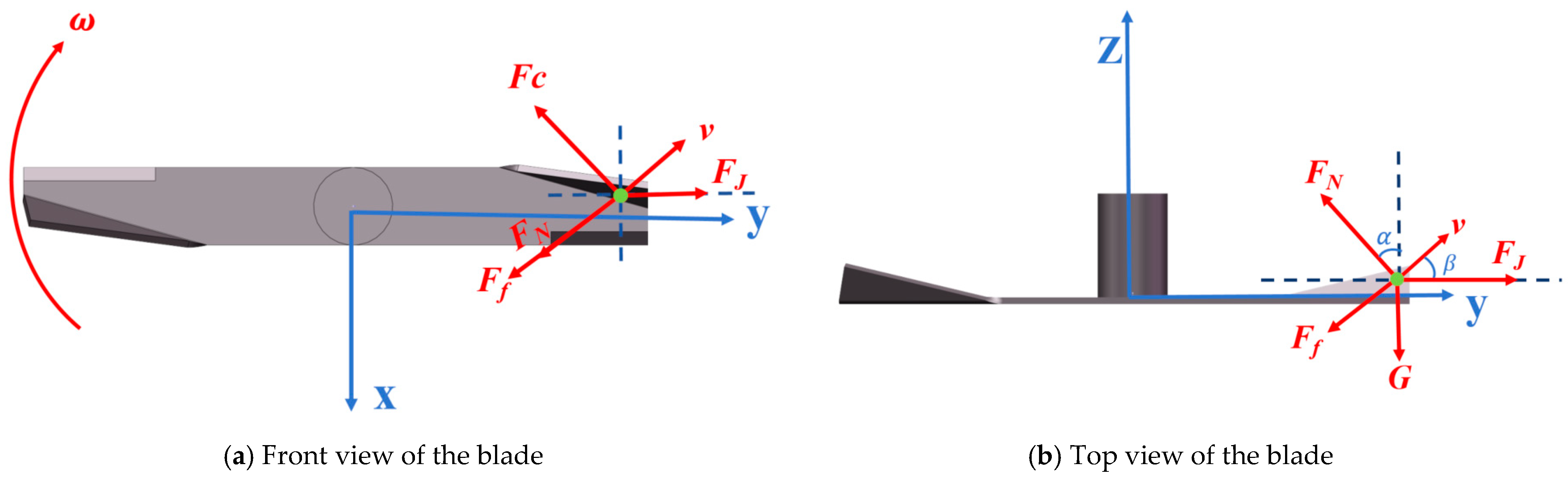
During the process of being discharged along with the blade of the mowing device, the crushed grass segments are subjected to the combined action of multiple forces, such as the supporting force, friction force, and centrifugal force exerted by the blade and the airfoil. The airfoil shape of the blade is a key factor affecting the movement state of crushed grass segments, and its structural parameters have a significant impact on the discharge of crushed grass segments. To study the movement of cut crushed grass segments under the action of the blade, the following assumptions are made for analysis: the crushed grass segments are regarded as rigid particles (with mass is m); the interaction between crushed grass segments is ignored, and only the force analysis of a single crushed grass segment during the rotation of the blade is conducted; this simplification was made based on the following considerations: the objective of this study was to optimize the blade structure capable of achieving stable and efficient lateral grass discharge. Through the dynamic analysis of a single crushed grass segment, the fundamental mechanism by which blade structural parameters affect the projectile motion of crushed grass segments can be clearly revealed. However, this assumption has limitations. When weeds are dense or high humidity causes crushed grass segments to be prone to collision and adhesion, the interaction between crushed grass segments will become significant, which may affect the actual movement trajectory of crushed grass segments on the blade. When the crushed grass segments reach the discharge outlet, they will immediately leave the blade and be discharged to the outside of the casing. As shown in Figure 4, a spatial coordinate system is established with the intersection point of the blade’s rotational central axis and the blade’s bottom as the origin, and the rotational central line as the Z-axis.
The crushed grass segments undergo accelerated motion on the surface of the blade airfoil, and the forces acting on them along the X, Y, and Z axes are as follows:
F X = F N x + F f x F C x F Y = F C y + F J F f y F N y F Z = F N z G F f z
where FX, FY, and FZ are the resultant forces acting on the crushed grass segment along the X, Y, and Z axes, respectively. The directions of the respective forces in the equations are as shown in Figure 4, and their values are as follows:
G = m g F C = 2 m ω v F J = m ω r + v cos β 2 / r F N = G cos α cos β + F C x sin α cos β F J + F C y sin α sin β F f = μ F N F C x = F C cos β F C y = F C sin β
where r is the coordinate of the crushed grass segment along the Y-axis; g is gravitational acceleration, m / s 2 ; μ is the friction coefficient between the crushed grass segment and the blade; v is the velocity of the crushed grass segment on the blade, m/s.
The components of the supporting force FN exerted by the blade airfoil on the crushed grass segment along the three axes are as follows:
F N x = F N sin α sin β F N y = F N sin α cos β F N z = F N cos α
The components of the friction force exerted by the blade airfoil on the crushed grass segment along the three axes are as follows:
F f x = μ F N cos α sin β F f y = μ F N cos α cos β F f z = μ F N sin α
By simultaneously solving Equations (8)–(10) and substituting them into Equation (7), the equations of motion of crushed grass segments in the OXYZ coordinate system can be derived according to Newton’s second law of motion (i.e., acceleration is equal to the ratio of the resultant force to mass), as shown in Equation (11). These equations form a system of second-order linear ordinary differential equations, which describe the complex relationship between the acceleration of crushed grass segments on the blade and various parameters.
d 2 x d t 2 = A d x d t 2 + B d x d t + C d 2 y d t 2 = D d y d t 2 + E d y d t + F d 2 z d t 2 = G d z d t 2 + H d z d t + I
where
A = cos β tan 2 α + μ cos β cos α tan β / r
B = 2 ω μ sin α 1 2 sin 2 β cos 2 β cos 3 β 2 ω 1 cos α tan β tan α sin α cos 2 β 1 2 tan α sin α sin 2 β
C = g cos α cos β ω 2 r sin α sin β sin α sin β + μ cos α cos β
D = 1 cos 2 α 1 2 tan α + μ tan α sin 2 β / r
E = 2 ω 1 cos α tan β cos α 2 ω sin α cos 2 β + 1 2 sin 2 β sin 2 β μ + tan α
F = g cos α cos β ω 2 r sin α sin β sin α + μ cos α cos β + ω 2 r
G = 1 2 cos β sin 2 β r 1 tan α + μ
H = 2 ω sin α 1 2 sin 2 β + cos 2 β 1 tan α + μ
I = g cos α sin β ω 2 r sin α sin β cos α + μ sin α g
It can be seen from the equation that the accelerations of the crushed grass segment along each axis interact with each other. Its motion state on the blade depends on the rotational speed of the blade, the horizontal included angle α of the airfoil, and the angle β between the friction force and the Y-axis. Moreover, angle β is related to the long side A and the short side B of the airfoil. The complete system of differential equations shown in Equations (7)–(11) describes the complex motion of crushed grass segments in three-dimensional space. However, it is difficult to obtain their analytical solutions. Yet, the focus of this study is on the motion states of crushed grass segments on the blade (which in turn affect their initial discharge states). This provides a theoretical basis for selecting key optimization variables in subsequent CFD simulations.

2.4. Analysis of the Motion of Crushed Grass Segments in the Air

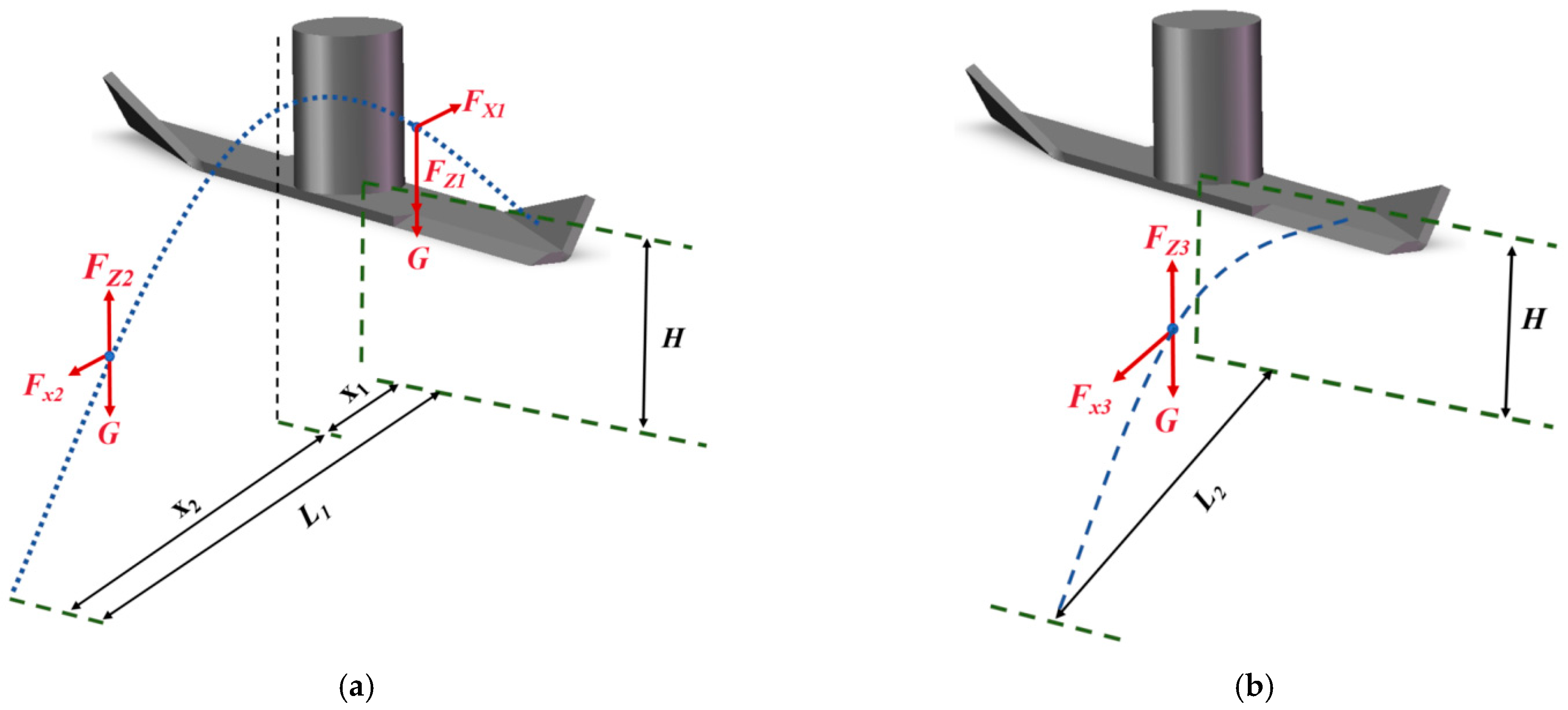
After the grass is crushed by the blade, the crushed grass segments leave the blade. They are thrown out under the combined action of centrifugal force and air flow. Due to the fact that the blade airfoil in this design forms a certain angle with the ground, the crushed grass segments will perform either an oblique projectile motion or a horizontal projectile motion with an initial velocity v. According to the projectile theory, when the crushed grass segments are close to the blade plane and are thrown out from the edge of the plane, they perform a horizontal projectile motion, with a relatively short projection distance. When the crushed grass segments are thrown off the airfoil of the blade, they undergo an oblique projectile motion, with a relatively long projection distance. This can create a time difference in the landing of crushed grass segments, enabling dispersed spreading and secondary spreading, thus enhancing the uniformity of spreading. Through the analysis of the lateral throwing distance, the main factors affecting the lateral throwing effect are determined. To simplify the analysis, it is assumed that the ground where the crushed grass segments fall is a horizontal plane. The research mainly focuses on the motion of crushed grass segments in the air and does not involve the rotation or collision of crushed grass segments on the cutting blade. It analyzes their lateral throwing distance and the motion of the crushed grass segments during discharge, as shown in Figure 5. When analyzing the oblique projectile motion of crushed grass segments during discharge, the entire process can be divided into two stages oblique ascent and oblique descent based on the different directions of air resistance in the Z-axis direction.
The air resistance acting on the crushed grass segment after it is thrown is
F = 1 2 ρ S a C a V 2
where
F—air resistance acting on the crushed grass segment, N;
ρ —the air density, kg/m3;
Sa—the windward area of the crushed grass segment, m2. Its value is related to the average size and attitude of crushed grass segments. During the movement process, the windward area can be approximately calculated according to the cross-sectional area of crushed grass segments, i.e., S a = π d s / 2 2 ;
Ca—the air resistance coefficient, set Ca = 0.44;
V—the velocity of the crushed grass segment when it is thrown, m/s.

2.4.1. Mechanical Analysis of the Crushed Grass Segment During the Oblique Ascent Stage

When a crushed grass segment undergoes oblique projectile motion, after detaching from the blade, it is only acted upon by gravity and air resistance in the air. By combining Newton’s second law, the motion of the crushed grass segment during the oblique ascent stage is decomposed into motions in the vertical and horizontal directions for analysis. The motion equation in the vertical direction is shown in Equation (13).
F Z 1 = k s V x 1 2 + V z 1 2 V z 1 m d 2 Z 1 d t 1 2 = m g + F z 1
where
k s = ρ S a C a 2
From the second equation of Equation (14), it can be obtained that:
d 2 Z 1 d t 1 2 = g + F z 1 m
By substituting F Z 1 = k s V x 1 2 + V z 1 2 V z 1 and V Z 1 = d Z 1 d t 1 , this yields a nonlinear differential equation. In a short time period, the acceleration is approximately constant; thus, the formula for uniformly accelerated motion, i.e., Z 1 = 1 2 a z 1 t 1 2 , is adopted, where a z 1 = d 2 z 1 d t 1 2 holds. It is obtained that:
t 1 2 = 2 Z 1 a Z 1 = 2 m Z 1 F Z 1 + m g = 2 m Z 1 k s V x 1 2 + V z 1 2 V z 1 + m g
The motion equation in the horizontal direction is shown in Equation (18):
F x 1 = k s V x 1 2 + V z 1 2 V x 1 m d 2 X 1 d t 1 2 = F x 1
where V x 1 is the horizontal component of the velocity of the crushed grass segment during the oblique ascent stage, m/s; V z 1 is the vertical component of the velocity of the crushed grass segment during the oblique ascent stage, m/s; t 1 is the motion time during the oblique ascent stage, s; Z 1 is the vertical displacement of the crushed grass segment during the oblique ascent stage, m; k s is the air resistance calculation factor; m is the mass of the crushed grass segment, kg.
From the second equation of Equation (18), it can be obtained that:
d 2 X 1 d t 1 2 = F x 1 m
The horizontal acceleration remains approximately constant over a short duration, with the displacement denoted as X 1 = 1 2 a x 1 t 1 2 where a x 1 = d X 1 d t 1 refers to the horizontal acceleration. It is obtained that:
X 1 = 1 2 F x 1 m t 1 2
By substituting Equation (17) and F x 1 = k s V x 1 2 + V z 1 2 V x 1 into Equation (20), the horizontal displacement of crushed grass segments during the oblique ascending phase can be obtained as
X 1 = F x 1 t 1 2 2 m = k s V x 1 2 + V z 1 2 V x 1 Z 1 k s V x 1 2 + V z 1 2 V z 1 + m g

2.4.2. Mechanical Analysis of the Crushed Grass Segment During the Oblique Descent Stage

The motion of the crushed grass segment during the oblique descent stage is decomposed into motions in the vertical and horizontal directions for analysis. The motion equation in the vertical direction is shown in Equation (22).
F Z 2 = k s V x 2 2 + V z 2 2 V z 2 m d 2 Z 2 d t 2 2 = m g F Z 2
From Equation (22), it can be obtained that:
t 2 2 = 2 Z 2 a Z 2 = 2 m Z 2 F Z 2 + m g = 2 m Z 2 K s V x 2 2 + V z 2 2 V z 2 + m g
The motion equation in the horizontal direction is shown in Equation (24).
F X 2 = k s V x 2 2 + V z 2 2 V x 2 m d 2 X 2 d t 2 2 = F x 2
where V x 2 is the horizontal component of the velocity of the crushed grass segment during the oblique descent stage, m/s; V z 2 is the vertical component of the velocity of the crushed grass segment during the oblique descent stage, m/s; Z 2 is the vertical displacement of the crushed grass segment during the oblique descent stage, m; t 2 is the motion time during the oblique descent stage, s.
Derived from Section 2.4.1, by the same token, the horizontal displacement of crushed grass segments during the oblique descent stage can be obtained as:
X 2 = F x 2 t 2 2 2 m = k s V x 2 2 + V z 2 2 V x 2 Z 2 m g + k s V x 2 2 + V z 2 2 V z 2
From Equations (21) and (25), the lateral throwing distance L1 of the crushed grass segment can be obtained as
L 1 = X 1 + X 2

2.4.3. Mechanical Analysis of the Crushed Grass Segment During the Horizontal Projectile Stage

When the crushed grass segments undergo horizontal projectile motion, it is as shown in Figure 4b. At the moment when the crushed grass segment is thrown off the blade, its initial velocity in the vertical direction is 0; that is, when t3 = 0, V z 3 = 0 . Therefore, when the crushed grass segment is in horizontal projectile motion, under the action of air resistance and gravity, it accelerates downward in the vertical direction and decelerates in the horizontal direction due to air resistance, eventually falling into the area below the fruit tree canopy. Its vertical motion equation is
F z 3 = k s V x 3 2 + V z 3 2 V z 3 m d 2 Z 3 d t 3 2 = m g F z 3
From Equation (30), it can be obtained that:
t 3 2 = 2 Z 3 a Z 3 = 2 m Z 3 F z 3 + m g = 2 m Z 3 k 3 V x 3 2 + V z 3 2 V z 3 + m g
The motion equation in the horizontal direction is shown in Equation (29).
F X 3 = k s V x 3 2 + V z 3 2 V x 3 m d 2 X 3 d t 3 2 = F x 3
where V x 3 is the horizontal component of the velocity of the crushed grass segment during the horizontal projectile stage, m/s; V z 3 is the vertical component of the velocity of the crushed grass segment during the horizontal projectile stage, m/s; Z 3 is the vertical displacement of the crushed grass segment during the horizontal projectile stage, m; t 3 is the motion time during the horizontal projectile stage, s.
Derived from Section 2.4.1, by the same token, the horizontal displacement of crushed grass segments during the oblique descent stage can be obtained as:
L 2 = F x 3 t 3 2 2 m = k s V x 3 2 + V z 3 2 V x 3 Z 3 m g k s V x 3 2 + V z 3 2 V z 3
Based on the above analysis of the motion of the crushed grass segment on the blade and in the air, it can be concluded that, excluding the influences of the crushed grass segment’s own mass and windward area, the lateral throwing distance is mainly affected by the velocity and height at the time of being thrown. The motion velocity of the crushed grass segment is determined by the rotational speed of the blade as well as the shape and inclination angle of the airfoil. Therefore, the main factors affecting the lateral throwing effect are the long side A of the blade airfoil, the short side B of the airfoil, and the horizontal angle α of the airfoil.

2.5. Simulation of Airflow Field Based on CFD Technology

2.5.1. Parameter Settings of the CFD Model

To investigate the influence of the airfoil parameters of the blade on the lateral discharge flow field, in accordance with modern orchard planting patterns and the operation requirements of orchard machinery, the designed blade was taken as the research object, and the three-dimensional modeling software SolidWorks 2021 was adopted to establish the geometric model of the blade. The modeling process is as follows: (1) Create a sketch on the front reference plane, and define the base contour of the blade as well as the airfoil section (determined by the long side A, short side B and horizontal angle α of the airfoil) according to the schematic diagram of the blade structure shown in Figure 2; (2) Use the Extruded Boss/Base feature, set a base thickness of 6 mm, and generate the solid blade model; (3) Utilize the Cut feature, and complete the modeling of the blade cutting edge in accordance with the parameters of a 30° cutting edge angle and a 100 mm cutting edge length; (4) Perform chamfering treatment on the model to eliminate tiny burrs (non-critical structures with dimensions < 1 mm), so as to obtain a simplified geometric model suitable for CFD calculations, with the key geometric features affecting the flow field retained as the priority.
A cylindrical rotating zone with a diameter of 501 mm and a height of 100 mm was created around the blade, which fully encloses the blade. The Multiple Reference Frame (MRF) model was employed to handle the rotational motion, and the zone was set to rotate around the Z-axis at a speed of 1500 rpm. A pressure-based steady-state solver was selected for the calculation. Considering the high Reynolds number and strong rotational characteristics caused by the high-speed rotation of the blade, the flow field was identified as a fully developed turbulent flow. Therefore, the Realizable k-ε turbulence model was chosen, as it exhibits excellent predictive capability for rotating flows and flows with strong pressure gradients. The standard wall function was adopted for near-wall treatment to meet the mesh requirements for engineering applications.
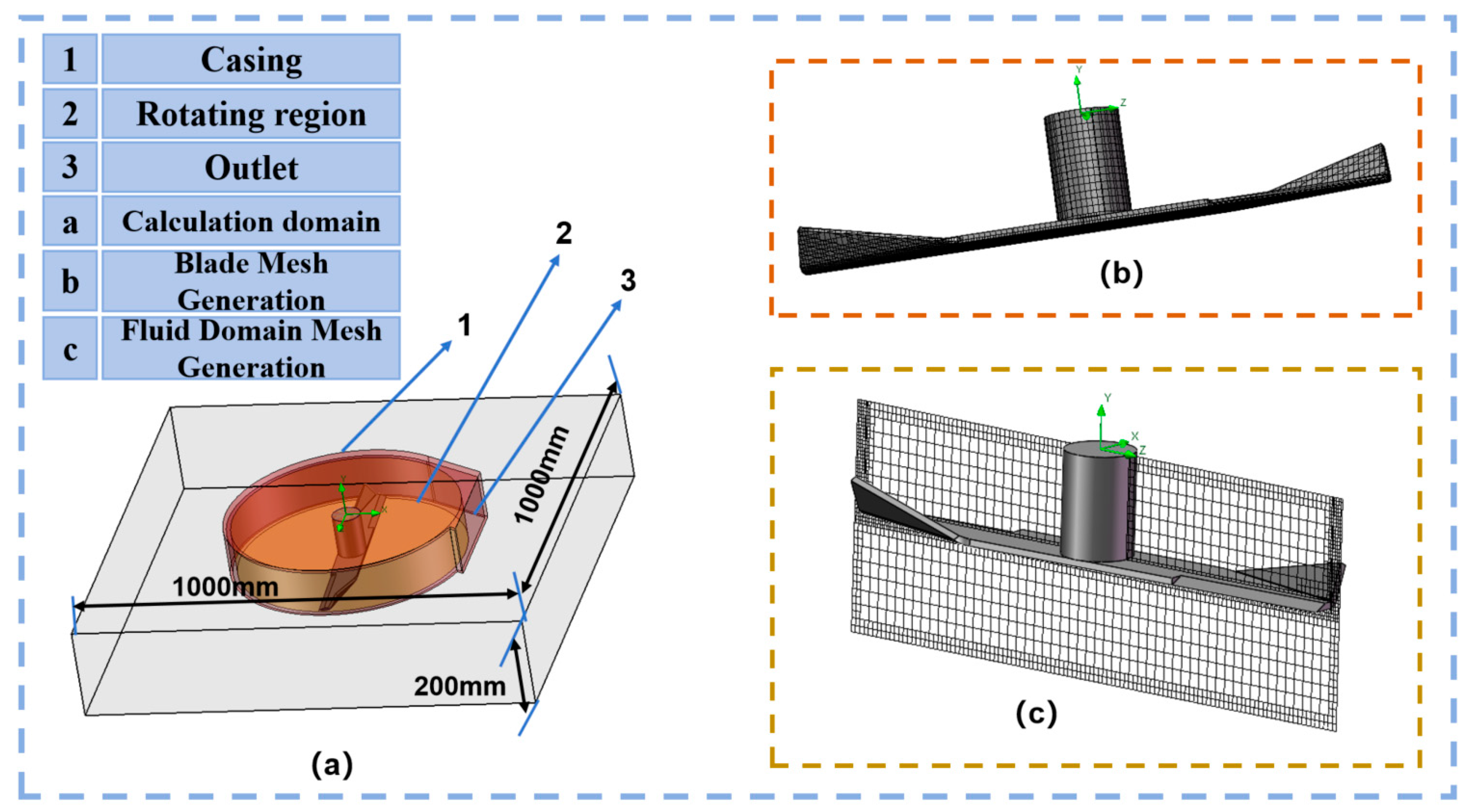
A strategy combining global mesh generation and local mesh refinement was adopted. Local mesh refinement was performed inside the rotating zone, near the blade surface, and in the discharge outlet zone, with the total number of generated hybrid mesh elements reaching approximately 320,000. The convergence criteria were set such that all residuals dropped below 10−4. The CFD simulation model of the mowing device established accordingly is shown in Figure 6.
To ensure that the accuracy of the simulation results was not significantly affected by the mesh quantity, a mesh independence verification was conducted, as shown in Table 1. Five sets of meshes were generated, with the number of mesh elements being 140,000, 240,000, 320,000, 450,000, and 800,000. The calculation results were gradually converged through stepwise mesh optimization. After comparing the discharge outlet velocity and discharge outlet volume flow rate (Figure 6a), it was found that when the number of mesh elements increased from 320,000 to 450,000, the changes in the discharge outlet velocity and flow rate were less than 2%. Therefore, the third set of meshes (approximately 325,000 elements) was selected for subsequent simulations, which balanced computational efficiency and accuracy.

2.5.2. Simulation Experiment Design

Three sets of single-factor simulation experiments were conducted to study the effects of the blade airfoil’s long side A, airfoil’s short side B, and airfoil’s horizontal included angle α on the working quality of the blade under different parameters. The experimental variables are shown in Table 2. The experimental indexes are the outlet velocity and outlet volumetric flow rate of the simulation model, and the values of each experimental index under different parameters can be directly obtained through the simulation post-processing module.

3. Results

3.1. Results and Analysis of Single-Factor Experiments

3.1.1. Influence of the Long Side A of the Blade Airfoil on the Outlet Velocity and Outlet Volumetric Flow Rate

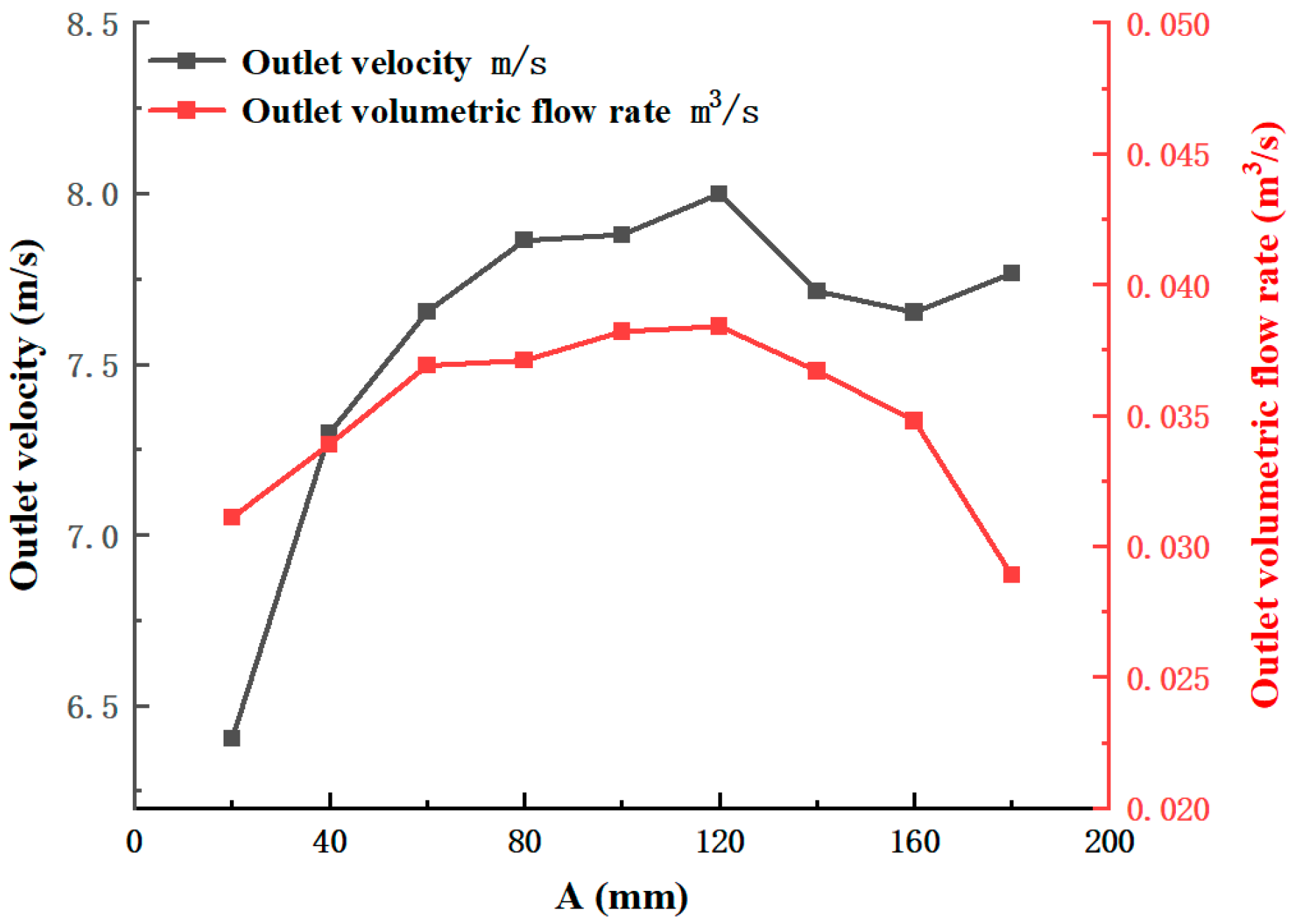
The length of the short side B of the blade airfoil was set to 30 mm, and the horizontal included angle α was 45°. When the long side A of the blade airfoil varied within the range of 0~200 mm, the influence of the blade airfoil on the outlet velocity and outlet volumetric flow rate is shown in Figure 7.
As can be seen from Figure 7, with the increase in the length of the long side A of the blade airfoil, both the outlet velocity and the outlet volumetric flow rate show a trend of first increasing and then decreasing. The reason is that as the length of A increases, the area swept by the airfoil during the blade rotation expands, and the centrifugal force consequently increases. After the centrifugal force is enhanced, it can drive the airflow to obtain a greater radial velocity. Meanwhile, the expansion of the area swept by the airfoil will also draw in more airflow, thereby increasing the outlet velocity and outlet volumetric flow rate. If A becomes too large, the airflow will rotate continuously alongside the blade, resulting in the formation of a circulation. This circulation fails to be discharged promptly by centrifugal force. Additionally, local eddies are created, which disturb the original pressure distribution. As a consequence, both the outlet velocity and the outlet volumetric flow rate tend to decrease. When A is in the range of 40–140 mm, both the outlet velocity and outlet volumetric flow rate remain at a relatively high level. However, when A exceeds 140 mm, the outlet volumetric flow rate drops sharply. Therefore, the length of A should not exceed 140 mm. Considering both the outlet velocity and outlet volumetric flow rate comprehensively, the discharge performance of crushed grass segments is relatively optimal when the length of the long side A of the blade airfoil is within this range.

3.1.2. Influence of the Short Side B of the Blade Airfoil on the Outlet Velocity and Outlet Volumetric Flow Rate

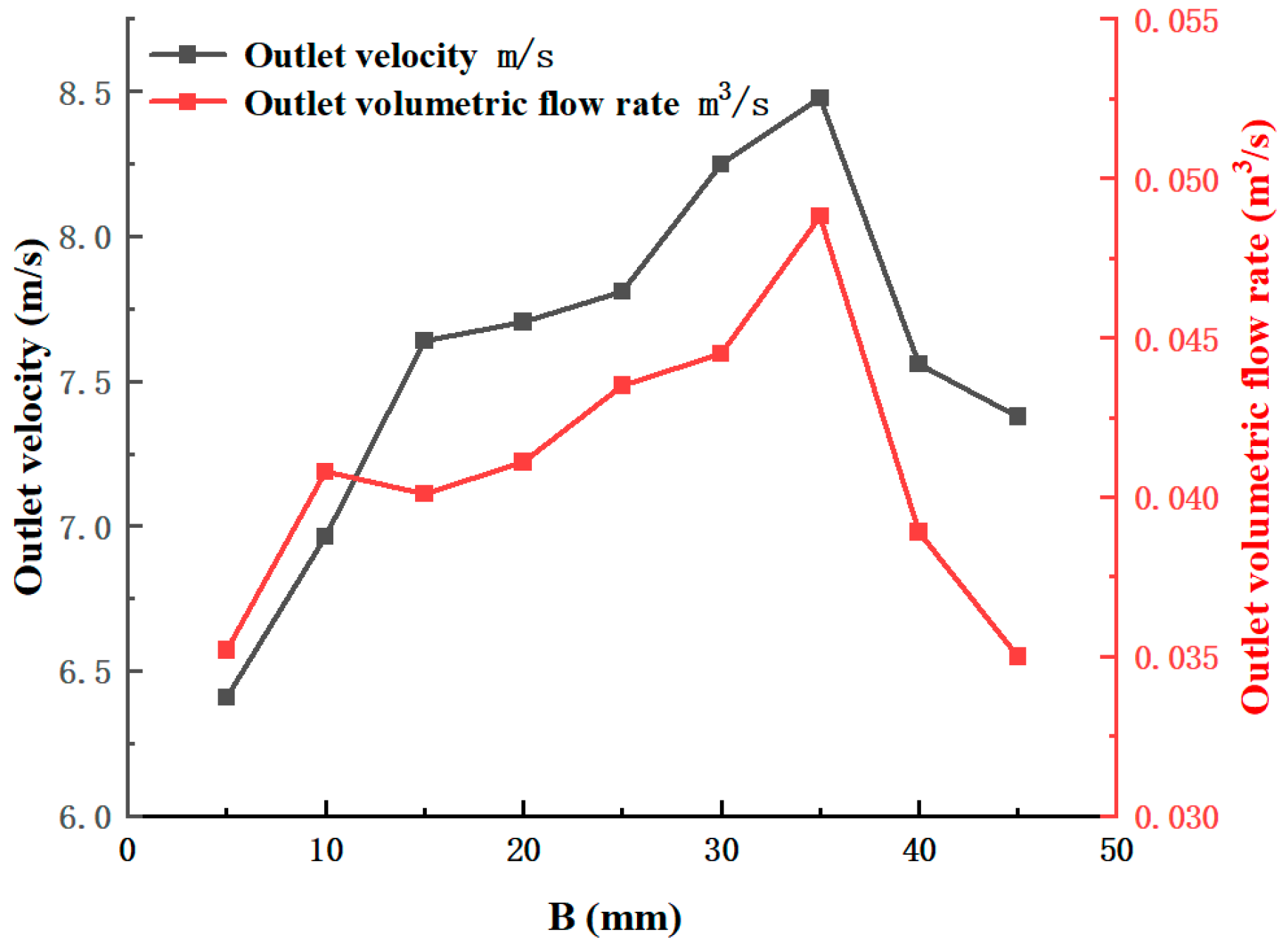
The length of the long side A of the blade airfoil was set to 100 mm, and the horizontal included angle α was 45°. When the short side B of the blade airfoil varied within the range of 15~45 mm, the influence of the blade airfoil on the outlet velocity and outlet volumetric flow rate is shown in Figure 8.
As can be seen from Figure 8, as the length of the short side B of the blade airfoil increases, both the outlet velocity and the outlet volumetric flow rate show a trend of first increasing and then decreasing. The reason is that initially, B acts as a relatively small “obstacle”. As B increases in length, the degree of disturbance to the air flowing past the blade intensifies, making it easier for airflow to form and for substances to be discharged; Although the increase in centrifugal force caused by the growth of B is not as significant as that caused by A, it will still increase the centrifugal force of the airflow to a certain extent. This promotes the airflow to move toward the edge of the blade, making it easier to discharge, thus increasing the outlet velocity and outlet volumetric flow rate.
When B exceeds the critical length, the path of air flowing over the blade surface becomes longer, and the airflow resistance increases significantly. This will cause the airflow velocity to decrease, thereby reducing the outlet velocity. Meanwhile, when B increases to a certain extent, although the inner airflow is enhanced, the outlet may fail to guide the airflow out in a timely manner, leading to airflow accumulation, which further restrains the increase in flow rate. When B exceeds 35 mm, both the outlet velocity and outlet volumetric flow rate drop sharply. Considering both the outlet velocity and outlet volumetric flow rate comprehensively, the discharge performance of crushed grass segments is relatively optimal when the length of the short side B of the airfoil is within the range of 20 ~ 40 mm .

3.1.3. Influence of the Blade Airfoil Horizontal Included Angle α on the Outlet Velocity and Outlet Volumetric Flow Rate

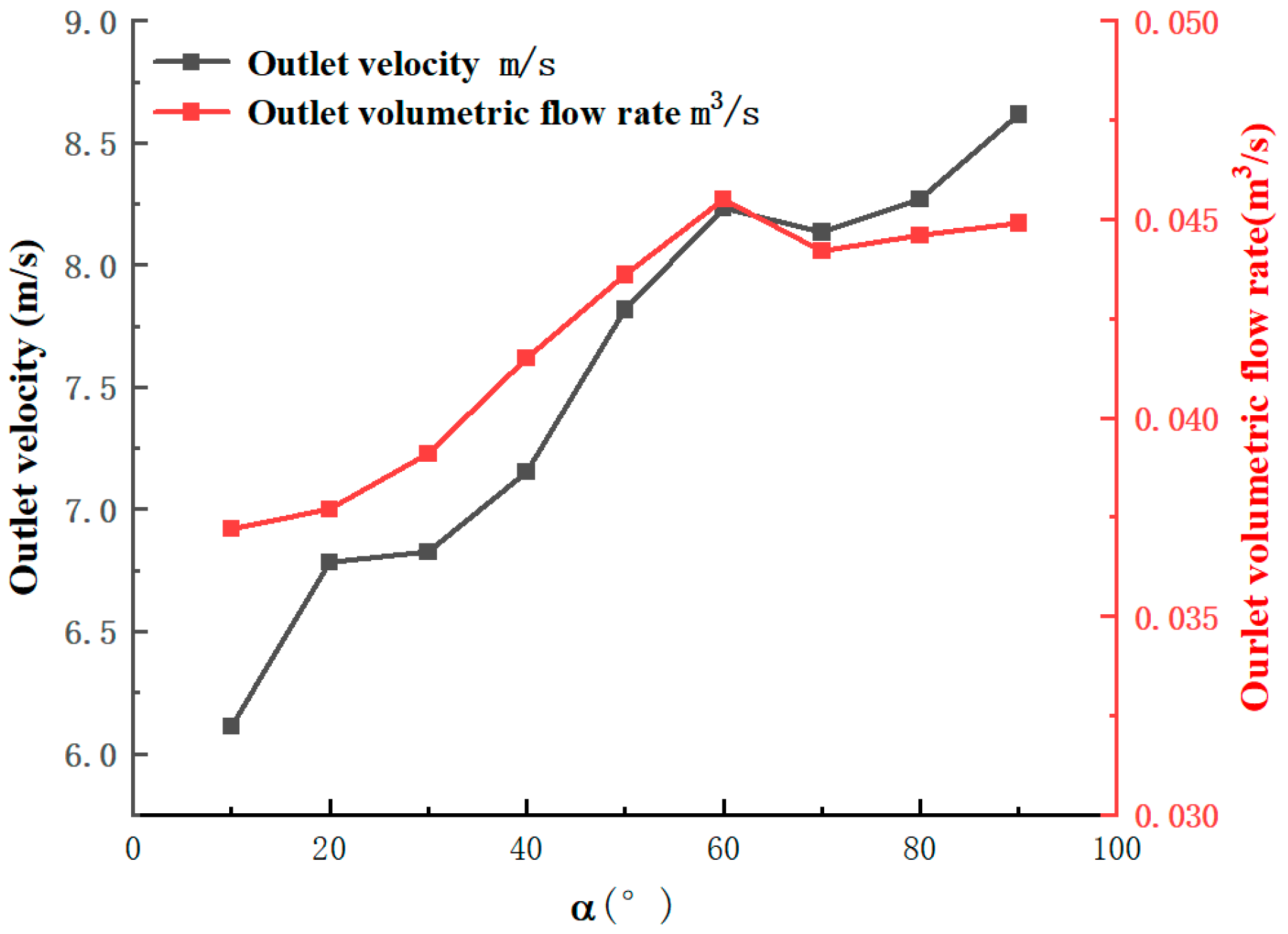
The length of the long side A and short side B of the blade airfoil was set to 100 mm and 30 mm, respectively. When the horizontal included angle α of the blade airfoil varied within the range of 0~90°, the influence of the blade airfoil on the outlet velocity and outlet volumetric flow rate is presented in Figure 9.
As can be seen from Figure 9, with the increase in the horizontal included angle α , both the outlet velocity and the outlet volumetric flow rate show an upward trend. The reason is that as the horizontal included angle α increases, the airflow velocity on the upper surface of the airfoil increases and the pressure decreases, while the pressure on the lower surface is relatively higher, resulting in a lift difference. This lift difference not only drives the airflow to move toward the outlet but also guides the airflow to adhere more closely to the airfoil surface, thereby reducing energy dissipation and improving the airflow transmission efficiency. When the horizontal included angle α exceeds 70°, the increase in outlet volumetric flow rate becomes insignificant. Considering both the outlet velocity and outlet volumetric flow rate comprehensively, the discharge performance of crushed grass segments is relatively optimal when the horizontal included angle α ranges from 50° to 70°.

3.2. Results and Analysis of Orthogonal Experiment

To further investigate the discharge performance of the designed blade for crushed grass segments, based on the value ranges obtained from single-factor experiments, the Box–Behnken Design (BBD) within the response surface methodology (RSM) was adopted for experimental design. This design involved three factors (the long side A, short side B, and horizontal angle α of the blade airfoil), with three levels set for each factor, resulting in a total of 17 experimental runs, including 5 center points for estimating experimental errors and evaluating the lack-of-fit terms of the model. The factor coding for the experiment is presented in Table 3. Through CFD simulation experiments, the influence laws of each factor on the outlet wind speed and outlet volume flow rate were explored, and the regression equations and optimization models between the experimental factors and evaluation indicators were established. The experimental schemes and simulation results are shown in Table 4, where x 1 , x 2 and x 3 represent the coded values of the factors.
Analysis of variance (ANOVA) was performed on the data in Table 3 to obtain the regression models for outlet velocity and outlet volumetric flow rate, with the results presented in Table 5 and Table 6, respectively.
As can be seen from Table 5, the regression model for outlet velocity is significant ( P < 0.0001 ), while the lack-of-fit term is not significant ( P = 0.6980 ). This indicates that the model has a good fitting degree and no lack-of-fit phenomenon occurs. The coefficient of determination R 2 = 0.9864 , and the adjusted correlation coefficient R a d j = 0.9689 , both of which are very close to 1. The coefficient of variation is 1.53%, indicating that the test data are reliable. The predicted values of the regression equation show a significant correlation with the actual values obtained from the analysis of simulation test results. The regression equations between each factor and the evaluation indicators are as follows:
y 1 = 8.7 + 0.743 x 1 + 0.3641 x 2 + 0.1781 x 3 + 0.2935 x 1 x 2 + 0.2815 x 1 x 3 0.1617 x 2 x 3 0.4887 x 1 2 0.274 x 2 2 0.1875 x 3 2
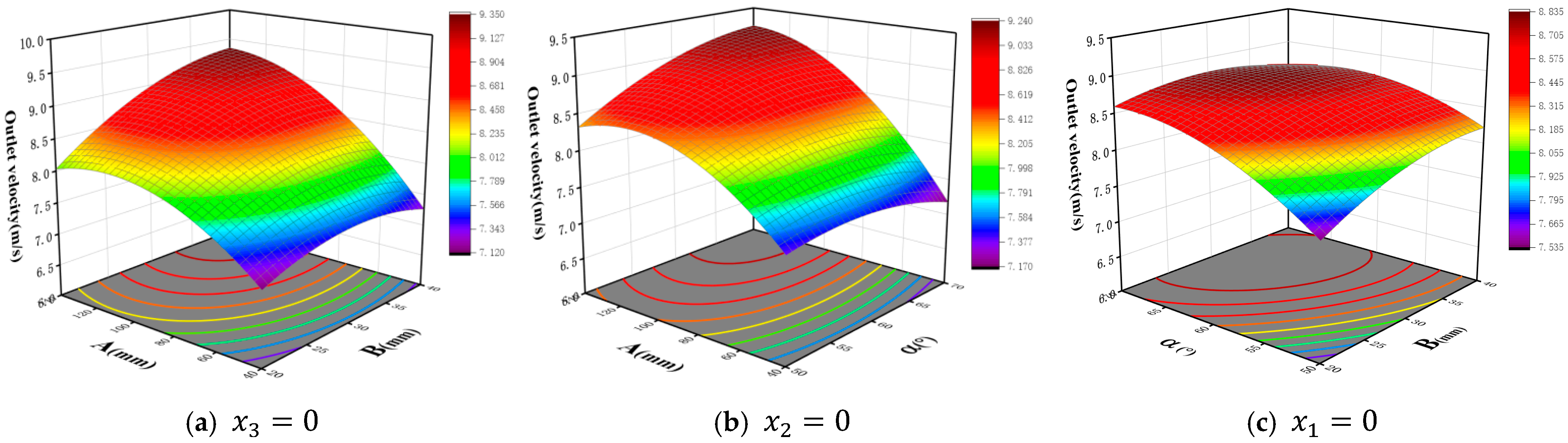
The response surfaces between the outlet velocity and each test factor are presented in Figure 10.
As can be seen from Figure 10a, within the value range of the test factors, the outlet velocity first increases and then decreases with the increase i n the long side A and short side B of the blade airfoil, and the influence of A on the outlet velocity is greater than that of B. As can be seen from Figure 10b, within the value range of the test factors, the outlet velocity first increases and then decreases with the increase in the horizontal included angle of the blade airfoil, and the influence of the long side A of the blade airfoil on the outlet velocity is greater than that of the horizontal included angle α of the blade airfoil. As can be seen from Figure 10c, with the increase in the horizontal included angle of the blade airfoil, the outlet velocity first increases and then decreases. Within the value range of the test factors, the influence of the short side B of the blade airfoil on the outlet velocity is greater than that of the horizontal included angle α of the blade airfoil.
As can be seen from Table 6, the regression model for outlet volumetric flow rate is significant ( P < 0.0001 ) , while the lack-of-fit term is not significant ( P = 0.8864 ). This indicates that the model has a good fitting degree and no lack-of-fit phenomenon occurs. The coefficient of determination R 2 = 0.9864 , and the adjusted coefficient of determination R a d j = 0.9690 , both of which are very close to 1. The coefficient of variation is 1.40%, indicating that the test data are reliable. The predicted values of the regression equations show a significant correlation with the actual values obtained from the analysis of test results. The regression equations between each factor and the evaluation indicators are as follows:
y 2 = 0.0449 + 0.0022 x 1 + 0.0006 x 2 + 0.0005 x 3 + 0.0015 x 1 x 2 + 0.0009 x 1 x 3 0.0007 x 2 x 3 0.0037 x 1 2 0.0021 x 2 2 0.0022 x 3 2
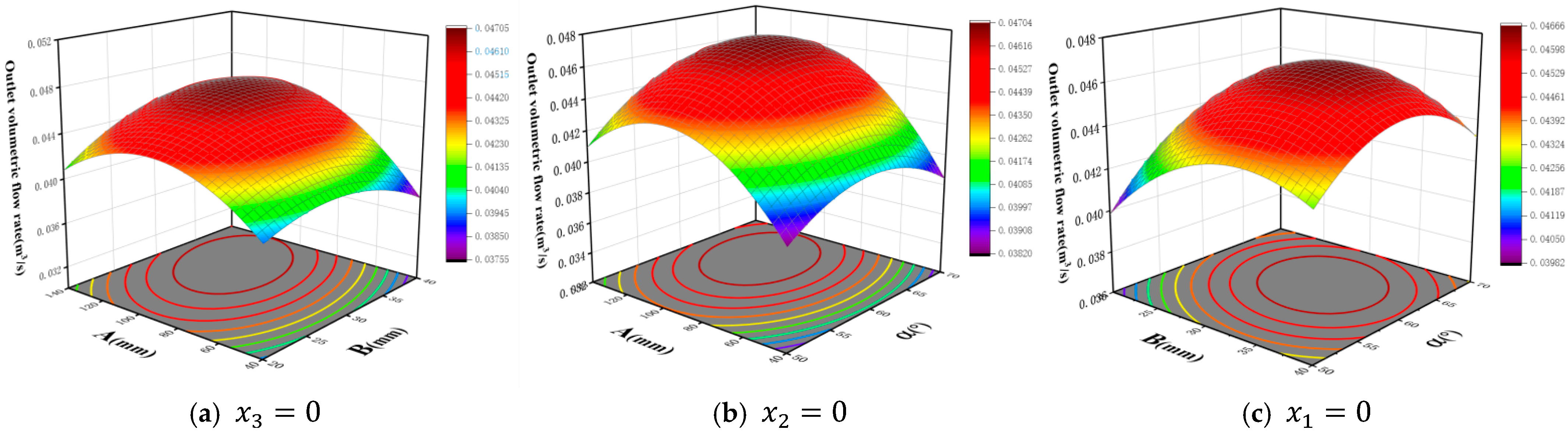
The response surfaces between the outlet volumetric flow rate and each test factor are presented in Figure 11. As can be seen from Figure 11a, within the value range of the test factors, the outlet volumetric flow rate first increases and then decreases with the increase in the long side A and short side B of the blade airfoil, and the influence of A on the outlet volumetric flow rate is greater than that of B. As can be seen from Figure 11b, within the value range of the test factors, the outlet volumetric flow rate first increases and then decreases with the increase in the horizontal included angle of the blade airfoil, and the influence of the long side A of the blade airfoil on the outlet volumetric flow rate is greater than that of the horizontal included angle α of the blade airfoil. As can be seen from Figure 11c, within the value range of the test factors, the influence of the short side B of the blade airfoil on the outlet volumetric flow rate is greater than that of the horizontal included angle α of the blade airfoil.
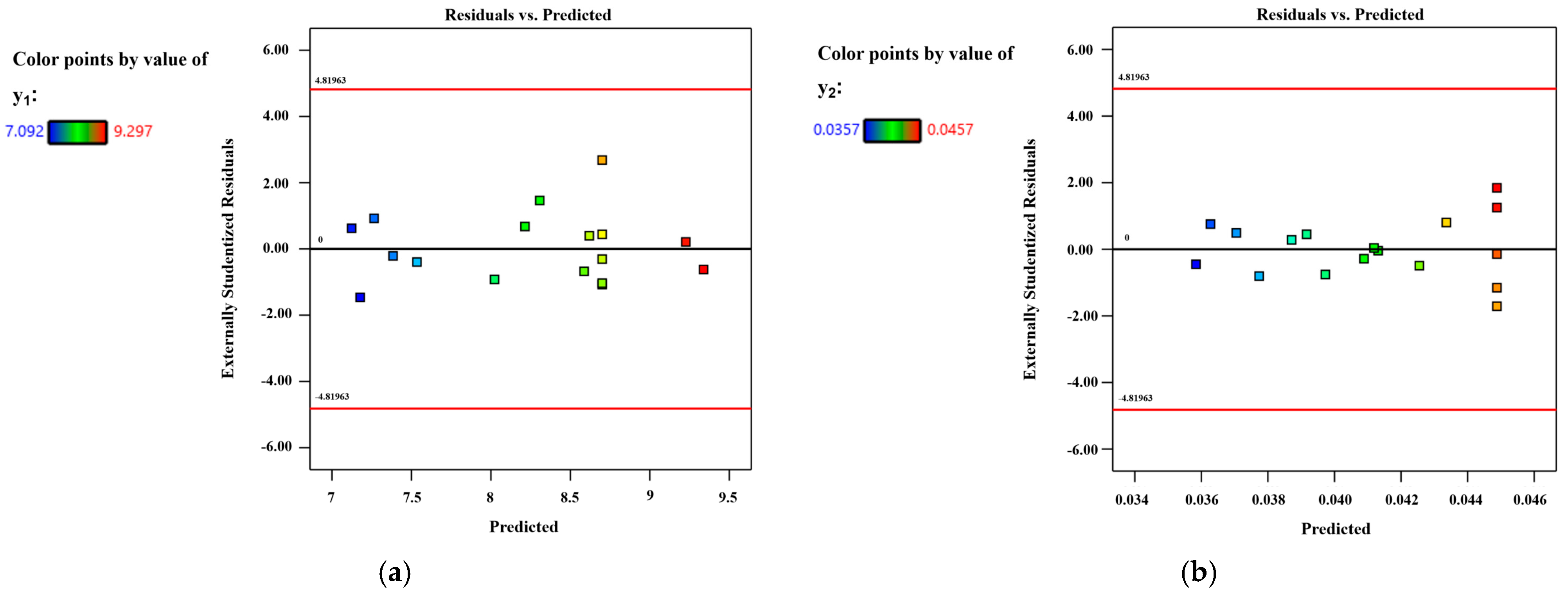
To further verify the reliability and prediction accuracy of the aforementioned regression model, and to avoid the overfitting risk caused by over-reliance on the coefficient of determination R2, the present study conducted a residual diagnostic analysis. As shown in Figure 12, Figure 12a and Figure 12b respectively show the scatter plots of residuals versus model predicted values for the outlet velocity (y1) and outlet volumetric flow rate (y2).
It can be observed from Figure 12 that the residual points are randomly and uniformly distributed on both sides of the baseline (residual = 0), without showing any discernible curve trends, funnel shapes, or other systematic patterns. This phenomenon confirms that the current full quadratic polynomial model is sufficient to capture the nonlinear relationship between the response and independent variables, without missing any important systematic trends; the fluctuation range of residuals does not change with the increase or decrease in predicted values. The two horizontal red reference lines in the figure correspond to the residual threshold value (approximately ±4.82). All data points fall within this threshold range, which proves that there are no significant outliers deviating from the model in the data. The results of all 17 simulation runs are consistent with the model predictions, indicating that the model has overall representativeness. The data points in the figure are color-coded according to the actual values of the response variables (y1 or y2). It can be seen that the color gradient from blue to red (corresponding to the increase in response values from low to high) is basically uniformly distributed across the entire residual band with no clustering. This means that the magnitude of residuals is independent of the level of response values themselves, which confirms the independence of model errors from another perspective and eliminates the possibility that errors vary with the increase in response values.
Based on the above residual diagnosis, no outliers were detected in the data, which indicates that the high R2 values obtained previously (0.9864 and 0.9690) did not result from overfitting. Therefore, although only 17 simulation runs were performed, the model has sound statistical validity, and its prediction results are reliable and can be used for subsequent parameter optimization and design exploration.

3.3. Parameter Optimization

To find the optimal combination of various factors, the Design-Expert software was used to conduct optimization analysis on the established quadratic regression equation. With the maximum values of outlet velocity and outlet volumetric flow rate as the optimization objectives, an optimized mathematical model was established through analysis, and a multi-objective solution was performed on the regression model of the evaluation indicators. The optimization objective functions and constraint conditions are as follows:
m a x   y 1 ( x 1 , x 2 , x 3 ) m a x   y 2 ( x 1 , x 2 , x 3 ) s . t . 40 m m x 1 140   m m 20 m m x 2 40   m m 50 ° x 3 70 °
The optimal parameter combination of the blade obtained from the solution is as follows: the long side A of the blade airfoil is 122.367 mm, the short side B of the blade airfoil is 35.325 mm, and the horizontal included angle α of the blade airfoil is 63.1°. Under these parameters, the outlet velocity is 9.261 m/s and the outlet volumetric flow rate is 0.045 m3/s.
To obtain the final results, the long side A of the blade airfoil, the short side B of the blade airfoil, and the horizontal included angle α of the blade airfoil were rounded, and simulations were conducted for their respective combinations. The results are presented in Table 7. Finally, the optimal parameter combination was selected as follows: the long side A of the blade airfoil is 125 mm, the short side B of the blade airfoil is 35 mm, and the horizontal included angle α of the blade airfoil is 60°.

3.4. Comparison of CFD Performance with Conventional Straight Blades

Through parameter optimization, the optimal parameters of the airfoil blade were determined. To verify the lateral grass discharge performance of the airfoil blade designed in this study, the commonly used rectangular flat straight blade in orchard mowing devices was selected as the reference for comparison. To ensure the reliability of the comparison, the straight blade model for comparison was installed in the same casing, and CFD simulation comparison was conducted under the same computational domain, meshing strategy, boundary conditions and rotational speed. The rectangular flat straight blade used for comparison had the same rotational diameter as the studied airfoil blade, both measuring 500 mm with a thickness of 6 mm, so as to ensure the fairness of the comparison. A comparison of the key performance indicators of the two types of blades under the same simulation conditions is shown in Table 8.
As shown in Table 8, under the same operating conditions, compared with the traditional rectangular flat straight blade, the airfoil blade developed in this study has its discharge outlet velocity increased by 54.6% and discharge outlet volume flow rate increased by 46.2%. The higher outlet air velocity ensures that the crushed grass segments can obtain sufficient initial kinetic energy to overcome air resistance and be delivered to the farther area under the tree canopy. Meanwhile, the larger volume flow rate means that more crushed grass segments can be carried and conveyed per unit time, effectively preventing blockage inside the casing.

3.5. Experimental Verification and Accuracy Analysis of the CFD Model

To verify the accuracy of the CFD simulation, external verification tests were conducted after parameter optimization. The purpose of the tests was to compare the discharge velocity predicted by CFD with the measured data, so as to evaluate the reliability of the model. The tests were carried out in a controllable indoor environment, with the same blade parameters and rotational speed as those adopted in the CFD simulation. Measurements were taken using a UT363S digital anemometer.
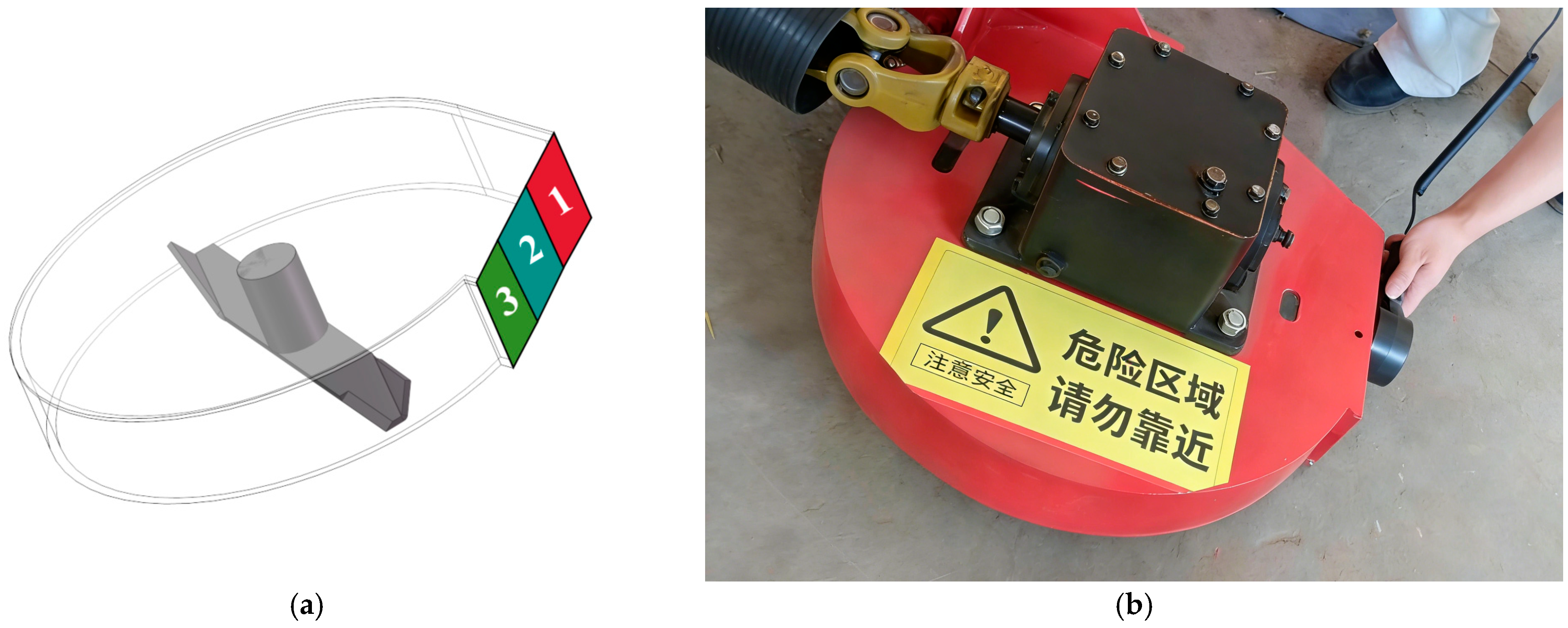
The test setup was configured consistently with the CFD model, as shown in Figure 13b. The mowing device was mounted on the test bench, and three measurement points were arranged at the discharge outlet (as shown in Figure 13a). The sampling time at each measurement point was 10 s, and the average value of the three areas was taken as one measurement result. Each test was repeated 5 times to simulate the discharge outlet position in the CFD calculations.
The discharge outlet velocity from the CFD simulation results obtained in Section 3.3 was approximately 9.11 m/s, while the five experimental measurements were 8.35 m/s, 8.56 m/s, 9.67 m/s, 8.21 m/s, and 9.80 m/s, respectively. The calculation formula for the relative error between the two is as follows:
E r = S v E v E v × 100 %
where
Er—denotes the relative error;
Sv—represents the simulated value;
Ev—stands for the experimental value.
The relative errors obtained were 8.34%, 6.03%, 6.14%, 9.88%, and 7.57%, respectively. All errors fell within the engineering acceptable range (<10%), indicating that the CFD model could reliably reflect the actual airflow field. The deviations may be attributed to model simplification or measurement uncertainty. Therefore, the conclusions drawn from the parameter optimization and performance comparison with conventional straight blades based on this CFD model are reliable, which provides a solid theoretical foundation for the validity of subsequent field performance tests.

4. Experimental Verification and Result Analysis

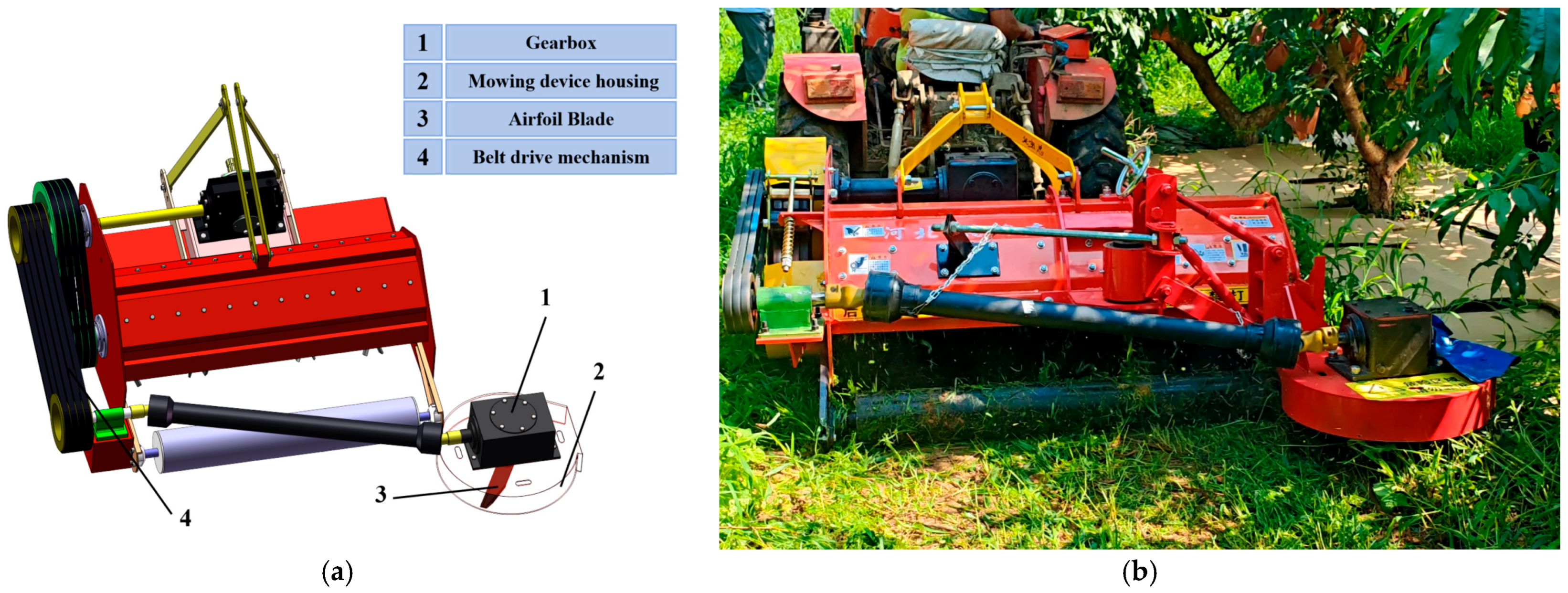
The optimal structural parameters of the blade were determined through theoretical analysis and simulation results. To verify the reliability of the obtained optimal parameter combination, blades were manufactured based on practical conditions and parameter optimization results, and a prototype of the orchard mower with lateral grass discharge was built (as shown in Figure 14). In July 2025, field tests were conducted at the peach orchard base of Mancheng Nursery in Baoding City, Hebei Province. During the tests, the temperature was 34 °C, the ambient wind was northerly with a speed of 0.34 m/s. The test orchard was a 6-year-old peach plantation with a row spacing of 4 m and a plant spacing of 2 m. The primary test subjects were Digitaria sanguinalis (large crabgrass) of the Poaceae family, with the grass layer height ranging from 150 mm to 250 mm. Power for the device was supplied by the tractor’s rear power take-off (PTO), and the blade maintained a stable operating speed of 1500 rpm. The casing featured an arc-shaped structure, and the lateral grass discharge outlet was rectangular with dimensions (width × height) of 250 mm × 100 mm. The traveling speed of the tractor was 3.6 km/h.

4.1. Test Evaluation Indicators and Measurement Methods

According to the test operation requirements and with reference to the national standards GB/T 10938-2008 [42] (Operating Quality Standard for Rotary Mowers) and GB/T 20346.1-2021 [43] (Fertilizer Spreading Machinery—Part 1: Full-Width Fertilizer Spreaders), the evaluation indicators for the prototype test were set as follows:
(1)
When the mower operates in the field, the cutting height indicator is defined by the proximity between the average cutting height and the set value of the actual cutting height. The designed cutting height of the prototype is set at 100 mm, with a stubble height stability coefficient of ≥90%;
(2)
The over-stubble loss rate shall be ≤5%;
(3)
The coefficient of variation for crushed grass segment distribution shall be ≤30%.

4.1.1. Stubble Height Measurement

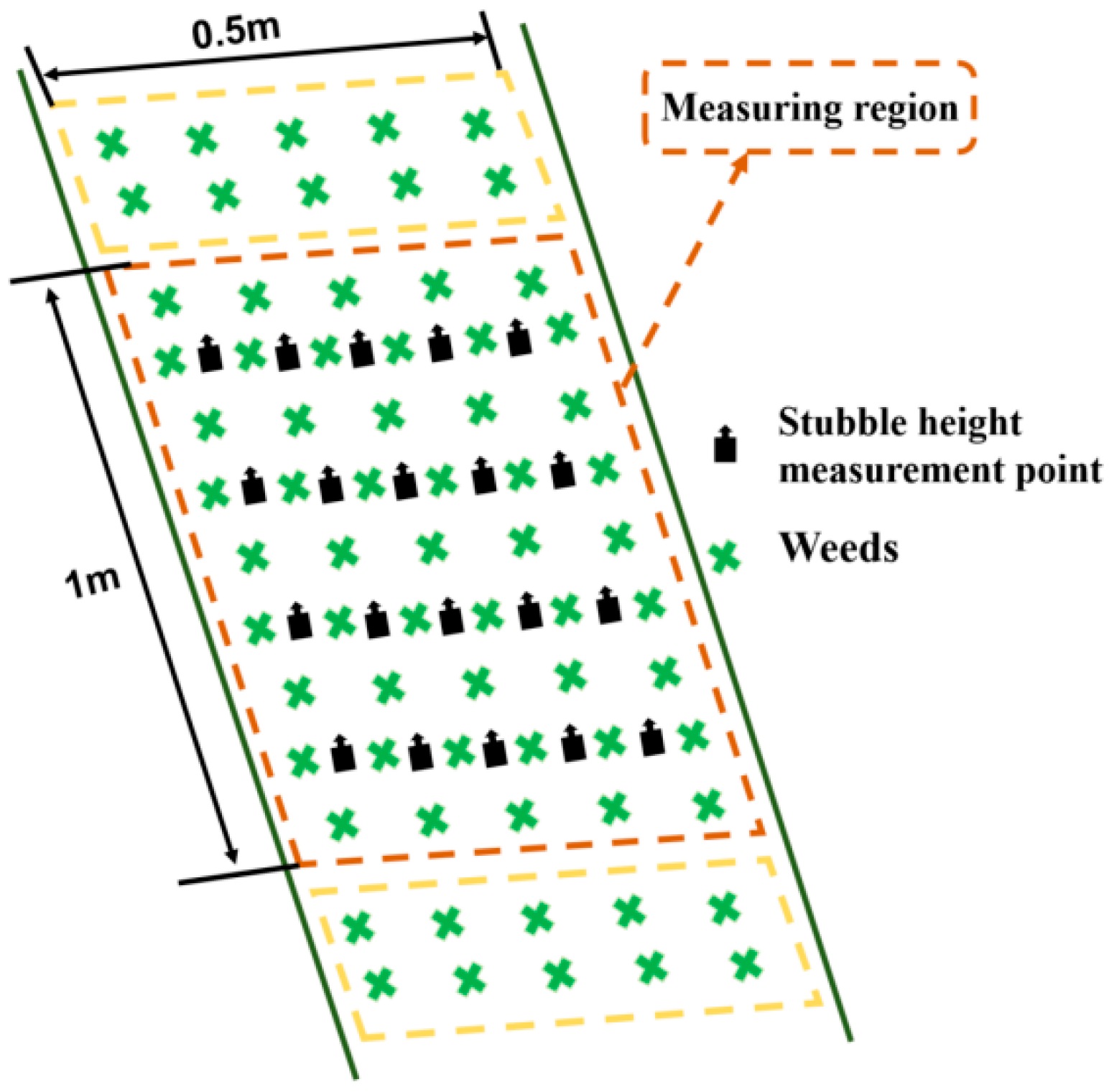
The stubble height is one of the important parameters for measuring the mowing quality of the mowing device, and the stubble stability coefficient is also an important indicator for evaluating the performance of the mowing device. Therefore, it is necessary to measure the stubble of the mowing device and calculate the stubble height stability coefficient. The measurement method is shown in Figure 15. During the test, a 1 m steel ruler was placed on the ground along the mowing width direction. For each travel path, 2 regions were selected at equal intervals, and the stubble height of 20 weeds was measured at equal intervals within each region.
Using the test data from the measurement points, the average stubble height is calculated as follows:
H j ¯ = i = 1 20 H j i 20
Measurement errors are unavoidable in the test, so it is necessary to calculate the standard deviation S j of stubble height from the measured data, which is as follows:
S j = i = 1 20 H j i H j ¯ 2 20 1
The coefficient of variation K j for stubble height is:
K j = S j H j ¯
The stubble stability coefficient is:
L j = ( 1 K j ) × 100 %
In each of the above formulas, j denotes the value corresponding to the j-th measurement group, and H j i represents the stubble height at the i-th measurement point in the j-th measurement group.

4.1.2. Measurement of Over-Stubble Loss Rate

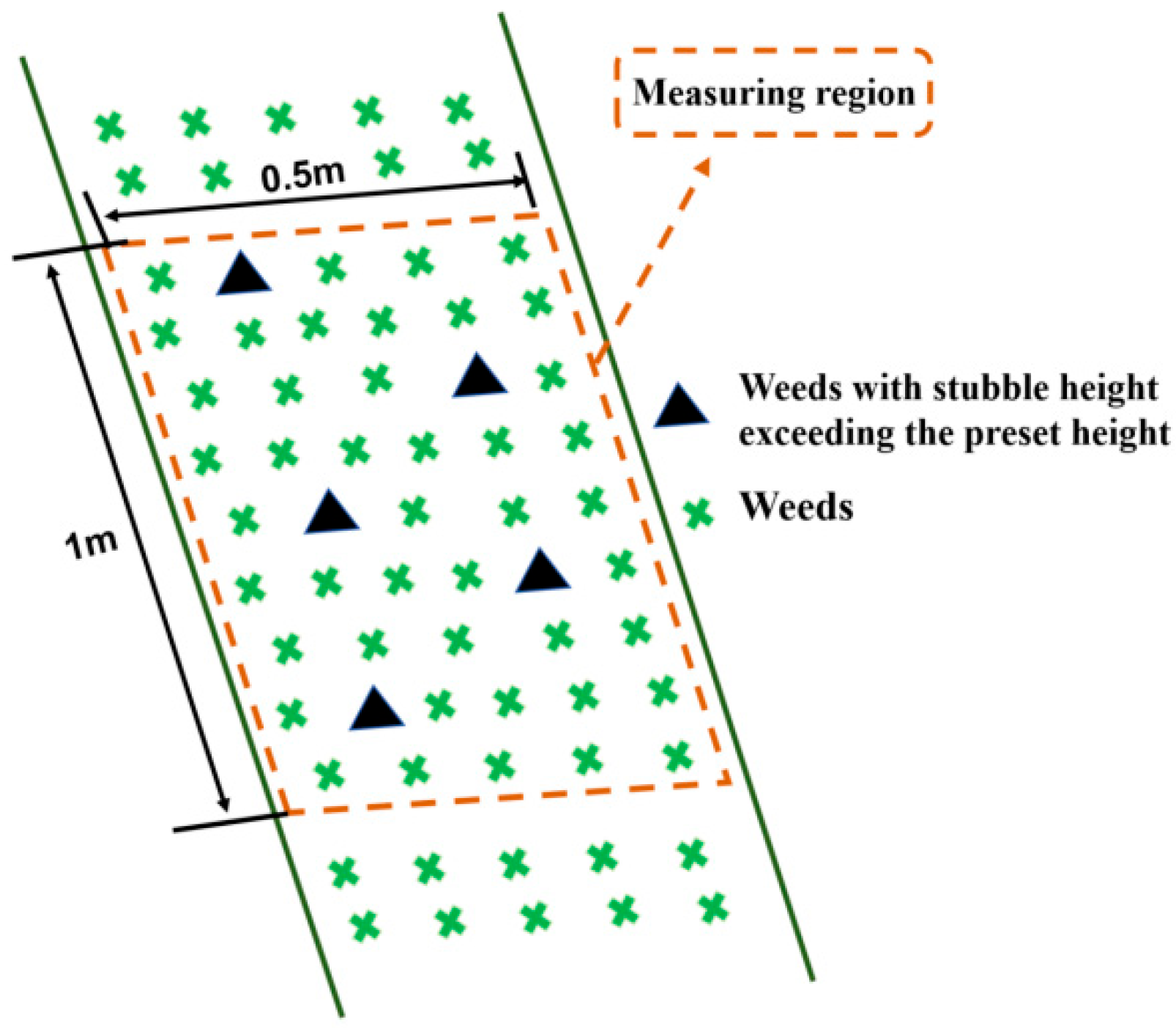
In the test area, the over-stubble loss rate is defined as the percentage of the ratio of the average mass of weed loss per unit area (caused by actual stubble height exceeding the technically required stubble height) to the mass of weeds to be harvested per unit area. To accurately measure the mass of weeds to be harvested per unit area, before the mowing test, 5 sampling areas of 1 m × 1 m were randomly selected in the designated test field. All weeds in these areas were cut down and weighed according to the specified stubble height, and the average value was taken as the mass of weeds to be harvested per unit area. The test process is shown in Figure 16.
The calculation formula for over-stubble loss rate is
S z = G Z G y × 100 %
where S z is the over-stubble loss rate, %; G z is the over-stubble loss mass per unit area, kg; G y is the actual harvested weed mass per unit area, kg.

4.1.3. Measurement of Coefficient of Variation for Crushed Grass Segment Distribution

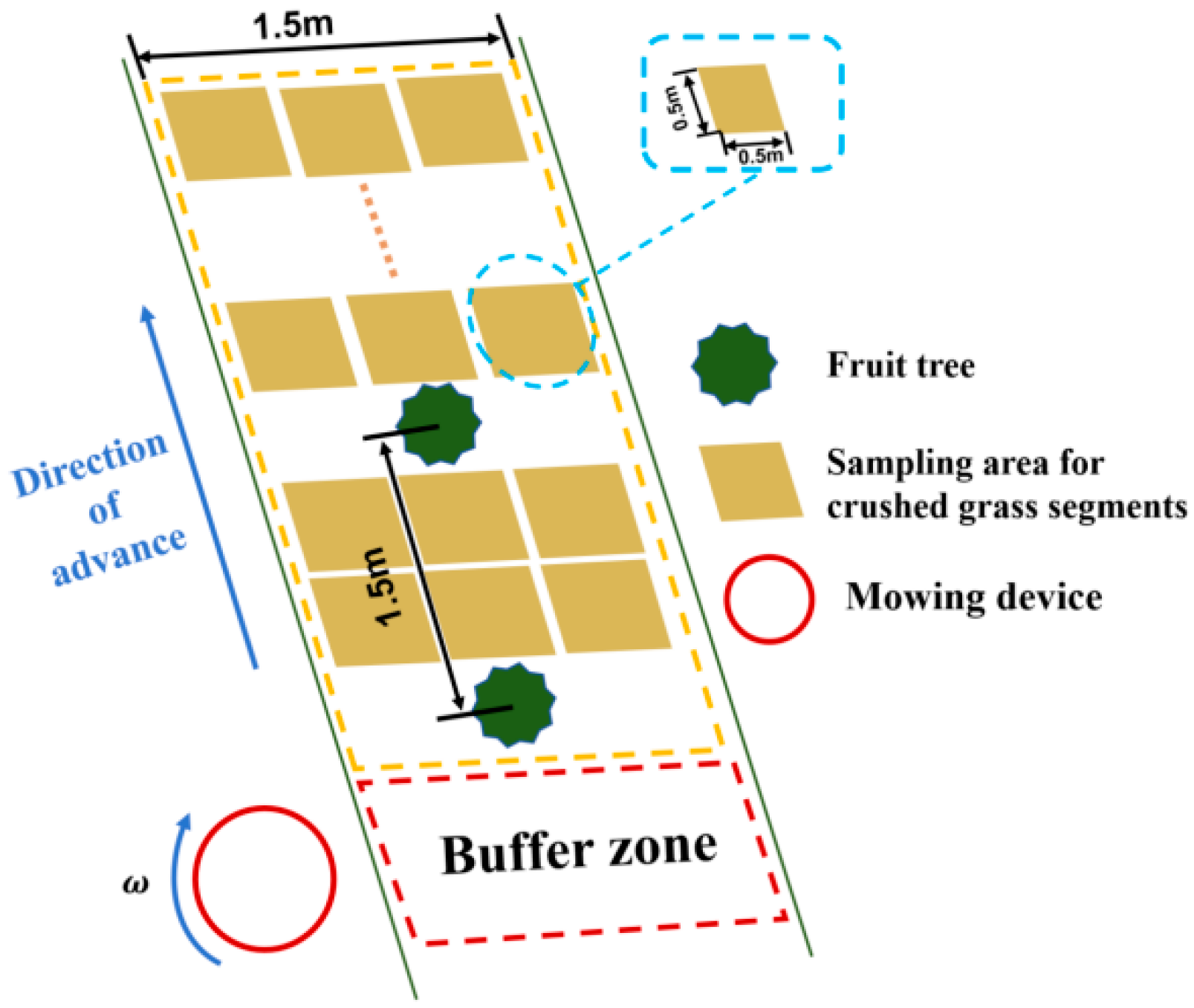
A test collection area with a length of 10 m was set up, and divided into 0.5 m × 0.5 m square crushed grass sampling zones centered on the tree trunks. A total of 60 crushed grass sampling zones were arranged within this area to facilitate weighing and calculation after the machine operation. The sampling zones are shown in Figure 17.
After the prototype operation, the mass of crushed grass in each sampling zone was counted. The calculation formula for the coefficient of variation is:
C v = S l x ¯ × 100 %
S l = 1 n 1 l = 1 n x l x ¯ 2
x ¯ = 1 n l = 1 n x l
where S l is the standard deviation; x ¯ is the absolute average value of crushed grass in each zone, kg; n is number of columns of collection regions; x l is mass of chopped grass collected in the l-th column of collection regions, kg.

4.2. Results and Analysis of the Test

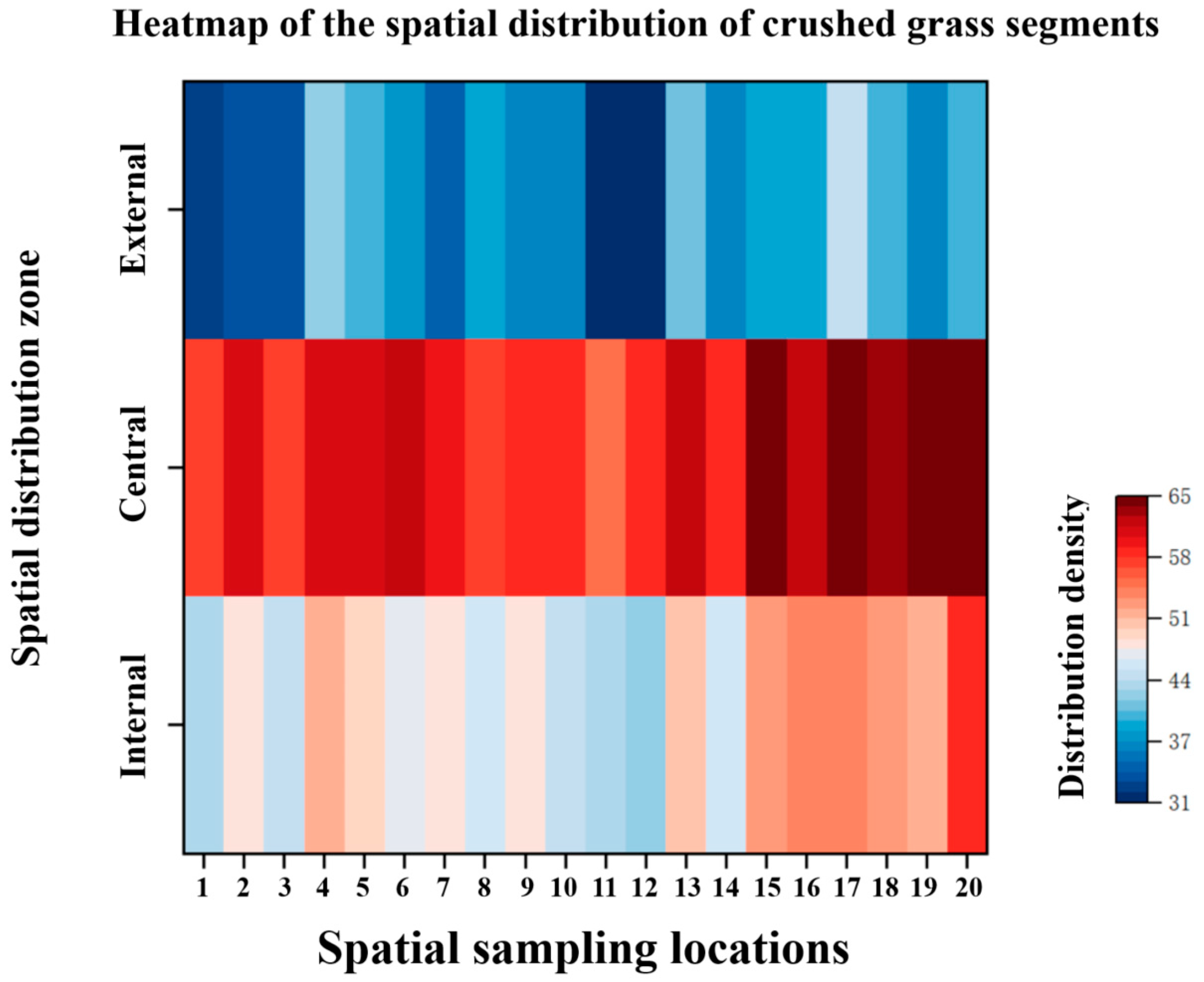
To verify the working performance of the blade under the optimal parameter combination, a field test was conducted in July 2025. To ensure the comprehensiveness and reliability of the evaluation, under the same operating conditions, the determination of the stubble stability coefficient, over-stubble loss rate, and coefficient of variation for crushed grass segment distribution adopted a test scheme with 5 independent operational repetitions, with each repetition carried out in a new operational pass. The measurement of all indicators was conducted in full accordance with the complete process described in Section 4.1.1, Section 4.1.2 and Section 4.1.3. Among them, the working performance test results of the stubble stability coefficient and over-stubble loss rate are presented in Table 9, and the test result of the coefficient of variation for crushed grass segment distribution is shown in Figure 18.
It can be seen from the field test results that the mean value of the stubble height stability coefficient was 94.2% (standard deviation = 1.08), and the mean value of the stubble-passing loss rate was 0.39% (standard deviation = 0.06). Meanwhile, by substituting the chopped grass mass data of the sampling zones into Formulas (35)–(37), the coefficient of variation of the chopped grass segment distribution was calculated to be 23.8%. To reveal the spatial pattern underlying the coefficient of variation, a visualization analysis was conducted on the chopped grass mass data from 60 sampling zones (as shown in the heatmap in Figure 18).
As observed from the heatmap, the chopped grass distribution exhibited a distinct layered structure: the darkest red high-value areas were concentrated in the central region (corresponding to the target mulching zone under tree canopies), where the chopped grass deposition amount was the highest; in contrast, the blue low-value areas at the top and bottom (corresponding to the inter-row areas) showed a significant reduction in chopped grass amount. This directly reflects the designed function of the device to directionally cover the area under tree canopies with chopped grass.

5. Discussion

Based on aerodynamic field theory and CFD simulation technology, this study designed an airfoil blade for the orchard lateral grass discharge mowing device. Key structural parameters were determined through single-factor tests and orthogonal test optimization, and the operational performance of the device was verified via field tests. Test results show that all indicators of the optimized mowing device meet the requirements for orchard mechanized operations, providing an efficient and eco-friendly technical solution for orchard grass growing and mulching management.
From the perspective of technical application scenarios, this device meets the precision management needs of large-scale orchards in China, and is particularly suitable for weed control under the grass growing and mulching mode. The targeted coverage of crushed grass segments in the area under the tree canopy can synergistically achieve the agronomic goals of soil moisture conservation, weed suppression, and soil fertility improvement, reduce the use of chemical herbicides, and conform to the concept of ecological orchard construction. Compared with similar mechanical mowing equipment, this device exhibits better performance in the uniformity of crushed grass distribution and the safety of tree protection, effectively avoiding the problem that traditional mowers tend to damage fruit tree roots or branches. However, this study still has room for further improvement. The current research focuses on the blade itself without considering the overall performance of the mowing device, such as the design of the casing, grass discharge outlet size, and guide plate, which also exert an important impact on the airflow field and grass discharge path. In addition, while the optimized blade improves operational quality, a detailed evaluation of whether its power consumption is optimal has not been conducted.
Future research can focus on three core directions: first, conduct system-level collaborative optimization of the mowing device, take the blade structure and casing flow guide design as an integrated research object, optimize the airflow field distribution and crushed grass discharge trajectory synchronously, and improve the overall operational coordination of the device; second, establish a full-cycle energy consumption evaluation system, refine the power consumption data of the blade under different operational states, introduce energy consumption indicators and operational quality indicators for multi-objective optimization, and balance the needs of operational efficiency and energy conservation; third, integrate visual sensing and intelligent algorithms, collect real-time data on orchard grass layer thickness, grass species types and tree morphology, construct a dynamic parameter adjustment model, and achieve precise matching of the grass discharge path, discharge velocity and operational scenarios.


6. Conclusions

In this study, a blade for the orchard mower with lateral grass discharge was designed. Key parameters influencing the working performance of the mowing device were identified through theoretical analysis, and computational fluid dynamics (CFD) simulations were employed to analyze the variation patterns of outlet velocity and outlet volumetric flow rate under the influence of different factors. It provides valuable references for the research on orchard mowers with lateral grass discharge. The main research conclusions are as follows:
(1)
By analyzing the motion states of crushed grass segments on the blade and in the air respectively, it is further concluded that the parameters of the long side of the blade airfoil, the parameters of the short side of the airfoil, and the horizontal angle of the airfoil all affect the outlet velocity of crushed grass segments.
(2)
The 3D model of the blade was established using SolidWorks 2021 software. Regression models of the blade airfoil side lengths, horizontal angle, outlet velocity, and outlet volumetric flow rate were established using Design-Expert 13.0 software. The influence patterns of factor interactions on the test indicators were analyzed via response surface methodology (RSM). After optimizing the regression model, the optimal structural and dimensional parameters of the blade were obtained: airfoil’s long side A = 125 mm, airfoil’s short side B = 35 mm, and airfoil’s horizontal included angle α = 60°.
(3)
Through single-factor experimental analysis, orthogonal experimental analysis, and response surface methodology (RSM) analysis, the influence patterns of the blade’s key parameters on performance indicators were identified, the optimal parameter combination was determined, and a test prototype was constructed to conduct field performance tests. Field test results indicate the following: the average stubble stability coefficient is 94.2%; the average over-stubble loss rate is 0.39%; and the coefficient of variation for crushed grass segment distribution is 21%. The operational performance is excellent, and all indicators meet the requirements for orchard mechanized operations.

Author Contributions

Conceptualization, H.G., P.W. and X.Y.; methodology, H.G., J.L. and S.T.; software, H.G. and S.T.; validation, H.G. and Y.L.; formal analysis, H.G.; investigation, L.L. and H.G.; resources, J.L.; data curation, H.G. and L.L.; writing—original draft preparation, H.G.; writing—review and editing, L.L. and J.L.; visualization, L.L.; supervision, J.L., P.W. and X.Y.; project administration, J.L.; funding acquisition, J.L. All authors have read and agreed to the published version of the manuscript.

Funding

This research was funded by the earmarked fund for CARS (CARS-27); supported by the Earmarked Fund for the Hebei Apple Innovation Team of the Modern Agro-industry Technology Research System (HBCT2024150202) and Research on Tracking Control of Crawler-type Mower in Apple Orchard with Complex Terrain (KY2025046).

Institutional Review Board Statement

Not applicable.

Data Availability Statement

The data presented in this study are available on request from the corresponding author.

Conflicts of Interest

The authors declare no conflicts of interest.

References

  1. Xiang, Y.; Chang, S.X.; Shen, Y.; Chen, G.; Liu, Y.; Yao, B.; Xue, J.; Li, Y. Grass cover increases soil microbial abundance and diversity and extracellular enzyme activities in orchards: A synthesis across China. Appl. Soil Ecol. 2023, 182, 104720. [Google Scholar] [CrossRef]
  2. China Statistics Press. National Bureau of Statistics of the People’s Republic of China. In China Statistical Yearbook 2024; China Statistics Press: Beijing, China, 2024. [Google Scholar]
  3. Martin-Lefevre, L.; Ollivier, M.; Kazakou, E.; Bopp, M.-C.; Fried, G. Impacts of agricultural intensification on weed floral and competitive traits: A spatiotemporal study in French vineyards and annual crops. Agric. Ecosyst. Environ. 2025, 394, 109877. [Google Scholar] [CrossRef]
  4. Han, Z.; Zhu, L.; Yuan, Y.; Zhao, B.; Fang, X.F.; Zhang, T.F. Analysis of slope trafficability and optimized design of crawler chassis in hillside orchard. Trans. Chin. Soc. Agric. Mach. 2022, 53, 413–421. [Google Scholar] [CrossRef]
  5. Zhang, Y. Operation Method of Controlling Weeds in Modern Orchards. J. Fruit Resour. 2024, 5, 86–89. [Google Scholar] [CrossRef]
  6. Kanagasingham, S.; Ekpanyapong, M.; Chaihan, R. Integrating machine vision-based row guidance with GPS and compass-based routing to achieve autonomous navigation for a rice field weeding robot. Precis. Agric. 2020, 21, 831–855. [Google Scholar] [CrossRef]
  7. Marinoudi, V.; Sørensen, C.G.; Pearson, S.; Bochtis, D. Robotics and labour in agriculture. A context consideration. Biosyst. Eng. 2019, 184, 111–121. [Google Scholar] [CrossRef]
  8. Duga, A.T.; Delele, M.A.; Ruysen, K.; Dekeyser, D.; Nuyttens, D.; Bylemans, D.; Nicolai, B.M.; Verboven, P. Development and validation of a 3D CFD model of drift and its application to air-assisted orchard sprayers. Biosyst. Eng. 2017, 154, 62–75. [Google Scholar] [CrossRef]
  9. Sandoval-Pillajo, L.; García-Santillán, I.; Pusdá-Chulde, M.; Giret, A. Weed detection based on deep learning from UAV imagery: A review. Smart Agric. Technol. 2025, 12, 101147. [Google Scholar] [CrossRef]
  10. Pérez-Ruiz, M.; Slaughter, D.C.; Gliever, C.J.; Upadhyaya, S.K. Automatic GPS-based intra-row weed knife control system for transplanted row crops. Comput. Electron. Agric. 2012, 80, 41–49. [Google Scholar] [CrossRef]
  11. Soleimani, A. The soft computing approaches in optimising multi-objective mechanical design of a weeding robot. Smart Agric. Technol. 2024, 9, 100674. [Google Scholar] [CrossRef]
  12. Billman, E.D.; Morrison, J.I.; Baldwin, B.S. Breeding heat tolerant orchardgrass germplasm for summer persistence in high temperature stress environments of the southeastern United States. Crop Sci. 2021, 61, 1915–1925. [Google Scholar] [CrossRef]
  13. Wang, Y.; Huang, Q.; Gao, H.; Zhang, R.; Yang, L.; Guo, Y.; Li, H.; Awasthi, M.K.; Li, G. Long-term cover crops improved soil phosphorus availability in a rain-fed apple orchard. Chemosphere 2021, 275, 130093. [Google Scholar] [CrossRef]
  14. Yang, J.; Duan, Y.; Zhang, R.; Liu, C.; Wang, Y.; Li, M.; Ding, Y.; Awasthi, M.K.; Li, H. Connecting soil dissolved organic matter to soil bacterial community structure in a long-term grass-mulching apple orchard. Ind. Crops Prod. 2020, 149, 112344. [Google Scholar] [CrossRef]
  15. Li, L.; Chen, P.; Wang, K.; Zhang, R.; Yuan, X.; Ge, L.; Li, Q.; Liu, Y.; Zhang, X.; Li, Z. Gramineae-legumes mixed planting effectively reduces soil and nutrient loss in orchards. Agric. Water Manag. 2023, 289, 108513. [Google Scholar] [CrossRef]
  16. Gyssels, G.; Poesen, J.; Bochet, E.; Li, Y. Impact of plant roots on the resistance of soils to erosion by water: A review. Prog. Phys. Geogr. Earth Environ. 2005, 29, 189–217. [Google Scholar] [CrossRef]
  17. Gutknecht, J.; Journey, A.; Peterson, H.; Blair, H.; Cates, A. Cover crop management practices to promote soil health and climate adaptation: Grappling with varied success from farmer and researcher observations. J. Environ. Qual. 2023, 52, 448–464. [Google Scholar] [CrossRef] [PubMed]
  18. Slaughter, D.C.; Giles, D.K.; Downey, D. Autonomous robotic weed control systems: A review. Comput. Electron. Agric. 2008, 61, 63–78. [Google Scholar] [CrossRef]
  19. Vasileiou, M.; Kyrgiakos, L.S.; Kleisiari, C.; Kleftodimos, G.; Vlontzos, G.; Belhouchette, H.; Pardalos, P.M. Transforming weed management in sustainable agriculture with artificial intelligence: A systematic literature review towards weed identification and deep learning. Crop Prot. 2024, 176, 106522. [Google Scholar] [CrossRef]
  20. Fu, Z.; Wang, D.; Li, W.; Huang, Y.; Zhu, R. Design and experiment of two-disc rotary mower of Alfalfa. Trans. Chin. Soc. Agric. Mach. 2018, 49, 214–220. [Google Scholar] [CrossRef]
  21. Archbold, T.; Carson, J.K. Optimisation of a grass cutting blade using design of experiments with qualitative and quantitative performance metrics. Biosyst. Eng. 2023, 234, 66–80. [Google Scholar] [CrossRef]
  22. Jun, H.; Choi, Y.; Lee, C.; Kang, Y. Development of Side-discharge Type Mid-mower Attached to a Tractor. Eng. Agric. Environ. Food 2008, 1, 39–44. [Google Scholar] [CrossRef]
  23. Chon, W.; Amano, R.S. Investigation of Flow Behavior around Corotating Blades in a Double-Spindle Lawn Mower Deck. Int. J. Rotating Mach. 2005, 2005, 77–89. [Google Scholar] [CrossRef]
  24. Bilous, I.; Jasinskas, A.; Dudin, V.; Kukharets, S.; Aliiev, E.; Domeika, R.; Paulikienė, S.; Ūksas, T. Justification of the Design and Operating Parameters of the Improved Disc Grain Crusher. Agriculture 2025, 15, 2344. [Google Scholar] [CrossRef]
  25. Mathanker, S.K.; Grift, T.E.; Hansen, A.C. Effect of blade oblique angle and cutting speed on cutting energy for energycane stems. Biosyst. Eng. 2015, 133, 64–70. [Google Scholar] [CrossRef]
  26. Wang, Y. Research on Lamnmower Design Based on TRIZ Theory. Master’s Thesis, Beijing University of Chemical Technology, Beijing, China, 2025. [Google Scholar] [CrossRef]
  27. Xiong, F.; Wang, B.; Li, C.; Yin, J.; Wang, H. A comprehensive multi-source uncertainty quantification method for RANS-CFD based on sparse multi-task deep active learning. Aerosp. Sci. Technol. 2025, 165, 110483. [Google Scholar] [CrossRef]
  28. Hafsi, Z.; Vecino-Mantilla, S.; Matos De Oliveira, F.; Barp, M.V.; Zandavalli, L.G.; Lo Faro, M. Combined Levenberg-Marquardt calibration algorithm and CFD modelling for solid oxide fuel cell analysis. Energy Convers. Manag. 2025, 342, 120116. [Google Scholar] [CrossRef]
  29. Bournet, P.-E.; Rojano, F. Advances of Computational Fluid Dynamics (CFD) applications in agricultural building modelling: Research, applications and challenges. Comput. Electron. Agric. 2022, 201, 107277. [Google Scholar] [CrossRef]
  30. Qin, P.; De Lange, A.; Van Hooff, T.; Traversari, R.; Loomans, M. Experimental and CFD analysis of particle distribution in a controlled test facility: Impact of exhalation flow velocity and direction. Build. Environ. 2025, 283, 113328. [Google Scholar] [CrossRef]
  31. Chen, Z.; Zhou, Z.; Wang, S.; Chen, R.; Wang, Y.; Liao, Q.; Yang, J.; Yang, C.; Zhang, Q. Simulation study on the spraying performance of a sprayer for the middle and lower leaves of cigar tobacco plants based on CFD-DPM. Comput. Electron. Agric. 2025, 238, 110787. [Google Scholar] [CrossRef]
  32. Wang, J.; Zhu, J.; Xu, Y.; Wang, C.; Tang, H. Study on flow field characteristics in a stabilised airflow region within a rice plot air-blowing cleaning header based on CFD simulation. Comput. Electron. Agric. 2025, 230, 109894. [Google Scholar] [CrossRef]
  33. Liu, Z.; Zhengz, Y. Design on air-flowing cleaning unit of micro rice-wheat combine harvester. Trans. Chin. Soc. Agric. Mach. 2015, 46, 102–108. [Google Scholar]
  34. Jin, D.; Guo, Y.; Li, X.; Yang, Y.; Fang, Y. Numerical study on the muck flow behavior in the screw conveyor during EPB shield tunneling. Tunn. Undergr. Space Technol. 2023, 134, 105017. [Google Scholar] [CrossRef]
  35. Tang, H.; Xu, C.; Zhao, J.; Wang, J. Formation and steady state characteristics of flow field effect in the header of a stripping prior to cutting combine harvester with CFD. Comput. Electron. Agric. 2023, 211, 107959. [Google Scholar] [CrossRef]
  36. Xing, H.; Ma, S.; Mo, J.; Zeng, B.S.; Liang, W.P.; Li, W.; Wang, F.L.; Bai, J.; Ding, Z.L. Optimization and experiment of parameters for the impeller structure of extractor in a sugarcane chopper harvester. Trans. CSAE 2021, 37, 12–19. [Google Scholar] [CrossRef]
  37. Li, Z.; Wang, D.; Liu, G.; Yang, M.; Wang, Z. CFD simulation and improvement of air-stream distributive metering device. Trans. Chin. Soc. Agric. Mach. 2009, 40, 64–68. [Google Scholar]
  38. Čedík, J.; Chyba, J.; Pexa, M.; Petrásek, S. Influence of shape of cutting tool on pressure conditions in workspace of mulcher with vertical axis of rotation. Agron. Res. 2017, 15, 1530–1539. [Google Scholar] [CrossRef]
  39. Wu, B.; Zuo, T.; Li, Z.; Qian, H.; Huang, T.; Xiang, Y. Numerical Simulation and Optimization of the Airflow Field of a Forage Drum Mower. Appl. Sci. 2023, 13, 5910. [Google Scholar] [CrossRef]
  40. Wang, J.; Zhang, X.; Yang, S. Design and Simulation of an Integrated Mower for Grass Shredding, Conveying, and Microorganism Spreading. J. Chin. Agric. Mech. 2020, 41, 79–86. [Google Scholar] [CrossRef]
  41. Tian, M. Design and Research of Small Self-Propelled Orchard GrassCutting Machine. Master’s Thesis, Anhui Agricultural University, Hefei, China, 2025. [Google Scholar] [CrossRef]
  42. GB/T 10938-2008; Rotary mower. Standards Press of China: Beijing, China, 2008.
  43. GB/T 20346.1-2021; Equipment for Distributing Fertilizer—Part 1: Full Width Fertilizer Distributors. Standards Press of China: Beijing, China, 2021.
Figure 1. Schematic diagram of the working principle of the orchard mower with lateral grass discharge.
Agriculture 16 00235 g001
Figure 2. Schematic diagram of the blade structure.
Agriculture 16 00235 g002
Figure 3. Differences in airflow around the airfoil during blade operation.
Agriculture 16 00235 g003
Figure 4. Force analysis of crushed grass segments on the blade airfoil. Ff is the friction force exerted on the crushed grass segments by the airfoil, N; FN is the supporting force exerted on the crushed grass segments, N; FC is the Coriolis force exerted on the crushed grass segments, N; FJ is the centrifugal force exerted on the crushed grass segments, N; G is the gravity of the crushed grass segments, N; ω is the rotational speed of the blade, rad/s; β is the angle between the velocity of the crushed grass segment and the Y-axis, °; α is the horizontal included angle of the blade airfoil, °.
Agriculture 16 00235 g004
Figure 5. Analysis of the motion of crushed grass segments in the air. (a) Analysis of the oblique projectile motion of crushed grass segments. (b) Analysis of the horizontal projectile motion of crushed grass segments. Fx1 is the horizontal component of the air resistance acting on the crushed grass segment during the oblique ascent stage, N; Fz1 is the vertical component of the air resistance acting on the crushed grass segment during the oblique ascent stage, N; Fx2 is the horizontal component of the air resistance acting on the crushed grass segment during the oblique descent stage, N; Fz2 is the vertical component of the air resistance acting on the crushed grass segment during the oblique descent stage, N; Fx3 is the horizontal component of the air resistance acting on the crushed grass segment during horizontal projectile motion, N; Fz3 is the vertical component of the air resistance acting on the crushed grass segment during horizontal projectile motion, N; G is the gravity of the crushed grass segment, N; L1 is the distance when the crushed grass segments undergo oblique projectile motion, m; L2 is the distance when the crushed grass segments undergo horizontal projectile motion, m; X1 is the horizontal displacement of the crushed grass segment during the oblique ascent stage, m; X2 is the horizontal displacement of the crushed grass segment during the oblique descent stage, m.
Agriculture 16 00235 g005
Figure 6. CFD simulation related settings. (a) Computational domain: (b) Mesh division of the blade; (c) Mesh division of the fluid region.
Agriculture 16 00235 g006
Figure 7. Curves of changes in outlet performance indexes at different lengths of A.
Agriculture 16 00235 g007
Figure 8. Curves of changes in outlet performance indexes at different lengths of B.
Agriculture 16 00235 g008
Figure 9. Curves of outlet performance index changes at different angles α .
Agriculture 16 00235 g009
Figure 10. Response surfaces of the effect of interaction between test factors on outlet velocity.
Agriculture 16 00235 g010
Figure 11. Response surfaces of the effect of interaction between test factors on outlet volumetric flow rate.
Agriculture 16 00235 g011
Figure 12. Plot of residuals versus predicted values. (a) Plot of residuals versus predicted values of outlet velocity (y1); (b) Plot of residuals versus predicted values of outlet volumetric flow rate (y2).
Agriculture 16 00235 g012
Figure 13. External Experimental Test. (a) Measurement area; (b) Field operation. In addition, the yellow area in the figure was also inherent during its creation. It has been defined as a hazard zone, with the warning: Keep away.
Agriculture 16 00235 g013
Figure 14. Prototype of the orchard lateral grass discharge mowing device. (a) Overall structure; (b) Field operation.
Agriculture 16 00235 g014
Figure 15. Schematic diagram of stubble height measurement.
Agriculture 16 00235 g015
Figure 16. Schematic diagram of over-stubble loss rate test.
Agriculture 16 00235 g016
Figure 17. Schematic diagram of crushed grass segments sampling zones.
Agriculture 16 00235 g017
Figure 18. Heatmap of the spatial distribution of crushed grass segments.
Agriculture 16 00235 g018
Table 1. Mesh Independence Verification.
Mesh GroupMesh Quantity (10,000 Elements)Discharge Outlet Velocity/(m/s)Volume Flow Rate/(m3/s)
1approximately 146.800.0361
2approximately 247.150.0375
3approximately 327.390.0384
4approximately 457.250.0381
5approximately 907.200.0379
Table 2. Variables of Single-Factor Experiments.
LevelParameters
Airfoil’s Long Side A (mm)Airfoil’s Short Side B (mm)Airfoil’s Horizontal Included Angle α (°)
10~2000~500~90
Table 3. Factors Coding.
LevelFactor
Airfoil’s Long Side A (mm)Airfoil’s Short Side B (mm)Airfoil’s Horizontal Included Angle α (°)
−1402050
0903060
11404070
Table 4. Box–Behnken Experimental Schemes and Results.
No.Factor y 1 /
(m/s)
y 2 /
(m3/s)
x 1 x 2 x 3
1−1−107.1650.0375
21−107.9640.0393
3−1107.3240.0357
41109.2970.0436
5−10−17.3700.0372
610−18.3930.0395
7−1017.0920.0365
81019.2410.0424
90−1−17.5080.0388
1001−18.5420.0413
110−118.2590.0412
120118.6460.0408
130008.5800.0448
140008.7530.0441
150008.6630.0457
160008.9210.0455
170008.5840.0443
Table 5. Analysis of variance for regression model of outlet velocity.
ParameterSum of SquaresdfMean SquaresFp
Model8.1190.900656.46<0.0001 **
x 1 4.4214.42276.87<0.0001 **
x 2 1.0611.0666.50<0.0001 **
x 3 0.253810.253815.910.0053 **
x 1 2 1.0111.0163.05<0.0001 **
x 2 2 0.316110.316119.810.0030 **
x 3 2 0.148010.14809.280.0187 *
x 1 x 2 0.344610.344621.600.0023 **
x 1 x 3 0.317010.317019.870.0029 **
x 2 x 3 0.104710.10476.560.0375 *
Residual0.111770.0160
Lack of Fit0.030830.01030.50750.6980
Pure Error0.080940.0202
Cor Total8.2216
Note: ** indicates that the impact is extremely significant (p < 0.01), and * indicates that the impact is significant (p < 0.05).
Table 6. Analysis of variance for the regression model of outlet volumetric flow rate.
ParameterSum of SquaresdfMean SquaresFp
Model0.000290.000056.57<0.0001 **
x 1 0.000010.0000120.82<0.0001 **
x 2 2645 × 10−612645 × 10−67.980.0256 *
x 3 2.101 × 10−612.101 × 10−66.340.0399 *
x 1 2 0.000110.0001177.66<0.0001 **
x 2 2 0.000010.000056.820.0001 **
x 3 2 0.000010.000063.73<0.0001 **
x 1 x 2 9.302 × 10−619.302 × 10−628.060.0011 **
x 1 x 3 3.240 × 10−613.240 × 10−69.770.0167 *
x 2 x 3 2.103 × 10−612.103 × 10−66.340.0399 *
Residual2.321 × 10−673.315 × 10⁻⁷
Lack of Fit3.125 × 10−731.042 × 10−70.20750.8864
Pure Error2.008 × 10−645.020 × 10⁻⁷
Cor Total0.000216
Note: ** indicates that the impact is extremely significant (p < 0.01), and * indicates that the impact is significant (p < 0.05).
Table 7. Parameter optimization table.
A/mmB/mm α / ° Outlet VelocityOutlet Volumetric Flow Rate
12035608.9320.0425
12035659.6020.0340
12535609.1050.0443
12535658.8650.0402
Table 8. CFD Comparison Results of Key Performance Indicators Between Airfoil Blades and Straight Blades.
Blade TypeDischarge Outlet Velocity/(m/s)Discharge Outlet Volume Flow Rate/(m3/s)
Airfoil Blade9.1050.0443
Straight Blade5.8910.0303
Performance Improvement54.6%46.2%
Table 9. Experimental Results of Prototype Working Performance.
No.Stubble Stability Coefficient/%Over-Stubble Loss Rate/%
192.70.47
293.30.43
395.90.40
494.20.29
595.00.36
Mean94.20.39
SD1.080.06
Disclaimer/Publisher’s Note: The statements, opinions and data contained in all publications are solely those of the individual author(s) and contributor(s) and not of MDPI and/or the editor(s). MDPI and/or the editor(s) disclaim responsibility for any injury to people or property resulting from any ideas, methods, instructions or products referred to in the content.