Article

Comparing Cotton ET Data from a Satellite Platform, In Situ Sensor, and Soil Water Balance Method in Arizona


1
Biosystems Engineering Department, University of Arizona, Tucson, AZ 85721, USA
2
United States Department of Agriculture (USDA)—Agricultural Research Service (ARS), Arid Land Agricultural Research Center, Maricopa, AZ 85138, USA
3
Grassland Soil & Water Research Laboratory, United States Department of Agriculture (USDA)—Agricultural Research Service (ARS), Temple, TX 76502, USA
*
Author to whom correspondence should be addressed.
Agriculture 2026, 16(2), 228; https://doi.org/10.3390/agriculture16020228
Submission received: 17 December 2025 / Revised: 5 January 2026 / Accepted: 14 January 2026 / Published: 15 January 2026
(This article belongs to the Section Agricultural Water Management)

Abstract

Crop production in the desert Southwest of the United States, as well as in other arid and semi-arid regions, requires tools that provide accurate crop evapotranspiration (ET) estimates to support efficient irrigation management. Such tools include the web-based OpenET platform, which provides real-time ET data generated from six satellite-based models, their Ensemble, and a field-based system (LI-710, LI-COR Inc., Lincoln, NE, USA). This study evaluated simulated ET (ETSIM) of cotton (Gossypium hirsutum L.) derived from OpenET models (ALEXI/DisALEXI, eeMETRIC, geeSEBAL, PT-JPL, SIMS, and SSEBop), their Ensemble approach, and LI-710. Field data were utilized to estimate cotton ET using the soil water balance (SWB) method (ETSWB) from June to October 2025 in Gila Bend, AZ, USA. Four evaluation metrics, the normalized root-mean-squared error (NRMSE), mean bias error (MBE), simulation error (Se), and coefficient of determination (R2), were employed to evaluate the performance of OpenET models, their Ensemble, and the LI-710 in estimating cotton ET. Statistical analysis indicated that the ALEXI/DisALEXI, geeSEBAL, and PT-JPL models substantially underestimated ETSWB, with simulation errors ranging from −26.92% to −20.57%. The eeMETRIC, SIMS, SSEBop, and Ensemble provided acceptable ET estimates (22.57% ≤ NRMSE ≤ 29.85%, −0.36 mm. day−1 ≤ MBE ≤ 0.16 mm. day−1, −7.58% ≤ Se ≤ 3.42%, 0.57 ≤ R2 ≤ 0.74). Meanwhile, LI-710 simulated cotton ET acceptably with a slight tendency to overestimate daily ET by 0.21 mm. A strong positive correlation was observed between daily ETSIM from LI-710 and ETSWB, with Se and NRMSE of 4.40% and 23.68%, respectively. Based on our findings, using a singular OpenET model, such as eeMETRIC, SIMS, or SSEBop, the OpenET Ensemble, and the LI-710 can offer growers and decision-makers reliable guidance for efficient irrigation management of late-planted cotton in arid and semi-arid climates.

1. Introduction

While freshwater is renewable, water resource depletion is occurring considerably more quickly than expected [1]. With population growth and socioeconomic development, the global consumption of water resources has grown nearly sevenfold in the last century [2], which could impact the long-term stability and sustainability of agriculture [3,4,5]. According to statistics, the agriculture sector is considered the largest user of global freshwater, accounting for more than two-thirds of all withdrawals. Therefore, a precise use of irrigation water, achieved by synchronizing irrigation timing and amount, has become crucial in addressing water scarcity, especially in arid and semi-arid regions where irrigated agriculture uses a significant proportion of available water resources [6,7].
Evapotranspiration (ET) is a significant component of the surface energy and hydrological balances, accounting for the largest portion of agricultural water used in both ecological and hydrological systems. ET constitutes a large majority of the water consumption from irrigated fields, especially in arid and semi-arid climates [8]. Therefore, precise estimation of ET has become an urgent necessity in irrigation water scheduling [9], water allocation, plant water stress evaluation, crop modeling, and estimating moisture and energy transfer between the land surface and atmosphere [10,11,12]. Understanding of crop ET (ETc) can assist producers in determining the optimal timing and quantity of irrigation water to deploy. This is crucial for achieving growers’ targets, which may include increasing crop yields, water use efficiency, and farm profitability, or alternatively, reducing costs, energy consumption, and adverse environmental impacts [13].
Several techniques have been adopted to estimate ETc, such as lysimeters (e.g., Dhungel et al. [14]; Evett et al. [15]; Sánchez et al. [16]; Sánchez et al. [16]), Bowen ratios (e.g., Evett et al. [15]), surface renewal (e.g., Xue et al. [17]), and eddy covariance (EC) (e.g., Bambach et al. [18]; Dhungel et al. [14]; Dong et al. [19]; Ferrara et al. [20]; García-Gutiérrez et al. [21]), at field scales [22] and combined with crop coefficients at regional scales. However, these methods are costly and time-consuming [23]. Moreover, they require expertise and knowledge of the instruments used [22,24]. Likewise, several remote sensing models were developed for estimating ETc [25,26,27,28]. However, the availability of these models was also limited by cost, computational requirements [29], and the expertise required to appropriately acquire the data [30]. The inaccessibility of such data has been overcome with the recently developed OpenET satellite-based models: ALEXI/DisALEXI, eeMETRIC, geeSEBAL, PT-JPL, SIMS, and SSEBop, and their Ensemble (https://etdata.org/, accessed on 6 December 2025), whereas the six OpenET models and their Ensemble provide freely obtained and high-resolution ET data (30 m by 30 m [0.22 acres per pixel]) that can be used for irrigation water management in the US (https://etdata.org/methods/.), accessed on 6 December 2025).
On the other hand, the LI-710 (LI-COR Inc., Lincoln, NE, USA), a single-purpose device providing continuous measurements of actual ETc, was introduced as an alternative to EC systems, which have been limited by cost, significant maintenance, and requirements for advanced data processing and expert operational skills [19,20]. The LI-710 is a reliable, user-friendly, and lower-cost alternative to traditional EC systems [31], where the cost is about 20% of the EC systems. The LI-710 preserves the core benefit of EC techniques by directly measuring the turbulent moisture exchange between the surface and atmosphere, all while lowering operational complexity and costs. Its streamlined design combines vital measurement parts, reducing instrument drift and maintenance issues common with traditional EC systems. Consequently, the LI-710 could be a balanced solution, offering the high accuracy of standard methods alongside the practicality required for everyday agricultural and environmental monitoring [32].
Limited research has evaluated and compared OpenET models for estimating soil water depletion of irrigated alfalfa in Arizona [33]. Others suggested the LI-710 as an alternative to EC systems for measuring ET for citrus, almonds, pistachio, and tomatoes under California’s Central Valley climatic conditions [31]. Despite cotton (Gossypium hirsutum L.) being a major summer crop that contributes notably to economic revenue and employment within the agricultural sector [34,35], there were no cited studies that evaluated the reliability of the ET data provided by the OpenET and LI-710 for cotton under irrigated field conditions or even in Arizona. To address this research gap, provide improved water management strategies for irrigated cotton systems, and establish grower and community confidence in using these techniques in the central Arizona climate, the present study was conducted to cross-validate ETc estimates obtained from the OpenET models and the LI-710 sensor with those derived from a soil water balance (SWB) approach in irrigated cotton fields of Arizona. The specific objectives were as follows: (1) evaluate the performance of the LI-710 sensor and the OpenET models in estimating cotton ET, compared to the SWB method, and (2) identify the best technique for estimating cotton ET under arid climatic conditions in Arizona.

2. Materials and Methods

2.1. Experimental Field and Datasets

The evaluation of the LI-710 sensor and the OpenET models was conducted in a commercial cotton field from June to October 2025. The experimental site is located in Gila Bend, Maricopa County, AZ, USA (33.02° N, 112.67° W) [Figure 1]. The region is characterized by an arid climate, receiving approximately 150–200 mm of average annual precipitation. From late spring through fall, hot and dry conditions prevail, with summer maximum daily air temperature typically reaching around 48.0 °C. On 1 June 2025, cotton (Deltapine 2317 B3TXF variety) was planted on a 25 ha field (about 550 m long and 455 m wide) under subsurface drip irrigation conditions.
Daily crop evapotranspiration (ETc,i) was estimated using the FAO56 dual crop coefficient procedures, which separate Kc into plant transpiration (basal) and soil evaporation coefficients [36]:
ETc,i = ETo,i (Ke,i + Kcb,i)
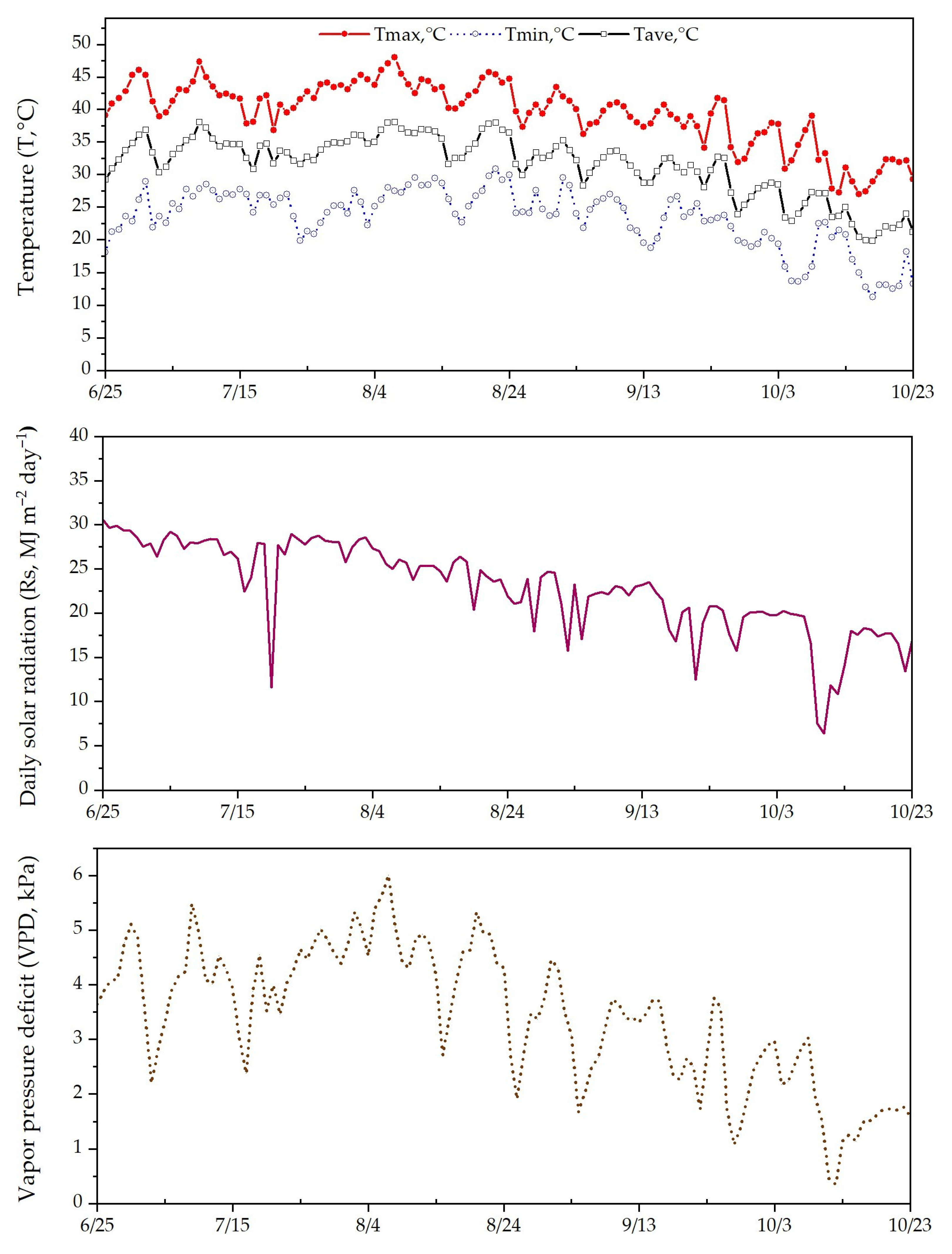
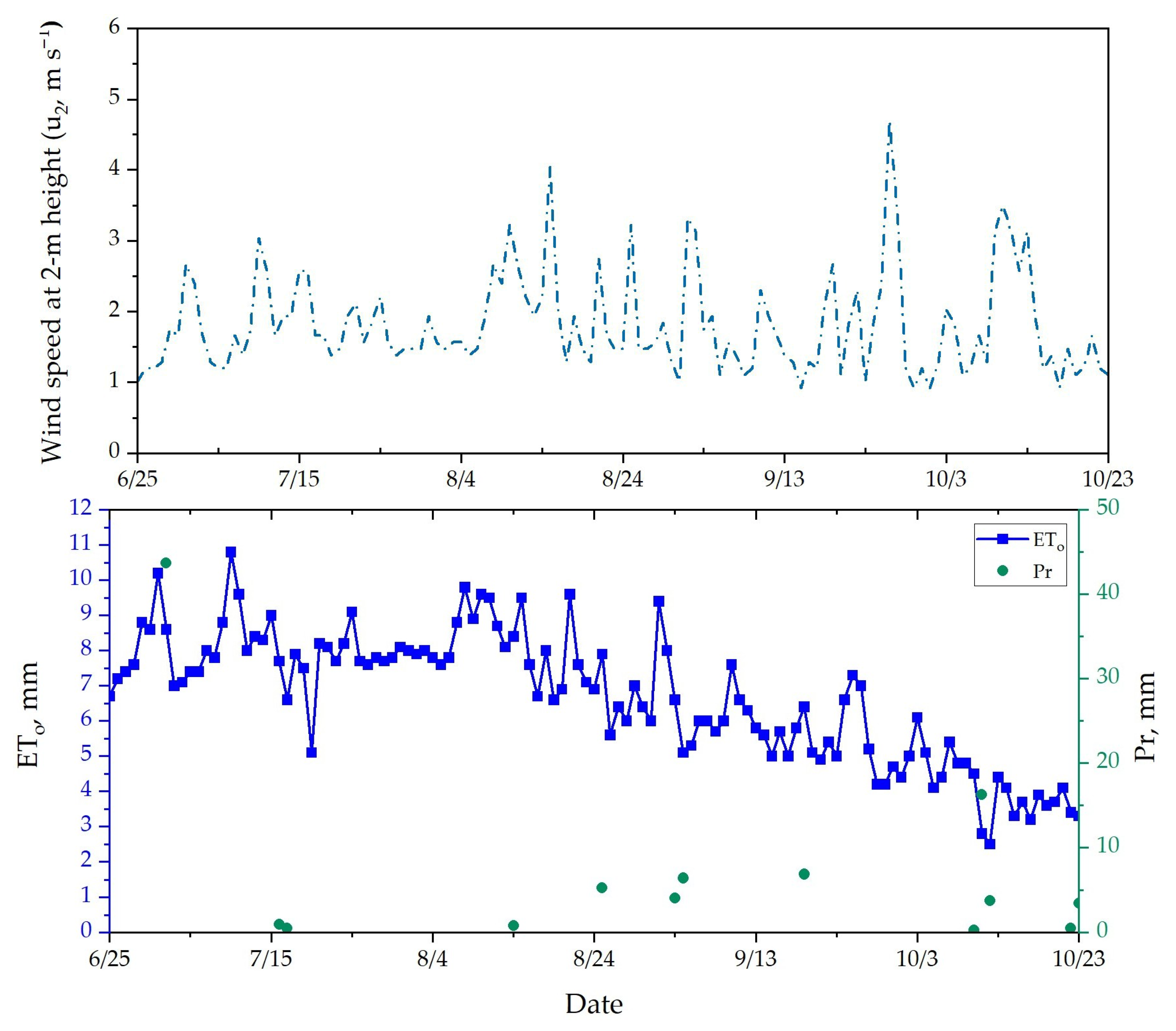
where Kcb,i and Ke,i are the soil evaporation coefficient and the basal crop coefficient on day i, respectively (unitless), and ETo,i is the grass reference crop evapotranspiration on day i (mm). Using daily meteorological data, such as maximum, minimum, and average temperatures (Tmax, Tmin, and Tave, °C), daily solar radiation (Rs, MJ m−2 day−1), average vapor pressure deficit (VPD, kPa), average wind speed at 2 m height (u2, m s−1), and precipitation (Pr, mm), that were collected from the nearby Arizona Meteorological Network (AZMET) weather station in Maricopa County (https://cales.arizona.edu/AZMET/az-data.htm, accessed on 6 December 2025), the FAO56 standardized Penman-Monteith was applied to compute daily ETo [36].
After cotton establishment on 25 June, the FAO-56 soil water balance model (SWB) was used to calculate the actual ET of cotton as follows [36]:
ETSWB = I + PrDp + CrRoff − ∆SWD
∆SWD = DriDri-1
where ETSWB is the soil water balance-derived evapotranspiration (mm) that occurred from day i-1 to the day i. The ∆SWD is the change in soil water depletion (mm), and Dri and Dri-1 are the depletion values at the initial and subsequent measurement times, respectively, calculated over rooting depth (Zr). Dr,i on measurement dates were calculated by Equation (4):
Dr,i = 1000 (θvFCθv,i) Zr
where θvFC is the depth-averaged field capacity (FC) soil water content (m3 m−3), and θv,i is the depth-averaged measured soil water content (m3 m−3) for a given location, and the cotton maximum effective Zr does not exceed 1.8 m [36]. The I, DP, Cr, and Roff in Equation (2) are irrigation, deep percolation infiltrated below Zr that occurred between two consecutive measurement dates, capillary rise from the groundwater table, and runoff (all units in mm). The DP was estimated by daily calculations of DP during irrigation days following Allen et al. [36]. The Cr was assumed to be zero in Equation (2) due to the deep groundwater table. Roff was negligible because of subsurface drip irrigation. The ∆SWD was monitored using a calibrated neutron probe moisture meter [NMM] (503 ELITE Hydroprobe, https://www.instrotek.com/products/503-elite-hydroprobe, accessed on 6 December 2025), whereas NMM was used to measure θv,i as a linear function of the ratio of NMM count reading to average standard count before and after each set of readings [33]. The NMM readings were collected weekly from seven galvanized steel access tubes (2.1 m long and 51 mm in diameter), distributed randomly in the experimental field. For each access tube, NMM readings were at 0.15 m below the soil surface and then at 0.30 m increments to a depth of 1.65 m (halfway between 1.50 and 1.80 m). Then, the FAO-56 soil water balance model was corrected using NMM readings. This approach ensured that the modeled soil water balance remained consistent with observed field conditions while retaining the FAO-56 framework for estimating daily soil water dynamics between measurement dates [37].
During access tube installation, soil samples were collected from each location every 0.3 m to a depth of 1.80 m below the soil surface. The soil samples were analyzed for soil properties, as summarized in Table 1.

2.2. OpenET

2.2.1. Dataset Description

OpenET employs six satellite-driven models, namely ALEXI/DisALEXI [25,38], eeMETRIC [39,40,41], geeSEBAL [42,43], PT-JPL [44], SSEBop [10,45], SIMS [46,47], and their Ensemble to generate daily, monthly, and yearly actual ET data on a field scale at a 30 m by 30 m spatial resolution (0.22 acres per pixel). Most of these models are based on full or simplified implementations of the surface energy balance (SEB) approach. The ALEXI/DisALEXI, eeMETRIC, and geeSEBAL models estimate each component of the energy balance using optical (i.e., short-wave) and thermal (i.e., long-wave) data. However, PT-JPL and SSEBop models are simplified approaches in which certain components of the energy balance are not estimated or are calculated using a set of simplifying assumptions. The SIMS uses both surface reflectance data and crop type information to estimate actual ET as a function of canopy density using a crop coefficient approach for agricultural areas (https://etdata.org/methods/, accessed on 6 December 2025). More information about the OpenET dataset description can be found in Attalah et al. [33,48], Melton et al. [8], and Volt et al. [29].

2.2.2. Data Acquisition

The actual ET database for the cotton field was accessed via the OpenET #5 platform website (https://account.etdata.org/login?redirect=https://explore.etdata.org#5, accessed on 6 December 2025), using a free user account. Under the “Explore Data” menu, the field border coordinators were used to construct a polygon. Then, the daily time interval was defined (25 June–23 October 2025). After that, the specific OpenET model and actual ET data in mm were retrieved by running the “Run Timeseries” application. Finally, the acquired data was saved in CSV files for performance analysis.

2.3. LI-710: Components and Theory of Operation

2.3.1. LI-710 Components

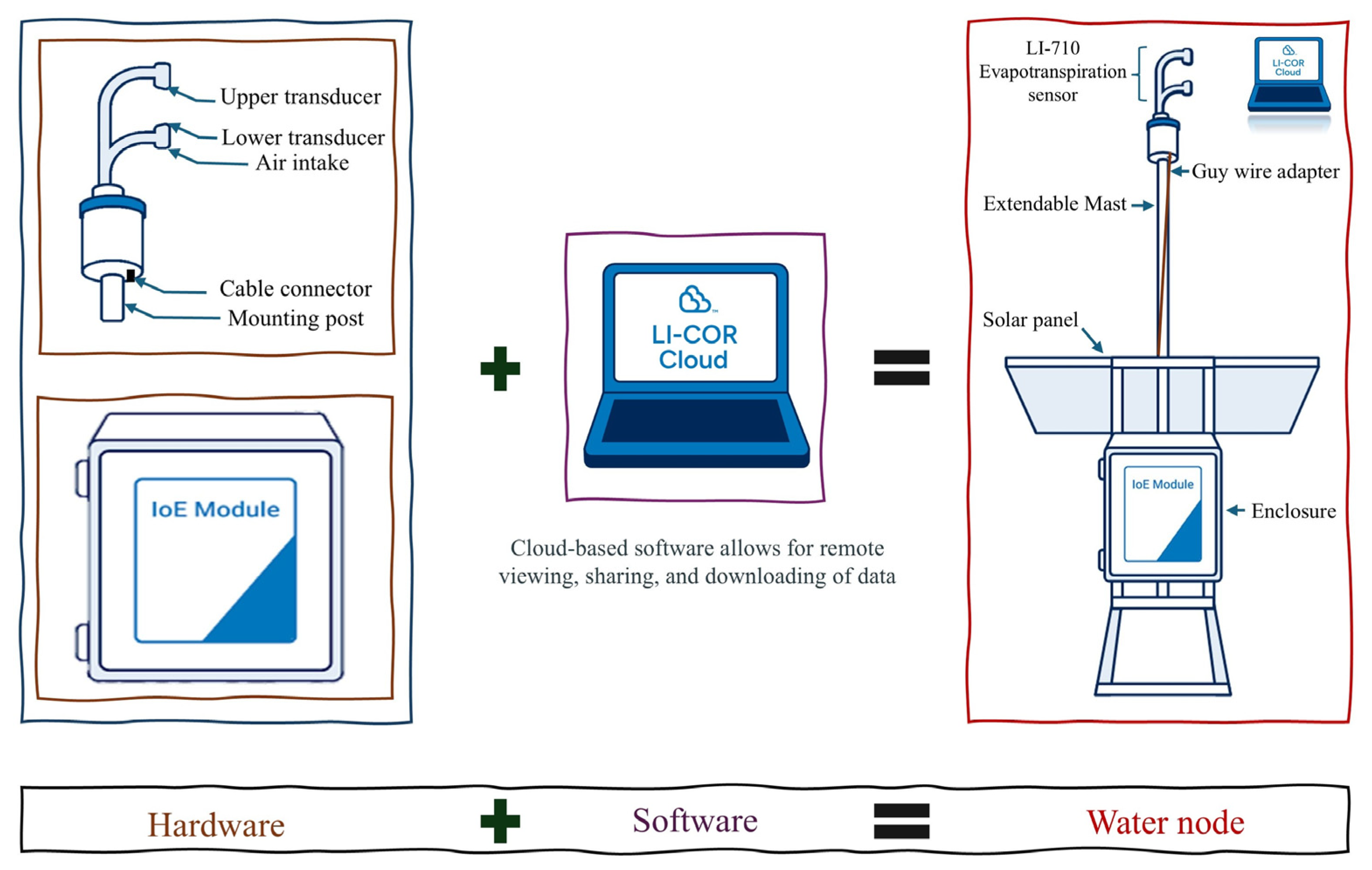
The LI-710 consists of two main components: (1) an Evapotranspiration (ET) sensor and (2) an Internet of Environment (IoE) Module (Figure 2). The ET sensor quantifies the total water transported from evaporation and transpiration over a specific area. The device outputs are actual evapotranspiration, energy flux, and additional parameters at 30 min intervals. The ET sensor is equipped with a single cable connector for power and data transmission, as well as a mounting post designed for attachment to an IoE Module or a tripod utilizing a 2.54 cm (1 inch) fitting.
The IoE Module supplies power to the LI-710 ET sensor for sustained, long-term operation and concurrently transmits data to the LI-COR Cloud (an online platform that enables data management, monitoring, and analysis, https://www.licor.cloud/, accessed on 6 December 2025) via a cellular network. This setup enables operators to access sensor data and evaluate the results remotely.
This IoE Module may include, but is not limited to, the following components and services: (1) a cellular service plan and access to LI-COR Cloud for one year; (2) backup data logging capabilities using a removable Micro SD card (applicable to all configurations); (3) an integrated charge controller for the solar power supply (applicable to all configurations); (4) an optional solar and battery power supply; (5) an optional mounting structure and enclosure for sensors and associated equipment.
When paired with an IoE Module, the LI-710 functions as a water node on the LI-COR Cloud. This water node, which includes the LI-710 ET sensor, IoE Module, and relevant software within the LI-COR Cloud, provides a straightforward way to monitor actual ET from one or multiple locations. It provides users with the ability to access and share data through an online platform. The all-in-one solution is designed for ease of setup, self-power, and minimal maintenance, facilitating the scaling of ET measurements across large sites or multiple locations. Upon relocation of the water node, GPS detection automatically updates its new position in the cloud. Within minutes of installation, all ET data becomes available in the cloud-based software.

2.3.2. LI-710 Theory of Operation

The LI-710 utilizes eddy covariance calculations that are optimized for its specific hardware and sensor configuration. By combining measurements of vertical wind speed with precise relative humidity data, it estimates ET from the area surrounding the LI-710 ET sensor. Under conditions of random or uniformly distributed wind directions, the LI-710 captures ET that represents the surrounding area and vegetation referred to as the “fetch footprint”. The fetch footprint typically covers an area of about 50 to 100 times the height of the ET sensor around the LI-710. For instance, placing the ET sensor 2 m above the canopy can fetch a footprint of approximately 100 to 200 m.
Since the device does not provide horizontal wind information, it cannot report the measurement’s fetch footprint. Hence, appropriate deployment requires positioning the sensor so that its footprint covers a uniform area around it, or the region upwind of the dominant wind direction. More information about the LI-710 components and theory of operation can be found at https://www.licor.com/support/LI-710/manuals.html, accessed on 6 December 2025.

2.4. Evaluation Metrics

Four statistical indicators, namely, the normalized root-mean-squared error (NRMSE), mean bias error (MBE), simulation error (Se), and coefficient of determination (R2), were applied to assess the performance of LI-710 and OpenET models in estimating cotton ET.
N R M S E = 100 E T S W B i = 1 n E T S I M E T S W B 2 n
M B E = i = 1 n ( E T S I M E T S W B ) n
S e = E T S I M E T S W B E T S W B × 100 %
R 2 = i = 1 n E T S W B E T S W B ( E T S I M E T S I M ) i = 1 n E T S W B E T S W B 2 i = 1 n ( E T S I M E T S I M ) 2 2
where ETSWB and ETSIM refer to the soil water balance-derived and simulated ET, respectively. E T S W B and E T S I M are the means of measured and simulated ET, respectively. n is the total number of data points. The NRMSE value varies within the range of 0 and ∞. The simulated ET is rated as excellent if the NRMSE is less than 10% and good if the result falls between 10% and 20%. A result of more than 20% to 30% signifies acceptable or fair performance, while NRMSE exceeding 30% indicates poor performance [49]. The MBE captures the average deviations between simulated and measured data datasets. The MBE value ranges from −∞ to ∞. Value > 0 indicates overestimation, whereas value < 0 indicates underestimation of the measured dataset. A zero value of MBE represents no bias. The Se between ±15% is acceptable [50]. R2 reflects the strength of the correlation between the simulated datasets. R2 values approaching 1.0 indicate a strong correlation between the simulated and observed ET datasets.

3. Results and Discussion

3.1. Climate Conditions

Daily meteorological data, including Tmax, Tmin, Tave, VPD, u2, Pr, and ETo, during June through October 2025, are shown in Figure 3. During that timeframe, daily maximum temperatures varied between 27.0 °C and 48.0 °C and averaged 39.5 °C, while daily minimum temperatures varied between 11.2 °C and 30.9 °C and averaged 23.4 °C. Daily Rs averaged 22.8  ±  5.0 MJ m−2 d−1 over the entire evaluation period. VPD varied from 0.4 to 6.0 kPa and averaged 3.4 kPa. Wind speed remains more fluctuating throughout the study period, generally varying between about 0.9 and 4.7 m s−1. ETo averaged 6.7  ±  1.8 mm, and total P for the study period was 92.6 mm.

3.2. OpenET Models

3.2.1. The ALEXI/DisALEXI Model

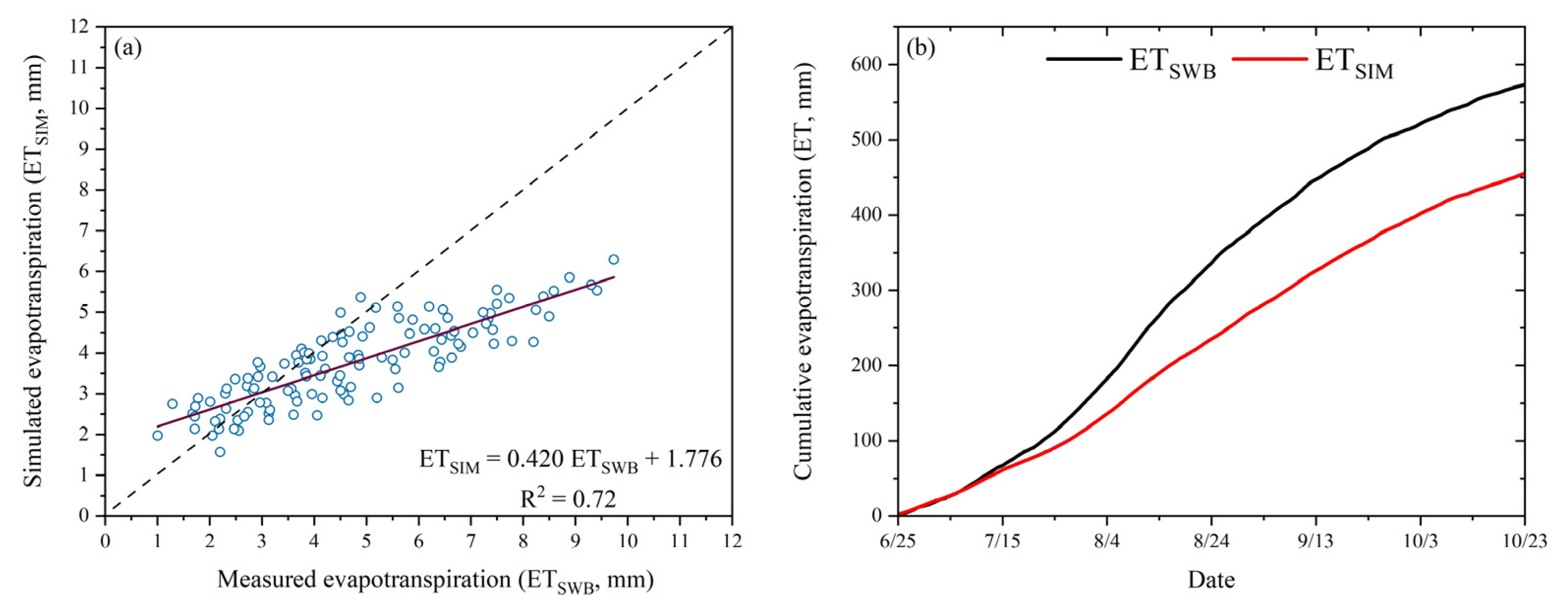
Table 2 summarizes the performance evaluation metrics of the ALEXI/DisALEXI model in simulating cotton ETc during the 2025 growing season. Although a positive linear correlation of 0.72 was observed between ETSIM and ETSWB (Table 2 and Figure 4 and Figure A1), the ALEXI/DisALEXI model tended to underestimate daily actual ET by 0.97 mm. The simulation error (Se) and NRMSE were −20.57% and 34.40%, respectively, reflecting a poor performance of the model in simulating cotton daily ETc [49,50].

3.2.2. The eeMETRIC Model

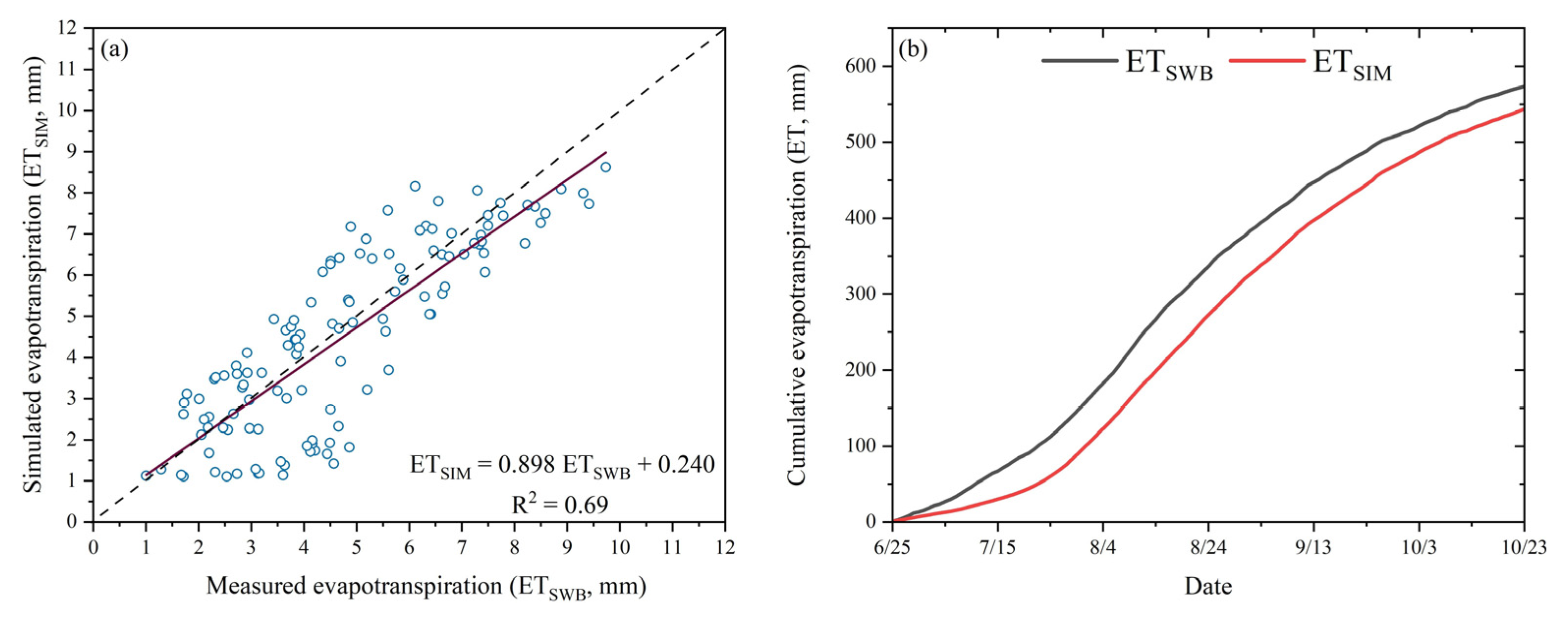
A comparison between ETSWB and ETSIM by the eeMETRIC model is represented in Table 3 and Figure 5 and Figure A1. Like ALEXI/DisALEXI, a positive linear correlation of 0.69 was observed between ETSIM and ETSWB; however, the eeMETRIC model underestimated daily actual ET slightly by 0.24 mm. Meanwhile, there was a slight deviation (−5.13%) between the soil water balance-derived and simulated actual ET. The eeMETRIC model outperformed ALEXI/DisALEXI in simulating cotton daily ETc, with NRMSE of 26.88%, indicating fair model performance in simulating ETc.

3.2.3. The geeSEBAL Model

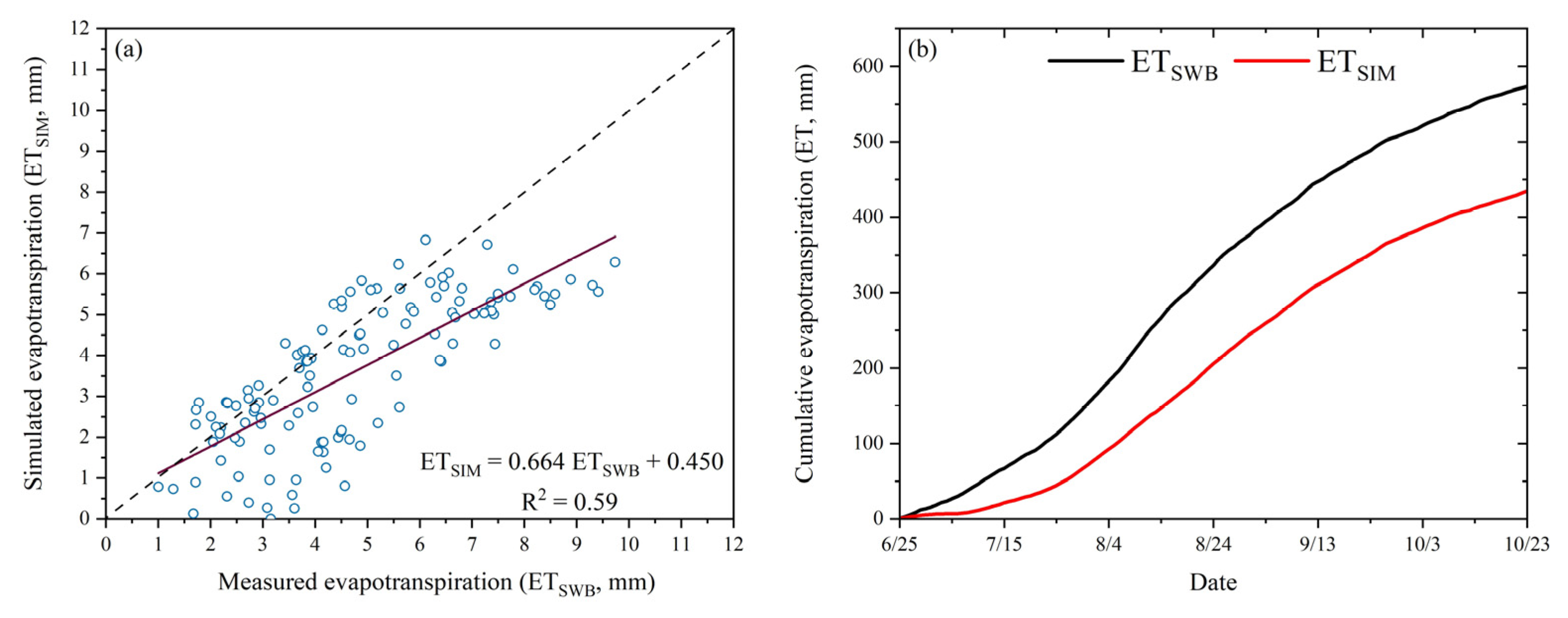
OpenET results from the geeSEBAL model compared with soil water balance-derived ET during the growing season are presented in Table 4 and Figure 6 and Figure A1. Overall, the geeSEBAL model demonstrated poor performance in simulating cotton daily ETc, with an NRMSE of 36.92% (Table 4). The model underestimated cotton daily ETc by 1.14 mm, resulting in a positive linear correlation of 0.59 between ETSIM and ETSWB and an unacceptable simulation error of 24.13%, as shown in Table 4 and Figure 6 and Figure A1.

3.2.4. The PT-JPL Model

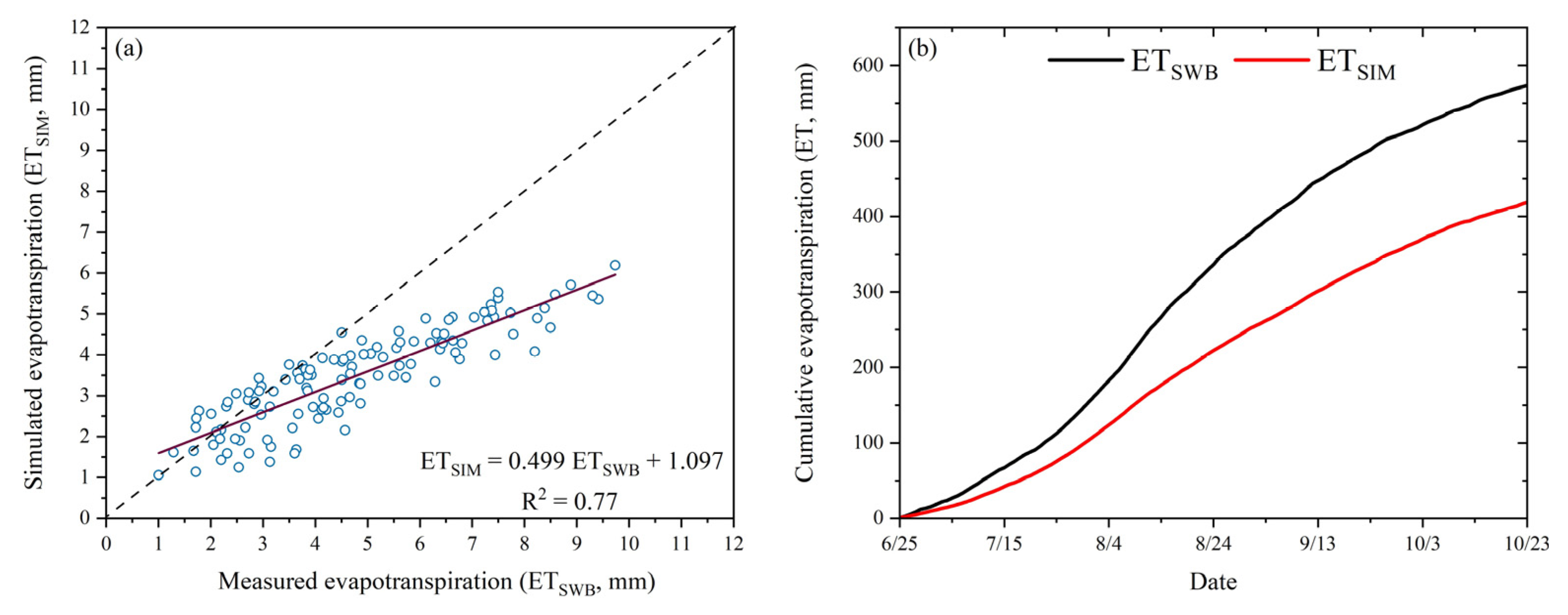
Similar to the ALEXI/DisALEXI, eeMETRIC, and geeSEBAL models, PT-JPL underestimated cotton ETc during the growing period when compared with soil water balance-derived ETc data (Table 5 and Figure 7 and Figure A1). The R2 and MBE were 0.77 and −1.28 mm, respectively. The Se was −26.92%, which exceeded the recommended ratio of ±15% for field experiments [50]. Moreover, NRMSE was 36.46%, demonstrating unacceptable model performance in simulating cotton ETc during the study period.

3.2.5. The SIMS Model

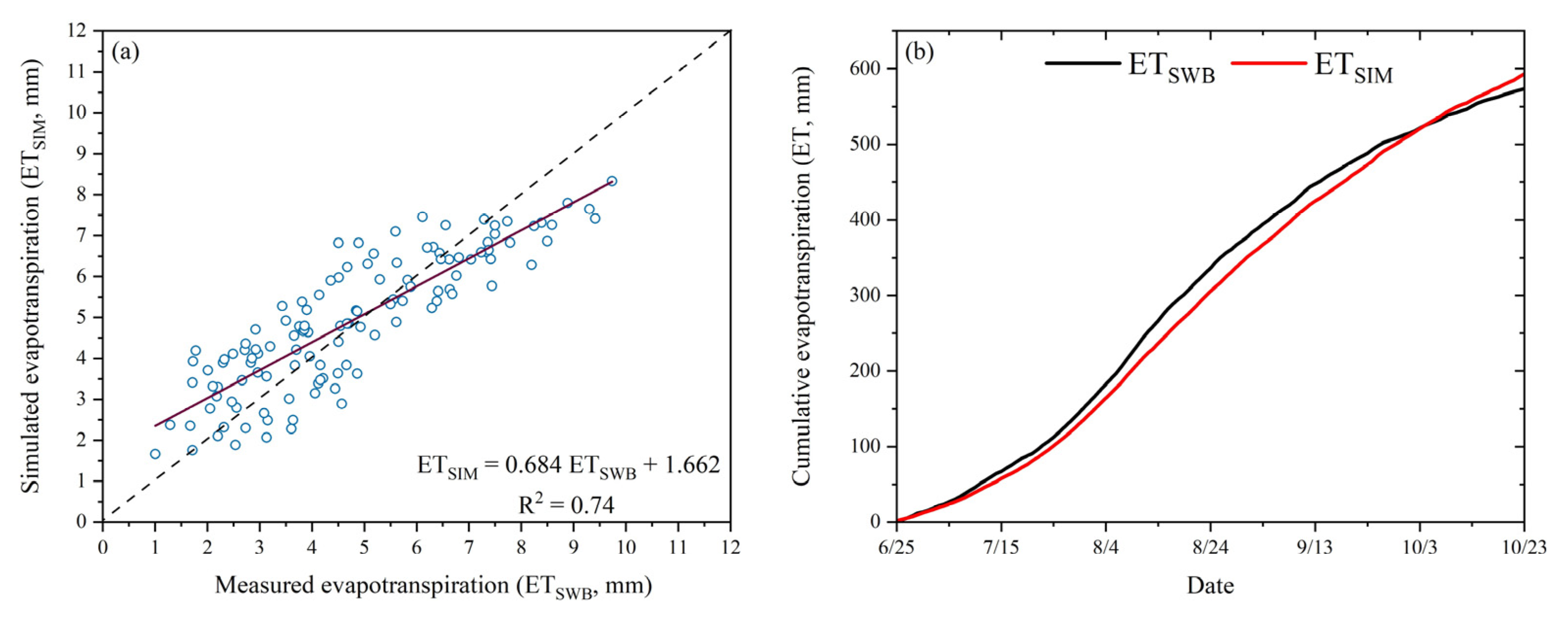
For the SIMS model, the obtained results illustrated acceptable performance in simulating ET (Table 6 and Figure 8 and Figure A1). During the evaluation period, the SIMS tended to overestimate daily ETc slightly by 0.16 mm. The R2 and Se were 0.74 and 3.42%, respectively. NRMSE was in the acceptable range of 20–30%, reported by Jamieson et al. [49].

3.2.6. The SSEBop Model

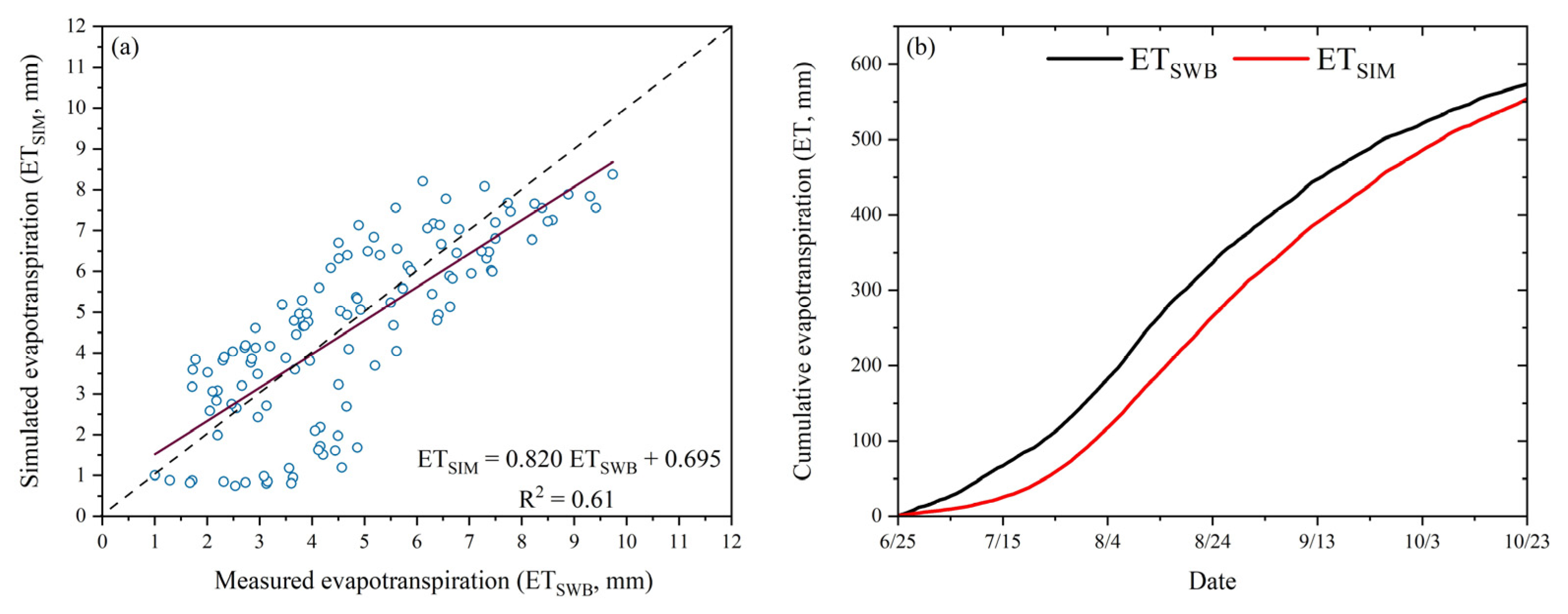
The SSEBop model showed a positive correlation between ETSIM and ETSWB datasets, as presented in Table 7 and Figure 9 and Figure A1. The model underestimated daily ETc by 0.16 mm, with a slight deviation of −3.35% between the ETSIM and ETSWB datasets. NRMSE was 29.85%, demonstrating acceptable performance of the model [49].

3.2.7. The Ensemble Approach

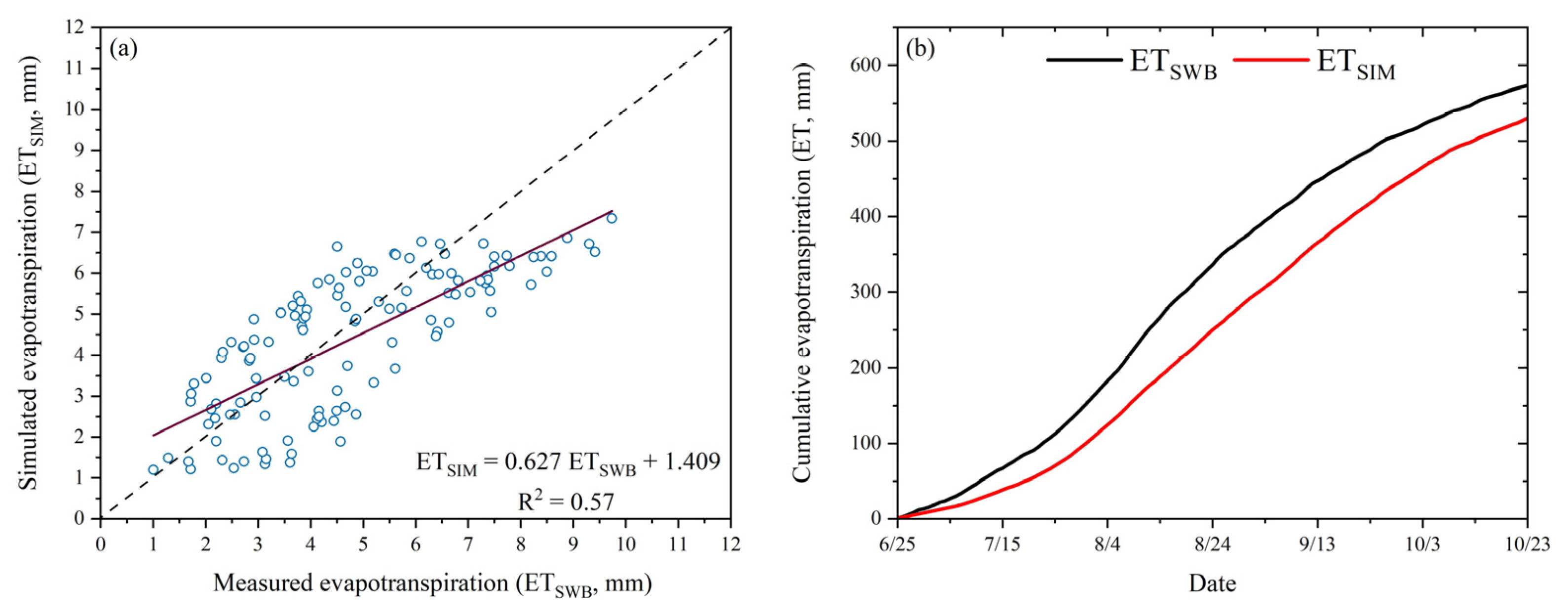
Statistical indicators, including NRMSE, MBE, Se, and R2, comparing the Ensemble approach with soil water balance-derived ETc are summarized in Table 8 and presented in Figure 10 and Figure A1. Based on our analyses, the Ensemble approach tended to underestimate daily cotton ETc by 0.36 mm. Meanwhile, Ensemble lowered Se to −7.58% with R2 and NRMSE of 0.57 and 29.62% (Table 8 and Figure 10 and Figure A1), reflecting an acceptable performance in simulating cotton ETc

3.3. LI-710

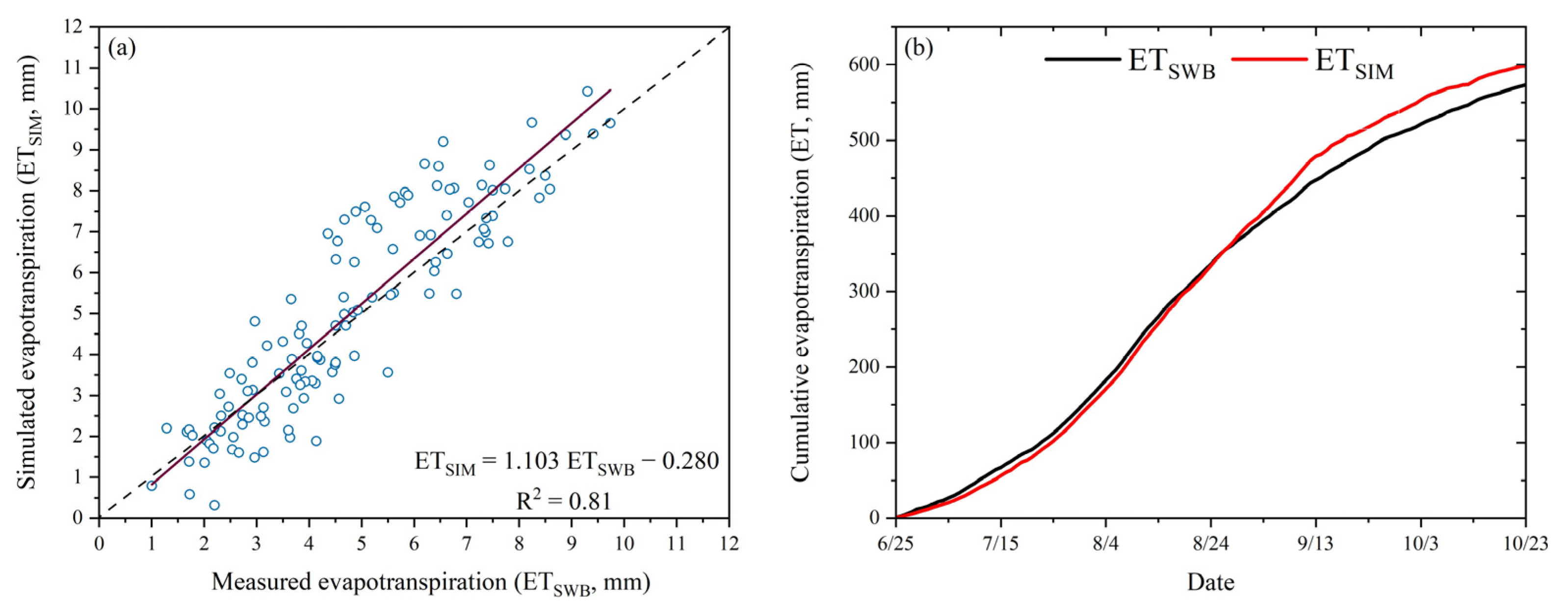
Figure 11 presents the daily ETSWB of the LI-710 ET sensors across the cotton field during the 2025 growing season. Overall, LI-710 simulated daily ET acceptably with a slight tendency to overestimate daily ET by 0.21 mm. There was a strong positive correlation of 0.81 between the ETSIM and ETSWB datasets (Table 9 and Figure 11 and Figure A1). Moreover, Se and NRMSE were 4.40% and 23.68%, respectively, as summarized in Table 9.

3.4. Discussion

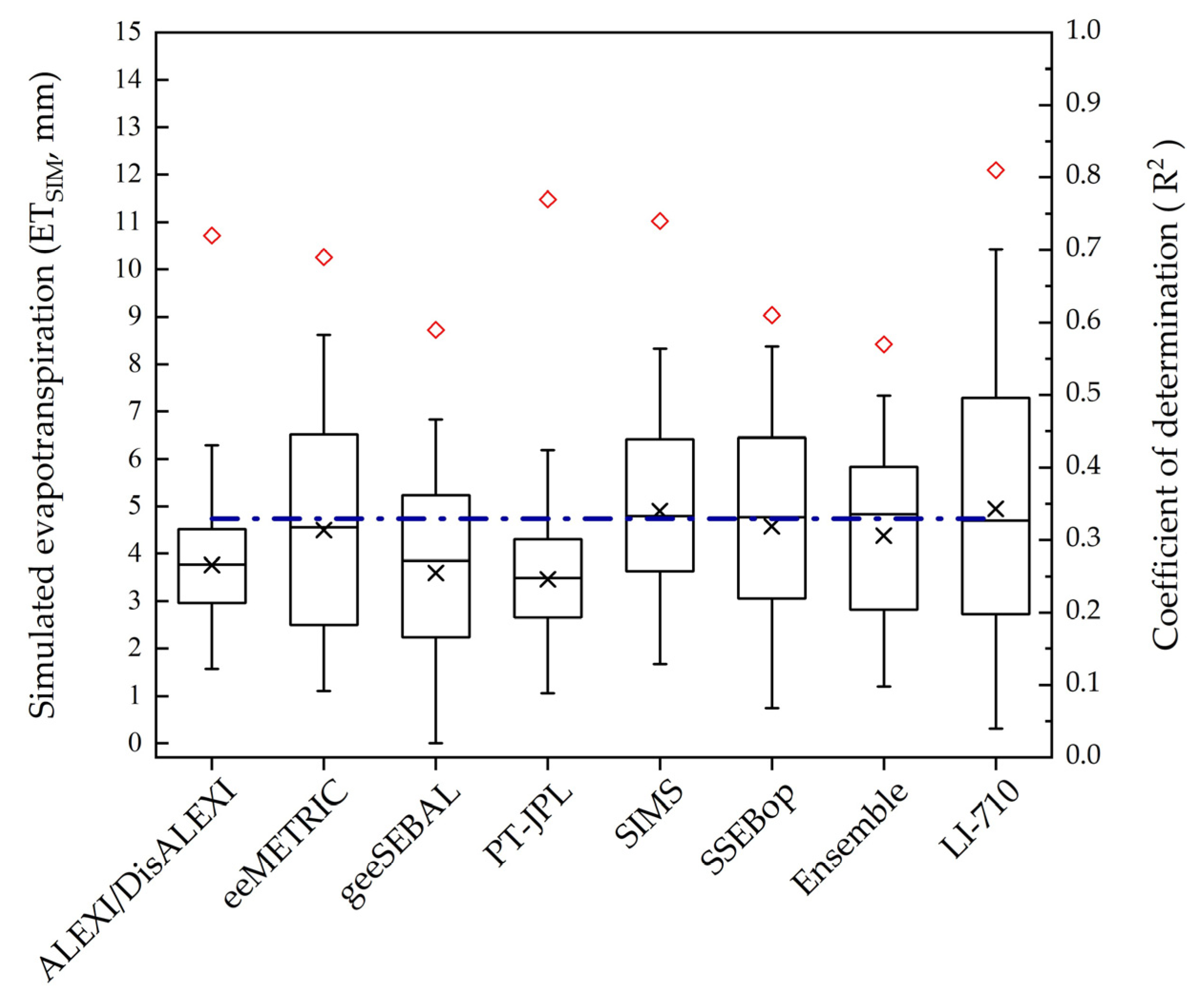
This study assessed the performance of OpenET models, their Ensemble, and the LI-710 sensor in estimating cotton daily ETc. Statistical evaluation metrics assessing the performance of the OpenET models and the LI-710 in comparison with the soil water balance method across the cotton field in Gila Bend, Maricopa County, AZ, USA, are presented in Table 2, Table 3, Table 4, Table 5, Table 6, Table 7, Table 8 and Table 9 and Figure 4a, Figure 5a, Figure 6a, Figure 7a, Figure 8a, Figure 9a, Figure 10a, Figure 11a and Figure A1. Although three of the six evaluated OpenET models showed a poor performance in simulating cotton daily ETc, both the OpenET Ensemble approach and the LI-710 ET sensor showed acceptable performance in simulating cotton daily ETc compared to the SWB method over the study period.
Based on our analysis, the DisALEXI model tended to underestimate ETc (Table 2 and Figure 4 and Figure A1). These findings support Huntington et al. [51], who reported that the DisALEXI model tends to underestimate actual ET compared to measured ET data in the Upper Colorado River Basin, USA. Also, our observations aligned with Tawalbeh et al. [30], who observed high variability in ALEXI/DisALEXI simulations, especially in July and August, accompanied by underestimation in ETSIM compared with measured ET data. Negative biases might be due to several reasons, such as aridity and advection [51].
The results indicated that the geeSEBAL model generally tends to underestimate actual ET (biased low) during the growing season (Table 4 and Figure 6 and Figure A1). These observations align with previous studies reporting that geeSEBAL underestimates ET from June to September [30]. Similar observations were reported by Huntington et al. [51] in the Upper Colorado River Basin, USA.
Similar to the geeSEBAL and ALEXI/DisALEXI models, PT-JPL underestimated actual evapotranspiration during the growing period when compared with soil water balance-derived ET data (Table 5 and Figure 7 and Figure A1). These observations were consistent with those of Huntington et al. [51], who indicated that the mentioned models were biased low compared to measured ET data in the Upper Colorado River Basin. Also, similar results were reported by Abbasi et al. [52] for the wheat crop in the lower Colorado River Basin. Moreover, the estimations of these were the lowest consumptive use not only across the Upper Colorado River Basin but also for each state [51]. A similar pattern of PT-JPL ET underestimations was observed during the summer months from June to September by Tawalbeh et al. [30] in the Mesilla Valley, NM, USA. Measured ET is commonly above ETSIM by the PT-JPL model in arid and semi-arid environments because of the advection of dry and warm air toward the surface [51]. Moreover, the limitations of using the PT equation in arid to semi-arid areas were noted in previous studies [53,54]. Even after the PT-JPL aridity correction, estimations from the model consistently fell below the 1:1 line when compared with the ETSWB datasets [8].
The SIMS model slightly overestimated cotton ETc over the study period. Our findings were inconsistent with Abbasi et al. [52], who reported underestimation of SIMS for wheat crops in the lower Colorado River Basin. SIMS employs a reflectance-based approach to estimate crop coefficients (Kc) and evapotranspiration by directly deriving crop canopy properties from satellite spectral reflectance, primarily in visible and near-infrared (NIR) wavelengths. The produced data includes the normalized difference vegetation index (NDVI), fractional cover (Fc), basal crop coefficient (Kcb), and ETc. Negative observed biases may be a result of the limitations of the reflectance-based approach, which was conducted to fit well-watered plants at different growing stages, making it less sensitive to intermittent water stress or deficit irrigation that is not sufficient to affect the crop canopy. Moreover, this approach is less sensitive to soil evaporation, especially over bare soil and early during the crop growth cycle when fractional crop cover is low. In addition to aridity and advection [51], SIMS can overestimate ET for late-planted cotton in Gila Bend because NDVI is boosted by bright/wet soil due to frequent irrigations and a sparse early canopy, causing fractional cover and Kc to rise earlier or higher than actual. Therefore, it is recommended to establish relations and methodologies that would facilitate the implementation of the reflectance-based approach to intermittent water stress or deficit irrigation, which does not significantly impact crop canopy.
Previous studies cited a general tendency for the eeMETRIC [55,56] and SSEBop [30,51,52] models to overestimate actual ET; however, in our study, both models tended to slightly underestimate cotton ETc by 5.13% and 3.35%, respectively (Table 3 and Table 7, and Figure 5, Figure 9 and Figure A1). The eeMETRIC model implementation utilizes the traditional METRIC calibration process of Allen et al. [40,57] and Irmak et al. [58], where a singular relationship between the near-surface air temperature difference (dT) and the lapse-corrected land surface temperature (TsDEM) is used to estimate sensible heat flux (H) and is applied to each Landsat scene. Even though eeMETRIC relies on corrected surface reflectance and land surface temperature (LST) from Landsat Collection 2, the model is expected to underestimate ETc for late-planted cotton. The potential reasons for this underestimation include prolonged bare-soil heating, frequent early-season irrigations, extreme atmospheric demand, and mid-season heat stress. These cause the energy-balance solution to attribute a large portion of net radiation to sensible rather than latent heat, resulting in consistent underestimation. Short episodes of overestimation may occur immediately after irrigation events, when the cooled soil surface is misinterpreted as transpiring vegetation; however, the dominant seasonal bias remains negative. Likewise, SSEBop is a simplified thermal-based surface energy model [10,45], implementing LST from Landsat Collection 2 for simulating ETc. Therefore, SSEBop slightly underestimated ETc for late-planted cotton in Gila Bend, AZ, USA, due to the previously mentioned reasons. SSEBop can be further improved by minimizing errors in reference ET, land surface temperature (LST), maximum ET scalar (Kmax), and differential temperature (dT) [59].
Many studies recommended the Ensemble approach as the best in simulating ETSWB when compared with the six OpenET models (e.g., Abbasi et al. [52]; Dhungel et al. [60], Huntington et al. [51]; Melton et al. [8]; Tawalbeh et al. [30]; Volk et al. [29]. However, fluctuations in SIMS, eeMETRIC, and SSEBop in the current study led to performance that was inconsistent with previous research, but that was acceptable. Despite containing poor individual models, the acceptable performance of the Ensemble approach suggests a buffering effect in which errors from different models are partially offset through averaging. In this context, careful selection of a singular OpenET model, rather than reliance on the Ensemble approach, may offer more precise and reliable guidance for irrigation management.
On the other hand, LI-710 demonstrated an acceptable performance in simulating cotton daily ETc (Table 9 and Figure 11 and Figure A1). Since there was no cited research on the LI-710 performance in simulating cotton ETc, the performance evaluation metrics could not be compared over the study period. Nevertheless, based on the magnitudes of the performance indicators (NRMSE, MBE, Se, and R2), LI-710 outperformed most of the OpenET models and their Ensemble approach over the study period (Table 2, Table 3, Table 4, Table 5, Table 6, Table 7, Table 8 and Table 9 and Figure 4, Figure 5, Figure 6, Figure 7, Figure 8, Figure 9, Figure 10, Figure 11 and Figure A1). Moreover, our findings support Peddinti et al. [31], who reported that corrected LI-710 over-predicted almonds and citrus ET by 4.5% and 8.2%, respectively, when compared with EC under California’s Central Valley climatic conditions. LI-710 uses the eddy covariance approach to measure turbulent fluxes. It provides reliable ET data due to capturing spatial variations in ET affected by microclimate or soil texture, which are often missed by single weather-based [31] or remote sensing estimations.

4. Conclusions

The present study evaluated the performance of the OpenET models (ALEXI/DisALEXI, eeMETRIC, geeSEBAL, PT-JPL, SIMS, and SSEBop), their Ensemble, and the LI-710 (LI-COR Inc., Lincoln, NE, USA) in simulating cotton evapotranspiration (ETc) compared to the soil water balance (SWB) method. Four statistical metrics were used to evaluate the OpenET models, Ensemble, and LI710 during the 2025 cotton growing season in Gila Bend, Maricopa County, AZ, USA. In general, OpenET models and their Ensemble approach were linearly correlated to soil water balance-derived evapotranspiration (ETSWB) with R2 > 0.57. Except for SIMS, all OpenET models and their Ensemble underestimated actual ET with acceptable to poor simulation errors. Underestimations of ETSWB by the ALEXI/DisALEXI, geeSEBAL, and PT-JPL models were deemed unreliable as singular models for cotton. However, the eeMETRIC, SIMS, SSEBop, and Ensemble were considered acceptable based on the statistical metrics. In contrast, LI-710 overestimated actual ET acceptably, providing reliable ET data due to capturing spatial variations in ET affected by microclimate or soil texture, which are often missed by single weather-based or remote sensing estimations.
Our results highlighted the limitations of using the PT equation in arid to semi-arid areas, whereas the PT-JPL estimations were always below the 1:1 line when compared with the soil water balance-derived ET datasets. The results highlighted the limitations of the reflectance-based approach, which is used by the SIMS model to employ simulations. Moreover, our findings highlighted the limitations of the surface temperature approach employed by eeMETRIC and SSEBop for estimating actual ET. Therefore, future work focusing on calibrating the reflectance-based (SIMS) and surface temperature-based (eeMETRIC, SSEBop) algorithms using local, high-frequency canopy and soil moisture data is recommended to better account for the conditions of late-planted crops under intermittent water stress or deficit irrigation in arid and semi-arid environments.
Considering the limitations of OpenET models and some maintenance challenges of the LI-710, our findings highlight the great potential of using a singular OpenET model, such as eeMETRIC, SIMS, or SSEBop, the OpenET Ensemble, and the LI-710 for effective cotton irrigation management in arid and semi-arid regions like Arizona.

Author Contributions

Conceptualization, E.A.E., S.A. and D.E.M.E.; methodology, E.A.E., S.A., C.W., K.R.T. and D.E.M.E.; validation, E.A.E., K.R.T., D.W. and D.E.M.E.; investigation, E.A.E. and D.E.M.E.; data curation, E.A.E., S.A. and D.E.M.E.; writing—original draft preparation, E.A.E. and D.E.M.E.; writing—review and editing, E.A.E., S.A., C.W., K.R.T., D.W. and D.E.M.E.; visualization, E.A.E., S.A. and D.E.M.E.; supervision, D.E.M.E.; project administration, D.E.M.E.; funding acquisition, C.W. and D.E.M.E. All authors have read and agreed to the published version of the manuscript.

Funding

This research was funded by the University of Arizona Cooperative Extension Service, The University of Arizona, Tucson, AZ 85721, USA. Additionally, it was supported by the Agricultural Research Service of the U.S. Department of Agriculture and carried out in collaboration with the Arid Land Agricultural Research Center.

Data Availability Statement

The original contributions presented in this study are included in the article. Further inquiries can be directed to the corresponding author(s).

Acknowledgments

The authors thank Aaron Dodge and Andrew J. Dull for helping with data collection and Ronald Rayner and Ross Rayner for allowing us to utilize their cotton field during the study period. Additionally, the authors gratefully acknowledge the University of Arizona Cooperative Extension Service for its continued support of irrigation research in arid regions like Arizona, USA.

Conflicts of Interest

The authors declare that they have no known competing financial interest or personal relationships that could have appeared to influence the work reported in this study.

Appendix A

Figure A1. Average biases in simulated evapotranspiration (ETSIM) by six OpenET models, the Ensemble approach, and LI-710 during the 2025 cotton growing season in Gila Bend, AZ, USA. The blue dash-dotted line represents the average soil water balance-derived evapotranspiration (ETSWB). The cross and line within the box mark the average and median ETSIM, respectively, and whiskers above and below the box indicate the maximum and minimum ETSIM values. The red diamonds indicate the coefficient of determination (R2).
Agriculture 16 00228 g0a1

References

  1. Galli, A.; Wiedmann, T.; Ercin, E.; Knoblauch, D.; Ewing, B.; Giljum, S. Integrating Ecological, Carbon and Water Footprint into a “Footprint Family” of Indicators: Definition and Role in Tracking Human Pressure on the Planet. Ecol. Indic. 2012, 16, 100–112. [Google Scholar] [CrossRef]
  2. Gleick, P.H. A Look at Twenty-First Century Water Resources Development. Water Int. 2000, 25, 127–138. [Google Scholar] [CrossRef]
  3. Alcamo, J.; Henrichs, T.; Rösch, T. World Water in 2025—Global Modeling and Scenario Analysis for the World Commission on Water for the 21st Century, Kassel World Water 27; Center for Environmental Systems Research: Kassel, Germany, 2000; pp. 922–939. [Google Scholar]
  4. Bruinsma, J. World Agriculture: Towards 2015/2030: An FAO Perspective; Routledge: Oxford, UK, 2003; Volume 1, pp. 13–24. [Google Scholar]
  5. Rosegrant, M.W.; Cai, X.; Cline, S.A. Global Water Outlook to 2025: Averting an Impending Crisis; International Food Policy Research Institute: Washington DC, USA, 2007. [Google Scholar]
  6. Lu, S.; Zhu, G.; Qiu, D.; Li, R.; Jiao, Y.; Meng, G.; Lin, X.; Wang, Q.; Zhang, W.; Chen, L. Optimizing Irrigation in Arid Irrigated Farmlands Based on Soil Water Movement Processes: Knowledge from Water Isotope Data. Geoderma 2025, 460, 117440. [Google Scholar] [CrossRef]
  7. Yi, J.; Li, H.; Zhao, Y.; Shao, M.; Zhang, H.; Liu, M. Assessing Soil Water Balance to Optimize Irrigation Schedules of Flood-Irrigated Maize Fields with Different Cultivation Histories in the Arid Region. Agric. Water Manag. 2022, 265, 107543. [Google Scholar] [CrossRef]
  8. Melton, F.S.; Huntington, J.; Grimm, R.; Herring, J.; Hall, M.; Rollison, D.; Erickson, T.; Allen, R.; Anderson, M.; Fisher, J.B.; et al. OpenET: Filling a Critical Data Gap in Water Management for the Western United States. JAWRA J. Am. Water Resour. Assoc. 2022, 58, 971–994. [Google Scholar] [CrossRef]
  9. Elbeltagi, A.; Srivastava, A.; Cao, X.; Gautam, V.K.; Zerouali, B.; Aslam, M.R.; Salem, A.; Emami, H.; Elsadek, E.A. Bayesian-Optimized Machine Learning Boosts Actual Evapotranspiration Prediction in Water-Stressed Agricultural Regions of China. Sci. Rep. 2025, 15, 37548. [Google Scholar] [CrossRef]
  10. Senay, G.B.; Bohms, S.; Singh, R.K.; Gowda, P.H.; Velpuri, N.M.; Alemu, H.; Verdin, J.P. Operational Evapotranspiration Mapping Using Remote Sensing and Weather Datasets: A New Parameterization for the SSEB Approach. JAWRA J. Am. Water Resour. Assoc. 2013, 49, 577–591. [Google Scholar] [CrossRef]
  11. Wagle, P.; Skaggs, T.H.; Gowda, P.H.; Northup, B.K.; Neel, J.P.S. Flux Variance Similarity-Based Partitioning of Evapotranspiration over a Rainfed Alfalfa Field Using High Frequency Eddy Covariance Data. Agric. For. Meteorol. 2020, 285–286, 107907. [Google Scholar] [CrossRef]
  12. French, A.N.; Hunsaker, D.J.; Bounoua, L.; Karnieli, A.; Luckett, W.E.; Strand, R. Remote Sensing of Evapotranspiration over the Central Arizona Irrigation and Drainage District, USA. Agronomy 2018, 8, 278. [Google Scholar] [CrossRef]
  13. Payero, J.O.; Irmak, S. Daily Energy Fluxes, Evapotranspiration and Crop Coefficient of Soybean. Agric. Water Manag. 2013, 129, 31–43. [Google Scholar] [CrossRef]
  14. Dhungel, R.; Aiken, R.; Evett, S.R.; Colaizzi, P.D.; Marek, G.; Moorhead, J.E.; Baumhardt, R.L.; Brauer, D.; Kutikoff, S.; Lin, X. Energy Imbalance and Evapotranspiration Hysteresis Under an Advective Environment: Evidence From Lysimeter, Eddy Covariance, and Energy Balance Modeling. Geophys. Res. Lett. 2021, 48, e2020GL091203. [Google Scholar] [CrossRef]
  15. Evett, S.R.; Kustas, W.P.; Gowda, P.H.; Anderson, M.C.; Prueger, J.H.; Howell, T.A. Overview of the Bushland Evapotranspiration and Agricultural Remote Sensing EXperiment 2008 (BEAREX08): A Field Experiment Evaluating Methods for Quantifying ET at Multiple Scales. Adv. Water Resour. 2012, 50, 4–19. [Google Scholar] [CrossRef]
  16. Sánchez, J.M.; López-Urrea, R.; Valentín, F.; Caselles, V.; Galve, J.M. Lysimeter Assessment of the Simplified Two-Source Energy Balance Model and Eddy Covariance System to Estimate Vineyard Evapotranspiration. Agric. For. Meteorol. 2019, 274, 172–183. [Google Scholar] [CrossRef]
  17. Xue, J.; Bali, K.M.; Light, S.; Hessels, T.; Kisekka, I. Evaluation of Remote Sensing-Based Evapotranspiration Models against Surface Renewal in Almonds, Tomatoes and Maize. Agric. Water Manag. 2020, 238, 106228. [Google Scholar] [CrossRef]
  18. Bambach, N.; Kustas, W.; Alfieri, J.; Prueger, J.; Hipps, L.; McKee, L.; Castro, S.J.; Volk, J.; Alsina, M.M.; McElrone, A.J. Evapotranspiration Uncertainty at Micrometeorological Scales: The Impact of the Eddy Covariance Energy Imbalance and Correction Methods. Irrig. Sci. 2022, 40, 445–461. [Google Scholar] [CrossRef]
  19. Dong, Y.; Yang, M.; Bakker, D.C.E.; Kitidis, V.; Bell, T.G. Uncertainties in Eddy Covariance Air–Sea CO2 Flux Measurements and Implications for Gas Transfer Velocity Parameterisations. Atmos. Chem. Phys. 2021, 21, 8089–8110. [Google Scholar] [CrossRef]
  20. Ferrara, R.M.; Di Tommasi, P.; Famulari, D.; Rana, G. Limitations of an Eddy-Covariance System in Measuring Low Ammonia Fluxes. Bound.-Layer Meteorol. 2021, 180, 173–186. [Google Scholar] [CrossRef]
  21. García-Gutiérrez, V.; Stöckle, C.; Gil, P.M.; Meza, F.J. Evaluation of Penman-Monteith Model Based on Sentinel-2 Data for the Estimation of Actual Evapotranspiration in Vineyards. Remote Sens. 2021, 13, 478. [Google Scholar] [CrossRef]
  22. Elsadek, E.A.; Ali, M.A.H.; Williams, C.; Thorp, K.R.; Elshikha, D.E.M. A Novel Framework for Predicting Daily Reference Evapotranspiration Using Interpretable Machine Learning Techniques. Agriculture 2025, 15, 1985. [Google Scholar] [CrossRef]
  23. Elbeltagi, A.; Katipoğlu, O.M.; Kartal, V.; Danandeh Mehr, A.; Berhail, S.; Elsadek, E.A. Advanced Reference Crop Evapotranspiration Prediction: A Novel Framework Combining Neural Nets, Bee Optimization Algorithm, and Mode Decomposition. Appl. Water Sci. 2024, 14, 256. [Google Scholar] [CrossRef]
  24. Bawazir, A.S.; Luthy, R.; King, J.P.; Tanzy, B.F.; Solis, J. Assessment of the Crop Coefficient for Saltgrass under Native Riparian Field Conditions in the Desert Southwest. Hydrol. Process. 2014, 28, 6163–6171. [Google Scholar] [CrossRef]
  25. Anderson, M.; Gao, F.; Knipper, K.; Hain, C.; Dulaney, W.; Baldocchi, D.; Eichelmann, E.; Hemes, K.; Yang, Y.; Medellin-Azuara, J.; et al. Field-Scale Assessment of Land and Water Use Change over the California Delta Using Remote Sensing. Remote Sens. 2018, 10, 889. [Google Scholar] [CrossRef]
  26. Knipper, K.R.; Kustas, W.P.; Anderson, M.C.; Alfieri, J.G.; Prueger, J.H.; Hain, C.R.; Gao, F.; Yang, Y.; McKee, L.G.; Nieto, H.; et al. Evapotranspiration Estimates Derived Using Thermal-Based Satellite Remote Sensing and Data Fusion for Irrigation Management in California Vineyards. Irrig. Sci. 2019, 37, 431–449. [Google Scholar] [CrossRef]
  27. Knipper, K.R.; Kustas, W.P.; Anderson, M.C.; Alsina, M.M.; Hain, C.R.; Alfieri, J.G.; Prueger, J.H.; Gao, F.; McKee, L.G.; Sanchez, L.A. Using High-Spatiotemporal Thermal Satellite ET Retrievals for Operational Water Use and Stress Monitoring in a California Vineyard. Remote Sens. 2019, 11, 2124. [Google Scholar] [CrossRef]
  28. Chen, J.M.; Liu, J. Evolution of Evapotranspiration Models Using Thermal and Shortwave Remote Sensing Data. Remote Sens. Environ. 2020, 237, 111594. [Google Scholar] [CrossRef]
  29. Volk, J.M.; Huntington, J.L.; Melton, F.S.; Allen, R.; Anderson, M.; Fisher, J.B.; Kilic, A.; Ruhoff, A.; Senay, G.B.; Minor, B.; et al. Assessing the Accuracy of OpenET Satellite-Based Evapotranspiration Data to Support Water Resource and Land Management Applications. Nat. Water 2024, 2, 193–205. [Google Scholar] [CrossRef]
  30. Tawalbeh, Z.M.; Bawazir, A.S.; Fernald, A.; Sabie, R.; Heerema, R.J. Assessing Satellite-Derived OpenET Platform Evapotranspiration of Mature Pecan Orchard in the Mesilla Valley, New Mexico. Remote Sens. 2024, 16, 1429. [Google Scholar] [CrossRef]
  31. Peddinti, S.R.; Kisekka, I. Evaluation of the LI-710 Evapotranspiration Sensor in Comparison to Full Eddy Covariance for Monitoring Energy Fluxes in Perennial and Annual Crops. Agric. Water Manag. 2025, 313, 109501. [Google Scholar] [CrossRef]
  32. Burba, G.; Miller, B.; Fratini, G.; Inkenbrandt, P.C.; Xu, L. Simple Direct Evapotranspiration Measurements with a New Cost-Optimized ET Flux Sensor. In Proceedings of the 104th AMS Annual Meeting (AMS), Baltimore, MD, USA, 28 January–1 February 2024. [Google Scholar]
  33. Attalah, S.; Elsadek, E.A.; Waller, P.; Hunsaker, D.J.; Thorp, K.R.; Bautista, E.; Williams, C.; Wall, G.; Orr, E.; Elshikha, D.E.M. Evaluation and Comparison of OpenET Models for Estimating Soil Water Depletion of Irrigated Alfalfa in Arizona. Agric. Water Manag. 2025, 320, 109850. [Google Scholar] [CrossRef]
  34. Elshikha, D.E.; Attalah, S.; Elsadek, E.A.; Waller, P.; Thorp, K.; Sanyal, D.; Bautista, E.; Norton, R.; Hunsaker, D.; Williams, C.; et al. The Impact of Gravity Drip and Flood Irrigation on Development, Water Productivity, and Fiber Yield of Cotton in Semi-Arid Conditions of Arizona. In Proceedings of the 2024 ASABE Annual International Meeting, Anaheim, CA, USA, 28–31 July 2024; American Society of Agricultural and Biological Engineers: St. Joseph, MI, USA, 2024; pp. 1–16. [Google Scholar]
  35. Elsadek, E.A.; Attalah, S.; Waller, P.; Norton, R.; Hunsaker, D.J.; Williams, C.; Thorp, K.R.; Orr, E.; Elshikha, D.E.M. Simulating Water Use and Yield for Full and Deficit Flood-Irrigated Cotton in Arizona, USA. Agronomy 2025, 15, 2023. [Google Scholar] [CrossRef]
  36. Allen, R.G.; Pereira, L.S.; Raes, D.; Smith, M. Crop Evapotranspiration-Guidelines for Computing Crop Water Requirements-FAO Irrigation and Drainage Paper 56; FAO: Rome, Italy, 1998. [Google Scholar]
  37. Hunsaker, D.J.; Barnes, E.M.; Clarke, T.R.; Fitzgerald, G.J.; Pinter, P.J., Jr. Cotton Irrigation Scheduling Using Remotely Sensed and FAO-56 Basal Crop Coefficients. Trans. ASAE 2005, 48, 1395–1407. [Google Scholar] [CrossRef]
  38. Anderson, M.C.; Norman, J.M.; Mecikalski, J.R.; Otkin, J.A.; Kustas, W.P. A Climatological Study of Evapotranspiration and Moisture Stress across the Continental United States Based on Thermal Remote Sensing: 1. Model Formulation. J. Geophys. Res. Atmos. 2007, 112, D10117. [Google Scholar] [CrossRef]
  39. Allen, R.G.; Tasumi, M.; Morse, A.; Trezza, R. A Landsat-Based Energy Balance and Evapotranspiration Model in Western US Water Rights Regulation and Planning. Irrig. Drain. Syst. 2005, 19, 251–268. [Google Scholar] [CrossRef]
  40. Allen, R.G.; Tasumi, M.; Trezza, R. Satellite-Based Energy Balance for Mapping Evapotranspiration with Internalized Calibration (METRIC)—Model. J. Irrig. Drain. Eng. 2007, 133, 380–394. [Google Scholar] [CrossRef]
  41. Allen, R.; Irmak, A.; Trezza, R.; Hendrickx, J.M.H.; Bastiaanssen, W.; Kjaersgaard, J. Satellite-based ET Estimation in Agriculture Using SEBAL and METRIC. Hydrol. Process. 2011, 25, 4011–4027. [Google Scholar] [CrossRef]
  42. Bastiaanssen, W.G.M.; Menenti, M.; Feddes, R.A.; Holtslag, A.A.M. A Remote Sensing Surface Energy Balance Algorithm for Land (SEBAL). 1. Formulation. J. Hydrol. 1998, 212–213, 198–212. [Google Scholar] [CrossRef]
  43. Laipelt, L.; Henrique Bloedow Kayser, R.; Santos Fleischmann, A.; Ruhoff, A.; Bastiaanssen, W.; Erickson, T.A.; Melton, F. Long-Term Monitoring of Evapotranspiration Using the SEBAL Algorithm and Google Earth Engine Cloud Computing. ISPRS J. Photogramm. Remote Sens. 2021, 178, 81–96. [Google Scholar] [CrossRef]
  44. Fisher, J.B.; Tu, K.P.; Baldocchi, D.D. Global Estimates of the Land–Atmosphere Water Flux Based on Monthly AVHRR and ISLSCP-II Data, Validated at 16 FLUXNET Sites. Remote Sens. Environ. 2008, 112, 901–919. [Google Scholar] [CrossRef]
  45. Senay, G.B. Satellite Psychrometric Formulation of the Operational Simplified Surface Energy Balance (SSEBop) Model for Quantifying and Mapping Evapotranspiration. Appl. Eng. Agric. 2018, 34, 555–566. [Google Scholar] [CrossRef]
  46. Melton, F.S.; Johnson, L.F.; Lund, C.P.; Pierce, L.L.; Michaelis, A.R.; Hiatt, S.H.; Guzman, A.; Adhikari, D.D.; Purdy, A.J.; Rosevelt, C.; et al. Satellite Irrigation Management Support With the Terrestrial Observation and Prediction System: A Framework for Integration of Satellite and Surface Observations to Support Improvements in Agricultural Water Resource Management. IEEE J. Sel. Top. Appl. Earth Obs. Remote Sens. 2012, 5, 1709–1721. [Google Scholar] [CrossRef]
  47. Pereira, L.S.; Paredes, P.; Melton, F.; Johnson, L.; Wang, T.; López-Urrea, R.; Cancela, J.J.; Allen, R.G. Prediction of Crop Coefficients from Fraction of Ground Cover and Height. Background and Validation Using Ground and Remote Sensing Data. Agric. Water Manag. 2020, 241, 106197. [Google Scholar] [CrossRef]
  48. Attalah, S.; Elsadek, E.A.; Waller, P.; Hunsaker, D.; Thorp, K.; Bautista, E.; Williams, C.; Wall, G.; Orr, E.; Elshikha, D.E. Evaluating the Performance of OpenET Models for Alfalfa in Arizona. In Proceedings of the 2024 ASABE Annual International Meeting, Anaheim, CA, USA, 28–31 July 2024; American Society of Agricultural and Biological Engineers: St. Joseph, MI, USA, 2024; p. 1. [Google Scholar]
  49. Jamieson, P.D.; Porter, J.R.; Wilson, D.R. A Test of the Computer Simulation Model ARCWHEAT1 on Wheat Crops Grown in New Zealand. Field Crops Res. 1991, 27, 337–350. [Google Scholar] [CrossRef]
  50. Brisson, N.; Ruget, F.; Gate, P.; Lorgeou, J.; Nicoullaud, B.; Tayot, X.; Plenet, D.; Jeuffroy, M.-H.; Bouthier, A.; Ripoche, D.; et al. STICS: A Generic Model for Simulating Crops and Their Water and Nitrogen Balances. II. Model Validation for Wheat and Maize. Agronomie 2002, 22, 69–92. [Google Scholar] [CrossRef]
  51. Huntington, J.L.; Pearson, C.; Minor, B.; Volk, J.; Morton, C.; Melton, F.; Allen, R. Appendix G: Upper Colorado River Basin OpenET Intercomparison Summary; US Bureau of Reclamation: Washington, DC, USA, 2022.
  52. Abbasi, N.; Nouri, H.; Nagler, P.; Didan, K.; Chavoshi Borujeni, S.; Barreto-Muñoz, A.; Opp, C.; Siebert, S. Crop Water Use Dynamics over Arid and Semi-Arid Croplands in the Lower Colorado River Basin. Eur. J. Remote Sens. 2023, 56, 2259244. [Google Scholar] [CrossRef]
  53. Weiß, M.; Menzel, L. A Global Comparison of Four Potential Evapotranspiration Equations and Their Relevance to Stream Flow Modelling in Semi-Arid Environments. Adv. Geosci. 2008, 18, 15–23. [Google Scholar] [CrossRef]
  54. Tabari, H.; Talaee, P.H. Local Calibration of the Hargreaves and Priestley-Taylor Equations for Estimating Reference Evapotranspiration in Arid and Cold Climates of Iran Based on the Penman-Monteith Model. J. Hydrol. Eng. 2011, 16, 837–845. [Google Scholar] [CrossRef]
  55. Singh, R.K.; Irmak, A. Treatment of Anchor Pixels in the METRIC Model for Improved Estimation of Sensible and Latent Heat Fluxes. Hydrol. Sci. J. 2011, 56, 895–906. [Google Scholar] [CrossRef]
  56. Wagle, P.; Bhattarai, N.; Gowda, P.H.; Kakani, V.G. Performance of Five Surface Energy Balance Models for Estimating Daily Evapotranspiration in High Biomass Sorghum. ISPRS J. Photogramm. Remote Sens. 2017, 128, 192–203. [Google Scholar] [CrossRef]
  57. Allen, R.G.; Morton, C.; Kamble, B.; Kilic, A.; Huntington, J.; Thau, D.; Gorelick, N.; Erickson, T.; Moore, R.; Trezza, R.; et al. EEFlux: A Landsat-Based Evapotranspiration Mapping Tool on the Google Earth Engine. In Proceedings of the 2015 ASABE/IA Irrigation Symposium: Emerging Technologies for Sustainable Irrigation—A Tribute to the Career of Terry Howell, Sr. Conference Proceedings, Long Beach, CA, USA, 10–12 November 2025; American Society of Agricultural and Biological Engineers: St. Joseph, MI, USA, 2015; pp. 1–11. [Google Scholar]
  58. Irmak, A.; Ratcliffe, I.; Ranade, P.; Hubbard, K.G.; Singh, R.K.; Kamble, B.; Kjaersgaard, J. Estimation of Land Surface Evapotranspiration with a Satellite Remote Sensing Procedure. Gt. Plains Res. 2011, 21, 73–88. [Google Scholar]
  59. Chen, M.; Senay, G.B.; Singh, R.K.; Verdin, J.P. Uncertainty Analysis of the Operational Simplified Surface Energy Balance (SSEBop) Model at Multiple Flux Tower Sites. J. Hydrol. 2016, 536, 384–399. [Google Scholar] [CrossRef]
  60. Dhungel, R.; Anderson, R.G.; French, A.N.; Skaggs, T.H.; Ajami, H.; Wang, D. Intercomparison of Citrus Evapotranspiration among Eddy Covariance, OpenET Ensemble Models, and the Water and Energy Balance Model (BAITSSS). Agric. Water Manag. 2024, 304, 109066. [Google Scholar] [CrossRef]
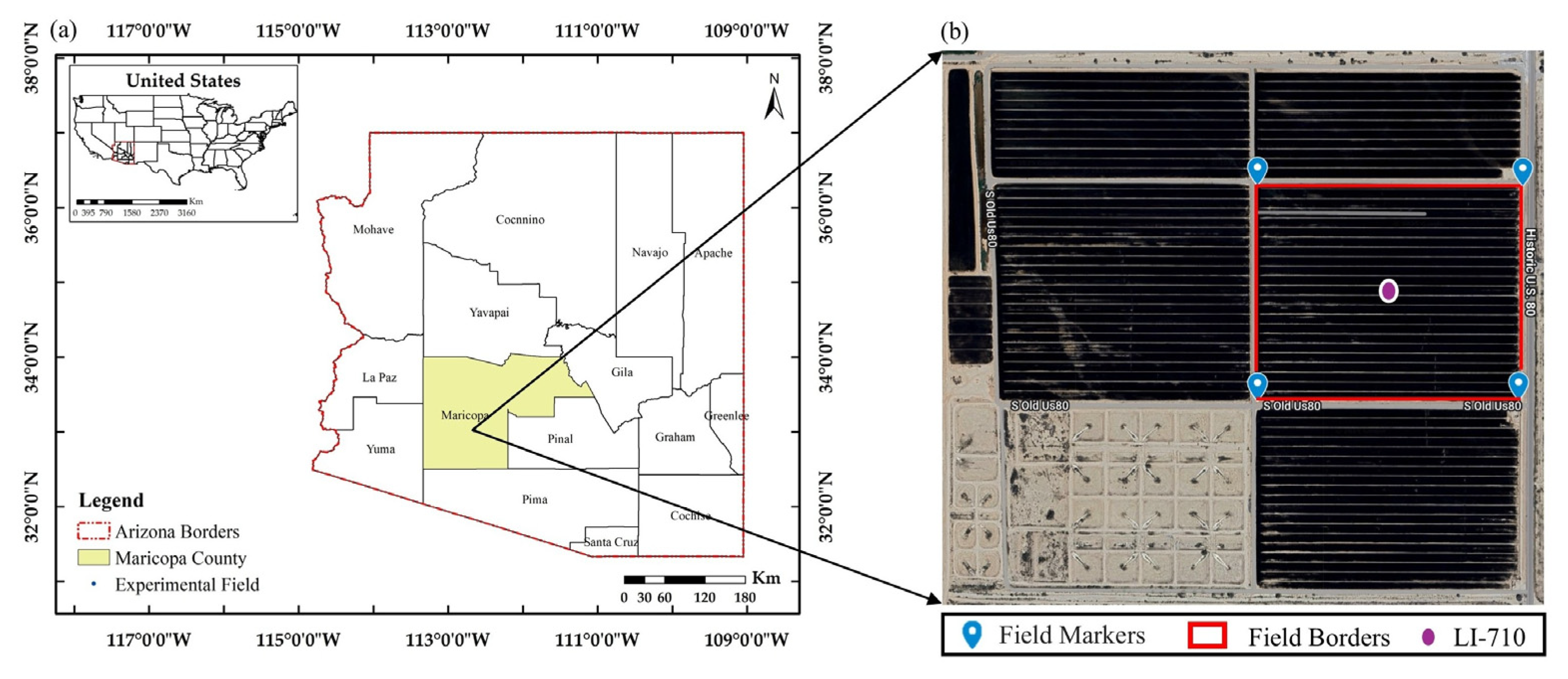
Figure 1. (a) Geographic location and (b) cotton field layout at Maricopa County, AZ, USA.
Agriculture 16 00228 g001
Figure 2. Components of the LI-710 water node.
Agriculture 16 00228 g002
Figure 3. Daily meteorological data collected from the AZMET weather station, Maricopa County, AZ, USA. Tmax, Tmin, and Tave refer to maximum, minimum, and average temperatures, while Pr and ETo refer to precipitation and reference crop evapotranspiration, respectively.
Agriculture 16 00228 g003aAgriculture 16 00228 g003b
Figure 4. (a) Soil water balance-derived (ETSWB), simulated (ETSIM), and (b) cumulative cotton evapotranspiration by the ALEXI/DisALEXI model during the study period.
Agriculture 16 00228 g004
Figure 5. (a) Soil water balance-derived (ETSWB), simulated (ETSIM), and (b) cumulative cotton evapotranspiration by the eeMETRIC model during the study period.
Agriculture 16 00228 g005
Figure 6. (a) Soil water balance-derived (ETSWB), simulated (ETSIM), and (b) cumulative cotton evapotranspiration by the geeSEBAL model during the study period.
Agriculture 16 00228 g006
Figure 7. (a) Soil water balance-derived (ETSWB), simulated (ETSIM), and (b) cumulative cotton evapotranspiration by the PT-JPL model during the study period.
Agriculture 16 00228 g007
Figure 8. (a) Soil water balance-derived (ETSWB), simulated (ETSIM), and (b) cumulative cotton evapotranspiration by the SIMS model during the study period.
Agriculture 16 00228 g008
Figure 9. (a) Soil water balance-derived (ETSWB), simulated (ETSIM), and (b) cumulative cotton evapotranspiration by the SSEBop model during the study period.
Agriculture 16 00228 g009
Figure 10. (a) Soil water balance-derived (ETSWB), simulated (ETSIM), and (b) cumulative cotton evapotranspiration by the Ensemble approach during the study period.
Agriculture 16 00228 g010
Figure 11. (a) Soil water balance-derived (ETSWB), simulated (ETSIM), and (b) cumulative cotton evapotranspiration by the LI-710 during the study period.
Agriculture 16 00228 g011
Table 1. Summary of soil properties at Gila Bend field during the 2025 cotton growing season.
Profile
Depth, m
FC, m3 m−3PWP, m3 m−3Soil Texture
Sand, %Silt, %Clay, %Texture Class
0.0–0.30.1530.06469.023.08.0Sandy Loam
0.3–0.60.1480.06471.022.08.0Sandy Loam
0.6–0.90.1300.05877.017.07.0Loam Sandy
0.9–1.20.1440.07578.012.010.0Sandy Loam
1.2–1.50.1290.06380.013.08.0Loam Sandy
1.5–1.80.1070.05185.09.06.0Loam Sandy
Notes: FC and PWP refer to field capacity and permanent wilting point, respectively.
Table 2. Summary of statistical indicators comparing the simulated evapotranspiration (ETSIM) by the ALEXI/DisALEXI model with soil water balance-derived evapotranspiration (ETSWB) during the 2025 cotton growing season in Gila Bend, AZ, USA.
ALEXI/DisALEXIETSWB, mmETSIM, mmStatistical Indicator
NRMSE, %MBE, mmSe, %R2
573.31455.3634.40−0.97−20.570.72
Notes: ETSWB and ETSIM refer to cumulative soil water balance-derived and simulated cotton evapotranspiration during the study period, respectively. NRMSE, MBE, Se, and R2 refer to the normalized root-mean-squared error, mean bias error, simulation error, and coefficient of determination, respectively. The simulation is excellent if the NRMSE is less than 10% and good if the result falls between 10% and 20%. A result of more than 20% to 30% signifies acceptable or fair performance, while NRMSE exceeding 30% indicates poor performance. The MBE value > 0 indicates overestimation, whereas a value < 0 indicates underestimation of ET. Se between ±15% is acceptable. R2 values approaching 1.0 indicate a strong correlation between the ETSIM and ETSWB datasets.
Table 3. Summary of statistical indicators comparing the simulated evapotranspiration (ETSIM) by the eeMETRIC model with soil water balance-derived evapotranspiration (ETSWB) during the 2025 cotton growing season in Gila Bend, AZ, USA.
eeMETRICETSWB, mmETSIM, mmStatistical Indicator
NRMSE, %MBE, mmSe, %R2
573.31543.8826.88−0.24−5.130.69
Notes: ETSWB and ETSIM refer to cumulative soil water balance-derived and simulated cotton evapotranspiration during the study period, respectively. NRMSE, MBE, Se, and R2 refer to the normalized root-mean-squared error, mean bias error, simulation error, and coefficient of determination, respectively. The simulation is excellent if the NRMSE is less than 10% and good if the result falls between 10% and 20%. A result of more than 20% to 30% signifies acceptable or fair performance, while NRMSE exceeding 30% indicates poor performance. The MBE value > 0 indicates overestimation, whereas a value < 0 indicates underestimation of ET. Se between ±15% is acceptable. R2 values approaching 1.0 indicate a strong correlation between the ETSIM and ETSWB datasets.
Table 4. Summary of statistical indicators comparing the simulated evapotranspiration (ETsim) by the geeSEBAL model with soil water balance-derived evapotranspiration (ETSWB) during the 2025 cotton growing season in Gila Bend, AZ, USA.
geeSEBALETSWB, mmETSIM, mmStatistical Indicator
NRMSE, %MBE, mmSe, %R2
573.31434.9936.92−1.14−24.130.59
Notes: ETSWB and ETSIM refer to cumulative soil water balance-derived and simulated cotton evapotranspiration during the study period, respectively. NRMSE, MBE, Se, and R2 refer to the normalized root-mean-squared error, mean bias error, simulation error, and coefficient of determination, respectively. The simulation is excellent if the NRMSE is less than 10% and good if the result falls between 10% and 20%. A result of more than 20% to 30% signifies acceptable or fair performance, while NRMSE exceeding 30% indicates poor performance. The MBE value > 0 indicates overestimation, whereas a value < 0 indicates underestimation of ET. Se between ±15% is acceptable. R2 values approaching 1.0 indicate a strong correlation between the ETSIM and ETSWB datasets.
Table 5. Summary of statistical indicators comparing the simulated evapotranspiration (ETSIM) by the PT-JPL model with soil water balance-derived evapotranspiration (ETSWB) during the 2025 cotton growing season in Gila Bend, AZ, USA.
PT-JPLETSWB, mmETSIM, mmStatistical Indicator
NRMSE, %MBE, mmSe, %R2
573.31418.9636.46−1.28−26.920.77
Notes: ETSWB and ETSIM refer to cumulative soil water balance-derived and simulated cotton evapotranspiration during the study period, respectively. NRMSE, MBE, Se, and R2 refer to the normalized root-mean-squared error, mean bias error, simulation error, and coefficient of determination, respectively. The simulation is excellent if the NRMSE is less than 10% and good if the result falls between 10% and 20%. A result of more than 20% to 30% signifies acceptable or fair performance, while NRMSE exceeding 30% indicates poor performance. The MBE value > 0 indicates overestimation, whereas a value < 0 indicates underestimation of ET. Se between ±15% is acceptable. R2 values approaching 1.0 indicate a strong correlation between the ETSIM and ETSWB datasets.
Table 6. Summary of statistical indicators comparing the simulated evapotranspiration (ETSIM) by the SIMS model with soil water balance-derived evapotranspiration (ETSWB) during the 2025 cotton growing season in Gila Bend, AZ, USA.
SIMSETSWB, mmETSIM, mmStatistical Indicator
NRMSE, %MBE, mmSe, %R2
573.31592.9322.570.163.420.74
Notes: ETSWB and ETSIM refer to cumulative soil water balance-derived and simulated cotton evapotranspiration during the study period, respectively. NRMSE, MBE, Se, and R2 refer to the normalized root-mean-squared error, mean bias error, simulation error, and coefficient of determination, respectively. The simulation is excellent if the NRMSE is less than 10% and good if the result falls between 10% and 20%. A result of more than 20% to 30% signifies acceptable or fair performance, while NRMSE exceeding 30% indicates poor performance. The MBE value > 0 indicates overestimation, whereas a value < 0 indicates underestimation of ET. Se between ±15% is acceptable. R2 values approaching 1.0 indicate a strong correlation between the ETSIM and ETSWB datasets.
Table 7. Summary of statistical indicators comparing the simulated evapotranspiration (ETSIM) by the SSEBop model with soil water balance-derived evapotranspiration (ETSWB) during the 2025 cotton growing season in Gila Bend, AZ, USA.
SSEBopETSWB, mmETSIM, mmStatistical Indicator
NRMSE, %MBE, mmSe, %R2
573.31554.1029.85−0.16−3.350.61
Notes: ETSWB and ETSIM refer to cumulative soil water balance-derived and simulated cotton evapotranspiration during the study period, respectively. NRMSE, MBE, Se, and R2 refer to the normalized root-mean-squared error, mean bias error, simulation error, and coefficient of determination, respectively. The simulation is excellent if the NRMSE is less than 10% and good if the result falls between 10% and 20%. A result of more than 20% to 30% signifies acceptable or fair performance, while NRMSE exceeding 30% indicates poor performance. The MBE value > 0 indicates overestimation, whereas a value < 0 indicates underestimation of ET. Se between ±15% is acceptable. R2 values approaching 1.0 indicate a strong correlation between the ETSIM and ETSWB datasets.
Table 8. Summary of statistical indicators comparing the simulated evapotranspiration (ETSIM) by the Ensemble with soil water balance-derived evapotranspiration (ETSWB) during the 2025 cotton growing season in Gila Bend, AZ, USA.
EnsembleETSWB, mmETSIM, mmStatistical Indicator
NRMSE, %MBE, mmSe, %R2
573.31529.8529.62−0.36−7.580.57
Notes: ETSWB and ETSIM refer to cumulative soil water balance-derived and simulated cotton evapotranspiration during the study period, respectively. NRMSE, MBE, Se, and R2 refer to the normalized root-mean-squared error, mean bias error, simulation error, and coefficient of determination, respectively. The simulation is excellent if the NRMSE is less than 10% and good if the result falls between 10% and 20%. A result of more than 20% to 30% signifies acceptable or fair performance, while NRMSE exceeding 30% indicates poor performance. The MBE value > 0 indicates overestimation, whereas a value < 0 indicates underestimation of ET. Se between ±15% is acceptable. R2 values approaching 1.0 indicate a strong correlation between the ETSIM and ETSWB datasets.
Table 9. Summary of statistical indicators comparing the LI-710 with soil water balance-derived evapotranspiration during the 2025 cotton growing season in Gila Bend, AZ, USA.
LI-710ETSWB, mmETSIM, mmStatistical Indicator
NRMSE, %MBE, mmSe, %R2
573.31598.5223.680.214.400.81
Notes: ETSWB and ETSIM refer to cumulative soil water balance-derived and simulated cotton evapotranspiration during the study period, respectively. NRMSE, MBE, Se, and R2 refer to the normalized root-mean-squared error, mean bias error, simulation error, and coefficient of determination, respectively. The simulation is excellent if the NRMSE is less than 10% and good if the result falls between 10% and 20%. A result of more than 20% to 30% signifies acceptable or fair performance, while NRMSE exceeding 30% indicates poor performance. The MBE value > 0 indicates overestimation, whereas a value < 0 indicates underestimation of ET. Se between ±15% is acceptable. R2 values approaching 1.0 indicate a strong correlation between the ETSIM and ETSWB datasets.
Disclaimer/Publisher’s Note: The statements, opinions and data contained in all publications are solely those of the individual author(s) and contributor(s) and not of MDPI and/or the editor(s). MDPI and/or the editor(s) disclaim responsibility for any injury to people or property resulting from any ideas, methods, instructions or products referred to in the content.