Article

Breed-Based Genome-Wide CNV Analysis in Dong Tao Chickens Identifies Candidate Regions Potentially Related to Robust Tibia Morphology


1
Joint International Research Laboratory of Agriculture and Agri-Product Safety, Ministry of Education of China, Institutes of Agricultural Science and Technology Development, Yangzhou University, Yangzhou 225009, China
2
Key Laboratory of Animal Genetics and Breeding and Molecular Design of Jiangsu Province, College of Animal Science and Technology, Yangzhou University, Yangzhou 225009, China
*
Author to whom correspondence should be addressed.
Present address: Key Laboratory of Organ Regeneration and Reconstruction, State Key Laboratory of Stem Cell and Reproductive Biology, Institute of Zoology, University of Chinese Academy of Sciences, Chinese Academy of Sciences, Beijing 100101, China.
Agriculture 2026, 16(2), 221; https://doi.org/10.3390/agriculture16020221
Submission received: 5 November 2025 / Revised: 25 December 2025 / Accepted: 13 January 2026 / Published: 15 January 2026

Abstract

Tibia morphology is a significant factor in poultry germplasm and market traits. Copy number variation (CNV) has been identified as a structural source of genetic variation for complex traits. We profiled genome-wide CNVs in Dong Tao chickens and nine other local breeds and performed a breed-based case–control CNV-GWAS (Dong Tao vs. reference breeds). We sequenced 152 chickens, including 46 Dong Tao, and annotated genes and pathways. A total of 22,972 CNVs were detected, of which 2193 were retained after filtration across 33 chromosomes, with sizes ranging from 2 kilobases to 12.8 megabases. Principal component analysis indicated an overall weakness in the breed structure and a sex-related trend within Dong Tao. A deletion on chromosome 3 at 36,529,501 to 36,539,000 was observed in Dong Tao. The exploratory screen identified 44 CNV regions at nominal significance (p < 0.05), distinguishing Dong Tao from other breeds. Thirty-seven regions contained 99 genes, including CHRM3 within the chromosome 3 deletion and CRADD overlapping two CNVs. Enrichment analysis indicated thiamine metabolism and growth hormone receptor signalling as the primary pathways of interest, with TPK1, SOCS2, and FHIT identified as potential candidates. These results provide a CNV landscape for Dong Tao and prioritize variant regions and pathways potentially relevant to its robust tibia morphology; however, no direct CNV–tibia phenotype regression was performed.

1. Introduction

Chickens are a major source of dietary protein and are one of the most widely domesticated livestock species [1]. Their domestication across cultures and regions has produced many local breeds with diverse traits [2]. Genome-wide analyses of Vietnamese local breeds have documented substantial diversity and clear population differentiation among breeds, including Dong Tao [3,4]. In the China–Vietnam border area, genetic studies have highlighted the Vietnamese Dong Tao chicken as a distinctive genetic resource with “enormously enlarged feet with reddish scales” [5]. These data support the distinctiveness of Dong Tao within Vietnamese local chicken resources. Skeletal and bone-related measurements are widely used to describe morphology. Genome-wide studies in multiple animal species have identified loci and candidate genes associated with bone traits and body measurements [6,7]. In chickens, available evidence is still relatively limited and has mainly come from single nucleotide polymorphisms (SNP) based analyses of specific skeletal traits [8]. Tibial morphology and strength are closely related to locomotor ability and production-relevant outcomes in broiler populations. Moreover, hindlimb phenotypes can have a genetic basis, as shown by studies linking specific mutations and developmental mechanisms to leg-related traits in chickens and birds [9,10]. Therefore, comparing Dong Tao chickens with reference breeds provides a practical framework to explore genomic factors that may contribute to robust lower-leg morphology, including tibia-related traits.
Genome-wide association studies (GWAS) have been widely used to dissect the genetic architecture of complex traits, including skeletal measures, and SNP-based signals near key genes have been linked to skeletal development across species. In chickens, available SNP-based evidence has mainly focused on specific skeletal or leg-related traits, providing initial support that limb phenotypes are polygenic and shaped by growth and developmental regulation [11]. However, SNP-based GWAS primarily interrogate small-scale variants and may capture only part of the genetic architecture; functional structural variation can be missed or imperfectly tagged by individual SNPs [12]. Copy number variation (CNV) is a major class of structural variants spanning kilobases to megabases, and it can influence phenotypes through gene dosage and/or regulatory effects on gene expression [13,14,15]. In chickens, CNV-based association studies have provided direct evidence linking CNVs to leg-associated and other skeletal/body size measures: CNVs detected from SNP-array data were associated with shank length and shank diameter in a crossbred population [16], and CNVs detected from whole-genome resequencing were associated with body-size traits that include tibial-related measures (e.g., tibial circumference) in Danzhou chickens [17]. Together with additional reports in chickens connecting CNVs to growth/performance and egg production or egg-quality traits [18,19], these findings support the rationale for prioritizing CNVs as complementary genetic variation when interrogating breed-associated skeletal morphology.
Building on the evidence above, we hypothesize that CNVs differentiating Dong Tao chickens from reference breeds may contribute to robust tibia-related morphology by altering gene dosage and/or local regulatory context of loci involved in long-bone growth, limb development and endocrine/metabolic regulation of growth. In this study, we used CNVcaller to profile genome-wide CNVs from whole-genome resequencing data and defined CNV regions (CNVRs). We then performed a breed-based case–control CNV association analysis (Dong Tao chickens as cases vs. nine reference breeds as controls), while accounting for population structure using principal components. Finally, we annotated genes within or near associated CNVRs and conducted functional enrichment to prioritize candidate regions and pathways for follow-up validation in larger, phenotype-rich populations and functional experiments. Because tibia phenotypes were not available for all breeds, this association is breed-identity-based and is intended for hypothesis generation rather than direct CNV-phenotype regression.

2. Materials and Methods

2.1. Ethics Statement

All animal procedures were conducted in accordance with relevant national guidelines The study was approved by the Institutional Animal Care and Use Committee and the School of Animal Experiments Ethics Committee of Yangzhou University (approval number YZUDWSY2017-11-07).

2.2. Sampling and Phenotyping

Blood samples were collected from ten breeds, including 46 Dong Tao chickens and 106 Chinese local chickens. Samples from nine Chinese local breeds were provided by the Jiangsu Institute of Poultry Sciences. Dong Tao samples were obtained from DABACO Company (Bac Ninh, Vietnam) breeding farms. The chickens were housed by breed at separate sites, with no intergroup contact. Detailed information on all samples is listed in Table 1. For phenotyping, shank length and shank width were measured on the left leg of the 46 Dong Tao chickens using digital callipers (cm). Shank length was defined as the distance between the intertarsal joint and the metatarsophalangeal joint, and shank width was recorded at the mid-point of the shank. Sex was recorded for all of the Dong Tao individuals; sex information was not available for the nine reference breeds. For the nine reference breeds, background information was obtained from the Database of Chicken Genetics Resources in China (http://www.yzcom.com/webdemo/2021/chicken/chicken.htm) (accessed on 18 April 2021), which was established by our laboratory.

2.3. DNA Extraction, Library Preparation, and Sequencing

Genomic DNA was extracted from whole blood using the QIAamp DNA Blood Mini Kit (QIAGEN, Hilden, Germany), following the manufacturer’s protocol. The purity and integrity of the DNA were checked by spectrophotometry, with an A260/A280 ratio between 1.8 and 2.0, an A260/A230 ratio of at least 2.0, and by 1% agarose gel electrophoresis. DNA concentration was quantified using a Qubit dsDNA assay (Thermo Fisher Scientific, Waltham, MA, USA). Paired-end libraries were prepared using a standard DNA kit, with an insert size of approximately 350 bp and unique dual indexes, and were then quantified by qPCR and pooled equimolarly. All libraries were sequenced on an Illumina NovaSeq 6000 (Illumina, San Diego, CA, USA) with PE150 reads. Across the 152 chickens, the median depth per sample was approximately 10×.

2.4. CNV Segmentation and Genotyping

The raw reads were filtered using the NGS QC Toolkit (version 2.3) with the default parameters. Subsequent to this, the clean reads were mapped to the GRCg7b reference genome (https://www.ncbi.nlm.nih.gov/datasets/genome/GCF_016699485.2/) (accessed on 9 June 2023). Subsequently, alignments were generated using BWA-MEM with default parameters [20]. The GC content, repetitive and gap content, read counts and absolute copy number per window were computed from the BAM files of all individuals using a sliding-window approach with custom windows of 1 kilobase and steps of 500 base pairs, implemented in CNVcaller [21]. Genome-wide CNVRs and genotypes were inferred according to the size of the experimental population using a Pearson correlation threshold of r ≥ 0.2. CNVRs were retained if they had a silhouette score greater than 0.6, a length greater than 1 kilobase pair, and a coefficient of variation less than 50%. All copy-number states were categorised into five events, including normal copy number (AA), homozygous deletion (dd) with copy number (CN) of approximately 0, heterozygous deletion (Ad) with CN of approximately 1, heterozygous duplication (AB) with CN of approximately 3, and homozygous duplication (BB, BC, or M) with CN of at least 4. The Venn analysis of genotype sets was performed using JVENN (online version, https://jvenn.toulouse.inrae.fr/app/example.html) (accessed on 8 October 2023) [22].

2.5. CNV-Based Genome-Wide Association Study

In accordance with the case–control association framework implemented in TASSEL v5.0 [23], Dong Tao chickens were designated as the case group and the nine breeds as the control group. The association was tested using a general linear model. To account for population structure, the top five principal components (PC1–PC5) from principal component analysis were included as covariates. Sex was recorded for all Dong Tao individuals; however, sex metadata were not available for the nine reference breeds and thus sex was not included as a covariate in the primary case–control association model across all individuals. Statistical significance was assessed using Bonferroni correction (p < 2.28 × 10⁻⁵ in this study). Importantly, the outcome variable in TASSEL was the group status (Dong Tao vs. reference breeds); tibia length/width were not modeled as quantitative traits in this association test.

2.6. Gene Annotation and Functional Analysis

The assessment of the gene content of significant CNV segments was conducted utilising the Ensembl Variant Effect Predictor (VEP; https://www.ensembl.org/Tools/VEP) (accessed on 22 October 2023) [24], with the GRCg7b genome assembly serving as the underlying reference. The investigation involved the analysis of the genes located in the proximity of the genomic intervals of the significant CNV segments, utilising 1 Mb windows with a 500 kb margin. Subsequent to this, the genes were converted to official identifiers via the DAVID database [25]. Enrichment analyses were performed using KOBAS-i (http://bioinfo.org/kobas/genelist/) (accessed on 11 November 2023) [26]. An investigation was conducted into KEGG pathways and Gene Ontology (GO) terms for biological processes, cellular components and molecular functions. The Benjamini and Hochberg method [27] was utilised to execute the requisite multiple testing correction.

3. Results

3.1. Genome-Wide Detection of CNVs

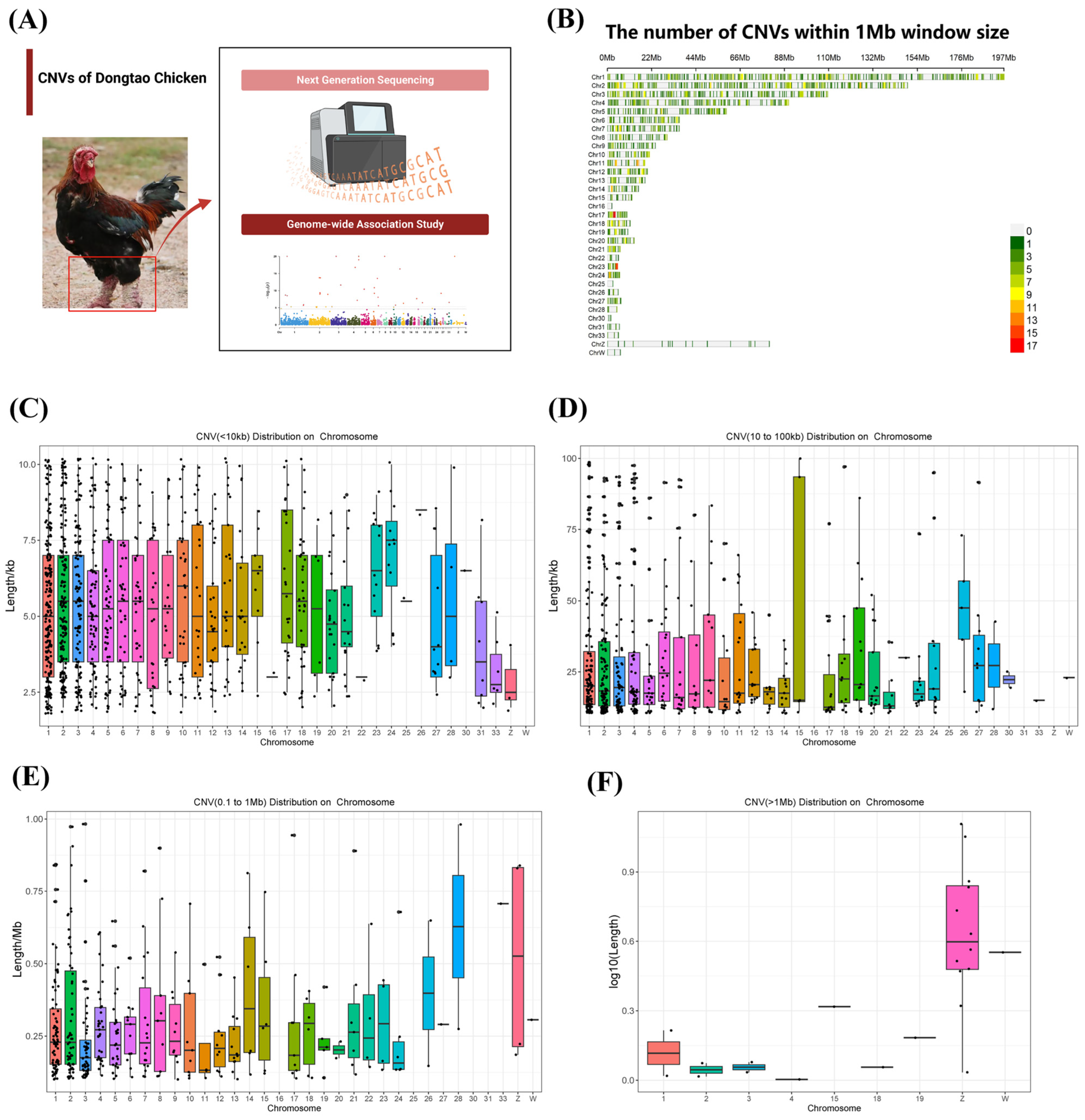
Firstly, copy number variants (CNVs) were detected in 152 local chickens from 10 Chinese and Vietnamese breeds, resulting in the identification of 22,972 events (see Supplementary Table S1). Following the application of a rigorous filtration process, 2193 CNVs were identified, which were distributed across 33 chromosomes (see Supplementary Table S2). The CNV landscape is illustrated in Figure 1B, which demonstrates that chromosomes of greater length exhibit an increased overlap with CNVRs. CNV lengths ranged from 2 kilobases (kb) to 12.8 megabases (Mb), with an average length of 100.81 kb and a cumulative length of 221.1 Mb, accounting for approximately 20.8% of the reference genome (see Supplementary Table S3). Of these CNVs, 1101 were shorter than 10 kb (Figure 1C), 663 were between 10 and 100 kb (Figure 1D), 406 were between 100 kb and 1 Mb (Figure 1E) and 23 were larger than 1 Mb (Figure 1F).
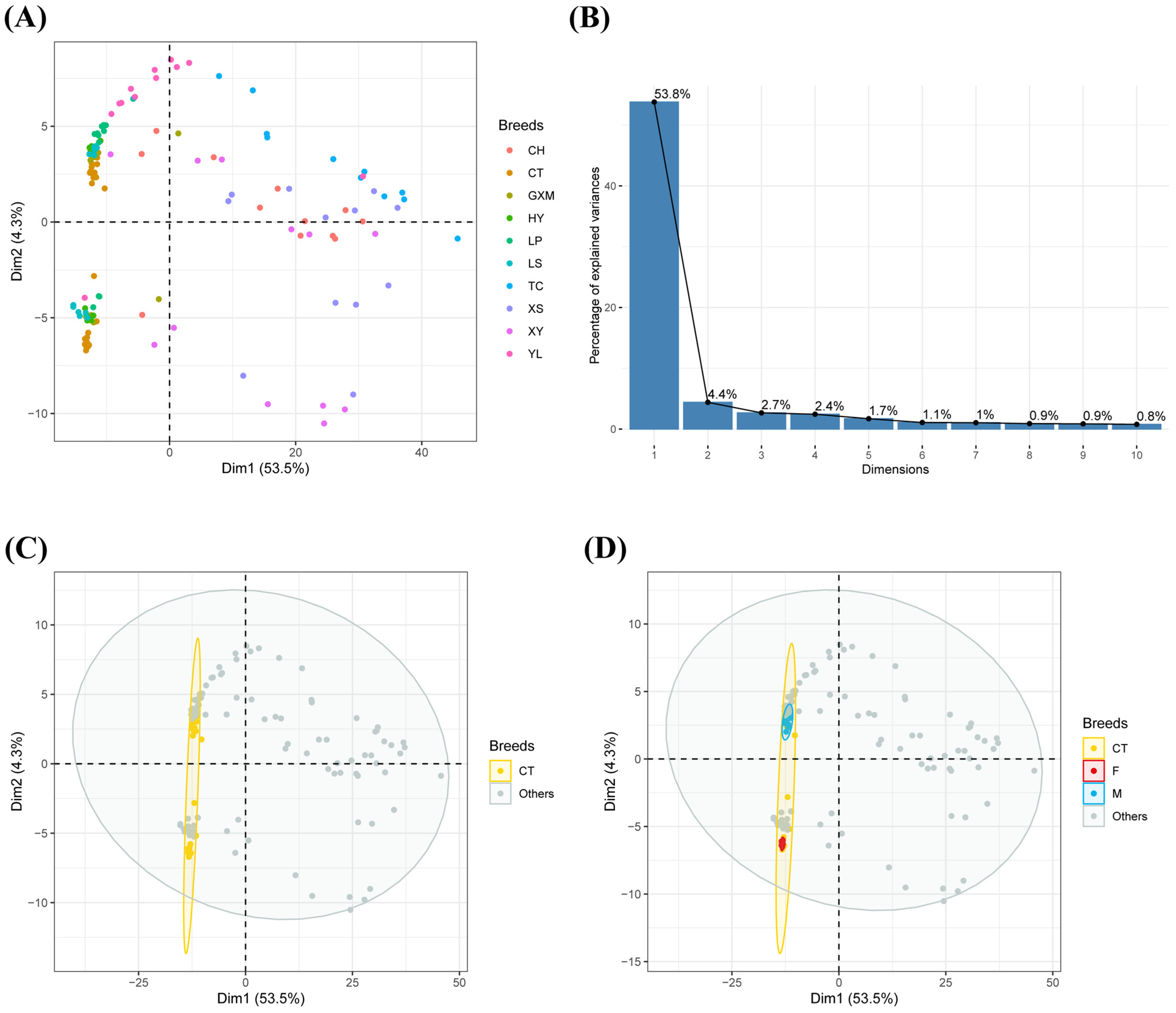
CNV-based principal component analysis was then employed to evaluate the population structure of local chickens from China and Vietnam. The results demonstrated an overall absence of significant separation between the groups (see Figure 2A,B), which is indicative of extensive genetic exchange. In the course of the study, it was found that when Dong Tao chickens were labelled separately from other breeds, two subgroups became apparent (see Figure 2C). Among Dong Tao individuals for which sex was recorded (n = 30), males and females exhibited distinct clustering patterns (Figure 2D), although the biological basis for this remains to be elucidated.

3.2. CNV Genotyping and Venn Analysis

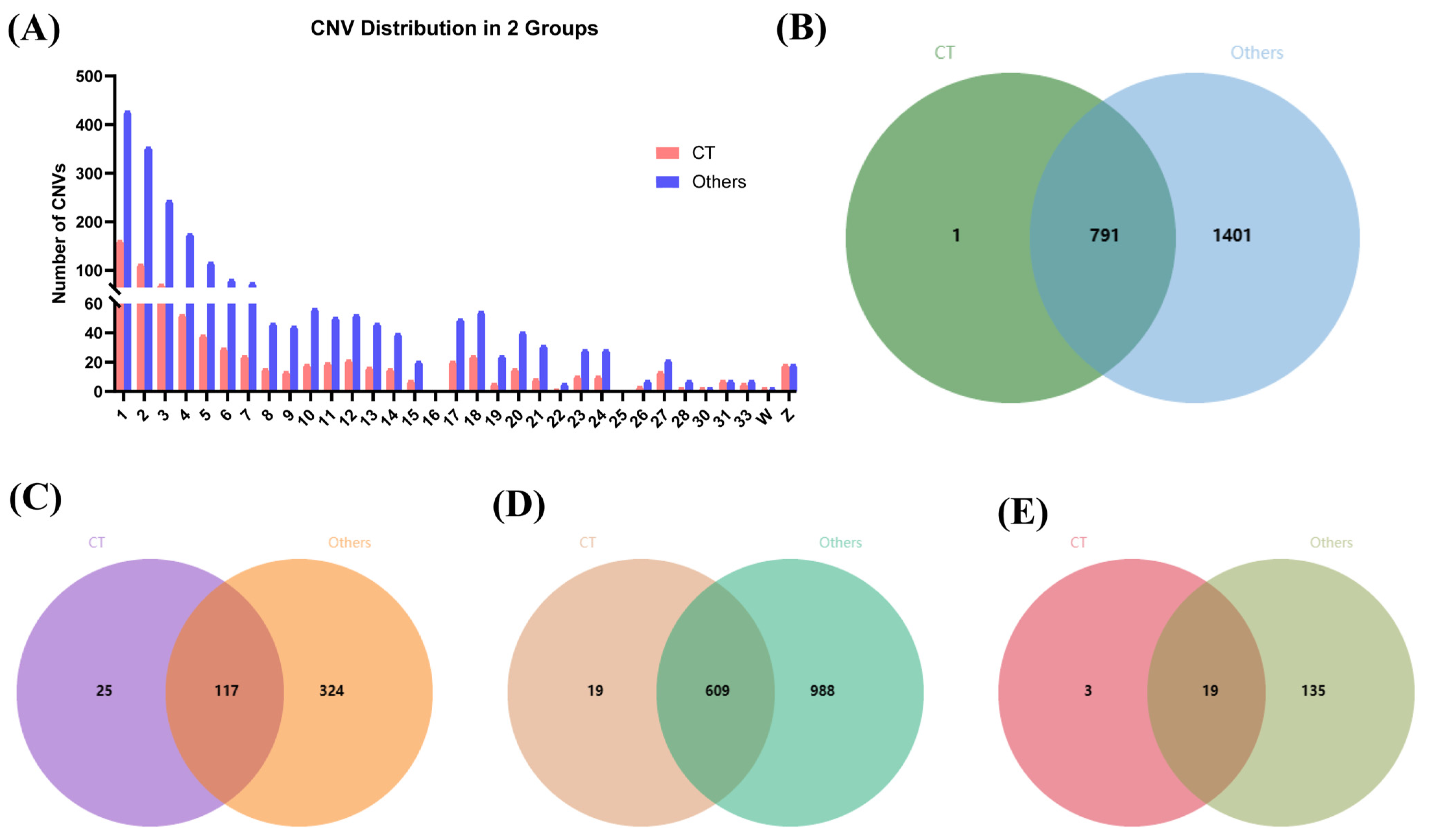
The CNV genotypes were grouped into three classes: normal (N), deletion (L), including dd and Ad, and duplication (D), including AB, BB, BC, and M. A comparison was made of the CNV distributions between the Dong Tao group and the other 106 local chicken breeds. This revealed 792 CNV events in Dong Tao and 2192 in the other breeds (see Figure 3A,B). Within the Dong Tao group, 142 L-type, 628 D-type, and 22 mixed CNVs were identified, with the latter category denoting loci showing both L-type and D-type CNVs across individuals. In the other breeds, 441 L-type, 1597 D-type, and 154 mixed CNVs were identified. In addition, 35 L-type and 3 D-type CNVs were identified in all breeds within the dataset (see Supplementary Table S4). Venn analysis revealed that all breeds shared 117 L-type CNVs (see Figure 3C), 609 D-type CNVs (see Figure 3D) and 19 mixed CNVs (see Figure 3E). It is noteworthy that only one CNV, designated as CNV883, exhibited a specific association with Dong Tao, manifesting as an L-type event on chromosome 3, situated between positions 36,529,501 and 36,539,000, as illustrated in Figure 3B.

3.3. Genome-Wide CNV Detection

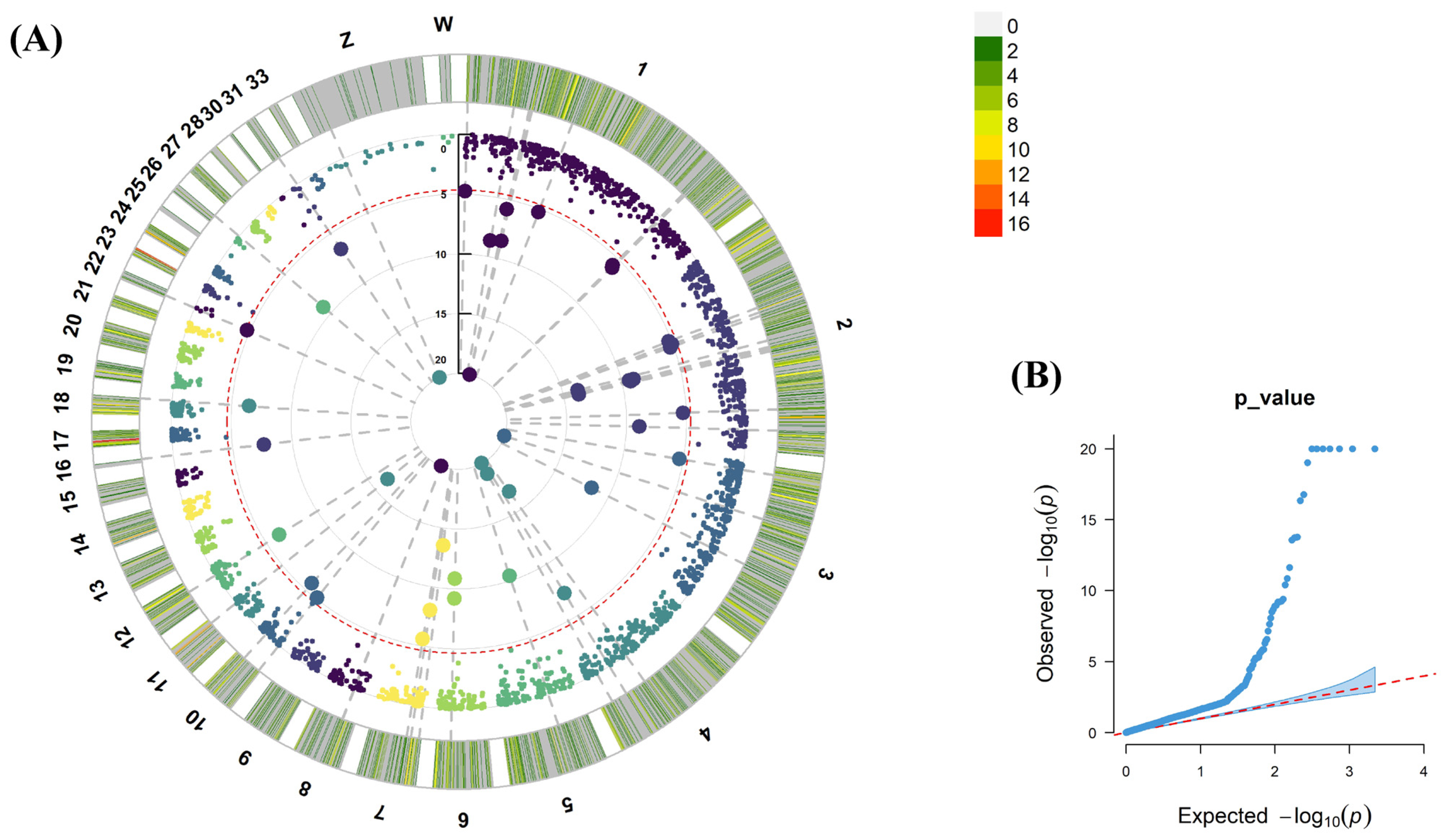
TASSEL v5.0 was utilised to conduct a case–control GWAS on CNV data. The study population comprised 46 Dong Tao chickens, who were designated as cases, and a total of 106 local chickens, who served as controls. The phenotype was coded 2 for cases and 1 for controls. The Manhattan plot identified 44 CNVRs associated with Dong Tao status, of which 35 showed the strongest signals (Figure 4A). The CNVRs in question included 21 deletions, 19 duplications, three normal type regions, and one mixed type, with lengths ranging from 2 kilobases to 10.5 kilobases (see Supplementary Table S5 for details). The quantile–quantile (Q-Q) plot indicated that the test statistics were well calibrated for the model (Figure 4B).

3.4. Gene Annotation and Pathway Enrichment Analysis

The 44 CNVRs identified by GWAS were annotated with the Ensembl Variant Effect Predictor (VEP) using the chicken reference genome GRCg7b. A total of 99 genes were identified within 37 CNVRs, encompassing 51 protein-coding genes, 45 long non-coding (lnc)RNAs, one small nucleolar RNA (snoRNA), and one small nucleolar RNA (snoRNA), as detailed in Supplementary Table S5. Seven CNVRs were found to be intergenic, indicating the absence of annotated genes within these regions. It was observed that two CNVs, designated cnv79 and cnv80, exhibited an overlap with CRADD on chromosome 1. Both CNVs were identified as D-type events in the majority of breeds examined. Furthermore, the Dong Tao-specific CNV883 on chromosome 3 spans CHRM3.
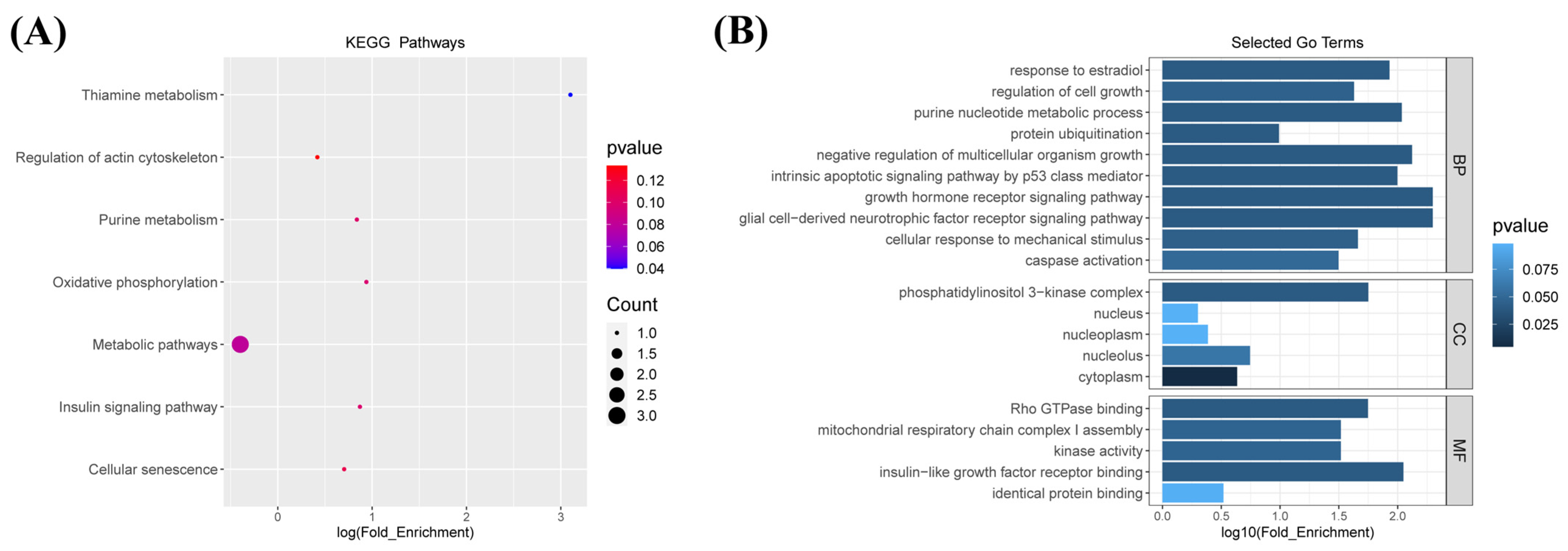
The conversion of gene identifiers was followed by pathway enrichment analysis, which was conducted utilising KOBAS v3.0. In total, seven KEGG pathways and 89 Gene Ontology terms were obtained, of which one KEGG pathway and 46 Gene Ontology terms were significant at p < 0.05, as summarised in Supplementary Table S6. The complete set of KEGG pathways is displayed in Figure 5A. In consideration of the extant evidence that nutrition and metabolism exert an influence on the development of chicken bones [28,29], 20 GO terms pertaining to metabolism or development that satisfied the p < 0.05 threshold or comprised larger gene sets, as illustrated in Figure 5B, were identified. It is noteworthy that the SOCS2 cnv79 D, FHIT cnv1709 D, TPK1 cnv565 D and DIAPH3 cnv348 L genes recurred across KEGG pathways, including thiamine metabolism (gga00730), the insulin signalling pathway (gga04910), purine metabolism (gga00230) and the regulation of actin cytoskeleton (gga04810). In addition, the same genes recurred in GO terms, including the growth hormone receptor signalling pathway (GO:0060396) and actin filament polymerisation (GO:0030041).

4. Discussion

In recent years, a considerable body of research has been dedicated to the investigation of CNVs in the chicken genome. Nonetheless, the majority of conventional detection methodologies principally depend on SNP arrays [30,31]. The advent of high-throughput genotyping has enabled the use of NGS data for the identification of CNVs associated with complex traits. In comparison with SNP arrays, NGS-based CNV detection offers higher marker density and has been implemented in various tools [32,33]. Nonetheless, NGS-based algorithms are subject to certain limitations. These include the occurrence of missed calls in the vicinity of sequencing breakpoints, as well as the presence of limited training data. These factors can result in the production of false negative or positive results [34]. In this study, we employed CNVcaller, a model that has demonstrated enhanced accuracy in comparison with previous iterations [21]. It is noteworthy that the data presented herein reveal variations in heterozygous deletions and duplications within the population. However, when the numbers of these two types are combined with the non-mutated types, the total count remains consistent across populations. This phenomenon was not observed in the detection of homozygous mutations. This finding may indicate that the software algorithm exhibits a lack of sensitivity in detecting heterozygous mutations and non-mutated types, resulting in their indistinguishability.
The focal phenotype of this study is the distinctive tibia morphology (“thick-leg”) in Dong Tao chickens. The determination of this trait may be influenced by specific genetic structural variations. In the present study, the CNV landscape and distribution in Dong Tao chicken and other Chinese and Vietnamese local chicken breeds was examined. CNV-based PCA revealed two clusters within Dong Tao in the subset with recorded sex, suggesting that sex-linked or sex-modulated CNV patterns are present, rather than overall stratification. CNV-GWAS identified 44 CNVRs associated with Dong Tao status, encompassing protein-coding genes and numerous long non-coding RNAs (lncRNAs). It is noteworthy that among the 51 protein-coding genes, TPK1, SOCS2, FHIT and DIAPH3 are particularly salient in their roles in metabolism regulation and development. TPK1 encodes thiamine phosphokinase and has been described as a key gene in thiamine metabolism [35]. In non-avian systems, TPK1 has been linked to diverse cellular processes, including regulation of preadipocyte proliferation/differentiation via miRNA targeting [36] and roles in DNA double-strand break repair [37]. In our CNV association results, TPK1 lies near associated CNV regions and is therefore a positional candidate, but a direct link between TPK1 and tibia development in chickens is currently not established and will require targeted validation in relevant avian tissues and developmental stages. FHIT was also highlighted among annotated genes; existing reports indicate that FHIT can bind a cofactor and inhibit translation and that chemical inhibitors targeting FHIT can induce apoptosis, but these data are largely derived from cancer- and translation-focused studies and do not provide direct evidence for a role in avian skeletal morphogenesis [38,39]. Therefore, FHIT is discussed conservatively as a candidate locus with established cellular functions, while its relevance to chicken bone traits remains to be determined. SOCS2 is a negative regulator of growth-related signaling with direct evidence for roles in avian limb morphogenesis [40]. In chicken embryos, SOCS2 shows region-specific expression in the developing forelimb, and overexpression can alter forelimb gene expression and produce reduced or malformed wings, while hindlimb development is largely unaffected. Accordingly, we interpret SOCS2 primarily as an avian forelimb developmental regulator, and we note it here because it is located within/near an associated CNVR in our breed-comparative analysis. At present, available avian functional evidence does not support a direct role of SOCS2 in hindlimb/tibia development; therefore, any implication for Dong Tao thick-leg morphology should be treated as a positional hypothesis that requires hindlimb- and tibia-focused validation. DIAPH3, located within an associated CNV region, encodes a formin-family regulator of actin cytoskeletal organization [41,42]. Cytoskeletal regulation is broadly relevant to skeletal morphogenesis [43,44,45] because endochondral ossification and long-bone shaping depend on coordinated cellular behaviors that require actin-based dynamics. Therefore, DIAPH3 represents a mechanistically interpretable gene within this CNVR that merits prioritization as a candidate potentially contributing to the breed’s robust lower-leg morphology via gene-dosage and local regulatory effects. However, since our case–control framework detects breed-differentiating CNVs rather than direct CNV-tibia quantitative associations, any DIAPH3-tibia link in chickens remains a working hypothesis and requires avian tissue-specific validation. Furthermore, CRADD, which is annotated by two significantly relevant CNVs, was regarded as a marker for breeds from hot arid regions to adapt to heat stress by genetic analysis based on SNPs [46]. The context of this study aligns with the geographical location of Vietnam, where Dong Tao chicken is sourced, which is situated within the tropical climate zone.
The present study is not without its limitations. Firstly, it should be emphasized that this work is an exploratory, breed-based CNV comparison using a case–control framework (Dong Tao vs. nine reference breeds), rather than a trait-based CNV–phenotype association study across individuals. Because tibia phenotypes were not explicitly modeled as quantitative outcomes in the association testing, the identified CNV regions should be interpreted as breed-differentiating candidates that may be relevant to the characteristic robust lower-leg morphology of Dong Tao, rather than definitive tibia-associated loci. Secondly, due to the limitations of contemporary technology and the intricacies inherent in the reference genome, six micro-chromosomes are absent from the reference assembly. This reference genome is distinguished by its high GC content and short base pairs [47]. Consequently, CNVRs that did not map to explicit chromosomes were filtered, and the focus was restricted to CNVs on 34 pairs of chromosomes (33 pairs of autosomes plus two sex chromosomes), despite the fact that the jungle fowl actually has 39 pairs of chromosomes. Thirdly, the genome of jungle fowl still lacks sufficient annotation [48], and there are few significantly related CNVR-annotated genes. Furthermore, the description of system functions is limited. Concurrently, we identified a substantial number of significant related CNVs that encompass or are in close proximity to a considerable number of LncRNA regions. Nevertheless, there is a paucity of documented functional validations in the chicken species. The present study therefore lacks tissue specificity, and establishing causal links to tibia development will require follow-up studies that collect harmonized tibia phenotypes across breeds, explicitly model these phenotypes in association analyses, and conduct tissue- and stage-specific functional validation. More broadly, integrating multi-omics data (transcriptomic, metabolomic, and epigenetic layers) across relevant tissues and developmental stages may help connect candidate CNVRs to regulatory networks underlying tibia morphogenesis in Dong Tao chickens.

5. Conclusions

In summary, we generated a genome-wide CNV landscape for Dong Tao chickens and nine reference breeds using whole-genome resequencing and identified 44 breed-associated CNVRs covering 99 putative genes. Among the annotated genes, TPK1, SOCS2, DIAPH3, and FHIT were highlighted as candidate loci within/near significant CNVRs, and functional enrichment suggested involvement of growth- and development-related biological processes. CNV883 (Chr3: 36,529,501–36,539,000) may serve as a potential marker for breed discrimination. Because our case–control framework tests breed status rather than modeling tibia phenotypes quantitatively, these signals should be interpreted as breed-differentiating candidate regions potentially related to Dong Tao’s characteristic robust lower-leg morphology and require phenotype-rich and tissue-specific validation to establish links to tibia traits.

Supplementary Materials

The following supporting information can be downloaded at https://www.mdpi.com/article/10.3390/agriculture16020221/s1. Table S1. CNV detection across multiple Chinese/Vietnamese local breeds; Table S2. Genome-wide per-chromosome CNV metrics after stringent filtering; Table S3: List of CNV markers with genomic positions, segment length, p-value, and genotypes across Dong Tao samples; Table S4. Group-wise distribution of CNV types at associated markers (CT vs. other breeds); Table S5. VEP-based annotation of genes overlapped by significant CNVRs; Table S6. GO enrichment analysis.

Author Contributions

H.B. and G.C. (Guobin Chang) conceived and designed the experiments. D.G., W.Z. and Y.Z. performed the experiments and participated in the data collection. H.B., D.G. and W.Z. analyzed the data and wrote the paper. G.C. (Guohong Chen), G.C. (Guobin Chang) and H.B. revised the manuscript. All authors have read and agreed to the published version of the manuscript.

Funding

This work was supported by the earmarked fund for CARS (CARS-41), the Jiangsu Key Research and Development Program (BE2022341), the Changzhou Modern Agriculture Science and Technology Innovation Center (CAIC(2023)001), and the College Student’s Innovative Entrepreneurial Training Plan Program of Yangzhou University (JILAR2021-23).

Institutional Review Board Statement

All samples were collected in accordance with the guidelines proposed by the China Council on Animal Care and the Ministry of Agriculture of the People’s Republic of China. Approval for the study was granted by the Institutional Animal Care and Use Committee and the School of Animal Experiments Ethics Committee of Yangzhou University (approval number YZUDWSY2017-11-07).

Data Availability Statement

The data supporting the findings of this study are available from the corresponding author upon reasonable request.

Conflicts of Interest

The authors declare there are no conflicts of interest.

References

  1. Godfray, H.C.J.; Aveyard, P.; Garnett, T.; Hall, J.W.; Key, T.J.; Lorimer, J.; Pierrehumbert, R.T.; Scarborough, P.; Springmann, M.; Jebb, S.A.; et al. Meat consumption, health, and the environment. Science 2018, 361, eaam5324. [Google Scholar] [CrossRef]
  2. Peters, J.; Lebrasseur, O.; Irving-Pease, E.K.; Paxinos, P.D.; Best, J.; Smallman, R.; Callou, C.; Gardeisen, A.; Trixl, S.; Frantz, L.; et al. The biocultural origins and dispersal of domestic chickens. Proc. Natl. Acad. Sci. USA 2022, 119, e2121978119. [Google Scholar] [CrossRef]
  3. Evelyne, M.; Nguyen Van, D.; Amelyne, D.; Nguyen Hoang, T.; Duc, L.D.; Nassim, M.; Dinh, T.V.; Frédéric, F. High-resolution genomic analysis of four local Vietnamese chicken breeds. J. Anim. Breed. Genet. 2022, 139, 583–595. [Google Scholar] [CrossRef]
  4. Zhuang, Z.; Zhao, L.; Zong, W.; Guo, Q.; Li, X.; Bi, Y.; Wang, Z.; Jiang, Y.; Chen, G.; Li, B.; et al. Genetic diversity and breed identification of Chinese and Vietnamese local chicken breeds based on microsatellite analysis. J. Anim. Sci. 2023, 101, skad182. [Google Scholar] [CrossRef]
  5. Luu, A.H.; Budi, T.; Singchat, W.; Nguyen, C.P.T.; Panthum, T.; Tanglertpaibul, N.; Thong, T.; Vangnai, K.; Chaiyes, A.; Yokthongwattana, C.; et al. Comparison of unique Dong Tao chickens from Vietnam and Thailand: Genetic background and differences for resource management. Genes Genom. 2025, 47, 727–739. [Google Scholar] [CrossRef]
  6. Chen, Q.; Huang, B.; Zhan, J.; Wang, J.; Qu, K.; Zhang, F.; Shen, J.; Jia, P.; Ning, Q.; Zhang, J.; et al. Whole-genome analyses identify loci and selective signals associated with body size in cattle. J. Anim. Sci. 2020, 98, skaa068. [Google Scholar] [CrossRef] [PubMed]
  7. Jiang, J.; Cao, Y.; Shan, H.; Wu, J.; Song, X.; Jiang, Y. The GWAS Analysis of Body Size and Population Verification of Related SNPs in Hu Sheep. Front. Genet. 2021, 12, 642552. [Google Scholar] [CrossRef] [PubMed]
  8. Guo, J.; Sun, C.; Qu, L.; Shen, M.; Dou, T.; Ma, M.; Wang, K.; Yang, N. Genetic architecture of bone quality variation in layer chickens revealed by a genome-wide association study. Sci. Rep. 2017, 45317. [Google Scholar] [CrossRef] [PubMed]
  9. Bonatto Paese, C.L.; Hawkins, M.B.; Brugmann, S.A.; Harris, M.P. Atavisms in the avian hindlimb and early developmental polarity of the limb. Dev. Dyn. 2021, 250, 1358–1367. [Google Scholar] [CrossRef]
  10. Huang, M.; Liu, Y.; Lu, X. Genomic Basis of Adaptive Divergence in Leg Length between Ground- and Tree-Dwelling Species within a Bird Family. Genome Biol. Evol. 2023, 15, evad166. [Google Scholar] [CrossRef]
  11. Wang, S.Z.; Wang, M.D.; Wang, J.Y.; Yuan, M.; Li, Y.D.; Luo, P.T.; Xiao, F.; Li, H. Genome-wide association study of growth curve parameters reveals novel genomic regions and candidate genes associated with metatarsal bone traits in chickens. Animal 2024, 18, 101129. [Google Scholar] [CrossRef] [PubMed]
  12. Liang, H.; Sedillo, J.C.; Schrodi, S.J.; Ikeda, A. Structural variants in linkage disequilibrium with GWAS-significant SNPs. Heliyon 2024, 10, e32053. [Google Scholar] [CrossRef] [PubMed]
  13. Bamshad, M.; Le, T.; Watkins, W.S.; Dixon, M.E.; Kramer, B.E.; Roeder, A.D.; Carey, J.C.; Root, S.; Schinzel, A.; Van Maldergem, L.; et al. The spectrum of mutations in TBX3 genotype phenotype relationship in ulnar-mammary syndrome. Am. J. Hum. Genet. 1999, 64, 1550–1562. [Google Scholar] [CrossRef]
  14. Liu, X.X.; Zhang, Y.L.; Liu, W.J.; Li, Y.F.; Pan, J.F.; Pu, Y.B.; Han, J.L.; Orlando, L.; Ma, Y.H.; Jiang, L.; et al. A single-nucleotide mutation within the TBX3 enhancer increased body size in Chinese horses. Curr. Biol. 2022, 32, 480–487.e6. [Google Scholar] [CrossRef]
  15. Redon, R.; Ishikawa, S.; Fitch, K.R.; Feuk, L.; Perry, G.H.; Andrews, T.D.; Fiegler, H.; Shapero, M.H.; Carson, A.R.; Chen, W.; et al. Global variation in copy number in the human genome. Nature 2006, 444, 444–454. [Google Scholar] [CrossRef]
  16. Lotfizadeh, F.; Masoudi, A.A.; Vaez Torshizi, R.; Emrani, H. Genome-wide association study of copy number variations with shank traits in a F2 crossbred chicken population. Anim. Genet. 2024, 55, 559–574. [Google Scholar] [CrossRef]
  17. Xie, X.; Shi, L.; Hou, G.; Zhong, Z.; Wang, Z.; Pan, D.; Na, W.; Xiao, Q. Genome wide detection of CNV and their association with body size in Danzhou chickens. Poult. Sci. 2024, 103, 104266. [Google Scholar] [CrossRef]
  18. Kafi, Z.; Masoudi, A.A.; Torshizi, R.V.; Ehsani, A. Copy number variations affecting growth curve parameters in a crossbred chicken population. Gene 2024, 927, 148710. [Google Scholar] [CrossRef]
  19. Yang, S.; Ning, C.; Yang, C.; Li, W.; Zhang, Q.; Wang, D.; Tang, H. Identify Candidate Genes Associated with the Weight and Egg Quality Traits in Wenshui Green Shell-Laying Chickens by the Copy Number Variation-Based Genome-Wide Association Study. Vet. Sci. 2024, 11, 76. [Google Scholar] [CrossRef]
  20. Li, H.; Durbin, R. Fast and accurate short read alignment with Burrows–Wheeler transform. Bioinformatics 2009, 25, 1754–1760. [Google Scholar] [CrossRef] [PubMed]
  21. Wang, X.; Zheng, Z.; Cai, Y.; Chen, T.; Li, C.; Fu, W.; Jiang, Y. CNVcaller: Highly efficient and widely applicable software for detecting copy number variations in large populations. GigaScience 2017, 6, 1–12. [Google Scholar] [CrossRef]
  22. Bardou, P.; Mariette, J.; Escudié, F.; Djemiel, C.; Klopp, C. jvenn: An interactive Venn diagram viewer. BMC Bioinform. 2014, 15, 293. [Google Scholar] [CrossRef] [PubMed]
  23. Bradbury, P.J.; Zhang, Z.; Kroon, D.E.; Casstevens, T.M.; Ramdoss, Y.; Buckler, E.S. TASSEL: Software for association mapping of complex traits in diverse samples. Bioinformatics 2007, 23, 2633–2635. [Google Scholar] [CrossRef]
  24. McLaren, W.; Gil, L.; Hunt, S.E.; Riat, H.S.; Ritchie, G.R.S.; Thormann, A.; Flicek, P.; Cunningham, F. The Ensembl Variant Effect Predictor. Genome Biol. 2016, 17, 122. [Google Scholar] [CrossRef]
  25. Sherman, B.T.; Hao, M.; Qiu, J.; Jiao, X.; Baseler, M.W.; Lane, H.C.; Imamichi, T.; Chang, W. DAVID: A web server for functional enrichment analysis and functional annotation of gene lists 2021 update. Nucleic Acids Res. 2022, 50, W216–W221. [Google Scholar] [CrossRef] [PubMed]
  26. Bu, D.; Luo, H.; Huo, P.; Wang, Z.; Zhang, S.; He, Z.; Wu, Y.; Zhao, L.; Liu, J.; Guo, J.; et al. KOBAS-i: Intelligent prioritization and exploratory visualization of biological functions for gene enrichment analysis. Nucleic Acids Res. 2021, 49, W317–W325. [Google Scholar] [CrossRef]
  27. Benjamini, Y.; Hochberg, Y. Controlling the false discovery rate a practical and powerful approach to multiple testing. J. R. Stat. Soc. Ser. B 1995, 57, 289–300. [Google Scholar] [CrossRef]
  28. Nguyen, H.T.T.; Morgan, N.; Roberts, J.R.; Wu, S.B.; Swick, R.A.; Toghyani, M. Zinc hydroxychloride supplementation improves tibia bone development and intestinal health of broiler chickens. Poult. Sci. 2021, 100, 101254. [Google Scholar] [CrossRef]
  29. Wu, Y.; Zhou, X.; Wang, M.; Wang, W.; Yang, Y. Effect of light intensity on growth performance and bone development of tibia in broilers. J. Anim. Physiol. Anim. Nutr. 2022, 107, 192–199. [Google Scholar] [CrossRef]
  30. Gorla, E.; Cozzi, M.C.; Roman-Ponce, S.I.; Lopez, F.J.R.; Vega-Murillo, V.E.; Cerolini, S.; Bagnato, A.; Strillacci, M.G. Genomic variability in Mexican chicken population using copy number variants. BMC Genet. 2017, 18, 61. [Google Scholar] [CrossRef]
  31. Mace, A.; Tuke, M.A.; Beckmann, J.S.; Lin, L.; Jacquemont, S.; Weedon, M.N.; Reymond, A.; Kutalik, Z. New quality measure for SNP array based CNV detection. Bioinformatics 2016, 32, 3298–3305. [Google Scholar] [CrossRef]
  32. Abyzov, A.; Urban, A.E.; Snyder, M.; Gerstein, M. CNVnator an approach to discover genotype and characterize typical and atypical CNVs from family and population genome sequencing. Genome Res. 2011, 21, 974–984. [Google Scholar] [CrossRef]
  33. Hujoel, M.L.A.; Sherman, M.A.; Barton, A.R.; Mukamel, R.E.; Sankaran, V.G.; Terao, C.; Loh, P.-R. Influences of rare copy-number variation on human complex traits. Cell 2022, 185, 4233–4248.e27. [Google Scholar] [CrossRef]
  34. Sanders, J.G.; Nurk, S.; Salido, R.A.; Minich, J.; Xu, Z.J.Z.; Zhu, Q.Y.; Martino, C.; Fedarko, M.; Arthur, T.D.; Chen, F.; et al. Optimizing sequencing protocols for leaderboard metagenomics by combining long and short reads. Genome Biol. 2019, 20, 226. [Google Scholar] [CrossRef]
  35. Zhao, R.B.; Gao, F.; Goldman, I.D. Molecular cloning of human thiamin pyrophosphokinase. BBA—Gene Struct. Expr. 2001, 1517, 320–322. [Google Scholar] [CrossRef]
  36. Zhang, X.; Wang, M.; Tang, T.; Zhou, J.; Sun, W. The Molecular Mechanism by Which miR-211-5p Regulates the Proliferation and Differentiation of Preadipocytes in Meat Rabbits by Targeting TPK1. Animals 2025, 15, 1497. [Google Scholar] [CrossRef]
  37. Jessulat, M.; Amin, S.; Hooshyar, M.; Malty, R.; Moutaoufik, M.T.; Zilocchi, M.; Istace, Z.; Phanse, S.; Aoki, H.; Omidi, K.; et al. The conserved Tpk1 regulates non-homologous end joining double-strand break repair by phosphorylation of Nej1, a homolog of the human XLF. Nucleic Acids Res. 2021, 49, 8145–8160. [Google Scholar] [CrossRef] [PubMed]
  38. Seol, D.; Ko, B.J.; Kim, B.; Chai, H.-H.; Lim, D.; Kim, H. Identification of copy number variation in domestic chicken using whole-genome sequencing reveals evidence of selection in the genome. Animals 2019, 9, 809. [Google Scholar] [CrossRef] [PubMed]
  39. Muroya, S.; Oe, M.; Ojima, K. Thiamine accumulation and thiamine triphosphate decline occur in parallel with ATP exhaustion during postmortem aging of pork muscles. Meat Sci. 2018, 137, 228–234. [Google Scholar] [CrossRef] [PubMed]
  40. Li, X.; Li, S.; Bai, S.; Tang, Y.; Jia, Z.; Yin, J.; Xu, X.; Zhang, J.; Irwin, D.M.; Zhang, S.; et al. Research Note: SOCS2 contributes to reduction of the third digit during development of the chicken forelimb. Poult. Sci. 2024, 103, 103672. [Google Scholar] [CrossRef]
  41. Qiu, C.; Zhang, L.; Yong, C.; Hu, R.; Sun, Y.; Wang, B.; Fang, L.; Zhu, G.J.; Lu, Q.; Wang, J.; et al. Stub1 promotes degradation of the activated Diaph3: A negative feedback regulatory mechanism of the actin nucleator. J. Biol. Chem. 2024, 300, 107813. [Google Scholar] [CrossRef]
  42. Lau, E.O.; Damiani, D.; Chehade, G.; Ruiz-Reig, N.; Saade, R.; Jossin, Y.; Aittaleb, M.; Schakman, O.; Tajeddine, N.; Gailly, P.; et al. DIAPH3 deficiency links microtubules to mitotic errors, defective neurogenesis, and brain dysfunction. eLife 2021, 10, e61974. [Google Scholar] [CrossRef]
  43. Dinesh, N.E.H.; Campeau, P.M.; Reinhardt, D.P. The integral role of fibronectin in skeletal morphogenesis and pathogenesis. Matrix Biol. 2024, 134, 23–29. [Google Scholar] [CrossRef]
  44. Moharrer, Y.; Boerckel, J.D. Tunnels in the rock: Dynamics of osteocyte morphogenesis. Bone 2021, 153, 116104. [Google Scholar] [CrossRef]
  45. Sunadome, K.; Erickson, A.G.; Kah, D.; Fabry, B.; Adori, C.; Kameneva, P.; Faure, L.; Kanatani, S.; Kaucka, M.; Dehnisch Ellström, I.; et al. Directionality of developing skeletal muscles is set by mechanical forces. Nat. Commun. 2023, 14, 3060. [Google Scholar] [CrossRef] [PubMed]
  46. Gu, J.; Liang, Q.; Liu, C.; Li, S. Genomic analyses reveal adaptation to hot arid and harsh environments in native chickens of China. Front. Genet. 2020, 11, 582355. [Google Scholar] [CrossRef] [PubMed]
  47. Huang, Z.; Xu, Z.; Bai, H.; Huang, Y.; Kang, N.; Ding, X.; Liu, J.; Luo, H.; Yang, C.; Chen, W.; et al. Evolutionary analysis of a complete chicken genome. Proc. Natl. Acad. Sci. USA 2023, 120, e2216641120. [Google Scholar] [CrossRef]
  48. Tuggle, C.K.; Giuffra, E. 29 Introduction to Functional Annotation of Animal Genomes Consortium. J. Anim. Sci. 2019, 97, 17. [Google Scholar] [CrossRef]
Figure 1. Genome-wide CNV landscape and size distributions. (A) Study schematic highlighting CNVs in Dong Tao chickens. (B) CNV counts per 1-Mb genomic window across chromosomes. (CF) Chromosome-wise CNV length distributions for <10 kb, 10–100 kb, 0.1–1 Mb, and >1 Mb.
Agriculture 16 00221 g001
Figure 2. CNV-based PCA of study populations. (A) PCA of all sampled chickens. CH: Gallus gallus spadiceus; CT: GÀ Tỉnh hưng (Dong Tao); GXM: Guangxi partridge chicken; HY: Yao chicken; LP: Lanping silky chicken; LS: Longshengfeng chicken; TC: Tengchong white chicken; XS: Xishuangbanna game chicken; XY: Xiayan chicken; YL: Yunlong dwarf chicken. (B) Scree plot showing variance explained by principal components. (C) PCA highlighting Dong Tao versus other breeds. (D) PCA of Dong Tao individuals colored by sex.
Agriculture 16 00221 g002
Figure 3. CNV genotyping summary and overlap between groups. (A) Chromosome-wise counts of CNVs in Dong Tao (CT, red) and other local breeds (Others, blue). (B) Venn diagram of all CNVs in CT and Others. (C) Venn diagram of deletion-type CNVs (L). (D) Venn diagram of duplication-type CNVs (D). (E) Venn diagram of mixed-type CNVs (Mixed; loci showing both L and D across individuals).
Agriculture 16 00221 g003
Figure 4. CNV-based genome-wide association analysis. (A) Circular Manhattan plot of CNVR association statistics across chromosomes; points represent CNVRs (colored as indicated), and the dashed circle denotes the genome-wide significance threshold. Values are shown as −log10(p). (B) Q-Q plot of observed versus expected −log10(p) with the null line (dashed) and confidence band.
Agriculture 16 00221 g004
Figure 5. Functional enrichment of genes within associated CNVRs. (A) KEGG pathway bubble plot for genes mapped to associated CNVRs. (B) Selected GO terms for biological process (BP), cellular component (CC), and molecular function (MF).
Agriculture 16 00221 g005
Table 1. Summary of sampled Chinese and Vietnamese local chicken breeds, sampling locations, sample sizes, and tibia measurements.
BreedEconomic CharacterHabitatSample SizeTibia Length (cm)Tibia Width (cm)
MaleFemaleMaleFemale
Gallus gallus spadiceusMeat typeXishuangbanna Dai Autonomous Prefecture, Yunnan Province128.9 ± 0.87.6 ± 0.54.0 ± 0.23.4 ± 0.2
Lanping silky chickenMeat and Medicinal typeLanping County, Yunnan Province1210.3 ± 0.48.8 ± 0.54.8 ± 0.44.0 ± 0.2
Tengchong white chickenMeat and Medicinal typeTengchong County, Yunnan Province1210.4 ± 0.48.2 ± 0.44.8 ± 0.24.1 ± 0.1
Xishuangbanna game chickenMeat and Medicinal typeXishuangbanna Dai Autonomous Prefecture, Yunnan Province1212.0 ± 1.29.8 ± 0.95.1 ± 0.64.2 ± 0.4
Yunlong dwarf chickenMeat and Egg typeYunlong County, Yunnan Province127.4 ± 0.46.5 ± 0.34.0 ± 0.43.2 ± 0.3
Guangxi partridge chickenMeat and Egg typeLingshan County, Guangxi118.11 ± 0.36.8 ± 0.34.4 ± 0.23.6 ± 0.1
Yao chickenMeat typeNandan county, Guangxi119.8 ± 0.57.6 ± 0.44.8 ± 0.43.9 ± 0.2
Longshengfeng chickenMeat typeLongsheng County, Guangxi128.9 ± 0.57.4 ± 0.33.9 ± 0.23.3 ± 0.1
Xiayan chickenMeat typeRong County, Guangxi128.3 ± 1.26.3 ± 0.44.5 ± 0.23.8 ± 0.1
Dong Tao chickenMeat typeTỉnh hưng yên (Khingan Province, Vietnam)4610.51 ± 0.958.03 ± 0.7610.36 ± 1.767.1 ± 0.73
Disclaimer/Publisher’s Note: The statements, opinions and data contained in all publications are solely those of the individual author(s) and contributor(s) and not of MDPI and/or the editor(s). MDPI and/or the editor(s) disclaim responsibility for any injury to people or property resulting from any ideas, methods, instructions or products referred to in the content.